
ChemistryQ1–94 of 117 questions
Page 1 of 2 · English
1
ChemistryMCQNEET · 2015
The imperfect fungi which are decomposers of litter and help in mineral cycling belong to
A
Phycomycetes
B
Ascomycetes
C
Deuteromycetes
D
Basidiomycetes
Solution
(C) : $Deuteromycetes$ are known as the imperfect fungi because their sexual stage is either absent or not yet discovered. Many members of this group act as saprophytes or parasites,while a significant number function as decomposers of litter and play a crucial role in mineral cycling. Examples include $Colletotrichum$ and $Helminthosporium$.
0 likesView Solution
2
ChemistryMCQNEET · 2015
Tthe floral formula of
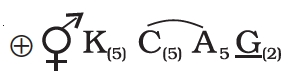
A
Petunia
B
Brassica
C
Allium
D
Sesbania.
Solution
(a) : The given floral formula is of Family Solanaceae. Among the given options, only Petunia belongs to Family Solanaceae. Allium is a member of Family Liliaceae, Sesbania is of Family Leguminosae and Brassica is a member of Family Brassicaceae or Cruciferae.
0 likesView Solution
3
ChemistryMCQNEET · 2015
Which of these is not an important component of initiation of parturition in humans?
A
Release of oxytocin
B
Release of prolactin
C
Increase in estrogen and progesterone ratio
D
Synthesis of prostaglandins
Solution
(B) : The process of parturition is induced by a complex neuroendocrine mechanism. The signals for parturition originate from the fully developed foetus and the placenta,which induce mild uterine contractions known as the foetal ejection reflex. This reflex triggers the release of oxytocin from the maternal posterior pituitary gland,which further stimulates stronger uterine contractions. Prostaglandins also play a crucial role in stimulating uterine contractions. An increase in the estrogen to progesterone ratio is essential for the onset of labour. Prolactin is primarily responsible for milk production (lactation) after childbirth and does not play a role in the initiation of parturition.
0 likesView Solution
4
ChemistryMediumMCQNEET · 2015
What is the mass of the precipitate formed when $50 \ mL$ of $16.9 \%$ solution of $AgNO_3$ is mixed with $50 \ mL$ of $5.8 \%$ $NaCl$ solution (in $g$)? (Atomic masses: $Ag = 107.8, N = 14, O = 16, Na = 23, Cl = 35.5$)
A
$3.5$
B
$7.17$
C
$14.35$
D
$28.7$
Solution
(B) $1$. Calculate the moles of $AgNO_3$: The molar mass of $AgNO_3 = 107.8 + 14 + (3 \times 16) = 169.8 \ g/mol$. Assuming the density of the solution is $1 \ g/mL$,mass of $50 \ mL$ solution = $50 \ g$. Moles of $AgNO_3 = (50 \times 0.169) / 169.8 \approx 0.05 \ mol$.
$2$. Calculate the moles of $NaCl$: The molar mass of $NaCl = 23 + 35.5 = 58.5 \ g/mol$. Moles of $NaCl = (50 \times 0.058) / 58.5 \approx 0.05 \ mol$.
$3$. The reaction is: $AgNO_3(aq) + NaCl(aq) \rightarrow AgCl(s) + NaNO_3(aq)$.
$4$. Since the stoichiometry is $1:1$,$0.05 \ mol$ of $AgNO_3$ reacts with $0.05 \ mol$ of $NaCl$ to produce $0.05 \ mol$ of $AgCl$ precipitate.
$5$. Molar mass of $AgCl = 107.8 + 35.5 = 143.3 \ g/mol$.
$6$. Mass of $AgCl = 0.05 \ mol \times 143.3 \ g/mol = 7.165 \ g \approx 7.17 \ g$.
$2$. Calculate the moles of $NaCl$: The molar mass of $NaCl = 23 + 35.5 = 58.5 \ g/mol$. Moles of $NaCl = (50 \times 0.058) / 58.5 \approx 0.05 \ mol$.
$3$. The reaction is: $AgNO_3(aq) + NaCl(aq) \rightarrow AgCl(s) + NaNO_3(aq)$.
$4$. Since the stoichiometry is $1:1$,$0.05 \ mol$ of $AgNO_3$ reacts with $0.05 \ mol$ of $NaCl$ to produce $0.05 \ mol$ of $AgCl$ precipitate.
$5$. Molar mass of $AgCl = 107.8 + 35.5 = 143.3 \ g/mol$.
$6$. Mass of $AgCl = 0.05 \ mol \times 143.3 \ g/mol = 7.165 \ g \approx 7.17 \ g$.
1 likesView Solution
5
ChemistryMediumMCQNEET · 2015
If Avogadro number $N_A$ is changed from $6.022 \times 10^{23} \ mol^{-1}$ to $6.022 \times 10^{20} \ mol^{-1},$ this would change
A
the mass of one mole of carbon
B
the ratio of chemical species to each other in a balanced equation
C
the ratio of elements to each other in a compound
D
the definition of mass in units of grams.
Solution
(A) The mass of $1 \ mol$ of a substance is defined as the mass of $N_A$ particles of that substance.
Currently,the mass of $1 \ mol$ ($6.022 \times 10^{23}$ atoms) of carbon is $12 \ g$.
If the Avogadro number $(N_A)$ is changed to $6.022 \times 10^{20} \ mol^{-1}$,the mass of $1 \ mol$ of carbon would become the mass of $6.022 \times 10^{20}$ atoms,which is $\frac{12 \times 6.022 \times 10^{20}}{6.022 \times 10^{23}} = 12 \times 10^{-3} \ g$.
Since the number of particles defining a mole has changed,the mass of one mole of carbon changes.
The ratios of chemical species in balanced equations and elements in compounds are based on the law of definite proportions and conservation of mass,which are independent of the numerical value of $N_A$.
Currently,the mass of $1 \ mol$ ($6.022 \times 10^{23}$ atoms) of carbon is $12 \ g$.
If the Avogadro number $(N_A)$ is changed to $6.022 \times 10^{20} \ mol^{-1}$,the mass of $1 \ mol$ of carbon would become the mass of $6.022 \times 10^{20}$ atoms,which is $\frac{12 \times 6.022 \times 10^{20}}{6.022 \times 10^{23}} = 12 \times 10^{-3} \ g$.
Since the number of particles defining a mole has changed,the mass of one mole of carbon changes.
The ratios of chemical species in balanced equations and elements in compounds are based on the law of definite proportions and conservation of mass,which are independent of the numerical value of $N_A$.
0 likesView Solution
6
ChemistryDifficultMCQNEET · 2015
The number of water molecules is maximum in
A
$1.8 \ g$ of water
B
$18 \ g$ of water
C
$18 \ moles$ of water
D
$18$ molecules of water
Solution
(C) To find the number of water molecules,we calculate the number of moles in each option:
$A$. $1.8 \ g$ of $H_2O = \frac{1.8 \ g}{18 \ g/mol} = 0.1 \ mol$
$B$. $18 \ g$ of $H_2O = \frac{18 \ g}{18 \ g/mol} = 1 \ mol$
$C$. $18 \ moles$ of $H_2O = 18 \ mol$
$D$. $18$ molecules of $H_2O = \frac{18}{6.022 \times 10^{23}} \ mol$
Since the number of molecules is directly proportional to the number of moles $(N = n \times N_A)$,the option with the highest number of moles will have the maximum number of molecules.
Therefore,$18 \ moles$ of water contains the maximum number of molecules.
$A$. $1.8 \ g$ of $H_2O = \frac{1.8 \ g}{18 \ g/mol} = 0.1 \ mol$
$B$. $18 \ g$ of $H_2O = \frac{18 \ g}{18 \ g/mol} = 1 \ mol$
$C$. $18 \ moles$ of $H_2O = 18 \ mol$
$D$. $18$ molecules of $H_2O = \frac{18}{6.022 \times 10^{23}} \ mol$
Since the number of molecules is directly proportional to the number of moles $(N = n \times N_A)$,the option with the highest number of moles will have the maximum number of molecules.
Therefore,$18 \ moles$ of water contains the maximum number of molecules.
0 likesView Solution
7
ChemistryDifficultMCQNEET · 2015
$A$ mixture of gases contains $H_2$ and $O_2$ gases in the ratio of $1 : 4$ $(w/w)$. What is the molar ratio of the two gases in the mixture?
A
$16 : 1$
B
$2 : 1$
C
$1 : 4$
D
$4 : 1$
Solution
(D) Let the mass of $H_2$ gas be $x \ g$ and the mass of $O_2$ gas be $4x \ g$.
The molar mass of $H_2$ is $2 \ g/mol$ and the molar mass of $O_2$ is $32 \ g/mol$.
The number of moles of $H_2$ $(n_{H_2})$ $= \frac{x}{2}$.
The number of moles of $O_2$ $(n_{O_2})$ $= \frac{4x}{32} = \frac{x}{8}$.
The molar ratio of $H_2$ to $O_2$ is $\frac{n_{H_2}}{n_{O_2}} = \frac{x/2}{x/8} = \frac{8}{2} = 4 : 1$.
The molar mass of $H_2$ is $2 \ g/mol$ and the molar mass of $O_2$ is $32 \ g/mol$.
The number of moles of $H_2$ $(n_{H_2})$ $= \frac{x}{2}$.
The number of moles of $O_2$ $(n_{O_2})$ $= \frac{4x}{32} = \frac{x}{8}$.
The molar ratio of $H_2$ to $O_2$ is $\frac{n_{H_2}}{n_{O_2}} = \frac{x/2}{x/8} = \frac{8}{2} = 4 : 1$.
0 likesView Solution
8
ChemistryMediumMCQNEET · 2015
Which is the correct order of increasing energy of the listed orbitals in the atom of titanium? (At. no. $Z = 22$)
A
$4s < 3s < 3p < 3d$
B
$3s < 3p < 3d < 4s$
C
$3s < 3p < 4s < 3d$
D
$3s < 4s < 3p < 3d$
Solution
(C) The electronic configuration of Titanium $(Z = 22)$ is $1s^2 2s^2 2p^6 3s^2 3p^6 4s^2 3d^2$.
According to the $(n+l)$ rule,the energy of an orbital increases as the value of $(n+l)$ increases.
For $3s$: $n+l = 3+0 = 3$.
For $3p$: $n+l = 3+1 = 4$.
For $4s$: $n+l = 4+0 = 4$.
For $3d$: $n+l = 3+2 = 5$.
Since $3p$ and $4s$ have the same $(n+l)$ value,the one with the lower $n$ value has lower energy. Thus,$3p < 4s$.
The correct order of increasing energy is $3s < 3p < 4s < 3d$.
According to the $(n+l)$ rule,the energy of an orbital increases as the value of $(n+l)$ increases.
For $3s$: $n+l = 3+0 = 3$.
For $3p$: $n+l = 3+1 = 4$.
For $4s$: $n+l = 4+0 = 4$.
For $3d$: $n+l = 3+2 = 5$.
Since $3p$ and $4s$ have the same $(n+l)$ value,the one with the lower $n$ value has lower energy. Thus,$3p < 4s$.
The correct order of increasing energy is $3s < 3p < 4s < 3d$.
0 likesView Solution
9
ChemistryMediumMCQNEET · 2015
The number of $d-$ electrons in $Fe^{2+} \ (Z = 26)$ is not equal to the number of electrons in which one of the following?
A
$d-$ electrons in $Fe \ (Z = 26)$
B
$p-$ electrons in $Ne \ (Z = 10)$
C
$s-$ electrons in $Mg \ (Z = 12)$
D
$p-$ electrons in $Cl \ (Z = 17)$
Solution
(D) The electronic configuration of $Fe^{2+}$ is $[Ar] 3d^{6} 4s^{0}$. Thus,the number of $d-$ electrons is $6$.
$A) \ Fe \ (Z = 26): [Ar] 3d^{6} 4s^{2}$. Number of $d-$ electrons is $6$.
$B) \ Ne \ (Z = 10): 1s^{2} 2s^{2} 2p^{6}$. Number of $p-$ electrons is $6$.
$C) \ Mg \ (Z = 12): 1s^{2} 2s^{2} 2p^{6} 3s^{2}$. Total number of $s-$ electrons is $2 + 2 + 2 = 6$.
$D) \ Cl \ (Z = 17): 1s^{2} 2s^{2} 2p^{6} 3s^{2} 3p^{5}$. Total number of $p-$ electrons is $6 + 5 = 11$.
Since $11 \neq 6$,the number of $p-$ electrons in $Cl$ is not equal to the number of $d-$ electrons in $Fe^{2+}$.
$A) \ Fe \ (Z = 26): [Ar] 3d^{6} 4s^{2}$. Number of $d-$ electrons is $6$.
$B) \ Ne \ (Z = 10): 1s^{2} 2s^{2} 2p^{6}$. Number of $p-$ electrons is $6$.
$C) \ Mg \ (Z = 12): 1s^{2} 2s^{2} 2p^{6} 3s^{2}$. Total number of $s-$ electrons is $2 + 2 + 2 = 6$.
$D) \ Cl \ (Z = 17): 1s^{2} 2s^{2} 2p^{6} 3s^{2} 3p^{5}$. Total number of $p-$ electrons is $6 + 5 = 11$.
Since $11 \neq 6$,the number of $p-$ electrons in $Cl$ is not equal to the number of $d-$ electrons in $Fe^{2+}$.
0 likesView Solution
10
ChemistryDifficultMCQNEET · 2015
The angular momentum of an electron in a $d$ orbital is equal to:
A
$2 \sqrt{3} \ \hbar$
B
$0 \ \hbar$
C
$\sqrt{6} \ \hbar$
D
$\sqrt{2} \ \hbar$
Solution
(C) The formula for the angular momentum of an electron is given by $\sqrt{l(l+1)} \ \hbar$.
For a $d$ orbital,the azimuthal quantum number $l = 2$.
Substituting the value of $l$ into the formula:
Angular momentum $= \sqrt{2(2+1)} \ \hbar = \sqrt{2 \times 3} \ \hbar = \sqrt{6} \ \hbar$.
For a $d$ orbital,the azimuthal quantum number $l = 2$.
Substituting the value of $l$ into the formula:
Angular momentum $= \sqrt{2(2+1)} \ \hbar = \sqrt{2 \times 3} \ \hbar = \sqrt{6} \ \hbar$.
0 likesView Solution
11
ChemistryMediumMCQNEET · 2015
The species $Ar$,$K^{+}$ and $Ca^{2+}$ contain the same number of electrons. In which order do their radii increase?
A
$Ca^{2+} < K^{+} < Ar$
B
$K^{+} < Ar < Ca^{2+}$
C
$Ar < K^{+} < Ca^{2+}$
D
$Ca^{2+} < Ar < K^{+}$
Solution
(A) The species $Ar$,$K^{+}$,and $Ca^{2+}$ are isoelectronic,meaning they all contain $18$ electrons.
For isoelectronic species,the ionic radius decreases as the nuclear charge $(Z)$ increases.
The atomic numbers are: $Ar$ $(Z=18)$,$K^{+}$ $(Z=19)$,and $Ca^{2+}$ $(Z=20)$.
Since the nuclear charge increases in the order $Ar < K^{+} < Ca^{2+}$,the ionic radii decrease in the same order.
Therefore,the order of increasing radii is $Ca^{2+} < K^{+} < Ar$.
For isoelectronic species,the ionic radius decreases as the nuclear charge $(Z)$ increases.
The atomic numbers are: $Ar$ $(Z=18)$,$K^{+}$ $(Z=19)$,and $Ca^{2+}$ $(Z=20)$.
Since the nuclear charge increases in the order $Ar < K^{+} < Ca^{2+}$,the ionic radii decrease in the same order.
Therefore,the order of increasing radii is $Ca^{2+} < K^{+} < Ar$.
0 likesView Solution
12
ChemistryMediumMCQNEET · 2015
In which of the following pairs,both the species are not isostructural?
A
Diamond,Silicon carbide
B
$NH_3, PH_3$
C
$XeF_4, XeO_4$
D
$SiCl_4, PCl_{4}^{+}$
Solution
(C) Two species are isostructural if they have the same hybridization and same geometry.
$A$. Diamond $(C)$ and Silicon carbide $(SiC)$ both have a tetrahedral structure ($sp^3$ hybridization).
$B$. $NH_3$ and $PH_3$ both have a trigonal pyramidal structure ($sp^3$ hybridization with one lone pair).
$C$. $XeF_4$ has $sp^3d^2$ hybridization and a square planar geometry,whereas $XeO_4$ has $sp^3$ hybridization and a tetrahedral geometry. Thus,they are not isostructural.
$D$. $SiCl_4$ and $PCl_{4}^{+}$ both have $sp^3$ hybridization and a tetrahedral geometry.
$A$. Diamond $(C)$ and Silicon carbide $(SiC)$ both have a tetrahedral structure ($sp^3$ hybridization).
$B$. $NH_3$ and $PH_3$ both have a trigonal pyramidal structure ($sp^3$ hybridization with one lone pair).
$C$. $XeF_4$ has $sp^3d^2$ hybridization and a square planar geometry,whereas $XeO_4$ has $sp^3$ hybridization and a tetrahedral geometry. Thus,they are not isostructural.
$D$. $SiCl_4$ and $PCl_{4}^{+}$ both have $sp^3$ hybridization and a tetrahedral geometry.
0 likesView Solution
13
ChemistryMediumMCQNEET · 2015
The decreasing order of stability of $O_2, O_{2}^{-}, O_{2}^{+}$ and $O_2^{2-}$ is:
A
$O_2^{2-} > O_{2}^{-} > O_2 > O_{2}^{+}$
B
$O_2 > O_{2}^{+} > O_2^{2-} > O_{2}^{-}$
C
$O_2^{-} > O_2^{2-} > O_2^{+} > O_2$
D
$O_2^{+} > O_2 > O_{2}^{-} > O_2^{2-}$
Solution
(D) Stability is directly proportional to the bond order of the species.
$1$. Calculate the total number of electrons and bond order $(B.O.)$ for each species:
- $O_2^{+}$ $(15 \ e^{-})$: $B.O. = 2.5$
- $O_2$ $(16 \ e^{-})$: $B.O. = 2.0$
- $O_2^{-}$ $(17 \ e^{-})$: $B.O. = 1.5$
- $O_2^{2-}$ $(18 \ e^{-})$: $B.O. = 1.0$
$2$. Since stability $\propto B.O.$,the decreasing order of stability is:
$O_2^{+} > O_2 > O_2^{-} > O_2^{2-}$
$1$. Calculate the total number of electrons and bond order $(B.O.)$ for each species:
- $O_2^{+}$ $(15 \ e^{-})$: $B.O. = 2.5$
- $O_2$ $(16 \ e^{-})$: $B.O. = 2.0$
- $O_2^{-}$ $(17 \ e^{-})$: $B.O. = 1.5$
- $O_2^{2-}$ $(18 \ e^{-})$: $B.O. = 1.0$
$2$. Since stability $\propto B.O.$,the decreasing order of stability is:
$O_2^{+} > O_2 > O_2^{-} > O_2^{2-}$
0 likesView Solution
14
ChemistryMediumMCQNEET · 2015
Which of the following pairs of ions are isoelectronic and isostructural?
A
$SO_3^{2-}, NO_3^-$
B
$ClO_3^-, SO_3^{2-}$
C
$CO_3^{2-}, SO_3^{2-}$
D
$ClO_3^-, CO_3^{2-}$
Solution
(B) Isoelectronic species have the same number of electrons,and isostructural species have the same geometry.
$1$. Calculate the number of electrons:
$SO_3^{2-}: 16 + (3 \times 8) + 2 = 42 \ e^-$
$ClO_3^-: 17 + (3 \times 8) + 1 = 42 \ e^-$
$CO_3^{2-}: 6 + (3 \times 8) + 2 = 32 \ e^-$
$NO_3^-: 7 + (3 \times 8) + 1 = 32 \ e^-$
$2$. Determine the structure:
$SO_3^{2-}$ and $ClO_3^-$ both have $sp^3$ hybridization with one lone pair on the central atom,resulting in a pyramidal geometry.
$CO_3^{2-}$ and $NO_3^-$ both have $sp^2$ hybridization with no lone pair on the central atom,resulting in a trigonal planar geometry.
Therefore,$ClO_3^-$ and $SO_3^{2-}$ are both isoelectronic $(42 \ e^-)$ and isostructural (pyramidal).
$1$. Calculate the number of electrons:
$SO_3^{2-}: 16 + (3 \times 8) + 2 = 42 \ e^-$
$ClO_3^-: 17 + (3 \times 8) + 1 = 42 \ e^-$
$CO_3^{2-}: 6 + (3 \times 8) + 2 = 32 \ e^-$
$NO_3^-: 7 + (3 \times 8) + 1 = 32 \ e^-$
$2$. Determine the structure:
$SO_3^{2-}$ and $ClO_3^-$ both have $sp^3$ hybridization with one lone pair on the central atom,resulting in a pyramidal geometry.
$CO_3^{2-}$ and $NO_3^-$ both have $sp^2$ hybridization with no lone pair on the central atom,resulting in a trigonal planar geometry.
Therefore,$ClO_3^-$ and $SO_3^{2-}$ are both isoelectronic $(42 \ e^-)$ and isostructural (pyramidal).
0 likesView Solution
15
ChemistryMediumMCQNEET · 2015
The correct bond order in the following species is
A
$O_{2}^{+} < O_{2}^{-} < O_{2}^{2+}$
B
$O_{2}^{-} < O_{2}^{+} < O_{2}^{2+}$
C
$O_{2}^{2+} < O_{2}^{+} < O_{2}^{-}$
D
$O_{2}^{2+} < O_{2}^{-} < O_{2}^{+}$
Solution
(B) According to Molecular Orbital Theory $(MOT)$,the bond order is calculated as: $\text{Bond Order} = \frac{N_b - N_a}{2}$,where $N_b$ is the number of bonding electrons and $N_a$ is the number of antibonding electrons.
For $O_{2}^{-}$ ($17$ electrons): $\sigma 1s^2, \sigma^* 1s^2, \sigma 2s^2, \sigma^* 2s^2, \sigma 2p_z^2, \pi 2p_x^2 = \pi 2p_y^2, \pi^* 2p_x^2 = \pi^* 2p_y^1$. Bond order = $\frac{10 - 7}{2} = 1.5$.
For $O_{2}^{+}$ ($15$ electrons): $\sigma 1s^2, \sigma^* 1s^2, \sigma 2s^2, \sigma^* 2s^2, \sigma 2p_z^2, \pi 2p_x^2 = \pi 2p_y^2, \pi^* 2p_x^1$. Bond order = $\frac{10 - 5}{2} = 2.5$.
For $O_{2}^{2+}$ ($14$ electrons): $\sigma 1s^2, \sigma^* 1s^2, \sigma 2s^2, \sigma^* 2s^2, \sigma 2p_z^2, \pi 2p_x^2 = \pi 2p_y^2$. Bond order = $\frac{10 - 4}{2} = 3.0$.
Thus,the increasing order of bond order is $O_{2}^{-} < O_{2}^{+} < O_{2}^{2+}$.
For $O_{2}^{-}$ ($17$ electrons): $\sigma 1s^2, \sigma^* 1s^2, \sigma 2s^2, \sigma^* 2s^2, \sigma 2p_z^2, \pi 2p_x^2 = \pi 2p_y^2, \pi^* 2p_x^2 = \pi^* 2p_y^1$. Bond order = $\frac{10 - 7}{2} = 1.5$.
For $O_{2}^{+}$ ($15$ electrons): $\sigma 1s^2, \sigma^* 1s^2, \sigma 2s^2, \sigma^* 2s^2, \sigma 2p_z^2, \pi 2p_x^2 = \pi 2p_y^2, \pi^* 2p_x^1$. Bond order = $\frac{10 - 5}{2} = 2.5$.
For $O_{2}^{2+}$ ($14$ electrons): $\sigma 1s^2, \sigma^* 1s^2, \sigma 2s^2, \sigma^* 2s^2, \sigma 2p_z^2, \pi 2p_x^2 = \pi 2p_y^2$. Bond order = $\frac{10 - 4}{2} = 3.0$.
Thus,the increasing order of bond order is $O_{2}^{-} < O_{2}^{+} < O_{2}^{2+}$.
0 likesView Solution
16
ChemistryMediumMCQNEET · 2015
Which of the following options represents the correct bond order?
A
$O_2^- < O_2 < O_2^+$
B
$O_2^- < O_2 > O_2^+$
C
$O_2^- > O_2 > O_2^+$
D
$O_2^+ < O_2 < O_2^-$
Solution
(A) According to Molecular Orbital Theory $(MOT)$:
Number of electrons:
$O_2^- = 17$,$O_2 = 16$,$O_2^+ = 15$.
Bond order calculation:
Bond Order = $\frac{1}{2} (N_b - N_a)$.
For $O_2^-$: Bond order = $1.5$.
For $O_2$: Bond order = $2.0$.
For $O_2^+$: Bond order = $2.5$.
Thus,the correct order of bond order is $O_2^- < O_2 < O_2^+$.
Number of electrons:
$O_2^- = 17$,$O_2 = 16$,$O_2^+ = 15$.
Bond order calculation:
Bond Order = $\frac{1}{2} (N_b - N_a)$.
For $O_2^-$: Bond order = $1.5$.
For $O_2$: Bond order = $2.0$.
For $O_2^+$: Bond order = $2.5$.
Thus,the correct order of bond order is $O_2^- < O_2 < O_2^+$.
0 likesView Solution
17
ChemistryMediumMCQNEET · 2015
Maximum bond angle at nitrogen is present in which of the following?
A
$NO_{2}^{+}$
B
$NO_{3}^{-}$
C
$NO_2$
D
$NO_{2}^{-}$
Solution
(A) The bond angles are determined by the hybridization and the presence of lone pairs or unpaired electrons on the central nitrogen atom:
$1.$ $NO_{2}^{+}$: Nitrogen is $sp$ hybridized,resulting in a linear geometry with a bond angle of $180^{\circ}$.
$2.$ $NO_{3}^{-}$: Nitrogen is $sp^{2}$ hybridized,resulting in a trigonal planar geometry with a bond angle of $120^{\circ}$.
$3.$ $NO_{2}$: Nitrogen is $sp^{2}$ hybridized with one unpaired electron,resulting in a bent shape with a bond angle of approximately $134^{\circ}$.
$4.$ $NO_{2}^{-}$: Nitrogen is $sp^{2}$ hybridized with one lone pair,resulting in a bent shape with a bond angle of approximately $115^{\circ}$.
Therefore,the maximum bond angle is in $NO_{2}^{+}$.
$1.$ $NO_{2}^{+}$: Nitrogen is $sp$ hybridized,resulting in a linear geometry with a bond angle of $180^{\circ}$.
$2.$ $NO_{3}^{-}$: Nitrogen is $sp^{2}$ hybridized,resulting in a trigonal planar geometry with a bond angle of $120^{\circ}$.
$3.$ $NO_{2}$: Nitrogen is $sp^{2}$ hybridized with one unpaired electron,resulting in a bent shape with a bond angle of approximately $134^{\circ}$.
$4.$ $NO_{2}^{-}$: Nitrogen is $sp^{2}$ hybridized with one lone pair,resulting in a bent shape with a bond angle of approximately $115^{\circ}$.
Therefore,the maximum bond angle is in $NO_{2}^{+}$.
0 likesView Solution
18
ChemistryEasyMCQNEET · 2015
$A$ gas such as carbon monoxide would be most likely to obey the ideal gas law at
A
low temperatures and high pressures
B
high temperatures and high pressures
C
low temperatures and low pressures
D
high temperatures and low pressures
Solution
(D) Real gases deviate from ideal behavior due to intermolecular forces and finite molecular volume. These deviations are minimized at $high \ temperatures$ and $low \ pressures$,where the gas particles are far apart and have high kinetic energy,causing them to behave most like an ideal gas.
0 likesView Solution
19
ChemistryMediumMCQNEET · 2015
The heat of combustion of carbon to $CO_2$ is $-393.5 \ kJ/mol$. The heat released upon formation of $35.2 \ g$ of $CO_2$ from carbon and oxygen gas is
A
$+ 315 \ kJ$
B
$- 630 \ kJ$
C
$- 314.8 \ kJ$
D
None of the above
Solution
(C) The combustion of carbon to $CO_2$ is represented as:
$C_{(s)} + O_{2(g)} \longrightarrow CO_{2(g)} \quad \Delta H = -393.5 \ kJ/mol$
The molar mass of $CO_2$ is $12 + (2 \times 16) = 44 \ g/mol$.
Heat released for the formation of $44 \ g$ of $CO_2$ is $393.5 \ kJ$.
Therefore,the heat released for the formation of $35.2 \ g$ of $CO_2$ is:
$\text{Heat} = \frac{393.5 \ kJ}{44 \ g} \times 35.2 \ g = 314.8 \ kJ$.
Since the process is exothermic,the heat released is $314.8 \ kJ$ (or $\Delta H = -314.8 \ kJ$).
$C_{(s)} + O_{2(g)} \longrightarrow CO_{2(g)} \quad \Delta H = -393.5 \ kJ/mol$
The molar mass of $CO_2$ is $12 + (2 \times 16) = 44 \ g/mol$.
Heat released for the formation of $44 \ g$ of $CO_2$ is $393.5 \ kJ$.
Therefore,the heat released for the formation of $35.2 \ g$ of $CO_2$ is:
$\text{Heat} = \frac{393.5 \ kJ}{44 \ g} \times 35.2 \ g = 314.8 \ kJ$.
Since the process is exothermic,the heat released is $314.8 \ kJ$ (or $\Delta H = -314.8 \ kJ$).
0 likesView Solution
20
ChemistryMediumMCQNEET · 2015
If the equilibrium constant for $N_{2(g)} + O_{2(g)} \rightleftharpoons 2NO_{(g)}$ is $K,$ the equilibrium constant for $\frac{1}{2} N_{2(g)} + \frac{1}{2} O_{2(g)} \rightleftharpoons NO_{(g)}$ will be
A
$\frac{1}{2} K$
B
$K$
C
$K^2$
D
$K^{1/2}$
Solution
(D) For the reaction $N_{2(g)} + O_{2(g)} \rightleftharpoons 2NO_{(g)},$ the equilibrium constant is $K = \frac{[NO]^2}{[N_2][O_2]}.$
For the reaction $\frac{1}{2} N_{2(g)} + \frac{1}{2} O_{2(g)} \rightleftharpoons NO_{(g)},$ the equilibrium constant $K'$ is given by $K' = \frac{[NO]}{[N_2]^{1/2}[O_2]^{1/2}}.$
Comparing the two expressions,we see that $K' = \sqrt{\frac{[NO]^2}{[N_2][O_2]}} = \sqrt{K} = K^{1/2}.$
For the reaction $\frac{1}{2} N_{2(g)} + \frac{1}{2} O_{2(g)} \rightleftharpoons NO_{(g)},$ the equilibrium constant $K'$ is given by $K' = \frac{[NO]}{[N_2]^{1/2}[O_2]^{1/2}}.$
Comparing the two expressions,we see that $K' = \sqrt{\frac{[NO]^2}{[N_2][O_2]}} = \sqrt{K} = K^{1/2}.$
0 likesView Solution
21
ChemistryMediumMCQNEET · 2015
What is the $pH$ of the resulting solution when equal volumes of $0.1 \ M \ NaOH$ and $0.01 \ M \ HCl$ are mixed?
A
$2$
B
$7$
C
$1.04$
D
$12.65$
Solution
(D) Let the volume of each solution be $V \ L$.
Total volume of the mixture $= 2V \ L$.
Moles of $NaOH = 0.1 \times V = 0.1V$.
Moles of $HCl = 0.01 \times V = 0.01V$.
Since $NaOH$ is a strong base and $HCl$ is a strong acid,they react as: $NaOH + HCl \rightarrow NaCl + H_2O$.
Moles of $NaOH$ left unneutralized $= 0.1V - 0.01V = 0.09V$.
Concentration of $[OH^-] = \frac{0.09V}{2V} = 0.045 \ M$.
$pOH = -\log(0.045) = 1.3468 \approx 1.35$.
$pH = 14 - pOH = 14 - 1.35 = 12.65$.
Total volume of the mixture $= 2V \ L$.
Moles of $NaOH = 0.1 \times V = 0.1V$.
Moles of $HCl = 0.01 \times V = 0.01V$.
Since $NaOH$ is a strong base and $HCl$ is a strong acid,they react as: $NaOH + HCl \rightarrow NaCl + H_2O$.
Moles of $NaOH$ left unneutralized $= 0.1V - 0.01V = 0.09V$.
Concentration of $[OH^-] = \frac{0.09V}{2V} = 0.045 \ M$.
$pOH = -\log(0.045) = 1.3468 \approx 1.35$.
$pH = 14 - pOH = 14 - 1.35 = 12.65$.
0 likesView Solution
22
ChemistryEasyMCQNEET · 2015
Aqueous solution of which of the following compounds is the best conductor of electric current?
A
Hydrochloric acid,$HCl$
B
Ammonia,$NH_3$
C
Fructose,$C_6H_{12}O_6$
D
Acetic acid,$CH_3COOH$
Solution
(A) $HCl$ is a strong acid and dissociates completely into ions in aqueous solution.
Since electrical conductivity depends on the number of free ions present in the solution,$HCl$ acts as the best conductor among the given options.
$NH_3$ and $CH_3COOH$ are weak electrolytes,while $C_6H_{12}O_6$ is a non-electrolyte.
Since electrical conductivity depends on the number of free ions present in the solution,$HCl$ acts as the best conductor among the given options.
$NH_3$ and $CH_3COOH$ are weak electrolytes,while $C_6H_{12}O_6$ is a non-electrolyte.
0 likesView Solution
23
ChemistryMediumMCQNEET · 2015
Which one of the following pairs of solutions is not an acidic buffer?
A
$CH_3COOH$ and $CH_3COONa$
B
$H_2CO_3$ and $Na_2CO_3$
C
$H_3PO_4$ and $Na_3PO_4$
D
$HClO_4$ and $NaClO_4$
Solution
(D) An acidic buffer is a mixture of a weak acid and its salt with a strong base.
$CH_3COOH$ (weak acid) and $CH_3COONa$ (salt) form an acidic buffer.
$H_2CO_3$ (weak acid) and $Na_2CO_3$ (salt) form an acidic buffer.
$H_3PO_4$ (weak acid) and $Na_3PO_4$ (salt) form an acidic buffer.
$HClO_4$ is a strong acid. $A$ mixture of a strong acid and its salt with a strong base does not act as a buffer solution because it cannot resist $pH$ changes effectively.
$CH_3COOH$ (weak acid) and $CH_3COONa$ (salt) form an acidic buffer.
$H_2CO_3$ (weak acid) and $Na_2CO_3$ (salt) form an acidic buffer.
$H_3PO_4$ (weak acid) and $Na_3PO_4$ (salt) form an acidic buffer.
$HClO_4$ is a strong acid. $A$ mixture of a strong acid and its salt with a strong base does not act as a buffer solution because it cannot resist $pH$ changes effectively.
0 likesView Solution
24
ChemistryDifficultMCQNEET · 2015
The $K_{sp}$ of $Ag_2CrO_4, AgCl, AgBr$ and $AgI$ are respectively,$1.1 \times 10^{-12}, 1.8 \times 10^{-10}, 5.0 \times 10^{-13}, 8.3 \times 10^{-17}$. Which one of the following salts will precipitate last if $AgNO_3$ solution is added to the solution containing equal moles of $NaCl, NaBr, NaI$ and $Na_2CrO_4$?
A
$AgBr$
B
$Ag_2CrO_4$
C
$AgI$
D
$AgCl$
Solution
(B) When $AgNO_3$ is added to a solution containing equal concentrations of anions $(Cl^-, Br^-, I^-, CrO_4^{2-})$,the salt that requires the highest concentration of $Ag^+$ to exceed its $K_{sp}$ will precipitate last.
For $AgCl, AgBr, AgI$ (type $AB$ salts),$[Ag^+] = \frac{K_{sp}}{[Anion]}$. Since $[Anion]$ is equal,the salt with the highest $K_{sp}$ precipitates last.
For $Ag_2CrO_4$ (type $A_2B$ salt),$K_{sp} = [Ag^+]^2 [CrO_4^{2-}]$,so $[Ag^+] = \sqrt{\frac{K_{sp}}{[CrO_4^{2-}]}}$.
Comparing the required $[Ag^+]$:
$AgCl: [Ag^+] = \frac{1.8 \times 10^{-10}}{C}$
$AgBr: [Ag^+] = \frac{5.0 \times 10^{-13}}{C}$
$AgI: [Ag^+] = \frac{8.3 \times 10^{-17}}{C}$
$Ag_2CrO_4: [Ag^+] = \sqrt{\frac{1.1 \times 10^{-12}}{C}}$
Comparing these values,the $[Ag^+]$ required for $Ag_2CrO_4$ is significantly higher than the others,meaning $Ag_2CrO_4$ will precipitate last.
For $AgCl, AgBr, AgI$ (type $AB$ salts),$[Ag^+] = \frac{K_{sp}}{[Anion]}$. Since $[Anion]$ is equal,the salt with the highest $K_{sp}$ precipitates last.
For $Ag_2CrO_4$ (type $A_2B$ salt),$K_{sp} = [Ag^+]^2 [CrO_4^{2-}]$,so $[Ag^+] = \sqrt{\frac{K_{sp}}{[CrO_4^{2-}]}}$.
Comparing the required $[Ag^+]$:
$AgCl: [Ag^+] = \frac{1.8 \times 10^{-10}}{C}$
$AgBr: [Ag^+] = \frac{5.0 \times 10^{-13}}{C}$
$AgI: [Ag^+] = \frac{8.3 \times 10^{-17}}{C}$
$Ag_2CrO_4: [Ag^+] = \sqrt{\frac{1.1 \times 10^{-12}}{C}}$
Comparing these values,the $[Ag^+]$ required for $Ag_2CrO_4$ is significantly higher than the others,meaning $Ag_2CrO_4$ will precipitate last.
0 likesView Solution
25
ChemistryMediumMCQNEET · 2015
Which of the following statements is correct for a reversible process in a state of equilibrium?
A
$\Delta G^{\circ} = -2.303 \, RT \log K$
B
$\Delta G^{\circ} = 2.303 \, RT \log K$
C
$\Delta G = -2.303 \, RT \log K$
D
$\Delta G = 2.303 \, RT \log K$
Solution
(A) The relationship between Gibbs free energy change and the reaction quotient is given by $\Delta G = \Delta G^{\circ} + 2.303 \, RT \log Q$.
At equilibrium,the change in Gibbs free energy is zero,i.e.,$\Delta G = 0$,and the reaction quotient $Q$ becomes equal to the equilibrium constant $K$.
Substituting these values into the equation: $0 = \Delta G^{\circ} + 2.303 \, RT \log K$.
Rearranging the terms,we get $\Delta G^{\circ} = -2.303 \, RT \log K$.
At equilibrium,the change in Gibbs free energy is zero,i.e.,$\Delta G = 0$,and the reaction quotient $Q$ becomes equal to the equilibrium constant $K$.
Substituting these values into the equation: $0 = \Delta G^{\circ} + 2.303 \, RT \log K$.
Rearranging the terms,we get $\Delta G^{\circ} = -2.303 \, RT \log K$.
0 likesView Solution
26
ChemistryEasyMCQNEET · 2015
If the value of equilibrium constant for a particular reaction is $1.6 \times 10^{12}$,then at equilibrium the system will contain:
A
mostly products
B
similar amounts of reactants and products
C
all reactants
D
mostly reactants.
Solution
(A) The value of the equilibrium constant for the reaction is $K = 1.6 \times 10^{12}$.
Since the value of $K$ is very large $(K > 10^3)$,the equilibrium position lies far to the right,which means the system will contain mostly products at equilibrium.
Since the value of $K$ is very large $(K > 10^3)$,the equilibrium position lies far to the right,which means the system will contain mostly products at equilibrium.
0 likesView Solution
27
ChemistryMediumMCQNEET · 2015
On heating,which of the following releases $CO_2$ most easily?
A
$Na_2CO_3$
B
$MgCO_3$
C
$CaCO_3$
D
$K_2CO_3$
Solution
(B) The thermal stability of alkaline earth metal carbonates increases down the group,while alkali metal carbonates are generally more stable than alkaline earth metal carbonates.
The order of thermal stability is: $K_2CO_3 > Na_2CO_3 > CaCO_3 > MgCO_3$.
Since $MgCO_3$ has the lowest thermal stability,it decomposes most easily upon heating to release $CO_2$ gas.
The reaction is: $MgCO_3 \stackrel{\Delta}{\longrightarrow} MgO + CO_2$.
The order of thermal stability is: $K_2CO_3 > Na_2CO_3 > CaCO_3 > MgCO_3$.
Since $MgCO_3$ has the lowest thermal stability,it decomposes most easily upon heating to release $CO_2$ gas.
The reaction is: $MgCO_3 \stackrel{\Delta}{\longrightarrow} MgO + CO_2$.
0 likesView Solution
28
ChemistryDifficultMCQNEET · 2015
$20.0 \ g$ of a magnesium carbonate sample decomposes on heating to give carbon dioxide and $8.0 \ g$ magnesium oxide. What will be the percentage purity of magnesium carbonate in the sample? $(At. \ wt. \ of \ Mg = 24)$
A
$96$
B
$60$
C
$84$
D
$75$
Solution
(C) The decomposition reaction is: $MgCO_{3(s)} \longrightarrow MgO_{(s)} + CO_{2(g)}$
Molar mass of $MgCO_3 = 24 + 12 + (3 \times 16) = 84 \ g/mol$.
Molar mass of $MgO = 24 + 16 = 40 \ g/mol$.
According to the stoichiometry,$84 \ g$ of pure $MgCO_3$ produces $40 \ g$ of $MgO$.
Therefore,the mass of pure $MgCO_3$ required to produce $8.0 \ g$ of $MgO$ is: $\frac{84 \ g \ MgCO_3}{40 \ g \ MgO} \times 8.0 \ g \ MgO = 16.8 \ g \ MgCO_3$.
Percentage purity of the sample = $\frac{\text{Mass of pure } MgCO_3}{\text{Total mass of sample}} \times 100 = \frac{16.8}{20.0} \times 100 = 84 \ \%$.
Molar mass of $MgCO_3 = 24 + 12 + (3 \times 16) = 84 \ g/mol$.
Molar mass of $MgO = 24 + 16 = 40 \ g/mol$.
According to the stoichiometry,$84 \ g$ of pure $MgCO_3$ produces $40 \ g$ of $MgO$.
Therefore,the mass of pure $MgCO_3$ required to produce $8.0 \ g$ of $MgO$ is: $\frac{84 \ g \ MgCO_3}{40 \ g \ MgO} \times 8.0 \ g \ MgO = 16.8 \ g \ MgCO_3$.
Percentage purity of the sample = $\frac{\text{Mass of pure } MgCO_3}{\text{Total mass of sample}} \times 100 = \frac{16.8}{20.0} \times 100 = 84 \ \%$.
0 likesView Solution
29
ChemistryEasyMCQNEET · 2015
The function of "Sodium pump" is a biological process operating in each and every cell of all animals. Which of the following biologically important ions is also a constituent of this pump?
A
$K^{+}$
B
$Fe^{2+}$
C
$Ca^{2+}$
D
$Mg^{2+}$
Solution
(A) The Sodium pump is also known as a sodium-potassium pump.
This pump is an important contributor to the action potential produced by nerve cells.
The process of moving sodium and potassium ions across the cell membrane is an active transport process involving the hydrolysis of $ATP$ to provide the necessary energy.
This process is responsible for maintaining a large excess of $Na^{+}$ ions outside the cell and a large excess of $K^{+}$ ions inside the cell.
This pump is an important contributor to the action potential produced by nerve cells.
The process of moving sodium and potassium ions across the cell membrane is an active transport process involving the hydrolysis of $ATP$ to provide the necessary energy.
This process is responsible for maintaining a large excess of $Na^{+}$ ions outside the cell and a large excess of $K^{+}$ ions inside the cell.
0 likesView Solution
30
ChemistryEasyMCQNEET · 2015
Solubility of the alkaline earth metal sulphates in water decreases in the sequence
A
$Sr > Ca > Mg > Ba$
B
$Ba > Mg > Sr > Ca$
C
$Mg > Ca > Sr > Ba$
D
$Ca > Sr > Ba > Mg$
Solution
(C) The solubility of alkaline earth metal sulphates decreases down the group. The order is $Mg > Ca > Sr > Ba$.
The magnitude of the lattice energy remains almost constant because the size of the sulphate ion is very large compared to the cations.
However,the hydration energy decreases significantly from $Be^{2+}$ to $Ba^{2+}$ as the size of the cation increases down the group.
Since hydration energy decreases faster than lattice energy,the overall solubility decreases down the group.
The magnitude of the lattice energy remains almost constant because the size of the sulphate ion is very large compared to the cations.
However,the hydration energy decreases significantly from $Be^{2+}$ to $Ba^{2+}$ as the size of the cation increases down the group.
Since hydration energy decreases faster than lattice energy,the overall solubility decreases down the group.
0 likesView Solution
31
ChemistryMediumMCQNEET · 2015
The stability of $+1$ oxidation state among $Al$,$Ga$,$In$ and $Tl$ increases in the sequence:
A
$Al < Ga < In < Tl$
B
$Tl < In < Ga < Al$
C
$In < Tl < Ga < Al$
D
$Ga < In < Al < Tl$
Solution
(A) The stability of the $+1$ oxidation state increases down the group $13$ elements as $Al < Ga < In < Tl$.
This is due to the inert pair effect,where the $ns^2$ electrons become increasingly reluctant to participate in bond formation due to poor shielding by $d$ and $f$ orbitals.
As we move down the group,the stability of the $+1$ oxidation state increases,making $Tl^+$ the most stable among the given ions.
This is due to the inert pair effect,where the $ns^2$ electrons become increasingly reluctant to participate in bond formation due to poor shielding by $d$ and $f$ orbitals.
As we move down the group,the stability of the $+1$ oxidation state increases,making $Tl^+$ the most stable among the given ions.
0 likesView Solution
32
ChemistryMediumMCQNEET · 2015
Which of the following statements is not correct for a nucleophile?
A
Ammonia is a nucleophile.
B
Nucleophiles attack low $e^-$ density sites.
C
Nucleophiles are not electron seeking.
D
Nucleophile is a Lewis acid.
Solution
(D) nucleophile is an electron-rich species that donates an electron pair to an electrophile.
Since it donates an electron pair,it acts as a Lewis base,not a Lewis acid.
Therefore,the statement that a nucleophile is a Lewis acid is incorrect.
Since it donates an electron pair,it acts as a Lewis base,not a Lewis acid.
Therefore,the statement that a nucleophile is a Lewis acid is incorrect.
0 likesView Solution
33
ChemistryMediumMCQNEET · 2015
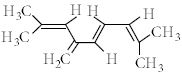
The total number of $\pi-$bond electrons in the following structure is
A
$12$
B
$16$
C
$4$
D
$8$
Solution
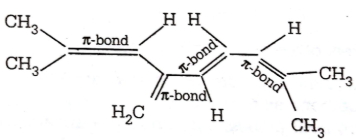
(D) In the given structure,there are $4$ double bonds,each containing one $\pi-$bond.
Therefore,the total number of $\pi-$bonds is $4$.
Since each $\pi-$bond consists of $2$ electrons,the total number of $\pi-$electrons is $4 \times 2 = 8$.
Therefore,the total number of $\pi-$bonds is $4$.
Since each $\pi-$bond consists of $2$ electrons,the total number of $\pi-$electrons is $4 \times 2 = 8$.
0 likesView Solution
34
ChemistryDifficultMCQNEET · 2015
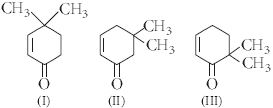
Which of the given compounds can exhibit tautomerism?
A
$II$ and $III$
B
$I$ and $II$
C
$I, II$ and $III$
D
$I$ and $III$
Solution
(C) Tautomerism in carbonyl compounds generally requires the presence of an $\alpha$-hydrogen atom.
$I$: This compound has an $\alpha$-hydrogen atom adjacent to the carbonyl group,so it can exhibit keto-enol tautomerism.
$II$: This compound also possesses an $\alpha$-hydrogen atom adjacent to the carbonyl group,allowing it to exhibit keto-enol tautomerism.
$III$: Although this compound lacks an $\alpha$-hydrogen,it can exhibit $\gamma$-tautomerism (also known as $p$-tautomerism) because it has a conjugated system where a $\gamma$-hydrogen can participate in the tautomeric shift.
Therefore,all three compounds ($I, II$,and $III$) can exhibit some form of tautomerism.
$I$: This compound has an $\alpha$-hydrogen atom adjacent to the carbonyl group,so it can exhibit keto-enol tautomerism.
$II$: This compound also possesses an $\alpha$-hydrogen atom adjacent to the carbonyl group,allowing it to exhibit keto-enol tautomerism.
$III$: Although this compound lacks an $\alpha$-hydrogen,it can exhibit $\gamma$-tautomerism (also known as $p$-tautomerism) because it has a conjugated system where a $\gamma$-hydrogen can participate in the tautomeric shift.
Therefore,all three compounds ($I, II$,and $III$) can exhibit some form of tautomerism.
0 likesView Solution
35
ChemistryMediumMCQNEET · 2015
Which of the following is the most correct electron displacement for a nucleophilic reaction to take place?
A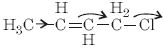
B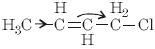
C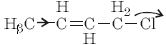
D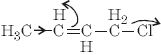
Solution
(A) For a nucleophilic reaction to occur,the leaving group must depart,often facilitated by the formation of a stable carbocation. In the given molecule,$CH_3-CH=CH-CH_2-Cl$,the departure of the $Cl^-$ ion is assisted by the resonance stabilization of the resulting carbocation. The $\pi$-electrons of the $C=C$ bond shift towards the $CH_2$ group,creating a positive charge on the carbon atom adjacent to the double bond,which is stabilized by the $+I$ effect of the $-CH_3$ group. This corresponds to the electron displacement shown in option $A$.
0 likesView Solution
36
ChemistryDifficultMCQNEET · 2015
In Dumas's method for estimation of nitrogen,$0.25 \, g$ of an organic compound gave $40 \, mL$ of nitrogen collected at $300 \, K$ temperature and $725 \, mm$ pressure. If the aqueous tension at $300 \, K$ is $25 \, mm,$ the percentage of nitrogen in the compound is
A
$16.76$
B
$15.76$
C
$17.36$
D
$18.20$
Solution
(A) Mass of organic compound $= 0.25 \, g$
Pressure of dry nitrogen gas $(P_1) = 725 \, mm - 25 \, mm = 700 \, mm$
Volume of nitrogen $(V_1) = 40 \, mL$
Temperature $(T_1) = 300 \, K$
Using the ideal gas equation at $STP$ $(P_2 = 760 \, mm, T_2 = 273 \, K)$:
$\frac{P_1 V_1}{T_1} = \frac{P_2 V_2}{T_2}$
$V_2 = \frac{700 \times 40 \times 273}{300 \times 760} = 33.52 \, mL$
Mass of $N_2$ at $STP = \frac{28 \times 33.52}{22400} = 0.0419 \, g$
Percentage of nitrogen $= \frac{0.0419}{0.25} \times 100 = 16.76 \%$
Pressure of dry nitrogen gas $(P_1) = 725 \, mm - 25 \, mm = 700 \, mm$
Volume of nitrogen $(V_1) = 40 \, mL$
Temperature $(T_1) = 300 \, K$
Using the ideal gas equation at $STP$ $(P_2 = 760 \, mm, T_2 = 273 \, K)$:
$\frac{P_1 V_1}{T_1} = \frac{P_2 V_2}{T_2}$
$V_2 = \frac{700 \times 40 \times 273}{300 \times 760} = 33.52 \, mL$
Mass of $N_2$ at $STP = \frac{28 \times 33.52}{22400} = 0.0419 \, g$
Percentage of nitrogen $= \frac{0.0419}{0.25} \times 100 = 16.76 \%$
0 likesView Solution
37
ChemistryMediumMCQNEET · 2015
Consider the following compounds:
$(I)$ $(CH_3)_3C-CH^{\bullet}-C_6H_5$
$(II)$ $(C_6H_5)_3C^{\bullet}$
$(III)$ $2$-methylbicyclo$[2.2.1]$hept$-2-$yl radical (as shown in the image)
Hyperconjugation occurs in:
$(I)$ $(CH_3)_3C-CH^{\bullet}-C_6H_5$
$(II)$ $(C_6H_5)_3C^{\bullet}$
$(III)$ $2$-methylbicyclo$[2.2.1]$hept$-2-$yl radical (as shown in the image)
Hyperconjugation occurs in:
A
$III$ only
B
$I$ and $III$
C
$I$ only
D
$II$ only
Solution
(A) Hyperconjugation in free radicals occurs through the $\alpha$-hydrogen atoms present on the carbon atom adjacent to the radical carbon atom.
In structure $(I)$,the radical carbon is attached to a tert-butyl group and a phenyl group. There are no $\alpha$-hydrogens on the carbon adjacent to the radical center.
In structure $(II)$,the radical carbon is attached to three phenyl groups. There are no $\alpha$-hydrogens.
In structure $(III)$,the radical carbon is part of a bicyclic system and is attached to a $-CH_3$ group. The carbon atom adjacent to the radical carbon has an $\alpha$-hydrogen atom,which allows for hyperconjugation.
Therefore,hyperconjugation occurs in structure $(III)$ only.
In structure $(I)$,the radical carbon is attached to a tert-butyl group and a phenyl group. There are no $\alpha$-hydrogens on the carbon adjacent to the radical center.
In structure $(II)$,the radical carbon is attached to three phenyl groups. There are no $\alpha$-hydrogens.
In structure $(III)$,the radical carbon is part of a bicyclic system and is attached to a $-CH_3$ group. The carbon atom adjacent to the radical carbon has an $\alpha$-hydrogen atom,which allows for hyperconjugation.
Therefore,hyperconjugation occurs in structure $(III)$ only.
0 likesView Solution
38
ChemistryDifficultMCQNEET · 2015
In which of the following compounds,the $C-Cl$ bond ionisation shall give the most stable carbonium ion?
A
$C_6H_5CH_2Cl$
B
$O_2NCH_2CH_2Cl$
C
$(CH_3)_2CH-Cl$
D
$(CH_3)_3C-Cl$
Solution
(A) The stability of a carbocation is determined by factors like resonance,hyperconjugation,and the inductive effect.
$1$. $C_6H_5CH_2Cl$ ionizes to form the benzyl carbocation $(C_6H_5CH_2^+)$,which is highly stabilized by resonance with the benzene ring.
$2$. $(CH_3)_3C-Cl$ forms a tertiary carbocation,which is stabilized by hyperconjugation and the inductive effect of three methyl groups.
$3$. $(CH_3)_2CH-Cl$ forms a secondary carbocation,which is less stable than the tertiary one.
$4$. $O_2NCH_2CH_2Cl$ forms a primary carbocation,which is further destabilized by the electron-withdrawing nitro group.
Comparing the benzyl carbocation and the tertiary carbocation,the resonance stabilization provided by the phenyl ring in the benzyl carbocation makes it significantly more stable than the simple alkyl-substituted tertiary carbocation. Therefore,$C_6H_5CH_2Cl$ gives the most stable carbonium ion.
$1$. $C_6H_5CH_2Cl$ ionizes to form the benzyl carbocation $(C_6H_5CH_2^+)$,which is highly stabilized by resonance with the benzene ring.
$2$. $(CH_3)_3C-Cl$ forms a tertiary carbocation,which is stabilized by hyperconjugation and the inductive effect of three methyl groups.
$3$. $(CH_3)_2CH-Cl$ forms a secondary carbocation,which is less stable than the tertiary one.
$4$. $O_2NCH_2CH_2Cl$ forms a primary carbocation,which is further destabilized by the electron-withdrawing nitro group.
Comparing the benzyl carbocation and the tertiary carbocation,the resonance stabilization provided by the phenyl ring in the benzyl carbocation makes it significantly more stable than the simple alkyl-substituted tertiary carbocation. Therefore,$C_6H_5CH_2Cl$ gives the most stable carbonium ion.
0 likesView Solution
39
ChemistryMediumMCQNEET · 2015
In the reaction with $HCl$,an alkene reacts in accordance with the Markovnikov's rule to give a product $1-$chloro$-1-$methylcyclohexane. The possible alkene is
A
Methylenecyclohexane
B
$1-$Methylcyclohexene
C
Both $(A)$ and $(B)$
D
$3-$Methylcyclohexene
Solution
(C) Markovnikov's rule states that in the addition of a protic acid to an asymmetric alkene,the acid hydrogen attaches to the carbon with the smaller number of hydrogen atoms and the halide group attaches to the carbon with the larger number of hydrogen atoms. However,the product $1-$chloro$-1-$methylcyclohexane can be formed from both methylenecyclohexane and $1-$methylcyclohexene.
For methylenecyclohexane: The protonation of the double bond leads to a $3^{\circ}$ carbocation at the $1-$position,which then reacts with $Cl^-$ to give $1-$chloro$-1-$methylcyclohexane.
For $1-$methylcyclohexene: The protonation leads to a $2^{\circ}$ carbocation,which undergoes rearrangement to form a more stable $3^{\circ}$ carbocation,which then reacts with $Cl^-$ to give $1-$chloro$-1-$methylcyclohexane.
Since both alkenes yield the same product,the correct answer is $(C)$.
For methylenecyclohexane: The protonation of the double bond leads to a $3^{\circ}$ carbocation at the $1-$position,which then reacts with $Cl^-$ to give $1-$chloro$-1-$methylcyclohexane.
For $1-$methylcyclohexene: The protonation leads to a $2^{\circ}$ carbocation,which undergoes rearrangement to form a more stable $3^{\circ}$ carbocation,which then reacts with $Cl^-$ to give $1-$chloro$-1-$methylcyclohexane.
Since both alkenes yield the same product,the correct answer is $(C)$.
0 likesView Solution
40
ChemistryAdvancedMCQNEET · 2015
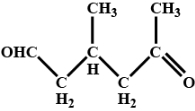
$A$ single compound of the structure $CH_3-CO-CH_2-CH_2-CH_2-CHO$ is obtainable from the ozonolysis of which of the following cyclic compounds?
A
$1,1-dimethylcyclopent-1-ene$
B
$1,2-dimethylcyclopent-1-ene$
C
$1,5-dimethylcyclopent-1-ene$
D
$1,2-dimethylcyclopent-3-ene$
Solution
(A) Ozonolysis of a cyclic alkene involves the cleavage of the double bond to form a dicarbonyl compound. The given product is $CH_3-CO-CH_2-CH_2-CH_2-CHO$. This is a $6$-carbon chain with a ketone group at position $2$ and an aldehyde group at position $6$. This implies the original cyclic compound must have been a $6$-membered ring,specifically $1-methylcyclohex-1-ene$. However,looking at the options provided,we must evaluate which cyclic compound yields this specific structure. The structure $CH_3-CO-CH_2-CH_2-CH_2-CHO$ is $6-oxohexanal$. This is formed by the oxidative cleavage of $1-methylcyclohex-1-ene$. Given the options are all $5$-membered rings,there might be a discrepancy in the question's structure. Re-evaluating the product $CH_3-CO-CH_2-CH_2-CH_2-CHO$,it corresponds to the ozonolysis of $1-methylcyclohex-1-ene$. If the question implies a $5$-membered ring,the product would be different. Based on standard chemistry problems of this type,$1-methylcyclohex-1-ene$ is the correct precursor for this specific linear dicarbonyl.
0 likesView Solution
41
ChemistryDifficultMCQNEET · 2015
Given the following structures:
$(I)$ $1,3,5-$trimethylbenzene (mesitylene)
$(II)$ $1,3-$dimethyl$-5-$methylenecyclohexa$-1,3-$diene
$(III)$ $1,3,5-$trimethylenecyclohexane
The enthalpy of hydrogenation of these compounds will be in the order as:
$(I)$ $1,3,5-$trimethylbenzene (mesitylene)
$(II)$ $1,3-$dimethyl$-5-$methylenecyclohexa$-1,3-$diene
$(III)$ $1,3,5-$trimethylenecyclohexane
The enthalpy of hydrogenation of these compounds will be in the order as:
A
$II > III > I$
B
$II > I > III$
C
$I > II > III$
D
$III > II > I$
Solution
(D) The enthalpy of hydrogenation is inversely proportional to the stability of the alkene/diene system.
$(I)$ is an aromatic compound (mesitylene),which is highly stable due to resonance energy.
$(II)$ is a conjugated diene system with some cross-conjugation,making it less stable than the aromatic system but more stable than the isolated exocyclic double bonds.
$(III)$ contains three isolated exocyclic double bonds,which are the least stable among the three.
Stability order: $I > II > III$.
Since enthalpy of hydrogenation is inversely proportional to stability,the order of enthalpy of hydrogenation is $III > II > I$.
$(I)$ is an aromatic compound (mesitylene),which is highly stable due to resonance energy.
$(II)$ is a conjugated diene system with some cross-conjugation,making it less stable than the aromatic system but more stable than the isolated exocyclic double bonds.
$(III)$ contains three isolated exocyclic double bonds,which are the least stable among the three.
Stability order: $I > II > III$.
Since enthalpy of hydrogenation is inversely proportional to stability,the order of enthalpy of hydrogenation is $III > II > I$.
0 likesView Solution
42
ChemistryDifficultMCQNEET · 2015
The variation of the boiling points of the hydrogen halides is in the order $HF > HI > HBr > HCl$. What explains the higher boiling point of hydrogen fluoride?
A
There is strong hydrogen bonding between $HF$ molecules.
B
The bond energy of $HF$ molecules is greater than in other hydrogen halides.
C
The effect of nuclear shielding is much reduced in fluorine which polarises the $HF$ molecule.
D
The electronegativity of fluorine is much higher than for other elements in the group.
Solution
(A) The boiling point of hydrogen halides depends on the intermolecular forces of attraction.
In $HF$ molecules,the high electronegativity and small size of the fluorine atom lead to the formation of strong intermolecular hydrogen bonding.
This results in a significantly higher boiling point compared to other hydrogen halides $(HI, HBr, HCl)$,where only weaker van der Waals forces are present.
Thus,the order is $HF > HI > HBr > HCl$.
In $HF$ molecules,the high electronegativity and small size of the fluorine atom lead to the formation of strong intermolecular hydrogen bonding.
This results in a significantly higher boiling point compared to other hydrogen halides $(HI, HBr, HCl)$,where only weaker van der Waals forces are present.
Thus,the order is $HF > HI > HBr > HCl$.
0 likesView Solution
43
ChemistryAdvancedMCQNEET · 2015
The formation of the oxide ion,$O^{2-}_{(g)}$ from an oxygen atom requires first an exothermic and then an endothermic step as shown below:
$O_{(g)} + e^- \to O^{-}_{(g)} ; \Delta_f H^o = -141 \ kJ \ mol^{-1}$
$O^{-}_{(g)} + e^- \to O^{2-}_{(g)} ; \Delta_f H^o = +780 \ kJ \ mol^{-1}$
Thus,the process of formation of $O^{2-}$ in the gas phase is unfavourable even though $O^{2-}$ is isoelectronic with neon. This is due to the fact that,
$O_{(g)} + e^- \to O^{-}_{(g)} ; \Delta_f H^o = -141 \ kJ \ mol^{-1}$
$O^{-}_{(g)} + e^- \to O^{2-}_{(g)} ; \Delta_f H^o = +780 \ kJ \ mol^{-1}$
Thus,the process of formation of $O^{2-}$ in the gas phase is unfavourable even though $O^{2-}$ is isoelectronic with neon. This is due to the fact that,
A
$O^{-}$ ion has a comparatively smaller size than the oxygen atom
B
oxygen is more electronegative
C
addition of an electron to oxygen results in a larger size of the ion
D
electron repulsion outweighs the stability gained by achieving noble gas configuration.
Solution
(D) The formation of $O^{2-}_{(g)}$ involves two steps:
$1$. The first electron addition is exothermic because energy is released when an electron is added to a neutral oxygen atom.
$2$. The second electron addition is highly endothermic because the incoming electron experiences strong electrostatic repulsion from the already present negative charge on the $O^{-}_{(g)}$ ion.
$3$. Even though $O^{2-}$ achieves a stable noble gas configuration (isoelectronic with $Ne$),the large amount of energy required to overcome the inter-electronic repulsion $(+780 \ kJ \ mol^{-1})$ makes the overall process unfavourable in the gas phase.
Therefore,the correct reason is that electron repulsion outweighs the stability gained by achieving noble gas configuration.
$1$. The first electron addition is exothermic because energy is released when an electron is added to a neutral oxygen atom.
$2$. The second electron addition is highly endothermic because the incoming electron experiences strong electrostatic repulsion from the already present negative charge on the $O^{-}_{(g)}$ ion.
$3$. Even though $O^{2-}$ achieves a stable noble gas configuration (isoelectronic with $Ne$),the large amount of energy required to overcome the inter-electronic repulsion $(+780 \ kJ \ mol^{-1})$ makes the overall process unfavourable in the gas phase.
Therefore,the correct reason is that electron repulsion outweighs the stability gained by achieving noble gas configuration.
0 likesView Solution
44
ChemistryDifficultMCQNEET · 2015
Assuming complete ionisation,same moles of which of the following compounds will require the least amount of acidified $KMnO_4$ for complete oxidation?
A
$FeSO_3$
B
$FeC_2O_4$
C
$Fe(NO_2)_2$
D
$FeSO_4$
Solution
(D) $KMnO_4$ $(Mn^{7+})$ is reduced to $Mn^{2+}$,involving $5$ electrons per mole of $KMnO_4$.
For the same number of moles of the compound,the one requiring the least number of electrons for oxidation will require the least amount of $KMnO_4$.
$(a)$ For $FeSO_3$:
$Fe^{2+} \rightarrow Fe^{3+} + 1e^-$
$SO_3^{2-} \rightarrow SO_4^{2-} + 2e^-$
Total $e^- = 1 + 2 = 3$
$(b)$ For $FeC_2O_4$:
$Fe^{2+} \rightarrow Fe^{3+} + 1e^-$
$C_2O_4^{2-} \rightarrow 2CO_2 + 2e^-$
Total $e^- = 1 + 2 = 3$
$(c)$ For $Fe(NO_2)_2$:
$Fe^{2+} \rightarrow Fe^{3+} + 1e^-$
$2NO_2^- \rightarrow 2NO_3^- + 4e^-$
Total $e^- = 1 + 4 = 5$
$(d)$ For $FeSO_4$:
$Fe^{2+} \rightarrow Fe^{3+} + 1e^-$
Total $e^- = 1$
Since $FeSO_4$ involves the minimum number of electrons $(1)$,it requires the least amount of $KMnO_4$.
For the same number of moles of the compound,the one requiring the least number of electrons for oxidation will require the least amount of $KMnO_4$.
$(a)$ For $FeSO_3$:
$Fe^{2+} \rightarrow Fe^{3+} + 1e^-$
$SO_3^{2-} \rightarrow SO_4^{2-} + 2e^-$
Total $e^- = 1 + 2 = 3$
$(b)$ For $FeC_2O_4$:
$Fe^{2+} \rightarrow Fe^{3+} + 1e^-$
$C_2O_4^{2-} \rightarrow 2CO_2 + 2e^-$
Total $e^- = 1 + 2 = 3$
$(c)$ For $Fe(NO_2)_2$:
$Fe^{2+} \rightarrow Fe^{3+} + 1e^-$
$2NO_2^- \rightarrow 2NO_3^- + 4e^-$
Total $e^- = 1 + 4 = 5$
$(d)$ For $FeSO_4$:
$Fe^{2+} \rightarrow Fe^{3+} + 1e^-$
Total $e^- = 1$
Since $FeSO_4$ involves the minimum number of electrons $(1)$,it requires the least amount of $KMnO_4$.
0 likesView Solution
45
ChemistryMediumMCQNEET · 2015
Which of the following processes does not involve oxidation of iron?
A
Formation of $Fe(CO)_5$ from $Fe$.
B
Liberation of $H_2$ from steam by iron at high temperature.
C
Rusting of iron sheets.
D
Decolourisation of blue $CuSO_4$ solution by iron.
Solution
(A) In the formation of $Fe(CO)_5$,the reaction is: $Fe + 5CO \rightarrow Fe(CO)_5$. Here,the oxidation state of $Fe$ remains $0$ (zero).
In the rusting of iron: $4Fe + 3O_2 + 2xH_2O \rightarrow 2Fe_2O_3 \cdot xH_2O$,$Fe$ is oxidized from $0$ to $+3$.
In the reaction with steam: $3Fe + 4H_2O \rightarrow Fe_3O_4 + 4H_2$,$Fe$ is oxidized from $0$ to $+8/3$.
In the reaction with $CuSO_4$: $Fe + CuSO_4 \rightarrow FeSO_4 + Cu$,$Fe$ is oxidized from $0$ to $+2$.
Therefore,the formation of $Fe(CO)_5$ does not involve the oxidation of iron.
In the rusting of iron: $4Fe + 3O_2 + 2xH_2O \rightarrow 2Fe_2O_3 \cdot xH_2O$,$Fe$ is oxidized from $0$ to $+3$.
In the reaction with steam: $3Fe + 4H_2O \rightarrow Fe_3O_4 + 4H_2$,$Fe$ is oxidized from $0$ to $+8/3$.
In the reaction with $CuSO_4$: $Fe + CuSO_4 \rightarrow FeSO_4 + Cu$,$Fe$ is oxidized from $0$ to $+2$.
Therefore,the formation of $Fe(CO)_5$ does not involve the oxidation of iron.
0 likesView Solution
46
ChemistryMediumMCQNEET · 2015
Two possible stereo-structures of $CH_3CH(OH)COOH$,which are optically active,are called
A
atropisomers
B
enantiomers
C
mesomers
D
diastereomers
Solution
(B) The molecule $CH_3CH(OH)COOH$ (lactic acid) contains a chiral carbon atom bonded to four different groups: $-H$,$-OH$,$-CH_3$,and $-COOH$.
Stereoisomers that are non-superimposable mirror images of each other are known as enantiomers.
Since the two structures of lactic acid are non-superimposable mirror images and are both optically active,they are classified as enantiomers.
Stereoisomers that are non-superimposable mirror images of each other are known as enantiomers.
Since the two structures of lactic acid are non-superimposable mirror images and are both optically active,they are classified as enantiomers.
0 likesView Solution
47
ChemistryDifficultMCQNEET · 2015
The oxidation of benzene by $V_2O_5$ in the presence of air and high temperature produces
A
maleic anhydride
B
benzoic acid
C
phenol
D
benzoic anhydride
Solution
(A) When benzene is oxidized by air in the presence of $V_2O_5$ at $773 \ K$,it undergoes catalytic oxidation to form maleic acid,which subsequently loses a water molecule to form maleic anhydride.
The reaction is as follows:
$C_6H_6 + \frac{9}{2} O_2$ $\xrightarrow{V_2O_5, 773 \ K} \text{Maleic acid}$ $\xrightarrow{\Delta, -H_2O} \text{Maleic anhydride}$
The reaction is as follows:
$C_6H_6 + \frac{9}{2} O_2$ $\xrightarrow{V_2O_5, 773 \ K} \text{Maleic acid}$ $\xrightarrow{\Delta, -H_2O} \text{Maleic anhydride}$
0 likesView Solution
48
ChemistryMCQNEET · 2015
$A$ column of water within xylem vessels of tall trees does not break under its weight because of
A
Tensile strength of water
B
Lignification of xylem vessels
C
Positive root pressure
D
Dissolved sugar in water
Solution
(A) The column of water in the xylem vessels of tall trees remains continuous and does not break under its own weight due to the cohesive and adhesive properties of water molecules.
These properties provide water with high $Tensile \text{ } strength$ (the ability to resist a pulling force).
Cohesion refers to the mutual attraction between water molecules, while adhesion refers to the attraction of water molecules to the polar surfaces of the xylem vessel walls.
Together, these forces create a strong water column that can be pulled up to great heights during transpiration.
These properties provide water with high $Tensile \text{ } strength$ (the ability to resist a pulling force).
Cohesion refers to the mutual attraction between water molecules, while adhesion refers to the attraction of water molecules to the polar surfaces of the xylem vessel walls.
Together, these forces create a strong water column that can be pulled up to great heights during transpiration.
0 likesView Solution
49
ChemistryMCQNEET · 2015
The oxygen evolved during photosynthesis comes from water molecules. Which one of the following pairs of elements is involved in this reaction?
A
Manganese and Potassium
B
Magnesium and Molybdenum
C
Magnesium and Chlorine
D
Manganese and Chlorine
Solution
(D) During the light-dependent reactions of photosynthesis,the process of photolysis of water occurs.
In this process,water molecules $(H_2O)$ are split into protons $(H^+)$,electrons $(e^-)$,and oxygen $(O_2)$.
This reaction is catalyzed by the Oxygen Evolving Complex $(OEC)$,which is associated with Photosystem $II$.
The essential mineral elements required for the functioning of this complex are Manganese $(Mn^{2+})$ and Chlorine $(Cl^-)$.
Therefore,the correct pair of elements involved in the photolysis of water is Manganese and Chlorine.
In this process,water molecules $(H_2O)$ are split into protons $(H^+)$,electrons $(e^-)$,and oxygen $(O_2)$.
This reaction is catalyzed by the Oxygen Evolving Complex $(OEC)$,which is associated with Photosystem $II$.
The essential mineral elements required for the functioning of this complex are Manganese $(Mn^{2+})$ and Chlorine $(Cl^-)$.
Therefore,the correct pair of elements involved in the photolysis of water is Manganese and Chlorine.
0 likesView Solution
50
ChemistryMCQNEET · 2015
Chromatophores take part in
A
Growth
B
Movement
C
Respiration
D
Photosynthesis
Solution
(D) Chromatophores are specialized membrane-bound vesicles found in certain photosynthetic bacteria (such as cyanobacteria and purple bacteria).
These structures contain pigments like chlorophyll and carotenoids,which are essential for capturing light energy.
Therefore,chromatophores are primarily involved in the process of photosynthesis in these prokaryotic organisms.
These structures contain pigments like chlorophyll and carotenoids,which are essential for capturing light energy.
Therefore,chromatophores are primarily involved in the process of photosynthesis in these prokaryotic organisms.
0 likesView Solution
51
ChemistryDifficultMCQNEET · 2015
Which of the following is not the product of dehydration of the given alcohol?

A
$1-$cyclohexyl$-1-$butene derivative
B
$1-$cyclohexyl$-1-$butene isomer
C
$1-$cyclohexyl$-1-$butene isomer
D
$1-$cyclohexyl$-1-$butene isomer
Solution
(A) The dehydration of $1$-cyclohexylbutan-$1$-ol involves the formation of a carbocation intermediate. Upon protonation of the $-OH$ group and loss of water,a tertiary carbocation is formed at the carbon attached to the cyclohexane ring. This carbocation can undergo elimination by losing a proton from adjacent carbons to form various alkenes. The product shown in option $A$ (where the double bond is inside the ring) is a possible product. However,the structure shown in the solution image (a double bond between the ring and the side chain) is not a possible product of this specific dehydration reaction because it would require the formation of a less stable alkene or a different carbocation rearrangement that is not favored here.
0 likesView Solution
52
ChemistryMediumMCQNEET · 2015
Treatment of cyclopentanone with methyl lithium gives which of the following species?
A
Cyclopentanonyl radical
B
Cyclopentanonyl biradical
C
Cyclopentanonyl anion
D
Cyclopentanonyl cation
Solution
(C) Methyl lithium $(CH_{3}Li)$ acts as a strong base.
It abstracts an acidic $\alpha$-hydrogen from the cyclopentanone molecule.
This process results in the formation of methane $(CH_{4})$ and a resonance-stabilized enolate intermediate,which is a cyclopentanonyl anion associated with the lithium cation.
It abstracts an acidic $\alpha$-hydrogen from the cyclopentanone molecule.
This process results in the formation of methane $(CH_{4})$ and a resonance-stabilized enolate intermediate,which is a cyclopentanonyl anion associated with the lithium cation.
0 likesView Solution
53
ChemistryMediumMCQNEET · 2015
The vacant space in $bcc$ lattice unit cell is ............ $\%$
A
$48$
B
$23$
C
$32$
D
$26$
Solution
(C) The packing efficiency of a $bcc$ (body-centered cubic) lattice is $68\%$.
The vacant space is calculated as: $100\% - \text{Packing Efficiency} = 100\% - 68\% = 32\%$.
The vacant space is calculated as: $100\% - \text{Packing Efficiency} = 100\% - 68\% = 32\%$.
0 likesView Solution
54
ChemistryMediumMCQNEET · 2015
The correct statement regarding defects in crystalline solids is
A
Frenkel defects decrease the density of crystalline solids
B
Frenkel defect is a dislocation defect
C
Frenkel defect is found in halides of alkaline metals
D
Schottky defects have no effect on the density of crystalline solids
Solution
(B) Frenkel defect is a type of point defect where an ion leaves its lattice site and occupies an interstitial site.
Because the ion remains within the crystal,the overall density of the solid remains unchanged.
This is known as a dislocation defect.
Schottky defects involve the loss of ions from the lattice,which decreases the density of the crystal.
Because the ion remains within the crystal,the overall density of the solid remains unchanged.
This is known as a dislocation defect.
Schottky defects involve the loss of ions from the lattice,which decreases the density of the crystal.
0 likesView Solution
55
ChemistryMediumMCQNEET · 2015
$A$ given metal crystallises out with a cubic structure having edge length of $361 \, pm$. If there are four metal atoms in one unit cell,what is the radius of one atom? .............. $pm$
A
$80$
B
$108$
C
$40$
D
$127$
Solution
(D) Given that the number of atoms per unit cell,$z = 4$,the crystal structure is face-centered cubic $(fcc)$.
For an $fcc$ unit cell,the relationship between the edge length $(a)$ and the atomic radius $(r)$ is given by $a = 2\sqrt{2}r$.
Therefore,$r = \frac{a}{2\sqrt{2}}$.
Substituting the given values: $r = \frac{361 \, pm}{2 \times 1.414} = \frac{361}{2.828} \approx 127.65 \, pm$.
Rounding to the nearest integer,the radius is $127 \, pm$.
For an $fcc$ unit cell,the relationship between the edge length $(a)$ and the atomic radius $(r)$ is given by $a = 2\sqrt{2}r$.
Therefore,$r = \frac{a}{2\sqrt{2}}$.
Substituting the given values: $r = \frac{361 \, pm}{2 \times 1.414} = \frac{361}{2.828} \approx 127.65 \, pm$.
Rounding to the nearest integer,the radius is $127 \, pm$.
0 likesView Solution
56
ChemistryMediumMCQNEET · 2015
What is the mole fraction of the solute in a $1.00 \, m$ aqueous solution?
A
$0.1770$
B
$0.0354$
C
$0.0177$
D
$0.177$
Solution
(C) $1.00 \, m$ solution means $1 \, mol$ of solute is present in $1000 \, g$ of water.
The number of moles of water is $n_{H_{2}O} = \frac{1000 \, g}{18 \, g/mol} = 55.5 \, mol$.
The mole fraction of the solute is given by $X_{\text{solute}} = \frac{n_{\text{solute}}}{n_{\text{solute}} + n_{H_{2}O}}$.
Substituting the values,$X_{\text{solute}} = \frac{1}{1 + 55.5} = \frac{1}{56.5} \approx 0.0177$.
The number of moles of water is $n_{H_{2}O} = \frac{1000 \, g}{18 \, g/mol} = 55.5 \, mol$.
The mole fraction of the solute is given by $X_{\text{solute}} = \frac{n_{\text{solute}}}{n_{\text{solute}} + n_{H_{2}O}}$.
Substituting the values,$X_{\text{solute}} = \frac{1}{1 + 55.5} = \frac{1}{56.5} \approx 0.0177$.
0 likesView Solution
57
ChemistryMediumMCQNEET · 2015
The boiling point of $0.2 \, mol \, kg^{-1}$ solution of $X$ in water is greater than equimolal solution of $Y$ in water. Which one of the following statements is true in this case?
A
Molecular mass of $X$ is less than the molecular mass of $Y.$
B
$Y$ is undergoing dissociation in water while $X$ undergoes no change.
C
$X$ is undergoing dissociation in water.
D
Molecular mass of $X$ is greater than the molecular mass of $Y.$
Solution
(C) The elevation in boiling point is given by the formula $\Delta T_{b} = i K_{b} m$,where $i$ is the van't Hoff factor,$K_{b}$ is the ebullioscopic constant,and $m$ is the molality.
Since the solutions are equimolal ($m$ is constant) and the solvent is the same ($K_{b}$ is constant),the elevation in boiling point depends directly on the van't Hoff factor $i$.
Given that the boiling point of the solution of $X$ is greater than that of $Y$,it implies that $\Delta T_{b}(X) > \Delta T_{b}(Y)$,which means $i_{X} > i_{Y}$.
If $X$ undergoes dissociation,its van't Hoff factor $i$ becomes greater than $1$,leading to a higher boiling point compared to a non-dissociating solute.
Since the solutions are equimolal ($m$ is constant) and the solvent is the same ($K_{b}$ is constant),the elevation in boiling point depends directly on the van't Hoff factor $i$.
Given that the boiling point of the solution of $X$ is greater than that of $Y$,it implies that $\Delta T_{b}(X) > \Delta T_{b}(Y)$,which means $i_{X} > i_{Y}$.
If $X$ undergoes dissociation,its van't Hoff factor $i$ becomes greater than $1$,leading to a higher boiling point compared to a non-dissociating solute.
0 likesView Solution
58
ChemistryMediumMCQNEET · 2015
Which one of the following electrolytes has the same value of van't Hoff factor $(i)$ as that of $Al_2(SO_4)_3$ (if all are $100 \%$ ionised)?
A
$Al(NO_3)_3$
B
$K_4[Fe(CN)_6]$
C
$K_2SO_4$
D
$K_3[Fe(CN)_6]$
Solution
(B) The van't Hoff factor $(i)$ for a $100 \%$ ionised electrolyte is equal to the total number of ions produced per formula unit.
For $Al_2(SO_4)_3$: $Al_2(SO_4)_3 \rightarrow 2 Al^{3+} + 3 SO_4^{2-}$. Total ions = $2 + 3 = 5$,so $i = 5$.
For $Al(NO_3)_3$: $Al(NO_3)_3 \rightarrow Al^{3+} + 3 NO_3^-$. Total ions = $1 + 3 = 4$,so $i = 4$.
For $K_4[Fe(CN)_6]$: $K_4[Fe(CN)_6] \rightarrow 4 K^{+} + [Fe(CN)_6]^{4-}$. Total ions = $4 + 1 = 5$,so $i = 5$.
For $K_2SO_4$: $K_2SO_4 \rightarrow 2 K^{+} + SO_4^{2-}$. Total ions = $2 + 1 = 3$,so $i = 3$.
For $K_3[Fe(CN)_6]$: $K_3[Fe(CN)_6] \rightarrow 3 K^{+} + [Fe(CN)_6]^{3-}$. Total ions = $3 + 1 = 4$,so $i = 4$.
Thus,$K_4[Fe(CN)_6]$ has the same van't Hoff factor as $Al_2(SO_4)_3$.
For $Al_2(SO_4)_3$: $Al_2(SO_4)_3 \rightarrow 2 Al^{3+} + 3 SO_4^{2-}$. Total ions = $2 + 3 = 5$,so $i = 5$.
For $Al(NO_3)_3$: $Al(NO_3)_3 \rightarrow Al^{3+} + 3 NO_3^-$. Total ions = $1 + 3 = 4$,so $i = 4$.
For $K_4[Fe(CN)_6]$: $K_4[Fe(CN)_6] \rightarrow 4 K^{+} + [Fe(CN)_6]^{4-}$. Total ions = $4 + 1 = 5$,so $i = 5$.
For $K_2SO_4$: $K_2SO_4 \rightarrow 2 K^{+} + SO_4^{2-}$. Total ions = $2 + 1 = 3$,so $i = 3$.
For $K_3[Fe(CN)_6]$: $K_3[Fe(CN)_6] \rightarrow 3 K^{+} + [Fe(CN)_6]^{3-}$. Total ions = $3 + 1 = 4$,so $i = 4$.
Thus,$K_4[Fe(CN)_6]$ has the same van't Hoff factor as $Al_2(SO_4)_3$.
0 likesView Solution
59
ChemistryMediumMCQNEET · 2015
Which of the following is not equal to zero for an ideal solution?
A
$\Delta V_{mix}$
B
$\Delta P = P_{observed} - P_{Raoult}$
C
$\Delta H_{mix}$
D
$\Delta S_{mix}$
Solution
(D) For an ideal solution,the enthalpy change of mixing $(\Delta H_{mix})$ is $0$,the volume change of mixing $(\Delta V_{mix})$ is $0$,and the pressure deviation $(\Delta P)$ is $0$.
However,for any spontaneous mixing process,the entropy change of mixing $(\Delta S_{mix})$ is always greater than $0$ $(\Delta S_{mix} > 0)$.
However,for any spontaneous mixing process,the entropy change of mixing $(\Delta S_{mix})$ is always greater than $0$ $(\Delta S_{mix} > 0)$.
0 likesView Solution
60
ChemistryEasyMCQNEET · 2015
$A$ device that converts the energy of combustion of fuels like hydrogen and methane directly into electrical energy is known as:
A
dynamo
B
$Ni-Cd$ cell
C
fuel cell
D
electrolytic cell
Solution
(C) $fuel \ cell$ is an electrochemical device that converts the chemical energy of a fuel (like $H_2$ or $CH_4$) and an oxidizing agent (like $O_2$) directly into electricity through a redox reaction.
0 likesView Solution
61
ChemistryMediumMCQNEET · 2015
The rate constant of the reaction $A \rightarrow B$ is $0.6 \times 10^{-3} \, mol \, L^{-1} \, s^{-1}.$ If the concentration of $A$ is $5 \, M,$ then the concentration of $B$ after $20$ minutes is ......... $M.$
A
$3.60$
B
$0.36$
C
$0.72$
D
$1.08$
Solution
(C) The reaction is of zero order because the units of the rate constant are $mol \, L^{-1} \, s^{-1}.$
For a zero order reaction,the change in concentration $x$ is given by $x = K \cdot t.$
Given $K = 0.6 \times 10^{-3} \, mol \, L^{-1} \, s^{-1}$ and $t = 20 \, \text{minutes} = 20 \times 60 \, s = 1200 \, s.$
Substituting the values: $x = (0.6 \times 10^{-3}) \times 1200 = 0.72 \, M.$
Thus,the concentration of $B$ formed after $20$ minutes is $0.72 \, M.$
For a zero order reaction,the change in concentration $x$ is given by $x = K \cdot t.$
Given $K = 0.6 \times 10^{-3} \, mol \, L^{-1} \, s^{-1}$ and $t = 20 \, \text{minutes} = 20 \times 60 \, s = 1200 \, s.$
Substituting the values: $x = (0.6 \times 10^{-3}) \times 1200 = 0.72 \, M.$
Thus,the concentration of $B$ formed after $20$ minutes is $0.72 \, M.$
1 likesView Solution
62
ChemistryMediumMCQNEET · 2015
The activation energy of a reaction can be determined from the slope of which of the following graphs?
A
$\ln k$ vs. $\frac{1}{T}$
B
$\frac{T}{\ln k}$ vs. $\frac{1}{T}$
C
$\ln k$ vs. $T$
D
$\frac{\ln k}{T}$ vs. $T$
Solution
(A) According to the Arrhenius equation: $k = A e^{-E_{a} / RT}$
Taking the natural logarithm on both sides: $\ln k = \ln A - \frac{E_{a}}{RT}$
This equation follows the linear form $y = mx + c$,where $y = \ln k$,$x = \frac{1}{T}$,and the slope $m = -\frac{E_{a}}{R}$.
Therefore,the activation energy $E_{a}$ can be determined from the slope of the graph of $\ln k$ vs. $\frac{1}{T}$.
Taking the natural logarithm on both sides: $\ln k = \ln A - \frac{E_{a}}{RT}$
This equation follows the linear form $y = mx + c$,where $y = \ln k$,$x = \frac{1}{T}$,and the slope $m = -\frac{E_{a}}{R}$.
Therefore,the activation energy $E_{a}$ can be determined from the slope of the graph of $\ln k$ vs. $\frac{1}{T}$.
0 likesView Solution
63
ChemistryMediumMCQNEET · 2015
When the initial concentration of a reactant is doubled in a reaction,its half-life period is not affected. The order of the reaction is:
A
second
B
more than zero but less than first
C
zero
D
first
Solution
(D) The half-life period $(T_{1/2})$ of a reaction is related to the initial concentration $([A]_0)$ by the expression $T_{1/2} \propto [A]_0^{1-n}$,where $n$ is the order of the reaction.
For a first-order reaction $(n=1)$,$T_{1/2} = \frac{\ln 2}{k}$.
Since this expression does not contain the initial concentration term,the half-life of a first-order reaction is independent of the initial concentration of the reactant.
Therefore,if doubling the initial concentration does not affect the half-life,the reaction must be of the first order.
For a first-order reaction $(n=1)$,$T_{1/2} = \frac{\ln 2}{k}$.
Since this expression does not contain the initial concentration term,the half-life of a first-order reaction is independent of the initial concentration of the reactant.
Therefore,if doubling the initial concentration does not affect the half-life,the reaction must be of the first order.
0 likesView Solution
64
ChemistryEasyMCQNEET · 2015
Which property of colloidal solution is independent of charge on the colloidal particles?
A
Electro-osmosis
B
Tyndall effect
C
Coagulation
D
Electrophoresis
Solution
(B) The $Tyndall \ effect$ is independent of the charge on the colloidal particles.
It is an optical property that depends on the size of the colloidal particles and the wavelength of light used.
The $Tyndall \ effect$,also known as $Tyndall \ scattering$,is the scattering of light by particles in a colloid or a fine suspension.
In contrast,$electro-osmosis$,$coagulation$,and $electrophoresis$ are electrical properties that directly depend on the charge present on the colloidal particles.
It is an optical property that depends on the size of the colloidal particles and the wavelength of light used.
The $Tyndall \ effect$,also known as $Tyndall \ scattering$,is the scattering of light by particles in a colloid or a fine suspension.
In contrast,$electro-osmosis$,$coagulation$,and $electrophoresis$ are electrical properties that directly depend on the charge present on the colloidal particles.
0 likesView Solution
65
ChemistryEasyMCQNEET · 2015
Which property of colloids is not dependent on the charge on colloidal particles?
A
Coagulation
B
Electrophoresis
C
Electro-osmosis
D
Tyndall effect
Solution
(D) The $Tyndall \ effect$ is an optical phenomenon that occurs due to the scattering of light by colloidal particles.
It depends on the size of the particles and the refractive index difference between the dispersed phase and the dispersion medium,but it is independent of the charge on the particles.
In contrast,$Coagulation$,$Electrophoresis$,and $Electro-osmosis$ are all properties that depend on the electrical charge of the colloidal particles.
It depends on the size of the particles and the refractive index difference between the dispersed phase and the dispersion medium,but it is independent of the charge on the particles.
In contrast,$Coagulation$,$Electrophoresis$,and $Electro-osmosis$ are all properties that depend on the electrical charge of the colloidal particles.
0 likesView Solution
66
ChemistryMediumMCQNEET · 2015
In the extraction of copper from its sulphide ore,the metal is finally obtained by the reduction of cuprous oxide with
A
carbon monoxide
B
copper $(I)$ sulphide
C
sulphur dioxide
D
iron $(II)$ sulphide
Solution
(B) In the extraction of copper from its sulphide ore,the ore is subjected to roasting,where some of it is oxidized to $Cu_{2}O$.
This $Cu_{2}O$ then reacts with the remaining $Cu_{2}S$ (cuprous sulphide) to produce copper metal.
The chemical equation for this self-reduction process is:
$2Cu_{2}O + Cu_{2}S \longrightarrow 6Cu + SO_{2} \uparrow$
In this reaction,$Cu_{2}S$ acts as the reducing agent for $Cu_{2}O$.
This $Cu_{2}O$ then reacts with the remaining $Cu_{2}S$ (cuprous sulphide) to produce copper metal.
The chemical equation for this self-reduction process is:
$2Cu_{2}O + Cu_{2}S \longrightarrow 6Cu + SO_{2} \uparrow$
In this reaction,$Cu_{2}S$ acts as the reducing agent for $Cu_{2}O$.
0 likesView Solution
67
ChemistryMediumMCQNEET · 2015
Metals are usually not found as nitrates in their ores. Out of the following two ($I$ and $II$) reasons,which is/are true for the above observation?
$I.$ Metal nitrates are highly unstable.
$II.$ Metal nitrates are highly soluble in water.
$I.$ Metal nitrates are highly unstable.
$II.$ Metal nitrates are highly soluble in water.
A
$I$ is false but $II$ is true.
B
$I$ is true but $II$ is false.
C
$I$ and $II$ are true.
D
$I$ and $II$ are false.
Solution
(A) Most metal nitrates are highly soluble in water. Due to this high solubility,they are easily washed away by rain or groundwater and do not accumulate in the earth's crust to form stable mineral deposits or ores.
Statement $I$ is false because many metal nitrates are thermally stable (e.g.,alkali metal nitrates).
Statement $II$ is true because the high solubility prevents their accumulation in ores.
Therefore,the correct option is $A$.
Statement $I$ is false because many metal nitrates are thermally stable (e.g.,alkali metal nitrates).
Statement $II$ is true because the high solubility prevents their accumulation in ores.
Therefore,the correct option is $A$.
0 likesView Solution
68
ChemistryMediumMCQNEET · 2015
Strong reducing behaviour of $H_3PO_2$ is due to
A
low co-ordination number of phosphorus
B
high oxidation state of phosphorus
C
presence of two $-OH$ groups and one $P-H$ bond
D
presence of one $-OH$ group and two $P-H$ bonds
Solution
(D) The strong reducing behavior of $H_3PO_2$ (hypophosphorous acid) is attributed to its molecular structure.
In $H_3PO_2$,the phosphorus atom is bonded to two hydrogen atoms directly ($P-H$ bonds) and one hydroxyl group ($-OH$ bond).
Any oxyacid of phosphorus that contains at least one $P-H$ bond acts as a reducing agent.
Since $H_3PO_2$ contains two $P-H$ bonds,it exhibits strong reducing properties.
In $H_3PO_2$,the phosphorus atom is bonded to two hydrogen atoms directly ($P-H$ bonds) and one hydroxyl group ($-OH$ bond).
Any oxyacid of phosphorus that contains at least one $P-H$ bond acts as a reducing agent.
Since $H_3PO_2$ contains two $P-H$ bonds,it exhibits strong reducing properties.
0 likesView Solution
69
ChemistryDifficultMCQNEET · 2015
Which of the statements given below is incorrect?
A
$O_3$ molecule is bent.
B
$ONF$ is isoelectronic with $O_2N^-$.
C
$OF_2$ is an oxide of fluorine.
D
$Cl_2O_7$ is an anhydride of perchloric acid.
Solution
(C) $OF_2$ is a fluoride of oxygen because the electronegativity of fluorine $(3.98)$ is greater than that of oxygen $(3.44)$.
Therefore,$OF_2$ is named oxygen difluoride,not an oxide of fluorine.
$O_3$ is bent,$ONF$ ($8+7+9 = 24$ electrons) is isoelectronic with $O_2N^-$ ($16+7+1 = 24$ electrons),and $Cl_2O_7$ is the anhydride of $HClO_4$ $(2HClO_4 \rightarrow Cl_2O_7 + H_2O)$.
Therefore,$OF_2$ is named oxygen difluoride,not an oxide of fluorine.
$O_3$ is bent,$ONF$ ($8+7+9 = 24$ electrons) is isoelectronic with $O_2N^-$ ($16+7+1 = 24$ electrons),and $Cl_2O_7$ is the anhydride of $HClO_4$ $(2HClO_4 \rightarrow Cl_2O_7 + H_2O)$.
0 likesView Solution
70
ChemistryEasyMCQNEET · 2015
Nitrogen dioxide $(NO_2)$ and sulphur dioxide $(SO_2)$ have some properties in common. Which property is shown by one of these compounds,but not by the other?
A
Is soluble in water.
B
Is used as a food preservative.
C
Forms 'acid-rain'.
D
Is a reducing agent.
Solution
(B) $SO_2$ is used as a food preservative because it acts as an antioxidant and antimicrobial agent.
$NO_2$ is not used as a food preservative.
Both $NO_2$ and $SO_2$ are soluble in water,form acid rain,and can act as reducing agents.
$NO_2$ is not used as a food preservative.
Both $NO_2$ and $SO_2$ are soluble in water,form acid rain,and can act as reducing agents.
0 likesView Solution
71
ChemistryMediumMCQNEET · 2015
Gadolinium belongs to the $4f$ series. Its atomic number is $64$. Which of the following is the correct electronic configuration of gadolinium?
A
$[Xe] 4f^9 5s^1$
B
$[Xe] 4f^7 5d^1 6s^2$
C
$[Xe] 4f^6 5d^2 6s^2$
D
$[Xe] 4f^8 6d^2$
Solution
(B) The atomic number of Gadolinium $(Gd)$ is $64$.
Its electronic configuration is determined by filling the $4f$ orbitals.
Due to the extra stability of the half-filled $4f^7$ subshell,one electron enters the $5d$ orbital instead of the $4f$ orbital.
Thus,the correct electronic configuration is $[Xe] 4f^7 5d^1 6s^2$.
Its electronic configuration is determined by filling the $4f$ orbitals.
Due to the extra stability of the half-filled $4f^7$ subshell,one electron enters the $5d$ orbital instead of the $4f$ orbital.
Thus,the correct electronic configuration is $[Xe] 4f^7 5d^1 6s^2$.
0 likesView Solution
72
ChemistryMediumMCQNEET · 2015
The magnetic moment of $2.84 \, B.M.$ is exhibited by which of the following ions? (Atomic numbers: $Ni = 28, Ti = 22, Cr = 24, Co = 27$)
A
$Cr^{2+}$
B
$Co^{2+}$
C
$Ni^{2+}$
D
$Ti^{3+}$
Solution
(C) The magnetic moment $\mu$ is given by the formula $\mu = \sqrt{n(n+2)} \, B.M.$,where $n$ is the number of unpaired electrons.
Given $\mu = 2.84 \, B.M.$,we have $\sqrt{n(n+2)} = 2.84$,which implies $n \approx 2$.
Electronic configurations:
$Cr^{2+} (Z=24): [Ar] 3d^4$ $(n=4)$
$Co^{2+} (Z=27): [Ar] 3d^7$ $(n=3)$
$Ni^{2+} (Z=28): [Ar] 3d^8$ $(n=2)$
$Ti^{3+} (Z=22): [Ar] 3d^1$ $(n=1)$
Since $Ni^{2+}$ has $2$ unpaired electrons,it corresponds to the magnetic moment of $2.84 \, B.M.$
Given $\mu = 2.84 \, B.M.$,we have $\sqrt{n(n+2)} = 2.84$,which implies $n \approx 2$.
Electronic configurations:
$Cr^{2+} (Z=24): [Ar] 3d^4$ $(n=4)$
$Co^{2+} (Z=27): [Ar] 3d^7$ $(n=3)$
$Ni^{2+} (Z=28): [Ar] 3d^8$ $(n=2)$
$Ti^{3+} (Z=22): [Ar] 3d^1$ $(n=1)$
Since $Ni^{2+}$ has $2$ unpaired electrons,it corresponds to the magnetic moment of $2.84 \, B.M.$
0 likesView Solution
73
ChemistryMediumMCQNEET · 2015
Because of lanthanoid contraction,which of the following pairs of elements have nearly same atomic radii? (Numbers in the parenthesis are atomic numbers)
A
$Zr(40)$ and $Hf(72)$
B
$Zr(40)$ and $Ta(73)$
C
$Ti(22)$ and $Zr(40)$
D
$Zr(40)$ and $Nb(41)$
Solution
(A) The atomic radii of $Zr$ $(40)$ and $Hf$ $(72)$ are nearly identical due to the lanthanoid contraction.
This phenomenon occurs because the $4f$ orbitals,which are filled before $Hf$,provide poor shielding,leading to a greater effective nuclear charge that offsets the expected increase in size down the group.
This phenomenon occurs because the $4f$ orbitals,which are filled before $Hf$,provide poor shielding,leading to a greater effective nuclear charge that offsets the expected increase in size down the group.
0 likesView Solution
74
ChemistryMediumMCQNEET · 2015
The hybridization involved in the complex $[Ni(CN)_4]^{2-}$ is (Atomic number of $Ni = 28$):
A
$sp^3$
B
$d^2sp^2$
C
$d^2sp^3$
D
$dsp^2$
Solution
(D) $1$. The oxidation state of $Ni$ in $[Ni(CN)_4]^{2-}$ is calculated as: $x + 4(-1) = -2$,so $x = +2$.
$2$. The electronic configuration of $Ni^{2+}$ is $[Ar]^{18} 3d^8 4s^0$.
$3$. $CN^-$ is a strong field ligand,which causes the pairing of electrons in the $3d$ orbitals.
$4$. After pairing,one $3d$,one $4s$,and two $4p$ orbitals are available for hybridization.
$5$. Thus,the hybridization is $dsp^2$.
$2$. The electronic configuration of $Ni^{2+}$ is $[Ar]^{18} 3d^8 4s^0$.
$3$. $CN^-$ is a strong field ligand,which causes the pairing of electrons in the $3d$ orbitals.
$4$. After pairing,one $3d$,one $4s$,and two $4p$ orbitals are available for hybridization.
$5$. Thus,the hybridization is $dsp^2$.
0 likesView Solution
75
ChemistryMediumMCQNEET · 2015
The name of the complex ion,$[Fe(CN)_6]^{3-}$ is
A
hexacyanitoferrate $(III)$ ion
B
tricyanoferrate $(III)$ ion
C
hexacyanidoferrate $(III)$ ion
D
hexacyanoiron $(III)$ ion
Solution
(C) In $IUPAC$ nomenclature for coordination compounds,when the complex ion is an anion,the name of the central metal atom ends with the suffix $-ate$.
For the complex ion $[Fe(CN)_6]^{3-}$:
$1$. The ligand is $CN^-$,which is named as $cyanido$ (according to current $IUPAC$ recommendations).
$2$. There are $6$ such ligands,so the prefix is $hexa-$.
$3$. The central metal is $Fe$,which is named as $ferrate$ because the complex is an anion.
$4$. The oxidation state of $Fe$ is calculated as: $x + 6(-1) = -3$,which gives $x = +3$.
Thus,the name is $hexacyanidoferrate(III)$ ion.
For the complex ion $[Fe(CN)_6]^{3-}$:
$1$. The ligand is $CN^-$,which is named as $cyanido$ (according to current $IUPAC$ recommendations).
$2$. There are $6$ such ligands,so the prefix is $hexa-$.
$3$. The central metal is $Fe$,which is named as $ferrate$ because the complex is an anion.
$4$. The oxidation state of $Fe$ is calculated as: $x + 6(-1) = -3$,which gives $x = +3$.
Thus,the name is $hexacyanidoferrate(III)$ ion.
0 likesView Solution
76
ChemistryDifficultMCQNEET · 2015
The sum of the coordination number and the oxidation number of the metal $M$ in the complex $[M(en)_2(C_2O_4)]Cl$ (where $en$ is ethylenediamine) is:
A
$6$
B
$7$
C
$8$
D
$9$
Solution
(D) Let the oxidation state of metal $M$ be $x$.
The complex is $[M(en)_2(C_2O_4)]Cl$. The charge on $en$ is $0$,the charge on $C_2O_4^{2-}$ is $-2$,and the charge on the complex ion is $+1$ (since $Cl$ is $-1$).
$x + 2(0) + 1(-2) = +1$
$x - 2 = 1$
$x = +3$
Thus,the oxidation number of $M$ is $3$.
Now,for the coordination number:
$en$ (ethylenediamine) is a bidentate ligand,and $C_2O_4^{2-}$ (oxalate) is also a bidentate ligand.
Coordination Number $(C.N.) = (2 \times 2) + (1 \times 2) = 4 + 2 = 6$.
The sum of the coordination number and the oxidation number is $6 + 3 = 9$.
The complex is $[M(en)_2(C_2O_4)]Cl$. The charge on $en$ is $0$,the charge on $C_2O_4^{2-}$ is $-2$,and the charge on the complex ion is $+1$ (since $Cl$ is $-1$).
$x + 2(0) + 1(-2) = +1$
$x - 2 = 1$
$x = +3$
Thus,the oxidation number of $M$ is $3$.
Now,for the coordination number:
$en$ (ethylenediamine) is a bidentate ligand,and $C_2O_4^{2-}$ (oxalate) is also a bidentate ligand.
Coordination Number $(C.N.) = (2 \times 2) + (1 \times 2) = 4 + 2 = 6$.
The sum of the coordination number and the oxidation number is $6 + 3 = 9$.
0 likesView Solution
77
ChemistryMediumMCQNEET · 2015
The number of possible stereoisomers for the complex $[Co(en)_2Cl_2]Cl$ is $(en = \text{ethylenediamine})$.
A
$1$
B
$3$
C
$4$
D
$2$
Solution
(B) The complex is $[Co(en)_2Cl_2]Cl$.
$(1)$ Geometrical Isomerism: The complex exhibits two geometrical isomers: $cis$ and $trans$.
$(2)$ Optical Isomerism: The $trans$-isomer has a plane of symmetry and is optically inactive. The $cis$-isomer lacks a plane of symmetry and is optically active,existing as a pair of enantiomers ($d$ and $l$ forms).
Total stereoisomers = $1$ $(trans)$ + $2$ ($cis$ enantiomers) = $3$.
$(1)$ Geometrical Isomerism: The complex exhibits two geometrical isomers: $cis$ and $trans$.
$(2)$ Optical Isomerism: The $trans$-isomer has a plane of symmetry and is optically inactive. The $cis$-isomer lacks a plane of symmetry and is optically active,existing as a pair of enantiomers ($d$ and $l$ forms).
Total stereoisomers = $1$ $(trans)$ + $2$ ($cis$ enantiomers) = $3$.
0 likesView Solution
78
ChemistryMediumMCQNEET · 2015
Cobalt $(III)$ chloride forms several octahedral complexes with ammonia. Which of the following will not give a test for chloride ions with silver nitrate at $25 \ ^oC$?
A
$CoCl_3 \cdot 5NH_3$
B
$CoCl_3 \cdot 6NH_3$
C
$CoCl_3 \cdot 3NH_3$
D
$CoCl_3 \cdot 4NH_3$
Solution
(C) The octahedral complex requires a coordination number of $6$.
In $CoCl_3 \cdot 3NH_3$,the complex is formulated as $[Co(NH_3)_3Cl_3]$.
Since all $3$ chloride ions are inside the coordination sphere,they are not ionizable.
Therefore,it will not produce a precipitate of $AgCl$ when treated with silver nitrate $(AgNO_3)$.
In $CoCl_3 \cdot 3NH_3$,the complex is formulated as $[Co(NH_3)_3Cl_3]$.
Since all $3$ chloride ions are inside the coordination sphere,they are not ionizable.
Therefore,it will not produce a precipitate of $AgCl$ when treated with silver nitrate $(AgNO_3)$.
0 likesView Solution
79
ChemistryDifficultMCQNEET · 2015
Which of these statements about $[Co(CN)_6]^{3-}$ is true?
A
$[Co(CN)_6]^{3-}$ has four unpaired electrons and will be in a high-spin configuration.
B
$[Co(CN)_6]^{3-}$ has no unpaired electrons and will be in a high-spin configuration.
C
$[Co(CN)_6]^{3-}$ has no unpaired electrons and will be in a low-spin configuration.
D
$[Co(CN)_6]^{3-}$ has four unpaired electrons and will be in a low-spin configuration.
Solution
(C) In $[Co(CN)_6]^{3-}$,the oxidation state of $Co$ is $+3$.
The electronic configuration of $Co^{3+}$ is $3d^6$.
Since $CN^-$ is a strong field ligand,it causes pairing of electrons in the $3d$ orbitals.
This results in all $6$ electrons being paired in the $t_{2g}$ orbitals.
Therefore,the complex has no unpaired electrons and is a low-spin complex.
The electronic configuration of $Co^{3+}$ is $3d^6$.
Since $CN^-$ is a strong field ligand,it causes pairing of electrons in the $3d$ orbitals.
This results in all $6$ electrons being paired in the $t_{2g}$ orbitals.
Therefore,the complex has no unpaired electrons and is a low-spin complex.
0 likesView Solution
80
ChemistryDifficultMCQNEET · 2015
In an $S_N1$ reaction on chiral centres,there is
A
inversion more than retention leading to partial racemisation
B
$100\%$ retention
C
$100\%$ inversion
D
$100\%$ racemisation.
Solution
(A) The $S_N1$ reaction proceeds via the formation of a planar carbocation intermediate.
Since the nucleophile can attack from either side of the planar carbocation,a racemic mixture is formed.
However,because the leaving group partially blocks the front side (ion-pair effect),the attack from the back side is slightly favored.
Therefore,there is inversion more than retention,leading to partial racemisation.
Since the nucleophile can attack from either side of the planar carbocation,a racemic mixture is formed.
However,because the leaving group partially blocks the front side (ion-pair effect),the attack from the back side is slightly favored.
Therefore,there is inversion more than retention,leading to partial racemisation.
0 likesView Solution
81
ChemistryDifficultMCQNEET · 2015
The reaction of $C_6H_5CH=CHCH_3$ with $HBr$ produces
A
$C_6H_5CH_2CH_2CH_2Br$
B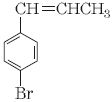
C
$C_6H_5CH(Br)CH_2CH_3$
D
$C_6H_5CH_2CH(Br)CH_3$
Solution
(C) The reaction follows Markovnikov's rule,where the electrophile $H^+$ adds to the carbon atom with more hydrogen atoms,and the nucleophile $Br^-$ adds to the more substituted carbon atom.
In the reaction of $C_6H_5CH=CHCH_3$ with $HBr$,the proton $H^+$ adds to the $CH$ group (adjacent to the methyl group) to form a more stable benzylic carbocation,$C_6H_5CH^+CH_2CH_3$.
Subsequently,the bromide ion $Br^-$ attacks this carbocation to form the final product,$C_6H_5CH(Br)CH_2CH_3$.
In the reaction of $C_6H_5CH=CHCH_3$ with $HBr$,the proton $H^+$ adds to the $CH$ group (adjacent to the methyl group) to form a more stable benzylic carbocation,$C_6H_5CH^+CH_2CH_3$.
Subsequently,the bromide ion $Br^-$ attacks this carbocation to form the final product,$C_6H_5CH(Br)CH_2CH_3$.
0 likesView Solution
82
ChemistryDifficultMCQNEET · 2015
Reaction of phenol with chloroform in the presence of dilute sodium hydroxide finally introduces which one of the following functional groups?
A
$-COOH$
B
$-CHCl_2$
C
$-CHO$
D
$-CH_2Cl$
Solution
(C) The reaction of phenol with chloroform $(CHCl_3)$ in the presence of aqueous sodium hydroxide $(NaOH)$ is known as the Reimer-Tiemann reaction.
This reaction introduces an aldehyde group $(-CHO)$ at the $ortho$ position of the phenol ring.
The overall transformation is: $C_6H_5OH + CHCl_3 + 3NaOH \rightarrow C_6H_4(OH)(CHO) + 3NaCl + 2H_2O$.
This reaction introduces an aldehyde group $(-CHO)$ at the $ortho$ position of the phenol ring.
The overall transformation is: $C_6H_5OH + CHCl_3 + 3NaOH \rightarrow C_6H_4(OH)(CHO) + 3NaCl + 2H_2O$.
0 likesView Solution
83
ChemistryMediumMCQNEET · 2015
Which of the following reaction$(s)$ can be used for the preparation of alkyl halides?
$I$. $CH_3CH_2OH + HCl \xrightarrow{Anh. ZnCl_2}$
$II$. $CH_3CH_2OH + HCl \rightarrow$
$III$. $(CH_3)_3COH + HCl \rightarrow$
$IV$. $(CH_3)_2CHOH + HCl \xrightarrow{Anh. ZnCl_2}$
$I$. $CH_3CH_2OH + HCl \xrightarrow{Anh. ZnCl_2}$
$II$. $CH_3CH_2OH + HCl \rightarrow$
$III$. $(CH_3)_3COH + HCl \rightarrow$
$IV$. $(CH_3)_2CHOH + HCl \xrightarrow{Anh. ZnCl_2}$
A
$I$ and $II$ only
B
$IV$ only
C
$III$ and $IV$ only
D
$I$,$III$ and $IV$ only
Solution
(D) The reaction of alcohols with $HCl$ to form alkyl halides is known as the $Groove's$ process.
$I$. Primary alcohols like $CH_3CH_2OH$ require the catalyst anhydrous $ZnCl_2$ to proceed.
$II$. Primary alcohols do not react with $HCl$ in the absence of $ZnCl_2$.
$III$. Tertiary alcohols like $(CH_3)_3COH$ are highly reactive and form alkyl halides with $HCl$ even at room temperature without $ZnCl_2$ due to the formation of a stable tertiary carbocation.
$IV$. Secondary alcohols like $(CH_3)_2CHOH$ require anhydrous $ZnCl_2$ to react with $HCl$.
Therefore,reactions $I$,$III$,and $IV$ are suitable for the preparation of alkyl halides.
$I$. Primary alcohols like $CH_3CH_2OH$ require the catalyst anhydrous $ZnCl_2$ to proceed.
$II$. Primary alcohols do not react with $HCl$ in the absence of $ZnCl_2$.
$III$. Tertiary alcohols like $(CH_3)_3COH$ are highly reactive and form alkyl halides with $HCl$ even at room temperature without $ZnCl_2$ due to the formation of a stable tertiary carbocation.
$IV$. Secondary alcohols like $(CH_3)_2CHOH$ require anhydrous $ZnCl_2$ to react with $HCl$.
Therefore,reactions $I$,$III$,and $IV$ are suitable for the preparation of alkyl halides.
0 likesView Solution
84
ChemistryMediumMCQNEET · 2015
This reaction,$CH_3-C(CH_3)_2-ONa + CH_3-CH_2-Cl \xrightarrow{-NaCl} CH_3-C(CH_3)_2-O-CH_2-CH_3$ is called:
A
Etard reaction
B
Gattermann-Koch reaction
C
Williamson synthesis
D
Williamson continuous etherification process
Solution
(C) The reaction of a sodium alkoxide with an alkyl halide to form an ether is known as $Williamson$ synthesis.
This reaction proceeds via an $S_N2$ mechanism where the alkoxide ion acts as a nucleophile and attacks the alkyl halide.
The given reaction is: $CH_3-C(CH_3)_2-ONa + CH_3-CH_2-Cl \rightarrow CH_3-C(CH_3)_2-O-CH_2-CH_3 + NaCl$.
This reaction proceeds via an $S_N2$ mechanism where the alkoxide ion acts as a nucleophile and attacks the alkyl halide.
The given reaction is: $CH_3-C(CH_3)_2-ONa + CH_3-CH_2-Cl \rightarrow CH_3-C(CH_3)_2-O-CH_2-CH_3 + NaCl$.
0 likesView Solution
85
ChemistryMediumMCQNEET · 2015
Reaction of a carbonyl compound with one of the following reagents involves nucleophilic addition followed by elimination of water. The reagent is
A
hydrazine in presence of feebly acidic solution
B
hydrocyanic acid
C
sodium hydrogen sulphite
D
a Grignard reagent.
Solution
(A) The reaction of carbonyl compounds with ammonia derivatives (like hydrazine,$NH_2NH_2$) involves nucleophilic addition to the carbonyl group followed by the elimination of a water molecule $(H_2O)$ to form a product containing a $C=N$ bond (e.g.,hydrazone).
This is a characteristic nucleophilic addition-elimination reaction.
This is a characteristic nucleophilic addition-elimination reaction.
0 likesView Solution
86
ChemistryMediumMCQNEET · 2015
Which one of the following esters gets hydrolysed most easily under alkaline conditions?
A
p-Methoxy phenyl acetate
B
Phenyl acetate
C
p-Chloro phenyl acetate
D
p-Nitro phenyl acetate
Solution
(D) The alkaline hydrolysis of esters follows a nucleophilic acyl substitution mechanism.
The rate of this reaction depends on the electrophilicity of the carbonyl carbon.
Electron-withdrawing groups $(EWG)$ increase the electrophilicity of the carbonyl carbon by pulling electron density away from it,thereby facilitating the attack of the nucleophile $(OH^-)$.
Among the given substituents,the nitro group $(-NO_2)$ is the strongest electron-withdrawing group due to its strong $-I$ and $-M$ effects.
Therefore,p-nitro phenyl acetate will be hydrolysed most easily.
The rate of this reaction depends on the electrophilicity of the carbonyl carbon.
Electron-withdrawing groups $(EWG)$ increase the electrophilicity of the carbonyl carbon by pulling electron density away from it,thereby facilitating the attack of the nucleophile $(OH^-)$.
Among the given substituents,the nitro group $(-NO_2)$ is the strongest electron-withdrawing group due to its strong $-I$ and $-M$ effects.
Therefore,p-nitro phenyl acetate will be hydrolysed most easily.
0 likesView Solution
87
ChemistryMediumMCQNEET · 2015
An organic compound '$X$' having molecular formula $C_5H_{10}O$ yields phenylhydrazone and gives negative response to the iodoform test and Tollens' test. It produces $n-$pentane on reduction. '$X$' could be
A
$3-$pentanone
B
$n-$amyl alcohol
C
pentanal
D
$2-$pentanone
Solution
(A) Compound '$X$' yields phenylhydrazone $\Rightarrow$ Presence of $C=O$ group.
Negative iodoform test $\Rightarrow$ Absence of $CH_3-C=O$ group.
Negative Tollens' test $\Rightarrow$ It is a ketone,not an aldehyde.
Since the compound is a ketone with $5$ carbon atoms and does not contain a methyl ketone group,it must be $3-$pentanone.
$3-$pentanone $(C_5H_{10}O): CH_3CH_2-C(=O)-CH_2CH_3 \xrightarrow{\text{Reduction}} CH_3CH_2CH_2CH_2CH_3$ ($n-$pentane).
Negative iodoform test $\Rightarrow$ Absence of $CH_3-C=O$ group.
Negative Tollens' test $\Rightarrow$ It is a ketone,not an aldehyde.
Since the compound is a ketone with $5$ carbon atoms and does not contain a methyl ketone group,it must be $3-$pentanone.
$3-$pentanone $(C_5H_{10}O): CH_3CH_2-C(=O)-CH_2CH_3 \xrightarrow{\text{Reduction}} CH_3CH_2CH_2CH_2CH_3$ ($n-$pentane).
0 likesView Solution
88
ChemistryMediumMCQNEET · 2015
The following reaction is known by the name:
$C_6H_5NH_2 + C_6H_5COCl \xrightarrow{NaOH} C_6H_5NHCOC_6H_5 + HCl$
$C_6H_5NH_2 + C_6H_5COCl \xrightarrow{NaOH} C_6H_5NHCOC_6H_5 + HCl$
A
Perkin's reaction
B
Acetylation reaction
C
Schotten-Baumann reaction
D
Friedel-Craft's reaction
Solution
(C) The reaction of aniline $(C_6H_5NH_2)$ with benzoyl chloride $(C_6H_5COCl)$ in the presence of a base like $NaOH$ is known as the Schotten-Baumann reaction.
This process involves the benzoylation of the amine to form an amide ($N$-phenylbenzamide).
This process involves the benzoylation of the amine to form an amide ($N$-phenylbenzamide).
0 likesView Solution
89
ChemistryMediumMCQNEET · 2015
Method by which aniline cannot be prepared is
A
degradation of benzamide with bromine in alkaline solution
B
reduction of nitrobenzene with $H_2/Pd$ in ethanol
C
potassium salt of phthalimide treated with chlorobenzene followed by hydrolysis with aqueous $NaOH$ solution
D
hydrolysis of phenylisocyanide with acidic solution
Solution
(C) Aniline cannot be prepared by the reaction of potassium phthalimide with chlorobenzene because chlorobenzene does not undergo nucleophilic substitution reaction under mild conditions.
This is because the $C-Cl$ bond in chlorobenzene acquires partial double bond character due to resonance,making it resistant to nucleophilic attack by the phthalimide anion.
Therefore,the Gabriel phthalimide synthesis is not suitable for the preparation of aromatic primary amines using aryl halides.
This is because the $C-Cl$ bond in chlorobenzene acquires partial double bond character due to resonance,making it resistant to nucleophilic attack by the phthalimide anion.
Therefore,the Gabriel phthalimide synthesis is not suitable for the preparation of aromatic primary amines using aryl halides.
0 likesView Solution
90
ChemistryDifficultMCQNEET · 2015
The number of structural isomers possible from the molecular formula $C_3H_9N$ is
A
$5$
B
$2$
C
$3$
D
$4$
Solution
(D) The molecular formula $C_3H_9N$ corresponds to a saturated amine.
Structural isomers are categorized by the degree of the amine:
$1^o$ amines: $CH_3CH_2CH_2NH_2$ (propan$-1-$amine) and $CH_3CH(NH_2)CH_3$ (propan$-2-$amine).
$2^o$ amine: $CH_3CH_2NHCH_3$ ($N$-methylethanamine).
$3^o$ amine: $(CH_3)_3N$ ($N$,$N$-dimethylmethanamine).
Total number of structural isomers = $4$.
Structural isomers are categorized by the degree of the amine:
$1^o$ amines: $CH_3CH_2CH_2NH_2$ (propan$-1-$amine) and $CH_3CH(NH_2)CH_3$ (propan$-2-$amine).
$2^o$ amine: $CH_3CH_2NHCH_3$ ($N$-methylethanamine).
$3^o$ amine: $(CH_3)_3N$ ($N$,$N$-dimethylmethanamine).
Total number of structural isomers = $4$.
0 likesView Solution
91
ChemistryMediumMCQNEET · 2015
The electrolytic reduction of nitrobenzene in a strongly acidic medium produces:
A
azobenzene
B
aniline
C
$p-$aminophenol
D
azoxybenzene
Solution
(C) The electrolytic reduction of nitrobenzene $(C_6H_5NO_2)$ in a strongly acidic medium proceeds through the formation of phenylhydroxylamine $(C_6H_5NHOH)$.
In the presence of a strong acid $(H^+)$,phenylhydroxylamine undergoes a Bamberger rearrangement to form $p-$aminophenol $(H_2N-C_6H_4-OH)$.
In the presence of a strong acid $(H^+)$,phenylhydroxylamine undergoes a Bamberger rearrangement to form $p-$aminophenol $(H_2N-C_6H_4-OH)$.
0 likesView Solution
92
ChemistryMediumMCQNEET · 2015
Caprolactam is used for the manufacture of
A
teflon
B
terylene
C
nylon $6, 6$
D
nylon $6$
Solution
(D) Caprolactam is heated with water at high temperature to undergo ring-opening polymerization.
This process yields $6$-aminohexanoic acid,which upon further heating undergoes condensation polymerization to form the polymer known as nylon $6$.
Therefore,caprolactam is the monomer used for the manufacture of nylon $6$.
This process yields $6$-aminohexanoic acid,which upon further heating undergoes condensation polymerization to form the polymer known as nylon $6$.
Therefore,caprolactam is the monomer used for the manufacture of nylon $6$.
0 likesView Solution
93
ChemistryMediumMCQNEET · 2015
The biodegradable polymer which can be produced from glycine and aminocaproic acid is
A
buna-$N$
B
nylon $6,6$
C
nylon-$2$-nylon-$6$
D
$PHBV$
Solution
(C) Nylon-$2$-nylon-$6$ is a biodegradable polyamide copolymer.
It is formed by the condensation polymerization of glycine $(H_2N-CH_2-COOH)$ and aminocaproic acid $(H_2N-(CH_2)_5-COOH)$.
The reaction is: $n(H_2N-CH_2-COOH) + n(H_2N-(CH_2)_5-COOH) \rightarrow [NH-CH_2-CO-NH-(CH_2)_5-CO]_n + 2nH_2O$.
It is formed by the condensation polymerization of glycine $(H_2N-CH_2-COOH)$ and aminocaproic acid $(H_2N-(CH_2)_5-COOH)$.
The reaction is: $n(H_2N-CH_2-COOH) + n(H_2N-(CH_2)_5-COOH) \rightarrow [NH-CH_2-CO-NH-(CH_2)_5-CO]_n + 2nH_2O$.
0 likesView Solution
94
ChemistryMediumMCQNEET · 2015
Bithional is generally added to soaps as an additive to function as a/an:
A
buffering agent
B
antiseptic
C
softener
D
dryer
Solution
(B) Bithional is added to soaps to impart antiseptic properties. It helps in reducing the odour produced by the bacterial decomposition of organic matter on the skin.
0 likesView Solution
Vedclass Products
For Students
Vedclass Test Series
Mock tests in real NEET style covering Chemistry with performance analysis. 5-day free trial.
Start Free TrialFor Teachers
Exam Paper Generator
Generate Set A/B/C/D Chemistry papers from 7.5L+ questions in 2 minutes. 3 chapters free.
Try FreeFor Institutes
Online Exam Module
Run live NEET mock exams with unlimited students, 360° analytics & white-label branding.
See DemoFrequently Asked Questions
How many Chemistry questions are in NEET 2015?
There are 117 Chemistry questions from the NEET 2015 paper on Vedclass, each with a detailed step-by-step solution in English.
Are NEET 2015 Chemistry solutions available in English?
Yes. All solutions on this page are in English. You can also switch to English or Hindi using the language buttons above the questions.
Can I practice NEET 2015 Chemistry as a timed test?
Yes. Use the Vedclass Test Series to attempt a full NEET mock test covering Chemistry with time limits and instant score analysis.
Can teachers create Chemistry papers from NEET previous year questions?
Yes. The Vedclass Exam Paper Generator lets teachers mix NEET Chemistry questions and generate Set A/B/C/D papers in minutes.
For Teachers & Institutes
Build a Custom Chemistry Paper
Pick NEET 2015 Chemistry questions, set difficulty, and generate Set A/B/C/D in 2 minutes.