
BiologyQ1–100 of 193 questions
Page 1 of 3 · English
1
BiologyEasyMCQNEET · 2015
What causes seed dormancy?
A
Ethylene
B
Abscisic acid
C
$IAA$
D
Starch
Solution
(B) Seed dormancy is primarily induced by the plant hormone Abscisic acid $(ABA)$.
$ABA$ acts as a growth inhibitor that prevents germination in seeds,buds,and underground storage organs,allowing them to survive unfavorable environmental conditions.
In contrast,Ethylene is often involved in breaking dormancy in certain seeds and buds.
$ABA$ acts as a growth inhibitor that prevents germination in seeds,buds,and underground storage organs,allowing them to survive unfavorable environmental conditions.
In contrast,Ethylene is often involved in breaking dormancy in certain seeds and buds.
0 likesView Solution
2
BiologyMediumMCQNEET · 2015
Which one is a wrong statement?
A
Haploid endosperm is a typical feature of Gymnosperms.
B
Brown algae have chlorophyll $a$ and $c$ and fucoxanthin.
C
Archegonia are found in Bryophyta,Pteridophyta and Gymnosperms.
D
Mucor has biflagellate zoospores.
Solution
(D) : $Mucor$ is a member of $Zygomycetes$ (the conjugation fungi) in which motile cells,e.g.,zoospores or planogametes,are absent.
Asexual reproduction takes place by the formation of non-motile mitospores called sporangiospores.
Sexual reproduction takes place by the formation of non-motile zygospores.
Therefore,the statement that $Mucor$ has biflagellate zoospores is incorrect.
Asexual reproduction takes place by the formation of non-motile mitospores called sporangiospores.
Sexual reproduction takes place by the formation of non-motile zygospores.
Therefore,the statement that $Mucor$ has biflagellate zoospores is incorrect.
0 likesView Solution
3
BiologyMediumMCQNEET · 2015
The structures that help some bacteria to attach to rocks and/or host tissues are
A
mesosomes
B
holdfast
C
rhizoids
D
fimbriae
Solution
(D) : Fimbriae are small bristle-like solid structures arising from the bacterial cell surface.
There are $300-400$ fimbriae per cell.
Their diameter is $3-10 \ nm$ while their length is $0.5-1.5 \ \mu m$.
Fimbriae are involved in attaching bacteria to solid surfaces (e.g.,rocks in a water body) or host tissues (e.g.,the urinary tract in $Neisseria \ gonorrhoeae$).
Some fimbriae cause the agglutination of $RBCs$.
They also help in the mutual clinging of bacteria.
There are $300-400$ fimbriae per cell.
Their diameter is $3-10 \ nm$ while their length is $0.5-1.5 \ \mu m$.
Fimbriae are involved in attaching bacteria to solid surfaces (e.g.,rocks in a water body) or host tissues (e.g.,the urinary tract in $Neisseria \ gonorrhoeae$).
Some fimbriae cause the agglutination of $RBCs$.
They also help in the mutual clinging of bacteria.
1 likesView Solution
4
BiologyMediumMCQNEET · 2015
Select the wrong statement.
A
The term 'contagium vivum fluidum' was coined by $M$. $W$. Beijerinck.
B
Mosaic disease in tobacco and $AIDS$ in human being are caused by viruses.
C
The viroids were discovered by $D$.$J$. Ivanowsky.
D
$W$.$M$. Stanley showed that viruses could be crystallised.
Solution
(C) : Viroids are infectious $RNA$ particles which were discovered by $T$.$O$. Diener $(1971)$.
These are devoid of protein coat and cause diseases in plants only,e.g.,potato spindle tuber,chrysanthemum stunt etc.
Therefore,the statement that viroids were discovered by $D$.$J$. Ivanowsky is incorrect,as $D$.$J$. Ivanowsky discovered the causal organism of tobacco mosaic disease.
These are devoid of protein coat and cause diseases in plants only,e.g.,potato spindle tuber,chrysanthemum stunt etc.
Therefore,the statement that viroids were discovered by $D$.$J$. Ivanowsky is incorrect,as $D$.$J$. Ivanowsky discovered the causal organism of tobacco mosaic disease.
0 likesView Solution
5
BiologyMediumMCQNEET · 2015
In which group of organisms do the cell walls form two thin overlapping shells that fit together?
A
Dinoflagellates
B
Slime moulds
C
Chrysophytes
D
Euglenoids
Solution
(C) The correct answer is $C$. Chrysophytes include diatoms and golden algae (desmids).
In diatoms,the cell walls form two thin overlapping shells,which fit together as in a soap box.
The walls are embedded with silica and thus the walls are indestructible.
The two shells are known as the epitheca (upper) and the hypotheca (lower).
In diatoms,the cell walls form two thin overlapping shells,which fit together as in a soap box.
The walls are embedded with silica and thus the walls are indestructible.
The two shells are known as the epitheca (upper) and the hypotheca (lower).
0 likesView Solution
6
BiologyMediumMCQNEET · 2015
Pick up the wrong statement.
A
Some fungi are edible.
B
Nuclear membrane is present in Monera.
C
Cell wall is absent in Animalia.
D
Protists have photosynthetic and heterotrophic modes of nutrition.
Solution
(B) : Kingdom Monera consists of prokaryotic organisms,which are characterized by the absence of a nuclear envelope around the nucleus and the absence of membrane-bound cell organelles. Therefore,the statement that a nuclear membrane is present in Monera is incorrect.
0 likesView Solution
7
BiologyMediumMCQNEET · 2015
Choose the wrong statement.
A
Morels and truffles are poisonous mushrooms.
B
Yeast is unicellular and useful in fermentation.
C
Penicillium is multicellular and produces antibiotics.
D
Neurospora is used in the study of biochemical genetics.
Solution
(A) : Morels are Ascomycetes with edible ascocarps that have a fleshy,sponge-like conical cap or pileus and a stalk-like stipe,e.g.,$Morchella$ $esculenta$.
Truffles are also edible members of Ascomycetes with tuber-like subterranean ascocarps that are often dug out with the help of trained dogs and pigs,e.g.,$Tuber$ $aestivum$.
Therefore,the statement that morels and truffles are poisonous is incorrect,as they are considered delicacies.
Truffles are also edible members of Ascomycetes with tuber-like subterranean ascocarps that are often dug out with the help of trained dogs and pigs,e.g.,$Tuber$ $aestivum$.
Therefore,the statement that morels and truffles are poisonous is incorrect,as they are considered delicacies.
0 likesView Solution
8
BiologyMediumMCQNEET · 2015
Cell wall is absent in
A
Mycoplasma
B
Nostoc
C
Aspergillus
D
Funaria
Solution
(A) : Mycoplasma (Kingdom Monera) are the simplest and smallest free-living prokaryotes that are devoid of a cell wall. The plasma membrane forms the outer boundary of the cell in Mycoplasma.
$B$: Nostoc is a cyanobacterium (Kingdom Monera),in which the cell wall is composed of peptidoglycans.
$C$: Aspergillus is a fungus (Kingdom Fungi),in which the cell wall is mainly made of chitin.
$D$: Funaria is a bryophyte (Kingdom Plantae),in which the cell wall is cellulosic in nature.
Therefore,the correct answer is $A$.
$B$: Nostoc is a cyanobacterium (Kingdom Monera),in which the cell wall is composed of peptidoglycans.
$C$: Aspergillus is a fungus (Kingdom Fungi),in which the cell wall is mainly made of chitin.
$D$: Funaria is a bryophyte (Kingdom Plantae),in which the cell wall is cellulosic in nature.
Therefore,the correct answer is $A$.
0 likesView Solution
9
BiologyMediumMCQNEET · 2015
True nucleus is absent in
A
Vaucheria
B
Volvox
C
Anabaena
D
Mucor
Solution
(C) : $Anabaena$ is a prokaryotic organism.
It is a cyanobacterium (blue-green alga) which belongs to Kingdom $Monera$.
Like all other prokaryotes,it lacks a true nucleus and membrane-bound cell organelles.
It is a cyanobacterium (blue-green alga) which belongs to Kingdom $Monera$.
Like all other prokaryotes,it lacks a true nucleus and membrane-bound cell organelles.
0 likesView Solution
10
BiologyMediumMCQNEET · 2015
Which one of the following matches is correct?
| $Mucor$ | Reproduction by Conjugation | $Ascomycetes$ |
| $Agaricus$ | Parasitic fungus | $Basidiomycetes$ |
| $Phytophthora$ | Aseptate mycelium | $Basidiomycetes$ |
| $Alternaria$ | Sexual reproduction absent | $Deuteromycetes$ |
A
$Mucor$ - Reproduction by Conjugation - $Ascomycetes$
B
$Agaricus$ - Parasitic fungus - $Basidiomycetes$
C
$Phytophthora$ - Aseptate mycelium - $Basidiomycetes$
D
$Alternaria$ - Sexual reproduction absent - $Deuteromycetes$
Solution
(D) $Alternaria$ is a member of $Deuteromycetes$, which are commonly known as 'fungi imperfecti'.
In $Deuteromycetes$, the sexual reproduction stage is either absent or not yet discovered, which is why they are classified as imperfect fungi.
$Mucor$ belongs to $Phycomycetes$ (Zygomycetes).
$Agaricus$ is a saprophytic fungus, not parasitic.
$Phytophthora$ belongs to $Phycomycetes$ (Oomycetes), not $Basidiomycetes$.
In $Deuteromycetes$, the sexual reproduction stage is either absent or not yet discovered, which is why they are classified as imperfect fungi.
$Mucor$ belongs to $Phycomycetes$ (Zygomycetes).
$Agaricus$ is a saprophytic fungus, not parasitic.
$Phytophthora$ belongs to $Phycomycetes$ (Oomycetes), not $Basidiomycetes$.
0 likesView Solution
11
BiologyMediumMCQNEET · 2015
Which one of the following statements is wrong?
A
Chlorella and Spirulina are used as space food.
B
Mannitol is stored food in Rhodophyceae.
C
Algin and carrageenan are products of algae.
D
Agar-agar is obtained from Gelidium and Gracilaria.
Solution
(B) The correct answer is $B$.
In Phaeophyceae (brown algae),food is stored as complex carbohydrates,usually in the form of laminarin or mannitol.
In Rhodophyceae (red algae),food is stored as floridean starch,which is very similar to amylopectin and glycogen in structure.
Therefore,the statement that mannitol is stored food in Rhodophyceae is incorrect.
In Phaeophyceae (brown algae),food is stored as complex carbohydrates,usually in the form of laminarin or mannitol.
In Rhodophyceae (red algae),food is stored as floridean starch,which is very similar to amylopectin and glycogen in structure.
Therefore,the statement that mannitol is stored food in Rhodophyceae is incorrect.
0 likesView Solution
12
BiologyMediumMCQNEET · 2015
In which of the following,gametophyte is not independent free living?
A
Pteris
B
Pinus
C
Funaria
D
Marchantia
Solution
(B) : In gymnosperms (like $Pinus$),the male and female gametophytes do not have an independent free-living existence.
They remain within the sporangia retained on the sporophytes,$i.e.$,the female gametophyte (within the megasporangium) and the male gametophyte (within the microsporangium).
They remain within the sporangia retained on the sporophytes,$i.e.$,the female gametophyte (within the megasporangium) and the male gametophyte (within the microsporangium).
0 likesView Solution
13
BiologyMediumMCQNEET · 2015
Read the following five statements $(A$ to $E)$ and select the option with all correct statements.
$A.$ Mosses and lichens are the first organisms to colonise a bare rock.
$B.$ Selaginella is a homosporous pteridophyte.
$C.$ Coralloid roots in Cycas have $VAM$.
$D.$ Main plant body in bryophytes is gametophytic,whereas in pteridophytes it is sporophytic.
$E.$ In gymnosperms,male and female gametophytes are present within sporangia located on sporophyte.
$A.$ Mosses and lichens are the first organisms to colonise a bare rock.
$B.$ Selaginella is a homosporous pteridophyte.
$C.$ Coralloid roots in Cycas have $VAM$.
$D.$ Main plant body in bryophytes is gametophytic,whereas in pteridophytes it is sporophytic.
$E.$ In gymnosperms,male and female gametophytes are present within sporangia located on sporophyte.
A
$A, D$ and $E$
B
$B, C$ and $E$
C
$A, C$ and $D$
D
$B, C$ and $D$
Solution
(A) Statement $A$ is correct: Lichens and mosses are pioneer species in primary succession on bare rocks.
Statement $B$ is incorrect: $Selaginella$ is a heterosporous pteridophyte,not homosporous.
Statement $C$ is incorrect: Coralloid roots in $Cycas$ contain nitrogen-fixing cyanobacteria (like $Nostoc$ or $Anabaena$),not $VAM$ (Vesicular Arbuscular Mycorrhiza),which is a fungal association.
Statement $D$ is correct: In bryophytes,the dominant phase is the gametophyte,while in pteridophytes,the dominant phase is the sporophyte.
Statement $E$ is correct: In gymnosperms,the male and female gametophytes do not have an independent free-living existence; they remain within the sporangia retained on the sporophytes.
Therefore,statements $A, D,$ and $E$ are correct.
Statement $B$ is incorrect: $Selaginella$ is a heterosporous pteridophyte,not homosporous.
Statement $C$ is incorrect: Coralloid roots in $Cycas$ contain nitrogen-fixing cyanobacteria (like $Nostoc$ or $Anabaena$),not $VAM$ (Vesicular Arbuscular Mycorrhiza),which is a fungal association.
Statement $D$ is correct: In bryophytes,the dominant phase is the gametophyte,while in pteridophytes,the dominant phase is the sporophyte.
Statement $E$ is correct: In gymnosperms,the male and female gametophytes do not have an independent free-living existence; they remain within the sporangia retained on the sporophytes.
Therefore,statements $A, D,$ and $E$ are correct.
0 likesView Solution
14
BiologyMediumMCQNEET · 2015
Male gametes are flagellated in
A
Ectocarpus
B
Spirogyra
C
Polysiphonia
D
Anabaena
Solution
(A) $Ectocarpus$ produces biflagellate gametes.
$Anabaena$ is a cyanobacterium and does not reproduce sexually.
$Spirogyra$ produces non-flagellated male gametes during conjugation,where the entire cell content functions as a gamete.
$Polysiphonia$ also produces non-flagellated spermatia.
$Anabaena$ is a cyanobacterium and does not reproduce sexually.
$Spirogyra$ produces non-flagellated male gametes during conjugation,where the entire cell content functions as a gamete.
$Polysiphonia$ also produces non-flagellated spermatia.
0 likesView Solution
15
BiologyMediumMCQNEET · 2015
Body having meshwork of cells,internal cavities lined with food filtering flagellated cells and indirect development are the characteristics of Phylum
A
Mollusca
B
Protozoa
C
Coelenterata
D
Porifera
Solution
(D) The correct answer is $D$.
Phylum $Porifera$ (sponges) is characterized by a cellular level of body organization.
Their body wall contains a meshwork of cells and internal cavities (spongocoel) lined with specialized flagellated cells known as $choanocytes$ or collar cells,which are responsible for filtering food particles from the water.
The development in this phylum is indirect,meaning it includes a free-swimming larval stage (such as $amphiblastula$ or $parenchymula$) before reaching the adult form,which aids in the dispersal of the species.
Phylum $Porifera$ (sponges) is characterized by a cellular level of body organization.
Their body wall contains a meshwork of cells and internal cavities (spongocoel) lined with specialized flagellated cells known as $choanocytes$ or collar cells,which are responsible for filtering food particles from the water.
The development in this phylum is indirect,meaning it includes a free-swimming larval stage (such as $amphiblastula$ or $parenchymula$) before reaching the adult form,which aids in the dispersal of the species.
0 likesView Solution
16
BiologyMediumMCQNEET · 2015
Metagenesis refers to
A
occurrence of a drastic change in form during post-embryonic development
B
presence of a segmented body and parthenogenetic mode of reproduction
C
presence of different morphic forms
D
alternation of generation between asexual and sexual phases of an organism
Solution
(D) : Metagenesis refers to the alternation of generation between asexual and sexual phases of an organism.
In this process,the organism exists in two different forms.
For example,in $Obelia$ (a coelenterate),the polyp form reproduces asexually to produce medusae,and the medusa form reproduces sexually to produce polyps.
In this process,the organism exists in two different forms.
For example,in $Obelia$ (a coelenterate),the polyp form reproduces asexually to produce medusae,and the medusa form reproduces sexually to produce polyps.
0 likesView Solution
17
BiologyMediumMCQNEET · 2015
$A$ jawless fish,which lays eggs in fresh water and whose ammocoetes larvae after metamorphosis return to the ocean is
A
Neomyxine
B
Petromyzon
C
Eptatretus
D
Myxine
Solution
(B) $Petromyzon$ (Lamprey) belongs to the Class $Cyclostomata$ of Phylum $Chordata$.
It is a jawless fish that migrates from the ocean to fresh water to lay eggs (anadromous migration).
The eggs hatch in about $3$ weeks into minute,transparent larvae called ammocoetes.
After metamorphosis,the young lampreys swim down to the sea,where they remain for $3$ or $4$ years before reaching maturity.
Once they reach maturity,they migrate back to fresh water streams or rivers to spawn and then die.
It is a jawless fish that migrates from the ocean to fresh water to lay eggs (anadromous migration).
The eggs hatch in about $3$ weeks into minute,transparent larvae called ammocoetes.
After metamorphosis,the young lampreys swim down to the sea,where they remain for $3$ or $4$ years before reaching maturity.
Once they reach maturity,they migrate back to fresh water streams or rivers to spawn and then die.
0 likesView Solution
18
BiologyMediumMCQNEET · 2015
Which of the following endoparasites of humans shows viviparity?
A
Trichinella spiralis
B
Ascaris lumbricoides
C
Ancylostoma duodenale
D
Enterobius vermicularis
Solution
(A) : $Trichinella$ $spiralis$ is a minute nematode parasite that exhibits viviparity,meaning it produces live young (larvae) instead of eggs.
The adults of $T. spiralis$ reside in the human small intestine,where the females release large numbers of larvae directly.
These larvae penetrate the intestinal wall and migrate through the bloodstream to muscles,causing trichinosis or trichiniasis,which presents with symptoms such as diarrhea,nausea,vertigo,muscle pain,and fever.
Humans typically become infected after consuming undercooked meat containing the parasite's larval cysts.
The adults of $T. spiralis$ reside in the human small intestine,where the females release large numbers of larvae directly.
These larvae penetrate the intestinal wall and migrate through the bloodstream to muscles,causing trichinosis or trichiniasis,which presents with symptoms such as diarrhea,nausea,vertigo,muscle pain,and fever.
Humans typically become infected after consuming undercooked meat containing the parasite's larval cysts.
0 likesView Solution
19
BiologyMediumMCQNEET · 2015
Which of the following represents the correct combination without any exception?
| $Option$ | $Characteristics$ |
| $(a)$ | $Cyclostomata$: Sucking and circular mouth; jaws absent, integument without scales; paired appendages. |
| $(b)$ | $Aves$: Body covered with feathers; skin moist and glandular, fore-limbs form wings; lungs with air sacs. |
| $(c)$ | $Mammalia$: Mammary gland; hair on body; pinnae; two pairs of limbs. |
| $(d)$ | $Chondrichthyes$: Mouth ventral; gills without operculum; skin with placoid scales; persistent notochord. |
A
$(a)$ and $(b)$
B
$(b)$ and $(c)$
C
$(c)$ and $(d)$
D
None of the above
Solution
(D) None of the options provided is correct without exceptions.
$1$. In $(a)$, $Cyclostomata$ do not have paired appendages.
$2$. In $(b)$, the skin of $Aves$ is dry and non-glandular (except for the oil gland at the base of the tail).
$3$. In $(c)$, while $Mammalia$ are characterized by mammary glands and hair, not all mammals have pinnae (e.g., monotremes) or two pairs of limbs (e.g., whales and dolphins lack hindlimbs).
$4$. In $(d)$, while $Chondrichthyes$ generally have gills without an operculum, there are exceptions like $Chimaera$ (ratfish), which possesses an operculum.
$1$. In $(a)$, $Cyclostomata$ do not have paired appendages.
$2$. In $(b)$, the skin of $Aves$ is dry and non-glandular (except for the oil gland at the base of the tail).
$3$. In $(c)$, while $Mammalia$ are characterized by mammary glands and hair, not all mammals have pinnae (e.g., monotremes) or two pairs of limbs (e.g., whales and dolphins lack hindlimbs).
$4$. In $(d)$, while $Chondrichthyes$ generally have gills without an operculum, there are exceptions like $Chimaera$ (ratfish), which possesses an operculum.
0 likesView Solution
20
BiologyMediumMCQNEET · 2015
Which of the following animals is not viviparous?
A
Platypus
B
Whale
C
Flying fox (Bat)
D
Elephant
Solution
(A) : Duck-billed platypus is an egg-laying mammal (oviparous).
It is found in the rivers of eastern Australia and Tasmania.
It is a beaver-like monotreme about $50-60 \ cm$ long and is well-adapted to live in water.
Usually,two eggs are laid at a time.
The female curls around them for incubation and remains inactive for about two weeks.
Newly hatched young ones are very immature,naked,blind,and each is $2.5 \ cm$ long.
In contrast,whales,bats,and elephants are placental mammals and are viviparous.
It is found in the rivers of eastern Australia and Tasmania.
It is a beaver-like monotreme about $50-60 \ cm$ long and is well-adapted to live in water.
Usually,two eggs are laid at a time.
The female curls around them for incubation and remains inactive for about two weeks.
Newly hatched young ones are very immature,naked,blind,and each is $2.5 \ cm$ long.
In contrast,whales,bats,and elephants are placental mammals and are viviparous.
0 likesView Solution
21
BiologyMediumMCQNEET · 2015
Which of the following characteristics is mainly responsible for the diversification of insects on land?
A
Exoskeleton
B
Eyes
C
Segmentation
D
Bilateral symmetry
Solution
(A) : The exoskeleton,composed of a chitinous cuticle,is the primary factor that has enabled insects to colonize land and diversify into almost all possible habitats. It provides essential protection,structural support,and significantly helps in preventing desiccation (water loss).
0 likesView Solution
22
BiologyMediumMCQNEET · 2015
Among China rose,mustard,brinjal,potato,guava,cucumber,onion and tulip,how many plants have superior ovary?
A
Three
B
Four
C
Five
D
Six
Solution
(D) The plants listed are China rose,mustard,brinjal,potato,guava,cucumber,onion,and tulip.
$1$. China rose: Superior ovary (Hypogynous flower).
$2$. Mustard: Superior ovary (Hypogynous flower).
$3$. Brinjal: Superior ovary (Hypogynous flower).
$4$. Potato: Superior ovary (Hypogynous flower).
$5$. Guava: Inferior ovary (Epigynous flower).
$6$. Cucumber: Inferior ovary (Epigynous flower).
$7$. Onion: Superior ovary (Hypogynous flower).
$8$. Tulip: Superior ovary (Hypogynous flower).
Thus,China rose,mustard,brinjal,potato,onion,and tulip have a superior ovary. The total count is $6$.
$1$. China rose: Superior ovary (Hypogynous flower).
$2$. Mustard: Superior ovary (Hypogynous flower).
$3$. Brinjal: Superior ovary (Hypogynous flower).
$4$. Potato: Superior ovary (Hypogynous flower).
$5$. Guava: Inferior ovary (Epigynous flower).
$6$. Cucumber: Inferior ovary (Epigynous flower).
$7$. Onion: Superior ovary (Hypogynous flower).
$8$. Tulip: Superior ovary (Hypogynous flower).
Thus,China rose,mustard,brinjal,potato,onion,and tulip have a superior ovary. The total count is $6$.
0 likesView Solution
23
BiologyMediumMCQNEET · 2015
Axile placentation is present in
A
pea
B
Argemone
C
Dianthus
D
lemon
Solution
(D) : Axile placentation occurs in syncarpous pistils. The ovary is partitioned into two or more chambers. Placentae occur in the central region where the septa meet so that an axile column bearing ovules is formed,$e.g.$,shoe flower (pentalocular),lemon (multilocular),etc.
0 likesView Solution
24
BiologyMediumMCQNEET · 2015
Roots play an insignificant role in the absorption of water in
A
pea
B
wheat
C
sunflower
D
Pistia
Solution
(D) : $Pistia$ (water lettuce) is a floating aquatic plant.
In aquatic plants,roots are generally poorly developed and do not participate in the absorption of water.
Water is absorbed directly through the general body surface of these plants.
In aquatic plants,roots are generally poorly developed and do not participate in the absorption of water.
Water is absorbed directly through the general body surface of these plants.
0 likesView Solution
25
BiologyMediumMCQNEET · 2015
Perigynous flowers are found in
A
China rose
B
rose
C
guava
D
cucumber
Solution
(B) In perigynous flowers,the gynoecium is situated in the center and other floral parts are located on the rim of the thalamus almost at the same level.
In this condition,the ovary is said to be half-inferior.
Examples of perigynous flowers include $plum$,$rose$,and $peach$.
Therefore,the correct option is $(b)$.
In this condition,the ovary is said to be half-inferior.
Examples of perigynous flowers include $plum$,$rose$,and $peach$.
Therefore,the correct option is $(b)$.
0 likesView Solution
26
BiologyMediumMCQNEET · 2015
Keel is the characteristic feature of the flower of
A
Aloe
B
Tomato
C
Tulip
D
Indigofera
Solution
(D) The flowers of the family $Fabaceae$ (subfamily $Papilionoideae$) exhibit a butterfly-shaped corolla,known as a papilionaceous corolla.
This arrangement consists of five petals: one posterior,large,outermost petal called the $standard$ or $vexillum$; two lateral petals called $wings$ or $alae$; and two anterior,fused petals called the $keel$ or $carina$.
The $keel$ petals enclose the stamens and the carpel.
This characteristic structure is found in plants like $Indigofera$,bean,gram,and pea.
This arrangement consists of five petals: one posterior,large,outermost petal called the $standard$ or $vexillum$; two lateral petals called $wings$ or $alae$; and two anterior,fused petals called the $keel$ or $carina$.
The $keel$ petals enclose the stamens and the carpel.
This characteristic structure is found in plants like $Indigofera$,bean,gram,and pea.
0 likesView Solution
27
BiologyMediumMCQNEET · 2015
Leaves become modified into spines in
A
onion
B
silk cotton
C
Opuntia
D
pea
Solution
(C) : In xerophytic plants, the leaves modify into sharp, pointed spines, $e.g.$, $Aloe$, $Solanum$ $surattense$, $Opuntia$, $Asparagus$ etc.
This modification is either for the protection of the plant, to reduce transpiration, or for both.
This modification is either for the protection of the plant, to reduce transpiration, or for both.
0 likesView Solution
28
BiologyMediumMCQNEET · 2015
Read the different components from $(i)$ to $(iv)$ in the list given below and tell the correct order of the components with reference to their arrangement from outer side to inner side in a woody dicot stem.
$(i)$ Secondary cortex $(ii)$ Wood $(iii)$ Secondary phloem $(iv)$ Phellem
The correct order is:
$(i)$ Secondary cortex $(ii)$ Wood $(iii)$ Secondary phloem $(iv)$ Phellem
The correct order is:
A
$(iv), (i), (iii), (ii)$
B
$(iv), (iii), (i), (ii)$
C
$(iii), (iv), (ii), (i)$
D
$(i), (ii), (iv), (iii)$
Solution
(A) In a woody dicot stem,the arrangement of tissues from the periphery (outer side) to the center (inner side) is as follows:
$1$. Phellem (cork): This is the outermost layer of the periderm.
$2$. Secondary cortex (phelloderm): This lies just inside the phellem and phellogen.
$3$. Secondary phloem: This is located outside the vascular cambium.
$4$. Wood (Secondary xylem): This is located inside the vascular cambium.
Therefore,the correct sequence from outer to inner side is: $(iv)$ Phellem $\rightarrow$ $(i)$ Secondary cortex $\rightarrow$ $(iii)$ Secondary phloem $\rightarrow$ $(ii)$ Wood (Secondary xylem).
Thus,the correct option is $(A)$.
$1$. Phellem (cork): This is the outermost layer of the periderm.
$2$. Secondary cortex (phelloderm): This lies just inside the phellem and phellogen.
$3$. Secondary phloem: This is located outside the vascular cambium.
$4$. Wood (Secondary xylem): This is located inside the vascular cambium.
Therefore,the correct sequence from outer to inner side is: $(iv)$ Phellem $\rightarrow$ $(i)$ Secondary cortex $\rightarrow$ $(iii)$ Secondary phloem $\rightarrow$ $(ii)$ Wood (Secondary xylem).
Thus,the correct option is $(A)$.
0 likesView Solution
29
BiologyMediumMCQNEET · 2015
$A$ major characteristic of $monocot$ root is the presence of
A
vasculature without $cambium$
B
$cambium$ sandwiched between $phloem$ and $xylem$ along the radius
C
open vascular bundles
D
scattered vascular bundles
Solution
(A) The correct answer is $A$.
In $monocot$ roots, the vascular bundles are radial, meaning $xylem$ and $phloem$ are arranged in separate patches along different radii.
$A$ key feature is that these vascular bundles are 'closed', which means there is no $cambium$ present between the $xylem$ and $phloem$.
Because $cambium$ is absent, $monocot$ roots do not undergo secondary growth.
In $monocot$ roots, the vascular bundles are radial, meaning $xylem$ and $phloem$ are arranged in separate patches along different radii.
$A$ key feature is that these vascular bundles are 'closed', which means there is no $cambium$ present between the $xylem$ and $phloem$.
Because $cambium$ is absent, $monocot$ roots do not undergo secondary growth.
0 likesView Solution
30
BiologyMediumMCQNEET · 2015
Vascular bundles in monocotyledons are considered closed because
A
there are no vessels with perforations
B
xylem is surrounded all around by phloem
C
a bundle sheath surrounds each bundle
D
cambium is absent
Solution
(D) In plants,vascular bundles are classified as open or closed based on the presence or absence of cambium.
In dicotyledonous stems,vascular bundles contain cambium between the xylem and phloem,which allows for secondary growth; these are called open vascular bundles.
In monocotyledonous stems,the cambium is absent between the xylem and phloem,meaning they cannot undergo secondary growth.
Therefore,vascular bundles in monocotyledons are referred to as closed vascular bundles.
In dicotyledonous stems,vascular bundles contain cambium between the xylem and phloem,which allows for secondary growth; these are called open vascular bundles.
In monocotyledonous stems,the cambium is absent between the xylem and phloem,meaning they cannot undergo secondary growth.
Therefore,vascular bundles in monocotyledons are referred to as closed vascular bundles.
0 likesView Solution
31
BiologyMediumMCQNEET · 2015
The body cells in cockroach discharge their nitrogenous waste in the haemolymph mainly in the form of
A
urea
B
calcium carbonate
C
ammonia
D
potassium urate
Solution
(D) The correct answer is $D$. In cockroaches, the body cells release nitrogenous waste into the haemolymph primarily as $potassium \text{ } urate$. The $Malpighian \text{ } tubules$ then extract these metabolic wastes, including $potassium \text{ } urate$, water, and carbon dioxide from the haemolymph. Within the $Malpighian \text{ } tubules$, these are converted into uric acid. $A$ significant portion of water and salts is reabsorbed by the cells of the $Malpighian \text{ } tubules$ and returned to the haemolymph, while the remaining uric acid is excreted through the alimentary canal.
0 likesView Solution
32
BiologyMediumMCQNEET · 2015
The function of the gap junction is to
A
separate two cells from each other
B
stop substance from leaking across a tissue
C
perform cementing to keep neighbouring cells together
D
facilitate communication between adjoining cells by connecting the cytoplasm for rapid transfer of ions,small molecules and some large molecules.
Solution
(D) : Most cells in animal tissues (with the exception of a few terminally differentiated cells such as skeletal muscle cells and blood cells) are in communication with their adjoining cells via gap junctions.
At the place where a gap junction is present,the membranes of two adjacent cells are separated by a uniform narrow gap of about $2-4 \ nm$.
The gap is spanned by channel-forming proteins called connexins,which allow inorganic ions and other small water-soluble molecules to pass directly from the cytoplasm of one cell to the cytoplasm of another cell.
At the place where a gap junction is present,the membranes of two adjacent cells are separated by a uniform narrow gap of about $2-4 \ nm$.
The gap is spanned by channel-forming proteins called connexins,which allow inorganic ions and other small water-soluble molecules to pass directly from the cytoplasm of one cell to the cytoplasm of another cell.
0 likesView Solution
33
BiologyMediumMCQNEET · 2015
The terga,sterna and pleura of the cockroach body are joined by:
A
arthrodial membrane
B
cartilage
C
cementing glue
D
muscular tissue
Solution
(A) The correct answer is $A$.
In the body of a cockroach,the exoskeleton consists of hardened plates called sclerites.
The dorsal plates are called terga,the ventral plates are called sterna,and the lateral plates are called pleura.
These sclerites are joined to each other by a thin,flexible,and tough cuticle known as the arthrodial membrane,which allows for movement between the segments.
In the body of a cockroach,the exoskeleton consists of hardened plates called sclerites.
The dorsal plates are called terga,the ventral plates are called sterna,and the lateral plates are called pleura.
These sclerites are joined to each other by a thin,flexible,and tough cuticle known as the arthrodial membrane,which allows for movement between the segments.
0 likesView Solution
34
BiologyEasyMCQNEET · 2015
Match the columns and identify the correct option.
| Column $I$ | Column $II$ |
| $A$. Thylakoids | $(i)$ Disc-shaped sacs in Golgi apparatus |
| $B$. Cristae | $(ii)$ Condensed structure of $DNA$ |
| $C$. Cisternae | $(iii)$ Flat membranous sacs in stroma |
| $D$. Chromatin | $(iv)$ Infoldings in mitochondria |
A
$A-(iii), B-(i), C-(iv), D-(ii)$
B
$A-(iii), B-(iv), C-(ii), D-(i)$
C
$A-(iv), B-(iii), C-(i), D-(ii)$
D
$A-(iii), B-(iv), C-(i), D-(ii)$
Solution
(D) The correct matching is as follows:
$A$. Thylakoids: These are flattened membranous sacs found within the stroma of chloroplasts,involved in light-dependent reactions $(iii)$.
$B$. Cristae: These are the infoldings of the inner mitochondrial membrane that increase the surface area for cellular respiration $(iv)$.
$C$. Cisternae: These are the disc-shaped,flattened sacs that make up the Golgi apparatus $(i)$.
$D$. Chromatin: This is the condensed,thread-like structure of $DNA$ and proteins found in the nucleus $(ii)$.
Therefore,the correct sequence is $A-(iii), B-(iv), C-(i), D-(ii)$.
$A$. Thylakoids: These are flattened membranous sacs found within the stroma of chloroplasts,involved in light-dependent reactions $(iii)$.
$B$. Cristae: These are the infoldings of the inner mitochondrial membrane that increase the surface area for cellular respiration $(iv)$.
$C$. Cisternae: These are the disc-shaped,flattened sacs that make up the Golgi apparatus $(i)$.
$D$. Chromatin: This is the condensed,thread-like structure of $DNA$ and proteins found in the nucleus $(ii)$.
Therefore,the correct sequence is $A-(iii), B-(iv), C-(i), D-(ii)$.
0 likesView Solution
35
BiologyEasyMCQNEET · 2015
Which of the following structures is not found in a prokaryotic cell?
A
Mesosome
B
Plasma membrane
C
Nuclear envelope
D
Ribosome
Solution
(C) : $A$ prokaryotic cell is characterized by the absence of an organized nucleus and membrane-bound cell organelles.
$DNA$ is naked,i.e.,without a nuclear envelope,and lies coiled in the cytoplasm,which is commonly called the nucleoid or genophore.
Mesosomes,plasma membrane,and $70S$ ribosomes are present in a prokaryotic cell.
$DNA$ is naked,i.e.,without a nuclear envelope,and lies coiled in the cytoplasm,which is commonly called the nucleoid or genophore.
Mesosomes,plasma membrane,and $70S$ ribosomes are present in a prokaryotic cell.
0 likesView Solution
36
BiologyEasyMCQNEET · 2015
Which of the following cellular organelles are membrane-bound?
A
Endoplasmic reticulum,ribosomes,and nuclei
B
Lysosomes,Golgi apparatus,and mitochondria
C
Nuclei,ribosomes,and mitochondria
D
Chromosomes,ribosomes,and endoplasmic reticulum
Solution
(B) The correct answer is $B$.
Membrane-bound organelles include the endoplasmic reticulum,nuclei,lysosomes,Golgi apparatus,and mitochondria.
Ribosomes are non-membrane-bound ribonucleoprotein particles.
Chromosomes are structures composed of $DNA$ and proteins found within the nucleus and are not considered membrane-bound organelles.
Membrane-bound organelles include the endoplasmic reticulum,nuclei,lysosomes,Golgi apparatus,and mitochondria.
Ribosomes are non-membrane-bound ribonucleoprotein particles.
Chromosomes are structures composed of $DNA$ and proteins found within the nucleus and are not considered membrane-bound organelles.
0 likesView Solution
37
BiologyEasyMCQNEET · 2015
Which of the following are not membrane-bound?
A
Lysosomes
B
Mesosomes
C
Vacuoles
D
Ribosomes
Solution
(D) The correct answer is $D$.
$1$. Membrane-bound organelles include the endoplasmic reticulum,nucleus,lysosomes,Golgi apparatus,vacuoles,and mitochondria.
$2$. Ribosomes are non-membrane-bound organelles composed of ribonucleoproteins,found in both prokaryotic and eukaryotic cells.
$3$. Mesosomes are infoldings of the plasma membrane in prokaryotes,which are membrane-bound structures.
$1$. Membrane-bound organelles include the endoplasmic reticulum,nucleus,lysosomes,Golgi apparatus,vacuoles,and mitochondria.
$2$. Ribosomes are non-membrane-bound organelles composed of ribonucleoproteins,found in both prokaryotic and eukaryotic cells.
$3$. Mesosomes are infoldings of the plasma membrane in prokaryotes,which are membrane-bound structures.
0 likesView Solution
38
BiologyMediumMCQNEET · 2015
$DNA$ is not present in:
A
Nucleus
B
Mitochondria
C
Chloroplast
D
Ribosomes
Solution
(D) : Ribosomes are small,spherical,non-membrane-bound organelles found in living cells that serve as the site for protein synthesis.
Ribosomes are composed of two subunits,one large and one small,which consist of ribosomal $RNA$ $(rRNA)$ and proteins.
Unlike the nucleus,mitochondria,and chloroplasts,which contain their own genetic material,ribosomes do not contain any $DNA$.
Ribosomes are composed of two subunits,one large and one small,which consist of ribosomal $RNA$ $(rRNA)$ and proteins.
Unlike the nucleus,mitochondria,and chloroplasts,which contain their own genetic material,ribosomes do not contain any $DNA$.
0 likesView Solution
39
BiologyMediumMCQNEET · 2015
Nuclear envelope is a derivative of
A
microtubules
B
rough endoplasmic reticulum
C
smooth endoplasmic reticulum
D
membrane of Golgi complex
Solution
(B) : Recent developments have shown that the nuclear membrane is derived from the rough endoplasmic reticulum $(RER)$. During cell division,the nuclear membrane disintegrates. The nuclear envelope transmembrane proteins are absorbed into the $RER$. Once the division is completed,the $RER$ reassembles the nuclear envelope.
0 likesView Solution
40
BiologyMediumMCQNEET · 2015
The structures that are formed by stacking of organised flattened membranous sacs in the chloroplasts are
A
stroma lamellae
B
stroma
C
cristae
D
grana
Solution
(D) The correct answer is $D$.
In chloroplasts,the inner membrane encloses a fluid-filled space called the stroma.
Within the stroma,there are organized,flattened,membranous sacs called thylakoids.
These thylakoids are stacked like a pile of coins to form structures known as grana (singular: granum).
Stroma lamellae are the membrane channels that connect the thylakoids of different grana.
Cristae are the infoldings of the inner mitochondrial membrane,not chloroplasts.
In chloroplasts,the inner membrane encloses a fluid-filled space called the stroma.
Within the stroma,there are organized,flattened,membranous sacs called thylakoids.
These thylakoids are stacked like a pile of coins to form structures known as grana (singular: granum).
Stroma lamellae are the membrane channels that connect the thylakoids of different grana.
Cristae are the infoldings of the inner mitochondrial membrane,not chloroplasts.
0 likesView Solution
41
BiologyMediumMCQNEET · 2015
Select the correct matching in the following pairs.
A
Rough $ER$ - Synthesis of glycogen
B
Rough $ER$ - Oxidation of fatty acids
C
Smooth $ER$ - Oxidation of phospholipids
D
Smooth $ER$ - Synthesis of lipids
Solution
(D) : Smooth endoplasmic reticulum $(SER)$ is a system of smooth membranes (i.e.,membranes not having ribosomes) within the cytoplasm of plant and animal cells.
It forms a link between the cell and nuclear membranes.
It is the site of important metabolic reactions,including phospholipid and fatty acid synthesis.
In animal cells,lipid-like steroidal hormones are also synthesized.
It forms a link between the cell and nuclear membranes.
It is the site of important metabolic reactions,including phospholipid and fatty acid synthesis.
In animal cells,lipid-like steroidal hormones are also synthesized.
0 likesView Solution
42
BiologyMediumMCQNEET · 2015
The chromosomes in which the centromere is situated close to one end are:
A
telocentric
B
sub-metacentric
C
metacentric
D
acrocentric
Solution
(D) The centromere is a specialized region of a chromosome that attaches to the spindle fibers during cell division.
Based on the position of the centromere,chromosomes are classified as follows:
$1$. Metacentric: Centromere is in the middle,forming two equal arms.
$2$. Sub-metacentric: Centromere is slightly away from the middle,resulting in one shorter and one longer arm.
$3$. Acrocentric: Centromere is situated close to one end,resulting in one extremely short arm and one very long arm.
$4$. Telocentric: Centromere is at the terminal end of the chromosome.
Therefore,the correct answer is acrocentric.
Based on the position of the centromere,chromosomes are classified as follows:
$1$. Metacentric: Centromere is in the middle,forming two equal arms.
$2$. Sub-metacentric: Centromere is slightly away from the middle,resulting in one shorter and one longer arm.
$3$. Acrocentric: Centromere is situated close to one end,resulting in one extremely short arm and one very long arm.
$4$. Telocentric: Centromere is at the terminal end of the chromosome.
Therefore,the correct answer is acrocentric.
0 likesView Solution
43
BiologyMediumMCQNEET · 2015
Which one of the following is not an inclusion body found in prokaryotes?
A
Glycogen granule
B
Polysome
C
Phosphate granule
D
Cyanophycean granule
Solution
(B) The correct answer is $B$.
Inclusion bodies are non-membrane-bound structures present in the cytoplasm of prokaryotic cells that serve as storage sites for reserve materials.
Examples of inclusion bodies include $Glycogen$ $granules$, $Phosphate$ $granules$, and $Cyanophycean$ $granules$.
$Polysomes$ (or $polyribosomes$) are not inclusion bodies; they are structures formed by the aggregation of multiple ribosomes attached to a single $mRNA$ strand during protein synthesis.
Inclusion bodies are non-membrane-bound structures present in the cytoplasm of prokaryotic cells that serve as storage sites for reserve materials.
Examples of inclusion bodies include $Glycogen$ $granules$, $Phosphate$ $granules$, and $Cyanophycean$ $granules$.
$Polysomes$ (or $polyribosomes$) are not inclusion bodies; they are structures formed by the aggregation of multiple ribosomes attached to a single $mRNA$ strand during protein synthesis.
0 likesView Solution
44
BiologyMediumMCQNEET · 2015
The chitinous exoskeleton of arthropods is formed by the polymerisation of
A
$N$-acetyl glucosamine
B
lipoglycans
C
keratin sulphate and chondroitin sulphate
D
$D$-glucosamine
Solution
(A) The correct answer is $A$.
Chitin is a structural polysaccharide that forms the exoskeleton of arthropods.
It is a complex carbohydrate (a nitrogen-containing polysaccharide) in which $N$-acetyl glucosamine monomers are linked together by $(1, 4)$ $\beta$-glycosidic linkages.
This chitinous exoskeleton provides structural strength,protection,and elasticity to the bodies of arthropods.
Chitin is a structural polysaccharide that forms the exoskeleton of arthropods.
It is a complex carbohydrate (a nitrogen-containing polysaccharide) in which $N$-acetyl glucosamine monomers are linked together by $(1, 4)$ $\beta$-glycosidic linkages.
This chitinous exoskeleton provides structural strength,protection,and elasticity to the bodies of arthropods.
0 likesView Solution
45
BiologyMediumMCQNEET · 2015
Which of the following biomolecules has a phosphodiester bond?
A
Amino acids in a polypeptide
B
Nucleic acids in a nucleotide
C
Fatty acids in a diglyceride
D
Monosaccharides in a polysaccharide
Solution
(B) phosphodiester bond is a chemical bond that joins the $3'$ carbon atom of one sugar molecule and the $5'$ carbon atom of another in a nucleic acid chain ($DNA$ or $RNA$).
- In a polypeptide,amino acids are linked by peptide bonds.
- In a diglyceride,fatty acids are linked to glycerol by ester bonds.
- In a polysaccharide,monosaccharides are linked by glycosidic bonds.
- Nucleic acids (polynucleotides) are formed by linking nucleotides through phosphodiester bonds.
Therefore,the correct option is $B$.
- In a polypeptide,amino acids are linked by peptide bonds.
- In a diglyceride,fatty acids are linked to glycerol by ester bonds.
- In a polysaccharide,monosaccharides are linked by glycosidic bonds.
- Nucleic acids (polynucleotides) are formed by linking nucleotides through phosphodiester bonds.
Therefore,the correct option is $B$.
1 likesView Solution
46
BiologyMediumMCQNEET · 2015
Which one of the following statements is incorrect?
A
The competitive inhibitor does not affect the rate of breakdown of the enzyme-substrate complex.
B
The presence of the competitive inhibitor decreases the $K_m$ of the enzyme for the substrate.
C
$A$ competitive inhibitor reacts reversibly with the enzyme to form an enzyme-inhibitor complex.
D
In competitive inhibition,the inhibitor molecule is not chemically changed by the enzyme.
Solution
(B) The correct answer is $B$. Competitive inhibition is a reversible process where the inhibitor competes with the normal substrate for the active site of the enzyme.
In competitive inhibition,the inhibitor is structurally similar to the substrate,allowing it to bind to the active site. This binding prevents the substrate from binding,thereby reducing the enzyme's affinity for the substrate.
The $K_m$ value (Michaelis constant) represents the substrate concentration at which the reaction velocity is half of the maximum velocity $(V_{max})$. $A$ higher $K_m$ indicates lower affinity. Since a competitive inhibitor reduces the apparent affinity of the enzyme for the substrate,it increases the $K_m$ value,not decreases it. Therefore,statement $B$ is incorrect.
Statement $A$ is correct because the inhibitor does not affect the catalytic step $(k_{cat})$ once the enzyme-substrate complex is formed. Statement $C$ is correct as the binding is reversible. Statement $D$ is correct because the inhibitor is not a substrate and is not chemically modified by the enzyme.
In competitive inhibition,the inhibitor is structurally similar to the substrate,allowing it to bind to the active site. This binding prevents the substrate from binding,thereby reducing the enzyme's affinity for the substrate.
The $K_m$ value (Michaelis constant) represents the substrate concentration at which the reaction velocity is half of the maximum velocity $(V_{max})$. $A$ higher $K_m$ indicates lower affinity. Since a competitive inhibitor reduces the apparent affinity of the enzyme for the substrate,it increases the $K_m$ value,not decreases it. Therefore,statement $B$ is incorrect.
Statement $A$ is correct because the inhibitor does not affect the catalytic step $(k_{cat})$ once the enzyme-substrate complex is formed. Statement $C$ is correct as the binding is reversible. Statement $D$ is correct because the inhibitor is not a substrate and is not chemically modified by the enzyme.
0 likesView Solution
47
BiologyMediumMCQNEET · 2015
Arrange the following events of meiosis in the correct sequence:
$(i)$ Crossing over
$(ii)$ Synapsis
$(iii)$ Terminalisation of chiasmata
$(iv)$ Disappearance of nucleolus
$(i)$ Crossing over
$(ii)$ Synapsis
$(iii)$ Terminalisation of chiasmata
$(iv)$ Disappearance of nucleolus
A
$(i), (ii), (iii), (iv)$
B
$(ii), (iii), (iv), (i)$
C
$(ii), (i), (iv), (iii)$
D
$(ii), (i), (iii), (iv)$
Solution
(D) The correct sequence is $(ii), (i), (iii), (iv)$.
Prophase-$I$ of meiosis is divided into five sub-stages: Leptotene,Zygotene,Pachytene,Diplotene,and Diakinesis.
$(ii)$ Synapsis (pairing of homologous chromosomes) occurs during the Zygotene stage.
$(i)$ Crossing over (exchange of genetic material between non-sister chromatids) occurs during the Pachytene stage.
$(iii)$ Terminalisation of chiasmata (shifting of chiasmata towards the ends of chromosomes) occurs during the Diakinesis stage.
$(iv)$ Disappearance of the nucleolus also occurs during the Diakinesis stage,marking the end of Prophase-$I$.
Prophase-$I$ of meiosis is divided into five sub-stages: Leptotene,Zygotene,Pachytene,Diplotene,and Diakinesis.
$(ii)$ Synapsis (pairing of homologous chromosomes) occurs during the Zygotene stage.
$(i)$ Crossing over (exchange of genetic material between non-sister chromatids) occurs during the Pachytene stage.
$(iii)$ Terminalisation of chiasmata (shifting of chiasmata towards the ends of chromosomes) occurs during the Diakinesis stage.
$(iv)$ Disappearance of the nucleolus also occurs during the Diakinesis stage,marking the end of Prophase-$I$.
0 likesView Solution
48
BiologyMediumMCQNEET · 2015
$A$ somatic cell that has just completed the $S$ phase of its cell cycle,as compared to a gamete of the same species,has:
A
twice the number of chromosomes and four times the amount of $DNA$.
B
four times the number of chromosomes and twice the amount of $DNA$.
C
twice the number of chromosomes and twice the amount of $DNA$.
D
same number of chromosomes but twice the amount of $DNA$.
Solution
(A) In a diploid somatic cell during the $G_1$ phase,the $DNA$ content is $2C$ and the chromosome number is $2n$.
In a haploid gamete,the $DNA$ content is $1C$ and the chromosome number is $n$.
The $S$ phase is characterized by the replication of $DNA$,which doubles the amount of $DNA$ per cell.
Therefore,in a somatic cell after the $S$ phase,the $DNA$ content becomes $4C$,while the chromosome number remains $2n$.
Comparing this to a gamete ($1C$ $DNA$ and $n$ chromosomes),the somatic cell has $4$ times the $DNA$ ($4C$ vs $1C$) and $2$ times the number of chromosomes ($2n$ vs $n$).
In a haploid gamete,the $DNA$ content is $1C$ and the chromosome number is $n$.
The $S$ phase is characterized by the replication of $DNA$,which doubles the amount of $DNA$ per cell.
Therefore,in a somatic cell after the $S$ phase,the $DNA$ content becomes $4C$,while the chromosome number remains $2n$.
Comparing this to a gamete ($1C$ $DNA$ and $n$ chromosomes),the somatic cell has $4$ times the $DNA$ ($4C$ vs $1C$) and $2$ times the number of chromosomes ($2n$ vs $n$).
0 likesView Solution
49
BiologyMediumMCQNEET · 2015
Select the correct option by matching Column $I$ with Column $II$.
| Column $I$ | Column $II$ |
| $A$. Synapsis aligns homologous chromosomes | $(i)$ Anaphase $II$ |
| $B$. Synthesis of $RNA$ and protein | $(ii)$ Zygotene |
| $C$. Action of enzyme recombinase | $(iii)$ $G_2$ phase |
| $D$. Centromeres do not separate but chromatids move towards opposite poles | $(iv)$ Anaphase $I$ |
| $(v)$ Pachytene |
A
$A-(i), B-(ii), C-(v), D-(iv)$
B
$A-(ii), B-(iii), C-(iv), D-(v)$
C
$A-(ii), B-(i), C-(iii), D-(iv)$
D
$A-(ii), B-(iii), C-(v), D-(iv)$
Solution
(D) The correct matching is as follows:
$A$. Synapsis aligns homologous chromosomes occurs during the Zygotene stage of Prophase $I$ of Meiosis $(ii)$.
$B$. Synthesis of $RNA$ and protein occurs during the $G_2$ phase of the cell cycle $(iii)$.
$C$. The action of the enzyme recombinase occurs during the Pachytene stage of Prophase $I$ of Meiosis $(v)$.
$D$. During Anaphase $I$,homologous chromosomes separate,but centromeres do not split,and chromatids move towards opposite poles $(iv)$.
Therefore,the correct sequence is $A-(ii), B-(iii), C-(v), D-(iv)$.
$A$. Synapsis aligns homologous chromosomes occurs during the Zygotene stage of Prophase $I$ of Meiosis $(ii)$.
$B$. Synthesis of $RNA$ and protein occurs during the $G_2$ phase of the cell cycle $(iii)$.
$C$. The action of the enzyme recombinase occurs during the Pachytene stage of Prophase $I$ of Meiosis $(v)$.
$D$. During Anaphase $I$,homologous chromosomes separate,but centromeres do not split,and chromatids move towards opposite poles $(iv)$.
Therefore,the correct sequence is $A-(ii), B-(iii), C-(v), D-(iv)$.
0 likesView Solution
50
BiologyMediumMCQNEET · 2015
Root pressure develops due to
A
passive absorption
B
active absorption
C
increase in transpiration
D
low osmotic potential in soil
Solution
(B) $Root$ pressure is a positive pressure that develops in the $xylem$ sap of the roots of certain plants. It is a direct manifestation of active water absorption,where mineral ions are actively transported from the soil into the root hairs,creating a water potential gradient that draws water into the roots.
0 likesView Solution
51
BiologyMediumMCQNEET · 2015
The wheat grain has an embryo with one large,shield-shaped cotyledon known as
A
scutellum
B
coleoptile
C
epiblast
D
coleorhiza
Solution
(A) : The seeds of monocotyledonous plants have only one cotyledon.
In the family $Poaceae$ (e.g.,wheat,maize,etc.),this cotyledon is called the scutellum,which is situated towards the lateral side of the embryonal axis.
It provides nourishment to the developing embryo.
In the family $Poaceae$ (e.g.,wheat,maize,etc.),this cotyledon is called the scutellum,which is situated towards the lateral side of the embryonal axis.
It provides nourishment to the developing embryo.
1 likesView Solution
52
BiologyEasyMCQNEET · 2015
Which of the following pairs is not correctly matched?
A
Binary fission $\Rightarrow$ Sargassum
B
Conidia $\Rightarrow$ Penicillium
C
Offset $\Rightarrow$ Water hyacinth
D
Rhizome $\Rightarrow$ Banana
Solution
(A) $(A) :$ $Sargassum$ is a brown alga. In brown algae,asexual reproduction occurs by means of spores,and sexual reproduction varies from isogamy,anisogamy to oogamy. Binary fission is a common method of asexual reproduction in unicellular organisms like bacteria and amoeba,not in $Sargassum$.
0 likesView Solution
53
BiologyEasyMCQNEET · 2015
Filiform apparatus is a characteristic feature of
A
aleurone cell
B
synergids
C
generative cell
D
nucellar embryo
Solution
(B) The filiform apparatus is a specialized mass of finger-like projections of the cell wall extending into the cytoplasm.
It is a characteristic feature of the synergids (helper cells) located in the micropylar region of the embryo sac.
Its primary function is to guide the pollen tube into the synergids within the ovule towards the egg cell.
It is a characteristic feature of the synergids (helper cells) located in the micropylar region of the embryo sac.
Its primary function is to guide the pollen tube into the synergids within the ovule towards the egg cell.
0 likesView Solution
54
BiologyMediumMCQNEET · 2015
In angiosperms,microsporogenesis and megasporogenesis
A
involve meiosis
B
occur in ovule
C
occur in anther
D
form gametes without further divisions.
Solution
(A) : In angiosperms,microsporogenesis,i.e.,the formation of microspores (or pollen grains),occurs by the meiotic divisions of diploid microspore mother cells (or pollen mother cells). Microsporogenesis takes place in the anther.
Megasporogenesis,i.e.,the formation of megaspores,occurs by the meiotic divisions of diploid megaspore mother cells. Megasporogenesis takes place in the ovule.
Both processes involve meiosis to reduce the chromosome number from diploid $(2n)$ to haploid $(n)$.
Megasporogenesis,i.e.,the formation of megaspores,occurs by the meiotic divisions of diploid megaspore mother cells. Megasporogenesis takes place in the ovule.
Both processes involve meiosis to reduce the chromosome number from diploid $(2n)$ to haploid $(n)$.
0 likesView Solution
55
BiologyMediumMCQNEET · 2015
Coconut water from a tender coconut is
A
innermost layers of the seed coat
B
degenerated nucellus
C
immature embryo
D
free nuclear endosperm.
Solution
(D) The correct answer is $D$.
Coconut water is a classic example of free-nuclear endosperm.
During the development of the coconut,the primary endosperm nucleus undergoes successive nuclear divisions without cytokinesis,resulting in the formation of a large number of free nuclei.
This liquid,known as coconut water,is the free-nuclear endosperm.
Later,cellularization occurs in the peripheral region,forming the solid,multicellular endosperm known as the coconut kernel or coconut meal.
Coconut water is a classic example of free-nuclear endosperm.
During the development of the coconut,the primary endosperm nucleus undergoes successive nuclear divisions without cytokinesis,resulting in the formation of a large number of free nuclei.
This liquid,known as coconut water,is the free-nuclear endosperm.
Later,cellularization occurs in the peripheral region,forming the solid,multicellular endosperm known as the coconut kernel or coconut meal.
0 likesView Solution
56
BiologyEasyMCQNEET · 2015
Which one of the following fruits is parthenocarpic?
A
Jackfruit
B
Banana
C
Brinjal
D
Apple
Solution
(B) : Parthenocarpic fruits are fruits that develop without the process of fertilization. These fruits are naturally seedless. For example, $\text{Banana}$ is a well-known parthenocarpic fruit.
0 likesView Solution
57
BiologyMediumMCQNEET · 2015
Male gametophyte in angiosperms produces
A
single sperm and two vegetative cells
B
three sperms
C
two sperms and a vegetative cell
D
single sperm and a vegetative cell.
Solution
(C) The protoplast of the male gametophyte divides mitotically to produce two unequal cells: a small generative cell and a large vegetative cell.
The generative cell divides later into two non-motile male gametes (or sperms).
Thus,the mature male gametophyte in angiosperms produces two sperms and a vegetative cell.
The vegetative cell later grows to produce the pollen tube.
The generative cell divides later into two non-motile male gametes (or sperms).
Thus,the mature male gametophyte in angiosperms produces two sperms and a vegetative cell.
The vegetative cell later grows to produce the pollen tube.
0 likesView Solution
58
BiologyMediumMCQNEET · 2015
Which of the following are the important floral rewards to the animal pollinators?
A
Floral fragrance and calcium crystals
B
Protein pellicle and stigmatic exudates
C
Colour and large size of flower
D
Nectar and pollen grains
Solution
(D) To sustain animal visits,flowers provide rewards to the animals. The most common floral rewards are nectar and pollen grains. Nectar is a sugary fluid that provides energy,while pollen grains are rich in nutrients and serve as a protein source for many pollinators. Therefore,the correct option is $(d)$.
0 likesView Solution
59
BiologyMediumMCQNEET · 2015
Which one of the following may require pollinators,but is genetically similar to autogamy?
A
Apogamy
B
Cleistogamy
C
Geitonogamy
D
Xenogamy
Solution
(C) $Geitonogamy$ involves the transfer of pollen grains from the anther of one flower to the stigma of another flower on the same plant.
Since the pollen must travel from one flower to another,it requires a pollinating agent (like insects,wind,or water).
However,it is genetically similar to $autogamy$ because both flowers belong to the same plant and therefore share the same genotype.
Since the pollen must travel from one flower to another,it requires a pollinating agent (like insects,wind,or water).
However,it is genetically similar to $autogamy$ because both flowers belong to the same plant and therefore share the same genotype.
0 likesView Solution
60
BiologyMediumMCQNEET · 2015
Which one of the following statements is not true?
A
The flowers pollinated by flies and bats secrete foul odour to attract them.
B
Honey is made by bees by digesting pollen collected from flowers.
C
Pollen grains are rich in nutrients and they are used in the form of tablets and syrups.
D
Pollen grains of some plants cause severe allergies and bronchial afflictions in some people.
Solution
(B) : Honey is made from nectar through a process of regurgitation and evaporation. Honeybees transform saccharides (carbohydrates) into honey by regurgitating it a number of times,until it is partially digested. The bees perform the regurgitation and digestion as a group. After the last regurgitation,the aqueous solution still has high water content; the process continues by evaporation of much of the water and enzymatic transformation. Honey is produced by bees as a food source,not by digesting pollen.
0 likesView Solution
61
BiologyMediumMCQNEET · 2015
The hilum is a scar on the
A
fruit,where style was present
B
seed,where micropyle was present
C
seed,where funicle was attached
D
fruit,where it was attached to pedicel.
Solution
(C) The correct answer is $C$.
An ovule is an integumented megasporangium found in spermatophytes,which develops into a seed after fertilization.
The stalk of the ovule is called the funiculus or funicle.
The point of attachment of the body of the ovule to the funiculus is known as the hilum.
In a mature seed,the hilum appears as a scar,representing the point where the seed was attached to the funicle.
An ovule is an integumented megasporangium found in spermatophytes,which develops into a seed after fertilization.
The stalk of the ovule is called the funiculus or funicle.
The point of attachment of the body of the ovule to the funiculus is known as the hilum.
In a mature seed,the hilum appears as a scar,representing the point where the seed was attached to the funicle.
0 likesView Solution
62
BiologyMediumMCQNEET · 2015
Transmission tissue is a characteristic feature of
A
dry stigma
B
wet stigma
C
hollow style
D
solid style
Solution
(D) The correct answer is $D$.
In flowering plants,the style is the part of the carpel that the pollen tube must traverse to reach the ovule.
Styles are categorized into two types: hollow and solid.
In hollow styles,the stylar canal is lined by glandular cells.
In contrast,a solid style contains a central core of specialized cells known as transmitting tissue.
This transmitting tissue is composed of thin-walled cells that provide nutrition and a pathway for the pollen tube to grow through the style towards the ovary.
In flowering plants,the style is the part of the carpel that the pollen tube must traverse to reach the ovule.
Styles are categorized into two types: hollow and solid.
In hollow styles,the stylar canal is lined by glandular cells.
In contrast,a solid style contains a central core of specialized cells known as transmitting tissue.
This transmitting tissue is composed of thin-walled cells that provide nutrition and a pathway for the pollen tube to grow through the style towards the ovary.
0 likesView Solution
63
BiologyMediumMCQNEET · 2015
In human females,meiosis-$II$ is not completed until
A
uterine implantation
B
birth
C
puberty
D
fertilisation.
Solution
(D) The correct answer is $D$. In human females,the secondary oocyte is released from the ovary during ovulation. The process of meiosis-$II$ remains arrested at the metaphase-$II$ stage. The completion of meiosis-$II$ occurs only when a sperm enters the secondary oocyte during the process of fertilisation. The entry of the sperm triggers the degradation of $MPF$ ($M$-phase promoting factor) and activates the $APC$ ($Anaphase$ promoting complex),allowing the cell to complete the second meiotic division,resulting in the formation of a mature ovum and a second polar body.
0 likesView Solution
64
BiologyEasyMCQNEET · 2015
Which of the following layers in an antral follicle is acellular?
A
Stroma
B
Zona pellucida
C
Granulosa
D
Theca interna
Solution
(B) The $Zona \ pellucida$ is a thick,transparent,and acellular glycoprotein layer that surrounds the plasma membrane of an oocyte.
It is secreted by both the oocyte and the surrounding follicular cells.
Other layers like the $Granulosa$ cells and $Theca \ interna$ are composed of living cells,while the $Stroma$ refers to the connective tissue framework of the ovary.
It is secreted by both the oocyte and the surrounding follicular cells.
Other layers like the $Granulosa$ cells and $Theca \ interna$ are composed of living cells,while the $Stroma$ refers to the connective tissue framework of the ovary.
0 likesView Solution
65
BiologyMediumMCQNEET · 2015
Which of the following events is not associated with ovulation in human female?
A
Release of secondary oocyte
B
$LH$ surge
C
Decrease in estradiol
D
Full development of Graafian follicle
Solution
(C) The correct answer is $C$.
Ovulation in human females involves the release of the secondary oocyte from the Graafian follicle,typically occurring around the $14^{th}$ day of the menstrual cycle.
This process is triggered by a rapid surge in Luteinizing Hormone $(LH)$ and Follicle Stimulating Hormone $(FSH)$,known as the $LH$ surge.
Before ovulation,the levels of estradiol (estrogen) reach their peak to stimulate the $LH$ surge; therefore,a decrease in estradiol is not associated with the event of ovulation itself,as the surge is dependent on high estrogen levels.
Ovulation in human females involves the release of the secondary oocyte from the Graafian follicle,typically occurring around the $14^{th}$ day of the menstrual cycle.
This process is triggered by a rapid surge in Luteinizing Hormone $(LH)$ and Follicle Stimulating Hormone $(FSH)$,known as the $LH$ surge.
Before ovulation,the levels of estradiol (estrogen) reach their peak to stimulate the $LH$ surge; therefore,a decrease in estradiol is not associated with the event of ovulation itself,as the surge is dependent on high estrogen levels.
0 likesView Solution
66
BiologyEasyMCQNEET · 2015
Ectopic pregnancies are referred to as
A
implantation of defective embryo in the uterus
B
pregnancies terminated due to hormonal imbalance
C
pregnancies with genetic abnormality
D
implantation of embryo at site other than uterus.
Solution
(D) : Ectopic pregnancy is a complication of pregnancy in which implantation of the embryo takes place at a site other than the uterus.
Signs and symptoms include abdominal pain and vaginal bleeding.
Most ectopic pregnancies $(90\%)$ occur in the Fallopian tube,which are known as tubal pregnancies.
Signs and symptoms include abdominal pain and vaginal bleeding.
Most ectopic pregnancies $(90\%)$ occur in the Fallopian tube,which are known as tubal pregnancies.
0 likesView Solution
67
BiologyMediumMCQNEET · 2015
Which of the following cells during gametogenesis is normally diploid?
A
Spermatogonia
B
Secondary polar body
C
Primary polar body
D
Spermatid
Solution
(A) : Spermatogonia are diploid cells $(2n)$ which mature into primary spermatocytes $(2n)$ through growth. They then produce two haploid secondary spermatocytes $(n)$ by meiosis $I$. Each secondary spermatocyte $(n)$ completes meiosis $II$ and produces two spermatids $(n)$. Each spermatid $(n)$ develops into a spermatozoan or sperm $(n)$. Similarly,in females,oogonia are the diploid cells $(2n)$ from which,through meiosis,haploid polar bodies $(n)$ and a single ovum $(n)$ are produced.
0 likesView Solution
68
BiologyMediumMCQNEET · 2015
Capacitation refers to changes in the
A
ovum after fertilisation
B
sperm after fertilisation
C
sperm before fertilisation
D
ovum before fertilisation.
Solution
(C) : The sperms in the female genital tract are made capable of fertilising the egg by secretions of the female genital tract.
These secretions remove coating substances deposited on the surface of the sperms,particularly those on the acrosome.
Thus,the receptor sites on the acrosome are exposed and the sperm becomes active to penetrate the egg.
This phenomenon of sperm activation in mammals is known as capacitation.
These secretions remove coating substances deposited on the surface of the sperms,particularly those on the acrosome.
Thus,the receptor sites on the acrosome are exposed and the sperm becomes active to penetrate the egg.
This phenomenon of sperm activation in mammals is known as capacitation.
0 likesView Solution
69
BiologyEasyMCQNEET · 2015
Hysterectomy is the surgical removal of:
A
vas deferens
B
mammary glands
C
uterus
D
prostate gland
Solution
(C) : Hysterectomy is the surgical removal of the uterus. It may also involve the removal of the cervix,ovaries,Fallopian tubes,and other surrounding structures.
0 likesView Solution
70
BiologyMediumMCQNEET · 2015
$A$ childless couple can be assisted to have a child through a technique called $GIFT$. The full form of this technique is
A
Gamete Internal Fertilisation and Transfer
B
Germ cell Internal Fallopian Transfer
C
Gamete Inseminated Fallopian Transfer
D
Gamete Intra Fallopian Transfer
Solution
(D) $GIFT$ stands for Gamete Intra Fallopian Transfer.
This is an assisted reproductive technology used for females who cannot produce an ovum but can provide a suitable environment for fertilisation and further development.
In this technique,gametes (sperm and ovum) are collected from donors and transferred into the Fallopian tube of the female recipient.
Fertilisation occurs naturally inside the female body (in vivo fertilization).
This is an assisted reproductive technology used for females who cannot produce an ovum but can provide a suitable environment for fertilisation and further development.
In this technique,gametes (sperm and ovum) are collected from donors and transferred into the Fallopian tube of the female recipient.
Fertilisation occurs naturally inside the female body (in vivo fertilization).
0 likesView Solution
71
BiologyMediumMCQNEET · 2015
Which of the following is not a sexually transmitted disease?
A
Trichomoniasis
B
Encephalitis
C
Syphilis
D
Acquired Immuno Deficiency Syndrome $(AIDS)$
Solution
(B) The correct answer is $(b)$ Encephalitis.
$1.$ Trichomoniasis is a common sexually transmitted infection caused by the parasite $Trichomonas$ $\text{vaginalis}$.
$2.$ Syphilis is a bacterial infection typically spread by sexual contact, caused by the bacterium $Treponema$ $\text{pallidum}$.
$3.$ Acquired Immuno Deficiency Syndrome $(AIDS)$ is a chronic, potentially life-threatening condition caused by the Human Immunodeficiency Virus $(HIV)$, which can be transmitted through sexual contact.
$4.$ Encephalitis is an inflammation of the brain, usually caused by a viral infection (such as herpes simplex virus, West Nile virus, or rabies) or an autoimmune reaction. It is not classified as a sexually transmitted disease.
$1.$ Trichomoniasis is a common sexually transmitted infection caused by the parasite $Trichomonas$ $\text{vaginalis}$.
$2.$ Syphilis is a bacterial infection typically spread by sexual contact, caused by the bacterium $Treponema$ $\text{pallidum}$.
$3.$ Acquired Immuno Deficiency Syndrome $(AIDS)$ is a chronic, potentially life-threatening condition caused by the Human Immunodeficiency Virus $(HIV)$, which can be transmitted through sexual contact.
$4.$ Encephalitis is an inflammation of the brain, usually caused by a viral infection (such as herpes simplex virus, West Nile virus, or rabies) or an autoimmune reaction. It is not classified as a sexually transmitted disease.
0 likesView Solution
72
BiologyMediumMCQNEET · 2015
Which of the following viruses is not transferred through the semen of an infected male?
A
Chikungunya virus
B
Ebola virus
C
Hepatitis $B$ virus
D
Human immunodeficiency virus
Solution
(A) The correct answer is $A$.
Chikungunya virus is an arbovirus primarily transmitted to humans through the bite of infected $Aedes$ $aegypti$ or $Aedes$ $albopictus$ mosquitoes.
It is not sexually transmitted through semen.
In contrast,Ebola virus,Hepatitis $B$ virus,and Human immunodeficiency virus $(HIV)$ have been documented to be present in semen and can be transmitted through sexual contact.
Chikungunya virus is an arbovirus primarily transmitted to humans through the bite of infected $Aedes$ $aegypti$ or $Aedes$ $albopictus$ mosquitoes.
It is not sexually transmitted through semen.
In contrast,Ebola virus,Hepatitis $B$ virus,and Human immunodeficiency virus $(HIV)$ have been documented to be present in semen and can be transmitted through sexual contact.
0 likesView Solution
73
BiologyMediumMCQNEET · 2015
$A$ gene showing codominance has
A
alleles that are recessive to each other
B
both alleles independently expressed in the heterozygote
C
one allele dominant on the other
D
alleles tightly linked on the same chromosome.
Solution
(B) : The phenomenon of expression of both the alleles in a heterozygote is called codominance.
Both alleles do not show a dominance-recessive relationship and are able to express themselves independently when present together.
As a result,the heterozygous condition has a phenotype that is a combination of both homozygous genotypes.
For example,the alleles for blood group $A$ $(I^A)$ and blood group $B$ $(I^B)$ are codominant,so when they occur together in an individual,they produce blood group $AB$.
Both alleles do not show a dominance-recessive relationship and are able to express themselves independently when present together.
As a result,the heterozygous condition has a phenotype that is a combination of both homozygous genotypes.
For example,the alleles for blood group $A$ $(I^A)$ and blood group $B$ $(I^B)$ are codominant,so when they occur together in an individual,they produce blood group $AB$.
0 likesView Solution
74
BiologyMediumMCQNEET · 2015
In his classic experiments on pea plants, Mendel did not use
A
seed shape
B
flower position
C
seed colour
D
pod length
Solution
(D) : Mendel considered the following $7$ pairs of contrasting characters in his experiments on pea plants:
Mendel did not use pod length as a character in his experiments. Therefore, the correct option is $D$.
| $1$. Seed shape | Round $(R)$ / Wrinkled $(r)$ |
| $2$. Seed colour | Yellow $(Y)$ / Green $(y)$ |
| $3$. Flower colour | Violet $(V)$ / White $(v)$ |
| $4$. Pod shape | Inflated $(I)$ / Constricted $(i)$ |
| $5$. Pod colour | Green $(G)$ / Yellow $(g)$ |
| $6$. Flower position | Axial $(A)$ / Terminal $(a)$ |
| $7$. Stem height | Tall $(T)$ / Dwarf $(t)$ |
Mendel did not use pod length as a character in his experiments. Therefore, the correct option is $D$.
0 likesView Solution
75
BiologyMediumMCQNEET · 2015
$A$ colour blind man marries a woman with normal sight who has no history of colour blindness in her family. What is the probability of their grandson being colour blind?
A
$Nil$
B
$0.25$
C
$0.5$
D
$1$
Solution
(B) colour blind man has the genotype $X^cY$,and a normal woman has the genotype $XX$.
When they marry,the offspring are: $X^cX$ (carrier daughter) and $XY$ (normal son).
All daughters are carriers $(X^cX)$ and all sons are normal $(XY)$.
When a carrier daughter $(X^cX)$ marries a normal man $(XY)$,the possible genotypes for their children are: $XX$ (normal daughter),$X^cX$ (carrier daughter),$XY$ (normal son),and $X^cY$ (colour blind son).
The probability of having a colour blind son (the grandson of the original couple) is $1/4$ or $0.25$.
When they marry,the offspring are: $X^cX$ (carrier daughter) and $XY$ (normal son).
All daughters are carriers $(X^cX)$ and all sons are normal $(XY)$.
When a carrier daughter $(X^cX)$ marries a normal man $(XY)$,the possible genotypes for their children are: $XX$ (normal daughter),$X^cX$ (carrier daughter),$XY$ (normal son),and $X^cY$ (colour blind son).
The probability of having a colour blind son (the grandson of the original couple) is $1/4$ or $0.25$.
0 likesView Solution
76
BiologyEasyMCQNEET · 2015
$A$ pleiotropic gene
A
controls a trait only in combination with another gene
B
controls multiple traits in an individual
C
is expressed only in primitive plants
D
is a gene evolved during Pliocene.
Solution
(B) The ability of a gene to have multiple phenotypic effects because it influences a number of characters simultaneously is known as pleiotropy.
$A$ gene that exhibits multiple phenotypic effects due to its ability to control the expression of two or more characters is called a pleiotropic gene.
In human beings,pleiotropy is exhibited by conditions such as sickle cell anaemia and phenylketonuria.
$A$ gene that exhibits multiple phenotypic effects due to its ability to control the expression of two or more characters is called a pleiotropic gene.
In human beings,pleiotropy is exhibited by conditions such as sickle cell anaemia and phenylketonuria.
0 likesView Solution
77
BiologyMediumMCQNEET · 2015
In the following human pedigree,the filled symbols represent the affected individuals. Identify the type of given pedigree.
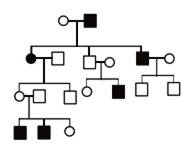
A
Autosomal recessive
B
$X$-linked dominant
C
Autosomal dominant
D
$X$-linked recessive
Solution
(C) The correct answer is $(C)$ Autosomal dominant.
Analysis of the pedigree:
$1$. The trait appears in every generation (vertical transmission),which is a characteristic of dominant traits.
$2$. Affected individuals have at least one affected parent.
$3$. Both males and females are affected,and affected fathers can pass the trait to their sons,which rules out $X$-linked recessive inheritance.
$4$. Since the trait does not skip generations and appears in both sexes with equal frequency,it is identified as an autosomal dominant trait.
Analysis of the pedigree:
$1$. The trait appears in every generation (vertical transmission),which is a characteristic of dominant traits.
$2$. Affected individuals have at least one affected parent.
$3$. Both males and females are affected,and affected fathers can pass the trait to their sons,which rules out $X$-linked recessive inheritance.
$4$. Since the trait does not skip generations and appears in both sexes with equal frequency,it is identified as an autosomal dominant trait.
0 likesView Solution
78
BiologyMediumMCQNEET · 2015
The term "linkage" was coined by
A
$G$. Mendel
B
$W$. Sutton
C
$T$.$H$. Morgan
D
$T$. Boveri
Solution
(C) The correct answer is $C$.
Linkage is the phenomenon where genes located on the same chromosome tend to be inherited together through generations without separation.
While Sutton and Boveri $(1902-1903)$ proposed the chromosomal theory of inheritance and Bateson and Punnett $(1906)$ observed the phenomenon in sweet peas, it was $T.H. Morgan$ who coined the term "linkage" and provided experimental proof using the fruit fly, $Drosophila$ $\text{melanogaster}$.
Linkage is the phenomenon where genes located on the same chromosome tend to be inherited together through generations without separation.
While Sutton and Boveri $(1902-1903)$ proposed the chromosomal theory of inheritance and Bateson and Punnett $(1906)$ observed the phenomenon in sweet peas, it was $T.H. Morgan$ who coined the term "linkage" and provided experimental proof using the fruit fly, $Drosophila$ $\text{melanogaster}$.
0 likesView Solution
79
BiologyMediumMCQNEET · 2015
The movement of a gene from one linkage group to another is called
A
translocation
B
crossing over
C
inversion
D
duplication
Solution
(A) : Translocation is a chromosomal abnormality caused by the rearrangement of parts between non-homologous chromosomes.
It results in the transfer of a segment of $DNA$ from one chromosome to another,which may cause a gene to move from one linkage group to another.
It results in the transfer of a segment of $DNA$ from one chromosome to another,which may cause a gene to move from one linkage group to another.
0 likesView Solution
80
BiologyMediumMCQNEET · 2015
Alleles are
A
different molecular forms of a gene
B
heterozygotes
C
different phenotype
D
true breeding homozygotes
Solution
(A) : Genes are the units of inheritance and contain the information that is required to express a particular trait in an organism.
Alternating forms of a single gene which code for a pair of contrasting traits are known as alleles.
For example,two alleles determine the height of a pea plant (tall and dwarf).
Alternating forms of a single gene which code for a pair of contrasting traits are known as alleles.
For example,two alleles determine the height of a pea plant (tall and dwarf).
0 likesView Solution
81
BiologyMediumMCQNEET · 2015
Multiple alleles are present:
A
at the same locus of the chromosome
B
on non-sister chromatids
C
on different chromosomes
D
at different loci on the same chromosome
Solution
(A) Multiple alleles refer to the existence of more than two alternative forms of a gene occupying the same locus on a homologous chromosome. Since an individual can only carry two alleles for a given trait (one on each homologous chromosome),multiple alleles can only be observed at the population level. Therefore,they are always present at the same locus of the chromosome.
0 likesView Solution
82
BiologyMediumMCQNEET · 2015
$A$ man with blood group $A$ marries a woman with blood group $B$. What are all the possible blood groups of their offspring?
A
$A, B, AB$ and $O$
B
$O$ only
C
$A$ and $B$ only
D
$A, B$ and $AB$ only
Solution
(A) The man has blood group $A$,so his genotype can be $I^AI^A$ or $I^AI^O$.
The woman has blood group $B$,so her genotype can be $I^BI^B$ or $I^BI^O$.
If we consider the heterozygous condition for both parents $(I^AI^O \times I^BI^O)$,the possible combinations for the offspring are:
$1. I^AI^B$ (Blood group $AB$)
$2. I^AI^O$ (Blood group $A$)
$3. I^BI^O$ (Blood group $B$)
$4. I^OI^O$ (Blood group $O$)
Therefore,all four blood groups ($A, B, AB,$ and $O$) are possible in their offspring.
The woman has blood group $B$,so her genotype can be $I^BI^B$ or $I^BI^O$.
If we consider the heterozygous condition for both parents $(I^AI^O \times I^BI^O)$,the possible combinations for the offspring are:
$1. I^AI^B$ (Blood group $AB$)
$2. I^AI^O$ (Blood group $A$)
$3. I^BI^O$ (Blood group $B$)
$4. I^OI^O$ (Blood group $O$)
Therefore,all four blood groups ($A, B, AB,$ and $O$) are possible in their offspring.
0 likesView Solution
83
BiologyMediumMCQNEET · 2015
How many pairs of contrasting characters in pea plants were studied by Mendel in his experiments?
A
Eight
B
Seven
C
Five
D
Six
Solution
(B) Mendel selected $7$ pairs of true-breeding contrasting characters in pea plants $(Pisum \text{ } sativum)$ for his hybridization experiments. These characters are summarized in the table below:
| $1$. Character: Seed shape (Dominant: Round,Recessive: Wrinkled) |
| $2$. Character: Seed colour (Dominant: Yellow,Recessive: Green) |
| $3$. Character: Flower colour (Dominant: Violet,Recessive: White) |
| $4$. Character: Pod shape (Dominant: Inflated,Recessive: Constricted) |
| $5$. Character: Pod colour (Dominant: Green,Recessive: Yellow) |
| $6$. Character: Flower position (Dominant: Axial,Recessive: Terminal) |
| $7$. Character: Stem height (Dominant: Tall,Recessive: Dwarf) |
0 likesView Solution
84
BiologyMediumMCQNEET · 2015
An abnormal human baby with $XXX$ sex chromosomes was born due to
A
fusion of two ova and one sperm
B
fusion of two sperms and one ovum
C
formation of abnormal sperms in the father
D
formation of abnormal ova in the mother.
Solution
(D) : The abnormal baby has an extra $X$ chromosome,thus it must have been produced by the fusion of an abnormal $XX$ ovum with a normal $X$ sperm.
Abnormal $XX$ sperm is not possible because males have an $XY$ genotype; if they produce abnormal sperms,then $XY$ sperms and $O$ sperms would be produced.
If the fusion of multiple gametes had occurred (either two ova with one sperm or two sperms with one ovum),the human baby would have a triploid genotype,not the trisomy of sex chromosomes.
Abnormal $XX$ sperm is not possible because males have an $XY$ genotype; if they produce abnormal sperms,then $XY$ sperms and $O$ sperms would be produced.
If the fusion of multiple gametes had occurred (either two ova with one sperm or two sperms with one ovum),the human baby would have a triploid genotype,not the trisomy of sex chromosomes.
0 likesView Solution
85
BiologyMediumMCQNEET · 2015
Which one of the following is not applicable to $RNA$?
A
Heterocyclic nitrogenous bases
B
Chargaff's rule
C
Complementary base pairing
D
$5'$ phosphoryl and $3'$ hydroxyl ends
Solution
(B) : Chargaff's rules are applicable only for double-stranded $DNA$ molecules.
These are not applicable for single-stranded $DNA$ or $RNA$ molecules.
Chargaff's rules state that $DNA$ helices contain equal molar ratios of $A$ and $T$,and $G$ and $C$.
This is because in a double-stranded $DNA$ molecule,complementary base pairing occurs between $A$ and $T$,and $C$ and $G$ base pairs.
This specific complementary base pairing is not possible in the case of a single-stranded $RNA$ molecule.
Thus,Chargaff's rules are not applicable to $RNA$.
These are not applicable for single-stranded $DNA$ or $RNA$ molecules.
Chargaff's rules state that $DNA$ helices contain equal molar ratios of $A$ and $T$,and $G$ and $C$.
This is because in a double-stranded $DNA$ molecule,complementary base pairing occurs between $A$ and $T$,and $C$ and $G$ base pairs.
This specific complementary base pairing is not possible in the case of a single-stranded $RNA$ molecule.
Thus,Chargaff's rules are not applicable to $RNA$.
0 likesView Solution
86
BiologyMediumMCQNEET · 2015
Identify the correct order of organisation of genetic material from largest to smallest.
A
Genome,chromosome,gene,nucleotide
B
Chromosome,genome,nucleotide,gene
C
Chromosome,gene,genome,nucleotide
D
Genome,chromosome,nucleotide,gene
Solution
(A) The correct order from largest to smallest is: Genome > Chromosome > Gene > Nucleotide.
$1$. Genome: The entire set of genetic instructions found in an organism.
$2$. Chromosome: $A$ thread-like structure of nucleic acids and protein found in the nucleus,carrying genetic information in the form of $DNA$.
$3$. Gene: $A$ specific segment of $DNA$ located on a chromosome that codes for a functional product (protein or $RNA$).
$4$. Nucleotide: The basic structural unit of $DNA$,consisting of a pentose sugar,a phosphate group,and a nitrogenous base.
Therefore,option $A$ is correct.
$1$. Genome: The entire set of genetic instructions found in an organism.
$2$. Chromosome: $A$ thread-like structure of nucleic acids and protein found in the nucleus,carrying genetic information in the form of $DNA$.
$3$. Gene: $A$ specific segment of $DNA$ located on a chromosome that codes for a functional product (protein or $RNA$).
$4$. Nucleotide: The basic structural unit of $DNA$,consisting of a pentose sugar,a phosphate group,and a nitrogenous base.
Therefore,option $A$ is correct.
0 likesView Solution
87
BiologyMediumMCQNEET · 2015
Satellite $DNA$ is important because it
A
does not code for proteins and is same in all members of the population
B
codes for enzymes needed for $DNA$ replication
C
codes for proteins needed in cell cycle
D
shows high degree of polymorphism in population and also the same degree of polymorphism in an individual,which is heritable from parents to children.
Solution
(D) : Satellite $DNA$ is a part of repetitive $DNA$ which consists of long repetitive nucleotide sequences in tandem,forming a separate fraction during density ultracentrifugation.
$DNA$ fingerprinting involves identifying differences in specific regions of $DNA$ sequences known as repetitive $DNA$,where a small stretch of $DNA$ is repeated many times.
These repetitive $DNA$ sequences are separated from bulk genomic $DNA$ as distinct peaks during density gradient centrifugation.
The bulk $DNA$ forms a major peak,while the smaller peaks are referred to as satellite $DNA$.
Depending on base composition ($A:T$ rich or $G:C$ rich),segment length,and the number of repetitive units,satellite $DNA$ is classified into categories such as microsatellites and minisatellites.
These sequences typically do not code for any proteins,yet they constitute a large portion of the human genome.
They exhibit a high degree of polymorphism,which forms the basis of $DNA$ fingerprinting.
Since $DNA$ from every tissue (such as blood,hair follicles,skin,bone,saliva,sperm,etc.) of an individual shows the same degree of polymorphism,it serves as a highly useful identification tool in forensic applications.
$DNA$ fingerprinting involves identifying differences in specific regions of $DNA$ sequences known as repetitive $DNA$,where a small stretch of $DNA$ is repeated many times.
These repetitive $DNA$ sequences are separated from bulk genomic $DNA$ as distinct peaks during density gradient centrifugation.
The bulk $DNA$ forms a major peak,while the smaller peaks are referred to as satellite $DNA$.
Depending on base composition ($A:T$ rich or $G:C$ rich),segment length,and the number of repetitive units,satellite $DNA$ is classified into categories such as microsatellites and minisatellites.
These sequences typically do not code for any proteins,yet they constitute a large portion of the human genome.
They exhibit a high degree of polymorphism,which forms the basis of $DNA$ fingerprinting.
Since $DNA$ from every tissue (such as blood,hair follicles,skin,bone,saliva,sperm,etc.) of an individual shows the same degree of polymorphism,it serves as a highly useful identification tool in forensic applications.
0 likesView Solution
88
BiologyMediumMCQNEET · 2015
Gene regulation governing the lactose operon of $E. coli$ that involves the $lac I$ gene product is:
A
negative and repressible because the repressor protein prevents transcription.
B
feedback inhibition because excess of $\beta$-galactosidase can switch off transcription.
C
positive and inducible because it can be induced by lactose.
D
negative and inducible because the repressor protein prevents transcription.
Solution
(D) $lac$ operon regulation is described as negative and inducible.
$1$. Negative control: The $lac I$ gene produces a repressor protein that binds to the operator region,preventing $RNA$ polymerase from transcribing the structural genes. This keeps the operon in an 'off' state under normal conditions.
$2$. Inducible: The presence of an inducer (allolactose) binds to the repressor protein,causing a conformational change that prevents the repressor from binding to the operator. This allows transcription to proceed.
$3$. Therefore,because the default state is 'off' due to a repressor and it is turned 'on' by an inducer,it is classified as negative and inducible.
$1$. Negative control: The $lac I$ gene produces a repressor protein that binds to the operator region,preventing $RNA$ polymerase from transcribing the structural genes. This keeps the operon in an 'off' state under normal conditions.
$2$. Inducible: The presence of an inducer (allolactose) binds to the repressor protein,causing a conformational change that prevents the repressor from binding to the operator. This allows transcription to proceed.
$3$. Therefore,because the default state is 'off' due to a repressor and it is turned 'on' by an inducer,it is classified as negative and inducible.
0 likesView Solution
89
BiologyMediumMCQNEET · 2015
In sea urchin $DNA$,which is double stranded,$17\%$ of the bases were shown to be cytosine. The percentages of the other three bases expected to be present in this $DNA$ are
A
$G\ 17\%, A\ 33\%, T\ 33\%$
B
$G\ 8.5\%, A\ 50\%, T\ 24.5\%$
C
$G\ 34\%, A\ 24.5\%, T\ 24.5\%$
D
$G\ 17\%, A\ 16.5\%, T\ 32.5\%$
Solution
(A) According to Chargaff's rule,for double-stranded $DNA$,the amount of adenine $(A)$ is equal to thymine $(T)$,and the amount of guanine $(G)$ is equal to cytosine $(C)$,i.e.,$A = T$ and $G = C$.
Given that cytosine $(C)$ is $17\%$,therefore,guanine $(G)$ must also be $17\%$.
The total percentage of all four bases is $100\%$.
So,$A + T + G + C = 100\%$.
Substituting the known values: $A + T + 17\% + 17\% = 100\%$.
$A + T + 34\% = 100\%$.
$A + T = 100\% - 34\% = 66\%$.
Since $A = T$,the percentage of adenine $(A)$ is $66\% / 2 = 33\%$ and the percentage of thymine $(T)$ is $66\% / 2 = 33\%$.
Thus,the percentages are $G = 17\%, A = 33\%, T = 33\%$.
Given that cytosine $(C)$ is $17\%$,therefore,guanine $(G)$ must also be $17\%$.
The total percentage of all four bases is $100\%$.
So,$A + T + G + C = 100\%$.
Substituting the known values: $A + T + 17\% + 17\% = 100\%$.
$A + T + 34\% = 100\%$.
$A + T = 100\% - 34\% = 66\%$.
Since $A = T$,the percentage of adenine $(A)$ is $66\% / 2 = 33\%$ and the percentage of thymine $(T)$ is $66\% / 2 = 33\%$.
Thus,the percentages are $G = 17\%, A = 33\%, T = 33\%$.
0 likesView Solution
90
BiologyMediumMCQNEET · 2015
The wings of a bird and the wings of an insect are
A
phylogenetic structures and represent divergent evolution
B
homologous structures and represent convergent evolution
C
homologous structures and represent divergent evolution
D
analogous structures and represent convergent evolution.
Solution
(D) $(D) :$ Analogous organs are those that perform similar functions but differ in their structural details and evolutionary origin.
Analogous structures are the result of convergent evolution.
The wings of an insect and the wings of a bird are considered analogous because,while they both serve the function of flight,their basic anatomical structures are entirely different (insect wings are outgrowths of the exoskeleton,while bird wings are modified forelimbs).
Therefore,they represent convergent evolution.
Analogous structures are the result of convergent evolution.
The wings of an insect and the wings of a bird are considered analogous because,while they both serve the function of flight,their basic anatomical structures are entirely different (insect wings are outgrowths of the exoskeleton,while bird wings are modified forelimbs).
Therefore,they represent convergent evolution.
0 likesView Solution
91
BiologyMediumMCQNEET · 2015
Industrial melanism is an example of
A
mutation
B
Neo-Lamarckism
C
Neo-Darwinism
D
natural selection.
Solution
(D) : Natural selection is the most widely accepted theory concerning the principal causal mechanism of evolutionary change,proposed by $Charles \ Darwin$ and $Alfred \ Russel \ Wallace$.
It results from differential reproduction,where some members of a population produce abundant offspring,some only a few,and others none,compared to other phenotypes in the same population.
This determines the relative share of different genotypes that individuals possess and propagate in a population.
Industrial melanism is a classic example that supports evolution by natural selection.
It is an adaptation where moths living in industrial areas developed melanin pigments to match their bodies to the soot-covered tree trunks,thereby increasing their survival rate against predators.
It results from differential reproduction,where some members of a population produce abundant offspring,some only a few,and others none,compared to other phenotypes in the same population.
This determines the relative share of different genotypes that individuals possess and propagate in a population.
Industrial melanism is a classic example that supports evolution by natural selection.
It is an adaptation where moths living in industrial areas developed melanin pigments to match their bodies to the soot-covered tree trunks,thereby increasing their survival rate against predators.
0 likesView Solution
92
BiologyMediumMCQNEET · 2015
$A$ population will not exist in Hardy-Weinberg equilibrium if
A
there is no migration
B
the population is large
C
individuals mate selectively
D
there are no mutations
Solution
(C) The Hardy-Weinberg principle states that allele frequencies in a population are stable and remain constant from generation to generation under specific conditions,which include random mating,a large population size,no migration (gene flow),no mutations,and no natural selection.
If individuals mate selectively (non-random mating),the allele frequencies will change over generations,and the population will not be in Hardy-Weinberg equilibrium.
Therefore,the correct option is $C$.
If individuals mate selectively (non-random mating),the allele frequencies will change over generations,and the population will not be in Hardy-Weinberg equilibrium.
Therefore,the correct option is $C$.
0 likesView Solution
93
BiologyMediumMCQNEET · 2015
Which is the most common mechanism of genetic variation in the population of a sexually reproducing organism?
A
Genetic drift
B
Recombination
C
Transduction
D
Chromosomal aberrations
Solution
(B) The correct answer is $B$.
Genetic variation in sexually reproducing organisms primarily arises from the reshuffling of genes.
This occurs through three main processes:
$1$. Independent assortment of chromosomes during meiosis.
$2$. Crossing over,which leads to the exchange of genetic material between homologous chromosomes.
$3$. Random fertilization of gametes.
Collectively,these processes are referred to as recombination. While mutations and genetic drift also contribute to variation,recombination is the most frequent and consistent mechanism driving variation in a sexually reproducing population.
Genetic variation in sexually reproducing organisms primarily arises from the reshuffling of genes.
This occurs through three main processes:
$1$. Independent assortment of chromosomes during meiosis.
$2$. Crossing over,which leads to the exchange of genetic material between homologous chromosomes.
$3$. Random fertilization of gametes.
Collectively,these processes are referred to as recombination. While mutations and genetic drift also contribute to variation,recombination is the most frequent and consistent mechanism driving variation in a sexually reproducing population.
0 likesView Solution
94
BiologyMediumMCQNEET · 2015
Which of the following had the smallest brain capacity?
A
Homo neanderthalensis
B
Homo habilis
C
Homo erectus
D
Homo sapiens
Solution
(B) : The brain capacity gradually increased from early human ancestors to modern man.
$Homo \text{ } habilis$ had a brain capacity of $650-800 \text{ } cc$, which increased to around $900 \text{ } cc$ in $Homo \text{ } erectus$.
The Neanderthal man $(Homo \text{ } neanderthalensis)$ had a brain capacity of $1400 \text{ } cc$, which evolved to around $1450 \text{ } cc$ in $Homo \text{ } sapiens$.
$Homo \text{ } habilis$ had a brain capacity of $650-800 \text{ } cc$, which increased to around $900 \text{ } cc$ in $Homo \text{ } erectus$.
The Neanderthal man $(Homo \text{ } neanderthalensis)$ had a brain capacity of $1400 \text{ } cc$, which evolved to around $1450 \text{ } cc$ in $Homo \text{ } sapiens$.
0 likesView Solution
95
BiologyMediumMCQNEET · 2015
If you suspect a major deficiency of antibodies in a person,to which of the following would you look for confirmatory evidence?
A
Haemocytes
B
Serum globulins
C
Fibrinogen in plasma
D
Serum albumins
Solution
(B) : Serum globulins are proteins that include gamma globulins (antibodies) and a variety of enzymes and carrier/transport proteins.
Serum protein electrophoresis $(SPEP)$ is used to analyze the profile of these globulins by separating them based on size and charge.
There are four major groups identified: alpha-$1$ globulins,alpha-$2$ globulins,beta globulins,and gamma globulins.
Since the gamma fraction primarily consists of immunoglobulins (antibodies),a deficiency in antibodies is directly reflected by a low level of serum globulins.
Serum protein electrophoresis $(SPEP)$ is used to analyze the profile of these globulins by separating them based on size and charge.
There are four major groups identified: alpha-$1$ globulins,alpha-$2$ globulins,beta globulins,and gamma globulins.
Since the gamma fraction primarily consists of immunoglobulins (antibodies),a deficiency in antibodies is directly reflected by a low level of serum globulins.
0 likesView Solution
96
BiologyMediumMCQNEET · 2015
Which of the following immunoglobulins constitutes the largest percentage in human milk?
A
$IgA$
B
$IgG$
C
$IgD$
D
$IgM$
Solution
(A) $IgA$ is the primary immunoglobulin found in human milk,particularly in colostrum. It provides passive immunity to the infant by protecting the mucosal surfaces of the gastrointestinal tract from pathogens. While $IgG$ is the most abundant immunoglobulin in human serum,$IgA$ is the predominant antibody in secretions,including breast milk.
0 likesView Solution
97
BiologyEasyMCQNEET · 2015
Which of the following diseases is caused by a protozoan?
A
Babesiosis
B
Blastomycosis
C
Syphilis
D
Influenza
Solution
(A) : Babesiosis is a malaria-like parasitic disease caused by infection with $Babesia$,a parasitic protozoan.
Babesiosis has long been recognized as a disease of cattle and other domestic animals,until human forms of babesiosis were discovered.
$Babesia$ parasites reproduce in the red blood cells of mammals and cause haemolytic anaemia,which is quite similar to malaria.
The parasite is transmitted by ticks.
Babesiosis has long been recognized as a disease of cattle and other domestic animals,until human forms of babesiosis were discovered.
$Babesia$ parasites reproduce in the red blood cells of mammals and cause haemolytic anaemia,which is quite similar to malaria.
The parasite is transmitted by ticks.
0 likesView Solution
98
BiologyMediumMCQNEET · 2015
Grafted kidney may be rejected in a patient due to
A
passive immune response
B
innate immune response
C
humoral immune response
D
cell-mediated immune response
Solution
(D) The correct answer is $(d)$.
Cell-mediated immune response $(CMIS)$ is primarily mediated by $T$-lymphocytes.
These cells are responsible for graft rejection because the immune system recognizes the proteins present on the surface of the transplanted tissue or organ as foreign (non-self).
Upon recognition,the $T$-cells initiate a specific immune attack against the transplanted organ,leading to its rejection.
Cell-mediated immune response $(CMIS)$ is primarily mediated by $T$-lymphocytes.
These cells are responsible for graft rejection because the immune system recognizes the proteins present on the surface of the transplanted tissue or organ as foreign (non-self).
Upon recognition,the $T$-cells initiate a specific immune attack against the transplanted organ,leading to its rejection.
0 likesView Solution
99
BiologyMediumMCQNEET · 2015
Match each disease with its correct type of vaccine.
| Column-$I$ | Column-$II$ |
| $(A)$ Tuberculosis | $(i)$ Harmless virus |
| $(B)$ Whooping cough | $(ii)$ Inactivated toxin |
| $(C)$ Diphtheria | $(iii)$ Killed bacteria |
| $(D)$ Polio | $(iv)$ Harmless bacteria |
A
$A-iv, B-iii, C-ii, D-i$
B
$A-i, B-ii, C-iv, D-iii$
C
$A-ii, B-i, C-iii, D-iv$
D
$A-iii, B-ii, C-iv, D-i$
Solution
(A) The correct matches are as follows:
$(A)$ Tuberculosis: The $BCG$ vaccine uses a live attenuated (harmless) strain of Mycobacterium bovis,which acts as a harmless bacterium $(iv)$.
$(B)$ Whooping cough (Pertussis): The vaccine typically uses killed Bordetella pertussis bacteria $(iii)$.
$(C)$ Diphtheria: The vaccine is a toxoid,which is an inactivated toxin $(ii)$ produced by the bacteria.
$(D)$ Polio: The Salk vaccine uses inactivated (killed) poliovirus,while the Sabin vaccine uses live attenuated (harmless) virus $(i)$.
Therefore,the correct sequence is $A-iv, B-iii, C-ii, D-i$.
$(A)$ Tuberculosis: The $BCG$ vaccine uses a live attenuated (harmless) strain of Mycobacterium bovis,which acts as a harmless bacterium $(iv)$.
$(B)$ Whooping cough (Pertussis): The vaccine typically uses killed Bordetella pertussis bacteria $(iii)$.
$(C)$ Diphtheria: The vaccine is a toxoid,which is an inactivated toxin $(ii)$ produced by the bacteria.
$(D)$ Polio: The Salk vaccine uses inactivated (killed) poliovirus,while the Sabin vaccine uses live attenuated (harmless) virus $(i)$.
Therefore,the correct sequence is $A-iv, B-iii, C-ii, D-i$.
0 likesView Solution
100
BiologyMediumMCQNEET · 2015
The active form of $Entamoeba \ histolytica$ feeds upon
A
food in intestine
B
blood only
C
erythrocytes,mucosa and submucosa of colon
D
mucosa and submucosa of colon only
Solution
(C) $Entamoeba \ histolytica$ (Gr.,$entos$: within + $amoeba$: change + $histos$: tissue + $lysis$: dissolve) is the causative organism of amoebic dysentery or amoebiasis in humans.
It is a microscopic endoparasite of humans.
It is commonly found in the upper part of the large intestine (colon) and can often lodge in the liver,lungs,brain,and testes.
In its life cycle,it occurs in three distinct forms: $(i)$ trophozoite or magna form,$(ii)$ precystic or minuta form,and $(iii)$ cystic form.
The trophozoite is the most active,motile,and feeding form,which is pathogenic to humans.
It lives in the mucous and submucous layers of the colon and feeds on these layers and erythrocytes.
It is a microscopic endoparasite of humans.
It is commonly found in the upper part of the large intestine (colon) and can often lodge in the liver,lungs,brain,and testes.
In its life cycle,it occurs in three distinct forms: $(i)$ trophozoite or magna form,$(ii)$ precystic or minuta form,and $(iii)$ cystic form.
The trophozoite is the most active,motile,and feeding form,which is pathogenic to humans.
It lives in the mucous and submucous layers of the colon and feeds on these layers and erythrocytes.
0 likesView Solution
Vedclass Products
For Students
Vedclass Test Series
Mock tests in real NEET style covering Biology with performance analysis. 5-day free trial.
Start Free TrialFor Teachers
Exam Paper Generator
Generate Set A/B/C/D Biology papers from 7.5L+ questions in 2 minutes. 3 chapters free.
Try FreeFor Institutes
Online Exam Module
Run live NEET mock exams with unlimited students, 360° analytics & white-label branding.
See DemoFrequently Asked Questions
How many Biology questions are in NEET 2015?
There are 193 Biology questions from the NEET 2015 paper on Vedclass, each with a detailed step-by-step solution in English.
Are NEET 2015 Biology solutions available in English?
Yes. All solutions on this page are in English. You can also switch to English or Hindi using the language buttons above the questions.
Can I practice NEET 2015 Biology as a timed test?
Yes. Use the Vedclass Test Series to attempt a full NEET mock test covering Biology with time limits and instant score analysis.
Can teachers create Biology papers from NEET previous year questions?
Yes. The Vedclass Exam Paper Generator lets teachers mix NEET Biology questions and generate Set A/B/C/D papers in minutes.
For Teachers & Institutes
Build a Custom Biology Paper
Pick NEET 2015 Biology questions, set difficulty, and generate Set A/B/C/D in 2 minutes.