
ChemistryQ1–94 of 116 questions
Page 1 of 2 · English
1
ChemistryMCQNEET · 2013
Which of the following is paramagnetic?
A
$O_2$
B
$CN^{-}$
C
$CO$
D
$NO^{+}$
Solution
(A) The electronic configuration of $O_2$ ($16$ electrons) according to Molecular Orbital Theory is:
$O_2 = \sigma(1s)^2 \sigma^*(1s)^2 \sigma(2s)^2 \sigma^*(2s)^2 \sigma(2p_z)^2 \pi(2p_x)^2 = \pi(2p_y)^2 \pi^*(2p_x)^1 = \pi^*(2p_y)^1$
Since the molecule contains two unpaired electrons in the antibonding $\pi^*$ orbitals,it exhibits paramagnetic behavior.
In contrast,$CN^-$,$CO$,and $NO^+$ are all isoelectronic with $14$ electrons and have no unpaired electrons,making them diamagnetic.
$O_2 = \sigma(1s)^2 \sigma^*(1s)^2 \sigma(2s)^2 \sigma^*(2s)^2 \sigma(2p_z)^2 \pi(2p_x)^2 = \pi(2p_y)^2 \pi^*(2p_x)^1 = \pi^*(2p_y)^1$
Since the molecule contains two unpaired electrons in the antibonding $\pi^*$ orbitals,it exhibits paramagnetic behavior.
In contrast,$CN^-$,$CO$,and $NO^+$ are all isoelectronic with $14$ electrons and have no unpaired electrons,making them diamagnetic.
0 likesView Solution
2
ChemistryMCQNEET · 2013
Which of the metabolites is common to respiration-mediated breakdown of fats,carbohydrates,and proteins?
A
Pyruvic acid
B
Acetyl $CoA$
C
Glucose-$6$-phosphate
D
Fructose $1, 6$-bisphosphate
Solution
(B) The correct answer is $B$.
Carbohydrates are typically converted into glucose before being used for respiration.
Fats are first broken down into glycerol and fatty acids. Fatty acids are degraded into acetyl $CoA$ to enter the respiratory pathway,while glycerol is converted into $3$-phosphoglyceraldehyde $(PGAL)$ before entering.
Proteins are broken down by proteases into individual amino acids. After deamination,these amino acids enter the respiratory pathway at various stages,such as pyruvate,acetyl $CoA$,or intermediates of the Krebs cycle.
Thus,acetyl $CoA$ acts as a common metabolic intermediate for the breakdown of all three major respiratory substrates: carbohydrates,proteins,and fats.
Carbohydrates are typically converted into glucose before being used for respiration.
Fats are first broken down into glycerol and fatty acids. Fatty acids are degraded into acetyl $CoA$ to enter the respiratory pathway,while glycerol is converted into $3$-phosphoglyceraldehyde $(PGAL)$ before entering.
Proteins are broken down by proteases into individual amino acids. After deamination,these amino acids enter the respiratory pathway at various stages,such as pyruvate,acetyl $CoA$,or intermediates of the Krebs cycle.
Thus,acetyl $CoA$ acts as a common metabolic intermediate for the breakdown of all three major respiratory substrates: carbohydrates,proteins,and fats.
0 likesView Solution
3
ChemistryMCQNEET · 2013
$A$ healthy person eats the following diet: $5 \ gm$ raw sugar,$4 \ gm$ albumin,$10 \ gm$ pure buffalo ghee adulterated with $2 \ gm$ vegetable ghee (hydrogenated vegetable oil) and $5 \ gm$ lignin. How many calories is he likely to get?
A
$126$
B
$164$
C
$112$
D
$144$
Solution
(D) Physiological value is the energy produced by $1 \ gm$ of food upon oxidation in the body.
For carbohydrates,it is $4.0 \ Kcal/g$,for proteins it is $4.0 \ Kcal/g$,and for fats,it is $9.0 \ Kcal/g$.
Lignin is a dietary fibre present in plant cells,but it cannot be digested by humans and thus does not produce energy.
Calculation:
$5 \ g$ raw sugar (carbohydrate) will yield $5 \times 4.0 = 20.0 \ Kcal$.
$4 \ g$ albumin (protein) will yield $4 \times 4.0 = 16.0 \ Kcal$.
$(10 + 2) \ g$ of fat (ghee) will yield $12 \times 9.0 = 108.0 \ Kcal$.
Total energy yield = $20.0 + 16.0 + 108.0 = 144 \ Kcal$.
For carbohydrates,it is $4.0 \ Kcal/g$,for proteins it is $4.0 \ Kcal/g$,and for fats,it is $9.0 \ Kcal/g$.
Lignin is a dietary fibre present in plant cells,but it cannot be digested by humans and thus does not produce energy.
Calculation:
$5 \ g$ raw sugar (carbohydrate) will yield $5 \times 4.0 = 20.0 \ Kcal$.
$4 \ g$ albumin (protein) will yield $4 \times 4.0 = 16.0 \ Kcal$.
$(10 + 2) \ g$ of fat (ghee) will yield $12 \times 9.0 = 108.0 \ Kcal$.
Total energy yield = $20.0 + 16.0 + 108.0 = 144 \ Kcal$.
0 likesView Solution
4
ChemistryMCQNEET · 2013
Which of the following statements is correct?
A
Sporopollenin can be degraded by enzymes.
B
Sporopollenin is made up of inorganic materials.
C
Sporopollenin can withstand high temperatures as well as strong acids and alkalis.
D
Sporopollenin can withstand high temperatures but not strong acids.
Solution
(C) The correct statement is $(C)$.
Sporopollenin is one of the most resistant organic materials known.
It is present in the exine of the pollen grain.
It can withstand high temperatures and strong acids and alkalis.
No enzyme that degrades sporopollenin is known so far.
Due to this extreme resistance,pollen grains are well-preserved as fossils.
Sporopollenin is one of the most resistant organic materials known.
It is present in the exine of the pollen grain.
It can withstand high temperatures and strong acids and alkalis.
No enzyme that degrades sporopollenin is known so far.
Due to this extreme resistance,pollen grains are well-preserved as fossils.
0 likesView Solution
5
ChemistryMCQNEET · 2013
Genes of interest can be selected from a genomic library by using
A
cloning vectors
B
$DNA$ probes
C
gene targets
D
restriction enzymes
Solution
(B) : $A$ genomic library is a collection of cloned $DNA$ fragments representing the entire genome of an organism.
$DNA$ probes are short,single-stranded segments of $DNA$ (usually $200-500$ nucleotides long) that are used to detect the presence of specific complementary sequences within the library.
These probes are labeled with radioactive or fluorescent markers.
When added to the library,the probe binds specifically to the complementary $DNA$ sequence of the gene of interest through base pairing.
This binding allows researchers to identify and isolate the specific gene from the vast collection of clones in the genomic library.
$DNA$ probes are short,single-stranded segments of $DNA$ (usually $200-500$ nucleotides long) that are used to detect the presence of specific complementary sequences within the library.
These probes are labeled with radioactive or fluorescent markers.
When added to the library,the probe binds specifically to the complementary $DNA$ sequence of the gene of interest through base pairing.
This binding allows researchers to identify and isolate the specific gene from the vast collection of clones in the genomic library.
0 likesView Solution
6
ChemistryMCQNEET · 2013
The largest tiger reserve in India is
A
Valmiki
B
Nagarjunasagar-Srisailam
C
Periyar
D
Nagarhole
Solution
(B) : Nagarjunasagar-Srisailam Tiger Reserve is the largest tiger reserve in India.
It is located in the state of Andhra Pradesh and covers a total area of $3568 \ km^2$.
The core area of this reserve is $1200 \ km^2$.
It is located in the state of Andhra Pradesh and covers a total area of $3568 \ km^2$.
The core area of this reserve is $1200 \ km^2$.
0 likesView Solution
7
ChemistryDifficultMCQNEET · 2013
$6.02 \times 10^{20}$ molecules of urea are present in $100 \ mL$ of its solution. The concentration of solution is $.... M$.
A
$0.001$
B
$0.1$
C
$0.02$
D
$0.01$
Solution
(D) Number of moles $= \frac{\text{number of molecules}}{N_A} = \frac{6.02 \times 10^{20}}{6.02 \times 10^{23}} = 10^{-3} \ mol$.
Molar concentration $= \frac{n \times 1000}{V_{\text{solution } (mL)}} = \frac{10^{-3} \times 1000}{100}$.
Molar concentration $= 0.01 \ M$.
Molar concentration $= \frac{n \times 1000}{V_{\text{solution } (mL)}} = \frac{10^{-3} \times 1000}{100}$.
Molar concentration $= 0.01 \ M$.
1 likesView Solution
8
ChemistryDifficultMCQNEET · 2013
In an experiment,it was shown that $10 \ mL$ of a $0.05 \ M$ solution of a chloride required $10 \ mL$ of a $0.1 \ M$ solution of $AgNO_3$. Which of the following will be the formula of the chloride ($X$ stands for the symbol of the element other than chlorine)?
A
$X_2Cl_2$
B
$XCl_2$
C
$XCl_4$
D
$X_2Cl$
Solution
(B) The reaction between the chloride and $AgNO_3$ is: $Ag^{+} + Cl^{-} \rightarrow AgCl_{(s)}$.
Number of moles of $AgNO_3 = \text{Molarity} \times \text{Volume (in L)} = 0.1 \ M \times 0.01 \ L = 10^{-3} \ mol$.
Number of moles of the chloride solution $= 0.05 \ M \times 0.01 \ L = 0.5 \times 10^{-3} \ mol$.
Let the formula of the chloride be $XCl_n$. The number of moles of $Cl^{-}$ ions provided by the solution is $n \times (0.5 \times 10^{-3}) \ mol$.
According to the stoichiometry of the reaction,moles of $Cl^{-}$ must equal moles of $Ag^{+}$:
$n \times 0.5 \times 10^{-3} = 10^{-3}$.
Solving for $n$: $n = \frac{10^{-3}}{0.5 \times 10^{-3}} = 2$.
Therefore,the formula of the chloride is $XCl_2$.
Number of moles of $AgNO_3 = \text{Molarity} \times \text{Volume (in L)} = 0.1 \ M \times 0.01 \ L = 10^{-3} \ mol$.
Number of moles of the chloride solution $= 0.05 \ M \times 0.01 \ L = 0.5 \times 10^{-3} \ mol$.
Let the formula of the chloride be $XCl_n$. The number of moles of $Cl^{-}$ ions provided by the solution is $n \times (0.5 \times 10^{-3}) \ mol$.
According to the stoichiometry of the reaction,moles of $Cl^{-}$ must equal moles of $Ag^{+}$:
$n \times 0.5 \times 10^{-3} = 10^{-3}$.
Solving for $n$: $n = \frac{10^{-3}}{0.5 \times 10^{-3}} = 2$.
Therefore,the formula of the chloride is $XCl_2$.
0 likesView Solution
9
ChemistryDifficultMCQNEET · 2013
What is the maximum number of electrons that can be associated with the following set of quantum numbers?
$n = 3, l = 1$ and $m = -1$
$n = 3, l = 1$ and $m = -1$
A
$4$
B
$2$
C
$10$
D
$6$
Solution
(B) The set of quantum numbers $n = 3, l = 1$ and $m = -1$ defines a specific orbital,which is the $3p_x$ or $3p_y$ orbital (depending on the convention for $m$).
According to the Pauli Exclusion Principle,any single orbital can hold a maximum of $2$ electrons with opposite spins.
Therefore,the maximum number of electrons associated with this specific set of quantum numbers is $2$.
According to the Pauli Exclusion Principle,any single orbital can hold a maximum of $2$ electrons with opposite spins.
Therefore,the maximum number of electrons associated with this specific set of quantum numbers is $2$.
0 likesView Solution
10
ChemistryAdvancedMCQNEET · 2013
Based on equation $E = - 2.178 \times 10^{-18} \ J \left( \frac{Z^2}{n^2} \right)$,certain conclusions are written. Which of them is not correct?
A
Equation can be used to calculate the change in energy when the electron changes orbit.
B
For $n = 1$,the electron has a more negative energy than it does for $n = 6$,which means that the electron is more loosely bound in the smallest allowed orbit.
C
The negative sign in equation simply means that the energy of electron bound to the nucleus is lower than it would be if the electrons were at the infinite distance from the nucleus.
D
Larger the value of $n$,the larger is the orbit radius.
Solution
(B) The energy of an electron in a hydrogen-like atom is given by $E = - 2.178 \times 10^{-18} \ J \left( \frac{Z^2}{n^2} \right)$.
As $n$ increases,the energy becomes less negative (closer to zero).
For $n = 1$,the energy is $-2.178 \times 10^{-18} \ J$,and for $n = 6$,it is $-2.178 \times 10^{-18} \ J \times (1/36)$,which is a smaller negative value.
More negative energy implies that the electron is more strongly bound to the nucleus.
Therefore,the statement in option $B$ is incorrect because it claims the electron is more loosely bound in the smallest orbit $(n=1)$,whereas it is actually more strongly bound.
As $n$ increases,the energy becomes less negative (closer to zero).
For $n = 1$,the energy is $-2.178 \times 10^{-18} \ J$,and for $n = 6$,it is $-2.178 \times 10^{-18} \ J \times (1/36)$,which is a smaller negative value.
More negative energy implies that the electron is more strongly bound to the nucleus.
Therefore,the statement in option $B$ is incorrect because it claims the electron is more loosely bound in the smallest orbit $(n=1)$,whereas it is actually more strongly bound.
0 likesView Solution
11
ChemistryDifficultMCQNEET · 2013
The value of Planck's constant is $6.63 \times 10^{-34} \ J \ s$. The speed of light is $3 \times 10^{17} \ nm \ s^{-1}$. Which value is closest to the wavelength in nanometers of a quantum of light with a frequency of $6 \times 10^{18} \ s^{-1}$?
A
$50$
B
$75$
C
$10$
D
$0.05$
Solution
(D) The relationship between wavelength $(\lambda)$,speed of light $(c)$,and frequency $(\nu)$ is given by the formula: $\lambda = \frac{c}{\nu}$.
Given:
$c = 3 \times 10^{17} \ nm \ s^{-1}$
$\nu = 6 \times 10^{18} \ s^{-1}$
Substituting the values:
$\lambda = \frac{3 \times 10^{17} \ nm \ s^{-1}}{6 \times 10^{18} \ s^{-1}} = 0.5 \times 10^{-1} \ nm = 0.05 \ nm$.
Therefore,the correct option is $D$.
Given:
$c = 3 \times 10^{17} \ nm \ s^{-1}$
$\nu = 6 \times 10^{18} \ s^{-1}$
Substituting the values:
$\lambda = \frac{3 \times 10^{17} \ nm \ s^{-1}}{6 \times 10^{18} \ s^{-1}} = 0.5 \times 10^{-1} \ nm = 0.05 \ nm$.
Therefore,the correct option is $D$.
0 likesView Solution
12
ChemistryDifficultMCQNEET · 2013
Which one of the following arrangements represents the correct order of least negative to most negative electron gain enthalpy for $C, Ca, Al, F$ and $O$?
A
$Al < Ca < O < C < F$
B
$Al < O < C < Ca < F$
C
$C < F < O < Al < Ca$
D
$Ca < Al < C < O < F$
Solution
(D) The electron gain enthalpy $(\Delta_{eg}H)$ generally becomes more negative as we move from left to right across a period due to an increase in effective nuclear charge.
It becomes less negative as we move down a group due to an increase in atomic size.
Comparing the elements:
$1$. $Ca$ (Group $2$,Period $4$): It has a very low electron affinity,often positive or slightly negative.
$2$. $Al$ (Group $13$,Period $3$): It has a small negative value.
$3$. $C$ (Group $14$,Period $2$): It has a more negative value than $Al$.
$4$. $O$ (Group $16$,Period $2$): It has a more negative value than $C$.
$5$. $F$ (Group $17$,Period $2$): It has the most negative electron gain enthalpy among these elements.
Therefore,the correct order from least negative to most negative is: $Ca < Al < C < O < F$.
It becomes less negative as we move down a group due to an increase in atomic size.
Comparing the elements:
$1$. $Ca$ (Group $2$,Period $4$): It has a very low electron affinity,often positive or slightly negative.
$2$. $Al$ (Group $13$,Period $3$): It has a small negative value.
$3$. $C$ (Group $14$,Period $2$): It has a more negative value than $Al$.
$4$. $O$ (Group $16$,Period $2$): It has a more negative value than $C$.
$5$. $F$ (Group $17$,Period $2$): It has the most negative electron gain enthalpy among these elements.
Therefore,the correct order from least negative to most negative is: $Ca < Al < C < O < F$.
0 likesView Solution
13
ChemistryMediumMCQNEET · 2013
Which of the following is electron-deficient?
A
$(BH_3)_2$
B
$PH_3$
C
$(CH_3)_2$
D
$(SiH_3)_2$
Solution
(A) Boron is an element of group $13$ and contains $3$ electrons in its valence shell.
When its compound $BH_3$ dimerises to form $(BH_3)_2$ (diborane),each boron atom is surrounded by only $6$ electrons,meaning its octet is incomplete.
Therefore,$(BH_3)_2$ is an electron-deficient compound.
In all other given molecules,the octet of the central atoms is complete.
When its compound $BH_3$ dimerises to form $(BH_3)_2$ (diborane),each boron atom is surrounded by only $6$ electrons,meaning its octet is incomplete.
Therefore,$(BH_3)_2$ is an electron-deficient compound.
In all other given molecules,the octet of the central atoms is complete.
0 likesView Solution
14
ChemistryMediumMCQNEET · 2013
$XeF_2$ is isostructural with
A
$SbCl_3$
B
$BaCl_2$
C
$TeF_2$
D
$ICl_2^-$
Solution
(D) To determine the isostructural species,we calculate the hybridization and geometry of the molecules:
$1$. $XeF_2$: The central atom $Xe$ has $8$ valence electrons. It forms $2$ bonds with $F$ atoms and has $3$ lone pairs. The steric number is $2 + 3 = 5$,corresponding to $sp^3d$ hybridization. Due to $3$ lone pairs in the equatorial positions,the geometry is linear.
$2$. $ICl_2^-$: The central atom $I$ has $7$ valence electrons. Including the negative charge,it has $8$ electrons. It forms $2$ bonds with $Cl$ atoms and has $3$ lone pairs. The steric number is $2 + 3 = 5$,corresponding to $sp^3d$ hybridization. Like $XeF_2$,it has a linear geometry.
$3$. $SbCl_3$: The central atom $Sb$ has $5$ valence electrons. It forms $3$ bonds with $Cl$ atoms and has $1$ lone pair. The steric number is $3 + 1 = 4$,corresponding to $sp^3$ hybridization and a pyramidal geometry.
$4$. $TeF_2$: The central atom $Te$ has $6$ valence electrons. It forms $2$ bonds with $F$ atoms and has $2$ lone pairs. The steric number is $2 + 2 = 4$,corresponding to $sp^3$ hybridization and a $V$-shaped (bent) geometry.
Therefore,$XeF_2$ and $ICl_2^-$ are isostructural.
$1$. $XeF_2$: The central atom $Xe$ has $8$ valence electrons. It forms $2$ bonds with $F$ atoms and has $3$ lone pairs. The steric number is $2 + 3 = 5$,corresponding to $sp^3d$ hybridization. Due to $3$ lone pairs in the equatorial positions,the geometry is linear.
$2$. $ICl_2^-$: The central atom $I$ has $7$ valence electrons. Including the negative charge,it has $8$ electrons. It forms $2$ bonds with $Cl$ atoms and has $3$ lone pairs. The steric number is $2 + 3 = 5$,corresponding to $sp^3d$ hybridization. Like $XeF_2$,it has a linear geometry.
$3$. $SbCl_3$: The central atom $Sb$ has $5$ valence electrons. It forms $3$ bonds with $Cl$ atoms and has $1$ lone pair. The steric number is $3 + 1 = 4$,corresponding to $sp^3$ hybridization and a pyramidal geometry.
$4$. $TeF_2$: The central atom $Te$ has $6$ valence electrons. It forms $2$ bonds with $F$ atoms and has $2$ lone pairs. The steric number is $2 + 2 = 4$,corresponding to $sp^3$ hybridization and a $V$-shaped (bent) geometry.
Therefore,$XeF_2$ and $ICl_2^-$ are isostructural.
0 likesView Solution
15
ChemistryMediumMCQNEET · 2013
Which of the following is a polar molecule?
A
$SiF_4$
B
$XeF_4$
C
$BF_3$
D
$SF_4$
Solution
(D) molecule is polar if it has a net dipole moment $(\mu \neq 0)$.
$SiF_4$ has a tetrahedral geometry with $\mu = 0$.
$XeF_4$ has a square planar geometry with $\mu = 0$.
$BF_3$ has a trigonal planar geometry with $\mu = 0$.
$SF_4$ has a see-saw geometry due to the presence of one lone pair on the central $S$ atom,which results in an unsymmetrical distribution of charge,making it a polar molecule with $\mu \neq 0$.
$SiF_4$ has a tetrahedral geometry with $\mu = 0$.
$XeF_4$ has a square planar geometry with $\mu = 0$.
$BF_3$ has a trigonal planar geometry with $\mu = 0$.
$SF_4$ has a see-saw geometry due to the presence of one lone pair on the central $S$ atom,which results in an unsymmetrical distribution of charge,making it a polar molecule with $\mu \neq 0$.
0 likesView Solution
16
ChemistryMediumMCQNEET · 2013
Which of the following is paramagnetic?
A
$CN^{-}$
B
$NO^{+}$
C
$CO$
D
$O_{2}^{-}$
Solution
(D) $CN^{-}$,$CO$,and $NO^{+}$ are isoelectronic with $14$ electrons each,and there are no unpaired electrons in the Molecular Orbital $(MO)$ configuration of these species.
Therefore,these are diamagnetic.
$O_{2}^{-}$ has $17$ electrons and is paramagnetic due to the presence of one unpaired electron in its antibonding $\pi^{*}$ orbital.
$(CN^{-}, CO, NO^{+}) \; 14 \; e^{-} = \sigma 1s^{2}, \sigma^{*} 1s^{2}, \sigma 2s^{2}, \sigma^{*} 2s^{2}, \sigma 2p_{z}^{2}, \pi 2p_{x}^{2} \approx \pi 2p_{y}^{2}$ (No unpaired electron,diamagnetic).
$O_{2}^{-} = \sigma 1s^{2}, \sigma^{*} 1s^{2}, \sigma 2s^{2}, \sigma^{*} 2s^{2}, \sigma 2p_{z}^{2}, \pi 2p_{x}^{2} \approx \pi 2p_{y}^{2}, \pi^{*} 2p_{x}^{2} \approx \pi^{*} 2p_{y}^{1}$ (One unpaired electron,paramagnetic).
Therefore,these are diamagnetic.
$O_{2}^{-}$ has $17$ electrons and is paramagnetic due to the presence of one unpaired electron in its antibonding $\pi^{*}$ orbital.
$(CN^{-}, CO, NO^{+}) \; 14 \; e^{-} = \sigma 1s^{2}, \sigma^{*} 1s^{2}, \sigma 2s^{2}, \sigma^{*} 2s^{2}, \sigma 2p_{z}^{2}, \pi 2p_{x}^{2} \approx \pi 2p_{y}^{2}$ (No unpaired electron,diamagnetic).
$O_{2}^{-} = \sigma 1s^{2}, \sigma^{*} 1s^{2}, \sigma 2s^{2}, \sigma^{*} 2s^{2}, \sigma 2p_{z}^{2}, \pi 2p_{x}^{2} \approx \pi 2p_{y}^{2}, \pi^{*} 2p_{x}^{2} \approx \pi^{*} 2p_{y}^{1}$ (One unpaired electron,paramagnetic).
0 likesView Solution
17
ChemistryDifficultMCQNEET · 2013
Dipole-induced dipole interactions are present in which of the following pairs?
A
$HCl$ and $He$ atoms
B
$SiF_4$ and $He$ atoms
C
$H_2O$ and alcohol
D
$Cl_2$ and $CCl_4$
Solution
(A) $HCl$ is a polar molecule with a permanent dipole moment $(\mu \neq 0)$.
$He$ is a non-polar atom with no permanent dipole moment $(\mu = 0)$.
When a polar molecule approaches a non-polar atom,it induces a dipole in the non-polar atom.
This interaction between a permanent dipole and an induced dipole is known as a dipole-induced dipole interaction.
Therefore,the pair $HCl$ and $He$ atoms exhibits this interaction.
$He$ is a non-polar atom with no permanent dipole moment $(\mu = 0)$.
When a polar molecule approaches a non-polar atom,it induces a dipole in the non-polar atom.
This interaction between a permanent dipole and an induced dipole is known as a dipole-induced dipole interaction.
Therefore,the pair $HCl$ and $He$ atoms exhibits this interaction.
0 likesView Solution
18
ChemistryDifficultMCQNEET · 2013
The pair of species that has the same bond order in the following is
A
$CO, NO^{+}$
B
$NO^{-}, CN^{-}$
C
$O_2, N_2$
D
$O_2, B_2$
Solution
(A) The bond order is calculated using the formula: $Bond \ order = \frac{N_b - N_a}{2}$,where $N_b$ is the number of electrons in bonding molecular orbitals and $N_a$ is the number of electrons in antibonding molecular orbitals.
For $CO$ ($6+8=14$ electrons): Bond order $= \frac{10-4}{2} = 3$.
For $NO^{+}$ ($7+8-1=14$ electrons): Bond order $= \frac{10-4}{2} = 3$.
Since both $CO$ and $NO^{+}$ have $14$ electrons,they have the same bond order of $3$.
For other options:
$NO^{-}$ ($16$ electrons,$BO=2$),$CN^{-}$ ($14$ electrons,$BO=3$).
$O_2$ ($16$ electrons,$BO=2$),$N_2$ ($14$ electrons,$BO=3$).
$O_2$ ($16$ electrons,$BO=2$),$B_2$ ($10$ electrons,$BO=1$).
For $CO$ ($6+8=14$ electrons): Bond order $= \frac{10-4}{2} = 3$.
For $NO^{+}$ ($7+8-1=14$ electrons): Bond order $= \frac{10-4}{2} = 3$.
Since both $CO$ and $NO^{+}$ have $14$ electrons,they have the same bond order of $3$.
For other options:
$NO^{-}$ ($16$ electrons,$BO=2$),$CN^{-}$ ($14$ electrons,$BO=3$).
$O_2$ ($16$ electrons,$BO=2$),$N_2$ ($14$ electrons,$BO=3$).
$O_2$ ($16$ electrons,$BO=2$),$B_2$ ($10$ electrons,$BO=1$).
0 likesView Solution
19
ChemistryMediumMCQNEET · 2013
The outer orbitals of $C$ in ethene molecule can be considered to be hybridized to give three equivalent $sp^2$ orbitals. The total number of sigma $(\sigma)$ and pi $(\pi)$ bonds in ethene molecule is
A
$3$ sigma $(\sigma)$ and $2$ pi $(\pi)$ bonds
B
$4$ sigma $(\sigma)$ and $1$ pi $(\pi)$ bonds
C
$5$ sigma $(\sigma)$ and $1$ pi $(\pi)$ bonds
D
$1$ sigma $(\sigma)$ and $2$ pi $(\pi)$ bonds
Solution
(C) The chemical formula of ethene is $CH_2=CH_2$.
In this molecule,there are $4$ $C-H$ sigma $(\sigma)$ bonds and $1$ $C-C$ sigma $(\sigma)$ bond,making a total of $5$ sigma $(\sigma)$ bonds.
Additionally,there is $1$ $C-C$ pi $(\pi)$ bond.
Therefore,the total number of bonds is $5$ sigma $(\sigma)$ and $1$ pi $(\pi)$ bonds.
In this molecule,there are $4$ $C-H$ sigma $(\sigma)$ bonds and $1$ $C-C$ sigma $(\sigma)$ bond,making a total of $5$ sigma $(\sigma)$ bonds.
Additionally,there is $1$ $C-C$ pi $(\pi)$ bond.
Therefore,the total number of bonds is $5$ sigma $(\sigma)$ and $1$ pi $(\pi)$ bonds.
0 likesView Solution
20
ChemistryMCQNEET · 2013
In which of the following pairs do both species have $sp^3$ hybridization?
A
$SiF_4, BeH_2$
B
$NF_3, H_2O$
C
$NF_3, BF_3$
D
$H_2S, BF_3$
Solution
(B) To determine the hybridization,we calculate the steric number using the formula: $\text{Steric Number} = \frac{1}{2} (V + M - C + A)$,where $V$ is the number of valence electrons,$M$ is the number of monovalent atoms,$C$ is the cationic charge,and $A$ is the anionic charge.
For $NF_3$: $\text{Steric Number} = \frac{1}{2} (5 + 3) = 4$,which corresponds to $sp^3$ hybridization.
For $H_2O$: $\text{Steric Number} = \frac{1}{2} (6 + 2) = 4$,which corresponds to $sp^3$ hybridization.
Thus,both $NF_3$ and $H_2O$ exhibit $sp^3$ hybridization.
For $NF_3$: $\text{Steric Number} = \frac{1}{2} (5 + 3) = 4$,which corresponds to $sp^3$ hybridization.
For $H_2O$: $\text{Steric Number} = \frac{1}{2} (6 + 2) = 4$,which corresponds to $sp^3$ hybridization.
Thus,both $NF_3$ and $H_2O$ exhibit $sp^3$ hybridization.
0 likesView Solution
21
ChemistryMCQNEET · 2013
In which of the following ionization processes does the bond energy increase and the magnetic behaviour change from paramagnetic to diamagnetic?
A
$O_2 \rightarrow O_2^+$
B
$C_2 \rightarrow C_2^+$
C
$NO \rightarrow NO^+$
D
$N_2 \rightarrow N_2^+$
Solution
(C) To determine the change in bond energy and magnetic behavior,we analyze the Molecular Orbital Theory $(MOT)$ configurations:
$1$. For $NO$ ($15$ electrons): Configuration is $\sigma 1s^2, \sigma^* 1s^2, \sigma 2s^2, \sigma^* 2s^2, \sigma 2p_z^2, \pi 2p_x^2 = \pi 2p_y^2, \pi^* 2p_x^1$. It is paramagnetic due to the unpaired electron in the $\pi^*$ orbital. Bond order = $(10-5)/2 = 2.5$.
$2$. For $NO^+$ ($14$ electrons): Configuration is $\sigma 1s^2, \sigma^* 1s^2, \sigma 2s^2, \sigma^* 2s^2, \sigma 2p_z^2, \pi 2p_x^2 = \pi 2p_y^2$. It is diamagnetic as all electrons are paired. Bond order = $(10-4)/2 = 3.0$.
Since the bond order increases from $2.5$ to $3.0$,the bond energy increases,and the magnetic behavior changes from paramagnetic to diamagnetic.
$1$. For $NO$ ($15$ electrons): Configuration is $\sigma 1s^2, \sigma^* 1s^2, \sigma 2s^2, \sigma^* 2s^2, \sigma 2p_z^2, \pi 2p_x^2 = \pi 2p_y^2, \pi^* 2p_x^1$. It is paramagnetic due to the unpaired electron in the $\pi^*$ orbital. Bond order = $(10-5)/2 = 2.5$.
$2$. For $NO^+$ ($14$ electrons): Configuration is $\sigma 1s^2, \sigma^* 1s^2, \sigma 2s^2, \sigma^* 2s^2, \sigma 2p_z^2, \pi 2p_x^2 = \pi 2p_y^2$. It is diamagnetic as all electrons are paired. Bond order = $(10-4)/2 = 3.0$.
Since the bond order increases from $2.5$ to $3.0$,the bond energy increases,and the magnetic behavior changes from paramagnetic to diamagnetic.
0 likesView Solution
22
ChemistryMediumMCQNEET · 2013
Maximum deviation from ideal gas behavior is expected from which of the following gases?
A
$CH_{4(g)}$
B
$NH_{3(g)}$
C
$H_{2(g)}$
D
$N_{2(g)}$
Solution
(B) The deviation from ideal gas behavior is primarily determined by the magnitude of intermolecular forces of attraction.
$NH_{3}$ is a polar molecule and exhibits strong dipole-dipole interactions,whereas $CH_{4}$,$H_{2}$,and $N_{2}$ are non-polar and exhibit only weak London dispersion forces.
Therefore,$NH_{3}$ shows the maximum deviation from ideal gas behavior.
$NH_{3}$ is a polar molecule and exhibits strong dipole-dipole interactions,whereas $CH_{4}$,$H_{2}$,and $N_{2}$ are non-polar and exhibit only weak London dispersion forces.
Therefore,$NH_{3}$ shows the maximum deviation from ideal gas behavior.
0 likesView Solution
23
ChemistryMediumMCQNEET · 2013
What is the density of $N_2$ gas at $227\,^\circ C$ and $5.00\ atm$ pressure? (Given: $R = 0.082\ L\ atm\ K^{-1}\ mol^{-1}$)
A
$1.40$
B
$2.81$
C
$3.41$
D
$0.29$
Solution
(C) The ideal gas equation is $PV = nRT$.
Since $n = \frac{W}{M}$,where $W$ is mass and $M$ is molar mass,we have $PV = \frac{W}{M} RT$.
Rearranging for density $d = \frac{W}{V}$,we get $P = \frac{dRT}{M}$,which implies $d = \frac{PM}{RT}$.
Given: $P = 5.00\ atm$,$M(N_2) = 28\ g/mol$,$T = 227 + 273 = 500\ K$,and $R = 0.082\ L\ atm\ K^{-1}\ mol^{-1}$.
Substituting the values: $d = \frac{5.00 \times 28}{0.082 \times 500} = \frac{140}{41} \approx 3.41\ g/L$.
Note: The density is $3.41\ g/L$. Since $1\ L = 1000\ mL$,the density in $g/mL$ is $0.00341\ g/mL$. Given the options,the numerical value $3.41$ is expected.
Since $n = \frac{W}{M}$,where $W$ is mass and $M$ is molar mass,we have $PV = \frac{W}{M} RT$.
Rearranging for density $d = \frac{W}{V}$,we get $P = \frac{dRT}{M}$,which implies $d = \frac{PM}{RT}$.
Given: $P = 5.00\ atm$,$M(N_2) = 28\ g/mol$,$T = 227 + 273 = 500\ K$,and $R = 0.082\ L\ atm\ K^{-1}\ mol^{-1}$.
Substituting the values: $d = \frac{5.00 \times 28}{0.082 \times 500} = \frac{140}{41} \approx 3.41\ g/L$.
Note: The density is $3.41\ g/L$. Since $1\ L = 1000\ mL$,the density in $g/mL$ is $0.00341\ g/mL$. Given the options,the numerical value $3.41$ is expected.
0 likesView Solution
24
ChemistryMediumMCQNEET · 2013
When $5 \ L$ of a gas mixture of methane and propane is perfectly combusted at $0 \ ^\circ C$ and $1 \ atm$,$16 \ L$ of oxygen at the same temperature and pressure is consumed. The amount of heat released from this combustion in $kJ$ ($\Delta H_{comb.} (CH_4) = 890 \ kJ \ mol^{-1},$ $\Delta H_{comb.} (C_3H_8) = 2220 \ kJ \ mol^{-1}$) is
A
$38$
B
$317$
C
$477$
D
$32$
Solution
(B) The combustion reactions are:
$CH_4(g) + 2O_2(g) \rightarrow CO_2(g) + 2H_2O(l)$
$C_3H_8(g) + 5O_2(g) \rightarrow 3CO_2(g) + 4H_2O(l)$
Let the volume of $CH_4$ be $x \ L$ and the volume of $C_3H_8$ be $(5-x) \ L$.
According to the stoichiometry of the reactions,the volume of $O_2$ consumed is $2x + 5(5-x) = 16$.
$2x + 25 - 5x = 16 \implies 3x = 9 \implies x = 3 \ L$.
Thus,volume of $CH_4 = 3 \ L$ and volume of $C_3H_8 = 2 \ L$.
At $STP$ $(0 \ ^\circ C, 1 \ atm)$,$22.4 \ L$ corresponds to $1 \ mol$. Therefore,moles of $CH_4 = 3/22.4$ and moles of $C_3H_8 = 2/22.4$.
Heat released $= (3/22.4) \times 890 + (2/22.4) \times 2220 = (2670 + 4440) / 22.4 = 7110 / 22.4 \approx 317.4 \ kJ$.
$CH_4(g) + 2O_2(g) \rightarrow CO_2(g) + 2H_2O(l)$
$C_3H_8(g) + 5O_2(g) \rightarrow 3CO_2(g) + 4H_2O(l)$
Let the volume of $CH_4$ be $x \ L$ and the volume of $C_3H_8$ be $(5-x) \ L$.
According to the stoichiometry of the reactions,the volume of $O_2$ consumed is $2x + 5(5-x) = 16$.
$2x + 25 - 5x = 16 \implies 3x = 9 \implies x = 3 \ L$.
Thus,volume of $CH_4 = 3 \ L$ and volume of $C_3H_8 = 2 \ L$.
At $STP$ $(0 \ ^\circ C, 1 \ atm)$,$22.4 \ L$ corresponds to $1 \ mol$. Therefore,moles of $CH_4 = 3/22.4$ and moles of $C_3H_8 = 2/22.4$.
Heat released $= (3/22.4) \times 890 + (2/22.4) \times 2220 = (2670 + 4440) / 22.4 = 7110 / 22.4 \approx 317.4 \ kJ$.
0 likesView Solution
25
ChemistryMediumMCQNEET · 2013
Three thermochemical equations are given below:
$(i) C_{(graphite)} + O_{2(g)} \to CO_{2(g)}; \Delta_r H^\circ = x \ kJ \ mol^{-1}$
$(ii) C_{(graphite)} + \frac{1}{2} O_{2(g)} \to CO_{(g)}; \Delta_r H^\circ = y \ kJ \ mol^{-1}$
$(iii) CO_{(g)} + \frac{1}{2} O_{2(g)} \to CO_{2(g)}; \Delta_r H^\circ = z \ kJ \ mol^{-1}$
Based on the above equations,find out which of the relationship given below is correct.
$(i) C_{(graphite)} + O_{2(g)} \to CO_{2(g)}; \Delta_r H^\circ = x \ kJ \ mol^{-1}$
$(ii) C_{(graphite)} + \frac{1}{2} O_{2(g)} \to CO_{(g)}; \Delta_r H^\circ = y \ kJ \ mol^{-1}$
$(iii) CO_{(g)} + \frac{1}{2} O_{2(g)} \to CO_{2(g)}; \Delta_r H^\circ = z \ kJ \ mol^{-1}$
Based on the above equations,find out which of the relationship given below is correct.
A
$z = x + y$
B
$x = y + z$
C
$y = 2z - x$
D
$x = y - z$
Solution
(B) According to Hess's Law,the enthalpy change of a reaction is the same whether it occurs in one step or several steps.
Adding reaction $(ii)$ and reaction $(iii)$:
$(C_{(graphite)} + \frac{1}{2} O_{2(g)} \to CO_{(g)}) + (CO_{(g)} + \frac{1}{2} O_{2(g)} \to CO_{2(g)})$
This simplifies to:
$C_{(graphite)} + O_{2(g)} \to CO_{2(g)}$
Therefore,the enthalpy change for the overall reaction is the sum of the enthalpy changes of the individual steps:
$x = y + z$
Adding reaction $(ii)$ and reaction $(iii)$:
$(C_{(graphite)} + \frac{1}{2} O_{2(g)} \to CO_{(g)}) + (CO_{(g)} + \frac{1}{2} O_{2(g)} \to CO_{2(g)})$
This simplifies to:
$C_{(graphite)} + O_{2(g)} \to CO_{2(g)}$
Therefore,the enthalpy change for the overall reaction is the sum of the enthalpy changes of the individual steps:
$x = y + z$
0 likesView Solution
26
ChemistryMediumMCQNEET · 2013
$KMnO_4$ can be prepared from $K_2MnO_4$ as per the reaction:
$3MnO_4^{2-} + 2H_2O \rightleftharpoons 2MnO_4^- + MnO_2 + 4OH^-$
The reaction can go to completion by removing $OH^-$ ions by adding:
$3MnO_4^{2-} + 2H_2O \rightleftharpoons 2MnO_4^- + MnO_2 + 4OH^-$
The reaction can go to completion by removing $OH^-$ ions by adding:
A
$CO_2$
B
$SO_2$
C
$HCl$
D
$KOH$
Solution
(A) According to Le Chatelier's principle,the reaction can be driven to the right by removing the product $OH^-$ ions.
$MnO_4^-$ is a strong oxidizing agent and will oxidize $HCl$ to $Cl_2$ and $SO_2$ to $SO_3$ (or $SO_4^{2-}$).
$CO_2$ reacts with $OH^-$ to form $HCO_3^-$ or $CO_3^{2-}$ $(CO_2 + 2OH^- \rightarrow CO_3^{2-} + H_2O)$,effectively removing $OH^-$ ions without reducing the $MnO_4^-$ product.
Therefore,$CO_2$ is the correct choice.
$MnO_4^-$ is a strong oxidizing agent and will oxidize $HCl$ to $Cl_2$ and $SO_2$ to $SO_3$ (or $SO_4^{2-}$).
$CO_2$ reacts with $OH^-$ to form $HCO_3^-$ or $CO_3^{2-}$ $(CO_2 + 2OH^- \rightarrow CO_3^{2-} + H_2O)$,effectively removing $OH^-$ ions without reducing the $MnO_4^-$ product.
Therefore,$CO_2$ is the correct choice.
0 likesView Solution
27
ChemistryEasyMCQNEET · 2013
Which of these is least likely to act as a Lewis base?
A
$BF_3$
B
$PF_3$
C
$CO$
D
$F^{-}$
Solution
(A) Lewis base is defined as a species that can donate an electron pair.
$BF_3$ is an electron-deficient molecule with an incomplete octet around the central Boron atom ($6$ electrons).
Because it has an empty orbital,it acts as a Lewis acid by accepting an electron pair.
In contrast,$PF_3$,$CO$,and $F^{-}$ all possess at least one lone pair of electrons that can be donated,allowing them to act as Lewis bases.
Therefore,$BF_3$ is the least likely to act as a Lewis base.
$BF_3$ is an electron-deficient molecule with an incomplete octet around the central Boron atom ($6$ electrons).
Because it has an empty orbital,it acts as a Lewis acid by accepting an electron pair.
In contrast,$PF_3$,$CO$,and $F^{-}$ all possess at least one lone pair of electrons that can be donated,allowing them to act as Lewis bases.
Therefore,$BF_3$ is the least likely to act as a Lewis base.
0 likesView Solution
28
ChemistryDifficultMCQNEET · 2013
Accumulation of lactic acid $(HC_3H_5O_3),$ a monobasic acid in tissues,leads to pain and a feeling of fatigue. In a $0.10 \ M$ aqueous solution,lactic acid is $3.7 \%$ dissociated. The value of the dissociation constant,$K_a,$ for this acid will be:
A
$1.4 \times 10^{-5}$
B
$1.4 \times 10^{-4}$
C
$3.7 \times 10^{-4}$
D
$2.8 \times 10^{-4}$
Solution
(B) For a weak monobasic acid,the dissociation constant $K_a$ is given by the formula $K_a = C\alpha^2,$ where $C$ is the concentration and $\alpha$ is the degree of dissociation.
Given: Concentration $C = 0.10 \ M$ and degree of dissociation $\alpha = 3.7 \% = 0.037.$
Substituting the values:
$K_a = 0.10 \times (0.037)^2$
$K_a = 0.10 \times 0.001369$
$K_a = 1.369 \times 10^{-4}$
Rounding to two significant figures,we get $K_a \approx 1.4 \times 10^{-4}.$
Given: Concentration $C = 0.10 \ M$ and degree of dissociation $\alpha = 3.7 \% = 0.037.$
Substituting the values:
$K_a = 0.10 \times (0.037)^2$
$K_a = 0.10 \times 0.001369$
$K_a = 1.369 \times 10^{-4}$
Rounding to two significant figures,we get $K_a \approx 1.4 \times 10^{-4}.$
0 likesView Solution
29
ChemistryDifficultMCQNEET · 2013
At $100\, ^oC$,the $K_w$ of water is $55$ times its value at $25\, ^oC$. What will be the $pH$ of a neutral solution at this temperature? $(\log 55 = 1.74)$
A
$7$
B
$7.87$
C
$5.13$
D
$6.13$
Solution
(D) At $25\, ^oC$,$K_w = 10^{-14}$.
At $100\, ^oC$,$K_w = 55 \times 10^{-14}$.
For a neutral solution,$[H^+] = [OH^-] = \sqrt{K_w}$.
$[H^+] = \sqrt{55 \times 10^{-14}} = \sqrt{55} \times 10^{-7}$.
$pH = -\log [H^+] = -\log (\sqrt{55} \times 10^{-7}) = -[\frac{1}{2} \log 55 - 7]$.
$pH = 7 - \frac{1}{2} \log 55 = 7 - \frac{1.74}{2} = 7 - 0.87 = 6.13$.
At $100\, ^oC$,$K_w = 55 \times 10^{-14}$.
For a neutral solution,$[H^+] = [OH^-] = \sqrt{K_w}$.
$[H^+] = \sqrt{55 \times 10^{-14}} = \sqrt{55} \times 10^{-7}$.
$pH = -\log [H^+] = -\log (\sqrt{55} \times 10^{-7}) = -[\frac{1}{2} \log 55 - 7]$.
$pH = 7 - \frac{1}{2} \log 55 = 7 - \frac{1.74}{2} = 7 - 0.87 = 6.13$.
0 likesView Solution
30
ChemistryAdvancedMCQNEET · 2013
The values of $K_{sp}$ of $CaCO_{3}$ and $CaC_{2}O_{4}$ are $4.7 \times 10^{-9}$ and $1.3 \times 10^{-9}$ respectively at $25 \, ^oC$. If the mixture of these two is washed with water,what is the concentration of $Ca^{2+}$ ions in water $\dots \times 10^{-5} \, M$?
A
$5.831$
B
$6.856$
C
$3.606$
D
$7.746$
Solution
(D) Let the concentration of $Ca^{2+}$ from $CaCO_{3}$ be $x$ and from $CaC_{2}O_{4}$ be $y$.
Total $[Ca^{2+}] = x + y$.
For $CaCO_{3}$: $K_{sp} = [Ca^{2+}][CO_{3}^{2-}] = (x + y)x = 4.7 \times 10^{-9} \quad (i)$
For $CaC_{2}O_{4}$: $K_{sp} = [Ca^{2+}][C_{2}O_{4}^{2-}] = (x + y)y = 1.3 \times 10^{-9} \quad (ii)$
Dividing $(i)$ by $(ii)$: $\frac{x}{y} = \frac{4.7}{1.3} \approx 3.615$.
So,$x = 3.615y$.
Substitute into $(ii)$: $(3.615y + y)y = 1.3 \times 10^{-9} \implies 4.615y^{2} = 1.3 \times 10^{-9}$.
$y^{2} = 0.2817 \times 10^{-9} = 28.17 \times 10^{-11} \implies y \approx 5.308 \times 10^{-6} \, M$.
$x = 3.615 \times 5.308 \times 10^{-6} \approx 1.919 \times 10^{-5} \, M$.
Total $[Ca^{2+}] = x + y = 1.919 \times 10^{-5} + 0.531 \times 10^{-5} = 2.45 \times 10^{-5} \, M$.
Re-evaluating the calculation: $x+y = \sqrt{\frac{K_{sp1} + K_{sp2}}{1}} = \sqrt{6.0 \times 10^{-9}} \approx 7.746 \times 10^{-5} \, M$.
Thus,the concentration is $7.746 \times 10^{-5} \, M$.
Total $[Ca^{2+}] = x + y$.
For $CaCO_{3}$: $K_{sp} = [Ca^{2+}][CO_{3}^{2-}] = (x + y)x = 4.7 \times 10^{-9} \quad (i)$
For $CaC_{2}O_{4}$: $K_{sp} = [Ca^{2+}][C_{2}O_{4}^{2-}] = (x + y)y = 1.3 \times 10^{-9} \quad (ii)$
Dividing $(i)$ by $(ii)$: $\frac{x}{y} = \frac{4.7}{1.3} \approx 3.615$.
So,$x = 3.615y$.
Substitute into $(ii)$: $(3.615y + y)y = 1.3 \times 10^{-9} \implies 4.615y^{2} = 1.3 \times 10^{-9}$.
$y^{2} = 0.2817 \times 10^{-9} = 28.17 \times 10^{-11} \implies y \approx 5.308 \times 10^{-6} \, M$.
$x = 3.615 \times 5.308 \times 10^{-6} \approx 1.919 \times 10^{-5} \, M$.
Total $[Ca^{2+}] = x + y = 1.919 \times 10^{-5} + 0.531 \times 10^{-5} = 2.45 \times 10^{-5} \, M$.
Re-evaluating the calculation: $x+y = \sqrt{\frac{K_{sp1} + K_{sp2}}{1}} = \sqrt{6.0 \times 10^{-9}} \approx 7.746 \times 10^{-5} \, M$.
Thus,the concentration is $7.746 \times 10^{-5} \, M$.
0 likesView Solution
31
ChemistryDifficultMCQNEET · 2013
The dissociation constant of a weak acid is $1 \times 10^{-4}.$ In order to prepare a buffer solution with a $pH = 5,$ the $[Salt]/[Acid]$ ratio should be
A
$4 : 5$
B
$10 : 1$
C
$5 : 4$
D
$1 : 10$
Solution
(B) Given,dissociation constant of weak acid $K_a = 1 \times 10^{-4}.$
The $pH$ of the buffer solution is $5.$
Using the Henderson-Hasselbalch equation for an acidic buffer:
$pH = pK_a + \log \frac{[Salt]}{[Acid]}$
First,calculate $pK_a$:
$pK_a = -\log(K_a) = -\log(1 \times 10^{-4}) = 4.$
Substitute the values into the equation:
$5 = 4 + \log \frac{[Salt]}{[Acid]}$
$\log \frac{[Salt]}{[Acid]} = 5 - 4 = 1.$
Taking the antilog on both sides:
$\frac{[Salt]}{[Acid]} = 10^1 = 10.$
Therefore,the ratio $[Salt]/[Acid]$ is $10 : 1.$
The $pH$ of the buffer solution is $5.$
Using the Henderson-Hasselbalch equation for an acidic buffer:
$pH = pK_a + \log \frac{[Salt]}{[Acid]}$
First,calculate $pK_a$:
$pK_a = -\log(K_a) = -\log(1 \times 10^{-4}) = 4.$
Substitute the values into the equation:
$5 = 4 + \log \frac{[Salt]}{[Acid]}$
$\log \frac{[Salt]}{[Acid]} = 5 - 4 = 1.$
Taking the antilog on both sides:
$\frac{[Salt]}{[Acid]} = 10^1 = 10.$
Therefore,the ratio $[Salt]/[Acid]$ is $10 : 1.$
0 likesView Solution
32
ChemistryEasyMCQNEET · 2013
Which of the following structures is similar to graphite?
A
$B_4C$
B
$B_2H_6$
C
$BN$
D
$B$
Solution
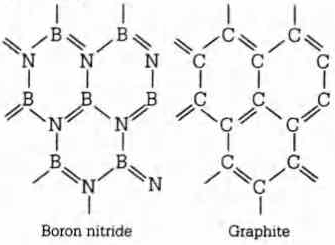
(C) Boron nitride $(BN)_x$ is known as inorganic graphite because its structure is similar to that of graphite.
In graphite,carbon atoms are arranged in hexagonal layers.
In boron nitride,boron and nitrogen atoms are arranged in a similar hexagonal layered structure,where each boron atom is surrounded by three nitrogen atoms and vice versa.
In graphite,carbon atoms are arranged in hexagonal layers.
In boron nitride,boron and nitrogen atoms are arranged in a similar hexagonal layered structure,where each boron atom is surrounded by three nitrogen atoms and vice versa.
0 likesView Solution
33
ChemistryMediumMCQNEET · 2013
Which of the following is not a monomer for a high molecular mass silicone polymer?
A
$Me_3SiCl$
B
$PhSiCl_3$
C
$MeSiCl_3$
D
$Me_2SiCl_2$
Solution
(A) $Me_3SiCl$ acts as a chain terminator.
Upon hydrolysis,it produces $Me_3SiOH$,which contains only one reactive site,thereby limiting the growth of the polymer chain.
On the other hand,$Me_2SiCl_2$ leads to linear polymers,and $RSiCl_3$ (like $MeSiCl_3$ or $PhSiCl_3$) leads to cross-linked high molecular mass polymers.
Upon hydrolysis,it produces $Me_3SiOH$,which contains only one reactive site,thereby limiting the growth of the polymer chain.
On the other hand,$Me_2SiCl_2$ leads to linear polymers,and $RSiCl_3$ (like $MeSiCl_3$ or $PhSiCl_3$) leads to cross-linked high molecular mass polymers.
0 likesView Solution
34
ChemistryMediumMCQNEET · 2013
The basic structural unit of silicates is
A
$SiO_3^{2-}$
B
$SiO_4^{2-}$
C
$SiO^{-}$
D
$SiO_4^{4-}$
Solution
(D) The basic structural unit of all silicates is the $SiO_4^{4-}$ tetrahedron,in which one silicon atom is bonded to four oxygen atoms in a tetrahedral arrangement.
This unit is derived from silicic acid,$H_4SiO_4$,by the removal of four protons ($H^+$ ions) as shown in the reaction:
$H_4SiO_4 \rightarrow SiO_4^{4-} + 4H^+$
This unit is derived from silicic acid,$H_4SiO_4$,by the removal of four protons ($H^+$ ions) as shown in the reaction:
$H_4SiO_4 \rightarrow SiO_4^{4-} + 4H^+$
0 likesView Solution
35
ChemistryMediumMCQNEET · 2013
Which statement is wrong?
A
Beryl is an example of cyclic silicate.
B
$Mg_2SiO_4$ is orthosilicate.
C
Basic structural unit in silicates is the $SiO_4^{4-}$ tetrahedron.
D
Feldspars are not aluminosilicates.
Solution
(D) $1$. Beryl $(Be_3Al_2Si_6O_{18})$ is a well-known example of a cyclic silicate (metasilicate) where six $SiO_4$ tetrahedra are linked in a ring.
$2$. $Mg_2SiO_4$ (Forsterite) is an orthosilicate (nesosilicate) containing discrete $SiO_4^{4-}$ units.
$3$. The basic structural unit of all silicates is the $SiO_4^{4-}$ tetrahedron.
$4$. Feldspars are three-dimensional tectosilicates where some silicon atoms are replaced by aluminum atoms,making them aluminosilicates. Therefore,the statement that 'Feldspars are not aluminosilicates' is incorrect.
$2$. $Mg_2SiO_4$ (Forsterite) is an orthosilicate (nesosilicate) containing discrete $SiO_4^{4-}$ units.
$3$. The basic structural unit of all silicates is the $SiO_4^{4-}$ tetrahedron.
$4$. Feldspars are three-dimensional tectosilicates where some silicon atoms are replaced by aluminum atoms,making them aluminosilicates. Therefore,the statement that 'Feldspars are not aluminosilicates' is incorrect.
0 likesView Solution
36
ChemistryDifficultMCQNEET · 2013
The radical,$C_6H_5CH_2^{\bullet}$,is aromatic because it has
A
$7 \ p$-orbitals and $7$ unpaired electrons
B
$6 \ p$-orbitals and $7$ unpaired electrons
C
$6 \ p$-orbitals and $6$ unpaired electrons
D
$7 \ p$-orbitals and $6$ unpaired electrons
Solution
(A) The benzyl radical $(C_6H_5CH_2^{\bullet})$ consists of a benzene ring attached to a $CH_2^{\bullet}$ group.
The benzene ring has $6$ carbon atoms,each contributing one $p$-orbital to the delocalized $\pi$-system,containing $6 \pi$-electrons.
The exocyclic carbon atom $(CH_2^{\bullet})$ is $sp^2$ hybridized and possesses one $p$-orbital containing one unpaired electron.
Therefore,the total number of $p$-orbitals involved in conjugation is $6 + 1 = 7$.
The total number of electrons in these $p$-orbitals is $6$ (from the ring) $+ 1$ (unpaired electron) $= 7$.
However,the aromaticity is determined by the $6 \pi$-electrons in the ring,and the radical is stabilized by resonance with the ring. The question asks for the characteristics that make it aromatic; it has $7$ $p$-orbitals in total (forming a conjugated system) and $7$ electrons in these $p$-orbitals (including the radical electron).
The benzene ring has $6$ carbon atoms,each contributing one $p$-orbital to the delocalized $\pi$-system,containing $6 \pi$-electrons.
The exocyclic carbon atom $(CH_2^{\bullet})$ is $sp^2$ hybridized and possesses one $p$-orbital containing one unpaired electron.
Therefore,the total number of $p$-orbitals involved in conjugation is $6 + 1 = 7$.
The total number of electrons in these $p$-orbitals is $6$ (from the ring) $+ 1$ (unpaired electron) $= 7$.
However,the aromaticity is determined by the $6 \pi$-electrons in the ring,and the radical is stabilized by resonance with the ring. The question asks for the characteristics that make it aromatic; it has $7$ $p$-orbitals in total (forming a conjugated system) and $7$ electrons in these $p$-orbitals (including the radical electron).
0 likesView Solution
37
ChemistryEasyMCQNEET · 2013
The structure of the isobutyl group in an organic compound is:
A
$CH_3-CH_2-CH_2-CH_2-$
B
$CH_3-C(CH_3)_2-$
C
$CH_3-CH(CH_3)-CH_2-$
D
$CH_3-CH_2-CH(CH_3)-$
Solution
(C) The isobutyl group is a four-carbon alkyl group with a methyl branch at the second carbon from the end of the chain.
Its structure is $CH_3-CH(CH_3)-CH_2-$.
Its structure is $CH_3-CH(CH_3)-CH_2-$.
0 likesView Solution
38
ChemistryDifficultMCQNEET · 2013
The structure of the compound whose $IUPAC$ name is $3-$ethyl$-2-$hydroxy$-4-$methylhex$-3-$en$-5-$ynoic acid is:
A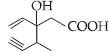
B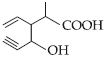
C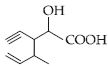
D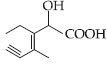
Solution
(D) To determine the structure of $3-$ethyl$-2-$hydroxy$-4-$methylhex$-3-$en$-5-$ynoic acid,we follow these steps:
$1$. The parent chain is a hexenoic acid,meaning it has $6$ carbon atoms with a carboxylic acid group at $C-1$.
$2$. The suffix $-3-$en$-5-$ynoic acid indicates a double bond at $C-3$ and a triple bond at $C-5$.
$3$. The substituents are an ethyl group at $C-3$,a hydroxy group at $C-2$,and a methyl group at $C-4$.
$4$. Constructing the chain: $CH_3-C\equiv C-C(CH_3)=C(C_2H_5)-CH(OH)-COOH$.
$5$. Comparing this with the given options,the structure corresponding to this $IUPAC$ name is represented in option $D$.
$1$. The parent chain is a hexenoic acid,meaning it has $6$ carbon atoms with a carboxylic acid group at $C-1$.
$2$. The suffix $-3-$en$-5-$ynoic acid indicates a double bond at $C-3$ and a triple bond at $C-5$.
$3$. The substituents are an ethyl group at $C-3$,a hydroxy group at $C-2$,and a methyl group at $C-4$.
$4$. Constructing the chain: $CH_3-C\equiv C-C(CH_3)=C(C_2H_5)-CH(OH)-COOH$.
$5$. Comparing this with the given options,the structure corresponding to this $IUPAC$ name is represented in option $D$.
0 likesView Solution
39
ChemistryDifficultMCQNEET · 2013
Some $meta$-directing substituents in aromatic substitution are given. Which one is most deactivating?
A
$-COOH$
B
$-NO_2$
C
$-C \equiv N$
D
$-SO_3H$
Solution
(B) The deactivating strength of a substituent depends on its electron-withdrawing power through inductive $(-I)$ and mesomeric $(-M)$ effects.
Among the given groups,the $-NO_2$ group exerts the strongest electron-withdrawing effect due to both a strong $-I$ effect and a strong $-M$ effect,making it the most deactivating group towards electrophilic aromatic substitution.
Among the given groups,the $-NO_2$ group exerts the strongest electron-withdrawing effect due to both a strong $-I$ effect and a strong $-M$ effect,making it the most deactivating group towards electrophilic aromatic substitution.
0 likesView Solution
40
ChemistryMediumMCQNEET · 2013
Arrange the following carbocations in increasing order of stability:
$1. \, (CH_3)_2 - \overset{+}{C} - CH_2 - CH_3$
$2. \, (CH_3)_3 - \overset{+}{C}$
$3. \, (CH_3)_2 - \overset{+}{C} H$
$4. \, CH_3 - \overset{+}{C} H_2$
$5. \, \overset{+}{C} H_3$
$1. \, (CH_3)_2 - \overset{+}{C} - CH_2 - CH_3$
$2. \, (CH_3)_3 - \overset{+}{C}$
$3. \, (CH_3)_2 - \overset{+}{C} H$
$4. \, CH_3 - \overset{+}{C} H_2$
$5. \, \overset{+}{C} H_3$
A
$5 < 4 < 3 < 1 < 2$
B
$4 < 5 < 3 < 1 < 2$
C
$1 < 5 < 4 < 3 < 2$
D
$5 < 4 < 3 < 2 < 1$
Solution
(A) The stability of carbocations is determined by the inductive effect and hyperconjugation,following the order: $methyl < 1^{\circ} < 2^{\circ} < 3^{\circ}$.
Analyzing the given carbocations:
$5. \, \overset{+}{C} H_3$ (Methyl carbocation)
$4. \, CH_3 - \overset{+}{C} H_2$ ($1^{\circ}$ carbocation)
$3. \, (CH_3)_2 - \overset{+}{C} H$ ($2^{\circ}$ carbocation)
$1. \, (CH_3)_2 - \overset{+}{C} - CH_2 - CH_3$ ($3^{\circ}$ carbocation)
$2. \, (CH_3)_3 - \overset{+}{C}$ ($3^{\circ}$ carbocation)
Note that $1$ and $2$ are both $3^{\circ}$ carbocations. However,$(CH_3)_3 - \overset{+}{C}$ (tert-butyl) is slightly more stable than $(CH_3)_2 - \overset{+}{C} - CH_2 - CH_3$ due to more hyperconjugative structures.
Thus,the increasing order of stability is: $5 < 4 < 3 < 1 < 2$.
Analyzing the given carbocations:
$5. \, \overset{+}{C} H_3$ (Methyl carbocation)
$4. \, CH_3 - \overset{+}{C} H_2$ ($1^{\circ}$ carbocation)
$3. \, (CH_3)_2 - \overset{+}{C} H$ ($2^{\circ}$ carbocation)
$1. \, (CH_3)_2 - \overset{+}{C} - CH_2 - CH_3$ ($3^{\circ}$ carbocation)
$2. \, (CH_3)_3 - \overset{+}{C}$ ($3^{\circ}$ carbocation)
Note that $1$ and $2$ are both $3^{\circ}$ carbocations. However,$(CH_3)_3 - \overset{+}{C}$ (tert-butyl) is slightly more stable than $(CH_3)_2 - \overset{+}{C} - CH_2 - CH_3$ due to more hyperconjugative structures.
Thus,the increasing order of stability is: $5 < 4 < 3 < 1 < 2$.
0 likesView Solution
41
ChemistryMediumMCQNEET · 2013
What is the hybridisation state of the benzyl carbocation shown in the image?

A
$sp^2$
B
$spd^2$
C
$sp^2d$
D
$sp^3$
Solution
(A) The benzyl carbocation is represented as $C_6H_5CH_2^+$.
In the $CH_2^+$ group,the central carbon atom is bonded to two hydrogen atoms and one phenyl ring carbon atom.
It has three sigma bonds and no lone pairs of electrons.
Therefore,the steric number is $3$,which corresponds to $sp^2$ hybridisation.
All carbocations are $sp^2$ hybridised and possess a planar triangular geometry.
In the $CH_2^+$ group,the central carbon atom is bonded to two hydrogen atoms and one phenyl ring carbon atom.
It has three sigma bonds and no lone pairs of electrons.
Therefore,the steric number is $3$,which corresponds to $sp^2$ hybridisation.
All carbocations are $sp^2$ hybridised and possess a planar triangular geometry.
0 likesView Solution
42
ChemistryMediumMCQNEET · 2013
Nitrogen detection in an organic compound is carried out by Lassaigne's test. The blue colour formed corresponds to which of the following formulae?
A
$Fe_3[Fe(CN)_6]_2$
B
$Fe_4[Fe(CN)_6]_3$
C
$Fe_4[Fe(CN)_6]_2$
D
$Fe_3[Fe(CN)_6]_3$
Solution
(B) The detection of nitrogen in an organic compound via Lassaigne's test involves the following chemical reactions:
$Na + C + N \xrightarrow{\Delta} NaCN$
$2 NaCN + FeSO_4 \longrightarrow Fe(CN)_2 + Na_2SO_4$
$Fe(CN)_2 + 4 NaCN \longrightarrow Na_4[Fe(CN)_6]$
Finally,the sodium ferrocyanide reacts with ferric ions $(Fe^{3+})$ formed by the oxidation of some $Fe^{2+}$ to produce ferric ferrocyanide (Prussian blue):
$3 Na_4[Fe(CN)_6] + 4 Fe^{3+} \longrightarrow Fe_4[Fe(CN)_6]_3 + 12 Na^{+}$
The blue colour corresponds to the formula $Fe_4[Fe(CN)_6]_3$.
$Na + C + N \xrightarrow{\Delta} NaCN$
$2 NaCN + FeSO_4 \longrightarrow Fe(CN)_2 + Na_2SO_4$
$Fe(CN)_2 + 4 NaCN \longrightarrow Na_4[Fe(CN)_6]$
Finally,the sodium ferrocyanide reacts with ferric ions $(Fe^{3+})$ formed by the oxidation of some $Fe^{2+}$ to produce ferric ferrocyanide (Prussian blue):
$3 Na_4[Fe(CN)_6] + 4 Fe^{3+} \longrightarrow Fe_4[Fe(CN)_6]_3 + 12 Na^{+}$
The blue colour corresponds to the formula $Fe_4[Fe(CN)_6]_3$.
0 likesView Solution
43
ChemistryDifficultMCQNEET · 2013
Homolytic fission of the following alkanes forms free radicals: $CH_3-CH_3$,$CH_3-CH_2-CH_3$,$(CH_3)_2CH-CH_3$,and $CH_3-CH_2-CH(CH_3)_2$. The increasing order of stability of the resulting free radicals is:
A
$CH_3-\dot{C}H_2 < (CH_3)_2\dot{C}H < (CH_3)_2\dot{C}-CH_2CH_3 < (CH_3)_3\dot{C}$
B
$CH_3-\dot{C}H_2 < CH_3-\dot{C}H-CH_3 < (CH_3)_2\dot{C}-CH_2-CH_3 < (CH_3)_3\dot{C}$
C
$CH_3-\dot{C}H_2 < CH_3-\dot{C}H-CH_3 < (CH_3)_3\dot{C} < (CH_3)_2\dot{C}-CH_2CH_3$
D
$(CH_3)_3\dot{C} < (CH_3)_2\dot{C}-CH_2CH_3 < CH_3-\dot{C}H-CH_3 < CH_3-\dot{C}H_2$
Solution
(B) The stability of free radicals is determined by the number of hyperconjugative structures and inductive effects.
Primary $(1^\circ)$ radicals are less stable than secondary $(2^\circ)$ radicals,which are less stable than tertiary $(3^\circ)$ radicals.
$1$. $CH_3-\dot{C}H_2$ (Primary)
$2$. $CH_3-\dot{C}H-CH_3$ (Secondary)
$3$. $(CH_3)_2\dot{C}-CH_2CH_3$ (Secondary,but more substituted)
$4$. $(CH_3)_3\dot{C}$ (Tertiary)
Stability order: $1^\circ < 2^\circ < 3^\circ$.
Thus,the increasing order is $CH_3-\dot{C}H_2 < CH_3-\dot{C}H-CH_3 < (CH_3)_2\dot{C}-CH_2CH_3 < (CH_3)_3\dot{C}$.
Primary $(1^\circ)$ radicals are less stable than secondary $(2^\circ)$ radicals,which are less stable than tertiary $(3^\circ)$ radicals.
$1$. $CH_3-\dot{C}H_2$ (Primary)
$2$. $CH_3-\dot{C}H-CH_3$ (Secondary)
$3$. $(CH_3)_2\dot{C}-CH_2CH_3$ (Secondary,but more substituted)
$4$. $(CH_3)_3\dot{C}$ (Tertiary)
Stability order: $1^\circ < 2^\circ < 3^\circ$.
Thus,the increasing order is $CH_3-\dot{C}H_2 < CH_3-\dot{C}H-CH_3 < (CH_3)_2\dot{C}-CH_2CH_3 < (CH_3)_3\dot{C}$.
0 likesView Solution
44
ChemistryMediumMCQNEET · 2013
Which of the following chemical systems is non-aromatic?
A
Benzene
B
Naphthalene
C
Thiophene
D
Cyclopentadiene
Solution
(D) Molecules that do not satisfy the Huckel rule or $(4n+2) \pi$-electron rule are classified as non-aromatic or anti-aromatic depending on their cyclic conjugation.
$1$. Benzene,Naphthalene,and Thiophene are aromatic because they are cyclic,planar,fully conjugated,and follow the $(4n+2) \pi$-electron rule.
$2$. Cyclopentadiene (option $d$) has an $sp^3$ hybridized carbon atom in the ring,which breaks the continuous conjugation. Therefore,it is non-aromatic.
$1$. Benzene,Naphthalene,and Thiophene are aromatic because they are cyclic,planar,fully conjugated,and follow the $(4n+2) \pi$-electron rule.
$2$. Cyclopentadiene (option $d$) has an $sp^3$ hybridized carbon atom in the ring,which breaks the continuous conjugation. Therefore,it is non-aromatic.
0 likesView Solution
45
ChemistryMediumMCQNEET · 2013
Which one of the following statements is not true?
A
Clean water would have a $BOD$ value of $5 \ ppm$.
B
Fluoride deficiency in drinking water is harmful. Soluble fluoride is often used to bring its concentration up to $1 \ ppm$.
C
When the $pH$ of rain water is higher than $6.5$,it is called acid rain.
D
Dissolved Oxygen $(DO)$ in cold water can reach a concentration up to $10 \ ppm$.
Solution
(C) The correct option is $C$. The statement "When the $pH$ of rain water is higher than $6.5$,it is called acid rain" is incorrect.
Acid rain is defined as rain water having a $pH$ value less than $5.6$ due to the presence of dissolved oxides of sulfur and nitrogen.
Acid rain is defined as rain water having a $pH$ value less than $5.6$ due to the presence of dissolved oxides of sulfur and nitrogen.
0 likesView Solution
46
ChemistryMediumMCQNEET · 2013
How many grams of concentrated nitric acid solution should be used to prepare $250 \ mL$ of $2.0 \ M \ HNO_3$? The concentrated acid is $70\% \ HNO_3$ by mass.
A
$70.0 \ g$ conc. $HNO_3$
B
$54.0 \ g$ conc. $HNO_3$
C
$45.0 \ g$ conc. $HNO_3$
D
$90.0 \ g$ conc. $HNO_3$
Solution
(C) Step $1$: Calculate the number of moles of $HNO_3$ required.
$n = M \times V(L) = 2.0 \ mol/L \times 0.250 \ L = 0.5 \ mol$.
Step $2$: Calculate the mass of pure $HNO_3$ required.
Molar mass of $HNO_3 = 1 + 14 + (3 \times 16) = 63 \ g/mol$.
Mass of $HNO_3 = 0.5 \ mol \times 63 \ g/mol = 31.5 \ g$.
Step $3$: Calculate the mass of the $70\%$ concentrated solution.
Since the solution is $70\%$ $HNO_3$ by mass,$70 \ g$ of $HNO_3$ is present in $100 \ g$ of solution.
Mass of solution $= (100 \ g \text{ solution} / 70 \ g \text{ } HNO_3) \times 31.5 \ g \text{ } HNO_3 = 45 \ g$.
$n = M \times V(L) = 2.0 \ mol/L \times 0.250 \ L = 0.5 \ mol$.
Step $2$: Calculate the mass of pure $HNO_3$ required.
Molar mass of $HNO_3 = 1 + 14 + (3 \times 16) = 63 \ g/mol$.
Mass of $HNO_3 = 0.5 \ mol \times 63 \ g/mol = 31.5 \ g$.
Step $3$: Calculate the mass of the $70\%$ concentrated solution.
Since the solution is $70\%$ $HNO_3$ by mass,$70 \ g$ of $HNO_3$ is present in $100 \ g$ of solution.
Mass of solution $= (100 \ g \text{ solution} / 70 \ g \text{ } HNO_3) \times 31.5 \ g \text{ } HNO_3 = 45 \ g$.
2 likesView Solution
47
ChemistryDifficultMCQNEET · 2013
Which is the strongest acid among the following?
A
$HClO_4$
B
$H_2SO_3$
C
$H_2SO_4$
D
$HClO_3$
Solution
(A) The correct answer is $A$.
$HClO_4$ is the strongest acid because the oxidation state of the central atom $Cl$ is $+7$,which is the highest among the given options.
Generally,for oxyacids,a higher oxidation state of the central atom leads to greater acidity due to the increased ability to stabilize the conjugate base through resonance and inductive effects.
$HClO_4$ is the strongest acid because the oxidation state of the central atom $Cl$ is $+7$,which is the highest among the given options.
Generally,for oxyacids,a higher oxidation state of the central atom leads to greater acidity due to the increased ability to stabilize the conjugate base through resonance and inductive effects.
0 likesView Solution
48
ChemistryEasyMCQNEET · 2013
Which one of the following molecules contains no $\pi$ bond?
A
$SO_2$
B
$NO_2$
C
$CO_2$
D
$H_2O$
Solution
(D) To determine the presence of $\pi$ bonds,we examine the Lewis structures of the given molecules:
$1$. $SO_2$: The structure is $O=S=O$ (with a lone pair on $S$),containing two $\pi$ bonds.
$2$. $NO_2$: The structure involves a nitrogen atom with an unpaired electron and double bonds,containing $\pi$ bonds.
$3$. $CO_2$: The structure is $O=C=O$,containing two $\pi$ bonds.
$4$. $H_2O$: The structure is $H-O-H$ with two lone pairs on the oxygen atom. All bonds are $\sigma$ bonds. There are no $\pi$ bonds in the $H_2O$ molecule.
Therefore,the correct option is $D$.
$1$. $SO_2$: The structure is $O=S=O$ (with a lone pair on $S$),containing two $\pi$ bonds.
$2$. $NO_2$: The structure involves a nitrogen atom with an unpaired electron and double bonds,containing $\pi$ bonds.
$3$. $CO_2$: The structure is $O=C=O$,containing two $\pi$ bonds.
$4$. $H_2O$: The structure is $H-O-H$ with two lone pairs on the oxygen atom. All bonds are $\sigma$ bonds. There are no $\pi$ bonds in the $H_2O$ molecule.
Therefore,the correct option is $D$.
0 likesView Solution
49
ChemistryMediumMCQNEET · 2013
Identify the correct order of solubility in aqueous medium.
A
$Na_2S > CuS > ZnS$
B
$Na_2S > ZnS > CuS$
C
$CuS > ZnS > Na_2S$
D
$ZnS > Na_2S > CuS$
Solution
(B) Ionic compounds are generally more soluble in water or aqueous media.
According to Fajans' rule,the covalent character increases with the polarising power of the cation,which is inversely proportional to the ionic character.
Ionic character is higher for cations with larger size and lower charge.
The order of size of the cations is $Na^{+} > Zn^{2+} > Cu^{2+}$.
Since $Na^+$ has the largest size and lowest charge,$Na_2S$ is the most ionic and thus the most soluble.
$CuS$ has the highest covalent character due to the smaller size and higher charge of $Cu^{2+}$,making it the least soluble.
Therefore,the correct order of solubility in water is $Na_2S > ZnS > CuS$.
According to Fajans' rule,the covalent character increases with the polarising power of the cation,which is inversely proportional to the ionic character.
Ionic character is higher for cations with larger size and lower charge.
The order of size of the cations is $Na^{+} > Zn^{2+} > Cu^{2+}$.
Since $Na^+$ has the largest size and lowest charge,$Na_2S$ is the most ionic and thus the most soluble.
$CuS$ has the highest covalent character due to the smaller size and higher charge of $Cu^{2+}$,making it the least soluble.
Therefore,the correct order of solubility in water is $Na_2S > ZnS > CuS$.
0 likesView Solution
50
ChemistryDifficultMCQNEET · 2013
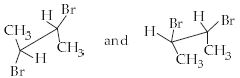
Given structures $I$ and $II$ are:
A
identical
B
a pair of conformers
C
a pair of geometrical isomers
D
a pair of optical isomers
Solution
(B) By rotating the front carbon atom of the first structure by $180^{\circ}$,we obtain the second structure.
Thus,both structures are conformers of each other.
Specifically,one is in the staggered conformation and the other is in the eclipsed conformation.
Thus,both structures are conformers of each other.
Specifically,one is in the staggered conformation and the other is in the eclipsed conformation.
0 likesView Solution
51
ChemistryDifficultMCQNEET · 2013
The outer electronic configuration of $Gd \ (At. \ No. \ 64)$ is
A
$4f^5 \ 5d^4 \ 6s^1$
B
$4f^7 \ 5d^1 \ 6s^2$
C
$4f^3 \ 5d^5 \ 6s^2$
D
$4f^4 \ 5d^5 \ 6s^1$
Solution
(B) The atomic number of Gadolinium $(Gd)$ is $64$.
Its electronic configuration is based on the noble gas Xenon ($Xe$,$Z=54$).
The remaining $10$ electrons are filled in the $4f$,$5d$,and $6s$ orbitals.
According to Hund's rule and the stability of half-filled subshells,the $4f$ subshell prefers to be half-filled $(4f^7)$.
Thus,the configuration is $[Xe] \ 4f^7 \ 5d^1 \ 6s^2$.
Its electronic configuration is based on the noble gas Xenon ($Xe$,$Z=54$).
The remaining $10$ electrons are filled in the $4f$,$5d$,and $6s$ orbitals.
According to Hund's rule and the stability of half-filled subshells,the $4f$ subshell prefers to be half-filled $(4f^7)$.
Thus,the configuration is $[Xe] \ 4f^7 \ 5d^1 \ 6s^2$.
0 likesView Solution
52
ChemistryMediumMCQNEET · 2013
According to the law of photochemical equivalence,the energy absorbed (in $ergs \ mol^{-1}$) is given as ($h = 6.62 \times 10^{-27} \ erg \ s$,$c = 3 \times 10^{10} \ cm \ s^{-1}$,$N_A = 6.02 \times 10^{23} \ mol^{-1}$):
A
$\frac{1.196 \times 10^8}{\lambda}$
B
$\frac{2.859 \times 10^5}{\lambda}$
C
$\frac{2.859 \times 10^{16}}{\lambda}$
D
$\frac{1.196 \times 10^{16}}{\lambda}$
Solution
(A) The energy of one mole of photons is given by the formula $E = \frac{h c N_A}{\lambda}$.
Substituting the given values:
$E = \frac{(6.62 \times 10^{-27} \ erg \ s) \times (3 \times 10^{10} \ cm \ s^{-1}) \times (6.02 \times 10^{23} \ mol^{-1})}{\lambda}$
$E = \frac{11.95572 \times 10^6}{\lambda} \ erg \ mol^{-1}$
$E = \frac{1.196 \times 10^8}{\lambda} \ erg \ mol^{-1}$.
Substituting the given values:
$E = \frac{(6.62 \times 10^{-27} \ erg \ s) \times (3 \times 10^{10} \ cm \ s^{-1}) \times (6.02 \times 10^{23} \ mol^{-1})}{\lambda}$
$E = \frac{11.95572 \times 10^6}{\lambda} \ erg \ mol^{-1}$
$E = \frac{1.196 \times 10^8}{\lambda} \ erg \ mol^{-1}$.
0 likesView Solution
53
ChemistryMediumMCQNEET · 2013
$A$ reaction having equal energies of activation for forward and reverse reactions has
A
$\Delta H = 0$
B
$\Delta H = \Delta G = \Delta S = 0$
C
$\Delta S = 0$
D
$\Delta G = 0$
Solution
(A) The enthalpy change of a reaction is given by the difference between the activation energy of the forward reaction $(E_a)_f$ and the activation energy of the reverse reaction $(E_a)_b$.
$\Delta H = (E_a)_f - (E_a)_b$
Given that the energies of activation for forward and reverse reactions are equal,i.e.,$(E_a)_f = (E_a)_b$.
Therefore,$\Delta H = 0$.
$\Delta H = (E_a)_f - (E_a)_b$
Given that the energies of activation for forward and reverse reactions are equal,i.e.,$(E_a)_f = (E_a)_b$.
Therefore,$\Delta H = 0$.
0 likesView Solution
54
ChemistryMediumMCQNEET · 2013
In the $Castner-Kellner$ cell for the production of sodium hydroxide,which of the following occurs?
A
Brine is electrolyzed using graphite electrodes.
B
Molten sodium chloride is electrolyzed.
C
Sodium amalgam is formed at the mercury cathode.
D
Brine is electrolyzed with $Pt$ electrodes.
Solution
(C) In the $Castner-Kellner$ process,a brine solution ($NaCl$ aqueous) is electrolyzed using a mercury cathode and a carbon anode.
At the mercury cathode,sodium ions $(Na^+)$ are reduced to form sodium metal,which then dissolves in the mercury to form sodium amalgam ($Na-Hg$ alloy).
This sodium amalgam is subsequently reacted with water to produce sodium hydroxide $(NaOH)$,hydrogen gas,and mercury.
At the mercury cathode,sodium ions $(Na^+)$ are reduced to form sodium metal,which then dissolves in the mercury to form sodium amalgam ($Na-Hg$ alloy).
This sodium amalgam is subsequently reacted with water to produce sodium hydroxide $(NaOH)$,hydrogen gas,and mercury.
0 likesView Solution
55
ChemistryMediumMCQNEET · 2013
Which of the following compounds will not undergo Friedel-Craft's reaction easily?
A
Nitrobenzene
B
Toluene
C
Cumene
D
Xylene
Solution
(A) The Friedel-Crafts reaction is an electrophilic aromatic substitution reaction.
It fails when the benzene ring is deactivated by a strong electron-withdrawing group.
In $Nitrobenzene$ $(C_6H_5NO_2)$,the $-NO_2$ group is a strong deactivating group,which withdraws electron density from the ring,making it less susceptible to electrophilic attack.
Therefore,$Nitrobenzene$ does not undergo Friedel-Crafts reaction easily.
It fails when the benzene ring is deactivated by a strong electron-withdrawing group.
In $Nitrobenzene$ $(C_6H_5NO_2)$,the $-NO_2$ group is a strong deactivating group,which withdraws electron density from the ring,making it less susceptible to electrophilic attack.
Therefore,$Nitrobenzene$ does not undergo Friedel-Crafts reaction easily.
0 likesView Solution
56
ChemistryMediumMCQNEET · 2013
In the following reaction:
$HC \equiv CH \xrightarrow[{Hg^{2+}}]{{H_2SO_4}} 'P'$
Product $'P'$ will not give:
$HC \equiv CH \xrightarrow[{Hg^{2+}}]{{H_2SO_4}} 'P'$
Product $'P'$ will not give:
A
Tollen's reagent test
B
Brady's reagent test
C
Victor Meyer test
D
Iodoform test
Solution
(C) The reaction of ethyne $(HC \equiv CH)$ with $H_2SO_4$ in the presence of $Hg^{2+}$ is a hydration reaction (Kucherov reaction).
$HC \equiv CH + H_2O \xrightarrow[{Hg^{2+}}]{{H_2SO_4}} CH_3CHO$ (Acetaldehyde).
Thus,product $'P'$ is acetaldehyde $(CH_3CHO)$.
$1$. Acetaldehyde gives a positive Tollen's reagent test (silver mirror test).
$2$. Acetaldehyde gives a positive Brady's reagent test ($2$,$4$-$DNP$ test) as it is an aldehyde.
$3$. Acetaldehyde gives a positive Iodoform test because it contains the $CH_3CO-$ group.
$4$. The Victor Meyer test is used to distinguish between primary,secondary,and tertiary alcohols,not aldehydes. Therefore,acetaldehyde will not give the Victor Meyer test.
$HC \equiv CH + H_2O \xrightarrow[{Hg^{2+}}]{{H_2SO_4}} CH_3CHO$ (Acetaldehyde).
Thus,product $'P'$ is acetaldehyde $(CH_3CHO)$.
$1$. Acetaldehyde gives a positive Tollen's reagent test (silver mirror test).
$2$. Acetaldehyde gives a positive Brady's reagent test ($2$,$4$-$DNP$ test) as it is an aldehyde.
$3$. Acetaldehyde gives a positive Iodoform test because it contains the $CH_3CO-$ group.
$4$. The Victor Meyer test is used to distinguish between primary,secondary,and tertiary alcohols,not aldehydes. Therefore,acetaldehyde will not give the Victor Meyer test.
0 likesView Solution
57
ChemistryMediumMCQNEET · 2013
$A$ metal has a $fcc$ lattice. The edge length of the unit cell is $404 \, pm$. The density of the metal is $2.72 \, g \, cm^{-3}$. The molar mass of the metal is ................. $g \, mol^{-1}$.
($N_A$ Avogadro's constant $= 6.02 \times 10^{23} \, mol^{-1}$)
($N_A$ Avogadro's constant $= 6.02 \times 10^{23} \, mol^{-1}$)
A
$27$
B
$20$
C
$40$
D
$30$
Solution
$(A)$ The density formula for a unit cell is $d = \frac{z \times M}{a^3 \times N_A}$.
For an $fcc$ lattice,the number of atoms per unit cell,$z = 4$.
The edge length $a = 404 \, pm = 404 \times 10^{-10} \, cm = 4.04 \times 10^{-8} \, cm$.
Rearranging the formula for molar mass $M$: $M = \frac{d \times a^3 \times N_A}{z}$.
Substituting the values: $M = \frac{2.72 \times (4.04 \times 10^{-8})^3 \times 6.02 \times 10^{23}}{4}$.
$M = \frac{2.72 \times 66.01 \times 10^{-24} \times 6.02 \times 10^{23}}{4} \approx 27 \, g \, mol^{-1}$.
For an $fcc$ lattice,the number of atoms per unit cell,$z = 4$.
The edge length $a = 404 \, pm = 404 \times 10^{-10} \, cm = 4.04 \times 10^{-8} \, cm$.
Rearranging the formula for molar mass $M$: $M = \frac{d \times a^3 \times N_A}{z}$.
Substituting the values: $M = \frac{2.72 \times (4.04 \times 10^{-8})^3 \times 6.02 \times 10^{23}}{4}$.
$M = \frac{2.72 \times 66.01 \times 10^{-24} \times 6.02 \times 10^{23}}{4} \approx 27 \, g \, mol^{-1}$.
0 likesView Solution
58
ChemistryEasyMCQNEET · 2013
The number of carbon atoms per unit cell of diamond unit cell is
A
$6$
B
$1$
C
$4$
D
$8$
Solution
(D) The diamond structure consists of two interpenetrating $fcc$ lattices,one displaced from the other by a body diagonal translation of $1/4$ of the length of the body diagonal.
In an $fcc$ unit cell,there are $4$ lattice points.
Since each lattice point in the diamond structure corresponds to $2$ carbon atoms,the total number of carbon atoms per unit cell is $4 \times 2 = 8$.
In an $fcc$ unit cell,there are $4$ lattice points.
Since each lattice point in the diamond structure corresponds to $2$ carbon atoms,the total number of carbon atoms per unit cell is $4 \times 2 = 8$.
0 likesView Solution
59
ChemistryMediumMCQNEET · 2013
Which condition is not satisfied by an ideal solution?
A
$\Delta _{mix} V = 0$
B
$\Delta _{mix} S = 0$
C
Obeyance to Raoult's Law
D
$\Delta _{mix} H = 0$
Solution
(B) For an ideal solution,the following conditions must be met:
$1$. $\Delta _{mix} H = 0$ (no heat is absorbed or evolved).
$2$. $\Delta _{mix} V = 0$ (no change in volume upon mixing).
$3$. It must obey Raoult's Law over the entire range of concentration.
$4$. For any spontaneous mixing process,the entropy of mixing must be positive,i.e.,$\Delta _{mix} S > 0$.
Therefore,the condition $\Delta _{mix} S = 0$ is not satisfied by an ideal solution.
$1$. $\Delta _{mix} H = 0$ (no heat is absorbed or evolved).
$2$. $\Delta _{mix} V = 0$ (no change in volume upon mixing).
$3$. It must obey Raoult's Law over the entire range of concentration.
$4$. For any spontaneous mixing process,the entropy of mixing must be positive,i.e.,$\Delta _{mix} S > 0$.
Therefore,the condition $\Delta _{mix} S = 0$ is not satisfied by an ideal solution.
0 likesView Solution
60
ChemistryAdvancedMCQNEET · 2013
At $25^oC$,the molar conductance of a $0.1 \ M$ aqueous solution of ammonium hydroxide is $9.54 \ \Omega^{-1} \ cm^2 \ mol^{-1}$ and at infinite dilution,its molar conductance is $238 \ \Omega^{-1} \ cm^2 \ mol^{-1}$. The degree of ionization of ammonium hydroxide at the same concentration and temperature is ........... $\%$.
A
$4.008$
B
$40.800$
C
$2.080$
D
$20.800$
Solution
(A) The degree of ionization $(\alpha)$ is given by the ratio of molar conductance at a specific concentration $(\lambda^c_m)$ to the molar conductance at infinite dilution $(\lambda^\infty_m)$:
$\alpha = \frac{\lambda^c_m}{\lambda^\infty_m} = \frac{9.54}{238} \approx 0.04008$
To express this as a percentage:
$\% \alpha = \alpha \times 100 = 0.04008 \times 100 = 4.008 \%$
$\alpha = \frac{\lambda^c_m}{\lambda^\infty_m} = \frac{9.54}{238} \approx 0.04008$
To express this as a percentage:
$\% \alpha = \alpha \times 100 = 0.04008 \times 100 = 4.008 \%$
0 likesView Solution
61
ChemistryMediumMCQNEET · 2013
$A$ button cell used in watches functions as follows:
$Zn_{(s)} + Ag_2O_{(s)} + H_2O_{(l)} \rightarrow 2Ag_{(s)} + Zn^{2+}_{(aq)} + 2OH^{-}_{(aq)}$
If the half-cell potentials are:
$Zn^{2+}_{(aq)} + 2e^- \rightarrow Zn_{(s)} \,;\, E^o = -0.76 \, V$
$Ag_2O_{(s)} + H_2O_{(l)} + 2e^- \rightarrow 2Ag_{(s)} + 2OH^{-}_{(aq)} \,;\, E^o = 0.34 \, V$
The cell potential will be $..........$ $V.$
$Zn_{(s)} + Ag_2O_{(s)} + H_2O_{(l)} \rightarrow 2Ag_{(s)} + Zn^{2+}_{(aq)} + 2OH^{-}_{(aq)}$
If the half-cell potentials are:
$Zn^{2+}_{(aq)} + 2e^- \rightarrow Zn_{(s)} \,;\, E^o = -0.76 \, V$
$Ag_2O_{(s)} + H_2O_{(l)} + 2e^- \rightarrow 2Ag_{(s)} + 2OH^{-}_{(aq)} \,;\, E^o = 0.34 \, V$
The cell potential will be $..........$ $V.$
A
$0.84$
B
$1.34$
C
$1.10$
D
$0.42$
Solution
(C) The cell reaction is:
Anode (Oxidation): $Zn_{(s)} \rightarrow Zn^{2+}_{(aq)} + 2e^- \,;\, E^o_{ox} = -(-0.76) = 0.76 \, V$
Cathode (Reduction): $Ag_2O_{(s)} + H_2O_{(l)} + 2e^- \rightarrow 2Ag_{(s)} + 2OH^{-}_{(aq)} \,;\, E^o_{red} = 0.34 \, V$
$E^o_{\text{cell}} = E^o_{ox} + E^o_{red}$
$E^o_{\text{cell}} = 0.76 \, V + 0.34 \, V = 1.10 \, V$
Anode (Oxidation): $Zn_{(s)} \rightarrow Zn^{2+}_{(aq)} + 2e^- \,;\, E^o_{ox} = -(-0.76) = 0.76 \, V$
Cathode (Reduction): $Ag_2O_{(s)} + H_2O_{(l)} + 2e^- \rightarrow 2Ag_{(s)} + 2OH^{-}_{(aq)} \,;\, E^o_{red} = 0.34 \, V$
$E^o_{\text{cell}} = E^o_{ox} + E^o_{red}$
$E^o_{\text{cell}} = 0.76 \, V + 0.34 \, V = 1.10 \, V$
0 likesView Solution
62
ChemistryDifficultMCQNEET · 2013
$A$ hydrogen gas electrode is made by dipping platinum wire in a solution of $HCl$ of $pH = 10$ and by passing hydrogen gas around the platinum wire at $1 \ atm$ pressure. The oxidation potential of the electrode would be $.......... \ V$.
A
$0.118$
B
$1.18$
C
$0.059$
D
$0.59$
Solution
(D) The oxidation reaction for the hydrogen electrode is: $H_{2}(g) \rightarrow 2H^{+}(aq) + 2e^{-}$.
Given $pH = 10$,the concentration of hydrogen ions is $[H^{+}] = 10^{-pH} = 10^{-10} \ M$.
The pressure of hydrogen gas is $P_{H_{2}} = 1 \ atm$.
The oxidation potential is given by the Nernst equation: $E_{ox} = E_{ox}^{0} - \frac{0.0591}{n} \log Q$.
For the standard hydrogen electrode,$E_{ox}^{0} = 0 \ V$ and $n = 2$.
The reaction quotient $Q = \frac{[H^{+}]^{2}}{P_{H_{2}}} = \frac{(10^{-10})^{2}}{1} = 10^{-20}$.
Substituting the values: $E_{ox} = 0 - \frac{0.0591}{2} \log(10^{-20})$.
$E_{ox} = -\frac{0.0591}{2} \times (-20) = 0.0591 \times 10 = 0.591 \ V$.
Given $pH = 10$,the concentration of hydrogen ions is $[H^{+}] = 10^{-pH} = 10^{-10} \ M$.
The pressure of hydrogen gas is $P_{H_{2}} = 1 \ atm$.
The oxidation potential is given by the Nernst equation: $E_{ox} = E_{ox}^{0} - \frac{0.0591}{n} \log Q$.
For the standard hydrogen electrode,$E_{ox}^{0} = 0 \ V$ and $n = 2$.
The reaction quotient $Q = \frac{[H^{+}]^{2}}{P_{H_{2}}} = \frac{(10^{-10})^{2}}{1} = 10^{-20}$.
Substituting the values: $E_{ox} = 0 - \frac{0.0591}{2} \log(10^{-20})$.
$E_{ox} = -\frac{0.0591}{2} \times (-20) = 0.0591 \times 10 = 0.591 \ V$.
0 likesView Solution
63
ChemistryAdvancedMCQNEET · 2013
Consider the half-cell reduction reactions:
$Mn^{2+} + 2e^{-} \rightarrow Mn$,$E^{\circ} = -1.18 \ V$
$Mn^{3+} + e^{-} \rightarrow Mn^{2+}$,$E^{\circ} = +1.51 \ V$
The $E^{\circ}$ for the reaction $3Mn^{2+} \rightarrow Mn + 2Mn^{3+}$,and the possibility of the forward reaction are respectively:
$Mn^{2+} + 2e^{-} \rightarrow Mn$,$E^{\circ} = -1.18 \ V$
$Mn^{3+} + e^{-} \rightarrow Mn^{2+}$,$E^{\circ} = +1.51 \ V$
The $E^{\circ}$ for the reaction $3Mn^{2+} \rightarrow Mn + 2Mn^{3+}$,and the possibility of the forward reaction are respectively:
A
$-4.18 \ V$ and yes
B
$+0.33 \ V$ and yes
C
$+2.69 \ V$ and no
D
$-2.69 \ V$ and no
Solution
(D) The given half-cell reactions are:
$(I) \ Mn^{2+} + 2e^{-} \rightarrow Mn$,$E^{\circ}_{1} = -1.18 \ V$
$(II) \ Mn^{3+} + e^{-} \rightarrow Mn^{2+}$,$E^{\circ}_{2} = +1.51 \ V$
To obtain the reaction $3Mn^{2+} \rightarrow Mn + 2Mn^{3+}$,we perform the operation: $(I) - 2 \times (II)$.
The standard Gibbs free energy change is given by $\Delta G^{\circ} = -nFE^{\circ}$.
For reaction $(I)$,$\Delta G^{\circ}_{1} = -2 \times F \times (-1.18) = +2.36F$.
For reaction $(II)$,$\Delta G^{\circ}_{2} = -1 \times F \times (+1.51) = -1.51F$.
For the target reaction,$\Delta G^{\circ}_{net} = \Delta G^{\circ}_{1} - 2 \times \Delta G^{\circ}_{2} = +2.36F - 2 \times (-1.51F) = +2.36F + 3.02F = +5.38F$.
Since $\Delta G^{\circ}_{net} = -nFE^{\circ}_{cell}$,where $n = 2$ electrons are transferred in the balanced equation:
$5.38F = -2 \times F \times E^{\circ}_{cell}$
$E^{\circ}_{cell} = -5.38 / 2 = -2.69 \ V$.
Since $E^{\circ}_{cell}$ is negative,the reaction is non-spontaneous.
$(I) \ Mn^{2+} + 2e^{-} \rightarrow Mn$,$E^{\circ}_{1} = -1.18 \ V$
$(II) \ Mn^{3+} + e^{-} \rightarrow Mn^{2+}$,$E^{\circ}_{2} = +1.51 \ V$
To obtain the reaction $3Mn^{2+} \rightarrow Mn + 2Mn^{3+}$,we perform the operation: $(I) - 2 \times (II)$.
The standard Gibbs free energy change is given by $\Delta G^{\circ} = -nFE^{\circ}$.
For reaction $(I)$,$\Delta G^{\circ}_{1} = -2 \times F \times (-1.18) = +2.36F$.
For reaction $(II)$,$\Delta G^{\circ}_{2} = -1 \times F \times (+1.51) = -1.51F$.
For the target reaction,$\Delta G^{\circ}_{net} = \Delta G^{\circ}_{1} - 2 \times \Delta G^{\circ}_{2} = +2.36F - 2 \times (-1.51F) = +2.36F + 3.02F = +5.38F$.
Since $\Delta G^{\circ}_{net} = -nFE^{\circ}_{cell}$,where $n = 2$ electrons are transferred in the balanced equation:
$5.38F = -2 \times F \times E^{\circ}_{cell}$
$E^{\circ}_{cell} = -5.38 / 2 = -2.69 \ V$.
Since $E^{\circ}_{cell}$ is negative,the reaction is non-spontaneous.
0 likesView Solution
64
ChemistryMediumMCQNEET · 2013
How many grams of cobalt metal will be deposited when a solution of cobalt $(II)$ chloride is electrolyzed with a current of $10 \ A$ for $109$ minutes? ($1 \ Faraday = 96,500 \ C$; Atomic mass of $Co = 59 \ u$)
A
$4.0$
B
$20.0$
C
$40.0$
D
$0.66$
Solution
(B) The reaction for the deposition of cobalt is: $Co^{2+} + 2e^- \rightarrow Co(s)$.
Given: Current $(I)$ = $10 \ A$,Time $(t)$ = $109 \ \text{minutes} = 109 \times 60 \ \text{seconds} = 6540 \ \text{s}$.
Total charge $(Q)$ = $I \times t = 10 \times 6540 = 65400 \ \text{C}$.
Equivalent mass of $Co$ $(E)$ = $\frac{\text{Atomic mass}}{\text{Valency factor}} = \frac{59}{2} = 29.5 \ \text{g/eq}$.
Using Faraday's law: $W = \frac{Q \times E}{96500} = \frac{65400 \times 29.5}{96500} \approx 20 \ \text{g}$.
Given: Current $(I)$ = $10 \ A$,Time $(t)$ = $109 \ \text{minutes} = 109 \times 60 \ \text{seconds} = 6540 \ \text{s}$.
Total charge $(Q)$ = $I \times t = 10 \times 6540 = 65400 \ \text{C}$.
Equivalent mass of $Co$ $(E)$ = $\frac{\text{Atomic mass}}{\text{Valency factor}} = \frac{59}{2} = 29.5 \ \text{g/eq}$.
Using Faraday's law: $W = \frac{Q \times E}{96500} = \frac{65400 \times 29.5}{96500} \approx 20 \ \text{g}$.
0 likesView Solution
65
ChemistryDifficultMCQNEET · 2013
What is the activation energy for a reaction if its rate doubles when the temperature is raised from $20 \,^{\circ}C$ to $35 \,^{\circ}C$ in $kJ \,mol^{-1}$? $(R = 8.314 \,J \,mol^{-1} \,K^{-1})$
A
$34.7$
B
$15.1$
C
$342$
D
$269$
Solution
(A) The Arrhenius equation is given by: $\log \frac{k_{2}}{k_{1}} = \frac{E_{a}}{2.303 \,R} \left( \frac{1}{T_{1}} - \frac{1}{T_{2}} \right)$
Given: $k_{2} = 2 \,k_{1}$,$T_{1} = 20 + 273 = 293 \,K$,$T_{2} = 35 + 273 = 308 \,K$,and $R = 8.314 \,J \,mol^{-1} \,K^{-1}$.
Substituting the values:
$\log(2) = \frac{E_{a}}{2.303 \times 8.314} \left( \frac{1}{293} - \frac{1}{308} \right)$
$0.3010 = \frac{E_{a}}{19.147} \times \left( \frac{308 - 293}{293 \times 308} \right)$
$0.3010 = \frac{E_{a}}{19.147} \times \frac{15}{90244}$
$E_{a} = \frac{0.3010 \times 19.147 \times 90244}{15} \approx 34673 \,J \,mol^{-1}$
Converting to $kJ \,mol^{-1}$: $E_{a} = 34.673 \,kJ \,mol^{-1} \approx 34.7 \,kJ \,mol^{-1}$.
Given: $k_{2} = 2 \,k_{1}$,$T_{1} = 20 + 273 = 293 \,K$,$T_{2} = 35 + 273 = 308 \,K$,and $R = 8.314 \,J \,mol^{-1} \,K^{-1}$.
Substituting the values:
$\log(2) = \frac{E_{a}}{2.303 \times 8.314} \left( \frac{1}{293} - \frac{1}{308} \right)$
$0.3010 = \frac{E_{a}}{19.147} \times \left( \frac{308 - 293}{293 \times 308} \right)$
$0.3010 = \frac{E_{a}}{19.147} \times \frac{15}{90244}$
$E_{a} = \frac{0.3010 \times 19.147 \times 90244}{15} \approx 34673 \,J \,mol^{-1}$
Converting to $kJ \,mol^{-1}$: $E_{a} = 34.673 \,kJ \,mol^{-1} \approx 34.7 \,kJ \,mol^{-1}$.
0 likesView Solution
66
ChemistryMediumMCQNEET · 2013
For a reaction between $A$ and $B$,the order with respect to $A$ is $2$ and the order with respect to $B$ is $3$. If the concentrations of both $A$ and $B$ are doubled,the rate will increase by a factor of:
A
$12$
B
$16$
C
$32$
D
$10$
Solution
(C) The rate law for the reaction is given by: $\text{Rate} = k[A]^2[B]^3$.
Let the initial rate be $r_1 = k[A]^2[B]^3$.
When the concentrations of both $A$ and $B$ are doubled,the new concentrations are $[A'] = 2[A]$ and $[B'] = 2[B]$.
The new rate $r_2$ is: $r_2 = k[2A]^2[2B]^3$.
$r_2 = k \cdot 4[A]^2 \cdot 8[B]^3$.
$r_2 = 32 \cdot k[A]^2[B]^3$.
$r_2 = 32 \cdot r_1$.
Therefore,the rate increases by a factor of $32$.
Let the initial rate be $r_1 = k[A]^2[B]^3$.
When the concentrations of both $A$ and $B$ are doubled,the new concentrations are $[A'] = 2[A]$ and $[B'] = 2[B]$.
The new rate $r_2$ is: $r_2 = k[2A]^2[2B]^3$.
$r_2 = k \cdot 4[A]^2 \cdot 8[B]^3$.
$r_2 = 32 \cdot k[A]^2[B]^3$.
$r_2 = 32 \cdot r_1$.
Therefore,the rate increases by a factor of $32$.
0 likesView Solution
67
ChemistryEasyMCQNEET · 2013
$A$ reaction is $50\%$ complete in $2 \ hours$ and $75\%$ complete in $4 \ hours$. The order of reaction is
A
$1$
B
$2$
C
$3$
D
$0$
Solution
(A) For a first-order reaction,the half-life $t_{1/2}$ is constant.
After $2 \ hours$,the reaction is $50\%$ complete,meaning $t_{1/2} = 2 \ hours$.
After another $2 \ hours$ (total $4 \ hours$),the remaining $50\%$ of the reactant is halved again,making the reaction $75\%$ complete $(50\% + 25\% = 75\%)$.
Since the time taken for each successive half-life is constant $(2 \ hours)$,the reaction follows first-order kinetics.
After $2 \ hours$,the reaction is $50\%$ complete,meaning $t_{1/2} = 2 \ hours$.
After another $2 \ hours$ (total $4 \ hours$),the remaining $50\%$ of the reactant is halved again,making the reaction $75\%$ complete $(50\% + 25\% = 75\%)$.
Since the time taken for each successive half-life is constant $(2 \ hours)$,the reaction follows first-order kinetics.
0 likesView Solution
68
ChemistryMediumMCQNEET · 2013
Roasting of sulphides gives the gas $X$ as a byproduct. This is a colourless gas with a choking smell of burnt sulphur and causes great damage to respiratory organs as a result of acid rain. Its aqueous solution is acidic,acts as a reducing agent,and its acid has never been isolated.
The gas $X$ is
The gas $X$ is
A
$CO_2$
B
$SO_3$
C
$H_2S$
D
$SO_2$
Solution
(D) Roasting of sulphide ores involves heating them in the presence of excess air,which produces $SO_2$ gas as a byproduct.
The chemical reaction is: $2MS + 3O_2 \rightarrow 2MO + 2SO_2$.
$SO_2$ is a colourless gas with a choking smell of burnt sulphur.
It causes damage to respiratory organs and is a major contributor to acid rain.
Its aqueous solution is acidic $(H_2SO_3)$,it acts as a reducing agent,and the corresponding acid $(H_2SO_3)$ is unstable and has never been isolated in pure form.
Therefore,the gas $X$ is $SO_2$.
The chemical reaction is: $2MS + 3O_2 \rightarrow 2MO + 2SO_2$.
$SO_2$ is a colourless gas with a choking smell of burnt sulphur.
It causes damage to respiratory organs and is a major contributor to acid rain.
Its aqueous solution is acidic $(H_2SO_3)$,it acts as a reducing agent,and the corresponding acid $(H_2SO_3)$ is unstable and has never been isolated in pure form.
Therefore,the gas $X$ is $SO_2$.
0 likesView Solution
69
ChemistryMediumMCQNEET · 2013
The metal oxide which cannot be reduced to metal by carbon is
A
$Al_2O_3$
B
$PbO$
C
$ZnO$
D
$Fe_2O_3$
Solution
(A) Metals with high affinity for oxygen,such as $Al$,$Mg$,and $Ca$,form very stable oxides.
$Al_2O_3$ cannot be reduced to metal by carbon because aluminum has a higher affinity for oxygen than carbon does at moderate temperatures.
Instead of reduction,aluminum reacts with carbon at very high temperatures to form aluminum carbide $(Al_4C_3)$.
$Al_2O_3$ cannot be reduced to metal by carbon because aluminum has a higher affinity for oxygen than carbon does at moderate temperatures.
Instead of reduction,aluminum reacts with carbon at very high temperatures to form aluminum carbide $(Al_4C_3)$.
0 likesView Solution
70
ChemistryMediumMCQNEET · 2013
Which of the following does not give oxygen on heating?
A
$K_2Cr_2O_7$
B
$(NH_4)_2Cr_2O_7$
C
$KClO_3$
D
$Zn(ClO_3)_2$
Solution
(B) Heating $K_2Cr_2O_7$ gives $O_2$ gas: $4K_2Cr_2O_7 \rightarrow 4K_2CrO_4 + 2Cr_2O_3 + 3O_2$.
Heating $(NH_4)_2Cr_2O_7$ gives $N_2$ gas: $(NH_4)_2Cr_2O_7 \rightarrow N_2 + Cr_2O_3 + 4H_2O$.
Heating $KClO_3$ gives $O_2$ gas: $2KClO_3 \rightarrow 2KCl + 3O_2$.
Heating $Zn(ClO_3)_2$ gives $O_2$ gas: $Zn(ClO_3)_2 \rightarrow ZnCl_2 + 3O_2$.
Therefore,$(NH_4)_2Cr_2O_7$ does not produce $O_2$ on heating.
Heating $(NH_4)_2Cr_2O_7$ gives $N_2$ gas: $(NH_4)_2Cr_2O_7 \rightarrow N_2 + Cr_2O_3 + 4H_2O$.
Heating $KClO_3$ gives $O_2$ gas: $2KClO_3 \rightarrow 2KCl + 3O_2$.
Heating $Zn(ClO_3)_2$ gives $O_2$ gas: $Zn(ClO_3)_2 \rightarrow ZnCl_2 + 3O_2$.
Therefore,$(NH_4)_2Cr_2O_7$ does not produce $O_2$ on heating.
0 likesView Solution
71
ChemistryMediumMCQNEET · 2013
Identify the incorrect statement regarding the molecule $XeO_4$:
A
$XeO_4$ molecule is square planar.
B
There are four $p\pi - d\pi$ bonds.
C
There are four $sp^3 - p, \sigma$ bonds.
D
$XeO_4$ molecule is tetrahedral.
Solution
(A) The central atom $Xe$ in $XeO_4$ has $8$ valence electrons. It forms $4$ double bonds with $4$ oxygen atoms.
The steric number is $4 + 0 = 4$,which corresponds to $sp^3$ hybridization.
Thus,the geometry of $XeO_4$ is tetrahedral,not square planar.
Each $Xe=O$ bond consists of one $\sigma$ bond (formed by $sp^3-p$ overlap) and one $\pi$ bond (formed by $p\pi-d\pi$ overlap).
Therefore,there are four $\sigma$ bonds and four $p\pi-d\pi$ $\pi$ bonds.
Statement $A$ is incorrect.
The steric number is $4 + 0 = 4$,which corresponds to $sp^3$ hybridization.
Thus,the geometry of $XeO_4$ is tetrahedral,not square planar.
Each $Xe=O$ bond consists of one $\sigma$ bond (formed by $sp^3-p$ overlap) and one $\pi$ bond (formed by $p\pi-d\pi$ overlap).
Therefore,there are four $\sigma$ bonds and four $p\pi-d\pi$ $\pi$ bonds.
Statement $A$ is incorrect.
0 likesView Solution
72
ChemistryDifficultMCQNEET · 2013
Which of the following statements about the interstitial compounds is incorrect?
A
They are much harder than the pure metal.
B
They have higher melting points than the pure metal.
C
They retain metallic conductivity.
D
They are chemically reactive.
Solution
(D) Interstitial compounds are formed when small atoms like $H, B, C, N,$ etc.,are trapped inside the crystal lattice of transition metals.
These compounds exhibit the following properties:
$1$. They are much harder than the pure metal.
$2$. They have higher melting points than the pure metal.
$3$. They retain metallic conductivity.
$4$. They are chemically inert (not reactive).
Therefore,the statement that they are chemically reactive is incorrect.
These compounds exhibit the following properties:
$1$. They are much harder than the pure metal.
$2$. They have higher melting points than the pure metal.
$3$. They retain metallic conductivity.
$4$. They are chemically inert (not reactive).
Therefore,the statement that they are chemically reactive is incorrect.
0 likesView Solution
73
ChemistryMediumMCQNEET · 2013
Which of the following lanthanoid ions is diamagnetic?
(At. nos. $Ce = 58, Sm = 62, Eu = 63, Yb = 70$)
(At. nos. $Ce = 58, Sm = 62, Eu = 63, Yb = 70$)
A
$Eu^{2+}$
B
$Yb^{2+}$
C
$Ce^{2+}$
D
$Sm^{2+}$
Solution
(B) lanthanoid ion with no unpaired electrons is diamagnetic in nature.
$Ce_{58} = [Xe] 4f^{2} 5d^{0} 6s^{2} \implies Ce^{2+} = [Xe] 4f^{2}$ (two unpaired electrons)
$Sm_{62} = [Xe] 4f^{6} 5d^{0} 6s^{2} \implies Sm^{2+} = [Xe] 4f^{6}$ (six unpaired electrons)
$Eu_{63} = [Xe] 4f^{7} 5d^{0} 6s^{2} \implies Eu^{2+} = [Xe] 4f^{7}$ (seven unpaired electrons)
$Yb_{70} = [Xe] 4f^{14} 5d^{0} 6s^{2} \implies Yb^{2+} = [Xe] 4f^{14}$ (no unpaired electrons)
Because of the absence of unpaired electrons,$Yb^{2+}$ is diamagnetic.
$Ce_{58} = [Xe] 4f^{2} 5d^{0} 6s^{2} \implies Ce^{2+} = [Xe] 4f^{2}$ (two unpaired electrons)
$Sm_{62} = [Xe] 4f^{6} 5d^{0} 6s^{2} \implies Sm^{2+} = [Xe] 4f^{6}$ (six unpaired electrons)
$Eu_{63} = [Xe] 4f^{7} 5d^{0} 6s^{2} \implies Eu^{2+} = [Xe] 4f^{7}$ (seven unpaired electrons)
$Yb_{70} = [Xe] 4f^{14} 5d^{0} 6s^{2} \implies Yb^{2+} = [Xe] 4f^{14}$ (no unpaired electrons)
Because of the absence of unpaired electrons,$Yb^{2+}$ is diamagnetic.
0 likesView Solution
74
ChemistryMediumMCQNEET · 2013
$Sc \ (Z = 21)$ is a transition element but $Zn \ (Z = 30)$ is not because
A
both $Sc^{3+}$ and $Zn^{2+}$ ions are colourless and form white compounds.
B
in case of $Sc, 3d$ orbitals are partially filled but in $Zn$ these are filled.
C
last electron is assumed to be added to $4s$ level in case of $Zn.$
D
both $Sc$ and $Zn$ do not exhibit variable oxidation states.
Solution
(B) transition element is defined as an element which has an incompletely filled $d$-orbital in its ground state or in any of its oxidation states.
The electronic configuration of $Sc \ (Z = 21)$ is $[Ar] \ 3d^{1} 4s^{2}$. Since the $3d$ orbital is partially filled,it is a transition element.
The electronic configuration of $Zn \ (Z = 30)$ is $[Ar] \ 3d^{10} 4s^{2}$. Since the $3d$ orbital is completely filled in the ground state as well as in its common oxidation state $(Zn^{2+}: 3d^{10})$,it is not considered a transition element.
The electronic configuration of $Sc \ (Z = 21)$ is $[Ar] \ 3d^{1} 4s^{2}$. Since the $3d$ orbital is partially filled,it is a transition element.
The electronic configuration of $Zn \ (Z = 30)$ is $[Ar] \ 3d^{10} 4s^{2}$. Since the $3d$ orbital is completely filled in the ground state as well as in its common oxidation state $(Zn^{2+}: 3d^{10})$,it is not considered a transition element.
0 likesView Solution
75
ChemistryDifficultMCQNEET · 2013
$A$ magnetic moment of $1.73 \ BM$ will be shown by which of the following?
A
$TiCl_4$
B
$[CoCl_6]^{4-}$
C
$[Cu(NH_3)_4]^{2+}$
D
$[Ni(CN)_4]^{2-}$
Solution
(C) The magnetic moment is given by the formula $\mu = \sqrt{n(n+2)} \ BM$,where $n$ is the number of unpaired electrons.
For $\mu = 1.73 \ BM$,we have $\sqrt{n(n+2)} = 1.73$,which implies $n = 1$.
$1$. $TiCl_4$: $Ti$ is in $+4$ oxidation state $(d^0)$,so $n = 0$.
$2$. $[CoCl_6]^{4-}$: $Co$ is in $+2$ oxidation state $(d^7)$. $Cl^-$ is a weak field ligand,so electrons remain unpaired,$n = 3$.
$3$. $[Cu(NH_3)_4]^{2+}$: $Cu$ is in $+2$ oxidation state $(d^9)$. In the square planar complex,there is $1$ unpaired electron in the $3d$ orbital,$n = 1$.
$4$. $[Ni(CN)_4]^{2-}$: $Ni$ is in $+2$ oxidation state $(d^8)$. $CN^-$ is a strong field ligand,causing pairing,$n = 0$.
Thus,$[Cu(NH_3)_4]^{2+}$ has $1$ unpaired electron and a magnetic moment of $1.73 \ BM$.
For $\mu = 1.73 \ BM$,we have $\sqrt{n(n+2)} = 1.73$,which implies $n = 1$.
$1$. $TiCl_4$: $Ti$ is in $+4$ oxidation state $(d^0)$,so $n = 0$.
$2$. $[CoCl_6]^{4-}$: $Co$ is in $+2$ oxidation state $(d^7)$. $Cl^-$ is a weak field ligand,so electrons remain unpaired,$n = 3$.
$3$. $[Cu(NH_3)_4]^{2+}$: $Cu$ is in $+2$ oxidation state $(d^9)$. In the square planar complex,there is $1$ unpaired electron in the $3d$ orbital,$n = 1$.
$4$. $[Ni(CN)_4]^{2-}$: $Ni$ is in $+2$ oxidation state $(d^8)$. $CN^-$ is a strong field ligand,causing pairing,$n = 0$.
Thus,$[Cu(NH_3)_4]^{2+}$ has $1$ unpaired electron and a magnetic moment of $1.73 \ BM$.
0 likesView Solution
76
ChemistryAdvancedMCQNEET · 2013
An excess of $AgNO_3$ is added to $100 \ mL$ of a $0.01 \ M$ solution of dichlorotetraaqua-chromium$(III)$ chloride. The number of moles of $AgCl$ precipitated would be
A
$0.003$
B
$0.01$
C
$0.001$
D
$0.002$
Solution
(C) The formula of dichlorotetraaqua-chromium$(III)$ chloride is $[Cr(H_2O)_4Cl_2]Cl$.
In this coordination compound,only the chloride ion outside the coordination sphere is ionizable.
$[Cr(H_2O)_4Cl_2]Cl \rightarrow [Cr(H_2O)_4Cl_2]^+ + Cl^-$
One mole of the complex yields $1 \ mole$ of $Cl^-$ ions,which reacts with $AgNO_3$ to form $1 \ mole$ of $AgCl$ precipitate.
Number of moles of complex $= M \times V_{(L)} = 0.01 \times 0.1 = 0.001 \ mol$.
Therefore,the number of moles of $AgCl$ precipitated is $0.001 \ mol$.
In this coordination compound,only the chloride ion outside the coordination sphere is ionizable.
$[Cr(H_2O)_4Cl_2]Cl \rightarrow [Cr(H_2O)_4Cl_2]^+ + Cl^-$
One mole of the complex yields $1 \ mole$ of $Cl^-$ ions,which reacts with $AgNO_3$ to form $1 \ mole$ of $AgCl$ precipitate.
Number of moles of complex $= M \times V_{(L)} = 0.01 \times 0.1 = 0.001 \ mol$.
Therefore,the number of moles of $AgCl$ precipitated is $0.001 \ mol$.
0 likesView Solution
77
ChemistryDifficultMCQNEET · 2013
The crystal field stabilization energy for a high spin $d^4$ octahedral complex is:
A
$- 1.2 \Delta_o$
B
$- 0.6 \Delta_o$
C
$- 0.8 \Delta_o$
D
$- 1.6 \Delta_o$
Solution
(B) In a high spin octahedral complex,the crystal field splitting energy $\Delta_o$ is small.
Therefore,the energy required to pair the fourth electron in the lower energy $t_{2g}$ orbitals is greater than the energy required to place it in the higher energy $e_g$ orbital.
Thus,the electronic configuration for a high spin $d^4$ complex is $t_{2g}^3 e_g^1$.
The crystal field stabilization energy $(CFSE)$ is calculated as:
$\text{CFSE} = (3 \times -0.4 \Delta_o) + (1 \times 0.6 \Delta_o)$
$= (-1.2 + 0.6) \Delta_o$
$= -0.6 \Delta_o$
Therefore,the energy required to pair the fourth electron in the lower energy $t_{2g}$ orbitals is greater than the energy required to place it in the higher energy $e_g$ orbital.
Thus,the electronic configuration for a high spin $d^4$ complex is $t_{2g}^3 e_g^1$.
The crystal field stabilization energy $(CFSE)$ is calculated as:
$\text{CFSE} = (3 \times -0.4 \Delta_o) + (1 \times 0.6 \Delta_o)$
$= (-1.2 + 0.6) \Delta_o$
$= -0.6 \Delta_o$
0 likesView Solution
78
ChemistryMediumMCQNEET · 2013
In a particular isomer of $[Co(NH_3)_4Cl_2]^0$,the $Cl-Co-Cl$ angle is $90^\circ$. This isomer is known as:
A
optical isomer
B
$cis$-isomer
C
position isomer
D
linkage isomer
Solution
(B) The complex $[Co(NH_3)_4Cl_2]^0$ exhibits geometric isomerism.
In the $cis$-isomer,the two $Cl^-$ ligands are adjacent to each other,forming a $Cl-Co-Cl$ bond angle of $90^\circ$.
In the $trans$-isomer,the two $Cl^-$ ligands are opposite to each other,forming a $Cl-Co-Cl$ bond angle of $180^\circ$.
Since the given angle is $90^\circ$,the isomer is the $cis$-isomer.
In the $cis$-isomer,the two $Cl^-$ ligands are adjacent to each other,forming a $Cl-Co-Cl$ bond angle of $90^\circ$.
In the $trans$-isomer,the two $Cl^-$ ligands are opposite to each other,forming a $Cl-Co-Cl$ bond angle of $180^\circ$.
Since the given angle is $90^\circ$,the isomer is the $cis$-isomer.
0 likesView Solution
79
ChemistryMediumMCQNEET · 2013
The anion of acetylacetone $(acac)$ forms $Co(acac)_3$ chelate with $Co^{3+}.$ The rings of the chelate are
A
five membered
B
four membered
C
six membered
D
three membered.
Solution
(C) Acetylacetone $(acac)$ is $CH_3COCH_2COCH_3.$ Upon deprotonation,it forms the acetylacetonate anion,$CH_3COCHCOCH_3^-.$
When this anion coordinates with $Co^{3+},$ the metal ion binds to the two oxygen atoms.
This creates a ring consisting of the metal atom,two oxygen atoms,and three carbon atoms from the ligand backbone.
Counting these atoms $(Co, O, C, C, C, O)$,we find that the chelate ring is a six-membered ring.
When this anion coordinates with $Co^{3+},$ the metal ion binds to the two oxygen atoms.
This creates a ring consisting of the metal atom,two oxygen atoms,and three carbon atoms from the ligand backbone.
Counting these atoms $(Co, O, C, C, C, O)$,we find that the chelate ring is a six-membered ring.
0 likesView Solution
80
ChemistryMediumMCQNEET · 2013
The correct $IUPAC$ name for $[CrF_2(en)_2]Cl$ is
A
chloro difluorido ethylene diaminechromium $(III)$ chloride
B
difluoridobis(ethylene diamine) chromium $(III)$ chloride
C
difluorobis-(ethylene diamine) chromium $(III)$ chloride
D
chloro difluoridobis(ethylene diamine) chromium $(III)$ (Karnataka)
Solution
(B) $1$. Identify the ligands: The complex contains two fluoride ions $(F^-)$ and two ethylenediamine $(en)$ molecules. The ligand $F^-$ is named 'fluorido' and $en$ is named 'ethane$-1,2-$diamine'.
$2$. Determine the order: Ligands are named in alphabetical order. 'Ethane$-1,2-$diamine' starts with 'e' and 'fluorido' starts with 'f'. Since there are two of each,we use the prefix 'bis' for the bidentate ligand $en$ and 'di' for $F^-$.
$3$. Oxidation state of central metal: Let the oxidation state of $Cr$ be $x$. The charge on $F$ is $-1$ and $en$ is $0$. The total charge of the complex $[CrF_2(en)_2]^+$ is $+1$ (since $Cl$ is $-1$). So,$x + 2(-1) + 2(0) = +1$,which gives $x = +3$.
$4$. Assemble the name: The name is 'difluoridobis(ethane$-1,2-$diamine)chromium$(III)$ chloride'. Among the given options,'difluoridobis(ethylene diamine) chromium$(III)$ chloride' is the standard nomenclature representation.
$2$. Determine the order: Ligands are named in alphabetical order. 'Ethane$-1,2-$diamine' starts with 'e' and 'fluorido' starts with 'f'. Since there are two of each,we use the prefix 'bis' for the bidentate ligand $en$ and 'di' for $F^-$.
$3$. Oxidation state of central metal: Let the oxidation state of $Cr$ be $x$. The charge on $F$ is $-1$ and $en$ is $0$. The total charge of the complex $[CrF_2(en)_2]^+$ is $+1$ (since $Cl$ is $-1$). So,$x + 2(-1) + 2(0) = +1$,which gives $x = +3$.
$4$. Assemble the name: The name is 'difluoridobis(ethane$-1,2-$diamine)chromium$(III)$ chloride'. Among the given options,'difluoridobis(ethylene diamine) chromium$(III)$ chloride' is the standard nomenclature representation.
0 likesView Solution
81
ChemistryMediumMCQNEET · 2013
Which among the following is a paramagnetic complex?
$($At. No. $Mo = 42, Pt = 78)$
$($At. No. $Mo = 42, Pt = 78)$
A
$[Co(NH_3)_6]^{3+}$
B
$[Pt(en)Cl_2]$
C
$[CoBr_4]^{2-}$
D
$Mo(CO)_6$
Solution
(C) The magnetic property of a complex depends on the number of unpaired electrons $(n)$. $A$ complex is paramagnetic if $n > 0$.
$1. [Co(NH_3)_6]^{3+}$: $Co^{3+}$ is $3d^6$. $NH_3$ is a strong field ligand,causing pairing. All electrons are paired $(n=0)$,so it is diamagnetic.
$2. [Pt(en)Cl_2]$: $Pt^{2+}$ is a $5d^8$ system. $5d$ series metals always form low-spin complexes with strong field ligands like $en$. All electrons are paired $(n=0)$,so it is diamagnetic.
$3. [CoBr_4]^{2-}$: $Co^{2+}$ is $3d^7$. $Br^-$ is a weak field ligand,so no pairing occurs. The configuration is $e_g^4 t_{2g}^3$,resulting in $n=3$ unpaired electrons. Thus,it is paramagnetic.
$4. Mo(CO)_6$: $Mo$ is in $0$ oxidation state $(4d^6)$. $CO$ is a strong field ligand,causing pairing. All electrons are paired $(n=0)$,so it is diamagnetic.
Therefore,$[CoBr_4]^{2-}$ is the paramagnetic complex.
$1. [Co(NH_3)_6]^{3+}$: $Co^{3+}$ is $3d^6$. $NH_3$ is a strong field ligand,causing pairing. All electrons are paired $(n=0)$,so it is diamagnetic.
$2. [Pt(en)Cl_2]$: $Pt^{2+}$ is a $5d^8$ system. $5d$ series metals always form low-spin complexes with strong field ligands like $en$. All electrons are paired $(n=0)$,so it is diamagnetic.
$3. [CoBr_4]^{2-}$: $Co^{2+}$ is $3d^7$. $Br^-$ is a weak field ligand,so no pairing occurs. The configuration is $e_g^4 t_{2g}^3$,resulting in $n=3$ unpaired electrons. Thus,it is paramagnetic.
$4. Mo(CO)_6$: $Mo$ is in $0$ oxidation state $(4d^6)$. $CO$ is a strong field ligand,causing pairing. All electrons are paired $(n=0)$,so it is diamagnetic.
Therefore,$[CoBr_4]^{2-}$ is the paramagnetic complex.
0 likesView Solution
82
ChemistryMediumMCQNEET · 2013
Which of the following complexes is diamagnetic?
A
$[CoF_6]^{3-}$
B
$[Ni(CN)_4]^{2-}$
C
$[NiCl_4]^{2-}$
D
$[Fe(CN)_6]^{3-}$
Solution
(B) complex is diamagnetic if all electrons are paired in the $d$-orbitals.
$(A)$ $[CoF_6]^{3-}$: $Co^{3+}$ is $3d^6$. $F^-$ is a weak field ligand,so electrons remain unpaired. It has $4$ unpaired electrons and is paramagnetic.
$(B)$ $[Ni(CN)_4]^{2-}$: $Ni^{2+}$ is $3d^8$. $CN^-$ is a strong field ligand,causing pairing. The configuration is $d_{sp^2}$ hybridization with all electrons paired. Thus,it is diamagnetic.
$(C)$ $[NiCl_4]^{2-}$: $Ni^{2+}$ is $3d^8$. $Cl^-$ is a weak field ligand. It has $2$ unpaired electrons and is paramagnetic.
$(D)$ $[Fe(CN)_6]^{3-}$: $Fe^{3+}$ is $3d^5$. $CN^-$ is a strong field ligand,but $d^5$ configuration results in $1$ unpaired electron. Thus,it is paramagnetic.
$(A)$ $[CoF_6]^{3-}$: $Co^{3+}$ is $3d^6$. $F^-$ is a weak field ligand,so electrons remain unpaired. It has $4$ unpaired electrons and is paramagnetic.
$(B)$ $[Ni(CN)_4]^{2-}$: $Ni^{2+}$ is $3d^8$. $CN^-$ is a strong field ligand,causing pairing. The configuration is $d_{sp^2}$ hybridization with all electrons paired. Thus,it is diamagnetic.
$(C)$ $[NiCl_4]^{2-}$: $Ni^{2+}$ is $3d^8$. $Cl^-$ is a weak field ligand. It has $2$ unpaired electrons and is paramagnetic.
$(D)$ $[Fe(CN)_6]^{3-}$: $Fe^{3+}$ is $3d^5$. $CN^-$ is a strong field ligand,but $d^5$ configuration results in $1$ unpaired electron. Thus,it is paramagnetic.
0 likesView Solution
83
ChemistryMediumMCQNEET · 2013
Among the following ethers,which one will produce methyl alcohol on treatment with hot concentrated $HI$?
A
$CH_3-C(CH_3)_2-O-CH_3$
B
$CH_3-CH(CH_3)-CH_2-O-CH_3$
C
$CH_3-CH_2-CH_2-O-CH_3$
D
$CH_3-CH_2-CH(CH_3)-O-CH_3$
Solution
(A) When an ether contains a tertiary alkyl group,the reaction with hot concentrated $HI$ proceeds via the $S_N1$ mechanism.
In the case of tert-butyl methyl ether $(CH_3-C(CH_3)_2-O-CH_3)$,the $C-O$ bond cleavage occurs such that the stable tertiary carbocation $(CH_3-C^+(CH_3)_2)$ is formed.
This carbocation then reacts with $I^-$ to form tert-butyl iodide,while the methoxy group is protonated to form methyl alcohol $(CH_3OH)$.
In contrast,for primary and secondary alkyl ethers,the reaction follows the $S_N2$ mechanism,where the nucleophile $I^-$ attacks the less sterically hindered carbon (the methyl group),resulting in the formation of methyl iodide $(CH_3I)$ and the corresponding alcohol.
In the case of tert-butyl methyl ether $(CH_3-C(CH_3)_2-O-CH_3)$,the $C-O$ bond cleavage occurs such that the stable tertiary carbocation $(CH_3-C^+(CH_3)_2)$ is formed.
This carbocation then reacts with $I^-$ to form tert-butyl iodide,while the methoxy group is protonated to form methyl alcohol $(CH_3OH)$.
In contrast,for primary and secondary alkyl ethers,the reaction follows the $S_N2$ mechanism,where the nucleophile $I^-$ attacks the less sterically hindered carbon (the methyl group),resulting in the formation of methyl iodide $(CH_3I)$ and the corresponding alcohol.
0 likesView Solution
84
ChemistryDifficultMCQNEET · 2013
Number of isomeric alcohols of molecular formula $C_6H_{14}O$ which give positive iodoform test is
A
$3$
B
$4$
C
$5$
D
$2$
Solution
(B) The iodoform test is positive for alcohols containing the $CH_3CH(OH)-$ group.
For the molecular formula $C_6H_{14}O$,the isomeric alcohols that contain this structural unit are:
$1.$ $CH_3CH_2CH_2CH_2CH(OH)CH_3$ ($2$-Hexanol)
$2.$ $CH_3CH_2CH(CH_3)CH(OH)CH_3$ ($3$-Methyl-$2$-pentanol)
$3.$ $(CH_3)_2CHCH_2CH(OH)CH_3$ ($4$-Methyl-$2$-pentanol)
$4.$ $(CH_3)_3CCH(OH)CH_3$ ($3,3$-Dimethyl-$2$-butanol)
Thus,there are $4$ such isomeric alcohols.
For the molecular formula $C_6H_{14}O$,the isomeric alcohols that contain this structural unit are:
$1.$ $CH_3CH_2CH_2CH_2CH(OH)CH_3$ ($2$-Hexanol)
$2.$ $CH_3CH_2CH(CH_3)CH(OH)CH_3$ ($3$-Methyl-$2$-pentanol)
$3.$ $(CH_3)_2CHCH_2CH(OH)CH_3$ ($4$-Methyl-$2$-pentanol)
$4.$ $(CH_3)_3CCH(OH)CH_3$ ($3,3$-Dimethyl-$2$-butanol)
Thus,there are $4$ such isomeric alcohols.
0 likesView Solution
85
ChemistryMediumMCQNEET · 2013
Which of the following reactions cannot be used to prepare benzaldehyde?
A
Benzene + $CO + HCl$ in the presence of anhydrous $AlCl_3$
B
Benzoic acid + $Zn/Hg$ and conc. $HCl$
C
Toluene + $CrO_2Cl_2$ in $CS_2$ followed by $H_3O^{+}$
D
Benzoyl chloride + $H_2$ in the presence of $Pd-BaSO_4$
Solution
(B) $1$. Gatterman-Koch reaction: Benzene reacts with $CO$ and $HCl$ in the presence of anhydrous $AlCl_3$ to form benzaldehyde.
$2$. Etard reaction: Toluene reacts with $CrO_2Cl_2$ in $CS_2$ followed by hydrolysis to form benzaldehyde.
$3$. Rosenmund reduction: Benzoyl chloride is reduced by $H_2$ in the presence of $Pd-BaSO_4$ to form benzaldehyde.
$4$. The reaction of benzoic acid with $Zn/Hg$ and conc. $HCl$ (Clemmensen reduction) is used to reduce aldehydes and ketones to alkanes,not to prepare aldehydes from carboxylic acids. Therefore,this reaction cannot be used to prepare benzaldehyde.
$2$. Etard reaction: Toluene reacts with $CrO_2Cl_2$ in $CS_2$ followed by hydrolysis to form benzaldehyde.
$3$. Rosenmund reduction: Benzoyl chloride is reduced by $H_2$ in the presence of $Pd-BaSO_4$ to form benzaldehyde.
$4$. The reaction of benzoic acid with $Zn/Hg$ and conc. $HCl$ (Clemmensen reduction) is used to reduce aldehydes and ketones to alkanes,not to prepare aldehydes from carboxylic acids. Therefore,this reaction cannot be used to prepare benzaldehyde.
0 likesView Solution
86
ChemistryMediumMCQNEET · 2013
Nitrobenzene on reaction with conc. $HNO_3/H_2SO_4$ at $80-100 \ ^oC$ forms which one of the following products?
A
$1, 4-$Dinitrobenzene
B
$1, 2, 4-$Trinitrobenzene
C
$1, 2-$Dinitrobenzene
D
$1, 3-$Dinitrobenzene
Solution
(D) The reaction of nitrobenzene with a mixture of concentrated $HNO_3$ and concentrated $H_2SO_4$ (nitrating mixture) at $80-100 \ ^oC$ is an electrophilic aromatic substitution reaction.
Since the $-NO_2$ group is a strongly deactivating and meta-directing group,the incoming nitro group enters the meta-position.
Therefore,the major product formed is $1, 3-$dinitrobenzene.
Since the $-NO_2$ group is a strongly deactivating and meta-directing group,the incoming nitro group enters the meta-position.
Therefore,the major product formed is $1, 3-$dinitrobenzene.
0 likesView Solution
87
ChemistryMediumMCQNEET · 2013
In the given reaction,identify the reagent $A$:
$4-nitro-3-bromobenzenediazonium \ chloride \xrightarrow{A} 1-bromo-3-nitrobenzene$
$4-nitro-3-bromobenzenediazonium \ chloride \xrightarrow{A} 1-bromo-3-nitrobenzene$
A
$H_3PO_2$ and $H_2O$
B
$H^{+}/H_2O$
C
$HgSO_4/H_2SO_4$
D
$Cu_2Cl_2$
Solution
(A) The given reaction involves the removal of the diazonium group $(-N_2^+Cl^-)$ from the benzene ring,which is a deamination reaction.
The reagent $H_3PO_2$ (hypophosphorous acid) in the presence of water $(H_2O)$ is a standard reducing agent used to replace the diazonium group with a hydrogen atom.
Therefore,the conversion of $4-nitro-3-bromobenzenediazonium \ chloride$ to $1-bromo-3-nitrobenzene$ is achieved using $H_3PO_2$ and $H_2O$.
The reagent $H_3PO_2$ (hypophosphorous acid) in the presence of water $(H_2O)$ is a standard reducing agent used to replace the diazonium group with a hydrogen atom.
Therefore,the conversion of $4-nitro-3-bromobenzenediazonium \ chloride$ to $1-bromo-3-nitrobenzene$ is achieved using $H_3PO_2$ and $H_2O$.
0 likesView Solution
88
ChemistryDifficultMCQNEET · 2013
On hydrolysis of a "compound",two compounds are obtained. One of which on treatment with sodium nitrite and hydrochloric acid gives a product which does not respond to iodoform test. The second one reduces Tollens reagent and Fehling's solution. The "compound" is
A
$CH_3CH_2CH_2NC$
B
$CH_3CH_2CH_2CN$
C
$CH_3CH_2CH_2ON=O$
D
$CH_3CH_2CH_2CON(CH_3)_2$
Solution
(A) The hydrolysis of an alkyl isocyanide $(R-NC)$ yields a primary amine $(R-NH_2)$ and formic acid $(HCOOH)$.
Here,the compound is $CH_3CH_2CH_2NC$ (propyl isocyanide).
Hydrolysis: $CH_3CH_2CH_2NC + 2H_2O \rightarrow CH_3CH_2CH_2NH_2 + HCOOH$.
$1$. $CH_3CH_2CH_2NH_2$ (propylamine) reacts with $NaNO_2/HCl$ to form $CH_3CH_2CH_2OH$ (propan$-1-$ol),which does not give the iodoform test.
$2$. $HCOOH$ (formic acid) reduces both Tollens reagent and Fehling's solution.
Thus,the compound is $CH_3CH_2CH_2NC$.
Here,the compound is $CH_3CH_2CH_2NC$ (propyl isocyanide).
Hydrolysis: $CH_3CH_2CH_2NC + 2H_2O \rightarrow CH_3CH_2CH_2NH_2 + HCOOH$.
$1$. $CH_3CH_2CH_2NH_2$ (propylamine) reacts with $NaNO_2/HCl$ to form $CH_3CH_2CH_2OH$ (propan$-1-$ol),which does not give the iodoform test.
$2$. $HCOOH$ (formic acid) reduces both Tollens reagent and Fehling's solution.
Thus,the compound is $CH_3CH_2CH_2NC$.
0 likesView Solution
89
ChemistryDifficultMCQNEET · 2013
Some reactions of amines are given. Which one is not correct?
A
$CH_3NH_2 + CH_3COCl \rightarrow CH_3NHCOCH_3 + HCl$
B
$CH_3CH_2NH_2 + HNO_2 \rightarrow CH_3CH_2OH + N_2 + H_2O$
C
$CH_3NH_2 + C_6H_5SO_2Cl \rightarrow CH_3NHSO_2C_6H_5 + HCl$
D
$(CH_3)_2NH + NaNO_2 + HCl \rightarrow (CH_3)_2N-N=O + NaCl + H_2O$
Solution
(D) The reaction of secondary aliphatic amines with nitrous acid $(HNO_2)$ produces $N$-nitrosamines,which are yellow oily compounds. The reaction is: $(CH_3)_2NH + HNO_2 \rightarrow (CH_3)_2N-N=O + H_2O$.
Option $D$ is incorrect because the reaction of dimethylamine with nitrous acid (generated from $NaNO_2 + HCl$) forms $N$-nitrosodimethylamine,not the structure implied by the notation in the option. Furthermore,the reaction shown in the option is chemically inaccurate regarding the products and stoichiometry for the given reactants.
Option $D$ is incorrect because the reaction of dimethylamine with nitrous acid (generated from $NaNO_2 + HCl$) forms $N$-nitrosodimethylamine,not the structure implied by the notation in the option. Furthermore,the reaction shown in the option is chemically inaccurate regarding the products and stoichiometry for the given reactants.
0 likesView Solution
90
ChemistryMediumMCQNEET · 2013
In $DNA$,the linkages between different nitrogenous bases are
A
phosphate linkage
B
$H$-bonding
C
glycosidic linkage
D
peptide linkage
Solution
(B) In $DNA$,the two strands are held together by hydrogen bonds between the complementary nitrogenous bases. Adenine $(A)$ pairs with Thymine $(T)$ via two hydrogen bonds,and Guanine $(G)$ pairs with Cytosine $(C)$ via three hydrogen bonds. Therefore,the linkages between different nitrogenous bases are $H$-bonding.
0 likesView Solution
91
ChemistryEasyMCQNEET · 2013
Nylon is an example of
A
polyamide
B
polythene
C
polyester
D
polysaccharide
Solution
(A) Nylon is an example of a polyamide.
For example,Nylon-$6,6$ is a copolymer formed by the condensation polymerization of adipic acid $[HOOC-(CH_2)_4-COOH]$ and hexamethylenediamine $[H_2N-(CH_2)_6-NH_2]$.
It contains amide linkages $[-CONH-]$ in its backbone,hence it is classified as a polyamide,represented as $[-CO-(CH_2)_4-CO-NH-(CH_2)_6-NH-]_n$.
For example,Nylon-$6,6$ is a copolymer formed by the condensation polymerization of adipic acid $[HOOC-(CH_2)_4-COOH]$ and hexamethylenediamine $[H_2N-(CH_2)_6-NH_2]$.
It contains amide linkages $[-CONH-]$ in its backbone,hence it is classified as a polyamide,represented as $[-CO-(CH_2)_4-CO-NH-(CH_2)_6-NH-]_n$.
0 likesView Solution
92
ChemistryMediumMCQNEET · 2013
Which of the following is the monomer of neoprene?
A
$CH_2=C(Cl)-CH=CH_2$
B
$CH_2=CH-C \equiv CH$
C
$CH_2=CH-CH=CH_2$
D
$CH_2=C(CH_3)-CH=CH_2$
Solution
(A) Neoprene is a synthetic rubber produced by the polymerization of chloroprene.
The $IUPAC$ name of chloroprene is $2$-chloro-$1,3$-butadiene.
Its chemical structure is $CH_2=C(Cl)-CH=CH_2$.
The $IUPAC$ name of chloroprene is $2$-chloro-$1,3$-butadiene.
Its chemical structure is $CH_2=C(Cl)-CH=CH_2$.
0 likesView Solution
93
ChemistryMediumMCQNEET · 2013
Antiseptics and disinfectants either kill or prevent the growth of microorganisms. Identify which of the following statements is not true.
A
Dilute solutions of boric acid and hydrogen peroxide are strong antiseptics.
B
Disinfectants harm the living tissues.
C
$A$ $0.2 \%$ solution of phenol is an antiseptic while $1 \%$ solution acts as a disinfectant.
D
Chlorine and iodine are used as strong disinfectants.
Solution
(A) Antiseptics and disinfectants both either kill or prevent the growth of microorganisms.
The main difference is that antiseptics are safe for living tissues,whereas disinfectants are not and are used for inanimate objects like floors and tiles.
Phenol at a $0.2 \%$ concentration acts as an antiseptic,while at $1 \%$ it acts as a disinfectant.
Chlorine and iodine are strong disinfectants.
Dilute solutions of boric acid and hydrogen peroxide are mild antiseptics,not strong ones.
Therefore,statement $A$ is incorrect.
The main difference is that antiseptics are safe for living tissues,whereas disinfectants are not and are used for inanimate objects like floors and tiles.
Phenol at a $0.2 \%$ concentration acts as an antiseptic,while at $1 \%$ it acts as a disinfectant.
Chlorine and iodine are strong disinfectants.
Dilute solutions of boric acid and hydrogen peroxide are mild antiseptics,not strong ones.
Therefore,statement $A$ is incorrect.
0 likesView Solution
94
ChemistryMediumMCQNEET · 2013
Dettol is the mixture of
A
chloroxylenol and bithionol
B
chloroxylenol and terpineol
C
phenol and iodine
D
terpineol and bithionol
Solution
(B) Dettol is a well-known antiseptic. It is a mixture of $chloroxylenol$ and $terpineol$ in a suitable solvent.
0 likesView Solution
Vedclass Products
For Students
Vedclass Test Series
Mock tests in real NEET style covering Chemistry with performance analysis. 5-day free trial.
Start Free TrialFor Teachers
Exam Paper Generator
Generate Set A/B/C/D Chemistry papers from 7.5L+ questions in 2 minutes. 3 chapters free.
Try FreeFor Institutes
Online Exam Module
Run live NEET mock exams with unlimited students, 360° analytics & white-label branding.
See DemoFrequently Asked Questions
How many Chemistry questions are in NEET 2013?
There are 116 Chemistry questions from the NEET 2013 paper on Vedclass, each with a detailed step-by-step solution in English.
Are NEET 2013 Chemistry solutions available in English?
Yes. All solutions on this page are in English. You can also switch to English or Hindi using the language buttons above the questions.
Can I practice NEET 2013 Chemistry as a timed test?
Yes. Use the Vedclass Test Series to attempt a full NEET mock test covering Chemistry with time limits and instant score analysis.
Can teachers create Chemistry papers from NEET previous year questions?
Yes. The Vedclass Exam Paper Generator lets teachers mix NEET Chemistry questions and generate Set A/B/C/D papers in minutes.
For Teachers & Institutes
Build a Custom Chemistry Paper
Pick NEET 2013 Chemistry questions, set difficulty, and generate Set A/B/C/D in 2 minutes.