
BiologyQ1–100 of 196 questions
Page 1 of 3 · English
1
BiologyEasyMCQNEET · 2013
Which one of the following is not a correct statement?
A
$A$ museum has a collection of photographs of plants and animals.
B
Key is a taxonomic aid for identification of specimens.
C
Herbarium houses dried,pressed,and preserved plant specimens.
D
Botanical gardens have a collection of living plants for reference.
Solution
(A) The correct answer is $A$.
Museums have collections of preserved plant and animal specimens for study and reference.
Specimens are preserved in containers or jars in preservative solutions.
Plant and animal specimens may also be preserved as dry specimens.
Insects are preserved in insect boxes after collecting,killing,and pinning.
Larger animals like birds and mammals are usually stuffed and preserved.
Museums often have collections of skeletons of animals too.
Therefore,the statement that a museum has a collection of photographs is incorrect,as they contain actual physical specimens.
Museums have collections of preserved plant and animal specimens for study and reference.
Specimens are preserved in containers or jars in preservative solutions.
Plant and animal specimens may also be preserved as dry specimens.
Insects are preserved in insect boxes after collecting,killing,and pinning.
Larger animals like birds and mammals are usually stuffed and preserved.
Museums often have collections of skeletons of animals too.
Therefore,the statement that a museum has a collection of photographs is incorrect,as they contain actual physical specimens.
0 likesView Solution
2
BiologyMediumMCQNEET · 2013
The common characteristics between tomato and potato will be maximum at the level of their
A
family
B
order
C
division
D
genus
Solution
(A) The correct answer is $A$.
Potato ($Solanum$ $tuberosum$) and tomato ($Solanum$ $lycopersicum$) both belong to the same family,$Solanaceae$.
In biological classification,as we move from species to kingdom,the number of common characteristics decreases.
Since both organisms share the same family,they exhibit the maximum number of common characteristics at this taxonomic level compared to higher categories like order or division.
Potato ($Solanum$ $tuberosum$) and tomato ($Solanum$ $lycopersicum$) both belong to the same family,$Solanaceae$.
In biological classification,as we move from species to kingdom,the number of common characteristics decreases.
Since both organisms share the same family,they exhibit the maximum number of common characteristics at this taxonomic level compared to higher categories like order or division.
0 likesView Solution
3
BiologyMediumMCQNEET · 2013
Which of the following are likely to be present in deep sea water?
A
Blue-green algae
B
Saprophytic fungi
C
Archaebacteria
D
Eubacteria
Solution
(C) : Archaebacteria belong to a group of prokaryotic organisms called Kingdom Monera.
These include halophilic bacteria (halophiles),which thrive in extremely salty environments and are found in deep sea water and other hypersaline habitats.
Unlike other bacteria,Archaebacteria possess a unique cell wall structure that allows them to survive in extreme conditions.
These include halophilic bacteria (halophiles),which thrive in extremely salty environments and are found in deep sea water and other hypersaline habitats.
Unlike other bacteria,Archaebacteria possess a unique cell wall structure that allows them to survive in extreme conditions.
0 likesView Solution
4
BiologyMediumMCQNEET · 2013
Pigment containing membranous extensions in some cyanobacteria are
A
pneumatophores
B
chromatophores
C
heterocysts
D
basal bodies
Solution
(B) : Chromatophores are pigmented,lamellar,or vesicular structures that can be isolated from disrupted photosynthetic bacteria or cyanobacteria.
Their plasma membrane may project into the cytoplasm as folds,forming lamellae that possess a double unit-membrane structure.
The pigments and most of the enzymes required for light-induced electron transport and phosphorylation processes of photosynthesis are located within these plasma membrane extensions and lamellae.
Their plasma membrane may project into the cytoplasm as folds,forming lamellae that possess a double unit-membrane structure.
The pigments and most of the enzymes required for light-induced electron transport and phosphorylation processes of photosynthesis are located within these plasma membrane extensions and lamellae.
0 likesView Solution
5
BiologyMediumMCQNEET · 2013
Why is a capsule advantageous to a bacterium?
A
It protects the bacterium from desiccation.
B
It provides means of locomotion.
C
It allows the bacterium to hide from the host's immune system.
D
It allows the bacterium to attach to the surface.
Solution
(C) The correct answer is $C$.
$S$-type or virulent bacteria possess a capsule.
The capsule is a thick,tough,mucilaginous layer composed of polysaccharides and sometimes amino acids.
It provides protection to the bacterium by preventing phagocytosis,thereby allowing the bacterium to hide from the host's immune system.
$S$-type or virulent bacteria possess a capsule.
The capsule is a thick,tough,mucilaginous layer composed of polysaccharides and sometimes amino acids.
It provides protection to the bacterium by preventing phagocytosis,thereby allowing the bacterium to hide from the host's immune system.
0 likesView Solution
6
BiologyMediumMCQNEET · 2013
Which one of the following is true for fungi?
A
They lack a rigid cell wall.
B
They are heterotrophs.
C
They lack nuclear membrane.
D
They are phagotrophs.
Solution
(B) : Fungi are achlorophyllous,heterotrophic,spore-forming,non-vascular,eukaryotic organisms. They possess a rigid cell wall primarily composed of chitin. Since they lack chlorophyll,they cannot perform photosynthesis and are therefore heterotrophic,obtaining nutrients through absorption.
0 likesView Solution
7
BiologyMediumMCQNEET · 2013
Select the wrong statement.
A
In Oomycetes,female gamete is smaller and motile,while male gamete is larger and non-motile.
B
Chlamydomonas exhibits both isogamy and anisogamy and Fucus shows oogamy.
C
Isogametes are similar in structure,function and behaviour.
D
Anisogametes differ either in structure,function or behaviour.
Solution
(A) : In Oomycetes,like other oogamous organisms,the female gamete is large and non-motile,while the male gamete is small and motile. Therefore,the statement in option $(a)$ is incorrect as it describes the opposite condition.
0 likesView Solution
8
BiologyMediumMCQNEET · 2013
Isogamous condition with non-flagellated gametes is found in
A
Volvox
B
Fucus
C
Chlamydomonas
D
Spirogyra
Solution
(D) : $Spirogyra$ exhibits isogamy where the gametes are similar in size and non-flagellated (non-motile).
$Volvox$ and $Fucus$ exhibit oogamy,where a large,non-motile female gamete fuses with a smaller,motile male gamete.
$Chlamydomonas$ species can show isogamy,anisogamy,or oogamy,but their gametes are typically flagellated (motile).
$Volvox$ and $Fucus$ exhibit oogamy,where a large,non-motile female gamete fuses with a smaller,motile male gamete.
$Chlamydomonas$ species can show isogamy,anisogamy,or oogamy,but their gametes are typically flagellated (motile).
0 likesView Solution
9
BiologyMediumMCQNEET · 2013
The monoecious plant of $Chara$ shows the occurrence of:
A
upper antheridium and lower oogonium on the same plant
B
upper oogonium and lower antheridium on the same plant
C
antheridiophore and archegoniophore on the same plant
D
stamen and carpel on the same plant
Solution
(B) The correct answer is $B$.
$Chara$ is a monoecious plant,meaning both male and female sex organs are present on the same individual plant.
The male sex organ is called the $antheridium$ (or $globule$),and the female sex organ is called the $oogonium$ (or $nucule$).
In $Chara$,these reproductive structures are borne at the nodes of the branches.
The $oogonium$ is positioned towards the upper side,while the $antheridium$ is positioned towards the lower side on the same plant.
$Chara$ is a monoecious plant,meaning both male and female sex organs are present on the same individual plant.
The male sex organ is called the $antheridium$ (or $globule$),and the female sex organ is called the $oogonium$ (or $nucule$).
In $Chara$,these reproductive structures are borne at the nodes of the branches.
The $oogonium$ is positioned towards the upper side,while the $antheridium$ is positioned towards the lower side on the same plant.
0 likesView Solution
10
BiologyMediumMCQNEET · 2013
Read the following statements $(A-E)$ and answer the question which follows them.
$(A)$ In liverworts,mosses and ferns,gametophytes are free-living.
$(B)$ Gymnosperms and some ferns are heterosporous.
$(C)$ Sexual reproduction in Fucus,Volvox and Albugo is oogamous.
$(D)$ The sporophyte in liverworts is more elaborate than that in mosses.
$(E)$ Both,Pinus and Marchantia are dioecious.
How many of the above statements are correct?
$(A)$ In liverworts,mosses and ferns,gametophytes are free-living.
$(B)$ Gymnosperms and some ferns are heterosporous.
$(C)$ Sexual reproduction in Fucus,Volvox and Albugo is oogamous.
$(D)$ The sporophyte in liverworts is more elaborate than that in mosses.
$(E)$ Both,Pinus and Marchantia are dioecious.
How many of the above statements are correct?
A
Three
B
Four
C
One
D
Two
Solution
(A) Let us analyze each statement:
$(A)$ In liverworts,mosses,and ferns,the gametophyte is the independent,free-living stage. This statement is correct.
$(B)$ All gymnosperms are heterosporous,and some ferns (like Salvinia and Selaginella) are also heterosporous. This statement is correct.
$(C)$ Sexual reproduction in $Fucus$ (alga),$Volvox$ (alga),and $Albugo$ (fungus) is oogamous. This statement is correct.
$(D)$ The sporophyte in mosses is more elaborate than that in liverworts. Liverwort sporophytes are simpler (e.g.,in $Riccia$),whereas moss sporophytes have a foot,seta,and capsule. This statement is incorrect.
$(E)$ $Pinus$ is monoecious (male and female cones on the same plant),while $Marchantia$ is dioecious. This statement is incorrect.
Thus,statements $(A)$,$(B)$,and $(C)$ are correct. The total number of correct statements is $3$.
$(A)$ In liverworts,mosses,and ferns,the gametophyte is the independent,free-living stage. This statement is correct.
$(B)$ All gymnosperms are heterosporous,and some ferns (like Salvinia and Selaginella) are also heterosporous. This statement is correct.
$(C)$ Sexual reproduction in $Fucus$ (alga),$Volvox$ (alga),and $Albugo$ (fungus) is oogamous. This statement is correct.
$(D)$ The sporophyte in mosses is more elaborate than that in liverworts. Liverwort sporophytes are simpler (e.g.,in $Riccia$),whereas moss sporophytes have a foot,seta,and capsule. This statement is incorrect.
$(E)$ $Pinus$ is monoecious (male and female cones on the same plant),while $Marchantia$ is dioecious. This statement is incorrect.
Thus,statements $(A)$,$(B)$,and $(C)$ are correct. The total number of correct statements is $3$.
0 likesView Solution
11
BiologyMediumMCQNEET · 2013
What is common in all the three,$Funaria$,$Dryopteris$,and $Ginkgo$?
A
Presence of archegonia
B
Well developed vascular tissues
C
Independent gametophyte
D
Independent sporophyte
Solution
(A) The correct answer is $A$.
$Funaria$ belongs to $Bryophyta$,$Dryopteris$ belongs to $Pteridophyta$,and $Ginkgo$ belongs to $Gymnosperms$.
All these three groups share the presence of the female sex organ known as the archegonium.
$Funaria$ lacks well-developed vascular tissues and an independent sporophyte.
$Ginkgo$ does not have an independent gametophyte,as it is dependent on the sporophyte.
$Funaria$ belongs to $Bryophyta$,$Dryopteris$ belongs to $Pteridophyta$,and $Ginkgo$ belongs to $Gymnosperms$.
All these three groups share the presence of the female sex organ known as the archegonium.
$Funaria$ lacks well-developed vascular tissues and an independent sporophyte.
$Ginkgo$ does not have an independent gametophyte,as it is dependent on the sporophyte.
0 likesView Solution
12
BiologyMediumMCQNEET · 2013
Which one of the following is wrongly matched?
A
$Spirogyra$ - Motile gametes
B
$Sargassum$ - Chlorophyll
C
$Basidiomycetes$ - Puffballs
D
$Nostoc$ - Water blooms
Solution
(A) : In $Spirogyra$,gametes are non-motile and sexual reproduction takes place by conjugation.
$Sargassum$ belongs to the $Phaeophyceae$ group of algae. They are commonly called 'brown algae' and contain photosynthetic pigments chlorophyll $a$ and $c$.
Puffballs are $Basidiomycetes$ with a stalked rounded structure that releases puffs of spores,e.g.,$Lycoperdon$ $oblongisporum$.
$Nostoc$ is a colonial cyanobacterium. It enriches its habitat with nitrogen by fixing atmospheric nitrogen and also causes water blooms.
$Sargassum$ belongs to the $Phaeophyceae$ group of algae. They are commonly called 'brown algae' and contain photosynthetic pigments chlorophyll $a$ and $c$.
Puffballs are $Basidiomycetes$ with a stalked rounded structure that releases puffs of spores,e.g.,$Lycoperdon$ $oblongisporum$.
$Nostoc$ is a colonial cyanobacterium. It enriches its habitat with nitrogen by fixing atmospheric nitrogen and also causes water blooms.
0 likesView Solution
13
BiologyMediumMCQNEET · 2013
The plant body is thalloid in
A
Sphagnum
B
Salvinia
C
Marchantia
D
Funaria
Solution
(C) $Sphagnum$ and $Funaria$ belong to Class $Bryopsida$ of Division $Bryophyta$. They are typically mosses. The plant body has radial symmetry and is essentially leafy.
$Salvinia$ belongs to Division $Pteridophyta$. It has a sporophyte plant body with true leaves,stem,and roots.
$Marchantia$ belongs to Class $Hepaticopsida$ of Division $Bryophyta$. They are also called liverworts. The plant body is a dorsoventrally flattened thallus.
$Salvinia$ belongs to Division $Pteridophyta$. It has a sporophyte plant body with true leaves,stem,and roots.
$Marchantia$ belongs to Class $Hepaticopsida$ of Division $Bryophyta$. They are also called liverworts. The plant body is a dorsoventrally flattened thallus.
0 likesView Solution
14
BiologyMediumMCQNEET · 2013
Which of the following are correctly matched with respect to their taxonomic classification?
A
House fly,butterfly,tse-tse fly,silver fish $\Rightarrow$ Insecta
B
Spiny anteater,sea urchin,sea cucumber $\Rightarrow$ Echinodermata
C
Flying fish,cuttle fish,silver fish $\Rightarrow$ Pisces
D
Centipede,millipede,spider,scorpion $\Rightarrow$ Insecta
Solution
(A) The correct option is $A$.
$1$. House fly,butterfly,tse-tse fly,and silver fish $(Lepisma)$ all belong to the class $Insecta$ of the phylum $Arthropoda$.
$2$. Spiny anteater $(Echidna)$ is a mammal,while sea urchin and sea cucumber belong to the phylum $Echinodermata$.
$3$. Flying fish $(Exocoetus)$ is a fish $(Pisces)$,but cuttle fish $(Sepia)$ is a mollusc and silver fish is an insect.
$4$. Centipede belongs to class $Chilopoda$,millipede to $Diplopoda$,and both spider and scorpion belong to class $Arachnida$ of the phylum $Arthropoda$.
$1$. House fly,butterfly,tse-tse fly,and silver fish $(Lepisma)$ all belong to the class $Insecta$ of the phylum $Arthropoda$.
$2$. Spiny anteater $(Echidna)$ is a mammal,while sea urchin and sea cucumber belong to the phylum $Echinodermata$.
$3$. Flying fish $(Exocoetus)$ is a fish $(Pisces)$,but cuttle fish $(Sepia)$ is a mollusc and silver fish is an insect.
$4$. Centipede belongs to class $Chilopoda$,millipede to $Diplopoda$,and both spider and scorpion belong to class $Arachnida$ of the phylum $Arthropoda$.
0 likesView Solution
15
BiologyMediumMCQNEET · 2013
Which group of animals belong to the same phylum?
A
Prawn,Scorpion,Locusta
B
Sponge,Sea anemone,Starfish
C
Malarial parasite,Amoeba,Mosquito
D
Earthworm,Pinworm,Tapeworm
Solution
(A) : Prawn,Scorpion,and Locusta belong to the phylum Arthropoda.
Other animal classifications are as follows:
Sponge $\rightarrow$ Porifera
Sea anemone $\rightarrow$ Cnidaria (Coelenterata)
Starfish $\rightarrow$ Echinodermata
Malarial parasite,Amoeba $\rightarrow$ Protozoa
Mosquito $\rightarrow$ Arthropoda
Earthworm $\rightarrow$ Annelida
Pinworm $\rightarrow$ Aschelminthes (Nematoda)
Tapeworm $\rightarrow$ Platyhelminthes
Other animal classifications are as follows:
Sponge $\rightarrow$ Porifera
Sea anemone $\rightarrow$ Cnidaria (Coelenterata)
Starfish $\rightarrow$ Echinodermata
Malarial parasite,Amoeba $\rightarrow$ Protozoa
Mosquito $\rightarrow$ Arthropoda
Earthworm $\rightarrow$ Annelida
Pinworm $\rightarrow$ Aschelminthes (Nematoda)
Tapeworm $\rightarrow$ Platyhelminthes
0 likesView Solution
16
BiologyMediumMCQNEET · 2013
Match the name of the animal with one characteristic and the phylum/class to which it belongs.
A
$Limulus \implies$ Body covered by chitinous exoskeleton $\implies$ Pisces
B
$Adamsia \implies$ Radially symmetrical $\implies$ Porifera
C
$Petromyzon \implies$ Ectoparasite $\implies$ Cyclostomata
D
$Ichthyophis \implies$ Terrestrial $\implies$ Reptilia
Solution
(C) The correct match is $Petromyzon \implies$ Ectoparasite $\implies$ Cyclostomata.
$1$. $Limulus$ (King crab) belongs to the phylum Arthropoda,not Pisces.
$2$. $Adamsia$ (Sea anemone) belongs to the phylum Cnidaria,not Porifera.
$3$. $Petromyzon$ (Lamprey) is a member of the class Cyclostomata and is known to be an ectoparasite on some fishes.
$4$. $Ichthyophis$ belongs to the class Amphibia,not Reptilia.
$1$. $Limulus$ (King crab) belongs to the phylum Arthropoda,not Pisces.
$2$. $Adamsia$ (Sea anemone) belongs to the phylum Cnidaria,not Porifera.
$3$. $Petromyzon$ (Lamprey) is a member of the class Cyclostomata and is known to be an ectoparasite on some fishes.
$4$. $Ichthyophis$ belongs to the class Amphibia,not Reptilia.
0 likesView Solution
17
BiologyEasyMCQNEET · 2013
One of the representatives of Phylum $Arthropoda$ is
A
puffer fish
B
flying fish
C
cuttle fish
D
silver fish
Solution
(D) : Phylum $Arthropoda$ is the largest phylum of $Animalia$ which includes insects.
Examples include $Apis$,silkworm,$Laccifer$,silver fish $(Lepisma)$,locust,etc.
Puffer fish and flying fish $(Exocoetus)$ are examples of superclass $Pisces$,while cuttle fish $(Sepia)$ belongs to phylum $Mollusca$.
Examples include $Apis$,silkworm,$Laccifer$,silver fish $(Lepisma)$,locust,etc.
Puffer fish and flying fish $(Exocoetus)$ are examples of superclass $Pisces$,while cuttle fish $(Sepia)$ belongs to phylum $Mollusca$.
0 likesView Solution
18
BiologyMediumMCQNEET · 2013
The characteristics of Class $Reptilia$ are:
A
Body covered with moist skin which is devoid of scales,the ear is represented by a tympanum,alimentary canal,urinary and reproductive tracts open into a common cloaca.
B
Fresh water animals with bony endoskeleton,air-bladder to regulate buoyancy.
C
Marine animals with cartilaginous endoskeleton,body covered with placoid scales.
D
Body covered with dry and cornified skin,scales over the body are epidermal,they do not have external ears.
Solution
(D) : $Reptiles$ represent the first class of vertebrates fully adapted for life in dry places on land.
Their body is covered by dry and cornified skin,and the scales over the body are epidermal in origin.
They do not have external ears; instead,a tympanum represents the ear.
These characteristics distinguish them from amphibians (which have moist skin) and fish (which have scales of different types and air-bladders).
Their body is covered by dry and cornified skin,and the scales over the body are epidermal in origin.
They do not have external ears; instead,a tympanum represents the ear.
These characteristics distinguish them from amphibians (which have moist skin) and fish (which have scales of different types and air-bladders).
0 likesView Solution
19
BiologyMediumMCQNEET · 2013
Which one of the following groups of animals reproduces only by sexual means?
A
Cnidaria
B
Porifera
C
Protozoa
D
Ctenophora
Solution
(D) : In $Ctenophora$,asexual reproduction is absent. They are monoecious and fertilization is generally external.
In $Cnidaria$,asexual reproduction (budding) is found in the polyps and sexual reproduction is found in the medusa form.
Both asexual and sexual reproduction occur in $Porifera$ (sponges). Asexual reproduction occurs by budding and gemmules.
In $Protozoa$,asexual reproduction takes place by binary fission,budding,etc.,and sexual reproduction takes place by syngamy and conjugation.
In $Cnidaria$,asexual reproduction (budding) is found in the polyps and sexual reproduction is found in the medusa form.
Both asexual and sexual reproduction occur in $Porifera$ (sponges). Asexual reproduction occurs by budding and gemmules.
In $Protozoa$,asexual reproduction takes place by binary fission,budding,etc.,and sexual reproduction takes place by syngamy and conjugation.
0 likesView Solution
20
BiologyMediumMCQNEET · 2013
Which one of the following animals is correctly matched with its one characteristic and the taxon?
A
Millipede $\rightarrow$ Ventral nerve $\rightarrow$ Arachnida
B
Sea anemone $\rightarrow$ Triploblastic $\rightarrow$ Cnidaria
C
Silverfish $\rightarrow$ Pectoral and pelvic fins $\rightarrow$ Chordata
D
Duckbilled platypus $\rightarrow$ Oviparous $\rightarrow$ Mammalia
Solution
(D) The correct option is $D$.
$1$. Duckbilled platypus is an egg-laying mammal (oviparous) belonging to the class $Mammalia$.
$2$. Millipede belongs to the class $Diplopoda$ (phylum $Arthropoda$),not $Arachnida$.
$3$. Sea anemone is $diploblastic$ (having two germ layers),not $triploblastic$.
$4$. Silverfish $(Lepisma)$ is an insect belonging to the phylum $Arthropoda$ (non-chordate),not $Chordata$.
$1$. Duckbilled platypus is an egg-laying mammal (oviparous) belonging to the class $Mammalia$.
$2$. Millipede belongs to the class $Diplopoda$ (phylum $Arthropoda$),not $Arachnida$.
$3$. Sea anemone is $diploblastic$ (having two germ layers),not $triploblastic$.
$4$. Silverfish $(Lepisma)$ is an insect belonging to the phylum $Arthropoda$ (non-chordate),not $Chordata$.
0 likesView Solution
21
BiologyMediumMCQNEET · 2013
Sharks and dogfishes differ from skates and rays because
A
gill slits are ventrally placed
B
head and trunk are widened considerably
C
distinct demarcation between body and tail
D
their pectoral fins are distinctly marked off from cylindrical bodies
Solution
(D) : Sharks and dogfishes possess a cylindrical body shape. In contrast,skates and rays have their pectoral fins fused with the body,giving them a flattened,wing-like appearance that is not distinctly separated from the main body.
0 likesView Solution
22
BiologyMediumMCQNEET · 2013
Which one of the following is one of the paths followed by air or $O_2$ during respiration in the adult male $Periplaneta$ $americana$ as it enters the animal body?
A
Spiracle in metathorax,trachea,tracheoles,oxygen diffuses into cells
B
Mouth,bronchial tube,trachea,oxygen enters cells
C
Spiracles in prothorax,tracheoles,trachea,oxygen diffuses into cells
D
Hypopharynx,mouth,pharynx,trachea,tissues
Solution
(A) The correct path for air entry in $Periplaneta$ $americana$ is: Spiracle $\rightarrow$ Trachea $\rightarrow$ Tracheoles $\rightarrow$ Cells.
In cockroaches,the respiratory system consists of a network of air tubes called tracheae,which open to the exterior through $10$ pairs of small holes known as spiracles.
These spiracles are segmentally arranged on the lateral sides of the body.
The tracheae branch into finer tubes called tracheoles,which carry oxygen directly to the tissues.
Option $A$ correctly describes the sequence: Spiracle in metathorax (as part of the thoracic spiracles),trachea,tracheoles,and finally oxygen diffusion into cells.
In cockroaches,the respiratory system consists of a network of air tubes called tracheae,which open to the exterior through $10$ pairs of small holes known as spiracles.
These spiracles are segmentally arranged on the lateral sides of the body.
The tracheae branch into finer tubes called tracheoles,which carry oxygen directly to the tissues.
Option $A$ correctly describes the sequence: Spiracle in metathorax (as part of the thoracic spiracles),trachea,tracheoles,and finally oxygen diffusion into cells.
0 likesView Solution
23
BiologyMediumMCQNEET · 2013
Among bitter gourd,mustard,brinjal,pumpkin,china rose,lupin,cucumber,sunhemp,gram,guava,bean,chilli,plum,petunia,tomato,rose,Withania,potato,onion,aloe and tulip,how many plants have hypogynous flowers?
A
Fifteen
B
Eighteen
C
Six
D
Ten
Solution
(A) In a hypogynous flower,the gynoecium occupies the highest position,while the other floral parts (sepals,petals,and stamens) are situated below it. The ovary in such flowers is superior.
Plants with hypogynous flowers from the given list are: mustard,brinjal,China rose,lupin,sunhemp,gram,bean,chilli,petunia,tomato,Withania,potato,onion,aloe,and tulip.
Plants that are $NOT$ hypogynous are: bitter gourd (epigynous),pumpkin (epigynous),cucumber (epigynous),guava (epigynous),plum (perigynous),and rose (perigynous).
Counting the hypogynous plants: mustard $(1)$,brinjal $(2)$,China rose $(3)$,lupin $(4)$,sunhemp $(5)$,gram $(6)$,bean $(7)$,chilli $(8)$,petunia $(9)$,tomato $(10)$,Withania $(11)$,potato $(12)$,onion $(13)$,aloe $(14)$,and tulip $(15)$.
Therefore,there are $15$ plants with hypogynous flowers.
Plants with hypogynous flowers from the given list are: mustard,brinjal,China rose,lupin,sunhemp,gram,bean,chilli,petunia,tomato,Withania,potato,onion,aloe,and tulip.
Plants that are $NOT$ hypogynous are: bitter gourd (epigynous),pumpkin (epigynous),cucumber (epigynous),guava (epigynous),plum (perigynous),and rose (perigynous).
Counting the hypogynous plants: mustard $(1)$,brinjal $(2)$,China rose $(3)$,lupin $(4)$,sunhemp $(5)$,gram $(6)$,bean $(7)$,chilli $(8)$,petunia $(9)$,tomato $(10)$,Withania $(11)$,potato $(12)$,onion $(13)$,aloe $(14)$,and tulip $(15)$.
Therefore,there are $15$ plants with hypogynous flowers.
0 likesView Solution
24
BiologyMediumMCQNEET · 2013
In China rose, the flowers are:
A
zygomorphic, hypogynous with imbricate aestivation
B
zygomorphic, epigynous with twisted aestivation
C
actinomorphic, hypogynous with twisted aestivation
D
actinomorphic, epigynous with valvate aestivation
Solution
(C) The correct answer is $C$.
In China rose $(Hibiscus \text{ } rosa-sinensis)$, the flowers are actinomorphic, meaning they can be divided into two equal radial halves in any radial plane passing through the center.
They are hypogynous, meaning the gynoecium occupies the highest position, while the other floral parts (sepals, petals, and stamens) are situated below it.
They exhibit twisted aestivation, where one margin of each petal overlaps with the margin of the next petal in a regular pattern.
In China rose $(Hibiscus \text{ } rosa-sinensis)$, the flowers are actinomorphic, meaning they can be divided into two equal radial halves in any radial plane passing through the center.
They are hypogynous, meaning the gynoecium occupies the highest position, while the other floral parts (sepals, petals, and stamens) are situated below it.
They exhibit twisted aestivation, where one margin of each petal overlaps with the margin of the next petal in a regular pattern.
1 likesView Solution
25
BiologyMediumMCQNEET · 2013
Among flowers of Calotropis,tulip,Sesbania,Asparagus,Colchicum,sweet pea,Petunia,Indigofera,mustard,soybean,tobacco and groundnut,how many plants have corolla with valvate aestivation?
A
Six
B
Seven
C
Eight
D
Five
Solution
(B) The mode of arrangement of sepals or petals in a floral bud with respect to one another is termed as aestivation.
In valvate aestivation,the margins of sepals or petals touch each other at the edge without overlapping.
Among the given plants,the following exhibit valvate aestivation:
$1$. Calotropis
$2$. Tulip
$3$. Asparagus
$4$. Colchicum
$5$. Petunia
$6$. Mustard
$7$. Tobacco
Sesbania,sweet pea,Indigofera,soybean,and groundnut exhibit vexillary aestivation (papilionaceous corolla).
Therefore,there are $7$ plants with valvate aestivation.
In valvate aestivation,the margins of sepals or petals touch each other at the edge without overlapping.
Among the given plants,the following exhibit valvate aestivation:
$1$. Calotropis
$2$. Tulip
$3$. Asparagus
$4$. Colchicum
$5$. Petunia
$6$. Mustard
$7$. Tobacco
Sesbania,sweet pea,Indigofera,soybean,and groundnut exhibit vexillary aestivation (papilionaceous corolla).
Therefore,there are $7$ plants with valvate aestivation.
0 likesView Solution
26
BiologyMediumMCQNEET · 2013
Inflorescence is racemose in
A
brinjal
B
tulip
C
aloe
D
soybean
Solution
(D) The correct answer is $D$.
Racemose inflorescence is also known as the indefinite or indeterminate type.
In this type, the growth of the peduncle is indefinite, and the terminal bud does not modify into a flower.
Flowers develop in an acropetal succession, meaning mature flowers are located towards the base, while younger flowers are towards the tip of the peduncle.
Flowers open in a centripetal succession, where the opening proceeds from the periphery towards the center of the inflorescence.
$Soybean$ belongs to the family $Fabaceae$, which is characterized by having a racemose inflorescence.
In contrast, $brinjal$, $tulip$, and $aloe$ typically exhibit different types of inflorescence or solitary flowers.
Racemose inflorescence is also known as the indefinite or indeterminate type.
In this type, the growth of the peduncle is indefinite, and the terminal bud does not modify into a flower.
Flowers develop in an acropetal succession, meaning mature flowers are located towards the base, while younger flowers are towards the tip of the peduncle.
Flowers open in a centripetal succession, where the opening proceeds from the periphery towards the center of the inflorescence.
$Soybean$ belongs to the family $Fabaceae$, which is characterized by having a racemose inflorescence.
In contrast, $brinjal$, $tulip$, and $aloe$ typically exhibit different types of inflorescence or solitary flowers.
0 likesView Solution
27
BiologyMediumMCQNEET · 2013
In a cymose inflorescence,the main axis
A
has unlimited growth
B
bears a solitary flower
C
has unlimited growth but lateral branches end in flowers
D
terminates in a flower
Solution
(D) : Cymose inflorescence is also called definite or determinate inflorescence. The growth of the peduncle is limited or definite. Here,the terminal bud is modified into a flower. Flowers develop in basipetal succession,$i.e.$,mature flowers are towards the apex and young flower buds are towards the base. Flowers open in centrifugal sequence,$i.e.$,flowers open from the centre to the periphery of the inflorescence,$e.g.$,$Solanum$,$Ranunculus$,$Datura$,$Gossypium$,etc.
0 likesView Solution
28
BiologyMediumMCQNEET · 2013
How many plants among China rose,Ocimum,sunflower,mustard,Alstonia,guava,Calotropis and Nerium (oleander) have opposite phyllotaxy?
A
Three
B
Four
C
Five
D
Two
Solution
(A) In opposite phyllotaxy,a pair of leaves arises at each node and lies opposite to each other.
Examples of plants with opposite phyllotaxy include $Ocimum$ (Tulsi),$Guava$ (Psidium),and $Calotropis$.
China rose,sunflower,and mustard exhibit alternate phyllotaxy.
Alstonia and Nerium exhibit whorled phyllotaxy.
Therefore,out of the given list,only $3$ plants ($Ocimum$,$Guava$,and $Calotropis$) show opposite phyllotaxy.
Examples of plants with opposite phyllotaxy include $Ocimum$ (Tulsi),$Guava$ (Psidium),and $Calotropis$.
China rose,sunflower,and mustard exhibit alternate phyllotaxy.
Alstonia and Nerium exhibit whorled phyllotaxy.
Therefore,out of the given list,only $3$ plants ($Ocimum$,$Guava$,and $Calotropis$) show opposite phyllotaxy.
0 likesView Solution
29
BiologyMediumMCQNEET · 2013
Lenticels are involved in
A
food transport
B
photosynthesis
C
transpiration
D
gaseous exchange
Solution
(D) : Lenticels are lens-shaped openings formed in the bark due to secondary growth.
They permit gaseous exchange in woody trees.
They also contribute to transpiration,but in minute amounts because the suberised complementary cells present beneath the pore prevent excessive water loss.
They permit gaseous exchange in woody trees.
They also contribute to transpiration,but in minute amounts because the suberised complementary cells present beneath the pore prevent excessive water loss.
0 likesView Solution
30
BiologyEasyMCQNEET · 2013
Age of a tree can be estimated by
A
number of annual rings
B
diameter of its heartwood
C
its height and girth
D
biomass
Solution
(A) : Two bands of secondary xylem,$i.e.$,autumn wood and spring wood,are produced in one year.
These two bands together form an annual ring.
The age of a tree can be determined by counting these annual rings.
This method of determining the age of a tree is known as $Dendrochronology$.
These two bands together form an annual ring.
The age of a tree can be determined by counting these annual rings.
This method of determining the age of a tree is known as $Dendrochronology$.
0 likesView Solution
31
BiologyMediumMCQNEET · 2013
Interfascicular cambium develops from the cells of
A
endodermis
B
pericycle
C
medullary rays
D
xylem parenchyma
Solution
(C) : In dicot stems,the cells of cambium present between primary xylem and primary phloem is the intrafascicular cambium.
The cells of medullary rays,adjoining these intrafascicular cambium,become meristematic and form the interfascicular cambium.
Thus,a continuous ring of cambium is formed.
The cells of medullary rays,adjoining these intrafascicular cambium,become meristematic and form the interfascicular cambium.
Thus,a continuous ring of cambium is formed.
0 likesView Solution
32
BiologyMediumMCQNEET · 2013
The meristematic tissue responsible for the increase in the girth of a tree trunk is:
A
Intercalary meristem
B
Lateral meristem
C
Phellogen
D
Apical meristem
Solution
(B) : Lateral meristems are the meristems present along the lateral sides of stems and roots. They divide in the radial direction,leading to secondary growth. The vascular cambium (formed by intrafascicular and interfascicular cambium) and the cork cambium (phellogen) are examples of lateral meristems. These tissues are responsible for the increase in the girth (diameter) of stems and roots.
0 likesView Solution
33
BiologyMediumMCQNEET · 2013
Bundle sheath cells:
A
are rich in $PEP$ carboxylase
B
lack $RuBisCO$
C
lack both $RuBisCO$ and $PEP$ carboxylase
D
are rich in $RuBisCO$
Solution
(D) $C_4$ plants exhibit $Kranz$ anatomy. In $Kranz$ anatomy,the mesophyll is undifferentiated,and its cells are arranged in concentric layers around the vascular bundles. The vascular bundles are surrounded by large bundle sheath cells,which are arranged in a wreath-like manner in one or more layers. In $C_4$ plants,there are two carboxylation reactions: the first occurs in the mesophyll chloroplasts and the second in the bundle sheath chloroplasts. $RuBisCO$ is present in the bundle sheath chloroplasts,where the $C_3$ cycle (Calvin cycle) takes place.
0 likesView Solution
34
BiologyMediumMCQNEET · 2013
Which of the following statements is not true for stomatal apparatus?
A
Guard cells invariably possess chloroplasts and mitochondria.
B
Guard cells are always surrounded by subsidiary cells.
C
Stomata are involved in gaseous exchange.
D
Inner wall of guard cells are thick.
Solution
(B) The correct answer is $B$. The epidermal surface of the leaf exhibits $1,000$ to $60,000$ minute openings called stomata.
Stomata are bordered by two specialized epidermal cells,known as guard cells.
In many plants,these guard cells are accompanied by specialized cells called subsidiary cells,but this is not a universal rule.
Guard cells possess chloroplasts and mitochondria.
The walls of guard cells are unevenly thickened; specifically,the inner walls (facing the stomatal aperture) are thick and inelastic,while the outer walls are thin and elastic.
Therefore,the statement that guard cells are always surrounded by subsidiary cells is incorrect.
Stomata are bordered by two specialized epidermal cells,known as guard cells.
In many plants,these guard cells are accompanied by specialized cells called subsidiary cells,but this is not a universal rule.
Guard cells possess chloroplasts and mitochondria.
The walls of guard cells are unevenly thickened; specifically,the inner walls (facing the stomatal aperture) are thick and inelastic,while the outer walls are thin and elastic.
Therefore,the statement that guard cells are always surrounded by subsidiary cells is incorrect.
0 likesView Solution
35
BiologyMediumMCQNEET · 2013
What external changes are visible after the last moult of a cockroach nymph?
A
Both forewings and hindwings develop
B
Labium develops
C
Mandibles become harder
D
Anal cerci develop
Solution
(A) The cockroach undergoes paurometabolous development,meaning the nymphal stages resemble the adult. The nymph moults about $13$ times to reach the adult form. The next-to-last nymphal stage has wing pads,but only the adult cockroach possesses fully developed wings (forewings and hindwings). Therefore,the development of wings is the primary external change visible after the final moult.
0 likesView Solution
36
BiologyMediumMCQNEET · 2013
Select the correct option with respect to cockroaches.
A
Malpighian tubules convert nitrogenous wastes into urea.
B
Males bear short anal styles not present in females.
C
Nervous system comprises of a dorsal nerve cord and ten pairs of ganglia.
D
The forewings are tegmina which are used in flight.
Solution
(B) : Malpighian tubules are the main excretory organs in cockroaches. They extract nitrogenous wastes and water from the haemolymph and reabsorb certain salts,resulting in the excretion of uric acid. Thus,cockroaches are uricotelic. Males possess a pair of anal styles on the $9^{th}$ abdominal sternite,which are absent in females.
0 likesView Solution
37
BiologyMediumMCQNEET · 2013
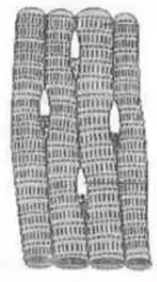
Identify the tissue shown in the diagram and match it with its characteristics and location.
A
Smooth muscles,show branching,found in the wall of the heart
B
Cardiac muscles,unbranched muscles,found in the walls of the heart
C
Striated muscles,tapering at both ends,attached with the bones of the ribs
D
Skeletal muscles show striations and are closely attached with the bones of the limbs
Solution
(B) The diagram shows cardiac muscle fibers. Cardiac muscle tissue is a contractile tissue present only in the heart. Cell junctions fuse the plasma membranes of cardiac muscle cells and make them stick together. Communication junctions (intercalated discs) at some fusion points allow the cells to contract as a unit,i.e.,when one cell receives a signal to contract,its neighbors are also stimulated to contract. These muscles are branched and striated. Therefore,the correct identification is cardiac muscle,which is branched and found in the heart wall. Note: The provided options contain a discrepancy as the diagram clearly depicts cardiac muscle (branched),but option $(d)$ is often cited in standard textbooks for skeletal muscle identification. Given the visual evidence of branching,the tissue is cardiac muscle.
0 likesView Solution
38
BiologyMediumMCQNEET · 2013
The Golgi complex plays a major role
A
as energy transferring organelles
B
in post-translational modification of proteins and glycosylation of lipids
C
in trapping the light and transforming it into chemical energy
D
in digesting proteins and carbohydrates
Solution
(B) : Post-translational modification $(PTM)$ is a crucial step in protein biosynthesis. Proteins are synthesized on ribosomes by translating $mRNA$ into polypeptide chains. These chains undergo $PTM$,such as folding,cleavage,and other modifications,to become mature functional proteins. Proteins synthesized by the rough endoplasmic reticulum $(RER)$ and lipids synthesized by the smooth endoplasmic reticulum $(SER)$ are transported to the cisternae of the Golgi apparatus. Within the Golgi,these molecules combine with carbohydrates to form glycoproteins and glycolipids. This specific process is known as glycosylation.
0 likesView Solution
39
BiologyMediumMCQNEET · 2013
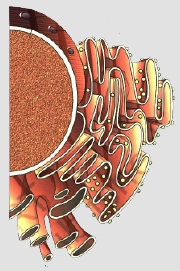
Which one of the following organelles in the figure correctly matches with its function?
A
Golgi apparatus,formation of glycolipids
B
Rough endoplasmic reticulum,protein synthesis
C
Rough endoplasmic reticulum,formation of glycoproteins
D
Golgi apparatus,protein synthesis
Solution
(B) The correct answer is $B$.
The given figure shows the endoplasmic reticulum with ribosomes attached to its surface,which is known as the Rough Endoplasmic Reticulum $(RER)$.
$RER$ is primarily involved in protein synthesis and secretion because the ribosomes attached to its surface are the sites of protein synthesis.
The given figure shows the endoplasmic reticulum with ribosomes attached to its surface,which is known as the Rough Endoplasmic Reticulum $(RER)$.
$RER$ is primarily involved in protein synthesis and secretion because the ribosomes attached to its surface are the sites of protein synthesis.
0 likesView Solution
40
BiologyMediumMCQNEET · 2013
$A$ major site for synthesis of lipids is
A
symplast
B
nucleoplasm
C
$RER$
D
$SER$
Solution
(D) $SER$ (Smooth Endoplasmic Reticulum) is a system of smooth membranes (i.e.,membranes lacking ribosomes) found within the cytoplasm of plant and animal cells.
It forms a structural link between the cell membrane and the nuclear membrane.
It serves as the primary site for critical metabolic reactions,including the synthesis of phospholipids and fatty acids.
In animal cells,lipid-like steroidal hormones are also synthesized within the $SER$.
It forms a structural link between the cell membrane and the nuclear membrane.
It serves as the primary site for critical metabolic reactions,including the synthesis of phospholipids and fatty acids.
In animal cells,lipid-like steroidal hormones are also synthesized within the $SER$.
0 likesView Solution
41
BiologyMediumMCQNEET · 2013
The term 'glycocalyx' is used for
A
a layer present between cell wall and membrane of bacteria
B
cell wall of bacteria
C
bacterial cell glyco-engineered to possess $N$-glycosylated proteins
D
a layer surrounding the cell wall of bacteria
Solution
(D) : Glycocalyx is a sticky,gelatinous material that collects outside the cell wall of bacteria to form an additional surface layer.
When this layer is firmly attached to the surface of the cell,it is called a capsule.
If it is loosely distributed around the cell,the glycocalyx is called a slime layer.
When this layer is firmly attached to the surface of the cell,it is called a capsule.
If it is loosely distributed around the cell,the glycocalyx is called a slime layer.
0 likesView Solution
42
BiologyMediumMCQNEET · 2013
Which of the following types of plastid does not contain stored food material?
A
Chromoplasts
B
Elaioplasts
C
Aleuroplasts
D
Amyloplasts
Solution
(A) : Chromoplasts are yellow or reddish in color due to the presence of carotenoid pigments. They do not contain stored food material.
Chromoplasts are formed either from leucoplasts or chloroplasts.
Chromoplasts provide color to many flowers for attracting pollinating insects.
They provide bright red or orange color to fruits for attracting animals for seed dispersal.
Chromoplasts are formed either from leucoplasts or chloroplasts.
Chromoplasts provide color to many flowers for attracting pollinating insects.
They provide bright red or orange color to fruits for attracting animals for seed dispersal.
0 likesView Solution
43
BiologyMediumMCQNEET · 2013
Which of the following best illustrates "feedback" in development?
A
Tissue $X$ secretes $RNA$ which changes the development of tissue $Y$.
B
As tissue $X$ develops, it secretes enzymes that inhibit the development of tissue $Y$.
C
As tissue $X$ develops, it secretes something that induces tissue $Y$ to develop.
D
As tissue $X$ develops, it secretes something that slows down the growth of tissue $Y$.
Solution
(C) The correct answer is $(C)$.
Feedback in biological development refers to a process where the product or activity of one tissue influences the developmental pathway of another tissue.
Option $(C)$ describes a scenario where the development of tissue $X$ induces the development of tissue $Y$, which is a classic example of a positive feedback or inductive signaling mechanism in embryogenesis.
Feedback in biological development refers to a process where the product or activity of one tissue influences the developmental pathway of another tissue.
Option $(C)$ describes a scenario where the development of tissue $X$ induces the development of tissue $Y$, which is a classic example of a positive feedback or inductive signaling mechanism in embryogenesis.
0 likesView Solution
44
BiologyEasyMCQNEET · 2013
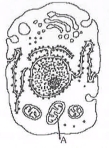
Select the alternative giving correct identification and function of the organelle '$A$' in the diagram.
A
Mitochondria - Produce cellular energy in the form of $ATP$
B
Golgi body - Provides packaging material
C
Lysosomes - Secrete hydrolytic enzymes
D
Endoplasmic reticulum - Synthesis of lipids
Solution
(A) The organelle labeled '$A$' in the diagram is the Mitochondrion.
Mitochondria are miniature biochemical factories where food stuffs or respiratory substrates are completely oxidised to carbon dioxide and water.
The energy liberated in the process is initially stored in the form of reduced coenzymes and reduced prosthetic groups.
The latter soon undergo oxidation and form energy-rich $ATP$.
$ATP$ comes out of mitochondria and helps perform various energy-requiring processes of the cell like muscle contraction,nerve impulse conduction,biosynthesis,membrane transport,cell division,movement,etc.
Because of the formation of $ATP$,the mitochondria are called powerhouses of the cell.
Mitochondria are miniature biochemical factories where food stuffs or respiratory substrates are completely oxidised to carbon dioxide and water.
The energy liberated in the process is initially stored in the form of reduced coenzymes and reduced prosthetic groups.
The latter soon undergo oxidation and form energy-rich $ATP$.
$ATP$ comes out of mitochondria and helps perform various energy-requiring processes of the cell like muscle contraction,nerve impulse conduction,biosynthesis,membrane transport,cell division,movement,etc.
Because of the formation of $ATP$,the mitochondria are called powerhouses of the cell.
0 likesView Solution
45
BiologyMediumMCQNEET · 2013
$A$ phosphoglyceride is always made up of
A
a saturated or unsaturated fatty acid esterified to a glycerol molecule to which a phosphate group is also attached.
B
a saturated or unsaturated fatty acid esterified to a phosphate group which is also attached to a glycerol molecule.
C
only a saturated fatty acid esterified to a glycerol molecule to which a phosphate group is also attached.
D
only an unsaturated fatty acid esterified to a glycerol molecule to which a phosphate group is also attached.
Solution
(A) Phosphoglycerides are complex lipids.
They are formed by the esterification of fatty acids (which can be either saturated or unsaturated) with a glycerol molecule.
Additionally,a phosphate group is attached to the glycerol backbone.
Therefore,the correct structure involves a glycerol molecule,fatty acids,and a phosphate group.
They are formed by the esterification of fatty acids (which can be either saturated or unsaturated) with a glycerol molecule.
Additionally,a phosphate group is attached to the glycerol backbone.
Therefore,the correct structure involves a glycerol molecule,fatty acids,and a phosphate group.
0 likesView Solution
46
BiologyMediumMCQNEET · 2013
Macromolecule chitin is
A
sulphur containing polysaccharide
B
simple polysaccharide
C
nitrogen containing polysaccharide
D
phosphorous containing polysaccharide
Solution
(C) Chitin is a structural polysaccharide that constitutes the exoskeleton of arthropods.
It is a complex carbohydrate in which $N$-acetyl glucosamine monomers are joined together by $(1, 4)$ $\beta$-linkages.
Since $N$-acetyl glucosamine contains a nitrogen atom in its structure,chitin is classified as a nitrogen-containing polysaccharide.
Chitinous exoskeleton provides strength and elasticity to arthropods.
It is a complex carbohydrate in which $N$-acetyl glucosamine monomers are joined together by $(1, 4)$ $\beta$-linkages.
Since $N$-acetyl glucosamine contains a nitrogen atom in its structure,chitin is classified as a nitrogen-containing polysaccharide.
Chitinous exoskeleton provides strength and elasticity to arthropods.
0 likesView Solution
47
BiologyMediumMCQNEET · 2013
The transition state structure of the substrate formed during an enzymatic reaction is:
A
transient and unstable
B
permanent and stable
C
transient but stable
D
permanent but unstable
Solution
(A) The transition state is the formation of an unstable intermediate structural state during an enzymatic reaction.
During this process,existing bonds in the substrate are broken and new bonds are established to transform the substrate molecules into products.
This state is transient (short-lived) and highly unstable due to its high energy level.
During this process,existing bonds in the substrate are broken and new bonds are established to transform the substrate molecules into products.
This state is transient (short-lived) and highly unstable due to its high energy level.
0 likesView Solution
48
BiologyMediumMCQNEET · 2013
The essential chemical components of many coenzymes are
A
carbohydrates
B
vitamins
C
proteins
D
nucleic acids
Solution
(B) : $A$ coenzyme is a non-protein organic group that attaches to the apoenzyme to form a holoenzyme or conjugate enzyme. It assists in removing the products of a chemical reaction and facilitates the interaction between the substrate and the enzyme. Most coenzymes are derived from water-soluble vitamins,such as $B$ and $C$ complex vitamins,$e.g.$,thiamine,riboflavin,nicotinamide,and pyridoxine.
0 likesView Solution
49
BiologyMediumMCQNEET · 2013
Which of the following statements about enzymes is wrong?
A
Enzymes are denatured at high temperatures.
B
Enzymes are mostly proteins but some are lipids also.
C
Enzymes are highly specific.
D
Enzymes require optimum pH and temperature for maximum activity.
Solution
(B) The correct answer is $B$.
Enzymes are primarily proteinaceous in nature.
Some $RNA$ molecules also act as enzymes,which are known as ribozymes.
There are no known lipids that function as enzymes.
Therefore,the statement that enzymes are lipids is incorrect.
Enzymes are primarily proteinaceous in nature.
Some $RNA$ molecules also act as enzymes,which are known as ribozymes.
There are no known lipids that function as enzymes.
Therefore,the statement that enzymes are lipids is incorrect.
0 likesView Solution
50
BiologyMediumMCQNEET · 2013
Uridine,present only in $RNA$,is a
A
nucleoside
B
nucleotide
C
purine
D
pyrimidine
Solution
(A) Uridine is a nucleoside formed by the combination of a nitrogenous base (Uracil) and a pentose sugar (Ribose).
$A$ nucleoside consists of a pentose sugar and a nitrogenous base,lacking the phosphate group.
Since Uridine is composed of Uracil and Ribose,it is classified as a nucleoside.
Uracil + Ribose $\to$ Uridine.
$A$ nucleoside consists of a pentose sugar and a nitrogenous base,lacking the phosphate group.
Since Uridine is composed of Uracil and Ribose,it is classified as a nucleoside.
Uracil + Ribose $\to$ Uridine.
0 likesView Solution
51
BiologyMediumMCQNEET · 2013
Syngamy can occur outside the body of the organism in
A
mosses
B
algae
C
ferns
D
fungi
Solution
(B) $Syngamy$ is the complete and permanent fusion of male and female gametes to form the zygote.
When fertilization occurs outside the body of the organism,this type of gametic fusion is called external fertilization or external $syngamy$.
In the majority of $algae$,external fertilization occurs in the surrounding water medium.
When fertilization occurs outside the body of the organism,this type of gametic fusion is called external fertilization or external $syngamy$.
In the majority of $algae$,external fertilization occurs in the surrounding water medium.
0 likesView Solution
52
BiologyMediumMCQNEET · 2013
Meiosis takes place in
A
gemmule
B
megaspore
C
meiocyte
D
conidia
Solution
(C) : Gemmules and conidia are asexual reproductive structures,so meiosis does not occur in them.
Megaspores are haploid cells formed as a result of meiosis in a diploid megaspore mother cell.
$A$ meiocyte is any cell that undergoes meiosis to produce gametes.
Megaspores are haploid cells formed as a result of meiosis in a diploid megaspore mother cell.
$A$ meiocyte is any cell that undergoes meiosis to produce gametes.
0 likesView Solution
53
BiologyMediumMCQNEET · 2013
Perisperm differs from endosperm in
A
being a diploid tissue
B
its formation by fusion of secondary nucleus with several sperms
C
being a haploid tissue
D
having no reserve food.
Solution
(A) : Both perisperm and endosperm are nutritive layers.
Perisperm is the residual persistent nucellus of the seed that remains after fertilization.
Endosperm develops when one of the male gametes fuses with two haploid polar nuclei (triple fusion).
Thus,perisperm is a diploid $(2n)$ tissue,whereas endosperm is a triploid $(3n)$ tissue.
Perisperm is the residual persistent nucellus of the seed that remains after fertilization.
Endosperm develops when one of the male gametes fuses with two haploid polar nuclei (triple fusion).
Thus,perisperm is a diploid $(2n)$ tissue,whereas endosperm is a triploid $(3n)$ tissue.
0 likesView Solution
54
BiologyMediumMCQNEET · 2013
The advantage of cleistogamy is
A
no dependence on pollinators
B
vivipary
C
higher genetic variability
D
more vigorous offspring
Solution
(A) : Cleistogamy is the process of pollination and fertilization occurring before the flower opens. In such flowers,the anther and stigma lie in close proximity. When anthers dehisce within the flower buds,pollen grains come in contact with the stigma to effect pollination. Thus,cleistogamous flowers are invariably autogamous as there is no chance of cross-pollen landing on the stigma. Cleistogamous flowers produce assured seed-set even in the absence of pollinators.
0 likesView Solution
55
BiologyMediumMCQNEET · 2013
Megasporangium is equivalent to
A
ovule
B
nucellus
C
embryo sac
D
fruit
Solution
(A) The megasporangium is equivalent to the ovule.
An ovule is technically referred to as an integumented megasporangium.
It is located within the ovary and is attached to a cushion-like structure known as the placenta.
Inside the ovule,a single embryo sac is formed from a functional megaspore through the process of meiosis (reduction division).
An ovule is technically referred to as an integumented megasporangium.
It is located within the ovary and is attached to a cushion-like structure known as the placenta.
Inside the ovule,a single embryo sac is formed from a functional megaspore through the process of meiosis (reduction division).
0 likesView Solution
56
BiologyMediumMCQNEET · 2013
Which one of the following statements is correct?
A
Endothecium produces the microspores.
B
Tapetum nourishes the developing pollen.
C
Hard outer layer of pollen is called intine.
D
Sporogenous tissue is haploid.
Solution
(B) : $A$ microsporangium is generally surrounded by four wall layers - the epidermis,endothecium,middle layers,and the tapetum.
The outer three wall layers perform the function of protection and help in the dehiscence of the anther to release the pollen.
The innermost wall layer is the tapetum.
It nourishes the developing pollen grains.
Cells of the tapetum are rich in nutrients,possess dense cytoplasm,and generally have more than one nucleus.
They disintegrate to liberate their contents,which are absorbed by the developing spores.
The outer three wall layers perform the function of protection and help in the dehiscence of the anther to release the pollen.
The innermost wall layer is the tapetum.
It nourishes the developing pollen grains.
Cells of the tapetum are rich in nutrients,possess dense cytoplasm,and generally have more than one nucleus.
They disintegrate to liberate their contents,which are absorbed by the developing spores.
0 likesView Solution
57
BiologyMediumMCQNEET · 2013
The product of sexual reproduction generally generates:
A
new genetic combinations leading to variation
B
large biomass
C
longer viability of seeds
D
prolonged dormancy
Solution
(A) : Sexual reproduction always involves meiosis (zygotic in case of haploid individuals and gametic in case of diploid individuals).
Meiosis results in crossing over between chromosomes during prophase $I$,which generates new recombinations.
Besides,sexual reproduction generally involves the combination of genes from two different organisms.
Thus,sexual reproduction generates new genetic combinations leading to variations.
Meiosis results in crossing over between chromosomes during prophase $I$,which generates new recombinations.
Besides,sexual reproduction generally involves the combination of genes from two different organisms.
Thus,sexual reproduction generates new genetic combinations leading to variations.
0 likesView Solution
58
BiologyMediumMCQNEET · 2013
Animal vectors are required for pollination in
A
Vallisneria
B
mulberry
C
cucumber
D
maize
Solution
(C) $Vallisneria$ undergoes pollination by water (hydrophily).
$Mulberry$ and $maize$ undergo pollination by wind (anemophily).
$Cucumber$ belongs to the family $Cucurbitaceae$,which typically requires biotic agents like insects (entomophily) for pollination.
Therefore,animal vectors are required for pollination in $cucumber$.
$Mulberry$ and $maize$ undergo pollination by wind (anemophily).
$Cucumber$ belongs to the family $Cucurbitaceae$,which typically requires biotic agents like insects (entomophily) for pollination.
Therefore,animal vectors are required for pollination in $cucumber$.
0 likesView Solution
59
BiologyMediumMCQNEET · 2013
Albuminous seeds store their reserve food mainly in
A
endosperm
B
cotyledons
C
hypocotyl
D
perisperm
Solution
(A) Albuminous or endospermic seeds are those in which the endosperm is not completely consumed by the developing embryo during seed maturation.
Instead,the endosperm persists in the mature seed and serves as the primary food storage tissue.
Examples of such seeds include castor,maize,wheat,barley,and coconut.
Therefore,the correct option is $A$.
Instead,the endosperm persists in the mature seed and serves as the primary food storage tissue.
Examples of such seeds include castor,maize,wheat,barley,and coconut.
Therefore,the correct option is $A$.
0 likesView Solution
60
BiologyMediumMCQNEET · 2013
Megaspores are produced from the megaspore mother cells after
A
mitotic division
B
formation of thick wall
C
differentiation
D
meiotic division
Solution
(D) The correct answer is $D$.
In flowering plants,the process of formation of megaspores from the diploid megaspore mother cell $(MMC)$ is known as megasporogenesis.
This process involves a meiotic division (reduction division) of the $MMC$,which results in the formation of four haploid megaspores.
Megasporogenesis occurs within the ovule of the plant.
In flowering plants,the process of formation of megaspores from the diploid megaspore mother cell $(MMC)$ is known as megasporogenesis.
This process involves a meiotic division (reduction division) of the $MMC$,which results in the formation of four haploid megaspores.
Megasporogenesis occurs within the ovule of the plant.
0 likesView Solution
61
BiologyMediumMCQNEET · 2013
Which one of the following statements is correct?
A
Cleistogamous flowers are always autogamous.
B
Xenogamy occurs only by wind pollination.
C
Chasmogamous flowers do not open at all.
D
Geitonogamy involves the pollen and stigma of flowers of different plants.
Solution
(A) : In cleistogamy,flowers never open,so there is no alternative to self-pollination. It is invariably autogamous.
$B$: Xenogamy is the transfer of pollen grains from the anther to the stigma of a different plant. It can occur by various agents like wind,water,insects,and animals.
$C$: Chasmogamous flowers are those that expose their mature anthers and stigmas to the environment.
$D$: Geitonogamy is the transfer of pollen grains from the anther to the stigma of another flower on the same plant. Genetically,it is self-pollination,but ecologically,it involves a pollinating agent.
$B$: Xenogamy is the transfer of pollen grains from the anther to the stigma of a different plant. It can occur by various agents like wind,water,insects,and animals.
$C$: Chasmogamous flowers are those that expose their mature anthers and stigmas to the environment.
$D$: Geitonogamy is the transfer of pollen grains from the anther to the stigma of another flower on the same plant. Genetically,it is self-pollination,but ecologically,it involves a pollinating agent.
0 likesView Solution
62
BiologyMediumMCQNEET · 2013
What is the correct sequence of sperm formation?
A
Spermatogonia,spermatozoa,spermatocytes,spermatids
B
Spermatogonia,spermatocytes,spermatids,spermatozoa
C
Spermatids,spermatocytes,spermatogonia,spermatozoa
D
Spermatogonia,spermatocytes,spermatozoa,spermatids
Solution
(B) The correct sequence is $B$.
Spermatogenesis is the process of formation of haploid spermatozoa (sperms) from diploid spermatogonia inside the testes of the male.
At sexual maturity,the undifferentiated primordial germ cells divide several times by mitosis to produce a large number of spermatogonia or sperm mother cells.
Each spermatogonium actively grows to a larger primary spermatocyte by obtaining nourishment from the nursing cells.
The phenomenon of formation of primary spermatocytes from spermatogonia is called spermatocytogenesis.
Each primary spermatocyte undergoes two successive divisions,called maturation divisions.
The first maturation division is reductional or meiotic,resulting in two haploid daughter cells called secondary spermatocytes.
Both secondary spermatocytes undergo a second maturation division (mitotic) to form four haploid spermatids.
The final transformation of spermatids into functional spermatozoa is called spermiogenesis.
Spermatogenesis is the process of formation of haploid spermatozoa (sperms) from diploid spermatogonia inside the testes of the male.
At sexual maturity,the undifferentiated primordial germ cells divide several times by mitosis to produce a large number of spermatogonia or sperm mother cells.
Each spermatogonium actively grows to a larger primary spermatocyte by obtaining nourishment from the nursing cells.
The phenomenon of formation of primary spermatocytes from spermatogonia is called spermatocytogenesis.
Each primary spermatocyte undergoes two successive divisions,called maturation divisions.
The first maturation division is reductional or meiotic,resulting in two haploid daughter cells called secondary spermatocytes.
Both secondary spermatocytes undergo a second maturation division (mitotic) to form four haploid spermatids.
The final transformation of spermatids into functional spermatozoa is called spermiogenesis.
0 likesView Solution
63
BiologyMediumMCQNEET · 2013
Which one of the following is not the function of placenta?
A
Facilitates removal of carbon dioxide and waste material from embryo
B
Secretes oxytocin during parturition
C
Facilitates supply of oxygen and nutrients to embryo
D
Secretes estrogen
Solution
(B) : Parturition is induced by a complex neuroendocrine mechanism. The signals for parturition originate from the fully developed foetus and the placenta,which induce mild uterine contractions called the foetal ejection reflex. This triggers the release of oxytocin from the maternal pituitary gland. Oxytocin acts on the uterine muscle and causes stronger uterine contractions,which in turn stimulates further secretion of oxytocin. The stimulatory reflex between the uterine contraction and oxytocin secretion continues,resulting in stronger and stronger contractions. This leads to the expulsion of the baby out of the uterus through the birth canal. Therefore,the placenta does not secrete oxytocin; it is secreted by the maternal pituitary.
0 likesView Solution
64
BiologyMediumMCQNEET · 2013
Menstrual flow occurs due to lack of
A
oxytocin
B
vasopressin
C
progesterone
D
$FSH$
Solution
(C) The corpus luteum secretes large amounts of progesterone,which is essential for the maintenance of the endometrium.
This endometrium is necessary for the implantation of the fertilized ovum and other events of pregnancy.
In the absence of fertilization,the corpus luteum degenerates.
This causes the disintegration of the endometrium,leading to menstruation.
The menstrual flow results from the breakdown of the endometrial lining of the uterus and its blood vessels,which forms a liquid that is discharged through the vagina.
This endometrium is necessary for the implantation of the fertilized ovum and other events of pregnancy.
In the absence of fertilization,the corpus luteum degenerates.
This causes the disintegration of the endometrium,leading to menstruation.
The menstrual flow results from the breakdown of the endometrial lining of the uterus and its blood vessels,which forms a liquid that is discharged through the vagina.
0 likesView Solution
65
BiologyMediumMCQNEET · 2013
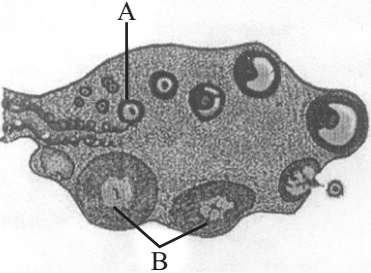
The figure shows a section of human ovary. Select the option which gives the correct identification of either $A$ or $B$ with function/characteristic.
A
$B$ - Corpus luteum - Secretes progesterone
B
$A$ - Tertiary follicle - Forms Graafian follicle
C
$B$ - Corpus luteum - Secretes estrogen
D
$A$ - Primary oocyte - It is in the prophase $I$ of the meiotic division
Solution
(A) The correct option is $A$.
In the provided figure,$A$ represents a secondary follicle,while $B$ represents the corpus luteum.
The corpus luteum is a temporary endocrine gland formed from the remnants of the Graafian follicle after ovulation.
It primarily secretes large amounts of progesterone,which is essential for the maintenance of the endometrium during pregnancy.
If fertilization does not occur,the corpus luteum degenerates into a corpus albicans after about $14$ days.
In the provided figure,$A$ represents a secondary follicle,while $B$ represents the corpus luteum.
The corpus luteum is a temporary endocrine gland formed from the remnants of the Graafian follicle after ovulation.
It primarily secretes large amounts of progesterone,which is essential for the maintenance of the endometrium during pregnancy.
If fertilization does not occur,the corpus luteum degenerates into a corpus albicans after about $14$ days.
0 likesView Solution
66
BiologyMediumMCQNEET · 2013
In our society,women are often blamed for producing female children. Choose the correct answer regarding sex determination in humans.
A
Due to some defect like aspermia in man
B
Due to the genetic makeup of the particular sperm that fertilizes the egg
C
Due to the genetic makeup of the egg
D
Due to some defect in the woman
Solution
(B) : The establishment of sex through differential development in an individual at an early stage of life is called sex determination.
It is determined at the time of fertilization and is also called syngametic sex determination.
The female is homomorphic,possessing two similar sex chromosomes,$XX$,and the male is heteromorphic,possessing one $X$ chromosome similar to that of the female and one shorter,morphologically different $Y$ chromosome.
The female is homogametic (produces similar eggs) and the male is heterogametic (produces two types of sperms,$i.e.$,$X$ or $Y$).
Sex is determined at the time of fertilization by the kind of sperm ($X$ or $Y$) that fuses with the ovum $(X)$.
It is determined at the time of fertilization and is also called syngametic sex determination.
The female is homomorphic,possessing two similar sex chromosomes,$XX$,and the male is heteromorphic,possessing one $X$ chromosome similar to that of the female and one shorter,morphologically different $Y$ chromosome.
The female is homogametic (produces similar eggs) and the male is heterogametic (produces two types of sperms,$i.e.$,$X$ or $Y$).
Sex is determined at the time of fertilization by the kind of sperm ($X$ or $Y$) that fuses with the ovum $(X)$.
0 likesView Solution
67
BiologyMediumMCQNEET · 2013
The foetal ejection reflex in humans triggers the release of
A
oxytocin from foetal pituitary
B
human chorionic gonadotropin $(hCG)$ from placenta
C
human placental lactogen $(hPL)$ from placenta
D
oxytocin from maternal pituitary.
Solution
(D) The correct answer is $D$.
Parturition is induced by a complex neuroendocrine mechanism.
The signals for parturition originate from the fully developed foetus and the placenta,which induce mild uterine contractions known as the foetal ejection reflex.
This reflex triggers the release of oxytocin from the maternal pituitary gland.
Oxytocin acts on the uterine muscles and causes stronger uterine contractions,which in turn stimulates further secretion of oxytocin.
The stimulatory reflex between the uterine contraction and oxytocin secretion continues,resulting in stronger and stronger contractions.
This leads to the expulsion of the baby out of the uterus through the birth canal.
Parturition is induced by a complex neuroendocrine mechanism.
The signals for parturition originate from the fully developed foetus and the placenta,which induce mild uterine contractions known as the foetal ejection reflex.
This reflex triggers the release of oxytocin from the maternal pituitary gland.
Oxytocin acts on the uterine muscles and causes stronger uterine contractions,which in turn stimulates further secretion of oxytocin.
The stimulatory reflex between the uterine contraction and oxytocin secretion continues,resulting in stronger and stronger contractions.
This leads to the expulsion of the baby out of the uterus through the birth canal.
0 likesView Solution
68
BiologyMediumMCQNEET · 2013
Artificial insemination means
A
artificial introduction of sperms of a healthy donor into the vagina
B
introduction of sperms of a healthy donor directly into the ovary
C
transfer of sperms of a healthy donor to a test tube containing ova
D
transfer of sperms of husband to a test tube containing ova
Solution
(A) : In the artificial insemination technique,the semen of a healthy donor male is collected and introduced artificially through a flexible polyethylene catheter into the vagina or into the uterus,which is called Intra-Uterine Insemination $(IUI)$.
Best results are obtained when the motile sperm count is more than $10$ million.
The fertilizing capacity of spermatozoa (sperms) lasts for $24-48$ hours.
The procedure may be repeated $2-3$ times over a period of $2-3$ days.
Best results are obtained when the motile sperm count is more than $10$ million.
The fertilizing capacity of spermatozoa (sperms) lasts for $24-48$ hours.
The procedure may be repeated $2-3$ times over a period of $2-3$ days.
0 likesView Solution
69
BiologyMediumMCQNEET · 2013
One of the legal methods of birth control is
A
by having coitus at the time of day break
B
by a premature ejaculation during coitus
C
by abstaining from coitus from day $10$ to $17$ of the menstrual cycle.
D
abortion by taking an appropriate medicine
Solution
(C) The correct option is $C$.
By abstaining from coitus from day $10$ to $17$ of the menstrual cycle,during which ovulation occurs,pregnancy can be prevented. This method of birth control is known as 'periodic abstinence' or the 'rhythm method'.
This is a natural and effective method to prevent pregnancy and is considered a legal and safe approach to birth control.
By abstaining from coitus from day $10$ to $17$ of the menstrual cycle,during which ovulation occurs,pregnancy can be prevented. This method of birth control is known as 'periodic abstinence' or the 'rhythm method'.
This is a natural and effective method to prevent pregnancy and is considered a legal and safe approach to birth control.
0 likesView Solution
70
BiologyMediumMCQNEET · 2013
The stage transferred into the uterus after induced fertilization of ovum in the laboratory is
A
embryo at $4$ blastomeres stage
B
embryo at $2$ blastomeres stage
C
morula
D
zygote
Solution
(C) The correct answer is $C$.
In the technique of $IVF$ (In Vitro Fertilization),the zygote or early embryo is transferred into the female reproductive tract.
According to the $GIFT$ and $IUT$ protocols,embryos with up to $8$ blastomeres are transferred into the fallopian tube ($ZIFT$ - Zygote Intra Fallopian Transfer),while embryos with more than $8$ blastomeres (morula stage) are transferred into the uterus ($IUT$ - Intra Uterine Transfer) for further development.
In the technique of $IVF$ (In Vitro Fertilization),the zygote or early embryo is transferred into the female reproductive tract.
According to the $GIFT$ and $IUT$ protocols,embryos with up to $8$ blastomeres are transferred into the fallopian tube ($ZIFT$ - Zygote Intra Fallopian Transfer),while embryos with more than $8$ blastomeres (morula stage) are transferred into the uterus ($IUT$ - Intra Uterine Transfer) for further development.
0 likesView Solution
71
BiologyMediumMCQNEET · 2013
One of the following is not a method of contraception. Which one?
A
Condoms
B
Pills of a combination of oxytocin and vasopressin
C
Lippes loop
D
Tubectomy
Solution
(B) : Oxytocin is a birth hormone,and vasopressin (anti-diuretic hormone) is responsible for reabsorbing water from the renal tubules to conserve water in the body. Neither of these hormones has any role in contraception.
0 likesView Solution
72
BiologyMediumMCQNEET · 2013
Select the incorrect statement with regard to haemophilia.
A
It is a dominant disease.
B
$A$ single protein involved in the clotting of blood is affected.
C
It is a sex-linked disease.
D
It is a recessive disease.
Solution
(A) : Haemophilia is a sex-linked recessive disease,also known as bleeder's disease.
In this condition,a single protein involved in the cascade of blood clotting is affected (e.g.,antihaemophilic globulin or factor $VIII$ in haemophilia-$A$,or plasma thromboplastin factor $IX$ in haemophilia-$B$).
Because the patient lacks these essential clotting factors,even a minor cut leads to continuous bleeding,which can be fatal.
It is caused by a recessive gene $h$ located on the $X$-chromosome.
$A$ female becomes haemophiliac only if both her $X$-chromosomes carry the recessive gene $(X^hX^h)$.
$A$ female with one recessive allele $(XX^h)$ is a carrier and appears normal because the dominant allele on the other $X$-chromosome ensures normal clotting.
Males are more frequently affected because they have only one $X$-chromosome $(X^hY)$,meaning a single recessive gene is sufficient to express the disease.
In this condition,a single protein involved in the cascade of blood clotting is affected (e.g.,antihaemophilic globulin or factor $VIII$ in haemophilia-$A$,or plasma thromboplastin factor $IX$ in haemophilia-$B$).
Because the patient lacks these essential clotting factors,even a minor cut leads to continuous bleeding,which can be fatal.
It is caused by a recessive gene $h$ located on the $X$-chromosome.
$A$ female becomes haemophiliac only if both her $X$-chromosomes carry the recessive gene $(X^hX^h)$.
$A$ female with one recessive allele $(XX^h)$ is a carrier and appears normal because the dominant allele on the other $X$-chromosome ensures normal clotting.
Males are more frequently affected because they have only one $X$-chromosome $(X^hY)$,meaning a single recessive gene is sufficient to express the disease.
0 likesView Solution
73
BiologyMediumMCQNEET · 2013
Which of the following cannot be detected in a developing foetus by amniocentesis?
A
Down's syndrome
B
Jaundice
C
Klinefelter's syndrome
D
Sex of the foetus
Solution
(B) Amniocentesis is a prenatal diagnostic technique based on the chromosomal pattern in the amniotic fluid surrounding the developing foetus.
It is used to detect chromosomal abnormalities such as $Down's$ syndrome and $Klinefelter's$ syndrome,as well as to determine the sex of the foetus.
$Jaundice$ is a physiological condition caused by the accumulation of bilirubin or liver dysfunction,which is not a chromosomal disorder.
Therefore,it cannot be detected by amniocentesis.
It is used to detect chromosomal abnormalities such as $Down's$ syndrome and $Klinefelter's$ syndrome,as well as to determine the sex of the foetus.
$Jaundice$ is a physiological condition caused by the accumulation of bilirubin or liver dysfunction,which is not a chromosomal disorder.
Therefore,it cannot be detected by amniocentesis.
0 likesView Solution
74
BiologyMediumMCQNEET · 2013
If both parents are carriers for thalassaemia,which is an autosomal recessive disorder,what are the chances of pregnancy resulting in an affected child?
A
$0.25$
B
$1$
C
No chance
D
$0.5$
Solution
(A) Thalassaemia is an autosomal recessive blood disorder.
Let the normal allele be $T$ and the recessive allele for thalassaemia be $t$.
Both parents are carriers,meaning their genotype is $Tt$.
When crossing $Tt \times Tt$,the possible genotypes of the offspring are $TT$ (normal),$Tt$ (carrier),$Tt$ (carrier),and $tt$ (affected).
The probability of an affected child $(tt)$ is $1/4$ or $0.25$.
Let the normal allele be $T$ and the recessive allele for thalassaemia be $t$.
Both parents are carriers,meaning their genotype is $Tt$.
When crossing $Tt \times Tt$,the possible genotypes of the offspring are $TT$ (normal),$Tt$ (carrier),$Tt$ (carrier),and $tt$ (affected).
The probability of an affected child $(tt)$ is $1/4$ or $0.25$.
0 likesView Solution
75
BiologyMediumMCQNEET · 2013
If two persons with $AB$ blood group marry and have a sufficiently large number of children,these children could be classified as $A$ blood group : $AB$ blood group : $B$ blood group in $1 : 2 : 1$ ratio. Modern techniques of protein electrophoresis reveal the presence of both $A$ and $B$ type proteins in $AB$ blood group individuals. This is an example of:
A
partial dominance
B
complete dominance
C
codominance
D
incomplete dominance
Solution
(C) The correct answer is $(c)$.
The phenomenon where both alleles of a gene pair express themselves equally in a heterozygote is known as codominance.
In the case of $ABO$ blood grouping in humans,the alleles $I^A$ and $I^B$ are codominant.
When both $I^A$ and $I^B$ are present together in an individual (genotype $I^A I^B$),both alleles express their respective antigens ($A$ and $B$ proteins) on the surface of red blood cells independently.
This results in the $AB$ blood group phenotype,which is distinct from both the $A$ blood group and the $B$ blood group,demonstrating that neither allele is dominant or recessive over the other.
The phenomenon where both alleles of a gene pair express themselves equally in a heterozygote is known as codominance.
In the case of $ABO$ blood grouping in humans,the alleles $I^A$ and $I^B$ are codominant.
When both $I^A$ and $I^B$ are present together in an individual (genotype $I^A I^B$),both alleles express their respective antigens ($A$ and $B$ proteins) on the surface of red blood cells independently.
This results in the $AB$ blood group phenotype,which is distinct from both the $A$ blood group and the $B$ blood group,demonstrating that neither allele is dominant or recessive over the other.
0 likesView Solution
76
BiologyMediumMCQNEET · 2013
Which idea is depicted by a cross in which the $F_1$ generation resembles both the parents?
A
Inheritance of one gene
B
Codominance
C
Incomplete dominance
D
Complete dominance
Solution
(B) : In codominance,both alleles are able to express themselves independently when present together,resulting in a phenotype that shows the characteristics of both parental homozygous phenotypes.
For example,the roan coat colour in cattle is a result of the codominance of alleles for white and red coat colours,where the offspring exhibits both white and red patches simultaneously.
For example,the roan coat colour in cattle is a result of the codominance of alleles for white and red coat colours,where the offspring exhibits both white and red patches simultaneously.
0 likesView Solution
77
BiologyMediumMCQNEET · 2013
Which one is the incorrect statement with regard to the importance of pedigree analysis?
A
It confirms that $DNA$ is the carrier of genetic information.
B
It helps to understand whether the trait in question is dominant or recessive.
C
It confirms that the trait is linked to one of the autosome.
D
It helps to trace the inheritance of a specific trait.
Solution
(A) : Pedigree analysis is a method of studying the inheritance of specific traits over several generations in a family.
It does not confirm that $DNA$ is the carrier of genetic information,as this is a tool for observing phenotypic patterns of inheritance.
Experiments to prove that $DNA$ is the genetic material require molecular biology techniques,such as the Hershey-Chase experiment.
Therefore,the statement that it confirms $DNA$ as the carrier of genetic information is incorrect.
It does not confirm that $DNA$ is the carrier of genetic information,as this is a tool for observing phenotypic patterns of inheritance.
Experiments to prove that $DNA$ is the genetic material require molecular biology techniques,such as the Hershey-Chase experiment.
Therefore,the statement that it confirms $DNA$ as the carrier of genetic information is incorrect.
0 likesView Solution
78
BiologyMediumMCQNEET · 2013
Down's syndrome in humans is due to
A
three $X$ chromosomes
B
three copies of chromosome $21$
C
monosomy
D
two $Y$ chromosomes
Solution
(B) : Down's syndrome is the trisomy of the $21$st chromosome in humans.
Down's syndrome is characterized by short stature,warty skin,protruding tongue,slanting eyes,and folded eyelids.
The affected person's face presents a typical mongoloid look; hence,it is also called mongoloid idiocy.
It occurs due to the phenomenon of nondisjunction.
Nondisjunction occurs when a pair of homologous chromosomes does not separate during meiosis but migrates to the same pole of the cell,resulting in an uneven number of chromosomes in the daughter cells ($45$ in one and $47$ in the other).
This numerical abnormality results in trisomy $(2n + 1)$ and monosomy $(2n - 1)$.
Nondisjunction is more common in sex chromosomes.
Down's syndrome is characterized by short stature,warty skin,protruding tongue,slanting eyes,and folded eyelids.
The affected person's face presents a typical mongoloid look; hence,it is also called mongoloid idiocy.
It occurs due to the phenomenon of nondisjunction.
Nondisjunction occurs when a pair of homologous chromosomes does not separate during meiosis but migrates to the same pole of the cell,resulting in an uneven number of chromosomes in the daughter cells ($45$ in one and $47$ in the other).
This numerical abnormality results in trisomy $(2n + 1)$ and monosomy $(2n - 1)$.
Nondisjunction is more common in sex chromosomes.
0 likesView Solution
79
BiologyMediumMCQNEET · 2013
Which of the following statements is not true of two genes that show $50\%$ recombination frequency?
A
The genes show independent assortment.
B
If the genes are present on the same chromosome,they undergo more than one crossover in every meiosis.
C
The genes may be on different chromosomes.
D
The genes are tightly linked.
Solution
(D) Recombination frequency of $50\%$ indicates that the genes are either located on different chromosomes or are so far apart on the same chromosome that they assort independently.
$A$ $50\%$ recombination frequency is the maximum possible value,which is equivalent to the frequency observed for genes undergoing independent assortment.
If genes were tightly linked,the recombination frequency would be very low (close to $0\%$).
Therefore,the statement that the genes are tightly linked is incorrect.
$A$ $50\%$ recombination frequency is the maximum possible value,which is equivalent to the frequency observed for genes undergoing independent assortment.
If genes were tightly linked,the recombination frequency would be very low (close to $0\%$).
Therefore,the statement that the genes are tightly linked is incorrect.
0 likesView Solution
80
BiologyMediumMCQNEET · 2013
The diagram shows an important concept in the genetic implication of $DNA$. Fill in the blanks $A$ to $C$.
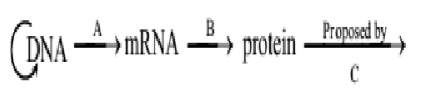
A
$A$ - Transcription,$B$ - Translation,$C$ - Francis Crick
B
$A$ - Translation,$B$ - Extension,$C$ - Rosalind Franklin
C
$A$ - Transcription,$B$ - Replication,$C$ - James Watson
D
$A$ - Translation,$B$ - Transcription,$C$ - Ervin Chargaff
Solution
(A) The correct answer is $A$.
The expression of genetic material occurs normally through the production of proteins. This involves two consecutive steps: transcription and translation.
$1$. Transcription $(A)$: The $DNA$ codes for the production of messenger $RNA$ $(mRNA)$.
$2$. Translation $(B)$: The $mRNA$ carries coded information to ribosomes,which read this information and use it for protein synthesis.
$3$. Central Dogma $(C)$: $F.H.C.$ Crick described this unidirectional flow of information in $1958$ as the 'central dogma of molecular biology'.
The expression of genetic material occurs normally through the production of proteins. This involves two consecutive steps: transcription and translation.
$1$. Transcription $(A)$: The $DNA$ codes for the production of messenger $RNA$ $(mRNA)$.
$2$. Translation $(B)$: The $mRNA$ carries coded information to ribosomes,which read this information and use it for protein synthesis.
$3$. Central Dogma $(C)$: $F.H.C.$ Crick described this unidirectional flow of information in $1958$ as the 'central dogma of molecular biology'.
0 likesView Solution
81
BiologyMediumMCQNEET · 2013
Which enzyme will be produced in a cell if there is a nonsense mutation in the lac $Y$ gene?
A
Transacetylase
B
Lactose permease and transacetylase
C
$\beta$-galactosidase
D
Lactose permease
Solution
(C) nonsense mutation is a genetic mutation that introduces a premature stop codon in the mRNA sequence,leading to the termination of polypeptide synthesis.
In the $lac$ operon,the structural genes are arranged in the order $lac Z$,$lac Y$,and $lac A$.
These genes code for $\beta$-galactosidase,lactose permease,and transacetylase,respectively.
If a nonsense mutation occurs in the $lac Y$ gene,the translation process will be terminated at that point.
Consequently,the protein encoded by the $lac Y$ gene (lactose permease) and the protein encoded by the downstream gene $lac A$ (transacetylase) will not be produced.
However,the $lac Z$ gene,which is located upstream of the $lac Y$ gene,will be transcribed and translated normally.
Therefore,only the $\beta$-galactosidase enzyme will be produced.
In the $lac$ operon,the structural genes are arranged in the order $lac Z$,$lac Y$,and $lac A$.
These genes code for $\beta$-galactosidase,lactose permease,and transacetylase,respectively.
If a nonsense mutation occurs in the $lac Y$ gene,the translation process will be terminated at that point.
Consequently,the protein encoded by the $lac Y$ gene (lactose permease) and the protein encoded by the downstream gene $lac A$ (transacetylase) will not be produced.
However,the $lac Z$ gene,which is located upstream of the $lac Y$ gene,will be transcribed and translated normally.
Therefore,only the $\beta$-galactosidase enzyme will be produced.
0 likesView Solution
82
BiologyMediumMCQNEET · 2013
The figure illustrates an important concept in the genetic implication of $DNA$. Fill in the blanks $A, B$,and $C$.

A
$A$-Maurice Wilkins,$B$-Transcription,$C$-Translation
B
$A$-James Watson,$B$-Replication,$C$-Extension
C
$A$-Erwin Chargaff,$B$-Translation,$C$-Replication
D
$A$-Francis Crick,$B$-Translation,$C$-Transcription
Solution
(D) The correct answer is $(d)$.
The figure represents the 'Central Dogma' of molecular biology,which describes the unidirectional flow of genetic information.
$1$. $C$ represents Transcription: This is the process where $DNA$ is used as a template to synthesize $mRNA$.
$2$. $B$ represents Translation: This is the process where the information present in $mRNA$ is used to synthesize proteins at the ribosomes.
$3$. $A$ represents Francis Crick: The concept of the 'Central Dogma' was proposed by Francis Crick in $1958$.
The figure represents the 'Central Dogma' of molecular biology,which describes the unidirectional flow of genetic information.
$1$. $C$ represents Transcription: This is the process where $DNA$ is used as a template to synthesize $mRNA$.
$2$. $B$ represents Translation: This is the process where the information present in $mRNA$ is used to synthesize proteins at the ribosomes.
$3$. $A$ represents Francis Crick: The concept of the 'Central Dogma' was proposed by Francis Crick in $1958$.
0 likesView Solution
83
BiologyMediumMCQNEET · 2013
Which of the following is not a property of the genetic code?
A
Non-overlapping
B
Ambiguous
C
Degeneracy
D
Universal
Solution
(B) The correct answer is $B$. The genetic code is non-ambiguous. $A$ non-ambiguous code means that one codon specifies only one particular amino acid. There are $64$ codons in total. Out of these,$3$ are stop codons (nonsense codons) which do not code for any amino acid,and the remaining $61$ code for $20$ amino acids. Since one codon always codes for only one specific amino acid,the code is not ambiguous.
0 likesView Solution
84
BiologyMediumMCQNEET · 2013
In an inducible operon, the genes are
A
usually not expressed unless a signal turns them "on".
B
usually expressed unless a signal turns them "off".
C
never expressed
D
always expressed.
Solution
(A) : The control of expression of $lac$ operon is negative (as it is turned off normally) and inducible.
An inducible operon is an operon which remains switched off normally but becomes operational in the presence of an inducer (lactose, actually allolactose, a metabolite of lactose, in the case of $lac$ operon).
The inducible operon generally functions in catabolic pathways.
In the presence of an inducer, the repressor has a higher affinity for the inducer than for the operator gene.
When lactose is added, a few lactose molecules are carried into the cell by the enzyme lactose permease, as a small amount of this enzyme is present in the cell even when the operon is not working.
These few lactose molecules are converted into allolactose molecules which act as an inducer and bind to the repressor (a product of the regulator gene).
The repressor-inducer complex fails to join with the operator gene, thus it is turned on.
An inducible operon is an operon which remains switched off normally but becomes operational in the presence of an inducer (lactose, actually allolactose, a metabolite of lactose, in the case of $lac$ operon).
The inducible operon generally functions in catabolic pathways.
In the presence of an inducer, the repressor has a higher affinity for the inducer than for the operator gene.
When lactose is added, a few lactose molecules are carried into the cell by the enzyme lactose permease, as a small amount of this enzyme is present in the cell even when the operon is not working.
These few lactose molecules are converted into allolactose molecules which act as an inducer and bind to the repressor (a product of the regulator gene).
The repressor-inducer complex fails to join with the operator gene, thus it is turned on.
0 likesView Solution
85
BiologyMediumMCQNEET · 2013
One of the most frequently used techniques in $DNA$ fingerprinting is
A
$VNTR$
B
$SSCP$
C
$SCAR$
D
$AFLP$
Solution
(A) $DNA$ fingerprinting relies on identifying differences in specific regions of $DNA$ sequence called repetitive $DNA$.
Specifically,the technique focuses on Variable Number Tandem Repeats $(VNTRs)$.
These are short nucleotide repeats that vary in number from person to person,making them highly polymorphic and ideal for individual identification.
Specifically,the technique focuses on Variable Number Tandem Repeats $(VNTRs)$.
These are short nucleotide repeats that vary in number from person to person,making them highly polymorphic and ideal for individual identification.
0 likesView Solution
86
BiologyMediumMCQNEET · 2013
According to Darwin,organic evolution is due to:
A
competition within closely related species
B
reduced feeding efficiency in one species due to the presence of interfering species
C
intraspecific competition
D
interspecific competition
Solution
(C) : Intraspecific competition is a primary driver of organic evolution according to Darwin's theory of natural selection.
In a growing population,variations arise naturally due to processes like crossing over during meiosis.
Organisms possessing variations that are better suited to their environment are favoured by natural selection,while those less fit are eliminated.
Gradually,this continuous process of natural selection leads to evolution.
While interspecific struggle also plays a role in evolution,intraspecific struggle is considered more intense and prominent because individuals of the same species compete for the exact same limited resources.
In a growing population,variations arise naturally due to processes like crossing over during meiosis.
Organisms possessing variations that are better suited to their environment are favoured by natural selection,while those less fit are eliminated.
Gradually,this continuous process of natural selection leads to evolution.
While interspecific struggle also plays a role in evolution,intraspecific struggle is considered more intense and prominent because individuals of the same species compete for the exact same limited resources.
0 likesView Solution
87
BiologyMediumMCQNEET · 2013
The tendency of a population to remain in genetic equilibrium may be disturbed by
A
Lack of mutations
B
Lack of random mating
C
Random mating
D
Lack of migration
Solution
(B) The $Hardy-Weinberg$ principle states that allele frequencies in a population are stable and remain constant from generation to generation in the absence of evolutionary forces such as mutation, gene flow, genetic drift, recombination, and natural selection.
$Random$ mating is one of the key assumptions of this principle.
If mating is not random (non-random mating), it leads to changes in genotype frequencies, thereby disturbing the genetic equilibrium.
Therefore, the correct option is $B$.
$Random$ mating is one of the key assumptions of this principle.
If mating is not random (non-random mating), it leads to changes in genotype frequencies, thereby disturbing the genetic equilibrium.
Therefore, the correct option is $B$.
0 likesView Solution
88
BiologyMediumMCQNEET · 2013
Variation in gene frequencies within populations can occur by chance rather than by natural selection. This is referred to as
A
random mating
B
genetic load
C
genetic flow
D
genetic drift
Solution
(D) : Genetic drift (also known as the Sewall Wright effect) is the random change in the frequency of alleles in a population over successive generations.
Each new generation differs from its parental generation regarding allele frequencies simply because of random variation in the distribution of gametes.
This process is more rapid in smaller populations,or when the alleles concerned confer no apparent selective advantage compared to their counterparts.
Each new generation differs from its parental generation regarding allele frequencies simply because of random variation in the distribution of gametes.
This process is more rapid in smaller populations,or when the alleles concerned confer no apparent selective advantage compared to their counterparts.
0 likesView Solution
89
BiologyMediumMCQNEET · 2013
The process by which organisms with different evolutionary history evolve similar phenotypic adaptations in response to a common environmental challenge,is called
A
non-random evolution
B
adaptive radiation
C
natural selection
D
convergent evolution
Solution
(D) : Convergent evolution is the development of superficially similar structures in unrelated organisms,usually because the organisms live in the same kind of environment.
Examples are the wings of insects and birds and the streamlined bodies of whales and fish.
One can say that it is the similar habitat that has resulted in the selection of similar adaptive features in different groups of organisms,but toward the same function.
An example of convergent evolution is the similar nature of the flight/wings of insects,birds,pterosaurs,and bats.
All four serve the same function and are similar in structure,but each evolved independently.
Some species of the lens of eyes also evolved independently in various animals.
Examples are the wings of insects and birds and the streamlined bodies of whales and fish.
One can say that it is the similar habitat that has resulted in the selection of similar adaptive features in different groups of organisms,but toward the same function.
An example of convergent evolution is the similar nature of the flight/wings of insects,birds,pterosaurs,and bats.
All four serve the same function and are similar in structure,but each evolved independently.
Some species of the lens of eyes also evolved independently in various animals.
0 likesView Solution
90
BiologyMediumMCQNEET · 2013
The eye of an octopus and the eye of a cat show different patterns of structure,yet they perform similar functions. This is an example of:
A
analogous organs that have evolved due to convergent evolution.
B
analogous organs that have evolved due to divergent evolution.
C
homologous organs that have evolved due to convergent evolution.
D
homologous organs that have evolved due to divergent evolution.
Solution
(A) The eye of an octopus (a mollusk) and the eye of a cat (a mammal) are anatomically different in their origin and structure.
However,both have evolved to perform the same function,which is vision.
Organs that have different developmental origins but perform similar functions are known as analogous organs.
This phenomenon,where unrelated organisms evolve similar traits to adapt to similar environmental pressures,is known as convergent evolution.
However,both have evolved to perform the same function,which is vision.
Organs that have different developmental origins but perform similar functions are known as analogous organs.
This phenomenon,where unrelated organisms evolve similar traits to adapt to similar environmental pressures,is known as convergent evolution.
0 likesView Solution
91
BiologyMediumMCQNEET · 2013
Random unidirectional change in allele frequencies that occurs by chance in all populations and especially in small populations is known as
A
migration
B
natural selection
C
genetic drift
D
mutation
Solution
(C) : Genetic drift (also known as the Sewall Wright effect) refers to the random,non-directional change in allele frequencies within a population over successive generations.
This phenomenon occurs due to chance events in the sampling of gametes that form the next generation.
Because of this random variation in gamete distribution,the allele frequencies in the offspring generation differ from those of the parental generation.
Genetic drift is particularly significant and rapid in small populations,where chance events can lead to the fixation or loss of alleles regardless of their adaptive value.
This phenomenon occurs due to chance events in the sampling of gametes that form the next generation.
Because of this random variation in gamete distribution,the allele frequencies in the offspring generation differ from those of the parental generation.
Genetic drift is particularly significant and rapid in small populations,where chance events can lead to the fixation or loss of alleles regardless of their adaptive value.
0 likesView Solution
92
BiologyMediumMCQNEET · 2013
Genetic variation in a population arises due to
A
recombination only
B
mutation as well as recombination
C
reproductive isolation and selection
D
mutations only
Solution
(B) The correct option is $B$. Genetic variations in a population arise primarily due to the reshuffling of genes caused by recombination and the introduction of new alleles through mutations.
Recombination occurs during meiosis through independent assortment of chromosomes and crossing over,which creates new combinations of existing genes.
Mutation is a sudden,heritable,and discontinuous change in the $DNA$ sequence (genotype) of an organism.
Both processes contribute to the genetic diversity within a population,which serves as the raw material for evolution.
Recombination occurs during meiosis through independent assortment of chromosomes and crossing over,which creates new combinations of existing genes.
Mutation is a sudden,heritable,and discontinuous change in the $DNA$ sequence (genotype) of an organism.
Both processes contribute to the genetic diversity within a population,which serves as the raw material for evolution.
0 likesView Solution
93
BiologyMediumMCQNEET · 2013
Dinosaurs dominated the world in which of the following geological eras?
A
Cenozoic
B
Mesozoic
C
Jurassic
D
Devonian
Solution
(B) The correct answer is $B$.
Dinosaurs were the dominant terrestrial vertebrates during the $Mesozoic$ era.
The $Mesozoic$ era is often referred to as the 'Age of Reptiles'.
While the $Jurassic$ period (a sub-period of the $Mesozoic$) is famous for the peak of dinosaur diversity,the entire $Mesozoic$ era (which includes the $Triassic$,$Jurassic$,and $Cretaceous$ periods) was characterized by their dominance before they went extinct by the end of the $Cretaceous$ period.
Dinosaurs were the dominant terrestrial vertebrates during the $Mesozoic$ era.
The $Mesozoic$ era is often referred to as the 'Age of Reptiles'.
While the $Jurassic$ period (a sub-period of the $Mesozoic$) is famous for the peak of dinosaur diversity,the entire $Mesozoic$ era (which includes the $Triassic$,$Jurassic$,and $Cretaceous$ periods) was characterized by their dominance before they went extinct by the end of the $Cretaceous$ period.
0 likesView Solution
94
BiologyMediumMCQNEET · 2013
The finch species of Galapagos islands are grouped according to their food sources. Which of the following is not a finch food?
A
Carrion
B
Insects
C
Tree buds
D
Seeds
Solution
(A) : Darwin's finches exhibit adaptive radiation. This radiation occurred in response to the various food resources available on the Galapagos islands. These finches are known to feed on insects,tree buds,seeds,and cactus fruits. Carrion refers to the decaying flesh of dead animals,and finches do not feed on them.
0 likesView Solution
95
BiologyMediumMCQNEET · 2013
Which one of the following statements is correct regarding sexually transmitted diseases $(STDs)$?
A
$A$ person may contract syphilis by sharing milk with one already suffering from the disease.
B
Haemophilia is one of the $STDs$.
C
Genital herpes and sickle-cell anaemia are both $STDs$.
D
The chances of a $5$-year-old boy contracting an $STD$ are very little.
Solution
(D) is the correct statement.
$1$. Syphilis is caused by the bacterium $Treponema pallidum$. It is a sexually transmitted disease $(STD)$ that is primarily transferred through sexual intercourse with an infected person, not by sharing food or milk.
$2$. Haemophilia is an $X$-linked recessive genetic disorder of the blood, not an $STD$.
$3$. Genital herpes is an $STD$ caused by a virus, whereas sickle-cell anaemia is an autosomal recessive hereditary disorder, not an $STD$.
$4$. The chances of a $5$-year-old boy contracting an $STD$ are very little because $STDs$ are primarily transmitted through sexual contact, which is highly unlikely at this age.
$1$. Syphilis is caused by the bacterium $Treponema pallidum$. It is a sexually transmitted disease $(STD)$ that is primarily transferred through sexual intercourse with an infected person, not by sharing food or milk.
$2$. Haemophilia is an $X$-linked recessive genetic disorder of the blood, not an $STD$.
$3$. Genital herpes is an $STD$ caused by a virus, whereas sickle-cell anaemia is an autosomal recessive hereditary disorder, not an $STD$.
$4$. The chances of a $5$-year-old boy contracting an $STD$ are very little because $STDs$ are primarily transmitted through sexual contact, which is highly unlikely at this age.
0 likesView Solution
96
BiologyMediumMCQNEET · 2013
Identify the site where $Wuchereria \text{ } bancrofti$ is normally found in the human body.
A
Muscles of the legs
B
Blood vessels of the thigh region
C
Skin between the fingers
D
Lymphatic vessels of the lower limbs
Solution
(D) $Wuchereria \text{ } bancrofti$ is a human parasite that causes filariasis.
It is a digenetic parasite that completes its life cycle in two hosts, with humans serving as the definitive host where the adult worms reside.
The adult worms typically inhabit the lymphatic vessels and lymph nodes, particularly those of the lower limbs.
This obstruction of the lymphatic vessels leads to the accumulation of lymph fluid, causing the characteristic swelling known as elephantiasis.
It is a digenetic parasite that completes its life cycle in two hosts, with humans serving as the definitive host where the adult worms reside.
The adult worms typically inhabit the lymphatic vessels and lymph nodes, particularly those of the lower limbs.
This obstruction of the lymphatic vessels leads to the accumulation of lymph fluid, causing the characteristic swelling known as elephantiasis.
0 likesView Solution
97
BiologyMediumMCQNEET · 2013
Which one of the following is a hallucinogenic drug?
A
Caffeine
B
Morphine
C
Lysergic acid diethylamide
D
Opium
Solution
(C) $LSD$ (Lysergic acid diethylamide) is a well-known hallucinogenic drug.
It is classified as a psychedelic drug because it causes optical and auditory hallucinations and induces significant behavioural abnormalities in the user.
Opium and morphine are classified as opiate narcotics,which act as depressants that suppress brain activity and are used to relieve pain.
Caffeine is a central nervous system stimulant that temporarily increases alertness and stimulates the nervous system.
It is classified as a psychedelic drug because it causes optical and auditory hallucinations and induces significant behavioural abnormalities in the user.
Opium and morphine are classified as opiate narcotics,which act as depressants that suppress brain activity and are used to relieve pain.
Caffeine is a central nervous system stimulant that temporarily increases alertness and stimulates the nervous system.
0 likesView Solution
98
BiologyEasyMCQNEET · 2013
In plant breeding programmes,the entire collection (of plants/seeds) having all the diverse alleles for all genes in a given crop is called:
A
evaluation and selection of parents
B
germplasm collection
C
selection of superior recombinants
D
cross-hybridisation among the selected parents
Solution
(B) The correct answer is $(B)$.
In plant breeding,the entire collection of plants or seeds having all the diverse alleles for all genes in a given crop is known as the germplasm collection.
This collection serves as the fundamental resource for breeding programmes.
It includes:
$(i)$ Cultivated improved varieties.
$(ii)$ Improved varieties that are no longer in cultivation.
$(iii)$ Old local or 'desi' varieties.
$(iv)$ Pure lines.
$(v)$ Wild species related to the crop species.
In plant breeding,the entire collection of plants or seeds having all the diverse alleles for all genes in a given crop is known as the germplasm collection.
This collection serves as the fundamental resource for breeding programmes.
It includes:
$(i)$ Cultivated improved varieties.
$(ii)$ Improved varieties that are no longer in cultivation.
$(iii)$ Old local or 'desi' varieties.
$(iv)$ Pure lines.
$(v)$ Wild species related to the crop species.
0 likesView Solution
99
BiologyMediumMCQNEET · 2013
Tissue culture technique can produce an infinite number of new plants from a small parental tissue. The economic importance of the technique is in raising
A
genetically uniform population identical to the original parent
B
homozygous diploid plants
C
new species
D
variants through picking up somaclonal variations
Solution
(A) : Plant tissue culture,also called micropropagation,is the growth of plant cells outside the plant body in a suitable culture medium which contains a mixture of nutrients in solid or liquid form,under controlled environmental conditions.
Tissue culture technique is based on the totipotent nature of plant cells or the phenomenon of totipotency,$i.e.$,each and every plant cell has the inherent capacity to develop into a complete plant.
The entirely vegetatively produced descendants of somatic cells are collectively called a clone.
They are genetically identical to the parents,thus ensuring the production of a genetically uniform population.
Tissue culture technique is based on the totipotent nature of plant cells or the phenomenon of totipotency,$i.e.$,each and every plant cell has the inherent capacity to develop into a complete plant.
The entirely vegetatively produced descendants of somatic cells are collectively called a clone.
They are genetically identical to the parents,thus ensuring the production of a genetically uniform population.
0 likesView Solution
100
BiologyMediumMCQNEET · 2013
The viability of seeds is tested by
A
$2, 6$-dichlorophenol indophenol
B
$2, 3, 5$-triphenyl tetrazolium chloride
C
$DMSO$
D
Safranine
Solution
(B) The correct answer is $B$.
Viability of seeds can be determined by two primary methods: $(i)$ testing the ability to germinate,and $(ii)$ testing the ability to respire.
All living,viable seeds perform respiration.
This metabolic activity can be tested by immersing a section of the seed containing the embryo in a $0.1\%$ solution of $2, 3, 5$-triphenyl tetrazolium chloride.
In viable seeds,the dehydrogenase enzymes present in the living embryo reduce the colourless triphenyl tetrazolium chloride into an insoluble red-coloured dye called triphenyl formazan.
Therefore,the embryo turns pink or red,indicating that the seed is viable.
Viability of seeds can be determined by two primary methods: $(i)$ testing the ability to germinate,and $(ii)$ testing the ability to respire.
All living,viable seeds perform respiration.
This metabolic activity can be tested by immersing a section of the seed containing the embryo in a $0.1\%$ solution of $2, 3, 5$-triphenyl tetrazolium chloride.
In viable seeds,the dehydrogenase enzymes present in the living embryo reduce the colourless triphenyl tetrazolium chloride into an insoluble red-coloured dye called triphenyl formazan.
Therefore,the embryo turns pink or red,indicating that the seed is viable.
0 likesView Solution
Vedclass Products
For Students
Vedclass Test Series
Mock tests in real NEET style covering Biology with performance analysis. 5-day free trial.
Start Free TrialFor Teachers
Exam Paper Generator
Generate Set A/B/C/D Biology papers from 7.5L+ questions in 2 minutes. 3 chapters free.
Try FreeFor Institutes
Online Exam Module
Run live NEET mock exams with unlimited students, 360° analytics & white-label branding.
See DemoFrequently Asked Questions
How many Biology questions are in NEET 2013?
There are 196 Biology questions from the NEET 2013 paper on Vedclass, each with a detailed step-by-step solution in English.
Are NEET 2013 Biology solutions available in English?
Yes. All solutions on this page are in English. You can also switch to English or Hindi using the language buttons above the questions.
Can I practice NEET 2013 Biology as a timed test?
Yes. Use the Vedclass Test Series to attempt a full NEET mock test covering Biology with time limits and instant score analysis.
Can teachers create Biology papers from NEET previous year questions?
Yes. The Vedclass Exam Paper Generator lets teachers mix NEET Biology questions and generate Set A/B/C/D papers in minutes.
For Teachers & Institutes
Build a Custom Biology Paper
Pick NEET 2013 Biology questions, set difficulty, and generate Set A/B/C/D in 2 minutes.