
ChemistryQ51–72 of 116 questions
Page 2 of 2 · English
51
ChemistryMediumMCQNEET · 2013
The order of stability of the following tautomeric compounds is:
$(I) CH_2=C(OH)-CH_2-C(=O)-CH_3$
$(II) CH_3-C(=O)-CH_2-C(=O)-CH_3$
$(III) CH_3-C(OH)=CH-C(=O)-CH_3$
$(I) CH_2=C(OH)-CH_2-C(=O)-CH_3$
$(II) CH_3-C(=O)-CH_2-C(=O)-CH_3$
$(III) CH_3-C(OH)=CH-C(=O)-CH_3$
A
$II > I > III$
B
$II > III > I$
C
$I > II > III$
D
$III > II > I$
Solution
(D) Compound $(III)$ is the most stable because it is a conjugated enol and is further stabilized by intramolecular hydrogen bonding,which forms a stable six-membered ring.
Compound $(II)$ is the keto form,which is generally more stable than a non-conjugated enol.
Compound $(I)$ is a non-conjugated enol,making it the least stable.
Therefore,the stability order is $III > II > I$.
Compound $(II)$ is the keto form,which is generally more stable than a non-conjugated enol.
Compound $(I)$ is a non-conjugated enol,making it the least stable.
Therefore,the stability order is $III > II > I$.
1 likesView Solution
52
ChemistryMCQNEET · 2013
Menstrual flow occurs due to lack of
A
$FSH$
B
Oxytocin
C
Vasopressin
D
Progesterone
Solution
(D) The menstrual cycle is regulated by hormones. During the secretory phase,the corpus luteum secretes large amounts of progesterone,which is essential for maintaining the endometrium of the uterus. If the ovum is not fertilized,the corpus luteum degenerates. This degeneration leads to a sharp decrease in the levels of progesterone. The withdrawal of progesterone causes the breakdown of the endometrial lining and its blood vessels,which leads to menstruation.
0 likesView Solution
53
ChemistryMCQNEET · 2013
Which of the following criteria does not pertain to facilitated transport?
A
High selectivity
B
Transport saturation
C
Uphill transport
D
Requirement of special membrane proteins
Solution
(C) Facilitated transport is a type of passive transport where molecules move across the membrane along the concentration gradient with the help of special membrane proteins.
Key characteristics of facilitated transport include:
$1$. It is highly selective,allowing only specific molecules to pass through.
$2$. It shows transport saturation,meaning the rate of transport reaches a maximum when all protein transporters are occupied.
$3$. It does not require energy $(ATP)$,as it follows the concentration gradient (downhill transport).
$4$. It requires special membrane proteins.
'Uphill transport' refers to moving molecules against the concentration gradient,which is a characteristic of active transport,not facilitated transport.
Key characteristics of facilitated transport include:
$1$. It is highly selective,allowing only specific molecules to pass through.
$2$. It shows transport saturation,meaning the rate of transport reaches a maximum when all protein transporters are occupied.
$3$. It does not require energy $(ATP)$,as it follows the concentration gradient (downhill transport).
$4$. It requires special membrane proteins.
'Uphill transport' refers to moving molecules against the concentration gradient,which is a characteristic of active transport,not facilitated transport.
0 likesView Solution
54
ChemistryMCQNEET · 2013
Which of the following elements is a constituent of biotin?
A
Sulphur
B
Magnesium
C
Calcium
D
Phosphorus
Solution
(A) Biotin,also known as Vitamin $B_7$,is a water-soluble vitamin that acts as a coenzyme for carboxylase enzymes.
Chemically,biotin contains a ureido ring fused with a tetrahydrothiophene ring.
The presence of the tetrahydrothiophene ring means that sulphur $(S)$ is an essential structural component of the biotin molecule.
Therefore,sulphur is a constituent element of biotin.
Chemically,biotin contains a ureido ring fused with a tetrahydrothiophene ring.
The presence of the tetrahydrothiophene ring means that sulphur $(S)$ is an essential structural component of the biotin molecule.
Therefore,sulphur is a constituent element of biotin.
0 likesView Solution
55
ChemistryMCQNEET · 2013
Which two distinct microbial processes are responsible for the release of fixed nitrogen as dinitrogen gas $(N_2)$ to the atmosphere?
A
Anaerobic ammonium oxidation,and denitrification
B
Aerobic nitrate oxidation and nitrite reduction
C
Decomposition of organic nitrogen and conversion of dinitrogen to ammonium compounds
D
Enteric fermentation in cattle,and nitrogen fixation by Rhizobium in root nodules of legumes
Solution
(A) The nitrogen cycle involves several microbial processes that return nitrogen to the atmosphere.
$1$. Denitrification: This is the primary process where bacteria such as $Pseudomonas$ and $Thiobacillus$ reduce nitrate $(NO_3^-)$ to dinitrogen gas $(N_2)$.
$2$. Anaerobic Ammonium Oxidation (Anammox): This process involves the oxidation of ammonium $(NH_4^+)$ with nitrite $(NO_2^-)$ to produce dinitrogen gas $(N_2)$ under anaerobic conditions,primarily carried out by specialized bacteria like $Brocadia$ $anammoxidans$.
Both processes are essential for completing the nitrogen cycle by returning fixed nitrogen to the atmosphere.
$1$. Denitrification: This is the primary process where bacteria such as $Pseudomonas$ and $Thiobacillus$ reduce nitrate $(NO_3^-)$ to dinitrogen gas $(N_2)$.
$2$. Anaerobic Ammonium Oxidation (Anammox): This process involves the oxidation of ammonium $(NH_4^+)$ with nitrite $(NO_2^-)$ to produce dinitrogen gas $(N_2)$ under anaerobic conditions,primarily carried out by specialized bacteria like $Brocadia$ $anammoxidans$.
Both processes are essential for completing the nitrogen cycle by returning fixed nitrogen to the atmosphere.
0 likesView Solution
56
ChemistryMCQNEET · 2013
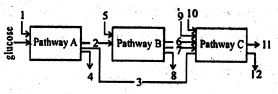
The three boxes in this diagram represent the three major biosynthetic pathways in aerobic respiration. Arrows represent net reactants or products. Arrows numbered $4, 8, 12$ can all be
A
$H_2O$
B
$ATP$
C
$FAD^+$ or $FADH_2$
D
$NADH$
Solution
(B) In aerobic respiration,the three major pathways are:
$1$. Glycolysis (Pathway $A$): Glucose is converted to pyruvate. Net products include $ATP$ and $NADH$.
$2$. Link Reaction/Krebs Cycle (Pathway $B$): Pyruvate is converted to Acetyl-$CoA$ and then enters the Krebs cycle. Net products include $ATP$ (or $GTP$),$NADH$,and $FADH_2$.
$3$. Electron Transport System (Pathway $C$): $NADH$ and $FADH_2$ are oxidized to produce $ATP$ and $H_2O$.
Looking at the diagram:
- Pathway $A$ (Glycolysis) produces $ATP$ (arrow $4$).
- Pathway $B$ (Krebs cycle) produces $ATP$ (arrow $8$).
- Pathway $C$ $(ETS)$ produces $ATP$ (arrow $12$).
Thus,arrows $4, 8,$ and $12$ represent the net production of $ATP$ in these three stages.
$1$. Glycolysis (Pathway $A$): Glucose is converted to pyruvate. Net products include $ATP$ and $NADH$.
$2$. Link Reaction/Krebs Cycle (Pathway $B$): Pyruvate is converted to Acetyl-$CoA$ and then enters the Krebs cycle. Net products include $ATP$ (or $GTP$),$NADH$,and $FADH_2$.
$3$. Electron Transport System (Pathway $C$): $NADH$ and $FADH_2$ are oxidized to produce $ATP$ and $H_2O$.
Looking at the diagram:
- Pathway $A$ (Glycolysis) produces $ATP$ (arrow $4$).
- Pathway $B$ (Krebs cycle) produces $ATP$ (arrow $8$).
- Pathway $C$ $(ETS)$ produces $ATP$ (arrow $12$).
Thus,arrows $4, 8,$ and $12$ represent the net production of $ATP$ in these three stages.
0 likesView Solution
57
ChemistryMCQNEET · 2013
Which enzymes are likely to act on the baked potatoes eaten by a man,starting from the mouth and as it moves down the alimentary canal?
A
Salivary maltase $\rightarrow$ carboxypeptidase $\rightarrow$ trypsinogen
B
Pancreatic amylase $\rightarrow$ salivary amylase $\rightarrow$ lipases
C
Disaccharidase like maltase $\rightarrow$ lipases $\rightarrow$ nucleases
D
Salivary amylase $\rightarrow$ pancreatic amylase $\rightarrow$ disaccharidases
Solution
(D) Baked potatoes are primarily composed of starch,which is a complex carbohydrate.
$1$. In the mouth,the process of digestion begins with the action of salivary amylase (ptyalin) on starch,breaking it down into maltose.
$2$. As the food moves into the small intestine,pancreatic amylase continues the digestion of remaining starch into disaccharides.
$3$. Finally,in the small intestine,disaccharidases (such as maltase) present in the intestinal juice (succus entericus) break down disaccharides like maltose into glucose units for absorption.
Therefore,the correct sequence of enzymes acting on starch is salivary amylase $\rightarrow$ pancreatic amylase $\rightarrow$ disaccharidases.
$1$. In the mouth,the process of digestion begins with the action of salivary amylase (ptyalin) on starch,breaking it down into maltose.
$2$. As the food moves into the small intestine,pancreatic amylase continues the digestion of remaining starch into disaccharides.
$3$. Finally,in the small intestine,disaccharidases (such as maltase) present in the intestinal juice (succus entericus) break down disaccharides like maltose into glucose units for absorption.
Therefore,the correct sequence of enzymes acting on starch is salivary amylase $\rightarrow$ pancreatic amylase $\rightarrow$ disaccharidases.
0 likesView Solution
58
ChemistryMCQNEET · 2013
The $H-$ zone in the skeletal muscle fibre is due to:
A
The central gap between myosin filaments in the $A-$ band.
B
The central gap between actin filaments extending through myosin filaments in the $A-$ band.
C
Extension of myosin filaments in the central portion of the $A-$ band
D
The absence of myofibrils in the central portion of $A-$ band
Solution
(B) In a skeletal muscle fibre,the $A-$ band contains both actin and myosin filaments.
However,in the central part of the $A-$ band,there is a region where the thin actin filaments do not overlap with the thick myosin filaments.
This central region,which contains only thick myosin filaments,is known as the $H-$ zone.
Therefore,the $H-$ zone represents the central gap between the actin filaments that extend into the $A-$ band.
However,in the central part of the $A-$ band,there is a region where the thin actin filaments do not overlap with the thick myosin filaments.
This central region,which contains only thick myosin filaments,is known as the $H-$ zone.
Therefore,the $H-$ zone represents the central gap between the actin filaments that extend into the $A-$ band.
0 likesView Solution
59
ChemistryMCQNEET · 2013
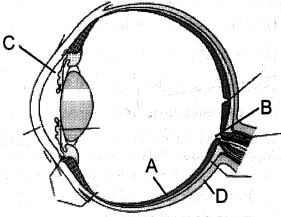
Parts $A, B, C$ and $D$ of the human eye are shown in the diagram. Select the option which gives correct identification along with its functions / characteristics:
A
$B-$ Blind spot - has only a few rods and cones
B
$C-$ Aqueous chamber - reflects the light which does not pass through the lens
C
$D-$ Choroid - its anterior part forms ciliary body
D
$A-$ Retina - contains photoreceptors - rods and cones.
Solution
(D) In the given diagram of the human eye:
$A$ represents the Retina,which is the innermost layer of the eye and contains photoreceptor cells called rods and cones.
$B$ represents the Blind spot,an area where the optic nerve leaves the eye and photoreceptors are absent.
$C$ represents the Aqueous chamber,the space between the cornea and the lens,filled with aqueous humor.
$D$ represents the Sclera,the outermost layer of the eye.
Therefore,option $D$ is the correct identification and description.
$A$ represents the Retina,which is the innermost layer of the eye and contains photoreceptor cells called rods and cones.
$B$ represents the Blind spot,an area where the optic nerve leaves the eye and photoreceptors are absent.
$C$ represents the Aqueous chamber,the space between the cornea and the lens,filled with aqueous humor.
$D$ represents the Sclera,the outermost layer of the eye.
Therefore,option $D$ is the correct identification and description.
0 likesView Solution
60
ChemistryMCQNEET · 2013
Isogamous condition with non-flagellated gametes is found in:
A
Spirogyra
B
Volvox
C
Fucus
D
Chlamydomonas
Solution
(A) In $Spirogyra$, sexual reproduction occurs through conjugation where the gametes are morphologically similar (isogamous) but physiologically distinct. These gametes are non-flagellated (non-motile).
In $Volvox$ and $Chlamydomonas$, sexual reproduction can be isogamous, anisogamous, or oogamous, but the gametes are typically flagellated (motile).
In $Fucus$, the sexual reproduction is oogamous, involving large non-motile eggs and small motile sperms.
In $Volvox$ and $Chlamydomonas$, sexual reproduction can be isogamous, anisogamous, or oogamous, but the gametes are typically flagellated (motile).
In $Fucus$, the sexual reproduction is oogamous, involving large non-motile eggs and small motile sperms.
0 likesView Solution
61
ChemistryMCQNEET · 2013
The meristematic tissue responsible for the increase in the girth of a tree trunk is:
A
Apical meristem
B
Intercalary meristem
C
Lateral meristem
D
Phellem
Solution
(C) The meristematic tissue responsible for the increase in the girth (secondary growth) of a tree trunk is the $Lateral \ meristem$ (also known as the $Cambium$ or $Lateral \ meristematic \ tissue$).
$Apical \ meristem$ is responsible for the increase in the length of the plant (primary growth).
$Intercalary \ meristem$ is found in the internodes and is responsible for the elongation of the stem in grasses and monocots.
$Phellem$ (cork) is a product of the cork cambium, which is a type of lateral meristem, but it is not the meristematic tissue itself.
$Apical \ meristem$ is responsible for the increase in the length of the plant (primary growth).
$Intercalary \ meristem$ is found in the internodes and is responsible for the elongation of the stem in grasses and monocots.
$Phellem$ (cork) is a product of the cork cambium, which is a type of lateral meristem, but it is not the meristematic tissue itself.
0 likesView Solution
62
ChemistryMCQNEET · 2013
The essential chemical components of many coenzymes are
A
Nucleic acids
B
Carbohydrates
C
Vitamins
D
Proteins
Solution
(C) Coenzymes are small,non-protein organic molecules that bind to enzymes to facilitate their catalytic activity.
Many coenzymes are derived from vitamins,specifically water-soluble vitamins like $B$-complex vitamins.
For example,$NAD^+$ and $NADP^+$ contain niacin (vitamin $B_3$),while $FAD$ contains riboflavin (vitamin $B_2$).
Therefore,vitamins are the essential chemical components of many coenzymes.
Many coenzymes are derived from vitamins,specifically water-soluble vitamins like $B$-complex vitamins.
For example,$NAD^+$ and $NADP^+$ contain niacin (vitamin $B_3$),while $FAD$ contains riboflavin (vitamin $B_2$).
Therefore,vitamins are the essential chemical components of many coenzymes.
0 likesView Solution
63
ChemistryMCQNEET · 2013
Secondary productivity is the rate of formation of new organic matter by:
A
Decomposers
B
Producers
C
Parasites
D
Consumers
Solution
(D) Primary productivity is defined as the rate at which biomass or organic matter is produced per unit area over a time period by plants during photosynthesis.
Secondary productivity is defined as the rate of formation of new organic matter by consumers.
Consumers (heterotrophs) ingest the organic matter produced by producers and convert it into their own biomass.
Therefore,the correct option is $D$.
Secondary productivity is defined as the rate of formation of new organic matter by consumers.
Consumers (heterotrophs) ingest the organic matter produced by producers and convert it into their own biomass.
Therefore,the correct option is $D$.
0 likesView Solution
64
ChemistryMCQNEET · 2013
Which of these is least likely to act as a Lewis base?
A
$PF_3$
B
$CO$
C
$F^{-}$
D
$BF_3$
Solution
(D) $CO$,$F^{-}$,and $PF_3$ possess lone pairs of electrons that they can donate to an electron-deficient species. Hence,they act as Lewis bases.
In contrast,$BF_3$ has an incomplete octet around the central Boron atom,which provides a vacant $p$-orbital.
Because of this vacant orbital,$BF_3$ acts as an electron-pair acceptor,making it a Lewis acid.
Therefore,$BF_3$ is the least likely to act as a Lewis base.
In contrast,$BF_3$ has an incomplete octet around the central Boron atom,which provides a vacant $p$-orbital.
Because of this vacant orbital,$BF_3$ acts as an electron-pair acceptor,making it a Lewis acid.
Therefore,$BF_3$ is the least likely to act as a Lewis base.
0 likesView Solution
65
ChemistryMCQNEET · 2013
Dipole-induced dipole interactions are present in which of the following pairs?
A
$SiF_4$ and $He$ atoms
B
$H_2O$ and alcohol
C
$Cl_2$ and $CCl_4$
D
$HCl$ and $He$ atoms
Solution
(D) Dipole-induced dipole interactions occur between a polar molecule and a non-polar molecule.
$HCl$ is a polar molecule because it has a permanent dipole moment $(\mu \neq 0)$.
$He$ atoms are non-polar because they are spherically symmetric and have no permanent dipole moment $(\mu = 0)$.
Therefore,the interaction between $HCl$ and $He$ is a dipole-induced dipole interaction.
$HCl$ is a polar molecule because it has a permanent dipole moment $(\mu \neq 0)$.
$He$ atoms are non-polar because they are spherically symmetric and have no permanent dipole moment $(\mu = 0)$.
Therefore,the interaction between $HCl$ and $He$ is a dipole-induced dipole interaction.
0 likesView Solution
66
ChemistryMCQNEET · 2013
Which of the following does not give oxygen on heating?
A
$(NH_4)_2Cr_2O_7$
B
$KClO_3$
C
$Zn(ClO_3)_2$
D
$K_2Cr_2O_7$
Solution
(A) Heating $(NH_4)_2Cr_2O_7$ results in the evolution of nitrogen gas,water vapor,and chromium$(III)$ oxide: $(NH_4)_2Cr_2O_7 \xrightarrow{\Delta} Cr_2O_3 + 4H_2O + N_2$.
$KClO_3$ and $Zn(ClO_3)_2$ are chlorates that decompose to release oxygen gas upon heating.
$K_2Cr_2O_7$ decomposes to release oxygen gas: $4K_2Cr_2O_7 \xrightarrow{\Delta} 4K_2CrO_4 + 2Cr_2O_3 + 3O_2$.
$KClO_3$ and $Zn(ClO_3)_2$ are chlorates that decompose to release oxygen gas upon heating.
$K_2Cr_2O_7$ decomposes to release oxygen gas: $4K_2Cr_2O_7 \xrightarrow{\Delta} 4K_2CrO_4 + 2Cr_2O_3 + 3O_2$.
0 likesView Solution
67
ChemistryMCQNEET · 2013
Which of the following is paramagnetic?
A
$NO^{+}$
B
$CO$
C
$O_2^-$
D
$CN^{-}$
Solution
(C) Paramagnetism is the property of a substance that contains one or more unpaired electrons.
$1.$ $NO^{+}$: Total electrons = $7 + 8 - 1 = 14$. Molecular orbital configuration: $(\sigma 1s)^2, (\sigma^* 1s)^2, (\sigma 2s)^2, (\sigma^* 2s)^2, (\sigma 2p_z)^2, (\pi 2p_x)^2, (\pi 2p_y)^2$. All electrons are paired,so it is diamagnetic.
$2.$ $CO$: Total electrons = $6 + 8 = 14$. Similar to $NO^{+}$,all electrons are paired,so it is diamagnetic.
$3.$ $O_2^-$: Total electrons = $8 + 8 + 1 = 17$. Molecular orbital configuration: $(\sigma 1s)^2, (\sigma^* 1s)^2, (\sigma 2s)^2, (\sigma^* 2s)^2, (\sigma 2p_z)^2, (\pi 2p_x)^2, (\pi 2p_y)^2, (\pi^* 2p_x)^2, (\pi^* 2p_y)^1$. It contains one unpaired electron in the $\pi^* 2p_y$ orbital,making it paramagnetic.
$4.$ $CN^{-}$: Total electrons = $6 + 7 + 1 = 14$. Similar to $CO$,all electrons are paired,so it is diamagnetic.
$1.$ $NO^{+}$: Total electrons = $7 + 8 - 1 = 14$. Molecular orbital configuration: $(\sigma 1s)^2, (\sigma^* 1s)^2, (\sigma 2s)^2, (\sigma^* 2s)^2, (\sigma 2p_z)^2, (\pi 2p_x)^2, (\pi 2p_y)^2$. All electrons are paired,so it is diamagnetic.
$2.$ $CO$: Total electrons = $6 + 8 = 14$. Similar to $NO^{+}$,all electrons are paired,so it is diamagnetic.
$3.$ $O_2^-$: Total electrons = $8 + 8 + 1 = 17$. Molecular orbital configuration: $(\sigma 1s)^2, (\sigma^* 1s)^2, (\sigma 2s)^2, (\sigma^* 2s)^2, (\sigma 2p_z)^2, (\pi 2p_x)^2, (\pi 2p_y)^2, (\pi^* 2p_x)^2, (\pi^* 2p_y)^1$. It contains one unpaired electron in the $\pi^* 2p_y$ orbital,making it paramagnetic.
$4.$ $CN^{-}$: Total electrons = $6 + 7 + 1 = 14$. Similar to $CO$,all electrons are paired,so it is diamagnetic.
0 likesView Solution
68
ChemistryMediumMCQNEET · 2013
In which of the following ionization processes has the bond energy increased and the magnetic behaviour changed from paramagnetic to diamagnetic?
A
$NO \to NO^{+}$
B
$N_2 \to N_2^{+}$
C
$C_2 \to C_2^{+}$
D
$O_2 \to O_2^{+}$
Solution
(A) For $NO$ (total $15$ electrons): Bond order $(B.O)$ $= 2.5$,magnetic behaviour is paramagnetic.
For $NO^{+}$ (total $14$ electrons): Bond order $(B.O)$ $= 3.0$,magnetic behaviour is diamagnetic.
Since the bond order increases,the bond energy also increases.
Thus,the process $NO \to NO^{+}$ satisfies both conditions.
For $NO^{+}$ (total $14$ electrons): Bond order $(B.O)$ $= 3.0$,magnetic behaviour is diamagnetic.
Since the bond order increases,the bond energy also increases.
Thus,the process $NO \to NO^{+}$ satisfies both conditions.
0 likesView Solution
69
ChemistryMCQNEET · 2013
Which of the following is paramagnetic?
A
$NO^{+}$
B
$CO$
C
$O_2^{-}$
D
$CN^{-}$
Solution
(C) To determine the magnetic behavior,we calculate the total number of electrons in each species:
$1$. $NO^{+}$: $7 + 8 - 1 = 14$ electrons. Configuration: $(\sigma 1s)^2 (\sigma^* 1s)^2 (\sigma 2s)^2 (\sigma^* 2s)^2 (\pi 2p_x)^2 (\pi 2p_y)^2 (\sigma 2p_z)^2$. All electrons are paired,so it is diamagnetic.
$2$. $CO$: $6 + 8 = 14$ electrons. Similar to $NO^{+}$,all electrons are paired,so it is diamagnetic.
$3$. $O_2^{-}$: $8 + 8 + 1 = 17$ electrons. Configuration: $(\sigma 1s)^2 (\sigma^* 1s)^2 (\sigma 2s)^2 (\sigma^* 2s)^2 (\sigma 2p_z)^2 (\pi 2p_x)^2 (\pi 2p_y)^2 (\pi^* 2p_x)^2 (\pi^* 2p_y)^1$. It has one unpaired electron,so it is paramagnetic.
$4$. $CN^{-}$: $6 + 7 + 1 = 14$ electrons. Similar to $CO$,all electrons are paired,so it is diamagnetic.
Therefore,$O_2^{-}$ is the only paramagnetic species.
$1$. $NO^{+}$: $7 + 8 - 1 = 14$ electrons. Configuration: $(\sigma 1s)^2 (\sigma^* 1s)^2 (\sigma 2s)^2 (\sigma^* 2s)^2 (\pi 2p_x)^2 (\pi 2p_y)^2 (\sigma 2p_z)^2$. All electrons are paired,so it is diamagnetic.
$2$. $CO$: $6 + 8 = 14$ electrons. Similar to $NO^{+}$,all electrons are paired,so it is diamagnetic.
$3$. $O_2^{-}$: $8 + 8 + 1 = 17$ electrons. Configuration: $(\sigma 1s)^2 (\sigma^* 1s)^2 (\sigma 2s)^2 (\sigma^* 2s)^2 (\sigma 2p_z)^2 (\pi 2p_x)^2 (\pi 2p_y)^2 (\pi^* 2p_x)^2 (\pi^* 2p_y)^1$. It has one unpaired electron,so it is paramagnetic.
$4$. $CN^{-}$: $6 + 7 + 1 = 14$ electrons. Similar to $CO$,all electrons are paired,so it is diamagnetic.
Therefore,$O_2^{-}$ is the only paramagnetic species.
0 likesView Solution
70
ChemistryMediumMCQNEET · 2013
In which of the following pairs do both the species have $sp^{3}$ hybridization?
A
$H_{2}S, BF_{3}$
B
$SiF_{4}, BeH_{2}$
C
$NF_{3}, H_{2}O$
D
$NF_{3}, BF_{3}$
Solution
(C) To determine the hybridization,we calculate the number of electron pairs around the central atom using the formula: $\text{Number of electron pairs} = \text{Number of bond pairs} + \text{Number of lone pairs}$.
For $NF_{3}$: The central atom $N$ has $3$ bond pairs and $1$ lone pair,totaling $4$ electron pairs,which corresponds to $sp^{3}$ hybridization.
For $H_{2}O$: The central atom $O$ has $2$ bond pairs and $2$ lone pairs,totaling $4$ electron pairs,which corresponds to $sp^{3}$ hybridization.
Since both $NF_{3}$ and $H_{2}O$ have $4$ electron pairs,both are $sp^{3}$ hybridized.
For $NF_{3}$: The central atom $N$ has $3$ bond pairs and $1$ lone pair,totaling $4$ electron pairs,which corresponds to $sp^{3}$ hybridization.
For $H_{2}O$: The central atom $O$ has $2$ bond pairs and $2$ lone pairs,totaling $4$ electron pairs,which corresponds to $sp^{3}$ hybridization.
Since both $NF_{3}$ and $H_{2}O$ have $4$ electron pairs,both are $sp^{3}$ hybridized.
0 likesView Solution
71
ChemistryMCQNEET · 2013
Which of the following statements is not true for two genes that show $50 \%$ recombination frequency?
A
The genes may be on different chromosomes
B
The genes are tightly linked
C
The genes show independent assortment
D
If the genes are present on the same chromosome,they undergo more than one crossover in every meiosis
Solution
(B) Recombination frequency of $50 \%$ indicates that the genes are either located on different chromosomes or are so far apart on the same chromosome that they behave as if they are unlinked.
Genes that show $50 \%$ recombination frequency follow the law of independent assortment.
If genes are tightly linked,the recombination frequency is very low (much less than $50 \%$).
Therefore,the statement that 'the genes are tightly linked' is incorrect.
Genes that show $50 \%$ recombination frequency follow the law of independent assortment.
If genes are tightly linked,the recombination frequency is very low (much less than $50 \%$).
Therefore,the statement that 'the genes are tightly linked' is incorrect.
0 likesView Solution
72
ChemistryMCQNEET · 2013
The complex formed by a pair of synapsed homologous chromosomes is called:
A
Axoneme
B
Equatorial plate
C
Kinetochore
D
Bivalent
Solution
(D) During the $Zygotene$ stage of $Prophase-I$ in $Meiosis$,homologous chromosomes pair up,a process known as $Synapsis$.
Each pair of synapsed homologous chromosomes is referred to as a $Bivalent$ or a $Tetrad$ (since it consists of four chromatids).
$Axoneme$ is the core structure of cilia and flagella.
$Equatorial plate$ is the plane where chromosomes align during $Metaphase$.
$Kinetochore$ is the protein structure on chromatids where spindle fibers attach.
Each pair of synapsed homologous chromosomes is referred to as a $Bivalent$ or a $Tetrad$ (since it consists of four chromatids).
$Axoneme$ is the core structure of cilia and flagella.
$Equatorial plate$ is the plane where chromosomes align during $Metaphase$.
$Kinetochore$ is the protein structure on chromatids where spindle fibers attach.
0 likesView Solution
Vedclass Products
For Students
Vedclass Test Series
Mock tests in real NEET style covering Chemistry with performance analysis. 5-day free trial.
Start Free TrialFor Teachers
Exam Paper Generator
Generate Set A/B/C/D Chemistry papers from 7.5L+ questions in 2 minutes. 3 chapters free.
Try FreeFor Institutes
Online Exam Module
Run live NEET mock exams with unlimited students, 360° analytics & white-label branding.
See DemoFrequently Asked Questions
How many Chemistry questions are in NEET 2013?
There are 116 Chemistry questions from the NEET 2013 paper on Vedclass, each with a detailed step-by-step solution in English.
Are NEET 2013 Chemistry solutions available in English?
Yes. All solutions on this page are in English. You can also switch to English or Hindi using the language buttons above the questions.
Can I practice NEET 2013 Chemistry as a timed test?
Yes. Use the Vedclass Test Series to attempt a full NEET mock test covering Chemistry with time limits and instant score analysis.
Can teachers create Chemistry papers from NEET previous year questions?
Yes. The Vedclass Exam Paper Generator lets teachers mix NEET Chemistry questions and generate Set A/B/C/D papers in minutes.
For Teachers & Institutes
Build a Custom Chemistry Paper
Pick NEET 2013 Chemistry questions, set difficulty, and generate Set A/B/C/D in 2 minutes.