
BiologyQ51–139 of 196 questions
Page 2 of 3 · English
51
BiologyMediumMCQNEET · 2013
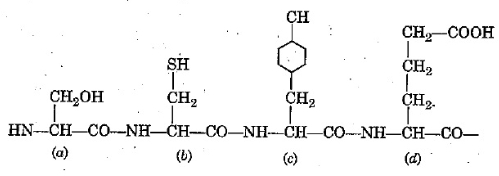
The figure shows a hypothetical tetrapeptide portion of a protein with parts labelled $a$ to $d$. Which one of the following options is correct?
A
$d$ is the acidic amino acid glutamic acid.
B
$c$ is an aromatic amino acid tryptophan.
C
$a$ is the $N$-terminal amino acid and $d$ is the $C$-terminal amino acid.
D
None of these
Solution
(A) By analyzing the structure of the tetrapeptide:
$1$. The amino acid at position $a$ has a side chain $-CH_2OH$,which corresponds to Serine.
$2$. The amino acid at position $b$ has a side chain $-CH_2SH$,which corresponds to Cysteine.
$3$. The amino acid at position $c$ has a side chain $-CH_2-C_6H_5$ (phenylalanine derivative),which is an aromatic amino acid,but not Tryptophan.
$4$. The amino acid at position $d$ has a side chain $-CH_2-CH_2-CH_2-COOH$,which corresponds to Glutamic acid.
$5$. In a polypeptide chain,the $N$-terminal is on the left and the $C$-terminal is on the right. Thus,$a$ is the $N$-terminal and $d$ is the $C$-terminal.
$6$. Option $a$ is incorrect because while $d$ is Glutamic acid,it is not the only correct statement if others are wrong,but looking at the options,none of the specific claims in $a, b, c$ are fully accurate except for the identification of $d$ as Glutamic acid. However,since $d$ is indeed Glutamic acid,option $a$ is the correct choice.
$1$. The amino acid at position $a$ has a side chain $-CH_2OH$,which corresponds to Serine.
$2$. The amino acid at position $b$ has a side chain $-CH_2SH$,which corresponds to Cysteine.
$3$. The amino acid at position $c$ has a side chain $-CH_2-C_6H_5$ (phenylalanine derivative),which is an aromatic amino acid,but not Tryptophan.
$4$. The amino acid at position $d$ has a side chain $-CH_2-CH_2-CH_2-COOH$,which corresponds to Glutamic acid.
$5$. In a polypeptide chain,the $N$-terminal is on the left and the $C$-terminal is on the right. Thus,$a$ is the $N$-terminal and $d$ is the $C$-terminal.
$6$. Option $a$ is incorrect because while $d$ is Glutamic acid,it is not the only correct statement if others are wrong,but looking at the options,none of the specific claims in $a, b, c$ are fully accurate except for the identification of $d$ as Glutamic acid. However,since $d$ is indeed Glutamic acid,option $a$ is the correct choice.
0 likesView Solution
52
BiologyMediumMCQNEET · 2013
The complex formed by a pair of synapsed homologous chromosomes is called
A
bivalent
B
axoneme
C
equatorial plate
D
kinetochore
Solution
(A) During the $zygotene$ stage of $Meiosis-I$,homologous chromosomes start pairing together,a process known as $synapsis$.
These paired chromosomes are referred to as homologous chromosomes.
The electron micrographs of this stage reveal that the pairing is accompanied by the formation of a complex structure known as the $synaptonemal$ $complex$.
The complex formed by a pair of synapsed homologous chromosomes is specifically called a $bivalent$ or a $tetrad$.
These paired chromosomes are referred to as homologous chromosomes.
The electron micrographs of this stage reveal that the pairing is accompanied by the formation of a complex structure known as the $synaptonemal$ $complex$.
The complex formed by a pair of synapsed homologous chromosomes is specifically called a $bivalent$ or a $tetrad$.
0 likesView Solution
53
BiologyMediumMCQNEET · 2013
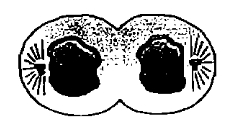
$A$ stage in cell division is shown in the figure. Select the answer which gives correct identification of the stage with its characteristics.
A
Cytokinesis $\Rightarrow$ Cell plate formed,mitochondria distributed between two daughter cells.
B
Telophase $\Rightarrow$ Endoplasmic reticulum and nucleolus not reformed yet.
C
Telophase $\Rightarrow$ Nuclear envelope reforms,Golgi complex reforms.
D
Late anaphase $\Rightarrow$ Chromosomes move away from equatorial plate,Golgi complex not present.
Solution
(C) The figure shows the telophase stage of mitotic cell division.
In this stage,the following key events occur:
- Chromosomes cluster at opposite spindle poles and their identity is lost as discrete elements.
- Nuclear envelope assembles around the chromosome clusters.
- Nucleolus,Golgi complex,and $ER$ reform.
In this stage,the following key events occur:
- Chromosomes cluster at opposite spindle poles and their identity is lost as discrete elements.
- Nuclear envelope assembles around the chromosome clusters.
- Nucleolus,Golgi complex,and $ER$ reform.
0 likesView Solution
54
BiologyMediumMCQNEET · 2013
During meiosis $I$,the chromosomes start pairing at
A
zygotene
B
pachytene
C
diplotene
D
leptotene
Solution
(A) The correct answer is $A$.
During the $zygotene$ stage of prophase $I$ of meiosis,the chromosomes begin to pair up.
This process of pairing of homologous chromosomes is known as $synapsis$.
Each pair of homologous chromosomes is referred to as a $bivalent$ or a $tetrad$.
During the $zygotene$ stage of prophase $I$ of meiosis,the chromosomes begin to pair up.
This process of pairing of homologous chromosomes is known as $synapsis$.
Each pair of homologous chromosomes is referred to as a $bivalent$ or a $tetrad$.
0 likesView Solution
55
BiologyMediumMCQNEET · 2013
During the metaphase stage of mitosis,spindle fibres attach to chromosomes at
A
kinetochore
B
both centromere and kinetochore
C
centromere,kinetochore and areas adjoining centromere
D
centromere
Solution
(A) During the metaphase stage of mitosis,chromosomes consisting of two sister chromatids align at the equatorial plate.
Discontinuous spindle fibres radiate from the two spindle poles and connect to the disc-shaped protein structures located on the surface of the centromere,known as kinetochores.
These fibres are referred to as chromosomal fibres or tractile fibrils.
$A$ kinetochore acts as a complex protein assembly that serves as the attachment point for spindle microtubules,facilitating the movement of chromosomes during cell division.
Discontinuous spindle fibres radiate from the two spindle poles and connect to the disc-shaped protein structures located on the surface of the centromere,known as kinetochores.
These fibres are referred to as chromosomal fibres or tractile fibrils.
$A$ kinetochore acts as a complex protein assembly that serves as the attachment point for spindle microtubules,facilitating the movement of chromosomes during cell division.
0 likesView Solution
56
BiologyEasyMCQNEET · 2013
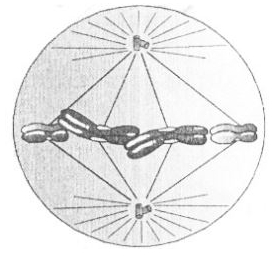
$A$ stage of mitosis is shown in the diagram. Which stage is it and what are its characteristics?
A
Metaphase - Spindle fibers attached to kinetochores,centromeres split and chromatids separate.
B
Metaphase - Chromosomes moved to spindle equator,chromosomes made up of two sister chromatids.
C
Anaphase - Centromeres split and chromatids separate and start moving away.
D
Late prophase - Chromosomes move to spindle equator.
Solution
(B) : In metaphase,chromosomes consisting of two sister chromatids get arranged at the equator. Discontinuous fibers radiate out from two spindle poles and get connected to the disc-shaped structure at the surface of the centromere called kinetochores. These are known as chromosome fibers or tractile fibrils. $A$ kinetochore is a complex protein structure that is analogous to a ring for the microtubule hook; it is the point where microtubules attach themselves.
0 likesView Solution
57
BiologyMediumMCQNEET · 2013
Which of the following criteria does not pertain to facilitated transport?
A
Transport saturation
B
Uphill transport
C
Requirement of special membrane proteins
D
High selectivity
Solution
(B) The correct answer is $B$.
Facilitated transport (or facilitated diffusion) is the spontaneous movement of molecules or ions across a biological membrane through specific transmembrane integral proteins.
It is a passive process,meaning it does not require energy $(ATP)$.
Facilitated diffusion is mediated by protein channels and carrier proteins.
Most transport proteins involved in this process are highly selective and only transport specific molecules.
Since it is a passive process,molecules move down their concentration gradient,which is known as 'downhill transport'.
'Uphill transport' refers to active transport,where molecules move against their concentration gradient,requiring energy. Therefore,uphill transport is not a characteristic of facilitated transport.
Facilitated transport (or facilitated diffusion) is the spontaneous movement of molecules or ions across a biological membrane through specific transmembrane integral proteins.
It is a passive process,meaning it does not require energy $(ATP)$.
Facilitated diffusion is mediated by protein channels and carrier proteins.
Most transport proteins involved in this process are highly selective and only transport specific molecules.
Since it is a passive process,molecules move down their concentration gradient,which is known as 'downhill transport'.
'Uphill transport' refers to active transport,where molecules move against their concentration gradient,requiring energy. Therefore,uphill transport is not a characteristic of facilitated transport.
0 likesView Solution
58
BiologyEasyMCQNEET · 2013
The first stable product of fixation of atmospheric nitrogen in leguminous plants is
A
$NO_3^-$
B
$NO_2^-$
C
glutamate
D
ammonia
Solution
(D) The correct answer is $(d)$. The enzyme nitrogenase is a $Mo-Fe$ protein that catalyzes the conversion of atmospheric nitrogen $(N_2)$ into ammonia $(NH_3)$,which is the first stable product of biological nitrogen fixation.
Nitrogen fixation is the process of converting inert atmospheric dinitrogen $(N_2)$ into usable nitrogenous compounds like ammonia,amino acids,etc.
Biological nitrogen fixation is carried out by both free-living and symbiotic microorganisms.
In leguminous plants,symbiotic nitrogen-fixing bacteria (like $Rhizobium$) reside in root nodules.
These nodules provide the necessary environment,including the enzyme nitrogenase and the oxygen-scavenging pigment leghaemoglobin,to facilitate the reduction of $N_2$ to ammonia.
Nitrogen fixation is the process of converting inert atmospheric dinitrogen $(N_2)$ into usable nitrogenous compounds like ammonia,amino acids,etc.
Biological nitrogen fixation is carried out by both free-living and symbiotic microorganisms.
In leguminous plants,symbiotic nitrogen-fixing bacteria (like $Rhizobium$) reside in root nodules.
These nodules provide the necessary environment,including the enzyme nitrogenase and the oxygen-scavenging pigment leghaemoglobin,to facilitate the reduction of $N_2$ to ammonia.
0 likesView Solution
59
BiologyEasyMCQNEET · 2013
Specialized cells for fixing atmospheric nitrogen in $Nostoc$ are
A
heterocysts
B
hormogonia
C
nodules
D
akinetes
Solution
(A) : Certain species of cyanobacteria $(Nostoc)$ possess some special cells called heterocysts which occur in terminal,basal,and intercalary positions.
These heterocysts are yellowish in color and their contents are homogeneous.
Heterocysts are now known as the primary sites of nitrogen fixation.
Atmospheric nitrogen is converted into ammonia by these cells in cyanobacteria.
These heterocysts are yellowish in color and their contents are homogeneous.
Heterocysts are now known as the primary sites of nitrogen fixation.
Atmospheric nitrogen is converted into ammonia by these cells in cyanobacteria.
0 likesView Solution
60
BiologyEasyMCQNEET · 2013
Which of the following elements is a constituent of biotin?
A
Magnesium
B
Calcium
C
Phosphorus
D
Sulphur
Solution
(D) $Sulphur$ is a key structural component of the vitamin $Biotin$ (Vitamin $B_7$).
It is also present in $Thiamine$ (Vitamin $B_1$).
$Biotin$ plays a crucial role in various metabolic processes, including fatty acid synthesis and gluconeogenesis.
It is commonly found in protein-rich foods such as eggs, lettuce, and sprouts.
It is also present in $Thiamine$ (Vitamin $B_1$).
$Biotin$ plays a crucial role in various metabolic processes, including fatty acid synthesis and gluconeogenesis.
It is commonly found in protein-rich foods such as eggs, lettuce, and sprouts.
0 likesView Solution
61
BiologyMediumMCQNEET · 2013
Which two distinct microbial processes are responsible for the release of fixed nitrogen as dinitrogen gas $(N_2)$ to the atmosphere?
A
Aerobic nitrate oxidation and nitrite reduction
B
Decomposition of organic nitrogen and conversion of dinitrogen to ammonium compounds
C
Enteric fermentation in cattle and nitrogen fixation by Rhizobium in root nodules of legumes
D
Anaerobic ammonium oxidation and denitrification
Solution
(D) The correct answer is $(D)$.
Denitrification is a biological process in which nitrates $(NO_3^-)$ in the soil are reduced to molecular nitrogen $(N_2)$ gas,which is then released into the atmosphere. This process is carried out by denitrifying bacteria such as $Pseudomonas$ $denitrificans$ and $Thiobacillus$ $denitrificans$.
Anaerobic ammonium oxidation (often referred to as $ANAMMOX$) is another microbial process where ammonium $(NH_4^+)$ is oxidized to dinitrogen gas $(N_2)$ under anaerobic conditions,contributing to the nitrogen cycle by returning $N_2$ to the atmosphere.
Denitrification is a biological process in which nitrates $(NO_3^-)$ in the soil are reduced to molecular nitrogen $(N_2)$ gas,which is then released into the atmosphere. This process is carried out by denitrifying bacteria such as $Pseudomonas$ $denitrificans$ and $Thiobacillus$ $denitrificans$.
Anaerobic ammonium oxidation (often referred to as $ANAMMOX$) is another microbial process where ammonium $(NH_4^+)$ is oxidized to dinitrogen gas $(N_2)$ under anaerobic conditions,contributing to the nitrogen cycle by returning $N_2$ to the atmosphere.
0 likesView Solution
62
BiologyMediumMCQNEET · 2013
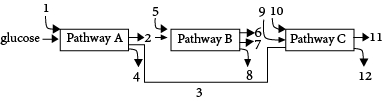
The three boxes in this diagram represent the three major biosynthetic pathways in aerobic respiration. Arrows represent net reactants or products. Arrows numbered $4, 8$ and $12$ can all be
A
$H_2O$
B
$FAD^+$ or $FADH_2$
C
$NADH$
D
$ATP$
Solution
(D) In the given diagram,pathway $A$ represents glycolysis,pathway $B$ represents the Krebs cycle,and pathway $C$ represents oxidative phosphorylation.
During glycolysis (pathway $A$),$ATP$ is produced as a net product (arrow $4$).
During the Krebs cycle (pathway $B$),$ATP$ (or $GTP$) is produced as a net product (arrow $8$).
During oxidative phosphorylation (pathway $C$),$ATP$ is produced as a net product (arrow $12$).
Therefore,arrows numbered $4, 8,$ and $12$ all represent the production of $ATP$.
During glycolysis (pathway $A$),$ATP$ is produced as a net product (arrow $4$).
During the Krebs cycle (pathway $B$),$ATP$ (or $GTP$) is produced as a net product (arrow $8$).
During oxidative phosphorylation (pathway $C$),$ATP$ is produced as a net product (arrow $12$).
Therefore,arrows numbered $4, 8,$ and $12$ all represent the production of $ATP$.
0 likesView Solution
63
BiologyMediumMCQNEET · 2013
During seed germination,its stored food is mobilized by
A
$ABA$
B
gibberellin
C
ethylene
D
cytokinin
Solution
(B) : Gibberellins are plant growth hormones that play a crucial role in seed germination. During germination,gibberellins stimulate the synthesis of hydrolytic enzymes,such as $\alpha$-amylase,in the aleurone layer of cereal seeds. These enzymes break down stored starch into simple sugars,which are then transported to the developing embryo to provide energy for growth. Thus,gibberellins are responsible for the mobilization of food reserves in germinating seeds.
0 likesView Solution
64
BiologyMediumMCQNEET · 2013
The pineapple, which under natural conditions is difficult to blossom, has been made to produce fruits throughout the year by the application of:
A
$NAA, 2, 4-D$
B
Phenyl acetic acid
C
Cytokinin
D
$IAA, IBA$
Solution
(A) $NAA$ ($\alpha$-Naphthalene acetic acid) and $2, 4-D$ ($2, 4$-dichlorophenoxy acetic acid) are synthetic auxins.
Normally, auxins inhibit flowering in many plants.
However, in pineapple and litchi, the application of these synthetic auxins promotes flowering.
Therefore, they are used to induce flowering in pineapple throughout the year.
Normally, auxins inhibit flowering in many plants.
However, in pineapple and litchi, the application of these synthetic auxins promotes flowering.
Therefore, they are used to induce flowering in pineapple throughout the year.
0 likesView Solution
65
BiologyMediumMCQNEET · 2013
Select the correct match of the digested products in humans given in column $I$ with their absorption site and mechanism in column $II$.
A
Glycerol,fatty acids $\Rightarrow$ Duodenum,move as chylomicrons
B
Cholesterol,maltose $\Rightarrow$ Large intestine,active absorption
C
Glycine,glucose $\Rightarrow$ Small intestine,active absorption
D
Fructose,$Na^+$ $\Rightarrow$ Small intestine,passive absorption
Solution
(C) The correct option is $C$.
Glycine (an amino acid) and glucose are absorbed into the blood capillaries of the small intestine via active transport,which requires energy $(ATP)$.
Fatty acids and glycerol are first incorporated into micelles,then move into intestinal cells where they are re-synthesized into chylomicrons.
Fructose is absorbed by facilitated diffusion.
$Na^+$ ions are absorbed by active transport.
Glycine (an amino acid) and glucose are absorbed into the blood capillaries of the small intestine via active transport,which requires energy $(ATP)$.
Fatty acids and glycerol are first incorporated into micelles,then move into intestinal cells where they are re-synthesized into chylomicrons.
Fructose is absorbed by facilitated diffusion.
$Na^+$ ions are absorbed by active transport.
0 likesView Solution
66
BiologyMediumMCQNEET · 2013
Which enzymes are likely to act on the baked potatoes eaten by a man, starting from the mouth and as it moves down the alimentary canal?
A
$Pancreatic amylase \to Salivary amylase \to Lipases$
B
$Disaccharidase like maltase \to Lipases \to Nucleases$
C
$Salivary amylase \to Pancreatic amylase \to Disaccharidases$
D
$Salivary maltase \to Carboxy peptidase \to Trypsinogen$
Solution
(C) The correct answer is $C$. Baked potatoes consist of starch, which is a polysaccharide.
$1$. In the oral cavity, food is mixed with saliva. Saliva contains an enzyme called salivary amylase (ptyalin), which converts starch into maltose, isomaltose, and small dextrins.
$Starch \xrightarrow[\text{Salivary amylase}]{} \text{Maltose} + \text{Isomaltose} + \alpha\text{-Dextrins}$.
$2$. The pancreatic juice, which enters the small intestine, contains a starch-digesting enzyme called pancreatic amylase. This enzyme further breaks down any remaining starch into maltose, isomaltose, and $\alpha$-dextrins.
$Starch \xrightarrow[\text{Pancreatic } \alpha\text{-amylase}]{} \text{Maltose} + \text{Isomaltose} + \alpha\text{-Dextrins}$.
$3$. Finally, disaccharidases such as maltase, present in the intestinal juice (succus entericus) of the small intestine, break down disaccharides like maltose into simpler monosaccharides (glucose).
$1$. In the oral cavity, food is mixed with saliva. Saliva contains an enzyme called salivary amylase (ptyalin), which converts starch into maltose, isomaltose, and small dextrins.
$Starch \xrightarrow[\text{Salivary amylase}]{} \text{Maltose} + \text{Isomaltose} + \alpha\text{-Dextrins}$.
$2$. The pancreatic juice, which enters the small intestine, contains a starch-digesting enzyme called pancreatic amylase. This enzyme further breaks down any remaining starch into maltose, isomaltose, and $\alpha$-dextrins.
$Starch \xrightarrow[\text{Pancreatic } \alpha\text{-amylase}]{} \text{Maltose} + \text{Isomaltose} + \alpha\text{-Dextrins}$.
$3$. Finally, disaccharidases such as maltase, present in the intestinal juice (succus entericus) of the small intestine, break down disaccharides like maltose into simpler monosaccharides (glucose).
0 likesView Solution
67
BiologyEasyMCQNEET · 2013
The figure shows a diagrammatic view of the human respiratory system with labels $A, B, C$,and $D$. Select the option which gives the correct identification and main function and/or characteristic.
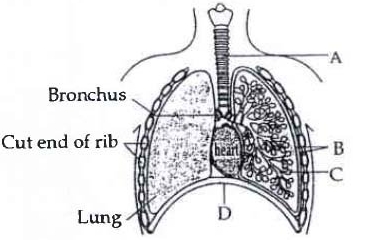
A
$C$ - Alveoli - Thin-walled vascular bag-like structures for the exchange of gases.
B
$D$ - Lower end of lungs - Diaphragm pulls it down during inspiration.
C
$A$ - Trachea - Long tube supported by complete cartilaginous rings for conducting inspired air.
D
$B$ - Pleural membrane - Surrounds ribs on both sides to provide a cushion against rubbing.
Solution
(A) The correct option is $A$.
In the given figure,$A$ represents the trachea. It is supported by incomplete cartilaginous rings which prevent its collapse during inspiration.
$B$ represents the pleural membrane,which encloses the lungs.
$C$ represents the alveoli. They are thin-walled sacs having an extensive network of capillaries for gaseous exchange.
$D$ represents the diaphragm,which is a dome-shaped muscular structure that helps in breathing.
In the given figure,$A$ represents the trachea. It is supported by incomplete cartilaginous rings which prevent its collapse during inspiration.
$B$ represents the pleural membrane,which encloses the lungs.
$C$ represents the alveoli. They are thin-walled sacs having an extensive network of capillaries for gaseous exchange.
$D$ represents the diaphragm,which is a dome-shaped muscular structure that helps in breathing.
0 likesView Solution
68
BiologyMediumMCQNEET · 2013
The given figure shows a schematic plan of blood circulation in humans with labels $A$ to $D$. Identify the label and give its functions.
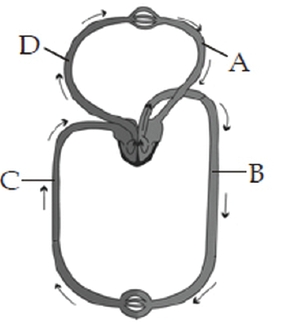
A
$C$ - Vena cava - takes blood from body parts to right auricle,$pCO_2 = 45 \ mm \ Hg$
B
$D$ - Dorsal aorta - takes blood from heart to body parts,$pO_2 = 95 \ mm \ Hg$
C
$A$ - Pulmonary vein - takes impure blood from body parts,$pO_2 = 60 \ mm \ Hg$
D
$B$ - Pulmonary artery - takes blood from heart to lungs,$pO_2 = 90 \ mm \ Hg$
Solution
(A) In the given figure:
$A$ represents the pulmonary vein,which brings oxygenated (pure) blood from the lungs to the left atrium.
$B$ represents the dorsal aorta,which carries oxygenated blood from the heart to various body parts.
$C$ represents the vena cava,which carries deoxygenated (impure) blood from body parts to the right auricle.
$D$ represents the pulmonary artery,which carries deoxygenated blood from the heart to the lungs.
Therefore,option $A$ correctly identifies the label $C$ and its function,noting that the $pCO_2$ in deoxygenated blood returning to the heart is approximately $45 \ mm \ Hg$.
$A$ represents the pulmonary vein,which brings oxygenated (pure) blood from the lungs to the left atrium.
$B$ represents the dorsal aorta,which carries oxygenated blood from the heart to various body parts.
$C$ represents the vena cava,which carries deoxygenated (impure) blood from body parts to the right auricle.
$D$ represents the pulmonary artery,which carries deoxygenated blood from the heart to the lungs.
Therefore,option $A$ correctly identifies the label $C$ and its function,noting that the $pCO_2$ in deoxygenated blood returning to the heart is approximately $45 \ mm \ Hg$.
0 likesView Solution
69
BiologyMediumMCQNEET · 2013
The diagram given here is the standard $ECG$ of a normal person. The $P$-wave represents the
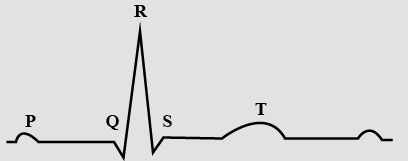
A
contraction of both ventricles
B
end of ventricular contraction
C
contraction of both the atria
D
initiation of the ventricular contraction.
Solution
(C) The correct answer is $(C)$.
In the given diagram,the $P$-wave represents the electrical excitation (or depolarisation) of the atria,which leads to the contraction of both the atria.
The $QRS$ complex represents the depolarisation of the ventricles,which initiates the ventricular contraction.
The contraction starts shortly after $Q$ and marks the beginning of the systole.
The $T$-wave represents the return of the ventricles from an excited to a normal state (repolarisation).
The end of the $T$-wave marks the end of systole.
In the given diagram,the $P$-wave represents the electrical excitation (or depolarisation) of the atria,which leads to the contraction of both the atria.
The $QRS$ complex represents the depolarisation of the ventricles,which initiates the ventricular contraction.
The contraction starts shortly after $Q$ and marks the beginning of the systole.
The $T$-wave represents the return of the ventricles from an excited to a normal state (repolarisation).
The end of the $T$-wave marks the end of systole.
0 likesView Solution
70
BiologyMediumMCQNEET · 2013
The figure shows blood circulation in humans with labels $A$ to $D$. Select the option which gives correct identification of label and functions of the part.
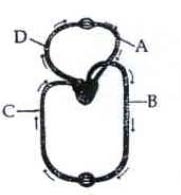
A
$B$ - Capillary: Thin,without muscle layer and wall is one cell layer thick.
B
$C$ - Vein: Thin-walled and blood flows in jerks/spurts.
C
$D$ - Pulmonary vein: Takes oxygenated blood to heart,$pO_2 = 95 \ mm \ Hg$.
D
$A$ - Artery: Thick-walled and blood flows evenly.
Solution
(C) - Pulmonary Artery: Carries deoxygenated blood from the heart to the lungs. It is thick-walled.
$B$ - Systemic Artery: Carries oxygenated blood from the heart to different body parts. It is thick-walled and elastic. The flow of blood in it is intermittent.
$C$ - Systemic Vein: Brings deoxygenated blood from different body parts to the heart. It is thin-walled and acts as a low-resistance conduit for blood flow.
$D$ - Pulmonary Vein: Transports oxygenated blood from the lungs to the left atrium. The partial pressure of oxygen $(pO_2)$ in the pulmonary vein is approximately $95 \ mm \ Hg$.
$B$ - Systemic Artery: Carries oxygenated blood from the heart to different body parts. It is thick-walled and elastic. The flow of blood in it is intermittent.
$C$ - Systemic Vein: Brings deoxygenated blood from different body parts to the heart. It is thin-walled and acts as a low-resistance conduit for blood flow.
$D$ - Pulmonary Vein: Transports oxygenated blood from the lungs to the left atrium. The partial pressure of oxygen $(pO_2)$ in the pulmonary vein is approximately $95 \ mm \ Hg$.
0 likesView Solution
71
BiologyMediumMCQNEET · 2013
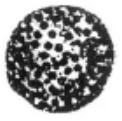
The figure shows a human blood cell. Identify it and give its characteristics.
A
Basophil $\to$ Secretes serotonin,inflammatory response
B
$B$-lymphocyte $\to$ Forms about $20\%$ of blood cells involved in immune response
C
Neutrophil $\to$ Most abundant blood cells,phagocytic
D
Monocyte $\to$ Life span of $3$ days,produces antibodies
Solution
(A) The image shows a Basophil,which is a type of granulocyte.
Basophils are the least abundant WBCs $(0.5-1.0\%)$.
They contain large,coarse granules that stain with basic dyes like methylene blue.
Their nucleus is typically lobed (often $S$-shaped or two-lobed,though sometimes appearing multi-lobed due to dense granules).
They secrete chemicals like histamine,serotonin,and heparin,which are involved in inflammatory responses.
Basophils are the least abundant WBCs $(0.5-1.0\%)$.
They contain large,coarse granules that stain with basic dyes like methylene blue.
Their nucleus is typically lobed (often $S$-shaped or two-lobed,though sometimes appearing multi-lobed due to dense granules).
They secrete chemicals like histamine,serotonin,and heparin,which are involved in inflammatory responses.
0 likesView Solution
72
BiologyMediumMCQNEET · 2013
Select the correct statement with respect to locomotion in humans.
A
The vertebral column has $10$ thoracic vertebrae.
B
The joint between adjacent vertebrae is a fibrous joint.
C
$A$ decreased level of progesterone causes osteoporosis in old people.
D
Accumulation of uric acid crystals in joints causes their inflammation.
Solution
(D) : Thoracic vertebrae are $12$ in number. Joints between adjacent vertebrae are cartilaginous joints,and the opposing surfaces are connected by fibrocartilage,which allows very little movement. Osteoporosis is a disease characterized by low bone mass and loss of bone tissue that may lead to weak and fragile bones. Osteoporosis occurs when there is an imbalance between new bone formation and old bone resorption. Generalized osteoporosis is common in elderly people and in women following menopause. In osteoporosis,the osteoblastic (bone-forming) activity in the bone is usually less than normal,and consequently,the rate of bone deposition is depressed. Estrogens inhibit osteoclastic (bone-resorption) activity in the bones and therefore stimulate bone growth. After menopause,almost no estrogens are secreted by ovaries. This estrogen deficiency leads to increased osteoclastic activity in the bones,decreased bone matrix,and decreased deposition of bone calcium and phosphate. In some women,this effect results in osteoporosis.
0 likesView Solution
73
BiologyMediumMCQNEET · 2013
The $H$-zone in the skeletal muscle fibre is due to
A
the central gap between actin filaments extending through myosin filaments in the $A$-band
B
extension of myosin filaments in the central portion of the $A$-band
C
the absence of myofibrils in the central portion of $A$-band
D
the central gap between myosin filaments in the $A$-band.
Solution
(A) The correct answer is $A$.
Each muscle fibre contains many parallelly arranged myofibrils.
Each myofibril consists of serially arranged functional units called sarcomeres.
Each sarcomere has a central $A$-band composed of thick myosin filaments and two half $I$-bands composed of thin actin filaments on either side,marked by $Z$-lines.
In a resting state,the edges of the thin filaments on either side of the thick filaments partially overlap the free ends of the thick filaments.
The central part of the thick filament that is not overlapped by thin filaments is known as the $H$-zone.
Each muscle fibre contains many parallelly arranged myofibrils.
Each myofibril consists of serially arranged functional units called sarcomeres.
Each sarcomere has a central $A$-band composed of thick myosin filaments and two half $I$-bands composed of thin actin filaments on either side,marked by $Z$-lines.
In a resting state,the edges of the thin filaments on either side of the thick filaments partially overlap the free ends of the thick filaments.
The central part of the thick filament that is not overlapped by thin filaments is known as the $H$-zone.
0 likesView Solution
74
BiologyMediumMCQNEET · 2013
The characteristic and an example of a synovial joint in humans is
A
Fluid filled synovial cavity between two bones $\Rightarrow$ Joint between atlas and axis
B
Lymph filled between two bones,limited movement $\Rightarrow$ Gliding joint between carpals
C
Fluid cartilage between two bones,limited movements $\Rightarrow$ Knee joint
D
Fluid filled between two joints,provides cushion $\Rightarrow$ Skull bones
Solution
(A) Synovial joints are characterized by the presence of a fluid-filled synovial cavity between the articulating surfaces of two bones.
This arrangement allows for considerable movement.
The joint between the atlas and axis (atlanto-axial joint) is a pivot joint,which is a specific type of synovial joint.
Therefore,option $A$ correctly identifies both the characteristic and an example.
This arrangement allows for considerable movement.
The joint between the atlas and axis (atlanto-axial joint) is a pivot joint,which is a specific type of synovial joint.
Therefore,option $A$ correctly identifies both the characteristic and an example.
0 likesView Solution
75
BiologyMediumMCQNEET · 2013
During muscle contraction in humans,the
A
sarcomere does not shorten
B
$A$ band remains same
C
$A, H$ and $I$ bands shorten
D
actin filaments shorten
Solution
(B) : According to the sliding-filament theory of muscle contraction,actin and myosin filaments slide past each other with the help of cross-bridges to reduce the length of the sarcomeres.
The smallest unit of muscle contraction is a sarcomere (which is delineated by $Z$-lines).
As a muscle contracts,the $Z$-lines come closer together (shortening the sarcomere),the width of the $I$-bands decreases,and the width of the $H$-zones decreases,but there is no change in the width of the $A$-band.
During relaxation,cross-bridges disappear and actin filaments slide back from $A$-bands; the width of the $I$-bands and $H$-zones increases,but there is still no change in the width of the $A$-band.
The smallest unit of muscle contraction is a sarcomere (which is delineated by $Z$-lines).
As a muscle contracts,the $Z$-lines come closer together (shortening the sarcomere),the width of the $I$-bands decreases,and the width of the $H$-zones decreases,but there is no change in the width of the $A$-band.
During relaxation,cross-bridges disappear and actin filaments slide back from $A$-bands; the width of the $I$-bands and $H$-zones increases,but there is still no change in the width of the $A$-band.
0 likesView Solution
76
BiologyMediumMCQNEET · 2013
Select the correct statement with respect to disorders of muscles in humans.
A
Failure of neuromuscular transmission in myasthenia gravis can prevent normal swallowing.
B
Accumulation of urea and creatine in the joints causes their inflammation.
C
An overdose of vitamin $D$ causes osteoporosis.
D
Rapid contractions of skeletal muscles cause muscle dystrophy.
Solution
(A) : Myasthenia gravis is an autoimmune disorder in which autoantibodies bind to cholinergic receptors on muscle cells and impair the ability of the neurotransmitter acetylcholine to induce muscular contraction. This leads to fatigue,weakening,and paralysis of skeletal muscles of the mouth and throat,which may prevent normal swallowing.
$B$: Gouty arthritis is caused by the accumulation of uric acid crystals in the joints,not urea or creatine,causing inflammation.
$C$: Osteoporosis is typically caused by a deficiency of vitamin $D$,not an overdose.
$D$: Muscular dystrophy is a genetic disorder characterized by the progressive degeneration of skeletal muscles,not by rapid contractions.
$B$: Gouty arthritis is caused by the accumulation of uric acid crystals in the joints,not urea or creatine,causing inflammation.
$C$: Osteoporosis is typically caused by a deficiency of vitamin $D$,not an overdose.
$D$: Muscular dystrophy is a genetic disorder characterized by the progressive degeneration of skeletal muscles,not by rapid contractions.
0 likesView Solution
77
BiologyMediumMCQNEET · 2013
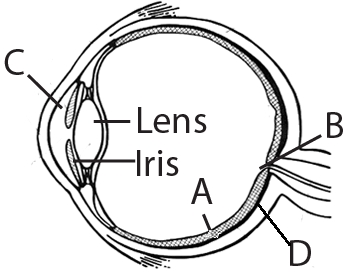
Parts $A, B, C$ and $D$ of the human eye are shown in the diagram. Select the option which gives correct identification along with its functions/characteristics.
A
$C$ - Aqueous chamber - Reflects the light which does not pass through the lens.
B
$D$ - Choroid - Its anterior part forms ciliary body.
C
$A$ - Retina - Contains photoreceptors $i.e.$,rods and cones.
D
$B$ - Blind spot - Has only a few rods and cones.
Solution
(C) The correct option is $C$.
In the given figure:
$A$ is the retina,which is the innermost layer of the eyeball and contains photoreceptors,namely rods and cones,responsible for vision.
$B$ is the blind spot,the point where optic nerves leave the eye and retinal blood vessels enter it; it contains no photoreceptor cells.
$C$ is the aqueous chamber,which is the space between the cornea and the lens,filled with aqueous humor.
$D$ is the sclera,the outermost layer of the eyeball,which maintains the shape of the eyeball and protects the inner layers.
In the given figure:
$A$ is the retina,which is the innermost layer of the eyeball and contains photoreceptors,namely rods and cones,responsible for vision.
$B$ is the blind spot,the point where optic nerves leave the eye and retinal blood vessels enter it; it contains no photoreceptor cells.
$C$ is the aqueous chamber,which is the space between the cornea and the lens,filled with aqueous humor.
$D$ is the sclera,the outermost layer of the eyeball,which maintains the shape of the eyeball and protects the inner layers.
0 likesView Solution
78
BiologyMediumMCQNEET · 2013
The most abundant intracellular cation is
A
$H^+$
B
$K^+$
C
$Na^+$
D
$Ca^{++}$
Solution
(B) The correct answer is $B$.
$K^+$ ions are the most abundant cations found in the intracellular fluid (cytoplasm) of cells.
In contrast,$Na^+$ ions are the most abundant cations found in the extracellular fluid.
This ionic gradient is maintained by the $Na^+-K^+$ pump,which is essential for maintaining the resting membrane potential of cells.
$K^+$ ions are the most abundant cations found in the intracellular fluid (cytoplasm) of cells.
In contrast,$Na^+$ ions are the most abundant cations found in the extracellular fluid.
This ionic gradient is maintained by the $Na^+-K^+$ pump,which is essential for maintaining the resting membrane potential of cells.
0 likesView Solution
79
BiologyEasyMCQNEET · 2013
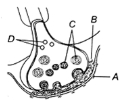
$A$ diagram showing an axon terminal and a synapse is given. Identify correctly at least two of $A - D$.
A
$A$ - Neurotransmitter,$B$ - Synaptic cleft
B
$C$ - Neurotransmitter,$D$ - $Ca^{++}$
C
$A$ - Receptor,$C$ - Synaptic vesicles
D
$B$ - Synaptic connection,$D$ - $K^+$
Solution
(C) Based on the provided diagram of the synapse:
$A$ points to the receptors located on the postsynaptic membrane.
$B$ points to the synaptic cleft,the space between the presynaptic and postsynaptic neurons.
$C$ points to the synaptic vesicles containing neurotransmitters.
$D$ points to the neurotransmitter molecules released into the synaptic cleft.
Comparing these with the options:
Option $A$ is incorrect because $A$ is a receptor,not a neurotransmitter.
Option $B$ is incorrect because $C$ is a synaptic vesicle,not a neurotransmitter.
Option $C$ is correct because $A$ is a receptor and $C$ represents synaptic vesicles.
Option $D$ is incorrect because $D$ represents neurotransmitters,not $K^+$ ions.
$A$ points to the receptors located on the postsynaptic membrane.
$B$ points to the synaptic cleft,the space between the presynaptic and postsynaptic neurons.
$C$ points to the synaptic vesicles containing neurotransmitters.
$D$ points to the neurotransmitter molecules released into the synaptic cleft.
Comparing these with the options:
Option $A$ is incorrect because $A$ is a receptor,not a neurotransmitter.
Option $B$ is incorrect because $C$ is a synaptic vesicle,not a neurotransmitter.
Option $C$ is correct because $A$ is a receptor and $C$ represents synaptic vesicles.
Option $D$ is incorrect because $D$ represents neurotransmitters,not $K^+$ ions.
0 likesView Solution
80
BiologyMediumMCQNEET · 2013
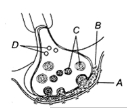
The figure shows an axon terminal and synapse. Select the option giving correct identification of labels $A-D$.
A
$A$ - Action potential,$C$ - Neurotransmitter
B
$B$ - Neurotransmitter,$D$ - Receptor capsules
C
$C$ - Receptor,$D$ - Synaptic vesicles
D
$A$ - Axon terminal,$B$ - Serotonin complex
Solution
(C) Based on the provided diagram of the synapse:
$A$ represents the Receptor on the postsynaptic membrane.
$B$ represents the Synaptic cleft.
$C$ represents the Synaptic vesicles containing neurotransmitters.
$D$ represents the Neurotransmitter molecules being released.
However,evaluating the standard $NCERT$ diagram for this structure:
$A$ is the Receptor.
$B$ is the Synaptic cleft.
$C$ is the Synaptic vesicle.
$D$ is the Neurotransmitter.
Given the options provided,option $(c)$ is the most appropriate identification where $C$ is identified as a Receptor (or vesicle component) and $D$ as Synaptic vesicles,though there is a slight discrepancy in standard labeling. Based on the provided solution key,$(c)$ is the intended answer.
$A$ represents the Receptor on the postsynaptic membrane.
$B$ represents the Synaptic cleft.
$C$ represents the Synaptic vesicles containing neurotransmitters.
$D$ represents the Neurotransmitter molecules being released.
However,evaluating the standard $NCERT$ diagram for this structure:
$A$ is the Receptor.
$B$ is the Synaptic cleft.
$C$ is the Synaptic vesicle.
$D$ is the Neurotransmitter.
Given the options provided,option $(c)$ is the most appropriate identification where $C$ is identified as a Receptor (or vesicle component) and $D$ as Synaptic vesicles,though there is a slight discrepancy in standard labeling. Based on the provided solution key,$(c)$ is the intended answer.
0 likesView Solution
81
BiologyMediumMCQNEET · 2013
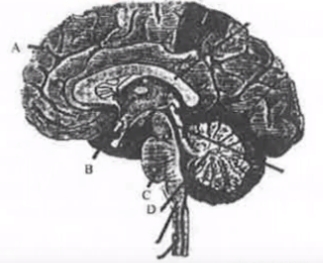
$A$ sagittal section of the human brain is shown here. Identify at least two labels from $A-D$.
A
$C$ - Midbrain,$D$ - Cerebellum
B
$A$ - Cerebrum,$C$ - Pons
C
$B$ - Corpus callosum,$D$ - Medulla
D
$A$ - Cerebral hemispheres,$B$ - Cerebellum
Solution
(B) Based on the provided sagittal section of the human brain:
$A$ represents the Cerebral hemisphere (part of the forebrain).
$B$ represents the Thalamus (part of the forebrain).
$C$ represents the Pons varolii (part of the hindbrain).
$D$ represents the Cerebellum (part of the hindbrain).
Therefore,option $B$ correctly identifies $A$ as the Cerebrum (Cerebral hemisphere) and $C$ as the Pons.
$A$ represents the Cerebral hemisphere (part of the forebrain).
$B$ represents the Thalamus (part of the forebrain).
$C$ represents the Pons varolii (part of the hindbrain).
$D$ represents the Cerebellum (part of the hindbrain).
Therefore,option $B$ correctly identifies $A$ as the Cerebrum (Cerebral hemisphere) and $C$ as the Pons.
0 likesView Solution
82
BiologyMediumMCQNEET · 2013
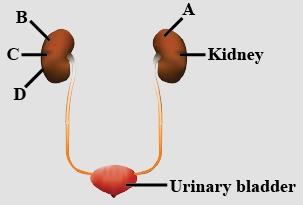
The figure shows the human urinary system with structures labelled $A$ to $D$. Select the option which correctly identifies them and gives their characteristics and/or functions.
A
$C$ - Medulla: inner zone of the kidney and contains complete nephrons.
B
$D$ - Cortex: outer part of the kidney and does not contain any part of the nephrons.
C
$A$ - Adrenal gland: located at the anterior part of the kidney. It secretes catecholamines which stimulate glycogen breakdown.
D
$B$ - Pelvis: broad funnel-shaped space inner to the hilum, directly connected to the loops of Henle.
Solution
(C) : In the given figure, $A$ is the adrenal gland which secretes two catecholamines; adrenaline (epinephrine) and noradrenaline (norepinephrine). Adrenaline increases the conversion of glycogen to glucose, providing quick energy for the "fight or flight" response. $B$ is the renal pelvis, which is a sac-like cavity of the kidney leading to the ureters; it is not directly connected to the loop of Henle. $C$ is the medulla, the inner region of the kidney containing the loop of Henle, collecting ducts, and ducts of Bellini. $D$ is the cortex, which has proximal and distal convoluted tubules and contains Malpighian corpuscles.
0 likesView Solution
83
BiologyMediumMCQNEET · 2013
$A$ pregnant female delivers a baby who suffers from stunted growth,mental retardation,low intelligence quotient,and abnormal skin. This is the result of:
A
cancer of the thyroid gland
B
oversecretion of pars distalis
C
deficiency of iodine in diet
D
low secretion of growth hormone
Solution
(C) The correct answer is $C$. Iodine is essential for the synthesis of thyroid hormones $T_3$ and $T_4$.
Iodine binds to tyrosine residues in thyroglobulin,which is then processed to form triiodothyronine $(T_3)$ and thyroxine $(T_4)$.
If a pregnant female has a deficiency of iodine in her diet,it leads to improper synthesis of thyroid hormones in the developing fetus.
The deficiency of thyroid hormones in infants results in a condition known as 'cretinism'.
The symptoms of cretinism include stunted growth,mental retardation,low intelligence quotient,abnormal skin,and deaf-mutism.
Iodine binds to tyrosine residues in thyroglobulin,which is then processed to form triiodothyronine $(T_3)$ and thyroxine $(T_4)$.
If a pregnant female has a deficiency of iodine in her diet,it leads to improper synthesis of thyroid hormones in the developing fetus.
The deficiency of thyroid hormones in infants results in a condition known as 'cretinism'.
The symptoms of cretinism include stunted growth,mental retardation,low intelligence quotient,abnormal skin,and deaf-mutism.
0 likesView Solution
84
BiologyMediumMCQNEET · 2013
Which of the following statements is correct in relation to the endocrine system?
A
Non-nutrient chemicals produced by the body in trace amounts that act as intercellular messenger are known as hormones.
B
Releasing and inhibitory hormones are produced by the pituitary gland.
C
Adenohypophysis is under direct neural regulation of the hypothalamus.
D
Organs in the body like gastrointestinal tract,heart,kidney and liver do not produce any hormones.
Solution
(A) : Hormones are non-nutrient chemicals which act as intercellular messengers and are produced in trace amounts.
$B$: Releasing and inhibitory hormones are produced by the hypothalamus,not the pituitary gland.
$C$: The adenohypophysis is under the control of hypothalamic hormones via the hypophyseal portal system,whereas the neurohypophysis is under direct neural regulation.
$D$: Several organs like the gastrointestinal tract,heart,kidney,and liver produce hormones (e.g.,$ANF$ from the heart,erythropoietin from the kidney).
$B$: Releasing and inhibitory hormones are produced by the hypothalamus,not the pituitary gland.
$C$: The adenohypophysis is under the control of hypothalamic hormones via the hypophyseal portal system,whereas the neurohypophysis is under direct neural regulation.
$D$: Several organs like the gastrointestinal tract,heart,kidney,and liver produce hormones (e.g.,$ANF$ from the heart,erythropoietin from the kidney).
0 likesView Solution
85
BiologyMediumMCQNEET · 2013
Select the answer which correctly matches the endocrine gland with the hormone it secretes and its function/deficiency symptom.
A
Thyroid gland $\to$ Thyroxine $\to$ Lack of iodine in diet results in goitre
B
Corpus luteum $\to$ Testosterone $\to$ Stimulates spermatogenesis
C
Anterior pituitary $\to$ Oxytocin $\to$ Stimulates uterus contraction during childbirth
D
Posterior pituitary $\to$ Growth hormone $(GH)$ $\to$ Stimulates abnormal growth
Solution
(A) : Iodine is essential for the synthesis of thyroxine. $A$ deficiency of iodine in the diet leads to low production of thyroxine (hypothyroidism) and enlargement of the thyroid gland,a condition known as goitre.
$B$: Corpus luteum secretes progesterone,not testosterone. Progesterone is essential for maintaining the endometrium.
$C$: Oxytocin is synthesized by the hypothalamus and stored/released by the posterior pituitary,not the anterior pituitary.
$D$: Growth hormone $(GH)$ is secreted by the anterior pituitary,not the posterior pituitary.
$B$: Corpus luteum secretes progesterone,not testosterone. Progesterone is essential for maintaining the endometrium.
$C$: Oxytocin is synthesized by the hypothalamus and stored/released by the posterior pituitary,not the anterior pituitary.
$D$: Growth hormone $(GH)$ is secreted by the anterior pituitary,not the posterior pituitary.
0 likesView Solution
86
BiologyMediumMCQNEET · 2013
Select the option which correctly matches the endocrine gland with its hormone and its function.
A
Placenta $\Rightarrow$ Estrogen $\Rightarrow$ Initiates secretion of the milk
B
Corpus luteum $\Rightarrow$ Estrogen $\Rightarrow$ Essential for maintenance of endometrium
C
Leydig's cells $\Rightarrow$ Androgen $\Rightarrow$ Initiates the production of sperms
D
Ovary $\Rightarrow$ $FSH$ $\Rightarrow$ Stimulates follicular development and the secretion of estrogens
Solution
(C) : Interstitial cells (or Leydig's cells) are the cells located between the seminiferous tubules of the testis.
They secrete androgens,primarily testosterone,in response to stimulation by Luteinizing Hormone $(LH)$ from the anterior pituitary gland.
Androgens are responsible for the development and maintenance of male secondary sexual characteristics and stimulate the germinal epithelium to undergo spermatogenesis (production of sperms).
They secrete androgens,primarily testosterone,in response to stimulation by Luteinizing Hormone $(LH)$ from the anterior pituitary gland.
Androgens are responsible for the development and maintenance of male secondary sexual characteristics and stimulate the germinal epithelium to undergo spermatogenesis (production of sperms).
0 likesView Solution
87
BiologyMediumMCQNEET · 2013
Norepinephrine:
$(i)$ is released by sympathetic fibers
$(ii)$ is released by parasympathetic fibers
$(iii)$ increases the heart rate
$(iv)$ decreases blood pressure.
Which of the above statements are correct?
$(i)$ is released by sympathetic fibers
$(ii)$ is released by parasympathetic fibers
$(iii)$ increases the heart rate
$(iv)$ decreases blood pressure.
Which of the above statements are correct?
A
$(i)$ and $(iii)$
B
$(ii)$ and $(iii)$
C
$(ii)$ and $(iv)$
D
$(i)$ and $(iv)$
Solution
(A) Norepinephrine is a neurotransmitter released by the postganglionic fibers of the sympathetic nervous system.
It is also secreted by the adrenal medulla along with epinephrine.
It acts to increase the heart rate and force of contraction.
It generally causes vasoconstriction,which leads to an increase in blood pressure,not a decrease.
Therefore,statements $(i)$ and $(iii)$ are correct.
It is also secreted by the adrenal medulla along with epinephrine.
It acts to increase the heart rate and force of contraction.
It generally causes vasoconstriction,which leads to an increase in blood pressure,not a decrease.
Therefore,statements $(i)$ and $(iii)$ are correct.
0 likesView Solution
88
BiologyMediumMCQNEET · 2013
Which of the following represents the action of insulin?
A
Increases blood glucose level by stimulating glucagon production.
B
Decreases blood glucose levels by forming glycogen.
C
Increases blood glucose levels by promoting cellular uptake of glucose.
D
Increases blood glucose levels by hydrolysis of glycogen.
Solution
(B) : Insulin is a peptide hormone,secreted by the $\beta$-cells of the islets of Langerhans in the pancreas. It promotes the uptake of glucose by body cells,particularly in the liver (hepatocytes) and muscles (adipocytes). By facilitating the conversion of glucose into glycogen (glycogenesis) in the liver and muscles,it effectively lowers the blood glucose concentration.
0 likesView Solution
89
BiologyMediumMCQNEET · 2013
Seed coat is not thin and membranous in:
A
groundnut
B
gram
C
maize
D
coconut
Solution
(D) In most seeds,the seed coat is thin and membranous. However,in coconut,the seed coat is not thin and membranous; instead,it is thick and fibrous. The coconut fruit is a drupe,and the fibrous part is the mesocarp,while the seed coat is part of the hard endocarp and the seed itself.
0 likesView Solution
90
BiologyMediumMCQNEET · 2013
Satellite $RNAs$ are present in some
A
viroids
B
prions
C
bacteriophages
D
plant viruses
Solution
(D) : Plant viruses often contain parasites of their own,referred to as satellites.
Satellite $RNAs$ are highly dependent on their helper virus for both replication and encapsidation.
Their size varies from $194$ to $1500$ nucleotides (approx.).
The larger satellites contain open reading frames and express proteins,whereas smaller satellites do not produce functional proteins.
Satellite $RNAs$ are highly dependent on their helper virus for both replication and encapsidation.
Their size varies from $194$ to $1500$ nucleotides (approx.).
The larger satellites contain open reading frames and express proteins,whereas smaller satellites do not produce functional proteins.
0 likesView Solution
91
BiologyMediumMCQNEET · 2013
Infection of $Ascaris$ usually occurs by
A
Tse-tse fly
B
mosquito bite
C
drinking water containing eggs of $Ascaris$
D
eating imperfectly cooked pork
Solution
(C) $Ascaris$ infection is acquired by humans through the direct ingestion of $Ascaris$ eggs,which contain the infective second-stage larva,via contaminated food or water.
$Ascaris$ has a monogenetic life cycle.
There is no vector or intermediate host involved in its transmission.
$Ascaris$ has a monogenetic life cycle.
There is no vector or intermediate host involved in its transmission.
0 likesView Solution
92
BiologyMediumMCQNEET · 2013
Besides paddy fields,cyanobacteria are also found inside the vegetative part of
A
Equisetum
B
Psilotum
C
Pinus
D
Cycas
Solution
(D) The correct answer is $D$.
In $Cycas$,specialized roots known as coralloid roots are formed.
These roots show a symbiotic association with nitrogen-fixing cyanobacteria,such as $Nostoc$ and $Anabaena$.
Coralloid roots are irregular,negatively geotropic,and dichotomously branched,resembling coral structures.
They lack root hairs and root caps,and the cyanobacteria reside in the cortical region of these roots to provide fixed nitrogen to the plant.
In $Cycas$,specialized roots known as coralloid roots are formed.
These roots show a symbiotic association with nitrogen-fixing cyanobacteria,such as $Nostoc$ and $Anabaena$.
Coralloid roots are irregular,negatively geotropic,and dichotomously branched,resembling coral structures.
They lack root hairs and root caps,and the cyanobacteria reside in the cortical region of these roots to provide fixed nitrogen to the plant.
0 likesView Solution
93
BiologyMediumMCQNEET · 2013
Which two distinct microbial processes are responsible for the release of fixed nitrogen as dinitrogen gas $(N_2)$ to the atmosphere?
A
Aerobic nitrate oxidation and nitrite reduction
B
Decomposition of organic nitrogen and conversion of dinitrogen to ammonium compounds
C
Enteric fermentation in cattle and nitrogen fixation by Rhizobium in root nodules of legumes
D
Anaerobic ammonium oxidation and denitrification.
Solution
(D) : Denitrification is a biological process in which nitrates $(NO_3^-)$ in the soil are reduced to molecular nitrogen $(N_2)$ gas, which is then released into the atmosphere. This process is carried out by denitrifying bacteria such as $Pseudomonas \text{ } denitrificans$ and $Thiobacillus \text{ } denitrificans$. Additionally, the anaerobic oxidation of ammonium $(NH_4^+)$, also known as the $Anammox$ process, involves the conversion of ammonium and nitrite directly into dinitrogen gas $(N_2)$ under anaerobic conditions.
0 likesView Solution
94
BiologyMediumMCQNEET · 2013
Which of the following statements is correct?
A
The gametophyte of Pteridophytes has a prothallus and a leafy stage.
B
The female gametophyte of Gymnosperms is free-living.
C
Antheridiophores and archegoniophores are present in Pteridophytes.
D
The precursor of seed habit is found in Pteridophytes.
Solution
(D) In Pteridophytes,the gametophyte (prothallus) is small but multicellular,free-living,and mostly photosynthetic. Some Pteridophytes like Selaginella exhibit heterospory,which is considered a precursor to the seed habit. Option $A$ is incorrect because the prothallus is the gametophyte itself,not a stage within it. Option $B$ is incorrect because the female gametophyte in Gymnosperms is retained within the megasporangium and is not free-living. Option $C$ is incorrect as these structures are typically associated with Bryophytes (like Marchantia). Therefore,option $D$ is the correct statement.
0 likesView Solution
95
BiologyMediumMCQNEET · 2013
Cycas and Adiantum resemble each other in having:
A
Seeds
B
Motile male gametes
C
Cambium
D
Vascular tissues
Solution
(B) Cycas is a gymnosperm,and Adiantum is a pteridophyte (fern).
Both Cycas and Adiantum possess motile male gametes (antherozoids) that require water or a fluid medium to reach the female gamete for fertilization.
While both have vascular tissues,the presence of motile male gametes is a specific shared characteristic often highlighted in evolutionary biology comparisons between these groups.
Seeds are present in Cycas but absent in Adiantum.
Cambium is present in Cycas but absent in Adiantum.
Both Cycas and Adiantum possess motile male gametes (antherozoids) that require water or a fluid medium to reach the female gamete for fertilization.
While both have vascular tissues,the presence of motile male gametes is a specific shared characteristic often highlighted in evolutionary biology comparisons between these groups.
Seeds are present in Cycas but absent in Adiantum.
Cambium is present in Cycas but absent in Adiantum.
0 likesView Solution
96
BiologyMediumMCQNEET · 2013
Read the following statements and answer the question based on them:
$(1)$ In liverworts,mosses,and ferns,the gametophyte is free-living.
$(2)$ Gymnosperms and some ferns are heterosporous.
$(3)$ Sexual reproduction in Fucus,Volvox,and Albugo is oogamous.
$(4)$ The sporophyte in liverworts is more elaborate than in mosses.
How many of the above statements are correct?
$(1)$ In liverworts,mosses,and ferns,the gametophyte is free-living.
$(2)$ Gymnosperms and some ferns are heterosporous.
$(3)$ Sexual reproduction in Fucus,Volvox,and Albugo is oogamous.
$(4)$ The sporophyte in liverworts is more elaborate than in mosses.
How many of the above statements are correct?
A
$1$
B
$2$
C
$3$
D
$4$
Solution
(C) Statement $(1)$ is correct: In bryophytes (liverworts and mosses) and pteridophytes (ferns),the gametophyte phase is free-living.
Statement $(2)$ is correct: Gymnosperms are heterosporous,and some pteridophytes like Selaginella and Salvinia are also heterosporous.
Statement $(3)$ is correct: In Fucus (algae),Volvox (algae),and Albugo (fungi),sexual reproduction is of the oogamous type.
Statement $(4)$ is incorrect: The sporophyte in mosses is more elaborate than in liverworts.
Therefore,there are $3$ correct statements.
Statement $(2)$ is correct: Gymnosperms are heterosporous,and some pteridophytes like Selaginella and Salvinia are also heterosporous.
Statement $(3)$ is correct: In Fucus (algae),Volvox (algae),and Albugo (fungi),sexual reproduction is of the oogamous type.
Statement $(4)$ is incorrect: The sporophyte in mosses is more elaborate than in liverworts.
Therefore,there are $3$ correct statements.
0 likesView Solution
97
BiologyMediumMCQNEET · 2013
In paddy fields,cyanobacteria are found in the vegetative parts of ..........
A
Pinus
B
Cycas
C
Equisetum
D
Psilotum
Solution
(B) Cyanobacteria,specifically $Anabaena$ and $Nostoc$,form a symbiotic association with the coralloid roots of $Cycas$.
These cyanobacteria fix atmospheric nitrogen,which is beneficial for the plant.
Therefore,in paddy fields or other environments,cyanobacteria are commonly found associated with the coralloid roots of $Cycas$.
These cyanobacteria fix atmospheric nitrogen,which is beneficial for the plant.
Therefore,in paddy fields or other environments,cyanobacteria are commonly found associated with the coralloid roots of $Cycas$.
0 likesView Solution
98
BiologyMediumMCQNEET · 2013
In which of the following is the seed coat not thin and membranous?
A
Maize
B
Coconut
C
Groundnut
D
Gram
Solution
(D) In most monocots like maize $(Zea \, mays)$, the seed coat is membranous and generally fused with the fruit wall. In dicots like gram $(Cicer \, arietinum)$, groundnut $(Arachis \, hypogaea)$, and coconut $(Cocos \, nucifera)$, the seed coat is distinct, thick, and not membranous. However, specifically in the context of $NCERT$ biology, the seed coat of maize is described as membranous and fused with the fruit wall. Among the given options, the seed coat of maize is thin and membranous, whereas in gram, groundnut, and coconut, it is not thin and membranous. Given the standard textbook phrasing, the question asks for the exception where the seed coat is not thin and membranous. Since maize is the classic example of a membranous seed coat, the other options (gram, groundnut, coconut) fit the criteria of having a non-membranous seed coat. However, in many competitive exams, 'Maize' is the correct answer for having a thin, membranous seed coat. If the question asks where it is $NOT$ thin and membranous, any of the others would technically be correct. Based on standard curriculum, 'Maize' is the intended answer for having a membranous seed coat.
0 likesView Solution
99
BiologyMediumMCQNEET · 2013
In $China$ $rose$,the flowers are ..........
A
Actinomorphic,hypogynous and show twisted aestivation.
B
Actinomorphic,epigynous and show valvate aestivation.
C
Zygomorphic,hypogynous and show imbricate aestivation.
D
Zygomorphic,epigynous and show twisted aestivation.
Solution
(A) In $China$ $rose$ ($Hibiscus$ $rosa-sinensis$):
$1$. The flowers are $Actinomorphic$ (radial symmetry),which means they can be divided into two equal radial halves in any radial plane passing through the center.
$2$. The flowers are $Hypogynous$,meaning the ovary is superior and other floral parts (sepals,petals,stamens) are situated below the ovary.
$3$. The aestivation is $Twisted$,where one margin of the sepal or petal overlaps that of the next one and so on.
$1$. The flowers are $Actinomorphic$ (radial symmetry),which means they can be divided into two equal radial halves in any radial plane passing through the center.
$2$. The flowers are $Hypogynous$,meaning the ovary is superior and other floral parts (sepals,petals,stamens) are situated below the ovary.
$3$. The aestivation is $Twisted$,where one margin of the sepal or petal overlaps that of the next one and so on.
0 likesView Solution
100
BiologyMediumMCQNEET · 2013
Among bitter gourd,mustard,brinjal,pumpkin,China rose,lupin,cucumber,sunn hemp,gram,guava,bean,chilli,plum,Petunia,tomato,rose,Withania,potato,onion,Aloe,and tulip,how many plants have hypogynous flowers?
A
$18$
B
$6$
C
$10$
D
$15$
Solution
(D) Hypogynous flowers are those in which the gynoecium occupies the highest position while the other parts are situated below it. This is characteristic of superior ovaries.
$1$. Bitter gourd: Epigynous
$2$. Mustard: Hypogynous
$3$. Brinjal: Hypogynous
$4$. Pumpkin: Epigynous
$5$. China rose: Hypogynous
$6$. Lupin: Hypogynous
$7$. Cucumber: Epigynous
$8$. Sunn hemp: Hypogynous
$9$. Gram: Hypogynous
$10$. Guava: Epigynous
$11$. Bean: Hypogynous
$12$. Chilli: Hypogynous
$13$. Plum: Perigynous
$14$. Petunia: Hypogynous
$15$. Tomato: Hypogynous
$16$. Rose: Perigynous
$17$. Withania: Hypogynous
$18$. Potato: Hypogynous
$19$. Onion: Hypogynous
$20$. Aloe: Hypogynous
$21$. Tulip: Hypogynous
Counting the hypogynous ones: Mustard,Brinjal,China rose,Lupin,Sunn hemp,Gram,Bean,Chilli,Petunia,Tomato,Withania,Potato,Onion,Aloe,and Tulip. Total = $15$.
$1$. Bitter gourd: Epigynous
$2$. Mustard: Hypogynous
$3$. Brinjal: Hypogynous
$4$. Pumpkin: Epigynous
$5$. China rose: Hypogynous
$6$. Lupin: Hypogynous
$7$. Cucumber: Epigynous
$8$. Sunn hemp: Hypogynous
$9$. Gram: Hypogynous
$10$. Guava: Epigynous
$11$. Bean: Hypogynous
$12$. Chilli: Hypogynous
$13$. Plum: Perigynous
$14$. Petunia: Hypogynous
$15$. Tomato: Hypogynous
$16$. Rose: Perigynous
$17$. Withania: Hypogynous
$18$. Potato: Hypogynous
$19$. Onion: Hypogynous
$20$. Aloe: Hypogynous
$21$. Tulip: Hypogynous
Counting the hypogynous ones: Mustard,Brinjal,China rose,Lupin,Sunn hemp,Gram,Bean,Chilli,Petunia,Tomato,Withania,Potato,Onion,Aloe,and Tulip. Total = $15$.
0 likesView Solution
101
BiologyMediumMCQNEET · 2013
Which of the following statements is not true about somatic embryogenesis?
A
The pattern of development of a somatic embryo is comparable to that of a zygotic embryo.
B
Somatic embryos can develop from microspores.
C
Somatic embryo is induced usually by an auxin such as $2, 4-D$.
D
$A$ somatic embryo develops from a somatic cell.
Solution
(B) is the correct answer. Somatic embryos develop from somatic cells,not from microspores. Their development is comparable to that of a zygotic embryo. They are similar to a normal embryo except that their development is induced from a diploid somatic cell. Somatic embryo culture is typically induced by a high concentration of an auxin,such as $2, 4-D$. Microspores are haploid cells that give rise to pollen grains,not somatic embryos.
0 likesView Solution
102
BiologyMediumMCQNEET · 2013
$A$ good producer of citric acid is
A
Clostridium
B
Saccharomyces
C
Aspergillus
D
Pseudomonas
Solution
(C) good producer of citric acid is $Aspergillus$ $niger$.
$Clostridium$ $butylicum$ is used for the production of butyric acid.
$Saccharomyces$ $cerevisiae$ is used for the commercial production of ethanol.
$Pseudomonas$ is known for producing alkaline proteases.
$Clostridium$ $butylicum$ is used for the production of butyric acid.
$Saccharomyces$ $cerevisiae$ is used for the commercial production of ethanol.
$Pseudomonas$ is known for producing alkaline proteases.
0 likesView Solution
103
BiologyMediumMCQNEET · 2013
The microbe used for the biocontrol of pest butterfly caterpillars is:
A
$Saccharomyces \text{ } cerevisiae$
B
$Bacillus \text{ } thuringiensis$
C
$Streptococcus \text{ } sp.$
D
$Trichoderma \text{ } sp.$
Solution
(B) : Biopesticides are biological agents used for the control of weeds, insects, and pathogens. The microorganisms used as biopesticides include viruses, bacteria, protozoa, fungi, and mites. Some of these are used on a commercial scale. The most important example is the soil bacterium, $Bacillus \text{ } thuringiensis$ $(Bt)$. Spores of this bacterium produce an insecticidal $Cry$ protein. When ingested by butterfly caterpillars, these spores release the toxin, which kills the larvae.
0 likesView Solution
104
BiologyMediumMCQNEET · 2013
Which of the following $Bt$ crops is being grown in India by the farmers?
A
Brinjal
B
Soybean
C
Maize
D
Cotton
Solution
(D) $Bt$ toxin genes were isolated from $Bacillus$ $thuringiensis$ and incorporated into several crop plants,such as cotton.
The choice of genes depends upon the crop and the targeted pest,as most $Bt$ toxins are insect-group specific.
The toxin is coded by a gene named $cry$. There are numerous such genes.
Two $cry$ genes,$cryIAc$ and $cryIIAb$,have been incorporated into cotton.
The genetically modified crop is called $Bt$ cotton as it contains $Bt$ toxin genes that provide resistance against cotton bollworms.
The choice of genes depends upon the crop and the targeted pest,as most $Bt$ toxins are insect-group specific.
The toxin is coded by a gene named $cry$. There are numerous such genes.
Two $cry$ genes,$cryIAc$ and $cryIIAb$,have been incorporated into cotton.
The genetically modified crop is called $Bt$ cotton as it contains $Bt$ toxin genes that provide resistance against cotton bollworms.
0 likesView Solution
105
BiologyMediumMCQNEET · 2013
$RNA$ interference involves
A
synthesis of $cDNA$ and $RNA$ using reverse transcriptase
B
silencing of specific $mRNA$ due to complementary $RNA$
C
interference of $RNA$ in synthesis of $DNA$
D
synthesis of $mRNA$ from $DNA$
Solution
(B) $RNA$ interference $(RNAi)$ is a biological process in which $RNA$ molecules inhibit gene expression or translation,by neutralizing targeted $mRNA$ molecules.
This method involves the silencing of a specific $mRNA$ due to a complementary $dsRNA$ molecule.
The complementary $dsRNA$ binds to the target $mRNA$,preventing its translation and thereby causing its silencing.
This mechanism serves as a method of cellular defense in all eukaryotic organisms.
This method involves the silencing of a specific $mRNA$ due to a complementary $dsRNA$ molecule.
The complementary $dsRNA$ binds to the target $mRNA$,preventing its translation and thereby causing its silencing.
This mechanism serves as a method of cellular defense in all eukaryotic organisms.
0 likesView Solution
106
BiologyMediumMCQNEET · 2013
Which one of the following vectors is used to replace the defective gene in gene therapy?
A
Adenovirus
B
Cosmid
C
$Ri$ plasmid
D
$Ti$ plasmid
Solution
(A) : Gene therapy is a corrective therapy used to treat diseases caused by genetic defects.
In this process,functional genes are inserted into a patient's cells or tissues to replace or compensate for the defective gene.
Viral vectors,such as $Adenovirus$ or $Retrovirus$,are commonly used to deliver the normal,functional gene into the target cells because of their high efficiency in infecting human cells.
In this process,functional genes are inserted into a patient's cells or tissues to replace or compensate for the defective gene.
Viral vectors,such as $Adenovirus$ or $Retrovirus$,are commonly used to deliver the normal,functional gene into the target cells because of their high efficiency in infecting human cells.
0 likesView Solution
107
BiologyMediumMCQNEET · 2013
$A$ sedentary sea anemone gets attached to the shell lining of a hermit crab. The association is:
A
commensalism
B
amensalism
C
ectoparasitism
D
symbiosis
Solution
(D) The correct answer is $D$.
Sea anemone attaches itself to the shell of a hermit crab.
This association is a classic example of mutualism,which is a type of symbiosis.
The sea anemone provides camouflage and protection to the hermit crab using its stinging cells (nematocysts).
In return,the hermit crab provides mobility to the sea anemone,allowing it to reach new food sources.
Since both organisms derive benefit from this interaction,it is classified as symbiosis (mutualism).
Sea anemone attaches itself to the shell of a hermit crab.
This association is a classic example of mutualism,which is a type of symbiosis.
The sea anemone provides camouflage and protection to the hermit crab using its stinging cells (nematocysts).
In return,the hermit crab provides mobility to the sea anemone,allowing it to reach new food sources.
Since both organisms derive benefit from this interaction,it is classified as symbiosis (mutualism).
0 likesView Solution
108
BiologyMediumMCQNEET · 2013
$A$ biologist studied the population of rats in a barn. He found that the average natality was $250$, average mortality $240$, immigration $20$ and emigration $30$. The net increase in population is
A
$5$
B
zero
C
$10$
D
$15$
Solution
(B) The population growth is determined by the formula: $\text{Net Increase} = (\text{Natality} + \text{Immigration}) - (\text{Mortality} + \text{Emigration})$.
Natality and immigration are factors that increase the population size.
Mortality and emigration are factors that decrease the population size.
Given values:
$\text{Natality} = 250$
$\text{Immigration} = 20$
$\text{Mortality} = 240$
$\text{Emigration} = 30$
$\text{Net Increase} = (250 + 20) - (240 + 30) = 270 - 270 = 0$.
Therefore, the net increase in the population is zero.
Natality and immigration are factors that increase the population size.
Mortality and emigration are factors that decrease the population size.
Given values:
$\text{Natality} = 250$
$\text{Immigration} = 20$
$\text{Mortality} = 240$
$\text{Emigration} = 30$
$\text{Net Increase} = (250 + 20) - (240 + 30) = 270 - 270 = 0$.
Therefore, the net increase in the population is zero.
0 likesView Solution
109
BiologyMediumMCQNEET · 2013
The age pyramid with a broad base indicates:
A
high percentage of old individuals
B
low percentage of young individuals
C
a stable population
D
high percentage of young individuals
Solution
(D) The correct answer is $D$.
An age pyramid is a graphical representation of the abundance of individuals in different age groups,with pre-reproductive individuals at the base,reproductive individuals in the middle,and post-reproductive individuals at the top.
$A$ triangular age pyramid (broad base) indicates a high proportion of pre-reproductive individuals,a moderate number of reproductive individuals,and fewer post-reproductive individuals.
This structure represents a young or rapidly growing population.
In contrast,a bell-shaped pyramid represents a stable population,and an urn-shaped pyramid represents a declining population.
An age pyramid is a graphical representation of the abundance of individuals in different age groups,with pre-reproductive individuals at the base,reproductive individuals in the middle,and post-reproductive individuals at the top.
$A$ triangular age pyramid (broad base) indicates a high proportion of pre-reproductive individuals,a moderate number of reproductive individuals,and fewer post-reproductive individuals.
This structure represents a young or rapidly growing population.
In contrast,a bell-shaped pyramid represents a stable population,and an urn-shaped pyramid represents a declining population.
0 likesView Solution
110
BiologyMediumMCQNEET · 2013
Which one of the following is not a parasitic adaptation?
A
Development of adhesive organs
B
Loss of digestive organs
C
Loss of reproductive capacity
D
Loss of unnecessary sense organs
Solution
(C) : Parasitism is a relationship between two living organisms of different species in which one organism,called the parasite,obtains its food directly from another living organism,called the host. The parasite spends a part or whole of its life either on or inside the body of the host.
The general parasitic adaptations are $(i)$ anaerobic respiration in internal parasites,$(ii)$ loss of certain unnecessary organs,$(iii)$ presence of adhesive organs,$(iv)$ excessive multiplication,$(v)$ resistant cysts and eggs for safe transfer of their progeny to new hosts,and $(vi)$ well-developed and complicated reproductive organs.
Therefore,the loss of reproductive capacity is not a parasitic adaptation; in fact,parasites typically exhibit a high reproductive capacity to ensure the survival of their species.
The general parasitic adaptations are $(i)$ anaerobic respiration in internal parasites,$(ii)$ loss of certain unnecessary organs,$(iii)$ presence of adhesive organs,$(iv)$ excessive multiplication,$(v)$ resistant cysts and eggs for safe transfer of their progeny to new hosts,and $(vi)$ well-developed and complicated reproductive organs.
Therefore,the loss of reproductive capacity is not a parasitic adaptation; in fact,parasites typically exhibit a high reproductive capacity to ensure the survival of their species.
0 likesView Solution
111
BiologyMediumMCQNEET · 2013
Benthic organisms are affected the most by
A
light reaching the forest floor
B
surface turbulence of water
C
sediment characteristics of aquatic ecosystems
D
water-holding capacity of soil
Solution
(C) : Benthic organisms are bottom-dwelling forms found crawling on or attached to the substrate at the bottom of aquatic ecosystems. The physical and chemical characteristics of the sediment,such as particle size,organic content,and oxygen availability,directly determine the type of benthic organisms that can thrive in that specific environment.
0 likesView Solution
112
BiologyEasyMCQNEET · 2013
The natural reservoir of phosphorus is
A
rock
B
fossils
C
sea water
D
animal bones
Solution
(A) : The reservoir pool of phosphorus is found in phosphate rocks,while the cycling pool consists of soil and water for terrestrial and aquatic ecosystems,respectively.
Small amounts of phosphate are continuously added to the cycling pool through the weathering of rocks.
Phosphate is generally found in the soil in combination with calcium,iron,and aluminium.
Unlike carbon or nitrogen,an atmospheric or gaseous cycle is absent for phosphorus.
Phosphate circulates in the abiotic environment within both the lithosphere and the hydrosphere.
Small amounts of phosphate are continuously added to the cycling pool through the weathering of rocks.
Phosphate is generally found in the soil in combination with calcium,iron,and aluminium.
Unlike carbon or nitrogen,an atmospheric or gaseous cycle is absent for phosphorus.
Phosphate circulates in the abiotic environment within both the lithosphere and the hydrosphere.
0 likesView Solution
113
BiologyMediumMCQNEET · 2013
Secondary productivity is the rate of formation of new organic matter by:
A
consumers
B
decomposers
C
producers
D
parasites
Solution
(A) Secondary productivity is defined as the rate of formation of new organic matter by consumers.
It represents the amount of energy stored as biomass by heterotrophs (consumers) after accounting for the energy lost through respiration and other metabolic processes.
Primary productivity is associated with producers (plants),whereas secondary productivity is associated with consumers that feed on these producers or other consumers.
It represents the amount of energy stored as biomass by heterotrophs (consumers) after accounting for the energy lost through respiration and other metabolic processes.
Primary productivity is associated with producers (plants),whereas secondary productivity is associated with consumers that feed on these producers or other consumers.
0 likesView Solution
114
BiologyMediumMCQNEET · 2013
Which one of the following processes during decomposition is correctly described?
A
Catabolism - Last step in the decomposition under fully anaerobic condition
B
Leaching - Water soluble inorganic nutrients rise to the top layers of soil
C
Fragmentation - Carried out by organisms such as earthworm
D
Humification - Leads to the accumulation of a dark coloured substance humus which undergoes microbial action at a very fast rate.
Solution
(C) : Decomposition is the process in which decomposers break down complex organic matter into inorganic substances like carbon dioxide,water,and nutrients.
The important steps in the process of decomposition are fragmentation,leaching,catabolism,humification,and mineralisation.
Detritivores (e.g.,earthworm) break down detritus into smaller particles. This process is called fragmentation.
By the process of leaching,water-soluble inorganic nutrients go down into the soil horizon and get precipitated as unavailable salts.
Bacterial and fungal enzymes degrade detritus into simpler inorganic substances. This process is called catabolism.
Humification leads to the accumulation of a dark-coloured amorphous substance called humus that is highly resistant to microbial action and undergoes decomposition at an extremely slow rate.
The humus is further degraded by some microbes and the release of inorganic nutrients occurs by the process known as mineralisation.
The important steps in the process of decomposition are fragmentation,leaching,catabolism,humification,and mineralisation.
Detritivores (e.g.,earthworm) break down detritus into smaller particles. This process is called fragmentation.
By the process of leaching,water-soluble inorganic nutrients go down into the soil horizon and get precipitated as unavailable salts.
Bacterial and fungal enzymes degrade detritus into simpler inorganic substances. This process is called catabolism.
Humification leads to the accumulation of a dark-coloured amorphous substance called humus that is highly resistant to microbial action and undergoes decomposition at an extremely slow rate.
The humus is further degraded by some microbes and the release of inorganic nutrients occurs by the process known as mineralisation.
0 likesView Solution
115
BiologyMediumMCQNEET · 2013
Which of the following is a primary consumer in a maize field ecosystem?
A
Grasshopper
B
Wolf
C
Phytoplankton
D
Lion
Solution
(A) The correct answer is $A$.
Primary consumers are herbivorous organisms that feed directly on producers (plants).
In a maize field ecosystem,maize plants act as producers.
Grasshoppers are herbivores that feed on these maize plants,making them primary consumers.
Wolf and lion are carnivores,which act as secondary or tertiary consumers.
Phytoplanktons are producers found in aquatic ecosystems,not in a maize field.
Primary consumers are herbivorous organisms that feed directly on producers (plants).
In a maize field ecosystem,maize plants act as producers.
Grasshoppers are herbivores that feed on these maize plants,making them primary consumers.
Wolf and lion are carnivores,which act as secondary or tertiary consumers.
Phytoplanktons are producers found in aquatic ecosystems,not in a maize field.
0 likesView Solution
116
BiologyMediumMCQNEET · 2013
When a man eats a fish which feeds on zooplanktons which have eaten small plants,the producer in this chain is:
A
small plants
B
fish
C
man
D
zooplankton
Solution
(A) : The transfer of food energy from producers to consumers through a series of organisms with repeated eating and being eaten is known as a food chain.
Green plants are always the first link of a food chain because they alone are capable of synthesizing organic food by using light energy through photosynthesis.
In the given chain: Small plants (Producers) $\rightarrow$ Zooplanktons (Primary Consumers) $\rightarrow$ Fish (Secondary Consumers) $\rightarrow$ Man (Tertiary Consumer).
Therefore,the producer in this chain is small plants.
Green plants are always the first link of a food chain because they alone are capable of synthesizing organic food by using light energy through photosynthesis.
In the given chain: Small plants (Producers) $\rightarrow$ Zooplanktons (Primary Consumers) $\rightarrow$ Fish (Secondary Consumers) $\rightarrow$ Man (Tertiary Consumer).
Therefore,the producer in this chain is small plants.
0 likesView Solution
117
BiologyMediumMCQNEET · 2013
Which one of the following is not used for ex situ plant conservation?
A
Shifting cultivation
B
Botanical gardens
C
Field gene banks
D
Seed banks
Solution
(A) : Ex situ conservation is the conservation of selected rare plants or animals in places outside their natural habitats. It includes botanical gardens, zoological parks, seed banks, cryopreservation, field gene banks, and tissue culture.
Shifting cultivation is an agricultural practice where land is cleared and cultivated for a short period, which often leads to deforestation and loss of biodiversity, rather than its conservation.
Botanical gardens, field gene banks, and seed banks are all established methods used for the ex situ conservation of plant species.
Shifting cultivation is an agricultural practice where land is cleared and cultivated for a short period, which often leads to deforestation and loss of biodiversity, rather than its conservation.
Botanical gardens, field gene banks, and seed banks are all established methods used for the ex situ conservation of plant species.
0 likesView Solution
118
BiologyMediumMCQNEET · 2013
Which of the following represent the maximum number of species among global biodiversity?
A
Fungi
B
Mosses and Ferns
C
Algae
D
Lichens
Solution
(A) The correct answer is $A$.
According to global biodiversity estimates,$Fungi$ represent the largest group of species among the options provided.
$Fungi$ are achlorophyllous,heterotrophic,spore-forming,non-vascular,eukaryotic organisms that possess chitin in their cell walls and store food as glycogen.
They act as major decomposers in various ecosystems and play a crucial role in nutrient cycling.
According to global biodiversity estimates,$Fungi$ represent the largest group of species among the options provided.
$Fungi$ are achlorophyllous,heterotrophic,spore-forming,non-vascular,eukaryotic organisms that possess chitin in their cell walls and store food as glycogen.
They act as major decomposers in various ecosystems and play a crucial role in nutrient cycling.
0 likesView Solution
119
BiologyEasyMCQNEET · 2013
Which of the following has maximum genetic diversity in India?
A
Mango
B
Wheat
C
Groundnut
D
Rice
Solution
(D) The correct answer is $D$.
Genetic diversity refers to the variation in the number and types of genes, as well as chromosomes, present in different species and the variations in genes and their alleles within the same species.
In India, $Oryza \text{ } sativa$ (rice) exhibits the highest genetic diversity.
There are more than $50,000$ genetically different strains of rice in India alone, which is a prime example of high genetic diversity within a single species.
Genetic diversity refers to the variation in the number and types of genes, as well as chromosomes, present in different species and the variations in genes and their alleles within the same species.
In India, $Oryza \text{ } sativa$ (rice) exhibits the highest genetic diversity.
There are more than $50,000$ genetically different strains of rice in India alone, which is a prime example of high genetic diversity within a single species.
0 likesView Solution
120
BiologyMediumMCQNEET · 2013
Which organization publishes the 'Red Data Book'?
A
$IUCN$
B
$UNEP$
C
$WWF$
D
$GEF$
Solution
(A) $(A) : IUCN$ stands for International Union for Conservation of Nature and Natural Resources,which is now known as the World Conservation Union $(WCU)$.
Its headquarters are located in Gland,Switzerland.
It maintains the 'Red Data Book' or 'Red List',which is a catalogue of taxa (species) facing the risk of extinction.
The 'Red Data Book' or 'Red List' was initiated in $1963$.
The $2000$ Red List provided an assessment of $18,000$ species.
Its headquarters are located in Gland,Switzerland.
It maintains the 'Red Data Book' or 'Red List',which is a catalogue of taxa (species) facing the risk of extinction.
The 'Red Data Book' or 'Red List' was initiated in $1963$.
The $2000$ Red List provided an assessment of $18,000$ species.
0 likesView Solution
121
BiologyEasyMCQNEET · 2013
The Kyoto Protocol was endorsed at:
A
$CoP-6$
B
$CoP-4$
C
$CoP-3$
D
$CoP-5$
Solution
(C) The Kyoto Protocol is an international treaty aimed at reducing the emission of greenhouse gases.
It was adopted at the third session of the Conference of Parties $(CoP-3)$ to the $UNFCCC$ (United Nations Framework Convention on Climate Change) in $1997$,held in Kyoto,Japan.
It was adopted at the third session of the Conference of Parties $(CoP-3)$ to the $UNFCCC$ (United Nations Framework Convention on Climate Change) in $1997$,held in Kyoto,Japan.
0 likesView Solution
122
BiologyMediumMCQNEET · 2013
Global warming can be controlled by
A
increasing deforestation,slowing down the growth of human population
B
increasing deforestation,reducing efficiency of energy usage
C
reducing deforestation,cutting down use of fossil fuel
D
reducing reforestation,increasing the use of fossil fuel
Solution
(C) Global warming is primarily caused by the increase in greenhouse gases like $CO_2$ in the atmosphere.
$1$. Reducing deforestation helps in maintaining forest cover,which acts as a carbon sink by absorbing $CO_2$ through photosynthesis.
$2$. Cutting down the use of fossil fuels (like coal,oil,and natural gas) reduces the emission of $CO_2$ and other greenhouse gases,thereby mitigating the greenhouse effect.
Therefore,option $C$ is the correct method to control global warming.
$1$. Reducing deforestation helps in maintaining forest cover,which acts as a carbon sink by absorbing $CO_2$ through photosynthesis.
$2$. Cutting down the use of fossil fuels (like coal,oil,and natural gas) reduces the emission of $CO_2$ and other greenhouse gases,thereby mitigating the greenhouse effect.
Therefore,option $C$ is the correct method to control global warming.
0 likesView Solution
123
BiologyEasyMCQNEET · 2013
The Air (Prevention and Control of Pollution) Act came into force in:
A
$1985$
B
$1990$
C
$1975$
D
$1981$
Solution
(D) The Air (Prevention and Control of Pollution) Act was enacted in $1981$ to provide for the prevention,control,and abatement of air pollution in India. It was later amended in $1987$ to include noise as an air pollutant.
0 likesView Solution
124
BiologyEasyMCQNEET · 2013
The second commitment period for the Kyoto Protocol was decided at
A
Durban
B
Bali
C
Doha
D
Cancun
Solution
(C) The correct answer is $C$.
International conferences held in Kyoto, Japan, established commitments from various countries to reduce overall greenhouse gas emissions to a level $5\%$ below that of $1990$ for the period $2008-2012$.
In Doha, Qatar, on $8^{th}$ December $2012$, the "Doha Amendment to the Kyoto Protocol" was adopted.
The second commitment period spans from $1^{st}$ January $2013$ to $31^{st}$ December $2020$.
International conferences held in Kyoto, Japan, established commitments from various countries to reduce overall greenhouse gas emissions to a level $5\%$ below that of $1990$ for the period $2008-2012$.
In Doha, Qatar, on $8^{th}$ December $2012$, the "Doha Amendment to the Kyoto Protocol" was adopted.
The second commitment period spans from $1^{st}$ January $2013$ to $31^{st}$ December $2020$.
0 likesView Solution
125
BiologyMediumMCQNEET · 2013
The climate of the world is threatened by
A
decreasing amount of atmospheric oxygen
B
increasing amount of atmospheric carbon dioxide
C
decreasing amount of atmospheric carbon dioxide
D
increasing concentration of atmospheric oxygen
Solution
(B) : Carbon dioxide is a greenhouse gas with a warming effect of $60\%$. Greenhouse gases are essential for keeping the Earth warm and hospitable. They prevent a substantial part of long-wave radiations emitted by the Earth from escaping into space and radiate a part of this energy back to the Earth. This phenomenon is called the greenhouse effect. Because of the greenhouse effect,the mean annual temperature of the Earth is $15^{\circ}C$. Recently,the concentration of greenhouse gases has started rising,which is resulting in an increase in the mean global temperature. This is called global warming. Deforestation has reduced carbon dioxide assimilation,causing excess $CO_2$ to remain in the air. Excessive use of fossil fuels is adding more $CO_2$ to the atmosphere,which intensifies the greenhouse effect.
0 likesView Solution
126
BiologyMediumMCQNEET · 2013
Which one of the following is not correct with regard to the harmful effects of particulate matter of the size $2.5 \ \mu m$ or less?
A
It can cause respiratory problems.
B
It can directly enter into our circulatory system.
C
It can cause inflammation and damage to the lungs.
D
It can be inhaled into the lungs.
Solution
(B) $PM\ 2.5$ refers to particulate matter with a diameter of $2.5 \ \mu m$ or less. These particles are considered the most harmful to human health according to the Central Pollution Control Board $(CPCB)$.
They are small enough to be inhaled deep into the lungs,where they cause respiratory problems,irritation,inflammation,and damage to lung tissues,potentially leading to premature death.
While they significantly impact the respiratory system,they do not directly enter the circulatory system; their effects on the circulatory system are indirect,occurring through the respiratory pathway.
Therefore,the statement that they can directly enter the circulatory system is incorrect.
They are small enough to be inhaled deep into the lungs,where they cause respiratory problems,irritation,inflammation,and damage to lung tissues,potentially leading to premature death.
While they significantly impact the respiratory system,they do not directly enter the circulatory system; their effects on the circulatory system are indirect,occurring through the respiratory pathway.
Therefore,the statement that they can directly enter the circulatory system is incorrect.
0 likesView Solution
127
BiologyMediumMCQNEET · 2013
Which of the following is true for multicellular fungi,filamentous algae,and the protonema of mosses?
A
Diplontic life cycle
B
Members of Kingdom Plantae
C
Mode of nutrition
D
Multiplication by fragmentation
Solution
(D) Multicellular fungi,filamentous algae,and the protonema of mosses all share the characteristic of reproducing through fragmentation. In this process,the body of the organism breaks into distinct pieces or fragments,and each fragment grows into a new individual. This is a common method of vegetative propagation or asexual reproduction in these groups.
0 likesView Solution
128
BiologyDifficultMCQNEET · 2013
What is the difference between perisperm and endosperm?
A
It is a haploid tissue.
B
It does not contain stored food.
C
It is a diploid tissue.
D
It is formed by the fusion of male gametes with the secondary nucleus.
Solution
(C) Perisperm is the persistent nucellus in a seed,which is diploid $(2n)$ in nature because it is derived from the maternal sporophytic tissue. In contrast,the endosperm is a triploid $(3n)$ tissue formed by the fusion of one male gamete with the secondary nucleus (double fertilization). Therefore,the key difference is that perisperm is a diploid tissue,whereas endosperm is a triploid tissue.
0 likesView Solution
129
BiologyMediumMCQNEET · 2013
What does the product of sexual reproduction generally generate?
A
Long-term viability of seeds
B
Prolonged dormancy
C
New genetic combinations leading to variation
D
Large biomass
Solution
(C) Sexual reproduction involves the fusion of male and female gametes,which are formed through meiosis.
This process involves independent assortment and crossing over,which leads to the creation of new genetic combinations in the offspring.
These genetic variations are crucial for evolution and adaptation to changing environments.
Therefore,the primary outcome of sexual reproduction is the generation of new genetic combinations that lead to variation.
This process involves independent assortment and crossing over,which leads to the creation of new genetic combinations in the offspring.
These genetic variations are crucial for evolution and adaptation to changing environments.
Therefore,the primary outcome of sexual reproduction is the generation of new genetic combinations that lead to variation.
0 likesView Solution
130
BiologyMediumMCQNEET · 2013
Select the incorrect statement:
A
Isogametes are similar in structure,function,and behavior.
B
Anisogametes differ in either structure,function,or behavior.
C
In Oomycetes,the female gamete is relatively small and motile,while the male gamete is large and non-motile.
D
Chlamydomonas exhibits both isogamy and anisogamy,and Fucus exhibits oogamy.
Solution
(C) The incorrect statement is $C$. In $Oomycetes$ (a group of water molds),the sexual reproduction is oogamous. In oogamy,the female gamete is typically large and non-motile (egg/ovum),while the male gamete is small and motile (antherozoid/sperm). The statement provided in option $C$ incorrectly reverses these characteristics. Options $A$,$B$,and $D$ are biologically correct descriptions of gametic types and reproductive strategies in algae and fungi.
0 likesView Solution
131
BiologyMediumMCQNEET · 2013
Which of the following cannot be detected by amniocentesis in a developing fetus?
A
Klinefelter syndrome
B
Sex of the fetus
C
Down syndrome
D
Jaundice
Solution
(D) Amniocentesis is a prenatal diagnostic technique used to determine chromosomal abnormalities and fetal sex by analyzing the amniotic fluid surrounding the fetus.
$1$. Klinefelter syndrome is a chromosomal disorder $(47, XXY)$ which can be detected by karyotyping cells from the amniotic fluid.
$2$. The sex of the fetus can be determined by identifying the presence of Barr bodies or by chromosomal analysis.
$3$. Down syndrome is a chromosomal disorder (Trisomy $21$) which is detectable via amniocentesis.
$4$. Jaundice is a physiological condition related to liver function and bilirubin levels,which cannot be diagnosed through the chromosomal analysis of amniotic fluid.
Therefore,the correct option is $D$.
$1$. Klinefelter syndrome is a chromosomal disorder $(47, XXY)$ which can be detected by karyotyping cells from the amniotic fluid.
$2$. The sex of the fetus can be determined by identifying the presence of Barr bodies or by chromosomal analysis.
$3$. Down syndrome is a chromosomal disorder (Trisomy $21$) which is detectable via amniocentesis.
$4$. Jaundice is a physiological condition related to liver function and bilirubin levels,which cannot be diagnosed through the chromosomal analysis of amniotic fluid.
Therefore,the correct option is $D$.
0 likesView Solution
132
BiologyMediumMCQNEET · 2013
Which of the following statements is $NOT$ true for two genes showing $50\%$ recombination frequency?
A
The genes are present on different chromosomes.
B
The genes are tightly linked.
C
The genes show independent assortment.
D
If the genes are on the same chromosome,they show more than one crossover in every meiosis.
Solution
(B) Recombination frequency of $50\%$ indicates that the genes are either located on different chromosomes or are so far apart on the same chromosome that they assort independently.
$1$. If genes are on different chromosomes,they show independent assortment.
$2$. If genes are on the same chromosome but very far apart,multiple crossovers occur,resulting in $50\%$ recombination.
$3$. Tightly linked genes show very low recombination frequency (much less than $50\%$).
Therefore,the statement that genes are tightly linked is incorrect.
$1$. If genes are on different chromosomes,they show independent assortment.
$2$. If genes are on the same chromosome but very far apart,multiple crossovers occur,resulting in $50\%$ recombination.
$3$. Tightly linked genes show very low recombination frequency (much less than $50\%$).
Therefore,the statement that genes are tightly linked is incorrect.
0 likesView Solution
133
BiologyMediumMCQNEET · 2013
In the human body,cell-mediated immunity is mediated by which of the following?
A
Erythrocytes
B
$T$-lymphocytes
C
$B$-lymphocytes
D
Thrombocytes
Solution
(B) Cell-mediated immunity $(CMI)$ is an immune response that does not involve antibodies.
Instead,it involves the activation of phagocytes,antigen-specific cytotoxic $T$-lymphocytes,and the release of various cytokines in response to an antigen.
$T$-lymphocytes are responsible for $CMI$,whereas $B$-lymphocytes are responsible for humoral immunity (antibody-mediated immunity).
Therefore,the correct option is $B$.
Instead,it involves the activation of phagocytes,antigen-specific cytotoxic $T$-lymphocytes,and the release of various cytokines in response to an antigen.
$T$-lymphocytes are responsible for $CMI$,whereas $B$-lymphocytes are responsible for humoral immunity (antibody-mediated immunity).
Therefore,the correct option is $B$.
0 likesView Solution
134
BiologyMediumMCQNEET · 2013
Which of the following gases are produced during the treatment of sewage waste?
A
Hydrogen sulfide,Methane,Nitrogen
B
Methane,Hydrogen sulfide,Carbon dioxide
C
Methane,Oxygen,Hydrogen sulfide
D
Hydrogen sulfide,Methane,Sulfur dioxide
Solution
(B) During the process of sewage treatment,specifically in the anaerobic sludge digesters,anaerobic bacteria (methanogens) act on the organic matter present in the sludge.
These bacteria produce a mixture of gases,which is known as biogas.
The primary components of this biogas are $CH_4$ (Methane),$H_2S$ (Hydrogen sulfide),and $CO_2$ (Carbon dioxide).
Therefore,the correct combination is Methane,Hydrogen sulfide,and Carbon dioxide.
These bacteria produce a mixture of gases,which is known as biogas.
The primary components of this biogas are $CH_4$ (Methane),$H_2S$ (Hydrogen sulfide),and $CO_2$ (Carbon dioxide).
Therefore,the correct combination is Methane,Hydrogen sulfide,and Carbon dioxide.
0 likesView Solution
135
BiologyMediumMCQNEET · 2013
In the context of blue-white screening,non-recombinant bacterial colonies appear blue in contrast to white recombinant colonies because:
A
Inactivation of glycosidase enzyme in recombinant bacteria.
B
Non-recombinant bacteria contain beta-galactosidase.
C
Inactivation of alpha-galactosidase insertion in non-recombinant bacteria.
D
Inactivation of alpha-galactosidase insertion in recombinant bacteria.
Solution
(B) The blue-white screening method is based on the insertional inactivation of the $lacZ$ gene.
$1$. The $lacZ$ gene encodes the enzyme $\beta$-galactosidase.
$2$. In non-recombinant bacteria,the $lacZ$ gene is intact and functional,so the bacteria produce $\beta$-galactosidase. This enzyme reacts with the chromogenic substrate $X-gal$ to produce a blue color.
$3$. In recombinant bacteria,the foreign $DNA$ is inserted into the $lacZ$ gene,causing insertional inactivation. Consequently,no functional $\beta$-galactosidase is produced,and the colonies remain white.
$1$. The $lacZ$ gene encodes the enzyme $\beta$-galactosidase.
$2$. In non-recombinant bacteria,the $lacZ$ gene is intact and functional,so the bacteria produce $\beta$-galactosidase. This enzyme reacts with the chromogenic substrate $X-gal$ to produce a blue color.
$3$. In recombinant bacteria,the foreign $DNA$ is inserted into the $lacZ$ gene,causing insertional inactivation. Consequently,no functional $\beta$-galactosidase is produced,and the colonies remain white.
0 likesView Solution
136
BiologyMediumMCQNEET · 2013
In a chemical process,the $DNA$ fragments produced by restriction endonucleases can be separated by:
A
Restriction mapping
B
Centrifugation
C
Polymerase chain reaction
D
Electrophoresis
Solution
(D) Restriction endonucleases cut $DNA$ at specific recognition sequences,resulting in fragments of varying lengths.
These $DNA$ fragments are negatively charged due to the phosphate backbone.
Gel electrophoresis is the technique used to separate these $DNA$ fragments based on their size (molecular weight).
Under an electric field,the fragments move through a matrix (usually agarose gel) towards the anode (positive electrode).
Smaller fragments move faster and travel further through the gel pores compared to larger fragments,allowing for their separation.
These $DNA$ fragments are negatively charged due to the phosphate backbone.
Gel electrophoresis is the technique used to separate these $DNA$ fragments based on their size (molecular weight).
Under an electric field,the fragments move through a matrix (usually agarose gel) towards the anode (positive electrode).
Smaller fragments move faster and travel further through the gel pores compared to larger fragments,allowing for their separation.
0 likesView Solution
137
BiologyEasyMCQNEET · 2013
Which of the following statements is correct?
A
Sporopollenin can withstand high temperatures but not strong acids.
B
Sporopollenin can be degraded by enzymes.
C
Sporopollenin is made up of inorganic materials.
D
Sporopollenin can withstand high temperature as well as strong acids and alkalis.
Solution
(D) Pollen grains are generally spherical and possess a prominent two-layered wall.
The hard outer layer,called the exine,is made up of sporopollenin,which is one of the most resistant organic materials known.
It can withstand high temperatures,strong acids,and strong alkalis,and no enzyme is known that degrades sporopollenin.
The hard outer layer,called the exine,is made up of sporopollenin,which is one of the most resistant organic materials known.
It can withstand high temperatures,strong acids,and strong alkalis,and no enzyme is known that degrades sporopollenin.
0 likesView Solution
138
BiologyMediumMCQNEET · 2013
Genes of interest can be selected from a genomic library by using
A
Restriction enzymes
B
Cloning vectors
C
$DNA$ probes
D
Gene targets
Solution
(C) hybridization probe is a fragment of $DNA$ of variable length which is used in $DNA$ samples to detect the presence of nucleotide sequences (the $DNA$ target) that are complementary to the sequence in the probe.
The probe hybridizes to single-stranded $DNA$ whose base sequence allows probe-target base-pairing due to complementarity between the probe and the target.
Therefore,$DNA$ probes are specifically used to identify and select genes of interest from a genomic library.
The probe hybridizes to single-stranded $DNA$ whose base sequence allows probe-target base-pairing due to complementarity between the probe and the target.
Therefore,$DNA$ probes are specifically used to identify and select genes of interest from a genomic library.
0 likesView Solution
139
BiologyEasyMCQNEET · 2013
The largest Tiger reserve in India is
A
Nagarhole
B
Valmiki
C
Nagarjunsagar-Srisailam
D
Periyar
Solution
(C) Nagarjunsagar-Srisailam Tiger Reserve is the largest Tiger reserve in India.
It is located in the state of Andhra Pradesh and Telangana.
It covers a vast area,making it the largest protected area for tigers in the country.
It is located in the state of Andhra Pradesh and Telangana.
It covers a vast area,making it the largest protected area for tigers in the country.
0 likesView Solution
Vedclass Products
For Students
Vedclass Test Series
Mock tests in real NEET style covering Biology with performance analysis. 5-day free trial.
Start Free TrialFor Teachers
Exam Paper Generator
Generate Set A/B/C/D Biology papers from 7.5L+ questions in 2 minutes. 3 chapters free.
Try FreeFor Institutes
Online Exam Module
Run live NEET mock exams with unlimited students, 360° analytics & white-label branding.
See DemoFrequently Asked Questions
How many Biology questions are in NEET 2013?
There are 196 Biology questions from the NEET 2013 paper on Vedclass, each with a detailed step-by-step solution in English.
Are NEET 2013 Biology solutions available in English?
Yes. All solutions on this page are in English. You can also switch to English or Hindi using the language buttons above the questions.
Can I practice NEET 2013 Biology as a timed test?
Yes. Use the Vedclass Test Series to attempt a full NEET mock test covering Biology with time limits and instant score analysis.
Can teachers create Biology papers from NEET previous year questions?
Yes. The Vedclass Exam Paper Generator lets teachers mix NEET Biology questions and generate Set A/B/C/D papers in minutes.
For Teachers & Institutes
Build a Custom Biology Paper
Pick NEET 2013 Biology questions, set difficulty, and generate Set A/B/C/D in 2 minutes.