
PhysicsQ351–431 of 795 questions
Page 8 of 9 · English
351
PhysicsMediumMCQMHT CET · 2025
The equation of a wave is $y = 60 \sin (1200 t - 6 x)$,where '$y$' is in micron,'$t$' is in second,and '$x$' is in metre. The ratio of the maximum particle velocity to the wave velocity of wave propagation is:
A
$3.6 \times 10^{-4}$
B
$3.6 \times 10^{-5}$
C
$3.6 \times 10^{-6}$
D
$36$
Solution
(A) The given wave equation is $y = A \sin (\omega t - k x)$,where $A = 60 \ \mu m = 60 \times 10^{-6} \ m$,$\omega = 1200 \ rad/s$,and $k = 6 \ m^{-1}$.
The maximum particle velocity $(v_p)$ is given by $v_p = A \omega$.
$v_p = (60 \times 10^{-6} \ m) \times (1200 \ rad/s) = 72000 \times 10^{-6} \ m/s = 7.2 \times 10^{-2} \ m/s$.
The wave velocity $(v_w)$ is given by $v_w = \frac{\omega}{k}$.
$v_w = \frac{1200}{6} = 200 \ m/s$.
The ratio of maximum particle velocity to wave velocity is $\frac{v_p}{v_w} = \frac{A \omega}{\omega/k} = A k$.
$\frac{v_p}{v_w} = (60 \times 10^{-6} \ m) \times (6 \ m^{-1}) = 360 \times 10^{-6} = 3.6 \times 10^{-4}$.
The maximum particle velocity $(v_p)$ is given by $v_p = A \omega$.
$v_p = (60 \times 10^{-6} \ m) \times (1200 \ rad/s) = 72000 \times 10^{-6} \ m/s = 7.2 \times 10^{-2} \ m/s$.
The wave velocity $(v_w)$ is given by $v_w = \frac{\omega}{k}$.
$v_w = \frac{1200}{6} = 200 \ m/s$.
The ratio of maximum particle velocity to wave velocity is $\frac{v_p}{v_w} = \frac{A \omega}{\omega/k} = A k$.
$\frac{v_p}{v_w} = (60 \times 10^{-6} \ m) \times (6 \ m^{-1}) = 360 \times 10^{-6} = 3.6 \times 10^{-4}$.
0 likesView Solution
352
PhysicsMediumMCQMHT CET · 2025
The distance between two consecutive points with phase difference of $45^{\circ}$ in a wave of frequency $300 \text{ Hz}$ is $4.0 \text{ m}$. The velocity of the travelling wave is (in $\text{km/s}$):
A
$1.6$
B
$3.6$
C
$4.8$
D
$9.6$
Solution
(D) The phase difference $\Delta \phi$ is related to the path difference $\Delta x$ by the formula: $\Delta \phi = \frac{2\pi}{\lambda} \Delta x$.
Given $\Delta \phi = 45^{\circ} = \frac{\pi}{4} \text{ radians}$ and $\Delta x = 4.0 \text{ m}$.
Substituting these values: $\frac{\pi}{4} = \frac{2\pi}{\lambda} \times 4.0$.
Solving for wavelength $\lambda$: $\lambda = 8 \times 4.0 = 32 \text{ m}$.
The wave velocity $v$ is given by $v = f \lambda$,where $f = 300 \text{ Hz}$.
$v = 300 \text{ Hz} \times 32 \text{ m} = 9600 \text{ m/s}$.
Converting to $\text{km/s}$: $v = \frac{9600}{1000} \text{ km/s} = 9.6 \text{ km/s}$.
Given $\Delta \phi = 45^{\circ} = \frac{\pi}{4} \text{ radians}$ and $\Delta x = 4.0 \text{ m}$.
Substituting these values: $\frac{\pi}{4} = \frac{2\pi}{\lambda} \times 4.0$.
Solving for wavelength $\lambda$: $\lambda = 8 \times 4.0 = 32 \text{ m}$.
The wave velocity $v$ is given by $v = f \lambda$,where $f = 300 \text{ Hz}$.
$v = 300 \text{ Hz} \times 32 \text{ m} = 9600 \text{ m/s}$.
Converting to $\text{km/s}$: $v = \frac{9600}{1000} \text{ km/s} = 9.6 \text{ km/s}$.
0 likesView Solution
353
PhysicsMediumMCQMHT CET · 2025
The fundamental frequency of a closed pipe of length $L$ is equal to the second overtone of a pipe open at both the ends of length $(XL)$. The value of $X$ is (Neglect end correction).
A
$1/6$
B
$1/3$
C
$3$
D
$6$
Solution
(D) For a closed pipe of length $L$,the fundamental frequency is given by $f_c = \frac{v}{4L}$.
For an open pipe of length $L' = XL$,the frequencies are given by $f_n = \frac{n v}{2L'}$,where $n = 1, 2, 3, \dots$.
The first overtone is $n=2$ and the second overtone is $n=3$.
Therefore,the second overtone frequency of the open pipe is $f_o = \frac{3v}{2(XL)}$.
According to the problem,$f_c = f_o$,so $\frac{v}{4L} = \frac{3v}{2XL}$.
Canceling $v$ and $L$ from both sides,we get $\frac{1}{4} = \frac{3}{2X}$.
Solving for $X$,we get $2X = 12$,which implies $X = 6$.
For an open pipe of length $L' = XL$,the frequencies are given by $f_n = \frac{n v}{2L'}$,where $n = 1, 2, 3, \dots$.
The first overtone is $n=2$ and the second overtone is $n=3$.
Therefore,the second overtone frequency of the open pipe is $f_o = \frac{3v}{2(XL)}$.
According to the problem,$f_c = f_o$,so $\frac{v}{4L} = \frac{3v}{2XL}$.
Canceling $v$ and $L$ from both sides,we get $\frac{1}{4} = \frac{3}{2X}$.
Solving for $X$,we get $2X = 12$,which implies $X = 6$.
0 likesView Solution
354
PhysicsMediumMCQMHT CET · 2025
$A$ string of mass $0.1 \ kg \ m^{-1}$ has length $0.9 \ m$. It is fixed at both ends and stretched such that it has a tension of $40 \ N$. The string vibrates in three segments with amplitude $0.3 \ cm$. The amplitude (maximum) of the particle velocity is (in $m/s$):
A
$\frac{\pi}{2}$
B
$\frac{\pi}{3}$
C
$\frac{\pi}{5}$
D
$\frac{\pi}{6}$
Solution
(C) Given: Linear mass density $\mu = 0.1 \ kg/m$,Length $L = 0.9 \ m$,Tension $T = 40 \ N$,Amplitude $A = 0.3 \ cm = 0.003 \ m$,Number of segments $n = 3$.
Wave speed $v = \sqrt{\frac{T}{\mu}} = \sqrt{\frac{40}{0.1}} = \sqrt{400} = 20 \ m/s$.
The frequency of the $n^{th}$ harmonic is $f_n = \frac{n v}{2L} = \frac{3 \times 20}{2 \times 0.9} = \frac{60}{1.8} = \frac{600}{18} = \frac{100}{3} \ Hz$.
Angular frequency $\omega = 2 \pi f_n = 2 \pi \times \frac{100}{3} = \frac{200 \pi}{3} \ rad/s$.
Maximum particle velocity $v_{max} = A \omega = 0.003 \times \frac{200 \pi}{3} = \frac{3}{1000} \times \frac{200 \pi}{3} = \frac{\pi}{5} \ m/s$.
Wave speed $v = \sqrt{\frac{T}{\mu}} = \sqrt{\frac{40}{0.1}} = \sqrt{400} = 20 \ m/s$.
The frequency of the $n^{th}$ harmonic is $f_n = \frac{n v}{2L} = \frac{3 \times 20}{2 \times 0.9} = \frac{60}{1.8} = \frac{600}{18} = \frac{100}{3} \ Hz$.
Angular frequency $\omega = 2 \pi f_n = 2 \pi \times \frac{100}{3} = \frac{200 \pi}{3} \ rad/s$.
Maximum particle velocity $v_{max} = A \omega = 0.003 \times \frac{200 \pi}{3} = \frac{3}{1000} \times \frac{200 \pi}{3} = \frac{\pi}{5} \ m/s$.
0 likesView Solution
355
PhysicsMediumMCQMHT CET · 2025
The frequency of the fourth overtone of a closed pipe is in unison with the fifth overtone of an open pipe. The ratio of the length of the closed pipe to that of the open pipe is
A
$2: 3$
B
$3: 4$
C
$4: 5$
D
$5: 6$
Solution
(B) For a closed pipe of length $L_c$,the frequency of the $n^{th}$ overtone is given by $f_c = \frac{(2n+1)v}{4L_c}$,where $n$ is the overtone number. For the fourth overtone $(n=4)$,$f_c = \frac{(2(4)+1)v}{4L_c} = \frac{9v}{4L_c}$.
For an open pipe of length $L_o$,the frequency of the $m^{th}$ overtone is given by $f_o = \frac{(m+1)v}{2L_o}$,where $m$ is the overtone number. For the fifth overtone $(m=5)$,$f_o = \frac{(5+1)v}{2L_o} = \frac{6v}{2L_o} = \frac{3v}{L_o}$.
Given that the frequencies are in unison,$f_c = f_o$,so $\frac{9v}{4L_c} = \frac{3v}{L_o}$.
Simplifying the equation: $\frac{9}{4L_c} = \frac{3}{L_o} \implies \frac{L_c}{L_o} = \frac{9}{4 \times 3} = \frac{9}{12} = \frac{3}{4}$.
Thus,the ratio of the length of the closed pipe to the open pipe is $3: 4$.
For an open pipe of length $L_o$,the frequency of the $m^{th}$ overtone is given by $f_o = \frac{(m+1)v}{2L_o}$,where $m$ is the overtone number. For the fifth overtone $(m=5)$,$f_o = \frac{(5+1)v}{2L_o} = \frac{6v}{2L_o} = \frac{3v}{L_o}$.
Given that the frequencies are in unison,$f_c = f_o$,so $\frac{9v}{4L_c} = \frac{3v}{L_o}$.
Simplifying the equation: $\frac{9}{4L_c} = \frac{3}{L_o} \implies \frac{L_c}{L_o} = \frac{9}{4 \times 3} = \frac{9}{12} = \frac{3}{4}$.
Thus,the ratio of the length of the closed pipe to the open pipe is $3: 4$.
0 likesView Solution
356
PhysicsMediumMCQMHT CET · 2025
$A$ wire of length $L$,diameter $d$,and density of material $\rho$ is under tension $T$,having a fundamental frequency of vibration $n_A$. Another wire of length $2L$,tension $2T$,density $2\rho$,and diameter $3d$ has a fundamental frequency of vibration $n_B$. The ratio $n_B : n_A$ is
A
$1 : 2$
B
$1 : 4$
C
$1 : 6$
D
$1 : 8$
Solution
(C) The fundamental frequency of a stretched wire is given by $n = \frac{1}{2L} \sqrt{\frac{T}{\mu}}$,where $\mu$ is the mass per unit length.
Since $\mu = \text{Area} \times \text{Density} = (\pi r^2) \rho = \pi (d/2)^2 \rho = \frac{\pi d^2 \rho}{4}$,we can write $n = \frac{1}{2L} \sqrt{\frac{T}{\frac{\pi d^2 \rho}{4}}} = \frac{1}{Ld} \sqrt{\frac{T}{\pi \rho}}$.
For wire $A$: $n_A = \frac{1}{Ld} \sqrt{\frac{T}{\pi \rho}}$.
For wire $B$: $n_B = \frac{1}{(2L)(3d)} \sqrt{\frac{2T}{\pi (2\rho)}} = \frac{1}{6Ld} \sqrt{\frac{T}{\pi \rho}}$.
Taking the ratio $n_B : n_A = \frac{\frac{1}{6Ld} \sqrt{\frac{T}{\pi \rho}}}{\frac{1}{Ld} \sqrt{\frac{T}{\pi \rho}}} = \frac{1}{6}$.
Thus,the ratio $n_B : n_A$ is $1 : 6$.
Since $\mu = \text{Area} \times \text{Density} = (\pi r^2) \rho = \pi (d/2)^2 \rho = \frac{\pi d^2 \rho}{4}$,we can write $n = \frac{1}{2L} \sqrt{\frac{T}{\frac{\pi d^2 \rho}{4}}} = \frac{1}{Ld} \sqrt{\frac{T}{\pi \rho}}$.
For wire $A$: $n_A = \frac{1}{Ld} \sqrt{\frac{T}{\pi \rho}}$.
For wire $B$: $n_B = \frac{1}{(2L)(3d)} \sqrt{\frac{2T}{\pi (2\rho)}} = \frac{1}{6Ld} \sqrt{\frac{T}{\pi \rho}}$.
Taking the ratio $n_B : n_A = \frac{\frac{1}{6Ld} \sqrt{\frac{T}{\pi \rho}}}{\frac{1}{Ld} \sqrt{\frac{T}{\pi \rho}}} = \frac{1}{6}$.
Thus,the ratio $n_B : n_A$ is $1 : 6$.
0 likesView Solution
357
PhysicsMediumMCQMHT CET · 2025
The frequency of a stretched uniform wire of length $L$ under tension is in resonance with the fundamental frequency of a closed pipe of same length. If the tension in the wire is increased by $8 \ N$,it is in resonance with the first overtone of the same closed pipe. The initial tension in the wire is (in $N$)
A
$4$
B
$0.5$
C
$2$
D
$1$
Solution
(D) Let the initial tension be $T$. The frequency of the stretched wire is $f_w = \frac{1}{2L} \sqrt{\frac{T}{\mu}}$.
The fundamental frequency of a closed pipe of length $L$ is $f_c = \frac{v}{4L}$.
Given $f_w = f_c$,so $\frac{1}{2L} \sqrt{\frac{T}{\mu}} = \frac{v}{4L} \implies \sqrt{\frac{T}{\mu}} = \frac{v}{2}$.
When tension is increased by $8 \ N$,the new frequency is $f_w' = \frac{1}{2L} \sqrt{\frac{T+8}{\mu}}$.
The first overtone of the closed pipe is $3f_c = \frac{3v}{4L}$.
Given $f_w' = 3f_c$,so $\frac{1}{2L} \sqrt{\frac{T+8}{\mu}} = \frac{3v}{4L} \implies \sqrt{\frac{T+8}{\mu}} = \frac{3v}{2}$.
Dividing the two equations: $\sqrt{\frac{T+8}{T}} = 3$.
Squaring both sides: $\frac{T+8}{T} = 9 \implies T+8 = 9T \implies 8T = 8 \implies T = 1 \ N$.
The fundamental frequency of a closed pipe of length $L$ is $f_c = \frac{v}{4L}$.
Given $f_w = f_c$,so $\frac{1}{2L} \sqrt{\frac{T}{\mu}} = \frac{v}{4L} \implies \sqrt{\frac{T}{\mu}} = \frac{v}{2}$.
When tension is increased by $8 \ N$,the new frequency is $f_w' = \frac{1}{2L} \sqrt{\frac{T+8}{\mu}}$.
The first overtone of the closed pipe is $3f_c = \frac{3v}{4L}$.
Given $f_w' = 3f_c$,so $\frac{1}{2L} \sqrt{\frac{T+8}{\mu}} = \frac{3v}{4L} \implies \sqrt{\frac{T+8}{\mu}} = \frac{3v}{2}$.
Dividing the two equations: $\sqrt{\frac{T+8}{T}} = 3$.
Squaring both sides: $\frac{T+8}{T} = 9 \implies T+8 = 9T \implies 8T = 8 \implies T = 1 \ N$.
0 likesView Solution
358
PhysicsMediumMCQMHT CET · 2025
Two uniform wires of same material are vibrating under the same tension. If the $1^{\text{st}}$ overtone of the $1^{\text{st}}$ wire is equal to the $2^{\text{nd}}$ overtone of the $2^{\text{nd}}$ wire and the radius of the $1^{\text{st}}$ wire is twice the radius of the $2^{\text{nd}}$ wire,find the ratio of the length of the $1^{\text{st}}$ wire to that of the $2^{\text{nd}}$ wire.
A
$1: 3$
B
$3: 1$
C
$2: 3$
D
$3: 2$
Solution
(A) The frequency of the $n^{\text{th}}$ harmonic for a stretched string is given by $f = \frac{n}{2L} \sqrt{\frac{T}{\mu}}$,where $\mu = \pi r^2 \rho$.
Thus,$f = \frac{n}{2L r} \sqrt{\frac{T}{\pi \rho}}$.
For the $1^{\text{st}}$ wire,the $1^{\text{st}}$ overtone is the $2^{\text{nd}}$ harmonic $(n_1 = 2)$.
So,$f_1 = \frac{2}{2L_1 r_1} \sqrt{\frac{T}{\pi \rho}} = \frac{1}{L_1 r_1} \sqrt{\frac{T}{\pi \rho}}$.
For the $2^{\text{nd}}$ wire,the $2^{\text{nd}}$ overtone is the $3^{\text{rd}}$ harmonic $(n_2 = 3)$.
So,$f_2 = \frac{3}{2L_2 r_2} \sqrt{\frac{T}{\pi \rho}}$.
Given $f_1 = f_2$ and $r_1 = 2r_2$:
$\frac{1}{L_1 (2r_2)} = \frac{3}{2L_2 r_2}$.
$\frac{1}{2L_1} = \frac{3}{2L_2} \implies \frac{L_1}{L_2} = \frac{1}{3}$.
Therefore,the ratio is $1: 3$.
Thus,$f = \frac{n}{2L r} \sqrt{\frac{T}{\pi \rho}}$.
For the $1^{\text{st}}$ wire,the $1^{\text{st}}$ overtone is the $2^{\text{nd}}$ harmonic $(n_1 = 2)$.
So,$f_1 = \frac{2}{2L_1 r_1} \sqrt{\frac{T}{\pi \rho}} = \frac{1}{L_1 r_1} \sqrt{\frac{T}{\pi \rho}}$.
For the $2^{\text{nd}}$ wire,the $2^{\text{nd}}$ overtone is the $3^{\text{rd}}$ harmonic $(n_2 = 3)$.
So,$f_2 = \frac{3}{2L_2 r_2} \sqrt{\frac{T}{\pi \rho}}$.
Given $f_1 = f_2$ and $r_1 = 2r_2$:
$\frac{1}{L_1 (2r_2)} = \frac{3}{2L_2 r_2}$.
$\frac{1}{2L_1} = \frac{3}{2L_2} \implies \frac{L_1}{L_2} = \frac{1}{3}$.
Therefore,the ratio is $1: 3$.
0 likesView Solution
359
PhysicsMediumMCQMHT CET · 2025
$A$ pipe open at both ends of length $1.5 \ m$ is dipped in water at one end such that the $2^{\text{nd}}$ overtone of the vibrating air column is resonating with a tuning fork of frequency $330 \ Hz$. The length of the pipe immersed in water is (Speed of sound in air $= 330 \ m/s$) (Neglect end correction). (in $m$)
A
$1$
B
$0.75$
C
$0.5$
D
$0.25$
Solution
(D) The speed of sound $v = 330 \ m/s$ and frequency $f = 330 \ Hz$. The wavelength $\lambda = v/f = 330/330 = 1 \ m$.
When one end of an open pipe is dipped in water,it acts as a pipe closed at one end.
The length of the air column is $L' = L - x$,where $L = 1.5 \ m$ is the total length and $x$ is the length immersed.
For a pipe closed at one end,the frequencies of harmonics are given by $f_n = (2n-1) \frac{v}{4L'}$,where $n=1$ is the fundamental,$n=2$ is the $1^{\text{st}}$ overtone,and $n=3$ is the $2^{\text{nd}}$ overtone.
For the $2^{\text{nd}}$ overtone,$n=3$,so $f_3 = 5 \frac{v}{4L'}$.
Given $f_3 = 330 \ Hz$,we have $330 = 5 \times \frac{330}{4L'}$.
This simplifies to $1 = \frac{5}{4L'}$,which gives $4L' = 5$,or $L' = 1.25 \ m$.
Since $L' = L - x$,we have $1.25 = 1.5 - x$.
Therefore,$x = 1.5 - 1.25 = 0.25 \ m$.
When one end of an open pipe is dipped in water,it acts as a pipe closed at one end.
The length of the air column is $L' = L - x$,where $L = 1.5 \ m$ is the total length and $x$ is the length immersed.
For a pipe closed at one end,the frequencies of harmonics are given by $f_n = (2n-1) \frac{v}{4L'}$,where $n=1$ is the fundamental,$n=2$ is the $1^{\text{st}}$ overtone,and $n=3$ is the $2^{\text{nd}}$ overtone.
For the $2^{\text{nd}}$ overtone,$n=3$,so $f_3 = 5 \frac{v}{4L'}$.
Given $f_3 = 330 \ Hz$,we have $330 = 5 \times \frac{330}{4L'}$.
This simplifies to $1 = \frac{5}{4L'}$,which gives $4L' = 5$,or $L' = 1.25 \ m$.
Since $L' = L - x$,we have $1.25 = 1.5 - x$.
Therefore,$x = 1.5 - 1.25 = 0.25 \ m$.
0 likesView Solution
360
PhysicsEasyMCQMHT CET · 2025
The fundamental frequency of a sonometer wire is $50 \text{ Hz}$ for a given length and tension. If the length is increased by $25 \%$ while keeping the tension constant,what is the percentage change in the frequency of the second harmonic?
A
increased by $20 \%$
B
decreased by $20 \%$
C
increased by $10 \%$
D
decreased by $10 \%$
Solution
(B) The fundamental frequency of a sonometer wire is given by $f = \frac{1}{2L} \sqrt{\frac{T}{\mu}}$.
Since $T$ and $\mu$ are constant,$f \propto \frac{1}{L}$.
Let the initial length be $L_1 = L$ and the initial fundamental frequency be $f_1 = 50 \text{ Hz}$.
The new length is $L_2 = L + 0.25L = 1.25L = \frac{5}{4}L$.
The new fundamental frequency $f_2$ is given by $\frac{f_2}{f_1} = \frac{L_1}{L_2} = \frac{L}{1.25L} = \frac{1}{1.25} = 0.8$.
So,$f_2 = 0.8 \times 50 \text{ Hz} = 40 \text{ Hz}$.
The frequency of the second harmonic is $f'_n = n \times f_n$. For the second harmonic $(n=2)$,$f'_2 = 2 \times f_2 = 2 \times 40 \text{ Hz} = 80 \text{ Hz}$.
The initial frequency of the second harmonic was $f'_1 = 2 \times f_1 = 2 \times 50 \text{ Hz} = 100 \text{ Hz}$.
The change in frequency is $\Delta f = f'_2 - f'_1 = 80 - 100 = -20 \text{ Hz}$.
The percentage change is $\frac{\Delta f}{f'_1} \times 100 = \frac{-20}{100} \times 100 = -20 \%$.
Thus,the frequency of the second harmonic decreases by $20 \%$.
Since $T$ and $\mu$ are constant,$f \propto \frac{1}{L}$.
Let the initial length be $L_1 = L$ and the initial fundamental frequency be $f_1 = 50 \text{ Hz}$.
The new length is $L_2 = L + 0.25L = 1.25L = \frac{5}{4}L$.
The new fundamental frequency $f_2$ is given by $\frac{f_2}{f_1} = \frac{L_1}{L_2} = \frac{L}{1.25L} = \frac{1}{1.25} = 0.8$.
So,$f_2 = 0.8 \times 50 \text{ Hz} = 40 \text{ Hz}$.
The frequency of the second harmonic is $f'_n = n \times f_n$. For the second harmonic $(n=2)$,$f'_2 = 2 \times f_2 = 2 \times 40 \text{ Hz} = 80 \text{ Hz}$.
The initial frequency of the second harmonic was $f'_1 = 2 \times f_1 = 2 \times 50 \text{ Hz} = 100 \text{ Hz}$.
The change in frequency is $\Delta f = f'_2 - f'_1 = 80 - 100 = -20 \text{ Hz}$.
The percentage change is $\frac{\Delta f}{f'_1} \times 100 = \frac{-20}{100} \times 100 = -20 \%$.
Thus,the frequency of the second harmonic decreases by $20 \%$.
0 likesView Solution
361
PhysicsMediumMCQMHT CET · 2025
Two tuning forks when sounded together produce $4$ beats per second. One of the forks is in unison with $23 \ cm$ length of a sonometer wire and the other with $24 \ cm$ length of the same wire. The frequencies of the two tuning forks are
A
$96 \ Hz, 92 \ Hz$
B
$92 \ Hz, 88 \ Hz$
C
$72 \ Hz, 68 \ Hz$
D
$48 \ Hz, 44 \ Hz$
Solution
(A) For a sonometer wire,the frequency $f$ is inversely proportional to the length $l$ of the wire,i.e.,$f \propto 1/l$ or $f \cdot l = k$ (constant).
Let the frequencies of the two tuning forks be $f_1$ and $f_2$.
Given $f_1 \cdot 23 = f_2 \cdot 24 = k$.
This implies $f_1 = k/23$ and $f_2 = k/24$.
Since $f_1 > f_2$,the beat frequency is $f_1 - f_2 = 4$.
Substituting the values: $k/23 - k/24 = 4$.
Taking $k$ as common: $k(24 - 23) / (23 \cdot 24) = 4$.
$k / 552 = 4 \implies k = 2208$.
Now,$f_1 = 2208 / 23 = 96 \ Hz$.
And $f_2 = 2208 / 24 = 92 \ Hz$.
Thus,the frequencies are $96 \ Hz$ and $92 \ Hz$.
Let the frequencies of the two tuning forks be $f_1$ and $f_2$.
Given $f_1 \cdot 23 = f_2 \cdot 24 = k$.
This implies $f_1 = k/23$ and $f_2 = k/24$.
Since $f_1 > f_2$,the beat frequency is $f_1 - f_2 = 4$.
Substituting the values: $k/23 - k/24 = 4$.
Taking $k$ as common: $k(24 - 23) / (23 \cdot 24) = 4$.
$k / 552 = 4 \implies k = 2208$.
Now,$f_1 = 2208 / 23 = 96 \ Hz$.
And $f_2 = 2208 / 24 = 92 \ Hz$.
Thus,the frequencies are $96 \ Hz$ and $92 \ Hz$.
0 likesView Solution
362
PhysicsMediumMCQMHT CET · 2025
The fundamental frequency of a sonometer wire is $n$. If the tension is increased $3$ times,the length is increased $3$ times,and the diameter is increased $2$ times,what will be the new frequency?
A
$\sqrt{\frac{3}{2}} n$
B
$\frac{\sqrt{3}}{2} n$
C
$\frac{n}{2 \sqrt{3}}$
D
$2 \sqrt{3} n$
Solution
(C) The fundamental frequency $n$ of a sonometer wire is given by the formula: $n = \frac{1}{2L} \sqrt{\frac{T}{\mu}}$,where $L$ is the length,$T$ is the tension,and $\mu$ is the linear mass density.
Since $\mu = \pi r^2 \rho$ (where $r$ is the radius and $\rho$ is the density),the frequency can be written as: $n = \frac{1}{2L} \sqrt{\frac{T}{\pi r^2 \rho}} = \frac{1}{2Lr} \sqrt{\frac{T}{\pi \rho}}$.
Given that the diameter $D = 2r$,we have $n \propto \frac{1}{LD} \sqrt{T}$.
Let the initial frequency be $n_1 = n$. The new frequency $n_2$ is given by the ratios of the changes:
$n_2 = n_1 \times \left( \frac{L_1}{L_2} \right) \times \left( \frac{D_1}{D_2} \right) \times \sqrt{\frac{T_2}{T_1}}$.
Given $L_2 = 3L_1$,$D_2 = 2D_1$,and $T_2 = 3T_1$:
$n_2 = n \times \left( \frac{1}{3} \right) \times \left( \frac{1}{2} \right) \times \sqrt{3} = n \times \frac{\sqrt{3}}{6} = \frac{\sqrt{3}}{2 \times 3} n = \frac{\sqrt{3}}{2 \times \sqrt{3} \times \sqrt{3}} n = \frac{n}{2 \sqrt{3}}$.
Thus,the new frequency is $\frac{n}{2 \sqrt{3}}$.
Since $\mu = \pi r^2 \rho$ (where $r$ is the radius and $\rho$ is the density),the frequency can be written as: $n = \frac{1}{2L} \sqrt{\frac{T}{\pi r^2 \rho}} = \frac{1}{2Lr} \sqrt{\frac{T}{\pi \rho}}$.
Given that the diameter $D = 2r$,we have $n \propto \frac{1}{LD} \sqrt{T}$.
Let the initial frequency be $n_1 = n$. The new frequency $n_2$ is given by the ratios of the changes:
$n_2 = n_1 \times \left( \frac{L_1}{L_2} \right) \times \left( \frac{D_1}{D_2} \right) \times \sqrt{\frac{T_2}{T_1}}$.
Given $L_2 = 3L_1$,$D_2 = 2D_1$,and $T_2 = 3T_1$:
$n_2 = n \times \left( \frac{1}{3} \right) \times \left( \frac{1}{2} \right) \times \sqrt{3} = n \times \frac{\sqrt{3}}{6} = \frac{\sqrt{3}}{2 \times 3} n = \frac{\sqrt{3}}{2 \times \sqrt{3} \times \sqrt{3}} n = \frac{n}{2 \sqrt{3}}$.
Thus,the new frequency is $\frac{n}{2 \sqrt{3}}$.
0 likesView Solution
363
PhysicsMediumMCQMHT CET · 2025
At poles,a stretched wire of a given length vibrates in unison with a tuning fork. At the equator,for the same setting,to produce resonance with the same fork,the vibrating length of the wire
A
should be decreased.
B
should be increased.
C
should be same.
D
should be three times.
Solution
(A) The frequency of a vibrating stretched wire is given by $f = \frac{1}{2L} \sqrt{\frac{T}{\mu}}$,where $L$ is the vibrating length,$T$ is the tension,and $\mu$ is the mass per unit length.
Since the frequency $f$ of the tuning fork is constant,we have $L \propto \sqrt{T}$.
The tension $T$ in the wire is provided by a suspended mass $M$,so $T = Mg$,where $g$ is the acceleration due to gravity.
Thus,$L \propto \sqrt{g}$.
At the equator,the value of $g$ is less than at the poles $(g_{equator} < g_{poles})$.
Since $L$ is directly proportional to $\sqrt{g}$,the vibrating length $L$ must be decreased at the equator to maintain the same frequency $f$.
Since the frequency $f$ of the tuning fork is constant,we have $L \propto \sqrt{T}$.
The tension $T$ in the wire is provided by a suspended mass $M$,so $T = Mg$,where $g$ is the acceleration due to gravity.
Thus,$L \propto \sqrt{g}$.
At the equator,the value of $g$ is less than at the poles $(g_{equator} < g_{poles})$.
Since $L$ is directly proportional to $\sqrt{g}$,the vibrating length $L$ must be decreased at the equator to maintain the same frequency $f$.
0 likesView Solution
364
PhysicsMediumMCQMHT CET · 2025
$A$ tuning fork gives $5$ beats per second with $40 \ cm$ length of a sonometer wire. If the length of the wire is shortened by $1 \ cm$,the number of beats is still the same. The frequency of the fork is (in $Hz$)
A
$390$
B
$395$
C
$400$
D
$405$
Solution
(B) The frequency of a sonometer wire is given by $f = \frac{1}{2L} \sqrt{\frac{T}{\mu}}$,which implies $f \propto \frac{1}{L}$.
Let the frequency of the tuning fork be $n$.
For length $L_1 = 40 \ cm$,the frequency of the wire is $f_1 = \frac{k}{40}$. Since it produces $5$ beats,$f_1 = n \pm 5$.
For length $L_2 = 39 \ cm$,the frequency of the wire is $f_2 = \frac{k}{39}$. Since it produces $5$ beats,$f_2 = n \pm 5$.
Since $L_2 < L_1$,$f_2 > f_1$. Thus,$f_1 = n - 5$ and $f_2 = n + 5$.
So,$\frac{k}{40} = n - 5$ and $\frac{k}{39} = n + 5$.
From the first equation,$k = 40(n - 5)$.
From the second equation,$k = 39(n + 5)$.
Equating the two: $40n - 200 = 39n + 195$.
$40n - 39n = 195 + 200$.
$n = 395 \ Hz$.
Let the frequency of the tuning fork be $n$.
For length $L_1 = 40 \ cm$,the frequency of the wire is $f_1 = \frac{k}{40}$. Since it produces $5$ beats,$f_1 = n \pm 5$.
For length $L_2 = 39 \ cm$,the frequency of the wire is $f_2 = \frac{k}{39}$. Since it produces $5$ beats,$f_2 = n \pm 5$.
Since $L_2 < L_1$,$f_2 > f_1$. Thus,$f_1 = n - 5$ and $f_2 = n + 5$.
So,$\frac{k}{40} = n - 5$ and $\frac{k}{39} = n + 5$.
From the first equation,$k = 40(n - 5)$.
From the second equation,$k = 39(n + 5)$.
Equating the two: $40n - 200 = 39n + 195$.
$40n - 39n = 195 + 200$.
$n = 395 \ Hz$.
0 likesView Solution
365
PhysicsEasyMCQMHT CET · 2025
In a Sonometer experiment,the frequency of the tuning fork used is $288 \ Hz$. Harmonics will '$NOT$' be produced at the frequency: (in $Hz$)
A
$288$
B
$576$
C
$844$
D
$864$
Solution
(C) In a Sonometer experiment,the string vibrates in harmonics which are integer multiples of the fundamental frequency $(f_0)$.
Given the fundamental frequency $f_0 = 288 \ Hz$.
The frequencies of the harmonics are given by $f_n = n \times f_0$,where $n = 1, 2, 3, ...$.
Calculating the first few harmonics:
$n=1: f_1 = 1 \times 288 = 288 \ Hz$
$n=2: f_2 = 2 \times 288 = 576 \ Hz$
$n=3: f_3 = 3 \times 288 = 864 \ Hz$
Comparing these with the given options,$844 \ Hz$ is not an integer multiple of $288 \ Hz$. Therefore,harmonics will not be produced at $844 \ Hz$.
Given the fundamental frequency $f_0 = 288 \ Hz$.
The frequencies of the harmonics are given by $f_n = n \times f_0$,where $n = 1, 2, 3, ...$.
Calculating the first few harmonics:
$n=1: f_1 = 1 \times 288 = 288 \ Hz$
$n=2: f_2 = 2 \times 288 = 576 \ Hz$
$n=3: f_3 = 3 \times 288 = 864 \ Hz$
Comparing these with the given options,$844 \ Hz$ is not an integer multiple of $288 \ Hz$. Therefore,harmonics will not be produced at $844 \ Hz$.
0 likesView Solution
366
PhysicsMediumMCQMHT CET · 2025
An air column is of length $17 \ cm$. The ratio of frequencies of the $5^{\text{th}}$ overtone for an air column closed at one end to that open at both ends is (velocity of sound in air $= 340 \ ms^{-1}$).
A
$\frac{9}{11}$
B
$\frac{5}{7}$
C
$\frac{11}{12}$
D
$\frac{13}{9}$
Solution
(C) For an air column of length $L$ closed at one end,the frequency of the $n^{\text{th}}$ overtone is given by $f_{c} = (2n + 1) \frac{v}{4L}$. For the $5^{\text{th}}$ overtone,$n = 5$,so $f_{c} = (2(5) + 1) \frac{v}{4L} = 11 \frac{v}{4L}$.
For an air column of length $L$ open at both ends,the frequency of the $n^{\text{th}}$ overtone is given by $f_{o} = (n + 1) \frac{v}{2L}$. For the $5^{\text{th}}$ overtone,$n = 5$,so $f_{o} = (5 + 1) \frac{v}{2L} = 6 \frac{v}{2L} = 12 \frac{v}{4L}$.
The ratio of the frequencies is $\frac{f_{c}}{f_{o}} = \frac{11v/4L}{12v/4L} = \frac{11}{12}$.
For an air column of length $L$ open at both ends,the frequency of the $n^{\text{th}}$ overtone is given by $f_{o} = (n + 1) \frac{v}{2L}$. For the $5^{\text{th}}$ overtone,$n = 5$,so $f_{o} = (5 + 1) \frac{v}{2L} = 6 \frac{v}{2L} = 12 \frac{v}{4L}$.
The ratio of the frequencies is $\frac{f_{c}}{f_{o}} = \frac{11v/4L}{12v/4L} = \frac{11}{12}$.
0 likesView Solution
367
PhysicsMediumMCQMHT CET · 2025
The fundamental frequency of a sonometer wire is $n$. If the tension is increased $3$ times,the length is increased $3$ times,and the diameter is increased $2$ times,what will be the new frequency?
A
$2 n$
B
$\frac{\sqrt{3}}{2} n$
C
$\frac{n}{2 \sqrt{3}}$
D
$\sqrt{3} n$
Solution
(C) The fundamental frequency of a sonometer wire is given by the formula: $n = \frac{1}{2L} \sqrt{\frac{T}{\mu}}$,where $L$ is the length,$T$ is the tension,and $\mu$ is the linear mass density.
Since $\mu = \text{Area} \times \text{Density} = (\pi r^2) \rho = \pi (\frac{d}{2})^2 \rho = \frac{\pi d^2 \rho}{4}$,we can write $n \propto \frac{1}{L d} \sqrt{\frac{T}{\rho}}$.
Given the initial conditions: $n_1 = n$,$L_1 = L$,$T_1 = T$,$d_1 = d$.
New conditions: $L_2 = 3L$,$T_2 = 3T$,$d_2 = 2d$.
The new frequency $n_2$ is given by: $n_2 = n_1 \times (\frac{L_1}{L_2}) \times (\frac{d_1}{d_2}) \times \sqrt{\frac{T_2}{T_1}}$.
Substituting the values: $n_2 = n \times (\frac{L}{3L}) \times (\frac{d}{2d}) \times \sqrt{\frac{3T}{T}}$.
$n_2 = n \times \frac{1}{3} \times \frac{1}{2} \times \sqrt{3} = \frac{\sqrt{3}}{6} n = \frac{\sqrt{3}}{2 \times 3} n = \frac{n}{2 \sqrt{3}}$.
Since $\mu = \text{Area} \times \text{Density} = (\pi r^2) \rho = \pi (\frac{d}{2})^2 \rho = \frac{\pi d^2 \rho}{4}$,we can write $n \propto \frac{1}{L d} \sqrt{\frac{T}{\rho}}$.
Given the initial conditions: $n_1 = n$,$L_1 = L$,$T_1 = T$,$d_1 = d$.
New conditions: $L_2 = 3L$,$T_2 = 3T$,$d_2 = 2d$.
The new frequency $n_2$ is given by: $n_2 = n_1 \times (\frac{L_1}{L_2}) \times (\frac{d_1}{d_2}) \times \sqrt{\frac{T_2}{T_1}}$.
Substituting the values: $n_2 = n \times (\frac{L}{3L}) \times (\frac{d}{2d}) \times \sqrt{\frac{3T}{T}}$.
$n_2 = n \times \frac{1}{3} \times \frac{1}{2} \times \sqrt{3} = \frac{\sqrt{3}}{6} n = \frac{\sqrt{3}}{2 \times 3} n = \frac{n}{2 \sqrt{3}}$.
0 likesView Solution
368
PhysicsDifficultMCQMHT CET · 2025
The closed and open organ pipes have the same length $L$. When they are vibrating simultaneously in their first overtone,they produce $4$ beats per second. The length of the open pipe is made half $(L/2)$ and that of the closed pipe is made two times $(2L)$ the original. Now,the number of beats produced if the two pipes are vibrating in their fundamental modes simultaneously is:
A
$8$
B
$10$
C
$14$
D
$16$
Solution
(C) Let the length of both pipes be $L$. The speed of sound is $v$.
For an open pipe,the frequencies are $f_{open, n} = n(v/2L)$. The first overtone $(n=2)$ is $f_{open, 1st} = 2(v/2L) = v/L$.
For a closed pipe,the frequencies are $f_{closed, n} = (2n-1)(v/4L)$. The first overtone $(n=2)$ is $f_{closed, 1st} = 3(v/4L)$.
Given that the beat frequency is $4$ Hz: $|v/L - 3v/4L| = 4 \implies v/4L = 4 \implies v/L = 16$.
Now,the new length of the open pipe is $L' = L/2$ and the new length of the closed pipe is $L'' = 2L$.
The fundamental frequency of the new open pipe is $f'_{open} = v/(2L') = v/(2(L/2)) = v/L = 16$ Hz.
The fundamental frequency of the new closed pipe is $f''_{closed} = v/(4L'') = v/(4(2L)) = v/8L = 16/8 = 2$ Hz.
The number of beats produced is $|f'_{open} - f''_{closed}| = |16 - 2| = 14$ Hz.
For an open pipe,the frequencies are $f_{open, n} = n(v/2L)$. The first overtone $(n=2)$ is $f_{open, 1st} = 2(v/2L) = v/L$.
For a closed pipe,the frequencies are $f_{closed, n} = (2n-1)(v/4L)$. The first overtone $(n=2)$ is $f_{closed, 1st} = 3(v/4L)$.
Given that the beat frequency is $4$ Hz: $|v/L - 3v/4L| = 4 \implies v/4L = 4 \implies v/L = 16$.
Now,the new length of the open pipe is $L' = L/2$ and the new length of the closed pipe is $L'' = 2L$.
The fundamental frequency of the new open pipe is $f'_{open} = v/(2L') = v/(2(L/2)) = v/L = 16$ Hz.
The fundamental frequency of the new closed pipe is $f''_{closed} = v/(4L'') = v/(4(2L)) = v/8L = 16/8 = 2$ Hz.
The number of beats produced is $|f'_{open} - f''_{closed}| = |16 - 2| = 14$ Hz.
0 likesView Solution
369
PhysicsMediumMCQMHT CET · 2025
Two tuning forks $A$ and $B$ give $5$ beats per second. Fork $A$ resonates with a closed air column $20 \ cm$ long and fork $B$ with an open air column $40.5 \ cm$ long. Neglecting end correction,the frequencies of tuning forks $A$ and $B$ are respectively.
A
$305 \ Hz, 300 \ Hz$
B
$355 \ Hz, 350 \ Hz$
C
$405 \ Hz, 400 \ Hz$
D
$455 \ Hz, 450 \ Hz$
Solution
(C) Let the frequency of fork $A$ be $f_A$ and fork $B$ be $f_B$. Given $|f_A - f_B| = 5 \ Hz$.
For a closed pipe of length $L_c = 20 \ cm = 0.2 \ m$,the fundamental frequency is $f_A = \frac{v}{4L_c} = \frac{v}{4 \times 0.2} = \frac{v}{0.8}$.
For an open pipe of length $L_o = 40.5 \ cm = 0.405 \ m$,the fundamental frequency is $f_B = \frac{v}{2L_o} = \frac{v}{2 \times 0.405} = \frac{v}{0.81}$.
Since $f_A > f_B$,we have $f_A - f_B = 5$.
$\frac{v}{0.8} - \frac{v}{0.81} = 5 \implies v \left( \frac{0.81 - 0.8}{0.8 \times 0.81} \right) = 5$.
$v \left( \frac{0.01}{0.648} \right) = 5 \implies v = \frac{5 \times 0.648}{0.01} = 500 \times 0.648 = 324 \ m/s$.
Now,$f_A = \frac{324}{0.8} = 405 \ Hz$ and $f_B = \frac{324}{0.81} = 400 \ Hz$.
For a closed pipe of length $L_c = 20 \ cm = 0.2 \ m$,the fundamental frequency is $f_A = \frac{v}{4L_c} = \frac{v}{4 \times 0.2} = \frac{v}{0.8}$.
For an open pipe of length $L_o = 40.5 \ cm = 0.405 \ m$,the fundamental frequency is $f_B = \frac{v}{2L_o} = \frac{v}{2 \times 0.405} = \frac{v}{0.81}$.
Since $f_A > f_B$,we have $f_A - f_B = 5$.
$\frac{v}{0.8} - \frac{v}{0.81} = 5 \implies v \left( \frac{0.81 - 0.8}{0.8 \times 0.81} \right) = 5$.
$v \left( \frac{0.01}{0.648} \right) = 5 \implies v = \frac{5 \times 0.648}{0.01} = 500 \times 0.648 = 324 \ m/s$.
Now,$f_A = \frac{324}{0.8} = 405 \ Hz$ and $f_B = \frac{324}{0.81} = 400 \ Hz$.
0 likesView Solution
370
PhysicsEasyMCQMHT CET · 2025
The ratio of the frequencies of the first overtone produced by an open pipe to that of a closed pipe having the same length is
A
$1: 2$
B
$2: 1$
C
$3: 4$
D
$4: 3$
Solution
(D) For an open pipe of length $L$,the fundamental frequency is $f_{open, 1} = \frac{v}{2L}$. The first overtone is the second harmonic,given by $f_{open, 2} = 2 \times f_{open, 1} = 2 \times \frac{v}{2L} = \frac{v}{L}$.
For a closed pipe of length $L$,the fundamental frequency is $f_{closed, 1} = \frac{v}{4L}$. The first overtone is the third harmonic,given by $f_{closed, 2} = 3 \times f_{closed, 1} = 3 \times \frac{v}{4L} = \frac{3v}{4L}$.
The ratio of the frequency of the first overtone of the open pipe to that of the closed pipe is $\frac{f_{open, 2}}{f_{closed, 2}} = \frac{v/L}{3v/4L} = \frac{1}{1} \times \frac{4}{3} = \frac{4}{3}$.
For a closed pipe of length $L$,the fundamental frequency is $f_{closed, 1} = \frac{v}{4L}$. The first overtone is the third harmonic,given by $f_{closed, 2} = 3 \times f_{closed, 1} = 3 \times \frac{v}{4L} = \frac{3v}{4L}$.
The ratio of the frequency of the first overtone of the open pipe to that of the closed pipe is $\frac{f_{open, 2}}{f_{closed, 2}} = \frac{v/L}{3v/4L} = \frac{1}{1} \times \frac{4}{3} = \frac{4}{3}$.
0 likesView Solution
371
PhysicsMediumMCQMHT CET · 2025
An organ pipe closed at one end has a fundamental frequency of $1500 \ Hz$. The maximum number of overtones generated by this pipe which a normal person can hear is ($A$ normal person can hear frequencies up to $19.5 \ kHz$,neglect end correction).
A
$6$
B
$3$
C
$13$
D
$11$
Solution
(A) For an organ pipe closed at one end,the frequencies of the harmonics are given by $f_n = (2n - 1)f_0$,where $n = 1, 2, 3, \dots$ and $f_0 = 1500 \ Hz$.
The fundamental frequency is $f_1 = 1500 \ Hz$.
The overtones are the frequencies higher than the fundamental frequency,given by $f_n = (2n - 1)f_0$ for $n > 1$.
We need $f_n \leq 19500 \ Hz$.
$(2n - 1) \times 1500 \leq 19500$.
$2n - 1 \leq \frac{19500}{1500} = 13$.
$2n \leq 14$,so $n \leq 7$.
The possible values for $n$ are $1, 2, 3, 4, 5, 6, 7$.
Since $n=1$ is the fundamental frequency,the overtones correspond to $n = 2, 3, 4, 5, 6, 7$.
There are $7 - 1 = 6$ overtones.
The fundamental frequency is $f_1 = 1500 \ Hz$.
The overtones are the frequencies higher than the fundamental frequency,given by $f_n = (2n - 1)f_0$ for $n > 1$.
We need $f_n \leq 19500 \ Hz$.
$(2n - 1) \times 1500 \leq 19500$.
$2n - 1 \leq \frac{19500}{1500} = 13$.
$2n \leq 14$,so $n \leq 7$.
The possible values for $n$ are $1, 2, 3, 4, 5, 6, 7$.
Since $n=1$ is the fundamental frequency,the overtones correspond to $n = 2, 3, 4, 5, 6, 7$.
There are $7 - 1 = 6$ overtones.
0 likesView Solution
372
PhysicsEasyMCQMHT CET · 2025
$A$ stone of mass $1 \ kg$ tied to a light inextensible string of length $L = \frac{5}{3} \ m$ is rotating in a circular path of radius $L$ in a vertical plane. If the ratio of maximum tension in the string to the minimum tension in the string is $3$,the speed of the stone at the highest point of the circle is ($g =$ acceleration due to gravity).
A
$\sqrt{gL}$
B
$2 \sqrt{gL}$
C
$4 \sqrt{gL}$
D
$8 \sqrt{gL}$
Solution
(B) Let $v_h$ be the speed at the highest point and $v_l$ be the speed at the lowest point.
At the highest point,the tension $T_h$ is given by $T_h = \frac{mv_h^2}{L} - mg$.
At the lowest point,the tension $T_l$ is given by $T_l = \frac{mv_l^2}{L} + mg$.
Using the conservation of energy between the highest and lowest points: $\frac{1}{2}mv_l^2 = \frac{1}{2}mv_h^2 + mg(2L)$,which simplifies to $v_l^2 = v_h^2 + 4gL$.
Substituting $v_l^2$ into the expression for $T_l$: $T_l = \frac{m(v_h^2 + 4gL)}{L} + mg = \frac{mv_h^2}{L} + 4mg + mg = \frac{mv_h^2}{L} + 5mg$.
Given the ratio $\frac{T_l}{T_h} = 3$,we have $\frac{\frac{mv_h^2}{L} + 5mg}{\frac{mv_h^2}{L} - mg} = 3$.
Let $x = \frac{v_h^2}{L}$. Then $\frac{x + 5g}{x - g} = 3 \implies x + 5g = 3x - 3g \implies 2x = 8g \implies x = 4g$.
Since $x = \frac{v_h^2}{L}$,we have $\frac{v_h^2}{L} = 4g$,which gives $v_h^2 = 4gL$.
Therefore,$v_h = 2\sqrt{gL}$.
At the highest point,the tension $T_h$ is given by $T_h = \frac{mv_h^2}{L} - mg$.
At the lowest point,the tension $T_l$ is given by $T_l = \frac{mv_l^2}{L} + mg$.
Using the conservation of energy between the highest and lowest points: $\frac{1}{2}mv_l^2 = \frac{1}{2}mv_h^2 + mg(2L)$,which simplifies to $v_l^2 = v_h^2 + 4gL$.
Substituting $v_l^2$ into the expression for $T_l$: $T_l = \frac{m(v_h^2 + 4gL)}{L} + mg = \frac{mv_h^2}{L} + 4mg + mg = \frac{mv_h^2}{L} + 5mg$.
Given the ratio $\frac{T_l}{T_h} = 3$,we have $\frac{\frac{mv_h^2}{L} + 5mg}{\frac{mv_h^2}{L} - mg} = 3$.
Let $x = \frac{v_h^2}{L}$. Then $\frac{x + 5g}{x - g} = 3 \implies x + 5g = 3x - 3g \implies 2x = 8g \implies x = 4g$.
Since $x = \frac{v_h^2}{L}$,we have $\frac{v_h^2}{L} = 4g$,which gives $v_h^2 = 4gL$.
Therefore,$v_h = 2\sqrt{gL}$.
0 likesView Solution
373
PhysicsMediumMCQMHT CET · 2025
$A$ weightless thread can bear tension up to $3.7 \ kg \ wt$. $A$ stone of mass $500 \ g$ is tied to it and revolved in a circular path of radius $4 \ m$ in a vertical plane. The maximum angular velocity of the stone will be (acceleration due to gravity,$g = 10 \ m/s^2$) (in $rad/s$)
A
$16$
B
$4$
C
$2$
D
$8$
Solution
(B) Given: Tension $T_{max} = 3.7 \ kg \ wt = 3.7 \times 10 \ N = 37 \ N$. Mass $m = 500 \ g = 0.5 \ kg$. Radius $r = 4 \ m$. $g = 10 \ m/s^2$.
In a vertical circular motion,the tension is maximum at the lowest point of the path.
The formula for tension at the lowest point is $T = mg + \frac{mv^2}{r}$.
Substituting the values: $37 = (0.5 \times 10) + \frac{0.5 \times v^2}{4}$.
$37 = 5 + \frac{0.5 \times v^2}{4}$.
$32 = \frac{0.5 \times v^2}{4}$.
$128 = 0.5 \times v^2$.
$v^2 = 256$.
$v = 16 \ m/s$.
Since $v = r\omega$,we have $\omega = \frac{v}{r} = \frac{16}{4} = 4 \ rad/s$.
In a vertical circular motion,the tension is maximum at the lowest point of the path.
The formula for tension at the lowest point is $T = mg + \frac{mv^2}{r}$.
Substituting the values: $37 = (0.5 \times 10) + \frac{0.5 \times v^2}{4}$.
$37 = 5 + \frac{0.5 \times v^2}{4}$.
$32 = \frac{0.5 \times v^2}{4}$.
$128 = 0.5 \times v^2$.
$v^2 = 256$.
$v = 16 \ m/s$.
Since $v = r\omega$,we have $\omega = \frac{v}{r} = \frac{16}{4} = 4 \ rad/s$.
0 likesView Solution
374
PhysicsDifficultMCQMHT CET · 2025
$A$ simple pendulum oscillates with an angular amplitude $\theta$. If the maximum tension in the string is $4$ times the minimum tension,then the value of $\theta$ is
A
$\cos ^{-1}(0.75)$
B
$\cos ^{-1}(0.5)$
C
$\sin ^{-1}(0.5)$
D
$\sin ^{-1}(0.75)$
Solution
(B) Let $m$ be the mass of the bob and $l$ be the length of the string. The tension in the string at any angle $\phi$ is given by $T = mg \cos \phi + \frac{mv^2}{l}$.
At the extreme position,$\phi = \theta$ and $v = 0$,so the minimum tension is $T_{min} = mg \cos \theta$.
At the lowest point,$\phi = 0$. Using conservation of energy,$mg(l - l \cos \theta) = \frac{1}{2}mv^2$,so $mv^2 = 2mgl(1 - \cos \theta)$.
The maximum tension is $T_{max} = mg + \frac{mv^2}{l} = mg + 2mg(1 - \cos \theta) = mg(3 - 2 \cos \theta)$.
Given $T_{max} = 4 T_{min}$,we have $mg(3 - 2 \cos \theta) = 4mg \cos \theta$.
$3 - 2 \cos \theta = 4 \cos \theta \implies 6 \cos \theta = 3 \implies \cos \theta = 0.5$.
Therefore,$\theta = \cos^{-1}(0.5)$.
At the extreme position,$\phi = \theta$ and $v = 0$,so the minimum tension is $T_{min} = mg \cos \theta$.
At the lowest point,$\phi = 0$. Using conservation of energy,$mg(l - l \cos \theta) = \frac{1}{2}mv^2$,so $mv^2 = 2mgl(1 - \cos \theta)$.
The maximum tension is $T_{max} = mg + \frac{mv^2}{l} = mg + 2mg(1 - \cos \theta) = mg(3 - 2 \cos \theta)$.
Given $T_{max} = 4 T_{min}$,we have $mg(3 - 2 \cos \theta) = 4mg \cos \theta$.
$3 - 2 \cos \theta = 4 \cos \theta \implies 6 \cos \theta = 3 \implies \cos \theta = 0.5$.
Therefore,$\theta = \cos^{-1}(0.5)$.
0 likesView Solution
375
PhysicsMediumMCQMHT CET · 2025
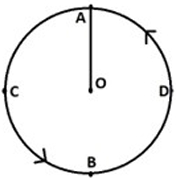
$A$ point mass '$m$' attached at one end of a massless,inextensible string of length '$\ell$' performs a vertical circular motion and the string rotates in a vertical plane,as shown in the diagram. The increase in the centripetal acceleration of the point mass when it moves from point $A$ to point $C$ is $(g = \text{acceleration due to gravity})$:
A
$3g$
B
$2g$
C
$g$
D
$\frac{g}{2}$
Solution
(B) For a particle to complete a vertical circular motion,the minimum velocity at the top point $A$ is $v_A = \sqrt{g\ell}$.
Using the law of conservation of energy between point $A$ and point $C$:
$\frac{1}{2}mv_A^2 + mg(2\ell) = \frac{1}{2}mv_C^2 + mg\ell$
$\frac{1}{2}m(g\ell) + 2mg\ell = \frac{1}{2}mv_C^2 + mg\ell$
$\frac{1}{2}g\ell + mg\ell = \frac{1}{2}mv_C^2$
$\frac{3}{2}g\ell = \frac{1}{2}v_C^2 \implies v_C^2 = 3g\ell$.
The centripetal acceleration at point $A$ is $a_A = \frac{v_A^2}{\ell} = \frac{g\ell}{\ell} = g$.
The centripetal acceleration at point $C$ is $a_C = \frac{v_C^2}{\ell} = \frac{3g\ell}{\ell} = 3g$.
The increase in centripetal acceleration is $\Delta a = a_C - a_A = 3g - g = 2g$.
Using the law of conservation of energy between point $A$ and point $C$:
$\frac{1}{2}mv_A^2 + mg(2\ell) = \frac{1}{2}mv_C^2 + mg\ell$
$\frac{1}{2}m(g\ell) + 2mg\ell = \frac{1}{2}mv_C^2 + mg\ell$
$\frac{1}{2}g\ell + mg\ell = \frac{1}{2}mv_C^2$
$\frac{3}{2}g\ell = \frac{1}{2}v_C^2 \implies v_C^2 = 3g\ell$.
The centripetal acceleration at point $A$ is $a_A = \frac{v_A^2}{\ell} = \frac{g\ell}{\ell} = g$.
The centripetal acceleration at point $C$ is $a_C = \frac{v_C^2}{\ell} = \frac{3g\ell}{\ell} = 3g$.
The increase in centripetal acceleration is $\Delta a = a_C - a_A = 3g - g = 2g$.
0 likesView Solution
376
PhysicsMediumMCQMHT CET · 2025
$A$ stone of mass $m$ $kg$ is tied to a string of length $L$ $m$ and moved in a vertical circle of radius $49$ $cm$ in a vertical plane. If it completes $30$ revolutions per minute,the tension in the string when it is at the lowermost point is nearly. [Take $\pi^2=10$ and acceleration due to gravity,$g=10$ $m/s^2$]
A
$(90m) N$
B
$(60m) N$
C
$(45m) N$
D
$(15m) N$
Solution
(D) Given: Mass $= m$ $kg$,Radius $r = 49$ $cm = 0.49$ $m$,Frequency $f = 30$ $rpm = 0.5$ $rev/s$.
Angular velocity $\omega = 2\pi f = 2 \times \pi \times 0.5 = \pi$ $rad/s$.
At the lowermost point,the tension $T$ is given by $T = mg + mr\omega^2$.
Substituting the values: $T = m(10) + m(0.49)(\pi^2)$.
Using $\pi^2 = 10$: $T = 10m + m(0.49)(10) = 10m + 4.9m = 14.9m$ $N$.
Rounding to the nearest integer,$T \approx 15m$ $N$.
Angular velocity $\omega = 2\pi f = 2 \times \pi \times 0.5 = \pi$ $rad/s$.
At the lowermost point,the tension $T$ is given by $T = mg + mr\omega^2$.
Substituting the values: $T = m(10) + m(0.49)(\pi^2)$.
Using $\pi^2 = 10$: $T = 10m + m(0.49)(10) = 10m + 4.9m = 14.9m$ $N$.
Rounding to the nearest integer,$T \approx 15m$ $N$.
0 likesView Solution
377
PhysicsEasyMCQMHT CET · 2025
$A$ stone is projected with kinetic energy $E$,making an angle $\theta$ with the horizontal. When it reaches its highest point,its kinetic energy is
A
$E^2 \sin^2 \theta$
B
$E \sin \theta$
C
$E \cos^2 \theta$
D
$E \cos \theta$
Solution
(C) Let the initial velocity of the stone be $u$. The initial kinetic energy is $E = \frac{1}{2} m u^2$.
At the highest point of the trajectory,the vertical component of the velocity becomes zero,while the horizontal component remains constant at $v_x = u \cos \theta$.
Therefore,the kinetic energy at the highest point is $E' = \frac{1}{2} m v_x^2$.
Substituting $v_x = u \cos \theta$,we get $E' = \frac{1}{2} m (u \cos \theta)^2$.
$E' = \frac{1}{2} m u^2 \cos^2 \theta$.
Since $E = \frac{1}{2} m u^2$,we have $E' = E \cos^2 \theta$.
At the highest point of the trajectory,the vertical component of the velocity becomes zero,while the horizontal component remains constant at $v_x = u \cos \theta$.
Therefore,the kinetic energy at the highest point is $E' = \frac{1}{2} m v_x^2$.
Substituting $v_x = u \cos \theta$,we get $E' = \frac{1}{2} m (u \cos \theta)^2$.
$E' = \frac{1}{2} m u^2 \cos^2 \theta$.
Since $E = \frac{1}{2} m u^2$,we have $E' = E \cos^2 \theta$.
0 likesView Solution
378
PhysicsMediumMCQMHT CET · 2025
$A$ pendulum bob has a speed $4 \,m/s$ at its lowest position. The pendulum is $1 \,m$ long. When the length of the string makes an angle of $60^{\circ}$ with the vertical, the speed of the bob at that position is (acceleration due to gravity, $g=10 \,m/s^2, \cos 60^{\circ}=0.5$).
A
$6 \,m/s$
B
$\sqrt{3} \,m/s$
C
$\sqrt{6} \,m/s$
D
$3 \,m/s$
Solution
(C) Let the length of the pendulum be $L = 1 \,m$ and the initial speed at the lowest point be $v_0 = 4 \,m/s$.
At the lowest point, the potential energy is taken as $0$. The total energy is $E = \frac{1}{2}mv_0^2$.
When the string makes an angle $\theta = 60^{\circ}$ with the vertical, the height of the bob is $h = L(1 - \cos \theta)$.
Substituting the values, $h = 1(1 - \cos 60^{\circ}) = 1(1 - 0.5) = 0.5 \,m$.
By the law of conservation of energy, the total energy at the lowest point equals the total energy at the angle $\theta$:
$\frac{1}{2}mv_0^2 = \frac{1}{2}mv^2 + mgh$
$v^2 = v_0^2 - 2gh$
$v^2 = (4)^2 - 2(10)(0.5)$
$v^2 = 16 - 10 = 6$
$v = \sqrt{6} \,m/s$.
At the lowest point, the potential energy is taken as $0$. The total energy is $E = \frac{1}{2}mv_0^2$.
When the string makes an angle $\theta = 60^{\circ}$ with the vertical, the height of the bob is $h = L(1 - \cos \theta)$.
Substituting the values, $h = 1(1 - \cos 60^{\circ}) = 1(1 - 0.5) = 0.5 \,m$.
By the law of conservation of energy, the total energy at the lowest point equals the total energy at the angle $\theta$:
$\frac{1}{2}mv_0^2 = \frac{1}{2}mv^2 + mgh$
$v^2 = v_0^2 - 2gh$
$v^2 = (4)^2 - 2(10)(0.5)$
$v^2 = 16 - 10 = 6$
$v = \sqrt{6} \,m/s$.
0 likesView Solution
379
PhysicsMediumMCQMHT CET · 2025
$A$ body of mass $1 \ kg$ begins to move under the action of a time-dependent force $\vec{F} = (t \hat{i} + 2t^2 \hat{j}) \ N$,where $\hat{i}$ and $\hat{j}$ are unit vectors along $x$ and $y$ axes. The power developed by the above force at time $t = 3 \ s$ will be: (in $W$)
A
$337.5$
B
$228.5$
C
$422.5$
D
$126.5$
Solution
(A) Given: Mass $m = 1 \ kg$,Force $\vec{F} = t \hat{i} + 2t^2 \hat{j}$.
Using Newton's second law,$\vec{F} = m \vec{a}$,so $\vec{a} = \frac{\vec{F}}{m} = t \hat{i} + 2t^2 \hat{j}$.
Velocity $\vec{v} = \int \vec{a} \ dt = \int (t \hat{i} + 2t^2 \hat{j}) \ dt = \frac{t^2}{2} \hat{i} + \frac{2t^3}{3} \hat{j}$ (assuming initial velocity is zero).
Power $P = \vec{F} \cdot \vec{v} = (t \hat{i} + 2t^2 \hat{j}) \cdot (\frac{t^2}{2} \hat{i} + \frac{2t^3}{3} \hat{j})$.
$P = \frac{t^3}{2} + \frac{4t^5}{3}$.
At $t = 3 \ s$:
$P = \frac{3^3}{2} + \frac{4(3^5)}{3} = \frac{27}{2} + 4(3^4) = 13.5 + 4(81) = 13.5 + 324 = 337.5 \ W$.
Using Newton's second law,$\vec{F} = m \vec{a}$,so $\vec{a} = \frac{\vec{F}}{m} = t \hat{i} + 2t^2 \hat{j}$.
Velocity $\vec{v} = \int \vec{a} \ dt = \int (t \hat{i} + 2t^2 \hat{j}) \ dt = \frac{t^2}{2} \hat{i} + \frac{2t^3}{3} \hat{j}$ (assuming initial velocity is zero).
Power $P = \vec{F} \cdot \vec{v} = (t \hat{i} + 2t^2 \hat{j}) \cdot (\frac{t^2}{2} \hat{i} + \frac{2t^3}{3} \hat{j})$.
$P = \frac{t^3}{2} + \frac{4t^5}{3}$.
At $t = 3 \ s$:
$P = \frac{3^3}{2} + \frac{4(3^5)}{3} = \frac{27}{2} + 4(3^4) = 13.5 + 4(81) = 13.5 + 324 = 337.5 \ W$.
0 likesView Solution
380
PhysicsEasyMCQMHT CET · 2025
$A$ particle is displaced from point $P(3 \ m, 4 \ m, 5 \ m)$ to a point $Q(2 \ m, 3 \ m, 4 \ m)$ under a constant force $\vec{F}=(3 \hat{i}+4 \hat{j}+5 \hat{k}) \ N$. The work done by the force in this process is
A
$+10 \ J$
B
$+4 \ J$
C
$-8 \ J$
D
$-12 \ J$
Solution
(D) The displacement vector $\vec{d}$ is given by $\vec{d} = \vec{r}_Q - \vec{r}_P$.
Given $\vec{r}_P = (3 \hat{i} + 4 \hat{j} + 5 \hat{k}) \ m$ and $\vec{r}_Q = (2 \hat{i} + 3 \hat{j} + 4 \hat{k}) \ m$.
So,$\vec{d} = (2-3) \hat{i} + (3-4) \hat{j} + (4-5) \hat{k} = (-1 \hat{i} - 1 \hat{j} - 1 \hat{k}) \ m$.
The work done $W$ by a constant force $\vec{F}$ is given by the dot product $W = \vec{F} \cdot \vec{d}$.
$W = (3 \hat{i} + 4 \hat{j} + 5 \hat{k}) \cdot (-1 \hat{i} - 1 \hat{j} - 1 \hat{k})$.
$W = (3 \times -1) + (4 \times -1) + (5 \times -1) = -3 - 4 - 5 = -12 \ J$.
Given $\vec{r}_P = (3 \hat{i} + 4 \hat{j} + 5 \hat{k}) \ m$ and $\vec{r}_Q = (2 \hat{i} + 3 \hat{j} + 4 \hat{k}) \ m$.
So,$\vec{d} = (2-3) \hat{i} + (3-4) \hat{j} + (4-5) \hat{k} = (-1 \hat{i} - 1 \hat{j} - 1 \hat{k}) \ m$.
The work done $W$ by a constant force $\vec{F}$ is given by the dot product $W = \vec{F} \cdot \vec{d}$.
$W = (3 \hat{i} + 4 \hat{j} + 5 \hat{k}) \cdot (-1 \hat{i} - 1 \hat{j} - 1 \hat{k})$.
$W = (3 \times -1) + (4 \times -1) + (5 \times -1) = -3 - 4 - 5 = -12 \ J$.
0 likesView Solution
381
PhysicsEasyMCQMHT CET · 2025
$A$ constant force $\vec{F} = 3\hat{i} - 2\hat{j} - \hat{k} \text{ N}$ causes a displacement $\vec{r} = 2\hat{i} - 3\hat{j} - 3\hat{k} \text{ m}$ in $2 \text{ s}$. The work done and the power are respectively:
A
$20 \text{ J}, 10 \text{ W}$
B
$15 \text{ J}, 7.5 \text{ W}$
C
$13 \text{ J}, 6.5 \text{ W}$
D
$10 \text{ J}, 5 \text{ W}$
Solution
(B) The work done $W$ by a constant force $\vec{F}$ is given by the dot product of force and displacement: $W = \vec{F} \cdot \vec{r}$.
Substituting the given values: $W = (3\hat{i} - 2\hat{j} - \hat{k}) \cdot (2\hat{i} - 3\hat{j} - 3\hat{k})$.
$W = (3 \times 2) + (-2 \times -3) + (-1 \times -3) = 6 + 6 + 3 = 15 \text{ J}$.
Power $P$ is defined as the rate of work done: $P = \frac{W}{t}$.
Given $t = 2 \text{ s}$,$P = \frac{15}{2} = 7.5 \text{ W}$.
Thus,the work done is $15 \text{ J}$ and the power is $7.5 \text{ W}$.
Substituting the given values: $W = (3\hat{i} - 2\hat{j} - \hat{k}) \cdot (2\hat{i} - 3\hat{j} - 3\hat{k})$.
$W = (3 \times 2) + (-2 \times -3) + (-1 \times -3) = 6 + 6 + 3 = 15 \text{ J}$.
Power $P$ is defined as the rate of work done: $P = \frac{W}{t}$.
Given $t = 2 \text{ s}$,$P = \frac{15}{2} = 7.5 \text{ W}$.
Thus,the work done is $15 \text{ J}$ and the power is $7.5 \text{ W}$.
0 likesView Solution
382
PhysicsMediumMCQMHT CET · 2025
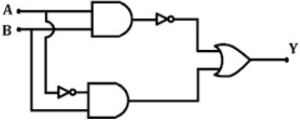
In the following combination of logic gates,the output $Y$ can be written in terms of inputs $A$ and $B$ as:
A
$(A \cdot \overline{B}) + (\overline{A} \cdot B)$
B
$(A \cdot B) + (\overline{A} \cdot B)$
C
$(\overline{A \cdot B}) + (\overline{A} \cdot B)$
D
$(\overline{A \cdot B}) + (A \cdot \overline{B})$
Solution
(C) $1$. The upper branch consists of an $AND$ gate followed by a $NOT$ gate ($NAND$ gate). The inputs to the $AND$ gate are $A$ and $B$,so its output is $(A \cdot B)$. After the $NOT$ gate,the output becomes $(\overline{A \cdot B})$.
$2$. The lower branch consists of a $NOT$ gate on input $A$ (giving $\overline{A}$) followed by an $AND$ gate with input $B$. Thus,the output of this branch is $(\overline{A} \cdot B)$.
$3$. These two outputs are fed into an $OR$ gate. Therefore,the final output $Y$ is the sum of these two expressions: $Y = (\overline{A \cdot B}) + (\overline{A} \cdot B)$.
$4$. Comparing this with the given options,option $C$ matches our derived expression.
$2$. The lower branch consists of a $NOT$ gate on input $A$ (giving $\overline{A}$) followed by an $AND$ gate with input $B$. Thus,the output of this branch is $(\overline{A} \cdot B)$.
$3$. These two outputs are fed into an $OR$ gate. Therefore,the final output $Y$ is the sum of these two expressions: $Y = (\overline{A \cdot B}) + (\overline{A} \cdot B)$.
$4$. Comparing this with the given options,option $C$ matches our derived expression.
0 likesView Solution
383
PhysicsEasyMCQMHT CET · 2025
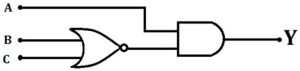
In the logic circuit given,$A, B$ and $C$ are the inputs and $Y$ is the output. The output $Y$ is $HIGH$ when:
A
for all the $HIGH$ inputs.
B
for all the $LOW$ inputs.
C
when $A=1, B=0, C=0$.
D
when $A=1, B=0, C=1$.
Solution
(C) The given circuit consists of a $NOR$ gate followed by an $AND$ gate.
Inputs $B$ and $C$ are fed into a $NOR$ gate,which produces an output $X = \overline{B+C}$.
This output $X$ and input $A$ are then fed into an $AND$ gate to produce the final output $Y$.
Therefore,the Boolean expression for the output is $Y = A \cdot X = A \cdot (\overline{B+C})$.
For the output $Y$ to be $HIGH$ $(Y=1)$,both $A$ must be $1$ and $(\overline{B+C})$ must be $1$.
$(\overline{B+C}) = 1$ only when $B+C = 0$,which means $B=0$ and $C=0$.
Thus,$Y=1$ when $A=1, B=0, C=0$.
Inputs $B$ and $C$ are fed into a $NOR$ gate,which produces an output $X = \overline{B+C}$.
This output $X$ and input $A$ are then fed into an $AND$ gate to produce the final output $Y$.
Therefore,the Boolean expression for the output is $Y = A \cdot X = A \cdot (\overline{B+C})$.
For the output $Y$ to be $HIGH$ $(Y=1)$,both $A$ must be $1$ and $(\overline{B+C})$ must be $1$.
$(\overline{B+C}) = 1$ only when $B+C = 0$,which means $B=0$ and $C=0$.
Thus,$Y=1$ when $A=1, B=0, C=0$.
0 likesView Solution
384
PhysicsMediumMCQMHT CET · 2025
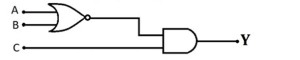
To get an output of the following logic circuit as '$0$' (zero),the inputs $A, B, C$ should $NOT$ be,respectively,
A
$1, 1, 0$
B
$0, 1, 0$
C
$1, 0, 1$
D
$0, 0, 1$
Solution
(D) The given logic circuit consists of a $NOR$ gate followed by an $AND$ gate.
Let the output of the $NOR$ gate be $X$. Then $X = \overline{A + B}$.
The final output $Y$ is the output of the $AND$ gate,so $Y = X \cdot C = (\overline{A + B}) \cdot C$.
We want the output $Y = 0$.
Let's check the options:
$A) A=1, B=1, C=0 \implies Y = (\overline{1+1}) \cdot 0 = 0 \cdot 0 = 0$.
$B) A=0, B=1, C=0 \implies Y = (\overline{0+1}) \cdot 0 = 0 \cdot 0 = 0$.
$C) A=1, B=0, C=1 \implies Y = (\overline{1+0}) \cdot 1 = 0 \cdot 1 = 0$.
$D) A=0, B=0, C=1 \implies Y = (\overline{0+0}) \cdot 1 = 1 \cdot 1 = 1$.
Since the question asks for the input set that does $NOT$ result in an output of $0$,the correct answer is $D$.
Let the output of the $NOR$ gate be $X$. Then $X = \overline{A + B}$.
The final output $Y$ is the output of the $AND$ gate,so $Y = X \cdot C = (\overline{A + B}) \cdot C$.
We want the output $Y = 0$.
Let's check the options:
$A) A=1, B=1, C=0 \implies Y = (\overline{1+1}) \cdot 0 = 0 \cdot 0 = 0$.
$B) A=0, B=1, C=0 \implies Y = (\overline{0+1}) \cdot 0 = 0 \cdot 0 = 0$.
$C) A=1, B=0, C=1 \implies Y = (\overline{1+0}) \cdot 1 = 0 \cdot 1 = 0$.
$D) A=0, B=0, C=1 \implies Y = (\overline{0+0}) \cdot 1 = 1 \cdot 1 = 1$.
Since the question asks for the input set that does $NOT$ result in an output of $0$,the correct answer is $D$.
0 likesView Solution
385
PhysicsEasyMCQMHT CET · 2025
The logic gate for which the output goes '$HIGH$' or '$1$' only when an odd number of '$HIGH$' or '$1$' are at its input,is
A
$OR$ gate
B
$NAND$ gate
C
Ex-$OR$ gate
D
$NOR$ gate
Solution
(C) The logic gate that produces a '$HIGH$' or '$1$' output only when an odd number of inputs are '$HIGH$' or '$1$' is the Exclusive-$OR$ (Ex-$OR$) gate.
For a two-input Ex-$OR$ gate,the output $Y$ is given by $Y = A \oplus B = A\bar{B} + \bar{A}B$.
The truth table for a two-input Ex-$OR$ gate is:
If $A=0, B=0$,then $Y=0$.
If $A=0, B=1$,then $Y=1$.
If $A=1, B=0$,then $Y=1$.
If $A=1, B=1$,then $Y=0$.
As observed,the output is '$1$' only when the number of '$HIGH$' inputs is odd (i.e.,$1$ input is '$HIGH$').
For a two-input Ex-$OR$ gate,the output $Y$ is given by $Y = A \oplus B = A\bar{B} + \bar{A}B$.
The truth table for a two-input Ex-$OR$ gate is:
If $A=0, B=0$,then $Y=0$.
If $A=0, B=1$,then $Y=1$.
If $A=1, B=0$,then $Y=1$.
If $A=1, B=1$,then $Y=0$.
As observed,the output is '$1$' only when the number of '$HIGH$' inputs is odd (i.e.,$1$ input is '$HIGH$').
0 likesView Solution
386
PhysicsMediumMCQMHT CET · 2025
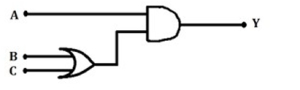
For the given combination of logic gates,which of the following sets of inputs $A, B,$ and $C$ respectively results in an output $Y = 1$?
A
$0, 0, 0$
B
$0, 1, 0$
C
$1, 0, 0$
D
$1, 0, 1$
Solution
(D) The given circuit consists of an $OR$ gate followed by an $AND$ gate.
Let the output of the $OR$ gate be $X$.
The inputs to the $OR$ gate are $B$ and $C$,so $X = B + C$.
The inputs to the $AND$ gate are $A$ and $X$.
Therefore,the final output is $Y = A \cdot X = A \cdot (B + C)$.
For the output $Y = 1$,both $A$ must be $1$ and $(B + C)$ must be $1$.
Checking the options:
$A) 0, 0, 0 \implies Y = 0 \cdot (0 + 0) = 0$
$B) 0, 1, 0 \implies Y = 0 \cdot (1 + 0) = 0$
$C) 1, 0, 0 \implies Y = 1 \cdot (0 + 0) = 0$
$D) 1, 0, 1 \implies Y = 1 \cdot (0 + 1) = 1 \cdot 1 = 1$
Thus,the set of inputs $A=1, B=0, C=1$ gives the output $Y=1$.
Let the output of the $OR$ gate be $X$.
The inputs to the $OR$ gate are $B$ and $C$,so $X = B + C$.
The inputs to the $AND$ gate are $A$ and $X$.
Therefore,the final output is $Y = A \cdot X = A \cdot (B + C)$.
For the output $Y = 1$,both $A$ must be $1$ and $(B + C)$ must be $1$.
Checking the options:
$A) 0, 0, 0 \implies Y = 0 \cdot (0 + 0) = 0$
$B) 0, 1, 0 \implies Y = 0 \cdot (1 + 0) = 0$
$C) 1, 0, 0 \implies Y = 1 \cdot (0 + 0) = 0$
$D) 1, 0, 1 \implies Y = 1 \cdot (0 + 1) = 1 \cdot 1 = 1$
Thus,the set of inputs $A=1, B=0, C=1$ gives the output $Y=1$.
0 likesView Solution
387
PhysicsEasyMCQMHT CET · 2025
In a certain $2$-input logic gate,when inputs $A=0$ and $B=0$,then output $C=1$. And also when inputs $A=0, B=1$,then again output $C=1$. The gate must be
A
$OR$
B
$AND$
C
$NAND$
D
$NOR$
Solution
(C) The truth table for the given conditions is:
$A=0, B=0 \implies C=1$
$A=0, B=1 \implies C=1$
Let us check the truth tables for the given options:
$1$. $OR$ gate: $0+0=0, 0+1=1, 1+0=1, 1+1=1$. (Does not match)
$2$. $AND$ gate: $0 \cdot 0=0, 0 \cdot 1=0, 1 \cdot 0=0, 1 \cdot 1=1$. (Does not match)
$3$. $NAND$ gate: $\overline{0 \cdot 0}=1, \overline{0 \cdot 1}=1, \overline{1 \cdot 0}=1, \overline{1 \cdot 1}=0$. (Matches the given conditions)
$4$. $NOR$ gate: $\overline{0+0}=1, \overline{0+1}=0, \overline{1+0}=0, \overline{1+1}=0$. (Does not match)
Thus,the logic gate is a $NAND$ gate.
$A=0, B=0 \implies C=1$
$A=0, B=1 \implies C=1$
Let us check the truth tables for the given options:
$1$. $OR$ gate: $0+0=0, 0+1=1, 1+0=1, 1+1=1$. (Does not match)
$2$. $AND$ gate: $0 \cdot 0=0, 0 \cdot 1=0, 1 \cdot 0=0, 1 \cdot 1=1$. (Does not match)
$3$. $NAND$ gate: $\overline{0 \cdot 0}=1, \overline{0 \cdot 1}=1, \overline{1 \cdot 0}=1, \overline{1 \cdot 1}=0$. (Matches the given conditions)
$4$. $NOR$ gate: $\overline{0+0}=1, \overline{0+1}=0, \overline{1+0}=0, \overline{1+1}=0$. (Does not match)
Thus,the logic gate is a $NAND$ gate.
0 likesView Solution
388
PhysicsEasyMCQMHT CET · 2025
Out of the following gates,identify the gates which will give an output as '$0$' (zero) for the given inputs.

A
$(A)$ and $(C)$
B
$(B)$ and $(D)$
C
$(B)$ and $(C)$
D
$(A)$ and $(D)$
Solution
(A) Let's analyze each logic gate with the given inputs:
$(A)$ This is a $NAND$ gate with inputs $1$ and $1$. The output of a $NAND$ gate is $Y = \overline{A \cdot B}$. For $A=1, B=1$,$Y = \overline{1 \cdot 1} = \overline{1} = 0$.
$(B)$ This is a $NOR$ gate with inputs $0$ and $0$. The output of a $NOR$ gate is $Y = \overline{A + B}$. For $A=0, B=0$,$Y = \overline{0 + 0} = \overline{0} = 1$.
$(C)$ This is an $AND$ gate with inputs $1$ and $0$. The output of an $AND$ gate is $Y = A \cdot B$. For $A=1, B=0$,$Y = 1 \cdot 0 = 0$.
$(D)$ This is an $XOR$ gate with inputs $0$ and $1$. The output of an $XOR$ gate is $Y = A \oplus B$. For $A=0, B=1$,$Y = 0 \oplus 1 = 1$.
Comparing the outputs,gates $(A)$ and $(C)$ give an output of '$0$'.
Therefore,the correct option is $(A)$ and $(C)$.
$(A)$ This is a $NAND$ gate with inputs $1$ and $1$. The output of a $NAND$ gate is $Y = \overline{A \cdot B}$. For $A=1, B=1$,$Y = \overline{1 \cdot 1} = \overline{1} = 0$.
$(B)$ This is a $NOR$ gate with inputs $0$ and $0$. The output of a $NOR$ gate is $Y = \overline{A + B}$. For $A=0, B=0$,$Y = \overline{0 + 0} = \overline{0} = 1$.
$(C)$ This is an $AND$ gate with inputs $1$ and $0$. The output of an $AND$ gate is $Y = A \cdot B$. For $A=1, B=0$,$Y = 1 \cdot 0 = 0$.
$(D)$ This is an $XOR$ gate with inputs $0$ and $1$. The output of an $XOR$ gate is $Y = A \oplus B$. For $A=0, B=1$,$Y = 0 \oplus 1 = 1$.
Comparing the outputs,gates $(A)$ and $(C)$ give an output of '$0$'.
Therefore,the correct option is $(A)$ and $(C)$.
0 likesView Solution
389
PhysicsEasyMCQMHT CET · 2025
An $AND$ gate is followed by a $NOT$ gate in series. With two inputs '$A$' and '$B$',the Boolean expression for the output '$Y$' will be
A
$\overline{A+B}$
B
$\overline{A \cdot B}$
C
$A \cdot B$
D
$A+B$
Solution
(B) $1$. An $AND$ gate takes two inputs $A$ and $B$ and produces an output $X = A \cdot B$.
$2$. This output $X$ is then passed through a $NOT$ gate.
$3$. $A$ $NOT$ gate inverts the input,so the final output $Y = \overline{X}$.
$4$. Substituting the value of $X$,we get $Y = \overline{A \cdot B}$.
$5$. This combination of an $AND$ gate followed by a $NOT$ gate is known as a $NAND$ gate.
$2$. This output $X$ is then passed through a $NOT$ gate.
$3$. $A$ $NOT$ gate inverts the input,so the final output $Y = \overline{X}$.
$4$. Substituting the value of $X$,we get $Y = \overline{A \cdot B}$.
$5$. This combination of an $AND$ gate followed by a $NOT$ gate is known as a $NAND$ gate.
0 likesView Solution
390
PhysicsMediumMCQMHT CET · 2025
If a centre-tap transformer is used with two $p-n$ junction diodes for full-wave rectification,then the output voltage of the rectifier with respect to each diode is (secondary voltage of transformer $= V_s$)
A
$2 V_s$
B
$\frac{2}{3} V_s$
C
$\frac{1}{2} V_s$
D
$\frac{3}{2} V_s$
Solution
(C) In a centre-tap full-wave rectifier,the secondary winding of the transformer is divided into two equal halves by the centre tap.
If the total secondary voltage across the entire secondary winding is $V_s$,then the voltage across each half of the secondary winding is $\frac{V_s}{2}$.
During the positive half-cycle,one diode conducts and the voltage across the load is the voltage across the top half of the secondary,which is $\frac{V_s}{2}$.
During the negative half-cycle,the other diode conducts and the voltage across the load is the voltage across the bottom half of the secondary,which is also $\frac{V_s}{2}$.
Therefore,the output voltage with respect to each diode is $\frac{1}{2} V_s$.
If the total secondary voltage across the entire secondary winding is $V_s$,then the voltage across each half of the secondary winding is $\frac{V_s}{2}$.
During the positive half-cycle,one diode conducts and the voltage across the load is the voltage across the top half of the secondary,which is $\frac{V_s}{2}$.
During the negative half-cycle,the other diode conducts and the voltage across the load is the voltage across the bottom half of the secondary,which is also $\frac{V_s}{2}$.
Therefore,the output voltage with respect to each diode is $\frac{1}{2} V_s$.
0 likesView Solution
391
PhysicsEasyMCQMHT CET · 2025
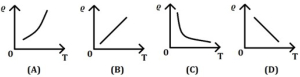
Which graph shows correctly the temperature $(T)$ dependence of resistivity $(\varrho)$ of a semiconductor?
A
$A$
B
$B$
C
$C$
D
$D$
Solution
(C) In a semiconductor,as the temperature $(T)$ increases,the number of charge carriers (electrons and holes) increases exponentially due to the breaking of covalent bonds.
This increase in the number of charge carriers dominates over the effect of increased lattice vibrations (which would otherwise increase resistivity).
Consequently,the resistivity $(\varrho)$ of a semiconductor decreases rapidly with an increase in temperature.
The relationship is given by $\varrho = \varrho_0 e^{E_g / 2k_BT}$,where $E_g$ is the band gap energy and $k_B$ is the Boltzmann constant.
Graph $(C)$ correctly represents this exponential decrease of resistivity with temperature.
This increase in the number of charge carriers dominates over the effect of increased lattice vibrations (which would otherwise increase resistivity).
Consequently,the resistivity $(\varrho)$ of a semiconductor decreases rapidly with an increase in temperature.
The relationship is given by $\varrho = \varrho_0 e^{E_g / 2k_BT}$,where $E_g$ is the band gap energy and $k_B$ is the Boltzmann constant.
Graph $(C)$ correctly represents this exponential decrease of resistivity with temperature.
0 likesView Solution
392
PhysicsMediumMCQMHT CET · 2025
In a pure silicon crystal,the electron-hole concentration is $10^{16} \ m^{-3}$ at $301 \ K$. Now,$10^{21}$ atoms of phosphorus are added per cubic metre. The new hole concentration in silicon is (in per $m^3$):
A
$10^5$
B
$10^{11}$
C
$10^{19}$
D
$10^{21}$
Solution
(B) Given: Intrinsic carrier concentration $n_i = 10^{16} \ m^{-3}$.
Phosphorus is a pentavalent impurity,so it acts as a donor. The concentration of donor atoms added is $N_D = 10^{21} \ m^{-3}$.
Since $N_D \gg n_i$,the electron concentration in the n-type semiconductor is approximately equal to the donor concentration: $n_e \approx N_D = 10^{21} \ m^{-3}$.
According to the law of mass action for semiconductors,$n_e \cdot n_h = n_i^2$,where $n_h$ is the hole concentration.
Substituting the values: $10^{21} \cdot n_h = (10^{16})^2$.
$10^{21} \cdot n_h = 10^{32}$.
$n_h = \frac{10^{32}}{10^{21}} = 10^{11} \ m^{-3}$.
Therefore,the new hole concentration is $10^{11} \ m^{-3}$.
Phosphorus is a pentavalent impurity,so it acts as a donor. The concentration of donor atoms added is $N_D = 10^{21} \ m^{-3}$.
Since $N_D \gg n_i$,the electron concentration in the n-type semiconductor is approximately equal to the donor concentration: $n_e \approx N_D = 10^{21} \ m^{-3}$.
According to the law of mass action for semiconductors,$n_e \cdot n_h = n_i^2$,where $n_h$ is the hole concentration.
Substituting the values: $10^{21} \cdot n_h = (10^{16})^2$.
$10^{21} \cdot n_h = 10^{32}$.
$n_h = \frac{10^{32}}{10^{21}} = 10^{11} \ m^{-3}$.
Therefore,the new hole concentration is $10^{11} \ m^{-3}$.
0 likesView Solution
393
PhysicsEasyMCQMHT CET · 2025
In an $n$-type semiconductor,the free electrons donated by the impurity atoms occupy energy levels in:
A
the conduction band.
B
the valence band.
C
the band gap and are close to the conduction band.
D
the band gap and are close to the valence band.
Solution
(C) In an $n$-type semiconductor,pentavalent impurity atoms (like $P, As, Sb$) are added to the intrinsic semiconductor (like $Si$ or $Ge$).
These impurity atoms provide extra electrons for conduction.
The energy levels corresponding to these donor electrons are called donor energy levels $(E_D)$.
These donor energy levels are located in the forbidden energy gap,just below the conduction band edge $(E_C)$.
Because they are very close to the conduction band,the electrons can easily gain thermal energy at room temperature and jump into the conduction band to contribute to electrical conductivity.
These impurity atoms provide extra electrons for conduction.
The energy levels corresponding to these donor electrons are called donor energy levels $(E_D)$.
These donor energy levels are located in the forbidden energy gap,just below the conduction band edge $(E_C)$.
Because they are very close to the conduction band,the electrons can easily gain thermal energy at room temperature and jump into the conduction band to contribute to electrical conductivity.
0 likesView Solution
394
PhysicsEasyMCQMHT CET · 2025
Which of the following statements is $\underline{TRUE}$ for $n$-type semiconductor?
A
Holes are majority carriers and trivalent atoms are dopants.
B
Electrons are majority carriers and trivalent atoms are dopants.
C
Holes are minority carriers and pentavalent atoms are dopants.
D
Electrons are minority carriers and pentavalent atoms are dopants.
Solution
(C) In an $n$-type semiconductor,the intrinsic semiconductor (like $Si$ or $Ge$) is doped with pentavalent impurity atoms (such as $P, As, Sb$).
These pentavalent atoms provide extra electrons to the conduction band,making electrons the majority charge carriers.
Conversely,holes are generated only due to thermal excitation,making them the minority charge carriers.
Therefore,the statement that 'Holes are minority carriers and pentavalent atoms are dopants' is correct.
These pentavalent atoms provide extra electrons to the conduction band,making electrons the majority charge carriers.
Conversely,holes are generated only due to thermal excitation,making them the minority charge carriers.
Therefore,the statement that 'Holes are minority carriers and pentavalent atoms are dopants' is correct.
0 likesView Solution
395
PhysicsEasyMCQMHT CET · 2025
$A$ piece of semiconductor is connected in series in an electric circuit. On increasing the temperature,the current in the circuit will
A
decrease.
B
remain unchanged.
C
increase.
D
stop flowing.
Solution
(C) In a semiconductor,the number of charge carriers (electrons and holes) increases exponentially with an increase in temperature because more covalent bonds are broken,releasing more charge carriers.
As the number of charge carriers increases,the electrical conductivity of the semiconductor increases,which leads to a decrease in its electrical resistance.
According to Ohm's law,$I = V/R$. Since the voltage $V$ remains constant and the resistance $R$ decreases,the current $I$ in the circuit will increase.
As the number of charge carriers increases,the electrical conductivity of the semiconductor increases,which leads to a decrease in its electrical resistance.
According to Ohm's law,$I = V/R$. Since the voltage $V$ remains constant and the resistance $R$ decreases,the current $I$ in the circuit will increase.
0 likesView Solution
396
PhysicsEasyMCQMHT CET · 2025
In $n$-type semiconductor,which of the following statements is true?
A
Electrons are majority carriers and trivalent atoms are dopants.
B
Electrons are minority carriers and pentavalent atoms are dopants.
C
Holes are minority carriers and pentavalent atoms are dopants.
D
Holes are majority carriers and trivalent atoms are dopants.
Solution
(C) In an $n$-type semiconductor,the semiconductor is doped with pentavalent impurity atoms (like $P$,$As$,$Sb$).
These pentavalent atoms provide extra electrons to the conduction band,making electrons the majority charge carriers.
Conversely,holes are generated only due to thermal excitation,making them the minority charge carriers.
Therefore,electrons are majority carriers and pentavalent atoms are dopants,while holes are minority carriers.
Comparing this with the given options,option $C$ is correct because it states that holes are minority carriers and pentavalent atoms are dopants.
These pentavalent atoms provide extra electrons to the conduction band,making electrons the majority charge carriers.
Conversely,holes are generated only due to thermal excitation,making them the minority charge carriers.
Therefore,electrons are majority carriers and pentavalent atoms are dopants,while holes are minority carriers.
Comparing this with the given options,option $C$ is correct because it states that holes are minority carriers and pentavalent atoms are dopants.
0 likesView Solution
397
PhysicsEasyMCQMHT CET · 2025
The material used for a solar cell should have a band gap:
A
equal to zero.
B
less than $1.0 \ eV$ (non-zero).
C
more than $1.8 \ eV$.
D
between $1.0 \ eV$ and $1.8 \ eV$.
Solution
(D) solar cell is a device that converts solar energy into electrical energy. The solar radiation spectrum has a maximum intensity around $1.5 \ eV$. To efficiently absorb solar radiation,the semiconductor material used in a solar cell must have a band gap that matches this energy range. Materials with a band gap between $1.0 \ eV$ and $1.8 \ eV$ are ideal for this purpose,as they can absorb a significant portion of the solar spectrum. Silicon,with a band gap of approximately $1.1 \ eV$,is the most commonly used material for solar cells.
0 likesView Solution
398
PhysicsEasyMCQMHT CET · 2025
When an $LED$ is manufactured by using aluminium gallium arsenide $(AlGaAs)$,it emits:
A
ultra-violet light
B
infra-red radiation
C
green light
D
blue light
Solution
(B) The wavelength of light emitted by an $LED$ depends on the band gap energy $(E_g)$ of the semiconductor material used.
Aluminium gallium arsenide $(AlGaAs)$ is a semiconductor material with a band gap energy that corresponds to the infra-red region of the electromagnetic spectrum.
Therefore,LEDs manufactured using $AlGaAs$ emit infra-red radiation.
Aluminium gallium arsenide $(AlGaAs)$ is a semiconductor material with a band gap energy that corresponds to the infra-red region of the electromagnetic spectrum.
Therefore,LEDs manufactured using $AlGaAs$ emit infra-red radiation.
0 likesView Solution
399
PhysicsMediumMCQMHT CET · 2025
In a Fraunhofer diffraction,light of wavelength $\lambda$ is incident on a slit of width $d$. The diffraction pattern is observed on a screen placed at a distance $D$. If the linear width of the central maximum is equal to two times the width of the slit,then the value of $D$ is:
A
$\frac{d^2}{\lambda}$
B
$\frac{d^2}{2 \lambda}$
C
$\frac{d^2}{3 \lambda}$
D
$\frac{d^2}{4 \lambda}$
Solution
(A) The linear width of the central maximum in a Fraunhofer diffraction pattern is given by the formula $w = \frac{2 \lambda D}{d}$.
According to the problem,the linear width of the central maximum is equal to two times the width of the slit,so $w = 2d$.
Equating the two expressions: $\frac{2 \lambda D}{d} = 2d$.
Dividing both sides by $2$,we get $\frac{\lambda D}{d} = d$.
Solving for $D$,we find $D = \frac{d^2}{\lambda}$.
According to the problem,the linear width of the central maximum is equal to two times the width of the slit,so $w = 2d$.
Equating the two expressions: $\frac{2 \lambda D}{d} = 2d$.
Dividing both sides by $2$,we get $\frac{\lambda D}{d} = d$.
Solving for $D$,we find $D = \frac{d^2}{\lambda}$.
0 likesView Solution
400
PhysicsMediumMCQMHT CET · 2025
In a Fraunhofer diffraction pattern,the slit width is $0.2 \ mm$ and the screen is at $2 \ m$ away from the lens. If the distance between the first minimum on either side of the central maximum is $1 \ cm$,the wavelength of light used is: (in $Å$)
A
$2000$
B
$4000$
C
$5000$
D
$10000$
Solution
(C) For Fraunhofer diffraction,the position of the $n^{th}$ minimum is given by $a \sin \theta = n \lambda$. For small angles,$\sin \theta \approx \theta = \frac{y_n}{D}$,where $y_n$ is the distance from the central maximum.
Thus,$y_n = \frac{n \lambda D}{a}$.
The distance between the first minima on either side of the central maximum is $2y_1 = \frac{2 \lambda D}{a}$.
Given: $a = 0.2 \ mm = 2 \times 10^{-4} \ m$,$D = 2 \ m$,and $2y_1 = 1 \ cm = 10^{-2} \ m$.
Substituting the values: $10^{-2} = \frac{2 \times \lambda \times 2}{2 \times 10^{-4}}$.
$10^{-2} = \frac{4 \lambda}{2 \times 10^{-4}} = 2 \times 10^4 \lambda$.
$\lambda = \frac{10^{-2}}{2 \times 10^4} = 0.5 \times 10^{-6} \ m = 5000 \times 10^{-10} \ m = 5000 \ Å$.
Thus,$y_n = \frac{n \lambda D}{a}$.
The distance between the first minima on either side of the central maximum is $2y_1 = \frac{2 \lambda D}{a}$.
Given: $a = 0.2 \ mm = 2 \times 10^{-4} \ m$,$D = 2 \ m$,and $2y_1 = 1 \ cm = 10^{-2} \ m$.
Substituting the values: $10^{-2} = \frac{2 \times \lambda \times 2}{2 \times 10^{-4}}$.
$10^{-2} = \frac{4 \lambda}{2 \times 10^{-4}} = 2 \times 10^4 \lambda$.
$\lambda = \frac{10^{-2}}{2 \times 10^4} = 0.5 \times 10^{-6} \ m = 5000 \times 10^{-10} \ m = 5000 \ Å$.
0 likesView Solution
401
PhysicsEasyMCQMHT CET · 2025
In a single slit diffraction pattern,identify the incorrect statement from the following.
A
The fringes have unequal width.
B
The fringes have unequal intensity.
C
The fringes have unequal width and unequal intensity.
D
The fringes have equal width and equal intensity.
Solution
(D) In a single slit diffraction pattern,the central maximum is the brightest and widest. As we move away from the center,the intensity of the secondary maxima decreases rapidly. The width of the central maximum is $2\lambda D/a$,while the width of the secondary maxima is $\lambda D/a$. Therefore,the fringes have unequal width and unequal intensity. Option $D$ states that the fringes have equal width and equal intensity,which is incorrect.
0 likesView Solution
402
PhysicsMediumMCQMHT CET · 2025
Assuming the human pupil to have a radius of $0.25 \ cm$ and a comfortable viewing distance of $25 \ cm$,the minimum separation between two objects that the human eye can resolve at $500 \ nm$ wavelength is nearly: (in $\mu m$)
A
$300$
B
$30$
C
$1$
D
$100$
Solution
(B) According to the Rayleigh criterion for a circular aperture,the angular resolution $\theta$ is given by $\theta = 1.22 \lambda / D$,where $\lambda$ is the wavelength and $D$ is the diameter of the aperture.
Given: Wavelength $\lambda = 500 \ nm = 500 \times 10^{-9} \ m$,Radius $r = 0.25 \ cm = 2.5 \times 10^{-3} \ m$,so Diameter $D = 2r = 5.0 \times 10^{-3} \ m$.
The angular resolution is $\theta = (1.22 \times 500 \times 10^{-9}) / (5.0 \times 10^{-3}) = 1.22 \times 10^{-4} \ rad$.
The minimum separation $d$ at a distance $L = 25 \ cm = 0.25 \ m$ is $d = L \times \theta$.
$d = 0.25 \times 1.22 \times 10^{-4} = 0.305 \times 10^{-4} \ m = 30.5 \times 10^{-6} \ m = 30.5 \mu m$.
Thus,the minimum separation is nearly $30 \mu m$.
Given: Wavelength $\lambda = 500 \ nm = 500 \times 10^{-9} \ m$,Radius $r = 0.25 \ cm = 2.5 \times 10^{-3} \ m$,so Diameter $D = 2r = 5.0 \times 10^{-3} \ m$.
The angular resolution is $\theta = (1.22 \times 500 \times 10^{-9}) / (5.0 \times 10^{-3}) = 1.22 \times 10^{-4} \ rad$.
The minimum separation $d$ at a distance $L = 25 \ cm = 0.25 \ m$ is $d = L \times \theta$.
$d = 0.25 \times 1.22 \times 10^{-4} = 0.305 \times 10^{-4} \ m = 30.5 \times 10^{-6} \ m = 30.5 \mu m$.
Thus,the minimum separation is nearly $30 \mu m$.
0 likesView Solution
403
PhysicsMediumMCQMHT CET · 2025
In a single slit diffraction pattern,the distance between the plane of the slit and the screen is $1.3 \ m$. The width of the slit is $0.65 \ mm$ and the second maximum is formed at a distance of $2.6 \ mm$ from the center of the screen. The wavelength of light used is: (in $Å$)
A
$6500$
B
$6000$
C
$5200$
D
$4600$
Solution
(C) For a single slit diffraction pattern,the condition for the $n^{th}$ secondary maximum is given by: $a \sin \theta = (n + \frac{1}{2}) \lambda$,where $a$ is the slit width,$\theta$ is the angle of diffraction,and $\lambda$ is the wavelength.
Since $\theta$ is very small,$\sin \theta \approx \tan \theta = \frac{y}{D}$,where $y$ is the distance from the center and $D$ is the distance to the screen.
For the second maximum,$n = 2$. Thus,$a \frac{y}{D} = (2 + \frac{1}{2}) \lambda = \frac{5}{2} \lambda$.
Given: $a = 0.65 \ mm = 0.65 \times 10^{-3} \ m$,$D = 1.3 \ m$,and $y = 2.6 \ mm = 2.6 \times 10^{-3} \ m$.
Substituting the values: $(0.65 \times 10^{-3}) \times \frac{2.6 \times 10^{-3}}{1.3} = \frac{5}{2} \lambda$.
$(0.65 \times 10^{-3}) \times (2 \times 10^{-3}) = 2.5 \lambda$.
$1.3 \times 10^{-6} = 2.5 \lambda$.
$\lambda = \frac{1.3 \times 10^{-6}}{2.5} = 0.52 \times 10^{-6} \ m = 5200 \ \times 10^{-10} \ m = 5200 \ Å$.
Since $\theta$ is very small,$\sin \theta \approx \tan \theta = \frac{y}{D}$,where $y$ is the distance from the center and $D$ is the distance to the screen.
For the second maximum,$n = 2$. Thus,$a \frac{y}{D} = (2 + \frac{1}{2}) \lambda = \frac{5}{2} \lambda$.
Given: $a = 0.65 \ mm = 0.65 \times 10^{-3} \ m$,$D = 1.3 \ m$,and $y = 2.6 \ mm = 2.6 \times 10^{-3} \ m$.
Substituting the values: $(0.65 \times 10^{-3}) \times \frac{2.6 \times 10^{-3}}{1.3} = \frac{5}{2} \lambda$.
$(0.65 \times 10^{-3}) \times (2 \times 10^{-3}) = 2.5 \lambda$.
$1.3 \times 10^{-6} = 2.5 \lambda$.
$\lambda = \frac{1.3 \times 10^{-6}}{2.5} = 0.52 \times 10^{-6} \ m = 5200 \ \times 10^{-10} \ m = 5200 \ Å$.
0 likesView Solution
404
PhysicsMediumMCQMHT CET · 2025
$A$ single slit diffraction pattern is formed with light of wavelength $6384 Å$. The second secondary maximum for this wavelength coincides with the third secondary maximum in the pattern for light of wavelength $\lambda_0$. The value of $\lambda_0$ is (in $Å$)
A
$4242$
B
$4560$
C
$5474$
D
$6384$
Solution
(B) For a single slit diffraction pattern,the condition for secondary maxima is given by $a \sin \theta = (n + \frac{1}{2}) \lambda$,where $n = 1, 2, 3, \dots$ is the order of the secondary maximum.
For the second secondary maximum $(n = 2)$ with wavelength $\lambda_1 = 6384 Å$,the condition is $a \sin \theta = (2 + \frac{1}{2}) \lambda_1 = \frac{5}{2} \lambda_1$.
For the third secondary maximum $(n = 3)$ with wavelength $\lambda_0$,the condition is $a \sin \theta = (3 + \frac{1}{2}) \lambda_0 = \frac{7}{2} \lambda_0$.
Since the positions coincide,we equate the two expressions: $\frac{5}{2} \lambda_1 = \frac{7}{2} \lambda_0$.
This simplifies to $5 \lambda_1 = 7 \lambda_0$.
Substituting $\lambda_1 = 6384 Å$,we get $\lambda_0 = \frac{5 \times 6384}{7} = \frac{31920}{7} = 4560 Å$.
For the second secondary maximum $(n = 2)$ with wavelength $\lambda_1 = 6384 Å$,the condition is $a \sin \theta = (2 + \frac{1}{2}) \lambda_1 = \frac{5}{2} \lambda_1$.
For the third secondary maximum $(n = 3)$ with wavelength $\lambda_0$,the condition is $a \sin \theta = (3 + \frac{1}{2}) \lambda_0 = \frac{7}{2} \lambda_0$.
Since the positions coincide,we equate the two expressions: $\frac{5}{2} \lambda_1 = \frac{7}{2} \lambda_0$.
This simplifies to $5 \lambda_1 = 7 \lambda_0$.
Substituting $\lambda_1 = 6384 Å$,we get $\lambda_0 = \frac{5 \times 6384}{7} = \frac{31920}{7} = 4560 Å$.
0 likesView Solution
405
PhysicsMediumMCQMHT CET · 2025
In Fraunhofer diffraction pattern,slit width is $0.3 \ mm$ and screen is at $1.5 \ m$ away from the lens. If wavelength of light used is $4500 \ Å$,then the distance between the first minimum on either side of the central maximum is [ $\theta$ is small and measured in radian.] (in $mm$)
A
$1.5$
B
$2.25$
C
$3.25$
D
$4.5$
Solution
(D) Given: Slit width $a = 0.3 \ mm = 0.3 \times 10^{-3} \ m$,Screen distance $D = 1.5 \ m$,Wavelength $\lambda = 4500 \ Å = 4500 \times 10^{-10} \ m$.
For Fraunhofer diffraction,the position of the $n^{th}$ minimum is given by $a \sin \theta = n \lambda$. For small $\theta$,$\sin \theta \approx \theta = \frac{y}{D}$.
Thus,$a \left( \frac{y}{D} \right) = n \lambda \implies y_n = \frac{n \lambda D}{a}$.
The distance of the first minimum $(n=1)$ from the central maximum is $y_1 = \frac{\lambda D}{a}$.
The distance between the first minimum on either side of the central maximum is $2y_1 = \frac{2 \lambda D}{a}$.
Substituting the values: $2y_1 = \frac{2 \times 4500 \times 10^{-10} \times 1.5}{0.3 \times 10^{-3}}$.
$2y_1 = \frac{13500 \times 10^{-10}}{0.3 \times 10^{-3}} = 45000 \times 10^{-7} \ m = 4.5 \times 10^{-3} \ m = 4.5 \ mm$.
For Fraunhofer diffraction,the position of the $n^{th}$ minimum is given by $a \sin \theta = n \lambda$. For small $\theta$,$\sin \theta \approx \theta = \frac{y}{D}$.
Thus,$a \left( \frac{y}{D} \right) = n \lambda \implies y_n = \frac{n \lambda D}{a}$.
The distance of the first minimum $(n=1)$ from the central maximum is $y_1 = \frac{\lambda D}{a}$.
The distance between the first minimum on either side of the central maximum is $2y_1 = \frac{2 \lambda D}{a}$.
Substituting the values: $2y_1 = \frac{2 \times 4500 \times 10^{-10} \times 1.5}{0.3 \times 10^{-3}}$.
$2y_1 = \frac{13500 \times 10^{-10}}{0.3 \times 10^{-3}} = 45000 \times 10^{-7} \ m = 4.5 \times 10^{-3} \ m = 4.5 \ mm$.
0 likesView Solution
406
PhysicsMediumMCQMHT CET · 2025
In a single slit diffraction experiment,a slit of width '$a$' is illuminated by light of wavelength '$\lambda$' and the width of the central maxima in the diffraction pattern is measured as '$y$'. When half of the slit is covered and illuminated by light of wavelength $(1.5)\lambda$,the width of the central maximum in the diffraction pattern becomes:
A
$\frac{3}{2} y$
B
$\frac{2}{3} y$
C
$3 y$
D
$\frac{y}{3}$
Solution
(C) The width of the central maximum in a single slit diffraction experiment is given by the formula: $y = \frac{2D\lambda}{a}$,where '$D$' is the distance of the screen from the slit,'$\lambda$' is the wavelength of light,and '$a$' is the width of the slit.
Initially,$y = \frac{2D\lambda}{a}$.
In the second case,the slit width is halved,so the new width is $a' = \frac{a}{2}$.
The new wavelength is $\lambda' = 1.5\lambda = \frac{3}{2}\lambda$.
The new width of the central maximum '$y'$' is given by: $y' = \frac{2D\lambda'}{a'} = \frac{2D(1.5\lambda)}{a/2}$.
Simplifying this,we get: $y' = \frac{2D(3/2\lambda)}{a/2} = \frac{3D\lambda}{a/2} = \frac{6D\lambda}{a}$.
Since $y = \frac{2D\lambda}{a}$,we can substitute this into the expression for $y'$:
$y' = 3 \times (\frac{2D\lambda}{a}) = 3y$.
Therefore,the new width of the central maximum is $3y$.
Initially,$y = \frac{2D\lambda}{a}$.
In the second case,the slit width is halved,so the new width is $a' = \frac{a}{2}$.
The new wavelength is $\lambda' = 1.5\lambda = \frac{3}{2}\lambda$.
The new width of the central maximum '$y'$' is given by: $y' = \frac{2D\lambda'}{a'} = \frac{2D(1.5\lambda)}{a/2}$.
Simplifying this,we get: $y' = \frac{2D(3/2\lambda)}{a/2} = \frac{3D\lambda}{a/2} = \frac{6D\lambda}{a}$.
Since $y = \frac{2D\lambda}{a}$,we can substitute this into the expression for $y'$:
$y' = 3 \times (\frac{2D\lambda}{a}) = 3y$.
Therefore,the new width of the central maximum is $3y$.
0 likesView Solution
407
PhysicsMediumMCQMHT CET · 2025
$A$ single slit diffraction pattern is formed with white light. For what wavelength of light the $4^{\text{th}}$ secondary maximum in the diffraction pattern coincides with the $3^{\text{rd}}$ secondary maximum in the pattern of light of wavelength $\lambda$?
A
$\frac{5 \lambda}{7}$
B
$\frac{7 \lambda}{9}$
C
$\frac{3 \lambda}{4}$
D
$\frac{9 \lambda}{13}$
Solution
(B) The condition for the $n^{\text{th}}$ secondary maximum in a single slit diffraction pattern is given by: $a \sin \theta = (n + \frac{1}{2}) \lambda'$,where $n$ is the order of the secondary maximum.
For the $4^{\text{th}}$ secondary maximum of wavelength $\lambda_1$,the condition is: $a \sin \theta_1 = (4 + \frac{1}{2}) \lambda_1 = \frac{9}{2} \lambda_1$.
For the $3^{\text{rd}}$ secondary maximum of wavelength $\lambda$,the condition is: $a \sin \theta_2 = (3 + \frac{1}{2}) \lambda = \frac{7}{2} \lambda$.
Since the maxima coincide,$\theta_1 = \theta_2$,so $a \sin \theta_1 = a \sin \theta_2$.
Equating the two expressions: $\frac{9}{2} \lambda_1 = \frac{7}{2} \lambda$.
Solving for $\lambda_1$: $\lambda_1 = \frac{7}{9} \lambda$.
For the $4^{\text{th}}$ secondary maximum of wavelength $\lambda_1$,the condition is: $a \sin \theta_1 = (4 + \frac{1}{2}) \lambda_1 = \frac{9}{2} \lambda_1$.
For the $3^{\text{rd}}$ secondary maximum of wavelength $\lambda$,the condition is: $a \sin \theta_2 = (3 + \frac{1}{2}) \lambda = \frac{7}{2} \lambda$.
Since the maxima coincide,$\theta_1 = \theta_2$,so $a \sin \theta_1 = a \sin \theta_2$.
Equating the two expressions: $\frac{9}{2} \lambda_1 = \frac{7}{2} \lambda$.
Solving for $\lambda_1$: $\lambda_1 = \frac{7}{9} \lambda$.
0 likesView Solution
408
PhysicsMediumMCQMHT CET · 2025
In Young's double-slit interference experiment,using two coherent sources of different amplitudes,the intensity ratio between bright and dark fringes is $5:1$. The value of the ratio of resultant amplitudes of the bright fringe to the dark fringe is
A
$\left(\frac{\sqrt{5}+1}{\sqrt{5}-1}\right)$
B
$\sqrt{5}: 1$
C
$\left(\frac{\sqrt{5}-1}{\sqrt{5}+1}\right)$
D
$1: \sqrt{5}$
Solution
(B) Let the amplitudes of the two coherent sources be $a_1$ and $a_2$.
The intensity of the bright fringe is $I_{max} = (a_1 + a_2)^2$.
The intensity of the dark fringe is $I_{min} = (a_1 - a_2)^2$.
Given the ratio of intensities is $\frac{I_{max}}{I_{min}} = \frac{5}{1}$.
Thus,$\frac{(a_1 + a_2)^2}{(a_1 - a_2)^2} = \frac{5}{1}$.
Taking the square root on both sides,we get $\frac{a_1 + a_2}{a_1 - a_2} = \frac{\sqrt{5}}{1}$.
The resultant amplitude of the bright fringe is $A_{max} = a_1 + a_2$ and the resultant amplitude of the dark fringe is $A_{min} = a_1 - a_2$.
Therefore,the ratio of the resultant amplitudes is $\frac{A_{max}}{A_{min}} = \frac{a_1 + a_2}{a_1 - a_2} = \frac{\sqrt{5}}{1}$.
The intensity of the bright fringe is $I_{max} = (a_1 + a_2)^2$.
The intensity of the dark fringe is $I_{min} = (a_1 - a_2)^2$.
Given the ratio of intensities is $\frac{I_{max}}{I_{min}} = \frac{5}{1}$.
Thus,$\frac{(a_1 + a_2)^2}{(a_1 - a_2)^2} = \frac{5}{1}$.
Taking the square root on both sides,we get $\frac{a_1 + a_2}{a_1 - a_2} = \frac{\sqrt{5}}{1}$.
The resultant amplitude of the bright fringe is $A_{max} = a_1 + a_2$ and the resultant amplitude of the dark fringe is $A_{min} = a_1 - a_2$.
Therefore,the ratio of the resultant amplitudes is $\frac{A_{max}}{A_{min}} = \frac{a_1 + a_2}{a_1 - a_2} = \frac{\sqrt{5}}{1}$.
0 likesView Solution
409
PhysicsMediumMCQMHT CET · 2025
$A$ ray of light of intensity $I$ is incident on a parallel glass slab at a point $A$ as shown in the figure. It undergoes partial reflection and refraction. At each reflection,$25\%$ of the incident energy is reflected. The rays $AB$ and $A^1B^1$ undergo interference. The ratio $I_{\text{max}} / I_{\text{min}}$ is (in $: 1$)
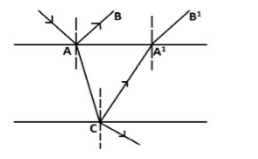
A
$7$
B
$49$
C
$4$
D
$8$
Solution
(B) Let the incident intensity be $I$.
At point $A$,$25\%$ of $I$ is reflected as ray $AB$. So,$I_1 = 0.25I = I/4$.
The intensity of the refracted ray is $0.75I$.
At point $C$,this ray is reflected. $25\%$ of the incident energy $(0.75I)$ is reflected. So,the intensity of the ray reaching $A^1$ is $0.25 \times 0.75I = 0.1875I = (3/16)I$.
At point $A^1$,this ray is refracted out as $A^1B^1$. Since $25\%$ is reflected at $A^1$,$75\%$ of the incident energy is transmitted.
So,$I_2 = 0.75 \times (3/16)I = (3/4) \times (3/16)I = (9/64)I$.
The amplitudes are $a_1 = \sqrt{I_1} = \sqrt{I/4} = (1/2)\sqrt{I}$ and $a_2 = \sqrt{I_2} = \sqrt{9I/64} = (3/8)\sqrt{I}$.
The ratio of amplitudes is $a_1/a_2 = (1/2) / (3/8) = 4/3$.
$I_{\text{max}} / I_{\text{min}} = (a_1 + a_2)^2 / (a_1 - a_2)^2 = ((4+3)/ (4-3))^2 = (7/1)^2 = 49/1$.
At point $A$,$25\%$ of $I$ is reflected as ray $AB$. So,$I_1 = 0.25I = I/4$.
The intensity of the refracted ray is $0.75I$.
At point $C$,this ray is reflected. $25\%$ of the incident energy $(0.75I)$ is reflected. So,the intensity of the ray reaching $A^1$ is $0.25 \times 0.75I = 0.1875I = (3/16)I$.
At point $A^1$,this ray is refracted out as $A^1B^1$. Since $25\%$ is reflected at $A^1$,$75\%$ of the incident energy is transmitted.
So,$I_2 = 0.75 \times (3/16)I = (3/4) \times (3/16)I = (9/64)I$.
The amplitudes are $a_1 = \sqrt{I_1} = \sqrt{I/4} = (1/2)\sqrt{I}$ and $a_2 = \sqrt{I_2} = \sqrt{9I/64} = (3/8)\sqrt{I}$.
The ratio of amplitudes is $a_1/a_2 = (1/2) / (3/8) = 4/3$.
$I_{\text{max}} / I_{\text{min}} = (a_1 + a_2)^2 / (a_1 - a_2)^2 = ((4+3)/ (4-3))^2 = (7/1)^2 = 49/1$.
0 likesView Solution
410
PhysicsMediumMCQMHT CET · 2025
Interference fringes are produced on the screen by using two light sources of intensities $I$ and $9I$. The phase difference between the beams is $\pi / 2$ at point $P$ and $\pi$ at point $Q$ on the screen. The difference between the resultant intensities at points $P$ and $Q$ is $(\cos 90^{\circ}=0, \cos 180^{\circ}=-1)$. (in $I$)
A
$2$
B
$4$
C
$6$
D
$8$
Solution
(C) The resultant intensity $I_R$ in an interference pattern is given by the formula: $I_R = I_1 + I_2 + 2\sqrt{I_1 I_2} \cos \phi$,where $\phi$ is the phase difference.
Given $I_1 = I$ and $I_2 = 9I$.
At point $P$,the phase difference $\phi_P = \pi / 2$. Thus,$I_P = I + 9I + 2\sqrt{I \cdot 9I} \cos(\pi / 2) = 10I + 6I(0) = 10I$.
At point $Q$,the phase difference $\phi_Q = \pi$. Thus,$I_Q = I + 9I + 2\sqrt{I \cdot 9I} \cos(\pi) = 10I + 6I(-1) = 10I - 6I = 4I$.
The difference between the resultant intensities at points $P$ and $Q$ is $|I_P - I_Q| = |10I - 4I| = 6I$.
Given $I_1 = I$ and $I_2 = 9I$.
At point $P$,the phase difference $\phi_P = \pi / 2$. Thus,$I_P = I + 9I + 2\sqrt{I \cdot 9I} \cos(\pi / 2) = 10I + 6I(0) = 10I$.
At point $Q$,the phase difference $\phi_Q = \pi$. Thus,$I_Q = I + 9I + 2\sqrt{I \cdot 9I} \cos(\pi) = 10I + 6I(-1) = 10I - 6I = 4I$.
The difference between the resultant intensities at points $P$ and $Q$ is $|I_P - I_Q| = |10I - 4I| = 6I$.
0 likesView Solution
411
PhysicsMediumMCQMHT CET · 2025
The two coherent sources produce interference with intensity ratio $b$. In the interference pattern, the ratio $\frac{I_{\text{max}} + I_{\text{min}}}{I_{\text{max}} - I_{\text{min}}}$ will be
A
$\frac{1+b}{\sqrt{b}}$
B
$\frac{1+b}{2\sqrt{b}}$
C
$\frac{2\sqrt{b}}{1+b}$
D
$\frac{2\sqrt{b}}{(1+b)^2}$
Solution
(B) Let the intensities of the two coherent sources be $I_1$ and $I_2$. The ratio of intensities is given as $b = \frac{I_1}{I_2}$.
We know that $I_{\text{max}} = (\sqrt{I_1} + \sqrt{I_2})^2$ and $I_{\text{min}} = (\sqrt{I_1} - \sqrt{I_2})^2$.
The required ratio is $R = \frac{I_{\text{max}} + I_{\text{min}}}{I_{\text{max}} - I_{\text{min}}}$.
Substituting the expressions for $I_{\text{max}}$ and $I_{\text{min}}$:
$R = \frac{(\sqrt{I_1} + \sqrt{I_2})^2 + (\sqrt{I_1} - \sqrt{I_2})^2}{(\sqrt{I_1} + \sqrt{I_2})^2 - (\sqrt{I_1} - \sqrt{I_2})^2}$.
Expanding the terms:
$R = \frac{(I_1 + I_2 + 2\sqrt{I_1I_2}) + (I_1 + I_2 - 2\sqrt{I_1I_2})}{(I_1 + I_2 + 2\sqrt{I_1I_2}) - (I_1 + I_2 - 2\sqrt{I_1I_2})} = \frac{2(I_1 + I_2)}{4\sqrt{I_1I_2}} = \frac{I_1 + I_2}{2\sqrt{I_1I_2}}$.
Dividing numerator and denominator by $I_2$:
$R = \frac{\frac{I_1}{I_2} + 1}{2\sqrt{\frac{I_1}{I_2}}} = \frac{b + 1}{2\sqrt{b}}$.
We know that $I_{\text{max}} = (\sqrt{I_1} + \sqrt{I_2})^2$ and $I_{\text{min}} = (\sqrt{I_1} - \sqrt{I_2})^2$.
The required ratio is $R = \frac{I_{\text{max}} + I_{\text{min}}}{I_{\text{max}} - I_{\text{min}}}$.
Substituting the expressions for $I_{\text{max}}$ and $I_{\text{min}}$:
$R = \frac{(\sqrt{I_1} + \sqrt{I_2})^2 + (\sqrt{I_1} - \sqrt{I_2})^2}{(\sqrt{I_1} + \sqrt{I_2})^2 - (\sqrt{I_1} - \sqrt{I_2})^2}$.
Expanding the terms:
$R = \frac{(I_1 + I_2 + 2\sqrt{I_1I_2}) + (I_1 + I_2 - 2\sqrt{I_1I_2})}{(I_1 + I_2 + 2\sqrt{I_1I_2}) - (I_1 + I_2 - 2\sqrt{I_1I_2})} = \frac{2(I_1 + I_2)}{4\sqrt{I_1I_2}} = \frac{I_1 + I_2}{2\sqrt{I_1I_2}}$.
Dividing numerator and denominator by $I_2$:
$R = \frac{\frac{I_1}{I_2} + 1}{2\sqrt{\frac{I_1}{I_2}}} = \frac{b + 1}{2\sqrt{b}}$.
0 likesView Solution
412
PhysicsMediumMCQMHT CET · 2025
If two sources of light emit waves of different amplitudes and interfere, then:
A
there is some intensity of light in the region of destructive interference.
B
fringe width is less.
C
brightness of fringes is less.
D
fringes disappear after short time.
Solution
(A) In the phenomenon of interference, the intensity of light is given by $I = I_1 + I_2 + 2\sqrt{I_1 I_2} \cos \phi$, where $I_1$ and $I_2$ are the intensities of the two waves.
Since $I \propto A^2$, where $A$ is the amplitude, the intensities at the points of destructive interference are given by $I_{min} = (\sqrt{I_1} - \sqrt{I_2})^2 = (A_1 - A_2)^2$.
If the amplitudes $A_1$ and $A_2$ are different, then $(A_1 - A_2)^2 \neq 0$.
Therefore, the intensity at the region of destructive interference is not zero, meaning there is some residual intensity of light.
Since $I \propto A^2$, where $A$ is the amplitude, the intensities at the points of destructive interference are given by $I_{min} = (\sqrt{I_1} - \sqrt{I_2})^2 = (A_1 - A_2)^2$.
If the amplitudes $A_1$ and $A_2$ are different, then $(A_1 - A_2)^2 \neq 0$.
Therefore, the intensity at the region of destructive interference is not zero, meaning there is some residual intensity of light.
0 likesView Solution
413
PhysicsMediumMCQMHT CET · 2025
Three identical polaroids $P_1, P_2$ and $P_3$ are placed one after another. The pass axis of $P_2$ and $P_3$ are inclined at an angle of $60^{\circ}$ and $90^{\circ}$ with respect to the axis of $P_1$. The source has an intensity $I_0 = 256 \ W/m^2$. Find the intensity of light at point $O$. (in $W/m^2$)
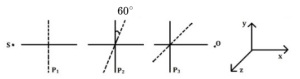
A
$24$
B
$20$
C
$16$
D
$8$
Solution
(A) Let the initial intensity of unpolarized light be $I_0 = 256 \ W/m^2$.
When unpolarized light passes through the first polaroid $P_1$,the intensity of the transmitted light becomes $I_1 = I_0 / 2 = 256 / 2 = 128 \ W/m^2$.
The pass axis of $P_2$ is at an angle $\theta_1 = 60^{\circ}$ with respect to $P_1$. According to Malus' Law,the intensity after $P_2$ is $I_2 = I_1 \cos^2(\theta_1) = 128 \times \cos^2(60^{\circ}) = 128 \times (0.5)^2 = 128 \times 0.25 = 32 \ W/m^2$.
The pass axis of $P_3$ is at an angle of $90^{\circ}$ with respect to $P_1$. The angle between the pass axes of $P_2$ and $P_3$ is $\theta_2 = 90^{\circ} - 60^{\circ} = 30^{\circ}$.
Applying Malus' Law again for $P_3$,the final intensity at point $O$ is $I_3 = I_2 \cos^2(\theta_2) = 32 \times \cos^2(30^{\circ}) = 32 \times (\sqrt{3}/2)^2 = 32 \times (3/4) = 24 \ W/m^2$.
When unpolarized light passes through the first polaroid $P_1$,the intensity of the transmitted light becomes $I_1 = I_0 / 2 = 256 / 2 = 128 \ W/m^2$.
The pass axis of $P_2$ is at an angle $\theta_1 = 60^{\circ}$ with respect to $P_1$. According to Malus' Law,the intensity after $P_2$ is $I_2 = I_1 \cos^2(\theta_1) = 128 \times \cos^2(60^{\circ}) = 128 \times (0.5)^2 = 128 \times 0.25 = 32 \ W/m^2$.
The pass axis of $P_3$ is at an angle of $90^{\circ}$ with respect to $P_1$. The angle between the pass axes of $P_2$ and $P_3$ is $\theta_2 = 90^{\circ} - 60^{\circ} = 30^{\circ}$.
Applying Malus' Law again for $P_3$,the final intensity at point $O$ is $I_3 = I_2 \cos^2(\theta_2) = 32 \times \cos^2(30^{\circ}) = 32 \times (\sqrt{3}/2)^2 = 32 \times (3/4) = 24 \ W/m^2$.
0 likesView Solution
414
PhysicsMediumMCQMHT CET · 2025
Four polaroids are placed such that the optic axis of each is inclined at an angle of $30^{\circ}$ with the optic axis of the preceding one. If unpolarised light of intensity $I_0$ falls on the first polaroid,the intensity of light transmitted from the fourth polaroid is $[\cos 30^{\circ} = \sqrt{3} / 2]$.
A
$\frac{9 I_0}{32}$
B
$\frac{27 I_0}{128}$
C
$\frac{35 I_0}{128}$
D
$\frac{27 I_0}{32}$
Solution
(B) When unpolarised light of intensity $I_0$ passes through the first polaroid,the intensity of the transmitted light is $I_1 = I_0 / 2$.
For subsequent polaroids,we use Malus' Law: $I_n = I_{n-1} \cos^2 \theta$,where $\theta = 30^{\circ}$.
Intensity after the second polaroid: $I_2 = I_1 \cos^2 30^{\circ} = (I_0 / 2) \times (\sqrt{3} / 2)^2 = (I_0 / 2) \times (3 / 4) = 3 I_0 / 8$.
Intensity after the third polaroid: $I_3 = I_2 \cos^2 30^{\circ} = (3 I_0 / 8) \times (3 / 4) = 9 I_0 / 32$.
Intensity after the fourth polaroid: $I_4 = I_3 \cos^2 30^{\circ} = (9 I_0 / 32) \times (3 / 4) = 27 I_0 / 128$.
Thus,the correct option is $B$.
For subsequent polaroids,we use Malus' Law: $I_n = I_{n-1} \cos^2 \theta$,where $\theta = 30^{\circ}$.
Intensity after the second polaroid: $I_2 = I_1 \cos^2 30^{\circ} = (I_0 / 2) \times (\sqrt{3} / 2)^2 = (I_0 / 2) \times (3 / 4) = 3 I_0 / 8$.
Intensity after the third polaroid: $I_3 = I_2 \cos^2 30^{\circ} = (3 I_0 / 8) \times (3 / 4) = 9 I_0 / 32$.
Intensity after the fourth polaroid: $I_4 = I_3 \cos^2 30^{\circ} = (9 I_0 / 32) \times (3 / 4) = 27 I_0 / 128$.
Thus,the correct option is $B$.
0 likesView Solution
415
PhysicsMediumMCQMHT CET · 2025
Three polarising sheets are placed co-axially. The pass axes of polaroids $2$ and $3$ make angles of $30^{\circ}$ and $90^{\circ}$ respectively with the pass axis of polaroid $1$. If $I_0$ is the intensity of unpolarised light entering sheet $1$,what is the intensity of the light emerging from sheet $3$? $(\cos 30^{\circ}=\sqrt{3} / 2, \cos 90^{\circ}=0, \cos 60^{\circ}=1 / 2)$
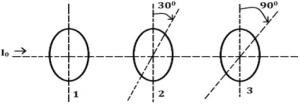
A
zero
B
$\frac{3 I_0}{32}$
C
$\frac{3 I_0}{8}$
D
$\frac{3 I_0}{16}$
Solution
(B) When unpolarised light of intensity $I_0$ passes through the first polaroid,the intensity of the emergent light is $I_1 = \frac{I_0}{2}$.
According to Malus' Law,the intensity of light emerging from a polaroid is $I = I_{incident} \cos^2 \theta$,where $\theta$ is the angle between the pass axis of the polaroid and the plane of polarisation of the incident light.
For the second polaroid,the angle between its pass axis and the pass axis of the first polaroid is $\theta_1 = 30^{\circ}$. Thus,the intensity of light emerging from the second polaroid is $I_2 = I_1 \cos^2 30^{\circ} = \left(\frac{I_0}{2}\right) \left(\frac{\sqrt{3}}{2}\right)^2 = \left(\frac{I_0}{2}\right) \left(\frac{3}{4}\right) = \frac{3 I_0}{8}$.
For the third polaroid,the angle between its pass axis and the pass axis of the second polaroid is $\theta_2 = 90^{\circ} - 30^{\circ} = 60^{\circ}$. Thus,the intensity of light emerging from the third polaroid is $I_3 = I_2 \cos^2 60^{\circ} = \left(\frac{3 I_0}{8}\right) \left(\frac{1}{2}\right)^2 = \left(\frac{3 I_0}{8}\right) \left(\frac{1}{4}\right) = \frac{3 I_0}{32}$.
According to Malus' Law,the intensity of light emerging from a polaroid is $I = I_{incident} \cos^2 \theta$,where $\theta$ is the angle between the pass axis of the polaroid and the plane of polarisation of the incident light.
For the second polaroid,the angle between its pass axis and the pass axis of the first polaroid is $\theta_1 = 30^{\circ}$. Thus,the intensity of light emerging from the second polaroid is $I_2 = I_1 \cos^2 30^{\circ} = \left(\frac{I_0}{2}\right) \left(\frac{\sqrt{3}}{2}\right)^2 = \left(\frac{I_0}{2}\right) \left(\frac{3}{4}\right) = \frac{3 I_0}{8}$.
For the third polaroid,the angle between its pass axis and the pass axis of the second polaroid is $\theta_2 = 90^{\circ} - 30^{\circ} = 60^{\circ}$. Thus,the intensity of light emerging from the third polaroid is $I_3 = I_2 \cos^2 60^{\circ} = \left(\frac{3 I_0}{8}\right) \left(\frac{1}{2}\right)^2 = \left(\frac{3 I_0}{8}\right) \left(\frac{1}{4}\right) = \frac{3 I_0}{32}$.
0 likesView Solution
416
PhysicsMediumMCQMHT CET · 2025
Two polaroids are placed in the path of an unpolarised beam of intensity $I_0$ such that no light is emitted from the second polaroid. If a third polaroid,whose polarisation axis makes an angle $\theta$ with the polarisation axis of the first polaroid,is placed between these polaroids,then the intensity of light emerging from the last polaroid will be:
A
$\frac{I_0}{4}(\sin 2 \theta)^2$
B
$\frac{I_0}{8}(\sin 2 \theta)^2$
C
$\frac{I_0}{4} \sin ^2 \theta$
D
$\frac{I_0}{8} \sin ^2 \theta$
Solution
(B) $1$. When unpolarised light of intensity $I_0$ passes through the first polaroid,the intensity of the transmitted light becomes $I_1 = \frac{I_0}{2}$.
$2$. The first and second polaroids are crossed (angle between axes is $90^\circ$),so no light passes through the second polaroid initially.
$3$. $A$ third polaroid is placed between them at an angle $\theta$ with the first polaroid. The angle between the third and the second polaroid is $(90^\circ - \theta)$.
$4$. Intensity after the third polaroid: $I_2 = I_1 \cos^2 \theta = \frac{I_0}{2} \cos^2 \theta$.
$5$. Intensity after the second (last) polaroid using Malus' Law: $I_3 = I_2 \cos^2(90^\circ - \theta) = I_2 \sin^2 \theta$.
$6$. Substituting $I_2$: $I_3 = (\frac{I_0}{2} \cos^2 \theta) \sin^2 \theta = \frac{I_0}{2} (\sin \theta \cos \theta)^2 = \frac{I_0}{2} (\frac{\sin 2 \theta}{2})^2 = \frac{I_0}{8} \sin^2 2 \theta$.
$2$. The first and second polaroids are crossed (angle between axes is $90^\circ$),so no light passes through the second polaroid initially.
$3$. $A$ third polaroid is placed between them at an angle $\theta$ with the first polaroid. The angle between the third and the second polaroid is $(90^\circ - \theta)$.
$4$. Intensity after the third polaroid: $I_2 = I_1 \cos^2 \theta = \frac{I_0}{2} \cos^2 \theta$.
$5$. Intensity after the second (last) polaroid using Malus' Law: $I_3 = I_2 \cos^2(90^\circ - \theta) = I_2 \sin^2 \theta$.
$6$. Substituting $I_2$: $I_3 = (\frac{I_0}{2} \cos^2 \theta) \sin^2 \theta = \frac{I_0}{2} (\sin \theta \cos \theta)^2 = \frac{I_0}{2} (\frac{\sin 2 \theta}{2})^2 = \frac{I_0}{8} \sin^2 2 \theta$.
0 likesView Solution
417
PhysicsMediumMCQMHT CET · 2025
Two polaroids are oriented with their planes perpendicular to incident light and transmission axis making an angle $30^{\circ}$ with each other. What fraction of incident unpolarised light is transmitted (in $\%$)? $(\cos 30^{\circ} = \sqrt{3} / 2)$
A
$57.5$
B
$17.5$
C
$27.5$
D
$37.5$
Solution
(D) When unpolarised light of intensity $I_0$ passes through the first polaroid,the intensity of the transmitted light becomes $I_1 = I_0 / 2$.
This light is now plane-polarised.
When this light passes through the second polaroid whose transmission axis makes an angle $\theta = 30^{\circ}$ with the first,the intensity of the transmitted light $I_2$ is given by Malus' Law: $I_2 = I_1 \cos^2 \theta$.
Substituting the values: $I_2 = (I_0 / 2) \cos^2 30^{\circ}$.
Since $\cos 30^{\circ} = \sqrt{3} / 2$,we have $\cos^2 30^{\circ} = 3 / 4$.
Therefore,$I_2 = (I_0 / 2) \times (3 / 4) = 3 I_0 / 8$.
Calculating the fraction: $3 / 8 = 0.375$,which is $37.5 \%$.
This light is now plane-polarised.
When this light passes through the second polaroid whose transmission axis makes an angle $\theta = 30^{\circ}$ with the first,the intensity of the transmitted light $I_2$ is given by Malus' Law: $I_2 = I_1 \cos^2 \theta$.
Substituting the values: $I_2 = (I_0 / 2) \cos^2 30^{\circ}$.
Since $\cos 30^{\circ} = \sqrt{3} / 2$,we have $\cos^2 30^{\circ} = 3 / 4$.
Therefore,$I_2 = (I_0 / 2) \times (3 / 4) = 3 I_0 / 8$.
Calculating the fraction: $3 / 8 = 0.375$,which is $37.5 \%$.
0 likesView Solution
418
PhysicsMediumMCQMHT CET · 2025
Let the speed of light in a medium be $V$ and the polarising angle be $i_p$. If $C$ is the speed of light in vacuum,what is the relation between them?
A
$V=C \cos(i_p)$
B
$V \cos(i_p) = C \sin(i_p)$
C
$C = V \cot(i_p)$
D
$V \sin(i_p) = C \cos(i_p)$
Solution
(D) According to Brewster's Law,the refractive index $\mu$ of a medium is given by $\mu = \tan(i_p)$,where $i_p$ is the polarising angle.
Also,the refractive index $\mu$ is defined as the ratio of the speed of light in vacuum $(C)$ to the speed of light in the medium $(V)$: $\mu = \frac{C}{V}$.
Equating the two expressions for $\mu$,we get: $\frac{C}{V} = \tan(i_p)$.
This can be written as $\frac{C}{V} = \frac{\sin(i_p)}{\cos(i_p)}$.
Rearranging the terms,we get $C \cos(i_p) = V \sin(i_p)$,which is equivalent to $V \sin(i_p) = C \cos(i_p)$.
Also,the refractive index $\mu$ is defined as the ratio of the speed of light in vacuum $(C)$ to the speed of light in the medium $(V)$: $\mu = \frac{C}{V}$.
Equating the two expressions for $\mu$,we get: $\frac{C}{V} = \tan(i_p)$.
This can be written as $\frac{C}{V} = \frac{\sin(i_p)}{\cos(i_p)}$.
Rearranging the terms,we get $C \cos(i_p) = V \sin(i_p)$,which is equivalent to $V \sin(i_p) = C \cos(i_p)$.
0 likesView Solution
419
PhysicsEasyMCQMHT CET · 2025
Select the correct statement.
A
If the Brewster's angle for the light propagation from air to glass is $\theta$, then the Brewster's angle for the light propagating from glass to air is $(\frac{\pi}{2} - \theta)$.
B
The Brewster's angle for the light propagating from the glass to air is $\tan^{-1}(\frac{1}{\mu})$, where $\mu$ is the refractive index of glass.
C
If the Brewster's angle for light propagating from air to glass is $\theta$, then the Brewster's angle for the light propagating from glass to air is $(\pi + \theta)$.
D
The Brewster's angle for light propagating from glass to air is $\tan(\mu)$, where $\mu$ is the refractive index of glass.
Solution
(A) Brewster's law states that $\tan(i_B) = \mu_{21}$, where $\mu_{21} = \frac{\mu_2}{\mu_1}$ is the refractive index of the second medium with respect to the first.
For light propagating from air $(\mu_1 = 1)$ to glass $(\mu_2 = \mu)$, the Brewster's angle $\theta$ is given by $\tan(\theta) = \frac{\mu}{1} = \mu$.
For light propagating from glass $(\mu_1 = \mu)$ to air $(\mu_2 = 1)$, the Brewster's angle $i_B'$ is given by $\tan(i_B') = \frac{1}{\mu}$.
Since $\tan(\theta) = \mu$, we have $\frac{1}{\mu} = \frac{1}{\tan(\theta)} = \cot(\theta) = \tan(\frac{\pi}{2} - \theta)$.
Therefore, $i_B' = \frac{\pi}{2} - \theta$.
For light propagating from air $(\mu_1 = 1)$ to glass $(\mu_2 = \mu)$, the Brewster's angle $\theta$ is given by $\tan(\theta) = \frac{\mu}{1} = \mu$.
For light propagating from glass $(\mu_1 = \mu)$ to air $(\mu_2 = 1)$, the Brewster's angle $i_B'$ is given by $\tan(i_B') = \frac{1}{\mu}$.
Since $\tan(\theta) = \mu$, we have $\frac{1}{\mu} = \frac{1}{\tan(\theta)} = \cot(\theta) = \tan(\frac{\pi}{2} - \theta)$.
Therefore, $i_B' = \frac{\pi}{2} - \theta$.
0 likesView Solution
420
PhysicsMediumMCQMHT CET · 2025
The polarising angle of a transparent medium is $\theta$. Let the speed of light in the medium be $v$. Then the relation between $\theta$ and $v$ is [where $c$ is the velocity of light in air].
A
$\theta=\sin ^{-1}\left(\frac{v}{c}\right)$
B
$\theta=\tan ^{-1}\left(\frac{v}{c}\right)$
C
$\theta=\cot ^{-1}\left(\frac{v}{c}\right)$
D
$\theta=\cos ^{-1}\left(\frac{v}{c}\right)$
Solution
(C) According to Brewster's Law,the refractive index $\mu$ of a medium is given by $\mu = \tan \theta$,where $\theta$ is the polarising angle.
We also know that the refractive index $\mu$ is the ratio of the speed of light in air $(c)$ to the speed of light in the medium $(v)$,so $\mu = \frac{c}{v}$.
Equating the two expressions for $\mu$,we get $\tan \theta = \frac{c}{v}$.
Therefore,$\theta = \tan^{-1}\left(\frac{c}{v}\right)$.
However,looking at the options provided,there seems to be a reciprocal relationship intended. If we define the refractive index as $\mu = \frac{1}{\tan \theta}$ or if the question implies the angle of incidence relative to the surface,we re-evaluate: $\tan \theta = \frac{c}{v} \implies \cot \theta = \frac{v}{c}$.
Thus,$\theta = \cot^{-1}\left(\frac{v}{c}\right)$.
We also know that the refractive index $\mu$ is the ratio of the speed of light in air $(c)$ to the speed of light in the medium $(v)$,so $\mu = \frac{c}{v}$.
Equating the two expressions for $\mu$,we get $\tan \theta = \frac{c}{v}$.
Therefore,$\theta = \tan^{-1}\left(\frac{c}{v}\right)$.
However,looking at the options provided,there seems to be a reciprocal relationship intended. If we define the refractive index as $\mu = \frac{1}{\tan \theta}$ or if the question implies the angle of incidence relative to the surface,we re-evaluate: $\tan \theta = \frac{c}{v} \implies \cot \theta = \frac{v}{c}$.
Thus,$\theta = \cot^{-1}\left(\frac{v}{c}\right)$.
0 likesView Solution
421
PhysicsMediumMCQMHT CET · 2025
$A$ ray of light is incident at the polarising angle $\theta$ on an air-glass interface. If $\lambda_{a}$ and $\lambda_{g}$ are the wavelengths of light in air and glass respectively,then:
A
$\lambda_g = \lambda_a \cot \theta$
B
$\lambda_a = \lambda_g \tan^2 \theta$
C
$\lambda_g = \lambda_a \tan^2 \theta$
D
$\lambda_a = \lambda_g \cot \theta$
Solution
(A) According to Brewster's Law,the refractive index $\mu$ of the glass with respect to air is given by $\mu = \tan \theta$,where $\theta$ is the polarising angle.
We know that the refractive index $\mu$ is also defined as the ratio of the speed of light in air $(c_a)$ to the speed of light in glass $(c_g)$,which is $\mu = \frac{c_a}{c_g}$.
Since the frequency $f$ of light remains constant when it travels from one medium to another,the speed of light is related to wavelength by $c = f \lambda$.
Therefore,$\mu = \frac{f \lambda_a}{f \lambda_g} = \frac{\lambda_a}{\lambda_g}$.
Equating the two expressions for $\mu$,we get $\tan \theta = \frac{\lambda_a}{\lambda_g}$.
Rearranging this,we find $\lambda_a = \lambda_g \tan \theta$. However,looking at the options provided,there seems to be a discrepancy in the standard form. Re-evaluating the relationship: $\mu = \frac{\lambda_a}{\lambda_g} = \tan \theta$. Thus,$\lambda_g = \frac{\lambda_a}{\tan \theta} = \lambda_a \cot \theta$.
We know that the refractive index $\mu$ is also defined as the ratio of the speed of light in air $(c_a)$ to the speed of light in glass $(c_g)$,which is $\mu = \frac{c_a}{c_g}$.
Since the frequency $f$ of light remains constant when it travels from one medium to another,the speed of light is related to wavelength by $c = f \lambda$.
Therefore,$\mu = \frac{f \lambda_a}{f \lambda_g} = \frac{\lambda_a}{\lambda_g}$.
Equating the two expressions for $\mu$,we get $\tan \theta = \frac{\lambda_a}{\lambda_g}$.
Rearranging this,we find $\lambda_a = \lambda_g \tan \theta$. However,looking at the options provided,there seems to be a discrepancy in the standard form. Re-evaluating the relationship: $\mu = \frac{\lambda_a}{\lambda_g} = \tan \theta$. Thus,$\lambda_g = \frac{\lambda_a}{\tan \theta} = \lambda_a \cot \theta$.
0 likesView Solution
422
PhysicsMediumMCQMHT CET · 2025
$A$ beam of light of intensity $I_0$ falls on a system of three polaroids which are arranged in succession such that the pass (transmission) axis is turned through $60^{\circ}$ with respect to the preceding one. The fraction of the incident light intensity that passes through the system is $\left(\cos 60^{\circ} = 1/2\right)$.
A
$1/8$
B
$1/32$
C
$1/16$
D
$1/2$
Solution
(B) Let the intensity of the incident light be $I_0$.
When light passes through the first polaroid,its intensity becomes $I_1 = I_0/2$ (assuming unpolarized light).
For the second polaroid,the angle between the transmission axis and the incident light is $\theta = 60^{\circ}$. According to Malus' Law,$I_2 = I_1 \cos^2(60^{\circ}) = (I_0/2) \times (1/2)^2 = I_0/8$.
For the third polaroid,the angle between its transmission axis and the second polaroid's axis is also $\theta = 60^{\circ}$.
Thus,$I_3 = I_2 \cos^2(60^{\circ}) = (I_0/8) \times (1/2)^2 = I_0/32$.
The fraction of the incident light intensity that passes through the system is $I_3/I_0 = 1/32$.
When light passes through the first polaroid,its intensity becomes $I_1 = I_0/2$ (assuming unpolarized light).
For the second polaroid,the angle between the transmission axis and the incident light is $\theta = 60^{\circ}$. According to Malus' Law,$I_2 = I_1 \cos^2(60^{\circ}) = (I_0/2) \times (1/2)^2 = I_0/8$.
For the third polaroid,the angle between its transmission axis and the second polaroid's axis is also $\theta = 60^{\circ}$.
Thus,$I_3 = I_2 \cos^2(60^{\circ}) = (I_0/8) \times (1/2)^2 = I_0/32$.
The fraction of the incident light intensity that passes through the system is $I_3/I_0 = 1/32$.
0 likesView Solution
423
PhysicsEasyMCQMHT CET · 2025
According to Huygen's wave theory of light,which one of the following statements is < u>not correct?
A
Different colours of light are due to different wavelengths of waves.
B
Different colours of light are due to different sizes of the corpuscles.
C
Speed of light in denser medium is less than that in rarer medium.
D
It can explain laws of reflection and refraction.
Solution
(B) Huygens' wave theory of light proposes that light travels as waves in a hypothetical medium called the luminiferous ether.
According to this theory,different colours of light correspond to different wavelengths (or frequencies) of these waves.
Option $A$ is correct as it aligns with the wave nature of light.
Option $B$ refers to Newton's Corpuscular theory,which suggests light consists of particles (corpuscles) of different sizes for different colours. This is $NOT$ part of Huygens' wave theory.
Option $C$ is a prediction of Huygens' theory,which correctly states that light travels slower in a denser medium compared to a rarer medium.
Option $D$ is correct because Huygens' principle successfully explains the laws of reflection and refraction using wave-fronts.
Therefore,the statement that is not correct according to Huygens' wave theory is $B$.
According to this theory,different colours of light correspond to different wavelengths (or frequencies) of these waves.
Option $A$ is correct as it aligns with the wave nature of light.
Option $B$ refers to Newton's Corpuscular theory,which suggests light consists of particles (corpuscles) of different sizes for different colours. This is $NOT$ part of Huygens' wave theory.
Option $C$ is a prediction of Huygens' theory,which correctly states that light travels slower in a denser medium compared to a rarer medium.
Option $D$ is correct because Huygens' principle successfully explains the laws of reflection and refraction using wave-fronts.
Therefore,the statement that is not correct according to Huygens' wave theory is $B$.
0 likesView Solution
424
PhysicsMediumMCQMHT CET · 2025
$A$ ray of light from a monochromatic point source of light is incident at a point on the screen. If a thin mica film of thickness $t$ and refractive index $n$ is introduced in its path,then the optical path
A
is decreased by $(n-1) t$.
B
is increased by $(n+1) t$.
C
is not affected.
D
is increased by $(n-1) t$.
Solution
(D) The optical path length is defined as the product of the refractive index of the medium and the geometric distance traveled by the light.
In vacuum (or air),the optical path for a distance $t$ is $t_{opt} = 1 \times t = t$.
When a mica film of thickness $t$ and refractive index $n$ is introduced,the light travels a distance $t$ through the film.
The optical path through the film is $t'_{opt} = n \times t = nt$.
The change in optical path is $\Delta = t'_{opt} - t_{opt} = nt - t = (n-1)t$.
Since $n > 1$,the optical path increases by $(n-1)t$.
In vacuum (or air),the optical path for a distance $t$ is $t_{opt} = 1 \times t = t$.
When a mica film of thickness $t$ and refractive index $n$ is introduced,the light travels a distance $t$ through the film.
The optical path through the film is $t'_{opt} = n \times t = nt$.
The change in optical path is $\Delta = t'_{opt} - t_{opt} = nt - t = (n-1)t$.
Since $n > 1$,the optical path increases by $(n-1)t$.
0 likesView Solution
425
PhysicsMediumMCQMHT CET · 2025
In Young's double slit experiment,let $d$ be the distance between two slits and $D$ be the distance between the slits and the screen. Using a monochromatic source of wavelength $\lambda$,in an interference pattern,the third minimum is observed exactly in front of one of the slits. If at the same point on the screen the first minimum is to be obtained,the required change in the wavelength is ($d$ and $D$ are not changed).
A
$2 \lambda$
B
$3 \lambda$
C
$4 \lambda$
D
$5 \lambda$
Solution
(C) The path difference at a point exactly in front of one of the slits is given by $\Delta x = \frac{d^2}{2D}$.
For the third minimum,the condition for path difference is $\Delta x = (2n - 1) \frac{\lambda}{2}$ where $n = 3$.
So,$\frac{d^2}{2D} = (2(3) - 1) \frac{\lambda}{2} = \frac{5\lambda}{2}$.
This implies $\frac{d^2}{D} = 5\lambda$.
Now,for the first minimum at the same point,let the new wavelength be $\lambda'$. The condition is $\Delta x = (2(1) - 1) \frac{\lambda'}{2} = \frac{\lambda'}{2}$.
Equating the path difference: $\frac{d^2}{2D} = \frac{\lambda'}{2}$,which gives $\frac{d^2}{D} = \lambda'$.
Substituting the value of $\frac{d^2}{D}$ from the first case: $\lambda' = 5\lambda$.
The change in wavelength is $\Delta \lambda = \lambda' - \lambda = 5\lambda - \lambda = 4\lambda$.
For the third minimum,the condition for path difference is $\Delta x = (2n - 1) \frac{\lambda}{2}$ where $n = 3$.
So,$\frac{d^2}{2D} = (2(3) - 1) \frac{\lambda}{2} = \frac{5\lambda}{2}$.
This implies $\frac{d^2}{D} = 5\lambda$.
Now,for the first minimum at the same point,let the new wavelength be $\lambda'$. The condition is $\Delta x = (2(1) - 1) \frac{\lambda'}{2} = \frac{\lambda'}{2}$.
Equating the path difference: $\frac{d^2}{2D} = \frac{\lambda'}{2}$,which gives $\frac{d^2}{D} = \lambda'$.
Substituting the value of $\frac{d^2}{D}$ from the first case: $\lambda' = 5\lambda$.
The change in wavelength is $\Delta \lambda = \lambda' - \lambda = 5\lambda - \lambda = 4\lambda$.
0 likesView Solution
426
PhysicsMediumMCQMHT CET · 2025
In Young's double slit experiment, the intensity on the screen at a point where the path difference is $\frac{\lambda}{4}$ is $\frac{K}{2}$. The intensity at a point when the path difference is $\lambda$ will be:
A
$4 K$
B
$2 K$
C
$K$
D
$\frac{K}{4}$
Solution
(C) The intensity $I$ at any point on the screen is given by $I = I_0 \cos^2(\frac{\phi}{2})$, where $I_0$ is the maximum intensity and $\phi$ is the phase difference.
Phase difference $\phi = \frac{2\pi}{\lambda} \times \Delta x$, where $\Delta x$ is the path difference.
For $\Delta x = \frac{\lambda}{4}$, the phase difference $\phi_1 = \frac{2\pi}{\lambda} \times \frac{\lambda}{4} = \frac{\pi}{2}$.
The intensity $I_1 = I_0 \cos^2(\frac{\pi/2}{2}) = I_0 \cos^2(\frac{\pi}{4}) = I_0 (\frac{1}{\sqrt{2}})^2 = \frac{I_0}{2}$.
Given $I_1 = \frac{K}{2}$, we have $\frac{I_0}{2} = \frac{K}{2}$, which implies $I_0 = K$.
For $\Delta x = \lambda$, the phase difference $\phi_2 = \frac{2\pi}{\lambda} \times \lambda = 2\pi$.
The intensity $I_2 = I_0 \cos^2(\frac{2\pi}{2}) = I_0 \cos^2(\pi) = I_0 (1)^2 = I_0$.
Since $I_0 = K$, the intensity $I_2 = K$.
Phase difference $\phi = \frac{2\pi}{\lambda} \times \Delta x$, where $\Delta x$ is the path difference.
For $\Delta x = \frac{\lambda}{4}$, the phase difference $\phi_1 = \frac{2\pi}{\lambda} \times \frac{\lambda}{4} = \frac{\pi}{2}$.
The intensity $I_1 = I_0 \cos^2(\frac{\pi/2}{2}) = I_0 \cos^2(\frac{\pi}{4}) = I_0 (\frac{1}{\sqrt{2}})^2 = \frac{I_0}{2}$.
Given $I_1 = \frac{K}{2}$, we have $\frac{I_0}{2} = \frac{K}{2}$, which implies $I_0 = K$.
For $\Delta x = \lambda$, the phase difference $\phi_2 = \frac{2\pi}{\lambda} \times \lambda = 2\pi$.
The intensity $I_2 = I_0 \cos^2(\frac{2\pi}{2}) = I_0 \cos^2(\pi) = I_0 (1)^2 = I_0$.
Since $I_0 = K$, the intensity $I_2 = K$.
0 likesView Solution
427
PhysicsEasyMCQMHT CET · 2025
In Young's double slit experiment,for the $n$th dark fringe $(n=1, 2, 3, \ldots)$ the phase difference of the interfering waves in radian will be
A
$n \frac{\pi}{2}$
B
$(2n+1) \pi$
C
$(2n-1) \pi$
D
$(2n-1) \frac{\pi}{2}$
Solution
(C) In Young's double slit experiment,the condition for destructive interference (dark fringe) is that the path difference $\Delta x$ must be an odd multiple of half the wavelength: $\Delta x = (2n-1) \frac{\lambda}{2}$,where $n = 1, 2, 3, \ldots$.
The relationship between phase difference $\Delta \phi$ and path difference $\Delta x$ is given by $\Delta \phi = \frac{2\pi}{\lambda} \Delta x$.
Substituting the expression for path difference into the phase difference formula:
$\Delta \phi = \frac{2\pi}{\lambda} \times (2n-1) \frac{\lambda}{2}$.
Simplifying the expression:
$\Delta \phi = (2n-1) \pi$ radians.
Thus,for the $n$th dark fringe,the phase difference is $(2n-1) \pi$.
The relationship between phase difference $\Delta \phi$ and path difference $\Delta x$ is given by $\Delta \phi = \frac{2\pi}{\lambda} \Delta x$.
Substituting the expression for path difference into the phase difference formula:
$\Delta \phi = \frac{2\pi}{\lambda} \times (2n-1) \frac{\lambda}{2}$.
Simplifying the expression:
$\Delta \phi = (2n-1) \pi$ radians.
Thus,for the $n$th dark fringe,the phase difference is $(2n-1) \pi$.
0 likesView Solution
428
PhysicsMediumMCQMHT CET · 2025
In Young's double slit experiment,when light of wavelength $600 \ nm$ is used,$18$ fringes are observed on the screen. If the wavelength of light is changed to $400 \ nm$,the number of fringes observed on the screen is:
A
$27$
B
$18$
C
$22$
D
$24$
Solution
(A) The number of fringes $N$ observed on a screen of fixed width $W$ is inversely proportional to the fringe width $\beta$.
The fringe width is given by $\beta = \frac{\lambda D}{d}$,where $\lambda$ is the wavelength,$D$ is the distance to the screen,and $d$ is the slit separation.
Since the total width $W$ covered by $N$ fringes is $W = N \beta$,we have $W = N \frac{\lambda D}{d}$.
For a fixed screen width $W$,$N \lambda = \text{constant}$.
Therefore,$N_1 \lambda_1 = N_2 \lambda_2$.
Given $N_1 = 18$,$\lambda_1 = 600 \ nm$,and $\lambda_2 = 400 \ nm$.
Substituting the values: $18 \times 600 = N_2 \times 400$.
$N_2 = \frac{18 \times 600}{400} = \frac{18 \times 6}{4} = \frac{108}{4} = 27$.
Thus,the number of fringes observed is $27$.
The fringe width is given by $\beta = \frac{\lambda D}{d}$,where $\lambda$ is the wavelength,$D$ is the distance to the screen,and $d$ is the slit separation.
Since the total width $W$ covered by $N$ fringes is $W = N \beta$,we have $W = N \frac{\lambda D}{d}$.
For a fixed screen width $W$,$N \lambda = \text{constant}$.
Therefore,$N_1 \lambda_1 = N_2 \lambda_2$.
Given $N_1 = 18$,$\lambda_1 = 600 \ nm$,and $\lambda_2 = 400 \ nm$.
Substituting the values: $18 \times 600 = N_2 \times 400$.
$N_2 = \frac{18 \times 600}{400} = \frac{18 \times 6}{4} = \frac{108}{4} = 27$.
Thus,the number of fringes observed is $27$.
0 likesView Solution
429
PhysicsMediumMCQMHT CET · 2025
In Young's double slit experiment,the distance between the screen and the aperture is $1 \ m$. The slit width is $2 \ mm$. Light of $6000 \ Å$ is used. If a thin glass plate $(\mu = 1.5)$ of thickness $0.04 \ mm$ is placed over one of the slits,then there will be a lateral displacement of the fringes by (in $cm$)
A
$0.5$
B
$1$
C
$1.5$
D
$2$
Solution
(B) The lateral displacement (fringe shift) $y$ in Young's double slit experiment when a glass plate of thickness $t$ and refractive index $\mu$ is placed in front of one slit is given by the formula:
$y = \frac{D}{d} (\mu - 1) t$
Given:
Distance between screen and aperture $D = 1 \ m$
Slit separation $d = 2 \ mm = 2 \times 10^{-3} \ m$
Refractive index $\mu = 1.5$
Thickness $t = 0.04 \ mm = 0.04 \times 10^{-3} \ m = 4 \times 10^{-5} \ m$
Substituting the values:
$y = \frac{1}{2 \times 10^{-3}} (1.5 - 1) \times 4 \times 10^{-5}$
$y = \frac{1}{2 \times 10^{-3}} (0.5) \times 4 \times 10^{-5}$
$y = \frac{0.5 \times 4 \times 10^{-5}}{2 \times 10^{-3}}$
$y = \frac{2 \times 10^{-5}}{2 \times 10^{-3}} = 10^{-2} \ m$
$y = 1 \ cm$
Therefore,the lateral displacement of the fringes is $1 \ cm$.
$y = \frac{D}{d} (\mu - 1) t$
Given:
Distance between screen and aperture $D = 1 \ m$
Slit separation $d = 2 \ mm = 2 \times 10^{-3} \ m$
Refractive index $\mu = 1.5$
Thickness $t = 0.04 \ mm = 0.04 \times 10^{-3} \ m = 4 \times 10^{-5} \ m$
Substituting the values:
$y = \frac{1}{2 \times 10^{-3}} (1.5 - 1) \times 4 \times 10^{-5}$
$y = \frac{1}{2 \times 10^{-3}} (0.5) \times 4 \times 10^{-5}$
$y = \frac{0.5 \times 4 \times 10^{-5}}{2 \times 10^{-3}}$
$y = \frac{2 \times 10^{-5}}{2 \times 10^{-3}} = 10^{-2} \ m$
$y = 1 \ cm$
Therefore,the lateral displacement of the fringes is $1 \ cm$.
0 likesView Solution
430
PhysicsMediumMCQMHT CET · 2025
In Young's double-slit experiment with monochromatic light of wavelength $\lambda = 600 \ nm$,the distance between the slits is $d = 10^{-3} \ m$. To change the fringe width $\beta$ by $\Delta\beta = 3 \times 10^{-5} \ m$,which of the following actions is correct?
A
both $(c)$ and $(d)$
B
both $(a)$ and $(b)$
C
only $(a)$
D
only $(c)$
Solution
(B) The fringe width in Young's double-slit experiment is given by $\beta = \frac{\lambda D}{d}$.
Given: $\lambda = 600 \ nm = 6 \times 10^{-7} \ m$,$d = 10^{-3} \ m$,and $\Delta\beta = 3 \times 10^{-5} \ m$.
The change in fringe width is $\Delta\beta = \frac{\lambda}{d} \Delta D$.
Substituting the values: $3 \times 10^{-5} = \frac{6 \times 10^{-7}}{10^{-3}} \Delta D$.
$3 \times 10^{-5} = 6 \times 10^{-4} \Delta D$.
$\Delta D = \frac{3 \times 10^{-5}}{6 \times 10^{-4}} = 0.5 \times 10^{-1} \ m = 0.05 \ m = 5 \ cm$.
If $\Delta\beta$ is positive (increase),the screen must be moved away by $5 \ cm$. If $\Delta\beta$ is negative (decrease),the screen must be moved towards the slits by $5 \ cm$. The question asks for the change in magnitude,so both moving away by $5 \ cm$ or towards by $5 \ cm$ result in a change of $3 \times 10^{-5} \ m$ in fringe width. Thus,both $(a)$ and $(b)$ are correct.
Given: $\lambda = 600 \ nm = 6 \times 10^{-7} \ m$,$d = 10^{-3} \ m$,and $\Delta\beta = 3 \times 10^{-5} \ m$.
The change in fringe width is $\Delta\beta = \frac{\lambda}{d} \Delta D$.
Substituting the values: $3 \times 10^{-5} = \frac{6 \times 10^{-7}}{10^{-3}} \Delta D$.
$3 \times 10^{-5} = 6 \times 10^{-4} \Delta D$.
$\Delta D = \frac{3 \times 10^{-5}}{6 \times 10^{-4}} = 0.5 \times 10^{-1} \ m = 0.05 \ m = 5 \ cm$.
If $\Delta\beta$ is positive (increase),the screen must be moved away by $5 \ cm$. If $\Delta\beta$ is negative (decrease),the screen must be moved towards the slits by $5 \ cm$. The question asks for the change in magnitude,so both moving away by $5 \ cm$ or towards by $5 \ cm$ result in a change of $3 \times 10^{-5} \ m$ in fringe width. Thus,both $(a)$ and $(b)$ are correct.
0 likesView Solution
431
PhysicsMediumMCQMHT CET · 2025
In Young's double slit experiment,in an interference pattern,a minimum is observed exactly in front of one slit. The distance between the two coherent sources is $d$ and $D$ is the distance between source and screen. The possible wavelengths used are proportional to
A
$\frac{d^2}{D}, \frac{d^2}{3D}, \frac{d^2}{5D}, \dots$
B
$\frac{d^2}{D}, \frac{d^2}{3D}, \frac{d^2}{5D}, \dots$
C
$\frac{d^2}{D}, \frac{d^2}{2D}, \frac{d^2}{3D}, \dots$
D
$\frac{d^2}{D^2}, \frac{d^2}{2D^2}, \frac{d^2}{3D^2}, \dots$
Solution
(B) In Young's double slit experiment,the path difference $\Delta x$ at a point exactly in front of one slit is given by the difference in distances from the two slits to that point.
Let the slits be at $y = d/2$ and $y = -d/2$. The point in front of one slit is at $y = d/2$.
The distance from the first slit is $0$.
The distance from the second slit is $\sqrt{D^2 + d^2}$.
Thus,the path difference is $\Delta x = \sqrt{D^2 + d^2} - D$.
Using the binomial approximation for $d \ll D$,$\Delta x \approx D(1 + \frac{d^2}{2D^2}) - D = \frac{d^2}{2D}$.
For a minimum (destructive interference),the path difference must be an odd multiple of half-wavelengths: $\Delta x = (2n - 1) \frac{\lambda}{2}$,where $n = 1, 2, 3, \dots$.
Equating the two expressions: $\frac{d^2}{2D} = (2n - 1) \frac{\lambda}{2}$.
Solving for $\lambda$,we get $\lambda = \frac{d^2}{D(2n - 1)}$.
For $n = 1, 2, 3, \dots$,the wavelengths are proportional to $\frac{1}{D}, \frac{1}{3D}, \frac{1}{5D}, \dots$.
Let the slits be at $y = d/2$ and $y = -d/2$. The point in front of one slit is at $y = d/2$.
The distance from the first slit is $0$.
The distance from the second slit is $\sqrt{D^2 + d^2}$.
Thus,the path difference is $\Delta x = \sqrt{D^2 + d^2} - D$.
Using the binomial approximation for $d \ll D$,$\Delta x \approx D(1 + \frac{d^2}{2D^2}) - D = \frac{d^2}{2D}$.
For a minimum (destructive interference),the path difference must be an odd multiple of half-wavelengths: $\Delta x = (2n - 1) \frac{\lambda}{2}$,where $n = 1, 2, 3, \dots$.
Equating the two expressions: $\frac{d^2}{2D} = (2n - 1) \frac{\lambda}{2}$.
Solving for $\lambda$,we get $\lambda = \frac{d^2}{D(2n - 1)}$.
For $n = 1, 2, 3, \dots$,the wavelengths are proportional to $\frac{1}{D}, \frac{1}{3D}, \frac{1}{5D}, \dots$.
0 likesView Solution
Vedclass Products
For Students
Vedclass Test Series
Mock tests in real MHT CET style covering Physics with performance analysis. 5-day free trial.
Start Free TrialFor Teachers
Exam Paper Generator
Generate Set A/B/C/D Physics papers from 7.5L+ questions in 2 minutes. 3 chapters free.
Try FreeFor Institutes
Online Exam Module
Run live MHT CET mock exams with unlimited students, 360° analytics & white-label branding.
See DemoFrequently Asked Questions
How many Physics questions are in MHT CET 2025?
There are 795 Physics questions from the MHT CET 2025 paper on Vedclass, each with a detailed step-by-step solution in English.
Are MHT CET 2025 Physics solutions available in English?
Yes. All solutions on this page are in English. You can also switch to English or Hindi using the language buttons above the questions.
Can I practice MHT CET 2025 Physics as a timed test?
Yes. Use the Vedclass Test Series to attempt a full MHT CET mock test covering Physics with time limits and instant score analysis.
Can teachers create Physics papers from MHT CET previous year questions?
Yes. The Vedclass Exam Paper Generator lets teachers mix MHT CET Physics questions and generate Set A/B/C/D papers in minutes.
For Teachers & Institutes
Build a Custom Physics Paper
Pick MHT CET 2025 Physics questions, set difficulty, and generate Set A/B/C/D in 2 minutes.