
PhysicsQ401–414 of 795 questions
Page 9 of 9 · English
401
PhysicsMediumMCQMHT CET · 2025
In a Young's double slit experiment,the wavelength of light used is $6000 \ Å$. The first-order maxima and tenth-order maxima fall at $14.50 \ mm$ and $16.75 \ mm$ from a particular reference point in the interference pattern,respectively. If the wavelength is changed to $5500 \ Å$,then the positions of the zero-order and tenth-order maxima are respectively [The other arrangements remaining same].
A
$14.25 \ mm, 16.55 \ mm$
B
$12.25 \ mm, 14.55 \ mm$
C
$10.25 \ mm, 12.55 \ mm$
D
$16.25 \ mm, 18.55 \ mm$
Solution
(A) The position of the $n^{th}$ order maxima is given by $x_n = x_0 + n \beta$,where $x_0$ is the position of the zero-order maxima and $\beta = \frac{\lambda D}{d}$ is the fringe width.
Given for $\lambda_1 = 6000 \ Å$:
$x_1 = x_0 + 1 \beta_1 = 14.50 \ mm$
$x_{10} = x_0 + 10 \beta_1 = 16.75 \ mm$
Subtracting the two equations: $9 \beta_1 = 16.75 - 14.50 = 2.25 \ mm$,so $\beta_1 = 0.25 \ mm$.
Then $x_0 = 14.50 - 0.25 = 14.25 \ mm$.
Now,for $\lambda_2 = 5500 \ Å$,the new fringe width $\beta_2 = \beta_1 \times (\frac{\lambda_2}{\lambda_1}) = 0.25 \times (\frac{5500}{6000}) = 0.25 \times (\frac{11}{12}) \approx 0.229 \ mm$.
The zero-order maxima $x_0$ remains at the same position relative to the central axis,but the problem implies a shift relative to the reference point. Since $x_0$ is the central fringe,its position relative to the slits remains $14.25 \ mm$.
The new position of the $10^{th}$ order maxima is $x'_{10} = x_0 + 10 \beta_2 = 14.25 + 10 \times (0.25 \times \frac{11}{12}) = 14.25 + 2.29 = 16.54 \ mm \approx 16.55 \ mm$.
Thus,the positions are $14.25 \ mm$ and $16.55 \ mm$.
Given for $\lambda_1 = 6000 \ Å$:
$x_1 = x_0 + 1 \beta_1 = 14.50 \ mm$
$x_{10} = x_0 + 10 \beta_1 = 16.75 \ mm$
Subtracting the two equations: $9 \beta_1 = 16.75 - 14.50 = 2.25 \ mm$,so $\beta_1 = 0.25 \ mm$.
Then $x_0 = 14.50 - 0.25 = 14.25 \ mm$.
Now,for $\lambda_2 = 5500 \ Å$,the new fringe width $\beta_2 = \beta_1 \times (\frac{\lambda_2}{\lambda_1}) = 0.25 \times (\frac{5500}{6000}) = 0.25 \times (\frac{11}{12}) \approx 0.229 \ mm$.
The zero-order maxima $x_0$ remains at the same position relative to the central axis,but the problem implies a shift relative to the reference point. Since $x_0$ is the central fringe,its position relative to the slits remains $14.25 \ mm$.
The new position of the $10^{th}$ order maxima is $x'_{10} = x_0 + 10 \beta_2 = 14.25 + 10 \times (0.25 \times \frac{11}{12}) = 14.25 + 2.29 = 16.54 \ mm \approx 16.55 \ mm$.
Thus,the positions are $14.25 \ mm$ and $16.55 \ mm$.
0 likesView Solution
402
PhysicsEasyMCQMHT CET · 2025
In Young's double slit experiment, the wavelength of light used is $6000 \, \text{\AA}$, the screen is $40 \, \text{cm}$ from the slits, and the fringe width is $0.012 \, \text{cm}$. The distance between the two slits is: (in $\text{cm}$)
A
$0.024$
B
$2.4$
C
$0.24$
D
$0.2$
Solution
(D) The formula for fringe width $(\beta)$ in Young's double slit experiment is given by: $\beta = \frac{\lambda D}{d}$, where $\lambda$ is the wavelength, $D$ is the distance of the screen from the slits, and $d$ is the distance between the slits.
Given values are: $\lambda = 6000 \, \text{\AA} = 6000 \times 10^{-8} \, \text{cm} = 6 \times 10^{-5} \, \text{cm}$, $D = 40 \, \text{cm}$, and $\beta = 0.012 \, \text{cm}$.
Rearranging the formula to solve for $d$: $d = \frac{\lambda D}{\beta}$.
Substituting the values: $d = \frac{(6 \times 10^{-5} \, \text{cm}) \times (40 \, \text{cm})}{0.012 \, \text{cm}}$.
$d = \frac{240 \times 10^{-5}}{0.012} \, \text{cm} = \frac{2.4 \times 10^{-3}}{1.2 \times 10^{-2}} \, \text{cm} = 2 \times 10^{-1} \, \text{cm} = 0.2 \, \text{cm}$.
Therefore, the distance between the two slits is $0.2 \, \text{cm}$.
Given values are: $\lambda = 6000 \, \text{\AA} = 6000 \times 10^{-8} \, \text{cm} = 6 \times 10^{-5} \, \text{cm}$, $D = 40 \, \text{cm}$, and $\beta = 0.012 \, \text{cm}$.
Rearranging the formula to solve for $d$: $d = \frac{\lambda D}{\beta}$.
Substituting the values: $d = \frac{(6 \times 10^{-5} \, \text{cm}) \times (40 \, \text{cm})}{0.012 \, \text{cm}}$.
$d = \frac{240 \times 10^{-5}}{0.012} \, \text{cm} = \frac{2.4 \times 10^{-3}}{1.2 \times 10^{-2}} \, \text{cm} = 2 \times 10^{-1} \, \text{cm} = 0.2 \, \text{cm}$.
Therefore, the distance between the two slits is $0.2 \, \text{cm}$.
0 likesView Solution
403
PhysicsMediumMCQMHT CET · 2025
In Young's double slit experiment,light of wavelength $\lambda$ is used. The intensity at a point on the screen is $I$ where the path difference is $\frac{\lambda}{4}$. If $I_0$ denotes the maximum intensity,then the ratio of $I_0$ to $I$ is (given $\cos 45^{\circ} = 1/\sqrt{2}$). (in $:1$)
A
$2$
B
$4$
C
$8$
D
$12$
Solution
(A) The intensity at any point on the screen in Young's double slit experiment is given by $I = I_0 \cos^2(\frac{\phi}{2})$,where $\phi$ is the phase difference.
Phase difference $\phi$ is related to path difference $\Delta x$ by the formula $\phi = \frac{2\pi}{\lambda} \Delta x$.
Given path difference $\Delta x = \frac{\lambda}{4}$,so $\phi = \frac{2\pi}{\lambda} \times \frac{\lambda}{4} = \frac{\pi}{2}$.
Now,substitute $\phi$ into the intensity formula: $I = I_0 \cos^2(\frac{\pi/2}{2}) = I_0 \cos^2(\frac{\pi}{4})$.
Since $\cos(\frac{\pi}{4}) = \frac{1}{\sqrt{2}}$,we have $I = I_0 (\frac{1}{\sqrt{2}})^2 = I_0 \times \frac{1}{2}$.
Therefore,the ratio $\frac{I_0}{I} = \frac{I_0}{I_0/2} = 2:1$.
Phase difference $\phi$ is related to path difference $\Delta x$ by the formula $\phi = \frac{2\pi}{\lambda} \Delta x$.
Given path difference $\Delta x = \frac{\lambda}{4}$,so $\phi = \frac{2\pi}{\lambda} \times \frac{\lambda}{4} = \frac{\pi}{2}$.
Now,substitute $\phi$ into the intensity formula: $I = I_0 \cos^2(\frac{\pi/2}{2}) = I_0 \cos^2(\frac{\pi}{4})$.
Since $\cos(\frac{\pi}{4}) = \frac{1}{\sqrt{2}}$,we have $I = I_0 (\frac{1}{\sqrt{2}})^2 = I_0 \times \frac{1}{2}$.
Therefore,the ratio $\frac{I_0}{I} = \frac{I_0}{I_0/2} = 2:1$.
0 likesView Solution
404
PhysicsMediumMCQMHT CET · 2025
In Young's double slit experiment,the intensity of light at a point on the screen where the path difference is $\lambda$ is $I$. What is the intensity at a point where the path difference is $\lambda / 6$? (Given: $\cos(\pi/6) = \sqrt{3}/2$,$\lambda$ = wavelength of light)
A
$I$
B
$3I/4$
C
$I/2$
D
$I/4$
Solution
(B) The intensity $I$ at any point in an interference pattern is given by $I = I_{max} \cos^2(\phi/2)$,where $\phi$ is the phase difference.
Phase difference $\phi$ is related to path difference $\Delta x$ by the formula $\phi = (2\pi / \lambda) \Delta x$.
For path difference $\Delta x = \lambda$,the phase difference is $\phi_1 = (2\pi / \lambda) \times \lambda = 2\pi$.
The intensity at this point is $I = I_{max} \cos^2(2\pi / 2) = I_{max} \cos^2(\pi) = I_{max} (-1)^2 = I_{max}$. Thus,$I_{max} = I$.
For path difference $\Delta x = \lambda / 6$,the phase difference is $\phi_2 = (2\pi / \lambda) \times (\lambda / 6) = \pi / 3$.
The intensity at this point is $I' = I_{max} \cos^2(\phi_2 / 2) = I \cos^2((\pi / 3) / 2) = I \cos^2(\pi / 6)$.
Given $\cos(\pi / 6) = \sqrt{3} / 2$,we have $I' = I \times (\sqrt{3} / 2)^2 = I \times (3 / 4) = 3I / 4$.
Phase difference $\phi$ is related to path difference $\Delta x$ by the formula $\phi = (2\pi / \lambda) \Delta x$.
For path difference $\Delta x = \lambda$,the phase difference is $\phi_1 = (2\pi / \lambda) \times \lambda = 2\pi$.
The intensity at this point is $I = I_{max} \cos^2(2\pi / 2) = I_{max} \cos^2(\pi) = I_{max} (-1)^2 = I_{max}$. Thus,$I_{max} = I$.
For path difference $\Delta x = \lambda / 6$,the phase difference is $\phi_2 = (2\pi / \lambda) \times (\lambda / 6) = \pi / 3$.
The intensity at this point is $I' = I_{max} \cos^2(\phi_2 / 2) = I \cos^2((\pi / 3) / 2) = I \cos^2(\pi / 6)$.
Given $\cos(\pi / 6) = \sqrt{3} / 2$,we have $I' = I \times (\sqrt{3} / 2)^2 = I \times (3 / 4) = 3I / 4$.
0 likesView Solution
405
PhysicsEasyMCQMHT CET · 2025
In a biprism experiment,a steady interference pattern is observed on the screen using light of wavelength $\lambda_1 = 5000 \ Å$. Without disturbing the setup of the experiment,the source of light is replaced by a source of wavelength $\lambda_2 = 6400 \ Å$. The fringe width will:
A
decrease by $48 \%$
B
decrease by $28 \%$
C
increase by $48 \%$
D
increase by $28 \%$
Solution
(D) The fringe width $\beta$ in a biprism experiment is given by the formula $\beta = \frac{\lambda D}{d}$,where $\lambda$ is the wavelength,$D$ is the distance between the source and the screen,and $d$ is the distance between the two virtual sources.
Since $D$ and $d$ remain constant,the fringe width is directly proportional to the wavelength: $\beta \propto \lambda$.
Given $\lambda_1 = 5000 \ Å$ and $\lambda_2 = 6400 \ Å$.
The ratio of the new fringe width $\beta_2$ to the initial fringe width $\beta_1$ is $\frac{\beta_2}{\beta_1} = \frac{\lambda_2}{\lambda_1} = \frac{6400}{5000} = 1.28$.
This means $\beta_2 = 1.28 \beta_1$.
The percentage increase in fringe width is given by $\frac{\beta_2 - \beta_1}{\beta_1} \times 100\% = (1.28 - 1) \times 100\% = 0.28 \times 100\% = 28\%$.
Therefore,the fringe width increases by $28\%$.
Since $D$ and $d$ remain constant,the fringe width is directly proportional to the wavelength: $\beta \propto \lambda$.
Given $\lambda_1 = 5000 \ Å$ and $\lambda_2 = 6400 \ Å$.
The ratio of the new fringe width $\beta_2$ to the initial fringe width $\beta_1$ is $\frac{\beta_2}{\beta_1} = \frac{\lambda_2}{\lambda_1} = \frac{6400}{5000} = 1.28$.
This means $\beta_2 = 1.28 \beta_1$.
The percentage increase in fringe width is given by $\frac{\beta_2 - \beta_1}{\beta_1} \times 100\% = (1.28 - 1) \times 100\% = 0.28 \times 100\% = 28\%$.
Therefore,the fringe width increases by $28\%$.
0 likesView Solution
406
PhysicsMediumMCQMHT CET · 2025
In Young's double slit experiment,at two points $P$ and $Q$ on the screen,waves from slits $S_1$ and $S_2$ have a path difference of $0$ and $\frac{\lambda}{4}$ respectively. The ratio of intensities at point $P$ to that at $Q$ will be $(\cos 0^{\circ}=1, \cos 45^{\circ}=\frac{1}{\sqrt{2}})$.
A
$3: 2$
B
$2: 1$
C
$\sqrt{2}: 1$
D
$4: 1$
Solution
(B) The intensity $I$ at any point on the screen in Young's double slit experiment is given by $I = I_{max} \cos^2(\frac{\phi}{2})$,where $\phi$ is the phase difference.
Phase difference $\phi = \frac{2\pi}{\lambda} \times (\text{path difference} \Delta x)$.
For point $P$,path difference $\Delta x_P = 0$,so $\phi_P = 0$. Intensity $I_P = I_{max} \cos^2(0) = I_{max}$.
For point $Q$,path difference $\Delta x_Q = \frac{\lambda}{4}$,so $\phi_Q = \frac{2\pi}{\lambda} \times \frac{\lambda}{4} = \frac{\pi}{2} = 90^{\circ}$.
Intensity $I_Q = I_{max} \cos^2(\frac{90^{\circ}}{2}) = I_{max} \cos^2(45^{\circ}) = I_{max} \times (\frac{1}{\sqrt{2}})^2 = \frac{I_{max}}{2}$.
The ratio of intensities is $\frac{I_P}{I_Q} = \frac{I_{max}}{I_{max}/2} = 2: 1$.
Phase difference $\phi = \frac{2\pi}{\lambda} \times (\text{path difference} \Delta x)$.
For point $P$,path difference $\Delta x_P = 0$,so $\phi_P = 0$. Intensity $I_P = I_{max} \cos^2(0) = I_{max}$.
For point $Q$,path difference $\Delta x_Q = \frac{\lambda}{4}$,so $\phi_Q = \frac{2\pi}{\lambda} \times \frac{\lambda}{4} = \frac{\pi}{2} = 90^{\circ}$.
Intensity $I_Q = I_{max} \cos^2(\frac{90^{\circ}}{2}) = I_{max} \cos^2(45^{\circ}) = I_{max} \times (\frac{1}{\sqrt{2}})^2 = \frac{I_{max}}{2}$.
The ratio of intensities is $\frac{I_P}{I_Q} = \frac{I_{max}}{I_{max}/2} = 2: 1$.
0 likesView Solution
407
PhysicsMediumMCQMHT CET · 2025
In Young's double slit experiment,the distance between the slits is $2 \ mm$ and the slits are $1 \ m$ away from the screen. Two interference patterns can be obtained on the screen due to light of wavelengths $\lambda_1$ and $\lambda_2$ respectively. The separation on the screen between the $3^{rd}$ order bright fringes of the two interference patterns is (given $\lambda_2 = 1.5 \lambda_1$).
A
$0.75 \times 10^{-3} \ m$
B
$1.75 \times 10^{-3} \ m$
C
$2.00 \times 10^{-3} \ m$
D
$2.25 \times 10^{-3} \ m$
Solution
(A) The position of the $n^{th}$ order bright fringe in Young's double slit experiment is given by $y_n = \frac{n \lambda D}{d}$.
Given: $d = 2 \ mm = 2 \times 10^{-3} \ m$,$D = 1 \ m$,$n = 3$.
For wavelength $\lambda_1$,the position of the $3^{rd}$ bright fringe is $y_1 = \frac{3 \lambda_1 D}{d}$.
For wavelength $\lambda_2$,the position of the $3^{rd}$ bright fringe is $y_2 = \frac{3 \lambda_2 D}{d}$.
Given $\lambda_2 = 1.5 \lambda_1$,so $y_2 = \frac{3(1.5 \lambda_1) D}{d} = \frac{4.5 \lambda_1 D}{d}$.
The separation between the fringes is $\Delta y = |y_2 - y_1| = \frac{4.5 \lambda_1 D}{d} - \frac{3 \lambda_1 D}{d} = \frac{1.5 \lambda_1 D}{d}$.
Substituting the values: $\Delta y = \frac{1.5 \times \lambda_1 \times 1}{2 \times 10^{-3}} = 0.75 \times 10^3 \lambda_1 \ m$.
Given: $d = 2 \ mm = 2 \times 10^{-3} \ m$,$D = 1 \ m$,$n = 3$.
For wavelength $\lambda_1$,the position of the $3^{rd}$ bright fringe is $y_1 = \frac{3 \lambda_1 D}{d}$.
For wavelength $\lambda_2$,the position of the $3^{rd}$ bright fringe is $y_2 = \frac{3 \lambda_2 D}{d}$.
Given $\lambda_2 = 1.5 \lambda_1$,so $y_2 = \frac{3(1.5 \lambda_1) D}{d} = \frac{4.5 \lambda_1 D}{d}$.
The separation between the fringes is $\Delta y = |y_2 - y_1| = \frac{4.5 \lambda_1 D}{d} - \frac{3 \lambda_1 D}{d} = \frac{1.5 \lambda_1 D}{d}$.
Substituting the values: $\Delta y = \frac{1.5 \times \lambda_1 \times 1}{2 \times 10^{-3}} = 0.75 \times 10^3 \lambda_1 \ m$.
0 likesView Solution
408
PhysicsMediumMCQMHT CET · 2025
The ratio of the distance of the $n^{\text{th}}$ bright band and the $m^{\text{th}}$ dark band from the central bright band in an interference pattern is
A
$n : m$
B
$m : n$
C
$n : (m - 1/2)$
D
$(n - 1/2) : m$
Solution
(C) In an interference pattern,the distance of the $n^{\text{th}}$ bright band from the central bright band is given by $y_n = n \beta$,where $\beta$ is the fringe width.
The distance of the $m^{\text{th}}$ dark band from the central bright band is given by $y_m = (m - 1/2) \beta$.
The ratio of the distance of the $n^{\text{th}}$ bright band to the $m^{\text{th}}$ dark band is:
$\text{Ratio} = \frac{y_n}{y_m} = \frac{n \beta}{(m - 1/2) \beta} = \frac{n}{m - 1/2}$.
Therefore,the ratio is $n : (m - 1/2)$.
The distance of the $m^{\text{th}}$ dark band from the central bright band is given by $y_m = (m - 1/2) \beta$.
The ratio of the distance of the $n^{\text{th}}$ bright band to the $m^{\text{th}}$ dark band is:
$\text{Ratio} = \frac{y_n}{y_m} = \frac{n \beta}{(m - 1/2) \beta} = \frac{n}{m - 1/2}$.
Therefore,the ratio is $n : (m - 1/2)$.
0 likesView Solution
409
PhysicsMediumMCQMHT CET · 2025
In Young's double slit experiment,the second minimum is observed exactly in front of one of the slits. The distance between the two coherent sources is $d$ and the distance between the source and the screen is $D$. What is the wavelength of the light source used?
A
$\frac{d^2}{4 D}$
B
$\frac{d^2}{3 D}$
C
$\frac{d^2}{2 D}$
D
$\frac{d^2}{D}$
Solution
(B) In Young's double slit experiment,the path difference $\Delta x$ at a point $y$ on the screen is given by $\Delta x = \frac{yd}{D}$.
For a minimum (destructive interference),the path difference is given by $\Delta x = (2n - 1) \frac{\lambda}{2}$,where $n = 1, 2, 3, \dots$.
The second minimum corresponds to $n = 2$,so $\Delta x = (2(2) - 1) \frac{\lambda}{2} = \frac{3\lambda}{2}$.
The point is exactly in front of one slit,so the distance from the center is $y = \frac{d}{2}$.
Equating the two expressions for path difference: $\frac{(\frac{d}{2})d}{D} = \frac{3\lambda}{2}$.
$\frac{d^2}{2D} = \frac{3\lambda}{2}$.
Solving for $\lambda$,we get $\lambda = \frac{d^2}{3D}$.
For a minimum (destructive interference),the path difference is given by $\Delta x = (2n - 1) \frac{\lambda}{2}$,where $n = 1, 2, 3, \dots$.
The second minimum corresponds to $n = 2$,so $\Delta x = (2(2) - 1) \frac{\lambda}{2} = \frac{3\lambda}{2}$.
The point is exactly in front of one slit,so the distance from the center is $y = \frac{d}{2}$.
Equating the two expressions for path difference: $\frac{(\frac{d}{2})d}{D} = \frac{3\lambda}{2}$.
$\frac{d^2}{2D} = \frac{3\lambda}{2}$.
Solving for $\lambda$,we get $\lambda = \frac{d^2}{3D}$.
0 likesView Solution
410
PhysicsMediumMCQMHT CET · 2025
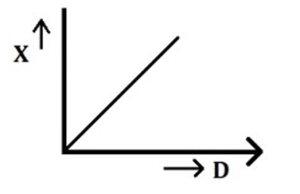
The graph shows the variation of fringe width $(X)$ versus the distance of the screen from the plane of the slits $(D)$ in Young's double-slit experiment (keeping other parameters constant,where $d$ is the distance between the slits). The wavelength of light used can be calculated as:
A
slope $\times d^2$
B
$\frac{d}{\text{slope}}$
C
$\frac{\text{slope}}{d}$
D
slope $\times d$
Solution
(D) In Young's double-slit experiment,the fringe width $(X)$ is given by the formula:
$X = \frac{\lambda D}{d}$
where $\lambda$ is the wavelength of light,$D$ is the distance of the screen from the slits,and $d$ is the distance between the slits.
Comparing this equation with the equation of a straight line $y = mx + c$,where $y = X$ and $x = D$,we get:
$X = (\frac{\lambda}{d}) D$
The slope of the graph is given by $m = \frac{\lambda}{d}$.
Therefore,the wavelength $\lambda$ can be calculated as:
$\lambda = \text{slope} \times d$.
$X = \frac{\lambda D}{d}$
where $\lambda$ is the wavelength of light,$D$ is the distance of the screen from the slits,and $d$ is the distance between the slits.
Comparing this equation with the equation of a straight line $y = mx + c$,where $y = X$ and $x = D$,we get:
$X = (\frac{\lambda}{d}) D$
The slope of the graph is given by $m = \frac{\lambda}{d}$.
Therefore,the wavelength $\lambda$ can be calculated as:
$\lambda = \text{slope} \times d$.
0 likesView Solution
411
PhysicsEasyMCQMHT CET · 2025
In a biprism experiment,the distance of the second dark fringe from the central fringe is $3 \ mm$. The distance of the sixth bright fringe from the central fringe is (in $mm$)
A
$12$
B
$8$
C
$6$
D
$4$
Solution
(A) The distance of the $n^{th}$ dark fringe from the central fringe is given by $y_n = (n - 1/2) \beta$,where $\beta$ is the fringe width.
For the second dark fringe $(n = 2)$:
$y_2 = (2 - 1/2) \beta = 1.5 \beta = 3 \ mm$.
Therefore,$\beta = 3 / 1.5 = 2 \ mm$.
The distance of the $n^{th}$ bright fringe from the central fringe is given by $y_n = n \beta$.
For the sixth bright fringe $(n = 6)$:
$y_6 = 6 \times \beta = 6 \times 2 \ mm = 12 \ mm$.
For the second dark fringe $(n = 2)$:
$y_2 = (2 - 1/2) \beta = 1.5 \beta = 3 \ mm$.
Therefore,$\beta = 3 / 1.5 = 2 \ mm$.
The distance of the $n^{th}$ bright fringe from the central fringe is given by $y_n = n \beta$.
For the sixth bright fringe $(n = 6)$:
$y_6 = 6 \times \beta = 6 \times 2 \ mm = 12 \ mm$.
0 likesView Solution
412
PhysicsEasyMCQMHT CET · 2025
In Young's double slit experiment,the separation between the slits is halved and the distance between the slits and the screen is doubled. The fringe width
A
remains unchanged.
B
becomes half.
C
becomes double.
D
increases four times.
Solution
(D) The fringe width $\beta$ in Young's double slit experiment is given by the formula: $\beta = \frac{\lambda D}{d}$,where $\lambda$ is the wavelength of light,$D$ is the distance between the slits and the screen,and $d$ is the separation between the slits.
According to the problem,the new distance $D' = 2D$ and the new slit separation $d' = \frac{d}{2}$.
Substituting these values into the formula for the new fringe width $\beta'$:
$\beta' = \frac{\lambda D'}{d'} = \frac{\lambda (2D)}{d/2} = 4 \left( \frac{\lambda D}{d} \right) = 4\beta$.
Therefore,the fringe width increases four times.
According to the problem,the new distance $D' = 2D$ and the new slit separation $d' = \frac{d}{2}$.
Substituting these values into the formula for the new fringe width $\beta'$:
$\beta' = \frac{\lambda D'}{d'} = \frac{\lambda (2D)}{d/2} = 4 \left( \frac{\lambda D}{d} \right) = 4\beta$.
Therefore,the fringe width increases four times.
0 likesView Solution
413
PhysicsMediumMCQMHT CET · 2025
In Young's double slit experiment,the intensity on the screen at a point where the path difference is $\frac{\lambda}{4}$ is $\frac{K}{4}$. What will be the intensity at a point where the path difference is $\lambda$? [Given: $\cos(\frac{\pi}{2}) = 0, \cos(2\pi) = 1$]
A
$4K$
B
$2K$
C
$K$
D
$\frac{K}{2}$
Solution
(D) The intensity $I$ at any point on the screen is given by the formula $I = I_0 \cos^2(\frac{\phi}{2})$,where $I_0$ is the maximum intensity and $\phi$ is the phase difference.
Phase difference $\phi$ is related to path difference $\Delta x$ by $\phi = \frac{2\pi}{\lambda} \Delta x$.
For the first case,$\Delta x = \frac{\lambda}{4}$,so $\phi_1 = \frac{2\pi}{\lambda} \times \frac{\lambda}{4} = \frac{\pi}{2}$.
The intensity is $I_1 = I_0 \cos^2(\frac{\pi/2}{2}) = I_0 \cos^2(\frac{\pi}{4}) = I_0 (\frac{1}{\sqrt{2}})^2 = \frac{I_0}{2}$.
Given $I_1 = \frac{K}{4}$,we have $\frac{I_0}{2} = \frac{K}{4}$,which implies $I_0 = \frac{K}{2}$.
For the second case,$\Delta x = \lambda$,so $\phi_2 = \frac{2\pi}{\lambda} \times \lambda = 2\pi$.
The intensity is $I_2 = I_0 \cos^2(\frac{2\pi}{2}) = I_0 \cos^2(\pi) = I_0 (-1)^2 = I_0$.
Substituting $I_0 = \frac{K}{2}$,we get $I_2 = \frac{K}{2}$.
Phase difference $\phi$ is related to path difference $\Delta x$ by $\phi = \frac{2\pi}{\lambda} \Delta x$.
For the first case,$\Delta x = \frac{\lambda}{4}$,so $\phi_1 = \frac{2\pi}{\lambda} \times \frac{\lambda}{4} = \frac{\pi}{2}$.
The intensity is $I_1 = I_0 \cos^2(\frac{\pi/2}{2}) = I_0 \cos^2(\frac{\pi}{4}) = I_0 (\frac{1}{\sqrt{2}})^2 = \frac{I_0}{2}$.
Given $I_1 = \frac{K}{4}$,we have $\frac{I_0}{2} = \frac{K}{4}$,which implies $I_0 = \frac{K}{2}$.
For the second case,$\Delta x = \lambda$,so $\phi_2 = \frac{2\pi}{\lambda} \times \lambda = 2\pi$.
The intensity is $I_2 = I_0 \cos^2(\frac{2\pi}{2}) = I_0 \cos^2(\pi) = I_0 (-1)^2 = I_0$.
Substituting $I_0 = \frac{K}{2}$,we get $I_2 = \frac{K}{2}$.
0 likesView Solution
414
PhysicsMediumMCQMHT CET · 2025
The apparent wavelength of light from a star moving away from the earth is $0.02 \%$ more than the actual wavelength. The velocity of the star is $[c = 3 \times 10^8 \ m/s]$. (in $km/s$)
A
$30$
B
$60$
C
$90$
D
$120$
Solution
(B) The Doppler effect for light is given by the formula $\frac{\Delta \lambda}{\lambda} = \frac{v}{c}$,where $\Delta \lambda$ is the change in wavelength,$\lambda$ is the actual wavelength,$v$ is the velocity of the star,and $c$ is the speed of light.
Given that the apparent wavelength is $0.02 \%$ more than the actual wavelength,we have $\frac{\Delta \lambda}{\lambda} = 0.02 \% = \frac{0.02}{100} = 2 \times 10^{-4}$.
Substituting the values into the formula: $2 \times 10^{-4} = \frac{v}{3 \times 10^8 \ m/s}$.
Solving for $v$: $v = (2 \times 10^{-4}) \times (3 \times 10^8 \ m/s) = 6 \times 10^4 \ m/s$.
Converting to $km/s$: $v = \frac{6 \times 10^4}{10^3} \ km/s = 60 \ km/s$.
Given that the apparent wavelength is $0.02 \%$ more than the actual wavelength,we have $\frac{\Delta \lambda}{\lambda} = 0.02 \% = \frac{0.02}{100} = 2 \times 10^{-4}$.
Substituting the values into the formula: $2 \times 10^{-4} = \frac{v}{3 \times 10^8 \ m/s}$.
Solving for $v$: $v = (2 \times 10^{-4}) \times (3 \times 10^8 \ m/s) = 6 \times 10^4 \ m/s$.
Converting to $km/s$: $v = \frac{6 \times 10^4}{10^3} \ km/s = 60 \ km/s$.
0 likesView Solution
Vedclass Products
For Students
Vedclass Test Series
Mock tests in real MHT CET style covering Physics with performance analysis. 5-day free trial.
Start Free TrialFor Teachers
Exam Paper Generator
Generate Set A/B/C/D Physics papers from 7.5L+ questions in 2 minutes. 3 chapters free.
Try FreeFor Institutes
Online Exam Module
Run live MHT CET mock exams with unlimited students, 360° analytics & white-label branding.
See DemoFrequently Asked Questions
How many Physics questions are in MHT CET 2025?
There are 795 Physics questions from the MHT CET 2025 paper on Vedclass, each with a detailed step-by-step solution in English.
Are MHT CET 2025 Physics solutions available in English?
Yes. All solutions on this page are in English. You can also switch to English or Hindi using the language buttons above the questions.
Can I practice MHT CET 2025 Physics as a timed test?
Yes. Use the Vedclass Test Series to attempt a full MHT CET mock test covering Physics with time limits and instant score analysis.
Can teachers create Physics papers from MHT CET previous year questions?
Yes. The Vedclass Exam Paper Generator lets teachers mix MHT CET Physics questions and generate Set A/B/C/D papers in minutes.
For Teachers & Institutes
Build a Custom Physics Paper
Pick MHT CET 2025 Physics questions, set difficulty, and generate Set A/B/C/D in 2 minutes.