
PhysicsQ201–300 of 795 questions
Page 5 of 9 · English
201
PhysicsMediumMCQMHT CET · 2025
Two discs of moment of inertia $I_1$ and $I_2$ and angular speeds $\omega_1$ and $\omega_2$ are rotating along collinear axes passing through their centers of mass and perpendicular to their planes. If the two discs are made to rotate together along the same axis,what will be the rotational kinetic energy of the system?
A
$\frac{I_1 \omega_1+I_2 \omega_2}{2(I_1+I_2)^2}$
B
$\frac{(I_1 \omega_1-I_2 \omega_2)^2}{2(I_1+I_2)}$
C
$\frac{(I_1 \omega_1+I_2 \omega_2)^2}{2(I_1-I_2)}$
D
$\frac{(I_1 \omega_1+I_2 \omega_2)^2}{2(I_1+I_2)}$
Solution
(D) According to the principle of conservation of angular momentum,the total angular momentum of the system remains constant when the two discs are coupled.
Initial angular momentum $L_i = I_1 \omega_1 + I_2 \omega_2$.
When the discs rotate together,they form a single system with a combined moment of inertia $I = I_1 + I_2$ and a common angular velocity $\omega$.
The final angular momentum is $L_f = (I_1 + I_2) \omega$.
Equating $L_i = L_f$,we get $\omega = \frac{I_1 \omega_1 + I_2 \omega_2}{I_1 + I_2}$.
The rotational kinetic energy $K$ of the system is given by $K = \frac{1}{2} I \omega^2$.
Substituting the values of $I$ and $\omega$:
$K = \frac{1}{2} (I_1 + I_2) \left( \frac{I_1 \omega_1 + I_2 \omega_2}{I_1 + I_2} \right)^2$.
$K = \frac{(I_1 \omega_1 + I_2 \omega_2)^2}{2(I_1 + I_2)}$.
Initial angular momentum $L_i = I_1 \omega_1 + I_2 \omega_2$.
When the discs rotate together,they form a single system with a combined moment of inertia $I = I_1 + I_2$ and a common angular velocity $\omega$.
The final angular momentum is $L_f = (I_1 + I_2) \omega$.
Equating $L_i = L_f$,we get $\omega = \frac{I_1 \omega_1 + I_2 \omega_2}{I_1 + I_2}$.
The rotational kinetic energy $K$ of the system is given by $K = \frac{1}{2} I \omega^2$.
Substituting the values of $I$ and $\omega$:
$K = \frac{1}{2} (I_1 + I_2) \left( \frac{I_1 \omega_1 + I_2 \omega_2}{I_1 + I_2} \right)^2$.
$K = \frac{(I_1 \omega_1 + I_2 \omega_2)^2}{2(I_1 + I_2)}$.
0 likesView Solution
202
PhysicsMediumMCQMHT CET · 2025
$A$ man standing on a turn-table is rotating at a certain angular frequency with his arms outstretched. He suddenly folds his arms. If his moment of inertia with folded arms is $75 \%$ of that with outstretched arms,then his rotational kinetic energy will
A
increase by $33.3 \%$
B
decrease by $33.3 \%$
C
increase by $25.0 \%$
D
decrease by $25.0 \%$
Solution
(A) Let the initial moment of inertia be $I_1$ and the final moment of inertia be $I_2 = 0.75 I_1 = \frac{3}{4} I_1$.
Since no external torque acts on the system,the angular momentum $L$ is conserved,so $L = I_1 \omega_1 = I_2 \omega_2$.
Thus,$\omega_2 = \frac{I_1}{I_2} \omega_1 = \frac{I_1}{0.75 I_1} \omega_1 = \frac{4}{3} \omega_1$.
The initial rotational kinetic energy is $K_1 = \frac{L^2}{2 I_1}$.
The final rotational kinetic energy is $K_2 = \frac{L^2}{2 I_2} = \frac{L^2}{2 (0.75 I_1)} = \frac{L^2}{1.5 I_1} = \frac{4}{3} K_1$.
The percentage increase in kinetic energy is $\frac{K_2 - K_1}{K_1} \times 100 = (\frac{4}{3} - 1) \times 100 = \frac{1}{3} \times 100 \approx 33.3 \%$.
Since no external torque acts on the system,the angular momentum $L$ is conserved,so $L = I_1 \omega_1 = I_2 \omega_2$.
Thus,$\omega_2 = \frac{I_1}{I_2} \omega_1 = \frac{I_1}{0.75 I_1} \omega_1 = \frac{4}{3} \omega_1$.
The initial rotational kinetic energy is $K_1 = \frac{L^2}{2 I_1}$.
The final rotational kinetic energy is $K_2 = \frac{L^2}{2 I_2} = \frac{L^2}{2 (0.75 I_1)} = \frac{L^2}{1.5 I_1} = \frac{4}{3} K_1$.
The percentage increase in kinetic energy is $\frac{K_2 - K_1}{K_1} \times 100 = (\frac{4}{3} - 1) \times 100 = \frac{1}{3} \times 100 \approx 33.3 \%$.
0 likesView Solution
203
PhysicsMediumMCQMHT CET · 2025
The angular momentum of a rotating body is $L$. When the frequency of the rotating body is tripled and its kinetic energy is made one-third,the new angular momentum becomes:
A
$\frac{1}{9} L$
B
$\frac{1}{3} L$
C
$6 L$
D
$9 L$
Solution
(A) The angular momentum $L$ of a rotating body is given by $L = I\omega$,where $I$ is the moment of inertia and $\omega$ is the angular velocity. The kinetic energy $K$ is given by $K = \frac{1}{2} I\omega^2 = \frac{L^2}{2I}$.
Given: Initial state is $L_1 = L$,$K_1 = K$,$\omega_1 = \omega$,$I_1 = I$.
New state: Frequency $f_2 = 3f_1$,which implies $\omega_2 = 3\omega_1 = 3\omega$. Kinetic energy $K_2 = \frac{1}{3} K_1 = \frac{K}{3}$.
Using $K = \frac{L^2}{2I}$,we have $I = \frac{L^2}{2K}$.
For the new state: $I_2 = \frac{L_2^2}{2K_2}$.
Also,$L_2 = I_2 \omega_2 = I_2 (3\omega)$.
From $K_2 = \frac{1}{2} I_2 \omega_2^2$,we have $\frac{K}{3} = \frac{1}{2} I_2 (3\omega)^2 = \frac{9}{2} I_2 \omega^2$.
Since $K = \frac{1}{2} I \omega^2$,we substitute this: $\frac{1}{3} (\frac{1}{2} I \omega^2) = \frac{9}{2} I_2 \omega^2$.
Solving for $I_2$: $I_2 = \frac{I}{27}$.
Now,calculate the new angular momentum $L_2 = I_2 \omega_2 = (\frac{I}{27}) (3\omega) = \frac{I\omega}{9} = \frac{L}{9}$.
Given: Initial state is $L_1 = L$,$K_1 = K$,$\omega_1 = \omega$,$I_1 = I$.
New state: Frequency $f_2 = 3f_1$,which implies $\omega_2 = 3\omega_1 = 3\omega$. Kinetic energy $K_2 = \frac{1}{3} K_1 = \frac{K}{3}$.
Using $K = \frac{L^2}{2I}$,we have $I = \frac{L^2}{2K}$.
For the new state: $I_2 = \frac{L_2^2}{2K_2}$.
Also,$L_2 = I_2 \omega_2 = I_2 (3\omega)$.
From $K_2 = \frac{1}{2} I_2 \omega_2^2$,we have $\frac{K}{3} = \frac{1}{2} I_2 (3\omega)^2 = \frac{9}{2} I_2 \omega^2$.
Since $K = \frac{1}{2} I \omega^2$,we substitute this: $\frac{1}{3} (\frac{1}{2} I \omega^2) = \frac{9}{2} I_2 \omega^2$.
Solving for $I_2$: $I_2 = \frac{I}{27}$.
Now,calculate the new angular momentum $L_2 = I_2 \omega_2 = (\frac{I}{27}) (3\omega) = \frac{I\omega}{9} = \frac{L}{9}$.
0 likesView Solution
204
PhysicsMediumMCQMHT CET · 2025
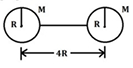
Two spheres each of mass $M$ and radius $R$ are connected with a massless rod of length $4R$. The moment of inertia of the system about an axis passing through the centre of one of the spheres and perpendicular to the rod will be
A
$\frac{21}{5} MR^2$
B
$\frac{84}{5} MR^2$
C
$\frac{42}{5} MR^2$
D
$\frac{5}{21} MR^2$
Solution
(B) Let the two spheres be $S_1$ and $S_2$. The axis of rotation passes through the centre of $S_1$ and is perpendicular to the rod.
For sphere $S_1$,the moment of inertia about its own centre is $I_1 = \frac{2}{5} MR^2$.
For sphere $S_2$,the distance of its centre from the axis of rotation is $d = R + 4R + R = 6R$ is incorrect based on the diagram. The rod length is $4R$ between the surfaces,or the distance between centres is $4R$. Given the diagram shows the rod length $4R$ between the spheres,the distance between the centres is $d = R + 4R + R = 6R$. However,if the rod length $4R$ is the distance between centres,then $d = 4R$.
Assuming the distance between centres is $4R$:
For $S_1$,$I_1 = \frac{2}{5} MR^2$.
For $S_2$,using the parallel axis theorem,$I_2 = I_{cm} + Md^2 = \frac{2}{5} MR^2 + M(4R)^2 = \frac{2}{5} MR^2 + 16MR^2 = \frac{82}{5} MR^2$.
Total moment of inertia $I = I_1 + I_2 = \frac{2}{5} MR^2 + \frac{82}{5} MR^2 = \frac{84}{5} MR^2$.
For sphere $S_1$,the moment of inertia about its own centre is $I_1 = \frac{2}{5} MR^2$.
For sphere $S_2$,the distance of its centre from the axis of rotation is $d = R + 4R + R = 6R$ is incorrect based on the diagram. The rod length is $4R$ between the surfaces,or the distance between centres is $4R$. Given the diagram shows the rod length $4R$ between the spheres,the distance between the centres is $d = R + 4R + R = 6R$. However,if the rod length $4R$ is the distance between centres,then $d = 4R$.
Assuming the distance between centres is $4R$:
For $S_1$,$I_1 = \frac{2}{5} MR^2$.
For $S_2$,using the parallel axis theorem,$I_2 = I_{cm} + Md^2 = \frac{2}{5} MR^2 + M(4R)^2 = \frac{2}{5} MR^2 + 16MR^2 = \frac{82}{5} MR^2$.
Total moment of inertia $I = I_1 + I_2 = \frac{2}{5} MR^2 + \frac{82}{5} MR^2 = \frac{84}{5} MR^2$.
0 likesView Solution
205
PhysicsEasyMCQMHT CET · 2025
Two discs $A$ and $B$ of same material and thickness have radii $R$ and $3R$ respectively. Their moments of inertia about their axis will be in the ratio
A
$1: 3$
B
$1: 9$
C
$1: 81$
D
$1: 27$
Solution
(C) The moment of inertia $I$ of a disc about its central axis is given by $I = \frac{1}{2} M R^2$.
Since the discs are made of the same material and have the same thickness $t$,their mass $M$ is given by $M = \text{density} \times \text{volume} = \rho \times (\pi R^2 t)$.
Substituting $M$ into the formula for $I$,we get $I = \frac{1}{2} (\rho \pi R^2 t) R^2 = \frac{1}{2} \rho \pi t R^4$.
Since $\rho$,$\pi$,and $t$ are constant for both discs,$I \propto R^4$.
Therefore,the ratio of the moments of inertia is $\frac{I_A}{I_B} = \left( \frac{R_A}{R_B} \right)^4$.
Given $R_A = R$ and $R_B = 3R$,we have $\frac{I_A}{I_B} = \left( \frac{R}{3R} \right)^4 = \left( \frac{1}{3} \right)^4 = \frac{1}{81}$.
Thus,the ratio is $1: 81$.
Since the discs are made of the same material and have the same thickness $t$,their mass $M$ is given by $M = \text{density} \times \text{volume} = \rho \times (\pi R^2 t)$.
Substituting $M$ into the formula for $I$,we get $I = \frac{1}{2} (\rho \pi R^2 t) R^2 = \frac{1}{2} \rho \pi t R^4$.
Since $\rho$,$\pi$,and $t$ are constant for both discs,$I \propto R^4$.
Therefore,the ratio of the moments of inertia is $\frac{I_A}{I_B} = \left( \frac{R_A}{R_B} \right)^4$.
Given $R_A = R$ and $R_B = 3R$,we have $\frac{I_A}{I_B} = \left( \frac{R}{3R} \right)^4 = \left( \frac{1}{3} \right)^4 = \frac{1}{81}$.
Thus,the ratio is $1: 81$.
0 likesView Solution
206
PhysicsMediumMCQMHT CET · 2025
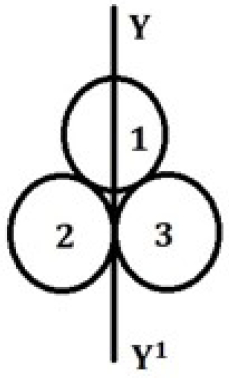
Three spheres,each of mass $m$ and radius $r$,are placed as shown in the figure. Consider an axis $YY^1$,which is tangent to two spheres (labeled $2$ and $3$) and passes through the diameter of the third sphere (labeled $1$). The moment of inertia of the system consisting of these three spheres about the $YY^1$ axis is:
A
$\frac{7}{5} mr^2$
B
$\frac{2}{5} mr^2$
C
$\frac{16}{5} mr^2$
D
$\frac{mr^2}{2}$
Solution
(C) The moment of inertia of a solid sphere of mass $m$ and radius $r$ about its diameter is $I_{cm} = \frac{2}{5} mr^2$.
For sphere $1$,the axis $YY^1$ passes through its center (diameter). Thus,$I_1 = \frac{2}{5} mr^2$.
For spheres $2$ and $3$,the axis $YY^1$ is tangent to them. The distance of the center of these spheres from the axis $YY^1$ is $r$. Using the parallel axis theorem,$I = I_{cm} + md^2$,where $d = r$.
So,$I_2 = I_3 = \frac{2}{5} mr^2 + mr^2 = \frac{7}{5} mr^2$.
The total moment of inertia of the system is $I_{total} = I_1 + I_2 + I_3 = \frac{2}{5} mr^2 + \frac{7}{5} mr^2 + \frac{7}{5} mr^2 = \frac{16}{5} mr^2$.
For sphere $1$,the axis $YY^1$ passes through its center (diameter). Thus,$I_1 = \frac{2}{5} mr^2$.
For spheres $2$ and $3$,the axis $YY^1$ is tangent to them. The distance of the center of these spheres from the axis $YY^1$ is $r$. Using the parallel axis theorem,$I = I_{cm} + md^2$,where $d = r$.
So,$I_2 = I_3 = \frac{2}{5} mr^2 + mr^2 = \frac{7}{5} mr^2$.
The total moment of inertia of the system is $I_{total} = I_1 + I_2 + I_3 = \frac{2}{5} mr^2 + \frac{7}{5} mr^2 + \frac{7}{5} mr^2 = \frac{16}{5} mr^2$.
0 likesView Solution
207
PhysicsMediumMCQMHT CET · 2025
Two circular loops $P$ and $Q$ of radii $r$ and $nr$ are made respectively from a uniform wire. The moment of inertia of loop $Q$ about its axis is $4$ times that of loop $P$ about its axis. The value of $n$ is:
A
$(2)^{-2/3}$
B
$(2)^{2/3}$
C
$\sqrt{2}$
D
$2^{1/3}$
Solution
(B) The moment of inertia $I$ of a circular loop of mass $M$ and radius $R$ about its central axis is given by $I = MR^2$.
Let the linear mass density of the wire be $\lambda$.
The mass of loop $P$ is $M_P = \lambda \cdot (2\pi r)$ and its radius is $R_P = r$.
Thus,$I_P = M_P R_P^2 = (2\pi r \lambda) r^2 = 2\pi \lambda r^3$.
The mass of loop $Q$ is $M_Q = \lambda \cdot (2\pi nr)$ and its radius is $R_Q = nr$.
Thus,$I_Q = M_Q R_Q^2 = (2\pi nr \lambda) (nr)^2 = 2\pi \lambda n^3 r^3$.
Given that $I_Q = 4 I_P$,we have $2\pi \lambda n^3 r^3 = 4(2\pi \lambda r^3)$.
Canceling $2\pi \lambda r^3$ from both sides,we get $n^3 = 4$.
Therefore,$n = 4^{1/3} = (2^2)^{1/3} = 2^{2/3}$.
Let the linear mass density of the wire be $\lambda$.
The mass of loop $P$ is $M_P = \lambda \cdot (2\pi r)$ and its radius is $R_P = r$.
Thus,$I_P = M_P R_P^2 = (2\pi r \lambda) r^2 = 2\pi \lambda r^3$.
The mass of loop $Q$ is $M_Q = \lambda \cdot (2\pi nr)$ and its radius is $R_Q = nr$.
Thus,$I_Q = M_Q R_Q^2 = (2\pi nr \lambda) (nr)^2 = 2\pi \lambda n^3 r^3$.
Given that $I_Q = 4 I_P$,we have $2\pi \lambda n^3 r^3 = 4(2\pi \lambda r^3)$.
Canceling $2\pi \lambda r^3$ from both sides,we get $n^3 = 4$.
Therefore,$n = 4^{1/3} = (2^2)^{1/3} = 2^{2/3}$.
0 likesView Solution
208
PhysicsMediumMCQMHT CET · 2025
Moment of inertia of a thin uniform rod of length $L$ and mass $M$ rotating about the perpendicular axis passing through its centre is $I$. If the same rod is bent in the form of a ring,its moment of inertia about the diameter is $I_1$. If $I_1 = xI$,then the value of $x$ is:
A
$\frac{2 \pi^2}{3}$
B
$\frac{3}{2 \pi^2}$
C
$\frac{3 \pi^2}{4}$
D
$\frac{4}{3 \pi^2}$
Solution
(B) $1$. For a thin uniform rod of mass $M$ and length $L$,the moment of inertia about the perpendicular axis passing through its centre is $I = \frac{ML^2}{12}$.
$2$. When the rod is bent into a ring of radius $R$,the circumference of the ring equals the length of the rod: $2\pi R = L$,so $R = \frac{L}{2\pi}$.
$3$. The moment of inertia of a ring of mass $M$ and radius $R$ about its diameter is $I_1 = \frac{1}{2}MR^2$.
$4$. Substituting $R = \frac{L}{2\pi}$ into the expression for $I_1$: $I_1 = \frac{1}{2}M(\frac{L}{2\pi})^2 = \frac{1}{2}M(\frac{L^2}{4\pi^2}) = \frac{ML^2}{8\pi^2}$.
$5$. Given $I_1 = xI$,we have $\frac{ML^2}{8\pi^2} = x(\frac{ML^2}{12})$.
$6$. Solving for $x$: $x = \frac{12}{8\pi^2} = \frac{3}{2\pi^2}$.
$2$. When the rod is bent into a ring of radius $R$,the circumference of the ring equals the length of the rod: $2\pi R = L$,so $R = \frac{L}{2\pi}$.
$3$. The moment of inertia of a ring of mass $M$ and radius $R$ about its diameter is $I_1 = \frac{1}{2}MR^2$.
$4$. Substituting $R = \frac{L}{2\pi}$ into the expression for $I_1$: $I_1 = \frac{1}{2}M(\frac{L}{2\pi})^2 = \frac{1}{2}M(\frac{L^2}{4\pi^2}) = \frac{ML^2}{8\pi^2}$.
$5$. Given $I_1 = xI$,we have $\frac{ML^2}{8\pi^2} = x(\frac{ML^2}{12})$.
$6$. Solving for $x$: $x = \frac{12}{8\pi^2} = \frac{3}{2\pi^2}$.
0 likesView Solution
209
PhysicsEasyMCQMHT CET · 2025
$A$ solid sphere and a thin-walled hollow sphere have the same mass and the same material. Which of them has a greater moment of inertia about its diameter? ($I_{h} =$ moment of inertia of a hollow sphere about an axis coinciding with its diameter,$I_{s} =$ moment of inertia of a solid sphere about an axis coinciding with its diameter)
A
$I_{s} > I_{h}$
B
$I_{h} \geqslant I_{s}$
C
$I_{h} > I_{s}$
D
$I_{h} = I_{s}$
Solution
(C) The moment of inertia of a solid sphere about its diameter is given by $I_{s} = \frac{2}{5}MR^{2}$.
The moment of inertia of a thin-walled hollow sphere about its diameter is given by $I_{h} = \frac{2}{3}MR^{2}$.
Since both spheres have the same mass $M$ and the same material,they must have the same volume if they were the same size,but for a solid and hollow sphere of the same mass,the radius $R$ of the hollow sphere must be larger than the radius of the solid sphere to maintain the same mass density distribution.
Even if we assume the radii are the same,comparing the coefficients: $\frac{2}{3} \approx 0.667$ and $\frac{2}{5} = 0.4$.
Since $0.667 > 0.4$,it follows that $I_{h} > I_{s}$.
The moment of inertia of a thin-walled hollow sphere about its diameter is given by $I_{h} = \frac{2}{3}MR^{2}$.
Since both spheres have the same mass $M$ and the same material,they must have the same volume if they were the same size,but for a solid and hollow sphere of the same mass,the radius $R$ of the hollow sphere must be larger than the radius of the solid sphere to maintain the same mass density distribution.
Even if we assume the radii are the same,comparing the coefficients: $\frac{2}{3} \approx 0.667$ and $\frac{2}{5} = 0.4$.
Since $0.667 > 0.4$,it follows that $I_{h} > I_{s}$.
0 likesView Solution
210
PhysicsMediumMCQMHT CET · 2025
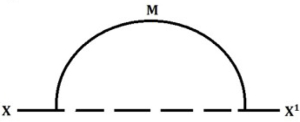
$A$ thin metal wire of length $L$ and mass $M$ is bent to form a semicircular ring as shown. The moment of inertia about the axis $XX^1$ passing through its ends is:
A
$\frac{M L^2}{4 \pi^2}$
B
$\frac{2 ML^2}{\pi^2}$
C
$\frac{M L^2}{2 \pi^2}$
D
$\frac{ML^2}{\pi^2}$
Solution
(C) $1$. The length of the wire is $L$. Since it is bent into a semicircular ring,the circumference of a full circle would be $2 \pi R = 2L$,where $R$ is the radius of the semicircle. Thus,$\pi R = L$,which gives $R = \frac{L}{\pi}$.
$2$. The moment of inertia of a complete circular ring of mass $M'$ and radius $R$ about its diameter is $I_{diam} = \frac{1}{2} M' R^2$.
$3$. For a semicircular ring of mass $M$ and radius $R$,the moment of inertia about the axis passing through its ends (the diameter) is the same as that of a full ring of the same radius and mass $M$ about its diameter. Therefore,$I = \frac{1}{2} M R^2$.
$4$. Substituting $R = \frac{L}{\pi}$ into the formula,we get $I = \frac{1}{2} M \left(\frac{L}{\pi}\right)^2 = \frac{M L^2}{2 \pi^2}$.
$2$. The moment of inertia of a complete circular ring of mass $M'$ and radius $R$ about its diameter is $I_{diam} = \frac{1}{2} M' R^2$.
$3$. For a semicircular ring of mass $M$ and radius $R$,the moment of inertia about the axis passing through its ends (the diameter) is the same as that of a full ring of the same radius and mass $M$ about its diameter. Therefore,$I = \frac{1}{2} M R^2$.
$4$. Substituting $R = \frac{L}{\pi}$ into the formula,we get $I = \frac{1}{2} M \left(\frac{L}{\pi}\right)^2 = \frac{M L^2}{2 \pi^2}$.
0 likesView Solution
211
PhysicsMediumMCQMHT CET · 2025
Four particles each of mass $M$ are placed at the corners of a square of side $L$. The radius of gyration of the system about an axis perpendicular to the square and passing through its centre is
A
$\frac{L}{2}$
B
$\frac{L}{\sqrt{2}}$
C
$2L$
D
$\frac{L}{4}$
Solution
(B) The moment of inertia $I$ of a system of particles about an axis is given by $I = \sum m_i r_i^2$.
For a square of side $L$,the distance of each corner from the centre is $r = \frac{L}{\sqrt{2}}$.
Since there are four particles of mass $M$,the total moment of inertia about an axis perpendicular to the plane and passing through the centre is $I = 4 \times M \times r^2 = 4 \times M \times (\frac{L}{\sqrt{2}})^2 = 4 \times M \times \frac{L^2}{2} = 2ML^2$.
The radius of gyration $k$ is defined by $I = Mk_{total} k^2$,where $M_{total} = 4M$.
So,$2ML^2 = (4M)k^2$.
$k^2 = \frac{2ML^2}{4M} = \frac{L^2}{2}$.
$k = \frac{L}{\sqrt{2}}$.
For a square of side $L$,the distance of each corner from the centre is $r = \frac{L}{\sqrt{2}}$.
Since there are four particles of mass $M$,the total moment of inertia about an axis perpendicular to the plane and passing through the centre is $I = 4 \times M \times r^2 = 4 \times M \times (\frac{L}{\sqrt{2}})^2 = 4 \times M \times \frac{L^2}{2} = 2ML^2$.
The radius of gyration $k$ is defined by $I = Mk_{total} k^2$,where $M_{total} = 4M$.
So,$2ML^2 = (4M)k^2$.
$k^2 = \frac{2ML^2}{4M} = \frac{L^2}{2}$.
$k = \frac{L}{\sqrt{2}}$.
0 likesView Solution
212
PhysicsMediumMCQMHT CET · 2025
The moment of inertia of a solid sphere of mass '$m$' and radius '$R$' about its diametric axis is '$I$'. Its moment of inertia about a tangent in the plane is (in $I$)
A
$2.5$
B
$3.0$
C
$3.5$
D
$4$
Solution
(C) The moment of inertia of a solid sphere about its diametric axis is given by $I = \frac{2}{5} mR^2$.
According to the parallel axis theorem,the moment of inertia about a tangent is $I_{tangent} = I_{cm} + mR^2$.
Substituting the value of $I_{cm} = I = \frac{2}{5} mR^2$,we get:
$I_{tangent} = \frac{2}{5} mR^2 + mR^2 = \frac{7}{5} mR^2$.
Since $I = \frac{2}{5} mR^2$,we can write $mR^2 = \frac{5}{2} I$.
Substituting this into the expression for $I_{tangent}$:
$I_{tangent} = \frac{7}{5} \times (\frac{5}{2} I) = \frac{7}{2} I = 3.5 I$.
According to the parallel axis theorem,the moment of inertia about a tangent is $I_{tangent} = I_{cm} + mR^2$.
Substituting the value of $I_{cm} = I = \frac{2}{5} mR^2$,we get:
$I_{tangent} = \frac{2}{5} mR^2 + mR^2 = \frac{7}{5} mR^2$.
Since $I = \frac{2}{5} mR^2$,we can write $mR^2 = \frac{5}{2} I$.
Substituting this into the expression for $I_{tangent}$:
$I_{tangent} = \frac{7}{5} \times (\frac{5}{2} I) = \frac{7}{2} I = 3.5 I$.
0 likesView Solution
213
PhysicsMediumMCQMHT CET · 2025
Moment of inertia of the rod about an axis passing through the centre and perpendicular to its length is $I_1$. The same rod is bent into a ring and its moment of inertia about the diameter is $I_2$. Then $I_1 / I_2$ is
A
$\frac{3 \pi^2}{2}$
B
$\frac{2 \pi^2}{3}$
C
$\frac{\pi^2}{3}$
D
$\frac{\pi^2}{9}$
Solution
(B) Let the mass of the rod be $M$ and its length be $L$. The moment of inertia of the rod about an axis passing through its center and perpendicular to its length is $I_1 = \frac{ML^2}{12}$.
When the rod is bent into a ring of radius $R$,the circumference of the ring is equal to the length of the rod,so $2\pi R = L$,which implies $R = \frac{L}{2\pi}$.
The moment of inertia of a ring of mass $M$ and radius $R$ about its diameter is $I_2 = \frac{1}{2}MR^2$.
Substituting $R = \frac{L}{2\pi}$ into the expression for $I_2$,we get $I_2 = \frac{1}{2}M(\frac{L}{2\pi})^2 = \frac{1}{2}M(\frac{L^2}{4\pi^2}) = \frac{ML^2}{8\pi^2}$.
Now,calculating the ratio $I_1 / I_2 = \frac{ML^2/12}{ML^2/8\pi^2} = \frac{8\pi^2}{12} = \frac{2\pi^2}{3}$.
When the rod is bent into a ring of radius $R$,the circumference of the ring is equal to the length of the rod,so $2\pi R = L$,which implies $R = \frac{L}{2\pi}$.
The moment of inertia of a ring of mass $M$ and radius $R$ about its diameter is $I_2 = \frac{1}{2}MR^2$.
Substituting $R = \frac{L}{2\pi}$ into the expression for $I_2$,we get $I_2 = \frac{1}{2}M(\frac{L}{2\pi})^2 = \frac{1}{2}M(\frac{L^2}{4\pi^2}) = \frac{ML^2}{8\pi^2}$.
Now,calculating the ratio $I_1 / I_2 = \frac{ML^2/12}{ML^2/8\pi^2} = \frac{8\pi^2}{12} = \frac{2\pi^2}{3}$.
0 likesView Solution
214
PhysicsMediumMCQMHT CET · 2025
The moment of inertia of a solid sphere about its diameter is $I$. It is then recast into $27$ small spheres of the same diameter. The moment of inertia of each small sphere about its diameter is:
A
$\frac{I}{44}$
B
$\frac{I}{188}$
C
$\frac{I}{204}$
D
$\frac{I}{243}$
Solution
(D) The moment of inertia of a solid sphere of mass $M$ and radius $R$ about its diameter is given by $I = \frac{2}{5}MR^2$.
Let the radius of the large sphere be $R$ and its mass be $M$.
When it is recast into $27$ small spheres of radius $r$,the volume remains constant: $\frac{4}{3}\pi R^3 = 27 \times \frac{4}{3}\pi r^3$.
This implies $R^3 = 27r^3$,so $R = 3r$ or $r = \frac{R}{3}$.
The mass of each small sphere $m$ is $\frac{M}{27}$.
The moment of inertia of each small sphere about its diameter is $I' = \frac{2}{5}mr^2$.
Substituting $m = \frac{M}{27}$ and $r = \frac{R}{3}$:
$I' = \frac{2}{5} \left( \frac{M}{27} \right) \left( \frac{R}{3} \right)^2 = \frac{2}{5} \left( \frac{M}{27} \right) \left( \frac{R^2}{9} \right) = \frac{1}{243} \left( \frac{2}{5}MR^2 \right)$.
Since $I = \frac{2}{5}MR^2$,we get $I' = \frac{I}{243}$.
Let the radius of the large sphere be $R$ and its mass be $M$.
When it is recast into $27$ small spheres of radius $r$,the volume remains constant: $\frac{4}{3}\pi R^3 = 27 \times \frac{4}{3}\pi r^3$.
This implies $R^3 = 27r^3$,so $R = 3r$ or $r = \frac{R}{3}$.
The mass of each small sphere $m$ is $\frac{M}{27}$.
The moment of inertia of each small sphere about its diameter is $I' = \frac{2}{5}mr^2$.
Substituting $m = \frac{M}{27}$ and $r = \frac{R}{3}$:
$I' = \frac{2}{5} \left( \frac{M}{27} \right) \left( \frac{R}{3} \right)^2 = \frac{2}{5} \left( \frac{M}{27} \right) \left( \frac{R^2}{9} \right) = \frac{1}{243} \left( \frac{2}{5}MR^2 \right)$.
Since $I = \frac{2}{5}MR^2$,we get $I' = \frac{I}{243}$.
0 likesView Solution
215
PhysicsMediumMCQMHT CET · 2025
$A$ thin wire of length $L$ and uniform linear mass density $\lambda$ is bent into a circular ring. The moment of inertia of the ring about a tangential axis in its plane is:
A
$\frac{3 \lambda L^3}{8 \pi^2}$
B
$\frac{8 \pi^2}{3 \lambda L^3}$
C
$\frac{3 \lambda L^2}{8 \pi^2}$
D
$\frac{8 \pi^2}{3 \lambda L^2}$
Solution
(A) $1$. The total mass $M$ of the wire is $M = \lambda L$.
$2$. The circumference of the ring is $2 \pi R = L$,so the radius $R = \frac{L}{2 \pi}$.
$3$. The moment of inertia of a ring about its central axis (perpendicular to the plane) is $I_{cm} = MR^2$.
$4$. By the perpendicular axis theorem,the moment of inertia about a diameter is $I_{diameter} = \frac{1}{2} MR^2$.
$5$. Using the parallel axis theorem,the moment of inertia about a tangential axis in the plane is $I = I_{diameter} + MR^2$.
$6$. $I = \frac{1}{2} MR^2 + MR^2 = \frac{3}{2} MR^2$.
$7$. Substituting $M = \lambda L$ and $R = \frac{L}{2 \pi}$:
$I = \frac{3}{2} (\lambda L) (\frac{L}{2 \pi})^2 = \frac{3}{2} \lambda L \cdot \frac{L^2}{4 \pi^2} = \frac{3 \lambda L^3}{8 \pi^2}$.
$2$. The circumference of the ring is $2 \pi R = L$,so the radius $R = \frac{L}{2 \pi}$.
$3$. The moment of inertia of a ring about its central axis (perpendicular to the plane) is $I_{cm} = MR^2$.
$4$. By the perpendicular axis theorem,the moment of inertia about a diameter is $I_{diameter} = \frac{1}{2} MR^2$.
$5$. Using the parallel axis theorem,the moment of inertia about a tangential axis in the plane is $I = I_{diameter} + MR^2$.
$6$. $I = \frac{1}{2} MR^2 + MR^2 = \frac{3}{2} MR^2$.
$7$. Substituting $M = \lambda L$ and $R = \frac{L}{2 \pi}$:
$I = \frac{3}{2} (\lambda L) (\frac{L}{2 \pi})^2 = \frac{3}{2} \lambda L \cdot \frac{L^2}{4 \pi^2} = \frac{3 \lambda L^3}{8 \pi^2}$.
0 likesView Solution
216
PhysicsMediumMCQMHT CET · 2025
Four particles each of mass $m$ are lying symmetrically on the rim of a disc of mass $M$ and radius $R$. The moment of inertia of the system about an axis passing through one of the particles and perpendicular to the plane of the disc is:
A
$16 mR^2$
B
$(M/2 + 6m)R^2$
C
$(M/2 + 8m)R^2$
D
$(M/2 + 4m)R^2$
Solution
(C) $1$. The moment of inertia of the disc about its central axis is $I_{cm} = \frac{1}{2}MR^2$.
$2$. Using the Parallel Axis Theorem,the moment of inertia of the disc about an axis passing through a point on its rim (perpendicular to the plane) is $I_{disc} = I_{cm} + MR^2 = \frac{1}{2}MR^2 + MR^2 = \frac{3}{2}MR^2$.
$3$. Let the four particles be at positions $(R, 0), (0, R), (-R, 0), (0, -R)$. Let the axis pass through the particle at $(R, 0)$.
$4$. The distances of the four particles from the axis are: $r_1 = 0$,$r_2 = \sqrt{R^2 + R^2} = R\sqrt{2}$,$r_3 = \sqrt{(2R)^2 + 0} = 2R$,$r_4 = \sqrt{R^2 + R^2} = R\sqrt{2}$.
$5$. The moment of inertia of the particles is $I_{particles} = m(r_1^2 + r_2^2 + r_3^2 + r_4^2) = m(0 + 2R^2 + 4R^2 + 2R^2) = 8mR^2$.
$6$. Total moment of inertia $I = I_{disc} + I_{particles} = \frac{3}{2}MR^2 + 8mR^2 = (\frac{M}{2} + 8m)R^2$.
$2$. Using the Parallel Axis Theorem,the moment of inertia of the disc about an axis passing through a point on its rim (perpendicular to the plane) is $I_{disc} = I_{cm} + MR^2 = \frac{1}{2}MR^2 + MR^2 = \frac{3}{2}MR^2$.
$3$. Let the four particles be at positions $(R, 0), (0, R), (-R, 0), (0, -R)$. Let the axis pass through the particle at $(R, 0)$.
$4$. The distances of the four particles from the axis are: $r_1 = 0$,$r_2 = \sqrt{R^2 + R^2} = R\sqrt{2}$,$r_3 = \sqrt{(2R)^2 + 0} = 2R$,$r_4 = \sqrt{R^2 + R^2} = R\sqrt{2}$.
$5$. The moment of inertia of the particles is $I_{particles} = m(r_1^2 + r_2^2 + r_3^2 + r_4^2) = m(0 + 2R^2 + 4R^2 + 2R^2) = 8mR^2$.
$6$. Total moment of inertia $I = I_{disc} + I_{particles} = \frac{3}{2}MR^2 + 8mR^2 = (\frac{M}{2} + 8m)R^2$.
0 likesView Solution
217
PhysicsMediumMCQMHT CET · 2025
The moment of inertia of a thin uniform rod of mass $M$ and length $L$,about an axis perpendicular to the length of the rod and at a distance $L/4$ from one end is:
A
$\frac{ML^2}{6}$
B
$\frac{ML^2}{12}$
C
$\frac{7 ML^2}{24}$
D
$\frac{7 ML^2}{48}$
Solution
(D) The moment of inertia of a thin uniform rod about an axis passing through its center of mass and perpendicular to its length is $I_{cm} = \frac{ML^2}{12}$.
According to the parallel axis theorem,$I = I_{cm} + Md^2$,where $d$ is the distance between the center of mass and the given axis.
The center of mass of the rod is at a distance $L/2$ from one end.
The given axis is at a distance $L/4$ from the same end.
Therefore,the distance $d$ between the center of mass and the axis is $d = |L/2 - L/4| = L/4$.
Substituting these values into the parallel axis theorem:
$I = \frac{ML^2}{12} + M(L/4)^2$
$I = \frac{ML^2}{12} + \frac{ML^2}{16}$
Taking the least common multiple of $12$ and $16$,which is $48$:
$I = \frac{4ML^2 + 3ML^2}{48} = \frac{7ML^2}{48}$.
According to the parallel axis theorem,$I = I_{cm} + Md^2$,where $d$ is the distance between the center of mass and the given axis.
The center of mass of the rod is at a distance $L/2$ from one end.
The given axis is at a distance $L/4$ from the same end.
Therefore,the distance $d$ between the center of mass and the axis is $d = |L/2 - L/4| = L/4$.
Substituting these values into the parallel axis theorem:
$I = \frac{ML^2}{12} + M(L/4)^2$
$I = \frac{ML^2}{12} + \frac{ML^2}{16}$
Taking the least common multiple of $12$ and $16$,which is $48$:
$I = \frac{4ML^2 + 3ML^2}{48} = \frac{7ML^2}{48}$.
0 likesView Solution
218
PhysicsMediumMCQMHT CET · 2025
$A$ body slides down a smooth inclined plane of inclination $\theta$ and reaches the bottom with velocity $V$. If the same body is a ring which rolls down the same inclined plane,then the linear velocity at the bottom of the plane is:
A
$\frac{V}{\sqrt{2}}$
B
$V$
C
$2V$
D
$\frac{V}{2}$
Solution
(A) For a body sliding down a smooth inclined plane of height $h$,the potential energy is converted into kinetic energy: $mgh = \frac{1}{2}mV^2$,which gives $V = \sqrt{2gh}$.
For a ring rolling down the same inclined plane,the potential energy is converted into both translational and rotational kinetic energy: $mgh = \frac{1}{2}mv^2 + \frac{1}{2}I\omega^2$.
For a ring,the moment of inertia $I = mr^2$ and the rolling condition is $v = r\omega$,so $\omega = v/r$.
Substituting these into the energy equation: $mgh = \frac{1}{2}mv^2 + \frac{1}{2}(mr^2)(v/r)^2 = \frac{1}{2}mv^2 + \frac{1}{2}mv^2 = mv^2$.
Thus,$v^2 = gh$,which means $v = \sqrt{gh}$.
Comparing the two velocities: $v = \sqrt{gh} = \frac{\sqrt{2gh}}{\sqrt{2}} = \frac{V}{\sqrt{2}}$.
For a ring rolling down the same inclined plane,the potential energy is converted into both translational and rotational kinetic energy: $mgh = \frac{1}{2}mv^2 + \frac{1}{2}I\omega^2$.
For a ring,the moment of inertia $I = mr^2$ and the rolling condition is $v = r\omega$,so $\omega = v/r$.
Substituting these into the energy equation: $mgh = \frac{1}{2}mv^2 + \frac{1}{2}(mr^2)(v/r)^2 = \frac{1}{2}mv^2 + \frac{1}{2}mv^2 = mv^2$.
Thus,$v^2 = gh$,which means $v = \sqrt{gh}$.
Comparing the two velocities: $v = \sqrt{gh} = \frac{\sqrt{2gh}}{\sqrt{2}} = \frac{V}{\sqrt{2}}$.
0 likesView Solution
219
PhysicsMediumMCQMHT CET · 2025
An inclined plane makes an angle $30^{\circ}$ with the horizontal. $A$ solid sphere rolling down an inclined plane from rest without slipping has a linear acceleration (where $g$ is the acceleration due to gravity and $\sin 30^{\circ} = 0.5$).
A
$\frac{5g}{7}$
B
$\frac{5g}{14}$
C
$\frac{2g}{3}$
D
$\frac{g}{3}$
Solution
(B) The linear acceleration $a$ of a body rolling down an inclined plane without slipping is given by the formula: $a = \frac{g \sin \theta}{1 + \frac{I}{MR^2}}$.
For a solid sphere,the moment of inertia $I$ about its center of mass is $\frac{2}{5}MR^2$.
Substituting this into the formula: $a = \frac{g \sin \theta}{1 + \frac{2/5 MR^2}{MR^2}} = \frac{g \sin \theta}{1 + 2/5} = \frac{g \sin \theta}{7/5} = \frac{5}{7} g \sin \theta$.
Given $\theta = 30^{\circ}$ and $\sin 30^{\circ} = 0.5$,we have:
$a = \frac{5}{7} g (0.5) = \frac{5}{7} g \left(\frac{1}{2}\right) = \frac{5g}{14}$.
Therefore,the correct option is $B$.
For a solid sphere,the moment of inertia $I$ about its center of mass is $\frac{2}{5}MR^2$.
Substituting this into the formula: $a = \frac{g \sin \theta}{1 + \frac{2/5 MR^2}{MR^2}} = \frac{g \sin \theta}{1 + 2/5} = \frac{g \sin \theta}{7/5} = \frac{5}{7} g \sin \theta$.
Given $\theta = 30^{\circ}$ and $\sin 30^{\circ} = 0.5$,we have:
$a = \frac{5}{7} g (0.5) = \frac{5}{7} g \left(\frac{1}{2}\right) = \frac{5g}{14}$.
Therefore,the correct option is $B$.
0 likesView Solution
220
PhysicsMediumMCQMHT CET · 2025
$A$ solid sphere rolling without friction on a horizontal surface with a constant speed of $2 \,m/s$, rolls up on an inclined ramp which is inclined at $30^{\circ}$. The maximum distance travelled by the sphere on the inclined ramp is (acceleration due to gravity $g=10 \,m/s^2, \sin 30^{\circ}=1/2$) (in $\,m$)
A
$0.56$
B
$0.25$
C
$0.47$
D
$0.84$
Solution
(A) For a solid sphere rolling without slipping, the total kinetic energy $K$ is the sum of translational and rotational kinetic energy: $K = \frac{1}{2}mv^2 + \frac{1}{2}I\omega^2$.
Since $I = \frac{2}{5}mr^2$ and $v = r\omega$, we have $K = \frac{1}{2}mv^2 + \frac{1}{2}(\frac{2}{5}mr^2)(\frac{v}{r})^2 = \frac{1}{2}mv^2 + \frac{1}{5}mv^2 = \frac{7}{10}mv^2$.
When the sphere moves up the ramp, this kinetic energy is converted into potential energy $U = mgh$, where $h = d \sin \theta$ and $d$ is the distance along the ramp.
Equating $K = U$: $\frac{7}{10}mv^2 = mgd \sin \theta$.
Solving for $d$: $d = \frac{7v^2}{10g \sin \theta}$.
Substituting the given values: $v = 2 \,m/s$, $g = 10 \,m/s^2$, $\theta = 30^{\circ}$:
$d = \frac{7 \times (2)^2}{10 \times 10 \times (1/2)} = \frac{7 \times 4}{100 \times 0.5} = \frac{28}{50} = 0.56 \,m$.
Since $I = \frac{2}{5}mr^2$ and $v = r\omega$, we have $K = \frac{1}{2}mv^2 + \frac{1}{2}(\frac{2}{5}mr^2)(\frac{v}{r})^2 = \frac{1}{2}mv^2 + \frac{1}{5}mv^2 = \frac{7}{10}mv^2$.
When the sphere moves up the ramp, this kinetic energy is converted into potential energy $U = mgh$, where $h = d \sin \theta$ and $d$ is the distance along the ramp.
Equating $K = U$: $\frac{7}{10}mv^2 = mgd \sin \theta$.
Solving for $d$: $d = \frac{7v^2}{10g \sin \theta}$.
Substituting the given values: $v = 2 \,m/s$, $g = 10 \,m/s^2$, $\theta = 30^{\circ}$:
$d = \frac{7 \times (2)^2}{10 \times 10 \times (1/2)} = \frac{7 \times 4}{100 \times 0.5} = \frac{28}{50} = 0.56 \,m$.
0 likesView Solution
221
PhysicsMediumMCQMHT CET · 2025
$A$ solid sphere at rest rolls down an inclined plane of vertical height $h$ without sliding. Its speed on reaching the bottom of the plane is ($g=$ acceleration due to gravity).
A
$\left(\frac{9gh}{11}\right)^{1/2}$
B
$\left(\frac{10gh}{7}\right)^{1/2}$
C
$\left(\frac{8gh}{7}\right)^{1/2}$
D
$\left(\frac{6gh}{7}\right)^{1/2}$
Solution
(B) For a body rolling down an inclined plane without slipping,mechanical energy is conserved.
Initial potential energy at the top is $PE = mgh$.
Initial kinetic energy at the top is $KE = 0$ (since it starts from rest).
At the bottom,the total kinetic energy is the sum of translational and rotational kinetic energy: $KE_{total} = \frac{1}{2}mv^2 + \frac{1}{2}I\omega^2$.
For a solid sphere,the moment of inertia $I = \frac{2}{5}mr^2$.
Since it rolls without slipping,$v = r\omega$,so $\omega = v/r$.
Substituting these into the kinetic energy equation: $KE_{total} = \frac{1}{2}mv^2 + \frac{1}{2}(\frac{2}{5}mr^2)(\frac{v}{r})^2 = \frac{1}{2}mv^2 + \frac{1}{5}mv^2 = \frac{7}{10}mv^2$.
By conservation of energy,$mgh = \frac{7}{10}mv^2$.
Solving for $v$,we get $v^2 = \frac{10gh}{7}$,which implies $v = \left(\frac{10gh}{7}\right)^{1/2}$.
Initial potential energy at the top is $PE = mgh$.
Initial kinetic energy at the top is $KE = 0$ (since it starts from rest).
At the bottom,the total kinetic energy is the sum of translational and rotational kinetic energy: $KE_{total} = \frac{1}{2}mv^2 + \frac{1}{2}I\omega^2$.
For a solid sphere,the moment of inertia $I = \frac{2}{5}mr^2$.
Since it rolls without slipping,$v = r\omega$,so $\omega = v/r$.
Substituting these into the kinetic energy equation: $KE_{total} = \frac{1}{2}mv^2 + \frac{1}{2}(\frac{2}{5}mr^2)(\frac{v}{r})^2 = \frac{1}{2}mv^2 + \frac{1}{5}mv^2 = \frac{7}{10}mv^2$.
By conservation of energy,$mgh = \frac{7}{10}mv^2$.
Solving for $v$,we get $v^2 = \frac{10gh}{7}$,which implies $v = \left(\frac{10gh}{7}\right)^{1/2}$.
0 likesView Solution
222
PhysicsEasyMCQMHT CET · 2025
When a ceiling fan is switched off,its angular velocity falls to $\frac{1}{3}$ of its initial value while it makes $24$ rotations. How many more rotations will it make before coming to rest?
A
$3$
B
$6$
C
$9$
D
$12$
Solution
(A) Let the initial angular velocity be $\omega_0$ and the final angular velocity be $\omega$. The equation of rotational motion is $\omega^2 = \omega_0^2 + 2\alpha\theta$.
For the first part,the velocity becomes $\frac{\omega_0}{3}$ after $\theta_1 = 24$ rotations.
$(\frac{\omega_0}{3})^2 = \omega_0^2 + 2\alpha(24 \times 2\pi) \implies \frac{\omega_0^2}{9} - \omega_0^2 = 48\pi\alpha \implies -\frac{8}{9}\omega_0^2 = 48\pi\alpha \implies \alpha = -\frac{\omega_0^2}{54\pi}$.
Now,for the motion from $\frac{\omega_0}{3}$ to $0$ (rest),let the additional rotations be $\theta_2$.
$0^2 = (\frac{\omega_0}{3})^2 + 2\alpha(\theta_2 \times 2\pi) \implies 0 = \frac{\omega_0^2}{9} + 2(-\frac{\omega_0^2}{54\pi})(2\pi\theta_2)$.
$0 = \frac{\omega_0^2}{9} - \frac{\omega_0^2}{13.5}\theta_2 \implies \frac{\omega_0^2}{9} = \frac{\omega_0^2}{13.5}\theta_2 \implies \theta_2 = \frac{13.5}{9} = 3$.
Thus,the fan makes $3$ more rotations.
For the first part,the velocity becomes $\frac{\omega_0}{3}$ after $\theta_1 = 24$ rotations.
$(\frac{\omega_0}{3})^2 = \omega_0^2 + 2\alpha(24 \times 2\pi) \implies \frac{\omega_0^2}{9} - \omega_0^2 = 48\pi\alpha \implies -\frac{8}{9}\omega_0^2 = 48\pi\alpha \implies \alpha = -\frac{\omega_0^2}{54\pi}$.
Now,for the motion from $\frac{\omega_0}{3}$ to $0$ (rest),let the additional rotations be $\theta_2$.
$0^2 = (\frac{\omega_0}{3})^2 + 2\alpha(\theta_2 \times 2\pi) \implies 0 = \frac{\omega_0^2}{9} + 2(-\frac{\omega_0^2}{54\pi})(2\pi\theta_2)$.
$0 = \frac{\omega_0^2}{9} - \frac{\omega_0^2}{13.5}\theta_2 \implies \frac{\omega_0^2}{9} = \frac{\omega_0^2}{13.5}\theta_2 \implies \theta_2 = \frac{13.5}{9} = 3$.
Thus,the fan makes $3$ more rotations.
0 likesView Solution
223
PhysicsMediumMCQMHT CET · 2025
$A$ disc of mass $m$ and radius $r$ rolls down an inclined plane of height $h$. When it reaches the bottom of the plane,its rotational kinetic energy is ($g=$ acceleration due to gravity).
A
$\frac{mgh}{3}$
B
$\frac{mgh}{6}$
C
$\frac{mgh}{2}$
D
$\frac{mgh}{4}$
Solution
(A) For a disc rolling down an inclined plane,the total potential energy at the top is converted into translational and rotational kinetic energy at the bottom.
By the law of conservation of energy: $mgh = K_{trans} + K_{rot}$.
For a disc,the moment of inertia $I = \frac{1}{2}mr^2$.
Since the disc rolls without slipping,$v = r\omega$,so $\omega = \frac{v}{r}$.
The translational kinetic energy is $K_{trans} = \frac{1}{2}mv^2$.
The rotational kinetic energy is $K_{rot} = \frac{1}{2}I\omega^2 = \frac{1}{2}(\frac{1}{2}mr^2)(\frac{v}{r})^2 = \frac{1}{4}mv^2$.
Total energy $mgh = \frac{1}{2}mv^2 + \frac{1}{4}mv^2 = \frac{3}{4}mv^2$.
Thus,$\frac{1}{2}mv^2 = \frac{2}{3}mgh$.
Substituting this into the expression for rotational kinetic energy: $K_{rot} = \frac{1}{4}mv^2 = \frac{1}{2}(\frac{1}{2}mv^2) = \frac{1}{2}(\frac{2}{3}mgh) = \frac{mgh}{3}$.
By the law of conservation of energy: $mgh = K_{trans} + K_{rot}$.
For a disc,the moment of inertia $I = \frac{1}{2}mr^2$.
Since the disc rolls without slipping,$v = r\omega$,so $\omega = \frac{v}{r}$.
The translational kinetic energy is $K_{trans} = \frac{1}{2}mv^2$.
The rotational kinetic energy is $K_{rot} = \frac{1}{2}I\omega^2 = \frac{1}{2}(\frac{1}{2}mr^2)(\frac{v}{r})^2 = \frac{1}{4}mv^2$.
Total energy $mgh = \frac{1}{2}mv^2 + \frac{1}{4}mv^2 = \frac{3}{4}mv^2$.
Thus,$\frac{1}{2}mv^2 = \frac{2}{3}mgh$.
Substituting this into the expression for rotational kinetic energy: $K_{rot} = \frac{1}{4}mv^2 = \frac{1}{2}(\frac{1}{2}mv^2) = \frac{1}{2}(\frac{2}{3}mgh) = \frac{mgh}{3}$.
0 likesView Solution
224
PhysicsMediumMCQMHT CET · 2025
$A$ wheel initially at rest,begins to rotate about its axis with constant angular acceleration. If it rotates through an angle $\theta_1$ in first $2 \ s$ and a further angle $\theta_2$ in the next $2 \ s$,the ratio $\theta_1 : \theta_2$ is
A
$1: 6$
B
$6: 1$
C
$3: 1$
D
$1: 3$
Solution
(D) The angular displacement $\theta$ for an object starting from rest with constant angular acceleration $\alpha$ is given by $\theta = \frac{1}{2} \alpha t^2$.
For the first $2 \ s$ $(t_1 = 2 \ s)$: $\theta_1 = \frac{1}{2} \alpha (2)^2 = 2\alpha$.
For the total time of $4 \ s$ $(t_2 = 2 + 2 = 4 \ s)$: $\theta_{total} = \frac{1}{2} \alpha (4)^2 = 8\alpha$.
The angle rotated in the next $2 \ s$ is $\theta_2 = \theta_{total} - \theta_1 = 8\alpha - 2\alpha = 6\alpha$.
Therefore,the ratio $\theta_1 : \theta_2 = 2\alpha : 6\alpha = 1 : 3$.
For the first $2 \ s$ $(t_1 = 2 \ s)$: $\theta_1 = \frac{1}{2} \alpha (2)^2 = 2\alpha$.
For the total time of $4 \ s$ $(t_2 = 2 + 2 = 4 \ s)$: $\theta_{total} = \frac{1}{2} \alpha (4)^2 = 8\alpha$.
The angle rotated in the next $2 \ s$ is $\theta_2 = \theta_{total} - \theta_1 = 8\alpha - 2\alpha = 6\alpha$.
Therefore,the ratio $\theta_1 : \theta_2 = 2\alpha : 6\alpha = 1 : 3$.
0 likesView Solution
225
PhysicsMediumMCQMHT CET · 2025
$A$ body is rotating about its own axis. Its rotational kinetic energy is $x$ and its angular momentum is $y$. Hence,its moment of inertia about its own axis is:
A
$\frac{x^2}{2y}$
B
$\frac{y^2}{2x}$
C
$\frac{x}{2y}$
D
$\frac{y}{2x}$
Solution
(B) The rotational kinetic energy $K$ of a body rotating with angular velocity $\omega$ and moment of inertia $I$ is given by $K = \frac{1}{2} I \omega^2$.
The angular momentum $L$ is given by $L = I \omega$.
We can express the kinetic energy in terms of angular momentum as:
$K = \frac{1}{2} I \left( \frac{L}{I} \right)^2 = \frac{L^2}{2I}$.
Given $K = x$ and $L = y$,we have $x = \frac{y^2}{2I}$.
Rearranging for the moment of inertia $I$,we get $I = \frac{y^2}{2x}$.
Therefore,the correct option is $B$.
The angular momentum $L$ is given by $L = I \omega$.
We can express the kinetic energy in terms of angular momentum as:
$K = \frac{1}{2} I \left( \frac{L}{I} \right)^2 = \frac{L^2}{2I}$.
Given $K = x$ and $L = y$,we have $x = \frac{y^2}{2I}$.
Rearranging for the moment of inertia $I$,we get $I = \frac{y^2}{2x}$.
Therefore,the correct option is $B$.
0 likesView Solution
226
PhysicsMediumMCQMHT CET · 2025
$A$ solid sphere of mass $m$ and radius $R$ is rotating about its diameter. $A$ solid cylinder of the same mass and same radius is also rotating about its geometrical axis with angular speed twice that of the sphere. The ratio of the kinetic energy of the sphere to the kinetic energy of the cylinder will be:
A
$1: 4$
B
$1: 5$
C
$3: 1$
D
$2: 3$
Solution
(B) The moment of inertia of a solid sphere about its diameter is $I_s = \frac{2}{5} mR^2$.
The moment of inertia of a solid cylinder about its geometrical axis is $I_c = \frac{1}{2} mR^2$.
Let the angular speed of the sphere be $\omega$. Then the angular speed of the cylinder is $2\omega$.
The rotational kinetic energy is given by $K = \frac{1}{2} I \omega^2$.
Kinetic energy of the sphere: $K_s = \frac{1}{2} I_s \omega^2 = \frac{1}{2} (\frac{2}{5} mR^2) \omega^2 = \frac{1}{5} mR^2 \omega^2$.
Kinetic energy of the cylinder: $K_c = \frac{1}{2} I_c (2\omega)^2 = \frac{1}{2} (\frac{1}{2} mR^2) (4\omega^2) = mR^2 \omega^2$.
The ratio of kinetic energy of the sphere to the cylinder is $\frac{K_s}{K_c} = \frac{\frac{1}{5} mR^2 \omega^2}{mR^2 \omega^2} = \frac{1}{5}$.
Thus,the ratio is $1: 5$.
The moment of inertia of a solid cylinder about its geometrical axis is $I_c = \frac{1}{2} mR^2$.
Let the angular speed of the sphere be $\omega$. Then the angular speed of the cylinder is $2\omega$.
The rotational kinetic energy is given by $K = \frac{1}{2} I \omega^2$.
Kinetic energy of the sphere: $K_s = \frac{1}{2} I_s \omega^2 = \frac{1}{2} (\frac{2}{5} mR^2) \omega^2 = \frac{1}{5} mR^2 \omega^2$.
Kinetic energy of the cylinder: $K_c = \frac{1}{2} I_c (2\omega)^2 = \frac{1}{2} (\frac{1}{2} mR^2) (4\omega^2) = mR^2 \omega^2$.
The ratio of kinetic energy of the sphere to the cylinder is $\frac{K_s}{K_c} = \frac{\frac{1}{5} mR^2 \omega^2}{mR^2 \omega^2} = \frac{1}{5}$.
Thus,the ratio is $1: 5$.
0 likesView Solution
227
PhysicsMediumMCQMHT CET · 2025
$A$ solid cylinder of mass $M$ and radius $R$ is rotating about its geometrical axis. $A$ solid sphere of same mass and same radius is also rotating about its diameter with an angular speed half that of the cylinder. The ratio of the kinetic energy of rotation of the sphere to that of the cylinder will be
A
$2: 5$
B
$5: 12$
C
$1: 5$
D
$5: 1$
Solution
(C) The rotational kinetic energy is given by $K = \frac{1}{2} I \omega^2$.
For a solid cylinder rotating about its geometrical axis,the moment of inertia is $I_c = \frac{1}{2} M R^2$.
Let the angular speed of the cylinder be $\omega_c = \omega$.
So,$K_c = \frac{1}{2} (\frac{1}{2} M R^2) \omega^2 = \frac{1}{4} M R^2 \omega^2$.
For a solid sphere rotating about its diameter,the moment of inertia is $I_s = \frac{2}{5} M R^2$.
The angular speed of the sphere is $\omega_s = \frac{\omega}{2}$.
So,$K_s = \frac{1}{2} (\frac{2}{5} M R^2) (\frac{\omega}{2})^2 = \frac{1}{5} M R^2 (\frac{\omega^2}{4}) = \frac{1}{20} M R^2 \omega^2$.
The ratio of the kinetic energy of the sphere to that of the cylinder is $\frac{K_s}{K_c} = \frac{\frac{1}{20} M R^2 \omega^2}{\frac{1}{4} M R^2 \omega^2} = \frac{1}{20} \times \frac{4}{1} = \frac{4}{20} = \frac{1}{5}$.
For a solid cylinder rotating about its geometrical axis,the moment of inertia is $I_c = \frac{1}{2} M R^2$.
Let the angular speed of the cylinder be $\omega_c = \omega$.
So,$K_c = \frac{1}{2} (\frac{1}{2} M R^2) \omega^2 = \frac{1}{4} M R^2 \omega^2$.
For a solid sphere rotating about its diameter,the moment of inertia is $I_s = \frac{2}{5} M R^2$.
The angular speed of the sphere is $\omega_s = \frac{\omega}{2}$.
So,$K_s = \frac{1}{2} (\frac{2}{5} M R^2) (\frac{\omega}{2})^2 = \frac{1}{5} M R^2 (\frac{\omega^2}{4}) = \frac{1}{20} M R^2 \omega^2$.
The ratio of the kinetic energy of the sphere to that of the cylinder is $\frac{K_s}{K_c} = \frac{\frac{1}{20} M R^2 \omega^2}{\frac{1}{4} M R^2 \omega^2} = \frac{1}{20} \times \frac{4}{1} = \frac{4}{20} = \frac{1}{5}$.
0 likesView Solution
228
PhysicsMediumMCQMHT CET · 2025
What is the linear velocity if angular velocity $\vec{\omega} = 3 \hat{i} - 4 \hat{j} + \hat{k}$ and position vector $\vec{r} = 5 \hat{i} - 6 \hat{j} + 6 \hat{k}$?
A
$(-18 \hat{i} - 13 \hat{j} + 2 \hat{k})$
B
$(8 \hat{i} - 10 \hat{j} + 7 \hat{k})$
C
$(-30 \hat{i} - 13 \hat{j} - 38 \hat{k})$
D
$(-2 \hat{i} - 2 \hat{j} - 5 \hat{k})$
Solution
(A) The linear velocity $\vec{v}$ is given by the cross product of angular velocity $\vec{\omega}$ and position vector $\vec{r}$:
$\vec{v} = \vec{\omega} \times \vec{r}$
$\vec{v} = \begin{vmatrix} \hat{i} & \hat{j} & \hat{k} \\ 3 & -4 & 1 \\ 5 & -6 & 6 \end{vmatrix}$
Expanding the determinant:
$\vec{v} = \hat{i} [(-4)(6) - (1)(-6)] - \hat{j} [(3)(6) - (1)(5)] + \hat{k} [(3)(-6) - (-4)(5)]$
$\vec{v} = \hat{i} [-24 + 6] - \hat{j} [18 - 5] + \hat{k} [-18 + 20]$
$\vec{v} = -18 \hat{i} - 13 \hat{j} + 2 \hat{k}$
$\vec{v} = \vec{\omega} \times \vec{r}$
$\vec{v} = \begin{vmatrix} \hat{i} & \hat{j} & \hat{k} \\ 3 & -4 & 1 \\ 5 & -6 & 6 \end{vmatrix}$
Expanding the determinant:
$\vec{v} = \hat{i} [(-4)(6) - (1)(-6)] - \hat{j} [(3)(6) - (1)(5)] + \hat{k} [(3)(-6) - (-4)(5)]$
$\vec{v} = \hat{i} [-24 + 6] - \hat{j} [18 - 5] + \hat{k} [-18 + 20]$
$\vec{v} = -18 \hat{i} - 13 \hat{j} + 2 \hat{k}$
0 likesView Solution
229
PhysicsMediumMCQMHT CET · 2025
$A$ thin uniform rod of length $L$ and mass $M$ is swinging freely about a horizontal axis passing through its end. Its maximum angular speed is $\omega$. Its centre of mass rises to a maximum height of (where $g$ is the acceleration due to gravity):
A
$\frac{L^2 \omega^2}{2g}$
B
$\frac{L \omega}{6g}$
C
$\frac{L \omega}{2g}$
D
$\frac{L^2 \omega^2}{6g}$
Solution
(D) The rod rotates about an axis passing through its end. The moment of inertia of the rod about this axis is $I = \frac{1}{3}ML^2$.
The rotational kinetic energy of the rod at its lowest point (maximum angular speed) is $K = \frac{1}{2}I\omega^2 = \frac{1}{2}(\frac{1}{3}ML^2)\omega^2 = \frac{1}{6}ML^2\omega^2$.
At the maximum height $h$,the centre of mass of the rod rises by $h$. The potential energy gained by the rod is $U = Mgh$.
By the law of conservation of energy,the rotational kinetic energy at the bottom equals the potential energy at the maximum height:
$\frac{1}{6}ML^2\omega^2 = Mgh$.
Solving for $h$:
$h = \frac{L^2\omega^2}{6g}$.
The rotational kinetic energy of the rod at its lowest point (maximum angular speed) is $K = \frac{1}{2}I\omega^2 = \frac{1}{2}(\frac{1}{3}ML^2)\omega^2 = \frac{1}{6}ML^2\omega^2$.
At the maximum height $h$,the centre of mass of the rod rises by $h$. The potential energy gained by the rod is $U = Mgh$.
By the law of conservation of energy,the rotational kinetic energy at the bottom equals the potential energy at the maximum height:
$\frac{1}{6}ML^2\omega^2 = Mgh$.
Solving for $h$:
$h = \frac{L^2\omega^2}{6g}$.
0 likesView Solution
230
PhysicsMediumMCQMHT CET · 2025
$A$ bob of mass $m$ is tied by a massless string whose other end is wound on a flywheel (disc) of radius $R$ and mass $m$. When released from rest,the bob starts falling vertically downwards. If the bob has covered a vertical distance $h$,then the angular speed of the wheel will be (There is no slipping between the string and the wheel,$g$ is the acceleration due to gravity).
A
$\frac{2}{R} \sqrt{\frac{gh}{3}}$
B
$\frac{1}{R} \sqrt{\frac{2gh}{3}}$
C
$R \sqrt{\frac{2gh}{3}}$
D
$2R \sqrt{\frac{gh}{3}}$
Solution
(A) Let the angular velocity of the disc be $\omega$ and the linear velocity of the bob be $v$. Since there is no slipping,$v = R\omega$.
Applying the law of conservation of energy: The loss in potential energy of the bob equals the gain in kinetic energy of the bob plus the gain in rotational kinetic energy of the disc.
$mgh = \frac{1}{2}mv^2 + \frac{1}{2}I\omega^2$
For a disc,the moment of inertia $I = \frac{1}{2}mR^2$.
Substituting $I$ and $v = R\omega$ into the equation:
$mgh = \frac{1}{2}m(R\omega)^2 + \frac{1}{2}(\frac{1}{2}mR^2)\omega^2$
$mgh = \frac{1}{2}mR^2\omega^2 + \frac{1}{4}mR^2\omega^2$
$mgh = \frac{3}{4}mR^2\omega^2$
$gh = \frac{3}{4}R^2\omega^2$
$\omega^2 = \frac{4gh}{3R^2}$
$\omega = \frac{2}{R} \sqrt{\frac{gh}{3}}$.
Applying the law of conservation of energy: The loss in potential energy of the bob equals the gain in kinetic energy of the bob plus the gain in rotational kinetic energy of the disc.
$mgh = \frac{1}{2}mv^2 + \frac{1}{2}I\omega^2$
For a disc,the moment of inertia $I = \frac{1}{2}mR^2$.
Substituting $I$ and $v = R\omega$ into the equation:
$mgh = \frac{1}{2}m(R\omega)^2 + \frac{1}{2}(\frac{1}{2}mR^2)\omega^2$
$mgh = \frac{1}{2}mR^2\omega^2 + \frac{1}{4}mR^2\omega^2$
$mgh = \frac{3}{4}mR^2\omega^2$
$gh = \frac{3}{4}R^2\omega^2$
$\omega^2 = \frac{4gh}{3R^2}$
$\omega = \frac{2}{R} \sqrt{\frac{gh}{3}}$.
0 likesView Solution
231
PhysicsMediumMCQMHT CET · 2025
$A$ rigid body rotates about a fixed axis with variable angular velocity $\omega(t) = \alpha - \beta t$ at time $t$,where $\alpha$ and $\beta$ are constants. The angle through which it rotates before it comes to rest is
A
$\frac{\alpha}{\beta}$
B
$\frac{\alpha^2}{\beta}$
C
$\frac{\alpha^2}{2 \beta}$
D
$\frac{\alpha}{2 \beta}$
Solution
(C) Given the angular velocity $\omega(t) = \alpha - \beta t$.
At time $t = 0$,$\omega = \alpha$.
The body comes to rest when $\omega(t) = 0$.
$\alpha - \beta t = 0 \implies t = \frac{\alpha}{\beta}$.
The angular displacement $\theta$ is given by the integral of angular velocity with respect to time:
$\theta = \int_{0}^{t} \omega(t) dt = \int_{0}^{\alpha/\beta} (\alpha - \beta t) dt$.
$\theta = [\alpha t - \frac{1}{2} \beta t^2]_{0}^{\alpha/\beta}$.
Substituting the limits:
$\theta = \alpha(\frac{\alpha}{\beta}) - \frac{1}{2} \beta (\frac{\alpha}{\beta})^2$.
$\theta = \frac{\alpha^2}{\beta} - \frac{1}{2} \frac{\alpha^2}{\beta} = \frac{\alpha^2}{2 \beta}$.
At time $t = 0$,$\omega = \alpha$.
The body comes to rest when $\omega(t) = 0$.
$\alpha - \beta t = 0 \implies t = \frac{\alpha}{\beta}$.
The angular displacement $\theta$ is given by the integral of angular velocity with respect to time:
$\theta = \int_{0}^{t} \omega(t) dt = \int_{0}^{\alpha/\beta} (\alpha - \beta t) dt$.
$\theta = [\alpha t - \frac{1}{2} \beta t^2]_{0}^{\alpha/\beta}$.
Substituting the limits:
$\theta = \alpha(\frac{\alpha}{\beta}) - \frac{1}{2} \beta (\frac{\alpha}{\beta})^2$.
$\theta = \frac{\alpha^2}{\beta} - \frac{1}{2} \frac{\alpha^2}{\beta} = \frac{\alpha^2}{2 \beta}$.
0 likesView Solution
232
PhysicsMediumMCQMHT CET · 2025
$A$ solid sphere is in purely rotational motion about its diameter. The ratio of its angular momentum $(L)$ and kinetic energy $(K)$ is $\frac{\pi}{22}$. Find the angular velocity $(\omega)$ of the sphere. (Take $\pi = \frac{22}{7}$) (in $rad/s$)
A
$10$
B
$7$
C
$14$
D
$21$
Solution
(C) The angular momentum of a rotating body is given by $L = I\omega$,where $I$ is the moment of inertia and $\omega$ is the angular velocity.
The rotational kinetic energy is given by $K = \frac{1}{2} I \omega^2$.
The ratio of angular momentum to kinetic energy is $\frac{L}{K} = \frac{I\omega}{\frac{1}{2} I \omega^2} = \frac{2}{\omega}$.
Given the ratio $\frac{L}{K} = \frac{\pi}{22}$,we equate the two expressions:
$\frac{2}{\omega} = \frac{\pi}{22}$.
Substituting $\pi = \frac{22}{7}$ into the equation:
$\frac{2}{\omega} = \frac{22/7}{22} = \frac{1}{7}$.
Solving for $\omega$:
$\omega = 2 \times 7 = 14 \ rad/s$.
Thus,the angular velocity of the sphere is $14 \ rad/s$.
The rotational kinetic energy is given by $K = \frac{1}{2} I \omega^2$.
The ratio of angular momentum to kinetic energy is $\frac{L}{K} = \frac{I\omega}{\frac{1}{2} I \omega^2} = \frac{2}{\omega}$.
Given the ratio $\frac{L}{K} = \frac{\pi}{22}$,we equate the two expressions:
$\frac{2}{\omega} = \frac{\pi}{22}$.
Substituting $\pi = \frac{22}{7}$ into the equation:
$\frac{2}{\omega} = \frac{22/7}{22} = \frac{1}{7}$.
Solving for $\omega$:
$\omega = 2 \times 7 = 14 \ rad/s$.
Thus,the angular velocity of the sphere is $14 \ rad/s$.
0 likesView Solution
233
PhysicsMediumMCQMHT CET · 2025
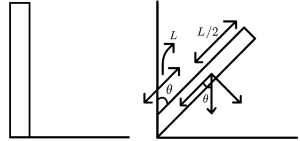
$A$ thin uniform rod of mass $m$ and length $L$ is pivoted at one end so that it can rotate in a vertical plane. The free end is held vertically above the pivot and then released. The angular acceleration of the rod when it makes an angle $\theta$ with the vertical is [consider negligible friction at the pivot] ($g=$ acceleration due to gravity).
A
$\frac{3g \sin \theta}{2L}$
B
$\frac{3g \cos \theta}{2L}$
C
$\frac{2g \sin \theta}{3L}$
D
$\frac{2g \cos \theta}{3L}$
Solution
(A) The rod is pivoted at one end. The moment of inertia of the rod about the pivot is $I = \frac{mL^2}{3}$.
The gravitational force $mg$ acts at the center of mass of the rod,which is at a distance $L/2$ from the pivot.
The torque $\tau$ about the pivot due to gravity is $\tau = mg \cdot (L/2) \sin \theta$.
Using the rotational analog of Newton's second law,$\tau = I \alpha$,where $\alpha$ is the angular acceleration:
$mg \frac{L}{2} \sin \theta = \left( \frac{mL^2}{3} \right) \alpha$
Solving for $\alpha$:
$\alpha = \frac{mg(L/2) \sin \theta}{mL^2/3} = \frac{mgL/2}{mL^2/3} \sin \theta = \frac{3g}{2L} \sin \theta$.
Thus,the angular acceleration is $\frac{3g \sin \theta}{2L}$.
The gravitational force $mg$ acts at the center of mass of the rod,which is at a distance $L/2$ from the pivot.
The torque $\tau$ about the pivot due to gravity is $\tau = mg \cdot (L/2) \sin \theta$.
Using the rotational analog of Newton's second law,$\tau = I \alpha$,where $\alpha$ is the angular acceleration:
$mg \frac{L}{2} \sin \theta = \left( \frac{mL^2}{3} \right) \alpha$
Solving for $\alpha$:
$\alpha = \frac{mg(L/2) \sin \theta}{mL^2/3} = \frac{mgL/2}{mL^2/3} \sin \theta = \frac{3g}{2L} \sin \theta$.
Thus,the angular acceleration is $\frac{3g \sin \theta}{2L}$.
0 likesView Solution
234
PhysicsEasyMCQMHT CET · 2025
If $\vec{F} = (5 \hat{i} - 10 \hat{j}) \text{ N}$ and $\vec{r} = (4 \hat{i} - 3 \hat{j}) \text{ m}$,then the torque $\vec{\tau}$ acting on the object will be:
A
$25 \hat{k} \text{ N m}$
B
$-25 \hat{k} \text{ N m}$
C
$15 \hat{k} \text{ N m}$
D
$-15 \hat{k} \text{ N m}$
Solution
(B) The torque $\vec{\tau}$ is given by the cross product of the position vector $\vec{r}$ and the force vector $\vec{F}$:
$\vec{\tau} = \vec{r} \times \vec{F}$
Given $\vec{r} = (4 \hat{i} - 3 \hat{j})$ and $\vec{F} = (5 \hat{i} - 10 \hat{j})$:
$\vec{\tau} = (4 \hat{i} - 3 \hat{j}) \times (5 \hat{i} - 10 \hat{j})$
Using the distributive property of the cross product:
$\vec{\tau} = 4 \hat{i} \times (5 \hat{i}) - 4 \hat{i} \times (10 \hat{j}) - 3 \hat{j} \times (5 \hat{i}) + 3 \hat{j} \times (10 \hat{j})$
Since $\hat{i} \times \hat{i} = 0$ and $\hat{j} \times \hat{j} = 0$,and knowing $\hat{i} \times \hat{j} = \hat{k}$ and $\hat{j} \times \hat{i} = -\hat{k}$:
$\vec{\tau} = 0 - 40(\hat{k}) - 15(-\hat{k}) + 0$
$\vec{\tau} = -40 \hat{k} + 15 \hat{k}$
$\vec{\tau} = -25 \hat{k} \text{ N m}$
$\vec{\tau} = \vec{r} \times \vec{F}$
Given $\vec{r} = (4 \hat{i} - 3 \hat{j})$ and $\vec{F} = (5 \hat{i} - 10 \hat{j})$:
$\vec{\tau} = (4 \hat{i} - 3 \hat{j}) \times (5 \hat{i} - 10 \hat{j})$
Using the distributive property of the cross product:
$\vec{\tau} = 4 \hat{i} \times (5 \hat{i}) - 4 \hat{i} \times (10 \hat{j}) - 3 \hat{j} \times (5 \hat{i}) + 3 \hat{j} \times (10 \hat{j})$
Since $\hat{i} \times \hat{i} = 0$ and $\hat{j} \times \hat{j} = 0$,and knowing $\hat{i} \times \hat{j} = \hat{k}$ and $\hat{j} \times \hat{i} = -\hat{k}$:
$\vec{\tau} = 0 - 40(\hat{k}) - 15(-\hat{k}) + 0$
$\vec{\tau} = -40 \hat{k} + 15 \hat{k}$
$\vec{\tau} = -25 \hat{k} \text{ N m}$
0 likesView Solution
235
PhysicsMediumMCQMHT CET · 2025
$A$ disc of mass $25 \ kg$ and radius $0.2 \ m$ is rotating at $240 \ r.p.m.$ $A$ retarding torque brings it to rest in $20 \ s$. If the torque is due to a force applied tangentially on the rim of the disc,then the magnitude of the force is:
A
$\frac{\pi}{2} \ N$
B
$2 \pi \ N$
C
$\pi \ N$
D
$4 \pi \ N$
Solution
(C) Given:
Mass $M = 25 \ kg$,Radius $R = 0.2 \ m$,Initial angular velocity $\omega_0 = 240 \ r.p.m. = 240 \times \frac{2\pi}{60} \ rad/s = 8\pi \ rad/s$.
Final angular velocity $\omega = 0 \ rad/s$,Time $t = 20 \ s$.
The moment of inertia of the disc is $I = \frac{1}{2}MR^2 = \frac{1}{2} \times 25 \times (0.2)^2 = 0.5 \ kg \cdot m^2$.
The angular acceleration $\alpha$ is given by $\alpha = \frac{\omega - \omega_0}{t} = \frac{0 - 8\pi}{20} = -0.4\pi \ rad/s^2$.
The retarding torque is $\tau = I|\alpha| = 0.5 \times 0.4\pi = 0.2\pi \ N \cdot m$.
Since the torque is applied tangentially,$\tau = F \times R$,so $F = \frac{\tau}{R} = \frac{0.2\pi}{0.2} = \pi \ N$.
Mass $M = 25 \ kg$,Radius $R = 0.2 \ m$,Initial angular velocity $\omega_0 = 240 \ r.p.m. = 240 \times \frac{2\pi}{60} \ rad/s = 8\pi \ rad/s$.
Final angular velocity $\omega = 0 \ rad/s$,Time $t = 20 \ s$.
The moment of inertia of the disc is $I = \frac{1}{2}MR^2 = \frac{1}{2} \times 25 \times (0.2)^2 = 0.5 \ kg \cdot m^2$.
The angular acceleration $\alpha$ is given by $\alpha = \frac{\omega - \omega_0}{t} = \frac{0 - 8\pi}{20} = -0.4\pi \ rad/s^2$.
The retarding torque is $\tau = I|\alpha| = 0.5 \times 0.4\pi = 0.2\pi \ N \cdot m$.
Since the torque is applied tangentially,$\tau = F \times R$,so $F = \frac{\tau}{R} = \frac{0.2\pi}{0.2} = \pi \ N$.
0 likesView Solution
236
PhysicsMediumMCQMHT CET · 2025
$A$ same torque is applied to a disc and a ring of equal mass and radii. Then:
A
the ring will rotate with greater angular frequency.
B
both will rotate with same angular frequency.
C
the disc will rotate with greater angular frequency.
D
both will rotate with same angular velocity.
Solution
(C) The torque $\tau$ is related to the moment of inertia $I$ and angular acceleration $\alpha$ by the equation $\tau = I\alpha$.
Since the torque $\tau$ is the same for both,the angular acceleration is given by $\alpha = \frac{\tau}{I}$.
The moment of inertia of a ring is $I_{\text{ring}} = MR^2$ and for a disc is $I_{\text{disc}} = \frac{1}{2}MR^2$.
Since $I_{\text{ring}} > I_{\text{disc}}$,the angular acceleration of the disc will be greater than that of the ring $(\alpha_{\text{disc}} > \alpha_{\text{ring}})$.
Consequently,the disc will rotate with a greater angular frequency (or angular velocity) compared to the ring after the same time interval.
Since the torque $\tau$ is the same for both,the angular acceleration is given by $\alpha = \frac{\tau}{I}$.
The moment of inertia of a ring is $I_{\text{ring}} = MR^2$ and for a disc is $I_{\text{disc}} = \frac{1}{2}MR^2$.
Since $I_{\text{ring}} > I_{\text{disc}}$,the angular acceleration of the disc will be greater than that of the ring $(\alpha_{\text{disc}} > \alpha_{\text{ring}})$.
Consequently,the disc will rotate with a greater angular frequency (or angular velocity) compared to the ring after the same time interval.
0 likesView Solution
237
PhysicsMediumMCQMHT CET · 2025
$A$ stationary object at $4^{\circ} C$ and weighing $3.5 \ kg$ falls from a height of $2000 \ m$ on a snow mountain at $0^{\circ} C$. If the temperature of the object just before hitting the snow is $0^{\circ} C$ and the object comes to rest immediately,then the quantity of ice that melts is (Acceleration due to gravity $= 10 \ m/s^2$,Latent heat of ice $= 3.5 \times 10^5 \ J/kg$)
A
$2 \ g$
B
$20 \ g$
C
$200 \ g$
D
$2 \ kg$
Solution
(C) The potential energy of the object at height $h$ is converted into heat energy upon impact.
Given: Mass $m = 3.5 \ kg$,height $h = 2000 \ m$,$g = 10 \ m/s^2$,Latent heat $L = 3.5 \times 10^5 \ J/kg$.
The potential energy $PE = mgh = 3.5 \times 10 \times 2000 = 70,000 \ J$.
The heat required to melt a mass $m'$ of ice is $Q = m'L$.
Since the object comes to rest,all potential energy is converted into heat: $mgh = m'L$.
$70,000 = m' \times 3.5 \times 10^5$.
$m' = \frac{70,000}{3.5 \times 10^5} = \frac{7 \times 10^4}{3.5 \times 10^5} = 2 \times 10^{-1} \ kg = 0.2 \ kg$.
Converting to grams: $0.2 \ kg = 200 \ g$.
Given: Mass $m = 3.5 \ kg$,height $h = 2000 \ m$,$g = 10 \ m/s^2$,Latent heat $L = 3.5 \times 10^5 \ J/kg$.
The potential energy $PE = mgh = 3.5 \times 10 \times 2000 = 70,000 \ J$.
The heat required to melt a mass $m'$ of ice is $Q = m'L$.
Since the object comes to rest,all potential energy is converted into heat: $mgh = m'L$.
$70,000 = m' \times 3.5 \times 10^5$.
$m' = \frac{70,000}{3.5 \times 10^5} = \frac{7 \times 10^4}{3.5 \times 10^5} = 2 \times 10^{-1} \ kg = 0.2 \ kg$.
Converting to grams: $0.2 \ kg = 200 \ g$.
0 likesView Solution
238
PhysicsMediumMCQMHT CET · 2025
$A$ calorimeter contains $10 \ g$ of water at $20^{\circ}C$. The temperature falls to $15^{\circ}C$ in $10 \ min$. When the calorimeter contains $20 \ g$ of water at $20^{\circ}C$,it takes $15 \ min$ for the temperature to become $15^{\circ}C$. The water equivalent of the calorimeter is: (in $g$)
A
$50$
B
$25$
C
$10$
D
$5$
Solution
(C) According to Newton's Law of Cooling,the rate of heat loss is proportional to the temperature difference between the body and the surroundings: $\frac{dQ}{dt} = k(T - T_s)$.
Here,the heat lost by the system (calorimeter + water) is $\Delta Q = (m_w + w)c \Delta T$,where $w$ is the water equivalent of the calorimeter.
The rate of cooling is $\frac{\Delta Q}{\Delta t} = \frac{(m_w + w)c \Delta T}{\Delta t} = k(T_{avg} - T_s)$.
Since the temperature change $\Delta T = 5^{\circ}C$ and the average temperature $T_{avg} = 17.5^{\circ}C$ are the same in both cases,the rate of heat loss is constant.
Thus,$\frac{(m_1 + w)c \Delta T}{t_1} = \frac{(m_2 + w)c \Delta T}{t_2}$.
This simplifies to $\frac{m_1 + w}{t_1} = \frac{m_2 + w}{t_2}$.
Given $m_1 = 10 \ g, t_1 = 10 \ min$ and $m_2 = 20 \ g, t_2 = 15 \ min$.
Substituting the values: $\frac{10 + w}{10} = \frac{20 + w}{15}$.
$15(10 + w) = 10(20 + w) \implies 150 + 15w = 200 + 10w$.
$5w = 50 \implies w = 10 \ g$.
Here,the heat lost by the system (calorimeter + water) is $\Delta Q = (m_w + w)c \Delta T$,where $w$ is the water equivalent of the calorimeter.
The rate of cooling is $\frac{\Delta Q}{\Delta t} = \frac{(m_w + w)c \Delta T}{\Delta t} = k(T_{avg} - T_s)$.
Since the temperature change $\Delta T = 5^{\circ}C$ and the average temperature $T_{avg} = 17.5^{\circ}C$ are the same in both cases,the rate of heat loss is constant.
Thus,$\frac{(m_1 + w)c \Delta T}{t_1} = \frac{(m_2 + w)c \Delta T}{t_2}$.
This simplifies to $\frac{m_1 + w}{t_1} = \frac{m_2 + w}{t_2}$.
Given $m_1 = 10 \ g, t_1 = 10 \ min$ and $m_2 = 20 \ g, t_2 = 15 \ min$.
Substituting the values: $\frac{10 + w}{10} = \frac{20 + w}{15}$.
$15(10 + w) = 10(20 + w) \implies 150 + 15w = 200 + 10w$.
$5w = 50 \implies w = 10 \ g$.
0 likesView Solution
239
PhysicsMediumMCQMHT CET · 2025
$A$ composite slab consists of two materials having coefficients of thermal conductivity $K$ and $2K$,thickness $x$ and $4x$ respectively. The temperatures of two outer surfaces of the composite slab are $T_2$ and $T_1$ respectively $(T_2 > T_1)$. The rate of heat transfer through the slab in a steady state is $\left[\frac{A(T_2 - T_1)K}{x}\right] f$,where $f$ is equal to:
A
$1$
B
$2/3$
C
$1/2$
D
$1/3$
Solution
(D) In a steady state,the rate of heat flow $(H)$ through materials in series is the same.
For the first material: $H = \frac{KA(T_2 - T)}{x}$,where $T$ is the interface temperature.
For the second material: $H = \frac{(2K)A(T - T_1)}{4x} = \frac{KA(T - T_1)}{2x}$.
Equating the two expressions: $\frac{KA(T_2 - T)}{x} = \frac{KA(T - T_1)}{2x}$.
$2(T_2 - T) = T - T_1 \implies 2T_2 - 2T = T - T_1 \implies 3T = 2T_2 + T_1 \implies T = \frac{2T_2 + T_1}{3}$.
Substituting $T$ back into the first expression: $H = \frac{KA}{x} (T_2 - \frac{2T_2 + T_1}{3}) = \frac{KA}{x} (\frac{3T_2 - 2T_2 - T_1}{3}) = \frac{KA(T_2 - T_1)}{3x}$.
Comparing this with the given expression $\left[\frac{A(T_2 - T_1)K}{x}\right] f$,we find $f = 1/3$.
For the first material: $H = \frac{KA(T_2 - T)}{x}$,where $T$ is the interface temperature.
For the second material: $H = \frac{(2K)A(T - T_1)}{4x} = \frac{KA(T - T_1)}{2x}$.
Equating the two expressions: $\frac{KA(T_2 - T)}{x} = \frac{KA(T - T_1)}{2x}$.
$2(T_2 - T) = T - T_1 \implies 2T_2 - 2T = T - T_1 \implies 3T = 2T_2 + T_1 \implies T = \frac{2T_2 + T_1}{3}$.
Substituting $T$ back into the first expression: $H = \frac{KA}{x} (T_2 - \frac{2T_2 + T_1}{3}) = \frac{KA}{x} (\frac{3T_2 - 2T_2 - T_1}{3}) = \frac{KA(T_2 - T_1)}{3x}$.
Comparing this with the given expression $\left[\frac{A(T_2 - T_1)K}{x}\right] f$,we find $f = 1/3$.
0 likesView Solution
240
PhysicsEasyMCQMHT CET · 2025
The two ends of a rod of length $x$ and uniform cross-sectional area $A$ are kept at temperatures $T_1$ and $T_2$ respectively $(T_1 > T_2)$. If the rate of heat transfer through the rod in steady state is $Q/t$,then the coefficient of thermal conductivity $K$ is:
A
$\frac{AQ}{tx(T_1-T_2)}$
B
$\frac{xQ}{tA(T_1-T_2)}$
C
$\frac{xAQ}{t(T_1-T_2)}$
D
$\frac{Q}{txA(T_1-T_2)}$
Solution
(B) The rate of heat transfer $H$ through a rod by conduction is given by the formula:
$H = \frac{Q}{t} = \frac{KA(T_1 - T_2)}{x}$
Where:
$Q/t$ is the rate of heat transfer,
$K$ is the coefficient of thermal conductivity,
$A$ is the cross-sectional area,
$x$ is the length of the rod,
$(T_1 - T_2)$ is the temperature difference.
Rearranging the formula to solve for $K$:
$K = \frac{(Q/t) \cdot x}{A(T_1 - T_2)}$
$K = \frac{xQ}{tA(T_1 - T_2)}$
Thus,the correct option is $B$.
$H = \frac{Q}{t} = \frac{KA(T_1 - T_2)}{x}$
Where:
$Q/t$ is the rate of heat transfer,
$K$ is the coefficient of thermal conductivity,
$A$ is the cross-sectional area,
$x$ is the length of the rod,
$(T_1 - T_2)$ is the temperature difference.
Rearranging the formula to solve for $K$:
$K = \frac{(Q/t) \cdot x}{A(T_1 - T_2)}$
$K = \frac{xQ}{tA(T_1 - T_2)}$
Thus,the correct option is $B$.
0 likesView Solution
241
PhysicsEasyMCQMHT CET · 2025
$A$ black sphere of radius $R$ radiates power $P$ at a certain temperature $T$. If the temperature is doubled and the radius is also doubled,the new power radiated will be: (in $P$)
A
$4$
B
$8$
C
$16$
D
$64$
Solution
(D) According to the Stefan-Boltzmann Law,the power $P$ radiated by a black body of surface area $A$ at temperature $T$ is given by $P = \sigma A T^4$.
For a sphere of radius $R$,the surface area is $A = 4 \pi R^2$.
Thus,the initial power is $P_1 = \sigma (4 \pi R^2) T^4$.
When the radius is doubled $(R' = 2R)$ and the temperature is doubled $(T' = 2T)$,the new power $P_2$ is:
$P_2 = \sigma (4 \pi (2R)^2) (2T)^4$
$P_2 = \sigma (4 \pi \cdot 4R^2) (16T^4)$
$P_2 = 16 \cdot 4 \cdot \sigma (4 \pi R^2) T^4$
$P_2 = 64 P_1$.
Therefore,the new power radiated is $64 P$.
For a sphere of radius $R$,the surface area is $A = 4 \pi R^2$.
Thus,the initial power is $P_1 = \sigma (4 \pi R^2) T^4$.
When the radius is doubled $(R' = 2R)$ and the temperature is doubled $(T' = 2T)$,the new power $P_2$ is:
$P_2 = \sigma (4 \pi (2R)^2) (2T)^4$
$P_2 = \sigma (4 \pi \cdot 4R^2) (16T^4)$
$P_2 = 16 \cdot 4 \cdot \sigma (4 \pi R^2) T^4$
$P_2 = 64 P_1$.
Therefore,the new power radiated is $64 P$.
0 likesView Solution
242
PhysicsEasyMCQMHT CET · 2025
The coefficient of absorption $(a)$ and the coefficient of reflection $(r)$ of a thin uniform plate are $0.77$ and $0.17$ respectively. If $250 \ kcal$ of heat is incident on the surface of the plate,the quantity of heat transmitted $(t)$ is: (in $kcal$)
A
$7$
B
$12$
C
$15$
D
$22$
Solution
(C) For any surface,the sum of the coefficient of absorption $(a)$,the coefficient of reflection $(r)$,and the coefficient of transmission $(t)$ is equal to $1$.
$a + r + t = 1$
Given: $a = 0.77$,$r = 0.17$.
Substituting these values: $0.77 + 0.17 + t = 1$
$0.94 + t = 1$
$t = 1 - 0.94 = 0.06$
The quantity of heat transmitted is given by the product of the incident heat $(Q)$ and the coefficient of transmission $(t)$.
$Q_{\text{transmitted}} = Q \times t$
$Q_{\text{transmitted}} = 250 \ kcal \times 0.06$
$Q_{\text{transmitted}} = 15 \ kcal$
Therefore,the correct option is $C$.
$a + r + t = 1$
Given: $a = 0.77$,$r = 0.17$.
Substituting these values: $0.77 + 0.17 + t = 1$
$0.94 + t = 1$
$t = 1 - 0.94 = 0.06$
The quantity of heat transmitted is given by the product of the incident heat $(Q)$ and the coefficient of transmission $(t)$.
$Q_{\text{transmitted}} = Q \times t$
$Q_{\text{transmitted}} = 250 \ kcal \times 0.06$
$Q_{\text{transmitted}} = 15 \ kcal$
Therefore,the correct option is $C$.
0 likesView Solution
243
PhysicsMediumMCQMHT CET · 2025
$A$ body cools from $60^{\circ} C$ to $40^{\circ} C$ in $6$ minutes. After the next $6$ minutes,its temperature will be (Temperature of the surroundings is $10^{\circ} C$). (in $^{\circ} C$)
A
$24$
B
$28$
C
$18$
D
$32$
Solution
(B) According to Newton's law of cooling,the rate of cooling is given by $\frac{dT}{dt} = -k(T - T_s)$,where $T_s$ is the temperature of the surroundings.
For the first interval: $\frac{60 - 40}{6} = k \left( \frac{60 + 40}{2} - 10 \right) \implies \frac{20}{6} = k(50 - 10) \implies \frac{10}{3} = 40k \implies k = \frac{1}{12}$.
For the second interval,let the final temperature be $T_f$: $\frac{40 - T_f}{6} = k \left( \frac{40 + T_f}{2} - 10 \right)$.
Substituting $k = \frac{1}{12}$: $\frac{40 - T_f}{6} = \frac{1}{12} \left( 20 + \frac{T_f}{2} - 10 \right) \implies \frac{40 - T_f}{6} = \frac{1}{12} \left( 10 + \frac{T_f}{2} \right)$.
Multiplying by $12$: $2(40 - T_f) = 10 + 0.5T_f \implies 80 - 2T_f = 10 + 0.5T_f \implies 70 = 2.5T_f \implies T_f = \frac{70}{2.5} = 28^{\circ} C$.
For the first interval: $\frac{60 - 40}{6} = k \left( \frac{60 + 40}{2} - 10 \right) \implies \frac{20}{6} = k(50 - 10) \implies \frac{10}{3} = 40k \implies k = \frac{1}{12}$.
For the second interval,let the final temperature be $T_f$: $\frac{40 - T_f}{6} = k \left( \frac{40 + T_f}{2} - 10 \right)$.
Substituting $k = \frac{1}{12}$: $\frac{40 - T_f}{6} = \frac{1}{12} \left( 20 + \frac{T_f}{2} - 10 \right) \implies \frac{40 - T_f}{6} = \frac{1}{12} \left( 10 + \frac{T_f}{2} \right)$.
Multiplying by $12$: $2(40 - T_f) = 10 + 0.5T_f \implies 80 - 2T_f = 10 + 0.5T_f \implies 70 = 2.5T_f \implies T_f = \frac{70}{2.5} = 28^{\circ} C$.
0 likesView Solution
244
PhysicsEasyMCQMHT CET · 2025
For a perfectly black body,the coefficient of emission (emissivity) is:
A
zero.
B
unity.
C
less than one (non-zero).
D
infinity.
Solution
(B) perfectly black body is defined as an object that absorbs all incident radiation of any wavelength. According to Kirchhoff's law of thermal radiation,for an arbitrary body in thermal equilibrium with its surroundings,the emissivity is equal to its absorptivity. Since a perfectly black body has an absorptivity of $1$,its emissivity (coefficient of emission) must also be $1$,which is referred to as unity.
0 likesView Solution
245
PhysicsMediumMCQMHT CET · 2025
$A$ metal sphere cools at a rate of $1.5^{\circ} C / min$ when its temperature is $80^{\circ} C$. When the temperature of the sphere is $40^{\circ} C$,its rate of cooling is $0.3^{\circ} C / min$. The temperature of the surrounding $\left(\theta_0\right)$ is (in $^{\circ} C$)
A
$30$
B
$35$
C
$25$
D
$27$
Solution
(A) According to Newton's Law of Cooling,the rate of cooling is given by: $\frac{d\theta}{dt} = K(\theta - \theta_0)$,where $\theta$ is the temperature of the body and $\theta_0$ is the temperature of the surroundings.
For the first case:
$1.5 = K(80 - \theta_0)$ --- (Equation $1$)
For the second case:
$0.3 = K(40 - \theta_0)$ --- (Equation $2$)
Dividing Equation $1$ by Equation $2$:
$\frac{1.5}{0.3} = \frac{K(80 - \theta_0)}{K(40 - \theta_0)}$
$5 = \frac{80 - \theta_0}{40 - \theta_0}$
$5(40 - \theta_0) = 80 - \theta_0$
$200 - 5\theta_0 = 80 - \theta_0$
$200 - 80 = 5\theta_0 - \theta_0$
$120 = 4\theta_0$
$\theta_0 = 30^{\circ} C$
Thus,the temperature of the surrounding is $30^{\circ} C$.
For the first case:
$1.5 = K(80 - \theta_0)$ --- (Equation $1$)
For the second case:
$0.3 = K(40 - \theta_0)$ --- (Equation $2$)
Dividing Equation $1$ by Equation $2$:
$\frac{1.5}{0.3} = \frac{K(80 - \theta_0)}{K(40 - \theta_0)}$
$5 = \frac{80 - \theta_0}{40 - \theta_0}$
$5(40 - \theta_0) = 80 - \theta_0$
$200 - 5\theta_0 = 80 - \theta_0$
$200 - 80 = 5\theta_0 - \theta_0$
$120 = 4\theta_0$
$\theta_0 = 30^{\circ} C$
Thus,the temperature of the surrounding is $30^{\circ} C$.
0 likesView Solution
246
PhysicsEasyMCQMHT CET · 2025
The following graph represents the radiant power versus wavelength of a black body. The area under the curve represents:
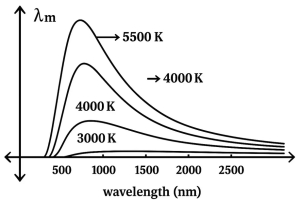
A
the maximum wavelength emitted by the object.
B
the minimum wavelength emitted by the object.
C
the total energy emitted per unit time by the black body at some particular wavelength.
D
the total energy emitted per unit time per unit area by the black body at all wavelengths.
Solution
(D) The graph shows the spectral emissive power $(E_{\lambda})$ on the y-axis and wavelength $(\lambda)$ on the x-axis.
The area under the curve is given by the integral $\int_{0}^{\infty} E_{\lambda} d\lambda$.
According to the definition of spectral emissive power,this integral represents the total radiant energy emitted per unit time per unit surface area of the black body across all possible wavelengths.
This is consistent with the Stefan-Boltzmann Law,which states that the total power radiated per unit area is proportional to the fourth power of the absolute temperature $(E = \sigma T^4)$.
The area under the curve is given by the integral $\int_{0}^{\infty} E_{\lambda} d\lambda$.
According to the definition of spectral emissive power,this integral represents the total radiant energy emitted per unit time per unit surface area of the black body across all possible wavelengths.
This is consistent with the Stefan-Boltzmann Law,which states that the total power radiated per unit area is proportional to the fourth power of the absolute temperature $(E = \sigma T^4)$.
0 likesView Solution
247
PhysicsMediumMCQMHT CET · 2025
$A$ rectangular block of surface area $A$ emits energy $E$ per second at $27^{\circ} C$. If length and breadth are reduced to half of their initial values and the temperature is raised to $327^{\circ} C$,then the energy emitted per second becomes:
A
$2 E$
B
$4 E$
C
$E$
D
$8 E$
Solution
(B) According to Stefan-Boltzmann Law,the energy emitted per second (power) $P$ is given by $P = \sigma A T^4$,where $\sigma$ is the Stefan-Boltzmann constant,$A$ is the surface area,and $T$ is the absolute temperature in Kelvin.
Initial state: $P_1 = E = \sigma A T_1^4$,where $T_1 = 27 + 273 = 300 \ K$.
Final state: Length and breadth are halved,so the new area $A' = (L/2) \times (B/2) = A/4$. The new temperature $T_2 = 327 + 273 = 600 \ K$.
The new power $P_2 = \sigma A' T_2^4 = \sigma (A/4) (600)^4$.
Taking the ratio: $P_2 / P_1 = [\sigma (A/4) (600)^4] / [\sigma A (300)^4] = (1/4) \times (600/300)^4 = (1/4) \times 2^4 = (1/4) \times 16 = 4$.
Therefore,$P_2 = 4 E$.
Initial state: $P_1 = E = \sigma A T_1^4$,where $T_1 = 27 + 273 = 300 \ K$.
Final state: Length and breadth are halved,so the new area $A' = (L/2) \times (B/2) = A/4$. The new temperature $T_2 = 327 + 273 = 600 \ K$.
The new power $P_2 = \sigma A' T_2^4 = \sigma (A/4) (600)^4$.
Taking the ratio: $P_2 / P_1 = [\sigma (A/4) (600)^4] / [\sigma A (300)^4] = (1/4) \times (600/300)^4 = (1/4) \times 2^4 = (1/4) \times 16 = 4$.
Therefore,$P_2 = 4 E$.
0 likesView Solution
248
PhysicsMediumMCQMHT CET · 2025
If a black body at $400 \ K$ surrounded by atmosphere at $300 \ K$ has a rate of cooling '$R_0$',the same body at $900 \ K$,surrounded by the same atmosphere,will have a rate of cooling nearly:
A
$4 R_0$
B
$16 R_0$
C
$36 R_0$
D
$\frac{81 R_0}{16}$
Solution
(C) According to Stefan-Boltzmann law,the rate of cooling $R$ of a body is given by $R \propto (T^4 - T_0^4)$,where $T$ is the temperature of the body and $T_0$ is the temperature of the surroundings.
For the first case: $R_0 = k(400^4 - 300^4) = k(256 \times 10^8 - 81 \times 10^8) = k(175 \times 10^8)$.
For the second case: $R' = k(900^4 - 300^4) = k(6561 \times 10^8 - 81 \times 10^8) = k(6480 \times 10^8)$.
Taking the ratio: $\frac{R'}{R_0} = \frac{6480}{175} \approx 37.02$.
Comparing this with the given options,the closest value is $36 R_0$.
For the first case: $R_0 = k(400^4 - 300^4) = k(256 \times 10^8 - 81 \times 10^8) = k(175 \times 10^8)$.
For the second case: $R' = k(900^4 - 300^4) = k(6561 \times 10^8 - 81 \times 10^8) = k(6480 \times 10^8)$.
Taking the ratio: $\frac{R'}{R_0} = \frac{6480}{175} \approx 37.02$.
Comparing this with the given options,the closest value is $36 R_0$.
0 likesView Solution
249
PhysicsMediumMCQMHT CET · 2025
Hot water cools from $80^{\circ} C$ to $60^{\circ} C$ in $1$ minute. How long will it take to cool from $60^{\circ} C$ to $50^{\circ} C$ (in $s$)? (Room temperature $= 30^{\circ} C$)
A
$48$
B
$42$
C
$50$
D
$45$
Solution
(A) According to Newton's Law of Cooling,the rate of cooling is given by $\frac{dT}{dt} = -k(T - T_0)$,where $T$ is the temperature of the body,$T_0$ is the room temperature,and $k$ is a constant.
For the first interval: $\frac{80 - 60}{1} = k \left( \frac{80 + 60}{2} - 30 \right) \implies 20 = k(70 - 30) \implies 20 = 40k \implies k = 0.5 \ \text{min}^{-1}$.
For the second interval: $\frac{60 - 50}{t} = k \left( \frac{60 + 50}{2} - 30 \right) \implies \frac{10}{t} = 0.5(55 - 30) \implies \frac{10}{t} = 0.5(25) \implies \frac{10}{t} = 12.5$.
Solving for $t$: $t = \frac{10}{12.5} = 0.8 \ \text{minutes}$.
Converting to seconds: $0.8 \times 60 = 48 \ \text{s}$.
For the first interval: $\frac{80 - 60}{1} = k \left( \frac{80 + 60}{2} - 30 \right) \implies 20 = k(70 - 30) \implies 20 = 40k \implies k = 0.5 \ \text{min}^{-1}$.
For the second interval: $\frac{60 - 50}{t} = k \left( \frac{60 + 50}{2} - 30 \right) \implies \frac{10}{t} = 0.5(55 - 30) \implies \frac{10}{t} = 0.5(25) \implies \frac{10}{t} = 12.5$.
Solving for $t$: $t = \frac{10}{12.5} = 0.8 \ \text{minutes}$.
Converting to seconds: $0.8 \times 60 = 48 \ \text{s}$.
0 likesView Solution
250
PhysicsEasyMCQMHT CET · 2025
If $120 \ J$ of thermal energy is incident on an area of $3 \ m^2$,the amount of heat transmitted is $12 \ J$,and the coefficient of absorption is $0.6$,then the amount of heat reflected is: (in $J$)
A
$24$
B
$30$
C
$36$
D
$40$
Solution
(C) Let $Q$ be the total incident thermal energy,$Q_a$ be the absorbed energy,$Q_t$ be the transmitted energy,and $Q_r$ be the reflected energy.
Given: $Q = 120 \ J$,$Q_t = 12 \ J$,and coefficient of absorption $a = 0.6$.
We know that the coefficient of absorption $a = \frac{Q_a}{Q}$.
Therefore,$Q_a = a \times Q = 0.6 \times 120 \ J = 72 \ J$.
According to the law of conservation of energy,the total incident energy is the sum of absorbed,transmitted,and reflected energy:
$Q = Q_a + Q_t + Q_r$
$120 \ J = 72 \ J + 12 \ J + Q_r$
$120 \ J = 84 \ J + Q_r$
$Q_r = 120 \ J - 84 \ J = 36 \ J$.
Thus,the amount of heat reflected is $36 \ J$.
Given: $Q = 120 \ J$,$Q_t = 12 \ J$,and coefficient of absorption $a = 0.6$.
We know that the coefficient of absorption $a = \frac{Q_a}{Q}$.
Therefore,$Q_a = a \times Q = 0.6 \times 120 \ J = 72 \ J$.
According to the law of conservation of energy,the total incident energy is the sum of absorbed,transmitted,and reflected energy:
$Q = Q_a + Q_t + Q_r$
$120 \ J = 72 \ J + 12 \ J + Q_r$
$120 \ J = 84 \ J + Q_r$
$Q_r = 120 \ J - 84 \ J = 36 \ J$.
Thus,the amount of heat reflected is $36 \ J$.
0 likesView Solution
251
PhysicsMediumMCQMHT CET · 2025
Two identical coils of inductance $L$ joined in series are placed very close to each other such that the winding direction of one coil is exactly opposite to that of the other. The net inductance is
A
$\frac{L}{2}$
B
$2L$
C
zero
D
$L$
Solution
(C) When two coils of inductance $L_1$ and $L_2$ are connected in series,the equivalent inductance $L_{eq}$ is given by $L_{eq} = L_1 + L_2 \pm 2M$,where $M$ is the mutual inductance between the coils.
Since the coils are identical,$L_1 = L_2 = L$.
Because the winding directions are exactly opposite,the magnetic flux produced by one coil opposes the flux produced by the other,resulting in a negative mutual inductance effect.
For two identical coils placed very close to each other,the mutual inductance $M$ is equal to the self-inductance $L$ (i.e.,$M = L$).
Substituting these values into the formula: $L_{eq} = L + L - 2M = 2L - 2L = 0$.
Since the coils are identical,$L_1 = L_2 = L$.
Because the winding directions are exactly opposite,the magnetic flux produced by one coil opposes the flux produced by the other,resulting in a negative mutual inductance effect.
For two identical coils placed very close to each other,the mutual inductance $M$ is equal to the self-inductance $L$ (i.e.,$M = L$).
Substituting these values into the formula: $L_{eq} = L + L - 2M = 2L - 2L = 0$.
0 likesView Solution
252
PhysicsEasyMCQMHT CET · 2025
When magnetic flux changes from $6.5 \times 10^{-2} \ Wb$ to $11 \times 10^{-2} \ Wb$ and the change in current is $0.03 \ A$,the coefficient of mutual inductance will be: (in $H$)
A
$1.0$
B
$1.2$
C
$1.5$
D
$1.8$
Solution
(C) The coefficient of mutual inductance $M$ is defined by the relation $\Delta \phi = M \Delta I$,where $\Delta \phi$ is the change in magnetic flux and $\Delta I$ is the change in current.
Given:
Initial flux $\phi_1 = 6.5 \times 10^{-2} \ Wb$
Final flux $\phi_2 = 11 \times 10^{-2} \ Wb$
Change in flux $\Delta \phi = \phi_2 - \phi_1 = (11 - 6.5) \times 10^{-2} \ Wb = 4.5 \times 10^{-2} \ Wb$
Change in current $\Delta I = 0.03 \ A = 3 \times 10^{-2} \ A$
Using the formula $M = \frac{\Delta \phi}{\Delta I}$:
$M = \frac{4.5 \times 10^{-2}}{3 \times 10^{-2}} = \frac{4.5}{3} = 1.5 \ H$
Therefore,the coefficient of mutual inductance is $1.5 \ H$.
Given:
Initial flux $\phi_1 = 6.5 \times 10^{-2} \ Wb$
Final flux $\phi_2 = 11 \times 10^{-2} \ Wb$
Change in flux $\Delta \phi = \phi_2 - \phi_1 = (11 - 6.5) \times 10^{-2} \ Wb = 4.5 \times 10^{-2} \ Wb$
Change in current $\Delta I = 0.03 \ A = 3 \times 10^{-2} \ A$
Using the formula $M = \frac{\Delta \phi}{\Delta I}$:
$M = \frac{4.5 \times 10^{-2}}{3 \times 10^{-2}} = \frac{4.5}{3} = 1.5 \ H$
Therefore,the coefficient of mutual inductance is $1.5 \ H$.
0 likesView Solution
253
PhysicsMediumMCQMHT CET · 2025
Two coils $P$ and $Q$ are kept near each other. When no current flows through coil $P$ and current increases in coil $Q$ at the rate $10 \ A/s$,the emf in coil $P$ is $12 \ mV$. When coil $Q$ carries no current and current of $1.5 \ A$ flows through coil $P$,the magnetic flux linked with the coil $Q$ in $mWb$ is
A
$0.9$
B
$1.2$
C
$1.5$
D
$1.8$
Solution
(D) The induced emf in coil $P$ due to the changing current in coil $Q$ is given by $\epsilon_P = M \frac{dI_Q}{dt}$,where $M$ is the mutual inductance.
Given $\epsilon_P = 12 \ mV = 12 \times 10^{-3} \ V$ and $\frac{dI_Q}{dt} = 10 \ A/s$.
$12 \times 10^{-3} = M \times 10 \implies M = 1.2 \times 10^{-3} \ H = 1.2 \ mH$.
Now,the magnetic flux $\phi_Q$ linked with coil $Q$ when current $I_P = 1.5 \ A$ flows through coil $P$ is given by $\phi_Q = M \times I_P$.
$\phi_Q = 1.2 \ mH \times 1.5 \ A = 1.8 \ mWb$.
Thus,the correct option is $D$.
Given $\epsilon_P = 12 \ mV = 12 \times 10^{-3} \ V$ and $\frac{dI_Q}{dt} = 10 \ A/s$.
$12 \times 10^{-3} = M \times 10 \implies M = 1.2 \times 10^{-3} \ H = 1.2 \ mH$.
Now,the magnetic flux $\phi_Q$ linked with coil $Q$ when current $I_P = 1.5 \ A$ flows through coil $P$ is given by $\phi_Q = M \times I_P$.
$\phi_Q = 1.2 \ mH \times 1.5 \ A = 1.8 \ mWb$.
Thus,the correct option is $D$.
0 likesView Solution
254
PhysicsEasyMCQMHT CET · 2025
The plot of magnetic flux ' $\phi$ ' linked with the coil versus current ' $I$ ' is as shown in the figure for two inductors $L_1$ and $L_2$. The self-inductance of:
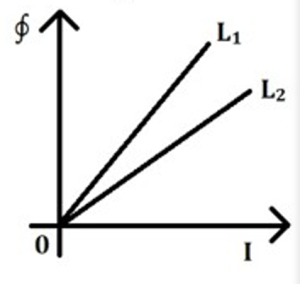
A
$L_1$ is equal to that of $L_2$.
B
$L_1$ is less than that of $L_2$.
C
$L_1$ is greater than that of $L_2$.
D
$L_1$ is half that of $L_2$.
Solution
(C) The magnetic flux $\phi$ linked with a coil is given by the relation $\phi = LI$,where $L$ is the self-inductance of the coil.
This equation represents a straight line passing through the origin,where the slope of the $\phi-I$ graph is equal to the self-inductance $L$ (i.e.,$L = \frac{\phi}{I} = \tan \theta$).
From the given figure,the slope of the line for $L_1$ is greater than the slope of the line for $L_2$ (since the angle $\theta_1 > \theta_2$).
Therefore,the self-inductance $L_1$ is greater than the self-inductance $L_2$.
This equation represents a straight line passing through the origin,where the slope of the $\phi-I$ graph is equal to the self-inductance $L$ (i.e.,$L = \frac{\phi}{I} = \tan \theta$).
From the given figure,the slope of the line for $L_1$ is greater than the slope of the line for $L_2$ (since the angle $\theta_1 > \theta_2$).
Therefore,the self-inductance $L_1$ is greater than the self-inductance $L_2$.
0 likesView Solution
255
PhysicsMediumMCQMHT CET · 2025
$A$ parallel plate capacitor with plate area $A$ and plate separation $d$ is charged by a constant current $I$. $A$ plane surface of area $A/2$,parallel to the plates,is drawn between the plates. The displacement current through this area is
A
$I$
B
$I/2$
C
$I/4$
D
$I/8$
Solution
(B) The displacement current $I_d$ is defined as $I_d = \epsilon_0 \frac{d\Phi_E}{dt}$,where $\Phi_E$ is the electric flux through the surface.
For a parallel plate capacitor,the electric field $E$ between the plates is uniform and given by $E = \frac{q}{\epsilon_0 A}$,where $q$ is the charge on the plates.
The electric flux $\Phi_E$ through an area $A'$ parallel to the plates is $\Phi_E = E \cdot A' = \frac{q}{\epsilon_0 A} \cdot A'$.
Substituting $A' = A/2$,we get $\Phi_E = \frac{q}{\epsilon_0 A} \cdot \frac{A}{2} = \frac{q}{2\epsilon_0}$.
The displacement current is $I_d = \epsilon_0 \frac{d}{dt} \left( \frac{q}{2\epsilon_0} \right) = \frac{1}{2} \frac{dq}{dt}$.
Since the charging current $I = \frac{dq}{dt}$,we have $I_d = \frac{I}{2}$.
For a parallel plate capacitor,the electric field $E$ between the plates is uniform and given by $E = \frac{q}{\epsilon_0 A}$,where $q$ is the charge on the plates.
The electric flux $\Phi_E$ through an area $A'$ parallel to the plates is $\Phi_E = E \cdot A' = \frac{q}{\epsilon_0 A} \cdot A'$.
Substituting $A' = A/2$,we get $\Phi_E = \frac{q}{\epsilon_0 A} \cdot \frac{A}{2} = \frac{q}{2\epsilon_0}$.
The displacement current is $I_d = \epsilon_0 \frac{d}{dt} \left( \frac{q}{2\epsilon_0} \right) = \frac{1}{2} \frac{dq}{dt}$.
Since the charging current $I = \frac{dq}{dt}$,we have $I_d = \frac{I}{2}$.
0 likesView Solution
256
PhysicsMediumMCQMHT CET · 2025
Two charges $q_1 = +6q$ and $q_2 = -3q$ are placed as shown in the figure. $A$ proton is placed on the $x$-axis away from $q_2$. To keep the proton in equilibrium,the distance between $q_1$ and the proton is:
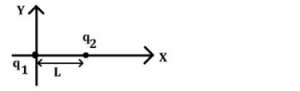
A
$\left(\frac{\sqrt{2}}{\sqrt{2}-1}\right) L$
B
$2 L$
C
$\frac{L}{2}$
D
$\left(\frac{\sqrt{2}}{\sqrt{2}+1}\right) L$
Solution
(A) Let the proton (charge $+e$) be placed at a distance $x$ from $q_1$ on the $x$-axis. Since $q_2$ is at distance $L$ from $q_1$,the distance of the proton from $q_2$ is $(x - L)$.
For the proton to be in equilibrium,the net electrostatic force on it must be zero.
The force due to $q_1$ is $F_1 = \frac{k q_1 e}{x^2}$ (repulsive,towards the right).
The force due to $q_2$ is $F_2 = \frac{k |q_2| e}{(x - L)^2}$ (attractive,towards the left).
Equating the magnitudes: $\frac{k (6q) e}{x^2} = \frac{k (3q) e}{(x - L)^2}$.
Simplifying: $\frac{6}{x^2} = \frac{3}{(x - L)^2} \implies \frac{2}{x^2} = \frac{1}{(x - L)^2}$.
Taking the square root on both sides: $\frac{\sqrt{2}}{x} = \frac{1}{x - L}$.
$\sqrt{2}(x - L) = x \implies \sqrt{2}x - \sqrt{2}L = x$.
$x(\sqrt{2} - 1) = \sqrt{2}L$.
$x = \left(\frac{\sqrt{2}}{\sqrt{2} - 1}\right) L$.
For the proton to be in equilibrium,the net electrostatic force on it must be zero.
The force due to $q_1$ is $F_1 = \frac{k q_1 e}{x^2}$ (repulsive,towards the right).
The force due to $q_2$ is $F_2 = \frac{k |q_2| e}{(x - L)^2}$ (attractive,towards the left).
Equating the magnitudes: $\frac{k (6q) e}{x^2} = \frac{k (3q) e}{(x - L)^2}$.
Simplifying: $\frac{6}{x^2} = \frac{3}{(x - L)^2} \implies \frac{2}{x^2} = \frac{1}{(x - L)^2}$.
Taking the square root on both sides: $\frac{\sqrt{2}}{x} = \frac{1}{x - L}$.
$\sqrt{2}(x - L) = x \implies \sqrt{2}x - \sqrt{2}L = x$.
$x(\sqrt{2} - 1) = \sqrt{2}L$.
$x = \left(\frac{\sqrt{2}}{\sqrt{2} - 1}\right) L$.
0 likesView Solution
257
PhysicsEasyMCQMHT CET · 2025
Three equal charges are placed on the three corners of a square as shown below. If the magnitude of force between $q_1$ and $q_2$ is $F_{12}$ and that between $q_1$ and $q_3$ is $F_{13}$,then the ratio of $F_{13}$ to $F_{12}$ is
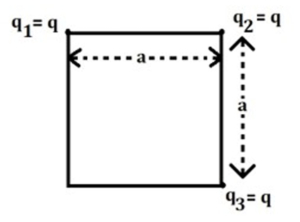
A
$\frac{1}{\sqrt{2}}$
B
$\sqrt{2}$
C
$\frac{1}{2}$
D
$2$
Solution
(C) Let the side length of the square be $a$. The charges are $q_1 = q_2 = q_3 = q$.
According to Coulomb's Law,the force between two charges $q_i$ and $q_j$ separated by a distance $r$ is $F = \frac{k q_i q_j}{r^2}$.
The distance between $q_1$ and $q_2$ is $r_{12} = a$. Thus,$F_{12} = \frac{k q^2}{a^2}$.
The distance between $q_1$ and $q_3$ is the diagonal of the square,$r_{13} = a\sqrt{2}$. Thus,$F_{13} = \frac{k q^2}{(a\sqrt{2})^2} = \frac{k q^2}{2a^2}$.
The ratio of $F_{13}$ to $F_{12}$ is $\frac{F_{13}}{F_{12}} = \frac{k q^2 / 2a^2}{k q^2 / a^2} = \frac{1}{2}$.
According to Coulomb's Law,the force between two charges $q_i$ and $q_j$ separated by a distance $r$ is $F = \frac{k q_i q_j}{r^2}$.
The distance between $q_1$ and $q_2$ is $r_{12} = a$. Thus,$F_{12} = \frac{k q^2}{a^2}$.
The distance between $q_1$ and $q_3$ is the diagonal of the square,$r_{13} = a\sqrt{2}$. Thus,$F_{13} = \frac{k q^2}{(a\sqrt{2})^2} = \frac{k q^2}{2a^2}$.
The ratio of $F_{13}$ to $F_{12}$ is $\frac{F_{13}}{F_{12}} = \frac{k q^2 / 2a^2}{k q^2 / a^2} = \frac{1}{2}$.
0 likesView Solution
258
PhysicsMediumMCQMHT CET · 2025
Three charges $+3q$,$Q$,and $+q$ are placed in a straight line of length $\ell$ at points at distances $0$,$\frac{\ell}{2}$,and $\ell$ respectively. The value of $Q$ in order to have the net force on $+q$ to be zero is $Q = xq$. The value of $x$ is:
A
$-\frac{1}{4}$
B
$-\frac{3}{4}$
C
$-3$
D
$4$
Solution
(B) Let the charges be $q_1 = +3q$ at $x = 0$,$q_2 = Q$ at $x = \frac{\ell}{2}$,and $q_3 = +q$ at $x = \ell$.
For the net force on the charge $+q$ at $x = \ell$ to be zero,the sum of the electrostatic forces exerted by $q_1$ and $q_2$ must be zero.
Using Coulomb's Law,$F = \frac{k q_1 q_2}{r^2}$.
The force exerted by $q_1$ on $q_3$ is $F_1 = \frac{k(3q)(q)}{\ell^2}$.
The force exerted by $q_2$ on $q_3$ is $F_2 = \frac{k(Q)(q)}{(\ell/2)^2} = \frac{kQq}{\ell^2/4} = \frac{4kQq}{\ell^2}$.
For the net force to be zero,$F_1 + F_2 = 0$,so $\frac{3kq^2}{\ell^2} + \frac{4kQq}{\ell^2} = 0$.
Dividing by $\frac{kq}{\ell^2}$,we get $3q + 4Q = 0$.
Therefore,$4Q = -3q$,which gives $Q = -\frac{3}{4}q$.
Comparing this with $Q = xq$,we find $x = -\frac{3}{4}$.
For the net force on the charge $+q$ at $x = \ell$ to be zero,the sum of the electrostatic forces exerted by $q_1$ and $q_2$ must be zero.
Using Coulomb's Law,$F = \frac{k q_1 q_2}{r^2}$.
The force exerted by $q_1$ on $q_3$ is $F_1 = \frac{k(3q)(q)}{\ell^2}$.
The force exerted by $q_2$ on $q_3$ is $F_2 = \frac{k(Q)(q)}{(\ell/2)^2} = \frac{kQq}{\ell^2/4} = \frac{4kQq}{\ell^2}$.
For the net force to be zero,$F_1 + F_2 = 0$,so $\frac{3kq^2}{\ell^2} + \frac{4kQq}{\ell^2} = 0$.
Dividing by $\frac{kq}{\ell^2}$,we get $3q + 4Q = 0$.
Therefore,$4Q = -3q$,which gives $Q = -\frac{3}{4}q$.
Comparing this with $Q = xq$,we find $x = -\frac{3}{4}$.
0 likesView Solution
259
PhysicsEasyMCQMHT CET · 2025
Two point charges $q_1$ and $q_2$ are '$l$' distance apart. If one of the charges is doubled and the distance between them is halved, the magnitude of the force becomes $n$ times, where $n$ is:
A
$1$
B
$2$
C
$8$
D
$16$
Solution
(C) According to Coulomb's Law, the electrostatic force between two point charges is given by $F = k \frac{|q_1 q_2|}{l^2}$.
Initially, the force is $F_1 = k \frac{q_1 q_2}{l^2}$.
When one charge is doubled $(q_1' = 2q_1)$ and the distance is halved $(l' = l/2)$, the new force $F_2$ is:
$F_2 = k \frac{(2q_1)(q_2)}{(l/2)^2} = k \frac{2q_1 q_2}{l^2 / 4} = 8 \left( k \frac{q_1 q_2}{l^2} \right)$.
Therefore, $F_2 = 8 F_1$.
Comparing this with $F_2 = n F_1$, we get $n = 8$.
Initially, the force is $F_1 = k \frac{q_1 q_2}{l^2}$.
When one charge is doubled $(q_1' = 2q_1)$ and the distance is halved $(l' = l/2)$, the new force $F_2$ is:
$F_2 = k \frac{(2q_1)(q_2)}{(l/2)^2} = k \frac{2q_1 q_2}{l^2 / 4} = 8 \left( k \frac{q_1 q_2}{l^2} \right)$.
Therefore, $F_2 = 8 F_1$.
Comparing this with $F_2 = n F_1$, we get $n = 8$.
0 likesView Solution
260
PhysicsMediumMCQMHT CET · 2025
Two equally charged small balls placed at a fixed distance experience a force $F$. $A$ similar uncharged ball after touching one of them is placed at the middle point between the two balls. The force experienced by this ball is:
A
$F/2$
B
$F$
C
$2F$
D
$4F$
Solution
(B) Let the charges on the two balls be $q$ and $q$,and the distance between them be $r$. The initial force is $F = k \frac{q^2}{r^2}$.
When an uncharged ball touches one of the charged balls,the charge $q$ is shared equally between them. Thus,the charge on the first ball becomes $q/2$ and the charge on the third ball becomes $q/2$.
The third ball is placed at the midpoint,so its distance from both balls is $r/2$.
The force on the third ball due to the first ball is $F_1 = k \frac{(q/2)(q/2)}{(r/2)^2} = k \frac{q^2/4}{r^2/4} = k \frac{q^2}{r^2} = F$ (directed away from the first ball).
The force on the third ball due to the second ball is $F_2 = k \frac{(q/2)(q)}{(r/2)^2} = k \frac{q^2/2}{r^2/4} = 2k \frac{q^2}{r^2} = 2F$ (directed away from the second ball).
Since these forces are in opposite directions,the net force on the third ball is $F_{net} = |F_2 - F_1| = |2F - F| = F$.
When an uncharged ball touches one of the charged balls,the charge $q$ is shared equally between them. Thus,the charge on the first ball becomes $q/2$ and the charge on the third ball becomes $q/2$.
The third ball is placed at the midpoint,so its distance from both balls is $r/2$.
The force on the third ball due to the first ball is $F_1 = k \frac{(q/2)(q/2)}{(r/2)^2} = k \frac{q^2/4}{r^2/4} = k \frac{q^2}{r^2} = F$ (directed away from the first ball).
The force on the third ball due to the second ball is $F_2 = k \frac{(q/2)(q)}{(r/2)^2} = k \frac{q^2/2}{r^2/4} = 2k \frac{q^2}{r^2} = 2F$ (directed away from the second ball).
Since these forces are in opposite directions,the net force on the third ball is $F_{net} = |F_2 - F_1| = |2F - F| = F$.
0 likesView Solution
261
PhysicsMediumMCQMHT CET · 2025
Two point charges $+2 \ C$ and $+6 \ C$ separated by a distance '$r$' repel each other with a force of $18 \ N$. If a negative charge of $-4 \ C$ is added to each of these charges,then the force experienced by them is:
A
$6 \ N$ (attractive)
B
$12 \ N$ (attractive)
C
$6 \ N$ (repulsive)
D
$12 \ N$ (repulsive)
Solution
(A) According to Coulomb's Law,the force between two charges $q_1$ and $q_2$ separated by distance $r$ is given by $F = k \frac{|q_1 q_2|}{r^2}$.
Initially,$q_1 = +2 \ C$ and $q_2 = +6 \ C$. The force is $F_1 = k \frac{(2)(6)}{r^2} = 18 \ N$.
This implies $k \frac{12}{r^2} = 18$,so $k/r^2 = 18/12 = 1.5$.
Now,$-4 \ C$ is added to each charge:
New charge $q_1' = +2 \ C - 4 \ C = -2 \ C$.
New charge $q_2' = +6 \ C - 4 \ C = +2 \ C$.
The new force is $F_2 = k \frac{|q_1' q_2'|}{r^2} = k \frac{|(-2)(2)|}{r^2} = k \frac{4}{r^2}$.
Substituting $k/r^2 = 1.5$,we get $F_2 = 1.5 \times 4 = 6 \ N$.
Since the charges are of opposite signs ($-2 \ C$ and $+2 \ C$),the force is attractive.
Initially,$q_1 = +2 \ C$ and $q_2 = +6 \ C$. The force is $F_1 = k \frac{(2)(6)}{r^2} = 18 \ N$.
This implies $k \frac{12}{r^2} = 18$,so $k/r^2 = 18/12 = 1.5$.
Now,$-4 \ C$ is added to each charge:
New charge $q_1' = +2 \ C - 4 \ C = -2 \ C$.
New charge $q_2' = +6 \ C - 4 \ C = +2 \ C$.
The new force is $F_2 = k \frac{|q_1' q_2'|}{r^2} = k \frac{|(-2)(2)|}{r^2} = k \frac{4}{r^2}$.
Substituting $k/r^2 = 1.5$,we get $F_2 = 1.5 \times 4 = 6 \ N$.
Since the charges are of opposite signs ($-2 \ C$ and $+2 \ C$),the force is attractive.
0 likesView Solution
262
PhysicsEasyMCQMHT CET · 2025
An electric dipole of dipole moment $p$ is aligned parallel to a uniform electric field $E$. The energy required to rotate the dipole by $90^{\circ}$ is $\left[\begin{array}{ll}\sin 0^{\circ}=0, & \sin 90^{\circ}=1 \\ \cos 0^{\circ}=1, & \cos 90^{\circ}=0\end{array}\right]$
A
$pE$
B
$pE^2$
C
$p^2 E$
D
$\infty$
Solution
(A) The potential energy $U$ of an electric dipole in an external electric field is given by $U = -pE \cos \theta$,where $\theta$ is the angle between the dipole moment $p$ and the electric field $E$.
Initially,the dipole is aligned parallel to the electric field,so $\theta_1 = 0^{\circ}$.
The initial potential energy is $U_1 = -pE \cos 0^{\circ} = -pE(1) = -pE$.
Finally,the dipole is rotated by $90^{\circ}$,so $\theta_2 = 90^{\circ}$.
The final potential energy is $U_2 = -pE \cos 90^{\circ} = -pE(0) = 0$.
The work done (energy required) to rotate the dipole is equal to the change in potential energy: $W = \Delta U = U_2 - U_1$.
$W = 0 - (-pE) = pE$.
Initially,the dipole is aligned parallel to the electric field,so $\theta_1 = 0^{\circ}$.
The initial potential energy is $U_1 = -pE \cos 0^{\circ} = -pE(1) = -pE$.
Finally,the dipole is rotated by $90^{\circ}$,so $\theta_2 = 90^{\circ}$.
The final potential energy is $U_2 = -pE \cos 90^{\circ} = -pE(0) = 0$.
The work done (energy required) to rotate the dipole is equal to the change in potential energy: $W = \Delta U = U_2 - U_1$.
$W = 0 - (-pE) = pE$.
0 likesView Solution
263
PhysicsEasyMCQMHT CET · 2025
An electric dipole having each charge of magnitude $2 \mu C$ is placed in an electric field of intensity $8 \times 10^{4} \ N/C$. If the maximum torque acting on the dipole is $4 \times 10^{-3} \ N \cdot m$,the length of the dipole is: (in $mm$)
A
$10$
B
$25$
C
$15$
D
$20$
Solution
(B) The torque $\tau$ acting on an electric dipole in an electric field $E$ is given by $\tau = pE \sin \theta$,where $p = q \times (2a)$ is the dipole moment and $(2a)$ is the length of the dipole.
For maximum torque,$\sin \theta = 1$,so $\tau_{max} = pE = q(2a)E$.
Given: $q = 2 \mu C = 2 \times 10^{-6} \ C$,$E = 8 \times 10^{4} \ N/C$,and $\tau_{max} = 4 \times 10^{-3} \ N \cdot m$.
Substituting the values: $4 \times 10^{-3} = (2 \times 10^{-6}) \times (2a) \times (8 \times 10^{4})$.
$4 \times 10^{-3} = 16 \times 10^{-2} \times (2a)$.
$2a = \frac{4 \times 10^{-3}}{16 \times 10^{-2}} = \frac{4}{16} \times 10^{-1} = 0.25 \times 10^{-1} \ m$.
$2a = 0.025 \ m = 25 \ mm$.
Thus,the length of the dipole is $25 \ mm$.
For maximum torque,$\sin \theta = 1$,so $\tau_{max} = pE = q(2a)E$.
Given: $q = 2 \mu C = 2 \times 10^{-6} \ C$,$E = 8 \times 10^{4} \ N/C$,and $\tau_{max} = 4 \times 10^{-3} \ N \cdot m$.
Substituting the values: $4 \times 10^{-3} = (2 \times 10^{-6}) \times (2a) \times (8 \times 10^{4})$.
$4 \times 10^{-3} = 16 \times 10^{-2} \times (2a)$.
$2a = \frac{4 \times 10^{-3}}{16 \times 10^{-2}} = \frac{4}{16} \times 10^{-1} = 0.25 \times 10^{-1} \ m$.
$2a = 0.025 \ m = 25 \ mm$.
Thus,the length of the dipole is $25 \ mm$.
0 likesView Solution
264
PhysicsEasyMCQMHT CET · 2025
Out of the following molecules,which one represents a polar molecule?
A
$(a)$
B
$(b)$
C
$(c)$
D
$(d)$
Solution
(B) polar molecule is one that possesses a permanent electric dipole moment. This occurs when there is an asymmetric distribution of charge within the molecule.
$(a)$ $H_2O$ (Water): It has a bent geometry. The bond dipoles of the two $O-H$ bonds do not cancel each other out,resulting in a net dipole moment. Thus,it is a polar molecule.
$(b)$ $N_2$: It is a homonuclear diatomic molecule with a linear structure,so its dipole moment is zero.
$(c)$ $CO_2$: It has a linear structure where the two $C=O$ bond dipoles are equal and opposite,canceling each other out. Thus,it is non-polar.
$(d)$ $H_2$: It is a homonuclear diatomic molecule,so its dipole moment is zero.
Therefore,the correct option is $(a)$.
$(a)$ $H_2O$ (Water): It has a bent geometry. The bond dipoles of the two $O-H$ bonds do not cancel each other out,resulting in a net dipole moment. Thus,it is a polar molecule.
$(b)$ $N_2$: It is a homonuclear diatomic molecule with a linear structure,so its dipole moment is zero.
$(c)$ $CO_2$: It has a linear structure where the two $C=O$ bond dipoles are equal and opposite,canceling each other out. Thus,it is non-polar.
$(d)$ $H_2$: It is a homonuclear diatomic molecule,so its dipole moment is zero.
Therefore,the correct option is $(a)$.
0 likesView Solution
265
PhysicsMediumMCQMHT CET · 2025
An electric dipole of length $2 \ cm$ is placed with its axis making an angle of $60^{\circ}$ to a uniform electric field of $10^{5} \ N/C$. If it experiences a torque of $8 \sqrt{3} \ Nm$,calculate the magnitude of the charge on the dipole. (Given: $\sin 60^{\circ} = \frac{\sqrt{3}}{2}$)
A
$7 \times 10^{-3} \ C$
B
$8 \times 10^{-3} \ C$
C
$9 \times 10^{-3} \ C$
D
$16 \times 10^{-3} \ C$
Solution
(B) The torque $\tau$ experienced by an electric dipole in a uniform electric field is given by the formula: $\tau = pE \sin \theta$,where $p = q \times (2a)$ is the dipole moment,$E$ is the electric field,and $\theta$ is the angle between the dipole axis and the electric field.
Given:
Length of dipole $(2a) = 2 \ cm = 0.02 \ m = 2 \times 10^{-2} \ m$
Electric field $(E) = 10^{5} \ N/C$
Angle $(\theta) = 60^{\circ}$
Torque $(\tau) = 8 \sqrt{3} \ Nm$
Substituting the values into the formula:
$8 \sqrt{3} = (q \times 2 \times 10^{-2}) \times 10^{5} \times \sin 60^{\circ}$
$8 \sqrt{3} = q \times 2 \times 10^{3} \times \frac{\sqrt{3}}{2}$
$8 \sqrt{3} = q \times \sqrt{3} \times 10^{3}$
$q = \frac{8 \sqrt{3}}{\sqrt{3} \times 10^{3}} = 8 \times 10^{-3} \ C$.
Thus,the magnitude of the charge is $8 \times 10^{-3} \ C$.
Given:
Length of dipole $(2a) = 2 \ cm = 0.02 \ m = 2 \times 10^{-2} \ m$
Electric field $(E) = 10^{5} \ N/C$
Angle $(\theta) = 60^{\circ}$
Torque $(\tau) = 8 \sqrt{3} \ Nm$
Substituting the values into the formula:
$8 \sqrt{3} = (q \times 2 \times 10^{-2}) \times 10^{5} \times \sin 60^{\circ}$
$8 \sqrt{3} = q \times 2 \times 10^{3} \times \frac{\sqrt{3}}{2}$
$8 \sqrt{3} = q \times \sqrt{3} \times 10^{3}$
$q = \frac{8 \sqrt{3}}{\sqrt{3} \times 10^{3}} = 8 \times 10^{-3} \ C$.
Thus,the magnitude of the charge is $8 \times 10^{-3} \ C$.
0 likesView Solution
266
PhysicsMediumMCQMHT CET · 2025
$A$ charged particle of mass $m$ and charge $q$ is at rest. It is accelerated in a uniform electric field of intensity $E$ for time $t$. The kinetic energy of the particle after time $t$ is
A
$\frac{Eqm}{2t}$
B
$\frac{E^2q^2t^2}{2m}$
C
$\frac{2E^2t^2}{mq^2}$
D
$\frac{Eqt}{m}$
Solution
(B) The force acting on the charged particle in a uniform electric field $E$ is given by $F = qE$.
According to Newton's second law,the acceleration $a$ of the particle is $a = \frac{F}{m} = \frac{qE}{m}$.
Since the particle starts from rest,its initial velocity $u = 0$. After time $t$,the velocity $v$ of the particle is given by $v = u + at = 0 + (\frac{qE}{m})t = \frac{qEt}{m}$.
The kinetic energy $K$ of the particle is given by $K = \frac{1}{2}mv^2$.
Substituting the value of $v$,we get $K = \frac{1}{2}m(\frac{qEt}{m})^2 = \frac{1}{2}m(\frac{q^2E^2t^2}{m^2}) = \frac{q^2E^2t^2}{2m}$.
According to Newton's second law,the acceleration $a$ of the particle is $a = \frac{F}{m} = \frac{qE}{m}$.
Since the particle starts from rest,its initial velocity $u = 0$. After time $t$,the velocity $v$ of the particle is given by $v = u + at = 0 + (\frac{qE}{m})t = \frac{qEt}{m}$.
The kinetic energy $K$ of the particle is given by $K = \frac{1}{2}mv^2$.
Substituting the value of $v$,we get $K = \frac{1}{2}m(\frac{qEt}{m})^2 = \frac{1}{2}m(\frac{q^2E^2t^2}{m^2}) = \frac{q^2E^2t^2}{2m}$.
0 likesView Solution
267
PhysicsEasyMCQMHT CET · 2025
$A$ conducting sphere of radius $R$ is given a charge $Q$ uniformly. The electric field and the electric potential at the centre of the sphere are respectively [$\epsilon_0 =$ permittivity of free space].
A
zero and $\frac{Q}{4 \pi \epsilon_0 R}$
B
$\frac{Q}{4 \pi \epsilon_0 R^2}$ and zero
C
$\frac{Q}{4 \pi \epsilon_0 R}$ and $\frac{Q}{4 \pi \epsilon_0 R^2}$
D
zero and zero
Solution
(A) For a conducting sphere,the charge $Q$ resides entirely on its outer surface.
Inside a conducting sphere,the electric field $E$ is zero everywhere because there is no enclosed charge $(q_{enclosed} = 0)$ according to Gauss's Law.
Since the electric field is zero inside the sphere,the potential $V$ is constant throughout the interior and is equal to the potential at the surface.
The potential at the surface (and thus at the centre) is given by $V = \frac{Q}{4 \pi \epsilon_0 R}$.
Therefore,the electric field at the centre is $0$ and the electric potential at the centre is $\frac{Q}{4 \pi \epsilon_0 R}$.
Inside a conducting sphere,the electric field $E$ is zero everywhere because there is no enclosed charge $(q_{enclosed} = 0)$ according to Gauss's Law.
Since the electric field is zero inside the sphere,the potential $V$ is constant throughout the interior and is equal to the potential at the surface.
The potential at the surface (and thus at the centre) is given by $V = \frac{Q}{4 \pi \epsilon_0 R}$.
Therefore,the electric field at the centre is $0$ and the electric potential at the centre is $\frac{Q}{4 \pi \epsilon_0 R}$.
0 likesView Solution
268
PhysicsEasyMCQMHT CET · 2025
Out of the following statements,which is $NOT$ a characteristic of electric lines of force?
A
Electric lines of force originate from a positively charged object and end on a negatively charged object.
B
The electric lines of force do not intersect each other.
C
The electric lines of force pass through the conductor.
D
The electric lines of force are crowded in a region where electric intensity is large.
Solution
(C) Electric field lines are imaginary lines used to represent the electric field in a region.
$1$. They originate from positive charges and terminate on negative charges.
$2$. They never intersect each other because if they did,the electric field at the point of intersection would have two directions,which is physically impossible.
$3$. The density of field lines is proportional to the magnitude of the electric field intensity.
$4$. Electric field lines do not pass through the interior of a conductor in electrostatic equilibrium because the electric field inside a conductor is zero.
Therefore,the statement that they pass through the conductor is incorrect.
$1$. They originate from positive charges and terminate on negative charges.
$2$. They never intersect each other because if they did,the electric field at the point of intersection would have two directions,which is physically impossible.
$3$. The density of field lines is proportional to the magnitude of the electric field intensity.
$4$. Electric field lines do not pass through the interior of a conductor in electrostatic equilibrium because the electric field inside a conductor is zero.
Therefore,the statement that they pass through the conductor is incorrect.
0 likesView Solution
269
PhysicsMediumMCQMHT CET · 2025
The point charges $+q, -q, -q, +q, +Q$ and $-q$ are placed at the vertices of a regular hexagon $ABCDEF$ as shown in the figure. The electric field at the centre of the hexagon '$O$' due to the five charges at $A, B, C, D$ and $F$ is twice the electric field at centre '$O$' due to charge $+Q$ at $E$ alone. The value of $Q$ is
A
$\frac{q}{2}$
B
$q$
C
$2q$
D
$4q$
Solution
(A) Let the distance from the centre $O$ to each vertex be $r$. The electric field due to a charge $q$ at distance $r$ is $E = \frac{kq}{r^2}$.
Let $\vec{E}_A, \vec{E}_B, \vec{E}_C, \vec{E}_D, \vec{E}_E, \vec{E}_F$ be the electric fields at $O$ due to charges at $A, B, C, D, E, F$ respectively.
The charges are: $A(+q), B(-q), C(-q), D(+q), E(+Q), F(-q)$.
Electric fields at $O$:
$\vec{E}_A$ is directed away from $A$ (towards $D$).
$\vec{E}_D$ is directed away from $D$ (towards $A$).
Since $q_A = q_D = +q$,$\vec{E}_A + \vec{E}_D = 0$.
Similarly,$\vec{E}_B$ is directed towards $B$ (away from $E$),and $\vec{E}_E$ is directed away from $E$ (towards $B$).
$\vec{E}_C$ is directed towards $C$ (away from $F$),and $\vec{E}_F$ is directed towards $F$ (away from $C$).
Let $\vec{E}_0$ be the resultant field due to charges at $A, B, C, D, F$.
$\vec{E}_0 = \vec{E}_A + \vec{E}_B + \vec{E}_C + \vec{E}_D + \vec{E}_F$.
Since $\vec{E}_A + \vec{E}_D = 0$,we have $\vec{E}_0 = \vec{E}_B + \vec{E}_C + \vec{E}_F$.
All these are directed towards the respective vertices (as they are negative charges $-q$): $\vec{E}_B$ towards $B$,$\vec{E}_C$ towards $C$,$\vec{E}_F$ towards $F$.
By symmetry,the resultant of these three fields is a vector of magnitude $\frac{kq}{r^2}$ directed towards $E$.
Given: $|\vec{E}_0| = 2 |\vec{E}_E|$,where $\vec{E}_E$ is the field due to $+Q$ at $E$.
$\frac{kq}{r^2} = 2 \frac{kQ}{r^2} \implies Q = \frac{q}{2}$.
Let $\vec{E}_A, \vec{E}_B, \vec{E}_C, \vec{E}_D, \vec{E}_E, \vec{E}_F$ be the electric fields at $O$ due to charges at $A, B, C, D, E, F$ respectively.
The charges are: $A(+q), B(-q), C(-q), D(+q), E(+Q), F(-q)$.
Electric fields at $O$:
$\vec{E}_A$ is directed away from $A$ (towards $D$).
$\vec{E}_D$ is directed away from $D$ (towards $A$).
Since $q_A = q_D = +q$,$\vec{E}_A + \vec{E}_D = 0$.
Similarly,$\vec{E}_B$ is directed towards $B$ (away from $E$),and $\vec{E}_E$ is directed away from $E$ (towards $B$).
$\vec{E}_C$ is directed towards $C$ (away from $F$),and $\vec{E}_F$ is directed towards $F$ (away from $C$).
Let $\vec{E}_0$ be the resultant field due to charges at $A, B, C, D, F$.
$\vec{E}_0 = \vec{E}_A + \vec{E}_B + \vec{E}_C + \vec{E}_D + \vec{E}_F$.
Since $\vec{E}_A + \vec{E}_D = 0$,we have $\vec{E}_0 = \vec{E}_B + \vec{E}_C + \vec{E}_F$.
All these are directed towards the respective vertices (as they are negative charges $-q$): $\vec{E}_B$ towards $B$,$\vec{E}_C$ towards $C$,$\vec{E}_F$ towards $F$.
By symmetry,the resultant of these three fields is a vector of magnitude $\frac{kq}{r^2}$ directed towards $E$.
Given: $|\vec{E}_0| = 2 |\vec{E}_E|$,where $\vec{E}_E$ is the field due to $+Q$ at $E$.
$\frac{kq}{r^2} = 2 \frac{kQ}{r^2} \implies Q = \frac{q}{2}$.
0 likesView Solution
270
PhysicsMediumMCQMHT CET · 2025
$A$ uniformly charged conducting sphere of diameter $3.5 \ cm$ has a surface charge density of $20 \ \mu C \ m^{-2}$. The total electric flux leaving the surface of the sphere is nearly:
[permittivity of free space,$\epsilon_0 = 8.85 \times 10^{-12} \ SI \ unit$]
[permittivity of free space,$\epsilon_0 = 8.85 \times 10^{-12} \ SI \ unit$]
A
$7 \times 10^2 \ N \cdot m^2 / C$
B
$7.0 \times 10^3 \ N \cdot m^2 / C$
C
$8.7 \times 10^2 \ N \cdot m^2 / C$
D
$8.7 \times 10^3 \ N \cdot m^2 / C$
Solution
(D) The surface charge density $\sigma = 20 \ \mu C \ m^{-2} = 20 \times 10^{-6} \ C \ m^{-2}$.
The diameter of the sphere $d = 3.5 \ cm$,so the radius $r = 1.75 \ cm = 1.75 \times 10^{-2} \ m$.
The surface area of the sphere $A = 4 \pi r^2 = 4 \times 3.14 \times (1.75 \times 10^{-2})^2 \ m^2$.
$A = 12.56 \times 3.0625 \times 10^{-4} \approx 3.848 \times 10^{-3} \ m^2$.
The total charge $q = \sigma \times A = (20 \times 10^{-6}) \times (3.848 \times 10^{-3}) \approx 7.696 \times 10^{-8} \ C$.
According to Gauss's Law,the total electric flux $\phi = q / \epsilon_0$.
$\phi = (7.696 \times 10^{-8}) / (8.85 \times 10^{-12}) \approx 0.8696 \times 10^4 \approx 8.7 \times 10^3 \ N \cdot m^2 / C$.
The diameter of the sphere $d = 3.5 \ cm$,so the radius $r = 1.75 \ cm = 1.75 \times 10^{-2} \ m$.
The surface area of the sphere $A = 4 \pi r^2 = 4 \times 3.14 \times (1.75 \times 10^{-2})^2 \ m^2$.
$A = 12.56 \times 3.0625 \times 10^{-4} \approx 3.848 \times 10^{-3} \ m^2$.
The total charge $q = \sigma \times A = (20 \times 10^{-6}) \times (3.848 \times 10^{-3}) \approx 7.696 \times 10^{-8} \ C$.
According to Gauss's Law,the total electric flux $\phi = q / \epsilon_0$.
$\phi = (7.696 \times 10^{-8}) / (8.85 \times 10^{-12}) \approx 0.8696 \times 10^4 \approx 8.7 \times 10^3 \ N \cdot m^2 / C$.
0 likesView Solution
271
PhysicsMediumMCQMHT CET · 2025
$A$ hollow cylinder has a charge of $q$ $C$ within it. If $\phi$ is the electric flux associated with the curved surface $B$,the flux linked with the plane surface $A$ will be
A
$\frac{\phi}{3}$
B
$\frac{q}{\epsilon_0}-\phi$
C
$\frac{q}{3 \epsilon_0}$
D
$\frac{1}{2}\left(\frac{q}{\epsilon_0}-\phi\right)$
Solution
(D) According to Gauss's Law,the total electric flux $\phi_{total}$ through a closed surface is given by $\phi_{total} = \frac{q}{\epsilon_0}$.
For the hollow cylinder,the total flux is the sum of the flux through the two plane surfaces ($A$ and $C$) and the curved surface $(B)$.
Let $\phi_A$,$\phi_C$,and $\phi_B$ be the flux through surfaces $A$,$C$,and $B$ respectively.
Thus,$\phi_A + \phi_C + \phi_B = \frac{q}{\epsilon_0}$.
Given that $\phi_B = \phi$,we have $\phi_A + \phi_C + \phi = \frac{q}{\epsilon_0}$.
Due to the symmetry of the cylinder,the flux through the two plane ends $A$ and $C$ must be equal,so $\phi_A = \phi_C$.
Substituting this into the equation: $2\phi_A + \phi = \frac{q}{\epsilon_0}$.
Solving for $\phi_A$: $2\phi_A = \frac{q}{\epsilon_0} - \phi$.
Therefore,$\phi_A = \frac{1}{2}\left(\frac{q}{\epsilon_0} - \phi\right)$.
For the hollow cylinder,the total flux is the sum of the flux through the two plane surfaces ($A$ and $C$) and the curved surface $(B)$.
Let $\phi_A$,$\phi_C$,and $\phi_B$ be the flux through surfaces $A$,$C$,and $B$ respectively.
Thus,$\phi_A + \phi_C + \phi_B = \frac{q}{\epsilon_0}$.
Given that $\phi_B = \phi$,we have $\phi_A + \phi_C + \phi = \frac{q}{\epsilon_0}$.
Due to the symmetry of the cylinder,the flux through the two plane ends $A$ and $C$ must be equal,so $\phi_A = \phi_C$.
Substituting this into the equation: $2\phi_A + \phi = \frac{q}{\epsilon_0}$.
Solving for $\phi_A$: $2\phi_A = \frac{q}{\epsilon_0} - \phi$.
Therefore,$\phi_A = \frac{1}{2}\left(\frac{q}{\epsilon_0} - \phi\right)$.
0 likesView Solution
272
PhysicsMediumMCQMHT CET · 2025
$A$ hollow cylinder has a charge $q$ coulomb within it. If $\phi$ is the electric flux in unit of $V-m$ associated with the curved surface $C$, the flux linked with the plane surface $A$ in unit of $V-m$ will be. $[\epsilon_0 = \text{permittivity of free space}]$
A
$\phi / 3$
B
$\left(\frac{q}{\epsilon_0}-\phi\right)$
C
$\frac{1}{2}\left(\frac{q}{\epsilon_0}-\phi\right)$
D
$\frac{q}{2 \epsilon_0}$
Solution
(C) According to Gauss's Law, the total electric flux $\phi_{total}$ through a closed surface is given by $\phi_{total} = \frac{q}{\epsilon_0}$.
For the hollow cylinder, the total flux is the sum of the flux through the two plane surfaces ($A$ and $B$) and the curved surface $(C)$: $\phi_{total} = \phi_A + \phi_B + \phi_C$.
Given that $\phi_C = \phi$ and by symmetry, the flux through the two plane surfaces is equal, i.e., $\phi_A = \phi_B$.
Substituting these into the Gauss's Law equation: $\frac{q}{\epsilon_0} = \phi_A + \phi_A + \phi$.
$\frac{q}{\epsilon_0} - \phi = 2\phi_A$.
Therefore, the flux linked with the plane surface $A$ is $\phi_A = \frac{1}{2}\left(\frac{q}{\epsilon_0} - \phi\right)$.
For the hollow cylinder, the total flux is the sum of the flux through the two plane surfaces ($A$ and $B$) and the curved surface $(C)$: $\phi_{total} = \phi_A + \phi_B + \phi_C$.
Given that $\phi_C = \phi$ and by symmetry, the flux through the two plane surfaces is equal, i.e., $\phi_A = \phi_B$.
Substituting these into the Gauss's Law equation: $\frac{q}{\epsilon_0} = \phi_A + \phi_A + \phi$.
$\frac{q}{\epsilon_0} - \phi = 2\phi_A$.
Therefore, the flux linked with the plane surface $A$ is $\phi_A = \frac{1}{2}\left(\frac{q}{\epsilon_0} - \phi\right)$.
0 likesView Solution
273
PhysicsMediumMCQMHT CET · 2025
The electric field intensity on the surface of a solid charged sphere of radius $r$ and volume charge density $\rho$ is ( $\epsilon_0=$ permittivity of free space).
A
zero
B
$\frac{5 \rho r}{6 \epsilon_0}$
C
$\frac{1}{4 \pi \epsilon_0} \frac{\rho}{r}$
D
$\frac{\rho r}{3 \epsilon_0}$
Solution
(D) The total charge $Q$ of a solid sphere of radius $r$ with uniform volume charge density $\rho$ is given by $Q = \rho \times V = \rho \times (\frac{4}{3} \pi r^3)$.
According to Gauss's Law,the electric field $E$ at a distance $r$ from the center of a charged sphere is $E = \frac{1}{4 \pi \epsilon_0} \frac{Q}{r^2}$.
Substituting the value of $Q$ into the formula,we get $E = \frac{1}{4 \pi \epsilon_0} \frac{\rho (\frac{4}{3} \pi r^3)}{r^2}$.
Simplifying the expression,we get $E = \frac{\rho r}{3 \epsilon_0}$.
According to Gauss's Law,the electric field $E$ at a distance $r$ from the center of a charged sphere is $E = \frac{1}{4 \pi \epsilon_0} \frac{Q}{r^2}$.
Substituting the value of $Q$ into the formula,we get $E = \frac{1}{4 \pi \epsilon_0} \frac{\rho (\frac{4}{3} \pi r^3)}{r^2}$.
Simplifying the expression,we get $E = \frac{\rho r}{3 \epsilon_0}$.
0 likesView Solution
274
PhysicsEasyMCQMHT CET · 2025
Four charges $2 \mu C, -3 \mu C, 4 \mu C, -4 \mu C$ and $-1 \mu C$ are enclosed by a Gaussian surface of radius $2 \ m$. The net outward flux through the Gaussian surface is (in $\mu V-m$):
A
$\frac{2}{\epsilon_0}$
B
zero
C
$\frac{3}{\epsilon_0}$
D
$\frac{5}{\epsilon_0}$
Solution
(A) According to Gauss's Law,the net electric flux $\phi$ through a closed surface is given by $\phi = \frac{q_{enclosed}}{\epsilon_0}$.
Here,the enclosed charges are $q_1 = 2 \mu C, q_2 = -3 \mu C, q_3 = 4 \mu C, q_4 = -4 \mu C$,and $q_5 = -1 \mu C$.
The net enclosed charge $q_{net} = q_1 + q_2 + q_3 + q_4 + q_5$.
$q_{net} = (2 - 3 + 4 - 4 - 1) \mu C = -2 \mu C$.
Therefore,the net outward flux $\phi = \frac{-2 \mu C}{\epsilon_0} = -\frac{2}{\epsilon_0} \mu V-m$.
Note: Since the question asks for the magnitude or the value based on the provided options,and the sum is $-2 \mu C$,there might be a typo in the question's provided options. However,based on the calculation,the net flux is $-\frac{2}{\epsilon_0}$.
Here,the enclosed charges are $q_1 = 2 \mu C, q_2 = -3 \mu C, q_3 = 4 \mu C, q_4 = -4 \mu C$,and $q_5 = -1 \mu C$.
The net enclosed charge $q_{net} = q_1 + q_2 + q_3 + q_4 + q_5$.
$q_{net} = (2 - 3 + 4 - 4 - 1) \mu C = -2 \mu C$.
Therefore,the net outward flux $\phi = \frac{-2 \mu C}{\epsilon_0} = -\frac{2}{\epsilon_0} \mu V-m$.
Note: Since the question asks for the magnitude or the value based on the provided options,and the sum is $-2 \mu C$,there might be a typo in the question's provided options. However,based on the calculation,the net flux is $-\frac{2}{\epsilon_0}$.
0 likesView Solution
275
PhysicsEasyMCQMHT CET · 2025
$A$ charge $Q \mu C$ is placed at the centre of a cube. The flux through two opposite faces of the cube is ( $\epsilon_0=$ permittivity of free space)
A
$\frac{Q}{6 \epsilon_0}$
B
$\frac{Q}{3 \epsilon_0}$
C
$\frac{Q}{\epsilon_0}$
D
$\frac{Q}{2 \epsilon_0}$
Solution
(B) According to Gauss's Law,the total electric flux $\phi_{total}$ through a closed surface is given by $\phi_{total} = \frac{Q_{enclosed}}{\epsilon_0}$.
Since the charge $Q$ is placed at the centre of the cube,the flux is distributed equally among all $6$ faces of the cube due to symmetry.
Therefore,the flux through one face is $\phi_{face} = \frac{1}{6} \phi_{total} = \frac{Q}{6 \epsilon_0}$.
The question asks for the flux through two opposite faces.
Thus,the flux through two opposite faces is $2 \times \phi_{face} = 2 \times \frac{Q}{6 \epsilon_0} = \frac{Q}{3 \epsilon_0}$.
Since the charge $Q$ is placed at the centre of the cube,the flux is distributed equally among all $6$ faces of the cube due to symmetry.
Therefore,the flux through one face is $\phi_{face} = \frac{1}{6} \phi_{total} = \frac{Q}{6 \epsilon_0}$.
The question asks for the flux through two opposite faces.
Thus,the flux through two opposite faces is $2 \times \phi_{face} = 2 \times \frac{Q}{6 \epsilon_0} = \frac{Q}{3 \epsilon_0}$.
0 likesView Solution
276
PhysicsEasyMCQMHT CET · 2025
The electric field intensity near a conducting surface having uniform surface charge density ' $\sigma$ ' is given by ( $\epsilon_0=$ permittivity of free space).
A
$\frac{\sigma}{\epsilon_0}$ and is parallel to the surface
B
$\frac{2 \sigma}{\epsilon_0}$ and is parallel to the surface
C
$\frac{\sigma}{\epsilon_0}$ and is normal to the surface
D
$\frac{2 \sigma}{\epsilon_0}$ and is normal to the surface
Solution
(C) According to Gauss's Law,the electric field $E$ near the surface of a charged conductor is given by $E = \frac{\sigma}{\epsilon_0}$.
This electric field is always directed perpendicular (normal) to the surface of the conductor.
If the field were not normal,there would be a component of the electric field parallel to the surface,which would cause the free charges on the conductor to move,contradicting the assumption of electrostatic equilibrium.
Therefore,the correct expression is $\frac{\sigma}{\epsilon_0}$ and it is normal to the surface.
This electric field is always directed perpendicular (normal) to the surface of the conductor.
If the field were not normal,there would be a component of the electric field parallel to the surface,which would cause the free charges on the conductor to move,contradicting the assumption of electrostatic equilibrium.
Therefore,the correct expression is $\frac{\sigma}{\epsilon_0}$ and it is normal to the surface.
0 likesView Solution
277
PhysicsEasyMCQMHT CET · 2025
$A$ charge is uniformly distributed on the surface of a spherical rubber balloon. As it is blown up,the total electric flux coming out of the surface
A
decreases
B
increases
C
remains unchanged
D
becomes zero
Solution
(C) According to Gauss's Law,the total electric flux $\Phi_E$ through any closed surface is given by $\Phi_E = \frac{q_{enclosed}}{\epsilon_0}$,where $q_{enclosed}$ is the total charge enclosed by the surface and $\epsilon_0$ is the permittivity of free space.
In this problem,the charge $q$ is distributed on the surface of the balloon. As the balloon is blown up,the total charge $q$ enclosed by the surface remains constant.
Since the enclosed charge $q$ does not change,the total electric flux $\Phi_E = \frac{q}{\epsilon_0}$ also remains constant.
Therefore,the electric flux remains unchanged.
In this problem,the charge $q$ is distributed on the surface of the balloon. As the balloon is blown up,the total charge $q$ enclosed by the surface remains constant.
Since the enclosed charge $q$ does not change,the total electric flux $\Phi_E = \frac{q}{\epsilon_0}$ also remains constant.
Therefore,the electric flux remains unchanged.
0 likesView Solution
278
PhysicsEasyMCQMHT CET · 2025
The electric flux through the surface in the given figures is:
A
in figure $(c)$ is the largest
B
in figure $(b)$ is same as figure $(c)$ but is smaller than figure $(d)$
C
the same for all the figures
D
in figure $(d)$ is the least
Solution
(C) According to Gauss's Law,the total electric flux $\phi_E$ through any closed surface is equal to the net charge $q_{enclosed}$ enclosed by the surface divided by the permittivity of free space $\epsilon_0$.
Mathematically,$\phi_E = \frac{q_{enclosed}}{\epsilon_0}$.
In all four figures $(a)$,$(b)$,$(c)$,and $(d)$,the charge enclosed by the surface is the same,which is $+q$.
Since the enclosed charge is identical for all surfaces and $\epsilon_0$ is a constant,the electric flux $\phi_E$ through each surface must be equal.
Therefore,the electric flux is the same for all the figures.
Mathematically,$\phi_E = \frac{q_{enclosed}}{\epsilon_0}$.
In all four figures $(a)$,$(b)$,$(c)$,and $(d)$,the charge enclosed by the surface is the same,which is $+q$.
Since the enclosed charge is identical for all surfaces and $\epsilon_0$ is a constant,the electric flux $\phi_E$ through each surface must be equal.
Therefore,the electric flux is the same for all the figures.
0 likesView Solution
279
PhysicsEasyMCQMHT CET · 2025
Let $W$ joule be the work done to move an electric charge $q$ coulomb from a place $A$,where potential is $-5 \ V$,to another place $B$,where potential is $V$ volt. The value of $V$ is
A
$Wq - 5$
B
$\frac{q}{W} + 5$
C
$W - \frac{5}{q}$
D
$\frac{W}{q} - 5$
Solution
(D) The work done $W$ in moving a charge $q$ from point $A$ to point $B$ is given by the formula:
$W = q(V_B - V_A)$
Here,the potential at point $A$ is $V_A = -5 \ V$ and the potential at point $B$ is $V_B = V$.
Substituting these values into the formula:
$W = q(V - (-5))$
$W = q(V + 5)$
Now,solve for $V$:
$\frac{W}{q} = V + 5$
$V = \frac{W}{q} - 5$
Therefore,the correct option is $D$.
$W = q(V_B - V_A)$
Here,the potential at point $A$ is $V_A = -5 \ V$ and the potential at point $B$ is $V_B = V$.
Substituting these values into the formula:
$W = q(V - (-5))$
$W = q(V + 5)$
Now,solve for $V$:
$\frac{W}{q} = V + 5$
$V = \frac{W}{q} - 5$
Therefore,the correct option is $D$.
0 likesView Solution
280
PhysicsEasyMCQMHT CET · 2025
The electric potential $V$ is given as a function of distance $x$ (metre) by $V = (4x^2 + 8x - 3) \ V$. The value of the electric field at $x = 0.5 \ m$,in $V/m$,is:
A
$-16$
B
$-12$
C
$0$
D
$+12$
Solution
(B) The relationship between electric field $E$ and electric potential $V$ is given by the formula $E = -\frac{dV}{dx}$.
Given $V = 4x^2 + 8x - 3$.
Differentiating $V$ with respect to $x$:
$\frac{dV}{dx} = \frac{d}{dx}(4x^2 + 8x - 3) = 8x + 8$.
Substituting this into the electric field formula:
$E = -(8x + 8) = -8x - 8$.
Now,evaluate the electric field at $x = 0.5 \ m$:
$E = -8(0.5) - 8 = -4 - 8 = -12 \ V/m$.
Therefore,the correct option is $B$.
Given $V = 4x^2 + 8x - 3$.
Differentiating $V$ with respect to $x$:
$\frac{dV}{dx} = \frac{d}{dx}(4x^2 + 8x - 3) = 8x + 8$.
Substituting this into the electric field formula:
$E = -(8x + 8) = -8x - 8$.
Now,evaluate the electric field at $x = 0.5 \ m$:
$E = -8(0.5) - 8 = -4 - 8 = -12 \ V/m$.
Therefore,the correct option is $B$.
0 likesView Solution
281
PhysicsMediumMCQMHT CET · 2025
' $n$ ' small spherical drops of the same size,each charged to a potential ' $V$ ',coalesce to form a single big drop. What is the potential of the big drop?
A
$V/n$
B
$n \cdot V$
C
$n^{1/3} \cdot V$
D
$n^{2/3} \cdot V$
Solution
(D) Let the radius of each small drop be ' $r$ ' and the charge on each be ' $q$ '. The potential of a small drop is given by $V = \frac{kq}{r}$.
When ' $n$ ' drops coalesce to form a big drop of radius ' $R$ ',the volume remains conserved: $\frac{4}{3} \pi R^3 = n \cdot \frac{4}{3} \pi r^3$,which implies $R = n^{1/3} r$.
The total charge on the big drop is $Q = n \cdot q$.
The potential of the big drop ' $V_{big}$ ' is given by $V_{big} = \frac{kQ}{R} = \frac{k(nq)}{n^{1/3}r} = n^{1 - 1/3} \cdot \frac{kq}{r} = n^{2/3} \cdot V$.
When ' $n$ ' drops coalesce to form a big drop of radius ' $R$ ',the volume remains conserved: $\frac{4}{3} \pi R^3 = n \cdot \frac{4}{3} \pi r^3$,which implies $R = n^{1/3} r$.
The total charge on the big drop is $Q = n \cdot q$.
The potential of the big drop ' $V_{big}$ ' is given by $V_{big} = \frac{kQ}{R} = \frac{k(nq)}{n^{1/3}r} = n^{1 - 1/3} \cdot \frac{kq}{r} = n^{2/3} \cdot V$.
0 likesView Solution
282
PhysicsMediumMCQMHT CET · 2025
Three point charges $+Q$,$+2Q$,and $q$ are placed at the vertices of an equilateral triangle. The value of charge $q$ in terms of $Q$,so that the electrical potential energy of the system is zero,is given by:
A
$q = -\frac{2}{3} Q$
B
$q = -\frac{3}{2} Q$
C
$q = -\frac{1}{3} Q$
D
$q = -\frac{2}{5} Q$
Solution
(A) The electrical potential energy $U$ of a system of point charges is given by the sum of the potential energies of all pairs of charges: $U = k \left( \frac{q_1 q_2}{r_{12}} + \frac{q_2 q_3}{r_{23}} + \frac{q_3 q_1}{r_{31}} \right)$.
For an equilateral triangle with side length $a$,the distance between any two charges is $a$.
Given charges are $q_1 = Q$,$q_2 = 2Q$,and $q_3 = q$.
The total potential energy is $U = \frac{k}{a} (Q \cdot 2Q + 2Q \cdot q + q \cdot Q)$.
Setting $U = 0$ for the system to have zero potential energy:
$2Q^2 + 2Qq + qQ = 0$.
$2Q^2 + 3Qq = 0$.
$Q(2Q + 3q) = 0$.
Since $Q \neq 0$,we have $2Q + 3q = 0$.
Therefore,$q = -\frac{2}{3} Q$.
For an equilateral triangle with side length $a$,the distance between any two charges is $a$.
Given charges are $q_1 = Q$,$q_2 = 2Q$,and $q_3 = q$.
The total potential energy is $U = \frac{k}{a} (Q \cdot 2Q + 2Q \cdot q + q \cdot Q)$.
Setting $U = 0$ for the system to have zero potential energy:
$2Q^2 + 2Qq + qQ = 0$.
$2Q^2 + 3Qq = 0$.
$Q(2Q + 3q) = 0$.
Since $Q \neq 0$,we have $2Q + 3q = 0$.
Therefore,$q = -\frac{2}{3} Q$.
0 likesView Solution
283
PhysicsMediumMCQMHT CET · 2025
Three concentric charged metallic spherical shells $A$,$B$,and $C$ have radii $a$,$b$,and $c$ (where $a < b < c$) and surface charge densities $+\sigma$,$-\sigma$,and $+\sigma$ respectively. The potential $V_A$ at the surface of shell $A$ is ($\epsilon_0$ = permittivity of free space).
A
$\frac{\sigma}{\epsilon_0}(a-b+c)$
B
$\frac{\sigma}{\epsilon_0}(a+b-c)$
C
$\frac{\sigma}{\epsilon_0}(-a+b+c)$
D
$\frac{\sigma}{\epsilon_0}(a+b+c)$
Solution
(A) The surface charge densities are $\sigma_A = +\sigma$,$\sigma_B = -\sigma$,and $\sigma_C = +\sigma$. The charges on the shells are $Q_A = 4\pi a^2 \sigma$,$Q_B = 4\pi b^2 (-\sigma) = -4\pi b^2 \sigma$,and $Q_C = 4\pi c^2 \sigma$.
The potential at the surface of shell $A$ is the sum of potentials due to all three shells: $V_A = V_{A,A} + V_{A,B} + V_{A,C}$.
Since $A$ is inside $B$ and $C$,the potential due to $B$ and $C$ at the surface of $A$ is equal to the potential at their respective surfaces: $V_A = \frac{1}{4\pi\epsilon_0} \left( \frac{Q_A}{a} + \frac{Q_B}{b} + \frac{Q_C}{c} \right)$.
Substituting the values: $V_A = \frac{1}{4\pi\epsilon_0} \left( \frac{4\pi a^2 \sigma}{a} + \frac{-4\pi b^2 \sigma}{b} + \frac{4\pi c^2 \sigma}{c} \right)$.
$V_A = \frac{1}{4\pi\epsilon_0} (4\pi a \sigma - 4\pi b \sigma + 4\pi c \sigma)$.
$V_A = \frac{\sigma}{\epsilon_0} (a - b + c)$.
The potential at the surface of shell $A$ is the sum of potentials due to all three shells: $V_A = V_{A,A} + V_{A,B} + V_{A,C}$.
Since $A$ is inside $B$ and $C$,the potential due to $B$ and $C$ at the surface of $A$ is equal to the potential at their respective surfaces: $V_A = \frac{1}{4\pi\epsilon_0} \left( \frac{Q_A}{a} + \frac{Q_B}{b} + \frac{Q_C}{c} \right)$.
Substituting the values: $V_A = \frac{1}{4\pi\epsilon_0} \left( \frac{4\pi a^2 \sigma}{a} + \frac{-4\pi b^2 \sigma}{b} + \frac{4\pi c^2 \sigma}{c} \right)$.
$V_A = \frac{1}{4\pi\epsilon_0} (4\pi a \sigma - 4\pi b \sigma + 4\pi c \sigma)$.
$V_A = \frac{\sigma}{\epsilon_0} (a - b + c)$.
0 likesView Solution
284
PhysicsMediumMCQMHT CET · 2025
The electric charges $+2q$, $+2q$, $-2q$ and $-2q$ are placed at the corners of a square of side $2L$ as shown in the figure. The electric potential at point $A$, midway between the two charges $+2q$ and $+2q$, is $(\epsilon_0 = \text{permittivity of free space})$
A
$\frac{1}{4 \pi \epsilon_0}\left(\frac{2 q}{L}\right)\left[1+\frac{1}{\sqrt{5}}\right]$
B
$\frac{q}{\pi \epsilon_0 L}\left[1-\frac{1}{\sqrt{5}}\right]$
C
$\frac{q}{\pi \epsilon_0 L}\left[1+\frac{1}{\sqrt{5}}\right]$
D
$\frac{1}{4 \pi \epsilon_0}\left(\frac{2 q}{L}\right)\left[1-\frac{1}{\sqrt{5}}\right]$
Solution
(B) The electric potential $V$ at a point due to a charge $q$ at a distance $r$ is given by $V = \frac{1}{4\pi\epsilon_0} \frac{q}{r}$.
Point $A$ is at the midpoint of the side with charges $+2q$ and $+2q$. The distance of $A$ from each of these charges is $L$.
The distance of $A$ from each of the charges $-2q$ at the opposite corners can be found using the Pythagorean theorem. The horizontal distance is $2L$ and the vertical distance is $L$, so the distance $r = \sqrt{(2L)^2 + L^2} = \sqrt{5L^2} = L\sqrt{5}$.
The total potential at $A$ is the sum of potentials due to all four charges:
$V_A = \frac{1}{4\pi\epsilon_0} \left[ \frac{2q}{L} + \frac{2q}{L} + \frac{-2q}{L\sqrt{5}} + \frac{-2q}{L\sqrt{5}} \right]$
$V_A = \frac{1}{4\pi\epsilon_0} \left[ \frac{4q}{L} - \frac{4q}{L\sqrt{5}} \right]$
$V_A = \frac{4q}{4\pi\epsilon_0 L} \left[ 1 - \frac{1}{\sqrt{5}} \right] = \frac{q}{\pi\epsilon_0 L} \left[ 1 - \frac{1}{\sqrt{5}} \right]$.
Point $A$ is at the midpoint of the side with charges $+2q$ and $+2q$. The distance of $A$ from each of these charges is $L$.
The distance of $A$ from each of the charges $-2q$ at the opposite corners can be found using the Pythagorean theorem. The horizontal distance is $2L$ and the vertical distance is $L$, so the distance $r = \sqrt{(2L)^2 + L^2} = \sqrt{5L^2} = L\sqrt{5}$.
The total potential at $A$ is the sum of potentials due to all four charges:
$V_A = \frac{1}{4\pi\epsilon_0} \left[ \frac{2q}{L} + \frac{2q}{L} + \frac{-2q}{L\sqrt{5}} + \frac{-2q}{L\sqrt{5}} \right]$
$V_A = \frac{1}{4\pi\epsilon_0} \left[ \frac{4q}{L} - \frac{4q}{L\sqrt{5}} \right]$
$V_A = \frac{4q}{4\pi\epsilon_0 L} \left[ 1 - \frac{1}{\sqrt{5}} \right] = \frac{q}{\pi\epsilon_0 L} \left[ 1 - \frac{1}{\sqrt{5}} \right]$.
0 likesView Solution
285
PhysicsMediumMCQMHT CET · 2025
Three charges,each of magnitude $3 \mu C$,are placed on the vertices of an equilateral triangle of side $6 \ cm$. The net potential energy of the system will be nearly $\left[\frac{1}{4 \pi \epsilon_0}=9 \times 10^9 \ SI \ unit\right]$. (in $J$)
A
$1.4$
B
$2.7$
C
$4.1$
D
$8.2$
Solution
(C) The potential energy $U$ of a system of point charges is given by $U = \sum \frac{1}{4 \pi \epsilon_0} \frac{q_i q_j}{r_{ij}}$.
For three identical charges $q$ placed at the vertices of an equilateral triangle of side $r$,the total potential energy is $U = 3 \times \left( \frac{1}{4 \pi \epsilon_0} \frac{q^2}{r} \right)$.
Given: $q = 3 \mu C = 3 \times 10^{-6} \ C$,$r = 6 \ cm = 0.06 \ m$,and $\frac{1}{4 \pi \epsilon_0} = 9 \times 10^9 \ N \cdot m^2/C^2$.
Substituting the values:
$U = 3 \times \left( 9 \times 10^9 \times \frac{(3 \times 10^{-6})^2}{0.06} \right)$
$U = 3 \times \left( 9 \times 10^9 \times \frac{9 \times 10^{-12}}{0.06} \right)$
$U = 3 \times \left( \frac{81 \times 10^{-3}}{0.06} \right)$
$U = 3 \times 1.35 = 4.05 \ J$.
Rounding to the nearest value,we get $4.1 \ J$.
For three identical charges $q$ placed at the vertices of an equilateral triangle of side $r$,the total potential energy is $U = 3 \times \left( \frac{1}{4 \pi \epsilon_0} \frac{q^2}{r} \right)$.
Given: $q = 3 \mu C = 3 \times 10^{-6} \ C$,$r = 6 \ cm = 0.06 \ m$,and $\frac{1}{4 \pi \epsilon_0} = 9 \times 10^9 \ N \cdot m^2/C^2$.
Substituting the values:
$U = 3 \times \left( 9 \times 10^9 \times \frac{(3 \times 10^{-6})^2}{0.06} \right)$
$U = 3 \times \left( 9 \times 10^9 \times \frac{9 \times 10^{-12}}{0.06} \right)$
$U = 3 \times \left( \frac{81 \times 10^{-3}}{0.06} \right)$
$U = 3 \times 1.35 = 4.05 \ J$.
Rounding to the nearest value,we get $4.1 \ J$.
0 likesView Solution
286
PhysicsMediumMCQMHT CET · 2025
$A$ regular hexagon of side $6 \ cm$ has a charge of $2 \ \mu C$ at each of its vertices. What is the potential at the centre of the hexagon? $\left[\frac{1}{4 \pi \epsilon_0}=9 \times 10^9 \text{ SI units}\right]$
A
$1.5 \times 10^5 \ V$
B
$1.8 \times 10^6 \ V$
C
$2.4 \times 10^5 \ V$
D
$3.2 \times 10^6 \ V$
Solution
(B) In a regular hexagon,the distance from the centre to each vertex is equal to the side length of the hexagon. Given side $a = 6 \ cm = 0.06 \ m$.
Since there are $6$ vertices,each with a charge $q = 2 \ \mu C = 2 \times 10^{-6} \ C$,the total potential $V$ at the centre is the sum of the potentials due to each charge.
$V = 6 \times \left( \frac{1}{4 \pi \epsilon_0} \cdot \frac{q}{a} \right)$
Substituting the values:
$V = 6 \times 9 \times 10^9 \times \frac{2 \times 10^{-6}}{0.06}$
$V = 54 \times 10^9 \times \frac{2 \times 10^{-6}}{6 \times 10^{-2}}$
$V = 54 \times 10^9 \times \frac{1}{3} \times 10^{-4}$
$V = 18 \times 10^5 \ V = 1.8 \times 10^6 \ V$.
Since there are $6$ vertices,each with a charge $q = 2 \ \mu C = 2 \times 10^{-6} \ C$,the total potential $V$ at the centre is the sum of the potentials due to each charge.
$V = 6 \times \left( \frac{1}{4 \pi \epsilon_0} \cdot \frac{q}{a} \right)$
Substituting the values:
$V = 6 \times 9 \times 10^9 \times \frac{2 \times 10^{-6}}{0.06}$
$V = 54 \times 10^9 \times \frac{2 \times 10^{-6}}{6 \times 10^{-2}}$
$V = 54 \times 10^9 \times \frac{1}{3} \times 10^{-4}$
$V = 18 \times 10^5 \ V = 1.8 \times 10^6 \ V$.
0 likesView Solution
287
PhysicsMediumMCQMHT CET · 2025
Two point charges $+10 \mu C$ and $+4 \mu C$ are placed $10 \ cm$ apart in air. The work required to be done to bring them $2 \ cm$ closer is $\left(\frac{1}{4 \pi \epsilon_0}=9 \times 10^9 \text{ SI units}\right)$. (in $J$)
A
$0.65$
B
$0.9$
C
$1.2$
D
$2.3$
Solution
(B) The work done $W$ to change the distance between two point charges $q_1$ and $q_2$ from $r_1$ to $r_2$ is given by the change in electrostatic potential energy: $W = U_f - U_i = \frac{1}{4 \pi \epsilon_0} q_1 q_2 \left( \frac{1}{r_2} - \frac{1}{r_1} \right)$.
Given: $q_1 = 10 \times 10^{-6} \ C$,$q_2 = 4 \times 10^{-6} \ C$,$r_1 = 10 \times 10^{-2} \ m$,$r_2 = (10 - 2) \times 10^{-2} = 8 \times 10^{-2} \ m$.
Substituting the values:
$W = (9 \times 10^9) \times (10 \times 10^{-6}) \times (4 \times 10^{-6}) \times \left( \frac{1}{8 \times 10^{-2}} - \frac{1}{10 \times 10^{-2}} \right)$.
$W = 360 \times 10^{-3} \times \left( \frac{100}{8} - \frac{100}{10} \right) \times 10^{-2} = 0.36 \times (12.5 - 10) = 0.36 \times 2.5 = 0.9 \ J$.
Given: $q_1 = 10 \times 10^{-6} \ C$,$q_2 = 4 \times 10^{-6} \ C$,$r_1 = 10 \times 10^{-2} \ m$,$r_2 = (10 - 2) \times 10^{-2} = 8 \times 10^{-2} \ m$.
Substituting the values:
$W = (9 \times 10^9) \times (10 \times 10^{-6}) \times (4 \times 10^{-6}) \times \left( \frac{1}{8 \times 10^{-2}} - \frac{1}{10 \times 10^{-2}} \right)$.
$W = 360 \times 10^{-3} \times \left( \frac{100}{8} - \frac{100}{10} \right) \times 10^{-2} = 0.36 \times (12.5 - 10) = 0.36 \times 2.5 = 0.9 \ J$.
0 likesView Solution
288
PhysicsMediumMCQMHT CET · 2025
'n' identical small spherical drops of water,each of radius 'r' and charged to the same potential 'v' are combined to form a big drop. The potential of a big drop is
A
nv
B
$n \sqrt{v}$
C
$n^{1/3} v$
D
$n^{2/3} v$
Solution
(D) Let the radius of each small drop be $r$ and the charge on each be $q$. The potential of a small drop is given by $v = \frac{kq}{r}$.
When $n$ small drops combine to form a big drop of radius $R$,the volume remains conserved: $\frac{4}{3} \pi R^3 = n \cdot \frac{4}{3} \pi r^3$,which gives $R = n^{1/3} r$.
The total charge on the big drop is $Q = nq$.
The potential of the big drop is $V = \frac{kQ}{R} = \frac{k(nq)}{n^{1/3} r} = n^{1 - 1/3} \cdot \frac{kq}{r} = n^{2/3} v$.
When $n$ small drops combine to form a big drop of radius $R$,the volume remains conserved: $\frac{4}{3} \pi R^3 = n \cdot \frac{4}{3} \pi r^3$,which gives $R = n^{1/3} r$.
The total charge on the big drop is $Q = nq$.
The potential of the big drop is $V = \frac{kQ}{R} = \frac{k(nq)}{n^{1/3} r} = n^{1 - 1/3} \cdot \frac{kq}{r} = n^{2/3} v$.
0 likesView Solution
289
PhysicsMediumMCQMHT CET · 2025
Three charges $Q$,$(-2q)$ and $(-2q)$ are placed at the vertices of an isosceles right-angled triangle as shown in the figure. The net electrostatic potential energy is zero if $Q$ is equal to
A
$\sqrt{2} q$
B
$\frac{q}{2}$
C
$\frac{q}{\sqrt{2}}$
D
$\frac{q}{2 \sqrt{2}}$
Solution
(C) The electrostatic potential energy $U$ of a system of point charges is given by $U = \sum \frac{k q_i q_j}{r_{ij}}$.
For the given system,the charges are $q_1 = Q$,$q_2 = -2q$,and $q_3 = -2q$. The distances between them are $r_{12} = l$,$r_{13} = l$,and $r_{23} = \sqrt{l^2 + l^2} = l\sqrt{2}$.
The total potential energy is:
$U = \frac{k Q(-2q)}{l} + \frac{k Q(-2q)}{l} + \frac{k (-2q)(-2q)}{l\sqrt{2}} = 0$
Dividing by $k$ and simplifying:
$-\frac{2Qq}{l} - \frac{2Qq}{l} + \frac{4q^2}{l\sqrt{2}} = 0$
$-\frac{4Qq}{l} + \frac{4q^2}{l\sqrt{2}} = 0$
$\frac{4Qq}{l} = \frac{4q^2}{l\sqrt{2}}$
$Q = \frac{q}{\sqrt{2}}$
Thus,the correct option is $C$.
For the given system,the charges are $q_1 = Q$,$q_2 = -2q$,and $q_3 = -2q$. The distances between them are $r_{12} = l$,$r_{13} = l$,and $r_{23} = \sqrt{l^2 + l^2} = l\sqrt{2}$.
The total potential energy is:
$U = \frac{k Q(-2q)}{l} + \frac{k Q(-2q)}{l} + \frac{k (-2q)(-2q)}{l\sqrt{2}} = 0$
Dividing by $k$ and simplifying:
$-\frac{2Qq}{l} - \frac{2Qq}{l} + \frac{4q^2}{l\sqrt{2}} = 0$
$-\frac{4Qq}{l} + \frac{4q^2}{l\sqrt{2}} = 0$
$\frac{4Qq}{l} = \frac{4q^2}{l\sqrt{2}}$
$Q = \frac{q}{\sqrt{2}}$
Thus,the correct option is $C$.
0 likesView Solution
290
PhysicsMediumMCQMHT CET · 2025
Assuming the drops to be spherical,$27$ identical drops of mercury are charged simultaneously to the same potential of $20 \ V$. If all the charged drops are made to combine to form one big drop,then the potential of the big drop will be: (in $V$)
A
$90$
B
$180$
C
$270$
D
$360$
Solution
(B) Let $r$ be the radius of each small drop and $q$ be the charge on each small drop.
The potential of a small drop is given by $V = \frac{kq}{r} = 20 \ V$.
When $n = 27$ drops combine to form a big drop of radius $R$ and charge $Q$,the volume remains constant:
$\frac{4}{3} \pi R^3 = n \cdot \frac{4}{3} \pi r^3 \implies R^3 = n r^3 \implies R = n^{1/3} r$.
For $n = 27$,$R = (27)^{1/3} r = 3r$.
The total charge on the big drop is $Q = nq = 27q$.
The potential of the big drop is $V' = \frac{kQ}{R} = \frac{k(nq)}{n^{1/3}r} = n^{2/3} \left( \frac{kq}{r} \right) = n^{2/3} V$.
Substituting the values: $V' = (27)^{2/3} \times 20 = (3^3)^{2/3} \times 20 = 3^2 \times 20 = 9 \times 20 = 180 \ V$.
The potential of a small drop is given by $V = \frac{kq}{r} = 20 \ V$.
When $n = 27$ drops combine to form a big drop of radius $R$ and charge $Q$,the volume remains constant:
$\frac{4}{3} \pi R^3 = n \cdot \frac{4}{3} \pi r^3 \implies R^3 = n r^3 \implies R = n^{1/3} r$.
For $n = 27$,$R = (27)^{1/3} r = 3r$.
The total charge on the big drop is $Q = nq = 27q$.
The potential of the big drop is $V' = \frac{kQ}{R} = \frac{k(nq)}{n^{1/3}r} = n^{2/3} \left( \frac{kq}{r} \right) = n^{2/3} V$.
Substituting the values: $V' = (27)^{2/3} \times 20 = (3^3)^{2/3} \times 20 = 3^2 \times 20 = 9 \times 20 = 180 \ V$.
0 likesView Solution
291
PhysicsMediumMCQMHT CET · 2025
Charges of $2 \mu C$ and $-3 \mu C$ are placed at two points $A$ and $B$ separated by a distance of $1 \ m$. The distance of the point from $A$ where the net potential is zero is: (in $m$)
A
$0.4$
B
$0.5$
C
$0.6$
D
$0.667$
Solution
(A) Let the point where the net potential is zero be at a distance $x$ from charge $A$ $(2 \mu C)$ along the line joining $A$ and $B$.
The potential $V$ due to a point charge $q$ at a distance $r$ is given by $V = \frac{kq}{r}$.
For the net potential to be zero,the sum of potentials from both charges must be zero:
$V_A + V_B = 0$
$\frac{k(2 \times 10^{-6})}{x} + \frac{k(-3 \times 10^{-6})}{1 - x} = 0$
$\frac{2}{x} = \frac{3}{1 - x}$
$2(1 - x) = 3x$
$2 - 2x = 3x$
$2 = 5x$
$x = \frac{2}{5} = 0.4 \ m$.
Thus,the distance from $A$ is $0.4 \ m$.
The potential $V$ due to a point charge $q$ at a distance $r$ is given by $V = \frac{kq}{r}$.
For the net potential to be zero,the sum of potentials from both charges must be zero:
$V_A + V_B = 0$
$\frac{k(2 \times 10^{-6})}{x} + \frac{k(-3 \times 10^{-6})}{1 - x} = 0$
$\frac{2}{x} = \frac{3}{1 - x}$
$2(1 - x) = 3x$
$2 - 2x = 3x$
$2 = 5x$
$x = \frac{2}{5} = 0.4 \ m$.
Thus,the distance from $A$ is $0.4 \ m$.
0 likesView Solution
292
PhysicsEasyMCQMHT CET · 2025
Two conducting spheres of radii $r_1$ and $r_2$ are equally charged. The ratio of their potentials is (potential of $r_1$ to potential of $r_2$):
A
$r_1^2/r_2^2$
B
$r_2^2/r_1^2$
C
$r_1/r_2$
D
$r_2/r_1$
Solution
(D) The potential $V$ of a conducting sphere of radius $r$ carrying a charge $q$ is given by the formula $V = \frac{1}{4\pi\epsilon_0} \frac{q}{r}$.
Given that both spheres have the same charge,let $q_1 = q_2 = q$.
The potential of the first sphere is $V_1 = \frac{1}{4\pi\epsilon_0} \frac{q}{r_1}$.
The potential of the second sphere is $V_2 = \frac{1}{4\pi\epsilon_0} \frac{q}{r_2}$.
The ratio of their potentials is $\frac{V_1}{V_2} = \frac{\frac{1}{4\pi\epsilon_0} \frac{q}{r_1}}{\frac{1}{4\pi\epsilon_0} \frac{q}{r_2}} = \frac{r_2}{r_1}$.
Therefore,the correct option is $D$.
Given that both spheres have the same charge,let $q_1 = q_2 = q$.
The potential of the first sphere is $V_1 = \frac{1}{4\pi\epsilon_0} \frac{q}{r_1}$.
The potential of the second sphere is $V_2 = \frac{1}{4\pi\epsilon_0} \frac{q}{r_2}$.
The ratio of their potentials is $\frac{V_1}{V_2} = \frac{\frac{1}{4\pi\epsilon_0} \frac{q}{r_1}}{\frac{1}{4\pi\epsilon_0} \frac{q}{r_2}} = \frac{r_2}{r_1}$.
Therefore,the correct option is $D$.
0 likesView Solution
293
PhysicsMediumMCQMHT CET · 2025
Two cells $E_1$ and $E_2$ having equal $EMF$ $E$ and internal resistances $r_1$ and $r_2$ $(r_1 > r_2)$ respectively are connected in series. This combination is connected to an external resistance $R$. It is observed that the potential difference across the cell $E_1$ becomes zero. The value of $R$ will be
A
$r_1 - r_2$
B
$r_1 + r_2$
C
$\frac{r_1 - r_2}{2}$
D
$\frac{r_1 + r_2}{2}$
Solution
(A) The total $EMF$ of the series combination is $E_{eq} = E + E = 2E$.
The total resistance of the circuit is $R_{total} = r_1 + r_2 + R$.
The current $I$ flowing through the circuit is given by $I = \frac{2E}{r_1 + r_2 + R}$.
The potential difference across cell $E_1$ is given by $V_1 = E - Ir_1$.
Given that $V_1 = 0$,we have $E - Ir_1 = 0$,which implies $E = Ir_1$.
Substituting the value of $I$,we get $E = \left( \frac{2E}{r_1 + r_2 + R} \right) r_1$.
Dividing both sides by $E$,we get $1 = \frac{2r_1}{r_1 + r_2 + R}$.
Rearranging the terms,$r_1 + r_2 + R = 2r_1$.
Therefore,$R = 2r_1 - r_1 - r_2 = r_1 - r_2$.
The total resistance of the circuit is $R_{total} = r_1 + r_2 + R$.
The current $I$ flowing through the circuit is given by $I = \frac{2E}{r_1 + r_2 + R}$.
The potential difference across cell $E_1$ is given by $V_1 = E - Ir_1$.
Given that $V_1 = 0$,we have $E - Ir_1 = 0$,which implies $E = Ir_1$.
Substituting the value of $I$,we get $E = \left( \frac{2E}{r_1 + r_2 + R} \right) r_1$.
Dividing both sides by $E$,we get $1 = \frac{2r_1}{r_1 + r_2 + R}$.
Rearranging the terms,$r_1 + r_2 + R = 2r_1$.
Therefore,$R = 2r_1 - r_1 - r_2 = r_1 - r_2$.
0 likesView Solution
294
PhysicsMediumMCQMHT CET · 2025
$A$ current $I$ is flowing in a conductor $PQRST$ as shown in the figure. The radius of the curved path $QRS$ is $r$ and the length of the straight portions $PQ$ and $ST$ is very large. The magnetic field at the centre $O$ of the curved part is $(\mu_0 = \text{permeability of free space})$
A
$\frac{\mu_0 I}{4 \pi r}\left(\frac{3 \pi}{2}+1\right)(-\widehat{k})$
B
$\frac{\mu_0 I}{4 \pi r}\left(\frac{3 \pi}{2}+1\right) \widehat{k}$
C
$\frac{\mu_0 I}{4 \pi r}\left[\frac{3 \pi}{2}-1\right](-\widehat{k})$
D
$\frac{\mu_0 I}{4 \pi r}\left[\frac{3 \pi}{2}-1\right] \widehat{k}$
Solution
(A) The magnetic field at the centre $O$ is the sum of the magnetic fields due to the three parts: straight wire $PQ$, curved part $QRS$, and straight wire $ST$.
$1$. For the straight wire $PQ$: The point $O$ lies on the axis of the wire, so the magnetic field $B_{PQ} = 0$.
$2$. For the curved part $QRS$: The angle subtended at the centre is $\theta = 270^\circ = \frac{3\pi}{2} \text{ radians}$. The magnetic field is $B_{QRS} = \frac{\mu_0 I}{4\pi r} \theta = \frac{\mu_0 I}{4\pi r} \left(\frac{3\pi}{2}\right)$. Using the right-hand rule, the direction is into the page $(-\widehat{k})$.
$3$. For the straight wire $ST$: The point $O$ is at a perpendicular distance $r$ from the wire. The wire extends from $S$ to infinity. The magnetic field is $B_{ST} = \frac{\mu_0 I}{4\pi r} (\sin 90^\circ + \sin 0^\circ) = \frac{\mu_0 I}{4\pi r}$. Using the right-hand rule, the direction is into the page $(-\widehat{k})$.
Total magnetic field $B = B_{PQ} + B_{QRS} + B_{ST} = 0 + \frac{\mu_0 I}{4\pi r} \left(\frac{3\pi}{2}\right) + \frac{\mu_0 I}{4\pi r} = \frac{\mu_0 I}{4\pi r} \left(\frac{3\pi}{2} + 1\right) (-\widehat{k})$.
$1$. For the straight wire $PQ$: The point $O$ lies on the axis of the wire, so the magnetic field $B_{PQ} = 0$.
$2$. For the curved part $QRS$: The angle subtended at the centre is $\theta = 270^\circ = \frac{3\pi}{2} \text{ radians}$. The magnetic field is $B_{QRS} = \frac{\mu_0 I}{4\pi r} \theta = \frac{\mu_0 I}{4\pi r} \left(\frac{3\pi}{2}\right)$. Using the right-hand rule, the direction is into the page $(-\widehat{k})$.
$3$. For the straight wire $ST$: The point $O$ is at a perpendicular distance $r$ from the wire. The wire extends from $S$ to infinity. The magnetic field is $B_{ST} = \frac{\mu_0 I}{4\pi r} (\sin 90^\circ + \sin 0^\circ) = \frac{\mu_0 I}{4\pi r}$. Using the right-hand rule, the direction is into the page $(-\widehat{k})$.
Total magnetic field $B = B_{PQ} + B_{QRS} + B_{ST} = 0 + \frac{\mu_0 I}{4\pi r} \left(\frac{3\pi}{2}\right) + \frac{\mu_0 I}{4\pi r} = \frac{\mu_0 I}{4\pi r} \left(\frac{3\pi}{2} + 1\right) (-\widehat{k})$.
0 likesView Solution
295
PhysicsEasyMCQMHT CET · 2025
An element $\overrightarrow{\Delta \ell} = \Delta x \hat{i}$ is placed at the origin and carries a current of $10 \ A$. Find the magnitude of the magnetic field on the $Y$-axis at a distance of $0.5 \ m$,given $\Delta x = 1 \ cm$. (Use $\frac{\mu_0}{4 \pi} = 10^{-7} \ T \cdot m/A$)
A
$2 \times 10^{-7} \ T$
B
$10^{-8} \ T$
C
$4 \times 10^{-8} \ T$
D
$2 \times 10^{-8} \ T$
Solution
(C) According to the Biot-Savart Law,the magnetic field $d\vec{B}$ due to a current element $I d\vec{\ell}$ is given by:
$d\vec{B} = \frac{\mu_0}{4\pi} \frac{I (d\vec{\ell} \times \vec{r})}{r^3}$
Here,$I = 10 \ A$,$d\vec{\ell} = \Delta x \hat{i} = 10^{-2} \hat{i} \ m$,and the position vector $\vec{r} = 0.5 \hat{j} \ m$.
The cross product is $(d\vec{\ell} \times \vec{r}) = (10^{-2} \hat{i}) \times (0.5 \hat{j}) = 0.5 \times 10^{-2} (\hat{i} \times \hat{j}) = 0.005 \hat{k} \ m^2$.
The magnitude of the magnetic field is:
$|d\vec{B}| = \frac{\mu_0}{4\pi} \frac{I |d\vec{\ell} \times \vec{r}|}{r^3} = 10^{-7} \times \frac{10 \times 0.005}{(0.5)^3}$
$|d\vec{B}| = 10^{-7} \times \frac{0.05}{0.125} = 10^{-7} \times 0.4 = 4 \times 10^{-8} \ T$.
$d\vec{B} = \frac{\mu_0}{4\pi} \frac{I (d\vec{\ell} \times \vec{r})}{r^3}$
Here,$I = 10 \ A$,$d\vec{\ell} = \Delta x \hat{i} = 10^{-2} \hat{i} \ m$,and the position vector $\vec{r} = 0.5 \hat{j} \ m$.
The cross product is $(d\vec{\ell} \times \vec{r}) = (10^{-2} \hat{i}) \times (0.5 \hat{j}) = 0.5 \times 10^{-2} (\hat{i} \times \hat{j}) = 0.005 \hat{k} \ m^2$.
The magnitude of the magnetic field is:
$|d\vec{B}| = \frac{\mu_0}{4\pi} \frac{I |d\vec{\ell} \times \vec{r}|}{r^3} = 10^{-7} \times \frac{10 \times 0.005}{(0.5)^3}$
$|d\vec{B}| = 10^{-7} \times \frac{0.05}{0.125} = 10^{-7} \times 0.4 = 4 \times 10^{-8} \ T$.
0 likesView Solution
296
PhysicsMediumMCQMHT CET · 2025
Two long straight wires $A$ and $B$ carrying equal current $I$ were kept parallel to each other at distance $d$ apart. The magnitude of the magnetic force experienced by length $L$ of wire $A$ is $F$. If the distance between the wires is halved and the currents are doubled,the force $F_2$ on length $L$ of wire $A$ will be:
A
$2 F$
B
$F$
C
$8 F$
D
$4 F$
Solution
(C) The magnetic force per unit length between two parallel wires carrying currents $I_1$ and $I_2$ separated by distance $d$ is given by $f = \frac{\mu_0 I_1 I_2}{2 \pi d}$.
For length $L$,the force is $F = \frac{\mu_0 I^2 L}{2 \pi d}$.
In the new condition,the distance $d' = \frac{d}{2}$ and the currents $I' = 2I$.
The new force $F_2$ is given by $F_2 = \frac{\mu_0 (2I)(2I) L}{2 \pi (d/2)}$.
Simplifying this,we get $F_2 = \frac{\mu_0 (4I^2) L}{2 \pi (d/2)} = 8 \times \left( \frac{\mu_0 I^2 L}{2 \pi d} \right)$.
Therefore,$F_2 = 8F$.
For length $L$,the force is $F = \frac{\mu_0 I^2 L}{2 \pi d}$.
In the new condition,the distance $d' = \frac{d}{2}$ and the currents $I' = 2I$.
The new force $F_2$ is given by $F_2 = \frac{\mu_0 (2I)(2I) L}{2 \pi (d/2)}$.
Simplifying this,we get $F_2 = \frac{\mu_0 (4I^2) L}{2 \pi (d/2)} = 8 \times \left( \frac{\mu_0 I^2 L}{2 \pi d} \right)$.
Therefore,$F_2 = 8F$.
0 likesView Solution
297
PhysicsMediumMCQMHT CET · 2025
Two long conductors separated by a distance '$d$' carry currents '$I_1$' and '$I_2$' in the same directions. They exert a force '$F$' on each other. The distance between them is increased to '$3d$'. If a new force of magnitude '$2/3 F$' is found between these conductors,the required change in the magnitude and direction of one of the currents in the conductor is respectively [length of the conductors is constant].
A
same,reversed.
B
twice,reversed.
C
thrice,same.
D
twice,same.
Solution
(A) The force per unit length between two long parallel conductors is given by $F/L = \frac{\mu_0 I_1 I_2}{2 \pi d}$.
Initially,$F = \frac{\mu_0 I_1 I_2}{2 \pi d}$.
After changing the distance to $3d$,the new force $F'$ is given as $2/3 F$ (repulsive).
Since the original force was attractive (same direction currents),a repulsive force implies the direction of one current must be reversed.
Let the new currents be $I_1$ and $I_2'$. Then $F' = \frac{\mu_0 I_1 I_2'}{2 \pi (3d)} = \frac{2}{3} F$.
Substituting $F = \frac{\mu_0 I_1 I_2}{2 \pi d}$,we get $\frac{\mu_0 I_1 I_2'}{6 \pi d} = \frac{2}{3} \left( \frac{\mu_0 I_1 I_2}{2 \pi d} \right)$.
Simplifying,$\frac{I_2'}{3} = \frac{2}{3} \cdot \frac{I_2}{2} = \frac{I_2}{3}$.
Thus,$I_2' = I_2$. The magnitude remains the same,but the direction is reversed.
Initially,$F = \frac{\mu_0 I_1 I_2}{2 \pi d}$.
After changing the distance to $3d$,the new force $F'$ is given as $2/3 F$ (repulsive).
Since the original force was attractive (same direction currents),a repulsive force implies the direction of one current must be reversed.
Let the new currents be $I_1$ and $I_2'$. Then $F' = \frac{\mu_0 I_1 I_2'}{2 \pi (3d)} = \frac{2}{3} F$.
Substituting $F = \frac{\mu_0 I_1 I_2}{2 \pi d}$,we get $\frac{\mu_0 I_1 I_2'}{6 \pi d} = \frac{2}{3} \left( \frac{\mu_0 I_1 I_2}{2 \pi d} \right)$.
Simplifying,$\frac{I_2'}{3} = \frac{2}{3} \cdot \frac{I_2}{2} = \frac{I_2}{3}$.
Thus,$I_2' = I_2$. The magnitude remains the same,but the direction is reversed.
0 likesView Solution
298
PhysicsEasyMCQMHT CET · 2025
$A$ wire of length $L$ carries current $I$ along the $x$-axis. $A$ magnetic field $\vec{B} = B_0(\hat{i} - \hat{j} - \hat{k}) \text{ T}$ acts on the wire. The magnitude of the magnetic force acting on the wire is:
A
$\frac{ILB_0}{2}$
B
$ILB_0$
C
$2 ILB_0$
D
$\sqrt{2} ILB_0$
Solution
(D) The magnetic force on a current-carrying wire is given by the formula $\vec{F} = I(\vec{L} \times \vec{B})$.
Here,the wire is along the $x$-axis,so the length vector is $\vec{L} = L\hat{i}$.
The magnetic field is $\vec{B} = B_0(\hat{i} - \hat{j} - \hat{k})$.
Substituting these into the force equation:
$\vec{F} = I(L\hat{i}) \times B_0(\hat{i} - \hat{j} - \hat{k})$
$\vec{F} = ILB_0 [(\hat{i} \times \hat{i}) - (\hat{i} \times \hat{j}) - (\hat{i} \times \hat{k})]$
Using the cross product rules ($\hat{i} \times \hat{i} = 0$,$\hat{i} \times \hat{j} = \hat{k}$,$\hat{i} \times \hat{k} = -\hat{j}$):
$\vec{F} = ILB_0 [0 - \hat{k} - (-\hat{j})]$
$\vec{F} = ILB_0 (\hat{j} - \hat{k})$
The magnitude of the force is $|\vec{F}| = ILB_0 \sqrt{(1)^2 + (-1)^2} = ILB_0 \sqrt{1 + 1} = \sqrt{2} ILB_0$.
Here,the wire is along the $x$-axis,so the length vector is $\vec{L} = L\hat{i}$.
The magnetic field is $\vec{B} = B_0(\hat{i} - \hat{j} - \hat{k})$.
Substituting these into the force equation:
$\vec{F} = I(L\hat{i}) \times B_0(\hat{i} - \hat{j} - \hat{k})$
$\vec{F} = ILB_0 [(\hat{i} \times \hat{i}) - (\hat{i} \times \hat{j}) - (\hat{i} \times \hat{k})]$
Using the cross product rules ($\hat{i} \times \hat{i} = 0$,$\hat{i} \times \hat{j} = \hat{k}$,$\hat{i} \times \hat{k} = -\hat{j}$):
$\vec{F} = ILB_0 [0 - \hat{k} - (-\hat{j})]$
$\vec{F} = ILB_0 (\hat{j} - \hat{k})$
The magnitude of the force is $|\vec{F}| = ILB_0 \sqrt{(1)^2 + (-1)^2} = ILB_0 \sqrt{1 + 1} = \sqrt{2} ILB_0$.
0 likesView Solution
299
PhysicsMediumMCQMHT CET · 2025
Two similar wires of equal lengths are bent in the form of a square and a circular loop. They are suspended in a uniform magnetic field and the same current is passed through them. The torque experienced by:
A
circular loop is greater.
B
square loop is greater.
C
both loops is same.
D
both will be zero.
Solution
(A) Let the length of the wire be $L$. For the square loop, the perimeter is $4a = L$, so the side length $a = L/4$. The area $A_s = a^2 = (L/4)^2 = L^2/16$.
For the circular loop, the circumference is $2\pi r = L$, so the radius $r = L/(2\pi)$. The area $A_c = \pi r^2 = \pi (L/(2\pi))^2 = L^2/(4\pi)$.
Since $\pi \approx 3.14$, $4\pi \approx 12.56$, which is less than $16$. Therefore, $A_c > A_s$.
The torque experienced by a current-carrying loop in a magnetic field is given by $\tau = NIAB \sin \theta$. Since $N$, $I$, $B$, and $\theta$ are the same for both loops, the torque is directly proportional to the area $A$.
Since $A_c > A_s$, the torque experienced by the circular loop is greater.
For the circular loop, the circumference is $2\pi r = L$, so the radius $r = L/(2\pi)$. The area $A_c = \pi r^2 = \pi (L/(2\pi))^2 = L^2/(4\pi)$.
Since $\pi \approx 3.14$, $4\pi \approx 12.56$, which is less than $16$. Therefore, $A_c > A_s$.
The torque experienced by a current-carrying loop in a magnetic field is given by $\tau = NIAB \sin \theta$. Since $N$, $I$, $B$, and $\theta$ are the same for both loops, the torque is directly proportional to the area $A$.
Since $A_c > A_s$, the torque experienced by the circular loop is greater.
0 likesView Solution
300
PhysicsMediumMCQMHT CET · 2025
$A$ square coil $ABCD$ of side $L$ is carrying a current $I_1$ in the clockwise direction. $A$ straight conductor carrying current $I_2$ (upward direction) is kept parallel to side $AB$ at a distance $\frac{L}{3}$ in the plane of $ABCD$. The net force on the coil $ABCD$ is ($\mu_0 =$ magnetic permeability).
A
$\frac{\mu_0 I_1 I_2}{3 \pi}$
B
$\frac{3 \mu_0 I_1 I_2}{4 \pi}$
C
$\frac{3 \mu_0 I_1 I_2}{8 \pi}$
D
$\frac{9 \mu_0 I_1 I_2}{8 \pi}$
Solution
(D) The magnetic field $B$ due to the straight wire at a distance $r$ is $B = \frac{\mu_0 I_2}{2 \pi r}$.
For side $AB$ (distance $r_1 = L/3$),the force is $F_{AB} = I_1 L B_1 = I_1 L \left( \frac{\mu_0 I_2}{2 \pi (L/3)} \right) = \frac{3 \mu_0 I_1 I_2}{2 \pi}$ (Attractive,towards the wire).
For side $CD$ (distance $r_2 = L/3 + L = 4L/3$),the force is $F_{CD} = I_1 L B_2 = I_1 L \left( \frac{\mu_0 I_2}{2 \pi (4L/3)} \right) = \frac{3 \mu_0 I_1 I_2}{8 \pi}$ (Repulsive,away from the wire).
The sides $BC$ and $AD$ are perpendicular to the wire,and the forces on them cancel each other out due to symmetry.
The net force $F_{net} = F_{AB} - F_{CD} = \frac{3 \mu_0 I_1 I_2}{2 \pi} - \frac{3 \mu_0 I_1 I_2}{8 \pi} = \frac{12 \mu_0 I_1 I_2 - 3 \mu_0 I_1 I_2}{8 \pi} = \frac{9 \mu_0 I_1 I_2}{8 \pi}$.
For side $AB$ (distance $r_1 = L/3$),the force is $F_{AB} = I_1 L B_1 = I_1 L \left( \frac{\mu_0 I_2}{2 \pi (L/3)} \right) = \frac{3 \mu_0 I_1 I_2}{2 \pi}$ (Attractive,towards the wire).
For side $CD$ (distance $r_2 = L/3 + L = 4L/3$),the force is $F_{CD} = I_1 L B_2 = I_1 L \left( \frac{\mu_0 I_2}{2 \pi (4L/3)} \right) = \frac{3 \mu_0 I_1 I_2}{8 \pi}$ (Repulsive,away from the wire).
The sides $BC$ and $AD$ are perpendicular to the wire,and the forces on them cancel each other out due to symmetry.
The net force $F_{net} = F_{AB} - F_{CD} = \frac{3 \mu_0 I_1 I_2}{2 \pi} - \frac{3 \mu_0 I_1 I_2}{8 \pi} = \frac{12 \mu_0 I_1 I_2 - 3 \mu_0 I_1 I_2}{8 \pi} = \frac{9 \mu_0 I_1 I_2}{8 \pi}$.
0 likesView Solution
Vedclass Products
For Students
Vedclass Test Series
Mock tests in real MHT CET style covering Physics with performance analysis. 5-day free trial.
Start Free TrialFor Teachers
Exam Paper Generator
Generate Set A/B/C/D Physics papers from 7.5L+ questions in 2 minutes. 3 chapters free.
Try FreeFor Institutes
Online Exam Module
Run live MHT CET mock exams with unlimited students, 360° analytics & white-label branding.
See DemoFrequently Asked Questions
How many Physics questions are in MHT CET 2025?
There are 795 Physics questions from the MHT CET 2025 paper on Vedclass, each with a detailed step-by-step solution in English.
Are MHT CET 2025 Physics solutions available in English?
Yes. All solutions on this page are in English. You can also switch to English or Hindi using the language buttons above the questions.
Can I practice MHT CET 2025 Physics as a timed test?
Yes. Use the Vedclass Test Series to attempt a full MHT CET mock test covering Physics with time limits and instant score analysis.
Can teachers create Physics papers from MHT CET previous year questions?
Yes. The Vedclass Exam Paper Generator lets teachers mix MHT CET Physics questions and generate Set A/B/C/D papers in minutes.
For Teachers & Institutes
Build a Custom Physics Paper
Pick MHT CET 2025 Physics questions, set difficulty, and generate Set A/B/C/D in 2 minutes.