
PhysicsQ401–431 of 788 questions
Page 9 of 9 · English
401
PhysicsEasyMCQMHT CET · 2024
The angular separation of the central maximum in the Fraunhofer diffraction pattern is measured. The slit is illuminated by light of wavelength $6000 Å$. If the slit is illuminated by light of another wavelength,the angular separation decreases by $20 \%$. The wavelength of light used is (in $Å$)
A
$6400$
B
$5600$
C
$4800$
D
$4400$
Solution
(C) The angular width of the central maximum in a Fraunhofer diffraction pattern is given by the formula: $\theta = \frac{2 \lambda}{a}$,where $\lambda$ is the wavelength of light and $a$ is the slit width.
From this relation,we can see that $\theta \propto \lambda$.
Let the initial wavelength be $\lambda_1 = 6000 Å$ and the initial angular width be $\theta_1$.
When the wavelength is changed to $\lambda_2$,the angular width becomes $\theta_2 = \theta_1 - 0.20 \theta_1 = 0.80 \theta_1$.
Using the proportionality $\frac{\theta_2}{\theta_1} = \frac{\lambda_2}{\lambda_1}$,we get:
$\frac{0.80 \theta_1}{\theta_1} = \frac{\lambda_2}{6000 Å}$
$0.80 = \frac{\lambda_2}{6000 Å}$
$\lambda_2 = 0.80 \times 6000 Å = 4800 Å$.
From this relation,we can see that $\theta \propto \lambda$.
Let the initial wavelength be $\lambda_1 = 6000 Å$ and the initial angular width be $\theta_1$.
When the wavelength is changed to $\lambda_2$,the angular width becomes $\theta_2 = \theta_1 - 0.20 \theta_1 = 0.80 \theta_1$.
Using the proportionality $\frac{\theta_2}{\theta_1} = \frac{\lambda_2}{\lambda_1}$,we get:
$\frac{0.80 \theta_1}{\theta_1} = \frac{\lambda_2}{6000 Å}$
$0.80 = \frac{\lambda_2}{6000 Å}$
$\lambda_2 = 0.80 \times 6000 Å = 4800 Å$.
0 likesView Solution
402
PhysicsEasyMCQMHT CET · 2024
In a single slit diffraction experiment,for a wavelength of light $\lambda$,the half-angular width of the central maxima is $\theta$. For a wavelength of light $p\lambda$,the half-angular width of the central maxima is $q\theta$. What is the ratio of the half-angular widths of the first secondary maxima in the first case to the second case?
A
$p: 1$
B
$q: 1$
C
$p: q$
D
$q: p$
Solution
(B) The half-angular width of the central maxima for a single slit of width $d$ is given by $\theta = \frac{\lambda}{d}$.
For the first case: $\theta = \frac{\lambda}{d} \implies d = \frac{\lambda}{\theta}$.
For the second case: $q\theta = \frac{p\lambda}{d'} \implies d' = \frac{p\lambda}{q\theta}$.
The half-angular width of the $n^{th}$ secondary maxima is given by $\theta_n = \frac{(2n+1)\lambda}{2d}$.
For the first secondary maxima $(n=1)$,$\theta_{s1} = \frac{3\lambda}{2d}$ and $\theta_{s2} = \frac{3(p\lambda)}{2d'}$.
The ratio is $\frac{\theta_{s1}}{\theta_{s2}} = \frac{3\lambda / 2d}{3p\lambda / 2d'} = \frac{1}{d} \cdot \frac{d'}{p} = \frac{d'}{pd}$.
Substituting $d' = \frac{p\lambda}{q\theta}$ and $d = \frac{\lambda}{\theta}$,we get $\frac{\theta_{s1}}{\theta_{s2}} = \frac{p\lambda / q\theta}{p(\lambda / \theta)} = \frac{1}{q}$.
Thus,the ratio is $1:q$,which corresponds to the inverse of the given options if interpreted as $q:1$ or $1:q$. Given the standard form,the ratio of widths is $1:q$.
For the first case: $\theta = \frac{\lambda}{d} \implies d = \frac{\lambda}{\theta}$.
For the second case: $q\theta = \frac{p\lambda}{d'} \implies d' = \frac{p\lambda}{q\theta}$.
The half-angular width of the $n^{th}$ secondary maxima is given by $\theta_n = \frac{(2n+1)\lambda}{2d}$.
For the first secondary maxima $(n=1)$,$\theta_{s1} = \frac{3\lambda}{2d}$ and $\theta_{s2} = \frac{3(p\lambda)}{2d'}$.
The ratio is $\frac{\theta_{s1}}{\theta_{s2}} = \frac{3\lambda / 2d}{3p\lambda / 2d'} = \frac{1}{d} \cdot \frac{d'}{p} = \frac{d'}{pd}$.
Substituting $d' = \frac{p\lambda}{q\theta}$ and $d = \frac{\lambda}{\theta}$,we get $\frac{\theta_{s1}}{\theta_{s2}} = \frac{p\lambda / q\theta}{p(\lambda / \theta)} = \frac{1}{q}$.
Thus,the ratio is $1:q$,which corresponds to the inverse of the given options if interpreted as $q:1$ or $1:q$. Given the standard form,the ratio of widths is $1:q$.
0 likesView Solution
403
PhysicsMediumMCQMHT CET · 2024
In a Young's double slit experiment,the source is white light. One of the holes is covered by a red filter and another by a blue filter. In this case
A
there shall be alternative interference fringes of red and blue.
B
there shall be interference fringes for red distinct from that for blue.
C
there shall be no interference fringes.
D
there shall be interference fringes for red mixing with one for blue.
Solution
(C) For the formation of stable interference fringes,the two light sources must be coherent. Coherent sources are sources that emit light waves of the same frequency and maintain a constant phase difference over time.
When one slit is covered with a red filter and the other with a blue filter,the light passing through them has different frequencies and wavelengths.
Because the frequencies are different,the phase difference between the two waves at any point on the screen will change rapidly with time.
Consequently,the condition for a stable interference pattern is not satisfied,and no interference fringes will be observed on the screen.
When one slit is covered with a red filter and the other with a blue filter,the light passing through them has different frequencies and wavelengths.
Because the frequencies are different,the phase difference between the two waves at any point on the screen will change rapidly with time.
Consequently,the condition for a stable interference pattern is not satisfied,and no interference fringes will be observed on the screen.
0 likesView Solution
404
PhysicsEasyMCQMHT CET · 2024
The intensity ratio of the maxima and minima in an interference pattern produced by two coherent sources of light is $9: 1$. The intensities of the light sources used are in the ratio (in $: 1$)
A
$3$
B
$4$
C
$9$
D
$10$
Solution
(B) The ratio of maximum intensity to minimum intensity is given by the formula:
$\frac{I_{\max }}{I_{\min }}=\frac{(\sqrt{I_1}+\sqrt{I_2})^2}{(\sqrt{I_1}-\sqrt{I_2})^2}$
Given that $\frac{I_{\max }}{I_{\min }} = \frac{9}{1}$,we have:
$\frac{9}{1} = \frac{(\sqrt{I_1}+\sqrt{I_2})^2}{(\sqrt{I_1}-\sqrt{I_2})^2}$
Taking the square root on both sides:
$\frac{3}{1} = \frac{\sqrt{I_1}+\sqrt{I_2}}{\sqrt{I_1}-\sqrt{I_2}}$
Cross-multiplying gives:
$3(\sqrt{I_1}-\sqrt{I_2}) = 1(\sqrt{I_1}+\sqrt{I_2})$
$3\sqrt{I_1} - 3\sqrt{I_2} = \sqrt{I_1} + \sqrt{I_2}$
$2\sqrt{I_1} = 4\sqrt{I_2}$
$\sqrt{\frac{I_1}{I_2}} = \frac{4}{2} = 2$
Squaring both sides,we get:
$\frac{I_1}{I_2} = \frac{4}{1}$
Thus,the ratio of the intensities of the light sources is $4: 1$.
$\frac{I_{\max }}{I_{\min }}=\frac{(\sqrt{I_1}+\sqrt{I_2})^2}{(\sqrt{I_1}-\sqrt{I_2})^2}$
Given that $\frac{I_{\max }}{I_{\min }} = \frac{9}{1}$,we have:
$\frac{9}{1} = \frac{(\sqrt{I_1}+\sqrt{I_2})^2}{(\sqrt{I_1}-\sqrt{I_2})^2}$
Taking the square root on both sides:
$\frac{3}{1} = \frac{\sqrt{I_1}+\sqrt{I_2}}{\sqrt{I_1}-\sqrt{I_2}}$
Cross-multiplying gives:
$3(\sqrt{I_1}-\sqrt{I_2}) = 1(\sqrt{I_1}+\sqrt{I_2})$
$3\sqrt{I_1} - 3\sqrt{I_2} = \sqrt{I_1} + \sqrt{I_2}$
$2\sqrt{I_1} = 4\sqrt{I_2}$
$\sqrt{\frac{I_1}{I_2}} = \frac{4}{2} = 2$
Squaring both sides,we get:
$\frac{I_1}{I_2} = \frac{4}{1}$
Thus,the ratio of the intensities of the light sources is $4: 1$.
0 likesView Solution
405
PhysicsEasyMCQMHT CET · 2024
In an interference experiment,the $n^{\text{th}}$ bright fringe for light of wavelength $\lambda_1$ $(n=0, 1, 2, 3, \ldots)$ coincides with the $m^{\text{th}}$ dark fringe for light of wavelength $\lambda_2$ $(m=1, 2, 3, \ldots)$. The ratio $\frac{\lambda_1}{\lambda_2}$ is
A
$\frac{m-1}{n}$
B
$\frac{2m-1}{n}$
C
$\frac{2m-1}{2n}$
D
$\frac{2m+1}{2n}$
Solution
(C) The position of the $n^{\text{th}}$ bright fringe for wavelength $\lambda_1$ is given by $y_n = \frac{n \lambda_1 D}{d}$.
The position of the $m^{\text{th}}$ dark fringe for wavelength $\lambda_2$ is given by $y_m = \frac{(2m-1) \lambda_2 D}{2d}$.
Since the fringes coincide,we equate their positions:
$\frac{n \lambda_1 D}{d} = \frac{(2m-1) \lambda_2 D}{2d}$.
Canceling $D$ and $d$ from both sides,we get:
$n \lambda_1 = \frac{(2m-1) \lambda_2}{2}$.
Rearranging to find the ratio $\frac{\lambda_1}{\lambda_2}$:
$\frac{\lambda_1}{\lambda_2} = \frac{2m-1}{2n}$.
The position of the $m^{\text{th}}$ dark fringe for wavelength $\lambda_2$ is given by $y_m = \frac{(2m-1) \lambda_2 D}{2d}$.
Since the fringes coincide,we equate their positions:
$\frac{n \lambda_1 D}{d} = \frac{(2m-1) \lambda_2 D}{2d}$.
Canceling $D$ and $d$ from both sides,we get:
$n \lambda_1 = \frac{(2m-1) \lambda_2}{2}$.
Rearranging to find the ratio $\frac{\lambda_1}{\lambda_2}$:
$\frac{\lambda_1}{\lambda_2} = \frac{2m-1}{2n}$.
0 likesView Solution
406
PhysicsEasyMCQMHT CET · 2024
Two light rays having the same wavelength ' $\lambda$ ' in vacuum are in phase initially. Then,the first ray travels a path ' $L_1$ ' through a medium of refractive index ' $\mu_1$ ' while the second ray travels a path of length ' $L_2$ ' through a medium of refractive index ' $\mu_2$ '. The two waves are then combined to observe interference. The phase difference between the two waves is
A
$\frac{2 \pi}{\lambda}(\mu_1 L_1 - \mu_2 L_2)$
B
$\frac{2 \pi}{\lambda}(L_2 - L_1)$
C
$\frac{2 \pi}{\lambda}(\frac{L_1}{\mu_1} - \frac{L_2}{\mu_2})$
D
$\frac{2 \pi}{\lambda}(\mu_2 L_1 - \mu_1 L_2)$
Solution
(A) The optical path length of a ray in a medium is defined as the product of the refractive index of the medium and the geometric path length traveled by the ray.
Optical path of the first ray = $\mu_1 L_1$.
Optical path of the second ray = $\mu_2 L_2$.
The optical path difference between the two rays is $\Delta x = |\mu_1 L_1 - \mu_2 L_2|$.
The relationship between phase difference $(\Delta \phi)$ and optical path difference $(\Delta x)$ is given by $\Delta \phi = \frac{2 \pi}{\lambda} \Delta x$.
Substituting the value of path difference,the phase difference is $\Delta \phi = \frac{2 \pi}{\lambda} |\mu_1 L_1 - \mu_2 L_2|$.
Optical path of the first ray = $\mu_1 L_1$.
Optical path of the second ray = $\mu_2 L_2$.
The optical path difference between the two rays is $\Delta x = |\mu_1 L_1 - \mu_2 L_2|$.
The relationship between phase difference $(\Delta \phi)$ and optical path difference $(\Delta x)$ is given by $\Delta \phi = \frac{2 \pi}{\lambda} \Delta x$.
Substituting the value of path difference,the phase difference is $\Delta \phi = \frac{2 \pi}{\lambda} |\mu_1 L_1 - \mu_2 L_2|$.
0 likesView Solution
407
PhysicsMediumMCQMHT CET · 2024
Two identical light waves having phase difference $\phi$ propagate in the same direction. When they superpose,the intensity of the resultant wave is proportional to:
A
$\cos ^2\left(\frac{\phi}{4}\right)$
B
$\cos ^2\left(\frac{\phi}{3}\right)$
C
$\cos ^2\left(\frac{\phi}{2}\right)$
D
$\cos ^2 \phi$
Solution
(C) The resultant amplitude $A$ of two superposing waves with individual amplitudes $a_1$ and $a_2$ and phase difference $\phi$ is given by: $A^2 = a_1^2 + a_2^2 + 2 a_1 a_2 \cos \phi$.
Since the waves are identical,$a_1 = a_2 = a$.
Substituting this into the equation: $A^2 = a^2 + a^2 + 2 a^2 \cos \phi = 2 a^2 (1 + \cos \phi)$.
Using the trigonometric identity $1 + \cos \phi = 2 \cos^2(\phi/2)$,we get: $A^2 = 2 a^2 (2 \cos^2(\phi/2)) = 4 a^2 \cos^2(\phi/2)$.
Since intensity $I$ is proportional to the square of the amplitude $(I \propto A^2)$,we have $I \propto \cos^2(\phi/2)$.
Since the waves are identical,$a_1 = a_2 = a$.
Substituting this into the equation: $A^2 = a^2 + a^2 + 2 a^2 \cos \phi = 2 a^2 (1 + \cos \phi)$.
Using the trigonometric identity $1 + \cos \phi = 2 \cos^2(\phi/2)$,we get: $A^2 = 2 a^2 (2 \cos^2(\phi/2)) = 4 a^2 \cos^2(\phi/2)$.
Since intensity $I$ is proportional to the square of the amplitude $(I \propto A^2)$,we have $I \propto \cos^2(\phi/2)$.
0 likesView Solution
408
PhysicsMediumMCQMHT CET · 2024
In Young's double slit experiment,the intensity of light at a point on the screen where the path difference is $\lambda$ is $x$ units,where $\lambda$ is the wavelength of light used. The intensity at a point where the path difference is $\frac{\lambda}{4}$ will be $\left(\cos 2\pi = 1, \cos \frac{\pi}{2} = 0\right)$.
A
$\frac{x}{4}$
B
$\frac{x}{2}$
C
$x$
D
zero
Solution
(B) The intensity of light in Young's double slit experiment is given by $I = 4I_0 \cos^2(\frac{\phi}{2})$,where $I_0$ is the intensity of each individual slit and $\phi$ is the phase difference.
Case $1$: Path difference $\Delta x = \lambda$.
The phase difference is $\phi = \frac{2\pi}{\lambda} \times \Delta x = \frac{2\pi}{\lambda} \times \lambda = 2\pi$.
Given intensity $I = x$,so $x = 4I_0 \cos^2(\frac{2\pi}{2}) = 4I_0 \cos^2(\pi) = 4I_0(1)^2 = 4I_0$.
Thus,$4I_0 = x$.
Case $2$: Path difference $\Delta x = \frac{\lambda}{4}$.
The phase difference is $\phi' = \frac{2\pi}{\lambda} \times \frac{\lambda}{4} = \frac{\pi}{2}$.
The new intensity $I'$ is $I' = 4I_0 \cos^2(\frac{\phi'}{2}) = 4I_0 \cos^2(\frac{\pi/2}{2}) = 4I_0 \cos^2(\frac{\pi}{4})$.
Since $\cos(\frac{\pi}{4}) = \frac{1}{\sqrt{2}}$,we have $I' = 4I_0 \times (\frac{1}{\sqrt{2}})^2 = 4I_0 \times \frac{1}{2} = 2I_0$.
Since $4I_0 = x$,then $2I_0 = \frac{x}{2}$.
Therefore,the intensity is $\frac{x}{2}$.
Case $1$: Path difference $\Delta x = \lambda$.
The phase difference is $\phi = \frac{2\pi}{\lambda} \times \Delta x = \frac{2\pi}{\lambda} \times \lambda = 2\pi$.
Given intensity $I = x$,so $x = 4I_0 \cos^2(\frac{2\pi}{2}) = 4I_0 \cos^2(\pi) = 4I_0(1)^2 = 4I_0$.
Thus,$4I_0 = x$.
Case $2$: Path difference $\Delta x = \frac{\lambda}{4}$.
The phase difference is $\phi' = \frac{2\pi}{\lambda} \times \frac{\lambda}{4} = \frac{\pi}{2}$.
The new intensity $I'$ is $I' = 4I_0 \cos^2(\frac{\phi'}{2}) = 4I_0 \cos^2(\frac{\pi/2}{2}) = 4I_0 \cos^2(\frac{\pi}{4})$.
Since $\cos(\frac{\pi}{4}) = \frac{1}{\sqrt{2}}$,we have $I' = 4I_0 \times (\frac{1}{\sqrt{2}})^2 = 4I_0 \times \frac{1}{2} = 2I_0$.
Since $4I_0 = x$,then $2I_0 = \frac{x}{2}$.
Therefore,the intensity is $\frac{x}{2}$.
0 likesView Solution
409
PhysicsEasyMCQMHT CET · 2024
Three identical polaroids $P_1, P_2$ and $P_3$ are placed one after another. The pass axis of $P_2$ and $P_3$ are inclined at an angle $60^{\circ}$ and $90^{\circ}$ with respect to the axis of $P_1$. The source has an intensity $I_0$. What is the intensity of transmitted light through $P_3$? $\left(\cos 60^{\circ}=0.5, \cos 30^{\circ}=\frac{\sqrt{3}}{2}\right)$
A
$\frac{I_0}{8}$
B
$\frac{3 I_0}{16}$
C
$\frac{3 I_0}{32}$
D
$\frac{I_0}{32}$
Solution
(C) According to Malus' law,the intensity of light transmitted through a polarizer is $I = I_{in} \cos^2 \theta$,where $\theta$ is the angle between the polarization direction of incident light and the pass axis of the polarizer.
$1$. When unpolarized light of intensity $I_0$ passes through the first polaroid $P_1$,the intensity of the transmitted light is $I_1 = \frac{I_0}{2}$.
$2$. The light from $P_1$ is now polarized at an angle $0^{\circ}$ relative to $P_1$'s axis. $P_2$ is at $60^{\circ}$ to $P_1$. Thus,the intensity after $P_2$ is:
$I_2 = I_1 \cos^2(60^{\circ}) = \frac{I_0}{2} \times (0.5)^2 = \frac{I_0}{2} \times \frac{1}{4} = \frac{I_0}{8}$.
$3$. The light from $P_2$ is polarized at $60^{\circ}$ relative to $P_1$. $P_3$ is at $90^{\circ}$ relative to $P_1$. The angle between the polarization of light from $P_2$ and the pass axis of $P_3$ is $\theta = 90^{\circ} - 60^{\circ} = 30^{\circ}$.
$4$. The intensity after $P_3$ is:
$I_3 = I_2 \cos^2(30^{\circ}) = \frac{I_0}{8} \times \left(\frac{\sqrt{3}}{2}\right)^2 = \frac{I_0}{8} \times \frac{3}{4} = \frac{3 I_0}{32}$.
$1$. When unpolarized light of intensity $I_0$ passes through the first polaroid $P_1$,the intensity of the transmitted light is $I_1 = \frac{I_0}{2}$.
$2$. The light from $P_1$ is now polarized at an angle $0^{\circ}$ relative to $P_1$'s axis. $P_2$ is at $60^{\circ}$ to $P_1$. Thus,the intensity after $P_2$ is:
$I_2 = I_1 \cos^2(60^{\circ}) = \frac{I_0}{2} \times (0.5)^2 = \frac{I_0}{2} \times \frac{1}{4} = \frac{I_0}{8}$.
$3$. The light from $P_2$ is polarized at $60^{\circ}$ relative to $P_1$. $P_3$ is at $90^{\circ}$ relative to $P_1$. The angle between the polarization of light from $P_2$ and the pass axis of $P_3$ is $\theta = 90^{\circ} - 60^{\circ} = 30^{\circ}$.
$4$. The intensity after $P_3$ is:
$I_3 = I_2 \cos^2(30^{\circ}) = \frac{I_0}{8} \times \left(\frac{\sqrt{3}}{2}\right)^2 = \frac{I_0}{8} \times \frac{3}{4} = \frac{3 I_0}{32}$.
0 likesView Solution
410
PhysicsEasyMCQMHT CET · 2024
When wavefronts pass from a denser medium to a rarer medium, the width of the wavefront
A
increases.
B
may increase or decrease.
C
decreases.
D
remains unchanged.
Solution
(A) When light travels from a denser medium to a rarer medium, its speed increases $(v_2 > v_1)$.
Since the frequency $(f)$ of the wave remains constant, the wavelength $(\lambda = v/f)$ also increases.
The distance between successive wavefronts is equal to the wavelength.
Therefore, as the wavefronts move from a denser medium to a rarer medium, the width (or spacing) between successive wavefronts increases.
Thus, the correct option is $A$.
Since the frequency $(f)$ of the wave remains constant, the wavelength $(\lambda = v/f)$ also increases.
The distance between successive wavefronts is equal to the wavelength.
Therefore, as the wavefronts move from a denser medium to a rarer medium, the width (or spacing) between successive wavefronts increases.
Thus, the correct option is $A$.
0 likesView Solution
411
PhysicsEasyMCQMHT CET · 2024
$A$ wavefront is a surface
A
perpendicular to the direction of propagation of light.
B
parallel to the direction of propagation of light.
C
without any specific orientation with direction of propagation of light.
D
which has nothing to do with intensity of light.
Solution
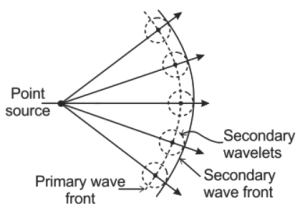
(A) Wavefront: The locus of all particles in a medium,vibrating in the same phase or constant phase,is called a wavefront.
The direction of propagation of light (ray of light) is always perpendicular to the wavefront.
Every point on the given wavefront acts as a source of a new disturbance called secondary wavelets,which travel in all directions with the velocity of light in the medium.
$A$ surface touching these secondary wavelets tangentially in the forward direction at any instant gives the new wavefront at that instant. This is called a secondary wavefront.
The direction of propagation of light (ray of light) is always perpendicular to the wavefront.
Every point on the given wavefront acts as a source of a new disturbance called secondary wavelets,which travel in all directions with the velocity of light in the medium.
$A$ surface touching these secondary wavelets tangentially in the forward direction at any instant gives the new wavefront at that instant. This is called a secondary wavefront.
0 likesView Solution
412
PhysicsMediumMCQMHT CET · 2024
The intensity of light coming from one of the slits in Young's double slit experiment is double the intensity from the other slit. The ratio of the maximum intensity to the minimum intensity in the interference fringe pattern observed is (in $: 1$)
A
$9$
B
$34$
C
$4$
D
$16$
Solution
(B) Two coherent sources of intensities $I_1$ and $I_2$ produce maximum intensity $I_{\max} = (\sqrt{I_1} + \sqrt{I_2})^2$ and minimum intensity $I_{\min} = (\sqrt{I_1} - \sqrt{I_2})^2$ in an interference pattern.
The ratio is given by $\frac{I_{\max}}{I_{\min}} = \frac{(\sqrt{I_1} + \sqrt{I_2})^2}{(\sqrt{I_1} - \sqrt{I_2})^2}$.
Given $I_1 = 2I_2$,we substitute this into the ratio:
$\frac{I_{\max}}{I_{\min}} = \frac{(\sqrt{2I_2} + \sqrt{I_2})^2}{(\sqrt{2I_2} - \sqrt{I_2})^2} = \frac{(\sqrt{I_2}(\sqrt{2} + 1))^2}{(\sqrt{I_2}(\sqrt{2} - 1))^2} = \frac{(\sqrt{2} + 1)^2}{(\sqrt{2} - 1)^2}$.
Expanding the squares: $\frac{2 + 1 + 2\sqrt{2}}{2 + 1 - 2\sqrt{2}} = \frac{3 + 2\sqrt{2}}{3 - 2\sqrt{2}}$.
Rationalizing the denominator: $\frac{(3 + 2\sqrt{2})(3 + 2\sqrt{2})}{(3 - 2\sqrt{2})(3 + 2\sqrt{2})} = \frac{9 + 8 + 12\sqrt{2}}{9 - 8} = 17 + 12\sqrt{2} \approx 33.97 \approx 34$.
Thus,the ratio is $34:1$.
The ratio is given by $\frac{I_{\max}}{I_{\min}} = \frac{(\sqrt{I_1} + \sqrt{I_2})^2}{(\sqrt{I_1} - \sqrt{I_2})^2}$.
Given $I_1 = 2I_2$,we substitute this into the ratio:
$\frac{I_{\max}}{I_{\min}} = \frac{(\sqrt{2I_2} + \sqrt{I_2})^2}{(\sqrt{2I_2} - \sqrt{I_2})^2} = \frac{(\sqrt{I_2}(\sqrt{2} + 1))^2}{(\sqrt{I_2}(\sqrt{2} - 1))^2} = \frac{(\sqrt{2} + 1)^2}{(\sqrt{2} - 1)^2}$.
Expanding the squares: $\frac{2 + 1 + 2\sqrt{2}}{2 + 1 - 2\sqrt{2}} = \frac{3 + 2\sqrt{2}}{3 - 2\sqrt{2}}$.
Rationalizing the denominator: $\frac{(3 + 2\sqrt{2})(3 + 2\sqrt{2})}{(3 - 2\sqrt{2})(3 + 2\sqrt{2})} = \frac{9 + 8 + 12\sqrt{2}}{9 - 8} = 17 + 12\sqrt{2} \approx 33.97 \approx 34$.
Thus,the ratio is $34:1$.
0 likesView Solution
413
PhysicsMediumMCQMHT CET · 2024
In Young's double slit experiment using monochromatic light of wavelength $\lambda$,the intensity of light at a point on the screen where the path difference is $\lambda$ is $K$ units. What is the intensity of light at a point where the path difference is $\frac{\lambda}{6}$? $\left[\cos \frac{\pi}{6} = \frac{\sqrt{3}}{2}\right]$
A
$K$
B
$\frac{3K}{4}$
C
$\frac{K}{2}$
D
$\frac{K}{4}$
Solution
(B) The intensity in Young's double slit experiment is given by $I = I_{max} \cos^2 \left( \frac{\phi}{2} \right)$,where $\phi$ is the phase difference.
Given that at path difference $\Delta x = \lambda$,the intensity is $K$. Since $\Delta x = \lambda$ corresponds to a phase difference $\phi = \frac{2\pi}{\lambda} \cdot \lambda = 2\pi$,we have $I = I_{max} \cos^2(\pi) = I_{max} = K$.
Now,for a path difference $\Delta x = \frac{\lambda}{6}$,the phase difference is $\phi = \frac{2\pi}{\lambda} \cdot \frac{\lambda}{6} = \frac{\pi}{3}$.
The intensity at this point is $I = K \cos^2 \left( \frac{\pi/3}{2} \right) = K \cos^2 \left( \frac{\pi}{6} \right)$.
Substituting $\cos \frac{\pi}{6} = \frac{\sqrt{3}}{2}$,we get $I = K \left( \frac{\sqrt{3}}{2} \right)^2 = K \left( \frac{3}{4} \right) = \frac{3K}{4}$.
Given that at path difference $\Delta x = \lambda$,the intensity is $K$. Since $\Delta x = \lambda$ corresponds to a phase difference $\phi = \frac{2\pi}{\lambda} \cdot \lambda = 2\pi$,we have $I = I_{max} \cos^2(\pi) = I_{max} = K$.
Now,for a path difference $\Delta x = \frac{\lambda}{6}$,the phase difference is $\phi = \frac{2\pi}{\lambda} \cdot \frac{\lambda}{6} = \frac{\pi}{3}$.
The intensity at this point is $I = K \cos^2 \left( \frac{\pi/3}{2} \right) = K \cos^2 \left( \frac{\pi}{6} \right)$.
Substituting $\cos \frac{\pi}{6} = \frac{\sqrt{3}}{2}$,we get $I = K \left( \frac{\sqrt{3}}{2} \right)^2 = K \left( \frac{3}{4} \right) = \frac{3K}{4}$.
0 likesView Solution
414
PhysicsEasyMCQMHT CET · 2024
In Young's double slit experiment,in an interference pattern,the second minimum is observed exactly in front of one slit. The distance between the two coherent sources is $d$ and the distance between the source and screen is $D$. The wavelength of light $(\lambda)$ used is:
A
$\frac{d^2}{D}$
B
$\frac{d^2}{2 D}$
C
$\frac{d^2}{3 D}$
D
$\frac{d^2}{4 D}$
Solution
(C) The position of the $n^{th}$ minimum in Young's double slit experiment is given by $y_n' = \frac{(2n-1) \lambda D}{2d}$.
Since the second minimum $(n=2)$ is observed exactly in front of one slit,its distance from the central axis is $y_2 = \frac{d}{2}$.
Substituting $n=2$ into the formula: $\frac{d}{2} = \frac{(2(2)-1) \lambda D}{2d}$.
Simplifying the equation: $\frac{d}{2} = \frac{3 \lambda D}{2d}$.
Canceling the $2$ from the denominators: $d = \frac{3 \lambda D}{d}$.
Solving for $\lambda$: $\lambda = \frac{d^2}{3D}$.
Since the second minimum $(n=2)$ is observed exactly in front of one slit,its distance from the central axis is $y_2 = \frac{d}{2}$.
Substituting $n=2$ into the formula: $\frac{d}{2} = \frac{(2(2)-1) \lambda D}{2d}$.
Simplifying the equation: $\frac{d}{2} = \frac{3 \lambda D}{2d}$.
Canceling the $2$ from the denominators: $d = \frac{3 \lambda D}{d}$.
Solving for $\lambda$: $\lambda = \frac{d^2}{3D}$.
0 likesView Solution
415
PhysicsDifficultMCQMHT CET · 2024
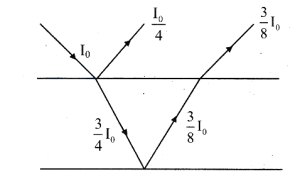
$A$ parallel beam of light of intensity $I_0$ is incident on a glass plate. $25 \%$ of light is reflected by the upper surface and $50 \%$ of light is reflected from the lower surface. The ratio of maximum to minimum intensity in the interference region of the reflected rays is
A
$\left[\frac{\frac{1}{2}+\sqrt{\frac{3}{8}}}{\frac{1}{2}-\sqrt{\frac{3}{8}}}\right]^2$
B
$\left[\frac{\frac{1}{4}+\sqrt{\frac{3}{8}}}{\frac{1}{2}-\sqrt{\frac{3}{8}}}\right]^2$
C
$\frac{5}{8}$
D
$\frac{8}{5}$
Solution
(A) Given that $25 \%$ of the total intensity of incident light is reflected from the upper surface. This implies that if the intensity of incident light is $I_0$,the intensity of the first reflected ray is $I_1 = 0.25 I_0 = \frac{I_0}{4}$.
The intensity of light reaching the lower surface of the plate is $I_0 - 0.25 I_0 = 0.75 I_0 = \frac{3}{4} I_0$.
Since $50 \%$ of this intensity is reflected from the lower surface,the intensity of the second reflected ray is $I_2 = 0.50 \times \frac{3}{4} I_0 = \frac{3}{8} I_0$.
The ratio of maximum to minimum intensity is given by the formula:
$\frac{I_{\max }}{I_{\min }}=\frac{\left(\sqrt{I_1}+\sqrt{I_2}\right)^2}{\left(\sqrt{I_1}-\sqrt{I_2}\right)^2}$
Substituting the values of $I_1$ and $I_2$:
$\frac{I_{\max }}{I_{\min }}=\frac{\left(\sqrt{\frac{I_0}{4}}+\sqrt{\frac{3 I_0}{8}}\right)^2}{\left(\sqrt{\frac{I_0}{4}}-\sqrt{\frac{3 I_0}{8}}\right)^2} = \left(\frac{\frac{1}{2} \sqrt{I_0} + \sqrt{\frac{3}{8}} \sqrt{I_0}}{\frac{1}{2} \sqrt{I_0} - \sqrt{\frac{3}{8}} \sqrt{I_0}}\right)^2 = \left(\frac{\frac{1}{2}+\sqrt{\frac{3}{8}}}{\frac{1}{2}-\sqrt{\frac{3}{8}}}\right)^2$
The intensity of light reaching the lower surface of the plate is $I_0 - 0.25 I_0 = 0.75 I_0 = \frac{3}{4} I_0$.
Since $50 \%$ of this intensity is reflected from the lower surface,the intensity of the second reflected ray is $I_2 = 0.50 \times \frac{3}{4} I_0 = \frac{3}{8} I_0$.
The ratio of maximum to minimum intensity is given by the formula:
$\frac{I_{\max }}{I_{\min }}=\frac{\left(\sqrt{I_1}+\sqrt{I_2}\right)^2}{\left(\sqrt{I_1}-\sqrt{I_2}\right)^2}$
Substituting the values of $I_1$ and $I_2$:
$\frac{I_{\max }}{I_{\min }}=\frac{\left(\sqrt{\frac{I_0}{4}}+\sqrt{\frac{3 I_0}{8}}\right)^2}{\left(\sqrt{\frac{I_0}{4}}-\sqrt{\frac{3 I_0}{8}}\right)^2} = \left(\frac{\frac{1}{2} \sqrt{I_0} + \sqrt{\frac{3}{8}} \sqrt{I_0}}{\frac{1}{2} \sqrt{I_0} - \sqrt{\frac{3}{8}} \sqrt{I_0}}\right)^2 = \left(\frac{\frac{1}{2}+\sqrt{\frac{3}{8}}}{\frac{1}{2}-\sqrt{\frac{3}{8}}}\right)^2$
0 likesView Solution
416
PhysicsMediumMCQMHT CET · 2024
In Young's double slit experiment using monochromatic light of wavelength $\lambda$,the maximum intensity of light at a point on the screen is $K$ units. The intensity of light at a point where the path difference is $\frac{\lambda}{6}$ is: $(\cos 60^{\circ}=\sin 30^{\circ}=0.5, \sin 60^{\circ}=\cos 30^{\circ}=\frac{\sqrt{3}}{2})$
A
$\frac{3K}{4}$
B
$\frac{K}{4}$
C
$\frac{K}{2}$
D
$K$
Solution
(A) The intensity $I$ at any point in an interference pattern is given by $I = I_{max} \cos^2(\frac{\phi}{2})$,where $I_{max} = K$ and $\phi$ is the phase difference.
Phase difference $\phi$ is related to path difference $\Delta x$ by the formula $\phi = \frac{2\pi}{\lambda} \Delta x$.
Given path difference $\Delta x = \frac{\lambda}{6}$,the phase difference is $\phi = \frac{2\pi}{\lambda} \times \frac{\lambda}{6} = \frac{\pi}{3}$.
Substituting this into the intensity formula: $I = K \cos^2(\frac{\pi/3}{2}) = K \cos^2(\frac{\pi}{6})$.
Since $\cos(\frac{\pi}{6}) = \cos(30^{\circ}) = \frac{\sqrt{3}}{2}$,we have $I = K (\frac{\sqrt{3}}{2})^2 = K (\frac{3}{4}) = \frac{3K}{4}$.
Phase difference $\phi$ is related to path difference $\Delta x$ by the formula $\phi = \frac{2\pi}{\lambda} \Delta x$.
Given path difference $\Delta x = \frac{\lambda}{6}$,the phase difference is $\phi = \frac{2\pi}{\lambda} \times \frac{\lambda}{6} = \frac{\pi}{3}$.
Substituting this into the intensity formula: $I = K \cos^2(\frac{\pi/3}{2}) = K \cos^2(\frac{\pi}{6})$.
Since $\cos(\frac{\pi}{6}) = \cos(30^{\circ}) = \frac{\sqrt{3}}{2}$,we have $I = K (\frac{\sqrt{3}}{2})^2 = K (\frac{3}{4}) = \frac{3K}{4}$.
0 likesView Solution
417
PhysicsMediumMCQMHT CET · 2024
The fringe width in an interference pattern is $X$. The distance between the sixth dark fringe from one side of the central bright band to the fourth bright fringe on the other side is: (in $X$)
A
$1.5$
B
$2$
C
$5.5$
D
$9.5$
Solution
(D) The fringe width is given by $W = \frac{\lambda D}{d} = X$ (given).
The position of the $n^{\text{th}}$ bright fringe from the central maximum is $y_n = n \frac{\lambda D}{d} = nX$.
For the $4^{\text{th}}$ bright fringe,$y_4 = 4X$.
The position of the $n^{\text{th}}$ dark fringe from the central maximum is $y'_n = (2n - 1) \frac{\lambda D}{2d} = (2n - 1) \frac{X}{2}$.
For the $6^{\text{th}}$ dark fringe,$y'_6 = (2(6) - 1) \frac{X}{2} = \frac{11X}{2} = 5.5X$.
Since the fringes are on opposite sides of the central bright band,the total distance is the sum of the magnitudes of their positions:
Total distance $= y_4 + y'_6 = 4X + 5.5X = 9.5X$.
The position of the $n^{\text{th}}$ bright fringe from the central maximum is $y_n = n \frac{\lambda D}{d} = nX$.
For the $4^{\text{th}}$ bright fringe,$y_4 = 4X$.
The position of the $n^{\text{th}}$ dark fringe from the central maximum is $y'_n = (2n - 1) \frac{\lambda D}{2d} = (2n - 1) \frac{X}{2}$.
For the $6^{\text{th}}$ dark fringe,$y'_6 = (2(6) - 1) \frac{X}{2} = \frac{11X}{2} = 5.5X$.
Since the fringes are on opposite sides of the central bright band,the total distance is the sum of the magnitudes of their positions:
Total distance $= y_4 + y'_6 = 4X + 5.5X = 9.5X$.
0 likesView Solution
418
PhysicsMediumMCQMHT CET · 2024
In the Young's double slit experiment,the intensity at a point on the screen,where the path difference is $\lambda$ ($\lambda =$ wavelength),is $\beta$. The intensity at a point where the path difference is $\lambda / 3$ will be: [Given: $\cos(\pi/3) = 1/2$]
A
$\beta$
B
$\beta / 2$
C
$\beta / 4$
D
$\beta / 8$
Solution
(C) The intensity $I$ in Young's double slit experiment is given by the formula $I = I_{max} \cos^2(\phi/2)$,where $\phi$ is the phase difference.
Given that the intensity at a path difference of $\lambda$ is $\beta$,we know that for a path difference of $\lambda$,the phase difference $\phi = (2\pi/\lambda) \times \lambda = 2\pi$.
Thus,$\beta = I_{max} \cos^2(2\pi/2) = I_{max} \cos^2(\pi) = I_{max}(1)^2 = I_{max}$.
Now,for a path difference of $\Delta x = \lambda/3$,the phase difference is $\phi = (2\pi/\lambda) \times (\lambda/3) = 2\pi/3$.
The intensity at this point is $I = I_{max} \cos^2(\phi/2) = \beta \cos^2((2\pi/3)/2) = \beta \cos^2(\pi/3)$.
Since $\cos(\pi/3) = 1/2$,we have $I = \beta (1/2)^2 = \beta/4$.
Given that the intensity at a path difference of $\lambda$ is $\beta$,we know that for a path difference of $\lambda$,the phase difference $\phi = (2\pi/\lambda) \times \lambda = 2\pi$.
Thus,$\beta = I_{max} \cos^2(2\pi/2) = I_{max} \cos^2(\pi) = I_{max}(1)^2 = I_{max}$.
Now,for a path difference of $\Delta x = \lambda/3$,the phase difference is $\phi = (2\pi/\lambda) \times (\lambda/3) = 2\pi/3$.
The intensity at this point is $I = I_{max} \cos^2(\phi/2) = \beta \cos^2((2\pi/3)/2) = \beta \cos^2(\pi/3)$.
Since $\cos(\pi/3) = 1/2$,we have $I = \beta (1/2)^2 = \beta/4$.
0 likesView Solution
419
PhysicsMediumMCQMHT CET · 2024
In Young's double-slit experiment,the $n^{\text{th}}$ maximum of wavelength $\lambda_1$ is at a distance of $y_1$ from the central maximum. When the wavelength of the source is changed to $\lambda_2$,the $(\frac{n}{3})^{\text{th}}$ maximum is at a distance of $y_2$ from its central maximum. The ratio $\frac{y_1}{y_2}$ is:
A
$\frac{3 \lambda_1}{\lambda_2}$
B
$\frac{3 \lambda_2}{\lambda_1}$
C
$\frac{\lambda_1}{3 \lambda_2}$
D
$\frac{\lambda_2}{3 \lambda_1}$
Solution
(A) The position of the $n^{\text{th}}$ maximum in Young's double-slit experiment is given by $y_n = \frac{n \lambda D}{d}$.
For the $n^{\text{th}}$ maximum with wavelength $\lambda_1$,the distance is $y_1 = \frac{n \lambda_1 D}{d} \quad (i)$.
For the $(\frac{n}{3})^{\text{th}}$ maximum with wavelength $\lambda_2$,the distance is $y_2 = \frac{(\frac{n}{3}) \lambda_2 D}{d} \quad (ii)$.
Taking the ratio of $(i)$ and $(ii)$:
$\frac{y_1}{y_2} = \frac{\frac{n \lambda_1 D}{d}}{\frac{n \lambda_2 D}{3d}} = \frac{n \lambda_1 D}{d} \times \frac{3d}{n \lambda_2 D} = \frac{3 \lambda_1}{\lambda_2}$.
Thus,the ratio $\frac{y_1}{y_2}$ is $\frac{3 \lambda_1}{\lambda_2}$.
For the $n^{\text{th}}$ maximum with wavelength $\lambda_1$,the distance is $y_1 = \frac{n \lambda_1 D}{d} \quad (i)$.
For the $(\frac{n}{3})^{\text{th}}$ maximum with wavelength $\lambda_2$,the distance is $y_2 = \frac{(\frac{n}{3}) \lambda_2 D}{d} \quad (ii)$.
Taking the ratio of $(i)$ and $(ii)$:
$\frac{y_1}{y_2} = \frac{\frac{n \lambda_1 D}{d}}{\frac{n \lambda_2 D}{3d}} = \frac{n \lambda_1 D}{d} \times \frac{3d}{n \lambda_2 D} = \frac{3 \lambda_1}{\lambda_2}$.
Thus,the ratio $\frac{y_1}{y_2}$ is $\frac{3 \lambda_1}{\lambda_2}$.
0 likesView Solution
420
PhysicsMediumMCQMHT CET · 2024
In Young's double slit experiment,the slits are separated by $0.6 \ mm$ and the screen is placed at a distance of $1.2 \ m$ from the slits. It is observed that the tenth bright fringe is at a distance of $8.85 \ mm$ from the third dark fringe on the same side. The wavelength of light used is: (in $Å$)
A
$5440$
B
$5890$
C
$5900$
D
$6630$
Solution
(C) For the $n^{\text{th}}$ bright fringe,the position is given by $y_n = \frac{n \lambda D}{d}$.
For the $10^{\text{th}}$ bright fringe $(n=10)$:
$y_{10} = \frac{10 \lambda D}{d} = \frac{10 \times \lambda \times 1.2}{0.6 \times 10^{-3}} = (20 \times 10^3) \lambda \quad \dots(i)$
For the $n^{\text{th}}$ dark fringe,the position is given by $y'_n = \frac{(2n-1) \lambda D}{2d}$.
For the $3^{\text{rd}}$ dark fringe $(n=3)$:
$y'_3 = \frac{(2 \times 3 - 1) \lambda D}{2d} = \frac{5 \lambda D}{2d} = \frac{5 \times \lambda \times 1.2}{2 \times 0.6 \times 10^{-3}} = (5 \times 10^3) \lambda \quad \dots(ii)$
Given that the distance between them is $8.85 \ mm$:
$y_{10} - y'_3 = 8.85 \times 10^{-3} \ m$
$(20 \times 10^3) \lambda - (5 \times 10^3) \lambda = 8.85 \times 10^{-3}$
$(15 \times 10^3) \lambda = 8.85 \times 10^{-3}$
$\lambda = \frac{8.85 \times 10^{-3}}{15 \times 10^3} = 0.59 \times 10^{-6} \ m = 5.9 \times 10^{-7} \ m$
$\lambda = 5900 \ Å$.
For the $10^{\text{th}}$ bright fringe $(n=10)$:
$y_{10} = \frac{10 \lambda D}{d} = \frac{10 \times \lambda \times 1.2}{0.6 \times 10^{-3}} = (20 \times 10^3) \lambda \quad \dots(i)$
For the $n^{\text{th}}$ dark fringe,the position is given by $y'_n = \frac{(2n-1) \lambda D}{2d}$.
For the $3^{\text{rd}}$ dark fringe $(n=3)$:
$y'_3 = \frac{(2 \times 3 - 1) \lambda D}{2d} = \frac{5 \lambda D}{2d} = \frac{5 \times \lambda \times 1.2}{2 \times 0.6 \times 10^{-3}} = (5 \times 10^3) \lambda \quad \dots(ii)$
Given that the distance between them is $8.85 \ mm$:
$y_{10} - y'_3 = 8.85 \times 10^{-3} \ m$
$(20 \times 10^3) \lambda - (5 \times 10^3) \lambda = 8.85 \times 10^{-3}$
$(15 \times 10^3) \lambda = 8.85 \times 10^{-3}$
$\lambda = \frac{8.85 \times 10^{-3}}{15 \times 10^3} = 0.59 \times 10^{-6} \ m = 5.9 \times 10^{-7} \ m$
$\lambda = 5900 \ Å$.
0 likesView Solution
421
PhysicsMediumMCQMHT CET · 2024
In Young's double slit experiment,the distance between the two coherent sources is '$d$' and the distance between the source and screen is '$D$'. When the wavelength $(\lambda)$ of the light source used is $\frac{d^2}{3D}$,then the $n^{\text{th}}$ dark fringe is observed on the screen,exactly in front of one of the slits. The value of '$n$' is
A
$1$
B
$2$
C
$3$
D
$4$
Solution
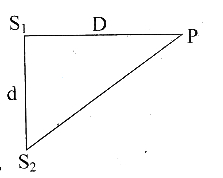
(B) Let the point $P$ be exactly in front of slit $S_1$. The distance $S_1P = D$ and $S_2P = \sqrt{D^2 + d^2}$.
Using the binomial expansion for $S_2P$:
$S_2P = D(1 + \frac{d^2}{D^2})^{1/2} \approx D(1 + \frac{d^2}{2D^2}) = D + \frac{d^2}{2D}$.
The path difference $\Delta x$ at point $P$ is:
$\Delta x = S_2P - S_1P = (D + \frac{d^2}{2D}) - D = \frac{d^2}{2D}$.
For the $n^{\text{th}}$ dark fringe,the condition for path difference is:
$\Delta x = (2n - 1) \frac{\lambda}{2}$.
Given $\lambda = \frac{d^2}{3D}$,we substitute this into the condition:
$\frac{d^2}{2D} = (2n - 1) \frac{d^2}{6D}$.
Dividing both sides by $\frac{d^2}{D}$:
$\frac{1}{2} = \frac{2n - 1}{6}$.
$3 = 2n - 1 \Rightarrow 2n = 4 \Rightarrow n = 2$.
Using the binomial expansion for $S_2P$:
$S_2P = D(1 + \frac{d^2}{D^2})^{1/2} \approx D(1 + \frac{d^2}{2D^2}) = D + \frac{d^2}{2D}$.
The path difference $\Delta x$ at point $P$ is:
$\Delta x = S_2P - S_1P = (D + \frac{d^2}{2D}) - D = \frac{d^2}{2D}$.
For the $n^{\text{th}}$ dark fringe,the condition for path difference is:
$\Delta x = (2n - 1) \frac{\lambda}{2}$.
Given $\lambda = \frac{d^2}{3D}$,we substitute this into the condition:
$\frac{d^2}{2D} = (2n - 1) \frac{d^2}{6D}$.
Dividing both sides by $\frac{d^2}{D}$:
$\frac{1}{2} = \frac{2n - 1}{6}$.
$3 = 2n - 1 \Rightarrow 2n = 4 \Rightarrow n = 2$.
0 likesView Solution
422
PhysicsEasyMCQMHT CET · 2024
In a Fraunhofer diffraction pattern,the slit width is $0.5 \ mm$ and the screen is at $2 \ m$ away from the lens. If the wavelength of the light used is $5500 \ Å$,then the distance between the first minima on either side of the central maximum is (assume $\theta$ is small and measured in radians). (in $mm$)
A
$1.1$
B
$2.2$
C
$4.4$
D
$5.5$
Solution
(C) The distance of the $1^{st}$ minima from the central maxima is given by $y_{1d} = \frac{\lambda D}{a}$.
Here,$\lambda = 5500 \ Å = 5500 \times 10^{-10} \ m$,$D = 2 \ m$,and $a = 0.5 \ mm = 0.5 \times 10^{-3} \ m$.
The distance between two minima on either side of the central maxima is $2 y_{1d} = \frac{2 \lambda D}{a}$.
Substituting the values: $2 y_{1d} = \frac{2 \times 5500 \times 10^{-10} \times 2}{0.5 \times 10^{-3}} = \frac{22000 \times 10^{-10}}{0.5 \times 10^{-3}} = 44000 \times 10^{-7} \ m = 4.4 \times 10^{-3} \ m = 4.4 \ mm$.
Here,$\lambda = 5500 \ Å = 5500 \times 10^{-10} \ m$,$D = 2 \ m$,and $a = 0.5 \ mm = 0.5 \times 10^{-3} \ m$.
The distance between two minima on either side of the central maxima is $2 y_{1d} = \frac{2 \lambda D}{a}$.
Substituting the values: $2 y_{1d} = \frac{2 \times 5500 \times 10^{-10} \times 2}{0.5 \times 10^{-3}} = \frac{22000 \times 10^{-10}}{0.5 \times 10^{-3}} = 44000 \times 10^{-7} \ m = 4.4 \times 10^{-3} \ m = 4.4 \ mm$.
0 likesView Solution
423
PhysicsMediumMCQMHT CET · 2024
How is the interference pattern affected when violet light replaces sodium light?
A
The fringes become brighter.
B
The fringes become faint.
C
Fringewidth decreases.
D
Fringewidth increases.
Solution
(C) In Young's double slit experiment,the fringe width $W$ is given by the formula $W = \frac{\lambda D}{d}$,where $\lambda$ is the wavelength of light,$D$ is the distance between the screen and the slits,and $d$ is the distance between the two slits.
Since the wavelength of violet light $(\lambda_{violet} \approx 400 \ nm)$ is significantly smaller than the wavelength of sodium light $(\lambda_{sodium} \approx 589 \ nm)$,the fringe width $W$ will decrease when violet light is used instead of sodium light.
Since the wavelength of violet light $(\lambda_{violet} \approx 400 \ nm)$ is significantly smaller than the wavelength of sodium light $(\lambda_{sodium} \approx 589 \ nm)$,the fringe width $W$ will decrease when violet light is used instead of sodium light.
0 likesView Solution
424
PhysicsEasyMCQMHT CET · 2024
The phase difference between two waves giving rise to a dark fringe in Young's double-slit experiment is (where $n$ is an integer):
A
zero
B
$(4n+1) \frac{\pi}{2}$
C
$(2n-1) \pi$
D
$(2n+1) \frac{\pi}{2}$
Solution
(C) In Young's double-slit experiment,dark fringes are formed due to destructive interference.
For destructive interference,the path difference $\Delta x$ must be an odd multiple of half-wavelength,i.e.,$\Delta x = (2n-1) \frac{\lambda}{2}$.
The relationship between phase difference $\Delta \phi$ and path difference $\Delta x$ is given by $\Delta \phi = \frac{2\pi}{\lambda} \Delta x$.
Substituting the value of $\Delta x$: $\Delta \phi = \frac{2\pi}{\lambda} \times (2n-1) \frac{\lambda}{2} = (2n-1) \pi$.
Thus,the phase difference for a dark fringe is $(2n-1) \pi$.
For destructive interference,the path difference $\Delta x$ must be an odd multiple of half-wavelength,i.e.,$\Delta x = (2n-1) \frac{\lambda}{2}$.
The relationship between phase difference $\Delta \phi$ and path difference $\Delta x$ is given by $\Delta \phi = \frac{2\pi}{\lambda} \Delta x$.
Substituting the value of $\Delta x$: $\Delta \phi = \frac{2\pi}{\lambda} \times (2n-1) \frac{\lambda}{2} = (2n-1) \pi$.
Thus,the phase difference for a dark fringe is $(2n-1) \pi$.
0 likesView Solution
425
PhysicsEasyMCQMHT CET · 2024
In Young's double slit experiment,$I_{min}$ is the minimum intensity and $I_1$ is the intensity at a point where the path difference is $\frac{\lambda}{4}$,where $\lambda$ is the wavelength of light used. The ratio $I_{min} / I_1$ is (Intensities of the two interfering waves are same).
A
$0.5$
B
$0$
C
$1$
D
$2$
Solution
(B) Let the intensities of the two individual waves be $I_0$. The resultant intensity $I$ is given by $I = I_0 + I_0 + 2\sqrt{I_0 I_0} \cos \phi = 2I_0(1 + \cos \phi) = 4I_0 \cos^2(\phi/2)$.
- The minimum intensity $I_{min}$ occurs when $\phi = \pi$,so $I_{min} = 4I_0 \cos^2(\pi/2) = 0$.
- The path difference $\Delta x = \lambda/4$ corresponds to a phase difference $\phi = \frac{2\pi}{\lambda} \Delta x = \frac{2\pi}{\lambda} \cdot \frac{\lambda}{4} = \frac{\pi}{2}$.
- The intensity $I_1$ at this point is $I_1 = 4I_0 \cos^2(\pi/4) = 4I_0 (1/\sqrt{2})^2 = 2I_0$.
- The ratio $I_{min} / I_1 = 0 / 2I_0 = 0$.
- The minimum intensity $I_{min}$ occurs when $\phi = \pi$,so $I_{min} = 4I_0 \cos^2(\pi/2) = 0$.
- The path difference $\Delta x = \lambda/4$ corresponds to a phase difference $\phi = \frac{2\pi}{\lambda} \Delta x = \frac{2\pi}{\lambda} \cdot \frac{\lambda}{4} = \frac{\pi}{2}$.
- The intensity $I_1$ at this point is $I_1 = 4I_0 \cos^2(\pi/4) = 4I_0 (1/\sqrt{2})^2 = 2I_0$.
- The ratio $I_{min} / I_1 = 0 / 2I_0 = 0$.
0 likesView Solution
426
PhysicsMediumMCQMHT CET · 2024
In a double-slit experiment,instead of taking slits of equal widths,one slit is made twice as wide as the other. Then,in the interference pattern:
A
the intensity of the maxima decreases and the minima has zero intensity.
B
the intensity of maxima decreases and that of the minima increases.
C
the intensity of the maxima increases and the minima has zero intensity.
D
the intensities of both the maxima and the minima increase.
Solution
(D) Let the amplitude of light from the first slit be $a_1 = a$ and from the second slit be $a_2 = a$. The intensity $I$ is proportional to the square of the amplitude $(I \propto A^2)$.
Initially,for equal widths,the amplitudes are equal $(a_1 = a_2 = a)$. The minimum intensity is $I_{\min} \propto (a - a)^2 = 0$,and the maximum intensity is $I_{\max} \propto (a + a)^2 = 4a^2$.
When one slit is made twice as wide,the amplitude of light from that slit becomes $a_1 = 2a$,while the other remains $a_2 = a$.
The new minimum intensity is $I_{\min}' \propto (2a - a)^2 = a^2$. Since $a^2 > 0$,the intensity of the minima increases.
The new maximum intensity is $I_{\max}' \propto (2a + a)^2 = 9a^2$. Since $9a^2 > 4a^2$,the intensity of the maxima also increases.
Therefore,both the intensity of the maxima and the minima increase.
Initially,for equal widths,the amplitudes are equal $(a_1 = a_2 = a)$. The minimum intensity is $I_{\min} \propto (a - a)^2 = 0$,and the maximum intensity is $I_{\max} \propto (a + a)^2 = 4a^2$.
When one slit is made twice as wide,the amplitude of light from that slit becomes $a_1 = 2a$,while the other remains $a_2 = a$.
The new minimum intensity is $I_{\min}' \propto (2a - a)^2 = a^2$. Since $a^2 > 0$,the intensity of the minima increases.
The new maximum intensity is $I_{\max}' \propto (2a + a)^2 = 9a^2$. Since $9a^2 > 4a^2$,the intensity of the maxima also increases.
Therefore,both the intensity of the maxima and the minima increase.
0 likesView Solution
427
PhysicsEasyMCQMHT CET · 2024
$A$ plate of refractive index $1.6$ is introduced in the path of light from one of the slits in Young's double slit experiment,then:
A
the fringe width towards the side of the plate will decrease.
B
the central maximum will shift towards this side.
C
number of fringes seen will decrease.
D
interference pattern will disappear.
Solution
(B) When a thin plate of refractive index $n$ is introduced in front of one of the slits in Young's double-slit experiment,it adds an extra optical path (and hence a phase difference) to the light coming from that slit.
This shifts the entire interference pattern on the screen but does not change the fringe spacing or make the pattern disappear.
Fringe width $\beta = \frac{\lambda D}{d}$ does not change because it depends on the slit separation $d$,the wavelength $\lambda$,and the screen distance $D$,not on a uniform phase shift introduced in one path.
The net effect of introducing a uniform optical path difference in one slit is a lateral shift of the central maximum (and all fringes) toward the slit with the plate.
The shift is given by $\Delta x = \frac{D}{d}(n-1)t$.
Hence,the correct statement is: $(B)$ The central maximum will shift towards the side on which the plate is introduced.
This shifts the entire interference pattern on the screen but does not change the fringe spacing or make the pattern disappear.
Fringe width $\beta = \frac{\lambda D}{d}$ does not change because it depends on the slit separation $d$,the wavelength $\lambda$,and the screen distance $D$,not on a uniform phase shift introduced in one path.
The net effect of introducing a uniform optical path difference in one slit is a lateral shift of the central maximum (and all fringes) toward the slit with the plate.
The shift is given by $\Delta x = \frac{D}{d}(n-1)t$.
Hence,the correct statement is: $(B)$ The central maximum will shift towards the side on which the plate is introduced.
0 likesView Solution
428
PhysicsDifficultMCQMHT CET · 2024
In Young's double slit experiment,the intensity at a point is $\frac{1}{4}$ of the maximum intensity. The angular position of this point is
A
$\sin ^{-1}\left(\frac{\lambda}{D}\right)$
B
$\sin ^{-1}\left(\frac{\lambda}{2 d}\right)$
C
$\sin ^{-1}\left(\frac{\lambda}{3 d}\right)$
D
$\sin ^{-1}\left(\frac{\lambda}{4 d}\right)$
Solution
(C) For any point in the interference pattern,the intensity $I$ is given by $I = I_{\max} \cos^2 \left(\frac{\phi}{2}\right)$.
Given that $I = \frac{I_{\max}}{4}$,we have $\frac{I_{\max}}{4} = I_{\max} \cos^2 \left(\frac{\phi}{2}\right)$.
This simplifies to $\cos^2 \left(\frac{\phi}{2}\right) = \frac{1}{4}$,which implies $\cos \left(\frac{\phi}{2}\right) = \frac{1}{2}$.
Thus,$\frac{\phi}{2} = 60^{\circ} = \frac{\pi}{3}$,so the phase difference $\phi = \frac{2\pi}{3}$.
The phase difference is related to the path difference $\Delta x$ by $\phi = \left(\frac{2\pi}{\lambda}\right) \Delta x$.
Substituting $\Delta x = d \sin \theta$,we get $\frac{2\pi}{3} = \left(\frac{2\pi}{\lambda}\right) d \sin \theta$.
Solving for $\sin \theta$,we find $\sin \theta = \frac{\lambda}{3d}$,which means $\theta = \sin^{-1} \left(\frac{\lambda}{3d}\right)$.
Given that $I = \frac{I_{\max}}{4}$,we have $\frac{I_{\max}}{4} = I_{\max} \cos^2 \left(\frac{\phi}{2}\right)$.
This simplifies to $\cos^2 \left(\frac{\phi}{2}\right) = \frac{1}{4}$,which implies $\cos \left(\frac{\phi}{2}\right) = \frac{1}{2}$.
Thus,$\frac{\phi}{2} = 60^{\circ} = \frac{\pi}{3}$,so the phase difference $\phi = \frac{2\pi}{3}$.
The phase difference is related to the path difference $\Delta x$ by $\phi = \left(\frac{2\pi}{\lambda}\right) \Delta x$.
Substituting $\Delta x = d \sin \theta$,we get $\frac{2\pi}{3} = \left(\frac{2\pi}{\lambda}\right) d \sin \theta$.
Solving for $\sin \theta$,we find $\sin \theta = \frac{\lambda}{3d}$,which means $\theta = \sin^{-1} \left(\frac{\lambda}{3d}\right)$.
0 likesView Solution
429
PhysicsEasyMCQMHT CET · 2024
In a double slit experiment,the distance between slits is increased $10$ times,whereas their distance from the screen is halved. The fringe width:
A
remains the same.
B
becomes $\frac{1}{10}$ times.
C
becomes $\frac{1}{20}$ times.
D
becomes $\frac{1}{90}$ times.
Solution
(C) The formula for fringe width $(\beta)$ in a Young's double slit experiment is given by $\beta = \frac{D \lambda}{d}$,where $D$ is the distance between the slits and the screen,$\lambda$ is the wavelength of light,and $d$ is the distance between the slits.
Given that the new distance between slits $d' = 10d$ and the new distance from the screen $D' = \frac{D}{2}$.
The new fringe width $\beta'$ is given by $\beta' = \frac{D' \lambda}{d'} = \frac{(\frac{D}{2}) \lambda}{10d} = \frac{D \lambda}{20d}$.
Since $\beta = \frac{D \lambda}{d}$,we have $\beta' = \frac{\beta}{20}$.
Thus,the fringe width becomes $\frac{1}{20}$ times the original fringe width.
Given that the new distance between slits $d' = 10d$ and the new distance from the screen $D' = \frac{D}{2}$.
The new fringe width $\beta'$ is given by $\beta' = \frac{D' \lambda}{d'} = \frac{(\frac{D}{2}) \lambda}{10d} = \frac{D \lambda}{20d}$.
Since $\beta = \frac{D \lambda}{d}$,we have $\beta' = \frac{\beta}{20}$.
Thus,the fringe width becomes $\frac{1}{20}$ times the original fringe width.
0 likesView Solution
430
PhysicsEasyMCQMHT CET · 2024
Considering interference between two sources of intensities $I$ and $4I$,the intensity at a point where the phase difference is $\pi$ is $(\cos \pi = -1)$.
A
$I$
B
$4$ $I$
C
$5$ $I$
D
$3$ $I$
Solution
(A) The resultant intensity $I'$ of two interfering waves with intensities $I_1$ and $I_2$ and phase difference $\phi$ is given by the formula:
$I' = I_1 + I_2 + 2\sqrt{I_1 I_2} \cos \phi$
Given $I_1 = I$,$I_2 = 4I$,and $\phi = \pi$:
$I' = I + 4I + 2\sqrt{I \times 4I} \cos \pi$
Since $\cos \pi = -1$:
$I' = 5I + 2\sqrt{4I^2} (-1)$
$I' = 5I + 2(2I)(-1)$
$I' = 5I - 4I = I$
$I' = I_1 + I_2 + 2\sqrt{I_1 I_2} \cos \phi$
Given $I_1 = I$,$I_2 = 4I$,and $\phi = \pi$:
$I' = I + 4I + 2\sqrt{I \times 4I} \cos \pi$
Since $\cos \pi = -1$:
$I' = 5I + 2\sqrt{4I^2} (-1)$
$I' = 5I + 2(2I)(-1)$
$I' = 5I - 4I = I$
0 likesView Solution
431
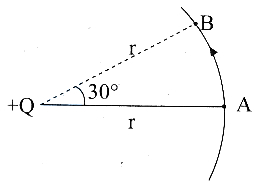
PhysicsEasyMCQMHT CET · 2024
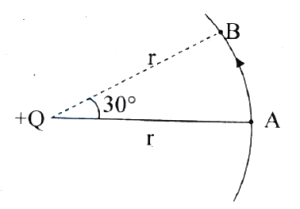
In an electric field due to charge $Q$,a charge $q$ moves from point $A$ to $B$ along an arc of a circle centered at $Q$,as shown in the figure. The work done is ($\varepsilon_0=$ permittivity of free space).
A
$\frac{1}{4 \pi \varepsilon_0} \frac{Qq}{r^2}$
B
$\frac{1}{4 \pi \varepsilon_0} \frac{Qq}{r^2} \frac{\pi}{6}$
C
$\frac{1}{4 \pi \varepsilon_0} \frac{Qq}{r}$
D
zero
Solution
(D) The electric field $\vec{E}$ due to a point charge $Q$ is always directed radially outward.
Since the path from $A$ to $B$ is an arc of a circle centered at $Q$,the displacement vector $d\vec{s}$ at any point on the path is tangent to the circle.
The radial direction (direction of $\vec{E}$) is always perpendicular to the tangent of the circle at any point.
Therefore,the force $\vec{F} = q\vec{E}$ is always perpendicular to the displacement $d\vec{s}$.
The work done $W$ is given by the integral $W = \int_A^B \vec{F} \cdot d\vec{s}$.
Since $\vec{F} \perp d\vec{s}$,the dot product $\vec{F} \cdot d\vec{s} = F \cdot ds \cos 90^{\circ} = 0$.
Thus,the total work done $W = 0$.
Since the path from $A$ to $B$ is an arc of a circle centered at $Q$,the displacement vector $d\vec{s}$ at any point on the path is tangent to the circle.
The radial direction (direction of $\vec{E}$) is always perpendicular to the tangent of the circle at any point.
Therefore,the force $\vec{F} = q\vec{E}$ is always perpendicular to the displacement $d\vec{s}$.
The work done $W$ is given by the integral $W = \int_A^B \vec{F} \cdot d\vec{s}$.
Since $\vec{F} \perp d\vec{s}$,the dot product $\vec{F} \cdot d\vec{s} = F \cdot ds \cos 90^{\circ} = 0$.
Thus,the total work done $W = 0$.
0 likesView Solution
Vedclass Products
For Students
Vedclass Test Series
Mock tests in real MHT CET style covering Physics with performance analysis. 5-day free trial.
Start Free TrialFor Teachers
Exam Paper Generator
Generate Set A/B/C/D Physics papers from 7.5L+ questions in 2 minutes. 3 chapters free.
Try FreeFor Institutes
Online Exam Module
Run live MHT CET mock exams with unlimited students, 360° analytics & white-label branding.
See DemoFrequently Asked Questions
How many Physics questions are in MHT CET 2024?
There are 788 Physics questions from the MHT CET 2024 paper on Vedclass, each with a detailed step-by-step solution in English.
Are MHT CET 2024 Physics solutions available in English?
Yes. All solutions on this page are in English. You can also switch to English or Hindi using the language buttons above the questions.
Can I practice MHT CET 2024 Physics as a timed test?
Yes. Use the Vedclass Test Series to attempt a full MHT CET mock test covering Physics with time limits and instant score analysis.
Can teachers create Physics papers from MHT CET previous year questions?
Yes. The Vedclass Exam Paper Generator lets teachers mix MHT CET Physics questions and generate Set A/B/C/D papers in minutes.
For Teachers & Institutes
Build a Custom Physics Paper
Pick MHT CET 2024 Physics questions, set difficulty, and generate Set A/B/C/D in 2 minutes.