
PhysicsQ101–200 of 491 questions
Page 3 of 6 · English
101
PhysicsMediumMCQMHT CET · 2021
Two particles $P$ and $Q$ perform $S.H.M.$ of same amplitude $a$ and frequency along the same straight line. At a particular instant,the maximum distance between the two particles is $\sqrt{2} a$. The initial phase difference between them is
A
$\frac{\pi}{6}$
B
$\frac{\pi}{2}$
C
zero
D
$\frac{\pi}{3}$
Solution
(B) Let the displacements of particles $P$ and $Q$ be $x_1 = a \sin(\omega t + \phi_1)$ and $x_2 = a \sin(\omega t + \phi_2)$.
The distance between them is $d = |x_1 - x_2| = |a \sin(\omega t + \phi_1) - a \sin(\omega t + \phi_2)|$.
Using the formula $\sin C - \sin D = 2 \sin(\frac{C-D}{2}) \cos(\frac{C+D}{2})$,we get $d = |2a \sin(\frac{\phi_1 - \phi_2}{2}) \cos(\omega t + \frac{\phi_1 + \phi_2}{2})|$.
The maximum distance occurs when $|\cos(\omega t + \frac{\phi_1 + \phi_2}{2})| = 1$,so $d_{max} = |2a \sin(\frac{\Delta \phi}{2})|$,where $\Delta \phi = \phi_1 - \phi_2$.
Given $d_{max} = \sqrt{2} a$,we have $\sqrt{2} a = 2a \sin(\frac{\Delta \phi}{2})$.
$\sin(\frac{\Delta \phi}{2}) = \frac{\sqrt{2}}{2} = \frac{1}{\sqrt{2}}$.
$\frac{\Delta \phi}{2} = \frac{\pi}{4}$,which gives $\Delta \phi = \frac{\pi}{2}$.
The distance between them is $d = |x_1 - x_2| = |a \sin(\omega t + \phi_1) - a \sin(\omega t + \phi_2)|$.
Using the formula $\sin C - \sin D = 2 \sin(\frac{C-D}{2}) \cos(\frac{C+D}{2})$,we get $d = |2a \sin(\frac{\phi_1 - \phi_2}{2}) \cos(\omega t + \frac{\phi_1 + \phi_2}{2})|$.
The maximum distance occurs when $|\cos(\omega t + \frac{\phi_1 + \phi_2}{2})| = 1$,so $d_{max} = |2a \sin(\frac{\Delta \phi}{2})|$,where $\Delta \phi = \phi_1 - \phi_2$.
Given $d_{max} = \sqrt{2} a$,we have $\sqrt{2} a = 2a \sin(\frac{\Delta \phi}{2})$.
$\sin(\frac{\Delta \phi}{2}) = \frac{\sqrt{2}}{2} = \frac{1}{\sqrt{2}}$.
$\frac{\Delta \phi}{2} = \frac{\pi}{4}$,which gives $\Delta \phi = \frac{\pi}{2}$.
0 likesView Solution
102
PhysicsEasyMCQMHT CET · 2021
$A$ particle of mass $5 \,g$ is executing $S.H.M.$ with an amplitude $0.3 \,m$ and period $\frac{\pi}{5} \,s$. The maximum value of the force acting on the particle is (in $\,N$)
A
$0.15$
B
$4$
C
$5$
D
$0.3$
Solution
(A) Given: Mass $m = 5 \,g = 5 \times 10^{-3} \,kg$,Amplitude $A = 0.3 \,m$,Time period $T = \frac{\pi}{5} \,s$.
Angular frequency $\omega = \frac{2\pi}{T} = \frac{2\pi}{\pi/5} = 10 \,rad/s$.
The maximum force acting on a particle in $S.H.M.$ is given by $F_{max} = m\omega^2A$.
Substituting the values: $F_{max} = (5 \times 10^{-3} \,kg) \times (10 \,rad/s)^2 \times (0.3 \,m)$.
$F_{max} = 5 \times 10^{-3} \times 100 \times 0.3 = 5 \times 10^{-1} \times 0.3 = 0.5 \times 0.3 = 0.15 \,N$.
Angular frequency $\omega = \frac{2\pi}{T} = \frac{2\pi}{\pi/5} = 10 \,rad/s$.
The maximum force acting on a particle in $S.H.M.$ is given by $F_{max} = m\omega^2A$.
Substituting the values: $F_{max} = (5 \times 10^{-3} \,kg) \times (10 \,rad/s)^2 \times (0.3 \,m)$.
$F_{max} = 5 \times 10^{-3} \times 100 \times 0.3 = 5 \times 10^{-1} \times 0.3 = 0.5 \times 0.3 = 0.15 \,N$.
0 likesView Solution
103
PhysicsEasyMCQMHT CET · 2021
$A$ particle is performing $S.H.M.$ with maximum velocity $v$. If the amplitude is tripled and periodic time is doubled,then the new maximum velocity will be:
A
$1.5 v$
B
$3 v$
C
$2 v$
D
$v$
Solution
(A) The maximum velocity of a particle performing $S.H.M.$ is given by the formula: $V_{max} = \omega A = \frac{2 \pi}{T} A$.
Here,$A$ is the amplitude and $T$ is the periodic time.
Given that the initial maximum velocity is $v = \frac{2 \pi A}{T}$.
If the amplitude is tripled $(A' = 3A)$ and the periodic time is doubled $(T' = 2T)$,the new maximum velocity $V'_{max}$ is:
$V'_{max} = \frac{2 \pi A'}{T'} = \frac{2 \pi (3A)}{2T} = \frac{3}{2} \left( \frac{2 \pi A}{T} \right) = 1.5 v$.
Therefore,the new maximum velocity will be $1.5 v$.
Here,$A$ is the amplitude and $T$ is the periodic time.
Given that the initial maximum velocity is $v = \frac{2 \pi A}{T}$.
If the amplitude is tripled $(A' = 3A)$ and the periodic time is doubled $(T' = 2T)$,the new maximum velocity $V'_{max}$ is:
$V'_{max} = \frac{2 \pi A'}{T'} = \frac{2 \pi (3A)}{2T} = \frac{3}{2} \left( \frac{2 \pi A}{T} \right) = 1.5 v$.
Therefore,the new maximum velocity will be $1.5 v$.
0 likesView Solution
104
PhysicsMediumMCQMHT CET · 2021
If the amplitude of linear $S.H.M.$ is decreased,then:
A
its period and total energy will increase
B
its period will increase,and total energy will decrease
C
its period and total energy will decrease
D
its period will not change but total energy will decrease
Solution
(D) The period $T$ of a simple harmonic motion is given by $T = 2\pi \sqrt{\frac{m}{k}}$,which shows that the period is independent of the amplitude $A$.
Therefore,the period will not change.
The total energy $E$ of a particle in $S.H.M.$ is given by $E = \frac{1}{2} m \omega^2 A^2$.
Since $E \propto A^2$,if the amplitude $A$ is decreased,the total energy $E$ will also decrease.
Thus,the period remains constant while the total energy decreases.
Therefore,the period will not change.
The total energy $E$ of a particle in $S.H.M.$ is given by $E = \frac{1}{2} m \omega^2 A^2$.
Since $E \propto A^2$,if the amplitude $A$ is decreased,the total energy $E$ will also decrease.
Thus,the period remains constant while the total energy decreases.
0 likesView Solution
105
PhysicsDifficultMCQMHT CET · 2021
$A$ mass $0.4 \,kg$ performs $S.H.M.$ with a frequency $\frac{16}{\pi} \,Hz$. At a certain displacement, it has kinetic energy $2 \,J$ and potential energy $1.2 \,J$. The amplitude of oscillation is (in $m$)
A
$0.15$
B
$0.125$
C
$0.075$
D
$0.1$
Solution
(B) Given: $m = 0.4 \,kg$, $f = \frac{16}{\pi} \,Hz$, $K.E. = 2 \,J$, $P.E. = 1.2 \,J$.
Angular frequency $\omega = 2 \pi f = 2 \pi \times \frac{16}{\pi} = 32 \,rad/s$.
Total energy $T.E. = K.E. + P.E. = 2 + 1.2 = 3.2 \,J$.
The formula for total energy in $S.H.M.$ is $T.E. = \frac{1}{2} m \omega^2 A^2$.
Substituting the values: $3.2 = \frac{1}{2} \times 0.4 \times (32)^2 \times A^2$.
$3.2 = 0.2 \times 1024 \times A^2$.
$3.2 = 204.8 \times A^2$.
$A^2 = \frac{3.2}{204.8} = \frac{32}{2048} = \frac{1}{64}$.
$A = \sqrt{\frac{1}{64}} = 0.125 \,m$.
Angular frequency $\omega = 2 \pi f = 2 \pi \times \frac{16}{\pi} = 32 \,rad/s$.
Total energy $T.E. = K.E. + P.E. = 2 + 1.2 = 3.2 \,J$.
The formula for total energy in $S.H.M.$ is $T.E. = \frac{1}{2} m \omega^2 A^2$.
Substituting the values: $3.2 = \frac{1}{2} \times 0.4 \times (32)^2 \times A^2$.
$3.2 = 0.2 \times 1024 \times A^2$.
$3.2 = 204.8 \times A^2$.
$A^2 = \frac{3.2}{204.8} = \frac{32}{2048} = \frac{1}{64}$.
$A = \sqrt{\frac{1}{64}} = 0.125 \,m$.
0 likesView Solution
106
PhysicsEasyMCQMHT CET · 2021
$A$ particle performing linear $S.H.M.$ of amplitude $0.1 \,m$ has displacement $0.02 \,m$ and acceleration $0.5 \,m/s^2$. The maximum velocity of the particle in $m/s$ is
A
$0.05$
B
$0.5$
C
$0.01$
D
$0.25$
Solution
(B) The acceleration $a$ of a particle in $S.H.M.$ is given by $a = \omega^2 x$,where $x$ is the displacement.
Given $a = 0.5 \,m/s^2$ and $x = 0.02 \,m$.
$\omega^2 = \frac{a}{x} = \frac{0.5}{0.02} = 25 \,rad^2/s^2$.
Taking the square root,we get $\omega = 5 \,rad/s$.
The maximum velocity $V_{\max}$ is given by $V_{\max} = A \omega$,where $A$ is the amplitude.
Given $A = 0.1 \,m$.
$V_{\max} = 0.1 \times 5 = 0.5 \,m/s$.
Given $a = 0.5 \,m/s^2$ and $x = 0.02 \,m$.
$\omega^2 = \frac{a}{x} = \frac{0.5}{0.02} = 25 \,rad^2/s^2$.
Taking the square root,we get $\omega = 5 \,rad/s$.
The maximum velocity $V_{\max}$ is given by $V_{\max} = A \omega$,where $A$ is the amplitude.
Given $A = 0.1 \,m$.
$V_{\max} = 0.1 \times 5 = 0.5 \,m/s$.
0 likesView Solution
107
PhysicsMediumMCQMHT CET · 2021
$A$ particle executing $S.H.M.$ starts from the mean position. Its amplitude is $A$ and time period is $T$. At what displacement is its speed one-fourth of the maximum speed?
A
$\frac{A}{\sqrt{15}}$
B
$\frac{A}{4}$
C
$\frac{4A}{15}$
D
$\frac{A\sqrt{15}}{4}$
Solution
(D) The velocity $V$ of a particle in $S.H.M.$ at displacement $x$ is given by $V = \omega \sqrt{A^2 - x^2}$.
Maximum speed $V_{\max}$ occurs at the mean position and is given by $V_{\max} = A\omega$.
According to the problem,the speed $V$ is one-fourth of the maximum speed:
$V = \frac{1}{4} V_{\max}$
$\omega \sqrt{A^2 - x^2} = \frac{1}{4} (A\omega)$
$\sqrt{A^2 - x^2} = \frac{A}{4}$
Squaring both sides:
$A^2 - x^2 = \frac{A^2}{16}$
$x^2 = A^2 - \frac{A^2}{16} = \frac{15A^2}{16}$
$x = \frac{A\sqrt{15}}{4}$
Maximum speed $V_{\max}$ occurs at the mean position and is given by $V_{\max} = A\omega$.
According to the problem,the speed $V$ is one-fourth of the maximum speed:
$V = \frac{1}{4} V_{\max}$
$\omega \sqrt{A^2 - x^2} = \frac{1}{4} (A\omega)$
$\sqrt{A^2 - x^2} = \frac{A}{4}$
Squaring both sides:
$A^2 - x^2 = \frac{A^2}{16}$
$x^2 = A^2 - \frac{A^2}{16} = \frac{15A^2}{16}$
$x = \frac{A\sqrt{15}}{4}$
0 likesView Solution
108
PhysicsEasyMCQMHT CET · 2021
The displacement of a particle performing $S.H.M.$ is given by $x=5 \sin (3 t+3)$,where $x$ is in $cm$ and $t$ is in $s$. The maximum acceleration of the particle will be (in $cm \ s^{-2}$)
A
$15$
B
$30$
C
$45$
D
$90$
Solution
(C) The given equation for displacement is $x = 5 \sin (3t + 3)$.
Comparing this with the standard equation of $S.H.M.$,$x = A \sin (\omega t + \phi)$,we get:
Amplitude $A = 5 \ cm$
Angular frequency $\omega = 3 \ rad/s$
The formula for the maximum acceleration of a particle in $S.H.M.$ is $a_{max} = A \omega^2$.
Substituting the values,we get $a_{max} = 5 \times (3)^2$.
$a_{max} = 5 \times 9 = 45 \ cm \ s^{-2}$.
Comparing this with the standard equation of $S.H.M.$,$x = A \sin (\omega t + \phi)$,we get:
Amplitude $A = 5 \ cm$
Angular frequency $\omega = 3 \ rad/s$
The formula for the maximum acceleration of a particle in $S.H.M.$ is $a_{max} = A \omega^2$.
Substituting the values,we get $a_{max} = 5 \times (3)^2$.
$a_{max} = 5 \times 9 = 45 \ cm \ s^{-2}$.
0 likesView Solution
109
PhysicsMediumMCQMHT CET · 2021
$A$ body performs $S.H.M.$ under the action of force $F_1$ with period $T_1$ seconds. If the force is changed to $F_2$,it performs $S.H.M.$ with period $T_2$ seconds. If both forces $F_1$ and $F_2$ act simultaneously in the same direction on the body,the period in seconds will be
A
$\frac{T_1+T_2}{T_1 T_2}$
B
$\frac{T_1^2+T_2^2}{T_1 T_2}$
C
$\frac{T_1 T_2}{\sqrt{T_1^2+T_2^2}}$
D
$\frac{T_1 T_2}{T_1+T_2}$
Solution
(C) For a body performing $S.H.M.$ under a restoring force $F = kx$,the time period is given by $T = 2\pi \sqrt{\frac{m}{k}}$,which implies $k = \frac{4\pi^2 m}{T^2}$.
Given $F_1 = k_1 x$ and $F_2 = k_2 x$,we have $k_1 = \frac{4\pi^2 m}{T_1^2}$ and $k_2 = \frac{4\pi^2 m}{T_2^2}$.
When both forces act simultaneously in the same direction,the effective force constant is $k_{eff} = k_1 + k_2$.
The new time period $T$ is given by $T = 2\pi \sqrt{\frac{m}{k_1 + k_2}}$.
Squaring both sides,$T^2 = 4\pi^2 \frac{m}{k_1 + k_2}$,so $\frac{1}{T^2} = \frac{k_1 + k_2}{4\pi^2 m} = \frac{k_1}{4\pi^2 m} + \frac{k_2}{4\pi^2 m}$.
Substituting the expressions for $k_1$ and $k_2$,we get $\frac{1}{T^2} = \frac{1}{T_1^2} + \frac{1}{T_2^2} = \frac{T_1^2 + T_2^2}{T_1^2 T_2^2}$.
Therefore,$T = \frac{T_1 T_2}{\sqrt{T_1^2 + T_2^2}}$.
Given $F_1 = k_1 x$ and $F_2 = k_2 x$,we have $k_1 = \frac{4\pi^2 m}{T_1^2}$ and $k_2 = \frac{4\pi^2 m}{T_2^2}$.
When both forces act simultaneously in the same direction,the effective force constant is $k_{eff} = k_1 + k_2$.
The new time period $T$ is given by $T = 2\pi \sqrt{\frac{m}{k_1 + k_2}}$.
Squaring both sides,$T^2 = 4\pi^2 \frac{m}{k_1 + k_2}$,so $\frac{1}{T^2} = \frac{k_1 + k_2}{4\pi^2 m} = \frac{k_1}{4\pi^2 m} + \frac{k_2}{4\pi^2 m}$.
Substituting the expressions for $k_1$ and $k_2$,we get $\frac{1}{T^2} = \frac{1}{T_1^2} + \frac{1}{T_2^2} = \frac{T_1^2 + T_2^2}{T_1^2 T_2^2}$.
Therefore,$T = \frac{T_1 T_2}{\sqrt{T_1^2 + T_2^2}}$.
0 likesView Solution
110
PhysicsMediumMCQMHT CET · 2021
$A$ mass '$m_1$' is suspended from a spring of negligible mass. The spring is pulled slightly in the downward direction and released; the mass performs $S.H.M.$ with a period '$T_1$'. If the mass is increased by '$m_2$',the time period becomes '$T_2$'. The ratio $\frac{m_2}{m_1}$ is
A
$\frac{T_1^2+T_2^2}{T_1^2}$
B
$\frac{T_1-T_2}{T_1}$
C
$\frac{T_2^2-T_1^2}{T_1^2}$
D
$\frac{T_1^2-T_2^2}{T_1^2}$
Solution
(C) The time period of a mass-spring system is given by $T = 2\pi \sqrt{\frac{m}{k}}$.
For the initial mass $m_1$,the time period is $T_1 = 2\pi \sqrt{\frac{m_1}{k}}$.
For the new mass $(m_1 + m_2)$,the time period is $T_2 = 2\pi \sqrt{\frac{m_1 + m_2}{k}}$.
Dividing the two equations: $\frac{T_2}{T_1} = \sqrt{\frac{m_1 + m_2}{m_1}}$.
Squaring both sides: $\frac{T_2^2}{T_1^2} = \frac{m_1 + m_2}{m_1} = 1 + \frac{m_2}{m_1}$.
Rearranging to find the ratio: $\frac{m_2}{m_1} = \frac{T_2^2}{T_1^2} - 1 = \frac{T_2^2 - T_1^2}{T_1^2}$.
For the initial mass $m_1$,the time period is $T_1 = 2\pi \sqrt{\frac{m_1}{k}}$.
For the new mass $(m_1 + m_2)$,the time period is $T_2 = 2\pi \sqrt{\frac{m_1 + m_2}{k}}$.
Dividing the two equations: $\frac{T_2}{T_1} = \sqrt{\frac{m_1 + m_2}{m_1}}$.
Squaring both sides: $\frac{T_2^2}{T_1^2} = \frac{m_1 + m_2}{m_1} = 1 + \frac{m_2}{m_1}$.
Rearranging to find the ratio: $\frac{m_2}{m_1} = \frac{T_2^2}{T_1^2} - 1 = \frac{T_2^2 - T_1^2}{T_1^2}$.
0 likesView Solution
111
PhysicsEasyMCQMHT CET · 2021
$A$ pendulum clock is running fast. To correct its time,we should
A
reduce the mass of the bob
B
reduce the amplitude of oscillation
C
increase the length of the pendulum
D
reduce the length of the pendulum
Solution
(C) The time period $T$ of a simple pendulum is given by the formula:
$T = 2\pi \sqrt{\frac{\ell}{g}}$
From this relation,we can see that $T \propto \sqrt{\ell}$.
If a clock is running fast,it means its time period $T$ is too small (it completes oscillations too quickly).
To correct the time,we need to increase the time period $T$.
Since $T$ is directly proportional to the square root of the length $\ell$,increasing the length $\ell$ will increase the time period $T$.
The time period is independent of the mass of the bob and the amplitude of oscillation (for small angles).
$T = 2\pi \sqrt{\frac{\ell}{g}}$
From this relation,we can see that $T \propto \sqrt{\ell}$.
If a clock is running fast,it means its time period $T$ is too small (it completes oscillations too quickly).
To correct the time,we need to increase the time period $T$.
Since $T$ is directly proportional to the square root of the length $\ell$,increasing the length $\ell$ will increase the time period $T$.
The time period is independent of the mass of the bob and the amplitude of oscillation (for small angles).
0 likesView Solution
112
PhysicsMediumMCQMHT CET · 2021
$A$ particle connected to the end of a spring executes $S$.$H$.$M$. with period $T_1$. While the corresponding period for another spring is $T_2$. If the period of oscillation with two springs in series is $T$,then
A
$T=\sqrt{T_1^2+T_2^2}$
B
$T=\sqrt{T_2^2-T_1^2}$
C
$T=T_1+T_2$
D
$T=T_1-T_2$
Solution
(A) The time period of a particle of mass $m$ attached to a spring of constant $k$ is given by $T = 2\pi \sqrt{\frac{m}{k}}$.
For the first spring,$T_1 = 2\pi \sqrt{\frac{m}{k_1}}$,so $T_1^2 = 4\pi^2 \frac{m}{k_1}$.
For the second spring,$T_2 = 2\pi \sqrt{\frac{m}{k_2}}$,so $T_2^2 = 4\pi^2 \frac{m}{k_2}$.
When two springs are connected in series,the effective spring constant $k$ is given by $\frac{1}{k} = \frac{1}{k_1} + \frac{1}{k_2}$.
The time period $T$ for the series combination is $T = 2\pi \sqrt{\frac{m}{k}}$.
Squaring both sides,$T^2 = 4\pi^2 \frac{m}{k} = 4\pi^2 m \left( \frac{1}{k_1} + \frac{1}{k_2} \right)$.
Substituting the expressions for $T_1^2$ and $T_2^2$,we get $T^2 = 4\pi^2 \frac{m}{k_1} + 4\pi^2 \frac{m}{k_2} = T_1^2 + T_2^2$.
Therefore,$T = \sqrt{T_1^2 + T_2^2}$.
For the first spring,$T_1 = 2\pi \sqrt{\frac{m}{k_1}}$,so $T_1^2 = 4\pi^2 \frac{m}{k_1}$.
For the second spring,$T_2 = 2\pi \sqrt{\frac{m}{k_2}}$,so $T_2^2 = 4\pi^2 \frac{m}{k_2}$.
When two springs are connected in series,the effective spring constant $k$ is given by $\frac{1}{k} = \frac{1}{k_1} + \frac{1}{k_2}$.
The time period $T$ for the series combination is $T = 2\pi \sqrt{\frac{m}{k}}$.
Squaring both sides,$T^2 = 4\pi^2 \frac{m}{k} = 4\pi^2 m \left( \frac{1}{k_1} + \frac{1}{k_2} \right)$.
Substituting the expressions for $T_1^2$ and $T_2^2$,we get $T^2 = 4\pi^2 \frac{m}{k_1} + 4\pi^2 \frac{m}{k_2} = T_1^2 + T_2^2$.
Therefore,$T = \sqrt{T_1^2 + T_2^2}$.
0 likesView Solution
113
PhysicsEasyMCQMHT CET · 2021
Two identical springs of constant $K$ are connected in series and parallel as shown in the figure. $A$ mass $M$ is suspended from them. The ratio of their frequencies in series to parallel combination will be
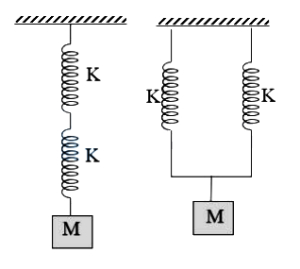
A
$1$:$2$
B
$1$:$4$
C
$4$:$1$
D
$1: \sqrt{2}$
Solution
(A) In the series combination,the effective spring constant $k_s$ is given by:
$k_s = \frac{K \cdot K}{K + K} = \frac{K}{2}$
In the parallel combination,the effective spring constant $k_p$ is given by:
$k_p = K + K = 2K$
The frequency of oscillation for a mass-spring system is $f = \frac{1}{2\pi} \sqrt{\frac{k}{M}}$.
For the series combination,the frequency $f_s$ is:
$f_s = \frac{1}{2\pi} \sqrt{\frac{K/2}{M}} = \frac{1}{2\pi} \sqrt{\frac{K}{2M}}$
For the parallel combination,the frequency $f_p$ is:
$f_p = \frac{1}{2\pi} \sqrt{\frac{2K}{M}}$
The ratio of the frequencies in series to parallel combination is:
$\frac{f_s}{f_p} = \frac{\frac{1}{2\pi} \sqrt{\frac{K}{2M}}}{\frac{1}{2\pi} \sqrt{\frac{2K}{M}}} = \sqrt{\frac{K}{2M} \cdot \frac{M}{2K}} = \sqrt{\frac{1}{4}} = \frac{1}{2}$
Thus,the ratio is $1:2$.
$k_s = \frac{K \cdot K}{K + K} = \frac{K}{2}$
In the parallel combination,the effective spring constant $k_p$ is given by:
$k_p = K + K = 2K$
The frequency of oscillation for a mass-spring system is $f = \frac{1}{2\pi} \sqrt{\frac{k}{M}}$.
For the series combination,the frequency $f_s$ is:
$f_s = \frac{1}{2\pi} \sqrt{\frac{K/2}{M}} = \frac{1}{2\pi} \sqrt{\frac{K}{2M}}$
For the parallel combination,the frequency $f_p$ is:
$f_p = \frac{1}{2\pi} \sqrt{\frac{2K}{M}}$
The ratio of the frequencies in series to parallel combination is:
$\frac{f_s}{f_p} = \frac{\frac{1}{2\pi} \sqrt{\frac{K}{2M}}}{\frac{1}{2\pi} \sqrt{\frac{2K}{M}}} = \sqrt{\frac{K}{2M} \cdot \frac{M}{2K}} = \sqrt{\frac{1}{4}} = \frac{1}{2}$
Thus,the ratio is $1:2$.
0 likesView Solution
114
PhysicsDifficultMCQMHT CET · 2021
$A$ body executes $SHM$ under the action of force $F_1$ with time period $T_1$. If the force is changed to $F_2$,it executes $SHM$ with time period $T_2$. If both the forces $F_1$ and $F_2$ act simultaneously in the same direction on the body,its time period is:
A
$\frac{\sqrt{T_1^2-T_2^2}}{T_1 T_2}$
B
$\frac{T_1 T_2}{\sqrt{T_1^2-T_2^2}}$
C
$\frac{\sqrt{T_1^2+T_2^2}}{T_1 T_2}$
D
$\frac{T_1 T_2}{\sqrt{T_1^2+T_2^2}}$
Solution
(D) For a body of mass $m$ executing $SHM$,the force is $F = kx$,where $k$ is the force constant. The time period is given by $T = 2\pi \sqrt{\frac{m}{k}}$,which implies $k = \frac{4\pi^2 m}{T^2}$.
For force $F_1$,$k_1 = \frac{4\pi^2 m}{T_1^2}$.
For force $F_2$,$k_2 = \frac{4\pi^2 m}{T_2^2}$.
When both forces act simultaneously in the same direction,the effective force constant is $k_{eff} = k_1 + k_2$.
The new time period $T$ is given by $T = 2\pi \sqrt{\frac{m}{k_1 + k_2}}$.
Squaring both sides,$T^2 = \frac{4\pi^2 m}{k_1 + k_2}$.
Taking the reciprocal,$\frac{1}{T^2} = \frac{k_1 + k_2}{4\pi^2 m} = \frac{k_1}{4\pi^2 m} + \frac{k_2}{4\pi^2 m}$.
Substituting the expressions for $k_1$ and $k_2$,we get $\frac{1}{T^2} = \frac{1}{T_1^2} + \frac{1}{T_2^2} = \frac{T_1^2 + T_2^2}{T_1^2 T_2^2}$.
Therefore,$T = \frac{T_1 T_2}{\sqrt{T_1^2 + T_2^2}}$.
For force $F_1$,$k_1 = \frac{4\pi^2 m}{T_1^2}$.
For force $F_2$,$k_2 = \frac{4\pi^2 m}{T_2^2}$.
When both forces act simultaneously in the same direction,the effective force constant is $k_{eff} = k_1 + k_2$.
The new time period $T$ is given by $T = 2\pi \sqrt{\frac{m}{k_1 + k_2}}$.
Squaring both sides,$T^2 = \frac{4\pi^2 m}{k_1 + k_2}$.
Taking the reciprocal,$\frac{1}{T^2} = \frac{k_1 + k_2}{4\pi^2 m} = \frac{k_1}{4\pi^2 m} + \frac{k_2}{4\pi^2 m}$.
Substituting the expressions for $k_1$ and $k_2$,we get $\frac{1}{T^2} = \frac{1}{T_1^2} + \frac{1}{T_2^2} = \frac{T_1^2 + T_2^2}{T_1^2 T_2^2}$.
Therefore,$T = \frac{T_1 T_2}{\sqrt{T_1^2 + T_2^2}}$.
0 likesView Solution
115
PhysicsDifficultMCQMHT CET · 2021
Three point masses,each of mass $m$,are kept at the corners of an equilateral triangle of side $L$. The system rotates about the center of the triangle without any change in the separation of masses during rotation. The period of rotation is directly proportional to
A
$L$
B
$L^{1/2}$
C
$L^{3/2}$
D
$L^{-2}$
Solution
(C) Consider a mass $m$ at corner $A$. The gravitational forces exerted on it by the other two masses at $B$ and $C$ are $F_1$ and $F_2$,where $F_1 = F_2 = G \frac{m^2}{L^2}$.
The angle between these two forces is $60^{\circ}$. The resultant force $F$ is given by:
$F = \sqrt{F_1^2 + F_2^2 + 2F_1 F_2 \cos 60^{\circ}} = \sqrt{3} F_1 = \sqrt{3} G \frac{m^2}{L^2}$.
The distance of each mass from the center of the triangle is $r = \frac{L}{\sqrt{3}}$.
For uniform circular motion,the gravitational force provides the necessary centripetal force:
$mr \omega^2 = F$
$m \left( \frac{L}{\sqrt{3}} \right) \omega^2 = \sqrt{3} G \frac{m^2}{L^2}$
$\omega^2 = 3 G \frac{m}{L^3}$
Since $\omega = \frac{2\pi}{T}$,we have:
$\left( \frac{2\pi}{T} \right)^2 = \frac{3Gm}{L^3}$
$T^2 = \frac{4\pi^2 L^3}{3Gm}$
$T \propto L^{3/2}$.
The angle between these two forces is $60^{\circ}$. The resultant force $F$ is given by:
$F = \sqrt{F_1^2 + F_2^2 + 2F_1 F_2 \cos 60^{\circ}} = \sqrt{3} F_1 = \sqrt{3} G \frac{m^2}{L^2}$.
The distance of each mass from the center of the triangle is $r = \frac{L}{\sqrt{3}}$.
For uniform circular motion,the gravitational force provides the necessary centripetal force:
$mr \omega^2 = F$
$m \left( \frac{L}{\sqrt{3}} \right) \omega^2 = \sqrt{3} G \frac{m^2}{L^2}$
$\omega^2 = 3 G \frac{m}{L^3}$
Since $\omega = \frac{2\pi}{T}$,we have:
$\left( \frac{2\pi}{T} \right)^2 = \frac{3Gm}{L^3}$
$T^2 = \frac{4\pi^2 L^3}{3Gm}$
$T \propto L^{3/2}$.
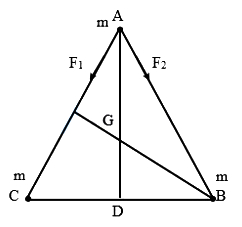
0 likesView Solution
116
PhysicsMediumMCQMHT CET · 2021
$A$ pendulum is oscillating with frequency $n$ on the surface of the Earth. If it is taken to a depth $d = \frac{R}{2}$ below the surface of the Earth,where $R$ is the radius of the Earth,what is the new frequency of oscillations at this depth?
A
$\frac{n}{\sqrt{2}}$
B
$n$
C
$\frac{n}{\sqrt{3}}$
D
$2n$
Solution
(A) The frequency of a simple pendulum is given by $n = \frac{1}{2\pi} \sqrt{\frac{g}{l}}$.
At the surface of the Earth,$n = \frac{1}{2\pi} \sqrt{\frac{g}{l}}$.
At a depth $d$ below the surface,the acceleration due to gravity $g'$ is given by $g' = g(1 - \frac{d}{R})$.
Given $d = \frac{R}{2}$,we have $g' = g(1 - \frac{R/2}{R}) = g(1 - \frac{1}{2}) = \frac{g}{2}$.
The new frequency $n'$ at depth $d$ is $n' = \frac{1}{2\pi} \sqrt{\frac{g'}{l}}$.
Substituting $g' = \frac{g}{2}$,we get $n' = \frac{1}{2\pi} \sqrt{\frac{g/2}{l}} = \frac{1}{\sqrt{2}} \left( \frac{1}{2\pi} \sqrt{\frac{g}{l}} \right)$.
Therefore,$n' = \frac{n}{\sqrt{2}}$.
At the surface of the Earth,$n = \frac{1}{2\pi} \sqrt{\frac{g}{l}}$.
At a depth $d$ below the surface,the acceleration due to gravity $g'$ is given by $g' = g(1 - \frac{d}{R})$.
Given $d = \frac{R}{2}$,we have $g' = g(1 - \frac{R/2}{R}) = g(1 - \frac{1}{2}) = \frac{g}{2}$.
The new frequency $n'$ at depth $d$ is $n' = \frac{1}{2\pi} \sqrt{\frac{g'}{l}}$.
Substituting $g' = \frac{g}{2}$,we get $n' = \frac{1}{2\pi} \sqrt{\frac{g/2}{l}} = \frac{1}{\sqrt{2}} \left( \frac{1}{2\pi} \sqrt{\frac{g}{l}} \right)$.
Therefore,$n' = \frac{n}{\sqrt{2}}$.
0 likesView Solution
117
PhysicsMediumMCQMHT CET · 2021
Two bodies rotate with kinetic energies $E_1$ and $E_2$. Their moments of inertia about their axes of rotation are $I_1$ and $I_2$. If $I_1 = \frac{I_2}{3}$ and $E_1 = 27 E_2$,then the ratio of their angular momenta $L_1$ to $L_2$ is:
A
$1: 3$
B
$3: 1$
C
$1: 1$
D
$2: 1$
Solution
(B) The rotational kinetic energy $E$ is given by $E = \frac{L^2}{2I}$,where $L$ is the angular momentum and $I$ is the moment of inertia.
From this,we can write $L = \sqrt{2IE}$.
Given $I_1 = \frac{I_2}{3} \implies I_2 = 3I_1$ and $E_1 = 27E_2$.
The ratio of angular momenta is $\frac{L_1}{L_2} = \frac{\sqrt{2I_1E_1}}{\sqrt{2I_2E_2}}$.
Substituting the given values:
$\frac{L_1}{L_2} = \sqrt{\frac{I_1}{I_2} \cdot \frac{E_1}{E_2}} = \sqrt{\frac{I_1}{3I_1} \cdot \frac{27E_2}{E_2}}$.
$\frac{L_1}{L_2} = \sqrt{\frac{1}{3} \cdot 27} = \sqrt{9} = 3$.
Thus,the ratio $L_1 : L_2$ is $3: 1$.
From this,we can write $L = \sqrt{2IE}$.
Given $I_1 = \frac{I_2}{3} \implies I_2 = 3I_1$ and $E_1 = 27E_2$.
The ratio of angular momenta is $\frac{L_1}{L_2} = \frac{\sqrt{2I_1E_1}}{\sqrt{2I_2E_2}}$.
Substituting the given values:
$\frac{L_1}{L_2} = \sqrt{\frac{I_1}{I_2} \cdot \frac{E_1}{E_2}} = \sqrt{\frac{I_1}{3I_1} \cdot \frac{27E_2}{E_2}}$.
$\frac{L_1}{L_2} = \sqrt{\frac{1}{3} \cdot 27} = \sqrt{9} = 3$.
Thus,the ratio $L_1 : L_2$ is $3: 1$.
0 likesView Solution
118
PhysicsMediumMCQMHT CET · 2021
$A$ particle performs rotational motion with an angular momentum $L$. If the frequency of rotation is doubled and its kinetic energy becomes one-fourth,the new angular momentum becomes:
A
$L$
B
$\frac{L}{4}$
C
$\frac{L}{8}$
D
$\frac{L}{2}$
Solution
(C) The kinetic energy of a rotating body is given by $K = \frac{1}{2} I \omega^2$,where $I$ is the moment of inertia and $\omega$ is the angular velocity.
Since $\omega = 2\pi f$,where $f$ is the frequency,we have $K \propto I f^2$.
Given that $f_2 = 2f_1$ and $K_2 = \frac{K_1}{4}$,we can write:
$\frac{K_2}{K_1} = \frac{I_2 f_2^2}{I_1 f_1^2}$
$\frac{1}{4} = \frac{I_2}{I_1} \times (2)^2$
$\frac{1}{4} = \frac{I_2}{I_1} \times 4$
$\frac{I_2}{I_1} = \frac{1}{16}$
Angular momentum is given by $L = I \omega = I(2\pi f)$,so $L \propto I f$.
$\frac{L_2}{L_1} = \frac{I_2 f_2}{I_1 f_1} = \left(\frac{I_2}{I_1}\right) \times \left(\frac{f_2}{f_1}\right)$
$\frac{L_2}{L_1} = \frac{1}{16} \times 2 = \frac{1}{8}$
Therefore,$L_2 = \frac{L}{8}$.
Since $\omega = 2\pi f$,where $f$ is the frequency,we have $K \propto I f^2$.
Given that $f_2 = 2f_1$ and $K_2 = \frac{K_1}{4}$,we can write:
$\frac{K_2}{K_1} = \frac{I_2 f_2^2}{I_1 f_1^2}$
$\frac{1}{4} = \frac{I_2}{I_1} \times (2)^2$
$\frac{1}{4} = \frac{I_2}{I_1} \times 4$
$\frac{I_2}{I_1} = \frac{1}{16}$
Angular momentum is given by $L = I \omega = I(2\pi f)$,so $L \propto I f$.
$\frac{L_2}{L_1} = \frac{I_2 f_2}{I_1 f_1} = \left(\frac{I_2}{I_1}\right) \times \left(\frac{f_2}{f_1}\right)$
$\frac{L_2}{L_1} = \frac{1}{16} \times 2 = \frac{1}{8}$
Therefore,$L_2 = \frac{L}{8}$.
0 likesView Solution
119
PhysicsEasyMCQMHT CET · 2021
Two rotating bodies $P$ and $Q$ of masses $m$ with moment of inertia $I_P$ and $I_Q$ $(I_Q > I_P)$ have equal kinetic energy of rotation. If $L_P$ and $L_Q$ are their angular momenta respectively,then:
A
$L_Q = 0$
B
$L_Q = L_P$
C
$L_Q < L_P$
D
$L_Q > L_P$
Solution
(D) The rotational kinetic energy $K$ is given by the formula $K = \frac{L^2}{2I}$,where $L$ is the angular momentum and $I$ is the moment of inertia.
Since the kinetic energies are equal,we have $K_P = K_Q$.
Therefore,$\frac{L_P^2}{2I_P} = \frac{L_Q^2}{2I_Q}$.
Rearranging the terms,we get $\frac{L_Q^2}{L_P^2} = \frac{I_Q}{I_P}$.
Taking the square root on both sides,$\frac{L_Q}{L_P} = \sqrt{\frac{I_Q}{I_P}}$.
Given that $I_Q > I_P$,it follows that $\frac{I_Q}{I_P} > 1$.
Thus,$\sqrt{\frac{I_Q}{I_P}} > 1$,which implies $\frac{L_Q}{L_P} > 1$.
Therefore,$L_Q > L_P$.
Since the kinetic energies are equal,we have $K_P = K_Q$.
Therefore,$\frac{L_P^2}{2I_P} = \frac{L_Q^2}{2I_Q}$.
Rearranging the terms,we get $\frac{L_Q^2}{L_P^2} = \frac{I_Q}{I_P}$.
Taking the square root on both sides,$\frac{L_Q}{L_P} = \sqrt{\frac{I_Q}{I_P}}$.
Given that $I_Q > I_P$,it follows that $\frac{I_Q}{I_P} > 1$.
Thus,$\sqrt{\frac{I_Q}{I_P}} > 1$,which implies $\frac{L_Q}{L_P} > 1$.
Therefore,$L_Q > L_P$.
0 likesView Solution
120
PhysicsEasyMCQMHT CET · 2021
$A$ particle with position vector $\overrightarrow{r}$ has a linear momentum $\overrightarrow{p}$. Which one of the following statements is true in respect of its angular momentum $\overrightarrow{L}$ about the origin?
A
$\overrightarrow{L}$ acts along $\overrightarrow{p}$
B
$\overrightarrow{L}$ is maximum when $\overrightarrow{p}$ is perpendicular to $\overrightarrow{r}$
C
$\overrightarrow{L}$ acts along $\overrightarrow{r}$
D
$\overrightarrow{L}$ is maximum when $\overrightarrow{p}$ and $\overrightarrow{r}$ are parallel
Solution
(B) The angular momentum of a particle is defined by the cross product of its position vector and linear momentum: $\overrightarrow{L} = \overrightarrow{r} \times \overrightarrow{p}$.
By the properties of the cross product,the vector $\overrightarrow{L}$ is perpendicular to both $\overrightarrow{r}$ and $\overrightarrow{p}$.
The magnitude of the angular momentum is given by $L = rp \sin \theta$,where $\theta$ is the angle between $\overrightarrow{r}$ and $\overrightarrow{p}$.
For the magnitude $L$ to be maximum,$\sin \theta$ must be maximum,which occurs when $\theta = 90^{\circ}$.
Therefore,$\overrightarrow{L}$ is maximum when $\overrightarrow{p}$ is perpendicular to $\overrightarrow{r}$.
By the properties of the cross product,the vector $\overrightarrow{L}$ is perpendicular to both $\overrightarrow{r}$ and $\overrightarrow{p}$.
The magnitude of the angular momentum is given by $L = rp \sin \theta$,where $\theta$ is the angle between $\overrightarrow{r}$ and $\overrightarrow{p}$.
For the magnitude $L$ to be maximum,$\sin \theta$ must be maximum,which occurs when $\theta = 90^{\circ}$.
Therefore,$\overrightarrow{L}$ is maximum when $\overrightarrow{p}$ is perpendicular to $\overrightarrow{r}$.
0 likesView Solution
121
PhysicsMediumMCQMHT CET · 2021
$A$ child is standing with folded hands at the centre of a platform rotating about its central axis. The kinetic energy of the system is $K$. The child now stretches his arms so that the moment of inertia of the system becomes double. The kinetic energy of the system now is
A
$\frac{K}{2}$
B
$2 K$
C
$4 K$
D
$\frac{K}{4}$
Solution
(A) The initial kinetic energy of the system is given by $K = \frac{1}{2} I \omega^2$,where $I$ is the initial moment of inertia and $\omega$ is the initial angular velocity.
According to the law of conservation of angular momentum,since no external torque acts on the system,the angular momentum $L$ remains constant: $L = I \omega = I^{\prime} \omega^{\prime}$.
Given that the new moment of inertia is $I^{\prime} = 2I$,we have $2I \omega^{\prime} = I \omega$,which implies $\omega^{\prime} = \frac{\omega}{2}$.
The new kinetic energy $K^{\prime}$ is given by $K^{\prime} = \frac{1}{2} I^{\prime} \omega^{\prime 2}$.
Substituting the values,$K^{\prime} = \frac{1}{2} (2I) \left( \frac{\omega}{2} \right)^2 = I \left( \frac{\omega^2}{4} \right) = \frac{1}{2} \left( \frac{1}{2} I \omega^2 \right) = \frac{K}{2}$.
According to the law of conservation of angular momentum,since no external torque acts on the system,the angular momentum $L$ remains constant: $L = I \omega = I^{\prime} \omega^{\prime}$.
Given that the new moment of inertia is $I^{\prime} = 2I$,we have $2I \omega^{\prime} = I \omega$,which implies $\omega^{\prime} = \frac{\omega}{2}$.
The new kinetic energy $K^{\prime}$ is given by $K^{\prime} = \frac{1}{2} I^{\prime} \omega^{\prime 2}$.
Substituting the values,$K^{\prime} = \frac{1}{2} (2I) \left( \frac{\omega}{2} \right)^2 = I \left( \frac{\omega^2}{4} \right) = \frac{1}{2} \left( \frac{1}{2} I \omega^2 \right) = \frac{K}{2}$.
0 likesView Solution
122
PhysicsEasyMCQMHT CET · 2021
The ratio of radii of gyration of a circular ring and a circular disc of the same mass and radius,about an axis passing through their centres and perpendicular to their planes is
A
$1: \sqrt{2}$
B
$2: 1$
C
$\sqrt{2}: 1$
D
$3: 2$
Solution
(C) The radius of gyration $K$ is defined by the relation $I = MK^2$,where $I$ is the moment of inertia and $M$ is the mass.
For a circular ring of mass $M$ and radius $R$,the moment of inertia about an axis passing through its centre and perpendicular to its plane is $I_{r} = MR^2$.
Thus,$MR^2 = MK_{r}^2$,which gives $K_{r} = R$.
For a circular disc of mass $M$ and radius $R$,the moment of inertia about an axis passing through its centre and perpendicular to its plane is $I_{d} = \frac{1}{2}MR^2$.
Thus,$\frac{1}{2}MR^2 = MK_{d}^2$,which gives $K_{d} = \frac{R}{\sqrt{2}}$.
The ratio of the radii of gyration is $\frac{K_{r}}{K_{d}} = \frac{R}{R/\sqrt{2}} = \sqrt{2} : 1$.
For a circular ring of mass $M$ and radius $R$,the moment of inertia about an axis passing through its centre and perpendicular to its plane is $I_{r} = MR^2$.
Thus,$MR^2 = MK_{r}^2$,which gives $K_{r} = R$.
For a circular disc of mass $M$ and radius $R$,the moment of inertia about an axis passing through its centre and perpendicular to its plane is $I_{d} = \frac{1}{2}MR^2$.
Thus,$\frac{1}{2}MR^2 = MK_{d}^2$,which gives $K_{d} = \frac{R}{\sqrt{2}}$.
The ratio of the radii of gyration is $\frac{K_{r}}{K_{d}} = \frac{R}{R/\sqrt{2}} = \sqrt{2} : 1$.
0 likesView Solution
123
PhysicsMediumMCQMHT CET · 2021
$A$ solid sphere of mass $M$ and radius $R$ has a moment of inertia $I$ about its diameter. It is recast into a disc of thickness $t$ whose moment of inertia about an axis passing through its edge and perpendicular to its plane remains $I$. The radius of the disc will be:
A
$\frac{4 R}{\sqrt{11}}$
B
$\frac{3 R}{4}$
C
$\frac{2 R}{\sqrt{15}}$
D
$\frac{2 R}{3}$
Solution
(C) The moment of inertia of a solid sphere about its diameter is given by $I = \frac{2}{5} MR^2$.
When the sphere is recast into a disc of radius $R'$ and mass $M$,the moment of inertia of the disc about an axis passing through its edge and perpendicular to its plane is given by the parallel axis theorem: $I' = I_{cm} + Md^2 = \frac{1}{2} MR'^2 + MR'^2 = \frac{3}{2} MR'^2$.
Given that $I' = I$,we equate the two expressions:
$\frac{3}{2} MR'^2 = \frac{2}{5} MR^2$.
Canceling $M$ from both sides,we get $R'^2 = \frac{2}{5} \times \frac{2}{3} R^2 = \frac{4}{15} R^2$.
Taking the square root,we find $R' = \sqrt{\frac{4}{15}} R = \frac{2}{\sqrt{15}} R$.
When the sphere is recast into a disc of radius $R'$ and mass $M$,the moment of inertia of the disc about an axis passing through its edge and perpendicular to its plane is given by the parallel axis theorem: $I' = I_{cm} + Md^2 = \frac{1}{2} MR'^2 + MR'^2 = \frac{3}{2} MR'^2$.
Given that $I' = I$,we equate the two expressions:
$\frac{3}{2} MR'^2 = \frac{2}{5} MR^2$.
Canceling $M$ from both sides,we get $R'^2 = \frac{2}{5} \times \frac{2}{3} R^2 = \frac{4}{15} R^2$.
Taking the square root,we find $R' = \sqrt{\frac{4}{15}} R = \frac{2}{\sqrt{15}} R$.
0 likesView Solution
124
PhysicsMediumMCQMHT CET · 2021
The moment of inertia of a circular disc of radius $2 \,m$ and mass $1 \,kg$ about an axis $XY$ passing through its center of mass and perpendicular to the plane of the disc is $2 \,kg \,m^2$. The moment of inertia about an axis parallel to the axis $XY$ and passing through the edge of the disc is
A
$6 \,kg \,m^2$
B
$4 \,kg \,m^2$
C
$10 \,kg \,m^2$
D
$8 \,kg \,m^2$
Solution
(A) The moment of inertia of a disc about an axis passing through its center of mass and perpendicular to its plane is given by $I_{cm} = \frac{1}{2} MR^2$.
Given $M = 1 \,kg$ and $R = 2 \,m$,$I_{cm} = \frac{1}{2} \times 1 \times (2)^2 = 2 \,kg \cdot m^2$.
According to the parallel axis theorem,the moment of inertia about an axis parallel to the $XY$ axis and passing through the edge of the disc is $I' = I_{cm} + Md^2$,where $d = R$ is the distance between the two axes.
Substituting the values,$I' = 2 + (1 \times 2^2) = 2 + 4 = 6 \,kg \cdot m^2$.
Given $M = 1 \,kg$ and $R = 2 \,m$,$I_{cm} = \frac{1}{2} \times 1 \times (2)^2 = 2 \,kg \cdot m^2$.
According to the parallel axis theorem,the moment of inertia about an axis parallel to the $XY$ axis and passing through the edge of the disc is $I' = I_{cm} + Md^2$,where $d = R$ is the distance between the two axes.
Substituting the values,$I' = 2 + (1 \times 2^2) = 2 + 4 = 6 \,kg \cdot m^2$.
0 likesView Solution
125
PhysicsEasyMCQMHT CET · 2021
Three rings each of mass $M$ and radius $R$ are arranged as shown in the figure. The moment of inertia of the system about the axis $YY'$ will be
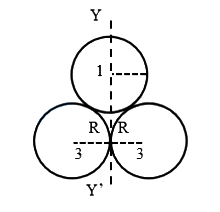
A
$5 MR^2$
B
$\frac{7}{2} MR^2$
C
$\frac{3}{2} MR^2$
D
$3 MR^2$
Solution
(B) The axis $YY'$ passes through the center of the top ring and is a diameter of that ring. The moment of inertia of the top ring about its diameter is $I_1 = \frac{1}{2} MR^2$.
For the two lower rings,the axis $YY'$ is a tangent to each ring in its own plane. According to the parallel axis theorem,the moment of inertia of a ring about a tangent in its plane is $I_{tangent} = I_{cm} + MR^2 = \frac{1}{2} MR^2 + MR^2 = \frac{3}{2} MR^2$.
Since there are two such lower rings,their combined moment of inertia is $I_2 + I_3 = \frac{3}{2} MR^2 + \frac{3}{2} MR^2 = 3 MR^2$.
The total moment of inertia of the system about the axis $YY'$ is $I = I_1 + I_2 + I_3 = \frac{1}{2} MR^2 + \frac{3}{2} MR^2 + \frac{3}{2} MR^2 = \frac{7}{2} MR^2$.
For the two lower rings,the axis $YY'$ is a tangent to each ring in its own plane. According to the parallel axis theorem,the moment of inertia of a ring about a tangent in its plane is $I_{tangent} = I_{cm} + MR^2 = \frac{1}{2} MR^2 + MR^2 = \frac{3}{2} MR^2$.
Since there are two such lower rings,their combined moment of inertia is $I_2 + I_3 = \frac{3}{2} MR^2 + \frac{3}{2} MR^2 = 3 MR^2$.
The total moment of inertia of the system about the axis $YY'$ is $I = I_1 + I_2 + I_3 = \frac{1}{2} MR^2 + \frac{3}{2} MR^2 + \frac{3}{2} MR^2 = \frac{7}{2} MR^2$.
0 likesView Solution
126
PhysicsEasyMCQMHT CET · 2021
Two rings of radius $R$ and $nR$ made of the same material have a ratio of moment of inertia about an axis passing through their centers and perpendicular to their planes as $1:8$. The value of $n$ is (mass per unit length $= \lambda$).
A
$2$
B
$4$
C
$1$
D
$3$
Solution
(A) The moment of inertia of a ring of mass $M$ and radius $R$ about an axis passing through its center and perpendicular to its plane is $I = MR^2$.
Given mass per unit length is $\lambda$. The mass of the first ring is $M_1 = \lambda(2\pi R)$ and its radius is $R_1 = R$.
So,$I_1 = M_1 R_1^2 = (2\pi R \lambda) R^2 = 2\pi \lambda R^3$.
The mass of the second ring is $M_2 = \lambda(2\pi nR)$ and its radius is $R_2 = nR$.
So,$I_2 = M_2 R_2^2 = (2\pi nR \lambda) (nR)^2 = 2\pi \lambda n^3 R^3$.
The ratio is given as $\frac{I_1}{I_2} = \frac{1}{8}$.
Substituting the expressions: $\frac{2\pi \lambda R^3}{2\pi \lambda n^3 R^3} = \frac{1}{n^3} = \frac{1}{8}$.
Therefore,$n^3 = 8$,which gives $n = 2$.
Given mass per unit length is $\lambda$. The mass of the first ring is $M_1 = \lambda(2\pi R)$ and its radius is $R_1 = R$.
So,$I_1 = M_1 R_1^2 = (2\pi R \lambda) R^2 = 2\pi \lambda R^3$.
The mass of the second ring is $M_2 = \lambda(2\pi nR)$ and its radius is $R_2 = nR$.
So,$I_2 = M_2 R_2^2 = (2\pi nR \lambda) (nR)^2 = 2\pi \lambda n^3 R^3$.
The ratio is given as $\frac{I_1}{I_2} = \frac{1}{8}$.
Substituting the expressions: $\frac{2\pi \lambda R^3}{2\pi \lambda n^3 R^3} = \frac{1}{n^3} = \frac{1}{8}$.
Therefore,$n^3 = 8$,which gives $n = 2$.
0 likesView Solution
127
PhysicsEasyMCQMHT CET · 2021
$A$ body of mass $m$ and radius of gyration $K$ has an angular momentum $L$. Then its angular velocity is
A
$\frac{L}{mK^2}$
B
$\frac{mK^2}{L}$
C
$\frac{K^2}{mL}$
D
$mK^2 L$
Solution
(A) The moment of inertia $I$ of a body in terms of its mass $m$ and radius of gyration $K$ is given by $I = mK^2$.
Angular momentum $L$ is related to moment of inertia $I$ and angular velocity $\omega$ by the formula $L = I\omega$.
Substituting the expression for $I$ into the angular momentum formula,we get $L = (mK^2)\omega$.
Rearranging this to solve for angular velocity $\omega$,we get $\omega = \frac{L}{mK^2}$.
Angular momentum $L$ is related to moment of inertia $I$ and angular velocity $\omega$ by the formula $L = I\omega$.
Substituting the expression for $I$ into the angular momentum formula,we get $L = (mK^2)\omega$.
Rearranging this to solve for angular velocity $\omega$,we get $\omega = \frac{L}{mK^2}$.
0 likesView Solution
128
PhysicsMediumMCQMHT CET · 2021
Three solid spheres each of mass $M$ and radius $R$ are arranged as shown in the figure. The moment of inertia of the system about $YY'$ will be
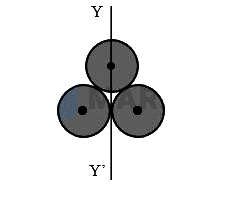
A
$\frac{16}{5} MR^2$
B
$\frac{21}{5} MR^2$
C
$\frac{7}{5} MR^2$
D
$\frac{11}{5} MR^2$
Solution
(A) The moment of inertia of the upper sphere about the axis $YY'$ passing through its center is $I_1 = \frac{2}{5} MR^2$.
For each of the two lower spheres,the axis $YY'$ is at a distance $R$ from their centers. Using the parallel axis theorem,the moment of inertia for each lower sphere is $I_2 = I_{cm} + MR^2 = \frac{2}{5} MR^2 + MR^2 = \frac{7}{5} MR^2$.
Therefore,the total moment of inertia of the system is $I = I_1 + 2 \times I_2 = \frac{2}{5} MR^2 + 2 \times \frac{7}{5} MR^2 = \frac{2}{5} MR^2 + \frac{14}{5} MR^2 = \frac{16}{5} MR^2$.
For each of the two lower spheres,the axis $YY'$ is at a distance $R$ from their centers. Using the parallel axis theorem,the moment of inertia for each lower sphere is $I_2 = I_{cm} + MR^2 = \frac{2}{5} MR^2 + MR^2 = \frac{7}{5} MR^2$.
Therefore,the total moment of inertia of the system is $I = I_1 + 2 \times I_2 = \frac{2}{5} MR^2 + 2 \times \frac{7}{5} MR^2 = \frac{2}{5} MR^2 + \frac{14}{5} MR^2 = \frac{16}{5} MR^2$.
0 likesView Solution
129
PhysicsDifficultMCQMHT CET · 2021
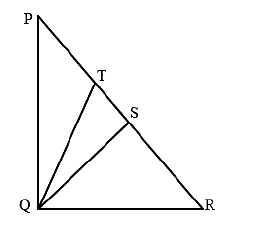
The figure shows a triangular lamina which can rotate about different axes. The moment of inertia is maximum about the axis:
A
$PR$
B
$QS$
C
$QR$
D
$PQ$
Solution
(C) The moment of inertia of a body about an axis is given by $I = \sum m_i r_i^2$,where $r_i$ is the perpendicular distance of the $i$-th particle from the axis of rotation.
For a given mass distribution,the moment of inertia is larger if the mass is distributed at a greater average distance from the axis of rotation.
In the given triangular lamina $PQR$,the axis $QR$ is the side of the triangle. The entire mass of the lamina is distributed such that most of the area (and thus mass) is at a relatively smaller distance from the axis $PQ$ or $PR$ compared to the axis $QR$ which is the base.
However,considering the perpendicular distance of the vertices from the axes,the axis $QR$ allows the vertex $P$ to be at the maximum perpendicular distance compared to other axes like $PQ$ or $PR$ where the vertices are closer to the axis.
Therefore,the moment of inertia is maximum about the axis $QR$.
For a given mass distribution,the moment of inertia is larger if the mass is distributed at a greater average distance from the axis of rotation.
In the given triangular lamina $PQR$,the axis $QR$ is the side of the triangle. The entire mass of the lamina is distributed such that most of the area (and thus mass) is at a relatively smaller distance from the axis $PQ$ or $PR$ compared to the axis $QR$ which is the base.
However,considering the perpendicular distance of the vertices from the axes,the axis $QR$ allows the vertex $P$ to be at the maximum perpendicular distance compared to other axes like $PQ$ or $PR$ where the vertices are closer to the axis.
Therefore,the moment of inertia is maximum about the axis $QR$.
0 likesView Solution
130
PhysicsEasyMCQMHT CET · 2021
Two circular loops $P$ and $Q$ are made from a uniform wire. The radii of $P$ and $Q$ are $R_1$ and $R_2$ respectively. The moments of inertia about their own axis are $I_{P}$ and $I_{Q}$ respectively. If $\frac{I_{P}}{I_{Q}}=\frac{1}{8}$,then $\frac{R_2}{R_1}$ is
A
$4$
B
$3$
C
$2$
D
$5$
Solution
(C) The moment of inertia of a circular loop of mass $M$ and radius $R$ about its central axis is $I = MR^2$.
Let $m$ be the mass per unit length of the wire. Then the masses of the loops are $M_P = 2\pi R_1 m$ and $M_Q = 2\pi R_2 m$.
The moments of inertia are $I_P = M_P R_1^2 = (2\pi R_1 m) R_1^2 = 2\pi m R_1^3$ and $I_Q = M_Q R_2^2 = (2\pi R_2 m) R_2^2 = 2\pi m R_2^3$.
Taking the ratio: $\frac{I_P}{I_Q} = \frac{2\pi m R_1^3}{2\pi m R_2^3} = \left(\frac{R_1}{R_2}\right)^3$.
Given $\frac{I_P}{I_Q} = \frac{1}{8}$,we have $\left(\frac{R_1}{R_2}\right)^3 = \frac{1}{8}$.
Taking the cube root on both sides: $\frac{R_1}{R_2} = \frac{1}{2}$.
Therefore,$\frac{R_2}{R_1} = 2$.
Let $m$ be the mass per unit length of the wire. Then the masses of the loops are $M_P = 2\pi R_1 m$ and $M_Q = 2\pi R_2 m$.
The moments of inertia are $I_P = M_P R_1^2 = (2\pi R_1 m) R_1^2 = 2\pi m R_1^3$ and $I_Q = M_Q R_2^2 = (2\pi R_2 m) R_2^2 = 2\pi m R_2^3$.
Taking the ratio: $\frac{I_P}{I_Q} = \frac{2\pi m R_1^3}{2\pi m R_2^3} = \left(\frac{R_1}{R_2}\right)^3$.
Given $\frac{I_P}{I_Q} = \frac{1}{8}$,we have $\left(\frac{R_1}{R_2}\right)^3 = \frac{1}{8}$.
Taking the cube root on both sides: $\frac{R_1}{R_2} = \frac{1}{2}$.
Therefore,$\frac{R_2}{R_1} = 2$.
0 likesView Solution
131
PhysicsEasyMCQMHT CET · 2021
The moment of inertia of a thin uniform rod of mass $M$ and length $L$ about an axis passing through a point at a distance $L/4$ from one of its ends and perpendicular to the length of the rod is
A
$ML^2/48$
B
$7ML^2/48$
C
$5ML^2/48$
D
$9ML^2/48$
Solution
(B) The moment of inertia of a thin uniform rod of mass $M$ and length $L$ about an axis passing through its center of mass and perpendicular to its length is $I_{cm} = ML^2/12$.
Using the parallel axis theorem,$I = I_{cm} + Md^2$,where $d$ is the distance between the center of mass and the new axis.
The center of mass is at $L/2$ from one end. The new axis is at $L/4$ from the same end.
Therefore,the distance $d = |L/2 - L/4| = L/4$.
Substituting these values into the parallel axis theorem:
$I = ML^2/12 + M(L/4)^2$
$I = ML^2/12 + ML^2/16$
Taking the least common multiple of $12$ and $16$,which is $48$:
$I = (4ML^2 + 3ML^2) / 48 = 7ML^2/48$.
Using the parallel axis theorem,$I = I_{cm} + Md^2$,where $d$ is the distance between the center of mass and the new axis.
The center of mass is at $L/2$ from one end. The new axis is at $L/4$ from the same end.
Therefore,the distance $d = |L/2 - L/4| = L/4$.
Substituting these values into the parallel axis theorem:
$I = ML^2/12 + M(L/4)^2$
$I = ML^2/12 + ML^2/16$
Taking the least common multiple of $12$ and $16$,which is $48$:
$I = (4ML^2 + 3ML^2) / 48 = 7ML^2/48$.
0 likesView Solution
132
PhysicsMediumMCQMHT CET · 2021
$A$ solid sphere of mass $M$ and radius $R$ is rotating about its diameter. $A$ solid cylinder of the same mass and radius is also rotating about its geometrical axis with an angular speed twice that of the sphere. The ratio of their kinetic energies of rotation ($K_{\text{sphere}}$ to $K_{\text{cylinder}}$) will be:
A
$1: 8$
B
$1: 6$
C
$1: 3$
D
$1: 5$
Solution
(D) The moment of inertia of a solid sphere about its diameter is $I_{\text{sphere}} = \frac{2}{5} M R^2$. The rotational kinetic energy is $K_{\text{sphere}} = \frac{1}{2} I_{\text{sphere}} \omega_{\text{sphere}}^2 = \frac{1}{2} \times \frac{2}{5} M R^2 \omega_{\text{sphere}}^2 = \frac{1}{5} M R^2 \omega_{\text{sphere}}^2$.
The moment of inertia of a solid cylinder about its geometrical axis is $I_{\text{cylinder}} = \frac{1}{2} M R^2$. Given the angular speed $\omega_{\text{cylinder}} = 2 \omega_{\text{sphere}}$,the rotational kinetic energy is $K_{\text{cylinder}} = \frac{1}{2} I_{\text{cylinder}} \omega_{\text{cylinder}}^2 = \frac{1}{2} \times \frac{1}{2} M R^2 (2 \omega_{\text{sphere}})^2 = \frac{1}{4} M R^2 (4 \omega_{\text{sphere}}^2) = M R^2 \omega_{\text{sphere}}^2$.
The ratio of their kinetic energies is $\frac{K_{\text{sphere}}}{K_{\text{cylinder}}} = \frac{\frac{1}{5} M R^2 \omega_{\text{sphere}}^2}{M R^2 \omega_{\text{sphere}}^2} = \frac{1}{5}$.
The moment of inertia of a solid cylinder about its geometrical axis is $I_{\text{cylinder}} = \frac{1}{2} M R^2$. Given the angular speed $\omega_{\text{cylinder}} = 2 \omega_{\text{sphere}}$,the rotational kinetic energy is $K_{\text{cylinder}} = \frac{1}{2} I_{\text{cylinder}} \omega_{\text{cylinder}}^2 = \frac{1}{2} \times \frac{1}{2} M R^2 (2 \omega_{\text{sphere}})^2 = \frac{1}{4} M R^2 (4 \omega_{\text{sphere}}^2) = M R^2 \omega_{\text{sphere}}^2$.
The ratio of their kinetic energies is $\frac{K_{\text{sphere}}}{K_{\text{cylinder}}} = \frac{\frac{1}{5} M R^2 \omega_{\text{sphere}}^2}{M R^2 \omega_{\text{sphere}}^2} = \frac{1}{5}$.
0 likesView Solution
133
PhysicsMediumMCQMHT CET · 2021
$A$ particle at rest starts moving with a constant angular acceleration of $4 \ rad/s^2$ in a circular path. At what time will the magnitude of its centripetal acceleration and tangential acceleration be equal?
A
$1/4 \ s$
B
$2/3 \ s$
C
$1/2 \ s$
D
$1/3 \ s$
Solution
(C) Given: Angular acceleration $\alpha = 4 \ rad/s^2$,initial angular velocity $\omega_0 = 0$.
Centripetal acceleration is given by $a_c = r\omega^2$.
Tangential acceleration is given by $a_t = r\alpha$.
We are given that $a_c = a_t$,so $r\omega^2 = r\alpha$.
This simplifies to $\omega^2 = \alpha$,which means $\omega = \sqrt{\alpha} = \sqrt{4} = 2 \ rad/s$.
Using the kinematic equation for rotational motion,$\omega = \omega_0 + \alpha t$.
Substituting the known values: $2 = 0 + 4t$.
Solving for $t$: $t = 2/4 = 1/2 \ s$.
Centripetal acceleration is given by $a_c = r\omega^2$.
Tangential acceleration is given by $a_t = r\alpha$.
We are given that $a_c = a_t$,so $r\omega^2 = r\alpha$.
This simplifies to $\omega^2 = \alpha$,which means $\omega = \sqrt{\alpha} = \sqrt{4} = 2 \ rad/s$.
Using the kinematic equation for rotational motion,$\omega = \omega_0 + \alpha t$.
Substituting the known values: $2 = 0 + 4t$.
Solving for $t$: $t = 2/4 = 1/2 \ s$.
0 likesView Solution
134
PhysicsDifficultMCQMHT CET · 2021
$A$ disc of radius $0.4 \,m$ and mass $1 \,kg$ rotates about an axis passing through its center and perpendicular to its plane. The angular acceleration is $10 \,rad \,s^{-2}$. The tangential force applied to the rim of the disc is (in $\,N$)
A
$2$
B
$3$
C
$4$
D
$5$
Solution
(A) Given: Radius $R = 0.4 \,m$,Mass $M = 1 \,kg$,Angular acceleration $\alpha = 10 \,rad \,s^{-2}$.
The moment of inertia of a disc about its central axis is $I = \frac{1}{2} MR^2$.
$I = \frac{1}{2} \times 1 \,kg \times (0.4 \,m)^2 = 0.5 \times 0.16 = 0.08 \,kg \,m^2$.
The torque $\tau$ is given by $\tau = I \alpha$.
$\tau = 0.08 \,kg \,m^2 \times 10 \,rad \,s^{-2} = 0.8 \,N \,m$.
The tangential force $F$ applied at the rim is related to torque by $\tau = F \times R$.
Therefore,$F = \frac{\tau}{R} = \frac{0.8 \,N \,m}{0.4 \,m} = 2 \,N$.
The moment of inertia of a disc about its central axis is $I = \frac{1}{2} MR^2$.
$I = \frac{1}{2} \times 1 \,kg \times (0.4 \,m)^2 = 0.5 \times 0.16 = 0.08 \,kg \,m^2$.
The torque $\tau$ is given by $\tau = I \alpha$.
$\tau = 0.08 \,kg \,m^2 \times 10 \,rad \,s^{-2} = 0.8 \,N \,m$.
The tangential force $F$ applied at the rim is related to torque by $\tau = F \times R$.
Therefore,$F = \frac{\tau}{R} = \frac{0.8 \,N \,m}{0.4 \,m} = 2 \,N$.
0 likesView Solution
135
PhysicsMediumMCQMHT CET · 2021
$A$ disc of radius $0.4 \,m$ and mass $1 \,kg$ rotates about an axis passing through its center and perpendicular to its plane. The angular acceleration of the disc is $10 \,rad/s^2$. The tangential force applied to the rim of the disc is (in $\,N$)
A
$4$
B
$1$
C
$2$
D
$8$
Solution
(C) Given: Radius $R = 0.4 \,m$,Mass $M = 1 \,kg$,Angular acceleration $\alpha = 10 \,rad/s^2$.
The moment of inertia $I$ of a disc about an axis passing through its center and perpendicular to its plane is given by $I = \frac{MR^2}{2}$.
Substituting the values: $I = \frac{1 \times (0.4)^2}{2} = \frac{0.16}{2} = 0.08 \,kg \cdot m^2$.
The torque $\tau$ is given by $\tau = I\alpha$. Also,for a tangential force $F$ applied at the rim,$\tau = RF$.
Equating the two: $RF = I\alpha$.
Solving for $F$: $F = \frac{I\alpha}{R} = \frac{0.08 \times 10}{0.4} = \frac{0.8}{0.4} = 2 \,N$.
The moment of inertia $I$ of a disc about an axis passing through its center and perpendicular to its plane is given by $I = \frac{MR^2}{2}$.
Substituting the values: $I = \frac{1 \times (0.4)^2}{2} = \frac{0.16}{2} = 0.08 \,kg \cdot m^2$.
The torque $\tau$ is given by $\tau = I\alpha$. Also,for a tangential force $F$ applied at the rim,$\tau = RF$.
Equating the two: $RF = I\alpha$.
Solving for $F$: $F = \frac{I\alpha}{R} = \frac{0.08 \times 10}{0.4} = \frac{0.8}{0.4} = 2 \,N$.
0 likesView Solution
136
PhysicsEasyMCQMHT CET · 2021
Two identical particles each of mass $m$ are separated by a distance $d$. The axis of rotation passes through the midpoint of $d$ and is perpendicular to the length $d$. If $K$ is the rotational kinetic energy of the system,then the angular frequency $\omega$ is:
A
$2d \sqrt{\frac{m}{K}}$
B
$\frac{d}{2} \sqrt{\frac{K}{m}}$
C
$\frac{2}{d} \sqrt{\frac{K}{m}}$
D
$\frac{d}{4} \sqrt{\frac{m}{K}}$
Solution
(C) The moment of inertia $I$ of the system about the axis passing through the midpoint is given by $I = m(\frac{d}{2})^2 + m(\frac{d}{2})^2 = 2m(\frac{d^2}{4}) = \frac{md^2}{2}$.
Rotational kinetic energy is given by $K = \frac{1}{2} I \omega^2$.
Substituting the value of $I$,we get $K = \frac{1}{2} (\frac{md^2}{2}) \omega^2 = \frac{md^2 \omega^2}{4}$.
Rearranging for $\omega^2$,we get $\omega^2 = \frac{4K}{md^2}$.
Taking the square root on both sides,we get $\omega = \sqrt{\frac{4K}{md^2}} = \frac{2}{d} \sqrt{\frac{K}{m}}$.
Rotational kinetic energy is given by $K = \frac{1}{2} I \omega^2$.
Substituting the value of $I$,we get $K = \frac{1}{2} (\frac{md^2}{2}) \omega^2 = \frac{md^2 \omega^2}{4}$.
Rearranging for $\omega^2$,we get $\omega^2 = \frac{4K}{md^2}$.
Taking the square root on both sides,we get $\omega = \sqrt{\frac{4K}{md^2}} = \frac{2}{d} \sqrt{\frac{K}{m}}$.
0 likesView Solution
137
PhysicsMediumMCQMHT CET · 2021
$A$ molecule consists of two atoms each of mass $m$ and separated by a distance $d$. At room temperature,if the average rotational kinetic energy is $E$,then the angular frequency is:
A
$\frac{2}{d} \sqrt{\frac{E}{m}}$
B
$\frac{d}{2} \sqrt{\frac{m}{E}}$
C
$\sqrt{\frac{Ed}{m}}$
D
$\sqrt{\frac{m}{Ed}}$
Solution
(A) The rotational kinetic energy $E$ of a rigid body is given by $E = \frac{1}{2} I \omega^2$,where $I$ is the moment of inertia and $\omega$ is the angular frequency.
For a molecule consisting of two atoms of mass $m$ separated by a distance $d$,the moment of inertia about an axis passing through the center of mass and perpendicular to the line joining the atoms is $I = m(\frac{d}{2})^2 + m(\frac{d}{2})^2 = 2m(\frac{d^2}{4}) = \frac{md^2}{2}$.
Substituting $I$ into the energy equation: $E = \frac{1}{2} (\frac{md^2}{2}) \omega^2 = \frac{md^2}{4} \omega^2$.
Solving for $\omega^2$: $\omega^2 = \frac{4E}{md^2}$.
Taking the square root: $\omega = \sqrt{\frac{4E}{md^2}} = \frac{2}{d} \sqrt{\frac{E}{m}}$.
For a molecule consisting of two atoms of mass $m$ separated by a distance $d$,the moment of inertia about an axis passing through the center of mass and perpendicular to the line joining the atoms is $I = m(\frac{d}{2})^2 + m(\frac{d}{2})^2 = 2m(\frac{d^2}{4}) = \frac{md^2}{2}$.
Substituting $I$ into the energy equation: $E = \frac{1}{2} (\frac{md^2}{2}) \omega^2 = \frac{md^2}{4} \omega^2$.
Solving for $\omega^2$: $\omega^2 = \frac{4E}{md^2}$.
Taking the square root: $\omega = \sqrt{\frac{4E}{md^2}} = \frac{2}{d} \sqrt{\frac{E}{m}}$.
0 likesView Solution
138
PhysicsEasyMCQMHT CET · 2021
The moment of inertia of a body about a given axis,rotating with an angular velocity of $1 \ rad/s$,is numerically equal to '$P$' times its rotational kinetic energy. The value of '$P$' is:
A
$1/4$
B
$1/2$
C
$2$
D
$1$
Solution
(C) The rotational kinetic energy $(K)$ of a body is given by the formula: $K = \frac{1}{2} I \omega^2$.
Given that the angular velocity $\omega = 1 \ rad/s$,we substitute this into the formula: $K = \frac{1}{2} I (1)^2 = \frac{1}{2} I$.
According to the problem,the moment of inertia $(I)$ is numerically equal to '$P$' times the rotational kinetic energy $(K)$: $I = P \cdot K$.
Substituting the expression for $K$: $I = P \cdot (\frac{1}{2} I)$.
Dividing both sides by $I$ (assuming $I \neq 0$): $1 = P \cdot \frac{1}{2}$.
Therefore,$P = 2$.
Given that the angular velocity $\omega = 1 \ rad/s$,we substitute this into the formula: $K = \frac{1}{2} I (1)^2 = \frac{1}{2} I$.
According to the problem,the moment of inertia $(I)$ is numerically equal to '$P$' times the rotational kinetic energy $(K)$: $I = P \cdot K$.
Substituting the expression for $K$: $I = P \cdot (\frac{1}{2} I)$.
Dividing both sides by $I$ (assuming $I \neq 0$): $1 = P \cdot \frac{1}{2}$.
Therefore,$P = 2$.
0 likesView Solution
139
PhysicsDifficultMCQMHT CET · 2021
$A$ body situated on the surface of the earth becomes weightless at the equator when the rotational kinetic energy of the earth reaches a critical value '$K$'. The value of '$K$' is given by [$g$ = gravitational acceleration on earth's surface,$M$ = mass of the earth,and $R$ = radius of the earth].
A
$\frac{1}{2} MgR$
B
$\frac{1}{3} MgR$
C
$\frac{1}{4} MgR$
D
$\frac{1}{5} MgR$
Solution
(D) body becomes weightless at the equator when the centrifugal force equals the gravitational force,which is expressed as $R \omega^2 = g$,or $\omega^2 = \frac{g}{R}$.
The rotational kinetic energy of the earth is given by $K = \frac{1}{2} I \omega^2$.
For a solid sphere (assuming the earth is a solid sphere),the moment of inertia is $I = \frac{2}{5} MR^2$.
Substituting the values of $I$ and $\omega^2$ into the kinetic energy formula:
$K = \frac{1}{2} \times (\frac{2}{5} MR^2) \times (\frac{g}{R})$.
Simplifying the expression:
$K = \frac{1}{2} \times \frac{2}{5} \times M \times R \times g = \frac{1}{5} MgR$.
The rotational kinetic energy of the earth is given by $K = \frac{1}{2} I \omega^2$.
For a solid sphere (assuming the earth is a solid sphere),the moment of inertia is $I = \frac{2}{5} MR^2$.
Substituting the values of $I$ and $\omega^2$ into the kinetic energy formula:
$K = \frac{1}{2} \times (\frac{2}{5} MR^2) \times (\frac{g}{R})$.
Simplifying the expression:
$K = \frac{1}{2} \times \frac{2}{5} \times M \times R \times g = \frac{1}{5} MgR$.
0 likesView Solution
140
PhysicsDifficultMCQMHT CET · 2021
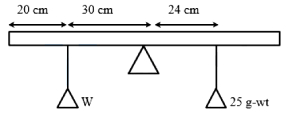
$A$ metre scale is supported on a wedge at its centre of gravity. $A$ body of weight '$W$' is suspended from the $20 \text{ cm}$ mark and another weight of $25 \text{ g-wt}$ is suspended from the $74 \text{ cm}$ mark to balance it, and the metre scale remains perfectly horizontal. Neglecting the weight of the metre scale, the weight of the body is: (in $\text{ g-wt}$)
A
$20$
B
$15$
C
$33$
D
$30$
Solution
(A) The centre of gravity of a metre scale is at the $50 \text{ cm}$ mark. The wedge is placed at this point.
The distance of the weight '$W$' from the wedge is $50 \text{ cm} - 20 \text{ cm} = 30 \text{ cm}$.
The distance of the $25 \text{ g-wt}$ weight from the wedge is $74 \text{ cm} - 50 \text{ cm} = 24 \text{ cm}$.
For the scale to remain horizontal, the clockwise moment must equal the anticlockwise moment about the pivot (wedge):
$W \times 30 \text{ cm} = 25 \text{ g-wt} \times 24 \text{ cm}$
$W = \frac{25 \times 24}{30} \text{ g-wt}$
$W = \frac{600}{30} \text{ g-wt} = 20 \text{ g-wt}$
The distance of the weight '$W$' from the wedge is $50 \text{ cm} - 20 \text{ cm} = 30 \text{ cm}$.
The distance of the $25 \text{ g-wt}$ weight from the wedge is $74 \text{ cm} - 50 \text{ cm} = 24 \text{ cm}$.
For the scale to remain horizontal, the clockwise moment must equal the anticlockwise moment about the pivot (wedge):
$W \times 30 \text{ cm} = 25 \text{ g-wt} \times 24 \text{ cm}$
$W = \frac{25 \times 24}{30} \text{ g-wt}$
$W = \frac{600}{30} \text{ g-wt} = 20 \text{ g-wt}$
0 likesView Solution
141
PhysicsEasyMCQMHT CET · 2021
$A$ conducting rod of length $1 \,m$ has an area of cross-section $10^{-3} \,m^2$. One end is immersed in boiling water $(100^{\circ} C)$ and the other end in ice $(0^{\circ} C)$. If the coefficient of thermal conductivity of the rod is $96 \,cal/(s \cdot m \cdot ^{\circ}C)$ and the latent heat of fusion for ice is $8 \times 10^4 \,cal/kg$,then the amount of ice that will melt in one minute is:
A
$5.4 \times 10^{-3} \,kg$
B
$7.2 \times 10^{-3} \,kg$
C
$1.8 \times 10^{-3} \,kg$
D
$3.6 \times 10^{-3} \,kg$
Solution
(B) The rate of heat flow through the rod is given by the formula: $Q = \frac{KA(\Delta \theta)t}{\ell}$.
This heat is used to melt the ice,so $Q = mL$,where $m$ is the mass of ice melted and $L$ is the latent heat of fusion.
Equating the two expressions: $mL = \frac{KA(\Delta \theta)t}{\ell}$.
Given values: $K = 96 \,cal/(s \cdot m \cdot ^{\circ}C)$,$A = 10^{-3} \,m^2$,$\Delta \theta = 100^{\circ}C - 0^{\circ}C = 100^{\circ}C$,$t = 60 \,s$,$\ell = 1 \,m$,and $L = 8 \times 10^4 \,cal/kg$.
Substituting these values into the equation:
$m = \frac{96 \times 10^{-3} \times 100 \times 60}{1 \times 8 \times 10^4}$.
$m = \frac{96 \times 10^{-1} \times 60}{8 \times 10^4} = \frac{576}{8 \times 10^5} = 72 \times 10^{-4} \,kg = 7.2 \times 10^{-3} \,kg$.
This heat is used to melt the ice,so $Q = mL$,where $m$ is the mass of ice melted and $L$ is the latent heat of fusion.
Equating the two expressions: $mL = \frac{KA(\Delta \theta)t}{\ell}$.
Given values: $K = 96 \,cal/(s \cdot m \cdot ^{\circ}C)$,$A = 10^{-3} \,m^2$,$\Delta \theta = 100^{\circ}C - 0^{\circ}C = 100^{\circ}C$,$t = 60 \,s$,$\ell = 1 \,m$,and $L = 8 \times 10^4 \,cal/kg$.
Substituting these values into the equation:
$m = \frac{96 \times 10^{-3} \times 100 \times 60}{1 \times 8 \times 10^4}$.
$m = \frac{96 \times 10^{-1} \times 60}{8 \times 10^4} = \frac{576}{8 \times 10^5} = 72 \times 10^{-4} \,kg = 7.2 \times 10^{-3} \,kg$.
0 likesView Solution
142
PhysicsDifficultMCQMHT CET · 2021
The temperature difference between two sides of a metal plate,$3 \ cm$ thick,is $15^{\circ} C$. Heat is transmitted through the plate at the rate of $900 \ kcal$ per minute per $m^2$ at steady state. The thermal conductivity of the metal is:
A
$1.8 \times 10^{-2} \ \frac{kcal}{m \cdot s \cdot ^{\circ}C}$
B
$4.5 \times 10^{-2} \ \frac{kcal}{m \cdot s \cdot ^{\circ}C}$
C
$3 \times 10^{-2} \ \frac{kcal}{m \cdot s \cdot ^{\circ}C}$
D
$6 \times 10^{-2} \ \frac{kcal}{m \cdot s \cdot ^{\circ}C}$
Solution
(C) The rate of heat flow through a conductor is given by the formula: $\frac{Q}{t} = \frac{kA \Delta \theta}{d}$.
Rearranging for thermal conductivity $k$: $k = \frac{Q}{tA} \cdot \frac{d}{\Delta \theta}$.
Given: Heat flux $\frac{Q}{tA} = 900 \ kcal / (min \cdot m^2) = \frac{900}{60} \ kcal / (s \cdot m^2) = 15 \ kcal / (s \cdot m^2)$.
Thickness $d = 3 \ cm = 3 \times 10^{-2} \ m$.
Temperature difference $\Delta \theta = 15^{\circ} C$.
Substituting the values: $k = \frac{15 \times 3 \times 10^{-2}}{15} = 3 \times 10^{-2} \ kcal / (m \cdot s \cdot ^{\circ}C)$.
Rearranging for thermal conductivity $k$: $k = \frac{Q}{tA} \cdot \frac{d}{\Delta \theta}$.
Given: Heat flux $\frac{Q}{tA} = 900 \ kcal / (min \cdot m^2) = \frac{900}{60} \ kcal / (s \cdot m^2) = 15 \ kcal / (s \cdot m^2)$.
Thickness $d = 3 \ cm = 3 \times 10^{-2} \ m$.
Temperature difference $\Delta \theta = 15^{\circ} C$.
Substituting the values: $k = \frac{15 \times 3 \times 10^{-2}}{15} = 3 \times 10^{-2} \ kcal / (m \cdot s \cdot ^{\circ}C)$.
0 likesView Solution
143
PhysicsMediumMCQMHT CET · 2021
Two rods of the same length and material are joined end-to-end. They transfer a certain amount of heat in $8 \ s$. When they are joined in parallel,they transfer the same amount of heat under the same conditions in a time of: (in $s$)
A
$3$
B
$2$
C
$1$
D
$4$
Solution
(B) Let $R$ be the thermal resistance of each rod. When connected in series,the total thermal resistance is $R_{s} = R + R = 2R$.
The heat transferred in series is $Q = \frac{\Delta T}{R_{s}} \times t_{s} = \frac{\Delta T}{2R} \times 8 = \frac{4 \Delta T}{R}$.
When connected in parallel,the equivalent thermal resistance is $R_{p} = \frac{R \times R}{R + R} = \frac{R}{2}$.
The heat transferred in parallel is $Q = \frac{\Delta T}{R_{p}} \times t_{p} = \frac{\Delta T}{R/2} \times t_{p} = \frac{2 \Delta T}{R} \times t_{p}$.
Since the heat transferred $Q$ is the same in both cases,we equate the expressions:
$\frac{4 \Delta T}{R} = \frac{2 \Delta T}{R} \times t_{p}$.
Solving for $t_{p}$,we get $t_{p} = \frac{4}{2} = 2 \ s$.
The heat transferred in series is $Q = \frac{\Delta T}{R_{s}} \times t_{s} = \frac{\Delta T}{2R} \times 8 = \frac{4 \Delta T}{R}$.
When connected in parallel,the equivalent thermal resistance is $R_{p} = \frac{R \times R}{R + R} = \frac{R}{2}$.
The heat transferred in parallel is $Q = \frac{\Delta T}{R_{p}} \times t_{p} = \frac{\Delta T}{R/2} \times t_{p} = \frac{2 \Delta T}{R} \times t_{p}$.
Since the heat transferred $Q$ is the same in both cases,we equate the expressions:
$\frac{4 \Delta T}{R} = \frac{2 \Delta T}{R} \times t_{p}$.
Solving for $t_{p}$,we get $t_{p} = \frac{4}{2} = 2 \ s$.
0 likesView Solution
144
PhysicsEasyMCQMHT CET · 2021
$A$ cylindrical rod has temperatures $\theta_1$ and $\theta_2$ at its ends. The rate of heat flow is $Q \ J s^{-1}$. All the linear dimensions of the rod are doubled while keeping the temperatures constant. What is the new rate of flow of heat?
A
$\frac{Q}{2}$
B
$\frac{Q}{4}$
C
$2 Q$
D
$\frac{3 Q}{2}$
Solution
(C) The rate of heat flow through a rod is given by $Q = \frac{kA(\theta_1 - \theta_2)}{\ell}$,where $k$ is thermal conductivity,$A$ is the cross-sectional area,and $\ell$ is the length of the rod.
When all linear dimensions are doubled,the radius $r$ becomes $2r$ and the length $\ell$ becomes $2\ell$.
The new area $A' = \pi(2r)^2 = 4\pi r^2 = 4A$.
The new length $\ell' = 2\ell$.
The new rate of heat flow $Q'$ is given by $Q' = \frac{kA'(\theta_1 - \theta_2)}{\ell'}$.
Substituting the new values: $Q' = \frac{k(4A)(\theta_1 - \theta_2)}{2\ell} = 2 \left( \frac{kA(\theta_1 - \theta_2)}{\ell} \right) = 2Q$.
When all linear dimensions are doubled,the radius $r$ becomes $2r$ and the length $\ell$ becomes $2\ell$.
The new area $A' = \pi(2r)^2 = 4\pi r^2 = 4A$.
The new length $\ell' = 2\ell$.
The new rate of heat flow $Q'$ is given by $Q' = \frac{kA'(\theta_1 - \theta_2)}{\ell'}$.
Substituting the new values: $Q' = \frac{k(4A)(\theta_1 - \theta_2)}{2\ell} = 2 \left( \frac{kA(\theta_1 - \theta_2)}{\ell} \right) = 2Q$.
0 likesView Solution
145
PhysicsEasyMCQMHT CET · 2021
The rate of flow of heat through a copper rod with a temperature difference of $28^{\circ} C$ is $1400 \ cal s^{-1}$. The thermal resistance of the copper rod will be:
A
$0.05 \ ^{\circ} C s cal^{-1}$
B
$0.02 \ ^{\circ} C s cal^{-1}$
C
$5 \ ^{\circ} C s cal^{-1}$
D
$2 \ ^{\circ} C s cal^{-1}$
Solution
(B) The thermal resistance $(R_{th})$ is defined as the ratio of the temperature difference $(\Delta T)$ to the rate of heat flow ($H$ or thermal current).
Formula: $R_{th} = \frac{\Delta T}{H}$
Given:
Temperature difference $\Delta T = 28^{\circ} C$
Rate of heat flow $H = 1400 \ cal s^{-1}$
Calculation:
$R_{th} = \frac{28}{1400} \ ^{\circ} C s cal^{-1}$
$R_{th} = 0.02 \ ^{\circ} C s cal^{-1}$
Therefore, the thermal resistance is $0.02 \ ^{\circ} C s cal^{-1}$.
Formula: $R_{th} = \frac{\Delta T}{H}$
Given:
Temperature difference $\Delta T = 28^{\circ} C$
Rate of heat flow $H = 1400 \ cal s^{-1}$
Calculation:
$R_{th} = \frac{28}{1400} \ ^{\circ} C s cal^{-1}$
$R_{th} = 0.02 \ ^{\circ} C s cal^{-1}$
Therefore, the thermal resistance is $0.02 \ ^{\circ} C s cal^{-1}$.
0 likesView Solution
146
PhysicsMediumMCQMHT CET · 2021
The temperature difference between two sides of an iron plate,$1.8 \ cm$ thick is $9^{\circ} C$. Heat is transmitted through the plate at a rate of $10 \ kcal / (s \cdot m^2)$ at steady state. The thermal conductivity of iron is:
A
$0.02 \ kcal / (m \cdot s \cdot ^{\circ} C)$
B
$0.04 \ kcal / (m \cdot s \cdot ^{\circ} C)$
C
$0.05 \ kcal / (m \cdot s \cdot ^{\circ} C)$
D
$0.004 \ kcal / (m \cdot s \cdot ^{\circ} C)$
Solution
(A) The rate of heat flow per unit area is given by the formula: $\frac{Q}{At} = \frac{k \Delta \theta}{d}$.
Given:
Heat flux $\frac{Q}{At} = 10 \ kcal / (s \cdot m^2)$
Thickness $d = 1.8 \ cm = 1.8 \times 10^{-2} \ m$
Temperature difference $\Delta \theta = 9^{\circ} C$
Substituting the values into the formula:
$10 = k \times \frac{9}{1.8 \times 10^{-2}}$
$10 = k \times \frac{9}{0.018}$
$10 = k \times 500$
$k = \frac{10}{500} = \frac{1}{50} = 0.02 \ kcal / (m \cdot s \cdot ^{\circ} C)$.
Given:
Heat flux $\frac{Q}{At} = 10 \ kcal / (s \cdot m^2)$
Thickness $d = 1.8 \ cm = 1.8 \times 10^{-2} \ m$
Temperature difference $\Delta \theta = 9^{\circ} C$
Substituting the values into the formula:
$10 = k \times \frac{9}{1.8 \times 10^{-2}}$
$10 = k \times \frac{9}{0.018}$
$10 = k \times 500$
$k = \frac{10}{500} = \frac{1}{50} = 0.02 \ kcal / (m \cdot s \cdot ^{\circ} C)$.
0 likesView Solution
147
PhysicsMediumMCQMHT CET · 2021
$A$ cylindrical rod has temperatures $T_1$ and $T_2$ at its ends. The rate of flow of heat is $Q_1 \text{ cal s}^{-1}$. If the length and radius of the rod are doubled while keeping the temperatures constant,then the new rate of flow of heat $Q_2$ will be:
A
$Q_2 = \frac{Q_1}{2}$
B
$Q_2 = \frac{Q_1}{4}$
C
$Q_2 = 4 Q_1$
D
$Q_2 = 2 Q_1$
Solution
(D) The rate of heat flow through a cylindrical rod is given by the formula: $Q = \frac{kA(T_1 - T_2)}{L}$,where $A = \pi r^2$.
Thus,$Q_1 = \frac{k \pi r_1^2 (T_1 - T_2)}{L_1}$.
When the length and radius are doubled,we have $L_2 = 2L_1$ and $r_2 = 2r_1$.
The new rate of heat flow is $Q_2 = \frac{k \pi r_2^2 (T_1 - T_2)}{L_2}$.
Taking the ratio: $\frac{Q_2}{Q_1} = \left( \frac{r_2}{r_1} \right)^2 \cdot \left( \frac{L_1}{L_2} \right)$.
Substituting the values: $\frac{Q_2}{Q_1} = (2)^2 \cdot \left( \frac{1}{2} \right) = 4 \cdot \frac{1}{2} = 2$.
Therefore,$Q_2 = 2 Q_1$.
Thus,$Q_1 = \frac{k \pi r_1^2 (T_1 - T_2)}{L_1}$.
When the length and radius are doubled,we have $L_2 = 2L_1$ and $r_2 = 2r_1$.
The new rate of heat flow is $Q_2 = \frac{k \pi r_2^2 (T_1 - T_2)}{L_2}$.
Taking the ratio: $\frac{Q_2}{Q_1} = \left( \frac{r_2}{r_1} \right)^2 \cdot \left( \frac{L_1}{L_2} \right)$.
Substituting the values: $\frac{Q_2}{Q_1} = (2)^2 \cdot \left( \frac{1}{2} \right) = 4 \cdot \frac{1}{2} = 2$.
Therefore,$Q_2 = 2 Q_1$.
0 likesView Solution
148
PhysicsEasyMCQMHT CET · 2021
For a perfectly black body,the coefficient of emission (emissivity) is:
A
zero.
B
unity.
C
less than one (non-zero).
D
infinity.
Solution
(B) perfectly black body is defined as an object that absorbs all incident radiation of any wavelength. According to Kirchhoff's law of thermal radiation,for an arbitrary body in thermal equilibrium with its surroundings,the emissivity is equal to its absorptivity. Since a perfectly black body has an absorptivity of $1$,its emissivity (coefficient of emission) must also be $1$,which is referred to as unity.
0 likesView Solution
149
PhysicsEasyMCQMHT CET · 2021
Two stars '$P$' and '$Q$' emit yellow and blue light respectively. The relation between their temperatures ($T_{P}$ and $T_{Q}$) is
A
$T_{P} = T_{Q}$
B
$T_{P} = \frac{T_{Q}}{2}$
C
$T_{P} > T_{Q}$
D
$T_{P} < T_{Q}$
Solution
(D) According to Wien's displacement law,the product of the wavelength of maximum emission $(\lambda_{m})$ and the absolute temperature $(T)$ is a constant,i.e.,$\lambda_{m} T = b$.
This implies that $T \propto \frac{1}{\lambda_{m}}$.
The wavelength of blue light is shorter than the wavelength of yellow light $(\lambda_{\text{blue}} < \lambda_{\text{yellow}})$.
Since the star '$Q$' emits blue light and star '$P$' emits yellow light,we have $\lambda_{Q} < \lambda_{P}$.
Therefore,$T_{Q} > T_{P}$,which can also be written as $T_{P} < T_{Q}$.
This implies that $T \propto \frac{1}{\lambda_{m}}$.
The wavelength of blue light is shorter than the wavelength of yellow light $(\lambda_{\text{blue}} < \lambda_{\text{yellow}})$.
Since the star '$Q$' emits blue light and star '$P$' emits yellow light,we have $\lambda_{Q} < \lambda_{P}$.
Therefore,$T_{Q} > T_{P}$,which can also be written as $T_{P} < T_{Q}$.
0 likesView Solution
150
PhysicsEasyMCQMHT CET · 2021
$A$ black rectangular surface of area '$A$' emits energy '$E$' per second at $27^{\circ}C$. If length and breadth are reduced to $(1/3)^{rd}$ of their initial values and temperature is raised to $327^{\circ}C$,then the energy emitted per second becomes:
A
$\frac{20 E}{9}$
B
$\frac{8 E}{9}$
C
$\frac{16 E}{9}$
D
$\frac{4 E}{9}$
Solution
(C) According to Stefan-Boltzmann Law,the energy emitted per second by a black body is given by $E = \sigma A T^4$.
Initially,$E = \sigma A T^4$,where $T = 27^{\circ}C = 300 \ K$.
When the length and breadth are reduced to $1/3$ of their initial values,the new area $A' = (L/3) \times (B/3) = A/9$.
The new temperature $T' = 327^{\circ}C = 600 \ K$.
The new energy emitted per second is $E' = \sigma A' (T')^4$.
Taking the ratio: $\frac{E'}{E} = \frac{A'}{A} \times \left(\frac{T'}{T}\right)^4$.
Substituting the values: $\frac{E'}{E} = \frac{1}{9} \times \left(\frac{600}{300}\right)^4 = \frac{1}{9} \times (2)^4 = \frac{16}{9}$.
Therefore,$E' = \frac{16 E}{9}$.
Initially,$E = \sigma A T^4$,where $T = 27^{\circ}C = 300 \ K$.
When the length and breadth are reduced to $1/3$ of their initial values,the new area $A' = (L/3) \times (B/3) = A/9$.
The new temperature $T' = 327^{\circ}C = 600 \ K$.
The new energy emitted per second is $E' = \sigma A' (T')^4$.
Taking the ratio: $\frac{E'}{E} = \frac{A'}{A} \times \left(\frac{T'}{T}\right)^4$.
Substituting the values: $\frac{E'}{E} = \frac{1}{9} \times \left(\frac{600}{300}\right)^4 = \frac{1}{9} \times (2)^4 = \frac{16}{9}$.
Therefore,$E' = \frac{16 E}{9}$.
0 likesView Solution
151
PhysicsEasyMCQMHT CET · 2021
In a photoelectric experiment,keeping the frequency of incident radiation and the accelerating potential fixed,if the intensity of incident light is increased,then:
A
photoelectric current decreases
B
kinetic energy of emitted photoelectrons decreases
C
photoelectric current increases
D
kinetic energy of emitted photoelectrons increases
Solution
(C) In the photoelectric effect,the photoelectric current is directly proportional to the intensity of the incident light,provided the frequency is above the threshold frequency. Since the frequency and accelerating potential are kept constant,increasing the intensity of the incident light increases the number of photons incident per unit time,which in turn increases the number of photoelectrons emitted per unit time. Therefore,the photoelectric current increases.
0 likesView Solution
152
PhysicsEasyMCQMHT CET · 2021
When the wavelength of incident radiation on a metal surface is reduced from $\lambda_1$ to $\lambda_2$,the kinetic energy of the emitted photoelectrons is tripled. Find the work function of the metal. [$h =$ Planck's constant,$c =$ velocity of light]
A
$\frac{hc}{2}\left[\frac{3 \lambda_1-\lambda_2}{\lambda_1 \lambda_2}\right]$
B
$\frac{hc}{2}\left[\frac{3 \lambda_2-\lambda_1}{\lambda_1 \lambda_2}\right]$
C
$hc\left[\frac{3 \lambda_1-\lambda_2}{\lambda_1 \lambda_2}\right]$
D
$hc\left[\frac{3 \lambda_2-\lambda_1}{\lambda_1 \lambda_2}\right]$
Solution
(B) According to Einstein's photoelectric equation,the kinetic energy $K$ is given by $K = \frac{hc}{\lambda} - W_0$,where $W_0$ is the work function.
For wavelength $\lambda_1$,the kinetic energy is $K_1 = \frac{hc}{\lambda_1} - W_0$.
For wavelength $\lambda_2$,the kinetic energy is $K_2 = \frac{hc}{\lambda_2} - W_0$.
Given that $K_2 = 3K_1$,we substitute the expressions:
$\frac{hc}{\lambda_2} - W_0 = 3\left(\frac{hc}{\lambda_1} - W_0\right)$.
$\frac{hc}{\lambda_2} - W_0 = \frac{3hc}{\lambda_1} - 3W_0$.
Rearranging the terms to solve for $W_0$:
$3W_0 - W_0 = \frac{3hc}{\lambda_1} - \frac{hc}{\lambda_2}$.
$2W_0 = hc\left(\frac{3}{\lambda_1} - \frac{1}{\lambda_2}\right)$.
$2W_0 = hc\left(\frac{3\lambda_2 - \lambda_1}{\lambda_1\lambda_2}\right)$.
Therefore,$W_0 = \frac{hc}{2}\left(\frac{3\lambda_2 - \lambda_1}{\lambda_1\lambda_2}\right)$.
For wavelength $\lambda_1$,the kinetic energy is $K_1 = \frac{hc}{\lambda_1} - W_0$.
For wavelength $\lambda_2$,the kinetic energy is $K_2 = \frac{hc}{\lambda_2} - W_0$.
Given that $K_2 = 3K_1$,we substitute the expressions:
$\frac{hc}{\lambda_2} - W_0 = 3\left(\frac{hc}{\lambda_1} - W_0\right)$.
$\frac{hc}{\lambda_2} - W_0 = \frac{3hc}{\lambda_1} - 3W_0$.
Rearranging the terms to solve for $W_0$:
$3W_0 - W_0 = \frac{3hc}{\lambda_1} - \frac{hc}{\lambda_2}$.
$2W_0 = hc\left(\frac{3}{\lambda_1} - \frac{1}{\lambda_2}\right)$.
$2W_0 = hc\left(\frac{3\lambda_2 - \lambda_1}{\lambda_1\lambda_2}\right)$.
Therefore,$W_0 = \frac{hc}{2}\left(\frac{3\lambda_2 - \lambda_1}{\lambda_1\lambda_2}\right)$.
0 likesView Solution
153
PhysicsEasyMCQMHT CET · 2021
In the photoelectric effect,the photocurrent:
A
does not depend on the frequency of the photon but depends on the intensity of the incident light.
B
decreases with an increase in the frequency of the incident photon.
C
increases with an increase in the frequency of the incident photon.
D
depends on the intensity of the incident radiation and its frequency.
Solution
(A) In the photoelectric effect,the photocurrent is directly proportional to the number of photoelectrons emitted per unit time.
Since each incident photon ejects at most one photoelectron,the number of photoelectrons emitted depends solely on the number of incident photons per unit time,which is determined by the intensity of the incident light.
The frequency of the incident light determines the kinetic energy of the emitted photoelectrons,provided the frequency is above the threshold frequency,but it does not affect the magnitude of the photocurrent.
Since each incident photon ejects at most one photoelectron,the number of photoelectrons emitted depends solely on the number of incident photons per unit time,which is determined by the intensity of the incident light.
The frequency of the incident light determines the kinetic energy of the emitted photoelectrons,provided the frequency is above the threshold frequency,but it does not affect the magnitude of the photocurrent.
0 likesView Solution
154
PhysicsDifficultMCQMHT CET · 2021
In a photoelectric experiment,a graph of maximum kinetic energy $(KE_{\max})$ against the frequency of incident radiation $(\nu)$ is plotted. If $A$ and $B$ are the intercepts on the $X$ and $Y$ axis respectively,the Planck's constant is given by:
A
$A+B$
B
$\frac{B}{A}$
C
$A \times B$
D
$\frac{A}{B}$
Solution
(B) According to Einstein's photoelectric equation,the maximum kinetic energy is given by:
$(KE)_{\max} = h\nu - \phi_0$
where $\phi_0 = h\nu_0$ is the work function.
Comparing this with the equation of a straight line $y = mx + c$:
Here,$y = (KE)_{\max}$,$x = \nu$,$m = h$ (slope),and $c = -h\nu_0$ (y-intercept).
$1$. The $X$-intercept $(A)$ occurs when $(KE)_{\max} = 0$:
$0 = h\nu - h\nu_0 \implies \nu = \nu_0 = A$.
$2$. The $Y$-intercept $(B)$ occurs when $\nu = 0$:
$(KE)_{\max} = -h\nu_0 = B$. Since $B$ represents the magnitude of the intercept,we take $|B| = h\nu_0$.
Therefore,the ratio of the magnitude of the $Y$-intercept to the $X$-intercept is:
$\frac{|B|}{A} = \frac{h\nu_0}{\nu_0} = h$.
Thus,Planck's constant $h$ is given by $\frac{B}{A}$ (considering magnitudes).
$(KE)_{\max} = h\nu - \phi_0$
where $\phi_0 = h\nu_0$ is the work function.
Comparing this with the equation of a straight line $y = mx + c$:
Here,$y = (KE)_{\max}$,$x = \nu$,$m = h$ (slope),and $c = -h\nu_0$ (y-intercept).
$1$. The $X$-intercept $(A)$ occurs when $(KE)_{\max} = 0$:
$0 = h\nu - h\nu_0 \implies \nu = \nu_0 = A$.
$2$. The $Y$-intercept $(B)$ occurs when $\nu = 0$:
$(KE)_{\max} = -h\nu_0 = B$. Since $B$ represents the magnitude of the intercept,we take $|B| = h\nu_0$.
Therefore,the ratio of the magnitude of the $Y$-intercept to the $X$-intercept is:
$\frac{|B|}{A} = \frac{h\nu_0}{\nu_0} = h$.
Thus,Planck's constant $h$ is given by $\frac{B}{A}$ (considering magnitudes).
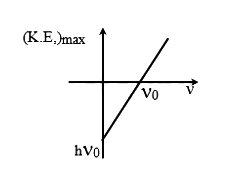
0 likesView Solution
155
PhysicsMediumMCQMHT CET · 2021
$A$ light of wavelength $\lambda$ and intensity $I$ falls on a photosensitive material. If $N$ photoelectrons are emitted,each with kinetic energy $E$,then:
A
$E \propto I, N \propto \lambda$
B
$E \propto I, N \propto I$
C
$E \propto I, N \propto \frac{1}{\lambda}$
D
$E \propto \frac{1}{\lambda}, N \propto I$
Solution
(D) According to Einstein's photoelectric equation,the kinetic energy $E$ of an emitted photoelectron is given by $E = \frac{hc}{\lambda} - \phi$,where $\phi$ is the work function of the material. This shows that $E$ depends only on the wavelength $\lambda$ of the incident light,specifically $E \propto \frac{1}{\lambda}$.
Intensity $I$ of light is proportional to the number of photons incident per unit area per unit time. Since each photon interacts with one electron to cause emission,the number of emitted photoelectrons $N$ is directly proportional to the intensity $I$ of the incident light $(N \propto I)$.
Intensity $I$ of light is proportional to the number of photons incident per unit area per unit time. Since each photon interacts with one electron to cause emission,the number of emitted photoelectrons $N$ is directly proportional to the intensity $I$ of the incident light $(N \propto I)$.
0 likesView Solution
156
PhysicsEasyMCQMHT CET · 2021
$A$ conducting loop of resistance $R$ is moved into a magnetic field. The total induced charge depends upon:
A
initial magnetic flux and $R$.
B
final magnetic flux and $R$.
C
the total change in magnetic flux and $R$.
D
the rate of change of magnetic flux and $R$.
Solution
(C) According to Faraday's law of induction,the induced electromotive force $(e)$ is given by $e = -\frac{\Delta \phi}{\Delta t}$.
Using Ohm's law,the induced current $(i)$ is $i = \frac{e}{R} = \frac{1}{R} \cdot \frac{\Delta \phi}{\Delta t}$.
Since current is the rate of flow of charge,we have $i = \frac{\Delta q}{\Delta t}$.
Equating the two expressions for current: $\frac{\Delta q}{\Delta t} = \frac{1}{R} \cdot \frac{\Delta \phi}{\Delta t}$.
Therefore,the total induced charge is $\Delta q = \frac{\Delta \phi}{R}$.
This shows that the total induced charge depends only on the total change in magnetic flux $(\Delta \phi)$ and the resistance $(R)$.
Using Ohm's law,the induced current $(i)$ is $i = \frac{e}{R} = \frac{1}{R} \cdot \frac{\Delta \phi}{\Delta t}$.
Since current is the rate of flow of charge,we have $i = \frac{\Delta q}{\Delta t}$.
Equating the two expressions for current: $\frac{\Delta q}{\Delta t} = \frac{1}{R} \cdot \frac{\Delta \phi}{\Delta t}$.
Therefore,the total induced charge is $\Delta q = \frac{\Delta \phi}{R}$.
This shows that the total induced charge depends only on the total change in magnetic flux $(\Delta \phi)$ and the resistance $(R)$.
0 likesView Solution
157
PhysicsMediumMCQMHT CET · 2021
An inductor coil wound uniformly has self-inductance $L$ and resistance $R$. The coil is broken into two identical parts. The two parts are then connected in parallel across a battery of $E$ volt of negligible internal resistance. The current through the battery at steady state is
A
$\frac{2 E}{R}$
B
$\frac{3 E}{R}$
C
$\frac{4 E}{R}$
D
$\frac{E}{R}$
Solution
(C) In a $DC$ circuit at steady state,the inductor acts as a simple wire with zero resistance (ideal inductor) or just a conductor with its inherent resistance $R$.
Since the coil is broken into two identical parts,the resistance of each part becomes $R' = \frac{R}{2}$.
When these two parts are connected in parallel,the equivalent resistance $R_{eq}$ is given by $\frac{1}{R_{eq}} = \frac{1}{R'} + \frac{1}{R'} = \frac{2}{R'} = \frac{2}{R/2} = \frac{4}{R}$.
Thus,$R_{eq} = \frac{R}{4}$.
The current $I$ through the battery is given by Ohm's law: $I = \frac{E}{R_{eq}} = \frac{E}{R/4} = \frac{4 E}{R}$.
Since the coil is broken into two identical parts,the resistance of each part becomes $R' = \frac{R}{2}$.
When these two parts are connected in parallel,the equivalent resistance $R_{eq}$ is given by $\frac{1}{R_{eq}} = \frac{1}{R'} + \frac{1}{R'} = \frac{2}{R'} = \frac{2}{R/2} = \frac{4}{R}$.
Thus,$R_{eq} = \frac{R}{4}$.
The current $I$ through the battery is given by Ohm's law: $I = \frac{E}{R_{eq}} = \frac{E}{R/4} = \frac{4 E}{R}$.
0 likesView Solution
158
PhysicsEasyMCQMHT CET · 2021
The magnetic potential energy stored in a certain inductor is $25 \ mJ$,when the current in the inductor is $50 \ mA$. What is the inductance (in $H$)?
A
$2.00$
B
$0.20$
C
$200$
D
$20$
Solution
(D) The magnetic potential energy $U$ stored in an inductor is given by the formula: $U = \frac{1}{2} LI^2$.
Given:
$U = 25 \ mJ = 25 \times 10^{-3} \ J$
$I = 50 \ mA = 50 \times 10^{-3} \ A$
Rearranging the formula to solve for inductance $L$:
$L = \frac{2U}{I^2}$
Substituting the values:
$L = \frac{2 \times 25 \times 10^{-3}}{(50 \times 10^{-3})^2}$
$L = \frac{50 \times 10^{-3}}{2500 \times 10^{-6}}$
$L = \frac{50 \times 10^{-3}}{2.5 \times 10^{-3}}$
$L = 20 \ H$.
Given:
$U = 25 \ mJ = 25 \times 10^{-3} \ J$
$I = 50 \ mA = 50 \times 10^{-3} \ A$
Rearranging the formula to solve for inductance $L$:
$L = \frac{2U}{I^2}$
Substituting the values:
$L = \frac{2 \times 25 \times 10^{-3}}{(50 \times 10^{-3})^2}$
$L = \frac{50 \times 10^{-3}}{2500 \times 10^{-6}}$
$L = \frac{50 \times 10^{-3}}{2.5 \times 10^{-3}}$
$L = 20 \ H$.
0 likesView Solution
159
PhysicsDifficultMCQMHT CET · 2021
The pure inductors,each of inductance $6 \ H$,are connected as shown in the figure. Their equivalent inductance between the points $P$ and $Q$ is (in $H$)
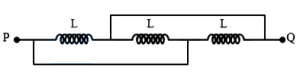
A
$0.5$
B
$18$
C
$6.3$
D
$2$
Solution
(D) In the given circuit,all three inductors have their left terminals connected to point $P$ and their right terminals connected to point $Q$.
This means the three inductors are connected in parallel.
The formula for the equivalent inductance $L_{eq}$ of inductors connected in parallel is given by:
$\frac{1}{L_{eq}} = \frac{1}{L_1} + \frac{1}{L_2} + \frac{1}{L_3}$
Given $L_1 = L_2 = L_3 = 6 \ H$,we have:
$\frac{1}{L_{eq}} = \frac{1}{6} + \frac{1}{6} + \frac{1}{6} = \frac{3}{6} = \frac{1}{2} \ H^{-1}$
Therefore,$L_{eq} = 2 \ H$.
This means the three inductors are connected in parallel.
The formula for the equivalent inductance $L_{eq}$ of inductors connected in parallel is given by:
$\frac{1}{L_{eq}} = \frac{1}{L_1} + \frac{1}{L_2} + \frac{1}{L_3}$
Given $L_1 = L_2 = L_3 = 6 \ H$,we have:
$\frac{1}{L_{eq}} = \frac{1}{6} + \frac{1}{6} + \frac{1}{6} = \frac{3}{6} = \frac{1}{2} \ H^{-1}$
Therefore,$L_{eq} = 2 \ H$.
0 likesView Solution
160
PhysicsEasyMCQMHT CET · 2021
If a current flowing in a coil is reduced to half of its initial value,the relation between the new energy $(E_2)$ and the original energy $(E_1)$ stored in the coil will be
A
$E_2 = \frac{E_1}{4}$
B
$E_2 = \frac{E_1}{2}$
C
$E_2 = E_1$
D
$E_2 = 4E_1$
Solution
(A) The energy $E$ stored in a coil with self-inductance $L$ carrying current $I$ is given by the formula: $E = \frac{1}{2} LI^2$.
Let the initial current be $I_1$ and the initial energy be $E_1 = \frac{1}{2} LI_1^2$.
Let the new current be $I_2 = \frac{I_1}{2}$ and the new energy be $E_2 = \frac{1}{2} LI_2^2$.
Taking the ratio of the two energies:
$\frac{E_2}{E_1} = \frac{\frac{1}{2} LI_2^2}{\frac{1}{2} LI_1^2} = \left( \frac{I_2}{I_1} \right)^2$.
Substituting $I_2 = \frac{I_1}{2}$:
$\frac{E_2}{E_1} = \left( \frac{I_1 / 2}{I_1} \right)^2 = \left( \frac{1}{2} \right)^2 = \frac{1}{4}$.
Therefore,$E_2 = \frac{E_1}{4}$.
Let the initial current be $I_1$ and the initial energy be $E_1 = \frac{1}{2} LI_1^2$.
Let the new current be $I_2 = \frac{I_1}{2}$ and the new energy be $E_2 = \frac{1}{2} LI_2^2$.
Taking the ratio of the two energies:
$\frac{E_2}{E_1} = \frac{\frac{1}{2} LI_2^2}{\frac{1}{2} LI_1^2} = \left( \frac{I_2}{I_1} \right)^2$.
Substituting $I_2 = \frac{I_1}{2}$:
$\frac{E_2}{E_1} = \left( \frac{I_1 / 2}{I_1} \right)^2 = \left( \frac{1}{2} \right)^2 = \frac{1}{4}$.
Therefore,$E_2 = \frac{E_1}{4}$.
0 likesView Solution
161
PhysicsMediumMCQMHT CET · 2021
$A$ circuit has self-inductance $L$ and carries a current $I$. To prevent sparking when the circuit is switched off,a capacitor which can withstand potential difference $V$ is used. The least capacitance is
A
$\frac{IV}{L}$
B
$L\left(\frac{V}{I}\right)^2$
C
$L\left(\frac{I}{V}\right)^2$
D
$\frac{LI}{V}$
Solution
(C) The energy stored in the inductor is given by $U = \frac{1}{2} LI^2$.
When the circuit is switched off,this energy must be transferred to the capacitor to prevent sparking.
The energy stored by the capacitor is given by $W = \frac{1}{2} CV^2$.
Equating the two energies: $\frac{1}{2} CV^2 = \frac{1}{2} LI^2$.
Solving for $C$: $C = \frac{LI^2}{V^2} = L\left(\frac{I}{V}\right)^2$.
When the circuit is switched off,this energy must be transferred to the capacitor to prevent sparking.
The energy stored by the capacitor is given by $W = \frac{1}{2} CV^2$.
Equating the two energies: $\frac{1}{2} CV^2 = \frac{1}{2} LI^2$.
Solving for $C$: $C = \frac{LI^2}{V^2} = L\left(\frac{I}{V}\right)^2$.
0 likesView Solution
162
PhysicsEasyMCQMHT CET · 2021
$A$ metal wire of length $2500 \ m$ is kept in east-west direction,at a certain height from the ground. If it falls freely on the ground,then the current induced in the wire when its speed is $10 \ m/s$ is (Resistance of wire $= 25 \ \Omega$,$g = 10 \ m/s^2$ and Earth's horizontal component of magnetic field $B_{H} = 2 \times 10^{-5} \ T$). (in $A$)
A
$0.2$
B
$0.02$
C
$0.01$
D
$2$
Solution
(B) The motional electromotive force (emf) induced in a conductor moving through a magnetic field is given by $e = B_{H} l v$.
Given:
Length of wire $l = 2500 \ m$
Speed of wire $v = 10 \ m/s$
Horizontal component of Earth's magnetic field $B_{H} = 2 \times 10^{-5} \ T$
Resistance of wire $R = 25 \ \Omega$
Calculating the induced emf:
$e = (2 \times 10^{-5} \ T) \times (2500 \ m) \times (10 \ m/s) = 0.5 \ V$
Now,calculating the induced current $I$ using Ohm's law:
$I = e / R = 0.5 \ V / 25 \ \Omega = 0.02 \ A$
Therefore,the induced current is $0.02 \ A$.
Given:
Length of wire $l = 2500 \ m$
Speed of wire $v = 10 \ m/s$
Horizontal component of Earth's magnetic field $B_{H} = 2 \times 10^{-5} \ T$
Resistance of wire $R = 25 \ \Omega$
Calculating the induced emf:
$e = (2 \times 10^{-5} \ T) \times (2500 \ m) \times (10 \ m/s) = 0.5 \ V$
Now,calculating the induced current $I$ using Ohm's law:
$I = e / R = 0.5 \ V / 25 \ \Omega = 0.02 \ A$
Therefore,the induced current is $0.02 \ A$.
0 likesView Solution
163
PhysicsEasyMCQMHT CET · 2021
$A$ metal conductor of length $1 \ m$ rotates vertically about one of its ends at an angular velocity of $5 \ rad/s$. If the horizontal component of the Earth's magnetic field is $0.2 \times 10^{-4} \ T$,then the e.m.f. developed between the two ends of the conductor is:
A
$5 \ \mu V$
B
$50 \ mV$
C
$5 \ mV$
D
$50 \ \mu V$
Solution
(D) The induced electromotive force $(e)$ in a conductor of length $\ell$ rotating with angular velocity $\omega$ in a magnetic field $B$ is given by the formula:
$e = \frac{1}{2} B \omega \ell^2$
Given values:
$B = 0.2 \times 10^{-4} \ T$
$\omega = 5 \ rad/s$
$\ell = 1 \ m$
Substituting these values into the formula:
$e = \frac{1}{2} \times (0.2 \times 10^{-4}) \times 5 \times (1)^2$
$e = 0.5 \times 10^{-4} \ V$
$e = 50 \times 10^{-6} \ V = 50 \ \mu V$
$e = \frac{1}{2} B \omega \ell^2$
Given values:
$B = 0.2 \times 10^{-4} \ T$
$\omega = 5 \ rad/s$
$\ell = 1 \ m$
Substituting these values into the formula:
$e = \frac{1}{2} \times (0.2 \times 10^{-4}) \times 5 \times (1)^2$
$e = 0.5 \times 10^{-4} \ V$
$e = 50 \times 10^{-6} \ V = 50 \ \mu V$
0 likesView Solution
164
PhysicsEasyMCQMHT CET · 2021
$A$ straight conductor of length $0.6 \, m$ is moved with a speed of $10 \, ms^{-1}$ perpendicular to a magnetic field of induction $1.2 \, Wb \cdot m^{-2}$. The induced e.m.f. across the conductor is (in $V$)
A
$6$
B
$7.2$
C
$0.72$
D
$12$
Solution
(B) The induced electromotive force (e.m.f.) in a conductor moving through a magnetic field is given by the formula:
$E = B \ell v$
Where:
$B = 1.2 \, Wb \cdot m^{-2}$ (Magnetic field induction)
$\ell = 0.6 \, m$ (Length of the conductor)
$v = 10 \, ms^{-1}$ (Speed of the conductor)
Substituting the values into the formula:
$E = 1.2 \times 0.6 \times 10$
$E = 7.2 \, V$
Therefore, the induced e.m.f. across the conductor is $7.2 \, V$.
$E = B \ell v$
Where:
$B = 1.2 \, Wb \cdot m^{-2}$ (Magnetic field induction)
$\ell = 0.6 \, m$ (Length of the conductor)
$v = 10 \, ms^{-1}$ (Speed of the conductor)
Substituting the values into the formula:
$E = 1.2 \times 0.6 \times 10$
$E = 7.2 \, V$
Therefore, the induced e.m.f. across the conductor is $7.2 \, V$.
0 likesView Solution
165
PhysicsMediumMCQMHT CET · 2021
Two conducting wire loops are concentric and lie in the same plane. The current in the outer loop is clockwise and increasing with time. The induced current in the inner loop is
A
clockwise
B
anticlockwise
C
in a direction which depends on the ratio of the loop radii
D
zero
Solution
(B) According to Lenz's Law,the induced current in a loop always opposes the change in magnetic flux that produces it.
As the current in the outer loop is clockwise and increasing,the magnetic field lines passing through the inner loop (directed into the plane) are increasing.
To oppose this increase in inward magnetic flux,the inner loop must generate an outward magnetic field.
By the right-hand thumb rule,an outward magnetic field is produced by an anticlockwise current.
Therefore,the induced current in the inner loop is anticlockwise.
As the current in the outer loop is clockwise and increasing,the magnetic field lines passing through the inner loop (directed into the plane) are increasing.
To oppose this increase in inward magnetic flux,the inner loop must generate an outward magnetic field.
By the right-hand thumb rule,an outward magnetic field is produced by an anticlockwise current.
Therefore,the induced current in the inner loop is anticlockwise.
0 likesView Solution
166
PhysicsMediumMCQMHT CET · 2021
$A$ wire of length $L$ having resistance $R$ falls from a height $\ell$ in the Earth's horizontal magnetic field $B$. The induced emf through the wire is ($g$ = acceleration due to gravity).
A
$BL \sqrt{2g\ell}$
B
$\frac{BL \sqrt{2g\ell}}{2}$
C
$\frac{BL \sqrt{2g\ell}}{R}$
D
$\frac{BL}{\sqrt{2g\ell}}$
Solution
(A) When a wire falls freely from a height $\ell$ under gravity,its velocity $v$ at the moment it reaches the ground is given by the equation of motion $v^2 = u^2 + 2g\ell$. Since the initial velocity $u = 0$,we have $v = \sqrt{2g\ell}$.
The motional electromotive force (emf) induced in a conductor of length $L$ moving with velocity $v$ perpendicular to a magnetic field $B$ is given by the formula $E = BLv$.
Substituting the value of $v$ into the emf equation,we get $E = BL \sqrt{2g\ell}$.
The motional electromotive force (emf) induced in a conductor of length $L$ moving with velocity $v$ perpendicular to a magnetic field $B$ is given by the formula $E = BLv$.
Substituting the value of $v$ into the emf equation,we get $E = BL \sqrt{2g\ell}$.
0 likesView Solution
167
PhysicsEasyMCQMHT CET · 2021
The north pole of a long horizontal bar magnet is being brought towards a closed circuit consisting of a coil. The direction of the induced current produced in it is
A
anticlockwise
B
horizontal
C
vertical
D
clockwise
Solution
(A) According to Lenz's law,the induced current in a closed circuit always flows in a direction such that it opposes the change in magnetic flux that produces it.
When the north pole of a bar magnet is brought towards the coil,the magnetic flux linked with the coil increases.
To oppose this increase in flux,the coil must behave like a north pole on the side facing the magnet.
According to the right-hand rule,a face behaving as a north pole has current flowing in an anticlockwise direction.
Therefore,the induced current in the coil flows in an anticlockwise direction.
When the north pole of a bar magnet is brought towards the coil,the magnetic flux linked with the coil increases.
To oppose this increase in flux,the coil must behave like a north pole on the side facing the magnet.
According to the right-hand rule,a face behaving as a north pole has current flowing in an anticlockwise direction.
Therefore,the induced current in the coil flows in an anticlockwise direction.
0 likesView Solution
168
PhysicsMediumMCQMHT CET · 2021
The magnetic flux near the axis and inside the air core solenoid of length $60 \, cm$ carrying current '$I$' is $1.57 \times 10^{-6} \, Wb$. Its magnetic moment will be $[\mu_0 = 4 \pi \times 10^{-7} \, SI \, unit$ and cross-sectional area is very small as compared to the length of the solenoid.] (in $Am^2$)
A
$1$
B
$0.25$
C
$0.5$
D
$0.75$
Solution
(D) The magnetic field inside a long solenoid is given by $B = \frac{\mu_0 NI}{L}$.
Since magnetic flux $\phi = B \cdot A$, we have $B = \frac{\phi}{A}$.
Equating the two expressions for $B$: $\frac{\phi}{A} = \frac{\mu_0 NI}{L}$.
Rearranging to find the magnetic moment $M = NIA$: $NIA = \frac{\phi L}{\mu_0}$.
Given $\phi = 1.57 \times 10^{-6} \, Wb$, $L = 0.6 \, m$, and $\mu_0 = 4 \pi \times 10^{-7} \, T \cdot m/A$.
Substituting the values: $M = \frac{1.57 \times 10^{-6} \times 0.6}{4 \pi \times 10^{-7}}$.
Using $\pi \approx 3.14$, $4 \pi \approx 12.56$.
$M = \frac{1.57 \times 10^{-6} \times 0.6}{12.56 \times 10^{-7}} = \frac{0.942 \times 10^{-6}}{12.56 \times 10^{-7}} = \frac{9.42}{12.56} \approx 0.75 \, Am^2$.
Since magnetic flux $\phi = B \cdot A$, we have $B = \frac{\phi}{A}$.
Equating the two expressions for $B$: $\frac{\phi}{A} = \frac{\mu_0 NI}{L}$.
Rearranging to find the magnetic moment $M = NIA$: $NIA = \frac{\phi L}{\mu_0}$.
Given $\phi = 1.57 \times 10^{-6} \, Wb$, $L = 0.6 \, m$, and $\mu_0 = 4 \pi \times 10^{-7} \, T \cdot m/A$.
Substituting the values: $M = \frac{1.57 \times 10^{-6} \times 0.6}{4 \pi \times 10^{-7}}$.
Using $\pi \approx 3.14$, $4 \pi \approx 12.56$.
$M = \frac{1.57 \times 10^{-6} \times 0.6}{12.56 \times 10^{-7}} = \frac{0.942 \times 10^{-6}}{12.56 \times 10^{-7}} = \frac{9.42}{12.56} \approx 0.75 \, Am^2$.
0 likesView Solution
169
PhysicsEasyMCQMHT CET · 2021
$A$ wire of length $1 \, m$ is moving at a speed of $2 \, m/s$ perpendicular to a homogeneous magnetic field of $0.5 \, T$. The ends of the wire are joined to a resistance of $6 \, \Omega$. The rate at which work is being done to keep the wire moving at that speed is:
A
$1/3 \, W$
B
$1/6 \, W$
C
$1/12 \, W$
D
$1 \, W$
Solution
(B) The induced electromotive force (emf) $e$ in the moving wire is given by $e = B \ell v$.
Substituting the given values: $e = 0.5 \, T \times 1 \, m \times 2 \, m/s = 1 \, V$.
The rate at which work is done to keep the wire moving at a constant speed is equal to the power dissipated in the resistance $R$.
The power $P$ is given by $P = \frac{e^2}{R}$.
Substituting the values: $P = \frac{(1 \, V)^2}{6 \, \Omega} = \frac{1}{6} \, W$.
Substituting the given values: $e = 0.5 \, T \times 1 \, m \times 2 \, m/s = 1 \, V$.
The rate at which work is done to keep the wire moving at a constant speed is equal to the power dissipated in the resistance $R$.
The power $P$ is given by $P = \frac{e^2}{R}$.
Substituting the values: $P = \frac{(1 \, V)^2}{6 \, \Omega} = \frac{1}{6} \, W$.
0 likesView Solution
170
PhysicsEasyMCQMHT CET · 2021
The magnetic flux (in weber) in a closed circuit of resistance $20 \ \Omega$ varies with time $t$ (in seconds) according to the equation $\phi = 5t^2 - 6t + 9$. The magnitude of the induced current at $t = 0.2 \ s$ is: (in $A$)
A
$0.08$
B
$1$
C
$0.2$
D
$0.4$
Solution
(C) Given: $\phi = 5t^2 - 6t + 9$ and $R = 20 \ \Omega$.
According to Faraday's law of induction,the induced electromotive force $(e)$ is given by $e = -\frac{d\phi}{dt}$.
$e = -\frac{d}{dt}(5t^2 - 6t + 9) = -(10t - 6)$.
The magnitude of the induced electromotive force is $|e| = |10t - 6|$.
At $t = 0.2 \ s$,$|e| = |10(0.2) - 6| = |2 - 6| = |-4| = 4 \ V$.
The induced current $i$ is given by $i = \frac{|e|}{R}$.
$i = \frac{4 \ V}{20 \ \Omega} = 0.2 \ A$.
According to Faraday's law of induction,the induced electromotive force $(e)$ is given by $e = -\frac{d\phi}{dt}$.
$e = -\frac{d}{dt}(5t^2 - 6t + 9) = -(10t - 6)$.
The magnitude of the induced electromotive force is $|e| = |10t - 6|$.
At $t = 0.2 \ s$,$|e| = |10(0.2) - 6| = |2 - 6| = |-4| = 4 \ V$.
The induced current $i$ is given by $i = \frac{|e|}{R}$.
$i = \frac{4 \ V}{20 \ \Omega} = 0.2 \ A$.
0 likesView Solution
171
PhysicsMediumMCQMHT CET · 2021
If the current of $I$ gives rise to a magnetic flux $\phi$ through a coil having $N$ turns,then the magnetic energy stored in the medium surrounding the coil is
A
$\frac{N \phi I}{4}$
B
$\frac{N \phi I}{2}$
C
$\frac{NI}{2 \phi}$
D
$\frac{N \phi}{2 I}$
Solution
(B) The self-inductance $L$ of a coil with $N$ turns is defined by the relation $N\phi = LI$,where $\phi$ is the magnetic flux through each turn.
Thus,the inductance is $L = \frac{N\phi}{I}$.
The magnetic energy $U$ stored in an inductor is given by the formula $U = \frac{1}{2}LI^2$.
Substituting the expression for $L$ into the energy formula:
$U = \frac{1}{2} \left( \frac{N\phi}{I} \right) I^2$.
Simplifying this,we get $U = \frac{1}{2} N\phi I$ or $U = \frac{N\phi I}{2}$.
Thus,the inductance is $L = \frac{N\phi}{I}$.
The magnetic energy $U$ stored in an inductor is given by the formula $U = \frac{1}{2}LI^2$.
Substituting the expression for $L$ into the energy formula:
$U = \frac{1}{2} \left( \frac{N\phi}{I} \right) I^2$.
Simplifying this,we get $U = \frac{1}{2} N\phi I$ or $U = \frac{N\phi I}{2}$.
0 likesView Solution
172
PhysicsMediumMCQMHT CET · 2021
$A$ coil has an area $0.06 \ m^2$ and it has $600$ turns. After placing the coil in a magnetic field of strength $5 \times 10^{-5} \ Wb/m^2$,it is rotated through $90^{\circ}$ in $0.2 \ s$. The magnitude of average e.m.f induced in the coil is
A
$12 \times 10^{-3} \ V$
B
$3 \ mV$
C
$3 \ V$
D
$9 \times 10^{-3} \ V$
Solution
(D) The induced electromotive force (e.m.f) is given by Faraday's law of induction: $e = -N \frac{d\phi}{dt} = -N \frac{\phi_2 - \phi_1}{t}$.
Given: Area $A = 0.06 \ m^2$,Number of turns $N = 600$,Magnetic field $B = 5 \times 10^{-5} \ Wb/m^2$,Time $t = 0.2 \ s$.
The magnetic flux is $\phi = BA \cos \theta$.
Initially,the coil is perpendicular to the magnetic field,so $\theta_1 = 0^{\circ}$ and $\phi_1 = BA \cos 0^{\circ} = BA$.
After rotating by $90^{\circ}$,the coil is parallel to the magnetic field,so $\theta_2 = 90^{\circ}$ and $\phi_2 = BA \cos 90^{\circ} = 0$.
The magnitude of the average induced e.m.f is:
$|e| = N \frac{|\phi_2 - \phi_1|}{t} = N \frac{|0 - BA|}{t} = \frac{NBA}{t}$.
Substituting the values:
$|e| = \frac{600 \times 5 \times 10^{-5} \times 0.06}{0.2} = \frac{1.8 \times 10^{-3}}{0.2} = 9 \times 10^{-3} \ V$.
Given: Area $A = 0.06 \ m^2$,Number of turns $N = 600$,Magnetic field $B = 5 \times 10^{-5} \ Wb/m^2$,Time $t = 0.2 \ s$.
The magnetic flux is $\phi = BA \cos \theta$.
Initially,the coil is perpendicular to the magnetic field,so $\theta_1 = 0^{\circ}$ and $\phi_1 = BA \cos 0^{\circ} = BA$.
After rotating by $90^{\circ}$,the coil is parallel to the magnetic field,so $\theta_2 = 90^{\circ}$ and $\phi_2 = BA \cos 90^{\circ} = 0$.
The magnitude of the average induced e.m.f is:
$|e| = N \frac{|\phi_2 - \phi_1|}{t} = N \frac{|0 - BA|}{t} = \frac{NBA}{t}$.
Substituting the values:
$|e| = \frac{600 \times 5 \times 10^{-5} \times 0.06}{0.2} = \frac{1.8 \times 10^{-3}}{0.2} = 9 \times 10^{-3} \ V$.
0 likesView Solution
173
PhysicsEasyMCQMHT CET · 2021
At what rate should a single conductor cut the magnetic flux so that a current of $1.5 \, mA$ flows through it when a resistance of $5 \, \Omega$ is connected across its ends?
A
$6 \times 10^{-3} \, Wb/s$
B
$8 \times 10^{-3} \, Wb/s$
C
$4 \times 10^{-4} \, Wb/s$
D
$7.5 \times 10^{-3} \, Wb/s$
Solution
(D) According to Ohm's law, the induced electromotive force $(e)$ is given by $e = I \times R$.
Given: Current $(I)$ = $1.5 \, mA = 1.5 \times 10^{-3} \, A$ and Resistance $(R)$ = $5 \, \Omega$.
Substituting the values, we get $e = (1.5 \times 10^{-3} \, A) \times (5 \, \Omega) = 7.5 \times 10^{-3} \, V$.
According to Faraday's law of electromagnetic induction, the induced emf is equal to the rate of change of magnetic flux, i.e., $e = \frac{d\phi}{dt}$.
Therefore, the rate at which the conductor cuts the magnetic flux is $\frac{d\phi}{dt} = 7.5 \times 10^{-3} \, Wb/s$.
Given: Current $(I)$ = $1.5 \, mA = 1.5 \times 10^{-3} \, A$ and Resistance $(R)$ = $5 \, \Omega$.
Substituting the values, we get $e = (1.5 \times 10^{-3} \, A) \times (5 \, \Omega) = 7.5 \times 10^{-3} \, V$.
According to Faraday's law of electromagnetic induction, the induced emf is equal to the rate of change of magnetic flux, i.e., $e = \frac{d\phi}{dt}$.
Therefore, the rate at which the conductor cuts the magnetic flux is $\frac{d\phi}{dt} = 7.5 \times 10^{-3} \, Wb/s$.
0 likesView Solution
174
PhysicsEasyMCQMHT CET · 2021
The magnitude of flux linked with a coil varies with time as $\phi = 3t^2 + 4t + 7$. The magnitude of the induced e.m.f. at $t = 2 \ s$ is: (in $V$)
A
$3$
B
$16$
C
$10$
D
$7$
Solution
(B) According to Faraday's law of electromagnetic induction, the magnitude of the induced e.m.f. $(|e|)$ is given by the rate of change of magnetic flux $(\phi)$ with respect to time $(t)$:
$|e| = \left| \frac{d\phi}{dt} \right|$
Given $\phi = 3t^2 + 4t + 7$.
Differentiating with respect to $t$:
$\frac{d\phi}{dt} = \frac{d}{dt}(3t^2 + 4t + 7) = 6t + 4$
At $t = 2 \ s$:
$|e| = 6(2) + 4 = 12 + 4 = 16 \ V$
Therefore, the magnitude of the induced e.m.f. is $16 \ V$.
$|e| = \left| \frac{d\phi}{dt} \right|$
Given $\phi = 3t^2 + 4t + 7$.
Differentiating with respect to $t$:
$\frac{d\phi}{dt} = \frac{d}{dt}(3t^2 + 4t + 7) = 6t + 4$
At $t = 2 \ s$:
$|e| = 6(2) + 4 = 12 + 4 = 16 \ V$
Therefore, the magnitude of the induced e.m.f. is $16 \ V$.
0 likesView Solution
175
PhysicsMediumMCQMHT CET · 2021
$A$ rectangular loop $PQMN$ with a movable arm $PQ$ of length $12 \, cm$ and resistance $2 \, \Omega$ is placed in a uniform magnetic field of $0.1 \, T$ acting perpendicular to the plane of the loop as shown in the figure. The resistance of the arms $MN$, $NP$, and $MQ$ are negligible. The current induced in the loop when arm $PQ$ is moved with a velocity of $20 \, ms^{-1}$ is (in $ \, A$)
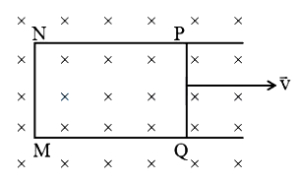
A
$0.12$
B
$0.06$
C
$0.24$
D
$0.18$
Solution
(A) Given:
Magnetic field $B = 0.1 \, T$
Length of the arm $PQ$, $\ell = 12 \, cm = 0.12 \, m$
Velocity of the arm, $v = 20 \, ms^{-1}$
Resistance of the loop, $R = 2 \, \Omega$
The motional electromotive force (emf) induced in the moving arm is given by:
$e = B \ell v$
$e = 0.1 \, T \times 0.12 \, m \times 20 \, ms^{-1}$
$e = 0.24 \, V$
The induced current $I$ in the loop is given by Ohm's law:
$I = \frac{e}{R}$
$I = \frac{0.24 \, V}{2 \, \Omega} = 0.12 \, A$
Therefore, the current induced in the loop is $0.12 \, A$.
Magnetic field $B = 0.1 \, T$
Length of the arm $PQ$, $\ell = 12 \, cm = 0.12 \, m$
Velocity of the arm, $v = 20 \, ms^{-1}$
Resistance of the loop, $R = 2 \, \Omega$
The motional electromotive force (emf) induced in the moving arm is given by:
$e = B \ell v$
$e = 0.1 \, T \times 0.12 \, m \times 20 \, ms^{-1}$
$e = 0.24 \, V$
The induced current $I$ in the loop is given by Ohm's law:
$I = \frac{e}{R}$
$I = \frac{0.24 \, V}{2 \, \Omega} = 0.12 \, A$
Therefore, the current induced in the loop is $0.12 \, A$.
0 likesView Solution
176
PhysicsMediumMCQMHT CET · 2021
$A$ circular coil of radius $R$ has $N$ turns of a wire. The coefficient of self-induction of the coil will be $(\mu_0 = \text{permeability of free space})$
A
$\frac{\mu_0 N \pi R^2}{2}$
B
$\frac{\mu_0 N \pi R}{4}$
C
$\frac{\mu_0 N^2 \pi R}{2}$
D
$\frac{\mu_0 N \pi R}{2}$
Solution
(C) The magnetic field at the center of a circular coil carrying current $I$ is given by $B = \frac{\mu_0 NI}{2R}$.
The total magnetic flux $\phi$ linked with the coil is the product of the number of turns $N$, the magnetic field $B$, and the area of the coil $A = \pi R^2$.
$\phi = N \cdot B \cdot A = N \cdot \left( \frac{\mu_0 NI}{2R} \right) \cdot \pi R^2 = \frac{\mu_0 N^2 \pi R I}{2}$.
The coefficient of self-induction $L$ is defined as $L = \frac{\phi}{I}$.
Substituting the value of $\phi$, we get $L = \frac{\mu_0 N^2 \pi R}{2}$.
The total magnetic flux $\phi$ linked with the coil is the product of the number of turns $N$, the magnetic field $B$, and the area of the coil $A = \pi R^2$.
$\phi = N \cdot B \cdot A = N \cdot \left( \frac{\mu_0 NI}{2R} \right) \cdot \pi R^2 = \frac{\mu_0 N^2 \pi R I}{2}$.
The coefficient of self-induction $L$ is defined as $L = \frac{\phi}{I}$.
Substituting the value of $\phi$, we get $L = \frac{\mu_0 N^2 \pi R}{2}$.
0 likesView Solution
177
PhysicsDifficultMCQMHT CET · 2021
The self-inductance of a solenoid of length $31.4 \ cm$,area of cross-section $10^{-3} \ m^2$ having a total number of turns $500$ will be nearly $\left[\mu_0 = 4 \pi \times 10^{-7} \ SI \ unit\right]$.
A
$3 \times 10^{-3} \ H$
B
$1 \times 10^{-3} \ H$
C
$2 \times 10^{-3} \ H$
D
$4 \times 10^{-3} \ H$
Solution
(B) Given:
Length of solenoid,$\ell = 31.4 \ cm = 0.314 \ m$
Area of cross-section,$A = 10^{-3} \ m^2$
Total number of turns,$N = 500$
Permeability of free space,$\mu_0 = 4 \pi \times 10^{-7} \ T \cdot m/A$
The formula for self-inductance of a solenoid is given by:
$L = \frac{\mu_0 N^2 A}{\ell}$
Substituting the values:
$L = \frac{(4 \times 3.14 \times 10^{-7}) \times (500)^2 \times 10^{-3}}{0.314}$
$L = \frac{4 \times 3.14 \times 10^{-7} \times 250000 \times 10^{-3}}{0.314}$
$L = \frac{4 \times 3.14 \times 10^{-7} \times 2.5 \times 10^5 \times 10^{-3}}{0.314}$
$L = \frac{4 \times 3.14 \times 2.5 \times 10^{-5}}{0.314}$
$L = 4 \times 10 \times 2.5 \times 10^{-5} = 10 \times 10^{-4} = 10^{-3} \ H$
Length of solenoid,$\ell = 31.4 \ cm = 0.314 \ m$
Area of cross-section,$A = 10^{-3} \ m^2$
Total number of turns,$N = 500$
Permeability of free space,$\mu_0 = 4 \pi \times 10^{-7} \ T \cdot m/A$
The formula for self-inductance of a solenoid is given by:
$L = \frac{\mu_0 N^2 A}{\ell}$
Substituting the values:
$L = \frac{(4 \times 3.14 \times 10^{-7}) \times (500)^2 \times 10^{-3}}{0.314}$
$L = \frac{4 \times 3.14 \times 10^{-7} \times 250000 \times 10^{-3}}{0.314}$
$L = \frac{4 \times 3.14 \times 10^{-7} \times 2.5 \times 10^5 \times 10^{-3}}{0.314}$
$L = \frac{4 \times 3.14 \times 2.5 \times 10^{-5}}{0.314}$
$L = 4 \times 10 \times 2.5 \times 10^{-5} = 10 \times 10^{-4} = 10^{-3} \ H$
0 likesView Solution
178
PhysicsEasyMCQMHT CET · 2021
$A$ current $I = 10 \sin(100 \pi t) \text{ A}$ is passed in a coil, which induces a maximum emf of $5 \pi \text{ V}$ in a neighboring coil. The mutual inductance of the two coils is: (in $\text{ mH}$)
A
$5$
B
$10$
C
$15$
D
$25$
Solution
(A) The induced emf $e$ in the neighboring coil is given by $e = M \frac{dI}{dt}$.
Given $I = 10 \sin(100 \pi t)$, we find the rate of change of current:
$\frac{dI}{dt} = 10 \times 100 \pi \cos(100 \pi t) = 1000 \pi \cos(100 \pi t)$.
Substituting this into the emf equation:
$e = M \times 1000 \pi \cos(100 \pi t)$.
The maximum value of the induced emf $e_0$ occurs when $\cos(100 \pi t) = 1$, so $e_0 = 1000 \pi M$.
Given $e_0 = 5 \pi \text{ V}$, we have $1000 \pi M = 5 \pi$.
Solving for $M$: $M = \frac{5 \pi}{1000 \pi} = 0.005 \text{ H} = 5 \text{ mH}$.
Given $I = 10 \sin(100 \pi t)$, we find the rate of change of current:
$\frac{dI}{dt} = 10 \times 100 \pi \cos(100 \pi t) = 1000 \pi \cos(100 \pi t)$.
Substituting this into the emf equation:
$e = M \times 1000 \pi \cos(100 \pi t)$.
The maximum value of the induced emf $e_0$ occurs when $\cos(100 \pi t) = 1$, so $e_0 = 1000 \pi M$.
Given $e_0 = 5 \pi \text{ V}$, we have $1000 \pi M = 5 \pi$.
Solving for $M$: $M = \frac{5 \pi}{1000 \pi} = 0.005 \text{ H} = 5 \text{ mH}$.
0 likesView Solution
179
PhysicsEasyMCQMHT CET · 2021
$A$ current $I$ produces a magnetic flux $\phi$ per turn in a coil of $n$ turns. The self-inductance of the coil is $L$. The relation between them is:
A
$nLI = \phi$
B
$\frac{nL}{I} = \phi$
C
$\frac{LI}{n^2} = \phi$
D
$\frac{LI}{n} = \phi$
Solution
(D) The total magnetic flux linkage in a coil with $n$ turns is given by $N\phi_{total} = L I$,where $N$ is the number of turns,$\phi_{total}$ is the flux per turn,$L$ is the self-inductance,and $I$ is the current.
Given that the flux per turn is $\phi$ and the number of turns is $n$,the total flux linkage is $n\phi$.
Therefore,the relation is $n\phi = LI$.
Rearranging for $\phi$,we get $\phi = \frac{LI}{n}$.
Given that the flux per turn is $\phi$ and the number of turns is $n$,the total flux linkage is $n\phi$.
Therefore,the relation is $n\phi = LI$.
Rearranging for $\phi$,we get $\phi = \frac{LI}{n}$.
0 likesView Solution
180
PhysicsMediumMCQMHT CET · 2021
$A$ coil of radius $r$ is placed on another coil (whose radius is $R$ and current flowing through it is changing) so that their centres coincide. $(R \gg r)$ If both the coils are coplanar,then the mutual inductance between them is proportional to
A
$\frac{r}{R}$
B
$\frac{R}{r}$
C
$\frac{R}{r^{2}}$
D
$\frac{r^{2}}{R}$
Solution
(D) The magnetic field $B$ at the center of a large coil of radius $R$ carrying current $I$ is given by $B = \frac{\mu_{0} I}{2R}$.
Since $R \gg r$,we can assume the magnetic field is uniform over the area of the smaller coil.
The magnetic flux $\phi$ passing through the smaller coil of radius $r$ is $\phi = B \cdot A = B \cdot (\pi r^{2})$.
Substituting the value of $B$,we get $\phi = \left( \frac{\mu_{0} I}{2R} \right) \cdot (\pi r^{2})$.
The mutual inductance $M$ is defined as $M = \frac{\phi}{I}$.
Therefore,$M = \frac{\mu_{0} \pi r^{2}}{2R}$.
Since $\mu_{0}$,$\pi$,and $2$ are constants,we have $M \propto \frac{r^{2}}{R}$.
Since $R \gg r$,we can assume the magnetic field is uniform over the area of the smaller coil.
The magnetic flux $\phi$ passing through the smaller coil of radius $r$ is $\phi = B \cdot A = B \cdot (\pi r^{2})$.
Substituting the value of $B$,we get $\phi = \left( \frac{\mu_{0} I}{2R} \right) \cdot (\pi r^{2})$.
The mutual inductance $M$ is defined as $M = \frac{\phi}{I}$.
Therefore,$M = \frac{\mu_{0} \pi r^{2}}{2R}$.
Since $\mu_{0}$,$\pi$,and $2$ are constants,we have $M \propto \frac{r^{2}}{R}$.
0 likesView Solution
181
PhysicsEasyMCQMHT CET · 2021
$F$ is the force between two identical charged particles placed at a distance $Y$ from each other. If the distance between the charges is reduced to half the previous distance,then the force between them becomes:
A
$\frac{F}{4}$
B
$4F$
C
$2F$
D
$\frac{F}{2}$
Solution
(B) According to Coulomb's Law,the force $F$ between two charges $q_1$ and $q_2$ separated by a distance $r$ is given by $F = k \frac{q_1 q_2}{r^2}$.
Given that the particles are identical,let $q_1 = q_2 = q$. Initially,the distance is $r_1 = Y$,so $F_1 = k \frac{q^2}{Y^2} = F$.
When the distance is reduced to half,the new distance is $r_2 = \frac{Y}{2}$.
The new force $F_2$ is given by $F_2 = k \frac{q^2}{(Y/2)^2} = k \frac{q^2}{Y^2 / 4} = 4 \left( k \frac{q^2}{Y^2} \right)$.
Substituting $F_1 = F$,we get $F_2 = 4F$.
Given that the particles are identical,let $q_1 = q_2 = q$. Initially,the distance is $r_1 = Y$,so $F_1 = k \frac{q^2}{Y^2} = F$.
When the distance is reduced to half,the new distance is $r_2 = \frac{Y}{2}$.
The new force $F_2$ is given by $F_2 = k \frac{q^2}{(Y/2)^2} = k \frac{q^2}{Y^2 / 4} = 4 \left( k \frac{q^2}{Y^2} \right)$.
Substituting $F_1 = F$,we get $F_2 = 4F$.
0 likesView Solution
182
PhysicsEasyMCQMHT CET · 2021
When a piece of polythene is rubbed with wool,a negative charge of $4 \times 10^{-7} \ C$ is developed on the polythene. The number of electrons transferred from wool to polythene is $\left[e = 1.6 \times 10^{-19} \ C\right]$.
A
$1.5 \times 10^{12}$
B
$3.5 \times 10^{13}$
C
$2.5 \times 10^{13}$
D
$2.5 \times 10^{12}$
Solution
(D) The charge on the polythene is given by $q = 4 \times 10^{-7} \ C$.
According to the quantization of charge,the total charge $q$ is given by $q = Ne$,where $N$ is the number of electrons and $e$ is the elementary charge.
Given $e = 1.6 \times 10^{-19} \ C$.
To find the number of electrons $N$,we use the formula $N = \frac{q}{e}$.
Substituting the values: $N = \frac{4 \times 10^{-7}}{1.6 \times 10^{-19}}$.
$N = \frac{4}{1.6} \times 10^{-7 - (-19)} = 2.5 \times 10^{12}$.
Thus,the number of electrons transferred is $2.5 \times 10^{12}$.
According to the quantization of charge,the total charge $q$ is given by $q = Ne$,where $N$ is the number of electrons and $e$ is the elementary charge.
Given $e = 1.6 \times 10^{-19} \ C$.
To find the number of electrons $N$,we use the formula $N = \frac{q}{e}$.
Substituting the values: $N = \frac{4 \times 10^{-7}}{1.6 \times 10^{-19}}$.
$N = \frac{4}{1.6} \times 10^{-7 - (-19)} = 2.5 \times 10^{12}$.
Thus,the number of electrons transferred is $2.5 \times 10^{12}$.
0 likesView Solution
183
PhysicsMediumMCQMHT CET · 2021
$A$ point charge $Q$ is placed at the center of the line joining two equal point charges $+q$ and $+q$. The value of $Q$ if the system of the charges is in equilibrium,is
A
$\frac{-q}{2}$
B
$-\frac{q}{4}$
C
$\frac{+q}{4}$
D
$\frac{+q}{2}$
Solution
(B) For the system to be in equilibrium,the net force on each charge must be zero.
Let the distance between the two charges $+q$ be $r$. The charge $Q$ is placed at the center,so its distance from each $+q$ charge is $r/2$.
The force on the central charge $Q$ due to the two $+q$ charges is equal and opposite,so it is already in equilibrium.
For the system to be in equilibrium,the net force on one of the $+q$ charges must be zero.
The force on a $+q$ charge due to the other $+q$ charge is $F_1 = \frac{1}{4 \pi \varepsilon_0} \cdot \frac{q^2}{r^2}$ (repulsive).
The force on this $+q$ charge due to the central charge $Q$ is $F_2 = \frac{1}{4 \pi \varepsilon_0} \cdot \frac{qQ}{(r/2)^2} = \frac{1}{4 \pi \varepsilon_0} \cdot \frac{4qQ}{r^2}$.
For equilibrium,$F_1 + F_2 = 0$,which implies $F_1 = -F_2$.
$\frac{1}{4 \pi \varepsilon_0} \cdot \frac{q^2}{r^2} = -\left( \frac{1}{4 \pi \varepsilon_0} \cdot \frac{4qQ}{r^2} \right)$.
$q^2 = -4qQ$.
$Q = -\frac{q}{4}$.
Let the distance between the two charges $+q$ be $r$. The charge $Q$ is placed at the center,so its distance from each $+q$ charge is $r/2$.
The force on the central charge $Q$ due to the two $+q$ charges is equal and opposite,so it is already in equilibrium.
For the system to be in equilibrium,the net force on one of the $+q$ charges must be zero.
The force on a $+q$ charge due to the other $+q$ charge is $F_1 = \frac{1}{4 \pi \varepsilon_0} \cdot \frac{q^2}{r^2}$ (repulsive).
The force on this $+q$ charge due to the central charge $Q$ is $F_2 = \frac{1}{4 \pi \varepsilon_0} \cdot \frac{qQ}{(r/2)^2} = \frac{1}{4 \pi \varepsilon_0} \cdot \frac{4qQ}{r^2}$.
For equilibrium,$F_1 + F_2 = 0$,which implies $F_1 = -F_2$.
$\frac{1}{4 \pi \varepsilon_0} \cdot \frac{q^2}{r^2} = -\left( \frac{1}{4 \pi \varepsilon_0} \cdot \frac{4qQ}{r^2} \right)$.
$q^2 = -4qQ$.
$Q = -\frac{q}{4}$.
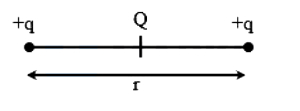
0 likesView Solution
184
PhysicsMediumMCQMHT CET · 2021
Two positive ions,each carrying a charge '$q$' are separated by a distance '$d$'. If '$F$' is the force of repulsion between the ions,the number of electrons missing from each ion will be ($e=$ charge on electron,$\varepsilon_0=$ permittivity of free space).
A
$\sqrt{\frac{4 \pi \varepsilon_0 d^2}{e^2}}$
B
$\sqrt{\frac{4 \pi \varepsilon_0 Fd}{e^2}}$
C
$\sqrt{\frac{4 \pi \varepsilon_0 Fd}{e}}$
D
$\sqrt{\frac{4 \pi \varepsilon_0 F d^2}{e^2}}$
Solution
(D) According to Coulomb's law,the force of repulsion between two charges $q$ separated by a distance $d$ is given by:
$F = \frac{1}{4 \pi \varepsilon_0} \cdot \frac{q^2}{d^2}$
Since the ions are positive,the charge $q$ on each ion is due to the loss of $n$ electrons,so $q = ne$.
Substituting $q = ne$ into the force equation:
$F = \frac{1}{4 \pi \varepsilon_0} \cdot \frac{(ne)^2}{d^2} = \frac{1}{4 \pi \varepsilon_0} \cdot \frac{n^2 e^2}{d^2}$
Now,solving for $n$:
$n^2 = \frac{F \cdot 4 \pi \varepsilon_0 \cdot d^2}{e^2}$
$n = \sqrt{\frac{4 \pi \varepsilon_0 F d^2}{e^2}}$
$F = \frac{1}{4 \pi \varepsilon_0} \cdot \frac{q^2}{d^2}$
Since the ions are positive,the charge $q$ on each ion is due to the loss of $n$ electrons,so $q = ne$.
Substituting $q = ne$ into the force equation:
$F = \frac{1}{4 \pi \varepsilon_0} \cdot \frac{(ne)^2}{d^2} = \frac{1}{4 \pi \varepsilon_0} \cdot \frac{n^2 e^2}{d^2}$
Now,solving for $n$:
$n^2 = \frac{F \cdot 4 \pi \varepsilon_0 \cdot d^2}{e^2}$
$n = \sqrt{\frac{4 \pi \varepsilon_0 F d^2}{e^2}}$
0 likesView Solution
185
PhysicsEasyMCQMHT CET · 2021
Two point charges $+3 \mu C$ and $+8 \mu C$ repel each other with a force of $40 \ N$. If a charge of $-5 \mu C$ is added to each of them,then the force between them will become: (in $N$)
A
$-10$
B
$10$
C
$20$
D
$-20$
Solution
(A) Initial charges are $q_1 = 3 \mu C$ and $q_2 = 8 \mu C$. The force between them is given by Coulomb's Law: $F = k \frac{q_1 q_2}{r^2} = 40 \ N$.
When a charge of $-5 \mu C$ is added to each,the new charges become:
$q_1' = 3 \mu C - 5 \mu C = -2 \mu C$
$q_2' = 8 \mu C - 5 \mu C = 3 \mu C$
The new force $F'$ is:
$F' = k \frac{q_1' q_2'}{r^2} = k \frac{(-2)(3)}{r^2} = -6k \frac{1}{r^2}$
Dividing the new force by the initial force:
$\frac{F'}{40} = \frac{k \frac{(-2)(3)}{r^2}}{k \frac{(3)(8)}{r^2}} = \frac{-6}{24} = -\frac{1}{4}$
$F' = 40 \times (-\frac{1}{4}) = -10 \ N$.
When a charge of $-5 \mu C$ is added to each,the new charges become:
$q_1' = 3 \mu C - 5 \mu C = -2 \mu C$
$q_2' = 8 \mu C - 5 \mu C = 3 \mu C$
The new force $F'$ is:
$F' = k \frac{q_1' q_2'}{r^2} = k \frac{(-2)(3)}{r^2} = -6k \frac{1}{r^2}$
Dividing the new force by the initial force:
$\frac{F'}{40} = \frac{k \frac{(-2)(3)}{r^2}}{k \frac{(3)(8)}{r^2}} = \frac{-6}{24} = -\frac{1}{4}$
$F' = 40 \times (-\frac{1}{4}) = -10 \ N$.
0 likesView Solution
186
PhysicsMediumMCQMHT CET · 2021
Three charges, each of $+1 \mu C$, are placed at the corners of an equilateral triangle. If the repulsive force between any two charges is $F$, then the net force on any one charge will be:
A
$2 \,F$
B
$3 \,F$
C
$\sqrt{2} \,F$
D
$\sqrt{3} \,F$
Solution
(D) Let the three charges be $q$ at the vertices of an equilateral triangle.
Consider one charge at a vertex. It experiences two repulsive forces from the other two charges, each of magnitude $F$.
The angle between these two forces is $60^{\circ}$ (the interior angle of an equilateral triangle).
The resultant force $R$ is given by the vector addition formula:
$R = \sqrt{F_1^2 + F_2^2 + 2 F_1 F_2 \cos \theta}$
Substituting $F_1 = F$, $F_2 = F$, and $\theta = 60^{\circ}$:
$R = \sqrt{F^2 + F^2 + 2 F^2 \cos 60^{\circ}}$
Since $\cos 60^{\circ} = 0.5$:
$R = \sqrt{2 F^2 + 2 F^2 (0.5)} = \sqrt{2 F^2 + F^2} = \sqrt{3 F^2} = \sqrt{3} F$.
Consider one charge at a vertex. It experiences two repulsive forces from the other two charges, each of magnitude $F$.
The angle between these two forces is $60^{\circ}$ (the interior angle of an equilateral triangle).
The resultant force $R$ is given by the vector addition formula:
$R = \sqrt{F_1^2 + F_2^2 + 2 F_1 F_2 \cos \theta}$
Substituting $F_1 = F$, $F_2 = F$, and $\theta = 60^{\circ}$:
$R = \sqrt{F^2 + F^2 + 2 F^2 \cos 60^{\circ}}$
Since $\cos 60^{\circ} = 0.5$:
$R = \sqrt{2 F^2 + 2 F^2 (0.5)} = \sqrt{2 F^2 + F^2} = \sqrt{3 F^2} = \sqrt{3} F$.
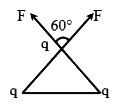
0 likesView Solution
187
PhysicsEasyMCQMHT CET · 2021
An electric dipole having dipole moment $P = q \times 2\ell$ is placed in a uniform electric field $E$. The dipole moment is along the direction of the field. The force acting on it and its potential energy are respectively
A
$qE$ and minimum
B
$qE$ and maximum
C
$2qE$ and minimum
D
zero and minimum
Solution
(D) An electric dipole consists of two equal and opposite charges,$+q$ and $-q$,separated by a distance $2\ell$.
In a uniform electric field $E$,the force on the positive charge is $F_+ = qE$ in the direction of the field,and the force on the negative charge is $F_- = -qE$ opposite to the direction of the field.
The net force on the dipole is $F_{net} = F_+ + F_- = qE - qE = 0$.
The potential energy $U$ of an electric dipole in an electric field is given by $U = -P \cdot E = -PE \cos \theta$.
When the dipole moment $P$ is along the direction of the field,the angle $\theta = 0^{\circ}$.
Thus,$U = -PE \cos(0^{\circ}) = -PE$,which is the minimum possible value (stable equilibrium).
In a uniform electric field $E$,the force on the positive charge is $F_+ = qE$ in the direction of the field,and the force on the negative charge is $F_- = -qE$ opposite to the direction of the field.
The net force on the dipole is $F_{net} = F_+ + F_- = qE - qE = 0$.
The potential energy $U$ of an electric dipole in an electric field is given by $U = -P \cdot E = -PE \cos \theta$.
When the dipole moment $P$ is along the direction of the field,the angle $\theta = 0^{\circ}$.
Thus,$U = -PE \cos(0^{\circ}) = -PE$,which is the minimum possible value (stable equilibrium).
0 likesView Solution
188
PhysicsMediumMCQMHT CET · 2021
$A$ uniformly charged semicircular arc of radius $r$ has linear charge density $\lambda$. What is the electric field at its centre? $(\epsilon_0 = \text{permittivity of free space})$
A
$\frac{\lambda}{2 \pi \epsilon_0 r}$
B
$\frac{2 \pi \epsilon_0}{\lambda}$
C
$\frac{\lambda}{4 \epsilon_0}$
D
$\frac{2 \epsilon_0}{\lambda}$
Solution
(A) The electric field $E$ due to a charged arc of radius $r$ and linear charge density $\lambda$ at its center is given by the formula $E = \frac{2 k \lambda}{r} \sin \alpha$,where $2\alpha$ is the total angle subtended by the arc at the center.
For a semicircular arc,the total angle subtended is $180^{\circ}$,so $2\alpha = 180^{\circ}$,which means $\alpha = 90^{\circ}$.
Substituting $k = \frac{1}{4 \pi \epsilon_0}$ and $\alpha = 90^{\circ}$ into the formula:
$E = \frac{2 (\frac{1}{4 \pi \epsilon_0}) \lambda}{r} \sin(90^{\circ})$
Since $\sin(90^{\circ}) = 1$,we get:
$E = \frac{2 \lambda}{4 \pi \epsilon_0 r} = \frac{\lambda}{2 \pi \epsilon_0 r}$.
For a semicircular arc,the total angle subtended is $180^{\circ}$,so $2\alpha = 180^{\circ}$,which means $\alpha = 90^{\circ}$.
Substituting $k = \frac{1}{4 \pi \epsilon_0}$ and $\alpha = 90^{\circ}$ into the formula:
$E = \frac{2 (\frac{1}{4 \pi \epsilon_0}) \lambda}{r} \sin(90^{\circ})$
Since $\sin(90^{\circ}) = 1$,we get:
$E = \frac{2 \lambda}{4 \pi \epsilon_0 r} = \frac{\lambda}{2 \pi \epsilon_0 r}$.
0 likesView Solution
189
PhysicsEasyMCQMHT CET · 2021
An electron of mass $m$ and charge $q$ is accelerated from rest in a uniform electric field of strength $E$. The velocity acquired by the electron when it travels a distance $L$ is
A
$\sqrt{\frac{2 q E}{m L}}$
B
$\sqrt{\frac{2 E m}{q L}}$
C
$\sqrt{\frac{2 qEL}{m}}$
D
$\sqrt{\frac{qE}{mL}}$
Solution
(C) The force acting on the electron in a uniform electric field is given by $F = qE$.
Since the electron is moving in the direction of the force,the work done by the electric field over a distance $L$ is $W = F \times L = qEL$.
According to the work-energy theorem,the work done is equal to the change in kinetic energy of the electron.
Since the electron starts from rest,the initial kinetic energy is $0$.
Therefore,$\frac{1}{2} mv^2 = qEL$.
Solving for the velocity $v$,we get $v^2 = \frac{2qEL}{m}$,which implies $v = \sqrt{\frac{2qEL}{m}}$.
Since the electron is moving in the direction of the force,the work done by the electric field over a distance $L$ is $W = F \times L = qEL$.
According to the work-energy theorem,the work done is equal to the change in kinetic energy of the electron.
Since the electron starts from rest,the initial kinetic energy is $0$.
Therefore,$\frac{1}{2} mv^2 = qEL$.
Solving for the velocity $v$,we get $v^2 = \frac{2qEL}{m}$,which implies $v = \sqrt{\frac{2qEL}{m}}$.
0 likesView Solution
190
PhysicsMediumMCQMHT CET · 2021
The electric field intensity on the surface of a charged solid sphere of radius '$r$' and volume charge density '$\rho$' is given by
A
zero
B
$\frac{\rho r}{3 \varepsilon_0}$
C
$\frac{1}{4 \pi \epsilon_0} \frac{\rho}{r}$
D
$\frac{5 \rho r}{6 \epsilon_0}$
Solution
(B) The electric field intensity $E$ at a distance $r$ from the center of a charged sphere is given by Coulomb's law as:
$E = \frac{1}{4 \pi \varepsilon_0} \frac{q}{r^2} \quad (1)$
For a solid sphere of radius $r$ with uniform volume charge density $\rho$,the total charge $q$ is given by:
$q = \rho \times \text{Volume} = \rho \times \left( \frac{4}{3} \pi r^3 \right)$
Substituting this value of $q$ into Eq. $(1)$:
$E = \frac{1}{4 \pi \varepsilon_0} \frac{\rho \times \frac{4}{3} \pi r^3}{r^2}$
Simplifying the expression:
$E = \frac{\rho r}{3 \varepsilon_0}$
$E = \frac{1}{4 \pi \varepsilon_0} \frac{q}{r^2} \quad (1)$
For a solid sphere of radius $r$ with uniform volume charge density $\rho$,the total charge $q$ is given by:
$q = \rho \times \text{Volume} = \rho \times \left( \frac{4}{3} \pi r^3 \right)$
Substituting this value of $q$ into Eq. $(1)$:
$E = \frac{1}{4 \pi \varepsilon_0} \frac{\rho \times \frac{4}{3} \pi r^3}{r^2}$
Simplifying the expression:
$E = \frac{\rho r}{3 \varepsilon_0}$
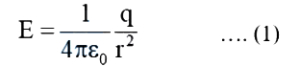
0 likesView Solution
191
PhysicsDifficultMCQMHT CET · 2021
Two charged metallic spheres are joined by a very thin metal wire. If the radius of the larger sphere is four times that of the smaller sphere,the electric field near the larger sphere is
A
twice that near the smaller sphere
B
quarter of that near the smaller sphere
C
same as that near the smaller sphere
D
half of that near smaller sphere
Solution
(B) Since the spheres are joined by a metal wire,their potentials will be the same.
Let the radius of the smaller sphere be $r_1$ and the radius of the larger sphere be $r_2 = 4r_1$.
Since the potentials are equal,$V = \frac{1}{4 \pi \varepsilon_0} \cdot \frac{q_1}{r_1} = \frac{1}{4 \pi \varepsilon_0} \cdot \frac{q_2}{r_2}$.
Therefore,$\frac{q_2}{q_1} = \frac{r_2}{r_1} = 4$.
The electric field near the surface of the spheres is given by $E = \frac{1}{4 \pi \varepsilon_0} \cdot \frac{q}{r^2}$.
Thus,$\frac{E_2}{E_1} = \frac{q_2}{q_1} \cdot \left(\frac{r_1}{r_2}\right)^2 = \left(\frac{r_2}{r_1}\right) \cdot \left(\frac{r_1}{r_2}\right)^2 = \frac{r_1}{r_2}$.
Substituting $r_2 = 4r_1$,we get $\frac{E_2}{E_1} = \frac{r_1}{4r_1} = \frac{1}{4}$.
So,the electric field near the larger sphere is a quarter of that near the smaller sphere.
Let the radius of the smaller sphere be $r_1$ and the radius of the larger sphere be $r_2 = 4r_1$.
Since the potentials are equal,$V = \frac{1}{4 \pi \varepsilon_0} \cdot \frac{q_1}{r_1} = \frac{1}{4 \pi \varepsilon_0} \cdot \frac{q_2}{r_2}$.
Therefore,$\frac{q_2}{q_1} = \frac{r_2}{r_1} = 4$.
The electric field near the surface of the spheres is given by $E = \frac{1}{4 \pi \varepsilon_0} \cdot \frac{q}{r^2}$.
Thus,$\frac{E_2}{E_1} = \frac{q_2}{q_1} \cdot \left(\frac{r_1}{r_2}\right)^2 = \left(\frac{r_2}{r_1}\right) \cdot \left(\frac{r_1}{r_2}\right)^2 = \frac{r_1}{r_2}$.
Substituting $r_2 = 4r_1$,we get $\frac{E_2}{E_1} = \frac{r_1}{4r_1} = \frac{1}{4}$.
So,the electric field near the larger sphere is a quarter of that near the smaller sphere.
0 likesView Solution
192
PhysicsEasyMCQMHT CET · 2021
$A$ spherical conducting shell of inner radius $r_1$ and outer radius $r_2$ has a net charge $Q$. $A$ point charge $-q$ is placed at the center of the shell. Determine the surface charge density on the inner and outer surfaces of the shell.
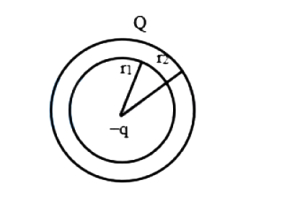
A
$\frac{q}{4 \pi r_1^2}$ and $\frac{Q-q}{4 \pi r_2^2}$
B
$\frac{q}{4 \pi r_1^2}$ and $\frac{Q}{4 \pi r_2^2}$
C
$\frac{-q}{4 \pi r_1^2}$ and $\frac{Q+q}{4 \pi r_2^2}$
D
zero and $\frac{Q-q}{4 \pi r_2^2}$
Solution
(A) $1$. According to the principle of electrostatic induction,when a charge $-q$ is placed at the center of a conducting shell,an equal and opposite charge $+q$ is induced on the inner surface of the shell to ensure the electric field inside the conductor is zero.
$2$. The inner surface of the shell now has a charge of $+q$. The surface charge density on the inner surface is given by $\sigma_{inner} = \frac{q}{4 \pi r_1^2}$.
$3$. Since the shell has a total charge $Q$ and the inner surface has a charge $+q$,the charge on the outer surface must be $Q_{outer} = Q - q$ to conserve the total charge.
$4$. The surface charge density on the outer surface is given by $\sigma_{outer} = \frac{Q-q}{4 \pi r_2^2}$.
$5$. Therefore,the surface charge densities are $\frac{q}{4 \pi r_1^2}$ and $\frac{Q-q}{4 \pi r_2^2}$.
$2$. The inner surface of the shell now has a charge of $+q$. The surface charge density on the inner surface is given by $\sigma_{inner} = \frac{q}{4 \pi r_1^2}$.
$3$. Since the shell has a total charge $Q$ and the inner surface has a charge $+q$,the charge on the outer surface must be $Q_{outer} = Q - q$ to conserve the total charge.
$4$. The surface charge density on the outer surface is given by $\sigma_{outer} = \frac{Q-q}{4 \pi r_2^2}$.
$5$. Therefore,the surface charge densities are $\frac{q}{4 \pi r_1^2}$ and $\frac{Q-q}{4 \pi r_2^2}$.
0 likesView Solution
193
PhysicsEasyMCQMHT CET · 2021
$A$ hollow charged metal sphere has radius $R$. If the potential difference between its surface and a point at a distance $5R$ from the centre is $V$,then the magnitude of the electric field intensity at a distance $5R$ from the centre of the sphere is:
A
$\frac{V}{2R}$
B
$\frac{V}{20R}$
C
$10VR$
D
$20VR$
Solution
(B) The potential at the surface of the sphere is $V_s = \frac{1}{4\pi\epsilon_0} \frac{q}{R}$.
The potential at a distance $5R$ from the centre is $V_p = \frac{1}{4\pi\epsilon_0} \frac{q}{5R}$.
The potential difference $V$ is given by $V = V_s - V_p = \frac{q}{4\pi\epsilon_0} (\frac{1}{R} - \frac{1}{5R}) = \frac{q}{4\pi\epsilon_0} (\frac{4}{5R}) = \frac{q}{5\pi\epsilon_0 R}$.
From this,we can express the charge $q$ as $q = \frac{5\pi\epsilon_0 RV}{1}$.
The electric field intensity $E$ at a distance $r = 5R$ is given by $E = \frac{1}{4\pi\epsilon_0} \frac{q}{r^2} = \frac{1}{4\pi\epsilon_0} \frac{q}{(5R)^2} = \frac{q}{100\pi\epsilon_0 R^2}$.
Substituting the value of $q$ in terms of $V$: $E = \frac{1}{100\pi\epsilon_0 R^2} \cdot (5\pi\epsilon_0 RV) = \frac{5}{100} \frac{V}{R} = \frac{V}{20R}$.
The potential at a distance $5R$ from the centre is $V_p = \frac{1}{4\pi\epsilon_0} \frac{q}{5R}$.
The potential difference $V$ is given by $V = V_s - V_p = \frac{q}{4\pi\epsilon_0} (\frac{1}{R} - \frac{1}{5R}) = \frac{q}{4\pi\epsilon_0} (\frac{4}{5R}) = \frac{q}{5\pi\epsilon_0 R}$.
From this,we can express the charge $q$ as $q = \frac{5\pi\epsilon_0 RV}{1}$.
The electric field intensity $E$ at a distance $r = 5R$ is given by $E = \frac{1}{4\pi\epsilon_0} \frac{q}{r^2} = \frac{1}{4\pi\epsilon_0} \frac{q}{(5R)^2} = \frac{q}{100\pi\epsilon_0 R^2}$.
Substituting the value of $q$ in terms of $V$: $E = \frac{1}{100\pi\epsilon_0 R^2} \cdot (5\pi\epsilon_0 RV) = \frac{5}{100} \frac{V}{R} = \frac{V}{20R}$.
0 likesView Solution
194
PhysicsMediumMCQMHT CET · 2021
$A$ uniformly charged half-ring of radius $R$ has a linear charge density $\sigma$. The electric potential at the centre of the half-ring is ($\epsilon_0$ = permittivity of free space).
A
$\frac{\sigma}{6 \epsilon_0}$
B
$\frac{\sigma}{2 \epsilon_0}$
C
$\frac{\sigma}{\epsilon_0}$
D
$\frac{\sigma}{4 \epsilon_0}$
Solution
(D) The electric potential $dV$ due to a small charge element $dq$ at the centre of the ring is given by $dV = \frac{1}{4 \pi \epsilon_0} \cdot \frac{dq}{R}$.
Since the ring is a half-ring,the total charge $q$ is the product of the linear charge density $\sigma$ and the length of the half-ring $(L = \pi R)$.
Thus,$q = \sigma \cdot \pi R$.
The total potential $V$ at the centre is the integral of $dV$ over the entire half-ring:
$V = \int dV = \int \frac{1}{4 \pi \epsilon_0} \cdot \frac{dq}{R} = \frac{1}{4 \pi \epsilon_0 R} \int dq$.
Substituting the total charge $q = \sigma \pi R$:
$V = \frac{1}{4 \pi \epsilon_0 R} \cdot (\sigma \pi R) = \frac{\sigma}{4 \epsilon_0}$.
Since the ring is a half-ring,the total charge $q$ is the product of the linear charge density $\sigma$ and the length of the half-ring $(L = \pi R)$.
Thus,$q = \sigma \cdot \pi R$.
The total potential $V$ at the centre is the integral of $dV$ over the entire half-ring:
$V = \int dV = \int \frac{1}{4 \pi \epsilon_0} \cdot \frac{dq}{R} = \frac{1}{4 \pi \epsilon_0 R} \int dq$.
Substituting the total charge $q = \sigma \pi R$:
$V = \frac{1}{4 \pi \epsilon_0 R} \cdot (\sigma \pi R) = \frac{\sigma}{4 \epsilon_0}$.
0 likesView Solution
195
PhysicsEasyMCQMHT CET · 2021
$A$ hollow metal sphere has a radius $r$. The potential difference between a point on its surface and a point at a distance $3r$ from its center is $V$. The electric intensity at the distance $3r$ from the center of the sphere will be
A
$\frac{V}{3r}$
B
$3Vr$
C
$\frac{V}{r}$
D
$\frac{V}{6r}$
Solution
(D) Let the charge on the sphere be $Q$.
The potential at the surface of the sphere is $V_{surface} = \frac{kQ}{r}$.
The potential at a distance $3r$ from the center is $V_{3r} = \frac{kQ}{3r}$.
The potential difference $V$ is given by:
$V = V_{surface} - V_{3r} = \frac{kQ}{r} - \frac{kQ}{3r} = \frac{2kQ}{3r}$.
From this,we find $kQ = \frac{3Vr}{2}$.
The electric intensity $E$ at a distance $3r$ from the center is given by:
$E = \frac{kQ}{(3r)^2} = \frac{kQ}{9r^2}$.
Substituting the value of $kQ$:
$E = \frac{1}{9r^2} \cdot \frac{3Vr}{2} = \frac{3V}{18r} = \frac{V}{6r}$.
The potential at the surface of the sphere is $V_{surface} = \frac{kQ}{r}$.
The potential at a distance $3r$ from the center is $V_{3r} = \frac{kQ}{3r}$.
The potential difference $V$ is given by:
$V = V_{surface} - V_{3r} = \frac{kQ}{r} - \frac{kQ}{3r} = \frac{2kQ}{3r}$.
From this,we find $kQ = \frac{3Vr}{2}$.
The electric intensity $E$ at a distance $3r$ from the center is given by:
$E = \frac{kQ}{(3r)^2} = \frac{kQ}{9r^2}$.
Substituting the value of $kQ$:
$E = \frac{1}{9r^2} \cdot \frac{3Vr}{2} = \frac{3V}{18r} = \frac{V}{6r}$.
0 likesView Solution
196
PhysicsDifficultMCQMHT CET · 2021
Two spherical conductors of radii $4 \ cm$ and $5 \ cm$ are charged to the same potential. If $\sigma_1$ and $\sigma_2$ are the respective values of the surface charge density on the two conductors,then the ratio $\sigma_1 : \sigma_2$ is
A
$5$:$4$
B
$3$:$2$
C
$4$:$3$
D
$2$:$1$
Solution
(A) Given that the two spherical conductors are at the same potential $V$.
For a spherical conductor of radius $r$ and charge $q$,the potential is given by $V = \frac{1}{4 \pi \varepsilon_0} \cdot \frac{q}{r}$.
Since $V_1 = V_2$,we have $\frac{q_1}{r_1} = \frac{q_2}{r_2}$,which implies $\frac{q_1}{q_2} = \frac{r_1}{r_2}$.
The surface charge density $\sigma$ is defined as $\sigma = \frac{q}{4 \pi r^2}$.
Therefore,the ratio of surface charge densities is $\frac{\sigma_1}{\sigma_2} = \frac{q_1 / (4 \pi r_1^2)}{q_2 / (4 \pi r_2^2)} = \frac{q_1}{q_2} \cdot \frac{r_2^2}{r_1^2}$.
Substituting $\frac{q_1}{q_2} = \frac{r_1}{r_2}$,we get $\frac{\sigma_1}{\sigma_2} = \frac{r_1}{r_2} \cdot \frac{r_2^2}{r_1^2} = \frac{r_2}{r_1}$.
Given $r_1 = 4 \ cm$ and $r_2 = 5 \ cm$,the ratio is $\frac{\sigma_1}{\sigma_2} = \frac{5}{4}$.
For a spherical conductor of radius $r$ and charge $q$,the potential is given by $V = \frac{1}{4 \pi \varepsilon_0} \cdot \frac{q}{r}$.
Since $V_1 = V_2$,we have $\frac{q_1}{r_1} = \frac{q_2}{r_2}$,which implies $\frac{q_1}{q_2} = \frac{r_1}{r_2}$.
The surface charge density $\sigma$ is defined as $\sigma = \frac{q}{4 \pi r^2}$.
Therefore,the ratio of surface charge densities is $\frac{\sigma_1}{\sigma_2} = \frac{q_1 / (4 \pi r_1^2)}{q_2 / (4 \pi r_2^2)} = \frac{q_1}{q_2} \cdot \frac{r_2^2}{r_1^2}$.
Substituting $\frac{q_1}{q_2} = \frac{r_1}{r_2}$,we get $\frac{\sigma_1}{\sigma_2} = \frac{r_1}{r_2} \cdot \frac{r_2^2}{r_1^2} = \frac{r_2}{r_1}$.
Given $r_1 = 4 \ cm$ and $r_2 = 5 \ cm$,the ratio is $\frac{\sigma_1}{\sigma_2} = \frac{5}{4}$.
0 likesView Solution
197
PhysicsEasyMCQMHT CET · 2021
Two particles $A$ and $B$ having the same mass have charges $+q$ and $+4q$ respectively. When they are allowed to fall from rest through the same electric potential difference,the ratio of their speeds $v_A$ to $v_B$ will be:
A
$1$:$2$
B
$2$:$1$
C
$1$:$4$
D
$4$:$1$
Solution
(A) The kinetic energy gained by a particle of charge $q$ and mass $m$ falling through a potential difference $V$ is given by $K = qV = \frac{1}{2}mv^2$.
For particle $A$ with charge $q$:
$\frac{1}{2}mv_A^2 = qV$ (Equation $1$)
For particle $B$ with charge $4q$:
$\frac{1}{2}mv_B^2 = 4qV$ (Equation $2$)
Dividing Equation $1$ by Equation $2$:
$\frac{v_A^2}{v_B^2} = \frac{qV}{4qV} = \frac{1}{4}$
Taking the square root on both sides:
$\frac{v_A}{v_B} = \sqrt{\frac{1}{4}} = \frac{1}{2}$
Therefore,the ratio of their speeds $v_A : v_B$ is $1:2$.
For particle $A$ with charge $q$:
$\frac{1}{2}mv_A^2 = qV$ (Equation $1$)
For particle $B$ with charge $4q$:
$\frac{1}{2}mv_B^2 = 4qV$ (Equation $2$)
Dividing Equation $1$ by Equation $2$:
$\frac{v_A^2}{v_B^2} = \frac{qV}{4qV} = \frac{1}{4}$
Taking the square root on both sides:
$\frac{v_A}{v_B} = \sqrt{\frac{1}{4}} = \frac{1}{2}$
Therefore,the ratio of their speeds $v_A : v_B$ is $1:2$.
0 likesView Solution
198
PhysicsEasyMCQMHT CET · 2021
Let $A, B$ and $C$ be the three points in a uniform electric field $(\overrightarrow{E})$ as shown. The electric potential is
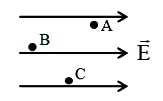
A
maximum at point $C$
B
maximum at point $A$
C
maximum at point $B$
D
same at all points $A, B$ and $C$
Solution
(C) The electric potential $V$ in an electric field $\overrightarrow{E}$ is given by the relation $dV = -\overrightarrow{E} \cdot d\overrightarrow{r}$.
This implies that the electric potential decreases as we move in the direction of the electric field.
In the given figure,point $B$ is at the leftmost position,meaning it is at the highest potential among the three points.
Points $A$ and $C$ are further along the direction of the electric field compared to point $B$,so their potentials will be lower than that of point $B$.
Therefore,the electric potential is maximum at point $B$.
This implies that the electric potential decreases as we move in the direction of the electric field.
In the given figure,point $B$ is at the leftmost position,meaning it is at the highest potential among the three points.
Points $A$ and $C$ are further along the direction of the electric field compared to point $B$,so their potentials will be lower than that of point $B$.
Therefore,the electric potential is maximum at point $B$.
0 likesView Solution
199
PhysicsEasyMCQMHT CET · 2021
In a hydrogen atom,an electron revolves around a proton (in the nucleus) at a distance '$r$' $m$. The intensity of the electric field due to the proton at distance '$r$' is $5 \times 10^{11} \ NC^{-1}$. The magnitude of the force between the electron and the proton is [charge on electron $= 1.6 \times 10^{-19} \ C$].
A
$4 \times 10^8 \ N$
B
$8 \times 10^8 \ N$
C
$4 \times 10^{-8} \ N$
D
$8 \times 10^{-8} \ N$
Solution
(D) The force $F$ experienced by a charge $q$ in an electric field $E$ is given by the formula $F = qE$.
Here,the charge of the electron is $q = 1.6 \times 10^{-19} \ C$ and the electric field intensity due to the proton is $E = 5 \times 10^{11} \ NC^{-1}$.
Substituting these values into the formula:
$F = (1.6 \times 10^{-19} \ C) \times (5 \times 10^{11} \ NC^{-1})$
$F = 8.0 \times 10^{-8} \ N$.
Thus,the magnitude of the force between the electron and the proton is $8 \times 10^{-8} \ N$.
Here,the charge of the electron is $q = 1.6 \times 10^{-19} \ C$ and the electric field intensity due to the proton is $E = 5 \times 10^{11} \ NC^{-1}$.
Substituting these values into the formula:
$F = (1.6 \times 10^{-19} \ C) \times (5 \times 10^{11} \ NC^{-1})$
$F = 8.0 \times 10^{-8} \ N$.
Thus,the magnitude of the force between the electron and the proton is $8 \times 10^{-8} \ N$.
0 likesView Solution
200
PhysicsMediumMCQMHT CET · 2021
$A$ charged spherical conductor has radius '$r$'. The potential difference between its surface and a point at a distance '$3r$' from the center is '$V$'. The electric intensity at a distance '$3r$' from the center of the conductor is:
A
$\frac{V}{8r}$
B
$\frac{V}{2r}$
C
$\frac{V}{4r}$
D
$\frac{V}{6r}$
Solution
(D) The potential at the surface of the conductor is $V_s = \frac{q}{4\pi\varepsilon_0 r}$.
The potential at a distance $3r$ from the center is $V_p = \frac{q}{4\pi\varepsilon_0 (3r)}$.
The potential difference $V$ is given by $V = V_s - V_p = \frac{q}{4\pi\varepsilon_0 r} - \frac{q}{12\pi\varepsilon_0 r} = \frac{q}{4\pi\varepsilon_0 r} \left(1 - \frac{1}{3}\right) = \frac{2q}{12\pi\varepsilon_0 r} = \frac{q}{6\pi\varepsilon_0 r}$.
Thus,$\frac{q}{4\pi\varepsilon_0} = \frac{3}{2} Vr$.
The electric intensity $E$ at a distance $3r$ is $E = \frac{q}{4\pi\varepsilon_0 (3r)^2} = \frac{q}{4\pi\varepsilon_0 (9r^2)}$.
Substituting the value of $\frac{q}{4\pi\varepsilon_0}$,we get $E = \frac{3Vr}{2(9r^2)} = \frac{V}{6r}$.
The potential at a distance $3r$ from the center is $V_p = \frac{q}{4\pi\varepsilon_0 (3r)}$.
The potential difference $V$ is given by $V = V_s - V_p = \frac{q}{4\pi\varepsilon_0 r} - \frac{q}{12\pi\varepsilon_0 r} = \frac{q}{4\pi\varepsilon_0 r} \left(1 - \frac{1}{3}\right) = \frac{2q}{12\pi\varepsilon_0 r} = \frac{q}{6\pi\varepsilon_0 r}$.
Thus,$\frac{q}{4\pi\varepsilon_0} = \frac{3}{2} Vr$.
The electric intensity $E$ at a distance $3r$ is $E = \frac{q}{4\pi\varepsilon_0 (3r)^2} = \frac{q}{4\pi\varepsilon_0 (9r^2)}$.
Substituting the value of $\frac{q}{4\pi\varepsilon_0}$,we get $E = \frac{3Vr}{2(9r^2)} = \frac{V}{6r}$.
0 likesView Solution
Vedclass Products
For Students
Vedclass Test Series
Mock tests in real MHT CET style covering Physics with performance analysis. 5-day free trial.
Start Free TrialFor Teachers
Exam Paper Generator
Generate Set A/B/C/D Physics papers from 7.5L+ questions in 2 minutes. 3 chapters free.
Try FreeFor Institutes
Online Exam Module
Run live MHT CET mock exams with unlimited students, 360° analytics & white-label branding.
See DemoFrequently Asked Questions
How many Physics questions are in MHT CET 2021?
There are 491 Physics questions from the MHT CET 2021 paper on Vedclass, each with a detailed step-by-step solution in English.
Are MHT CET 2021 Physics solutions available in English?
Yes. All solutions on this page are in English. You can also switch to English or Hindi using the language buttons above the questions.
Can I practice MHT CET 2021 Physics as a timed test?
Yes. Use the Vedclass Test Series to attempt a full MHT CET mock test covering Physics with time limits and instant score analysis.
Can teachers create Physics papers from MHT CET previous year questions?
Yes. The Vedclass Exam Paper Generator lets teachers mix MHT CET Physics questions and generate Set A/B/C/D papers in minutes.
For Teachers & Institutes
Build a Custom Physics Paper
Pick MHT CET 2021 Physics questions, set difficulty, and generate Set A/B/C/D in 2 minutes.