
PhysicsQ151–250 of 491 questions
Page 4 of 6 · English
151
PhysicsEasyMCQMHT CET · 2021
$A$ perfectly black body emits radiation at a temperature $T_1 \ K$. If it is to radiate at $16$ times this power,its temperature $T_2 \ K$ should be: (in $T_1$)
A
$8$
B
$4$
C
$2$
D
$16$
Solution
(C) According to the Stefan-Boltzmann law,the power $P$ radiated by a perfectly black body is proportional to the fourth power of its absolute temperature $T$,given by $P = \sigma A T^4$.
Given the ratio of powers is $\frac{P_2}{P_1} = 16$.
Using the relation $\frac{P_2}{P_1} = \left(\frac{T_2}{T_1}\right)^4$,we substitute the given values:
$16 = \left(\frac{T_2}{T_1}\right)^4$
Taking the fourth root on both sides:
$\left(2^4\right)^{1/4} = \frac{T_2}{T_1}$
$2 = \frac{T_2}{T_1}$
Therefore,$T_2 = 2 \ T_1$.
Given the ratio of powers is $\frac{P_2}{P_1} = 16$.
Using the relation $\frac{P_2}{P_1} = \left(\frac{T_2}{T_1}\right)^4$,we substitute the given values:
$16 = \left(\frac{T_2}{T_1}\right)^4$
Taking the fourth root on both sides:
$\left(2^4\right)^{1/4} = \frac{T_2}{T_1}$
$2 = \frac{T_2}{T_1}$
Therefore,$T_2 = 2 \ T_1$.
0 likesView Solution
152
PhysicsMediumMCQMHT CET · 2021
$A$ black rectangular surface of area '$A$' emits energy '$E$' per second at $27^{\circ} C$. If length and breadth are reduced to $\frac{1}{3}$ of their initial values and the temperature is raised to $327^{\circ} C$,then the energy emitted per second becomes:
A
$\frac{16 E}{9}$
B
$\frac{8 E}{9}$
C
$\frac{4 E}{9}$
D
$\frac{E}{9}$
Solution
(A) According to Stefan-Boltzmann Law,the energy emitted per second is given by $E = \sigma A T^4$,where $\sigma$ is the Stefan-Boltzmann constant,$A$ is the area,and $T$ is the absolute temperature in Kelvin.
Initial state: $E = \sigma A T_1^4$,where $T_1 = 27 + 273 = 300 \ K$.
Final state: $E' = \sigma A' T_2^4$,where $T_2 = 327 + 273 = 600 \ K$.
The area $A = \ell \times b$. If length and breadth are reduced to $\frac{1}{3}$ of their initial values,the new area $A' = (\frac{\ell}{3}) \times (\frac{b}{3}) = \frac{A}{9}$.
Taking the ratio: $\frac{E'}{E} = \frac{A'}{A} \times (\frac{T_2}{T_1})^4$.
Substituting the values: $\frac{E'}{E} = \frac{1}{9} \times (\frac{600}{300})^4 = \frac{1}{9} \times (2)^4 = \frac{16}{9}$.
Therefore,$E' = \frac{16 E}{9}$.
Initial state: $E = \sigma A T_1^4$,where $T_1 = 27 + 273 = 300 \ K$.
Final state: $E' = \sigma A' T_2^4$,where $T_2 = 327 + 273 = 600 \ K$.
The area $A = \ell \times b$. If length and breadth are reduced to $\frac{1}{3}$ of their initial values,the new area $A' = (\frac{\ell}{3}) \times (\frac{b}{3}) = \frac{A}{9}$.
Taking the ratio: $\frac{E'}{E} = \frac{A'}{A} \times (\frac{T_2}{T_1})^4$.
Substituting the values: $\frac{E'}{E} = \frac{1}{9} \times (\frac{600}{300})^4 = \frac{1}{9} \times (2)^4 = \frac{16}{9}$.
Therefore,$E' = \frac{16 E}{9}$.
0 likesView Solution
153
PhysicsEasyMCQMHT CET · 2021
$A$ black body has a maximum wavelength $\lambda_{m}$ at a temperature of $2000 \ K$. Its corresponding wavelength at a temperature of $3000 \ K$ will be:
A
$\frac{4}{9} \lambda_m$
B
$\frac{2}{3} \lambda_m$
C
$\frac{3}{2} \lambda_m$
D
$\frac{9}{4} \lambda_m$
Solution
(B) According to Wien's displacement law,the product of the wavelength of maximum emission and the absolute temperature is a constant:
$\lambda_m T = \text{constant}$
Therefore,$\lambda_m \propto \frac{1}{T}$.
Given $T_1 = 2000 \ K$ and $T_2 = 3000 \ K$,and the initial wavelength is $\lambda_m$:
$\frac{\lambda_2}{\lambda_m} = \frac{T_1}{T_2}$
$\frac{\lambda_2}{\lambda_m} = \frac{2000}{3000} = \frac{2}{3}$
$\lambda_2 = \frac{2}{3} \lambda_m$
Thus,the corresponding wavelength at $3000 \ K$ is $\frac{2}{3} \lambda_m$.
$\lambda_m T = \text{constant}$
Therefore,$\lambda_m \propto \frac{1}{T}$.
Given $T_1 = 2000 \ K$ and $T_2 = 3000 \ K$,and the initial wavelength is $\lambda_m$:
$\frac{\lambda_2}{\lambda_m} = \frac{T_1}{T_2}$
$\frac{\lambda_2}{\lambda_m} = \frac{2000}{3000} = \frac{2}{3}$
$\lambda_2 = \frac{2}{3} \lambda_m$
Thus,the corresponding wavelength at $3000 \ K$ is $\frac{2}{3} \lambda_m$.
0 likesView Solution
154
PhysicsEasyMCQMHT CET · 2021
If the temperature of the sun is doubled,the rate of energy received by the earth will be increased by a factor of:
A
$8$
B
$2$
C
$4$
D
$16$
Solution
(D) According to Stefan-Boltzmann Law,the rate of energy emission $R$ from a black body is proportional to the fourth power of its absolute temperature $T$,given by $R \propto T^4$.
Since the distance between the sun and the earth remains constant,the rate of energy received by the earth is directly proportional to the rate of energy emission from the sun.
Let $T_1$ be the initial temperature and $T_2 = 2T_1$ be the final temperature.
The ratio of the rates of energy received is $\frac{R_2}{R_1} = \left(\frac{T_2}{T_1}\right)^4$.
Substituting the values,we get $\frac{R_2}{R_1} = (2)^4 = 16$.
Therefore,the rate of energy received by the earth will increase by a factor of $16$.
Since the distance between the sun and the earth remains constant,the rate of energy received by the earth is directly proportional to the rate of energy emission from the sun.
Let $T_1$ be the initial temperature and $T_2 = 2T_1$ be the final temperature.
The ratio of the rates of energy received is $\frac{R_2}{R_1} = \left(\frac{T_2}{T_1}\right)^4$.
Substituting the values,we get $\frac{R_2}{R_1} = (2)^4 = 16$.
Therefore,the rate of energy received by the earth will increase by a factor of $16$.
0 likesView Solution
155
PhysicsEasyMCQMHT CET · 2021
The emissive power of a sphere of area $0.04 \,m^2$ is $0.7 \,kcal \,s^{-1} \,m^{-2}$. The amount of heat radiated in $20 \,s$ is: (in $\,kcal$)
A
$0.56$
B
$0.28$
C
$5.6$
D
$2.8$
Solution
(A) The emissive power $E$ is defined as the heat energy $Q$ radiated per unit area $A$ per unit time $t$, given by the formula $E = \frac{Q}{A \cdot t}$.
To find the total heat radiated $Q$, we rearrange the formula: $Q = E \cdot A \cdot t$.
Given values are $E = 0.7 \,kcal \,s^{-1} \,m^{-2}$, $A = 0.04 \,m^2$, and $t = 20 \,s$.
Substituting these values: $Q = 0.7 \times 0.04 \times 20$.
$Q = 0.7 \times 0.8 = 0.56 \,kcal$.
Therefore, the amount of heat radiated is $0.56 \,kcal$.
To find the total heat radiated $Q$, we rearrange the formula: $Q = E \cdot A \cdot t$.
Given values are $E = 0.7 \,kcal \,s^{-1} \,m^{-2}$, $A = 0.04 \,m^2$, and $t = 20 \,s$.
Substituting these values: $Q = 0.7 \times 0.04 \times 20$.
$Q = 0.7 \times 0.8 = 0.56 \,kcal$.
Therefore, the amount of heat radiated is $0.56 \,kcal$.
0 likesView Solution
156
PhysicsMediumMCQMHT CET · 2021
The temperature of a black body is increased by $50 \%$. The percentage increase in the rate of radiation by the body is approximately: (in $\%$)
A
$50$
B
$100$
C
$400$
D
$150$
Solution
(C) According to Stefan-Boltzmann law,the rate of radiation $R$ is proportional to the fourth power of the absolute temperature $T$ of the black body: $R \propto T^4$.
Let the initial temperature be $T_1 = T$ and the initial rate of radiation be $R_1$.
The temperature is increased by $50 \%$,so the new temperature $T_2 = T + 0.5T = 1.5T$.
The new rate of radiation $R_2$ is given by:
$\frac{R_2}{R_1} = \left(\frac{T_2}{T_1}\right)^4 = (1.5)^4 = 5.0625 \approx 5$.
Thus,$R_2 \approx 5R_1$.
The percentage increase in the rate of radiation is given by:
$\text{Percentage increase} = \left(\frac{R_2 - R_1}{R_1}\right) \times 100 = \left(\frac{5R_1 - R_1}{R_1}\right) \times 100 = 4 \times 100 = 400 \%$.
Let the initial temperature be $T_1 = T$ and the initial rate of radiation be $R_1$.
The temperature is increased by $50 \%$,so the new temperature $T_2 = T + 0.5T = 1.5T$.
The new rate of radiation $R_2$ is given by:
$\frac{R_2}{R_1} = \left(\frac{T_2}{T_1}\right)^4 = (1.5)^4 = 5.0625 \approx 5$.
Thus,$R_2 \approx 5R_1$.
The percentage increase in the rate of radiation is given by:
$\text{Percentage increase} = \left(\frac{R_2 - R_1}{R_1}\right) \times 100 = \left(\frac{5R_1 - R_1}{R_1}\right) \times 100 = 4 \times 100 = 400 \%$.
0 likesView Solution
157
PhysicsMediumMCQMHT CET · 2021
$A$ metal sphere cools at the rate of $1.5^{\circ} C / min$ when its temperature is $80^{\circ} C$. At what rate will it cool when its temperature falls to $50^{\circ} C$? [Temperature of surrounding is $30^{\circ} C$]
A
$0.9^{\circ} C / min$
B
$0.6^{\circ} C / min$
C
$1.5^{\circ} C / min$
D
$1.2^{\circ} C / min$
Solution
(B) According to Newton's law of cooling,the rate of cooling is proportional to the temperature difference between the body and its surroundings: $\frac{dT}{dt} = k(T - T_s)$.
For the first case,$T_1 = 80^{\circ} C$ and $T_s = 30^{\circ} C$. The rate is $1.5^{\circ} C / min$.
$1.5 = k(80 - 30) = k(50) \implies k = \frac{1.5}{50} = 0.03 \ min^{-1}$.
For the second case,$T_2 = 50^{\circ} C$ and $T_s = 30^{\circ} C$. Let the rate be $r$.
$r = k(50 - 30) = k(20)$.
Substituting the value of $k$:
$r = 0.03 \times 20 = 0.6^{\circ} C / min$.
For the first case,$T_1 = 80^{\circ} C$ and $T_s = 30^{\circ} C$. The rate is $1.5^{\circ} C / min$.
$1.5 = k(80 - 30) = k(50) \implies k = \frac{1.5}{50} = 0.03 \ min^{-1}$.
For the second case,$T_2 = 50^{\circ} C$ and $T_s = 30^{\circ} C$. Let the rate be $r$.
$r = k(50 - 30) = k(20)$.
Substituting the value of $k$:
$r = 0.03 \times 20 = 0.6^{\circ} C / min$.
0 likesView Solution
158
PhysicsEasyMCQMHT CET · 2021
Assume that for solar radiation,the surface temperature of the Sun is $6000 \,K$. If Wien's constant '$b$' is $2.897 \times 10^{-3} \,m-K$,the value of the maximum wavelength will be: (in $Å$)
A
$4828$
B
$3648$
C
$6400$
D
$0.18$
Solution
(A) Given: Surface temperature $T = 6000 \,K$,Wien's constant $b = 2.897 \times 10^{-3} \,m-K$.
According to Wien's displacement law,$\lambda_{max} T = b$.
Therefore,$\lambda_{max} = \frac{b}{T} = \frac{2.897 \times 10^{-3}}{6000} \,m$.
$\lambda_{max} = 4.828 \times 10^{-7} \,m$.
Since $1 \,Å = 10^{-10} \,m$,we have $4.828 \times 10^{-7} \,m = 4828 \times 10^{-10} \,m = 4828 \,Å$.
According to Wien's displacement law,$\lambda_{max} T = b$.
Therefore,$\lambda_{max} = \frac{b}{T} = \frac{2.897 \times 10^{-3}}{6000} \,m$.
$\lambda_{max} = 4.828 \times 10^{-7} \,m$.
Since $1 \,Å = 10^{-10} \,m$,we have $4.828 \times 10^{-7} \,m = 4828 \times 10^{-10} \,m = 4828 \,Å$.
0 likesView Solution
159
PhysicsMediumMCQMHT CET · 2021
Two rods of different metals have coefficients of linear expansion $\alpha_1$ and $\alpha_2$ respectively. Their respective lengths are $L_1$ and $L_2$. At all temperatures,$(L_2 - L_1)$ remains the same. The correct relation is:
A
$L_1 \alpha_1^2 = L_2 \alpha_2^2$
B
$L_1^2 \alpha_1^2 = L_2^2 \alpha_2^2$
C
$L_1 \alpha_2 = L_2 \alpha_1$
D
$L_1 \alpha_1 = L_2 \alpha_2$
Solution
(D) Let the change in temperature be $\Delta T$. The change in length of the first rod is $\Delta L_1 = L_1 \alpha_1 \Delta T$.
The change in length of the second rod is $\Delta L_2 = L_2 \alpha_2 \Delta T$.
Given that the difference $(L_2 - L_1)$ remains constant at all temperatures,the change in length of both rods must be equal.
Therefore,$\Delta L_1 = \Delta L_2$.
Substituting the expressions,we get $L_1 \alpha_1 \Delta T = L_2 \alpha_2 \Delta T$.
Canceling $\Delta T$ from both sides,we obtain the relation $L_1 \alpha_1 = L_2 \alpha_2$.
The change in length of the second rod is $\Delta L_2 = L_2 \alpha_2 \Delta T$.
Given that the difference $(L_2 - L_1)$ remains constant at all temperatures,the change in length of both rods must be equal.
Therefore,$\Delta L_1 = \Delta L_2$.
Substituting the expressions,we get $L_1 \alpha_1 \Delta T = L_2 \alpha_2 \Delta T$.
Canceling $\Delta T$ from both sides,we obtain the relation $L_1 \alpha_1 = L_2 \alpha_2$.
0 likesView Solution
160
PhysicsDifficultMCQMHT CET · 2021
On an imaginary linear scale of temperature (called '$W$' scale) the freezing and boiling points of water are $39^{\circ} W$ and $239^{\circ} W$ respectively. The temperature on the new scale corresponding to $39^{\circ} C$ temperature on the Celsius scale will be (in $^{\circ} W$)
A
$139$
B
$78$
C
$117$
D
$200$
Solution
(C) In the Celsius scale,the freezing point of water is $0^{\circ} C$ and the boiling point is $100^{\circ} C$. The range is $100 - 0 = 100$.
In the given imaginary '$W$' scale,the freezing point is $39^{\circ} W$ and the boiling point is $239^{\circ} W$. The range is $239 - 39 = 200$.
Using the linear conversion formula between two temperature scales:
$\frac{C - C_{freezing}}{C_{boiling} - C_{freezing}} = \frac{W - W_{freezing}}{W_{boiling} - W_{freezing}}$
Substituting the values:
$\frac{C - 0}{100 - 0} = \frac{W - 39}{239 - 39}$
$\frac{C}{100} = \frac{W - 39}{200}$
For $C = 39^{\circ} C$:
$\frac{39}{100} = \frac{W - 39}{200}$
$39 \times 2 = W - 39$
$78 = W - 39$
$W = 78 + 39 = 117^{\circ} W$.
In the given imaginary '$W$' scale,the freezing point is $39^{\circ} W$ and the boiling point is $239^{\circ} W$. The range is $239 - 39 = 200$.
Using the linear conversion formula between two temperature scales:
$\frac{C - C_{freezing}}{C_{boiling} - C_{freezing}} = \frac{W - W_{freezing}}{W_{boiling} - W_{freezing}}$
Substituting the values:
$\frac{C - 0}{100 - 0} = \frac{W - 39}{239 - 39}$
$\frac{C}{100} = \frac{W - 39}{200}$
For $C = 39^{\circ} C$:
$\frac{39}{100} = \frac{W - 39}{200}$
$39 \times 2 = W - 39$
$78 = W - 39$
$W = 78 + 39 = 117^{\circ} W$.
0 likesView Solution
161
PhysicsEasyMCQMHT CET · 2021
Find the value of $-197^{\circ} C$ temperature in Kelvin. (in $ K$)
A
$47$
B
$76$
C
$470$
D
$760$
Solution
(B) The relation between temperature in Celsius $(C)$ and Kelvin $(K)$ is given by:
$T(K) = T(^{\circ}C) + 273.15$
Given $T(^{\circ}C) = -197^{\circ}C$.
Substituting the value:
$T(K) = -197 + 273 = 76 K$
Therefore,the temperature is $76 K$.
$T(K) = T(^{\circ}C) + 273.15$
Given $T(^{\circ}C) = -197^{\circ}C$.
Substituting the value:
$T(K) = -197 + 273 = 76 K$
Therefore,the temperature is $76 K$.
0 likesView Solution
162
PhysicsEasyMCQMHT CET · 2021
The change in internal energy of a mass of gas,when the volume changes from $V$ to $2V$ at constant pressure $P$,is (where $\gamma$ is the ratio of $C_p$ to $C_v$):
A
$\frac{PV}{\gamma-1}$
B
$\frac{P}{\gamma-1}$
C
$PV$
D
$\frac{\gamma PV}{\gamma-1}$
Solution
(A) The change in internal energy $\Delta U$ for an ideal gas is given by $\Delta U = n C_v \Delta T$.
Using the relation $C_v = \frac{R}{\gamma-1}$,we get $\Delta U = n \left( \frac{R}{\gamma-1} \right) \Delta T$.
From the ideal gas law $PV = nRT$,at constant pressure $P$,we have $P \Delta V = nR \Delta T$.
Substituting this into the internal energy equation: $\Delta U = \frac{P \Delta V}{\gamma-1}$.
Given that the volume changes from $V$ to $2V$,the change in volume is $\Delta V = 2V - V = V$.
Therefore,$\Delta U = \frac{P(V)}{\gamma-1} = \frac{PV}{\gamma-1}$.
Using the relation $C_v = \frac{R}{\gamma-1}$,we get $\Delta U = n \left( \frac{R}{\gamma-1} \right) \Delta T$.
From the ideal gas law $PV = nRT$,at constant pressure $P$,we have $P \Delta V = nR \Delta T$.
Substituting this into the internal energy equation: $\Delta U = \frac{P \Delta V}{\gamma-1}$.
Given that the volume changes from $V$ to $2V$,the change in volume is $\Delta V = 2V - V = V$.
Therefore,$\Delta U = \frac{P(V)}{\gamma-1} = \frac{PV}{\gamma-1}$.
0 likesView Solution
163
PhysicsEasyMCQMHT CET · 2021
Internal energy of $n_1$ moles of hydrogen at temperature $T$ is equal to the internal energy of $n_2$ moles of helium at temperature $2T$. Then the ratio $n_1:n_2$ is: [Degree of freedom of $He = 3$,Degree of freedom of $H_2 = 5$]
A
$5$:$3$
B
$6$:$5$
C
$2$:$3$
D
$3$:$5$
Solution
(B) The internal energy $U$ of an ideal gas is given by the formula $U = n \frac{f}{2} RT$,where $n$ is the number of moles,$f$ is the degree of freedom,$R$ is the universal gas constant,and $T$ is the absolute temperature.
For $n_1$ moles of hydrogen $(H_2)$ at temperature $T$ with $f_1 = 5$:
$U_1 = n_1 \times \frac{5}{2} \times R \times T$
For $n_2$ moles of helium $(He)$ at temperature $2T$ with $f_2 = 3$:
$U_2 = n_2 \times \frac{3}{2} \times R \times (2T)$
Given that $U_1 = U_2$:
$n_1 \times \frac{5}{2} \times RT = n_2 \times \frac{3}{2} \times R \times 2T$
Canceling $\frac{1}{2}$,$R$,and $T$ from both sides:
$5n_1 = 6n_2$
Therefore,the ratio $\frac{n_1}{n_2} = \frac{6}{5}$.
For $n_1$ moles of hydrogen $(H_2)$ at temperature $T$ with $f_1 = 5$:
$U_1 = n_1 \times \frac{5}{2} \times R \times T$
For $n_2$ moles of helium $(He)$ at temperature $2T$ with $f_2 = 3$:
$U_2 = n_2 \times \frac{3}{2} \times R \times (2T)$
Given that $U_1 = U_2$:
$n_1 \times \frac{5}{2} \times RT = n_2 \times \frac{3}{2} \times R \times 2T$
Canceling $\frac{1}{2}$,$R$,and $T$ from both sides:
$5n_1 = 6n_2$
Therefore,the ratio $\frac{n_1}{n_2} = \frac{6}{5}$.
0 likesView Solution
164
PhysicsEasyMCQMHT CET · 2021
The relation obeyed by a perfect gas during an adiabatic process is $PV^{3/2} = \text{constant}$. The initial temperature of the gas is $T$. When the gas is compressed to half of its initial volume, the final temperature of the gas is:
A
$2\sqrt{2}T$
B
$4T$
C
$\sqrt{2}T$
D
$2T$
Solution
(C) For an adiabatic process, the relation between pressure and volume is given as $PV^{\gamma} = \text{constant}$. Here, $\gamma = 3/2$.
Using the ideal gas law $PV = nRT$, we can write $P = nRT/V$.
Substituting this into the adiabatic equation: $(nRT/V)V^{\gamma} = \text{constant}$, which simplifies to $TV^{\gamma-1} = \text{constant}$.
Given $\gamma = 3/2$, the relation becomes $TV^{(3/2 - 1)} = TV^{1/2} = \text{constant}$.
Let the initial state be $(T_1, V_1)$ and the final state be $(T_2, V_2)$.
Given $T_1 = T$ and $V_2 = V_1/2$.
Using $T_1 V_1^{1/2} = T_2 V_2^{1/2}$:
$T_2 = T_1 (V_1/V_2)^{1/2} = T (V_1 / (V_1/2))^{1/2} = T (2)^{1/2} = \sqrt{2}T$.
Using the ideal gas law $PV = nRT$, we can write $P = nRT/V$.
Substituting this into the adiabatic equation: $(nRT/V)V^{\gamma} = \text{constant}$, which simplifies to $TV^{\gamma-1} = \text{constant}$.
Given $\gamma = 3/2$, the relation becomes $TV^{(3/2 - 1)} = TV^{1/2} = \text{constant}$.
Let the initial state be $(T_1, V_1)$ and the final state be $(T_2, V_2)$.
Given $T_1 = T$ and $V_2 = V_1/2$.
Using $T_1 V_1^{1/2} = T_2 V_2^{1/2}$:
$T_2 = T_1 (V_1/V_2)^{1/2} = T (V_1 / (V_1/2))^{1/2} = T (2)^{1/2} = \sqrt{2}T$.
0 likesView Solution
165
PhysicsEasyMCQMHT CET · 2021
One mole of an ideal gas expands adiabatically at constant pressure such that its temperature $T \propto \frac{1}{\sqrt{V}}$. The value of $\gamma$ for the gas is $(\gamma = \frac{C_p}{C_v}, V = \text{Volume of the gas})$
A
$1.8$
B
$1.5$
C
$1.3$
D
$1.4$
Solution
(B) For an adiabatic process,the relationship between temperature $T$ and volume $V$ is given by $TV^{\gamma-1} = \text{constant}$.
Given the condition $T \propto \frac{1}{\sqrt{V}}$,we can write this as $T \propto V^{-1/2}$,which implies $TV^{1/2} = \text{constant}$.
Comparing the two expressions $TV^{\gamma-1} = \text{constant}$ and $TV^{1/2} = \text{constant}$,we get $\gamma - 1 = \frac{1}{2}$.
Solving for $\gamma$,we find $\gamma = 1 + 0.5 = 1.5$.
Given the condition $T \propto \frac{1}{\sqrt{V}}$,we can write this as $T \propto V^{-1/2}$,which implies $TV^{1/2} = \text{constant}$.
Comparing the two expressions $TV^{\gamma-1} = \text{constant}$ and $TV^{1/2} = \text{constant}$,we get $\gamma - 1 = \frac{1}{2}$.
Solving for $\gamma$,we find $\gamma = 1 + 0.5 = 1.5$.
0 likesView Solution
166
PhysicsMediumMCQMHT CET · 2021
For a monoatomic gas,work done at constant pressure is $W$. The heat supplied at constant volume for the same rise in temperature of the gas is
A
$W$
B
$\frac{5 W}{2}$
C
$\frac{W}{2}$
D
$\frac{3 W}{2}$
Solution
(D) For a monoatomic gas,the molar heat capacities are $C_p = \frac{5}{2}R$ and $C_v = \frac{3}{2}R$.
Work done at constant pressure is $W = nR \Delta T$.
Heat supplied at constant volume is $Q_v = nC_v \Delta T = n \left( \frac{3}{2}R \right) \Delta T$.
Substituting $nR \Delta T = W$ into the expression for $Q_v$,we get $Q_v = \frac{3}{2} W$.
Work done at constant pressure is $W = nR \Delta T$.
Heat supplied at constant volume is $Q_v = nC_v \Delta T = n \left( \frac{3}{2}R \right) \Delta T$.
Substituting $nR \Delta T = W$ into the expression for $Q_v$,we get $Q_v = \frac{3}{2} W$.
0 likesView Solution
167
PhysicsEasyMCQMHT CET · 2021
Specific heats of an ideal gas at constant pressure and volume are denoted by $C_p$ and $C_v$ respectively. If $\gamma = \frac{C_p}{C_v}$ and $R$ is the universal gas constant,then $C_v$ is equal to:
A
$\frac{(\gamma-1)}{(\gamma+1)}$
B
$\frac{(\gamma-1)}{R}$
C
$R \gamma$
D
$\frac{R}{(\gamma-1)}$
Solution
(D) We know that for an ideal gas,the relationship between specific heats at constant pressure $(C_p)$ and constant volume $(C_v)$ is given by Mayer's relation: $C_p - C_v = R$.
Given that the ratio of specific heats is $\gamma = \frac{C_p}{C_v}$,we can write $C_p = \gamma C_v$.
Substituting this into Mayer's relation: $\gamma C_v - C_v = R$.
Factoring out $C_v$: $C_v(\gamma - 1) = R$.
Therefore,$C_v = \frac{R}{\gamma - 1}$.
Given that the ratio of specific heats is $\gamma = \frac{C_p}{C_v}$,we can write $C_p = \gamma C_v$.
Substituting this into Mayer's relation: $\gamma C_v - C_v = R$.
Factoring out $C_v$: $C_v(\gamma - 1) = R$.
Therefore,$C_v = \frac{R}{\gamma - 1}$.
0 likesView Solution
168
PhysicsEasyMCQMHT CET · 2021
Which one of the following equations specifies an isobaric process?
$[Q=$ heat supplied; $\Delta P, \Delta V$ and $\Delta T$ are change in pressure,volume,and temperature respectively.]
$[Q=$ heat supplied; $\Delta P, \Delta V$ and $\Delta T$ are change in pressure,volume,and temperature respectively.]
A
$Q=0$
B
$\Delta T=0$
C
$\Delta V=0$
D
$\Delta P=0$
Solution
(D) An isobaric process is a thermodynamic process in which the pressure of the system remains constant throughout the process.
By definition,if the pressure $P$ is constant,then the change in pressure $\Delta P$ must be equal to zero.
Therefore,the equation that specifies an isobaric process is $\Delta P=0$.
By definition,if the pressure $P$ is constant,then the change in pressure $\Delta P$ must be equal to zero.
Therefore,the equation that specifies an isobaric process is $\Delta P=0$.
0 likesView Solution
169
PhysicsEasyMCQMHT CET · 2021
$A$ monoatomic gas at pressure $P$ having volume $V$ expands isothermally to a volume $2V$ and then adiabatically to a volume $16V$. The final pressure of the gas is $\left(\gamma = \frac{5}{3}\right)$.
A
$\frac{P}{64}$
B
$\frac{P}{128}$
C
$\frac{P}{8}$
D
$\frac{P}{32}$
Solution
(A) For the isothermal process,the relation is $P_1 V_1 = P_2 V_2$. Given $P_1 = P$,$V_1 = V$,and $V_2 = 2V$.
Substituting these values: $P \times V = P_2 \times 2V$,which gives $P_2 = \frac{P}{2}$.
For the adiabatic process,the relation is $P_2 V_2^\gamma = P_3 V_3^\gamma$. Given $V_2 = 2V$,$V_3 = 16V$,and $\gamma = \frac{5}{3}$.
Substituting these values: $P_3 = P_2 \left(\frac{V_2}{V_3}\right)^\gamma = \frac{P}{2} \left(\frac{2V}{16V}\right)^{5/3}$.
$P_3 = \frac{P}{2} \left(\frac{1}{8}\right)^{5/3} = \frac{P}{2} \times \left(\left(\frac{1}{2}\right)^3\right)^{5/3} = \frac{P}{2} \times \left(\frac{1}{2}\right)^5 = \frac{P}{2} \times \frac{1}{32} = \frac{P}{64}$.
Substituting these values: $P \times V = P_2 \times 2V$,which gives $P_2 = \frac{P}{2}$.
For the adiabatic process,the relation is $P_2 V_2^\gamma = P_3 V_3^\gamma$. Given $V_2 = 2V$,$V_3 = 16V$,and $\gamma = \frac{5}{3}$.
Substituting these values: $P_3 = P_2 \left(\frac{V_2}{V_3}\right)^\gamma = \frac{P}{2} \left(\frac{2V}{16V}\right)^{5/3}$.
$P_3 = \frac{P}{2} \left(\frac{1}{8}\right)^{5/3} = \frac{P}{2} \times \left(\left(\frac{1}{2}\right)^3\right)^{5/3} = \frac{P}{2} \times \left(\frac{1}{2}\right)^5 = \frac{P}{2} \times \frac{1}{32} = \frac{P}{64}$.
0 likesView Solution
170
PhysicsEasyMCQMHT CET · 2021
In thermodynamics,for an isochoric process,which one of the following statements is $INCORRECT$?
A
Energy exchanged is used to do work and also to change internal energy
B
No work is done in the process
C
It is a constant volume process
D
Temperature of the system changes during the process
Solution
(A) An isochoric process is defined as a process where the volume of the system remains constant $(dV = 0)$.
Since work done $dW = P dV$,if $dV = 0$,then $dW = 0$. Thus,no work is done in the process.
According to the first law of thermodynamics,$dQ = dU + dW$. Since $dW = 0$,the heat exchanged $(dQ)$ is entirely used to change the internal energy $(dU)$ of the system.
Therefore,statement $(A)$ is incorrect because energy exchanged is not used to do work.
Since work done $dW = P dV$,if $dV = 0$,then $dW = 0$. Thus,no work is done in the process.
According to the first law of thermodynamics,$dQ = dU + dW$. Since $dW = 0$,the heat exchanged $(dQ)$ is entirely used to change the internal energy $(dU)$ of the system.
Therefore,statement $(A)$ is incorrect because energy exchanged is not used to do work.
0 likesView Solution
171
PhysicsEasyMCQMHT CET · 2021
Which of the following statements is true? ($\Delta U = \text{increase in internal energy}$,$dW = \text{work done by the system}$)
A
In an adiabatic process $\Delta U = dW$
B
In an adiabatic process $\Delta U = -dW$
C
In an isothermal process $\Delta U = -dW$
D
In an isothermal process $\Delta U = dW$
Solution
(B) According to the first law of thermodynamics,the change in internal energy $\Delta U$ is given by $\Delta Q = \Delta U + dW$,where $\Delta Q$ is the heat supplied to the system and $dW$ is the work done by the system.
In an adiabatic process,there is no exchange of heat with the surroundings,so $\Delta Q = 0$.
Substituting this into the equation,we get $0 = \Delta U + dW$.
Therefore,$\Delta U = -dW$.
In an adiabatic process,there is no exchange of heat with the surroundings,so $\Delta Q = 0$.
Substituting this into the equation,we get $0 = \Delta U + dW$.
Therefore,$\Delta U = -dW$.
0 likesView Solution
172
PhysicsEasyMCQMHT CET · 2021
$A$ polyatomic gas $(\gamma = 4/3)$ is compressed to $(1/8)^{\text{th}}$ of its initial volume adiabatically. If its initial pressure is $P_0$,what will be its new pressure (in $P_0$)?
A
$2$
B
$8$
C
$6$
D
$16$
Solution
(D) For an adiabatic process,the relationship between pressure and volume is given by $P_1 V_1^\gamma = P_2 V_2^\gamma$.
Given that the gas is compressed to $(1/8)^{\text{th}}$ of its initial volume,we have $V_2 = V_1 / 8$,which implies $V_1 / V_2 = 8$.
The adiabatic index is given as $\gamma = 4/3$.
Substituting these values into the adiabatic equation:
$P_2 / P_1 = (V_1 / V_2)^\gamma$
$P_2 / P_0 = (8)^{4/3}$
$P_2 / P_0 = (2^3)^{4/3} = 2^4 = 16$
Therefore,the new pressure is $P_2 = 16 P_0$.
Given that the gas is compressed to $(1/8)^{\text{th}}$ of its initial volume,we have $V_2 = V_1 / 8$,which implies $V_1 / V_2 = 8$.
The adiabatic index is given as $\gamma = 4/3$.
Substituting these values into the adiabatic equation:
$P_2 / P_1 = (V_1 / V_2)^\gamma$
$P_2 / P_0 = (8)^{4/3}$
$P_2 / P_0 = (2^3)^{4/3} = 2^4 = 16$
Therefore,the new pressure is $P_2 = 16 P_0$.
0 likesView Solution
173
PhysicsMediumMCQMHT CET · 2021
If the pressure of an ideal gas is decreased by $10 \%$ isothermally,then its volume will
A
decrease by $8 \%$
B
decrease by $9 \%$
C
increase by $8 \%$
D
increase by $11 \%$
Solution
(D) For an isothermal process,the temperature remains constant,so Boyle's Law applies: $P_1 V_1 = P_2 V_2$.
Given that the pressure is decreased by $10 \%$,the new pressure $P_2$ is:
$P_2 = P_1 - 0.10 P_1 = 0.9 P_1 = \frac{9}{10} P_1$.
Substituting this into the equation:
$P_1 V_1 = (\frac{9}{10} P_1) V_2$.
Solving for $V_2$:
$V_2 = \frac{10}{9} V_1 \approx 1.111 V_1$.
The change in volume is $\Delta V = V_2 - V_1 = 1.111 V_1 - V_1 = 0.111 V_1$.
Expressed as a percentage,the volume increases by approximately $11.1 \%$,which is closest to $11 \%$.
Given that the pressure is decreased by $10 \%$,the new pressure $P_2$ is:
$P_2 = P_1 - 0.10 P_1 = 0.9 P_1 = \frac{9}{10} P_1$.
Substituting this into the equation:
$P_1 V_1 = (\frac{9}{10} P_1) V_2$.
Solving for $V_2$:
$V_2 = \frac{10}{9} V_1 \approx 1.111 V_1$.
The change in volume is $\Delta V = V_2 - V_1 = 1.111 V_1 - V_1 = 0.111 V_1$.
Expressed as a percentage,the volume increases by approximately $11.1 \%$,which is closest to $11 \%$.
0 likesView Solution
174
PhysicsMediumMCQMHT CET · 2021
An ideal gas at $27^{\circ} C$ is compressed adiabatically to $8/27$ of its original volume. If the ratio of specific heats is $\gamma = 5/3$,then the rise in temperature of the gas is: (in $K$)
A
$500$
B
$125$
C
$250$
D
$375$
Solution
(D) For an adiabatic process,the relation between temperature and volume is $TV^{\gamma-1} = \text{constant}$.
Thus,$\frac{T_2}{T_1} = \left(\frac{V_1}{V_2}\right)^{\gamma-1}$.
Given $T_1 = 27^{\circ} C = 300 \ K$ and $V_2 = \frac{8}{27} V_1$,so $\frac{V_1}{V_2} = \frac{27}{8}$.
Given $\gamma = 5/3$,so $\gamma - 1 = 5/3 - 1 = 2/3$.
Substituting the values: $\frac{T_2}{300} = \left(\frac{27}{8}\right)^{2/3} = \left(\left(\frac{3}{2}\right)^3\right)^{2/3} = \left(\frac{3}{2}\right)^2 = \frac{9}{4}$.
$T_2 = \frac{9}{4} \times 300 = 9 \times 75 = 675 \ K$.
The rise in temperature is $\Delta T = T_2 - T_1 = 675 \ K - 300 \ K = 375 \ K$.
Thus,$\frac{T_2}{T_1} = \left(\frac{V_1}{V_2}\right)^{\gamma-1}$.
Given $T_1 = 27^{\circ} C = 300 \ K$ and $V_2 = \frac{8}{27} V_1$,so $\frac{V_1}{V_2} = \frac{27}{8}$.
Given $\gamma = 5/3$,so $\gamma - 1 = 5/3 - 1 = 2/3$.
Substituting the values: $\frac{T_2}{300} = \left(\frac{27}{8}\right)^{2/3} = \left(\left(\frac{3}{2}\right)^3\right)^{2/3} = \left(\frac{3}{2}\right)^2 = \frac{9}{4}$.
$T_2 = \frac{9}{4} \times 300 = 9 \times 75 = 675 \ K$.
The rise in temperature is $\Delta T = T_2 - T_1 = 675 \ K - 300 \ K = 375 \ K$.
0 likesView Solution
175
PhysicsEasyMCQMHT CET · 2021
For a monoatomic gas, the work done at constant pressure is $W$. The heat supplied at constant volume for the same rise in temperature of the gas is
A
$2 \,W$
B
$W$
C
$\frac{W}{2}$
D
$\frac{3 \,W}{2}$
Solution
(D) At constant pressure, the work done is given by $W = P \Delta V$.
For an ideal gas, $PV = nRT$, so $P \Delta V = nR \Delta T$.
Thus, $W = nR \Delta T$.
Heat supplied at constant volume is given by $Q = \Delta U = nC_v \Delta T$.
For a monoatomic gas, the molar heat capacity at constant volume is $C_v = \frac{3}{2}R$.
Substituting this into the heat equation, we get $Q = n \left( \frac{3}{2}R \right) \Delta T = \frac{3}{2} (nR \Delta T)$.
Since $W = nR \Delta T$, we substitute $W$ into the equation for $Q$:
$Q = \frac{3}{2} W$.
For an ideal gas, $PV = nRT$, so $P \Delta V = nR \Delta T$.
Thus, $W = nR \Delta T$.
Heat supplied at constant volume is given by $Q = \Delta U = nC_v \Delta T$.
For a monoatomic gas, the molar heat capacity at constant volume is $C_v = \frac{3}{2}R$.
Substituting this into the heat equation, we get $Q = n \left( \frac{3}{2}R \right) \Delta T = \frac{3}{2} (nR \Delta T)$.
Since $W = nR \Delta T$, we substitute $W$ into the equation for $Q$:
$Q = \frac{3}{2} W$.
0 likesView Solution
176
PhysicsMediumMCQMHT CET · 2021
An ideal gas with pressure $P$,volume $V$ and temperature $T$ is expanded isothermally to a volume $2V$ and a final pressure $P_i$. The same gas is expanded adiabatically to a volume $2V$,the final pressure is $P_a$. In terms of the ratio of the two specific heats for the gas $\gamma$,the ratio $\frac{P_i}{P_a}$ is
A
$2^{\gamma+1}$
B
$2^{\gamma-1}$
C
$2^{1-\gamma}$
D
$2^{\gamma}$
Solution
(B) For isothermal expansion,the process follows Boyle's Law: $P_1 V_1 = P_2 V_2$.
Given $P_1 = P$,$V_1 = V$,and $V_2 = 2V$.
Therefore,$P_i = P \times (V / 2V) = P / 2$.
For adiabatic expansion,the process follows the relation $P_1 V_1^{\gamma} = P_2 V_2^{\gamma}$.
Given $P_1 = P$,$V_1 = V$,and $V_2 = 2V$.
Therefore,$P_a = P \times (V / 2V)^{\gamma} = P / 2^{\gamma}$.
Now,calculating the ratio $\frac{P_i}{P_a}$:
$\frac{P_i}{P_a} = \frac{P/2}{P/2^{\gamma}} = \frac{2^{\gamma}}{2} = 2^{\gamma-1}$.
Given $P_1 = P$,$V_1 = V$,and $V_2 = 2V$.
Therefore,$P_i = P \times (V / 2V) = P / 2$.
For adiabatic expansion,the process follows the relation $P_1 V_1^{\gamma} = P_2 V_2^{\gamma}$.
Given $P_1 = P$,$V_1 = V$,and $V_2 = 2V$.
Therefore,$P_a = P \times (V / 2V)^{\gamma} = P / 2^{\gamma}$.
Now,calculating the ratio $\frac{P_i}{P_a}$:
$\frac{P_i}{P_a} = \frac{P/2}{P/2^{\gamma}} = \frac{2^{\gamma}}{2} = 2^{\gamma-1}$.
0 likesView Solution
177
PhysicsMediumMCQMHT CET · 2021
An ideal gas at pressure $p$ is adiabatically compressed so that its density becomes twice that of the initial. If $\gamma = \frac{c_p}{c_v} = \frac{7}{5}$,then the final pressure of the gas is:
A
$p$
B
$2p$
C
$\frac{7}{5}p$
D
$2.63p$
Solution
(D) For an ideal gas,density $\rho = \frac{m}{V}$. Since the mass $m$ remains constant,$\rho \propto \frac{1}{V}$.
Given that the final density is twice the initial density,$\rho_2 = 2\rho_1$,which implies $V_2 = \frac{V_1}{2}$ or $\frac{V_1}{V_2} = 2$.
For an adiabatic process,the relation between pressure and volume is $P_1 V_1^\gamma = P_2 V_2^\gamma$.
Therefore,the final pressure $P_2$ is given by $P_2 = P_1 \left( \frac{V_1}{V_2} \right)^\gamma$.
Substituting the given values,$P_2 = p \times (2)^{7/5} = p \times (2)^{1.4}$.
Calculating the value,$2^{1.4} \approx 2.639$.
Thus,the final pressure is approximately $2.63p$.
Given that the final density is twice the initial density,$\rho_2 = 2\rho_1$,which implies $V_2 = \frac{V_1}{2}$ or $\frac{V_1}{V_2} = 2$.
For an adiabatic process,the relation between pressure and volume is $P_1 V_1^\gamma = P_2 V_2^\gamma$.
Therefore,the final pressure $P_2$ is given by $P_2 = P_1 \left( \frac{V_1}{V_2} \right)^\gamma$.
Substituting the given values,$P_2 = p \times (2)^{7/5} = p \times (2)^{1.4}$.
Calculating the value,$2^{1.4} \approx 2.639$.
Thus,the final pressure is approximately $2.63p$.
0 likesView Solution
178
PhysicsEasyMCQMHT CET · 2021
Which one of the following statements is wrong for an isobaric process?
A
The pressure of the system remains constant.
B
There is a change in volume when work is done.
C
Temperature of the system remains constant.
D
Energy exchanged is used to do work and to change internal energy.
Solution
(C) An isobaric process is defined as a thermodynamic process in which the pressure of the system remains constant $(P = \text{constant})$.
According to the ideal gas law, $PV = nRT$. Since $P$ is constant, $V \propto T$.
Therefore, if the volume changes during the process, the temperature of the system must also change.
Statement $(C)$ claims that the temperature remains constant, which is incorrect for an isobaric process; it is a characteristic of an isothermal process.
According to the ideal gas law, $PV = nRT$. Since $P$ is constant, $V \propto T$.
Therefore, if the volume changes during the process, the temperature of the system must also change.
Statement $(C)$ claims that the temperature remains constant, which is incorrect for an isobaric process; it is a characteristic of an isothermal process.
0 likesView Solution
179
PhysicsDifficultMCQMHT CET · 2021
The initial pressure and volume of a gas are $P$ and $V$ respectively. First,the gas is expanded to a volume of $9V$ by an isothermal process,and then it is compressed to a volume of $V$ by an adiabatic process. What is its final pressure (in $P$)? (Ratio of specific heat at constant pressure to constant volume $\gamma = \frac{3}{2}$)
A
$6$
B
$27$
C
$3$
D
$9$
Solution
(C) Given: $\gamma = \frac{C_p}{C_v} = \frac{3}{2}$.
Case $I$: Isothermal process $(T = \text{constant})$
For an isothermal process,$P_1 V_1 = P_2 V_2$.
Given $P_1 = P$,$V_1 = V$,and $V_2 = 9V$.
$P \times V = P_2 \times 9V$
$P_2 = \frac{P}{9}$.
Case $II$: Adiabatic process $(PV^\gamma = \text{constant})$
For an adiabatic process,$P_2 V_2^\gamma = P_3 V_3^\gamma$.
Given $P_2 = \frac{P}{9}$,$V_2 = 9V$,and $V_3 = V$.
$\frac{P}{9} \times (9V)^{3/2} = P_3 \times (V)^{3/2}$
$P_3 = \frac{P}{9} \times \left(\frac{9V}{V}\right)^{3/2}$
$P_3 = \frac{P}{9} \times (9)^{3/2}$
$P_3 = \frac{P}{9} \times (3^2)^{3/2} = \frac{P}{9} \times 3^3 = \frac{P}{9} \times 27 = 3P$.
Therefore,the final pressure is $3P$.
Case $I$: Isothermal process $(T = \text{constant})$
For an isothermal process,$P_1 V_1 = P_2 V_2$.
Given $P_1 = P$,$V_1 = V$,and $V_2 = 9V$.
$P \times V = P_2 \times 9V$
$P_2 = \frac{P}{9}$.
Case $II$: Adiabatic process $(PV^\gamma = \text{constant})$
For an adiabatic process,$P_2 V_2^\gamma = P_3 V_3^\gamma$.
Given $P_2 = \frac{P}{9}$,$V_2 = 9V$,and $V_3 = V$.
$\frac{P}{9} \times (9V)^{3/2} = P_3 \times (V)^{3/2}$
$P_3 = \frac{P}{9} \times \left(\frac{9V}{V}\right)^{3/2}$
$P_3 = \frac{P}{9} \times (9)^{3/2}$
$P_3 = \frac{P}{9} \times (3^2)^{3/2} = \frac{P}{9} \times 3^3 = \frac{P}{9} \times 27 = 3P$.
Therefore,the final pressure is $3P$.
0 likesView Solution
180
PhysicsEasyMCQMHT CET · 2021
Which one of the following $p-V$ diagrams is correct for an isochoric process?
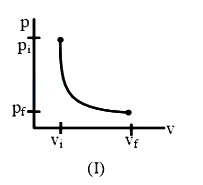
A
$IV$
B
$II$
C
$III$
D
$I$
Solution
(B) In an isochoric process,the volume of the system remains constant throughout the process.
On a $p-V$ diagram,where pressure $p$ is plotted on the $y$-axis and volume $V$ is plotted on the $x$-axis,a constant volume process is represented by a vertical line.
This vertical line indicates that for any change in pressure,the value of $V$ remains the same.
Looking at the provided diagrams (not fully shown but implied by standard physics problems of this type),the diagram representing a vertical line corresponds to the isochoric process.
Assuming the standard set of diagrams where $II$ represents the vertical line,the correct option is $II$.
On a $p-V$ diagram,where pressure $p$ is plotted on the $y$-axis and volume $V$ is plotted on the $x$-axis,a constant volume process is represented by a vertical line.
This vertical line indicates that for any change in pressure,the value of $V$ remains the same.
Looking at the provided diagrams (not fully shown but implied by standard physics problems of this type),the diagram representing a vertical line corresponds to the isochoric process.
Assuming the standard set of diagrams where $II$ represents the vertical line,the correct option is $II$.
0 likesView Solution
181
PhysicsEasyMCQMHT CET · 2021
$A$ monoatomic gas is suddenly compressed to $(1/8)^{\text{th}}$ of its initial volume adiabatically. The ratio of the final pressure to initial pressure of the gas is $(\gamma = 5/3)$.
A
$32$
B
$8$
C
$40$/$3$
D
$24$/$5$
Solution
(A) Given: Initial volume $V_1$,Final volume $V_2 = V_1/8$,Adiabatic index $\gamma = 5/3$.
For an adiabatic process,the relation between pressure and volume is given by $P_1 V_1^\gamma = P_2 V_2^\gamma$.
Rearranging for the ratio of final pressure to initial pressure: $\frac{P_2}{P_1} = \left(\frac{V_1}{V_2}\right)^\gamma$.
Substituting the values: $\frac{P_2}{P_1} = (8)^{5/3}$.
Since $8 = 2^3$,we have $(2^3)^{5/3} = 2^5 = 32$.
Thus,the ratio of the final pressure to the initial pressure is $32$.
For an adiabatic process,the relation between pressure and volume is given by $P_1 V_1^\gamma = P_2 V_2^\gamma$.
Rearranging for the ratio of final pressure to initial pressure: $\frac{P_2}{P_1} = \left(\frac{V_1}{V_2}\right)^\gamma$.
Substituting the values: $\frac{P_2}{P_1} = (8)^{5/3}$.
Since $8 = 2^3$,we have $(2^3)^{5/3} = 2^5 = 32$.
Thus,the ratio of the final pressure to the initial pressure is $32$.
0 likesView Solution
182
PhysicsEasyMCQMHT CET · 2021
What is the $SI$ unit of density?
A
$kg \cdot dm^3$
B
$kg \cdot m^{-3}$
C
$kg \cdot m^3$
D
$kg \cdot dm^{-3}$
Solution
(B) $\text{Density} = \frac{\text{Mass}}{\text{Volume}}$
$\text{The SI unit of mass is kilogram } (kg)$.
$\text{The SI unit of volume is cubic meter } (m^3)$.
$\text{Therefore, the SI unit of density is } \frac{kg}{m^3} \text{ or } kg \cdot m^{-3}$.
$\text{The SI unit of mass is kilogram } (kg)$.
$\text{The SI unit of volume is cubic meter } (m^3)$.
$\text{Therefore, the SI unit of density is } \frac{kg}{m^3} \text{ or } kg \cdot m^{-3}$.
0 likesView Solution
183
PhysicsEasyMCQMHT CET · 2021
Which one of the following statements is true?
A
The sound waves in air are longitudinal while the light waves in air are transverse
B
Both light and sound waves in air are transverse
C
Both light and sound waves in air are longitudinal
D
The sound waves are transverse and light waves are longitudinal
Solution
(A) Sound waves are mechanical waves that require a medium to travel. In air,particles oscillate parallel to the direction of wave propagation,making them longitudinal waves.
Light waves are electromagnetic waves that do not require a medium. They consist of oscillating electric and magnetic fields perpendicular to the direction of propagation,making them transverse waves.
Therefore,the correct statement is that sound waves in air are longitudinal while light waves in air are transverse.
Light waves are electromagnetic waves that do not require a medium. They consist of oscillating electric and magnetic fields perpendicular to the direction of propagation,making them transverse waves.
Therefore,the correct statement is that sound waves in air are longitudinal while light waves in air are transverse.
0 likesView Solution
184
PhysicsMediumMCQMHT CET · 2021
The equation of a wave is given by $y = 10 \sin \left(\frac{2 \pi t}{30} + \alpha\right)$. If the displacement is $5 \ cm$ at $t = 0 \ s$,then the total phase angle at $t = 7.5 \ s$ will be:
A
$\frac{\pi}{3} \ rad$
B
$\frac{\pi}{2} \ rad$
C
$\frac{2 \pi}{5} \ rad$
D
$\frac{2 \pi}{3} \ rad$
Solution
(D) The given wave equation is $y = 10 \sin \left(\frac{2 \pi t}{30} + \alpha\right)$.
At $t = 0 \ s$,the displacement $y = 5 \ cm$.
Substituting these values into the equation: $5 = 10 \sin \left(\frac{2 \pi (0)}{30} + \alpha\right) \implies 5 = 10 \sin \alpha \implies \sin \alpha = \frac{1}{2}$.
Thus,the initial phase constant $\alpha = \frac{\pi}{6} \ rad$.
The total phase angle $\phi$ at any time $t$ is given by $\phi = \frac{2 \pi t}{30} + \alpha$.
At $t = 7.5 \ s$,the total phase angle is $\phi = \frac{2 \pi (7.5)}{30} + \frac{\pi}{6}$.
$\phi = \frac{15 \pi}{30} + \frac{\pi}{6} = \frac{\pi}{2} + \frac{\pi}{6}$.
$\phi = \frac{3 \pi + \pi}{6} = \frac{4 \pi}{6} = \frac{2 \pi}{3} \ rad$.
At $t = 0 \ s$,the displacement $y = 5 \ cm$.
Substituting these values into the equation: $5 = 10 \sin \left(\frac{2 \pi (0)}{30} + \alpha\right) \implies 5 = 10 \sin \alpha \implies \sin \alpha = \frac{1}{2}$.
Thus,the initial phase constant $\alpha = \frac{\pi}{6} \ rad$.
The total phase angle $\phi$ at any time $t$ is given by $\phi = \frac{2 \pi t}{30} + \alpha$.
At $t = 7.5 \ s$,the total phase angle is $\phi = \frac{2 \pi (7.5)}{30} + \frac{\pi}{6}$.
$\phi = \frac{15 \pi}{30} + \frac{\pi}{6} = \frac{\pi}{2} + \frac{\pi}{6}$.
$\phi = \frac{3 \pi + \pi}{6} = \frac{4 \pi}{6} = \frac{2 \pi}{3} \ rad$.
0 likesView Solution
185
PhysicsMediumMCQMHT CET · 2021
$A$ progressive wave of frequency $50 \,Hz$ is travelling with velocity $350 \,m/s$ through a medium. The change in phase at a given time interval of $0.01 \,s$ is
A
$\frac{\pi}{4} \,rad$
B
$\frac{3\pi}{2} \,rad$
C
$\pi \,rad$
D
$\frac{\pi}{2} \,rad$
Solution
(C) The relationship between phase difference $\Delta \phi$ and time interval $\Delta t$ is given by:
$\Delta \phi = \omega \Delta t = (2\pi f) \Delta t$
Given frequency $f = 50 \,Hz$ and time interval $\Delta t = 0.01 \,s$.
Substituting the values:
$\Delta \phi = 2 \times \pi \times 50 \times 0.01$
$\Delta \phi = 100 \pi \times 0.01$
$\Delta \phi = \pi \,rad$.
$\Delta \phi = \omega \Delta t = (2\pi f) \Delta t$
Given frequency $f = 50 \,Hz$ and time interval $\Delta t = 0.01 \,s$.
Substituting the values:
$\Delta \phi = 2 \times \pi \times 50 \times 0.01$
$\Delta \phi = 100 \pi \times 0.01$
$\Delta \phi = \pi \,rad$.
0 likesView Solution
186
PhysicsEasyMCQMHT CET · 2021
$A$ simple harmonic progressive wave is given by $Y = Y_0 \sin 2 \pi (nt - \frac{x}{\lambda})$. If the wave velocity is $(1/8)^{\text{th}}$ of the maximum particle velocity,then the wavelength is
A
$\frac{\pi Y_0}{2}$
B
$\frac{\pi Y_0}{4}$
C
$\frac{\pi Y_0}{8}$
D
$\frac{\pi Y_0}{16}$
Solution
(B) The given wave equation is $Y = Y_0 \sin(2 \pi n t - \frac{2 \pi x}{\lambda})$.
Comparing this with the standard form $Y = Y_0 \sin(\omega t - kx)$,we get angular frequency $\omega = 2 \pi n$.
The maximum particle velocity $v_{p, \text{max}} = Y_0 \omega = Y_0 (2 \pi n) = 2 \pi n Y_0$.
The wave velocity $v = n \lambda$.
According to the problem,the wave velocity is $(1/8)^{\text{th}}$ of the maximum particle velocity:
$v = \frac{1}{8} v_{p, \text{max}}$
$n \lambda = \frac{1}{8} (2 \pi n Y_0)$
$n \lambda = \frac{\pi n Y_0}{4}$
$\lambda = \frac{\pi Y_0}{4}$.
Comparing this with the standard form $Y = Y_0 \sin(\omega t - kx)$,we get angular frequency $\omega = 2 \pi n$.
The maximum particle velocity $v_{p, \text{max}} = Y_0 \omega = Y_0 (2 \pi n) = 2 \pi n Y_0$.
The wave velocity $v = n \lambda$.
According to the problem,the wave velocity is $(1/8)^{\text{th}}$ of the maximum particle velocity:
$v = \frac{1}{8} v_{p, \text{max}}$
$n \lambda = \frac{1}{8} (2 \pi n Y_0)$
$n \lambda = \frac{\pi n Y_0}{4}$
$\lambda = \frac{\pi Y_0}{4}$.
0 likesView Solution
187
PhysicsDifficultMCQMHT CET · 2021
The equations of two simple harmonic waves are given by $Y_1 = 2 \sin 8 \pi \left(\frac{t}{0.2} - \frac{x}{2}\right) \text{ m}$ and $Y_2 = 4 \sin 8 \pi \left(\frac{t}{0.16} - \frac{x}{1.6}\right) \text{ m}$. Then both waves have:
A
same period
B
same frequency
C
same wavelength
D
same velocity
Solution
(D) The standard equation for a wave is $Y = A \sin 2 \pi \left(\frac{t}{T} - \frac{x}{\lambda}\right)$.
For the first wave: $Y_1 = 2 \sin 2 \pi \left(\frac{4t}{0.2} - \frac{4x}{2}\right) = 2 \sin 2 \pi \left(\frac{t}{0.05} - \frac{x}{0.5}\right)$.
Here,$T_1 = 0.05 \text{ s}$ and $\lambda_1 = 0.5 \text{ m}$.
Velocity $v_1 = \frac{\lambda_1}{T_1} = \frac{0.5}{0.05} = 10 \text{ m/s}$.
For the second wave: $Y_2 = 4 \sin 2 \pi \left(\frac{4t}{0.16} - \frac{4x}{1.6}\right) = 4 \sin 2 \pi \left(\frac{t}{0.04} - \frac{x}{0.4}\right)$.
Here,$T_2 = 0.04 \text{ s}$ and $\lambda_2 = 0.4 \text{ m}$.
Velocity $v_2 = \frac{\lambda_2}{T_2} = \frac{0.4}{0.04} = 10 \text{ m/s}$.
Since $v_1 = v_2 = 10 \text{ m/s}$,both waves have the same velocity.
For the first wave: $Y_1 = 2 \sin 2 \pi \left(\frac{4t}{0.2} - \frac{4x}{2}\right) = 2 \sin 2 \pi \left(\frac{t}{0.05} - \frac{x}{0.5}\right)$.
Here,$T_1 = 0.05 \text{ s}$ and $\lambda_1 = 0.5 \text{ m}$.
Velocity $v_1 = \frac{\lambda_1}{T_1} = \frac{0.5}{0.05} = 10 \text{ m/s}$.
For the second wave: $Y_2 = 4 \sin 2 \pi \left(\frac{4t}{0.16} - \frac{4x}{1.6}\right) = 4 \sin 2 \pi \left(\frac{t}{0.04} - \frac{x}{0.4}\right)$.
Here,$T_2 = 0.04 \text{ s}$ and $\lambda_2 = 0.4 \text{ m}$.
Velocity $v_2 = \frac{\lambda_2}{T_2} = \frac{0.4}{0.04} = 10 \text{ m/s}$.
Since $v_1 = v_2 = 10 \text{ m/s}$,both waves have the same velocity.
0 likesView Solution
188
PhysicsEasyMCQMHT CET · 2021
The equation of a simple harmonic wave produced in a string under a tension of $0.4 \,N$ is given by $y=4 \sin (3x+60t) \,m$. The mass per unit length of the string is:
A
$10^{-3} \,kg \,m^{-1}$
B
$10^{-5} \,kg \,m^{-1}$
C
$10^{-3} \,g \,cm^{-1}$
D
$10^{-5} \,g \,cm^{-1}$
Solution
(A) The standard equation of a traveling wave is given by $y=A \sin (kx+\omega t)$.
Comparing this with the given equation $y=4 \sin (3x+60t)$,we get the wave number $k=3 \,m^{-1}$ and the angular frequency $\omega=60 \,rad/s$.
The wave speed $V$ is calculated as $V = \frac{\omega}{k} = \frac{60}{3} = 20 \,m/s$.
The speed of a transverse wave in a stretched string is given by $V = \sqrt{\frac{T}{\mu}}$,where $T$ is the tension and $\mu$ is the mass per unit length.
Squaring both sides,we get $V^2 = \frac{T}{\mu}$,which implies $\mu = \frac{T}{V^2}$.
Substituting the given values $T = 0.4 \,N$ and $V = 20 \,m/s$:
$\mu = \frac{0.4}{(20)^2} = \frac{0.4}{400} = \frac{4 \times 10^{-1}}{4 \times 10^2} = 10^{-3} \,kg \,m^{-1}$.
Comparing this with the given equation $y=4 \sin (3x+60t)$,we get the wave number $k=3 \,m^{-1}$ and the angular frequency $\omega=60 \,rad/s$.
The wave speed $V$ is calculated as $V = \frac{\omega}{k} = \frac{60}{3} = 20 \,m/s$.
The speed of a transverse wave in a stretched string is given by $V = \sqrt{\frac{T}{\mu}}$,where $T$ is the tension and $\mu$ is the mass per unit length.
Squaring both sides,we get $V^2 = \frac{T}{\mu}$,which implies $\mu = \frac{T}{V^2}$.
Substituting the given values $T = 0.4 \,N$ and $V = 20 \,m/s$:
$\mu = \frac{0.4}{(20)^2} = \frac{0.4}{400} = \frac{4 \times 10^{-1}}{4 \times 10^2} = 10^{-3} \,kg \,m^{-1}$.
0 likesView Solution
189
PhysicsMediumMCQMHT CET · 2021
$A$ sound wave is travelling with a frequency of $50 \,Hz$. The phase difference between two points in the path of the wave is $\frac{\pi}{3} \,rad$. The distance between those two points is (Velocity of sound in air $=330 \,m/s$) (in $m$)
A
$1.1$
B
$0.6$
C
$2.2$
D
$1.7$
Solution
(A) The relationship between phase difference $\phi$ and path difference $x$ is given by $\phi = \frac{2 \pi}{\lambda} x$.
First,calculate the wavelength $\lambda$ using the formula $\lambda = \frac{v}{f}$,where $v = 330 \,m/s$ and $f = 50 \,Hz$.
$\lambda = \frac{330}{50} = 6.6 \,m$.
Now,rearrange the phase difference formula to solve for $x$: $x = \frac{\phi \lambda}{2 \pi}$.
Substituting the values: $x = \frac{(\pi/3) \times 6.6}{2 \pi} = \frac{6.6}{6} = 1.1 \,m$.
Thus,the distance between the two points is $1.1 \,m$.
First,calculate the wavelength $\lambda$ using the formula $\lambda = \frac{v}{f}$,where $v = 330 \,m/s$ and $f = 50 \,Hz$.
$\lambda = \frac{330}{50} = 6.6 \,m$.
Now,rearrange the phase difference formula to solve for $x$: $x = \frac{\phi \lambda}{2 \pi}$.
Substituting the values: $x = \frac{(\pi/3) \times 6.6}{2 \pi} = \frac{6.6}{6} = 1.1 \,m$.
Thus,the distance between the two points is $1.1 \,m$.
0 likesView Solution
190
PhysicsEasyMCQMHT CET · 2021
$A$ transverse wave given by $y=2 \sin (0.01 x+30 t)$ moves on a stretched string from one end to another end in $0.5 \ s$. If $x$ and $y$ are in $cm$ and $t$ is in $s$,then the length of the string is: (in $m$)
A
$6$
B
$9$
C
$12$
D
$15$
Solution
(D) The given equation of the transverse wave is $y=2 \sin (0.01 x+30 t)$.
Comparing this with the standard wave equation $y=A \sin (kx+\omega t)$,we identify the wave number $k=0.01 \ rad/cm$ and the angular frequency $\omega=30 \ rad/s$.
The wave speed $v$ is calculated as $v = \frac{\omega}{k} = \frac{30}{0.01} = 3000 \ cm/s$.
Converting the speed to $SI$ units,$v = 30 \ m/s$.
The time taken to travel the length of the string is $t = 0.5 \ s$.
Therefore,the length of the string $L = v \times t = 30 \ m/s \times 0.5 \ s = 15 \ m$.
Comparing this with the standard wave equation $y=A \sin (kx+\omega t)$,we identify the wave number $k=0.01 \ rad/cm$ and the angular frequency $\omega=30 \ rad/s$.
The wave speed $v$ is calculated as $v = \frac{\omega}{k} = \frac{30}{0.01} = 3000 \ cm/s$.
Converting the speed to $SI$ units,$v = 30 \ m/s$.
The time taken to travel the length of the string is $t = 0.5 \ s$.
Therefore,the length of the string $L = v \times t = 30 \ m/s \times 0.5 \ s = 15 \ m$.
0 likesView Solution
191
PhysicsDifficultMCQMHT CET · 2021
$A$ sound wave of frequency $160 \,Hz$ has a velocity of $320 \,m/s$. When it travels through air, the particles having a phase difference of $90^{\circ}$ are separated by a distance of: (in $cm$)
A
$50$
B
$1$
C
$25$
D
$75$
Solution
(A) Given: Frequency $f = 160 \,Hz$, Velocity $v = 320 \,m/s$.
First, calculate the wavelength $\lambda$ using the formula $\lambda = v/f$:
$\lambda = 320 / 160 = 2 \,m = 200 \,cm$.
The relationship between phase difference $\phi$ and path difference $x$ is given by $\phi = \frac{2\pi x}{\lambda}$.
Given phase difference $\phi = 90^{\circ} = \pi/2$ radians.
Substituting the values: $\frac{\pi}{2} = \frac{2\pi x}{200}$.
Solving for $x$: $x = \frac{\pi}{2} \cdot \frac{200}{2\pi} = \frac{200}{4} = 50 \,cm$.
First, calculate the wavelength $\lambda$ using the formula $\lambda = v/f$:
$\lambda = 320 / 160 = 2 \,m = 200 \,cm$.
The relationship between phase difference $\phi$ and path difference $x$ is given by $\phi = \frac{2\pi x}{\lambda}$.
Given phase difference $\phi = 90^{\circ} = \pi/2$ radians.
Substituting the values: $\frac{\pi}{2} = \frac{2\pi x}{200}$.
Solving for $x$: $x = \frac{\pi}{2} \cdot \frac{200}{2\pi} = \frac{200}{4} = 50 \,cm$.
0 likesView Solution
192
PhysicsEasyMCQMHT CET · 2021
Two tuning forks of frequencies $320 \,Hz$ and $480 \,Hz$ are sounded together to produce sound waves. The velocity of sound in air is $320 \,ms^{-1}$. The difference between the wavelengths of these waves is nearly: (in $cm$)
A
$48$
B
$16.5$
C
$33$
D
$42$
Solution
(C) The wavelength $\lambda$ of a sound wave is given by the formula $\lambda = \frac{V}{f}$,where $V$ is the velocity of sound and $f$ is the frequency.
For the first tuning fork,$f_1 = 320 \,Hz$,so $\lambda_1 = \frac{320 \,ms^{-1}}{320 \,Hz} = 1 \,m$.
For the second tuning fork,$f_2 = 480 \,Hz$,so $\lambda_2 = \frac{320 \,ms^{-1}}{480 \,Hz} = \frac{2}{3} \,m \approx 0.67 \,m$.
The difference between the wavelengths is $\Delta\lambda = \lambda_1 - \lambda_2 = 1 \,m - 0.67 \,m = 0.33 \,m$.
Converting to centimeters,$0.33 \,m = 33 \,cm$.
For the first tuning fork,$f_1 = 320 \,Hz$,so $\lambda_1 = \frac{320 \,ms^{-1}}{320 \,Hz} = 1 \,m$.
For the second tuning fork,$f_2 = 480 \,Hz$,so $\lambda_2 = \frac{320 \,ms^{-1}}{480 \,Hz} = \frac{2}{3} \,m \approx 0.67 \,m$.
The difference between the wavelengths is $\Delta\lambda = \lambda_1 - \lambda_2 = 1 \,m - 0.67 \,m = 0.33 \,m$.
Converting to centimeters,$0.33 \,m = 33 \,cm$.
0 likesView Solution
193
PhysicsMediumMCQMHT CET · 2021
The frequency of a tuning fork is $220 \,Hz$ and the velocity of sound in air is $330 \,m/s$. When the tuning fork completes $80$ vibrations, the distance travelled by the sound wave is: (in $\,m$)
A
$120$
B
$60$
C
$53$
D
$100$
Solution
(A) Given: Frequency $f = 220 \,Hz$, Velocity $v = 330 \,m/s$.
First, calculate the wavelength $\lambda$ using the formula $v = f \lambda$:
$\lambda = \frac{v}{f} = \frac{330}{220} = 1.5 \,m$.
In one vibration, the sound wave travels a distance equal to one wavelength $\lambda$.
Therefore, for $80$ vibrations, the total distance $d$ is:
$d = 80 \times \lambda = 80 \times 1.5 = 120 \,m$.
First, calculate the wavelength $\lambda$ using the formula $v = f \lambda$:
$\lambda = \frac{v}{f} = \frac{330}{220} = 1.5 \,m$.
In one vibration, the sound wave travels a distance equal to one wavelength $\lambda$.
Therefore, for $80$ vibrations, the total distance $d$ is:
$d = 80 \times \lambda = 80 \times 1.5 = 120 \,m$.
0 likesView Solution
194
PhysicsDifficultMCQMHT CET · 2021
$A$ uniform rope of length $12 \ m$ and mass $6 \ kg$ hangs vertically from a rigid support. $A$ block of mass $2 \ kg$ is attached to the free end of the rope. $A$ transverse pulse of wavelength $0.06 \ m$ is produced at the lower end of the rope. The wavelength of the pulse when it reaches the top of the rope is (in $m$)
A
$0.12$
B
$0.4$
C
$0.8$
D
$0.16$
Solution
(A) The speed of a transverse wave in a string is given by $v = f \lambda = \sqrt{\frac{T}{\mu}}$,where $T$ is the tension and $\mu$ is the linear mass density.
Since the frequency $f$ of the pulse remains constant as it travels,we have $\lambda \propto \sqrt{T}$.
Therefore,the ratio of wavelengths is $\frac{\lambda_2}{\lambda_1} = \sqrt{\frac{T_2}{T_1}}$.
At the lower end (bottom),the tension $T_1$ is due to the block of mass $2 \ kg$: $T_1 = 2g$.
At the top of the rope,the tension $T_2$ supports both the block $(2 \ kg)$ and the rope $(6 \ kg)$: $T_2 = (2 + 6)g = 8g$.
Given $\lambda_1 = 0.06 \ m$,we calculate $\lambda_2$ as:
$\lambda_2 = \lambda_1 \sqrt{\frac{T_2}{T_1}} = 0.06 \times \sqrt{\frac{8g}{2g}} = 0.06 \times \sqrt{4} = 0.06 \times 2 = 0.12 \ m$.
Since the frequency $f$ of the pulse remains constant as it travels,we have $\lambda \propto \sqrt{T}$.
Therefore,the ratio of wavelengths is $\frac{\lambda_2}{\lambda_1} = \sqrt{\frac{T_2}{T_1}}$.
At the lower end (bottom),the tension $T_1$ is due to the block of mass $2 \ kg$: $T_1 = 2g$.
At the top of the rope,the tension $T_2$ supports both the block $(2 \ kg)$ and the rope $(6 \ kg)$: $T_2 = (2 + 6)g = 8g$.
Given $\lambda_1 = 0.06 \ m$,we calculate $\lambda_2$ as:
$\lambda_2 = \lambda_1 \sqrt{\frac{T_2}{T_1}} = 0.06 \times \sqrt{\frac{8g}{2g}} = 0.06 \times \sqrt{4} = 0.06 \times 2 = 0.12 \ m$.
0 likesView Solution
195
PhysicsEasyMCQMHT CET · 2021
Beats are produced by waves $y_1 = a \sin(2000 \pi t)$ and $y_2 = a \sin(2008 \pi t)$. The number of beats heard per second is
A
$4$
B
$1$
C
zero
D
$8$
Solution
(A) The general equation for a wave is given by $y = a \sin(2 \pi n t)$,where $n$ is the frequency.
For the first wave,$2 \pi n_1 = 2000 \pi$,which gives $n_1 = 1000 \text{ Hz}$.
For the second wave,$2 \pi n_2 = 2008 \pi$,which gives $n_2 = 1004 \text{ Hz}$.
The beat frequency is the difference between the two frequencies: $f_{\text{beat}} = |n_2 - n_1| = |1004 - 1000| = 4 \text{ Hz}$.
Therefore,the number of beats heard per second is $4$.
For the first wave,$2 \pi n_1 = 2000 \pi$,which gives $n_1 = 1000 \text{ Hz}$.
For the second wave,$2 \pi n_2 = 2008 \pi$,which gives $n_2 = 1004 \text{ Hz}$.
The beat frequency is the difference between the two frequencies: $f_{\text{beat}} = |n_2 - n_1| = |1004 - 1000| = 4 \text{ Hz}$.
Therefore,the number of beats heard per second is $4$.
0 likesView Solution
196
PhysicsEasyMCQMHT CET · 2021
The frequencies of three tuning forks $A$,$B$,and $C$ are related as $n_{A} > n_{B} > n_{C}$. When the forks $A$ and $B$ are sounded together,the number of beats produced per second is $n_1$. When forks $A$ and $C$ are sounded together,the number of beats produced per second is $n_2$. How many beats are produced per second when forks $B$ and $C$ are sounded together?
A
$n_1 - n_2$
B
$\frac{n_1 + n_2}{2}$
C
$n_2 - n_1$
D
$n_1 + n_2$
Solution
(C) Given the frequencies of the tuning forks are $n_A, n_B, n_C$ such that $n_A > n_B > n_C$.
When forks $A$ and $B$ are sounded together,the beat frequency is $n_1 = n_A - n_B$ (Equation $i$).
When forks $A$ and $C$ are sounded together,the beat frequency is $n_2 = n_A - n_C$ (Equation $ii$).
We want to find the beat frequency when $B$ and $C$ are sounded together,which is $n_B - n_C$.
Subtracting Equation $i$ from Equation $ii$:
$(n_A - n_C) - (n_A - n_B) = n_2 - n_1$
$n_A - n_C - n_A + n_B = n_2 - n_1$
$n_B - n_C = n_2 - n_1$.
Thus,the number of beats produced per second is $n_2 - n_1$.
When forks $A$ and $B$ are sounded together,the beat frequency is $n_1 = n_A - n_B$ (Equation $i$).
When forks $A$ and $C$ are sounded together,the beat frequency is $n_2 = n_A - n_C$ (Equation $ii$).
We want to find the beat frequency when $B$ and $C$ are sounded together,which is $n_B - n_C$.
Subtracting Equation $i$ from Equation $ii$:
$(n_A - n_C) - (n_A - n_B) = n_2 - n_1$
$n_A - n_C - n_A + n_B = n_2 - n_1$
$n_B - n_C = n_2 - n_1$.
Thus,the number of beats produced per second is $n_2 - n_1$.
0 likesView Solution
197
PhysicsMediumMCQMHT CET · 2021
Two sound waves having wavelengths $5.0 \ m$ and $5.5 \ m$ propagate in a gas with velocity $300 \ m/s$. The number of beats produced per second is
A
six
B
two
C
three
D
one
Solution
(A) Given: Wavelengths $\lambda_1 = 5.0 \ m$ and $\lambda_2 = 5.5 \ m$. Velocity of sound $v = 300 \ m/s$.
The frequency $n$ of a wave is given by $n = \frac{v}{\lambda}$.
Frequency of the first wave: $n_1 = \frac{300}{5.0} = 60 \ Hz$.
Frequency of the second wave: $n_2 = \frac{300}{5.5} = \frac{3000}{55} \approx 54.55 \ Hz$.
The number of beats produced per second is the difference in frequencies: $n_{beats} = |n_1 - n_2| = |60 - 54.55| = 5.45 \ Hz$.
Rounding to the nearest integer,the number of beats is approximately $5 \ Hz$ or $6 \ Hz$ depending on the precision. Given the options,$6 \ Hz$ is the closest match.
The frequency $n$ of a wave is given by $n = \frac{v}{\lambda}$.
Frequency of the first wave: $n_1 = \frac{300}{5.0} = 60 \ Hz$.
Frequency of the second wave: $n_2 = \frac{300}{5.5} = \frac{3000}{55} \approx 54.55 \ Hz$.
The number of beats produced per second is the difference in frequencies: $n_{beats} = |n_1 - n_2| = |60 - 54.55| = 5.45 \ Hz$.
Rounding to the nearest integer,the number of beats is approximately $5 \ Hz$ or $6 \ Hz$ depending on the precision. Given the options,$6 \ Hz$ is the closest match.
0 likesView Solution
198
PhysicsMediumMCQMHT CET · 2021
An air column in a pipe,which is closed at one end,will be in resonance with a vibrating tuning fork of frequency $264 \,Hz$ for various lengths. Which one of the following lengths is not possible (in $\,cm$)? $(V=330 \,m/s)$
A
$62.50$
B
$93.75$
C
$156.25$
D
$31.25$
Solution
(A) The frequency of the tuning fork is $n = 264 \,Hz$ and the speed of sound is $V = 330 \,m/s$.
For a pipe closed at one end,the resonance occurs at lengths given by $\ell = (2k-1) \frac{\lambda}{4}$,where $k = 1, 2, 3, \dots$.
The wavelength is $\lambda = \frac{V}{n} = \frac{330}{264} = 1.25 \,m = 125 \,cm$.
Thus,the possible lengths are $\ell = (2k-1) \frac{125}{4} = (2k-1) \times 31.25 \,cm$.
For $k=1$,$\ell = 31.25 \,cm$.
For $k=2$,$\ell = 3 \times 31.25 = 93.75 \,cm$.
For $k=3$,$\ell = 5 \times 31.25 = 156.25 \,cm$.
Comparing these with the given options,$62.50 \,cm$ is not an odd multiple of $31.25 \,cm$,hence it is not possible.
For a pipe closed at one end,the resonance occurs at lengths given by $\ell = (2k-1) \frac{\lambda}{4}$,where $k = 1, 2, 3, \dots$.
The wavelength is $\lambda = \frac{V}{n} = \frac{330}{264} = 1.25 \,m = 125 \,cm$.
Thus,the possible lengths are $\ell = (2k-1) \frac{125}{4} = (2k-1) \times 31.25 \,cm$.
For $k=1$,$\ell = 31.25 \,cm$.
For $k=2$,$\ell = 3 \times 31.25 = 93.75 \,cm$.
For $k=3$,$\ell = 5 \times 31.25 = 156.25 \,cm$.
Comparing these with the given options,$62.50 \,cm$ is not an odd multiple of $31.25 \,cm$,hence it is not possible.
0 likesView Solution
199
PhysicsMediumMCQMHT CET · 2021
Two consecutive harmonics of an air column in a pipe closed at one end are of frequencies $150 \,Hz$ and $250 \,Hz$. The fundamental frequency of the air column is: (in $\,Hz$)
A
$25$
B
$75$
C
$100$
D
$50$
Solution
(D) In a pipe closed at one end, the allowed frequencies are odd multiples of the fundamental frequency $(f_0)$: $f_n = (2n-1)f_0$, where $n = 1, 2, 3, ...$.
These frequencies are $f_1 = f_0$, $f_2 = 3f_0$, $f_3 = 5f_0$, $f_4 = 7f_0$, and so on.
The difference between two consecutive harmonics in a closed pipe is $2f_0$.
Given the consecutive frequencies are $150 \,Hz$ and $250 \,Hz$, their difference is $250 \,Hz - 150 \,Hz = 100 \,Hz$.
Therefore, $2f_0 = 100 \,Hz$, which gives $f_0 = 50 \,Hz$.
These frequencies are $f_1 = f_0$, $f_2 = 3f_0$, $f_3 = 5f_0$, $f_4 = 7f_0$, and so on.
The difference between two consecutive harmonics in a closed pipe is $2f_0$.
Given the consecutive frequencies are $150 \,Hz$ and $250 \,Hz$, their difference is $250 \,Hz - 150 \,Hz = 100 \,Hz$.
Therefore, $2f_0 = 100 \,Hz$, which gives $f_0 = 50 \,Hz$.
0 likesView Solution
200
PhysicsMediumMCQMHT CET · 2021
The frequency of a tuning fork is $n \ Hz$ and the velocity of sound in air is $V \ m/s$. When the tuning fork completes $x$ vibrations,the distance traveled by the wave is:
A
$\frac{V}{xn}$
B
$\frac{Vn}{x}$
C
$\frac{xV}{n}$
D
$\frac{x}{Vn}$
Solution
(C) The time period of one vibration is $T = \frac{1}{n} \ s$.
For $x$ vibrations,the total time taken is $t = x \times T = \frac{x}{n} \ s$.
The distance traveled by the wave in time $t$ is given by $d = V \times t$.
Substituting the value of $t$,we get $d = V \times \frac{x}{n} = \frac{xV}{n} \ m$.
For $x$ vibrations,the total time taken is $t = x \times T = \frac{x}{n} \ s$.
The distance traveled by the wave in time $t$ is given by $d = V \times t$.
Substituting the value of $t$,we get $d = V \times \frac{x}{n} = \frac{xV}{n} \ m$.
0 likesView Solution
201
PhysicsEasyMCQMHT CET · 2021
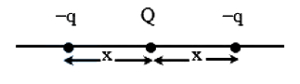
Three charges $-q, Q$ and $-q$ are placed at equal distances on a straight line. If the total potential energy of the system of three charges is zero,then the ratio $\frac{Q}{q}$ is
A
$1$ : $2$
B
$1$ : $1$
C
$1$ : $4$
D
$1$ : $3$
Solution
(C) The potential energy $U$ of a system of point charges is given by the sum of the potential energies of all pairs of charges: $U = \sum \frac{k q_i q_j}{r_{ij}}$.
Given the charges $-q, Q, -q$ are placed at distances $x$ apart,the pairs are: $(-q, Q)$ at distance $x$,$(Q, -q)$ at distance $x$,and $(-q, -q)$ at distance $2x$.
The total potential energy is:
$U = \frac{1}{4 \pi \varepsilon_0} \left( \frac{(-q)(Q)}{x} + \frac{(Q)(-q)}{x} + \frac{(-q)(-q)}{2x} \right) = 0$
Dividing by $\frac{1}{4 \pi \varepsilon_0 x}$ (assuming $x \neq 0$):
$-qQ - qQ + \frac{q^2}{2} = 0$
$-2qQ + \frac{q^2}{2} = 0$
$2qQ = \frac{q^2}{2}$
Dividing both sides by $2q$ (assuming $q \neq 0$):
$Q = \frac{q}{4}$
Therefore,the ratio $\frac{Q}{q} = \frac{1}{4}$.
Given the charges $-q, Q, -q$ are placed at distances $x$ apart,the pairs are: $(-q, Q)$ at distance $x$,$(Q, -q)$ at distance $x$,and $(-q, -q)$ at distance $2x$.
The total potential energy is:
$U = \frac{1}{4 \pi \varepsilon_0} \left( \frac{(-q)(Q)}{x} + \frac{(Q)(-q)}{x} + \frac{(-q)(-q)}{2x} \right) = 0$
Dividing by $\frac{1}{4 \pi \varepsilon_0 x}$ (assuming $x \neq 0$):
$-qQ - qQ + \frac{q^2}{2} = 0$
$-2qQ + \frac{q^2}{2} = 0$
$2qQ = \frac{q^2}{2}$
Dividing both sides by $2q$ (assuming $q \neq 0$):
$Q = \frac{q}{4}$
Therefore,the ratio $\frac{Q}{q} = \frac{1}{4}$.
0 likesView Solution
202
PhysicsMediumMCQMHT CET · 2021
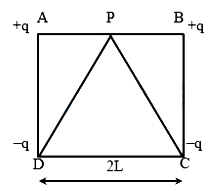
Four electric charges $+q, +q, -q$ and $-q$ are placed in order at the corners of a square of side $2L$. The electric potential at point $P$ midway between the two positive charges is
A
$\frac{1}{4 \pi \epsilon_0} \frac{2q}{L}(1-\sqrt{5})$
B
zero
C
$\frac{1}{4 \pi \epsilon_0} \frac{2q}{L}\left(1+\frac{1}{\sqrt{5}}\right)$
D
$\frac{1}{4 \pi \epsilon_0} \frac{2q}{L}\left(1-\frac{1}{\sqrt{5}}\right)$
Solution
(D) Let the square be $ABCD$ with side length $2L$. Charges $+q$ are at $A$ and $B$,and charges $-q$ are at $D$ and $C$. Point $P$ is the midpoint of $AB$.
Distance $AP = PB = L$.
The distance from $P$ to $D$ and $C$ can be found using the Pythagorean theorem in $\triangle ADP$ and $\triangle BCP$:
$PD = PC = \sqrt{(2L)^2 + L^2} = \sqrt{4L^2 + L^2} = \sqrt{5}L$.
The electric potential $V$ at point $P$ is the sum of potentials due to all four charges:
$V = \frac{1}{4 \pi \epsilon_0} \left( \frac{q}{AP} + \frac{q}{BP} + \frac{-q}{PD} + \frac{-q}{PC} \right)$
$V = \frac{1}{4 \pi \epsilon_0} \left( \frac{q}{L} + \frac{q}{L} - \frac{q}{\sqrt{5}L} - \frac{q}{\sqrt{5}L} \right)$
$V = \frac{1}{4 \pi \epsilon_0} \left( \frac{2q}{L} - \frac{2q}{\sqrt{5}L} \right)$
$V = \frac{1}{4 \pi \epsilon_0} \frac{2q}{L} \left( 1 - \frac{1}{\sqrt{5}} \right)$
Distance $AP = PB = L$.
The distance from $P$ to $D$ and $C$ can be found using the Pythagorean theorem in $\triangle ADP$ and $\triangle BCP$:
$PD = PC = \sqrt{(2L)^2 + L^2} = \sqrt{4L^2 + L^2} = \sqrt{5}L$.
The electric potential $V$ at point $P$ is the sum of potentials due to all four charges:
$V = \frac{1}{4 \pi \epsilon_0} \left( \frac{q}{AP} + \frac{q}{BP} + \frac{-q}{PD} + \frac{-q}{PC} \right)$
$V = \frac{1}{4 \pi \epsilon_0} \left( \frac{q}{L} + \frac{q}{L} - \frac{q}{\sqrt{5}L} - \frac{q}{\sqrt{5}L} \right)$
$V = \frac{1}{4 \pi \epsilon_0} \left( \frac{2q}{L} - \frac{2q}{\sqrt{5}L} \right)$
$V = \frac{1}{4 \pi \epsilon_0} \frac{2q}{L} \left( 1 - \frac{1}{\sqrt{5}} \right)$
0 likesView Solution
203
PhysicsEasyMCQMHT CET · 2021
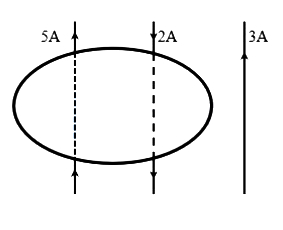
Two wires carrying currents of $5 \ A$ and $2 \ A$ are enclosed in a circular loop as shown in the figure. Another wire carrying a current of $3 \ A$ is situated outside the loop. The value of $\oint \overrightarrow{B} \cdot d\overrightarrow{l}$ around the loop is ($\mu_0 = \text{permeability of free space}$,$d\overrightarrow{l}$ is the length element of the Amperian loop).
A
$4 \mu_0$
B
$2 \mu_0$
C
$3 \mu_0$
D
$\mu_0$
Solution
(C) According to Ampere's circuital law,the line integral of the magnetic field $\overrightarrow{B}$ around any closed loop is equal to $\mu_0$ times the net current $I_{\text{enclosed}}$ passing through the loop.
$\oint \overrightarrow{B} \cdot d\overrightarrow{l} = \mu_0 I_{\text{enclosed}}$
In the given figure,two wires carrying currents of $5 \ A$ and $2 \ A$ are inside the loop. Since these currents are in opposite directions,the net current enclosed by the loop is $I_{\text{enclosed}} = 5 \ A - 2 \ A = 3 \ A$.
The wire carrying $3 \ A$ current is situated outside the loop,so it does not contribute to the net enclosed current.
Therefore,the value of the line integral is $\oint \overrightarrow{B} \cdot d\overrightarrow{l} = \mu_0 \times 3 \ A = 3 \mu_0$.
$\oint \overrightarrow{B} \cdot d\overrightarrow{l} = \mu_0 I_{\text{enclosed}}$
In the given figure,two wires carrying currents of $5 \ A$ and $2 \ A$ are inside the loop. Since these currents are in opposite directions,the net current enclosed by the loop is $I_{\text{enclosed}} = 5 \ A - 2 \ A = 3 \ A$.
The wire carrying $3 \ A$ current is situated outside the loop,so it does not contribute to the net enclosed current.
Therefore,the value of the line integral is $\oint \overrightarrow{B} \cdot d\overrightarrow{l} = \mu_0 \times 3 \ A = 3 \mu_0$.
0 likesView Solution
204
PhysicsMediumMCQMHT CET · 2021
Two long conductors separated by a distance $d$ carry currents $I_1$ and $I_2$ in the same direction. They exert a force $F$ on each other. Now,the current in one of them is increased to $2$ times and its direction is reversed. The distance between them is also increased to $3d$. The new value of force between them is:
A
$-2F$
B
$\frac{F}{3}$
C
$\frac{-2F}{3}$
D
$\frac{-F}{3}$
Solution
(C) The force per unit length between two parallel long conductors is given by the formula: $F = \frac{\mu_0 I_1 I_2}{2 \pi d}$.
Initially,the force is $F = \frac{\mu_0 I_1 I_2}{2 \pi d}$.
When the current in one conductor is doubled $(I_1' = 2I_1)$ and its direction is reversed,the new current becomes $-2I_1$. The distance is increased to $d' = 3d$.
The new force $F'$ is given by: $F' = \frac{\mu_0 (-2I_1) I_2}{2 \pi (3d)}$.
Simplifying this,we get: $F' = -\frac{2}{3} \left( \frac{\mu_0 I_1 I_2}{2 \pi d} \right)$.
Substituting the initial force $F$,we get: $F' = -\frac{2F}{3}$.
Initially,the force is $F = \frac{\mu_0 I_1 I_2}{2 \pi d}$.
When the current in one conductor is doubled $(I_1' = 2I_1)$ and its direction is reversed,the new current becomes $-2I_1$. The distance is increased to $d' = 3d$.
The new force $F'$ is given by: $F' = \frac{\mu_0 (-2I_1) I_2}{2 \pi (3d)}$.
Simplifying this,we get: $F' = -\frac{2}{3} \left( \frac{\mu_0 I_1 I_2}{2 \pi d} \right)$.
Substituting the initial force $F$,we get: $F' = -\frac{2F}{3}$.
0 likesView Solution
205
PhysicsEasyMCQMHT CET · 2021
$A, B$ and $C$ are three parallel conductors of equal lengths carrying currents $I, I$ and $2I$ respectively. The distance between $A$ and $B$ is $x$ and that between $B$ and $C$ is also $x$. $F_1$ is the force exerted by conductor $B$ on $A$. $F_2$ is the force exerted by conductor $C$ on $A$. The current $I$ in $A$ and $I$ in $B$ are in the same direction,and the current $2I$ in $C$ is in the opposite direction. Then:
A
$F_1=F_2$
B
$F_2=2F_1$
C
$F_1=2F_2$
D
$F_1=-F_2$
Solution
(D) The force per unit length between two parallel conductors carrying currents $I_1$ and $I_2$ separated by distance $r$ is given by $f = \frac{\mu_0 I_1 I_2}{2 \pi r}$.
$1$. Force $F_1$ exerted by $B$ on $A$:
Since currents in $A$ and $B$ are in the same direction,the force is attractive (towards $B$).
$F_1 = \frac{\mu_0 I \cdot I}{2 \pi x} \cdot L = \frac{\mu_0 I^2 L}{2 \pi x}$.
$2$. Force $F_2$ exerted by $C$ on $A$:
Since currents in $A$ and $C$ are in opposite directions,the force is repulsive (away from $C$).
The distance between $A$ and $C$ is $2x$.
$F_2 = \frac{\mu_0 I \cdot 2I}{2 \pi (2x)} \cdot L = \frac{\mu_0 I^2 L}{2 \pi x}$.
Comparing the magnitudes,we see that $F_1 = F_2$. However,since the forces are in opposite directions (one is attractive towards $B$ and the other is repulsive away from $C$),we have $F_1 = -F_2$ in vector notation.
$1$. Force $F_1$ exerted by $B$ on $A$:
Since currents in $A$ and $B$ are in the same direction,the force is attractive (towards $B$).
$F_1 = \frac{\mu_0 I \cdot I}{2 \pi x} \cdot L = \frac{\mu_0 I^2 L}{2 \pi x}$.
$2$. Force $F_2$ exerted by $C$ on $A$:
Since currents in $A$ and $C$ are in opposite directions,the force is repulsive (away from $C$).
The distance between $A$ and $C$ is $2x$.
$F_2 = \frac{\mu_0 I \cdot 2I}{2 \pi (2x)} \cdot L = \frac{\mu_0 I^2 L}{2 \pi x}$.
Comparing the magnitudes,we see that $F_1 = F_2$. However,since the forces are in opposite directions (one is attractive towards $B$ and the other is repulsive away from $C$),we have $F_1 = -F_2$ in vector notation.
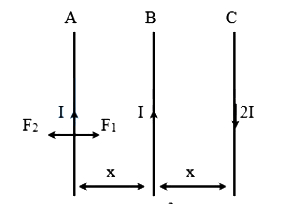
0 likesView Solution
206
PhysicsEasyMCQMHT CET · 2021
$A$ current-carrying loop is placed in a uniform magnetic field. The torque acting on the loop does not depend upon
A
area of the loop
B
number of turns in the loop
C
shape of the loop
D
strength of the magnetic field
Solution
(C) The torque $\tau$ acting on a current-carrying loop in a uniform magnetic field is given by the formula: $\tau = N i A B \sin \theta$.
Here,$N$ is the number of turns,$i$ is the current,$A$ is the area of the loop,$B$ is the magnetic field strength,and $\theta$ is the angle between the normal to the loop and the magnetic field.
From the formula,it is evident that the torque depends on $N, i, A, B,$ and $\theta$.
It does not depend on the shape of the loop,as long as the area $A$ remains constant.
Here,$N$ is the number of turns,$i$ is the current,$A$ is the area of the loop,$B$ is the magnetic field strength,and $\theta$ is the angle between the normal to the loop and the magnetic field.
From the formula,it is evident that the torque depends on $N, i, A, B,$ and $\theta$.
It does not depend on the shape of the loop,as long as the area $A$ remains constant.
0 likesView Solution
207
PhysicsMediumMCQMHT CET · 2021
$A$ magnetic dipole of magnetic moment $M$ is freely suspended in a magnetic field of induction $B$. The minimum and maximum values of the potential energy of the dipole,respectively,are
A
$-MB, +MB$
B
$0, MB$
C
$0, 2 MB$
D
$MB, 0$
Solution
(A) The potential energy $U$ of a magnetic dipole in an external magnetic field is given by the formula $U = -\vec{M} \cdot \vec{B} = -MB \cos \theta$,where $\theta$ is the angle between the magnetic moment $\vec{M}$ and the magnetic field $\vec{B}$.
For the minimum potential energy,$\cos \theta$ must be maximum,which occurs at $\theta = 0^{\circ}$. Thus,$U_{\text{min}} = -MB \cos 0^{\circ} = -MB(1) = -MB$.
For the maximum potential energy,$\cos \theta$ must be minimum,which occurs at $\theta = 180^{\circ}$. Thus,$U_{\text{max}} = -MB \cos 180^{\circ} = -MB(-1) = +MB$.
Therefore,the minimum and maximum values are $-MB$ and $+MB$ respectively.
For the minimum potential energy,$\cos \theta$ must be maximum,which occurs at $\theta = 0^{\circ}$. Thus,$U_{\text{min}} = -MB \cos 0^{\circ} = -MB(1) = -MB$.
For the maximum potential energy,$\cos \theta$ must be minimum,which occurs at $\theta = 180^{\circ}$. Thus,$U_{\text{max}} = -MB \cos 180^{\circ} = -MB(-1) = +MB$.
Therefore,the minimum and maximum values are $-MB$ and $+MB$ respectively.
0 likesView Solution
208
PhysicsEasyMCQMHT CET · 2021
The magnetic field intensity $H$ at the centre of a long solenoid having $n$ turns per unit length and carrying a current $I$,when no material is kept in it,is
A
$I/n$
B
$n/I$
C
$nI$
D
$n^2 I$
Solution
(C) For a long solenoid,the magnetic field $B$ at the centre is given by $B = \mu_0 n I$,where $\mu_0$ is the permeability of free space,$n$ is the number of turns per unit length,and $I$ is the current.
The magnetic field intensity $H$ is defined as $H = B / \mu_0$.
Substituting the value of $B$,we get $H = (\mu_0 n I) / \mu_0 = n I$.
Therefore,the magnetic field intensity at the centre of a long solenoid is $n I$.
The magnetic field intensity $H$ is defined as $H = B / \mu_0$.
Substituting the value of $B$,we get $H = (\mu_0 n I) / \mu_0 = n I$.
Therefore,the magnetic field intensity at the centre of a long solenoid is $n I$.
0 likesView Solution
209
PhysicsMediumMCQMHT CET · 2021
An electron $(e)$ moves in a circular orbit of radius '$r$' with uniform speed '$V$'. It produces a magnetic field '$B$' at the center of the circle. The magnetic field $B$ is ($\mu_0 =$ permeability of free space).
A
$\frac{\mu_0 e}{4 \pi} \left( \frac{V}{r^2} \right)$
B
$\frac{\mu_0 e}{4 \pi} Vr^2$
C
$\frac{\mu_0 e}{4 \pi} \left( \frac{V}{r} \right)$
D
$\frac{\mu_0 e}{4 \pi} Vr$
Solution
(A) The magnetic field $B$ at the center of a circular current loop is given by the formula: $B = \frac{\mu_0 I}{2r}$.
Here,the current $I$ is defined as the charge per unit time,$I = \frac{e}{T}$.
The time period $T$ for one revolution is $T = \frac{2 \pi r}{V}$.
Substituting $T$ into the current equation,we get $I = \frac{e}{(2 \pi r / V)} = \frac{eV}{2 \pi r}$.
Now,substitute the value of $I$ into the magnetic field formula:
$B = \frac{\mu_0}{2r} \left( \frac{eV}{2 \pi r} \right) = \frac{\mu_0 eV}{4 \pi r^2}$.
Here,the current $I$ is defined as the charge per unit time,$I = \frac{e}{T}$.
The time period $T$ for one revolution is $T = \frac{2 \pi r}{V}$.
Substituting $T$ into the current equation,we get $I = \frac{e}{(2 \pi r / V)} = \frac{eV}{2 \pi r}$.
Now,substitute the value of $I$ into the magnetic field formula:
$B = \frac{\mu_0}{2r} \left( \frac{eV}{2 \pi r} \right) = \frac{\mu_0 eV}{4 \pi r^2}$.
0 likesView Solution
210
PhysicsEasyMCQMHT CET · 2021
$A$ long solenoid carrying a current produces a magnetic field $B$ along its axis. If the number of turns per $cm$ is doubled and the current is made $\left(\frac{1}{3}\right)^{rd}$ of its original value,then the new value of the magnetic field will be:
A
$\frac{B}{3}$
B
$3B$
C
$2B$
D
$\frac{2B}{3}$
Solution
(D) The magnetic field $B$ inside a long solenoid is given by the formula:
$B = \mu_0 n I$
where $n$ is the number of turns per unit length and $I$ is the current flowing through the solenoid.
Given that the initial magnetic field is $B = \mu_0 n I$.
According to the problem,the new number of turns per unit length $n' = 2n$ and the new current $I' = \frac{1}{3}I$.
The new magnetic field $B'$ is given by:
$B' = \mu_0 n' I'$
$B' = \mu_0 (2n) \left(\frac{1}{3}I\right)$
$B' = \frac{2}{3} (\mu_0 n I)$
$B' = \frac{2}{3} B$
Therefore,the new value of the magnetic field is $\frac{2B}{3}$.
$B = \mu_0 n I$
where $n$ is the number of turns per unit length and $I$ is the current flowing through the solenoid.
Given that the initial magnetic field is $B = \mu_0 n I$.
According to the problem,the new number of turns per unit length $n' = 2n$ and the new current $I' = \frac{1}{3}I$.
The new magnetic field $B'$ is given by:
$B' = \mu_0 n' I'$
$B' = \mu_0 (2n) \left(\frac{1}{3}I\right)$
$B' = \frac{2}{3} (\mu_0 n I)$
$B' = \frac{2}{3} B$
Therefore,the new value of the magnetic field is $\frac{2B}{3}$.
0 likesView Solution
211
PhysicsDifficultMCQMHT CET · 2021
Assuming the atom is in the ground state, the expression for the magnetic field at the nucleus in a hydrogen atom due to the circular motion of the electron is [$\mu_0 =$ permeability of free space, $m =$ mass of electron, $\epsilon_0 =$ permittivity of free space, $h =$ Planck's constant].
A
$\frac{\mu_0 e^7 \pi m^2}{8 \epsilon_0^3 h^5}$
B
$\frac{\mu_0 e^5 \pi^2 m^2}{8 \epsilon_0^2 h^4}$
C
$\frac{\mu_0 e^5 \pi m^3}{8 \epsilon_0^3 h^5}$
D
$\frac{\mu_0 e^7 \pi^2 m^2}{8 \epsilon_0^3 h^5}$
Solution
(A) The magnetic field $B$ at the center of a circular current loop is given by $B = \frac{\mu_0 I}{2r}$.
Since the electron revolves with period $T$, the equivalent current is $I = \frac{e}{T}$.
Given $T = \frac{2\pi r}{v}$, we have $I = \frac{ev}{2\pi r}$.
Substituting this into the magnetic field formula: $B = \frac{\mu_0 (ev/2\pi r)}{2r} = \frac{\mu_0 ev}{4\pi r^2}$.
For a hydrogen atom in the ground state $(n=1)$, the velocity $v$ and radius $r$ are given by Bohr's theory:
$v = \frac{e^2}{2\epsilon_0 h}$ and $r = \frac{\epsilon_0 h^2}{\pi m e^2}$.
Substituting these into the expression for $B$:
$B = \frac{\mu_0 e}{4\pi} \cdot \left( \frac{e^2}{2\epsilon_0 h} \right) \cdot \left( \frac{\pi m e^2}{\epsilon_0 h^2} \right)^2$
$B = \frac{\mu_0 e^3}{8\pi \epsilon_0 h} \cdot \frac{\pi^2 m^2 e^4}{\epsilon_0^2 h^4} = \frac{\mu_0 e^7 \pi m^2}{8 \epsilon_0^3 h^5}$.
Since the electron revolves with period $T$, the equivalent current is $I = \frac{e}{T}$.
Given $T = \frac{2\pi r}{v}$, we have $I = \frac{ev}{2\pi r}$.
Substituting this into the magnetic field formula: $B = \frac{\mu_0 (ev/2\pi r)}{2r} = \frac{\mu_0 ev}{4\pi r^2}$.
For a hydrogen atom in the ground state $(n=1)$, the velocity $v$ and radius $r$ are given by Bohr's theory:
$v = \frac{e^2}{2\epsilon_0 h}$ and $r = \frac{\epsilon_0 h^2}{\pi m e^2}$.
Substituting these into the expression for $B$:
$B = \frac{\mu_0 e}{4\pi} \cdot \left( \frac{e^2}{2\epsilon_0 h} \right) \cdot \left( \frac{\pi m e^2}{\epsilon_0 h^2} \right)^2$
$B = \frac{\mu_0 e^3}{8\pi \epsilon_0 h} \cdot \frac{\pi^2 m^2 e^4}{\epsilon_0^2 h^4} = \frac{\mu_0 e^7 \pi m^2}{8 \epsilon_0^3 h^5}$.
0 likesView Solution
212
PhysicsMediumMCQMHT CET · 2021
Two concentric coplanar circular loops of radii $r_1$ and $r_2$ carry currents $i_1$ and $i_2$ in opposite directions (one clockwise and the other anticlockwise). The magnetic induction at the center of the loops is half that due to $i_1$ alone at the center. If $r_2 = 2r_1$,find the value of $\frac{i_2}{i_1}$.
A
$\frac{1}{4}$
B
$1$
C
$2$
D
$\frac{1}{2}$
Solution
(B) The magnetic field at the center of a circular loop of radius $r$ carrying current $i$ is given by $B = \frac{\mu_0 i}{2r}$.
For the two loops,the magnetic fields are $B_1 = \frac{\mu_0 i_1}{2r_1}$ and $B_2 = \frac{\mu_0 i_2}{2r_2}$.
Since the currents are in opposite directions,the resultant magnetic field at the center is $B = B_1 - B_2$ (assuming $B_1 > B_2$).
Given that $B = \frac{B_1}{2}$,we have:
$\frac{B_1}{2} = B_1 - B_2$
$B_2 = \frac{B_1}{2}$
Substituting the expressions for $B_1$ and $B_2$:
$\frac{\mu_0 i_2}{2r_2} = \frac{1}{2} \left( \frac{\mu_0 i_1}{2r_1} \right)$
$\frac{i_2}{r_2} = \frac{i_1}{2r_1}$
Given $r_2 = 2r_1$,we substitute this into the equation:
$\frac{i_2}{2r_1} = \frac{i_1}{2r_1}$
$\frac{i_2}{i_1} = 1$.
For the two loops,the magnetic fields are $B_1 = \frac{\mu_0 i_1}{2r_1}$ and $B_2 = \frac{\mu_0 i_2}{2r_2}$.
Since the currents are in opposite directions,the resultant magnetic field at the center is $B = B_1 - B_2$ (assuming $B_1 > B_2$).
Given that $B = \frac{B_1}{2}$,we have:
$\frac{B_1}{2} = B_1 - B_2$
$B_2 = \frac{B_1}{2}$
Substituting the expressions for $B_1$ and $B_2$:
$\frac{\mu_0 i_2}{2r_2} = \frac{1}{2} \left( \frac{\mu_0 i_1}{2r_1} \right)$
$\frac{i_2}{r_2} = \frac{i_1}{2r_1}$
Given $r_2 = 2r_1$,we substitute this into the equation:
$\frac{i_2}{2r_1} = \frac{i_1}{2r_1}$
$\frac{i_2}{i_1} = 1$.
0 likesView Solution
213
PhysicsEasyMCQMHT CET · 2021
When a battery is connected to the two ends of a diagonal of a square conductor frame of side '$a$',the magnitude of the magnetic field at the center will be $(\mu_0 = \text{permeability of free space})$.
A
$\frac{\mu_0}{\sqrt{2} \pi a}$
B
$\frac{\sqrt{2} \mu_0}{\pi a}$
C
$\frac{\mu_0}{\pi a}$
D
Zero
Solution
(D) When a battery is connected across the diagonal of a square frame,the current splits into two equal paths.
Each path consists of two sides of the square.
Due to the symmetry of the circuit,the current flowing through each side creates a magnetic field at the center of the square.
For any side of the square,the magnetic field produced at the center is equal in magnitude but opposite in direction to the field produced by the diametrically opposite side.
Since the currents in these opposite segments are equal and flow in such a way that their magnetic field contributions at the center cancel each other out,the net magnetic field at the center is zero.
Each path consists of two sides of the square.
Due to the symmetry of the circuit,the current flowing through each side creates a magnetic field at the center of the square.
For any side of the square,the magnetic field produced at the center is equal in magnitude but opposite in direction to the field produced by the diametrically opposite side.
Since the currents in these opposite segments are equal and flow in such a way that their magnetic field contributions at the center cancel each other out,the net magnetic field at the center is zero.
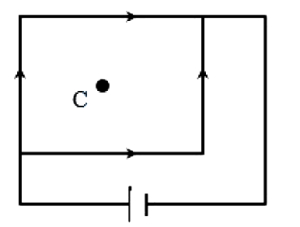
0 likesView Solution
214
PhysicsDifficultMCQMHT CET · 2021
$A$ particle having a charge $100 e$ is revolving in a circular path of radius $0.8 \ m$ with $1 \ r.p.s$. The magnetic field produced at the center of the circle in $SI$ unit is ($\mu_0$ is the permeability of vacuum,$e = 1.6 \times 10^{-19} \ C$).
A
$10^{-17} \mu_0$
B
$10^{-3} \mu_0$
C
$10^{-7} \mu_0$
D
$10^{-11} \mu_0$
Solution
(A) The magnetic field $B$ at the center of a circular loop carrying current $I$ is given by $B = \frac{\mu_0 I}{2r}$.
Here,the charge $q = 100e$ is revolving with a frequency $f = 1 \ r.p.s$.
The equivalent current $I$ is given by $I = qf = 100e \times 1 = 100e \ A$.
Given radius $r = 0.8 \ m$ and $e = 1.6 \times 10^{-19} \ C$.
Substituting these values into the formula:
$B = \frac{\mu_0 \times 100e}{2 \times 0.8} = \frac{\mu_0 \times 100 \times 1.6 \times 10^{-19}}{1.6}$.
$B = \frac{\mu_0 \times 100 \times 1.6 \times 10^{-19}}{1.6} = 100 \times 10^{-19} \mu_0 = 10^{-17} \mu_0 \ T$.
Here,the charge $q = 100e$ is revolving with a frequency $f = 1 \ r.p.s$.
The equivalent current $I$ is given by $I = qf = 100e \times 1 = 100e \ A$.
Given radius $r = 0.8 \ m$ and $e = 1.6 \times 10^{-19} \ C$.
Substituting these values into the formula:
$B = \frac{\mu_0 \times 100e}{2 \times 0.8} = \frac{\mu_0 \times 100 \times 1.6 \times 10^{-19}}{1.6}$.
$B = \frac{\mu_0 \times 100 \times 1.6 \times 10^{-19}}{1.6} = 100 \times 10^{-19} \mu_0 = 10^{-17} \mu_0 \ T$.
0 likesView Solution
215
PhysicsMediumMCQMHT CET · 2021
The magnetic field inside a current-carrying toroidal solenoid is $0.2 \ mT$. What is the magnetic field inside the toroid if the current is tripled (in $mT$)?
A
$0.02$
B
$0.6$
C
$0.8$
D
$0.9$
Solution
(B) The magnetic field $B$ inside a toroidal solenoid is given by the formula: $B = \mu_0 n I$,where $\mu_0$ is the permeability of free space,$n$ is the number of turns per unit length,and $I$ is the current flowing through the solenoid.
Since $B \propto I$,if the current is tripled $(I_2 = 3I_1)$,the magnetic field will also become three times the original value.
Given $B_1 = 0.2 \ mT$ and $I_2 = 3I_1$,we have:
$B_2 = 3 \times B_1 = 3 \times 0.2 \ mT = 0.6 \ mT$.
Since $B \propto I$,if the current is tripled $(I_2 = 3I_1)$,the magnetic field will also become three times the original value.
Given $B_1 = 0.2 \ mT$ and $I_2 = 3I_1$,we have:
$B_2 = 3 \times B_1 = 3 \times 0.2 \ mT = 0.6 \ mT$.
0 likesView Solution
216
PhysicsMediumMCQMHT CET · 2021
$A$ thin ring of radius $R$ meter has charge $q$ coulomb uniformly spread on it. The ring rotates about its axis with a constant frequency of $f$ revolution/s. The value of magnetic induction in $Wb/m^2$ at the center of the ring is $(\mu_0 = \text{Permeability of free space})$
A
$\frac{\mu_0 q f}{2 \pi R}$
B
$\frac{\mu_0 q}{2 \pi R}$
C
$\frac{\mu_0 qf}{2 R}$
D
$\frac{\mu_0 q}{2 \pi fR}$
Solution
(C) The magnetic field $B$ at the center of a circular loop carrying current $I$ is given by the formula: $B = \frac{\mu_0 I}{2 R}$.
Since the ring has a charge $q$ rotating with frequency $f$ (revolutions per second), the equivalent current $I$ is defined as the charge passing a point per unit time.
Thus, $I = q \times f$.
Substituting this value of $I$ into the magnetic field formula, we get:
$B = \frac{\mu_0 (qf)}{2 R}$.
Therefore, the correct option is $C$.
Since the ring has a charge $q$ rotating with frequency $f$ (revolutions per second), the equivalent current $I$ is defined as the charge passing a point per unit time.
Thus, $I = q \times f$.
Substituting this value of $I$ into the magnetic field formula, we get:
$B = \frac{\mu_0 (qf)}{2 R}$.
Therefore, the correct option is $C$.
0 likesView Solution
217
PhysicsMediumMCQMHT CET · 2021
$A$ long solenoid carrying current $I_1$ produces a magnetic field $B_1$ along its axis. If the current is reduced to $20 \%$ and the number of turns per $cm$ is increased five times,then the new magnetic field $B_2$ is equal to:
A
$B_1$
B
$\frac{B_1}{5}$
C
$5 B_1$
D
$0.25 B_1$
Solution
(A) The magnetic field inside a long solenoid is given by $B = \mu_0 n I$,where $n$ is the number of turns per unit length and $I$ is the current.
Initially,$B_1 = \mu_0 n_1 I_1$.
Given that the current is reduced to $20 \%$,the new current $I_2 = 0.2 I_1$.
The number of turns per $cm$ is increased five times,so the new turn density $n_2 = 5 n_1$.
The new magnetic field is $B_2 = \mu_0 n_2 I_2$.
Substituting the values: $B_2 = \mu_0 (5 n_1) (0.2 I_1) = \mu_0 n_1 I_1 (5 \times 0.2) = \mu_0 n_1 I_1 (1) = B_1$.
Therefore,the new magnetic field $B_2$ is equal to $B_1$.
Initially,$B_1 = \mu_0 n_1 I_1$.
Given that the current is reduced to $20 \%$,the new current $I_2 = 0.2 I_1$.
The number of turns per $cm$ is increased five times,so the new turn density $n_2 = 5 n_1$.
The new magnetic field is $B_2 = \mu_0 n_2 I_2$.
Substituting the values: $B_2 = \mu_0 (5 n_1) (0.2 I_1) = \mu_0 n_1 I_1 (5 \times 0.2) = \mu_0 n_1 I_1 (1) = B_1$.
Therefore,the new magnetic field $B_2$ is equal to $B_1$.
0 likesView Solution
218
PhysicsEasyMCQMHT CET · 2021
$A$ straight wire of diameter $0.4 \,mm$ carrying a current of $2 \,A$ is replaced by another wire of $0.8 \,mm$ diameter carrying the same current. The magnetic field at distance $R$ from both the wires is $B_1$ and $B_2$ respectively. The relation between $B_1$ and $B_2$ is
A
$B_1 = \frac{B_2}{2}$
B
$B_1 = B_2$
C
$B_1 = 2 \,B_2$
D
$B_1 = \frac{B_2}{3}$
Solution
(B) According to Ampere's Circuital Law, the magnetic field $B$ at a distance $R$ from the axis of a long straight cylindrical wire carrying current $I$ is given by $B = \frac{\mu_0 I}{2 \pi R}$ for points outside the wire $(R \ge \text{radius of wire})$.
Since the current $I$ is the same in both cases and the distance $R$ is the same, the magnetic field depends only on the current and the distance from the wire.
Therefore, the diameter of the wire does not affect the magnetic field at a distance $R$ outside the wire.
Thus, $B_1 = B_2$.
Since the current $I$ is the same in both cases and the distance $R$ is the same, the magnetic field depends only on the current and the distance from the wire.
Therefore, the diameter of the wire does not affect the magnetic field at a distance $R$ outside the wire.
Thus, $B_1 = B_2$.
0 likesView Solution
219
PhysicsEasyMCQMHT CET · 2021
$A$ solenoid $2 \,m$ long and $4 \,cm$ in diameter has $4$ layers of windings of $1000$ turns each and carries a current of $5 \,A$. What is the magnetic field at its centre along the axis? $\left[\mu_0=4 \pi \times 10^{-7} \,Wb / Am\right]$
A
$10^{-3} \,T$
B
$2 \pi \times 10^{-3} \,T$
C
$4 \pi \times 10^{-3} \,T$
D
$8 \pi \times 10^{-3} \,T$
Solution
(C) The magnetic field $B$ at the centre of a long solenoid is given by the formula $B = \mu_0 n I$.
Here,$n$ is the number of turns per unit length.
Total number of turns $N = 4 \times 1000 = 4000$.
Length of the solenoid $L = 2 \,m$.
Therefore,$n = \frac{N}{L} = \frac{4000}{2} = 2000 \text{ turns/m}$.
The current $I = 5 \,A$.
Substituting the values into the formula:
$B = (4 \pi \times 10^{-7} \,Wb/Am) \times (2000 \text{ turns/m}) \times (5 \,A)$.
$B = 4 \pi \times 10^{-7} \times 10000$.
$B = 4 \pi \times 10^{-3} \,T$.
Here,$n$ is the number of turns per unit length.
Total number of turns $N = 4 \times 1000 = 4000$.
Length of the solenoid $L = 2 \,m$.
Therefore,$n = \frac{N}{L} = \frac{4000}{2} = 2000 \text{ turns/m}$.
The current $I = 5 \,A$.
Substituting the values into the formula:
$B = (4 \pi \times 10^{-7} \,Wb/Am) \times (2000 \text{ turns/m}) \times (5 \,A)$.
$B = 4 \pi \times 10^{-7} \times 10000$.
$B = 4 \pi \times 10^{-3} \,T$.
0 likesView Solution
220
PhysicsEasyMCQMHT CET · 2021
The magnetic field at the centre of a current-carrying circular coil of area '$A$' is '$B$'. The magnetic moment of the coil is $(\mu_0 = \text{permeability of free space})$
A
$\frac{2 BA^{3 / 2}}{\mu_0 \sqrt{\pi}}$
B
$\frac{BA^{3 / 2}}{\mu_0 \pi}$
C
$\frac{\mu_0 \sqrt{\pi}}{2 BA^2}$
D
$\frac{2 BA^2}{\mu_0 \sqrt{\pi}}$
Solution
(A) The area of the circular coil is given by $A = \pi R^2$,where $R$ is the radius of the coil.
From this,the radius is $R = \sqrt{\frac{A}{\pi}}$.
The magnetic field at the centre of a circular coil carrying current $I$ is $B = \frac{\mu_0 I}{2 R}$.
Rearranging for current $I$,we get $I = \frac{2 B R}{\mu_0}$.
The magnetic moment $M$ of the coil is defined as $M = I A$.
Substituting the expression for $I$ and $R$ into the formula for $M$:
$M = \left( \frac{2 B R}{\mu_0} \right) A = \frac{2 B A}{\mu_0} \sqrt{\frac{A}{\pi}}$.
Simplifying this,we get $M = \frac{2 B A^{3/2}}{\mu_0 \sqrt{\pi}}$.
From this,the radius is $R = \sqrt{\frac{A}{\pi}}$.
The magnetic field at the centre of a circular coil carrying current $I$ is $B = \frac{\mu_0 I}{2 R}$.
Rearranging for current $I$,we get $I = \frac{2 B R}{\mu_0}$.
The magnetic moment $M$ of the coil is defined as $M = I A$.
Substituting the expression for $I$ and $R$ into the formula for $M$:
$M = \left( \frac{2 B R}{\mu_0} \right) A = \frac{2 B A}{\mu_0} \sqrt{\frac{A}{\pi}}$.
Simplifying this,we get $M = \frac{2 B A^{3/2}}{\mu_0 \sqrt{\pi}}$.
0 likesView Solution
221
PhysicsEasyMCQMHT CET · 2021
The relation between the magnetic moment '$M$' of a revolving electron and the principal quantum number '$n$' is:
A
$M \propto \frac{1}{n}$
B
$M \propto n$
C
$M \propto n^2$
D
$M \propto n^3$
Solution
(B) According to Bohr's theory,the angular momentum '$L$' of an electron in the '$n^{th}$' orbit is given by $L = \frac{nh}{2\pi}$.
The magnetic moment '$M$' associated with a revolving electron is given by $M = \frac{e}{2m_e} L$.
Substituting the value of '$L$' into the equation for '$M$':
$M = \frac{e}{2m_e} \left( \frac{nh}{2\pi} \right) = \frac{enh}{4\pi m_e}$.
Since '$e$','$h$','$m_e$',and '$\pi$' are constants,we have $M \propto n$.
The magnetic moment '$M$' associated with a revolving electron is given by $M = \frac{e}{2m_e} L$.
Substituting the value of '$L$' into the equation for '$M$':
$M = \frac{e}{2m_e} \left( \frac{nh}{2\pi} \right) = \frac{enh}{4\pi m_e}$.
Since '$e$','$h$','$m_e$',and '$\pi$' are constants,we have $M \propto n$.
0 likesView Solution
222
PhysicsEasyMCQMHT CET · 2021
If the charge to mass ratio of an electron is $A \ C/kg$,then the gyromagnetic ratio of an orbital electron in $C/kg$ is
A
$\frac{A}{4}$
B
$A$
C
$2A$
D
$\frac{A}{2}$
Solution
(D) The gyromagnetic ratio is defined as the ratio of the magnetic moment $(\mu_L)$ to the angular momentum $(L)$ of an orbital electron.
$\text{Gyromagnetic ratio} = \frac{\mu_L}{L} = \frac{e}{2m}$.
Given that the charge to mass ratio of an electron is $\frac{e}{m} = A \ C/kg$.
Substituting this into the expression,we get:
$\text{Gyromagnetic ratio} = \frac{1}{2} \times \left(\frac{e}{m}\right) = \frac{A}{2} \ C/kg$.
$\text{Gyromagnetic ratio} = \frac{\mu_L}{L} = \frac{e}{2m}$.
Given that the charge to mass ratio of an electron is $\frac{e}{m} = A \ C/kg$.
Substituting this into the expression,we get:
$\text{Gyromagnetic ratio} = \frac{1}{2} \times \left(\frac{e}{m}\right) = \frac{A}{2} \ C/kg$.
0 likesView Solution
223
PhysicsEasyMCQMHT CET · 2021
The magnetic moment of a revolving electron of charge $e$ and mass $m$ in terms of the angular momentum $L$ of the electron is:
A
$\frac{eL}{8m}$
B
$\frac{eL}{4m}$
C
$\frac{eL}{2m}$
D
$\frac{eL}{m}$
Solution
(C) Consider an electron of charge $e$ and mass $m$ revolving in a circular orbit of radius $r$ with a speed $v$ and time period $T$.
The current $I$ associated with this revolving electron is $I = \frac{e}{T} = \frac{e}{2\pi r / v} = \frac{ev}{2\pi r}$.
The magnetic moment $M$ is given by $M = I \times A = I \times (\pi r^2)$.
Substituting the value of $I$,we get $M = \left(\frac{ev}{2\pi r}\right) \times (\pi r^2) = \frac{evr}{2}$.
The angular momentum $L$ of the electron is $L = mvr$.
Thus,$vr = \frac{L}{m}$.
Substituting this into the expression for $M$,we get $M = \frac{e}{2} \times \left(\frac{L}{m}\right) = \frac{eL}{2m}$.
The current $I$ associated with this revolving electron is $I = \frac{e}{T} = \frac{e}{2\pi r / v} = \frac{ev}{2\pi r}$.
The magnetic moment $M$ is given by $M = I \times A = I \times (\pi r^2)$.
Substituting the value of $I$,we get $M = \left(\frac{ev}{2\pi r}\right) \times (\pi r^2) = \frac{evr}{2}$.
The angular momentum $L$ of the electron is $L = mvr$.
Thus,$vr = \frac{L}{m}$.
Substituting this into the expression for $M$,we get $M = \frac{e}{2} \times \left(\frac{L}{m}\right) = \frac{eL}{2m}$.
0 likesView Solution
224
PhysicsMediumMCQMHT CET · 2021
$A$ current $I$ is flowing in a conductor of length $L$. When it is bent in the form of a circular loop,its magnetic moment will be
A
$\frac{IL}{4 \pi^2}$
B
$4 \pi IL^2$
C
$\frac{4 \pi}{IL^2}$
D
$\frac{IL^2}{4 \pi}$
Solution
(D) The length of the conductor $L$ forms the circumference of the circular loop.
$L = 2 \pi r$,where $r$ is the radius of the loop.
Therefore,$r = \frac{L}{2 \pi}$.
The area $A$ of the circular loop is given by $A = \pi r^2$.
Substituting the value of $r$,we get $A = \pi \left( \frac{L}{2 \pi} \right)^2 = \pi \left( \frac{L^2}{4 \pi^2} \right) = \frac{L^2}{4 \pi}$.
The magnetic moment $M$ of a current-carrying loop is given by $M = I \times A$.
Substituting the value of $A$,we get $M = I \left( \frac{L^2}{4 \pi} \right) = \frac{IL^2}{4 \pi}$.
$L = 2 \pi r$,where $r$ is the radius of the loop.
Therefore,$r = \frac{L}{2 \pi}$.
The area $A$ of the circular loop is given by $A = \pi r^2$.
Substituting the value of $r$,we get $A = \pi \left( \frac{L}{2 \pi} \right)^2 = \pi \left( \frac{L^2}{4 \pi^2} \right) = \frac{L^2}{4 \pi}$.
The magnetic moment $M$ of a current-carrying loop is given by $M = I \times A$.
Substituting the value of $A$,we get $M = I \left( \frac{L^2}{4 \pi} \right) = \frac{IL^2}{4 \pi}$.
0 likesView Solution
225
PhysicsDifficultMCQMHT CET · 2021
In the Bohr model,an electron moves in a circular orbit around the nucleus. Considering an orbiting electron to be a circular current loop,the magnetic moment of the hydrogen atom,when the electron is in the $n^{th}$ excited state,is ($e=$ electronic charge,$m_{e}=$ mass of the electron,$h=$ Planck's constant).
A
$\left(\frac{e}{m_{e}}\right) \frac{nh}{2 \pi}$
B
$\left(\frac{e}{m_{e}}\right) \frac{n^2 h}{2 \pi}$
C
$\left(\frac{e}{2 m_{e}}\right) \frac{n^2 h}{2 \pi}$
D
$\left(\frac{e}{2 m_{e}}\right) \frac{nh}{2 \pi}$
Solution
(D) The current $i$ produced by an electron moving in a circular orbit is given by $i = \frac{e}{T}$,where $T$ is the time period of revolution. Since $T = \frac{2 \pi r}{v}$,we have $i = \frac{ev}{2 \pi r}$.
The magnetic moment $M$ of a current loop is $M = iA$,where $A = \pi r^2$ is the area of the orbit.
Substituting the values,$M = \left(\frac{ev}{2 \pi r}\right) (\pi r^2) = \frac{evr}{2}$.
Multiplying and dividing by the mass of the electron $m_{e}$,we get $M = \frac{e}{2 m_{e}} (m_{e}vr)$.
According to Bohr's quantization condition,the angular momentum $L = m_{e}vr = \frac{nh}{2 \pi}$.
Substituting this into the expression for $M$,we get $M = \frac{e}{2 m_{e}} \left(\frac{nh}{2 \pi}\right)$.
The magnetic moment $M$ of a current loop is $M = iA$,where $A = \pi r^2$ is the area of the orbit.
Substituting the values,$M = \left(\frac{ev}{2 \pi r}\right) (\pi r^2) = \frac{evr}{2}$.
Multiplying and dividing by the mass of the electron $m_{e}$,we get $M = \frac{e}{2 m_{e}} (m_{e}vr)$.
According to Bohr's quantization condition,the angular momentum $L = m_{e}vr = \frac{nh}{2 \pi}$.
Substituting this into the expression for $M$,we get $M = \frac{e}{2 m_{e}} \left(\frac{nh}{2 \pi}\right)$.
0 likesView Solution
226
PhysicsEasyMCQMHT CET · 2021
An electron in a circular orbit of radius $0.05 \,nm$ performs $10^{16}$ revolutions per second. What is the magnetic moment due to the rotation of the electron? $(e = 1.6 \times 10^{-19} \,C)$
A
$3.21 \times 10^{-23} \,A-m^2$
B
$2.16 \times 10^{-23} \,A-m^2$
C
$3.21 \times 10^{-22} \,A-m^2$
D
$1.26 \times 10^{-23} \,A-m^2$
Solution
(D) The magnetic moment $M$ of a current loop is given by $M = I \times A$.
Here, the current $I$ due to the revolving electron is $I = qf = ef$, where $f$ is the frequency of revolution.
The area $A$ of the circular orbit is $A = \pi r^2$.
Substituting these into the formula, we get $M = (ef)(\pi r^2)$.
Given: $r = 0.05 \,nm = 0.05 \times 10^{-9} \,m = 5 \times 10^{-11} \,m$, $f = 10^{16} \,Hz$, and $e = 1.6 \times 10^{-19} \,C$.
$M = (1.6 \times 10^{-19} \,C) \times (10^{16} \,s^{-1}) \times (3.14) \times (5 \times 10^{-11} \,m)^2$.
$M = 1.6 \times 10^{-3} \times 3.14 \times 25 \times 10^{-22}$.
$M = 1.6 \times 3.14 \times 25 \times 10^{-25}$.
$M = 125.6 \times 10^{-25} = 1.256 \times 10^{-23} \,A-m^2 \approx 1.26 \times 10^{-23} \,A-m^2$.
Here, the current $I$ due to the revolving electron is $I = qf = ef$, where $f$ is the frequency of revolution.
The area $A$ of the circular orbit is $A = \pi r^2$.
Substituting these into the formula, we get $M = (ef)(\pi r^2)$.
Given: $r = 0.05 \,nm = 0.05 \times 10^{-9} \,m = 5 \times 10^{-11} \,m$, $f = 10^{16} \,Hz$, and $e = 1.6 \times 10^{-19} \,C$.
$M = (1.6 \times 10^{-19} \,C) \times (10^{16} \,s^{-1}) \times (3.14) \times (5 \times 10^{-11} \,m)^2$.
$M = 1.6 \times 10^{-3} \times 3.14 \times 25 \times 10^{-22}$.
$M = 1.6 \times 3.14 \times 25 \times 10^{-25}$.
$M = 125.6 \times 10^{-25} = 1.256 \times 10^{-23} \,A-m^2 \approx 1.26 \times 10^{-23} \,A-m^2$.
0 likesView Solution
227
PhysicsEasyMCQMHT CET · 2021
$A$ charge of magnitude $2e$ and mass $4m$ is moving in an electric field $E$. The acceleration imparted to the above charge is
A
$\frac{2m}{3Ee}$
B
$\frac{Ee}{2m}$
C
$\frac{2Ee}{3m}$
D
$\frac{3m}{2Ee}$
Solution
(B) The force $F$ acting on a charge $q$ in an electric field $E$ is given by $F = qE$.
Given charge $q = 2e$ and electric field $E$,the force is $F = 2eE$.
The acceleration $a$ is given by Newton's second law,$a = \frac{F}{m_{total}}$.
Given mass $m_{total} = 4m$,the acceleration is $a = \frac{2eE}{4m}$.
Simplifying the expression,we get $a = \frac{eE}{2m}$.
Given charge $q = 2e$ and electric field $E$,the force is $F = 2eE$.
The acceleration $a$ is given by Newton's second law,$a = \frac{F}{m_{total}}$.
Given mass $m_{total} = 4m$,the acceleration is $a = \frac{2eE}{4m}$.
Simplifying the expression,we get $a = \frac{eE}{2m}$.
0 likesView Solution
228
PhysicsEasyMCQMHT CET · 2021
$A$ charge moves with velocity $\overrightarrow{V}$ through an electric field $\overrightarrow{E}$ as well as a magnetic field $\overrightarrow{B}$. Then the force acting on it is:
A
$q(\overrightarrow{B} \times \overrightarrow{V})$
B
$q(\overrightarrow{V} \times \overrightarrow{B})$
C
$q\overrightarrow{E} + q(\overrightarrow{V} \times \overrightarrow{B})$
D
$q(\overrightarrow{E} \times \overrightarrow{V})$
Solution
(C) The force acting on a moving charge in the presence of both electric and magnetic fields is known as the Lorentz force.
The force due to the electric field is given by $\overrightarrow{F}_{e} = q\overrightarrow{E}$.
The force due to the magnetic field is given by $\overrightarrow{F}_{m} = q(\overrightarrow{V} \times \overrightarrow{B})$.
Therefore,the total force $\overrightarrow{F}$ acting on the charge is the vector sum of these two forces:
$\overrightarrow{F} = \overrightarrow{F}_{e} + \overrightarrow{F}_{m} = q\overrightarrow{E} + q(\overrightarrow{V} \times \overrightarrow{B})$.
The force due to the electric field is given by $\overrightarrow{F}_{e} = q\overrightarrow{E}$.
The force due to the magnetic field is given by $\overrightarrow{F}_{m} = q(\overrightarrow{V} \times \overrightarrow{B})$.
Therefore,the total force $\overrightarrow{F}$ acting on the charge is the vector sum of these two forces:
$\overrightarrow{F} = \overrightarrow{F}_{e} + \overrightarrow{F}_{m} = q\overrightarrow{E} + q(\overrightarrow{V} \times \overrightarrow{B})$.
0 likesView Solution
229
PhysicsEasyMCQMHT CET · 2021
An electron is projected along the axis of a circular conductor carrying current $I$. The electron will experience:
A
a force perpendicular to the axis
B
a force along the axis
C
a force at an angle $30^{\circ}$ with the axis
D
no force
Solution
(D) The magnetic field produced by a circular current-carrying loop at any point on its axis is directed along the axis of the loop.
Since the electron is projected along the same axis,its velocity vector $\vec{v}$ is parallel or anti-parallel to the magnetic field vector $\vec{B}$.
Therefore,the angle $\theta$ between the velocity and the magnetic field is either $0^{\circ}$ or $180^{\circ}$.
The magnetic force on a moving charge is given by the Lorentz force formula: $F = qvB \sin \theta$.
Substituting $\theta = 0^{\circ}$ or $180^{\circ}$,we get $\sin(0^{\circ}) = 0$ or $\sin(180^{\circ}) = 0$.
Thus,$F = 0$. The electron experiences no force.
Since the electron is projected along the same axis,its velocity vector $\vec{v}$ is parallel or anti-parallel to the magnetic field vector $\vec{B}$.
Therefore,the angle $\theta$ between the velocity and the magnetic field is either $0^{\circ}$ or $180^{\circ}$.
The magnetic force on a moving charge is given by the Lorentz force formula: $F = qvB \sin \theta$.
Substituting $\theta = 0^{\circ}$ or $180^{\circ}$,we get $\sin(0^{\circ}) = 0$ or $\sin(180^{\circ}) = 0$.
Thus,$F = 0$. The electron experiences no force.
0 likesView Solution
230
PhysicsMediumMCQMHT CET · 2021
Two bar magnets '$P$' and '$Q$' are kept in a uniform magnetic field '$B$' with magnetic moments '$M_{P}$' and '$M_{Q}$' respectively. Magnet '$P$' is oscillating with a frequency twice that of magnet '$Q$'. If the moment of inertia of magnet '$P$' is twice that of magnet '$Q$',then:
A
$M_{Q} = 2 M_{P}$
B
$M_{P} = 2 M_{Q}$
C
$M_{P} = 8 M_{Q}$
D
$M_{Q} = 8 M_{P}$
Solution
(C) The frequency of oscillation for a bar magnet in a uniform magnetic field is given by $f = \frac{1}{2 \pi} \sqrt{\frac{MB}{I}}$.
For magnet $P$: $f_{P} = \frac{1}{2 \pi} \sqrt{\frac{M_{P} B}{I_{P}}}$.
For magnet $Q$: $f_{Q} = \frac{1}{2 \pi} \sqrt{\frac{M_{Q} B}{I_{Q}}}$.
Given $f_{P} = 2 f_{Q}$ and $I_{P} = 2 I_{Q}$.
Substituting these into the ratio: $\frac{f_{P}}{f_{Q}} = \sqrt{\frac{M_{P} I_{Q}}{M_{Q} I_{P}}} = 2$.
Squaring both sides: $\frac{M_{P} I_{Q}}{M_{Q} I_{P}} = 4$.
Since $I_{P} = 2 I_{Q}$,we have $\frac{I_{Q}}{I_{P}} = \frac{1}{2}$.
Therefore,$\frac{M_{P}}{M_{Q}} \cdot \frac{1}{2} = 4$,which implies $\frac{M_{P}}{M_{Q}} = 8$,or $M_{P} = 8 M_{Q}$.
For magnet $P$: $f_{P} = \frac{1}{2 \pi} \sqrt{\frac{M_{P} B}{I_{P}}}$.
For magnet $Q$: $f_{Q} = \frac{1}{2 \pi} \sqrt{\frac{M_{Q} B}{I_{Q}}}$.
Given $f_{P} = 2 f_{Q}$ and $I_{P} = 2 I_{Q}$.
Substituting these into the ratio: $\frac{f_{P}}{f_{Q}} = \sqrt{\frac{M_{P} I_{Q}}{M_{Q} I_{P}}} = 2$.
Squaring both sides: $\frac{M_{P} I_{Q}}{M_{Q} I_{P}} = 4$.
Since $I_{P} = 2 I_{Q}$,we have $\frac{I_{Q}}{I_{P}} = \frac{1}{2}$.
Therefore,$\frac{M_{P}}{M_{Q}} \cdot \frac{1}{2} = 4$,which implies $\frac{M_{P}}{M_{Q}} = 8$,or $M_{P} = 8 M_{Q}$.
0 likesView Solution
231
PhysicsEasyMCQMHT CET · 2021
What is the magnetic susceptibility of a medium if its relative permeability is $0.85$?
A
$1.85$
B
$0.15$
C
-$0.15$
D
-$0.85$
Solution
(C) The relationship between relative permeability $\mu_{r}$ and magnetic susceptibility $\chi$ is given by the formula: $\mu_{r} = 1 + \chi$.
Given that the relative permeability $\mu_{r} = 0.85$.
Substituting the value into the formula: $0.85 = 1 + \chi$.
Therefore,$\chi = 0.85 - 1 = -0.15$.
Thus,the magnetic susceptibility of the medium is $-0.15$.
Given that the relative permeability $\mu_{r} = 0.85$.
Substituting the value into the formula: $0.85 = 1 + \chi$.
Therefore,$\chi = 0.85 - 1 = -0.15$.
Thus,the magnetic susceptibility of the medium is $-0.15$.
0 likesView Solution
232
PhysicsEasyMCQMHT CET · 2021
The permeability of a metal is $0.1256 \ TmA^{-1}$. Its relative permeability will be (Given: $\frac{\mu_0}{4 \pi} = 10^{-7} \ SI \ unit$,$\pi = 3.14$).
A
$10^5$
B
$3 \times 10^5$
C
$2 \times 10^6$
D
$10^4$
Solution
(A) Given,permeability of the metal $\mu = 0.1256 \ TmA^{-1}$.
We know that the permeability of free space $\mu_0 = 4 \pi \times 10^{-7} \ TmA^{-1}$.
Substituting $\pi = 3.14$,we get $\mu_0 = 4 \times 3.14 \times 10^{-7} = 12.56 \times 10^{-7} \ TmA^{-1}$.
The relative permeability $\mu_r$ is defined as the ratio of the permeability of the medium to the permeability of free space:
$\mu_r = \frac{\mu}{\mu_0} = \frac{0.1256}{12.56 \times 10^{-7}}$.
$\mu_r = \frac{12.56 \times 10^{-2}}{12.56 \times 10^{-7}} = 10^{-2} \times 10^7 = 10^5$.
Thus,the relative permeability is $10^5$.
We know that the permeability of free space $\mu_0 = 4 \pi \times 10^{-7} \ TmA^{-1}$.
Substituting $\pi = 3.14$,we get $\mu_0 = 4 \times 3.14 \times 10^{-7} = 12.56 \times 10^{-7} \ TmA^{-1}$.
The relative permeability $\mu_r$ is defined as the ratio of the permeability of the medium to the permeability of free space:
$\mu_r = \frac{\mu}{\mu_0} = \frac{0.1256}{12.56 \times 10^{-7}}$.
$\mu_r = \frac{12.56 \times 10^{-2}}{12.56 \times 10^{-7}} = 10^{-2} \times 10^7 = 10^5$.
Thus,the relative permeability is $10^5$.
0 likesView Solution
233
PhysicsEasyMCQMHT CET · 2021
The relative permeability of iron is $2000$. Its absolute permeability in $SI$ units will be (given $\frac{\mu_0}{4 \pi} = 10^{-7} \text{ SI units}$):
A
$8 \pi \times 10^{-7}$
B
$4 \pi \times 10^{-5}$
C
$8 \pi \times 10^{-4}$
D
$\frac{500}{\pi} \times 10^{-7}$
Solution
(C) The absolute permeability $\mu$ is given by the formula $\mu = \mu_r \mu_0$.
Given that the relative permeability $\mu_r = 2000$ and the permeability of free space $\mu_0 = 4 \pi \times 10^{-7} \text{ T m/A}$.
Substituting these values into the formula:
$\mu = 2000 \times (4 \pi \times 10^{-7}) \text{ T m/A}$.
$\mu = 8000 \pi \times 10^{-7} \text{ T m/A}$.
$\mu = 8 \pi \times 10^{-4} \text{ T m/A}$.
Given that the relative permeability $\mu_r = 2000$ and the permeability of free space $\mu_0 = 4 \pi \times 10^{-7} \text{ T m/A}$.
Substituting these values into the formula:
$\mu = 2000 \times (4 \pi \times 10^{-7}) \text{ T m/A}$.
$\mu = 8000 \pi \times 10^{-7} \text{ T m/A}$.
$\mu = 8 \pi \times 10^{-4} \text{ T m/A}$.
0 likesView Solution
234
PhysicsMediumMCQMHT CET · 2021
$A$ bar magnet has length $3 \,cm$, cross-sectional area $2 \,cm^2$ and magnetic moment $3 \,Am^2$. The intensity of magnetization of the bar magnet is
A
$2 \times 10^5 \,A/m$
B
$3 \times 10^5 \,A/m$
C
$4 \times 10^5 \,A/m$
D
$5 \times 10^5 \,A/m$
Solution
(D) Given: Length $L = 3 \,cm = 3 \times 10^{-2} \,m$, Cross-sectional area $A = 2 \,cm^2 = 2 \times 10^{-4} \,m^2$, Magnetic moment $M = 3 \,Am^2$.
The intensity of magnetization $I$ (or $M_z$) is defined as the magnetic moment per unit volume.
Volume $V = L \times A = (3 \times 10^{-2} \,m) \times (2 \times 10^{-4} \,m^2) = 6 \times 10^{-6} \,m^3$.
Intensity of magnetization $I = \frac{M}{V} = \frac{3 \,Am^2}{6 \times 10^{-6} \,m^3}$.
$I = 0.5 \times 10^6 \,A/m = 5 \times 10^5 \,A/m$.
The intensity of magnetization $I$ (or $M_z$) is defined as the magnetic moment per unit volume.
Volume $V = L \times A = (3 \times 10^{-2} \,m) \times (2 \times 10^{-4} \,m^2) = 6 \times 10^{-6} \,m^3$.
Intensity of magnetization $I = \frac{M}{V} = \frac{3 \,Am^2}{6 \times 10^{-6} \,m^3}$.
$I = 0.5 \times 10^6 \,A/m = 5 \times 10^5 \,A/m$.
0 likesView Solution
235
PhysicsMediumMCQMHT CET · 2021
$A$ nucleus breaks into two nuclear parts,which have their velocity ratio $2:1$. The ratio of their nuclear radii will be
A
$\sqrt{2}$
B
$1/2$
C
$1/2^{1/3}$
D
$1/\sqrt{2}$
Solution
(C) By the law of conservation of momentum,the two parts will have equal and opposite momentum,assuming the nucleus was initially at rest.
$m_1 v_1 = m_2 v_2$
$\frac{m_1}{m_2} = \frac{v_2}{v_1} = \frac{1}{2}$
Since the nuclear mass $m$ is proportional to the volume,which is proportional to the cube of the radius $r^3$ (i.e.,$m \propto r^3$):
$\frac{m_1}{m_2} = \left(\frac{r_1}{r_2}\right)^3$
Substituting the mass ratio:
$\left(\frac{r_1}{r_2}\right)^3 = \frac{1}{2}$
$\frac{r_1}{r_2} = \left(\frac{1}{2}\right)^{1/3} = \frac{1}{2^{1/3}}$
$m_1 v_1 = m_2 v_2$
$\frac{m_1}{m_2} = \frac{v_2}{v_1} = \frac{1}{2}$
Since the nuclear mass $m$ is proportional to the volume,which is proportional to the cube of the radius $r^3$ (i.e.,$m \propto r^3$):
$\frac{m_1}{m_2} = \left(\frac{r_1}{r_2}\right)^3$
Substituting the mass ratio:
$\left(\frac{r_1}{r_2}\right)^3 = \frac{1}{2}$
$\frac{r_1}{r_2} = \left(\frac{1}{2}\right)^{1/3} = \frac{1}{2^{1/3}}$
0 likesView Solution
236
PhysicsMediumMCQMHT CET · 2021
$A$ sample of a radioactive element contains $8 \times 10^{16}$ active nuclei. The half-life of the element is $15 \text{ days}$. The number of nuclei decayed after $60 \text{ days}$ is:
A
$7.5 \times 10^{16}$
B
$2.0 \times 10^{16}$
C
$0.5 \times 10^{16}$
D
$4.0 \times 10^{16}$
Solution
(A) Given: Initial number of nuclei $N_0 = 8 \times 10^{16}$,half-life $T = 15 \text{ days}$,and total time $t = 60 \text{ days}$.
First,calculate the number of half-lives $n$:
$n = \frac{t}{T} = \frac{60}{15} = 4$.
The number of nuclei remaining $N$ after $n$ half-lives is given by:
$N = N_0 \left(\frac{1}{2}\right)^n = 8 \times 10^{16} \times \left(\frac{1}{2}\right)^4 = 8 \times 10^{16} \times \frac{1}{16} = 0.5 \times 10^{16}$.
The number of nuclei decayed is the difference between the initial and remaining nuclei:
$\text{Decayed nuclei} = N_0 - N = 8 \times 10^{16} - 0.5 \times 10^{16} = 7.5 \times 10^{16}$.
First,calculate the number of half-lives $n$:
$n = \frac{t}{T} = \frac{60}{15} = 4$.
The number of nuclei remaining $N$ after $n$ half-lives is given by:
$N = N_0 \left(\frac{1}{2}\right)^n = 8 \times 10^{16} \times \left(\frac{1}{2}\right)^4 = 8 \times 10^{16} \times \frac{1}{16} = 0.5 \times 10^{16}$.
The number of nuclei decayed is the difference between the initial and remaining nuclei:
$\text{Decayed nuclei} = N_0 - N = 8 \times 10^{16} - 0.5 \times 10^{16} = 7.5 \times 10^{16}$.
0 likesView Solution
237
PhysicsMediumMCQMHT CET · 2021
Two radioactive materials $X_1$ and $X_2$ have decay constants $5 \lambda$ and $\lambda$ respectively. Initially,they have the same number of nuclei. After time $t$,the ratio of the number of nuclei of $X_1$ to that of $X_2$ is $\frac{1}{e}$. Then $t$ is equal to:
A
$\frac{\lambda}{2}$
B
$\frac{e}{\lambda}$
C
$\lambda$
D
$\frac{1}{4 \lambda}$
Solution
(D) Let $N_0$ be the initial number of nuclei for both materials.
After time $t$,the number of nuclei remaining for $X_1$ is $N_1 = N_0 e^{-5 \lambda t}$.
After time $t$,the number of nuclei remaining for $X_2$ is $N_2 = N_0 e^{-\lambda t}$.
The ratio of the number of nuclei is given by $\frac{N_1}{N_2} = \frac{N_0 e^{-5 \lambda t}}{N_0 e^{-\lambda t}} = e^{-5 \lambda t + \lambda t} = e^{-4 \lambda t}$.
Given that $\frac{N_1}{N_2} = \frac{1}{e} = e^{-1}$.
Equating the exponents: $-4 \lambda t = -1$.
Therefore,$t = \frac{1}{4 \lambda}$.
After time $t$,the number of nuclei remaining for $X_1$ is $N_1 = N_0 e^{-5 \lambda t}$.
After time $t$,the number of nuclei remaining for $X_2$ is $N_2 = N_0 e^{-\lambda t}$.
The ratio of the number of nuclei is given by $\frac{N_1}{N_2} = \frac{N_0 e^{-5 \lambda t}}{N_0 e^{-\lambda t}} = e^{-5 \lambda t + \lambda t} = e^{-4 \lambda t}$.
Given that $\frac{N_1}{N_2} = \frac{1}{e} = e^{-1}$.
Equating the exponents: $-4 \lambda t = -1$.
Therefore,$t = \frac{1}{4 \lambda}$.
0 likesView Solution
238
PhysicsEasyMCQMHT CET · 2021
The half-life of a radioactive substance is $30 \text{ minutes}$. The time taken between $40 \%$ decay and $85 \%$ decay of the same radioactive substance is
A
$15 \text{ minutes}$
B
$90 \text{ minutes}$
C
$60 \text{ minutes}$
D
$30 \text{ minutes}$
Solution
(C) Let the initial amount of the radioactive substance be $N_i = 100 \%$.
At $40 \%$ decay, the remaining amount is $N_1 = 100 \% - 40 \% = 60 \%$.
At $85 \%$ decay, the remaining amount is $N_2 = 100 \% - 85 \% = 15 \%$.
We know that the amount remaining after time $t$ is given by $N(t) = N_i \left( \frac{1}{2} \right)^{t/T_{1/2}}$, where $T_{1/2} = 30 \text{ minutes}$.
For the interval between $N_1$ and $N_2$, the ratio of remaining nuclei is $\frac{N_2}{N_1} = \frac{15 \%}{60 \%} = \frac{1}{4}$.
Since $\frac{1}{4} = \left( \frac{1}{2} \right)^2$, the time taken corresponds to two half-lives.
Therefore, the time taken is $t = 2 \times T_{1/2} = 2 \times 30 \text{ minutes} = 60 \text{ minutes}$.
At $40 \%$ decay, the remaining amount is $N_1 = 100 \% - 40 \% = 60 \%$.
At $85 \%$ decay, the remaining amount is $N_2 = 100 \% - 85 \% = 15 \%$.
We know that the amount remaining after time $t$ is given by $N(t) = N_i \left( \frac{1}{2} \right)^{t/T_{1/2}}$, where $T_{1/2} = 30 \text{ minutes}$.
For the interval between $N_1$ and $N_2$, the ratio of remaining nuclei is $\frac{N_2}{N_1} = \frac{15 \%}{60 \%} = \frac{1}{4}$.
Since $\frac{1}{4} = \left( \frac{1}{2} \right)^2$, the time taken corresponds to two half-lives.
Therefore, the time taken is $t = 2 \times T_{1/2} = 2 \times 30 \text{ minutes} = 60 \text{ minutes}$.
0 likesView Solution
239
PhysicsEasyMCQMHT CET · 2021
The refractive index of glass is $1.5$ and that of water is $1.33$. The critical angle for a ray of light going from glass to water is
A
$\sin ^{-1}\left(\frac{4}{7}\right)$
B
$\sin ^{-1}\left(\frac{5}{8}\right)$
C
$\sin ^{-1}\left(\frac{8}{9}\right)$
D
$\sin ^{-1}\left(\frac{2}{3}\right)$
Solution
(C) The refractive index of glass is $\mu_g = 1.5 = \frac{3}{2}$.
The refractive index of water is $\mu_w = 1.33 = \frac{4}{3}$.
The relative refractive index of glass with respect to water is given by ${}_w\mu_g = \frac{\mu_g}{\mu_w} = \frac{3/2}{4/3} = \frac{3}{2} \times \frac{3}{4} = \frac{9}{8}$.
The formula for the critical angle $C$ is $\sin C = \frac{1}{{}_w\mu_g}$.
Substituting the value,$\sin C = \frac{1}{9/8} = \frac{8}{9}$.
Therefore,the critical angle is $C = \sin^{-1}\left(\frac{8}{9}\right)$.
The refractive index of water is $\mu_w = 1.33 = \frac{4}{3}$.
The relative refractive index of glass with respect to water is given by ${}_w\mu_g = \frac{\mu_g}{\mu_w} = \frac{3/2}{4/3} = \frac{3}{2} \times \frac{3}{4} = \frac{9}{8}$.
The formula for the critical angle $C$ is $\sin C = \frac{1}{{}_w\mu_g}$.
Substituting the value,$\sin C = \frac{1}{9/8} = \frac{8}{9}$.
Therefore,the critical angle is $C = \sin^{-1}\left(\frac{8}{9}\right)$.
0 likesView Solution
240
PhysicsMediumMCQMHT CET · 2021
$A$ glass slab has a refractive index ' $\mu$ ' with respect to air,and the critical angle for a ray of light going from glass to air is ' $\theta$ '. If a ray of light is incident from air on the glass with an angle of incidence ' $\theta$ ',then the corresponding angle of refraction is:
A
$\sin^{-1}\left(\frac{1}{\sqrt{\mu}}\right)$
B
$\sin^{-1}\left(\frac{1}{\mu}\right)$
C
$\sin^{-1}\left(\frac{1}{\mu^2}\right)$
D
$90^{\circ}$
Solution
(C) In the first case,$\theta$ is the critical angle for the glass-air interface.
According to the definition of the critical angle,$\sin \theta = \frac{1}{\mu}$.
In the second case,light travels from air to glass. Using Snell's law,$\frac{\sin i}{\sin r} = \mu$,where $i = \theta$.
Therefore,$\sin r = \frac{\sin \theta}{\mu}$.
Substituting $\sin \theta = \frac{1}{\mu}$ into the equation,we get $\sin r = \frac{1/\mu}{\mu} = \frac{1}{\mu^2}$.
Thus,the angle of refraction is $r = \sin^{-1}\left(\frac{1}{\mu^2}\right)$.
According to the definition of the critical angle,$\sin \theta = \frac{1}{\mu}$.
In the second case,light travels from air to glass. Using Snell's law,$\frac{\sin i}{\sin r} = \mu$,where $i = \theta$.
Therefore,$\sin r = \frac{\sin \theta}{\mu}$.
Substituting $\sin \theta = \frac{1}{\mu}$ into the equation,we get $\sin r = \frac{1/\mu}{\mu} = \frac{1}{\mu^2}$.
Thus,the angle of refraction is $r = \sin^{-1}\left(\frac{1}{\mu^2}\right)$.
0 likesView Solution
241
PhysicsEasyMCQMHT CET · 2021
'Circle of least confusion' refers to which one of the following defects occurring in images formed by mirrors or lenses?
A
Distortion
B
Coma
C
Astigmatism
D
Spherical aberration
Solution
(D) The 'Circle of least confusion' is a term used in optics to describe the smallest cross-sectional area of a light beam that has passed through a lens or mirror system.
It is specifically associated with 'Spherical aberration',where rays of light passing through the edges of a lens focus at a different point than rays passing through the center.
Because the rays do not converge at a single point,the image appears blurred,and the region of minimum blur is known as the 'Circle of least confusion'.
It is specifically associated with 'Spherical aberration',where rays of light passing through the edges of a lens focus at a different point than rays passing through the center.
Because the rays do not converge at a single point,the image appears blurred,and the region of minimum blur is known as the 'Circle of least confusion'.
0 likesView Solution
242
PhysicsDifficultMCQMHT CET · 2021
Inside a vessel filled with liquid, a converging lens is placed as shown in the figure. The lens has a focal length of $15 \,cm$ when in air and has a refractive index of $\frac{3}{2}$. If the liquid has a refractive index of $\frac{9}{5}$, the focal length of the lens in the liquid is (in $\,cm$)
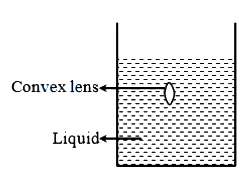
A
$15$
B
$-60$
C
$90$
D
$-45$
Solution
(D) The focal length of a lens in air is given by the Lens Maker's Formula:
$\frac{1}{f} = (n_g - 1) \left( \frac{1}{R_1} - \frac{1}{R_2} \right) \quad \dots(1)$
where $n_g = \frac{3}{2}$ and $f = 15 \,cm$.
The focal length of the same lens in a liquid of refractive index $n_l$ is given by:
$\frac{1}{f'} = \left( \frac{n_g}{n_l} - 1 \right) \left( \frac{1}{R_1} - \frac{1}{R_2} \right) \quad \dots(2)$
Dividing equation $(1)$ by equation $(2)$, we get:
$\frac{f'}{f} = \frac{(n_g - 1)}{\left( \frac{n_g}{n_l} - 1 \right)}$
Substituting the given values $n_g = \frac{3}{2}$ and $n_l = \frac{9}{5}$:
$\frac{f'}{15} = \frac{(\frac{3}{2} - 1)}{(\frac{3/2}{9/5} - 1)} = \frac{1/2}{(\frac{3}{2} \times \frac{5}{9} - 1)} = \frac{1/2}{(\frac{5}{6} - 1)} = \frac{1/2}{-1/6} = -3$
Therefore, $f' = -3 \times 15 = -45 \,cm$.
$\frac{1}{f} = (n_g - 1) \left( \frac{1}{R_1} - \frac{1}{R_2} \right) \quad \dots(1)$
where $n_g = \frac{3}{2}$ and $f = 15 \,cm$.
The focal length of the same lens in a liquid of refractive index $n_l$ is given by:
$\frac{1}{f'} = \left( \frac{n_g}{n_l} - 1 \right) \left( \frac{1}{R_1} - \frac{1}{R_2} \right) \quad \dots(2)$
Dividing equation $(1)$ by equation $(2)$, we get:
$\frac{f'}{f} = \frac{(n_g - 1)}{\left( \frac{n_g}{n_l} - 1 \right)}$
Substituting the given values $n_g = \frac{3}{2}$ and $n_l = \frac{9}{5}$:
$\frac{f'}{15} = \frac{(\frac{3}{2} - 1)}{(\frac{3/2}{9/5} - 1)} = \frac{1/2}{(\frac{3}{2} \times \frac{5}{9} - 1)} = \frac{1/2}{(\frac{5}{6} - 1)} = \frac{1/2}{-1/6} = -3$
Therefore, $f' = -3 \times 15 = -45 \,cm$.
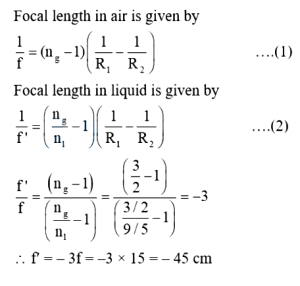
0 likesView Solution
243
PhysicsEasyMCQMHT CET · 2021
$A$ convex lens $T$ is used to form an image whose size is one-fourth that of the size of the object. Then the object distance is (in $f$)
A
$2$
B
$5$
C
$4$
D
$3$
Solution
(B) Magnification,$m = -\frac{1}{4}$ (Since the image is real and inverted,magnification is negative).
Using the magnification formula,$m = \frac{v}{u} = -\frac{1}{4}$,which gives $v = -\frac{u}{4}$.
Applying the lens formula,$\frac{1}{v} - \frac{1}{u} = \frac{1}{f}$.
Substituting the value of $v$: $\frac{1}{-u/4} - \frac{1}{u} = \frac{1}{f}$.
$-\frac{4}{u} - \frac{1}{u} = \frac{1}{f}$.
$-\frac{5}{u} = \frac{1}{f}$.
Therefore,$u = -5f$.
The magnitude of the object distance is $5f$.
Using the magnification formula,$m = \frac{v}{u} = -\frac{1}{4}$,which gives $v = -\frac{u}{4}$.
Applying the lens formula,$\frac{1}{v} - \frac{1}{u} = \frac{1}{f}$.
Substituting the value of $v$: $\frac{1}{-u/4} - \frac{1}{u} = \frac{1}{f}$.
$-\frac{4}{u} - \frac{1}{u} = \frac{1}{f}$.
$-\frac{5}{u} = \frac{1}{f}$.
Therefore,$u = -5f$.
The magnitude of the object distance is $5f$.
0 likesView Solution
244
PhysicsEasyMCQMHT CET · 2021
$A$ convex lens of focal length $f$ produces a real image $n$ times the size of the object. The image distance is
A
$f(n+1)$
B
$f(n-1)$
C
$\frac{f}{n+1}$
D
$\frac{f}{n-1}$
Solution
(A) The image is real and hence inverted.
Therefore,the magnification $m = \frac{v}{u} = -n$,which implies $u = -\frac{v}{n}$.
Using the lens formula,$\frac{1}{v} - \frac{1}{u} = \frac{1}{f}$.
Substituting the value of $u$,we get $\frac{1}{v} - (-\frac{n}{v}) = \frac{1}{f}$.
This simplifies to $\frac{1+n}{v} = \frac{1}{f}$.
Therefore,the image distance $v = f(n+1)$.
Therefore,the magnification $m = \frac{v}{u} = -n$,which implies $u = -\frac{v}{n}$.
Using the lens formula,$\frac{1}{v} - \frac{1}{u} = \frac{1}{f}$.
Substituting the value of $u$,we get $\frac{1}{v} - (-\frac{n}{v}) = \frac{1}{f}$.
This simplifies to $\frac{1+n}{v} = \frac{1}{f}$.
Therefore,the image distance $v = f(n+1)$.
0 likesView Solution
245
PhysicsDifficultMCQMHT CET · 2021
$A$ particle executes linear $S.H.M.$ along the principal axis of a convex lens of focal length $8 \,cm$. The mean position of oscillation is at $14 \,cm$ from the lens with amplitude $1 \,cm$. The amplitude of the oscillating image of the particle is nearly: (in $\,cm$)
A
$3$
B
$5$
C
$2$
D
$4$
Solution
(C) Given: Focal length $f = 8 \,cm$. The mean position of the particle is $u_0 = -14 \,cm$. The amplitude of the particle is $A_p = 1 \,cm$.
First, find the position of the image $v_0$ when the particle is at the mean position:
$\frac{1}{v_0} = \frac{1}{f} + \frac{1}{u_0} = \frac{1}{8} - \frac{1}{14} = \frac{7-4}{56} = \frac{3}{56}$
$v_0 = \frac{56}{3} \approx 18.67 \,cm$.
Next, find the position of the image $v_1$ when the particle is at the extreme position $u_1 = -14 - 1 = -15 \,cm$:
$\frac{1}{v_1} = \frac{1}{f} + \frac{1}{u_1} = \frac{1}{8} - \frac{1}{15} = \frac{15-8}{120} = \frac{7}{120}$
$v_1 = \frac{120}{7} \approx 17.14 \,cm$.
The amplitude of the oscillating image is the difference between the image positions:
$A_i = |v_0 - v_1| = |18.67 - 17.14| = 1.53 \,cm$.
Rounding to the nearest integer, the amplitude is approximately $2 \,cm$.
First, find the position of the image $v_0$ when the particle is at the mean position:
$\frac{1}{v_0} = \frac{1}{f} + \frac{1}{u_0} = \frac{1}{8} - \frac{1}{14} = \frac{7-4}{56} = \frac{3}{56}$
$v_0 = \frac{56}{3} \approx 18.67 \,cm$.
Next, find the position of the image $v_1$ when the particle is at the extreme position $u_1 = -14 - 1 = -15 \,cm$:
$\frac{1}{v_1} = \frac{1}{f} + \frac{1}{u_1} = \frac{1}{8} - \frac{1}{15} = \frac{15-8}{120} = \frac{7}{120}$
$v_1 = \frac{120}{7} \approx 17.14 \,cm$.
The amplitude of the oscillating image is the difference between the image positions:
$A_i = |v_0 - v_1| = |18.67 - 17.14| = 1.53 \,cm$.
Rounding to the nearest integer, the amplitude is approximately $2 \,cm$.
0 likesView Solution
246
PhysicsMediumMCQMHT CET · 2021
$A$ convex lens is dipped in a liquid whose refractive index is equal to the refractive index of the lens material. Then its focal length will
A
increase
B
remain unchanged
C
become infinite
D
become zero
Solution
(C) The focal length of a lens is given by the Lens Maker's Formula: $\frac{1}{f} = (\mu_{rel} - 1) \left( \frac{1}{R_1} - \frac{1}{R_2} \right)$,where $\mu_{rel} = \frac{\mu_{lens}}{\mu_{liquid}}$.
Given that the refractive index of the liquid is equal to the refractive index of the lens material,we have $\mu_{lens} = \mu_{liquid}$,which implies $\mu_{rel} = 1$.
Substituting this into the formula: $\frac{1}{f} = (1 - 1) \left( \frac{1}{R_1} - \frac{1}{R_2} \right) = 0$.
Therefore,$\frac{1}{f} = 0$,which means $f = \infty$ (the focal length becomes infinite).
Given that the refractive index of the liquid is equal to the refractive index of the lens material,we have $\mu_{lens} = \mu_{liquid}$,which implies $\mu_{rel} = 1$.
Substituting this into the formula: $\frac{1}{f} = (1 - 1) \left( \frac{1}{R_1} - \frac{1}{R_2} \right) = 0$.
Therefore,$\frac{1}{f} = 0$,which means $f = \infty$ (the focal length becomes infinite).
0 likesView Solution
247
PhysicsMediumMCQMHT CET · 2021
$A$ biconvex lens $(R_1 = R_2 = 30 \ cm)$ has a focal length equal to the focal length of a concave mirror. What is the radius of curvature of the concave mirror (in $cm$)? (Refractive index of the material of the lens $\mu = 1.6$)
A
$30$
B
$40$
C
$50$
D
$20$
Solution
(C) For a biconvex lens,the lens maker's formula is given by $\frac{1}{f} = (\mu - 1) \left( \frac{1}{R_1} - \frac{1}{R_2} \right)$.
Given $R_1 = 30 \ cm$ and $R_2 = -30 \ cm$ (by sign convention for biconvex lens),and $\mu = 1.6$.
Substituting the values: $\frac{1}{f} = (1.6 - 1) \left( \frac{1}{30} - \frac{1}{-30} \right) = 0.6 \times \left( \frac{2}{30} \right) = \frac{1.2}{30} = \frac{1}{25}$.
Thus,the focal length of the lens is $f = 25 \ cm$.
Since the focal length of the concave mirror is equal to the focal length of the lens,$f_{mirror} = 25 \ cm$.
The radius of curvature of a concave mirror is $R = 2f = 2 \times 25 \ cm = 50 \ cm$.
Given $R_1 = 30 \ cm$ and $R_2 = -30 \ cm$ (by sign convention for biconvex lens),and $\mu = 1.6$.
Substituting the values: $\frac{1}{f} = (1.6 - 1) \left( \frac{1}{30} - \frac{1}{-30} \right) = 0.6 \times \left( \frac{2}{30} \right) = \frac{1.2}{30} = \frac{1}{25}$.
Thus,the focal length of the lens is $f = 25 \ cm$.
Since the focal length of the concave mirror is equal to the focal length of the lens,$f_{mirror} = 25 \ cm$.
The radius of curvature of a concave mirror is $R = 2f = 2 \times 25 \ cm = 50 \ cm$.
0 likesView Solution
248
PhysicsMediumMCQMHT CET · 2021
An object is located on a wall,its image of equal size is to be obtained on a parallel wall with the help of a convex lens. The lens is placed at a distance '$d$' in front of the second wall. The required focal length of the lens is
A
less than $\frac{d}{4}$
B
more than $\frac{d}{4}$ but less than $\frac{d}{2}$
C
only $\frac{d}{4}$
D
only $\frac{d}{2}$
Solution
(D) For a convex lens,to obtain an image of equal size to the object,the magnification $m$ must be $-1$.
This occurs when the object is placed at $2f$ from the lens,and the image is formed at $2f$ on the other side.
Given that the image is formed on a wall at a distance $d$ from the lens,we have the image distance $v = d$.
Since the image size equals the object size,the object distance $u$ must also be $d$.
Thus,the total distance between the two walls is $u + v = d + d = 2d$.
For a real image of equal size,the distance between the object and the screen must be at least $4f$.
Therefore,$4f = 2d$,which gives $f = \frac{d}{2}$.
This occurs when the object is placed at $2f$ from the lens,and the image is formed at $2f$ on the other side.
Given that the image is formed on a wall at a distance $d$ from the lens,we have the image distance $v = d$.
Since the image size equals the object size,the object distance $u$ must also be $d$.
Thus,the total distance between the two walls is $u + v = d + d = 2d$.
For a real image of equal size,the distance between the object and the screen must be at least $4f$.
Therefore,$4f = 2d$,which gives $f = \frac{d}{2}$.
0 likesView Solution
249
PhysicsDifficultMCQMHT CET · 2021
The radii of curvature of both surfaces of a convex lens of focal length $f$ and focal power $P$ are equal. One of the surfaces is made plane by grinding. The new focal length and focal power of the lens are respectively:
A
$f/2, 2P$
B
$2f, P/2$
C
$\sqrt{2/f}, \sqrt{P/2}$
D
$2f/3, 2P/3$
Solution
(B) The lens maker's formula is given by $P = 1/f = (\mu - 1)(1/R_1 - 1/R_2)$.
For a convex lens with equal radii of curvature,$R_1 = R$ and $R_2 = -R$.
Thus,$P = (\mu - 1)(1/R + 1/R) = (\mu - 1)(2/R)$.
When one surface is made plane,the new radii are $R_1 = R$ and $R_2 = \infty$.
The new power $P' = (\mu - 1)(1/R - 1/\infty) = (\mu - 1)/R$.
Comparing $P'$ with $P$,we get $P' = P/2$.
Since $f' = 1/P'$,we have $f' = 1/(P/2) = 2/P = 2f$.
Therefore,the new focal length is $2f$ and the new power is $P/2$.
For a convex lens with equal radii of curvature,$R_1 = R$ and $R_2 = -R$.
Thus,$P = (\mu - 1)(1/R + 1/R) = (\mu - 1)(2/R)$.
When one surface is made plane,the new radii are $R_1 = R$ and $R_2 = \infty$.
The new power $P' = (\mu - 1)(1/R - 1/\infty) = (\mu - 1)/R$.
Comparing $P'$ with $P$,we get $P' = P/2$.
Since $f' = 1/P'$,we have $f' = 1/(P/2) = 2/P = 2f$.
Therefore,the new focal length is $2f$ and the new power is $P/2$.
0 likesView Solution
250
PhysicsDifficultMCQMHT CET · 2021
$A$ plano-convex lens of refractive index $\mu_1$ fits exactly into a plano-concave lens of refractive index $\mu_2$. Their plane surfaces are parallel to each other. $R$ is the radius of curvature of the curved surface of the lenses. The focal length of the combination is:
A
$\frac{R}{\mu_1-\mu_2}$
B
$\frac{R}{2(\mu_1+\mu_2)}$
C
$\frac{2R}{\mu_1-\mu_2}$
D
$\frac{R}{2(\mu_1-\mu_2)}$
Solution
(A) For the plano-convex lens,the focal length $f_1$ is given by the lens maker's formula: $\frac{1}{f_1} = (\mu_1 - 1)(\frac{1}{R} - \frac{1}{\infty}) = \frac{\mu_1 - 1}{R}$.
For the plano-concave lens,the focal length $f_2$ is given by: $\frac{1}{f_2} = (\mu_2 - 1)(\frac{1}{-\infty} - \frac{1}{-R}) = \frac{\mu_2 - 1}{-R} = -\frac{\mu_2 - 1}{R}$.
The focal length $f$ of the combination is given by $\frac{1}{f} = \frac{1}{f_1} + \frac{1}{f_2}$.
Substituting the values: $\frac{1}{f} = \frac{\mu_1 - 1}{R} - \frac{\mu_2 - 1}{R} = \frac{\mu_1 - 1 - \mu_2 + 1}{R} = \frac{\mu_1 - \mu_2}{R}$.
Therefore,$f = \frac{R}{\mu_1 - \mu_2}$.
For the plano-concave lens,the focal length $f_2$ is given by: $\frac{1}{f_2} = (\mu_2 - 1)(\frac{1}{-\infty} - \frac{1}{-R}) = \frac{\mu_2 - 1}{-R} = -\frac{\mu_2 - 1}{R}$.
The focal length $f$ of the combination is given by $\frac{1}{f} = \frac{1}{f_1} + \frac{1}{f_2}$.
Substituting the values: $\frac{1}{f} = \frac{\mu_1 - 1}{R} - \frac{\mu_2 - 1}{R} = \frac{\mu_1 - 1 - \mu_2 + 1}{R} = \frac{\mu_1 - \mu_2}{R}$.
Therefore,$f = \frac{R}{\mu_1 - \mu_2}$.
0 likesView Solution
Vedclass Products
For Students
Vedclass Test Series
Mock tests in real MHT CET style covering Physics with performance analysis. 5-day free trial.
Start Free TrialFor Teachers
Exam Paper Generator
Generate Set A/B/C/D Physics papers from 7.5L+ questions in 2 minutes. 3 chapters free.
Try FreeFor Institutes
Online Exam Module
Run live MHT CET mock exams with unlimited students, 360° analytics & white-label branding.
See DemoFrequently Asked Questions
How many Physics questions are in MHT CET 2021?
There are 491 Physics questions from the MHT CET 2021 paper on Vedclass, each with a detailed step-by-step solution in English.
Are MHT CET 2021 Physics solutions available in English?
Yes. All solutions on this page are in English. You can also switch to English or Hindi using the language buttons above the questions.
Can I practice MHT CET 2021 Physics as a timed test?
Yes. Use the Vedclass Test Series to attempt a full MHT CET mock test covering Physics with time limits and instant score analysis.
Can teachers create Physics papers from MHT CET previous year questions?
Yes. The Vedclass Exam Paper Generator lets teachers mix MHT CET Physics questions and generate Set A/B/C/D papers in minutes.
For Teachers & Institutes
Build a Custom Physics Paper
Pick MHT CET 2021 Physics questions, set difficulty, and generate Set A/B/C/D in 2 minutes.