
MathematicsQ401–450 of 698 questions
Page 9 of 10 · English
401
MathematicsEasyMCQMHT CET · 2020
The shortest distance between the lines $\bar{r}=(1-t) \hat{i}+(t-2) \hat{j}+(3-2 t) \hat{k}$ and $\bar{r}=(p+1) \hat{i}+(2 p-1) \hat{j}+(2 p+1) \hat{k}$ is
A
$\frac{8}{\sqrt{29}} \text{ units}$
B
$\frac{4}{\sqrt{29}} \text{ units}$
C
$\frac{2}{\sqrt{5}} \text{ units}$
D
$\frac{4}{\sqrt{19}} \text{ units}$
Solution
(C) The given lines are $\ell_{1}: \bar{r} = (\hat{i}-2\hat{j}+3\hat{k}) + t(-\hat{i}+\hat{j}-2\hat{k})$ and $\ell_{2}: \bar{r} = (\hat{i}-\hat{j}+\hat{k}) + p(\hat{i}+2\hat{j}+2\hat{k})$.
Here,$\bar{a}_{1} = \hat{i}-2\hat{j}+3\hat{k}$,$\bar{b}_{1} = -\hat{i}+\hat{j}-2\hat{k}$,$\bar{a}_{2} = \hat{i}-\hat{j}+\hat{k}$,and $\bar{b}_{2} = \hat{i}+2\hat{j}+2\hat{k}$.
First,calculate $\bar{a}_{2}-\bar{a}_{1} = (\hat{i}-\hat{j}+\hat{k}) - (\hat{i}-2\hat{j}+3\hat{k}) = \hat{j}-2\hat{k}$.
Next,calculate the cross product $\bar{b}_{1} \times \bar{b}_{2} = \begin{vmatrix} \hat{i} & \hat{j} & \hat{k} \\ -1 & 1 & -2 \\ 1 & 2 & 2 \end{vmatrix} = \hat{i}(2+4) - \hat{j}(-2+2) + \hat{k}(-2-1) = 6\hat{i} - 3\hat{k}$.
The magnitude is $|\bar{b}_{1} \times \bar{b}_{2}| = \sqrt{6^2 + (-3)^2} = \sqrt{36+9} = \sqrt{45} = 3\sqrt{5}$.
The shortest distance $d = \left| \frac{(\bar{b}_{1} \times \bar{b}_{2}) \cdot (\bar{a}_{2}-\bar{a}_{1})}{|\bar{b}_{1} \times \bar{b}_{2}|} \right| = \left| \frac{(6\hat{i}-3\hat{k}) \cdot (\hat{j}-2\hat{k})}{3\sqrt{5}} \right| = \left| \frac{0 + 0 + 6}{3\sqrt{5}} \right| = \frac{6}{3\sqrt{5}} = \frac{2}{\sqrt{5}}$ units.
Here,$\bar{a}_{1} = \hat{i}-2\hat{j}+3\hat{k}$,$\bar{b}_{1} = -\hat{i}+\hat{j}-2\hat{k}$,$\bar{a}_{2} = \hat{i}-\hat{j}+\hat{k}$,and $\bar{b}_{2} = \hat{i}+2\hat{j}+2\hat{k}$.
First,calculate $\bar{a}_{2}-\bar{a}_{1} = (\hat{i}-\hat{j}+\hat{k}) - (\hat{i}-2\hat{j}+3\hat{k}) = \hat{j}-2\hat{k}$.
Next,calculate the cross product $\bar{b}_{1} \times \bar{b}_{2} = \begin{vmatrix} \hat{i} & \hat{j} & \hat{k} \\ -1 & 1 & -2 \\ 1 & 2 & 2 \end{vmatrix} = \hat{i}(2+4) - \hat{j}(-2+2) + \hat{k}(-2-1) = 6\hat{i} - 3\hat{k}$.
The magnitude is $|\bar{b}_{1} \times \bar{b}_{2}| = \sqrt{6^2 + (-3)^2} = \sqrt{36+9} = \sqrt{45} = 3\sqrt{5}$.
The shortest distance $d = \left| \frac{(\bar{b}_{1} \times \bar{b}_{2}) \cdot (\bar{a}_{2}-\bar{a}_{1})}{|\bar{b}_{1} \times \bar{b}_{2}|} \right| = \left| \frac{(6\hat{i}-3\hat{k}) \cdot (\hat{j}-2\hat{k})}{3\sqrt{5}} \right| = \left| \frac{0 + 0 + 6}{3\sqrt{5}} \right| = \frac{6}{3\sqrt{5}} = \frac{2}{\sqrt{5}}$ units.
0 likesView Solution
402
MathematicsEasyMCQMHT CET · 2020
The equation of a line passing through the point $(2, 4, 6)$ and parallel to the line $3x + 4 = 4y - 1 = 1 - 4z$ is
A
$\frac{x-2}{4} = \frac{y-4}{3} = \frac{z-6}{3}$
B
$\frac{x-2}{4} = \frac{y-4}{3} = \frac{z-6}{-3}$
C
$\frac{x-2}{-4} = \frac{y-4}{3} = \frac{z-6}{-3}$
D
$\frac{x-2}{-4} = \frac{y-4}{-3} = \frac{z-6}{-3}$
Solution
(B) The given equation of the line is $3x + 4 = 4y - 1 = 1 - 4z$.
We rewrite this in the standard form $\frac{x-x_1}{a} = \frac{y-y_1}{b} = \frac{z-z_1}{c}$ by dividing by the coefficients of $x, y, z$:
$\frac{x + 4/3}{1/3} = \frac{y - 1/4}{1/4} = \frac{z - 1/4}{-1/4}$.
Multiplying the denominators by $12$,we get the direction ratios $(a, b, c)$ as $(4, 3, -3)$.
The equation of a line passing through $(x_0, y_0, z_0) = (2, 4, 6)$ with direction ratios $(4, 3, -3)$ is:
$\frac{x-2}{4} = \frac{y-4}{3} = \frac{z-6}{-3}$.
We rewrite this in the standard form $\frac{x-x_1}{a} = \frac{y-y_1}{b} = \frac{z-z_1}{c}$ by dividing by the coefficients of $x, y, z$:
$\frac{x + 4/3}{1/3} = \frac{y - 1/4}{1/4} = \frac{z - 1/4}{-1/4}$.
Multiplying the denominators by $12$,we get the direction ratios $(a, b, c)$ as $(4, 3, -3)$.
The equation of a line passing through $(x_0, y_0, z_0) = (2, 4, 6)$ with direction ratios $(4, 3, -3)$ is:
$\frac{x-2}{4} = \frac{y-4}{3} = \frac{z-6}{-3}$.
0 likesView Solution
403
MathematicsEasyMCQMHT CET · 2020
If the lines $\frac{x-1}{5}=\frac{y+1}{3}=\frac{3-z}{\lambda}$ and $\frac{x+1}{4}=\frac{1-3y}{15}=z+1$ are perpendicular to each other,then $\lambda=$
A
$2$
B
$3$
C
$5$
D
$4$
Solution
(C) First,rewrite the equations of the lines in standard form $\frac{x-x_1}{a} = \frac{y-y_1}{b} = \frac{z-z_1}{c}$.
For the first line: $\frac{x-1}{5} = \frac{y+1}{3} = \frac{z-3}{-\lambda}$. The direction ratios are $\vec{v_1} = (5, 3, -\lambda)$.
For the second line: $\frac{x+1}{4} = \frac{y-1/3}{-5} = \frac{z+1}{1}$. The direction ratios are $\vec{v_2} = (4, -5, 1)$.
Since the lines are perpendicular,the dot product of their direction ratios must be zero: $\vec{v_1} \cdot \vec{v_2} = 0$.
$5(4) + 3(-5) + (-\lambda)(1) = 0$.
$20 - 15 - \lambda = 0$.
$5 - \lambda = 0$.
Therefore,$\lambda = 5$.
For the first line: $\frac{x-1}{5} = \frac{y+1}{3} = \frac{z-3}{-\lambda}$. The direction ratios are $\vec{v_1} = (5, 3, -\lambda)$.
For the second line: $\frac{x+1}{4} = \frac{y-1/3}{-5} = \frac{z+1}{1}$. The direction ratios are $\vec{v_2} = (4, -5, 1)$.
Since the lines are perpendicular,the dot product of their direction ratios must be zero: $\vec{v_1} \cdot \vec{v_2} = 0$.
$5(4) + 3(-5) + (-\lambda)(1) = 0$.
$20 - 15 - \lambda = 0$.
$5 - \lambda = 0$.
Therefore,$\lambda = 5$.
0 likesView Solution
404
MathematicsEasyMCQMHT CET · 2020
If the lines $\frac{x-1}{2}=\frac{y+1}{3}=\frac{z-1}{4}$ and $\frac{x-3}{1}=\frac{y-k}{2}=\frac{z}{1}$ intersect,then $k=$
A
$\frac{9}{2}$
B
$\frac{2}{9}$
C
$\frac{-9}{2}$
D
$\frac{-2}{9}$
Solution
(A) The given lines are $L_1: \frac{x-1}{2}=\frac{y+1}{3}=\frac{z-1}{4} = \lambda$ and $L_2: \frac{x-3}{1}=\frac{y-k}{2}=\frac{z}{1} = \mu$.
Any point on $L_1$ is $P(2\lambda+1, 3\lambda-1, 4\lambda+1)$ and any point on $L_2$ is $Q(\mu+3, 2\mu+k, \mu)$.
For the lines to intersect,there must exist $\lambda$ and $\mu$ such that $P=Q$.
Equating coordinates:
$2\lambda+1 = \mu+3 \implies 2\lambda - \mu = 2$ $(i)$
$3\lambda-1 = 2\mu+k \implies 3\lambda - 2\mu = k+1$ (ii)
$4\lambda+1 = \mu \implies 4\lambda - \mu = -1$ (iii)
Subtracting $(i)$ from (iii): $(4\lambda - \mu) - (2\lambda - \mu) = -1 - 2 \implies 2\lambda = -3 \implies \lambda = -\frac{3}{2}$.
Substitute $\lambda = -\frac{3}{2}$ into $(i)$: $2(-\frac{3}{2}) - \mu = 2 \implies -3 - \mu = 2 \implies \mu = -5$.
Now substitute $\lambda = -\frac{3}{2}$ and $\mu = -5$ into (ii): $3(-\frac{3}{2}) - 2(-5) = k+1 \implies -\frac{9}{2} + 10 = k+1 \implies k = 9 - \frac{9}{2} = \frac{9}{2}$.
Any point on $L_1$ is $P(2\lambda+1, 3\lambda-1, 4\lambda+1)$ and any point on $L_2$ is $Q(\mu+3, 2\mu+k, \mu)$.
For the lines to intersect,there must exist $\lambda$ and $\mu$ such that $P=Q$.
Equating coordinates:
$2\lambda+1 = \mu+3 \implies 2\lambda - \mu = 2$ $(i)$
$3\lambda-1 = 2\mu+k \implies 3\lambda - 2\mu = k+1$ (ii)
$4\lambda+1 = \mu \implies 4\lambda - \mu = -1$ (iii)
Subtracting $(i)$ from (iii): $(4\lambda - \mu) - (2\lambda - \mu) = -1 - 2 \implies 2\lambda = -3 \implies \lambda = -\frac{3}{2}$.
Substitute $\lambda = -\frac{3}{2}$ into $(i)$: $2(-\frac{3}{2}) - \mu = 2 \implies -3 - \mu = 2 \implies \mu = -5$.
Now substitute $\lambda = -\frac{3}{2}$ and $\mu = -5$ into (ii): $3(-\frac{3}{2}) - 2(-5) = k+1 \implies -\frac{9}{2} + 10 = k+1 \implies k = 9 - \frac{9}{2} = \frac{9}{2}$.
0 likesView Solution
405
MathematicsEasyMCQMHT CET · 2020
If the lines given by $\bar{r} = 2 \hat{i} + \lambda(\hat{i} + 2 \hat{j} + m \hat{k})$ and $\bar{r} = \hat{i} + \mu(2 \hat{i} + \hat{j} + 6 \hat{k})$ are perpendicular,then the value of $m$ is:
A
$\frac{3}{2}$
B
$\frac{-3}{2}$
C
$\frac{2}{3}$
D
$\frac{-2}{3}$
Solution
(D) The direction vectors of the two lines are $\vec{b_1} = \hat{i} + 2 \hat{j} + m \hat{k}$ and $\vec{b_2} = 2 \hat{i} + \hat{j} + 6 \hat{k}$.
Since the lines are perpendicular,the dot product of their direction vectors must be zero,i.e.,$\vec{b_1} \cdot \vec{b_2} = 0$.
$(1)(2) + (2)(1) + (m)(6) = 0$.
$2 + 2 + 6m = 0$.
$4 + 6m = 0$.
$6m = -4$.
$m = \frac{-4}{6} = \frac{-2}{3}$.
Since the lines are perpendicular,the dot product of their direction vectors must be zero,i.e.,$\vec{b_1} \cdot \vec{b_2} = 0$.
$(1)(2) + (2)(1) + (m)(6) = 0$.
$2 + 2 + 6m = 0$.
$4 + 6m = 0$.
$6m = -4$.
$m = \frac{-4}{6} = \frac{-2}{3}$.
0 likesView Solution
406
MathematicsEasyMCQMHT CET · 2020
The equation of the line passing through the points $(3, 4, -7)$ and $(6, -1, 1)$ is
A
$\frac{x-3}{3} = \frac{y-4}{-5} = \frac{z+7}{8}$
B
$\frac{x-3}{3} = \frac{y-4}{5} = \frac{z+7}{8}$
C
$\frac{x-3}{-3} = \frac{y-4}{-5} = \frac{z+7}{8}$
D
$\frac{x-3}{3} = \frac{y-4}{-5} = \frac{z-7}{8}$
Solution
(A) The equation of a line passing through two points $(x_1, y_1, z_1)$ and $(x_2, y_2, z_2)$ is given by $\frac{x-x_1}{x_2-x_1} = \frac{y-y_1}{y_2-y_1} = \frac{z-z_1}{z_2-z_1}$.
Given points are $(3, 4, -7)$ and $(6, -1, 1)$.
Substituting these values into the formula:
$\frac{x-3}{6-3} = \frac{y-4}{-1-4} = \frac{z-(-7)}{1-(-7)}$
$\frac{x-3}{3} = \frac{y-4}{-5} = \frac{z+7}{8}$.
Thus,the correct option is $A$.
Given points are $(3, 4, -7)$ and $(6, -1, 1)$.
Substituting these values into the formula:
$\frac{x-3}{6-3} = \frac{y-4}{-1-4} = \frac{z-(-7)}{1-(-7)}$
$\frac{x-3}{3} = \frac{y-4}{-5} = \frac{z+7}{8}$.
Thus,the correct option is $A$.
0 likesView Solution
407
MathematicsEasyMCQMHT CET · 2020
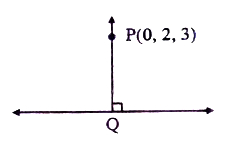
The coordinates of the foot of the perpendicular from the point $(0,2,3)$ on the line $\frac{x+3}{5}=\frac{y-1}{2}=\frac{z+4}{3}$ are
A
$(2,1,-1)$
B
$(2,3,-1)$
C
$(2,3,1)$
D
$(-2,-3,-1)$
Solution
(B) Let $Q$ be the foot of the perpendicular drawn from the point $P(0,2,3)$ to the given line.
Any point on the line $\frac{x+3}{5}=\frac{y-1}{2}=\frac{z+4}{3}=\lambda$ is given by $Q(5\lambda-3, 2\lambda+1, 3\lambda-4)$.
The direction ratios of the line $PQ$ are $(5\lambda-3-0, 2\lambda+1-2, 3\lambda-4-3)$,which simplifies to $(5\lambda-3, 2\lambda-1, 3\lambda-7)$.
The direction ratios of the given line are $(5, 2, 3)$.
Since $PQ$ is perpendicular to the line,the dot product of their direction ratios must be zero:
$5(5\lambda-3) + 2(2\lambda-1) + 3(3\lambda-7) = 0$
$25\lambda - 15 + 4\lambda - 2 + 9\lambda - 21 = 0$
$38\lambda - 38 = 0$
$\lambda = 1$
Substituting $\lambda = 1$ into the coordinates of $Q$:
$Q = (5(1)-3, 2(1)+1, 3(1)-4) = (2, 3, -1)$.
Thus,the correct option is $(B)$.
Any point on the line $\frac{x+3}{5}=\frac{y-1}{2}=\frac{z+4}{3}=\lambda$ is given by $Q(5\lambda-3, 2\lambda+1, 3\lambda-4)$.
The direction ratios of the line $PQ$ are $(5\lambda-3-0, 2\lambda+1-2, 3\lambda-4-3)$,which simplifies to $(5\lambda-3, 2\lambda-1, 3\lambda-7)$.
The direction ratios of the given line are $(5, 2, 3)$.
Since $PQ$ is perpendicular to the line,the dot product of their direction ratios must be zero:
$5(5\lambda-3) + 2(2\lambda-1) + 3(3\lambda-7) = 0$
$25\lambda - 15 + 4\lambda - 2 + 9\lambda - 21 = 0$
$38\lambda - 38 = 0$
$\lambda = 1$
Substituting $\lambda = 1$ into the coordinates of $Q$:
$Q = (5(1)-3, 2(1)+1, 3(1)-4) = (2, 3, -1)$.
Thus,the correct option is $(B)$.
0 likesView Solution
408
MathematicsEasyMCQMHT CET · 2020
The shortest distance between the lines $1+x=2y=-12z$ and $x=y+2=6z-6$ is
A
$1$ unit
B
$4$ units
C
$2$ units
D
$3$ units
Solution
(C) First,we write the equations of the lines in symmetric form $\frac{x-x_1}{a_1} = \frac{y-y_1}{b_1} = \frac{z-z_1}{c_1}$.
For the first line $1+x = 2y = -12z$,we have $\frac{x+1}{1} = \frac{y}{1/2} = \frac{z}{-1/12}$. Here,point $P_1 = (-1, 0, 0)$ and direction vector $\vec{b_1} = (1, 1/2, -1/12)$.
For the second line $x = y+2 = 6z-6$,we have $\frac{x}{1} = \frac{y+2}{1} = \frac{z-1}{1/6}$. Here,point $P_2 = (0, -2, 1)$ and direction vector $\vec{b_2} = (1, 1, 1/6)$.
The shortest distance $d$ is given by $d = \frac{|(\vec{P_2} - \vec{P_1}) \cdot (\vec{b_1} \times \vec{b_2})|}{||\vec{b_1} \times \vec{b_2}||}$.
Vector $\vec{P_2} - \vec{P_1} = (0 - (-1), -2 - 0, 1 - 0) = (1, -2, 1)$.
Cross product $\vec{b_1} \times \vec{b_2} = \begin{vmatrix} \hat{i} & \hat{j} & \hat{k} \\ 1 & 1/2 & -1/12 \\ 1 & 1 & 1/6 \end{vmatrix} = \hat{i}(\frac{1}{12} + \frac{1}{12}) - \hat{j}(\frac{1}{6} + \frac{1}{12}) + \hat{k}(1 - 1/2) = (1/6, -1/4, 1/2)$.
Magnitude $||\vec{b_1} \times \vec{b_2}|| = \sqrt{(1/6)^2 + (-1/4)^2 + (1/2)^2} = \sqrt{1/36 + 1/16 + 1/4} = \sqrt{\frac{4+9+36}{144}} = \sqrt{49/144} = 7/12$.
Dot product $(\vec{P_2} - \vec{P_1}) \cdot (\vec{b_1} \times \vec{b_2}) = (1)(1/6) + (-2)(-1/4) + (1)(1/2) = 1/6 + 1/2 + 1/2 = 7/6$.
Therefore,$d = \frac{|7/6|}{7/12} = \frac{7}{6} \times \frac{12}{7} = 2$ units.
For the first line $1+x = 2y = -12z$,we have $\frac{x+1}{1} = \frac{y}{1/2} = \frac{z}{-1/12}$. Here,point $P_1 = (-1, 0, 0)$ and direction vector $\vec{b_1} = (1, 1/2, -1/12)$.
For the second line $x = y+2 = 6z-6$,we have $\frac{x}{1} = \frac{y+2}{1} = \frac{z-1}{1/6}$. Here,point $P_2 = (0, -2, 1)$ and direction vector $\vec{b_2} = (1, 1, 1/6)$.
The shortest distance $d$ is given by $d = \frac{|(\vec{P_2} - \vec{P_1}) \cdot (\vec{b_1} \times \vec{b_2})|}{||\vec{b_1} \times \vec{b_2}||}$.
Vector $\vec{P_2} - \vec{P_1} = (0 - (-1), -2 - 0, 1 - 0) = (1, -2, 1)$.
Cross product $\vec{b_1} \times \vec{b_2} = \begin{vmatrix} \hat{i} & \hat{j} & \hat{k} \\ 1 & 1/2 & -1/12 \\ 1 & 1 & 1/6 \end{vmatrix} = \hat{i}(\frac{1}{12} + \frac{1}{12}) - \hat{j}(\frac{1}{6} + \frac{1}{12}) + \hat{k}(1 - 1/2) = (1/6, -1/4, 1/2)$.
Magnitude $||\vec{b_1} \times \vec{b_2}|| = \sqrt{(1/6)^2 + (-1/4)^2 + (1/2)^2} = \sqrt{1/36 + 1/16 + 1/4} = \sqrt{\frac{4+9+36}{144}} = \sqrt{49/144} = 7/12$.
Dot product $(\vec{P_2} - \vec{P_1}) \cdot (\vec{b_1} \times \vec{b_2}) = (1)(1/6) + (-2)(-1/4) + (1)(1/2) = 1/6 + 1/2 + 1/2 = 7/6$.
Therefore,$d = \frac{|7/6|}{7/12} = \frac{7}{6} \times \frac{12}{7} = 2$ units.
0 likesView Solution
409
MathematicsEasyMCQMHT CET · 2020
The angle between the lines $\frac{x-1}{4}=\frac{y-3}{1}=\frac{z}{8}$ and $\frac{x-2}{2}=\frac{y+1}{2}=\frac{z-4}{1}$ is
A
$\sin ^{-1}\left(\frac{2}{3}\right)$
B
$\cos ^{-1}\left(\frac{2}{3}\right)$
C
$\cos ^{-1}\left(\frac{1}{3}\right)$
D
$\sin ^{-1}\left(\frac{1}{3}\right)$
Solution
(B) The direction ratios of the first line are $\vec{b_1} = (4, 1, 8)$.
The direction ratios of the second line are $\vec{b_2} = (2, 2, 1)$.
The angle $\theta$ between two lines with direction ratios $(a_1, b_1, c_1)$ and $(a_2, b_2, c_2)$ is given by $\cos \theta = \left| \frac{a_1 a_2 + b_1 b_2 + c_1 c_2}{\sqrt{a_1^2 + b_1^2 + c_1^2} \sqrt{a_2^2 + b_2^2 + c_2^2}} \right|$.
Substituting the values:
$\cos \theta = \left| \frac{4(2) + 1(2) + 8(1)}{\sqrt{4^2 + 1^2 + 8^2} \sqrt{2^2 + 2^2 + 1^2}} \right|$
$\cos \theta = \left| \frac{8 + 2 + 8}{\sqrt{16 + 1 + 64} \sqrt{4 + 4 + 1}} \right|$
$\cos \theta = \left| \frac{18}{\sqrt{81} \cdot \sqrt{9}} \right| = \frac{18}{9 \cdot 3} = \frac{18}{27} = \frac{2}{3}$.
Therefore,$\theta = \cos^{-1}\left(\frac{2}{3}\right)$.
The direction ratios of the second line are $\vec{b_2} = (2, 2, 1)$.
The angle $\theta$ between two lines with direction ratios $(a_1, b_1, c_1)$ and $(a_2, b_2, c_2)$ is given by $\cos \theta = \left| \frac{a_1 a_2 + b_1 b_2 + c_1 c_2}{\sqrt{a_1^2 + b_1^2 + c_1^2} \sqrt{a_2^2 + b_2^2 + c_2^2}} \right|$.
Substituting the values:
$\cos \theta = \left| \frac{4(2) + 1(2) + 8(1)}{\sqrt{4^2 + 1^2 + 8^2} \sqrt{2^2 + 2^2 + 1^2}} \right|$
$\cos \theta = \left| \frac{8 + 2 + 8}{\sqrt{16 + 1 + 64} \sqrt{4 + 4 + 1}} \right|$
$\cos \theta = \left| \frac{18}{\sqrt{81} \cdot \sqrt{9}} \right| = \frac{18}{9 \cdot 3} = \frac{18}{27} = \frac{2}{3}$.
Therefore,$\theta = \cos^{-1}\left(\frac{2}{3}\right)$.
0 likesView Solution
410
MathematicsEasyMCQMHT CET · 2020
The angle between the two lines $\frac{x-4}{1}=\frac{y+4}{2}=\frac{z+1}{2}$ and $\frac{x+1}{2}=\frac{y+3}{2}=\frac{z-4}{-1}$ is
A
$\cos ^{-1}\left(\frac{4}{9}\right)$
B
$\cos ^{-1}\left(\frac{5}{9}\right)$
C
$\cos ^{-1}\left(\frac{1}{9}\right)$
D
$\cos ^{-1}\left(\frac{2}{9}\right)$
Solution
(A) Let the direction ratios of the two lines be $\vec{b_1} = (1, 2, 2)$ and $\vec{b_2} = (2, 2, -1)$.
The formula for the angle $\theta$ between two lines with direction ratios $(a_1, b_1, c_1)$ and $(a_2, b_2, c_2)$ is given by:
$\cos \theta = \left| \frac{a_1 a_2 + b_1 b_2 + c_1 c_2}{\sqrt{a_1^2 + b_1^2 + c_1^2} \sqrt{a_2^2 + b_2^2 + c_2^2}} \right|$
Substituting the values:
$\cos \theta = \left| \frac{1(2) + 2(2) + 2(-1)}{\sqrt{1^2 + 2^2 + 2^2} \sqrt{2^2 + 2^2 + (-1)^2}} \right|$
$\cos \theta = \left| \frac{2 + 4 - 2}{\sqrt{1 + 4 + 4} \sqrt{4 + 4 + 1}} \right|$
$\cos \theta = \left| \frac{4}{\sqrt{9} \sqrt{9}} \right| = \frac{4}{3 \times 3} = \frac{4}{9}$
Therefore,$\theta = \cos ^{-1}\left(\frac{4}{9}\right)$.
The formula for the angle $\theta$ between two lines with direction ratios $(a_1, b_1, c_1)$ and $(a_2, b_2, c_2)$ is given by:
$\cos \theta = \left| \frac{a_1 a_2 + b_1 b_2 + c_1 c_2}{\sqrt{a_1^2 + b_1^2 + c_1^2} \sqrt{a_2^2 + b_2^2 + c_2^2}} \right|$
Substituting the values:
$\cos \theta = \left| \frac{1(2) + 2(2) + 2(-1)}{\sqrt{1^2 + 2^2 + 2^2} \sqrt{2^2 + 2^2 + (-1)^2}} \right|$
$\cos \theta = \left| \frac{2 + 4 - 2}{\sqrt{1 + 4 + 4} \sqrt{4 + 4 + 1}} \right|$
$\cos \theta = \left| \frac{4}{\sqrt{9} \sqrt{9}} \right| = \frac{4}{3 \times 3} = \frac{4}{9}$
Therefore,$\theta = \cos ^{-1}\left(\frac{4}{9}\right)$.
0 likesView Solution
411
MathematicsEasyMCQMHT CET · 2020
The angle between the lines $\bar{r}=(\hat{i}+2\hat{j}+3\hat{k})+\lambda(\hat{i}+\hat{j}+2\hat{k})$ and $\bar{r}=(3\hat{i}+\hat{k})+\lambda^{\prime}(2\hat{i}+\hat{j}-\hat{k})$,where $\lambda, \lambda^{\prime} \in R$,is
A
$\cos^{-1}\left(\frac{1}{6}\right)$
B
$\cos^{-1}\left(\frac{1}{5}\right)$
C
$\cos^{-1}\left(\frac{1}{3}\right)$
D
$\cos^{-1}\left(\frac{2}{3}\right)$
Solution
(A) The direction vectors of the two lines are $\vec{b_1} = \hat{i} + \hat{j} + 2\hat{k}$ and $\vec{b_2} = 2\hat{i} + \hat{j} - \hat{k}$.
Let $\theta$ be the angle between the lines.
The formula for the angle between two lines with direction vectors $\vec{b_1}$ and $\vec{b_2}$ is given by $\cos \theta = \frac{|\vec{b_1} \cdot \vec{b_2}|}{|\vec{b_1}| |\vec{b_2}|}$.
Calculating the dot product: $\vec{b_1} \cdot \vec{b_2} = (1)(2) + (1)(1) + (2)(-1) = 2 + 1 - 2 = 1$.
Calculating the magnitudes: $|\vec{b_1}| = \sqrt{1^2 + 1^2 + 2^2} = \sqrt{6}$ and $|\vec{b_2}| = \sqrt{2^2 + 1^2 + (-1)^2} = \sqrt{6}$.
Substituting these values into the formula: $\cos \theta = \frac{|1|}{\sqrt{6} \cdot \sqrt{6}} = \frac{1}{6}$.
Therefore,$\theta = \cos^{-1}\left(\frac{1}{6}\right)$.
Let $\theta$ be the angle between the lines.
The formula for the angle between two lines with direction vectors $\vec{b_1}$ and $\vec{b_2}$ is given by $\cos \theta = \frac{|\vec{b_1} \cdot \vec{b_2}|}{|\vec{b_1}| |\vec{b_2}|}$.
Calculating the dot product: $\vec{b_1} \cdot \vec{b_2} = (1)(2) + (1)(1) + (2)(-1) = 2 + 1 - 2 = 1$.
Calculating the magnitudes: $|\vec{b_1}| = \sqrt{1^2 + 1^2 + 2^2} = \sqrt{6}$ and $|\vec{b_2}| = \sqrt{2^2 + 1^2 + (-1)^2} = \sqrt{6}$.
Substituting these values into the formula: $\cos \theta = \frac{|1|}{\sqrt{6} \cdot \sqrt{6}} = \frac{1}{6}$.
Therefore,$\theta = \cos^{-1}\left(\frac{1}{6}\right)$.
0 likesView Solution
412
MathematicsEasyMCQMHT CET · 2020
The angle between the lines $\frac{x-1}{4}=\frac{y-3}{1}=\frac{z}{8}$ and $\frac{x-2}{2}=\frac{y+1}{2}=\frac{z-4}{1}$ is
A
$\cos ^{-1}\left(\frac{3}{4}\right)$
B
$\cos ^{-1}\left(\frac{1}{3}\right)$
C
$\cos ^{-1}\left(\frac{1}{2}\right)$
D
$\cos ^{-1}\left(\frac{2}{3}\right)$
Solution
(D) Let $\vec{a}$ and $\vec{b}$ be the direction vectors of the lines $\frac{x-1}{4}=\frac{y-3}{1}=\frac{z}{8}$ and $\frac{x-2}{2}=\frac{y+1}{2}=\frac{z-4}{1}$ respectively.
$\vec{a} = 4\hat{i} + \hat{j} + 8\hat{k}$ and $\vec{b} = 2\hat{i} + 2\hat{j} + \hat{k}$.
The dot product is $\vec{a} \cdot \vec{b} = (4 \times 2) + (1 \times 2) + (8 \times 1) = 8 + 2 + 8 = 18$.
The magnitudes are $|\vec{a}| = \sqrt{4^2 + 1^2 + 8^2} = \sqrt{16 + 1 + 64} = \sqrt{81} = 9$ and $|\vec{b}| = \sqrt{2^2 + 2^2 + 1^2} = \sqrt{4 + 4 + 1} = \sqrt{9} = 3$.
Let $\theta$ be the angle between the lines. Then $\cos \theta = \frac{|\vec{a} \cdot \vec{b}|}{|\vec{a}| |\vec{b}|} = \frac{18}{9 \times 3} = \frac{18}{27} = \frac{2}{3}$.
Therefore,$\theta = \cos^{-1}\left(\frac{2}{3}\right)$.
$\vec{a} = 4\hat{i} + \hat{j} + 8\hat{k}$ and $\vec{b} = 2\hat{i} + 2\hat{j} + \hat{k}$.
The dot product is $\vec{a} \cdot \vec{b} = (4 \times 2) + (1 \times 2) + (8 \times 1) = 8 + 2 + 8 = 18$.
The magnitudes are $|\vec{a}| = \sqrt{4^2 + 1^2 + 8^2} = \sqrt{16 + 1 + 64} = \sqrt{81} = 9$ and $|\vec{b}| = \sqrt{2^2 + 2^2 + 1^2} = \sqrt{4 + 4 + 1} = \sqrt{9} = 3$.
Let $\theta$ be the angle between the lines. Then $\cos \theta = \frac{|\vec{a} \cdot \vec{b}|}{|\vec{a}| |\vec{b}|} = \frac{18}{9 \times 3} = \frac{18}{27} = \frac{2}{3}$.
Therefore,$\theta = \cos^{-1}\left(\frac{2}{3}\right)$.
0 likesView Solution
413
MathematicsEasyMCQMHT CET · 2020
The cosine of the angle included between the lines $\overline{r}=(2 \hat{\imath}+\hat{\jmath}-2 \hat{k})+\lambda(\hat{\imath}-2 \hat{\jmath}-2 \hat{k})$ and $\overline{r}=(\hat{\imath}+\hat{\jmath}+3 \hat{k})+\mu(3 \hat{\imath}+2 \hat{\jmath}-6 \hat{k})$ where $\lambda, \mu \in R$ is
A
$\frac{13}{21}$
B
$\frac{11}{21}$
C
$\frac{3}{21}$
D
$\frac{17}{21}$
Solution
(B) The direction vectors of the two lines are $\vec{b_1} = \hat{\imath} - 2\hat{\jmath} - 2\hat{k}$ and $\vec{b_2} = 3\hat{\imath} + 2\hat{\jmath} - 6\hat{k}$.
The cosine of the angle $\theta$ between the lines is given by $\cos \theta = \frac{|\vec{b_1} \cdot \vec{b_2}|}{|\vec{b_1}| |\vec{b_2}|}$.
First,calculate the dot product: $\vec{b_1} \cdot \vec{b_2} = (1)(3) + (-2)(2) + (-2)(-6) = 3 - 4 + 12 = 11$.
Next,calculate the magnitudes: $|\vec{b_1}| = \sqrt{1^2 + (-2)^2 + (-2)^2} = \sqrt{1 + 4 + 4} = \sqrt{9} = 3$.
$|\vec{b_2}| = \sqrt{3^2 + 2^2 + (-6)^2} = \sqrt{9 + 4 + 36} = \sqrt{49} = 7$.
Therefore,$\cos \theta = \frac{|11|}{3 \times 7} = \frac{11}{21}$.
The cosine of the angle $\theta$ between the lines is given by $\cos \theta = \frac{|\vec{b_1} \cdot \vec{b_2}|}{|\vec{b_1}| |\vec{b_2}|}$.
First,calculate the dot product: $\vec{b_1} \cdot \vec{b_2} = (1)(3) + (-2)(2) + (-2)(-6) = 3 - 4 + 12 = 11$.
Next,calculate the magnitudes: $|\vec{b_1}| = \sqrt{1^2 + (-2)^2 + (-2)^2} = \sqrt{1 + 4 + 4} = \sqrt{9} = 3$.
$|\vec{b_2}| = \sqrt{3^2 + 2^2 + (-6)^2} = \sqrt{9 + 4 + 36} = \sqrt{49} = 7$.
Therefore,$\cos \theta = \frac{|11|}{3 \times 7} = \frac{11}{21}$.
0 likesView Solution
414
MathematicsEasyMCQMHT CET · 2020
The angle between the lines $\vec{r}=(2 \hat{i}+\hat{j}-3 \hat{k})+\lambda(\hat{i}-\hat{j}+\hat{k})$ and $\frac{x-1}{1}=\frac{y+2}{3}=\frac{z-3}{2}$ is
A
$\frac{\pi}{6}$
B
$\frac{\pi}{3}$
C
$\frac{\pi}{4}$
D
$\frac{\pi}{2}$
Solution
(D) The direction vector of the first line is $\vec{b_1} = \hat{i} - \hat{j} + \hat{k}$.
The direction vector of the second line is $\vec{b_2} = \hat{i} + 3\hat{j} + 2\hat{k}$.
The angle $\theta$ between the two lines is given by $\cos \theta = \frac{|\vec{b_1} \cdot \vec{b_2}|}{|\vec{b_1}| |\vec{b_2}|}$.
Calculating the dot product: $\vec{b_1} \cdot \vec{b_2} = (1)(1) + (-1)(3) + (1)(2) = 1 - 3 + 2 = 0$.
Since the dot product is $0$,$\cos \theta = 0$,which implies $\theta = \frac{\pi}{2}$.
The direction vector of the second line is $\vec{b_2} = \hat{i} + 3\hat{j} + 2\hat{k}$.
The angle $\theta$ between the two lines is given by $\cos \theta = \frac{|\vec{b_1} \cdot \vec{b_2}|}{|\vec{b_1}| |\vec{b_2}|}$.
Calculating the dot product: $\vec{b_1} \cdot \vec{b_2} = (1)(1) + (-1)(3) + (1)(2) = 1 - 3 + 2 = 0$.
Since the dot product is $0$,$\cos \theta = 0$,which implies $\theta = \frac{\pi}{2}$.
0 likesView Solution
415
MathematicsEasyMCQMHT CET · 2020
The equation of the line passing through $(1, 2, 3)$ and perpendicular to the lines $x-1 = \frac{y+2}{2} = \frac{z+4}{4}$ and $\frac{x-1}{2} = \frac{y-2}{2} = z+3$ is
A
$\frac{x-1}{6} = \frac{2-y}{7} = \frac{z-3}{2}$
B
$\frac{x-1}{6} = \frac{y-2}{7} = \frac{z-3}{2}$
C
$\frac{x-1}{4} = \frac{2-y}{5} = \frac{z-3}{2}$
D
$x-1 = \frac{y-2}{2} = \frac{z-3}{4}$
Solution
(A) Let the direction ratios of the required line be $(a, b, c)$.
The direction ratios of the first line are $(1, 2, 4)$ and the second line are $(2, 2, 1)$.
Since the required line is perpendicular to both,its direction vector is the cross product of the direction vectors of the given lines:
$\vec{v} = \begin{vmatrix} \hat{i} & \hat{j} & \hat{k} \\ 1 & 2 & 4 \\ 2 & 2 & 1 \end{vmatrix} = \hat{i}(2-8) - \hat{j}(1-8) + \hat{k}(2-4) = -6\hat{i} + 7\hat{j} - 2\hat{k}$.
Thus,the direction ratios are proportional to $(-6, 7, -2)$ or $(6, -7, 2)$.
The line passes through $(1, 2, 3)$,so its equation is $\frac{x-1}{6} = \frac{y-2}{-7} = \frac{z-3}{2}$.
This can be rewritten as $\frac{x-1}{6} = \frac{2-y}{7} = \frac{z-3}{2}$.
The direction ratios of the first line are $(1, 2, 4)$ and the second line are $(2, 2, 1)$.
Since the required line is perpendicular to both,its direction vector is the cross product of the direction vectors of the given lines:
$\vec{v} = \begin{vmatrix} \hat{i} & \hat{j} & \hat{k} \\ 1 & 2 & 4 \\ 2 & 2 & 1 \end{vmatrix} = \hat{i}(2-8) - \hat{j}(1-8) + \hat{k}(2-4) = -6\hat{i} + 7\hat{j} - 2\hat{k}$.
Thus,the direction ratios are proportional to $(-6, 7, -2)$ or $(6, -7, 2)$.
The line passes through $(1, 2, 3)$,so its equation is $\frac{x-1}{6} = \frac{y-2}{-7} = \frac{z-3}{2}$.
This can be rewritten as $\frac{x-1}{6} = \frac{2-y}{7} = \frac{z-3}{2}$.
0 likesView Solution
416
MathematicsEasyMCQMHT CET · 2020
The parametric equations of the line passing through the points $A(3,4,-7)$ and $B(1,-1,6)$ are
A
$x=1+3 \lambda, \quad y=-1+4 \lambda, \quad z=6-7 \lambda$
B
$x=-2+3 \lambda, \quad y=-5+4 \lambda, \quad z=13-7 \lambda$
C
$x=3-2 \lambda, \quad y=4-5 \lambda, \quad z=-7+13 \lambda$
D
$x=3+\lambda, \quad y=-1+4 \lambda, \quad z=-7+6 \lambda$
Solution
(C) The vector equation of a line passing through points $A(\vec{a})$ and $B(\vec{b})$ is given by $\vec{r} = \vec{a} + \lambda(\vec{b} - \vec{a})$.
Here,$\vec{a} = 3\hat{i} + 4\hat{j} - 7\hat{k}$ and $\vec{b} = \hat{i} - \hat{j} + 6\hat{k}$.
The direction vector $\vec{v} = \vec{b} - \vec{a} = (1-3)\hat{i} + (-1-4)\hat{j} + (6 - (-7))\hat{k} = -2\hat{i} - 5\hat{j} + 13\hat{k}$.
Thus,the parametric equations are $x = x_1 + v_x \lambda$,$y = y_1 + v_y \lambda$,$z = z_1 + v_z \lambda$.
Substituting the values: $x = 3 - 2\lambda$,$y = 4 - 5\lambda$,$z = -7 + 13\lambda$.
Here,$\vec{a} = 3\hat{i} + 4\hat{j} - 7\hat{k}$ and $\vec{b} = \hat{i} - \hat{j} + 6\hat{k}$.
The direction vector $\vec{v} = \vec{b} - \vec{a} = (1-3)\hat{i} + (-1-4)\hat{j} + (6 - (-7))\hat{k} = -2\hat{i} - 5\hat{j} + 13\hat{k}$.
Thus,the parametric equations are $x = x_1 + v_x \lambda$,$y = y_1 + v_y \lambda$,$z = z_1 + v_z \lambda$.
Substituting the values: $x = 3 - 2\lambda$,$y = 4 - 5\lambda$,$z = -7 + 13\lambda$.
0 likesView Solution
417
MathematicsEasyMCQMHT CET · 2020
If the lines $\frac{x-1}{-3}=\frac{y-2}{2k}=\frac{z-3}{2}$ and $\frac{x-1}{3k}=\frac{y-5}{1}=\frac{z-6}{-5}$ are perpendicular to each other,then $k$ is
A
$\frac{7}{10}$
B
$\frac{10}{7}$
C
$\frac{-7}{10}$
D
$\frac{-10}{7}$
Solution
(D) Two lines with direction ratios $(a_1, b_1, c_1)$ and $(a_2, b_2, c_2)$ are perpendicular if $a_1 a_2 + b_1 b_2 + c_1 c_2 = 0$.
Given the direction ratios of the first line are $(-3, 2k, 2)$ and the second line are $(3k, 1, -5)$.
Applying the condition for perpendicularity:
$(-3)(3k) + (2k)(1) + (2)(-5) = 0$
$-9k + 2k - 10 = 0$
$-7k - 10 = 0$
$-7k = 10$
$k = \frac{-10}{7}$
Given the direction ratios of the first line are $(-3, 2k, 2)$ and the second line are $(3k, 1, -5)$.
Applying the condition for perpendicularity:
$(-3)(3k) + (2k)(1) + (2)(-5) = 0$
$-9k + 2k - 10 = 0$
$-7k - 10 = 0$
$-7k = 10$
$k = \frac{-10}{7}$
0 likesView Solution
418
MathematicsEasyMCQMHT CET · 2020
The equation of a plane containing the point $(1, -1, 1)$ and parallel to the plane $2x + 3y - 4z = 17$ is
A
$\bar{r} \cdot (2 \hat{i} + 3 \hat{j} - 4 \hat{k}) = -5$
B
$\bar{r} \cdot (2 \hat{i} + 3 \hat{j} - 4 \hat{k}) = -15$
C
$\bar{r} \cdot (4 \hat{i} + 3 \hat{j} - 4 \hat{k}) = -3$
D
$\bar{r} \cdot (3 \hat{i} + 4 \hat{j} - 2 \hat{k}) = -3$
Solution
(A) The equation of a plane parallel to $2x + 3y - 4z = 17$ is of the form $2x + 3y - 4z = d$.
Since the plane passes through the point $(1, -1, 1)$,we substitute these coordinates into the equation:
$2(1) + 3(-1) - 4(1) = d$
$2 - 3 - 4 = d$
$d = -5$.
Thus,the Cartesian equation is $2x + 3y - 4z = -5$.
In vector form,this is $\bar{r} \cdot (2 \hat{i} + 3 \hat{j} - 4 \hat{k}) = -5$.
Since the plane passes through the point $(1, -1, 1)$,we substitute these coordinates into the equation:
$2(1) + 3(-1) - 4(1) = d$
$2 - 3 - 4 = d$
$d = -5$.
Thus,the Cartesian equation is $2x + 3y - 4z = -5$.
In vector form,this is $\bar{r} \cdot (2 \hat{i} + 3 \hat{j} - 4 \hat{k}) = -5$.
0 likesView Solution
419
MathematicsEasyMCQMHT CET · 2020
The length of the perpendicular from the origin to the plane $\bar{r} \cdot (\hat{i} - 2\hat{j} + 3\hat{k}) = 14$ is
A
$\sqrt{7}$ units
B
$7$ units
C
$14$ units
D
$\sqrt{14}$ units
Solution
(D) The length of the perpendicular from a point with position vector $\bar{a}$ to the plane $\bar{r} \cdot \bar{n} = p$ is given by the formula $d = \frac{|\bar{a} \cdot \bar{n} - p|}{|\bar{n}|}$.
Here,the origin is the point,so $\bar{a} = 0\hat{i} + 0\hat{j} + 0\hat{k}$.
The plane equation is $\bar{r} \cdot (\hat{i} - 2\hat{j} + 3\hat{k}) = 14$,so $\bar{n} = \hat{i} - 2\hat{j} + 3\hat{k}$ and $p = 14$.
Calculating the dot product: $\bar{a} \cdot \bar{n} = 0(1) + 0(-2) + 0(3) = 0$.
Calculating the magnitude of the normal vector: $|\bar{n}| = \sqrt{1^2 + (-2)^2 + 3^2} = \sqrt{1 + 4 + 9} = \sqrt{14}$.
Substituting these values into the formula: $d = \frac{|0 - 14|}{\sqrt{14}} = \frac{14}{\sqrt{14}} = \sqrt{14}$ units.
Here,the origin is the point,so $\bar{a} = 0\hat{i} + 0\hat{j} + 0\hat{k}$.
The plane equation is $\bar{r} \cdot (\hat{i} - 2\hat{j} + 3\hat{k}) = 14$,so $\bar{n} = \hat{i} - 2\hat{j} + 3\hat{k}$ and $p = 14$.
Calculating the dot product: $\bar{a} \cdot \bar{n} = 0(1) + 0(-2) + 0(3) = 0$.
Calculating the magnitude of the normal vector: $|\bar{n}| = \sqrt{1^2 + (-2)^2 + 3^2} = \sqrt{1 + 4 + 9} = \sqrt{14}$.
Substituting these values into the formula: $d = \frac{|0 - 14|}{\sqrt{14}} = \frac{14}{\sqrt{14}} = \sqrt{14}$ units.
0 likesView Solution
420
MathematicsMediumMCQMHT CET · 2020
$A$ plane $E_{1}$ makes intercepts $1, -3, 4$ on the coordinate axes. The equation of a plane parallel to plane $E_{1}$ and passing through $(2, 6, -8)$ is
A
$\frac{x}{2}-\frac{y}{3}+\frac{z}{4}+3=0$
B
$\frac{x}{1}-\frac{y}{3}+\frac{z}{4}+12=0$
C
$\frac{x}{1}-\frac{y}{3}+\frac{z}{4}+2=0$
D
$\frac{x}{3}-\frac{y}{6}+\frac{z}{2}+\frac{13}{3}=0$
Solution
(C) The intercept form of the plane $E_{1}$ with intercepts $a=1, b=-3, c=4$ is $\frac{x}{1} + \frac{y}{-3} + \frac{z}{4} = 1$.
Multiplying by $12$,we get $12x - 4y + 3z = 12$,or $12x - 4y + 3z - 12 = 0$.
The normal vector to this plane is $\vec{n} = 12\hat{i} - 4\hat{j} + 3\hat{k}$.
Since the required plane is parallel to $E_{1}$,its equation is of the form $12x - 4y + 3z + k = 0$.
Since it passes through $(2, 6, -8)$,we substitute these coordinates: $12(2) - 4(6) + 3(-8) + k = 0$.
$24 - 24 - 24 + k = 0 \Rightarrow k = 24$.
Thus,the equation is $12x - 4y + 3z + 24 = 0$.
Dividing by $12$,we get $x - \frac{y}{3} + \frac{z}{4} + 2 = 0$.
Multiplying by $12$,we get $12x - 4y + 3z = 12$,or $12x - 4y + 3z - 12 = 0$.
The normal vector to this plane is $\vec{n} = 12\hat{i} - 4\hat{j} + 3\hat{k}$.
Since the required plane is parallel to $E_{1}$,its equation is of the form $12x - 4y + 3z + k = 0$.
Since it passes through $(2, 6, -8)$,we substitute these coordinates: $12(2) - 4(6) + 3(-8) + k = 0$.
$24 - 24 - 24 + k = 0 \Rightarrow k = 24$.
Thus,the equation is $12x - 4y + 3z + 24 = 0$.
Dividing by $12$,we get $x - \frac{y}{3} + \frac{z}{4} + 2 = 0$.
0 likesView Solution
421
MathematicsMediumMCQMHT CET · 2020
The equation of the plane passing through the points $(2,3,1)$ and $(4,-5,3)$ and parallel to the $y$-axis is:
A
$x+z=3$
B
$x+z=1$
C
$x-z=1$
D
$z-x+2=0$
Solution
(C) The equation of a plane passing through the point $(2,3,1)$ is given by $a(x-2)+b(y-3)+c(z-1)=0$ $\ldots(1)$.
Since the point $(4,-5,3)$ lies on the plane,we substitute these coordinates into equation $(1)$:
$a(4-2)+b(-5-3)+c(3-1)=0$
$2a-8b+2c=0$
$a-4b+c=0$ $\ldots(2)$.
Since the plane is parallel to the $y$-axis,its normal vector is perpendicular to the $y$-axis vector $(0,1,0)$. Thus,$a(0)+b(1)+c(0)=0$,which implies $b=0$.
Substituting $b=0$ into equation $(2)$,we get $a+c=0$,or $a=-c$.
Substituting $a=-c$ and $b=0$ into equation $(1)$:
$-c(x-2)+0(y-3)+c(z-1)=0$
Dividing by $-c$ (assuming $c \neq 0$):
$(x-2)-(z-1)=0$
$x-z-1=0$
$x-z=1$.
Since the point $(4,-5,3)$ lies on the plane,we substitute these coordinates into equation $(1)$:
$a(4-2)+b(-5-3)+c(3-1)=0$
$2a-8b+2c=0$
$a-4b+c=0$ $\ldots(2)$.
Since the plane is parallel to the $y$-axis,its normal vector is perpendicular to the $y$-axis vector $(0,1,0)$. Thus,$a(0)+b(1)+c(0)=0$,which implies $b=0$.
Substituting $b=0$ into equation $(2)$,we get $a+c=0$,or $a=-c$.
Substituting $a=-c$ and $b=0$ into equation $(1)$:
$-c(x-2)+0(y-3)+c(z-1)=0$
Dividing by $-c$ (assuming $c \neq 0$):
$(x-2)-(z-1)=0$
$x-z-1=0$
$x-z=1$.
0 likesView Solution
422
MathematicsEasyMCQMHT CET · 2020
The foot of the perpendicular drawn from the origin to the plane $x+y+3z-4=0$ is
A
$\left(\frac{2}{11}, \frac{2}{11}, \frac{9}{11}\right)$
B
$\left(\frac{4}{11}, \frac{4}{11}, \frac{12}{11}\right)$
C
$\left(\frac{1}{7}, \frac{1}{7}, \frac{6}{7}\right)$
D
$\left(\frac{1}{5}, \frac{1}{5}, \frac{3}{5}\right)$
Solution
(B) The direction ratios of the normal to the plane $x+y+3z-4=0$ are $(1, 1, 3)$.
Since the perpendicular line passes through the origin $(0, 0, 0)$,its equation is $\frac{x}{1} = \frac{y}{1} = \frac{z}{3} = K$.
Any point on this line is of the form $P(K, K, 3K)$.
Since this point $P$ lies on the plane,it must satisfy the plane equation:
$K + K + 3(3K) - 4 = 0$
$2K + 9K = 4$
$11K = 4 \Rightarrow K = \frac{4}{11}$.
Substituting $K$ back into the coordinates of $P$,we get $P = \left(\frac{4}{11}, \frac{4}{11}, \frac{12}{11}\right)$.
Since the perpendicular line passes through the origin $(0, 0, 0)$,its equation is $\frac{x}{1} = \frac{y}{1} = \frac{z}{3} = K$.
Any point on this line is of the form $P(K, K, 3K)$.
Since this point $P$ lies on the plane,it must satisfy the plane equation:
$K + K + 3(3K) - 4 = 0$
$2K + 9K = 4$
$11K = 4 \Rightarrow K = \frac{4}{11}$.
Substituting $K$ back into the coordinates of $P$,we get $P = \left(\frac{4}{11}, \frac{4}{11}, \frac{12}{11}\right)$.
0 likesView Solution
423
MathematicsEasyMCQMHT CET · 2020
Given points $A(3, 2, -1)$ and $B(1, 4, 3)$,find the equation of the plane that bisects the segment $AB$ perpendicularly.
A
$x+y+2z+3=0$
B
$x-y+2z-3=0$
C
$x+y-2z-3=0$
D
$x-y-2z+3=0$
Solution
(D) The plane bisects the segment $AB$ perpendicularly,meaning it passes through the midpoint of $AB$ and the vector $\vec{AB}$ is normal to the plane.
Midpoint $M = \left(\frac{3+1}{2}, \frac{2+4}{2}, \frac{-1+3}{2}\right) = (2, 3, 1)$.
The normal vector $\vec{n}$ is the direction ratio of line $AB$: $\vec{n} = (1-3, 4-2, 3-(-1)) = (-2, 2, 4)$.
We can simplify the normal vector by dividing by $-2$,giving $\vec{n}' = (1, -1, -2)$.
The equation of the plane passing through $(x_0, y_0, z_0)$ with normal $(a, b, c)$ is $a(x-x_0) + b(y-y_0) + c(z-z_0) = 0$.
Substituting the values: $1(x-2) - 1(y-3) - 2(z-1) = 0$.
$x - 2 - y + 3 - 2z + 2 = 0$.
$x - y - 2z + 3 = 0$.
Midpoint $M = \left(\frac{3+1}{2}, \frac{2+4}{2}, \frac{-1+3}{2}\right) = (2, 3, 1)$.
The normal vector $\vec{n}$ is the direction ratio of line $AB$: $\vec{n} = (1-3, 4-2, 3-(-1)) = (-2, 2, 4)$.
We can simplify the normal vector by dividing by $-2$,giving $\vec{n}' = (1, -1, -2)$.
The equation of the plane passing through $(x_0, y_0, z_0)$ with normal $(a, b, c)$ is $a(x-x_0) + b(y-y_0) + c(z-z_0) = 0$.
Substituting the values: $1(x-2) - 1(y-3) - 2(z-1) = 0$.
$x - 2 - y + 3 - 2z + 2 = 0$.
$x - y - 2z + 3 = 0$.
0 likesView Solution
424
MathematicsMediumMCQMHT CET · 2020
The equation of a plane passing through the intersection of two planes $x+2y-3z+2=0$ and $6x+y+z+1=0$ and parallel to the line $x-1=y+2=7-z$ is
A
$5x-y+4z+1=0$
B
$5x+y+4z+1=0$
C
$5x-y+4z=1$
D
$5x+y+4z=1$
Solution
(C) The equation of a plane passing through the intersection of two planes $P_1: x+2y-3z+2=0$ and $P_2: 6x+y+z+1=0$ is given by $P_1 + \lambda P_2 = 0$.
$(x+2y-3z+2) + \lambda(6x+y+z+1) = 0$
$(1+6\lambda)x + (2+\lambda)y + (-3+\lambda)z + (2+\lambda) = 0$
This plane is parallel to the line $\frac{x-1}{1} = \frac{y+2}{1} = \frac{z-7}{-1}$.
The normal vector of the plane is $\vec{n} = (1+6\lambda, 2+\lambda, -3+\lambda)$ and the direction vector of the line is $\vec{v} = (1, 1, -1)$.
Since the plane is parallel to the line,the normal vector is perpendicular to the direction vector,so $\vec{n} \cdot \vec{v} = 0$.
$(1+6\lambda)(1) + (2+\lambda)(1) + (-3+\lambda)(-1) = 0$
$1 + 6\lambda + 2 + \lambda + 3 - \lambda = 0$
$6\lambda + 6 = 0 \Rightarrow \lambda = -1$.
Substituting $\lambda = -1$ into the equation:
$(1-6)x + (2-1)y + (-3-1)z + (2-1) = 0$
$-5x + y - 4z + 1 = 0$
$5x - y + 4z = 1$.
$(x+2y-3z+2) + \lambda(6x+y+z+1) = 0$
$(1+6\lambda)x + (2+\lambda)y + (-3+\lambda)z + (2+\lambda) = 0$
This plane is parallel to the line $\frac{x-1}{1} = \frac{y+2}{1} = \frac{z-7}{-1}$.
The normal vector of the plane is $\vec{n} = (1+6\lambda, 2+\lambda, -3+\lambda)$ and the direction vector of the line is $\vec{v} = (1, 1, -1)$.
Since the plane is parallel to the line,the normal vector is perpendicular to the direction vector,so $\vec{n} \cdot \vec{v} = 0$.
$(1+6\lambda)(1) + (2+\lambda)(1) + (-3+\lambda)(-1) = 0$
$1 + 6\lambda + 2 + \lambda + 3 - \lambda = 0$
$6\lambda + 6 = 0 \Rightarrow \lambda = -1$.
Substituting $\lambda = -1$ into the equation:
$(1-6)x + (2-1)y + (-3-1)z + (2-1) = 0$
$-5x + y - 4z + 1 = 0$
$5x - y + 4z = 1$.
0 likesView Solution
425
MathematicsEasyMCQMHT CET · 2020
The equation of a plane containing the lines $\overline{r}=(\hat{\imath}+2 \hat{\jmath}-4 \hat{k})+\lambda(2 \hat{\imath}+3 \hat{\jmath}+6 \hat{k})$ and $\overline{r}=(\hat{\imath}+3 \hat{\jmath}+4 \hat{k})+\mu(\hat{\imath}+\hat{\jmath}-\hat{k})$ is
A
$9 x+8 y+z+11=0$
B
$9 x-8 y-z-11=0$
C
$9 x-8 y-z+11=0$
D
$9 x-8 y+z+11=0$
Solution
(D) The normal vector $\vec{n}$ of the plane is perpendicular to the direction vectors of both lines,$\vec{v}_1 = 2\hat{i} + 3\hat{j} + 6\hat{k}$ and $\vec{v}_2 = \hat{i} + \hat{j} - \hat{k}$.
Thus,$\vec{n} = \vec{v}_1 \times \vec{v}_2 = \begin{vmatrix} \hat{i} & \hat{j} & \hat{k} \\ 2 & 3 & 6 \\ 1 & 1 & -1 \end{vmatrix} = \hat{i}(-3-6) - \hat{j}(-2-6) + \hat{k}(2-3) = -9\hat{i} + 8\hat{j} - \hat{k}$.
We can take the normal vector as $\vec{n} = 9\hat{i} - 8\hat{j} + \hat{k}$.
The plane passes through the point $(1, 3, 4)$ from the second line equation.
The equation of the plane is given by $(\vec{r} - \vec{a}) \cdot \vec{n} = 0$,where $\vec{a} = \hat{i} + 3\hat{j} + 4\hat{k}$.
$(x\hat{i} + y\hat{j} + z\hat{k} - (\hat{i} + 3\hat{j} + 4\hat{k})) \cdot (9\hat{i} - 8\hat{j} + \hat{k}) = 0$.
$9(x-1) - 8(y-3) + 1(z-4) = 0$.
$9x - 9 - 8y + 24 + z - 4 = 0$.
$9x - 8y + z + 11 = 0$.
Thus,$\vec{n} = \vec{v}_1 \times \vec{v}_2 = \begin{vmatrix} \hat{i} & \hat{j} & \hat{k} \\ 2 & 3 & 6 \\ 1 & 1 & -1 \end{vmatrix} = \hat{i}(-3-6) - \hat{j}(-2-6) + \hat{k}(2-3) = -9\hat{i} + 8\hat{j} - \hat{k}$.
We can take the normal vector as $\vec{n} = 9\hat{i} - 8\hat{j} + \hat{k}$.
The plane passes through the point $(1, 3, 4)$ from the second line equation.
The equation of the plane is given by $(\vec{r} - \vec{a}) \cdot \vec{n} = 0$,where $\vec{a} = \hat{i} + 3\hat{j} + 4\hat{k}$.
$(x\hat{i} + y\hat{j} + z\hat{k} - (\hat{i} + 3\hat{j} + 4\hat{k})) \cdot (9\hat{i} - 8\hat{j} + \hat{k}) = 0$.
$9(x-1) - 8(y-3) + 1(z-4) = 0$.
$9x - 9 - 8y + 24 + z - 4 = 0$.
$9x - 8y + z + 11 = 0$.
0 likesView Solution
426
MathematicsEasyMCQMHT CET · 2020
If the points $(1, 1, \lambda)$ and $(-3, 0, 1)$ are equidistant from the plane $3x + 4y - 12z + 13 = 0$,then the integer value of $\lambda$ is:
A
$2$
B
$1$
C
$3$
D
$4$
Solution
(B) The distance of a point $(x_1, y_1, z_1)$ from the plane $Ax + By + Cz + D = 0$ is given by $d = \frac{|Ax_1 + By_1 + Cz_1 + D|}{\sqrt{A^2 + B^2 + C^2}}$.
Given the points $A(1, 1, \lambda)$ and $B(-3, 0, 1)$ are equidistant from the plane $3x + 4y - 12z + 13 = 0$.
Distance from $A$: $d_1 = \frac{|3(1) + 4(1) - 12(\lambda) + 13|}{\sqrt{3^2 + 4^2 + (-12)^2}} = \frac{|20 - 12\lambda|}{\sqrt{9 + 16 + 144}} = \frac{|20 - 12\lambda|}{13}$.
Distance from $B$: $d_2 = \frac{|3(-3) + 4(0) - 12(1) + 13|}{\sqrt{3^2 + 4^2 + (-12)^2}} = \frac{|-9 + 0 - 12 + 13|}{13} = \frac{|-8|}{13} = \frac{8}{13}$.
Since $d_1 = d_2$,we have $\frac{|20 - 12\lambda|}{13} = \frac{8}{13}$,which implies $|20 - 12\lambda| = 8$.
Case $1$: $20 - 12\lambda = 8 \Rightarrow 12\lambda = 12 \Rightarrow \lambda = 1$.
Case $2$: $20 - 12\lambda = -8 \Rightarrow 12\lambda = 28 \Rightarrow \lambda = \frac{28}{12} = \frac{7}{3}$.
Since $\lambda$ must be an integer,the value is $\lambda = 1$.
Given the points $A(1, 1, \lambda)$ and $B(-3, 0, 1)$ are equidistant from the plane $3x + 4y - 12z + 13 = 0$.
Distance from $A$: $d_1 = \frac{|3(1) + 4(1) - 12(\lambda) + 13|}{\sqrt{3^2 + 4^2 + (-12)^2}} = \frac{|20 - 12\lambda|}{\sqrt{9 + 16 + 144}} = \frac{|20 - 12\lambda|}{13}$.
Distance from $B$: $d_2 = \frac{|3(-3) + 4(0) - 12(1) + 13|}{\sqrt{3^2 + 4^2 + (-12)^2}} = \frac{|-9 + 0 - 12 + 13|}{13} = \frac{|-8|}{13} = \frac{8}{13}$.
Since $d_1 = d_2$,we have $\frac{|20 - 12\lambda|}{13} = \frac{8}{13}$,which implies $|20 - 12\lambda| = 8$.
Case $1$: $20 - 12\lambda = 8 \Rightarrow 12\lambda = 12 \Rightarrow \lambda = 1$.
Case $2$: $20 - 12\lambda = -8 \Rightarrow 12\lambda = 28 \Rightarrow \lambda = \frac{28}{12} = \frac{7}{3}$.
Since $\lambda$ must be an integer,the value is $\lambda = 1$.
0 likesView Solution
427
MathematicsEasyMCQMHT CET · 2020
The distance of the point $(2, -1, 0)$ from the plane $2x + y + 2z + 8 = 0$ is
A
$\frac{17}{3}$ units
B
$\frac{13}{3}$ units
C
$\frac{7}{3}$ units
D
$\frac{11}{3}$ units
Solution
(D) The distance $d$ of a point $(x_1, y_1, z_1)$ from the plane $Ax + By + Cz + D = 0$ is given by the formula:
$d = \frac{|Ax_1 + By_1 + Cz_1 + D|}{\sqrt{A^2 + B^2 + C^2}}$
Here,the point is $(2, -1, 0)$ and the plane is $2x + y + 2z + 8 = 0$.
Substituting the values into the formula:
$d = \frac{|2(2) + 1(-1) + 2(0) + 8|}{\sqrt{2^2 + 1^2 + 2^2}}$
$d = \frac{|4 - 1 + 0 + 8|}{\sqrt{4 + 1 + 4}}$
$d = \frac{|11|}{\sqrt{9}}$
$d = \frac{11}{3}$ units.
$d = \frac{|Ax_1 + By_1 + Cz_1 + D|}{\sqrt{A^2 + B^2 + C^2}}$
Here,the point is $(2, -1, 0)$ and the plane is $2x + y + 2z + 8 = 0$.
Substituting the values into the formula:
$d = \frac{|2(2) + 1(-1) + 2(0) + 8|}{\sqrt{2^2 + 1^2 + 2^2}}$
$d = \frac{|4 - 1 + 0 + 8|}{\sqrt{4 + 1 + 4}}$
$d = \frac{|11|}{\sqrt{9}}$
$d = \frac{11}{3}$ units.
0 likesView Solution
428
MathematicsEasyMCQMHT CET · 2020
If the foot of the perpendicular drawn from the origin to the plane is $(3, 2, 1)$,then the equation of the plane is
A
$3x+2y-z=12$
B
$3x+2y+z=14$
C
$3x+2y+z=12$
D
$3x-2y-z=12$
Solution
(B) Let the foot of the perpendicular from the origin $O(0, 0, 0)$ to the plane be $P(3, 2, 1)$.
The normal vector $\vec{n}$ to the plane is the vector $\vec{OP} = 3\hat{i} + 2\hat{j} + \hat{k}$.
The equation of a plane passing through a point $P(x_1, y_1, z_1)$ with normal vector $\vec{n} = a\hat{i} + b\hat{j} + c\hat{k}$ is given by $a(x - x_1) + b(y - y_1) + c(z - z_1) = 0$.
Substituting the values $a=3, b=2, c=1$ and $(x_1, y_1, z_1) = (3, 2, 1)$:
$3(x - 3) + 2(y - 2) + 1(z - 1) = 0$
$3x - 9 + 2y - 4 + z - 1 = 0$
$3x + 2y + z - 14 = 0$
$3x + 2y + z = 14$.
Thus,the correct option is $B$.
The normal vector $\vec{n}$ to the plane is the vector $\vec{OP} = 3\hat{i} + 2\hat{j} + \hat{k}$.
The equation of a plane passing through a point $P(x_1, y_1, z_1)$ with normal vector $\vec{n} = a\hat{i} + b\hat{j} + c\hat{k}$ is given by $a(x - x_1) + b(y - y_1) + c(z - z_1) = 0$.
Substituting the values $a=3, b=2, c=1$ and $(x_1, y_1, z_1) = (3, 2, 1)$:
$3(x - 3) + 2(y - 2) + 1(z - 1) = 0$
$3x - 9 + 2y - 4 + z - 1 = 0$
$3x + 2y + z - 14 = 0$
$3x + 2y + z = 14$.
Thus,the correct option is $B$.
0 likesView Solution
429
MathematicsEasyMCQMHT CET · 2020
If the plane $2x + 3y + 5z = 1$ intersects the coordinate axes at the points $A, B, C$,then the centroid of $\triangle ABC$ is
A
$\left(\frac{3}{2}, 1, \frac{3}{5}\right)$
B
$\left(\frac{1}{2}, \frac{1}{3}, \frac{1}{5}\right)$
C
$\left(\frac{1}{6}, \frac{1}{9}, \frac{1}{15}\right)$
D
$(2, 3, 5)$
Solution
(C) The given equation of the plane is $2x + 3y + 5z = 1$.
To find the intercepts on the coordinate axes,we rewrite the equation in the intercept form $\frac{x}{a} + \frac{y}{b} + \frac{z}{c} = 1$.
This gives $\frac{x}{(1/2)} + \frac{y}{(1/3)} + \frac{z}{(1/5)} = 1$.
Thus,the intercepts on the $X, Y, Z$ axes are $a = 1/2$,$b = 1/3$,and $c = 1/5$ respectively.
The coordinates of the points $A, B, C$ are $A = (1/2, 0, 0)$,$B = (0, 1/3, 0)$,and $C = (0, 0, 1/5)$.
The centroid of $\triangle ABC$ is given by the formula $\left(\frac{x_1+x_2+x_3}{3}, \frac{y_1+y_2+y_3}{3}, \frac{z_1+z_2+z_3}{3}\right)$.
Substituting the coordinates,we get $\left(\frac{1/2 + 0 + 0}{3}, \frac{0 + 1/3 + 0}{3}, \frac{0 + 0 + 1/5}{3}\right) = \left(\frac{1}{6}, \frac{1}{9}, \frac{1}{15}\right)$.
Therefore,the correct option is $C$.
To find the intercepts on the coordinate axes,we rewrite the equation in the intercept form $\frac{x}{a} + \frac{y}{b} + \frac{z}{c} = 1$.
This gives $\frac{x}{(1/2)} + \frac{y}{(1/3)} + \frac{z}{(1/5)} = 1$.
Thus,the intercepts on the $X, Y, Z$ axes are $a = 1/2$,$b = 1/3$,and $c = 1/5$ respectively.
The coordinates of the points $A, B, C$ are $A = (1/2, 0, 0)$,$B = (0, 1/3, 0)$,and $C = (0, 0, 1/5)$.
The centroid of $\triangle ABC$ is given by the formula $\left(\frac{x_1+x_2+x_3}{3}, \frac{y_1+y_2+y_3}{3}, \frac{z_1+z_2+z_3}{3}\right)$.
Substituting the coordinates,we get $\left(\frac{1/2 + 0 + 0}{3}, \frac{0 + 1/3 + 0}{3}, \frac{0 + 0 + 1/5}{3}\right) = \left(\frac{1}{6}, \frac{1}{9}, \frac{1}{15}\right)$.
Therefore,the correct option is $C$.
0 likesView Solution
430
MathematicsEasyMCQMHT CET · 2020
The distance of a point $(1, 2, -1)$ from the plane $x - 2y + 4z + 10 = 0$ is
A
$\frac{3}{\sqrt{21}}$ units
B
$\frac{\sqrt{3}}{7}$ units
C
$\sqrt{\frac{7}{3}}$ units
D
$\sqrt{\frac{3}{7}}$ units
Solution
(D) The distance $d$ of a point $(x_1, y_1, z_1)$ from the plane $Ax + By + Cz + D = 0$ is given by the formula:
$d = \frac{|Ax_1 + By_1 + Cz_1 + D|}{\sqrt{A^2 + B^2 + C^2}}$
Given the point $(1, 2, -1)$ and the plane $x - 2y + 4z + 10 = 0$,we have $A=1, B=-2, C=4, D=10$ and $x_1=1, y_1=2, z_1=-1$.
Substituting these values into the formula:
$d = \frac{|1(1) - 2(2) + 4(-1) + 10|}{\sqrt{1^2 + (-2)^2 + 4^2}}$
$d = \frac{|1 - 4 - 4 + 10|}{\sqrt{1 + 4 + 16}}$
$d = \frac{|3|}{\sqrt{21}} = \frac{3}{\sqrt{21}} = \frac{3}{\sqrt{3 \times 7}} = \frac{\sqrt{3}}{\sqrt{7}} = \sqrt{\frac{3}{7}}$ units.
Thus,the correct option is $D$.
$d = \frac{|Ax_1 + By_1 + Cz_1 + D|}{\sqrt{A^2 + B^2 + C^2}}$
Given the point $(1, 2, -1)$ and the plane $x - 2y + 4z + 10 = 0$,we have $A=1, B=-2, C=4, D=10$ and $x_1=1, y_1=2, z_1=-1$.
Substituting these values into the formula:
$d = \frac{|1(1) - 2(2) + 4(-1) + 10|}{\sqrt{1^2 + (-2)^2 + 4^2}}$
$d = \frac{|1 - 4 - 4 + 10|}{\sqrt{1 + 4 + 16}}$
$d = \frac{|3|}{\sqrt{21}} = \frac{3}{\sqrt{21}} = \frac{3}{\sqrt{3 \times 7}} = \frac{\sqrt{3}}{\sqrt{7}} = \sqrt{\frac{3}{7}}$ units.
Thus,the correct option is $D$.
0 likesView Solution
431
MathematicsEasyMCQMHT CET · 2020
The equation of the line passing through the point $(1, 2, 3)$ and perpendicular to the lines $\frac{x-1}{1} = \frac{y-2}{2} = \frac{z-3}{3}$ and $\bar{r} = \lambda(-3 \hat{i} + 2 \hat{j} + 5 \hat{k})$ is
A
$\bar{r} = (\hat{i} + 2 \hat{j} + 3 \hat{k}) + \lambda(4 \hat{i} - 14 \hat{j} + 8 \hat{k})$
B
$\bar{r} = (\hat{i} + 2 \hat{j} + 3 \hat{k}) + \lambda(2 \hat{i} + 7 \hat{j} + 4 \hat{k})$
C
$\bar{r} = (\hat{i} + 2 \hat{j} + 3 \hat{k}) + \lambda(2 \hat{i} - 7 \hat{j} - 4 \hat{k})$
D
$\bar{r} = (\hat{i} + 2 \hat{j} + 3 \hat{k}) + \lambda(4 \hat{i} - 14 \hat{j} + 8 \hat{k})$
Solution
(A) The direction vectors of the two given lines are $\vec{b_1} = \hat{i} + 2 \hat{j} + 3 \hat{k}$ and $\vec{b_2} = -3 \hat{i} + 2 \hat{j} + 5 \hat{k}$.
Since the required line is perpendicular to both,its direction vector $\vec{v}$ is given by the cross product $\vec{b_1} \times \vec{b_2}$.
$\vec{v} = \begin{vmatrix} \hat{i} & \hat{j} & \hat{k} \\ 1 & 2 & 3 \\ -3 & 2 & 5 \end{vmatrix} = \hat{i}(10 - 6) - \hat{j}(5 - (-9)) + \hat{k}(2 - (-6)) = 4 \hat{i} - 14 \hat{j} + 8 \hat{k}$.
The line passes through $(1, 2, 3)$,so its vector equation is $\bar{r} = (\hat{i} + 2 \hat{j} + 3 \hat{k}) + \lambda(4 \hat{i} - 14 \hat{j} + 8 \hat{k})$.
Since the required line is perpendicular to both,its direction vector $\vec{v}$ is given by the cross product $\vec{b_1} \times \vec{b_2}$.
$\vec{v} = \begin{vmatrix} \hat{i} & \hat{j} & \hat{k} \\ 1 & 2 & 3 \\ -3 & 2 & 5 \end{vmatrix} = \hat{i}(10 - 6) - \hat{j}(5 - (-9)) + \hat{k}(2 - (-6)) = 4 \hat{i} - 14 \hat{j} + 8 \hat{k}$.
The line passes through $(1, 2, 3)$,so its vector equation is $\bar{r} = (\hat{i} + 2 \hat{j} + 3 \hat{k}) + \lambda(4 \hat{i} - 14 \hat{j} + 8 \hat{k})$.
0 likesView Solution
432
MathematicsMediumMCQMHT CET · 2020
The equations of planes parallel to the plane $x+2y+2z+8=0$,which are at a distance of $2$ units from the point $(1,1,2)$ are
A
$x+2y+2z-13=0$ or $x+2y+2z-1=0$
B
$x+2y+2z-6=0$ or $x+2y+2z-7=0$
C
$x+2y+2z+3=0$ or $x+2y+2z-5=0$
D
$x+2y+2z-5=0$ or $x+2y+2z-3=0$
Solution
(A) The equation of any plane parallel to $x+2y+2z+8=0$ is of the form $x+2y+2z+\lambda=0$.
Given that the distance of this plane from the point $(1,1,2)$ is $2$ units.
The distance $d$ of a point $(x_1, y_1, z_1)$ from the plane $Ax+By+Cz+D=0$ is given by $d = \frac{|Ax_1+By_1+Cz_1+D|}{\sqrt{A^2+B^2+C^2}}$.
Substituting the values,we get:
$2 = \frac{|1(1)+2(1)+2(2)+\lambda|}{\sqrt{1^2+2^2+2^2}}$
$2 = \frac{|1+2+4+\lambda|}{\sqrt{1+4+4}}$
$2 = \frac{|7+\lambda|}{\sqrt{9}}$
$2 = \frac{|7+\lambda|}{3}$
$|7+\lambda| = 6$
This implies $7+\lambda = 6$ or $7+\lambda = -6$.
Case $1$: $7+\lambda = 6 \Rightarrow \lambda = -1$.
Case $2$: $7+\lambda = -6 \Rightarrow \lambda = -13$.
Thus,the equations of the planes are $x+2y+2z-1=0$ and $x+2y+2z-13=0$.
Given that the distance of this plane from the point $(1,1,2)$ is $2$ units.
The distance $d$ of a point $(x_1, y_1, z_1)$ from the plane $Ax+By+Cz+D=0$ is given by $d = \frac{|Ax_1+By_1+Cz_1+D|}{\sqrt{A^2+B^2+C^2}}$.
Substituting the values,we get:
$2 = \frac{|1(1)+2(1)+2(2)+\lambda|}{\sqrt{1^2+2^2+2^2}}$
$2 = \frac{|1+2+4+\lambda|}{\sqrt{1+4+4}}$
$2 = \frac{|7+\lambda|}{\sqrt{9}}$
$2 = \frac{|7+\lambda|}{3}$
$|7+\lambda| = 6$
This implies $7+\lambda = 6$ or $7+\lambda = -6$.
Case $1$: $7+\lambda = 6 \Rightarrow \lambda = -1$.
Case $2$: $7+\lambda = -6 \Rightarrow \lambda = -13$.
Thus,the equations of the planes are $x+2y+2z-1=0$ and $x+2y+2z-13=0$.
0 likesView Solution
433
MathematicsMediumMCQMHT CET · 2020
The equation of a plane containing the point $(1, -1, 2)$ and perpendicular to the planes $2x + 3y - 2z = 5$ and $x + 2y - 3z = 8$ is
A
$\bar{r} \cdot (5\hat{i} - 4\hat{j} - \hat{k}) = 7$
B
$\bar{r} \cdot (5\hat{i} + 4\hat{j} + 2\hat{k}) = 5$
C
$\bar{r} \cdot (4\hat{i} - 5\hat{j} + 3\hat{k}) = 15$
D
$\bar{r} \cdot (5\hat{i} + 4\hat{j} - \hat{k}) = 5$
Solution
(A) The equation of a plane passing through $(1, -1, 2)$ is given by $a(x - 1) + b(y + 1) + c(z - 2) = 0$.
Since the plane is perpendicular to the planes $2x + 3y - 2z = 5$ and $x + 2y - 3z = 8$,its normal vector $\vec{n} = (a, b, c)$ must be perpendicular to the normal vectors of the given planes,$\vec{n_1} = (2, 3, -2)$ and $\vec{n_2} = (1, 2, -3)$.
Thus,$\vec{n} = \vec{n_1} \times \vec{n_2} = \begin{vmatrix} \hat{i} & \hat{j} & \hat{k} \\ 2 & 3 & -2 \\ 1 & 2 & -3 \end{vmatrix} = \hat{i}(-9 - (-4)) - \hat{j}(-6 - (-2)) + \hat{k}(4 - 3) = -5\hat{i} + 4\hat{j} + \hat{k}$.
So,$a = -5, b = 4, c = 1$.
Substituting these values into the plane equation: $-5(x - 1) + 4(y + 1) + 1(z - 2) = 0$.
$-5x + 5 + 4y + 4 + z - 2 = 0 \Rightarrow -5x + 4y + z + 7 = 0 \Rightarrow 5x - 4y - z = 7$.
In vector form,this is $\bar{r} \cdot (5\hat{i} - 4\hat{j} - \hat{k}) = 7$.
Since the plane is perpendicular to the planes $2x + 3y - 2z = 5$ and $x + 2y - 3z = 8$,its normal vector $\vec{n} = (a, b, c)$ must be perpendicular to the normal vectors of the given planes,$\vec{n_1} = (2, 3, -2)$ and $\vec{n_2} = (1, 2, -3)$.
Thus,$\vec{n} = \vec{n_1} \times \vec{n_2} = \begin{vmatrix} \hat{i} & \hat{j} & \hat{k} \\ 2 & 3 & -2 \\ 1 & 2 & -3 \end{vmatrix} = \hat{i}(-9 - (-4)) - \hat{j}(-6 - (-2)) + \hat{k}(4 - 3) = -5\hat{i} + 4\hat{j} + \hat{k}$.
So,$a = -5, b = 4, c = 1$.
Substituting these values into the plane equation: $-5(x - 1) + 4(y + 1) + 1(z - 2) = 0$.
$-5x + 5 + 4y + 4 + z - 2 = 0 \Rightarrow -5x + 4y + z + 7 = 0 \Rightarrow 5x - 4y - z = 7$.
In vector form,this is $\bar{r} \cdot (5\hat{i} - 4\hat{j} - \hat{k}) = 7$.
0 likesView Solution
434
MathematicsEasyMCQMHT CET · 2020
The equation of a plane containing the point $(1, -1, 1)$ and parallel to the plane $2x + 3y - 4z = 17$ is
A
$\overline{r} \cdot (2 \hat{i} - 3 \hat{j} - 4 \hat{k}) = -1$
B
$\overline{r} \cdot (\hat{i} - \hat{j} + \hat{k}) = 3$
C
$\overline{r} \cdot (2 \hat{i} + 3 \hat{j} - 4 \hat{k}) = -5$
D
$\overline{r} \cdot (2 \hat{i} + 3 \hat{j} - 4 \hat{k}) = 5$
Solution
(C) The given plane is $2x + 3y - 4z = 17$. The normal vector to this plane is $\overline{n} = 2 \hat{i} + 3 \hat{j} - 4 \hat{k}$.
Since the required plane is parallel to the given plane,it will have the same normal vector $\overline{n} = 2 \hat{i} + 3 \hat{j} - 4 \hat{k}$.
The equation of a plane passing through point $\overline{a} = \hat{i} - \hat{j} + \hat{k}$ and having normal $\overline{n}$ is given by $\overline{r} \cdot \overline{n} = \overline{a} \cdot \overline{n}$.
Calculating $\overline{a} \cdot \overline{n} = (1)(2) + (-1)(3) + (1)(-4) = 2 - 3 - 4 = -5$.
Thus,the equation of the plane is $\overline{r} \cdot (2 \hat{i} + 3 \hat{j} - 4 \hat{k}) = -5$.
Since the required plane is parallel to the given plane,it will have the same normal vector $\overline{n} = 2 \hat{i} + 3 \hat{j} - 4 \hat{k}$.
The equation of a plane passing through point $\overline{a} = \hat{i} - \hat{j} + \hat{k}$ and having normal $\overline{n}$ is given by $\overline{r} \cdot \overline{n} = \overline{a} \cdot \overline{n}$.
Calculating $\overline{a} \cdot \overline{n} = (1)(2) + (-1)(3) + (1)(-4) = 2 - 3 - 4 = -5$.
Thus,the equation of the plane is $\overline{r} \cdot (2 \hat{i} + 3 \hat{j} - 4 \hat{k}) = -5$.
0 likesView Solution
435
MathematicsEasyMCQMHT CET · 2020
The unit vector perpendicular to the plane $4x - 3y + 12z = 15$ is
A
$\frac{4\hat{i} + 3\hat{j} + 12\hat{k}}{13}$
B
$\frac{4\hat{i} - 3\hat{j} + 12\hat{k}}{13}$
C
$\frac{-4\hat{i} + 3\hat{j} + 12\hat{k}}{13}$
D
$\frac{-4\hat{i} - 3\hat{j} + 12\hat{k}}{13}$
Solution
(B) The equation of the plane is given by $4x - 3y + 12z = 15$.
Comparing this with the general form $ax + by + cz = d$,we get the normal vector $\vec{n} = 4\hat{i} - 3\hat{j} + 12\hat{k}$.
The magnitude of the normal vector is $|\vec{n}| = \sqrt{4^2 + (-3)^2 + 12^2} = \sqrt{16 + 9 + 144} = \sqrt{169} = 13$.
The unit vector perpendicular to the plane is given by $\hat{n} = \frac{\vec{n}}{|\vec{n}|} = \frac{4\hat{i} - 3\hat{j} + 12\hat{k}}{13}$.
Comparing this with the general form $ax + by + cz = d$,we get the normal vector $\vec{n} = 4\hat{i} - 3\hat{j} + 12\hat{k}$.
The magnitude of the normal vector is $|\vec{n}| = \sqrt{4^2 + (-3)^2 + 12^2} = \sqrt{16 + 9 + 144} = \sqrt{169} = 13$.
The unit vector perpendicular to the plane is given by $\hat{n} = \frac{\vec{n}}{|\vec{n}|} = \frac{4\hat{i} - 3\hat{j} + 12\hat{k}}{13}$.
0 likesView Solution
436
MathematicsMediumMCQMHT CET · 2020
The equation of a plane containing the line $x-2=\frac{y-4}{4}=\frac{z-6}{7}$ and parallel to the line $\vec{r}=(\hat{i}+3\hat{j}+5\hat{k})+\lambda(3\hat{i}+5\hat{j}+7\hat{k})$ is
A
$x-2y+z=10$
B
$3x-2y+z=4$
C
$x-2y+z=9$
D
$x-2y+z=0$
Solution
(D) The direction ratios of the given lines are $\vec{b_1} = (1, 4, 7)$ and $\vec{b_2} = (3, 5, 7)$.
Since the plane contains the first line and is parallel to the second,the normal vector $\vec{n}$ to the plane is perpendicular to both $\vec{b_1}$ and $\vec{b_2}$.
$\vec{n} = \vec{b_1} \times \vec{b_2} = \begin{vmatrix} \hat{i} & \hat{j} & \hat{k} \\ 1 & 4 & 7 \\ 3 & 5 & 7 \end{vmatrix}$
$= \hat{i}(28-35) - \hat{j}(7-21) + \hat{k}(5-12) = -7\hat{i} + 14\hat{j} - 7\hat{k} = -7(\hat{i} - 2\hat{j} + \hat{k})$.
Thus,the equation of the plane is of the form $x - 2y + z = d$.
Since the plane contains the line,it must pass through the point $(2, 4, 6)$.
Substituting the point into the equation: $2 - 2(4) + 6 = 2 - 8 + 6 = 0$.
Therefore,the equation of the plane is $x - 2y + z = 0$.
Since the plane contains the first line and is parallel to the second,the normal vector $\vec{n}$ to the plane is perpendicular to both $\vec{b_1}$ and $\vec{b_2}$.
$\vec{n} = \vec{b_1} \times \vec{b_2} = \begin{vmatrix} \hat{i} & \hat{j} & \hat{k} \\ 1 & 4 & 7 \\ 3 & 5 & 7 \end{vmatrix}$
$= \hat{i}(28-35) - \hat{j}(7-21) + \hat{k}(5-12) = -7\hat{i} + 14\hat{j} - 7\hat{k} = -7(\hat{i} - 2\hat{j} + \hat{k})$.
Thus,the equation of the plane is of the form $x - 2y + z = d$.
Since the plane contains the line,it must pass through the point $(2, 4, 6)$.
Substituting the point into the equation: $2 - 2(4) + 6 = 2 - 8 + 6 = 0$.
Therefore,the equation of the plane is $x - 2y + z = 0$.
0 likesView Solution
437
MathematicsEasyMCQMHT CET · 2020
If the origin and the points $(1, 2, 3)$,$(2, 3, 4)$,and $(x, y, z)$ are coplanar,then
A
$x-2y+z=0$
B
$x+y+z=6$
C
$x-2y+z+1=0$
D
$z-2x+y=0$
Solution
(A) Since the points $O(0, 0, 0)$,$A(1, 2, 3)$,$B(2, 3, 4)$,and $P(x, y, z)$ are coplanar,the scalar triple product of the vectors $\vec{OA}$,$\vec{OB}$,and $\vec{OP}$ must be zero.
The condition for coplanarity is given by the determinant:
$\begin{vmatrix} 1 & 2 & 3 \\ 2 & 3 & 4 \\ x & y & z \end{vmatrix} = 0$
Expanding the determinant along the third row:
$x(2 \times 4 - 3 \times 3) - y(1 \times 4 - 3 \times 2) + z(1 \times 3 - 2 \times 2) = 0$
$x(8-9) - y(4-6) + z(3-4) = 0$
$-x - y(-2) + z(-1) = 0$
$-x + 2y - z = 0$
Multiplying by $-1$,we get:
$x - 2y + z = 0$
The condition for coplanarity is given by the determinant:
$\begin{vmatrix} 1 & 2 & 3 \\ 2 & 3 & 4 \\ x & y & z \end{vmatrix} = 0$
Expanding the determinant along the third row:
$x(2 \times 4 - 3 \times 3) - y(1 \times 4 - 3 \times 2) + z(1 \times 3 - 2 \times 2) = 0$
$x(8-9) - y(4-6) + z(3-4) = 0$
$-x - y(-2) + z(-1) = 0$
$-x + 2y - z = 0$
Multiplying by $-1$,we get:
$x - 2y + z = 0$
0 likesView Solution
438
MathematicsMediumMCQMHT CET · 2020
If the lines $\frac{x-1}{2}=\frac{y+1}{3}=\frac{z-1}{4}$ and $\frac{x-3}{1}=\frac{y-k}{2}=\frac{z}{1}$ intersect,then the value of $k$ is
A
$\frac{3}{2}$
B
$\frac{-3}{2}$
C
$\frac{-2}{9}$
D
$\frac{9}{2}$
Solution
(D) Let the given lines be $\frac{x-1}{2}=\frac{y+1}{3}=\frac{z-1}{4}=\lambda$ and $\frac{x-3}{1}=\frac{y-k}{2}=\frac{z}{1}=\mu$.
Any point on the first line is $(2\lambda+1, 3\lambda-1, 4\lambda+1)$ and any point on the second line is $(\mu+3, 2\mu+k, \mu)$.
Since the lines intersect,there must exist some $\lambda$ and $\mu$ such that the coordinates are equal:
$2\lambda+1 = \mu+3 \implies 2\lambda - \mu = 2$ .... $(1)$
$3\lambda-1 = 2\mu+k \implies 3\lambda - 2\mu = k+1$ .... $(2)$
$4\lambda+1 = \mu \implies 4\lambda - \mu = -1$ .... $(3)$
Subtracting $(1)$ from $(3)$,we get $(4\lambda - \mu) - (2\lambda - \mu) = -1 - 2$,which gives $2\lambda = -3$,so $\lambda = \frac{-3}{2}$.
Substituting $\lambda = \frac{-3}{2}$ into $(3)$,we get $\mu = 4(\frac{-3}{2}) + 1 = -6 + 1 = -5$.
Now,substitute $\lambda = \frac{-3}{2}$ and $\mu = -5$ into $(2)$:
$3(\frac{-3}{2}) - 2(-5) = k+1$
$\frac{-9}{2} + 10 = k+1$
$\frac{-9+20}{2} = k+1$
$\frac{11}{2} = k+1$
$k = \frac{11}{2} - 1 = \frac{9}{2}$.
Any point on the first line is $(2\lambda+1, 3\lambda-1, 4\lambda+1)$ and any point on the second line is $(\mu+3, 2\mu+k, \mu)$.
Since the lines intersect,there must exist some $\lambda$ and $\mu$ such that the coordinates are equal:
$2\lambda+1 = \mu+3 \implies 2\lambda - \mu = 2$ .... $(1)$
$3\lambda-1 = 2\mu+k \implies 3\lambda - 2\mu = k+1$ .... $(2)$
$4\lambda+1 = \mu \implies 4\lambda - \mu = -1$ .... $(3)$
Subtracting $(1)$ from $(3)$,we get $(4\lambda - \mu) - (2\lambda - \mu) = -1 - 2$,which gives $2\lambda = -3$,so $\lambda = \frac{-3}{2}$.
Substituting $\lambda = \frac{-3}{2}$ into $(3)$,we get $\mu = 4(\frac{-3}{2}) + 1 = -6 + 1 = -5$.
Now,substitute $\lambda = \frac{-3}{2}$ and $\mu = -5$ into $(2)$:
$3(\frac{-3}{2}) - 2(-5) = k+1$
$\frac{-9}{2} + 10 = k+1$
$\frac{-9+20}{2} = k+1$
$\frac{11}{2} = k+1$
$k = \frac{11}{2} - 1 = \frac{9}{2}$.
0 likesView Solution
439
MathematicsEasyMCQMHT CET · 2020
The angle between the line $\frac{x-1}{2}=\frac{y+3}{1}=\frac{z+7}{2}$ and the plane $\bar{r} \cdot(6 \hat{\imath}-2 \hat{\jmath}-3 \hat{k})=5$ is
A
$\sin ^{-1}\left(\frac{4}{21}\right)$
B
$\cos ^{-1}\left(\frac{4}{21}\right)$
C
$\sin ^{-1}\left(\frac{5}{7}\right)$
D
$\cos ^{-1}\left(\frac{5}{7}\right)$
Solution
(A) The angle $\theta$ between a line with direction ratios $(a, b, c)$ and a plane with normal vector $\vec{n} = (a_1, b_1, c_1)$ is given by the formula:
$\sin \theta = \frac{|a a_1 + b b_1 + c c_1|}{\sqrt{a^2 + b^2 + c^2} \sqrt{a_1^2 + b_1^2 + c_1^2}}$
Here,the direction ratios of the line are $(a, b, c) = (2, 1, 2)$ and the normal vector to the plane is $\vec{n} = (6, -2, -3)$.
The magnitude of the direction vector of the line is $\sqrt{2^2 + 1^2 + 2^2} = \sqrt{4 + 1 + 4} = \sqrt{9} = 3$.
The magnitude of the normal vector to the plane is $\sqrt{6^2 + (-2)^2 + (-3)^2} = \sqrt{36 + 4 + 9} = \sqrt{49} = 7$.
Substituting these values into the formula:
$\sin \theta = \frac{|(2)(6) + (1)(-2) + (2)(-3)|}{3 \times 7} = \frac{|12 - 2 - 6|}{21} = \frac{4}{21}$.
Therefore,$\theta = \sin ^{-1}\left(\frac{4}{21}\right)$.
$\sin \theta = \frac{|a a_1 + b b_1 + c c_1|}{\sqrt{a^2 + b^2 + c^2} \sqrt{a_1^2 + b_1^2 + c_1^2}}$
Here,the direction ratios of the line are $(a, b, c) = (2, 1, 2)$ and the normal vector to the plane is $\vec{n} = (6, -2, -3)$.
The magnitude of the direction vector of the line is $\sqrt{2^2 + 1^2 + 2^2} = \sqrt{4 + 1 + 4} = \sqrt{9} = 3$.
The magnitude of the normal vector to the plane is $\sqrt{6^2 + (-2)^2 + (-3)^2} = \sqrt{36 + 4 + 9} = \sqrt{49} = 7$.
Substituting these values into the formula:
$\sin \theta = \frac{|(2)(6) + (1)(-2) + (2)(-3)|}{3 \times 7} = \frac{|12 - 2 - 6|}{21} = \frac{4}{21}$.
Therefore,$\theta = \sin ^{-1}\left(\frac{4}{21}\right)$.
0 likesView Solution
440
MathematicsEasyMCQMHT CET · 2020
If $O \equiv (0, 0, 0)$ and $P \equiv (1, \sqrt{2}, 1)$,then the acute angles made by the line $OP$ with $XOY$,$YOZ$,and $ZOX$ planes are,respectively:
A
$45^{\circ}, 45^{\circ}, 60^{\circ}$
B
$45^{\circ}, 60^{\circ}, 30^{\circ}$
C
$60^{\circ}, 45^{\circ}, 60^{\circ}$
D
$30^{\circ}, 30^{\circ}, 45^{\circ}$
Solution
(D) The direction ratios of the line $OP$ are $(1, \sqrt{2}, 1)$.
Let the direction cosines of the line $OP$ be $(l, m, n)$.
The magnitude of vector $\vec{OP}$ is $\sqrt{1^2 + (\sqrt{2})^2 + 1^2} = \sqrt{1 + 2 + 1} = \sqrt{4} = 2$.
Thus,the direction cosines are $l = \frac{1}{2}$,$m = \frac{\sqrt{2}}{2} = \frac{1}{\sqrt{2}}$,and $n = \frac{1}{2}$.
The angle $\alpha$ made by a line with direction cosines $(l, m, n)$ with the $YOZ$ plane is given by $\sin \alpha = |l| = \frac{1}{2}$,so $\alpha = 30^{\circ}$.
The angle $\beta$ made with the $ZOX$ plane is given by $\sin \beta = |m| = \frac{1}{\sqrt{2}}$,so $\beta = 45^{\circ}$.
The angle $\gamma$ made with the $XOY$ plane is given by $\sin \gamma = |n| = \frac{1}{2}$,so $\gamma = 30^{\circ}$.
Wait,re-evaluating the question order: $XOY$ plane (involves $z$),$YOZ$ plane (involves $x$),$ZOX$ plane (involves $y$).
Angle with $XOY$ plane: $\sin \theta_1 = |n| = \frac{1}{2} \implies \theta_1 = 30^{\circ}$.
Angle with $YOZ$ plane: $\sin \theta_2 = |l| = \frac{1}{2} \implies \theta_2 = 30^{\circ}$.
Angle with $ZOX$ plane: $\sin \theta_3 = |m| = \frac{1}{\sqrt{2}} \implies \theta_3 = 45^{\circ}$.
Given the options,there might be a convention difference. Let's re-calculate: The angle $\theta$ between a line with direction cosines $(l, m, n)$ and a plane with normal $(a, b, c)$ is $\sin \theta = |al + bm + cn|$.
For $XOY$ ($z=0$,normal $(0,0,1)$): $\sin \theta_1 = |0(1/2) + 0(1/\sqrt{2}) + 1(1/2)| = 1/2 \implies 30^{\circ}$.
For $YOZ$ ($x=0$,normal $(1,0,0)$): $\sin \theta_2 = |1(1/2) + 0 + 0| = 1/2 \implies 30^{\circ}$.
For $ZOX$ ($y=0$,normal $(0,1,0)$): $\sin \theta_3 = |0 + 1(1/\sqrt{2}) + 0| = 1/\sqrt{2} \implies 45^{\circ}$.
Correct answer is $30^{\circ}, 30^{\circ}, 45^{\circ}$.
Let the direction cosines of the line $OP$ be $(l, m, n)$.
The magnitude of vector $\vec{OP}$ is $\sqrt{1^2 + (\sqrt{2})^2 + 1^2} = \sqrt{1 + 2 + 1} = \sqrt{4} = 2$.
Thus,the direction cosines are $l = \frac{1}{2}$,$m = \frac{\sqrt{2}}{2} = \frac{1}{\sqrt{2}}$,and $n = \frac{1}{2}$.
The angle $\alpha$ made by a line with direction cosines $(l, m, n)$ with the $YOZ$ plane is given by $\sin \alpha = |l| = \frac{1}{2}$,so $\alpha = 30^{\circ}$.
The angle $\beta$ made with the $ZOX$ plane is given by $\sin \beta = |m| = \frac{1}{\sqrt{2}}$,so $\beta = 45^{\circ}$.
The angle $\gamma$ made with the $XOY$ plane is given by $\sin \gamma = |n| = \frac{1}{2}$,so $\gamma = 30^{\circ}$.
Wait,re-evaluating the question order: $XOY$ plane (involves $z$),$YOZ$ plane (involves $x$),$ZOX$ plane (involves $y$).
Angle with $XOY$ plane: $\sin \theta_1 = |n| = \frac{1}{2} \implies \theta_1 = 30^{\circ}$.
Angle with $YOZ$ plane: $\sin \theta_2 = |l| = \frac{1}{2} \implies \theta_2 = 30^{\circ}$.
Angle with $ZOX$ plane: $\sin \theta_3 = |m| = \frac{1}{\sqrt{2}} \implies \theta_3 = 45^{\circ}$.
Given the options,there might be a convention difference. Let's re-calculate: The angle $\theta$ between a line with direction cosines $(l, m, n)$ and a plane with normal $(a, b, c)$ is $\sin \theta = |al + bm + cn|$.
For $XOY$ ($z=0$,normal $(0,0,1)$): $\sin \theta_1 = |0(1/2) + 0(1/\sqrt{2}) + 1(1/2)| = 1/2 \implies 30^{\circ}$.
For $YOZ$ ($x=0$,normal $(1,0,0)$): $\sin \theta_2 = |1(1/2) + 0 + 0| = 1/2 \implies 30^{\circ}$.
For $ZOX$ ($y=0$,normal $(0,1,0)$): $\sin \theta_3 = |0 + 1(1/\sqrt{2}) + 0| = 1/\sqrt{2} \implies 45^{\circ}$.
Correct answer is $30^{\circ}, 30^{\circ}, 45^{\circ}$.
0 likesView Solution
441
MathematicsEasyMCQMHT CET · 2020
The acute angle between the line $\bar{r}=(\hat{i}+2\hat{j}+\hat{k})+\lambda(\hat{i}+\hat{j}+\hat{k})$ and the plane $\bar{r} \cdot(2\hat{i}-\hat{j}+\hat{k})=5$ is
A
$\sin^{-1}\left(\frac{\sqrt{2}}{3}\right)$
B
$\sin^{-1}\left(\frac{2}{3}\right)$
C
$\sin^{-1}\left(\sqrt{\frac{2}{3}}\right)$
D
$\sin^{-1}\left(\frac{2}{\sqrt{3}}\right)$
Solution
(A) The angle $\theta$ between a line with direction vector $\bar{b}$ and a plane with normal vector $\bar{n}$ is given by $\sin \theta = \frac{|\bar{b} \cdot \bar{n}|}{|\bar{b}| |\bar{n}|}$.
Given the line $\bar{r}=(\hat{i}+2\hat{j}+\hat{k})+\lambda(\hat{i}+\hat{j}+\hat{k})$,the direction vector is $\bar{b} = \hat{i}+\hat{j}+\hat{k}$.
Given the plane $\bar{r} \cdot(2\hat{i}-\hat{j}+\hat{k})=5$,the normal vector is $\bar{n} = 2\hat{i}-\hat{j}+\hat{k}$.
Calculate the magnitudes: $|\bar{b}| = \sqrt{1^2+1^2+1^2} = \sqrt{3}$ and $|\bar{n}| = \sqrt{2^2+(-1)^2+1^2} = \sqrt{4+1+1} = \sqrt{6}$.
Calculate the dot product: $\bar{b} \cdot \bar{n} = (1)(2) + (1)(-1) + (1)(1) = 2 - 1 + 1 = 2$.
Substitute into the formula: $\sin \theta = \frac{|2|}{\sqrt{3} \cdot \sqrt{6}} = \frac{2}{\sqrt{18}} = \frac{2}{3\sqrt{2}} = \frac{\sqrt{2}}{3}$.
Therefore,$\theta = \sin^{-1}\left(\frac{\sqrt{2}}{3}\right)$.
Given the line $\bar{r}=(\hat{i}+2\hat{j}+\hat{k})+\lambda(\hat{i}+\hat{j}+\hat{k})$,the direction vector is $\bar{b} = \hat{i}+\hat{j}+\hat{k}$.
Given the plane $\bar{r} \cdot(2\hat{i}-\hat{j}+\hat{k})=5$,the normal vector is $\bar{n} = 2\hat{i}-\hat{j}+\hat{k}$.
Calculate the magnitudes: $|\bar{b}| = \sqrt{1^2+1^2+1^2} = \sqrt{3}$ and $|\bar{n}| = \sqrt{2^2+(-1)^2+1^2} = \sqrt{4+1+1} = \sqrt{6}$.
Calculate the dot product: $\bar{b} \cdot \bar{n} = (1)(2) + (1)(-1) + (1)(1) = 2 - 1 + 1 = 2$.
Substitute into the formula: $\sin \theta = \frac{|2|}{\sqrt{3} \cdot \sqrt{6}} = \frac{2}{\sqrt{18}} = \frac{2}{3\sqrt{2}} = \frac{\sqrt{2}}{3}$.
Therefore,$\theta = \sin^{-1}\left(\frac{\sqrt{2}}{3}\right)$.
0 likesView Solution
442
MathematicsEasyMCQMHT CET · 2020
The distance of the point $(3, 4, 5)$ from the point of intersection of the line $\frac{x-3}{1} = \frac{y-4}{2} = \frac{z-5}{2}$ and the plane $x+y+z=2$ is: (in $units$)
A
$6$
B
$13$
C
$10$
D
$7$
Solution
(A) Let the line be $\frac{x-3}{1} = \frac{y-4}{2} = \frac{z-5}{2} = \lambda$.
Any point on the line is given by $(x, y, z) = (\lambda+3, 2\lambda+4, 2\lambda+5)$.
Since this point lies on the plane $x+y+z=2$,we substitute the coordinates into the plane equation:
$(\lambda+3) + (2\lambda+4) + (2\lambda+5) = 2$.
$5\lambda + 12 = 2$.
$5\lambda = -10$,which gives $\lambda = -2$.
Substituting $\lambda = -2$ back into the point coordinates,we get the point of intersection:
$x = -2+3 = 1$,$y = 2(-2)+4 = 0$,$z = 2(-2)+5 = 1$.
The point of intersection is $(1, 0, 1)$.
The distance between $(3, 4, 5)$ and $(1, 0, 1)$ is calculated using the distance formula:
$d = \sqrt{(3-1)^2 + (4-0)^2 + (5-1)^2} = \sqrt{2^2 + 4^2 + 4^2} = \sqrt{4 + 16 + 16} = \sqrt{36} = 6$ units.
Any point on the line is given by $(x, y, z) = (\lambda+3, 2\lambda+4, 2\lambda+5)$.
Since this point lies on the plane $x+y+z=2$,we substitute the coordinates into the plane equation:
$(\lambda+3) + (2\lambda+4) + (2\lambda+5) = 2$.
$5\lambda + 12 = 2$.
$5\lambda = -10$,which gives $\lambda = -2$.
Substituting $\lambda = -2$ back into the point coordinates,we get the point of intersection:
$x = -2+3 = 1$,$y = 2(-2)+4 = 0$,$z = 2(-2)+5 = 1$.
The point of intersection is $(1, 0, 1)$.
The distance between $(3, 4, 5)$ and $(1, 0, 1)$ is calculated using the distance formula:
$d = \sqrt{(3-1)^2 + (4-0)^2 + (5-1)^2} = \sqrt{2^2 + 4^2 + 4^2} = \sqrt{4 + 16 + 16} = \sqrt{36} = 6$ units.
0 likesView Solution
443
MathematicsEasyMCQMHT CET · 2020
If the line $\bar{r}=(\hat{i}-2 \hat{j}+3 \hat{k})+\lambda(2 \hat{i}+\hat{j}+2 \hat{k})$ is parallel to the plane $\bar{r} \cdot(3 \hat{i}-2 \hat{j}-m \hat{k})=5$,then the value of $m$ is:
A
$-2$
B
$-3$
C
$2$
D
$3$
Solution
(C) line given by $\bar{r} = \bar{a} + \lambda \bar{b}$ is parallel to a plane $\bar{r} \cdot \bar{n} = d$ if and only if the direction vector of the line $\bar{b}$ is perpendicular to the normal vector of the plane $\bar{n}$.
This implies that the dot product of the vectors $\bar{b}$ and $\bar{n}$ must be zero,i.e.,$\bar{b} \cdot \bar{n} = 0$.
Given $\bar{b} = 2 \hat{i} + \hat{j} + 2 \hat{k}$ and $\bar{n} = 3 \hat{i} - 2 \hat{j} - m \hat{k}$.
Calculating the dot product: $(2 \hat{i} + \hat{j} + 2 \hat{k}) \cdot (3 \hat{i} - 2 \hat{j} - m \hat{k}) = 0$.
$(2)(3) + (1)(-2) + (2)(-m) = 0$.
$6 - 2 - 2m = 0$.
$4 - 2m = 0$.
$2m = 4$.
$m = 2$.
This implies that the dot product of the vectors $\bar{b}$ and $\bar{n}$ must be zero,i.e.,$\bar{b} \cdot \bar{n} = 0$.
Given $\bar{b} = 2 \hat{i} + \hat{j} + 2 \hat{k}$ and $\bar{n} = 3 \hat{i} - 2 \hat{j} - m \hat{k}$.
Calculating the dot product: $(2 \hat{i} + \hat{j} + 2 \hat{k}) \cdot (3 \hat{i} - 2 \hat{j} - m \hat{k}) = 0$.
$(2)(3) + (1)(-2) + (2)(-m) = 0$.
$6 - 2 - 2m = 0$.
$4 - 2m = 0$.
$2m = 4$.
$m = 2$.
0 likesView Solution
444
MathematicsEasyMCQMHT CET · 2020
The distance of the point $(7,5,2)$ from the plane $3x+4y+z-8=0$ measured parallel to the line $\frac{x-1}{3}=\frac{y-2}{6}=\frac{z+1}{2}$ is:
A
$\sqrt{74}$ units
B
$\sqrt{47}$ units
C
$6$ units
D
$7$ units
Solution
(D) Let $P = (7, 5, 2)$.
The equation of the line passing through $P$ and parallel to the given line $\frac{x-1}{3} = \frac{y-2}{6} = \frac{z+1}{2}$ is given by $\frac{x-7}{3} = \frac{y-5}{6} = \frac{z-2}{2} = r$.
Any point $Q$ on this line can be represented as $(3r+7, 6r+5, 2r+2)$.
Since $Q$ lies on the plane $3x+4y+z-8=0$,we substitute the coordinates of $Q$ into the plane equation:
$3(3r+7) + 4(6r+5) + (2r+2) - 8 = 0$.
Expanding the terms:
$9r + 21 + 24r + 20 + 2r + 2 - 8 = 0$.
Combining like terms:
$35r + 35 = 0 \Rightarrow 35r = -35 \Rightarrow r = -1$.
Substituting $r = -1$ back into the coordinates of $Q$:
$Q = (3(-1)+7, 6(-1)+5, 2(-1)+2) = (4, -1, 0)$.
The distance $PQ$ is calculated using the distance formula:
$PQ = \sqrt{(7-4)^2 + (5-(-1))^2 + (2-0)^2} = \sqrt{3^2 + 6^2 + 2^2} = \sqrt{9 + 36 + 4} = \sqrt{49} = 7$ units.
The equation of the line passing through $P$ and parallel to the given line $\frac{x-1}{3} = \frac{y-2}{6} = \frac{z+1}{2}$ is given by $\frac{x-7}{3} = \frac{y-5}{6} = \frac{z-2}{2} = r$.
Any point $Q$ on this line can be represented as $(3r+7, 6r+5, 2r+2)$.
Since $Q$ lies on the plane $3x+4y+z-8=0$,we substitute the coordinates of $Q$ into the plane equation:
$3(3r+7) + 4(6r+5) + (2r+2) - 8 = 0$.
Expanding the terms:
$9r + 21 + 24r + 20 + 2r + 2 - 8 = 0$.
Combining like terms:
$35r + 35 = 0 \Rightarrow 35r = -35 \Rightarrow r = -1$.
Substituting $r = -1$ back into the coordinates of $Q$:
$Q = (3(-1)+7, 6(-1)+5, 2(-1)+2) = (4, -1, 0)$.
The distance $PQ$ is calculated using the distance formula:
$PQ = \sqrt{(7-4)^2 + (5-(-1))^2 + (2-0)^2} = \sqrt{3^2 + 6^2 + 2^2} = \sqrt{9 + 36 + 4} = \sqrt{49} = 7$ units.
0 likesView Solution
445
MathematicsEasyMCQMHT CET · 2020
The angle between the line $\vec{r}=(\hat{i}+\hat{j}-\hat{k})+\lambda(3\hat{i}+\hat{j})$ and the plane $\vec{r} \cdot (\hat{i}+2\hat{j}+3\hat{k})=8$ is:
A
$\sin^{-1}\left(\frac{2\sqrt{7}}{\sqrt{5}}\right)$
B
$\sin^{-1}\left(\frac{3\sqrt{7}}{\sqrt{5}}\right)$
C
$\sin^{-1}\left(\frac{\sqrt{5}}{2\sqrt{7}}\right)$
D
$\sin^{-1}\left(\frac{\sqrt{7}}{3\sqrt{5}}\right)$
Solution
(C) The angle $\theta$ between a line with direction vector $\vec{b}$ and a plane with normal vector $\vec{n}$ is given by $\sin \theta = \left|\frac{\vec{b} \cdot \vec{n}}{|\vec{b}| |\vec{n}|}\right|$.
Here,the direction vector of the line is $\vec{b} = 3\hat{i} + \hat{j}$ and the normal vector to the plane is $\vec{n} = \hat{i} + 2\hat{j} + 3\hat{k}$.
The dot product is $\vec{b} \cdot \vec{n} = (3)(1) + (1)(2) + (0)(3) = 3 + 2 + 0 = 5$.
The magnitudes are $|\vec{b}| = \sqrt{3^2 + 1^2} = \sqrt{10}$ and $|\vec{n}| = \sqrt{1^2 + 2^2 + 3^2} = \sqrt{14}$.
Substituting these values into the formula: $\sin \theta = \frac{5}{\sqrt{10} \cdot \sqrt{14}} = \frac{5}{\sqrt{140}} = \frac{5}{2\sqrt{35}} = \frac{\sqrt{5} \cdot \sqrt{5}}{2\sqrt{7} \cdot \sqrt{5}} = \frac{\sqrt{5}}{2\sqrt{7}}$.
Thus,$\theta = \sin^{-1}\left(\frac{\sqrt{5}}{2\sqrt{7}}\right)$.
Here,the direction vector of the line is $\vec{b} = 3\hat{i} + \hat{j}$ and the normal vector to the plane is $\vec{n} = \hat{i} + 2\hat{j} + 3\hat{k}$.
The dot product is $\vec{b} \cdot \vec{n} = (3)(1) + (1)(2) + (0)(3) = 3 + 2 + 0 = 5$.
The magnitudes are $|\vec{b}| = \sqrt{3^2 + 1^2} = \sqrt{10}$ and $|\vec{n}| = \sqrt{1^2 + 2^2 + 3^2} = \sqrt{14}$.
Substituting these values into the formula: $\sin \theta = \frac{5}{\sqrt{10} \cdot \sqrt{14}} = \frac{5}{\sqrt{140}} = \frac{5}{2\sqrt{35}} = \frac{\sqrt{5} \cdot \sqrt{5}}{2\sqrt{7} \cdot \sqrt{5}} = \frac{\sqrt{5}}{2\sqrt{7}}$.
Thus,$\theta = \sin^{-1}\left(\frac{\sqrt{5}}{2\sqrt{7}}\right)$.
0 likesView Solution
446
MathematicsEasyMCQMHT CET · 2020
If the line $\bar{r}=(\hat{\imath}-2 \hat{\jmath}+3 \hat{k})+\lambda(2 \hat{\imath}+\hat{\jmath}+2 \hat{k})$ is parallel to the plane $\bar{r} \cdot (3 \hat{\imath}-2 \hat{\jmath}+m \hat{k})=10$,then the value of $m$ is
A
$2$
B
$-3$
C
$-2$
D
$3$
Solution
(C) The equation of the line is $\bar{r} = \bar{a} + \lambda \bar{b}$,where $\bar{b} = 2 \hat{\imath} + \hat{\jmath} + 2 \hat{k}$.
The equation of the plane is $\bar{r} \cdot \bar{n} = d$,where $\bar{n} = 3 \hat{\imath} - 2 \hat{\jmath} + m \hat{k}$.
Since the line is parallel to the plane,the direction vector of the line $\bar{b}$ must be perpendicular to the normal vector of the plane $\bar{n}$.
Therefore,$\bar{b} \cdot \bar{n} = 0$.
$(2 \hat{\imath} + \hat{\jmath} + 2 \hat{k}) \cdot (3 \hat{\imath} - 2 \hat{\jmath} + m \hat{k}) = 0$.
$(2)(3) + (1)(-2) + (2)(m) = 0$.
$6 - 2 + 2m = 0$.
$4 + 2m = 0$.
$2m = -4$.
$m = -2$.
The equation of the plane is $\bar{r} \cdot \bar{n} = d$,where $\bar{n} = 3 \hat{\imath} - 2 \hat{\jmath} + m \hat{k}$.
Since the line is parallel to the plane,the direction vector of the line $\bar{b}$ must be perpendicular to the normal vector of the plane $\bar{n}$.
Therefore,$\bar{b} \cdot \bar{n} = 0$.
$(2 \hat{\imath} + \hat{\jmath} + 2 \hat{k}) \cdot (3 \hat{\imath} - 2 \hat{\jmath} + m \hat{k}) = 0$.
$(2)(3) + (1)(-2) + (2)(m) = 0$.
$6 - 2 + 2m = 0$.
$4 + 2m = 0$.
$2m = -4$.
$m = -2$.
0 likesView Solution
447
MathematicsEasyMCQMHT CET · 2020
The coordinates of the point where the line $\frac{x-1}{2}=\frac{y-2}{-3}=\frac{z+3}{4}$ meets the plane $2x+4y-z=1$ are
A
$(3, -1, 1)$
B
$(3, -1, -1)$
C
$(3, 1, -1)$
D
$(-2, 1, -1)$
Solution
(A) Let the given line be $\frac{x-1}{2}=\frac{y-2}{-3}=\frac{z+3}{4}=\lambda$.
Any point $P$ on the line is given by $P = (2\lambda+1, -3\lambda+2, 4\lambda-3)$.
Since this point $P$ lies on the plane $2x+4y-z=1$,we substitute the coordinates of $P$ into the plane equation:
$2(2\lambda+1) + 4(-3\lambda+2) - (4\lambda-3) = 1$.
Expanding the terms:
$4\lambda + 2 - 12\lambda + 8 - 4\lambda + 3 = 1$.
Combining the $\lambda$ terms and constants:
$-12\lambda + 13 = 1$.
$-12\lambda = -12$,which gives $\lambda = 1$.
Substituting $\lambda = 1$ back into the coordinates of $P$:
$x = 2(1)+1 = 3$,
$y = -3(1)+2 = -1$,
$z = 4(1)-3 = 1$.
Thus,the point of intersection is $(3, -1, 1)$.
Any point $P$ on the line is given by $P = (2\lambda+1, -3\lambda+2, 4\lambda-3)$.
Since this point $P$ lies on the plane $2x+4y-z=1$,we substitute the coordinates of $P$ into the plane equation:
$2(2\lambda+1) + 4(-3\lambda+2) - (4\lambda-3) = 1$.
Expanding the terms:
$4\lambda + 2 - 12\lambda + 8 - 4\lambda + 3 = 1$.
Combining the $\lambda$ terms and constants:
$-12\lambda + 13 = 1$.
$-12\lambda = -12$,which gives $\lambda = 1$.
Substituting $\lambda = 1$ back into the coordinates of $P$:
$x = 2(1)+1 = 3$,
$y = -3(1)+2 = -1$,
$z = 4(1)-3 = 1$.
Thus,the point of intersection is $(3, -1, 1)$.
0 likesView Solution
448
MathematicsEasyMCQMHT CET · 2020
The angle between the line $\bar{r}=(\hat{i}+2\hat{j}-\hat{k})+\lambda(\hat{i}-\hat{j}+\hat{k})$ and the plane $\bar{r} \cdot (2\hat{i}-\hat{j}+\hat{k})=4$ is:
A
$\sin^{-1}\left(\frac{2}{3}\right)$
B
$\sin^{-1}\left(\frac{\sqrt{3}}{2}\right)$
C
$\sin^{-1}\left(\frac{2\sqrt{2}}{3}\right)$
D
$\sin^{-1}\left(\frac{2}{\sqrt{3}}\right)$
Solution
(C) The angle $\theta$ between the line $\bar{r}=\bar{a}+\lambda\bar{b}$ and the plane $\bar{r} \cdot \bar{n}=p$ is given by $\sin \theta = \frac{|\bar{b} \cdot \bar{n}|}{|\bar{b}| |\bar{n}|}$.
Here,$\bar{b} = \hat{i} - \hat{j} + \hat{k}$ and $\bar{n} = 2\hat{i} - \hat{j} + \hat{k}$.
Calculating the dot product: $\bar{b} \cdot \bar{n} = (1)(2) + (-1)(-1) + (1)(1) = 2 + 1 + 1 = 4$.
Calculating the magnitudes: $|\bar{b}| = \sqrt{1^2 + (-1)^2 + 1^2} = \sqrt{3}$ and $|\bar{n}| = \sqrt{2^2 + (-1)^2 + 1^2} = \sqrt{4 + 1 + 1} = \sqrt{6}$.
Substituting these values into the formula: $\sin \theta = \frac{4}{\sqrt{3} \cdot \sqrt{6}} = \frac{4}{\sqrt{18}} = \frac{4}{3\sqrt{2}} = \frac{2\sqrt{2}}{3}$.
Therefore,$\theta = \sin^{-1}\left(\frac{2\sqrt{2}}{3}\right)$.
Here,$\bar{b} = \hat{i} - \hat{j} + \hat{k}$ and $\bar{n} = 2\hat{i} - \hat{j} + \hat{k}$.
Calculating the dot product: $\bar{b} \cdot \bar{n} = (1)(2) + (-1)(-1) + (1)(1) = 2 + 1 + 1 = 4$.
Calculating the magnitudes: $|\bar{b}| = \sqrt{1^2 + (-1)^2 + 1^2} = \sqrt{3}$ and $|\bar{n}| = \sqrt{2^2 + (-1)^2 + 1^2} = \sqrt{4 + 1 + 1} = \sqrt{6}$.
Substituting these values into the formula: $\sin \theta = \frac{4}{\sqrt{3} \cdot \sqrt{6}} = \frac{4}{\sqrt{18}} = \frac{4}{3\sqrt{2}} = \frac{2\sqrt{2}}{3}$.
Therefore,$\theta = \sin^{-1}\left(\frac{2\sqrt{2}}{3}\right)$.
0 likesView Solution
449
MathematicsEasyMCQMHT CET · 2020
The position vector of the point of intersection of the line $\bar{r}=(2 \hat{i}+\hat{j}-4 \hat{k})+\lambda(\hat{i}-2 \hat{j}+2 \hat{k})$ and the $XOY$-plane is:
A
$4 \hat{i}+3 \hat{k}$
B
$4 \hat{i}+3 \hat{j}$
C
$4 \hat{i}-3 \hat{k}$
D
$4 \hat{i}-3 \hat{j}$
Solution
(D) The equation of the line is given by $\bar{r}=(2 \hat{i}+\hat{j}-4 \hat{k})+\lambda(\hat{i}-2 \hat{j}+2 \hat{k})$.
Any point on this line can be represented in Cartesian coordinates as $(x, y, z) = (2+\lambda, 1-2\lambda, -4+2\lambda)$.
The $XOY$-plane is defined by the equation $z=0$.
Since the point of intersection lies on the $XOY$-plane,we set the $z$-coordinate to zero:
$-4+2\lambda = 0 \Rightarrow 2\lambda = 4 \Rightarrow \lambda = 2$.
Substituting $\lambda = 2$ back into the coordinates:
$x = 2+2 = 4$
$y = 1-2(2) = 1-4 = -3$
$z = -4+2(2) = 0$.
Thus,the point of intersection is $(4, -3, 0)$,and its position vector is $4 \hat{i}-3 \hat{j}$.
Any point on this line can be represented in Cartesian coordinates as $(x, y, z) = (2+\lambda, 1-2\lambda, -4+2\lambda)$.
The $XOY$-plane is defined by the equation $z=0$.
Since the point of intersection lies on the $XOY$-plane,we set the $z$-coordinate to zero:
$-4+2\lambda = 0 \Rightarrow 2\lambda = 4 \Rightarrow \lambda = 2$.
Substituting $\lambda = 2$ back into the coordinates:
$x = 2+2 = 4$
$y = 1-2(2) = 1-4 = -3$
$z = -4+2(2) = 0$.
Thus,the point of intersection is $(4, -3, 0)$,and its position vector is $4 \hat{i}-3 \hat{j}$.
0 likesView Solution
450
MathematicsMediumMCQMHT CET · 2020
If $\sin (x+y)+\cos (x+y)=\sin \left[\cos ^{-1}\left(\frac{1}{3}\right)\right]$,then $\frac{d y}{d x}=$
A
$\frac{1}{2}$
B
-$1$
C
$1$
D
$0$
Solution
(B) Let $\cos ^{-1}\left(\frac{1}{3}\right)=\theta$,then $\cos \theta=\frac{1}{3}$.
Since $\sin^2 \theta + \cos^2 \theta = 1$,we have $\sin \theta = \sqrt{1-\left(\frac{1}{3}\right)^2} = \sqrt{\frac{8}{9}} = \frac{2\sqrt{2}}{3}$.
Thus,the given equation is $\sin (x+y)+\cos (x+y)=\frac{2\sqrt{2}}{3}$.
Since $\frac{2\sqrt{2}}{3} \approx 0.9428$,and the maximum value of $\sin(x+y)+\cos(x+y)$ is $\sqrt{2} \approx 1.414$,this equation represents a constant value for the expression $(x+y)$.
Let $x+y = C$,where $C$ is a constant.
Differentiating both sides with respect to $x$:
$\frac{d}{dx}(x+y) = \frac{d}{dx}(C)$
$1 + \frac{dy}{dx} = 0$
$\frac{dy}{dx} = -1$.
Since $\sin^2 \theta + \cos^2 \theta = 1$,we have $\sin \theta = \sqrt{1-\left(\frac{1}{3}\right)^2} = \sqrt{\frac{8}{9}} = \frac{2\sqrt{2}}{3}$.
Thus,the given equation is $\sin (x+y)+\cos (x+y)=\frac{2\sqrt{2}}{3}$.
Since $\frac{2\sqrt{2}}{3} \approx 0.9428$,and the maximum value of $\sin(x+y)+\cos(x+y)$ is $\sqrt{2} \approx 1.414$,this equation represents a constant value for the expression $(x+y)$.
Let $x+y = C$,where $C$ is a constant.
Differentiating both sides with respect to $x$:
$\frac{d}{dx}(x+y) = \frac{d}{dx}(C)$
$1 + \frac{dy}{dx} = 0$
$\frac{dy}{dx} = -1$.
0 likesView Solution
Vedclass Products
For Students
Vedclass Test Series
Mock tests in real MHT CET style covering Mathematics with performance analysis. 5-day free trial.
Start Free TrialFor Teachers
Exam Paper Generator
Generate Set A/B/C/D Mathematics papers from 7.5L+ questions in 2 minutes. 3 chapters free.
Try FreeFor Institutes
Online Exam Module
Run live MHT CET mock exams with unlimited students, 360° analytics & white-label branding.
See DemoFrequently Asked Questions
How many Mathematics questions are in MHT CET 2020?
There are 698 Mathematics questions from the MHT CET 2020 paper on Vedclass, each with a detailed step-by-step solution in English.
Are MHT CET 2020 Mathematics solutions available in English?
Yes. All solutions on this page are in English. You can also switch to English or Hindi using the language buttons above the questions.
Can I practice MHT CET 2020 Mathematics as a timed test?
Yes. Use the Vedclass Test Series to attempt a full MHT CET mock test covering Mathematics with time limits and instant score analysis.
Can teachers create Mathematics papers from MHT CET previous year questions?
Yes. The Vedclass Exam Paper Generator lets teachers mix MHT CET Mathematics questions and generate Set A/B/C/D papers in minutes.
For Teachers & Institutes
Build a Custom Mathematics Paper
Pick MHT CET 2020 Mathematics questions, set difficulty, and generate Set A/B/C/D in 2 minutes.