
MathematicsQ201–258 of 698 questions
Page 5 of 10 · English
201
MathematicsMediumMCQMHT CET · 2020
$\cos x \cdot \cos 7 x - \cos 5 x \cdot \cos 13 x = $
A
$2 \cos ^{2} 6 x \cdot \cos 12 x$
B
$2 \sin ^{2} 6 x \cdot \cos 6 x$
C
$2 \sin 6 x \cdot \sin 12 x$
D
$2 \sin 6 x \cdot \cos 12 x$
Solution
(B) We use the formula $2 \cos A \cos B = \cos(A+B) + \cos(A-B)$.
$\cos x \cos 7 x - \cos 5 x \cos 13 x = \frac{1}{2} [2 \cos 7 x \cos x - 2 \cos 13 x \cos 5 x]$
$= \frac{1}{2} [(\cos 8 x + \cos 6 x) - (\cos 18 x + \cos 8 x)]$
$= \frac{1}{2} [\cos 6 x - \cos 18 x]$
Using the formula $\cos C - \cos D = -2 \sin \frac{C+D}{2} \sin \frac{C-D}{2}$:
$= \frac{1}{2} [-2 \sin \frac{6 x + 18 x}{2} \sin \frac{6 x - 18 x}{2}]$
$= - \sin 12 x \sin(-6 x)$
$= \sin 12 x \sin 6 x$
Since $\sin 12 x = 2 \sin 6 x \cos 6 x$,we have:
$= (2 \sin 6 x \cos 6 x) \sin 6 x = 2 \sin ^{2} 6 x \cos 6 x$.
$\cos x \cos 7 x - \cos 5 x \cos 13 x = \frac{1}{2} [2 \cos 7 x \cos x - 2 \cos 13 x \cos 5 x]$
$= \frac{1}{2} [(\cos 8 x + \cos 6 x) - (\cos 18 x + \cos 8 x)]$
$= \frac{1}{2} [\cos 6 x - \cos 18 x]$
Using the formula $\cos C - \cos D = -2 \sin \frac{C+D}{2} \sin \frac{C-D}{2}$:
$= \frac{1}{2} [-2 \sin \frac{6 x + 18 x}{2} \sin \frac{6 x - 18 x}{2}]$
$= - \sin 12 x \sin(-6 x)$
$= \sin 12 x \sin 6 x$
Since $\sin 12 x = 2 \sin 6 x \cos 6 x$,we have:
$= (2 \sin 6 x \cos 6 x) \sin 6 x = 2 \sin ^{2} 6 x \cos 6 x$.
0 likesView Solution
202
MathematicsMediumMCQMHT CET · 2020
If $A+B+C=180^{\circ}$,then the value of $\tan \left(\frac{A}{2}\right) \tan \left(\frac{B}{2}\right)+\tan \left(\frac{B}{2}\right) \tan \left(\frac{C}{2}\right)+\tan \left(\frac{C}{2}\right) \tan \left(\frac{A}{2}\right)$ is
A
$1$
B
$-1$
C
$-2$
D
$2$
Solution
(A) Given $A+B+C=180^{\circ}$,so $\frac{A+B+C}{2} = 90^{\circ}$.
Thus,$\frac{A+B}{2} = 90^{\circ} - \frac{C}{2}$.
Taking tangent on both sides: $\tan \left(\frac{A+B}{2}\right) = \tan \left(90^{\circ} - \frac{C}{2}\right) = \cot \left(\frac{C}{2}\right)$.
Using the formula $\tan(x+y) = \frac{\tan x + \tan y}{1 - \tan x \tan y}$,we get:
$\frac{\tan(A/2) + \tan(B/2)}{1 - \tan(A/2) \tan(B/2)} = \frac{1}{\tan(C/2)}$.
Cross-multiplying gives: $\tan(C/2) [\tan(A/2) + \tan(B/2)] = 1 - \tan(A/2) \tan(B/2)$.
Rearranging the terms: $\tan(A/2) \tan(B/2) + \tan(B/2) \tan(C/2) + \tan(C/2) \tan(A/2) = 1$.
Thus,$\frac{A+B}{2} = 90^{\circ} - \frac{C}{2}$.
Taking tangent on both sides: $\tan \left(\frac{A+B}{2}\right) = \tan \left(90^{\circ} - \frac{C}{2}\right) = \cot \left(\frac{C}{2}\right)$.
Using the formula $\tan(x+y) = \frac{\tan x + \tan y}{1 - \tan x \tan y}$,we get:
$\frac{\tan(A/2) + \tan(B/2)}{1 - \tan(A/2) \tan(B/2)} = \frac{1}{\tan(C/2)}$.
Cross-multiplying gives: $\tan(C/2) [\tan(A/2) + \tan(B/2)] = 1 - \tan(A/2) \tan(B/2)$.
Rearranging the terms: $\tan(A/2) \tan(B/2) + \tan(B/2) \tan(C/2) + \tan(C/2) \tan(A/2) = 1$.
0 likesView Solution
203
MathematicsMediumMCQMHT CET · 2020
$\frac{1-\sin \theta+\cos \theta}{1-\sin \theta-\cos \theta} = $
A
$\cot \frac{\theta}{2}$
B
$-\cot \frac{\theta}{2}$
C
$\tan \frac{\theta}{2}$
D
$-\tan \frac{\theta}{2}$
Solution
(B) We use the identities $\sin \theta = 2 \sin \frac{\theta}{2} \cos \frac{\theta}{2}$ and $\cos \theta = 2 \cos^2 \frac{\theta}{2} - 1 = 1 - 2 \sin^2 \frac{\theta}{2}$.
Substituting these into the expression:
$\frac{1 - (2 \sin \frac{\theta}{2} \cos \frac{\theta}{2}) + (2 \cos^2 \frac{\theta}{2} - 1)}{1 - (2 \sin \frac{\theta}{2} \cos \frac{\theta}{2}) - (1 - 2 \sin^2 \frac{\theta}{2})}$
$= \frac{2 \cos^2 \frac{\theta}{2} - 2 \sin \frac{\theta}{2} \cos \frac{\theta}{2}}{2 \sin^2 \frac{\theta}{2} - 2 \sin \frac{\theta}{2} \cos \frac{\theta}{2}}$
$= \frac{2 \cos \frac{\theta}{2} (\cos \frac{\theta}{2} - \sin \frac{\theta}{2})}{2 \sin \frac{\theta}{2} (\sin \frac{\theta}{2} - \cos \frac{\theta}{2})}$
$= \frac{2 \cos \frac{\theta}{2} (\cos \frac{\theta}{2} - \sin \frac{\theta}{2})}{-2 \sin \frac{\theta}{2} (\cos \frac{\theta}{2} - \sin \frac{\theta}{2})}$
$= -\frac{\cos \frac{\theta}{2}}{\sin \frac{\theta}{2}} = -\cot \frac{\theta}{2}$.
Substituting these into the expression:
$\frac{1 - (2 \sin \frac{\theta}{2} \cos \frac{\theta}{2}) + (2 \cos^2 \frac{\theta}{2} - 1)}{1 - (2 \sin \frac{\theta}{2} \cos \frac{\theta}{2}) - (1 - 2 \sin^2 \frac{\theta}{2})}$
$= \frac{2 \cos^2 \frac{\theta}{2} - 2 \sin \frac{\theta}{2} \cos \frac{\theta}{2}}{2 \sin^2 \frac{\theta}{2} - 2 \sin \frac{\theta}{2} \cos \frac{\theta}{2}}$
$= \frac{2 \cos \frac{\theta}{2} (\cos \frac{\theta}{2} - \sin \frac{\theta}{2})}{2 \sin \frac{\theta}{2} (\sin \frac{\theta}{2} - \cos \frac{\theta}{2})}$
$= \frac{2 \cos \frac{\theta}{2} (\cos \frac{\theta}{2} - \sin \frac{\theta}{2})}{-2 \sin \frac{\theta}{2} (\cos \frac{\theta}{2} - \sin \frac{\theta}{2})}$
$= -\frac{\cos \frac{\theta}{2}}{\sin \frac{\theta}{2}} = -\cot \frac{\theta}{2}$.
0 likesView Solution
204
MathematicsEasyMCQMHT CET · 2020
The maximum value of the function $y = e^{5 + \sqrt{3} \sin x + \cos x}$ is
A
$e^{7}$
B
$e^{2}$
C
$e^{5}$
D
$e^{8}$
Solution
(A) The expression $\sqrt{3} \sin x + \cos x$ can be written in the form $R \sin(x + \alpha)$,where $R = \sqrt{(\sqrt{3})^2 + (1)^2} = \sqrt{3 + 1} = 2$.
Thus,the maximum value of $\sqrt{3} \sin x + \cos x$ is $2$.
Therefore,the maximum value of the function $y = e^{5 + \sqrt{3} \sin x + \cos x}$ is $e^{5 + 2} = e^{7}$.
Thus,the maximum value of $\sqrt{3} \sin x + \cos x$ is $2$.
Therefore,the maximum value of the function $y = e^{5 + \sqrt{3} \sin x + \cos x}$ is $e^{5 + 2} = e^{7}$.
0 likesView Solution
205
MathematicsEasyMCQMHT CET · 2020
If $\cos 2\theta = \sin \alpha$,then $\theta =$
A
$n\pi \pm (\frac{\pi}{2} - \alpha), n \in \mathbb{Z}$
B
$n\pi \pm (\frac{\pi}{4} + \frac{\alpha}{2}), n \in \mathbb{Z}$
C
$\frac{1}{2}[n\pi + (-1)^n \alpha], n \in \mathbb{Z}$
D
$n\pi \pm (\frac{\pi}{4} - \frac{\alpha}{2}), n \in \mathbb{Z}$
Solution
(D) Given $\cos 2\theta = \sin \alpha$.
We know that $\sin \alpha = \cos(\frac{\pi}{2} - \alpha)$.
So,$\cos 2\theta = \cos(\frac{\pi}{2} - \alpha)$.
The general solution for $\cos x = \cos y$ is $x = 2n\pi \pm y$,where $n \in \mathbb{Z}$.
Applying this,$2\theta = 2n\pi \pm (\frac{\pi}{2} - \alpha)$.
Dividing by $2$,we get $\theta = n\pi \pm (\frac{\pi}{4} - \frac{\alpha}{2})$,where $n \in \mathbb{Z}$.
We know that $\sin \alpha = \cos(\frac{\pi}{2} - \alpha)$.
So,$\cos 2\theta = \cos(\frac{\pi}{2} - \alpha)$.
The general solution for $\cos x = \cos y$ is $x = 2n\pi \pm y$,where $n \in \mathbb{Z}$.
Applying this,$2\theta = 2n\pi \pm (\frac{\pi}{2} - \alpha)$.
Dividing by $2$,we get $\theta = n\pi \pm (\frac{\pi}{4} - \frac{\alpha}{2})$,where $n \in \mathbb{Z}$.
0 likesView Solution
206
MathematicsEasyMCQMHT CET · 2020
The general solution of $\tan 3x = 1$ is
A
$x = n\pi, n \in Z$
B
$x = n\left(\frac{\pi}{3}\right) + \frac{\pi}{12}, n \in Z$
C
$x = n\pi + \frac{\pi}{4}, n \in Z$
D
$x = n\pi \pm \frac{\pi}{4}, n \in Z$
Solution
(B) We know that $\tan \theta = \tan \alpha$ implies $\theta = n\pi + \alpha$,where $n \in Z$.
Given $\tan 3x = 1$.
Since $\tan \frac{\pi}{4} = 1$,we have $\tan 3x = \tan \frac{\pi}{4}$.
Therefore,$3x = n\pi + \frac{\pi}{4}$.
Dividing by $3$,we get $x = \frac{n\pi}{3} + \frac{\pi}{12}$,where $n \in Z$.
Given $\tan 3x = 1$.
Since $\tan \frac{\pi}{4} = 1$,we have $\tan 3x = \tan \frac{\pi}{4}$.
Therefore,$3x = n\pi + \frac{\pi}{4}$.
Dividing by $3$,we get $x = \frac{n\pi}{3} + \frac{\pi}{12}$,where $n \in Z$.
0 likesView Solution
207
MathematicsMediumMCQMHT CET · 2020
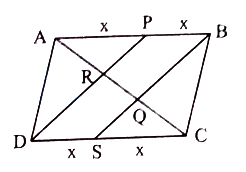
$ABCD$ is a parallelogram,$P$ is the mid-point of $AB$. If $R$ is the point of intersection of $AC$ and $DP$,then $R$ divides $AC$ internally in the ratio
A
$3: 1$
B
$2: 1$
C
$1: 2$
D
$2: 3$
Solution
(C) In $\triangle ABP$ and $\triangle CDP$,$AB \parallel DC$ and $AB = DC$. Since $P$ is the mid-point of $AB$,$AP = PB = \frac{1}{2} AB = \frac{1}{2} DC$.
Consider $\triangle APR$ and $\triangle CPD$:
$\angle PAR = \angle PCD$ (alternate interior angles as $AB \parallel DC$)
$\angle APR = \angle CPD$ (vertically opposite angles)
Thus,$\triangle APR \sim \triangle CPD$ by $AA$ similarity.
Therefore,the ratio of corresponding sides is equal:
$\frac{AR}{CR} = \frac{AP}{CD} = \frac{\frac{1}{2} AB}{AB} = \frac{1}{2}$.
Hence,$R$ divides $AC$ in the ratio $1: 2$.
Consider $\triangle APR$ and $\triangle CPD$:
$\angle PAR = \angle PCD$ (alternate interior angles as $AB \parallel DC$)
$\angle APR = \angle CPD$ (vertically opposite angles)
Thus,$\triangle APR \sim \triangle CPD$ by $AA$ similarity.
Therefore,the ratio of corresponding sides is equal:
$\frac{AR}{CR} = \frac{AP}{CD} = \frac{\frac{1}{2} AB}{AB} = \frac{1}{2}$.
Hence,$R$ divides $AC$ in the ratio $1: 2$.
0 likesView Solution
208
MathematicsEasyMCQMHT CET · 2020
If $P(3,2,6), Q(1,4,5)$ and $R(3,5,3)$ are the vertices of $\Delta PQR$,then $m \angle PQR$ is (in $^{\circ}$)
A
$90$
B
$50$
C
$70$
D
$30$
Solution
(A) Given the vertices of the triangle are $P(3,2,6), Q(1,4,5)$,and $R(3,5,3)$.
First,we find the direction ratios of the vectors $\vec{QP}$ and $\vec{QR}$.
The vector $\vec{QP} = (3-1, 2-4, 6-5) = (2, -2, 1)$.
The vector $\vec{QR} = (3-1, 5-4, 3-5) = (2, 1, -2)$.
Now,we calculate the dot product of $\vec{QP}$ and $\vec{QR}$:
$\vec{QP} \cdot \vec{QR} = (2)(2) + (-2)(1) + (1)(-2) = 4 - 2 - 2 = 0$.
Since the dot product is $0$,the vectors $\vec{QP}$ and $\vec{QR}$ are perpendicular to each other.
Therefore,$m \angle PQR = 90^{\circ}$.
First,we find the direction ratios of the vectors $\vec{QP}$ and $\vec{QR}$.
The vector $\vec{QP} = (3-1, 2-4, 6-5) = (2, -2, 1)$.
The vector $\vec{QR} = (3-1, 5-4, 3-5) = (2, 1, -2)$.
Now,we calculate the dot product of $\vec{QP}$ and $\vec{QR}$:
$\vec{QP} \cdot \vec{QR} = (2)(2) + (-2)(1) + (1)(-2) = 4 - 2 - 2 = 0$.
Since the dot product is $0$,the vectors $\vec{QP}$ and $\vec{QR}$ are perpendicular to each other.
Therefore,$m \angle PQR = 90^{\circ}$.
0 likesView Solution
209
MathematicsEasyMCQMHT CET · 2020
The derivative of $\cot ^{-1} x$ with respect to $\log (1+x^{2})$ is
A
$-2 x$
B
$-\frac{1}{2 x}$
C
$\frac{1}{2 x}$
D
$2 x$
Solution
(B) Let $u = \cot ^{-1} x$ and $v = \log (1+x^{2})$.
First,we find the derivative of $u$ with respect to $x$:
$\frac{du}{dx} = -\frac{1}{1+x^{2}}$.
Next,we find the derivative of $v$ with respect to $x$ using the chain rule:
$\frac{dv}{dx} = \frac{1}{1+x^{2}} \times \frac{d}{dx}(1+x^{2}) = \frac{2x}{1+x^{2}}$.
Now,we find the derivative of $u$ with respect to $v$:
$\frac{du}{dv} = \frac{du/dx}{dv/dx} = \frac{-1/(1+x^{2})}{2x/(1+x^{2})} = -\frac{1}{2x}$.
Thus,the correct option is $B$.
First,we find the derivative of $u$ with respect to $x$:
$\frac{du}{dx} = -\frac{1}{1+x^{2}}$.
Next,we find the derivative of $v$ with respect to $x$ using the chain rule:
$\frac{dv}{dx} = \frac{1}{1+x^{2}} \times \frac{d}{dx}(1+x^{2}) = \frac{2x}{1+x^{2}}$.
Now,we find the derivative of $u$ with respect to $v$:
$\frac{du}{dv} = \frac{du/dx}{dv/dx} = \frac{-1/(1+x^{2})}{2x/(1+x^{2})} = -\frac{1}{2x}$.
Thus,the correct option is $B$.
0 likesView Solution
210
MathematicsDifficultMCQMHT CET · 2020
If $y = \tan^{-1} \left[ \frac{x - \sqrt{1 - x^2}}{x + \sqrt{1 - x^2}} \right]$,then $\frac{dy}{dx} = $
A
$\frac{-1}{\sqrt{1 - x^2}}$
B
$\frac{-x}{\sqrt{1 - x^2}}$
C
$\frac{1}{\sqrt{1 - x^2}}$
D
$\frac{x}{\sqrt{1 - x^2}}$
Solution
(C) Given $y = \tan^{-1} \left[ \frac{x - \sqrt{1 - x^2}}{x + \sqrt{1 - x^2}} \right]$.
Let $x = \cos \theta$,then $\theta = \cos^{-1} x$.
Substituting $x = \cos \theta$ into the expression:
$y = \tan^{-1} \left[ \frac{\cos \theta - \sin \theta}{\cos \theta + \sin \theta} \right]$
Divide numerator and denominator by $\cos \theta$:
$y = \tan^{-1} \left[ \frac{1 - \tan \theta}{1 + \tan \theta} \right]$
Using the formula $\tan(\frac{\pi}{4} - \theta) = \frac{1 - \tan \theta}{1 + \tan \theta}$:
$y = \tan^{-1} \left[ \tan \left( \frac{\pi}{4} - \theta \right) \right] = \frac{\pi}{4} - \theta$
Substitute back $\theta = \cos^{-1} x$:
$y = \frac{\pi}{4} - \cos^{-1} x$
Differentiating with respect to $x$:
$\frac{dy}{dx} = \frac{d}{dx} \left( \frac{\pi}{4} - \cos^{-1} x \right) = 0 - \left( -\frac{1}{\sqrt{1 - x^2}} \right) = \frac{1}{\sqrt{1 - x^2}}$.
Let $x = \cos \theta$,then $\theta = \cos^{-1} x$.
Substituting $x = \cos \theta$ into the expression:
$y = \tan^{-1} \left[ \frac{\cos \theta - \sin \theta}{\cos \theta + \sin \theta} \right]$
Divide numerator and denominator by $\cos \theta$:
$y = \tan^{-1} \left[ \frac{1 - \tan \theta}{1 + \tan \theta} \right]$
Using the formula $\tan(\frac{\pi}{4} - \theta) = \frac{1 - \tan \theta}{1 + \tan \theta}$:
$y = \tan^{-1} \left[ \tan \left( \frac{\pi}{4} - \theta \right) \right] = \frac{\pi}{4} - \theta$
Substitute back $\theta = \cos^{-1} x$:
$y = \frac{\pi}{4} - \cos^{-1} x$
Differentiating with respect to $x$:
$\frac{dy}{dx} = \frac{d}{dx} \left( \frac{\pi}{4} - \cos^{-1} x \right) = 0 - \left( -\frac{1}{\sqrt{1 - x^2}} \right) = \frac{1}{\sqrt{1 - x^2}}$.
0 likesView Solution
211
MathematicsMediumMCQMHT CET · 2020
If $f(x) = \sin^{-1}\left(\sqrt{\frac{1-x}{2}}\right)$,then $f^{\prime}(x) = $
A
$\frac{-1}{2 \sqrt{1-x^{2}}}$
B
$\frac{1}{\sqrt{1-x^{2}}}$
C
$\frac{-1}{2 \sqrt{1+x^{2}}}$
D
$\frac{1}{2 \sqrt{1+x^{2}}}$
Solution
(A) Given $f(x) = \sin^{-1}\left(\sqrt{\frac{1-x}{2}}\right)$.
Method $1$: Using the chain rule:
$f^{\prime}(x) = \frac{d}{dx}\left[\sin^{-1}\left(\sqrt{\frac{1-x}{2}}\right)\right] = \frac{1}{\sqrt{1-\left(\sqrt{\frac{1-x}{2}}\right)^{2}}} \cdot \frac{d}{dx}\left(\sqrt{\frac{1-x}{2}}\right)$
$= \frac{1}{\sqrt{1-\frac{1-x}{2}}} \cdot \frac{1}{2\sqrt{\frac{1-x}{2}}} \cdot \left(-\frac{1}{2}\right)$
$= \frac{1}{\sqrt{\frac{1+x}{2}}} \cdot \frac{1}{\sqrt{2}\sqrt{1-x}} \cdot \left(-\frac{1}{2}\right)$
$= \frac{\sqrt{2}}{\sqrt{1+x}} \cdot \frac{1}{\sqrt{2}\sqrt{1-x}} \cdot \left(-\frac{1}{2}\right) = \frac{-1}{2\sqrt{1-x^{2}}}$.
Method $2$: Using substitution:
Let $x = \cos \theta$,then $\sqrt{\frac{1-x}{2}} = \sqrt{\frac{1-\cos \theta}{2}} = \sqrt{\frac{2\sin^{2}(\theta/2)}{2}} = \sin(\theta/2)$.
So,$f(x) = \sin^{-1}(\sin(\theta/2)) = \theta/2 = \frac{1}{2}\cos^{-1}(x)$.
Differentiating with respect to $x$:
$f^{\prime}(x) = \frac{1}{2} \cdot \left(-\frac{1}{\sqrt{1-x^{2}}}\right) = \frac{-1}{2\sqrt{1-x^{2}}}$.
Thus,the correct option is $A$.
Method $1$: Using the chain rule:
$f^{\prime}(x) = \frac{d}{dx}\left[\sin^{-1}\left(\sqrt{\frac{1-x}{2}}\right)\right] = \frac{1}{\sqrt{1-\left(\sqrt{\frac{1-x}{2}}\right)^{2}}} \cdot \frac{d}{dx}\left(\sqrt{\frac{1-x}{2}}\right)$
$= \frac{1}{\sqrt{1-\frac{1-x}{2}}} \cdot \frac{1}{2\sqrt{\frac{1-x}{2}}} \cdot \left(-\frac{1}{2}\right)$
$= \frac{1}{\sqrt{\frac{1+x}{2}}} \cdot \frac{1}{\sqrt{2}\sqrt{1-x}} \cdot \left(-\frac{1}{2}\right)$
$= \frac{\sqrt{2}}{\sqrt{1+x}} \cdot \frac{1}{\sqrt{2}\sqrt{1-x}} \cdot \left(-\frac{1}{2}\right) = \frac{-1}{2\sqrt{1-x^{2}}}$.
Method $2$: Using substitution:
Let $x = \cos \theta$,then $\sqrt{\frac{1-x}{2}} = \sqrt{\frac{1-\cos \theta}{2}} = \sqrt{\frac{2\sin^{2}(\theta/2)}{2}} = \sin(\theta/2)$.
So,$f(x) = \sin^{-1}(\sin(\theta/2)) = \theta/2 = \frac{1}{2}\cos^{-1}(x)$.
Differentiating with respect to $x$:
$f^{\prime}(x) = \frac{1}{2} \cdot \left(-\frac{1}{\sqrt{1-x^{2}}}\right) = \frac{-1}{2\sqrt{1-x^{2}}}$.
Thus,the correct option is $A$.
0 likesView Solution
212
MathematicsDifficultMCQMHT CET · 2020
If $y = \sin^{-1} \left[ \frac{\sqrt{1+x} + \sqrt{1-x}}{2} \right]$,then $\frac{dy}{dx} = $
A
$-\frac{1}{2\sqrt{1-x^2}}$
B
$-\frac{1}{2\sqrt{x^2-1}}$
C
$\frac{1}{4\sqrt{1-x^2}}$
D
$-\frac{1}{2\sqrt{1+x}}$
Solution
(A) Let $x = \cos(2\theta)$,so $2\theta = \cos^{-1}(x)$ and $\theta = \frac{1}{2} \cos^{-1}(x)$.
Then $\sqrt{1+x} = \sqrt{1+\cos(2\theta)} = \sqrt{2\cos^2(\theta)} = \sqrt{2} \cos(\theta)$ and $\sqrt{1-x} = \sqrt{1-\cos(2\theta)} = \sqrt{2\sin^2(\theta)} = \sqrt{2} \sin(\theta)$.
Substituting these into the expression for $y$:
$y = \sin^{-1} \left[ \frac{\sqrt{2}\cos(\theta) + \sqrt{2}\sin(\theta)}{2} \right] = \sin^{-1} \left[ \frac{1}{\sqrt{2}} \cos(\theta) + \frac{1}{\sqrt{2}} \sin(\theta) \right]$.
Using the identity $\sin(\frac{\pi}{4} + \theta) = \sin(\frac{\pi}{4}) \cos(\theta) + \cos(\frac{\pi}{4}) \sin(\theta) = \frac{1}{\sqrt{2}} \cos(\theta) + \frac{1}{\sqrt{2}} \sin(\theta)$.
So,$y = \sin^{-1} [\sin(\frac{\pi}{4} + \theta)] = \frac{\pi}{4} + \theta = \frac{\pi}{4} + \frac{1}{2} \cos^{-1}(x)$.
Differentiating with respect to $x$:
$\frac{dy}{dx} = 0 + \frac{1}{2} \left( -\frac{1}{\sqrt{1-x^2}} \right) = -\frac{1}{2\sqrt{1-x^2}}$.
Then $\sqrt{1+x} = \sqrt{1+\cos(2\theta)} = \sqrt{2\cos^2(\theta)} = \sqrt{2} \cos(\theta)$ and $\sqrt{1-x} = \sqrt{1-\cos(2\theta)} = \sqrt{2\sin^2(\theta)} = \sqrt{2} \sin(\theta)$.
Substituting these into the expression for $y$:
$y = \sin^{-1} \left[ \frac{\sqrt{2}\cos(\theta) + \sqrt{2}\sin(\theta)}{2} \right] = \sin^{-1} \left[ \frac{1}{\sqrt{2}} \cos(\theta) + \frac{1}{\sqrt{2}} \sin(\theta) \right]$.
Using the identity $\sin(\frac{\pi}{4} + \theta) = \sin(\frac{\pi}{4}) \cos(\theta) + \cos(\frac{\pi}{4}) \sin(\theta) = \frac{1}{\sqrt{2}} \cos(\theta) + \frac{1}{\sqrt{2}} \sin(\theta)$.
So,$y = \sin^{-1} [\sin(\frac{\pi}{4} + \theta)] = \frac{\pi}{4} + \theta = \frac{\pi}{4} + \frac{1}{2} \cos^{-1}(x)$.
Differentiating with respect to $x$:
$\frac{dy}{dx} = 0 + \frac{1}{2} \left( -\frac{1}{\sqrt{1-x^2}} \right) = -\frac{1}{2\sqrt{1-x^2}}$.
0 likesView Solution
213
MathematicsMediumMCQMHT CET · 2020
If $y = \sec(\tan^{-1} x)$,then $\frac{dy}{dx}$ at $x = 1$ is
A
$\sqrt{2}$
B
$\frac{1}{2}$
C
$1$
D
$\frac{1}{\sqrt{2}}$
Solution
(D) Given $y = \sec(\tan^{-1} x)$.
Using the chain rule,$\frac{dy}{dx} = \sec(\tan^{-1} x) \tan(\tan^{-1} x) \cdot \frac{d}{dx}(\tan^{-1} x)$.
Since $\frac{d}{dx}(\tan^{-1} x) = \frac{1}{1+x^2}$,we have $\frac{dy}{dx} = \sec(\tan^{-1} x) \cdot x \cdot \frac{1}{1+x^2}$.
At $x = 1$,$\tan^{-1}(1) = \frac{\pi}{4}$.
So,$\frac{dy}{dx} = \sec(\frac{\pi}{4}) \cdot 1 \cdot \frac{1}{1+1^2} = \sqrt{2} \cdot \frac{1}{2} = \frac{1}{\sqrt{2}}$.
Alternatively,let $\tan^{-1} x = \theta$,then $\tan \theta = x$. Since $\sec^2 \theta = 1 + \tan^2 \theta$,we have $\sec \theta = \sqrt{1+x^2}$.
Thus,$y = \sqrt{1+x^2}$.
Then $\frac{dy}{dx} = \frac{1}{2\sqrt{1+x^2}} \cdot 2x = \frac{x}{\sqrt{1+x^2}}$.
At $x = 1$,$\frac{dy}{dx} = \frac{1}{\sqrt{1+1^2}} = \frac{1}{\sqrt{2}}$.
Using the chain rule,$\frac{dy}{dx} = \sec(\tan^{-1} x) \tan(\tan^{-1} x) \cdot \frac{d}{dx}(\tan^{-1} x)$.
Since $\frac{d}{dx}(\tan^{-1} x) = \frac{1}{1+x^2}$,we have $\frac{dy}{dx} = \sec(\tan^{-1} x) \cdot x \cdot \frac{1}{1+x^2}$.
At $x = 1$,$\tan^{-1}(1) = \frac{\pi}{4}$.
So,$\frac{dy}{dx} = \sec(\frac{\pi}{4}) \cdot 1 \cdot \frac{1}{1+1^2} = \sqrt{2} \cdot \frac{1}{2} = \frac{1}{\sqrt{2}}$.
Alternatively,let $\tan^{-1} x = \theta$,then $\tan \theta = x$. Since $\sec^2 \theta = 1 + \tan^2 \theta$,we have $\sec \theta = \sqrt{1+x^2}$.
Thus,$y = \sqrt{1+x^2}$.
Then $\frac{dy}{dx} = \frac{1}{2\sqrt{1+x^2}} \cdot 2x = \frac{x}{\sqrt{1+x^2}}$.
At $x = 1$,$\frac{dy}{dx} = \frac{1}{\sqrt{1+1^2}} = \frac{1}{\sqrt{2}}$.
0 likesView Solution
214
MathematicsMediumMCQMHT CET · 2020
If $x^{2}+y^{2}=1$,then $\frac{d^{2} x}{d y^{2}}=$
A
$x^{3}$
B
$y^{3}$
C
$-\frac{1}{x^{3}}$
D
$-y^{3}$
Solution
(C) Given the equation $x^{2}+y^{2}=1$.
Differentiating both sides with respect to $y$,we get:
$2x \frac{dx}{dy} + 2y = 0$
$2x \frac{dx}{dy} = -2y$
$\frac{dx}{dy} = -\frac{y}{x}$
Now,differentiating $\frac{dx}{dy}$ with respect to $y$ using the quotient rule:
$\frac{d^{2}x}{dy^{2}} = \frac{d}{dy} \left( -\frac{y}{x} \right) = -\left[ \frac{x(1) - y(\frac{dx}{dy})}{x^{2}} \right]$
Substitute $\frac{dx}{dy} = -\frac{y}{x}$ into the expression:
$\frac{d^{2}x}{dy^{2}} = -\left[ \frac{x - y(-\frac{y}{x})}{x^{2}} \right]$
$\frac{d^{2}x}{dy^{2}} = -\left[ \frac{x + \frac{y^{2}}{x}}{x^{2}} \right] = -\left[ \frac{x^{2} + y^{2}}{x^{3}} \right]$
Since $x^{2}+y^{2}=1$,we have:
$\frac{d^{2}x}{dy^{2}} = -\frac{1}{x^{3}}$
Differentiating both sides with respect to $y$,we get:
$2x \frac{dx}{dy} + 2y = 0$
$2x \frac{dx}{dy} = -2y$
$\frac{dx}{dy} = -\frac{y}{x}$
Now,differentiating $\frac{dx}{dy}$ with respect to $y$ using the quotient rule:
$\frac{d^{2}x}{dy^{2}} = \frac{d}{dy} \left( -\frac{y}{x} \right) = -\left[ \frac{x(1) - y(\frac{dx}{dy})}{x^{2}} \right]$
Substitute $\frac{dx}{dy} = -\frac{y}{x}$ into the expression:
$\frac{d^{2}x}{dy^{2}} = -\left[ \frac{x - y(-\frac{y}{x})}{x^{2}} \right]$
$\frac{d^{2}x}{dy^{2}} = -\left[ \frac{x + \frac{y^{2}}{x}}{x^{2}} \right] = -\left[ \frac{x^{2} + y^{2}}{x^{3}} \right]$
Since $x^{2}+y^{2}=1$,we have:
$\frac{d^{2}x}{dy^{2}} = -\frac{1}{x^{3}}$
0 likesView Solution
215
MathematicsEasyMCQMHT CET · 2020
If $y=e^{4x} \cos 5x$,then $\frac{d^{2}y}{dx^{2}}$ at $x=0$ is
A
$-9$
B
$9$
C
$8$
D
$-8$
Solution
(A) Given $y = e^{4x} \cos 5x$.
Applying the product rule,$\frac{dy}{dx} = e^{4x}(-5 \sin 5x) + \cos 5x(4e^{4x}) = e^{4x}(4 \cos 5x - 5 \sin 5x)$.
Now,differentiating again with respect to $x$:
$\frac{d^{2}y}{dx^{2}} = e^{4x}(-20 \sin 5x - 25 \cos 5x) + (4 \cos 5x - 5 \sin 5x)(4e^{4x})$.
Evaluating at $x=0$:
$\left(\frac{d^{2}y}{dx^{2}}\right)_{x=0} = e^{0}(-20 \sin 0 - 25 \cos 0) + (4 \cos 0 - 5 \sin 0)(4e^{0})$.
Since $\sin 0 = 0$ and $\cos 0 = 1$:
$\left(\frac{d^{2}y}{dx^{2}}\right)_{x=0} = 1(0 - 25) + (4 - 0)(4) = -25 + 16 = -9$.
Applying the product rule,$\frac{dy}{dx} = e^{4x}(-5 \sin 5x) + \cos 5x(4e^{4x}) = e^{4x}(4 \cos 5x - 5 \sin 5x)$.
Now,differentiating again with respect to $x$:
$\frac{d^{2}y}{dx^{2}} = e^{4x}(-20 \sin 5x - 25 \cos 5x) + (4 \cos 5x - 5 \sin 5x)(4e^{4x})$.
Evaluating at $x=0$:
$\left(\frac{d^{2}y}{dx^{2}}\right)_{x=0} = e^{0}(-20 \sin 0 - 25 \cos 0) + (4 \cos 0 - 5 \sin 0)(4e^{0})$.
Since $\sin 0 = 0$ and $\cos 0 = 1$:
$\left(\frac{d^{2}y}{dx^{2}}\right)_{x=0} = 1(0 - 25) + (4 - 0)(4) = -25 + 16 = -9$.
0 likesView Solution
216
MathematicsMediumMCQMHT CET · 2020
If $\sqrt{x+y}+\sqrt{y-x}=5$,then $\left(\frac{d^{2} y}{d x^{2}}\right)=$
A
$\frac{2}{25}$
B
$\frac{2}{5}$
C
$\frac{-2}{5}$
D
$\frac{-2}{25}$
Solution
(A) Given $\sqrt{x+y}+\sqrt{y-x}=5$.
Rearranging the terms,we get $\sqrt{y-x}=5-\sqrt{x+y}$.
Squaring both sides,we have $y-x = 25 + (x+y) - 10\sqrt{x+y}$.
Simplifying,$-2x = 25 - 10\sqrt{x+y}$,which gives $10\sqrt{x+y} = 2x + 25$.
Differentiating both sides with respect to $x$:
$10 \times \frac{1}{2\sqrt{x+y}} \times (1 + \frac{dy}{dx}) = 2$.
$\frac{5}{\sqrt{x+y}} \times (1 + \frac{dy}{dx}) = 2$.
$1 + \frac{dy}{dx} = \frac{2\sqrt{x+y}}{5}$.
Differentiating again with respect to $x$:
$\frac{d^2y}{dx^2} = \frac{2}{5} \times \frac{1}{2\sqrt{x+y}} \times (1 + \frac{dy}{dx})$.
Substituting the value of $(1 + \frac{dy}{dx})$ from the previous step:
$\frac{d^2y}{dx^2} = \frac{1}{5\sqrt{x+y}} \times \frac{2\sqrt{x+y}}{5} = \frac{2}{25}$.
Rearranging the terms,we get $\sqrt{y-x}=5-\sqrt{x+y}$.
Squaring both sides,we have $y-x = 25 + (x+y) - 10\sqrt{x+y}$.
Simplifying,$-2x = 25 - 10\sqrt{x+y}$,which gives $10\sqrt{x+y} = 2x + 25$.
Differentiating both sides with respect to $x$:
$10 \times \frac{1}{2\sqrt{x+y}} \times (1 + \frac{dy}{dx}) = 2$.
$\frac{5}{\sqrt{x+y}} \times (1 + \frac{dy}{dx}) = 2$.
$1 + \frac{dy}{dx} = \frac{2\sqrt{x+y}}{5}$.
Differentiating again with respect to $x$:
$\frac{d^2y}{dx^2} = \frac{2}{5} \times \frac{1}{2\sqrt{x+y}} \times (1 + \frac{dy}{dx})$.
Substituting the value of $(1 + \frac{dy}{dx})$ from the previous step:
$\frac{d^2y}{dx^2} = \frac{1}{5\sqrt{x+y}} \times \frac{2\sqrt{x+y}}{5} = \frac{2}{25}$.
0 likesView Solution
217
MathematicsMediumMCQMHT CET · 2020
If $x=a(1-\cos \theta)$ and $y=a(\theta-\sin \theta)$,then $\frac{d^{2} y}{d x^{2}}=$
A
$\frac{\cos ^{2}(\theta/2)}{2a \operatorname{cosec} \theta}$
B
$\frac{\operatorname{cosec}^{4}(\theta/2)}{4a}$
C
$\frac{1}{4a \sin^{4}(\theta/2)}$
D
$\frac{\operatorname{cosec}^{3}(\theta/2)}{4a}$
Solution
(B) Given $x = a(1 - \cos \theta)$ and $y = a(\theta - \sin \theta)$.
First,find $\frac{dx}{d\theta} = a \sin \theta$ and $\frac{dy}{d\theta} = a(1 - \cos \theta)$.
Then,$\frac{dy}{dx} = \frac{dy/d\theta}{dx/d\theta} = \frac{a(1 - \cos \theta)}{a \sin \theta} = \frac{2 \sin^{2}(\theta/2)}{2 \sin(\theta/2) \cos(\theta/2)} = \tan(\theta/2)$.
Now,differentiate with respect to $x$: $\frac{d^{2}y}{dx^{2}} = \frac{d}{dx}(\tan(\theta/2)) = \sec^{2}(\theta/2) \cdot \frac{1}{2} \cdot \frac{d\theta}{dx}$.
Since $\frac{dx}{d\theta} = a \sin \theta$,we have $\frac{d\theta}{dx} = \frac{1}{a \sin \theta}$.
Substituting this: $\frac{d^{2}y}{dx^{2}} = \frac{1}{2} \sec^{2}(\theta/2) \cdot \frac{1}{a(2 \sin(\theta/2) \cos(\theta/2))} = \frac{1}{4a \sin(\theta/2) \cos^{3}(\theta/2)} = \frac{1}{4a \sin(\theta/2) \cos(\theta/2) \cos^{2}(\theta/2)} = \frac{1}{2a \sin \theta \cos^{2}(\theta/2)}$.
Alternatively,$\frac{d^{2}y}{dx^{2}} = \frac{1}{2} \sec^{2}(\theta/2) \cdot \frac{1}{a(2 \sin(\theta/2) \cos(\theta/2))} = \frac{1}{4a \sin(\theta/2) \cos^{3}(\theta/2)} = \frac{\sec^{4}(\theta/2)}{4a}$.
First,find $\frac{dx}{d\theta} = a \sin \theta$ and $\frac{dy}{d\theta} = a(1 - \cos \theta)$.
Then,$\frac{dy}{dx} = \frac{dy/d\theta}{dx/d\theta} = \frac{a(1 - \cos \theta)}{a \sin \theta} = \frac{2 \sin^{2}(\theta/2)}{2 \sin(\theta/2) \cos(\theta/2)} = \tan(\theta/2)$.
Now,differentiate with respect to $x$: $\frac{d^{2}y}{dx^{2}} = \frac{d}{dx}(\tan(\theta/2)) = \sec^{2}(\theta/2) \cdot \frac{1}{2} \cdot \frac{d\theta}{dx}$.
Since $\frac{dx}{d\theta} = a \sin \theta$,we have $\frac{d\theta}{dx} = \frac{1}{a \sin \theta}$.
Substituting this: $\frac{d^{2}y}{dx^{2}} = \frac{1}{2} \sec^{2}(\theta/2) \cdot \frac{1}{a(2 \sin(\theta/2) \cos(\theta/2))} = \frac{1}{4a \sin(\theta/2) \cos^{3}(\theta/2)} = \frac{1}{4a \sin(\theta/2) \cos(\theta/2) \cos^{2}(\theta/2)} = \frac{1}{2a \sin \theta \cos^{2}(\theta/2)}$.
Alternatively,$\frac{d^{2}y}{dx^{2}} = \frac{1}{2} \sec^{2}(\theta/2) \cdot \frac{1}{a(2 \sin(\theta/2) \cos(\theta/2))} = \frac{1}{4a \sin(\theta/2) \cos^{3}(\theta/2)} = \frac{\sec^{4}(\theta/2)}{4a}$.
0 likesView Solution
218
MathematicsEasyMCQMHT CET · 2020
If $y = \cos^{2}\left(\frac{5x}{2}\right) - \sin^{2}\left(\frac{5x}{2}\right)$,then $\frac{d^{2}y}{dx^{2}} = $
A
$-5 \sqrt{1-y^{2}}$
B
$5 \sqrt{1-y^{2}}$
C
$25 y$
D
$-25 y$
Solution
(D) We are given the function $y = \cos^{2}\left(\frac{5x}{2}\right) - \sin^{2}\left(\frac{5x}{2}\right)$.
Using the trigonometric identity $\cos(2\theta) = \cos^{2}(\theta) - \sin^{2}(\theta)$,we can simplify the expression by setting $\theta = \frac{5x}{2}$.
Thus,$y = \cos\left(2 \times \frac{5x}{2}\right) = \cos(5x)$.
Now,we find the first derivative with respect to $x$:
$\frac{dy}{dx} = \frac{d}{dx}(\cos(5x)) = -5 \sin(5x)$.
Next,we find the second derivative with respect to $x$:
$\frac{d^{2}y}{dx^{2}} = \frac{d}{dx}(-5 \sin(5x)) = -5 \times 5 \cos(5x) = -25 \cos(5x)$.
Since $y = \cos(5x)$,we substitute $y$ back into the expression:
$\frac{d^{2}y}{dx^{2}} = -25y$.
Using the trigonometric identity $\cos(2\theta) = \cos^{2}(\theta) - \sin^{2}(\theta)$,we can simplify the expression by setting $\theta = \frac{5x}{2}$.
Thus,$y = \cos\left(2 \times \frac{5x}{2}\right) = \cos(5x)$.
Now,we find the first derivative with respect to $x$:
$\frac{dy}{dx} = \frac{d}{dx}(\cos(5x)) = -5 \sin(5x)$.
Next,we find the second derivative with respect to $x$:
$\frac{d^{2}y}{dx^{2}} = \frac{d}{dx}(-5 \sin(5x)) = -5 \times 5 \cos(5x) = -25 \cos(5x)$.
Since $y = \cos(5x)$,we substitute $y$ back into the expression:
$\frac{d^{2}y}{dx^{2}} = -25y$.
0 likesView Solution
219
MathematicsEasyMCQMHT CET · 2020
If $f(x)=e^{x} g(x)$,$g(0)=4$,and $g^{\prime}(0)=2$,then $f^{\prime}(0)=$
A
$4$
B
$6$
C
$1$
D
$2$
Solution
(B) Given the function $f(x) = e^{x} g(x)$.
Applying the product rule for differentiation,we have $f^{\prime}(x) = \frac{d}{dx}(e^{x}) \cdot g(x) + e^{x} \cdot \frac{d}{dx}(g(x))$.
This simplifies to $f^{\prime}(x) = e^{x} g(x) + e^{x} g^{\prime}(x) = e^{x} (g(x) + g^{\prime}(x))$.
Now,substitute $x = 0$ into the derivative expression:
$f^{\prime}(0) = e^{0} (g(0) + g^{\prime}(0))$.
Given $g(0) = 4$ and $g^{\prime}(0) = 2$,and knowing $e^{0} = 1$:
$f^{\prime}(0) = 1 \cdot (4 + 2) = 6$.
Applying the product rule for differentiation,we have $f^{\prime}(x) = \frac{d}{dx}(e^{x}) \cdot g(x) + e^{x} \cdot \frac{d}{dx}(g(x))$.
This simplifies to $f^{\prime}(x) = e^{x} g(x) + e^{x} g^{\prime}(x) = e^{x} (g(x) + g^{\prime}(x))$.
Now,substitute $x = 0$ into the derivative expression:
$f^{\prime}(0) = e^{0} (g(0) + g^{\prime}(0))$.
Given $g(0) = 4$ and $g^{\prime}(0) = 2$,and knowing $e^{0} = 1$:
$f^{\prime}(0) = 1 \cdot (4 + 2) = 6$.
0 likesView Solution
220
MathematicsMediumMCQMHT CET · 2020
If $2 f(x) = f^{\prime}(x)$ and $f(0) = 3$,then the value of $f(2)$ is
A
$3 e^{2}$
B
$2 e^{3}$
C
$4 e^{3}$
D
$3 e^{4}$
Solution
(D) Given the differential equation $f^{\prime}(x) = 2 f(x)$.
Rearranging the terms,we get $\frac{f^{\prime}(x)}{f(x)} = 2$.
Integrating both sides with respect to $x$:
$\int \frac{f^{\prime}(x)}{f(x)} dx = \int 2 dx$
$\ln |f(x)| = 2x + C$.
Using the initial condition $f(0) = 3$:
$\ln |f(0)| = 2(0) + C \Rightarrow \ln 3 = C$.
Substituting $C$ back into the equation:
$\ln |f(x)| = 2x + \ln 3$.
To find $f(2)$,substitute $x = 2$:
$\ln |f(2)| = 2(2) + \ln 3 = 4 + \ln 3$.
Taking the exponential on both sides:
$f(2) = e^{4 + \ln 3} = e^{4} \cdot e^{\ln 3} = 3 e^{4}$.
Rearranging the terms,we get $\frac{f^{\prime}(x)}{f(x)} = 2$.
Integrating both sides with respect to $x$:
$\int \frac{f^{\prime}(x)}{f(x)} dx = \int 2 dx$
$\ln |f(x)| = 2x + C$.
Using the initial condition $f(0) = 3$:
$\ln |f(0)| = 2(0) + C \Rightarrow \ln 3 = C$.
Substituting $C$ back into the equation:
$\ln |f(x)| = 2x + \ln 3$.
To find $f(2)$,substitute $x = 2$:
$\ln |f(2)| = 2(2) + \ln 3 = 4 + \ln 3$.
Taking the exponential on both sides:
$f(2) = e^{4 + \ln 3} = e^{4} \cdot e^{\ln 3} = 3 e^{4}$.
0 likesView Solution
221
MathematicsEasyMCQMHT CET · 2020
Domain of the real valued function $f(x) = \frac{x+2}{9-x^{2}}$ is
A
$-3 \leq x \leq 3$
B
$R - \{-3, 3\}$
C
$R$
D
$R - \{3\}$
Solution
(B) The function $f(x) = \frac{x+2}{9-x^{2}}$ is defined for all real values of $x$ except where the denominator is zero.
Setting the denominator to zero: $9 - x^{2} = 0$.
This implies $x^{2} = 9$,so $x = \pm 3$.
Thus,the function is undefined at $x = 3$ and $x = -3$.
Therefore,the domain of the function is the set of all real numbers except $\{-3, 3\}$,which is written as $R - \{-3, 3\}$.
Setting the denominator to zero: $9 - x^{2} = 0$.
This implies $x^{2} = 9$,so $x = \pm 3$.
Thus,the function is undefined at $x = 3$ and $x = -3$.
Therefore,the domain of the function is the set of all real numbers except $\{-3, 3\}$,which is written as $R - \{-3, 3\}$.
0 likesView Solution
222
MathematicsEasyMCQMHT CET · 2020
The domain of a function $f(y) = \frac{\cos^{-1}(y-5)}{\sqrt{25-y^2}}$ is
A
$(4, 6]$
B
$(-5, 5)$
C
$[4, 5)$
D
$(4, 5]$
Solution
(C) For the function $f(y) = \frac{\cos^{-1}(y-5)}{\sqrt{25-y^2}}$ to be defined,the following conditions must be satisfied:
$1$. The argument of $\cos^{-1}$ must be in the interval $[-1, 1]$,so $-1 \leq y-5 \leq 1$. Adding $5$ to all sides gives $4 \leq y \leq 6$.
$2$. The denominator must be non-zero and the expression inside the square root must be positive,so $25-y^2 > 0$,which implies $y^2 < 25$,or $-5 < y < 5$.
$3$. Taking the intersection of the two conditions: $y \in [4, 6]$ and $y \in (-5, 5)$.
$4$. The intersection is $4 \leq y < 5$,which can be written as the interval $[4, 5)$.
Therefore,the domain is $[4, 5)$.
$1$. The argument of $\cos^{-1}$ must be in the interval $[-1, 1]$,so $-1 \leq y-5 \leq 1$. Adding $5$ to all sides gives $4 \leq y \leq 6$.
$2$. The denominator must be non-zero and the expression inside the square root must be positive,so $25-y^2 > 0$,which implies $y^2 < 25$,or $-5 < y < 5$.
$3$. Taking the intersection of the two conditions: $y \in [4, 6]$ and $y \in (-5, 5)$.
$4$. The intersection is $4 \leq y < 5$,which can be written as the interval $[4, 5)$.
Therefore,the domain is $[4, 5)$.
0 likesView Solution
223
MathematicsEasyMCQMHT CET · 2020
For the greatest integer function $f(x) = [x]$,where $x \in R$,which of the following is true?
A
$[x] + 1 = x$
B
$[x] + 1 \leq x$
C
$[x] + 1 > x$
D
$[x] + 1 < x$
Solution
(C) The greatest integer function $[x]$ is defined as the greatest integer less than or equal to $x$.
If $x$ is an integer,then $[x] = x$,which implies $[x] + 1 = x + 1 > x$.
If $x$ is not an integer,then $[x] < x < [x] + 1$.
In both cases,we have $[x] + 1 > x$.
If $x$ is an integer,then $[x] = x$,which implies $[x] + 1 = x + 1 > x$.
If $x$ is not an integer,then $[x] < x < [x] + 1$.
In both cases,we have $[x] + 1 > x$.
0 likesView Solution
224
MathematicsEasyMCQMHT CET · 2020
The domain of the function $f(x) = \sqrt{x}$ is
A
$R - \{0\}$
B
$R^{+}$
C
$R^{+} \cup \{0\}$
D
$R$
Solution
(C) For $f(x) = \sqrt{x}$ to be defined in the set of real numbers,the expression under the square root must be non-negative.
Therefore,$x \geq 0$.
The domain is the set of all non-negative real numbers,which is represented as $[0, \infty)$ or $R^{+} \cup \{0\}$.
Thus,the correct option is $C$.
Therefore,$x \geq 0$.
The domain is the set of all non-negative real numbers,which is represented as $[0, \infty)$ or $R^{+} \cup \{0\}$.
Thus,the correct option is $C$.
0 likesView Solution
225
MathematicsEasyMCQMHT CET · 2020
The domain and range of the relation $R$ given by $R = \{(x, y) : y = x + \frac{6}{x}, x, y \in N \text{ and } x < 6\}$ are
A
Domain $= \{2, 3\}$,Range $= \{5\}$.
B
Domain $= \{1, 2\}$,Range $= \{5, 7\}$.
C
Domain $= \{1, 2, 3, 4, 5\}$,Range $= \{7, 5, 5.5, 6.2\}$.
D
Domain $= \{1, 2, 3\}$,Range $= \{5, 7\}$.
Solution
(D) Given the relation $R = \{(x, y) : y = x + \frac{6}{x}, x, y \in N, x < 6\}$.
We test each value of $x \in \{1, 2, 3, 4, 5\}$ to see if $y$ is a natural number $(N)$:
For $x = 1, y = 1 + \frac{6}{1} = 7 \in N$.
For $x = 2, y = 2 + \frac{6}{2} = 2 + 3 = 5 \in N$.
For $x = 3, y = 3 + \frac{6}{3} = 3 + 2 = 5 \in N$.
For $x = 4, y = 4 + \frac{6}{4} = 4 + 1.5 = 5.5 \notin N$.
For $x = 5, y = 5 + \frac{6}{5} = 5 + 1.2 = 6.2 \notin N$.
Thus,the relation $R = \{(1, 7), (2, 5), (3, 5)\}$.
The domain is the set of first elements: $\{1, 2, 3\}$.
The range is the set of second elements: $\{5, 7\}$.
We test each value of $x \in \{1, 2, 3, 4, 5\}$ to see if $y$ is a natural number $(N)$:
For $x = 1, y = 1 + \frac{6}{1} = 7 \in N$.
For $x = 2, y = 2 + \frac{6}{2} = 2 + 3 = 5 \in N$.
For $x = 3, y = 3 + \frac{6}{3} = 3 + 2 = 5 \in N$.
For $x = 4, y = 4 + \frac{6}{4} = 4 + 1.5 = 5.5 \notin N$.
For $x = 5, y = 5 + \frac{6}{5} = 5 + 1.2 = 6.2 \notin N$.
Thus,the relation $R = \{(1, 7), (2, 5), (3, 5)\}$.
The domain is the set of first elements: $\{1, 2, 3\}$.
The range is the set of second elements: $\{5, 7\}$.
0 likesView Solution
226
MathematicsEasyMCQMHT CET · 2020
If $f(x) = \frac{2x+3}{3x-2}$,$x \neq \frac{2}{3}$,then the function $f \circ f$ is
A
an even function
B
an identity function
C
a constant function
D
an exponential function
Solution
(B) Given $f(x) = \frac{2x+3}{3x-2}$.
We need to find $(f \circ f)(x) = f(f(x))$.
$f(f(x)) = \frac{2 \left( \frac{2x+3}{3x-2} \right) + 3}{3 \left( \frac{2x+3}{3x-2} \right) - 2}$
Multiplying the numerator and denominator by $(3x-2)$:
$= \frac{2(2x+3) + 3(3x-2)}{3(2x+3) - 2(3x-2)}$
$= \frac{4x + 6 + 9x - 6}{6x + 9 - 6x + 4}$
$= \frac{13x}{13} = x$
Since $(f \circ f)(x) = x$,the function is an identity function.
We need to find $(f \circ f)(x) = f(f(x))$.
$f(f(x)) = \frac{2 \left( \frac{2x+3}{3x-2} \right) + 3}{3 \left( \frac{2x+3}{3x-2} \right) - 2}$
Multiplying the numerator and denominator by $(3x-2)$:
$= \frac{2(2x+3) + 3(3x-2)}{3(2x+3) - 2(3x-2)}$
$= \frac{4x + 6 + 9x - 6}{6x + 9 - 6x + 4}$
$= \frac{13x}{13} = x$
Since $(f \circ f)(x) = x$,the function is an identity function.
0 likesView Solution
227
MathematicsEasyMCQMHT CET · 2020
The range of the function $f(x) = \frac{x-3}{5-x}, x \neq 5$ is
A
$R - \{1\}$
B
$R - \{-5\}$
C
$R - \{5\}$
D
$R - \{-1\}$
Solution
(D) Let $y = \frac{x-3}{5-x}$.
$y(5-x) = x-3$
$5y - xy = x - 3$
$5y + 3 = x + xy$
$5y + 3 = x(1+y)$
$x = \frac{5y+3}{1+y}$.
For $x$ to be defined,the denominator $1+y \neq 0$,which means $y \neq -1$.
Thus,the range of the function is $R - \{-1\}$.
Therefore,the correct option is $D$.
$y(5-x) = x-3$
$5y - xy = x - 3$
$5y + 3 = x + xy$
$5y + 3 = x(1+y)$
$x = \frac{5y+3}{1+y}$.
For $x$ to be defined,the denominator $1+y \neq 0$,which means $y \neq -1$.
Thus,the range of the function is $R - \{-1\}$.
Therefore,the correct option is $D$.
0 likesView Solution
228
MathematicsEasyMCQMHT CET · 2020
If $f: R \rightarrow R$,such that $f(x)=\frac{e^{x}+e^{-x}}{e^{x}-e^{-x}}$,then $f$ is
A
a periodic function
B
an even function
C
an odd function
D
a neither even nor odd function
Solution
(C) Given function is $f(x) = \frac{e^{x} + e^{-x}}{e^{x} - e^{-x}}$.
To check if the function is even or odd,we evaluate $f(-x)$:
$f(-x) = \frac{e^{-x} + e^{-(-x)}}{e^{-x} - e^{-(-x)}}$
$f(-x) = \frac{e^{-x} + e^{x}}{e^{-x} - e^{x}}$
We can rewrite the denominator by factoring out a negative sign:
$f(-x) = \frac{e^{x} + e^{-x}}{-(e^{x} - e^{-x})}$
$f(-x) = -\left( \frac{e^{x} + e^{-x}}{e^{x} - e^{-x}} \right)$
$f(-x) = -f(x)$
Since $f(-x) = -f(x)$,the function $f(x)$ is an odd function.
To check if the function is even or odd,we evaluate $f(-x)$:
$f(-x) = \frac{e^{-x} + e^{-(-x)}}{e^{-x} - e^{-(-x)}}$
$f(-x) = \frac{e^{-x} + e^{x}}{e^{-x} - e^{x}}$
We can rewrite the denominator by factoring out a negative sign:
$f(-x) = \frac{e^{x} + e^{-x}}{-(e^{x} - e^{-x})}$
$f(-x) = -\left( \frac{e^{x} + e^{-x}}{e^{x} - e^{-x}} \right)$
$f(-x) = -f(x)$
Since $f(-x) = -f(x)$,the function $f(x)$ is an odd function.
0 likesView Solution
229
MathematicsEasyMCQMHT CET · 2020
If $f(x) = \frac{2x+3}{3x-2}$,$x \neq \frac{2}{3}$,then $(f \circ f)(x)$ is:
A
an even function
B
not defined for all $x \in R$
C
a constant function
D
an odd function
Solution
(D) Given $f(x) = \frac{2x+3}{3x-2}$.
We need to find $(f \circ f)(x) = f(f(x))$.
$(f \circ f)(x) = f\left(\frac{2x+3}{3x-2}\right) = \frac{2\left(\frac{2x+3}{3x-2}\right) + 3}{3\left(\frac{2x+3}{3x-2}\right) - 2}$.
Multiplying the numerator and denominator by $(3x-2)$,we get:
$(f \circ f)(x) = \frac{2(2x+3) + 3(3x-2)}{3(2x+3) - 2(3x-2)}$.
$(f \circ f)(x) = \frac{4x + 6 + 9x - 6}{6x + 9 - 6x + 4} = \frac{13x}{13} = x$.
Since $(f \circ f)(x) = x$,and $g(x) = x$ is an odd function,the result is an odd function.
We need to find $(f \circ f)(x) = f(f(x))$.
$(f \circ f)(x) = f\left(\frac{2x+3}{3x-2}\right) = \frac{2\left(\frac{2x+3}{3x-2}\right) + 3}{3\left(\frac{2x+3}{3x-2}\right) - 2}$.
Multiplying the numerator and denominator by $(3x-2)$,we get:
$(f \circ f)(x) = \frac{2(2x+3) + 3(3x-2)}{3(2x+3) - 2(3x-2)}$.
$(f \circ f)(x) = \frac{4x + 6 + 9x - 6}{6x + 9 - 6x + 4} = \frac{13x}{13} = x$.
Since $(f \circ f)(x) = x$,and $g(x) = x$ is an odd function,the result is an odd function.
0 likesView Solution
230
MathematicsEasyMCQMHT CET · 2020
If $f(x) = \frac{4x+7}{7x-4}$,then the value of $f\{f[f(2)]\} =$ ?
A
$\frac{3}{2}$
B
$\frac{2}{3}$
C
$\frac{35}{39}$
D
$\frac{39}{35}$
Solution
(A) Given $f(x) = \frac{4x+7}{7x-4}$.
First,calculate $f(2)$:
$f(2) = \frac{4(2)+7}{7(2)-4} = \frac{8+7}{14-4} = \frac{15}{10} = \frac{3}{2}$.
Next,calculate $f[f(2)] = f(\frac{3}{2})$:
$f(\frac{3}{2}) = \frac{4(\frac{3}{2})+7}{7(\frac{3}{2})-4} = \frac{6+7}{\frac{21}{2}-4} = \frac{13}{\frac{21-8}{2}} = \frac{13 \times 2}{13} = 2$.
Finally,calculate $f\{f[f(2)]\} = f(2)$:
$f(2) = \frac{3}{2}$.
Alternatively,observe that $f(f(x)) = x$,which implies $f(f(f(x))) = f(x)$.
Thus,$f(f(f(2))) = f(2) = \frac{3}{2}$.
First,calculate $f(2)$:
$f(2) = \frac{4(2)+7}{7(2)-4} = \frac{8+7}{14-4} = \frac{15}{10} = \frac{3}{2}$.
Next,calculate $f[f(2)] = f(\frac{3}{2})$:
$f(\frac{3}{2}) = \frac{4(\frac{3}{2})+7}{7(\frac{3}{2})-4} = \frac{6+7}{\frac{21}{2}-4} = \frac{13}{\frac{21-8}{2}} = \frac{13 \times 2}{13} = 2$.
Finally,calculate $f\{f[f(2)]\} = f(2)$:
$f(2) = \frac{3}{2}$.
Alternatively,observe that $f(f(x)) = x$,which implies $f(f(f(x))) = f(x)$.
Thus,$f(f(f(2))) = f(2) = \frac{3}{2}$.
0 likesView Solution
231
MathematicsEasyMCQMHT CET · 2020
If $f: R \rightarrow R$ and $g: R \rightarrow R$ are defined by $f(x) = x^{2} - 3x + 4$ and $g(x) = 2x + 1$,then the value of $x$ for which $f(x) = (f \circ g)(x)$ is
A
$1, \frac{-2}{3}$
B
$-1, \frac{2}{3}$
C
$1, \frac{2}{3}$
D
$-1, \frac{-2}{3}$
Solution
(B) $(f \circ g)(x) = f[g(x)] = f(2x + 1) = (2x + 1)^{2} - 3(2x + 1) + 4$
$= 4x^{2} + 4x + 1 - 6x - 3 + 4 = 4x^{2} - 2x + 2$
Given $f(x) = (f \circ g)(x)$
$\therefore x^{2} - 3x + 4 = 4x^{2} - 2x + 2$
$3x^{2} + x - 2 = 0$
$3x^{2} + 3x - 2x - 2 = 0$
$3x(x + 1) - 2(x + 1) = 0$
$(x + 1)(3x - 2) = 0$
$\therefore x = -1, \frac{2}{3}$
$= 4x^{2} + 4x + 1 - 6x - 3 + 4 = 4x^{2} - 2x + 2$
Given $f(x) = (f \circ g)(x)$
$\therefore x^{2} - 3x + 4 = 4x^{2} - 2x + 2$
$3x^{2} + x - 2 = 0$
$3x^{2} + 3x - 2x - 2 = 0$
$3x(x + 1) - 2(x + 1) = 0$
$(x + 1)(3x - 2) = 0$
$\therefore x = -1, \frac{2}{3}$
0 likesView Solution
232
MathematicsEasyMCQMHT CET · 2020
If $f(x) = \frac{3x+4}{5x-7}, x \neq \frac{7}{5}$ and $g(x) = \frac{7x+4}{5x-3}, x \neq \frac{3}{5}$,then $(g \circ f)(3) = $
A
$-3$
B
$-\frac{1}{3}$
C
$3$
D
$\frac{1}{3}$
Solution
(C) Given $f(x) = \frac{3x+4}{5x-7}$ and $g(x) = \frac{7x+4}{5x-3}$.
We need to find $(g \circ f)(x) = g(f(x))$.
$g(f(x)) = \frac{7(f(x)) + 4}{5(f(x)) - 3}$
Substitute $f(x) = \frac{3x+4}{5x-7}$:
$g(f(x)) = \frac{7(\frac{3x+4}{5x-7}) + 4}{5(\frac{3x+4}{5x-7}) - 3}$
Multiply numerator and denominator by $(5x-7)$:
$g(f(x)) = \frac{7(3x+4) + 4(5x-7)}{5(3x+4) - 3(5x-7)}$
$g(f(x)) = \frac{21x + 28 + 20x - 28}{15x + 20 - 15x + 21}$
$g(f(x)) = \frac{41x}{41} = x$
Therefore,$(g \circ f)(3) = 3$.
We need to find $(g \circ f)(x) = g(f(x))$.
$g(f(x)) = \frac{7(f(x)) + 4}{5(f(x)) - 3}$
Substitute $f(x) = \frac{3x+4}{5x-7}$:
$g(f(x)) = \frac{7(\frac{3x+4}{5x-7}) + 4}{5(\frac{3x+4}{5x-7}) - 3}$
Multiply numerator and denominator by $(5x-7)$:
$g(f(x)) = \frac{7(3x+4) + 4(5x-7)}{5(3x+4) - 3(5x-7)}$
$g(f(x)) = \frac{21x + 28 + 20x - 28}{15x + 20 - 15x + 21}$
$g(f(x)) = \frac{41x}{41} = x$
Therefore,$(g \circ f)(3) = 3$.
0 likesView Solution
233
MathematicsEasyMCQMHT CET · 2020
If $f(x)=2x^{2}+bx+c$,$f(0)=3$ and $f(2)=1$,then $(f \circ f)(1)=$
A
$0$
B
$2$
C
$1$
D
$3$
Solution
(D) Given $f(x) = 2x^{2} + bx + c$.
Since $f(0) = 3$,we have $2(0)^{2} + b(0) + c = 3$,which gives $c = 3$.
Now,$f(x) = 2x^{2} + bx + 3$.
Given $f(2) = 1$,we have $2(2)^{2} + b(2) + 3 = 1$.
$8 + 2b + 3 = 1 \Rightarrow 2b + 11 = 1 \Rightarrow 2b = -10 \Rightarrow b = -5$.
Thus,$f(x) = 2x^{2} - 5x + 3$.
First,calculate $f(1) = 2(1)^{2} - 5(1) + 3 = 2 - 5 + 3 = 0$.
Now,$(f \circ f)(1) = f(f(1)) = f(0)$.
Since $f(0) = 3$,we get $(f \circ f)(1) = 3$.
Since $f(0) = 3$,we have $2(0)^{2} + b(0) + c = 3$,which gives $c = 3$.
Now,$f(x) = 2x^{2} + bx + 3$.
Given $f(2) = 1$,we have $2(2)^{2} + b(2) + 3 = 1$.
$8 + 2b + 3 = 1 \Rightarrow 2b + 11 = 1 \Rightarrow 2b = -10 \Rightarrow b = -5$.
Thus,$f(x) = 2x^{2} - 5x + 3$.
First,calculate $f(1) = 2(1)^{2} - 5(1) + 3 = 2 - 5 + 3 = 0$.
Now,$(f \circ f)(1) = f(f(1)) = f(0)$.
Since $f(0) = 3$,we get $(f \circ f)(1) = 3$.
0 likesView Solution
234
MathematicsEasyMCQMHT CET · 2020
If $f: R \rightarrow R$ and $g: R \rightarrow R$ are two functions defined by $f(x)=2x-3$ and $g(x)=x^{3}+5$,then $(fog)^{-1}(x) = $
A
$\left(\frac{2x+3}{2}\right)^{\frac{1}{2}}$
B
$\left(\frac{x-7}{2}\right)^{\frac{1}{3}}$
C
$\left(\frac{x-7}{2}\right)^{\frac{1}{2}}$
D
$\left(\frac{x+7}{2}\right)^{\frac{1}{3}}$
Solution
(B) Given $f(x)=2x-3$ and $g(x)=x^{3}+5$.
First,find the composite function $(fog)(x)$:
$(fog)(x) = f(g(x)) = f(x^{3}+5) = 2(x^{3}+5)-3 = 2x^{3}+10-3 = 2x^{3}+7$.
Let $y = (fog)(x) = 2x^{3}+7$.
To find the inverse,solve for $x$ in terms of $y$:
$y-7 = 2x^{3} \Rightarrow x^{3} = \frac{y-7}{2} \Rightarrow x = \left(\frac{y-7}{2}\right)^{\frac{1}{3}}$.
Replacing $y$ with $x$,we get $(fog)^{-1}(x) = \left(\frac{x-7}{2}\right)^{\frac{1}{3}}$.
First,find the composite function $(fog)(x)$:
$(fog)(x) = f(g(x)) = f(x^{3}+5) = 2(x^{3}+5)-3 = 2x^{3}+10-3 = 2x^{3}+7$.
Let $y = (fog)(x) = 2x^{3}+7$.
To find the inverse,solve for $x$ in terms of $y$:
$y-7 = 2x^{3} \Rightarrow x^{3} = \frac{y-7}{2} \Rightarrow x = \left(\frac{y-7}{2}\right)^{\frac{1}{3}}$.
Replacing $y$ with $x$,we get $(fog)^{-1}(x) = \left(\frac{x-7}{2}\right)^{\frac{1}{3}}$.
0 likesView Solution
235
MathematicsEasyMCQMHT CET · 2020
If $f: R \rightarrow R$ is given by $f(x)=7x+8$ and $f^{-1}(12)=\frac{k}{7}$,then the value of $k$ is
A
$7$
B
$1$
C
$4$
D
$8$
Solution
(C) Given $f(x) = 7x + 8 = y$.
To find the inverse function $f^{-1}(y)$,we solve for $x$ in terms of $y$:
$7x = y - 8$
$x = \frac{y - 8}{7}$
Thus,$f^{-1}(y) = \frac{y - 8}{7}$,which implies $f^{-1}(x) = \frac{x - 8}{7}$.
Given $f^{-1}(12) = \frac{k}{7}$,we substitute $x = 12$ into the inverse function:
$f^{-1}(12) = \frac{12 - 8}{7} = \frac{4}{7}$.
Comparing $\frac{4}{7}$ with $\frac{k}{7}$,we get $k = 4$.
To find the inverse function $f^{-1}(y)$,we solve for $x$ in terms of $y$:
$7x = y - 8$
$x = \frac{y - 8}{7}$
Thus,$f^{-1}(y) = \frac{y - 8}{7}$,which implies $f^{-1}(x) = \frac{x - 8}{7}$.
Given $f^{-1}(12) = \frac{k}{7}$,we substitute $x = 12$ into the inverse function:
$f^{-1}(12) = \frac{12 - 8}{7} = \frac{4}{7}$.
Comparing $\frac{4}{7}$ with $\frac{k}{7}$,we get $k = 4$.
0 likesView Solution
236
MathematicsEasyMCQMHT CET · 2020
If a function $f: R \rightarrow R$ is defined by $f(x) = \frac{4x}{5} + 3$,then $f^{-1}(x) =$
A
$\frac{5(x+3)}{4}$
B
$\frac{5(x-3)}{4}$
C
$\frac{4(x+3)}{5}$
D
$\frac{4(x-3)}{5}$
Solution
(B) To find the inverse function $f^{-1}(x)$,we set $f(x) = y$.
$y = \frac{4x}{5} + 3$
Subtract $3$ from both sides:
$y - 3 = \frac{4x}{5}$
Multiply both sides by $5$:
$5(y - 3) = 4x$
Divide by $4$:
$x = \frac{5(y - 3)}{4}$
Since $x = f^{-1}(y)$,we have $f^{-1}(y) = \frac{5(y - 3)}{4}$.
Replacing $y$ with $x$,we get:
$f^{-1}(x) = \frac{5(x - 3)}{4}$
Thus,the correct option is $B$.
$y = \frac{4x}{5} + 3$
Subtract $3$ from both sides:
$y - 3 = \frac{4x}{5}$
Multiply both sides by $5$:
$5(y - 3) = 4x$
Divide by $4$:
$x = \frac{5(y - 3)}{4}$
Since $x = f^{-1}(y)$,we have $f^{-1}(y) = \frac{5(y - 3)}{4}$.
Replacing $y$ with $x$,we get:
$f^{-1}(x) = \frac{5(x - 3)}{4}$
Thus,the correct option is $B$.
0 likesView Solution
237
MathematicsEasyMCQMHT CET · 2020
If $f(x) = \frac{3x+2}{5x-3}$,where $x \in R - \{\frac{3}{5}\}$,then:
A
$f^{-1}(x) = f(x)$
B
$f^{-1}(x)$ does not exist.
C
$f[f(x)] = -x$
D
$f^{-1}(x) = -f(x)$
Solution
(A) Let $y = f(x) = \frac{3x+2}{5x-3}$.
Then $y(5x - 3) = 3x + 2$.
Expanding this,we get $5xy - 3y = 3x + 2$.
Rearranging the terms to solve for $x$,we have $5xy - 3x = 3y + 2$.
Factoring out $x$,we get $x(5y - 3) = 3y + 2$.
Thus,$x = \frac{3y+2}{5y-3}$.
By definition,$f^{-1}(y) = x = \frac{3y+2}{5y-3}$.
Replacing $y$ with $x$,we obtain $f^{-1}(x) = \frac{3x+2}{5x-3}$.
Since $f^{-1}(x) = f(x)$,the correct option is $A$.
Then $y(5x - 3) = 3x + 2$.
Expanding this,we get $5xy - 3y = 3x + 2$.
Rearranging the terms to solve for $x$,we have $5xy - 3x = 3y + 2$.
Factoring out $x$,we get $x(5y - 3) = 3y + 2$.
Thus,$x = \frac{3y+2}{5y-3}$.
By definition,$f^{-1}(y) = x = \frac{3y+2}{5y-3}$.
Replacing $y$ with $x$,we obtain $f^{-1}(x) = \frac{3x+2}{5x-3}$.
Since $f^{-1}(x) = f(x)$,the correct option is $A$.
0 likesView Solution
238
MathematicsEasyMCQMHT CET · 2020
If $f(x) = [x]^{2} - 5[x] + 6 = 0$,where $[x]$ denotes the greatest integer function,then $x \in$
A
$(2, 4]$
B
$[2, 4]$
C
$[2, 4)$
D
$(2, 4)$
Solution
(C) Given the equation: $[x]^{2} - 5[x] + 6 = 0$.
Let $t = [x]$. Then the equation becomes $t^{2} - 5t + 6 = 0$.
Factoring the quadratic equation: $(t - 3)(t - 2) = 0$.
This gives $t = 2$ or $t = 3$.
Thus,$[x] = 2$ or $[x] = 3$.
By the definition of the greatest integer function:
If $[x] = 2$,then $x \in [2, 3)$.
If $[x] = 3$,then $x \in [3, 4)$.
Combining these intervals,we get $x \in [2, 3) \cup [3, 4) = [2, 4)$.
Therefore,the correct option is $C$.
Let $t = [x]$. Then the equation becomes $t^{2} - 5t + 6 = 0$.
Factoring the quadratic equation: $(t - 3)(t - 2) = 0$.
This gives $t = 2$ or $t = 3$.
Thus,$[x] = 2$ or $[x] = 3$.
By the definition of the greatest integer function:
If $[x] = 2$,then $x \in [2, 3)$.
If $[x] = 3$,then $x \in [3, 4)$.
Combining these intervals,we get $x \in [2, 3) \cup [3, 4) = [2, 4)$.
Therefore,the correct option is $C$.
0 likesView Solution
239
MathematicsEasyMCQMHT CET · 2020
If $f(x) = x^{2} - 3x + 4$ and $f(x) = f(2x + 1)$,then $x =$
A
$-1, \frac{2}{3}$
B
$-1, \frac{3}{2}$
C
$1, \frac{3}{2}$
D
$1, \frac{2}{3}$
Solution
(A) Given $f(x) = x^{2} - 3x + 4$.
First,we find $f(2x + 1)$:
$f(2x + 1) = (2x + 1)^{2} - 3(2x + 1) + 4$
$= (4x^{2} + 4x + 1) - 6x - 3 + 4$
$= 4x^{2} - 2x + 2$.
Since $f(x) = f(2x + 1)$,we equate the two expressions:
$x^{2} - 3x + 4 = 4x^{2} - 2x + 2$
$3x^{2} + x - 2 = 0$
Factoring the quadratic equation:
$3x^{2} + 3x - 2x - 2 = 0$
$3x(x + 1) - 2(x + 1) = 0$
$(x + 1)(3x - 2) = 0$
Thus,$x = -1$ or $x = \frac{2}{3}$.
First,we find $f(2x + 1)$:
$f(2x + 1) = (2x + 1)^{2} - 3(2x + 1) + 4$
$= (4x^{2} + 4x + 1) - 6x - 3 + 4$
$= 4x^{2} - 2x + 2$.
Since $f(x) = f(2x + 1)$,we equate the two expressions:
$x^{2} - 3x + 4 = 4x^{2} - 2x + 2$
$3x^{2} + x - 2 = 0$
Factoring the quadratic equation:
$3x^{2} + 3x - 2x - 2 = 0$
$3x(x + 1) - 2(x + 1) = 0$
$(x + 1)(3x - 2) = 0$
Thus,$x = -1$ or $x = \frac{2}{3}$.
0 likesView Solution
240
MathematicsEasyMCQMHT CET · 2020
$\int \frac{d x}{\sqrt{5+4 x-x^{2}}}=$
A
$\sin ^{-1}\left(\frac{x-2}{3}\right)+c$
B
$\log \left|(x-2)+\sqrt{5+4 x-x^{2}}\right|+c$
C
$\log \left|(x+2)+\sqrt{5+4 x-x^{2}}\right|+c$
D
$\sin ^{-1}\left(\frac{x+2}{3}\right)+c$
Solution
(A) To evaluate the integral $I = \int \frac{dx}{\sqrt{5+4x-x^2}}$,we first complete the square for the quadratic expression inside the square root.
$5+4x-x^2 = -(x^2-4x-5) = -((x-2)^2 - 4 - 5) = -( (x-2)^2 - 9 ) = 9 - (x-2)^2$.
Substituting this back into the integral,we get:
$I = \int \frac{dx}{\sqrt{3^2 - (x-2)^2}}$.
Using the standard integration formula $\int \frac{dx}{\sqrt{a^2 - x^2}} = \sin^{-1}(\frac{x}{a}) + c$,we obtain:
$I = \sin^{-1}\left(\frac{x-2}{3}\right) + c$.
$5+4x-x^2 = -(x^2-4x-5) = -((x-2)^2 - 4 - 5) = -( (x-2)^2 - 9 ) = 9 - (x-2)^2$.
Substituting this back into the integral,we get:
$I = \int \frac{dx}{\sqrt{3^2 - (x-2)^2}}$.
Using the standard integration formula $\int \frac{dx}{\sqrt{a^2 - x^2}} = \sin^{-1}(\frac{x}{a}) + c$,we obtain:
$I = \sin^{-1}\left(\frac{x-2}{3}\right) + c$.
0 likesView Solution
241
MathematicsEasyMCQMHT CET · 2020
If $f^{\prime}(x)=k(\cos x+\sin x)$ and $f(0)=9, f\left(\frac{\pi}{2}\right)=15$,then $f(x)=$
A
$3(\sin x-\cos x)+12$
B
$3(\sin x-\cos x)-12$
C
$3(\sin x+\cos x)+12$
D
$3(\cos x+\sin x)-12$
Solution
(A) Given $f^{\prime}(x)=k(\cos x+\sin x)$.
Integrating both sides with respect to $x$,we get:
$f(x) = \int k(\cos x + \sin x) dx = k(\sin x - \cos x) + C$.
Using the condition $f(0) = 9$:
$f(0) = k(\sin 0 - \cos 0) + C = k(0 - 1) + C = -k + C = 9$ ...$(1)$.
Using the condition $f\left(\frac{\pi}{2}\right) = 15$:
$f\left(\frac{\pi}{2}\right) = k\left(\sin \frac{\pi}{2} - \cos \frac{\pi}{2}\right) + C = k(1 - 0) + C = k + C = 15$ ...$(2)$.
Adding equations $(1)$ and $(2)$:
$(-k + C) + (k + C) = 9 + 15 \Rightarrow 2C = 24 \Rightarrow C = 12$.
Substituting $C = 12$ into equation $(2)$:
$k + 12 = 15 \Rightarrow k = 3$.
Thus,$f(x) = 3(\sin x - \cos x) + 12$.
Integrating both sides with respect to $x$,we get:
$f(x) = \int k(\cos x + \sin x) dx = k(\sin x - \cos x) + C$.
Using the condition $f(0) = 9$:
$f(0) = k(\sin 0 - \cos 0) + C = k(0 - 1) + C = -k + C = 9$ ...$(1)$.
Using the condition $f\left(\frac{\pi}{2}\right) = 15$:
$f\left(\frac{\pi}{2}\right) = k\left(\sin \frac{\pi}{2} - \cos \frac{\pi}{2}\right) + C = k(1 - 0) + C = k + C = 15$ ...$(2)$.
Adding equations $(1)$ and $(2)$:
$(-k + C) + (k + C) = 9 + 15 \Rightarrow 2C = 24 \Rightarrow C = 12$.
Substituting $C = 12$ into equation $(2)$:
$k + 12 = 15 \Rightarrow k = 3$.
Thus,$f(x) = 3(\sin x - \cos x) + 12$.
0 likesView Solution
242
MathematicsMediumMCQMHT CET · 2020
$\int \frac{4 e^{x}+6 e^{-x}}{9 e^{x}-4 e^{-x}} d x=A x+B \log \left|9 e^{2 x}-4\right|+c$,then (Where $c$ is constant of integration)
A
$A=\frac{3}{2}, B=\frac{35}{36}$
B
$A=\frac{1}{2}, B=\frac{35}{36}$
C
$A=\frac{-3}{2}, B=\frac{35}{36}$
D
$A=\frac{-3}{2}, B=\frac{36}{35}$
Solution
(C) Multiply numerator and denominator by $e^x$:
$I = \int \frac{4 e^{2x} + 6}{9 e^{2x} - 4} dx$
Let $4 e^{2x} + 6 = A(18 e^{2x}) + B(9 e^{2x} - 4)$
Comparing coefficients of $e^{2x}$ and constants:
$18A + 9B = 4$ and $-4B = 6$
From $-4B = 6$,we get $B = -\frac{3}{2}$
Substituting $B$ in $18A + 9B = 4$:
$18A + 9(-\frac{3}{2}) = 4 \Rightarrow 18A - \frac{27}{2} = 4 \Rightarrow 18A = \frac{35}{2} \Rightarrow A = \frac{35}{36}$
Now,$I = \int \left[ \frac{\frac{35}{36}(18 e^{2x})}{9 e^{2x} - 4} - \frac{\frac{3}{2}(9 e^{2x} - 4)}{9 e^{2x} - 4} \right] dx$
$I = \frac{35}{36} \log |9 e^{2x} - 4| - \frac{3}{2} x + c$
Comparing with $Ax + B \log |9 e^{2x} - 4| + c$,we get $A = -\frac{3}{2}$ and $B = \frac{35}{36}$.
$I = \int \frac{4 e^{2x} + 6}{9 e^{2x} - 4} dx$
Let $4 e^{2x} + 6 = A(18 e^{2x}) + B(9 e^{2x} - 4)$
Comparing coefficients of $e^{2x}$ and constants:
$18A + 9B = 4$ and $-4B = 6$
From $-4B = 6$,we get $B = -\frac{3}{2}$
Substituting $B$ in $18A + 9B = 4$:
$18A + 9(-\frac{3}{2}) = 4 \Rightarrow 18A - \frac{27}{2} = 4 \Rightarrow 18A = \frac{35}{2} \Rightarrow A = \frac{35}{36}$
Now,$I = \int \left[ \frac{\frac{35}{36}(18 e^{2x})}{9 e^{2x} - 4} - \frac{\frac{3}{2}(9 e^{2x} - 4)}{9 e^{2x} - 4} \right] dx$
$I = \frac{35}{36} \log |9 e^{2x} - 4| - \frac{3}{2} x + c$
Comparing with $Ax + B \log |9 e^{2x} - 4| + c$,we get $A = -\frac{3}{2}$ and $B = \frac{35}{36}$.
0 likesView Solution
243
MathematicsEasyMCQMHT CET · 2020
$\int \frac{dx}{\cos 2x + \sin^2 x} = $
A
$\sin x + c$
B
$\tan x + c$
C
$\sec^2 x + c$
D
$\cos x + c$
Solution
(B) We are given the integral $I = \int \frac{dx}{\cos 2x + \sin^2 x}$.
Using the trigonometric identity $\cos 2x = 1 - 2\sin^2 x$,we substitute this into the denominator:
$I = \int \frac{dx}{1 - 2\sin^2 x + \sin^2 x}$
$I = \int \frac{dx}{1 - \sin^2 x}$
Using the identity $1 - \sin^2 x = \cos^2 x$,we get:
$I = \int \frac{dx}{\cos^2 x}$
$I = \int \sec^2 x \, dx$
The integral of $\sec^2 x$ is $\tan x + c$.
Therefore,$I = \tan x + c$.
Using the trigonometric identity $\cos 2x = 1 - 2\sin^2 x$,we substitute this into the denominator:
$I = \int \frac{dx}{1 - 2\sin^2 x + \sin^2 x}$
$I = \int \frac{dx}{1 - \sin^2 x}$
Using the identity $1 - \sin^2 x = \cos^2 x$,we get:
$I = \int \frac{dx}{\cos^2 x}$
$I = \int \sec^2 x \, dx$
The integral of $\sec^2 x$ is $\tan x + c$.
Therefore,$I = \tan x + c$.
0 likesView Solution
244
MathematicsEasyMCQMHT CET · 2020
$\int \frac{dx}{\cos 2x - \cos^2 x} = $
A
$-\cot x + c$
B
$\tan x + c$
C
$-\tan x + c$
D
$\cot x + c$
Solution
(D) We are given the integral $I = \int \frac{dx}{\cos 2x - \cos^2 x}$.
Using the trigonometric identity $\cos 2x = 2\cos^2 x - 1$,we substitute this into the denominator:
$I = \int \frac{dx}{(2\cos^2 x - 1) - \cos^2 x} = \int \frac{dx}{\cos^2 x - 1}$.
We know that $\cos^2 x - 1 = - (1 - \cos^2 x) = -\sin^2 x$.
Substituting this back into the integral:
$I = \int \frac{dx}{-\sin^2 x} = -\int \csc^2 x \, dx$.
Since the derivative of $\cot x$ is $-\csc^2 x$,the integral of $-\csc^2 x$ is $\cot x + c$.
Therefore,$I = \cot x + c$.
Using the trigonometric identity $\cos 2x = 2\cos^2 x - 1$,we substitute this into the denominator:
$I = \int \frac{dx}{(2\cos^2 x - 1) - \cos^2 x} = \int \frac{dx}{\cos^2 x - 1}$.
We know that $\cos^2 x - 1 = - (1 - \cos^2 x) = -\sin^2 x$.
Substituting this back into the integral:
$I = \int \frac{dx}{-\sin^2 x} = -\int \csc^2 x \, dx$.
Since the derivative of $\cot x$ is $-\csc^2 x$,the integral of $-\csc^2 x$ is $\cot x + c$.
Therefore,$I = \cot x + c$.
0 likesView Solution
245
MathematicsEasyMCQMHT CET · 2020
If $f^{\prime}(x)=k(\cos x-\sin x)$,$f^{\prime}(0)=3$,and $f\left(\frac{\pi}{2}\right)=15$,then $f(x)=$
A
$3(\sin x+\cos x)+12$
B
$3(\sin x+\cos x)-12$
C
$-3(\sin x+\cos x)-12$
D
$12(\sin x+\cos x)+3$
Solution
(A) Given $f^{\prime}(x)=k(\cos x-\sin x)$.
Substitute $x=0$ into the derivative: $f^{\prime}(0)=k(\cos 0-\sin 0)=k(1-0)=k$.
Since $f^{\prime}(0)=3$,we have $k=3$.
Now,integrate $f^{\prime}(x)$ to find $f(x)$:
$f(x)=\int 3(\cos x-\sin x) \, dx = 3(\sin x+\cos x)+C$.
Use the condition $f\left(\frac{\pi}{2}\right)=15$ to find $C$:
$f\left(\frac{\pi}{2}\right)=3(\sin \frac{\pi}{2}+\cos \frac{\pi}{2})+C = 3(1+0)+C = 3+C$.
Setting $3+C=15$,we get $C=12$.
Therefore,$f(x)=3(\sin x+\cos x)+12$.
Substitute $x=0$ into the derivative: $f^{\prime}(0)=k(\cos 0-\sin 0)=k(1-0)=k$.
Since $f^{\prime}(0)=3$,we have $k=3$.
Now,integrate $f^{\prime}(x)$ to find $f(x)$:
$f(x)=\int 3(\cos x-\sin x) \, dx = 3(\sin x+\cos x)+C$.
Use the condition $f\left(\frac{\pi}{2}\right)=15$ to find $C$:
$f\left(\frac{\pi}{2}\right)=3(\sin \frac{\pi}{2}+\cos \frac{\pi}{2})+C = 3(1+0)+C = 3+C$.
Setting $3+C=15$,we get $C=12$.
Therefore,$f(x)=3(\sin x+\cos x)+12$.
0 likesView Solution
246
MathematicsMediumMCQMHT CET · 2020
$\int \frac{d x}{x^{2}+4 x+13} = $
A
$\frac{1}{3} \tan ^{-1}\left(\frac{x+2}{3}\right)+c$
B
$\frac{1}{6} \log \left(\frac{x-1}{x+5}\right)+c$
C
$\frac{1}{6} \tan ^{-1}\left(\frac{x+2}{3}\right)+c$
D
$3 \tan ^{-1}\left(\frac{x+2}{3}\right)+c$
Solution
(A) To evaluate the integral $\int \frac{d x}{x^{2}+4 x+13}$,we complete the square in the denominator:
$x^{2}+4 x+13 = (x^{2}+4 x+4) + 9 = (x+2)^{2} + 3^{2}$.
Now,the integral becomes $\int \frac{d x}{(x+2)^{2} + 3^{2}}$.
Using the standard formula $\int \frac{d x}{x^{2}+a^{2}} = \frac{1}{a} \tan^{-1}\left(\frac{x}{a}\right) + c$,where $a=3$ and the variable is $(x+2)$:
$\int \frac{d x}{(x+2)^{2} + 3^{2}} = \frac{1}{3} \tan^{-1}\left(\frac{x+2}{3}\right) + c$.
Comparing this with the given options,the correct option is $A$.
$x^{2}+4 x+13 = (x^{2}+4 x+4) + 9 = (x+2)^{2} + 3^{2}$.
Now,the integral becomes $\int \frac{d x}{(x+2)^{2} + 3^{2}}$.
Using the standard formula $\int \frac{d x}{x^{2}+a^{2}} = \frac{1}{a} \tan^{-1}\left(\frac{x}{a}\right) + c$,where $a=3$ and the variable is $(x+2)$:
$\int \frac{d x}{(x+2)^{2} + 3^{2}} = \frac{1}{3} \tan^{-1}\left(\frac{x+2}{3}\right) + c$.
Comparing this with the given options,the correct option is $A$.
0 likesView Solution
247
MathematicsEasyMCQMHT CET · 2020
$\int \frac{d x}{\cos x \sqrt{\cos 2 x}} = $
A
$\sin ^{-1}(\tan x)+c$
B
$\frac{1}{2} \log \left|\tan \left(\frac{\pi}{4}+x\right)\right|+c$
C
$2 \log \left|\frac{1+\tan x}{1-\tan x}\right|+c$
D
$\frac{1}{2} \log \left|\frac{1-\tan x}{1+\tan x}\right|+c$
Solution
(A) Let $I = \int \frac{d x}{\cos x \sqrt{\cos 2 x}}$.
Divide the numerator and denominator by $\cos x$ inside the square root,or rewrite the expression:
$I = \int \frac{d x}{\cos x \sqrt{\cos^2 x - \sin^2 x}} = \int \frac{d x}{\cos x \cdot \cos x \sqrt{1 - \tan^2 x}} = \int \frac{\sec^2 x}{\sqrt{1 - \tan^2 x}} d x$.
Substitute $t = \tan x$,then $dt = \sec^2 x d x$.
Thus,$I = \int \frac{dt}{\sqrt{1 - t^2}} = \sin^{-1}(t) + c$.
Substituting back $t = \tan x$,we get $I = \sin^{-1}(\tan x) + c$.
Divide the numerator and denominator by $\cos x$ inside the square root,or rewrite the expression:
$I = \int \frac{d x}{\cos x \sqrt{\cos^2 x - \sin^2 x}} = \int \frac{d x}{\cos x \cdot \cos x \sqrt{1 - \tan^2 x}} = \int \frac{\sec^2 x}{\sqrt{1 - \tan^2 x}} d x$.
Substitute $t = \tan x$,then $dt = \sec^2 x d x$.
Thus,$I = \int \frac{dt}{\sqrt{1 - t^2}} = \sin^{-1}(t) + c$.
Substituting back $t = \tan x$,we get $I = \sin^{-1}(\tan x) + c$.
0 likesView Solution
248
MathematicsDifficultMCQMHT CET · 2020
$\int e^{\cos ^{-1} x} \left[ \frac{x-\sqrt{1-x^{2}}}{\sqrt{1-x^{2}}} \right] dx =$
A
$-e^{\sin ^{-1} x} + c$
B
$-x e^{\cos ^{-1} x} + c$
C
$-x e^{\sin ^{-1} x} + c$
D
$-e^{\cos ^{-1} x} + c$
Solution
(B) Let $\cos ^{-1} x = t$. Then $x = \cos t$ and $dx = -\sin t \ dt$. Also,$\frac{dx}{\sqrt{1-x^2}} = -dt$.
Substituting these into the integral:
$I = \int e^t \left[ \frac{\cos t - \sin t}{\sin t} \right] (-dt) = \int e^t \left[ \frac{\sin t - \cos t}{\sin t} \right] dt$
Wait,let us simplify the expression directly:
$I = \int e^{\cos ^{-1} x} \left( \frac{x}{\sqrt{1-x^2}} - 1 \right) dx$.
Let $t = \cos ^{-1} x$,so $x = \cos t$ and $dx = -\sin t \ dt$.
$I = \int e^t \left( \frac{\cos t}{\sin t} - 1 \right) (-\sin t \ dt) = \int e^t (\sin t - \cos t) dt$.
Using the formula $\int e^t (f(t) + f'(t)) dt = e^t f(t) + c$,where $f(t) = \sin t$ and $f'(t) = \cos t$,we get:
$I = e^t \sin t + c$.
Since $t = \cos ^{-1} x$,$\sin t = \sqrt{1 - \cos^2 t} = \sqrt{1 - x^2}$.
This does not match the options. Let us re-evaluate:
$I = \int e^t (\sin t - \cos t) dt = -\int e^t (\cos t - \sin t) dt = -e^t \cos t + c$.
Substituting back $t = \cos ^{-1} x$:
$I = -e^{\cos ^{-1} x} \cdot x + c = -x e^{\cos ^{-1} x} + c$.
Substituting these into the integral:
$I = \int e^t \left[ \frac{\cos t - \sin t}{\sin t} \right] (-dt) = \int e^t \left[ \frac{\sin t - \cos t}{\sin t} \right] dt$
Wait,let us simplify the expression directly:
$I = \int e^{\cos ^{-1} x} \left( \frac{x}{\sqrt{1-x^2}} - 1 \right) dx$.
Let $t = \cos ^{-1} x$,so $x = \cos t$ and $dx = -\sin t \ dt$.
$I = \int e^t \left( \frac{\cos t}{\sin t} - 1 \right) (-\sin t \ dt) = \int e^t (\sin t - \cos t) dt$.
Using the formula $\int e^t (f(t) + f'(t)) dt = e^t f(t) + c$,where $f(t) = \sin t$ and $f'(t) = \cos t$,we get:
$I = e^t \sin t + c$.
Since $t = \cos ^{-1} x$,$\sin t = \sqrt{1 - \cos^2 t} = \sqrt{1 - x^2}$.
This does not match the options. Let us re-evaluate:
$I = \int e^t (\sin t - \cos t) dt = -\int e^t (\cos t - \sin t) dt = -e^t \cos t + c$.
Substituting back $t = \cos ^{-1} x$:
$I = -e^{\cos ^{-1} x} \cdot x + c = -x e^{\cos ^{-1} x} + c$.
0 likesView Solution
249
MathematicsMediumMCQMHT CET · 2020
$\int \frac{5^{x}}{\sqrt{5^{-2x}-5^{2x}}} dx=$
A
$\sin ^{-1}\left(5^{2 x}\right)+c$
B
$\frac{\sin ^{-1}\left(5^{2 x}\right)}{\log 25}+c$
C
$\tan ^{-1}\left(5^{x}\right)+c$
D
$\tan ^{-1}\left(5^{2 x}\right) \cdot \log 25+c$
Solution
(B) Let $I = \int \frac{5^{x}}{\sqrt{5^{-2x}-5^{2x}}} dx$.
We can rewrite the denominator as:
$\sqrt{5^{-2x}-5^{2x}} = \sqrt{\frac{1}{5^{2x}} - 5^{2x}} = \sqrt{\frac{1 - (5^{2x})^2}{5^{2x}}} = \frac{\sqrt{1 - (5^{2x})^2}}{5^x}$.
Substituting this into the integral:
$I = \int \frac{5^x}{\frac{\sqrt{1 - (5^{2x})^2}}{5^x}} dx = \int \frac{5^{2x}}{\sqrt{1 - (5^{2x})^2}} dx$.
Let $t = 5^{2x}$. Then $dt = 5^{2x} \cdot \ln(5) \cdot 2 dx = 2 \ln(5) \cdot 5^{2x} dx$.
So,$5^{2x} dx = \frac{dt}{2 \ln(5)} = \frac{dt}{\ln(25)}$.
Substituting into the integral:
$I = \int \frac{1}{\sqrt{1 - t^2}} \cdot \frac{dt}{\ln(25)} = \frac{1}{\ln(25)} \int \frac{dt}{\sqrt{1 - t^2}}$.
$I = \frac{1}{\ln(25)} \sin^{-1}(t) + c = \frac{\sin^{-1}(5^{2x})}{\ln(25)} + c$.
We can rewrite the denominator as:
$\sqrt{5^{-2x}-5^{2x}} = \sqrt{\frac{1}{5^{2x}} - 5^{2x}} = \sqrt{\frac{1 - (5^{2x})^2}{5^{2x}}} = \frac{\sqrt{1 - (5^{2x})^2}}{5^x}$.
Substituting this into the integral:
$I = \int \frac{5^x}{\frac{\sqrt{1 - (5^{2x})^2}}{5^x}} dx = \int \frac{5^{2x}}{\sqrt{1 - (5^{2x})^2}} dx$.
Let $t = 5^{2x}$. Then $dt = 5^{2x} \cdot \ln(5) \cdot 2 dx = 2 \ln(5) \cdot 5^{2x} dx$.
So,$5^{2x} dx = \frac{dt}{2 \ln(5)} = \frac{dt}{\ln(25)}$.
Substituting into the integral:
$I = \int \frac{1}{\sqrt{1 - t^2}} \cdot \frac{dt}{\ln(25)} = \frac{1}{\ln(25)} \int \frac{dt}{\sqrt{1 - t^2}}$.
$I = \frac{1}{\ln(25)} \sin^{-1}(t) + c = \frac{\sin^{-1}(5^{2x})}{\ln(25)} + c$.
0 likesView Solution
250
MathematicsMediumMCQMHT CET · 2020
$\int \frac{d x}{(x+2) \sqrt{x+1}} = $
A
$\tan ^{-1}(\sqrt{x+1}) + c$
B
$2 \tan ^{-1}(\sqrt{x+1}) + c$
C
$2 \tan ^{-1}(\sqrt{x+2}) + c$
D
$\tan ^{-1}(\sqrt{x+2}) + c$
Solution
(B) Let $I = \int \frac{d x}{(x+2) \sqrt{x+1}}$.
Substitute $\sqrt{x+1} = t$,which implies $x+1 = t^2$,so $x = t^2 - 1$ and $dx = 2t \, dt$.
Substituting these into the integral:
$I = \int \frac{2t \, dt}{(t^2 - 1 + 2) \cdot t}$
$I = \int \frac{2t \, dt}{(t^2 + 1) \cdot t}$
$I = 2 \int \frac{dt}{t^2 + 1}$
Using the standard integral formula $\int \frac{dt}{t^2 + 1} = \tan^{-1}(t) + c$:
$I = 2 \tan^{-1}(t) + c$
Substituting back $t = \sqrt{x+1}$:
$I = 2 \tan^{-1}(\sqrt{x+1}) + c$.
Substitute $\sqrt{x+1} = t$,which implies $x+1 = t^2$,so $x = t^2 - 1$ and $dx = 2t \, dt$.
Substituting these into the integral:
$I = \int \frac{2t \, dt}{(t^2 - 1 + 2) \cdot t}$
$I = \int \frac{2t \, dt}{(t^2 + 1) \cdot t}$
$I = 2 \int \frac{dt}{t^2 + 1}$
Using the standard integral formula $\int \frac{dt}{t^2 + 1} = \tan^{-1}(t) + c$:
$I = 2 \tan^{-1}(t) + c$
Substituting back $t = \sqrt{x+1}$:
$I = 2 \tan^{-1}(\sqrt{x+1}) + c$.
0 likesView Solution
251
MathematicsEasyMCQMHT CET · 2020
$\int \frac{\sec x}{\sqrt{\log (\sec x+\tan x)}} d x=$
A
$\sqrt{\log (\sec x+\tan x)}+c$
B
$\sqrt{\sec x+\tan x}+c$
C
$2 \sqrt{\sec x+\tan x}+c$
D
$2 \sqrt{\log (\sec x+\tan x)}+c$
Solution
(D) Let $I = \int \frac{\sec x}{\sqrt{\log (\sec x+\tan x)}} dx$.
Substitute $t = \log (\sec x + \tan x)$.
Differentiating both sides with respect to $x$,we get:
$dt = \frac{1}{\sec x + \tan x} (\sec x \tan x + \sec^2 x) dx$.
$dt = \frac{\sec x(\tan x + \sec x)}{\sec x + \tan x} dx$.
$dt = \sec x dx$.
Now,the integral becomes:
$I = \int \frac{dt}{\sqrt{t}} = \int t^{-1/2} dt$.
Integrating with respect to $t$:
$I = \frac{t^{1/2}}{1/2} + c = 2\sqrt{t} + c$.
Substituting back $t = \log (\sec x + \tan x)$:
$I = 2\sqrt{\log (\sec x + \tan x)} + c$.
Substitute $t = \log (\sec x + \tan x)$.
Differentiating both sides with respect to $x$,we get:
$dt = \frac{1}{\sec x + \tan x} (\sec x \tan x + \sec^2 x) dx$.
$dt = \frac{\sec x(\tan x + \sec x)}{\sec x + \tan x} dx$.
$dt = \sec x dx$.
Now,the integral becomes:
$I = \int \frac{dt}{\sqrt{t}} = \int t^{-1/2} dt$.
Integrating with respect to $t$:
$I = \frac{t^{1/2}}{1/2} + c = 2\sqrt{t} + c$.
Substituting back $t = \log (\sec x + \tan x)$:
$I = 2\sqrt{\log (\sec x + \tan x)} + c$.
0 likesView Solution
252
MathematicsDifficultMCQMHT CET · 2020
$\int \frac{dx}{\sqrt{(x-1)(x-2)}}=$
A
$\log \left|\left(x-\frac{3}{2}\right)-\sqrt{x^{2}-3 x+2}\right|+c$
B
$\log \left|\left(x-\frac{3}{2}\right)+\sqrt{x^{2}-3 x+2}\right|+c$
C
$\log \left|(x-1)+\sqrt{x^{2}-3 x+2}\right|+c$
D
$\log \left|\left(x+\frac{3}{2}\right)+\sqrt{x^{2}-3 x+2}\right|+c$
Solution
(B) We need to evaluate the integral $I = \int \frac{dx}{\sqrt{(x-1)(x-2)}}$.
First,expand the denominator: $(x-1)(x-2) = x^2 - 3x + 2$.
Now,complete the square for the quadratic expression: $x^2 - 3x + 2 = (x^2 - 3x + \frac{9}{4}) - \frac{9}{4} + 2 = (x - \frac{3}{2})^2 - \frac{1}{4} = (x - \frac{3}{2})^2 - (\frac{1}{2})^2$.
The integral becomes $I = \int \frac{dx}{\sqrt{(x - \frac{3}{2})^2 - (\frac{1}{2})^2}}$.
Using the standard integral formula $\int \frac{dx}{\sqrt{x^2 - a^2}} = \log |x + \sqrt{x^2 - a^2}| + c$,we get:
$I = \log |(x - \frac{3}{2}) + \sqrt{(x - \frac{3}{2})^2 - (\frac{1}{2})^2}| + c$.
Simplifying the expression inside the square root back to the original form,we get:
$I = \log |(x - \frac{3}{2}) + \sqrt{x^2 - 3x + 2}| + c$.
First,expand the denominator: $(x-1)(x-2) = x^2 - 3x + 2$.
Now,complete the square for the quadratic expression: $x^2 - 3x + 2 = (x^2 - 3x + \frac{9}{4}) - \frac{9}{4} + 2 = (x - \frac{3}{2})^2 - \frac{1}{4} = (x - \frac{3}{2})^2 - (\frac{1}{2})^2$.
The integral becomes $I = \int \frac{dx}{\sqrt{(x - \frac{3}{2})^2 - (\frac{1}{2})^2}}$.
Using the standard integral formula $\int \frac{dx}{\sqrt{x^2 - a^2}} = \log |x + \sqrt{x^2 - a^2}| + c$,we get:
$I = \log |(x - \frac{3}{2}) + \sqrt{(x - \frac{3}{2})^2 - (\frac{1}{2})^2}| + c$.
Simplifying the expression inside the square root back to the original form,we get:
$I = \log |(x - \frac{3}{2}) + \sqrt{x^2 - 3x + 2}| + c$.
0 likesView Solution
253
MathematicsEasyMCQMHT CET · 2020
$\int \left[ \frac{1+\log x}{\cos^{2}(x \log x)} \right] dx =$
A
$\sin(x \log x) + c$
B
$\sin^{2}(x \log x) + c$
C
$\log(x \log x) + c$
D
$\tan(x \log x) + c$
Solution
(D) Let $I = \int \frac{1+\log x}{\cos^{2}(x \log x)} dx$.
Substitute $t = x \log x$.
Differentiating with respect to $x$ using the product rule: $\frac{dt}{dx} = x \cdot \frac{1}{x} + \log x \cdot 1 = 1 + \log x$.
Therefore,$(1 + \log x) dx = dt$.
Substituting these into the integral: $I = \int \frac{1}{\cos^{2} t} dt = \int \sec^{2} t dt$.
The integral of $\sec^{2} t$ is $\tan t + c$.
Substituting back $t = x \log x$,we get $I = \tan(x \log x) + c$.
Substitute $t = x \log x$.
Differentiating with respect to $x$ using the product rule: $\frac{dt}{dx} = x \cdot \frac{1}{x} + \log x \cdot 1 = 1 + \log x$.
Therefore,$(1 + \log x) dx = dt$.
Substituting these into the integral: $I = \int \frac{1}{\cos^{2} t} dt = \int \sec^{2} t dt$.
The integral of $\sec^{2} t$ is $\tan t + c$.
Substituting back $t = x \log x$,we get $I = \tan(x \log x) + c$.
0 likesView Solution
254
MathematicsMediumMCQMHT CET · 2020
If $\int x^{x}(1+\log x) d x=k x^{x}+c$,then $k=$
A
$\log _{e} e$
B
$\log _{e}\left(\frac{1}{e^{2}}\right)$
C
$\log _{e}\left(e^{2}\right)$
D
$\log _{e}\left(\frac{1}{e}\right)$
Solution
(A) Let $I = \int x^{x}(1+\log x) dx$.
Consider the substitution $u = x^{x}$.
Taking the natural logarithm on both sides,$\log u = x \log x$.
Differentiating with respect to $x$,$\frac{1}{u} \frac{du}{dx} = 1 \cdot \log x + x \cdot \frac{1}{x} = \log x + 1$.
Thus,$\frac{du}{dx} = u(1 + \log x) = x^{x}(1 + \log x)$.
Therefore,$du = x^{x}(1 + \log x) dx$.
Substituting this into the integral,$I = \int du = u + c$.
Replacing $u$ with $x^{x}$,we get $I = x^{x} + c$.
Comparing this with the given expression $k x^{x} + c$,we find $k = 1$.
Since $\log_{e} e = 1$,the correct option is $A$.
Consider the substitution $u = x^{x}$.
Taking the natural logarithm on both sides,$\log u = x \log x$.
Differentiating with respect to $x$,$\frac{1}{u} \frac{du}{dx} = 1 \cdot \log x + x \cdot \frac{1}{x} = \log x + 1$.
Thus,$\frac{du}{dx} = u(1 + \log x) = x^{x}(1 + \log x)$.
Therefore,$du = x^{x}(1 + \log x) dx$.
Substituting this into the integral,$I = \int du = u + c$.
Replacing $u$ with $x^{x}$,we get $I = x^{x} + c$.
Comparing this with the given expression $k x^{x} + c$,we find $k = 1$.
Since $\log_{e} e = 1$,the correct option is $A$.
0 likesView Solution
255
MathematicsEasyMCQMHT CET · 2020
$\int \frac{\cos \sqrt{x}}{\sqrt{x}} \, dx =$
A
$\frac{1}{2} \cos \sqrt{x} + c$
B
$2 \sin \sqrt{x} + c$
C
$\frac{1}{2} \sin \sqrt{x} + c$
D
$2 \cos \sqrt{x} + c$
Solution
(B) Let $I = \int \frac{\cos \sqrt{x}}{\sqrt{x}} \, dx$.
Substitute $\sqrt{x} = t$.
Then,differentiating both sides with respect to $x$,we get $\frac{1}{2\sqrt{x}} \, dx = dt$,which implies $\frac{1}{\sqrt{x}} \, dx = 2 \, dt$.
Substituting these into the integral,we get $I = \int \cos(t) \cdot 2 \, dt$.
$I = 2 \int \cos(t) \, dt$.
Integrating $\cos(t)$,we get $I = 2 \sin(t) + c$.
Substituting back $t = \sqrt{x}$,we obtain $I = 2 \sin \sqrt{x} + c$.
Substitute $\sqrt{x} = t$.
Then,differentiating both sides with respect to $x$,we get $\frac{1}{2\sqrt{x}} \, dx = dt$,which implies $\frac{1}{\sqrt{x}} \, dx = 2 \, dt$.
Substituting these into the integral,we get $I = \int \cos(t) \cdot 2 \, dt$.
$I = 2 \int \cos(t) \, dt$.
Integrating $\cos(t)$,we get $I = 2 \sin(t) + c$.
Substituting back $t = \sqrt{x}$,we obtain $I = 2 \sin \sqrt{x} + c$.
0 likesView Solution
256
MathematicsDifficultMCQMHT CET · 2020
$\int 7^{7^{7^{x}}} 7^{7^{x}} 7^{x} \,d x=$
A
$\frac{7^{7^{7^{x}}}}{(\log 7)^{3}}+C$
B
$\frac{7^{7^{x}}}{(\log 7)^{2}}+C$
C
$\frac{7^{7^{x}}}{(\log 7)}+C$
D
$\frac{7^{7^{7^{x}}}}{(\log 7)^{2}}+C$
Solution
(A) Let $I = \int 7^{7^{7^{x}}} 7^{7^{x}} 7^{x} dx$.
Let $u = 7^{x}$. Then $du = 7^{x} \log 7 dx$,so $7^{x} dx = \frac{du}{\log 7}$.
The integral becomes $I = \int 7^{7^{u}} 7^{u} \frac{du}{\log 7} = \frac{1}{\log 7} \int 7^{7^{u}} 7^{u} du$.
Let $v = 7^{u}$. Then $dv = 7^{u} \log 7 du$,so $7^{u} du = \frac{dv}{\log 7}$.
Substituting this into the integral,we get $I = \frac{1}{\log 7} \int 7^{v} \frac{dv}{\log 7} = \frac{1}{(\log 7)^{2}} \int 7^{v} dv$.
Since $\int 7^{v} dv = \frac{7^{v}}{\log 7} + C$,we have $I = \frac{7^{v}}{(\log 7)^{3}} + C$.
Substituting back $v = 7^{u} = 7^{7^{x}}$,we get $I = \frac{7^{7^{7^{x}}}}{(\log 7)^{3}} + C$.
Let $u = 7^{x}$. Then $du = 7^{x} \log 7 dx$,so $7^{x} dx = \frac{du}{\log 7}$.
The integral becomes $I = \int 7^{7^{u}} 7^{u} \frac{du}{\log 7} = \frac{1}{\log 7} \int 7^{7^{u}} 7^{u} du$.
Let $v = 7^{u}$. Then $dv = 7^{u} \log 7 du$,so $7^{u} du = \frac{dv}{\log 7}$.
Substituting this into the integral,we get $I = \frac{1}{\log 7} \int 7^{v} \frac{dv}{\log 7} = \frac{1}{(\log 7)^{2}} \int 7^{v} dv$.
Since $\int 7^{v} dv = \frac{7^{v}}{\log 7} + C$,we have $I = \frac{7^{v}}{(\log 7)^{3}} + C$.
Substituting back $v = 7^{u} = 7^{7^{x}}$,we get $I = \frac{7^{7^{7^{x}}}}{(\log 7)^{3}} + C$.
0 likesView Solution
257
MathematicsEasyMCQMHT CET · 2020
If $\int \sqrt{x-\frac{1}{x}}\left(\frac{x^{2}+1}{x^{2}}\right) d x=\frac{2}{3}\left(x-\frac{1}{x}\right)^{k}+c$,then the value of $k$ is
A
$\frac{2}{3}$
B
$\frac{3}{2}$
C
$\frac{5}{2}$
D
$\frac{2}{5}$
Solution
(B) Let $I = \int \sqrt{x-\frac{1}{x}}\left(\frac{x^{2}+1}{x^{2}}\right) d x$.
Substitute $u = x - \frac{1}{x}$.
Then $du = (1 + \frac{1}{x^2}) dx = \frac{x^2+1}{x^2} dx$.
Substituting these into the integral,we get:
$I = \int \sqrt{u} du = \int u^{1/2} du$.
Integrating,we get:
$I = \frac{u^{3/2}}{3/2} + c = \frac{2}{3} u^{3/2} + c$.
Substituting back $u = x - \frac{1}{x}$:
$I = \frac{2}{3} (x - \frac{1}{x})^{3/2} + c$.
Comparing this with the given expression $\frac{2}{3}(x-\frac{1}{x})^k + c$,we find $k = \frac{3}{2}$.
Substitute $u = x - \frac{1}{x}$.
Then $du = (1 + \frac{1}{x^2}) dx = \frac{x^2+1}{x^2} dx$.
Substituting these into the integral,we get:
$I = \int \sqrt{u} du = \int u^{1/2} du$.
Integrating,we get:
$I = \frac{u^{3/2}}{3/2} + c = \frac{2}{3} u^{3/2} + c$.
Substituting back $u = x - \frac{1}{x}$:
$I = \frac{2}{3} (x - \frac{1}{x})^{3/2} + c$.
Comparing this with the given expression $\frac{2}{3}(x-\frac{1}{x})^k + c$,we find $k = \frac{3}{2}$.
0 likesView Solution
258
MathematicsEasyMCQMHT CET · 2020
$\int \frac{1+2 e^{-x}}{1-2 e^{-x}} d x=$
A
$x-\log \left|1-2 e^{-x}\right|+c$
B
$x+\log \left|1-2 e^{-x}\right|+c$
C
$x+2\log \left|1-2 e^{-x}\right|+c$
D
$\log \left|1-2 e^{-x}\right|+c$
Solution
(C) Let $I = \int \frac{1+2 e^{-x}}{1-2 e^{-x}} d x$.
We can rewrite the numerator as $(1-2e^{-x}) + 4e^{-x}$.
So,$I = \int \frac{(1-2e^{-x}) + 4e^{-x}}{1-2e^{-x}} d x$.
$I = \int \left( 1 + \frac{4e^{-x}}{1-2e^{-x}} \right) d x$.
$I = \int 1 d x + 2 \int \frac{2e^{-x}}{1-2e^{-x}} d x$.
Let $u = 1-2e^{-x}$,then $du = 2e^{-x} d x$.
$I = x + 2 \int \frac{1}{u} du = x + 2 \ln|u| + c$.
Substituting back $u$,we get $I = x + 2 \ln|1-2e^{-x}| + c$.
We can rewrite the numerator as $(1-2e^{-x}) + 4e^{-x}$.
So,$I = \int \frac{(1-2e^{-x}) + 4e^{-x}}{1-2e^{-x}} d x$.
$I = \int \left( 1 + \frac{4e^{-x}}{1-2e^{-x}} \right) d x$.
$I = \int 1 d x + 2 \int \frac{2e^{-x}}{1-2e^{-x}} d x$.
Let $u = 1-2e^{-x}$,then $du = 2e^{-x} d x$.
$I = x + 2 \int \frac{1}{u} du = x + 2 \ln|u| + c$.
Substituting back $u$,we get $I = x + 2 \ln|1-2e^{-x}| + c$.
0 likesView Solution
Vedclass Products
For Students
Vedclass Test Series
Mock tests in real MHT CET style covering Mathematics with performance analysis. 5-day free trial.
Start Free TrialFor Teachers
Exam Paper Generator
Generate Set A/B/C/D Mathematics papers from 7.5L+ questions in 2 minutes. 3 chapters free.
Try FreeFor Institutes
Online Exam Module
Run live MHT CET mock exams with unlimited students, 360° analytics & white-label branding.
See DemoFrequently Asked Questions
How many Mathematics questions are in MHT CET 2020?
There are 698 Mathematics questions from the MHT CET 2020 paper on Vedclass, each with a detailed step-by-step solution in English.
Are MHT CET 2020 Mathematics solutions available in English?
Yes. All solutions on this page are in English. You can also switch to English or Hindi using the language buttons above the questions.
Can I practice MHT CET 2020 Mathematics as a timed test?
Yes. Use the Vedclass Test Series to attempt a full MHT CET mock test covering Mathematics with time limits and instant score analysis.
Can teachers create Mathematics papers from MHT CET previous year questions?
Yes. The Vedclass Exam Paper Generator lets teachers mix MHT CET Mathematics questions and generate Set A/B/C/D papers in minutes.
For Teachers & Institutes
Build a Custom Mathematics Paper
Pick MHT CET 2020 Mathematics questions, set difficulty, and generate Set A/B/C/D in 2 minutes.