
MathematicsQ301–350 of 698 questions
Page 7 of 10 · English
301
MathematicsMediumMCQMHT CET · 2020
The minimum value for the $LPP$ $Z = 6x + 2y$,subject to $2x + y \geq 16$,$x \geq 6$,$y \geq 1$ is
A
$44$
B
$47$
C
$24$
D
$34$
Solution
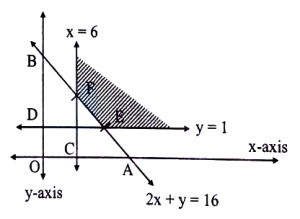
(A) The feasible region is determined by the constraints $2x + y \geq 16$,$x \geq 6$,and $y \geq 1$.
The corner points of the feasible region are found by the intersection of these lines:
$1$. Intersection of $x = 6$ and $y = 1$ is $(6, 1)$,but this point does not satisfy $2x + y \geq 16$ $(12 + 1 = 13 < 16)$.
$2$. Intersection of $2x + y = 16$ and $y = 1$: $2x + 1 = 16 \implies 2x = 15 \implies x = 7.5$. So,point $E = (7.5, 1)$.
$3$. Intersection of $2x + y = 16$ and $x = 6$: $2(6) + y = 16 \implies 12 + y = 16 \implies y = 4$. So,point $F = (6, 4)$.
Since the region is unbounded,we check the values of $Z$ at the corner points:
$Z(E) = Z(7.5, 1) = 6(7.5) + 2(1) = 45 + 2 = 47$.
$Z(F) = Z(6, 4) = 6(6) + 2(4) = 36 + 8 = 44$.
Comparing the values,the minimum value is $44$.
The corner points of the feasible region are found by the intersection of these lines:
$1$. Intersection of $x = 6$ and $y = 1$ is $(6, 1)$,but this point does not satisfy $2x + y \geq 16$ $(12 + 1 = 13 < 16)$.
$2$. Intersection of $2x + y = 16$ and $y = 1$: $2x + 1 = 16 \implies 2x = 15 \implies x = 7.5$. So,point $E = (7.5, 1)$.
$3$. Intersection of $2x + y = 16$ and $x = 6$: $2(6) + y = 16 \implies 12 + y = 16 \implies y = 4$. So,point $F = (6, 4)$.
Since the region is unbounded,we check the values of $Z$ at the corner points:
$Z(E) = Z(7.5, 1) = 6(7.5) + 2(1) = 45 + 2 = 47$.
$Z(F) = Z(6, 4) = 6(6) + 2(4) = 36 + 8 = 44$.
Comparing the values,the minimum value is $44$.
0 likesView Solution
302
MathematicsEasyMCQMHT CET · 2020
The optimal solution of the $L$.$P$.$P$. Maximize $Z = 8x + 3y$ subject to the constraints $x + y \leq 3, 4x + y \leq 6, x \geq 0, y \geq 0$ is
A
$x = 0, y = 3$
B
$x = 0, y = 0$
C
$x = \frac{3}{2}, y = 0$
D
$x = 1, y = 2$
Solution
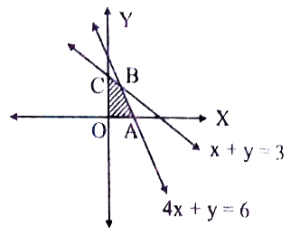
(D) The feasible region is determined by the constraints $x + y \leq 3$,$4x + y \leq 6$,$x \geq 0$,and $y \geq 0$.
The corner points of the feasible region are $O(0, 0)$,$A(1.5, 0)$,$B(1, 2)$,and $C(0, 3)$.
We evaluate the objective function $Z = 8x + 3y$ at each corner point:
$1$. At $O(0, 0)$,$Z = 8(0) + 3(0) = 0$.
$2$. At $A(1.5, 0)$,$Z = 8(1.5) + 3(0) = 12$.
$3$. At $B(1, 2)$,$Z = 8(1) + 3(2) = 8 + 6 = 14$.
$4$. At $C(0, 3)$,$Z = 8(0) + 3(3) = 9$.
The maximum value of $Z$ is $14$,which occurs at the point $(1, 2)$.
Therefore,the optimal solution is $x = 1, y = 2$.
The corner points of the feasible region are $O(0, 0)$,$A(1.5, 0)$,$B(1, 2)$,and $C(0, 3)$.
We evaluate the objective function $Z = 8x + 3y$ at each corner point:
$1$. At $O(0, 0)$,$Z = 8(0) + 3(0) = 0$.
$2$. At $A(1.5, 0)$,$Z = 8(1.5) + 3(0) = 12$.
$3$. At $B(1, 2)$,$Z = 8(1) + 3(2) = 8 + 6 = 14$.
$4$. At $C(0, 3)$,$Z = 8(0) + 3(3) = 9$.
The maximum value of $Z$ is $14$,which occurs at the point $(1, 2)$.
Therefore,the optimal solution is $x = 1, y = 2$.
0 likesView Solution
303
MathematicsMediumMCQMHT CET · 2020
The minimum value of $Z = 5x + 8y$ subject to the constraints $x + y \geq 5$,$0 \leq x \leq 4$,$y \geq 2$ is:
A
$40$
B
$36$
C
$31$
D
$28$
Solution
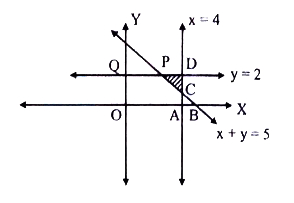
(C) The constraints are $x + y \geq 5$,$0 \leq x \leq 4$,and $y \geq 2$.
From the graph,the feasible region is the triangle formed by the intersection of the lines $x + y = 5$,$x = 4$,and $y = 2$.
To find the vertices of the feasible region:
$1$. Intersection of $x + y = 5$ and $y = 2$: Substituting $y = 2$ into $x + y = 5$,we get $x = 3$. So,vertex $P = (3, 2)$.
$2$. Intersection of $x + y = 5$ and $x = 4$: Substituting $x = 4$ into $x + y = 5$,we get $y = 1$. However,the constraint is $y \geq 2$. Looking at the graph,the vertex is at $x = 4$ and $y = 2$,which is point $D = (4, 2)$.
$3$. The third vertex is the intersection of $x = 4$ and $x + y = 5$,which is $C = (4, 1)$. But since $y \geq 2$,the region is bounded by $P(3, 2)$,$D(4, 2)$,and the point where $x=4$ meets $x+y=5$ is $(4, 1)$,which is outside the feasible region $y \geq 2$.
Re-evaluating the vertices from the graph: The vertices of the shaded region are $P(3, 2)$,$D(4, 2)$,and the point where $x=4$ intersects $x+y=5$ is $(4, 1)$,but the region is bounded by $y \geq 2$. The vertices are $P(3, 2)$ and $D(4, 2)$. The line $x+y=5$ passes through $(3, 2)$ and $(4, 1)$. The feasible region is the triangle with vertices $(3, 2)$,$(4, 2)$,and $(4, 1)$ is incorrect. The region is bounded by $x+y \geq 5$,$x \leq 4$,$y \geq 2$. The vertices are $P(3, 2)$ and $D(4, 2)$. The line $x+y=5$ intersects $x=4$ at $(4, 1)$. The region is the triangle with vertices $(3, 2)$,$(4, 2)$,and $(4, 1)$ is not possible as $y \geq 2$. The vertices are $P(3, 2)$ and $D(4, 2)$ and the line $x+y=5$ segment. The vertices are $P(3, 2)$ and $D(4, 2)$. Evaluating $Z = 5x + 8y$ at these points:
$Z(P) = 5(3) + 8(2) = 15 + 16 = 31$.
$Z(D) = 5(4) + 8(2) = 20 + 16 = 36$.
The minimum value is $31$.
From the graph,the feasible region is the triangle formed by the intersection of the lines $x + y = 5$,$x = 4$,and $y = 2$.
To find the vertices of the feasible region:
$1$. Intersection of $x + y = 5$ and $y = 2$: Substituting $y = 2$ into $x + y = 5$,we get $x = 3$. So,vertex $P = (3, 2)$.
$2$. Intersection of $x + y = 5$ and $x = 4$: Substituting $x = 4$ into $x + y = 5$,we get $y = 1$. However,the constraint is $y \geq 2$. Looking at the graph,the vertex is at $x = 4$ and $y = 2$,which is point $D = (4, 2)$.
$3$. The third vertex is the intersection of $x = 4$ and $x + y = 5$,which is $C = (4, 1)$. But since $y \geq 2$,the region is bounded by $P(3, 2)$,$D(4, 2)$,and the point where $x=4$ meets $x+y=5$ is $(4, 1)$,which is outside the feasible region $y \geq 2$.
Re-evaluating the vertices from the graph: The vertices of the shaded region are $P(3, 2)$,$D(4, 2)$,and the point where $x=4$ intersects $x+y=5$ is $(4, 1)$,but the region is bounded by $y \geq 2$. The vertices are $P(3, 2)$ and $D(4, 2)$. The line $x+y=5$ passes through $(3, 2)$ and $(4, 1)$. The feasible region is the triangle with vertices $(3, 2)$,$(4, 2)$,and $(4, 1)$ is incorrect. The region is bounded by $x+y \geq 5$,$x \leq 4$,$y \geq 2$. The vertices are $P(3, 2)$ and $D(4, 2)$. The line $x+y=5$ intersects $x=4$ at $(4, 1)$. The region is the triangle with vertices $(3, 2)$,$(4, 2)$,and $(4, 1)$ is not possible as $y \geq 2$. The vertices are $P(3, 2)$ and $D(4, 2)$ and the line $x+y=5$ segment. The vertices are $P(3, 2)$ and $D(4, 2)$. Evaluating $Z = 5x + 8y$ at these points:
$Z(P) = 5(3) + 8(2) = 15 + 16 = 31$.
$Z(D) = 5(4) + 8(2) = 20 + 16 = 36$.
The minimum value is $31$.
0 likesView Solution
304
MathematicsEasyMCQMHT CET · 2020
The maximum value of $Z=3x+5y$,subject to the constraints $3x+2y \leq 18$,$x \leq 4$,$y \leq 6$,and $x, y \geq 0$ is
A
$30$
B
$27$
C
$36$
D
$32$
Solution
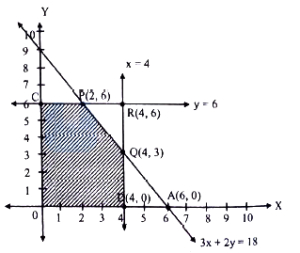
(C) The feasible region is determined by the constraints $3x+2y \leq 18$,$x \leq 4$,$y \leq 6$,and $x, y \geq 0$. The vertices of the feasible region are $O(0,0)$,$D(4,0)$,$Q(4,3)$,$P(2,6)$,and $C(0,6)$.
We evaluate the objective function $Z=3x+5y$ at each vertex:
At $O(0,0)$: $Z = 3(0) + 5(0) = 0$
At $D(4,0)$: $Z = 3(4) + 5(0) = 12$
At $Q(4,3)$: $Z = 3(4) + 5(3) = 12 + 15 = 27$
At $P(2,6)$: $Z = 3(2) + 5(6) = 6 + 30 = 36$
At $C(0,6)$: $Z = 3(0) + 5(6) = 30$
Comparing these values,the maximum value of $Z$ is $36$ at the point $(2,6)$.
We evaluate the objective function $Z=3x+5y$ at each vertex:
At $O(0,0)$: $Z = 3(0) + 5(0) = 0$
At $D(4,0)$: $Z = 3(4) + 5(0) = 12$
At $Q(4,3)$: $Z = 3(4) + 5(3) = 12 + 15 = 27$
At $P(2,6)$: $Z = 3(2) + 5(6) = 6 + 30 = 36$
At $C(0,6)$: $Z = 3(0) + 5(6) = 30$
Comparing these values,the maximum value of $Z$ is $36$ at the point $(2,6)$.
0 likesView Solution
305
MathematicsMediumMCQMHT CET · 2020
If $Z=10x+25y$ subject to $0 \leq x \leq 3, 0 \leq y \leq 3, x+y \leq 5, x \geq 0, y \geq 0$,then $Z$ is maximum at the point:
A
$(2,4)$
B
$(1,6)$
C
$(2,3)$
D
$(4,3)$
Solution
(C) The constraints are $x \leq 3, y \leq 3, x+y \leq 5, x \geq 0, y \geq 0$.
We identify the vertices of the feasible region by finding the intersection points of the boundary lines:
$1$. $x=0, y=0 \Rightarrow O(0,0)$
$2$. $x=3, y=0 \Rightarrow A(3,0)$
$3$. $x=3, x+y=5 \Rightarrow P(3,2)$
$4$. $x+y=5, y=3 \Rightarrow Q(2,3)$
$5$. $x=0, y=3 \Rightarrow D(0,3)$
Now,we evaluate the objective function $Z=10x+25y$ at each vertex:
- At $O(0,0): Z = 10(0) + 25(0) = 0$
- At $A(3,0): Z = 10(3) + 25(0) = 30$
- At $P(3,2): Z = 10(3) + 25(2) = 30 + 50 = 80$
- At $Q(2,3): Z = 10(2) + 25(3) = 20 + 75 = 95$
- At $D(0,3): Z = 10(0) + 25(3) = 0 + 75 = 75$
The maximum value of $Z$ is $95$,which occurs at the point $(2,3)$.
Therefore,the correct option is $C$.
We identify the vertices of the feasible region by finding the intersection points of the boundary lines:
$1$. $x=0, y=0 \Rightarrow O(0,0)$
$2$. $x=3, y=0 \Rightarrow A(3,0)$
$3$. $x=3, x+y=5 \Rightarrow P(3,2)$
$4$. $x+y=5, y=3 \Rightarrow Q(2,3)$
$5$. $x=0, y=3 \Rightarrow D(0,3)$
Now,we evaluate the objective function $Z=10x+25y$ at each vertex:
- At $O(0,0): Z = 10(0) + 25(0) = 0$
- At $A(3,0): Z = 10(3) + 25(0) = 30$
- At $P(3,2): Z = 10(3) + 25(2) = 30 + 50 = 80$
- At $Q(2,3): Z = 10(2) + 25(3) = 20 + 75 = 95$
- At $D(0,3): Z = 10(0) + 25(3) = 0 + 75 = 75$
The maximum value of $Z$ is $95$,which occurs at the point $(2,3)$.
Therefore,the correct option is $C$.

0 likesView Solution
306
MathematicsMediumMCQMHT CET · 2020
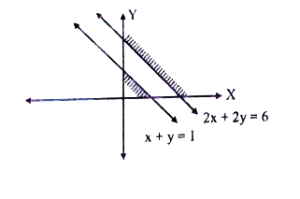
The $L$.$P$.$P$. to maximize $Z = x + y$,subject to $x + y \leq 1$,$2x + 2y \geq 6$,$x \geq 0$,$y \geq 0$ has
A
no solution.
B
infinite solutions.
C
one solution.
D
two solutions.
Solution
(A) The given constraints are:
$1$) $x + y \leq 1$
$2$) $2x + 2y \geq 6 \implies x + y \geq 3$
$3$) $x \geq 0, y \geq 0$
From the first constraint,the region is towards the origin for the line $x + y = 1$.
From the second constraint,the region is away from the origin for the line $x + y = 3$.
Since there is no point $(x, y)$ that satisfies both $x + y \leq 1$ and $x + y \geq 3$ simultaneously,there is no common feasible region.
Therefore,the given $L$.$P$.$P$. has no solution.
$1$) $x + y \leq 1$
$2$) $2x + 2y \geq 6 \implies x + y \geq 3$
$3$) $x \geq 0, y \geq 0$
From the first constraint,the region is towards the origin for the line $x + y = 1$.
From the second constraint,the region is away from the origin for the line $x + y = 3$.
Since there is no point $(x, y)$ that satisfies both $x + y \leq 1$ and $x + y \geq 3$ simultaneously,there is no common feasible region.
Therefore,the given $L$.$P$.$P$. has no solution.
0 likesView Solution
307
MathematicsMediumMCQMHT CET · 2020
The minimum value of the objective function $Z = 5x + 8y$,subject to the constraints $x + y \geq 5$,$x \leq 4$,$y \leq 2$,$x \geq 0$,and $y \geq 0$,occurs at the point:
A
$(5, 0)$
B
$(0, 5)$
C
$(4, 2)$
D
$(4, 1)$
Solution
(D) The constraints are $x + y \geq 5$,$x \leq 4$,$y \leq 2$,$x \geq 0$,and $y \geq 0$.
To find the feasible region,we identify the intersection points of the lines:
$1$. $x + y = 5$ and $x = 4$ gives $4 + y = 5 \implies y = 1$. Point: $(4, 1)$.
$2$. $x + y = 5$ and $y = 2$ gives $x + 2 = 5 \implies x = 3$. Point: $(3, 2)$.
$3$. $x = 4$ and $y = 2$ gives the point $(4, 2)$.
The vertices of the feasible region are $(4, 1)$,$(4, 2)$,and $(3, 2)$.
Now,evaluate the objective function $Z = 5x + 8y$ at these vertices:
- At $(4, 1)$: $Z = 5(4) + 8(1) = 20 + 8 = 28$.
- At $(4, 2)$: $Z = 5(4) + 8(2) = 20 + 16 = 36$.
- At $(3, 2)$: $Z = 5(3) + 8(2) = 15 + 16 = 31$.
The minimum value is $28$,which occurs at the point $(4, 1)$.
To find the feasible region,we identify the intersection points of the lines:
$1$. $x + y = 5$ and $x = 4$ gives $4 + y = 5 \implies y = 1$. Point: $(4, 1)$.
$2$. $x + y = 5$ and $y = 2$ gives $x + 2 = 5 \implies x = 3$. Point: $(3, 2)$.
$3$. $x = 4$ and $y = 2$ gives the point $(4, 2)$.
The vertices of the feasible region are $(4, 1)$,$(4, 2)$,and $(3, 2)$.
Now,evaluate the objective function $Z = 5x + 8y$ at these vertices:
- At $(4, 1)$: $Z = 5(4) + 8(1) = 20 + 8 = 28$.
- At $(4, 2)$: $Z = 5(4) + 8(2) = 20 + 16 = 36$.
- At $(3, 2)$: $Z = 5(3) + 8(2) = 15 + 16 = 31$.
The minimum value is $28$,which occurs at the point $(4, 1)$.
0 likesView Solution
308
MathematicsMediumMCQMHT CET · 2020
If a Linear Programming Problem $(L.P.P.)$ has optimum solutions at two consecutive corner points of the feasible region,then the $L.P.P.$ has:
A
infinite solutions
B
no solution
C
two solutions
D
unique solution
Solution
(A) In a Linear Programming Problem $(L.P.P.)$,the objective function is a linear function.
If the objective function attains the same optimal value at two distinct corner points of the feasible region,then it will also attain the same optimal value at every point on the line segment joining these two points.
Since a line segment contains an infinite number of points,the $L.P.P.$ will have infinite solutions.
If the objective function attains the same optimal value at two distinct corner points of the feasible region,then it will also attain the same optimal value at every point on the line segment joining these two points.
Since a line segment contains an infinite number of points,the $L.P.P.$ will have infinite solutions.
0 likesView Solution
309
MathematicsEasyMCQMHT CET · 2020
If $A = \begin{bmatrix} 1 & 0 \\ -1 & 7 \end{bmatrix}$,$I = \begin{bmatrix} 1 & 0 \\ 0 & 1 \end{bmatrix}$ and $A^{2} = 8A + kI$,then the value of $k$ is
A
$1/7$
B
$-1/7$
C
$-7$
D
$7$
Solution
(C) First,we calculate $A^{2}$:
$A^{2} = A \times A = \begin{bmatrix} 1 & 0 \\ -1 & 7 \end{bmatrix} \begin{bmatrix} 1 & 0 \\ -1 & 7 \end{bmatrix} = \begin{bmatrix} (1)(1) + (0)(-1) & (1)(0) + (0)(7) \\ (-1)(1) + (7)(-1) & (-1)(0) + (7)(7) \end{bmatrix} = \begin{bmatrix} 1 & 0 \\ -8 & 49 \end{bmatrix}$
Given the equation $A^{2} = 8A + kI$,we substitute the matrices:
$\begin{bmatrix} 1 & 0 \\ -8 & 49 \end{bmatrix} = 8 \begin{bmatrix} 1 & 0 \\ -1 & 7 \end{bmatrix} + k \begin{bmatrix} 1 & 0 \\ 0 & 1 \end{bmatrix}$
$\begin{bmatrix} 1 & 0 \\ -8 & 49 \end{bmatrix} = \begin{bmatrix} 8 & 0 \\ -8 & 56 \end{bmatrix} + \begin{bmatrix} k & 0 \\ 0 & k \end{bmatrix}$
$\begin{bmatrix} 1 & 0 \\ -8 & 49 \end{bmatrix} = \begin{bmatrix} 8 + k & 0 \\ -8 & 56 + k \end{bmatrix}$
By comparing the corresponding elements,we get:
$8 + k = 1 \Rightarrow k = 1 - 8 = -7$
Also,$56 + k = 49 \Rightarrow k = 49 - 56 = -7$
Thus,the value of $k$ is $-7$.
$A^{2} = A \times A = \begin{bmatrix} 1 & 0 \\ -1 & 7 \end{bmatrix} \begin{bmatrix} 1 & 0 \\ -1 & 7 \end{bmatrix} = \begin{bmatrix} (1)(1) + (0)(-1) & (1)(0) + (0)(7) \\ (-1)(1) + (7)(-1) & (-1)(0) + (7)(7) \end{bmatrix} = \begin{bmatrix} 1 & 0 \\ -8 & 49 \end{bmatrix}$
Given the equation $A^{2} = 8A + kI$,we substitute the matrices:
$\begin{bmatrix} 1 & 0 \\ -8 & 49 \end{bmatrix} = 8 \begin{bmatrix} 1 & 0 \\ -1 & 7 \end{bmatrix} + k \begin{bmatrix} 1 & 0 \\ 0 & 1 \end{bmatrix}$
$\begin{bmatrix} 1 & 0 \\ -8 & 49 \end{bmatrix} = \begin{bmatrix} 8 & 0 \\ -8 & 56 \end{bmatrix} + \begin{bmatrix} k & 0 \\ 0 & k \end{bmatrix}$
$\begin{bmatrix} 1 & 0 \\ -8 & 49 \end{bmatrix} = \begin{bmatrix} 8 + k & 0 \\ -8 & 56 + k \end{bmatrix}$
By comparing the corresponding elements,we get:
$8 + k = 1 \Rightarrow k = 1 - 8 = -7$
Also,$56 + k = 49 \Rightarrow k = 49 - 56 = -7$
Thus,the value of $k$ is $-7$.
0 likesView Solution
310
MathematicsEasyMCQMHT CET · 2020
If $A = \begin{bmatrix} 1 & 2 & i \\ 1 & 1 & 1 \\ 1 & 1 & 0 \end{bmatrix}$,then $[\operatorname{adj}(\operatorname{adj} A)]^{-1} = $
A
$A^2$
B
$2A$
C
$A^{-1}$
D
$I$
Solution
(C) We know that for a square matrix $A$ of order $n$,the property of the adjoint of an adjoint is given by $\operatorname{adj}(\operatorname{adj} A) = |A|^{n-2} A$.
Here,the order of matrix $A$ is $n = 3$.
First,calculate the determinant $|A|$:
$|A| = \begin{vmatrix} 1 & 2 & i \\ 1 & 1 & 1 \\ 1 & 1 & 0 \end{vmatrix} = 1(0 - 1) - 2(0 - 1) + i(1 - 1) = -1 + 2 + 0 = 1$.
Now,substitute $n = 3$ and $|A| = 1$ into the formula:
$\operatorname{adj}(\operatorname{adj} A) = (1)^{3-2} A = (1)^1 A = A$.
Therefore,$[\operatorname{adj}(\operatorname{adj} A)]^{-1} = (A)^{-1} = A^{-1}$.
Here,the order of matrix $A$ is $n = 3$.
First,calculate the determinant $|A|$:
$|A| = \begin{vmatrix} 1 & 2 & i \\ 1 & 1 & 1 \\ 1 & 1 & 0 \end{vmatrix} = 1(0 - 1) - 2(0 - 1) + i(1 - 1) = -1 + 2 + 0 = 1$.
Now,substitute $n = 3$ and $|A| = 1$ into the formula:
$\operatorname{adj}(\operatorname{adj} A) = (1)^{3-2} A = (1)^1 A = A$.
Therefore,$[\operatorname{adj}(\operatorname{adj} A)]^{-1} = (A)^{-1} = A^{-1}$.
0 likesView Solution
311
MathematicsEasyMCQMHT CET · 2020
The adjoint of the matrix $A = \begin{bmatrix} 2 & -3 \\ 3 & 5 \end{bmatrix}$ is
A
$\begin{bmatrix} 5 & 3 \\ -3 & 2 \end{bmatrix}$
B
$\begin{bmatrix} 5 & -3 \\ 3 & 2 \end{bmatrix}$
C
$\frac{1}{19} \begin{bmatrix} 5 & 3 \\ -3 & 2 \end{bmatrix}$
D
$\frac{1}{19} \begin{bmatrix} 5 & -3 \\ 3 & 2 \end{bmatrix}$
Solution
(A) For a $2 \times 2$ matrix $A = \begin{bmatrix} a & b \\ c & d \end{bmatrix}$,the adjoint is given by $\operatorname{adj}(A) = \begin{bmatrix} d & -b \\ -c & a \end{bmatrix}$.
Given $A = \begin{bmatrix} 2 & -3 \\ 3 & 5 \end{bmatrix}$,we have $a = 2, b = -3, c = 3, d = 5$.
Substituting these values into the formula,we get $\operatorname{adj}(A) = \begin{bmatrix} 5 & -(-3) \\ -3 & 2 \end{bmatrix} = \begin{bmatrix} 5 & 3 \\ -3 & 2 \end{bmatrix}$.
Given $A = \begin{bmatrix} 2 & -3 \\ 3 & 5 \end{bmatrix}$,we have $a = 2, b = -3, c = 3, d = 5$.
Substituting these values into the formula,we get $\operatorname{adj}(A) = \begin{bmatrix} 5 & -(-3) \\ -3 & 2 \end{bmatrix} = \begin{bmatrix} 5 & 3 \\ -3 & 2 \end{bmatrix}$.
0 likesView Solution
312
MathematicsEasyMCQMHT CET · 2020
The sum of the cofactors of the elements of the second row of the matrix $\begin{bmatrix} 1 & 3 & 2 \\ -2 & 0 & 1 \\ 5 & 2 & 1 \end{bmatrix}$ is
A
$23$
B
$5$
C
$3$
D
$-23$
Solution
(B) Let the matrix be $A = \begin{bmatrix} 1 & 3 & 2 \\ -2 & 0 & 1 \\ 5 & 2 & 1 \end{bmatrix}$.
The cofactors of the elements of the second row $(A_{21}, A_{22}, A_{23})$ are calculated as follows:
$A_{21} = (-1)^{2+1} \begin{vmatrix} 3 & 2 \\ 2 & 1 \end{vmatrix} = (-1)(3(1) - 2(2)) = (-1)(3 - 4) = (-1)(-1) = 1$.
$A_{22} = (-1)^{2+2} \begin{vmatrix} 1 & 2 \\ 5 & 1 \end{vmatrix} = (1)(1(1) - 5(2)) = (1)(1 - 10) = -9$.
$A_{23} = (-1)^{2+3} \begin{vmatrix} 1 & 3 \\ 5 & 2 \end{vmatrix} = (-1)(1(2) - 5(3)) = (-1)(2 - 15) = (-1)(-13) = 13$.
The sum of the cofactors is $A_{21} + A_{22} + A_{23} = 1 + (-9) + 13 = 5$.
Therefore,the correct option is $B$.
The cofactors of the elements of the second row $(A_{21}, A_{22}, A_{23})$ are calculated as follows:
$A_{21} = (-1)^{2+1} \begin{vmatrix} 3 & 2 \\ 2 & 1 \end{vmatrix} = (-1)(3(1) - 2(2)) = (-1)(3 - 4) = (-1)(-1) = 1$.
$A_{22} = (-1)^{2+2} \begin{vmatrix} 1 & 2 \\ 5 & 1 \end{vmatrix} = (1)(1(1) - 5(2)) = (1)(1 - 10) = -9$.
$A_{23} = (-1)^{2+3} \begin{vmatrix} 1 & 3 \\ 5 & 2 \end{vmatrix} = (-1)(1(2) - 5(3)) = (-1)(2 - 15) = (-1)(-13) = 13$.
The sum of the cofactors is $A_{21} + A_{22} + A_{23} = 1 + (-9) + 13 = 5$.
Therefore,the correct option is $B$.
0 likesView Solution
313
MathematicsEasyMCQMHT CET · 2020
The cofactors of the elements of the first column of the matrix $A = \begin{bmatrix} 2 & 0 & -1 \\ 3 & 1 & 2 \\ -1 & 1 & 2 \end{bmatrix}$ are
A
$0, -7, 2$
B
$0, -1, 1$
C
$0, -8, 4$
D
$-1, 3, -2$
Solution
(B) The cofactor $C_{ij}$ of an element $a_{ij}$ is given by $C_{ij} = (-1)^{i+j} M_{ij}$,where $M_{ij}$ is the minor of the element $a_{ij}$.
For the first column,we need to find $C_{11}, C_{21},$ and $C_{31}$.
$C_{11} = (-1)^{1+1} \begin{vmatrix} 1 & 2 \\ 1 & 2 \end{vmatrix} = (1)(2 - 2) = 0$.
$C_{21} = (-1)^{2+1} \begin{vmatrix} 0 & -1 \\ 1 & 2 \end{vmatrix} = (-1)(0 - (-1)) = (-1)(1) = -1$.
$C_{31} = (-1)^{3+1} \begin{vmatrix} 0 & -1 \\ 1 & 2 \end{vmatrix} = (1)(0 - (-1)) = (1)(1) = 1$.
Thus,the cofactors are $0, -1, 1$.
For the first column,we need to find $C_{11}, C_{21},$ and $C_{31}$.
$C_{11} = (-1)^{1+1} \begin{vmatrix} 1 & 2 \\ 1 & 2 \end{vmatrix} = (1)(2 - 2) = 0$.
$C_{21} = (-1)^{2+1} \begin{vmatrix} 0 & -1 \\ 1 & 2 \end{vmatrix} = (-1)(0 - (-1)) = (-1)(1) = -1$.
$C_{31} = (-1)^{3+1} \begin{vmatrix} 0 & -1 \\ 1 & 2 \end{vmatrix} = (1)(0 - (-1)) = (1)(1) = 1$.
Thus,the cofactors are $0, -1, 1$.
0 likesView Solution
314
MathematicsEasyMCQMHT CET · 2020
If $A = \begin{bmatrix} 2 & -1 \\ -1 & 2 \end{bmatrix}$,such that $A^{2} - 4A + 3I = 0$,then $A^{-1} =$
A
$\frac{-1}{3} \begin{bmatrix} 2 & 1 \\ 1 & 2 \end{bmatrix}$
B
$\frac{-1}{3} \begin{bmatrix} 2 & -1 \\ -1 & 2 \end{bmatrix}$
C
$\frac{1}{3} \begin{bmatrix} -2 & -1 \\ 1 & -2 \end{bmatrix}$
D
$\frac{1}{3} \begin{bmatrix} 2 & 1 \\ 1 & 2 \end{bmatrix}$
Solution
(D) Given the matrix $A = \begin{bmatrix} 2 & -1 \\ -1 & 2 \end{bmatrix}$.
The determinant of $A$ is $|A| = (2)(2) - (-1)(-1) = 4 - 1 = 3$.
The adjoint of $A$ is $\text{adj}(A) = \begin{bmatrix} 2 & 1 \\ 1 & 2 \end{bmatrix}$.
The inverse of a matrix is given by $A^{-1} = \frac{1}{|A|} \text{adj}(A)$.
Substituting the values,we get $A^{-1} = \frac{1}{3} \begin{bmatrix} 2 & 1 \\ 1 & 2 \end{bmatrix}$.
Alternatively,using the characteristic equation $A^{2} - 4A + 3I = 0$,multiply by $A^{-1}$:
$A - 4I + 3A^{-1} = 0 \Rightarrow 3A^{-1} = 4I - A$.
$3A^{-1} = 4 \begin{bmatrix} 1 & 0 \\ 0 & 1 \end{bmatrix} - \begin{bmatrix} 2 & -1 \\ -1 & 2 \end{bmatrix} = \begin{bmatrix} 2 & 1 \\ 1 & 2 \end{bmatrix}$.
Thus,$A^{-1} = \frac{1}{3} \begin{bmatrix} 2 & 1 \\ 1 & 2 \end{bmatrix}$.
The determinant of $A$ is $|A| = (2)(2) - (-1)(-1) = 4 - 1 = 3$.
The adjoint of $A$ is $\text{adj}(A) = \begin{bmatrix} 2 & 1 \\ 1 & 2 \end{bmatrix}$.
The inverse of a matrix is given by $A^{-1} = \frac{1}{|A|} \text{adj}(A)$.
Substituting the values,we get $A^{-1} = \frac{1}{3} \begin{bmatrix} 2 & 1 \\ 1 & 2 \end{bmatrix}$.
Alternatively,using the characteristic equation $A^{2} - 4A + 3I = 0$,multiply by $A^{-1}$:
$A - 4I + 3A^{-1} = 0 \Rightarrow 3A^{-1} = 4I - A$.
$3A^{-1} = 4 \begin{bmatrix} 1 & 0 \\ 0 & 1 \end{bmatrix} - \begin{bmatrix} 2 & -1 \\ -1 & 2 \end{bmatrix} = \begin{bmatrix} 2 & 1 \\ 1 & 2 \end{bmatrix}$.
Thus,$A^{-1} = \frac{1}{3} \begin{bmatrix} 2 & 1 \\ 1 & 2 \end{bmatrix}$.
0 likesView Solution
315
MathematicsEasyMCQMHT CET · 2020
Which of the following matrices is invertible?
$A_{1}=\begin{bmatrix} 4 & 2 \\ 2 & 1 \end{bmatrix}$
$A_{2}=\begin{bmatrix} -1 & -2 & 3 \\ 4 & 5 & 7 \\ 2 & 4 & -6 \end{bmatrix}$
$A_{3}=\begin{bmatrix} 1 & 0 & 0 \\ 5 & 2 & 1 \\ 7 & 2 & 1 \end{bmatrix}$
$A_{4}=\begin{bmatrix} 1 & 0 & 1 \\ 0 & 2 & 3 \\ 1 & 2 & 1 \end{bmatrix}$
$A_{1}=\begin{bmatrix} 4 & 2 \\ 2 & 1 \end{bmatrix}$
$A_{2}=\begin{bmatrix} -1 & -2 & 3 \\ 4 & 5 & 7 \\ 2 & 4 & -6 \end{bmatrix}$
$A_{3}=\begin{bmatrix} 1 & 0 & 0 \\ 5 & 2 & 1 \\ 7 & 2 & 1 \end{bmatrix}$
$A_{4}=\begin{bmatrix} 1 & 0 & 1 \\ 0 & 2 & 3 \\ 1 & 2 & 1 \end{bmatrix}$
A
$A_{1}$
B
$A_{3}$
C
$A_{4}$
D
$A_{2}$
Solution
(C) square matrix $A$ is invertible if and only if its determinant $|A| \neq 0$.
Let us calculate the determinant for each matrix:
$1$. For $A_{1} = \begin{bmatrix} 4 & 2 \\ 2 & 1 \end{bmatrix}$,$|A_{1}| = (4 \times 1) - (2 \times 2) = 4 - 4 = 0$. Thus,$A_{1}$ is not invertible.
$2$. For $A_{2} = \begin{bmatrix} -1 & -2 & 3 \\ 4 & 5 & 7 \\ 2 & 4 & -6 \end{bmatrix}$,notice that row $3$ is $-2$ times row $1$ $(R_{3} = -2R_{1})$. Since two rows are proportional,$|A_{2}| = 0$. Thus,$A_{2}$ is not invertible.
$3$. For $A_{3} = \begin{bmatrix} 1 & 0 & 0 \\ 5 & 2 & 1 \\ 7 & 2 & 1 \end{bmatrix}$,notice that row $2$ and row $3$ are not proportional,but let's calculate: $|A_{3}| = 1(2-2) - 0 + 0 = 0$. Thus,$A_{3}$ is not invertible.
$4$. For $A_{4} = \begin{bmatrix} 1 & 0 & 1 \\ 0 & 2 & 3 \\ 1 & 2 & 1 \end{bmatrix}$,$|A_{4}| = 1(2-6) - 0(0-3) + 1(0-2) = 1(-4) + 1(-2) = -4 - 2 = -6$.
Since $|A_{4}| = -6 \neq 0$,the matrix $A_{4}$ is invertible.
Let us calculate the determinant for each matrix:
$1$. For $A_{1} = \begin{bmatrix} 4 & 2 \\ 2 & 1 \end{bmatrix}$,$|A_{1}| = (4 \times 1) - (2 \times 2) = 4 - 4 = 0$. Thus,$A_{1}$ is not invertible.
$2$. For $A_{2} = \begin{bmatrix} -1 & -2 & 3 \\ 4 & 5 & 7 \\ 2 & 4 & -6 \end{bmatrix}$,notice that row $3$ is $-2$ times row $1$ $(R_{3} = -2R_{1})$. Since two rows are proportional,$|A_{2}| = 0$. Thus,$A_{2}$ is not invertible.
$3$. For $A_{3} = \begin{bmatrix} 1 & 0 & 0 \\ 5 & 2 & 1 \\ 7 & 2 & 1 \end{bmatrix}$,notice that row $2$ and row $3$ are not proportional,but let's calculate: $|A_{3}| = 1(2-2) - 0 + 0 = 0$. Thus,$A_{3}$ is not invertible.
$4$. For $A_{4} = \begin{bmatrix} 1 & 0 & 1 \\ 0 & 2 & 3 \\ 1 & 2 & 1 \end{bmatrix}$,$|A_{4}| = 1(2-6) - 0(0-3) + 1(0-2) = 1(-4) + 1(-2) = -4 - 2 = -6$.
Since $|A_{4}| = -6 \neq 0$,the matrix $A_{4}$ is invertible.
0 likesView Solution
316
MathematicsEasyMCQMHT CET · 2020
If $A = \begin{bmatrix} 2 & 3 \\ 1 & 2 \end{bmatrix}$ and $B = \begin{bmatrix} 1 & 0 \\ 3 & 1 \end{bmatrix}$,then $(AB)^{-1} =$
A
$\begin{bmatrix} 2 & -3 \\ -7 & 11 \end{bmatrix}$
B
$\begin{bmatrix} 2 & -3 \\ 7 & 11 \end{bmatrix}$
C
$\begin{bmatrix} 2 & -3 \\ -7 & -11 \end{bmatrix}$
D
$\begin{bmatrix} -2 & -3 \\ -7 & 11 \end{bmatrix}$
Solution
(A) First,calculate the product $AB$:
$AB = \begin{bmatrix} 2 & 3 \\ 1 & 2 \end{bmatrix} \begin{bmatrix} 1 & 0 \\ 3 & 1 \end{bmatrix} = \begin{bmatrix} (2 \times 1 + 3 \times 3) & (2 \times 0 + 3 \times 1) \\ (1 \times 1 + 2 \times 3) & (1 \times 0 + 2 \times 1) \end{bmatrix} = \begin{bmatrix} 11 & 3 \\ 7 & 2 \end{bmatrix}$
Next,find the determinant $|AB|$:
$|AB| = (11 \times 2) - (3 \times 7) = 22 - 21 = 1$
Now,find the adjoint of $AB$:
For a matrix $\begin{bmatrix} a & b \\ c & d \end{bmatrix}$,the adjoint is $\begin{bmatrix} d & -b \\ -c & a \end{bmatrix}$.
Thus,$\text{adj}(AB) = \begin{bmatrix} 2 & -3 \\ -7 & 11 \end{bmatrix}$
Finally,$(AB)^{-1} = \frac{1}{|AB|} \text{adj}(AB) = \frac{1}{1} \begin{bmatrix} 2 & -3 \\ -7 & 11 \end{bmatrix} = \begin{bmatrix} 2 & -3 \\ -7 & 11 \end{bmatrix}$
$AB = \begin{bmatrix} 2 & 3 \\ 1 & 2 \end{bmatrix} \begin{bmatrix} 1 & 0 \\ 3 & 1 \end{bmatrix} = \begin{bmatrix} (2 \times 1 + 3 \times 3) & (2 \times 0 + 3 \times 1) \\ (1 \times 1 + 2 \times 3) & (1 \times 0 + 2 \times 1) \end{bmatrix} = \begin{bmatrix} 11 & 3 \\ 7 & 2 \end{bmatrix}$
Next,find the determinant $|AB|$:
$|AB| = (11 \times 2) - (3 \times 7) = 22 - 21 = 1$
Now,find the adjoint of $AB$:
For a matrix $\begin{bmatrix} a & b \\ c & d \end{bmatrix}$,the adjoint is $\begin{bmatrix} d & -b \\ -c & a \end{bmatrix}$.
Thus,$\text{adj}(AB) = \begin{bmatrix} 2 & -3 \\ -7 & 11 \end{bmatrix}$
Finally,$(AB)^{-1} = \frac{1}{|AB|} \text{adj}(AB) = \frac{1}{1} \begin{bmatrix} 2 & -3 \\ -7 & 11 \end{bmatrix} = \begin{bmatrix} 2 & -3 \\ -7 & 11 \end{bmatrix}$
0 likesView Solution
317
MathematicsEasyMCQMHT CET · 2020
If $A = \begin{bmatrix} \cos \theta & -\sin \theta \\ -\sin \theta & -\cos \theta \end{bmatrix}$,then $A^{-1} =$
A
$\begin{bmatrix} -\sin \theta & -\cos \theta \\ -\cos \theta & \sin \theta \end{bmatrix}$
B
$\begin{bmatrix} \sin \theta & -\cos \theta \\ \cos \theta & -\sin \theta \end{bmatrix}$
C
$\begin{bmatrix} -\cos \theta & \sin \theta \\ \sin \theta & \cos \theta \end{bmatrix}$
D
$\begin{bmatrix} \cos \theta & -\sin \theta \\ -\sin \theta & -\cos \theta \end{bmatrix}$
Solution
(D) Given $A = \begin{bmatrix} \cos \theta & -\sin \theta \\ -\sin \theta & -\cos \theta \end{bmatrix}$.
First,we find the determinant of $A$:
$|A| = (\cos \theta)(-\cos \theta) - (-\sin \theta)(-\sin \theta) = -\cos^2 \theta - \sin^2 \theta = -(\cos^2 \theta + \sin^2 \theta) = -1$.
Next,we find the adjoint of $A$ by swapping the diagonal elements and changing the signs of the off-diagonal elements:
$\text{adj}(A) = \begin{bmatrix} -\cos \theta & \sin \theta \\ \sin \theta & \cos \theta \end{bmatrix}$.
Finally,the inverse is given by $A^{-1} = \frac{1}{|A|} \text{adj}(A)$:
$A^{-1} = \frac{1}{-1} \begin{bmatrix} -\cos \theta & \sin \theta \\ \sin \theta & \cos \theta \end{bmatrix} = \begin{bmatrix} \cos \theta & -\sin \theta \\ -\sin \theta & -\cos \theta \end{bmatrix}$.
Thus,$A^{-1} = A$.
First,we find the determinant of $A$:
$|A| = (\cos \theta)(-\cos \theta) - (-\sin \theta)(-\sin \theta) = -\cos^2 \theta - \sin^2 \theta = -(\cos^2 \theta + \sin^2 \theta) = -1$.
Next,we find the adjoint of $A$ by swapping the diagonal elements and changing the signs of the off-diagonal elements:
$\text{adj}(A) = \begin{bmatrix} -\cos \theta & \sin \theta \\ \sin \theta & \cos \theta \end{bmatrix}$.
Finally,the inverse is given by $A^{-1} = \frac{1}{|A|} \text{adj}(A)$:
$A^{-1} = \frac{1}{-1} \begin{bmatrix} -\cos \theta & \sin \theta \\ \sin \theta & \cos \theta \end{bmatrix} = \begin{bmatrix} \cos \theta & -\sin \theta \\ -\sin \theta & -\cos \theta \end{bmatrix}$.
Thus,$A^{-1} = A$.
0 likesView Solution
318
MathematicsEasyMCQMHT CET · 2020
If $A=\left[\begin{array}{ll}2 & 3 \\ 1 & 2\end{array}\right]$ and $B=\left[\begin{array}{cc}2 & -3 \\ -1 & 2\end{array}\right]$,then $\left(B^{-1} A^{-1}\right)^{-1}=$
A
$\left[\begin{array}{cc}2 & 3 \\ 1 & -2\end{array}\right]$
B
$\left[\begin{array}{ll}0 & 1 \\ 1 & 0\end{array}\right]$
C
$\left[\begin{array}{ll}1 & 2 \\ 3 & 4\end{array}\right]$
D
$\left[\begin{array}{ll}1 & 0 \\ 0 & 1\end{array}\right]$
Solution
(D) We know that for any invertible matrices $A$ and $B$,the property $(B^{-1} A^{-1})^{-1} = (A^{-1})^{-1} (B^{-1})^{-1}$ holds true.
Since $(A^{-1})^{-1} = A$ and $(B^{-1})^{-1} = B$,the expression simplifies to $AB$.
Now,we calculate the product $AB$:
$AB = \left[\begin{array}{ll}2 & 3 \\ 1 & 2\end{array}\right] \left[\begin{array}{cc}2 & -3 \\ -1 & 2\end{array}\right]$
$AB = \left[\begin{array}{cc} (2)(2) + (3)(-1) & (2)(-3) + (3)(2) \\ (1)(2) + (2)(-1) & (1)(-3) + (2)(2) \end{array}\right]$
$AB = \left[\begin{array}{cc} 4 - 3 & -6 + 6 \\ 2 - 2 & -3 + 4 \end{array}\right]$
$AB = \left[\begin{array}{ll} 1 & 0 \\ 0 & 1 \end{array}\right]$
Thus,the correct option is $D$.
Since $(A^{-1})^{-1} = A$ and $(B^{-1})^{-1} = B$,the expression simplifies to $AB$.
Now,we calculate the product $AB$:
$AB = \left[\begin{array}{ll}2 & 3 \\ 1 & 2\end{array}\right] \left[\begin{array}{cc}2 & -3 \\ -1 & 2\end{array}\right]$
$AB = \left[\begin{array}{cc} (2)(2) + (3)(-1) & (2)(-3) + (3)(2) \\ (1)(2) + (2)(-1) & (1)(-3) + (2)(2) \end{array}\right]$
$AB = \left[\begin{array}{cc} 4 - 3 & -6 + 6 \\ 2 - 2 & -3 + 4 \end{array}\right]$
$AB = \left[\begin{array}{ll} 1 & 0 \\ 0 & 1 \end{array}\right]$
Thus,the correct option is $D$.
0 likesView Solution
319
MathematicsEasyMCQMHT CET · 2020
If $A = \begin{bmatrix} 2 & 0 & 0 \\ 0 & -2 & 0 \\ 0 & 0 & -1 \end{bmatrix}$,then $A^4 A^{-1} = $
A
$\begin{bmatrix} 8 & 0 & 0 \\ 0 & -8 & 0 \\ 0 & 0 & -1 \end{bmatrix}$
B
$\begin{bmatrix} 8 & 0 & 0 \\ 0 & 8 & 0 \\ 0 & 0 & 1 \end{bmatrix}$
C
$\begin{bmatrix} \frac{1}{2} & 0 & 0 \\ 0 & -\frac{1}{2} & 0 \\ 0 & 0 & -1 \end{bmatrix}$
D
$\begin{bmatrix} -4 & 0 & 0 \\ 0 & 4 & 0 \\ 0 & 0 & -1 \end{bmatrix}$
Solution
(A) We know that $A^4 A^{-1} = A^{4-1} = A^3$.
Since $A$ is a diagonal matrix,$A^n = \begin{bmatrix} a_{11}^n & 0 & 0 \\ 0 & a_{22}^n & 0 \\ 0 & 0 & a_{33}^n \end{bmatrix}$.
Given $A = \begin{bmatrix} 2 & 0 & 0 \\ 0 & -2 & 0 \\ 0 & 0 & -1 \end{bmatrix}$,we calculate $A^3$:
$A^3 = \begin{bmatrix} 2^3 & 0 & 0 \\ 0 & (-2)^3 & 0 \\ 0 & 0 & (-1)^3 \end{bmatrix} = \begin{bmatrix} 8 & 0 & 0 \\ 0 & -8 & 0 \\ 0 & 0 & -1 \end{bmatrix}$.
Thus,$A^4 A^{-1} = \begin{bmatrix} 8 & 0 & 0 \\ 0 & -8 & 0 \\ 0 & 0 & -1 \end{bmatrix}$.
Since $A$ is a diagonal matrix,$A^n = \begin{bmatrix} a_{11}^n & 0 & 0 \\ 0 & a_{22}^n & 0 \\ 0 & 0 & a_{33}^n \end{bmatrix}$.
Given $A = \begin{bmatrix} 2 & 0 & 0 \\ 0 & -2 & 0 \\ 0 & 0 & -1 \end{bmatrix}$,we calculate $A^3$:
$A^3 = \begin{bmatrix} 2^3 & 0 & 0 \\ 0 & (-2)^3 & 0 \\ 0 & 0 & (-1)^3 \end{bmatrix} = \begin{bmatrix} 8 & 0 & 0 \\ 0 & -8 & 0 \\ 0 & 0 & -1 \end{bmatrix}$.
Thus,$A^4 A^{-1} = \begin{bmatrix} 8 & 0 & 0 \\ 0 & -8 & 0 \\ 0 & 0 & -1 \end{bmatrix}$.
0 likesView Solution
320
MathematicsEasyMCQMHT CET · 2020
If the elements of matrix $A$ are the reciprocals of elements of matrix $\left[\begin{array}{ccc}1 & \omega & \omega^{2} \\ \omega & \omega^{2} & 1 \\ \omega^{2} & 1 & \omega\end{array}\right]$,where $\omega$ is a complex cube root of unity,then:
A
$A^{-1}=I$
B
$A^{-1}=A^{2}$
C
$A^{-1}=A$
D
$A^{-1}$ does not exist
Solution
(D) Given the matrix $M = \left[\begin{array}{ccc}1 & \omega & \omega^{2} \\ \omega & \omega^{2} & 1 \\ \omega^{2} & 1 & \omega\end{array}\right]$.
The matrix $A$ consists of the reciprocals of the elements of $M$,so $A = \left[\begin{array}{ccc}1 & \frac{1}{\omega} & \frac{1}{\omega^2} \\ \frac{1}{\omega} & \frac{1}{\omega^2} & 1 \\ \frac{1}{\omega^2} & 1 & \frac{1}{\omega}\end{array}\right]$.
Using the property $\omega^3 = 1$,we can write $\frac{1}{\omega} = \omega^2$ and $\frac{1}{\omega^2} = \omega$.
Thus,$A = \left[\begin{array}{ccc}1 & \omega^2 & \omega \\ \omega^2 & \omega & 1 \\ \omega & 1 & \omega^2\end{array}\right]$.
Now,calculate the determinant $|A|$:
$|A| = 1(\omega^3 - 1) - \omega^2(\omega^4 - \omega) + \omega(\omega^2 - \omega^2)$
$|A| = 1(1 - 1) - \omega^2(\omega - \omega) + \omega(0)$
$|A| = 0 - 0 + 0 = 0$.
Since the determinant of matrix $A$ is $0$,the matrix $A$ is singular,and therefore $A^{-1}$ does not exist.
The matrix $A$ consists of the reciprocals of the elements of $M$,so $A = \left[\begin{array}{ccc}1 & \frac{1}{\omega} & \frac{1}{\omega^2} \\ \frac{1}{\omega} & \frac{1}{\omega^2} & 1 \\ \frac{1}{\omega^2} & 1 & \frac{1}{\omega}\end{array}\right]$.
Using the property $\omega^3 = 1$,we can write $\frac{1}{\omega} = \omega^2$ and $\frac{1}{\omega^2} = \omega$.
Thus,$A = \left[\begin{array}{ccc}1 & \omega^2 & \omega \\ \omega^2 & \omega & 1 \\ \omega & 1 & \omega^2\end{array}\right]$.
Now,calculate the determinant $|A|$:
$|A| = 1(\omega^3 - 1) - \omega^2(\omega^4 - \omega) + \omega(\omega^2 - \omega^2)$
$|A| = 1(1 - 1) - \omega^2(\omega - \omega) + \omega(0)$
$|A| = 0 - 0 + 0 = 0$.
Since the determinant of matrix $A$ is $0$,the matrix $A$ is singular,and therefore $A^{-1}$ does not exist.
0 likesView Solution
321
MathematicsEasyMCQMHT CET · 2020
The value of $x$ such that the matrix $\begin{bmatrix} x & 2 & 3 \\ 4 & 5 & 6 \\ 2 & 3 & 5 \end{bmatrix}$ is not invertible is
A
$\frac{-10}{7}$
B
$\frac{7}{10}$
C
$\frac{-7}{10}$
D
$\frac{10}{7}$
Solution
(D) matrix is not invertible if its determinant is equal to $0$.
We set the determinant of the given matrix to $0$:
$\begin{vmatrix} x & 2 & 3 \\ 4 & 5 & 6 \\ 2 & 3 & 5 \end{vmatrix} = 0$
Expanding along the first row:
$x(5 \times 5 - 6 \times 3) - 2(4 \times 5 - 6 \times 2) + 3(4 \times 3 - 5 \times 2) = 0$
$x(25 - 18) - 2(20 - 12) + 3(12 - 10) = 0$
$x(7) - 2(8) + 3(2) = 0$
$7x - 16 + 6 = 0$
$7x - 10 = 0$
$7x = 10$
$x = \frac{10}{7}$
We set the determinant of the given matrix to $0$:
$\begin{vmatrix} x & 2 & 3 \\ 4 & 5 & 6 \\ 2 & 3 & 5 \end{vmatrix} = 0$
Expanding along the first row:
$x(5 \times 5 - 6 \times 3) - 2(4 \times 5 - 6 \times 2) + 3(4 \times 3 - 5 \times 2) = 0$
$x(25 - 18) - 2(20 - 12) + 3(12 - 10) = 0$
$x(7) - 2(8) + 3(2) = 0$
$7x - 16 + 6 = 0$
$7x - 10 = 0$
$7x = 10$
$x = \frac{10}{7}$
0 likesView Solution
322
MathematicsEasyMCQMHT CET · 2020
If $A = \begin{bmatrix} 0 & 0 & -1 \\ 0 & -1 & 0 \\ -1 & 0 & 0 \end{bmatrix}$,then
A
$A$ is not invertible
B
$A = A^{-1}$
C
$A^{-1} = 2A$
D
$A^{-1} = I$
Solution
(B) Given $A = \begin{bmatrix} 0 & 0 & -1 \\ 0 & -1 & 0 \\ -1 & 0 & 0 \end{bmatrix}$.
First,we find the determinant $|A| = 0(0) - 0(0) - 1(0 - 1) = -1(-1) = 1$.
Since $|A| \neq 0$,the matrix $A$ is invertible.
Now,we calculate $A^2 = \begin{bmatrix} 0 & 0 & -1 \\ 0 & -1 & 0 \\ -1 & 0 & 0 \end{bmatrix} \begin{bmatrix} 0 & 0 & -1 \\ 0 & -1 & 0 \\ -1 & 0 & 0 \end{bmatrix} = \begin{bmatrix} 1 & 0 & 0 \\ 0 & 1 & 0 \\ 0 & 0 & 1 \end{bmatrix} = I$.
Since $A^2 = I$,multiplying both sides by $A^{-1}$ gives $A = A^{-1}$.
First,we find the determinant $|A| = 0(0) - 0(0) - 1(0 - 1) = -1(-1) = 1$.
Since $|A| \neq 0$,the matrix $A$ is invertible.
Now,we calculate $A^2 = \begin{bmatrix} 0 & 0 & -1 \\ 0 & -1 & 0 \\ -1 & 0 & 0 \end{bmatrix} \begin{bmatrix} 0 & 0 & -1 \\ 0 & -1 & 0 \\ -1 & 0 & 0 \end{bmatrix} = \begin{bmatrix} 1 & 0 & 0 \\ 0 & 1 & 0 \\ 0 & 0 & 1 \end{bmatrix} = I$.
Since $A^2 = I$,multiplying both sides by $A^{-1}$ gives $A = A^{-1}$.
0 likesView Solution
323
MathematicsEasyMCQMHT CET · 2020
If $A=\begin{bmatrix} 1 & 1 \\ 1 & 2 \end{bmatrix}$ and $B=\begin{bmatrix} 4 & 1 \\ 3 & 1 \end{bmatrix}$,then $(A+B)^{-1} = $
A
$\frac{1}{7}\begin{bmatrix} 3 & 2 \\ 4 & 5 \end{bmatrix}$
B
$7\begin{bmatrix} 3 & 2 \\ 4 & 5 \end{bmatrix}$
C
$\frac{1}{7}\begin{bmatrix} 3 & -2 \\ -4 & 5 \end{bmatrix}$
D
$7\begin{bmatrix} 3 & -2 \\ -4 & 5 \end{bmatrix}$
Solution
(C) First,calculate the sum of matrices $A$ and $B$:
$A+B = \begin{bmatrix} 1 & 1 \\ 1 & 2 \end{bmatrix} + \begin{bmatrix} 4 & 1 \\ 3 & 1 \end{bmatrix} = \begin{bmatrix} 5 & 2 \\ 4 & 3 \end{bmatrix}$
Next,find the determinant of $(A+B)$:
$|A+B| = (5 \times 3) - (2 \times 4) = 15 - 8 = 7$
Now,find the adjoint of $(A+B)$ by swapping the diagonal elements and changing the signs of the off-diagonal elements:
$\text{adj}(A+B) = \begin{bmatrix} 3 & -2 \\ -4 & 5 \end{bmatrix}$
Finally,use the formula $(A+B)^{-1} = \frac{1}{|A+B|} \text{adj}(A+B)$:
$(A+B)^{-1} = \frac{1}{7} \begin{bmatrix} 3 & -2 \\ -4 & 5 \end{bmatrix}$
$A+B = \begin{bmatrix} 1 & 1 \\ 1 & 2 \end{bmatrix} + \begin{bmatrix} 4 & 1 \\ 3 & 1 \end{bmatrix} = \begin{bmatrix} 5 & 2 \\ 4 & 3 \end{bmatrix}$
Next,find the determinant of $(A+B)$:
$|A+B| = (5 \times 3) - (2 \times 4) = 15 - 8 = 7$
Now,find the adjoint of $(A+B)$ by swapping the diagonal elements and changing the signs of the off-diagonal elements:
$\text{adj}(A+B) = \begin{bmatrix} 3 & -2 \\ -4 & 5 \end{bmatrix}$
Finally,use the formula $(A+B)^{-1} = \frac{1}{|A+B|} \text{adj}(A+B)$:
$(A+B)^{-1} = \frac{1}{7} \begin{bmatrix} 3 & -2 \\ -4 & 5 \end{bmatrix}$
0 likesView Solution
324
MathematicsEasyMCQMHT CET · 2020
If $A = \begin{bmatrix} 1 & 2 & 1 \\ 2 & 1 & 0 \end{bmatrix}$ and $B = \begin{bmatrix} 1 & 2 \\ 2 & 1 \\ 0 & 1 \end{bmatrix}$,then $(AB)^{-1}$ is
A
$\left(\frac{1}{5}\right) \begin{bmatrix} 5 & -5 \\ 4 & -5 \end{bmatrix}$
B
$\left(\frac{1}{5}\right) \begin{bmatrix} 5 & -5 \\ -4 & 5 \end{bmatrix}$
C
$\left(\frac{1}{5}\right) \begin{bmatrix} 5 & -5 \\ 4 & 5 \end{bmatrix}$
D
$\left(\frac{1}{5}\right) \begin{bmatrix} 5 & -5 \\ -4 & -5 \end{bmatrix}$
Solution
(B) First,calculate the product $AB$:
$AB = \begin{bmatrix} 1 & 2 & 1 \\ 2 & 1 & 0 \end{bmatrix} \begin{bmatrix} 1 & 2 \\ 2 & 1 \\ 0 & 1 \end{bmatrix} = \begin{bmatrix} (1)(1)+(2)(2)+(1)(0) & (1)(2)+(2)(1)+(1)(1) \\ (2)(1)+(1)(2)+(0)(0) & (2)(2)+(1)(1)+(0)(1) \end{bmatrix} = \begin{bmatrix} 5 & 5 \\ 4 & 5 \end{bmatrix}$
Now,find the determinant $|AB|$:
$|AB| = (5)(5) - (5)(4) = 25 - 20 = 5$
Next,find the adjoint of $AB$:
$adj(AB) = \begin{bmatrix} 5 & -5 \\ -4 & 5 \end{bmatrix}$
Finally,calculate the inverse $(AB)^{-1} = \frac{1}{|AB|} adj(AB)$:
$(AB)^{-1} = \frac{1}{5} \begin{bmatrix} 5 & -5 \\ -4 & 5 \end{bmatrix}$
Thus,the correct option is $B$.
$AB = \begin{bmatrix} 1 & 2 & 1 \\ 2 & 1 & 0 \end{bmatrix} \begin{bmatrix} 1 & 2 \\ 2 & 1 \\ 0 & 1 \end{bmatrix} = \begin{bmatrix} (1)(1)+(2)(2)+(1)(0) & (1)(2)+(2)(1)+(1)(1) \\ (2)(1)+(1)(2)+(0)(0) & (2)(2)+(1)(1)+(0)(1) \end{bmatrix} = \begin{bmatrix} 5 & 5 \\ 4 & 5 \end{bmatrix}$
Now,find the determinant $|AB|$:
$|AB| = (5)(5) - (5)(4) = 25 - 20 = 5$
Next,find the adjoint of $AB$:
$adj(AB) = \begin{bmatrix} 5 & -5 \\ -4 & 5 \end{bmatrix}$
Finally,calculate the inverse $(AB)^{-1} = \frac{1}{|AB|} adj(AB)$:
$(AB)^{-1} = \frac{1}{5} \begin{bmatrix} 5 & -5 \\ -4 & 5 \end{bmatrix}$
Thus,the correct option is $B$.
0 likesView Solution
325
MathematicsEasyMCQMHT CET · 2020
If $A = \begin{bmatrix} 2 & 0 & -1 \\ 5 & 1 & 0 \\ 0 & 1 & 3 \end{bmatrix}$ and $A^{-1} = \begin{bmatrix} 3 & -1 & 1 \\ \alpha & 6 & -5 \\ \beta & -2 & 2 \end{bmatrix}$,then the values of $\alpha$ and $\beta$ are respectively:
A
$15, 5$
B
$-15, 5$
C
$15, -5$
D
$-15, -5$
Solution
(B) We know that $A \cdot A^{-1} = I$,where $I$ is the identity matrix of order $3 \times 3$.
$\begin{bmatrix} 2 & 0 & -1 \\ 5 & 1 & 0 \\ 0 & 1 & 3 \end{bmatrix} \begin{bmatrix} 3 & -1 & 1 \\ \alpha & 6 & -5 \\ \beta & -2 & 2 \end{bmatrix} = \begin{bmatrix} 1 & 0 & 0 \\ 0 & 1 & 0 \\ 0 & 0 & 1 \end{bmatrix}$
Multiplying the matrices on the left side:
Row $1$,Column $1$: $(2)(3) + (0)(\alpha) + (-1)(\beta) = 6 - \beta$
Since the result must be $I$,$6 - \beta = 1$,which gives $\beta = 5$.
Row $2$,Column $1$: $(5)(3) + (1)(\alpha) + (0)(\beta) = 15 + \alpha$
Since the result must be $I$,$15 + \alpha = 0$,which gives $\alpha = -15$.
Thus,the values are $\alpha = -15$ and $\beta = 5$.
$\begin{bmatrix} 2 & 0 & -1 \\ 5 & 1 & 0 \\ 0 & 1 & 3 \end{bmatrix} \begin{bmatrix} 3 & -1 & 1 \\ \alpha & 6 & -5 \\ \beta & -2 & 2 \end{bmatrix} = \begin{bmatrix} 1 & 0 & 0 \\ 0 & 1 & 0 \\ 0 & 0 & 1 \end{bmatrix}$
Multiplying the matrices on the left side:
Row $1$,Column $1$: $(2)(3) + (0)(\alpha) + (-1)(\beta) = 6 - \beta$
Since the result must be $I$,$6 - \beta = 1$,which gives $\beta = 5$.
Row $2$,Column $1$: $(5)(3) + (1)(\alpha) + (0)(\beta) = 15 + \alpha$
Since the result must be $I$,$15 + \alpha = 0$,which gives $\alpha = -15$.
Thus,the values are $\alpha = -15$ and $\beta = 5$.
0 likesView Solution
326
MathematicsEasyMCQMHT CET · 2020
The matrix $A = \begin{bmatrix} a & -1 & 4 \\ -3 & 0 & 1 \\ -1 & 1 & 2 \end{bmatrix}$ is not invertible only if $a =$
A
-$17$
B
-$16$
C
$16$
D
$17$
Solution
(A) matrix $A$ is not invertible if and only if its determinant is zero,i.e.,$|A| = 0$.
Given the matrix $A = \begin{bmatrix} a & -1 & 4 \\ -3 & 0 & 1 \\ -1 & 1 & 2 \end{bmatrix}$.
Calculating the determinant $|A|$:
$|A| = a(0 \times 2 - 1 \times 1) - (-1)(-3 \times 2 - 1 \times (-1)) + 4(-3 \times 1 - 0 \times (-1)) = 0$
$|A| = a(0 - 1) + 1(-6 + 1) + 4(-3 - 0) = 0$
$|A| = a(-1) + 1(-5) + 4(-3) = 0$
$-a - 5 - 12 = 0$
$-a - 17 = 0$
$a = -17$.
Thus,the matrix is not invertible when $a = -17$.
Given the matrix $A = \begin{bmatrix} a & -1 & 4 \\ -3 & 0 & 1 \\ -1 & 1 & 2 \end{bmatrix}$.
Calculating the determinant $|A|$:
$|A| = a(0 \times 2 - 1 \times 1) - (-1)(-3 \times 2 - 1 \times (-1)) + 4(-3 \times 1 - 0 \times (-1)) = 0$
$|A| = a(0 - 1) + 1(-6 + 1) + 4(-3 - 0) = 0$
$|A| = a(-1) + 1(-5) + 4(-3) = 0$
$-a - 5 - 12 = 0$
$-a - 17 = 0$
$a = -17$.
Thus,the matrix is not invertible when $a = -17$.
0 likesView Solution
327
MathematicsMediumMCQMHT CET · 2020
If $A = \begin{bmatrix} 2 & 3 \\ 1 & 2 \end{bmatrix}$ and $B = \begin{bmatrix} 1 & 0 \\ 3 & 1 \end{bmatrix}$,then $B^{-1} A^{-1} = $
A
$\begin{bmatrix} 2 & -3 \\ -7 & 11 \end{bmatrix}$
B
$\begin{bmatrix} 2 & 3 \\ 7 & 11 \end{bmatrix}$
C
$\begin{bmatrix} -2 & -3 \\ -7 & 11 \end{bmatrix}$
D
$\begin{bmatrix} -2 & -3 \\ -7 & -11 \end{bmatrix}$
Solution
(A) We know that $(AB)^{-1} = B^{-1} A^{-1}$.
First,we find the product $AB$:
$AB = \begin{bmatrix} 2 & 3 \\ 1 & 2 \end{bmatrix} \begin{bmatrix} 1 & 0 \\ 3 & 1 \end{bmatrix} = \begin{bmatrix} (2)(1) + (3)(3) & (2)(0) + (3)(1) \\ (1)(1) + (2)(3) & (1)(0) + (2)(1) \end{bmatrix} = \begin{bmatrix} 11 & 3 \\ 7 & 2 \end{bmatrix}$.
Now,we find $(AB)^{-1} = \frac{1}{|AB|} \text{adj}(AB)$.
$|AB| = (11)(2) - (3)(7) = 22 - 21 = 1$.
$\text{adj}(AB) = \begin{bmatrix} 2 & -3 \\ -7 & 11 \end{bmatrix}$.
Therefore,$B^{-1} A^{-1} = (AB)^{-1} = \frac{1}{1} \begin{bmatrix} 2 & -3 \\ -7 & 11 \end{bmatrix} = \begin{bmatrix} 2 & -3 \\ -7 & 11 \end{bmatrix}$.
First,we find the product $AB$:
$AB = \begin{bmatrix} 2 & 3 \\ 1 & 2 \end{bmatrix} \begin{bmatrix} 1 & 0 \\ 3 & 1 \end{bmatrix} = \begin{bmatrix} (2)(1) + (3)(3) & (2)(0) + (3)(1) \\ (1)(1) + (2)(3) & (1)(0) + (2)(1) \end{bmatrix} = \begin{bmatrix} 11 & 3 \\ 7 & 2 \end{bmatrix}$.
Now,we find $(AB)^{-1} = \frac{1}{|AB|} \text{adj}(AB)$.
$|AB| = (11)(2) - (3)(7) = 22 - 21 = 1$.
$\text{adj}(AB) = \begin{bmatrix} 2 & -3 \\ -7 & 11 \end{bmatrix}$.
Therefore,$B^{-1} A^{-1} = (AB)^{-1} = \frac{1}{1} \begin{bmatrix} 2 & -3 \\ -7 & 11 \end{bmatrix} = \begin{bmatrix} 2 & -3 \\ -7 & 11 \end{bmatrix}$.
0 likesView Solution
328
MathematicsMediumMCQMHT CET · 2020
If $\omega$ is a complex cube root of unity and $A=\begin{bmatrix} \omega & 0 \\ 0 & \omega \end{bmatrix}$,then $A^{-1}=$
A
$A^{2}$
B
$2A$
C
$\omega^{2}I$
D
$A$
Solution
(A) Given $A = \begin{bmatrix} \omega & 0 \\ 0 & \omega \end{bmatrix}$.
We know that $A^{-1} = \frac{1}{|A|} \text{adj}(A)$.
First,calculate the determinant $|A| = \omega \cdot \omega - 0 \cdot 0 = \omega^{2}$.
Next,find the adjoint of $A$ for a diagonal matrix $\begin{bmatrix} a & 0 \\ 0 & b \end{bmatrix}$ is $\begin{bmatrix} b & 0 \\ 0 & a \end{bmatrix}$.
Thus,$\text{adj}(A) = \begin{bmatrix} \omega & 0 \\ 0 & \omega \end{bmatrix}$.
Therefore,$A^{-1} = \frac{1}{\omega^{2}} \begin{bmatrix} \omega & 0 \\ 0 & \omega \end{bmatrix} = \begin{bmatrix} \frac{\omega}{\omega^{2}} & 0 \\ 0 & \frac{\omega}{\omega^{2}} \end{bmatrix} = \begin{bmatrix} \frac{1}{\omega} & 0 \\ 0 & \frac{1}{\omega} \end{bmatrix}$.
Since $\omega^{3} = 1$,we have $\frac{1}{\omega} = \omega^{2}$.
So,$A^{-1} = \begin{bmatrix} \omega^{2} & 0 \\ 0 & \omega^{2} \end{bmatrix}$.
Now,check the options:
$A^{2} = \begin{bmatrix} \omega & 0 \\ 0 & \omega \end{bmatrix} \begin{bmatrix} \omega & 0 \\ 0 & \omega \end{bmatrix} = \begin{bmatrix} \omega^{2} & 0 \\ 0 & \omega^{2} \end{bmatrix}$.
Thus,$A^{-1} = A^{2}$.
We know that $A^{-1} = \frac{1}{|A|} \text{adj}(A)$.
First,calculate the determinant $|A| = \omega \cdot \omega - 0 \cdot 0 = \omega^{2}$.
Next,find the adjoint of $A$ for a diagonal matrix $\begin{bmatrix} a & 0 \\ 0 & b \end{bmatrix}$ is $\begin{bmatrix} b & 0 \\ 0 & a \end{bmatrix}$.
Thus,$\text{adj}(A) = \begin{bmatrix} \omega & 0 \\ 0 & \omega \end{bmatrix}$.
Therefore,$A^{-1} = \frac{1}{\omega^{2}} \begin{bmatrix} \omega & 0 \\ 0 & \omega \end{bmatrix} = \begin{bmatrix} \frac{\omega}{\omega^{2}} & 0 \\ 0 & \frac{\omega}{\omega^{2}} \end{bmatrix} = \begin{bmatrix} \frac{1}{\omega} & 0 \\ 0 & \frac{1}{\omega} \end{bmatrix}$.
Since $\omega^{3} = 1$,we have $\frac{1}{\omega} = \omega^{2}$.
So,$A^{-1} = \begin{bmatrix} \omega^{2} & 0 \\ 0 & \omega^{2} \end{bmatrix}$.
Now,check the options:
$A^{2} = \begin{bmatrix} \omega & 0 \\ 0 & \omega \end{bmatrix} \begin{bmatrix} \omega & 0 \\ 0 & \omega \end{bmatrix} = \begin{bmatrix} \omega^{2} & 0 \\ 0 & \omega^{2} \end{bmatrix}$.
Thus,$A^{-1} = A^{2}$.
0 likesView Solution
329
MathematicsEasyMCQMHT CET · 2020
If $A=\begin{bmatrix} 4 & 5 \\ 2 & 1 \end{bmatrix}$ and $A^{2}-5A-6I=0$,then $A^{-1}=$
A
$\frac{1}{6}\begin{bmatrix} -1 & 5 \\ 2 & 4 \end{bmatrix}$
B
$\frac{1}{6}\begin{bmatrix} -1 & 5 \\ -2 & -4 \end{bmatrix}$
C
$\frac{1}{6}\begin{bmatrix} -1 & 5 \\ 2 & -4 \end{bmatrix}$
D
$\frac{1}{6}\begin{bmatrix} 1 & 5 \\ 2 & -4 \end{bmatrix}$
Solution
(C) Given the characteristic equation $A^{2}-5A-6I=0$.
Multiplying by $A^{-1}$ on both sides,we get:
$A^{-1}(A^{2}-5A-6I) = A^{-1}(0)$
$A - 5I - 6A^{-1} = 0$
$6A^{-1} = A - 5I$
Substituting the matrices:
$6A^{-1} = \begin{bmatrix} 4 & 5 \\ 2 & 1 \end{bmatrix} - 5\begin{bmatrix} 1 & 0 \\ 0 & 1 \end{bmatrix}$
$6A^{-1} = \begin{bmatrix} 4-5 & 5-0 \\ 2-0 & 1-5 \end{bmatrix} = \begin{bmatrix} -1 & 5 \\ 2 & -4 \end{bmatrix}$
$A^{-1} = \frac{1}{6}\begin{bmatrix} -1 & 5 \\ 2 & -4 \end{bmatrix}$
Thus,the correct option is $C$.
Multiplying by $A^{-1}$ on both sides,we get:
$A^{-1}(A^{2}-5A-6I) = A^{-1}(0)$
$A - 5I - 6A^{-1} = 0$
$6A^{-1} = A - 5I$
Substituting the matrices:
$6A^{-1} = \begin{bmatrix} 4 & 5 \\ 2 & 1 \end{bmatrix} - 5\begin{bmatrix} 1 & 0 \\ 0 & 1 \end{bmatrix}$
$6A^{-1} = \begin{bmatrix} 4-5 & 5-0 \\ 2-0 & 1-5 \end{bmatrix} = \begin{bmatrix} -1 & 5 \\ 2 & -4 \end{bmatrix}$
$A^{-1} = \frac{1}{6}\begin{bmatrix} -1 & 5 \\ 2 & -4 \end{bmatrix}$
Thus,the correct option is $C$.
0 likesView Solution
330
MathematicsEasyMCQMHT CET · 2020
The element in the third row and first column of the inverse of the matrix $\left[\begin{array}{ccc}1 & -3 & 2 \\ -3 & 3 & -1 \\ 2 & -1 & 0\end{array}\right]$ is
A
$-3$
B
$4$
C
$3$
D
$2$
Solution
(C) Let $A = \left[\begin{array}{ccc}1 & -3 & 2 \\ -3 & 3 & -1 \\ 2 & -1 & 0\end{array}\right]$.
First,we calculate the determinant $|A|$:
$|A| = 1(0 - 1) - (-3)(0 - (-2)) + 2(3 - 6)$
$|A| = 1(-1) + 3(2) + 2(-3) = -1 + 6 - 6 = -1$.
The element in the third row and first column of $A^{-1}$ is given by $\frac{C_{13}}{|A|}$,where $C_{13}$ is the cofactor of the element in the first row and third column of $A$.
$C_{13} = (-1)^{1+3} \left|\begin{array}{cc}-3 & 3 \\ 2 & -1\end{array}\right| = 1(3 - 6) = -3$.
Therefore,the element in the third row and first column of $A^{-1}$ is $\frac{-3}{-1} = 3$.
First,we calculate the determinant $|A|$:
$|A| = 1(0 - 1) - (-3)(0 - (-2)) + 2(3 - 6)$
$|A| = 1(-1) + 3(2) + 2(-3) = -1 + 6 - 6 = -1$.
The element in the third row and first column of $A^{-1}$ is given by $\frac{C_{13}}{|A|}$,where $C_{13}$ is the cofactor of the element in the first row and third column of $A$.
$C_{13} = (-1)^{1+3} \left|\begin{array}{cc}-3 & 3 \\ 2 & -1\end{array}\right| = 1(3 - 6) = -3$.
Therefore,the element in the third row and first column of $A^{-1}$ is $\frac{-3}{-1} = 3$.
0 likesView Solution
331
MathematicsMediumMCQMHT CET · 2020
If $A=\left[\begin{array}{cc}1 & 2 \\ -5 & 1\end{array}\right]$ and $A^{-1}=x A+y I$,where $I$ is the unit matrix of order $2$,then the values of $x$ and $y$ are respectively:
A
$\frac{1}{11}, \frac{2}{11}$
B
$\frac{-1}{11}, \frac{2}{11}$
C
$\frac{1}{11}, \frac{-2}{11}$
D
$\frac{-1}{11}, \frac{-2}{11}$
Solution
(B) First,find the determinant of $A$: $|A| = (1)(1) - (2)(-5) = 1 + 10 = 11$.
Next,find the adjoint of $A$: $\text{adj } A = \left[\begin{array}{cc}1 & -2 \\ 5 & 1\end{array}\right]$.
Therefore,$A^{-1} = \frac{1}{|A|} \text{adj } A = \frac{1}{11} \left[\begin{array}{cc}1 & -2 \\ 5 & 1\end{array}\right]$.
Given the equation $A^{-1} = xA + yI$,we substitute the matrices:
$\frac{1}{11} \left[\begin{array}{cc}1 & -2 \\ 5 & 1\end{array}\right] = x \left[\begin{array}{cc}1 & 2 \\ -5 & 1\end{array}\right] + y \left[\begin{array}{cc}1 & 0 \\ 0 & 1\end{array}\right]$.
$\left[\begin{array}{cc}1/11 & -2/11 \\ 5/11 & 1/11\end{array}\right] = \left[\begin{array}{cc}x+y & 2x \\ -5x & x+y\end{array}\right]$.
Comparing the elements,we get $2x = -2/11$,which implies $x = -1/11$.
Also,$x+y = 1/11$. Substituting $x = -1/11$,we get $-1/11 + y = 1/11$,so $y = 2/11$.
Thus,the values are $x = -1/11$ and $y = 2/11$.
Next,find the adjoint of $A$: $\text{adj } A = \left[\begin{array}{cc}1 & -2 \\ 5 & 1\end{array}\right]$.
Therefore,$A^{-1} = \frac{1}{|A|} \text{adj } A = \frac{1}{11} \left[\begin{array}{cc}1 & -2 \\ 5 & 1\end{array}\right]$.
Given the equation $A^{-1} = xA + yI$,we substitute the matrices:
$\frac{1}{11} \left[\begin{array}{cc}1 & -2 \\ 5 & 1\end{array}\right] = x \left[\begin{array}{cc}1 & 2 \\ -5 & 1\end{array}\right] + y \left[\begin{array}{cc}1 & 0 \\ 0 & 1\end{array}\right]$.
$\left[\begin{array}{cc}1/11 & -2/11 \\ 5/11 & 1/11\end{array}\right] = \left[\begin{array}{cc}x+y & 2x \\ -5x & x+y\end{array}\right]$.
Comparing the elements,we get $2x = -2/11$,which implies $x = -1/11$.
Also,$x+y = 1/11$. Substituting $x = -1/11$,we get $-1/11 + y = 1/11$,so $y = 2/11$.
Thus,the values are $x = -1/11$ and $y = 2/11$.
0 likesView Solution
332
MathematicsEasyMCQMHT CET · 2020
If $A = \begin{bmatrix} 2 & -3 \\ 5 & -7 \end{bmatrix}$,then $2A - 3A^{-1} = $
A
$\begin{bmatrix} 25 & 15 \\ 25 & 20 \end{bmatrix}$
B
$\begin{bmatrix} 25 & 25 \\ -15 & -20 \end{bmatrix}$
C
$\begin{bmatrix} 25 & -15 \\ 25 & -20 \end{bmatrix}$
D
$\begin{bmatrix} 25 & -25 \\ -15 & -20 \end{bmatrix}$
Solution
(C) Given $A = \begin{bmatrix} 2 & -3 \\ 5 & -7 \end{bmatrix}$.
First,we find the determinant $|A| = (2)(-7) - (-3)(5) = -14 + 15 = 1$.
Since $|A| \neq 0$,$A^{-1}$ exists.
The inverse is given by $A^{-1} = \frac{1}{|A|} \text{adj}(A) = \frac{1}{1} \begin{bmatrix} -7 & 3 \\ -5 & 2 \end{bmatrix} = \begin{bmatrix} -7 & 3 \\ -5 & 2 \end{bmatrix}$.
Now,calculate $2A = 2 \begin{bmatrix} 2 & -3 \\ 5 & -7 \end{bmatrix} = \begin{bmatrix} 4 & -6 \\ 10 & -14 \end{bmatrix}$.
Next,calculate $3A^{-1} = 3 \begin{bmatrix} -7 & 3 \\ -5 & 2 \end{bmatrix} = \begin{bmatrix} -21 & 9 \\ -15 & 6 \end{bmatrix}$.
Finally,$2A - 3A^{-1} = \begin{bmatrix} 4 & -6 \\ 10 & -14 \end{bmatrix} - \begin{bmatrix} -21 & 9 \\ -15 & 6 \end{bmatrix} = \begin{bmatrix} 4 - (-21) & -6 - 9 \\ 10 - (-15) & -14 - 6 \end{bmatrix} = \begin{bmatrix} 25 & -15 \\ 25 & -20 \end{bmatrix}$.
First,we find the determinant $|A| = (2)(-7) - (-3)(5) = -14 + 15 = 1$.
Since $|A| \neq 0$,$A^{-1}$ exists.
The inverse is given by $A^{-1} = \frac{1}{|A|} \text{adj}(A) = \frac{1}{1} \begin{bmatrix} -7 & 3 \\ -5 & 2 \end{bmatrix} = \begin{bmatrix} -7 & 3 \\ -5 & 2 \end{bmatrix}$.
Now,calculate $2A = 2 \begin{bmatrix} 2 & -3 \\ 5 & -7 \end{bmatrix} = \begin{bmatrix} 4 & -6 \\ 10 & -14 \end{bmatrix}$.
Next,calculate $3A^{-1} = 3 \begin{bmatrix} -7 & 3 \\ -5 & 2 \end{bmatrix} = \begin{bmatrix} -21 & 9 \\ -15 & 6 \end{bmatrix}$.
Finally,$2A - 3A^{-1} = \begin{bmatrix} 4 & -6 \\ 10 & -14 \end{bmatrix} - \begin{bmatrix} -21 & 9 \\ -15 & 6 \end{bmatrix} = \begin{bmatrix} 4 - (-21) & -6 - 9 \\ 10 - (-15) & -14 - 6 \end{bmatrix} = \begin{bmatrix} 25 & -15 \\ 25 & -20 \end{bmatrix}$.
0 likesView Solution
333
MathematicsEasyMCQMHT CET · 2020
If $A = \begin{bmatrix} 1 & 2 \\ 3 & 4 \end{bmatrix}$ and $X$ is a $2 \times 2$ matrix such that $AX = I$,then $X =$
A
$\begin{bmatrix} -2 & 1 \\ \frac{3}{2} & \frac{1}{2} \end{bmatrix}$
B
$\begin{bmatrix} 2 & 1 \\ \frac{3}{2} & -\frac{1}{2} \end{bmatrix}$
C
$\begin{bmatrix} -2 & 1 \\ -\frac{3}{2} & -\frac{1}{2} \end{bmatrix}$
D
$\begin{bmatrix} -2 & 1 \\ \frac{3}{2} & -\frac{1}{2} \end{bmatrix}$
Solution
(D) Given $A = \begin{bmatrix} 1 & 2 \\ 3 & 4 \end{bmatrix}$ and $AX = I$.
Since $AX = I$,it follows that $X = A^{-1}$.
First,find the determinant of $A$: $|A| = (1)(4) - (2)(3) = 4 - 6 = -2$.
The inverse of a $2 \times 2$ matrix $\begin{bmatrix} a & b \\ c & d \end{bmatrix}$ is given by $\frac{1}{ad-bc} \begin{bmatrix} d & -b \\ -c & a \end{bmatrix}$.
Therefore,$A^{-1} = \frac{1}{-2} \begin{bmatrix} 4 & -2 \\ -3 & 1 \end{bmatrix}$.
$X = \begin{bmatrix} \frac{4}{-2} & \frac{-2}{-2} \\ \frac{-3}{-2} & \frac{1}{-2} \end{bmatrix} = \begin{bmatrix} -2 & 1 \\ \frac{3}{2} & -\frac{1}{2} \end{bmatrix}$.
Since $AX = I$,it follows that $X = A^{-1}$.
First,find the determinant of $A$: $|A| = (1)(4) - (2)(3) = 4 - 6 = -2$.
The inverse of a $2 \times 2$ matrix $\begin{bmatrix} a & b \\ c & d \end{bmatrix}$ is given by $\frac{1}{ad-bc} \begin{bmatrix} d & -b \\ -c & a \end{bmatrix}$.
Therefore,$A^{-1} = \frac{1}{-2} \begin{bmatrix} 4 & -2 \\ -3 & 1 \end{bmatrix}$.
$X = \begin{bmatrix} \frac{4}{-2} & \frac{-2}{-2} \\ \frac{-3}{-2} & \frac{1}{-2} \end{bmatrix} = \begin{bmatrix} -2 & 1 \\ \frac{3}{2} & -\frac{1}{2} \end{bmatrix}$.
0 likesView Solution
334
MathematicsEasyMCQMHT CET · 2020
In a single throw of three dice,the probability of getting a sum at least $5$ is
A
$\frac{53}{54}$
B
$\frac{51}{54}$
C
$\frac{1}{54}$
D
$\frac{2}{3}$
Solution
(A) The total number of outcomes when throwing three dice is $n(S) = 6 \times 6 \times 6 = 216$.
The sums less than $5$ are obtained from the outcomes: $(1, 1, 1), (1, 1, 2), (1, 2, 1), (2, 1, 1)$.
The number of outcomes with a sum less than $5$ is $n(E') = 4$.
The probability of getting a sum less than $5$ is $P(< 5) = \frac{4}{216} = \frac{1}{54}$.
The probability of getting a sum at least $5$ is $P(\geq 5) = 1 - P(< 5)$.
$P(\geq 5) = 1 - \frac{1}{54} = \frac{53}{54}$.
The sums less than $5$ are obtained from the outcomes: $(1, 1, 1), (1, 1, 2), (1, 2, 1), (2, 1, 1)$.
The number of outcomes with a sum less than $5$ is $n(E') = 4$.
The probability of getting a sum less than $5$ is $P(< 5) = \frac{4}{216} = \frac{1}{54}$.
The probability of getting a sum at least $5$ is $P(\geq 5) = 1 - P(< 5)$.
$P(\geq 5) = 1 - \frac{1}{54} = \frac{53}{54}$.
0 likesView Solution
335
MathematicsMediumMCQMHT CET · 2020
The probability that a person wins a prize on a lottery ticket is $\frac{1}{4}$. If he purchases $5$ lottery tickets at random,then the probability that he wins at least one prize is
A
$\frac{121}{1024}$
B
$\frac{774}{1024}$
C
$\frac{781}{1024}$
D
$\frac{223}{1024}$
Solution
(C) Let $n = 5$ be the number of lottery tickets purchased.
Let $p$ be the probability of winning a prize on a single ticket,so $p = \frac{1}{4}$.
Let $q$ be the probability of not winning a prize on a single ticket,so $q = 1 - p = 1 - \frac{1}{4} = \frac{3}{4}$.
We want to find the probability of winning at least one prize,which is $P(X \ge 1)$.
Using the complement rule,$P(X \ge 1) = 1 - P(X = 0)$.
The probability of winning zero prizes in $5$ trials is given by the binomial distribution formula $P(X = k) = \binom{n}{k} p^k q^{n-k}$.
For $k = 0$,$P(X = 0) = \binom{5}{0} (\frac{1}{4})^0 (\frac{3}{4})^5 = 1 \times 1 \times \frac{243}{1024} = \frac{243}{1024}$.
Therefore,$P(X \ge 1) = 1 - \frac{243}{1024} = \frac{1024 - 243}{1024} = \frac{781}{1024}$.
Let $p$ be the probability of winning a prize on a single ticket,so $p = \frac{1}{4}$.
Let $q$ be the probability of not winning a prize on a single ticket,so $q = 1 - p = 1 - \frac{1}{4} = \frac{3}{4}$.
We want to find the probability of winning at least one prize,which is $P(X \ge 1)$.
Using the complement rule,$P(X \ge 1) = 1 - P(X = 0)$.
The probability of winning zero prizes in $5$ trials is given by the binomial distribution formula $P(X = k) = \binom{n}{k} p^k q^{n-k}$.
For $k = 0$,$P(X = 0) = \binom{5}{0} (\frac{1}{4})^0 (\frac{3}{4})^5 = 1 \times 1 \times \frac{243}{1024} = \frac{243}{1024}$.
Therefore,$P(X \ge 1) = 1 - \frac{243}{1024} = \frac{1024 - 243}{1024} = \frac{781}{1024}$.
0 likesView Solution
336
MathematicsEasyMCQMHT CET · 2020
Two cards are drawn from a pack of well-shuffled $52$ playing cards one by one without replacement. The probability that both cards are queens is:
A
$\frac{1}{221}$
B
$\frac{1}{220}$
C
$\frac{3}{220}$
D
$\frac{2}{221}$
Solution
(A) There are $52$ cards in a deck,and there are $4$ queens in total.
When the first card is drawn,the probability of getting a queen is $P(Q_1) = \frac{4}{52} = \frac{1}{13}$.
Since the card is drawn without replacement,there are now $51$ cards left,and $3$ queens remaining.
The probability of drawing a second queen given that the first was a queen is $P(Q_2|Q_1) = \frac{3}{51} = \frac{1}{17}$.
The probability that both cards are queens is $P(Q_1 \cap Q_2) = P(Q_1) \times P(Q_2|Q_1) = \frac{4}{52} \times \frac{3}{51} = \frac{1}{13} \times \frac{1}{17} = \frac{1}{221}$.
When the first card is drawn,the probability of getting a queen is $P(Q_1) = \frac{4}{52} = \frac{1}{13}$.
Since the card is drawn without replacement,there are now $51$ cards left,and $3$ queens remaining.
The probability of drawing a second queen given that the first was a queen is $P(Q_2|Q_1) = \frac{3}{51} = \frac{1}{17}$.
The probability that both cards are queens is $P(Q_1 \cap Q_2) = P(Q_1) \times P(Q_2|Q_1) = \frac{4}{52} \times \frac{3}{51} = \frac{1}{13} \times \frac{1}{17} = \frac{1}{221}$.
0 likesView Solution
337
MathematicsMediumMCQMHT CET · 2020
$A$ multiple choice examination has $5$ questions. Each question has three alternative answers of which exactly one is correct. The probability that a student will get at least one correct answer is
A
$\frac{80}{243}$
B
$\frac{32}{243}$
C
$\frac{163}{243}$
D
$\frac{211}{243}$
Solution
(D) There are $5$ questions and each question has $3$ options of which one is correct.
Probability of getting a correct answer for any question is $p = \frac{1}{3}$.
Probability of getting an incorrect answer is $q = 1 - p = 1 - \frac{1}{3} = \frac{2}{3}$.
We need to find the probability of getting at least one correct answer.
$P(\text{at least one correct}) = 1 - P(\text{none correct})$.
The probability that none of the $5$ questions are answered correctly is given by $P(X=0) = {}^{5}C_{0} \times p^{0} \times q^{5}$.
$P(X=0) = 1 \times 1 \times (\frac{2}{3})^{5} = \frac{32}{243}$.
Therefore,$P(\text{at least one correct}) = 1 - \frac{32}{243} = \frac{243 - 32}{243} = \frac{211}{243}$.
Probability of getting a correct answer for any question is $p = \frac{1}{3}$.
Probability of getting an incorrect answer is $q = 1 - p = 1 - \frac{1}{3} = \frac{2}{3}$.
We need to find the probability of getting at least one correct answer.
$P(\text{at least one correct}) = 1 - P(\text{none correct})$.
The probability that none of the $5$ questions are answered correctly is given by $P(X=0) = {}^{5}C_{0} \times p^{0} \times q^{5}$.
$P(X=0) = 1 \times 1 \times (\frac{2}{3})^{5} = \frac{32}{243}$.
Therefore,$P(\text{at least one correct}) = 1 - \frac{32}{243} = \frac{243 - 32}{243} = \frac{211}{243}$.
0 likesView Solution
338
MathematicsEasyMCQMHT CET · 2020
An urn contains $4$ red and $5$ white balls. Two balls are drawn one after the other without replacement,then the probability that both the balls are red is
A
$\frac{5}{6}$
B
$\frac{1}{6}$
C
$\frac{2}{9}$
D
$\frac{4}{9}$
Solution
(B) Total number of red balls $= 4$.
Total number of white balls $= 5$.
Total number of balls $= 4 + 5 = 9$.
Let $R_1$ be the event that the first ball drawn is red and $R_2$ be the event that the second ball drawn is red.
The probability of drawing the first red ball is $P(R_1) = \frac{4}{9}$.
Since the balls are drawn without replacement,if the first ball is red,there are now $3$ red balls left out of $8$ total balls.
The probability of drawing the second red ball given that the first was red is $P(R_2|R_1) = \frac{3}{8}$.
The probability that both balls are red is $P(R_1 \cap R_2) = P(R_1) \times P(R_2|R_1) = \frac{4}{9} \times \frac{3}{8} = \frac{12}{72} = \frac{1}{6}$.
Total number of white balls $= 5$.
Total number of balls $= 4 + 5 = 9$.
Let $R_1$ be the event that the first ball drawn is red and $R_2$ be the event that the second ball drawn is red.
The probability of drawing the first red ball is $P(R_1) = \frac{4}{9}$.
Since the balls are drawn without replacement,if the first ball is red,there are now $3$ red balls left out of $8$ total balls.
The probability of drawing the second red ball given that the first was red is $P(R_2|R_1) = \frac{3}{8}$.
The probability that both balls are red is $P(R_1 \cap R_2) = P(R_1) \times P(R_2|R_1) = \frac{4}{9} \times \frac{3}{8} = \frac{12}{72} = \frac{1}{6}$.
0 likesView Solution
339
MathematicsEasyMCQMHT CET · 2020
If $P(A') = 0.6$,$P(B) = 0.8$,and $P(B/A) = 0.3$,then $P(A/B) = $
A
$\frac{7}{20}$
B
$\frac{3}{20}$
C
$\frac{3}{4}$
D
$\frac{9}{20}$
Solution
(B) Given $P(A') = 0.6$,we have $P(A) = 1 - 0.6 = 0.4$.
We are given $P(B) = 0.8$ and $P(B/A) = 0.3$.
Using the multiplication theorem,$P(A \cap B) = P(A) \cdot P(B/A) = 0.4 \times 0.3 = 0.12$.
We know that $P(A/B) = \frac{P(A \cap B)}{P(B)}$.
Substituting the values,$P(A/B) = \frac{0.12}{0.8} = \frac{12}{80} = \frac{3}{20}$.
We are given $P(B) = 0.8$ and $P(B/A) = 0.3$.
Using the multiplication theorem,$P(A \cap B) = P(A) \cdot P(B/A) = 0.4 \times 0.3 = 0.12$.
We know that $P(A/B) = \frac{P(A \cap B)}{P(B)}$.
Substituting the values,$P(A/B) = \frac{0.12}{0.8} = \frac{12}{80} = \frac{3}{20}$.
0 likesView Solution
340
MathematicsMediumMCQMHT CET · 2020
The probability that a person who undergoes a certain operation will survive is $0.2$. If $5$ patients undergo similar operations,then the probability that exactly four will survive is
A
$0.0042$
B
$0.0084$
C
$0.0032$
D
$0.0064$
Solution
(D) This is a binomial distribution problem where $n = 5$ and the probability of success $p = 0.2$.
The probability of failure is $q = 1 - p = 1 - 0.2 = 0.8$.
We need to find the probability that exactly $x = 4$ patients survive.
The formula for binomial probability is $P(X = x) = {}^{n}C_{x} p^{x} q^{n-x}$.
Substituting the values: $P(X = 4) = {}^{5}C_{4} (0.2)^{4} (0.8)^{5-4}$.
$P(X = 4) = 5 \times (0.0016) \times (0.8)$.
$P(X = 4) = 5 \times 0.00128 = 0.0064$.
The probability of failure is $q = 1 - p = 1 - 0.2 = 0.8$.
We need to find the probability that exactly $x = 4$ patients survive.
The formula for binomial probability is $P(X = x) = {}^{n}C_{x} p^{x} q^{n-x}$.
Substituting the values: $P(X = 4) = {}^{5}C_{4} (0.2)^{4} (0.8)^{5-4}$.
$P(X = 4) = 5 \times (0.0016) \times (0.8)$.
$P(X = 4) = 5 \times 0.00128 = 0.0064$.
0 likesView Solution
341
MathematicsEasyMCQMHT CET · 2020
If $A$ and $B$ are independent events and $P(A)=\frac{2}{3}$ and $P(B)=\frac{3}{5}$,then $P(A^{\prime} \cap B)$ is equal to:
A
$\frac{4}{15}$
B
$\frac{3}{5}$
C
$\frac{2}{5}$
D
$\frac{1}{5}$
Solution
(D) Given that $A$ and $B$ are independent events,$P(A) = \frac{2}{3}$ and $P(B) = \frac{3}{5}$.
Since $A$ and $B$ are independent,$A^{\prime}$ and $B$ are also independent.
Therefore,$P(A^{\prime} \cap B) = P(A^{\prime}) \times P(B)$.
We know that $P(A^{\prime}) = 1 - P(A) = 1 - \frac{2}{3} = \frac{1}{3}$.
Substituting the values,we get $P(A^{\prime} \cap B) = \frac{1}{3} \times \frac{3}{5} = \frac{1}{5}$.
Thus,the correct option is $D$.
Since $A$ and $B$ are independent,$A^{\prime}$ and $B$ are also independent.
Therefore,$P(A^{\prime} \cap B) = P(A^{\prime}) \times P(B)$.
We know that $P(A^{\prime}) = 1 - P(A) = 1 - \frac{2}{3} = \frac{1}{3}$.
Substituting the values,we get $P(A^{\prime} \cap B) = \frac{1}{3} \times \frac{3}{5} = \frac{1}{5}$.
Thus,the correct option is $D$.
0 likesView Solution
342
MathematicsEasyMCQMHT CET · 2020
If $A$ and $B$ are two independent events and $P(A)=\frac{3}{5}$ and $P(B)=\frac{2}{3}$,then $P(A' \cap B')=$
A
$\frac{7}{15}$
B
$\frac{2}{15}$
C
$\frac{4}{15}$
D
$\frac{1}{15}$
Solution
(B) Given that $A$ and $B$ are independent events,$P(A) = \frac{3}{5}$ and $P(B) = \frac{2}{3}$.
We need to find $P(A' \cap B')$.
Since $A$ and $B$ are independent,$A'$ and $B'$ are also independent.
Therefore,$P(A' \cap B') = P(A') \cdot P(B')$.
First,calculate $P(A')$ and $P(B')$:
$P(A') = 1 - P(A) = 1 - \frac{3}{5} = \frac{2}{5}$.
$P(B') = 1 - P(B) = 1 - \frac{2}{3} = \frac{1}{3}$.
Now,calculate the product:
$P(A' \cap B') = \frac{2}{5} \times \frac{1}{3} = \frac{2}{15}$.
Thus,the correct option is $B$.
We need to find $P(A' \cap B')$.
Since $A$ and $B$ are independent,$A'$ and $B'$ are also independent.
Therefore,$P(A' \cap B') = P(A') \cdot P(B')$.
First,calculate $P(A')$ and $P(B')$:
$P(A') = 1 - P(A) = 1 - \frac{3}{5} = \frac{2}{5}$.
$P(B') = 1 - P(B) = 1 - \frac{2}{3} = \frac{1}{3}$.
Now,calculate the product:
$P(A' \cap B') = \frac{2}{5} \times \frac{1}{3} = \frac{2}{15}$.
Thus,the correct option is $B$.
0 likesView Solution
343
MathematicsEasyMCQMHT CET · 2020
Suppose that $5 \%$ of men and $0.25 \%$ of women have gray hair. $A$ person with gray hair is selected at random. If there are an equal number of males and females,then the probability that the selected person is a man is:
A
$\frac{20}{21}$
B
$\frac{10}{21}$
C
$\frac{1}{21}$
D
$\frac{11}{21}$
Solution
(A) Let $M$ be the event that the selected person is a man,$W$ be the event that the selected person is a woman,and $G$ be the event that the selected person has gray hair.
Given that the number of males and females is equal,we have $P(M) = P(W) = \frac{1}{2}$.
The probability of a man having gray hair is $P(G|M) = \frac{5}{100}$.
The probability of a woman having gray hair is $P(G|W) = \frac{0.25}{100} = \frac{1}{400}$.
We need to find the probability that the person is a man,given that they have gray hair,which is $P(M|G)$.
Using Bayes' Theorem:
$P(M|G) = \frac{P(M) \times P(G|M)}{P(M) \times P(G|M) + P(W) \times P(G|W)}$
$P(M|G) = \frac{\frac{1}{2} \times \frac{5}{100}}{\frac{1}{2} \times \frac{5}{100} + \frac{1}{2} \times \frac{0.25}{100}}$
$P(M|G) = \frac{5}{5 + 0.25} = \frac{5}{5.25} = \frac{500}{525} = \frac{20}{21}$.
Given that the number of males and females is equal,we have $P(M) = P(W) = \frac{1}{2}$.
The probability of a man having gray hair is $P(G|M) = \frac{5}{100}$.
The probability of a woman having gray hair is $P(G|W) = \frac{0.25}{100} = \frac{1}{400}$.
We need to find the probability that the person is a man,given that they have gray hair,which is $P(M|G)$.
Using Bayes' Theorem:
$P(M|G) = \frac{P(M) \times P(G|M)}{P(M) \times P(G|M) + P(W) \times P(G|W)}$
$P(M|G) = \frac{\frac{1}{2} \times \frac{5}{100}}{\frac{1}{2} \times \frac{5}{100} + \frac{1}{2} \times \frac{0.25}{100}}$
$P(M|G) = \frac{5}{5 + 0.25} = \frac{5}{5.25} = \frac{500}{525} = \frac{20}{21}$.
0 likesView Solution
344
MathematicsEasyMCQMHT CET · 2020
If $X \sim B(4, p)$ and $2 P(X=3)=3 P(X=2)$,then the value of $p$ is:
A
$\frac{9}{13}$
B
$\frac{4}{13}$
C
$\frac{1}{13}$
D
$\frac{12}{13}$
Solution
(A) Given $X \sim B(4, p)$,where $n=4$. The probability mass function is $P(X=k) = {}^{n}C_{k} p^{k} q^{n-k}$.
Given the condition $2 P(X=3) = 3 P(X=2)$.
Substituting the values: $2 \times ({}^{4}C_{3} p^{3} q^{1}) = 3 \times ({}^{4}C_{2} p^{2} q^{2})$.
Calculating combinations: $2 \times (4 p^{3} q) = 3 \times (6 p^{2} q^{2})$.
Simplifying: $8 p^{3} q = 18 p^{2} q^{2}$.
Dividing both sides by $2 p^{2} q$ (assuming $p, q \neq 0$): $4 p = 9 q$.
Since $q = 1 - p$,we have $4 p = 9(1 - p)$.
$4 p = 9 - 9 p$.
$13 p = 9$.
Therefore,$p = \frac{9}{13}$.
Given the condition $2 P(X=3) = 3 P(X=2)$.
Substituting the values: $2 \times ({}^{4}C_{3} p^{3} q^{1}) = 3 \times ({}^{4}C_{2} p^{2} q^{2})$.
Calculating combinations: $2 \times (4 p^{3} q) = 3 \times (6 p^{2} q^{2})$.
Simplifying: $8 p^{3} q = 18 p^{2} q^{2}$.
Dividing both sides by $2 p^{2} q$ (assuming $p, q \neq 0$): $4 p = 9 q$.
Since $q = 1 - p$,we have $4 p = 9(1 - p)$.
$4 p = 9 - 9 p$.
$13 p = 9$.
Therefore,$p = \frac{9}{13}$.
0 likesView Solution
345
MathematicsEasyMCQMHT CET · 2020
In a box containing $100$ bulbs,$10$ are defective. The probability that out of $20$ bulbs selected at random,none is defective is
A
$10\left(\frac{1}{10}\right)^{20}$
B
$20\left(\frac{9}{10}\right)^{20}$
C
$5\left(\frac{1}{10}\right)^{20}$
D
$\left(\frac{9}{10}\right)^{20}$
Solution
(D) Let $X$ denote the number of defective bulbs out of $20$ bulbs selected.
Given that the total number of bulbs is $100$ and $10$ are defective,the probability $p$ of selecting a defective bulb is $p = \frac{10}{100} = \frac{1}{10}$.
Consequently,the probability $q$ of selecting a non-defective bulb is $q = 1 - p = 1 - \frac{1}{10} = \frac{9}{10}$.
We are selecting $n = 20$ bulbs. The probability of getting no defective bulb is given by the binomial distribution formula $P(X = k) = {}^{n}C_{k} \cdot p^{k} \cdot q^{n-k}$.
For $k = 0$,$P(X = 0) = {}^{20}C_{0} \cdot \left(\frac{1}{10}\right)^{0} \cdot \left(\frac{9}{10}\right)^{20-0}$.
$P(X = 0) = 1 \cdot 1 \cdot \left(\frac{9}{10}\right)^{20} = \left(\frac{9}{10}\right)^{20}$.
Given that the total number of bulbs is $100$ and $10$ are defective,the probability $p$ of selecting a defective bulb is $p = \frac{10}{100} = \frac{1}{10}$.
Consequently,the probability $q$ of selecting a non-defective bulb is $q = 1 - p = 1 - \frac{1}{10} = \frac{9}{10}$.
We are selecting $n = 20$ bulbs. The probability of getting no defective bulb is given by the binomial distribution formula $P(X = k) = {}^{n}C_{k} \cdot p^{k} \cdot q^{n-k}$.
For $k = 0$,$P(X = 0) = {}^{20}C_{0} \cdot \left(\frac{1}{10}\right)^{0} \cdot \left(\frac{9}{10}\right)^{20-0}$.
$P(X = 0) = 1 \cdot 1 \cdot \left(\frac{9}{10}\right)^{20} = \left(\frac{9}{10}\right)^{20}$.
0 likesView Solution
346
MathematicsMediumMCQMHT CET · 2020
$A$ fair coin is tossed $2$ times. $A$ person receives $₹ X^{3}$ if he gets $X$ number of heads. His expected gain is $=$
A
$₹ 2.00$
B
$₹ 1.00$
C
$₹ 2.50$
D
$₹ 5.20$
Solution
(C) fair coin is tossed $2$ times. The sample space is $S = \{HH, HT, TH, TT\}$.
Let $X$ be the number of heads. The possible values for $X$ are $0, 1, 2$.
The corresponding probabilities are:
$P(X=0) = \frac{1}{4}$
$P(X=1) = \frac{2}{4} = \frac{1}{2}$
$P(X=2) = \frac{1}{4}$
The gain is given by $G(X) = X^{3}$.
The expected gain $E[G(X)]$ is calculated as:
$E[G(X)] = \sum P(X=x) \cdot G(x)$
$E[G(X)] = (P(X=0) \cdot 0^{3}) + (P(X=1) \cdot 1^{3}) + (P(X=2) \cdot 2^{3})$
$E[G(X)] = (\frac{1}{4} \cdot 0) + (\frac{1}{2} \cdot 1) + (\frac{1}{4} \cdot 8)$
$E[G(X)] = 0 + 0.5 + 2 = 2.5$
Thus,the expected gain is $₹ 2.50$.
Let $X$ be the number of heads. The possible values for $X$ are $0, 1, 2$.
The corresponding probabilities are:
$P(X=0) = \frac{1}{4}$
$P(X=1) = \frac{2}{4} = \frac{1}{2}$
$P(X=2) = \frac{1}{4}$
The gain is given by $G(X) = X^{3}$.
The expected gain $E[G(X)]$ is calculated as:
$E[G(X)] = \sum P(X=x) \cdot G(x)$
$E[G(X)] = (P(X=0) \cdot 0^{3}) + (P(X=1) \cdot 1^{3}) + (P(X=2) \cdot 2^{3})$
$E[G(X)] = (\frac{1}{4} \cdot 0) + (\frac{1}{2} \cdot 1) + (\frac{1}{4} \cdot 8)$
$E[G(X)] = 0 + 0.5 + 2 = 2.5$
Thus,the expected gain is $₹ 2.50$.
0 likesView Solution
347
MathematicsMediumMCQMHT CET · 2020
If a fair coin is tossed $8$ times,then the probability that it shows heads more than tails is
A
$\frac{91}{256}$
B
$\frac{97}{256}$
C
$\frac{93}{256}$
D
$\frac{95}{256}$
Solution
(C) Let $X$ be the number of heads in $8$ tosses of a fair coin. Here,$n=8$,$p=\frac{1}{2}$,and $q=\frac{1}{2}$.
We want to find the probability that heads show more than tails,which means $X > 4$.
Since the total number of outcomes is $2^8 = 256$,and the distribution is symmetric,we have $P(X < 4) = P(X > 4)$.
We know that $\sum_{k=0}^{8} P(X=k) = 1$,so $P(X < 4) + P(X=4) + P(X > 4) = 1$.
Thus,$2P(X > 4) + P(X=4) = 1$,which implies $P(X > 4) = \frac{1 - P(X=4)}{2}$.
Calculating $P(X=4) = {}^{8}C_{4} \left(\frac{1}{2}\right)^{8} = \frac{70}{256}$.
Therefore,$P(X > 4) = \frac{1 - \frac{70}{256}}{2} = \frac{\frac{186}{256}}{2} = \frac{93}{256}$.
We want to find the probability that heads show more than tails,which means $X > 4$.
Since the total number of outcomes is $2^8 = 256$,and the distribution is symmetric,we have $P(X < 4) = P(X > 4)$.
We know that $\sum_{k=0}^{8} P(X=k) = 1$,so $P(X < 4) + P(X=4) + P(X > 4) = 1$.
Thus,$2P(X > 4) + P(X=4) = 1$,which implies $P(X > 4) = \frac{1 - P(X=4)}{2}$.
Calculating $P(X=4) = {}^{8}C_{4} \left(\frac{1}{2}\right)^{8} = \frac{70}{256}$.
Therefore,$P(X > 4) = \frac{1 - \frac{70}{256}}{2} = \frac{\frac{186}{256}}{2} = \frac{93}{256}$.
0 likesView Solution
348
MathematicsEasyMCQMHT CET · 2020
The probability that a bomb will miss the target is $0.2$. Then the probability that out of $10$ bombs dropped,exactly $2$ will hit the target is:
A
$\frac{288}{5^{10}}$
B
$\frac{144}{5^{9}}$
C
$\frac{144}{5^{10}}$
D
$\frac{288}{5^{9}}$
Solution
(B) The probability of missing the target is $q = 0.2 = \frac{1}{5}$.
So,the probability of hitting the target is $p = 1 - q = 1 - 0.2 = 0.8 = \frac{4}{5}$.
Given $n = 10$ bombs are dropped,and we want exactly $r = 2$ hits.
Using the binomial distribution formula $P(X = r) = {}^{n}C_{r} p^{r} q^{n-r}$:
$P(X = 2) = {}^{10}C_{2} \times (0.8)^{2} \times (0.2)^{8}$
$P(X = 2) = \frac{10 \times 9}{2 \times 1} \times \left(\frac{4}{5}\right)^{2} \times \left(\frac{1}{5}\right)^{8}$
$P(X = 2) = 45 \times \frac{16}{25} \times \frac{1}{5^{8}}$
$P(X = 2) = 45 \times \frac{16}{5^{2} \times 5^{8}} = 45 \times \frac{16}{5^{10}}$
$P(X = 2) = (9 \times 5) \times \frac{16}{5^{10}} = \frac{9 \times 16}{5^{9}} = \frac{144}{5^{9}}$
Thus,the correct option is $B$.
So,the probability of hitting the target is $p = 1 - q = 1 - 0.2 = 0.8 = \frac{4}{5}$.
Given $n = 10$ bombs are dropped,and we want exactly $r = 2$ hits.
Using the binomial distribution formula $P(X = r) = {}^{n}C_{r} p^{r} q^{n-r}$:
$P(X = 2) = {}^{10}C_{2} \times (0.8)^{2} \times (0.2)^{8}$
$P(X = 2) = \frac{10 \times 9}{2 \times 1} \times \left(\frac{4}{5}\right)^{2} \times \left(\frac{1}{5}\right)^{8}$
$P(X = 2) = 45 \times \frac{16}{25} \times \frac{1}{5^{8}}$
$P(X = 2) = 45 \times \frac{16}{5^{2} \times 5^{8}} = 45 \times \frac{16}{5^{10}}$
$P(X = 2) = (9 \times 5) \times \frac{16}{5^{10}} = \frac{9 \times 16}{5^{9}} = \frac{144}{5^{9}}$
Thus,the correct option is $B$.
0 likesView Solution
349
MathematicsEasyMCQMHT CET · 2020
Out of $100$ people selected at random,$10$ have a common cold. If five persons are selected at random from the group,then the probability that at most one person will have a common cold is
A
$0.9254$
B
$0.9185$
C
$0.9851$
D
$0.9245$
Solution
(B) Let the probability of a person having a common cold be $p = \frac{10}{100} = \frac{1}{10}$.
Then,the probability of a person not having a common cold is $q = 1 - p = \frac{9}{10}$.
We are selecting $n = 5$ persons. Let $X$ be the number of persons having a common cold. $X$ follows a binomial distribution $B(n, p) = B(5, 0.1)$.
We need to find the probability that at most one person has a common cold,which is $P(X \le 1) = P(X = 0) + P(X = 1)$.
Using the binomial probability formula $P(X = k) = {}^{n}C_{k} p^{k} q^{n-k}$:
$P(X = 0) = {}^{5}C_{0} \left(\frac{1}{10}\right)^{0} \left(\frac{9}{10}\right)^{5} = 1 \times 1 \times \frac{59049}{100000} = 0.59049$.
$P(X = 1) = {}^{5}C_{1} \left(\frac{1}{10}\right)^{1} \left(\frac{9}{10}\right)^{4} = 5 \times \frac{1}{10} \times \frac{6561}{10000} = \frac{32805}{100000} = 0.32805$.
Therefore,$P(X \le 1) = 0.59049 + 0.32805 = 0.91854$.
Rounding to four decimal places,the probability is $0.9185$.
Then,the probability of a person not having a common cold is $q = 1 - p = \frac{9}{10}$.
We are selecting $n = 5$ persons. Let $X$ be the number of persons having a common cold. $X$ follows a binomial distribution $B(n, p) = B(5, 0.1)$.
We need to find the probability that at most one person has a common cold,which is $P(X \le 1) = P(X = 0) + P(X = 1)$.
Using the binomial probability formula $P(X = k) = {}^{n}C_{k} p^{k} q^{n-k}$:
$P(X = 0) = {}^{5}C_{0} \left(\frac{1}{10}\right)^{0} \left(\frac{9}{10}\right)^{5} = 1 \times 1 \times \frac{59049}{100000} = 0.59049$.
$P(X = 1) = {}^{5}C_{1} \left(\frac{1}{10}\right)^{1} \left(\frac{9}{10}\right)^{4} = 5 \times \frac{1}{10} \times \frac{6561}{10000} = \frac{32805}{100000} = 0.32805$.
Therefore,$P(X \le 1) = 0.59049 + 0.32805 = 0.91854$.
Rounding to four decimal places,the probability is $0.9185$.
0 likesView Solution
350
MathematicsEasyMCQMHT CET · 2020
Given $X \sim B(n, p)$,if $E(X) = 4$ and $\operatorname{Var}(X) = 2.4$,then $n = $
A
$20$
B
$15$
C
$5$
D
$10$
Solution
(D) For a binomial distribution $X \sim B(n, p)$,the mean is given by $E(X) = np$ and the variance is given by $\operatorname{Var}(X) = npq$,where $q = 1 - p$.
Given $E(X) = np = 4$.
Given $\operatorname{Var}(X) = npq = 2.4$.
Substituting $np = 4$ into the variance equation: $4q = 2.4$.
Solving for $q$: $q = \frac{2.4}{4} = 0.6 = \frac{3}{5}$.
Since $p = 1 - q$,we have $p = 1 - 0.6 = 0.4 = \frac{2}{5}$.
Now,substitute $p$ back into the mean equation: $n \times \frac{2}{5} = 4$.
$n = 4 \times \frac{5}{2} = 10$.
Thus,the value of $n$ is $10$.
Given $E(X) = np = 4$.
Given $\operatorname{Var}(X) = npq = 2.4$.
Substituting $np = 4$ into the variance equation: $4q = 2.4$.
Solving for $q$: $q = \frac{2.4}{4} = 0.6 = \frac{3}{5}$.
Since $p = 1 - q$,we have $p = 1 - 0.6 = 0.4 = \frac{2}{5}$.
Now,substitute $p$ back into the mean equation: $n \times \frac{2}{5} = 4$.
$n = 4 \times \frac{5}{2} = 10$.
Thus,the value of $n$ is $10$.
0 likesView Solution
Vedclass Products
For Students
Vedclass Test Series
Mock tests in real MHT CET style covering Mathematics with performance analysis. 5-day free trial.
Start Free TrialFor Teachers
Exam Paper Generator
Generate Set A/B/C/D Mathematics papers from 7.5L+ questions in 2 minutes. 3 chapters free.
Try FreeFor Institutes
Online Exam Module
Run live MHT CET mock exams with unlimited students, 360° analytics & white-label branding.
See DemoFrequently Asked Questions
How many Mathematics questions are in MHT CET 2020?
There are 698 Mathematics questions from the MHT CET 2020 paper on Vedclass, each with a detailed step-by-step solution in English.
Are MHT CET 2020 Mathematics solutions available in English?
Yes. All solutions on this page are in English. You can also switch to English or Hindi using the language buttons above the questions.
Can I practice MHT CET 2020 Mathematics as a timed test?
Yes. Use the Vedclass Test Series to attempt a full MHT CET mock test covering Mathematics with time limits and instant score analysis.
Can teachers create Mathematics papers from MHT CET previous year questions?
Yes. The Vedclass Exam Paper Generator lets teachers mix MHT CET Mathematics questions and generate Set A/B/C/D papers in minutes.
For Teachers & Institutes
Build a Custom Mathematics Paper
Pick MHT CET 2020 Mathematics questions, set difficulty, and generate Set A/B/C/D in 2 minutes.