
MathematicsQ251–300 of 698 questions
Page 6 of 10 · English
251
MathematicsMediumMCQMHT CET · 2020
$\int \frac{dx}{1+\sqrt{x}} = $
A
$2\sqrt{x} - 2\log |1+\sqrt{x}| + c$
B
$\sqrt{x} + \log |1+\sqrt{x}| + c$
C
$2\sqrt{x} - 2\log |1+\sqrt{x}| + c$
D
$\sqrt{x} - \log |1+\sqrt{x}| + c$
Solution
(A) Let $I = \int \frac{dx}{1+\sqrt{x}}$.
Substitute $\sqrt{x} = t$,which implies $x = t^2$,so $dx = 2t \, dt$.
Substituting these into the integral:
$I = \int \frac{2t}{1+t} \, dt$.
$I = 2 \int \frac{t}{1+t} \, dt$.
$I = 2 \int \frac{(t+1) - 1}{1+t} \, dt$.
$I = 2 \int \left( 1 - \frac{1}{1+t} \right) \, dt$.
$I = 2 \left( \int 1 \, dt - \int \frac{1}{1+t} \, dt \right)$.
$I = 2(t - \log|1+t|) + c$.
Substituting $t = \sqrt{x}$ back:
$I = 2\sqrt{x} - 2\log|1+\sqrt{x}| + c$.
Substitute $\sqrt{x} = t$,which implies $x = t^2$,so $dx = 2t \, dt$.
Substituting these into the integral:
$I = \int \frac{2t}{1+t} \, dt$.
$I = 2 \int \frac{t}{1+t} \, dt$.
$I = 2 \int \frac{(t+1) - 1}{1+t} \, dt$.
$I = 2 \int \left( 1 - \frac{1}{1+t} \right) \, dt$.
$I = 2 \left( \int 1 \, dt - \int \frac{1}{1+t} \, dt \right)$.
$I = 2(t - \log|1+t|) + c$.
Substituting $t = \sqrt{x}$ back:
$I = 2\sqrt{x} - 2\log|1+\sqrt{x}| + c$.
0 likesView Solution
252
MathematicsMediumMCQMHT CET · 2020
$\int \frac{\sin x \cdot \cos x}{\sin ^{4} x+\cos ^{4} x} d x=$
A
$\tan ^{-1}(\sin ^{2} x)+c$
B
$2 \tan ^{-1}(\tan ^{2} x)+c$
C
$\frac{1}{2} \tan ^{-1}(\tan ^{2} x)+c$
D
$\tan ^{-1}(\cos ^{2} x)+c$
Solution
(C) Let $I = \int \frac{\sin x \cdot \cos x}{\sin ^{4} x + \cos ^{4} x} dx$.
Dividing the numerator and the denominator by $\cos ^{4} x$,we get:
$I = \int \frac{\frac{\sin x \cdot \cos x}{\cos ^{4} x}}{\frac{\sin ^{4} x}{\cos ^{4} x} + 1} dx = \int \frac{\tan x \sec ^{2} x}{\tan ^{4} x + 1} dx$.
Let $\tan ^{2} x = t$. Then,differentiating both sides with respect to $x$,we get $2 \tan x \sec ^{2} x dx = dt$,which implies $\tan x \sec ^{2} x dx = \frac{1}{2} dt$.
Substituting these into the integral:
$I = \int \frac{1}{1 + t^{2}} \cdot \frac{1}{2} dt = \frac{1}{2} \int \frac{1}{1 + t^{2}} dt$.
Using the standard integral formula $\int \frac{1}{1 + t^{2}} dt = \tan ^{-1} t + c$,we get:
$I = \frac{1}{2} \tan ^{-1} t + c = \frac{1}{2} \tan ^{-1}(\tan ^{2} x) + c$.
Dividing the numerator and the denominator by $\cos ^{4} x$,we get:
$I = \int \frac{\frac{\sin x \cdot \cos x}{\cos ^{4} x}}{\frac{\sin ^{4} x}{\cos ^{4} x} + 1} dx = \int \frac{\tan x \sec ^{2} x}{\tan ^{4} x + 1} dx$.
Let $\tan ^{2} x = t$. Then,differentiating both sides with respect to $x$,we get $2 \tan x \sec ^{2} x dx = dt$,which implies $\tan x \sec ^{2} x dx = \frac{1}{2} dt$.
Substituting these into the integral:
$I = \int \frac{1}{1 + t^{2}} \cdot \frac{1}{2} dt = \frac{1}{2} \int \frac{1}{1 + t^{2}} dt$.
Using the standard integral formula $\int \frac{1}{1 + t^{2}} dt = \tan ^{-1} t + c$,we get:
$I = \frac{1}{2} \tan ^{-1} t + c = \frac{1}{2} \tan ^{-1}(\tan ^{2} x) + c$.
0 likesView Solution
253
MathematicsEasyMCQMHT CET · 2020
$\int \frac{(\sin^{-1} x)^{\frac{3}{2}}}{\sqrt{1-x^2}} dx =$
A
$\frac{2}{5}(\sin^{-1} x)^{\frac{5}{2}} + c$
B
$\frac{2}{5}(\cos^{-1} x)^{\frac{5}{2}} + c$
C
$\frac{5}{2}(\cos^{-1} x)^{\frac{5}{2}} + c$
D
$\frac{5}{2}(\sin^{-1} x)^{\frac{5}{2}} + c$
Solution
(A) Let $I = \int \frac{(\sin^{-1} x)^{\frac{3}{2}}}{\sqrt{1-x^2}} dx$.
Substitute $\sin^{-1} x = t$.
Then,differentiating both sides with respect to $x$,we get $\frac{1}{\sqrt{1-x^2}} dx = dt$.
Substituting these into the integral,we have:
$I = \int t^{\frac{3}{2}} dt$.
Using the power rule for integration $\int t^n dt = \frac{t^{n+1}}{n+1} + c$:
$I = \frac{t^{\frac{3}{2} + 1}}{\frac{3}{2} + 1} + c = \frac{t^{\frac{5}{2}}}{\frac{5}{2}} + c = \frac{2}{5} t^{\frac{5}{2}} + c$.
Substituting back $t = \sin^{-1} x$,we get:
$I = \frac{2}{5}(\sin^{-1} x)^{\frac{5}{2}} + c$.
Substitute $\sin^{-1} x = t$.
Then,differentiating both sides with respect to $x$,we get $\frac{1}{\sqrt{1-x^2}} dx = dt$.
Substituting these into the integral,we have:
$I = \int t^{\frac{3}{2}} dt$.
Using the power rule for integration $\int t^n dt = \frac{t^{n+1}}{n+1} + c$:
$I = \frac{t^{\frac{3}{2} + 1}}{\frac{3}{2} + 1} + c = \frac{t^{\frac{5}{2}}}{\frac{5}{2}} + c = \frac{2}{5} t^{\frac{5}{2}} + c$.
Substituting back $t = \sin^{-1} x$,we get:
$I = \frac{2}{5}(\sin^{-1} x)^{\frac{5}{2}} + c$.
0 likesView Solution
254
MathematicsMediumMCQMHT CET · 2020
$\int x^{3} e^{x^{2}} dx =$
A
$\frac{1}{2} e^{x^{2}}(x^{2}+1)+c$
B
$\frac{1}{2} e^{x^{2}}(x^{2}-1)+c$
C
$\frac{1}{2} e^{x}(x^{2}-1)+c$
D
$\frac{1}{2} e^{x}(x^{2}+1)+c$
Solution
(B) Let $I = \int x^{3} e^{x^{2}} dx$.
Substitute $x^{2} = t$,then $2x dx = dt$,which implies $x dx = \frac{1}{2} dt$.
Substituting these into the integral,we get $I = \frac{1}{2} \int t e^{t} dt$.
Using integration by parts,$\int u dv = uv - \int v du$,where $u = t$ and $dv = e^{t} dt$.
Then $du = dt$ and $v = e^{t}$.
So,$I = \frac{1}{2} [t e^{t} - \int e^{t} dt] = \frac{1}{2} [t e^{t} - e^{t}] + c$.
Factoring out $e^{t}$,we get $I = \frac{1}{2} e^{t}(t - 1) + c$.
Substituting back $t = x^{2}$,we obtain $I = \frac{1}{2} e^{x^{2}}(x^{2} - 1) + c$.
Substitute $x^{2} = t$,then $2x dx = dt$,which implies $x dx = \frac{1}{2} dt$.
Substituting these into the integral,we get $I = \frac{1}{2} \int t e^{t} dt$.
Using integration by parts,$\int u dv = uv - \int v du$,where $u = t$ and $dv = e^{t} dt$.
Then $du = dt$ and $v = e^{t}$.
So,$I = \frac{1}{2} [t e^{t} - \int e^{t} dt] = \frac{1}{2} [t e^{t} - e^{t}] + c$.
Factoring out $e^{t}$,we get $I = \frac{1}{2} e^{t}(t - 1) + c$.
Substituting back $t = x^{2}$,we obtain $I = \frac{1}{2} e^{x^{2}}(x^{2} - 1) + c$.
0 likesView Solution
255
MathematicsEasyMCQMHT CET · 2020
$\int \frac{e^{x}}{\sqrt{x}}(1+2 x) d x=$
A
$\frac{1}{\sqrt{x}} e^{x}+c$
B
$2 \sqrt{x} e^{x}+c$
C
$\frac{\sqrt{x}}{2} e^{x}+c$
D
$\sqrt{x} e^{x}+c$
Solution
(B) Let $I = \int \frac{e^{x}}{\sqrt{x}}(1+2x) dx$.
We can rewrite the integrand as:
$I = \int e^{x} \left( \frac{1}{\sqrt{x}} + \frac{2x}{\sqrt{x}} \right) dx = \int e^{x} \left( \frac{1}{\sqrt{x}} + 2\sqrt{x} \right) dx$.
Rearranging the terms:
$I = \int e^{x} \left( 2\sqrt{x} + \frac{1}{\sqrt{x}} \right) dx$.
Let $f(x) = 2\sqrt{x}$. Then $f'(x) = 2 \cdot \frac{1}{2\sqrt{x}} = \frac{1}{\sqrt{x}}$.
Using the standard integral formula $\int e^{x} [f(x) + f'(x)] dx = e^{x} f(x) + c$,we get:
$I = e^{x} (2\sqrt{x}) + c = 2\sqrt{x} e^{x} + c$.
We can rewrite the integrand as:
$I = \int e^{x} \left( \frac{1}{\sqrt{x}} + \frac{2x}{\sqrt{x}} \right) dx = \int e^{x} \left( \frac{1}{\sqrt{x}} + 2\sqrt{x} \right) dx$.
Rearranging the terms:
$I = \int e^{x} \left( 2\sqrt{x} + \frac{1}{\sqrt{x}} \right) dx$.
Let $f(x) = 2\sqrt{x}$. Then $f'(x) = 2 \cdot \frac{1}{2\sqrt{x}} = \frac{1}{\sqrt{x}}$.
Using the standard integral formula $\int e^{x} [f(x) + f'(x)] dx = e^{x} f(x) + c$,we get:
$I = e^{x} (2\sqrt{x}) + c = 2\sqrt{x} e^{x} + c$.
0 likesView Solution
256
MathematicsMediumMCQMHT CET · 2020
$\int e^{\tan ^{-1} x} \left(1 + \frac{x}{1 + x^2} \right) dx$
A
$\left(\frac{x}{2}\right) e^{\tan ^{-1} x} + c$
B
$x e^{\tan ^{-1} x} + c$
C
$\left(\frac{1}{2}\right) e^{\tan ^{-1} x} + c$
D
$e^{\tan ^{-1} x} + c$
Solution
(B) Let $I = \int e^{\tan ^{-1} x} \left(1 + \frac{x}{1 + x^2} \right) dx$.
Substitute $t = \tan ^{-1} x$,which implies $x = \tan t$ and $dx = (1 + x^2) dt = \sec^2 t dt$.
Then,$I = \int e^t \left(1 + \frac{\tan t}{1 + \tan^2 t} \right) \sec^2 t dt$.
Since $1 + \tan^2 t = \sec^2 t$,the expression becomes $I = \int e^t \left(1 + \frac{\tan t}{\sec^2 t} \right) \sec^2 t dt$.
$I = \int e^t (\sec^2 t + \tan t) dt$.
Using the standard integral formula $\int e^t [f(t) + f'(t)] dt = e^t f(t) + c$,where $f(t) = \tan t$ and $f'(t) = \sec^2 t$.
Thus,$I = e^t \tan t + c$.
Substituting back $t = \tan ^{-1} x$,we get $I = x e^{\tan ^{-1} x} + c$.
Substitute $t = \tan ^{-1} x$,which implies $x = \tan t$ and $dx = (1 + x^2) dt = \sec^2 t dt$.
Then,$I = \int e^t \left(1 + \frac{\tan t}{1 + \tan^2 t} \right) \sec^2 t dt$.
Since $1 + \tan^2 t = \sec^2 t$,the expression becomes $I = \int e^t \left(1 + \frac{\tan t}{\sec^2 t} \right) \sec^2 t dt$.
$I = \int e^t (\sec^2 t + \tan t) dt$.
Using the standard integral formula $\int e^t [f(t) + f'(t)] dt = e^t f(t) + c$,where $f(t) = \tan t$ and $f'(t) = \sec^2 t$.
Thus,$I = e^t \tan t + c$.
Substituting back $t = \tan ^{-1} x$,we get $I = x e^{\tan ^{-1} x} + c$.
0 likesView Solution
257
MathematicsDifficultMCQMHT CET · 2020
$\int \cot x \cdot \log [\log (\sin x)] d x=$
A
$\log (\sin x)[\log (\sin x)+1]+c$
B
$\log (\sin x)[\log (\log (\sin x))+1]+c$
C
$\log (\sin x)[\log (\log (\sin x))-1]+c$
D
$\log (\sin x)[\log (\sin x)-1]+c$
Solution
(C) Let $I = \int \cot x \cdot \log [\log (\sin x)] d x$.
Substitute $t = \log (\sin x)$.
Then $dt = \frac{1}{\sin x} \cdot \cos x \, dx = \cot x \, dx$.
Thus,the integral becomes $I = \int \log t \, dt$.
Using integration by parts,$\int u \, dv = uv - \int v \, du$,where $u = \log t$ and $dv = dt$:
$I = t \log t - \int t \cdot \frac{1}{t} \, dt$.
$I = t \log t - \int 1 \, dt$.
$I = t \log t - t + c = t(\log t - 1) + c$.
Substituting back $t = \log (\sin x)$:
$I = \log (\sin x) [\log (\log (\sin x)) - 1] + c$.
Substitute $t = \log (\sin x)$.
Then $dt = \frac{1}{\sin x} \cdot \cos x \, dx = \cot x \, dx$.
Thus,the integral becomes $I = \int \log t \, dt$.
Using integration by parts,$\int u \, dv = uv - \int v \, du$,where $u = \log t$ and $dv = dt$:
$I = t \log t - \int t \cdot \frac{1}{t} \, dt$.
$I = t \log t - \int 1 \, dt$.
$I = t \log t - t + c = t(\log t - 1) + c$.
Substituting back $t = \log (\sin x)$:
$I = \log (\sin x) [\log (\log (\sin x)) - 1] + c$.
0 likesView Solution
258
MathematicsMediumMCQMHT CET · 2020
$\int \left[ \frac{\log x - 1}{1 + (\log x)^2} \right]^2 dx = $
A
$\frac{x}{1 + \log x} + c$
B
$\frac{x}{1 + (\log x)^2} + c$
C
$\frac{x^2}{1 + (\log x)^2} + c$
D
$\frac{1}{1 + (\log x)^2} + c$
Solution
(B) Let $I = \int \left[ \frac{\log x - 1}{1 + (\log x)^2} \right]^2 dx$.
Substitute $\log x = t$,which implies $x = e^t$ and $dx = e^t dt$.
The integral becomes $I = \int \left[ \frac{t - 1}{1 + t^2} \right]^2 e^t dt = \int e^t \left[ \frac{t^2 - 2t + 1}{(1 + t^2)^2} \right] dt$.
We can rewrite the numerator as $(t^2 + 1) - 2t$.
So,$I = \int e^t \left[ \frac{t^2 + 1}{(1 + t^2)^2} - \frac{2t}{(1 + t^2)^2} \right] dt = \int e^t \left[ \frac{1}{1 + t^2} - \frac{2t}{(1 + t^2)^2} \right] dt$.
This is in the form $\int e^t [f(t) + f'(t)] dt = e^t f(t) + c$,where $f(t) = \frac{1}{1 + t^2}$.
Thus,$I = e^t \left( \frac{1}{1 + t^2} \right) + c$.
Substituting back $t = \log x$,we get $I = \frac{x}{1 + (\log x)^2} + c$.
Substitute $\log x = t$,which implies $x = e^t$ and $dx = e^t dt$.
The integral becomes $I = \int \left[ \frac{t - 1}{1 + t^2} \right]^2 e^t dt = \int e^t \left[ \frac{t^2 - 2t + 1}{(1 + t^2)^2} \right] dt$.
We can rewrite the numerator as $(t^2 + 1) - 2t$.
So,$I = \int e^t \left[ \frac{t^2 + 1}{(1 + t^2)^2} - \frac{2t}{(1 + t^2)^2} \right] dt = \int e^t \left[ \frac{1}{1 + t^2} - \frac{2t}{(1 + t^2)^2} \right] dt$.
This is in the form $\int e^t [f(t) + f'(t)] dt = e^t f(t) + c$,where $f(t) = \frac{1}{1 + t^2}$.
Thus,$I = e^t \left( \frac{1}{1 + t^2} \right) + c$.
Substituting back $t = \log x$,we get $I = \frac{x}{1 + (\log x)^2} + c$.
0 likesView Solution
259
MathematicsDifficultMCQMHT CET · 2020
$\int \log x \cdot(\log x+2) dx =$
A
$x(\log x)^{2}+c$
B
$(\log x)^{2}+c$
C
$e^{x}(\log x)^{2}+c$
D
$x \log x+c$
Solution
(A) Let $I = \int \log x \cdot (\log x + 2) dx$.
Substitute $\log x = t$,which implies $x = e^t$ and $dx = e^t dt$.
Then,$I = \int t(t + 2) e^t dt = \int (t^2 + 2t) e^t dt$.
Recall the standard integral formula $\int e^t [f(t) + f'(t)] dt = e^t f(t) + c$.
Here,let $f(t) = t^2$,then $f'(t) = 2t$.
Thus,$I = e^t (t^2) + c$.
Substituting back $t = \log x$,we get $I = x(\log x)^2 + c$.
Substitute $\log x = t$,which implies $x = e^t$ and $dx = e^t dt$.
Then,$I = \int t(t + 2) e^t dt = \int (t^2 + 2t) e^t dt$.
Recall the standard integral formula $\int e^t [f(t) + f'(t)] dt = e^t f(t) + c$.
Here,let $f(t) = t^2$,then $f'(t) = 2t$.
Thus,$I = e^t (t^2) + c$.
Substituting back $t = \log x$,we get $I = x(\log x)^2 + c$.
0 likesView Solution
260
MathematicsMediumMCQMHT CET · 2020
$\int \sin ^{-1} x \, dx =$
A
$x \sin ^{-1} x + \sqrt{1 - x^2} + c$
B
$x \sin ^{-1} x - \sqrt{1 - x^2} + c$
C
$x \sin ^{-1} x - \sqrt{1 + x^2} + c$
D
$x \sin ^{-1} x + \sqrt{1 + x^2} + c$
Solution
(A) Let $I = \int \sin^{-1} x \cdot 1 \, dx$.
Using integration by parts,$\int u \cdot v \, dx = u \int v \, dx - \int (u' \cdot \int v \, dx) \, dx$.
Here,$u = \sin^{-1} x$ and $v = 1$.
$I = \sin^{-1} x \cdot x - \int \frac{1}{\sqrt{1 - x^2}} \cdot x \, dx$.
$I = x \sin^{-1} x - \int \frac{x}{\sqrt{1 - x^2}} \, dx$.
To solve $\int \frac{x}{\sqrt{1 - x^2}} \, dx$,let $1 - x^2 = t$,then $-2x \, dx = dt$,so $x \, dx = -\frac{1}{2} dt$.
$\int \frac{x}{\sqrt{1 - x^2}} \, dx = \int \frac{-1/2}{\sqrt{t}} \, dt = -\frac{1}{2} \int t^{-1/2} \, dt = -\frac{1}{2} \cdot \frac{t^{1/2}}{1/2} = -\sqrt{t} = -\sqrt{1 - x^2}$.
Substituting this back into the expression for $I$:
$I = x \sin^{-1} x - (-\sqrt{1 - x^2}) + c = x \sin^{-1} x + \sqrt{1 - x^2} + c$.
Using integration by parts,$\int u \cdot v \, dx = u \int v \, dx - \int (u' \cdot \int v \, dx) \, dx$.
Here,$u = \sin^{-1} x$ and $v = 1$.
$I = \sin^{-1} x \cdot x - \int \frac{1}{\sqrt{1 - x^2}} \cdot x \, dx$.
$I = x \sin^{-1} x - \int \frac{x}{\sqrt{1 - x^2}} \, dx$.
To solve $\int \frac{x}{\sqrt{1 - x^2}} \, dx$,let $1 - x^2 = t$,then $-2x \, dx = dt$,so $x \, dx = -\frac{1}{2} dt$.
$\int \frac{x}{\sqrt{1 - x^2}} \, dx = \int \frac{-1/2}{\sqrt{t}} \, dt = -\frac{1}{2} \int t^{-1/2} \, dt = -\frac{1}{2} \cdot \frac{t^{1/2}}{1/2} = -\sqrt{t} = -\sqrt{1 - x^2}$.
Substituting this back into the expression for $I$:
$I = x \sin^{-1} x - (-\sqrt{1 - x^2}) + c = x \sin^{-1} x + \sqrt{1 - x^2} + c$.
0 likesView Solution
261
MathematicsMediumMCQMHT CET · 2020
$\int(1+x) \log x \, dx =$
A
$\left(x+\frac{x^{2}}{2}\right) \log x+\left(x-\frac{x^{2}}{4}\right)+C$
B
$\left(x+\frac{x^{2}}{2}\right) \log x-\left(x+\frac{x^{2}}{4}\right)+C$
C
$\left(x+\frac{x^{2}}{2}\right) \log x-\left(x-\frac{x^{2}}{4}\right)+C$
D
$\left(x+\frac{x^{2}}{2}\right) \log x+\left(x+\frac{x^{2}}{4}\right)+C$
Solution
(B) Let $I = \int (1+x) \log x \, dx$.
Using integration by parts,let $u = \log x$ and $dv = (1+x) \, dx$.
Then $du = \frac{1}{x} \, dx$ and $v = x + \frac{x^2}{2}$.
Using the formula $\int u \, dv = uv - \int v \, du$:
$I = \log x \left(x + \frac{x^2}{2}\right) - \int \left(x + \frac{x^2}{2}\right) \cdot \frac{1}{x} \, dx$.
$I = \left(x + \frac{x^2}{2}\right) \log x - \int \left(1 + \frac{x}{2}\right) \, dx$.
$I = \left(x + \frac{x^2}{2}\right) \log x - \left(x + \frac{x^2}{4}\right) + C$.
Using integration by parts,let $u = \log x$ and $dv = (1+x) \, dx$.
Then $du = \frac{1}{x} \, dx$ and $v = x + \frac{x^2}{2}$.
Using the formula $\int u \, dv = uv - \int v \, du$:
$I = \log x \left(x + \frac{x^2}{2}\right) - \int \left(x + \frac{x^2}{2}\right) \cdot \frac{1}{x} \, dx$.
$I = \left(x + \frac{x^2}{2}\right) \log x - \int \left(1 + \frac{x}{2}\right) \, dx$.
$I = \left(x + \frac{x^2}{2}\right) \log x - \left(x + \frac{x^2}{4}\right) + C$.
0 likesView Solution
262
MathematicsEasyMCQMHT CET · 2020
$\int e^{x} \sec x(1+\tan x) dx =$
A
$e^{x} \operatorname{cosec} x+c$
B
$e^{x} \sec x+c$
C
$e^{x} \cot x+c$
D
$e^{x} \tan x+c$
Solution
(B) We know the standard integral form $\int e^{x} [f(x) + f'(x)] dx = e^{x} f(x) + c$.
Given the integral $\int e^{x} \sec x(1+\tan x) dx$.
Distributing $\sec x$,we get $\int e^{x} (\sec x + \sec x \tan x) dx$.
Let $f(x) = \sec x$. Then $f'(x) = \sec x \tan x$.
Substituting this into the standard form,we get $e^{x} \sec x + c$.
Given the integral $\int e^{x} \sec x(1+\tan x) dx$.
Distributing $\sec x$,we get $\int e^{x} (\sec x + \sec x \tan x) dx$.
Let $f(x) = \sec x$. Then $f'(x) = \sec x \tan x$.
Substituting this into the standard form,we get $e^{x} \sec x + c$.
0 likesView Solution
263
MathematicsEasyMCQMHT CET · 2020
$\int_{0}^{\infty} \frac{dx}{(x^{2}+4)(x^{2}+9)} = $
A
$\frac{\pi}{120}$
B
$\frac{\pi}{60}$
C
$\frac{\pi}{80}$
D
$\frac{-\pi}{60}$
Solution
(B) Let $I = \int_{0}^{\infty} \frac{dx}{(x^{2}+4)(x^{2}+9)}$.
Using partial fractions,we write $\frac{1}{(x^{2}+4)(x^{2}+9)} = \frac{A}{x^{2}+4} + \frac{B}{x^{2}+9}$.
$1 = A(x^{2}+9) + B(x^{2}+4)$.
Setting $x^{2} = -4$,we get $1 = A(5) \implies A = \frac{1}{5}$.
Setting $x^{2} = -9$,we get $1 = B(-5) \implies B = -\frac{1}{5}$.
So,$I = \frac{1}{5} \int_{0}^{\infty} \left( \frac{1}{x^{2}+4} - \frac{1}{x^{2}+9} \right) dx$.
Using the formula $\int \frac{dx}{x^{2}+a^{2}} = \frac{1}{a} \tan^{-1}(\frac{x}{a}) + C$,we get:
$I = \frac{1}{5} \left[ \frac{1}{2} \tan^{-1}(\frac{x}{2}) - \frac{1}{3} \tan^{-1}(\frac{x}{3}) \right]_{0}^{\infty}$.
Evaluating the limits:
$I = \frac{1}{5} \left[ (\frac{1}{2} \cdot \frac{\pi}{2} - 0) - (\frac{1}{3} \cdot \frac{\pi}{2} - 0) \right]$.
$I = \frac{1}{5} \left( \frac{\pi}{4} - \frac{\pi}{6} \right) = \frac{1}{5} \left( \frac{3\pi - 2\pi}{12} \right) = \frac{1}{5} \cdot \frac{\pi}{12} = \frac{\pi}{60}$.
Using partial fractions,we write $\frac{1}{(x^{2}+4)(x^{2}+9)} = \frac{A}{x^{2}+4} + \frac{B}{x^{2}+9}$.
$1 = A(x^{2}+9) + B(x^{2}+4)$.
Setting $x^{2} = -4$,we get $1 = A(5) \implies A = \frac{1}{5}$.
Setting $x^{2} = -9$,we get $1 = B(-5) \implies B = -\frac{1}{5}$.
So,$I = \frac{1}{5} \int_{0}^{\infty} \left( \frac{1}{x^{2}+4} - \frac{1}{x^{2}+9} \right) dx$.
Using the formula $\int \frac{dx}{x^{2}+a^{2}} = \frac{1}{a} \tan^{-1}(\frac{x}{a}) + C$,we get:
$I = \frac{1}{5} \left[ \frac{1}{2} \tan^{-1}(\frac{x}{2}) - \frac{1}{3} \tan^{-1}(\frac{x}{3}) \right]_{0}^{\infty}$.
Evaluating the limits:
$I = \frac{1}{5} \left[ (\frac{1}{2} \cdot \frac{\pi}{2} - 0) - (\frac{1}{3} \cdot \frac{\pi}{2} - 0) \right]$.
$I = \frac{1}{5} \left( \frac{\pi}{4} - \frac{\pi}{6} \right) = \frac{1}{5} \left( \frac{3\pi - 2\pi}{12} \right) = \frac{1}{5} \cdot \frac{\pi}{12} = \frac{\pi}{60}$.
0 likesView Solution
264
MathematicsEasyMCQMHT CET · 2020
$\int_{2}^{3} \frac{dx}{x^{2}+x} = $
A
$\log \left(\frac{3}{4}\right)$
B
$\log \left(\frac{3}{2}\right)$
C
$\log \left(\frac{9}{8}\right)$
D
$\log \left(\frac{8}{9}\right)$
Solution
(C) We are given the integral $I = \int_{2}^{3} \frac{dx}{x^{2}+x}$.
First,we factor the denominator: $x^{2}+x = x(x+1)$.
Using partial fractions,we can write $\frac{1}{x(x+1)} = \frac{A}{x} + \frac{B}{x+1}$.
Solving for $A$ and $B$,we get $1 = A(x+1) + Bx$. Setting $x=0$ gives $A=1$,and setting $x=-1$ gives $B=-1$.
Thus,$\frac{1}{x(x+1)} = \frac{1}{x} - \frac{1}{x+1}$.
Now,integrate: $I = \int_{2}^{3} \left(\frac{1}{x} - \frac{1}{x+1}\right) dx = [\log|x| - \log|x+1|]_{2}^{3} = [\log|\frac{x}{x+1}|]_{2}^{3}$.
Evaluating at the limits: $I = \log(\frac{3}{4}) - \log(\frac{2}{3}) = \log(\frac{3}{4} \div \frac{2}{3}) = \log(\frac{3}{4} \times \frac{3}{2}) = \log(\frac{9}{8})$.
First,we factor the denominator: $x^{2}+x = x(x+1)$.
Using partial fractions,we can write $\frac{1}{x(x+1)} = \frac{A}{x} + \frac{B}{x+1}$.
Solving for $A$ and $B$,we get $1 = A(x+1) + Bx$. Setting $x=0$ gives $A=1$,and setting $x=-1$ gives $B=-1$.
Thus,$\frac{1}{x(x+1)} = \frac{1}{x} - \frac{1}{x+1}$.
Now,integrate: $I = \int_{2}^{3} \left(\frac{1}{x} - \frac{1}{x+1}\right) dx = [\log|x| - \log|x+1|]_{2}^{3} = [\log|\frac{x}{x+1}|]_{2}^{3}$.
Evaluating at the limits: $I = \log(\frac{3}{4}) - \log(\frac{2}{3}) = \log(\frac{3}{4} \div \frac{2}{3}) = \log(\frac{3}{4} \times \frac{3}{2}) = \log(\frac{9}{8})$.
0 likesView Solution
265
MathematicsMediumMCQMHT CET · 2020
$\int \frac{x^{2}}{(x+1)(x+2)^{2}} d x=$
A
$\log |x+1|+\frac{4}{x+2}+c$
B
$\log |x+1|-\frac{4}{x+2}+\frac{3}{(x+2)^{2}}+c$
C
$\log |x+1|+\frac{1}{x+2}+c$
D
$\log |x+1|-\frac{4}{x+2}-\frac{3}{(x+2)^{2}}+c$
Solution
(A) Let $I = \int \frac{x^{2}}{(x+1)(x+2)^{2}} dx$.
Using partial fractions,we write:
$\frac{x^{2}}{(x+1)(x+2)^{2}} = \frac{A}{x+1} + \frac{B}{x+2} + \frac{C}{(x+2)^{2}}$.
Multiplying both sides by $(x+1)(x+2)^{2}$,we get:
$x^{2} = A(x+2)^{2} + B(x+1)(x+2) + C(x+1)$.
Setting $x = -2$,we get $(-2)^{2} = C(-2+1) \Rightarrow 4 = -C \Rightarrow C = -4$.
Setting $x = -1$,we get $(-1)^{2} = A(-1+2)^{2} \Rightarrow 1 = A(1)^{2} \Rightarrow A = 1$.
Comparing the coefficients of $x^{2}$ on both sides,we get $1 = A + B$.
Since $A = 1$,we have $1 = 1 + B \Rightarrow B = 0$.
Thus,the integral becomes:
$I = \int \left( \frac{1}{x+1} - \frac{4}{(x+2)^{2}} \right) dx$.
$I = \int \frac{1}{x+1} dx - 4 \int (x+2)^{-2} dx$.
$I = \log |x+1| - 4 \left( \frac{(x+2)^{-1}}{-1} \right) + c$.
$I = \log |x+1| + \frac{4}{x+2} + c$.
Using partial fractions,we write:
$\frac{x^{2}}{(x+1)(x+2)^{2}} = \frac{A}{x+1} + \frac{B}{x+2} + \frac{C}{(x+2)^{2}}$.
Multiplying both sides by $(x+1)(x+2)^{2}$,we get:
$x^{2} = A(x+2)^{2} + B(x+1)(x+2) + C(x+1)$.
Setting $x = -2$,we get $(-2)^{2} = C(-2+1) \Rightarrow 4 = -C \Rightarrow C = -4$.
Setting $x = -1$,we get $(-1)^{2} = A(-1+2)^{2} \Rightarrow 1 = A(1)^{2} \Rightarrow A = 1$.
Comparing the coefficients of $x^{2}$ on both sides,we get $1 = A + B$.
Since $A = 1$,we have $1 = 1 + B \Rightarrow B = 0$.
Thus,the integral becomes:
$I = \int \left( \frac{1}{x+1} - \frac{4}{(x+2)^{2}} \right) dx$.
$I = \int \frac{1}{x+1} dx - 4 \int (x+2)^{-2} dx$.
$I = \log |x+1| - 4 \left( \frac{(x+2)^{-1}}{-1} \right) + c$.
$I = \log |x+1| + \frac{4}{x+2} + c$.
0 likesView Solution
266
MathematicsMediumMCQMHT CET · 2020
$\int \frac{x^{2}+1}{(x-3)(x-2)} d x = P x + Q \log |x-3| + R \log |x-2| + c$,where $c$ is the constant of integration. Then the values of $P, Q, R$ are,respectively:
A
$1, 10, -5$
B
$0, 10, -5$
C
$1, 10, 5$
D
$0, 10, 5$
Solution
(A) Given integral: $I = \int \frac{x^{2}+1}{(x-3)(x-2)} d x$
Since the degree of the numerator is equal to the degree of the denominator,we perform division:
$\frac{x^{2}+1}{x^{2}-5x+6} = 1 + \frac{5x-5}{x^{2}-5x+6}$
So,$I = \int (1 + \frac{5x-5}{(x-3)(x-2)}) d x = \int 1 d x + 5 \int \frac{x-1}{(x-3)(x-2)} d x$
Using partial fractions for $\frac{x-1}{(x-3)(x-2)} = \frac{A}{x-3} + \frac{B}{x-2}$:
$x-1 = A(x-2) + B(x-3)$
For $x=3$: $3-1 = A(3-2) \Rightarrow A=2$
For $x=2$: $2-1 = B(2-3) \Rightarrow B=-1$
Thus,$I = x + 5 \int (\frac{2}{x-3} - \frac{1}{x-2}) d x = x + 10 \log |x-3| - 5 \log |x-2| + c$
Comparing with $Px + Q \log |x-3| + R \log |x-2| + c$,we get $P=1, Q=10, R=-5$.
Since the degree of the numerator is equal to the degree of the denominator,we perform division:
$\frac{x^{2}+1}{x^{2}-5x+6} = 1 + \frac{5x-5}{x^{2}-5x+6}$
So,$I = \int (1 + \frac{5x-5}{(x-3)(x-2)}) d x = \int 1 d x + 5 \int \frac{x-1}{(x-3)(x-2)} d x$
Using partial fractions for $\frac{x-1}{(x-3)(x-2)} = \frac{A}{x-3} + \frac{B}{x-2}$:
$x-1 = A(x-2) + B(x-3)$
For $x=3$: $3-1 = A(3-2) \Rightarrow A=2$
For $x=2$: $2-1 = B(2-3) \Rightarrow B=-1$
Thus,$I = x + 5 \int (\frac{2}{x-3} - \frac{1}{x-2}) d x = x + 10 \log |x-3| - 5 \log |x-2| + c$
Comparing with $Px + Q \log |x-3| + R \log |x-2| + c$,we get $P=1, Q=10, R=-5$.
0 likesView Solution
267
MathematicsMediumMCQMHT CET · 2020
If $\int \frac{2 x^{2}+3}{\left(x^{2}-1\right)\left(x^{2}+4\right)} d x=a \log \left|\frac{x-1}{x+1}\right|+b \tan ^{-1}\left(\frac{x}{2}\right)+C$,then
A
$a=\frac{1}{2}, \quad b=\frac{1}{2}$
B
$a=-1, \quad b=1$
C
$a=\frac{1}{2}, \quad b=-\frac{1}{2}$
D
$a=1, \quad b=-1$
Solution
(A) Let $I = \int \frac{2 x^{2}+3}{\left(x^{2}-1\right)\left(x^{2}+4\right)} d x$.
Using partial fractions,let $x^2 = t$. Then $\frac{2t+3}{(t-1)(t+4)} = \frac{A}{t-1} + \frac{B}{t+4}$.
$2t+3 = A(t+4) + B(t-1)$.
For $t=1$,$5 = 5A \implies A=1$.
For $t=-4$,$-5 = -5B \implies B=1$.
Thus,$\frac{2x^2+3}{(x^2-1)(x^2+4)} = \frac{1}{x^2-1} + \frac{1}{x^2+4}$.
Integrating both sides,$I = \int \frac{1}{x^2-1} dx + \int \frac{1}{x^2+2^2} dx$.
$I = \frac{1}{2(1)} \log \left| \frac{x-1}{x+1} \right| + \frac{1}{2} \tan^{-1} \left( \frac{x}{2} \right) + C$.
Comparing this with the given expression $a \log \left| \frac{x-1}{x+1} \right| + b \tan^{-1} \left( \frac{x}{2} \right) + C$,we get $a = \frac{1}{2}$ and $b = \frac{1}{2}$.
Using partial fractions,let $x^2 = t$. Then $\frac{2t+3}{(t-1)(t+4)} = \frac{A}{t-1} + \frac{B}{t+4}$.
$2t+3 = A(t+4) + B(t-1)$.
For $t=1$,$5 = 5A \implies A=1$.
For $t=-4$,$-5 = -5B \implies B=1$.
Thus,$\frac{2x^2+3}{(x^2-1)(x^2+4)} = \frac{1}{x^2-1} + \frac{1}{x^2+4}$.
Integrating both sides,$I = \int \frac{1}{x^2-1} dx + \int \frac{1}{x^2+2^2} dx$.
$I = \frac{1}{2(1)} \log \left| \frac{x-1}{x+1} \right| + \frac{1}{2} \tan^{-1} \left( \frac{x}{2} \right) + C$.
Comparing this with the given expression $a \log \left| \frac{x-1}{x+1} \right| + b \tan^{-1} \left( \frac{x}{2} \right) + C$,we get $a = \frac{1}{2}$ and $b = \frac{1}{2}$.
0 likesView Solution
268
MathematicsEasyMCQMHT CET · 2020
$\int \frac{x+1}{x^{2}+5 x+6} d x=$
A
$-\log |x+2|+2 \log |x+3|+C$
B
$-\log |x+2|-2 \log |x+3|+C$
C
$2 \log |x+2|-2 \log |x+3|+C$
D
$\log |x+2|+2 \log |x+3|+C$
Solution
(A) Let $I = \int \frac{x+1}{x^{2}+5x+6} dx$.
Factorizing the denominator: $x^{2}+5x+6 = (x+2)(x+3)$.
Using partial fractions: $\frac{x+1}{(x+2)(x+3)} = \frac{A}{x+2} + \frac{B}{x+3}$.
$x+1 = A(x+3) + B(x+2)$.
Setting $x = -2$: $-2+1 = A(-2+3) \implies A = -1$.
Setting $x = -3$: $-3+1 = B(-3+2) \implies -2 = B(-1) \implies B = 2$.
Thus,$I = \int \left( \frac{-1}{x+2} + \frac{2}{x+3} \right) dx$.
$I = -\int \frac{1}{x+2} dx + 2 \int \frac{1}{x+3} dx$.
$I = -\log |x+2| + 2 \log |x+3| + C$.
Factorizing the denominator: $x^{2}+5x+6 = (x+2)(x+3)$.
Using partial fractions: $\frac{x+1}{(x+2)(x+3)} = \frac{A}{x+2} + \frac{B}{x+3}$.
$x+1 = A(x+3) + B(x+2)$.
Setting $x = -2$: $-2+1 = A(-2+3) \implies A = -1$.
Setting $x = -3$: $-3+1 = B(-3+2) \implies -2 = B(-1) \implies B = 2$.
Thus,$I = \int \left( \frac{-1}{x+2} + \frac{2}{x+3} \right) dx$.
$I = -\int \frac{1}{x+2} dx + 2 \int \frac{1}{x+3} dx$.
$I = -\log |x+2| + 2 \log |x+3| + C$.
0 likesView Solution
269
MathematicsDifficultMCQMHT CET · 2020
$\int \frac{x^{2}+1}{x^{4}+x^{2}+1} d x=$
A
$\frac{1}{\sqrt{3}} \tan ^{-1}\left(\frac{x-\frac{1}{x}}{\sqrt{3}}\right)+c$
B
$\frac{1}{3} \tan ^{-1}\left(\frac{x-\frac{1}{x}}{3}\right)+c$
C
$\frac{1}{\sqrt{3}} \tan ^{-1}\left(\frac{x+\frac{1}{x}}{\sqrt{3}}\right)+c$
D
$\frac{1}{3} \tan ^{-1}\left(\frac{x+\frac{1}{x}}{3}\right)+c$
Solution
(A) Let $I = \int \frac{x^{2}+1}{x^{4}+x^{2}+1} dx$.
Divide the numerator and denominator by $x^{2}$:
$I = \int \frac{1 + \frac{1}{x^{2}}}{x^{2} + 1 + \frac{1}{x^{2}}} dx$.
Rewrite the denominator as $(x^{2} + \frac{1}{x^{2}} - 2) + 3 = (x - \frac{1}{x})^{2} + (\sqrt{3})^{2}$.
So,$I = \int \frac{1 + \frac{1}{x^{2}}}{(x - \frac{1}{x})^{2} + (\sqrt{3})^{2}} dx$.
Let $t = x - \frac{1}{x}$,then $dt = (1 + \frac{1}{x^{2}}) dx$.
Substituting these into the integral,we get:
$I = \int \frac{dt}{t^{2} + (\sqrt{3})^{2}}$.
Using the standard integral formula $\int \frac{dx}{x^{2} + a^{2}} = \frac{1}{a} \tan^{-1}(\frac{x}{a}) + c$:
$I = \frac{1}{\sqrt{3}} \tan^{-1}(\frac{t}{\sqrt{3}}) + c$.
Replacing $t$ with $x - \frac{1}{x}$,we get:
$I = \frac{1}{\sqrt{3}} \tan^{-1}(\frac{x - \frac{1}{x}}{\sqrt{3}}) + c$.
Divide the numerator and denominator by $x^{2}$:
$I = \int \frac{1 + \frac{1}{x^{2}}}{x^{2} + 1 + \frac{1}{x^{2}}} dx$.
Rewrite the denominator as $(x^{2} + \frac{1}{x^{2}} - 2) + 3 = (x - \frac{1}{x})^{2} + (\sqrt{3})^{2}$.
So,$I = \int \frac{1 + \frac{1}{x^{2}}}{(x - \frac{1}{x})^{2} + (\sqrt{3})^{2}} dx$.
Let $t = x - \frac{1}{x}$,then $dt = (1 + \frac{1}{x^{2}}) dx$.
Substituting these into the integral,we get:
$I = \int \frac{dt}{t^{2} + (\sqrt{3})^{2}}$.
Using the standard integral formula $\int \frac{dx}{x^{2} + a^{2}} = \frac{1}{a} \tan^{-1}(\frac{x}{a}) + c$:
$I = \frac{1}{\sqrt{3}} \tan^{-1}(\frac{t}{\sqrt{3}}) + c$.
Replacing $t$ with $x - \frac{1}{x}$,we get:
$I = \frac{1}{\sqrt{3}} \tan^{-1}(\frac{x - \frac{1}{x}}{\sqrt{3}}) + c$.
0 likesView Solution
270
MathematicsMediumMCQMHT CET · 2020
$\int \frac{\sin 2x}{\sin^2 x \cos^2 x} dx =$
A
$\log |\tan^2 x| + c$
B
$\log |\sec^2 x| + c$
C
$\log |\tan x| + c$
D
$\log |\sec x| + c$
Solution
(A) Let $I = \int \frac{\sin 2x}{\sin^2 x \cos^2 x} dx$.
Using the identity $\sin 2x = 2 \sin x \cos x$,we get:
$I = \int \frac{2 \sin x \cos x}{\sin^2 x \cos^2 x} dx$
$I = 2 \int \frac{1}{\sin x \cos x} dx$
Multiply numerator and denominator by $2$:
$I = 2 \int \frac{2}{2 \sin x \cos x} dx = 4 \int \frac{1}{\sin 2x} dx$
$I = 4 \int \operatorname{cosec} 2x dx$
Using the formula $\int \operatorname{cosec} u du = \log |\tan(u/2)| + c$,we get:
$I = 4 \times \frac{1}{2} \log |\tan x| + c = 2 \log |\tan x| + c$
Using the property $n \log a = \log a^n$,we get:
$I = \log |\tan^2 x| + c$.
Using the identity $\sin 2x = 2 \sin x \cos x$,we get:
$I = \int \frac{2 \sin x \cos x}{\sin^2 x \cos^2 x} dx$
$I = 2 \int \frac{1}{\sin x \cos x} dx$
Multiply numerator and denominator by $2$:
$I = 2 \int \frac{2}{2 \sin x \cos x} dx = 4 \int \frac{1}{\sin 2x} dx$
$I = 4 \int \operatorname{cosec} 2x dx$
Using the formula $\int \operatorname{cosec} u du = \log |\tan(u/2)| + c$,we get:
$I = 4 \times \frac{1}{2} \log |\tan x| + c = 2 \log |\tan x| + c$
Using the property $n \log a = \log a^n$,we get:
$I = \log |\tan^2 x| + c$.
0 likesView Solution
271
MathematicsMediumMCQMHT CET · 2020
$\int \left[\frac{1-\log x}{1+(\log x)^{2}}\right]^{2} dx = $
A
$\frac{1}{1+(\log x)^{2}}+c$
B
$\frac{x}{1+(\log x)^{2}}+c$
C
$\frac{1}{1+\log x}+c$
D
$\frac{x}{1+\log x}+c$
Solution
(B) Let $I = \int \left[\frac{1-\log x}{1+(\log x)^{2}}\right]^{2} dx$.
Put $\log x = t$,then $x = e^{t}$,so $dx = e^{t} dt$.
Substituting these into the integral,we get $I = \int e^{t} \left[\frac{1-t}{1+t^{2}}\right]^{2} dt$.
Expanding the square,$I = \int e^{t} \frac{1+t^{2}-2t}{(1+t^{2})^{2}} dt = \int e^{t} \left[\frac{1}{1+t^{2}} - \frac{2t}{(1+t^{2})^{2}}\right] dt$.
Using the standard integral formula $\int e^{t} [f(t) + f'(t)] dt = e^{t} f(t) + c$,where $f(t) = \frac{1}{1+t^{2}}$ and $f'(t) = -\frac{2t}{(1+t^{2})^{2}}$.
Thus,$I = e^{t} \left(\frac{1}{1+t^{2}}\right) + c$.
Substituting back $t = \log x$,we get $I = \frac{x}{1+(\log x)^{2}} + c$.
Put $\log x = t$,then $x = e^{t}$,so $dx = e^{t} dt$.
Substituting these into the integral,we get $I = \int e^{t} \left[\frac{1-t}{1+t^{2}}\right]^{2} dt$.
Expanding the square,$I = \int e^{t} \frac{1+t^{2}-2t}{(1+t^{2})^{2}} dt = \int e^{t} \left[\frac{1}{1+t^{2}} - \frac{2t}{(1+t^{2})^{2}}\right] dt$.
Using the standard integral formula $\int e^{t} [f(t) + f'(t)] dt = e^{t} f(t) + c$,where $f(t) = \frac{1}{1+t^{2}}$ and $f'(t) = -\frac{2t}{(1+t^{2})^{2}}$.
Thus,$I = e^{t} \left(\frac{1}{1+t^{2}}\right) + c$.
Substituting back $t = \log x$,we get $I = \frac{x}{1+(\log x)^{2}} + c$.
0 likesView Solution
272
MathematicsMediumMCQMHT CET · 2020
$\int \frac{\sin x}{\sin \left(x-\frac{\pi}{4}\right)} d x=$
A
$\frac{1}{\sqrt{2}}\left[x+\log \left|\sin \left(x-\frac{\pi}{4}\right)\right|\right]+c$
B
$x+\log \left|\sin \left(x-\frac{\pi}{4}\right)\right|+c$
C
$x-\log \left|\sin \left(x-\frac{\pi}{4}\right)\right|+c$
D
$\frac{1}{\sqrt{2}}\left[x-\log \left|\sin \left(x-\frac{\pi}{4}\right)\right|\right]+c$
Solution
(A) Let $I = \int \frac{\sin x}{\sin \left(x-\frac{\pi}{4}\right)} d x$.
Substitute $x = (x - \frac{\pi}{4}) + \frac{\pi}{4}$,so $I = \int \frac{\sin \left((x-\frac{\pi}{4}) + \frac{\pi}{4}\right)}{\sin \left(x-\frac{\pi}{4}\right)} d x$.
Using the identity $\sin(A+B) = \sin A \cos B + \cos A \sin B$,we get $I = \int \frac{\sin (x-\frac{\pi}{4}) \cos \frac{\pi}{4} + \cos (x-\frac{\pi}{4}) \sin \frac{\pi}{4}}{\sin (x-\frac{\pi}{4})} d x$.
Since $\cos \frac{\pi}{4} = \frac{1}{\sqrt{2}}$ and $\sin \frac{\pi}{4} = \frac{1}{\sqrt{2}}$,we have $I = \int \left( \frac{1}{\sqrt{2}} + \frac{1}{\sqrt{2}} \cot (x-\frac{\pi}{4}) \right) d x$.
Integrating term by term,$I = \frac{1}{\sqrt{2}} \int 1 d x + \frac{1}{\sqrt{2}} \int \cot (x-\frac{\pi}{4}) d x$.
The integral of $\cot u$ is $\log |\sin u|$,so $I = \frac{1}{\sqrt{2}} [x + \log |\sin (x-\frac{\pi}{4})|] + c$.
Substitute $x = (x - \frac{\pi}{4}) + \frac{\pi}{4}$,so $I = \int \frac{\sin \left((x-\frac{\pi}{4}) + \frac{\pi}{4}\right)}{\sin \left(x-\frac{\pi}{4}\right)} d x$.
Using the identity $\sin(A+B) = \sin A \cos B + \cos A \sin B$,we get $I = \int \frac{\sin (x-\frac{\pi}{4}) \cos \frac{\pi}{4} + \cos (x-\frac{\pi}{4}) \sin \frac{\pi}{4}}{\sin (x-\frac{\pi}{4})} d x$.
Since $\cos \frac{\pi}{4} = \frac{1}{\sqrt{2}}$ and $\sin \frac{\pi}{4} = \frac{1}{\sqrt{2}}$,we have $I = \int \left( \frac{1}{\sqrt{2}} + \frac{1}{\sqrt{2}} \cot (x-\frac{\pi}{4}) \right) d x$.
Integrating term by term,$I = \frac{1}{\sqrt{2}} \int 1 d x + \frac{1}{\sqrt{2}} \int \cot (x-\frac{\pi}{4}) d x$.
The integral of $\cot u$ is $\log |\sin u|$,so $I = \frac{1}{\sqrt{2}} [x + \log |\sin (x-\frac{\pi}{4})|] + c$.
0 likesView Solution
273
MathematicsMediumMCQMHT CET · 2020
$\int \left[ \log (1+\cos x) - x \tan \left( \frac{x}{2} \right) \right] dx =$
A
$x \log |x| + c$
B
$x \log |1+\sin x| + c$
C
$x \log \left| \tan \frac{x}{2} \right| + c$
D
$x \log |1+\cos x| + c$
Solution
(D) Let $I = \int \left[ \log (1+\cos x) - x \tan \left( \frac{x}{2} \right) \right] dx$.
Using integration by parts on the first term,$\int u \cdot v dx = u \int v dx - \int (u' \int v dx) dx$,where $u = \log(1+\cos x)$ and $v = 1$.
$I = x \log(1+\cos x) - \int x \cdot \frac{d}{dx} [\log(1+\cos x)] dx - \int x \tan \left( \frac{x}{2} \right) dx$.
Since $\frac{d}{dx} [\log(1+\cos x)] = \frac{-\sin x}{1+\cos x} = \frac{-2 \sin(x/2) \cos(x/2)}{2 \cos^2(x/2)} = -\tan(x/2)$.
$I = x \log(1+\cos x) - \int x \left( -\tan \frac{x}{2} \right) dx - \int x \tan \frac{x}{2} dx$.
$I = x \log(1+\cos x) + \int x \tan \frac{x}{2} dx - \int x \tan \frac{x}{2} dx$.
$I = x \log(1+\cos x) + c$.
Using integration by parts on the first term,$\int u \cdot v dx = u \int v dx - \int (u' \int v dx) dx$,where $u = \log(1+\cos x)$ and $v = 1$.
$I = x \log(1+\cos x) - \int x \cdot \frac{d}{dx} [\log(1+\cos x)] dx - \int x \tan \left( \frac{x}{2} \right) dx$.
Since $\frac{d}{dx} [\log(1+\cos x)] = \frac{-\sin x}{1+\cos x} = \frac{-2 \sin(x/2) \cos(x/2)}{2 \cos^2(x/2)} = -\tan(x/2)$.
$I = x \log(1+\cos x) - \int x \left( -\tan \frac{x}{2} \right) dx - \int x \tan \frac{x}{2} dx$.
$I = x \log(1+\cos x) + \int x \tan \frac{x}{2} dx - \int x \tan \frac{x}{2} dx$.
$I = x \log(1+\cos x) + c$.
0 likesView Solution
274
MathematicsMediumMCQMHT CET · 2020
$\int e^{x}\left(\frac{1-x}{1+x^{2}}\right)^{2} \,d x=$
A
$e^{x}\left(\frac{1}{1+x^{2}}\right)+C$
B
$e^{x}\left(\frac{-1}{1+x^{2}}\right)+C$
C
$e^{x}\left(\frac{2}{1+x^{2}}\right)+C$
D
$e^{x}\left(\frac{-2}{1+x^{2}}\right)+C$
Solution
(A) We know that $\int e^{x}[f(x) + f'(x)] dx = e^{x}f(x) + C$.
Given integral is $I = \int e^{x} \left( \frac{1-x}{1+x^{2}} \right)^{2} dx$.
Expanding the numerator: $I = \int e^{x} \frac{1 + x^{2} - 2x}{(1+x^{2})^{2}} dx$.
Splitting the fraction: $I = \int e^{x} \left[ \frac{1+x^{2}}{(1+x^{2})^{2}} - \frac{2x}{(1+x^{2})^{2}} \right] dx$.
$I = \int e^{x} \left[ \frac{1}{1+x^{2}} - \frac{2x}{(1+x^{2})^{2}} \right] dx$.
Let $f(x) = \frac{1}{1+x^{2}}$. Then $f'(x) = -\frac{1}{(1+x^{2})^{2}} \cdot (2x) = -\frac{2x}{(1+x^{2})^{2}}$.
Thus,$I = \int e^{x} [f(x) + f'(x)] dx = e^{x} f(x) + C$.
Therefore,$I = \frac{e^{x}}{1+x^{2}} + C$.
Given integral is $I = \int e^{x} \left( \frac{1-x}{1+x^{2}} \right)^{2} dx$.
Expanding the numerator: $I = \int e^{x} \frac{1 + x^{2} - 2x}{(1+x^{2})^{2}} dx$.
Splitting the fraction: $I = \int e^{x} \left[ \frac{1+x^{2}}{(1+x^{2})^{2}} - \frac{2x}{(1+x^{2})^{2}} \right] dx$.
$I = \int e^{x} \left[ \frac{1}{1+x^{2}} - \frac{2x}{(1+x^{2})^{2}} \right] dx$.
Let $f(x) = \frac{1}{1+x^{2}}$. Then $f'(x) = -\frac{1}{(1+x^{2})^{2}} \cdot (2x) = -\frac{2x}{(1+x^{2})^{2}}$.
Thus,$I = \int e^{x} [f(x) + f'(x)] dx = e^{x} f(x) + C$.
Therefore,$I = \frac{e^{x}}{1+x^{2}} + C$.
0 likesView Solution
275
MathematicsDifficultMCQMHT CET · 2020
If $\int \frac{\sin \theta}{\sin 3 \theta} d \theta = \frac{1}{2 k} \log \left|\frac{k+\tan \theta}{k-\tan \theta}\right|+c$,then $k=$
A
$\sqrt{3}$
B
$\sqrt{2}$
C
$\sqrt{7}$
D
$\sqrt{5}$
Solution
(A) We have the integral $I = \int \frac{\sin \theta}{\sin 3 \theta} d \theta$.
Using the identity $\sin 3 \theta = 3 \sin \theta - 4 \sin^3 \theta$,we get:
$I = \int \frac{\sin \theta}{\sin \theta(3 - 4 \sin^2 \theta)} d \theta = \int \frac{1}{3 - 4 \sin^2 \theta} d \theta$.
Dividing the numerator and denominator by $\cos^2 \theta$:
$I = \int \frac{\sec^2 \theta}{3 \sec^2 \theta - 4 \tan^2 \theta} d \theta = \int \frac{\sec^2 \theta}{3(1 + \tan^2 \theta) - 4 \tan^2 \theta} d \theta = \int \frac{\sec^2 \theta}{3 - \tan^2 \theta} d \theta$.
Let $\tan \theta = t$,then $\sec^2 \theta d \theta = dt$.
$I = \int \frac{1}{(\sqrt{3})^2 - t^2} dt$.
Using the formula $\int \frac{1}{a^2 - x^2} dx = \frac{1}{2a} \log \left| \frac{a+x}{a-x} \right| + c$:
$I = \frac{1}{2 \sqrt{3}} \log \left| \frac{\sqrt{3} + t}{\sqrt{3} - t} \right| + c = \frac{1}{2 \sqrt{3}} \log \left| \frac{\sqrt{3} + \tan \theta}{\sqrt{3} - \tan \theta} \right| + c$.
Comparing this with the given expression $\frac{1}{2 k} \log \left|\frac{k+\tan \theta}{k-\tan \theta}\right|+c$,we find $k = \sqrt{3}$.
Using the identity $\sin 3 \theta = 3 \sin \theta - 4 \sin^3 \theta$,we get:
$I = \int \frac{\sin \theta}{\sin \theta(3 - 4 \sin^2 \theta)} d \theta = \int \frac{1}{3 - 4 \sin^2 \theta} d \theta$.
Dividing the numerator and denominator by $\cos^2 \theta$:
$I = \int \frac{\sec^2 \theta}{3 \sec^2 \theta - 4 \tan^2 \theta} d \theta = \int \frac{\sec^2 \theta}{3(1 + \tan^2 \theta) - 4 \tan^2 \theta} d \theta = \int \frac{\sec^2 \theta}{3 - \tan^2 \theta} d \theta$.
Let $\tan \theta = t$,then $\sec^2 \theta d \theta = dt$.
$I = \int \frac{1}{(\sqrt{3})^2 - t^2} dt$.
Using the formula $\int \frac{1}{a^2 - x^2} dx = \frac{1}{2a} \log \left| \frac{a+x}{a-x} \right| + c$:
$I = \frac{1}{2 \sqrt{3}} \log \left| \frac{\sqrt{3} + t}{\sqrt{3} - t} \right| + c = \frac{1}{2 \sqrt{3}} \log \left| \frac{\sqrt{3} + \tan \theta}{\sqrt{3} - \tan \theta} \right| + c$.
Comparing this with the given expression $\frac{1}{2 k} \log \left|\frac{k+\tan \theta}{k-\tan \theta}\right|+c$,we find $k = \sqrt{3}$.
0 likesView Solution
276
MathematicsEasyMCQMHT CET · 2020
$\sin ^{-1}\left(\frac{1}{2}\right)+\cos ^{-1}\left(\frac{\sqrt{3}}{2}\right)+\cot ^{-1}\left(-\frac{1}{\sqrt{3}}\right)=$
A
$\frac{2 \pi}{3}$
B
$\pi$
C
$\frac{\pi}{6}$
D
$\frac{\pi}{3}$
Solution
(B) We know that $\sin ^{-1}\left(\frac{1}{2}\right) = \frac{\pi}{6}$ (or $30^{\circ}$).
We know that $\cos ^{-1}\left(\frac{\sqrt{3}}{2}\right) = \frac{\pi}{6}$ (or $30^{\circ}$).
We know that $\cot ^{-1}\left(-\frac{1}{\sqrt{3}}\right) = \pi - \cot ^{-1}\left(\frac{1}{\sqrt{3}}\right) = \pi - \frac{\pi}{3} = \frac{2\pi}{3}$ (or $120^{\circ}$).
Adding these values together:
$\frac{\pi}{6} + \frac{\pi}{6} + \frac{2\pi}{3} = \frac{2\pi}{6} + \frac{2\pi}{3} = \frac{\pi}{3} + \frac{2\pi}{3} = \frac{3\pi}{3} = \pi$.
We know that $\cos ^{-1}\left(\frac{\sqrt{3}}{2}\right) = \frac{\pi}{6}$ (or $30^{\circ}$).
We know that $\cot ^{-1}\left(-\frac{1}{\sqrt{3}}\right) = \pi - \cot ^{-1}\left(\frac{1}{\sqrt{3}}\right) = \pi - \frac{\pi}{3} = \frac{2\pi}{3}$ (or $120^{\circ}$).
Adding these values together:
$\frac{\pi}{6} + \frac{\pi}{6} + \frac{2\pi}{3} = \frac{2\pi}{6} + \frac{2\pi}{3} = \frac{\pi}{3} + \frac{2\pi}{3} = \frac{3\pi}{3} = \pi$.
0 likesView Solution
277
MathematicsEasyMCQMHT CET · 2020
The principal value of $\sin ^{-1}\left(-\frac{1}{2}\right)$ is
A
$\frac{\pi}{3}$
B
$\frac{\pi}{6}$
C
$-\frac{\pi}{3}$
D
$-\frac{\pi}{6}$
Solution
(D) Let $y = \sin ^{-1}\left(-\frac{1}{2}\right)$.
Then,$\sin y = -\frac{1}{2}$.
We know that the range of the principal value branch of $\sin ^{-1} x$ is $\left[-\frac{\pi}{2}, \frac{\pi}{2}\right]$.
Since $\sin\left(\frac{\pi}{6}\right) = \frac{1}{2}$,we have $\sin\left(-\frac{\pi}{6}\right) = -\frac{1}{2}$.
Thus,the principal value is $-\frac{\pi}{6}$.
Then,$\sin y = -\frac{1}{2}$.
We know that the range of the principal value branch of $\sin ^{-1} x$ is $\left[-\frac{\pi}{2}, \frac{\pi}{2}\right]$.
Since $\sin\left(\frac{\pi}{6}\right) = \frac{1}{2}$,we have $\sin\left(-\frac{\pi}{6}\right) = -\frac{1}{2}$.
Thus,the principal value is $-\frac{\pi}{6}$.
0 likesView Solution
278
MathematicsEasyMCQMHT CET · 2020
The value of $\sin ^{-1}\left(-\frac{1}{2}\right)+\cos ^{-1}\left(-\frac{\sqrt{3}}{2}\right)$ is
A
$\cos ^{-1}\left(\frac{1}{2}\right)$
B
$\sin ^{-1}\left(-\frac{1}{2}\right)$
C
$\cos ^{-1}\left(-\frac{1}{2}\right)$
D
$\cos ^{-1}\left(-\frac{\sqrt{3}}{2}\right)$
Solution
(C) Let $\alpha = \sin ^{-1}\left(-\frac{1}{2}\right)$. Since the range of $\sin ^{-1} x$ is $\left[-\frac{\pi}{2}, \frac{\pi}{2}\right]$,we have $\sin \alpha = -\frac{1}{2} = \sin\left(-\frac{\pi}{6}\right)$,so $\alpha = -\frac{\pi}{6}$.
Let $\beta = \cos ^{-1}\left(-\frac{\sqrt{3}}{2}\right)$. Since the range of $\cos ^{-1} x$ is $[0, \pi]$,we have $\cos \beta = -\frac{\sqrt{3}}{2} = -\cos\left(\frac{\pi}{6}\right) = \cos\left(\pi - \frac{\pi}{6}\right) = \cos\left(\frac{5\pi}{6}\right)$,so $\beta = \frac{5\pi}{6}$.
Adding these values,we get $\alpha + \beta = -\frac{\pi}{6} + \frac{5\pi}{6} = \frac{4\pi}{6} = \frac{2\pi}{3}$.
Now,checking the options:
Option $C$ is $\cos ^{-1}\left(-\frac{1}{2}\right) = \frac{2\pi}{3}$.
Thus,the correct option is $C$.
Let $\beta = \cos ^{-1}\left(-\frac{\sqrt{3}}{2}\right)$. Since the range of $\cos ^{-1} x$ is $[0, \pi]$,we have $\cos \beta = -\frac{\sqrt{3}}{2} = -\cos\left(\frac{\pi}{6}\right) = \cos\left(\pi - \frac{\pi}{6}\right) = \cos\left(\frac{5\pi}{6}\right)$,so $\beta = \frac{5\pi}{6}$.
Adding these values,we get $\alpha + \beta = -\frac{\pi}{6} + \frac{5\pi}{6} = \frac{4\pi}{6} = \frac{2\pi}{3}$.
Now,checking the options:
Option $C$ is $\cos ^{-1}\left(-\frac{1}{2}\right) = \frac{2\pi}{3}$.
Thus,the correct option is $C$.
0 likesView Solution
279
MathematicsMediumMCQMHT CET · 2020
If $y = \tan^{-1}(\sec x + \tan x)$,then $\frac{dy}{dx} = $
A
$\frac{1}{2}$
B
$1$
C
$-\frac{1}{2}$
D
$-1$
Solution
(A) Given $y = \tan^{-1}(\sec x + \tan x)$.
We can rewrite the expression inside the inverse tangent function as:
$y = \tan^{-1}\left(\frac{1}{\cos x} + \frac{\sin x}{\cos x}\right) = \tan^{-1}\left(\frac{1 + \sin x}{\cos x}\right)$.
Using the half-angle identities $\sin x = 2\sin\frac{x}{2}\cos\frac{x}{2}$,$\cos x = \cos^2\frac{x}{2} - \sin^2\frac{x}{2}$,and $1 = \cos^2\frac{x}{2} + \sin^2\frac{x}{2}$,we get:
$y = \tan^{-1}\left[\frac{\cos^2\frac{x}{2} + \sin^2\frac{x}{2} + 2\sin\frac{x}{2}\cos\frac{x}{2}}{\cos^2\frac{x}{2} - \sin^2\frac{x}{2}}\right]$
$y = \tan^{-1}\left[\frac{(\cos\frac{x}{2} + \sin\frac{x}{2})^2}{(\cos\frac{x}{2} - \sin\frac{x}{2})(\cos\frac{x}{2} + \sin\frac{x}{2})}\right]$
$y = \tan^{-1}\left[\frac{\cos\frac{x}{2} + \sin\frac{x}{2}}{\cos\frac{x}{2} - \sin\frac{x}{2}}\right]$
Dividing numerator and denominator by $\cos\frac{x}{2}$:
$y = \tan^{-1}\left(\frac{1 + \tan\frac{x}{2}}{1 - \tan\frac{x}{2}}\right) = \tan^{-1}\left(\tan(\frac{\pi}{4} + \frac{x}{2})\right)$
$y = \frac{\pi}{4} + \frac{x}{2}$.
Now,differentiating with respect to $x$:
$\frac{dy}{dx} = 0 + \frac{1}{2} = \frac{1}{2}$.
We can rewrite the expression inside the inverse tangent function as:
$y = \tan^{-1}\left(\frac{1}{\cos x} + \frac{\sin x}{\cos x}\right) = \tan^{-1}\left(\frac{1 + \sin x}{\cos x}\right)$.
Using the half-angle identities $\sin x = 2\sin\frac{x}{2}\cos\frac{x}{2}$,$\cos x = \cos^2\frac{x}{2} - \sin^2\frac{x}{2}$,and $1 = \cos^2\frac{x}{2} + \sin^2\frac{x}{2}$,we get:
$y = \tan^{-1}\left[\frac{\cos^2\frac{x}{2} + \sin^2\frac{x}{2} + 2\sin\frac{x}{2}\cos\frac{x}{2}}{\cos^2\frac{x}{2} - \sin^2\frac{x}{2}}\right]$
$y = \tan^{-1}\left[\frac{(\cos\frac{x}{2} + \sin\frac{x}{2})^2}{(\cos\frac{x}{2} - \sin\frac{x}{2})(\cos\frac{x}{2} + \sin\frac{x}{2})}\right]$
$y = \tan^{-1}\left[\frac{\cos\frac{x}{2} + \sin\frac{x}{2}}{\cos\frac{x}{2} - \sin\frac{x}{2}}\right]$
Dividing numerator and denominator by $\cos\frac{x}{2}$:
$y = \tan^{-1}\left(\frac{1 + \tan\frac{x}{2}}{1 - \tan\frac{x}{2}}\right) = \tan^{-1}\left(\tan(\frac{\pi}{4} + \frac{x}{2})\right)$
$y = \frac{\pi}{4} + \frac{x}{2}$.
Now,differentiating with respect to $x$:
$\frac{dy}{dx} = 0 + \frac{1}{2} = \frac{1}{2}$.
0 likesView Solution
280
MathematicsEasyMCQMHT CET · 2020
If $y = \tan^{-1} \left[ \sqrt{\frac{1 + \cos(x/2)}{1 - \cos(x/2)}} \right]$,then $\frac{dy}{dx} = $
A
$\frac{-1}{3}$
B
$\frac{-1}{4}$
C
$\frac{1}{3}$
D
$\frac{1}{4}$
Solution
(B) Given $y = \tan^{-1} \left[ \sqrt{\frac{1 + \cos(x/2)}{1 - \cos(x/2)}} \right]$.
Using the trigonometric identities $1 + \cos \theta = 2 \cos^2(\theta/2)$ and $1 - \cos \theta = 2 \sin^2(\theta/2)$,we have:
$y = \tan^{-1} \sqrt{\frac{2 \cos^2(x/4)}{2 \sin^2(x/4)}}$
$y = \tan^{-1} \sqrt{\cot^2(x/4)}$
$y = \tan^{-1} (\cot(x/4))$
Since $\cot \theta = \tan(\pi/2 - \theta)$,we get:
$y = \tan^{-1} \left[ \tan \left( \frac{\pi}{2} - \frac{x}{4} \right) \right]$
$y = \frac{\pi}{2} - \frac{x}{4}$
Differentiating with respect to $x$:
$\frac{dy}{dx} = \frac{d}{dx} \left( \frac{\pi}{2} - \frac{x}{4} \right) = 0 - \frac{1}{4} = -\frac{1}{4}$.
Using the trigonometric identities $1 + \cos \theta = 2 \cos^2(\theta/2)$ and $1 - \cos \theta = 2 \sin^2(\theta/2)$,we have:
$y = \tan^{-1} \sqrt{\frac{2 \cos^2(x/4)}{2 \sin^2(x/4)}}$
$y = \tan^{-1} \sqrt{\cot^2(x/4)}$
$y = \tan^{-1} (\cot(x/4))$
Since $\cot \theta = \tan(\pi/2 - \theta)$,we get:
$y = \tan^{-1} \left[ \tan \left( \frac{\pi}{2} - \frac{x}{4} \right) \right]$
$y = \frac{\pi}{2} - \frac{x}{4}$
Differentiating with respect to $x$:
$\frac{dy}{dx} = \frac{d}{dx} \left( \frac{\pi}{2} - \frac{x}{4} \right) = 0 - \frac{1}{4} = -\frac{1}{4}$.
0 likesView Solution
281
MathematicsMediumMCQMHT CET · 2020
If $u=\tan ^{-1}\left(\frac{\sqrt{1+x^{2}}-1}{x}\right)$ and $v=\tan ^{-1}\left(\frac{2 x \sqrt{1-x^{2}}}{1-2 x^{2}}\right)$,then $\frac{d u}{d v}$ at $x=0$ is
A
$\frac{1}{4}$
B
$\frac{1}{8}$
C
$1$
D
$\frac{-1}{8}$
Solution
(A) Given $u=\tan ^{-1}\left(\frac{\sqrt{1+x^{2}}-1}{x}\right)$.
Let $x=\tan \theta$,then $\theta=\tan ^{-1} x$.
$u=\tan ^{-1}\left(\frac{\sec \theta-1}{\tan \theta}\right) = \tan ^{-1}\left(\frac{1-\cos \theta}{\sin \theta}\right) = \tan ^{-1}\left(\frac{2 \sin ^{2}(\theta/2)}{2 \sin(\theta/2) \cos(\theta/2)}\right) = \tan ^{-1}(\tan(\theta/2)) = \frac{\theta}{2} = \frac{1}{2} \tan ^{-1} x$.
Thus,$\frac{d u}{d x} = \frac{1}{2(1+x^{2})}$.
Given $v=\tan ^{-1}\left(\frac{2 x \sqrt{1-x^{2}}}{1-2 x^{2}}\right)$.
Let $x=\sin \theta$,then $\theta=\sin ^{-1} x$.
$v=\tan ^{-1}\left(\frac{2 \sin \theta \cos \theta}{1-2 \sin ^{2} \theta}\right) = \tan ^{-1}\left(\frac{\sin 2 \theta}{\cos 2 \theta}\right) = \tan ^{-1}(\tan 2 \theta) = 2 \theta = 2 \sin ^{-1} x$.
Thus,$\frac{d v}{d x} = \frac{2}{\sqrt{1-x^{2}}}$.
Then $\frac{d u}{d v} = \frac{d u/d x}{d v/d x} = \frac{1}{2(1+x^{2})} \times \frac{\sqrt{1-x^{2}}}{2} = \frac{\sqrt{1-x^{2}}}{4(1+x^{2})}$.
At $x=0$,$\frac{d u}{d v} = \frac{\sqrt{1-0}}{4(1+0)} = \frac{1}{4}$.
Let $x=\tan \theta$,then $\theta=\tan ^{-1} x$.
$u=\tan ^{-1}\left(\frac{\sec \theta-1}{\tan \theta}\right) = \tan ^{-1}\left(\frac{1-\cos \theta}{\sin \theta}\right) = \tan ^{-1}\left(\frac{2 \sin ^{2}(\theta/2)}{2 \sin(\theta/2) \cos(\theta/2)}\right) = \tan ^{-1}(\tan(\theta/2)) = \frac{\theta}{2} = \frac{1}{2} \tan ^{-1} x$.
Thus,$\frac{d u}{d x} = \frac{1}{2(1+x^{2})}$.
Given $v=\tan ^{-1}\left(\frac{2 x \sqrt{1-x^{2}}}{1-2 x^{2}}\right)$.
Let $x=\sin \theta$,then $\theta=\sin ^{-1} x$.
$v=\tan ^{-1}\left(\frac{2 \sin \theta \cos \theta}{1-2 \sin ^{2} \theta}\right) = \tan ^{-1}\left(\frac{\sin 2 \theta}{\cos 2 \theta}\right) = \tan ^{-1}(\tan 2 \theta) = 2 \theta = 2 \sin ^{-1} x$.
Thus,$\frac{d v}{d x} = \frac{2}{\sqrt{1-x^{2}}}$.
Then $\frac{d u}{d v} = \frac{d u/d x}{d v/d x} = \frac{1}{2(1+x^{2})} \times \frac{\sqrt{1-x^{2}}}{2} = \frac{\sqrt{1-x^{2}}}{4(1+x^{2})}$.
At $x=0$,$\frac{d u}{d v} = \frac{\sqrt{1-0}}{4(1+0)} = \frac{1}{4}$.
0 likesView Solution
282
MathematicsEasyMCQMHT CET · 2020
The value of $\cos ^{-1}\left(\cos \left(\frac{7 \pi}{6}\right)\right)$ is
A
$\frac{5 \pi}{6}$
B
$\frac{\pi}{3}$
C
$\frac{7 \pi}{6}$
D
$\frac{\pi}{6}$
Solution
(A) We know that the range of the principal value branch of $\cos ^{-1} x$ is $[0, \pi]$.
Given expression is $\cos ^{-1}\left(\cos \left(\frac{7 \pi}{6}\right)\right)$.
Since $\frac{7 \pi}{6} > \pi$,we cannot directly write $\cos ^{-1}(\cos \theta) = \theta$.
We use the property $\cos(2 \pi - \theta) = \cos \theta$.
$\cos \left(\frac{7 \pi}{6}\right) = \cos \left(2 \pi - \frac{5 \pi}{6}\right) = \cos \left(\frac{5 \pi}{6}\right)$.
Now,$\cos ^{-1}\left(\cos \left(\frac{5 \pi}{6}\right)\right) = \frac{5 \pi}{6}$,which lies in the interval $[0, \pi]$.
Thus,the correct option is $A$.
Given expression is $\cos ^{-1}\left(\cos \left(\frac{7 \pi}{6}\right)\right)$.
Since $\frac{7 \pi}{6} > \pi$,we cannot directly write $\cos ^{-1}(\cos \theta) = \theta$.
We use the property $\cos(2 \pi - \theta) = \cos \theta$.
$\cos \left(\frac{7 \pi}{6}\right) = \cos \left(2 \pi - \frac{5 \pi}{6}\right) = \cos \left(\frac{5 \pi}{6}\right)$.
Now,$\cos ^{-1}\left(\cos \left(\frac{5 \pi}{6}\right)\right) = \frac{5 \pi}{6}$,which lies in the interval $[0, \pi]$.
Thus,the correct option is $A$.
0 likesView Solution
283
MathematicsEasyMCQMHT CET · 2020
The value of $\cos ^{-1}\left(\cos \frac{8 \pi}{3}\right)$ is
A
$\frac{8 \pi}{3}$
B
$\frac{\pi}{3}$
C
$\frac{2 \pi}{3}$
D
$\frac{3 \pi}{2}$
Solution
(C) We know that the principal value branch of $\cos ^{-1} x$ is $[0, \pi]$.
Given expression is $\cos ^{-1}\left(\cos \frac{8 \pi}{3}\right)$.
Since $\frac{8 \pi}{3} = 2 \pi + \frac{2 \pi}{3}$,we have $\cos \frac{8 \pi}{3} = \cos \left(2 \pi + \frac{2 \pi}{3}\right) = \cos \frac{2 \pi}{3}$.
Since $\frac{2 \pi}{3} \in [0, \pi]$,we have $\cos ^{-1}\left(\cos \frac{2 \pi}{3}\right) = \frac{2 \pi}{3}$.
Therefore,the value is $\frac{2 \pi}{3}$.
Given expression is $\cos ^{-1}\left(\cos \frac{8 \pi}{3}\right)$.
Since $\frac{8 \pi}{3} = 2 \pi + \frac{2 \pi}{3}$,we have $\cos \frac{8 \pi}{3} = \cos \left(2 \pi + \frac{2 \pi}{3}\right) = \cos \frac{2 \pi}{3}$.
Since $\frac{2 \pi}{3} \in [0, \pi]$,we have $\cos ^{-1}\left(\cos \frac{2 \pi}{3}\right) = \frac{2 \pi}{3}$.
Therefore,the value is $\frac{2 \pi}{3}$.
0 likesView Solution
284
MathematicsMediumMCQMHT CET · 2020
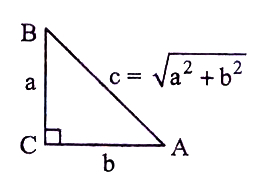
With usual notations in $\Delta ABC$,if $C=90^{\circ}$,then $\tan ^{-1}\left(\frac{a}{b+c}\right)+\tan ^{-1}\left(\frac{b}{c+a}\right)=$
A
$\frac{\pi}{4}$
B
$\frac{\pi}{6}$
C
$\pi$
D
$\frac{\pi}{3}$
Solution
(A) Given that in $\Delta ABC$,$C=90^{\circ}$,therefore by Pythagoras theorem,$a^{2}+b^{2}=c^{2}$.
We need to evaluate $\tan ^{-1}\left(\frac{a}{b+c}\right)+\tan ^{-1}\left(\frac{b}{c+a}\right)$.
Using the formula $\tan ^{-1} x + \tan ^{-1} y = \tan ^{-1} \left( \frac{x+y}{1-xy} \right)$:
$= \tan ^{-1} \left[ \frac{\frac{a}{b+c} + \frac{b}{c+a}}{1 - \left( \frac{a}{b+c} \right) \left( \frac{b}{c+a} \right)} \right]$
$= \tan ^{-1} \left[ \frac{a(c+a) + b(b+c)}{(b+c)(c+a) - ab} \right]$
$= \tan ^{-1} \left[ \frac{ac + a^{2} + b^{2} + bc}{bc + ab + c^{2} + ac - ab} \right]$
Since $a^{2}+b^{2}=c^{2}$,the numerator becomes $ac + c^{2} + bc = c(a+b+c)$.
The denominator becomes $bc + ac + c^{2} = c(b+a+c)$.
$= \tan ^{-1} \left( \frac{c(a+b+c)}{c(a+b+c)} \right)$
$= \tan ^{-1}(1) = \frac{\pi}{4}$.
We need to evaluate $\tan ^{-1}\left(\frac{a}{b+c}\right)+\tan ^{-1}\left(\frac{b}{c+a}\right)$.
Using the formula $\tan ^{-1} x + \tan ^{-1} y = \tan ^{-1} \left( \frac{x+y}{1-xy} \right)$:
$= \tan ^{-1} \left[ \frac{\frac{a}{b+c} + \frac{b}{c+a}}{1 - \left( \frac{a}{b+c} \right) \left( \frac{b}{c+a} \right)} \right]$
$= \tan ^{-1} \left[ \frac{a(c+a) + b(b+c)}{(b+c)(c+a) - ab} \right]$
$= \tan ^{-1} \left[ \frac{ac + a^{2} + b^{2} + bc}{bc + ab + c^{2} + ac - ab} \right]$
Since $a^{2}+b^{2}=c^{2}$,the numerator becomes $ac + c^{2} + bc = c(a+b+c)$.
The denominator becomes $bc + ac + c^{2} = c(b+a+c)$.
$= \tan ^{-1} \left( \frac{c(a+b+c)}{c(a+b+c)} \right)$
$= \tan ^{-1}(1) = \frac{\pi}{4}$.
0 likesView Solution
285
MathematicsEasyMCQMHT CET · 2020
$\left[\sin \left(\tan ^{-1} \frac{3}{4}\right)\right]^{2}+\left[\sin \left(\tan ^{-1} \frac{4}{3}\right)\right]^{2}=$
A
$5$
B
$1$
C
$-1$
D
$0$
Solution
(B) Let $\tan ^{-1} \frac{3}{4} = \theta$. Then $\tan \theta = \frac{3}{4}$.
Using the identity $\sin \theta = \frac{\tan \theta}{\sqrt{1 + \tan^2 \theta}}$,we get $\sin \theta = \frac{3/4}{\sqrt{1 + (3/4)^2}} = \frac{3/4}{\sqrt{25/16}} = \frac{3/4}{5/4} = \frac{3}{5}$.
Thus,$\left[\sin \left(\tan ^{-1} \frac{3}{4}\right)\right]^2 = \left(\frac{3}{5}\right)^2 = \frac{9}{25}$.
Let $\tan ^{-1} \frac{4}{3} = \phi$. Then $\tan \phi = \frac{4}{3}$.
Using the identity $\sin \phi = \frac{\tan \phi}{\sqrt{1 + \tan^2 \phi}}$,we get $\sin \phi = \frac{4/3}{\sqrt{1 + (4/3)^2}} = \frac{4/3}{\sqrt{25/9}} = \frac{4/3}{5/3} = \frac{4}{5}$.
Thus,$\left[\sin \left(\tan ^{-1} \frac{4}{3}\right)\right]^2 = \left(\frac{4}{5}\right)^2 = \frac{16}{25}$.
Adding the two values: $\frac{9}{25} + \frac{16}{25} = \frac{25}{25} = 1$.
Using the identity $\sin \theta = \frac{\tan \theta}{\sqrt{1 + \tan^2 \theta}}$,we get $\sin \theta = \frac{3/4}{\sqrt{1 + (3/4)^2}} = \frac{3/4}{\sqrt{25/16}} = \frac{3/4}{5/4} = \frac{3}{5}$.
Thus,$\left[\sin \left(\tan ^{-1} \frac{3}{4}\right)\right]^2 = \left(\frac{3}{5}\right)^2 = \frac{9}{25}$.
Let $\tan ^{-1} \frac{4}{3} = \phi$. Then $\tan \phi = \frac{4}{3}$.
Using the identity $\sin \phi = \frac{\tan \phi}{\sqrt{1 + \tan^2 \phi}}$,we get $\sin \phi = \frac{4/3}{\sqrt{1 + (4/3)^2}} = \frac{4/3}{\sqrt{25/9}} = \frac{4/3}{5/3} = \frac{4}{5}$.
Thus,$\left[\sin \left(\tan ^{-1} \frac{4}{3}\right)\right]^2 = \left(\frac{4}{5}\right)^2 = \frac{16}{25}$.
Adding the two values: $\frac{9}{25} + \frac{16}{25} = \frac{25}{25} = 1$.
0 likesView Solution
286
MathematicsEasyMCQMHT CET · 2020
If $x^{2} y^{2} = \sin^{-1} \sqrt{x^{2} + y^{2}} + \cos^{-1} \sqrt{x^{2} + y^{2}}$,then $\frac{dy}{dx} = $
A
$\frac{-y}{x}$
B
$\frac{x}{y}$
C
$\frac{y}{x}$
D
$\frac{-x}{y}$
Solution
(A) We know that for any $\theta \in [-1, 1]$,$\sin^{-1} \theta + \cos^{-1} \theta = \frac{\pi}{2}$.
Given the equation $x^{2} y^{2} = \sin^{-1} \sqrt{x^{2} + y^{2}} + \cos^{-1} \sqrt{x^{2} + y^{2}}$,we can simplify the right side to get $x^{2} y^{2} = \frac{\pi}{2}$.
Differentiating both sides with respect to $x$ using the product rule:
$\frac{d}{dx}(x^{2} y^{2}) = \frac{d}{dx}(\frac{\pi}{2})$
$x^{2} \cdot (2y \frac{dy}{dx}) + y^{2} \cdot (2x) = 0$
$2x^{2}y \frac{dy}{dx} = -2xy^{2}$
Dividing both sides by $2xy$ (assuming $x, y \neq 0$):
$\frac{dy}{dx} = \frac{-2xy^{2}}{2x^{2}y} = -\frac{y}{x}$.
Given the equation $x^{2} y^{2} = \sin^{-1} \sqrt{x^{2} + y^{2}} + \cos^{-1} \sqrt{x^{2} + y^{2}}$,we can simplify the right side to get $x^{2} y^{2} = \frac{\pi}{2}$.
Differentiating both sides with respect to $x$ using the product rule:
$\frac{d}{dx}(x^{2} y^{2}) = \frac{d}{dx}(\frac{\pi}{2})$
$x^{2} \cdot (2y \frac{dy}{dx}) + y^{2} \cdot (2x) = 0$
$2x^{2}y \frac{dy}{dx} = -2xy^{2}$
Dividing both sides by $2xy$ (assuming $x, y \neq 0$):
$\frac{dy}{dx} = \frac{-2xy^{2}}{2x^{2}y} = -\frac{y}{x}$.
0 likesView Solution
287
MathematicsEasyMCQMHT CET · 2020
$\int_{-1}^{3} \left[ \tan^{-1} \left( \frac{x}{x^{2}+1} \right) + \tan^{-1} \left( \frac{x^{2}+1}{x} \right) \right] dx =$
A
$\pi$
B
$2 \pi$
C
$\frac{\pi}{2}$
D
$\frac{\pi}{4}$
Solution
(B) We know that $\tan^{-1}(u) + \cot^{-1}(u) = \frac{\pi}{2}$ for any $u > 0$.
Given the integral $I = \int_{-1}^{3} \left[ \tan^{-1} \left( \frac{x}{x^{2}+1} \right) + \tan^{-1} \left( \frac{x^{2}+1}{x} \right) \right] dx$.
Since $\tan^{-1} \left( \frac{x^{2}+1}{x} \right) = \cot^{-1} \left( \frac{x}{x^{2}+1} \right)$ for $x > 0$,the expression inside the integral becomes $\tan^{-1} \left( \frac{x}{x^{2}+1} \right) + \cot^{-1} \left( \frac{x}{x^{2}+1} \right) = \frac{\pi}{2}$.
Thus,$I = \int_{-1}^{3} \frac{\pi}{2} dx = \frac{\pi}{2} [x]_{-1}^{3} = \frac{\pi}{2} (3 - (-1)) = \frac{\pi}{2} (4) = 2 \pi$.
Given the integral $I = \int_{-1}^{3} \left[ \tan^{-1} \left( \frac{x}{x^{2}+1} \right) + \tan^{-1} \left( \frac{x^{2}+1}{x} \right) \right] dx$.
Since $\tan^{-1} \left( \frac{x^{2}+1}{x} \right) = \cot^{-1} \left( \frac{x}{x^{2}+1} \right)$ for $x > 0$,the expression inside the integral becomes $\tan^{-1} \left( \frac{x}{x^{2}+1} \right) + \cot^{-1} \left( \frac{x}{x^{2}+1} \right) = \frac{\pi}{2}$.
Thus,$I = \int_{-1}^{3} \frac{\pi}{2} dx = \frac{\pi}{2} [x]_{-1}^{3} = \frac{\pi}{2} (3 - (-1)) = \frac{\pi}{2} (4) = 2 \pi$.
0 likesView Solution
288
MathematicsDifficultMCQMHT CET · 2020
If $\tan ^{-1} x + \tan ^{-1} y + \tan ^{-1} z = \frac{\pi}{2}$,where $x, y, z > 0$ and $xy < 1$,then the value of $xy + yz + zx$ is:
A
$xyz$
B
$0$
C
$1$
D
$-xyz$
Solution
(C) Given: $\tan ^{-1} x + \tan ^{-1} y + \tan ^{-1} z = \frac{\pi}{2}$
$\tan ^{-1} x + \tan ^{-1} y = \frac{\pi}{2} - \tan ^{-1} z$
Using the identity $\frac{\pi}{2} - \tan ^{-1} z = \cot ^{-1} z = \tan ^{-1} (\frac{1}{z})$:
$\tan ^{-1} (\frac{x+y}{1-xy}) = \tan ^{-1} (\frac{1}{z})$
Comparing both sides:
$\frac{x+y}{1-xy} = \frac{1}{z}$
$z(x+y) = 1 - xy$
$zx + zy = 1 - xy$
$xy + yz + zx = 1$
$\tan ^{-1} x + \tan ^{-1} y = \frac{\pi}{2} - \tan ^{-1} z$
Using the identity $\frac{\pi}{2} - \tan ^{-1} z = \cot ^{-1} z = \tan ^{-1} (\frac{1}{z})$:
$\tan ^{-1} (\frac{x+y}{1-xy}) = \tan ^{-1} (\frac{1}{z})$
Comparing both sides:
$\frac{x+y}{1-xy} = \frac{1}{z}$
$z(x+y) = 1 - xy$
$zx + zy = 1 - xy$
$xy + yz + zx = 1$
0 likesView Solution
289
MathematicsEasyMCQMHT CET · 2020
The value of $\tan \left(\cos ^{-1}\left(\frac{4}{5}\right)+\tan ^{-1}\left(\frac{2}{3}\right)\right)$ is
A
$\frac{6}{17}$
B
$\frac{7}{16}$
C
$\frac{16}{7}$
D
$\frac{17}{6}$
Solution
(D) We know that $\cos ^{-1}\left(\frac{4}{5}\right) = \tan ^{-1}\left(\frac{3}{4}\right)$ because in a right-angled triangle with base $4$ and hypotenuse $5$,the perpendicular is $\sqrt{5^2 - 4^2} = 3$.
Substituting this into the expression:
$\tan \left(\tan ^{-1}\left(\frac{3}{4}\right) + \tan ^{-1}\left(\frac{2}{3}\right)\right)$
Using the formula $\tan ^{-1}(x) + \tan ^{-1}(y) = \tan ^{-1}\left(\frac{x+y}{1-xy}\right)$:
$= \tan \left(\tan ^{-1}\left(\frac{\frac{3}{4} + \frac{2}{3}}{1 - \frac{3}{4} \times \frac{2}{3}}\right)\right)$
$= \tan \left(\tan ^{-1}\left(\frac{\frac{9+8}{12}}{1 - \frac{6}{12}}\right)\right)$
$= \tan \left(\tan ^{-1}\left(\frac{\frac{17}{12}}{\frac{6}{12}}\right)\right)$
$= \tan \left(\tan ^{-1}\left(\frac{17}{6}\right)\right) = \frac{17}{6}$
Substituting this into the expression:
$\tan \left(\tan ^{-1}\left(\frac{3}{4}\right) + \tan ^{-1}\left(\frac{2}{3}\right)\right)$
Using the formula $\tan ^{-1}(x) + \tan ^{-1}(y) = \tan ^{-1}\left(\frac{x+y}{1-xy}\right)$:
$= \tan \left(\tan ^{-1}\left(\frac{\frac{3}{4} + \frac{2}{3}}{1 - \frac{3}{4} \times \frac{2}{3}}\right)\right)$
$= \tan \left(\tan ^{-1}\left(\frac{\frac{9+8}{12}}{1 - \frac{6}{12}}\right)\right)$
$= \tan \left(\tan ^{-1}\left(\frac{\frac{17}{12}}{\frac{6}{12}}\right)\right)$
$= \tan \left(\tan ^{-1}\left(\frac{17}{6}\right)\right) = \frac{17}{6}$
0 likesView Solution
290
MathematicsMediumMCQMHT CET · 2020
If $\tan ^{-1}\left(\frac{1-x}{1+x}\right)-\frac{1}{2} \tan ^{-1} x=0$,for $x>0$,then $x=$
A
$\sqrt{3}$
B
$\frac{1}{\sqrt{2}}$
C
$\frac{1}{\sqrt{3}}$
D
$\frac{1}{3}$
Solution
(C) Given equation is $\tan ^{-1}\left(\frac{1-x}{1+x}\right)-\frac{1}{2} \tan ^{-1} x=0$.
Rearranging the terms,we get $\tan ^{-1}\left(\frac{1-x}{1+x}\right)=\frac{1}{2} \tan ^{-1} x$.
Using the property $\tan ^{-1} a - \tan ^{-1} b = \tan ^{-1}\left(\frac{a-b}{1+ab}\right)$,we can write $\tan ^{-1}(1) - \tan ^{-1}(x) = \frac{1}{2} \tan ^{-1} x$.
This simplifies to $\frac{\pi}{4} = \frac{1}{2} \tan ^{-1} x + \tan ^{-1} x$.
$\frac{\pi}{4} = \frac{3}{2} \tan ^{-1} x$.
$\tan ^{-1} x = \frac{\pi}{4} \times \frac{2}{3} = \frac{\pi}{6}$.
Therefore,$x = \tan\left(\frac{\pi}{6}\right) = \frac{1}{\sqrt{3}}$.
Rearranging the terms,we get $\tan ^{-1}\left(\frac{1-x}{1+x}\right)=\frac{1}{2} \tan ^{-1} x$.
Using the property $\tan ^{-1} a - \tan ^{-1} b = \tan ^{-1}\left(\frac{a-b}{1+ab}\right)$,we can write $\tan ^{-1}(1) - \tan ^{-1}(x) = \frac{1}{2} \tan ^{-1} x$.
This simplifies to $\frac{\pi}{4} = \frac{1}{2} \tan ^{-1} x + \tan ^{-1} x$.
$\frac{\pi}{4} = \frac{3}{2} \tan ^{-1} x$.
$\tan ^{-1} x = \frac{\pi}{4} \times \frac{2}{3} = \frac{\pi}{6}$.
Therefore,$x = \tan\left(\frac{\pi}{6}\right) = \frac{1}{\sqrt{3}}$.
0 likesView Solution
291
MathematicsMediumMCQMHT CET · 2020
$2 \tan ^{-1}\left(\frac{1}{3}\right)-\tan ^{-1}\left(\frac{3}{4}\right)=$
A
$0$
B
$2$
C
$1$
D
$3$
Solution
(A) We use the formula $2 \tan ^{-1} x = \tan ^{-1} \left( \frac{2x}{1-x^2} \right)$.
For $x = \frac{1}{3}$,we have:
$2 \tan ^{-1} \left( \frac{1}{3} \right) = \tan ^{-1} \left( \frac{2 \times \frac{1}{3}}{1 - (\frac{1}{3})^2} \right)$
$= \tan ^{-1} \left( \frac{\frac{2}{3}}{1 - \frac{1}{9}} \right)$
$= \tan ^{-1} \left( \frac{\frac{2}{3}}{\frac{8}{9}} \right)$
$= \tan ^{-1} \left( \frac{2}{3} \times \frac{9}{8} \right) = \tan ^{-1} \left( \frac{3}{4} \right)$
Now,substituting this back into the original expression:
$2 \tan ^{-1} \left( \frac{1}{3} \right) - \tan ^{-1} \left( \frac{3}{4} \right) = \tan ^{-1} \left( \frac{3}{4} \right) - \tan ^{-1} \left( \frac{3}{4} \right) = 0$.
For $x = \frac{1}{3}$,we have:
$2 \tan ^{-1} \left( \frac{1}{3} \right) = \tan ^{-1} \left( \frac{2 \times \frac{1}{3}}{1 - (\frac{1}{3})^2} \right)$
$= \tan ^{-1} \left( \frac{\frac{2}{3}}{1 - \frac{1}{9}} \right)$
$= \tan ^{-1} \left( \frac{\frac{2}{3}}{\frac{8}{9}} \right)$
$= \tan ^{-1} \left( \frac{2}{3} \times \frac{9}{8} \right) = \tan ^{-1} \left( \frac{3}{4} \right)$
Now,substituting this back into the original expression:
$2 \tan ^{-1} \left( \frac{1}{3} \right) - \tan ^{-1} \left( \frac{3}{4} \right) = \tan ^{-1} \left( \frac{3}{4} \right) - \tan ^{-1} \left( \frac{3}{4} \right) = 0$.
0 likesView Solution
292
MathematicsMediumMCQMHT CET · 2020
The value of $\tan ^{-1}\left(\frac{1}{3}\right)+\tan ^{-1}\left(\frac{1}{5}\right)+\tan ^{-1}\left(\frac{1}{7}\right)+\tan ^{-1}\left(\frac{1}{8}\right)$ is
A
$\frac{\pi}{3}$
B
$\frac{\pi}{12}$
C
$\frac{\pi}{4}$
D
$\frac{\pi}{6}$
Solution
(C) We use the formula $\tan ^{-1} x + \tan ^{-1} y = \tan ^{-1} \left( \frac{x+y}{1-xy} \right)$.
First,combine the first two terms:
$\tan ^{-1} \left( \frac{1}{3} \right) + \tan ^{-1} \left( \frac{1}{5} \right) = \tan ^{-1} \left( \frac{\frac{1}{3} + \frac{1}{5}}{1 - \frac{1}{3} \times \frac{1}{5}} \right) = \tan ^{-1} \left( \frac{\frac{8}{15}}{\frac{14}{15}} \right) = \tan ^{-1} \left( \frac{8}{14} \right) = \tan ^{-1} \left( \frac{4}{7} \right)$.
Now,combine the last two terms:
$\tan ^{-1} \left( \frac{1}{7} \right) + \tan ^{-1} \left( \frac{1}{8} \right) = \tan ^{-1} \left( \frac{\frac{1}{7} + \frac{1}{8}}{1 - \frac{1}{7} \times \frac{1}{8}} \right) = \tan ^{-1} \left( \frac{\frac{15}{56}}{\frac{55}{56}} \right) = \tan ^{-1} \left( \frac{15}{55} \right) = \tan ^{-1} \left( \frac{3}{11} \right)$.
Finally,add the results:
$\tan ^{-1} \left( \frac{4}{7} \right) + \tan ^{-1} \left( \frac{3}{11} \right) = \tan ^{-1} \left( \frac{\frac{4}{7} + \frac{3}{11}}{1 - \frac{4}{7} \times \frac{3}{11}} \right) = \tan ^{-1} \left( \frac{\frac{44+21}{77}}{\frac{77-12}{77}} \right) = \tan ^{-1} \left( \frac{65}{65} \right) = \tan ^{-1} (1) = \frac{\pi}{4}$.
Thus,the correct option is $C$.
First,combine the first two terms:
$\tan ^{-1} \left( \frac{1}{3} \right) + \tan ^{-1} \left( \frac{1}{5} \right) = \tan ^{-1} \left( \frac{\frac{1}{3} + \frac{1}{5}}{1 - \frac{1}{3} \times \frac{1}{5}} \right) = \tan ^{-1} \left( \frac{\frac{8}{15}}{\frac{14}{15}} \right) = \tan ^{-1} \left( \frac{8}{14} \right) = \tan ^{-1} \left( \frac{4}{7} \right)$.
Now,combine the last two terms:
$\tan ^{-1} \left( \frac{1}{7} \right) + \tan ^{-1} \left( \frac{1}{8} \right) = \tan ^{-1} \left( \frac{\frac{1}{7} + \frac{1}{8}}{1 - \frac{1}{7} \times \frac{1}{8}} \right) = \tan ^{-1} \left( \frac{\frac{15}{56}}{\frac{55}{56}} \right) = \tan ^{-1} \left( \frac{15}{55} \right) = \tan ^{-1} \left( \frac{3}{11} \right)$.
Finally,add the results:
$\tan ^{-1} \left( \frac{4}{7} \right) + \tan ^{-1} \left( \frac{3}{11} \right) = \tan ^{-1} \left( \frac{\frac{4}{7} + \frac{3}{11}}{1 - \frac{4}{7} \times \frac{3}{11}} \right) = \tan ^{-1} \left( \frac{\frac{44+21}{77}}{\frac{77-12}{77}} \right) = \tan ^{-1} \left( \frac{65}{65} \right) = \tan ^{-1} (1) = \frac{\pi}{4}$.
Thus,the correct option is $C$.
0 likesView Solution
293
MathematicsMediumMCQMHT CET · 2020
If $\sin ^{-1} x+\sin ^{-1} y+\sin ^{-1} z=\frac{3 \pi}{2}$,then $x^{100}+y^{100}+z^{100}=$
A
$3$
B
$4$
C
$2$
D
$1$
Solution
(A) We know that the range of $\sin ^{-1} \theta$ is $[-\frac{\pi}{2}, \frac{\pi}{2}]$.
Since the sum of three such values is $\frac{3 \pi}{2}$,each term must be equal to its maximum value,$\frac{\pi}{2}$.
Thus,$\sin ^{-1} x = \frac{\pi}{2}$,$\sin ^{-1} y = \frac{\pi}{2}$,and $\sin ^{-1} z = \frac{\pi}{2}$.
This implies $x = \sin(\frac{\pi}{2}) = 1$,$y = \sin(\frac{\pi}{2}) = 1$,and $z = \sin(\frac{\pi}{2}) = 1$.
Substituting these values into the expression,we get $x^{100} + y^{100} + z^{100} = 1^{100} + 1^{100} + 1^{100} = 1 + 1 + 1 = 3$.
Since the sum of three such values is $\frac{3 \pi}{2}$,each term must be equal to its maximum value,$\frac{\pi}{2}$.
Thus,$\sin ^{-1} x = \frac{\pi}{2}$,$\sin ^{-1} y = \frac{\pi}{2}$,and $\sin ^{-1} z = \frac{\pi}{2}$.
This implies $x = \sin(\frac{\pi}{2}) = 1$,$y = \sin(\frac{\pi}{2}) = 1$,and $z = \sin(\frac{\pi}{2}) = 1$.
Substituting these values into the expression,we get $x^{100} + y^{100} + z^{100} = 1^{100} + 1^{100} + 1^{100} = 1 + 1 + 1 = 3$.
0 likesView Solution
294
MathematicsEasyMCQMHT CET · 2020
If $f(x) = \left(\frac{2^{x}-1}{1-3^{x}}\right)$ for $x \neq 0$ is continuous at $x = 0$,then $f(0) = $
A
$-\log_{3} 2$
B
$-\frac{\log 2}{\log 3}$
C
$\frac{\log 2}{\log 3}$
D
$-\log 2$
Solution
(B) For $f(x)$ to be continuous at $x = 0$,we must have $f(0) = \lim_{x \to 0} f(x)$.
$f(0) = \lim_{x \to 0} \frac{2^{x}-1}{1-3^{x}}$
$f(0) = \lim_{x \to 0} \frac{2^{x}-1}{-(3^{x}-1)}$
$f(0) = -\frac{\lim_{x \to 0} \frac{2^{x}-1}{x}}{\lim_{x \to 0} \frac{3^{x}-1}{x}}$
Using the standard limit $\lim_{x \to 0} \frac{a^{x}-1}{x} = \log a$,we get:
$f(0) = -\frac{\log 2}{\log 3}$
$f(0) = \lim_{x \to 0} \frac{2^{x}-1}{1-3^{x}}$
$f(0) = \lim_{x \to 0} \frac{2^{x}-1}{-(3^{x}-1)}$
$f(0) = -\frac{\lim_{x \to 0} \frac{2^{x}-1}{x}}{\lim_{x \to 0} \frac{3^{x}-1}{x}}$
Using the standard limit $\lim_{x \to 0} \frac{a^{x}-1}{x} = \log a$,we get:
$f(0) = -\frac{\log 2}{\log 3}$
0 likesView Solution
295
MathematicsMediumMCQMHT CET · 2020
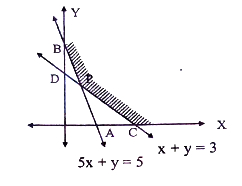
If $Z = 7x + y$ subject to $5x + y \geq 5$,$x + y \geq 3$,$x \geq 0$,$y \geq 0$,then the minimum value of $Z$ is
A
$2$
B
$5$
C
$6$
D
$3$
Solution
(B) The feasible region is the unbounded region defined by the constraints $5x + y \geq 5$,$x + y \geq 3$,$x \geq 0$,and $y \geq 0$.
To find the corner points,we solve the equations of the lines:
$1$) $5x + y = 5$ and $x + y = 3$. Subtracting the second from the first gives $4x = 2$,so $x = 0.5$. Substituting into $x + y = 3$ gives $y = 2.5$. Thus,point $P = (0.5, 2.5)$.
$2$) The intersection of $x + y = 3$ with the $x$-axis $(y=0)$ is $C = (3, 0)$.
$3$) The intersection of $5x + y = 5$ with the $y$-axis $(x=0)$ is $B = (0, 5)$.
We evaluate $Z = 7x + y$ at these corner points:
At $C(3, 0)$: $Z = 7(3) + 0 = 21$.
At $P(0.5, 2.5)$: $Z = 7(0.5) + 2.5 = 3.5 + 2.5 = 6$.
At $B(0, 5)$: $Z = 7(0) + 5 = 5$.
Since the feasible region is unbounded,we check if the minimum value $5$ is attained. The value $5$ is the minimum among the corner points. Testing a point in the region,e.g.,$(1, 3)$,$Z = 7(1) + 3 = 10 > 5$. Thus,the minimum value is $5$.
To find the corner points,we solve the equations of the lines:
$1$) $5x + y = 5$ and $x + y = 3$. Subtracting the second from the first gives $4x = 2$,so $x = 0.5$. Substituting into $x + y = 3$ gives $y = 2.5$. Thus,point $P = (0.5, 2.5)$.
$2$) The intersection of $x + y = 3$ with the $x$-axis $(y=0)$ is $C = (3, 0)$.
$3$) The intersection of $5x + y = 5$ with the $y$-axis $(x=0)$ is $B = (0, 5)$.
We evaluate $Z = 7x + y$ at these corner points:
At $C(3, 0)$: $Z = 7(3) + 0 = 21$.
At $P(0.5, 2.5)$: $Z = 7(0.5) + 2.5 = 3.5 + 2.5 = 6$.
At $B(0, 5)$: $Z = 7(0) + 5 = 5$.
Since the feasible region is unbounded,we check if the minimum value $5$ is attained. The value $5$ is the minimum among the corner points. Testing a point in the region,e.g.,$(1, 3)$,$Z = 7(1) + 3 = 10 > 5$. Thus,the minimum value is $5$.
0 likesView Solution
296
MathematicsMediumMCQMHT CET · 2020
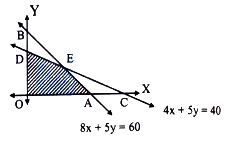
The feasible region of the $L$.$P$.$P$. (Linear Programming Problem) to maximize $z = 70x + 50y$ subject to the constraints $8x + 5y \leq 60$,$4x + 5y \leq 40$ and $x \geq 0, y \geq 0$ is:
A
a triangle
B
a square
C
a pentagon
D
a quadrilateral
Solution
(D) To find the feasible region,we first determine the intercepts of the boundary lines:
Solving the equations $8x + 5y = 60$ and $4x + 5y = 40$ simultaneously:
Subtracting the second from the first: $(8x - 4x) = 60 - 40 \Rightarrow 4x = 20 \Rightarrow x = 5$.
Substituting $x = 5$ into $4x + 5y = 40$: $4(5) + 5y = 40 \Rightarrow 20 + 5y = 40 \Rightarrow 5y = 20 \Rightarrow y = 4$.
So,the intersection point is $E(5, 4)$.
The constraints $x \geq 0, y \geq 0$ restrict the region to the first quadrant.
The feasible region is bounded by the vertices $O(0, 0)$,$A(7.5, 0)$,$E(5, 4)$,and $D(0, 8)$.
Since there are four vertices,the feasible region is a quadrilateral.
| $\text{Line}$ | $\text{Intercepts}$ |
| $8x + 5y = 60$ | $A(7.5, 0), B(0, 12)$ |
| $4x + 5y = 40$ | $C(10, 0), D(0, 8)$ |
Solving the equations $8x + 5y = 60$ and $4x + 5y = 40$ simultaneously:
Subtracting the second from the first: $(8x - 4x) = 60 - 40 \Rightarrow 4x = 20 \Rightarrow x = 5$.
Substituting $x = 5$ into $4x + 5y = 40$: $4(5) + 5y = 40 \Rightarrow 20 + 5y = 40 \Rightarrow 5y = 20 \Rightarrow y = 4$.
So,the intersection point is $E(5, 4)$.
The constraints $x \geq 0, y \geq 0$ restrict the region to the first quadrant.
The feasible region is bounded by the vertices $O(0, 0)$,$A(7.5, 0)$,$E(5, 4)$,and $D(0, 8)$.
Since there are four vertices,the feasible region is a quadrilateral.
0 likesView Solution
297
MathematicsEasyMCQMHT CET · 2020
The $L$.$P$.$P$. to maximize $z=x+y$,subject to $x+y \leq 30, x \leq 15, y \leq 20, x+y \geq 15$,and $x, y \geq 0$ has
A
no solution.
B
a unique solution.
C
infinite solutions.
D
unbounded solutions.
Solution
(B) To find the solution,we first identify the feasible region defined by the constraints:
$1$. $x+y \leq 30$
$2$. $x \leq 15$
$3$. $y \leq 20$
$4$. $x+y \geq 15$
$5$. $x, y \geq 0$
The vertices of the feasible region are determined by the intersection of these lines:
- Intersection of $x=15$ and $y=20$ is $E(15, 20)$.
- Intersection of $x=0$ and $y=20$ is $D(0, 20)$.
- Intersection of $x=0$ and $x+y=15$ is $F(0, 15)$.
- Intersection of $x=15$ and $x+y=15$ is $C(15, 0)$.
The feasible region is the quadrilateral $CDEF$.
We evaluate the objective function $z=x+y$ at these vertices:
- At $C(15, 0): z = 15+0 = 15$
- At $D(0, 20): z = 0+20 = 20$
- At $E(15, 20): z = 15+20 = 35$
- At $F(0, 15): z = 0+15 = 15$
The maximum value of $z$ is $35$,which occurs at the unique vertex $E(15, 20)$. Therefore,the $L$.$P$.$P$. has a unique solution.
$1$. $x+y \leq 30$
$2$. $x \leq 15$
$3$. $y \leq 20$
$4$. $x+y \geq 15$
$5$. $x, y \geq 0$
The vertices of the feasible region are determined by the intersection of these lines:
- Intersection of $x=15$ and $y=20$ is $E(15, 20)$.
- Intersection of $x=0$ and $y=20$ is $D(0, 20)$.
- Intersection of $x=0$ and $x+y=15$ is $F(0, 15)$.
- Intersection of $x=15$ and $x+y=15$ is $C(15, 0)$.
The feasible region is the quadrilateral $CDEF$.
We evaluate the objective function $z=x+y$ at these vertices:
- At $C(15, 0): z = 15+0 = 15$
- At $D(0, 20): z = 0+20 = 20$
- At $E(15, 20): z = 15+20 = 35$
- At $F(0, 15): z = 0+15 = 15$
The maximum value of $z$ is $35$,which occurs at the unique vertex $E(15, 20)$. Therefore,the $L$.$P$.$P$. has a unique solution.
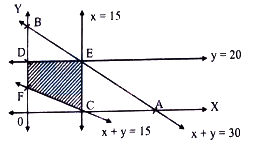
0 likesView Solution
298
MathematicsEasyMCQMHT CET · 2020
For the following shaded region,the linear constraints are:
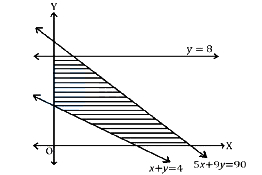
A
$5x + 9y \leq 90, x + y \geq 4, y \geq 8, x, y \geq 0$
B
$5x + 9y \geq 90, x + y \leq 4, y \leq 8, x, y \geq 0$
C
$5x + 9y \geq 90, x + y \geq 4, y \geq 8, x, y \geq 0$
D
$5x + 9y \leq 90, x + y \geq 4, y \leq 8, x, y \geq 0$
Solution
(D) $1$. The line $5x + 9y = 90$ passes through $(18, 0)$ and $(0, 10)$. The shaded region is towards the origin,so the constraint is $5x + 9y \leq 90$.
$2$. The line $x + y = 4$ passes through $(4, 0)$ and $(0, 4)$. The shaded region is away from the origin,so the constraint is $x + y \geq 4$.
$3$. The line $y = 8$ is a horizontal line. The shaded region is below this line,so the constraint is $y \leq 8$.
$4$. Since the region is in the first quadrant,$x \geq 0$ and $y \geq 0$.
Combining these,the constraints are $5x + 9y \leq 90, x + y \geq 4, y \leq 8, x, y \geq 0$.
$2$. The line $x + y = 4$ passes through $(4, 0)$ and $(0, 4)$. The shaded region is away from the origin,so the constraint is $x + y \geq 4$.
$3$. The line $y = 8$ is a horizontal line. The shaded region is below this line,so the constraint is $y \leq 8$.
$4$. Since the region is in the first quadrant,$x \geq 0$ and $y \geq 0$.
Combining these,the constraints are $5x + 9y \leq 90, x + y \geq 4, y \leq 8, x, y \geq 0$.
0 likesView Solution
299
MathematicsEasyMCQMHT CET · 2020
The maximum value of $Z=3x+5y$,subject to the constraints $x+4y \leq 24$,$y \leq 4$,$x \geq 0$,$y \geq 0$ is:
A
$20$
B
$120$
C
$72$
D
$44$
Solution
(C) To find the maximum value of $Z=3x+5y$,we first identify the feasible region defined by the constraints $x+4y \leq 24$,$y \leq 4$,$x \geq 0$,and $y \geq 0$.
The vertices of the feasible region are $O(0,0)$,$A(24,0)$,$D(8,4)$,and $C(0,4)$.
We evaluate the objective function $Z=3x+5y$ at each vertex:
$1$. At $O(0,0)$: $Z = 3(0) + 5(0) = 0$
$2$. At $A(24,0)$: $Z = 3(24) + 5(0) = 72$
$3$. At $D(8,4)$: $Z = 3(8) + 5(4) = 24 + 20 = 44$
$4$. At $C(0,4)$: $Z = 3(0) + 5(4) = 20$
Comparing these values,the maximum value of $Z$ is $72$ at point $A(24,0)$.
The vertices of the feasible region are $O(0,0)$,$A(24,0)$,$D(8,4)$,and $C(0,4)$.
We evaluate the objective function $Z=3x+5y$ at each vertex:
$1$. At $O(0,0)$: $Z = 3(0) + 5(0) = 0$
$2$. At $A(24,0)$: $Z = 3(24) + 5(0) = 72$
$3$. At $D(8,4)$: $Z = 3(8) + 5(4) = 24 + 20 = 44$
$4$. At $C(0,4)$: $Z = 3(0) + 5(4) = 20$
Comparing these values,the maximum value of $Z$ is $72$ at point $A(24,0)$.
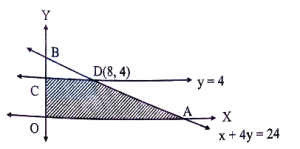
0 likesView Solution
300
MathematicsEasyMCQMHT CET · 2020
The maximum value of $Z=10 x+25 y$ subject to $0 \leq x \leq 3, 0 \leq y \leq 3, x+y \leq 5, x \geq 0, y \geq 0$ is
A
$110$
B
$100$
C
$120$
D
$95$
Solution
(D) Given the objective function $Z=10 x+25 y$ subject to the constraints $0 \leq x \leq 3, 0 \leq y \leq 3, x+y \leq 5, x \geq 0, y \geq 0$.
The feasible region is bounded by the vertices $O(0,0), C(3,0), F(3,2), G(2,3), D(0,3)$.
We evaluate $Z$ at each corner point:
$1$. At $O(0,0): Z = 10(0) + 25(0) = 0$
$2$. At $C(3,0): Z = 10(3) + 25(0) = 30$
$3$. At $F(3,2): Z = 10(3) + 25(2) = 30 + 50 = 80$
$4$. At $G(2,3): Z = 10(2) + 25(3) = 20 + 75 = 95$
$5$. At $D(0,3): Z = 10(0) + 25(3) = 75$
The maximum value of $Z$ is $95$ at the point $(2,3)$.
The feasible region is bounded by the vertices $O(0,0), C(3,0), F(3,2), G(2,3), D(0,3)$.
We evaluate $Z$ at each corner point:
$1$. At $O(0,0): Z = 10(0) + 25(0) = 0$
$2$. At $C(3,0): Z = 10(3) + 25(0) = 30$
$3$. At $F(3,2): Z = 10(3) + 25(2) = 30 + 50 = 80$
$4$. At $G(2,3): Z = 10(2) + 25(3) = 20 + 75 = 95$
$5$. At $D(0,3): Z = 10(0) + 25(3) = 75$
The maximum value of $Z$ is $95$ at the point $(2,3)$.
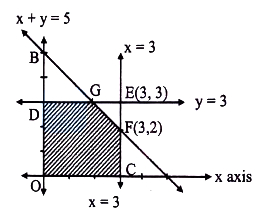
0 likesView Solution
Vedclass Products
For Students
Vedclass Test Series
Mock tests in real MHT CET style covering Mathematics with performance analysis. 5-day free trial.
Start Free TrialFor Teachers
Exam Paper Generator
Generate Set A/B/C/D Mathematics papers from 7.5L+ questions in 2 minutes. 3 chapters free.
Try FreeFor Institutes
Online Exam Module
Run live MHT CET mock exams with unlimited students, 360° analytics & white-label branding.
See DemoFrequently Asked Questions
How many Mathematics questions are in MHT CET 2020?
There are 698 Mathematics questions from the MHT CET 2020 paper on Vedclass, each with a detailed step-by-step solution in English.
Are MHT CET 2020 Mathematics solutions available in English?
Yes. All solutions on this page are in English. You can also switch to English or Hindi using the language buttons above the questions.
Can I practice MHT CET 2020 Mathematics as a timed test?
Yes. Use the Vedclass Test Series to attempt a full MHT CET mock test covering Mathematics with time limits and instant score analysis.
Can teachers create Mathematics papers from MHT CET previous year questions?
Yes. The Vedclass Exam Paper Generator lets teachers mix MHT CET Mathematics questions and generate Set A/B/C/D papers in minutes.
For Teachers & Institutes
Build a Custom Mathematics Paper
Pick MHT CET 2020 Mathematics questions, set difficulty, and generate Set A/B/C/D in 2 minutes.