
MathematicsQ451–490 of 698 questions
Page 10 of 10 · English
451
MathematicsEasyMCQMHT CET · 2020
If $y=\tan ^{-1}\left(\frac{\sin 2 x}{1+\cos 2 x}\right)$,then $\frac{d y}{d x}=$
A
$1$
B
$0$
C
$-1$
D
$2$
Solution
(A) Given $y=\tan ^{-1}\left(\frac{\sin 2 x}{1+\cos 2 x}\right)$.
Using trigonometric identities $\sin 2x = 2 \sin x \cos x$ and $1 + \cos 2x = 2 \cos^2 x$,we get:
$y = \tan^{-1}\left(\frac{2 \sin x \cos x}{2 \cos^2 x}\right)$
$y = \tan^{-1}(\tan x)$
$y = x$
Therefore,$\frac{dy}{dx} = \frac{d}{dx}(x) = 1$.
Using trigonometric identities $\sin 2x = 2 \sin x \cos x$ and $1 + \cos 2x = 2 \cos^2 x$,we get:
$y = \tan^{-1}\left(\frac{2 \sin x \cos x}{2 \cos^2 x}\right)$
$y = \tan^{-1}(\tan x)$
$y = x$
Therefore,$\frac{dy}{dx} = \frac{d}{dx}(x) = 1$.
0 likesView Solution
452
MathematicsDifficultMCQMHT CET · 2020
If $\bar{a}, \bar{b}, \bar{c}, \bar{d}$ are the position vectors of the points $A, B, C, D$ respectively such that $3 \bar{a}-\bar{b}+2 \bar{c}-4 \bar{d}=\overline{0}$,then the position vector of the point of intersection of the line segments $AC$ and $BD$ is
A
$\frac{\bar{b}+3 \bar{d}}{4}$
B
$\frac{3 \bar{a}+2 \bar{c}}{5}$
C
$\frac{\bar{a}+\bar{c}}{2}$
D
$\frac{\bar{b}+4 \bar{d}}{5}$
Solution
(B) Given the equation $3 \bar{a}-\bar{b}+2 \bar{c}-4 \bar{d}=\overline{0}$.
Rearranging the terms,we get $3 \bar{a}+2 \bar{c}=\bar{b}+4 \bar{d}$.
Dividing both sides by $5$,we have $\frac{3 \bar{a}+2 \bar{c}}{5}=\frac{\bar{b}+4 \bar{d}}{5}$.
Let $\bar{r} = \frac{3 \bar{a}+2 \bar{c}}{3+2} = \frac{\bar{b}+4 \bar{d}}{1+4}$.
This vector $\bar{r}$ represents a point that lies on the line segment $AC$ (dividing it in ratio $2:3$) and also on the line segment $BD$ (dividing it in ratio $4:1$).
Thus,$\bar{r}$ is the position vector of the point of intersection of $AC$ and $BD$.
Rearranging the terms,we get $3 \bar{a}+2 \bar{c}=\bar{b}+4 \bar{d}$.
Dividing both sides by $5$,we have $\frac{3 \bar{a}+2 \bar{c}}{5}=\frac{\bar{b}+4 \bar{d}}{5}$.
Let $\bar{r} = \frac{3 \bar{a}+2 \bar{c}}{3+2} = \frac{\bar{b}+4 \bar{d}}{1+4}$.
This vector $\bar{r}$ represents a point that lies on the line segment $AC$ (dividing it in ratio $2:3$) and also on the line segment $BD$ (dividing it in ratio $4:1$).
Thus,$\bar{r}$ is the position vector of the point of intersection of $AC$ and $BD$.
0 likesView Solution
453
MathematicsMediumMCQMHT CET · 2020
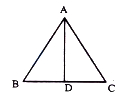
If $\vec{AB} = 3 \hat{i} + 5 \hat{j} + 4 \hat{k}$ and $\vec{AC} = 5 \hat{i} - 5 \hat{j} + 2 \hat{k}$ represent the sides of triangle $ABC$,then the length of the median through $A$ is
A
$\sqrt{6}$ units
B
$5$ units
C
$\sqrt{5}$ units
D
$6$ units
Solution
(B) Let $D$ be the midpoint of $BC$. The median through $A$ is the vector $\vec{AD}$.
Since $D$ is the midpoint of $BC$,the position vector of $D$ relative to $A$ is given by $\vec{AD} = \frac{1}{2}(\vec{AB} + \vec{AC})$.
Given $\vec{AB} = 3 \hat{i} + 5 \hat{j} + 4 \hat{k}$ and $\vec{AC} = 5 \hat{i} - 5 \hat{j} + 2 \hat{k}$.
Substituting these values:
$\vec{AD} = \frac{1}{2}((3 \hat{i} + 5 \hat{j} + 4 \hat{k}) + (5 \hat{i} - 5 \hat{j} + 2 \hat{k}))$
$\vec{AD} = \frac{1}{2}(8 \hat{i} + 0 \hat{j} + 6 \hat{k})$
$\vec{AD} = 4 \hat{i} + 3 \hat{k}$.
The length of the median is the magnitude of vector $\vec{AD}$:
$|\vec{AD}| = \sqrt{4^2 + 0^2 + 3^2} = \sqrt{16 + 9} = \sqrt{25} = 5$ units.
Since $D$ is the midpoint of $BC$,the position vector of $D$ relative to $A$ is given by $\vec{AD} = \frac{1}{2}(\vec{AB} + \vec{AC})$.
Given $\vec{AB} = 3 \hat{i} + 5 \hat{j} + 4 \hat{k}$ and $\vec{AC} = 5 \hat{i} - 5 \hat{j} + 2 \hat{k}$.
Substituting these values:
$\vec{AD} = \frac{1}{2}((3 \hat{i} + 5 \hat{j} + 4 \hat{k}) + (5 \hat{i} - 5 \hat{j} + 2 \hat{k}))$
$\vec{AD} = \frac{1}{2}(8 \hat{i} + 0 \hat{j} + 6 \hat{k})$
$\vec{AD} = 4 \hat{i} + 3 \hat{k}$.
The length of the median is the magnitude of vector $\vec{AD}$:
$|\vec{AD}| = \sqrt{4^2 + 0^2 + 3^2} = \sqrt{16 + 9} = \sqrt{25} = 5$ units.
0 likesView Solution
454
MathematicsDifficultMCQMHT CET · 2020
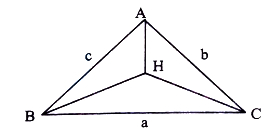
If $a, b, c$ are lengths of the sides $BC, CA, AB$ respectively of $\triangle ABC$ and $H$ is any point in the plane of $\triangle ABC$ such that $a \vec{AH} + b \vec{BH} + c \vec{CH} = \vec{0}$,then $H$ is the
A
Circumcentre of $\triangle ABC$
B
Incentre of $\triangle ABC$
C
Centroid of $\triangle ABC$
D
Orthocentre of $\triangle ABC$
Solution
(B) Let the position vector of $H$ be the origin $\vec{0}$.
Then the position vectors of the vertices $A, B, C$ are $\vec{a}, \vec{b}, \vec{c}$ respectively.
The given equation is $a \vec{AH} + b \vec{BH} + c \vec{CH} = \vec{0}$.
Since $H$ is the origin,$\vec{AH} = \vec{0} - \vec{a} = -\vec{a}$,$\vec{BH} = -\vec{b}$,and $\vec{CH} = -\vec{c}$.
Substituting these into the equation,we get $a(-\vec{a}) + b(-\vec{b}) + c(-\vec{c}) = \vec{0}$,which implies $a\vec{a} + b\vec{b} + c\vec{c} = \vec{0}$.
However,the standard definition of the incentre $I$ with position vector $\vec{i}$ is $\vec{i} = \frac{a\vec{A} + b\vec{B} + c\vec{C}}{a+b+c}$.
If $H$ is the incentre,then $a(\vec{A}-\vec{H}) + b(\vec{B}-\vec{H}) + c(\vec{C}-\vec{H}) = \vec{0}$.
This simplifies to $(a+b+c)\vec{H} = a\vec{A} + b\vec{B} + c\vec{C}$,which is the definition of the incentre.
Therefore,$H$ is the incentre of $\triangle ABC$.
Then the position vectors of the vertices $A, B, C$ are $\vec{a}, \vec{b}, \vec{c}$ respectively.
The given equation is $a \vec{AH} + b \vec{BH} + c \vec{CH} = \vec{0}$.
Since $H$ is the origin,$\vec{AH} = \vec{0} - \vec{a} = -\vec{a}$,$\vec{BH} = -\vec{b}$,and $\vec{CH} = -\vec{c}$.
Substituting these into the equation,we get $a(-\vec{a}) + b(-\vec{b}) + c(-\vec{c}) = \vec{0}$,which implies $a\vec{a} + b\vec{b} + c\vec{c} = \vec{0}$.
However,the standard definition of the incentre $I$ with position vector $\vec{i}$ is $\vec{i} = \frac{a\vec{A} + b\vec{B} + c\vec{C}}{a+b+c}$.
If $H$ is the incentre,then $a(\vec{A}-\vec{H}) + b(\vec{B}-\vec{H}) + c(\vec{C}-\vec{H}) = \vec{0}$.
This simplifies to $(a+b+c)\vec{H} = a\vec{A} + b\vec{B} + c\vec{C}$,which is the definition of the incentre.
Therefore,$H$ is the incentre of $\triangle ABC$.
0 likesView Solution
455
MathematicsEasyMCQMHT CET · 2020
If the vectors $\bar{a}=\hat{\imath}-2 \hat{\jmath}+\hat{k}$,$\bar{b}=2 \hat{\imath}-5 \hat{\jmath}+p \hat{k}$ and $\bar{c}=5 \hat{\imath}-9 \hat{\jmath}+4 \hat{k}$ are coplanar,then the value of $p$ is
A
$-3$
B
$3$
C
$\frac{1}{3}$
D
$-\frac{1}{3}$
Solution
(B) Since the vectors $\bar{a}$,$\bar{b}$,and $\bar{c}$ are coplanar,their scalar triple product must be zero,i.e.,$\bar{a} \cdot (\bar{b} \times \bar{c}) = 0$.
This is equivalent to the determinant of the matrix formed by their components being zero:
$\begin{vmatrix} 1 & -2 & 1 \\ 2 & -5 & p \\ 5 & -9 & 4 \end{vmatrix} = 0$.
Expanding the determinant along the first row:
$1((-5)(4) - (-9)(p)) - (-2)((2)(4) - (5)(p)) + 1((2)(-9) - (5)(-5)) = 0$.
$1(-20 + 9p) + 2(8 - 5p) + 1(-18 + 25) = 0$.
$-20 + 9p + 16 - 10p + 7 = 0$.
$-p + 3 = 0$.
Therefore,$p = 3$.
This is equivalent to the determinant of the matrix formed by their components being zero:
$\begin{vmatrix} 1 & -2 & 1 \\ 2 & -5 & p \\ 5 & -9 & 4 \end{vmatrix} = 0$.
Expanding the determinant along the first row:
$1((-5)(4) - (-9)(p)) - (-2)((2)(4) - (5)(p)) + 1((2)(-9) - (5)(-5)) = 0$.
$1(-20 + 9p) + 2(8 - 5p) + 1(-18 + 25) = 0$.
$-20 + 9p + 16 - 10p + 7 = 0$.
$-p + 3 = 0$.
Therefore,$p = 3$.
0 likesView Solution
456
MathematicsEasyMCQMHT CET · 2020
If the vectors $\hat{i}+2 \hat{j}+x \hat{k}$ and $y \hat{i}+6 \hat{j}+4 \hat{k}$ are collinear,then the values of $x$ and $y$ are respectively,
A
$\frac{4}{3}, 3$
B
$3, 4$
C
$\frac{1}{3}, 1$
D
$4, 3$
Solution
(A) Let $\vec{a} = \hat{i} + 2\hat{j} + x\hat{k}$ and $\vec{b} = y\hat{i} + 6\hat{j} + 4\hat{k}$ be two collinear vectors.
Since they are collinear,there exists a scalar $m$ such that $\vec{a} = m\vec{b}$.
Substituting the components,we get: $\hat{i} + 2\hat{j} + x\hat{k} = m(y\hat{i} + 6\hat{j} + 4\hat{k})$.
Equating the coefficients of $\hat{i}, \hat{j},$ and $\hat{k}$ on both sides:
$1 = my$
$2 = 6m \Rightarrow m = \frac{2}{6} = \frac{1}{3}$
$x = 4m$
Substituting $m = \frac{1}{3}$ into the equations for $x$ and $y$:
$x = 4 \times \frac{1}{3} = \frac{4}{3}$
$1 = \frac{1}{3}y \Rightarrow y = 3$
Thus,the values are $x = \frac{4}{3}$ and $y = 3$.
Since they are collinear,there exists a scalar $m$ such that $\vec{a} = m\vec{b}$.
Substituting the components,we get: $\hat{i} + 2\hat{j} + x\hat{k} = m(y\hat{i} + 6\hat{j} + 4\hat{k})$.
Equating the coefficients of $\hat{i}, \hat{j},$ and $\hat{k}$ on both sides:
$1 = my$
$2 = 6m \Rightarrow m = \frac{2}{6} = \frac{1}{3}$
$x = 4m$
Substituting $m = \frac{1}{3}$ into the equations for $x$ and $y$:
$x = 4 \times \frac{1}{3} = \frac{4}{3}$
$1 = \frac{1}{3}y \Rightarrow y = 3$
Thus,the values are $x = \frac{4}{3}$ and $y = 3$.
0 likesView Solution
457
MathematicsEasyMCQMHT CET · 2020
$\bar{a} = \hat{i} + \hat{j} + \hat{k}$,$\bar{b} = \hat{i} - \hat{j} + 2\hat{k}$ and $\bar{c} = x\hat{i} + (x-1)\hat{j} - \hat{k}$. If the vector $\bar{c}$ lies in the plane of $\bar{a}$ and $\bar{b}$,then $x=$
A
$\frac{2}{3}$
B
$\frac{-3}{2}$
C
$\frac{-2}{3}$
D
$\frac{3}{2}$
Solution
(B) Since the vectors $\bar{a}$,$\bar{b}$,and $\bar{c}$ are coplanar,their scalar triple product must be zero: $\bar{a} \cdot (\bar{b} \times \bar{c}) = 0$.
This is equivalent to the determinant of the components being zero:
$\begin{vmatrix} 1 & 1 & 1 \\ 1 & -1 & 2 \\ x & x-1 & -1 \end{vmatrix} = 0$.
Expanding the determinant along the first row:
$1((-1)(-1) - (2)(x-1)) - 1((1)(-1) - (2)(x)) + 1((1)(x-1) - (-1)(x)) = 0$.
$1(1 - 2x + 2) - 1(-1 - 2x) + 1(x - 1 + x) = 0$.
$(3 - 2x) + (1 + 2x) + (2x - 1) = 0$.
$3 - 2x + 1 + 2x + 2x - 1 = 0$.
$2x + 3 = 0$.
$x = \frac{-3}{2}$.
This is equivalent to the determinant of the components being zero:
$\begin{vmatrix} 1 & 1 & 1 \\ 1 & -1 & 2 \\ x & x-1 & -1 \end{vmatrix} = 0$.
Expanding the determinant along the first row:
$1((-1)(-1) - (2)(x-1)) - 1((1)(-1) - (2)(x)) + 1((1)(x-1) - (-1)(x)) = 0$.
$1(1 - 2x + 2) - 1(-1 - 2x) + 1(x - 1 + x) = 0$.
$(3 - 2x) + (1 + 2x) + (2x - 1) = 0$.
$3 - 2x + 1 + 2x + 2x - 1 = 0$.
$2x + 3 = 0$.
$x = \frac{-3}{2}$.
0 likesView Solution
458
MathematicsEasyMCQMHT CET · 2020
If $a, b, c$ are non-negative distinct numbers and $a \hat{\imath}+a \hat{\jmath}+c \hat{k}$,$\hat{\imath}+\hat{k}$ and $c \hat{\imath}+c \hat{\jmath}+b \hat{k}$ are coplanar vectors,then
A
$a, c, b$ are in $A$.$P$.
B
$a, b, c$ are in $G$.$P$.
C
$a, c, b$ are in $G$.$P$.
D
$a, b, c$ are in $A$.$P$.
Solution
(C) Since the given vectors are coplanar,their scalar triple product must be zero.
$\therefore \begin{vmatrix} a & a & c \\ 1 & 0 & 1 \\ c & c & b \end{vmatrix} = 0$
Expanding the determinant along the second row:
$-1(ab - c^2) + 0(ab - c^2) - 1(ac - ac) = 0$
Wait,expanding along the first row:
$a(0 - c) - a(b - c) + c(c - 0) = 0$
$-ac - ab + ac + c^2 = 0$
$-ab + c^2 = 0$
$c^2 = ab$
This implies that $a, c, b$ are in $G$.$P$.
$\therefore \begin{vmatrix} a & a & c \\ 1 & 0 & 1 \\ c & c & b \end{vmatrix} = 0$
Expanding the determinant along the second row:
$-1(ab - c^2) + 0(ab - c^2) - 1(ac - ac) = 0$
Wait,expanding along the first row:
$a(0 - c) - a(b - c) + c(c - 0) = 0$
$-ac - ab + ac + c^2 = 0$
$-ab + c^2 = 0$
$c^2 = ab$
This implies that $a, c, b$ are in $G$.$P$.
0 likesView Solution
459
MathematicsEasyMCQMHT CET · 2020
If a point $P$ on the line segment joining the points $(3, 5, -1)$ and $(6, 3, -2)$ has its $y$-coordinate $2$,then its $z$-coordinate is
A
$-\frac{5}{2}$
B
$\frac{17}{3}$
C
$\frac{15}{2}$
D
$\frac{3}{17}$
Solution
(A) The equation of the line passing through points $A(3, 5, -1)$ and $B(6, 3, -2)$ is given by the formula $\frac{x-x_1}{x_2-x_1} = \frac{y-y_1}{y_2-y_1} = \frac{z-z_1}{z_2-z_1}$.
Substituting the coordinates,we get $\frac{x-3}{6-3} = \frac{y-5}{3-5} = \frac{z-(-1)}{-2-(-1)}$,which simplifies to $\frac{x-3}{3} = \frac{y-5}{-2} = \frac{z+1}{-1} = r$.
Any point $P$ on this line can be represented as $(3r+3, -2r+5, -r-1)$.
Given that the $y$-coordinate of point $P$ is $2$,we set $-2r+5 = 2$.
Solving for $r$,we get $-2r = -3$,so $r = \frac{3}{2}$.
Now,substitute $r = \frac{3}{2}$ into the $z$-coordinate expression: $z = -r-1 = -\frac{3}{2} - 1 = -\frac{5}{2}$.
Substituting the coordinates,we get $\frac{x-3}{6-3} = \frac{y-5}{3-5} = \frac{z-(-1)}{-2-(-1)}$,which simplifies to $\frac{x-3}{3} = \frac{y-5}{-2} = \frac{z+1}{-1} = r$.
Any point $P$ on this line can be represented as $(3r+3, -2r+5, -r-1)$.
Given that the $y$-coordinate of point $P$ is $2$,we set $-2r+5 = 2$.
Solving for $r$,we get $-2r = -3$,so $r = \frac{3}{2}$.
Now,substitute $r = \frac{3}{2}$ into the $z$-coordinate expression: $z = -r-1 = -\frac{3}{2} - 1 = -\frac{5}{2}$.
0 likesView Solution
460
MathematicsEasyMCQMHT CET · 2020
If $\overline{a}=2 \hat{\imath}-\hat{\jmath}+\hat{k}$,$\overline{b}=\hat{\imath}+2 \hat{\jmath}-3 \hat{k}$ and $\overline{c}=3 \hat{\imath}+\lambda \hat{\jmath}+5 \hat{k}$ are coplanar,then $\lambda$ is the root of the equation
A
$x^{2}+2 x=6$
B
$x^{2}+2 x=4$
C
$x^{2}+3 x=4$
D
$x^{2}+3 x=6$
Solution
(C) Since the given vectors $\overline{a}, \overline{b},$ and $\overline{c}$ are coplanar,their scalar triple product must be zero,i.e.,$[\overline{a} \overline{b} \overline{c}] = 0$.
This is equivalent to the determinant of the matrix formed by their components being zero:
$\begin{vmatrix} 2 & -1 & 1 \\ 1 & 2 & -3 \\ 3 & \lambda & 5 \end{vmatrix} = 0$
Expanding the determinant along the first row:
$2(2 \times 5 - (-3) \times \lambda) - (-1)(1 \times 5 - (-3) \times 3) + 1(1 \times \lambda - 2 \times 3) = 0$
$2(10 + 3\lambda) + 1(5 + 9) + 1(\lambda - 6) = 0$
$20 + 6\lambda + 14 + \lambda - 6 = 0$
$7\lambda + 28 = 0$
$7\lambda = -28 \Rightarrow \lambda = -4$
Now,we check which equation has $x = -4$ as a root:
$(A)$ $(-4)^2 + 2(-4) = 16 - 8 = 8 \neq 6$
$(B)$ $(-4)^2 + 2(-4) = 16 - 8 = 8 \neq 4$
$(C)$ $(-4)^2 + 3(-4) = 16 - 12 = 4$. This is correct.
$(D)$ $(-4)^2 + 3(-4) = 16 - 12 = 4 \neq 6$
Thus,$\lambda = -4$ is the root of the equation $x^2 + 3x = 4$.
This is equivalent to the determinant of the matrix formed by their components being zero:
$\begin{vmatrix} 2 & -1 & 1 \\ 1 & 2 & -3 \\ 3 & \lambda & 5 \end{vmatrix} = 0$
Expanding the determinant along the first row:
$2(2 \times 5 - (-3) \times \lambda) - (-1)(1 \times 5 - (-3) \times 3) + 1(1 \times \lambda - 2 \times 3) = 0$
$2(10 + 3\lambda) + 1(5 + 9) + 1(\lambda - 6) = 0$
$20 + 6\lambda + 14 + \lambda - 6 = 0$
$7\lambda + 28 = 0$
$7\lambda = -28 \Rightarrow \lambda = -4$
Now,we check which equation has $x = -4$ as a root:
$(A)$ $(-4)^2 + 2(-4) = 16 - 8 = 8 \neq 6$
$(B)$ $(-4)^2 + 2(-4) = 16 - 8 = 8 \neq 4$
$(C)$ $(-4)^2 + 3(-4) = 16 - 12 = 4$. This is correct.
$(D)$ $(-4)^2 + 3(-4) = 16 - 12 = 4 \neq 6$
Thus,$\lambda = -4$ is the root of the equation $x^2 + 3x = 4$.
0 likesView Solution
461
MathematicsMediumMCQMHT CET · 2020
The perimeter of the triangle whose vertices have the position vectors $\hat{i}+\hat{j}+\hat{k}$,$5\hat{i}+3\hat{j}-3\hat{k}$,and $2\hat{i}+5\hat{j}+9\hat{k}$ is
A
$(\sqrt{15}-\sqrt{157}) \text{ units}$
B
$(15+\sqrt{157}) \text{ units}$
C
$(15-\sqrt{157}) \text{ units}$
D
$(\sqrt{15}+\sqrt{157}) \text{ units}$
Solution
(B) Let the vertices be $A$,$B$,and $C$ with position vectors $\vec{a} = \hat{i}+\hat{j}+\hat{k}$,$\vec{b} = 5\hat{i}+3\hat{j}-3\hat{k}$,and $\vec{c} = 2\hat{i}+5\hat{j}+9\hat{k}$.
The side lengths are the magnitudes of the vectors $\vec{AB}$,$\vec{BC}$,and $\vec{AC}$.
$\vec{AB} = \vec{b} - \vec{a} = (5-1)\hat{i} + (3-1)\hat{j} + (-3-1)\hat{k} = 4\hat{i} + 2\hat{j} - 4\hat{k}$.
$|\vec{AB}| = \sqrt{4^2 + 2^2 + (-4)^2} = \sqrt{16 + 4 + 16} = \sqrt{36} = 6$.
$\vec{BC} = \vec{c} - \vec{b} = (2-5)\hat{i} + (5-3)\hat{j} + (9-(-3))\hat{k} = -3\hat{i} + 2\hat{j} + 12\hat{k}$.
$|\vec{BC}| = \sqrt{(-3)^2 + 2^2 + 12^2} = \sqrt{9 + 4 + 144} = \sqrt{157}$.
$\vec{AC} = \vec{c} - \vec{a} = (2-1)\hat{i} + (5-1)\hat{j} + (9-1)\hat{k} = 1\hat{i} + 4\hat{j} + 8\hat{k}$.
$|\vec{AC}| = \sqrt{1^2 + 4^2 + 8^2} = \sqrt{1 + 16 + 64} = \sqrt{81} = 9$.
The perimeter of the triangle is $|\vec{AB}| + |\vec{BC}| + |\vec{AC}| = 6 + \sqrt{157} + 9 = 15 + \sqrt{157}$ units.
The side lengths are the magnitudes of the vectors $\vec{AB}$,$\vec{BC}$,and $\vec{AC}$.
$\vec{AB} = \vec{b} - \vec{a} = (5-1)\hat{i} + (3-1)\hat{j} + (-3-1)\hat{k} = 4\hat{i} + 2\hat{j} - 4\hat{k}$.
$|\vec{AB}| = \sqrt{4^2 + 2^2 + (-4)^2} = \sqrt{16 + 4 + 16} = \sqrt{36} = 6$.
$\vec{BC} = \vec{c} - \vec{b} = (2-5)\hat{i} + (5-3)\hat{j} + (9-(-3))\hat{k} = -3\hat{i} + 2\hat{j} + 12\hat{k}$.
$|\vec{BC}| = \sqrt{(-3)^2 + 2^2 + 12^2} = \sqrt{9 + 4 + 144} = \sqrt{157}$.
$\vec{AC} = \vec{c} - \vec{a} = (2-1)\hat{i} + (5-1)\hat{j} + (9-1)\hat{k} = 1\hat{i} + 4\hat{j} + 8\hat{k}$.
$|\vec{AC}| = \sqrt{1^2 + 4^2 + 8^2} = \sqrt{1 + 16 + 64} = \sqrt{81} = 9$.
The perimeter of the triangle is $|\vec{AB}| + |\vec{BC}| + |\vec{AC}| = 6 + \sqrt{157} + 9 = 15 + \sqrt{157}$ units.
0 likesView Solution
462
MathematicsEasyMCQMHT CET · 2020
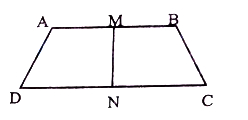
In a quadrilateral $ABCD$,$M$ and $N$ are the mid-points of the sides $AB$ and $CD$ respectively. If $\vec{AD} + \vec{BC} = t \vec{MN}$,then $t =$
A
$4$
B
$2$
C
$\frac{1}{2}$
D
$\frac{3}{2}$
Solution
(B) Let $\vec{a}, \vec{b}, \vec{c}, \vec{d}, \vec{m}, \vec{n}$ be the position vectors of $A, B, C, D, M, N$ respectively.
Since $M$ and $N$ are the midpoints of $AB$ and $CD$ respectively,we have:
$\vec{m} = \frac{\vec{a} + \vec{b}}{2} \implies \vec{a} + \vec{b} = 2\vec{m}$
$\vec{n} = \frac{\vec{c} + \vec{d}}{2} \implies \vec{c} + \vec{d} = 2\vec{n}$
We are given the equation: $\vec{AD} + \vec{BC} = t \vec{MN}$
Expressing the vectors in terms of position vectors:
$(\vec{d} - \vec{a}) + (\vec{c} - \vec{b}) = t(\vec{n} - \vec{m})$
Rearranging the terms:
$(\vec{d} + \vec{c}) - (\vec{a} + \vec{b}) = t(\vec{n} - \vec{m})$
Substituting the expressions for the sums of position vectors:
$2\vec{n} - 2\vec{m} = t(\vec{n} - \vec{m})$
$2(\vec{n} - \vec{m}) = t(\vec{n} - \vec{m})$
Comparing both sides,we get $t = 2$.
Since $M$ and $N$ are the midpoints of $AB$ and $CD$ respectively,we have:
$\vec{m} = \frac{\vec{a} + \vec{b}}{2} \implies \vec{a} + \vec{b} = 2\vec{m}$
$\vec{n} = \frac{\vec{c} + \vec{d}}{2} \implies \vec{c} + \vec{d} = 2\vec{n}$
We are given the equation: $\vec{AD} + \vec{BC} = t \vec{MN}$
Expressing the vectors in terms of position vectors:
$(\vec{d} - \vec{a}) + (\vec{c} - \vec{b}) = t(\vec{n} - \vec{m})$
Rearranging the terms:
$(\vec{d} + \vec{c}) - (\vec{a} + \vec{b}) = t(\vec{n} - \vec{m})$
Substituting the expressions for the sums of position vectors:
$2\vec{n} - 2\vec{m} = t(\vec{n} - \vec{m})$
$2(\vec{n} - \vec{m}) = t(\vec{n} - \vec{m})$
Comparing both sides,we get $t = 2$.
0 likesView Solution
463
MathematicsMediumMCQMHT CET · 2020
Let $G$ be the centroid of a triangle $ABC$ and $O$ be any other point in that plane,then $\overline{OA}+\overline{OB}+\overline{OC}+\overline{OG}=$
A
$4 \overline{OG}$
B
$\overline{O}$
C
$3 \overline{OG}$
D
$2 \overline{OG}$
Solution
(A) Let $\vec{a}, \vec{b}, \vec{c}$ be the position vectors of vertices $A, B, C$ with respect to the origin $O$.
Then,$\overline{OA} = \vec{a}, \overline{OB} = \vec{b}, \overline{OC} = \vec{c}$.
The centroid $G$ of triangle $ABC$ is given by the position vector $\overline{OG} = \frac{\vec{a} + \vec{b} + \vec{c}}{3}$.
This implies $\vec{a} + \vec{b} + \vec{c} = 3 \overline{OG}$.
Now,we evaluate the expression $\overline{OA} + \overline{OB} + \overline{OC} + \overline{OG}$:
$\overline{OA} + \overline{OB} + \overline{OC} + \overline{OG} = (\vec{a} + \vec{b} + \vec{c}) + \overline{OG}$.
Substituting the value of $(\vec{a} + \vec{b} + \vec{c})$:
$= 3 \overline{OG} + \overline{OG} = 4 \overline{OG}$.
Then,$\overline{OA} = \vec{a}, \overline{OB} = \vec{b}, \overline{OC} = \vec{c}$.
The centroid $G$ of triangle $ABC$ is given by the position vector $\overline{OG} = \frac{\vec{a} + \vec{b} + \vec{c}}{3}$.
This implies $\vec{a} + \vec{b} + \vec{c} = 3 \overline{OG}$.
Now,we evaluate the expression $\overline{OA} + \overline{OB} + \overline{OC} + \overline{OG}$:
$\overline{OA} + \overline{OB} + \overline{OC} + \overline{OG} = (\vec{a} + \vec{b} + \vec{c}) + \overline{OG}$.
Substituting the value of $(\vec{a} + \vec{b} + \vec{c})$:
$= 3 \overline{OG} + \overline{OG} = 4 \overline{OG}$.
0 likesView Solution
464
MathematicsEasyMCQMHT CET · 2020
If the points $A(2,1,-1), B(0,-1,0), C(4,0,4)$ and $D(2,0,x)$ are coplanar,then $x=$
A
$2$
B
$1$
C
$4$
D
$3$
Solution
(B) For four points $A, B, C, D$ to be coplanar,the scalar triple product of vectors $\vec{AB}, \vec{AC},$ and $\vec{AD}$ must be zero,i.e.,$[\vec{AB} \ \vec{AC} \ \vec{AD}] = 0$.
First,we find the vectors:
$\vec{AB} = (0-2)\hat{i} + (-1-1)\hat{j} + (0-(-1))\hat{k} = -2\hat{i} - 2\hat{j} + \hat{k}$
$\vec{AC} = (4-2)\hat{i} + (0-1)\hat{j} + (4-(-1))\hat{k} = 2\hat{i} - \hat{j} + 5\hat{k}$
$\vec{AD} = (2-2)\hat{i} + (0-1)\hat{j} + (x-(-1))\hat{k} = 0\hat{i} - \hat{j} + (x+1)\hat{k}$
The condition for coplanarity is given by the determinant:
$\begin{vmatrix} -2 & -2 & 1 \\ 2 & -1 & 5 \\ 0 & -1 & x+1 \end{vmatrix} = 0$
Expanding the determinant along the first row:
$-2[(-1)(x+1) - (5)(-1)] - (-2)[(2)(x+1) - (5)(0)] + 1[(2)(-1) - (-1)(0)] = 0$
$-2[-x-1+5] + 2[2x+2] + 1[-2] = 0$
$-2[4-x] + 4x + 4 - 2 = 0$
$-8 + 2x + 4x + 2 = 0$
$6x - 6 = 0$
$6x = 6$
$x = 1$
First,we find the vectors:
$\vec{AB} = (0-2)\hat{i} + (-1-1)\hat{j} + (0-(-1))\hat{k} = -2\hat{i} - 2\hat{j} + \hat{k}$
$\vec{AC} = (4-2)\hat{i} + (0-1)\hat{j} + (4-(-1))\hat{k} = 2\hat{i} - \hat{j} + 5\hat{k}$
$\vec{AD} = (2-2)\hat{i} + (0-1)\hat{j} + (x-(-1))\hat{k} = 0\hat{i} - \hat{j} + (x+1)\hat{k}$
The condition for coplanarity is given by the determinant:
$\begin{vmatrix} -2 & -2 & 1 \\ 2 & -1 & 5 \\ 0 & -1 & x+1 \end{vmatrix} = 0$
Expanding the determinant along the first row:
$-2[(-1)(x+1) - (5)(-1)] - (-2)[(2)(x+1) - (5)(0)] + 1[(2)(-1) - (-1)(0)] = 0$
$-2[-x-1+5] + 2[2x+2] + 1[-2] = 0$
$-2[4-x] + 4x + 4 - 2 = 0$
$-8 + 2x + 4x + 2 = 0$
$6x - 6 = 0$
$6x = 6$
$x = 1$
0 likesView Solution
465
MathematicsEasyMCQMHT CET · 2020
If $a, b, c$ are distinct positive numbers and vectors $a \hat{\imath} + a \hat{\jmath} + c \hat{k}$,$\hat{\imath} + \hat{k}$,and $c \hat{\imath} + c \hat{\jmath} + b \hat{k}$ lie in a plane,then
A
$c$ is $A$.$M$. of $a$ and $b$
B
$c^2 = ab$
C
$c$ is $H$.$M$. of $a$ and $b$
D
$c$ is $G$.$M$. of $a$ and $b$
Solution
(D) Since the three vectors are coplanar,their scalar triple product must be zero.
The determinant formed by the components of these vectors is:
$\begin{vmatrix} a & a & c \\ 1 & 0 & 1 \\ c & c & b \end{vmatrix} = 0$
Applying the column operation $C_1 \rightarrow C_1 - C_2$:
$\begin{vmatrix} 0 & a & c \\ 1 & 0 & 1 \\ 0 & c & b \end{vmatrix} = 0$
Expanding along the first column $(C_1)$:
$-1(ab - c^2) = 0$
$c^2 - ab = 0 \Rightarrow c^2 = ab$
This implies that $c$ is the Geometric Mean ($G$.$M$.) of $a$ and $b$.
The determinant formed by the components of these vectors is:
$\begin{vmatrix} a & a & c \\ 1 & 0 & 1 \\ c & c & b \end{vmatrix} = 0$
Applying the column operation $C_1 \rightarrow C_1 - C_2$:
$\begin{vmatrix} 0 & a & c \\ 1 & 0 & 1 \\ 0 & c & b \end{vmatrix} = 0$
Expanding along the first column $(C_1)$:
$-1(ab - c^2) = 0$
$c^2 - ab = 0 \Rightarrow c^2 = ab$
This implies that $c$ is the Geometric Mean ($G$.$M$.) of $a$ and $b$.
0 likesView Solution
466
MathematicsEasyMCQMHT CET · 2020
$\bar{a}$ and $\bar{b}$ are non-collinear vectors. If $\bar{p} = (2x + 1)\bar{a} - \bar{b}$ and $\bar{q} = (x - 2)\bar{a} + \bar{b}$ are collinear vectors,then $x =$
A
$-3$
B
$\frac{1}{3}$
C
$-\frac{1}{3}$
D
$3$
Solution
(B) Since $\bar{a}$ and $\bar{b}$ are non-collinear vectors,two vectors $\bar{p} = m_1\bar{a} + n_1\bar{b}$ and $\bar{q} = m_2\bar{a} + n_2\bar{b}$ are collinear if and only if their components are proportional,i.e.,$\frac{m_1}{m_2} = \frac{n_1}{n_2} = k$.
Given $\bar{p} = (2x + 1)\bar{a} - 1\bar{b}$ and $\bar{q} = (x - 2)\bar{a} + 1\bar{b}$.
For collinearity,we have:
$\frac{2x + 1}{x - 2} = \frac{-1}{1}$
$2x + 1 = -(x - 2)$
$2x + 1 = -x + 2$
$3x = 1$
$x = \frac{1}{3}$
Given $\bar{p} = (2x + 1)\bar{a} - 1\bar{b}$ and $\bar{q} = (x - 2)\bar{a} + 1\bar{b}$.
For collinearity,we have:
$\frac{2x + 1}{x - 2} = \frac{-1}{1}$
$2x + 1 = -(x - 2)$
$2x + 1 = -x + 2$
$3x = 1$
$x = \frac{1}{3}$
0 likesView Solution
467
MathematicsMediumMCQMHT CET · 2020
The point $P$ lies on the line $AB$,where $A \equiv (2, 4, 5)$ and $B \equiv (1, 2, 3)$. If the $z$-coordinate of point $P$ is $3$,then its $y$-coordinate is:
A
$2$
B
$-2$
C
$-3$
D
$3$
Solution
(A) The equation of the line passing through $A(2, 4, 5)$ and $B(1, 2, 3)$ is given by:
$\frac{x-2}{1-2} = \frac{y-4}{2-4} = \frac{z-5}{3-5} = k$
$\frac{x-2}{-1} = \frac{y-4}{-2} = \frac{z-5}{-2} = k$
The coordinates of any point $P$ on this line are given by $(x, y, z) = (-k+2, -2k+4, -2k+5)$.
Given that the $z$-coordinate of point $P$ is $3$,we have:
$-2k + 5 = 3$
$-2k = -2$
$k = 1$
Substituting $k = 1$ into the expression for the $y$-coordinate:
$y = -2(1) + 4 = 2$.
Thus,the $y$-coordinate of point $P$ is $2$.
$\frac{x-2}{1-2} = \frac{y-4}{2-4} = \frac{z-5}{3-5} = k$
$\frac{x-2}{-1} = \frac{y-4}{-2} = \frac{z-5}{-2} = k$
The coordinates of any point $P$ on this line are given by $(x, y, z) = (-k+2, -2k+4, -2k+5)$.
Given that the $z$-coordinate of point $P$ is $3$,we have:
$-2k + 5 = 3$
$-2k = -2$
$k = 1$
Substituting $k = 1$ into the expression for the $y$-coordinate:
$y = -2(1) + 4 = 2$.
Thus,the $y$-coordinate of point $P$ is $2$.
0 likesView Solution
468
MathematicsEasyMCQMHT CET · 2020
If $\bar{a}=3 \hat{\imath}+\hat{\jmath}-\hat{k}, \bar{b}=2 \hat{\imath}-\hat{\jmath}+7 \hat{k}$ and $\bar{c}=7 \hat{\imath}-\hat{\jmath}+23 \hat{k}$ are three vectors,then which of the following statements is true?
A
$\bar{a}, \bar{b}$ and $\bar{c}$ are non-coplanar.
B
$\bar{a}, \bar{b}$ and $\bar{c}$ are coplanar.
C
$\bar{a}, \bar{b}, \bar{c}$ are mutually perpendicular.
D
$\bar{a}$ and $\bar{b}$ are collinear.
Solution
(A) To determine if the vectors are coplanar,we calculate the scalar triple product $[\bar{a} \ \bar{b} \ \bar{c}]$.
If the scalar triple product is $0$,the vectors are coplanar. If it is non-zero,they are non-coplanar.
Given $\bar{a} = 3\hat{\imath} + \hat{\jmath} - \hat{k}$,$\bar{b} = 2\hat{\imath} - \hat{\jmath} + 7\hat{k}$,and $\bar{c} = 7\hat{\imath} - \hat{\jmath} + 23\hat{k}$.
$[\bar{a} \ \bar{b} \ \bar{c}] = \begin{vmatrix} 3 & 1 & -1 \\ 2 & -1 & 7 \\ 7 & -1 & 23 \end{vmatrix}$
$= 3((-1)(23) - (7)(-1)) - 1((2)(23) - (7)(7)) - 1((2)(-1) - (7)(-1))$
$= 3(-23 + 7) - 1(46 - 49) - 1(-2 + 7)$
$= 3(-16) - 1(-3) - 1(5)$
$= -48 + 3 - 5 = -50$.
Since the scalar triple product is $-50 \neq 0$,the vectors $\bar{a}, \bar{b},$ and $\bar{c}$ are non-coplanar. Thus,statement $A$ is true.
If the scalar triple product is $0$,the vectors are coplanar. If it is non-zero,they are non-coplanar.
Given $\bar{a} = 3\hat{\imath} + \hat{\jmath} - \hat{k}$,$\bar{b} = 2\hat{\imath} - \hat{\jmath} + 7\hat{k}$,and $\bar{c} = 7\hat{\imath} - \hat{\jmath} + 23\hat{k}$.
$[\bar{a} \ \bar{b} \ \bar{c}] = \begin{vmatrix} 3 & 1 & -1 \\ 2 & -1 & 7 \\ 7 & -1 & 23 \end{vmatrix}$
$= 3((-1)(23) - (7)(-1)) - 1((2)(23) - (7)(7)) - 1((2)(-1) - (7)(-1))$
$= 3(-23 + 7) - 1(46 - 49) - 1(-2 + 7)$
$= 3(-16) - 1(-3) - 1(5)$
$= -48 + 3 - 5 = -50$.
Since the scalar triple product is $-50 \neq 0$,the vectors $\bar{a}, \bar{b},$ and $\bar{c}$ are non-coplanar. Thus,statement $A$ is true.
0 likesView Solution
469
MathematicsEasyMCQMHT CET · 2020
If $\overline{a}=2 \hat{\imath}+3 \hat{\jmath}+\hat{k}$,$\overline{b}=4 \hat{\imath}+5 \hat{\jmath}+3 \hat{k}$ and $\overline{c}=6 \hat{\imath}+\hat{\jmath}+5 \hat{k}$ are the position vectors of the vertices of a triangle $ABC$ respectively,then the position vector of the intersection of the medians (centroid) of the triangle $ABC$ is:
A
$4 \hat{\imath}+3 \hat{\jmath}+3 \hat{k}$
B
$2 \hat{\imath}+3 \hat{\jmath}+3 \hat{k}$
C
$5 \hat{\imath}+3 \hat{\jmath}+3 \hat{k}$
D
$3 \hat{\imath}+3 \hat{\jmath}+4 \hat{k}$
Solution
(A) The position vector of the centroid $G$ of a triangle with vertices having position vectors $\overline{a}$,$\overline{b}$,and $\overline{c}$ is given by the formula: $\overline{g} = \frac{\overline{a} + \overline{b} + \overline{c}}{3}$.
Substituting the given vectors:
$\overline{g} = \frac{(2 \hat{\imath} + 3 \hat{\jmath} + \hat{k}) + (4 \hat{\imath} + 5 \hat{\jmath} + 3 \hat{k}) + (6 \hat{\imath} + \hat{\jmath} + 5 \hat{k})}{3}$
Summing the components:
$\overline{g} = \frac{(2+4+6) \hat{\imath} + (3+5+1) \hat{\jmath} + (1+3+5) \hat{k}}{3}$
$\overline{g} = \frac{12 \hat{\imath} + 9 \hat{\jmath} + 9 \hat{k}}{3}$
$\overline{g} = 4 \hat{\imath} + 3 \hat{\jmath} + 3 \hat{k}$.
Substituting the given vectors:
$\overline{g} = \frac{(2 \hat{\imath} + 3 \hat{\jmath} + \hat{k}) + (4 \hat{\imath} + 5 \hat{\jmath} + 3 \hat{k}) + (6 \hat{\imath} + \hat{\jmath} + 5 \hat{k})}{3}$
Summing the components:
$\overline{g} = \frac{(2+4+6) \hat{\imath} + (3+5+1) \hat{\jmath} + (1+3+5) \hat{k}}{3}$
$\overline{g} = \frac{12 \hat{\imath} + 9 \hat{\jmath} + 9 \hat{k}}{3}$
$\overline{g} = 4 \hat{\imath} + 3 \hat{\jmath} + 3 \hat{k}$.
0 likesView Solution
470
MathematicsMediumMCQMHT CET · 2020
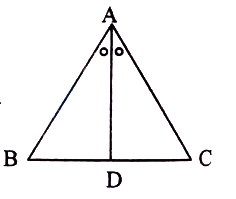
If the position vectors of the vertices $A, B, C$ of a triangle $ABC$ are $4 \hat{\imath} + 7 \hat{\jmath} + 8 \hat{k}$,$2 \hat{\imath} + 3 \hat{\jmath} + 4 \hat{k}$,and $2 \hat{\imath} + 5 \hat{\jmath} + 7 \hat{k}$ respectively,then the position vector of the point where the bisector of angle $A$ meets $BC$ is
A
$\frac{1}{3}(6 \hat{\imath} + 11 \hat{\jmath} + 15 \hat{k})$
B
$\frac{1}{2}(4 \hat{\imath} + 8 \hat{\jmath} + 11 \hat{k})$
C
$\frac{1}{4}(8 \hat{\imath} + 14 \hat{\jmath} + 19 \hat{k})$
D
$\frac{1}{3}(6 \hat{\imath} + 13 \hat{\jmath} + 18 \hat{k})$
Solution
(D) Let the position vectors of vertices $A, B, C$ be $\vec{a} = 4 \hat{\imath} + 7 \hat{\jmath} + 8 \hat{k}$,$\vec{b} = 2 \hat{\imath} + 3 \hat{\jmath} + 4 \hat{k}$,and $\vec{c} = 2 \hat{\imath} + 5 \hat{\jmath} + 7 \hat{k}$.
According to the Angle Bisector Theorem,the bisector of $\angle A$ divides the opposite side $BC$ in the ratio of the sides $AB$ and $AC$.
Let $D$ be the point where the bisector of $\angle A$ meets $BC$. Then $D$ divides $BC$ in the ratio $AB : AC$.
First,calculate the lengths of sides $AB$ and $AC$:
$\vec{AB} = \vec{b} - \vec{a} = (2-4)\hat{\imath} + (3-7)\hat{\jmath} + (4-8)\hat{k} = -2\hat{\imath} - 4\hat{\jmath} - 4\hat{k}$.
$AB = |\vec{AB}| = \sqrt{(-2)^2 + (-4)^2 + (-4)^2} = \sqrt{4 + 16 + 16} = \sqrt{36} = 6$.
$\vec{AC} = \vec{c} - \vec{a} = (2-4)\hat{\imath} + (5-7)\hat{\jmath} + (7-8)\hat{k} = -2\hat{\imath} - 2\hat{\jmath} - 1\hat{k}$.
$AC = |\vec{AC}| = \sqrt{(-2)^2 + (-2)^2 + (-1)^2} = \sqrt{4 + 4 + 1} = \sqrt{9} = 3$.
The ratio $AB : AC = 6 : 3 = 2 : 1$.
Using the section formula,the position vector of $D$ is given by:
$\vec{d} = \frac{AB \cdot \vec{c} + AC \cdot \vec{b}}{AB + AC} = \frac{6(2\hat{\imath} + 5\hat{\jmath} + 7\hat{k}) + 3(2\hat{\imath} + 3\hat{\jmath} + 4\hat{k})}{6 + 3}$
$\vec{d} = \frac{(12\hat{\imath} + 30\hat{\jmath} + 42\hat{k}) + (6\hat{\imath} + 9\hat{\jmath} + 12\hat{k})}{9} = \frac{18\hat{\imath} + 39\hat{\jmath} + 54\hat{k}}{9} = 2\hat{\imath} + \frac{13}{3}\hat{\jmath} + 6\hat{k}$.
Wait,re-evaluating the ratio division: $D$ divides $BC$ in ratio $c:b$ (where $c=AB, b=AC$).
$\vec{d} = \frac{AC \cdot \vec{b} + AB \cdot \vec{c}}{AC + AB} = \frac{3(2\hat{\imath} + 3\hat{\jmath} + 4\hat{k}) + 6(2\hat{\imath} + 5\hat{\jmath} + 7\hat{k})}{3 + 6} = \frac{6\hat{\imath} + 9\hat{\jmath} + 12\hat{k} + 12\hat{\imath} + 30\hat{\jmath} + 42\hat{k}}{9} = \frac{18\hat{\imath} + 39\hat{\jmath} + 54\hat{k}}{9} = 2\hat{\imath} + \frac{13}{3}\hat{\jmath} + 6\hat{k}$.
Checking options: $\frac{1}{3}(6\hat{\imath} + 13\hat{\jmath} + 18\hat{k}) = 2\hat{\imath} + \frac{13}{3}\hat{\jmath} + 6\hat{k}$. This matches option $D$.
According to the Angle Bisector Theorem,the bisector of $\angle A$ divides the opposite side $BC$ in the ratio of the sides $AB$ and $AC$.
Let $D$ be the point where the bisector of $\angle A$ meets $BC$. Then $D$ divides $BC$ in the ratio $AB : AC$.
First,calculate the lengths of sides $AB$ and $AC$:
$\vec{AB} = \vec{b} - \vec{a} = (2-4)\hat{\imath} + (3-7)\hat{\jmath} + (4-8)\hat{k} = -2\hat{\imath} - 4\hat{\jmath} - 4\hat{k}$.
$AB = |\vec{AB}| = \sqrt{(-2)^2 + (-4)^2 + (-4)^2} = \sqrt{4 + 16 + 16} = \sqrt{36} = 6$.
$\vec{AC} = \vec{c} - \vec{a} = (2-4)\hat{\imath} + (5-7)\hat{\jmath} + (7-8)\hat{k} = -2\hat{\imath} - 2\hat{\jmath} - 1\hat{k}$.
$AC = |\vec{AC}| = \sqrt{(-2)^2 + (-2)^2 + (-1)^2} = \sqrt{4 + 4 + 1} = \sqrt{9} = 3$.
The ratio $AB : AC = 6 : 3 = 2 : 1$.
Using the section formula,the position vector of $D$ is given by:
$\vec{d} = \frac{AB \cdot \vec{c} + AC \cdot \vec{b}}{AB + AC} = \frac{6(2\hat{\imath} + 5\hat{\jmath} + 7\hat{k}) + 3(2\hat{\imath} + 3\hat{\jmath} + 4\hat{k})}{6 + 3}$
$\vec{d} = \frac{(12\hat{\imath} + 30\hat{\jmath} + 42\hat{k}) + (6\hat{\imath} + 9\hat{\jmath} + 12\hat{k})}{9} = \frac{18\hat{\imath} + 39\hat{\jmath} + 54\hat{k}}{9} = 2\hat{\imath} + \frac{13}{3}\hat{\jmath} + 6\hat{k}$.
Wait,re-evaluating the ratio division: $D$ divides $BC$ in ratio $c:b$ (where $c=AB, b=AC$).
$\vec{d} = \frac{AC \cdot \vec{b} + AB \cdot \vec{c}}{AC + AB} = \frac{3(2\hat{\imath} + 3\hat{\jmath} + 4\hat{k}) + 6(2\hat{\imath} + 5\hat{\jmath} + 7\hat{k})}{3 + 6} = \frac{6\hat{\imath} + 9\hat{\jmath} + 12\hat{k} + 12\hat{\imath} + 30\hat{\jmath} + 42\hat{k}}{9} = \frac{18\hat{\imath} + 39\hat{\jmath} + 54\hat{k}}{9} = 2\hat{\imath} + \frac{13}{3}\hat{\jmath} + 6\hat{k}$.
Checking options: $\frac{1}{3}(6\hat{\imath} + 13\hat{\jmath} + 18\hat{k}) = 2\hat{\imath} + \frac{13}{3}\hat{\jmath} + 6\hat{k}$. This matches option $D$.
0 likesView Solution
471
MathematicsMediumMCQMHT CET · 2020
If $\bar{a}, \bar{b}, \bar{c}$ are the position vectors of the points $A(1,3,0), B(2,5,0), C(4,2,0)$ respectively and $\bar{c}=t_{1} \bar{a}+t_{2} \bar{b}$,then the value of $t_{1} t_{2}$ is:
A
$-16$
B
$16$
C
$160$
D
$-160$
Solution
(D) Given position vectors are $\bar{a} = \hat{i} + 3\hat{j}$,$\bar{b} = 2\hat{i} + 5\hat{j}$,and $\bar{c} = 4\hat{i} + 2\hat{j}$.
Given the relation $\bar{c} = t_{1}\bar{a} + t_{2}\bar{b}$,we substitute the vectors:
$4\hat{i} + 2\hat{j} = t_{1}(\hat{i} + 3\hat{j}) + t_{2}(2\hat{i} + 5\hat{j})$
$4\hat{i} + 2\hat{j} = (t_{1} + 2t_{2})\hat{i} + (3t_{1} + 5t_{2})\hat{j}$
Comparing the coefficients of $\hat{i}$ and $\hat{j}$,we get the system of linear equations:
$t_{1} + 2t_{2} = 4$ --- $(1)$
$3t_{1} + 5t_{2} = 2$ --- $(2)$
Multiply equation $(1)$ by $3$: $3t_{1} + 6t_{2} = 12$ --- $(3)$
Subtract equation $(2)$ from $(3)$: $(3t_{1} + 6t_{2}) - (3t_{1} + 5t_{2}) = 12 - 2$
$t_{2} = 10$
Substitute $t_{2} = 10$ into equation $(1)$: $t_{1} + 2(10) = 4$
$t_{1} + 20 = 4 \implies t_{1} = -16$
Therefore,$t_{1}t_{2} = (-16)(10) = -160$.
Given the relation $\bar{c} = t_{1}\bar{a} + t_{2}\bar{b}$,we substitute the vectors:
$4\hat{i} + 2\hat{j} = t_{1}(\hat{i} + 3\hat{j}) + t_{2}(2\hat{i} + 5\hat{j})$
$4\hat{i} + 2\hat{j} = (t_{1} + 2t_{2})\hat{i} + (3t_{1} + 5t_{2})\hat{j}$
Comparing the coefficients of $\hat{i}$ and $\hat{j}$,we get the system of linear equations:
$t_{1} + 2t_{2} = 4$ --- $(1)$
$3t_{1} + 5t_{2} = 2$ --- $(2)$
Multiply equation $(1)$ by $3$: $3t_{1} + 6t_{2} = 12$ --- $(3)$
Subtract equation $(2)$ from $(3)$: $(3t_{1} + 6t_{2}) - (3t_{1} + 5t_{2}) = 12 - 2$
$t_{2} = 10$
Substitute $t_{2} = 10$ into equation $(1)$: $t_{1} + 2(10) = 4$
$t_{1} + 20 = 4 \implies t_{1} = -16$
Therefore,$t_{1}t_{2} = (-16)(10) = -160$.
0 likesView Solution
472
MathematicsEasyMCQMHT CET · 2020
If $\bar{a}=\hat{\imath}+\hat{\jmath}+\hat{k}, \bar{b}=2 \hat{\imath}-2 \hat{\jmath}+2 \hat{k}, \bar{c}=2 \hat{\imath}+3 \hat{\jmath}+2 \hat{k}$ are three vectors such that $l \bar{a}+m \bar{b}+n \bar{c}=\overline{0}$,then the values of $l, m, n$ are respectively
A
$10, 1, 4$
B
$10, -4, 1$
C
$10, -1, -4$
D
$10, 1, -4$
Solution
(C) Given the equation $l \bar{a} + m \bar{b} + n \bar{c} = \overline{0}$.
Substituting the vectors: $l(\hat{\imath} + \hat{\jmath} + \hat{k}) + m(2\hat{\imath} - 2\hat{\jmath} + 2\hat{k}) + n(2\hat{\imath} + 3\hat{\jmath} + 2\hat{k}) = 0\hat{\imath} + 0\hat{\jmath} + 0\hat{k}$.
Equating the components to zero:
$l + 2m + 2n = 0$ $(i)$
$l - 2m + 3n = 0$ (ii)
$l + 2m + 2n = 0$ (iii)
From $(i)$ and (iii),we see they are identical. Subtracting (ii) from $(i)$:
$(l + 2m + 2n) - (l - 2m + 3n) = 0$
$4m - n = 0 \implies n = 4m$.
Substitute $n = 4m$ into $(i)$:
$l + 2m + 2(4m) = 0 \implies l + 10m = 0 \implies l = -10m$.
Let $m = -1$,then $l = 10$ and $n = -4$.
Thus,the values are $(10, -1, -4)$.
Substituting the vectors: $l(\hat{\imath} + \hat{\jmath} + \hat{k}) + m(2\hat{\imath} - 2\hat{\jmath} + 2\hat{k}) + n(2\hat{\imath} + 3\hat{\jmath} + 2\hat{k}) = 0\hat{\imath} + 0\hat{\jmath} + 0\hat{k}$.
Equating the components to zero:
$l + 2m + 2n = 0$ $(i)$
$l - 2m + 3n = 0$ (ii)
$l + 2m + 2n = 0$ (iii)
From $(i)$ and (iii),we see they are identical. Subtracting (ii) from $(i)$:
$(l + 2m + 2n) - (l - 2m + 3n) = 0$
$4m - n = 0 \implies n = 4m$.
Substitute $n = 4m$ into $(i)$:
$l + 2m + 2(4m) = 0 \implies l + 10m = 0 \implies l = -10m$.
Let $m = -1$,then $l = 10$ and $n = -4$.
Thus,the values are $(10, -1, -4)$.
0 likesView Solution
473
MathematicsEasyMCQMHT CET · 2020
If $\bar{a}=2\hat{i}+3\hat{j}-\hat{k}$,$\bar{b}=-\hat{i}+2\hat{j}-4\hat{k}$ and $\bar{c}=\hat{i}+\hat{j}+\hat{k}$,then $(\bar{a} \times \bar{b}) \cdot(\bar{a} \times \bar{c})=$
A
$-74$
B
$64$
C
$-64$
D
$74$
Solution
(A) First,calculate the cross product $\bar{a} \times \bar{b}$:
$\bar{a} \times \bar{b} = \begin{vmatrix} \hat{i} & \hat{j} & \hat{k} \\ 2 & 3 & -1 \\ -1 & 2 & -4 \end{vmatrix} = \hat{i}(-12 - (-2)) - \hat{j}(-8 - 1) + \hat{k}(4 - (-3)) = -10\hat{i} + 9\hat{j} + 7\hat{k}$
Next,calculate the cross product $\bar{a} \times \bar{c}$:
$\bar{a} \times \bar{c} = \begin{vmatrix} \hat{i} & \hat{j} & \hat{k} \\ 2 & 3 & -1 \\ 1 & 1 & 1 \end{vmatrix} = \hat{i}(3 - (-1)) - \hat{j}(2 - (-1)) + \hat{k}(2 - 3) = 4\hat{i} - 3\hat{j} - \hat{k}$
Now,compute the dot product of the two resulting vectors:
$(\bar{a} \times \bar{b}) \cdot (\bar{a} \times \bar{c}) = (-10\hat{i} + 9\hat{j} + 7\hat{k}) \cdot (4\hat{i} - 3\hat{j} - \hat{k})$
$= (-10)(4) + (9)(-3) + (7)(-1)$
$= -40 - 27 - 7 = -74$
$\bar{a} \times \bar{b} = \begin{vmatrix} \hat{i} & \hat{j} & \hat{k} \\ 2 & 3 & -1 \\ -1 & 2 & -4 \end{vmatrix} = \hat{i}(-12 - (-2)) - \hat{j}(-8 - 1) + \hat{k}(4 - (-3)) = -10\hat{i} + 9\hat{j} + 7\hat{k}$
Next,calculate the cross product $\bar{a} \times \bar{c}$:
$\bar{a} \times \bar{c} = \begin{vmatrix} \hat{i} & \hat{j} & \hat{k} \\ 2 & 3 & -1 \\ 1 & 1 & 1 \end{vmatrix} = \hat{i}(3 - (-1)) - \hat{j}(2 - (-1)) + \hat{k}(2 - 3) = 4\hat{i} - 3\hat{j} - \hat{k}$
Now,compute the dot product of the two resulting vectors:
$(\bar{a} \times \bar{b}) \cdot (\bar{a} \times \bar{c}) = (-10\hat{i} + 9\hat{j} + 7\hat{k}) \cdot (4\hat{i} - 3\hat{j} - \hat{k})$
$= (-10)(4) + (9)(-3) + (7)(-1)$
$= -40 - 27 - 7 = -74$
0 likesView Solution
474
MathematicsEasyMCQMHT CET · 2020
If $\bar{a}=\hat{i}+5 \hat{k}, \bar{b}=2 \hat{i}+3 \hat{k}, \bar{c}=4 \hat{i}-\hat{j}+2 \hat{k}$ and $\bar{d}=\hat{i}-\hat{j}$,then $(\bar{c}-\bar{a}) \cdot(\bar{b} \times \bar{d})=$
A
$12$
B
$20$
C
$30$
D
$10$
Solution
(A) First,calculate the cross product $\bar{b} \times \bar{d}$:
$\bar{b} \times \bar{d} = \begin{vmatrix} \hat{i} & \hat{j} & \hat{k} \\ 2 & 0 & 3 \\ 1 & -1 & 0 \end{vmatrix} = \hat{i}(0 - (-3)) - \hat{j}(0 - 3) + \hat{k}(-2 - 0) = 3\hat{i} + 3\hat{j} - 2\hat{k}$
Next,calculate the vector $\bar{c} - \bar{a}$:
$\bar{c} - \bar{a} = (4\hat{i} - \hat{j} + 2\hat{k}) - (\hat{i} + 5\hat{k}) = 3\hat{i} - \hat{j} - 3\hat{k}$
Finally,calculate the dot product $(\bar{c} - \bar{a}) \cdot (\bar{b} \times \bar{d})$:
$(\bar{c} - \bar{a}) \cdot (\bar{b} \times \bar{d}) = (3\hat{i} - \hat{j} - 3\hat{k}) \cdot (3\hat{i} + 3\hat{j} - 2\hat{k})$
$= (3)(3) + (-1)(3) + (-3)(-2) = 9 - 3 + 6 = 12$
$\bar{b} \times \bar{d} = \begin{vmatrix} \hat{i} & \hat{j} & \hat{k} \\ 2 & 0 & 3 \\ 1 & -1 & 0 \end{vmatrix} = \hat{i}(0 - (-3)) - \hat{j}(0 - 3) + \hat{k}(-2 - 0) = 3\hat{i} + 3\hat{j} - 2\hat{k}$
Next,calculate the vector $\bar{c} - \bar{a}$:
$\bar{c} - \bar{a} = (4\hat{i} - \hat{j} + 2\hat{k}) - (\hat{i} + 5\hat{k}) = 3\hat{i} - \hat{j} - 3\hat{k}$
Finally,calculate the dot product $(\bar{c} - \bar{a}) \cdot (\bar{b} \times \bar{d})$:
$(\bar{c} - \bar{a}) \cdot (\bar{b} \times \bar{d}) = (3\hat{i} - \hat{j} - 3\hat{k}) \cdot (3\hat{i} + 3\hat{j} - 2\hat{k})$
$= (3)(3) + (-1)(3) + (-3)(-2) = 9 - 3 + 6 = 12$
0 likesView Solution
475
MathematicsEasyMCQMHT CET · 2020
The direction ratios of the line perpendicular to the lines having direction ratios $2, 3, 1$ and $1, 2, 1$ are
A
$1, -1, 1$
B
$1, 1, 1$
C
$2, 1, 1$
D
$2, 2, -2$
Solution
(A) Let $\vec{a}$ and $\vec{b}$ be the vectors along the lines whose direction ratios are $2, 3, 1$ and $1, 2, 1$ respectively.
$\vec{a} = 2\hat{i} + 3\hat{j} + \hat{k}$ and $\vec{b} = \hat{i} + 2\hat{j} + \hat{k}$.
$A$ vector perpendicular to both $\vec{a}$ and $\vec{b}$ is given by their cross product $\vec{a} \times \vec{b}$.
$\vec{a} \times \vec{b} = \begin{vmatrix} \hat{i} & \hat{j} & \hat{k} \\ 2 & 3 & 1 \\ 1 & 2 & 1 \end{vmatrix} = \hat{i}(3-2) - \hat{j}(2-1) + \hat{k}(4-3) = \hat{i} - \hat{j} + \hat{k}$.
Thus,the direction ratios are $1, -1, 1$.
Comparing this with the given options,the correct choice is $A$.
$\vec{a} = 2\hat{i} + 3\hat{j} + \hat{k}$ and $\vec{b} = \hat{i} + 2\hat{j} + \hat{k}$.
$A$ vector perpendicular to both $\vec{a}$ and $\vec{b}$ is given by their cross product $\vec{a} \times \vec{b}$.
$\vec{a} \times \vec{b} = \begin{vmatrix} \hat{i} & \hat{j} & \hat{k} \\ 2 & 3 & 1 \\ 1 & 2 & 1 \end{vmatrix} = \hat{i}(3-2) - \hat{j}(2-1) + \hat{k}(4-3) = \hat{i} - \hat{j} + \hat{k}$.
Thus,the direction ratios are $1, -1, 1$.
Comparing this with the given options,the correct choice is $A$.
0 likesView Solution
476
MathematicsEasyMCQMHT CET · 2020
The value of $m$,if the vectors $\hat{\imath}-\hat{\jmath}-6 \hat{k}$,$\hat{\imath}-3 \hat{\jmath}+4 \hat{k}$,and $2 \hat{\imath}-5 \hat{\jmath}+m \hat{k}$ are coplanar,is
A
$1$
B
$-3$
C
$3$
D
$-1$
Solution
(C) Let the given vectors be $\vec{a} = \hat{\imath} - \hat{\jmath} - 6\hat{k}$,$\vec{b} = \hat{\imath} - 3\hat{\jmath} + 4\hat{k}$,and $\vec{c} = 2\hat{\imath} - 5\hat{\jmath} + m\hat{k}$.
Since the vectors are coplanar,their scalar triple product must be zero,i.e.,$[\vec{a} \vec{b} \vec{c}] = 0$.
This implies the determinant of the components is zero:
$\begin{vmatrix} 1 & -1 & -6 \\ 1 & -3 & 4 \\ 2 & -5 & m \end{vmatrix} = 0$
Expanding along the first row:
$1((-3)(m) - (4)(-5)) - (-1)((1)(m) - (4)(2)) + (-6)((1)(-5) - (-3)(2)) = 0$
$1(-3m + 20) + 1(m - 8) - 6(-5 + 6) = 0$
$-3m + 20 + m - 8 - 6(1) = 0$
$-2m + 12 - 6 = 0$
$-2m + 6 = 0$
$2m = 6$
$m = 3$
Since the vectors are coplanar,their scalar triple product must be zero,i.e.,$[\vec{a} \vec{b} \vec{c}] = 0$.
This implies the determinant of the components is zero:
$\begin{vmatrix} 1 & -1 & -6 \\ 1 & -3 & 4 \\ 2 & -5 & m \end{vmatrix} = 0$
Expanding along the first row:
$1((-3)(m) - (4)(-5)) - (-1)((1)(m) - (4)(2)) + (-6)((1)(-5) - (-3)(2)) = 0$
$1(-3m + 20) + 1(m - 8) - 6(-5 + 6) = 0$
$-3m + 20 + m - 8 - 6(1) = 0$
$-2m + 12 - 6 = 0$
$-2m + 6 = 0$
$2m = 6$
$m = 3$
0 likesView Solution
477
MathematicsMediumMCQMHT CET · 2020
If $[\bar{a} \quad \bar{b} \quad \bar{c}]=4$,then the volume of the parallelepiped with coterminous edges $\bar{a}+2 \bar{b}$,$\bar{b}+2 \bar{c}$,and $\bar{c}+2 \bar{a}$ is:
A
$36 \text{ units}^3$
B
$32 \text{ units}^3$
C
$20 \text{ units}^3$
D
$40 \text{ units}^3$
Solution
(A) The volume of a parallelepiped with coterminous edges $\vec{u}, \vec{v}, \vec{w}$ is given by the scalar triple product $[\vec{u} \quad \vec{v} \quad \vec{w}] = \vec{u} \cdot (\vec{v} \times \vec{w})$.
Given $[\bar{a} \quad \bar{b} \quad \bar{c}] = 4$.
We need to find the volume of the parallelepiped with edges $\bar{a}+2 \bar{b}$,$\bar{b}+2 \bar{c}$,and $\bar{c}+2 \bar{a}$.
Volume $= [(\bar{a}+2 \bar{b}) \quad (\bar{b}+2 \bar{c}) \quad (\bar{c}+2 \bar{a})]$.
$= (\bar{a}+2 \bar{b}) \cdot [(\bar{b}+2 \bar{c}) \times (\bar{c}+2 \bar{a})]$.
$= (\bar{a}+2 \bar{b}) \cdot [(\bar{b} \times \bar{c}) + 2(\bar{b} \times \bar{a}) + 2(\bar{c} \times \bar{c}) + 4(\bar{c} \times \bar{a})]$.
Since $\bar{c} \times \bar{c} = 0$,this simplifies to:
$= (\bar{a}+2 \bar{b}) \cdot [(\bar{b} \times \bar{c}) + 2(\bar{b} \times \bar{a}) + 4(\bar{c} \times \bar{a})]$.
$= \bar{a} \cdot (\bar{b} \times \bar{c}) + 2\bar{a} \cdot (\bar{b} \times \bar{a}) + 4\bar{a} \cdot (\bar{c} \times \bar{a}) + 2\bar{b} \cdot (\bar{b} \times \bar{c}) + 4\bar{b} \cdot (\bar{b} \times \bar{a}) + 8\bar{b} \cdot (\bar{c} \times \bar{a})$.
Using the property that the scalar triple product is zero if any two vectors are the same:
$= [\bar{a} \quad \bar{b} \quad \bar{c}] + 0 + 0 + 0 + 0 + 8[\bar{b} \quad \bar{c} \quad \bar{a}]$.
Since $[\bar{b} \quad \bar{c} \quad \bar{a}] = [\bar{a} \quad \bar{b} \quad \bar{c}] = 4$,
Volume $= 4 + 8(4) = 4 + 32 = 36 \text{ units}^3$.
Given $[\bar{a} \quad \bar{b} \quad \bar{c}] = 4$.
We need to find the volume of the parallelepiped with edges $\bar{a}+2 \bar{b}$,$\bar{b}+2 \bar{c}$,and $\bar{c}+2 \bar{a}$.
Volume $= [(\bar{a}+2 \bar{b}) \quad (\bar{b}+2 \bar{c}) \quad (\bar{c}+2 \bar{a})]$.
$= (\bar{a}+2 \bar{b}) \cdot [(\bar{b}+2 \bar{c}) \times (\bar{c}+2 \bar{a})]$.
$= (\bar{a}+2 \bar{b}) \cdot [(\bar{b} \times \bar{c}) + 2(\bar{b} \times \bar{a}) + 2(\bar{c} \times \bar{c}) + 4(\bar{c} \times \bar{a})]$.
Since $\bar{c} \times \bar{c} = 0$,this simplifies to:
$= (\bar{a}+2 \bar{b}) \cdot [(\bar{b} \times \bar{c}) + 2(\bar{b} \times \bar{a}) + 4(\bar{c} \times \bar{a})]$.
$= \bar{a} \cdot (\bar{b} \times \bar{c}) + 2\bar{a} \cdot (\bar{b} \times \bar{a}) + 4\bar{a} \cdot (\bar{c} \times \bar{a}) + 2\bar{b} \cdot (\bar{b} \times \bar{c}) + 4\bar{b} \cdot (\bar{b} \times \bar{a}) + 8\bar{b} \cdot (\bar{c} \times \bar{a})$.
Using the property that the scalar triple product is zero if any two vectors are the same:
$= [\bar{a} \quad \bar{b} \quad \bar{c}] + 0 + 0 + 0 + 0 + 8[\bar{b} \quad \bar{c} \quad \bar{a}]$.
Since $[\bar{b} \quad \bar{c} \quad \bar{a}] = [\bar{a} \quad \bar{b} \quad \bar{c}] = 4$,
Volume $= 4 + 8(4) = 4 + 32 = 36 \text{ units}^3$.
0 likesView Solution
478
MathematicsMediumMCQMHT CET · 2020
If $\bar{a}=\frac{1}{\sqrt{10}}(3 \hat{\imath}+\hat{k})$ and $\bar{b}=\frac{1}{7}(2 \hat{\imath}+3 \hat{\jmath}-6 \hat{k})$,then the value of $(2 \bar{a}-\bar{b}) \cdot[(\bar{a} \times \bar{b}) \times(\bar{a}+2 \bar{b})]$ is
A
$7$
B
$-5$
C
$5$
D
$-7$
Solution
(C) Given vectors $\bar{a}$ and $\bar{b}$ are unit vectors as $|\bar{a}| = \sqrt{\frac{9+1}{10}} = 1$ and $|\bar{b}| = \sqrt{\frac{4+9+36}{49}} = 1$.
First,calculate the dot product $\bar{a} \cdot \bar{b} = \frac{1}{7\sqrt{10}}(3 \times 2 + 0 \times 3 + 1 \times (-6)) = \frac{6-6}{7\sqrt{10}} = 0$.
Now,simplify the expression $(2 \bar{a}-\bar{b}) \cdot[(\bar{a} \times \bar{b}) \times(\bar{a}+2 \bar{b})]$.
Using the vector triple product identity $\bar{u} \times (\bar{v} \times \bar{w}) = (\bar{u} \cdot \bar{w}) \bar{v} - (\bar{u} \cdot \bar{v}) \bar{w}$,we have:
$(\bar{a} \times \bar{b}) \times(\bar{a}+2 \bar{b}) = -[(\bar{a}+2 \bar{b}) \times (\bar{a} \times \bar{b})] = -[(\bar{a}+2 \bar{b}) \cdot \bar{b}] \bar{a} + [(\bar{a}+2 \bar{b}) \cdot \bar{a}] \bar{b}$.
Since $\bar{a} \cdot \bar{b} = 0$,$|\bar{a}|=1$,and $|\bar{b}|=1$:
$(\bar{a}+2 \bar{b}) \cdot \bar{b} = \bar{a} \cdot \bar{b} + 2|\bar{b}|^2 = 0 + 2(1) = 2$.
$(\bar{a}+2 \bar{b}) \cdot \bar{a} = |\bar{a}|^2 + 2(\bar{b} \cdot \bar{a}) = 1 + 0 = 1$.
So,the expression becomes $-(2 \bar{a}-\bar{b}) \cdot [-2 \bar{a} + \bar{b}] = (2 \bar{a}-\bar{b}) \cdot (2 \bar{a}-\bar{b}) = |2 \bar{a}-\bar{b}|^2$.
$|2 \bar{a}-\bar{b}|^2 = 4|\bar{a}|^2 + |\bar{b}|^2 - 4(\bar{a} \cdot \bar{b}) = 4(1) + 1 - 4(0) = 5$.
First,calculate the dot product $\bar{a} \cdot \bar{b} = \frac{1}{7\sqrt{10}}(3 \times 2 + 0 \times 3 + 1 \times (-6)) = \frac{6-6}{7\sqrt{10}} = 0$.
Now,simplify the expression $(2 \bar{a}-\bar{b}) \cdot[(\bar{a} \times \bar{b}) \times(\bar{a}+2 \bar{b})]$.
Using the vector triple product identity $\bar{u} \times (\bar{v} \times \bar{w}) = (\bar{u} \cdot \bar{w}) \bar{v} - (\bar{u} \cdot \bar{v}) \bar{w}$,we have:
$(\bar{a} \times \bar{b}) \times(\bar{a}+2 \bar{b}) = -[(\bar{a}+2 \bar{b}) \times (\bar{a} \times \bar{b})] = -[(\bar{a}+2 \bar{b}) \cdot \bar{b}] \bar{a} + [(\bar{a}+2 \bar{b}) \cdot \bar{a}] \bar{b}$.
Since $\bar{a} \cdot \bar{b} = 0$,$|\bar{a}|=1$,and $|\bar{b}|=1$:
$(\bar{a}+2 \bar{b}) \cdot \bar{b} = \bar{a} \cdot \bar{b} + 2|\bar{b}|^2 = 0 + 2(1) = 2$.
$(\bar{a}+2 \bar{b}) \cdot \bar{a} = |\bar{a}|^2 + 2(\bar{b} \cdot \bar{a}) = 1 + 0 = 1$.
So,the expression becomes $-(2 \bar{a}-\bar{b}) \cdot [-2 \bar{a} + \bar{b}] = (2 \bar{a}-\bar{b}) \cdot (2 \bar{a}-\bar{b}) = |2 \bar{a}-\bar{b}|^2$.
$|2 \bar{a}-\bar{b}|^2 = 4|\bar{a}|^2 + |\bar{b}|^2 - 4(\bar{a} \cdot \bar{b}) = 4(1) + 1 - 4(0) = 5$.
0 likesView Solution
479
MathematicsMediumMCQMHT CET · 2020
If $\bar{u}=\hat{\imath}-2 \hat{\jmath}+\hat{k}, \bar{v}=3 \hat{\imath}+\hat{k}$ and $\bar{w}=\hat{\jmath}-\hat{k}$,then the volume of the parallelepiped with $\bar{u} \times \bar{v}, \bar{u}+\bar{w}$ and $\bar{v}+\bar{w}$ as coterminus edges is
A
$12$ cubic units
B
$10$ cubic units
C
$24$ cubic units
D
$18$ cubic units
Solution
(C) First,calculate the cross product $\bar{u} \times \bar{v}$:
$\bar{u} \times \bar{v} = \begin{vmatrix} \hat{i} & \hat{j} & \hat{k} \\ 1 & -2 & 1 \\ 3 & 0 & 1 \end{vmatrix} = \hat{i}(-2-0) - \hat{j}(1-3) + \hat{k}(0 - (-6)) = -2\hat{i} + 2\hat{j} + 6\hat{k}$.
Next,define the vectors for the edges:
$\bar{a} = \bar{u} \times \bar{v} = -2\hat{i} + 2\hat{j} + 6\hat{k}$
$\bar{b} = \bar{u} + \bar{w} = (\hat{i} - 2\hat{j} + \hat{k}) + (\hat{j} - \hat{k}) = \hat{i} - \hat{j}$
$\bar{c} = \bar{v} + \bar{w} = (3\hat{i} + \hat{k}) + (\hat{j} - \hat{k}) = 3\hat{i} + \hat{j}$
The volume of the parallelepiped is given by the scalar triple product $|\bar{a} \cdot (\bar{b} \times \bar{c})|$,which is equivalent to the absolute value of the determinant of the matrix formed by these vectors:
Volume $= \left| \begin{vmatrix} -2 & 2 & 6 \\ 1 & -1 & 0 \\ 3 & 1 & 0 \end{vmatrix} \right|$
Expanding along the third column:
Volume $= |6(1 - (-3))| = |6(4)| = 24$ cubic units.
$\bar{u} \times \bar{v} = \begin{vmatrix} \hat{i} & \hat{j} & \hat{k} \\ 1 & -2 & 1 \\ 3 & 0 & 1 \end{vmatrix} = \hat{i}(-2-0) - \hat{j}(1-3) + \hat{k}(0 - (-6)) = -2\hat{i} + 2\hat{j} + 6\hat{k}$.
Next,define the vectors for the edges:
$\bar{a} = \bar{u} \times \bar{v} = -2\hat{i} + 2\hat{j} + 6\hat{k}$
$\bar{b} = \bar{u} + \bar{w} = (\hat{i} - 2\hat{j} + \hat{k}) + (\hat{j} - \hat{k}) = \hat{i} - \hat{j}$
$\bar{c} = \bar{v} + \bar{w} = (3\hat{i} + \hat{k}) + (\hat{j} - \hat{k}) = 3\hat{i} + \hat{j}$
The volume of the parallelepiped is given by the scalar triple product $|\bar{a} \cdot (\bar{b} \times \bar{c})|$,which is equivalent to the absolute value of the determinant of the matrix formed by these vectors:
Volume $= \left| \begin{vmatrix} -2 & 2 & 6 \\ 1 & -1 & 0 \\ 3 & 1 & 0 \end{vmatrix} \right|$
Expanding along the third column:
Volume $= |6(1 - (-3))| = |6(4)| = 24$ cubic units.
0 likesView Solution
480
MathematicsMediumMCQMHT CET · 2020
If $A(-1, 2, 3)$,$B(3, -2, 1)$,$C(2, 1, 3)$ and $D(-1, -2, 4)$ are the vertices of a tetrahedron,then its volume is
A
$\frac{16}{3}$ cu. units
B
$\frac{13}{6}$ cu. units
C
$\frac{16}{31}$ cu. units
D
$\frac{31}{6}$ cu. units
Solution
(A) The volume of a tetrahedron with vertices $A, B, C, D$ is given by the formula $V = \frac{1}{6} |[\vec{AB} \vec{AC} \vec{AD}]|$.
First,we find the vectors:
$\vec{AB} = (3 - (-1))\hat{i} + (-2 - 2)\hat{j} + (1 - 3)\hat{k} = 4\hat{i} - 4\hat{j} - 2\hat{k}$
$\vec{AC} = (2 - (-1))\hat{i} + (1 - 2)\hat{j} + (3 - 3)\hat{k} = 3\hat{i} - 1\hat{j} + 0\hat{k}$
$\vec{AD} = (-1 - (-1))\hat{i} + (-2 - 2)\hat{j} + (4 - 3)\hat{k} = 0\hat{i} - 4\hat{j} + 1\hat{k}$
Now,calculate the scalar triple product $[\vec{AB} \vec{AC} \vec{AD}]$ using the determinant:
$|\vec{AB} \vec{AC} \vec{AD}| = \begin{vmatrix} 4 & -4 & -2 \\ 3 & -1 & 0 \\ 0 & -4 & 1 \end{vmatrix}$
$= 4((-1)(1) - (0)(-4)) - (-4)((3)(1) - (0)(0)) + (-2)((3)(-4) - (-1)(0))$
$= 4(-1) + 4(3) - 2(-12) = -4 + 12 + 24 = 32$
Therefore,the volume $V = \frac{1}{6} \times 32 = \frac{32}{6} = \frac{16}{3}$ cu. units.
First,we find the vectors:
$\vec{AB} = (3 - (-1))\hat{i} + (-2 - 2)\hat{j} + (1 - 3)\hat{k} = 4\hat{i} - 4\hat{j} - 2\hat{k}$
$\vec{AC} = (2 - (-1))\hat{i} + (1 - 2)\hat{j} + (3 - 3)\hat{k} = 3\hat{i} - 1\hat{j} + 0\hat{k}$
$\vec{AD} = (-1 - (-1))\hat{i} + (-2 - 2)\hat{j} + (4 - 3)\hat{k} = 0\hat{i} - 4\hat{j} + 1\hat{k}$
Now,calculate the scalar triple product $[\vec{AB} \vec{AC} \vec{AD}]$ using the determinant:
$|\vec{AB} \vec{AC} \vec{AD}| = \begin{vmatrix} 4 & -4 & -2 \\ 3 & -1 & 0 \\ 0 & -4 & 1 \end{vmatrix}$
$= 4((-1)(1) - (0)(-4)) - (-4)((3)(1) - (0)(0)) + (-2)((3)(-4) - (-1)(0))$
$= 4(-1) + 4(3) - 2(-12) = -4 + 12 + 24 = 32$
Therefore,the volume $V = \frac{1}{6} \times 32 = \frac{32}{6} = \frac{16}{3}$ cu. units.
0 likesView Solution
481
MathematicsMediumMCQMHT CET · 2020
If the vectors $\bar{a}, \bar{b}, \bar{c}$ are non-coplanar,then $\frac{[\bar{a}+2\bar{b} \quad \bar{b}+2\bar{c} \quad \bar{c}+2\bar{a}]}{[\bar{a} \quad \bar{b} \quad \bar{c}]}=$
A
$8$
B
$3$
C
$9$
D
$6$
Solution
(C) The scalar triple product is defined as $[\bar{a} \quad \bar{b} \quad \bar{c}] = \bar{a} \cdot (\bar{b} \times \bar{c})$.
We need to evaluate the expression $[\bar{a}+2\bar{b} \quad \bar{b}+2\bar{c} \quad \bar{c}+2\bar{a}]$.
Using the properties of the scalar triple product,we can write this as:
$[\bar{a}+2\bar{b} \quad \bar{b}+2\bar{c} \quad \bar{c}+2\bar{a}] = (\bar{a}+2\bar{b}) \cdot [(\bar{b}+2\bar{c}) \times (\bar{c}+2\bar{a})]$.
Expanding the cross product:
$(\bar{b}+2\bar{c}) \times (\bar{c}+2\bar{a}) = (\bar{b} \times \bar{c}) + 2(\bar{b} \times \bar{a}) + 2(\bar{c} \times \bar{c}) + 4(\bar{c} \times \bar{a})$.
Since $\bar{c} \times \bar{c} = 0$,this simplifies to $(\bar{b} \times \bar{c}) + 2(\bar{b} \times \bar{a}) + 4(\bar{c} \times \bar{a})$.
Now,take the dot product with $(\bar{a}+2\bar{b})$:
$(\bar{a}+2\bar{b}) \cdot [(\bar{b} \times \bar{c}) + 2(\bar{b} \times \bar{a}) + 4(\bar{c} \times \bar{a})]$
$= \bar{a} \cdot (\bar{b} \times \bar{c}) + 2\bar{a} \cdot (\bar{b} \times \bar{a}) + 4\bar{a} \cdot (\bar{c} \times \bar{a}) + 2\bar{b} \cdot (\bar{b} \times \bar{c}) + 4\bar{b} \cdot (\bar{b} \times \bar{a}) + 8\bar{b} \cdot (\bar{c} \times \bar{a})$.
Using the property that the scalar triple product is zero if any two vectors are identical:
$= [\bar{a} \bar{b} \bar{c}] + 0 + 0 + 0 + 0 + 8[\bar{b} \bar{c} \bar{a}]$
$= [\bar{a} \bar{b} \bar{c}] + 8[\bar{a} \bar{b} \bar{c}] = 9[\bar{a} \bar{b} \bar{c}]$.
Therefore,$\frac{[\bar{a}+2\bar{b} \quad \bar{b}+2\bar{c} \quad \bar{c}+2\bar{a}]}{[\bar{a} \bar{b} \bar{c}]} = \frac{9[\bar{a} \bar{b} \bar{c}]}{[\bar{a} \bar{b} \bar{c}]} = 9$.
We need to evaluate the expression $[\bar{a}+2\bar{b} \quad \bar{b}+2\bar{c} \quad \bar{c}+2\bar{a}]$.
Using the properties of the scalar triple product,we can write this as:
$[\bar{a}+2\bar{b} \quad \bar{b}+2\bar{c} \quad \bar{c}+2\bar{a}] = (\bar{a}+2\bar{b}) \cdot [(\bar{b}+2\bar{c}) \times (\bar{c}+2\bar{a})]$.
Expanding the cross product:
$(\bar{b}+2\bar{c}) \times (\bar{c}+2\bar{a}) = (\bar{b} \times \bar{c}) + 2(\bar{b} \times \bar{a}) + 2(\bar{c} \times \bar{c}) + 4(\bar{c} \times \bar{a})$.
Since $\bar{c} \times \bar{c} = 0$,this simplifies to $(\bar{b} \times \bar{c}) + 2(\bar{b} \times \bar{a}) + 4(\bar{c} \times \bar{a})$.
Now,take the dot product with $(\bar{a}+2\bar{b})$:
$(\bar{a}+2\bar{b}) \cdot [(\bar{b} \times \bar{c}) + 2(\bar{b} \times \bar{a}) + 4(\bar{c} \times \bar{a})]$
$= \bar{a} \cdot (\bar{b} \times \bar{c}) + 2\bar{a} \cdot (\bar{b} \times \bar{a}) + 4\bar{a} \cdot (\bar{c} \times \bar{a}) + 2\bar{b} \cdot (\bar{b} \times \bar{c}) + 4\bar{b} \cdot (\bar{b} \times \bar{a}) + 8\bar{b} \cdot (\bar{c} \times \bar{a})$.
Using the property that the scalar triple product is zero if any two vectors are identical:
$= [\bar{a} \bar{b} \bar{c}] + 0 + 0 + 0 + 0 + 8[\bar{b} \bar{c} \bar{a}]$
$= [\bar{a} \bar{b} \bar{c}] + 8[\bar{a} \bar{b} \bar{c}] = 9[\bar{a} \bar{b} \bar{c}]$.
Therefore,$\frac{[\bar{a}+2\bar{b} \quad \bar{b}+2\bar{c} \quad \bar{c}+2\bar{a}]}{[\bar{a} \bar{b} \bar{c}]} = \frac{9[\bar{a} \bar{b} \bar{c}]}{[\bar{a} \bar{b} \bar{c}]} = 9$.
0 likesView Solution
482
MathematicsMediumMCQMHT CET · 2020
If $[\bar{a} \bar{b} \bar{c}]=3$,then the volume of the parallelepiped with $2 \bar{a}+\bar{b}, 2 \bar{b}+\bar{c}, 2 \bar{c}+\bar{a}$ as coterminus edges is
A
$22$ cubic units
B
$15$ cubic units
C
$27$ cubic units
D
$25$ cubic units
Solution
(C) The volume of a parallelepiped with coterminus edges $\vec{u}, \vec{v}, \vec{w}$ is given by the scalar triple product $[\vec{u} \vec{v} \vec{w}] = \vec{u} \cdot (\vec{v} \times \vec{w})$.
Given $\vec{u} = 2\bar{a}+\bar{b}$,$\vec{v} = 2\bar{b}+\vec{c}$,and $\vec{w} = 2\bar{c}+\bar{a}$.
Volume $= (2\bar{a}+\bar{b}) \cdot [(2\bar{b}+\bar{c}) \times (2\bar{c}+\bar{a})]$.
Expanding the cross product: $(2\bar{b}+\bar{c}) \times (2\bar{c}+\bar{a}) = 4(\bar{b} \times \bar{c}) + 2(\bar{b} \times \bar{a}) + 2(\bar{c} \times \bar{c}) + (\bar{c} \times \bar{a}) = 4(\bar{b} \times \bar{c}) + 2(\bar{b} \times \bar{a}) + (\bar{c} \times \bar{a})$.
Now,taking the dot product with $(2\bar{a}+\bar{b})$:
Volume $= (2\bar{a}+\bar{b}) \cdot [4(\bar{b} \times \bar{c}) + 2(\bar{b} \times \bar{a}) + (\bar{c} \times \bar{a})]$.
$= 8[\bar{a} \bar{b} \bar{c}] + 4[\bar{a} \bar{b} \bar{a}] + 2[\bar{a} \bar{c} \bar{a}] + 4[\bar{b} \bar{b} \bar{c}] + 2[\bar{b} \bar{b} \bar{a}] + [\bar{b} \bar{c} \bar{a}]$.
Since the scalar triple product is zero if any two vectors are identical,we have $[\bar{a} \bar{b} \bar{a}] = 0, [\bar{a} \bar{c} \bar{a}] = 0, [\bar{b} \bar{b} \bar{c}] = 0, [\bar{b} \bar{b} \bar{a}] = 0$.
Volume $= 8[\bar{a} \bar{b} \bar{c}] + [\bar{b} \bar{c} \bar{a}] = 8[\bar{a} \bar{b} \bar{c}] + [\bar{a} \bar{b} \bar{c}] = 9[\bar{a} \bar{b} \bar{c}]$.
Given $[\bar{a} \bar{b} \bar{c}] = 3$,Volume $= 9 \times 3 = 27$ cubic units.
Given $\vec{u} = 2\bar{a}+\bar{b}$,$\vec{v} = 2\bar{b}+\vec{c}$,and $\vec{w} = 2\bar{c}+\bar{a}$.
Volume $= (2\bar{a}+\bar{b}) \cdot [(2\bar{b}+\bar{c}) \times (2\bar{c}+\bar{a})]$.
Expanding the cross product: $(2\bar{b}+\bar{c}) \times (2\bar{c}+\bar{a}) = 4(\bar{b} \times \bar{c}) + 2(\bar{b} \times \bar{a}) + 2(\bar{c} \times \bar{c}) + (\bar{c} \times \bar{a}) = 4(\bar{b} \times \bar{c}) + 2(\bar{b} \times \bar{a}) + (\bar{c} \times \bar{a})$.
Now,taking the dot product with $(2\bar{a}+\bar{b})$:
Volume $= (2\bar{a}+\bar{b}) \cdot [4(\bar{b} \times \bar{c}) + 2(\bar{b} \times \bar{a}) + (\bar{c} \times \bar{a})]$.
$= 8[\bar{a} \bar{b} \bar{c}] + 4[\bar{a} \bar{b} \bar{a}] + 2[\bar{a} \bar{c} \bar{a}] + 4[\bar{b} \bar{b} \bar{c}] + 2[\bar{b} \bar{b} \bar{a}] + [\bar{b} \bar{c} \bar{a}]$.
Since the scalar triple product is zero if any two vectors are identical,we have $[\bar{a} \bar{b} \bar{a}] = 0, [\bar{a} \bar{c} \bar{a}] = 0, [\bar{b} \bar{b} \bar{c}] = 0, [\bar{b} \bar{b} \bar{a}] = 0$.
Volume $= 8[\bar{a} \bar{b} \bar{c}] + [\bar{b} \bar{c} \bar{a}] = 8[\bar{a} \bar{b} \bar{c}] + [\bar{a} \bar{b} \bar{c}] = 9[\bar{a} \bar{b} \bar{c}]$.
Given $[\bar{a} \bar{b} \bar{c}] = 3$,Volume $= 9 \times 3 = 27$ cubic units.
0 likesView Solution
483
MathematicsEasyMCQMHT CET · 2020
The volume of a tetrahedron whose vertices are $A \equiv (-1, 2, 3)$,$B \equiv (3, -2, 1)$,$C \equiv (2, 1, 3)$,and $D \equiv (-1, -2, 4)$ is
A
$\frac{14}{3}$ cu. units
B
$\frac{16}{3}$ cu. units
C
$\frac{17}{3}$ cu. units
D
$\frac{15}{3}$ cu. units
Solution
(B) The volume of a tetrahedron with vertices $A, B, C, D$ is given by $V = \frac{1}{6} |(\vec{AB}) \cdot (\vec{AC} \times \vec{AD})|$.
First,we find the vectors:
$\vec{AB} = (3 - (-1))\hat{i} + (-2 - 2)\hat{j} + (1 - 3)\hat{k} = 4\hat{i} - 4\hat{j} - 2\hat{k}$
$\vec{AC} = (2 - (-1))\hat{i} + (1 - 2)\hat{j} + (3 - 3)\hat{k} = 3\hat{i} - 1\hat{j} + 0\hat{k}$
$\vec{AD} = (-1 - (-1))\hat{i} + (-2 - 2)\hat{j} + (4 - 3)\hat{k} = 0\hat{i} - 4\hat{j} + 1\hat{k}$
Now,calculate the scalar triple product:
$V = \frac{1}{6} \left| \begin{vmatrix} 4 & -4 & -2 \\ 3 & -1 & 0 \\ 0 & -4 & 1 \end{vmatrix} \right|$
$V = \frac{1}{6} |4(-1 - 0) - (-4)(3 - 0) + (-2)(-12 - 0)|$
$V = \frac{1}{6} |4(-1) + 4(3) - 2(-12)|$
$V = \frac{1}{6} |-4 + 12 + 24| = \frac{1}{6} |32| = \frac{32}{6} = \frac{16}{3} \text{ cu. units}$.
First,we find the vectors:
$\vec{AB} = (3 - (-1))\hat{i} + (-2 - 2)\hat{j} + (1 - 3)\hat{k} = 4\hat{i} - 4\hat{j} - 2\hat{k}$
$\vec{AC} = (2 - (-1))\hat{i} + (1 - 2)\hat{j} + (3 - 3)\hat{k} = 3\hat{i} - 1\hat{j} + 0\hat{k}$
$\vec{AD} = (-1 - (-1))\hat{i} + (-2 - 2)\hat{j} + (4 - 3)\hat{k} = 0\hat{i} - 4\hat{j} + 1\hat{k}$
Now,calculate the scalar triple product:
$V = \frac{1}{6} \left| \begin{vmatrix} 4 & -4 & -2 \\ 3 & -1 & 0 \\ 0 & -4 & 1 \end{vmatrix} \right|$
$V = \frac{1}{6} |4(-1 - 0) - (-4)(3 - 0) + (-2)(-12 - 0)|$
$V = \frac{1}{6} |4(-1) + 4(3) - 2(-12)|$
$V = \frac{1}{6} |-4 + 12 + 24| = \frac{1}{6} |32| = \frac{32}{6} = \frac{16}{3} \text{ cu. units}$.
0 likesView Solution
484
MathematicsEasyMCQMHT CET · 2020
If $[\bar{a} \bar{b} \bar{c}] \neq 0$,then $\frac{[\bar{a}+\bar{b} \quad \bar{b}+\bar{c} \quad \bar{c}+\bar{a}]}{[\bar{b} \bar{c} \bar{a}]}=$
A
$0$
B
$1$
C
$2$
D
$4$
Solution
(C) We know that the scalar triple product $[\bar{a}+\bar{b} \quad \bar{b}+\bar{c} \quad \bar{c}+\bar{a}]$ can be expanded as follows:
$[\bar{a}+\bar{b} \quad \bar{b}+\bar{c} \quad \bar{c}+\bar{a}] = (\bar{a}+\bar{b}) \cdot [(\bar{b}+\bar{c}) \times (\bar{c}+\bar{a})]$
$= (\bar{a}+\bar{b}) \cdot [(\bar{b} \times \bar{c}) + (\bar{b} \times \bar{a}) + (\bar{c} \times \bar{c}) + (\bar{c} \times \bar{a})]$
Since $\bar{c} \times \bar{c} = 0$,we have:
$= (\bar{a}+\bar{b}) \cdot [(\bar{b} \times \bar{c}) + (\bar{b} \times \bar{a}) + (\bar{c} \times \bar{a})]$
$= \bar{a} \cdot (\bar{b} \times \bar{c}) + \bar{a} \cdot (\bar{b} \times \bar{a}) + \bar{a} \cdot (\bar{c} \times \bar{a}) + \bar{b} \cdot (\bar{b} \times \bar{c}) + \bar{b} \cdot (\bar{b} \times \bar{a}) + \bar{b} \cdot (\bar{c} \times \bar{a})$
Using the property that the scalar triple product is zero if any two vectors are identical,we get:
$= [\bar{a} \bar{b} \bar{c}] + 0 + 0 + 0 + 0 + [\bar{b} \bar{c} \bar{a}]$
Since $[\bar{a} \bar{b} \bar{c}] = [\bar{b} \bar{c} \bar{a}]$,we have:
$= [\bar{a} \bar{b} \bar{c}] + [\bar{a} \bar{b} \bar{c}] = 2[\bar{a} \bar{b} \bar{c}]$
Therefore,the given expression is $\frac{2[\bar{a} \bar{b} \bar{c}]}{[\bar{a} \bar{b} \bar{c}]} = 2$.
$[\bar{a}+\bar{b} \quad \bar{b}+\bar{c} \quad \bar{c}+\bar{a}] = (\bar{a}+\bar{b}) \cdot [(\bar{b}+\bar{c}) \times (\bar{c}+\bar{a})]$
$= (\bar{a}+\bar{b}) \cdot [(\bar{b} \times \bar{c}) + (\bar{b} \times \bar{a}) + (\bar{c} \times \bar{c}) + (\bar{c} \times \bar{a})]$
Since $\bar{c} \times \bar{c} = 0$,we have:
$= (\bar{a}+\bar{b}) \cdot [(\bar{b} \times \bar{c}) + (\bar{b} \times \bar{a}) + (\bar{c} \times \bar{a})]$
$= \bar{a} \cdot (\bar{b} \times \bar{c}) + \bar{a} \cdot (\bar{b} \times \bar{a}) + \bar{a} \cdot (\bar{c} \times \bar{a}) + \bar{b} \cdot (\bar{b} \times \bar{c}) + \bar{b} \cdot (\bar{b} \times \bar{a}) + \bar{b} \cdot (\bar{c} \times \bar{a})$
Using the property that the scalar triple product is zero if any two vectors are identical,we get:
$= [\bar{a} \bar{b} \bar{c}] + 0 + 0 + 0 + 0 + [\bar{b} \bar{c} \bar{a}]$
Since $[\bar{a} \bar{b} \bar{c}] = [\bar{b} \bar{c} \bar{a}]$,we have:
$= [\bar{a} \bar{b} \bar{c}] + [\bar{a} \bar{b} \bar{c}] = 2[\bar{a} \bar{b} \bar{c}]$
Therefore,the given expression is $\frac{2[\bar{a} \bar{b} \bar{c}]}{[\bar{a} \bar{b} \bar{c}]} = 2$.
0 likesView Solution
485
MathematicsEasyMCQMHT CET · 2020
If the vectors $\hat{\imath}+\hat{\jmath}+\hat{k}$,$\hat{\imath}-\hat{\jmath}+\hat{k}$ and $2\hat{\imath}+3\hat{\jmath}+m\hat{k}$ are coplanar,then $m=$
A
$3$
B
$-2$
C
$2$
D
$-3$
Solution
(C) For three vectors to be coplanar,their scalar triple product must be zero.
Let the vectors be $\vec{a} = \hat{\imath}+\hat{\jmath}+\hat{k}$,$\vec{b} = \hat{\imath}-\hat{\jmath}+\hat{k}$,and $\vec{c} = 2\hat{\imath}+3\hat{\jmath}+m\hat{k}$.
The condition for coplanarity is $\vec{a} \cdot (\vec{b} \times \vec{c}) = 0$,which is equivalent to the determinant of the components being zero:
$\begin{vmatrix} 1 & 1 & 1 \\ 1 & -1 & 1 \\ 2 & 3 & m \end{vmatrix} = 0$
Expanding the determinant along the first row:
$1((-1)(m) - (1)(3)) - 1((1)(m) - (1)(2)) + 1((1)(3) - (-1)(2)) = 0$
$1(-m - 3) - 1(m - 2) + 1(3 + 2) = 0$
$-m - 3 - m + 2 + 5 = 0$
$-2m + 4 = 0$
$2m = 4$
$m = 2$
Let the vectors be $\vec{a} = \hat{\imath}+\hat{\jmath}+\hat{k}$,$\vec{b} = \hat{\imath}-\hat{\jmath}+\hat{k}$,and $\vec{c} = 2\hat{\imath}+3\hat{\jmath}+m\hat{k}$.
The condition for coplanarity is $\vec{a} \cdot (\vec{b} \times \vec{c}) = 0$,which is equivalent to the determinant of the components being zero:
$\begin{vmatrix} 1 & 1 & 1 \\ 1 & -1 & 1 \\ 2 & 3 & m \end{vmatrix} = 0$
Expanding the determinant along the first row:
$1((-1)(m) - (1)(3)) - 1((1)(m) - (1)(2)) + 1((1)(3) - (-1)(2)) = 0$
$1(-m - 3) - 1(m - 2) + 1(3 + 2) = 0$
$-m - 3 - m + 2 + 5 = 0$
$-2m + 4 = 0$
$2m = 4$
$m = 2$
0 likesView Solution
486
MathematicsEasyMCQMHT CET · 2020
If the volume of the parallelepiped whose coterminous edges are along the vectors $\bar{a}, \bar{b}, \bar{c}$ is $12$,then the volume of the tetrahedron whose coterminous edges are $\bar{a}+\bar{b}, \bar{b}+\bar{c}$ and $\bar{c}+\bar{a}$ is
A
$4 \text{ (units)}^3$
B
$24 \text{ (units)}^3$
C
$6 \text{ (units)}^3$
D
$12 \text{ (units)}^3$
Solution
(A) Given that the volume of the parallelepiped formed by vectors $\bar{a}, \bar{b}, \bar{c}$ is $12$. Thus,the scalar triple product is $[\bar{a} \bar{b} \bar{c}] = 12$.
The volume of a tetrahedron with coterminous edges $\bar{u}, \bar{v}, \bar{w}$ is given by $\frac{1}{6} |[\bar{u} \bar{v} \bar{w}]|$.
Here,the edges are $\bar{a}+\bar{b}, \bar{b}+\bar{c}, \bar{c}+\bar{a}$.
We calculate the scalar triple product:
$[\bar{a}+\bar{b} \quad \bar{b}+\bar{c} \quad \bar{c}+\bar{a}] = (\bar{a}+\bar{b}) \cdot ((\bar{b}+\bar{c}) \times (\bar{c}+\bar{a}))$
$= (\bar{a}+\bar{b}) \cdot (\bar{b} \times \bar{c} + \bar{b} \times \bar{a} + \bar{c} \times \bar{c} + \bar{c} \times \bar{a})$
Since $\bar{c} \times \bar{c} = 0$,this simplifies to:
$= (\bar{a}+\bar{b}) \cdot (\bar{b} \times \bar{c} + \bar{b} \times \bar{a} + \bar{c} \times \bar{a})$
$= \bar{a} \cdot (\bar{b} \times \bar{c}) + \bar{a} \cdot (\bar{b} \times \bar{a}) + \bar{a} \cdot (\bar{c} \times \bar{a}) + \bar{b} \cdot (\bar{b} \times \bar{c}) + \bar{b} \cdot (\bar{b} \times \bar{a}) + \bar{b} \cdot (\bar{c} \times \bar{a})$
$= [\bar{a} \bar{b} \bar{c}] + 0 + 0 + 0 + 0 + [\bar{b} \bar{c} \bar{a}]$
$= [\bar{a} \bar{b} \bar{c}] + [\bar{a} \bar{b} \bar{c}] = 2[\bar{a} \bar{b} \bar{c}] = 2(12) = 24$.
Therefore,the volume of the tetrahedron is $\frac{1}{6} \times 24 = 4 \text{ (units)}^3$.
The volume of a tetrahedron with coterminous edges $\bar{u}, \bar{v}, \bar{w}$ is given by $\frac{1}{6} |[\bar{u} \bar{v} \bar{w}]|$.
Here,the edges are $\bar{a}+\bar{b}, \bar{b}+\bar{c}, \bar{c}+\bar{a}$.
We calculate the scalar triple product:
$[\bar{a}+\bar{b} \quad \bar{b}+\bar{c} \quad \bar{c}+\bar{a}] = (\bar{a}+\bar{b}) \cdot ((\bar{b}+\bar{c}) \times (\bar{c}+\bar{a}))$
$= (\bar{a}+\bar{b}) \cdot (\bar{b} \times \bar{c} + \bar{b} \times \bar{a} + \bar{c} \times \bar{c} + \bar{c} \times \bar{a})$
Since $\bar{c} \times \bar{c} = 0$,this simplifies to:
$= (\bar{a}+\bar{b}) \cdot (\bar{b} \times \bar{c} + \bar{b} \times \bar{a} + \bar{c} \times \bar{a})$
$= \bar{a} \cdot (\bar{b} \times \bar{c}) + \bar{a} \cdot (\bar{b} \times \bar{a}) + \bar{a} \cdot (\bar{c} \times \bar{a}) + \bar{b} \cdot (\bar{b} \times \bar{c}) + \bar{b} \cdot (\bar{b} \times \bar{a}) + \bar{b} \cdot (\bar{c} \times \bar{a})$
$= [\bar{a} \bar{b} \bar{c}] + 0 + 0 + 0 + 0 + [\bar{b} \bar{c} \bar{a}]$
$= [\bar{a} \bar{b} \bar{c}] + [\bar{a} \bar{b} \bar{c}] = 2[\bar{a} \bar{b} \bar{c}] = 2(12) = 24$.
Therefore,the volume of the tetrahedron is $\frac{1}{6} \times 24 = 4 \text{ (units)}^3$.
0 likesView Solution
487
MathematicsMediumMCQMHT CET · 2020
For any non-zero vectors $\bar{a}$ and $\bar{b}$,$\left[\begin{array}{lll}\bar{b} & \bar{a} \times \bar{b} & \bar{a}\end{array}\right]=$
A
$|\bar{a} \times \bar{b}|$
B
$|\bar{a} \times \bar{b}|^2$
C
$0$
D
$\bar{a} \times \bar{b}$
Solution
(B) The scalar triple product is defined as $[\bar{b}, \bar{a} \times \bar{b}, \bar{a}] = \bar{b} \cdot ((\bar{a} \times \bar{b}) \times \bar{a})$.
Using the property of the vector triple product,$(\bar{a} \times \bar{b}) \times \bar{a} = -\bar{a} \times (\bar{a} \times \bar{b})$.
By the vector triple product formula $\bar{u} \times (\bar{v} \times \bar{w}) = (\bar{u} \cdot \bar{w})\bar{v} - (\bar{u} \cdot \bar{v})\bar{w}$,we have $\bar{a} \times (\bar{a} \times \bar{b}) = (\bar{a} \cdot \bar{b})\bar{a} - (\bar{a} \cdot \bar{a})\bar{b}$.
Thus,$[\bar{b}, \bar{a} \times \bar{b}, \bar{a}] = \bar{b} \cdot ((\bar{a} \cdot \bar{b})\bar{a} - (\bar{a} \cdot \bar{a})\bar{b}) = (\bar{a} \cdot \bar{b})(\bar{b} \cdot \bar{a}) - (\bar{a} \cdot \bar{a})(\bar{b} \cdot \bar{b}) = (\bar{a} \cdot \bar{b})^2 - |\bar{a}|^2 |\bar{b}|^2$.
Using Lagrange's identity,$|\bar{a} \times \bar{b}|^2 = |\bar{a}|^2 |\bar{b}|^2 - (\bar{a} \cdot \bar{b})^2$.
Therefore,$[\bar{b}, \bar{a} \times \bar{b}, \bar{a}] = -|\bar{a} \times \bar{b}|^2$.
Using the property of the vector triple product,$(\bar{a} \times \bar{b}) \times \bar{a} = -\bar{a} \times (\bar{a} \times \bar{b})$.
By the vector triple product formula $\bar{u} \times (\bar{v} \times \bar{w}) = (\bar{u} \cdot \bar{w})\bar{v} - (\bar{u} \cdot \bar{v})\bar{w}$,we have $\bar{a} \times (\bar{a} \times \bar{b}) = (\bar{a} \cdot \bar{b})\bar{a} - (\bar{a} \cdot \bar{a})\bar{b}$.
Thus,$[\bar{b}, \bar{a} \times \bar{b}, \bar{a}] = \bar{b} \cdot ((\bar{a} \cdot \bar{b})\bar{a} - (\bar{a} \cdot \bar{a})\bar{b}) = (\bar{a} \cdot \bar{b})(\bar{b} \cdot \bar{a}) - (\bar{a} \cdot \bar{a})(\bar{b} \cdot \bar{b}) = (\bar{a} \cdot \bar{b})^2 - |\bar{a}|^2 |\bar{b}|^2$.
Using Lagrange's identity,$|\bar{a} \times \bar{b}|^2 = |\bar{a}|^2 |\bar{b}|^2 - (\bar{a} \cdot \bar{b})^2$.
Therefore,$[\bar{b}, \bar{a} \times \bar{b}, \bar{a}] = -|\bar{a} \times \bar{b}|^2$.
0 likesView Solution
488
MathematicsEasyMCQMHT CET · 2020
If $\bar{a}, \bar{b}, \bar{c}$ are nonzero vectors along the coterminus edges of a parallelepiped with volume $7$ cubic units,then the volume of a parallelepiped with $\bar{a}+\bar{b}, \bar{b}+\bar{c}, \bar{c}+\bar{a}$ as the coterminus edges is
A
$49$ cubic units
B
$2$ cubic units
C
$14$ cubic units
D
$7$ cubic units
Solution
(C) The volume of a parallelepiped with coterminus edges $\bar{a}, \bar{b}, \bar{c}$ is given by the scalar triple product $[\bar{a} \bar{b} \bar{c}] = |\bar{a} \cdot (\bar{b} \times \bar{c})| = 7$.
We need to find the volume of a parallelepiped with edges $\bar{a}+\bar{b}, \bar{b}+\bar{c}, \bar{c}+\bar{a}$.
This volume is given by the scalar triple product $[\bar{a}+\bar{b} \quad \bar{b}+\bar{c} \quad \bar{c}+\bar{a}]$.
Using the property of the scalar triple product,we have:
$[\bar{a}+\bar{b} \quad \bar{b}+\bar{c} \quad \bar{c}+\bar{a}] = (\bar{a}+\bar{b}) \cdot ((\bar{b}+\bar{c}) \times (\bar{c}+\bar{a}))$.
Expanding the cross product:
$(\bar{b}+\bar{c}) \times (\bar{c}+\bar{a}) = \bar{b} \times \bar{c} + \bar{b} \times \bar{a} + \bar{c} \times \bar{c} + \bar{c} \times \bar{a} = \bar{b} \times \bar{c} + \bar{b} \times \bar{a} + \bar{c} \times \bar{a}$ (since $\bar{c} \times \bar{c} = 0$).
Now,taking the dot product with $(\bar{a}+\bar{b})$:
$(\bar{a}+\bar{b}) \cdot (\bar{b} \times \bar{c} + \bar{b} \times \bar{a} + \bar{c} \times \bar{a}) = \bar{a} \cdot (\bar{b} \times \bar{c}) + \bar{a} \cdot (\bar{b} \times \bar{a}) + \bar{a} \cdot (\bar{c} \times \bar{a}) + \bar{b} \cdot (\bar{b} \times \bar{c}) + \bar{b} \cdot (\bar{b} \times \bar{a}) + \bar{b} \cdot (\bar{c} \times \bar{a})$.
Since the scalar triple product is zero if any two vectors are the same,we have:
$= [\bar{a} \bar{b} \bar{c}] + 0 + 0 + 0 + 0 + [\bar{b} \bar{c} \bar{a}] = [\bar{a} \bar{b} \bar{c}] + [\bar{a} \bar{b} \bar{c}] = 2[\bar{a} \bar{b} \bar{c}]$.
Given $[\bar{a} \bar{b} \bar{c}] = 7$,the volume is $2 \times 7 = 14$ cubic units.
We need to find the volume of a parallelepiped with edges $\bar{a}+\bar{b}, \bar{b}+\bar{c}, \bar{c}+\bar{a}$.
This volume is given by the scalar triple product $[\bar{a}+\bar{b} \quad \bar{b}+\bar{c} \quad \bar{c}+\bar{a}]$.
Using the property of the scalar triple product,we have:
$[\bar{a}+\bar{b} \quad \bar{b}+\bar{c} \quad \bar{c}+\bar{a}] = (\bar{a}+\bar{b}) \cdot ((\bar{b}+\bar{c}) \times (\bar{c}+\bar{a}))$.
Expanding the cross product:
$(\bar{b}+\bar{c}) \times (\bar{c}+\bar{a}) = \bar{b} \times \bar{c} + \bar{b} \times \bar{a} + \bar{c} \times \bar{c} + \bar{c} \times \bar{a} = \bar{b} \times \bar{c} + \bar{b} \times \bar{a} + \bar{c} \times \bar{a}$ (since $\bar{c} \times \bar{c} = 0$).
Now,taking the dot product with $(\bar{a}+\bar{b})$:
$(\bar{a}+\bar{b}) \cdot (\bar{b} \times \bar{c} + \bar{b} \times \bar{a} + \bar{c} \times \bar{a}) = \bar{a} \cdot (\bar{b} \times \bar{c}) + \bar{a} \cdot (\bar{b} \times \bar{a}) + \bar{a} \cdot (\bar{c} \times \bar{a}) + \bar{b} \cdot (\bar{b} \times \bar{c}) + \bar{b} \cdot (\bar{b} \times \bar{a}) + \bar{b} \cdot (\bar{c} \times \bar{a})$.
Since the scalar triple product is zero if any two vectors are the same,we have:
$= [\bar{a} \bar{b} \bar{c}] + 0 + 0 + 0 + 0 + [\bar{b} \bar{c} \bar{a}] = [\bar{a} \bar{b} \bar{c}] + [\bar{a} \bar{b} \bar{c}] = 2[\bar{a} \bar{b} \bar{c}]$.
Given $[\bar{a} \bar{b} \bar{c}] = 7$,the volume is $2 \times 7 = 14$ cubic units.
0 likesView Solution
489
MathematicsEasyMCQMHT CET · 2020
If $\bar{a}, \bar{b}, \bar{c}$ are non-coplanar vectors and $\bar{p}=\frac{\bar{b} \times \bar{c}}{[\bar{a} \bar{b} \bar{c}]}, \bar{q}=\frac{\bar{c} \times \bar{a}}{[\bar{a} \bar{b} \bar{c}]}, \bar{r}=\frac{\bar{a} \times \bar{b}}{[\bar{a} \bar{b} \bar{c}]}$,then $\bar{a} \cdot \bar{p}+\bar{b} \cdot \bar{q}+\bar{c} \cdot \bar{r}=$
A
$2$
B
$1$
C
$3$
D
$0$
Solution
(C) Given that $\bar{p}=\frac{\bar{b} \times \bar{c}}{[\bar{a} \bar{b} \bar{c}]}, \bar{q}=\frac{\bar{c} \times \bar{a}}{[\bar{a} \bar{b} \bar{c}]}, \bar{r}=\frac{\bar{a} \times \bar{b}}{[\bar{a} \bar{b} \bar{c}]}$.
We know that the scalar triple product $[\bar{a} \bar{b} \bar{c}] = \bar{a} \cdot (\bar{b} \times \bar{c})$.
Now,calculate each term:
$\bar{a} \cdot \bar{p} = \bar{a} \cdot \left( \frac{\bar{b} \times \bar{c}}{[\bar{a} \bar{b} \bar{c}]} \right) = \frac{\bar{a} \cdot (\bar{b} \times \bar{c})}{[\bar{a} \bar{b} \bar{c}]} = \frac{[\bar{a} \bar{b} \bar{c}]}{[\bar{a} \bar{b} \bar{c}]} = 1$.
Similarly,$\bar{b} \cdot \bar{q} = \bar{b} \cdot \left( \frac{\bar{c} \times \bar{a}}{[\bar{a} \bar{b} \bar{c}]} \right) = \frac{\bar{b} \cdot (\bar{c} \times \bar{a})}{[\bar{a} \bar{b} \bar{c}]} = \frac{[\bar{b} \bar{c} \bar{a}]}{[\bar{a} \bar{b} \bar{c}]} = \frac{[\bar{a} \bar{b} \bar{c}]}{[\bar{a} \bar{b} \bar{c}]} = 1$.
And $\bar{c} \cdot \bar{r} = \bar{c} \cdot \left( \frac{\bar{a} \times \bar{b}}{[\bar{a} \bar{b} \bar{c}]} \right) = \frac{\bar{c} \cdot (\bar{a} \times \bar{b})}{[\bar{a} \bar{b} \bar{c}]} = \frac{[\bar{c} \bar{a} \bar{b}]}{[\bar{a} \bar{b} \bar{c}]} = \frac{[\bar{a} \bar{b} \bar{c}]}{[\bar{a} \bar{b} \bar{c}]} = 1$.
Therefore,$\bar{a} \cdot \bar{p} + \bar{b} \cdot \bar{q} + \bar{c} \cdot \bar{r} = 1 + 1 + 1 = 3$.
We know that the scalar triple product $[\bar{a} \bar{b} \bar{c}] = \bar{a} \cdot (\bar{b} \times \bar{c})$.
Now,calculate each term:
$\bar{a} \cdot \bar{p} = \bar{a} \cdot \left( \frac{\bar{b} \times \bar{c}}{[\bar{a} \bar{b} \bar{c}]} \right) = \frac{\bar{a} \cdot (\bar{b} \times \bar{c})}{[\bar{a} \bar{b} \bar{c}]} = \frac{[\bar{a} \bar{b} \bar{c}]}{[\bar{a} \bar{b} \bar{c}]} = 1$.
Similarly,$\bar{b} \cdot \bar{q} = \bar{b} \cdot \left( \frac{\bar{c} \times \bar{a}}{[\bar{a} \bar{b} \bar{c}]} \right) = \frac{\bar{b} \cdot (\bar{c} \times \bar{a})}{[\bar{a} \bar{b} \bar{c}]} = \frac{[\bar{b} \bar{c} \bar{a}]}{[\bar{a} \bar{b} \bar{c}]} = \frac{[\bar{a} \bar{b} \bar{c}]}{[\bar{a} \bar{b} \bar{c}]} = 1$.
And $\bar{c} \cdot \bar{r} = \bar{c} \cdot \left( \frac{\bar{a} \times \bar{b}}{[\bar{a} \bar{b} \bar{c}]} \right) = \frac{\bar{c} \cdot (\bar{a} \times \bar{b})}{[\bar{a} \bar{b} \bar{c}]} = \frac{[\bar{c} \bar{a} \bar{b}]}{[\bar{a} \bar{b} \bar{c}]} = \frac{[\bar{a} \bar{b} \bar{c}]}{[\bar{a} \bar{b} \bar{c}]} = 1$.
Therefore,$\bar{a} \cdot \bar{p} + \bar{b} \cdot \bar{q} + \bar{c} \cdot \bar{r} = 1 + 1 + 1 = 3$.
0 likesView Solution
490
MathematicsMediumMCQMHT CET · 2020
If $\bar{a}$,$\bar{b}$,and $\bar{c}$ are non-coplanar vectors and $(\bar{a} + \bar{b} + \bar{c}) \cdot (\bar{a} \times \bar{b} + \bar{b} \times \bar{c} + \bar{c} \times \bar{a}) = k[\bar{a} \bar{b} \bar{c}]$,then the value of $k$ is:
A
$4$
B
$1$
C
$2$
D
$3$
Solution
(D) We expand the dot product: $(\bar{a} + \bar{b} + \bar{c}) \cdot (\bar{a} \times \bar{b} + \bar{b} \times \bar{c} + \bar{c} \times \bar{a})$.
Using the distributive property of the dot product,we get:
$= \bar{a} \cdot (\bar{a} \times \bar{b}) + \bar{a} \cdot (\bar{b} \times \bar{c}) + \bar{a} \cdot (\bar{c} \times \bar{a}) + \bar{b} \cdot (\bar{a} \times \bar{b}) + \bar{b} \cdot (\bar{b} \times \bar{c}) + \bar{b} \cdot (\bar{c} \times \bar{a}) + \bar{c} \cdot (\bar{a} \times \bar{b}) + \bar{c} \cdot (\bar{b} \times \bar{c}) + \bar{c} \cdot (\bar{c} \times \bar{a})$.
Since the scalar triple product $[\bar{x} \bar{y} \bar{z}] = 0$ if any two vectors are identical,terms like $\bar{a} \cdot (\bar{a} \times \bar{b}) = 0$,$\bar{b} \cdot (\bar{b} \times \bar{c}) = 0$,and $\bar{c} \cdot (\bar{c} \times \bar{a}) = 0$.
This leaves us with:
$= [\bar{a} \bar{b} \bar{c}] + [\bar{b} \bar{c} \bar{a}] + [\bar{c} \bar{a} \bar{b}]$.
Since the scalar triple product is invariant under cyclic permutation,$[\bar{a} \bar{b} \bar{c}] = [\bar{b} \bar{c} \bar{a}] = [\bar{c} \bar{a} \bar{b}]$.
Therefore,the expression equals $3[\bar{a} \bar{b} \bar{c}]$.
Comparing this with $k[\bar{a} \bar{b} \bar{c}]$,we find $k = 3$.
Using the distributive property of the dot product,we get:
$= \bar{a} \cdot (\bar{a} \times \bar{b}) + \bar{a} \cdot (\bar{b} \times \bar{c}) + \bar{a} \cdot (\bar{c} \times \bar{a}) + \bar{b} \cdot (\bar{a} \times \bar{b}) + \bar{b} \cdot (\bar{b} \times \bar{c}) + \bar{b} \cdot (\bar{c} \times \bar{a}) + \bar{c} \cdot (\bar{a} \times \bar{b}) + \bar{c} \cdot (\bar{b} \times \bar{c}) + \bar{c} \cdot (\bar{c} \times \bar{a})$.
Since the scalar triple product $[\bar{x} \bar{y} \bar{z}] = 0$ if any two vectors are identical,terms like $\bar{a} \cdot (\bar{a} \times \bar{b}) = 0$,$\bar{b} \cdot (\bar{b} \times \bar{c}) = 0$,and $\bar{c} \cdot (\bar{c} \times \bar{a}) = 0$.
This leaves us with:
$= [\bar{a} \bar{b} \bar{c}] + [\bar{b} \bar{c} \bar{a}] + [\bar{c} \bar{a} \bar{b}]$.
Since the scalar triple product is invariant under cyclic permutation,$[\bar{a} \bar{b} \bar{c}] = [\bar{b} \bar{c} \bar{a}] = [\bar{c} \bar{a} \bar{b}]$.
Therefore,the expression equals $3[\bar{a} \bar{b} \bar{c}]$.
Comparing this with $k[\bar{a} \bar{b} \bar{c}]$,we find $k = 3$.
0 likesView Solution
Vedclass Products
For Students
Vedclass Test Series
Mock tests in real MHT CET style covering Mathematics with performance analysis. 5-day free trial.
Start Free TrialFor Teachers
Exam Paper Generator
Generate Set A/B/C/D Mathematics papers from 7.5L+ questions in 2 minutes. 3 chapters free.
Try FreeFor Institutes
Online Exam Module
Run live MHT CET mock exams with unlimited students, 360° analytics & white-label branding.
See DemoFrequently Asked Questions
How many Mathematics questions are in MHT CET 2020?
There are 698 Mathematics questions from the MHT CET 2020 paper on Vedclass, each with a detailed step-by-step solution in English.
Are MHT CET 2020 Mathematics solutions available in English?
Yes. All solutions on this page are in English. You can also switch to English or Hindi using the language buttons above the questions.
Can I practice MHT CET 2020 Mathematics as a timed test?
Yes. Use the Vedclass Test Series to attempt a full MHT CET mock test covering Mathematics with time limits and instant score analysis.
Can teachers create Mathematics papers from MHT CET previous year questions?
Yes. The Vedclass Exam Paper Generator lets teachers mix MHT CET Mathematics questions and generate Set A/B/C/D papers in minutes.
For Teachers & Institutes
Build a Custom Mathematics Paper
Pick MHT CET 2020 Mathematics questions, set difficulty, and generate Set A/B/C/D in 2 minutes.