
MathematicsQ351–400 of 698 questions
Page 8 of 10 · English
351
MathematicsEasyMCQMHT CET · 2020
If the sum of the mean and the variance of a binomial distribution for $5$ trials is $1 \cdot 8$,then $p=$
A
$0 \cdot 4$
B
$0 \cdot 2$
C
$0 \cdot 8$
D
$0 \cdot 18$
Solution
(B) For a binomial distribution,the mean is $\mu = np$ and the variance is $\sigma^2 = npq$,where $q = 1-p$.
Given $n = 5$ and $np + npq = 1 \cdot 8$.
Substituting the values,we get $5p + 5pq = 1 \cdot 8$.
$5p(1 + q) = 1 \cdot 8$.
Since $q = 1 - p$,we have $5p(1 + 1 - p) = 1 \cdot 8$.
$5p(2 - p) = 1 \cdot 8$.
$10p - 5p^2 = 1 \cdot 8$.
$5p^2 - 10p + 1 \cdot 8 = 0$.
Multiplying by $5$ to simplify: $25p^2 - 50p + 9 = 0$.
Using the quadratic formula $p = \frac{-b \pm \sqrt{b^2 - 4ac}}{2a}$:
$p = \frac{50 \pm \sqrt{2500 - 4(25)(9)}}{50} = \frac{50 \pm \sqrt{2500 - 900}}{50} = \frac{50 \pm \sqrt{1600}}{50} = \frac{50 \pm 40}{50}$.
$p = \frac{90}{50} = 1 \cdot 8$ (not possible as $0 \le p \le 1$) or $p = \frac{10}{50} = 0 \cdot 2$.
Thus,$p = 0 \cdot 2$.
Given $n = 5$ and $np + npq = 1 \cdot 8$.
Substituting the values,we get $5p + 5pq = 1 \cdot 8$.
$5p(1 + q) = 1 \cdot 8$.
Since $q = 1 - p$,we have $5p(1 + 1 - p) = 1 \cdot 8$.
$5p(2 - p) = 1 \cdot 8$.
$10p - 5p^2 = 1 \cdot 8$.
$5p^2 - 10p + 1 \cdot 8 = 0$.
Multiplying by $5$ to simplify: $25p^2 - 50p + 9 = 0$.
Using the quadratic formula $p = \frac{-b \pm \sqrt{b^2 - 4ac}}{2a}$:
$p = \frac{50 \pm \sqrt{2500 - 4(25)(9)}}{50} = \frac{50 \pm \sqrt{2500 - 900}}{50} = \frac{50 \pm \sqrt{1600}}{50} = \frac{50 \pm 40}{50}$.
$p = \frac{90}{50} = 1 \cdot 8$ (not possible as $0 \le p \le 1$) or $p = \frac{10}{50} = 0 \cdot 2$.
Thus,$p = 0 \cdot 2$.
0 likesView Solution
352
MathematicsEasyMCQMHT CET · 2020
$A$ die is thrown $100$ times. If the success is defined as getting an even number,then the variance of the number of successes is:
A
$1.10$
B
$25$
C
$50$
D
$100$
Solution
(B) Let $X$ be the number of successes in $n = 100$ trials. This follows a binomial distribution $B(n, p)$.
Here,the probability of getting an even number in a single throw of a die is $p = \frac{3}{6} = \frac{1}{2}$.
The probability of failure is $q = 1 - p = 1 - \frac{1}{2} = \frac{1}{2}$.
The variance of a binomial distribution is given by the formula $\text{Var}(X) = npq$.
Substituting the values,we get $\text{Var}(X) = 100 \times \frac{1}{2} \times \frac{1}{2} = 100 \times \frac{1}{4} = 25$.
Therefore,the variance is $25$.
Here,the probability of getting an even number in a single throw of a die is $p = \frac{3}{6} = \frac{1}{2}$.
The probability of failure is $q = 1 - p = 1 - \frac{1}{2} = \frac{1}{2}$.
The variance of a binomial distribution is given by the formula $\text{Var}(X) = npq$.
Substituting the values,we get $\text{Var}(X) = 100 \times \frac{1}{2} \times \frac{1}{2} = 100 \times \frac{1}{4} = 25$.
Therefore,the variance is $25$.
0 likesView Solution
353
MathematicsEasyMCQMHT CET · 2020
It is known that a box of $8$ batteries contains $3$ defective pieces and a person randomly selects two batteries from the box. If $X$ is the number of defective batteries selected,then $P(X \leq 1) = $
A
$\frac{25}{28}$
B
$\frac{14}{28}$
C
$\frac{55}{56}$
D
$\frac{13}{28}$
Solution
(A) The total number of ways to select $2$ batteries from $8$ is given by $^{8}C_{2} = \frac{8 \times 7}{2 \times 1} = 28$.
Let $X$ be the number of defective batteries. The number of defective batteries is $3$ and non-defective is $5$.
We need to find $P(X \leq 1) = P(X=0) + P(X=1)$.
$P(X=0)$ is the probability of selecting $0$ defective and $2$ non-defective batteries: $P(X=0) = \frac{^{3}C_{0} \times ^{5}C_{2}}{^{8}C_{2}} = \frac{1 \times 10}{28} = \frac{10}{28}$.
$P(X=1)$ is the probability of selecting $1$ defective and $1$ non-defective battery: $P(X=1) = \frac{^{3}C_{1} \times ^{5}C_{1}}{^{8}C_{2}} = \frac{3 \times 5}{28} = \frac{15}{28}$.
Therefore,$P(X \leq 1) = \frac{10}{28} + \frac{15}{28} = \frac{25}{28}$.
Let $X$ be the number of defective batteries. The number of defective batteries is $3$ and non-defective is $5$.
We need to find $P(X \leq 1) = P(X=0) + P(X=1)$.
$P(X=0)$ is the probability of selecting $0$ defective and $2$ non-defective batteries: $P(X=0) = \frac{^{3}C_{0} \times ^{5}C_{2}}{^{8}C_{2}} = \frac{1 \times 10}{28} = \frac{10}{28}$.
$P(X=1)$ is the probability of selecting $1$ defective and $1$ non-defective battery: $P(X=1) = \frac{^{3}C_{1} \times ^{5}C_{1}}{^{8}C_{2}} = \frac{3 \times 5}{28} = \frac{15}{28}$.
Therefore,$P(X \leq 1) = \frac{10}{28} + \frac{15}{28} = \frac{25}{28}$.
0 likesView Solution
354
MathematicsMediumMCQMHT CET · 2020
If the function $f$ defined by $f(x) = \begin{cases} K(x-x^2) & \text{if } 0 < x < 1 \\ 0 & \text{otherwise} \end{cases}$ is the probability density function (p.d.f.) of a random variable $X$,then the value of $P(X < \frac{1}{2})$ is
A
$\frac{1}{2}$
B
$\frac{1}{3}$
C
$\frac{1}{4}$
D
$\frac{2}{3}$
Solution
(A) Since $f(x)$ is the p.d.f. of a random variable $X$,the total area under the curve must be $1$.
$\int_{0}^{1} f(x) dx = 1 \Rightarrow \int_{0}^{1} K(x-x^2) dx = 1$
$K \left[ \frac{x^2}{2} - \frac{x^3}{3} \right]_{0}^{1} = 1 \Rightarrow K \left( \frac{1}{2} - \frac{1}{3} \right) = 1$
$K \left( \frac{1}{6} \right) = 1 \Rightarrow K = 6$
Now,we calculate $P(X < \frac{1}{2}) = \int_{0}^{\frac{1}{2}} 6(x-x^2) dx$
$= 6 \left[ \frac{x^2}{2} - \frac{x^3}{3} \right]_{0}^{\frac{1}{2}} = \left[ 3x^2 - 2x^3 \right]_{0}^{\frac{1}{2}}$
$= 3 \left( \frac{1}{2} \right)^2 - 2 \left( \frac{1}{2} \right)^3 = 3 \left( \frac{1}{4} \right) - 2 \left( \frac{1}{8} \right)$
$= \frac{3}{4} - \frac{1}{4} = \frac{2}{4} = \frac{1}{2}$
$\int_{0}^{1} f(x) dx = 1 \Rightarrow \int_{0}^{1} K(x-x^2) dx = 1$
$K \left[ \frac{x^2}{2} - \frac{x^3}{3} \right]_{0}^{1} = 1 \Rightarrow K \left( \frac{1}{2} - \frac{1}{3} \right) = 1$
$K \left( \frac{1}{6} \right) = 1 \Rightarrow K = 6$
Now,we calculate $P(X < \frac{1}{2}) = \int_{0}^{\frac{1}{2}} 6(x-x^2) dx$
$= 6 \left[ \frac{x^2}{2} - \frac{x^3}{3} \right]_{0}^{\frac{1}{2}} = \left[ 3x^2 - 2x^3 \right]_{0}^{\frac{1}{2}}$
$= 3 \left( \frac{1}{2} \right)^2 - 2 \left( \frac{1}{2} \right)^3 = 3 \left( \frac{1}{4} \right) - 2 \left( \frac{1}{8} \right)$
$= \frac{3}{4} - \frac{1}{4} = \frac{2}{4} = \frac{1}{2}$
0 likesView Solution
355
MathematicsEasyMCQMHT CET · 2020
The probability mass function of a random variable $X$ is given by $P(X=x) = \frac{{}^{5}C_{x}}{2^{5}}$ for $x = 0, 1, 2, 3, 4, 5$ and $0$ otherwise. Then,$P(X \leq 2)$ is equal to:
A
$P(X > 3)$
B
$P(X \geq 3)$
C
$P(X \geq 2)$
D
$P(X > 4)$
Solution
(B) Given the probability mass function $P(X=x) = \frac{{}^{5}C_{x}}{2^{5}}$ for $x \in \{0, 1, 2, 3, 4, 5\}$.
We need to calculate $P(X \leq 2) = P(X=0) + P(X=1) + P(X=2)$.
$P(X=0) = \frac{{}^{5}C_{0}}{2^{5}} = \frac{1}{32}$
$P(X=1) = \frac{{}^{5}C_{1}}{2^{5}} = \frac{5}{32}$
$P(X=2) = \frac{{}^{5}C_{2}}{2^{5}} = \frac{10}{32}$
Summing these values: $P(X \leq 2) = \frac{1+5+10}{32} = \frac{16}{32} = \frac{1}{2}$.
Now,check the options:
$P(X \geq 3) = P(X=3) + P(X=4) + P(X=5) = \frac{{}^{5}C_{3} + {}^{5}C_{4} + {}^{5}C_{5}}{2^{5}} = \frac{10+5+1}{32} = \frac{16}{32} = \frac{1}{2}$.
Since $P(X \leq 2) = \frac{1}{2}$ and $P(X \geq 3) = \frac{1}{2}$,we have $P(X \leq 2) = P(X \geq 3)$.
We need to calculate $P(X \leq 2) = P(X=0) + P(X=1) + P(X=2)$.
$P(X=0) = \frac{{}^{5}C_{0}}{2^{5}} = \frac{1}{32}$
$P(X=1) = \frac{{}^{5}C_{1}}{2^{5}} = \frac{5}{32}$
$P(X=2) = \frac{{}^{5}C_{2}}{2^{5}} = \frac{10}{32}$
Summing these values: $P(X \leq 2) = \frac{1+5+10}{32} = \frac{16}{32} = \frac{1}{2}$.
Now,check the options:
$P(X \geq 3) = P(X=3) + P(X=4) + P(X=5) = \frac{{}^{5}C_{3} + {}^{5}C_{4} + {}^{5}C_{5}}{2^{5}} = \frac{10+5+1}{32} = \frac{16}{32} = \frac{1}{2}$.
Since $P(X \leq 2) = \frac{1}{2}$ and $P(X \geq 3) = \frac{1}{2}$,we have $P(X \leq 2) = P(X \geq 3)$.
0 likesView Solution
356
MathematicsEasyMCQMHT CET · 2020
The p.d.f. of a random variable $X$ is given by $f(x) = \frac{k}{\sqrt{x}}$ for $0 \leq x \leq 4$ and $f(x) = 0$ otherwise. Then $P(1 < X < 4) = $
A
$\frac{1}{2}$
B
$\frac{1}{3}$
C
$\frac{1}{5}$
D
$\frac{3}{4}$
Solution
(A) For a probability density function,the total area under the curve must be $1$.
$\int_{0}^{4} f(x) dx = 1$
$\int_{0}^{4} \frac{k}{\sqrt{x}} dx = 1$
$k [2\sqrt{x}]_{0}^{4} = 1$
$k [2(2) - 0] = 1 \Rightarrow 4k = 1 \Rightarrow k = \frac{1}{4}$
Now,we calculate $P(1 < X < 4)$:
$P(1 < X < 4) = \int_{1}^{4} \frac{1/4}{\sqrt{x}} dx$
$= \frac{1}{4} [2\sqrt{x}]_{1}^{4}$
$= \frac{1}{2} [\sqrt{4} - \sqrt{1}]$
$= \frac{1}{2} [2 - 1] = \frac{1}{2}$
$\int_{0}^{4} f(x) dx = 1$
$\int_{0}^{4} \frac{k}{\sqrt{x}} dx = 1$
$k [2\sqrt{x}]_{0}^{4} = 1$
$k [2(2) - 0] = 1 \Rightarrow 4k = 1 \Rightarrow k = \frac{1}{4}$
Now,we calculate $P(1 < X < 4)$:
$P(1 < X < 4) = \int_{1}^{4} \frac{1/4}{\sqrt{x}} dx$
$= \frac{1}{4} [2\sqrt{x}]_{1}^{4}$
$= \frac{1}{2} [\sqrt{4} - \sqrt{1}]$
$= \frac{1}{2} [2 - 1] = \frac{1}{2}$
0 likesView Solution
357
MathematicsEasyMCQMHT CET · 2020
Given below is the probability distribution of a discrete random variable $X$:
Then $P(X \geq 4) = $
| $X = x$ | $1$ | $2$ | $3$ | $4$ | $5$ | $6$ |
|---|---|---|---|---|---|---|
| $P(X = x)$ | $k$ | $0$ | $2k$ | $5k$ | $k$ | $3k$ |
Then $P(X \geq 4) = $
A
$\frac{1}{4}$
B
$\frac{1}{3}$
C
$\frac{1}{2}$
D
$\frac{3}{4}$
Solution
(D) For a probability distribution,the sum of all probabilities must be equal to $1$.
Therefore,$k + 0 + 2k + 5k + k + 3k = 1$.
$12k = 1 \Rightarrow k = \frac{1}{12}$.
We need to find $P(X \geq 4)$,which is $P(X = 4) + P(X = 5) + P(X = 6)$.
$P(X \geq 4) = 5k + k + 3k = 9k$.
Substituting the value of $k$,we get $P(X \geq 4) = 9 \times \frac{1}{12} = \frac{9}{12} = \frac{3}{4}$.
Therefore,$k + 0 + 2k + 5k + k + 3k = 1$.
$12k = 1 \Rightarrow k = \frac{1}{12}$.
We need to find $P(X \geq 4)$,which is $P(X = 4) + P(X = 5) + P(X = 6)$.
$P(X \geq 4) = 5k + k + 3k = 9k$.
Substituting the value of $k$,we get $P(X \geq 4) = 9 \times \frac{1}{12} = \frac{9}{12} = \frac{3}{4}$.
0 likesView Solution
358
MathematicsMediumMCQMHT CET · 2020
If $\mu$ and $\sigma^{2}$ are the mean and variance of a random variable $X$ whose probability mass function is given by $P(X=x) = \binom{6}{x} \left(\frac{1}{3}\right)^{x} \left(\frac{2}{3}\right)^{6-x}$ for $x = 0, 1, 2, \ldots, 6$,then the value of $2\mu + 12\sigma^{2}$ is:
A
$4$
B
$8$
C
$20$
D
$16$
Solution
(C) The given probability mass function is of a binomial distribution $B(n, p)$ where $n = 6$ and $p = \frac{1}{3}$.
Since $q = 1 - p = 1 - \frac{1}{3} = \frac{2}{3}$,the distribution is $P(X=x) = \binom{6}{x} \left(\frac{1}{3}\right)^{x} \left(\frac{2}{3}\right)^{6-x}$.
The mean $\mu = np = 6 \times \frac{1}{3} = 2$.
The variance $\sigma^{2} = npq = 6 \times \frac{1}{3} \times \frac{2}{3} = \frac{12}{9} = \frac{4}{3}$.
Now,we calculate $2\mu + 12\sigma^{2} = 2(2) + 12\left(\frac{4}{3}\right) = 4 + 16 = 20$.
Since $q = 1 - p = 1 - \frac{1}{3} = \frac{2}{3}$,the distribution is $P(X=x) = \binom{6}{x} \left(\frac{1}{3}\right)^{x} \left(\frac{2}{3}\right)^{6-x}$.
The mean $\mu = np = 6 \times \frac{1}{3} = 2$.
The variance $\sigma^{2} = npq = 6 \times \frac{1}{3} \times \frac{2}{3} = \frac{12}{9} = \frac{4}{3}$.
Now,we calculate $2\mu + 12\sigma^{2} = 2(2) + 12\left(\frac{4}{3}\right) = 4 + 16 = 20$.
0 likesView Solution
359
MathematicsEasyMCQMHT CET · 2020
If the probability mass function (p.m.f.) of a random variable $X$ is given by the table below,then find the value of $k$.
| $X$ | $1$ | $2$ | $3$ | $4$ | $5$ |
| $P(X = x)$ | $k$ | $\frac{k}{3}$ | $\frac{k}{4}$ | $\frac{k}{2}$ | $\frac{k}{2}$ |
A
$\frac{15}{31}$
B
$\frac{1}{12}$
C
$\frac{11}{12}$
D
$\frac{12}{31}$
Solution
(D) For a probability mass function,the sum of all probabilities must be equal to $1$.
Therefore,$P(X=1) + P(X=2) + P(X=3) + P(X=4) + P(X=5) = 1$.
Substituting the given values: $k + \frac{k}{3} + \frac{k}{4} + \frac{k}{2} + \frac{k}{2} = 1$.
Taking the least common multiple $(LCM)$ of the denominators $(3, 4, 2, 2)$,which is $12$:
$\frac{12k + 4k + 3k + 6k + 6k}{12} = 1$.
Summing the numerators: $\frac{31k}{12} = 1$.
Solving for $k$: $k = \frac{12}{31}$.
Therefore,$P(X=1) + P(X=2) + P(X=3) + P(X=4) + P(X=5) = 1$.
Substituting the given values: $k + \frac{k}{3} + \frac{k}{4} + \frac{k}{2} + \frac{k}{2} = 1$.
Taking the least common multiple $(LCM)$ of the denominators $(3, 4, 2, 2)$,which is $12$:
$\frac{12k + 4k + 3k + 6k + 6k}{12} = 1$.
Summing the numerators: $\frac{31k}{12} = 1$.
Solving for $k$: $k = \frac{12}{31}$.
0 likesView Solution
360
MathematicsMediumMCQMHT CET · 2020
If the probability density function of a continuous random variable $X$ is $f(x) = \frac{x^3}{3}$ for $-1 < x < 2$,and $f(x) = 0$ otherwise,then the cumulative distribution function $F(x)$ for $-1 < x < 2$ is:
A
$\frac{1}{14}(x^4 - 1)$
B
$\frac{1}{10}(x^4 - 1)$
C
$\frac{1}{12}(x^4 - 1)$
D
$\frac{1}{16}(x^4 - 1)$
Solution
(C) The cumulative distribution function $F(x)$ is defined as $F(x) = P(X \leq x) = \int_{-\infty}^{x} f(t) dt$.
For $-1 < x < 2$,we have:
$F(x) = \int_{-1}^{x} \frac{t^3}{3} dt$
$F(x) = \frac{1}{3} \left[ \frac{t^4}{4} \right]_{-1}^{x}$
$F(x) = \frac{1}{3} \left( \frac{x^4}{4} - \frac{(-1)^4}{4} \right)$
$F(x) = \frac{1}{3} \left( \frac{x^4}{4} - \frac{1}{4} \right)$
$F(x) = \frac{1}{12} (x^4 - 1)$
For $-1 < x < 2$,we have:
$F(x) = \int_{-1}^{x} \frac{t^3}{3} dt$
$F(x) = \frac{1}{3} \left[ \frac{t^4}{4} \right]_{-1}^{x}$
$F(x) = \frac{1}{3} \left( \frac{x^4}{4} - \frac{(-1)^4}{4} \right)$
$F(x) = \frac{1}{3} \left( \frac{x^4}{4} - \frac{1}{4} \right)$
$F(x) = \frac{1}{12} (x^4 - 1)$
0 likesView Solution
361
MathematicsEasyMCQMHT CET · 2020
The p.d.f. of a continuous random variable $X$ is given by $f(x) = \frac{1}{2}$ if $0 < x < 2$ and $f(x) = 0$ otherwise. If $a = P(X < \frac{1}{2})$ and $b = P(X > \frac{3}{2})$,then the relation between $a$ and $b$ is:
A
$a - b = 0$
B
$2a - b = 0$
C
$3a - b = 0$
D
$a - 2b = 0$
Solution
(A) Given the p.d.f. $f(x) = \frac{1}{2}$ for $0 < x < 2$.
First,we calculate $a = P(X < \frac{1}{2})$:
$a = \int_{0}^{1/2} \frac{1}{2} dx = \frac{1}{2} [x]_{0}^{1/2} = \frac{1}{2} (\frac{1}{2} - 0) = \frac{1}{4}$.
Next,we calculate $b = P(X > \frac{3}{2})$:
$b = \int_{3/2}^{2} \frac{1}{2} dx = \frac{1}{2} [x]_{3/2}^{2} = \frac{1}{2} (2 - \frac{3}{2}) = \frac{1}{2} (\frac{1}{2}) = \frac{1}{4}$.
Comparing $a$ and $b$,we have $a = \frac{1}{4}$ and $b = \frac{1}{4}$.
Therefore,$a - b = \frac{1}{4} - \frac{1}{4} = 0$.
First,we calculate $a = P(X < \frac{1}{2})$:
$a = \int_{0}^{1/2} \frac{1}{2} dx = \frac{1}{2} [x]_{0}^{1/2} = \frac{1}{2} (\frac{1}{2} - 0) = \frac{1}{4}$.
Next,we calculate $b = P(X > \frac{3}{2})$:
$b = \int_{3/2}^{2} \frac{1}{2} dx = \frac{1}{2} [x]_{3/2}^{2} = \frac{1}{2} (2 - \frac{3}{2}) = \frac{1}{2} (\frac{1}{2}) = \frac{1}{4}$.
Comparing $a$ and $b$,we have $a = \frac{1}{4}$ and $b = \frac{1}{4}$.
Therefore,$a - b = \frac{1}{4} - \frac{1}{4} = 0$.
0 likesView Solution
362
MathematicsEasyMCQMHT CET · 2020
The cumulative distribution function of a continuous random variable $X$ is given by $F(x) = \frac{\sqrt{x}}{2}$ for $0 \leq x \leq 4$. Then $P[X > 1]$ is
A
$\frac{1}{3}$
B
$\frac{1}{\sqrt{2}}$
C
$\frac{1}{2}$
D
$\frac{1}{4}$
Solution
(C) The cumulative distribution function (c.d.f.) is given by $F(x) = P(X \leq x) = \frac{\sqrt{x}}{2}$.
We need to find the probability $P[X > 1]$.
Using the property of the cumulative distribution function,we know that $P(X > x) = 1 - P(X \leq x) = 1 - F(x)$.
Therefore,$P[X > 1] = 1 - F(1)$.
Substituting $x = 1$ into the given function: $F(1) = \frac{\sqrt{1}}{2} = \frac{1}{2}$.
Thus,$P[X > 1] = 1 - \frac{1}{2} = \frac{1}{2}$.
We need to find the probability $P[X > 1]$.
Using the property of the cumulative distribution function,we know that $P(X > x) = 1 - P(X \leq x) = 1 - F(x)$.
Therefore,$P[X > 1] = 1 - F(1)$.
Substituting $x = 1$ into the given function: $F(1) = \frac{\sqrt{1}}{2} = \frac{1}{2}$.
Thus,$P[X > 1] = 1 - \frac{1}{2} = \frac{1}{2}$.
0 likesView Solution
363
MathematicsMediumMCQMHT CET · 2020
The probability distribution of a discrete random variable $X$ is given by the following table:
Then the value of $P(X \leq 2)$ is:
| $X = x$ | $0$ | $1$ | $2$ | $3$ | $4$ |
| $P(X = x)$ | $k$ | $2k$ | $4k$ | $2k$ | $k$ |
Then the value of $P(X \leq 2)$ is:
A
$\frac{1}{10}$
B
$\frac{7}{10}$
C
$\frac{3}{10}$
D
$\frac{9}{10}$
Solution
(B) For a probability distribution,the sum of all probabilities must be equal to $1$.
Therefore,$P(0) + P(1) + P(2) + P(3) + P(4) = 1$.
Substituting the given values: $k + 2k + 4k + 2k + k = 1$.
$10k = 1 \Rightarrow k = \frac{1}{10}$.
We need to find $P(X \leq 2)$,which is $P(0) + P(1) + P(2)$.
$P(X \leq 2) = k + 2k + 4k = 7k$.
Substituting the value of $k$: $7 \times \frac{1}{10} = \frac{7}{10}$.
Therefore,$P(0) + P(1) + P(2) + P(3) + P(4) = 1$.
Substituting the given values: $k + 2k + 4k + 2k + k = 1$.
$10k = 1 \Rightarrow k = \frac{1}{10}$.
We need to find $P(X \leq 2)$,which is $P(0) + P(1) + P(2)$.
$P(X \leq 2) = k + 2k + 4k = 7k$.
Substituting the value of $k$: $7 \times \frac{1}{10} = \frac{7}{10}$.
0 likesView Solution
364
MathematicsMediumMCQMHT CET · 2020
If the error involved in making a certain measurement is a continuous random variable $X$ with probability density function $f(x) = k(4 - x^2)$ for $-2 \leq x \leq 2$ and $f(x) = 0$ otherwise,then $P[-1 < X < 1] = $
A
$\frac{13}{16}$
B
$\frac{1}{2}$
C
$\frac{1}{3}$
D
$\frac{11}{16}$
Solution
(D) Since $f(x)$ is a probability density function,the total area under the curve must be $1$:
$\int_{-2}^{2} k(4 - x^2) dx = 1$
Since the function is even,we have $2k \int_{0}^{2} (4 - x^2) dx = 1$.
$2k [4x - \frac{x^3}{3}]_0^2 = 1$
$2k (8 - \frac{8}{3}) = 1 \Rightarrow 2k(\frac{16}{3}) = 1 \Rightarrow k = \frac{3}{32}$.
Now,we calculate $P[-1 < X < 1]$:
$P[-1 < X < 1] = \int_{-1}^{1} \frac{3}{32}(4 - x^2) dx = 2 \times \frac{3}{32} \int_{0}^{1} (4 - x^2) dx$
$= \frac{6}{32} [4x - \frac{x^3}{3}]_0^1 = \frac{3}{16} (4 - \frac{1}{3}) = \frac{3}{16} \times \frac{11}{3} = \frac{11}{16}$.
$\int_{-2}^{2} k(4 - x^2) dx = 1$
Since the function is even,we have $2k \int_{0}^{2} (4 - x^2) dx = 1$.
$2k [4x - \frac{x^3}{3}]_0^2 = 1$
$2k (8 - \frac{8}{3}) = 1 \Rightarrow 2k(\frac{16}{3}) = 1 \Rightarrow k = \frac{3}{32}$.
Now,we calculate $P[-1 < X < 1]$:
$P[-1 < X < 1] = \int_{-1}^{1} \frac{3}{32}(4 - x^2) dx = 2 \times \frac{3}{32} \int_{0}^{1} (4 - x^2) dx$
$= \frac{6}{32} [4x - \frac{x^3}{3}]_0^1 = \frac{3}{16} (4 - \frac{1}{3}) = \frac{3}{16} \times \frac{11}{3} = \frac{11}{16}$.
0 likesView Solution
365
MathematicsMediumMCQMHT CET · 2020
If $f(x) = \frac{x+2}{18}$ for $-2 < x < 4$ and $f(x) = 0$ otherwise,is the probability density function (p.d.f.) of a random variable $X$,then the value of $P(|X| < 2)$ is
A
$\frac{5}{9}$
B
$\frac{4}{9}$
C
$\frac{2}{9}$
D
$\frac{1}{9}$
Solution
(B) The probability $P(|X| < 2)$ is equivalent to $P(-2 < X < 2)$.
Given the p.d.f. $f(x) = \frac{x+2}{18}$ for $-2 < x < 4$,we integrate over the interval $(-2, 2)$:
$P(-2 < X < 2) = \int_{-2}^{2} \frac{x+2}{18} dx$
$= \frac{1}{18} \left[ \frac{x^2}{2} + 2x \right]_{-2}^{2}$
$= \frac{1}{18} \left[ (\frac{2^2}{2} + 2(2)) - (\frac{(-2)^2}{2} + 2(-2)) \right]$
$= \frac{1}{18} \left[ (2 + 4) - (2 - 4) \right]$
$= \frac{1}{18} [6 - (-2)]$
$= \frac{8}{18} = \frac{4}{9}$
Given the p.d.f. $f(x) = \frac{x+2}{18}$ for $-2 < x < 4$,we integrate over the interval $(-2, 2)$:
$P(-2 < X < 2) = \int_{-2}^{2} \frac{x+2}{18} dx$
$= \frac{1}{18} \left[ \frac{x^2}{2} + 2x \right]_{-2}^{2}$
$= \frac{1}{18} \left[ (\frac{2^2}{2} + 2(2)) - (\frac{(-2)^2}{2} + 2(-2)) \right]$
$= \frac{1}{18} \left[ (2 + 4) - (2 - 4) \right]$
$= \frac{1}{18} [6 - (-2)]$
$= \frac{8}{18} = \frac{4}{9}$
0 likesView Solution
366
MathematicsEasyMCQMHT CET · 2020
If the probability mass function (p.m.f.) is given by $P(X) = k \binom{4}{x}$ for $x = 0, 1, 2, 3, 4$ and $k > 0$,and $P(X) = 0$ otherwise,then the value of $k$ is:
A
$\frac{3}{16}$
B
$\frac{7}{16}$
C
$\frac{1}{16}$
D
$\frac{5}{16}$
Solution
(C) For a probability mass function (p.m.f.),the sum of all probabilities must be equal to $1$,i.e.,$\sum P(X) = 1$.
Given $P(X) = k \binom{4}{x}$ for $x = 0, 1, 2, 3, 4$.
Calculating each probability:
$P(X=0) = k \binom{4}{0} = k \times 1 = k$
$P(X=1) = k \binom{4}{1} = k \times 4 = 4k$
$P(X=2) = k \binom{4}{2} = k \times 6 = 6k$
$P(X=3) = k \binom{4}{3} = k \times 4 = 4k$
$P(X=4) = k \binom{4}{4} = k \times 1 = k$
Summing these probabilities:
$k + 4k + 6k + 4k + k = 1$
$16k = 1$
$k = \frac{1}{16}$
Given $P(X) = k \binom{4}{x}$ for $x = 0, 1, 2, 3, 4$.
Calculating each probability:
$P(X=0) = k \binom{4}{0} = k \times 1 = k$
$P(X=1) = k \binom{4}{1} = k \times 4 = 4k$
$P(X=2) = k \binom{4}{2} = k \times 6 = 6k$
$P(X=3) = k \binom{4}{3} = k \times 4 = 4k$
$P(X=4) = k \binom{4}{4} = k \times 1 = k$
Summing these probabilities:
$k + 4k + 6k + 4k + k = 1$
$16k = 1$
$k = \frac{1}{16}$
0 likesView Solution
367
MathematicsEasyMCQMHT CET · 2020
For the probability distribution of $X$ given below,the variance of $X$ is:
| $X = x$ | $-2$ | $-1$ | $0$ | $1$ | $2$ |
|---|---|---|---|---|---|
| $P(X = x)$ | $0.2$ | $0.3$ | $0.1$ | $0.15$ | $0.25$ |
A
$2.4257$
B
$2.5427$
C
$2.5742$
D
$2.2475$
Solution
(D) The mean $E(X)$ is calculated as:
$E(X) = \sum x_i P_i = (-2)(0.2) + (-1)(0.3) + (0)(0.1) + (1)(0.15) + (2)(0.25)$
$E(X) = -0.4 - 0.3 + 0 + 0.15 + 0.5 = -0.05$
Next,we calculate $E(X^2)$:
$E(X^2) = \sum x_i^2 P_i = (-2)^2(0.2) + (-1)^2(0.3) + (0)^2(0.1) + (1)^2(0.15) + (2)^2(0.25)$
$E(X^2) = (4)(0.2) + (1)(0.3) + 0 + (1)(0.15) + (4)(0.25)$
$E(X^2) = 0.8 + 0.3 + 0.15 + 1.0 = 2.25$
The variance $Var(X)$ is given by:
$Var(X) = E(X^2) - [E(X)]^2$
$Var(X) = 2.25 - (-0.05)^2$
$Var(X) = 2.25 - 0.0025 = 2.2475$
$E(X) = \sum x_i P_i = (-2)(0.2) + (-1)(0.3) + (0)(0.1) + (1)(0.15) + (2)(0.25)$
$E(X) = -0.4 - 0.3 + 0 + 0.15 + 0.5 = -0.05$
Next,we calculate $E(X^2)$:
$E(X^2) = \sum x_i^2 P_i = (-2)^2(0.2) + (-1)^2(0.3) + (0)^2(0.1) + (1)^2(0.15) + (2)^2(0.25)$
$E(X^2) = (4)(0.2) + (1)(0.3) + 0 + (1)(0.15) + (4)(0.25)$
$E(X^2) = 0.8 + 0.3 + 0.15 + 1.0 = 2.25$
The variance $Var(X)$ is given by:
$Var(X) = E(X^2) - [E(X)]^2$
$Var(X) = 2.25 - (-0.05)^2$
$Var(X) = 2.25 - 0.0025 = 2.2475$
0 likesView Solution
368
MathematicsEasyMCQMHT CET · 2020
If the p.m.f. of a random variable $X$ is given by $P(X=x) = \frac{\binom{5}{x}}{2^{5}}$ for $x = 0, 1, 2, \ldots, 5$ and $0$ otherwise,then which of the following is not true?
A
$P(X \leq 1) = P(X \geq 4)$
B
$P(X \leq 2) \geq P(X \geq 4)$
C
$P(X \leq 3) \leq P(X \geq 3)$
D
$P(X \leq 2) = P(X \geq 3)$
Solution
(C) The given probability mass function is $P(X=x) = \frac{\binom{5}{x}}{2^5}$ for $x \in \{0, 1, 2, 3, 4, 5\}$.
Calculating the probabilities:
$P(X=0) = \frac{\binom{5}{0}}{32} = \frac{1}{32}$,$P(X=1) = \frac{\binom{5}{1}}{32} = \frac{5}{32}$,$P(X=2) = \frac{\binom{5}{2}}{32} = \frac{10}{32}$,$P(X=3) = \frac{\binom{5}{3}}{32} = \frac{10}{32}$,$P(X=4) = \frac{\binom{5}{4}}{32} = \frac{5}{32}$,$P(X=5) = \frac{\binom{5}{5}}{32} = \frac{1}{32}$.
Now evaluate the options:
$A$. $P(X \leq 1) = P(0) + P(1) = \frac{1+5}{32} = \frac{6}{32}$ and $P(X \geq 4) = P(4) + P(5) = \frac{5+1}{32} = \frac{6}{32}$. Thus,$P(X \leq 1) = P(X \geq 4)$ is true.
$B$. $P(X \leq 2) = P(0) + P(1) + P(2) = \frac{1+5+10}{32} = \frac{16}{32} = 0.5$. $P(X \geq 4) = \frac{6}{32} = 0.1875$. Since $0.5 \geq 0.1875$,this is true.
$C$. $P(X \leq 3) = P(0) + P(1) + P(2) + P(3) = \frac{1+5+10+10}{32} = \frac{26}{32} = 0.8125$. $P(X \geq 3) = P(3) + P(4) + P(5) = \frac{10+5+1}{32} = \frac{16}{32} = 0.5$. Since $0.8125 \leq 0.5$ is false,option $C$ is not true.
$D$. $P(X \leq 2) = \frac{16}{32} = 0.5$ and $P(X \geq 3) = \frac{16}{32} = 0.5$. Thus,$P(X \leq 2) = P(X \geq 3)$ is true.
Calculating the probabilities:
$P(X=0) = \frac{\binom{5}{0}}{32} = \frac{1}{32}$,$P(X=1) = \frac{\binom{5}{1}}{32} = \frac{5}{32}$,$P(X=2) = \frac{\binom{5}{2}}{32} = \frac{10}{32}$,$P(X=3) = \frac{\binom{5}{3}}{32} = \frac{10}{32}$,$P(X=4) = \frac{\binom{5}{4}}{32} = \frac{5}{32}$,$P(X=5) = \frac{\binom{5}{5}}{32} = \frac{1}{32}$.
Now evaluate the options:
$A$. $P(X \leq 1) = P(0) + P(1) = \frac{1+5}{32} = \frac{6}{32}$ and $P(X \geq 4) = P(4) + P(5) = \frac{5+1}{32} = \frac{6}{32}$. Thus,$P(X \leq 1) = P(X \geq 4)$ is true.
$B$. $P(X \leq 2) = P(0) + P(1) + P(2) = \frac{1+5+10}{32} = \frac{16}{32} = 0.5$. $P(X \geq 4) = \frac{6}{32} = 0.1875$. Since $0.5 \geq 0.1875$,this is true.
$C$. $P(X \leq 3) = P(0) + P(1) + P(2) + P(3) = \frac{1+5+10+10}{32} = \frac{26}{32} = 0.8125$. $P(X \geq 3) = P(3) + P(4) + P(5) = \frac{10+5+1}{32} = \frac{16}{32} = 0.5$. Since $0.8125 \leq 0.5$ is false,option $C$ is not true.
$D$. $P(X \leq 2) = \frac{16}{32} = 0.5$ and $P(X \geq 3) = \frac{16}{32} = 0.5$. Thus,$P(X \leq 2) = P(X \geq 3)$ is true.
0 likesView Solution
369
MathematicsEasyMCQMHT CET · 2020
The p.d.f. of a continuous random variable $X$ is given by $f(x) = \frac{x+2}{18}$ for $-2 < x < 4$ and $f(x) = 0$ otherwise. Then $P[|x| < 1] = $
A
$\frac{1}{18}$
B
$\frac{4}{9}$
C
$\frac{2}{9}$
D
$\frac{1}{9}$
Solution
(C) We are given the probability density function $f(x) = \frac{x+2}{18}$ for $-2 < x < 4$.
We need to find $P[|x| < 1]$.
The condition $|x| < 1$ is equivalent to $-1 < x < 1$.
Thus,$P[|x| < 1] = \int_{-1}^{1} f(x) \, dx = \int_{-1}^{1} \frac{x+2}{18} \, dx$.
Evaluating the integral:
$P = \frac{1}{18} \int_{-1}^{1} (x+2) \, dx = \frac{1}{18} \left[ \frac{x^2}{2} + 2x \right]_{-1}^{1}$.
Substituting the limits:
$P = \frac{1}{18} \left[ (\frac{1}{2} + 2) - (\frac{(-1)^2}{2} + 2(-1)) \right]$.
$P = \frac{1}{18} \left[ (\frac{1}{2} + 2) - (\frac{1}{2} - 2) \right]$.
$P = \frac{1}{18} [ \frac{1}{2} + 2 - \frac{1}{2} + 2 ] = \frac{1}{18} [4] = \frac{4}{18} = \frac{2}{9}$.
Therefore,the correct option is $C$.
We need to find $P[|x| < 1]$.
The condition $|x| < 1$ is equivalent to $-1 < x < 1$.
Thus,$P[|x| < 1] = \int_{-1}^{1} f(x) \, dx = \int_{-1}^{1} \frac{x+2}{18} \, dx$.
Evaluating the integral:
$P = \frac{1}{18} \int_{-1}^{1} (x+2) \, dx = \frac{1}{18} \left[ \frac{x^2}{2} + 2x \right]_{-1}^{1}$.
Substituting the limits:
$P = \frac{1}{18} \left[ (\frac{1}{2} + 2) - (\frac{(-1)^2}{2} + 2(-1)) \right]$.
$P = \frac{1}{18} \left[ (\frac{1}{2} + 2) - (\frac{1}{2} - 2) \right]$.
$P = \frac{1}{18} [ \frac{1}{2} + 2 - \frac{1}{2} + 2 ] = \frac{1}{18} [4] = \frac{4}{18} = \frac{2}{9}$.
Therefore,the correct option is $C$.
0 likesView Solution
370
MathematicsEasyMCQMHT CET · 2020
If a die is thrown at random,then the expectation of the number on it is
A
$2.4$
B
$3.5$
C
$2.1$
D
$3.3$
Solution
(B) When a die is thrown,the possible outcomes are $S = \{1, 2, 3, 4, 5, 6\}$.
The probability of getting any number $x \in S$ is $P(x) = \frac{1}{6}$.
The expectation $E(X)$ is given by the formula $E(X) = \sum x \cdot P(x)$.
$E(X) = (1 \times \frac{1}{6}) + (2 \times \frac{1}{6}) + (3 \times \frac{1}{6}) + (4 \times \frac{1}{6}) + (5 \times \frac{1}{6}) + (6 \times \frac{1}{6})$.
$E(X) = \frac{1}{6} \times (1 + 2 + 3 + 4 + 5 + 6)$.
$E(X) = \frac{1}{6} \times 21 = 3.5$.
The probability of getting any number $x \in S$ is $P(x) = \frac{1}{6}$.
The expectation $E(X)$ is given by the formula $E(X) = \sum x \cdot P(x)$.
$E(X) = (1 \times \frac{1}{6}) + (2 \times \frac{1}{6}) + (3 \times \frac{1}{6}) + (4 \times \frac{1}{6}) + (5 \times \frac{1}{6}) + (6 \times \frac{1}{6})$.
$E(X) = \frac{1}{6} \times (1 + 2 + 3 + 4 + 5 + 6)$.
$E(X) = \frac{1}{6} \times 21 = 3.5$.
0 likesView Solution
371
MathematicsEasyMCQMHT CET · 2020
The p.d.f. of a continuous random variable $X$ is given by $f(x) = \frac{x}{8}$ for $0 < x < 4$ and $f(x) = 0$ otherwise. Then $P(X \leq 2)$ is:
A
$\frac{5}{16}$
B
$\frac{9}{16}$
C
$\frac{1}{4}$
D
$\frac{7}{16}$
Solution
(C) To find $P(X \leq 2)$,we integrate the probability density function $f(x)$ from the lower bound $0$ to $2$.
$P(X \leq 2) = \int_{0}^{2} f(x) \, dx$
$P(X \leq 2) = \int_{0}^{2} \frac{x}{8} \, dx$
$P(X \leq 2) = \frac{1}{8} \left[ \frac{x^2}{2} \right]_{0}^{2}$
$P(X \leq 2) = \frac{1}{8} \left( \frac{2^2}{2} - \frac{0^2}{2} \right)$
$P(X \leq 2) = \frac{1}{8} \left( \frac{4}{2} \right) = \frac{1}{8} \times 2 = \frac{2}{8} = \frac{1}{4}$
$P(X \leq 2) = \int_{0}^{2} f(x) \, dx$
$P(X \leq 2) = \int_{0}^{2} \frac{x}{8} \, dx$
$P(X \leq 2) = \frac{1}{8} \left[ \frac{x^2}{2} \right]_{0}^{2}$
$P(X \leq 2) = \frac{1}{8} \left( \frac{2^2}{2} - \frac{0^2}{2} \right)$
$P(X \leq 2) = \frac{1}{8} \left( \frac{4}{2} \right) = \frac{1}{8} \times 2 = \frac{2}{8} = \frac{1}{4}$
0 likesView Solution
372
MathematicsEasyMCQMHT CET · 2020
If the p.m.f. of a random variable $X$ is given by the following table,then the standard deviation of $X$ is (given $p+q=1$):
| $x$ | $0$ | $1$ | $2$ |
|---|---|---|---|
| $P(X=x)$ | $q^2$ | $2pq$ | $p^2$ |
A
$2 \sqrt{q}$
B
$\sqrt{2pq}$
C
$2 \sqrt{p}$
D
$\sqrt{pq}$
Solution
(B) To find the standard deviation,we first calculate the mean $\mu = E(X)$ and the variance $\sigma^2 = E(X^2) - [E(X)]^2$.
The probability distribution is:
Mean $\mu = E(X) = \sum p_i x_i = 2pq + 2p^2 = 2p(q+p)$.
Since $p+q=1$,we have $\mu = 2p(1) = 2p$.
Variance $\sigma^2 = E(X^2) - \mu^2 = (2pq + 4p^2) - (2p)^2 = 2pq + 4p^2 - 4p^2 = 2pq$.
Standard deviation $\sigma = \sqrt{\text{Variance}} = \sqrt{2pq}$.
The probability distribution is:
| $x_i$ | $p_i$ | $p_i x_i$ | $p_i x_i^2$ |
|---|---|---|---|
| $0$ | $q^2$ | $0$ | $0$ |
| $1$ | $2pq$ | $2pq$ | $2pq$ |
| $2$ | $p^2$ | $2p^2$ | $4p^2$ |
| Total | $1$ | $2pq + 2p^2$ | $2pq + 4p^2$ |
Mean $\mu = E(X) = \sum p_i x_i = 2pq + 2p^2 = 2p(q+p)$.
Since $p+q=1$,we have $\mu = 2p(1) = 2p$.
Variance $\sigma^2 = E(X^2) - \mu^2 = (2pq + 4p^2) - (2p)^2 = 2pq + 4p^2 - 4p^2 = 2pq$.
Standard deviation $\sigma = \sqrt{\text{Variance}} = \sqrt{2pq}$.
0 likesView Solution
373
MathematicsEasyMCQMHT CET · 2020
The cumulative distribution function (c.d.f.) $F(x)$ of a discrete random variable $X$ is given by the following table:
Then,find $P[X=3]$.
| $X$ | $-3$ | $-1$ | $0$ | $1$ | $3$ | $5$ | $7$ | $9$ |
|---|---|---|---|---|---|---|---|---|
| $F(X)$ | $0.1$ | $0.3$ | $0.5$ | $0.65$ | $0.75$ | $0.85$ | $0.90$ | $1$ |
Then,find $P[X=3]$.
A
$0.85$
B
$0.10$
C
$0.75$
D
$0.65$
Solution
(B) For a discrete random variable $X$,the probability mass function $P[X=x]$ is related to the cumulative distribution function $F(x)$ by the formula:
$P[X=x] = F(x) - F(x^-)$
where $F(x^-)$ is the value of the cumulative distribution function at the value immediately preceding $x$.
In this case,we want to find $P[X=3]$.
Looking at the table,the value of $X$ immediately preceding $3$ is $1$.
Therefore,$P[X=3] = F(3) - F(1)$.
From the table:
$F(3) = 0.75$
$F(1) = 0.65$
Substituting these values:
$P[X=3] = 0.75 - 0.65 = 0.10$
Thus,the correct option is $(B)$.
$P[X=x] = F(x) - F(x^-)$
where $F(x^-)$ is the value of the cumulative distribution function at the value immediately preceding $x$.
In this case,we want to find $P[X=3]$.
Looking at the table,the value of $X$ immediately preceding $3$ is $1$.
Therefore,$P[X=3] = F(3) - F(1)$.
From the table:
$F(3) = 0.75$
$F(1) = 0.65$
Substituting these values:
$P[X=3] = 0.75 - 0.65 = 0.10$
Thus,the correct option is $(B)$.
0 likesView Solution
374
MathematicsMediumMCQMHT CET · 2020
If $X$ is a random variable with cumulative distribution function $F(x)$ and its probability distribution is given by the following table:
Then,find the value of $F(1.5) - F(-0.5)$.
| $X = x$ | $-1.5$ | $-0.5$ | $0.5$ | $1.5$ | $2.5$ |
|---|---|---|---|---|---|
| $P(X = x)$ | $0.05$ | $0.2$ | $0.15$ | $0.25$ | $0.35$ |
Then,find the value of $F(1.5) - F(-0.5)$.
A
$0.2$
B
$0.4$
C
$0.1$
D
$0.3$
Solution
(B) The cumulative distribution function $F(x)$ is defined as $F(x) = P(X \leq x)$.
We need to calculate $F(1.5) - F(-0.5) = P(X \leq 1.5) - P(X \leq -0.5)$.
By the definition of probability for a discrete random variable,$P(X \leq x) = \sum_{x_i \leq x} P(X = x_i)$.
Therefore,$P(X \leq 1.5) = P(X = -1.5) + P(X = -0.5) + P(X = 0.5) + P(X = 1.5) = 0.05 + 0.2 + 0.15 + 0.25 = 0.65$.
And $P(X \leq -0.5) = P(X = -1.5) + P(X = -0.5) = 0.05 + 0.2 = 0.25$.
Thus,$F(1.5) - F(-0.5) = 0.65 - 0.25 = 0.4$.
Alternatively,$F(1.5) - F(-0.5) = P(-0.5 < X \leq 1.5) = P(X = 0.5) + P(X = 1.5) = 0.15 + 0.25 = 0.4$.
The correct option is $B$.
We need to calculate $F(1.5) - F(-0.5) = P(X \leq 1.5) - P(X \leq -0.5)$.
By the definition of probability for a discrete random variable,$P(X \leq x) = \sum_{x_i \leq x} P(X = x_i)$.
Therefore,$P(X \leq 1.5) = P(X = -1.5) + P(X = -0.5) + P(X = 0.5) + P(X = 1.5) = 0.05 + 0.2 + 0.15 + 0.25 = 0.65$.
And $P(X \leq -0.5) = P(X = -1.5) + P(X = -0.5) = 0.05 + 0.2 = 0.25$.
Thus,$F(1.5) - F(-0.5) = 0.65 - 0.25 = 0.4$.
Alternatively,$F(1.5) - F(-0.5) = P(-0.5 < X \leq 1.5) = P(X = 0.5) + P(X = 1.5) = 0.15 + 0.25 = 0.4$.
The correct option is $B$.
0 likesView Solution
375
MathematicsEasyMCQMHT CET · 2020
The cumulative distribution function (c.d.f.) $F(x)$ associated with the probability density function (p.d.f.) $f(x) = 3(1 - x^2)$ for $0 < x < 1$ and $f(x) = 0$ otherwise,is given by $F(x) = k(x - \frac{2x^3}{k})$. Find the value of $k$.
A
$3$
B
$1$
C
$\frac{1}{3}$
D
$\frac{1}{6}$
Solution
(A) The cumulative distribution function $F(x)$ is defined as the integral of the probability density function $f(x)$.
$F(x) = \int_{0}^{x} f(t) dt = \int_{0}^{x} 3(1 - 2t^2) dt$.
Evaluating the integral:
$F(x) = 3 \left[ t - \frac{2t^3}{3} \right]_{0}^{x} = 3 \left( x - \frac{2x^3}{3} \right)$.
Comparing this with the given form $F(x) = k(x - \frac{2x^3}{k})$,we observe that $k = 3$ is not directly matching the structure unless we rewrite the expression.
Wait,let us re-evaluate the expression: $F(x) = 3x - 2x^3$.
If $F(x) = k(x - \frac{2x^3}{k}) = kx - 2x^3$,then by comparing coefficients,$k = 3$ and $2 = 2$. Thus,$k = 3$.
$F(x) = \int_{0}^{x} f(t) dt = \int_{0}^{x} 3(1 - 2t^2) dt$.
Evaluating the integral:
$F(x) = 3 \left[ t - \frac{2t^3}{3} \right]_{0}^{x} = 3 \left( x - \frac{2x^3}{3} \right)$.
Comparing this with the given form $F(x) = k(x - \frac{2x^3}{k})$,we observe that $k = 3$ is not directly matching the structure unless we rewrite the expression.
Wait,let us re-evaluate the expression: $F(x) = 3x - 2x^3$.
If $F(x) = k(x - \frac{2x^3}{k}) = kx - 2x^3$,then by comparing coefficients,$k = 3$ and $2 = 2$. Thus,$k = 3$.
0 likesView Solution
376
MathematicsEasyMCQMHT CET · 2020
If a discrete random variable $X$ has the probability distribution as follows:
Then $Var(X) = $
| $X = x$ | $0$ | $1$ | $2$ | $3$ |
| $P(X = x)$ | $k$ | $3k$ | $3k$ | $k$ |
Then $Var(X) = $
A
$\frac{3}{4}$
B
$\frac{22}{27}$
C
$\frac{24}{27}$
D
$\frac{23}{27}$
Solution
(A) For a probability distribution,the sum of all probabilities must be $1$.
Therefore,$k + 3k + 3k + k = 1$,which implies $8k = 1$,so $k = \frac{1}{8}$.
The mean $E(X) = \sum x_i P(x_i) = (0 \times \frac{1}{8}) + (1 \times \frac{3}{8}) + (2 \times \frac{3}{8}) + (3 \times \frac{1}{8}) = 0 + \frac{3}{8} + \frac{6}{8} + \frac{3}{8} = \frac{12}{8} = \frac{3}{2}$.
The expected value of the square,$E(X^2) = \sum x_i^2 P(x_i) = (0^2 \times \frac{1}{8}) + (1^2 \times \frac{3}{8}) + (2^2 \times \frac{3}{8}) + (3^2 \times \frac{1}{8}) = 0 + \frac{3}{8} + \frac{12}{8} + \frac{9}{8} = \frac{24}{8} = 3$.
The variance $Var(X) = E(X^2) - [E(X)]^2$.
$Var(X) = 3 - (\frac{3}{2})^2 = 3 - \frac{9}{4} = \frac{12 - 9}{4} = \frac{3}{4}$.
Therefore,$k + 3k + 3k + k = 1$,which implies $8k = 1$,so $k = \frac{1}{8}$.
The mean $E(X) = \sum x_i P(x_i) = (0 \times \frac{1}{8}) + (1 \times \frac{3}{8}) + (2 \times \frac{3}{8}) + (3 \times \frac{1}{8}) = 0 + \frac{3}{8} + \frac{6}{8} + \frac{3}{8} = \frac{12}{8} = \frac{3}{2}$.
The expected value of the square,$E(X^2) = \sum x_i^2 P(x_i) = (0^2 \times \frac{1}{8}) + (1^2 \times \frac{3}{8}) + (2^2 \times \frac{3}{8}) + (3^2 \times \frac{1}{8}) = 0 + \frac{3}{8} + \frac{12}{8} + \frac{9}{8} = \frac{24}{8} = 3$.
The variance $Var(X) = E(X^2) - [E(X)]^2$.
$Var(X) = 3 - (\frac{3}{2})^2 = 3 - \frac{9}{4} = \frac{12 - 9}{4} = \frac{3}{4}$.
0 likesView Solution
377
MathematicsEasyMCQMHT CET · 2020
If $f(x) = \frac{x}{8}$ for $0 < x < 4$ and $f(x) = 0$ otherwise,is the probability density function (p.d.f.) of a continuous random variable $X$,and $F(x)$ is the cumulative distribution function (c.d.f.) associated with $f(x)$,then find $F(0.5)$.
A
$\frac{1}{64}$
B
$\frac{1}{8}$
C
$\frac{1}{32}$
D
$\frac{1}{128}$
Solution
(A) The cumulative distribution function $F(x)$ is defined as $F(x) = \int_{-\infty}^{x} f(t) dt$.
For $0 < x < 4$,$F(x) = \int_{0}^{x} \frac{t}{8} dt$.
$F(x) = \frac{1}{8} \left[ \frac{t^2}{2} \right]_{0}^{x} = \frac{1}{16} (x^2 - 0) = \frac{x^2}{16}$.
Now,substitute $x = 0.5$ into the expression for $F(x)$:
$F(0.5) = \frac{(0.5)^2}{16} = \frac{0.25}{16} = \frac{1/4}{16} = \frac{1}{64}$.
For $0 < x < 4$,$F(x) = \int_{0}^{x} \frac{t}{8} dt$.
$F(x) = \frac{1}{8} \left[ \frac{t^2}{2} \right]_{0}^{x} = \frac{1}{16} (x^2 - 0) = \frac{x^2}{16}$.
Now,substitute $x = 0.5$ into the expression for $F(x)$:
$F(0.5) = \frac{(0.5)^2}{16} = \frac{0.25}{16} = \frac{1/4}{16} = \frac{1}{64}$.
0 likesView Solution
378
MathematicsMediumMCQMHT CET · 2020
If $X \sim B\left(8, \frac{1}{2}\right)$,then $P(|X-4| \leq 2) = $
A
$\frac{119}{128}$
B
$\frac{29}{128}$
C
$\frac{238}{728}$
D
$\frac{119}{228}$
Solution
(A) Given $X \sim B\left(8, \frac{1}{2}\right)$,we have $n=8, p=\frac{1}{2}, q=\frac{1}{2}$.
We need to find $P(|X-4| \leq 2)$.
This inequality $|X-4| \leq 2$ implies $-2 \leq X-4 \leq 2$,which simplifies to $2 \leq X \leq 6$.
Thus,we need to calculate $P(X=2) + P(X=3) + P(X=4) + P(X=5) + P(X=6)$.
The probability mass function is $P(X=k) = {}^{8}C_{k} \left(\frac{1}{2}\right)^{k} \left(\frac{1}{2}\right)^{8-k} = {}^{8}C_{k} \left(\frac{1}{2}\right)^{8}$.
Summing these probabilities:
$P(2 \leq X \leq 6) = \left(\frac{1}{2}\right)^{8} \left[ {}^{8}C_{2} + {}^{8}C_{3} + {}^{8}C_{4} + {}^{8}C_{5} + {}^{8}C_{6} \right]$.
Calculating the combinations:
${}^{8}C_{2} = 28, {}^{8}C_{3} = 56, {}^{8}C_{4} = 70, {}^{8}C_{5} = 56, {}^{8}C_{6} = 28$.
Sum $= 28 + 56 + 70 + 56 + 28 = 238$.
Therefore,$P(2 \leq X \leq 6) = \frac{238}{256} = \frac{119}{128}$.
We need to find $P(|X-4| \leq 2)$.
This inequality $|X-4| \leq 2$ implies $-2 \leq X-4 \leq 2$,which simplifies to $2 \leq X \leq 6$.
Thus,we need to calculate $P(X=2) + P(X=3) + P(X=4) + P(X=5) + P(X=6)$.
The probability mass function is $P(X=k) = {}^{8}C_{k} \left(\frac{1}{2}\right)^{k} \left(\frac{1}{2}\right)^{8-k} = {}^{8}C_{k} \left(\frac{1}{2}\right)^{8}$.
Summing these probabilities:
$P(2 \leq X \leq 6) = \left(\frac{1}{2}\right)^{8} \left[ {}^{8}C_{2} + {}^{8}C_{3} + {}^{8}C_{4} + {}^{8}C_{5} + {}^{8}C_{6} \right]$.
Calculating the combinations:
${}^{8}C_{2} = 28, {}^{8}C_{3} = 56, {}^{8}C_{4} = 70, {}^{8}C_{5} = 56, {}^{8}C_{6} = 28$.
Sum $= 28 + 56 + 70 + 56 + 28 = 238$.
Therefore,$P(2 \leq X \leq 6) = \frac{238}{256} = \frac{119}{128}$.
0 likesView Solution
379
MathematicsEasyMCQMHT CET · 2020
The probability distribution of a random variable $X$ is given by
Then the variance of $X$ is
| $X = x$ | $0$ | $1$ | $2$ |
| $P(X = x)$ | $\frac{1}{5}$ | $\frac{2}{5}$ | $\frac{2}{5}$ |
Then the variance of $X$ is
A
$\frac{14}{25}$
B
$\frac{9}{25}$
C
$\frac{6}{25}$
D
$\frac{1}{25}$
Solution
(A) To find the variance of the random variable $X$,we use the formula $Var(X) = E(X^2) - [E(X)]^2$.
First,calculate the mean $E(X) = \sum p_{i} x_{i} = 0 + \frac{2}{5} + \frac{4}{5} = \frac{6}{5}$.
Next,calculate $E(X^2) = \sum p_{i} x_{i}^{2} = 0 + \frac{2}{5} + \frac{8}{5} = \frac{10}{5} = 2$.
Now,calculate the variance: $Var(X) = E(X^2) - [E(X)]^2 = 2 - (\frac{6}{5})^2 = 2 - \frac{36}{25} = \frac{50 - 36}{25} = \frac{14}{25}$.
| $x_{i}$ | $p(x_{i})$ | $p_{i} x_{i}$ | $p_{i} x_{i}^{2}$ |
| $0$ | $\frac{1}{5}$ | $0$ | $0$ |
| $1$ | $\frac{2}{5}$ | $\frac{2}{5}$ | $\frac{2}{5}$ |
| $2$ | $\frac{2}{5}$ | $\frac{4}{5}$ | $\frac{8}{5}$ |
First,calculate the mean $E(X) = \sum p_{i} x_{i} = 0 + \frac{2}{5} + \frac{4}{5} = \frac{6}{5}$.
Next,calculate $E(X^2) = \sum p_{i} x_{i}^{2} = 0 + \frac{2}{5} + \frac{8}{5} = \frac{10}{5} = 2$.
Now,calculate the variance: $Var(X) = E(X^2) - [E(X)]^2 = 2 - (\frac{6}{5})^2 = 2 - \frac{36}{25} = \frac{50 - 36}{25} = \frac{14}{25}$.
0 likesView Solution
380
MathematicsEasyMCQMHT CET · 2020
$A$ random variable $X$ takes the values $0, 1, 2$. Its mean is $1.2$. If $P(X=0)=0.3$,then $P(X=1)=$
A
$0.1$
B
$0.5$
C
$0.2$
D
$0.4$
Solution
(C) The random variable $X$ takes values $x_i \in \{0, 1, 2\}$.
Given the mean $E(X) = \sum x_i P(x_i) = 1.2$.
Substituting the values: $(0 \times P(X=0)) + (1 \times P(X=1)) + (2 \times P(X=2)) = 1.2$.
Since $P(X=0) = 0.3$,we have: $0 + P(X=1) + 2P(X=2) = 1.2 \implies P(X=1) + 2P(X=2) = 1.2$ (Equation $1$).
Also,the sum of probabilities is $1$: $P(X=0) + P(X=1) + P(X=2) = 1$.
$0.3 + P(X=1) + P(X=2) = 1 \implies P(X=1) + P(X=2) = 0.7$ (Equation $2$).
Subtracting Equation $2$ from Equation $1$: $(P(X=1) + 2P(X=2)) - (P(X=1) + P(X=2)) = 1.2 - 0.7$.
$P(X=2) = 0.5$.
Substituting $P(X=2) = 0.5$ into Equation $2$: $P(X=1) + 0.5 = 0.7 \implies P(X=1) = 0.2$.
Given the mean $E(X) = \sum x_i P(x_i) = 1.2$.
Substituting the values: $(0 \times P(X=0)) + (1 \times P(X=1)) + (2 \times P(X=2)) = 1.2$.
Since $P(X=0) = 0.3$,we have: $0 + P(X=1) + 2P(X=2) = 1.2 \implies P(X=1) + 2P(X=2) = 1.2$ (Equation $1$).
Also,the sum of probabilities is $1$: $P(X=0) + P(X=1) + P(X=2) = 1$.
$0.3 + P(X=1) + P(X=2) = 1 \implies P(X=1) + P(X=2) = 0.7$ (Equation $2$).
Subtracting Equation $2$ from Equation $1$: $(P(X=1) + 2P(X=2)) - (P(X=1) + P(X=2)) = 1.2 - 0.7$.
$P(X=2) = 0.5$.
Substituting $P(X=2) = 0.5$ into Equation $2$: $P(X=1) + 0.5 = 0.7 \implies P(X=1) = 0.2$.
0 likesView Solution
381
MathematicsMediumMCQMHT CET · 2020
$A$ die is thrown $100$ times. The standard deviation of getting an even number is:
A
$10$
B
$5$
C
$20$
D
$15$
Solution
(B) Let $X$ denote the number of successes (getting an even number) in $100$ trials.
Then $X$ follows a binomial distribution with $n = 100$,$p = \frac{1}{2}$,and $q = \frac{1}{2}$.
Variance of $X = npq = 100 \times \frac{1}{2} \times \frac{1}{2} = 25$.
Standard Deviation = $\sqrt{\text{Variance}} = \sqrt{25} = 5$.
Then $X$ follows a binomial distribution with $n = 100$,$p = \frac{1}{2}$,and $q = \frac{1}{2}$.
Variance of $X = npq = 100 \times \frac{1}{2} \times \frac{1}{2} = 25$.
Standard Deviation = $\sqrt{\text{Variance}} = \sqrt{25} = 5$.
0 likesView Solution
382
MathematicsEasyMCQMHT CET · 2020
If a line in octant $OXYZ$ makes equal angles with coordinate axes,then
A
$l=m=n=\frac{1}{3}$
B
$l=m=n=-\frac{1}{3}$
C
$l=m=n=\frac{1}{\sqrt{3}}$
D
$l=m=n=-\frac{1}{\sqrt{3}}$
Solution
(C) Let the direction cosines of the line be $l, m, n$. Since the line makes equal angles $\alpha$ with each of the coordinate axes,we have $l = \cos \alpha$,$m = \cos \alpha$,and $n = \cos \alpha$.
We know that for any line,$l^2 + m^2 + n^2 = 1$.
Substituting the values,we get $\cos^2 \alpha + \cos^2 \alpha + \cos^2 \alpha = 1$.
$3 \cos^2 \alpha = 1 \Rightarrow \cos^2 \alpha = \frac{1}{3}$.
Since the line is in the first octant $OXYZ$,the direction cosines must be positive,so $\cos \alpha = \frac{1}{\sqrt{3}}$.
Thus,$l = m = n = \frac{1}{\sqrt{3}}$.
We know that for any line,$l^2 + m^2 + n^2 = 1$.
Substituting the values,we get $\cos^2 \alpha + \cos^2 \alpha + \cos^2 \alpha = 1$.
$3 \cos^2 \alpha = 1 \Rightarrow \cos^2 \alpha = \frac{1}{3}$.
Since the line is in the first octant $OXYZ$,the direction cosines must be positive,so $\cos \alpha = \frac{1}{\sqrt{3}}$.
Thus,$l = m = n = \frac{1}{\sqrt{3}}$.
0 likesView Solution
383
MathematicsEasyMCQMHT CET · 2020
The direction cosines of a line which makes equal acute angles with the coordinate axes are
A
$\frac{-1}{3}, \frac{1}{3}, \frac{1}{3}$
B
$\frac{-1}{\sqrt{3}}, \frac{-1}{\sqrt{3}}, \frac{-1}{\sqrt{3}}$
C
$\frac{1}{\sqrt{3}}, \frac{1}{\sqrt{3}}, \frac{1}{\sqrt{3}}$
D
$\frac{1}{\sqrt{3}}, \frac{-1}{\sqrt{3}}, \frac{1}{\sqrt{3}}$
Solution
(C) Let the direction angles of the line be $\alpha, \beta, \gamma$.
Since the line makes equal angles with the coordinate axes,we have $\alpha = \beta = \gamma$.
The direction cosines are given by $l = \cos \alpha, m = \cos \beta, n = \cos \gamma$.
We know the identity $l^2 + m^2 + n^2 = 1$,which implies $\cos^2 \alpha + \cos^2 \beta + \cos^2 \gamma = 1$.
Substituting $\alpha = \beta = \gamma$,we get $3 \cos^2 \alpha = 1$.
This gives $\cos^2 \alpha = \frac{1}{3}$,so $\cos \alpha = \pm \frac{1}{\sqrt{3}}$.
Since the angles are given to be acute,$\cos \alpha, \cos \beta, \cos \gamma$ must be positive.
Therefore,the direction cosines are $\frac{1}{\sqrt{3}}, \frac{1}{\sqrt{3}}, \frac{1}{\sqrt{3}}$.
Since the line makes equal angles with the coordinate axes,we have $\alpha = \beta = \gamma$.
The direction cosines are given by $l = \cos \alpha, m = \cos \beta, n = \cos \gamma$.
We know the identity $l^2 + m^2 + n^2 = 1$,which implies $\cos^2 \alpha + \cos^2 \beta + \cos^2 \gamma = 1$.
Substituting $\alpha = \beta = \gamma$,we get $3 \cos^2 \alpha = 1$.
This gives $\cos^2 \alpha = \frac{1}{3}$,so $\cos \alpha = \pm \frac{1}{\sqrt{3}}$.
Since the angles are given to be acute,$\cos \alpha, \cos \beta, \cos \gamma$ must be positive.
Therefore,the direction cosines are $\frac{1}{\sqrt{3}}, \frac{1}{\sqrt{3}}, \frac{1}{\sqrt{3}}$.
0 likesView Solution
384
MathematicsEasyMCQMHT CET · 2020
If the planes $2x - 5y + z = 8$ and $2\lambda x - 15y + \lambda z + 6 = 0$ are parallel to each other,then the value of $\lambda$ is:
A
$\frac{1}{3}$
B
$-3$
C
$2$
D
$3$
Solution
(D) Two planes $a_1x + b_1y + c_1z + d_1 = 0$ and $a_2x + b_2y + c_2z + d_2 = 0$ are parallel if their normal vectors are proportional,i.e.,$\frac{a_1}{a_2} = \frac{b_1}{b_2} = \frac{c_1}{c_2}$.
Given planes are $2x - 5y + z - 8 = 0$ and $2\lambda x - 15y + \lambda z + 6 = 0$.
Comparing the coefficients,we get:
$\frac{2}{2\lambda} = \frac{-5}{-15} = \frac{1}{\lambda}$.
Simplifying the ratios:
$\frac{1}{\lambda} = \frac{1}{3} = \frac{1}{\lambda}$.
From this,we conclude that $\lambda = 3$.
Given planes are $2x - 5y + z - 8 = 0$ and $2\lambda x - 15y + \lambda z + 6 = 0$.
Comparing the coefficients,we get:
$\frac{2}{2\lambda} = \frac{-5}{-15} = \frac{1}{\lambda}$.
Simplifying the ratios:
$\frac{1}{\lambda} = \frac{1}{3} = \frac{1}{\lambda}$.
From this,we conclude that $\lambda = 3$.
0 likesView Solution
385
MathematicsEasyMCQMHT CET · 2020
The direction cosines of a line which lies in the $ZOX$ plane and makes an angle of $30^{\circ}$ with the $Z$-axis are
A
$0, \frac{1}{2}, \pm \frac{\sqrt{3}}{2}$
B
$\pm \frac{1}{2}, 0, \frac{\sqrt{3}}{2}$
C
$0, \frac{\sqrt{3}}{2}, \pm \frac{1}{2}$
D
$\frac{\sqrt{3}}{2}, 0, \pm \frac{1}{2}$
Solution
(B) Direction cosines are the cosines of the angles which a line makes with the positive coordinate axes. They are represented by $\langle l, m, n \rangle$ where $l, m, n$ correspond to the $x$-axis,$y$-axis,and $z$-axis respectively. The sum of the squares of the direction cosines is unity,i.e.,$l^{2} + m^{2} + n^{2} = 1$.
Since the line lies in the $ZOX$ plane,it is perpendicular to the $y$-axis. Therefore,the angle made with the $y$-axis is $90^{\circ}$,so $m = \cos(90^{\circ}) = 0$.
The line makes an angle of $30^{\circ}$ with the $Z$-axis,so $n = \cos(30^{\circ}) = \frac{\sqrt{3}}{2}$.
Using the property $l^{2} + m^{2} + n^{2} = 1$,we substitute $m = 0$ and $n = \frac{\sqrt{3}}{2}$:
$l^{2} + 0^{2} + \left(\frac{\sqrt{3}}{2}\right)^{2} = 1$
$l^{2} + \frac{3}{4} = 1$
$l^{2} = 1 - \frac{3}{4} = \frac{1}{4}$
$l = \pm \frac{1}{2}$.
Thus,the direction cosines are $\langle \pm \frac{1}{2}, 0, \frac{\sqrt{3}}{2} \rangle$.
Since the line lies in the $ZOX$ plane,it is perpendicular to the $y$-axis. Therefore,the angle made with the $y$-axis is $90^{\circ}$,so $m = \cos(90^{\circ}) = 0$.
The line makes an angle of $30^{\circ}$ with the $Z$-axis,so $n = \cos(30^{\circ}) = \frac{\sqrt{3}}{2}$.
Using the property $l^{2} + m^{2} + n^{2} = 1$,we substitute $m = 0$ and $n = \frac{\sqrt{3}}{2}$:
$l^{2} + 0^{2} + \left(\frac{\sqrt{3}}{2}\right)^{2} = 1$
$l^{2} + \frac{3}{4} = 1$
$l^{2} = 1 - \frac{3}{4} = \frac{1}{4}$
$l = \pm \frac{1}{2}$.
Thus,the direction cosines are $\langle \pm \frac{1}{2}, 0, \frac{\sqrt{3}}{2} \rangle$.
0 likesView Solution
386
MathematicsEasyMCQMHT CET · 2020
If the vectors $(2 \hat{\imath} - q \hat{\jmath} + 3 \hat{k})$ and $(4 \hat{\imath} - 5 \hat{\jmath} + 6 \hat{k})$ are collinear,then the value of $q$ is
A
$5/2$
B
$-5/2$
C
$-2/5$
D
$2/5$
Solution
(A) Two vectors $\vec{a} = a_1 \hat{\imath} + a_2 \hat{\jmath} + a_3 \hat{k}$ and $\vec{b} = b_1 \hat{\imath} + b_2 \hat{\jmath} + b_3 \hat{k}$ are collinear if their corresponding components are proportional,i.e.,$\frac{a_1}{b_1} = \frac{a_2}{b_2} = \frac{a_3}{b_3}$.
Given vectors are $(2, -q, 3)$ and $(4, -5, 6)$.
Setting the ratios equal,we get:
$\frac{2}{4} = \frac{-q}{-5} = \frac{3}{6}$
Simplifying the fractions:
$\frac{1}{2} = \frac{q}{5} = \frac{1}{2}$
From $\frac{1}{2} = \frac{q}{5}$,we find:
$q = \frac{5}{2}$
Given vectors are $(2, -q, 3)$ and $(4, -5, 6)$.
Setting the ratios equal,we get:
$\frac{2}{4} = \frac{-q}{-5} = \frac{3}{6}$
Simplifying the fractions:
$\frac{1}{2} = \frac{q}{5} = \frac{1}{2}$
From $\frac{1}{2} = \frac{q}{5}$,we find:
$q = \frac{5}{2}$
0 likesView Solution
387
MathematicsEasyMCQMHT CET · 2020
If the angle between the lines whose direction ratios are $4, -3, 5$ and $3, 4, k$ is $\frac{\pi}{3}$,then $k=$
A
$\pm 7$
B
$\pm 10$
C
$\pm 5$
D
$\pm 6$
Solution
(C) The formula for the cosine of the angle $\theta$ between two lines with direction ratios $a_1, b_1, c_1$ and $a_2, b_2, c_2$ is given by $\cos \theta = \left| \frac{a_1 a_2 + b_1 b_2 + c_1 c_2}{\sqrt{a_1^2 + b_1^2 + c_1^2} \sqrt{a_2^2 + b_2^2 + c_2^2}} \right|$.
Given $\theta = \frac{\pi}{3}$,$a_1=4, b_1=-3, c_1=5$ and $a_2=3, b_2=4, c_2=k$.
Substituting these values,we get $\cos \frac{\pi}{3} = \left| \frac{4(3) + (-3)(4) + 5k}{\sqrt{4^2 + (-3)^2 + 5^2} \sqrt{3^2 + 4^2 + k^2}} \right|$.
$\frac{1}{2} = \left| \frac{12 - 12 + 5k}{\sqrt{16 + 9 + 25} \sqrt{9 + 16 + k^2}} \right|$.
$\frac{1}{2} = \left| \frac{5k}{\sqrt{50} \sqrt{25 + k^2}} \right| = \left| \frac{5k}{5\sqrt{2} \sqrt{25 + k^2}} \right| = \left| \frac{k}{\sqrt{2} \sqrt{25 + k^2}} \right|$.
Squaring both sides,$\frac{1}{4} = \frac{k^2}{2(25 + k^2)}$.
$2(25 + k^2) = 4k^2$.
$50 + 2k^2 = 4k^2$.
$2k^2 = 50 \Rightarrow k^2 = 25$.
Therefore,$k = \pm 5$.
Given $\theta = \frac{\pi}{3}$,$a_1=4, b_1=-3, c_1=5$ and $a_2=3, b_2=4, c_2=k$.
Substituting these values,we get $\cos \frac{\pi}{3} = \left| \frac{4(3) + (-3)(4) + 5k}{\sqrt{4^2 + (-3)^2 + 5^2} \sqrt{3^2 + 4^2 + k^2}} \right|$.
$\frac{1}{2} = \left| \frac{12 - 12 + 5k}{\sqrt{16 + 9 + 25} \sqrt{9 + 16 + k^2}} \right|$.
$\frac{1}{2} = \left| \frac{5k}{\sqrt{50} \sqrt{25 + k^2}} \right| = \left| \frac{5k}{5\sqrt{2} \sqrt{25 + k^2}} \right| = \left| \frac{k}{\sqrt{2} \sqrt{25 + k^2}} \right|$.
Squaring both sides,$\frac{1}{4} = \frac{k^2}{2(25 + k^2)}$.
$2(25 + k^2) = 4k^2$.
$50 + 2k^2 = 4k^2$.
$2k^2 = 50 \Rightarrow k^2 = 25$.
Therefore,$k = \pm 5$.
0 likesView Solution
388
MathematicsEasyMCQMHT CET · 2020
If the direction cosines of a line are $\frac{1}{c}, \frac{1}{c}, \frac{1}{c}$,then:
A
$2 < c < 3$
B
$c=\pm 3$
C
$c=\pm \sqrt{3}$
D
$c=\pm \frac{1}{\sqrt{3}}$
Solution
(C) The direction cosines of a line are denoted by $\ell, m, n$.
Given that $\ell = \frac{1}{c}$,$m = \frac{1}{c}$,and $n = \frac{1}{c}$.
We know the fundamental property of direction cosines is $\ell^{2} + m^{2} + n^{2} = 1$.
Substituting the given values: $(\frac{1}{c})^{2} + (\frac{1}{c})^{2} + (\frac{1}{c})^{2} = 1$.
This simplifies to $\frac{1}{c^{2}} + \frac{1}{c^{2}} + \frac{1}{c^{2}} = 1$,which is $\frac{3}{c^{2}} = 1$.
Therefore,$c^{2} = 3$,which gives $c = \pm \sqrt{3}$.
Given that $\ell = \frac{1}{c}$,$m = \frac{1}{c}$,and $n = \frac{1}{c}$.
We know the fundamental property of direction cosines is $\ell^{2} + m^{2} + n^{2} = 1$.
Substituting the given values: $(\frac{1}{c})^{2} + (\frac{1}{c})^{2} + (\frac{1}{c})^{2} = 1$.
This simplifies to $\frac{1}{c^{2}} + \frac{1}{c^{2}} + \frac{1}{c^{2}} = 1$,which is $\frac{3}{c^{2}} = 1$.
Therefore,$c^{2} = 3$,which gives $c = \pm \sqrt{3}$.
0 likesView Solution
389
MathematicsMediumMCQMHT CET · 2020
$A$ line makes angles $\alpha, \beta, \gamma$ with the coordinate axes,then $\cos 2\alpha + \cos 2\beta + \cos 2\gamma$ is equal to
A
$2$
B
$-1$
C
$1$
D
$-2$
Solution
(B) We know that for a line making angles $\alpha, \beta, \gamma$ with the coordinate axes,the direction cosines are $\cos \alpha, \cos \beta, \cos \gamma$.
The sum of the squares of the direction cosines is given by $\cos^2 \alpha + \cos^2 \beta + \cos^2 \gamma = 1$.
Now,we need to evaluate $\cos 2\alpha + \cos 2\beta + \cos 2\gamma$.
Using the identity $\cos 2\theta = 2\cos^2 \theta - 1$,we get:
$\cos 2\alpha + \cos 2\beta + \cos 2\gamma = (2\cos^2 \alpha - 1) + (2\cos^2 \beta - 1) + (2\cos^2 \gamma - 1)$
$= 2(\cos^2 \alpha + \cos^2 \beta + \cos^2 \gamma) - 3$
Substituting the value $1$ for the sum of squares:
$= 2(1) - 3 = 2 - 3 = -1$.
The sum of the squares of the direction cosines is given by $\cos^2 \alpha + \cos^2 \beta + \cos^2 \gamma = 1$.
Now,we need to evaluate $\cos 2\alpha + \cos 2\beta + \cos 2\gamma$.
Using the identity $\cos 2\theta = 2\cos^2 \theta - 1$,we get:
$\cos 2\alpha + \cos 2\beta + \cos 2\gamma = (2\cos^2 \alpha - 1) + (2\cos^2 \beta - 1) + (2\cos^2 \gamma - 1)$
$= 2(\cos^2 \alpha + \cos^2 \beta + \cos^2 \gamma) - 3$
Substituting the value $1$ for the sum of squares:
$= 2(1) - 3 = 2 - 3 = -1$.
0 likesView Solution
390
MathematicsEasyMCQMHT CET · 2020
The direction cosines of a line which is perpendicular to lines whose direction ratios are $3, -2, 4$ and $1, 3, -2$ are
A
$\frac{-8}{\sqrt{285}}, \frac{-10}{\sqrt{285}}, \frac{11}{\sqrt{285}}$
B
$\frac{-8}{\sqrt{285}}, \frac{10}{\sqrt{285}}, \frac{11}{\sqrt{285}}$
C
$\frac{8}{\sqrt{285}}, \frac{10}{\sqrt{285}}, \frac{11}{\sqrt{285}}$
D
$\frac{4}{\sqrt{297}}, \frac{5}{\sqrt{297}}, \frac{16}{\sqrt{297}}$
Solution
(B) Let $\vec{a} = 3\hat{i} - 2\hat{j} + 4\hat{k}$ and $\vec{b} = 1\hat{i} + 3\hat{j} - 2\hat{k}$.
Since the line is perpendicular to both lines,its direction vector is given by the cross product $\vec{n} = \vec{a} \times \vec{b}$.
$\vec{n} = \begin{vmatrix} \hat{i} & \hat{j} & \hat{k} \\ 3 & -2 & 4 \\ 1 & 3 & -2 \end{vmatrix} = \hat{i}(4 - 12) - \hat{j}(-6 - 4) + \hat{k}(9 + 2) = -8\hat{i} + 10\hat{j} + 11\hat{k}$.
The magnitude of the vector is $|\vec{n}| = \sqrt{(-8)^2 + 10^2 + 11^2} = \sqrt{64 + 100 + 121} = \sqrt{285}$.
The direction cosines are the components of the unit vector,which are $\frac{-8}{\sqrt{285}}, \frac{10}{\sqrt{285}}, \frac{11}{\sqrt{285}}$.
Since the line is perpendicular to both lines,its direction vector is given by the cross product $\vec{n} = \vec{a} \times \vec{b}$.
$\vec{n} = \begin{vmatrix} \hat{i} & \hat{j} & \hat{k} \\ 3 & -2 & 4 \\ 1 & 3 & -2 \end{vmatrix} = \hat{i}(4 - 12) - \hat{j}(-6 - 4) + \hat{k}(9 + 2) = -8\hat{i} + 10\hat{j} + 11\hat{k}$.
The magnitude of the vector is $|\vec{n}| = \sqrt{(-8)^2 + 10^2 + 11^2} = \sqrt{64 + 100 + 121} = \sqrt{285}$.
The direction cosines are the components of the unit vector,which are $\frac{-8}{\sqrt{285}}, \frac{10}{\sqrt{285}}, \frac{11}{\sqrt{285}}$.
0 likesView Solution
391
MathematicsEasyMCQMHT CET · 2020
If the lines given by $\frac{x - 1}{2 \lambda} = \frac{y - 1}{-5} = \frac{z - 1}{2}$ and $\frac{x + 2}{\lambda} = \frac{y + 3}{\lambda} = \frac{z + 5}{1}$ are parallel,then the value of $\lambda$ is
A
$\frac{-2}{5}$
B
$\frac{2}{5}$
C
$\frac{5}{2}$
D
$\frac{-5}{2}$
Solution
(D) The direction ratios of the first line $\frac{x - 1}{2 \lambda} = \frac{y - 1}{-5} = \frac{z - 1}{2}$ are $(2 \lambda, -5, 2)$.
The direction ratios of the second line $\frac{x + 2}{\lambda} = \frac{y + 3}{\lambda} = \frac{z + 5}{1}$ are $(\lambda, \lambda, 1)$.
Since the two lines are parallel,their direction ratios must be proportional:
$\frac{2 \lambda}{\lambda} = \frac{-5}{\lambda} = \frac{2}{1}$.
From the ratio $\frac{-5}{\lambda} = \frac{2}{1}$,we get $2 \lambda = -5$,which implies $\lambda = \frac{-5}{2}$.
Checking the first ratio: $\frac{2 \lambda}{\lambda} = 2$,which is consistent with the third ratio $\frac{2}{1} = 2$ for $\lambda \neq 0$.
The direction ratios of the second line $\frac{x + 2}{\lambda} = \frac{y + 3}{\lambda} = \frac{z + 5}{1}$ are $(\lambda, \lambda, 1)$.
Since the two lines are parallel,their direction ratios must be proportional:
$\frac{2 \lambda}{\lambda} = \frac{-5}{\lambda} = \frac{2}{1}$.
From the ratio $\frac{-5}{\lambda} = \frac{2}{1}$,we get $2 \lambda = -5$,which implies $\lambda = \frac{-5}{2}$.
Checking the first ratio: $\frac{2 \lambda}{\lambda} = 2$,which is consistent with the third ratio $\frac{2}{1} = 2$ for $\lambda \neq 0$.
0 likesView Solution
392
MathematicsMediumMCQMHT CET · 2020
The direction cosines of the line which bisects the angle between the positive direction of $Y$ and $Z$ axes are
A
$1/\sqrt{2}, 0, 1/\sqrt{2}$
B
$1/\sqrt{2}, 1/\sqrt{2}, 0$
C
$0, 1/\sqrt{2}, 1/\sqrt{2}$
D
$1/\sqrt{2}, 1/\sqrt{2}, 1/\sqrt{2}$
Solution
(C) The unit vectors along the positive $Y$ and $Z$ axes are $\hat{j} = (0, 1, 0)$ and $\hat{k} = (0, 0, 1)$ respectively.
Any vector along the bisector of the angle between these two axes is given by the sum of these unit vectors: $\vec{v} = \hat{j} + \hat{k} = (0, 1, 1)$.
The magnitude of this vector is $|\vec{v}| = \sqrt{0^2 + 1^2 + 1^2} = \sqrt{2}$.
The direction cosines are obtained by dividing the components of the vector by its magnitude:
$l = 0/\sqrt{2} = 0$,
$m = 1/\sqrt{2}$,
$n = 1/\sqrt{2}$.
Thus,the direction cosines are $(0, 1/\sqrt{2}, 1/\sqrt{2})$.
Any vector along the bisector of the angle between these two axes is given by the sum of these unit vectors: $\vec{v} = \hat{j} + \hat{k} = (0, 1, 1)$.
The magnitude of this vector is $|\vec{v}| = \sqrt{0^2 + 1^2 + 1^2} = \sqrt{2}$.
The direction cosines are obtained by dividing the components of the vector by its magnitude:
$l = 0/\sqrt{2} = 0$,
$m = 1/\sqrt{2}$,
$n = 1/\sqrt{2}$.
Thus,the direction cosines are $(0, 1/\sqrt{2}, 1/\sqrt{2})$.
0 likesView Solution
393
MathematicsEasyMCQMHT CET · 2020
$A$ line makes angles $\alpha, \beta, \gamma$ with the coordinate axes and $\alpha+\beta=90^{\circ}$,then $\gamma=$ (in $^{\circ}$)
A
$60$
B
$90$
C
$45$
D
$30$
Solution
(B) We know that the sum of the squares of the direction cosines of a line is $1$,i.e.,$\cos^{2} \alpha + \cos^{2} \beta + \cos^{2} \gamma = 1$.
Given that $\alpha + \beta = 90^{\circ}$,we have $\alpha = 90^{\circ} - \beta$.
Substituting this into the expression for $\cos \alpha$,we get $\cos \alpha = \cos(90^{\circ} - \beta) = \sin \beta$.
Therefore,$\cos^{2} \alpha = \sin^{2} \beta$.
Using the identity $\sin^{2} \beta = 1 - \cos^{2} \beta$,we get $\cos^{2} \alpha = 1 - \cos^{2} \beta$,which implies $\cos^{2} \alpha + \cos^{2} \beta = 1$.
Substituting this into the original equation: $(1) + \cos^{2} \gamma = 1$.
This simplifies to $\cos^{2} \gamma = 0$,which means $\cos \gamma = 0$.
Thus,$\gamma = 90^{\circ}$.
Given that $\alpha + \beta = 90^{\circ}$,we have $\alpha = 90^{\circ} - \beta$.
Substituting this into the expression for $\cos \alpha$,we get $\cos \alpha = \cos(90^{\circ} - \beta) = \sin \beta$.
Therefore,$\cos^{2} \alpha = \sin^{2} \beta$.
Using the identity $\sin^{2} \beta = 1 - \cos^{2} \beta$,we get $\cos^{2} \alpha = 1 - \cos^{2} \beta$,which implies $\cos^{2} \alpha + \cos^{2} \beta = 1$.
Substituting this into the original equation: $(1) + \cos^{2} \gamma = 1$.
This simplifies to $\cos^{2} \gamma = 0$,which means $\cos \gamma = 0$.
Thus,$\gamma = 90^{\circ}$.
0 likesView Solution
394
MathematicsEasyMCQMHT CET · 2020
If a line makes angles of measure $\frac{\pi}{6}$ and $\frac{\pi}{3}$ with $X$ and $Y$ axes respectively,then the angle made by the line with $Z$ axis is
A
$\frac{\pi}{6}$
B
$\frac{\pi}{2}$
C
$\frac{\pi}{4}$
D
$\frac{\pi}{5}$
Solution
(B) Let the direction angles of the line be $\alpha = \frac{\pi}{6}$,$\beta = \frac{\pi}{3}$,and $\gamma$ be the angle with the $Z$ axis.
The sum of the squares of the direction cosines is always $1$,i.e.,$\cos^2 \alpha + \cos^2 \beta + \cos^2 \gamma = 1$.
Substituting the given values: $\cos^2(\frac{\pi}{6}) + \cos^2(\frac{\pi}{3}) + \cos^2 \gamma = 1$.
We know that $\cos(\frac{\pi}{6}) = \frac{\sqrt{3}}{2}$ and $\cos(\frac{\pi}{3}) = \frac{1}{2}$.
So,$(\frac{\sqrt{3}}{2})^2 + (\frac{1}{2})^2 + \cos^2 \gamma = 1$.
$\frac{3}{4} + \frac{1}{4} + \cos^2 \gamma = 1$.
$1 + \cos^2 \gamma = 1$.
$\cos^2 \gamma = 0$,which implies $\cos \gamma = 0$.
Therefore,$\gamma = \frac{\pi}{2}$.
The sum of the squares of the direction cosines is always $1$,i.e.,$\cos^2 \alpha + \cos^2 \beta + \cos^2 \gamma = 1$.
Substituting the given values: $\cos^2(\frac{\pi}{6}) + \cos^2(\frac{\pi}{3}) + \cos^2 \gamma = 1$.
We know that $\cos(\frac{\pi}{6}) = \frac{\sqrt{3}}{2}$ and $\cos(\frac{\pi}{3}) = \frac{1}{2}$.
So,$(\frac{\sqrt{3}}{2})^2 + (\frac{1}{2})^2 + \cos^2 \gamma = 1$.
$\frac{3}{4} + \frac{1}{4} + \cos^2 \gamma = 1$.
$1 + \cos^2 \gamma = 1$.
$\cos^2 \gamma = 0$,which implies $\cos \gamma = 0$.
Therefore,$\gamma = \frac{\pi}{2}$.
0 likesView Solution
395
MathematicsEasyMCQMHT CET · 2020
$A$ line makes an angle of $45^{\circ}$ with the $x$-axis and congruent angles with the $y$ and $z$-axes. Then,the direction cosines of the line are:
A
$\frac{1}{\sqrt{2}}, \frac{1}{2}, \frac{1}{2}$ and $-\frac{1}{\sqrt{2}},-\frac{1}{2},-\frac{1}{2}$
B
$\frac{1}{2}, \frac{1}{2}, \frac{1}{2}$ and $-\frac{1}{2},-\frac{1}{2},-\frac{1}{2}$
C
$\frac{1}{\sqrt{2}}, \frac{1}{\sqrt{2}}, \frac{1}{\sqrt{2}}$ and $-\frac{1}{\sqrt{2}},-\frac{1}{\sqrt{2}},-\frac{1}{\sqrt{2}}$
D
$\frac{1}{\sqrt{2}}, \frac{1}{2}, \frac{1}{2}$ and $\frac{1}{\sqrt{2}},-\frac{1}{2},-\frac{1}{2}$
Solution
(A) Let the angles made by the line with the $x$,$y$,and $z$-axes be $\alpha$,$\beta$,and $\gamma$ respectively.
Given $\alpha = 45^{\circ}$ and $\beta = \gamma = \theta$.
The direction cosines are $l = \cos \alpha$,$m = \cos \beta$,and $n = \cos \gamma$.
We know that $l^2 + m^2 + n^2 = 1$.
Substituting the values,we get $\cos^2 45^{\circ} + \cos^2 \theta + \cos^2 \theta = 1$.
$(\frac{1}{\sqrt{2}})^2 + 2 \cos^2 \theta = 1$.
$\frac{1}{2} + 2 \cos^2 \theta = 1$.
$2 \cos^2 \theta = 1 - \frac{1}{2} = \frac{1}{2}$.
$\cos^2 \theta = \frac{1}{4} \Rightarrow \cos \theta = \pm \frac{1}{2}$.
Thus,the direction cosines are $(\cos 45^{\circ}, \cos \theta, \cos \theta)$,which gives $(\frac{1}{\sqrt{2}}, \frac{1}{2}, \frac{1}{2})$ or $(\frac{1}{\sqrt{2}}, -\frac{1}{2}, -\frac{1}{2})$.
Given $\alpha = 45^{\circ}$ and $\beta = \gamma = \theta$.
The direction cosines are $l = \cos \alpha$,$m = \cos \beta$,and $n = \cos \gamma$.
We know that $l^2 + m^2 + n^2 = 1$.
Substituting the values,we get $\cos^2 45^{\circ} + \cos^2 \theta + \cos^2 \theta = 1$.
$(\frac{1}{\sqrt{2}})^2 + 2 \cos^2 \theta = 1$.
$\frac{1}{2} + 2 \cos^2 \theta = 1$.
$2 \cos^2 \theta = 1 - \frac{1}{2} = \frac{1}{2}$.
$\cos^2 \theta = \frac{1}{4} \Rightarrow \cos \theta = \pm \frac{1}{2}$.
Thus,the direction cosines are $(\cos 45^{\circ}, \cos \theta, \cos \theta)$,which gives $(\frac{1}{\sqrt{2}}, \frac{1}{2}, \frac{1}{2})$ or $(\frac{1}{\sqrt{2}}, -\frac{1}{2}, -\frac{1}{2})$.
0 likesView Solution
396
MathematicsMediumMCQMHT CET · 2020
The parametric equations of the line passing through $A(3, 4, -7)$ and $B(1, -1, 6)$ are:
A
$x = 3 - 2\lambda, \quad y = 4 - 5\lambda, \quad z = -7 + 13\lambda$
B
$x = -2 + 5\lambda, \quad y = -5 + 4\lambda, \quad z = 13 - 7\lambda$
C
$x = 1 + 3\lambda, \quad y = -1 + 4\lambda, \quad z = 6 - 7\lambda$
D
$x = 3 + \lambda, \quad y = -1 + 4\lambda, \quad z = -7 + 6\lambda$
Solution
(A) The line passes through points $A(3, 4, -7)$ and $B(1, -1, 6)$.
First,find the direction vector $\vec{v} = B - A = (1 - 3, -1 - 4, 6 - (-7)) = (-2, -5, 13)$.
The parametric equations of a line passing through $(x_1, y_1, z_1)$ with direction vector $(a, b, c)$ are given by $x = x_1 + a\lambda, y = y_1 + b\lambda, z = z_1 + c\lambda$.
Using point $A(3, 4, -7)$ and direction vector $(-2, -5, 13)$,we get:
$x = 3 - 2\lambda$
$y = 4 - 5\lambda$
$z = -7 + 13\lambda$
Thus,the correct option is $A$.
First,find the direction vector $\vec{v} = B - A = (1 - 3, -1 - 4, 6 - (-7)) = (-2, -5, 13)$.
The parametric equations of a line passing through $(x_1, y_1, z_1)$ with direction vector $(a, b, c)$ are given by $x = x_1 + a\lambda, y = y_1 + b\lambda, z = z_1 + c\lambda$.
Using point $A(3, 4, -7)$ and direction vector $(-2, -5, 13)$,we get:
$x = 3 - 2\lambda$
$y = 4 - 5\lambda$
$z = -7 + 13\lambda$
Thus,the correct option is $A$.
0 likesView Solution
397
MathematicsEasyMCQMHT CET · 2020
If the Cartesian equation of the line is $x-1=2y+3=3-z$,then its vector equation is
A
$\bar{r}=(\hat{i}-3\hat{j}+3\hat{k})+\lambda(2\hat{i}+\hat{j}-2\hat{k})$
B
$\bar{r}=(-\hat{i}-3\hat{j}+3\hat{k})+\lambda(\hat{i}+\frac{1}{2}\hat{j}-\hat{k})$
C
$\bar{r}=(-\hat{i}+\frac{3}{2}\hat{j}-3\hat{k})+\lambda(2\hat{i}+\hat{j}-2\hat{k})$
D
$\bar{r}=(\hat{i}-\frac{3}{2}\hat{j}+3\hat{k})+\lambda(2\hat{i}+\hat{j}-2\hat{k})$
Solution
(D) The given Cartesian equation is $x-1 = 2y+3 = 3-z$.
Rewrite the equation in the standard form $\frac{x-x_1}{a} = \frac{y-y_1}{b} = \frac{z-z_1}{c}$:
$\frac{x-1}{1} = \frac{y - (-3/2)}{1/2} = \frac{z-3}{-1}$.
Thus,the point on the line is $A(1, -3/2, 3)$ and the direction ratios are $(1, 1/2, -1)$.
Multiplying the direction ratios by $2$,we get the proportional direction ratios $(2, 1, -2)$.
The vector equation of a line passing through point $\vec{a}$ and parallel to vector $\vec{b}$ is $\vec{r} = \vec{a} + \lambda \vec{b}$.
Substituting the values,we get $\vec{r} = (\hat{i} - \frac{3}{2}\hat{j} + 3\hat{k}) + \lambda(2\hat{i} + \hat{j} - 2\hat{k})$.
Rewrite the equation in the standard form $\frac{x-x_1}{a} = \frac{y-y_1}{b} = \frac{z-z_1}{c}$:
$\frac{x-1}{1} = \frac{y - (-3/2)}{1/2} = \frac{z-3}{-1}$.
Thus,the point on the line is $A(1, -3/2, 3)$ and the direction ratios are $(1, 1/2, -1)$.
Multiplying the direction ratios by $2$,we get the proportional direction ratios $(2, 1, -2)$.
The vector equation of a line passing through point $\vec{a}$ and parallel to vector $\vec{b}$ is $\vec{r} = \vec{a} + \lambda \vec{b}$.
Substituting the values,we get $\vec{r} = (\hat{i} - \frac{3}{2}\hat{j} + 3\hat{k}) + \lambda(2\hat{i} + \hat{j} - 2\hat{k})$.
0 likesView Solution
398
MathematicsEasyMCQMHT CET · 2020
The vector equation of the line $\frac{x+3}{2}=\frac{2y-3}{5}; z=-1$ is
A
$\bar{r}=\left(3 \hat{i}-\frac{3}{2} \hat{j}-\hat{k}\right)+\lambda(4 \hat{i}+5 \hat{j})$
B
$\bar{r}=\left(-3 \hat{i}+\frac{3}{2} \hat{j}-\hat{k}\right)+\lambda(4 \hat{i}+5 \hat{j})$
C
$\bar{r}=\left(-3 \hat{i}+\frac{3}{2} \hat{j}+\hat{k}\right)+\lambda(4 \hat{i}+5 \hat{j})$
D
$\bar{r}=\left(3 \hat{i}+\frac{3}{2} \hat{j}-\hat{k}\right)+\lambda\left(4 \hat{i}+\frac{5}{2} \hat{j}\right)$
Solution
(B) The given equation of the line is $\frac{x+3}{2}=\frac{2y-3}{5}; z=-1$.
First,rewrite the equation in the standard form $\frac{x-x_1}{a}=\frac{y-y_1}{b}=\frac{z-z_1}{c}$.
$\frac{x+3}{2}=\frac{2(y-3/2)}{5}; z=-1$
$\frac{x-(-3)}{2}=\frac{y-3/2}{5/2}; z=-1$.
This line passes through the point $(-3, 3/2, -1)$ and has direction ratios proportional to $(2, 5/2, 0)$.
Multiplying the direction ratios by $2$,we get $(4, 5, 0)$.
The vector equation of a line passing through point $\vec{a}$ and parallel to vector $\vec{b}$ is $\vec{r}=\vec{a}+\lambda\vec{b}$.
Here,$\vec{a}=-3\hat{i}+\frac{3}{2}\hat{j}-\hat{k}$ and $\vec{b}=4\hat{i}+5\hat{j}$.
Thus,the vector equation is $\vec{r}=\left(-3\hat{i}+\frac{3}{2}\hat{j}-\hat{k}\right)+\lambda(4\hat{i}+5\hat{j})$.
First,rewrite the equation in the standard form $\frac{x-x_1}{a}=\frac{y-y_1}{b}=\frac{z-z_1}{c}$.
$\frac{x+3}{2}=\frac{2(y-3/2)}{5}; z=-1$
$\frac{x-(-3)}{2}=\frac{y-3/2}{5/2}; z=-1$.
This line passes through the point $(-3, 3/2, -1)$ and has direction ratios proportional to $(2, 5/2, 0)$.
Multiplying the direction ratios by $2$,we get $(4, 5, 0)$.
The vector equation of a line passing through point $\vec{a}$ and parallel to vector $\vec{b}$ is $\vec{r}=\vec{a}+\lambda\vec{b}$.
Here,$\vec{a}=-3\hat{i}+\frac{3}{2}\hat{j}-\hat{k}$ and $\vec{b}=4\hat{i}+5\hat{j}$.
Thus,the vector equation is $\vec{r}=\left(-3\hat{i}+\frac{3}{2}\hat{j}-\hat{k}\right)+\lambda(4\hat{i}+5\hat{j})$.
0 likesView Solution
399
MathematicsEasyMCQMHT CET · 2020
If the lines $\frac{1-x}{2}=\frac{y-8}{\lambda}=\frac{z-5}{2}$ and $\frac{x-11}{5}=\frac{y-3}{3}=\frac{z-1}{1}$ are perpendicular,then $\lambda=$
A
$4$
B
$-4$
C
$\frac{8}{3}$
D
$\frac{-8}{3}$
Solution
(C) The given lines are $\frac{1-x}{2}=\frac{y-8}{\lambda}=\frac{z-5}{2}$ and $\frac{x-11}{5}=\frac{y-3}{3}=\frac{z-1}{1}$.
First,rewrite the first line in standard form $\frac{x-x_1}{a}=\frac{y-y_1}{b}=\frac{z-z_1}{c}$:
$\frac{x-1}{-2}=\frac{y-8}{\lambda}=\frac{z-5}{2}$.
The direction ratios of the first line are $\vec{v_1} = (-2, \lambda, 2)$.
The direction ratios of the second line are $\vec{v_2} = (5, 3, 1)$.
Since the lines are perpendicular,the dot product of their direction vectors must be zero:
$\vec{v_1} \cdot \vec{v_2} = 0$
$(-2)(5) + (\lambda)(3) + (2)(1) = 0$
$-10 + 3\lambda + 2 = 0$
$3\lambda - 8 = 0$
$3\lambda = 8$
$\lambda = \frac{8}{3}$.
First,rewrite the first line in standard form $\frac{x-x_1}{a}=\frac{y-y_1}{b}=\frac{z-z_1}{c}$:
$\frac{x-1}{-2}=\frac{y-8}{\lambda}=\frac{z-5}{2}$.
The direction ratios of the first line are $\vec{v_1} = (-2, \lambda, 2)$.
The direction ratios of the second line are $\vec{v_2} = (5, 3, 1)$.
Since the lines are perpendicular,the dot product of their direction vectors must be zero:
$\vec{v_1} \cdot \vec{v_2} = 0$
$(-2)(5) + (\lambda)(3) + (2)(1) = 0$
$-10 + 3\lambda + 2 = 0$
$3\lambda - 8 = 0$
$3\lambda = 8$
$\lambda = \frac{8}{3}$.
0 likesView Solution
400
MathematicsMediumMCQMHT CET · 2020
The equation of the line passing through the point $(2, 3, -4)$ and perpendicular to the $XOZ$ plane is
A
$x = -2; \quad y = 3 + \lambda; \quad z = 4$
B
$\frac{x - 2}{1} = \frac{z + 4}{1}; \quad y = 3$
C
$x = -2; \quad y = -3 + \lambda; \quad z = 4$
D
$x = 2; \quad y = 3 + \lambda; \quad z = -4$
Solution
(D) The $XOZ$ plane is the plane where $y = 0$. The normal vector to the $XOZ$ plane is parallel to the $y$-axis,which is given by the vector $\vec{n} = (0, 1, 0)$.
Since the required line is perpendicular to the $XOZ$ plane,it must be parallel to the normal vector $\vec{n} = (0, 1, 0)$.
The line passes through the point $(2, 3, -4)$.
Using the symmetric form of the line equation,$\frac{x - x_1}{a} = \frac{y - y_1}{b} = \frac{z - z_1}{c} = \lambda$,where $(x_1, y_1, z_1) = (2, 3, -4)$ and the direction ratios are $(a, b, c) = (0, 1, 0)$.
Thus,the equation is $\frac{x - 2}{0} = \frac{y - 3}{1} = \frac{z + 4}{0} = \lambda$.
This implies $x - 2 = 0 \implies x = 2$,$z + 4 = 0 \implies z = -4$,and $y - 3 = \lambda \implies y = 3 + \lambda$.
Therefore,the equation of the line is $x = 2, \quad y = 3 + \lambda, \quad z = -4$.
Since the required line is perpendicular to the $XOZ$ plane,it must be parallel to the normal vector $\vec{n} = (0, 1, 0)$.
The line passes through the point $(2, 3, -4)$.
Using the symmetric form of the line equation,$\frac{x - x_1}{a} = \frac{y - y_1}{b} = \frac{z - z_1}{c} = \lambda$,where $(x_1, y_1, z_1) = (2, 3, -4)$ and the direction ratios are $(a, b, c) = (0, 1, 0)$.
Thus,the equation is $\frac{x - 2}{0} = \frac{y - 3}{1} = \frac{z + 4}{0} = \lambda$.
This implies $x - 2 = 0 \implies x = 2$,$z + 4 = 0 \implies z = -4$,and $y - 3 = \lambda \implies y = 3 + \lambda$.
Therefore,the equation of the line is $x = 2, \quad y = 3 + \lambda, \quad z = -4$.
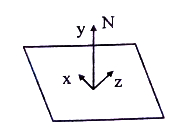
0 likesView Solution
Vedclass Products
For Students
Vedclass Test Series
Mock tests in real MHT CET style covering Mathematics with performance analysis. 5-day free trial.
Start Free TrialFor Teachers
Exam Paper Generator
Generate Set A/B/C/D Mathematics papers from 7.5L+ questions in 2 minutes. 3 chapters free.
Try FreeFor Institutes
Online Exam Module
Run live MHT CET mock exams with unlimited students, 360° analytics & white-label branding.
See DemoFrequently Asked Questions
How many Mathematics questions are in MHT CET 2020?
There are 698 Mathematics questions from the MHT CET 2020 paper on Vedclass, each with a detailed step-by-step solution in English.
Are MHT CET 2020 Mathematics solutions available in English?
Yes. All solutions on this page are in English. You can also switch to English or Hindi using the language buttons above the questions.
Can I practice MHT CET 2020 Mathematics as a timed test?
Yes. Use the Vedclass Test Series to attempt a full MHT CET mock test covering Mathematics with time limits and instant score analysis.
Can teachers create Mathematics papers from MHT CET previous year questions?
Yes. The Vedclass Exam Paper Generator lets teachers mix MHT CET Mathematics questions and generate Set A/B/C/D papers in minutes.
For Teachers & Institutes
Build a Custom Mathematics Paper
Pick MHT CET 2020 Mathematics questions, set difficulty, and generate Set A/B/C/D in 2 minutes.