
MathematicsQ101–200 of 698 questions
Page 3 of 10 · English
101
MathematicsEasyMCQMHT CET · 2020
In $\triangle ABC$,if $\frac{\cos A}{a} = \frac{\cos B}{b} = \frac{\cos C}{c}$ with usual notations,then the triangle is
A
an isosceles triangle
B
an equilateral triangle
C
a right-angled scalene triangle
D
a scalene triangle
Solution
(B) Using the sine rule,we have $\frac{a}{\sin A} = \frac{b}{\sin B} = \frac{c}{\sin C} = 2R$,which implies $a = 2R \sin A$,$b = 2R \sin B$,and $c = 2R \sin C$.
Given the condition $\frac{\cos A}{a} = \frac{\cos B}{b} = \frac{\cos C}{c}$,we substitute the values of $a, b, c$:
$\frac{\cos A}{2R \sin A} = \frac{\cos B}{2R \sin B} = \frac{\cos C}{2R \sin C}$.
This simplifies to $\cot A = \cot B = \cot C$.
Since $A, B, C$ are angles of a triangle,$\cot A = \cot B = \cot C$ implies $A = B = C$.
Therefore,the triangle is an equilateral triangle.
Given the condition $\frac{\cos A}{a} = \frac{\cos B}{b} = \frac{\cos C}{c}$,we substitute the values of $a, b, c$:
$\frac{\cos A}{2R \sin A} = \frac{\cos B}{2R \sin B} = \frac{\cos C}{2R \sin C}$.
This simplifies to $\cot A = \cot B = \cot C$.
Since $A, B, C$ are angles of a triangle,$\cot A = \cot B = \cot C$ implies $A = B = C$.
Therefore,the triangle is an equilateral triangle.
0 likesView Solution
102
MathematicsDifficultMCQMHT CET · 2020
In a triangle $ABC$ with usual notations,if $\tan A, \tan B, \tan C$ are in $H.P.$,then $a^{2}, b^{2}, c^{2}$ are in
A
$A.P.$
B
Not in $A.P.$
C
$H.P.$
D
$G.P.$
Solution
(A) Given that $\tan A, \tan B, \tan C$ are in $H.P.$
$\frac{2}{\tan B} = \frac{1}{\tan A} + \frac{1}{\tan C}$
$\frac{2 \cos B}{\sin B} = \frac{\cos A}{\sin A} + \frac{\cos C}{\sin C}$
Using the sine rule $\frac{a}{\sin A} = \frac{b}{\sin B} = \frac{c}{\sin C} = 2R$,we have $\sin A = \frac{a}{2R}, \sin B = \frac{b}{2R}, \sin C = \frac{c}{2R}$.
Also,$\cos B = \frac{a^{2}+c^{2}-b^{2}}{2ac}, \cos A = \frac{b^{2}+c^{2}-a^{2}}{2bc}, \cos C = \frac{a^{2}+b^{2}-c^{2}}{2ab}$.
Substituting these values:
$2 \left( \frac{a^{2}+c^{2}-b^{2}}{2ac} \right) \cdot \frac{2R}{b} = \frac{b^{2}+c^{2}-a^{2}}{2bc} \cdot \frac{2R}{a} + \frac{a^{2}+b^{2}-c^{2}}{2ab} \cdot \frac{2R}{c}$
Multiplying both sides by $\frac{abc}{2R}$:
$2(a^{2}+c^{2}-b^{2}) = (b^{2}+c^{2}-a^{2}) + (a^{2}+b^{2}-c^{2})$
$2a^{2} + 2c^{2} - 2b^{2} = 2b^{2}$
$2a^{2} + 2c^{2} = 4b^{2}$
$a^{2} + c^{2} = 2b^{2}$
Thus,$a^{2}, b^{2}, c^{2}$ are in $A.P.$
$\frac{2}{\tan B} = \frac{1}{\tan A} + \frac{1}{\tan C}$
$\frac{2 \cos B}{\sin B} = \frac{\cos A}{\sin A} + \frac{\cos C}{\sin C}$
Using the sine rule $\frac{a}{\sin A} = \frac{b}{\sin B} = \frac{c}{\sin C} = 2R$,we have $\sin A = \frac{a}{2R}, \sin B = \frac{b}{2R}, \sin C = \frac{c}{2R}$.
Also,$\cos B = \frac{a^{2}+c^{2}-b^{2}}{2ac}, \cos A = \frac{b^{2}+c^{2}-a^{2}}{2bc}, \cos C = \frac{a^{2}+b^{2}-c^{2}}{2ab}$.
Substituting these values:
$2 \left( \frac{a^{2}+c^{2}-b^{2}}{2ac} \right) \cdot \frac{2R}{b} = \frac{b^{2}+c^{2}-a^{2}}{2bc} \cdot \frac{2R}{a} + \frac{a^{2}+b^{2}-c^{2}}{2ab} \cdot \frac{2R}{c}$
Multiplying both sides by $\frac{abc}{2R}$:
$2(a^{2}+c^{2}-b^{2}) = (b^{2}+c^{2}-a^{2}) + (a^{2}+b^{2}-c^{2})$
$2a^{2} + 2c^{2} - 2b^{2} = 2b^{2}$
$2a^{2} + 2c^{2} = 4b^{2}$
$a^{2} + c^{2} = 2b^{2}$
Thus,$a^{2}, b^{2}, c^{2}$ are in $A.P.$
0 likesView Solution
103
MathematicsEasyMCQMHT CET · 2020
With usual notations,in triangle $ABC$,$a=\sqrt{3}+1$,$b=\sqrt{3}-1$ and $m \angle C=60^{\circ}$,then $A-B=$ (in $^{\circ}$)
A
$45$
B
$60$
C
$30$
D
$90$
Solution
(D) Given $a=\sqrt{3}+1$,$b=\sqrt{3}-1$,$m \angle C=60^{\circ}$.
Using the tangent rule (Napier's Analogy): $\tan \left( \frac{A-B}{2} \right) = \frac{a-b}{a+b} \cot \left( \frac{C}{2} \right)$.
Substitute the values: $\frac{a-b}{a+b} = \frac{(\sqrt{3}+1)-(\sqrt{3}-1)}{(\sqrt{3}+1)+(\sqrt{3}-1)} = \frac{2}{2\sqrt{3}} = \frac{1}{\sqrt{3}}$.
$\tan \left( \frac{A-B}{2} \right) = \frac{1}{\sqrt{3}} \cot \left( \frac{60^{\circ}}{2} \right) = \frac{1}{\sqrt{3}} \cot(30^{\circ}) = \frac{1}{\sqrt{3}} \times \sqrt{3} = 1$.
$\frac{A-B}{2} = 45^{\circ} \Rightarrow A-B = 90^{\circ}$.
Using the tangent rule (Napier's Analogy): $\tan \left( \frac{A-B}{2} \right) = \frac{a-b}{a+b} \cot \left( \frac{C}{2} \right)$.
Substitute the values: $\frac{a-b}{a+b} = \frac{(\sqrt{3}+1)-(\sqrt{3}-1)}{(\sqrt{3}+1)+(\sqrt{3}-1)} = \frac{2}{2\sqrt{3}} = \frac{1}{\sqrt{3}}$.
$\tan \left( \frac{A-B}{2} \right) = \frac{1}{\sqrt{3}} \cot \left( \frac{60^{\circ}}{2} \right) = \frac{1}{\sqrt{3}} \cot(30^{\circ}) = \frac{1}{\sqrt{3}} \times \sqrt{3} = 1$.
$\frac{A-B}{2} = 45^{\circ} \Rightarrow A-B = 90^{\circ}$.
0 likesView Solution
104
MathematicsMediumMCQMHT CET · 2020
In a triangle $ABC$ with usual notations,if $\frac{\cos A}{a} = \frac{\cos B}{b} = \frac{\cos C}{c}$,then the triangle is equilateral. If the side length is $a = \sqrt{6}$,find the area of the triangle.
A
$\frac{\sqrt{3}}{2}$ sq. units
B
$\frac{3 \sqrt{3}}{2}$ sq. units
C
$\frac{2}{\sqrt{3}}$ sq. units
D
$\frac{5 \sqrt{3}}{2}$ sq. units
Solution
(B) We know from the Sine Rule that $\frac{\sin A}{a} = \frac{\sin B}{b} = \frac{\sin C}{c} = k$.
Given that $\frac{\cos A}{a} = \frac{\cos B}{b} = \frac{\cos C}{c}$.
Dividing the Sine Rule equation by the given equation,we get $\tan A = \tan B = \tan C$.
Since $A, B, C$ are angles of a triangle,this implies $A = B = C = 60^{\circ}$,so the triangle is equilateral.
The area of an equilateral triangle with side $a$ is given by $\text{Area} = \frac{\sqrt{3}}{4} a^2$.
Given $a = \sqrt{6}$,the area is $\frac{\sqrt{3}}{4} (\sqrt{6})^2 = \frac{\sqrt{3}}{4} \times 6 = \frac{3 \sqrt{3}}{2}$ sq. units.
Given that $\frac{\cos A}{a} = \frac{\cos B}{b} = \frac{\cos C}{c}$.
Dividing the Sine Rule equation by the given equation,we get $\tan A = \tan B = \tan C$.
Since $A, B, C$ are angles of a triangle,this implies $A = B = C = 60^{\circ}$,so the triangle is equilateral.
The area of an equilateral triangle with side $a$ is given by $\text{Area} = \frac{\sqrt{3}}{4} a^2$.
Given $a = \sqrt{6}$,the area is $\frac{\sqrt{3}}{4} (\sqrt{6})^2 = \frac{\sqrt{3}}{4} \times 6 = \frac{3 \sqrt{3}}{2}$ sq. units.
0 likesView Solution
105
MathematicsEasyMCQMHT CET · 2020
In a $\Delta ABC$,if $2 \cos C = \sin B \cdot \operatorname{cosec} A$,then:
A
$a = b$
B
$b = c$
C
$a = c$
D
$a = b = c$
Solution
(C) Given the equation: $2 \cos C = \sin B \cdot \operatorname{cosec} A$
Since $\operatorname{cosec} A = \frac{1}{\sin A}$,we have $2 \cos C = \frac{\sin B}{\sin A}$.
Using the Sine Rule,$\frac{\sin B}{\sin A} = \frac{b}{a}$.
Thus,$2 \cos C = \frac{b}{a}$.
Using the Cosine Rule,$\cos C = \frac{a^2 + b^2 - c^2}{2ab}$.
Substituting this into the equation: $2 \left( \frac{a^2 + b^2 - c^2}{2ab} \right) = \frac{b}{a}$.
$\frac{a^2 + b^2 - c^2}{ab} = \frac{b}{a}$.
Multiplying both sides by $ab$,we get $a^2 + b^2 - c^2 = b^2$.
$a^2 - c^2 = 0 \Rightarrow a^2 = c^2$.
Since $a$ and $c$ are side lengths,$a = c$.
Since $\operatorname{cosec} A = \frac{1}{\sin A}$,we have $2 \cos C = \frac{\sin B}{\sin A}$.
Using the Sine Rule,$\frac{\sin B}{\sin A} = \frac{b}{a}$.
Thus,$2 \cos C = \frac{b}{a}$.
Using the Cosine Rule,$\cos C = \frac{a^2 + b^2 - c^2}{2ab}$.
Substituting this into the equation: $2 \left( \frac{a^2 + b^2 - c^2}{2ab} \right) = \frac{b}{a}$.
$\frac{a^2 + b^2 - c^2}{ab} = \frac{b}{a}$.
Multiplying both sides by $ab$,we get $a^2 + b^2 - c^2 = b^2$.
$a^2 - c^2 = 0 \Rightarrow a^2 = c^2$.
Since $a$ and $c$ are side lengths,$a = c$.
0 likesView Solution
106
MathematicsEasyMCQMHT CET · 2020
With usual notations,if the angles $A, B, C$ of a $\triangle ABC$ are in $A$.$P$. and $b:c = \sqrt{3}:\sqrt{2}$,then $\angle A=$ (in $^{\circ}$)
A
$55$
B
$45$
C
$35$
D
$75$
Solution
(D) Given that $A, B, C$ are in $A$.$P$.,we have $2B = A + C$.
Since $A + B + C = 180^{\circ}$,we substitute $A + C = 2B$ to get $3B = 180^{\circ}$,which implies $B = 60^{\circ}$.
Using the Sine Rule,$\frac{\sin B}{b} = \frac{\sin C}{c}$,we have $\sin C = \frac{c}{b} \sin B$.
Given $b:c = \sqrt{3}:\sqrt{2}$,we have $\frac{c}{b} = \frac{\sqrt{2}}{\sqrt{3}}$.
Thus,$\sin C = \frac{\sqrt{2}}{\sqrt{3}} \times \sin 60^{\circ} = \frac{\sqrt{2}}{\sqrt{3}} \times \frac{\sqrt{3}}{2} = \frac{\sqrt{2}}{2} = \frac{1}{\sqrt{2}}$.
Therefore,$C = 45^{\circ}$.
Finally,$A = 180^{\circ} - (B + C) = 180^{\circ} - (60^{\circ} + 45^{\circ}) = 180^{\circ} - 105^{\circ} = 75^{\circ}$.
Since $A + B + C = 180^{\circ}$,we substitute $A + C = 2B$ to get $3B = 180^{\circ}$,which implies $B = 60^{\circ}$.
Using the Sine Rule,$\frac{\sin B}{b} = \frac{\sin C}{c}$,we have $\sin C = \frac{c}{b} \sin B$.
Given $b:c = \sqrt{3}:\sqrt{2}$,we have $\frac{c}{b} = \frac{\sqrt{2}}{\sqrt{3}}$.
Thus,$\sin C = \frac{\sqrt{2}}{\sqrt{3}} \times \sin 60^{\circ} = \frac{\sqrt{2}}{\sqrt{3}} \times \frac{\sqrt{3}}{2} = \frac{\sqrt{2}}{2} = \frac{1}{\sqrt{2}}$.
Therefore,$C = 45^{\circ}$.
Finally,$A = 180^{\circ} - (B + C) = 180^{\circ} - (60^{\circ} + 45^{\circ}) = 180^{\circ} - 105^{\circ} = 75^{\circ}$.
0 likesView Solution
107
MathematicsMediumMCQMHT CET · 2020
With usual notations,if triangle $ABC$ is right-angled at $C$,then $\left(\frac{a^{2}+b^{2}}{a^{2}-b^{2}}\right) \sin (A-B) =$
A
$3$
B
$1$
C
$0$
D
$-1$
Solution
(B) Given that in $\triangle ABC, \angle C = 90^{\circ}$,so $A+B = 90^{\circ} \Rightarrow B = 90^{\circ}-A$.
Using the sine rule,$a = k \sin A$ and $b = k \sin B$.
Substituting these into the expression:
$\frac{a^{2}+b^{2}}{a^{2}-b^{2}} \sin (A-B) = \frac{\sin^{2} A + \sin^{2} B}{\sin^{2} A - \sin^{2} B} \sin (A-B)$.
Since $B = 90^{\circ}-A$,$\sin B = \cos A$ and $\cos B = \sin A$.
Thus,$\sin^{2} A + \sin^{2} B = \sin^{2} A + \cos^{2} A = 1$.
And $\sin^{2} A - \sin^{2} B = \sin^{2} A - \cos^{2} A = -\cos 2A$.
Also,$\sin (A-B) = \sin (A - (90^{\circ}-A)) = \sin (2A - 90^{\circ}) = -\cos 2A$.
Substituting these values:
$\frac{1}{-\cos 2A} \cdot (-\cos 2A) = 1$.
Using the sine rule,$a = k \sin A$ and $b = k \sin B$.
Substituting these into the expression:
$\frac{a^{2}+b^{2}}{a^{2}-b^{2}} \sin (A-B) = \frac{\sin^{2} A + \sin^{2} B}{\sin^{2} A - \sin^{2} B} \sin (A-B)$.
Since $B = 90^{\circ}-A$,$\sin B = \cos A$ and $\cos B = \sin A$.
Thus,$\sin^{2} A + \sin^{2} B = \sin^{2} A + \cos^{2} A = 1$.
And $\sin^{2} A - \sin^{2} B = \sin^{2} A - \cos^{2} A = -\cos 2A$.
Also,$\sin (A-B) = \sin (A - (90^{\circ}-A)) = \sin (2A - 90^{\circ}) = -\cos 2A$.
Substituting these values:
$\frac{1}{-\cos 2A} \cdot (-\cos 2A) = 1$.
0 likesView Solution
108
MathematicsDifficultMCQMHT CET · 2020
With usual notations,in $\triangle ABC$,if $a=2, b=3, c=5$ and $\frac{\cos A}{a}+\frac{\cos B}{b}+\frac{\cos C}{c}=\frac{k+7}{30}$,then $k=$
A
$6$
B
$16$
C
$17$
D
$12$
Solution
(D) Using the cosine rule,$\cos A = \frac{b^2+c^2-a^2}{2bc}$,$\cos B = \frac{a^2+c^2-b^2}{2ac}$,and $\cos C = \frac{a^2+b^2-c^2}{2ab}$.
Substituting these into the given expression:
$\frac{b^2+c^2-a^2}{2abc} + \frac{a^2+c^2-b^2}{2abc} + \frac{a^2+b^2-c^2}{2abc} = \frac{k+7}{30}$
$\frac{a^2+b^2+c^2}{2abc} = \frac{k+7}{30}$
Given $a=2, b=3, c=5$,we have $a^2+b^2+c^2 = 4+9+25 = 38$ and $2abc = 2 \times 2 \times 3 \times 5 = 60$.
So,$\frac{38}{60} = \frac{k+7}{30}$
$\frac{38}{60} = \frac{2(k+7)}{60}$
$38 = 2k + 14$
$2k = 24 \Rightarrow k = 12$.
Substituting these into the given expression:
$\frac{b^2+c^2-a^2}{2abc} + \frac{a^2+c^2-b^2}{2abc} + \frac{a^2+b^2-c^2}{2abc} = \frac{k+7}{30}$
$\frac{a^2+b^2+c^2}{2abc} = \frac{k+7}{30}$
Given $a=2, b=3, c=5$,we have $a^2+b^2+c^2 = 4+9+25 = 38$ and $2abc = 2 \times 2 \times 3 \times 5 = 60$.
So,$\frac{38}{60} = \frac{k+7}{30}$
$\frac{38}{60} = \frac{2(k+7)}{60}$
$38 = 2k + 14$
$2k = 24 \Rightarrow k = 12$.
0 likesView Solution
109
MathematicsMediumMCQMHT CET · 2020
If $A, B, C$ are the angles of a $\Delta ABC$,then with usual notations,$\frac{c^{2}-a^{2}+b^{2}}{a^{2}-b^{2}+c^{2}} = $
A
$\frac{\cos B}{\cos A}$
B
$\frac{\cot B}{\cot A}$
C
$\frac{\sin B}{\sin A}$
D
$\frac{\tan B}{\tan A}$
Solution
(D) Using the cosine rule,we have $\cos A = \frac{b^2 + c^2 - a^2}{2bc}$ and $\cos B = \frac{a^2 + c^2 - b^2}{2ac}$.
Thus,$b^2 + c^2 - a^2 = 2bc \cos A$ and $a^2 + c^2 - b^2 = 2ac \cos B$.
Substituting these into the given expression:
$\frac{c^2 - a^2 + b^2}{a^2 - b^2 + c^2} = \frac{2bc \cos A}{2ac \cos B} = \frac{b \cos A}{a \cos B}$.
By the sine rule,$\frac{a}{\sin A} = \frac{b}{\sin B} = 2R$,so $a = 2R \sin A$ and $b = 2R \sin B$.
Substituting these values:
$= \frac{(2R \sin B) \cos A}{(2R \sin A) \cos B} = \frac{\sin B \cos A}{\sin A \cos B} = \frac{\tan B}{\tan A}$.
Thus,$b^2 + c^2 - a^2 = 2bc \cos A$ and $a^2 + c^2 - b^2 = 2ac \cos B$.
Substituting these into the given expression:
$\frac{c^2 - a^2 + b^2}{a^2 - b^2 + c^2} = \frac{2bc \cos A}{2ac \cos B} = \frac{b \cos A}{a \cos B}$.
By the sine rule,$\frac{a}{\sin A} = \frac{b}{\sin B} = 2R$,so $a = 2R \sin A$ and $b = 2R \sin B$.
Substituting these values:
$= \frac{(2R \sin B) \cos A}{(2R \sin A) \cos B} = \frac{\sin B \cos A}{\sin A \cos B} = \frac{\tan B}{\tan A}$.
0 likesView Solution
110
MathematicsEasyMCQMHT CET · 2020
In $\Delta ABC$ with usual notations $a=4, b=3, \angle A=60^{\circ}$,then $c$ is a root of the equation
A
$c^{2}-3c-7=0$
B
$c^{2}-3c+7=0$
C
$c^{2}+3c-7=0$
D
$c^{2}+3c+7=0$
Solution
(A) Using the Law of Cosines: $\cos A = \frac{b^{2}+c^{2}-a^{2}}{2bc}$
Substituting the given values: $\cos 60^{\circ} = \frac{3^{2}+c^{2}-4^{2}}{2(3)(c)}$
$\frac{1}{2} = \frac{9+c^{2}-16}{6c}$
$\frac{1}{2} = \frac{c^{2}-7}{6c}$
$3c = c^{2}-7$
$c^{2}-3c-7 = 0$
Substituting the given values: $\cos 60^{\circ} = \frac{3^{2}+c^{2}-4^{2}}{2(3)(c)}$
$\frac{1}{2} = \frac{9+c^{2}-16}{6c}$
$\frac{1}{2} = \frac{c^{2}-7}{6c}$
$3c = c^{2}-7$
$c^{2}-3c-7 = 0$
0 likesView Solution
111
MathematicsEasyMCQMHT CET · 2020
In a triangle $ABC$ with usual notations,$\frac{\cos A-\cos C}{a-c}+\frac{\cos B}{b}=$
A
$\frac{1}{b}$
B
$\frac{2}{b}$
C
$\frac{-1}{b}$
D
$\frac{-2}{b}$
Solution
(C) We are given the expression $\frac{\cos A-\cos C}{a-c}+\frac{\cos B}{b}$.
By taking the common denominator,we get $\frac{b(\cos A-\cos C) + (a-c)\cos B}{b(a-c)}$.
Expanding the numerator,we have $\frac{b \cos A - b \cos C + a \cos B - c \cos B}{b(a-c)}$.
Rearranging the terms,we get $\frac{(a \cos B + b \cos A) - (b \cos C + c \cos B)}{b(a-c)}$.
Using the projection formula $c = a \cos B + b \cos A$ and $a = b \cos C + c \cos B$,the expression becomes $\frac{c - a}{b(a-c)}$.
Since $c - a = -(a - c)$,the expression simplifies to $\frac{-(a - c)}{b(a - c)} = \frac{-1}{b}$.
By taking the common denominator,we get $\frac{b(\cos A-\cos C) + (a-c)\cos B}{b(a-c)}$.
Expanding the numerator,we have $\frac{b \cos A - b \cos C + a \cos B - c \cos B}{b(a-c)}$.
Rearranging the terms,we get $\frac{(a \cos B + b \cos A) - (b \cos C + c \cos B)}{b(a-c)}$.
Using the projection formula $c = a \cos B + b \cos A$ and $a = b \cos C + c \cos B$,the expression becomes $\frac{c - a}{b(a-c)}$.
Since $c - a = -(a - c)$,the expression simplifies to $\frac{-(a - c)}{b(a - c)} = \frac{-1}{b}$.
0 likesView Solution
112
MathematicsMediumMCQMHT CET · 2020
The area of the triangle $ABC$ is $10\sqrt{3} \text{ cm}^2$,angle $B$ is $60^{\circ}$ and its perimeter is $20 \text{ cm}$. Then $\ell(AC) = $ (in $\text{ cm}$)
A
$10$
B
$8$
C
$5$
D
$7$
Solution
(D) Given: $\text{Area} = 10\sqrt{3} \text{ cm}^2$,$\angle B = 60^{\circ}$,and $a+b+c = 20 \text{ cm}$.
Using the area formula: $\text{Area} = \frac{1}{2}ac \sin B$.
$10\sqrt{3} = \frac{1}{2}ac \sin 60^{\circ} \Rightarrow 10\sqrt{3} = \frac{1}{2}ac \left(\frac{\sqrt{3}}{2}\right)$.
$10\sqrt{3} = \frac{ac\sqrt{3}}{4} \Rightarrow ac = 40$.
Using the Law of Cosines: $b^2 = a^2 + c^2 - 2ac \cos B$.
$b^2 = (a+c)^2 - 2ac - 2ac \cos 60^{\circ}$.
Since $a+c = 20-b$,we have $b^2 = (20-b)^2 - 2(40) - 2(40)(0.5)$.
$b^2 = 400 + b^2 - 40b - 80 - 40$.
$0 = 280 - 40b$.
$40b = 280 \Rightarrow b = 7 \text{ cm}$.
Thus,$\ell(AC) = b = 7 \text{ cm}$.
Using the area formula: $\text{Area} = \frac{1}{2}ac \sin B$.
$10\sqrt{3} = \frac{1}{2}ac \sin 60^{\circ} \Rightarrow 10\sqrt{3} = \frac{1}{2}ac \left(\frac{\sqrt{3}}{2}\right)$.
$10\sqrt{3} = \frac{ac\sqrt{3}}{4} \Rightarrow ac = 40$.
Using the Law of Cosines: $b^2 = a^2 + c^2 - 2ac \cos B$.
$b^2 = (a+c)^2 - 2ac - 2ac \cos 60^{\circ}$.
Since $a+c = 20-b$,we have $b^2 = (20-b)^2 - 2(40) - 2(40)(0.5)$.
$b^2 = 400 + b^2 - 40b - 80 - 40$.
$0 = 280 - 40b$.
$40b = 280 \Rightarrow b = 7 \text{ cm}$.
Thus,$\ell(AC) = b = 7 \text{ cm}$.
0 likesView Solution
113
MathematicsMediumMCQMHT CET · 2020
With usual notations,in $\Delta ABC$,if $b \cos ^{2} \frac{C}{2}+c \cos ^{2} \frac{B}{2}=\frac{3 a}{2}$,then
A
$b, a, c$ are in $A$.$P$.
B
$b, a, c$ are in $G$.$P$.
C
$a, b, c$ are in $G$.$P$.
D
$a, b, c$ are in $A$.$P$.
Solution
(A) Given $b \cos ^{2} \frac{C}{2}+c \cos ^{2} \frac{B}{2}=\frac{3 a}{2}$.
Using the identity $\cos ^{2} \theta = \frac{1+\cos 2\theta}{2}$,we have:
$b \left( \frac{1+\cos C}{2} \right) + c \left( \frac{1+\cos B}{2} \right) = \frac{3 a}{2}$.
Multiplying by $2$ on both sides:
$b(1+\cos C) + c(1+\cos B) = 3a$.
$b + b \cos C + c + c \cos B = 3a$.
Rearranging terms:
$(b \cos C + c \cos B) + b + c = 3a$.
By the projection rule,$b \cos C + c \cos B = a$,so:
$a + b + c = 3a$.
$b + c = 2a$.
This implies that $b, a, c$ are in $A$.$P$.
Using the identity $\cos ^{2} \theta = \frac{1+\cos 2\theta}{2}$,we have:
$b \left( \frac{1+\cos C}{2} \right) + c \left( \frac{1+\cos B}{2} \right) = \frac{3 a}{2}$.
Multiplying by $2$ on both sides:
$b(1+\cos C) + c(1+\cos B) = 3a$.
$b + b \cos C + c + c \cos B = 3a$.
Rearranging terms:
$(b \cos C + c \cos B) + b + c = 3a$.
By the projection rule,$b \cos C + c \cos B = a$,so:
$a + b + c = 3a$.
$b + c = 2a$.
This implies that $b, a, c$ are in $A$.$P$.
0 likesView Solution
114
MathematicsMediumMCQMHT CET · 2020
With usual notations,if in $\triangle ABC$,$s$ is the semi-perimeter and $(s-a)(s-b)=s(s-c)$,then $\triangle ABC$ is
A
an equilateral triangle
B
an obtuse-angled triangle
C
a right-angled triangle
D
an acute-angled triangle
Solution
(C) We know the half-angle formulas for a triangle:
$\sin^2 \frac{C}{2} = \frac{(s-a)(s-b)}{ab}$ and $\cos^2 \frac{C}{2} = \frac{s(s-c)}{ab}$.
Given the condition $(s-a)(s-b) = s(s-c)$,we can substitute these into the expressions:
$ab \sin^2 \frac{C}{2} = ab \cos^2 \frac{C}{2}$.
Dividing both sides by $ab \cos^2 \frac{C}{2}$ (assuming $ab \neq 0$ and $\cos \frac{C}{2} \neq 0$):
$\tan^2 \frac{C}{2} = 1$.
Since $\frac{C}{2}$ must be an acute angle in a triangle,$\tan \frac{C}{2} = 1$ implies $\frac{C}{2} = 45^{\circ}$.
Therefore,$C = 90^{\circ}$.
Thus,$\triangle ABC$ is a right-angled triangle.
$\sin^2 \frac{C}{2} = \frac{(s-a)(s-b)}{ab}$ and $\cos^2 \frac{C}{2} = \frac{s(s-c)}{ab}$.
Given the condition $(s-a)(s-b) = s(s-c)$,we can substitute these into the expressions:
$ab \sin^2 \frac{C}{2} = ab \cos^2 \frac{C}{2}$.
Dividing both sides by $ab \cos^2 \frac{C}{2}$ (assuming $ab \neq 0$ and $\cos \frac{C}{2} \neq 0$):
$\tan^2 \frac{C}{2} = 1$.
Since $\frac{C}{2}$ must be an acute angle in a triangle,$\tan \frac{C}{2} = 1$ implies $\frac{C}{2} = 45^{\circ}$.
Therefore,$C = 90^{\circ}$.
Thus,$\triangle ABC$ is a right-angled triangle.
0 likesView Solution
115
MathematicsEasyMCQMHT CET · 2020
If $m_{1}$ and $m_{2}$ are slopes of the lines represented by $(\sec^{2} \theta - \sin^{2} \theta) x^{2} - 2 \tan \theta xy + \sin^{2} \theta y^{2} = 0$,then $|m_{1} - m_{2}| = $
A
$1$
B
$2$
C
$4$
D
$3$
Solution
(B) The given equation is of the form $Ax^{2} + 2Hxy + By^{2} = 0$,where $A = \sec^{2} \theta - \sin^{2} \theta$,$2H = -2 \tan \theta$,and $B = \sin^{2} \theta$.
For a pair of lines $Ax^{2} + 2Hxy + By^{2} = 0$,the sum of slopes is $m_{1} + m_{2} = -\frac{2H}{B}$ and the product of slopes is $m_{1}m_{2} = \frac{A}{B}$.
Here,$m_{1} + m_{2} = \frac{2 \tan \theta}{\sin^{2} \theta}$ and $m_{1}m_{2} = \frac{\sec^{2} \theta - \sin^{2} \theta}{\sin^{2} \theta}$.
We know that $|m_{1} - m_{2}| = \sqrt{(m_{1} + m_{2})^{2} - 4m_{1}m_{2}}$.
Substituting the values:
$|m_{1} - m_{2}| = \sqrt{\left(\frac{2 \tan \theta}{\sin^{2} \theta}\right)^{2} - 4\left(\frac{\sec^{2} \theta - \sin^{2} \theta}{\sin^{2} \theta}\right)}$
$|m_{1} - m_{2}| = \sqrt{\frac{4 \tan^{2} \theta - 4(\sec^{2} \theta - \sin^{2} \theta) \sin^{2} \theta}{\sin^{4} \theta}}$
Using $\tan^{2} \theta = \frac{\sin^{2} \theta}{\cos^{2} \theta}$ and $\sec^{2} \theta = \frac{1}{\cos^{2} \theta}$:
$|m_{1} - m_{2}| = \sqrt{\frac{4 \frac{\sin^{2} \theta}{\cos^{2} \theta} - 4(\frac{1}{\cos^{2} \theta} - \sin^{2} \theta) \sin^{2} \theta}{\sin^{4} \theta}} = \sqrt{\frac{4 \frac{\sin^{2} \theta}{\cos^{2} \theta} - 4 \frac{\sin^{2} \theta}{\cos^{2} \theta} + 4 \sin^{4} \theta}{\sin^{4} \theta}} = \sqrt{\frac{4 \sin^{4} \theta}{\sin^{4} \theta}} = \sqrt{4} = 2$.
For a pair of lines $Ax^{2} + 2Hxy + By^{2} = 0$,the sum of slopes is $m_{1} + m_{2} = -\frac{2H}{B}$ and the product of slopes is $m_{1}m_{2} = \frac{A}{B}$.
Here,$m_{1} + m_{2} = \frac{2 \tan \theta}{\sin^{2} \theta}$ and $m_{1}m_{2} = \frac{\sec^{2} \theta - \sin^{2} \theta}{\sin^{2} \theta}$.
We know that $|m_{1} - m_{2}| = \sqrt{(m_{1} + m_{2})^{2} - 4m_{1}m_{2}}$.
Substituting the values:
$|m_{1} - m_{2}| = \sqrt{\left(\frac{2 \tan \theta}{\sin^{2} \theta}\right)^{2} - 4\left(\frac{\sec^{2} \theta - \sin^{2} \theta}{\sin^{2} \theta}\right)}$
$|m_{1} - m_{2}| = \sqrt{\frac{4 \tan^{2} \theta - 4(\sec^{2} \theta - \sin^{2} \theta) \sin^{2} \theta}{\sin^{4} \theta}}$
Using $\tan^{2} \theta = \frac{\sin^{2} \theta}{\cos^{2} \theta}$ and $\sec^{2} \theta = \frac{1}{\cos^{2} \theta}$:
$|m_{1} - m_{2}| = \sqrt{\frac{4 \frac{\sin^{2} \theta}{\cos^{2} \theta} - 4(\frac{1}{\cos^{2} \theta} - \sin^{2} \theta) \sin^{2} \theta}{\sin^{4} \theta}} = \sqrt{\frac{4 \frac{\sin^{2} \theta}{\cos^{2} \theta} - 4 \frac{\sin^{2} \theta}{\cos^{2} \theta} + 4 \sin^{4} \theta}{\sin^{4} \theta}} = \sqrt{\frac{4 \sin^{4} \theta}{\sin^{4} \theta}} = \sqrt{4} = 2$.
0 likesView Solution
116
MathematicsEasyMCQMHT CET · 2020
If the Arithmetic Mean ($A$.$M$.) and Geometric Mean ($G$.$M$.) of the roots of a quadratic equation in $x$ are $p$ and $q$ respectively,then the equation is:
A
$x^{2}+2px+q^{2}=0$
B
$x^{2}+px+q^{2}=0$
C
$x^{2}-px+q^{2}=0$
D
$x^{2}-2px+q^{2}=0$
Solution
(D) Let the roots of the quadratic equation be $\alpha$ and $\beta$.
Given that the Arithmetic Mean ($A$.$M$.) of the roots is $p$,we have $\frac{\alpha+\beta}{2} = p$,which implies $\alpha+\beta = 2p$.
Given that the Geometric Mean ($G$.$M$.) of the roots is $q$,we have $\sqrt{\alpha\beta} = q$,which implies $\alpha\beta = q^{2}$.
$A$ quadratic equation with roots $\alpha$ and $\beta$ is given by $x^{2} - (\text{sum of roots})x + (\text{product of roots}) = 0$.
Substituting the values,we get $x^{2} - (2p)x + q^{2} = 0$,which simplifies to $x^{2} - 2px + q^{2} = 0$.
Given that the Arithmetic Mean ($A$.$M$.) of the roots is $p$,we have $\frac{\alpha+\beta}{2} = p$,which implies $\alpha+\beta = 2p$.
Given that the Geometric Mean ($G$.$M$.) of the roots is $q$,we have $\sqrt{\alpha\beta} = q$,which implies $\alpha\beta = q^{2}$.
$A$ quadratic equation with roots $\alpha$ and $\beta$ is given by $x^{2} - (\text{sum of roots})x + (\text{product of roots}) = 0$.
Substituting the values,we get $x^{2} - (2p)x + q^{2} = 0$,which simplifies to $x^{2} - 2px + q^{2} = 0$.
0 likesView Solution
117
MathematicsEasyMCQMHT CET · 2020
The quadratic equation whose roots are the numbers having arithmetic mean $34$ and geometric mean $16$ is
A
$x^{2}+68x-256=0$
B
$x^{2}-68x-256=0$
C
$x^{2}-68x+256=0$
D
$x^{2}+68x+256=0$
Solution
(C) Let the roots of the quadratic equation be $a$ and $b$.
Given that the arithmetic mean of $a$ and $b$ is $34$,we have $\frac{a+b}{2} = 34$,which implies $a+b = 68$.
Given that the geometric mean of $a$ and $b$ is $16$,we have $\sqrt{ab} = 16$,which implies $ab = 16^{2} = 256$.
$A$ quadratic equation with roots $a$ and $b$ is given by $x^{2} - (a+b)x + ab = 0$.
Substituting the values,we get $x^{2} - 68x + 256 = 0$.
Given that the arithmetic mean of $a$ and $b$ is $34$,we have $\frac{a+b}{2} = 34$,which implies $a+b = 68$.
Given that the geometric mean of $a$ and $b$ is $16$,we have $\sqrt{ab} = 16$,which implies $ab = 16^{2} = 256$.
$A$ quadratic equation with roots $a$ and $b$ is given by $x^{2} - (a+b)x + ab = 0$.
Substituting the values,we get $x^{2} - 68x + 256 = 0$.
0 likesView Solution
118
MathematicsEasyMCQMHT CET · 2020
If $f(x) = ax^{2} + bx + 2$ and $f(1) = 4, f(3) = 38$,then $a - b = $
A
$15$
B
$-2$
C
$2$
D
$8$
Solution
(D) Given $f(x) = ax^{2} + bx + 2$.
For $f(1) = 4$:
$a(1)^{2} + b(1) + 2 = 4 \implies a + b = 2$ ... $(1)$
For $f(3) = 38$:
$a(3)^{2} + b(3) + 2 = 38 \implies 9a + 3b = 36 \implies 3a + b = 12$ ... $(2)$
Subtracting $(1)$ from $(2)$:
$(3a + b) - (a + b) = 12 - 2
2a = 10 \implies a = 5$
Substituting $a = 5$ in $(1)$:
$5 + b = 2 \implies b = -3$
Therefore,$a - b = 5 - (-3) = 5 + 3 = 8$.
For $f(1) = 4$:
$a(1)^{2} + b(1) + 2 = 4 \implies a + b = 2$ ... $(1)$
For $f(3) = 38$:
$a(3)^{2} + b(3) + 2 = 38 \implies 9a + 3b = 36 \implies 3a + b = 12$ ... $(2)$
Subtracting $(1)$ from $(2)$:
$(3a + b) - (a + b) = 12 - 2
2a = 10 \implies a = 5$
Substituting $a = 5$ in $(1)$:
$5 + b = 2 \implies b = -3$
Therefore,$a - b = 5 - (-3) = 5 + 3 = 8$.
0 likesView Solution
119
MathematicsMediumMCQMHT CET · 2020
For a sequence,if $S_{n} = \frac{5^{n} - 2^{n}}{2^{n}}$,then its fourth term is
A
$\frac{375}{16}$
B
$\frac{375}{8}$
C
$\frac{251}{8}$
D
$\frac{251}{16}$
Solution
(A) Given the sum of the first $n$ terms $S_{n} = \frac{5^{n} - 2^{n}}{2^{n}} = (\frac{5}{2})^{n} - 1$.
The $n^{th}$ term $T_{n}$ is given by $T_{n} = S_{n} - S_{n-1}$ for $n > 1$.
For $n = 4$,$T_{4} = S_{4} - S_{3}$.
$S_{4} = (\frac{5}{2})^{4} - 1 = \frac{625}{16} - 1 = \frac{625 - 16}{16} = \frac{609}{16}$.
$S_{3} = (\frac{5}{2})^{3} - 1 = \frac{125}{8} - 1 = \frac{125 - 8}{8} = \frac{117}{8} = \frac{234}{16}$.
$T_{4} = \frac{609}{16} - \frac{234}{16} = \frac{375}{16}$.
The $n^{th}$ term $T_{n}$ is given by $T_{n} = S_{n} - S_{n-1}$ for $n > 1$.
For $n = 4$,$T_{4} = S_{4} - S_{3}$.
$S_{4} = (\frac{5}{2})^{4} - 1 = \frac{625}{16} - 1 = \frac{625 - 16}{16} = \frac{609}{16}$.
$S_{3} = (\frac{5}{2})^{3} - 1 = \frac{125}{8} - 1 = \frac{125 - 8}{8} = \frac{117}{8} = \frac{234}{16}$.
$T_{4} = \frac{609}{16} - \frac{234}{16} = \frac{375}{16}$.
0 likesView Solution
120
MathematicsEasyMCQMHT CET · 2020
If for an Arithmetic Progression $(AP)$,$9$ times the $9^{th}$ term is equal to $13$ times the $13^{th}$ term,then the value of the $22^{nd}$ term is:
A
$0$
B
$2$
C
$4$
D
$5$
Solution
(A) Let the first term be $a$ and the common difference be $d$ for the given $AP$.
The $n^{th}$ term of an $AP$ is given by $a_n = a + (n-1)d$.
Given that $9 \times a_9 = 13 \times a_{13}$.
Substituting the formula for the terms:
$9[a + (9-1)d] = 13[a + (13-1)d]$
$9[a + 8d] = 13[a + 12d]$
$9a + 72d = 13a + 156d$
Rearranging the terms:
$13a - 9a + 156d - 72d = 0$
$4a + 84d = 0$
Dividing by $4$:
$a + 21d = 0$
Since the $22^{nd}$ term $a_{22} = a + (22-1)d = a + 21d$,
Therefore,$a_{22} = 0$.
The $n^{th}$ term of an $AP$ is given by $a_n = a + (n-1)d$.
Given that $9 \times a_9 = 13 \times a_{13}$.
Substituting the formula for the terms:
$9[a + (9-1)d] = 13[a + (13-1)d]$
$9[a + 8d] = 13[a + 12d]$
$9a + 72d = 13a + 156d$
Rearranging the terms:
$13a - 9a + 156d - 72d = 0$
$4a + 84d = 0$
Dividing by $4$:
$a + 21d = 0$
Since the $22^{nd}$ term $a_{22} = a + (22-1)d = a + 21d$,
Therefore,$a_{22} = 0$.
0 likesView Solution
121
MathematicsEasyMCQMHT CET · 2020
For a sequence $(t_{n})$,if $s_{n} = 7(3^{n} - 1)$,then $t_{n} =$
A
$7 \cdot 3^{n-1}$
B
$14 \cdot 3^{n+1}$
C
$14 \cdot 3^{n-1}$
D
$7 \cdot 3^{n+1}$
Solution
(C) Given the sum of the first $n$ terms is $s_{n} = 7(3^{n} - 1)$.
We know that the $n^{th}$ term $t_{n} = s_{n} - s_{n-1}$ for $n > 1$.
$s_{n-1} = 7(3^{n-1} - 1)$.
$t_{n} = 7(3^{n} - 1) - 7(3^{n-1} - 1)$.
$t_{n} = 7(3^{n} - 1 - 3^{n-1} + 1)$.
$t_{n} = 7(3^{n} - 3^{n-1})$.
$t_{n} = 7 \cdot 3^{n-1}(3 - 1)$.
$t_{n} = 7 \cdot 3^{n-1} \cdot 2$.
$t_{n} = 14 \cdot 3^{n-1}$.
We know that the $n^{th}$ term $t_{n} = s_{n} - s_{n-1}$ for $n > 1$.
$s_{n-1} = 7(3^{n-1} - 1)$.
$t_{n} = 7(3^{n} - 1) - 7(3^{n-1} - 1)$.
$t_{n} = 7(3^{n} - 1 - 3^{n-1} + 1)$.
$t_{n} = 7(3^{n} - 3^{n-1})$.
$t_{n} = 7 \cdot 3^{n-1}(3 - 1)$.
$t_{n} = 7 \cdot 3^{n-1} \cdot 2$.
$t_{n} = 14 \cdot 3^{n-1}$.
0 likesView Solution
122
MathematicsMediumMCQMHT CET · 2020
The rational form of the number $1.\overline{41}$ is
A
$\frac{154}{99}$
B
$\frac{55}{99}$
C
$\frac{140}{99}$
D
$\frac{41}{99}$
Solution
(C) Let $x = 1.\overline{41} = 1.414141...$ $(i)$
Multiply both sides by $100$ to shift the decimal point:
$100x = 141.414141...$ (ii)
Subtract equation $(i)$ from equation (ii):
$100x - x = 141.414141... - 1.414141...$
$99x = 140$
$x = \frac{140}{99}$
Therefore,the rational form is $\frac{140}{99}$.
Multiply both sides by $100$ to shift the decimal point:
$100x = 141.414141...$ (ii)
Subtract equation $(i)$ from equation (ii):
$100x - x = 141.414141... - 1.414141...$
$99x = 140$
$x = \frac{140}{99}$
Therefore,the rational form is $\frac{140}{99}$.
0 likesView Solution
123
MathematicsEasyMCQMHT CET · 2020
The sum of the first four terms of a $G.P.$ is $160$ and the common ratio is $3$. Find the $4^{th}$ term.
A
$118$
B
$100$
C
$108$
D
$102$
Solution
(C) Let the first four terms of the $G.P.$ be $a, ar, ar^2, ar^3$.
Given,common ratio $r = 3$ and the sum of the first four terms $S_4 = 160$.
The formula for the sum of the first $n$ terms is $S_n = \frac{a(r^n - 1)}{r - 1}$.
Substituting the values: $160 = \frac{a(3^4 - 1)}{3 - 1}$.
$160 = \frac{a(81 - 1)}{2} = \frac{a(80)}{2} = 40a$.
Thus,$a = \frac{160}{40} = 4$.
The $4^{th}$ term is $T_4 = ar^3$.
$T_4 = 4 \times (3)^3 = 4 \times 27 = 108$.
Given,common ratio $r = 3$ and the sum of the first four terms $S_4 = 160$.
The formula for the sum of the first $n$ terms is $S_n = \frac{a(r^n - 1)}{r - 1}$.
Substituting the values: $160 = \frac{a(3^4 - 1)}{3 - 1}$.
$160 = \frac{a(81 - 1)}{2} = \frac{a(80)}{2} = 40a$.
Thus,$a = \frac{160}{40} = 4$.
The $4^{th}$ term is $T_4 = ar^3$.
$T_4 = 4 \times (3)^3 = 4 \times 27 = 108$.
0 likesView Solution
124
MathematicsEasyMCQMHT CET · 2020
If for the harmonic progression,$t_{7} = \frac{1}{10}$ and $t_{12} = \frac{1}{25}$,then $t_{20} =$
A
$\frac{1}{48}$
B
$49$
C
$\frac{1}{49}$
D
$48$
Solution
(C) In a harmonic progression $(HP)$,the reciprocals of the terms form an arithmetic progression $(AP)$.
Let the corresponding $AP$ have the first term $A$ and common difference $D$.
Given $t_{7} = \frac{1}{10} \Rightarrow T_{7} = 10$,where $T_{n}$ is the $n^{\text{th}}$ term of the $AP$.
Given $t_{12} = \frac{1}{25} \Rightarrow T_{12} = 25$.
Using the formula $T_{n} = A + (n-1)D$:
$A + 6D = 10$ (Equation $1$)
$A + 11D = 25$ (Equation $2$)
Subtracting Equation $1$ from Equation $2$: $5D = 15 \Rightarrow D = 3$.
Substituting $D = 3$ into Equation $1$: $A + 6(3) = 10$ $\Rightarrow A + 18 = 10$ $\Rightarrow A = -8$.
Now,find the $20^{\text{th}}$ term of the $AP$: $T_{20} = A + 19D = -8 + 19(3) = -8 + 57 = 49$.
Therefore,the $20^{\text{th}}$ term of the $HP$ is $t_{20} = \frac{1}{T_{20}} = \frac{1}{49}$.
Let the corresponding $AP$ have the first term $A$ and common difference $D$.
Given $t_{7} = \frac{1}{10} \Rightarrow T_{7} = 10$,where $T_{n}$ is the $n^{\text{th}}$ term of the $AP$.
Given $t_{12} = \frac{1}{25} \Rightarrow T_{12} = 25$.
Using the formula $T_{n} = A + (n-1)D$:
$A + 6D = 10$ (Equation $1$)
$A + 11D = 25$ (Equation $2$)
Subtracting Equation $1$ from Equation $2$: $5D = 15 \Rightarrow D = 3$.
Substituting $D = 3$ into Equation $1$: $A + 6(3) = 10$ $\Rightarrow A + 18 = 10$ $\Rightarrow A = -8$.
Now,find the $20^{\text{th}}$ term of the $AP$: $T_{20} = A + 19D = -8 + 19(3) = -8 + 57 = 49$.
Therefore,the $20^{\text{th}}$ term of the $HP$ is $t_{20} = \frac{1}{T_{20}} = \frac{1}{49}$.
0 likesView Solution
125
MathematicsMediumMCQMHT CET · 2020
If $\frac{1}{4}, a, b, \frac{1}{19}$ form a $H.P.$,then the values of $a$ and $b$ are respectively:
A
$\frac{1}{9}, \frac{1}{14}$
B
$\frac{1}{5}, \frac{1}{7}$
C
$\frac{1}{12}, \frac{1}{15}$
D
$\frac{1}{11}, \frac{1}{17}$
Solution
(A) Given that $\frac{1}{4}, a, b, \frac{1}{19}$ are in $H.P.$
Therefore,their reciprocals $4, \frac{1}{a}, \frac{1}{b}, 19$ are in $A.P.$
Let the $A.P.$ be $4, 4+d, 4+2d, 4+3d$.
Here,$4+3d = 19 \implies 3d = 15 \implies d = 5$.
Thus,the terms are $4, 4+5, 4+10, 19$,which are $4, 9, 14, 19$.
Comparing the terms,$\frac{1}{a} = 9 \implies a = \frac{1}{9}$ and $\frac{1}{b} = 14 \implies b = \frac{1}{14}$.
Therefore,their reciprocals $4, \frac{1}{a}, \frac{1}{b}, 19$ are in $A.P.$
Let the $A.P.$ be $4, 4+d, 4+2d, 4+3d$.
Here,$4+3d = 19 \implies 3d = 15 \implies d = 5$.
Thus,the terms are $4, 4+5, 4+10, 19$,which are $4, 9, 14, 19$.
Comparing the terms,$\frac{1}{a} = 9 \implies a = \frac{1}{9}$ and $\frac{1}{b} = 14 \implies b = \frac{1}{14}$.
0 likesView Solution
126
MathematicsMediumMCQMHT CET · 2020
If $\frac{2+4+6+8+\dots+\text{upto } n \text{ terms}}{1+3+5+7+\dots+\text{upto } n \text{ terms}} = \frac{37}{36}$,then $n = $
A
$36$
B
$29$
C
$23$
D
$37$
Solution
(A) The sum of the first $n$ even natural numbers is given by $S_e = n(n+1)$.
The sum of the first $n$ odd natural numbers is given by $S_o = n^2$.
Given the ratio: $\frac{n(n+1)}{n^2} = \frac{37}{36}$.
Simplifying the expression: $\frac{n+1}{n} = \frac{37}{36}$.
By cross-multiplication: $36(n+1) = 37n$.
$36n + 36 = 37n$.
$37n - 36n = 36$.
Therefore,$n = 36$.
The sum of the first $n$ odd natural numbers is given by $S_o = n^2$.
Given the ratio: $\frac{n(n+1)}{n^2} = \frac{37}{36}$.
Simplifying the expression: $\frac{n+1}{n} = \frac{37}{36}$.
By cross-multiplication: $36(n+1) = 37n$.
$36n + 36 = 37n$.
$37n - 36n = 36$.
Therefore,$n = 36$.
0 likesView Solution
127
MathematicsEasyMCQMHT CET · 2020
$5^{2}+6^{2}+7^{2}+\ldots+20^{2} =$
A
$2860$
B
$2840$
C
$2830$
D
$2850$
Solution
(B) We need to find the sum $S = 5^{2} + 6^{2} + 7^{2} + \ldots + 20^{2}$.
This can be expressed as the difference of two sums of squares:
$S = \sum_{k=1}^{20} k^{2} - \sum_{k=1}^{4} k^{2}$.
Using the formula $\sum_{k=1}^{n} k^{2} = \frac{n(n+1)(2n+1)}{6}$:
For $n=20$: $\sum_{k=1}^{20} k^{2} = \frac{20(21)(41)}{6} = 10 \times 7 \times 41 = 2870$.
For $n=4$: $\sum_{k=1}^{4} k^{2} = \frac{4(5)(9)}{6} = 2 \times 5 \times 3 = 30$.
Therefore,$S = 2870 - 30 = 2840$.
This can be expressed as the difference of two sums of squares:
$S = \sum_{k=1}^{20} k^{2} - \sum_{k=1}^{4} k^{2}$.
Using the formula $\sum_{k=1}^{n} k^{2} = \frac{n(n+1)(2n+1)}{6}$:
For $n=20$: $\sum_{k=1}^{20} k^{2} = \frac{20(21)(41)}{6} = 10 \times 7 \times 41 = 2870$.
For $n=4$: $\sum_{k=1}^{4} k^{2} = \frac{4(5)(9)}{6} = 2 \times 5 \times 3 = 30$.
Therefore,$S = 2870 - 30 = 2840$.
0 likesView Solution
128
MathematicsMediumMCQMHT CET · 2020
$\frac{1^{2}}{2} + \frac{1^{2}+2^{2}}{3} + \frac{1^{2}+2^{2}+3^{2}}{4} + \frac{1^{2}+2^{2}+3^{2}+4^{2}}{5} + \dots$ up to $8$ terms $=$
A
$76$
B
$74$
C
$78$
D
$72$
Solution
(B) The $n^{th}$ term of the series is given by $T_n = \frac{\sum_{k=1}^{n} k^2}{n+1}$.
Using the formula $\sum_{k=1}^{n} k^2 = \frac{n(n+1)(2n+1)}{6}$,we get:
$T_n = \frac{n(n+1)(2n+1)}{6(n+1)} = \frac{n(2n+1)}{6} = \frac{2n^2 + n}{6}$.
We need to find the sum of the first $8$ terms,$S_8 = \sum_{n=1}^{8} T_n = \sum_{n=1}^{8} \frac{2n^2 + n}{6}$.
$S_8 = \frac{1}{6} \left[ 2 \sum_{n=1}^{8} n^2 + \sum_{n=1}^{8} n \right]$.
Using $\sum_{n=1}^{8} n^2 = \frac{8(9)(17)}{6} = 204$ and $\sum_{n=1}^{8} n = \frac{8(9)}{2} = 36$.
$S_8 = \frac{1}{6} [2(204) + 36] = \frac{1}{6} [408 + 36] = \frac{444}{6} = 74$.
Using the formula $\sum_{k=1}^{n} k^2 = \frac{n(n+1)(2n+1)}{6}$,we get:
$T_n = \frac{n(n+1)(2n+1)}{6(n+1)} = \frac{n(2n+1)}{6} = \frac{2n^2 + n}{6}$.
We need to find the sum of the first $8$ terms,$S_8 = \sum_{n=1}^{8} T_n = \sum_{n=1}^{8} \frac{2n^2 + n}{6}$.
$S_8 = \frac{1}{6} \left[ 2 \sum_{n=1}^{8} n^2 + \sum_{n=1}^{8} n \right]$.
Using $\sum_{n=1}^{8} n^2 = \frac{8(9)(17)}{6} = 204$ and $\sum_{n=1}^{8} n = \frac{8(9)}{2} = 36$.
$S_8 = \frac{1}{6} [2(204) + 36] = \frac{1}{6} [408 + 36] = \frac{444}{6} = 74$.
0 likesView Solution
129
MathematicsMediumMCQMHT CET · 2020
The sum to $10$ terms of the series $1 \times 3^{2} + 2 \times 5^{2} + 3 \times 7^{2} + \dots$ is
A
$13,495$
B
$15,595$
C
$13,000$
D
$13,695$
Solution
(D) The $n^{th}$ term of the series is given by $T_n = n(2n+1)^2$.
Expanding this,we get $T_n = n(4n^2 + 4n + 1) = 4n^3 + 4n^2 + n$.
The sum of $10$ terms is $S_{10} = \sum_{n=1}^{10} (4n^3 + 4n^2 + n)$.
Using the standard summation formulas:
$\sum_{n=1}^{10} n^3 = \left(\frac{10 \times 11}{2}\right)^2 = 55^2 = 3025$.
$\sum_{n=1}^{10} n^2 = \frac{10 \times 11 \times 21}{6} = 385$.
$\sum_{n=1}^{10} n = \frac{10 \times 11}{2} = 55$.
Therefore,$S_{10} = 4(3025) + 4(385) + 55$.
$S_{10} = 12100 + 1540 + 55 = 13695$.
Expanding this,we get $T_n = n(4n^2 + 4n + 1) = 4n^3 + 4n^2 + n$.
The sum of $10$ terms is $S_{10} = \sum_{n=1}^{10} (4n^3 + 4n^2 + n)$.
Using the standard summation formulas:
$\sum_{n=1}^{10} n^3 = \left(\frac{10 \times 11}{2}\right)^2 = 55^2 = 3025$.
$\sum_{n=1}^{10} n^2 = \frac{10 \times 11 \times 21}{6} = 385$.
$\sum_{n=1}^{10} n = \frac{10 \times 11}{2} = 55$.
Therefore,$S_{10} = 4(3025) + 4(385) + 55$.
$S_{10} = 12100 + 1540 + 55 = 13695$.
0 likesView Solution
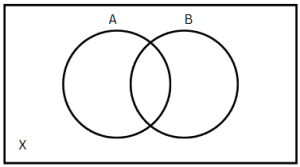
130
MathematicsEasyMCQMHT CET · 2020
If $A$ and $B$ are subsets of universal set $X$ such that $n(X)=200, n(A)=90, n(B)=80$ and $n(A' \cap B')=40$,then $n(A \cap B')=$
A
$70$
B
$80$
C
$20$
D
$10$
Solution
(B) Given that $n(X)=200, n(A)=90, n(B)=80$ and $n(A' \cap B')=40$.
By De Morgan's Law,$n(A' \cap B') = n((A \cup B)') = n(X) - n(A \cup B)$.
So,$40 = 200 - n(A \cup B)$,which implies $n(A \cup B) = 160$.
We know that $n(A \cup B) = n(A) + n(B) - n(A \cap B)$.
$160 = 90 + 80 - n(A \cap B) \implies 160 = 170 - n(A \cap B) \implies n(A \cap B) = 10$.
Now,$n(A \cap B') = n(A) - n(A \cap B) = 90 - 10 = 80$.
By De Morgan's Law,$n(A' \cap B') = n((A \cup B)') = n(X) - n(A \cup B)$.
So,$40 = 200 - n(A \cup B)$,which implies $n(A \cup B) = 160$.
We know that $n(A \cup B) = n(A) + n(B) - n(A \cap B)$.
$160 = 90 + 80 - n(A \cap B) \implies 160 = 170 - n(A \cap B) \implies n(A \cap B) = 10$.
Now,$n(A \cap B') = n(A) - n(A \cap B) = 90 - 10 = 80$.
0 likesView Solution
131
MathematicsEasyMCQMHT CET · 2020
If $A=\{2,4\}, B=\{3,4,5\}$,then $(A \cap B) \times (A \cup B) =$
A
$\{(3,2), (3,4), (4,4), (5,4)\}$
B
$\{(2,3), (2,4), (2,5)\}$
C
$\{(4,2), (4,3), (4,4), (4,5)\}$
D
$\{(4,3), (4,4), (4,5)\}$
Solution
(C) $A \cap B = \{4\}$
$A \cup B = \{2, 3, 4, 5\}$
Therefore,the Cartesian product is:
$(A \cap B) \times (A \cup B) = \{4\} \times \{2, 3, 4, 5\}$
$= \{(4, 2), (4, 3), (4, 4), (4, 5)\}$
$A \cup B = \{2, 3, 4, 5\}$
Therefore,the Cartesian product is:
$(A \cap B) \times (A \cup B) = \{4\} \times \{2, 3, 4, 5\}$
$= \{(4, 2), (4, 3), (4, 4), (4, 5)\}$
0 likesView Solution
132
MathematicsEasyMCQMHT CET · 2020
If $A = \{x \mid x \text{ is a prime number, } 0 \leq x \leq 9\}$,then the number of elements of the power set of $A$ is
A
$12$
B
$4$
C
$16$
D
$8$
Solution
(C) The set $A$ consists of prime numbers between $0$ and $9$.
$A = \{2, 3, 5, 7\}$.
The number of elements in set $A$ is $n(A) = 4$.
The number of elements in the power set of $A$ is given by $2^{n(A)}$.
$2^{4} = 16$.
$A = \{2, 3, 5, 7\}$.
The number of elements in set $A$ is $n(A) = 4$.
The number of elements in the power set of $A$ is given by $2^{n(A)}$.
$2^{4} = 16$.
0 likesView Solution
133
MathematicsEasyMCQMHT CET · 2020
Given $A = \{1, 2, 3, 4, 5\}$ and $B = \{1, 4, 5\}$. If $R$ is a relation from $A$ to $B$ such that $(x, y) \in R$ with $x > y$,then the range of $R$ is:
A
$\{1, 4\}$
B
$\{4, 5\}$
C
$\{1, 4, 5\}$
D
$\{2, 4\}$
Solution
(A) The relation $R$ is defined from $A$ to $B$ as $R = \{(x, y) : x \in A, y \in B, x > y\}$.
We check each element $x \in A$ against $y \in B$ where $x > y$:
For $x = 2$,$y = 1$ $(2 > 1)$,so $(2, 1) \in R$.
For $x = 3$,$y = 1$ $(3 > 1)$,so $(3, 1) \in R$.
For $x = 4$,$y = 1$ $(4 > 1)$ and $y = 1$ is not the only one,$y = 1$ is valid. Also $4 > 1$,so $(4, 1) \in R$.
For $x = 5$,$y = 1$ $(5 > 1)$ and $y = 4$ $(5 > 4)$,so $(5, 1) \in R$ and $(5, 4) \in R$.
The set of all ordered pairs in $R$ is $\{(2, 1), (3, 1), (4, 1), (5, 1), (5, 4)\}$.
The range is the set of all second elements in the ordered pairs of $R$.
Range $R = \{1, 4\}$.
We check each element $x \in A$ against $y \in B$ where $x > y$:
For $x = 2$,$y = 1$ $(2 > 1)$,so $(2, 1) \in R$.
For $x = 3$,$y = 1$ $(3 > 1)$,so $(3, 1) \in R$.
For $x = 4$,$y = 1$ $(4 > 1)$ and $y = 1$ is not the only one,$y = 1$ is valid. Also $4 > 1$,so $(4, 1) \in R$.
For $x = 5$,$y = 1$ $(5 > 1)$ and $y = 4$ $(5 > 4)$,so $(5, 1) \in R$ and $(5, 4) \in R$.
The set of all ordered pairs in $R$ is $\{(2, 1), (3, 1), (4, 1), (5, 1), (5, 4)\}$.
The range is the set of all second elements in the ordered pairs of $R$.
Range $R = \{1, 4\}$.
0 likesView Solution
134
MathematicsEasyMCQMHT CET · 2020
If $A = \{x, y, z\}$ and $B = \{1, 2\}$,then the total number of relations from set $A$ to set $B$ is:
A
$64$
B
$16$
C
$32$
D
$8$
Solution
(A) Given sets are $A = \{x, y, z\}$ and $B = \{1, 2\}$.
Number of elements in $A$ is $n(A) = 3$.
Number of elements in $B$ is $n(B) = 2$.
The Cartesian product $A \times B$ contains $n(A) \times n(B) = 3 \times 2 = 6$ elements.
$A$ relation from $A$ to $B$ is a subset of $A \times B$.
The total number of subsets of a set with $n$ elements is $2^n$.
Therefore,the total number of relations from $A$ to $B$ is $2^6 = 64$.
Number of elements in $A$ is $n(A) = 3$.
Number of elements in $B$ is $n(B) = 2$.
The Cartesian product $A \times B$ contains $n(A) \times n(B) = 3 \times 2 = 6$ elements.
$A$ relation from $A$ to $B$ is a subset of $A \times B$.
The total number of subsets of a set with $n$ elements is $2^n$.
Therefore,the total number of relations from $A$ to $B$ is $2^6 = 64$.
0 likesView Solution
135
MathematicsEasyMCQMHT CET · 2020
The Cartesian coordinates of the point whose polar coordinates are $\left(\frac{1}{2}, 120^{\circ}\right)$ are:
A
$\left(\frac{1}{4}, \frac{-\sqrt{3}}{4}\right)$
B
$\left(\frac{1}{4}, \frac{\sqrt{3}}{4}\right)$
C
$\left(\frac{-1}{4}, \frac{-\sqrt{3}}{4}\right)$
D
$\left(\frac{-1}{4}, \frac{\sqrt{3}}{4}\right)$
Solution
(D) Given polar coordinates are $P(r, \theta) = \left(\frac{1}{2}, 120^{\circ}\right)$,where $r = \frac{1}{2}$ and $\theta = 120^{\circ}$.
We use the conversion formulas $x = r \cos \theta$ and $y = r \sin \theta$.
For $x$: $x = \frac{1}{2} \cos 120^{\circ} = \frac{1}{2} \left(-\frac{1}{2}\right) = -\frac{1}{4}$.
For $y$: $y = \frac{1}{2} \sin 120^{\circ} = \frac{1}{2} \left(\frac{\sqrt{3}}{2}\right) = \frac{\sqrt{3}}{4}$.
Therefore,the Cartesian coordinates are $\left(-\frac{1}{4}, \frac{\sqrt{3}}{4}\right)$.
We use the conversion formulas $x = r \cos \theta$ and $y = r \sin \theta$.
For $x$: $x = \frac{1}{2} \cos 120^{\circ} = \frac{1}{2} \left(-\frac{1}{2}\right) = -\frac{1}{4}$.
For $y$: $y = \frac{1}{2} \sin 120^{\circ} = \frac{1}{2} \left(\frac{\sqrt{3}}{2}\right) = \frac{\sqrt{3}}{4}$.
Therefore,the Cartesian coordinates are $\left(-\frac{1}{4}, \frac{\sqrt{3}}{4}\right)$.
0 likesView Solution
136
MathematicsMediumMCQMHT CET · 2020
If $A(0,4,0)$,$B(0,0,3)$,and $C(0,4,3)$ are the vertices of $\Delta ABC$,then its incentre is
A
$(2,0,3)$
B
$(3,0,2)$
C
$(0,3,2)$
D
$(0,2,3)$
Solution
(C) The vertices are $A(0,4,0)$,$B(0,0,3)$,and $C(0,4,3)$.
Calculate the side lengths:
$a = BC = \sqrt{(0-0)^2 + (4-0)^2 + (3-3)^2} = \sqrt{0+16+0} = 4$.
$b = AC = \sqrt{(0-0)^2 + (4-4)^2 + (3-0)^2} = \sqrt{0+0+9} = 3$.
$c = AB = \sqrt{(0-0)^2 + (0-4)^2 + (3-0)^2} = \sqrt{0+16+9} = 5$.
The incentre $I(x, y, z)$ is given by the formula:
$I = \left( \frac{ax_A + bx_B + cx_C}{a+b+c}, \frac{ay_A + by_B + cy_C}{a+b+c}, \frac{az_A + bz_B + cz_C}{a+b+c} \right)$.
Substituting the values:
$x = \frac{4(0) + 3(0) + 5(0)}{4+3+5} = 0$.
$y = \frac{4(4) + 3(0) + 5(4)}{4+3+5} = \frac{16+0+20}{12} = \frac{36}{12} = 3$.
$z = \frac{4(0) + 3(3) + 5(3)}{4+3+5} = \frac{0+9+15}{12} = \frac{24}{12} = 2$.
Thus,the incentre is $(0,3,2)$.
Calculate the side lengths:
$a = BC = \sqrt{(0-0)^2 + (4-0)^2 + (3-3)^2} = \sqrt{0+16+0} = 4$.
$b = AC = \sqrt{(0-0)^2 + (4-4)^2 + (3-0)^2} = \sqrt{0+0+9} = 3$.
$c = AB = \sqrt{(0-0)^2 + (0-4)^2 + (3-0)^2} = \sqrt{0+16+9} = 5$.
The incentre $I(x, y, z)$ is given by the formula:
$I = \left( \frac{ax_A + bx_B + cx_C}{a+b+c}, \frac{ay_A + by_B + cy_C}{a+b+c}, \frac{az_A + bz_B + cz_C}{a+b+c} \right)$.
Substituting the values:
$x = \frac{4(0) + 3(0) + 5(0)}{4+3+5} = 0$.
$y = \frac{4(4) + 3(0) + 5(4)}{4+3+5} = \frac{16+0+20}{12} = \frac{36}{12} = 3$.
$z = \frac{4(0) + 3(3) + 5(3)}{4+3+5} = \frac{0+9+15}{12} = \frac{24}{12} = 2$.
Thus,the incentre is $(0,3,2)$.
0 likesView Solution
137
MathematicsEasyMCQMHT CET · 2020
If the origin is the centroid of the triangle whose vertices are $A(2, p, -3)$,$B(q, -2, 5)$,and $C(-5, 1, r)$,then
A
$p=-1, q=3, r=-2$
B
$p=1, q=-3, r=-2$
C
$p=1, q=3, r=2$
D
$p=1, q=3, r=-2$
Solution
(D) The centroid of a triangle with vertices $(x_1, y_1, z_1)$,$(x_2, y_2, z_2)$,and $(x_3, y_3, z_3)$ is given by $(\frac{x_1+x_2+x_3}{3}, \frac{y_1+y_2+y_3}{3}, \frac{z_1+z_2+z_3}{3})$.
Given that the origin $(0, 0, 0)$ is the centroid:
For the $x$-coordinate: $\frac{2+q-5}{3} = 0$ $\Rightarrow q-3 = 0$ $\Rightarrow q = 3$.
For the $y$-coordinate: $\frac{p-2+1}{3} = 0$ $\Rightarrow p-1 = 0$ $\Rightarrow p = 1$.
For the $z$-coordinate: $\frac{-3+5+r}{3} = 0$ $\Rightarrow r+2 = 0$ $\Rightarrow r = -2$.
Thus,$p=1, q=3, r=-2$.
Given that the origin $(0, 0, 0)$ is the centroid:
For the $x$-coordinate: $\frac{2+q-5}{3} = 0$ $\Rightarrow q-3 = 0$ $\Rightarrow q = 3$.
For the $y$-coordinate: $\frac{p-2+1}{3} = 0$ $\Rightarrow p-1 = 0$ $\Rightarrow p = 1$.
For the $z$-coordinate: $\frac{-3+5+r}{3} = 0$ $\Rightarrow r+2 = 0$ $\Rightarrow r = -2$.
Thus,$p=1, q=3, r=-2$.
0 likesView Solution
138
MathematicsEasyMCQMHT CET · 2020
If the points $A(5, k)$,$B(-3, 1)$ and $C(-7, -2)$ are collinear,then $k=$
A
$7$
B
$\frac{-1}{7}$
C
$\frac{1}{7}$
D
$-7$
Solution
(A) Since the points $A(5, k)$,$B(-3, 1)$,and $C(-7, -2)$ are collinear,the slope of $AB$ must be equal to the slope of $BC$.
Slope of $AB = \frac{1 - k}{-3 - 5} = \frac{1 - k}{-8}$.
Slope of $BC = \frac{-2 - 1}{-7 - (-3)} = \frac{-3}{-4} = \frac{3}{4}$.
Equating the slopes: $\frac{1 - k}{-8} = \frac{3}{4}$.
Multiplying both sides by $-8$: $1 - k = \frac{3}{4} \times (-8)$.
$1 - k = -6$.
$k = 1 + 6 = 7$.
Slope of $AB = \frac{1 - k}{-3 - 5} = \frac{1 - k}{-8}$.
Slope of $BC = \frac{-2 - 1}{-7 - (-3)} = \frac{-3}{-4} = \frac{3}{4}$.
Equating the slopes: $\frac{1 - k}{-8} = \frac{3}{4}$.
Multiplying both sides by $-8$: $1 - k = \frac{3}{4} \times (-8)$.
$1 - k = -6$.
$k = 1 + 6 = 7$.
0 likesView Solution
139
MathematicsEasyMCQMHT CET · 2020
The polar coordinates of the point whose Cartesian coordinates are $(-2, -2)$ are given by
A
$(2 \sqrt{2}, \frac{5 \pi}{4})$
B
$(2 \sqrt{2}, \frac{3 \pi}{4})$
C
$(2 \sqrt{2}, \frac{7 \pi}{6})$
D
$(2 \sqrt{2}, \frac{\pi}{4})$
Solution
(A) We know that $r = \sqrt{x^2 + y^2} = \sqrt{(-2)^2 + (-2)^2} = \sqrt{4 + 4} = \sqrt{8} = 2 \sqrt{2}$.
Since the point $(-2, -2)$ lies in the $III$ quadrant,the angle $\theta$ is given by $\tan \theta = \frac{y}{x} = \frac{-2}{-2} = 1$.
Since the point is in the $III$ quadrant,$\theta = \pi + \tan^{-1}(1) = \pi + \frac{\pi}{4} = \frac{5 \pi}{4}$.
Therefore,the polar coordinates $(r, \theta)$ are $(2 \sqrt{2}, \frac{5 \pi}{4})$.
Since the point $(-2, -2)$ lies in the $III$ quadrant,the angle $\theta$ is given by $\tan \theta = \frac{y}{x} = \frac{-2}{-2} = 1$.
Since the point is in the $III$ quadrant,$\theta = \pi + \tan^{-1}(1) = \pi + \frac{\pi}{4} = \frac{5 \pi}{4}$.
Therefore,the polar coordinates $(r, \theta)$ are $(2 \sqrt{2}, \frac{5 \pi}{4})$.
0 likesView Solution
140
MathematicsEasyMCQMHT CET · 2020
The points $A(-a, -b)$,$B(0, 0)$,$C(a, b)$,and $D(a^2, ab)$ are
A
collinear
B
vertices of a parallelogram
C
vertices of a square
D
vertices of a rectangle
Solution
(A) To check if the points are collinear,we can check the slopes of the line segments formed by these points.
Slope of $AB = \frac{0 - (-b)}{0 - (-a)} = \frac{b}{a}$.
Slope of $BC = \frac{b - 0}{a - 0} = \frac{b}{a}$.
Since the slope of $AB$ is equal to the slope of $BC$,the points $A, B,$ and $C$ are collinear.
Now,check the slope of $CD = \frac{ab - b}{a^2 - a} = \frac{b(a - 1)}{a(a - 1)} = \frac{b}{a}$ (for $a \neq 1, a \neq 0$).
Since the slope of $BC$ is equal to the slope of $CD$,the points $B, C,$ and $D$ are also collinear.
Since all points lie on the same line with slope $\frac{b}{a}$,the points $A, B, C,$ and $D$ are collinear.
Slope of $AB = \frac{0 - (-b)}{0 - (-a)} = \frac{b}{a}$.
Slope of $BC = \frac{b - 0}{a - 0} = \frac{b}{a}$.
Since the slope of $AB$ is equal to the slope of $BC$,the points $A, B,$ and $C$ are collinear.
Now,check the slope of $CD = \frac{ab - b}{a^2 - a} = \frac{b(a - 1)}{a(a - 1)} = \frac{b}{a}$ (for $a \neq 1, a \neq 0$).
Since the slope of $BC$ is equal to the slope of $CD$,the points $B, C,$ and $D$ are also collinear.
Since all points lie on the same line with slope $\frac{b}{a}$,the points $A, B, C,$ and $D$ are collinear.
0 likesView Solution
141
MathematicsEasyMCQMHT CET · 2020
The line passing through the points $(1, 4)$ and $(-5, 1)$ intersects the line $4x + 3y - 5 = 0$ at the point:
A
$(-1, -3)$
B
$(\frac{5}{3}, -\frac{5}{3})$
C
$(-1, 3)$
D
$(2, 1)$
Solution
(C) The equation of the line passing through points $(x_1, y_1) = (1, 4)$ and $(x_2, y_2) = (-5, 1)$ is given by the two-point form: $\frac{y - y_1}{y_2 - y_1} = \frac{x - x_1}{x_2 - x_1}$.
Substituting the values: $\frac{y - 4}{1 - 4} = \frac{x - 1}{-5 - 1}$.
$\frac{y - 4}{-3} = \frac{x - 1}{-6}$.
$2(y - 4) = x - 1$ $\Rightarrow 2y - 8 = x - 1$ $\Rightarrow x - 2y + 7 = 0$ ...$(1)$.
We are given the second line: $4x + 3y - 5 = 0$ ...$(2)$.
From $(1)$,$x = 2y - 7$. Substituting this into $(2)$:
$4(2y - 7) + 3y - 5 = 0$.
$8y - 28 + 3y - 5 = 0$.
$11y - 33 = 0 \Rightarrow y = 3$.
Substituting $y = 3$ into $x = 2y - 7$: $x = 2(3) - 7 = 6 - 7 = -1$.
Thus,the point of intersection is $(-1, 3)$.
Substituting the values: $\frac{y - 4}{1 - 4} = \frac{x - 1}{-5 - 1}$.
$\frac{y - 4}{-3} = \frac{x - 1}{-6}$.
$2(y - 4) = x - 1$ $\Rightarrow 2y - 8 = x - 1$ $\Rightarrow x - 2y + 7 = 0$ ...$(1)$.
We are given the second line: $4x + 3y - 5 = 0$ ...$(2)$.
From $(1)$,$x = 2y - 7$. Substituting this into $(2)$:
$4(2y - 7) + 3y - 5 = 0$.
$8y - 28 + 3y - 5 = 0$.
$11y - 33 = 0 \Rightarrow y = 3$.
Substituting $y = 3$ into $x = 2y - 7$: $x = 2(3) - 7 = 6 - 7 = -1$.
Thus,the point of intersection is $(-1, 3)$.
0 likesView Solution
142
MathematicsMediumMCQMHT CET · 2020
$A$ line cuts the $X$ and $Y$ axes at the points $A$ and $B$ respectively. If the point $(5, 6)$ divides the line segment $AB$ internally in the ratio $3: 1$,then the equation of the line is:
A
$2x + y = 16$
B
$2x + 5y = 40$
C
$2x - y = 4$
D
$2x - 5y = -20$
Solution
(B) Let $A \equiv (a, 0)$ and $B \equiv (0, b)$.
Let $P \equiv (5, 6)$ be the point that divides the line segment $AB$ internally in the ratio $3: 1$.
Using the section formula,the coordinates of $P$ are given by:
$5 = \frac{3 \times 0 + 1 \times a}{3 + 1}$ $\Rightarrow 5 = \frac{a}{4}$ $\Rightarrow a = 20$.
$6 = \frac{3 \times b + 1 \times 0}{3 + 1}$ $\Rightarrow 6 = \frac{3b}{4}$ $\Rightarrow 3b = 24$ $\Rightarrow b = 8$.
Thus,the $X$-intercept is $20$ and the $Y$-intercept is $8$.
The equation of the line in intercept form is $\frac{x}{a} + \frac{y}{b} = 1$.
Substituting the values,we get $\frac{x}{20} + \frac{y}{8} = 1$.
Multiplying by $40$,we get $2x + 5y = 40$.
Let $P \equiv (5, 6)$ be the point that divides the line segment $AB$ internally in the ratio $3: 1$.
Using the section formula,the coordinates of $P$ are given by:
$5 = \frac{3 \times 0 + 1 \times a}{3 + 1}$ $\Rightarrow 5 = \frac{a}{4}$ $\Rightarrow a = 20$.
$6 = \frac{3 \times b + 1 \times 0}{3 + 1}$ $\Rightarrow 6 = \frac{3b}{4}$ $\Rightarrow 3b = 24$ $\Rightarrow b = 8$.
Thus,the $X$-intercept is $20$ and the $Y$-intercept is $8$.
The equation of the line in intercept form is $\frac{x}{a} + \frac{y}{b} = 1$.
Substituting the values,we get $\frac{x}{20} + \frac{y}{8} = 1$.
Multiplying by $40$,we get $2x + 5y = 40$.
0 likesView Solution
143
MathematicsMediumMCQMHT CET · 2020
The equations of the lines which make intercepts on the axes whose sum is $8$ and product is $15$ are
A
$3x - 5y + 15 = 0, 5x + 3y + 15 = 0$
B
$5x - 3y + 15 = 0, 3x + 5y + 15 = 0$
C
$3x + 5y - 15 = 0, 5x + 3y - 15 = 0$
D
$3x + 5y + 15 = 0, 5x + 3y - 15 = 0$
Solution
(C) Let $a$ and $b$ be the intercepts made by the line on the axes.
We are given $a + b = 8$ and $ab = 15$.
Solving the quadratic equation $t^2 - 8t + 15 = 0$,we get $(t - 3)(t - 5) = 0$,so $(a, b) = (3, 5)$ or $(5, 3)$.
The intercept form of the equation of a line is $\frac{x}{a} + \frac{y}{b} = 1$.
Case $1$: When $a = 3$ and $b = 5$,the equation is $\frac{x}{3} + \frac{y}{5} = 1$,which simplifies to $5x + 3y - 15 = 0$.
Case $2$: When $a = 5$ and $b = 3$,the equation is $\frac{x}{5} + \frac{y}{3} = 1$,which simplifies to $3x + 5y - 15 = 0$.
Thus,the equations are $5x + 3y - 15 = 0$ and $3x + 5y - 15 = 0$.
We are given $a + b = 8$ and $ab = 15$.
Solving the quadratic equation $t^2 - 8t + 15 = 0$,we get $(t - 3)(t - 5) = 0$,so $(a, b) = (3, 5)$ or $(5, 3)$.
The intercept form of the equation of a line is $\frac{x}{a} + \frac{y}{b} = 1$.
Case $1$: When $a = 3$ and $b = 5$,the equation is $\frac{x}{3} + \frac{y}{5} = 1$,which simplifies to $5x + 3y - 15 = 0$.
Case $2$: When $a = 5$ and $b = 3$,the equation is $\frac{x}{5} + \frac{y}{3} = 1$,which simplifies to $3x + 5y - 15 = 0$.
Thus,the equations are $5x + 3y - 15 = 0$ and $3x + 5y - 15 = 0$.
0 likesView Solution
144
MathematicsEasyMCQMHT CET · 2020
The equation of a line passing through the point of intersection of the lines $x - 2y + 8 = 0$ and $3x - y + 4 = 0$ and passing through the origin is
A
$4x - 5y = 0$
B
$5x - 4y = 0$
C
$5x + 4y = 0$
D
$4x + 5y = 0$
Solution
(B) Given lines are $L_1: x - 2y + 8 = 0$ and $L_2: 3x - y + 4 = 0$.
To find the point of intersection,multiply $L_2$ by $2$: $6x - 2y + 8 = 0$.
Subtract $L_1$ from this: $(6x - 2y + 8) - (x - 2y + 8) = 0$,which gives $5x = 0$,so $x = 0$.
Substituting $x = 0$ in $L_2$: $3(0) - y + 4 = 0$,which gives $y = 4$.
The point of intersection is $(0, 4)$.
$A$ line passing through $(0, 0)$ and $(0, 4)$ is the $y$-axis,which is $x = 0$.
However,checking the options,if the line passes through $(0, 0)$ and the intersection point,the slope $m = \frac{4-0}{0-0}$ is undefined. Re-evaluating the intersection: $x-2y+8=0$ and $3x-y+4=0$. $y=3x+4$. $x-2(3x+4)+8=0 \implies x-6x-8+8=0 \implies -5x=0 \implies x=0, y=4$. The line is $x=0$. Given the options,there might be a typo in the question constants. If the intersection was $(4, 5)$,the line would be $5x-4y=0$.
To find the point of intersection,multiply $L_2$ by $2$: $6x - 2y + 8 = 0$.
Subtract $L_1$ from this: $(6x - 2y + 8) - (x - 2y + 8) = 0$,which gives $5x = 0$,so $x = 0$.
Substituting $x = 0$ in $L_2$: $3(0) - y + 4 = 0$,which gives $y = 4$.
The point of intersection is $(0, 4)$.
$A$ line passing through $(0, 0)$ and $(0, 4)$ is the $y$-axis,which is $x = 0$.
However,checking the options,if the line passes through $(0, 0)$ and the intersection point,the slope $m = \frac{4-0}{0-0}$ is undefined. Re-evaluating the intersection: $x-2y+8=0$ and $3x-y+4=0$. $y=3x+4$. $x-2(3x+4)+8=0 \implies x-6x-8+8=0 \implies -5x=0 \implies x=0, y=4$. The line is $x=0$. Given the options,there might be a typo in the question constants. If the intersection was $(4, 5)$,the line would be $5x-4y=0$.
0 likesView Solution
145
MathematicsEasyMCQMHT CET · 2020
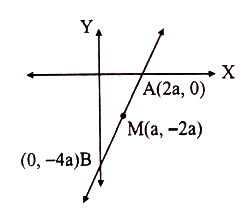
If $(a, -2a), a > 0$ is the midpoint of a line segment intercepted between the coordinate axes,then the equation of the line is
A
$x - 2y + 4a = 0$
B
$2x - y = 4a$
C
$x - 2y = 5a$
D
$2x - y + 4a = 0$
Solution
(B) Let the line intersect the $x$-axis at $(h, 0)$ and the $y$-axis at $(0, k)$.
Since $(a, -2a)$ is the midpoint of the line segment,we have:
$\frac{h + 0}{2} = a \Rightarrow h = 2a$
$\frac{0 + k}{2} = -2a \Rightarrow k = -4a$
Using the intercept form of the line equation,$\frac{x}{h} + \frac{y}{k} = 1$:
$\frac{x}{2a} + \frac{y}{-4a} = 1$
Multiplying by $4a$,we get:
$2x - y = 4a$
Thus,the equation of the line is $2x - y = 4a$.
Since $(a, -2a)$ is the midpoint of the line segment,we have:
$\frac{h + 0}{2} = a \Rightarrow h = 2a$
$\frac{0 + k}{2} = -2a \Rightarrow k = -4a$
Using the intercept form of the line equation,$\frac{x}{h} + \frac{y}{k} = 1$:
$\frac{x}{2a} + \frac{y}{-4a} = 1$
Multiplying by $4a$,we get:
$2x - y = 4a$
Thus,the equation of the line is $2x - y = 4a$.
0 likesView Solution
146
MathematicsEasyMCQMHT CET · 2020
The equation of a line passing through the point $(7, -4)$ and perpendicular to the line passing through the points $(2, 3)$ and $(1, -2)$ is
A
$x+5y+13=0$
B
$x-5y-13=0$
C
$x-2y-15=0$
D
$x+2y+1=0$
Solution
(A) The slope $m_1$ of the line passing through $(2, 3)$ and $(1, -2)$ is given by $m_1 = \frac{-2-3}{1-2} = \frac{-5}{-1} = 5$.
Since the required line is perpendicular to this line,its slope $m_2$ must satisfy $m_1 \times m_2 = -1$.
Thus,$m_2 = -\frac{1}{5}$.
Using the point-slope form $(y - y_1) = m(x - x_1)$ for the point $(7, -4)$:
$y - (-4) = -\frac{1}{5}(x - 7)$
$5(y + 4) = -(x - 7)$
$5y + 20 = -x + 7$
$x + 5y + 13 = 0$.
Since the required line is perpendicular to this line,its slope $m_2$ must satisfy $m_1 \times m_2 = -1$.
Thus,$m_2 = -\frac{1}{5}$.
Using the point-slope form $(y - y_1) = m(x - x_1)$ for the point $(7, -4)$:
$y - (-4) = -\frac{1}{5}(x - 7)$
$5(y + 4) = -(x - 7)$
$5y + 20 = -x + 7$
$x + 5y + 13 = 0$.
0 likesView Solution
147
MathematicsEasyMCQMHT CET · 2020
The acute angle between the lines $x \sin \theta - y \cos \theta = 5$ and $x \sin \alpha - y \cos \alpha + 11 = 0$ is
A
$|\theta - \alpha|$
B
$\frac{\pi}{4}$
C
$\frac{\pi}{3}$
D
$\theta + \alpha$
Solution
(A) The equation of the first line is $x \sin \theta - y \cos \theta = 5$. Its slope $m_1 = \frac{\sin \theta}{\cos \theta} = \tan \theta$.
The equation of the second line is $x \sin \alpha - y \cos \alpha + 11 = 0$. Its slope $m_2 = \frac{\sin \alpha}{\cos \alpha} = \tan \alpha$.
Let $\beta$ be the acute angle between the lines.
Then,$\tan \beta = \left| \frac{m_1 - m_2}{1 + m_1 m_2} \right| = \left| \frac{\tan \theta - \tan \alpha}{1 + \tan \theta \tan \alpha} \right|$.
Using the trigonometric identity $\tan(\theta - \alpha) = \frac{\tan \theta - \tan \alpha}{1 + \tan \theta \tan \alpha}$,we get $\tan \beta = |\tan(\theta - \alpha)|$.
Therefore,$\beta = |\theta - \alpha|$.
The equation of the second line is $x \sin \alpha - y \cos \alpha + 11 = 0$. Its slope $m_2 = \frac{\sin \alpha}{\cos \alpha} = \tan \alpha$.
Let $\beta$ be the acute angle between the lines.
Then,$\tan \beta = \left| \frac{m_1 - m_2}{1 + m_1 m_2} \right| = \left| \frac{\tan \theta - \tan \alpha}{1 + \tan \theta \tan \alpha} \right|$.
Using the trigonometric identity $\tan(\theta - \alpha) = \frac{\tan \theta - \tan \alpha}{1 + \tan \theta \tan \alpha}$,we get $\tan \beta = |\tan(\theta - \alpha)|$.
Therefore,$\beta = |\theta - \alpha|$.
0 likesView Solution
148
MathematicsEasyMCQMHT CET · 2020
The acute angle between the lines given by $y - \sqrt{3}x + 1 = 0$ and $\sqrt{3}y - x + 7 = 0$ is (in $^{\circ}$)
A
$75$
B
$60$
C
$45$
D
$30$
Solution
(D) The given equations of the lines are $y = \sqrt{3}x - 1$ and $y = \frac{1}{\sqrt{3}}x - \frac{7}{\sqrt{3}}$.
Comparing these with $y = mx + c$,the slopes are $m_{1} = \sqrt{3}$ and $m_{2} = \frac{1}{\sqrt{3}}$.
The angle $\theta$ between the lines is given by $\tan \theta = \left| \frac{m_{1} - m_{2}}{1 + m_{1}m_{2}} \right|$.
Substituting the values: $\tan \theta = \left| \frac{\sqrt{3} - \frac{1}{\sqrt{3}}}{1 + (\sqrt{3})(\frac{1}{\sqrt{3}})} \right| = \left| \frac{\frac{3-1}{\sqrt{3}}}{1 + 1} \right| = \left| \frac{2/\sqrt{3}}{2} \right| = \frac{1}{\sqrt{3}}$.
Since $\tan \theta = \frac{1}{\sqrt{3}}$,we have $\theta = 30^{\circ}$.
Comparing these with $y = mx + c$,the slopes are $m_{1} = \sqrt{3}$ and $m_{2} = \frac{1}{\sqrt{3}}$.
The angle $\theta$ between the lines is given by $\tan \theta = \left| \frac{m_{1} - m_{2}}{1 + m_{1}m_{2}} \right|$.
Substituting the values: $\tan \theta = \left| \frac{\sqrt{3} - \frac{1}{\sqrt{3}}}{1 + (\sqrt{3})(\frac{1}{\sqrt{3}})} \right| = \left| \frac{\frac{3-1}{\sqrt{3}}}{1 + 1} \right| = \left| \frac{2/\sqrt{3}}{2} \right| = \frac{1}{\sqrt{3}}$.
Since $\tan \theta = \frac{1}{\sqrt{3}}$,we have $\theta = 30^{\circ}$.
0 likesView Solution
149
MathematicsEasyMCQMHT CET · 2020
The distance between the lines given by $3x + 4y = 9$ and $6x + 8y = 15$ is (in $units$)
A
$5$
B
$3$
C
$0.5$
D
$0.3$
Solution
(D) The given lines are $3x + 4y = 9$ and $6x + 8y = 15$.
To find the distance between parallel lines,we first make the coefficients of $x$ and $y$ identical.
Multiply the first equation by $2$: $2(3x + 4y) = 2(9) \Rightarrow 6x + 8y = 18$.
The distance $d$ between two parallel lines $ax + by + c_1 = 0$ and $ax + by + c_2 = 0$ is given by $d = \frac{|c_1 - c_2|}{\sqrt{a^2 + b^2}}$.
Here,$a = 6$,$b = 8$,$c_1 = -18$,and $c_2 = -15$.
$d = \frac{|-18 - (-15)|}{\sqrt{6^2 + 8^2}} = \frac{|-3|}{\sqrt{36 + 64}} = \frac{3}{\sqrt{100}} = \frac{3}{10} = 0.3$ units.
To find the distance between parallel lines,we first make the coefficients of $x$ and $y$ identical.
Multiply the first equation by $2$: $2(3x + 4y) = 2(9) \Rightarrow 6x + 8y = 18$.
The distance $d$ between two parallel lines $ax + by + c_1 = 0$ and $ax + by + c_2 = 0$ is given by $d = \frac{|c_1 - c_2|}{\sqrt{a^2 + b^2}}$.
Here,$a = 6$,$b = 8$,$c_1 = -18$,and $c_2 = -15$.
$d = \frac{|-18 - (-15)|}{\sqrt{6^2 + 8^2}} = \frac{|-3|}{\sqrt{36 + 64}} = \frac{3}{\sqrt{100}} = \frac{3}{10} = 0.3$ units.
0 likesView Solution
150
MathematicsEasyMCQMHT CET · 2020
The length of the perpendicular from the point $P(a, b)$ to the line $\frac{x}{a} + \frac{y}{b} = 1$ is
A
$\left| \frac{\sqrt{a^{2} + b^{2}}}{ab} \right|$ units
B
$\left| \frac{ab}{\sqrt{a^{2} + b^{2}}} \right|$ units
C
$\left| \frac{b^{2}}{\sqrt{a^{2} + b^{2}}} \right|$ units
D
$\left| \frac{a^{2}}{\sqrt{a^{2} + b^{2}}} \right|$ units
Solution
(B) The given line is $\frac{x}{a} + \frac{y}{b} = 1$,which can be rewritten as $bx + ay - ab = 0$.
The length of the perpendicular from a point $(x_{1}, y_{1})$ to the line $Ax + By + C = 0$ is given by $d = \left| \frac{Ax_{1} + By_{1} + C}{\sqrt{A^{2} + B^{2}}} \right|$.
Substituting $A = b$,$B = a$,$C = -ab$,$x_{1} = a$,and $y_{1} = b$:
$d = \left| \frac{b(a) + a(b) - ab}{\sqrt{b^{2} + a^{2}}} \right| = \left| \frac{ab + ab - ab}{\sqrt{a^{2} + b^{2}}} \right| = \left| \frac{ab}{\sqrt{a^{2} + b^{2}}} \right|$ units.
The length of the perpendicular from a point $(x_{1}, y_{1})$ to the line $Ax + By + C = 0$ is given by $d = \left| \frac{Ax_{1} + By_{1} + C}{\sqrt{A^{2} + B^{2}}} \right|$.
Substituting $A = b$,$B = a$,$C = -ab$,$x_{1} = a$,and $y_{1} = b$:
$d = \left| \frac{b(a) + a(b) - ab}{\sqrt{b^{2} + a^{2}}} \right| = \left| \frac{ab + ab - ab}{\sqrt{a^{2} + b^{2}}} \right| = \left| \frac{ab}{\sqrt{a^{2} + b^{2}}} \right|$ units.
0 likesView Solution
151
MathematicsDifficultMCQMHT CET · 2020
$\int_{-2}^{1} [x+1] \, dx =$ (Where $[x]$ is the greatest integer function not greater than $x$)
A
$1$
B
$0$
C
$-1$
D
$2$
Solution
(B) Let $I = \int_{-2}^{1} [x+1] \, dx$.
Using the property $[x+n] = [x] + n$ for any integer $n$,we have $[x+1] = [x] + 1$.
So,$I = \int_{-2}^{1} ([x] + 1) \, dx = \int_{-2}^{1} [x] \, dx + \int_{-2}^{1} 1 \, dx$.
Evaluating the second integral: $\int_{-2}^{1} 1 \, dx = [x]_{-2}^{1} = 1 - (-2) = 3$.
Evaluating the first integral: $\int_{-2}^{1} [x] \, dx = \int_{-2}^{-1} -2 \, dx + \int_{-1}^{0} -1 \, dx + \int_{0}^{1} 0 \, dx$.
$= -2[x]_{-2}^{-1} - 1[x]_{-1}^{0} + 0 = -2(-1 - (-2)) - 1(0 - (-1)) = -2(1) - 1(1) = -2 - 1 = -3$.
Therefore,$I = -3 + 3 = 0$.
Using the property $[x+n] = [x] + n$ for any integer $n$,we have $[x+1] = [x] + 1$.
So,$I = \int_{-2}^{1} ([x] + 1) \, dx = \int_{-2}^{1} [x] \, dx + \int_{-2}^{1} 1 \, dx$.
Evaluating the second integral: $\int_{-2}^{1} 1 \, dx = [x]_{-2}^{1} = 1 - (-2) = 3$.
Evaluating the first integral: $\int_{-2}^{1} [x] \, dx = \int_{-2}^{-1} -2 \, dx + \int_{-1}^{0} -1 \, dx + \int_{0}^{1} 0 \, dx$.
$= -2[x]_{-2}^{-1} - 1[x]_{-1}^{0} + 0 = -2(-1 - (-2)) - 1(0 - (-1)) = -2(1) - 1(1) = -2 - 1 = -3$.
Therefore,$I = -3 + 3 = 0$.
0 likesView Solution
152
MathematicsEasyMCQMHT CET · 2020
$\int_{0}^{\frac{\pi}{2}} \sin^{2} x \, dx =$
A
$\frac{\pi}{2}$
B
$\frac{3\pi}{2}$
C
$\frac{3\pi}{4}$
D
$\frac{\pi}{4}$
Solution
(D) We use the trigonometric identity $\sin^{2} x = \frac{1 - \cos 2x}{2}$.
$\int_{0}^{\frac{\pi}{2}} \sin^{2} x \, dx = \int_{0}^{\frac{\pi}{2}} \frac{1 - \cos 2x}{2} \, dx$
$= \frac{1}{2} \int_{0}^{\frac{\pi}{2}} (1 - \cos 2x) \, dx$
$= \frac{1}{2} \left[ x - \frac{\sin 2x}{2} \right]_{0}^{\frac{\pi}{2}}$
$= \frac{1}{2} \left[ \left( \frac{\pi}{2} - \frac{\sin(\pi)}{2} \right) - \left( 0 - \frac{\sin(0)}{2} \right) \right]$
$= \frac{1}{2} \left[ \frac{\pi}{2} - 0 - 0 + 0 \right]$
$= \frac{\pi}{4}$
$\int_{0}^{\frac{\pi}{2}} \sin^{2} x \, dx = \int_{0}^{\frac{\pi}{2}} \frac{1 - \cos 2x}{2} \, dx$
$= \frac{1}{2} \int_{0}^{\frac{\pi}{2}} (1 - \cos 2x) \, dx$
$= \frac{1}{2} \left[ x - \frac{\sin 2x}{2} \right]_{0}^{\frac{\pi}{2}}$
$= \frac{1}{2} \left[ \left( \frac{\pi}{2} - \frac{\sin(\pi)}{2} \right) - \left( 0 - \frac{\sin(0)}{2} \right) \right]$
$= \frac{1}{2} \left[ \frac{\pi}{2} - 0 - 0 + 0 \right]$
$= \frac{\pi}{4}$
0 likesView Solution
153
MathematicsMediumMCQMHT CET · 2020
Evaluate the definite integral $\int_{-2}^{2.24} [x] \, dx$,where $[x]$ denotes the greatest integer function.
A
$2$
B
$4$
C
$-2$
D
$-1.52$
Solution
(D) The integral is $\int_{-2}^{2.24} [x] \, dx$. We split the interval based on the jumps of the greatest integer function $[x]$:
$\int_{-2}^{2.24} [x] \, dx = \int_{-2}^{-1} -2 \, dx + \int_{-1}^{0} -1 \, dx + \int_{0}^{1} 0 \, dx + \int_{1}^{2} 1 \, dx + \int_{2}^{2.24} 2 \, dx$
Evaluating each part:
$\int_{-2}^{-1} -2 \, dx = -2[-1 - (-2)] = -2(1) = -2$
$\int_{-1}^{0} -1 \, dx = -1[0 - (-1)] = -1(1) = -1$
$\int_{0}^{1} 0 \, dx = 0$
$\int_{1}^{2} 1 \, dx = 1[2 - 1] = 1$
$\int_{2}^{2.24} 2 \, dx = 2[2.24 - 2] = 2(0.24) = 0.48$
Summing these values: $-2 - 1 + 0 + 1 + 0.48 = -2 + 0.48 = -1.52$.
Note: Since the provided options do not match the calculated result,the correct value is $-1.52$.
$\int_{-2}^{2.24} [x] \, dx = \int_{-2}^{-1} -2 \, dx + \int_{-1}^{0} -1 \, dx + \int_{0}^{1} 0 \, dx + \int_{1}^{2} 1 \, dx + \int_{2}^{2.24} 2 \, dx$
Evaluating each part:
$\int_{-2}^{-1} -2 \, dx = -2[-1 - (-2)] = -2(1) = -2$
$\int_{-1}^{0} -1 \, dx = -1[0 - (-1)] = -1(1) = -1$
$\int_{0}^{1} 0 \, dx = 0$
$\int_{1}^{2} 1 \, dx = 1[2 - 1] = 1$
$\int_{2}^{2.24} 2 \, dx = 2[2.24 - 2] = 2(0.24) = 0.48$
Summing these values: $-2 - 1 + 0 + 1 + 0.48 = -2 + 0.48 = -1.52$.
Note: Since the provided options do not match the calculated result,the correct value is $-1.52$.
0 likesView Solution
154
MathematicsEasyMCQMHT CET · 2020
$\int_{0}^{4}|x-2| d x=$
A
$0$
B
$4$
C
$8$
D
$2$
Solution
(B) We need to evaluate the definite integral $\int_{0}^{4}|x-2| d x$.
The function $|x-2|$ changes its definition at $x=2$. Specifically,$|x-2| = -(x-2) = 2-x$ for $x < 2$ and $|x-2| = x-2$ for $x \ge 2$.
Thus,we split the integral at $x=2$:
$\int_{0}^{4}|x-2| d x = \int_{0}^{2}(2-x) d x + \int_{2}^{4}(x-2) d x$
Evaluating the first part: $\int_{0}^{2}(2-x) d x = [2x - \frac{x^2}{2}]_{0}^{2} = (4 - 2) - (0 - 0) = 2$.
Evaluating the second part: $\int_{2}^{4}(x-2) d x = [\frac{x^2}{2} - 2x]_{2}^{4} = (8 - 8) - (2 - 4) = 0 - (-2) = 2$.
Adding the two parts: $2 + 2 = 4$.
The function $|x-2|$ changes its definition at $x=2$. Specifically,$|x-2| = -(x-2) = 2-x$ for $x < 2$ and $|x-2| = x-2$ for $x \ge 2$.
Thus,we split the integral at $x=2$:
$\int_{0}^{4}|x-2| d x = \int_{0}^{2}(2-x) d x + \int_{2}^{4}(x-2) d x$
Evaluating the first part: $\int_{0}^{2}(2-x) d x = [2x - \frac{x^2}{2}]_{0}^{2} = (4 - 2) - (0 - 0) = 2$.
Evaluating the second part: $\int_{2}^{4}(x-2) d x = [\frac{x^2}{2} - 2x]_{2}^{4} = (8 - 8) - (2 - 4) = 0 - (-2) = 2$.
Adding the two parts: $2 + 2 = 4$.
0 likesView Solution
155
MathematicsMediumMCQMHT CET · 2020
If $A = \begin{bmatrix} 1 & 0 & 2 \\ 2 & 1 & 3 \\ 0 & 3 & -5 \end{bmatrix}$,where $A_{ij}$ is the cofactor of the element $a_{ij}$ of matrix $A$,then $a_{21} A_{21} + a_{22} A_{22} + a_{23} A_{23} = $
A
$-26$
B
$0$
C
$-2$
D
$26$
Solution
(C) The expression $a_{21} A_{21} + a_{22} A_{22} + a_{23} A_{23}$ represents the expansion of the determinant of matrix $A$ along the second row.
By the property of determinants,the sum of the products of elements of any row (or column) with their corresponding cofactors is equal to the value of the determinant $|A|$.
First,we calculate the determinant $|A|$:
$|A| = 1 \begin{vmatrix} 1 & 3 \\ 3 & -5 \end{vmatrix} - 0 \begin{vmatrix} 2 & 3 \\ 0 & -5 \end{vmatrix} + 2 \begin{vmatrix} 2 & 1 \\ 0 & 3 \end{vmatrix}$
$|A| = 1(-5 - 9) - 0 + 2(6 - 0)$
$|A| = 1(-14) + 2(6) = -14 + 12 = -2$.
Thus,$a_{21} A_{21} + a_{22} A_{22} + a_{23} A_{23} = |A| = -2$.
By the property of determinants,the sum of the products of elements of any row (or column) with their corresponding cofactors is equal to the value of the determinant $|A|$.
First,we calculate the determinant $|A|$:
$|A| = 1 \begin{vmatrix} 1 & 3 \\ 3 & -5 \end{vmatrix} - 0 \begin{vmatrix} 2 & 3 \\ 0 & -5 \end{vmatrix} + 2 \begin{vmatrix} 2 & 1 \\ 0 & 3 \end{vmatrix}$
$|A| = 1(-5 - 9) - 0 + 2(6 - 0)$
$|A| = 1(-14) + 2(6) = -14 + 12 = -2$.
Thus,$a_{21} A_{21} + a_{22} A_{22} + a_{23} A_{23} = |A| = -2$.
0 likesView Solution
156
MathematicsMediumMCQMHT CET · 2020
If $AX=B$,where $A=\left[\begin{array}{ccc}1 & -1 & 1 \\ 2 & -1 & 0 \\ 3 & 3 & -4\end{array}\right]$,$B=\left[\begin{array}{l}1 \\ 1 \\ 2\end{array}\right]$ and $X=\left[\begin{array}{l}x \\ y \\ z\end{array}\right]$,then $x+y+z=$
A
$2$
B
$3$
C
$6$
D
$1$
Solution
(B) Given the matrix equation $AX=B$,where $A=\left[\begin{array}{ccc}1 & -1 & 1 \\ 2 & -1 & 0 \\ 3 & 3 & -4\end{array}\right]$,$B=\left[\begin{array}{l}1 \\ 1 \\ 2\end{array}\right]$,and $X=\left[\begin{array}{l}x \\ y \\ z\end{array}\right]$.
First,we find the determinant of $A$:
$|A| = 1((-1)(-4) - (0)(3)) - (-1)((2)(-4) - (0)(3)) + 1((2)(3) - (-1)(3))$
$|A| = 1(4) + 1(-8) + 1(6+3) = 4 - 8 + 9 = 5$.
Since $|A| \neq 0$,$A^{-1}$ exists.
The adjoint of $A$,$adj(A)$,is the transpose of the cofactor matrix:
$C_{11} = 4, C_{12} = 8, C_{13} = 9$
$C_{21} = -1, C_{22} = -7, C_{23} = -6$
$C_{31} = 1, C_{32} = 2, C_{33} = 1$
$adj(A) = \left[\begin{array}{ccc}4 & -1 & 1 \\ 8 & -7 & 2 \\ 9 & -6 & 1\end{array}\right]$.
Thus,$A^{-1} = \frac{1}{|A|} adj(A) = \frac{1}{5} \left[\begin{array}{ccc}4 & -1 & 1 \\ 8 & -7 & 2 \\ 9 & -6 & 1\end{array}\right]$.
Now,$X = A^{-1}B = \frac{1}{5} \left[\begin{array}{ccc}4 & -1 & 1 \\ 8 & -7 & 2 \\ 9 & -6 & 1\end{array}\right] \left[\begin{array}{l}1 \\ 1 \\ 2\end{array}\right] = \frac{1}{5} \left[\begin{array}{l}4(1) - 1(1) + 1(2) \\ 8(1) - 7(1) + 2(2) \\ 9(1) - 6(1) + 1(2)\end{array}\right] = \frac{1}{5} \left[\begin{array}{l}5 \\ 5 \\ 5\end{array}\right] = \left[\begin{array}{l}1 \\ 1 \\ 1\end{array}\right]$.
Therefore,$x=1, y=1, z=1$.
Finally,$x+y+z = 1+1+1 = 3$.
First,we find the determinant of $A$:
$|A| = 1((-1)(-4) - (0)(3)) - (-1)((2)(-4) - (0)(3)) + 1((2)(3) - (-1)(3))$
$|A| = 1(4) + 1(-8) + 1(6+3) = 4 - 8 + 9 = 5$.
Since $|A| \neq 0$,$A^{-1}$ exists.
The adjoint of $A$,$adj(A)$,is the transpose of the cofactor matrix:
$C_{11} = 4, C_{12} = 8, C_{13} = 9$
$C_{21} = -1, C_{22} = -7, C_{23} = -6$
$C_{31} = 1, C_{32} = 2, C_{33} = 1$
$adj(A) = \left[\begin{array}{ccc}4 & -1 & 1 \\ 8 & -7 & 2 \\ 9 & -6 & 1\end{array}\right]$.
Thus,$A^{-1} = \frac{1}{|A|} adj(A) = \frac{1}{5} \left[\begin{array}{ccc}4 & -1 & 1 \\ 8 & -7 & 2 \\ 9 & -6 & 1\end{array}\right]$.
Now,$X = A^{-1}B = \frac{1}{5} \left[\begin{array}{ccc}4 & -1 & 1 \\ 8 & -7 & 2 \\ 9 & -6 & 1\end{array}\right] \left[\begin{array}{l}1 \\ 1 \\ 2\end{array}\right] = \frac{1}{5} \left[\begin{array}{l}4(1) - 1(1) + 1(2) \\ 8(1) - 7(1) + 2(2) \\ 9(1) - 6(1) + 1(2)\end{array}\right] = \frac{1}{5} \left[\begin{array}{l}5 \\ 5 \\ 5\end{array}\right] = \left[\begin{array}{l}1 \\ 1 \\ 1\end{array}\right]$.
Therefore,$x=1, y=1, z=1$.
Finally,$x+y+z = 1+1+1 = 3$.
0 likesView Solution
157
MathematicsMediumMCQMHT CET · 2020
If $AX=B$,where $A=\begin{bmatrix} 1 & 3 & 3 \\ 1 & 4 & 4 \\ 1 & 3 & 4 \end{bmatrix}$,$X=\begin{bmatrix} x \\ y \\ z \end{bmatrix}$ and $B=\begin{bmatrix} 12 \\ 15 \\ 13 \end{bmatrix}$,then $x^{2}+y^{2}+z^{2}=$
A
$14$
B
$19$
C
$21$
D
$6$
Solution
(A) Given the matrix equation $AX=B$:
$\begin{bmatrix} 1 & 3 & 3 \\ 1 & 4 & 4 \\ 1 & 3 & 4 \end{bmatrix} \begin{bmatrix} x \\ y \\ z \end{bmatrix} = \begin{bmatrix} 12 \\ 15 \\ 13 \end{bmatrix}$
Applying row operations $R_{2} \rightarrow R_{2}-R_{1}$ and $R_{3} \rightarrow R_{3}-R_{1}$:
$\begin{bmatrix} 1 & 3 & 3 \\ 0 & 1 & 1 \\ 0 & 0 & 1 \end{bmatrix} \begin{bmatrix} x \\ y \\ z \end{bmatrix} = \begin{bmatrix} 12 \\ 3 \\ 1 \end{bmatrix}$
This gives the system of equations:
$x + 3y + 3z = 12$
$y + z = 3$
$z = 1$
From $z = 1$,substitute into $y + z = 3$ to get $y + 1 = 3$,so $y = 2$.
Substitute $y = 2$ and $z = 1$ into $x + 3y + 3z = 12$:
$x + 3(2) + 3(1) = 12$
$x + 6 + 3 = 12$
$x + 9 = 12 \Rightarrow x = 3$
Finally,calculate $x^{2} + y^{2} + z^{2} = 3^{2} + 2^{2} + 1^{2} = 9 + 4 + 1 = 14$.
$\begin{bmatrix} 1 & 3 & 3 \\ 1 & 4 & 4 \\ 1 & 3 & 4 \end{bmatrix} \begin{bmatrix} x \\ y \\ z \end{bmatrix} = \begin{bmatrix} 12 \\ 15 \\ 13 \end{bmatrix}$
Applying row operations $R_{2} \rightarrow R_{2}-R_{1}$ and $R_{3} \rightarrow R_{3}-R_{1}$:
$\begin{bmatrix} 1 & 3 & 3 \\ 0 & 1 & 1 \\ 0 & 0 & 1 \end{bmatrix} \begin{bmatrix} x \\ y \\ z \end{bmatrix} = \begin{bmatrix} 12 \\ 3 \\ 1 \end{bmatrix}$
This gives the system of equations:
$x + 3y + 3z = 12$
$y + z = 3$
$z = 1$
From $z = 1$,substitute into $y + z = 3$ to get $y + 1 = 3$,so $y = 2$.
Substitute $y = 2$ and $z = 1$ into $x + 3y + 3z = 12$:
$x + 3(2) + 3(1) = 12$
$x + 6 + 3 = 12$
$x + 9 = 12 \Rightarrow x = 3$
Finally,calculate $x^{2} + y^{2} + z^{2} = 3^{2} + 2^{2} + 1^{2} = 9 + 4 + 1 = 14$.
0 likesView Solution
158
MathematicsEasyMCQMHT CET · 2020
Degree of the differential equation $e^{\frac{dy}{dx}} + (\frac{dy}{dx})^3 = x$ is
A
$2$
B
$1$
C
not defined
D
$3$
Solution
(C) The degree of a differential equation is defined as the power of the highest ordered derivative,provided the equation can be expressed as a polynomial in terms of its derivatives.
In the given equation $e^{\frac{dy}{dx}} + (\frac{dy}{dx})^3 = x$,the term $e^{\frac{dy}{dx}}$ involves the derivative in the exponent,which means it cannot be expressed as a polynomial in terms of $\frac{dy}{dx}$.
Therefore,the degree of this differential equation is not defined.
In the given equation $e^{\frac{dy}{dx}} + (\frac{dy}{dx})^3 = x$,the term $e^{\frac{dy}{dx}}$ involves the derivative in the exponent,which means it cannot be expressed as a polynomial in terms of $\frac{dy}{dx}$.
Therefore,the degree of this differential equation is not defined.
0 likesView Solution
159
MathematicsEasyMCQMHT CET · 2020
The order and degree of the differential equation $\left[1+\left(\frac{dy}{dx}\right)^{3}\right]^{\frac{7}{3}}=7 \frac{d^{2}y}{dx^{2}}$ are respectively.
A
$2, 1$
B
$2, 3$
C
$1, 2$
D
$3, 2$
Solution
(B) Given differential equation is $\left[1+\left(\frac{dy}{dx}\right)^{3}\right]^{\frac{7}{3}}=7 \frac{d^{2}y}{dx^{2}}$.
To find the degree,we must eliminate the fractional exponent by raising both sides to the power of $3$:
$\left(\left[1+\left(\frac{dy}{dx}\right)^{3}\right]^{\frac{7}{3}}\right)^{3} = \left(7 \frac{d^{2}y}{dx^{2}}\right)^{3}$.
This simplifies to $\left[1+\left(\frac{dy}{dx}\right)^{3}\right]^{7} = 343 \left(\frac{d^{2}y}{dx^{2}}\right)^{3}$.
The highest order derivative present is $\frac{d^{2}y}{dx^{2}}$,so the order is $2$.
The power of the highest order derivative after making the equation a polynomial in derivatives is $3$,so the degree is $3$.
Thus,the order and degree are $2$ and $3$ respectively.
To find the degree,we must eliminate the fractional exponent by raising both sides to the power of $3$:
$\left(\left[1+\left(\frac{dy}{dx}\right)^{3}\right]^{\frac{7}{3}}\right)^{3} = \left(7 \frac{d^{2}y}{dx^{2}}\right)^{3}$.
This simplifies to $\left[1+\left(\frac{dy}{dx}\right)^{3}\right]^{7} = 343 \left(\frac{d^{2}y}{dx^{2}}\right)^{3}$.
The highest order derivative present is $\frac{d^{2}y}{dx^{2}}$,so the order is $2$.
The power of the highest order derivative after making the equation a polynomial in derivatives is $3$,so the degree is $3$.
Thus,the order and degree are $2$ and $3$ respectively.
0 likesView Solution
160
MathematicsEasyMCQMHT CET · 2020
The order and degree of the differential equation $\sqrt{1+\frac{1}{(\frac{dy}{dx})^2}} = (\frac{d^2y}{dx^2})^{3/2}$ are respectively:
A
$2, 3$
B
$3, 2$
C
$2, 2$
D
$3, 3$
Solution
(A) Given differential equation is $\sqrt{1+\frac{1}{(\frac{dy}{dx})^2}} = (\frac{d^2y}{dx^2})^{3/2}$.
Squaring both sides,we get $1+\frac{1}{(\frac{dy}{dx})^2} = (\frac{d^2y}{dx^2})^3$.
Multiplying both sides by $(\frac{dy}{dx})^2$,we get $(\frac{dy}{dx})^2 + 1 = (\frac{d^2y}{dx^2})^3 (\frac{dy}{dx})^2$.
The highest order derivative present is $\frac{d^2y}{dx^2}$,so the order is $2$.
The power of the highest order derivative after making the equation free from radicals and fractions is $3$,so the degree is $3$.
Thus,the order and degree are $2$ and $3$ respectively.
Squaring both sides,we get $1+\frac{1}{(\frac{dy}{dx})^2} = (\frac{d^2y}{dx^2})^3$.
Multiplying both sides by $(\frac{dy}{dx})^2$,we get $(\frac{dy}{dx})^2 + 1 = (\frac{d^2y}{dx^2})^3 (\frac{dy}{dx})^2$.
The highest order derivative present is $\frac{d^2y}{dx^2}$,so the order is $2$.
The power of the highest order derivative after making the equation free from radicals and fractions is $3$,so the degree is $3$.
Thus,the order and degree are $2$ and $3$ respectively.
0 likesView Solution
161
MathematicsEasyMCQMHT CET · 2020
The order and degree of the differential equation $\left[1+\frac{1}{(\frac{dy}{dx})^{2}}\right]^{\frac{5}{3}}=5 \frac{d^{2}y}{dx^{2}}$ are respectively:
A
$2, 3$
B
$3, 2$
C
$5, 2$
D
$2, 5$
Solution
(A) Given differential equation is $\left[1+\frac{1}{(\frac{dy}{dx})^{2}}\right]^{\frac{5}{3}}=5 \frac{d^{2}y}{dx^{2}}$.
To find the order and degree,we first eliminate the fractional exponent by raising both sides to the power of $3$:
$\left[1+\frac{1}{(\frac{dy}{dx})^{2}}\right]^{5} = (5 \frac{d^{2}y}{dx^{2}})^{3}$
$\left[\frac{(\frac{dy}{dx})^{2}+1}{(\frac{dy}{dx})^{2}}\right]^{5} = 125 (\frac{d^{2}y}{dx^{2}})^{3}$
$((\frac{dy}{dx})^{2}+1)^{5} = 125 (\frac{d^{2}y}{dx^{2}})^{3} (\frac{dy}{dx})^{10}$
The highest order derivative present is $\frac{d^{2}y}{dx^{2}}$,so the order is $2$.
The power of the highest order derivative after making the equation a polynomial in derivatives is $3$.
Thus,the order is $2$ and the degree is $3$.
To find the order and degree,we first eliminate the fractional exponent by raising both sides to the power of $3$:
$\left[1+\frac{1}{(\frac{dy}{dx})^{2}}\right]^{5} = (5 \frac{d^{2}y}{dx^{2}})^{3}$
$\left[\frac{(\frac{dy}{dx})^{2}+1}{(\frac{dy}{dx})^{2}}\right]^{5} = 125 (\frac{d^{2}y}{dx^{2}})^{3}$
$((\frac{dy}{dx})^{2}+1)^{5} = 125 (\frac{d^{2}y}{dx^{2}})^{3} (\frac{dy}{dx})^{10}$
The highest order derivative present is $\frac{d^{2}y}{dx^{2}}$,so the order is $2$.
The power of the highest order derivative after making the equation a polynomial in derivatives is $3$.
Thus,the order is $2$ and the degree is $3$.
0 likesView Solution
162
MathematicsEasyMCQMHT CET · 2020
The order and degree of the differential equation $y=px+\sqrt{a^{2}p^{2}+b^{2}}$,where $p=\frac{dy}{dx}$,are respectively:
A
$1, 2$
B
$3, 1$
C
$2, 1$
D
$1, 3$
Solution
(A) Given the differential equation: $y = px + \sqrt{a^{2}p^{2} + b^{2}}$,where $p = \frac{dy}{dx}$.
Rearranging the terms,we get: $y - px = \sqrt{a^{2}p^{2} + b^{2}}$.
Squaring both sides:
$(y - px)^{2} = a^{2}p^{2} + b^{2}$
$y^{2} - 2pxy + p^{2}x^{2} = a^{2}p^{2} + b^{2}$
Substituting $p = \frac{dy}{dx}$:
$y^{2} - 2xy\left(\frac{dy}{dx}\right) + x^{2}\left(\frac{dy}{dx}\right)^{2} = a^{2}\left(\frac{dy}{dx}\right)^{2} + b^{2}$
The highest derivative present is $\frac{dy}{dx}$,so the order is $1$.
The highest power of the highest derivative is $2$,so the degree is $2$.
Therefore,the order and degree are $1$ and $2$ respectively.
Rearranging the terms,we get: $y - px = \sqrt{a^{2}p^{2} + b^{2}}$.
Squaring both sides:
$(y - px)^{2} = a^{2}p^{2} + b^{2}$
$y^{2} - 2pxy + p^{2}x^{2} = a^{2}p^{2} + b^{2}$
Substituting $p = \frac{dy}{dx}$:
$y^{2} - 2xy\left(\frac{dy}{dx}\right) + x^{2}\left(\frac{dy}{dx}\right)^{2} = a^{2}\left(\frac{dy}{dx}\right)^{2} + b^{2}$
The highest derivative present is $\frac{dy}{dx}$,so the order is $1$.
The highest power of the highest derivative is $2$,so the degree is $2$.
Therefore,the order and degree are $1$ and $2$ respectively.
0 likesView Solution
163
MathematicsEasyMCQMHT CET · 2020
The order and the degree of the differential equation $\left[1+\left(\frac{dy}{dx}\right)^{3}\right]^{\frac{7}{3}}=7\left(\frac{d^{2}y}{dx^{2}}\right)$ are respectively
A
$2, 3$
B
$3, 3$
C
$2, 2$
D
$3, 2$
Solution
(A) Given the differential equation: $\left[1+\left(\frac{dy}{dx}\right)^{3}\right]^{\frac{7}{3}}=7\left(\frac{d^{2}y}{dx^{2}}\right)$.
To find the degree,we must eliminate the fractional exponent. Raise both sides to the power of $3$:
$\left[1+\left(\frac{dy}{dx}\right)^{3}\right]^{7} = 7^{3}\left(\frac{d^{2}y}{dx^{2}}\right)^{3}$.
The order of a differential equation is the highest derivative present,which is $\frac{d^{2}y}{dx^{2}}$,so the order is $2$.
The degree is the power of the highest order derivative after the equation is expressed as a polynomial in derivatives. Here,the power of $\frac{d^{2}y}{dx^{2}}$ is $3$.
Thus,the order is $2$ and the degree is $3$.
To find the degree,we must eliminate the fractional exponent. Raise both sides to the power of $3$:
$\left[1+\left(\frac{dy}{dx}\right)^{3}\right]^{7} = 7^{3}\left(\frac{d^{2}y}{dx^{2}}\right)^{3}$.
The order of a differential equation is the highest derivative present,which is $\frac{d^{2}y}{dx^{2}}$,so the order is $2$.
The degree is the power of the highest order derivative after the equation is expressed as a polynomial in derivatives. Here,the power of $\frac{d^{2}y}{dx^{2}}$ is $3$.
Thus,the order is $2$ and the degree is $3$.
0 likesView Solution
164
MathematicsDifficultMCQMHT CET · 2020
The differential equation of the family of lines having $x$-intercept $a$ and $y$-intercept $b$ is
A
$\frac{d^{2} y}{d x^{2}}=-1$
B
$\frac{d^{2} y}{d x^{2}}=10$
C
$\frac{d^{2} y}{d x^{2}}=1$
D
$\frac{d^{2} y}{d x^{2}}=0$
Solution
(D) The equation of a line with $x$-intercept $a$ and $y$-intercept $b$ is given by $\frac{x}{a} + \frac{y}{b} = 1$.
Multiplying by $ab$,we get $bx + ay = ab$.
Differentiating both sides with respect to $x$,we get $b + a \frac{dy}{dx} = 0$,which implies $\frac{dy}{dx} = -\frac{b}{a}$.
Differentiating again with respect to $x$,since $-\frac{b}{a}$ is a constant,we get $\frac{d^{2} y}{d x^{2}} = 0$.
Multiplying by $ab$,we get $bx + ay = ab$.
Differentiating both sides with respect to $x$,we get $b + a \frac{dy}{dx} = 0$,which implies $\frac{dy}{dx} = -\frac{b}{a}$.
Differentiating again with respect to $x$,since $-\frac{b}{a}$ is a constant,we get $\frac{d^{2} y}{d x^{2}} = 0$.
0 likesView Solution
165
MathematicsMediumMCQMHT CET · 2020
The differential equation obtained by eliminating the arbitrary constants from the equation $y^{2}=(2 x+c)^{5}$ is
A
$\left(\frac{d y}{d x}\right)^{4}-625 y^{4}=0$
B
$\left(\frac{d y}{d x}\right)^{5}-3125 y^{3}=0$
C
$\left(\frac{d y}{d x}\right)^{3}-125 y^{3}=0$
D
$x y \frac{d y}{d x}=5$
Solution
(B) Given equation is $y^{2}=(2 x+c)^{5}$ ...$(i)$
Differentiating both sides with respect to $x$:
$2 y \frac{dy}{dx} = 5(2 x+c)^{4} \times 2$
$y \frac{dy}{dx} = 5(2 x+c)^{4}$
From this,we find $(2 x+c)$:
$(2 x+c)^{4} = \frac{y}{5} \frac{dy}{dx}$
$(2 x+c) = \left(\frac{y}{5} \frac{dy}{dx}\right)^{1/4}$
Substituting this into equation $(i)$:
$y^{2} = \left[\left(\frac{y}{5} \frac{dy}{dx}\right)^{1/4}\right]^{5}$
$y^{2} = \left(\frac{y}{5} \frac{dy}{dx}\right)^{5/4}$
Raising both sides to the power of $4$:
$(y^{2})^{4} = \left(\frac{y}{5} \frac{dy}{dx}\right)^{5}$
$y^{8} = \frac{y^{5}}{5^{5}} \left(\frac{dy}{dx}\right)^{5}$
$y^{8} = \frac{y^{5}}{3125} \left(\frac{dy}{dx}\right)^{5}$
Dividing by $y^{5}$ (assuming $y \neq 0$):
$y^{3} = \frac{1}{3125} \left(\frac{dy}{dx}\right)^{5}$
$3125 y^{3} = \left(\frac{dy}{dx}\right)^{5}$
$\left(\frac{dy}{dx}\right)^{5} - 3125 y^{3} = 0$
Differentiating both sides with respect to $x$:
$2 y \frac{dy}{dx} = 5(2 x+c)^{4} \times 2$
$y \frac{dy}{dx} = 5(2 x+c)^{4}$
From this,we find $(2 x+c)$:
$(2 x+c)^{4} = \frac{y}{5} \frac{dy}{dx}$
$(2 x+c) = \left(\frac{y}{5} \frac{dy}{dx}\right)^{1/4}$
Substituting this into equation $(i)$:
$y^{2} = \left[\left(\frac{y}{5} \frac{dy}{dx}\right)^{1/4}\right]^{5}$
$y^{2} = \left(\frac{y}{5} \frac{dy}{dx}\right)^{5/4}$
Raising both sides to the power of $4$:
$(y^{2})^{4} = \left(\frac{y}{5} \frac{dy}{dx}\right)^{5}$
$y^{8} = \frac{y^{5}}{5^{5}} \left(\frac{dy}{dx}\right)^{5}$
$y^{8} = \frac{y^{5}}{3125} \left(\frac{dy}{dx}\right)^{5}$
Dividing by $y^{5}$ (assuming $y \neq 0$):
$y^{3} = \frac{1}{3125} \left(\frac{dy}{dx}\right)^{5}$
$3125 y^{3} = \left(\frac{dy}{dx}\right)^{5}$
$\left(\frac{dy}{dx}\right)^{5} - 3125 y^{3} = 0$
0 likesView Solution
166
MathematicsEasyMCQMHT CET · 2020
The differential equation whose solution is $y=e^{ax}$ is
A
$y \frac{dy}{dx} = x \log y$
B
$\frac{dy}{dx} = x \log x$
C
$\frac{dy}{dx} = y \log x$
D
$x \frac{dy}{dx} = y \log y$
Solution
(D) Given $y = e^{ax}$.
Taking the natural logarithm on both sides,we get $\log y = \log(e^{ax})$.
Since $\log(e^{ax}) = ax$,we have $\log y = ax$ ...$(1)$.
Differentiating both sides with respect to $x$,we get $\frac{1}{y} \frac{dy}{dx} = a$.
Now,substitute the value of $a$ from the derivative into equation $(1)$:
$\log y = \left( \frac{1}{y} \frac{dy}{dx} \right) x$.
Multiplying both sides by $y$,we obtain $y \log y = x \frac{dy}{dx}$,which is $x \frac{dy}{dx} = y \log y$.
Taking the natural logarithm on both sides,we get $\log y = \log(e^{ax})$.
Since $\log(e^{ax}) = ax$,we have $\log y = ax$ ...$(1)$.
Differentiating both sides with respect to $x$,we get $\frac{1}{y} \frac{dy}{dx} = a$.
Now,substitute the value of $a$ from the derivative into equation $(1)$:
$\log y = \left( \frac{1}{y} \frac{dy}{dx} \right) x$.
Multiplying both sides by $y$,we obtain $y \log y = x \frac{dy}{dx}$,which is $x \frac{dy}{dx} = y \log y$.
0 likesView Solution
167
MathematicsEasyMCQMHT CET · 2020
$\tan ^{-1} x + \tan ^{-1} y = c$ is the general solution of the differential equation:
A
$\frac{dy}{dx} = -\left(\frac{1+y^2}{1+x^2}\right)$
B
$\frac{dy}{dx} = \left(\frac{1+y^2}{1+x^2}\right)$
C
$\frac{dy}{dx} = -\left(\frac{1+x^2}{1+y^2}\right)$
D
$\frac{dy}{dx} = \left(\frac{1+x^2}{1+y^2}\right)$
Solution
(A) Given the equation: $\tan^{-1} x + \tan^{-1} y = c$
Differentiating both sides with respect to $x$:
$\frac{d}{dx}(\tan^{-1} x) + \frac{d}{dx}(\tan^{-1} y) = \frac{d}{dx}(c)$
$\frac{1}{1+x^2} + \frac{1}{1+y^2} \cdot \frac{dy}{dx} = 0$
Rearranging the terms to solve for $\frac{dy}{dx}$:
$\frac{1}{1+y^2} \cdot \frac{dy}{dx} = -\frac{1}{1+x^2}$
$\frac{dy}{dx} = -\frac{1+y^2}{1+x^2}$
Thus,the correct option is $A$.
Differentiating both sides with respect to $x$:
$\frac{d}{dx}(\tan^{-1} x) + \frac{d}{dx}(\tan^{-1} y) = \frac{d}{dx}(c)$
$\frac{1}{1+x^2} + \frac{1}{1+y^2} \cdot \frac{dy}{dx} = 0$
Rearranging the terms to solve for $\frac{dy}{dx}$:
$\frac{1}{1+y^2} \cdot \frac{dy}{dx} = -\frac{1}{1+x^2}$
$\frac{dy}{dx} = -\frac{1+y^2}{1+x^2}$
Thus,the correct option is $A$.
0 likesView Solution
168
MathematicsEasyMCQMHT CET · 2020
$If \frac{x}{x-y} = \log \left(\frac{a}{x-y}\right)$,then $\frac{dy}{dx} =$
A
$2 + \frac{1}{y}$
B
$\frac{2y - x}{y}$
C
$\frac{2x - y}{x}$
D
$\frac{x - 2y}{y}$
Solution
(B) Given $\frac{x}{x-y} = \log a - \log(x-y)$.
Rearranging,we get $\log(x-y) + \frac{x}{x-y} = \log a$.
Differentiating both sides with respect to $x$:
$\frac{1}{x-y} \left(1 - \frac{dy}{dx}\right) + \frac{(x-y)(1) - x(1 - \frac{dy}{dx})}{(x-y)^2} = 0$.
Multiply by $(x-y)^2$:
$(x-y)(1 - \frac{dy}{dx}) + x - y - x + x \frac{dy}{dx} = 0$.
$x - y - (x-y) \frac{dy}{dx} - y + x \frac{dy}{dx} = 0$.
$x - 2y + \frac{dy}{dx} (x - (x-y)) = 0$.
$x - 2y + y \frac{dy}{dx} = 0$.
$y \frac{dy}{dx} = 2y - x$.
Therefore,$\frac{dy}{dx} = \frac{2y - x}{y}$.
Rearranging,we get $\log(x-y) + \frac{x}{x-y} = \log a$.
Differentiating both sides with respect to $x$:
$\frac{1}{x-y} \left(1 - \frac{dy}{dx}\right) + \frac{(x-y)(1) - x(1 - \frac{dy}{dx})}{(x-y)^2} = 0$.
Multiply by $(x-y)^2$:
$(x-y)(1 - \frac{dy}{dx}) + x - y - x + x \frac{dy}{dx} = 0$.
$x - y - (x-y) \frac{dy}{dx} - y + x \frac{dy}{dx} = 0$.
$x - 2y + \frac{dy}{dx} (x - (x-y)) = 0$.
$x - 2y + y \frac{dy}{dx} = 0$.
$y \frac{dy}{dx} = 2y - x$.
Therefore,$\frac{dy}{dx} = \frac{2y - x}{y}$.
0 likesView Solution
169
MathematicsEasyMCQMHT CET · 2020
$y = mx + \frac{2}{m}$ is the general solution of
A
$y\left(\frac{dy}{dx}\right)^{2} = x\left(\frac{dy}{dx}\right) + 2$
B
$y = x \frac{dy}{dx} + 2$
C
$y\left(\frac{dy}{dx}\right) = x\left(\frac{dy}{dx}\right)^{2} + 2$
D
$y\left(\frac{dy}{dx}\right) = x + 2$
Solution
(C) Given the equation $y = mx + \frac{2}{m} \dots (1)$
Differentiating with respect to $x$,we get $\frac{dy}{dx} = m$.
Substituting $m = \frac{dy}{dx}$ into equation $(1)$:
$y = x \left(\frac{dy}{dx}\right) + \frac{2}{\frac{dy}{dx}}$
Multiplying both sides by $\frac{dy}{dx}$:
$y \left(\frac{dy}{dx}\right) = x \left(\frac{dy}{dx}\right)^{2} + 2$.
Differentiating with respect to $x$,we get $\frac{dy}{dx} = m$.
Substituting $m = \frac{dy}{dx}$ into equation $(1)$:
$y = x \left(\frac{dy}{dx}\right) + \frac{2}{\frac{dy}{dx}}$
Multiplying both sides by $\frac{dy}{dx}$:
$y \left(\frac{dy}{dx}\right) = x \left(\frac{dy}{dx}\right)^{2} + 2$.
0 likesView Solution
170
MathematicsMediumMCQMHT CET · 2020
The particular solution of the differential equation $\cos \left(\frac{dy}{dx}\right) = a$,under the conditions $a \in \mathbb{R}$ and $y(0) = 2$ is
A
$\cos \left(\frac{x-2}{y-2}\right) = a$
B
$\cos^{-1} \left(\frac{y-2}{x}\right) = a$
C
$\cos \left(\frac{y-2}{x}\right) = a$
D
$\cos \left(\frac{x-2}{y+2}\right) = a$
Solution
(C) Given the differential equation $\cos \left(\frac{dy}{dx}\right) = a$.
Taking $\cos^{-1}$ on both sides,we get $\frac{dy}{dx} = \cos^{-1} a$.
Integrating both sides with respect to $x$,we have $\int dy = \int \cos^{-1} a \, dx$.
This gives $y = x \cos^{-1} a + c$ .... $(1)$.
Given the initial condition $y(0) = 2$,substitute $x = 0$ and $y = 2$ into equation $(1)$:
$2 = 0 \cdot \cos^{-1} a + c \Rightarrow c = 2$.
Substituting $c = 2$ back into equation $(1)$,we get $y = x \cos^{-1} a + 2$.
Rearranging the terms,$y - 2 = x \cos^{-1} a$,which implies $\frac{y - 2}{x} = \cos^{-1} a$.
Taking $\cos$ on both sides,we obtain $\cos \left(\frac{y - 2}{x}\right) = a$.
Taking $\cos^{-1}$ on both sides,we get $\frac{dy}{dx} = \cos^{-1} a$.
Integrating both sides with respect to $x$,we have $\int dy = \int \cos^{-1} a \, dx$.
This gives $y = x \cos^{-1} a + c$ .... $(1)$.
Given the initial condition $y(0) = 2$,substitute $x = 0$ and $y = 2$ into equation $(1)$:
$2 = 0 \cdot \cos^{-1} a + c \Rightarrow c = 2$.
Substituting $c = 2$ back into equation $(1)$,we get $y = x \cos^{-1} a + 2$.
Rearranging the terms,$y - 2 = x \cos^{-1} a$,which implies $\frac{y - 2}{x} = \cos^{-1} a$.
Taking $\cos$ on both sides,we obtain $\cos \left(\frac{y - 2}{x}\right) = a$.
0 likesView Solution
171
MathematicsMediumMCQMHT CET · 2020
The differential equation of the family of curves $y=e^{x}(A \cos x+B \sin x)$,where $A$ and $B$ are arbitrary constants,is
A
$\frac{d^{2} y}{d x^{2}}-2\frac{dy}{d x}+2 y=0$
B
$\frac{d^{2} y}{d x^{2}}+2\frac{dy}{d x}-2 y=0$
C
$\frac{d^{2} y}{d x^{2}}-2\frac{dy}{d x}-2 y=0$
D
$\frac{d^{2} y}{d x^{2}}+2\frac{dy}{d x}+2 y=0$
Solution
(A) Given $y=e^{x}(A \cos x+B \sin x)$ ... $(1)$
Differentiating with respect to $x$:
$\frac{dy}{dx} = e^{x}(A \cos x + B \sin x) + e^{x}(-A \sin x + B \cos x)$
$\frac{dy}{dx} = y + e^{x}(-A \sin x + B \cos x)$ ... $(2)$
Differentiating again with respect to $x$:
$\frac{d^{2}y}{dx^{2}} = \frac{dy}{dx} + e^{x}(-A \sin x + B \cos x) + e^{x}(-A \cos x - B \sin x)$
Substitute $e^{x}(-A \sin x + B \cos x) = \frac{dy}{dx} - y$ from $(2)$:
$\frac{d^{2}y}{dx^{2}} = \frac{dy}{dx} + (\frac{dy}{dx} - y) - e^{x}(A \cos x + B \sin x)$
Since $e^{x}(A \cos x + B \sin x) = y$:
$\frac{d^{2}y}{dx^{2}} = 2\frac{dy}{dx} - y - y$
$\frac{d^{2}y}{dx^{2}} - 2\frac{dy}{dx} + 2y = 0$
Differentiating with respect to $x$:
$\frac{dy}{dx} = e^{x}(A \cos x + B \sin x) + e^{x}(-A \sin x + B \cos x)$
$\frac{dy}{dx} = y + e^{x}(-A \sin x + B \cos x)$ ... $(2)$
Differentiating again with respect to $x$:
$\frac{d^{2}y}{dx^{2}} = \frac{dy}{dx} + e^{x}(-A \sin x + B \cos x) + e^{x}(-A \cos x - B \sin x)$
Substitute $e^{x}(-A \sin x + B \cos x) = \frac{dy}{dx} - y$ from $(2)$:
$\frac{d^{2}y}{dx^{2}} = \frac{dy}{dx} + (\frac{dy}{dx} - y) - e^{x}(A \cos x + B \sin x)$
Since $e^{x}(A \cos x + B \sin x) = y$:
$\frac{d^{2}y}{dx^{2}} = 2\frac{dy}{dx} - y - y$
$\frac{d^{2}y}{dx^{2}} - 2\frac{dy}{dx} + 2y = 0$
0 likesView Solution
172
MathematicsMediumMCQMHT CET · 2020
The differential equation obtained from the function $y=a(x-a)^{2}$ is
A
$8 y^{2}=\left(\frac{d y}{d x}\right)^{2}\left[x-\frac{1}{4 y}\left(\frac{d y}{d x}\right)^{2}\right]^{2}$
B
$8 y^{3}=\left(\frac{d y}{d x}\right)^{2}\left[2x-\frac{d y}{d x}\right]$
C
$2 y^{2}=\left(\frac{d y}{d x}\right)^{2}\left[x-\frac{1}{4 y}\left(\frac{d y}{d x}\right)^{2}\right]^{2}$
D
$4 y^{2}=\left(\frac{d y}{d x}\right)^{2}\left[x-\frac{1}{4 y}\left(\frac{d y}{d x}\right)^{2}\right]^{2}$
Solution
(B) Given the function $y = a(x-a)^{2} \quad ...(1)$
Differentiating with respect to $x$,we get $\frac{dy}{dx} = 2a(x-a) \quad ...(2)$
From $(2)$,$a = \frac{1}{2} \frac{dy/dx}{x-a}$. Substituting $a$ into $(1)$:
$y = \frac{1}{2} \frac{dy/dx}{x-a} (x-a)^2 = \frac{1}{2} (x-a) \frac{dy}{dx}$
Thus,$(x-a) = \frac{2y}{dy/dx}$.
Substituting $(x-a)$ back into $(2)$:
$\frac{dy}{dx} = 2a \left( \frac{2y}{dy/dx} \right) \implies a = \frac{(dy/dx)^2}{4y}$.
Now,substitute $a$ and $(x-a)$ into $y = a(x-a)^2$:
$y = \left( \frac{(dy/dx)^2}{4y} \right) \left( \frac{2y}{dy/dx} \right)^2$
$y = \frac{(dy/dx)^2}{4y} \cdot \frac{4y^2}{(dy/dx)^2} = y$.
To find the differential equation,we eliminate $a$ from $y = a(x-a)^2$ and $y' = 2a(x-a)$.
From $y' = 2a(x-a)$,we have $a = x - \frac{y'}{2a}$ is not correct.
Correct approach: $x-a = \frac{y'}{2a}$. Substitute into $y = a(x-a)^2$:
$y = a \left( \frac{y'}{2a} \right)^2 = \frac{(y')^2}{4a}$.
Since $a = x - (x-a) = x - \frac{y'}{2a}$,we have $2a^2 - 2ax + y' = 0$.
Solving for $a$ and substituting leads to the relation $8y^3 = (y')^2 (2x - y')$. Option $B$ is the correct form.
Differentiating with respect to $x$,we get $\frac{dy}{dx} = 2a(x-a) \quad ...(2)$
From $(2)$,$a = \frac{1}{2} \frac{dy/dx}{x-a}$. Substituting $a$ into $(1)$:
$y = \frac{1}{2} \frac{dy/dx}{x-a} (x-a)^2 = \frac{1}{2} (x-a) \frac{dy}{dx}$
Thus,$(x-a) = \frac{2y}{dy/dx}$.
Substituting $(x-a)$ back into $(2)$:
$\frac{dy}{dx} = 2a \left( \frac{2y}{dy/dx} \right) \implies a = \frac{(dy/dx)^2}{4y}$.
Now,substitute $a$ and $(x-a)$ into $y = a(x-a)^2$:
$y = \left( \frac{(dy/dx)^2}{4y} \right) \left( \frac{2y}{dy/dx} \right)^2$
$y = \frac{(dy/dx)^2}{4y} \cdot \frac{4y^2}{(dy/dx)^2} = y$.
To find the differential equation,we eliminate $a$ from $y = a(x-a)^2$ and $y' = 2a(x-a)$.
From $y' = 2a(x-a)$,we have $a = x - \frac{y'}{2a}$ is not correct.
Correct approach: $x-a = \frac{y'}{2a}$. Substitute into $y = a(x-a)^2$:
$y = a \left( \frac{y'}{2a} \right)^2 = \frac{(y')^2}{4a}$.
Since $a = x - (x-a) = x - \frac{y'}{2a}$,we have $2a^2 - 2ax + y' = 0$.
Solving for $a$ and substituting leads to the relation $8y^3 = (y')^2 (2x - y')$. Option $B$ is the correct form.
0 likesView Solution
173
MathematicsMediumMCQMHT CET · 2020
The differential equation of the circles having their centres on the line $y=8$ and touching the $X$-axis is
A
$(y-8)^{2}\left[1-\left(\frac{d y}{d x}\right)^{2}\right]=64$
B
$(y-8)^{2}\left[1+\left(\frac{d y}{d x}\right)^{2}\right]=64$
C
$(y-8)\left[1+\left(\frac{d y}{d x}\right)^{2}\right]=64$
D
$y^{2}\left(1+\frac{d y}{d x}\right)=64$
Solution
(B) Let $(h, 8)$ be the centre of the circle.
Since the circle touches the $X$-axis,its radius is $r = 8$.
The equation of the circle is $(x-h)^{2} + (y-8)^{2} = 8^{2} = 64$ ... $(1)$
Differentiating equation $(1)$ with respect to $x$,we get:
$2(x-h) + 2(y-8) \frac{d y}{d x} = 0$
$(x-h) = -(y-8) \frac{d y}{d x}$
Substituting the value of $(x-h)$ into equation $(1)$:
$[-(y-8) \frac{d y}{d x}]^{2} + (y-8)^{2} = 64$
$(y-8)^{2} (\frac{d y}{d x})^{2} + (y-8)^{2} = 64$
$(y-8)^{2} [1 + (\frac{d y}{d x})^{2}] = 64$
Thus,the correct option is $B$.
Since the circle touches the $X$-axis,its radius is $r = 8$.
The equation of the circle is $(x-h)^{2} + (y-8)^{2} = 8^{2} = 64$ ... $(1)$
Differentiating equation $(1)$ with respect to $x$,we get:
$2(x-h) + 2(y-8) \frac{d y}{d x} = 0$
$(x-h) = -(y-8) \frac{d y}{d x}$
Substituting the value of $(x-h)$ into equation $(1)$:
$[-(y-8) \frac{d y}{d x}]^{2} + (y-8)^{2} = 64$
$(y-8)^{2} (\frac{d y}{d x})^{2} + (y-8)^{2} = 64$
$(y-8)^{2} [1 + (\frac{d y}{d x})^{2}] = 64$
Thus,the correct option is $B$.
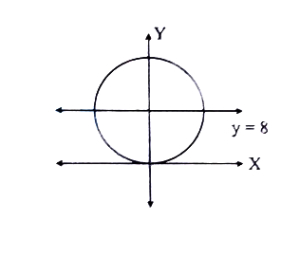
0 likesView Solution
174
MathematicsMediumMCQMHT CET · 2020
If $x = a \sin t - b \cos t$ and $y = a \cos t + b \sin t$,then $y^{3} \frac{d^{2} y}{d x^{2}} + x^{2} + y^{2} = $
A
$0$
B
$2$
C
$1$
D
-$1$
Solution
(A) Given: $x = a \sin t - b \cos t$ and $y = a \cos t + b \sin t$.
Squaring and adding both equations:
$x^{2} + y^{2} = (a \sin t - b \cos t)^{2} + (a \cos t + b \sin t)^{2}$
$x^{2} + y^{2} = a^{2} \sin^{2} t + b^{2} \cos^{2} t - 2ab \sin t \cos t + a^{2} \cos^{2} t + b^{2} \sin^{2} t + 2ab \sin t \cos t$
$x^{2} + y^{2} = a^{2}(\sin^{2} t + \cos^{2} t) + b^{2}(\cos^{2} t + \sin^{2} t) = a^{2} + b^{2}$.
Differentiating $x^{2} + y^{2} = a^{2} + b^{2}$ with respect to $x$:
$2x + 2y \frac{dy}{dx} = 0 \implies y \frac{dy}{dx} = -x$.
Differentiating again with respect to $x$:
$y \frac{d^{2}y}{dx^{2}} + \left(\frac{dy}{dx}\right)^{2} = -1$.
Substitute $\frac{dy}{dx} = -\frac{x}{y}$:
$y \frac{d^{2}y}{dx^{2}} + \left(-\frac{x}{y}\right)^{2} = -1$
$y \frac{d^{2}y}{dx^{2}} + \frac{x^{2}}{y^{2}} = -1$.
Multiplying by $y^{2}$:
$y^{3} \frac{d^{2}y}{dx^{2}} + x^{2} = -y^{2}$
$y^{3} \frac{d^{2}y}{dx^{2}} + x^{2} + y^{2} = 0$.
Squaring and adding both equations:
$x^{2} + y^{2} = (a \sin t - b \cos t)^{2} + (a \cos t + b \sin t)^{2}$
$x^{2} + y^{2} = a^{2} \sin^{2} t + b^{2} \cos^{2} t - 2ab \sin t \cos t + a^{2} \cos^{2} t + b^{2} \sin^{2} t + 2ab \sin t \cos t$
$x^{2} + y^{2} = a^{2}(\sin^{2} t + \cos^{2} t) + b^{2}(\cos^{2} t + \sin^{2} t) = a^{2} + b^{2}$.
Differentiating $x^{2} + y^{2} = a^{2} + b^{2}$ with respect to $x$:
$2x + 2y \frac{dy}{dx} = 0 \implies y \frac{dy}{dx} = -x$.
Differentiating again with respect to $x$:
$y \frac{d^{2}y}{dx^{2}} + \left(\frac{dy}{dx}\right)^{2} = -1$.
Substitute $\frac{dy}{dx} = -\frac{x}{y}$:
$y \frac{d^{2}y}{dx^{2}} + \left(-\frac{x}{y}\right)^{2} = -1$
$y \frac{d^{2}y}{dx^{2}} + \frac{x^{2}}{y^{2}} = -1$.
Multiplying by $y^{2}$:
$y^{3} \frac{d^{2}y}{dx^{2}} + x^{2} = -y^{2}$
$y^{3} \frac{d^{2}y}{dx^{2}} + x^{2} + y^{2} = 0$.
0 likesView Solution
175
MathematicsEasyMCQMHT CET · 2020
The general solution of the differential equation $\sec^{2} x \tan y \, dx + \sec^{2} y \tan x \, dy = 0$ is
A
$\tan x \tan y = c$
B
$\sec x \tan y = c$
C
$\sec x \sec y = c$
D
$\tan x \sec y = c$
Solution
(A) Given the differential equation: $\sec^{2} x \tan y \, dx + \sec^{2} y \tan x \, dy = 0$
Rearranging the terms,we get: $\sec^{2} x \tan y \, dx = -\sec^{2} y \tan x \, dy$
Separating the variables: $\frac{\sec^{2} x}{\tan x} \, dx = -\frac{\sec^{2} y}{\tan y} \, dy$
Integrating both sides: $\int \frac{\sec^{2} x}{\tan x} \, dx = -\int \frac{\sec^{2} y}{\tan y} \, dy$
Let $u = \tan x$,then $du = \sec^{2} x \, dx$. Similarly,let $v = \tan y$,then $dv = \sec^{2} y \, dy$.
Thus,$\int \frac{1}{u} \, du = -\int \frac{1}{v} \, dv$
$\log |u| = -\log |v| + \log |c|$
$\log |\tan x| + \log |\tan y| = \log |c|$
$\log |\tan x \tan y| = \log |c|$
Therefore,the general solution is $\tan x \tan y = c$.
Rearranging the terms,we get: $\sec^{2} x \tan y \, dx = -\sec^{2} y \tan x \, dy$
Separating the variables: $\frac{\sec^{2} x}{\tan x} \, dx = -\frac{\sec^{2} y}{\tan y} \, dy$
Integrating both sides: $\int \frac{\sec^{2} x}{\tan x} \, dx = -\int \frac{\sec^{2} y}{\tan y} \, dy$
Let $u = \tan x$,then $du = \sec^{2} x \, dx$. Similarly,let $v = \tan y$,then $dv = \sec^{2} y \, dy$.
Thus,$\int \frac{1}{u} \, du = -\int \frac{1}{v} \, dv$
$\log |u| = -\log |v| + \log |c|$
$\log |\tan x| + \log |\tan y| = \log |c|$
$\log |\tan x \tan y| = \log |c|$
Therefore,the general solution is $\tan x \tan y = c$.
0 likesView Solution
176
MathematicsEasyMCQMHT CET · 2020
The particular solution of the differential equation $x dy + 2y dx = 0$,when $x = 2$ and $y = 1$ is
A
$xy^2 = 4$
B
$x^2y = 4$
C
$x^2y = -4$
D
$xy^2 = -4$
Solution
(B) Given differential equation is $x dy + 2y dx = 0$.
Rearranging the terms,we get $x dy = -2y dx$.
Separating the variables,we have $\frac{dy}{y} = -2 \frac{dx}{x}$.
Integrating both sides,$\int \frac{dy}{y} = -2 \int \frac{dx}{x}$.
This gives $\ln|y| = -2 \ln|x| + C$.
Using properties of logarithms,$\ln|y| + 2 \ln|x| = C$,which simplifies to $\ln|y| + \ln|x^2| = C$.
Thus,$\ln|yx^2| = C$,which implies $yx^2 = e^C = k$.
Given the initial condition $x = 2$ and $y = 1$,substitute these values into $x^2y = k$:
$(2)^2(1) = k \Rightarrow 4(1) = k \Rightarrow k = 4$.
Therefore,the particular solution is $x^2y = 4$.
Rearranging the terms,we get $x dy = -2y dx$.
Separating the variables,we have $\frac{dy}{y} = -2 \frac{dx}{x}$.
Integrating both sides,$\int \frac{dy}{y} = -2 \int \frac{dx}{x}$.
This gives $\ln|y| = -2 \ln|x| + C$.
Using properties of logarithms,$\ln|y| + 2 \ln|x| = C$,which simplifies to $\ln|y| + \ln|x^2| = C$.
Thus,$\ln|yx^2| = C$,which implies $yx^2 = e^C = k$.
Given the initial condition $x = 2$ and $y = 1$,substitute these values into $x^2y = k$:
$(2)^2(1) = k \Rightarrow 4(1) = k \Rightarrow k = 4$.
Therefore,the particular solution is $x^2y = 4$.
0 likesView Solution
177
MathematicsEasyMCQMHT CET · 2020
The general solution of the differential equation $\frac{dy}{dx} + \frac{1}{\sqrt{1-x^2}} = 0$ is
A
$y^2 + 2 \sin^{-1} x = c$
B
$x + \sin^{-1} y = c$
C
$y + \sin^{-1} x = c$
D
$x^2 + 2 \sin^2 y = c$
Solution
(C) Given the differential equation: $\frac{dy}{dx} + \frac{1}{\sqrt{1-x^2}} = 0$
Rearranging the terms,we get: $\frac{dy}{dx} = -\frac{1}{\sqrt{1-x^2}}$
Integrating both sides with respect to $x$: $\int dy = -\int \frac{1}{\sqrt{1-x^2}} dx$
We know that $\int \frac{1}{\sqrt{1-x^2}} dx = \sin^{-1} x + c$
Therefore,the solution is: $y = -\sin^{-1} x + c$
This can be rewritten as: $y + \sin^{-1} x = c$
Rearranging the terms,we get: $\frac{dy}{dx} = -\frac{1}{\sqrt{1-x^2}}$
Integrating both sides with respect to $x$: $\int dy = -\int \frac{1}{\sqrt{1-x^2}} dx$
We know that $\int \frac{1}{\sqrt{1-x^2}} dx = \sin^{-1} x + c$
Therefore,the solution is: $y = -\sin^{-1} x + c$
This can be rewritten as: $y + \sin^{-1} x = c$
0 likesView Solution
178
MathematicsMediumMCQMHT CET · 2020
The solution of the differential equation $\log \left(\frac{dy}{dx}\right) = 9x - 6y + 6$ is (given that $y = 1$ when $x = 0$):
A
$3e^{6y} = 2e^{9x-6} + e^{6}$
B
$3e^{6y} = 2e^{9x+6} + e^{6}$
C
$3e^{6y} = 2e^{9x+6} - e^{6}$
D
$3e^{6y} = 2e^{9x-6} - e^{6}$
Solution
(B) Given the differential equation: $\log \left(\frac{dy}{dx}\right) = 9x - 6y + 6$.
Taking the exponential of both sides,we get: $\frac{dy}{dx} = e^{9x - 6y + 6} = e^{9x+6} \cdot e^{-6y}$.
Separating the variables,we have: $e^{6y} dy = e^{9x+6} dx$.
Integrating both sides: $\int e^{6y} dy = \int e^{9x+6} dx$.
This gives: $\frac{e^{6y}}{6} = \frac{e^{9x+6}}{9} + C$.
Given $y = 1$ when $x = 0$: $\frac{e^{6}}{6} = \frac{e^{6}}{9} + C$.
Solving for $C$: $C = \frac{e^{6}}{6} - \frac{e^{6}}{9} = \frac{3e^{6} - 2e^{6}}{18} = \frac{e^{6}}{18}$.
Substituting $C$ back into the equation: $\frac{e^{6y}}{6} = \frac{e^{9x+6}}{9} + \frac{e^{6}}{18}$.
Multiplying by $18$: $3e^{6y} = 2e^{9x+6} + e^{6}$.
Taking the exponential of both sides,we get: $\frac{dy}{dx} = e^{9x - 6y + 6} = e^{9x+6} \cdot e^{-6y}$.
Separating the variables,we have: $e^{6y} dy = e^{9x+6} dx$.
Integrating both sides: $\int e^{6y} dy = \int e^{9x+6} dx$.
This gives: $\frac{e^{6y}}{6} = \frac{e^{9x+6}}{9} + C$.
Given $y = 1$ when $x = 0$: $\frac{e^{6}}{6} = \frac{e^{6}}{9} + C$.
Solving for $C$: $C = \frac{e^{6}}{6} - \frac{e^{6}}{9} = \frac{3e^{6} - 2e^{6}}{18} = \frac{e^{6}}{18}$.
Substituting $C$ back into the equation: $\frac{e^{6y}}{6} = \frac{e^{9x+6}}{9} + \frac{e^{6}}{18}$.
Multiplying by $18$: $3e^{6y} = 2e^{9x+6} + e^{6}$.
0 likesView Solution
179
MathematicsMediumMCQMHT CET · 2020
The particular solution of the differential equation $y(\frac{dx}{dy}) = x \log x$ at $x = e$ and $y = 1$ is
A
$e^{xy} = 2$
B
$x = e^y$
C
$xy = 2$
D
$\log x = 2y$
Solution
(B) Given the differential equation: $y \frac{dx}{dy} = x \log x$
Separate the variables: $\frac{dx}{x \log x} = \frac{dy}{y}$
Integrate both sides: $\int \frac{1}{x \log x} dx = \int \frac{1}{y} dy$
Let $u = \log x$,then $du = \frac{1}{x} dx$. The integral becomes $\int \frac{1}{u} du = \log |u| = \log |\log x|$.
So,$\log |\log x| = \log |y| + C$.
Given $x = e$ and $y = 1$: $\log |\log e| = \log |1| + C \Rightarrow \log |1| = 0 + C \Rightarrow 0 = 0 + C \Rightarrow C = 0$.
Thus,$\log |\log x| = \log |y|$.
Taking the exponential of both sides: $\log x = y$,which implies $x = e^y$.
Separate the variables: $\frac{dx}{x \log x} = \frac{dy}{y}$
Integrate both sides: $\int \frac{1}{x \log x} dx = \int \frac{1}{y} dy$
Let $u = \log x$,then $du = \frac{1}{x} dx$. The integral becomes $\int \frac{1}{u} du = \log |u| = \log |\log x|$.
So,$\log |\log x| = \log |y| + C$.
Given $x = e$ and $y = 1$: $\log |\log e| = \log |1| + C \Rightarrow \log |1| = 0 + C \Rightarrow 0 = 0 + C \Rightarrow C = 0$.
Thus,$\log |\log x| = \log |y|$.
Taking the exponential of both sides: $\log x = y$,which implies $x = e^y$.
0 likesView Solution
180
MathematicsMediumMCQMHT CET · 2020
The general solution of the differential equation $(1+y^{2})+(x-e^{\tan ^{-1} y}) \frac{dy}{dx}=0$ is
A
$x \cdot e^{\tan ^{-1} y}=\frac{(e^{\tan ^{-1} y})^{2}}{2}+c$
B
$e^{\tan ^{-1} y}=(e^{\tan ^{-1} y})^{2}+c$
C
$x \cdot e^{\tan ^{-1} y}=\frac{(e^{\tan ^{-1} x})^{2}}{2}+c$
D
$x \cdot e^{\tan ^{-1} y}=(e^{\tan ^{-1} y})^{2}+c$
Solution
(A) Given the differential equation: $(1+y^{2})+(x-e^{\tan ^{-1} y}) \frac{dy}{dx}=0$
Rearranging the terms: $(x-e^{\tan ^{-1} y}) \frac{dy}{dx} = -(1+y^{2})$
Taking the reciprocal: $\frac{dx}{dy} = \frac{-(x-e^{\tan ^{-1} y})}{1+y^{2}} = \frac{-x}{1+y^{2}} + \frac{e^{\tan ^{-1} y}}{1+y^{2}}$
This is a linear differential equation of the form $\frac{dx}{dy} + P(y)x = Q(y)$,where $P(y) = \frac{1}{1+y^{2}}$ and $Q(y) = \frac{e^{\tan ^{-1} y}}{1+y^{2}}$.
The Integrating Factor ($I$.$F$.) is $e^{\int P(y) dy} = e^{\int \frac{1}{1+y^{2}} dy} = e^{\tan ^{-1} y}$.
The general solution is given by $x \cdot (I.F.) = \int Q(y) \cdot (I.F.) dy + c$.
$x \cdot e^{\tan ^{-1} y} = \int \frac{e^{\tan ^{-1} y}}{1+y^{2}} \cdot e^{\tan ^{-1} y} dy + c$.
Let $t = e^{\tan ^{-1} y}$,then $dt = \frac{e^{\tan ^{-1} y}}{1+y^{2}} dy$.
Substituting this into the integral: $x \cdot e^{\tan ^{-1} y} = \int t dt + c = \frac{t^{2}}{2} + c$.
Thus,the general solution is $x \cdot e^{\tan ^{-1} y} = \frac{(e^{\tan ^{-1} y})^{2}}{2} + c$.
Rearranging the terms: $(x-e^{\tan ^{-1} y}) \frac{dy}{dx} = -(1+y^{2})$
Taking the reciprocal: $\frac{dx}{dy} = \frac{-(x-e^{\tan ^{-1} y})}{1+y^{2}} = \frac{-x}{1+y^{2}} + \frac{e^{\tan ^{-1} y}}{1+y^{2}}$
This is a linear differential equation of the form $\frac{dx}{dy} + P(y)x = Q(y)$,where $P(y) = \frac{1}{1+y^{2}}$ and $Q(y) = \frac{e^{\tan ^{-1} y}}{1+y^{2}}$.
The Integrating Factor ($I$.$F$.) is $e^{\int P(y) dy} = e^{\int \frac{1}{1+y^{2}} dy} = e^{\tan ^{-1} y}$.
The general solution is given by $x \cdot (I.F.) = \int Q(y) \cdot (I.F.) dy + c$.
$x \cdot e^{\tan ^{-1} y} = \int \frac{e^{\tan ^{-1} y}}{1+y^{2}} \cdot e^{\tan ^{-1} y} dy + c$.
Let $t = e^{\tan ^{-1} y}$,then $dt = \frac{e^{\tan ^{-1} y}}{1+y^{2}} dy$.
Substituting this into the integral: $x \cdot e^{\tan ^{-1} y} = \int t dt + c = \frac{t^{2}}{2} + c$.
Thus,the general solution is $x \cdot e^{\tan ^{-1} y} = \frac{(e^{\tan ^{-1} y})^{2}}{2} + c$.
0 likesView Solution
181
MathematicsMediumMCQMHT CET · 2020
The solution of the differential equation $\sin ^{-1}\left(\frac{dy}{d x}\right)=x+y$ is
A
$x=\tan (x+y) \cdot \sec (x+y)+c$
B
$x=\tan (x+y)-\sec (x+y)+c$
C
$x=\tan (x+y)+\sec (x+y)+c$
D
$x=\tan x \cdot \tan y+c$
Solution
(B) Given the differential equation: $\sin ^{-1}\left(\frac{dy}{dx}\right)=x+y$
$\implies \frac{dy}{dx}=\sin (x+y)$
Let $x+y=t$. Then differentiating with respect to $x$,we get $1+\frac{dy}{dx}=\frac{dt}{dx}$,so $\frac{dy}{dx}=\frac{dt}{dx}-1$.
Substituting this into the equation: $\frac{dt}{dx}-1=\sin t$
$\implies \frac{dt}{dx}=1+\sin t$
$\implies \int \frac{dt}{1+\sin t}=\int dx$
To integrate $\frac{1}{1+\sin t}$,multiply numerator and denominator by $(1-\sin t)$:
$\int \frac{1-\sin t}{1-\sin^2 t} dt = \int dx$
$\implies \int \frac{1-\sin t}{\cos^2 t} dt = x+c$
$\implies \int (\sec^2 t - \sec t \tan t) dt = x+c$
$\implies \tan t - \sec t = x+c$
Substituting $t=x+y$ back,we get: $x = \tan (x+y) - \sec (x+y) + c$.
$\implies \frac{dy}{dx}=\sin (x+y)$
Let $x+y=t$. Then differentiating with respect to $x$,we get $1+\frac{dy}{dx}=\frac{dt}{dx}$,so $\frac{dy}{dx}=\frac{dt}{dx}-1$.
Substituting this into the equation: $\frac{dt}{dx}-1=\sin t$
$\implies \frac{dt}{dx}=1+\sin t$
$\implies \int \frac{dt}{1+\sin t}=\int dx$
To integrate $\frac{1}{1+\sin t}$,multiply numerator and denominator by $(1-\sin t)$:
$\int \frac{1-\sin t}{1-\sin^2 t} dt = \int dx$
$\implies \int \frac{1-\sin t}{\cos^2 t} dt = x+c$
$\implies \int (\sec^2 t - \sec t \tan t) dt = x+c$
$\implies \tan t - \sec t = x+c$
Substituting $t=x+y$ back,we get: $x = \tan (x+y) - \sec (x+y) + c$.
0 likesView Solution
182
MathematicsEasyMCQMHT CET · 2020
The solution of the differential equation $x^{2} \frac{dy}{dx} = y^{2} + xy$ is
A
$\frac{x}{y} + \log |x| = c$
B
$\frac{y}{x} + \log |x| = c$
C
$\frac{x}{y} - \log |x| = c$
D
$\frac{y}{x} - \log |x| = c$
Solution
(A) Given the differential equation $x^{2} \frac{dy}{dx} = y^{2} + xy$.
Dividing by $x^{2}$,we get $\frac{dy}{dx} = \frac{y^{2} + xy}{x^{2}} = \left(\frac{y}{x}\right)^{2} + \frac{y}{x}$.
This is a homogeneous differential equation. Let $y = ux$,then $\frac{dy}{dx} = u + x \frac{du}{dx}$.
Substituting these into the equation: $u + x \frac{du}{dx} = u^{2} + u$.
Subtracting $u$ from both sides: $x \frac{du}{dx} = u^{2}$.
Separating the variables: $\frac{du}{u^{2}} = \frac{dx}{x}$.
Integrating both sides: $\int u^{-2} du = \int \frac{1}{x} dx$.
$-u^{-1} = \log |x| + c$.
Since $u = \frac{y}{x}$,we have $-\frac{x}{y} = \log |x| + c$.
Rearranging the terms: $\frac{x}{y} + \log |x| = -c$,which can be written as $\frac{x}{y} + \log |x| = C$ (where $C = -c$).
Dividing by $x^{2}$,we get $\frac{dy}{dx} = \frac{y^{2} + xy}{x^{2}} = \left(\frac{y}{x}\right)^{2} + \frac{y}{x}$.
This is a homogeneous differential equation. Let $y = ux$,then $\frac{dy}{dx} = u + x \frac{du}{dx}$.
Substituting these into the equation: $u + x \frac{du}{dx} = u^{2} + u$.
Subtracting $u$ from both sides: $x \frac{du}{dx} = u^{2}$.
Separating the variables: $\frac{du}{u^{2}} = \frac{dx}{x}$.
Integrating both sides: $\int u^{-2} du = \int \frac{1}{x} dx$.
$-u^{-1} = \log |x| + c$.
Since $u = \frac{y}{x}$,we have $-\frac{x}{y} = \log |x| + c$.
Rearranging the terms: $\frac{x}{y} + \log |x| = -c$,which can be written as $\frac{x}{y} + \log |x| = C$ (where $C = -c$).
0 likesView Solution
183
MathematicsEasyMCQMHT CET · 2020
The equation of the curve which passes through point $(1,0)$ and has a tangent with slope $1+\frac{y}{x}+\left(\frac{y}{x}\right)^{2}$ is
A
$\tan ^{-1}\left(\frac{x}{y}\right)=\log |x|$
B
$\tan ^{-1}\left(\frac{x}{y}\right)=\log |y|$
C
$\tan ^{-1}\left(\frac{y}{x}\right)=\log |y|$
D
$\tan ^{-1}\left(\frac{y}{x}\right)=\log |x|$
Solution
(D) Given the slope of the tangent is $\frac{dy}{dx} = 1 + \frac{y}{x} + \left(\frac{y}{x}\right)^2$.
This is a homogeneous differential equation.
Let $y = ux$,then $\frac{dy}{dx} = u + x\frac{du}{dx}$.
Substituting this into the equation:
$u + x\frac{du}{dx} = 1 + u + u^2$.
Subtracting $u$ from both sides:
$x\frac{du}{dx} = 1 + u^2$.
Separating the variables:
$\int \frac{du}{1 + u^2} = \int \frac{dx}{x}$.
Integrating both sides:
$\tan^{-1}(u) = \log|x| + C$.
Substituting $u = \frac{y}{x}$:
$\tan^{-1}\left(\frac{y}{x}\right) = \log|x| + C$.
Since the curve passes through $(1,0)$,we have $\tan^{-1}(0) = \log|1| + C$,which gives $0 = 0 + C$,so $C = 0$.
Thus,the equation is $\tan^{-1}\left(\frac{y}{x}\right) = \log|x|$.
This is a homogeneous differential equation.
Let $y = ux$,then $\frac{dy}{dx} = u + x\frac{du}{dx}$.
Substituting this into the equation:
$u + x\frac{du}{dx} = 1 + u + u^2$.
Subtracting $u$ from both sides:
$x\frac{du}{dx} = 1 + u^2$.
Separating the variables:
$\int \frac{du}{1 + u^2} = \int \frac{dx}{x}$.
Integrating both sides:
$\tan^{-1}(u) = \log|x| + C$.
Substituting $u = \frac{y}{x}$:
$\tan^{-1}\left(\frac{y}{x}\right) = \log|x| + C$.
Since the curve passes through $(1,0)$,we have $\tan^{-1}(0) = \log|1| + C$,which gives $0 = 0 + C$,so $C = 0$.
Thus,the equation is $\tan^{-1}\left(\frac{y}{x}\right) = \log|x|$.
0 likesView Solution
184
MathematicsEasyMCQMHT CET · 2020
$y=c^{2}+\frac{c}{x}$ is the solution of the differential equation
A
$x^{4}\left(\frac{d y}{d x}\right)^{2}+x\left(\frac{d y}{d x}\right)-y=0$
B
$x^{4}\left(\frac{d y}{d x}\right)^{2}-x\left(\frac{d y}{d x}\right)-y=0$
C
$x^{4}\left(\frac{d y}{d x}\right)^{2}-x\left(\frac{d y}{d x}\right)+y=0$
D
$x^{4}\left(\frac{d y}{d x}\right)^{2}+x\left(\frac{d y}{d x}\right)+y=0$
Solution
(B) Given the equation $y=c^{2}+\frac{c}{x}$.
Differentiating both sides with respect to $x$,we get:
$\frac{d y}{d x} = -\frac{c}{x^{2}}$
From this,we can express $c$ in terms of $x$ and $\frac{d y}{d x}$:
$c = -x^{2} \frac{d y}{d x}$
Now,substitute this value of $c$ back into the original equation:
$y = (-x^{2} \frac{d y}{d x})^{2} + \frac{-x^{2} \frac{d y}{d x}}{x}$
$y = x^{4} (\frac{d y}{d x})^{2} - x \frac{d y}{d x}$
Rearranging the terms to form the differential equation:
$x^{4} (\frac{d y}{d x})^{2} - x \frac{d y}{d x} - y = 0$
Thus,the correct option is $B$.
Differentiating both sides with respect to $x$,we get:
$\frac{d y}{d x} = -\frac{c}{x^{2}}$
From this,we can express $c$ in terms of $x$ and $\frac{d y}{d x}$:
$c = -x^{2} \frac{d y}{d x}$
Now,substitute this value of $c$ back into the original equation:
$y = (-x^{2} \frac{d y}{d x})^{2} + \frac{-x^{2} \frac{d y}{d x}}{x}$
$y = x^{4} (\frac{d y}{d x})^{2} - x \frac{d y}{d x}$
Rearranging the terms to form the differential equation:
$x^{4} (\frac{d y}{d x})^{2} - x \frac{d y}{d x} - y = 0$
Thus,the correct option is $B$.
0 likesView Solution
185
MathematicsMediumMCQMHT CET · 2020
The solution of the differential equation $x \cdot \sin \left(\frac{y}{x}\right) dy = \left[y \cdot \sin \left(\frac{y}{x}\right) - x\right] dx$ is
A
$\cos \left(\frac{x}{y}\right) = \log |x| + c$
B
$\cos \left(\frac{y}{x}\right) = \log |y| + c$
C
$\cos \left(\frac{y}{x}\right) = \log |x| + c$
D
$\cos \left(\frac{x}{y}\right) = \log |y| + c$
Solution
(C) Given the differential equation: $x \sin \left(\frac{y}{x}\right) dy = \left[y \sin \left(\frac{y}{x}\right) - x\right] dx$
Dividing both sides by $dx \cdot x \sin \left(\frac{y}{x}\right)$,we get:
$\frac{dy}{dx} = \frac{y \sin \left(\frac{y}{x}\right) - x}{x \sin \left(\frac{y}{x}\right)} = \frac{y}{x} - \frac{1}{\sin \left(\frac{y}{x}\right)}$
Let $v = \frac{y}{x}$,so $y = vx$. Then $\frac{dy}{dx} = v + x \frac{dv}{dx}$.
Substituting these into the equation:
$v + x \frac{dv}{dx} = v - \frac{1}{\sin v}$
$x \frac{dv}{dx} = -\frac{1}{\sin v} = -\operatorname{cosec} v$
Separating the variables:
$\sin v \, dv = -\frac{1}{x} dx$
Integrating both sides:
$\int \sin v \, dv = -\int \frac{1}{x} dx$
$-\cos v = -\log |x| + c$
$\cos v = \log |x| + c$
Substituting $v = \frac{y}{x}$ back:
$\cos \left(\frac{y}{x}\right) = \log |x| + c$
Dividing both sides by $dx \cdot x \sin \left(\frac{y}{x}\right)$,we get:
$\frac{dy}{dx} = \frac{y \sin \left(\frac{y}{x}\right) - x}{x \sin \left(\frac{y}{x}\right)} = \frac{y}{x} - \frac{1}{\sin \left(\frac{y}{x}\right)}$
Let $v = \frac{y}{x}$,so $y = vx$. Then $\frac{dy}{dx} = v + x \frac{dv}{dx}$.
Substituting these into the equation:
$v + x \frac{dv}{dx} = v - \frac{1}{\sin v}$
$x \frac{dv}{dx} = -\frac{1}{\sin v} = -\operatorname{cosec} v$
Separating the variables:
$\sin v \, dv = -\frac{1}{x} dx$
Integrating both sides:
$\int \sin v \, dv = -\int \frac{1}{x} dx$
$-\cos v = -\log |x| + c$
$\cos v = \log |x| + c$
Substituting $v = \frac{y}{x}$ back:
$\cos \left(\frac{y}{x}\right) = \log |x| + c$
0 likesView Solution
186
MathematicsEasyMCQMHT CET · 2020
The particular solution of the differential equation $\sin^{2} y \frac{dx}{dy} + x = \cot y$ when $x = 0$ and $y = \frac{3\pi}{4}$ is
A
$x = 1 + \cot y$
B
$xy = \cot(x + y)$
C
$xy = \cot(x - y)$
D
$y = 1 + \cot x$
Solution
(A) Given the differential equation: $\sin^{2} y \frac{dx}{dy} + x = \cot y$.
Dividing by $\sin^{2} y$,we get: $\frac{dx}{dy} + (\operatorname{cosec}^{2} y)x = \cot y \operatorname{cosec}^{2} y$.
This is a linear differential equation of the form $\frac{dx}{dy} + P(y)x = Q(y)$,where $P(y) = \operatorname{cosec}^{2} y$ and $Q(y) = \cot y \operatorname{cosec}^{2} y$.
The Integrating Factor ($I$.$F$.) is $e^{\int P(y) dy} = e^{\int \operatorname{cosec}^{2} y dy} = e^{-\cot y}$.
The solution is given by $x \cdot (I.F.) = \int Q(y) \cdot (I.F.) dy + C$.
$x e^{-\cot y} = \int \cot y \operatorname{cosec}^{2} y e^{-\cot y} dy + C$.
Let $t = -\cot y$,then $dt = \operatorname{cosec}^{2} y dy$.
$x e^{-\cot y} = \int (-t) e^{t} dt + C = -(t e^{t} - e^{t}) + C = e^{t}(1 - t) + C$.
Substituting back $t = -\cot y$: $x e^{-\cot y} = e^{-\cot y}(1 + \cot y) + C$.
Given $x = 0$ at $y = \frac{3\pi}{4}$,we have $0 = e^{-\cot(3\pi/4)}(1 + \cot(3\pi/4)) + C$.
Since $\cot(3\pi/4) = -1$,$0 = e^{1}(1 - 1) + C \implies C = 0$.
Thus,$x e^{-\cot y} = e^{-\cot y}(1 + \cot y)$,which simplifies to $x = 1 + \cot y$.
Dividing by $\sin^{2} y$,we get: $\frac{dx}{dy} + (\operatorname{cosec}^{2} y)x = \cot y \operatorname{cosec}^{2} y$.
This is a linear differential equation of the form $\frac{dx}{dy} + P(y)x = Q(y)$,where $P(y) = \operatorname{cosec}^{2} y$ and $Q(y) = \cot y \operatorname{cosec}^{2} y$.
The Integrating Factor ($I$.$F$.) is $e^{\int P(y) dy} = e^{\int \operatorname{cosec}^{2} y dy} = e^{-\cot y}$.
The solution is given by $x \cdot (I.F.) = \int Q(y) \cdot (I.F.) dy + C$.
$x e^{-\cot y} = \int \cot y \operatorname{cosec}^{2} y e^{-\cot y} dy + C$.
Let $t = -\cot y$,then $dt = \operatorname{cosec}^{2} y dy$.
$x e^{-\cot y} = \int (-t) e^{t} dt + C = -(t e^{t} - e^{t}) + C = e^{t}(1 - t) + C$.
Substituting back $t = -\cot y$: $x e^{-\cot y} = e^{-\cot y}(1 + \cot y) + C$.
Given $x = 0$ at $y = \frac{3\pi}{4}$,we have $0 = e^{-\cot(3\pi/4)}(1 + \cot(3\pi/4)) + C$.
Since $\cot(3\pi/4) = -1$,$0 = e^{1}(1 - 1) + C \implies C = 0$.
Thus,$x e^{-\cot y} = e^{-\cot y}(1 + \cot y)$,which simplifies to $x = 1 + \cot y$.
0 likesView Solution
187
MathematicsEasyMCQMHT CET · 2020
The integrating factor of the differential equation $\frac{dy}{dx} + \frac{1}{x}y = x^3 - 3$ is
A
$-y$
B
$y$
C
$x$
D
$-x$
Solution
(C) The given differential equation is $\frac{dy}{dx} + \frac{1}{x}y = x^3 - 3$.
This is a linear differential equation of the form $\frac{dy}{dx} + Py = Q$,where $P = \frac{1}{x}$ and $Q = x^3 - 3$.
The integrating factor ($I$.$F$.) is given by the formula $I.F. = e^{\int P dx}$.
Substituting $P = \frac{1}{x}$,we get $I.F. = e^{\int \frac{1}{x} dx} = e^{\ln|x|} = x$.
Therefore,the integrating factor is $x$.
This is a linear differential equation of the form $\frac{dy}{dx} + Py = Q$,where $P = \frac{1}{x}$ and $Q = x^3 - 3$.
The integrating factor ($I$.$F$.) is given by the formula $I.F. = e^{\int P dx}$.
Substituting $P = \frac{1}{x}$,we get $I.F. = e^{\int \frac{1}{x} dx} = e^{\ln|x|} = x$.
Therefore,the integrating factor is $x$.
0 likesView Solution
188
MathematicsEasyMCQMHT CET · 2020
The solution of $r dx + (x - r^2) dr = 0$ is
A
$r^2 x = \frac{r^3}{3} + c$
B
$rx = \frac{r^2}{2} + c$
C
$x = \frac{r^3}{3} + c$
D
$rx = \frac{r^3}{3} + c$
Solution
(D) Given the differential equation $r dx + (x - r^2) dr = 0$.
Rearranging the terms,we get $r dx = -(x - r^2) dr$.
Dividing by $dr$,we have $r \frac{dx}{dr} = r^2 - x$.
Rearranging into the standard linear form $\frac{dx}{dr} + P(r)x = Q(r)$,we get $\frac{dx}{dr} + \frac{1}{r}x = r$.
The Integrating Factor ($I$.$F$.) is $e^{\int \frac{1}{r} dr} = e^{\log r} = r$.
The general solution is given by $x \cdot (I.F.) = \int Q(r) \cdot (I.F.) dr + c$.
Substituting the values,$x \cdot r = \int r \cdot r dr + c$.
Integrating the right side,$xr = \int r^2 dr + c$.
Thus,$xr = \frac{r^3}{3} + c$.
Rearranging the terms,we get $r dx = -(x - r^2) dr$.
Dividing by $dr$,we have $r \frac{dx}{dr} = r^2 - x$.
Rearranging into the standard linear form $\frac{dx}{dr} + P(r)x = Q(r)$,we get $\frac{dx}{dr} + \frac{1}{r}x = r$.
The Integrating Factor ($I$.$F$.) is $e^{\int \frac{1}{r} dr} = e^{\log r} = r$.
The general solution is given by $x \cdot (I.F.) = \int Q(r) \cdot (I.F.) dr + c$.
Substituting the values,$x \cdot r = \int r \cdot r dr + c$.
Integrating the right side,$xr = \int r^2 dr + c$.
Thus,$xr = \frac{r^3}{3} + c$.
0 likesView Solution
189
MathematicsEasyMCQMHT CET · 2020
The solution of the differential equation $\frac{dy}{dx} + 2y = e^{-x}$ is
A
$y e^{x} = e^{x} + c$
B
$y e^{2x} = e^{x} + c$
C
$y e^{x} = e^{2x} + c$
D
$y e^{2x} = e^{2x} + c$
Solution
(B) The given differential equation is $\frac{dy}{dx} + 2y = e^{-x}$.
This is a linear differential equation of the form $\frac{dy}{dx} + Py = Q$,where $P = 2$ and $Q = e^{-x}$.
The Integrating Factor ($I$.$F$.) is given by $I.F. = e^{\int P dx} = e^{\int 2 dx} = e^{2x}$.
The general solution is given by $y \cdot (I.F.) = \int (Q \cdot I.F.) dx + c$.
Substituting the values,we get $y e^{2x} = \int (e^{-x} \cdot e^{2x}) dx + c$.
$y e^{2x} = \int e^{x} dx + c$.
$y e^{2x} = e^{x} + c$.
This is a linear differential equation of the form $\frac{dy}{dx} + Py = Q$,where $P = 2$ and $Q = e^{-x}$.
The Integrating Factor ($I$.$F$.) is given by $I.F. = e^{\int P dx} = e^{\int 2 dx} = e^{2x}$.
The general solution is given by $y \cdot (I.F.) = \int (Q \cdot I.F.) dx + c$.
Substituting the values,we get $y e^{2x} = \int (e^{-x} \cdot e^{2x}) dx + c$.
$y e^{2x} = \int e^{x} dx + c$.
$y e^{2x} = e^{x} + c$.
0 likesView Solution
190
MathematicsMediumMCQMHT CET · 2020
The general solution of the differential equation $(1-x^{2}) \frac{dy}{dx} + 2xy = x(1-x^{2})^{\frac{1}{2}}$ is
A
$y = \sqrt{1-x^{2}} + c(1-x^{2})$
B
$y = 2\sqrt{1-x^{2}} + c$
C
$y = 2\sqrt{1-x^{2}} + c(1+x^{2})$
D
$y\sqrt{1-x^{2}} = c(1-x^{2})$
Solution
(A) Given the differential equation: $(1-x^{2}) \frac{dy}{dx} + 2xy = x(1-x^{2})^{\frac{1}{2}}$
Divide by $(1-x^{2})$ to get the standard form $\frac{dy}{dx} + Py = Q$:
$\frac{dy}{dx} + \frac{2x}{1-x^{2}}y = \frac{x}{\sqrt{1-x^{2}}}$
Here,$P = \frac{2x}{1-x^{2}}$ and $Q = \frac{x}{\sqrt{1-x^{2}}}$.
Integrating Factor $(I.F.) = e^{\int P dx} = e^{\int \frac{2x}{1-x^{2}} dx} = e^{-\ln(1-x^{2})} = e^{\ln(\frac{1}{1-x^{2}})} = \frac{1}{1-x^{2}}$.
The general solution is $y \times (I.F.) = \int Q \times (I.F.) dx + c$.
$y \times \frac{1}{1-x^{2}} = \int \frac{x}{\sqrt{1-x^{2}}} \times \frac{1}{1-x^{2}} dx + c$
$y \times \frac{1}{1-x^{2}} = \int x(1-x^{2})^{-\frac{3}{2}} dx + c$
Let $u = 1-x^{2}$,then $du = -2x dx$,so $x dx = -\frac{1}{2} du$.
$y \times \frac{1}{1-x^{2}} = -\frac{1}{2} \int u^{-\frac{3}{2}} du + c = -\frac{1}{2} \left( \frac{u^{-\frac{1}{2}}}{-\frac{1}{2}} \right) + c = u^{-\frac{1}{2}} + c = \frac{1}{\sqrt{1-x^{2}}} + c$.
Multiplying both sides by $(1-x^{2})$:
$y = \frac{1-x^{2}}{\sqrt{1-x^{2}}} + c(1-x^{2}) = \sqrt{1-x^{2}} + c(1-x^{2})$.
Divide by $(1-x^{2})$ to get the standard form $\frac{dy}{dx} + Py = Q$:
$\frac{dy}{dx} + \frac{2x}{1-x^{2}}y = \frac{x}{\sqrt{1-x^{2}}}$
Here,$P = \frac{2x}{1-x^{2}}$ and $Q = \frac{x}{\sqrt{1-x^{2}}}$.
Integrating Factor $(I.F.) = e^{\int P dx} = e^{\int \frac{2x}{1-x^{2}} dx} = e^{-\ln(1-x^{2})} = e^{\ln(\frac{1}{1-x^{2}})} = \frac{1}{1-x^{2}}$.
The general solution is $y \times (I.F.) = \int Q \times (I.F.) dx + c$.
$y \times \frac{1}{1-x^{2}} = \int \frac{x}{\sqrt{1-x^{2}}} \times \frac{1}{1-x^{2}} dx + c$
$y \times \frac{1}{1-x^{2}} = \int x(1-x^{2})^{-\frac{3}{2}} dx + c$
Let $u = 1-x^{2}$,then $du = -2x dx$,so $x dx = -\frac{1}{2} du$.
$y \times \frac{1}{1-x^{2}} = -\frac{1}{2} \int u^{-\frac{3}{2}} du + c = -\frac{1}{2} \left( \frac{u^{-\frac{1}{2}}}{-\frac{1}{2}} \right) + c = u^{-\frac{1}{2}} + c = \frac{1}{\sqrt{1-x^{2}}} + c$.
Multiplying both sides by $(1-x^{2})$:
$y = \frac{1-x^{2}}{\sqrt{1-x^{2}}} + c(1-x^{2}) = \sqrt{1-x^{2}} + c(1-x^{2})$.
0 likesView Solution
191
MathematicsEasyMCQMHT CET · 2020
Find the integrating factor of the differential equation $(1+x^{2}) dt = (\tan^{-1} x - t) dx$.
A
$-e^{\frac{(\tan^{-1} x)^{2}}{2}}$
B
$-e^{\tan^{-1} x}$
C
$e^{\frac{(\tan^{-1} x)^{2}}{2}}$
D
$e^{\tan^{-1} x}$
Solution
(D) Given the differential equation: $(1+x^{2}) dt = (\tan^{-1} x - t) dx$.
Divide both sides by $(1+x^{2}) dx$:
$\frac{dt}{dx} = \frac{\tan^{-1} x - t}{1+x^{2}}$
Rearrange the equation into the standard linear form $\frac{dt}{dx} + P(x)t = Q(x)$:
$\frac{dt}{dx} + \frac{1}{1+x^{2}}t = \frac{\tan^{-1} x}{1+x^{2}}$
Here,$P(x) = \frac{1}{1+x^{2}}$.
The integrating factor ($I$.$F$.) is given by $e^{\int P(x) dx}$:
$I.F. = e^{\int \frac{1}{1+x^{2}} dx} = e^{\tan^{-1} x}$.
Divide both sides by $(1+x^{2}) dx$:
$\frac{dt}{dx} = \frac{\tan^{-1} x - t}{1+x^{2}}$
Rearrange the equation into the standard linear form $\frac{dt}{dx} + P(x)t = Q(x)$:
$\frac{dt}{dx} + \frac{1}{1+x^{2}}t = \frac{\tan^{-1} x}{1+x^{2}}$
Here,$P(x) = \frac{1}{1+x^{2}}$.
The integrating factor ($I$.$F$.) is given by $e^{\int P(x) dx}$:
$I.F. = e^{\int \frac{1}{1+x^{2}} dx} = e^{\tan^{-1} x}$.
0 likesView Solution
192
MathematicsMediumMCQMHT CET · 2020
The integrating factor of the differential equation $\sin y \left(\frac{d y}{d x}\right) = \cos y (1 - x \cos y)$ is
A
$e^{-x}$
B
$e^{-\cos y}$
C
$e^{-y}$
D
$e^{\sin y}$
Solution
(A) Given differential equation: $\sin y \frac{d y}{d x} = \cos y (1 - x \cos y)$.
Expanding the right side: $\sin y \frac{d y}{d x} = \cos y - x \cos^2 y$.
Dividing both sides by $\cos^2 y$: $\frac{\sin y}{\cos^2 y} \frac{d y}{d x} = \frac{1}{\cos y} - x$.
This simplifies to: $\sec y \tan y \frac{d y}{d x} = \sec y - x$.
Rearranging the terms: $\sec y \tan y \frac{d y}{d x} - \sec y = -x$.
Let $v = \sec y$. Then $\frac{d v}{d x} = \sec y \tan y \frac{d y}{d x}$.
Substituting into the equation: $\frac{d v}{d x} - v = -x$.
This is a linear differential equation of the form $\frac{d v}{d x} + P(x)v = Q(x)$,where $P(x) = -1$.
The integrating factor ($I$.$F$.) is given by $e^{\int P(x) dx} = e^{\int -1 dx} = e^{-x}$.
Expanding the right side: $\sin y \frac{d y}{d x} = \cos y - x \cos^2 y$.
Dividing both sides by $\cos^2 y$: $\frac{\sin y}{\cos^2 y} \frac{d y}{d x} = \frac{1}{\cos y} - x$.
This simplifies to: $\sec y \tan y \frac{d y}{d x} = \sec y - x$.
Rearranging the terms: $\sec y \tan y \frac{d y}{d x} - \sec y = -x$.
Let $v = \sec y$. Then $\frac{d v}{d x} = \sec y \tan y \frac{d y}{d x}$.
Substituting into the equation: $\frac{d v}{d x} - v = -x$.
This is a linear differential equation of the form $\frac{d v}{d x} + P(x)v = Q(x)$,where $P(x) = -1$.
The integrating factor ($I$.$F$.) is given by $e^{\int P(x) dx} = e^{\int -1 dx} = e^{-x}$.
0 likesView Solution
193
MathematicsMediumMCQMHT CET · 2020
The integrating factor of the differential equation $(1+y+x^{2}y)dx + (x+x^{3})dy = 0$ is
A
$\frac{1}{x}$
B
$x$
C
$\log x$
D
$e^{x}$
Solution
(B) Given differential equation is $(1+y+x^{2}y)dx + (x+x^{3})dy = 0$.
Rearranging the terms,we have $(x+x^{3})dy = -(1+y(1+x^{2}))dx$.
Dividing by $dx(x+x^{3})$,we get $\frac{dy}{dx} = -\frac{1+y(1+x^{2})}{x(1+x^{2})}$.
This simplifies to $\frac{dy}{dx} = -\frac{1}{x(1+x^{2})} - \frac{y(1+x^{2})}{x(1+x^{2})}$.
Thus,$\frac{dy}{dx} + \left(\frac{1}{x}\right)y = -\frac{1}{x(1+x^{2})}$.
This is a linear differential equation of the form $\frac{dy}{dx} + Py = Q$,where $P = \frac{1}{x}$ and $Q = -\frac{1}{x(1+x^{2})}$.
The integrating factor ($I$.$F$.) is given by $e^{\int P dx} = e^{\int \frac{1}{x} dx} = e^{\log x} = x$.
Rearranging the terms,we have $(x+x^{3})dy = -(1+y(1+x^{2}))dx$.
Dividing by $dx(x+x^{3})$,we get $\frac{dy}{dx} = -\frac{1+y(1+x^{2})}{x(1+x^{2})}$.
This simplifies to $\frac{dy}{dx} = -\frac{1}{x(1+x^{2})} - \frac{y(1+x^{2})}{x(1+x^{2})}$.
Thus,$\frac{dy}{dx} + \left(\frac{1}{x}\right)y = -\frac{1}{x(1+x^{2})}$.
This is a linear differential equation of the form $\frac{dy}{dx} + Py = Q$,where $P = \frac{1}{x}$ and $Q = -\frac{1}{x(1+x^{2})}$.
The integrating factor ($I$.$F$.) is given by $e^{\int P dx} = e^{\int \frac{1}{x} dx} = e^{\log x} = x$.
0 likesView Solution
194
MathematicsMediumMCQMHT CET · 2020
The integrating factor of the differential equation $x \frac{dy}{dx} + y \log x = x^2$ is
A
$(\log x)^x$
B
$x^{\log x}$
C
$(\log x)^2$
D
$x^{\log (\sqrt{x})}$
Solution
(D) The given differential equation is $x \frac{dy}{dx} + y \log x = x^2$.
Dividing both sides by $x$,we get:
$\frac{dy}{dx} + \left(\frac{\log x}{x}\right) y = x$.
This is a linear differential equation of the form $\frac{dy}{dx} + Py = Q$,where $P = \frac{\log x}{x}$ and $Q = x$.
The integrating factor ($I$.$F$.) is given by $e^{\int P dx}$.
$I$.$F$. $= e^{\int \frac{\log x}{x} dx}$.
Let $u = \log x$,then $du = \frac{1}{x} dx$.
So,$\int \frac{\log x}{x} dx = \int u du = \frac{u^2}{2} = \frac{(\log x)^2}{2}$.
Therefore,$I$.$F$. $= e^{\frac{(\log x)^2}{2}} = (e^{\log x})^{\frac{\log x}{2}} = x^{\frac{\log x}{2}} = x^{\log (\sqrt{x})}$.
Thus,the correct option is $D$.
Dividing both sides by $x$,we get:
$\frac{dy}{dx} + \left(\frac{\log x}{x}\right) y = x$.
This is a linear differential equation of the form $\frac{dy}{dx} + Py = Q$,where $P = \frac{\log x}{x}$ and $Q = x$.
The integrating factor ($I$.$F$.) is given by $e^{\int P dx}$.
$I$.$F$. $= e^{\int \frac{\log x}{x} dx}$.
Let $u = \log x$,then $du = \frac{1}{x} dx$.
So,$\int \frac{\log x}{x} dx = \int u du = \frac{u^2}{2} = \frac{(\log x)^2}{2}$.
Therefore,$I$.$F$. $= e^{\frac{(\log x)^2}{2}} = (e^{\log x})^{\frac{\log x}{2}} = x^{\frac{\log x}{2}} = x^{\log (\sqrt{x})}$.
Thus,the correct option is $D$.
0 likesView Solution
195
MathematicsEasyMCQMHT CET · 2020
The integrating factor of the differential equation $y \log y \left(\frac{dx}{dy}\right) + x = \log y$ is
A
$\log(\log y)$
B
$\log y$
C
$y$
D
$e^{y}$
Solution
(B) The given differential equation is $y \log y \left(\frac{dx}{dy}\right) + x = \log y$.
Dividing both sides by $y \log y$,we get:
$\frac{dx}{dy} + \frac{x}{y \log y} = \frac{\log y}{y \log y} = \frac{1}{y}$.
This is a linear differential equation of the form $\frac{dx}{dy} + Px = Q$,where $P = \frac{1}{y \log y}$ and $Q = \frac{1}{y}$.
The integrating factor ($I$.$F$.) is given by $e^{\int P dy}$.
$I$.$F$. $= e^{\int \frac{1}{y \log y} dy}$.
Let $u = \log y$,then $du = \frac{1}{y} dy$.
So,$\int \frac{1}{y \log y} dy = \int \frac{1}{u} du = \log u = \log(\log y)$.
Therefore,$I$.$F$. $= e^{\log(\log y)} = \log y$.
Dividing both sides by $y \log y$,we get:
$\frac{dx}{dy} + \frac{x}{y \log y} = \frac{\log y}{y \log y} = \frac{1}{y}$.
This is a linear differential equation of the form $\frac{dx}{dy} + Px = Q$,where $P = \frac{1}{y \log y}$ and $Q = \frac{1}{y}$.
The integrating factor ($I$.$F$.) is given by $e^{\int P dy}$.
$I$.$F$. $= e^{\int \frac{1}{y \log y} dy}$.
Let $u = \log y$,then $du = \frac{1}{y} dy$.
So,$\int \frac{1}{y \log y} dy = \int \frac{1}{u} du = \log u = \log(\log y)$.
Therefore,$I$.$F$. $= e^{\log(\log y)} = \log y$.
0 likesView Solution
196
MathematicsEasyMCQMHT CET · 2020
The integrating factor of the differential equation $\frac{dy}{dx}(x \log x) + y = 4 \log x$ is
A
$\log(\log x)$
B
$x$
C
$e^{x}$
D
$\log x$
Solution
(D) Given the differential equation: $\frac{dy}{dx}(x \log x) + y = 4 \log x$.
Divide the entire equation by $(x \log x)$ to bring it into the standard form $\frac{dy}{dx} + Py = Q$:
$\frac{dy}{dx} + \frac{1}{x \log x} y = \frac{4 \log x}{x \log x} = \frac{4}{x}$.
Here,$P = \frac{1}{x \log x}$.
The integrating factor ($I$.$F$.) is given by $e^{\int P dx}$:
$I.F. = e^{\int \frac{1}{x \log x} dx}$.
Let $u = \log x$,then $du = \frac{1}{x} dx$.
So,$\int \frac{1}{x \log x} dx = \int \frac{1}{u} du = \log u = \log(\log x)$.
Therefore,$I.F. = e^{\log(\log x)} = \log x$.
Divide the entire equation by $(x \log x)$ to bring it into the standard form $\frac{dy}{dx} + Py = Q$:
$\frac{dy}{dx} + \frac{1}{x \log x} y = \frac{4 \log x}{x \log x} = \frac{4}{x}$.
Here,$P = \frac{1}{x \log x}$.
The integrating factor ($I$.$F$.) is given by $e^{\int P dx}$:
$I.F. = e^{\int \frac{1}{x \log x} dx}$.
Let $u = \log x$,then $du = \frac{1}{x} dx$.
So,$\int \frac{1}{x \log x} dx = \int \frac{1}{u} du = \log u = \log(\log x)$.
Therefore,$I.F. = e^{\log(\log x)} = \log x$.
0 likesView Solution
197
MathematicsMediumMCQMHT CET · 2020
The particular solution of the differential equation $(y + x \cdot \frac{dy}{dx}) \cdot \sin(xy) = \cos x$ at $x = 0$ is
A
$\sin x + \cos(xy) = 1$
B
$\cos x - \sin(xy) = 1$
C
$\sin x - \cos(xy) = 1$
D
$\cos x + \sin(xy) = 1$
Solution
(A) Given the differential equation: $(y + x \frac{dy}{dx}) \sin(xy) = \cos x$
Let $u = xy$. Then,differentiating with respect to $x$,we get $\frac{du}{dx} = y + x \frac{dy}{dx}$.
Substituting this into the equation,we have: $\sin(u) \frac{du}{dx} = \cos x$.
Integrating both sides with respect to $x$: $\int \sin(u) du = \int \cos x dx$.
This yields: $-\cos(u) = \sin x + C$.
Substituting $u = xy$ back,we get: $-\cos(xy) = \sin x + C$.
At $x = 0$,the value of $y$ is not explicitly given,but since $\cos(xy) = -\sin x - C$,at $x=0$,$\cos(0) = -\sin(0) - C$,which implies $1 = 0 - C$,so $C = -1$.
Thus,$-\cos(xy) = \sin x - 1$,which simplifies to $\sin x + \cos(xy) = 1$.
Let $u = xy$. Then,differentiating with respect to $x$,we get $\frac{du}{dx} = y + x \frac{dy}{dx}$.
Substituting this into the equation,we have: $\sin(u) \frac{du}{dx} = \cos x$.
Integrating both sides with respect to $x$: $\int \sin(u) du = \int \cos x dx$.
This yields: $-\cos(u) = \sin x + C$.
Substituting $u = xy$ back,we get: $-\cos(xy) = \sin x + C$.
At $x = 0$,the value of $y$ is not explicitly given,but since $\cos(xy) = -\sin x - C$,at $x=0$,$\cos(0) = -\sin(0) - C$,which implies $1 = 0 - C$,so $C = -1$.
Thus,$-\cos(xy) = \sin x - 1$,which simplifies to $\sin x + \cos(xy) = 1$.
0 likesView Solution
198
MathematicsMediumMCQMHT CET · 2020
The differential equation of all lines perpendicular to the line $5x + 2y + 7 = 0$ is
A
$3dy - 2dx = 0$
B
$2dy - 5dx = 0$
C
$2dy - 3dx = 0$
D
$5dy - 2dx = 0$
Solution
(D) The given line is $5x + 2y + 7 = 0$.
Its slope is $m_1 = -\frac{5}{2}$.
Any line perpendicular to this line will have a slope $m_2 = -\frac{1}{m_1} = \frac{2}{5}$.
The equation of a family of lines with slope $\frac{2}{5}$ is $y = \frac{2}{5}x + c$,which can be written as $2x - 5y + 5c = 0$.
Let $5c = k$,so the equation is $2x - 5y + k = 0$.
Differentiating both sides with respect to $x$,we get $2 - 5\frac{dy}{dx} = 0$.
Multiplying by $dx$,we get $2dx - 5dy = 0$,or $5dy - 2dx = 0$.
Its slope is $m_1 = -\frac{5}{2}$.
Any line perpendicular to this line will have a slope $m_2 = -\frac{1}{m_1} = \frac{2}{5}$.
The equation of a family of lines with slope $\frac{2}{5}$ is $y = \frac{2}{5}x + c$,which can be written as $2x - 5y + 5c = 0$.
Let $5c = k$,so the equation is $2x - 5y + k = 0$.
Differentiating both sides with respect to $x$,we get $2 - 5\frac{dy}{dx} = 0$.
Multiplying by $dx$,we get $2dx - 5dy = 0$,or $5dy - 2dx = 0$.
0 likesView Solution
199
MathematicsMediumMCQMHT CET · 2020
The rate of growth of bacteria is proportional to the number present. If initially there were $1000$ bacteria and the number doubles in $1$ hour,then the number of bacteria after $2 \frac{1}{2}$ hours is (Given $\sqrt{2} = 1.414$):
A
$4646$ approximately
B
$5056$ approximately
C
$5656$ approximately
D
$400 \sqrt{2}$ approximately
Solution
(C) The rate of growth is proportional to the number present.
$\frac{dN}{dt} = kN \Rightarrow \frac{dN}{N} = k dt$.
Integrating both sides,we get $\ln N = kt + C$.
At $t = 0$,$N = 1000$,so $C = \ln 1000$.
Thus,$\ln N = kt + \ln 1000 \Rightarrow \ln(\frac{N}{1000}) = kt \Rightarrow N = 1000 e^{kt}$.
Given that at $t = 1$,$N = 2000$,we have $2000 = 1000 e^k$,which implies $e^k = 2$.
Substituting this into the equation,$N = 1000 \times (e^k)^t = 1000 \times 2^t$.
For $t = 2 \frac{1}{2} = 2.5$ hours:
$N = 1000 \times 2^{2.5} = 1000 \times 2^2 \times 2^{0.5} = 1000 \times 4 \times \sqrt{2}$.
Given $\sqrt{2} = 1.414$,we get $N = 1000 \times 4 \times 1.414 = 5656$.
$\frac{dN}{dt} = kN \Rightarrow \frac{dN}{N} = k dt$.
Integrating both sides,we get $\ln N = kt + C$.
At $t = 0$,$N = 1000$,so $C = \ln 1000$.
Thus,$\ln N = kt + \ln 1000 \Rightarrow \ln(\frac{N}{1000}) = kt \Rightarrow N = 1000 e^{kt}$.
Given that at $t = 1$,$N = 2000$,we have $2000 = 1000 e^k$,which implies $e^k = 2$.
Substituting this into the equation,$N = 1000 \times (e^k)^t = 1000 \times 2^t$.
For $t = 2 \frac{1}{2} = 2.5$ hours:
$N = 1000 \times 2^{2.5} = 1000 \times 2^2 \times 2^{0.5} = 1000 \times 4 \times \sqrt{2}$.
Given $\sqrt{2} = 1.414$,we get $N = 1000 \times 4 \times 1.414 = 5656$.
0 likesView Solution
200
MathematicsMediumMCQMHT CET · 2020
$A$ body cools according to Newton's law of cooling from $100^{\circ} C$ to $60^{\circ} C$ in $20 \text{ minutes}$. If the temperature of the surrounding is $20^{\circ} C$,then the temperature of the body after one hour is: (in $^{\circ} C$)
A
$15$
B
$30$
C
$40$
D
$20$
Solution
(B) Let $\theta$ be the temperature of the body at time $t$. The temperature of the surrounding is $\theta_s = 20^{\circ} C$. According to Newton's law of cooling,$\frac{d\theta}{dt} = -K(\theta - \theta_s)$.
Integrating this,we get $\ln(\theta - 20) = -Kt + C$.
At $t = 0$,$\theta = 100^{\circ} C$,so $\ln(100 - 20) = C \Rightarrow C = \ln(80)$.
Thus,$\ln\left(\frac{\theta - 20}{80}\right) = -Kt$.
At $t = 20 \text{ min}$,$\theta = 60^{\circ} C$,so $\ln\left(\frac{60 - 20}{80}\right) = -K(20) \Rightarrow \ln(0.5) = -20K \Rightarrow K = \frac{-\ln(0.5)}{20}$.
We need to find $\theta$ at $t = 60 \text{ min}$ (one hour).
$\ln\left(\frac{\theta - 20}{80}\right) = -\left(\frac{-\ln(0.5)}{20}\right)(60) = 3 \ln(0.5) = \ln(0.5^3) = \ln(0.125)$.
$\frac{\theta - 20}{80} = 0.125 = \frac{1}{8}$.
$\theta - 20 = 10 \Rightarrow \theta = 30^{\circ} C$.
Integrating this,we get $\ln(\theta - 20) = -Kt + C$.
At $t = 0$,$\theta = 100^{\circ} C$,so $\ln(100 - 20) = C \Rightarrow C = \ln(80)$.
Thus,$\ln\left(\frac{\theta - 20}{80}\right) = -Kt$.
At $t = 20 \text{ min}$,$\theta = 60^{\circ} C$,so $\ln\left(\frac{60 - 20}{80}\right) = -K(20) \Rightarrow \ln(0.5) = -20K \Rightarrow K = \frac{-\ln(0.5)}{20}$.
We need to find $\theta$ at $t = 60 \text{ min}$ (one hour).
$\ln\left(\frac{\theta - 20}{80}\right) = -\left(\frac{-\ln(0.5)}{20}\right)(60) = 3 \ln(0.5) = \ln(0.5^3) = \ln(0.125)$.
$\frac{\theta - 20}{80} = 0.125 = \frac{1}{8}$.
$\theta - 20 = 10 \Rightarrow \theta = 30^{\circ} C$.
0 likesView Solution
Vedclass Products
For Students
Vedclass Test Series
Mock tests in real MHT CET style covering Mathematics with performance analysis. 5-day free trial.
Start Free TrialFor Teachers
Exam Paper Generator
Generate Set A/B/C/D Mathematics papers from 7.5L+ questions in 2 minutes. 3 chapters free.
Try FreeFor Institutes
Online Exam Module
Run live MHT CET mock exams with unlimited students, 360° analytics & white-label branding.
See DemoFrequently Asked Questions
How many Mathematics questions are in MHT CET 2020?
There are 698 Mathematics questions from the MHT CET 2020 paper on Vedclass, each with a detailed step-by-step solution in English.
Are MHT CET 2020 Mathematics solutions available in English?
Yes. All solutions on this page are in English. You can also switch to English or Hindi using the language buttons above the questions.
Can I practice MHT CET 2020 Mathematics as a timed test?
Yes. Use the Vedclass Test Series to attempt a full MHT CET mock test covering Mathematics with time limits and instant score analysis.
Can teachers create Mathematics papers from MHT CET previous year questions?
Yes. The Vedclass Exam Paper Generator lets teachers mix MHT CET Mathematics questions and generate Set A/B/C/D papers in minutes.
For Teachers & Institutes
Build a Custom Mathematics Paper
Pick MHT CET 2020 Mathematics questions, set difficulty, and generate Set A/B/C/D in 2 minutes.