
MathematicsQ401–415 of 781 questions
Page 9 of 9 · English
401
MathematicsDifficultMCQJEE Main · 2021
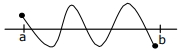
Let $f:(a, b) \rightarrow R$ be a twice differentiable function such that $f(x) = \int_{a}^{x} g(t) \, dt$ for a differentiable function $g(x)$. If $f(x) = 0$ has exactly five distinct roots in $(a, b)$,then $g(x) g'(x) = 0$ has at least:
A
seven roots in $(a, b)$
B
five roots in $(a, b)$
C
three roots in $(a, b)$
D
twelve roots in $(a, b)$
Solution
(A) Given $f(x) = \int_{a}^{x} g(t) \, dt$. By the Fundamental Theorem of Calculus,$f'(x) = g(x)$.
Since $f(x) = 0$ has $5$ distinct roots in $(a, b)$,by Rolle's Theorem,$f'(x) = 0$ must have at least $5 - 1 = 4$ distinct roots in $(a, b)$.
Thus,$g(x) = 0$ has at least $4$ distinct roots in $(a, b)$.
Now,by Rolle's Theorem applied to $g(x)$,since $g(x) = 0$ has at least $4$ distinct roots,$g'(x) = 0$ must have at least $4 - 1 = 3$ distinct roots in $(a, b)$.
The equation $g(x) g'(x) = 0$ is satisfied if $g(x) = 0$ or $g'(x) = 0$.
Since $g(x) = 0$ has at least $4$ roots and $g'(x) = 0$ has at least $3$ roots,the total number of distinct roots for $g(x) g'(x) = 0$ is at least $4 + 3 = 7$ roots in $(a, b)$.
Since $f(x) = 0$ has $5$ distinct roots in $(a, b)$,by Rolle's Theorem,$f'(x) = 0$ must have at least $5 - 1 = 4$ distinct roots in $(a, b)$.
Thus,$g(x) = 0$ has at least $4$ distinct roots in $(a, b)$.
Now,by Rolle's Theorem applied to $g(x)$,since $g(x) = 0$ has at least $4$ distinct roots,$g'(x) = 0$ must have at least $4 - 1 = 3$ distinct roots in $(a, b)$.
The equation $g(x) g'(x) = 0$ is satisfied if $g(x) = 0$ or $g'(x) = 0$.
Since $g(x) = 0$ has at least $4$ roots and $g'(x) = 0$ has at least $3$ roots,the total number of distinct roots for $g(x) g'(x) = 0$ is at least $4 + 3 = 7$ roots in $(a, b)$.
0 likesView Solution
402
MathematicsDifficultMCQJEE Main · 2021
Let $f:[0, \infty) \rightarrow [0, 3]$ be a function defined by
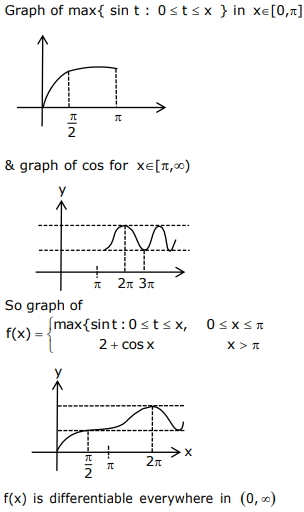
$f(x) = \begin{cases} \max \{\sin t : 0 \leq t \leq x\}, & 0 \leq x \leq \pi \\ 2 + \cos x, & x > \pi \end{cases}$
Then which of the following is true?
$f(x) = \begin{cases} \max \{\sin t : 0 \leq t \leq x\}, & 0 \leq x \leq \pi \\ 2 + \cos x, & x > \pi \end{cases}$
Then which of the following is true?
A
$f$ is differentiable everywhere in $(0, \infty)$
B
$f$ is continuous everywhere but not differentiable exactly at two points in $(0, \infty)$
C
$f$ is not continuous exactly at two points in $(0, \infty)$
D
$f$ is continuous everywhere but not differentiable exactly at one point in $(0, \infty)$
Solution
(A) For $0 \leq x \leq \pi$,$f(x) = \max \{\sin t : 0 \leq t \leq x\}$. Since $\sin t$ increases from $0$ to $1$ on $[0, \pi/2]$ and decreases from $1$ to $0$ on $[\pi/2, \pi]$,we have:
$f(x) = \sin x$ for $0 \leq x \leq \pi/2$,and $f(x) = 1$ for $\pi/2 < x \leq \pi$.
For $x > \pi$,$f(x) = 2 + \cos x$.
Now,check continuity at $x = \pi$:
Left-hand limit: $\lim_{x \to \pi^-} f(x) = 1$.
Right-hand limit: $\lim_{x \to \pi^+} f(x) = 2 + \cos(\pi) = 2 - 1 = 1$.
Since $f(\pi) = 1$,the function is continuous at $x = \pi$.
Check differentiability:
At $x = \pi/2$: Left derivative is $\cos(\pi/2) = 0$,right derivative is $0$. So,$f$ is differentiable at $x = \pi/2$.
At $x = \pi$: Left derivative is $0$ (since $f(x)=1$ for $x \in [\pi/2, \pi]$). Right derivative is $-\sin(\pi) = 0$. So,$f$ is differentiable at $x = \pi$.
For $x > \pi$,$f(x) = 2 + \cos x$,which is differentiable everywhere. Thus,$f$ is differentiable everywhere in $(0, \infty)$.
$f(x) = \sin x$ for $0 \leq x \leq \pi/2$,and $f(x) = 1$ for $\pi/2 < x \leq \pi$.
For $x > \pi$,$f(x) = 2 + \cos x$.
Now,check continuity at $x = \pi$:
Left-hand limit: $\lim_{x \to \pi^-} f(x) = 1$.
Right-hand limit: $\lim_{x \to \pi^+} f(x) = 2 + \cos(\pi) = 2 - 1 = 1$.
Since $f(\pi) = 1$,the function is continuous at $x = \pi$.
Check differentiability:
At $x = \pi/2$: Left derivative is $\cos(\pi/2) = 0$,right derivative is $0$. So,$f$ is differentiable at $x = \pi/2$.
At $x = \pi$: Left derivative is $0$ (since $f(x)=1$ for $x \in [\pi/2, \pi]$). Right derivative is $-\sin(\pi) = 0$. So,$f$ is differentiable at $x = \pi$.
For $x > \pi$,$f(x) = 2 + \cos x$,which is differentiable everywhere. Thus,$f$ is differentiable everywhere in $(0, \infty)$.
0 likesView Solution
403
MathematicsMediumMCQJEE Main · 2021
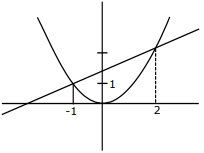
The area of the region bounded by $y-x=2$ and $x^{2}=y$ is equal to:
A
$\frac{4}{3}$
B
$\frac{9}{2}$
C
$\frac{16}{3}$
D
$\frac{2}{3}$
Solution
(B) Given curves are $y = x+2$ and $y = x^2$.
To find the points of intersection,set $x^2 = x+2$.
$x^2 - x - 2 = 0$
$(x-2)(x+1) = 0$
So,$x = 2$ and $x = -1$.
The area $A$ is given by the integral of the upper curve minus the lower curve from $x = -1$ to $x = 2$:
$A = \int_{-1}^{2} (x+2 - x^2) \, dx$
$A = \left[ \frac{x^2}{2} + 2x - \frac{x^3}{3} \right]_{-1}^{2}$
$A = \left( \frac{4}{2} + 4 - \frac{8}{3} \right) - \left( \frac{1}{2} - 2 - \frac{-1}{3} \right)$
$A = \left( 2 + 4 - \frac{8}{3} \right) - \left( \frac{1}{2} - 2 + \frac{1}{3} \right)$
$A = \left( 6 - \frac{8}{3} \right) - \left( \frac{3 - 12 + 2}{6} \right)$
$A = \frac{10}{3} - \left( -\frac{7}{6} \right) = \frac{20}{6} + \frac{7}{6} = \frac{27}{6} = \frac{9}{2}$.
To find the points of intersection,set $x^2 = x+2$.
$x^2 - x - 2 = 0$
$(x-2)(x+1) = 0$
So,$x = 2$ and $x = -1$.
The area $A$ is given by the integral of the upper curve minus the lower curve from $x = -1$ to $x = 2$:
$A = \int_{-1}^{2} (x+2 - x^2) \, dx$
$A = \left[ \frac{x^2}{2} + 2x - \frac{x^3}{3} \right]_{-1}^{2}$
$A = \left( \frac{4}{2} + 4 - \frac{8}{3} \right) - \left( \frac{1}{2} - 2 - \frac{-1}{3} \right)$
$A = \left( 2 + 4 - \frac{8}{3} \right) - \left( \frac{1}{2} - 2 + \frac{1}{3} \right)$
$A = \left( 6 - \frac{8}{3} \right) - \left( \frac{3 - 12 + 2}{6} \right)$
$A = \frac{10}{3} - \left( -\frac{7}{6} \right) = \frac{20}{6} + \frac{7}{6} = \frac{27}{6} = \frac{9}{2}$.
0 likesView Solution
404
MathematicsDifficultMCQJEE Main · 2021
Let $y=y(x)$ be the solution of the differential equation $(x-x^{3}) dy=(y+yx^{2}-3x^{4}) dx, x>2$. If $y(3)=3$,then $y(4)$ is equal to :
A
$8$
B
$12$
C
$16$
D
$4$
Solution
(B) Given differential equation: $(x-x^{3}) dy = (y+yx^{2}-3x^{4}) dx$
Rearranging the terms:
$(x-x^{3}) dy - y(1+x^{2}) dx = -3x^{4} dx$
Divide by $x(1-x^{2})$ or rearrange to identify the structure:
$x dy - x^{3} dy = y dx + yx^{2} dx - 3x^{4} dx$
$x dy - y dx = x^{3} dy + yx^{2} dx - 3x^{4} dx$
Divide by $x^{2}$:
$\frac{x dy - y dx}{x^{2}} = \frac{x^{3} dy + yx^{2} dx}{x^{2}} - 3x^{2} dx$
$d(\frac{y}{x}) = d(xy) - d(x^{3})$
Integrating both sides:
$\frac{y}{x} = xy - x^{3} + C$
Given $y(3)=3$,substitute $x=3, y=3$:
$\frac{3}{3} = 3(3) - 3^{3} + C$
$1 = 9 - 27 + C$
$1 = -18 + C \Rightarrow C = 19$
So,the equation is $\frac{y}{x} = xy - x^{3} + 19$
For $x=4$:
$\frac{y}{4} = 4y - 64 + 19$
$\frac{y}{4} = 4y - 45$
$y = 16y - 180$
$15y = 180$
$y = 12$
Rearranging the terms:
$(x-x^{3}) dy - y(1+x^{2}) dx = -3x^{4} dx$
Divide by $x(1-x^{2})$ or rearrange to identify the structure:
$x dy - x^{3} dy = y dx + yx^{2} dx - 3x^{4} dx$
$x dy - y dx = x^{3} dy + yx^{2} dx - 3x^{4} dx$
Divide by $x^{2}$:
$\frac{x dy - y dx}{x^{2}} = \frac{x^{3} dy + yx^{2} dx}{x^{2}} - 3x^{2} dx$
$d(\frac{y}{x}) = d(xy) - d(x^{3})$
Integrating both sides:
$\frac{y}{x} = xy - x^{3} + C$
Given $y(3)=3$,substitute $x=3, y=3$:
$\frac{3}{3} = 3(3) - 3^{3} + C$
$1 = 9 - 27 + C$
$1 = -18 + C \Rightarrow C = 19$
So,the equation is $\frac{y}{x} = xy - x^{3} + 19$
For $x=4$:
$\frac{y}{4} = 4y - 64 + 19$
$\frac{y}{4} = 4y - 45$
$y = 16y - 180$
$15y = 180$
$y = 12$
0 likesView Solution
405
MathematicsDifficultMCQJEE Main · 2021
Let $\vec{a}, \vec{b}$ and $\vec{c}$ be three vectors such that $\vec{a}=\vec{b} \times(\vec{b} \times \vec{c}) .$ If magnitudes of the vectors $\vec{a}, \vec{b}$ and $\vec{c}$ are $\sqrt{2}, 1$ and $2$ respectively and the angle between $\vec{b}$ and $\vec{c}$ is $\theta$ $(0 < \theta < \frac{\pi}{2})$,then the value of $1+\tan \theta$ is equal to:
A
$\frac{\sqrt{3}+1}{\sqrt{3}}$
B
$2$
C
$\sqrt{3}+1$
D
$1$
Solution
(B) Using the vector triple product formula,$\vec{a} = \vec{b} \times (\vec{b} \times \vec{c}) = (\vec{b} \cdot \vec{c}) \vec{b} - (\vec{b} \cdot \vec{b}) \vec{c}$.
Given $|\vec{a}| = \sqrt{2}$,$|\vec{b}| = 1$,$|\vec{c}| = 2$,and $\vec{b} \cdot \vec{c} = |\vec{b}| |\vec{c}| \cos \theta = 1 \cdot 2 \cdot \cos \theta = 2 \cos \theta$.
Substituting these values,$\vec{a} = (2 \cos \theta) \vec{b} - (1)^2 \vec{c} = 2 \cos \theta \vec{b} - \vec{c}$.
Now,calculate $|\vec{a}|^2 = |2 \cos \theta \vec{b} - \vec{c}|^2 = (2 \cos \theta)^2 |\vec{b}|^2 + |\vec{c}|^2 - 2(2 \cos \theta) (\vec{b} \cdot \vec{c})$.
$|\vec{a}|^2 = 4 \cos^2 \theta (1) + 4 - 4 \cos \theta (2 \cos \theta) = 4 \cos^2 \theta + 4 - 8 \cos^2 \theta = 4 - 4 \cos^2 \theta$.
Since $|\vec{a}|^2 = (\sqrt{2})^2 = 2$,we have $2 = 4 - 4 \cos^2 \theta$.
$4 \cos^2 \theta = 2 \Rightarrow \cos^2 \theta = \frac{1}{2}$.
Since $0 < \theta < \frac{\pi}{2}$,$\cos \theta = \frac{1}{\sqrt{2}}$,which implies $\theta = \frac{\pi}{4}$.
Therefore,$1 + \tan \theta = 1 + \tan(\frac{\pi}{4}) = 1 + 1 = 2$.
Given $|\vec{a}| = \sqrt{2}$,$|\vec{b}| = 1$,$|\vec{c}| = 2$,and $\vec{b} \cdot \vec{c} = |\vec{b}| |\vec{c}| \cos \theta = 1 \cdot 2 \cdot \cos \theta = 2 \cos \theta$.
Substituting these values,$\vec{a} = (2 \cos \theta) \vec{b} - (1)^2 \vec{c} = 2 \cos \theta \vec{b} - \vec{c}$.
Now,calculate $|\vec{a}|^2 = |2 \cos \theta \vec{b} - \vec{c}|^2 = (2 \cos \theta)^2 |\vec{b}|^2 + |\vec{c}|^2 - 2(2 \cos \theta) (\vec{b} \cdot \vec{c})$.
$|\vec{a}|^2 = 4 \cos^2 \theta (1) + 4 - 4 \cos \theta (2 \cos \theta) = 4 \cos^2 \theta + 4 - 8 \cos^2 \theta = 4 - 4 \cos^2 \theta$.
Since $|\vec{a}|^2 = (\sqrt{2})^2 = 2$,we have $2 = 4 - 4 \cos^2 \theta$.
$4 \cos^2 \theta = 2 \Rightarrow \cos^2 \theta = \frac{1}{2}$.
Since $0 < \theta < \frac{\pi}{2}$,$\cos \theta = \frac{1}{\sqrt{2}}$,which implies $\theta = \frac{\pi}{4}$.
Therefore,$1 + \tan \theta = 1 + \tan(\frac{\pi}{4}) = 1 + 1 = 2$.
0 likesView Solution
406
MathematicsMediumMCQJEE Main · 2021
$A$ student appeared in an examination consisting of $8$ true-false type questions. The student guesses the answers with equal probability. The smallest value of $n$,so that the probability of guessing at least $n$ correct answers is less than $\frac{1}{2}$,is:
A
$5$
B
$3$
C
$6$
D
$4$
Solution
(A) Let $X$ be the number of correct answers. Since the student guesses,$X$ follows a binomial distribution $B(n=8, p=1/2)$.
We want to find the smallest $n$ such that $P(X \geq n) < \frac{1}{2}$.
$P(X \geq n) = \sum_{r=n}^{8} {}^{8}C_{r} (\frac{1}{2})^{r} (\frac{1}{2})^{8-r} = \frac{1}{2^{8}} \sum_{r=n}^{8} {}^{8}C_{r} < \frac{1}{2}$.
$\sum_{r=n}^{8} {}^{8}C_{r} < 2^{7} = 128$.
We know that $\sum_{r=0}^{8} {}^{8}C_{r} = 2^{8} = 256$.
So,$\sum_{r=n}^{8} {}^{8}C_{r} = 256 - \sum_{r=0}^{n-1} {}^{8}C_{r} < 128$.
$\sum_{r=0}^{n-1} {}^{8}C_{r} > 128$.
For $n=5$,$\sum_{r=0}^{4} {}^{8}C_{r} = {}^{8}C_{0} + {}^{8}C_{1} + {}^{8}C_{2} + {}^{8}C_{3} + {}^{8}C_{4} = 1 + 8 + 28 + 56 + 70 = 163$.
Since $163 > 128$,the condition holds for $n=5$.
For $n=4$,$\sum_{r=0}^{3} {}^{8}C_{r} = 1 + 8 + 28 + 56 = 93$,which is not greater than $128$.
Thus,the smallest value of $n$ is $5$.
We want to find the smallest $n$ such that $P(X \geq n) < \frac{1}{2}$.
$P(X \geq n) = \sum_{r=n}^{8} {}^{8}C_{r} (\frac{1}{2})^{r} (\frac{1}{2})^{8-r} = \frac{1}{2^{8}} \sum_{r=n}^{8} {}^{8}C_{r} < \frac{1}{2}$.
$\sum_{r=n}^{8} {}^{8}C_{r} < 2^{7} = 128$.
We know that $\sum_{r=0}^{8} {}^{8}C_{r} = 2^{8} = 256$.
So,$\sum_{r=n}^{8} {}^{8}C_{r} = 256 - \sum_{r=0}^{n-1} {}^{8}C_{r} < 128$.
$\sum_{r=0}^{n-1} {}^{8}C_{r} > 128$.
For $n=5$,$\sum_{r=0}^{4} {}^{8}C_{r} = {}^{8}C_{0} + {}^{8}C_{1} + {}^{8}C_{2} + {}^{8}C_{3} + {}^{8}C_{4} = 1 + 8 + 28 + 56 + 70 = 163$.
Since $163 > 128$,the condition holds for $n=5$.
For $n=4$,$\sum_{r=0}^{3} {}^{8}C_{r} = 1 + 8 + 28 + 56 = 93$,which is not greater than $128$.
Thus,the smallest value of $n$ is $5$.
0 likesView Solution
407
MathematicsDifficultMCQJEE Main · 2021
Let $N$ be the set of natural numbers and a relation $R$ on $N$ be defined by $R = \{(x, y) \in N \times N : x^{3}-3x^{2}y-xy^{2}+3y^{3}=0\}$. Then the relation $R$ is:
A
reflexive and symmetric,but not transitive
B
reflexive but neither symmetric nor transitive
C
an equivalence relation
D
symmetric but neither reflexive nor transitive
Solution
(B) The given equation is $x^{3}-3x^{2}y-xy^{2}+3y^{3}=0$.
Factoring the expression:
$x^{2}(x-3y) - y^{2}(x-3y) = 0$
$(x^{2}-y^{2})(x-3y) = 0$
$(x-y)(x+y)(x-3y) = 0$
This implies $x=y$ or $x=-y$ or $x=3y$.
Since $x, y \in N$,$x=-y$ is impossible as $x, y > 0$.
Thus,the relation is $R = \{(x, y) \in N \times N : x=y \text{ or } x=3y\}$.
$1$. Reflexivity: For any $x \in N$,$(x, x) \in R$ because $x=x$ is true. Thus,$R$ is reflexive.
$2$. Symmetry: Consider $(3, 1) \in R$ because $3=3(1)$. However,$(1, 3) \notin R$ because $1 \neq 3$ and $1 \neq 3(3)=9$. Thus,$R$ is not symmetric.
$3$. Transitivity: Consider $(9, 3) \in R$ (since $9=3(3)$) and $(3, 1) \in R$ (since $3=3(1)$). For $R$ to be transitive,$(9, 1)$ must be in $R$. But $9 \neq 1$ and $9 \neq 3(1)=3$. Thus,$R$ is not transitive.
Therefore,$R$ is reflexive but neither symmetric nor transitive.
Factoring the expression:
$x^{2}(x-3y) - y^{2}(x-3y) = 0$
$(x^{2}-y^{2})(x-3y) = 0$
$(x-y)(x+y)(x-3y) = 0$
This implies $x=y$ or $x=-y$ or $x=3y$.
Since $x, y \in N$,$x=-y$ is impossible as $x, y > 0$.
Thus,the relation is $R = \{(x, y) \in N \times N : x=y \text{ or } x=3y\}$.
$1$. Reflexivity: For any $x \in N$,$(x, x) \in R$ because $x=x$ is true. Thus,$R$ is reflexive.
$2$. Symmetry: Consider $(3, 1) \in R$ because $3=3(1)$. However,$(1, 3) \notin R$ because $1 \neq 3$ and $1 \neq 3(3)=9$. Thus,$R$ is not symmetric.
$3$. Transitivity: Consider $(9, 3) \in R$ (since $9=3(3)$) and $(3, 1) \in R$ (since $3=3(1)$). For $R$ to be transitive,$(9, 1)$ must be in $R$. But $9 \neq 1$ and $9 \neq 3(1)=3$. Thus,$R$ is not transitive.
Therefore,$R$ is reflexive but neither symmetric nor transitive.
0 likesView Solution
408
MathematicsDifficultMCQJEE Main · 2021
Let $A$ and $B$ be two $3 \times 3$ real matrices such that $(A^{2}-B^{2})$ is an invertible matrix. If $A^{5}=B^{5}$ and $A^{3} B^{2}=A^{2} B^{3}$,then the value of the determinant of the matrix $A^{3}+B^{3}$ is equal to:
A
$0$
B
$2$
C
$1$
D
$4$
Solution
(A) Given that $A^{5}=B^{5}$ and $A^{3} B^{2}=A^{2} B^{3}$.
Subtracting the second equation from the first,we get:
$A^{5}-A^{3} B^{2} = B^{5}-A^{2} B^{3}$
$A^{3}(A^{2}-B^{2}) = B^{5}-A^{2} B^{3}$
Rearranging the terms:
$A^{3}(A^{2}-B^{2}) + B^{3}(A^{2}-B^{2}) = 0$
$(A^{3}+B^{3})(A^{2}-B^{2}) = 0$
Since $(A^{2}-B^{2})$ is an invertible matrix,we can post-multiply by its inverse $(A^{2}-B^{2})^{-1}$:
$(A^{3}+B^{3})(A^{2}-B^{2})(A^{2}-B^{2})^{-1} = 0 \cdot (A^{2}-B^{2})^{-1}$
$A^{3}+B^{3} = 0$
Therefore,the determinant of the zero matrix is $|A^{3}+B^{3}| = |0| = 0$.
Subtracting the second equation from the first,we get:
$A^{5}-A^{3} B^{2} = B^{5}-A^{2} B^{3}$
$A^{3}(A^{2}-B^{2}) = B^{5}-A^{2} B^{3}$
Rearranging the terms:
$A^{3}(A^{2}-B^{2}) + B^{3}(A^{2}-B^{2}) = 0$
$(A^{3}+B^{3})(A^{2}-B^{2}) = 0$
Since $(A^{2}-B^{2})$ is an invertible matrix,we can post-multiply by its inverse $(A^{2}-B^{2})^{-1}$:
$(A^{3}+B^{3})(A^{2}-B^{2})(A^{2}-B^{2})^{-1} = 0 \cdot (A^{2}-B^{2})^{-1}$
$A^{3}+B^{3} = 0$
Therefore,the determinant of the zero matrix is $|A^{3}+B^{3}| = |0| = 0$.
0 likesView Solution
409
MathematicsDifficultMCQJEE Main · 2021
If $A = \begin{bmatrix} 1 & 1 & 1 \\ 0 & 1 & 1 \\ 0 & 0 & 1 \end{bmatrix}$ and $M = A + A^{2} + A^{3} + \dots + A^{20}$,then the sum of all the elements of the matrix $M$ is equal to $.....$
A
$1010$
B
$2020$
C
$1414$
D
$2121$
Solution
(B) Given $A = \begin{bmatrix} 1 & 1 & 1 \\ 0 & 1 & 1 \\ 0 & 0 & 1 \end{bmatrix}$.
We can observe that $A = I + N$,where $I$ is the identity matrix and $N = \begin{bmatrix} 0 & 1 & 1 \\ 0 & 0 & 1 \\ 0 & 0 & 0 \end{bmatrix}$.
Note that $N^2 = \begin{bmatrix} 0 & 0 & 1 \\ 0 & 0 & 0 \\ 0 & 0 & 0 \end{bmatrix}$ and $N^3 = 0$.
Using the binomial expansion,$A^n = (I+N)^n = I + nN + \frac{n(n-1)}{2}N^2$.
Thus,$A^n = \begin{bmatrix} 1 & n & n + \frac{n(n-1)}{2} \\ 0 & 1 & n \\ 0 & 0 & 1 \end{bmatrix} = \begin{bmatrix} 1 & n & \frac{n^2+n}{2} \\ 0 & 1 & n \\ 0 & 0 & 1 \end{bmatrix}$.
The sum of elements of $A^n$ is $S_n = 1 + n + \frac{n^2+n}{2} + 0 + 1 + n + 0 + 0 + 1 = 3 + 2n + \frac{n^2+n}{2} = 3 + \frac{5n+n^2}{2}$.
Sum of elements of $M = \sum_{n=1}^{20} S_n = \sum_{n=1}^{20} (3 + \frac{5}{2}n + \frac{1}{2}n^2) = 3(20) + \frac{5}{2} \frac{20(21)}{2} + \frac{1}{2} \frac{20(21)(41)}{6}$.
$= 60 + 525 + 1435 = 2020$.
We can observe that $A = I + N$,where $I$ is the identity matrix and $N = \begin{bmatrix} 0 & 1 & 1 \\ 0 & 0 & 1 \\ 0 & 0 & 0 \end{bmatrix}$.
Note that $N^2 = \begin{bmatrix} 0 & 0 & 1 \\ 0 & 0 & 0 \\ 0 & 0 & 0 \end{bmatrix}$ and $N^3 = 0$.
Using the binomial expansion,$A^n = (I+N)^n = I + nN + \frac{n(n-1)}{2}N^2$.
Thus,$A^n = \begin{bmatrix} 1 & n & n + \frac{n(n-1)}{2} \\ 0 & 1 & n \\ 0 & 0 & 1 \end{bmatrix} = \begin{bmatrix} 1 & n & \frac{n^2+n}{2} \\ 0 & 1 & n \\ 0 & 0 & 1 \end{bmatrix}$.
The sum of elements of $A^n$ is $S_n = 1 + n + \frac{n^2+n}{2} + 0 + 1 + n + 0 + 0 + 1 = 3 + 2n + \frac{n^2+n}{2} = 3 + \frac{5n+n^2}{2}$.
Sum of elements of $M = \sum_{n=1}^{20} S_n = \sum_{n=1}^{20} (3 + \frac{5}{2}n + \frac{1}{2}n^2) = 3(20) + \frac{5}{2} \frac{20(21)}{2} + \frac{1}{2} \frac{20(21)(41)}{6}$.
$= 60 + 525 + 1435 = 2020$.
0 likesView Solution
410
MathematicsMediumMCQJEE Main · 2021
The distance of the point $P(3,4,4)$ from the point of intersection of the line joining the points $Q(3,-4,-5)$ and $R(2,-3,1)$ and the plane $2x+y+z=7$ is equal to $.....$
A
$4$
B
$5$
C
$6$
D
$7$
Solution
(D) The equation of the line passing through $Q(3,-4,-5)$ and $R(2,-3,1)$ is given by $\frac{x-3}{2-3} = \frac{y-(-4)}{-3-(-4)} = \frac{z-(-5)}{1-(-5)} = r$.
This simplifies to $\frac{x-3}{-1} = \frac{y+4}{1} = \frac{z+5}{6} = r$.
Any point on this line is given by $(x, y, z) = (-r+3, r-4, 6r-5)$.
Since this point lies on the plane $2x+y+z=7$,we substitute the coordinates into the plane equation:
$2(-r+3) + (r-4) + (6r-5) = 7$.
$-2r + 6 + r - 4 + 6r - 5 = 7$.
$5r - 3 = 7 \Rightarrow 5r = 10 \Rightarrow r = 2$.
Substituting $r=2$ back into the point coordinates,we get the point of intersection $T = (-2+3, 2-4, 6(2)-5) = (1, -2, 7)$.
The distance between $P(3,4,4)$ and $T(1,-2,7)$ is given by the distance formula:
$PT = \sqrt{(1-3)^2 + (-2-4)^2 + (7-4)^2}$.
$PT = \sqrt{(-2)^2 + (-6)^2 + (3)^2} = \sqrt{4 + 36 + 9} = \sqrt{49} = 7$.
This simplifies to $\frac{x-3}{-1} = \frac{y+4}{1} = \frac{z+5}{6} = r$.
Any point on this line is given by $(x, y, z) = (-r+3, r-4, 6r-5)$.
Since this point lies on the plane $2x+y+z=7$,we substitute the coordinates into the plane equation:
$2(-r+3) + (r-4) + (6r-5) = 7$.
$-2r + 6 + r - 4 + 6r - 5 = 7$.
$5r - 3 = 7 \Rightarrow 5r = 10 \Rightarrow r = 2$.
Substituting $r=2$ back into the point coordinates,we get the point of intersection $T = (-2+3, 2-4, 6(2)-5) = (1, -2, 7)$.
The distance between $P(3,4,4)$ and $T(1,-2,7)$ is given by the distance formula:
$PT = \sqrt{(1-3)^2 + (-2-4)^2 + (7-4)^2}$.
$PT = \sqrt{(-2)^2 + (-6)^2 + (3)^2} = \sqrt{4 + 36 + 9} = \sqrt{49} = 7$.
0 likesView Solution
411
MathematicsDifficultMCQJEE Main · 2021
If $\int_{0}^{\pi} (\sin^{3} x) e^{-\sin^{2} x} dx = \alpha - \frac{\beta}{e} \int_{0}^{1} \sqrt{t} e^{t} dt$,then $\alpha + \beta$ is equal to $....$
A
$4$
B
$5$
C
$6$
D
$7$
Solution
(B) Let $I = \int_{0}^{\pi} \sin^{3} x e^{-\sin^{2} x} dx$. Since $\sin^{3}(\pi - x) = \sin^{3} x$ and $\sin^{2}(\pi - x) = \sin^{2} x$,we have $I = 2 \int_{0}^{\pi/2} \sin^{3} x e^{-\sin^{2} x} dx$.
Using $\sin^{3} x = \sin x (1 - \cos^{2} x)$,$I = 2 \int_{0}^{\pi/2} \sin x e^{-\sin^{2} x} dx - 2 \int_{0}^{\pi/2} \sin x \cos^{2} x e^{-\sin^{2} x} dx$.
For the second integral,let $u = \cos x$,$du = -\sin x dx$. However,it is easier to use $v = \sin x$,$dv = \cos x dx$.
Alternatively,rewrite as $I = 2 \int_{0}^{\pi/2} \sin x (1 - \sin^{2} x) e^{-\sin^{2} x} dx$. Let $t = \sin x$,$dt = \cos x dx$.
Using integration by parts on $2 \int_{0}^{\pi/2} \sin x \cos^{2} x e^{-\sin^{2} x} dx$,let $u = \cos x$ and $dv = \sin x \cos x e^{-\sin^{2} x} dx$. Then $du = -\sin x dx$ and $v = \frac{1}{2} e^{-\sin^{2} x}$.
Evaluating the integral leads to $I = 2 - \frac{3}{e} \int_{0}^{1} \sqrt{t} e^{t} dt$.
Comparing with $\alpha - \frac{\beta}{e} \int_{0}^{1} \sqrt{t} e^{t} dt$,we get $\alpha = 2$ and $\beta = 3$.
Thus,$\alpha + \beta = 2 + 3 = 5$.
Using $\sin^{3} x = \sin x (1 - \cos^{2} x)$,$I = 2 \int_{0}^{\pi/2} \sin x e^{-\sin^{2} x} dx - 2 \int_{0}^{\pi/2} \sin x \cos^{2} x e^{-\sin^{2} x} dx$.
For the second integral,let $u = \cos x$,$du = -\sin x dx$. However,it is easier to use $v = \sin x$,$dv = \cos x dx$.
Alternatively,rewrite as $I = 2 \int_{0}^{\pi/2} \sin x (1 - \sin^{2} x) e^{-\sin^{2} x} dx$. Let $t = \sin x$,$dt = \cos x dx$.
Using integration by parts on $2 \int_{0}^{\pi/2} \sin x \cos^{2} x e^{-\sin^{2} x} dx$,let $u = \cos x$ and $dv = \sin x \cos x e^{-\sin^{2} x} dx$. Then $du = -\sin x dx$ and $v = \frac{1}{2} e^{-\sin^{2} x}$.
Evaluating the integral leads to $I = 2 - \frac{3}{e} \int_{0}^{1} \sqrt{t} e^{t} dt$.
Comparing with $\alpha - \frac{\beta}{e} \int_{0}^{1} \sqrt{t} e^{t} dt$,we get $\alpha = 2$ and $\beta = 3$.
Thus,$\alpha + \beta = 2 + 3 = 5$.
0 likesView Solution
412
MathematicsDifficultMCQJEE Main · 2021
Let $\vec{a}=\hat{i}-\alpha \hat{j}+\beta \hat{k}$,$\vec{b}=3 \hat{i}+\beta \hat{j}-\alpha \hat{k}$ and $\vec{c}=-\alpha \hat{i}-2 \hat{j}+\hat{k}$,where $\alpha$ and $\beta$ are integers. If $\vec{a} \cdot \vec{b}=-1$ and $\vec{b} \cdot \vec{c}=10$,then $(\vec{a} \times \vec{b}) \cdot \vec{c}$ is equal to $.....$
A
$8$
B
$5$
C
$9$
D
$1$
Solution
(C) Given vectors are $\vec{a}=(1, -\alpha, \beta)$,$\vec{b}=(3, \beta, -\alpha)$,and $\vec{c}=(-\alpha, -2, 1)$,where $\alpha, \beta \in \mathbb{Z}$.
From $\vec{a} \cdot \vec{b} = -1$:
$(1)(3) + (-\alpha)(\beta) + (\beta)(-\alpha) = -1$
$3 - 2\alpha\beta = -1 \Rightarrow 2\alpha\beta = 4 \Rightarrow \alpha\beta = 2$.
From $\vec{b} \cdot \vec{c} = 10$:
$(3)(-\alpha) + (\beta)(-2) + (-\alpha)(1) = 10$
$-3\alpha - 2\beta - \alpha = 10 \Rightarrow -4\alpha - 2\beta = 10 \Rightarrow 2\alpha + \beta = -5$.
Since $\alpha\beta = 2$ and $\beta = -5 - 2\alpha$,we substitute $\beta$:
$\alpha(-5 - 2\alpha) = 2 \Rightarrow -5\alpha - 2\alpha^2 = 2 \Rightarrow 2\alpha^2 + 5\alpha + 2 = 0$.
$(2\alpha + 1)(\alpha + 2) = 0$. Since $\alpha$ is an integer,$\alpha = -2$.
Then $\beta = -5 - 2(-2) = -5 + 4 = -1$.
Now,calculate the scalar triple product $[\vec{a} \vec{b} \vec{c}] = \begin{vmatrix} 1 & -(-2) & -1 \\ 3 & -1 & -(-2) \\ -(-2) & -2 & 1 \end{vmatrix} = \begin{vmatrix} 1 & 2 & -1 \\ 3 & -1 & 2 \\ 2 & -2 & 1 \end{vmatrix}$.
$= 1(-1 + 4) - 2(3 - 4) - 1(-6 + 2)$
$= 1(3) - 2(-1) - 1(-4) = 3 + 2 + 4 = 9$.
From $\vec{a} \cdot \vec{b} = -1$:
$(1)(3) + (-\alpha)(\beta) + (\beta)(-\alpha) = -1$
$3 - 2\alpha\beta = -1 \Rightarrow 2\alpha\beta = 4 \Rightarrow \alpha\beta = 2$.
From $\vec{b} \cdot \vec{c} = 10$:
$(3)(-\alpha) + (\beta)(-2) + (-\alpha)(1) = 10$
$-3\alpha - 2\beta - \alpha = 10 \Rightarrow -4\alpha - 2\beta = 10 \Rightarrow 2\alpha + \beta = -5$.
Since $\alpha\beta = 2$ and $\beta = -5 - 2\alpha$,we substitute $\beta$:
$\alpha(-5 - 2\alpha) = 2 \Rightarrow -5\alpha - 2\alpha^2 = 2 \Rightarrow 2\alpha^2 + 5\alpha + 2 = 0$.
$(2\alpha + 1)(\alpha + 2) = 0$. Since $\alpha$ is an integer,$\alpha = -2$.
Then $\beta = -5 - 2(-2) = -5 + 4 = -1$.
Now,calculate the scalar triple product $[\vec{a} \vec{b} \vec{c}] = \begin{vmatrix} 1 & -(-2) & -1 \\ 3 & -1 & -(-2) \\ -(-2) & -2 & 1 \end{vmatrix} = \begin{vmatrix} 1 & 2 & -1 \\ 3 & -1 & 2 \\ 2 & -2 & 1 \end{vmatrix}$.
$= 1(-1 + 4) - 2(3 - 4) - 1(-6 + 2)$
$= 1(3) - 2(-1) - 1(-4) = 3 + 2 + 4 = 9$.
0 likesView Solution
413
MathematicsMediumMCQJEE Main · 2021
Let $y=y(x)$ be the solution of the differential equation $dy=e^{\alpha x+y} dx$; $\alpha \in N$. If $y(\log_{e} 2)=\log_{e} 2$ and $y(0)=\log_{e}(\frac{1}{2})$,then the value of $\alpha$ is equal to $.....$
A
$1$
B
$2$
C
$3$
D
$5$
Solution
(B) Given the differential equation: $dy = e^{\alpha x + y} dx$.
Rearranging the terms to separate the variables:
$e^{-y} dy = e^{\alpha x} dx$.
Integrating both sides:
$\int e^{-y} dy = \int e^{\alpha x} dx$
$-e^{-y} = \frac{e^{\alpha x}}{\alpha} + C \quad \dots(i)$
Using the condition $y(0) = \log_{e}(\frac{1}{2}) = -\log_{e} 2$:
$-e^{-(-\log_{e} 2)} = \frac{e^{\alpha(0)}}{\alpha} + C$
$-e^{\log_{e} 2} = \frac{1}{\alpha} + C$
$-2 = \frac{1}{\alpha} + C \quad \dots(ii)$
Using the condition $y(\log_{e} 2) = \log_{e} 2$:
$-e^{-\log_{e} 2} = \frac{e^{\alpha \log_{e} 2}}{\alpha} + C$
$-\frac{1}{2} = \frac{2^{\alpha}}{\alpha} + C \quad \dots(iii)$
Subtracting equation $(ii)$ from equation $(iii)$:
$(-\frac{1}{2}) - (-2) = \frac{2^{\alpha}}{\alpha} - \frac{1}{\alpha}$
$\frac{3}{2} = \frac{2^{\alpha} - 1}{\alpha}$
For $\alpha = 2$:
$\frac{2^{2} - 1}{2} = \frac{4 - 1}{2} = \frac{3}{2}$.
Thus,the value of $\alpha$ is $2$.
Rearranging the terms to separate the variables:
$e^{-y} dy = e^{\alpha x} dx$.
Integrating both sides:
$\int e^{-y} dy = \int e^{\alpha x} dx$
$-e^{-y} = \frac{e^{\alpha x}}{\alpha} + C \quad \dots(i)$
Using the condition $y(0) = \log_{e}(\frac{1}{2}) = -\log_{e} 2$:
$-e^{-(-\log_{e} 2)} = \frac{e^{\alpha(0)}}{\alpha} + C$
$-e^{\log_{e} 2} = \frac{1}{\alpha} + C$
$-2 = \frac{1}{\alpha} + C \quad \dots(ii)$
Using the condition $y(\log_{e} 2) = \log_{e} 2$:
$-e^{-\log_{e} 2} = \frac{e^{\alpha \log_{e} 2}}{\alpha} + C$
$-\frac{1}{2} = \frac{2^{\alpha}}{\alpha} + C \quad \dots(iii)$
Subtracting equation $(ii)$ from equation $(iii)$:
$(-\frac{1}{2}) - (-2) = \frac{2^{\alpha}}{\alpha} - \frac{1}{\alpha}$
$\frac{3}{2} = \frac{2^{\alpha} - 1}{\alpha}$
For $\alpha = 2$:
$\frac{2^{2} - 1}{2} = \frac{4 - 1}{2} = \frac{3}{2}$.
Thus,the value of $\alpha$ is $2$.
0 likesView Solution
414
MathematicsMediumMCQJEE Main · 2021
If $\int \frac{\cos x-\sin x}{\sqrt{8-\sin 2 x}} \,d x=\operatorname{a} \sin^{-1}\left(\frac{\sin x+\cos x}{b}\right)+c$,where $c$ is a constant of integration,then the ordered pair $(a, b)$ is equal to
A
$(1, 3)$
B
$(3, 1)$
C
$(-1, 3)$
D
$(-3, 1)$
Solution
(A) Let $I = \int \frac{\cos x - \sin x}{\sqrt{8 - \sin 2x}} dx$.
We know that $\sin 2x = 1 - (1 - \sin 2x) = 1 - (\sin x - \cos x)^2$,but it is more convenient to write $8 - \sin 2x = 9 - (1 + \sin 2x) = 9 - (\sin x + \cos x)^2$.
So,$I = \int \frac{\cos x - \sin x}{\sqrt{9 - (\sin x + \cos x)^2}} dx$.
Let $t = \sin x + \cos x$.
Then $dt = (\cos x - \sin x) dx$.
Substituting these into the integral,we get $I = \int \frac{dt}{\sqrt{3^2 - t^2}}$.
Using the standard integral formula $\int \frac{dx}{\sqrt{a^2 - x^2}} = \sin^{-1}(\frac{x}{a}) + c$,we have $I = \sin^{-1}(\frac{t}{3}) + c$.
Substituting $t = \sin x + \cos x$ back,we get $I = \sin^{-1}\left(\frac{\sin x + \cos x}{3}\right) + c$.
Comparing this with the given expression $a \sin^{-1}\left(\frac{\sin x + \cos x}{b}\right) + c$,we find $a = 1$ and $b = 3$.
Thus,the ordered pair $(a, b)$ is $(1, 3)$.
We know that $\sin 2x = 1 - (1 - \sin 2x) = 1 - (\sin x - \cos x)^2$,but it is more convenient to write $8 - \sin 2x = 9 - (1 + \sin 2x) = 9 - (\sin x + \cos x)^2$.
So,$I = \int \frac{\cos x - \sin x}{\sqrt{9 - (\sin x + \cos x)^2}} dx$.
Let $t = \sin x + \cos x$.
Then $dt = (\cos x - \sin x) dx$.
Substituting these into the integral,we get $I = \int \frac{dt}{\sqrt{3^2 - t^2}}$.
Using the standard integral formula $\int \frac{dx}{\sqrt{a^2 - x^2}} = \sin^{-1}(\frac{x}{a}) + c$,we have $I = \sin^{-1}(\frac{t}{3}) + c$.
Substituting $t = \sin x + \cos x$ back,we get $I = \sin^{-1}\left(\frac{\sin x + \cos x}{3}\right) + c$.
Comparing this with the given expression $a \sin^{-1}\left(\frac{\sin x + \cos x}{b}\right) + c$,we find $a = 1$ and $b = 3$.
Thus,the ordered pair $(a, b)$ is $(1, 3)$.
0 likesView Solution
415
MathematicsEasyMCQJEE Main · 2021
Let $a, b \in R$. If the mirror image of the point $P(a, 6, 9)$ with respect to the line $\frac{x-3}{7} = \frac{y-2}{5} = \frac{z-1}{-9}$ is $(20, b, -a-9)$,then $|a+b|$ is equal to
A
$88$
B
$86$
C
$90$
D
$84$
Solution
(A) Let the point be $P(a, 6, 9)$ and its mirror image be $P'(20, b, -a-9)$.
The midpoint $M$ of $PP'$ is $\left(\frac{a+20}{2}, \frac{6+b}{2}, \frac{9-a-9}{2}\right) = \left(\frac{a+20}{2}, \frac{6+b}{2}, -\frac{a}{2}\right)$.
Since $M$ lies on the line $\frac{x-3}{7} = \frac{y-2}{5} = \frac{z-1}{-9} = k$,we have:
$\frac{\frac{a+20}{2}-3}{7} = \frac{\frac{6+b}{2}-2}{5} = \frac{-\frac{a}{2}-1}{-9} = k$.
From the first and third parts: $\frac{a+14}{14} = \frac{a+2}{18} \implies 18a + 252 = 14a + 28 \implies 4a = -224 \implies a = -56$.
Substituting $a = -56$ into the line equation: $\frac{-56+14}{14} = \frac{6+b-4}{10} \implies -3 = \frac{b+2}{10} \implies b+2 = -30 \implies b = -32$.
Thus,$|a+b| = |-56 - 32| = |-88| = 88$.
The midpoint $M$ of $PP'$ is $\left(\frac{a+20}{2}, \frac{6+b}{2}, \frac{9-a-9}{2}\right) = \left(\frac{a+20}{2}, \frac{6+b}{2}, -\frac{a}{2}\right)$.
Since $M$ lies on the line $\frac{x-3}{7} = \frac{y-2}{5} = \frac{z-1}{-9} = k$,we have:
$\frac{\frac{a+20}{2}-3}{7} = \frac{\frac{6+b}{2}-2}{5} = \frac{-\frac{a}{2}-1}{-9} = k$.
From the first and third parts: $\frac{a+14}{14} = \frac{a+2}{18} \implies 18a + 252 = 14a + 28 \implies 4a = -224 \implies a = -56$.
Substituting $a = -56$ into the line equation: $\frac{-56+14}{14} = \frac{6+b-4}{10} \implies -3 = \frac{b+2}{10} \implies b+2 = -30 \implies b = -32$.
Thus,$|a+b| = |-56 - 32| = |-88| = 88$.
0 likesView Solution
Vedclass Products
For Students
Vedclass Test Series
Mock tests in real JEE Main style covering Mathematics with performance analysis. 5-day free trial.
Start Free TrialFor Teachers
Exam Paper Generator
Generate Set A/B/C/D Mathematics papers from 7.5L+ questions in 2 minutes. 3 chapters free.
Try FreeFor Institutes
Online Exam Module
Run live JEE Main mock exams with unlimited students, 360° analytics & white-label branding.
See DemoFrequently Asked Questions
How many Mathematics questions are in JEE Main 2021?
There are 781 Mathematics questions from the JEE Main 2021 paper on Vedclass, each with a detailed step-by-step solution in English.
Are JEE Main 2021 Mathematics solutions available in English?
Yes. All solutions on this page are in English. You can also switch to English or Hindi using the language buttons above the questions.
Can I practice JEE Main 2021 Mathematics as a timed test?
Yes. Use the Vedclass Test Series to attempt a full JEE Main mock test covering Mathematics with time limits and instant score analysis.
Can teachers create Mathematics papers from JEE Main previous year questions?
Yes. The Vedclass Exam Paper Generator lets teachers mix JEE Main Mathematics questions and generate Set A/B/C/D papers in minutes.
For Teachers & Institutes
Build a Custom Mathematics Paper
Pick JEE Main 2021 Mathematics questions, set difficulty, and generate Set A/B/C/D in 2 minutes.