
MathematicsQ351–416 of 781 questions
Page 8 of 9 · English
351
MathematicsEasyMCQJEE Main · 2021
Which of the following is the negation of the statement "for all $M > 0$,there exists $x \in S$ such that $x \geq M$"?
A
there exists $M > 0$,such that $x \geq M$ for all $x \in S$
B
there exists $M > 0$,there exists $x \in S$ such that $x \geq M$
C
there exists $M > 0$,such that $x < M$ for all $x \in S$
D
there exists $M > 0$,there exists $x \in S$ such that $x < M$
Solution
(C) Let the statement $P$ be: "For all $M > 0$,there exists $x \in S$ such that $x \geq M$."
The negation of a statement involving quantifiers follows these rules:
$1$. The negation of "for all" $(\forall)$ is "there exists" $(\exists)$.
$2$. The negation of "there exists" $(\exists)$ is "for all" $(\forall)$.
$3$. The negation of $x \geq M$ is $x < M$.
Applying these rules to $P$:
$\sim P$: "There exists $M > 0$ such that for all $x \in S$,$x < M$."
Thus,the correct option is $C$.
The negation of a statement involving quantifiers follows these rules:
$1$. The negation of "for all" $(\forall)$ is "there exists" $(\exists)$.
$2$. The negation of "there exists" $(\exists)$ is "for all" $(\forall)$.
$3$. The negation of $x \geq M$ is $x < M$.
Applying these rules to $P$:
$\sim P$: "There exists $M > 0$ such that for all $x \in S$,$x < M$."
Thus,the correct option is $C$.
0 likesView Solution
352
MathematicsDifficultMCQJEE Main · 2021
The point $P(a, b)$ undergoes the following three transformations successively:
$(a)$ reflection about the line $y=x$.
$(b)$ translation through $2$ units along the positive direction of $x$-axis.
$(c)$ rotation through angle $\frac{\pi}{4}$ about the origin in the anti-clockwise direction.
If the coordinates of the final position of the point $P$ are $\left(-\frac{1}{\sqrt{2}}, \frac{7}{\sqrt{2}}\right)$,then the value of $2a+b$ is equal to:
$(a)$ reflection about the line $y=x$.
$(b)$ translation through $2$ units along the positive direction of $x$-axis.
$(c)$ rotation through angle $\frac{\pi}{4}$ about the origin in the anti-clockwise direction.
If the coordinates of the final position of the point $P$ are $\left(-\frac{1}{\sqrt{2}}, \frac{7}{\sqrt{2}}\right)$,then the value of $2a+b$ is equal to:
A
$9$
B
$5$
C
$13$
D
$7$
Solution
(A) The reflection of point $P(a, b)$ about the line $y=x$ gives the point $(b, a)$.
Translating this point by $2$ units along the positive $x$-axis results in the point $(b+2, a)$.
Applying a rotation of $\frac{\pi}{4}$ anti-clockwise about the origin,the new coordinates $(x', y')$ are given by:
$x' = (b+2)\cos\frac{\pi}{4} - a\sin\frac{\pi}{4} = \frac{b+2-a}{\sqrt{2}}$
$y' = (b+2)\sin\frac{\pi}{4} + a\cos\frac{\pi}{4} = \frac{b+2+a}{\sqrt{2}}$
Given the final position is $\left(-\frac{1}{\sqrt{2}}, \frac{7}{\sqrt{2}}\right)$,we have:
$\frac{b+2-a}{\sqrt{2}} = -\frac{1}{\sqrt{2}}$ $\Rightarrow b-a+2 = -1$ $\Rightarrow b-a = -3$ (Equation $1$)
$\frac{b+2+a}{\sqrt{2}} = \frac{7}{\sqrt{2}}$ $\Rightarrow b+a+2 = 7$ $\Rightarrow b+a = 5$ (Equation $2$)
Adding Equation $1$ and Equation $2$:
$2b = 2 \Rightarrow b = 1$
Substituting $b=1$ into Equation $2$:
$1+a = 5 \Rightarrow a = 4$
Therefore,$2a+b = 2(4)+1 = 9$.
Translating this point by $2$ units along the positive $x$-axis results in the point $(b+2, a)$.
Applying a rotation of $\frac{\pi}{4}$ anti-clockwise about the origin,the new coordinates $(x', y')$ are given by:
$x' = (b+2)\cos\frac{\pi}{4} - a\sin\frac{\pi}{4} = \frac{b+2-a}{\sqrt{2}}$
$y' = (b+2)\sin\frac{\pi}{4} + a\cos\frac{\pi}{4} = \frac{b+2+a}{\sqrt{2}}$
Given the final position is $\left(-\frac{1}{\sqrt{2}}, \frac{7}{\sqrt{2}}\right)$,we have:
$\frac{b+2-a}{\sqrt{2}} = -\frac{1}{\sqrt{2}}$ $\Rightarrow b-a+2 = -1$ $\Rightarrow b-a = -3$ (Equation $1$)
$\frac{b+2+a}{\sqrt{2}} = \frac{7}{\sqrt{2}}$ $\Rightarrow b+a+2 = 7$ $\Rightarrow b+a = 5$ (Equation $2$)
Adding Equation $1$ and Equation $2$:
$2b = 2 \Rightarrow b = 1$
Substituting $b=1$ into Equation $2$:
$1+a = 5 \Rightarrow a = 4$
Therefore,$2a+b = 2(4)+1 = 9$.
0 likesView Solution
353
MathematicsDifficultMCQJEE Main · 2021
Let $a = \max_{x \in R} \{8^{2 \sin 3x} \cdot 4^{4 \cos 3x}\}$ and $\beta = \min_{x \in R} \{8^{2 \sin 3x} \cdot 4^{4 \cos 3x}\}$. If $8x^2 + bx + c = 0$ is a quadratic equation whose roots are $\alpha^{1/5}$ and $\beta^{1/5}$,then the value of $c - b$ is equal to:
A
$43$
B
$42$
C
$50$
D
$47$
Solution
(B) Given $\alpha = \max \{8^{2 \sin 3x} \cdot 4^{4 \cos 3x}\}$ and $\beta = \min \{8^{2 \sin 3x} \cdot 4^{4 \cos 3x}\}$.
We can rewrite the expression as $2^{6 \sin 3x} \cdot 2^{8 \cos 3x} = 2^{6 \sin 3x + 8 \cos 3x}$.
The range of $6 \sin 3x + 8 \cos 3x$ is $[-\sqrt{6^2 + 8^2}, \sqrt{6^2 + 8^2}] = [-10, 10]$.
Thus,$\alpha = 2^{10}$ and $\beta = 2^{-10}$.
Then $\alpha^{1/5} = (2^{10})^{1/5} = 2^2 = 4$ and $\beta^{1/5} = (2^{-10})^{1/5} = 2^{-2} = 1/4$.
The roots of $8x^2 + bx + c = 0$ are $4$ and $1/4$.
Sum of roots: $4 + 1/4 = 17/4 = -b/8 \Rightarrow b = -34$.
Product of roots: $4 \cdot 1/4 = 1 = c/8 \Rightarrow c = 8$.
Therefore,$c - b = 8 - (-34) = 42$.
We can rewrite the expression as $2^{6 \sin 3x} \cdot 2^{8 \cos 3x} = 2^{6 \sin 3x + 8 \cos 3x}$.
The range of $6 \sin 3x + 8 \cos 3x$ is $[-\sqrt{6^2 + 8^2}, \sqrt{6^2 + 8^2}] = [-10, 10]$.
Thus,$\alpha = 2^{10}$ and $\beta = 2^{-10}$.
Then $\alpha^{1/5} = (2^{10})^{1/5} = 2^2 = 4$ and $\beta^{1/5} = (2^{-10})^{1/5} = 2^{-2} = 1/4$.
The roots of $8x^2 + bx + c = 0$ are $4$ and $1/4$.
Sum of roots: $4 + 1/4 = 17/4 = -b/8 \Rightarrow b = -34$.
Product of roots: $4 \cdot 1/4 = 1 = c/8 \Rightarrow c = 8$.
Therefore,$c - b = 8 - (-34) = 42$.
0 likesView Solution
354
MathematicsDifficultMCQJEE Main · 2021
Let $C$ be the set of all complex numbers. Let $S_{1}=\{z \in C:|z-2| \leq 1\}$ and $S_{2}=\{z \in C: z(1+i)+\overline{z}(1-i) \geq 4\}$. Then,the maximum value of $\left|z-\frac{5}{2}\right|^{2}$ for $z \in S_{1} \cap S_{2}$ is equal to:
A
$\frac{3+2 \sqrt{2}}{4}$
B
$\frac{5+2 \sqrt{2}}{2}$
C
$\frac{3+2 \sqrt{2}}{2}$
D
$\frac{5+2 \sqrt{2}}{4}$
Solution
(D) Given $S_{1}: |z-2| \leq 1$,which represents a disk centered at $(2, 0)$ with radius $1$.
Given $S_{2}: z(1+i)+\overline{z}(1-i) \geq 4$. Let $z = x+iy$. Then $\overline{z} = x-iy$.
Substituting these into the inequality:
$(x+iy)(1+i) + (x-iy)(1-i) \geq 4$
$(x - y + i(x+y)) + (x - y - i(x+y)) \geq 4$
$2x - 2y \geq 4 \implies y \leq x-2$.
We need the maximum value of $|z - 2.5|^2$ for $z$ in the intersection of the disk $|z-2| \leq 1$ and the half-plane $y \leq x-2$.
The point $z = 2.5$ lies on the boundary of the disk. The maximum distance from $2.5$ in the disk occurs at the point on the boundary furthest from $2.5$. The line $y = x-2$ passes through the center $(2,0)$ of the circle.
The intersection points of the line $y = x-2$ and the circle $(x-2)^2 + y^2 = 1$ are found by substituting $y = x-2$ into the circle equation:
$(x-2)^2 + (x-2)^2 = 1 \implies 2(x-2)^2 = 1 \implies x-2 = \pm \frac{1}{\sqrt{2}}$.
So $x = 2 \pm \frac{1}{\sqrt{2}}$. The corresponding $y$ values are $y = x-2 = \pm \frac{1}{\sqrt{2}}$.
The intersection points are $(2 + \frac{1}{\sqrt{2}}, \frac{1}{\sqrt{2}})$ and $(2 - \frac{1}{\sqrt{2}}, -\frac{1}{\sqrt{2}})$.
The point $P = (2 - \frac{1}{\sqrt{2}}, -\frac{1}{\sqrt{2}})$ is the point in the intersection region furthest from $2.5 + 0i$.
$|z - 2.5|^2 = |(2 - \frac{1}{\sqrt{2}} - 2.5) - i\frac{1}{\sqrt{2}}|^2 = |-\frac{1}{2} - \frac{1}{\sqrt{2}} - i\frac{1}{\sqrt{2}}|^2$
$= (-\frac{1}{2} - \frac{1}{\sqrt{2}})^2 + (-\frac{1}{\sqrt{2}})^2 = (\frac{1}{4} + \frac{1}{2} + \frac{1}{\sqrt{2}}) + \frac{1}{2} = \frac{5}{4} + \frac{1}{\sqrt{2}} = \frac{5 + 2\sqrt{2}}{4}$.
Given $S_{2}: z(1+i)+\overline{z}(1-i) \geq 4$. Let $z = x+iy$. Then $\overline{z} = x-iy$.
Substituting these into the inequality:
$(x+iy)(1+i) + (x-iy)(1-i) \geq 4$
$(x - y + i(x+y)) + (x - y - i(x+y)) \geq 4$
$2x - 2y \geq 4 \implies y \leq x-2$.
We need the maximum value of $|z - 2.5|^2$ for $z$ in the intersection of the disk $|z-2| \leq 1$ and the half-plane $y \leq x-2$.
The point $z = 2.5$ lies on the boundary of the disk. The maximum distance from $2.5$ in the disk occurs at the point on the boundary furthest from $2.5$. The line $y = x-2$ passes through the center $(2,0)$ of the circle.
The intersection points of the line $y = x-2$ and the circle $(x-2)^2 + y^2 = 1$ are found by substituting $y = x-2$ into the circle equation:
$(x-2)^2 + (x-2)^2 = 1 \implies 2(x-2)^2 = 1 \implies x-2 = \pm \frac{1}{\sqrt{2}}$.
So $x = 2 \pm \frac{1}{\sqrt{2}}$. The corresponding $y$ values are $y = x-2 = \pm \frac{1}{\sqrt{2}}$.
The intersection points are $(2 + \frac{1}{\sqrt{2}}, \frac{1}{\sqrt{2}})$ and $(2 - \frac{1}{\sqrt{2}}, -\frac{1}{\sqrt{2}})$.
The point $P = (2 - \frac{1}{\sqrt{2}}, -\frac{1}{\sqrt{2}})$ is the point in the intersection region furthest from $2.5 + 0i$.
$|z - 2.5|^2 = |(2 - \frac{1}{\sqrt{2}} - 2.5) - i\frac{1}{\sqrt{2}}|^2 = |-\frac{1}{2} - \frac{1}{\sqrt{2}} - i\frac{1}{\sqrt{2}}|^2$
$= (-\frac{1}{2} - \frac{1}{\sqrt{2}})^2 + (-\frac{1}{\sqrt{2}})^2 = (\frac{1}{4} + \frac{1}{2} + \frac{1}{\sqrt{2}}) + \frac{1}{2} = \frac{5}{4} + \frac{1}{\sqrt{2}} = \frac{5 + 2\sqrt{2}}{4}$.
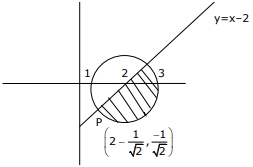
0 likesView Solution
355
MathematicsDifficultMCQJEE Main · 2021
Two sides of a parallelogram are along the lines $4x + 5y = 0$ and $7x + 2y = 0$. If the equation of one of the diagonals of the parallelogram is $11x + 7y = 9$,then the other diagonal passes through the point:
A
$(1, 3)$
B
$(1, 2)$
C
$(2, 2)$
D
$(2, 1)$
Solution
(C) Let the parallelogram be $ABCD$. The lines $4x + 5y = 0$ and $7x + 2y = 0$ intersect at the origin $A(0, 0)$.
Let the diagonal $BD$ lie on the line $11x + 7y = 9$.
Point $D$ is the intersection of $4x + 5y = 0$ and $11x + 7y = 9$. Solving these,we get $D = (5/3, -4/3)$.
Point $B$ is the intersection of $7x + 2y = 0$ and $11x + 7y = 9$. Solving these,we get $B = (-2/3, 7/3)$.
The diagonals of a parallelogram bisect each other. Let $M$ be the midpoint of $BD$.
$M = (\frac{5/3 - 2/3}{2}, \frac{-4/3 + 7/3}{2}) = (1/2, 1/2)$.
The other diagonal $AC$ passes through $A(0, 0)$ and $M(1/2, 1/2)$.
The equation of line $AC$ is $y - 0 = \frac{1/2 - 0}{1/2 - 0}(x - 0)$,which simplifies to $y = x$.
Checking the options,the point $(2, 2)$ satisfies $y = x$.
Let the diagonal $BD$ lie on the line $11x + 7y = 9$.
Point $D$ is the intersection of $4x + 5y = 0$ and $11x + 7y = 9$. Solving these,we get $D = (5/3, -4/3)$.
Point $B$ is the intersection of $7x + 2y = 0$ and $11x + 7y = 9$. Solving these,we get $B = (-2/3, 7/3)$.
The diagonals of a parallelogram bisect each other. Let $M$ be the midpoint of $BD$.
$M = (\frac{5/3 - 2/3}{2}, \frac{-4/3 + 7/3}{2}) = (1/2, 1/2)$.
The other diagonal $AC$ passes through $A(0, 0)$ and $M(1/2, 1/2)$.
The equation of line $AC$ is $y - 0 = \frac{1/2 - 0}{1/2 - 0}(x - 0)$,which simplifies to $y = x$.
Checking the options,the point $(2, 2)$ satisfies $y = x$.
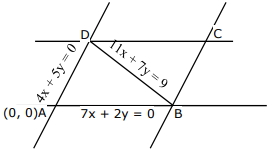
0 likesView Solution
356
MathematicsEasyMCQJEE Main · 2021
Let the mean and variance of the frequency distribution be $6$ and $6.8$ respectively.
If $x_{3}$ is changed from $8$ to $7$,then the mean for the new data will be:
| $x$ | $2$ | $6$ | $8$ | $9$ |
| $f$ | $4$ | $4$ | $\alpha$ | $\beta$ |
If $x_{3}$ is changed from $8$ to $7$,then the mean for the new data will be:
A
$\frac{16}{3}$
B
$4$
C
$\frac{17}{3}$
D
$5$
Solution
(C) The total frequency is $N = 4 + 4 + \alpha + \beta = 8 + \alpha + \beta$.
The mean is given by $\bar{x} = \frac{\sum f_i x_i}{N} = 6$.
$\frac{4(2) + 4(6) + \alpha(8) + \beta(9)}{8 + \alpha + \beta} = 6$
$8 + 24 + 8\alpha + 9\beta = 48 + 6\alpha + 6\beta$
$2\alpha + 3\beta = 16 \quad \dots (i)$
The variance is $\sigma^2 = \frac{\sum f_i x_i^2}{N} - (\bar{x})^2 = 6.8$.
$\frac{4(4) + 4(36) + \alpha(64) + \beta(81)}{8 + \alpha + \beta} - 36 = 6.8$
$\frac{16 + 144 + 64\alpha + 81\beta}{8 + \alpha + \beta} = 42.8$
$160 + 64\alpha + 81\beta = 42.8(8 + \alpha + \beta) = 342.4 + 42.8\alpha + 42.8\beta$
$21.2\alpha + 38.2\beta = 182.4$
Multiplying by $10$: $212\alpha + 382\beta = 1824 \Rightarrow 106\alpha + 191\beta = 912 \quad \dots (ii)$
Solving $(i)$ and $(ii)$: From $(i)$,$\alpha = \frac{16 - 3\beta}{2} = 8 - 1.5\beta$.
Substituting in $(ii)$: $106(8 - 1.5\beta) + 191\beta = 912$
$848 - 159\beta + 191\beta = 912 \Rightarrow 32\beta = 64 \Rightarrow \beta = 2$.
Then $\alpha = 8 - 1.5(2) = 5$.
Total frequency $N = 8 + 5 + 2 = 15$.
New sum of observations when $x_3$ changes from $8$ to $7$:
Original sum $= 6 \times 15 = 90$.
New sum $= 90 - (8 \times 5) + (7 \times 5) = 90 - 40 + 35 = 85$.
New mean $= \frac{85}{15} = \frac{17}{3}$.
The mean is given by $\bar{x} = \frac{\sum f_i x_i}{N} = 6$.
$\frac{4(2) + 4(6) + \alpha(8) + \beta(9)}{8 + \alpha + \beta} = 6$
$8 + 24 + 8\alpha + 9\beta = 48 + 6\alpha + 6\beta$
$2\alpha + 3\beta = 16 \quad \dots (i)$
The variance is $\sigma^2 = \frac{\sum f_i x_i^2}{N} - (\bar{x})^2 = 6.8$.
$\frac{4(4) + 4(36) + \alpha(64) + \beta(81)}{8 + \alpha + \beta} - 36 = 6.8$
$\frac{16 + 144 + 64\alpha + 81\beta}{8 + \alpha + \beta} = 42.8$
$160 + 64\alpha + 81\beta = 42.8(8 + \alpha + \beta) = 342.4 + 42.8\alpha + 42.8\beta$
$21.2\alpha + 38.2\beta = 182.4$
Multiplying by $10$: $212\alpha + 382\beta = 1824 \Rightarrow 106\alpha + 191\beta = 912 \quad \dots (ii)$
Solving $(i)$ and $(ii)$: From $(i)$,$\alpha = \frac{16 - 3\beta}{2} = 8 - 1.5\beta$.
Substituting in $(ii)$: $106(8 - 1.5\beta) + 191\beta = 912$
$848 - 159\beta + 191\beta = 912 \Rightarrow 32\beta = 64 \Rightarrow \beta = 2$.
Then $\alpha = 8 - 1.5(2) = 5$.
Total frequency $N = 8 + 5 + 2 = 15$.
New sum of observations when $x_3$ changes from $8$ to $7$:
Original sum $= 6 \times 15 = 90$.
New sum $= 90 - (8 \times 5) + (7 \times 5) = 90 - 40 + 35 = 85$.
New mean $= \frac{85}{15} = \frac{17}{3}$.
0 likesView Solution
357
MathematicsDifficultMCQJEE Main · 2021
$A$ possible value of $x$,for which the ninth term in the expansion of $\left\{3^{\log _{3} \sqrt{25^{x-1}+7}}+3^{\left(-\frac{1}{8}\right) \log _{3}\left(5^{x-1}+1\right)}\right\}^{10}$ in the increasing powers of $3^{\left(-\frac{1}{8}\right) \log _{3}\left(5^{x-1}+1\right)}$ is equal to $180$,is:
A
$2$
B
$1$
C
$0$
D
$-1$
Solution
(B) Let $a = 3^{\log _{3} \sqrt{25^{x-1}+7}} = \sqrt{25^{x-1}+7}$ and $b = 3^{\left(-\frac{1}{8}\right) \log _{3}\left(5^{x-1}+1\right)} = (5^{x-1}+1)^{-1/8}$.
The expansion is $(a+b)^{10}$. The ninth term $T_9$ is given by $T_9 = {}^{10}C_8 a^{10-8} b^8 = {}^{10}C_8 a^2 b^8$.
Substituting the values: ${}^{10}C_8 = 45$,$a^2 = 25^{x-1}+7$,and $b^8 = (5^{x-1}+1)^{-1}$.
So,$45 \times \frac{25^{x-1}+7}{5^{x-1}+1} = 180$.
Dividing by $45$,we get $\frac{25^{x-1}+7}{5^{x-1}+1} = 4$.
Let $t = 5^{x-1}$. Then $\frac{t^2+7}{t+1} = 4$.
$t^2+7 = 4t+4 \Rightarrow t^2-4t+3 = 0$.
$(t-1)(t-3) = 0$,so $t=1$ or $t=3$.
If $5^{x-1} = 1$,then $x-1 = 0 \Rightarrow x = 1$.
If $5^{x-1} = 3$,then $x-1 = \log_5 3 \Rightarrow x = 1 + \log_5 3$.
The expansion is $(a+b)^{10}$. The ninth term $T_9$ is given by $T_9 = {}^{10}C_8 a^{10-8} b^8 = {}^{10}C_8 a^2 b^8$.
Substituting the values: ${}^{10}C_8 = 45$,$a^2 = 25^{x-1}+7$,and $b^8 = (5^{x-1}+1)^{-1}$.
So,$45 \times \frac{25^{x-1}+7}{5^{x-1}+1} = 180$.
Dividing by $45$,we get $\frac{25^{x-1}+7}{5^{x-1}+1} = 4$.
Let $t = 5^{x-1}$. Then $\frac{t^2+7}{t+1} = 4$.
$t^2+7 = 4t+4 \Rightarrow t^2-4t+3 = 0$.
$(t-1)(t-3) = 0$,so $t=1$ or $t=3$.
If $5^{x-1} = 1$,then $x-1 = 0 \Rightarrow x = 1$.
If $5^{x-1} = 3$,then $x-1 = \log_5 3 \Rightarrow x = 1 + \log_5 3$.
0 likesView Solution
358
MathematicsDifficultMCQJEE Main · 2021
If $\tan \left(\frac{\pi}{9}\right), x, \tan \left(\frac{7 \pi}{18}\right)$ are in arithmetic progression and $\tan \left(\frac{\pi}{9}\right), y, \tan \left(\frac{5 \pi}{18}\right)$ are also in arithmetic progression,then $|x-2 y|$ is equal to:
A
$0$
B
$3$
C
$4$
D
$1$
Solution
(A) Given that $\tan \left(\frac{\pi}{9}\right), x, \tan \left(\frac{7 \pi}{18}\right)$ are in arithmetic progression,we have $2x = \tan \left(\frac{\pi}{9}\right) + \tan \left(\frac{7 \pi}{18}\right)$,so $x = \frac{1}{2} \left(\tan \frac{\pi}{9} + \tan \frac{7 \pi}{18}\right)$.
Given that $\tan \left(\frac{\pi}{9}\right), y, \tan \left(\frac{5 \pi}{18}\right)$ are in arithmetic progression,we have $2y = \tan \left(\frac{\pi}{9}\right) + \tan \left(\frac{5 \pi}{18}\right)$.
We need to find $|x - 2y|$.
Substituting the expressions:
$x - 2y = \frac{1}{2} \left(\tan \frac{\pi}{9} + \tan \frac{7 \pi}{18}\right) - \left(\tan \frac{\pi}{9} + \tan \frac{5 \pi}{18}\right)$.
Using the identities $\tan \left(\frac{7 \pi}{18}\right) = \cot \left(\frac{\pi}{9}\right)$ and $\tan \left(\frac{5 \pi}{18}\right) = \cot \left(\frac{2 \pi}{9}\right)$:
$x - 2y = \frac{1}{2} \tan \frac{\pi}{9} + \frac{1}{2} \cot \frac{\pi}{9} - \tan \frac{\pi}{9} - \cot \frac{2 \pi}{9} = \frac{1}{2} \left(\cot \frac{\pi}{9} - \tan \frac{\pi}{9}\right) - \cot \frac{2 \pi}{9}$.
Since $\cot \theta - \tan \theta = 2 \cot(2\theta)$:
$x - 2y = \frac{1}{2} \left(2 \cot \frac{2 \pi}{9}\right) - \cot \frac{2 \pi}{9} = \cot \frac{2 \pi}{9} - \cot \frac{2 \pi}{9} = 0$.
Therefore,$|x - 2y| = 0$.
Given that $\tan \left(\frac{\pi}{9}\right), y, \tan \left(\frac{5 \pi}{18}\right)$ are in arithmetic progression,we have $2y = \tan \left(\frac{\pi}{9}\right) + \tan \left(\frac{5 \pi}{18}\right)$.
We need to find $|x - 2y|$.
Substituting the expressions:
$x - 2y = \frac{1}{2} \left(\tan \frac{\pi}{9} + \tan \frac{7 \pi}{18}\right) - \left(\tan \frac{\pi}{9} + \tan \frac{5 \pi}{18}\right)$.
Using the identities $\tan \left(\frac{7 \pi}{18}\right) = \cot \left(\frac{\pi}{9}\right)$ and $\tan \left(\frac{5 \pi}{18}\right) = \cot \left(\frac{2 \pi}{9}\right)$:
$x - 2y = \frac{1}{2} \tan \frac{\pi}{9} + \frac{1}{2} \cot \frac{\pi}{9} - \tan \frac{\pi}{9} - \cot \frac{2 \pi}{9} = \frac{1}{2} \left(\cot \frac{\pi}{9} - \tan \frac{\pi}{9}\right) - \cot \frac{2 \pi}{9}$.
Since $\cot \theta - \tan \theta = 2 \cot(2\theta)$:
$x - 2y = \frac{1}{2} \left(2 \cot \frac{2 \pi}{9}\right) - \cot \frac{2 \pi}{9} = \cot \frac{2 \pi}{9} - \cot \frac{2 \pi}{9} = 0$.
Therefore,$|x - 2y| = 0$.
0 likesView Solution
359
MathematicsDifficultMCQJEE Main · 2021
The value of $\lim _{x \rightarrow 0} \left( \frac{x}{\sqrt[8]{1-\sin x}-\sqrt[8]{1+\sin x}} \right)$ is equal to:
A
$-1$
B
$-4$
C
$0$
D
$4$
Solution
(B) Let $L = \lim _{x \rightarrow 0} \frac{x}{(1-\sin x)^{1/8}-(1+\sin x)^{1/8}}$.
Using the binomial expansion $(1+u)^n \approx 1+nu$ for small $u$,where $n = 1/8$:
$(1-\sin x)^{1/8} \approx 1 - \frac{1}{8} \sin x$.
$(1+\sin x)^{1/8} \approx 1 + \frac{1}{8} \sin x$.
Substituting these into the limit expression:
$L = \lim _{x \rightarrow 0} \frac{x}{(1 - \frac{1}{8} \sin x) - (1 + \frac{1}{8} \sin x)}$.
$L = \lim _{x \rightarrow 0} \frac{x}{-\frac{2}{8} \sin x} = \lim _{x \rightarrow 0} \frac{x}{-\frac{1}{4} \sin x}$.
Since $\lim _{x \rightarrow 0} \frac{\sin x}{x} = 1$,we have $\lim _{x \rightarrow 0} \frac{x}{\sin x} = 1$.
Therefore,$L = -4 \times 1 = -4$.
Using the binomial expansion $(1+u)^n \approx 1+nu$ for small $u$,where $n = 1/8$:
$(1-\sin x)^{1/8} \approx 1 - \frac{1}{8} \sin x$.
$(1+\sin x)^{1/8} \approx 1 + \frac{1}{8} \sin x$.
Substituting these into the limit expression:
$L = \lim _{x \rightarrow 0} \frac{x}{(1 - \frac{1}{8} \sin x) - (1 + \frac{1}{8} \sin x)}$.
$L = \lim _{x \rightarrow 0} \frac{x}{-\frac{2}{8} \sin x} = \lim _{x \rightarrow 0} \frac{x}{-\frac{1}{4} \sin x}$.
Since $\lim _{x \rightarrow 0} \frac{\sin x}{x} = 1$,we have $\lim _{x \rightarrow 0} \frac{x}{\sin x} = 1$.
Therefore,$L = -4 \times 1 = -4$.
0 likesView Solution
360
MathematicsEasyMCQJEE Main · 2021
Consider a circle $C$ which touches the $y$-axis at $(0,6)$ and cuts off an intercept $6 \sqrt{5}$ on the $x$-axis. Then the radius of the circle $C$ is equal to:
A
$\sqrt{82}$
B
$9$
C
$8$
D
$\sqrt{53}$
Solution
(B) Let the center of the circle be $(h, k)$. Since the circle touches the $y$-axis at $(0, 6)$,the $y$-coordinate of the center is $k = 6$ and the radius $r = |h|$.
Thus,the equation of the circle is $(x - h)^{2} + (y - 6)^{2} = h^{2}$.
This circle cuts an intercept of $6 \sqrt{5}$ on the $x$-axis. Setting $y = 0$ in the equation,we get $(x - h)^{2} + (0 - 6)^{2} = h^{2}$,which simplifies to $(x - h)^{2} + 36 = h^{2}$,or $(x - h)^{2} = h^{2} - 36$.
Taking the square root,$x - h = \pm \sqrt{h^{2} - 36}$,so $x = h \pm \sqrt{h^{2} - 36}$.
The length of the intercept on the $x$-axis is the difference between these two $x$-values: $(h + \sqrt{h^{2} - 36}) - (h - \sqrt{h^{2} - 36}) = 2 \sqrt{h^{2} - 36}$.
Given that the intercept is $6 \sqrt{5}$,we have $2 \sqrt{h^{2} - 36} = 6 \sqrt{5}$,so $\sqrt{h^{2} - 36} = 3 \sqrt{5}$.
Squaring both sides,$h^{2} - 36 = 9 \times 5 = 45$,so $h^{2} = 81$,which means $h = \pm 9$.
Since the radius $r = |h|$,the radius of the circle is $r = 9$.
Thus,the equation of the circle is $(x - h)^{2} + (y - 6)^{2} = h^{2}$.
This circle cuts an intercept of $6 \sqrt{5}$ on the $x$-axis. Setting $y = 0$ in the equation,we get $(x - h)^{2} + (0 - 6)^{2} = h^{2}$,which simplifies to $(x - h)^{2} + 36 = h^{2}$,or $(x - h)^{2} = h^{2} - 36$.
Taking the square root,$x - h = \pm \sqrt{h^{2} - 36}$,so $x = h \pm \sqrt{h^{2} - 36}$.
The length of the intercept on the $x$-axis is the difference between these two $x$-values: $(h + \sqrt{h^{2} - 36}) - (h - \sqrt{h^{2} - 36}) = 2 \sqrt{h^{2} - 36}$.
Given that the intercept is $6 \sqrt{5}$,we have $2 \sqrt{h^{2} - 36} = 6 \sqrt{5}$,so $\sqrt{h^{2} - 36} = 3 \sqrt{5}$.
Squaring both sides,$h^{2} - 36 = 9 \times 5 = 45$,so $h^{2} = 81$,which means $h = \pm 9$.
Since the radius $r = |h|$,the radius of the circle is $r = 9$.
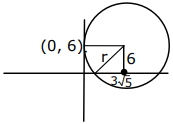
0 likesView Solution
361
MathematicsDifficultMCQJEE Main · 2021
Let $E$ be an ellipse whose axes are parallel to the coordinate axes,having its center at $(3, -4)$,one focus at $(4, -4)$,and one vertex at $(5, -4)$. If $mx - y = 4$ with $m > 0$ is a tangent to the ellipse $E$,then the value of $5m^{2}$ is equal to .....
A
$1$
B
$2$
C
$3$
D
$4$
Solution
(C) The center of the ellipse is $C(3, -4)$.
The focus is $S(4, -4)$ and the vertex is $A(5, -4)$.
Since the $y$-coordinates are the same,the major axis is horizontal.
The distance from the center to the vertex is $a = |5 - 3| = 2$.
The distance from the center to the focus is $ae = |4 - 3| = 1$.
Thus,$e = \frac{1}{2}$.
Using $b^{2} = a^{2}(1 - e^{2})$,we get $b^{2} = 4(1 - \frac{1}{4}) = 4(\frac{3}{4}) = 3$.
The equation of the ellipse is $\frac{(x - 3)^{2}}{4} + \frac{(y + 4)^{2}}{3} = 1$.
The condition for the line $y = mx - 4$ to be a tangent to the ellipse $\frac{(x - h)^{2}}{a^{2}} + \frac{(y - k)^{2}}{b^{2}} = 1$ is $(y - k) = m(x - h) \pm \sqrt{a^{2}m^{2} + b^{2}}$.
Here,$h = 3, k = -4, a^{2} = 4, b^{2} = 3$.
The line is $y + 4 = mx - 3m$,so $y - (-4) = m(x - 3) - 3m$.
Comparing with the tangent form,the constant term is $-3m = \pm \sqrt{4m^{2} + 3}$.
Squaring both sides,$9m^{2} = 4m^{2} + 3$.
$5m^{2} = 3$.
The focus is $S(4, -4)$ and the vertex is $A(5, -4)$.
Since the $y$-coordinates are the same,the major axis is horizontal.
The distance from the center to the vertex is $a = |5 - 3| = 2$.
The distance from the center to the focus is $ae = |4 - 3| = 1$.
Thus,$e = \frac{1}{2}$.
Using $b^{2} = a^{2}(1 - e^{2})$,we get $b^{2} = 4(1 - \frac{1}{4}) = 4(\frac{3}{4}) = 3$.
The equation of the ellipse is $\frac{(x - 3)^{2}}{4} + \frac{(y + 4)^{2}}{3} = 1$.
The condition for the line $y = mx - 4$ to be a tangent to the ellipse $\frac{(x - h)^{2}}{a^{2}} + \frac{(y - k)^{2}}{b^{2}} = 1$ is $(y - k) = m(x - h) \pm \sqrt{a^{2}m^{2} + b^{2}}$.
Here,$h = 3, k = -4, a^{2} = 4, b^{2} = 3$.
The line is $y + 4 = mx - 3m$,so $y - (-4) = m(x - 3) - 3m$.
Comparing with the tangent form,the constant term is $-3m = \pm \sqrt{4m^{2} + 3}$.
Squaring both sides,$9m^{2} = 4m^{2} + 3$.
$5m^{2} = 3$.
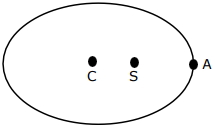
0 likesView Solution
362
MathematicsMediumMCQJEE Main · 2021
If the real part of the complex number $z = \frac{3 + 2i \cos \theta}{1 - 3i \cos \theta}$, where $\theta \in (0, \frac{\pi}{2})$, is zero, then the value of $\sin^2 3\theta + \cos^2 \theta$ is equal to:
A
$1$
B
$3$
C
$2$
D
$4$
Solution
(A) Given $z = \frac{3 + 2i \cos \theta}{1 - 3i \cos \theta}$.
To find the real part, multiply the numerator and denominator by the conjugate of the denominator $(1 + 3i \cos \theta)$:
$z = \frac{(3 + 2i \cos \theta)(1 + 3i \cos \theta)}{(1 - 3i \cos \theta)(1 + 3i \cos \theta)}$
$z = \frac{3 + 9i \cos \theta + 2i \cos \theta + 6i^2 \cos^2 \theta}{1 + 9 \cos^2 \theta}$
Since $i^2 = -1$, we have:
$z = \frac{3 - 6 \cos^2 \theta + 11i \cos \theta}{1 + 9 \cos^2 \theta}$
The real part is $\operatorname{Re}(z) = \frac{3 - 6 \cos^2 \theta}{1 + 9 \cos^2 \theta}$.
Given $\operatorname{Re}(z) = 0$, we have $3 - 6 \cos^2 \theta = 0$, which implies $\cos^2 \theta = \frac{1}{2}$.
Since $\theta \in (0, \frac{\pi}{2})$, $\cos \theta = \frac{1}{\sqrt{2}}$, so $\theta = \frac{\pi}{4}$.
Now, calculate $\sin^2 3\theta + \cos^2 \theta$:
$\sin^2 3(\frac{\pi}{4}) + \cos^2(\frac{\pi}{4}) = \sin^2(\frac{3\pi}{4}) + (\frac{1}{\sqrt{2}})^2$
$= (\frac{1}{\sqrt{2}})^2 + \frac{1}{2} = \frac{1}{2} + \frac{1}{2} = 1$.
To find the real part, multiply the numerator and denominator by the conjugate of the denominator $(1 + 3i \cos \theta)$:
$z = \frac{(3 + 2i \cos \theta)(1 + 3i \cos \theta)}{(1 - 3i \cos \theta)(1 + 3i \cos \theta)}$
$z = \frac{3 + 9i \cos \theta + 2i \cos \theta + 6i^2 \cos^2 \theta}{1 + 9 \cos^2 \theta}$
Since $i^2 = -1$, we have:
$z = \frac{3 - 6 \cos^2 \theta + 11i \cos \theta}{1 + 9 \cos^2 \theta}$
The real part is $\operatorname{Re}(z) = \frac{3 - 6 \cos^2 \theta}{1 + 9 \cos^2 \theta}$.
Given $\operatorname{Re}(z) = 0$, we have $3 - 6 \cos^2 \theta = 0$, which implies $\cos^2 \theta = \frac{1}{2}$.
Since $\theta \in (0, \frac{\pi}{2})$, $\cos \theta = \frac{1}{\sqrt{2}}$, so $\theta = \frac{\pi}{4}$.
Now, calculate $\sin^2 3\theta + \cos^2 \theta$:
$\sin^2 3(\frac{\pi}{4}) + \cos^2(\frac{\pi}{4}) = \sin^2(\frac{3\pi}{4}) + (\frac{1}{\sqrt{2}})^2$
$= (\frac{1}{\sqrt{2}})^2 + \frac{1}{2} = \frac{1}{2} + \frac{1}{2} = 1$.
0 likesView Solution
363
MathematicsMediumMCQJEE Main · 2021
The number of real roots of the equation $e^{4x} - e^{3x} - 4e^{2x} - e^{x} + 1 = 0$ is equal to $.....$
A
$0$
B
$2$
C
$3$
D
$4$
Solution
(B) Given equation: $e^{4x} - e^{3x} - 4e^{2x} - e^{x} + 1 = 0$.
Divide by $e^{2x}$ (since $e^{2x} > 0$):
$e^{2x} - e^{x} - 4 - e^{-x} + e^{-2x} = 0$.
Group terms: $(e^{2x} + e^{-2x}) - (e^{x} + e^{-x}) - 4 = 0$.
Let $t = e^{x} > 0$. Then $e^{x} + e^{-x} = t + \frac{1}{t} = \alpha$,where $\alpha \geq 2$.
Note that $e^{2x} + e^{-2x} = (t + \frac{1}{t})^2 - 2 = \alpha^2 - 2$.
Substituting into the equation: $(\alpha^2 - 2) - \alpha - 4 = 0$.
$\alpha^2 - \alpha - 6 = 0$.
$(\alpha - 3)(\alpha + 2) = 0$.
Since $\alpha \geq 2$,we have $\alpha = 3$.
Now,$t + \frac{1}{t} = 3 \Rightarrow t^2 - 3t + 1 = 0$.
The discriminant $D = (-3)^2 - 4(1)(1) = 5 > 0$.
Since $t = e^{x} > 0$ and the product of roots is $1$ and sum is $3$,both roots for $t$ are positive.
Thus,there are $2$ real roots for $x$.
Divide by $e^{2x}$ (since $e^{2x} > 0$):
$e^{2x} - e^{x} - 4 - e^{-x} + e^{-2x} = 0$.
Group terms: $(e^{2x} + e^{-2x}) - (e^{x} + e^{-x}) - 4 = 0$.
Let $t = e^{x} > 0$. Then $e^{x} + e^{-x} = t + \frac{1}{t} = \alpha$,where $\alpha \geq 2$.
Note that $e^{2x} + e^{-2x} = (t + \frac{1}{t})^2 - 2 = \alpha^2 - 2$.
Substituting into the equation: $(\alpha^2 - 2) - \alpha - 4 = 0$.
$\alpha^2 - \alpha - 6 = 0$.
$(\alpha - 3)(\alpha + 2) = 0$.
Since $\alpha \geq 2$,we have $\alpha = 3$.
Now,$t + \frac{1}{t} = 3 \Rightarrow t^2 - 3t + 1 = 0$.
The discriminant $D = (-3)^2 - 4(1)(1) = 5 > 0$.
Since $t = e^{x} > 0$ and the product of roots is $1$ and sum is $3$,both roots for $t$ are positive.
Thus,there are $2$ real roots for $x$.
0 likesView Solution
364
MathematicsDifficultMCQJEE Main · 2021
Let $n$ be a non-negative integer. Then the number of divisors of the form $4n+1$ of the number $(10)^{10} \cdot (11)^{11} \cdot (13)^{13}$ is equal to $....$
A
$924$
B
$750$
C
$125$
D
$654$
Solution
(A) The given number is $N = (10)^{10} \cdot (11)^{11} \cdot (13)^{13} = 2^{10} \cdot 5^{10} \cdot 11^{11} \cdot 13^{13}$.
$A$ divisor $d$ of $N$ is of the form $2^a \cdot 5^b \cdot 11^c \cdot 13^d$,where $0 \le a \le 10, 0 \le b \le 10, 0 \le c \le 11, 0 \le d \le 13$.
For $d$ to be of the form $4n+1$,$d$ must be odd,so $a=0$.
Thus,$d = 5^b \cdot 11^c \cdot 13^d$.
Modulo $4$,we have $5 \equiv 1 \pmod{4}$,$11 \equiv -1 \equiv 3 \pmod{4}$,and $13 \equiv 1 \pmod{4}$.
So,$d \equiv 1^b \cdot (-1)^c \cdot 1^d \equiv (-1)^c \pmod{4}$.
For $d \equiv 1 \pmod{4}$,we must have $(-1)^c = 1$,which means $c$ must be even.
Possible values for $c \in \{0, 2, 4, 6, 8, 10\}$,which gives $6$ choices.
Possible values for $b \in \{0, 1, 2, \dots, 10\}$,which gives $11$ choices.
Possible values for $d \in \{0, 1, 2, \dots, 13\}$,which gives $14$ choices.
The total number of such divisors is $11 \times 6 \times 14 = 924$.
$A$ divisor $d$ of $N$ is of the form $2^a \cdot 5^b \cdot 11^c \cdot 13^d$,where $0 \le a \le 10, 0 \le b \le 10, 0 \le c \le 11, 0 \le d \le 13$.
For $d$ to be of the form $4n+1$,$d$ must be odd,so $a=0$.
Thus,$d = 5^b \cdot 11^c \cdot 13^d$.
Modulo $4$,we have $5 \equiv 1 \pmod{4}$,$11 \equiv -1 \equiv 3 \pmod{4}$,and $13 \equiv 1 \pmod{4}$.
So,$d \equiv 1^b \cdot (-1)^c \cdot 1^d \equiv (-1)^c \pmod{4}$.
For $d \equiv 1 \pmod{4}$,we must have $(-1)^c = 1$,which means $c$ must be even.
Possible values for $c \in \{0, 2, 4, 6, 8, 10\}$,which gives $6$ choices.
Possible values for $b \in \{0, 1, 2, \dots, 10\}$,which gives $11$ choices.
Possible values for $d \in \{0, 1, 2, \dots, 13\}$,which gives $14$ choices.
The total number of such divisors is $11 \times 6 \times 14 = 924$.
0 likesView Solution
365
MathematicsMediumMCQJEE Main · 2021
Let $A = \{n \in N \mid n^{2} \leq n + 10,000\}$,$B = \{3k + 1 \mid k \in N\}$,and $C = \{2k \mid k \in N\}$. Then the sum of all the elements of the set $A \cap (B - C)$ is equal to $.....$
A
$832$
B
$412$
C
$963$
D
$123$
Solution
(A) First,find the set $A$: $n^{2} - n \leq 10,000$. Solving $n(n-1) \leq 10,000$,we find $n \approx 100.5$,so $A = \{1, 2, \ldots, 100\}$.
Next,find $B - C$: $B$ contains numbers of the form $3k+1$ (i.e.,$4, 7, 10, 13, 16, 19, \ldots$). $C$ contains even numbers. Thus,$B - C$ contains odd numbers of the form $3k+1$,which are $7, 13, 19, \ldots$.
The general term of $B - C$ is $6m + 1$ for $m \geq 1$.
We need $A \cap (B - C) = \{n \in \{1, \ldots, 100\} \mid n = 6m + 1\}$.
For $m=1, n=7$; for $m=16, n=97$. The number of terms is $16$.
The sum is an arithmetic progression: $S = \frac{16}{2}(7 + 97) = 8 \times 104 = 832$.
Next,find $B - C$: $B$ contains numbers of the form $3k+1$ (i.e.,$4, 7, 10, 13, 16, 19, \ldots$). $C$ contains even numbers. Thus,$B - C$ contains odd numbers of the form $3k+1$,which are $7, 13, 19, \ldots$.
The general term of $B - C$ is $6m + 1$ for $m \geq 1$.
We need $A \cap (B - C) = \{n \in \{1, \ldots, 100\} \mid n = 6m + 1\}$.
For $m=1, n=7$; for $m=16, n=97$. The number of terms is $16$.
The sum is an arithmetic progression: $S = \frac{16}{2}(7 + 97) = 8 \times 104 = 832$.
0 likesView Solution
366
MathematicsEasyMCQJEE Main · 2021
Consider three observations $a, b,$ and $c$ such that $b = a + c$. If the standard deviation of $a + 2, b + 2, c + 2$ is $d$,then which of the following holds true?
A
$b^2 = 3(a^2 + c^2 + d^2)$
B
$b^2 = a^2 + c^2 + 3d^2$
C
$b^2 = 3(a^2 + c^2) - 9d^2$
D
$b^2 = 3(a^2 + c^2) + 9d^2$
Solution
(C) The mean of $a, b, c$ is $\bar{x} = \frac{a+b+c}{3}$.
Since $b = a + c$,we have $\bar{x} = \frac{b+b}{3} = \frac{2b}{3}$.
The standard deviation of $a+2, b+2, c+2$ is the same as the standard deviation of $a, b, c$,which is $d$.
Thus,$d^2 = \frac{a^2+b^2+c^2}{3} - (\bar{x})^2$.
$d^2 = \frac{a^2+b^2+c^2}{3} - \left(\frac{2b}{3}\right)^2$.
$d^2 = \frac{a^2+b^2+c^2}{3} - \frac{4b^2}{9}$.
$d^2 = \frac{3(a^2+b^2+c^2) - 4b^2}{9}$.
$9d^2 = 3(a^2+c^2+b^2) - 4b^2$.
$9d^2 = 3(a^2+c^2) + 3b^2 - 4b^2$.
$9d^2 = 3(a^2+c^2) - b^2$.
Therefore,$b^2 = 3(a^2+c^2) - 9d^2$.
Since $b = a + c$,we have $\bar{x} = \frac{b+b}{3} = \frac{2b}{3}$.
The standard deviation of $a+2, b+2, c+2$ is the same as the standard deviation of $a, b, c$,which is $d$.
Thus,$d^2 = \frac{a^2+b^2+c^2}{3} - (\bar{x})^2$.
$d^2 = \frac{a^2+b^2+c^2}{3} - \left(\frac{2b}{3}\right)^2$.
$d^2 = \frac{a^2+b^2+c^2}{3} - \frac{4b^2}{9}$.
$d^2 = \frac{3(a^2+b^2+c^2) - 4b^2}{9}$.
$9d^2 = 3(a^2+c^2+b^2) - 4b^2$.
$9d^2 = 3(a^2+c^2) + 3b^2 - 4b^2$.
$9d^2 = 3(a^2+c^2) - b^2$.
Therefore,$b^2 = 3(a^2+c^2) - 9d^2$.
0 likesView Solution
367
MathematicsDifficultMCQJEE Main · 2021
Let $f:[0, \infty) \rightarrow [0, \infty)$ be defined as $f(x) = \int_{0}^{x} [y] \, dy$,where $[x]$ is the greatest integer less than or equal to $x$. Which of the following is true?
A
$f$ is differentiable at every point in $[0, \infty)$.
B
$f$ is continuous everywhere except at the integer points in $[0, \infty)$.
C
$f$ is continuous at every point in $[0, \infty)$ and differentiable except at the integer points.
D
$f$ is both continuous and differentiable except at the integer points in $[0, \infty)$.
Solution
(C) Given $f(x) = \int_{0}^{x} [y] \, dy$.
For $x \in [n, n+1)$,where $n \in \mathbb{N}_0$,we have $[y] = n$ for $y \in [n, x)$.
Thus,$f(x) = \int_{0}^{1} 0 \, dy + \int_{1}^{2} 1 \, dy + \dots + \int_{n-1}^{n} (n-1) \, dy + \int_{n}^{x} n \, dy$.
$f(x) = 0 + 1 + 2 + \dots + (n-1) + n(x-n) = \frac{(n-1)n}{2} + nx - n^2$.
Since $n = [x]$,we have $f(x) = \frac{[x]([x]-1)}{2} + [x](x-[x])$.
At any integer $x=n$,the left-hand limit is $\lim_{x \to n^-} f(x) = \sum_{k=0}^{n-1} k = \frac{(n-1)n}{2}$ and the right-hand limit is $\lim_{x \to n^+} f(x) = \frac{(n-1)n}{2} + n(n-n) = \frac{n(n-1)}{2}$.
Since the limits are equal,$f(x)$ is continuous for all $x \geq 0$.
However,the derivative $f'(x) = [x]$ is discontinuous at integer points because $\lim_{x \to n^-} f'(x) = n-1$ and $\lim_{x \to n^+} f'(x) = n$.
Therefore,$f$ is continuous everywhere but not differentiable at integer points.
For $x \in [n, n+1)$,where $n \in \mathbb{N}_0$,we have $[y] = n$ for $y \in [n, x)$.
Thus,$f(x) = \int_{0}^{1} 0 \, dy + \int_{1}^{2} 1 \, dy + \dots + \int_{n-1}^{n} (n-1) \, dy + \int_{n}^{x} n \, dy$.
$f(x) = 0 + 1 + 2 + \dots + (n-1) + n(x-n) = \frac{(n-1)n}{2} + nx - n^2$.
Since $n = [x]$,we have $f(x) = \frac{[x]([x]-1)}{2} + [x](x-[x])$.
At any integer $x=n$,the left-hand limit is $\lim_{x \to n^-} f(x) = \sum_{k=0}^{n-1} k = \frac{(n-1)n}{2}$ and the right-hand limit is $\lim_{x \to n^+} f(x) = \frac{(n-1)n}{2} + n(n-n) = \frac{n(n-1)}{2}$.
Since the limits are equal,$f(x)$ is continuous for all $x \geq 0$.
However,the derivative $f'(x) = [x]$ is discontinuous at integer points because $\lim_{x \to n^-} f'(x) = n-1$ and $\lim_{x \to n^+} f'(x) = n$.
Therefore,$f$ is continuous everywhere but not differentiable at integer points.
0 likesView Solution
368
MathematicsDifficultMCQJEE Main · 2021
Let $g: N \rightarrow N$ be defined as
$g(3n+1)=3n+2$
$g(3n+2)=3n+3$
$g(3n+3)=3n+1, \text{ for all } n \geq 0$
Then which of the following statements is true?
$g(3n+1)=3n+2$
$g(3n+2)=3n+3$
$g(3n+3)=3n+1, \text{ for all } n \geq 0$
Then which of the following statements is true?
A
$g \circ g \circ g = g$
B
There exists an onto function $f: N \rightarrow N$ such that $f \circ g = f$
C
There exists a one-one function $f: N \rightarrow N$ such that $f \circ g = f$
D
There exists a function $f: N \rightarrow N$ such that $g \circ f = f$
Solution
(B) Given $g(3n+1)=3n+2$,$g(3n+2)=3n+3$,and $g(3n+3)=3n+1$ for $n \geq 0$.
First,we calculate $g \circ g \circ g(x)$:
For $x = 3n+1$,$g(g(g(3n+1))) = g(g(3n+2)) = g(3n+3) = 3n+1$.
Similarly,$g(g(g(3n+2))) = 3n+2$ and $g(g(g(3n+3))) = 3n+3$.
Thus,$g \circ g \circ g(x) = x$ for all $x \in N$.
Now,consider the condition $f(g(x)) = f(x)$.
If $f$ is a constant function,say $f(x) = c$ for all $x \in N$,then $f(g(x)) = c = f(x)$. However,a constant function is not onto on $N$.
If we define $f$ such that it maps all elements in the same cycle of $g$ to the same value,$f$ will satisfy $f(g(x)) = f(x)$.
For example,define $f(3n+1) = f(3n+2) = f(3n+3) = n+1$. This function $f$ is onto because for any $y \in N$,we can choose $n = y-1$ such that $f(3(y-1)+1) = y$.
Thus,there exists an onto function $f$ such that $f \circ g = f$.
First,we calculate $g \circ g \circ g(x)$:
For $x = 3n+1$,$g(g(g(3n+1))) = g(g(3n+2)) = g(3n+3) = 3n+1$.
Similarly,$g(g(g(3n+2))) = 3n+2$ and $g(g(g(3n+3))) = 3n+3$.
Thus,$g \circ g \circ g(x) = x$ for all $x \in N$.
Now,consider the condition $f(g(x)) = f(x)$.
If $f$ is a constant function,say $f(x) = c$ for all $x \in N$,then $f(g(x)) = c = f(x)$. However,a constant function is not onto on $N$.
If we define $f$ such that it maps all elements in the same cycle of $g$ to the same value,$f$ will satisfy $f(g(x)) = f(x)$.
For example,define $f(3n+1) = f(3n+2) = f(3n+3) = n+1$. This function $f$ is onto because for any $y \in N$,we can choose $n = y-1$ such that $f(3(y-1)+1) = y$.
Thus,there exists an onto function $f$ such that $f \circ g = f$.
0 likesView Solution
369
MathematicsDifficultMCQJEE Main · 2021
Let $9$ distinct balls be distributed among $4$ boxes,$B_{1}, B_{2}, B_{3}$ and $B_{4}$. If the probability that $B_{3}$ contains exactly $3$ balls is $k\left(\frac{3}{4}\right)^{9}$,then $k$ lies in the set:
A
$\{x \in R : |x-5| \leq 1\}$
B
$\{x \in R : |x-2| \leq 1\}$
C
$\{x \in R : |x-3| < 1\}$
D
$\{x \in R : |x-1| < 1\}$
Solution
(C) The total number of ways to distribute $9$ distinct balls into $4$ boxes is $4^{9}$.
The number of ways to choose $3$ balls for box $B_{3}$ is ${}^{9}C_{3}$.
The remaining $6$ balls can be distributed among the other $3$ boxes $(B_{1}, B_{2}, B_{4})$ in $3^{6}$ ways.
Thus,the probability that $B_{3}$ contains exactly $3$ balls is $P = \frac{{}^{9}C_{3} \cdot 3^{6}}{4^{9}}$.
We can rewrite this as $P = \frac{{}^{9}C_{3} \cdot 3^{6}}{4^{9}} = \frac{84 \cdot 3^{6}}{4^{9}}$.
Since we want the form $k \left(\frac{3}{4}\right)^{9}$,we write $P = k \cdot \frac{3^{9}}{4^{9}}$.
Equating the two expressions: $k \cdot \frac{3^{9}}{4^{9}} = \frac{84 \cdot 3^{6}}{4^{9}}$.
$k = \frac{84 \cdot 3^{6}}{3^{9}} = \frac{84}{3^{3}} = \frac{84}{27} = \frac{28}{9} \approx 3.11$.
Checking the options for $k = \frac{28}{9} \approx 3.11$:
$|x-3| < 1 \Rightarrow 2 < x < 4$. Since $3.11$ lies in this interval,option $C$ is correct.
The number of ways to choose $3$ balls for box $B_{3}$ is ${}^{9}C_{3}$.
The remaining $6$ balls can be distributed among the other $3$ boxes $(B_{1}, B_{2}, B_{4})$ in $3^{6}$ ways.
Thus,the probability that $B_{3}$ contains exactly $3$ balls is $P = \frac{{}^{9}C_{3} \cdot 3^{6}}{4^{9}}$.
We can rewrite this as $P = \frac{{}^{9}C_{3} \cdot 3^{6}}{4^{9}} = \frac{84 \cdot 3^{6}}{4^{9}}$.
Since we want the form $k \left(\frac{3}{4}\right)^{9}$,we write $P = k \cdot \frac{3^{9}}{4^{9}}$.
Equating the two expressions: $k \cdot \frac{3^{9}}{4^{9}} = \frac{84 \cdot 3^{6}}{4^{9}}$.
$k = \frac{84 \cdot 3^{6}}{3^{9}} = \frac{84}{3^{3}} = \frac{84}{27} = \frac{28}{9} \approx 3.11$.
Checking the options for $k = \frac{28}{9} \approx 3.11$:
$|x-3| < 1 \Rightarrow 2 < x < 4$. Since $3.11$ lies in this interval,option $C$ is correct.
0 likesView Solution
370
MathematicsDifficultMCQJEE Main · 2021
Let the foot of the perpendicular from a point $P(1,2,-1)$ to the straight line $L: \frac{x}{1}=\frac{y}{0}=\frac{z}{-1}$ be $N$. Let a line be drawn from $P$ parallel to the plane $x+y+2z=0$ which meets $L$ at point $Q$. If $\alpha$ is the acute angle between the lines $PN$ and $PQ$,then $\cos \alpha$ is equal to $.....$
A
$\frac{1}{2 \sqrt{3}}$
B
$\frac{1}{\sqrt{5}}$
C
$\frac{\sqrt{3}}{2}$
D
$\frac{1}{\sqrt{3}}$
Solution
(D) The line $L$ is given by $\frac{x}{1}=\frac{y}{0}=\frac{z}{-1} = \lambda$. So,any point on $L$ is $N(\lambda, 0, -\lambda)$.
Since $PN \perp L$,the vector $\vec{PN} = (\lambda-1, -2, -\lambda+1)$ is perpendicular to the direction vector of $L$,which is $\vec{v} = (1, 0, -1)$.
Thus,$(\lambda-1)(1) + (-2)(0) + (-\lambda+1)(-1) = 0 \Rightarrow \lambda-1 + \lambda-1 = 0 \Rightarrow 2\lambda = 2 \Rightarrow \lambda = 1$.
So,$N = (1, 0, -1)$ and $\vec{PN} = (0, -2, 0)$.
Now,let the line through $P$ parallel to the plane $x+y+2z=0$ meet $L$ at $Q(\mu, 0, -\mu)$.
The vector $\vec{PQ} = (\mu-1, -2, -\mu+1)$. Since this line is parallel to the plane,$\vec{PQ}$ is perpendicular to the normal of the plane $\vec{n} = (1, 1, 2)$.
Thus,$(\mu-1)(1) + (-2)(1) + (-\mu+1)(2) = 0 \Rightarrow \mu-1 - 2 - 2\mu + 2 = 0 \Rightarrow -\mu - 1 = 0 \Rightarrow \mu = -1$.
So,$Q = (-1, 0, 1)$ and $\vec{PQ} = (-2, -2, 2)$.
The angle $\alpha$ between $\vec{PN} = (0, -2, 0)$ and $\vec{PQ} = (-2, -2, 2)$ is given by $\cos \alpha = \frac{|\vec{PN} \cdot \vec{PQ}|}{|\vec{PN}| |\vec{PQ}|}$.
$|\vec{PN}| = \sqrt{0^2 + (-2)^2 + 0^2} = 2$.
$|\vec{PQ}| = \sqrt{(-2)^2 + (-2)^2 + 2^2} = \sqrt{4+4+4} = \sqrt{12} = 2\sqrt{3}$.
$\vec{PN} \cdot \vec{PQ} = (0)(-2) + (-2)(-2) + (0)(2) = 4$.
$\cos \alpha = \frac{4}{2 \times 2\sqrt{3}} = \frac{4}{4\sqrt{3}} = \frac{1}{\sqrt{3}}$.
Since $PN \perp L$,the vector $\vec{PN} = (\lambda-1, -2, -\lambda+1)$ is perpendicular to the direction vector of $L$,which is $\vec{v} = (1, 0, -1)$.
Thus,$(\lambda-1)(1) + (-2)(0) + (-\lambda+1)(-1) = 0 \Rightarrow \lambda-1 + \lambda-1 = 0 \Rightarrow 2\lambda = 2 \Rightarrow \lambda = 1$.
So,$N = (1, 0, -1)$ and $\vec{PN} = (0, -2, 0)$.
Now,let the line through $P$ parallel to the plane $x+y+2z=0$ meet $L$ at $Q(\mu, 0, -\mu)$.
The vector $\vec{PQ} = (\mu-1, -2, -\mu+1)$. Since this line is parallel to the plane,$\vec{PQ}$ is perpendicular to the normal of the plane $\vec{n} = (1, 1, 2)$.
Thus,$(\mu-1)(1) + (-2)(1) + (-\mu+1)(2) = 0 \Rightarrow \mu-1 - 2 - 2\mu + 2 = 0 \Rightarrow -\mu - 1 = 0 \Rightarrow \mu = -1$.
So,$Q = (-1, 0, 1)$ and $\vec{PQ} = (-2, -2, 2)$.
The angle $\alpha$ between $\vec{PN} = (0, -2, 0)$ and $\vec{PQ} = (-2, -2, 2)$ is given by $\cos \alpha = \frac{|\vec{PN} \cdot \vec{PQ}|}{|\vec{PN}| |\vec{PQ}|}$.
$|\vec{PN}| = \sqrt{0^2 + (-2)^2 + 0^2} = 2$.
$|\vec{PQ}| = \sqrt{(-2)^2 + (-2)^2 + 2^2} = \sqrt{4+4+4} = \sqrt{12} = 2\sqrt{3}$.
$\vec{PN} \cdot \vec{PQ} = (0)(-2) + (-2)(-2) + (0)(2) = 4$.
$\cos \alpha = \frac{4}{2 \times 2\sqrt{3}} = \frac{4}{4\sqrt{3}} = \frac{1}{\sqrt{3}}$.
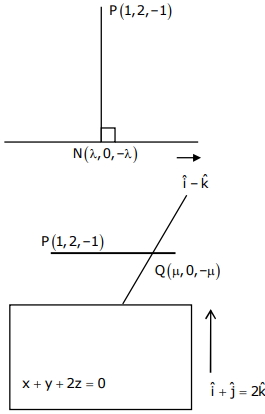
0 likesView Solution
371
MathematicsDifficultMCQJEE Main · 2021
Let $f(x)=3 \sin ^{4} x+10 \sin ^{3} x+6 \sin ^{2} x-3$,where $x \in\left[-\frac{\pi}{6}, \frac{\pi}{2}\right]$. Then,$f$ is $.....$
A
increasing in $\left(-\frac{\pi}{6}, 0\right)$
B
decreasing in $\left(0, \frac{\pi}{2}\right)$
C
decreasing in $\left(-\frac{\pi}{6}, 0\right)$
D
increasing in $\left(-\frac{\pi}{6}, \frac{\pi}{2}\right)$
Solution
(C) Given $f(x)=3 \sin ^{4} x+10 \sin ^{3} x+6 \sin ^{2} x-3$.
Differentiating with respect to $x$:
$f'(x) = 12 \sin^3 x \cos x + 30 \sin^2 x \cos x + 12 \sin x \cos x$
$f'(x) = 6 \sin x \cos x (2 \sin^2 x + 5 \sin x + 2)$
Factoring the quadratic expression:
$f'(x) = 6 \sin x \cos x (2 \sin x + 1)(\sin x + 2)$
For $x \in \left[-\frac{\pi}{6}, \frac{\pi}{2}\right]$,we have:
$1. \cos x > 0$ for all $x \in \left[-\frac{\pi}{6}, \frac{\pi}{2}\right]$.
$2. (\sin x + 2) > 0$ for all $x \in \left[-\frac{\pi}{6}, \frac{\pi}{2}\right]$.
$3. (2 \sin x + 1) \ge 0$ for all $x \in \left[-\frac{\pi}{6}, \frac{\pi}{2}\right]$.
Thus,the sign of $f'(x)$ depends on $\sin x$:
- If $x \in \left(-\frac{\pi}{6}, 0\right)$,then $\sin x < 0$,so $f'(x) < 0$. Thus,$f$ is decreasing in $\left(-\frac{\pi}{6}, 0\right)$.
- If $x \in \left(0, \frac{\pi}{2}\right)$,then $\sin x > 0$,so $f'(x) > 0$. Thus,$f$ is increasing in $\left(0, \frac{\pi}{2}\right)$.
Differentiating with respect to $x$:
$f'(x) = 12 \sin^3 x \cos x + 30 \sin^2 x \cos x + 12 \sin x \cos x$
$f'(x) = 6 \sin x \cos x (2 \sin^2 x + 5 \sin x + 2)$
Factoring the quadratic expression:
$f'(x) = 6 \sin x \cos x (2 \sin x + 1)(\sin x + 2)$
For $x \in \left[-\frac{\pi}{6}, \frac{\pi}{2}\right]$,we have:
$1. \cos x > 0$ for all $x \in \left[-\frac{\pi}{6}, \frac{\pi}{2}\right]$.
$2. (\sin x + 2) > 0$ for all $x \in \left[-\frac{\pi}{6}, \frac{\pi}{2}\right]$.
$3. (2 \sin x + 1) \ge 0$ for all $x \in \left[-\frac{\pi}{6}, \frac{\pi}{2}\right]$.
Thus,the sign of $f'(x)$ depends on $\sin x$:
- If $x \in \left(-\frac{\pi}{6}, 0\right)$,then $\sin x < 0$,so $f'(x) < 0$. Thus,$f$ is decreasing in $\left(-\frac{\pi}{6}, 0\right)$.
- If $x \in \left(0, \frac{\pi}{2}\right)$,then $\sin x > 0$,so $f'(x) > 0$. Thus,$f$ is increasing in $\left(0, \frac{\pi}{2}\right)$.
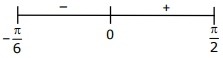
0 likesView Solution
372
MathematicsDifficultMCQJEE Main · 2021
Let the vectors $\vec{u} = (2+a+b) \hat{i}+(a+2 b+c) \hat{j}-(b+c) \hat{k}$,$\vec{v} = (1+b) \hat{i}+2 b \hat{j}-b \hat{k}$,and $\vec{w} = (2+b) \hat{i}+2 b \hat{j}+(1-b) \hat{k}$ where $a, b, c \in \mathbb{R}$ be co-planar. Then which of the following is true?
A
$2 a=b+c$
B
$2 b=a+c$
C
$3 c=a+b$
D
$a=b+2 c$
Solution
(B) For the vectors to be co-planar,their scalar triple product must be zero:
$\begin{vmatrix} a+b+2 & a+2 b+c & -(b+c) \\ b+1 & 2 b & -b \\ b+2 & 2 b & 1-b \end{vmatrix} = 0$
Applying row operations $R_3 \rightarrow R_3 - R_2$ and $R_1 \rightarrow R_1 - R_2$:
$\begin{vmatrix} a+1 & a+c & -c \\ b+1 & 2 b & -b \\ 1 & 0 & 1 \end{vmatrix} = 0$
Expanding along the third row:
$1((a+c)(-b) - (2b)(-c)) + 1((a+1)(2b) - (b+1)(a+c)) = 0$
$(-ab - bc + 2bc) + (2ab + 2b - (ab + ac + b + c)) = 0$
$(-ab + bc) + (ab - ac + b - c) = 0$
$bc - ac + b - c = 0$
$c(b-a) + 1(b-c) = 0$
Wait,let us re-evaluate the determinant expansion:
$(a+1)(2b) - (a+c)(b+1+b) + (-c)(-2b) = 0$
$(a+1)(2b) - (a+c)(2b+1) + 2bc = 0$
$2ab + 2b - (2ab + a + 2bc + c) + 2bc = 0$
$2ab + 2b - 2ab - a - 2bc - c + 2bc = 0$
$2b - a - c = 0$
Therefore,$2b = a+c$.
$\begin{vmatrix} a+b+2 & a+2 b+c & -(b+c) \\ b+1 & 2 b & -b \\ b+2 & 2 b & 1-b \end{vmatrix} = 0$
Applying row operations $R_3 \rightarrow R_3 - R_2$ and $R_1 \rightarrow R_1 - R_2$:
$\begin{vmatrix} a+1 & a+c & -c \\ b+1 & 2 b & -b \\ 1 & 0 & 1 \end{vmatrix} = 0$
Expanding along the third row:
$1((a+c)(-b) - (2b)(-c)) + 1((a+1)(2b) - (b+1)(a+c)) = 0$
$(-ab - bc + 2bc) + (2ab + 2b - (ab + ac + b + c)) = 0$
$(-ab + bc) + (ab - ac + b - c) = 0$
$bc - ac + b - c = 0$
$c(b-a) + 1(b-c) = 0$
Wait,let us re-evaluate the determinant expansion:
$(a+1)(2b) - (a+c)(b+1+b) + (-c)(-2b) = 0$
$(a+1)(2b) - (a+c)(2b+1) + 2bc = 0$
$2ab + 2b - (2ab + a + 2bc + c) + 2bc = 0$
$2ab + 2b - 2ab - a - 2bc - c + 2bc = 0$
$2b - a - c = 0$
Therefore,$2b = a+c$.
0 likesView Solution
373
MathematicsDifficultMCQJEE Main · 2021
Let $f: R \rightarrow R$ be defined as:
$f(x) = \begin{cases} \frac{\lambda|x^{2}-5x+6|}{\mu(5x-x^{2}-6)}, & x < 2 \\ \mu, & x = 2 \\ e^{\frac{\tan(x-2)}{x-[x]}}, & x > 2 \end{cases}$
Where $[x]$ is the greatest integer less than or equal to $x$. If $f$ is continuous at $x = 2$,then $\lambda + \mu$ is equal to:
$f(x) = \begin{cases} \frac{\lambda|x^{2}-5x+6|}{\mu(5x-x^{2}-6)}, & x < 2 \\ \mu, & x = 2 \\ e^{\frac{\tan(x-2)}{x-[x]}}, & x > 2 \end{cases}$
Where $[x]$ is the greatest integer less than or equal to $x$. If $f$ is continuous at $x = 2$,then $\lambda + \mu$ is equal to:
A
$e(e-2)$
B
$2e-1$
C
$e(-e+1)$
D
$1$
Solution
(C) For $f$ to be continuous at $x = 2$,we must have $\lim_{x \rightarrow 2^{-}} f(x) = \lim_{x \rightarrow 2^{+}} f(x) = f(2) = \mu$.
First,calculate the right-hand limit:
$\lim_{x \rightarrow 2^{+}} f(x) = \lim_{x \rightarrow 2^{+}} e^{\frac{\tan(x-2)}{x-[x]}}$. Since $x > 2$,$[x] = 2$,so $\lim_{x \rightarrow 2^{+}} e^{\frac{\tan(x-2)}{x-2}} = e^{1} = e$.
Thus,$\mu = e$.
Next,calculate the left-hand limit:
$\lim_{x \rightarrow 2^{-}} f(x) = \lim_{x \rightarrow 2^{-}} \frac{\lambda|x^{2}-5x+6|}{\mu(5x-x^{2}-6)}$.
Note that $x^{2}-5x+6 = (x-2)(x-3)$. For $x < 2$,$(x-2) < 0$ and $(x-3) < 0$,so $(x-2)(x-3) > 0$. Thus,$|x^{2}-5x+6| = (x-2)(x-3)$.
Also,$5x-x^{2}-6 = -(x^{2}-5x+6) = -(x-2)(x-3)$.
So,$\lim_{x \rightarrow 2^{-}} f(x) = \frac{\lambda(x-2)(x-3)}{\mu(-(x-2)(x-3))} = -\frac{\lambda}{\mu}$.
Equating the limits: $-\frac{\lambda}{\mu} = e \Rightarrow \lambda = -\mu e = -e^{2}$.
Therefore,$\lambda + \mu = -e^{2} + e = e(-e+1)$.
First,calculate the right-hand limit:
$\lim_{x \rightarrow 2^{+}} f(x) = \lim_{x \rightarrow 2^{+}} e^{\frac{\tan(x-2)}{x-[x]}}$. Since $x > 2$,$[x] = 2$,so $\lim_{x \rightarrow 2^{+}} e^{\frac{\tan(x-2)}{x-2}} = e^{1} = e$.
Thus,$\mu = e$.
Next,calculate the left-hand limit:
$\lim_{x \rightarrow 2^{-}} f(x) = \lim_{x \rightarrow 2^{-}} \frac{\lambda|x^{2}-5x+6|}{\mu(5x-x^{2}-6)}$.
Note that $x^{2}-5x+6 = (x-2)(x-3)$. For $x < 2$,$(x-2) < 0$ and $(x-3) < 0$,so $(x-2)(x-3) > 0$. Thus,$|x^{2}-5x+6| = (x-2)(x-3)$.
Also,$5x-x^{2}-6 = -(x^{2}-5x+6) = -(x-2)(x-3)$.
So,$\lim_{x \rightarrow 2^{-}} f(x) = \frac{\lambda(x-2)(x-3)}{\mu(-(x-2)(x-3))} = -\frac{\lambda}{\mu}$.
Equating the limits: $-\frac{\lambda}{\mu} = e \Rightarrow \lambda = -\mu e = -e^{2}$.
Therefore,$\lambda + \mu = -e^{2} + e = e(-e+1)$.
0 likesView Solution
374
MathematicsAdvancedMCQJEE Main · 2021
The number of real roots of the equation $e^{6x} - e^{4x} - 2e^{3x} - 12e^{2x} + e^{x} + 1 = 0$ is:
A
$1$
B
$6$
C
$4$
D
$2$
Solution
(D) Given equation: $e^{6x} - e^{4x} - 2e^{3x} - 12e^{2x} + e^{x} + 1 = 0$
Divide the entire equation by $e^{3x}$ (since $e^{3x} \neq 0$):
$e^{3x} - e^{x} - 2 - 12e^{-x} + e^{-2x} + e^{-3x} = 0$
Rearranging terms:
$(e^{3x} + e^{-3x}) - (e^{x} - e^{-2x}) - (e^{-x} - e^{x}) - 2 = 0$
Alternatively,divide by $e^{3x}$ and group:
$e^{3x} - 12 - e^{-3x} = e^{x} + 2 - e^{-x}$
Let $f(x) = e^{3x} - 12 - e^{-3x}$ and $g(x) = e^{x} + 2 - e^{-x}$.
$f'(x) = 3e^{3x} + 3e^{-3x} > 0$ (strictly increasing).
$g'(x) = e^{x} + e^{-x} > 0$ (strictly increasing).
By observing the intersection of the graphs of $f(x)$ and $g(x)$,or by analyzing the behavior of the function $h(x) = e^{6x} - e^{4x} - 2e^{3x} - 12e^{2x} + e^{x} + 1$,we find that the function crosses the $x$-axis at exactly $2$ points.
Thus,the number of real roots is $2$.
Divide the entire equation by $e^{3x}$ (since $e^{3x} \neq 0$):
$e^{3x} - e^{x} - 2 - 12e^{-x} + e^{-2x} + e^{-3x} = 0$
Rearranging terms:
$(e^{3x} + e^{-3x}) - (e^{x} - e^{-2x}) - (e^{-x} - e^{x}) - 2 = 0$
Alternatively,divide by $e^{3x}$ and group:
$e^{3x} - 12 - e^{-3x} = e^{x} + 2 - e^{-x}$
Let $f(x) = e^{3x} - 12 - e^{-3x}$ and $g(x) = e^{x} + 2 - e^{-x}$.
$f'(x) = 3e^{3x} + 3e^{-3x} > 0$ (strictly increasing).
$g'(x) = e^{x} + e^{-x} > 0$ (strictly increasing).
By observing the intersection of the graphs of $f(x)$ and $g(x)$,or by analyzing the behavior of the function $h(x) = e^{6x} - e^{4x} - 2e^{3x} - 12e^{2x} + e^{x} + 1$,we find that the function crosses the $x$-axis at exactly $2$ points.
Thus,the number of real roots is $2$.
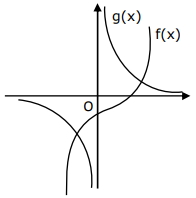
0 likesView Solution
375
MathematicsDifficultMCQJEE Main · 2021
The area (in $sq. \,units$) of the region,given by the set $\{(x, y) \in R \times R \mid x \geq 0, 2x^2 \leq y \leq 4-2x\}$ is:
A
$\frac{7}{3}$
B
$\frac{13}{3}$
C
$\frac{17}{3}$
D
$\frac{8}{3}$
Solution
(A) The region is bounded by the curves $y = 2x^2$ and $y = 4-2x$ for $x \geq 0$.
To find the intersection points,set $2x^2 = 4-2x$,which simplifies to $x^2 + x - 2 = 0$.
Factoring gives $(x+2)(x-1) = 0$,so $x = 1$ or $x = -2$.
Since $x \geq 0$,we consider the interval $[0, 1]$.
The area is given by the integral $\int_{0}^{1} ((4-2x) - 2x^2) dx$.
$= \int_{0}^{1} (4 - 2x - 2x^2) dx$
$= [4x - x^2 - \frac{2x^3}{3}]_{0}^{1}$
$= (4(1) - (1)^2 - \frac{2(1)^3}{3}) - (0)$
$= 4 - 1 - \frac{2}{3} = 3 - \frac{2}{3} = \frac{7}{3} \, sq. \, units$.
To find the intersection points,set $2x^2 = 4-2x$,which simplifies to $x^2 + x - 2 = 0$.
Factoring gives $(x+2)(x-1) = 0$,so $x = 1$ or $x = -2$.
Since $x \geq 0$,we consider the interval $[0, 1]$.
The area is given by the integral $\int_{0}^{1} ((4-2x) - 2x^2) dx$.
$= \int_{0}^{1} (4 - 2x - 2x^2) dx$
$= [4x - x^2 - \frac{2x^3}{3}]_{0}^{1}$
$= (4(1) - (1)^2 - \frac{2(1)^3}{3}) - (0)$
$= 4 - 1 - \frac{2}{3} = 3 - \frac{2}{3} = \frac{7}{3} \, sq. \, units$.
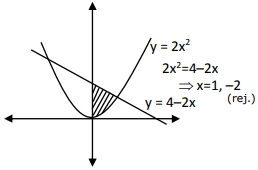
0 likesView Solution
376
MathematicsMediumMCQJEE Main · 2021
The values of $a$ and $b$,for which the system of equations $2x + 3y + 6z = 8$,$x + 2y + az = 5$,and $3x + 5y + 9z = b$ has no solution,are:
A
$a = 3, b = 13$
B
$a \neq 3, b \neq 13$
C
$a \neq 3, b = 3$
D
$a = 3, b \neq 13$
Solution
(D) For a system of linear equations to have no solution,the determinant of the coefficient matrix $D$ must be $0$,and at least one of the Cramer's rule determinants $(D_x, D_y, D_z)$ must be non-zero.
First,calculate the determinant of the coefficient matrix $D$:
$D = \begin{vmatrix} 2 & 3 & 6 \\ 1 & 2 & a \\ 3 & 5 & 9 \end{vmatrix} = 2(18 - 5a) - 3(9 - 3a) + 6(5 - 6) = 36 - 10a - 27 + 9a - 6 = 3 - a$.
For $D = 0$,we must have $a = 3$.
Next,calculate the determinant $D_z$ (or check the consistency of the augmented matrix):
$D_z = \begin{vmatrix} 2 & 3 & 8 \\ 1 & 2 & 5 \\ 3 & 5 & b \end{vmatrix} = 2(2b - 25) - 3(b - 15) + 8(5 - 6) = 4b - 50 - 3b + 45 - 8 = b - 13$.
For the system to have no solution when $D = 0$,we require $D_z \neq 0$,which implies $b - 13 \neq 0$,or $b \neq 13$.
Thus,the system has no solution when $a = 3$ and $b \neq 13$.
First,calculate the determinant of the coefficient matrix $D$:
$D = \begin{vmatrix} 2 & 3 & 6 \\ 1 & 2 & a \\ 3 & 5 & 9 \end{vmatrix} = 2(18 - 5a) - 3(9 - 3a) + 6(5 - 6) = 36 - 10a - 27 + 9a - 6 = 3 - a$.
For $D = 0$,we must have $a = 3$.
Next,calculate the determinant $D_z$ (or check the consistency of the augmented matrix):
$D_z = \begin{vmatrix} 2 & 3 & 8 \\ 1 & 2 & 5 \\ 3 & 5 & b \end{vmatrix} = 2(2b - 25) - 3(b - 15) + 8(5 - 6) = 4b - 50 - 3b + 45 - 8 = b - 13$.
For the system to have no solution when $D = 0$,we require $D_z \neq 0$,which implies $b - 13 \neq 0$,or $b \neq 13$.
Thus,the system has no solution when $a = 3$ and $b \neq 13$.
0 likesView Solution
377
MathematicsDifficultMCQJEE Main · 2021
The value of the definite integral $\int_{\pi / 24}^{5 \pi / 24} \frac{d x}{1+\sqrt[3]{\tan 2 x}}$ is
A
$\frac{\pi}{18}$
B
$\frac{\pi}{3}$
C
$\frac{\pi}{6}$
D
$\frac{\pi}{12}$
Solution
(D) Let $I = \int_{\pi / 24}^{5 \pi / 24} \frac{1}{1 + (\tan 2x)^{1/3}} dx = \int_{\pi / 24}^{5 \pi / 24} \frac{(\cos 2x)^{1/3}}{(\cos 2x)^{1/3} + (\sin 2x)^{1/3}} dx \dots (i)$
Using the property $\int_{a}^{b} f(x) dx = \int_{a}^{b} f(a+b-x) dx$,where $a+b = \frac{\pi}{24} + \frac{5\pi}{24} = \frac{6\pi}{24} = \frac{\pi}{4}$.
Then $I = \int_{\pi / 24}^{5 \pi / 24} \frac{(\cos(2(\frac{\pi}{4} - x)))^{1/3}}{(\cos(2(\frac{\pi}{4} - x)))^{1/3} + (\sin(2(\frac{\pi}{4} - x)))^{1/3}} dx$
$I = \int_{\pi / 24}^{5 \pi / 24} \frac{(\cos(\frac{\pi}{2} - 2x))^{1/3}}{(\cos(\frac{\pi}{2} - 2x))^{1/3} + (\sin(\frac{\pi}{2} - 2x))^{1/3}} dx$
$I = \int_{\pi / 24}^{5 \pi / 24} \frac{(\sin 2x)^{1/3}}{(\sin 2x)^{1/3} + (\cos 2x)^{1/3}} dx \dots (ii)$
Adding $(i)$ and $(ii)$:
$2I = \int_{\pi / 24}^{5 \pi / 24} \frac{(\cos 2x)^{1/3} + (\sin 2x)^{1/3}}{(\cos 2x)^{1/3} + (\sin 2x)^{1/3}} dx = \int_{\pi / 24}^{5 \pi / 24} 1 dx$
$2I = [x]_{\pi / 24}^{5 \pi / 24} = \frac{5\pi}{24} - \frac{\pi}{24} = \frac{4\pi}{24} = \frac{\pi}{6}$
$I = \frac{\pi}{12}$
Using the property $\int_{a}^{b} f(x) dx = \int_{a}^{b} f(a+b-x) dx$,where $a+b = \frac{\pi}{24} + \frac{5\pi}{24} = \frac{6\pi}{24} = \frac{\pi}{4}$.
Then $I = \int_{\pi / 24}^{5 \pi / 24} \frac{(\cos(2(\frac{\pi}{4} - x)))^{1/3}}{(\cos(2(\frac{\pi}{4} - x)))^{1/3} + (\sin(2(\frac{\pi}{4} - x)))^{1/3}} dx$
$I = \int_{\pi / 24}^{5 \pi / 24} \frac{(\cos(\frac{\pi}{2} - 2x))^{1/3}}{(\cos(\frac{\pi}{2} - 2x))^{1/3} + (\sin(\frac{\pi}{2} - 2x))^{1/3}} dx$
$I = \int_{\pi / 24}^{5 \pi / 24} \frac{(\sin 2x)^{1/3}}{(\sin 2x)^{1/3} + (\cos 2x)^{1/3}} dx \dots (ii)$
Adding $(i)$ and $(ii)$:
$2I = \int_{\pi / 24}^{5 \pi / 24} \frac{(\cos 2x)^{1/3} + (\sin 2x)^{1/3}}{(\cos 2x)^{1/3} + (\sin 2x)^{1/3}} dx = \int_{\pi / 24}^{5 \pi / 24} 1 dx$
$2I = [x]_{\pi / 24}^{5 \pi / 24} = \frac{5\pi}{24} - \frac{\pi}{24} = \frac{4\pi}{24} = \frac{\pi}{6}$
$I = \frac{\pi}{12}$
1 likesView Solution
378
MathematicsDifficultMCQJEE Main · 2021
Let $y=y(x)$ be the solution of the differential equation $\frac{dy}{dx}=1+xe^{y-x}$,where $-\sqrt{2} < x < \sqrt{2}$ and $y(0)=0$. Then,the minimum value of $y(x)$ for $x \in(-\sqrt{2}, \sqrt{2})$ is equal to:
A
$(1-\sqrt{3})-\log_{e}(\sqrt{3}-1)$
B
$(2+\sqrt{3})+\log_{e} 2$
C
$(2-\sqrt{3})-\log_{e} 2$
D
$(1+\sqrt{3})-\log_{e}(\sqrt{3}-1)$
Solution
(A) Given the differential equation $\frac{dy}{dx} = 1 + xe^{y-x}$.
Rearranging the terms: $\frac{dy}{dx} - 1 = xe^{y-x}$.
Since $y-x = u$,then $\frac{du}{dx} = \frac{dy}{dx} - 1$. Substituting this,we get $\frac{du}{dx} = xe^u$.
Separating variables: $e^{-u} du = x dx$.
Integrating both sides: $\int e^{-u} du = \int x dx \Rightarrow -e^{-u} = \frac{x^2}{2} + C$.
Substituting $u = y-x$: $-e^{-(y-x)} = \frac{x^2}{2} + C \Rightarrow -e^{x-y} = \frac{x^2}{2} + C$.
Given $y(0)=0$,at $x=0, y=0$: $-e^0 = 0 + C \Rightarrow C = -1$.
So,$-e^{x-y} = \frac{x^2}{2} - 1 \Rightarrow e^{x-y} = 1 - \frac{x^2}{2} = \frac{2-x^2}{2}$.
Taking natural log: $x-y = \ln\left(\frac{2-x^2}{2}\right) \Rightarrow y = x - \ln\left(\frac{2-x^2}{2}\right)$.
To find the minimum,set $\frac{dy}{dx} = 0$: $1 + xe^{y-x} = 0$. From the original equation,$\frac{dy}{dx} = 1 + x\left(\frac{2}{2-x^2}\right) = \frac{2-x^2+2x}{2-x^2} = 0$.
Solving $-x^2+2x+2=0 \Rightarrow x^2-2x-2=0$. Roots are $x = \frac{2 \pm \sqrt{4+8}}{2} = 1 \pm \sqrt{3}$.
Since $x \in(-\sqrt{2}, \sqrt{2})$,we take $x = 1-\sqrt{3}$.
Substituting $x = 1-\sqrt{3}$ into $y(x)$: $y = (1-\sqrt{3}) - \ln\left(\frac{2-(1-\sqrt{3})^2}{2}\right) = (1-\sqrt{3}) - \ln\left(\frac{2-(1+3-2\sqrt{3})}{2}\right) = (1-\sqrt{3}) - \ln\left(\frac{2-4+2\sqrt{3}}{2}\right) = (1-\sqrt{3}) - \ln(\sqrt{3}-1)$.
Rearranging the terms: $\frac{dy}{dx} - 1 = xe^{y-x}$.
Since $y-x = u$,then $\frac{du}{dx} = \frac{dy}{dx} - 1$. Substituting this,we get $\frac{du}{dx} = xe^u$.
Separating variables: $e^{-u} du = x dx$.
Integrating both sides: $\int e^{-u} du = \int x dx \Rightarrow -e^{-u} = \frac{x^2}{2} + C$.
Substituting $u = y-x$: $-e^{-(y-x)} = \frac{x^2}{2} + C \Rightarrow -e^{x-y} = \frac{x^2}{2} + C$.
Given $y(0)=0$,at $x=0, y=0$: $-e^0 = 0 + C \Rightarrow C = -1$.
So,$-e^{x-y} = \frac{x^2}{2} - 1 \Rightarrow e^{x-y} = 1 - \frac{x^2}{2} = \frac{2-x^2}{2}$.
Taking natural log: $x-y = \ln\left(\frac{2-x^2}{2}\right) \Rightarrow y = x - \ln\left(\frac{2-x^2}{2}\right)$.
To find the minimum,set $\frac{dy}{dx} = 0$: $1 + xe^{y-x} = 0$. From the original equation,$\frac{dy}{dx} = 1 + x\left(\frac{2}{2-x^2}\right) = \frac{2-x^2+2x}{2-x^2} = 0$.
Solving $-x^2+2x+2=0 \Rightarrow x^2-2x-2=0$. Roots are $x = \frac{2 \pm \sqrt{4+8}}{2} = 1 \pm \sqrt{3}$.
Since $x \in(-\sqrt{2}, \sqrt{2})$,we take $x = 1-\sqrt{3}$.
Substituting $x = 1-\sqrt{3}$ into $y(x)$: $y = (1-\sqrt{3}) - \ln\left(\frac{2-(1-\sqrt{3})^2}{2}\right) = (1-\sqrt{3}) - \ln\left(\frac{2-(1+3-2\sqrt{3})}{2}\right) = (1-\sqrt{3}) - \ln\left(\frac{2-4+2\sqrt{3}}{2}\right) = (1-\sqrt{3}) - \ln(\sqrt{3}-1)$.
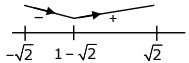
0 likesView Solution
379
MathematicsDifficultMCQJEE Main · 2021
Let $\vec{p}=2 \hat{i}+3 \hat{j}+\hat{k}$ and $\vec{q}=\hat{i}+2 \hat{j}+\hat{k}$ be two vectors. If a vector $\vec{r}=(\alpha \hat{i}+\beta \hat{j}+\gamma \hat{k})$ is perpendicular to each of the vectors $(\vec{p}+\vec{q})$ and $(\vec{p}-\vec{q})$,and $|\vec{r}|=\sqrt{3}$,then $|\alpha|+|\beta|+|\gamma|$ is equal to $.....$
A
$3$
B
$4$
C
$1$
D
$2$
Solution
(A) Given vectors are $\vec{p}=2 \hat{i}+3 \hat{j}+\hat{k}$ and $\vec{q}=\hat{i}+2 \hat{j}+\hat{k}$.
First,calculate the sum and difference of the vectors:
$\vec{p}+\vec{q} = (2+1)\hat{i} + (3+2)\hat{j} + (1+1)\hat{k} = 3\hat{i} + 5\hat{j} + 2\hat{k}$
$\vec{p}-\vec{q} = (2-1)\hat{i} + (3-2)\hat{j} + (1-1)\hat{k} = \hat{i} + \hat{j} + 0\hat{k}$
Since $\vec{r}$ is perpendicular to both $(\vec{p}+\vec{q})$ and $(\vec{p}-\vec{q})$,$\vec{r}$ must be parallel to their cross product:
$(\vec{p}+\vec{q}) \times (\vec{p}-\vec{q}) = \begin{vmatrix} \hat{i} & \hat{j} & \hat{k} \\ 3 & 5 & 2 \\ 1 & 1 & 0 \end{vmatrix} = \hat{i}(0-2) - \hat{j}(0-2) + \hat{k}(3-5) = -2\hat{i} + 2\hat{j} - 2\hat{k}$.
Let $\vec{v} = -2\hat{i} + 2\hat{j} - 2\hat{k}$. The magnitude is $|\vec{v}| = \sqrt{(-2)^2 + 2^2 + (-2)^2} = \sqrt{4+4+4} = \sqrt{12} = 2\sqrt{3}$.
The vector $\vec{r}$ is given by $\vec{r} = \pm |\vec{r}| \frac{\vec{v}}{|\vec{v}|} = \pm \sqrt{3} \frac{-2\hat{i} + 2\hat{j} - 2\hat{k}}{2\sqrt{3}} = \pm (-\hat{i} + \hat{j} - \hat{k})$.
Thus,$\vec{r} = \mp \hat{i} \pm \hat{j} \mp \hat{k}$.
Comparing with $\vec{r} = \alpha \hat{i} + \beta \hat{j} + \gamma \hat{k}$,we get $|\alpha|=1, |\beta|=1, |\gamma|=1$.
Therefore,$|\alpha|+|\beta|+|\gamma| = 1+1+1 = 3$.
First,calculate the sum and difference of the vectors:
$\vec{p}+\vec{q} = (2+1)\hat{i} + (3+2)\hat{j} + (1+1)\hat{k} = 3\hat{i} + 5\hat{j} + 2\hat{k}$
$\vec{p}-\vec{q} = (2-1)\hat{i} + (3-2)\hat{j} + (1-1)\hat{k} = \hat{i} + \hat{j} + 0\hat{k}$
Since $\vec{r}$ is perpendicular to both $(\vec{p}+\vec{q})$ and $(\vec{p}-\vec{q})$,$\vec{r}$ must be parallel to their cross product:
$(\vec{p}+\vec{q}) \times (\vec{p}-\vec{q}) = \begin{vmatrix} \hat{i} & \hat{j} & \hat{k} \\ 3 & 5 & 2 \\ 1 & 1 & 0 \end{vmatrix} = \hat{i}(0-2) - \hat{j}(0-2) + \hat{k}(3-5) = -2\hat{i} + 2\hat{j} - 2\hat{k}$.
Let $\vec{v} = -2\hat{i} + 2\hat{j} - 2\hat{k}$. The magnitude is $|\vec{v}| = \sqrt{(-2)^2 + 2^2 + (-2)^2} = \sqrt{4+4+4} = \sqrt{12} = 2\sqrt{3}$.
The vector $\vec{r}$ is given by $\vec{r} = \pm |\vec{r}| \frac{\vec{v}}{|\vec{v}|} = \pm \sqrt{3} \frac{-2\hat{i} + 2\hat{j} - 2\hat{k}}{2\sqrt{3}} = \pm (-\hat{i} + \hat{j} - \hat{k})$.
Thus,$\vec{r} = \mp \hat{i} \pm \hat{j} \mp \hat{k}$.
Comparing with $\vec{r} = \alpha \hat{i} + \beta \hat{j} + \gamma \hat{k}$,we get $|\alpha|=1, |\beta|=1, |\gamma|=1$.
Therefore,$|\alpha|+|\beta|+|\gamma| = 1+1+1 = 3$.
0 likesView Solution
380
MathematicsDifficultMCQJEE Main · 2021
Let $M=\left\{A=\begin{bmatrix} a & b \\ c & d \end{bmatrix} : a, b, c, d \in \{\pm 3, \pm 2, \pm 1, 0\}\right\}$. Define $f: M \rightarrow \mathbb{Z}$ as $f(A) = \det(A)$ for all $A \in M$,where $\mathbb{Z}$ is the set of all integers. Then the number of $A \in M$ such that $f(A) = 15$ is equal to $.....$
A
$16$
B
$32$
C
$48$
D
$71$
Solution
(A) We are given $A = \begin{bmatrix} a & b \\ c & d \end{bmatrix}$ where $a, b, c, d \in \{\pm 3, \pm 2, \pm 1, 0\}$.
We need to find the number of matrices such that $\det(A) = ad - bc = 15$.
Since the maximum value of $ad$ is $3 \times 3 = 9$ and the minimum value of $bc$ is $-3 \times 3 = -9$,the maximum value of $ad - bc$ is $9 - (-9) = 18$.
Possible values for $ad$ and $bc$ such that $ad - bc = 15$:
Case $I$: $ad = 9$ and $bc = -6$.
For $ad = 9$,the pairs $(a, d)$ can be $(3, 3)$ or $(-3, -3)$ ($2$ pairs).
For $bc = -6$,the pairs $(b, c)$ can be $(3, -2), (-3, 2), (-2, 3), (2, -3)$ ($4$ pairs).
Total matrices for Case $I = 2 \times 4 = 8$.
Case $II$: $ad = 6$ and $bc = -9$.
For $ad = 6$,the pairs $(a, d)$ can be $(3, 2), (2, 3), (-3, -2), (-2, -3)$ ($4$ pairs).
For $bc = -9$,the pairs $(b, c)$ can be $(3, -3), (-3, 3)$ ($2$ pairs).
Total matrices for Case $II = 4 \times 2 = 8$.
Total number of such matrices $= 8 + 8 = 16$.
We need to find the number of matrices such that $\det(A) = ad - bc = 15$.
Since the maximum value of $ad$ is $3 \times 3 = 9$ and the minimum value of $bc$ is $-3 \times 3 = -9$,the maximum value of $ad - bc$ is $9 - (-9) = 18$.
Possible values for $ad$ and $bc$ such that $ad - bc = 15$:
Case $I$: $ad = 9$ and $bc = -6$.
For $ad = 9$,the pairs $(a, d)$ can be $(3, 3)$ or $(-3, -3)$ ($2$ pairs).
For $bc = -6$,the pairs $(b, c)$ can be $(3, -2), (-3, 2), (-2, 3), (2, -3)$ ($4$ pairs).
Total matrices for Case $I = 2 \times 4 = 8$.
Case $II$: $ad = 6$ and $bc = -9$.
For $ad = 6$,the pairs $(a, d)$ can be $(3, 2), (2, 3), (-3, -2), (-2, -3)$ ($4$ pairs).
For $bc = -9$,the pairs $(b, c)$ can be $(3, -3), (-3, 3)$ ($2$ pairs).
Total matrices for Case $II = 4 \times 2 = 8$.
Total number of such matrices $= 8 + 8 = 16$.
0 likesView Solution
381
MathematicsDifficultMCQJEE Main · 2021
Let $y=y(x)$ be the solution of the differential equation $e^{y} \frac{d y}{d x}-2 e^{y} \sin x+\sin x \cos ^{2} x=0$,with $y(\frac{\pi}{2})=0$. If $y(0)=\log _{e}(\alpha+\beta e^{-2})$,then $4(\alpha+\beta)$ is equal to $....$
A
$2$
B
$5$
C
$4$
D
$3$
Solution
(C) Given the differential equation: $e^{y} \frac{d y}{d x}-2 e^{y} \sin x=-\sin x \cos ^{2} x$.
Let $e^{y}=t$,then $e^{y} \frac{d y}{d x}=\frac{d t}{d x}$.
The equation becomes $\frac{d t}{d x}-2 \sin x \cdot t=-\sin x \cos ^{2} x$.
This is a linear differential equation of the form $\frac{d t}{d x}+P(x)t=Q(x)$,where $P(x)=-2 \sin x$ and $Q(x)=-\sin x \cos ^{2} x$.
The integrating factor $I.F. = e^{\int -2 \sin x dx} = e^{2 \cos x}$.
The solution is $t \cdot e^{2 \cos x} = \int -\sin x \cos ^{2} x \cdot e^{2 \cos x} dx + C$.
Let $u = \cos x$,then $du = -\sin x dx$. The integral becomes $\int u^{2} e^{2u} du$.
Using integration by parts: $\int u^{2} e^{2u} du = u^{2} \frac{e^{2u}}{2} - \int 2u \frac{e^{2u}}{2} du = \frac{u^{2} e^{2u}}{2} - (u \frac{e^{2u}}{2} - \int \frac{e^{2u}}{2} du) = \frac{u^{2} e^{2u}}{2} - \frac{u e^{2u}}{2} + \frac{e^{2u}}{4}$.
So,$e^{y} e^{2 \cos x} = e^{2 \cos x} (\frac{\cos^{2} x}{2} - \frac{\cos x}{2} + \frac{1}{4}) + C$.
At $x = \frac{\pi}{2}$,$y = 0$,so $e^{0} e^{0} = e^{0} (0 - 0 + \frac{1}{4}) + C \Rightarrow 1 = \frac{1}{4} + C \Rightarrow C = \frac{3}{4}$.
Thus,$e^{y} = \frac{\cos^{2} x}{2} - \frac{\cos x}{2} + \frac{1}{4} + \frac{3}{4} e^{-2 \cos x}$.
At $x = 0$,$e^{y(0)} = \frac{1}{2} - \frac{1}{2} + \frac{1}{4} + \frac{3}{4} e^{-2} = \frac{1}{4} + \frac{3}{4} e^{-2}$.
Comparing with $\alpha + \beta e^{-2}$,we get $\alpha = \frac{1}{4}$ and $\beta = \frac{3}{4}$.
Therefore,$4(\alpha + \beta) = 4(\frac{1}{4} + \frac{3}{4}) = 4(1) = 4$.
Let $e^{y}=t$,then $e^{y} \frac{d y}{d x}=\frac{d t}{d x}$.
The equation becomes $\frac{d t}{d x}-2 \sin x \cdot t=-\sin x \cos ^{2} x$.
This is a linear differential equation of the form $\frac{d t}{d x}+P(x)t=Q(x)$,where $P(x)=-2 \sin x$ and $Q(x)=-\sin x \cos ^{2} x$.
The integrating factor $I.F. = e^{\int -2 \sin x dx} = e^{2 \cos x}$.
The solution is $t \cdot e^{2 \cos x} = \int -\sin x \cos ^{2} x \cdot e^{2 \cos x} dx + C$.
Let $u = \cos x$,then $du = -\sin x dx$. The integral becomes $\int u^{2} e^{2u} du$.
Using integration by parts: $\int u^{2} e^{2u} du = u^{2} \frac{e^{2u}}{2} - \int 2u \frac{e^{2u}}{2} du = \frac{u^{2} e^{2u}}{2} - (u \frac{e^{2u}}{2} - \int \frac{e^{2u}}{2} du) = \frac{u^{2} e^{2u}}{2} - \frac{u e^{2u}}{2} + \frac{e^{2u}}{4}$.
So,$e^{y} e^{2 \cos x} = e^{2 \cos x} (\frac{\cos^{2} x}{2} - \frac{\cos x}{2} + \frac{1}{4}) + C$.
At $x = \frac{\pi}{2}$,$y = 0$,so $e^{0} e^{0} = e^{0} (0 - 0 + \frac{1}{4}) + C \Rightarrow 1 = \frac{1}{4} + C \Rightarrow C = \frac{3}{4}$.
Thus,$e^{y} = \frac{\cos^{2} x}{2} - \frac{\cos x}{2} + \frac{1}{4} + \frac{3}{4} e^{-2 \cos x}$.
At $x = 0$,$e^{y(0)} = \frac{1}{2} - \frac{1}{2} + \frac{1}{4} + \frac{3}{4} e^{-2} = \frac{1}{4} + \frac{3}{4} e^{-2}$.
Comparing with $\alpha + \beta e^{-2}$,we get $\alpha = \frac{1}{4}$ and $\beta = \frac{3}{4}$.
Therefore,$4(\alpha + \beta) = 4(\frac{1}{4} + \frac{3}{4}) = 4(1) = 4$.
0 likesView Solution
382
MathematicsMediumMCQJEE Main · 2021
Let $S=\{n \in N \mid \begin{bmatrix} 0 & i \\ 1 & 0 \end{bmatrix}^{n} \begin{bmatrix} a & b \\ c & d \end{bmatrix} = \begin{bmatrix} a & b \\ c & d \end{bmatrix} \forall a, b, c, d \in R \}$,where $i=\sqrt{-1}$. Then the number of $2$-digit numbers in the set $S$ is $......$
A
$11$
B
$15$
C
$19$
D
$21$
Solution
(A) Let $A = \begin{bmatrix} 0 & i \\ 1 & 0 \end{bmatrix}$ and $X = \begin{bmatrix} a & b \\ c & d \end{bmatrix}$.
The given condition is $A^n X = X$ for all $a, b, c, d \in R$.
Since $X$ can be any $2 \times 2$ matrix,we can choose $X = I$ (the identity matrix),which implies $A^n = I$.
Now,calculate powers of $A$:
$A^2 = \begin{bmatrix} 0 & i \\ 1 & 0 \end{bmatrix} \begin{bmatrix} 0 & i \\ 1 & 0 \end{bmatrix} = \begin{bmatrix} i & 0 \\ 0 & i \end{bmatrix} = iI$.
$A^4 = (A^2)^2 = (iI)^2 = i^2 I = -I$.
$A^8 = (A^4)^2 = (-I)^2 = I$.
Thus,$A^n = I$ if and only if $n$ is a multiple of $8$.
We need to find the number of $2$-digit numbers $n$ such that $n$ is a multiple of $8$.
The $2$-digit multiples of $8$ are $16, 24, 32, 40, 48, 56, 64, 72, 80, 88, 96$.
Counting these,we have $11$ such numbers.
The given condition is $A^n X = X$ for all $a, b, c, d \in R$.
Since $X$ can be any $2 \times 2$ matrix,we can choose $X = I$ (the identity matrix),which implies $A^n = I$.
Now,calculate powers of $A$:
$A^2 = \begin{bmatrix} 0 & i \\ 1 & 0 \end{bmatrix} \begin{bmatrix} 0 & i \\ 1 & 0 \end{bmatrix} = \begin{bmatrix} i & 0 \\ 0 & i \end{bmatrix} = iI$.
$A^4 = (A^2)^2 = (iI)^2 = i^2 I = -I$.
$A^8 = (A^4)^2 = (-I)^2 = I$.
Thus,$A^n = I$ if and only if $n$ is a multiple of $8$.
We need to find the number of $2$-digit numbers $n$ such that $n$ is a multiple of $8$.
The $2$-digit multiples of $8$ are $16, 24, 32, 40, 48, 56, 64, 72, 80, 88, 96$.
Counting these,we have $11$ such numbers.
0 likesView Solution
383
MathematicsDifficultMCQJEE Main · 2021
Let $y=y(x)$ be the solution of the differential equation $x dy = (y + x^3 \cos x) dx$ with $y(\pi) = 0$. Then $y(\frac{\pi}{2})$ is equal to:
A
$\frac{\pi^2}{2} - \frac{\pi}{4}$
B
$\frac{\pi^2}{4} + \frac{\pi}{2}$
C
$\frac{\pi^2}{4} - \frac{\pi}{2}$
D
$\frac{\pi^2}{2} + \frac{\pi}{4}$
Solution
(B) Given the differential equation: $x dy = (y + x^3 \cos x) dx$
Divide by $x^2$ (assuming $x \neq 0$):
$\frac{x dy - y dx}{x^2} = x \cos x dx$
This is the derivative of the quotient:
$d(\frac{y}{x}) = x \cos x dx$
Integrating both sides:
$\int d(\frac{y}{x}) = \int x \cos x dx$
Using integration by parts for the right side:
$\frac{y}{x} = x \sin x - \int \sin x dx$
$\frac{y}{x} = x \sin x + \cos x + C$
Given $y(\pi) = 0$,substitute $x = \pi$ and $y = 0$:
$0 = \pi \sin(\pi) + \cos(\pi) + C$
$0 = 0 - 1 + C \implies C = 1$
So,$\frac{y}{x} = x \sin x + \cos x + 1$
$y = x^2 \sin x + x \cos x + x$
Now,calculate $y(\frac{\pi}{2})$:
$y(\frac{\pi}{2}) = (\frac{\pi}{2})^2 \sin(\frac{\pi}{2}) + \frac{\pi}{2} \cos(\frac{\pi}{2}) + \frac{\pi}{2}$
$y(\frac{\pi}{2}) = \frac{\pi^2}{4}(1) + \frac{\pi}{2}(0) + \frac{\pi}{2} = \frac{\pi^2}{4} + \frac{\pi}{2}$
Divide by $x^2$ (assuming $x \neq 0$):
$\frac{x dy - y dx}{x^2} = x \cos x dx$
This is the derivative of the quotient:
$d(\frac{y}{x}) = x \cos x dx$
Integrating both sides:
$\int d(\frac{y}{x}) = \int x \cos x dx$
Using integration by parts for the right side:
$\frac{y}{x} = x \sin x - \int \sin x dx$
$\frac{y}{x} = x \sin x + \cos x + C$
Given $y(\pi) = 0$,substitute $x = \pi$ and $y = 0$:
$0 = \pi \sin(\pi) + \cos(\pi) + C$
$0 = 0 - 1 + C \implies C = 1$
So,$\frac{y}{x} = x \sin x + \cos x + 1$
$y = x^2 \sin x + x \cos x + x$
Now,calculate $y(\frac{\pi}{2})$:
$y(\frac{\pi}{2}) = (\frac{\pi}{2})^2 \sin(\frac{\pi}{2}) + \frac{\pi}{2} \cos(\frac{\pi}{2}) + \frac{\pi}{2}$
$y(\frac{\pi}{2}) = \frac{\pi^2}{4}(1) + \frac{\pi}{2}(0) + \frac{\pi}{2} = \frac{\pi^2}{4} + \frac{\pi}{2}$
0 likesView Solution
384
MathematicsDifficultMCQJEE Main · 2021
The number of distinct real roots of $\left|\begin{array}{lll}\sin x & \cos x & \cos x \\ \cos x & \sin x & \cos x \\ \cos x & \cos x & \sin x\end{array}\right|=0$ in the interval $-\frac{\pi}{4} \leq x \leq \frac{\pi}{4}$ is
A
$1$
B
$2$
C
$3$
D
$4$
Solution
(A) Given the determinant equation: $\left|\begin{array}{lll} \sin x & \cos x & \cos x \\ \cos x & \sin x & \cos x \\ \cos x & \cos x & \sin x \end{array}\right|=0$.
Applying row operations $R_{1} \rightarrow R_{1}-R_{2}$ and $R_{2} \rightarrow R_{2}-R_{3}$,we get:
$\left|\begin{array}{ccc} \sin x-\cos x & \cos x-\sin x & 0 \\ 0 & \sin x-\cos x & \cos x-\sin x \\ \cos x & \cos x & \sin x \end{array}\right|=0$.
Taking $(\sin x-\cos x)$ common from $R_{1}$ and $R_{2}$:
$(\sin x-\cos x)^{2} \left|\begin{array}{ccc} 1 & -1 & 0 \\ 0 & 1 & -1 \\ \cos x & \cos x & \sin x \end{array}\right|=0$.
Expanding the determinant:
$(\sin x-\cos x)^{2} [1(\sin x + \cos x) + 1(0 + \cos x)] = 0$.
$(\sin x-\cos x)^{2} (\sin x + 2 \cos x) = 0$.
This implies $\sin x = \cos x$ or $\sin x = -2 \cos x$.
Case $1$: $\tan x = 1 \implies x = \frac{\pi}{4}$. This value lies in the interval $[-\frac{\pi}{4}, \frac{\pi}{4}]$.
Case $2$: $\tan x = -2$. In the interval $[-\frac{\pi}{4}, \frac{\pi}{4}]$,$\tan x$ ranges from $-1$ to $1$. Since $-2$ is outside this range,there is no solution for $\tan x = -2$ in this interval.
Thus,there is only $1$ distinct real root,which is $x = \frac{\pi}{4}$.
Applying row operations $R_{1} \rightarrow R_{1}-R_{2}$ and $R_{2} \rightarrow R_{2}-R_{3}$,we get:
$\left|\begin{array}{ccc} \sin x-\cos x & \cos x-\sin x & 0 \\ 0 & \sin x-\cos x & \cos x-\sin x \\ \cos x & \cos x & \sin x \end{array}\right|=0$.
Taking $(\sin x-\cos x)$ common from $R_{1}$ and $R_{2}$:
$(\sin x-\cos x)^{2} \left|\begin{array}{ccc} 1 & -1 & 0 \\ 0 & 1 & -1 \\ \cos x & \cos x & \sin x \end{array}\right|=0$.
Expanding the determinant:
$(\sin x-\cos x)^{2} [1(\sin x + \cos x) + 1(0 + \cos x)] = 0$.
$(\sin x-\cos x)^{2} (\sin x + 2 \cos x) = 0$.
This implies $\sin x = \cos x$ or $\sin x = -2 \cos x$.
Case $1$: $\tan x = 1 \implies x = \frac{\pi}{4}$. This value lies in the interval $[-\frac{\pi}{4}, \frac{\pi}{4}]$.
Case $2$: $\tan x = -2$. In the interval $[-\frac{\pi}{4}, \frac{\pi}{4}]$,$\tan x$ ranges from $-1$ to $1$. Since $-2$ is outside this range,there is no solution for $\tan x = -2$ in this interval.
Thus,there is only $1$ distinct real root,which is $x = \frac{\pi}{4}$.
0 likesView Solution
385
MathematicsMediumMCQJEE Main · 2021
Consider functions $f: A \rightarrow B$ and $g: B \rightarrow C$ $(A, B, C \subseteq \mathbb{R})$ such that $(g \circ f)^{-1}$ exists. Then:
A
$f$ and $g$ both are one-one
B
$f$ is onto and $g$ is one-one
C
$f$ is one-one and $g$ is onto
D
$f$ and $g$ both are onto
Solution
(C) Given that $(g \circ f)^{-1}$ exists,the composite function $g \circ f: A \rightarrow C$ must be a bijection (both one-one and onto).
$1$. For $g \circ f$ to be one-one,$f$ must be one-one. If $f$ were not one-one,there would exist $x_1, x_2 \in A$ such that $f(x_1) = f(x_2)$,implying $g(f(x_1)) = g(f(x_2))$,which contradicts the one-one property of $g \circ f$.
$2$. For $g \circ f$ to be onto,$g$ must be onto. If $g$ were not onto,there would exist some $z \in C$ such that no $y \in B$ satisfies $g(y) = z$,meaning no $x \in A$ could satisfy $g(f(x)) = z$,contradicting the onto property of $g \circ f$.
Therefore,$f$ must be one-one and $g$ must be onto.
$1$. For $g \circ f$ to be one-one,$f$ must be one-one. If $f$ were not one-one,there would exist $x_1, x_2 \in A$ such that $f(x_1) = f(x_2)$,implying $g(f(x_1)) = g(f(x_2))$,which contradicts the one-one property of $g \circ f$.
$2$. For $g \circ f$ to be onto,$g$ must be onto. If $g$ were not onto,there would exist some $z \in C$ such that no $y \in B$ satisfies $g(y) = z$,meaning no $x \in A$ could satisfy $g(f(x)) = z$,contradicting the onto property of $g \circ f$.
Therefore,$f$ must be one-one and $g$ must be onto.
0 likesView Solution
386
MathematicsEasyMCQJEE Main · 2021
The value of the integral $\int_{-1}^{1} \log \left(x+\sqrt{x^{2}+1}\right) \, dx$ is:
A
$1$
B
$0$
C
$-1$
D
$2$
Solution
(B) Let $I = \int_{-1}^{1} f(x) \, dx$,where $f(x) = \log \left(x+\sqrt{x^{2}+1}\right)$.
Check if $f(x)$ is an odd function by evaluating $f(-x)$:
$f(-x) = \log \left(-x+\sqrt{(-x)^{2}+1}\right) = \log \left(\sqrt{x^{2}+1}-x\right)$.
Multiply and divide by $(\sqrt{x^{2}+1}+x)$:
$f(-x) = \log \left(\frac{(\sqrt{x^{2}+1}-x)(\sqrt{x^{2}+1}+x)}{\sqrt{x^{2}+1}+x}\right) = \log \left(\frac{x^{2}+1-x^{2}}{\sqrt{x^{2}+1}+x}\right) = \log \left(\frac{1}{\sqrt{x^{2}+1}+x}\right)$.
Using the property $\log(1/a) = -\log(a)$:
$f(-x) = -\log \left(x+\sqrt{x^{2}+1}\right) = -f(x)$.
Since $f(-x) = -f(x)$,the function is an odd function.
By the property of definite integrals,if $f(x)$ is an odd function,then $\int_{-a}^{a} f(x) \, dx = 0$.
Therefore,$\int_{-1}^{1} \log \left(x+\sqrt{x^{2}+1}\right) \, dx = 0$.
Check if $f(x)$ is an odd function by evaluating $f(-x)$:
$f(-x) = \log \left(-x+\sqrt{(-x)^{2}+1}\right) = \log \left(\sqrt{x^{2}+1}-x\right)$.
Multiply and divide by $(\sqrt{x^{2}+1}+x)$:
$f(-x) = \log \left(\frac{(\sqrt{x^{2}+1}-x)(\sqrt{x^{2}+1}+x)}{\sqrt{x^{2}+1}+x}\right) = \log \left(\frac{x^{2}+1-x^{2}}{\sqrt{x^{2}+1}+x}\right) = \log \left(\frac{1}{\sqrt{x^{2}+1}+x}\right)$.
Using the property $\log(1/a) = -\log(a)$:
$f(-x) = -\log \left(x+\sqrt{x^{2}+1}\right) = -f(x)$.
Since $f(-x) = -f(x)$,the function is an odd function.
By the property of definite integrals,if $f(x)$ is an odd function,then $\int_{-a}^{a} f(x) \, dx = 0$.
Therefore,$\int_{-1}^{1} \log \left(x+\sqrt{x^{2}+1}\right) \, dx = 0$.
0 likesView Solution
387
MathematicsMediumMCQJEE Main · 2021
If $P = \begin{bmatrix} 1 & 0 \\ 1/2 & 1 \end{bmatrix}$,then $P^{50}$ is:
A
$\begin{bmatrix} 1 & 25 \\ 0 & 1 \end{bmatrix}$
B
$\begin{bmatrix} 1 & 0 \\ 25 & 1 \end{bmatrix}$
C
$\begin{bmatrix} 1 & 0 \\ 50 & 1 \end{bmatrix}$
D
$\begin{bmatrix} 1 & 50 \\ 0 & 1 \end{bmatrix}$
Solution
(B) Given $P = \begin{bmatrix} 1 & 0 \\ 1/2 & 1 \end{bmatrix}$.
Calculate $P^2 = P \times P = \begin{bmatrix} 1 & 0 \\ 1/2 & 1 \end{bmatrix} \begin{bmatrix} 1 & 0 \\ 1/2 & 1 \end{bmatrix} = \begin{bmatrix} 1 & 0 \\ 1/2 + 1/2 & 1 \end{bmatrix} = \begin{bmatrix} 1 & 0 \\ 1 & 1 \end{bmatrix}$.
Calculate $P^3 = P^2 \times P = \begin{bmatrix} 1 & 0 \\ 1 & 1 \end{bmatrix} \begin{bmatrix} 1 & 0 \\ 1/2 & 1 \end{bmatrix} = \begin{bmatrix} 1 & 0 \\ 1 + 1/2 & 1 \end{bmatrix} = \begin{bmatrix} 1 & 0 \\ 3/2 & 1 \end{bmatrix}$.
Calculate $P^4 = P^2 \times P^2 = \begin{bmatrix} 1 & 0 \\ 1 & 1 \end{bmatrix} \begin{bmatrix} 1 & 0 \\ 1 & 1 \end{bmatrix} = \begin{bmatrix} 1 & 0 \\ 1 + 1 & 1 \end{bmatrix} = \begin{bmatrix} 1 & 0 \\ 2 & 1 \end{bmatrix}$.
Observing the pattern,$P^n = \begin{bmatrix} 1 & 0 \\ n/2 & 1 \end{bmatrix}$.
Therefore,for $n = 50$,$P^{50} = \begin{bmatrix} 1 & 0 \\ 50/2 & 1 \end{bmatrix} = \begin{bmatrix} 1 & 0 \\ 25 & 1 \end{bmatrix}$.
Calculate $P^2 = P \times P = \begin{bmatrix} 1 & 0 \\ 1/2 & 1 \end{bmatrix} \begin{bmatrix} 1 & 0 \\ 1/2 & 1 \end{bmatrix} = \begin{bmatrix} 1 & 0 \\ 1/2 + 1/2 & 1 \end{bmatrix} = \begin{bmatrix} 1 & 0 \\ 1 & 1 \end{bmatrix}$.
Calculate $P^3 = P^2 \times P = \begin{bmatrix} 1 & 0 \\ 1 & 1 \end{bmatrix} \begin{bmatrix} 1 & 0 \\ 1/2 & 1 \end{bmatrix} = \begin{bmatrix} 1 & 0 \\ 1 + 1/2 & 1 \end{bmatrix} = \begin{bmatrix} 1 & 0 \\ 3/2 & 1 \end{bmatrix}$.
Calculate $P^4 = P^2 \times P^2 = \begin{bmatrix} 1 & 0 \\ 1 & 1 \end{bmatrix} \begin{bmatrix} 1 & 0 \\ 1 & 1 \end{bmatrix} = \begin{bmatrix} 1 & 0 \\ 1 + 1 & 1 \end{bmatrix} = \begin{bmatrix} 1 & 0 \\ 2 & 1 \end{bmatrix}$.
Observing the pattern,$P^n = \begin{bmatrix} 1 & 0 \\ n/2 & 1 \end{bmatrix}$.
Therefore,for $n = 50$,$P^{50} = \begin{bmatrix} 1 & 0 \\ 50/2 & 1 \end{bmatrix} = \begin{bmatrix} 1 & 0 \\ 25 & 1 \end{bmatrix}$.
0 likesView Solution
388
MathematicsEasyMCQJEE Main · 2021
Let $a, b$ and $c$ be distinct positive numbers. If the vectors $a \hat{i} + a \hat{j} + c \hat{k}$,$\hat{i} + \hat{k}$ and $c \hat{i} + c \hat{j} + b \hat{k}$ are coplanar,then $c$ is equal to:
A
$\sqrt{ab}$
B
$\frac{a+b}{2}$
C
$\frac{1}{a} + \frac{1}{b}$
D
$\frac{2}{\frac{1}{a} + \frac{1}{b}}$
Solution
(A) Three vectors $\vec{u}, \vec{v}, \vec{w}$ are coplanar if their scalar triple product is zero,i.e.,$[\vec{u} \vec{v} \vec{w}] = 0$.
The given vectors are $\vec{u} = a \hat{i} + a \hat{j} + c \hat{k}$,$\vec{v} = 1 \hat{i} + 0 \hat{j} + 1 \hat{k}$,and $\vec{w} = c \hat{i} + c \hat{j} + b \hat{k}$.
The condition for coplanarity is given by the determinant:
$\left|\begin{array}{lll}a & a & c \\ 1 & 0 & 1 \\ c & c & b\end{array}\right| = 0$
Expanding the determinant along the second row:
$-1 \cdot \left|\begin{array}{ll}a & c \\ c & b\end{array}\right| + 0 \cdot \left|\begin{array}{ll}a & c \\ c & b\end{array}\right| - 1 \cdot \left|\begin{array}{ll}a & a \\ c & c\end{array}\right| = 0$
$-1(ab - c^2) - 1(ac - ac) = 0$
$-(ab - c^2) - 0 = 0$
$c^2 - ab = 0$
$c^2 = ab$
Since $a, b, c$ are positive numbers,$c = \sqrt{ab}$.
The given vectors are $\vec{u} = a \hat{i} + a \hat{j} + c \hat{k}$,$\vec{v} = 1 \hat{i} + 0 \hat{j} + 1 \hat{k}$,and $\vec{w} = c \hat{i} + c \hat{j} + b \hat{k}$.
The condition for coplanarity is given by the determinant:
$\left|\begin{array}{lll}a & a & c \\ 1 & 0 & 1 \\ c & c & b\end{array}\right| = 0$
Expanding the determinant along the second row:
$-1 \cdot \left|\begin{array}{ll}a & c \\ c & b\end{array}\right| + 0 \cdot \left|\begin{array}{ll}a & c \\ c & b\end{array}\right| - 1 \cdot \left|\begin{array}{ll}a & a \\ c & c\end{array}\right| = 0$
$-1(ab - c^2) - 1(ac - ac) = 0$
$-(ab - c^2) - 0 = 0$
$c^2 - ab = 0$
$c^2 = ab$
Since $a, b, c$ are positive numbers,$c = \sqrt{ab}$.
0 likesView Solution
389
MathematicsMediumMCQJEE Main · 2021
Let $X$ be a random variable such that the probability function of a distribution is given by $P(X=0) = \frac{1}{2}$ and $P(X=j) = \frac{1}{3^j}$ for $j = 1, 2, 3, \ldots, \infty$. Then the mean of the distribution and $P(X \text{ is positive and even})$ respectively are:
A
$\frac{3}{4}$ and $\frac{1}{9}$
B
$\frac{3}{4}$ and $\frac{1}{16}$
C
$\frac{3}{8}$ and $\frac{1}{8}$
D
$\frac{3}{4}$ and $\frac{1}{8}$
Solution
(D) The mean $E(X)$ is given by $\sum_{j=0}^{\infty} j \cdot P(X=j)$.
Since $P(X=0) = 0 \cdot \frac{1}{2} = 0$,we have $E(X) = \sum_{j=1}^{\infty} j \cdot \frac{1}{3^j}$.
This is an arithmetico-geometric series of the form $\sum_{j=1}^{\infty} j r^j$ where $r = \frac{1}{3}$.
The sum is given by $\frac{r}{(1-r)^2} = \frac{1/3}{(1-1/3)^2} = \frac{1/3}{4/9} = \frac{3}{4}$.
For $P(X \text{ is positive and even})$,we sum $P(X=j)$ for $j \in \{2, 4, 6, \ldots\}$.
$P(X \text{ is positive and even}) = \sum_{k=1}^{\infty} P(X=2k) = \sum_{k=1}^{\infty} \frac{1}{3^{2k}} = \sum_{k=1}^{\infty} \left(\frac{1}{9}\right)^k$.
This is a geometric series with first term $a = \frac{1}{9}$ and common ratio $r = \frac{1}{9}$.
The sum is $\frac{a}{1-r} = \frac{1/9}{1-1/9} = \frac{1/9}{8/9} = \frac{1}{8}$.
Thus,the mean is $\frac{3}{4}$ and the probability is $\frac{1}{8}$.
Since $P(X=0) = 0 \cdot \frac{1}{2} = 0$,we have $E(X) = \sum_{j=1}^{\infty} j \cdot \frac{1}{3^j}$.
This is an arithmetico-geometric series of the form $\sum_{j=1}^{\infty} j r^j$ where $r = \frac{1}{3}$.
The sum is given by $\frac{r}{(1-r)^2} = \frac{1/3}{(1-1/3)^2} = \frac{1/3}{4/9} = \frac{3}{4}$.
For $P(X \text{ is positive and even})$,we sum $P(X=j)$ for $j \in \{2, 4, 6, \ldots\}$.
$P(X \text{ is positive and even}) = \sum_{k=1}^{\infty} P(X=2k) = \sum_{k=1}^{\infty} \frac{1}{3^{2k}} = \sum_{k=1}^{\infty} \left(\frac{1}{9}\right)^k$.
This is a geometric series with first term $a = \frac{1}{9}$ and common ratio $r = \frac{1}{9}$.
The sum is $\frac{a}{1-r} = \frac{1/9}{1-1/9} = \frac{1/9}{8/9} = \frac{1}{8}$.
Thus,the mean is $\frac{3}{4}$ and the probability is $\frac{1}{8}$.
0 likesView Solution
390
MathematicsEasyMCQJEE Main · 2021
If $|\vec{a}|=2, |\vec{b}|=5$ and $|\vec{a} \times \vec{b}|=8$,then $|\vec{a} \cdot \vec{b}|$ is equal to :
A
$5$
B
$4$
C
$6$
D
$3$
Solution
(C) Given: $|\vec{a}|=2$ and $|\vec{b}|=5$.
We know that $|\vec{a} \times \vec{b}| = |\vec{a}||\vec{b}| \sin \theta = 8$.
Substituting the values: $2 \times 5 \times \sin \theta = 8 \implies 10 \sin \theta = 8 \implies \sin \theta = \frac{8}{10} = \frac{4}{5}$.
Since $\sin^2 \theta + \cos^2 \theta = 1$,we have $\cos^2 \theta = 1 - \sin^2 \theta = 1 - (\frac{4}{5})^2 = 1 - \frac{16}{25} = \frac{9}{25}$.
Thus,$|\cos \theta| = \sqrt{\frac{9}{25}} = \frac{3}{5}$.
Now,$|\vec{a} \cdot \vec{b}| = |\vec{a}||\vec{b}| |\cos \theta|$.
$|\vec{a} \cdot \vec{b}| = 2 \times 5 \times \frac{3}{5} = 6$.
We know that $|\vec{a} \times \vec{b}| = |\vec{a}||\vec{b}| \sin \theta = 8$.
Substituting the values: $2 \times 5 \times \sin \theta = 8 \implies 10 \sin \theta = 8 \implies \sin \theta = \frac{8}{10} = \frac{4}{5}$.
Since $\sin^2 \theta + \cos^2 \theta = 1$,we have $\cos^2 \theta = 1 - \sin^2 \theta = 1 - (\frac{4}{5})^2 = 1 - \frac{16}{25} = \frac{9}{25}$.
Thus,$|\cos \theta| = \sqrt{\frac{9}{25}} = \frac{3}{5}$.
Now,$|\vec{a} \cdot \vec{b}| = |\vec{a}||\vec{b}| |\cos \theta|$.
$|\vec{a} \cdot \vec{b}| = 2 \times 5 \times \frac{3}{5} = 6$.
0 likesView Solution
391
MathematicsDifficultMCQJEE Main · 2021
If $f(x) = \begin{cases} \int_{0}^{x} (5 + |1-t|) \, dt, & x > 2 \\ 5x + 1, & x \leq 2 \end{cases}$,then:
A
$f(x)$ is not differentiable at $x=1$
B
$f(x)$ is continuous but not differentiable at $x=2$
C
$f(x)$ is not continuous at $x=2$
D
$f(x)$ is everywhere differentiable
Solution
(B) For $x > 2$,$f(x) = \int_{0}^{1} (5 + (1-t)) \, dt + \int_{1}^{x} (5 + (t-1)) \, dt$.
Evaluating the integrals:
$f(x) = \int_{0}^{1} (6-t) \, dt + \int_{1}^{x} (4+t) \, dt = [6t - \frac{t^2}{2}]_{0}^{1} + [4t + \frac{t^2}{2}]_{1}^{x}$.
$f(x) = (6 - \frac{1}{2}) + (4x + \frac{x^2}{2} - 4 - \frac{1}{2}) = \frac{11}{2} + 4x + \frac{x^2}{2} - \frac{9}{2} = \frac{x^2}{2} + 4x + 1$.
Check continuity at $x=2$:
$f(2^-) = 5(2) + 1 = 11$.
$f(2^+) = \frac{2^2}{2} + 4(2) + 1 = 2 + 8 + 1 = 11$.
Since $f(2^-) = f(2^+) = 11$,$f(x)$ is continuous at $x=2$.
Check differentiability at $x=2$:
$Lf'(2) = \frac{d}{dx}(5x+1)|_{x=2} = 5$.
$Rf'(2) = \frac{d}{dx}(\frac{x^2}{2} + 4x + 1)|_{x=2} = (x+4)|_{x=2} = 2+4 = 6$.
Since $Lf'(2) \neq Rf'(2)$,$f(x)$ is not differentiable at $x=2$.
Evaluating the integrals:
$f(x) = \int_{0}^{1} (6-t) \, dt + \int_{1}^{x} (4+t) \, dt = [6t - \frac{t^2}{2}]_{0}^{1} + [4t + \frac{t^2}{2}]_{1}^{x}$.
$f(x) = (6 - \frac{1}{2}) + (4x + \frac{x^2}{2} - 4 - \frac{1}{2}) = \frac{11}{2} + 4x + \frac{x^2}{2} - \frac{9}{2} = \frac{x^2}{2} + 4x + 1$.
Check continuity at $x=2$:
$f(2^-) = 5(2) + 1 = 11$.
$f(2^+) = \frac{2^2}{2} + 4(2) + 1 = 2 + 8 + 1 = 11$.
Since $f(2^-) = f(2^+) = 11$,$f(x)$ is continuous at $x=2$.
Check differentiability at $x=2$:
$Lf'(2) = \frac{d}{dx}(5x+1)|_{x=2} = 5$.
$Rf'(2) = \frac{d}{dx}(\frac{x^2}{2} + 4x + 1)|_{x=2} = (x+4)|_{x=2} = 2+4 = 6$.
Since $Lf'(2) \neq Rf'(2)$,$f(x)$ is not differentiable at $x=2$.
0 likesView Solution
392
MathematicsDifficultMCQJEE Main · 2021
Consider the function $f(x) = \begin{cases} \frac{P(x)}{\sin(x-2)}, & x \neq 2 \\ 7, & x = 2 \end{cases}$ where $P(x)$ is a polynomial such that $P''(x)$ is always a constant and $P(3) = 9$. If $f(x)$ is continuous at $x = 2$,then $P(5)$ is equal to:
A
$41$
B
$40$
C
$39$
D
$71$
Solution
(C) Since $P''(x)$ is a constant,$P(x)$ must be a polynomial of degree $2$. Let $P(x) = ax^2 + bx + c$.
Given that $f(x)$ is continuous at $x = 2$,we have $\lim_{x \to 2} f(x) = f(2) = 7$.
This implies $\lim_{x \to 2} \frac{P(x)}{\sin(x-2)} = 7$.
For the limit to exist and be finite,$P(2)$ must be $0$ because $\sin(x-2) \to 0$ as $x \to 2$. Thus,$(x-2)$ is a factor of $P(x)$.
Let $P(x) = (x-2)(ax + k)$.
Then $\lim_{x \to 2} \frac{(x-2)(ax+k)}{\sin(x-2)} = \lim_{x \to 2} \frac{x-2}{\sin(x-2)} \cdot (ax+k) = 1 \cdot (2a+k) = 7$.
So,$2a + k = 7$.
We are given $P(3) = 9$. Substituting $x=3$ into $P(x) = (x-2)(ax+k)$ gives $(3-2)(3a+k) = 9$,so $3a + k = 9$.
Subtracting the two equations: $(3a+k) - (2a+k) = 9 - 7$,which gives $a = 2$.
Substituting $a=2$ into $2a+k=7$ gives $4+k=7$,so $k=3$.
Thus,$P(x) = (x-2)(2x+3)$.
Finally,$P(5) = (5-2)(2(5)+3) = 3(13) = 39$.
Given that $f(x)$ is continuous at $x = 2$,we have $\lim_{x \to 2} f(x) = f(2) = 7$.
This implies $\lim_{x \to 2} \frac{P(x)}{\sin(x-2)} = 7$.
For the limit to exist and be finite,$P(2)$ must be $0$ because $\sin(x-2) \to 0$ as $x \to 2$. Thus,$(x-2)$ is a factor of $P(x)$.
Let $P(x) = (x-2)(ax + k)$.
Then $\lim_{x \to 2} \frac{(x-2)(ax+k)}{\sin(x-2)} = \lim_{x \to 2} \frac{x-2}{\sin(x-2)} \cdot (ax+k) = 1 \cdot (2a+k) = 7$.
So,$2a + k = 7$.
We are given $P(3) = 9$. Substituting $x=3$ into $P(x) = (x-2)(ax+k)$ gives $(3-2)(3a+k) = 9$,so $3a + k = 9$.
Subtracting the two equations: $(3a+k) - (2a+k) = 9 - 7$,which gives $a = 2$.
Substituting $a=2$ into $2a+k=7$ gives $4+k=7$,so $k=3$.
Thus,$P(x) = (x-2)(2x+3)$.
Finally,$P(5) = (5-2)(2(5)+3) = 3(13) = 39$.
0 likesView Solution
393
MathematicsDifficultMCQJEE Main · 2021
If a rectangle is inscribed in an equilateral triangle of side length $2 \sqrt{2}$ as shown in the figure,then the square of the largest area of such a rectangle is $....$
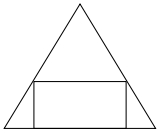
A
$1$
B
$2$
C
$3$
D
$4$
Solution
(C) Let the side length of the equilateral triangle be $a = 2 \sqrt{2}$.
Let the length of the rectangle be $\ell$ and its breadth be $b$.
From the similar triangles formed at the top,the ratio of the height of the small triangle to its base is equal to the ratio of the height of the large triangle to its base.
The height of the equilateral triangle is $H = \frac{\sqrt{3}}{2} a = \frac{\sqrt{3}}{2} (2 \sqrt{2}) = \sqrt{6}$.
By similar triangles,$\frac{H-b}{H} = \frac{\ell}{a}$.
$\frac{\sqrt{6}-b}{\sqrt{6}} = \frac{\ell}{2 \sqrt{2}}$.
$b = \sqrt{6} (1 - \frac{\ell}{2 \sqrt{2}}) = \sqrt{6} - \frac{\sqrt{6} \ell}{2 \sqrt{2}} = \sqrt{6} - \frac{\sqrt{3}}{2} \ell$.
The area $A = \ell \times b = \ell (\sqrt{6} - \frac{\sqrt{3}}{2} \ell) = \sqrt{6} \ell - \frac{\sqrt{3}}{2} \ell^2$.
To maximize $A$,set $\frac{dA}{d\ell} = 0$.
$\sqrt{6} - \sqrt{3} \ell = 0 \Rightarrow \ell = \frac{\sqrt{6}}{\sqrt{3}} = \sqrt{2}$.
The maximum area $A = \sqrt{2} (\sqrt{6} - \frac{\sqrt{3}}{2} \sqrt{2}) = \sqrt{12} - \frac{\sqrt{6}}{2} \sqrt{2} = 2 \sqrt{3} - \sqrt{3} = \sqrt{3}$.
The square of the largest area is $A^2 = (\sqrt{3})^2 = 3$.
Let the length of the rectangle be $\ell$ and its breadth be $b$.
From the similar triangles formed at the top,the ratio of the height of the small triangle to its base is equal to the ratio of the height of the large triangle to its base.
The height of the equilateral triangle is $H = \frac{\sqrt{3}}{2} a = \frac{\sqrt{3}}{2} (2 \sqrt{2}) = \sqrt{6}$.
By similar triangles,$\frac{H-b}{H} = \frac{\ell}{a}$.
$\frac{\sqrt{6}-b}{\sqrt{6}} = \frac{\ell}{2 \sqrt{2}}$.
$b = \sqrt{6} (1 - \frac{\ell}{2 \sqrt{2}}) = \sqrt{6} - \frac{\sqrt{6} \ell}{2 \sqrt{2}} = \sqrt{6} - \frac{\sqrt{3}}{2} \ell$.
The area $A = \ell \times b = \ell (\sqrt{6} - \frac{\sqrt{3}}{2} \ell) = \sqrt{6} \ell - \frac{\sqrt{3}}{2} \ell^2$.
To maximize $A$,set $\frac{dA}{d\ell} = 0$.
$\sqrt{6} - \sqrt{3} \ell = 0 \Rightarrow \ell = \frac{\sqrt{6}}{\sqrt{3}} = \sqrt{2}$.
The maximum area $A = \sqrt{2} (\sqrt{6} - \frac{\sqrt{3}}{2} \sqrt{2}) = \sqrt{12} - \frac{\sqrt{6}}{2} \sqrt{2} = 2 \sqrt{3} - \sqrt{3} = \sqrt{3}$.
The square of the largest area is $A^2 = (\sqrt{3})^2 = 3$.
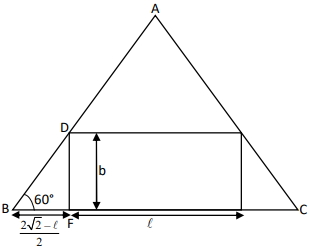
0 likesView Solution
394
MathematicsEasyMCQJEE Main · 2021
Let a curve $y=f(x)$ pass through the point $(2, (\ln 2)^2)$ and have slope $\frac{2y}{x \ln x}$ for all positive real values of $x$. Then the value of $f(e)$ is equal to:
A
$1$
B
$2$
C
$3$
D
$4$
Solution
(A) Given the differential equation: $\frac{dy}{dx} = \frac{2y}{x \ln x}$.
Separating the variables,we get: $\frac{dy}{y} = \frac{2 dx}{x \ln x}$.
Integrating both sides: $\int \frac{dy}{y} = \int \frac{2}{x \ln x} dx$.
Let $u = \ln x$,then $du = \frac{1}{x} dx$. The integral becomes: $\ln |y| = 2 \int \frac{du}{u} = 2 \ln |u| + C = 2 \ln |\ln x| + C$.
So,$\ln |y| = \ln |(\ln x)^2| + C$,which implies $y = k(\ln x)^2$ for some constant $k$.
Given that the curve passes through $(2, (\ln 2)^2)$,we substitute $x=2$ and $y=(\ln 2)^2$:
$(\ln 2)^2 = k(\ln 2)^2 \Rightarrow k = 1$.
Thus,the function is $f(x) = (\ln x)^2$.
To find $f(e)$,we substitute $x=e$: $f(e) = (\ln e)^2 = (1)^2 = 1$.
Separating the variables,we get: $\frac{dy}{y} = \frac{2 dx}{x \ln x}$.
Integrating both sides: $\int \frac{dy}{y} = \int \frac{2}{x \ln x} dx$.
Let $u = \ln x$,then $du = \frac{1}{x} dx$. The integral becomes: $\ln |y| = 2 \int \frac{du}{u} = 2 \ln |u| + C = 2 \ln |\ln x| + C$.
So,$\ln |y| = \ln |(\ln x)^2| + C$,which implies $y = k(\ln x)^2$ for some constant $k$.
Given that the curve passes through $(2, (\ln 2)^2)$,we substitute $x=2$ and $y=(\ln 2)^2$:
$(\ln 2)^2 = k(\ln 2)^2 \Rightarrow k = 1$.
Thus,the function is $f(x) = (\ln x)^2$.
To find $f(e)$,we substitute $x=e$: $f(e) = (\ln e)^2 = (1)^2 = 1$.
0 likesView Solution
395
MathematicsEasyMCQJEE Main · 2021
$A$ fair coin is tossed $n$ times such that the probability of getting at least one head is at least $0.9$. Then the minimum value of $n$ is:
A
$3$
B
$4$
C
$5$
D
$6$
Solution
(B) The probability of getting a head in a single toss is $P(H) = \frac{1}{2}$.
The probability of getting no heads in $n$ tosses is $P(X=0) = \left(\frac{1}{2}\right)^n$.
The probability of getting at least one head is $P(X \geq 1) = 1 - P(X=0) = 1 - \left(\frac{1}{2}\right)^n$.
Given that $P(X \geq 1) \geq 0.9$,we have:
$1 - \left(\frac{1}{2}\right)^n \geq 0.9$
Rearranging the inequality:
$1 - 0.9 \geq \left(\frac{1}{2}\right)^n$
$0.1 \geq \left(\frac{1}{2}\right)^n$
$\frac{1}{10} \geq \frac{1}{2^n}$
$2^n \geq 10$
Testing values for $n$:
For $n=3$,$2^3 = 8 < 10$.
For $n=4$,$2^4 = 16 \geq 10$.
Thus,the minimum value of $n$ is $4$.
The probability of getting no heads in $n$ tosses is $P(X=0) = \left(\frac{1}{2}\right)^n$.
The probability of getting at least one head is $P(X \geq 1) = 1 - P(X=0) = 1 - \left(\frac{1}{2}\right)^n$.
Given that $P(X \geq 1) \geq 0.9$,we have:
$1 - \left(\frac{1}{2}\right)^n \geq 0.9$
Rearranging the inequality:
$1 - 0.9 \geq \left(\frac{1}{2}\right)^n$
$0.1 \geq \left(\frac{1}{2}\right)^n$
$\frac{1}{10} \geq \frac{1}{2^n}$
$2^n \geq 10$
Testing values for $n$:
For $n=3$,$2^3 = 8 < 10$.
For $n=4$,$2^4 = 16 \geq 10$.
Thus,the minimum value of $n$ is $4$.
0 likesView Solution
396
MathematicsEasyMCQJEE Main · 2021
If the lines $\frac{x-k}{1}=\frac{y-2}{2}=\frac{z-3}{3}$ and $\frac{x+1}{3}=\frac{y+2}{2}=\frac{z+3}{1}$ are co-planar,then the value of $k$ is $.....$
A
$5$
B
$4$
C
$1$
D
$2$
Solution
(C) Two lines $\frac{x-x_1}{a_1} = \frac{y-y_1}{b_1} = \frac{z-z_1}{c_1}$ and $\frac{x-x_2}{a_2} = \frac{y-y_2}{b_2} = \frac{z-z_2}{c_2}$ are co-planar if the determinant of the vector connecting a point on each line and the direction vectors is zero:
$\left|\begin{array}{ccc} x_2-x_1 & y_2-y_1 & z_2-z_1 \\ a_1 & b_1 & c_1 \\ a_2 & b_2 & c_2 \end{array}\right| = 0$
Here,$(x_1, y_1, z_1) = (k, 2, 3)$ and $(x_2, y_2, z_2) = (-1, -2, -3)$.
The direction vectors are $(a_1, b_1, c_1) = (1, 2, 3)$ and $(a_2, b_2, c_2) = (3, 2, 1)$.
Substituting these values into the determinant:
$\left|\begin{array}{ccc} -1-k & -2-2 & -3-3 \\ 1 & 2 & 3 \\ 3 & 2 & 1 \end{array}\right| = 0$
$\left|\begin{array}{ccc} -(k+1) & -4 & -6 \\ 1 & 2 & 3 \\ 3 & 2 & 1 \end{array}\right| = 0$
Expanding the determinant:
$-(k+1)(2-6) - (-4)(1-9) + (-6)(2-6) = 0$
$-(k+1)(-4) + 4(-8) - 6(-4) = 0$
$4(k+1) - 32 + 24 = 0$
$4k + 4 - 8 = 0$
$4k - 4 = 0$
$4k = 4$
$k = 1$
$\left|\begin{array}{ccc} x_2-x_1 & y_2-y_1 & z_2-z_1 \\ a_1 & b_1 & c_1 \\ a_2 & b_2 & c_2 \end{array}\right| = 0$
Here,$(x_1, y_1, z_1) = (k, 2, 3)$ and $(x_2, y_2, z_2) = (-1, -2, -3)$.
The direction vectors are $(a_1, b_1, c_1) = (1, 2, 3)$ and $(a_2, b_2, c_2) = (3, 2, 1)$.
Substituting these values into the determinant:
$\left|\begin{array}{ccc} -1-k & -2-2 & -3-3 \\ 1 & 2 & 3 \\ 3 & 2 & 1 \end{array}\right| = 0$
$\left|\begin{array}{ccc} -(k+1) & -4 & -6 \\ 1 & 2 & 3 \\ 3 & 2 & 1 \end{array}\right| = 0$
Expanding the determinant:
$-(k+1)(2-6) - (-4)(1-9) + (-6)(2-6) = 0$
$-(k+1)(-4) + 4(-8) - 6(-4) = 0$
$4(k+1) - 32 + 24 = 0$
$4k + 4 - 8 = 0$
$4k - 4 = 0$
$4k = 4$
$k = 1$
0 likesView Solution
397
MathematicsMediumMCQJEE Main · 2021
If $(\vec{a}+3 \vec{b})$ is perpendicular to $(7 \vec{a}-5 \vec{b})$ and $(\vec{a}-4 \vec{b})$ is perpendicular to $(7 \vec{a}-2 \vec{b})$,then the angle between $\vec{a}$ and $\vec{b}$ (in degrees) is $......$
A
$40$
B
$60$
C
$15$
D
$75$
Solution
(B) Given $(\vec{a}+3 \vec{b}) \perp(7 \vec{a}-5 \vec{b})$,their dot product is zero:
$(\vec{a}+3 \vec{b}) \cdot(7 \vec{a}-5 \vec{b}) = 7|\vec{a}|^2 - 15|\vec{b}|^2 + 16(\vec{a} \cdot \vec{b}) = 0 \quad \dots(1)$
Given $(\vec{a}-4 \vec{b}) \perp(7 \vec{a}-2 \vec{b})$,their dot product is zero:
$(\vec{a}-4 \vec{b}) \cdot(7 \vec{a}-2 \vec{b}) = 7|\vec{a}|^2 + 8|\vec{b}|^2 - 30(\vec{a} \cdot \vec{b}) = 0 \quad \dots(2)$
Subtracting equation $(2)$ from equation $(1)$:
$(7|\vec{a}|^2 - 15|\vec{b}|^2 + 16(\vec{a} \cdot \vec{b})) - (7|\vec{a}|^2 + 8|\vec{b}|^2 - 30(\vec{a} \cdot \vec{b})) = 0$
$-23|\vec{b}|^2 + 46(\vec{a} \cdot \vec{b}) = 0 \implies 46(\vec{a} \cdot \vec{b}) = 23|\vec{b}|^2 \implies \vec{a} \cdot \vec{b} = \frac{1}{2}|\vec{b}|^2$
Substitute $\vec{a} \cdot \vec{b} = \frac{1}{2}|\vec{b}|^2$ into equation $(1)$:
$7|\vec{a}|^2 - 15|\vec{b}|^2 + 16(\frac{1}{2}|\vec{b}|^2) = 0$
$7|\vec{a}|^2 - 15|\vec{b}|^2 + 8|\vec{b}|^2 = 0 \implies 7|\vec{a}|^2 = 7|\vec{b}|^2 \implies |\vec{a}| = |\vec{b}|$
Now,$\cos \theta = \frac{\vec{a} \cdot \vec{b}}{|\vec{a}||\vec{b}|} = \frac{\frac{1}{2}|\vec{b}|^2}{|\vec{b}||\vec{b}|} = \frac{1}{2}$
$\theta = \cos^{-1}(\frac{1}{2}) = 60^{\circ}$
$(\vec{a}+3 \vec{b}) \cdot(7 \vec{a}-5 \vec{b}) = 7|\vec{a}|^2 - 15|\vec{b}|^2 + 16(\vec{a} \cdot \vec{b}) = 0 \quad \dots(1)$
Given $(\vec{a}-4 \vec{b}) \perp(7 \vec{a}-2 \vec{b})$,their dot product is zero:
$(\vec{a}-4 \vec{b}) \cdot(7 \vec{a}-2 \vec{b}) = 7|\vec{a}|^2 + 8|\vec{b}|^2 - 30(\vec{a} \cdot \vec{b}) = 0 \quad \dots(2)$
Subtracting equation $(2)$ from equation $(1)$:
$(7|\vec{a}|^2 - 15|\vec{b}|^2 + 16(\vec{a} \cdot \vec{b})) - (7|\vec{a}|^2 + 8|\vec{b}|^2 - 30(\vec{a} \cdot \vec{b})) = 0$
$-23|\vec{b}|^2 + 46(\vec{a} \cdot \vec{b}) = 0 \implies 46(\vec{a} \cdot \vec{b}) = 23|\vec{b}|^2 \implies \vec{a} \cdot \vec{b} = \frac{1}{2}|\vec{b}|^2$
Substitute $\vec{a} \cdot \vec{b} = \frac{1}{2}|\vec{b}|^2$ into equation $(1)$:
$7|\vec{a}|^2 - 15|\vec{b}|^2 + 16(\frac{1}{2}|\vec{b}|^2) = 0$
$7|\vec{a}|^2 - 15|\vec{b}|^2 + 8|\vec{b}|^2 = 0 \implies 7|\vec{a}|^2 = 7|\vec{b}|^2 \implies |\vec{a}| = |\vec{b}|$
Now,$\cos \theta = \frac{\vec{a} \cdot \vec{b}}{|\vec{a}||\vec{b}|} = \frac{\frac{1}{2}|\vec{b}|^2}{|\vec{b}||\vec{b}|} = \frac{1}{2}$
$\theta = \cos^{-1}(\frac{1}{2}) = 60^{\circ}$
0 likesView Solution
398
MathematicsDifficultMCQJEE Main · 2021
If the area of the bounded region $R=\{(x, y): \max \{0, \log _{e} x\} \leq y \leq 2^{x}, \frac{1}{2} \leq x \leq 2\}$ is $\alpha(\log _{e} 2)^{-1}+\beta(\log _{e} 2)+\gamma$,then the value of $(\alpha+\beta-2 \gamma)^{2}$ is equal to:
A
$4$
B
$1$
C
$8$
D
$2$
Solution
(D) The region $R$ is defined by $\frac{1}{2} \leq x \leq 2$ and $0 \leq y \leq 2^x$ for $x \in [\frac{1}{2}, 1]$,and $\log_e x \leq y \leq 2^x$ for $x \in [1, 2]$.
Area $A = \int_{1/2}^{1} 2^x \, dx + \int_{1}^{2} (2^x - \log_e x) \, dx$
$A = \int_{1/2}^{2} 2^x \, dx - \int_{1}^{2} \log_e x \, dx$
$A = \left[ \frac{2^x}{\log_e 2} \right]_{1/2}^{2} - [x \log_e x - x]_{1}^{2}$
$A = \frac{2^2 - 2^{1/2}}{\log_e 2} - ((2 \log_e 2 - 2) - (1 \log_e 1 - 1))$
$A = \frac{4 - \sqrt{2}}{\log_e 2} - (2 \log_e 2 - 2 + 1)$
$A = (4 - \sqrt{2})(\log_e 2)^{-1} - 2(\log_e 2) + 1$
Comparing with $\alpha(\log_e 2)^{-1} + \beta(\log_e 2) + \gamma$,we get $\alpha = 4 - \sqrt{2}$,$\beta = -2$,$\gamma = 1$.
Now,$(\alpha + \beta - 2\gamma)^2 = (4 - \sqrt{2} - 2 - 2(1))^2 = (4 - \sqrt{2} - 2 - 2)^2 = (-\sqrt{2})^2 = 2$.
Area $A = \int_{1/2}^{1} 2^x \, dx + \int_{1}^{2} (2^x - \log_e x) \, dx$
$A = \int_{1/2}^{2} 2^x \, dx - \int_{1}^{2} \log_e x \, dx$
$A = \left[ \frac{2^x}{\log_e 2} \right]_{1/2}^{2} - [x \log_e x - x]_{1}^{2}$
$A = \frac{2^2 - 2^{1/2}}{\log_e 2} - ((2 \log_e 2 - 2) - (1 \log_e 1 - 1))$
$A = \frac{4 - \sqrt{2}}{\log_e 2} - (2 \log_e 2 - 2 + 1)$
$A = (4 - \sqrt{2})(\log_e 2)^{-1} - 2(\log_e 2) + 1$
Comparing with $\alpha(\log_e 2)^{-1} + \beta(\log_e 2) + \gamma$,we get $\alpha = 4 - \sqrt{2}$,$\beta = -2$,$\gamma = 1$.
Now,$(\alpha + \beta - 2\gamma)^2 = (4 - \sqrt{2} - 2 - 2(1))^2 = (4 - \sqrt{2} - 2 - 2)^2 = (-\sqrt{2})^2 = 2$.
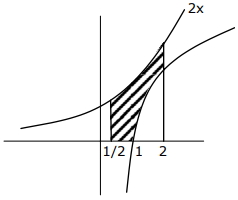
0 likesView Solution
399
MathematicsDifficultMCQJEE Main · 2021
Let $y=y(x)$ be the solution of the differential equation $\log _{e}\left(\frac{d y}{d x}\right)=3 x+4 y$,with $y(0)=0$. If $y\left(-\frac{2}{3} \log _{e} 2\right)=\alpha \log _{e} 2$,then the value of $\alpha$ is equal to:
A
$-\frac{1}{2}$
B
$-\frac{1}{4}$
C
$2$
D
$\frac{1}{4}$
Solution
(B) Given the differential equation $\log _{e}\left(\frac{d y}{d x}\right)=3 x+4 y$,we can write it as $\frac{d y}{d x}=e^{3 x+4 y}=e^{3 x} \cdot e^{4 y}$.
Separating the variables,we get $e^{-4 y} d y=e^{3 x} d x$.
Integrating both sides,$\int e^{-4 y} d y=\int e^{3 x} d x$,which gives $-\frac{1}{4} e^{-4 y}=\frac{1}{3} e^{3 x}+C$.
Using the initial condition $y(0)=0$,we substitute $x=0$ and $y=0$: $-\frac{1}{4} e^{0}=\frac{1}{3} e^{0}+C \Rightarrow -\frac{1}{4}=\frac{1}{3}+C \Rightarrow C=-\frac{1}{4}-\frac{1}{3}=-\frac{7}{12}$.
Thus,$-\frac{1}{4} e^{-4 y}=\frac{1}{3} e^{3 x}-\frac{7}{12}$.
Multiplying by $-12$,we get $3 e^{-4 y} = 7 - 4 e^{3 x}$,so $e^{-4 y} = \frac{7 - 4 e^{3 x}}{3}$.
Taking the reciprocal,$e^{4 y} = \frac{3}{7 - 4 e^{3 x}}$,so $4 y = \log _{e} \left(\frac{3}{7 - 4 e^{3 x}}\right)$.
For $x = -\frac{2}{3} \log _{e} 2$,we have $e^{3 x} = e^{3 \left(-\frac{2}{3} \log _{e} 2\right)} = e^{-2 \log _{e} 2} = e^{\log _{e} (2^{-2})} = 2^{-2} = \frac{1}{4}$.
Substituting this into the equation for $4y$: $4 y = \log _{e} \left(\frac{3}{7 - 4(1/4)}\right) = \log _{e} \left(\frac{3}{7 - 1}\right) = \log _{e} \left(\frac{3}{6}\right) = \log _{e} \left(\frac{1}{2}\right) = -\log _{e} 2$.
Therefore,$y = -\frac{1}{4} \log _{e} 2$. Comparing this with $y = \alpha \log _{e} 2$,we get $\alpha = -\frac{1}{4}$.
Separating the variables,we get $e^{-4 y} d y=e^{3 x} d x$.
Integrating both sides,$\int e^{-4 y} d y=\int e^{3 x} d x$,which gives $-\frac{1}{4} e^{-4 y}=\frac{1}{3} e^{3 x}+C$.
Using the initial condition $y(0)=0$,we substitute $x=0$ and $y=0$: $-\frac{1}{4} e^{0}=\frac{1}{3} e^{0}+C \Rightarrow -\frac{1}{4}=\frac{1}{3}+C \Rightarrow C=-\frac{1}{4}-\frac{1}{3}=-\frac{7}{12}$.
Thus,$-\frac{1}{4} e^{-4 y}=\frac{1}{3} e^{3 x}-\frac{7}{12}$.
Multiplying by $-12$,we get $3 e^{-4 y} = 7 - 4 e^{3 x}$,so $e^{-4 y} = \frac{7 - 4 e^{3 x}}{3}$.
Taking the reciprocal,$e^{4 y} = \frac{3}{7 - 4 e^{3 x}}$,so $4 y = \log _{e} \left(\frac{3}{7 - 4 e^{3 x}}\right)$.
For $x = -\frac{2}{3} \log _{e} 2$,we have $e^{3 x} = e^{3 \left(-\frac{2}{3} \log _{e} 2\right)} = e^{-2 \log _{e} 2} = e^{\log _{e} (2^{-2})} = 2^{-2} = \frac{1}{4}$.
Substituting this into the equation for $4y$: $4 y = \log _{e} \left(\frac{3}{7 - 4(1/4)}\right) = \log _{e} \left(\frac{3}{7 - 1}\right) = \log _{e} \left(\frac{3}{6}\right) = \log _{e} \left(\frac{1}{2}\right) = -\log _{e} 2$.
Therefore,$y = -\frac{1}{4} \log _{e} 2$. Comparing this with $y = \alpha \log _{e} 2$,we get $\alpha = -\frac{1}{4}$.
0 likesView Solution
400
MathematicsMediumMCQJEE Main · 2021
Let $A = \begin{bmatrix} 1 & 2 \\ -1 & 4 \end{bmatrix}$. If $A^{-1} = \alpha I + \beta A$,where $\alpha, \beta \in \mathbb{R}$ and $I$ is a $2 \times 2$ identity matrix,then $4(\alpha - \beta)$ is equal to:
A
$5$
B
$4$
C
$2$
D
$\frac{8}{3}$
Solution
(B) Given $A = \begin{bmatrix} 1 & 2 \\ -1 & 4 \end{bmatrix}$.
First,we find the determinant of $A$: $|A| = (1)(4) - (2)(-1) = 4 + 2 = 6$.
Next,we find the adjoint of $A$: $\text{adj}(A) = \begin{bmatrix} 4 & -2 \\ 1 & 1 \end{bmatrix}$.
Thus,$A^{-1} = \frac{1}{|A|} \text{adj}(A) = \frac{1}{6} \begin{bmatrix} 4 & -2 \\ 1 & 1 \end{bmatrix} = \begin{bmatrix} \frac{2}{3} & -\frac{1}{3} \\ \frac{1}{6} & \frac{1}{6} \end{bmatrix}$.
We are given $A^{-1} = \alpha I + \beta A$,so:
$\begin{bmatrix} \frac{2}{3} & -\frac{1}{3} \\ \frac{1}{6} & \frac{1}{6} \end{bmatrix} = \alpha \begin{bmatrix} 1 & 0 \\ 0 & 1 \end{bmatrix} + \beta \begin{bmatrix} 1 & 2 \\ -1 & 4 \end{bmatrix} = \begin{bmatrix} \alpha + \beta & 2\beta \\ -\beta & \alpha + 4\beta \end{bmatrix}$.
Comparing the elements,we get:
$2\beta = -\frac{1}{3} \implies \beta = -\frac{1}{6}$.
$\alpha + \beta = \frac{2}{3} \implies \alpha - \frac{1}{6} = \frac{2}{3} \implies \alpha = \frac{2}{3} + \frac{1}{6} = \frac{5}{6}$.
Finally,calculate $4(\alpha - \beta) = 4(\frac{5}{6} - (-\frac{1}{6})) = 4(\frac{5}{6} + \frac{1}{6}) = 4(1) = 4$.
First,we find the determinant of $A$: $|A| = (1)(4) - (2)(-1) = 4 + 2 = 6$.
Next,we find the adjoint of $A$: $\text{adj}(A) = \begin{bmatrix} 4 & -2 \\ 1 & 1 \end{bmatrix}$.
Thus,$A^{-1} = \frac{1}{|A|} \text{adj}(A) = \frac{1}{6} \begin{bmatrix} 4 & -2 \\ 1 & 1 \end{bmatrix} = \begin{bmatrix} \frac{2}{3} & -\frac{1}{3} \\ \frac{1}{6} & \frac{1}{6} \end{bmatrix}$.
We are given $A^{-1} = \alpha I + \beta A$,so:
$\begin{bmatrix} \frac{2}{3} & -\frac{1}{3} \\ \frac{1}{6} & \frac{1}{6} \end{bmatrix} = \alpha \begin{bmatrix} 1 & 0 \\ 0 & 1 \end{bmatrix} + \beta \begin{bmatrix} 1 & 2 \\ -1 & 4 \end{bmatrix} = \begin{bmatrix} \alpha + \beta & 2\beta \\ -\beta & \alpha + 4\beta \end{bmatrix}$.
Comparing the elements,we get:
$2\beta = -\frac{1}{3} \implies \beta = -\frac{1}{6}$.
$\alpha + \beta = \frac{2}{3} \implies \alpha - \frac{1}{6} = \frac{2}{3} \implies \alpha = \frac{2}{3} + \frac{1}{6} = \frac{5}{6}$.
Finally,calculate $4(\alpha - \beta) = 4(\frac{5}{6} - (-\frac{1}{6})) = 4(\frac{5}{6} + \frac{1}{6}) = 4(1) = 4$.
0 likesView Solution
401
MathematicsMediumMCQJEE Main · 2021
Let $f: \left(-\frac{\pi}{4}, \frac{\pi}{4}\right) \rightarrow \mathbb{R}$ be defined as
$f(x) = \begin{cases} (1+|\sin x|)^{\frac{3a}{|\sin x|}}, & -\frac{\pi}{4} < x < 0 \\ b, & x = 0 \\ e^{\frac{\cot 4x}{\cot 2x}}, & 0 < x < \frac{\pi}{4} \end{cases}$
If $f$ is continuous at $x = 0$,then the value of $6a + b^2$ is equal to:
$f(x) = \begin{cases} (1+|\sin x|)^{\frac{3a}{|\sin x|}}, & -\frac{\pi}{4} < x < 0 \\ b, & x = 0 \\ e^{\frac{\cot 4x}{\cot 2x}}, & 0 < x < \frac{\pi}{4} \end{cases}$
If $f$ is continuous at $x = 0$,then the value of $6a + b^2$ is equal to:
A
$e$
B
$1+e$
C
$1-e$
D
$e-1$
Solution
(B) For $f(x)$ to be continuous at $x=0$,we must have $\lim_{x \rightarrow 0^-} f(x) = \lim_{x \rightarrow 0^+} f(x) = f(0) = b$.
First,calculate the right-hand limit:
$\lim_{x \rightarrow 0^+} f(x) = \lim_{x \rightarrow 0^+} e^{\frac{\cot 4x}{\cot 2x}} = \lim_{x \rightarrow 0^+} e^{\frac{\tan 2x}{\tan 4x}} = \lim_{x \rightarrow 0^+} e^{\frac{\tan 2x}{2\tan 2x(1-\tan^2 2x)}} = e^{1/2}$.
Thus,$b = e^{1/2}$.
Next,calculate the left-hand limit:
$\lim_{x \rightarrow 0^-} f(x) = \lim_{x \rightarrow 0^-} (1+|\sin x|)^{\frac{3a}{|\sin x|}} = \lim_{t \rightarrow 0^+} (1+t)^{\frac{3a}{t}} = e^{3a}$ (where $t = |\sin x|$).
Equating the limits,$e^{3a} = e^{1/2}$,which implies $3a = 1/2$,so $a = 1/6$.
Therefore,$6a = 1$.
Finally,$6a + b^2 = 1 + (e^{1/2})^2 = 1 + e$.
First,calculate the right-hand limit:
$\lim_{x \rightarrow 0^+} f(x) = \lim_{x \rightarrow 0^+} e^{\frac{\cot 4x}{\cot 2x}} = \lim_{x \rightarrow 0^+} e^{\frac{\tan 2x}{\tan 4x}} = \lim_{x \rightarrow 0^+} e^{\frac{\tan 2x}{2\tan 2x(1-\tan^2 2x)}} = e^{1/2}$.
Thus,$b = e^{1/2}$.
Next,calculate the left-hand limit:
$\lim_{x \rightarrow 0^-} f(x) = \lim_{x \rightarrow 0^-} (1+|\sin x|)^{\frac{3a}{|\sin x|}} = \lim_{t \rightarrow 0^+} (1+t)^{\frac{3a}{t}} = e^{3a}$ (where $t = |\sin x|$).
Equating the limits,$e^{3a} = e^{1/2}$,which implies $3a = 1/2$,so $a = 1/6$.
Therefore,$6a = 1$.
Finally,$6a + b^2 = 1 + (e^{1/2})^2 = 1 + e$.
0 likesView Solution
402
MathematicsDifficultMCQJEE Main · 2021
Let $\vec{a}=\hat{i}+\hat{j}+2 \hat{k}$ and $\vec{b}=-\hat{i}+2 \hat{j}+3 \hat{k}$. Then the vector product $(\vec{a}+\vec{b}) \times((\vec{a} \times((\vec{a}-\vec{b}) \times \vec{b})) \times \vec{b})$ is equal to:
A
$5(30 \hat{i}-5 \hat{j}+7 \hat{k})$
B
$5(34 \hat{i}-5 \hat{j}+3 \hat{k})$
C
$7(30 \hat{i}-5 \hat{j}+7 \hat{k})$
D
$7(34 \hat{i}-5 \hat{j}+3 \hat{k})$
Solution
(D) Given $\vec{a}=\hat{i}+\hat{j}+2 \hat{k}$ and $\vec{b}=-\hat{i}+2 \hat{j}+3 \hat{k}$.
First,calculate $\vec{a}+\vec{b} = (1-1)\hat{i} + (1+2)\hat{j} + (2+3)\hat{k} = 3\hat{j} + 5\hat{k}$.
Next,simplify the expression $E = ((\vec{a} \times((\vec{a}-\vec{b}) \times \vec{b})) \times \vec{b})$.
Using the property $(\vec{a}-\vec{b}) \times \vec{b} = \vec{a} \times \vec{b} - \vec{b} \times \vec{b} = \vec{a} \times \vec{b}$.
So,$E = ((\vec{a} \times (\vec{a} \times \vec{b})) \times \vec{b})$.
Using the vector triple product formula $\vec{u} \times (\vec{v} \times \vec{w}) = (\vec{u} \cdot \vec{w})\vec{v} - (\vec{u} \cdot \vec{v})\vec{w}$,we have:
$\vec{a} \times (\vec{a} \times \vec{b}) = (\vec{a} \cdot \vec{b})\vec{a} - (\vec{a} \cdot \vec{a})\vec{b}$.
Then $E = ((\vec{a} \cdot \vec{b})\vec{a} - (\vec{a} \cdot \vec{a})\vec{b}) \times \vec{b} = (\vec{a} \cdot \vec{b})(\vec{a} \times \vec{b}) - (\vec{a} \cdot \vec{a})(\vec{b} \times \vec{b}) = (\vec{a} \cdot \vec{b})(\vec{a} \times \vec{b})$.
Calculate $\vec{a} \cdot \vec{b} = (1)(-1) + (1)(2) + (2)(3) = -1 + 2 + 6 = 7$.
Calculate $\vec{a} \times \vec{b} = \begin{vmatrix} \hat{i} & \hat{j} & \hat{k} \\ 1 & 1 & 2 \\ -1 & 2 & 3 \end{vmatrix} = \hat{i}(3-4) - \hat{j}(3+2) + \hat{k}(2+1) = -\hat{i} - 5\hat{j} + 3\hat{k}$.
Thus,$E = 7(-\hat{i} - 5\hat{j} + 3\hat{k})$.
Finally,calculate $(\vec{a}+\vec{b}) \times E = (3\hat{j} + 5\hat{k}) \times 7(-\hat{i} - 5\hat{j} + 3\hat{k}) = 7 \begin{vmatrix} \hat{i} & \hat{j} & \hat{k} \\ 0 & 3 & 5 \\ -1 & -5 & 3 \end{vmatrix}$.
$= 7 [\hat{i}(9 - (-25)) - \hat{j}(0 - (-5)) + \hat{k}(0 - (-3))] = 7(34\hat{i} - 5\hat{j} + 3\hat{k})$.
First,calculate $\vec{a}+\vec{b} = (1-1)\hat{i} + (1+2)\hat{j} + (2+3)\hat{k} = 3\hat{j} + 5\hat{k}$.
Next,simplify the expression $E = ((\vec{a} \times((\vec{a}-\vec{b}) \times \vec{b})) \times \vec{b})$.
Using the property $(\vec{a}-\vec{b}) \times \vec{b} = \vec{a} \times \vec{b} - \vec{b} \times \vec{b} = \vec{a} \times \vec{b}$.
So,$E = ((\vec{a} \times (\vec{a} \times \vec{b})) \times \vec{b})$.
Using the vector triple product formula $\vec{u} \times (\vec{v} \times \vec{w}) = (\vec{u} \cdot \vec{w})\vec{v} - (\vec{u} \cdot \vec{v})\vec{w}$,we have:
$\vec{a} \times (\vec{a} \times \vec{b}) = (\vec{a} \cdot \vec{b})\vec{a} - (\vec{a} \cdot \vec{a})\vec{b}$.
Then $E = ((\vec{a} \cdot \vec{b})\vec{a} - (\vec{a} \cdot \vec{a})\vec{b}) \times \vec{b} = (\vec{a} \cdot \vec{b})(\vec{a} \times \vec{b}) - (\vec{a} \cdot \vec{a})(\vec{b} \times \vec{b}) = (\vec{a} \cdot \vec{b})(\vec{a} \times \vec{b})$.
Calculate $\vec{a} \cdot \vec{b} = (1)(-1) + (1)(2) + (2)(3) = -1 + 2 + 6 = 7$.
Calculate $\vec{a} \times \vec{b} = \begin{vmatrix} \hat{i} & \hat{j} & \hat{k} \\ 1 & 1 & 2 \\ -1 & 2 & 3 \end{vmatrix} = \hat{i}(3-4) - \hat{j}(3+2) + \hat{k}(2+1) = -\hat{i} - 5\hat{j} + 3\hat{k}$.
Thus,$E = 7(-\hat{i} - 5\hat{j} + 3\hat{k})$.
Finally,calculate $(\vec{a}+\vec{b}) \times E = (3\hat{j} + 5\hat{k}) \times 7(-\hat{i} - 5\hat{j} + 3\hat{k}) = 7 \begin{vmatrix} \hat{i} & \hat{j} & \hat{k} \\ 0 & 3 & 5 \\ -1 & -5 & 3 \end{vmatrix}$.
$= 7 [\hat{i}(9 - (-25)) - \hat{j}(0 - (-5)) + \hat{k}(0 - (-3))] = 7(34\hat{i} - 5\hat{j} + 3\hat{k})$.
0 likesView Solution
403
MathematicsDifficultMCQJEE Main · 2021
The value of the definite integral $\int_{-\frac{\pi}{4}}^{\frac{\pi}{4}} \frac{d x}{\left(1+e^{x \cos x}\right)\left(\sin ^{4} x+\cos ^{4} x\right)}$ is equal to:
A
$\frac{\pi}{\sqrt{2}}$
B
$-\frac{\pi}{4}$
C
$\frac{\pi}{2 \sqrt{2}}$
D
$-\frac{\pi}{2}$
Solution
(C) Let $I = \int_{-\frac{\pi}{4}}^{\frac{\pi}{4}} \frac{d x}{\left(1+e^{x \cos x}\right)\left(\sin ^{4} x+\cos ^{4} x\right)} \cdots(1)$
Using the property $\int_{a}^{b} f(x) d x = \int_{a}^{b} f(a+b-x) d x$,where $a = -\frac{\pi}{4}$ and $b = \frac{\pi}{4}$,we get $a+b = 0$. Thus,$f(x)$ becomes $f(-x)$:
$I = \int_{-\frac{\pi}{4}}^{\frac{\pi}{4}} \frac{d x}{\left(1+e^{-x \cos(-x)}\right)\left(\sin ^{4}(-x)+\cos ^{4}(-x)\right)} = \int_{-\frac{\pi}{4}}^{\frac{\pi}{4}} \frac{d x}{\left(1+e^{-x \cos x}\right)\left(\sin ^{4} x+\cos ^{4} x\right)} \cdots(2)$
Adding $(1)$ and $(2)$:
$2I = \int_{-\frac{\pi}{4}}^{\frac{\pi}{4}} \left( \frac{1}{1+e^{x \cos x}} + \frac{1}{1+e^{-x \cos x}} \right) \frac{d x}{\sin ^{4} x+\cos ^{4} x}$
Since $\frac{1}{1+e^{x \cos x}} + \frac{1}{1+e^{-x \cos x}} = \frac{1}{1+e^{x \cos x}} + \frac{e^{x \cos x}}{e^{x \cos x}+1} = 1$,we have:
$2I = \int_{-\frac{\pi}{4}}^{\frac{\pi}{4}} \frac{d x}{\sin ^{4} x+\cos ^{4} x} = 2 \int_{0}^{\frac{\pi}{4}} \frac{d x}{\sin ^{4} x+\cos ^{4} x}$
$I = \int_{0}^{\frac{\pi}{4}} \frac{d x}{\sin ^{4} x+\cos ^{4} x} = \int_{0}^{\frac{\pi}{4}} \frac{\sec^4 x}{\tan^4 x + 1} dx = \int_{0}^{\frac{\pi}{4}} \frac{(1+\tan^2 x) \sec^2 x}{\tan^4 x + 1} dx$
Let $\tan x = u$,then $\sec^2 x dx = du$. As $x \to 0, u \to 0$ and $x \to \frac{\pi}{4}, u \to 1$:
$I = \int_{0}^{1} \frac{1+u^2}{u^4+1} du = \int_{0}^{1} \frac{1+\frac{1}{u^2}}{u^2+\frac{1}{u^2}} du = \int_{0}^{1} \frac{1+\frac{1}{u^2}}{(u-\frac{1}{u})^2 + 2} du$
Let $u-\frac{1}{u} = t$,then $(1+\frac{1}{u^2}) du = dt$. As $u \to 0, t \to -\infty$ and $u \to 1, t \to 0$:
$I = \int_{-\infty}^{0} \frac{dt}{t^2+2} = \left[ \frac{1}{\sqrt{2}} \tan^{-1} \left( \frac{t}{\sqrt{2}} \right) \right]_{-\infty}^{0} = \frac{1}{\sqrt{2}} (0 - (-\frac{\pi}{2})) = \frac{\pi}{2\sqrt{2}}$
Using the property $\int_{a}^{b} f(x) d x = \int_{a}^{b} f(a+b-x) d x$,where $a = -\frac{\pi}{4}$ and $b = \frac{\pi}{4}$,we get $a+b = 0$. Thus,$f(x)$ becomes $f(-x)$:
$I = \int_{-\frac{\pi}{4}}^{\frac{\pi}{4}} \frac{d x}{\left(1+e^{-x \cos(-x)}\right)\left(\sin ^{4}(-x)+\cos ^{4}(-x)\right)} = \int_{-\frac{\pi}{4}}^{\frac{\pi}{4}} \frac{d x}{\left(1+e^{-x \cos x}\right)\left(\sin ^{4} x+\cos ^{4} x\right)} \cdots(2)$
Adding $(1)$ and $(2)$:
$2I = \int_{-\frac{\pi}{4}}^{\frac{\pi}{4}} \left( \frac{1}{1+e^{x \cos x}} + \frac{1}{1+e^{-x \cos x}} \right) \frac{d x}{\sin ^{4} x+\cos ^{4} x}$
Since $\frac{1}{1+e^{x \cos x}} + \frac{1}{1+e^{-x \cos x}} = \frac{1}{1+e^{x \cos x}} + \frac{e^{x \cos x}}{e^{x \cos x}+1} = 1$,we have:
$2I = \int_{-\frac{\pi}{4}}^{\frac{\pi}{4}} \frac{d x}{\sin ^{4} x+\cos ^{4} x} = 2 \int_{0}^{\frac{\pi}{4}} \frac{d x}{\sin ^{4} x+\cos ^{4} x}$
$I = \int_{0}^{\frac{\pi}{4}} \frac{d x}{\sin ^{4} x+\cos ^{4} x} = \int_{0}^{\frac{\pi}{4}} \frac{\sec^4 x}{\tan^4 x + 1} dx = \int_{0}^{\frac{\pi}{4}} \frac{(1+\tan^2 x) \sec^2 x}{\tan^4 x + 1} dx$
Let $\tan x = u$,then $\sec^2 x dx = du$. As $x \to 0, u \to 0$ and $x \to \frac{\pi}{4}, u \to 1$:
$I = \int_{0}^{1} \frac{1+u^2}{u^4+1} du = \int_{0}^{1} \frac{1+\frac{1}{u^2}}{u^2+\frac{1}{u^2}} du = \int_{0}^{1} \frac{1+\frac{1}{u^2}}{(u-\frac{1}{u})^2 + 2} du$
Let $u-\frac{1}{u} = t$,then $(1+\frac{1}{u^2}) du = dt$. As $u \to 0, t \to -\infty$ and $u \to 1, t \to 0$:
$I = \int_{-\infty}^{0} \frac{dt}{t^2+2} = \left[ \frac{1}{\sqrt{2}} \tan^{-1} \left( \frac{t}{\sqrt{2}} \right) \right]_{-\infty}^{0} = \frac{1}{\sqrt{2}} (0 - (-\frac{\pi}{2})) = \frac{\pi}{2\sqrt{2}}$
0 likesView Solution
404
MathematicsMediumMCQJEE Main · 2021
Let the plane passing through the point $(-1, 0, -2)$ and perpendicular to each of the planes $2x + y - z = 2$ and $x - y - z = 3$ be $ax + by + cz + 8 = 0$. Then the value of $a + b + c$ is equal to:
A
$8$
B
$4$
C
$3$
D
$5$
Solution
(B) The normal vector $\vec{n}$ of the required plane is perpendicular to the normals of the given planes $\vec{n}_1 = 2\hat{i} + \hat{j} - \hat{k}$ and $\vec{n}_2 = \hat{i} - \hat{j} - \hat{k}$.
Thus,$\vec{n} = \vec{n}_1 \times \vec{n}_2 = \begin{vmatrix} \hat{i} & \hat{j} & \hat{k} \\ 2 & 1 & -1 \\ 1 & -1 & -1 \end{vmatrix} = \hat{i}(-1 - 1) - \hat{j}(-2 + 1) + \hat{k}(-2 - 1) = -2\hat{i} + \hat{j} - 3\hat{k}$.
The equation of the plane passing through $(-1, 0, -2)$ with normal vector $\vec{n} = -2\hat{i} + \hat{j} - 3\hat{k}$ is:
$-2(x + 1) + 1(y - 0) - 3(z + 2) = 0$
$-2x - 2 + y - 3z - 6 = 0$
$-2x + y - 3z - 8 = 0$
Multiplying by $-1$,we get $2x - y + 3z + 8 = 0$.
Comparing this with $ax + by + cz + 8 = 0$,we have $a = 2$,$b = -1$,and $c = 3$.
Therefore,$a + b + c = 2 - 1 + 3 = 4$.
Thus,$\vec{n} = \vec{n}_1 \times \vec{n}_2 = \begin{vmatrix} \hat{i} & \hat{j} & \hat{k} \\ 2 & 1 & -1 \\ 1 & -1 & -1 \end{vmatrix} = \hat{i}(-1 - 1) - \hat{j}(-2 + 1) + \hat{k}(-2 - 1) = -2\hat{i} + \hat{j} - 3\hat{k}$.
The equation of the plane passing through $(-1, 0, -2)$ with normal vector $\vec{n} = -2\hat{i} + \hat{j} - 3\hat{k}$ is:
$-2(x + 1) + 1(y - 0) - 3(z + 2) = 0$
$-2x - 2 + y - 3z - 6 = 0$
$-2x + y - 3z - 8 = 0$
Multiplying by $-1$,we get $2x - y + 3z + 8 = 0$.
Comparing this with $ax + by + cz + 8 = 0$,we have $a = 2$,$b = -1$,and $c = 3$.
Therefore,$a + b + c = 2 - 1 + 3 = 4$.
0 likesView Solution
405
MathematicsDifficultMCQJEE Main · 2021
The value of $\lim _{n \rightarrow \infty} \frac{1}{n} \sum_{j=1}^{n} \frac{(2 j-1)+8 n}{(2 j-1)+4 n}$ is equal to:
A
$2-\log _{e}\left(\frac{2}{3}\right)$
B
$3+2 \log _{e}\left(\frac{2}{3}\right)$
C
$1+2 \log _{e}\left(\frac{3}{2}\right)$
D
$5+\log _{e}\left(\frac{3}{2}\right)$
Solution
(C) We are given the limit $L = \lim _{n \rightarrow \infty} \frac{1}{n} \sum_{j=1}^{n} \frac{(2 j-1)+8 n}{(2 j-1)+4 n}$.
Dividing the numerator and denominator of the term inside the sum by $n$,we get:
$L = \lim _{n \rightarrow \infty} \frac{1}{n} \sum_{j=1}^{n} \frac{2(\frac{j}{n}) - \frac{1}{n} + 8}{2(\frac{j}{n}) - \frac{1}{n} + 4}$.
Using the definition of the definite integral as the limit of a Riemann sum,where $\frac{j}{n} \rightarrow x$ and $\frac{1}{n} \rightarrow dx$ as $n \rightarrow \infty$,the expression becomes:
$L = \int_{0}^{1} \frac{2x + 8}{2x + 4} dx$.
We can simplify the integrand as follows:
$\frac{2x + 8}{2x + 4} = \frac{(2x + 4) + 4}{2x + 4} = 1 + \frac{4}{2x + 4} = 1 + \frac{2}{x + 2}$.
Now,integrate with respect to $x$ from $0$ to $1$:
$L = \int_{0}^{1} (1 + \frac{2}{x + 2}) dx = [x + 2 \ln|x + 2|]_{0}^{1}$.
Evaluating the definite integral:
$L = (1 + 2 \ln(3)) - (0 + 2 \ln(2)) = 1 + 2(\ln(3) - \ln(2)) = 1 + 2 \ln(\frac{3}{2})$.
Thus,the correct option is $C$.
Dividing the numerator and denominator of the term inside the sum by $n$,we get:
$L = \lim _{n \rightarrow \infty} \frac{1}{n} \sum_{j=1}^{n} \frac{2(\frac{j}{n}) - \frac{1}{n} + 8}{2(\frac{j}{n}) - \frac{1}{n} + 4}$.
Using the definition of the definite integral as the limit of a Riemann sum,where $\frac{j}{n} \rightarrow x$ and $\frac{1}{n} \rightarrow dx$ as $n \rightarrow \infty$,the expression becomes:
$L = \int_{0}^{1} \frac{2x + 8}{2x + 4} dx$.
We can simplify the integrand as follows:
$\frac{2x + 8}{2x + 4} = \frac{(2x + 4) + 4}{2x + 4} = 1 + \frac{4}{2x + 4} = 1 + \frac{2}{x + 2}$.
Now,integrate with respect to $x$ from $0$ to $1$:
$L = \int_{0}^{1} (1 + \frac{2}{x + 2}) dx = [x + 2 \ln|x + 2|]_{0}^{1}$.
Evaluating the definite integral:
$L = (1 + 2 \ln(3)) - (0 + 2 \ln(2)) = 1 + 2(\ln(3) - \ln(2)) = 1 + 2 \ln(\frac{3}{2})$.
Thus,the correct option is $C$.
0 likesView Solution
406
MathematicsDifficultMCQJEE Main · 2021
$f(x) = \left| \begin{array}{ccc} \sin^2 x & -2 + \cos^2 x & \cos 2x \\ 2 + \sin^2 x & \cos^2 x & \cos 2x \\ \sin^2 x & \cos^2 x & 1 + \cos 2x \end{array} \right|, x \in [0, \pi]$. The maximum value of $f(x)$ is equal to $.....$
A
$6$
B
$7$
C
$8$
D
$9$
Solution
(A) Given the determinant $f(x) = \left| \begin{array}{ccc} \sin^2 x & -2 + \cos^2 x & \cos 2x \\ 2 + \sin^2 x & \cos^2 x & \cos 2x \\ \sin^2 x & \cos^2 x & 1 + \cos 2x \end{array} \right|$.
Applying row operations $R_1 \rightarrow R_1 - R_2$ and $R_2 \rightarrow R_2 - R_3$:
$f(x) = \left| \begin{array}{ccc} -2 & -2 & 0 \\ 2 & 0 & -1 \\ \sin^2 x & \cos^2 x & 1 + \cos 2x \end{array} \right|$.
Expanding along the first row:
$f(x) = -2(0 - (-\cos^2 x)) - (-2)(2(1 + \cos 2x) - (-\sin^2 x)) + 0$
$f(x) = -2 \cos^2 x + 2(2 + 2 \cos 2x + \sin^2 x)$
$f(x) = -2 \cos^2 x + 4 + 4 \cos 2x + 2 \sin^2 x$
$f(x) = 4 + 4 \cos 2x - 2(\cos^2 x - \sin^2 x)$
Since $\cos 2x = \cos^2 x - \sin^2 x$,we have:
$f(x) = 4 + 4 \cos 2x - 2 \cos 2x = 4 + 2 \cos 2x$.
For $x \in [0, \pi]$,the maximum value of $\cos 2x$ is $1$.
Therefore,$f(x)_{\text{max}} = 4 + 2(1) = 6$.
Applying row operations $R_1 \rightarrow R_1 - R_2$ and $R_2 \rightarrow R_2 - R_3$:
$f(x) = \left| \begin{array}{ccc} -2 & -2 & 0 \\ 2 & 0 & -1 \\ \sin^2 x & \cos^2 x & 1 + \cos 2x \end{array} \right|$.
Expanding along the first row:
$f(x) = -2(0 - (-\cos^2 x)) - (-2)(2(1 + \cos 2x) - (-\sin^2 x)) + 0$
$f(x) = -2 \cos^2 x + 2(2 + 2 \cos 2x + \sin^2 x)$
$f(x) = -2 \cos^2 x + 4 + 4 \cos 2x + 2 \sin^2 x$
$f(x) = 4 + 4 \cos 2x - 2(\cos^2 x - \sin^2 x)$
Since $\cos 2x = \cos^2 x - \sin^2 x$,we have:
$f(x) = 4 + 4 \cos 2x - 2 \cos 2x = 4 + 2 \cos 2x$.
For $x \in [0, \pi]$,the maximum value of $\cos 2x$ is $1$.
Therefore,$f(x)_{\text{max}} = 4 + 2(1) = 6$.
0 likesView Solution
407
MathematicsAdvancedMCQJEE Main · 2021
Let $F:[3,5] \rightarrow R$ be a twice differentiable function on $(3,5)$ such that $F(x)=e^{-x} \int_{3}^{x} (3t^{2}+2t+4F^{\prime}(t)) \,dt$. If $F^{\prime}(4)=\frac{\alpha e^{\beta}-224}{(e^{\beta}-4)^{2}}$,then $\alpha+\beta$ is equal to $....$
A
$8$
B
$16$
C
$48$
D
$32$
Solution
(B) Given $F(x) = e^{-x} \int_{3}^{x} (3t^{2}+2t+4F^{\prime}(t)) \,dt$. Note that $F(3) = 0$.
Multiply by $e^{x}$: $e^{x}F(x) = \int_{3}^{x} (3t^{2}+2t+4F^{\prime}(t)) \,dt$.
Differentiating both sides with respect to $x$ using the Leibniz rule:
$e^{x}F(x) + e^{x}F^{\prime}(x) = 3x^{2}+2x+4F^{\prime}(x)$.
Rearranging terms: $(e^{x}-4)F^{\prime}(x) + e^{x}F(x) = 3x^{2}+2x$.
This is a linear differential equation of the form $\frac{d}{dx} [F(x)(e^{x}-4)] = 3x^{2}+2x$.
Integrating both sides with respect to $x$: $F(x)(e^{x}-4) = \int (3x^{2}+2x) \,dx = x^{3}+x^{2}+C$.
Since $F(3) = 0$,we have $0 = 3^{3}+3^{2}+C \Rightarrow C = -36$.
Thus,$F(x) = \frac{x^{3}+x^{2}-36}{e^{x}-4}$.
Now,$F^{\prime}(x) = \frac{(3x^{2}+2x)(e^{x}-4) - (x^{3}+x^{2}-36)e^{x}}{(e^{x}-4)^{2}}$.
At $x=4$: $F^{\prime}(4) = \frac{(3(16)+2(4))(e^{4}-4) - (64+16-36)e^{4}}{(e^{4}-4)^{2}} = \frac{56(e^{4}-4) - 44e^{4}}{(e^{4}-4)^{2}} = \frac{12e^{4}-224}{(e^{4}-4)^{2}}$.
Comparing with $\frac{\alpha e^{\beta}-224}{(e^{\beta}-4)^{2}}$,we get $\alpha=12$ and $\beta=4$.
Therefore,$\alpha+\beta = 12+4 = 16$.
Multiply by $e^{x}$: $e^{x}F(x) = \int_{3}^{x} (3t^{2}+2t+4F^{\prime}(t)) \,dt$.
Differentiating both sides with respect to $x$ using the Leibniz rule:
$e^{x}F(x) + e^{x}F^{\prime}(x) = 3x^{2}+2x+4F^{\prime}(x)$.
Rearranging terms: $(e^{x}-4)F^{\prime}(x) + e^{x}F(x) = 3x^{2}+2x$.
This is a linear differential equation of the form $\frac{d}{dx} [F(x)(e^{x}-4)] = 3x^{2}+2x$.
Integrating both sides with respect to $x$: $F(x)(e^{x}-4) = \int (3x^{2}+2x) \,dx = x^{3}+x^{2}+C$.
Since $F(3) = 0$,we have $0 = 3^{3}+3^{2}+C \Rightarrow C = -36$.
Thus,$F(x) = \frac{x^{3}+x^{2}-36}{e^{x}-4}$.
Now,$F^{\prime}(x) = \frac{(3x^{2}+2x)(e^{x}-4) - (x^{3}+x^{2}-36)e^{x}}{(e^{x}-4)^{2}}$.
At $x=4$: $F^{\prime}(4) = \frac{(3(16)+2(4))(e^{4}-4) - (64+16-36)e^{4}}{(e^{4}-4)^{2}} = \frac{56(e^{4}-4) - 44e^{4}}{(e^{4}-4)^{2}} = \frac{12e^{4}-224}{(e^{4}-4)^{2}}$.
Comparing with $\frac{\alpha e^{\beta}-224}{(e^{\beta}-4)^{2}}$,we get $\alpha=12$ and $\beta=4$.
Therefore,$\alpha+\beta = 12+4 = 16$.
0 likesView Solution
408
MathematicsMediumMCQJEE Main · 2021
Let a plane $P$ pass through the point $(3, 7, -7)$ and contain the line $\frac{x-2}{-3} = \frac{y-3}{2} = \frac{z+2}{1}$. If the distance of the plane $P$ from the origin is $d$,then $d^{2}$ is equal to $.....$
A
$1$
B
$2$
C
$3$
D
$4$
Solution
(C) The line passes through point $A(2, 3, -2)$ and has direction vector $\vec{v} = -3\hat{i} + 2\hat{j} + \hat{k}$.
The plane passes through point $B(3, 7, -7)$ and point $A(2, 3, -2)$.
The vector $\vec{AB} = (3-2)\hat{i} + (7-3)\hat{j} + (-7 - (-2))\hat{k} = \hat{i} + 4\hat{j} - 5\hat{k}$.
The normal vector $\vec{n}$ to the plane is given by the cross product of $\vec{v}$ and $\vec{AB}$:
$\vec{n} = \vec{v} \times \vec{AB} = \begin{vmatrix} \hat{i} & \hat{j} & \hat{k} \\ -3 & 2 & 1 \\ 1 & 4 & -5 \end{vmatrix} = \hat{i}(-10-4) - \hat{j}(15-1) + \hat{k}(-12-2) = -14\hat{i} - 14\hat{j} - 14\hat{k}$.
We can take the normal vector as $\vec{n} = \hat{i} + \hat{j} + \hat{k}$.
The equation of the plane is $1(x-2) + 1(y-3) + 1(z+2) = 0$,which simplifies to $x + y + z - 3 = 0$.
The distance $d$ from the origin $(0, 0, 0)$ to the plane $x + y + z - 3 = 0$ is $d = \frac{|0+0+0-3|}{\sqrt{1^2+1^2+1^2}} = \frac{3}{\sqrt{3}} = \sqrt{3}$.
Therefore,$d^{2} = (\sqrt{3})^{2} = 3$.
The plane passes through point $B(3, 7, -7)$ and point $A(2, 3, -2)$.
The vector $\vec{AB} = (3-2)\hat{i} + (7-3)\hat{j} + (-7 - (-2))\hat{k} = \hat{i} + 4\hat{j} - 5\hat{k}$.
The normal vector $\vec{n}$ to the plane is given by the cross product of $\vec{v}$ and $\vec{AB}$:
$\vec{n} = \vec{v} \times \vec{AB} = \begin{vmatrix} \hat{i} & \hat{j} & \hat{k} \\ -3 & 2 & 1 \\ 1 & 4 & -5 \end{vmatrix} = \hat{i}(-10-4) - \hat{j}(15-1) + \hat{k}(-12-2) = -14\hat{i} - 14\hat{j} - 14\hat{k}$.
We can take the normal vector as $\vec{n} = \hat{i} + \hat{j} + \hat{k}$.
The equation of the plane is $1(x-2) + 1(y-3) + 1(z+2) = 0$,which simplifies to $x + y + z - 3 = 0$.
The distance $d$ from the origin $(0, 0, 0)$ to the plane $x + y + z - 3 = 0$ is $d = \frac{|0+0+0-3|}{\sqrt{1^2+1^2+1^2}} = \frac{3}{\sqrt{3}} = \sqrt{3}$.
Therefore,$d^{2} = (\sqrt{3})^{2} = 3$.
0 likesView Solution
409
MathematicsDifficultMCQJEE Main · 2021
Let $S = \{1, 2, 3, 4, 5, 6, 7\}$. Then the number of possible functions $f: S \rightarrow S$ such that $f(m \cdot n) = f(m) \cdot f(n)$ for every $m, n \in S$ and $m \cdot n \in S$ is equal to $......$
A
$500$
B
$600$
C
$570$
D
$490$
Solution
(D) Given $f(m \cdot n) = f(m) \cdot f(n)$ for all $m, n \in S$ such that $m \cdot n \in S$.
$1$. For $m=1$,$f(n) = f(1) \cdot f(n)$,which implies $f(1) = 1$.
$2$. The values of $f(2), f(3), f(5), f(7)$ determine the function because $f(4) = f(2 \cdot 2) = f(2)^2$ and $f(6) = f(2 \cdot 3) = f(2) \cdot f(3)$.
$3$. Case $1$: $f(2) = 1$. Then $f(4) = 1^2 = 1$ and $f(6) = 1 \cdot f(3) = f(3)$.
$f(3)$ can be any value in $S$ ($7$ choices),$f(5)$ can be any value in $S$ ($7$ choices),and $f(7)$ can be any value in $S$ ($7$ choices).
Number of functions = $1 \times 1 \times 7 \times 1 \times 7 \times 7 = 343$.
$4$. Case $2$: $f(2) = 2$. Then $f(4) = 2^2 = 4 \in S$ (valid) and $f(6) = 2 \cdot f(3)$.
For $f(6) \in S$,$2 \cdot f(3) \in \{1, 2, 3, 4, 5, 6, 7\}$.
Possible values for $f(3)$ are $1, 2, 3$ (since $2 \cdot 1=2, 2 \cdot 2=4, 2 \cdot 3=6$,all $\in S$).
$f(5)$ can be any value in $S$ ($7$ choices),$f(7)$ can be any value in $S$ ($7$ choices).
Number of functions = $1 \times 3 \times 7 \times 7 = 147$.
$5$. Case $3$: $f(2) = 3$. Then $f(4) = 3^2 = 9 \notin S$ (invalid).
Total number of functions = $343 + 147 = 490$.
$1$. For $m=1$,$f(n) = f(1) \cdot f(n)$,which implies $f(1) = 1$.
$2$. The values of $f(2), f(3), f(5), f(7)$ determine the function because $f(4) = f(2 \cdot 2) = f(2)^2$ and $f(6) = f(2 \cdot 3) = f(2) \cdot f(3)$.
$3$. Case $1$: $f(2) = 1$. Then $f(4) = 1^2 = 1$ and $f(6) = 1 \cdot f(3) = f(3)$.
$f(3)$ can be any value in $S$ ($7$ choices),$f(5)$ can be any value in $S$ ($7$ choices),and $f(7)$ can be any value in $S$ ($7$ choices).
Number of functions = $1 \times 1 \times 7 \times 1 \times 7 \times 7 = 343$.
$4$. Case $2$: $f(2) = 2$. Then $f(4) = 2^2 = 4 \in S$ (valid) and $f(6) = 2 \cdot f(3)$.
For $f(6) \in S$,$2 \cdot f(3) \in \{1, 2, 3, 4, 5, 6, 7\}$.
Possible values for $f(3)$ are $1, 2, 3$ (since $2 \cdot 1=2, 2 \cdot 2=4, 2 \cdot 3=6$,all $\in S$).
$f(5)$ can be any value in $S$ ($7$ choices),$f(7)$ can be any value in $S$ ($7$ choices).
Number of functions = $1 \times 3 \times 7 \times 7 = 147$.
$5$. Case $3$: $f(2) = 3$. Then $f(4) = 3^2 = 9 \notin S$ (invalid).
Total number of functions = $343 + 147 = 490$.
0 likesView Solution
410
MathematicsDifficultMCQJEE Main · 2021
Let $f:[0,3] \rightarrow R$ be defined by $f(x)=\min \{x-[x], 1+[x]-x\}$,where $[x]$ is the greatest integer less than or equal to $x$. Let $P$ denote the set containing all $x \in[0,3]$ where $f$ is discontinuous,and $Q$ denote the set containing all $x \in(0,3)$ where $f$ is not differentiable. Then the sum of number of elements in $P$ and $Q$ is equal to $......$
A
$5$
B
$6$
C
$7$
D
$8$
Solution
(A) Given $f(x) = \min \{x-[x], 1+[x]-x\}$. Let ${x} = x-[x]$. Then $f(x) = \min \{\{x\}, 1-\{x\}\}$.
For $x \in [0, 3)$,the function ${x}$ is periodic with period $1$. The graph of $f(x)$ consists of triangular waves between $0$ and $3$.
Specifically,$f(x) = \{x\}$ when $0 \le \{x\} \le 1/2$ and $f(x) = 1-\{x\}$ when $1/2 < \{x\} < 1$.
$1$. Continuity: The function $f(x)$ is continuous everywhere on $[0, 3]$ because ${x}$ is continuous except at integers,but the $\min$ function makes it continuous at integers as well. Thus,$P = \emptyset$ and the number of elements in $P$ is $0$.
$2$. Differentiability: The function $f(x)$ is not differentiable at points where the two expressions are equal,i.e.,${x} = 1/2$,and at points where ${x}$ is discontinuous,i.e.,$x \in \{1, 2\}$.
In the interval $(0, 3)$,${x} = 1/2$ occurs at $x \in \{1/2, 3/2, 5/2\}$.
The points where $f$ is not differentiable are $Q = \{1/2, 1, 3/2, 2, 5/2\}$.
The number of elements in $Q$ is $5$.
Sum of elements in $P$ and $Q = 0 + 5 = 5$.
For $x \in [0, 3)$,the function ${x}$ is periodic with period $1$. The graph of $f(x)$ consists of triangular waves between $0$ and $3$.
Specifically,$f(x) = \{x\}$ when $0 \le \{x\} \le 1/2$ and $f(x) = 1-\{x\}$ when $1/2 < \{x\} < 1$.
$1$. Continuity: The function $f(x)$ is continuous everywhere on $[0, 3]$ because ${x}$ is continuous except at integers,but the $\min$ function makes it continuous at integers as well. Thus,$P = \emptyset$ and the number of elements in $P$ is $0$.
$2$. Differentiability: The function $f(x)$ is not differentiable at points where the two expressions are equal,i.e.,${x} = 1/2$,and at points where ${x}$ is discontinuous,i.e.,$x \in \{1, 2\}$.
In the interval $(0, 3)$,${x} = 1/2$ occurs at $x \in \{1/2, 3/2, 5/2\}$.
The points where $f$ is not differentiable are $Q = \{1/2, 1, 3/2, 2, 5/2\}$.
The number of elements in $Q$ is $5$.
Sum of elements in $P$ and $Q = 0 + 5 = 5$.
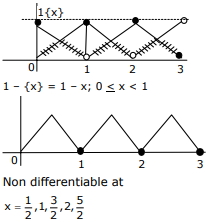
0 likesView Solution
411
MathematicsMediumMCQJEE Main · 2021
For real numbers $\alpha$ and $\beta$,consider the following system of linear equations:
$x+y-z=2, x+2y+\alpha z=1, 2x-y+z=\beta$. If the system has infinite solutions,then $\alpha+\beta$ is equal to $.....$
$x+y-z=2, x+2y+\alpha z=1, 2x-y+z=\beta$. If the system has infinite solutions,then $\alpha+\beta$ is equal to $.....$
A
$4$
B
$5$
C
$6$
D
$7$
Solution
(B) For a system of linear equations to have infinite solutions,the determinant of the coefficient matrix $\Delta$ must be $0$,and the determinants $\Delta_1, \Delta_2, \Delta_3$ must also be $0$.
First,calculate $\Delta$:
$\Delta = \begin{vmatrix} 1 & 1 & -1 \\ 1 & 2 & \alpha \\ 2 & -1 & 1 \end{vmatrix} = 1(2 + \alpha) - 1(1 - 2\alpha) - 1(-1 - 4) = 2 + \alpha - 1 + 2\alpha + 5 = 3\alpha + 6$.
Setting $\Delta = 0$,we get $3\alpha + 6 = 0$,which implies $\alpha = -2$.
Now,substitute $\alpha = -2$ into the system:
$x + y - z = 2$
$x + 2y - 2z = 1$
$2x - y + z = \beta$
For infinite solutions,the augmented matrix must have a rank less than $3$. We can use Cramer's rule or row reduction. Using $\Delta_2 = 0$:
$\Delta_2 = \begin{vmatrix} 1 & 2 & -1 \\ 1 & 1 & -2 \\ 2 & \beta & 1 \end{vmatrix} = 1(1 + 2\beta) - 2(1 + 4) - 1(\beta - 2) = 1 + 2\beta - 10 - \beta + 2 = \beta - 7$.
Setting $\Delta_2 = 0$,we get $\beta = 7$.
Thus,$\alpha + \beta = -2 + 7 = 5$.
First,calculate $\Delta$:
$\Delta = \begin{vmatrix} 1 & 1 & -1 \\ 1 & 2 & \alpha \\ 2 & -1 & 1 \end{vmatrix} = 1(2 + \alpha) - 1(1 - 2\alpha) - 1(-1 - 4) = 2 + \alpha - 1 + 2\alpha + 5 = 3\alpha + 6$.
Setting $\Delta = 0$,we get $3\alpha + 6 = 0$,which implies $\alpha = -2$.
Now,substitute $\alpha = -2$ into the system:
$x + y - z = 2$
$x + 2y - 2z = 1$
$2x - y + z = \beta$
For infinite solutions,the augmented matrix must have a rank less than $3$. We can use Cramer's rule or row reduction. Using $\Delta_2 = 0$:
$\Delta_2 = \begin{vmatrix} 1 & 2 & -1 \\ 1 & 1 & -2 \\ 2 & \beta & 1 \end{vmatrix} = 1(1 + 2\beta) - 2(1 + 4) - 1(\beta - 2) = 1 + 2\beta - 10 - \beta + 2 = \beta - 7$.
Setting $\Delta_2 = 0$,we get $\beta = 7$.
Thus,$\alpha + \beta = -2 + 7 = 5$.
0 likesView Solution
412
MathematicsDifficultMCQJEE Main · 2021
Let the domain of the function $f(x) = \log_{4}(\log_{5}(\log_{3}(18x - x^{2} - 77)))$ be $(a, b)$. Then the value of the integral $\int_{a}^{b} \frac{\sin^{3} x}{\sin^{3} x + \sin^{3}(a + b - x)} dx$ is equal to $.....$
A
$8$
B
$7$
C
$1$
D
$0$
Solution
(C) For the function to be defined,the arguments of the logarithms must be positive:
$\log_{5}(\log_{3}(18x - x^{2} - 77)) > 0 \implies \log_{3}(18x - x^{2} - 77) > 1 \implies 18x - x^{2} - 77 > 3$
$x^{2} - 18x + 80 < 0 \implies (x - 8)(x - 10) < 0 \implies x \in (8, 10)$.
Thus,$a = 8$ and $b = 10$.
Let $I = \int_{a}^{b} \frac{\sin^{3} x}{\sin^{3} x + \sin^{3}(a + b - x)} dx$.
Using the property $\int_{a}^{b} f(x) dx = \int_{a}^{b} f(a + b - x) dx$,we get:
$I = \int_{a}^{b} \frac{\sin^{3}(a + b - x)}{\sin^{3}(a + b - x) + \sin^{3} x} dx$.
Adding the two expressions for $I$:
$2I = \int_{a}^{b} \frac{\sin^{3} x + \sin^{3}(a + b - x)}{\sin^{3} x + \sin^{3}(a + b - x)} dx = \int_{a}^{b} 1 dx = b - a$.
$I = \frac{b - a}{2} = \frac{10 - 8}{2} = 1$.
$\log_{5}(\log_{3}(18x - x^{2} - 77)) > 0 \implies \log_{3}(18x - x^{2} - 77) > 1 \implies 18x - x^{2} - 77 > 3$
$x^{2} - 18x + 80 < 0 \implies (x - 8)(x - 10) < 0 \implies x \in (8, 10)$.
Thus,$a = 8$ and $b = 10$.
Let $I = \int_{a}^{b} \frac{\sin^{3} x}{\sin^{3} x + \sin^{3}(a + b - x)} dx$.
Using the property $\int_{a}^{b} f(x) dx = \int_{a}^{b} f(a + b - x) dx$,we get:
$I = \int_{a}^{b} \frac{\sin^{3}(a + b - x)}{\sin^{3}(a + b - x) + \sin^{3} x} dx$.
Adding the two expressions for $I$:
$2I = \int_{a}^{b} \frac{\sin^{3} x + \sin^{3}(a + b - x)}{\sin^{3} x + \sin^{3}(a + b - x)} dx = \int_{a}^{b} 1 dx = b - a$.
$I = \frac{b - a}{2} = \frac{10 - 8}{2} = 1$.
0 likesView Solution
413
MathematicsMediumMCQJEE Main · 2021
If $y=y(x), y \in [0, \frac{\pi}{2})$ is the solution of the differential equation $\sec y \frac{dy}{dx} - \sin(x+y) - \sin(x-y) = 0$,with $y(0)=0$,then $5y'(\frac{\pi}{2})$ is equal to $......$
A
$1$
B
$2$
C
$3$
D
$4$
Solution
(B) Given the differential equation: $\sec y \frac{dy}{dx} - (\sin(x+y) + \sin(x-y)) = 0$.
Using the identity $\sin(A+B) + \sin(A-B) = 2 \sin A \cos B$,we get:
$\sec y \frac{dy}{dx} - 2 \sin x \cos y = 0$.
$\sec y \frac{dy}{dx} = 2 \sin x \cos y$.
Dividing by $\cos y$ (since $\cos y \neq 0$ for $y \in [0, \frac{\pi}{2})$):
$\sec^2 y \frac{dy}{dx} = 2 \sin x$.
Integrating both sides with respect to $x$:
$\int \sec^2 y dy = \int 2 \sin x dx$.
$\tan y = -2 \cos x + C$.
Given $y(0) = 0$,we substitute $x=0$ and $y=0$:
$\tan(0) = -2 \cos(0) + C \Rightarrow 0 = -2(1) + C \Rightarrow C = 2$.
So,$\tan y = 2 - 2 \cos x$.
Differentiating with respect to $x$:
$\sec^2 y \frac{dy}{dx} = 2 \sin x$.
At $x = \frac{\pi}{2}$,$\tan y = 2 - 2 \cos(\frac{\pi}{2}) = 2 - 0 = 2$.
Since $\tan y = 2$,$\sec^2 y = 1 + \tan^2 y = 1 + 2^2 = 5$.
Substituting into the derivative equation:
$5 \frac{dy}{dx} = 2 \sin(\frac{\pi}{2}) = 2(1) = 2$.
Thus,$5y'(\frac{\pi}{2}) = 2$.
Using the identity $\sin(A+B) + \sin(A-B) = 2 \sin A \cos B$,we get:
$\sec y \frac{dy}{dx} - 2 \sin x \cos y = 0$.
$\sec y \frac{dy}{dx} = 2 \sin x \cos y$.
Dividing by $\cos y$ (since $\cos y \neq 0$ for $y \in [0, \frac{\pi}{2})$):
$\sec^2 y \frac{dy}{dx} = 2 \sin x$.
Integrating both sides with respect to $x$:
$\int \sec^2 y dy = \int 2 \sin x dx$.
$\tan y = -2 \cos x + C$.
Given $y(0) = 0$,we substitute $x=0$ and $y=0$:
$\tan(0) = -2 \cos(0) + C \Rightarrow 0 = -2(1) + C \Rightarrow C = 2$.
So,$\tan y = 2 - 2 \cos x$.
Differentiating with respect to $x$:
$\sec^2 y \frac{dy}{dx} = 2 \sin x$.
At $x = \frac{\pi}{2}$,$\tan y = 2 - 2 \cos(\frac{\pi}{2}) = 2 - 0 = 2$.
Since $\tan y = 2$,$\sec^2 y = 1 + \tan^2 y = 1 + 2^2 = 5$.
Substituting into the derivative equation:
$5 \frac{dy}{dx} = 2 \sin(\frac{\pi}{2}) = 2(1) = 2$.
Thus,$5y'(\frac{\pi}{2}) = 2$.
0 likesView Solution
414
MathematicsMediumMCQJEE Main · 2021
Let $\vec{a} = \hat{i} + \hat{j} + \hat{k}$,$\vec{b}$,and $\vec{c} = \hat{j} - \hat{k}$ be three vectors such that $\vec{a} \times \vec{b} = \vec{c}$ and $\vec{a} \cdot \vec{b} = 1$. If the length of the projection vector of the vector $\vec{b}$ on the vector $\vec{a} \times \vec{c}$ is $l$,then the value of $3l^{2}$ is equal to $.....$
A
$3$
B
$1$
C
$2$
D
$9$
Solution
(C) Given $\vec{a} = \hat{i} + \hat{j} + \hat{k}$,$\vec{c} = \hat{j} - \hat{k}$,$\vec{a} \times \vec{b} = \vec{c}$,and $\vec{a} \cdot \vec{b} = 1$.
First,calculate $\vec{a} \times \vec{c} = (\hat{i} + \hat{j} + \hat{k}) \times (\hat{j} - \hat{k}) = \hat{i}(-1-1) - \hat{j}(-1-0) + \hat{k}(1-0) = -2\hat{i} + \hat{j} + \hat{k}$.
The magnitude $|\vec{a} \times \vec{c}| = \sqrt{(-2)^{2} + 1^{2} + 1^{2}} = \sqrt{4 + 1 + 1} = \sqrt{6}$.
The projection length $l$ of $\vec{b}$ on $\vec{a} \times \vec{c}$ is given by $l = \frac{|\vec{b} \cdot (\vec{a} \times \vec{c})|}{|\vec{a} \times \vec{c}|}$.
Using the scalar triple product property,$\vec{b} \cdot (\vec{a} \times \vec{c}) = -\vec{a} \cdot (\vec{b} \times \vec{c})$. Alternatively,since $\vec{a} \times \vec{b} = \vec{c}$,we have $\vec{b} \cdot (\vec{a} \times \vec{c}) = \vec{b} \cdot (\vec{a} \times (\vec{a} \times \vec{b})) = \vec{b} \cdot ((\vec{a} \cdot \vec{b})\vec{a} - (\vec{a} \cdot \vec{a})\vec{b}) = (\vec{a} \cdot \vec{b})(\vec{b} \cdot \vec{a}) - |\vec{a}|^{2}|\vec{b}|^{2}$.
Easier approach: $(\vec{a} \times \vec{b}) \cdot \vec{c} = \vec{c} \cdot \vec{c} = |\vec{c}|^{2} = 0^{2} + 1^{2} + (-1)^{2} = 2$.
Since $\vec{b} \cdot (\vec{a} \times \vec{c}) = -\vec{c} \cdot (\vec{a} \times \vec{b}) = -|\vec{c}|^{2} = -2$,we have $l = \frac{|-2|}{\sqrt{6}} = \frac{2}{\sqrt{6}}$.
Thus,$l^{2} = \frac{4}{6} = \frac{2}{3}$.
Therefore,$3l^{2} = 3 \times \frac{2}{3} = 2$.
First,calculate $\vec{a} \times \vec{c} = (\hat{i} + \hat{j} + \hat{k}) \times (\hat{j} - \hat{k}) = \hat{i}(-1-1) - \hat{j}(-1-0) + \hat{k}(1-0) = -2\hat{i} + \hat{j} + \hat{k}$.
The magnitude $|\vec{a} \times \vec{c}| = \sqrt{(-2)^{2} + 1^{2} + 1^{2}} = \sqrt{4 + 1 + 1} = \sqrt{6}$.
The projection length $l$ of $\vec{b}$ on $\vec{a} \times \vec{c}$ is given by $l = \frac{|\vec{b} \cdot (\vec{a} \times \vec{c})|}{|\vec{a} \times \vec{c}|}$.
Using the scalar triple product property,$\vec{b} \cdot (\vec{a} \times \vec{c}) = -\vec{a} \cdot (\vec{b} \times \vec{c})$. Alternatively,since $\vec{a} \times \vec{b} = \vec{c}$,we have $\vec{b} \cdot (\vec{a} \times \vec{c}) = \vec{b} \cdot (\vec{a} \times (\vec{a} \times \vec{b})) = \vec{b} \cdot ((\vec{a} \cdot \vec{b})\vec{a} - (\vec{a} \cdot \vec{a})\vec{b}) = (\vec{a} \cdot \vec{b})(\vec{b} \cdot \vec{a}) - |\vec{a}|^{2}|\vec{b}|^{2}$.
Easier approach: $(\vec{a} \times \vec{b}) \cdot \vec{c} = \vec{c} \cdot \vec{c} = |\vec{c}|^{2} = 0^{2} + 1^{2} + (-1)^{2} = 2$.
Since $\vec{b} \cdot (\vec{a} \times \vec{c}) = -\vec{c} \cdot (\vec{a} \times \vec{b}) = -|\vec{c}|^{2} = -2$,we have $l = \frac{|-2|}{\sqrt{6}} = \frac{2}{\sqrt{6}}$.
Thus,$l^{2} = \frac{4}{6} = \frac{2}{3}$.
Therefore,$3l^{2} = 3 \times \frac{2}{3} = 2$.
0 likesView Solution
415
MathematicsMediumMCQJEE Main · 2021
For real numbers $\alpha$ and $\beta \neq 0$,if the point of intersection of the straight lines $\frac{x-\alpha}{1}=\frac{y-1}{2}=\frac{z-1}{3}$ and $\frac{x-4}{\beta}=\frac{y-6}{3}=\frac{z-7}{3}$ lies on the plane $x+2y-z=8$,then $\alpha-\beta$ is equal to:
A
$5$
B
$3$
C
$7$
D
$9$
Solution
(C) Let the first line be $\frac{x-\alpha}{1}=\frac{y-1}{2}=\frac{z-1}{3} = \phi$. Then any point on this line is $(\phi+\alpha, 2\phi+1, 3\phi+1)$.
Let the second line be $\frac{x-4}{\beta}=\frac{y-6}{3}=\frac{z-7}{3} = q$. Then any point on this line is $(q\beta+4, 3q+6, 3q+7)$.
For the lines to intersect,there must exist $\phi$ and $q$ such that:
$\phi+\alpha = q\beta+4$ $(i)$
$2\phi+1 = 3q+6$ (ii)
$3\phi+1 = 3q+7$ (iii)
Subtracting (ii) from (iii),we get $\phi = 1$. Substituting $\phi=1$ into (ii),we get $2(1)+1 = 3q+6$,which implies $3q = -3$,so $q = -1$.
Substituting $\phi=1$ and $q=-1$ into $(i)$,we get $1+\alpha = -\beta+4$,which simplifies to $\alpha+\beta = 3$.
The point of intersection is $(\phi+\alpha, 2\phi+1, 3\phi+1) = (1+\alpha, 3, 4)$.
Since this point lies on the plane $x+2y-z=8$,we have $(1+\alpha) + 2(3) - 4 = 8$.
$1+\alpha+6-4 = 8 \implies \alpha+3 = 8 \implies \alpha = 5$.
Since $\alpha+\beta = 3$,we have $5+\beta = 3 \implies \beta = -2$.
Thus,$\alpha-\beta = 5 - (-2) = 7$.
Let the second line be $\frac{x-4}{\beta}=\frac{y-6}{3}=\frac{z-7}{3} = q$. Then any point on this line is $(q\beta+4, 3q+6, 3q+7)$.
For the lines to intersect,there must exist $\phi$ and $q$ such that:
$\phi+\alpha = q\beta+4$ $(i)$
$2\phi+1 = 3q+6$ (ii)
$3\phi+1 = 3q+7$ (iii)
Subtracting (ii) from (iii),we get $\phi = 1$. Substituting $\phi=1$ into (ii),we get $2(1)+1 = 3q+6$,which implies $3q = -3$,so $q = -1$.
Substituting $\phi=1$ and $q=-1$ into $(i)$,we get $1+\alpha = -\beta+4$,which simplifies to $\alpha+\beta = 3$.
The point of intersection is $(\phi+\alpha, 2\phi+1, 3\phi+1) = (1+\alpha, 3, 4)$.
Since this point lies on the plane $x+2y-z=8$,we have $(1+\alpha) + 2(3) - 4 = 8$.
$1+\alpha+6-4 = 8 \implies \alpha+3 = 8 \implies \alpha = 5$.
Since $\alpha+\beta = 3$,we have $5+\beta = 3 \implies \beta = -2$.
Thus,$\alpha-\beta = 5 - (-2) = 7$.
0 likesView Solution
416
MathematicsDifficultMCQJEE Main · 2021
Let $f: R \rightarrow R$ be defined as $f(x+y)+f(x-y)=2 f(x) f(y)$ and $f\left(\frac{1}{2}\right)=-1$. Then,the value of $\sum_{k=1}^{20} \frac{1}{\sin (k) \sin (k+f(k))}$ is equal to:
A
$\operatorname{cosec}^{2}(1) \operatorname{cosec}(21) \sin (20)$
B
$\sec ^{2}(1) \sec (21) \cos (20)$
C
$\operatorname{cosec}^{2}(21) \cos (20) \cos (2)$
D
$\sec ^{2}(21) \sin (20) \sin (2)$
Solution
(A) The given functional equation is $f(x+y)+f(x-y)=2 f(x) f(y)$.
This is a well-known Cauchy-type functional equation whose solution is $f(x) = \cos(ax)$.
Given $f\left(\frac{1}{2}\right) = -1$,we have $\cos\left(\frac{a}{2}\right) = -1$,which implies $\frac{a}{2} = (2n+1)\pi$,so $a = 2(2n+1)\pi$.
For any integer $k$,$f(k) = \cos(2(2n+1)\pi k) = \cos(2m\pi) = 1$ where $m$ is an integer.
Thus,the expression becomes $\sum_{k=1}^{20} \frac{1}{\sin(k) \sin(k+1)}$.
Using the identity $\frac{1}{\sin(k) \sin(k+1)} = \frac{1}{\sin(1)} \left( \frac{\sin((k+1)-k)}{\sin(k) \sin(k+1)} \right) = \frac{1}{\sin(1)} (\cot(k) - \cot(k+1))$.
Summing from $k=1$ to $20$,we get $\frac{1}{\sin(1)} (\cot(1) - \cot(21))$.
$= \frac{1}{\sin(1)} \left( \frac{\cos(1)}{\sin(1)} - \frac{\cos(21)}{\sin(21)} \right) = \frac{1}{\sin(1)} \left( \frac{\cos(1)\sin(21) - \sin(1)\cos(21)}{\sin(1)\sin(21)} \right)$.
$= \frac{\sin(21-1)}{\sin^2(1) \sin(21)} = \frac{\sin(20)}{\sin^2(1) \sin(21)} = \operatorname{cosec}^2(1) \operatorname{cosec}(21) \sin(20)$.
This is a well-known Cauchy-type functional equation whose solution is $f(x) = \cos(ax)$.
Given $f\left(\frac{1}{2}\right) = -1$,we have $\cos\left(\frac{a}{2}\right) = -1$,which implies $\frac{a}{2} = (2n+1)\pi$,so $a = 2(2n+1)\pi$.
For any integer $k$,$f(k) = \cos(2(2n+1)\pi k) = \cos(2m\pi) = 1$ where $m$ is an integer.
Thus,the expression becomes $\sum_{k=1}^{20} \frac{1}{\sin(k) \sin(k+1)}$.
Using the identity $\frac{1}{\sin(k) \sin(k+1)} = \frac{1}{\sin(1)} \left( \frac{\sin((k+1)-k)}{\sin(k) \sin(k+1)} \right) = \frac{1}{\sin(1)} (\cot(k) - \cot(k+1))$.
Summing from $k=1$ to $20$,we get $\frac{1}{\sin(1)} (\cot(1) - \cot(21))$.
$= \frac{1}{\sin(1)} \left( \frac{\cos(1)}{\sin(1)} - \frac{\cos(21)}{\sin(21)} \right) = \frac{1}{\sin(1)} \left( \frac{\cos(1)\sin(21) - \sin(1)\cos(21)}{\sin(1)\sin(21)} \right)$.
$= \frac{\sin(21-1)}{\sin^2(1) \sin(21)} = \frac{\sin(20)}{\sin^2(1) \sin(21)} = \operatorname{cosec}^2(1) \operatorname{cosec}(21) \sin(20)$.
0 likesView Solution
Vedclass Products
For Students
Vedclass Test Series
Mock tests in real JEE Main style covering Mathematics with performance analysis. 5-day free trial.
Start Free TrialFor Teachers
Exam Paper Generator
Generate Set A/B/C/D Mathematics papers from 7.5L+ questions in 2 minutes. 3 chapters free.
Try FreeFor Institutes
Online Exam Module
Run live JEE Main mock exams with unlimited students, 360° analytics & white-label branding.
See DemoFrequently Asked Questions
How many Mathematics questions are in JEE Main 2021?
There are 781 Mathematics questions from the JEE Main 2021 paper on Vedclass, each with a detailed step-by-step solution in English.
Are JEE Main 2021 Mathematics solutions available in English?
Yes. All solutions on this page are in English. You can also switch to English or Hindi using the language buttons above the questions.
Can I practice JEE Main 2021 Mathematics as a timed test?
Yes. Use the Vedclass Test Series to attempt a full JEE Main mock test covering Mathematics with time limits and instant score analysis.
Can teachers create Mathematics papers from JEE Main previous year questions?
Yes. The Vedclass Exam Paper Generator lets teachers mix JEE Main Mathematics questions and generate Set A/B/C/D papers in minutes.
For Teachers & Institutes
Build a Custom Mathematics Paper
Pick JEE Main 2021 Mathematics questions, set difficulty, and generate Set A/B/C/D in 2 minutes.