
ChemistryQ1–34 of 34 questions
Page 1 of 1 · English
1
ChemistryEasyMCQIIT JEE · 2020
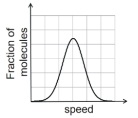
If the distribution of molecular speeds of a gas is as per the figure shown below,then the ratio of the most probable,the average and the root mean square speeds,respectively,is
A
$1: 1: 1$
B
$1: 1: 1.224$
C
$1: 1.128: 1.224$
D
$1: 1.128: 1$
Solution
(C) The standard expressions for the speeds are:
Most probable speed $(u_{mp})$ = $\sqrt{\frac{2RT}{M}}$
Average speed $(u_{av})$ = $\sqrt{\frac{8RT}{\pi M}} \approx 1.128 \times \sqrt{\frac{RT}{M}}$
Root mean square speed $(u_{rms})$ = $\sqrt{\frac{3RT}{M}} \approx 1.224 \times \sqrt{\frac{RT}{M}}$
Taking the ratio $u_{mp} : u_{av} : u_{rms}$:
$\sqrt{2} : \sqrt{\frac{8}{\pi}} : \sqrt{3}$
$1.414 : 1.596 : 1.732$
Dividing by $1.414$:
$1 : 1.128 : 1.224$
Most probable speed $(u_{mp})$ = $\sqrt{\frac{2RT}{M}}$
Average speed $(u_{av})$ = $\sqrt{\frac{8RT}{\pi M}} \approx 1.128 \times \sqrt{\frac{RT}{M}}$
Root mean square speed $(u_{rms})$ = $\sqrt{\frac{3RT}{M}} \approx 1.224 \times \sqrt{\frac{RT}{M}}$
Taking the ratio $u_{mp} : u_{av} : u_{rms}$:
$\sqrt{2} : \sqrt{\frac{8}{\pi}} : \sqrt{3}$
$1.414 : 1.596 : 1.732$
Dividing by $1.414$:
$1 : 1.128 : 1.224$
0 likesView Solution
2
ChemistryMediumMCQIIT JEE · 2020
Which of the following liberates $O_2$ upon hydrolysis?
A
$Pb_3O_4$
B
$KO_2$
C
$Na_2O_2$
D
$Li_2O_2$
Solution
(B) $Pb_3O_4$ is insoluble in water and does not react with it.
$2 KO_2 + 2 H_2O \rightarrow 2 KOH + H_2O_2 + O_2 \uparrow$. Potassium superoxide $(KO_2)$ reacts with water to liberate oxygen gas.
$Na_2O_2 + 2 H_2O \rightarrow 2 NaOH + H_2O_2$. Sodium peroxide produces hydrogen peroxide,not oxygen gas.
$Li_2O_2 + 2 H_2O \rightarrow 2 LiOH + H_2O_2$. Lithium peroxide produces hydrogen peroxide,not oxygen gas.
$2 KO_2 + 2 H_2O \rightarrow 2 KOH + H_2O_2 + O_2 \uparrow$. Potassium superoxide $(KO_2)$ reacts with water to liberate oxygen gas.
$Na_2O_2 + 2 H_2O \rightarrow 2 NaOH + H_2O_2$. Sodium peroxide produces hydrogen peroxide,not oxygen gas.
$Li_2O_2 + 2 H_2O \rightarrow 2 LiOH + H_2O_2$. Lithium peroxide produces hydrogen peroxide,not oxygen gas.
0 likesView Solution
3
ChemistryMediumMCQIIT JEE · 2020
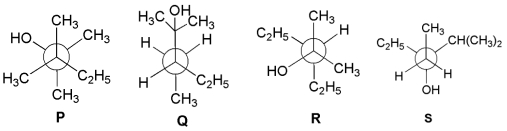
Newman projections $P$,$Q$,$R$,and $S$ are shown below:
Which one of the following options represents identical molecules?
Which one of the following options represents identical molecules?
A
$P$ and $Q$
B
$Q$ and $S$
C
$Q$ and $R$
D
$R$ and $S$
Solution
(C) To determine if the molecules are identical,we assign $IUPAC$ names to each Newman projection:
$P$: The structure corresponds to $2,3,3$-trimethylpentan-$2$-ol.
$Q$: The structure corresponds to $3$-ethyl-$2$-methylpentan-$2$-ol.
$R$: The structure corresponds to $3$-ethyl-$2$-methylpentan-$2$-ol.
$S$: The structure corresponds to $3$-ethyl-$2$-methylpentan-$3$-ol.
Comparing the $IUPAC$ names,$Q$ and $R$ have the same name ($3$-ethyl-$2$-methylpentan-$2$-ol),which means they represent the same molecule. Thus,the correct option is $C$.
$P$: The structure corresponds to $2,3,3$-trimethylpentan-$2$-ol.
$Q$: The structure corresponds to $3$-ethyl-$2$-methylpentan-$2$-ol.
$R$: The structure corresponds to $3$-ethyl-$2$-methylpentan-$2$-ol.
$S$: The structure corresponds to $3$-ethyl-$2$-methylpentan-$3$-ol.
Comparing the $IUPAC$ names,$Q$ and $R$ have the same name ($3$-ethyl-$2$-methylpentan-$2$-ol),which means they represent the same molecule. Thus,the correct option is $C$.
0 likesView Solution
4
ChemistryEasyMCQIIT JEE · 2020
Which one of the following structures has the $IUPAC$ name $3$-ethynyl-$2$-hydroxy-$4$-methylhex-$3$-en-$5$-ynoic acid?
A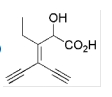
B
C
D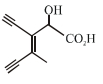
Solution
(D) To determine the structure,we analyze the $IUPAC$ name: $3$-ethynyl-$2$-hydroxy-$4$-methylhex-$3$-en-$5$-ynoic acid.
$1$. The parent chain is a hexenoic acid ($6$ carbons,carboxylic acid at $C-1$,double bond at $C-3$).
$2$. There is a hydroxy group at $C-2$.
$3$. There is an ethynyl group $(-C \equiv CH)$ at $C-3$.
$4$. There is a methyl group at $C-4$.
$5$. There is a triple bond at $C-5$ ($-C \equiv CH$ group at $C-5$ position in the chain).
Comparing this with the given options,structure $D$ correctly represents the connectivity where the carboxylic acid is at $C-1$,hydroxy at $C-2$,ethynyl at $C-3$,and the methyl group and the remaining alkyne chain are at $C-4$ and $C-5$ respectively.
$1$. The parent chain is a hexenoic acid ($6$ carbons,carboxylic acid at $C-1$,double bond at $C-3$).
$2$. There is a hydroxy group at $C-2$.
$3$. There is an ethynyl group $(-C \equiv CH)$ at $C-3$.
$4$. There is a methyl group at $C-4$.
$5$. There is a triple bond at $C-5$ ($-C \equiv CH$ group at $C-5$ position in the chain).
Comparing this with the given options,structure $D$ correctly represents the connectivity where the carboxylic acid is at $C-1$,hydroxy at $C-2$,ethynyl at $C-3$,and the methyl group and the remaining alkyne chain are at $C-4$ and $C-5$ respectively.
0 likesView Solution
5
ChemistryMediumMCQIIT JEE · 2020
The Fischer projection of $D$-erythrose is shown below.
$D$-Erythrose and its isomers are listed as $P$,$Q$,$R$,and $S$ in Column-$I$. Choose the correct relationship of $P$,$Q$,$R$,and $S$ with $D$-erythrose from Column-$II$.
Column-$I$:
$P$: $CHO-C(OH)(H)-C(OH)(H)-CH_2OH$ (rotated)
$Q$: $CHO-C(H)(OH)-C(OH)(H)-CH_2OH$
$R$: $CHO-C(OH)(H)-C(H)(OH)-CH_2OH$
$S$: $CHO-C(H)(OH)-C(H)(OH)-CH_2OH$ (enantiomer)
Column-$II$:
$1$. Diastereomer
$2$. Identical
$3$. Enantiomer
$D$-Erythrose and its isomers are listed as $P$,$Q$,$R$,and $S$ in Column-$I$. Choose the correct relationship of $P$,$Q$,$R$,and $S$ with $D$-erythrose from Column-$II$.
Column-$I$:
$P$: $CHO-C(OH)(H)-C(OH)(H)-CH_2OH$ (rotated)
$Q$: $CHO-C(H)(OH)-C(OH)(H)-CH_2OH$
$R$: $CHO-C(OH)(H)-C(H)(OH)-CH_2OH$
$S$: $CHO-C(H)(OH)-C(H)(OH)-CH_2OH$ (enantiomer)
Column-$II$:
$1$. Diastereomer
$2$. Identical
$3$. Enantiomer
A
$P$ $\rightarrow 2, Q$ $\rightarrow 3, R$ $\rightarrow 2, S$ $\rightarrow 2$
B
$P$ $\rightarrow 3, Q$ $\rightarrow 1, R$ $\rightarrow 1, S$ $\rightarrow 2$
C
$P$ $\rightarrow 2, Q$ $\rightarrow 1, R$ $\rightarrow 1, S$ $\rightarrow 3$
D
$P$ $\rightarrow 2, Q$ $\rightarrow 3, R$ $\rightarrow 3, S$ $\rightarrow 1$
Solution
(C) -Erythrose has the configuration $(2R, 3R)$.
$P$: By rotating the given structure,it matches $D$-erythrose,so it is Identical $(2)$.
$Q$: The configuration is $(2S, 3R)$,which is a Diastereomer $(1)$.
$R$: The configuration is $(2R, 3S)$,which is a Diastereomer $(1)$.
$S$: The configuration is $(2S, 3S)$,which is the Enantiomer $(3)$.
Therefore,the correct matching is $P$ $\rightarrow 2, Q$ $\rightarrow 1, R$ $\rightarrow 1, S$ $\rightarrow 3$.
$P$: By rotating the given structure,it matches $D$-erythrose,so it is Identical $(2)$.
$Q$: The configuration is $(2S, 3R)$,which is a Diastereomer $(1)$.
$R$: The configuration is $(2R, 3S)$,which is a Diastereomer $(1)$.
$S$: The configuration is $(2S, 3S)$,which is the Enantiomer $(3)$.
Therefore,the correct matching is $P$ $\rightarrow 2, Q$ $\rightarrow 1, R$ $\rightarrow 1, S$ $\rightarrow 3$.
0 likesView Solution
6
ChemistryAdvancedMCQIIT JEE · 2020
In thermodynamics,the $P-V$ work done is given by $w = -\int P_{ext} dV$. For a system undergoing a particular process,the work done is $w = -\int \left(\frac{RT}{V - b} - \frac{a}{V^2}\right) dV$. This equation is applicable to a:
A
$A$ System that satisfies the van der Waals equation of state.
B
$B$ Process that is reversible and isothermal.
C
$C$ Process that is reversible and adiabatic.
D
$D$ Process that is irreversible and at constant pressure.
Solution
(C) The van der Waals equation for $1$ mole of gas is given by $P = \frac{RT}{V - b} - \frac{a}{V^2}$.
In thermodynamics,the work done is defined as $w = -\int P_{ext} dV$.
If the process is reversible,the external pressure $P_{ext}$ is equal to the internal pressure $P$ of the system at every stage,i.e.,$P_{ext} = P$.
Substituting the van der Waals pressure into the work equation gives $w = -\int \left(\frac{RT}{V - b} - \frac{a}{V^2}\right) dV$.
This expression is valid for any reversible process involving a van der Waals gas,regardless of whether it is isothermal or adiabatic. Thus,both $A$ and $B$ (in the context of reversibility) are satisfied.
In thermodynamics,the work done is defined as $w = -\int P_{ext} dV$.
If the process is reversible,the external pressure $P_{ext}$ is equal to the internal pressure $P$ of the system at every stage,i.e.,$P_{ext} = P$.
Substituting the van der Waals pressure into the work equation gives $w = -\int \left(\frac{RT}{V - b} - \frac{a}{V^2}\right) dV$.
This expression is valid for any reversible process involving a van der Waals gas,regardless of whether it is isothermal or adiabatic. Thus,both $A$ and $B$ (in the context of reversibility) are satisfied.
0 likesView Solution
7
ChemistryMediumMCQIIT JEE · 2020
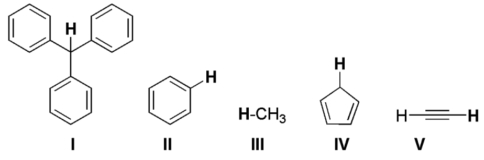
With respect to the compounds $I-V$,choose the correct statement$(s)$.
$(A)$ The acidity of compound $I$ is due to delocalization in the conjugate base.
$(B)$ The conjugate base of compound $IV$ is aromatic.
$(C)$ Compound $II$ becomes more acidic,when it has a $-NO_2$ substituent.
$(D)$ The acidity of compounds follows the order $IV > V > I > II > III$.
$(A)$ The acidity of compound $I$ is due to delocalization in the conjugate base.
$(B)$ The conjugate base of compound $IV$ is aromatic.
$(C)$ Compound $II$ becomes more acidic,when it has a $-NO_2$ substituent.
$(D)$ The acidity of compounds follows the order $IV > V > I > II > III$.
A
$B, C, D$
B
$B, C$
C
$A, B, C$
D
$B, D$
Solution
(C) The acidity of a compound depends on the stability of its conjugate base.
$(A)$ The conjugate base of compound $I$ (triphenylmethane) is a triphenylmethyl carbanion,which is resonance-stabilized by three phenyl rings. Thus,statement $(A)$ is correct.
$(B)$ The conjugate base of compound $IV$ (cyclopentadiene) is the cyclopentadienyl anion,which has $6\pi$ electrons and is aromatic. Thus,statement $(B)$ is correct.
$(C)$ The $-NO_2$ group is a strong electron-withdrawing group ($-I$ and $-M$ effect). When attached to benzene (compound $II$),it stabilizes the conjugate base (phenyl anion) by withdrawing electron density,thereby increasing the acidity. Thus,statement $(C)$ is correct.
$(D)$ Based on $pK_a$ values: $IV$ $(16)$ > $V$ $(25)$ > $I$ $(33.3)$ > $II$ $(43)$ > $III$ $(50)$. The order of acidity is $IV > V > I > II > III$. Thus,statement $(D)$ is correct.
Therefore,statements $(A), (B), (C),$ and $(D)$ are all correct. However,given the options,the most appropriate choice is $(C)$.
$(A)$ The conjugate base of compound $I$ (triphenylmethane) is a triphenylmethyl carbanion,which is resonance-stabilized by three phenyl rings. Thus,statement $(A)$ is correct.
$(B)$ The conjugate base of compound $IV$ (cyclopentadiene) is the cyclopentadienyl anion,which has $6\pi$ electrons and is aromatic. Thus,statement $(B)$ is correct.
$(C)$ The $-NO_2$ group is a strong electron-withdrawing group ($-I$ and $-M$ effect). When attached to benzene (compound $II$),it stabilizes the conjugate base (phenyl anion) by withdrawing electron density,thereby increasing the acidity. Thus,statement $(C)$ is correct.
$(D)$ Based on $pK_a$ values: $IV$ $(16)$ > $V$ $(25)$ > $I$ $(33.3)$ > $II$ $(43)$ > $III$ $(50)$. The order of acidity is $IV > V > I > II > III$. Thus,statement $(D)$ is correct.
Therefore,statements $(A), (B), (C),$ and $(D)$ are all correct. However,given the options,the most appropriate choice is $(C)$.
0 likesView Solution
8
ChemistryDifficultMCQIIT JEE · 2020
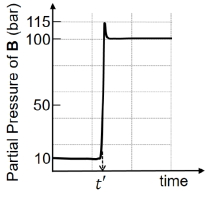
Consider the reaction $A \rightleftharpoons B$ at $1000 \ K$. At time $t^{\prime}$,the temperature of the system was increased to $2000 \ K$ and the system was allowed to reach equilibrium. Throughout this experiment,the partial pressure of $A$ was maintained at $1 \ bar$. Given below is the plot of the partial pressure of $B$ with time. What is the ratio of the standard Gibbs energy of the reaction at $1000 \ K$ to that at $2000 \ K$?
A
$0.10$
B
$0.15$
C
$0.20$
D
$0.25$
Solution
(D) The equilibrium constant $K_{eq}$ for the reaction $A \rightleftharpoons B$ is given by $K_{eq} = \frac{P_B}{P_A}$.
From the graph,at $1000 \ K$,$P_B = 10 \ bar$ and $P_A = 1 \ bar$,so $K_{1000} = \frac{10}{1} = 10$.
At $2000 \ K$,$P_B = 100 \ bar$ and $P_A = 1 \ bar$,so $K_{2000} = \frac{100}{1} = 100$.
The standard Gibbs energy change is given by $\Delta G^0 = -RT \ln(K_{eq})$.
Therefore,the ratio is:
$\frac{\Delta G_{1000}^0}{\Delta G_{2000}^0} = \frac{-R(1000) \ln(10)}{-R(2000) \ln(100)}$
$= \frac{1000 \times \ln(10)}{2000 \times \ln(10^2)}$
$= \frac{1000 \times \ln(10)}{2000 \times 2 \ln(10)}$
$= \frac{1000}{4000} = 0.25$.
From the graph,at $1000 \ K$,$P_B = 10 \ bar$ and $P_A = 1 \ bar$,so $K_{1000} = \frac{10}{1} = 10$.
At $2000 \ K$,$P_B = 100 \ bar$ and $P_A = 1 \ bar$,so $K_{2000} = \frac{100}{1} = 100$.
The standard Gibbs energy change is given by $\Delta G^0 = -RT \ln(K_{eq})$.
Therefore,the ratio is:
$\frac{\Delta G_{1000}^0}{\Delta G_{2000}^0} = \frac{-R(1000) \ln(10)}{-R(2000) \ln(100)}$
$= \frac{1000 \times \ln(10)}{2000 \times \ln(10^2)}$
$= \frac{1000 \times \ln(10)}{2000 \times 2 \ln(10)}$
$= \frac{1000}{4000} = 0.25$.
0 likesView Solution
9
ChemistryMediumMCQIIT JEE · 2020
Aluminium reacts with sulfuric acid to form aluminium sulfate and hydrogen. What is the volume of hydrogen gas in liters $(L)$ produced at $300 \ K$ and $1.0 \ atm$ pressure,when $5.4 \ g$ of aluminium and $50.0 \ mL$ of $5.0 \ M$ sulfuric acid are combined for the reaction?
(Use molar mass of aluminium as $27.0 \ g \ mol^{-1}, R = 0.082 \ atm \ L \ mol^{-1} \ K^{-1}$)
(Use molar mass of aluminium as $27.0 \ g \ mol^{-1}, R = 0.082 \ atm \ L \ mol^{-1} \ K^{-1}$)
A
$6.10$
B
$6.15$
C
$6.20$
D
$6.25$
Solution
(B) The balanced chemical equation is: $2 \ Al(s) + 3 \ H_2SO_4(aq) \longrightarrow Al_2(SO_4)_3(aq) + 3 \ H_2(g)$
Moles of $Al = \frac{5.4 \ g}{27.0 \ g \ mol^{-1}} = 0.2 \ mol$
Moles of $H_2SO_4 = M \times V(L) = 5.0 \ mol \ L^{-1} \times 0.050 \ L = 0.25 \ mol$
According to the stoichiometry,$2 \ mol$ of $Al$ requires $3 \ mol$ of $H_2SO_4$.
For $0.2 \ mol$ of $Al$,required $H_2SO_4 = \frac{3}{2} \times 0.2 = 0.3 \ mol$.
Since we have only $0.25 \ mol$ of $H_2SO_4$,$H_2SO_4$ is the limiting reagent.
Moles of $H_2$ produced $= \frac{3}{3} \times 0.25 \ mol = 0.25 \ mol$.
Using the ideal gas law $PV = nRT$:
$V = \frac{nRT}{P} = \frac{0.25 \ mol \times 0.082 \ atm \ L \ mol^{-1} \ K^{-1} \times 300 \ K}{1.0 \ atm} = 6.15 \ L$.
Moles of $Al = \frac{5.4 \ g}{27.0 \ g \ mol^{-1}} = 0.2 \ mol$
Moles of $H_2SO_4 = M \times V(L) = 5.0 \ mol \ L^{-1} \times 0.050 \ L = 0.25 \ mol$
According to the stoichiometry,$2 \ mol$ of $Al$ requires $3 \ mol$ of $H_2SO_4$.
For $0.2 \ mol$ of $Al$,required $H_2SO_4 = \frac{3}{2} \times 0.2 = 0.3 \ mol$.
Since we have only $0.25 \ mol$ of $H_2SO_4$,$H_2SO_4$ is the limiting reagent.
Moles of $H_2$ produced $= \frac{3}{3} \times 0.25 \ mol = 0.25 \ mol$.
Using the ideal gas law $PV = nRT$:
$V = \frac{nRT}{P} = \frac{0.25 \ mol \times 0.082 \ atm \ L \ mol^{-1} \ K^{-1} \times 300 \ K}{1.0 \ atm} = 6.15 \ L$.
0 likesView Solution
10
ChemistryDifficultMCQIIT JEE · 2020
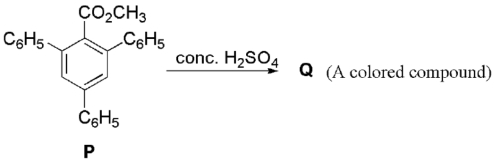
In the following reaction,compound $Q$ is obtained from compound $P$ via an ionic intermediate. What is the degree of unsaturation of $Q$?
A
$10$
B
$15$
C
$18$
D
$25$
Solution
(C) The reaction involves the cyclization of compound $P$ in the presence of concentrated $H_2SO_4$ to form compound $Q$.
Compound $P$ undergoes protonation at the carbonyl oxygen,followed by the loss of methanol $(-CH_3OH)$ to form an acylium ion intermediate.
This acylium ion then undergoes intramolecular Friedel-Crafts acylation with one of the ortho-phenyl rings to form the cyclic ketone $Q$.
The structure of $Q$ contains four benzene rings (each with a degree of unsaturation of $4$,totaling $16$) and one additional ring formed by cyclization,plus one carbonyl group $(C=O)$,which adds $1$ to the degree of unsaturation.
Therefore,the total degree of unsaturation $(DBE)$ for $Q$ is $16 + 1 + 1 = 18$.
Compound $P$ undergoes protonation at the carbonyl oxygen,followed by the loss of methanol $(-CH_3OH)$ to form an acylium ion intermediate.
This acylium ion then undergoes intramolecular Friedel-Crafts acylation with one of the ortho-phenyl rings to form the cyclic ketone $Q$.
The structure of $Q$ contains four benzene rings (each with a degree of unsaturation of $4$,totaling $16$) and one additional ring formed by cyclization,plus one carbonyl group $(C=O)$,which adds $1$ to the degree of unsaturation.
Therefore,the total degree of unsaturation $(DBE)$ for $Q$ is $16 + 1 + 1 = 18$.
0 likesView Solution
11
ChemistryMediumMCQIIT JEE · 2020
The $1^{\text{st}}$,$2^{\text{nd}}$,and $3^{\text{rd}}$ ionization enthalpies $I_1, I_2$,and $I_3$ of four atoms with atomic numbers $n, n+1, n+2$,and $n+3$,where $n < 10$,are tabulated below. What is the value of $n$?
| Atomic number | $I_1$ $(kJ/mol)$ | $I_2$ $(kJ/mol)$ | $I_3$ $(kJ/mol)$ |
| $n$ | $I_1$ | $I_2$ | $I_3$ |
| $n+1$ | $1681$ | $3374$ | $6050$ |
| $n+2$ | $2081$ | $3952$ | $6122$ |
| $n+3$ | $496$ | $4562$ | $6910$ |
| $n+4$ | $738$ | $1451$ | $7733$ |
A
$5$
B
$7$
C
$8$
D
$9$
Solution
(C) To determine the value of $n$,we analyze the jump in ionization enthalpies for each element:
$1$. For atomic number $(n+4)$,the jump occurs between $I_2$ and $I_3$ ($1451$ to $7733$),indicating it is an alkaline earth metal (Group $2$).
$2$. For atomic number $(n+3)$,the jump occurs between $I_1$ and $I_2$ ($496$ to $4562$),indicating it is an alkali metal (Group $1$).
$3$. Since $(n+3)$ is an alkali metal and $(n+4)$ is an alkaline earth metal,$(n+3)$ corresponds to $Z=11$ (Sodium) and $(n+4)$ corresponds to $Z=12$ (Magnesium).
$4$. If $n+3 = 11$,then $n = 8$.
$5$. Checking the sequence: $n=8$ (Oxygen),$n+1=9$ (Fluorine),$n+2=10$ (Neon),$n+3=11$ (Sodium). The ionization energies provided for $n+1$ $(1681)$ and $n+2$ $(2081)$ are consistent with Fluorine and Neon respectively. Thus,$n=8$.
$1$. For atomic number $(n+4)$,the jump occurs between $I_2$ and $I_3$ ($1451$ to $7733$),indicating it is an alkaline earth metal (Group $2$).
$2$. For atomic number $(n+3)$,the jump occurs between $I_1$ and $I_2$ ($496$ to $4562$),indicating it is an alkali metal (Group $1$).
$3$. Since $(n+3)$ is an alkali metal and $(n+4)$ is an alkaline earth metal,$(n+3)$ corresponds to $Z=11$ (Sodium) and $(n+4)$ corresponds to $Z=12$ (Magnesium).
$4$. If $n+3 = 11$,then $n = 8$.
$5$. Checking the sequence: $n=8$ (Oxygen),$n+1=9$ (Fluorine),$n+2=10$ (Neon),$n+3=11$ (Sodium). The ionization energies provided for $n+1$ $(1681)$ and $n+2$ $(2081)$ are consistent with Fluorine and Neon respectively. Thus,$n=8$.
0 likesView Solution
12
ChemistryMediumMCQIIT JEE · 2020
Consider the following compounds in the liquid form:
$O_2, HF, H_2O, NH_3, H_2O_2, CCl_4, CHCl_3, C_6H_6, C_6H_5Cl$.
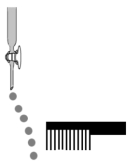
When a charged comb is brought near their flowing stream,how many of them show deflection as per the figure?
$O_2, HF, H_2O, NH_3, H_2O_2, CCl_4, CHCl_3, C_6H_6, C_6H_5Cl$.
When a charged comb is brought near their flowing stream,how many of them show deflection as per the figure?
A
$6$
B
$8$
C
$9$
D
$10$
Solution
(A) charged comb creates an electric field that exerts an attractive force on polar molecules due to their permanent dipole moment,causing them to deflect from their path.
Nonpolar molecules do not possess a permanent dipole moment and are not significantly deflected by a charged comb.
Let us analyze the polarity of the given compounds:
$1$. $O_2$: Nonpolar (homonuclear diatomic molecule).
$2$. $HF$: Polar (electronegativity difference).
$3$. $H_2O$: Polar (bent geometry).
$4$. $NH_3$: Polar (pyramidal geometry).
$5$. $H_2O_2$: Polar (non-planar structure).
$6$. $CCl_4$: Nonpolar (symmetrical tetrahedral geometry).
$7$. $CHCl_3$: Polar (asymmetrical tetrahedral geometry).
$8$. $C_6H_6$: Nonpolar (symmetrical planar structure).
$9$. $C_6H_5Cl$: Polar (asymmetrical substitution on the benzene ring).
Polar molecules are: $HF, H_2O, NH_3, H_2O_2, CHCl_3, C_6H_5Cl$.
Total number of polar molecules = $6$.
Nonpolar molecules do not possess a permanent dipole moment and are not significantly deflected by a charged comb.
Let us analyze the polarity of the given compounds:
$1$. $O_2$: Nonpolar (homonuclear diatomic molecule).
$2$. $HF$: Polar (electronegativity difference).
$3$. $H_2O$: Polar (bent geometry).
$4$. $NH_3$: Polar (pyramidal geometry).
$5$. $H_2O_2$: Polar (non-planar structure).
$6$. $CCl_4$: Nonpolar (symmetrical tetrahedral geometry).
$7$. $CHCl_3$: Polar (asymmetrical tetrahedral geometry).
$8$. $C_6H_6$: Nonpolar (symmetrical planar structure).
$9$. $C_6H_5Cl$: Polar (asymmetrical substitution on the benzene ring).
Polar molecules are: $HF, H_2O, NH_3, H_2O_2, CHCl_3, C_6H_5Cl$.
Total number of polar molecules = $6$.
0 likesView Solution
13
ChemistryMediumMCQIIT JEE · 2020
In the chemical reaction between stoichiometric quantities of $KMnO_4$ and $KI$ in a weakly basic or neutral solution,what is the number of moles of $I_2$ released for $4$ moles of $KMnO_4$ consumed?
A
$4$
B
$6$
C
$7$
D
$9$
Solution
(B) The balanced chemical equation for the reaction of $KMnO_4$ with $KI$ in a weakly basic or neutral medium is:
$2KMnO_4 + KI + H_2O \longrightarrow 2MnO_2 + KIO_3 + 2KOH$ (Note: $I^-$ is oxidized to $IO_3^-$ in neutral/basic medium).
However,if the reaction is considered as $I^-$ to $I_2$ (as implied by the question context):
$2KMnO_4 + 6KI + 4H_2O \longrightarrow 2MnO_2 + 3I_2 + 8KOH$.
From the stoichiometry of the balanced equation,$2$ moles of $KMnO_4$ produce $3$ moles of $I_2$.
Therefore,for $4$ moles of $KMnO_4$,the moles of $I_2$ produced = $(4 \times 3) / 2 = 6$ moles.
$2KMnO_4 + KI + H_2O \longrightarrow 2MnO_2 + KIO_3 + 2KOH$ (Note: $I^-$ is oxidized to $IO_3^-$ in neutral/basic medium).
However,if the reaction is considered as $I^-$ to $I_2$ (as implied by the question context):
$2KMnO_4 + 6KI + 4H_2O \longrightarrow 2MnO_2 + 3I_2 + 8KOH$.
From the stoichiometry of the balanced equation,$2$ moles of $KMnO_4$ produce $3$ moles of $I_2$.
Therefore,for $4$ moles of $KMnO_4$,the moles of $I_2$ produced = $(4 \times 3) / 2 = 6$ moles.
0 likesView Solution
14
ChemistryAdvancedMCQIIT JEE · 2020
Consider the following transformations of a compound $P$ $(C_9H_{12})$:
$(i)$ $P \xrightarrow{NaNH_2, C_6H_5COCH_3, H_3O^+/\Delta} R$ (Optically active)
(ii) $P \xrightarrow{Pt/H_2} \text{propylcyclohexane}$
(iii) $P \xrightarrow{X, KMnO_4/H_2SO_4/\Delta} Q$ ($C_8H_{12}O_6$,Optically active acid)
Choose the correct option$(s)$:
$(A)$ $P$ is $3-$cyclohexylprop$-1-$yne
$(B)$ $X$ is $Pd-C/\text{quinoline}/H_2$
$(C)$ $P$ is $1-$cyclohexylprop$-2-$yne
$(D)$ $R$ is $1-$cyclohexyl$-4-$phenylbut$-3-$yn$-2-$ol
$(i)$ $P \xrightarrow{NaNH_2, C_6H_5COCH_3, H_3O^+/\Delta} R$ (Optically active)
(ii) $P \xrightarrow{Pt/H_2} \text{propylcyclohexane}$
(iii) $P \xrightarrow{X, KMnO_4/H_2SO_4/\Delta} Q$ ($C_8H_{12}O_6$,Optically active acid)
Choose the correct option$(s)$:
$(A)$ $P$ is $3-$cyclohexylprop$-1-$yne
$(B)$ $X$ is $Pd-C/\text{quinoline}/H_2$
$(C)$ $P$ is $1-$cyclohexylprop$-2-$yne
$(D)$ $R$ is $1-$cyclohexyl$-4-$phenylbut$-3-$yn$-2-$ol
A
$B, C$
B
$A, C$
C
$A, D$
D
$A, B$
Solution
(D) $1$. Compound $P$ $(C_9H_{12})$ on hydrogenation with $Pt/H_2$ gives propylcyclohexane,indicating $P$ has a cyclohexyl ring and a propyl chain with a triple bond.
$2$. The reaction with $NaNH_2$ followed by $C_6H_5COCH_3$ and $H_3O^+/\Delta$ confirms $P$ is a terminal alkyne,specifically $3-$cyclohexylprop$-1-$yne.
$3$. $X$ is a reagent that partially reduces the alkyne to an alkene,which is $Pd-C/\text{quinoline}/H_2$ (Lindlar's catalyst).
$4$. Oxidation of the resulting alkene with $KMnO_4/H_2SO_4/\Delta$ yields the optically active acid $Q$.
$5$. Thus,$P$ is $3-$cyclohexylprop$-1-$yne (Option $A$) and $X$ is $Pd-C/\text{quinoline}/H_2$ (Option $B$).
$6$. Therefore,the correct options are $A$ and $B$.
$2$. The reaction with $NaNH_2$ followed by $C_6H_5COCH_3$ and $H_3O^+/\Delta$ confirms $P$ is a terminal alkyne,specifically $3-$cyclohexylprop$-1-$yne.
$3$. $X$ is a reagent that partially reduces the alkyne to an alkene,which is $Pd-C/\text{quinoline}/H_2$ (Lindlar's catalyst).
$4$. Oxidation of the resulting alkene with $KMnO_4/H_2SO_4/\Delta$ yields the optically active acid $Q$.
$5$. Thus,$P$ is $3-$cyclohexylprop$-1-$yne (Option $A$) and $X$ is $Pd-C/\text{quinoline}/H_2$ (Option $B$).
$6$. Therefore,the correct options are $A$ and $B$.
0 likesView Solution
15
ChemistryDifficultMCQIIT JEE · 2020
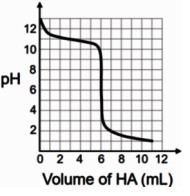
$A$ solution of $0.1 \ M$ weak base $(B)$ is titrated with $0.1 \ M$ of a strong acid $(HA)$. The variation of $pH$ of the solution with the volume of $HA$ added is shown in the figure below. What is the $pK_{b}$ of the base? The neutralization reaction is given by $B + HA \rightarrow BH^{+} + A^{-}$.
A
$2.60$
B
$2.80$
C
$2.85$
D
$2.90$
Solution
(C) From the titration curve,the equivalence point is reached at $V = 6 \ mL$ of $HA$ added.
At the half-equivalence point,$V = 3 \ mL$,the concentration of the weak base $[B]$ is equal to the concentration of its conjugate acid $[BH^{+}]$.
According to the Henderson-Hasselbalch equation for a weak base:
$pOH = pK_{b} + \log\left(\frac{[BH^{+}]}{[B]}\right)$
At the half-equivalence point,$[BH^{+}] = [B]$,so $\log(1) = 0$.
Therefore,$pOH = pK_{b}$.
From the graph,at $V = 3 \ mL$,the $pH$ is approximately $11.15$.
Since $pH + pOH = 14$ at $25^{\circ}C$,we have $pOH = 14 - 11.15 = 2.85$.
Thus,$pK_{b} = 2.85$.
At the half-equivalence point,$V = 3 \ mL$,the concentration of the weak base $[B]$ is equal to the concentration of its conjugate acid $[BH^{+}]$.
According to the Henderson-Hasselbalch equation for a weak base:
$pOH = pK_{b} + \log\left(\frac{[BH^{+}]}{[B]}\right)$
At the half-equivalence point,$[BH^{+}] = [B]$,so $\log(1) = 0$.
Therefore,$pOH = pK_{b}$.
From the graph,at $V = 3 \ mL$,the $pH$ is approximately $11.15$.
Since $pH + pOH = 14$ at $25^{\circ}C$,we have $pOH = 14 - 11.15 = 2.85$.
Thus,$pK_{b} = 2.85$.
0 likesView Solution
16
ChemistryEasyMCQIIT JEE · 2020
An acidified solution of $0.05 \ M \ Zn^{2+}$ is saturated with $0.1 \ M \ H_2S$. What is the minimum molar concentration $(M)$ of $H^{+}$ required to prevent the precipitation of $ZnS$? Use $K_{sp}(ZnS) = 1.25 \times 10^{-22}$ and overall dissociation constant of $H_2S$,$K_{NET} = K_1 K_2 = 1 \times 10^{-21}$.
A
$0.10$
B
$0.15$
C
$0.20$
D
$0.25$
Solution
(C) To prevent the precipitation of $ZnS$,the ionic product $Q_{sp}$ must be less than or equal to the solubility product $K_{sp}$.
$Q_{sp} = [Zn^{2+}][S^{2-}] \leq K_{sp}(ZnS)$
Given: $[Zn^{2+}] = 0.05 \ M$ and $K_{sp}(ZnS) = 1.25 \times 10^{-22}$
$[S^{2-}] \leq \frac{K_{sp}}{[Zn^{2+}]} = \frac{1.25 \times 10^{-22}}{0.05} = 2.5 \times 10^{-21} \ M$
For the dissociation of $H_2S$: $H_2S \rightleftharpoons 2H^{+} + S^{2-}$
The overall dissociation constant is given by:
$K_{NET} = \frac{[H^{+}]^2 [S^{2-}]}{[H_2S]}$
$1 \times 10^{-21} = \frac{[H^{+}]^2 \times (2.5 \times 10^{-21})}{0.1}$
$[H^{+}]^2 = \frac{1 \times 10^{-21} \times 0.1}{2.5 \times 10^{-21}} = \frac{0.1}{2.5} = 0.04$
$[H^{+}] = \sqrt{0.04} = 0.2 \ M$
Thus,the minimum concentration of $H^{+}$ required is $0.20 \ M$.
$Q_{sp} = [Zn^{2+}][S^{2-}] \leq K_{sp}(ZnS)$
Given: $[Zn^{2+}] = 0.05 \ M$ and $K_{sp}(ZnS) = 1.25 \times 10^{-22}$
$[S^{2-}] \leq \frac{K_{sp}}{[Zn^{2+}]} = \frac{1.25 \times 10^{-22}}{0.05} = 2.5 \times 10^{-21} \ M$
For the dissociation of $H_2S$: $H_2S \rightleftharpoons 2H^{+} + S^{2-}$
The overall dissociation constant is given by:
$K_{NET} = \frac{[H^{+}]^2 [S^{2-}]}{[H_2S]}$
$1 \times 10^{-21} = \frac{[H^{+}]^2 \times (2.5 \times 10^{-21})}{0.1}$
$[H^{+}]^2 = \frac{1 \times 10^{-21} \times 0.1}{2.5 \times 10^{-21}} = \frac{0.1}{2.5} = 0.04$
$[H^{+}] = \sqrt{0.04} = 0.2 \ M$
Thus,the minimum concentration of $H^{+}$ required is $0.20 \ M$.
0 likesView Solution
17
ChemistryDifficultMCQIIT JEE · 2020
$A$ colorless aqueous solution contains nitrates of two metals,$X$ and $Y$. When it was added to an aqueous solution of $NaCl$,a white precipitate was formed. This precipitate was found to be partly soluble in hot water to give a residue $P$ and a solution $Q$. The residue $P$ was soluble in aqueous $NH_3$ and also in excess sodium thiosulfate. The hot solution $Q$ gave a yellow precipitate with $KI$. The metals $X$ and $Y$,respectively,are
A
$Ag$ and $Pb$
B
$Ag$ and $Cd$
C
$Cd$ and $Pb$
D
$Cd$ and $Zn$
Solution
(A) $1$. The addition of $NaCl$ to the solution containing nitrates of $X$ and $Y$ produces white precipitates of $AgCl$ and $PbCl_2$.
$2$. $PbCl_2$ is soluble in hot water,while $AgCl$ is not. Thus,the residue $P$ is $AgCl$ and the hot filtrate $Q$ contains $PbCl_2$.
$3$. $AgCl$ (residue $P$) is soluble in aqueous $NH_3$ to form $[Ag(NH_3)_2]Cl$ and in excess sodium thiosulfate to form $Na_3[Ag(S_2O_3)_2]$.
$4$. The hot solution $Q$ containing $Pb^{2+}$ ions reacts with $KI$ to form a yellow precipitate of $PbI_2$ $(Pb^{2+} + 2I^- \rightarrow PbI_2 \downarrow)$.
$5$. Therefore,$X$ is $Ag$ and $Y$ is $Pb$.
$2$. $PbCl_2$ is soluble in hot water,while $AgCl$ is not. Thus,the residue $P$ is $AgCl$ and the hot filtrate $Q$ contains $PbCl_2$.
$3$. $AgCl$ (residue $P$) is soluble in aqueous $NH_3$ to form $[Ag(NH_3)_2]Cl$ and in excess sodium thiosulfate to form $Na_3[Ag(S_2O_3)_2]$.
$4$. The hot solution $Q$ containing $Pb^{2+}$ ions reacts with $KI$ to form a yellow precipitate of $PbI_2$ $(Pb^{2+} + 2I^- \rightarrow PbI_2 \downarrow)$.
$5$. Therefore,$X$ is $Ag$ and $Y$ is $Pb$.
0 likesView Solution
18
ChemistryDifficultMCQIIT JEE · 2020
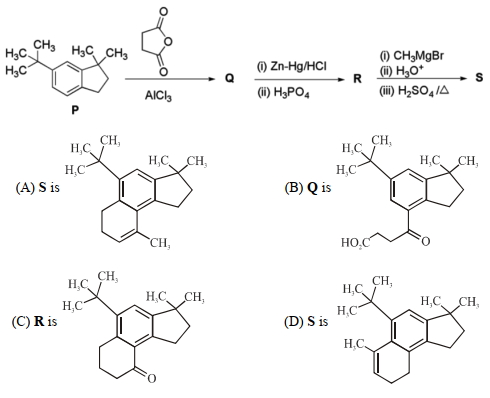
In the reaction scheme shown below,$Q$,$R$,and $S$ are the major products. Identify the correct structure of the products from the given options:
$(P)$ + Succinic anhydride $\xrightarrow{AlCl_3}$ $Q$
$Q$ $\xrightarrow[H_3PO_4]{Zn-Hg/HCl}$ $R$
$R$ $\xrightarrow[(ii) H_3O^+]{(i) CH_3MgBr, (iii) H_2SO_4/\Delta}$ $S$
$(A)$ $S$ is [Structure $A$]
$(B)$ $Q$ is [Structure $B$]
$(C)$ $R$ is [Structure $C$]
$(D)$ $S$ is [Structure $D$]
$(P)$ + Succinic anhydride $\xrightarrow{AlCl_3}$ $Q$
$Q$ $\xrightarrow[H_3PO_4]{Zn-Hg/HCl}$ $R$
$R$ $\xrightarrow[(ii) H_3O^+]{(i) CH_3MgBr, (iii) H_2SO_4/\Delta}$ $S$
$(A)$ $S$ is [Structure $A$]
$(B)$ $Q$ is [Structure $B$]
$(C)$ $R$ is [Structure $C$]
$(D)$ $S$ is [Structure $D$]
A
$A.B$
B
$A.D$
C
$A.C$
D
$B.D$
Solution
(C) $1$. Friedel-Crafts acylation of $P$ with succinic anhydride gives $Q$,which is a keto-acid: $Ar-CO-CH_2-CH_2-COOH$.
$2$. Clemmensen reduction $(Zn-Hg/HCl)$ reduces the ketone to a methylene group,followed by intramolecular cyclization using $H_3PO_4$ to form the cyclic ketone $R$.
$3$. Reaction of $R$ with $CH_3MgBr$ followed by acid workup gives a tertiary alcohol.
$4$. Dehydration of the alcohol with $H_2SO_4/\Delta$ yields the alkene $S$.
$5$. Comparing the structures,$A$ represents the correct structure for $S$ and $C$ represents the correct structure for $R$. Thus,the correct combination is $A.C$.
$2$. Clemmensen reduction $(Zn-Hg/HCl)$ reduces the ketone to a methylene group,followed by intramolecular cyclization using $H_3PO_4$ to form the cyclic ketone $R$.
$3$. Reaction of $R$ with $CH_3MgBr$ followed by acid workup gives a tertiary alcohol.
$4$. Dehydration of the alcohol with $H_2SO_4/\Delta$ yields the alkene $S$.
$5$. Comparing the structures,$A$ represents the correct structure for $S$ and $C$ represents the correct structure for $R$. Thus,the correct combination is $A.C$.
0 likesView Solution
19
ChemistryMediumMCQIIT JEE · 2020
Choose the correct statement$(s)$ among the following:
$(A)$ $[FeCl_4]^-$ has tetrahedral geometry.
$(B)$ $[Co(en)(NH_3)_2Cl_2]^+$ has $2$ geometrical isomers.
$(C)$ $[FeCl_4]^-$ has higher spin-only magnetic moment than $[Co(en)(NH_3)_2Cl_2]^+$.
$(D)$ The cobalt ion in $[Co(en)(NH_3)_2Cl_2]^+$ has $sp^3d^2$ hybridization.
$(A)$ $[FeCl_4]^-$ has tetrahedral geometry.
$(B)$ $[Co(en)(NH_3)_2Cl_2]^+$ has $2$ geometrical isomers.
$(C)$ $[FeCl_4]^-$ has higher spin-only magnetic moment than $[Co(en)(NH_3)_2Cl_2]^+$.
$(D)$ The cobalt ion in $[Co(en)(NH_3)_2Cl_2]^+$ has $sp^3d^2$ hybridization.
A
$A, C$
B
$A, B$
C
$A, D$
D
$B, C$
Solution
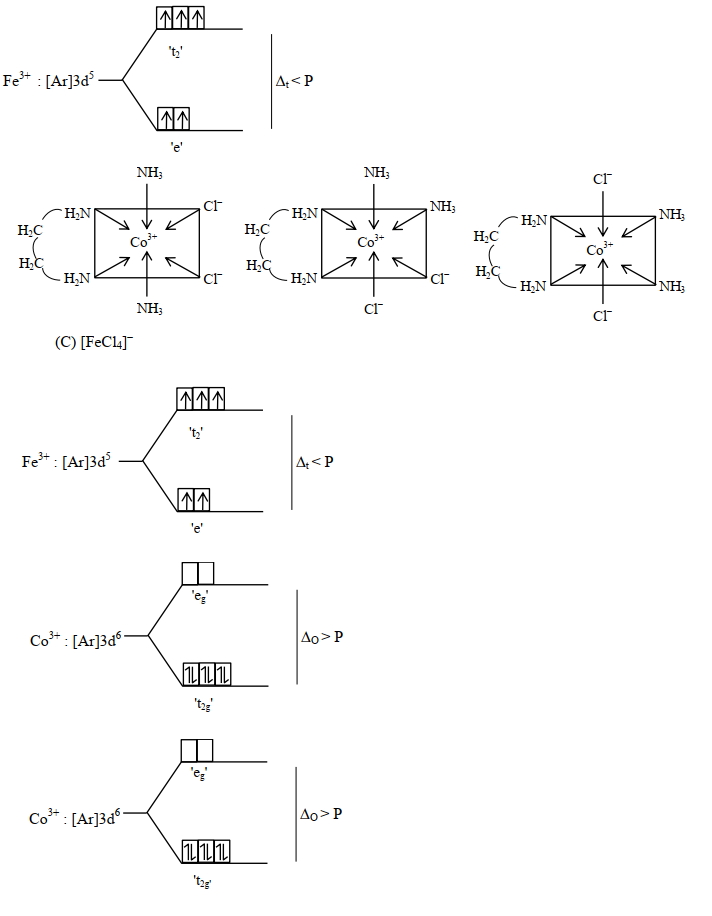
(A) In $[FeCl_4]^-$,$Fe^{3+}$ has the electronic configuration $[Ar] 3d^5$. Since $Cl^-$ is a weak field ligand,it forms a high-spin tetrahedral complex with $sp^3$ hybridization.
$(C)$ $[FeCl_4]^-$ has $5$ unpaired electrons,so its spin-only magnetic moment is $\mu = \sqrt{5(5+2)} = \sqrt{35} \approx 5.92 \ BM$. In $[Co(en)(NH_3)_2Cl_2]^+$,$Co^{3+}$ has the configuration $[Ar] 3d^6$. Due to the presence of strong field ligands ($en$ and $NH_3$),the electrons pair up,resulting in $0$ unpaired electrons $(n=0, \mu=0)$. Therefore,$[FeCl_4]^-$ has a higher magnetic moment.
$(B)$ is incorrect because $[Co(en)(NH_3)_2Cl_2]^+$ has $3$ geometrical isomers (trans,cis-cis,and cis-trans).
$(D)$ is incorrect because the hybridization of $Co^{3+}$ in this low-spin octahedral complex is $d^2sp^3$.
$(C)$ $[FeCl_4]^-$ has $5$ unpaired electrons,so its spin-only magnetic moment is $\mu = \sqrt{5(5+2)} = \sqrt{35} \approx 5.92 \ BM$. In $[Co(en)(NH_3)_2Cl_2]^+$,$Co^{3+}$ has the configuration $[Ar] 3d^6$. Due to the presence of strong field ligands ($en$ and $NH_3$),the electrons pair up,resulting in $0$ unpaired electrons $(n=0, \mu=0)$. Therefore,$[FeCl_4]^-$ has a higher magnetic moment.
$(B)$ is incorrect because $[Co(en)(NH_3)_2Cl_2]^+$ has $3$ geometrical isomers (trans,cis-cis,and cis-trans).
$(D)$ is incorrect because the hybridization of $Co^{3+}$ in this low-spin octahedral complex is $d^2sp^3$.
0 likesView Solution
20
ChemistryMediumMCQIIT JEE · 2020
With respect to hypochlorite,chlorate,and perchlorate ions,choose the correct statement$(s)$.
$A.$ The hypochlorite ion is the strongest conjugate base.
$B.$ The molecular shape of only the chlorate ion is influenced by the lone pair of electrons on $Cl$.
$C.$ The hypochlorite and chlorate ions disproportionate to give rise to an identical set of ions.
$D.$ The hypochlorite ion oxidizes the sulfite ion.
$A.$ The hypochlorite ion is the strongest conjugate base.
$B.$ The molecular shape of only the chlorate ion is influenced by the lone pair of electrons on $Cl$.
$C.$ The hypochlorite and chlorate ions disproportionate to give rise to an identical set of ions.
$D.$ The hypochlorite ion oxidizes the sulfite ion.
A
$A, B, C$
B
$A, B, D$
C
$A, B$
D
$A, C$
Solution
(B) Hypochlorite ion: $ClO^{-}$
Chlorate ion: $ClO_{3}^{-}$
Perchlorate ion: $ClO_{4}^{-}$
$A.$ Acidic strength order: $HClO < HClO_{3} < HClO_{4}$. Therefore,the conjugate base strength order is $ClO^{-} > ClO_{3}^{-} > ClO_{4}^{-}$. Thus,$A$ is correct.
$B.$ Hypochlorite ion $(ClO^{-})$: Linear shape. Chlorate ion $(ClO_{3}^{-})$: Trigonal pyramidal shape due to the lone pair on $Cl$. Perchlorate ion $(ClO_{4}^{-})$: Tetrahedral shape. Only the chlorate ion's shape is significantly distorted by a lone pair. Thus,$B$ is correct.
$C.$ Disproportionation reactions:
$I.$ $3ClO^{-} \rightarrow 2Cl^{-} + ClO_{3}^{-}$
$II.$ $4ClO_{3}^{-} \rightarrow 3ClO_{4}^{-} + Cl^{-}$
The products are different. Thus,$C$ is incorrect.
$D.$ Hypochlorite is a strong oxidizing agent and oxidizes sulfite $(SO_{3}^{2-})$ to sulfate $(SO_{4}^{2-})$: $ClO^{-} + SO_{3}^{2-} \rightarrow Cl^{-} + SO_{4}^{2-}$. Thus,$D$ is correct.
Correct statements are $A, B, D$.
Chlorate ion: $ClO_{3}^{-}$
Perchlorate ion: $ClO_{4}^{-}$
$A.$ Acidic strength order: $HClO < HClO_{3} < HClO_{4}$. Therefore,the conjugate base strength order is $ClO^{-} > ClO_{3}^{-} > ClO_{4}^{-}$. Thus,$A$ is correct.
$B.$ Hypochlorite ion $(ClO^{-})$: Linear shape. Chlorate ion $(ClO_{3}^{-})$: Trigonal pyramidal shape due to the lone pair on $Cl$. Perchlorate ion $(ClO_{4}^{-})$: Tetrahedral shape. Only the chlorate ion's shape is significantly distorted by a lone pair. Thus,$B$ is correct.
$C.$ Disproportionation reactions:
$I.$ $3ClO^{-} \rightarrow 2Cl^{-} + ClO_{3}^{-}$
$II.$ $4ClO_{3}^{-} \rightarrow 3ClO_{4}^{-} + Cl^{-}$
The products are different. Thus,$C$ is incorrect.
$D.$ Hypochlorite is a strong oxidizing agent and oxidizes sulfite $(SO_{3}^{2-})$ to sulfate $(SO_{4}^{2-})$: $ClO^{-} + SO_{3}^{2-} \rightarrow Cl^{-} + SO_{4}^{2-}$. Thus,$D$ is correct.
Correct statements are $A, B, D$.
0 likesView Solution
21
ChemistryMediumMCQIIT JEE · 2020
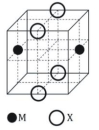
The cubic unit cell structure of a compound containing cation $M$ and anion $X$ is shown below. When compared to the anion,the cation has a smaller ionic radius. Choose the correct statement$(s)$:
$(A)$ The empirical formula of the compound is $MX$.
$(B)$ The cation $M$ and anion $X$ have different coordination geometries.
$(C)$ The ratio of $M-X$ bond length to the cubic unit cell edge length is $0.866$.
$(D)$ The ratio of the ionic radii of cation $M$ to anion $X$ is $0.414$.
$(A)$ The empirical formula of the compound is $MX$.
$(B)$ The cation $M$ and anion $X$ have different coordination geometries.
$(C)$ The ratio of $M-X$ bond length to the cubic unit cell edge length is $0.866$.
$(D)$ The ratio of the ionic radii of cation $M$ to anion $X$ is $0.414$.
A
$A, B$
B
$A, D$
C
$A, C$
D
$B, C$
Solution
(A) From the given unit cell,$M$ atoms are at the face centers and $X$ atoms are at the edge centers.
$(A)$ Number of $M$ atoms $(Z_M)$ = $6 \times \frac{1}{2} = 3$. Number of $X$ atoms $(Z_X)$ = $12 \times \frac{1}{4} = 3$. The ratio $Z_M : Z_X = 1:1$. Thus,the empirical formula is $MX$.
$(B)$ Both $M$ and $X$ occupy sites with the same coordination number,so they have the same coordination geometry.
$(C)$ The distance between a face-centered atom $M$ and an edge-centered atom $X$ is the bond length $d = \sqrt{(\frac{a}{2})^2 + (\frac{a}{2})^2 + 0^2} = \frac{a}{\sqrt{2}} = 0.707a$. The statement is incorrect.
$(D)$ For this structure,the contact occurs between $M$ and $X$. The distance $d = r_M + r_X = \frac{a}{\sqrt{2}}$. Given $r_M < r_X$,the ratio $r_M/r_X$ is not $0.414$. The statement is incorrect.
Therefore,only statement $(A)$ is correct. However,based on standard multiple-choice patterns,if $(A)$ is the only correct statement,the provided options might be flawed. Re-evaluating the structure: if $M$ is at body center and $X$ at corners,it is $CsCl$ type. The provided image shows $M$ at face centers and $X$ at edge centers,which is not a standard lattice. Given the options,$(A)$ is the most plausible correct statement.
$(A)$ Number of $M$ atoms $(Z_M)$ = $6 \times \frac{1}{2} = 3$. Number of $X$ atoms $(Z_X)$ = $12 \times \frac{1}{4} = 3$. The ratio $Z_M : Z_X = 1:1$. Thus,the empirical formula is $MX$.
$(B)$ Both $M$ and $X$ occupy sites with the same coordination number,so they have the same coordination geometry.
$(C)$ The distance between a face-centered atom $M$ and an edge-centered atom $X$ is the bond length $d = \sqrt{(\frac{a}{2})^2 + (\frac{a}{2})^2 + 0^2} = \frac{a}{\sqrt{2}} = 0.707a$. The statement is incorrect.
$(D)$ For this structure,the contact occurs between $M$ and $X$. The distance $d = r_M + r_X = \frac{a}{\sqrt{2}}$. Given $r_M < r_X$,the ratio $r_M/r_X$ is not $0.414$. The statement is incorrect.
Therefore,only statement $(A)$ is correct. However,based on standard multiple-choice patterns,if $(A)$ is the only correct statement,the provided options might be flawed. Re-evaluating the structure: if $M$ is at body center and $X$ at corners,it is $CsCl$ type. The provided image shows $M$ at face centers and $X$ at edge centers,which is not a standard lattice. Given the options,$(A)$ is the most plausible correct statement.
0 likesView Solution
22
ChemistryEasyMCQIIT JEE · 2020
$5.00 \ mL$ of $0.10 \ M$ oxalic acid solution taken in a conical flask is titrated against $NaOH$ from a burette using phenolphthalein indicator. The volume of $NaOH$ required for the appearance of permanent faint pink color is tabulated below for five experiments. What is the concentration,in molarity,of the $NaOH$ solution?
| $Exp. \ No.$ | $Vol. \ of \ NaOH \ (mL)$ |
| $1$ | $12.5$ |
| $2$ | $10.5$ |
| $3$ | $9.0$ |
| $4$ | $9.0$ |
| $5$ | $9.0$ |
A
$0.11$
B
$0.15$
C
$0.20$
D
$0.25$
Solution
(A) The reaction between oxalic acid $(H_2C_2O_4)$ and $NaOH$ is: $H_2C_2O_4 + 2NaOH \rightarrow Na_2C_2O_4 + 2H_2O$.
The concordant volume of $NaOH$ is $9.0 \ mL$.
Using the equivalence relation: $n_1 M_1 V_1 = n_2 M_2 V_2$,where $n$ is the n-factor.
For oxalic acid,$n_1 = 2$. For $NaOH$,$n_2 = 1$.
$2 \times 0.10 \ M \times 5.00 \ mL = 1 \times M_{NaOH} \times 9.0 \ mL$.
$M_{NaOH} = \frac{2 \times 0.10 \times 5.00}{9.0} = \frac{1.0}{9.0} \approx 0.11 \ M$.
The concordant volume of $NaOH$ is $9.0 \ mL$.
Using the equivalence relation: $n_1 M_1 V_1 = n_2 M_2 V_2$,where $n$ is the n-factor.
For oxalic acid,$n_1 = 2$. For $NaOH$,$n_2 = 1$.
$2 \times 0.10 \ M \times 5.00 \ mL = 1 \times M_{NaOH} \times 9.0 \ mL$.
$M_{NaOH} = \frac{2 \times 0.10 \times 5.00}{9.0} = \frac{1.0}{9.0} \approx 0.11 \ M$.
0 likesView Solution
23
ChemistryMediumMCQIIT JEE · 2020
Consider a $70 \%$ efficient hydrogen-oxygen fuel cell working under standard conditions at $1 \ bar$ and $298 \ K$. Its cell reaction is
$H_{2(g)} + \frac{1}{2} O_{2(g)} \rightarrow H_2O(\ell)$
The work derived from the cell on the consumption of $1.0 \times 10^{-3} \ mol$ of $H_{2(g)}$ is used to compress $1.00 \ mol$ of a monoatomic ideal gas in a thermally insulated container. What is the change in the temperature (in $K$) of the ideal gas?
The standard reduction potentials for the two half-cells are given below.
$O_{2(g)} + 4H^{+}(aq.) + 4e^- \rightarrow 2H_2O(\ell), E^{\circ} = 1.23 \ V$
$2H^{+}(aq.) + 2e^- \rightarrow H_{2(g)}, E^{\circ} = 0.00 \ V$
Use $F = 96500 \ C \ mol^{-1}, R = 8.314 \ J \ mol^{-1} \ K^{-1}$
$H_{2(g)} + \frac{1}{2} O_{2(g)} \rightarrow H_2O(\ell)$
The work derived from the cell on the consumption of $1.0 \times 10^{-3} \ mol$ of $H_{2(g)}$ is used to compress $1.00 \ mol$ of a monoatomic ideal gas in a thermally insulated container. What is the change in the temperature (in $K$) of the ideal gas?
The standard reduction potentials for the two half-cells are given below.
$O_{2(g)} + 4H^{+}(aq.) + 4e^- \rightarrow 2H_2O(\ell), E^{\circ} = 1.23 \ V$
$2H^{+}(aq.) + 2e^- \rightarrow H_{2(g)}, E^{\circ} = 0.00 \ V$
Use $F = 96500 \ C \ mol^{-1}, R = 8.314 \ J \ mol^{-1} \ K^{-1}$
A
$13.32$
B
$13.35$
C
$13.40$
D
$13.45$
Solution
(A) $E_{\text{cell}}^{\circ} = 1.23 \ V - 0.00 \ V = 1.23 \ V$
$\Delta G^{\circ} = -nFE_{\text{cell}}^{\circ} = -2 \times 96500 \times 1.23 \ J \ mol^{-1}$
Work derived from the fuel cell for $1.0 \times 10^{-3} \ mol$ of $H_{2(g)}$:
$W = 0.70 \times |\Delta G^{\circ}| \times 10^{-3} = 0.70 \times (2 \times 96500 \times 1.23) \times 10^{-3} \ J = 166.002 \ J$
For a thermally insulated container,$q = 0$. According to the first law of thermodynamics,$W = \Delta U = nC_{V,m} \Delta T$.
For a monoatomic ideal gas,$C_{V,m} = \frac{3}{2}R = \frac{3}{2} \times 8.314 \ J \ mol^{-1} \ K^{-1} = 12.471 \ J \ mol^{-1} \ K^{-1}$.
$166.002 = 1.00 \times 12.471 \times \Delta T$
$\Delta T = \frac{166.002}{12.471} \approx 13.311 \ K \approx 13.32 \ K$.
$\Delta G^{\circ} = -nFE_{\text{cell}}^{\circ} = -2 \times 96500 \times 1.23 \ J \ mol^{-1}$
Work derived from the fuel cell for $1.0 \times 10^{-3} \ mol$ of $H_{2(g)}$:
$W = 0.70 \times |\Delta G^{\circ}| \times 10^{-3} = 0.70 \times (2 \times 96500 \times 1.23) \times 10^{-3} \ J = 166.002 \ J$
For a thermally insulated container,$q = 0$. According to the first law of thermodynamics,$W = \Delta U = nC_{V,m} \Delta T$.
For a monoatomic ideal gas,$C_{V,m} = \frac{3}{2}R = \frac{3}{2} \times 8.314 \ J \ mol^{-1} \ K^{-1} = 12.471 \ J \ mol^{-1} \ K^{-1}$.
$166.002 = 1.00 \times 12.471 \times \Delta T$
$\Delta T = \frac{166.002}{12.471} \approx 13.311 \ K \approx 13.32 \ K$.
0 likesView Solution
24
ChemistryMediumMCQIIT JEE · 2020
An acidified solution of potassium chromate was layered with an equal volume of amyl alcohol. When it was shaken after the addition of $1 \ mL$ of $3 \% \ H_2O_2$,a blue alcohol layer was obtained. The blue color is due to the formation of a chromium$(VI)$ compound '$X$'. What is the number of oxygen atoms bonded to chromium through only single bonds in a molecule of $X$ ?
A
$2$
B
$3$
C
$4$
D
$5$
Solution
(C) The reaction between acidified potassium chromate and $H_2O_2$ produces chromium pentoxide $(CrO_5)$,which is a blue-colored compound.
The chemical reaction is: $K_2CrO_4 + 2H_2O_2 + 2H^+ \rightarrow CrO_5 + 2K^+ + 2H_2O$.
$CrO_5$ has a butterfly-like structure.
In this structure,there is one double-bonded oxygen atom $(Cr=O)$ and four single-bonded oxygen atoms $(Cr-O)$ which are part of two peroxo groups $(-O-O-)$.
Therefore,the number of oxygen atoms bonded to chromium through only single bonds is $4$.
The chemical reaction is: $K_2CrO_4 + 2H_2O_2 + 2H^+ \rightarrow CrO_5 + 2K^+ + 2H_2O$.
$CrO_5$ has a butterfly-like structure.
In this structure,there is one double-bonded oxygen atom $(Cr=O)$ and four single-bonded oxygen atoms $(Cr-O)$ which are part of two peroxo groups $(-O-O-)$.
Therefore,the number of oxygen atoms bonded to chromium through only single bonds is $4$.
0 likesView Solution
25
ChemistryDifficultMCQIIT JEE · 2020
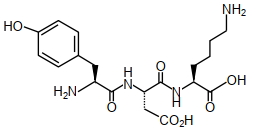
The structure of a peptide is given below. If the absolute values of the net charge of the peptide at $pH = 2$,$pH = 6$,and $pH = 11$ are $|z_1|$,$|z_2|$,and $|z_3|$,respectively,then what is $|z_1| + |z_2| + |z_3|$?
A
$3$
B
$2$
C
$4$
D
$5$
Solution
(D) The peptide is $Tyr-Asp-Lys$. The ionizable groups are the $N$-terminal $-NH_2$ $(pK_a \approx 9)$,the $C$-terminal $-COOH$ $(pK_a \approx 2)$,the side chain $-COOH$ of $Asp$ $(pK_a \approx 3.9)$,the side chain $-OH$ of $Tyr$ $(pK_a \approx 10)$,and the side chain $-NH_2$ of $Lys$ $(pK_a \approx 10.5)$.
At $pH = 2$: The $N$-terminal $-NH_2$ is protonated ($-NH_3^+$,$+1$),the $C$-terminal $-COOH$ is neutral $(0)$,the $Asp$ side chain $-COOH$ is neutral $(0)$,the $Tyr$ side chain $-OH$ is neutral $(0)$,and the $Lys$ side chain $-NH_2$ is protonated ($-NH_3^+$,$+1$). Net charge $z_1 = +2$,so $|z_1| = 2$.
At $pH = 6$: The $N$-terminal $-NH_2$ is protonated ($-NH_3^+$,$+1$),the $C$-terminal $-COOH$ is deprotonated ($-COO^-$,$-1$),the $Asp$ side chain $-COOH$ is deprotonated ($-COO^-$,$-1$),the $Tyr$ side chain $-OH$ is neutral $(0)$,and the $Lys$ side chain $-NH_2$ is protonated ($-NH_3^+$,$+1$). Net charge $z_2 = (+1) + (-1) + (-1) + (+1) = 0$,so $|z_2| = 0$.
At $pH = 11$: The $N$-terminal $-NH_2$ is neutral $(0)$,the $C$-terminal $-COOH$ is deprotonated ($-COO^-$,$-1$),the $Asp$ side chain $-COOH$ is deprotonated ($-COO^-$,$-1$),the $Tyr$ side chain $-OH$ is deprotonated ($-O^-$,$-1$),and the $Lys$ side chain $-NH_2$ is neutral $(0)$. Net charge $z_3 = (-1) + (-1) + (-1) = -3$,so $|z_3| = 3$.
Therefore,$|z_1| + |z_2| + |z_3| = 2 + 0 + 3 = 5$.
At $pH = 2$: The $N$-terminal $-NH_2$ is protonated ($-NH_3^+$,$+1$),the $C$-terminal $-COOH$ is neutral $(0)$,the $Asp$ side chain $-COOH$ is neutral $(0)$,the $Tyr$ side chain $-OH$ is neutral $(0)$,and the $Lys$ side chain $-NH_2$ is protonated ($-NH_3^+$,$+1$). Net charge $z_1 = +2$,so $|z_1| = 2$.
At $pH = 6$: The $N$-terminal $-NH_2$ is protonated ($-NH_3^+$,$+1$),the $C$-terminal $-COOH$ is deprotonated ($-COO^-$,$-1$),the $Asp$ side chain $-COOH$ is deprotonated ($-COO^-$,$-1$),the $Tyr$ side chain $-OH$ is neutral $(0)$,and the $Lys$ side chain $-NH_2$ is protonated ($-NH_3^+$,$+1$). Net charge $z_2 = (+1) + (-1) + (-1) + (+1) = 0$,so $|z_2| = 0$.
At $pH = 11$: The $N$-terminal $-NH_2$ is neutral $(0)$,the $C$-terminal $-COOH$ is deprotonated ($-COO^-$,$-1$),the $Asp$ side chain $-COOH$ is deprotonated ($-COO^-$,$-1$),the $Tyr$ side chain $-OH$ is deprotonated ($-O^-$,$-1$),and the $Lys$ side chain $-NH_2$ is neutral $(0)$. Net charge $z_3 = (-1) + (-1) + (-1) = -3$,so $|z_3| = 3$.
Therefore,$|z_1| + |z_2| + |z_3| = 2 + 0 + 3 = 5$.
0 likesView Solution
26
ChemistryDifficultMCQIIT JEE · 2020
An organic compound $(C_8H_{10}O_2)$ rotates plane-polarized light. It produces a pink color with a neutral $FeCl_3$ solution. What is the total number of all the possible isomers for this compound?
A
$6$
B
$7$
C
$8$
D
$9$
Solution
(A) The molecular formula $C_8H_{10}O_2$ and the positive $FeCl_3$ test indicate that the compound is a phenol derivative.
Since the compound rotates plane-polarized light,it must be optically active,meaning it contains a chiral center.
The structure consists of a benzene ring with an $-OH$ group and a side chain of $-CH(OH)CH_3$.
There are three possible positions for the side chain relative to the $-OH$ group on the benzene ring: ortho,meta,and para.
For each of these three positions,the side chain $-CH(OH)CH_3$ contains a chiral carbon atom,which results in two enantiomers ($R$ and $S$ configurations).
Therefore,the total number of optically active isomers is $3 \times 2 = 6$.
Since the compound rotates plane-polarized light,it must be optically active,meaning it contains a chiral center.
The structure consists of a benzene ring with an $-OH$ group and a side chain of $-CH(OH)CH_3$.
There are three possible positions for the side chain relative to the $-OH$ group on the benzene ring: ortho,meta,and para.
For each of these three positions,the side chain $-CH(OH)CH_3$ contains a chiral carbon atom,which results in two enantiomers ($R$ and $S$ configurations).
Therefore,the total number of optically active isomers is $3 \times 2 = 6$.
0 likesView Solution
27
ChemistryAdvancedMCQIIT JEE · 2020
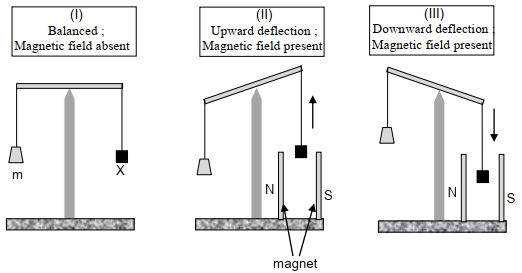
In an experiment,$m$ grams of a compound $X$ (gas/liquid/solid) taken in a container is loaded in a balance as shown in figure $I$ below. In the presence of a magnetic field,the pan with $X$ is either deflected upwards (figure $II$),or deflected downwards (figure $III$),depending on the compound $X$. Identify the correct statement$(s)$:
$(A)$ If $X$ is $H_2O_{(l)}$,deflection of the pan is upwards.
$(B)$ If $X$ is $K_4[Fe(CN)_6]_{(s)}$,deflection of the pan is upwards.
$(C)$ If $X$ is $O_{2(g)}$,deflection of the pan is downwards.
$(D)$ If $X$ is $C_6H_{6(l)}$,deflection of the pan is downwards.
$(A)$ If $X$ is $H_2O_{(l)}$,deflection of the pan is upwards.
$(B)$ If $X$ is $K_4[Fe(CN)_6]_{(s)}$,deflection of the pan is upwards.
$(C)$ If $X$ is $O_{2(g)}$,deflection of the pan is downwards.
$(D)$ If $X$ is $C_6H_{6(l)}$,deflection of the pan is downwards.
A
$A, B, D$
B
$A, B, C$
C
$A, B$
D
$A, D$
Solution
(B) Paramagnetic compounds are attracted towards a magnetic field,causing the pan to be deflected downwards (figure $III$).
Diamagnetic compounds are repelled by a magnetic field,causing the pan to be deflected upwards (figure $II$).
$(A)$ $H_2O_{(l)}$ is diamagnetic. Therefore,the deflection is upwards. (Correct)
$(B)$ $K_4[Fe(CN)_6]_{(s)}$ contains $Fe^{2+}$ with a strong field ligand $(CN^-)$,resulting in a $d^6$ configuration $[t_{2g}^6, e_g^0]$. It is diamagnetic. Therefore,the deflection is upwards. (Correct)
$(C)$ $O_{2(g)}$ is paramagnetic due to two unpaired electrons in its $\pi^*$ antibonding orbitals. Therefore,the deflection is downwards. (Correct)
$(D)$ $C_6H_{6(l)}$ (benzene) is diamagnetic as it has no unpaired electrons. Therefore,the deflection should be upwards,not downwards. (Incorrect)
Thus,statements $(A), (B),$ and $(C)$ are correct.
Diamagnetic compounds are repelled by a magnetic field,causing the pan to be deflected upwards (figure $II$).
$(A)$ $H_2O_{(l)}$ is diamagnetic. Therefore,the deflection is upwards. (Correct)
$(B)$ $K_4[Fe(CN)_6]_{(s)}$ contains $Fe^{2+}$ with a strong field ligand $(CN^-)$,resulting in a $d^6$ configuration $[t_{2g}^6, e_g^0]$. It is diamagnetic. Therefore,the deflection is upwards. (Correct)
$(C)$ $O_{2(g)}$ is paramagnetic due to two unpaired electrons in its $\pi^*$ antibonding orbitals. Therefore,the deflection is downwards. (Correct)
$(D)$ $C_6H_{6(l)}$ (benzene) is diamagnetic as it has no unpaired electrons. Therefore,the deflection should be upwards,not downwards. (Incorrect)
Thus,statements $(A), (B),$ and $(C)$ are correct.
0 likesView Solution
28
ChemistryMediumMCQIIT JEE · 2020
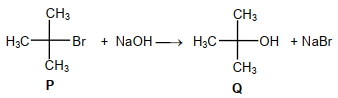
Which of the following plots is(are) correct for the given reaction? $( [P]_0$ is the initial concentration of $P$ $)$
A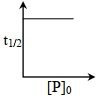
B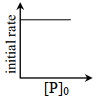
C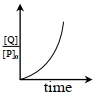
D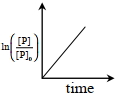
Solution
(A) The reaction is a $SN^1$ reaction,which follows first-order kinetics.
For a first-order reaction:
$1$. The half-life $t_{1/2} = \frac{0.693}{k}$ is independent of the initial concentration $[P]_0$. Thus,the plot of $t_{1/2}$ vs $[P]_0$ is a horizontal line.
$2$. The rate of reaction is given by $rate = k[P]$. The initial rate is $rate_0 = k[P]_0$. Thus,the plot of initial rate vs $[P]_0$ is a straight line passing through the origin.
$3$. The concentration of product $Q$ at time $t$ is $[Q] = [P]_0 - [P] = [P]_0(1 - e^{-kt})$. Thus,$\frac{[Q]}{[P]_0} = 1 - e^{-kt}$. This plot is an exponential growth curve.
$4$. For first-order kinetics,$\ln(\frac{[P]}{[P]_0}) = -kt$. The plot of $\ln(\frac{[P]}{[P]_0})$ vs time is a straight line with a negative slope $-k$ passing through the origin.
For a first-order reaction:
$1$. The half-life $t_{1/2} = \frac{0.693}{k}$ is independent of the initial concentration $[P]_0$. Thus,the plot of $t_{1/2}$ vs $[P]_0$ is a horizontal line.
$2$. The rate of reaction is given by $rate = k[P]$. The initial rate is $rate_0 = k[P]_0$. Thus,the plot of initial rate vs $[P]_0$ is a straight line passing through the origin.
$3$. The concentration of product $Q$ at time $t$ is $[Q] = [P]_0 - [P] = [P]_0(1 - e^{-kt})$. Thus,$\frac{[Q]}{[P]_0} = 1 - e^{-kt}$. This plot is an exponential growth curve.
$4$. For first-order kinetics,$\ln(\frac{[P]}{[P]_0}) = -kt$. The plot of $\ln(\frac{[P]}{[P]_0})$ vs time is a straight line with a negative slope $-k$ passing through the origin.
0 likesView Solution
29
ChemistryDifficultMCQIIT JEE · 2020
Which among the following statement$(s)$ is(are) true for the extraction of aluminium from bauxite?
$A$. Hydrated $Al_2O_3$ precipitates,when $CO_2$ is bubbled through a solution of sodium aluminate.
$B$. Addition of $Na_3AlF_6$ lowers the melting point of alumina.
$C$. $CO_2$ is evolved at the anode during electrolysis.
$D$. The cathode is a steel vessel with a lining of carbon.
$A$. Hydrated $Al_2O_3$ precipitates,when $CO_2$ is bubbled through a solution of sodium aluminate.
$B$. Addition of $Na_3AlF_6$ lowers the melting point of alumina.
$C$. $CO_2$ is evolved at the anode during electrolysis.
$D$. The cathode is a steel vessel with a lining of carbon.
A
$A, B, C$
B
$A, B, C, D$
C
$A, B$
D
$A, C$
Solution
(B) . $2 Na[Al(OH)_4]_{(aq)} + CO_2 \longrightarrow Na_2CO_3 + H_2O + 2 Al(OH)_3(\downarrow)$. This is correct as hydrated alumina precipitates.
$B$. $Na_3AlF_6$ (cryolite) is added to lower the melting point of the mixture and increase conductivity. This is correct.
$C$. During electrolysis,carbon anodes react with oxygen to form $CO$ and $CO_2$. This is correct.
$D$. The electrolytic cell consists of a steel vessel with a carbon lining which acts as the cathode. This is correct.
Therefore,all statements $A, B, C,$ and $D$ are true.
$B$. $Na_3AlF_6$ (cryolite) is added to lower the melting point of the mixture and increase conductivity. This is correct.
$C$. During electrolysis,carbon anodes react with oxygen to form $CO$ and $CO_2$. This is correct.
$D$. The electrolytic cell consists of a steel vessel with a carbon lining which acts as the cathode. This is correct.
Therefore,all statements $A, B, C,$ and $D$ are true.
0 likesView Solution
30
ChemistryDifficultMCQIIT JEE · 2020
Choose the correct statement$(s)$ among the following.
$A$. $SnCl_2 \cdot 2 H_2O$ is a reducing agent.
$B$. $SnO_2$ reacts with $KOH$ to form $K_2[Sn(OH)_6]$.
$C$. $A$ solution of $PbCl_2$ in $HCl$ contains $Pb^{2+}$ and $Cl^{-}$ ions.
$D$. The reaction of $Pb_3O_4$ with hot dilute nitric acid to give $PbO_2$ is a redox reaction.
$A$. $SnCl_2 \cdot 2 H_2O$ is a reducing agent.
$B$. $SnO_2$ reacts with $KOH$ to form $K_2[Sn(OH)_6]$.
$C$. $A$ solution of $PbCl_2$ in $HCl$ contains $Pb^{2+}$ and $Cl^{-}$ ions.
$D$. The reaction of $Pb_3O_4$ with hot dilute nitric acid to give $PbO_2$ is a redox reaction.
A
$A, C$
B
$A, D$
C
$A, B$
D
$A, B, C$
Solution
(D) . $SnCl_2 \cdot 2 H_2O$ is a reducing agent because $Sn^{2+}$ is easily oxidized to $Sn^{4+}$.
$B$. $SnO_2$ is amphoteric and reacts with $KOH$ to form the stannate complex: $SnO_2 + 2 KOH + 2 H_2O \longrightarrow K_2[Sn(OH)_6]$.
$C$. $PbCl_2$ is slightly soluble in water. In the presence of $HCl$,it exists in equilibrium as $Pb^{2+}$ and $Cl^-$ ions,though it can also form complex ions like $[PbCl_4]^{2-}$ in excess $HCl$.
$D$. The reaction $Pb_3O_4 + 4 HNO_3 \longrightarrow PbO_2 + 2 Pb(NO_3)_2 + 2 H_2O$ is a disproportionation-like reaction where $Pb_3O_4$ (which is $2PbO \cdot PbO_2$) reacts with acid; it is not a redox reaction as the oxidation states of $Pb$ remain $+2$ and $+4$ throughout.
$B$. $SnO_2$ is amphoteric and reacts with $KOH$ to form the stannate complex: $SnO_2 + 2 KOH + 2 H_2O \longrightarrow K_2[Sn(OH)_6]$.
$C$. $PbCl_2$ is slightly soluble in water. In the presence of $HCl$,it exists in equilibrium as $Pb^{2+}$ and $Cl^-$ ions,though it can also form complex ions like $[PbCl_4]^{2-}$ in excess $HCl$.
$D$. The reaction $Pb_3O_4 + 4 HNO_3 \longrightarrow PbO_2 + 2 Pb(NO_3)_2 + 2 H_2O$ is a disproportionation-like reaction where $Pb_3O_4$ (which is $2PbO \cdot PbO_2$) reacts with acid; it is not a redox reaction as the oxidation states of $Pb$ remain $+2$ and $+4$ throughout.
0 likesView Solution
31
ChemistryDifficultMCQIIT JEE · 2020
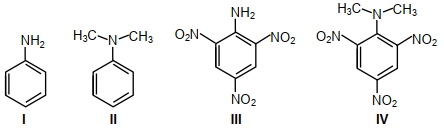
Consider the following four compounds $I, II, III,$ and $IV$.
Choose the correct statement$(s)$.
$(A)$ The order of basicity is $II > I > III > IV$.
$(B)$ The magnitude of $pK_b$ difference between $I$ and $II$ is more than that between $III$ and $IV$.
$(C)$ Resonance effect is more in $III$ than in $IV$.
$(D)$ Steric effect makes compound $IV$ more basic than $III$.
Choose the correct statement$(s)$.
$(A)$ The order of basicity is $II > I > III > IV$.
$(B)$ The magnitude of $pK_b$ difference between $I$ and $II$ is more than that between $III$ and $IV$.
$(C)$ Resonance effect is more in $III$ than in $IV$.
$(D)$ Steric effect makes compound $IV$ more basic than $III$.
A
$A, B$
B
$A, C$
C
$A, D$
D
$C, D$
Solution
(D) The $pK_b$ difference between $I$ and $II$ is $0.53$ and that of $III$ and $IV$ is $4.6$. Thus,statement $(B)$ is incorrect.
In $2,4,6$-trinitroaniline $(III)$,due to the strong $-R$ effect of the three $-NO_2$ groups,the lone pair of the $-NH_2$ group is highly delocalized into the benzene ring,making it the least basic compound.
In $N,N$-dimethyl-$2,4,6$-trinitroaniline $(IV)$,the bulky $-CH_3$ groups at the nitrogen atom experience steric repulsion with the ortho $-NO_2$ groups. This leads to Steric Inhibition of Resonance $(SIR)$,causing the lone pair on the nitrogen to be pushed out of the plane of the benzene ring. Consequently,the lone pair is not involved in resonance and is more available for protonation,making $(IV)$ more basic than $(III)$.
Therefore,statements $(C)$ and $(D)$ are correct.
In $2,4,6$-trinitroaniline $(III)$,due to the strong $-R$ effect of the three $-NO_2$ groups,the lone pair of the $-NH_2$ group is highly delocalized into the benzene ring,making it the least basic compound.
In $N,N$-dimethyl-$2,4,6$-trinitroaniline $(IV)$,the bulky $-CH_3$ groups at the nitrogen atom experience steric repulsion with the ortho $-NO_2$ groups. This leads to Steric Inhibition of Resonance $(SIR)$,causing the lone pair on the nitrogen to be pushed out of the plane of the benzene ring. Consequently,the lone pair is not involved in resonance and is more available for protonation,making $(IV)$ more basic than $(III)$.
Therefore,statements $(C)$ and $(D)$ are correct.
0 likesView Solution
32
ChemistryMediumMCQIIT JEE · 2020
Liquids $A$ and $B$ form an ideal solution for all compositions of $A$ and $B$ at $25^{\circ} C$. Two such solutions with $0.25$ and $0.50$ mole fractions of $A$ have total vapor pressures of $0.3 \ bar$ and $0.4 \ bar$,respectively. What is the vapor pressure of pure liquid $B$ in $bar$?
A
$0.10$
B
$0.15$
C
$0.20$
D
$0.25$
Solution
(C) For an ideal solution,the total vapor pressure is given by Raoult's Law: $P_{T} = P_{A}^{\circ} X_{A} + P_{B}^{\circ} X_{B}$.
Since $X_{B} = 1 - X_{A}$,we have $P_{T} = P_{A}^{\circ} X_{A} + P_{B}^{\circ} (1 - X_{A})$.
For the first solution: $0.3 = P_{A}^{\circ} (0.25) + P_{B}^{\circ} (0.75) \implies 0.3 = 0.25 P_{A}^{\circ} + 0.75 P_{B}^{\circ} \implies 1.2 = P_{A}^{\circ} + 3 P_{B}^{\circ} \quad (I)$.
For the second solution: $0.4 = P_{A}^{\circ} (0.50) + P_{B}^{\circ} (0.50) \implies 0.4 = 0.5 P_{A}^{\circ} + 0.5 P_{B}^{\circ} \implies 0.8 = P_{A}^{\circ} + P_{B}^{\circ} \quad (II)$.
Subtracting equation $(II)$ from equation $(I)$: $(P_{A}^{\circ} + 3 P_{B}^{\circ}) - (P_{A}^{\circ} + P_{B}^{\circ}) = 1.2 - 0.8 \implies 2 P_{B}^{\circ} = 0.4 \implies P_{B}^{\circ} = 0.2 \ bar$.
Since $X_{B} = 1 - X_{A}$,we have $P_{T} = P_{A}^{\circ} X_{A} + P_{B}^{\circ} (1 - X_{A})$.
For the first solution: $0.3 = P_{A}^{\circ} (0.25) + P_{B}^{\circ} (0.75) \implies 0.3 = 0.25 P_{A}^{\circ} + 0.75 P_{B}^{\circ} \implies 1.2 = P_{A}^{\circ} + 3 P_{B}^{\circ} \quad (I)$.
For the second solution: $0.4 = P_{A}^{\circ} (0.50) + P_{B}^{\circ} (0.50) \implies 0.4 = 0.5 P_{A}^{\circ} + 0.5 P_{B}^{\circ} \implies 0.8 = P_{A}^{\circ} + P_{B}^{\circ} \quad (II)$.
Subtracting equation $(II)$ from equation $(I)$: $(P_{A}^{\circ} + 3 P_{B}^{\circ}) - (P_{A}^{\circ} + P_{B}^{\circ}) = 1.2 - 0.8 \implies 2 P_{B}^{\circ} = 0.4 \implies P_{B}^{\circ} = 0.2 \ bar$.
0 likesView Solution
33
ChemistryMediumMCQIIT JEE · 2020
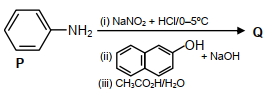
Consider the reaction sequence from $P$ to $Q$ shown below. The overall yield of the major product $Q$ from $P$ is $75 \%$. What is the amount in grams of $Q$ obtained from $9.3 \ mL$ of $P$? (Use density of $P = 1.00 \ g \ mL^{-1}$,Molar mass of $C = 12.0, H = 1.0, O = 16.0$ and $N = 14.0 \ g \ mol^{-1}$)
A
$18.60$
B
$18.70$
C
$18.80$
D
$18.90$
Solution
(A) Molecular weight of aniline $(P)$ $= C_6H_7N = 6 \times 12 + 7 \times 1 + 14 = 93 \ g \ mol^{-1}$.
Density of $P = 1.00 \ g \ mL^{-1}$,so mass of $9.3 \ mL$ of $P = 9.3 \ g$.
Moles of $P = \frac{9.3 \ g}{93 \ g \ mol^{-1}} = 0.1 \ mol$.
The reaction is a coupling reaction where $1 \ mol$ of aniline $(P)$ produces $1 \ mol$ of the azo dye $(Q)$.
Given the overall yield is $75 \%$,the actual moles of $Q$ formed $= 0.1 \times 0.75 = 0.075 \ mol$.
The molecular formula of $Q$ is $C_{16}H_{12}N_2O$.
Molar mass of $Q = 16 \times 12 + 12 \times 1 + 2 \times 14 + 16 = 192 + 12 + 28 + 16 = 248 \ g \ mol^{-1}$.
Amount of $Q$ in grams $= 0.075 \ mol \times 248 \ g \ mol^{-1} = 18.6 \ g$.
Density of $P = 1.00 \ g \ mL^{-1}$,so mass of $9.3 \ mL$ of $P = 9.3 \ g$.
Moles of $P = \frac{9.3 \ g}{93 \ g \ mol^{-1}} = 0.1 \ mol$.
The reaction is a coupling reaction where $1 \ mol$ of aniline $(P)$ produces $1 \ mol$ of the azo dye $(Q)$.
Given the overall yield is $75 \%$,the actual moles of $Q$ formed $= 0.1 \times 0.75 = 0.075 \ mol$.
The molecular formula of $Q$ is $C_{16}H_{12}N_2O$.
Molar mass of $Q = 16 \times 12 + 12 \times 1 + 2 \times 14 + 16 = 192 + 12 + 28 + 16 = 248 \ g \ mol^{-1}$.
Amount of $Q$ in grams $= 0.075 \ mol \times 248 \ g \ mol^{-1} = 18.6 \ g$.
0 likesView Solution
34
ChemistryMediumMCQIIT JEE · 2020
Tin is obtained from cassiterite by reduction with coke. Use the data given below to determine the minimum temperature (in $K$) at which the reduction of cassiterite by coke would take place.
At $298 \ K$: $\Delta_{f}H^{\circ}(SnO_{2(s)}) = -581.0 \ kJ \ mol^{-1}$,$\Delta_{f}H^{\circ}(CO_{2(g)}) = -394.0 \ kJ \ mol^{-1}$
$S^{\circ}(SnO_{2(s)}) = 56.0 \ J \ K^{-1} \ mol^{-1}$,$S^{\circ}(Sn_{(s)}) = 52.0 \ J \ K^{-1} \ mol^{-1}$
$S^{\circ}(C_{(s)}) = 6.0 \ J \ K^{-1} \ mol^{-1}$,$S^{\circ}(CO_{2(g)}) = 210.0 \ J \ K^{-1} \ mol^{-1}$
Assume that the enthalpies and the entropies are temperature independent.
At $298 \ K$: $\Delta_{f}H^{\circ}(SnO_{2(s)}) = -581.0 \ kJ \ mol^{-1}$,$\Delta_{f}H^{\circ}(CO_{2(g)}) = -394.0 \ kJ \ mol^{-1}$
$S^{\circ}(SnO_{2(s)}) = 56.0 \ J \ K^{-1} \ mol^{-1}$,$S^{\circ}(Sn_{(s)}) = 52.0 \ J \ K^{-1} \ mol^{-1}$
$S^{\circ}(C_{(s)}) = 6.0 \ J \ K^{-1} \ mol^{-1}$,$S^{\circ}(CO_{2(g)}) = 210.0 \ J \ K^{-1} \ mol^{-1}$
Assume that the enthalpies and the entropies are temperature independent.
A
$934$
B
$935$
C
$936$
D
$937$
Solution
(B) The chemical equation for the reduction of cassiterite $(SnO_2)$ by coke $(C)$ is: $SnO_{2(s)} + C_{(s)} \longrightarrow Sn_{(s)} + CO_{2(g)}$
Calculate the standard enthalpy of reaction: $\Delta H^{\circ}_{rxn} = [\Delta_{f}H^{\circ}(Sn_{(s)}) + \Delta_{f}H^{\circ}(CO_{2(g)})] - [\Delta_{f}H^{\circ}(SnO_{2(s)}) + \Delta_{f}H^{\circ}(C_{(s)})]$
Since $\Delta_{f}H^{\circ}$ for elements in their standard state is $0$,$\Delta H^{\circ}_{rxn} = [-394.0] - [-581.0] = 187.0 \ kJ \ mol^{-1} = 187000 \ J \ mol^{-1}$
Calculate the standard entropy of reaction: $\Delta S^{\circ}_{rxn} = [S^{\circ}(Sn_{(s)}) + S^{\circ}(CO_{2(g)})] - [S^{\circ}(SnO_{2(s)}) + S^{\circ}(C_{(s)})]$
$\Delta S^{\circ}_{rxn} = [52.0 + 210.0] - [56.0 + 6.0] = 262.0 - 62.0 = 200.0 \ J \ K^{-1} \ mol^{-1}$
For the reaction to be spontaneous,$\Delta G^{\circ} < 0$. At equilibrium,$\Delta G^{\circ} = 0$,so $T = \frac{\Delta H^{\circ}}{\Delta S^{\circ}}$
$T = \frac{187000 \ J \ mol^{-1}}{200.0 \ J \ K^{-1} \ mol^{-1}} = 935 \ K$
Calculate the standard enthalpy of reaction: $\Delta H^{\circ}_{rxn} = [\Delta_{f}H^{\circ}(Sn_{(s)}) + \Delta_{f}H^{\circ}(CO_{2(g)})] - [\Delta_{f}H^{\circ}(SnO_{2(s)}) + \Delta_{f}H^{\circ}(C_{(s)})]$
Since $\Delta_{f}H^{\circ}$ for elements in their standard state is $0$,$\Delta H^{\circ}_{rxn} = [-394.0] - [-581.0] = 187.0 \ kJ \ mol^{-1} = 187000 \ J \ mol^{-1}$
Calculate the standard entropy of reaction: $\Delta S^{\circ}_{rxn} = [S^{\circ}(Sn_{(s)}) + S^{\circ}(CO_{2(g)})] - [S^{\circ}(SnO_{2(s)}) + S^{\circ}(C_{(s)})]$
$\Delta S^{\circ}_{rxn} = [52.0 + 210.0] - [56.0 + 6.0] = 262.0 - 62.0 = 200.0 \ J \ K^{-1} \ mol^{-1}$
For the reaction to be spontaneous,$\Delta G^{\circ} < 0$. At equilibrium,$\Delta G^{\circ} = 0$,so $T = \frac{\Delta H^{\circ}}{\Delta S^{\circ}}$
$T = \frac{187000 \ J \ mol^{-1}}{200.0 \ J \ K^{-1} \ mol^{-1}} = 935 \ K$
0 likesView Solution
Vedclass Products
For Students
Vedclass Test Series
Mock tests in real IIT JEE style covering Chemistry with performance analysis. 5-day free trial.
Start Free TrialFor Teachers
Exam Paper Generator
Generate Set A/B/C/D Chemistry papers from 7.5L+ questions in 2 minutes. 3 chapters free.
Try FreeFor Institutes
Online Exam Module
Run live IIT JEE mock exams with unlimited students, 360° analytics & white-label branding.
See DemoFrequently Asked Questions
How many Chemistry questions are in IIT JEE 2020?
There are 34 Chemistry questions from the IIT JEE 2020 paper on Vedclass, each with a detailed step-by-step solution in English.
Are IIT JEE 2020 Chemistry solutions available in English?
Yes. All solutions on this page are in English. You can also switch to English or Hindi using the language buttons above the questions.
Can I practice IIT JEE 2020 Chemistry as a timed test?
Yes. Use the Vedclass Test Series to attempt a full IIT JEE mock test covering Chemistry with time limits and instant score analysis.
Can teachers create Chemistry papers from IIT JEE previous year questions?
Yes. The Vedclass Exam Paper Generator lets teachers mix IIT JEE Chemistry questions and generate Set A/B/C/D papers in minutes.
For Teachers & Institutes
Build a Custom Chemistry Paper
Pick IIT JEE 2020 Chemistry questions, set difficulty, and generate Set A/B/C/D in 2 minutes.