
ChemistryQ1–34 of 34 questions
Page 1 of 1 · English
1
ChemistryEasyMCQIIT JEE · 2019
Which of the following statement$(s)$ is (are) correct regarding the root mean square speed $(U_{rms})$ and average translational kinetic energy $(\varepsilon_{av})$ of a molecule in a gas at equilibrium?
$(1)$ $U_{rms}$ is doubled when its temperature is increased four times
$(2)$ $\varepsilon_{av}$ at a given temperature does not depend on its molecular mass
$(3)$ $U_{rms}$ is inversely proportional to the square root of its molecular mass
$(4)$ $\varepsilon_{av}$ is doubled when its temperature is increased four times
$(1)$ $U_{rms}$ is doubled when its temperature is increased four times
$(2)$ $\varepsilon_{av}$ at a given temperature does not depend on its molecular mass
$(3)$ $U_{rms}$ is inversely proportional to the square root of its molecular mass
$(4)$ $\varepsilon_{av}$ is doubled when its temperature is increased four times
A
$(1), (2), (3)$
B
$(1), (2), (4)$
C
$(1), (3), (4)$
D
$(2), (3), (4)$
Solution
(A) $U_{rms} = \sqrt{\frac{3RT}{M}}$. Since $U_{rms} \propto \sqrt{T}$,if $T$ becomes $4T$,$U_{rms}$ becomes $\sqrt{4} = 2$ times. Thus,statement $(1)$ is correct.
$\varepsilon_{av} = \frac{3}{2}kT$. This expression depends only on temperature $T$ and not on molecular mass $M$. Thus,statement $(2)$ is correct.
From $U_{rms} = \sqrt{\frac{3RT}{M}}$,$U_{rms} \propto \frac{1}{\sqrt{M}}$. Thus,statement $(3)$ is correct.
Since $\varepsilon_{av} = \frac{3}{2}kT$,$\varepsilon_{av} \propto T$. If $T$ is increased four times,$\varepsilon_{av}$ increases four times,not doubled. Thus,statement $(4)$ is incorrect.
Therefore,statements $(1), (2),$ and $(3)$ are correct.
$\varepsilon_{av} = \frac{3}{2}kT$. This expression depends only on temperature $T$ and not on molecular mass $M$. Thus,statement $(2)$ is correct.
From $U_{rms} = \sqrt{\frac{3RT}{M}}$,$U_{rms} \propto \frac{1}{\sqrt{M}}$. Thus,statement $(3)$ is correct.
Since $\varepsilon_{av} = \frac{3}{2}kT$,$\varepsilon_{av} \propto T$. If $T$ is increased four times,$\varepsilon_{av}$ increases four times,not doubled. Thus,statement $(4)$ is incorrect.
Therefore,statements $(1), (2),$ and $(3)$ are correct.
0 likesView Solution
2
ChemistryAdvancedMCQIIT JEE · 2019
$A$ tin chloride $Q$ undergoes the following reactions (not balanced):
$Q + Cl^{-} \rightarrow X$
$Q + Me_3N \rightarrow Y$
$Q + CuCl_2 \rightarrow Z + CuCl$
$X$ is a monoanion having pyramidal geometry. Both $Y$ and $Z$ are neutral compounds. Choose the correct option$(s)$.
$(1)$ The central atom in $X$ is $sp^3$ hybridized
$(2)$ The oxidation state of the central atom in $Z$ is $+4$
$(3)$ The central atom in $Z$ has no lone pair of electrons
$(4)$ There is a coordinate bond in $Y$
$Q + Cl^{-} \rightarrow X$
$Q + Me_3N \rightarrow Y$
$Q + CuCl_2 \rightarrow Z + CuCl$
$X$ is a monoanion having pyramidal geometry. Both $Y$ and $Z$ are neutral compounds. Choose the correct option$(s)$.
$(1)$ The central atom in $X$ is $sp^3$ hybridized
$(2)$ The oxidation state of the central atom in $Z$ is $+4$
$(3)$ The central atom in $Z$ has no lone pair of electrons
$(4)$ There is a coordinate bond in $Y$
A
$1, 2$
B
$1, 3$
C
$1, 4$
D
$2, 3$
Solution
(C) $Q$ is $SnCl_2$.
$1. SnCl_2 + Cl^{-} \rightarrow [SnCl_3]^{-} (X)$. The $Sn$ atom in $[SnCl_3]^{-}$ has $3$ bond pairs and $1$ lone pair,so it is $sp^3$ hybridized with pyramidal geometry. Statement $(1)$ is correct.
$2. SnCl_2 + Me_3N \rightarrow SnCl_2 \cdot NMe_3 (Y)$. This is an adduct where $N$ donates a lone pair to $Sn$,forming a coordinate bond. Statement $(4)$ is correct.
$3. SnCl_2 + 2CuCl_2 \rightarrow SnCl_4 (Z) + 2CuCl$. The oxidation state of $Sn$ in $SnCl_4$ is $+4$. Statement $(2)$ is incorrect.
$4. SnCl_4$ has $4$ bond pairs and $0$ lone pairs. Statement $(3)$ is incorrect.
Therefore,statements $(1)$ and $(4)$ are correct.
$1. SnCl_2 + Cl^{-} \rightarrow [SnCl_3]^{-} (X)$. The $Sn$ atom in $[SnCl_3]^{-}$ has $3$ bond pairs and $1$ lone pair,so it is $sp^3$ hybridized with pyramidal geometry. Statement $(1)$ is correct.
$2. SnCl_2 + Me_3N \rightarrow SnCl_2 \cdot NMe_3 (Y)$. This is an adduct where $N$ donates a lone pair to $Sn$,forming a coordinate bond. Statement $(4)$ is correct.
$3. SnCl_2 + 2CuCl_2 \rightarrow SnCl_4 (Z) + 2CuCl$. The oxidation state of $Sn$ in $SnCl_4$ is $+4$. Statement $(2)$ is incorrect.
$4. SnCl_4$ has $4$ bond pairs and $0$ lone pairs. Statement $(3)$ is incorrect.
Therefore,statements $(1)$ and $(4)$ are correct.
0 likesView Solution
3
ChemistryEasyMCQIIT JEE · 2019
Each of the following options contains a set of four molecules. Identify the option$(s)$ where all four molecules possess a permanent dipole moment at room temperature.
$(1)$ $BeCl_2, CO_2, BCl_3, CHCl_3$
$(2)$ $SO_2, C_6H_5Cl, H_2Se, BrF_5$
$(3)$ $BF_3, O_3, SF_6, XeF_6$
$(4)$ $NO_2, NH_3, POCl_3, CH_3Cl$
$(1)$ $BeCl_2, CO_2, BCl_3, CHCl_3$
$(2)$ $SO_2, C_6H_5Cl, H_2Se, BrF_5$
$(3)$ $BF_3, O_3, SF_6, XeF_6$
$(4)$ $NO_2, NH_3, POCl_3, CH_3Cl$
A
$1, 2$
B
$1, 3$
C
$1, 4$
D
$2, 4$
Solution
(D) molecule possesses a permanent dipole moment if it is polar,meaning its net dipole moment $\mu \neq 0$.
In set $(1)$,$BeCl_2$ (linear),$CO_2$ (linear),and $BCl_3$ (trigonal planar) are symmetrical and have $\mu = 0$.
In set $(2)$,$SO_2$ (bent),$C_6H_5Cl$ (polar),$H_2Se$ (bent),and $BrF_5$ (square pyramidal) are all polar molecules with $\mu \neq 0$.
In set $(3)$,$BF_3$ (trigonal planar) and $SF_6$ (octahedral) are symmetrical and have $\mu = 0$.
In set $(4)$,$NO_2$ (bent),$NH_3$ (pyramidal),$POCl_3$ (distorted tetrahedral),and $CH_3Cl$ (distorted tetrahedral) are all polar molecules with $\mu \neq 0$.
Thus,sets $(2)$ and $(4)$ contain molecules that all possess a permanent dipole moment.
In set $(1)$,$BeCl_2$ (linear),$CO_2$ (linear),and $BCl_3$ (trigonal planar) are symmetrical and have $\mu = 0$.
In set $(2)$,$SO_2$ (bent),$C_6H_5Cl$ (polar),$H_2Se$ (bent),and $BrF_5$ (square pyramidal) are all polar molecules with $\mu \neq 0$.
In set $(3)$,$BF_3$ (trigonal planar) and $SF_6$ (octahedral) are symmetrical and have $\mu = 0$.
In set $(4)$,$NO_2$ (bent),$NH_3$ (pyramidal),$POCl_3$ (distorted tetrahedral),and $CH_3Cl$ (distorted tetrahedral) are all polar molecules with $\mu \neq 0$.
Thus,sets $(2)$ and $(4)$ contain molecules that all possess a permanent dipole moment.
0 likesView Solution
4
ChemistryMediumMCQIIT JEE · 2019
Choose the reaction$(s)$ from the following options,for which the standard enthalpy of reaction is equal to the standard enthalpy of formation.
$(1)$ $\frac{3}{2} O_{2(g)} \rightarrow O_{3(g)}$
$(2)$ $\frac{1}{8} S_{8(s)} + O_{2(g)} \rightarrow SO_{2(g)}$
$(3)$ $2 H_{2(g)} + O_{2(g)} \rightarrow 2 H_2O_{(l)}$
$(4)$ $2 C_{(g)} + 3 H_{2(g)} \rightarrow C_2H_{6(g)}$
$(1)$ $\frac{3}{2} O_{2(g)} \rightarrow O_{3(g)}$
$(2)$ $\frac{1}{8} S_{8(s)} + O_{2(g)} \rightarrow SO_{2(g)}$
$(3)$ $2 H_{2(g)} + O_{2(g)} \rightarrow 2 H_2O_{(l)}$
$(4)$ $2 C_{(g)} + 3 H_{2(g)} \rightarrow C_2H_{6(g)}$
A
$(1), (2)$
B
$(1), (3)$
C
$(1), (4)$
D
$(2), (3)$
Solution
(A) The standard enthalpy of formation $(\Delta_f H^\circ)$ is defined as the enthalpy change when $1 \text{ mole}$ of a compound is formed from its constituent elements in their most stable standard states.
$(1)$ $\frac{3}{2} O_{2(g)} \rightarrow O_{3(g)}$: $O_2$ is the most stable form of oxygen. $1 \text{ mole}$ of $O_3$ is formed. This represents $\Delta_f H^\circ$.
$(2)$ $\frac{1}{8} S_{8(s)} + O_{2(g)} \rightarrow SO_{2(g)}$: $S_8$ is the most stable form of sulfur and $O_2$ is the most stable form of oxygen. $1 \text{ mole}$ of $SO_2$ is formed. This represents $\Delta_f H^\circ$.
$(3)$ $2 H_{2(g)} + O_{2(g)} \rightarrow 2 H_2O_{(l)}$: Here,$2 \text{ moles}$ of $H_2O$ are formed,so this is $2 \times \Delta_f H^\circ$,not $\Delta_f H^\circ$.
$(4)$ $2 C_{(g)} + 3 H_{2(g)} \rightarrow C_2H_{6(g)}$: Carbon is not in its most stable state (graphite is the standard state). Thus,this is not $\Delta_f H^\circ$.
Therefore,reactions $(1)$ and $(2)$ satisfy the condition.
$(1)$ $\frac{3}{2} O_{2(g)} \rightarrow O_{3(g)}$: $O_2$ is the most stable form of oxygen. $1 \text{ mole}$ of $O_3$ is formed. This represents $\Delta_f H^\circ$.
$(2)$ $\frac{1}{8} S_{8(s)} + O_{2(g)} \rightarrow SO_{2(g)}$: $S_8$ is the most stable form of sulfur and $O_2$ is the most stable form of oxygen. $1 \text{ mole}$ of $SO_2$ is formed. This represents $\Delta_f H^\circ$.
$(3)$ $2 H_{2(g)} + O_{2(g)} \rightarrow 2 H_2O_{(l)}$: Here,$2 \text{ moles}$ of $H_2O$ are formed,so this is $2 \times \Delta_f H^\circ$,not $\Delta_f H^\circ$.
$(4)$ $2 C_{(g)} + 3 H_{2(g)} \rightarrow C_2H_{6(g)}$: Carbon is not in its most stable state (graphite is the standard state). Thus,this is not $\Delta_f H^\circ$.
Therefore,reactions $(1)$ and $(2)$ satisfy the condition.
0 likesView Solution
5
ChemistryMediumMCQIIT JEE · 2019
For the following reaction,the equilibrium constant $K_{c}$ at $298 \ K$ is $1.6 \times 10^{17}$.
$Fe^{2+}_{(aq)} + S^{2-}_{(aq)} \rightleftharpoons FeS_{(s)}$
When equal volumes of $0.06 \ M \ Fe^{2+}_{(aq)}$ and $0.2 \ M \ S^{2-}_{(aq)}$ solutions are mixed,the equilibrium concentration of $Fe^{2+}_{(aq)}$ is found to be $Y \times 10^{-17} \ M$. The value of $Y$ is. . . . .
$Fe^{2+}_{(aq)} + S^{2-}_{(aq)} \rightleftharpoons FeS_{(s)}$
When equal volumes of $0.06 \ M \ Fe^{2+}_{(aq)}$ and $0.2 \ M \ S^{2-}_{(aq)}$ solutions are mixed,the equilibrium concentration of $Fe^{2+}_{(aq)}$ is found to be $Y \times 10^{-17} \ M$. The value of $Y$ is. . . . .
A
$8.80$
B
$8.85$
C
$8.93$
D
$8.95$
Solution
(C) The reaction is $Fe^{2+}_{(aq)} + S^{2-}_{(aq)} \rightleftharpoons FeS_{(s)}$.
Since equal volumes are mixed,the new concentrations are $0.03 \ M \ Fe^{2+}$ and $0.1 \ M \ S^{2-}$.
Given $K_{c} = 1.6 \times 10^{17}$,which is very large,the reaction proceeds almost to completion.
Let $y$ be the equilibrium concentration of $Fe^{2+}_{(aq)}$.
Initial concentrations: $[Fe^{2+}] = 0.03 \ M$,$[S^{2-}] = 0.1 \ M$.
At equilibrium: $[Fe^{2+}] = y$,$[S^{2-}] = 0.1 - 0.03 = 0.07 \ M$.
$K_{c} = \frac{1}{[Fe^{2+}][S^{2-}]} = \frac{1}{y \times 0.07} = 1.6 \times 10^{17}$.
$y = \frac{1}{1.6 \times 0.07} \times 10^{-17} = \frac{1}{0.112} \times 10^{-17} \approx 8.928 \times 10^{-17} \ M$.
Thus,$Y \approx 8.93$.
Since equal volumes are mixed,the new concentrations are $0.03 \ M \ Fe^{2+}$ and $0.1 \ M \ S^{2-}$.
Given $K_{c} = 1.6 \times 10^{17}$,which is very large,the reaction proceeds almost to completion.
Let $y$ be the equilibrium concentration of $Fe^{2+}_{(aq)}$.
Initial concentrations: $[Fe^{2+}] = 0.03 \ M$,$[S^{2-}] = 0.1 \ M$.
At equilibrium: $[Fe^{2+}] = y$,$[S^{2-}] = 0.1 - 0.03 = 0.07 \ M$.
$K_{c} = \frac{1}{[Fe^{2+}][S^{2-}]} = \frac{1}{y \times 0.07} = 1.6 \times 10^{17}$.
$y = \frac{1}{1.6 \times 0.07} \times 10^{-17} = \frac{1}{0.112} \times 10^{-17} \approx 8.928 \times 10^{-17} \ M$.
Thus,$Y \approx 8.93$.
0 likesView Solution
6
ChemistryEasyMCQIIT JEE · 2019
Among $B_2H_6, B_3N_3H_6, N_2O, N_2O_4, H_2S_2O_3$ and $H_2S_2O_8$,the total number of molecules containing a covalent bond between two atoms of the same kind is . . . .
A
$2$
B
$4$
C
$8$
D
$10$
Solution
(B) Let us analyze the structures of the given molecules to identify those with a covalent bond between two atoms of the same kind:
$1$. $B_2H_6$ (Diborane): Contains $B-H-B$ bridge bonds. There is no $B-B$ bond.
$2$. $B_3N_3H_6$ (Borazine): Contains $B-N$ bonds. There is no $B-B$ or $N-N$ bond.
$3$. $N_2O$: The structure is $N \equiv N \rightarrow O$. It contains an $N-N$ bond.
$4$. $N_2O_4$: The structure is $O_2N-NO_2$. It contains an $N-N$ bond.
$5$. $H_2S_2O_3$ (Thiosulfuric acid): The structure contains an $S-S$ bond.
$6$. $H_2S_2O_8$ (Peroxodisulfuric acid): The structure contains an $O-O$ (peroxide) bond.
Thus,the molecules containing a covalent bond between two atoms of the same kind are $N_2O, N_2O_4, H_2S_2O_3$,and $H_2S_2O_8$.
The total number of such molecules is $4$.
$1$. $B_2H_6$ (Diborane): Contains $B-H-B$ bridge bonds. There is no $B-B$ bond.
$2$. $B_3N_3H_6$ (Borazine): Contains $B-N$ bonds. There is no $B-B$ or $N-N$ bond.
$3$. $N_2O$: The structure is $N \equiv N \rightarrow O$. It contains an $N-N$ bond.
$4$. $N_2O_4$: The structure is $O_2N-NO_2$. It contains an $N-N$ bond.
$5$. $H_2S_2O_3$ (Thiosulfuric acid): The structure contains an $S-S$ bond.
$6$. $H_2S_2O_8$ (Peroxodisulfuric acid): The structure contains an $O-O$ (peroxide) bond.
Thus,the molecules containing a covalent bond between two atoms of the same kind are $N_2O, N_2O_4, H_2S_2O_3$,and $H_2S_2O_8$.
The total number of such molecules is $4$.
0 likesView Solution
7
ChemistryEasyMCQIIT JEE · 2019
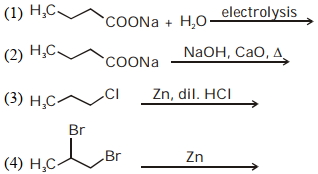
Which of the following reactions produce$(s)$ propane as a major product?
A
$1, 2$
B
$1, 3$
C
$2, 3$
D
$2, 4$
Solution
(C) Let us analyze each reaction:
$(1)$ Kolbe's electrolysis of sodium butanoate $(CH_3CH_2CH_2COONa)$ produces $n$-hexane $(CH_3CH_2CH_2CH_2CH_2CH_3)$.
$(2)$ Decarboxylation of sodium butanoate $(CH_3CH_2CH_2COONa)$ with soda lime $(NaOH + CaO)$ produces propane $(CH_3CH_2CH_3)$.
$(3)$ Reduction of $1$-chloropropane $(CH_3CH_2CH_2Cl)$ with $Zn$ and dilute $HCl$ produces propane $(CH_3CH_2CH_3)$.
$(4)$ Dehalogenation of $1,2$-dibromopropane with $Zn$ produces propene $(CH_3CH=CH_2)$.
Thus,reactions $(2)$ and $(3)$ produce propane as the major product.
$(1)$ Kolbe's electrolysis of sodium butanoate $(CH_3CH_2CH_2COONa)$ produces $n$-hexane $(CH_3CH_2CH_2CH_2CH_2CH_3)$.
$(2)$ Decarboxylation of sodium butanoate $(CH_3CH_2CH_2COONa)$ with soda lime $(NaOH + CaO)$ produces propane $(CH_3CH_2CH_3)$.
$(3)$ Reduction of $1$-chloropropane $(CH_3CH_2CH_2Cl)$ with $Zn$ and dilute $HCl$ produces propane $(CH_3CH_2CH_3)$.
$(4)$ Dehalogenation of $1,2$-dibromopropane with $Zn$ produces propene $(CH_3CH=CH_2)$.
Thus,reactions $(2)$ and $(3)$ produce propane as the major product.
0 likesView Solution
8
ChemistryMediumMCQIIT JEE · 2019
The ground state energy of a hydrogen atom is $-13.6 \ eV$. Consider an electronic state $\Psi$ of $He^+$ whose energy,azimuthal quantum number,and magnetic quantum number are $-3.4 \ eV$,$2$,and $0$ respectively. Which of the following statement$(s)$ is(are) true for the state $\Psi$?
$(1)$ It has $2$ angular nodes
$(2)$ It has $3$ radial nodes
$(3)$ It is a $4d$ state
$(4)$ The nuclear charge experienced by the electron in this state is less than $2e$,where $e$ is the magnitude of the electronic charge.
$(1)$ It has $2$ angular nodes
$(2)$ It has $3$ radial nodes
$(3)$ It is a $4d$ state
$(4)$ The nuclear charge experienced by the electron in this state is less than $2e$,where $e$ is the magnitude of the electronic charge.
A
$1, 3$
B
$1, 4$
C
$1, 2$
D
$1, 2, 3$
Solution
(A) For a hydrogen-like species,the energy is given by $E_n = -13.6 \times \frac{Z^2}{n^2} \ eV$.
For $He^+$,$Z = 2$. Given $E = -3.4 \ eV$,we have $-3.4 = -13.6 \times \frac{2^2}{n^2}$,which simplifies to $n^2 = 16$,so $n = 4$.
Given azimuthal quantum number $\ell = 2$,the state is $4d$.
Number of angular nodes $= \ell = 2$.
Number of radial nodes $= n - \ell - 1 = 4 - 2 - 1 = 1$.
Since $He^+$ is a single-electron species,the nuclear charge experienced is the full nuclear charge $Z = 2e$,so statement $(4)$ is incorrect.
Thus,statements $(1)$ and $(3)$ are true.
For $He^+$,$Z = 2$. Given $E = -3.4 \ eV$,we have $-3.4 = -13.6 \times \frac{2^2}{n^2}$,which simplifies to $n^2 = 16$,so $n = 4$.
Given azimuthal quantum number $\ell = 2$,the state is $4d$.
Number of angular nodes $= \ell = 2$.
Number of radial nodes $= n - \ell - 1 = 4 - 2 - 1 = 1$.
Since $He^+$ is a single-electron species,the nuclear charge experienced is the full nuclear charge $Z = 2e$,so statement $(4)$ is incorrect.
Thus,statements $(1)$ and $(3)$ are true.
0 likesView Solution
9
ChemistryAdvancedMCQIIT JEE · 2019
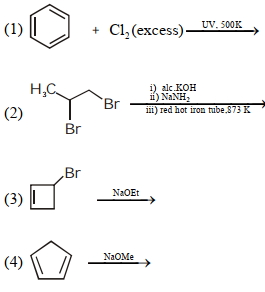
Choose the correct option$(s)$ that give$(s)$ an aromatic compound as the major product.
A
$2, 1$
B
$2, 3$
C
$2, 4$
D
$1, 2, 3$
Solution
(C) Analysis of the given reactions:
$(1)$ Benzene reacts with excess $Cl_2$ in the presence of $UV$ light at $500 \ K$ to form benzene hexachloride,which is non-aromatic.
$(2)$ $1,2$-dibromopropane reacts with $alc. KOH$ followed by $NaNH_2$ to form propyne $(CH_3-C \equiv CH)$. Cyclotrimerization of propyne using a red hot iron tube at $873 \ K$ yields $1,3,5$-trimethylbenzene (mesitylene),which is aromatic.
$(3)$ $3$-bromocyclobutene reacts with $NaOEt$ to give a substitution product and an elimination product (cyclobutadiene),which dimerizes to a non-aromatic compound.
$(4)$ Cyclopentadiene reacts with $NaOMe$ to form the cyclopentadienyl anion,which is aromatic ($6 \pi$ electrons,Huckel's rule).
Therefore,reactions $(2)$ and $(4)$ yield aromatic products.
$(1)$ Benzene reacts with excess $Cl_2$ in the presence of $UV$ light at $500 \ K$ to form benzene hexachloride,which is non-aromatic.
$(2)$ $1,2$-dibromopropane reacts with $alc. KOH$ followed by $NaNH_2$ to form propyne $(CH_3-C \equiv CH)$. Cyclotrimerization of propyne using a red hot iron tube at $873 \ K$ yields $1,3,5$-trimethylbenzene (mesitylene),which is aromatic.
$(3)$ $3$-bromocyclobutene reacts with $NaOEt$ to give a substitution product and an elimination product (cyclobutadiene),which dimerizes to a non-aromatic compound.
$(4)$ Cyclopentadiene reacts with $NaOMe$ to form the cyclopentadienyl anion,which is aromatic ($6 \pi$ electrons,Huckel's rule).
Therefore,reactions $(2)$ and $(4)$ yield aromatic products.
0 likesView Solution
10
ChemistryMediumMCQIIT JEE · 2019
Consider the following reactions (unbalanced):
$Zn +$ hot conc. $H_2SO_4 \rightarrow G + R + X$
$Zn +$ conc. $NaOH \rightarrow T + Q$
$G + H_2S + NH_4OH \rightarrow Z$ (a precipitate) $+ X + Y$
Choose the correct option$(s)$.
$(1)$ The oxidation state of $Zn$ in $T$ is $+1$
$(2)$ Bond order of $Q$ is $1$ in its ground state
$(3)$ $Z$ is dirty white in colour
$(4)$ $R$ is a $V$-shaped molecule
$Zn +$ hot conc. $H_2SO_4 \rightarrow G + R + X$
$Zn +$ conc. $NaOH \rightarrow T + Q$
$G + H_2S + NH_4OH \rightarrow Z$ (a precipitate) $+ X + Y$
Choose the correct option$(s)$.
$(1)$ The oxidation state of $Zn$ in $T$ is $+1$
$(2)$ Bond order of $Q$ is $1$ in its ground state
$(3)$ $Z$ is dirty white in colour
$(4)$ $R$ is a $V$-shaped molecule
A
$1, 2, 3$
B
$1, 2, 4$
C
$1, 2$
D
$2, 3, 4$
Solution
(D) The balanced reactions are:
$Zn + 2H_2SO_4 \text{ (hot conc.)} \rightarrow ZnSO_4 (G) + SO_2 (R) + 2H_2O (X)$
$Zn + 2NaOH \text{ (conc.)} \rightarrow Na_2ZnO_2 (T) + H_2 (Q)$
$ZnSO_4 (G) + H_2S + 2NH_4OH \rightarrow ZnS (Z) + 2H_2O (X) + (NH_4)_2SO_4 (Y)$
Analysis of statements:
$(1)$ In $Na_2ZnO_2$ $(T)$,the oxidation state of $Zn$ is $+2$,not $+1$. So,statement $(1)$ is incorrect.
$(2)$ $Q$ is $H_2$. The bond order of $H_2$ is $1$. So,statement $(2)$ is correct.
$(3)$ $Z$ is $ZnS$,which is white in colour. So,statement $(3)$ is correct.
$(4)$ $R$ is $SO_2$. $SO_2$ has a bent or $V$-shaped geometry. So,statement $(4)$ is correct.
Thus,statements $(2, 3, 4)$ are correct.
$Zn + 2H_2SO_4 \text{ (hot conc.)} \rightarrow ZnSO_4 (G) + SO_2 (R) + 2H_2O (X)$
$Zn + 2NaOH \text{ (conc.)} \rightarrow Na_2ZnO_2 (T) + H_2 (Q)$
$ZnSO_4 (G) + H_2S + 2NH_4OH \rightarrow ZnS (Z) + 2H_2O (X) + (NH_4)_2SO_4 (Y)$
Analysis of statements:
$(1)$ In $Na_2ZnO_2$ $(T)$,the oxidation state of $Zn$ is $+2$,not $+1$. So,statement $(1)$ is incorrect.
$(2)$ $Q$ is $H_2$. The bond order of $H_2$ is $1$. So,statement $(2)$ is correct.
$(3)$ $Z$ is $ZnS$,which is white in colour. So,statement $(3)$ is correct.
$(4)$ $R$ is $SO_2$. $SO_2$ has a bent or $V$-shaped geometry. So,statement $(4)$ is correct.
Thus,statements $(2, 3, 4)$ are correct.
0 likesView Solution
11
ChemistryAdvancedMCQIIT JEE · 2019
The total number of isomers,considering both structural and stereoisomers,of cyclic ethers with the molecular formula $C_4H_8O$ is. . . . . .
A
$5$
B
$8$
C
$10$
D
$15$
Solution
(C) The molecular formula $C_4H_8O$ corresponds to a degree of unsaturation of $1$. For cyclic ethers,we consider the following structures:
$1$. Tetrahydrofuran $(THF)$: $1$ isomer.
$2$. $2$-methyl-oxetane: Has a chiral center,so it exists as a pair of enantiomers ($R$ and $S$). Total = $2$ isomers.
$3$. $3$-methyl-oxetane: Achiral. Total = $1$ isomer.
$4$. $2$-ethyl-oxirane: Has a chiral center,so it exists as a pair of enantiomers ($R$ and $S$). Total = $2$ isomers.
$5$. $2,3$-dimethyl-oxirane: Has two chiral centers. It exists as $(R,R)$,$(S,S)$ (enantiomeric pair) and $(R,S)$ (meso compound). Total = $3$ isomers.
$6$. $1,1$-dimethyl-oxirane: Achiral. Total = $1$ isomer.
Summing these up: $1 + 2 + 1 + 2 + 3 + 1 = 10$ isomers.
$1$. Tetrahydrofuran $(THF)$: $1$ isomer.
$2$. $2$-methyl-oxetane: Has a chiral center,so it exists as a pair of enantiomers ($R$ and $S$). Total = $2$ isomers.
$3$. $3$-methyl-oxetane: Achiral. Total = $1$ isomer.
$4$. $2$-ethyl-oxirane: Has a chiral center,so it exists as a pair of enantiomers ($R$ and $S$). Total = $2$ isomers.
$5$. $2,3$-dimethyl-oxirane: Has two chiral centers. It exists as $(R,R)$,$(S,S)$ (enantiomeric pair) and $(R,S)$ (meso compound). Total = $3$ isomers.
$6$. $1,1$-dimethyl-oxirane: Achiral. Total = $1$ isomer.
Summing these up: $1 + 2 + 1 + 2 + 3 + 1 = 10$ isomers.
0 likesView Solution
12
ChemistryEasyMCQIIT JEE · 2019
The amount of water produced (in $g$) in the oxidation of $1$ mole of rhombic sulphur by conc. $HNO_3$ to a compound with the highest oxidation state of sulphur is. . . . . (Given data : Molar mass of water $= 18 \ g \ mol^{-1}$)
A
$200$
B
$210$
C
$288$
D
$290$
Solution
(C) The oxidation of rhombic sulphur $(S_8)$ by concentrated $HNO_3$ produces sulphuric acid $(H_2SO_4)$ as the product with the highest oxidation state of sulphur $(+6)$.
The balanced chemical equation is:
$S_8 + 48 \ HNO_3 \longrightarrow 8 \ H_2SO_4 + 48 \ NO_2 + 16 \ H_2O$
From the stoichiometry of the reaction,$1$ mole of $S_8$ produces $16$ moles of $H_2O$.
Since $1$ mole of rhombic sulphur is $S_8$,we must consider the reaction for $1$ mole of $S_8$ atoms (as implied by the question context of $1$ mole of sulphur atoms,or if $1$ mole of $S_8$ is meant,the stoichiometry adjusts accordingly. Given the standard interpretation of $1$ mole of $S$ atoms):
For $1$ mole of $S$ atoms,the equation is: $S + 6 \ HNO_3 \longrightarrow H_2SO_4 + 6 \ NO_2 + 2 \ H_2O$.
Thus,$1$ mole of $S$ produces $2$ moles of $H_2O$.
Mass of $H_2O = 2 \ mol \times 18 \ g \ mol^{-1} = 36 \ g$.
However,if the question refers to $1$ mole of $S_8$ molecules,then $16$ moles of $H_2O$ are produced.
Mass of $H_2O = 16 \ mol \times 18 \ g \ mol^{-1} = 288 \ g$.
The balanced chemical equation is:
$S_8 + 48 \ HNO_3 \longrightarrow 8 \ H_2SO_4 + 48 \ NO_2 + 16 \ H_2O$
From the stoichiometry of the reaction,$1$ mole of $S_8$ produces $16$ moles of $H_2O$.
Since $1$ mole of rhombic sulphur is $S_8$,we must consider the reaction for $1$ mole of $S_8$ atoms (as implied by the question context of $1$ mole of sulphur atoms,or if $1$ mole of $S_8$ is meant,the stoichiometry adjusts accordingly. Given the standard interpretation of $1$ mole of $S$ atoms):
For $1$ mole of $S$ atoms,the equation is: $S + 6 \ HNO_3 \longrightarrow H_2SO_4 + 6 \ NO_2 + 2 \ H_2O$.
Thus,$1$ mole of $S$ produces $2$ moles of $H_2O$.
Mass of $H_2O = 2 \ mol \times 18 \ g \ mol^{-1} = 36 \ g$.
However,if the question refers to $1$ mole of $S_8$ molecules,then $16$ moles of $H_2O$ are produced.
Mass of $H_2O = 16 \ mol \times 18 \ g \ mol^{-1} = 288 \ g$.
0 likesView Solution
13
ChemistryMediumMCQIIT JEE · 2019
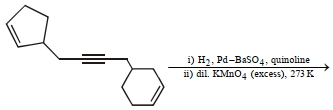
Total number of hydroxyl groups present in a molecule of the major product $P$ is. . . . . . . .
A
$6$
B
$8$
C
$9$
D
$10$
Solution
(A) $1$. The starting material contains one alkyne group and two alkene groups (one in a cyclopentene ring and one in a cyclohexene ring).
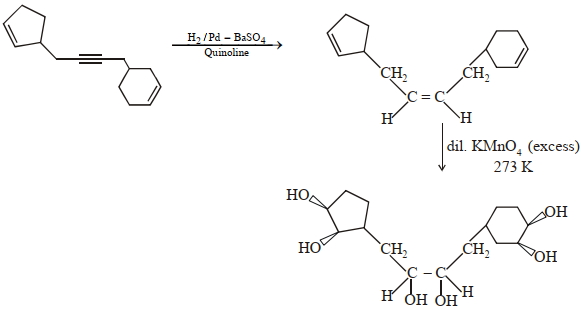
$2$. The first step uses $H_2, Pd-BaSO_4$,and quinoline (Lindlar's catalyst),which selectively reduces the alkyne to a $cis$-alkene without affecting the other alkene groups.
$3$. The second step uses dilute $KMnO_4$ at $273 \ K$ (Baeyer's reagent),which performs syn-dihydroxylation of all double bonds present in the molecule.
$4$. The molecule has three double bonds: one newly formed $cis$-alkene from the alkyne and the two original cyclic alkenes.
$5$. Each double bond undergoes dihydroxylation,adding two $-OH$ groups per double bond.
$6$. Total $-OH$ groups $= 3 \times 2 = 6$.
$2$. The first step uses $H_2, Pd-BaSO_4$,and quinoline (Lindlar's catalyst),which selectively reduces the alkyne to a $cis$-alkene without affecting the other alkene groups.
$3$. The second step uses dilute $KMnO_4$ at $273 \ K$ (Baeyer's reagent),which performs syn-dihydroxylation of all double bonds present in the molecule.
$4$. The molecule has three double bonds: one newly formed $cis$-alkene from the alkyne and the two original cyclic alkenes.
$5$. Each double bond undergoes dihydroxylation,adding two $-OH$ groups per double bond.
$6$. Total $-OH$ groups $= 3 \times 2 = 6$.
0 likesView Solution
14
ChemistryAdvancedMCQIIT JEE · 2019
Answer the following by appropriately matching the lists based on the information given in the paragraph. Consider Bohr's model of a one-electron atom where the electron moves around the nucleus. In the following,$List-I$ contains some quantities for the $n^{\text{th}}$ orbit of the atom and $List-II$ contains options showing how they depend on $n$.
$(1)$ Which of the following options has the correct combination considering $List-I$ and $List-II$?
$(1) (II), (R)$ $(2) (I), (P)$ $(3) (I), (T)$ $(4) (II), (Q)$
$(2)$ Which of the following options has the correct combination considering $List-I$ and $List-II$?
$(1) (III), (S)$ $(2) (IV), (Q)$ $(3) (IV), (U)$ $(4) (III), (P)$
Give the answer for questions $(1)$ and $(2)$.
| $List-I$ | $List-II$ |
| $(I)$ Radius of the $n^{\text{th}}$ orbit | $(P) \propto n^{-2}$ |
| $(II)$ Angular momentum of the electron in the $n^{\text{th}}$ orbit | $(Q) \propto n^{-1}$ |
| $(III)$ Kinetic energy of the electron in the $n^{\text{th}}$ orbit | $(R) \propto n^0$ |
| $(IV)$ Potential energy of the electron in the $n^{\text{th}}$ orbit | $(S) \propto n^1$ |
| - | $(T) \propto n^2$ |
| - | $(U) \propto n^{1/2}$ |
$(1)$ Which of the following options has the correct combination considering $List-I$ and $List-II$?
$(1) (II), (R)$ $(2) (I), (P)$ $(3) (I), (T)$ $(4) (II), (Q)$
$(2)$ Which of the following options has the correct combination considering $List-I$ and $List-II$?
$(1) (III), (S)$ $(2) (IV), (Q)$ $(3) (IV), (U)$ $(4) (III), (P)$
Give the answer for questions $(1)$ and $(2)$.
A
$3, 4$
B
$3, 2$
C
$3, 1$
D
$1, 2$
Solution
(A) According to Bohr's model for a one-electron atom:
$1.$ Radius of $n^{\text{th}}$ orbit,$r_n = \frac{n^2 h^2 \epsilon_0}{\pi m Z e^2} \propto n^2$. Thus,$(I)$ matches with $(T)$.
$2.$ Angular momentum,$L = \frac{nh}{2\pi} \propto n^1$. Thus,$(II)$ matches with $(S)$.
$3.$ Kinetic energy,$KE = \frac{m Z^2 e^4}{8 \epsilon_0^2 n^2 h^2} \propto n^{-2}$. Thus,$(III)$ matches with $(P)$.
$4.$ Potential energy,$PE = - \frac{m Z^2 e^4}{4 \epsilon_0^2 n^2 h^2} \propto n^{-2}$. Thus,$(IV)$ matches with $(P)$.
For question $(1)$,the correct combination is $(I), (T)$,which is option $(3)$.
For question $(2)$,the correct combination is $(III), (P)$,which is option $(4)$.
Therefore,the answer is $3, 4$.
$1.$ Radius of $n^{\text{th}}$ orbit,$r_n = \frac{n^2 h^2 \epsilon_0}{\pi m Z e^2} \propto n^2$. Thus,$(I)$ matches with $(T)$.
$2.$ Angular momentum,$L = \frac{nh}{2\pi} \propto n^1$. Thus,$(II)$ matches with $(S)$.
$3.$ Kinetic energy,$KE = \frac{m Z^2 e^4}{8 \epsilon_0^2 n^2 h^2} \propto n^{-2}$. Thus,$(III)$ matches with $(P)$.
$4.$ Potential energy,$PE = - \frac{m Z^2 e^4}{4 \epsilon_0^2 n^2 h^2} \propto n^{-2}$. Thus,$(IV)$ matches with $(P)$.
For question $(1)$,the correct combination is $(I), (T)$,which is option $(3)$.
For question $(2)$,the correct combination is $(III), (P)$,which is option $(4)$.
Therefore,the answer is $3, 4$.
0 likesView Solution
15
ChemistryMediumMCQIIT JEE · 2019
Molar conductivity $\left(\Lambda_m\right)$ of an aqueous solution of sodium stearate,which behaves as a strong electrolyte,is recorded at varying concentrations $(c)$ of sodium stearate. Which one of the following plots provides the correct representation of micelle formation in the solution? (Critical micelle concentration $(CMC)$ is marked with an arrow in the figures.)
A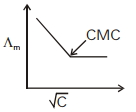
B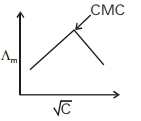
C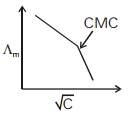
D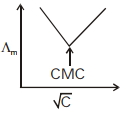
Solution
(A) Sodium stearate is a surfactant that behaves as a strong electrolyte at low concentrations.
As the concentration increases,the molar conductivity $\left(\Lambda_m\right)$ decreases due to the interionic attractions,similar to other strong electrolytes.
However,once the concentration reaches the Critical Micelle Concentration $(CMC)$,the individual ions aggregate to form large,bulky micelles.
These micelles have a much lower mobility compared to individual ions,leading to a sharp decrease in the rate of change of molar conductivity with respect to $\sqrt{c}$ after the $CMC$ point.
This results in a plot where the slope changes significantly at the $CMC$,which is best represented by the graph in option $A$.
As the concentration increases,the molar conductivity $\left(\Lambda_m\right)$ decreases due to the interionic attractions,similar to other strong electrolytes.
However,once the concentration reaches the Critical Micelle Concentration $(CMC)$,the individual ions aggregate to form large,bulky micelles.
These micelles have a much lower mobility compared to individual ions,leading to a sharp decrease in the rate of change of molar conductivity with respect to $\sqrt{c}$ after the $CMC$ point.
This results in a plot where the slope changes significantly at the $CMC$,which is best represented by the graph in option $A$.
0 likesView Solution
16
ChemistryEasyMCQIIT JEE · 2019
The correct order of acid strength of the following carboxylic acids is $-$

A
$I > II > III > IV$
B
$III > II > I > IV$
C
$II > I > IV > III$
D
$I > III > II > IV$
Solution
(A) Acid strength is inversely proportional to the $pK_a$ value.
Lower $pK_a$ indicates higher acid strength.
The given compounds are:
$(I)$ Propiolic acid $(pK_a = 1.86)$
$(II)$ Acrylic acid $(pK_a = 4.3)$
$(III)$ $p$-Methoxybenzoic acid $(pK_a = 4.5)$
$(IV)$ Propanoic acid $(pK_a = 4.88)$
Comparing the $pK_a$ values: $1.86 < 4.3 < 4.5 < 4.88$.
Therefore,the order of acid strength is $I > II > III > IV$.
Lower $pK_a$ indicates higher acid strength.
The given compounds are:
$(I)$ Propiolic acid $(pK_a = 1.86)$
$(II)$ Acrylic acid $(pK_a = 4.3)$
$(III)$ $p$-Methoxybenzoic acid $(pK_a = 4.5)$
$(IV)$ Propanoic acid $(pK_a = 4.88)$
Comparing the $pK_a$ values: $1.86 < 4.3 < 4.5 < 4.88$.
Therefore,the order of acid strength is $I > II > III > IV$.
0 likesView Solution
17
ChemistryEasyMCQIIT JEE · 2019
Calamine,malachite,magnetite and cryolite,respectively are
A
$ZnSO_4, CuCO_3, Fe_2O_3, AlF_3$
B
$ZnCO_3, CuCO_3 \cdot Cu(OH)_2, Fe_3O_4, Na_3AlF_6$
C
$ZnSO_4, Cu(OH)_2, Fe_3O_4, Na_3AlF_6$
D
$ZnCO_3, CuCO_3, Fe_2O_3, Na_3AlF_6$
Solution
(B) The chemical formulas for the given ores are as follows:
Therefore,the correct option is $B$.
| Ore | Formula |
| Calamine | $ZnCO_3$ |
| Malachite | $CuCO_3 \cdot Cu(OH)_2$ |
| Magnetite | $Fe_3O_4$ |
| Cryolite | $Na_3AlF_6$ |
Therefore,the correct option is $B$.
0 likesView Solution
18
ChemistryMediumMCQIIT JEE · 2019
The green colour produced in the borax bead test of a chromium$(III)$ salt is due to formation of . . . . . . :
A
$Cr(BO_2)_3$
B
$CrB$
C
$Cr_2(B_4O_7)_3$
D
$Cr_2O_3$
Solution
(A) In the borax bead test,the chromium $(III)$ salt decomposes upon heating to form chromium $(III)$ oxide $(Cr_2O_3)$.
Borax $(Na_2B_4O_7 \cdot 10H_2O)$ on heating loses water and forms sodium metaborate $(NaBO_2)$ and boric anhydride $(B_2O_3)$.
The reaction is: $Cr_2O_3 + 3B_2O_3 \longrightarrow 2Cr(BO_2)_3$.
The green colour is due to the formation of chromium metaborate,$Cr(BO_2)_3$.
Borax $(Na_2B_4O_7 \cdot 10H_2O)$ on heating loses water and forms sodium metaborate $(NaBO_2)$ and boric anhydride $(B_2O_3)$.
The reaction is: $Cr_2O_3 + 3B_2O_3 \longrightarrow 2Cr(BO_2)_3$.
The green colour is due to the formation of chromium metaborate,$Cr(BO_2)_3$.
0 likesView Solution
19
ChemistryMediumMCQIIT JEE · 2019
Fusion of $MnO_2$ with $KOH$ in presence of $O_2$ produces a salt $W$. Alkaline solution of $W$ upon electrolytic oxidation yields another salt $X$. The manganese containing ions present in $W$ and $X$,respectively,are $Y$ and $Z$. Correct statement$(s)$ is (are)
$(1)$ $Y$ is diamagnetic in nature while $Z$ is paramagnetic
$(2)$ Both $Y$ and $Z$ are coloured and have tetrahedral shape
$(3)$ In both $Y$ and $Z$,$\pi$-bonding occurs between $p$-orbitals of oxygen and $d$-orbitals of manganese.
$(4)$ In aqueous acidic solution,$Y$ undergoes disproportionation reaction to give $Z$ and $MnO_2$.
$(1)$ $Y$ is diamagnetic in nature while $Z$ is paramagnetic
$(2)$ Both $Y$ and $Z$ are coloured and have tetrahedral shape
$(3)$ In both $Y$ and $Z$,$\pi$-bonding occurs between $p$-orbitals of oxygen and $d$-orbitals of manganese.
$(4)$ In aqueous acidic solution,$Y$ undergoes disproportionation reaction to give $Z$ and $MnO_2$.
A
$1, 2, 3$
B
$2, 3, 4$
C
$3, 4$
D
$2, 4$
Solution
(B) $MnO_2 + 2 KOH + \frac{1}{2} O_2 \xrightarrow{\Delta} K_2MnO_4 + H_2O$ $(W)$
$W = K_2MnO_4 \rightleftharpoons 2K^{\oplus} + MnO_4^{2-} (Y)$
$K_2MnO_4 + H_2O \xrightarrow{\text{Electrolytic}} H_2 + KOH + KMnO_4 (X)$
Anion of $X = MnO_4^{-} (Z)$
$1$. $Y$ $(MnO_4^{2-})$ is $d^1$ (paramagnetic) and $Z$ $(MnO_4^{-})$ is $d^0$ (diamagnetic). Statement $(1)$ is incorrect.
$2$. Both $MnO_4^{2-}$ and $MnO_4^{-}$ are coloured due to charge transfer and have tetrahedral geometry. Statement $(2)$ is correct.
$3$. In both,$\pi$-bonding occurs between $p$-orbitals of oxygen and $d$-orbitals of manganese ($p\pi-d\pi$ bonding). Statement $(3)$ is correct.
$4$. In acidic solution,$MnO_4^{2-}$ undergoes disproportionation: $3MnO_4^{2-} + 4H^{\oplus} \longrightarrow 2MnO_4^{-} + MnO_2 + 2H_2O$. Statement $(4)$ is correct.
Thus,statements $(2, 3, 4)$ are correct.
$W = K_2MnO_4 \rightleftharpoons 2K^{\oplus} + MnO_4^{2-} (Y)$
$K_2MnO_4 + H_2O \xrightarrow{\text{Electrolytic}} H_2 + KOH + KMnO_4 (X)$
Anion of $X = MnO_4^{-} (Z)$
$1$. $Y$ $(MnO_4^{2-})$ is $d^1$ (paramagnetic) and $Z$ $(MnO_4^{-})$ is $d^0$ (diamagnetic). Statement $(1)$ is incorrect.
$2$. Both $MnO_4^{2-}$ and $MnO_4^{-}$ are coloured due to charge transfer and have tetrahedral geometry. Statement $(2)$ is correct.
$3$. In both,$\pi$-bonding occurs between $p$-orbitals of oxygen and $d$-orbitals of manganese ($p\pi-d\pi$ bonding). Statement $(3)$ is correct.
$4$. In acidic solution,$MnO_4^{2-}$ undergoes disproportionation: $3MnO_4^{2-} + 4H^{\oplus} \longrightarrow 2MnO_4^{-} + MnO_2 + 2H_2O$. Statement $(4)$ is correct.
Thus,statements $(2, 3, 4)$ are correct.
0 likesView Solution
20
ChemistryMediumMCQIIT JEE · 2019
In the decay sequence:
$^{238}_{92}U$ $\xrightarrow{- x_1} ^{234}_{90}Th$ $\xrightarrow{- x_2} ^{234}_{91}Pa$ $\xrightarrow{- x_3} ^{234}_{92}Z$ $\xrightarrow{- x_4} ^{230}_{90}Th$
$x_1, x_2, x_3$ and $x_4$ are particles/radiation emitted by the respective isotopes. The correct option$(s)$ is/are-
$(1)$ $Z$ is an isotope of uranium
$(2)$ $x_2$ is $\beta^{-}$
$(3)$ $x_1$ will deflect towards negatively charged plate
$(4)$ $x_3$ is $\gamma$-ray
$^{238}_{92}U$ $\xrightarrow{- x_1} ^{234}_{90}Th$ $\xrightarrow{- x_2} ^{234}_{91}Pa$ $\xrightarrow{- x_3} ^{234}_{92}Z$ $\xrightarrow{- x_4} ^{230}_{90}Th$
$x_1, x_2, x_3$ and $x_4$ are particles/radiation emitted by the respective isotopes. The correct option$(s)$ is/are-
$(1)$ $Z$ is an isotope of uranium
$(2)$ $x_2$ is $\beta^{-}$
$(3)$ $x_1$ will deflect towards negatively charged plate
$(4)$ $x_3$ is $\gamma$-ray
A
$1, 2, 3$
B
$1, 2, 4$
C
$2, 3, 4$
D
$1, 2$
Solution
(A) Analyze the decay sequence:
$1$. $^{238}_{92}U \xrightarrow{- x_1} ^{234}_{90}Th$: Mass number decreases by $4$ and atomic number by $2$,so $x_1$ is an $\alpha$-particle $(^{4}_{2}He^{2+})$. $\alpha$-particles are positively charged and deflect towards the negatively charged plate. Statement $(3)$ is correct.
$2$. $^{234}_{90}Th \xrightarrow{- x_2} ^{234}_{91}Pa$: Atomic number increases by $1$,so $x_2$ is a $\beta^{-}$-particle $(^{0}_{-1}e)$. Statement $(2)$ is correct.
$3$. $^{234}_{91}Pa \xrightarrow{- x_3} ^{234}_{92}Z$: Atomic number increases by $1$,so $x_3$ is a $\beta^{-}$-particle. Statement $(4)$ is incorrect.
$4$. $^{234}_{92}Z$ has atomic number $92$,same as $U$,so $Z$ is an isotope of uranium. Statement $(1)$ is correct.
Thus,statements $(1)$,$(2)$,and $(3)$ are correct.
$1$. $^{238}_{92}U \xrightarrow{- x_1} ^{234}_{90}Th$: Mass number decreases by $4$ and atomic number by $2$,so $x_1$ is an $\alpha$-particle $(^{4}_{2}He^{2+})$. $\alpha$-particles are positively charged and deflect towards the negatively charged plate. Statement $(3)$ is correct.
$2$. $^{234}_{90}Th \xrightarrow{- x_2} ^{234}_{91}Pa$: Atomic number increases by $1$,so $x_2$ is a $\beta^{-}$-particle $(^{0}_{-1}e)$. Statement $(2)$ is correct.
$3$. $^{234}_{91}Pa \xrightarrow{- x_3} ^{234}_{92}Z$: Atomic number increases by $1$,so $x_3$ is a $\beta^{-}$-particle. Statement $(4)$ is incorrect.
$4$. $^{234}_{92}Z$ has atomic number $92$,same as $U$,so $Z$ is an isotope of uranium. Statement $(1)$ is correct.
Thus,statements $(1)$,$(2)$,and $(3)$ are correct.
0 likesView Solution
21
ChemistryEasyMCQIIT JEE · 2019
Which of the following statement$(s)$ is(are) true?
$(1)$ Oxidation of glucose with bromine water gives gluconic acid.
$(2)$ The two six-membered cyclic hemiacetal forms of $D-(+)-$glucose are called anomers.
$(3)$ Hydrolysis of sucrose gives dextrorotatory glucose and laevorotatory fructose.
$(4)$ Monosaccharides cannot be hydrolysed to give polyhydroxy aldehydes and ketones.
$(1)$ Oxidation of glucose with bromine water gives gluconic acid.
$(2)$ The two six-membered cyclic hemiacetal forms of $D-(+)-$glucose are called anomers.
$(3)$ Hydrolysis of sucrose gives dextrorotatory glucose and laevorotatory fructose.
$(4)$ Monosaccharides cannot be hydrolysed to give polyhydroxy aldehydes and ketones.
A
$1, 2, 3$
B
$2, 3, 4$
C
$2, 3$
D
$1, 2$
Solution
(B) $(1)$ $FALSE$: Oxidation of glucose with bromine water ($Br_2$ water) gives gluconic acid,not glutamic acid.
$(2)$ $TRUE$: The two six-membered cyclic hemiacetal forms of $D-( )-$glucose ($\alpha-D-$glucose and $\beta-D-$glucose) differ in configuration at the $C_1$ carbon and are called anomers.
$(3)$ $TRUE$: Hydrolysis of sucrose yields $D-( )-$glucose (dextrorotatory) and $D-(-)-$fructose (laevorotatory).
$(4)$ $TRUE$: Monosaccharides are the simplest carbohydrates and cannot be further hydrolysed into smaller polyhydroxy aldehyde or ketone units.
$(2)$ $TRUE$: The two six-membered cyclic hemiacetal forms of $D-( )-$glucose ($\alpha-D-$glucose and $\beta-D-$glucose) differ in configuration at the $C_1$ carbon and are called anomers.
$(3)$ $TRUE$: Hydrolysis of sucrose yields $D-( )-$glucose (dextrorotatory) and $D-(-)-$fructose (laevorotatory).
$(4)$ $TRUE$: Monosaccharides are the simplest carbohydrates and cannot be further hydrolysed into smaller polyhydroxy aldehyde or ketone units.
0 likesView Solution
22
ChemistryDifficultMCQIIT JEE · 2019
Choose the correct option$(s)$ for the following set of reactions:
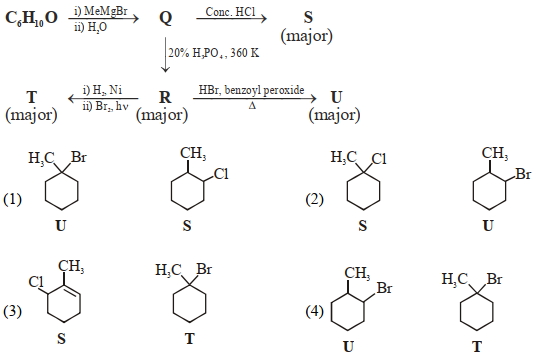
A
$2,4$
B
$2,3$
C
$1,2$
D
$1,4$
Solution
(A) $1$. The starting material $C_6H_{10}O$ is cyclohexanone. Reaction with $CH_3MgBr$ followed by $H_2O$ gives $1$-methylcyclohexanol $(Q)$.
$2$. $Q$ reacts with $conc. HCl$ to form $1$-chloro-$1$-methylcyclohexane $(S)$. This matches structure $(2)$.
$3$. $Q$ undergoes acid-catalyzed dehydration with $20\% H_3PO_4$ at $360 \ K$ to form $1$-methylcyclohexene $(R)$.
$4$. $R$ reacts with $HBr$ in the presence of benzoyl peroxide (anti-Markovnikov addition) to form $1$-bromo-$2$-methylcyclohexane $(U)$. This matches structure $(4)$.
$5$. $R$ undergoes hydrogenation $(H_2, Ni)$ to form methylcyclohexane,followed by radical bromination $(Br_2, h\nu)$ to form $1$-bromo-$1$-methylcyclohexane $(T)$.
$6$. Comparing the structures: $S$ is $(2)$,$U$ is $(4)$,and $T$ is $(1)$. The correct set is $(2, 4)$.
$2$. $Q$ reacts with $conc. HCl$ to form $1$-chloro-$1$-methylcyclohexane $(S)$. This matches structure $(2)$.
$3$. $Q$ undergoes acid-catalyzed dehydration with $20\% H_3PO_4$ at $360 \ K$ to form $1$-methylcyclohexene $(R)$.
$4$. $R$ reacts with $HBr$ in the presence of benzoyl peroxide (anti-Markovnikov addition) to form $1$-bromo-$2$-methylcyclohexane $(U)$. This matches structure $(4)$.
$5$. $R$ undergoes hydrogenation $(H_2, Ni)$ to form methylcyclohexane,followed by radical bromination $(Br_2, h\nu)$ to form $1$-bromo-$1$-methylcyclohexane $(T)$.
$6$. Comparing the structures: $S$ is $(2)$,$U$ is $(4)$,and $T$ is $(1)$. The correct set is $(2, 4)$.
0 likesView Solution
23
ChemistryMediumMCQIIT JEE · 2019
Consider the kinetic data given in the following table for the reaction $A + B + C \rightarrow$ Product.
The rate of the reaction for $[A]=0.15 \ mol \ dm^{-3}, [B]=0.25 \ mol \ dm^{-3}$ and $[C]=0.15 \ mol \ dm^{-3}$ is found to be $Y \times 10^{-5} \ mol \ dm^{-3} \ s^{-1}$. The value of $Y$ is . . . . . .
| Experiment No. | $[A] \ (mol \ dm^{-3})$ | $[B] \ (mol \ dm^{-3})$ | $[C] \ (mol \ dm^{-3})$ | Rate of reaction $(mol \ dm^{-3} \ s^{-1})$ |
| $1$ | $0.2$ | $0.1$ | $0.1$ | $6.0 \times 10^{-5}$ |
| $2$ | $0.2$ | $0.2$ | $0.1$ | $6.0 \times 10^{-5}$ |
| $3$ | $0.2$ | $0.1$ | $0.2$ | $1.2 \times 10^{-4}$ |
| $4$ | $0.3$ | $0.1$ | $0.1$ | $9.0 \times 10^{-5}$ |
The rate of the reaction for $[A]=0.15 \ mol \ dm^{-3}, [B]=0.25 \ mol \ dm^{-3}$ and $[C]=0.15 \ mol \ dm^{-3}$ is found to be $Y \times 10^{-5} \ mol \ dm^{-3} \ s^{-1}$. The value of $Y$ is . . . . . .
A
$6.75$
B
$6.80$
C
$6.85$
D
$6.90$
Solution
(A) The rate law is given by $r = K [A]^{n_1} [B]^{n_2} [C]^{n_3}$.
Comparing experiments $1$ and $2$,$[A]$ and $[C]$ are constant,but $[B]$ changes and the rate remains constant,so $n_2 = 0$.
Comparing experiments $1$ and $3$,$[A]$ and $[B]$ are constant,$[C]$ doubles,and the rate doubles,so $n_3 = 1$.
Comparing experiments $1$ and $4$,$[B]$ and $[C]$ are constant,$[A]$ increases by $1.5$ times,and the rate increases by $1.5$ times,so $n_1 = 1$.
Thus,the rate law is $r = K [A] [C]$.
Using experiment $1$: $6.0 \times 10^{-5} = K \times 0.2 \times 0.1$,which gives $K = 3.0 \times 10^{-3} \ L \ mol^{-1} \ s^{-1}$.
Now,for $[A] = 0.15 \ mol \ dm^{-3}, [B] = 0.25 \ mol \ dm^{-3}, [C] = 0.15 \ mol \ dm^{-3}$:
$r = (3.0 \times 10^{-3}) \times 0.15 \times 0.15 = 6.75 \times 10^{-5} \ mol \ dm^{-3} \ s^{-1}$.
Comparing this with $Y \times 10^{-5}$,we get $Y = 6.75$.
Comparing experiments $1$ and $2$,$[A]$ and $[C]$ are constant,but $[B]$ changes and the rate remains constant,so $n_2 = 0$.
Comparing experiments $1$ and $3$,$[A]$ and $[B]$ are constant,$[C]$ doubles,and the rate doubles,so $n_3 = 1$.
Comparing experiments $1$ and $4$,$[B]$ and $[C]$ are constant,$[A]$ increases by $1.5$ times,and the rate increases by $1.5$ times,so $n_1 = 1$.
Thus,the rate law is $r = K [A] [C]$.
Using experiment $1$: $6.0 \times 10^{-5} = K \times 0.2 \times 0.1$,which gives $K = 3.0 \times 10^{-3} \ L \ mol^{-1} \ s^{-1}$.
Now,for $[A] = 0.15 \ mol \ dm^{-3}, [B] = 0.25 \ mol \ dm^{-3}, [C] = 0.15 \ mol \ dm^{-3}$:
$r = (3.0 \times 10^{-3}) \times 0.15 \times 0.15 = 6.75 \times 10^{-5} \ mol \ dm^{-3} \ s^{-1}$.
Comparing this with $Y \times 10^{-5}$,we get $Y = 6.75$.
0 likesView Solution
24
ChemistryEasyMCQIIT JEE · 2019
On dissolving $0.5 \ g$ of a non-volatile non-ionic solute to $39 \ g$ of benzene,its vapor pressure decreases from $650 \ mm \ Hg$ to $640 \ mm \ Hg$. The depression of freezing point of benzene (in $K$) upon addition of the solute is. . . . .
(Given data : Molar mass and the molal freezing point depression constant of benzene are $78 \ g \ mol^{-1}$ and $5.12 \ K \ kg \ mol^{-1}$,respectively)
(Given data : Molar mass and the molal freezing point depression constant of benzene are $78 \ g \ mol^{-1}$ and $5.12 \ K \ kg \ mol^{-1}$,respectively)
A
$1.01$
B
$1.02$
C
$1.03$
D
$1.04$
Solution
(A) According to Raoult's law for relative lowering of vapor pressure:
$\frac{P^{\circ} - P_s}{P^{\circ}} = \frac{n_2}{n_1 + n_2} \approx \frac{n_2}{n_1}$
Given: $P^{\circ} = 650 \ mm \ Hg$,$P_s = 640 \ mm \ Hg$,$W_2 = 0.5 \ g$,$W_1 = 39 \ g$,$M_1 = 78 \ g \ mol^{-1}$,$K_f = 5.12 \ K \ kg \ mol^{-1}$.
$\frac{650 - 640}{650} = \frac{0.5 / M_2}{39 / 78} = \frac{0.5 / M_2}{0.5} = \frac{1}{M_2}$
$\frac{10}{650} = \frac{1}{M_2} \implies M_2 = 65 \ g \ mol^{-1}$.
Now,calculate molality $(m)$:
$m = \frac{W_2 \times 1000}{M_2 \times W_1} = \frac{0.5 \times 1000}{65 \times 39} \approx 0.197 \ mol \ kg^{-1}$.
Depression in freezing point $\Delta T_f = K_f \times m = 5.12 \times 0.197 \approx 1.01 \ K$.
$\frac{P^{\circ} - P_s}{P^{\circ}} = \frac{n_2}{n_1 + n_2} \approx \frac{n_2}{n_1}$
Given: $P^{\circ} = 650 \ mm \ Hg$,$P_s = 640 \ mm \ Hg$,$W_2 = 0.5 \ g$,$W_1 = 39 \ g$,$M_1 = 78 \ g \ mol^{-1}$,$K_f = 5.12 \ K \ kg \ mol^{-1}$.
$\frac{650 - 640}{650} = \frac{0.5 / M_2}{39 / 78} = \frac{0.5 / M_2}{0.5} = \frac{1}{M_2}$
$\frac{10}{650} = \frac{1}{M_2} \implies M_2 = 65 \ g \ mol^{-1}$.
Now,calculate molality $(m)$:
$m = \frac{W_2 \times 1000}{M_2 \times W_1} = \frac{0.5 \times 1000}{65 \times 39} \approx 0.197 \ mol \ kg^{-1}$.
Depression in freezing point $\Delta T_f = K_f \times m = 5.12 \times 0.197 \approx 1.01 \ K$.
0 likesView Solution
25
ChemistryMediumMCQIIT JEE · 2019
Scheme $1$ and $2$ describe the conversion of $P$ to $Q$ and $R$ to $S$,respectively. Scheme $3$ describes the synthesis of $T$ from $Q$ and $S$. The total number of $Br$ atoms in a molecule of $T$ is. . . . . . . .
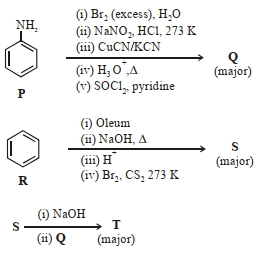
A
$2$
B
$3$
C
$4$
D
$5$
Solution
(C) Step $1$: Conversion of $P$ (aniline) to $Q$ ($2$,$4$,$6$-tribromobenzoyl chloride).
Aniline reacts with excess $Br_2/H_2O$ to form $2,4,6$-tribromoaniline. Diazotization followed by reaction with $CuCN/KCN$ gives $2,4,6$-tribromobenzonitrile. Hydrolysis gives $2,4,6$-tribromobenzoic acid,which reacts with $SOCl_2$ to form $Q$ ($2,4,6$-tribromobenzoyl chloride).
Step $2$: Conversion of $R$ (benzene) to $S$ ($4$-bromophenol).
Benzene reacts with oleum to form benzenesulfonic acid,which on fusion with $NaOH$ followed by acidification gives phenol. Bromination of phenol with $Br_2/CS_2$ at $273 \ K$ gives $4$-bromophenol $(S)$ as the major product.
Step $3$: Synthesis of $T$ from $Q$ and $S$.
$S$ ($4$-bromophenol) reacts with $NaOH$ to form sodium $4$-bromophenoxide,which acts as a nucleophile and attacks the carbonyl carbon of $Q$ ($2,4,6$-tribromobenzoyl chloride) to form an ester $T$ ($4$-bromophenyl $2,4,6$-tribromobenzoate).
Structure of $T$ contains $3$ $Br$ atoms from the benzoyl part and $1$ $Br$ atom from the phenoxy part.
Total number of $Br$ atoms in $T = 3 + 1 = 4$.
Aniline reacts with excess $Br_2/H_2O$ to form $2,4,6$-tribromoaniline. Diazotization followed by reaction with $CuCN/KCN$ gives $2,4,6$-tribromobenzonitrile. Hydrolysis gives $2,4,6$-tribromobenzoic acid,which reacts with $SOCl_2$ to form $Q$ ($2,4,6$-tribromobenzoyl chloride).
Step $2$: Conversion of $R$ (benzene) to $S$ ($4$-bromophenol).
Benzene reacts with oleum to form benzenesulfonic acid,which on fusion with $NaOH$ followed by acidification gives phenol. Bromination of phenol with $Br_2/CS_2$ at $273 \ K$ gives $4$-bromophenol $(S)$ as the major product.
Step $3$: Synthesis of $T$ from $Q$ and $S$.
$S$ ($4$-bromophenol) reacts with $NaOH$ to form sodium $4$-bromophenoxide,which acts as a nucleophile and attacks the carbonyl carbon of $Q$ ($2,4,6$-tribromobenzoyl chloride) to form an ester $T$ ($4$-bromophenyl $2,4,6$-tribromobenzoate).
Structure of $T$ contains $3$ $Br$ atoms from the benzoyl part and $1$ $Br$ atom from the phenoxy part.
Total number of $Br$ atoms in $T = 3 + 1 = 4$.
0 likesView Solution
26
ChemistryAdvancedMCQIIT JEE · 2019
At $143 \ K$,the reaction of $XeF_4$ with $O_2F_2$ produces a xenon compound $Y$. The total number of lone pair$(s)$ of electrons present on the whole molecule of $Y$ is . . . . .
A
$19$
B
$20$
C
$25$
D
$30$
Solution
(A) The chemical reaction is: $XeF_4 + O_2F_2 \rightarrow XeF_6 + O_2$.
The compound $Y$ is $XeF_6$.
In $XeF_6$,there are $6$ fluorine atoms. Each fluorine atom has $3$ lone pairs of electrons,contributing $6 \times 3 = 18$ lone pairs.
The xenon atom in $XeF_6$ has $1$ lone pair of electrons.
Therefore,the total number of lone pairs of electrons in the $XeF_6$ molecule is $18 + 1 = 19$.
The compound $Y$ is $XeF_6$.
In $XeF_6$,there are $6$ fluorine atoms. Each fluorine atom has $3$ lone pairs of electrons,contributing $6 \times 3 = 18$ lone pairs.
The xenon atom in $XeF_6$ has $1$ lone pair of electrons.
Therefore,the total number of lone pairs of electrons in the $XeF_6$ molecule is $18 + 1 = 19$.
0 likesView Solution
27
ChemistryEasyMCQIIT JEE · 2019
The cyanide process of gold extraction involves leaching out gold from its ore with $CN^{-}$ in the presence of $Q$ in water to form $R$. Subsequently,$R$ is treated with $T$ to obtain $Au$ and $Z$. Choose the correct option$(s)$.
$1$. $T$ is $Zn$
$2$. $R$ is $[Au(CN)_2]^-$
$3$. $Z$ is $[Zn(CN)_4]^{2-}$
$4$. $Q$ is $O_2$
$1$. $T$ is $Zn$
$2$. $R$ is $[Au(CN)_2]^-$
$3$. $Z$ is $[Zn(CN)_4]^{2-}$
$4$. $Q$ is $O_2$
A
$1, 2, 3$
B
$1, 2, 4$
C
$1, 3, 4$
D
$1, 2, 3, 4$
Solution
(D) The extraction of gold involves the following reactions:
$4Au_{(s)} + 8CN^{-}_{(aq)} + 2H_2O_{(l)} + O_{2(g)} \rightarrow 4[Au(CN)_2]^{-}_{(aq)} + 4OH^{-}_{(aq)}$
Here,$Q = O_2$ and $R = [Au(CN)_2]^{-}$.
The complex $R$ is then treated with zinc $(T = Zn)$ to displace gold:
$2[Au(CN)_2]^{-}_{(aq)} + Zn_{(s)} \rightarrow [Zn(CN)_4]^{2-}_{(aq)} + 2Au_{(s)}$
Here,$Z = [Zn(CN)_4]^{2-}$.
All statements $1, 2, 3,$ and $4$ are correct.
$4Au_{(s)} + 8CN^{-}_{(aq)} + 2H_2O_{(l)} + O_{2(g)} \rightarrow 4[Au(CN)_2]^{-}_{(aq)} + 4OH^{-}_{(aq)}$
Here,$Q = O_2$ and $R = [Au(CN)_2]^{-}$.
The complex $R$ is then treated with zinc $(T = Zn)$ to displace gold:
$2[Au(CN)_2]^{-}_{(aq)} + Zn_{(s)} \rightarrow [Zn(CN)_4]^{2-}_{(aq)} + 2Au_{(s)}$
Here,$Z = [Zn(CN)_4]^{2-}$.
All statements $1, 2, 3,$ and $4$ are correct.
0 likesView Solution
28
ChemistryEasyMCQIIT JEE · 2019
With reference to aqua regia,choose the correct option$(s)$.
$(1)$ Reaction of gold with aqua regia produces $NO_2$ in the absence of air.
$(2)$ Aqua regia is prepared by mixing conc. $HCl$ and conc. $HNO_3$ in $3:1$ $(v/v)$ ratio.
$(3)$ Reaction of gold with aqua regia produces an anion having $Au$ in $+3$ oxidation state.
$(4)$ The yellow colour of aqua regia is due to the presence of $NOCl$ and $Cl_2$.
$(1)$ Reaction of gold with aqua regia produces $NO_2$ in the absence of air.
$(2)$ Aqua regia is prepared by mixing conc. $HCl$ and conc. $HNO_3$ in $3:1$ $(v/v)$ ratio.
$(3)$ Reaction of gold with aqua regia produces an anion having $Au$ in $+3$ oxidation state.
$(4)$ The yellow colour of aqua regia is due to the presence of $NOCl$ and $Cl_2$.
A
$1, 2, 3$
B
$1, 2, 4$
C
$1, 3$
D
$2, 3, 4$
Solution
(D) $(1)$ The reaction of gold with aqua regia produces $NO$ (nitric oxide),not $NO_2$. Thus,statement $(1)$ is incorrect.
$(2)$ Aqua regia is indeed prepared by mixing concentrated $HCl$ and concentrated $HNO_3$ in a $3:1$ volume ratio. Thus,statement $(2)$ is correct.
$(3)$ The reaction is $Au + 4H^+ + NO_3^- + 4Cl^- \rightarrow AuCl_4^- + NO + 2H_2O$. The complex ion $AuCl_4^-$ contains gold in the $+3$ oxidation state. Thus,statement $(3)$ is correct.
$(4)$ The yellow-orange colour of aqua regia is due to the formation of nitrosyl chloride $(NOCl)$ and chlorine $(Cl_2)$. Thus,statement $(4)$ is correct.
$(2)$ Aqua regia is indeed prepared by mixing concentrated $HCl$ and concentrated $HNO_3$ in a $3:1$ volume ratio. Thus,statement $(2)$ is correct.
$(3)$ The reaction is $Au + 4H^+ + NO_3^- + 4Cl^- \rightarrow AuCl_4^- + NO + 2H_2O$. The complex ion $AuCl_4^-$ contains gold in the $+3$ oxidation state. Thus,statement $(3)$ is correct.
$(4)$ The yellow-orange colour of aqua regia is due to the formation of nitrosyl chloride $(NOCl)$ and chlorine $(Cl_2)$. Thus,statement $(4)$ is correct.
0 likesView Solution
29
ChemistryEasyMCQIIT JEE · 2019
Choose the correct option$(s)$ from the following:
$(1)$ Natural rubber is polyisoprene containing trans alkene units.
$(2)$ Nylon-$6$ has amide linkages.
$(3)$ Cellulose has only $\alpha-D$-glucose units that are joined by glycosidic linkages.
$(4)$ Teflon is prepared by heating tetrafluoroethene in the presence of a persulphate catalyst at high pressure.
$(1)$ Natural rubber is polyisoprene containing trans alkene units.
$(2)$ Nylon-$6$ has amide linkages.
$(3)$ Cellulose has only $\alpha-D$-glucose units that are joined by glycosidic linkages.
$(4)$ Teflon is prepared by heating tetrafluoroethene in the presence of a persulphate catalyst at high pressure.
A
$1, 2$
B
$1, 3$
C
$2, 4$
D
$1, 4$
Solution
(C) $(1)$ Natural rubber is cis-polyisoprene. Thus,statement $(1)$ is incorrect.
$(2)$ Nylon-$6$ is formed by the polymerization of caprolactam and contains amide linkages $(-NH-CO-)$. Thus,statement $(2)$ is correct.
$(3)$ Cellulose is a linear polymer of $\beta-D$-glucose units joined by $\beta$-glycosidic linkages. Thus,statement $(3)$ is incorrect.
$(4)$ Teflon is prepared by heating tetrafluoroethene $(CF_2=CF_2)$ in the presence of a persulphate catalyst at high pressure. Thus,statement $(4)$ is correct.
Therefore,statements $(2)$ and $(4)$ are correct.
$(2)$ Nylon-$6$ is formed by the polymerization of caprolactam and contains amide linkages $(-NH-CO-)$. Thus,statement $(2)$ is correct.
$(3)$ Cellulose is a linear polymer of $\beta-D$-glucose units joined by $\beta$-glycosidic linkages. Thus,statement $(3)$ is incorrect.
$(4)$ Teflon is prepared by heating tetrafluoroethene $(CF_2=CF_2)$ in the presence of a persulphate catalyst at high pressure. Thus,statement $(4)$ is correct.
Therefore,statements $(2)$ and $(4)$ are correct.
0 likesView Solution
30
ChemistryAdvancedMCQIIT JEE · 2019
Choose the correct option$(s)$ for the following reaction sequence. Consider $Q$,$R$ and $S$ as major products.
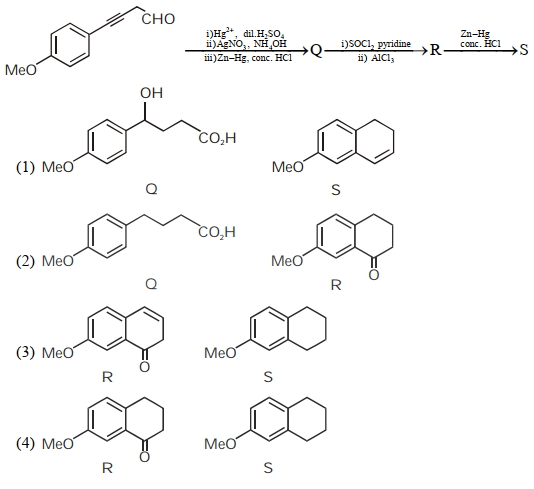
A
$2,4$
B
$2,3$
C
$1,4$
D
$1,3$
Solution
(A) $1$. The starting material is $4$-methoxyphenylbut-$3$-ynal. Treatment with $Hg^{2+}, dil. H_2SO_4$ hydrates the alkyne to a ketone,yielding $4$-methoxyphenyl-$4$-oxobutanal.
$2$. Oxidation with $AgNO_3, NH_4OH$ (Tollens' reagent) converts the aldehyde to a carboxylic acid,followed by Clemmensen reduction $(Zn-Hg, conc. HCl)$ which reduces the ketone to a methylene group,resulting in $4-(4-methoxyphenyl)butanoic$ acid $(Q)$.
$3$. Treatment of $Q$ with $SOCl_2$ followed by $AlCl_3$ (Friedel-Crafts acylation) leads to intramolecular cyclization to form $7-methoxy-1-tetralone$ $(R)$.
$4$. Finally,Clemmensen reduction $(Zn-Hg, conc. HCl)$ of the ketone $R$ gives $6-methoxytetralin$ $(S)$.
$5$. Comparing with the given structures,$Q$ matches structure $(2)$,$R$ matches structure $(4)$,and $S$ matches structure $(4)$. Thus,the correct options are $2$ and $4$.
$2$. Oxidation with $AgNO_3, NH_4OH$ (Tollens' reagent) converts the aldehyde to a carboxylic acid,followed by Clemmensen reduction $(Zn-Hg, conc. HCl)$ which reduces the ketone to a methylene group,resulting in $4-(4-methoxyphenyl)butanoic$ acid $(Q)$.
$3$. Treatment of $Q$ with $SOCl_2$ followed by $AlCl_3$ (Friedel-Crafts acylation) leads to intramolecular cyclization to form $7-methoxy-1-tetralone$ $(R)$.
$4$. Finally,Clemmensen reduction $(Zn-Hg, conc. HCl)$ of the ketone $R$ gives $6-methoxytetralin$ $(S)$.
$5$. Comparing with the given structures,$Q$ matches structure $(2)$,$R$ matches structure $(4)$,and $S$ matches structure $(4)$. Thus,the correct options are $2$ and $4$.
0 likesView Solution
31
ChemistryAdvancedMCQIIT JEE · 2019
The decomposition reaction $2N_2O_{5(g)} \xrightarrow{\Delta} 2N_2O_{4(g)} + O_{2(g)}$ is started in a closed cylinder under isothermal isochoric conditions at an initial pressure of $1 \ atm$. After $Y \times 10^3 \ s$,the pressure inside the cylinder is found to be $1.45 \ atm$. If the rate constant of the reaction is $5 \times 10^{-4} \ s^{-1}$,assuming ideal gas behavior,the value of $Y$ is. . . . . . . .
A
$2.20$
B
$2.30$
C
$2.40$
D
$2.50$
Solution
(B) For the reaction $2N_2O_{5(g)} \rightarrow 2N_2O_{4(g)} + O_{2(g)}$ at constant $V$ and $T$:
At $t = 0$,$P_{N_2O_5} = 1 \ atm$,$P_{N_2O_4} = 0$,$P_{O_2} = 0$.
At $t = Y \times 10^3 \ s$,let the pressure of $O_2$ formed be $P$. Then $P_{N_2O_5} = 1 - 2P$,$P_{N_2O_4} = 2P$,and $P_{O_2} = P$.
The total pressure $P_T = (1 - 2P) + 2P + P = 1 + P = 1.45 \ atm$.
Thus,$P = 0.45 \ atm$.
The initial pressure of $N_2O_5$ is $P_0 = 1 \ atm$ and the pressure at time $t$ is $P_t = 1 - 2P = 1 - 2(0.45) = 0.1 \ atm$.
For a first-order reaction,$k = \frac{2.303}{t} \log \left(\frac{P_0}{P_t}\right)$.
Substituting the values: $5 \times 10^{-4} = \frac{2.303}{Y \times 10^3} \log \left(\frac{1}{0.1}\right)$.
$5 \times 10^{-4} = \frac{2.303}{Y \times 10^3} \times 1$.
$0.5 = \frac{2.303}{Y} \implies Y = \frac{2.303}{0.5} = 4.606$.
Given the options provided,there is a discrepancy in the calculation or the provided options. Based on standard calculation,$Y = 4.606$.
At $t = 0$,$P_{N_2O_5} = 1 \ atm$,$P_{N_2O_4} = 0$,$P_{O_2} = 0$.
At $t = Y \times 10^3 \ s$,let the pressure of $O_2$ formed be $P$. Then $P_{N_2O_5} = 1 - 2P$,$P_{N_2O_4} = 2P$,and $P_{O_2} = P$.
The total pressure $P_T = (1 - 2P) + 2P + P = 1 + P = 1.45 \ atm$.
Thus,$P = 0.45 \ atm$.
The initial pressure of $N_2O_5$ is $P_0 = 1 \ atm$ and the pressure at time $t$ is $P_t = 1 - 2P = 1 - 2(0.45) = 0.1 \ atm$.
For a first-order reaction,$k = \frac{2.303}{t} \log \left(\frac{P_0}{P_t}\right)$.
Substituting the values: $5 \times 10^{-4} = \frac{2.303}{Y \times 10^3} \log \left(\frac{1}{0.1}\right)$.
$5 \times 10^{-4} = \frac{2.303}{Y \times 10^3} \times 1$.
$0.5 = \frac{2.303}{Y} \implies Y = \frac{2.303}{0.5} = 4.606$.
Given the options provided,there is a discrepancy in the calculation or the provided options. Based on standard calculation,$Y = 4.606$.
0 likesView Solution
32
ChemistryMediumMCQIIT JEE · 2019
Total number of cis $N-Mn-Cl$ bond angles (that is,$Mn-N$ and $Mn-Cl$ bonds in cis positions) present in $cis-[Mn(en)_2Cl_2]$ is: $(en = NH_2CH_2CH_2NH_2)$
A
$6$
B
$8$
C
$9$
D
$10$
Solution
(A) In the $cis-[Mn(en)_2Cl_2]$ complex,the central metal ion $Mn$ is octahedrally coordinated.
There are two $Cl$ ligands and two $en$ (ethylenediamine) ligands.
Each $en$ ligand provides two $N$ donor atoms.
Let the $Cl$ atoms be $Cl_{(a)}$ and $Cl_{(b)}$,and the $N$ atoms be $N_{(1)}, N_{(2)}, N_{(3)}, N_{(4)}$.
By analyzing the octahedral geometry,the cis $N-Mn-Cl$ bond angles are:
$Cl_{(a)}-Mn-N_{(1)}$,$Cl_{(a)}-Mn-N_{(2)}$,$Cl_{(a)}-Mn-N_{(4)}$,$Cl_{(b)}-Mn-N_{(1)}$,$Cl_{(b)}-Mn-N_{(3)}$,and $Cl_{(b)}-Mn-N_{(4)}$.
Counting these,we find a total of $6$ such cis bond angles.
There are two $Cl$ ligands and two $en$ (ethylenediamine) ligands.
Each $en$ ligand provides two $N$ donor atoms.
Let the $Cl$ atoms be $Cl_{(a)}$ and $Cl_{(b)}$,and the $N$ atoms be $N_{(1)}, N_{(2)}, N_{(3)}, N_{(4)}$.
By analyzing the octahedral geometry,the cis $N-Mn-Cl$ bond angles are:
$Cl_{(a)}-Mn-N_{(1)}$,$Cl_{(a)}-Mn-N_{(2)}$,$Cl_{(a)}-Mn-N_{(4)}$,$Cl_{(b)}-Mn-N_{(1)}$,$Cl_{(b)}-Mn-N_{(3)}$,and $Cl_{(b)}-Mn-N_{(4)}$.
Counting these,we find a total of $6$ such cis bond angles.
0 likesView Solution
33
ChemistryMediumMCQIIT JEE · 2019
The mole fraction of urea in an aqueous urea solution containing $900 \text{ g}$ of water is $0.05$. If the density of the solution is $1.2 \text{ g cm}^{-3}$,the molarity of the urea solution is . . . . . (Given data: Molar masses of urea and water are $60 \text{ g mol}^{-1}$ and $18 \text{ g mol}^{-1}$,respectively)
A
$2.50$
B
$2.55$
C
$2.60$
D
$2.98$
Solution
(D) Moles of water $(n_{H_2O})$ = $\frac{900}{18} = 50 \text{ mol}$.
Mole fraction of urea $(x_{urea})$ = $0.05$.
Using the formula $x_{urea} = \frac{n_{urea}}{n_{urea} + n_{H_2O}}$:
$0.05 = \frac{n_{urea}}{n_{urea} + 50}$.
$0.05n_{urea} + 2.5 = n_{urea} \implies 0.95n_{urea} = 2.5 \implies n_{urea} = \frac{2.5}{0.95} \approx 2.6316 \text{ mol}$.
Mass of urea = $2.6316 \text{ mol} \times 60 \text{ g mol}^{-1} = 157.896 \text{ g}$.
Total mass of solution = $157.896 \text{ g} + 900 \text{ g} = 1057.896 \text{ g}$.
Volume of solution $(V)$ = $\frac{\text{Mass}}{\text{Density}} = \frac{1057.896 \text{ g}}{1.2 \text{ g cm}^{-3}} = 881.58 \text{ mL} = 0.88158 \text{ L}$.
Molarity $(M)$ = $\frac{n_{urea}}{V(L)} = \frac{2.6316}{0.88158} \approx 2.98 \text{ M}$.
Mole fraction of urea $(x_{urea})$ = $0.05$.
Using the formula $x_{urea} = \frac{n_{urea}}{n_{urea} + n_{H_2O}}$:
$0.05 = \frac{n_{urea}}{n_{urea} + 50}$.
$0.05n_{urea} + 2.5 = n_{urea} \implies 0.95n_{urea} = 2.5 \implies n_{urea} = \frac{2.5}{0.95} \approx 2.6316 \text{ mol}$.
Mass of urea = $2.6316 \text{ mol} \times 60 \text{ g mol}^{-1} = 157.896 \text{ g}$.
Total mass of solution = $157.896 \text{ g} + 900 \text{ g} = 1057.896 \text{ g}$.
Volume of solution $(V)$ = $\frac{\text{Mass}}{\text{Density}} = \frac{1057.896 \text{ g}}{1.2 \text{ g cm}^{-3}} = 881.58 \text{ mL} = 0.88158 \text{ L}$.
Molarity $(M)$ = $\frac{n_{urea}}{V(L)} = \frac{2.6316}{0.88158} \approx 2.98 \text{ M}$.
0 likesView Solution
34
ChemistryAdvancedMCQIIT JEE · 2019
Answer the following by appropriately matching the lists based on the information given in the paragraph. List-$I$ includes starting materials and reagents of selected chemical reactions. List-$II$ gives structures of compounds that may be formed as intermediate products and/or final products from the reactions of List-$I$.
$(1)$ Which of the following options has correct combination considering List-$I$ and List-$II$?
$(1) (III), (T), (R)$ $(2) (IV), (Q), (R)$ $(3) (III), (T), (U)$ $(4) (IV), (Q), (U)$
$(2)$ Which of the following options has correct combination considering List-$I$ and List-$II$?
$(1) (I), (Q), (R)$ $(2) (II), (S), (U)$ $(3) (II), (P), (S), (T)$ $(4) (I), (S), (Q), (R)$
Give the answer for question $(1)$ and $(2)$.
$(1)$ Which of the following options has correct combination considering List-$I$ and List-$II$?
$(1) (III), (T), (R)$ $(2) (IV), (Q), (R)$ $(3) (III), (T), (U)$ $(4) (IV), (Q), (U)$
$(2)$ Which of the following options has correct combination considering List-$I$ and List-$II$?
$(1) (I), (Q), (R)$ $(2) (II), (S), (U)$ $(3) (II), (P), (S), (T)$ $(4) (I), (S), (Q), (R)$
Give the answer for question $(1)$ and $(2)$.
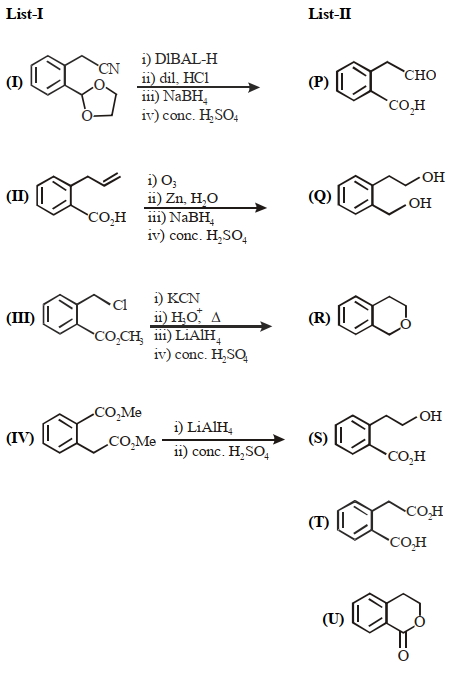
A
$1, 2$
B
$1, 3$
C
$2, 2$
D
$2, 4$
Solution
(A) For reaction $(III)$: The starting material is $o$-chloromethyl methyl benzoate. Treatment with $KCN$ gives $o$-cyanomethyl methyl benzoate. Hydrolysis $(H_3O^+, \Delta)$ yields $o$-carboxymethyl benzoic acid $(T)$. Reduction with $LiAlH_4$ gives the diol,and cyclization with $conc. H_2SO_4$ yields the ether $(R)$. Thus,$(III)$ matches $(T)$ and $(R)$.
For reaction $(IV)$: The starting material is dimethyl $o$-phenylenediacetate. Reduction with $LiAlH_4$ gives the diol $(Q)$. Cyclization with $conc. H_2SO_4$ gives the ether $(R)$. Thus,$(IV)$ matches $(Q)$ and $(R)$.
For reaction $(I)$: The starting material is $2$-(cyanomethyl)benzaldehyde ethylene acetal. $DiBAL-H$ followed by $dil. HCl$ gives the dialdehyde. $NaBH_4$ reduces it to the diol $(Q)$. Cyclization with $conc. H_2SO_4$ gives the ether $(R)$. Thus,$(I)$ matches $(Q)$ and $(R)$.
For reaction $(II)$: The starting material is $o$-allylbenzoic acid. Ozonolysis $(O_3/Zn, H_2O)$ gives the aldehyde-acid. $NaBH_4$ reduces the aldehyde to alcohol $(S)$. Cyclization with $conc. H_2SO_4$ gives the lactone $(U)$. Thus,$(II)$ matches $(S)$ and $(U)$.
Question $(1)$: $(III)$ matches $(T, R)$ and $(IV)$ matches $(Q, R)$. Option $(1)$ is $(III, T, R)$ and Option $(2)$ is $(IV, Q, R)$. Both are correct combinations.
Question $(2)$: $(I)$ matches $(Q, R)$ and $(II)$ matches $(S, U)$. Option $(1)$ is $(I, Q, R)$ and Option $(2)$ is $(II, S, U)$. Both are correct combinations.
Therefore,the correct answer is $(1, 2)$.
For reaction $(IV)$: The starting material is dimethyl $o$-phenylenediacetate. Reduction with $LiAlH_4$ gives the diol $(Q)$. Cyclization with $conc. H_2SO_4$ gives the ether $(R)$. Thus,$(IV)$ matches $(Q)$ and $(R)$.
For reaction $(I)$: The starting material is $2$-(cyanomethyl)benzaldehyde ethylene acetal. $DiBAL-H$ followed by $dil. HCl$ gives the dialdehyde. $NaBH_4$ reduces it to the diol $(Q)$. Cyclization with $conc. H_2SO_4$ gives the ether $(R)$. Thus,$(I)$ matches $(Q)$ and $(R)$.
For reaction $(II)$: The starting material is $o$-allylbenzoic acid. Ozonolysis $(O_3/Zn, H_2O)$ gives the aldehyde-acid. $NaBH_4$ reduces the aldehyde to alcohol $(S)$. Cyclization with $conc. H_2SO_4$ gives the lactone $(U)$. Thus,$(II)$ matches $(S)$ and $(U)$.
Question $(1)$: $(III)$ matches $(T, R)$ and $(IV)$ matches $(Q, R)$. Option $(1)$ is $(III, T, R)$ and Option $(2)$ is $(IV, Q, R)$. Both are correct combinations.
Question $(2)$: $(I)$ matches $(Q, R)$ and $(II)$ matches $(S, U)$. Option $(1)$ is $(I, Q, R)$ and Option $(2)$ is $(II, S, U)$. Both are correct combinations.
Therefore,the correct answer is $(1, 2)$.
0 likesView Solution
Vedclass Products
For Students
Vedclass Test Series
Mock tests in real IIT JEE style covering Chemistry with performance analysis. 5-day free trial.
Start Free TrialFor Teachers
Exam Paper Generator
Generate Set A/B/C/D Chemistry papers from 7.5L+ questions in 2 minutes. 3 chapters free.
Try FreeFor Institutes
Online Exam Module
Run live IIT JEE mock exams with unlimited students, 360° analytics & white-label branding.
See DemoFrequently Asked Questions
How many Chemistry questions are in IIT JEE 2019?
There are 34 Chemistry questions from the IIT JEE 2019 paper on Vedclass, each with a detailed step-by-step solution in English.
Are IIT JEE 2019 Chemistry solutions available in English?
Yes. All solutions on this page are in English. You can also switch to English or Hindi using the language buttons above the questions.
Can I practice IIT JEE 2019 Chemistry as a timed test?
Yes. Use the Vedclass Test Series to attempt a full IIT JEE mock test covering Chemistry with time limits and instant score analysis.
Can teachers create Chemistry papers from IIT JEE previous year questions?
Yes. The Vedclass Exam Paper Generator lets teachers mix IIT JEE Chemistry questions and generate Set A/B/C/D papers in minutes.
For Teachers & Institutes
Build a Custom Chemistry Paper
Pick IIT JEE 2019 Chemistry questions, set difficulty, and generate Set A/B/C/D in 2 minutes.