
ChemistryQ1–32 of 32 questions
Page 1 of 1 · English
1
ChemistryMCQIIT JEE · 2025
The heating of $NH _4 NO _2$ at $60-70^{\circ} C$ and $NH _4 NO _3$ at $200-250^{\circ} C$ is associated with the formation of nitrogen containing compounds $X$ and $Y$, respectively. $X$ and $Y$, respectively, are
A
$N _2$ and $N _2 O$
B
$NH _3$ and $NO _2$
C
$NO$ and $N _2 O$
D
$N _2$ and $NH _3$
Solution
$ NH _4 NO _2 \xrightarrow[60-70^{\circ} C ]{\Delta} N _2+2 H _2 O$
$NH _4 NO _3 \xrightarrow[200-250^{\circ} C ]{\Delta} N _2 O +2 H _2 O $
$NH _4 NO _3 \xrightarrow[200-250^{\circ} C ]{\Delta} N _2 O +2 H _2 O $
0 likesView Solution
2
ChemistryMCQIIT JEE · 2025
The correct order of the wavelength maxima of the absorption band in the ultraviolet-visible region for the given complexes is
A
${\left[ Co \left( NH _3\right)_5( Cl )\right]^{2+}<\left[ Co \left( NH _3\right)_5\left( H _2 O \right)\right]^{3+}<\left[ Co \left( NH _3\right)_6\right]^{3+}<\left[ Co ( CN )_6\right]^{3-}}$
B
${\left[ Co ( CN )_6\right]^{3-}<\left[ Co \left( NH _3\right)_6\right]^{3+}<\left[ Co \left( NH _3\right)_5\left( H _2 O \right)\right]^{3+}<\left[ Co \left( NH _3\right)_5( Cl )\right]^{2+}}$
C
${\left[ Co ( CN )_6\right]^{3-}<\left[ Co \left( NH _3\right)_5( Cl )\right]^{2+}<\left[ Co \left( NH _3\right)_5\left( H _2 O \right)\right]^{3+}<\left[ Co \left( NH _3\right)_6\right]^{3+}}$
D
${\left[ Co \left( NH _3\right)_6\right]^{3+}<\left[ Co ( CN )_6\right]^{3-}<\left[ Co \left( NH _3\right)_5( Cl )\right]^{2+}<\left[ Co \left( NH _3\right)_5\left( H _2 O \right)\right]^{3+}}$
Solution
$\Delta_{O} \propto \frac{1}{\lambda}$
$\therefore$ The absorb wave length order is
$\left[Co(CN)_6\right]^{3-}<\left[Co\left(NH_3\right)_6\right]^{3+} < \left[Co\left(NH_3\right)_5 H_2 O\right]^{3+}<\left[Co\left(NH_3\right)_5 Cl\right]^{2+}$
$\therefore$ The absorb wave length order is
$\left[Co(CN)_6\right]^{3-}<\left[Co\left(NH_3\right)_6\right]^{3+} < \left[Co\left(NH_3\right)_5 H_2 O\right]^{3+}<\left[Co\left(NH_3\right)_5 Cl\right]^{2+}$
0 likesView Solution
3
ChemistryMCQIIT JEE · 2025
One of the products formed from the reaction of permanganate ion with iodide ion in neutral aqueous medium is
A
$I _2$
B
$IO _4^{-}$
C
$IO _3^{-}$
D
$IO _2^{-}$
Solution
$I ^{-}+2 MnO _4^{-}+ H _2 O \xrightarrow{\text { Neutral solution }} 2 MnO _2+ IO _3^{-}+2 OH ^{-}$
0 likesView Solution
4
ChemistryMCQIIT JEE · 2025
Consider the depicted hydrogen $( H )$ in the hydrocarbons given below. The most acidic hydrogen $( H )$ is
A
B
C
D
Solution
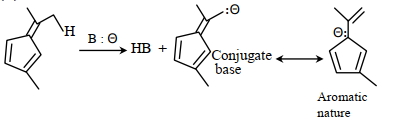
0 likesView Solution
5
ChemistryMCQIIT JEE · 2025
Regarding the molecular orbital $(MO)$ energy levels for homonuclear diatomic molecules, the $\text{INCORRECT}$ statement$(s)$ is$($are$)$
$(A)$ Bond order of $Ne _2$ is zero.
$(B)$ The highest occupied molecular orbital $\text{(HOMO)}$ of $F_2$ is $\sigma$-type.
$(C)$ Bond energy of $O _2^{+}$is smaller than the bond energy of $O _2$.
$(D)$ Bond length of $Li _2$ is larger than the bond length of $B _2$
$(A)$ Bond order of $Ne _2$ is zero.
$(B)$ The highest occupied molecular orbital $\text{(HOMO)}$ of $F_2$ is $\sigma$-type.
$(C)$ Bond energy of $O _2^{+}$is smaller than the bond energy of $O _2$.
$(D)$ Bond length of $Li _2$ is larger than the bond length of $B _2$
A
$(B,C)$
B
$(A,C)$
C
$(A,D)$
D
$(B,D)$
Solution
$(i) Ne _2 \Rightarrow\left(\sigma 1 s^2\right)\left(\sigma^* 1 s^2\right)\left(\sigma 2 s^2\right)\left(\sigma^* 2 s^2\right)\left(\sigma 2 p_z^2\right)\left(\pi 2 p_{ x }^2=\pi 2 p_{ y }^2\right)\left(\pi^* 2 p_{ x }^2=\pi^* 2 p_{ y }^2\right)\left(\sigma^* 2 p_z^2\right)$
$B.O. =\frac{6-6}{2}=0$
$(ii) F _2 \Rightarrow\left(\sigma 1 s^2\right)\left(\sigma^* 1 s^2\right)\left(\sigma 2 s^2\right)\left(\sigma^* 2 s^2\right)\left(\sigma 2 p _{ z }^2\right)\left(\pi 2 p _{ x }^2=\pi 2 p _{ y }^2\right)\left(\pi^* 2 p _{ x }^2=\pi^* 2 p _{ y }^2\right)$
$\text{HOMO}$
$(iii) O _2^{\oplus} \Rightarrow\left(\sigma 1 s^2\right)\left(\sigma^* 1 s^2\right)\left(\sigma 2 s^2\right)\left(\sigma^* 2 s^2\right)\left(\sigma 2 p_z^2\right)\left(\pi 2 p_x^2=\pi 2 p_y^2\right)\left(\pi^* 2 p_x^1=\pi^* 2 p_y\right)$
$\text { B.O. }=\frac{6-1}{2}=2.5$
$O_2 \Rightarrow\left(\sigma 1 s^2\right)\left(\sigma^* 1 s^2\right)\left(\sigma 2 s^2\right)\left(\sigma^* 2 s^2\right)\left(\sigma 2 p_z^2\right)\left(\pi 2 p_x^2=\pi 2 p_y^2\right)\left(\pi^* 2 p_x^1=\pi^* 2 p_y^1\right)$
$B.O. \frac{6-2}{2}=2 ($Bond order increases, Bond strength increases$)$
$(iv)$ Size of atom increases, Bond length increases Size of $Li > B$
So, Bond length of $Li _2 > B _2$
$B.O. =\frac{6-6}{2}=0$
$(ii) F _2 \Rightarrow\left(\sigma 1 s^2\right)\left(\sigma^* 1 s^2\right)\left(\sigma 2 s^2\right)\left(\sigma^* 2 s^2\right)\left(\sigma 2 p _{ z }^2\right)\left(\pi 2 p _{ x }^2=\pi 2 p _{ y }^2\right)\left(\pi^* 2 p _{ x }^2=\pi^* 2 p _{ y }^2\right)$
$\text{HOMO}$
$(iii) O _2^{\oplus} \Rightarrow\left(\sigma 1 s^2\right)\left(\sigma^* 1 s^2\right)\left(\sigma 2 s^2\right)\left(\sigma^* 2 s^2\right)\left(\sigma 2 p_z^2\right)\left(\pi 2 p_x^2=\pi 2 p_y^2\right)\left(\pi^* 2 p_x^1=\pi^* 2 p_y\right)$
$\text { B.O. }=\frac{6-1}{2}=2.5$
$O_2 \Rightarrow\left(\sigma 1 s^2\right)\left(\sigma^* 1 s^2\right)\left(\sigma 2 s^2\right)\left(\sigma^* 2 s^2\right)\left(\sigma 2 p_z^2\right)\left(\pi 2 p_x^2=\pi 2 p_y^2\right)\left(\pi^* 2 p_x^1=\pi^* 2 p_y^1\right)$
$B.O. \frac{6-2}{2}=2 ($Bond order increases, Bond strength increases$)$
$(iv)$ Size of atom increases, Bond length increases Size of $Li > B$
So, Bond length of $Li _2 > B _2$
0 likesView Solution
6
ChemistryMCQIIT JEE · 2025
The pair$(s)$ of diamagnetic ions is$(are)$
$(A) \ La ^{3+}, Ce ^{4+}$ $(B) \ Yb ^{2+}, Lu ^{3+}$ $(C) \ La ^{2+}, Ce ^{3+}$ $(D) \ Yb ^{3+}, Lu ^{2+}$
$(A) \ La ^{3+}, Ce ^{4+}$ $(B) \ Yb ^{2+}, Lu ^{3+}$ $(C) \ La ^{2+}, Ce ^{3+}$ $(D) \ Yb ^{3+}, Lu ^{2+}$
A
$(A,C)$
B
$(A,B)$
C
$(A,D)$
D
$(B,D)$
Solution
$La ^{+3} \rightarrow\left[{ }_{54} Xe \right] 4 f ^0$ diamagnetic
$Yb ^{+2} \rightarrow\left[{ }_{54} Xe \right] 4 f ^{14}$ diamagnetic
$Lu ^{+3} \rightarrow\left[{ }_{54} Xe \right] 4 f ^{14}$ diamagnetic
$La ^{+2} \rightarrow\left[{ }_{54} Xe \right] 5 d^1$ paramagnetic
$Ce ^{+4} \rightarrow\left[{ }_{54} Xe \right] 4 f ^0$ diamagnetic
$Ce ^{+3} \rightarrow\left[{ }_{54} Xe \right] 4 f ^1$ paramagnetic
$Yb ^{+3} \rightarrow\left[{ }_{54} Xe \right] 4 f ^{13}$ paramagnetic
$Lu ^{+2} \rightarrow\left[{ }_{54} Xe \right] 4 f ^{14} 5 d^1$ paramagnetic
$Yb ^{+2} \rightarrow\left[{ }_{54} Xe \right] 4 f ^{14}$ diamagnetic
$Lu ^{+3} \rightarrow\left[{ }_{54} Xe \right] 4 f ^{14}$ diamagnetic
$La ^{+2} \rightarrow\left[{ }_{54} Xe \right] 5 d^1$ paramagnetic
$Ce ^{+4} \rightarrow\left[{ }_{54} Xe \right] 4 f ^0$ diamagnetic
$Ce ^{+3} \rightarrow\left[{ }_{54} Xe \right] 4 f ^1$ paramagnetic
$Yb ^{+3} \rightarrow\left[{ }_{54} Xe \right] 4 f ^{13}$ paramagnetic
$Lu ^{+2} \rightarrow\left[{ }_{54} Xe \right] 4 f ^{14} 5 d^1$ paramagnetic
0 likesView Solution
7
ChemistryMCQIIT JEE · 2025
For the reaction sequence given below, the correct statement$(s)$ is$($are$)$
image
$($In the options, $X$ is any atom other than carbon and hydrogen, and it is different in $P , Q$ and $R )$
image
$($In the options, $X$ is any atom other than carbon and hydrogen, and it is different in $P , Q$ and $R )$
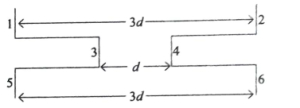
A
$C-X$ bond enthalpy in $P , Q$ and $R$ follows the order $R > P > Q$.
B
$C-X$ bond length in $P , Q$ and $R$ follows the order $Q > R > P$.
C
Relative reactivity toward $S _{ N } 2$ reaction in $P , Q$ and $R$ follows the order $P > R > Q$.
D
$p K_{ a }$ value of the conjugate acids of the leaving groups in $P , Q$ and $R$ follows the order $R > Q > P$.
Solution
$(A)$ Wrong: bond length order $Q > P > R$
$(B)$ Correct: Bond enthalpy $R > P > Q$
$(C)$ Wrong: $S _{ N } 2$ reactivity $Q > P > R$
$(D)$ Wrong: $pKa ( HI < HBr < HF )$ $R > P > Q ($ pKa $)$
$(B)$ Correct: Bond enthalpy $R > P > Q$
$(C)$ Wrong: $S _{ N } 2$ reactivity $Q > P > R$
$(D)$ Wrong: $pKa ( HI < HBr < HF )$ $R > P > Q ($ pKa $)$
0 likesView Solution
8
ChemistryMCQIIT JEE · 2025
In an electrochemicalcell, dichromate ions in aqueous acidic medium are reduced to $Cr ^{3+}$. The current $($in amperes$)$ that flows through the cell for $48.25$ minutes to produce $1$ mole of $Cr ^{3+}$ is $....$ . Use: $1$ Faraday $=96500 C mol ^{-1}$
A
$200$
B
$100$
C
$300$
D
$400$
Solution
For reduction of dichromate, balanced reaction is :
$Cr_2 O_7^{-2}(aq)+6 e^{-}+14 H^{+}(aq) \rightarrow 2 Cr^{3+}(aq)+7 H_2 O(l)$
$\qquad 3 mol \qquad 1 mol$
$\text { Number of Farads required }=3 mol$
$\text { Let current }=I \text { amperes }$
$\Rightarrow \frac{I \times 48.25 \times 60}{96500}=3$
$I=100 A$
$Cr_2 O_7^{-2}(aq)+6 e^{-}+14 H^{+}(aq) \rightarrow 2 Cr^{3+}(aq)+7 H_2 O(l)$
$\qquad 3 mol \qquad 1 mol$
$\text { Number of Farads required }=3 mol$
$\text { Let current }=I \text { amperes }$
$\Rightarrow \frac{I \times 48.25 \times 60}{96500}=3$
$I=100 A$
0 likesView Solution
9
ChemistryMCQIIT JEE · 2025
At $25^{\circ} C$, the concentration of $H ^{+}$ions in $1.00 \times 10^{-3} M$ aqueous solution of a weak monobasic acid having acid dissociation constant $\left(K_a\right)=4.00 \times 10^{-11}$ is $X \times 10^{-7} M$. The value of $X$ is $...$ .
Use: Ionic product of water $\left(K_w\right)=1.00 \times 10^{-14}$ at $25^{\circ} C$
Use: Ionic product of water $\left(K_w\right)=1.00 \times 10^{-14}$ at $25^{\circ} C$
A
$3.23$ or $3.24$
B
$1.23$ or $1.24$
C
$2.23$ or $2.24$
D
$1.50$ or $1.76$
Solution
Because concentration of $H +$ from weak acid is less we need to consider self ionization of $H _2 O$ also.
$HX ( aq ) \rightleftharpoons H ^{+}+ X ^{-}( aq )$
$10^{-3}- x \quad x + y \quad x$
$H _2 O ( l ) \rightleftharpoons H ^{+}( aq )+ OH ^{-}( aq )$
$ \quad x+y \quad y$
$\text { Approximation : }\left(10^{-3}-x\right) \simeq 10^{-3}$
$\Rightarrow \frac{x(x+y)}{10^{-3}}=K_{a}=4 \times 10^{-11}.....(1)$
$\Rightarrow y(x+y)=Kw=10^{-14}......(2)$
$\text { Add }(1)+(2)$
$\Rightarrow \quad(x+y)^2=5 \times 10^{-14}$
$\Rightarrow x+y=\left[H^{+}\right]=\sqrt{5} \times 10^{-7}$
$\Rightarrow x=\sqrt{5}=2.236$
Answer $2.23$ or $2.24 .$
$HX ( aq ) \rightleftharpoons H ^{+}+ X ^{-}( aq )$
$10^{-3}- x \quad x + y \quad x$
$H _2 O ( l ) \rightleftharpoons H ^{+}( aq )+ OH ^{-}( aq )$
$ \quad x+y \quad y$
$\text { Approximation : }\left(10^{-3}-x\right) \simeq 10^{-3}$
$\Rightarrow \frac{x(x+y)}{10^{-3}}=K_{a}=4 \times 10^{-11}.....(1)$
$\Rightarrow y(x+y)=Kw=10^{-14}......(2)$
$\text { Add }(1)+(2)$
$\Rightarrow \quad(x+y)^2=5 \times 10^{-14}$
$\Rightarrow x+y=\left[H^{+}\right]=\sqrt{5} \times 10^{-7}$
$\Rightarrow x=\sqrt{5}=2.236$
Answer $2.23$ or $2.24 .$
0 likesView Solution
10
ChemistryMCQIIT JEE · 2025
Molar volume $( V_m )$ of a van der Waals gas can be calculated by expressing the van der Waals equation as a cubic equation with $V_m$ as the variable. The ratio $($in $mol dm ^{-3} )$ of the coefficient of $V_m^2$ to the coefficient of $V_m$ for a gas having van der Waals constants $a=6.0 dm ^6 atm \ mol ^{-2}$ and $b=0.060 dm ^3 mol^{-1}$ at $300 K$ and $300 atm$ is $....$ .
Use: Universal gas constant $(R)=0.082 dm ^3 atm \ mol { }^{-1} K^{-1}$
Use: Universal gas constant $(R)=0.082 dm ^3 atm \ mol { }^{-1} K^{-1}$
A
$-8.18$
B
$-5.12$
C
$-8.11$
D
$-7.10$
Solution
$\left( P +\frac{ a }{ V _{ m }^2}\right)\left( V _{ m }- b \right)= RT$
$P V_m-b P+\frac{a}{V_m}-\frac{a b}{V_m^2}-R T=0$
$\Rightarrow P V_m^2-(b P+R T) V_m^2+a V_m-a b=0$
Coefficient of $V _{ m }^2=-( bP + RT )$
Coefficient of $V_m=a$
Ratio $=-\frac{(b P + RT )}{ a }=-\left[\frac{0.06 \times 300+24.6}{6}\right]=-7.1$
$P V_m-b P+\frac{a}{V_m}-\frac{a b}{V_m^2}-R T=0$
$\Rightarrow P V_m^2-(b P+R T) V_m^2+a V_m-a b=0$
Coefficient of $V _{ m }^2=-( bP + RT )$
Coefficient of $V_m=a$
Ratio $=-\frac{(b P + RT )}{ a }=-\left[\frac{0.06 \times 300+24.6}{6}\right]=-7.1$
0 likesView Solution
11
ChemistryMCQIIT JEE · 2025
Considering ideal gas behavior, the expansion work done $(in kJ )$ when $144 g$ of water is electrolyzed completely under constant pressure at $300 K$ is $...$ .
Use: Universal gas constant $( R )=8.3 J K ^{-1} mol^{-1}$; Atomic mass $($in amu$)$: $H =1, O =16$
Use: Universal gas constant $( R )=8.3 J K ^{-1} mol^{-1}$; Atomic mass $($in amu$)$: $H =1, O =16$
A
$29.88$
B
$30.88$
C
$15.88$
D
$10.88$
Solution
$H _2 O (l) \rightarrow H _2(g) + \frac{1}{2} O _2(g)$
$144 g \quad - \quad - $
$8 \ mol \ 8 \ mol - 8 \ mol$
$W=-P \Delta V=-(\Delta n) RT$
Change in gaseous moles $=12$
$\Rightarrow \quad W =-\frac{12 \times 8.3 \times 300}{1000} kJ=-29.88 kJ$.
$144 g \quad - \quad - $
$8 \ mol \ 8 \ mol - 8 \ mol$
$W=-P \Delta V=-(\Delta n) RT$
Change in gaseous moles $=12$
$\Rightarrow \quad W =-\frac{12 \times 8.3 \times 300}{1000} kJ=-29.88 kJ$.
0 likesView Solution
12
ChemistryMCQIIT JEE · 2025
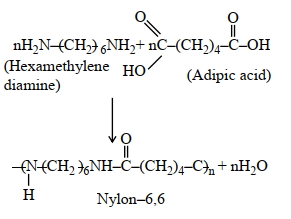
The monomer $( X )$ involved in the synthesis of Nylon $6,6$ gives positive carbylamine test. If $10$ moles of $X$ are analyzed using Dumas method, the amount $($in grams$)$ of nitrogen gas evolved is $....$
Use: Atomic mass of $N ($in amu$) = 14$
Use: Atomic mass of $N ($in amu$) = 14$
A
$270$
B
$280$
C
$290$
D
$300$
Solution
Hexamethylene diamine series give $(+)$ carbylamine test.
$C _{ x } H _{ y } N _{ z }+(2 x +1 / 2) CuO \rightarrow xCO _2+\frac{ y }{2} H _2 O +\frac{ z }{2} N_2 ($Dumas method$)$
$C _6 H _{16} N_2$ then $\frac{ z }{2} N_2=\frac{2}{2} N_2=1$ mole
Given $10$ mole in this reaction so $w _{ N _2}=10 \times 28=280 gm$
$C _{ x } H _{ y } N _{ z }+(2 x +1 / 2) CuO \rightarrow xCO _2+\frac{ y }{2} H _2 O +\frac{ z }{2} N_2 ($Dumas method$)$
$C _6 H _{16} N_2$ then $\frac{ z }{2} N_2=\frac{2}{2} N_2=1$ mole
Given $10$ mole in this reaction so $w _{ N _2}=10 \times 28=280 gm$
0 likesView Solution
13
ChemistryMCQIIT JEE · 2025
The reaction sequence given below is carried out with $16$ moles of $X$. The yield of the major product in each step is given below the product in parentheses. The amount $($in grams$)$ of $S$ produced is $.....$
image
Use: Atomic mass $($in amu$): H =1, C =12, O =16, Br =80$
image
Use: Atomic mass $($in amu$): H =1, C =12, O =16, Br =80$
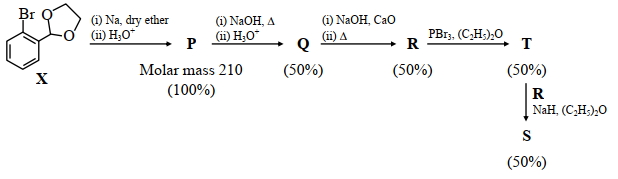
A
$125$
B
$155$
C
$175$
D
$200$
Solution
image
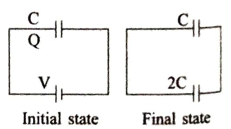
Weight of product of $S=350 \times 1 / 2=175 gm$ Ans.
* $\text{WES}$ : Williamson ether synthesis
Weight of product of $S=350 \times 1 / 2=175 gm$ Ans.
* $\text{WES}$ : Williamson ether synthesis
0 likesView Solution
14
ChemistryMCQIIT JEE · 2025
The correct match of the group reagents in List$-I$ for precipitating the metal ion given in List$-II$ from solutions, is
| List$-I$ | List$-II$ |
| $(P)$ Passing $H _2 S$ in the presence of $NH _4 OH$ | $(1) \ Cu ^{2+}$ |
| $(Q) \ \left( NH _4\right)_2 CO _3$ in the presence of $NH _4 OH$ | $(2) \ Al ^{3+}$ |
| $(R) \ NH _4 OH$ in the presence of $NH _4 Cl$ | $(3) \ Mn ^{2+}$ |
| $(S)$ Passing $H _2 S$ in the presence of dilute $\text{HCl}$ | $(4) \ Ba ^{2+}$ |
| $(5) \ Mg ^{2+}$ |
A
$P \rightarrow 5 ; Q \rightarrow 3 ; R \rightarrow 2 ; S \rightarrow 4$
B
$P \rightarrow 4 ; Q \rightarrow 2 ; R \rightarrow 3 ; S \rightarrow 1$
C
$P \rightarrow 3 ; Q \rightarrow 4 ; R \rightarrow 1 ; S \rightarrow 5$
D
$P \rightarrow 3 ; Q \rightarrow 4 ; R \rightarrow 2 ; S \rightarrow 1$
Solution
$Mn ^{+2} \xrightarrow{ H _2 S+ NH _4 OH } \underset{\text { Pink/buff ppt. }}{ MnS \downarrow}$
$Ba ^{+2} \xrightarrow{\left( NH _4\right)_2 CO _3+ NH _4 OH } \underset{\text { White ppt. }}{ BaCO _3 \downarrow}$
$Al ^{+3} \xrightarrow{ NH _4 Cl + NH _4 OH } \underset{\text { White ppt. }}{ Al ( OH )_3 \downarrow}$
$Cu ^{+2} \xrightarrow{ H _2 S+ HCl \text { (dil.) }} \underset{\text { Black ppt. }}{ CuS \downarrow}$
$Ba ^{+2} \xrightarrow{\left( NH _4\right)_2 CO _3+ NH _4 OH } \underset{\text { White ppt. }}{ BaCO _3 \downarrow}$
$Al ^{+3} \xrightarrow{ NH _4 Cl + NH _4 OH } \underset{\text { White ppt. }}{ Al ( OH )_3 \downarrow}$
$Cu ^{+2} \xrightarrow{ H _2 S+ HCl \text { (dil.) }} \underset{\text { Black ppt. }}{ CuS \downarrow}$
0 likesView Solution
15
ChemistryMCQIIT JEE · 2025
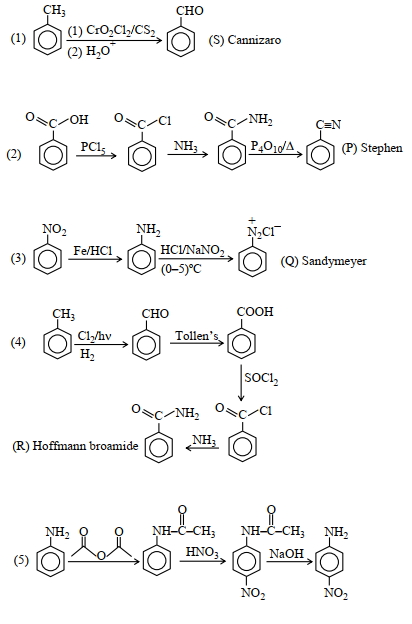
The major products obtained from the reactions in List$-II$ are the reactants for the named reactions mentioned in List$-I.$ Match each entry in List$-I$ with the appropriate entry in List$-II$ and choose the correct options.
| List$-I$ | List$-II$ |
| $(P)$ Stephen reaction | $(1)$ Toluene $\xrightarrow{\substack{\text { (i) } CrO _2 Cl _2 / CS _2 \\ \text { (ii) } H _3 O +}}$ |
| $(Q)$ Sandmeyer reaction | $(2)$ Benzoic acid $\xrightarrow{\substack{\text { (i) } PCl _5 \\ \text { (iii) } NH _3 \\ \text { (iii) } P _4 O _{10}, \Delta}}$ |
| $(R)$ Hoffmann bromamide degradation reaction | $(3)$ Nitrobenzene $\xrightarrow{\begin{array}{l}\text { (i) } Fe , HCl \\ \text { (ii) } HCl , NaNO _2 \\ \text { (273-278 K), } H _2 O \end{array}}$ |
| $(S)$ Cannizzaro reaction | $(4)$ Toluene $\xrightarrow{\begin{array}{l}\text { (i) } Cl _2 / hv , H _2 O \\ \text { (ii) } \text {Tollen 's reagent } \\ \text { (iii) } SO _2 Cl _2 \\ \text { (iv) } NH _3\end{array}}$ |
| $(5)$ Aniline $\xrightarrow{\substack{\text { (i) }\left( CH _3 CO \right)_2 O , \text { Pyridine } \\ \text { (ii) } HN O _3 H _{2} SO _4, 288 K \\ \text { (iii) } aq . NaOH }}$ |
A
$P \rightarrow 2 ; Q \rightarrow 3 ; R \rightarrow 4 ; S \rightarrow 1$
B
$P \rightarrow 2 ; Q \rightarrow 4 ; R \rightarrow 1 ; S \rightarrow 3$
C
$P \rightarrow 5 ; Q \rightarrow 3 ; R \rightarrow 4 ; S \rightarrow 2$
D
$P \rightarrow 5 ; Q \rightarrow 4 ; R \rightarrow 2 ; S \rightarrow 1$
Solution
0 likesView Solution
16
ChemistryMCQIIT JEE · 2025
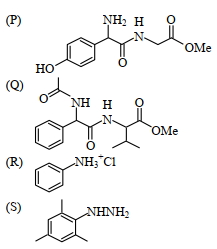
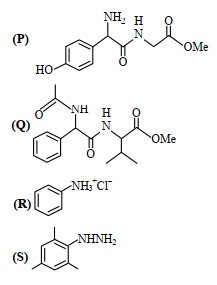
Match the compounds in List$-I$ with the appropriate observations in List$-II$ and choose the correct option.
| List$-I$ | List$-II$ |
| $(P)$ image | $(1)$ Reaction with phenyl diazonium salt gives yellow dye. |
| $(Q)$ image | $(2)$ Reaction with ninhydrin gives purple color and it also reacts with $FeCl _3$ to give violet color. |
| $(R)$ image | $(3)$ Reaction with glucose will give corresponding hydrazone. |
| $(S)$ image | $(4)$ Lassiagne extract of the compound treated with dilute HCl followed by addition of aqueous $FeCl _3$ gives blood red color. |
| $(5)$ After complete hydrolysis, it will give ninhydrin test and it $\text{DOES NOT}$ give positive phthalein dye test. |
A
$P \rightarrow 1 ; Q \rightarrow 5 ; R \rightarrow 4 ; S \rightarrow 2$
B
$P \rightarrow 2 ; Q \rightarrow 5 ; R \rightarrow 1 ; S \rightarrow 3$
C
$P \rightarrow 5 ; Q \rightarrow 2 ; R \rightarrow 1 ; S \rightarrow 4$
D
$P \rightarrow 2 ; Q \rightarrow 1 ; R \rightarrow 5 ; S \rightarrow 3$
Solution
image
Gives $FeCl _3$ test because of presence of phenolic group and ninhydrin test.
image
Amino acid obtained gives $(+)$ Ninhydrin test but not phthalein dye test.
image
Reaction with phenyl diazonium salt gives yellow dye.
image
Compound will form hydrazone derivative with aldehydic group of glucose
Gives $FeCl _3$ test because of presence of phenolic group and ninhydrin test.
image
Amino acid obtained gives $(+)$ Ninhydrin test but not phthalein dye test.
image
Reaction with phenyl diazonium salt gives yellow dye.
image
Compound will form hydrazone derivative with aldehydic group of glucose
0 likesView Solution
17
ChemistryMCQIIT JEE · 2025
During sodium nitroprusside test of sulphide ion in an aqueous solution, one of the ligands coordinated to the metal ion is converted to
A
$SCN ^{-}$
B
$SNO ^{-}$
C
$NOS ^{-}$
D
$NCS ^{-}$
Solution
$Na _2\left[ Fe ( CN )_5( NO )\right]+ Na _2 S \rightarrow Na _4\left[ Fe ( CN )_5( NOS )\right]$
Sodium nitroprusside $\quad$ purple solution
Sodium nitroprusside $\quad$ purple solution
0 likesView Solution
18
ChemistryMCQIIT JEE · 2025
The complete hydrolysis of $ICl , ClF _3$ and $BrF _5$, respectively, gives
A
$IO ^{-}, ClO _2^{-}$ and $BrO _3^{-}$
B
$IO ^{-}, ClO ^{-}$ and $BrO _2^{-}$
C
$IO _3^{-}, ClO _4^{-}$ and $BrO _2^{-}$
D
$IO _3^{-}, ClO _2^{-}$ and $BrO _3^{-}$
Solution
$ICl \xrightarrow{ H _2 O } \underset{\substack{\downarrow \\ IO ^{\ominus}}}{ HIO }+ HCl$
$ClF _3 \xrightarrow{ H _2 O } \underset{\substack{\downarrow \\ CIO _2^{\ominus}}}{ HCIO _2}+3 HF$
$BrF _5 \xrightarrow{ H _2 O } \underset{\substack{\downarrow \\ BrO _3^{\ominus}}}{ HBrO _3+5 HF }$
$ClF _3 \xrightarrow{ H _2 O } \underset{\substack{\downarrow \\ CIO _2^{\ominus}}}{ HCIO _2}+3 HF$
$BrF _5 \xrightarrow{ H _2 O } \underset{\substack{\downarrow \\ BrO _3^{\ominus}}}{ HBrO _3+5 HF }$
0 likesView Solution
19
ChemistryMCQIIT JEE · 2025
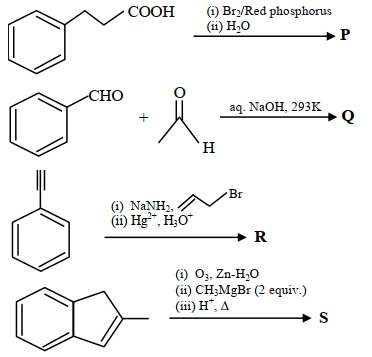
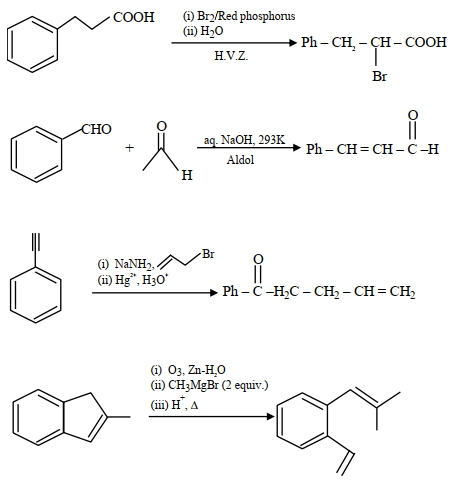
Monocyclic compounds $\text{P , Q , R}$ and $S$ are the major products formed in the reaction sequences given below.
image
The product having the highest number of unsaturated carbon atom$(s)$ is-
image
The product having the highest number of unsaturated carbon atom$(s)$ is-
A
$P$
B
$Q$
C
$R$
D
$S$
Solution
0 likesView Solution
20
ChemistryMCQIIT JEE · 2025
The correct reaction/reaction sequence that would produce a dicarboxylic acid as the major product is
A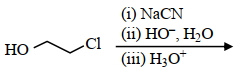
B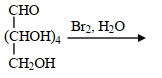
C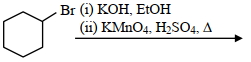
D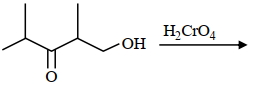
Solution
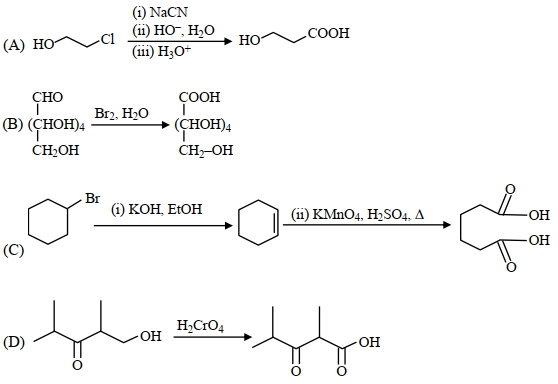
0 likesView Solution
21
ChemistryMCQIIT JEE · 2025
The correct statements $(s)$ about intermolecular forces is$(are)$
$(A)$ The potential energy between two point charges approaches zero more rapidly than the potential energy between a point dipole and a point charge as the distance between them approaches infinity.
$(B)$ The average potential energy of two rotating polar molecules that are separated by a distance $r$ has $1 / r^3$ dependence.
$(C)$ The dipole-induced dipole average interaction energy is independent of temperature.
$(D)$ Nonpolar molecules attract one another even though neither has a permanent dipole moment.
$(A)$ The potential energy between two point charges approaches zero more rapidly than the potential energy between a point dipole and a point charge as the distance between them approaches infinity.
$(B)$ The average potential energy of two rotating polar molecules that are separated by a distance $r$ has $1 / r^3$ dependence.
$(C)$ The dipole-induced dipole average interaction energy is independent of temperature.
$(D)$ Nonpolar molecules attract one another even though neither has a permanent dipole moment.
A
$C,D$
B
$A,D$
C
$B,D$
D
$B,C$
Solution
$(i)$ Ion $-$ Ion $\rightarrow$ Interaction energy $\propto \frac{1}{r}$
Ion $-$ dipole $\rightarrow$ Interaction energy $\propto \frac{1}{ r ^2}$
Ion $-$ dipole Interaction energy approaches zero more rapidly as ' $r$ ' increases
$(ii)$ Rotating Polar molecules $\rightarrow$ Interaction energy $\propto \frac{1}{ r ^6}$.
$(iii)$ Dipole $-$ induced dipole forces are independent of temperature.
$(iv)$ Non$-$polar species show London dispersion forces.
Ion $-$ dipole $\rightarrow$ Interaction energy $\propto \frac{1}{ r ^2}$
Ion $-$ dipole Interaction energy approaches zero more rapidly as ' $r$ ' increases
$(ii)$ Rotating Polar molecules $\rightarrow$ Interaction energy $\propto \frac{1}{ r ^6}$.
$(iii)$ Dipole $-$ induced dipole forces are independent of temperature.
$(iv)$ Non$-$polar species show London dispersion forces.
0 likesView Solution
22
ChemistryMCQIIT JEE · 2025
The compound$(s)$ with $P - H$ bond$(s)$ is$(are)$
$(A) \ H _3 PO _4$ $(B) \ H _3 PO _3$ $(C) \ H _4 P _2 O _7$ $(D) \ H _3 PO _2$
$(A) \ H _3 PO _4$ $(B) \ H _3 PO _3$ $(C) \ H _4 P _2 O _7$ $(D) \ H _3 PO _2$
A
$B,D$
B
$A,D$
C
$C,D$
D
$A,C$
Solution
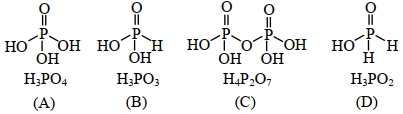
0 likesView Solution
23
ChemistryMCQIIT JEE · 2025
For the reaction sequence given below, the correct statement$(s)$ is$(are)$
image
$(A)$ Both $X$ and $Y$ are oxygen containing compounds.
$(B) \ Y$ on heating with $CHCl _3 / KOH$ forms isocyanide.
$(C) \ Z$ reacts with Hinsberg's reagent.
$(D) \ Z$ is an aromatic primary amine.
image
$(A)$ Both $X$ and $Y$ are oxygen containing compounds.
$(B) \ Y$ on heating with $CHCl _3 / KOH$ forms isocyanide.
$(C) \ Z$ reacts with Hinsberg's reagent.
$(D) \ Z$ is an aromatic primary amine.

A
$A,C$
B
$B,C$
C
$A,D$
D
$B,D$
Solution
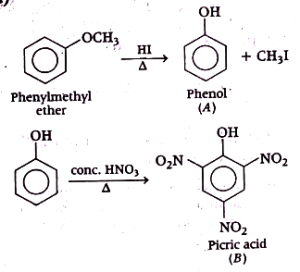
0 likesView Solution
24
ChemistryMCQIIT JEE · 2025
For the reaction sequence given below, the correct statement$(s)$ is$(are)$
image
$(A) \ P$ is optically active.
$(B) \ S$ gives Bayer's test.
$(C) \ Q$ gives effervescence with aq. $NaHCO _3$.
$(D) \ R$ is an alkyne.
image
$(A) \ P$ is optically active.
$(B) \ S$ gives Bayer's test.
$(C) \ Q$ gives effervescence with aq. $NaHCO _3$.
$(D) \ R$ is an alkyne.
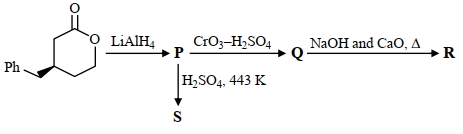
A
$A,C$
B
$B,C$
C
$C,D$
D
$A,D$
Solution
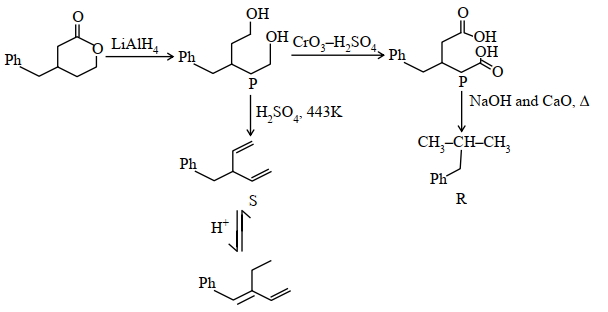
0 likesView Solution
25
ChemistryMCQIIT JEE · 2025
The density $($in $g cm ^{-3} )$ of the metal which forms a cubic close packed $(ccp)$ lattice with an axial distance $($edge length$)$ equal to $400 \ pm$ is $....$
Use: Atomic mass of metal $=105.6 \ amu$ and Avogadro's constant $=6 \times 10^{23} mol^{-1}$
Use: Atomic mass of metal $=105.6 \ amu$ and Avogadro's constant $=6 \times 10^{23} mol^{-1}$
A
$10$
B
$11$
C
$12$
D
$13$
Solution
$\text{CCP}:$
$(Z=4, a=400 pm, M=105.6 g / mol)$
$\text { Density }=\frac{Z \times M}{a^3 \times N_{A}}$
$=\frac{4 \times 105.6}{\left(400 \times 10^{-10}\right)^3 \times 6 \times 10^{23}}=11.00 g / \ cm^3$
$(Z=4, a=400 pm, M=105.6 g / mol)$
$\text { Density }=\frac{Z \times M}{a^3 \times N_{A}}$
$=\frac{4 \times 105.6}{\left(400 \times 10^{-10}\right)^3 \times 6 \times 10^{23}}=11.00 g / \ cm^3$
0 likesView Solution
26
ChemistryMCQIIT JEE · 2025
The solubility of barium iodate in an aqueous solution prepared by mixing $200 \ mL$ of $0.010 \ M$ barium nitrate with $100 \ mL$ of $0.10 M$ sodium iodate is $X \times 10^{-6} mol dm ^{-3}$. The value of $X$ is $.....$
Use: Solubility product constant $\left(K_{ sp }\right)$ of barium iodate $=1.58 \times 10^{-9}$
Use: Solubility product constant $\left(K_{ sp }\right)$ of barium iodate $=1.58 \times 10^{-9}$
A
$3.95$
B
$4.95$
C
$5.95$
D
$6.95$
Solution
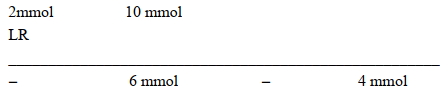
$Ba \left( NO _3\right)_2( aq )+2 NaIO _3( aq ) \rightarrow Ba \left( IO _3\right)_2(s)+2 NaNO _3( aq )$
image
${\left[ NaIO _3\right]=\frac{6}{300}=2 \times 10^{-2} M }$
$Ba \left( IO _3\right)_2(s) \rightleftharpoons Ba ^{2+}+2 IO _3^{-}$
$\left(2 \times 10^{-2}+2 s\right)$
$K _{ sp }=\left[ Ba ^{+2}\right]\left[ IO _3^{-}\right]^2$
$1.58 \times 10^{-9}=\left[ Ba ^{+2}\right] \times\left(2 \times 10^{-2}\right)^2$
${\left[ Ba ^{+2}\right]= s =3.95 \times 10^{-6} M }$
$X =3.95$
image
${\left[ NaIO _3\right]=\frac{6}{300}=2 \times 10^{-2} M }$
$Ba \left( IO _3\right)_2(s) \rightleftharpoons Ba ^{2+}+2 IO _3^{-}$
$\left(2 \times 10^{-2}+2 s\right)$
$K _{ sp }=\left[ Ba ^{+2}\right]\left[ IO _3^{-}\right]^2$
$1.58 \times 10^{-9}=\left[ Ba ^{+2}\right] \times\left(2 \times 10^{-2}\right)^2$
${\left[ Ba ^{+2}\right]= s =3.95 \times 10^{-6} M }$
$X =3.95$
0 likesView Solution
27
ChemistryMCQIIT JEE · 2025
Adsorption of phenol from its aqueous solution on to fly ash obeys Freundlich isotherm. At a given temperature, from $10 \ mg \ g ^{-1}$ and $16 \ mg \ g ^{-1}$ aqueous phenol solutions, the concentrations of adsorbed phenol are measured to be $4 \ mg \ g ^{-1}$ and $10 \ mg \ g ^{-1}$, respectively. At this temperature, the concentration (in $mg \ g ^{-1}$ ) of adsorbed phenol from $20 \ mg \ g ^{-1}$ aqueous solution of phenol will be $.....$ .
Use : $\log _{10} 2=0.3$
Use : $\log _{10} 2=0.3$
A
$15.62$ or $16.00$
B
$11.62$ or $17.00$
C
$12.62$ or $19.00$
D
$15.62$ or $22.00$
Solution
$\frac{ x }{ m }= K \times C ^{1 / n }$
$\log \left(\frac{x}{m}\right)=\log K+\frac{1}{n} \log C$
$\log 4=\log K+\frac{1}{n} \log 10$
$0.6=\log K+\frac{1}{n}...(1)$
$\log 10=\log K+\frac{1}{n} \log 16$
$1=\log K+\frac{1}{n} \times 1.2...(2)$
Equation $(2) -$ equation $(1)$
$0.4=\frac{1}{n} \times(0.2) \Rightarrow n=0.5$
and $\log K =-1.4$
$\log \frac{x}{m}=\log K+\frac{1}{n} \times \log C$
$=-1.4+2 \times \log 20$
$=-1.4+2.6=1.2$
$\frac{x}{m}=10^{+1.2}=16$
$\left(\log 2=0.3,4 \log 2=1.2,16=10^{+1.2}\right)$
or
$\frac{x}{m}=K \times C^{1 / n}$
$4=K(10)^{1 / n}....(1)$
$10=K(16)^{1 / n}.....(2)$
$X=K(20)^{1 / n}.......(3)$
On solving equation $(1)$ and $(2)$
$\frac{1}{n}=2$
On solving equation $(1)$ and $(3)$
$\frac{4}{X}=\left(\frac{10}{20}\right)^2$
$X=16$
On solving equation $(2)$ and $(3)$
$\frac{10}{X}=\left(\frac{16}{20}\right)^2$
$X=15.625$
$\log \left(\frac{x}{m}\right)=\log K+\frac{1}{n} \log C$
$\log 4=\log K+\frac{1}{n} \log 10$
$0.6=\log K+\frac{1}{n}...(1)$
$\log 10=\log K+\frac{1}{n} \log 16$
$1=\log K+\frac{1}{n} \times 1.2...(2)$
Equation $(2) -$ equation $(1)$
$0.4=\frac{1}{n} \times(0.2) \Rightarrow n=0.5$
and $\log K =-1.4$
$\log \frac{x}{m}=\log K+\frac{1}{n} \times \log C$
$=-1.4+2 \times \log 20$
$=-1.4+2.6=1.2$
$\frac{x}{m}=10^{+1.2}=16$
$\left(\log 2=0.3,4 \log 2=1.2,16=10^{+1.2}\right)$
or
$\frac{x}{m}=K \times C^{1 / n}$
$4=K(10)^{1 / n}....(1)$
$10=K(16)^{1 / n}.....(2)$
$X=K(20)^{1 / n}.......(3)$
On solving equation $(1)$ and $(2)$
$\frac{1}{n}=2$
On solving equation $(1)$ and $(3)$
$\frac{4}{X}=\left(\frac{10}{20}\right)^2$
$X=16$
On solving equation $(2)$ and $(3)$
$\frac{10}{X}=\left(\frac{16}{20}\right)^2$
$X=15.625$
0 likesView Solution
28
ChemistryMCQIIT JEE · 2025
Consider a reaction $A+R \rightarrow$ Product. The rate of this reaction is measured to be $k[A][R]$. At the start of the reaction, the concentration of $R,[R]_0$, is $10-$times the concentration of $A,[A]_0$. The reaction can be considered to be a pseudo first order reaction with assumption that $k[R]=k^{\prime}$ is constant. Due to this assumption, the relative error $(in \%)$ in the rate when this reaction is $40 \%$ complete, is $....$
$[ k$ and $k^{\prime}$ represent corresponding rate constants$]$
$[ k$ and $k^{\prime}$ represent corresponding rate constants$]$
A
$5.16$ or$5.17$
B
$4.16$ or $4.17$
C
$6.16$ or $6.17$
D
$9.16$ or $9.17$
Solution
$ A + R \rightarrow \text { Product }$
$t =0 A_0 10 A_0$
$t = t 0.6 A_0 9.6 A_0$
$\text { Rate }= k [ A ][ R ]$
$\text { Rate }_1= k \left(0.6 A_0\right) \times 9.6 A_0$
$A + R \rightarrow$ Product
$ t =0 A_0 10 A_0 \text { (excess) }$
$t = t 0.6 A_0 10 A_0$
$\text { Rate }= k ^{\prime}[ A ], k ^{\prime}= k [ R ]$
$\text { Rate }_2=\left( k \times 10 A_0\right) \times\left(0.6 A_0\right)$
$100 \times \frac{\Delta \text { Rate }}{\text { Rate }_1}=\frac{(0.6 \times 10-0.6 \times 9.6}{0.6 \times 9.6} \times 100=4.1666$
$t =0 A_0 10 A_0$
$t = t 0.6 A_0 9.6 A_0$
$\text { Rate }= k [ A ][ R ]$
$\text { Rate }_1= k \left(0.6 A_0\right) \times 9.6 A_0$
$A + R \rightarrow$ Product
$ t =0 A_0 10 A_0 \text { (excess) }$
$t = t 0.6 A_0 10 A_0$
$\text { Rate }= k ^{\prime}[ A ], k ^{\prime}= k [ R ]$
$\text { Rate }_2=\left( k \times 10 A_0\right) \times\left(0.6 A_0\right)$
$100 \times \frac{\Delta \text { Rate }}{\text { Rate }_1}=\frac{(0.6 \times 10-0.6 \times 9.6}{0.6 \times 9.6} \times 100=4.1666$
0 likesView Solution
29
ChemistryMCQIIT JEE · 2025
At $300 K$ , an ideal dilute solution of a macromolecule exerts osmotic pressure that is expressed in terms of the height $(h)$ of the solution $($density $=1.00 g cm ^{-3} )$ where h is equal to $2.00 cm$ . If the concentration of the dilute solution of the macromolecule is $2.00 g dm ^{-3}$, the molar mass of the macromolecule is calculated to be $X \times 10^4 g mol ^{-1}$. The value of $X$ is $...$ .
Use : Universal gas constant $(R)=8.3 J K ^{-1} mol^{-1}$ and acceleration due to gravity $( g )=10 m s ^{-2}$
Use : Universal gas constant $(R)=8.3 J K ^{-1} mol^{-1}$ and acceleration due to gravity $( g )=10 m s ^{-2}$
A
$2.49$
B
$3.49$
C
$4.49$
D
$9.49$
Solution
$\pi=\rho g h=10^3 \times 10 \times 2 \times 10^{-2} \text { Pascal }=200 \text { Pascal }$
$\pi=C R T$
$200=\frac{2}{M} \times 1000 \times 8.3 \times 300$
$M=24900=2.49 \times 10^4 g / mol$
$X=2.49$
$\pi=C R T$
$200=\frac{2}{M} \times 1000 \times 8.3 \times 300$
$M=24900=2.49 \times 10^4 g / mol$
$X=2.49$
0 likesView Solution
30
ChemistryMCQIIT JEE · 2025
An electrochemical cell is fueled by the combustion of butane at $1$ bar and $298 K$ . Its cell potential is $\frac{ X }{ F } \times 10^3$ volts, where $F$ is the Faraday constant. The value of $X$ is $...$ .
Use : Standard Gibbs energies of formation at $298 K$ are : $\Delta_f G_{ CO _2}^{ o }=-394 kJ mol ^{-1}; \Delta_f G_{\text {water }}^{ o }=-237 kJ mol ^{-1} ; \Delta_f G_{\text {butane }}^{ o }=-18 kJ mol ^{-1}$
Use : Standard Gibbs energies of formation at $298 K$ are : $\Delta_f G_{ CO _2}^{ o }=-394 kJ mol ^{-1}; \Delta_f G_{\text {water }}^{ o }=-237 kJ mol ^{-1} ; \Delta_f G_{\text {butane }}^{ o }=-18 kJ mol ^{-1}$
A
$102.23$
B
$106.23$
C
$105.50$
D
$108.46$
Solution
$C _4 H _{10}(g)+\frac{13}{2} O _2(g) \rightarrow 4 CO _2(g)+5 H _2 O (l)$
$\Delta_{ r } G ^{ o }=4 \Delta_{ f } G _{ CO _2}^{ o }+5 \Delta_{ f } G _{ H _2 O }^{ o }-\Delta_{ f } G _{ C _4 H _{10}}^{ o }$
$=4 \times(-394)+5(-237)+18$
$=-2743 kJ / mol $
$\Delta_{ r } G ^{\circ}=- nFE ^{\circ}$
$-2743 \times 1000=-26 \times FE ^{\circ}$
$E ^{ o }=\frac{105.5}{F} \times 10^3=105.50$
$\Delta_{ r } G ^{ o }=4 \Delta_{ f } G _{ CO _2}^{ o }+5 \Delta_{ f } G _{ H _2 O }^{ o }-\Delta_{ f } G _{ C _4 H _{10}}^{ o }$
$=4 \times(-394)+5(-237)+18$
$=-2743 kJ / mol $
$\Delta_{ r } G ^{\circ}=- nFE ^{\circ}$
$-2743 \times 1000=-26 \times FE ^{\circ}$
$E ^{ o }=\frac{105.5}{F} \times 10^3=105.50$
0 likesView Solution
31
ChemistryMCQIIT JEE · 2025
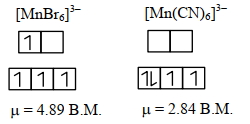
The sum of the spin only magnetic moment values $(in \ B.M.)$ of $\left[ Mn ( Br )_6\right]^{3-}$ and $\left[ Mn ( CN )_6\right]^{3-}$ is $....$ .
A
$7.70$ to$7.73$
B
$6.70$ to $6.73$
C
$11.70$ to $11.73$
D
$15.70$ to $15.73$
Solution
Sum of spin magnetic moments of both complexes is $7.70$ to $7.73 B . M$.
0 likesView Solution
32
ChemistryMCQIIT JEE · 2025
A linear octasaccharide $($molar mass $=1024 g mol ^{-1} )$ on complete hydrolysis produces three monosaccharides: ribose, $2-$deoxyribose and glucose. The amount of $2-$deoxyribose formed is $58.26 \%( w / w )$ of the total amount of the monosaccharides produced in the hydrolyzed products. The number of ribose unit$(s)$ present in one molecule of octasaccharide is $.....$
Use : Molar mass $($in g $mol ^{-1} )$: ribose $=150,2-$deoxyribose $=134$, glucose $=180$; Atomic mass $($in amu$): H =1, O =16$
Use : Molar mass $($in g $mol ^{-1} )$: ribose $=150,2-$deoxyribose $=134$, glucose $=180$; Atomic mass $($in amu$): H =1, O =16$
A
$1$
B
$2$
C
$3$
D
$4$
Solution
$\underset{\text { M.M. }=1024}{\text { Octasaccharide }}+\underset{\text { M.M. }=126}{7 H _2 O } \longrightarrow \begin{array}{l}\text { Ribose }+2 \text { deoxyribose }+ \text { glucose } \\ \text { Totalmass }=1024+126=1150\end{array}$
$58.26=\frac{134 \times n}{1150} \times 100$
$\frac{66.999}{100}=134 n n=4.99=5$
$5$ units of $2-$Deoxyribose
$1150=(5 \times 150)+(x \times 150)+(y \times 180)$
$1150=\underbrace{750}_{5 \text { unit }}+\underbrace{1500}_{300 \text { unit }}+\underbrace{180 y }_{180 \text { unit }}$
$n =2.00$
$58.26=\frac{134 \times n}{1150} \times 100$
$\frac{66.999}{100}=134 n n=4.99=5$
$5$ units of $2-$Deoxyribose
$1150=(5 \times 150)+(x \times 150)+(y \times 180)$
$1150=\underbrace{750}_{5 \text { unit }}+\underbrace{1500}_{300 \text { unit }}+\underbrace{180 y }_{180 \text { unit }}$
$n =2.00$
0 likesView Solution
Vedclass Products
For Students
Vedclass Test Series
Mock tests in real IIT JEE style covering Chemistry with performance analysis. 5-day free trial.
Start Free TrialFor Teachers
Exam Paper Generator
Generate Set A/B/C/D Chemistry papers from 7.5L+ questions in 2 minutes. 3 chapters free.
Try FreeFor Institutes
Online Exam Module
Run live IIT JEE mock exams with unlimited students, 360° analytics & white-label branding.
See DemoFrequently Asked Questions
How many Chemistry questions are in IIT JEE 2025?
There are 32 Chemistry questions from the IIT JEE 2025 paper on Vedclass, each with a detailed step-by-step solution in English.
Are IIT JEE 2025 Chemistry solutions available in English?
Yes. All solutions on this page are in English. You can also switch to English or Hindi using the language buttons above the questions.
Can I practice IIT JEE 2025 Chemistry as a timed test?
Yes. Use the Vedclass Test Series to attempt a full IIT JEE mock test covering Chemistry with time limits and instant score analysis.
Can teachers create Chemistry papers from IIT JEE previous year questions?
Yes. The Vedclass Exam Paper Generator lets teachers mix IIT JEE Chemistry questions and generate Set A/B/C/D papers in minutes.
For Teachers & Institutes
Build a Custom Chemistry Paper
Pick IIT JEE 2025 Chemistry questions, set difficulty, and generate Set A/B/C/D in 2 minutes.