
PhysicsQ151–239 of 399 questions
Page 4 of 5 · English
151
PhysicsMediumMCQAP EAMCET · 2025
$A$ Carnot engine having efficiency $60 \%$ receives heat from a source at a temperature $600 \text{ K}$. For the same sink temperature, to increase its efficiency to $80 \%$, the temperature of the source is (in $\text{ K}$)
A
$300$
B
$900$
C
$1200$
D
$720$
Solution
(C) The efficiency of a Carnot engine is given by $\eta = 1 - \frac{T_2}{T_1}$, where $T_1$ is the source temperature and $T_2$ is the sink temperature.
For the first case: $\eta_1 = 0.60$, $T_1 = 600 \text{ K}$.
$0.60 = 1 - \frac{T_2}{600} \implies \frac{T_2}{600} = 0.40 \implies T_2 = 240 \text{ K}$.
For the second case: $\eta_2 = 0.80$, $T_2 = 240 \text{ K}$.
$0.80 = 1 - \frac{240}{T_1'} \implies \frac{240}{T_1'} = 0.20 \implies T_1' = \frac{240}{0.20} = 1200 \text{ K}$.
Thus, the new source temperature required is $1200 \text{ K}$.
For the first case: $\eta_1 = 0.60$, $T_1 = 600 \text{ K}$.
$0.60 = 1 - \frac{T_2}{600} \implies \frac{T_2}{600} = 0.40 \implies T_2 = 240 \text{ K}$.
For the second case: $\eta_2 = 0.80$, $T_2 = 240 \text{ K}$.
$0.80 = 1 - \frac{240}{T_1'} \implies \frac{240}{T_1'} = 0.20 \implies T_1' = \frac{240}{0.20} = 1200 \text{ K}$.
Thus, the new source temperature required is $1200 \text{ K}$.
0 likesView Solution
152
PhysicsMediumMCQAP EAMCET · 2025
$A$ Carnot heat engine absorbs $600 \ J$ of heat from a source at a temperature of $127^{\circ} C$ and rejects $400 \ J$ of heat to a sink in each cycle. The temperature of the sink is (in $K$)
A
$266.7$
B
$166.7$
C
$133.3$
D
$333.3$
Solution
(A) For a Carnot engine,the ratio of heat exchanged is equal to the ratio of the absolute temperatures of the source and the sink: $\frac{Q_1}{Q_2} = \frac{T_1}{T_2}$.
Given:
Heat absorbed from source,$Q_1 = 600 \ J$.
Heat rejected to sink,$Q_2 = 400 \ J$.
Temperature of source,$T_1 = 127^{\circ} C = 127 + 273 = 400 \ K$.
Using the formula: $\frac{600}{400} = \frac{400}{T_2}$.
Simplifying the ratio: $1.5 = \frac{400}{T_2}$.
Solving for $T_2$: $T_2 = \frac{400}{1.5} = 266.67 \ K \approx 266.7 \ K$.
Given:
Heat absorbed from source,$Q_1 = 600 \ J$.
Heat rejected to sink,$Q_2 = 400 \ J$.
Temperature of source,$T_1 = 127^{\circ} C = 127 + 273 = 400 \ K$.
Using the formula: $\frac{600}{400} = \frac{400}{T_2}$.
Simplifying the ratio: $1.5 = \frac{400}{T_2}$.
Solving for $T_2$: $T_2 = \frac{400}{1.5} = 266.67 \ K \approx 266.7 \ K$.
0 likesView Solution
153
PhysicsEasyMCQAP EAMCET · 2025
The fundamental limitation to the coefficient of performance of a refrigerator is given by
A
first law of thermodynamics
B
Newton's law of cooling
C
zeroth law of thermodynamics
D
second law of thermodynamics
Solution
(D) The coefficient of performance $(COP)$ of a refrigerator is defined as the ratio of the heat extracted from the cold reservoir $(Q_L)$ to the work input $(W)$.
$COP = \frac{Q_L}{W} = \frac{Q_L}{Q_H - Q_L}$.
According to the second law of thermodynamics,heat cannot spontaneously flow from a colder body to a hotter body without the expenditure of external work.
This law imposes a theoretical upper limit on the efficiency of heat engines and the $COP$ of refrigerators (Carnot limit).
Therefore,the fundamental limitation to the $COP$ of a refrigerator is governed by the second law of thermodynamics.
$COP = \frac{Q_L}{W} = \frac{Q_L}{Q_H - Q_L}$.
According to the second law of thermodynamics,heat cannot spontaneously flow from a colder body to a hotter body without the expenditure of external work.
This law imposes a theoretical upper limit on the efficiency of heat engines and the $COP$ of refrigerators (Carnot limit).
Therefore,the fundamental limitation to the $COP$ of a refrigerator is governed by the second law of thermodynamics.
0 likesView Solution
154
PhysicsMediumMCQAP EAMCET · 2025
$A$ Carnot engine $A$ working between temperatures $600 \ K$ and $T$ $(T < 600 \ K)$ and another Carnot engine $B$ working between temperatures $T$ $(T > 400 \ K)$ and $400 \ K$ are connected in series. If the work done by both the engines is the same, then $T =$ (in $K$)
A
$550$
B
$500$
C
$575$
D
$525$
Solution
(B) For a Carnot engine, the efficiency $\eta$ is given by $\eta = 1 - \frac{T_{low}}{T_{high}}$.
Also, the work done $W$ is given by $W = Q_{in} \cdot \eta$, where $Q_{in}$ is the heat absorbed from the source.
For engine $A$: $W_A = Q_A \left(1 - \frac{T}{600}\right)$.
For engine $B$: $W_B = Q_B \left(1 - \frac{400}{T}\right)$.
Since the engines are in series, the heat rejected by engine $A$ is the heat absorbed by engine $B$, so $Q_B = Q_A \left(\frac{T}{600}\right)$.
Given $W_A = W_B$, we have $Q_A \left(1 - \frac{T}{600}\right) = Q_A \left(\frac{T}{600}\right) \left(1 - \frac{400}{T}\right)$.
Simplifying the equation: $1 - \frac{T}{600} = \frac{T}{600} - \frac{400}{600}$.
$1 + \frac{400}{600} = \frac{2T}{600}$.
$1 + \frac{2}{3} = \frac{T}{300} \implies \frac{5}{3} = \frac{T}{300}$.
$T = \frac{5 \times 300}{3} = 500 \ K$.
Also, the work done $W$ is given by $W = Q_{in} \cdot \eta$, where $Q_{in}$ is the heat absorbed from the source.
For engine $A$: $W_A = Q_A \left(1 - \frac{T}{600}\right)$.
For engine $B$: $W_B = Q_B \left(1 - \frac{400}{T}\right)$.
Since the engines are in series, the heat rejected by engine $A$ is the heat absorbed by engine $B$, so $Q_B = Q_A \left(\frac{T}{600}\right)$.
Given $W_A = W_B$, we have $Q_A \left(1 - \frac{T}{600}\right) = Q_A \left(\frac{T}{600}\right) \left(1 - \frac{400}{T}\right)$.
Simplifying the equation: $1 - \frac{T}{600} = \frac{T}{600} - \frac{400}{600}$.
$1 + \frac{400}{600} = \frac{2T}{600}$.
$1 + \frac{2}{3} = \frac{T}{300} \implies \frac{5}{3} = \frac{T}{300}$.
$T = \frac{5 \times 300}{3} = 500 \ K$.
0 likesView Solution
155
PhysicsMediumMCQAP EAMCET · 2025
In a Carnot engine,if the work done during isothermal expansion is $25 \%$ more than the work done during isothermal compression,then the efficiency of the engine is: (in $\%$)
A
$10$
B
$15$
C
$20$
D
$25$
Solution
(C) In a Carnot engine,the work done during isothermal expansion $(W_{exp})$ is given by $W_{exp} = nRT_H \ln(V_2/V_1)$ and the work done during isothermal compression $(W_{comp})$ is given by $W_{comp} = nRT_L \ln(V_2/V_1)$.
Given that $W_{exp} = W_{comp} + 0.25 W_{comp} = 1.25 W_{comp}$.
Substituting the expressions,we get $nRT_H \ln(V_2/V_1) = 1.25 nRT_L \ln(V_2/V_1)$.
This simplifies to $T_H = 1.25 T_L$,or $T_L/T_H = 1/1.25 = 0.8$.
The efficiency of a Carnot engine is given by $\eta = 1 - (T_L/T_H)$.
Substituting the value,$\eta = 1 - 0.8 = 0.2$.
Thus,the efficiency is $20 \%$.
Given that $W_{exp} = W_{comp} + 0.25 W_{comp} = 1.25 W_{comp}$.
Substituting the expressions,we get $nRT_H \ln(V_2/V_1) = 1.25 nRT_L \ln(V_2/V_1)$.
This simplifies to $T_H = 1.25 T_L$,or $T_L/T_H = 1/1.25 = 0.8$.
The efficiency of a Carnot engine is given by $\eta = 1 - (T_L/T_H)$.
Substituting the value,$\eta = 1 - 0.8 = 0.2$.
Thus,the efficiency is $20 \%$.
0 likesView Solution
156
PhysicsEasyMCQAP EAMCET · 2025
In a Carnot engine,if the absolute temperature of the source is $25 \%$ more than the absolute temperature of the sink,then the efficiency of the engine is (in $\%$)
A
$25$
B
$50$
C
$20$
D
$40$
Solution
(C) The efficiency $\eta$ of a Carnot engine is given by the formula: $\eta = 1 - \frac{T_2}{T_1}$,where $T_1$ is the temperature of the source and $T_2$ is the temperature of the sink.
Given that the source temperature $T_1$ is $25 \%$ more than the sink temperature $T_2$,we have: $T_1 = T_2 + 0.25 T_2 = 1.25 T_2$.
Substituting $T_1$ into the efficiency formula: $\eta = 1 - \frac{T_2}{1.25 T_2} = 1 - \frac{1}{1.25}$.
Since $1.25 = \frac{5}{4}$,we get: $\eta = 1 - \frac{4}{5} = \frac{1}{5}$.
Converting this to percentage: $\eta = \frac{1}{5} \times 100 \% = 20 \%$.
Given that the source temperature $T_1$ is $25 \%$ more than the sink temperature $T_2$,we have: $T_1 = T_2 + 0.25 T_2 = 1.25 T_2$.
Substituting $T_1$ into the efficiency formula: $\eta = 1 - \frac{T_2}{1.25 T_2} = 1 - \frac{1}{1.25}$.
Since $1.25 = \frac{5}{4}$,we get: $\eta = 1 - \frac{4}{5} = \frac{1}{5}$.
Converting this to percentage: $\eta = \frac{1}{5} \times 100 \% = 20 \%$.
0 likesView Solution
157
PhysicsMediumMCQAP EAMCET · 2025
If a heat engine and a refrigerator are working between the same two temperatures $T_1$ and $T_2$ $(T_1 > T_2)$,then the ratio of the efficiency of the heat engine to the coefficient of performance of the refrigerator is:
A
$\frac{T_1 - T_2}{T_1 T_2}$
B
$\frac{T_1 + T_2}{T_1 T_2}$
C
$\frac{(T_1 - T_2)^2}{T_1 T_2}$
D
$\frac{(T_1 + T_2)^2}{T_1 T_2}$
Solution
(C) The efficiency of a Carnot heat engine is given by $\eta = 1 - \frac{T_2}{T_1} = \frac{T_1 - T_2}{T_1}$.
The coefficient of performance of a Carnot refrigerator is given by $\beta = \frac{T_2}{T_1 - T_2}$.
We need to find the ratio of the efficiency of the heat engine to the coefficient of performance of the refrigerator:
Ratio $= \frac{\eta}{\beta} = \frac{\frac{T_1 - T_2}{T_1}}{\frac{T_2}{T_1 - T_2}}$.
Simplifying the expression:
Ratio $= \frac{T_1 - T_2}{T_1} \times \frac{T_1 - T_2}{T_2} = \frac{(T_1 - T_2)^2}{T_1 T_2}$.
Thus,the correct option is $C$.
The coefficient of performance of a Carnot refrigerator is given by $\beta = \frac{T_2}{T_1 - T_2}$.
We need to find the ratio of the efficiency of the heat engine to the coefficient of performance of the refrigerator:
Ratio $= \frac{\eta}{\beta} = \frac{\frac{T_1 - T_2}{T_1}}{\frac{T_2}{T_1 - T_2}}$.
Simplifying the expression:
Ratio $= \frac{T_1 - T_2}{T_1} \times \frac{T_1 - T_2}{T_2} = \frac{(T_1 - T_2)^2}{T_1 T_2}$.
Thus,the correct option is $C$.
0 likesView Solution
158
PhysicsMediumMCQAP EAMCET · 2025
$A$ refrigerator of coefficient of performance $5$ that extracts heat from the cooling compartment at the rate of $250 \ J$ per cycle is placed in a room. The heat released per cycle to the room by the refrigerator is (in $J$)
A
$250$
B
$50$
C
$200$
D
$300$
Solution
(D) The coefficient of performance $(\beta)$ of a refrigerator is given by the formula: $\beta = \frac{Q_2}{W}$, where $Q_2$ is the heat extracted from the cold reservoir and $W$ is the work done on the system.
Given: $\beta = 5$ and $Q_2 = 250 \ J$.
Substituting the values: $5 = \frac{250}{W} \implies W = \frac{250}{5} = 50 \ J$.
The heat released to the room $(Q_1)$ is the sum of the heat extracted and the work done: $Q_1 = Q_2 + W$.
$Q_1 = 250 \ J + 50 \ J = 300 \ J$.
Therefore, the heat released per cycle to the room is $300 \ J$.
Given: $\beta = 5$ and $Q_2 = 250 \ J$.
Substituting the values: $5 = \frac{250}{W} \implies W = \frac{250}{5} = 50 \ J$.
The heat released to the room $(Q_1)$ is the sum of the heat extracted and the work done: $Q_1 = Q_2 + W$.
$Q_1 = 250 \ J + 50 \ J = 300 \ J$.
Therefore, the heat released per cycle to the room is $300 \ J$.
0 likesView Solution
159
PhysicsMediumMCQAP EAMCET · 2025
The ratio of the efficiencies of two Carnot engines $A$ and $B$ is $1.25$. The temperature difference between the source and the sink is the same in both engines. The ratio of the absolute temperatures of the sources of engines $A$ and $B$ is
A
$2: 3$
B
$2: 5$
C
$3: 4$
D
$4: 5$
Solution
(D) The efficiency of a Carnot engine is given by $\eta = 1 - \frac{T_2}{T_1} = \frac{T_1 - T_2}{T_1}$,where $T_1$ is the source temperature and $T_2$ is the sink temperature.
Let $\Delta T = T_1 - T_2$ be the temperature difference,which is constant for both engines.
Thus,$\eta = \frac{\Delta T}{T_1}$.
Given the ratio of efficiencies $\frac{\eta_A}{\eta_B} = 1.25 = \frac{5}{4}$.
Since $\eta_A = \frac{\Delta T}{T_{1A}}$ and $\eta_B = \frac{\Delta T}{T_{1B}}$,we have $\frac{\eta_A}{\eta_B} = \frac{T_{1B}}{T_{1A}} = \frac{5}{4}$.
Therefore,the ratio of the absolute temperatures of the sources $T_{1A} : T_{1B} = 4 : 5$.
Let $\Delta T = T_1 - T_2$ be the temperature difference,which is constant for both engines.
Thus,$\eta = \frac{\Delta T}{T_1}$.
Given the ratio of efficiencies $\frac{\eta_A}{\eta_B} = 1.25 = \frac{5}{4}$.
Since $\eta_A = \frac{\Delta T}{T_{1A}}$ and $\eta_B = \frac{\Delta T}{T_{1B}}$,we have $\frac{\eta_A}{\eta_B} = \frac{T_{1B}}{T_{1A}} = \frac{5}{4}$.
Therefore,the ratio of the absolute temperatures of the sources $T_{1A} : T_{1B} = 4 : 5$.
0 likesView Solution
160
PhysicsMediumMCQAP EAMCET · 2025
The efficiency of a Carnot's heat engine is $\frac{1}{3}$. If the temperature of the source is decreased by $50 \ K$ and the temperature of the sink is increased by $25 \ K$,the efficiency of the engine becomes $\frac{3}{16}$. The initial temperature of the sink is (in $K$)
A
$325$
B
$375$
C
$350$
D
$300$
Solution
(D) The efficiency of a Carnot engine is given by $\eta = 1 - \frac{T_2}{T_1}$,where $T_1$ is the source temperature and $T_2$ is the sink temperature.
Given $\eta_1 = \frac{1}{3}$,so $1 - \frac{T_2}{T_1} = \frac{1}{3} \implies \frac{T_2}{T_1} = \frac{2}{3} \implies T_1 = 1.5 T_2$.
When the source temperature is decreased by $50 \ K$ and the sink temperature is increased by $25 \ K$,the new efficiency is $\eta_2 = \frac{3}{16}$.
Thus,$1 - \frac{T_2 + 25}{T_1 - 50} = \frac{3}{16} \implies \frac{T_2 + 25}{T_1 - 50} = \frac{13}{16}$.
Substituting $T_1 = 1.5 T_2$ into the equation:
$\frac{T_2 + 25}{1.5 T_2 - 50} = \frac{13}{16}$.
Cross-multiplying: $16(T_2 + 25) = 13(1.5 T_2 - 50)$.
$16 T_2 + 400 = 19.5 T_2 - 650$.
$1050 = 3.5 T_2$.
$T_2 = \frac{1050}{3.5} = 300 \ K$.
Given $\eta_1 = \frac{1}{3}$,so $1 - \frac{T_2}{T_1} = \frac{1}{3} \implies \frac{T_2}{T_1} = \frac{2}{3} \implies T_1 = 1.5 T_2$.
When the source temperature is decreased by $50 \ K$ and the sink temperature is increased by $25 \ K$,the new efficiency is $\eta_2 = \frac{3}{16}$.
Thus,$1 - \frac{T_2 + 25}{T_1 - 50} = \frac{3}{16} \implies \frac{T_2 + 25}{T_1 - 50} = \frac{13}{16}$.
Substituting $T_1 = 1.5 T_2$ into the equation:
$\frac{T_2 + 25}{1.5 T_2 - 50} = \frac{13}{16}$.
Cross-multiplying: $16(T_2 + 25) = 13(1.5 T_2 - 50)$.
$16 T_2 + 400 = 19.5 T_2 - 650$.
$1050 = 3.5 T_2$.
$T_2 = \frac{1050}{3.5} = 300 \ K$.
0 likesView Solution
161
PhysicsMediumMCQAP EAMCET · 2025
For the given $P-V$ diagram of a thermodynamic system,match the curves with their respective thermodynamic processes. ($P$ = Pressure and $V$ = Volume)
| Curve | Process |
| $I$ | $a)$ Adiabatic |
| $II$ | $b)$ Isobaric |
| $III$ | $c)$ Isochoric |
| $IV$ | $d)$ Isothermal |
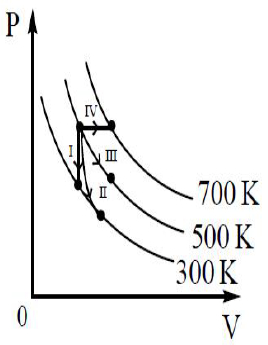
A
$I-c, II-a, III-d, IV-b$
B
$I-c, II-d, III-b, IV-a$
C
$I-d, II-b, III-a, IV-c$
D
$I-a, II-c, III-d, IV-b$
Solution
(A) In the given $P-V$ diagram:
$1$. Process $I$ is a vertical line,meaning volume $V$ is constant. This is an isochoric process. Thus,$I-c$.
$2$. Process $IV$ is a horizontal line,meaning pressure $P$ is constant. This is an isobaric process. Thus,$IV-b$.
$3$. Processes $II$ and $III$ are curves representing changes in both $P$ and $V$. Since $II$ connects the $300 \ K$ and $500 \ K$ isotherms and $III$ connects the $500 \ K$ and $700 \ K$ isotherms,they represent adiabatic processes (as they cross isotherms). Specifically,$II$ is adiabatic and $III$ is isothermal (or vice versa depending on the specific slope analysis). However,looking at the options,$I-c$ and $IV-b$ are fixed. Comparing with options,$I-c, II-a, III-d, IV-b$ fits the standard interpretation where $II$ is adiabatic and $III$ is isothermal. Therefore,the correct match is $I-c, II-a, III-d, IV-b$.
$1$. Process $I$ is a vertical line,meaning volume $V$ is constant. This is an isochoric process. Thus,$I-c$.
$2$. Process $IV$ is a horizontal line,meaning pressure $P$ is constant. This is an isobaric process. Thus,$IV-b$.
$3$. Processes $II$ and $III$ are curves representing changes in both $P$ and $V$. Since $II$ connects the $300 \ K$ and $500 \ K$ isotherms and $III$ connects the $500 \ K$ and $700 \ K$ isotherms,they represent adiabatic processes (as they cross isotherms). Specifically,$II$ is adiabatic and $III$ is isothermal (or vice versa depending on the specific slope analysis). However,looking at the options,$I-c$ and $IV-b$ are fixed. Comparing with options,$I-c, II-a, III-d, IV-b$ fits the standard interpretation where $II$ is adiabatic and $III$ is isothermal. Therefore,the correct match is $I-c, II-a, III-d, IV-b$.
0 likesView Solution
162
PhysicsMediumMCQAP EAMCET · 2025
If a gas of volume $400 \ cc$ at an initial pressure $P$ is suddenly compressed to $100 \ cc$,then its final pressure is (The ratio of the specific heat capacities of the gas at constant pressure and constant volume is $1.5$).
A
$P/32$
B
$8P$
C
$32P$
D
$16P$
Solution
(B) sudden compression of a gas is an adiabatic process.
For an adiabatic process,the relation between pressure $P$ and volume $V$ is given by $P_1 V_1^\gamma = P_2 V_2^\gamma$,where $\gamma$ is the adiabatic index (ratio of specific heat capacities).
Given:
Initial pressure $P_1 = P$
Initial volume $V_1 = 400 \ cc$
Final volume $V_2 = 100 \ cc$
Adiabatic index $\gamma = 1.5 = 3/2$
Substituting the values into the adiabatic equation:
$P \times (400)^{3/2} = P_2 \times (100)^{3/2}$
$P_2 = P \times (400/100)^{3/2}$
$P_2 = P \times (4)^{3/2}$
$P_2 = P \times (2^2)^{3/2}$
$P_2 = P \times 2^3$
$P_2 = 8P$
Therefore,the final pressure is $8P$.
For an adiabatic process,the relation between pressure $P$ and volume $V$ is given by $P_1 V_1^\gamma = P_2 V_2^\gamma$,where $\gamma$ is the adiabatic index (ratio of specific heat capacities).
Given:
Initial pressure $P_1 = P$
Initial volume $V_1 = 400 \ cc$
Final volume $V_2 = 100 \ cc$
Adiabatic index $\gamma = 1.5 = 3/2$
Substituting the values into the adiabatic equation:
$P \times (400)^{3/2} = P_2 \times (100)^{3/2}$
$P_2 = P \times (400/100)^{3/2}$
$P_2 = P \times (4)^{3/2}$
$P_2 = P \times (2^2)^{3/2}$
$P_2 = P \times 2^3$
$P_2 = 8P$
Therefore,the final pressure is $8P$.
0 likesView Solution
163
PhysicsMediumMCQAP EAMCET · 2025
During adiabatic expansion,if the temperature of $3$ moles of a diatomic gas decreases by $50^{\circ} C$,then the work done by the gas is (where $R$ is the Universal gas constant). (in $R$)
A
$375$
B
$750$
C
$1500$
D
$825$
Solution
(A) For an adiabatic process,the first law of thermodynamics states that $Q = \Delta U + W$. Since the process is adiabatic,$Q = 0$,so $W = -\Delta U$.
The change in internal energy is given by $\Delta U = n C_v \Delta T$.
For a diatomic gas,the molar heat capacity at constant volume is $C_v = \frac{5}{2} R$.
Given: $n = 3$ moles,$\Delta T = -50^{\circ} C$ (since temperature decreases).
Therefore,$\Delta U = 3 \times (\frac{5}{2} R) \times (-50) = 3 \times 2.5 R \times (-50) = -375 R$.
The work done by the gas is $W = -\Delta U = -(-375 R) = 375 R$.
The change in internal energy is given by $\Delta U = n C_v \Delta T$.
For a diatomic gas,the molar heat capacity at constant volume is $C_v = \frac{5}{2} R$.
Given: $n = 3$ moles,$\Delta T = -50^{\circ} C$ (since temperature decreases).
Therefore,$\Delta U = 3 \times (\frac{5}{2} R) \times (-50) = 3 \times 2.5 R \times (-50) = -375 R$.
The work done by the gas is $W = -\Delta U = -(-375 R) = 375 R$.
0 likesView Solution
164
PhysicsMediumMCQAP EAMCET · 2025
When an ideal diatomic gas is heated at constant pressure,the fraction of the heat utilized to increase the internal energy of the gas is
A
$2/5$
B
$3/5$
C
$3/7$
D
$5/7$
Solution
(D) For an ideal diatomic gas,the molar heat capacity at constant pressure is $C_p = \frac{7}{2}R$ and the molar heat capacity at constant volume is $C_v = \frac{5}{2}R$.
When heat $dQ$ is supplied at constant pressure,the total heat supplied is $dQ = n C_p dT = n (\frac{7}{2}R) dT$.
The heat utilized to increase the internal energy is $dU = n C_v dT = n (\frac{5}{2}R) dT$.
The fraction of heat utilized to increase internal energy is $f = \frac{dU}{dQ} = \frac{n (\frac{5}{2}R) dT}{n (\frac{7}{2}R) dT} = \frac{5/2}{7/2} = \frac{5}{7}$.
When heat $dQ$ is supplied at constant pressure,the total heat supplied is $dQ = n C_p dT = n (\frac{7}{2}R) dT$.
The heat utilized to increase the internal energy is $dU = n C_v dT = n (\frac{5}{2}R) dT$.
The fraction of heat utilized to increase internal energy is $f = \frac{dU}{dQ} = \frac{n (\frac{5}{2}R) dT}{n (\frac{7}{2}R) dT} = \frac{5/2}{7/2} = \frac{5}{7}$.
0 likesView Solution
165
PhysicsMediumMCQAP EAMCET · 2025
If the given graph shows the logarithmic values of pressure $(P)$ and volume $(V)$ of an ideal gas, then the ratio of the specific heat capacities of the gas is
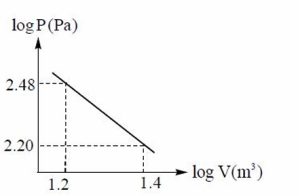
A
$1.5$
B
$1.2$
C
$1.4$
D
$1.3$
Solution
(C) For an adiabatic process, the relation between pressure $(P)$ and volume $(V)$ is given by $PV^{\gamma} = \text{constant}$.
Taking the logarithm on both sides, we get $\log P + \gamma \log V = \text{constant}$, which can be written as $\log P = -\gamma \log V + C$.
This is the equation of a straight line $y = mx + c$, where the slope $m = -\gamma$.
From the graph, the slope is calculated as:
$m = \frac{\log P_2 - \log P_1}{\log V_2 - \log V_1} = \frac{2.20 - 2.48}{1.4 - 1.2} = \frac{-0.28}{0.2} = -1.4$.
Since $m = -\gamma$, we have $-\gamma = -1.4$, which implies $\gamma = 1.4$.
Therefore, the ratio of the specific heat capacities is $1.4$.
Taking the logarithm on both sides, we get $\log P + \gamma \log V = \text{constant}$, which can be written as $\log P = -\gamma \log V + C$.
This is the equation of a straight line $y = mx + c$, where the slope $m = -\gamma$.
From the graph, the slope is calculated as:
$m = \frac{\log P_2 - \log P_1}{\log V_2 - \log V_1} = \frac{2.20 - 2.48}{1.4 - 1.2} = \frac{-0.28}{0.2} = -1.4$.
Since $m = -\gamma$, we have $-\gamma = -1.4$, which implies $\gamma = 1.4$.
Therefore, the ratio of the specific heat capacities is $1.4$.
0 likesView Solution
166
PhysicsMediumMCQAP EAMCET · 2025
The work done by $6$ moles of helium gas when its temperature increases by $20^{\circ} C$ at constant pressure is (Universal gas constant $R = 8.31 \ J \ mol^{-1} \ K^{-1}$) (in $J$)
A
$807.2$
B
$887.2$
C
$997.2$
D
$1007.2$
Solution
(C) For an ideal gas undergoing a process at constant pressure,the work done $W$ is given by the formula $W = nR\Delta T$.
Here,the number of moles $n = 6$.
The universal gas constant $R = 8.31 \ J \ mol^{-1} \ K^{-1}$.
The change in temperature $\Delta T = 20^{\circ} C = 20 \ K$ (since the change in temperature is the same in Celsius and Kelvin scales).
Substituting these values into the formula:
$W = 6 \times 8.31 \times 20$
$W = 120 \times 8.31$
$W = 997.2 \ J$.
Therefore,the correct option is $C$.
Here,the number of moles $n = 6$.
The universal gas constant $R = 8.31 \ J \ mol^{-1} \ K^{-1}$.
The change in temperature $\Delta T = 20^{\circ} C = 20 \ K$ (since the change in temperature is the same in Celsius and Kelvin scales).
Substituting these values into the formula:
$W = 6 \times 8.31 \times 20$
$W = 120 \times 8.31$
$W = 997.2 \ J$.
Therefore,the correct option is $C$.
0 likesView Solution
167
PhysicsMediumMCQAP EAMCET · 2025
When an ideal diatomic gas undergoes adiabatic expansion,if the increase in its volume is $0.5 \%$,then the change in the pressure of the gas is
A
$+0.5 \%$
B
$-0.5 \%$
C
$-0.7 \%$
D
$+0.7 \%$
Solution
(C) For an adiabatic process,the relation between pressure $P$ and volume $V$ is given by $PV^{\gamma} = \text{constant}$.
Taking the natural logarithm on both sides: $\ln P + \gamma \ln V = \text{constant}$.
Differentiating both sides: $\frac{dP}{P} + \gamma \frac{dV}{V} = 0$.
Therefore,the fractional change in pressure is $\frac{dP}{P} = -\gamma \frac{dV}{V}$.
For a diatomic gas,the adiabatic exponent $\gamma = \frac{7}{5} = 1.4$.
Given the increase in volume $\frac{dV}{V} = 0.5 \% = 0.005$.
Substituting the values: $\frac{dP}{P} = -1.4 \times 0.5 \% = -0.7 \%$.
Thus,the change in pressure is $-0.7 \%$.
Taking the natural logarithm on both sides: $\ln P + \gamma \ln V = \text{constant}$.
Differentiating both sides: $\frac{dP}{P} + \gamma \frac{dV}{V} = 0$.
Therefore,the fractional change in pressure is $\frac{dP}{P} = -\gamma \frac{dV}{V}$.
For a diatomic gas,the adiabatic exponent $\gamma = \frac{7}{5} = 1.4$.
Given the increase in volume $\frac{dV}{V} = 0.5 \% = 0.005$.
Substituting the values: $\frac{dP}{P} = -1.4 \times 0.5 \% = -0.7 \%$.
Thus,the change in pressure is $-0.7 \%$.
0 likesView Solution
168
PhysicsMediumMCQAP EAMCET · 2025
If $5.6$ litres of a monoatomic gas at $STP$ is adiabatically compressed to $0.7$ litres,then the work done on the gas is nearly ($R$ = Universal gas constant). (in $R$)
A
$307$
B
$357$
C
$367$
D
$407$
Solution
(A) For a monoatomic gas,the adiabatic index $\gamma = 5/3$. At $STP$,$1$ mole of gas occupies $22.4$ litres. Therefore,the number of moles $n = 5.6 / 22.4 = 0.25$ moles.
For an adiabatic process,$T_1 V_1^{\gamma-1} = T_2 V_2^{\gamma-1}$.
Given $V_1 = 5.6$ $L$,$V_2 = 0.7$ $L$,and $T_1 = 273$ $K$.
$T_2 = T_1 (V_1/V_2)^{\gamma-1} = 273 \times (5.6/0.7)^{5/3-1} = 273 \times (8)^{2/3} = 273 \times 4 = 1092$ $K$.
The work done on the gas in an adiabatic process is $W = -\Delta U = -n C_v (T_2 - T_1)$.
For a monoatomic gas,$C_v = 3R/2$.
$W = -0.25 \times (3R/2) \times (1092 - 273) = -0.375 R \times 819 = -307.125 R$.
The work done on the gas is the magnitude,which is approximately $307 R$.
For an adiabatic process,$T_1 V_1^{\gamma-1} = T_2 V_2^{\gamma-1}$.
Given $V_1 = 5.6$ $L$,$V_2 = 0.7$ $L$,and $T_1 = 273$ $K$.
$T_2 = T_1 (V_1/V_2)^{\gamma-1} = 273 \times (5.6/0.7)^{5/3-1} = 273 \times (8)^{2/3} = 273 \times 4 = 1092$ $K$.
The work done on the gas in an adiabatic process is $W = -\Delta U = -n C_v (T_2 - T_1)$.
For a monoatomic gas,$C_v = 3R/2$.
$W = -0.25 \times (3R/2) \times (1092 - 273) = -0.375 R \times 819 = -307.125 R$.
The work done on the gas is the magnitude,which is approximately $307 R$.
0 likesView Solution
169
PhysicsMediumMCQAP EAMCET · 2025
$A$ monatomic gas at a pressure of $100 \text{ kPa}$ expands adiabatically such that its final volume becomes $8$ times its initial volume. If the work done during the process is $180 \text{ J}$, then the initial volume of the gas is (in $\text{ cm}^3$)
A
$1600$
B
$800$
C
$1200$
D
$2000$
Solution
(A) For an adiabatic process, the work done $W$ is given by the formula: $W = \frac{P_i V_i - P_f V_f}{\gamma - 1}$.
Since $P_i V_i^\gamma = P_f V_f^\gamma$, we have $P_f = P_i (V_i / V_f)^\gamma$.
Given $V_f = 8 V_i$ and for a monatomic gas $\gamma = 5/3$, we get $P_f = P_i (1/8)^{5/3} = P_i / 32$.
Substituting these into the work formula: $W = \frac{P_i V_i - (P_i / 32)(8 V_i)}{5/3 - 1} = \frac{P_i V_i - P_i V_i / 4}{2/3} = \frac{(3/4) P_i V_i}{2/3} = \frac{9}{8} P_i V_i$.
Given $W = 180 \text{ J}$ and $P_i = 100 \times 10^3 \text{ Pa}$, we have $180 = \frac{9}{8} \times 10^5 \times V_i$.
$V_i = \frac{180 \times 8}{9 \times 10^5} = \frac{160}{10^5} = 1.6 \times 10^{-3} \text{ m}^3$.
Converting to $\text{cm}^3$: $1.6 \times 10^{-3} \times 10^6 \text{ cm}^3 = 1600 \text{ cm}^3$.
Since $P_i V_i^\gamma = P_f V_f^\gamma$, we have $P_f = P_i (V_i / V_f)^\gamma$.
Given $V_f = 8 V_i$ and for a monatomic gas $\gamma = 5/3$, we get $P_f = P_i (1/8)^{5/3} = P_i / 32$.
Substituting these into the work formula: $W = \frac{P_i V_i - (P_i / 32)(8 V_i)}{5/3 - 1} = \frac{P_i V_i - P_i V_i / 4}{2/3} = \frac{(3/4) P_i V_i}{2/3} = \frac{9}{8} P_i V_i$.
Given $W = 180 \text{ J}$ and $P_i = 100 \times 10^3 \text{ Pa}$, we have $180 = \frac{9}{8} \times 10^5 \times V_i$.
$V_i = \frac{180 \times 8}{9 \times 10^5} = \frac{160}{10^5} = 1.6 \times 10^{-3} \text{ m}^3$.
Converting to $\text{cm}^3$: $1.6 \times 10^{-3} \times 10^6 \text{ cm}^3 = 1600 \text{ cm}^3$.
0 likesView Solution
170
PhysicsEasyMCQAP EAMCET · 2025
According to the zeroth law of thermodynamics,the physical quantity which is the same for two bodies in thermal equilibrium is
A
heat
B
temperature
C
volume
D
pressure
Solution
(B) The zeroth law of thermodynamics states that if two systems are each in thermal equilibrium with a third system,then they are in thermal equilibrium with each other.
Thermal equilibrium is defined as the state in which two systems in contact with each other do not exchange any net heat.
This condition is satisfied when both systems have the same temperature.
Therefore,the physical quantity that remains the same for two bodies in thermal equilibrium is temperature.
Thermal equilibrium is defined as the state in which two systems in contact with each other do not exchange any net heat.
This condition is satisfied when both systems have the same temperature.
Therefore,the physical quantity that remains the same for two bodies in thermal equilibrium is temperature.
0 likesView Solution
171
PhysicsEasyMCQAP EAMCET · 2025
The dimensional formula of Planck's constant is
A
$[ML^2 T^{-3}]$
B
$[ML^2 T^0]$
C
$[ML^2 T^{-1}]$
D
$[M^0 L^0 T^0]$
Solution
(C) Planck's constant $(h)$ is related to the energy $(E)$ of a photon and its frequency $(
u)$ by the equation: $E = h
u$.
From this,we can write $h = \frac{E}{\nu}$.
The dimensional formula of energy $(E)$ is $[ML^2 T^{-2}]$.
The dimensional formula of frequency $(
u)$ is $[T^{-1}]$.
Substituting these into the equation for $h$:
$h = \frac{[ML^2 T^{-2}]}{[T^{-1}]} = [ML^2 T^{-2+1}] = [ML^2 T^{-1}]$.
Therefore,the correct dimensional formula for Planck's constant is $[ML^2 T^{-1}]$.
u)$ by the equation: $E = h
u$.
From this,we can write $h = \frac{E}{\nu}$.
The dimensional formula of energy $(E)$ is $[ML^2 T^{-2}]$.
The dimensional formula of frequency $(
u)$ is $[T^{-1}]$.
Substituting these into the equation for $h$:
$h = \frac{[ML^2 T^{-2}]}{[T^{-1}]} = [ML^2 T^{-2+1}] = [ML^2 T^{-1}]$.
Therefore,the correct dimensional formula for Planck's constant is $[ML^2 T^{-1}]$.
0 likesView Solution
172
PhysicsEasyMCQAP EAMCET · 2025
Of the following,the pair of physical quantities not having the same dimensional formula is
A
work and torque
B
angular momentum and Planck's constant
C
stress and linear momentum
D
surface tension and force constant
Solution
(C) To determine which pair does not have the same dimensional formula,we analyze each option:
$1$. Work and Torque: Both have the dimensional formula $[ML^2T^{-2}]$.
$2$. Angular momentum and Planck's constant: Both have the dimensional formula $[ML^2T^{-1}]$.
$3$. Stress and Linear momentum: Stress is force per unit area,$[ML^{-1}T^{-2}]$. Linear momentum is mass times velocity,$[MLT^{-1}]$. These are not the same.
$4$. Surface tension and Force constant: Both have the dimensional formula $[MT^{-2}]$.
Therefore,the pair that does not have the same dimensional formula is stress and linear momentum.
$1$. Work and Torque: Both have the dimensional formula $[ML^2T^{-2}]$.
$2$. Angular momentum and Planck's constant: Both have the dimensional formula $[ML^2T^{-1}]$.
$3$. Stress and Linear momentum: Stress is force per unit area,$[ML^{-1}T^{-2}]$. Linear momentum is mass times velocity,$[MLT^{-1}]$. These are not the same.
$4$. Surface tension and Force constant: Both have the dimensional formula $[MT^{-2}]$.
Therefore,the pair that does not have the same dimensional formula is stress and linear momentum.
0 likesView Solution
173
PhysicsMediumMCQAP EAMCET · 2025
If the equation for the velocity of a particle at time $t$ is $v = at + \frac{b}{t+c}$,then the dimensions of $a, b, c$ are respectively:
A
$LT^{-2}, L, T$
B
$L^2, L, T$
C
$LT^{-2}, LT, L$
D
$L, LT, L^2$
Solution
(A) According to the principle of homogeneity of dimensions,the dimensions of each term in an equation must be the same.
$1$. For the term $(t+c)$,the dimension of $c$ must be the same as the dimension of time $t$. Therefore,$[c] = [T]$.
$2$. For the term $at$,the dimension of $at$ must be equal to the dimension of velocity $v$. Since $[v] = [LT^{-1}]$ and $[t] = [T]$,we have $[a][T] = [LT^{-1}]$,which gives $[a] = [LT^{-2}]$.
$3$. For the term $\frac{b}{t+c}$,the dimension of this term must be equal to the dimension of velocity $v$. Since $[t+c] = [T]$ and $[v] = [LT^{-1}]$,we have $\frac{[b]}{[T]} = [LT^{-1}]$,which gives $[b] = [L]$.
Thus,the dimensions are $[a] = [LT^{-2}]$,$[b] = [L]$,and $[c] = [T]$.
$1$. For the term $(t+c)$,the dimension of $c$ must be the same as the dimension of time $t$. Therefore,$[c] = [T]$.
$2$. For the term $at$,the dimension of $at$ must be equal to the dimension of velocity $v$. Since $[v] = [LT^{-1}]$ and $[t] = [T]$,we have $[a][T] = [LT^{-1}]$,which gives $[a] = [LT^{-2}]$.
$3$. For the term $\frac{b}{t+c}$,the dimension of this term must be equal to the dimension of velocity $v$. Since $[t+c] = [T]$ and $[v] = [LT^{-1}]$,we have $\frac{[b]}{[T]} = [LT^{-1}]$,which gives $[b] = [L]$.
Thus,the dimensions are $[a] = [LT^{-2}]$,$[b] = [L]$,and $[c] = [T]$.
0 likesView Solution
174
PhysicsEasyMCQAP EAMCET · 2025
The number of significant figures in $0.03240$ is
A
$5$
B
$4$
C
$6$
D
$3$
Solution
(B) According to the rules for significant figures:
$1$. Leading zeros (zeros to the left of the first non-zero digit) are not significant. In $0.03240$,the zeros before $3$ are not significant.
$2$. Non-zero digits are always significant. Here,$3, 2, 4$ are significant.
$3$. Trailing zeros in a decimal number are significant. The zero at the end of $0.03240$ is significant.
Therefore,the significant figures are $3, 2, 4, 0$,which gives a total of $4$ significant figures.
$1$. Leading zeros (zeros to the left of the first non-zero digit) are not significant. In $0.03240$,the zeros before $3$ are not significant.
$2$. Non-zero digits are always significant. Here,$3, 2, 4$ are significant.
$3$. Trailing zeros in a decimal number are significant. The zero at the end of $0.03240$ is significant.
Therefore,the significant figures are $3, 2, 4, 0$,which gives a total of $4$ significant figures.
0 likesView Solution
175
PhysicsMediumMCQAP EAMCET · 2025
If $\text{force} = \frac{\alpha}{\text{density} + \beta^3}$,then the dimensional formulae of $\alpha$ and $\beta$ are respectively:
A
$[M L^2 T^{-2}], [M L^{-1} T^0]$
B
$[M^2 L^{-2} T^{-2}], [M^{1/3} L^{-1} T^0]$
C
$[M^2 L^{-2} T^{-2}], [M^{1/3} L^{-1} T^0]$
D
$[M^2 L^{-2} T^{-2}], [M L^{-3} T^0]$
Solution
(B) The given equation is $\text{Force} = \frac{\alpha}{\text{density} + \beta^3}$.
According to the principle of homogeneity of dimensions,quantities added together must have the same dimensions.
Therefore,the dimension of $\beta^3$ must be equal to the dimension of density.
Dimension of density = $[M L^{-3} T^0]$.
So,$[\beta^3] = [M L^{-3} T^0]$.
Taking the cube root,$[\beta] = [M^{1/3} L^{-1} T^0]$.
Now,the dimension of force is $[M L T^{-2}]$.
From the equation,$\alpha = \text{Force} \times (\text{density} + \beta^3)$.
Since $(\text{density} + \beta^3)$ has the same dimension as density,$[\alpha] = [M L T^{-2}] \times [M L^{-3} T^0] = [M^2 L^{-2} T^{-2}]$.
Thus,the dimensions are $[M^2 L^{-2} T^{-2}]$ and $[M^{1/3} L^{-1} T^0]$.
According to the principle of homogeneity of dimensions,quantities added together must have the same dimensions.
Therefore,the dimension of $\beta^3$ must be equal to the dimension of density.
Dimension of density = $[M L^{-3} T^0]$.
So,$[\beta^3] = [M L^{-3} T^0]$.
Taking the cube root,$[\beta] = [M^{1/3} L^{-1} T^0]$.
Now,the dimension of force is $[M L T^{-2}]$.
From the equation,$\alpha = \text{Force} \times (\text{density} + \beta^3)$.
Since $(\text{density} + \beta^3)$ has the same dimension as density,$[\alpha] = [M L T^{-2}] \times [M L^{-3} T^0] = [M^2 L^{-2} T^{-2}]$.
Thus,the dimensions are $[M^2 L^{-2} T^{-2}]$ and $[M^{1/3} L^{-1} T^0]$.
0 likesView Solution
176
PhysicsMediumMCQAP EAMCET · 2025
The physical quantity having the dimensions of the square root of the ratio of the kinetic energy and surface tension is
A
distance
B
time
C
temperature
D
mass
Solution
(A) The dimensions of kinetic energy $(K.E.)$ are $[M L^2 T^{-2}]$.
The dimensions of surface tension $(S)$ are $[M T^{-2}]$.
Let the required quantity be $X = \sqrt{\frac{K.E.}{S}}$.
Substituting the dimensions: $X = \sqrt{\frac{[M L^2 T^{-2}]}{[M T^{-2}]}}$.
Simplifying the expression: $X = \sqrt{[L^2]} = [L]$.
The dimension $[L]$ corresponds to length or distance.
Therefore,the correct option is $A$.
The dimensions of surface tension $(S)$ are $[M T^{-2}]$.
Let the required quantity be $X = \sqrt{\frac{K.E.}{S}}$.
Substituting the dimensions: $X = \sqrt{\frac{[M L^2 T^{-2}]}{[M T^{-2}]}}$.
Simplifying the expression: $X = \sqrt{[L^2]} = [L]$.
The dimension $[L]$ corresponds to length or distance.
Therefore,the correct option is $A$.
0 likesView Solution
177
PhysicsEasyMCQAP EAMCET · 2025
If the maximum and minimum temperatures at a place on a day are measured as $44^{\circ} C \pm 0.5^{\circ} C$ and $22^{\circ} C \pm 0.5^{\circ} C$ respectively,then the temperature difference is
A
$22^{\circ} C \pm 1^{\circ} C$
B
$22^{\circ} C \pm 0.5^{\circ} C$
C
$22^{\circ} C \pm 0.25^{\circ} C$
D
$22^{\circ} C \pm 1.5^{\circ} C$
Solution
(A) Let the maximum temperature be $T_1 = 44^{\circ} C \pm 0.5^{\circ} C$ and the minimum temperature be $T_2 = 22^{\circ} C \pm 0.5^{\circ} C$.
The temperature difference is given by $\Delta T = T_1 - T_2$.
The value of the difference is $44^{\circ} C - 22^{\circ} C = 22^{\circ} C$.
According to the rule of error propagation for subtraction,when two quantities are subtracted,their absolute errors are added.
Therefore,the error in the difference is $\Delta(\Delta T) = \Delta T_1 + \Delta T_2 = 0.5^{\circ} C + 0.5^{\circ} C = 1.0^{\circ} C$.
Thus,the temperature difference is $22^{\circ} C \pm 1^{\circ} C$.
The temperature difference is given by $\Delta T = T_1 - T_2$.
The value of the difference is $44^{\circ} C - 22^{\circ} C = 22^{\circ} C$.
According to the rule of error propagation for subtraction,when two quantities are subtracted,their absolute errors are added.
Therefore,the error in the difference is $\Delta(\Delta T) = \Delta T_1 + \Delta T_2 = 0.5^{\circ} C + 0.5^{\circ} C = 1.0^{\circ} C$.
Thus,the temperature difference is $22^{\circ} C \pm 1^{\circ} C$.
0 likesView Solution
178
PhysicsMediumMCQAP EAMCET · 2025
The number of significant figures in the simplification of $\frac{0.501}{0.05}(0.312-0.03)$ is
A
$1$
B
$3$
C
$2$
D
$5$
Solution
(A) Step $1$: Perform the subtraction inside the parentheses. $0.312 - 0.03 = 0.282$. According to the rules of significant figures for subtraction,the result should have the same number of decimal places as the measurement with the fewest decimal places. Here,$0.03$ has two decimal places,so the result $0.282$ is rounded to $0.28$ (two decimal places).
Step $2$: Perform the division. $\frac{0.501}{0.05} = 10.02$.
Step $3$: Multiply the results. $10.02 \times 0.28 = 2.8056$.
Step $4$: Apply the rules for multiplication. The result should have the same number of significant figures as the measurement with the fewest significant figures. $0.05$ has $1$ significant figure,and $0.28$ has $2$ significant figures. Therefore,the final result should be rounded to $1$ significant figure. Thus,the number of significant figures is $1$.
Step $2$: Perform the division. $\frac{0.501}{0.05} = 10.02$.
Step $3$: Multiply the results. $10.02 \times 0.28 = 2.8056$.
Step $4$: Apply the rules for multiplication. The result should have the same number of significant figures as the measurement with the fewest significant figures. $0.05$ has $1$ significant figure,and $0.28$ has $2$ significant figures. Therefore,the final result should be rounded to $1$ significant figure. Thus,the number of significant figures is $1$.
0 likesView Solution
179
PhysicsMediumMCQAP EAMCET · 2025
If the error in the measurement of the surface area of a sphere is $1.2 \%$,then the error in the determination of the volume of the sphere is (in $\%$)
A
$2.4$
B
$1.8$
C
$1.2$
D
$0.6$
Solution
(B) The surface area $S$ of a sphere is given by $S = 4\pi r^2$,where $r$ is the radius.
The relative error in surface area is given by $\frac{\Delta S}{S} = 2 \frac{\Delta r}{r}$.
Given $\frac{\Delta S}{S} \times 100 = 1.2 \%$,we have $2 \frac{\Delta r}{r} \times 100 = 1.2 \%$,which implies $\frac{\Delta r}{r} \times 100 = 0.6 \%$.
The volume $V$ of a sphere is given by $V = \frac{4}{3}\pi r^3$.
The relative error in volume is given by $\frac{\Delta V}{V} = 3 \frac{\Delta r}{r}$.
Substituting the value of $\frac{\Delta r}{r}$,we get $\frac{\Delta V}{V} \times 100 = 3 \times 0.6 \% = 1.8 \%$.
The relative error in surface area is given by $\frac{\Delta S}{S} = 2 \frac{\Delta r}{r}$.
Given $\frac{\Delta S}{S} \times 100 = 1.2 \%$,we have $2 \frac{\Delta r}{r} \times 100 = 1.2 \%$,which implies $\frac{\Delta r}{r} \times 100 = 0.6 \%$.
The volume $V$ of a sphere is given by $V = \frac{4}{3}\pi r^3$.
The relative error in volume is given by $\frac{\Delta V}{V} = 3 \frac{\Delta r}{r}$.
Substituting the value of $\frac{\Delta r}{r}$,we get $\frac{\Delta V}{V} \times 100 = 3 \times 0.6 \% = 1.8 \%$.
0 likesView Solution
180
PhysicsEasyMCQAP EAMCET · 2025
The path difference between two waves given by the equations $y_1 = a_1 \sin \left(\omega t - \frac{2 \pi x}{\lambda}\right)$ and $y_2 = a_2 \sin \left(\omega t - \frac{2 \pi x}{\lambda} + \phi\right)$ is
A
$\left(\frac{\lambda}{\pi} \phi\right)$
B
$\frac{\lambda}{\pi} \left(\phi - \frac{\pi}{2}\right)$
C
$\frac{\lambda}{2 \pi} \phi$
D
$\frac{\lambda}{2 \pi} \left(\phi - \frac{\pi}{2}\right)$
Solution
(C) The phase difference between the two waves is given by the difference in their arguments.
Let $\phi_1 = \omega t - \frac{2 \pi x}{\lambda}$ and $\phi_2 = \omega t - \frac{2 \pi x}{\lambda} + \phi$.
The phase difference $\Delta \phi = \phi_2 - \phi_1 = \phi$.
The relationship between path difference $(\Delta x)$ and phase difference $(\Delta \phi)$ is given by the formula:
$\Delta \phi = \frac{2 \pi}{\lambda} \Delta x$.
Rearranging this formula to solve for the path difference $\Delta x$:
$\Delta x = \frac{\lambda}{2 \pi} \Delta \phi$.
Substituting $\Delta \phi = \phi$ into the equation:
$\Delta x = \frac{\lambda}{2 \pi} \phi$.
Let $\phi_1 = \omega t - \frac{2 \pi x}{\lambda}$ and $\phi_2 = \omega t - \frac{2 \pi x}{\lambda} + \phi$.
The phase difference $\Delta \phi = \phi_2 - \phi_1 = \phi$.
The relationship between path difference $(\Delta x)$ and phase difference $(\Delta \phi)$ is given by the formula:
$\Delta \phi = \frac{2 \pi}{\lambda} \Delta x$.
Rearranging this formula to solve for the path difference $\Delta x$:
$\Delta x = \frac{\lambda}{2 \pi} \Delta \phi$.
Substituting $\Delta \phi = \phi$ into the equation:
$\Delta x = \frac{\lambda}{2 \pi} \phi$.
0 likesView Solution
181
PhysicsMediumMCQAP EAMCET · 2025
The speed of a stationary wave represented by the equation $y = 0.7 \sin \left(\frac{7 \pi}{4} x\right) \cos (350 \pi t)$ is (In the given equation $x$ and $y$ are in metre and $t$ is in second). (in $m \ s^{-1}$)
A
$100$
B
$150$
C
$160$
D
$200$
Solution
(D) The general equation of a stationary wave is given by $y = A \sin(kx) \cos(\omega t)$.
Comparing this with the given equation $y = 0.7 \sin \left(\frac{7 \pi}{4} x\right) \cos (350 \pi t)$,we get:
Wave number $k = \frac{7 \pi}{4} \ m^{-1}$
Angular frequency $\omega = 350 \pi \ rad \ s^{-1}$
The wave speed $v$ is defined as the ratio of angular frequency to wave number:
$v = \frac{\omega}{k}$
Substituting the values:
$v = \frac{350 \pi}{7 \pi / 4}$
$v = 350 \pi \times \frac{4}{7 \pi}$
$v = 50 \times 4 = 200 \ m \ s^{-1}$
Thus,the speed of the wave is $200 \ m \ s^{-1}$.
Comparing this with the given equation $y = 0.7 \sin \left(\frac{7 \pi}{4} x\right) \cos (350 \pi t)$,we get:
Wave number $k = \frac{7 \pi}{4} \ m^{-1}$
Angular frequency $\omega = 350 \pi \ rad \ s^{-1}$
The wave speed $v$ is defined as the ratio of angular frequency to wave number:
$v = \frac{\omega}{k}$
Substituting the values:
$v = \frac{350 \pi}{7 \pi / 4}$
$v = 350 \pi \times \frac{4}{7 \pi}$
$v = 50 \times 4 = 200 \ m \ s^{-1}$
Thus,the speed of the wave is $200 \ m \ s^{-1}$.
0 likesView Solution
182
PhysicsMediumMCQAP EAMCET · 2025
$A$ steel wire of length $81 \text{ cm}$ has a mass of $5 \times 10^{-3} \text{ kg}$. If the wire is under a tension of $50 \text{ N}$, then the speed of transverse waves on the wire is (in $\text{ m s}^{-1}$)
A
$100$
B
$105$
C
$90$
D
$60$
Solution
(C) The speed of a transverse wave on a stretched string is given by the formula $v = \sqrt{\frac{T}{\mu}}$, where $T$ is the tension and $\mu$ is the linear mass density.
Linear mass density $\mu = \frac{m}{L}$.
Given: $m = 5 \times 10^{-3} \text{ kg}$, $L = 81 \text{ cm} = 0.81 \text{ m}$, $T = 50 \text{ N}$.
Calculate $\mu$: $\mu = \frac{5 \times 10^{-3}}{0.81} \text{ kg/m}$.
Now, substitute the values into the speed formula:
$v = \sqrt{\frac{50}{\frac{5 \times 10^{-3}}{0.81}}} = \sqrt{\frac{50 \times 0.81}{5 \times 10^{-3}}} = \sqrt{10 \times 0.81 \times 10^3} = \sqrt{8100} = 90 \text{ m s}^{-1}$.
Thus, the speed of the transverse wave is $90 \text{ m s}^{-1}$.
Linear mass density $\mu = \frac{m}{L}$.
Given: $m = 5 \times 10^{-3} \text{ kg}$, $L = 81 \text{ cm} = 0.81 \text{ m}$, $T = 50 \text{ N}$.
Calculate $\mu$: $\mu = \frac{5 \times 10^{-3}}{0.81} \text{ kg/m}$.
Now, substitute the values into the speed formula:
$v = \sqrt{\frac{50}{\frac{5 \times 10^{-3}}{0.81}}} = \sqrt{\frac{50 \times 0.81}{5 \times 10^{-3}}} = \sqrt{10 \times 0.81 \times 10^3} = \sqrt{8100} = 90 \text{ m s}^{-1}$.
Thus, the speed of the transverse wave is $90 \text{ m s}^{-1}$.
0 likesView Solution
183
PhysicsMediumMCQAP EAMCET · 2025
The equation of a transverse wave propagating along a stretched string of length $80 \ cm$ is $y=1.5 \sin \{(5 \times 10^{-3} x) + 20 t\}$,where $x$ and $y$ are in $cm$ and the time $t$ is in seconds. If the mass of the string is $3 \ g$,then the tension in the string is: (in $N$)
A
$12$
B
$4$
C
$6$
D
$8$
Solution
(C) The standard equation of a wave is $y = A \sin(kx + \omega t)$.
Comparing this with the given equation $y = 1.5 \sin((5 \times 10^{-3} x) + 20 t)$,we get:
Wave number $k = 5 \times 10^{-3} \ cm^{-1}$
Angular frequency $\omega = 20 \ rad/s$
The wave speed $v$ is given by $v = \frac{\omega}{k} = \frac{20}{5 \times 10^{-3}} = 4000 \ cm/s = 40 \ m/s$.
The mass per unit length $\mu$ is $\frac{m}{L} = \frac{3 \ g}{80 \ cm} = \frac{3 \times 10^{-3} \ kg}{0.8 \ m} = 3.75 \times 10^{-3} \ kg/m$.
The wave speed in a stretched string is $v = \sqrt{\frac{T}{\mu}}$,where $T$ is the tension.
Therefore,$T = v^2 \mu = (40)^2 \times (3.75 \times 10^{-3}) = 1600 \times 0.00375 = 6 \ N$.
Comparing this with the given equation $y = 1.5 \sin((5 \times 10^{-3} x) + 20 t)$,we get:
Wave number $k = 5 \times 10^{-3} \ cm^{-1}$
Angular frequency $\omega = 20 \ rad/s$
The wave speed $v$ is given by $v = \frac{\omega}{k} = \frac{20}{5 \times 10^{-3}} = 4000 \ cm/s = 40 \ m/s$.
The mass per unit length $\mu$ is $\frac{m}{L} = \frac{3 \ g}{80 \ cm} = \frac{3 \times 10^{-3} \ kg}{0.8 \ m} = 3.75 \times 10^{-3} \ kg/m$.
The wave speed in a stretched string is $v = \sqrt{\frac{T}{\mu}}$,where $T$ is the tension.
Therefore,$T = v^2 \mu = (40)^2 \times (3.75 \times 10^{-3}) = 1600 \times 0.00375 = 6 \ N$.
0 likesView Solution
184
PhysicsMediumMCQAP EAMCET · 2025
Two sound waves of wavelengths $99 \ cm$ and $100 \ cm$ produce $10$ beats in a time of $t$ seconds. If the speed of sound in air is $330 \ m \ s^{-1}$,then the value of $t$ in seconds is
A
$12$
B
$9$
C
$6$
D
$3$
Solution
(D) The speed of sound $v = 330 \ m \ s^{-1}$.
The wavelengths are $\lambda_1 = 0.99 \ m$ and $\lambda_2 = 1.00 \ m$.
The frequencies are $f_1 = \frac{v}{\lambda_1} = \frac{330}{0.99} = \frac{33000}{99} = \frac{1000}{3} \ Hz$ and $f_2 = \frac{v}{\lambda_2} = \frac{330}{1.00} = 330 \ Hz$.
The beat frequency $f_b = |f_1 - f_2| = |\frac{1000}{3} - 330| = |\frac{1000 - 990}{3}| = \frac{10}{3} \ Hz$.
Beat frequency is defined as the number of beats per second. Thus,$f_b = \frac{\text{Number of beats}}{t}$.
Given that $10$ beats are produced in $t$ seconds,we have $\frac{10}{3} = \frac{10}{t}$.
Therefore,$t = 3 \ s$.
The wavelengths are $\lambda_1 = 0.99 \ m$ and $\lambda_2 = 1.00 \ m$.
The frequencies are $f_1 = \frac{v}{\lambda_1} = \frac{330}{0.99} = \frac{33000}{99} = \frac{1000}{3} \ Hz$ and $f_2 = \frac{v}{\lambda_2} = \frac{330}{1.00} = 330 \ Hz$.
The beat frequency $f_b = |f_1 - f_2| = |\frac{1000}{3} - 330| = |\frac{1000 - 990}{3}| = \frac{10}{3} \ Hz$.
Beat frequency is defined as the number of beats per second. Thus,$f_b = \frac{\text{Number of beats}}{t}$.
Given that $10$ beats are produced in $t$ seconds,we have $\frac{10}{3} = \frac{10}{t}$.
Therefore,$t = 3 \ s$.
0 likesView Solution
185
PhysicsMediumMCQAP EAMCET · 2025
If two progressive sound waves represented by $y_1 = 3 \sin(250 \pi t)$ and $y_2 = 2 \sin(260 \pi t)$ (where displacement is in metre and time is in second) superimpose,then the time interval between two successive maximum intensities is (in $s$)
A
$0.1$
B
$0.4$
C
$0.5$
D
$0.2$
Solution
(D) The given equations of the two sound waves are $y_1 = 3 \sin(250 \pi t)$ and $y_2 = 2 \sin(260 \pi t)$.
Comparing these with the standard equation $y = A \sin(\omega t)$,we get the angular frequencies as $\omega_1 = 250 \pi \text{ rad/s}$ and $\omega_2 = 260 \pi \text{ rad/s}$.
The frequencies $f_1$ and $f_2$ are given by $f = \frac{\omega}{2 \pi}$.
Thus,$f_1 = \frac{250 \pi}{2 \pi} = 125 \text{ Hz}$ and $f_2 = \frac{260 \pi}{2 \pi} = 130 \text{ Hz}$.
The beat frequency $f_b$ is the difference between the two frequencies: $f_b = |f_2 - f_1| = |130 - 125| = 5 \text{ Hz}$.
The time interval between two successive maximum intensities is the time period of the beats,given by $T_b = \frac{1}{f_b}$.
Therefore,$T_b = \frac{1}{5} = 0.2 \text{ s}$.
Thus,the correct option is $D$.
Comparing these with the standard equation $y = A \sin(\omega t)$,we get the angular frequencies as $\omega_1 = 250 \pi \text{ rad/s}$ and $\omega_2 = 260 \pi \text{ rad/s}$.
The frequencies $f_1$ and $f_2$ are given by $f = \frac{\omega}{2 \pi}$.
Thus,$f_1 = \frac{250 \pi}{2 \pi} = 125 \text{ Hz}$ and $f_2 = \frac{260 \pi}{2 \pi} = 130 \text{ Hz}$.
The beat frequency $f_b$ is the difference between the two frequencies: $f_b = |f_2 - f_1| = |130 - 125| = 5 \text{ Hz}$.
The time interval between two successive maximum intensities is the time period of the beats,given by $T_b = \frac{1}{f_b}$.
Therefore,$T_b = \frac{1}{5} = 0.2 \text{ s}$.
Thus,the correct option is $D$.
0 likesView Solution
186
PhysicsMediumMCQAP EAMCET · 2025
When both the source of sound and the observer approach each other with a speed equal to $10 \%$ of the speed of sound,then the percentage change in frequency heard by the observer is nearly (in $\%$)
A
$33.3$
B
$12.2$
C
$22.2$
D
$11.1$
Solution
(C) Let the speed of sound be $v$. The speed of the source $v_s = 0.1v$ and the speed of the observer $v_o = 0.1v$.
Since both are approaching each other,the observed frequency $f'$ is given by the Doppler effect formula:
$f' = f \left( \frac{v + v_o}{v - v_s} \right)$
Substituting the values:
$f' = f \left( \frac{v + 0.1v}{v - 0.1v} \right) = f \left( \frac{1.1v}{0.9v} \right) = f \left( \frac{11}{9} \right)$
$f' \approx 1.222f$
The change in frequency is $\Delta f = f' - f = 1.222f - f = 0.222f$.
The percentage change is $\frac{\Delta f}{f} \times 100 = 0.222 \times 100 = 22.2 \%$.
Since both are approaching each other,the observed frequency $f'$ is given by the Doppler effect formula:
$f' = f \left( \frac{v + v_o}{v - v_s} \right)$
Substituting the values:
$f' = f \left( \frac{v + 0.1v}{v - 0.1v} \right) = f \left( \frac{1.1v}{0.9v} \right) = f \left( \frac{11}{9} \right)$
$f' \approx 1.222f$
The change in frequency is $\Delta f = f' - f = 1.222f - f = 0.222f$.
The percentage change is $\frac{\Delta f}{f} \times 100 = 0.222 \times 100 = 22.2 \%$.
0 likesView Solution
187
PhysicsEasyMCQAP EAMCET · 2025
In a closed organ pipe, the number of nodes formed in the fifth and ninth harmonics are respectively:
A
$5$, $9$
B
$3$, $5$
C
$5$, $7$
D
$2$, $4$
Solution
(B) For a closed organ pipe, the frequency of the $n^{th}$ harmonic is given by $f_n = n \cdot f_1$, where $n$ must be an odd integer $(n = 1, 3, 5, 7, 9, ...)$.
In a closed organ pipe of length $L$, the number of nodes $N$ formed for the $n^{th}$ harmonic is given by the formula $N = \frac{n+1}{2}$.
For the fifth harmonic $(n = 5)$:
$N_5 = \frac{5+1}{2} = \frac{6}{2} = 3$.
For the ninth harmonic $(n = 9)$:
$N_9 = \frac{9+1}{2} = \frac{10}{2} = 5$.
Therefore, the number of nodes formed are $3$ and $5$ respectively.
In a closed organ pipe of length $L$, the number of nodes $N$ formed for the $n^{th}$ harmonic is given by the formula $N = \frac{n+1}{2}$.
For the fifth harmonic $(n = 5)$:
$N_5 = \frac{5+1}{2} = \frac{6}{2} = 3$.
For the ninth harmonic $(n = 9)$:
$N_9 = \frac{9+1}{2} = \frac{10}{2} = 5$.
Therefore, the number of nodes formed are $3$ and $5$ respectively.
0 likesView Solution
188
PhysicsEasyMCQAP EAMCET · 2025
If a travelling wave is given by $y(x, t) = 0.5 \sin (70.1 x - 10 \pi t)$,where $x$ and $y$ are in metre,the time $t$ is in second,then the frequency of the wave is (in $Hz$)
A
$6$
B
$7$
C
$4$
D
$5$
Solution
(D) The standard equation of a travelling wave is given by $y(x, t) = A \sin (kx - \omega t)$.
Comparing this with the given equation $y(x, t) = 0.5 \sin (70.1 x - 10 \pi t)$,we get the angular frequency $\omega = 10 \pi \text{ rad/s}$.
The relationship between angular frequency $\omega$ and frequency $f$ is given by $\omega = 2 \pi f$.
Substituting the value of $\omega$,we have $10 \pi = 2 \pi f$.
Solving for $f$,we get $f = \frac{10 \pi}{2 \pi} = 5 \text{ Hz}$.
Therefore,the frequency of the wave is $5 \text{ Hz}$.
Comparing this with the given equation $y(x, t) = 0.5 \sin (70.1 x - 10 \pi t)$,we get the angular frequency $\omega = 10 \pi \text{ rad/s}$.
The relationship between angular frequency $\omega$ and frequency $f$ is given by $\omega = 2 \pi f$.
Substituting the value of $\omega$,we have $10 \pi = 2 \pi f$.
Solving for $f$,we get $f = \frac{10 \pi}{2 \pi} = 5 \text{ Hz}$.
Therefore,the frequency of the wave is $5 \text{ Hz}$.
0 likesView Solution
189
PhysicsMediumMCQAP EAMCET · 2025
$A$ sound wave of frequency $500 \text{ Hz}$ travels between two points $X$ and $Y$ separated by a distance of $600 \text{ m}$ in a time of $2 \text{ s}$. The number of waves between the points $X$ and $Y$ are
A
$1000$
B
$1500$
C
$300$
D
$600$
Solution
(A) The frequency of the sound wave is $f = 500 \text{ Hz}$.
The time taken for the wave to travel from $X$ to $Y$ is $t = 2 \text{ s}$.
The number of waves $N$ produced by a source in time $t$ is given by the formula $N = f \times t$.
Substituting the given values: $N = 500 \text{ Hz} \times 2 \text{ s} = 1000$.
Thus,there are $1000$ waves between points $X$ and $Y$.
The time taken for the wave to travel from $X$ to $Y$ is $t = 2 \text{ s}$.
The number of waves $N$ produced by a source in time $t$ is given by the formula $N = f \times t$.
Substituting the given values: $N = 500 \text{ Hz} \times 2 \text{ s} = 1000$.
Thus,there are $1000$ waves between points $X$ and $Y$.
0 likesView Solution
190
PhysicsMediumMCQAP EAMCET · 2025
When a stretched wire of fundamental frequency $f$ is divided into three segments,the fundamental frequencies of these three segments are $f_1, f_2$ and $f_3$ respectively. Then the relation among $f_1, f_2, f_3$ and $f$ is (Assume tension is constant).
A
$\sqrt{f}=\sqrt{f_1}+\sqrt{f_2}+\sqrt{f_3}$
B
$f=f_1+f_2+f_3$
C
$\frac{1}{f}=\frac{1}{f_1}+\frac{1}{f_2}+\frac{1}{f_3}$
D
$\frac{1}{f}=\frac{1}{f_1}+\frac{1}{f_2}+\frac{1}{f_3}$
Solution
(C) The fundamental frequency of a stretched wire is given by $f = \frac{1}{2L} \sqrt{\frac{T}{\mu}}$,where $L$ is the length,$T$ is the tension,and $\mu$ is the linear mass density.
Since $T$ and $\mu$ are constant,we have $f \propto \frac{1}{L}$,which implies $fL = \text{constant} = k$.
Therefore,$L = \frac{k}{f}$.
When the wire of length $L$ is divided into three segments of lengths $L_1, L_2, L_3$,we have $L = L_1 + L_2 + L_3$.
Substituting $L = \frac{k}{f}$,$L_1 = \frac{k}{f_1}$,$L_2 = \frac{k}{f_2}$,and $L_3 = \frac{k}{f_3}$ into the equation,we get:
$\frac{k}{f} = \frac{k}{f_1} + \frac{k}{f_2} + \frac{k}{f_3}$.
Dividing both sides by $k$,we obtain the relation: $\frac{1}{f} = \frac{1}{f_1} + \frac{1}{f_2} + \frac{1}{f_3}$.
Since $T$ and $\mu$ are constant,we have $f \propto \frac{1}{L}$,which implies $fL = \text{constant} = k$.
Therefore,$L = \frac{k}{f}$.
When the wire of length $L$ is divided into three segments of lengths $L_1, L_2, L_3$,we have $L = L_1 + L_2 + L_3$.
Substituting $L = \frac{k}{f}$,$L_1 = \frac{k}{f_1}$,$L_2 = \frac{k}{f_2}$,and $L_3 = \frac{k}{f_3}$ into the equation,we get:
$\frac{k}{f} = \frac{k}{f_1} + \frac{k}{f_2} + \frac{k}{f_3}$.
Dividing both sides by $k$,we obtain the relation: $\frac{1}{f} = \frac{1}{f_1} + \frac{1}{f_2} + \frac{1}{f_3}$.
0 likesView Solution
191
PhysicsMediumMCQAP EAMCET · 2025
$A$ person holds a ball of mass $0.25 \ kg$ in his hand and throws it,so that it leaves his hand with a speed of $12 \ m \ s^{-1}$. In this process,if his hand moved through a distance of $0.9 \ m$,then the net force acted on the ball is (in $N$)
A
$40$
B
$20$
C
$25$
D
$10$
Solution
(B) Given: Mass of the ball $m = 0.25 \ kg$,final velocity $v = 12 \ m \ s^{-1}$,initial velocity $u = 0 \ m \ s^{-1}$,and distance $s = 0.9 \ m$.
Using the third equation of motion: $v^2 = u^2 + 2as$.
Substituting the values: $(12)^2 = (0)^2 + 2 \times a \times 0.9$.
$144 = 1.8 \times a$.
$a = 144 / 1.8 = 80 \ m \ s^{-2}$.
Now,using Newton's second law of motion: $F = ma$.
$F = 0.25 \ kg \times 80 \ m \ s^{-2} = 20 \ N$.
Therefore,the net force acting on the ball is $20 \ N$.
Using the third equation of motion: $v^2 = u^2 + 2as$.
Substituting the values: $(12)^2 = (0)^2 + 2 \times a \times 0.9$.
$144 = 1.8 \times a$.
$a = 144 / 1.8 = 80 \ m \ s^{-2}$.
Now,using Newton's second law of motion: $F = ma$.
$F = 0.25 \ kg \times 80 \ m \ s^{-2} = 20 \ N$.
Therefore,the net force acting on the ball is $20 \ N$.
0 likesView Solution
192
PhysicsEasyMCQAP EAMCET · 2025
If a particle of mass $m$ covers half of the horizontal circle with constant speed $v$,then the change in its kinetic energy is
A
$m v^2$
B
Zero
C
$2m v^2$
D
$\frac{1}{2} m v^2$
Solution
(B) The kinetic energy $(K)$ of a particle is given by the formula $K = \frac{1}{2} m v^2$.
Since the particle moves with a constant speed $v$,the magnitude of its velocity remains unchanged throughout the motion.
Because the mass $m$ and the speed $v$ are constant,the kinetic energy $K$ remains constant at all points on the circular path.
The change in kinetic energy $(\Delta K)$ is defined as the final kinetic energy $(K_f)$ minus the initial kinetic energy $(K_i)$.
Since $K_f = K_i = \frac{1}{2} m v^2$,the change in kinetic energy is $\Delta K = K_f - K_i = 0$.
Since the particle moves with a constant speed $v$,the magnitude of its velocity remains unchanged throughout the motion.
Because the mass $m$ and the speed $v$ are constant,the kinetic energy $K$ remains constant at all points on the circular path.
The change in kinetic energy $(\Delta K)$ is defined as the final kinetic energy $(K_f)$ minus the initial kinetic energy $(K_i)$.
Since $K_f = K_i = \frac{1}{2} m v^2$,the change in kinetic energy is $\Delta K = K_f - K_i = 0$.
0 likesView Solution
193
PhysicsMediumMCQAP EAMCET · 2025
The bob of a simple pendulum of length $200 \ cm$ is released from a horizontal position. If $10 \%$ of its initial energy is lost due to air resistance,then the speed of the bob at the mean position is (Acceleration due to gravity $= 10 \ m \ s^{-2}$) (in $m \ s^{-1}$)
A
$6$
B
$3$
C
$12$
D
$2$
Solution
(A) The initial potential energy of the bob at the horizontal position is $PE_i = mgh$,where $h = L = 200 \ cm = 2 \ m$.
So,$PE_i = m \times 10 \times 2 = 20mg$.
When the bob reaches the mean position,its potential energy is converted into kinetic energy.
Given that $10 \%$ of the initial energy is lost,the remaining energy is $90 \%$ of the initial potential energy.
$KE_f = 0.9 \times PE_i = 0.9 \times 20mg = 18mg$.
At the mean position,$KE_f = \frac{1}{2}mv^2$.
Equating the two: $\frac{1}{2}mv^2 = 18mg$.
$v^2 = 36g = 36 \times 10 = 360$.
$v = \sqrt{360} \approx 18.97 \ m \ s^{-1}$.
Wait,re-evaluating: $PE_i = mgL$. $KE_f = 0.9 \times mgL = \frac{1}{2}mv^2$.
$v^2 = 1.8 \times g \times L = 1.8 \times 10 \times 2 = 36$.
$v = 6 \ m \ s^{-1}$.
So,$PE_i = m \times 10 \times 2 = 20mg$.
When the bob reaches the mean position,its potential energy is converted into kinetic energy.
Given that $10 \%$ of the initial energy is lost,the remaining energy is $90 \%$ of the initial potential energy.
$KE_f = 0.9 \times PE_i = 0.9 \times 20mg = 18mg$.
At the mean position,$KE_f = \frac{1}{2}mv^2$.
Equating the two: $\frac{1}{2}mv^2 = 18mg$.
$v^2 = 36g = 36 \times 10 = 360$.
$v = \sqrt{360} \approx 18.97 \ m \ s^{-1}$.
Wait,re-evaluating: $PE_i = mgL$. $KE_f = 0.9 \times mgL = \frac{1}{2}mv^2$.
$v^2 = 1.8 \times g \times L = 1.8 \times 10 \times 2 = 36$.
$v = 6 \ m \ s^{-1}$.
0 likesView Solution
194
PhysicsMediumMCQAP EAMCET · 2025
Two bodies $A$ and $B$ of masses $20 \ kg$ and $5 \ kg$ respectively are at rest. Due to the action of a force of $40 \ N$ separately,if the two bodies acquire equal kinetic energies in times $t_A$ and $t_B$ respectively,then $t_A: t_B=$
A
$1: 2$
B
$2: 1$
C
$2: 5$
D
$5: 6$
Solution
(B) Given: Mass of body $A$ $(m_A = 20 \ kg)$,mass of body $B$ $(m_B = 5 \ kg)$,force $(F = 40 \ N)$.
Since both bodies start from rest,their kinetic energies are $K_A = K_B = K$.
Kinetic energy is given by $K = \frac{p^2}{2m}$,where $p$ is momentum.
Since $K_A = K_B$,we have $\frac{p_A^2}{2m_A} = \frac{p_B^2}{2m_B} \implies \frac{p_A}{p_B} = \sqrt{\frac{m_A}{m_B}} = \sqrt{\frac{20}{5}} = \sqrt{4} = 2$.
From the impulse-momentum theorem,$F \cdot t = \Delta p$. Since initial momentum is zero,$p = F \cdot t$.
Thus,$\frac{p_A}{p_B} = \frac{F \cdot t_A}{F \cdot t_B} = \frac{t_A}{t_B}$.
Therefore,$\frac{t_A}{t_B} = 2$,which means $t_A: t_B = 2: 1$.
Since both bodies start from rest,their kinetic energies are $K_A = K_B = K$.
Kinetic energy is given by $K = \frac{p^2}{2m}$,where $p$ is momentum.
Since $K_A = K_B$,we have $\frac{p_A^2}{2m_A} = \frac{p_B^2}{2m_B} \implies \frac{p_A}{p_B} = \sqrt{\frac{m_A}{m_B}} = \sqrt{\frac{20}{5}} = \sqrt{4} = 2$.
From the impulse-momentum theorem,$F \cdot t = \Delta p$. Since initial momentum is zero,$p = F \cdot t$.
Thus,$\frac{p_A}{p_B} = \frac{F \cdot t_A}{F \cdot t_B} = \frac{t_A}{t_B}$.
Therefore,$\frac{t_A}{t_B} = 2$,which means $t_A: t_B = 2: 1$.
0 likesView Solution
195
PhysicsMediumMCQAP EAMCET · 2025
$A$ car of mass $2000 \ kg$ is accelerating from rest. If its engine is supplying a constant power of $10 \ kW$,then the velocity of the car at a time of $10 \ s$ is: (in $m \ s^{-1}$)
A
$15$
B
$20$
C
$5$
D
$10$
Solution
(D) Given: Mass $m = 2000 \ kg$,Power $P = 10 \ kW = 10000 \ W$,Time $t = 10 \ s$.
We know that Power $P = F \cdot v = (m \cdot a) \cdot v = m \cdot \frac{dv}{dt} \cdot v$.
So,$P \cdot dt = m \cdot v \cdot dv$.
Integrating both sides from $t = 0$ to $t = 10 \ s$ and $v = 0$ to $v = v$:
$\int_{0}^{10} P \, dt = \int_{0}^{v} m \cdot v \, dv$.
$P \cdot t = \frac{1}{2} \cdot m \cdot v^2$.
$10000 \times 10 = \frac{1}{2} \times 2000 \times v^2$.
$100000 = 1000 \times v^2$.
$v^2 = 100$.
$v = 10 \ m \ s^{-1}$.
We know that Power $P = F \cdot v = (m \cdot a) \cdot v = m \cdot \frac{dv}{dt} \cdot v$.
So,$P \cdot dt = m \cdot v \cdot dv$.
Integrating both sides from $t = 0$ to $t = 10 \ s$ and $v = 0$ to $v = v$:
$\int_{0}^{10} P \, dt = \int_{0}^{v} m \cdot v \, dv$.
$P \cdot t = \frac{1}{2} \cdot m \cdot v^2$.
$10000 \times 10 = \frac{1}{2} \times 2000 \times v^2$.
$100000 = 1000 \times v^2$.
$v^2 = 100$.
$v = 10 \ m \ s^{-1}$.
0 likesView Solution
196
PhysicsMediumMCQAP EAMCET · 2025
$A$ circular well of diameter $2 \ m$ has water up to the ground level. If the bottom of the well is at a depth of $14 \ m$,the time taken in seconds to empty the well using a $1.4 \ kW$ motor is (Acceleration due to gravity $= 10 \ m \ s^{-2}$)
A
$1860$
B
$2200$
C
$2660$
D
$3300$
Solution
(B) The radius of the well $r = 1 \ m$ and depth $h = 14 \ m$.
The volume of water $V = \pi r^2 h = \pi \times (1)^2 \times 14 = 14\pi \ m^3$.
The mass of water $m = \text{density} \times \text{volume} = 1000 \ kg/m^3 \times 14\pi \ m^3 = 14000\pi \ kg$.
The work done to empty the well is equal to the potential energy of the water,where the center of mass is at $h/2 = 7 \ m$.
$W = mgh_{cm} = (14000\pi) \times 10 \times 7 = 980000\pi \ J$.
Power $P = 1.4 \ kW = 1400 \ W$.
Time $t = W / P = (980000\pi) / 1400 = 700\pi \ s$.
Using $\pi \approx 3.14$,$t = 700 \times 3.14 = 2198 \ s \approx 2200 \ s$.
The volume of water $V = \pi r^2 h = \pi \times (1)^2 \times 14 = 14\pi \ m^3$.
The mass of water $m = \text{density} \times \text{volume} = 1000 \ kg/m^3 \times 14\pi \ m^3 = 14000\pi \ kg$.
The work done to empty the well is equal to the potential energy of the water,where the center of mass is at $h/2 = 7 \ m$.
$W = mgh_{cm} = (14000\pi) \times 10 \times 7 = 980000\pi \ J$.
Power $P = 1.4 \ kW = 1400 \ W$.
Time $t = W / P = (980000\pi) / 1400 = 700\pi \ s$.
Using $\pi \approx 3.14$,$t = 700 \times 3.14 = 2198 \ s \approx 2200 \ s$.
0 likesView Solution
197
PhysicsMediumMCQAP EAMCET · 2025
Two bodies $A$ and $B$ of masses $1.5 \ kg$ and $3 \ kg$ are moving with velocities $20 \ m \ s^{-1}$ and $15 \ m \ s^{-1}$ respectively. If the same retarding force is applied on the two bodies,then the ratio of the distances travelled by the bodies $A$ and $B$ before they come to rest is
A
$1: 1$
B
$8: 9$
C
$2: 3$
D
$3: 8$
Solution
(B) According to the work-energy theorem,the work done by the retarding force is equal to the change in kinetic energy of the body.
$W = \Delta K$
$F \cdot d = \frac{1}{2} m v^2$
Since the retarding force $F$ is the same for both bodies,the distance $d$ travelled before coming to rest is given by:
$d = \frac{m v^2}{2F}$
For body $A$:
$d_A = \frac{m_A v_A^2}{2F} = \frac{1.5 \times (20)^2}{2F} = \frac{1.5 \times 400}{2F} = \frac{600}{2F}$
For body $B$:
$d_B = \frac{m_B v_B^2}{2F} = \frac{3 \times (15)^2}{2F} = \frac{3 \times 225}{2F} = \frac{675}{2F}$
The ratio of the distances is:
$\frac{d_A}{d_B} = \frac{600}{675} = \frac{24}{27} = \frac{8}{9}$
Thus,the ratio is $8: 9$.
$W = \Delta K$
$F \cdot d = \frac{1}{2} m v^2$
Since the retarding force $F$ is the same for both bodies,the distance $d$ travelled before coming to rest is given by:
$d = \frac{m v^2}{2F}$
For body $A$:
$d_A = \frac{m_A v_A^2}{2F} = \frac{1.5 \times (20)^2}{2F} = \frac{1.5 \times 400}{2F} = \frac{600}{2F}$
For body $B$:
$d_B = \frac{m_B v_B^2}{2F} = \frac{3 \times (15)^2}{2F} = \frac{3 \times 225}{2F} = \frac{675}{2F}$
The ratio of the distances is:
$\frac{d_A}{d_B} = \frac{600}{675} = \frac{24}{27} = \frac{8}{9}$
Thus,the ratio is $8: 9$.
0 likesView Solution
198
PhysicsMediumMCQAP EAMCET · 2025
If the potential energy of a particle of mass $0.1 \ kg$ moving along $x$-axis is $U(x) = 5x(x-4) \ J$,then the speed of the particle is maximum at a position of
A
$x=2 \ m$
B
$x=3 \ m$
C
$x=0.5 \ m$
D
$x=5 \ m$
Solution
(A) The potential energy of the particle is given by $U(x) = 5x(x-4) = 5x^2 - 20x \ J$.
For a particle moving in a conservative field,the force acting on it is given by $F = -\frac{dU}{dx}$.
$F = -\frac{d}{dx}(5x^2 - 20x) = -(10x - 20) = 20 - 10x$.
The speed of the particle is maximum when the net force acting on it is zero (equilibrium position).
Setting $F = 0$,we get $20 - 10x = 0$.
$10x = 20$,which implies $x = 2 \ m$.
At this position,the potential energy is minimum,and by the law of conservation of energy,the kinetic energy is maximum,meaning the speed is maximum.
For a particle moving in a conservative field,the force acting on it is given by $F = -\frac{dU}{dx}$.
$F = -\frac{d}{dx}(5x^2 - 20x) = -(10x - 20) = 20 - 10x$.
The speed of the particle is maximum when the net force acting on it is zero (equilibrium position).
Setting $F = 0$,we get $20 - 10x = 0$.
$10x = 20$,which implies $x = 2 \ m$.
At this position,the potential energy is minimum,and by the law of conservation of energy,the kinetic energy is maximum,meaning the speed is maximum.
0 likesView Solution
199
PhysicsMediumMCQAP EAMCET · 2025
$A$ body is projected vertically upwards with a velocity of $20 \,m \,s^{-1}$. If the potential energy of the body at a height of $5 \,m$ from the ground is $100 \,J$, then the kinetic energy of the body at a height of $10 \,m$ from the ground is (Acceleration due to gravity $= 10 \,m \,s^{-2}$) (in $\,J$)
A
$200$
B
$300$
C
$150$
D
$250$
Solution
(A) The total mechanical energy of the body is conserved.
Initial kinetic energy at the ground $(h=0)$ is $K_i = \frac{1}{2} m v^2 = \frac{1}{2} m (20)^2 = 200m \,J$.
Initial potential energy at the ground is $U_i = 0 \,J$.
Total energy $E = K_i + U_i = 200m \,J$.
At a height of $5 \,m$, potential energy $U_5 = mgh = m(10)(5) = 50m \,J$.
Given $U_5 = 100 \,J$, so $50m = 100$, which gives $m = 2 \,kg$.
Total energy $E = 200(2) = 400 \,J$.
At a height of $10 \,m$, potential energy $U_{10} = mgh = 2(10)(10) = 200 \,J$.
By conservation of energy, $E = K_{10} + U_{10}$.
$400 = K_{10} + 200$.
$K_{10} = 200 \,J$.
Initial kinetic energy at the ground $(h=0)$ is $K_i = \frac{1}{2} m v^2 = \frac{1}{2} m (20)^2 = 200m \,J$.
Initial potential energy at the ground is $U_i = 0 \,J$.
Total energy $E = K_i + U_i = 200m \,J$.
At a height of $5 \,m$, potential energy $U_5 = mgh = m(10)(5) = 50m \,J$.
Given $U_5 = 100 \,J$, so $50m = 100$, which gives $m = 2 \,kg$.
Total energy $E = 200(2) = 400 \,J$.
At a height of $10 \,m$, potential energy $U_{10} = mgh = 2(10)(10) = 200 \,J$.
By conservation of energy, $E = K_{10} + U_{10}$.
$400 = K_{10} + 200$.
$K_{10} = 200 \,J$.
0 likesView Solution
200
PhysicsMediumMCQAP EAMCET · 2025
$A$ train of mass $10^6 \ kg$ is moving at a constant speed of $108 \ km/h$. If the frictional force acting on it is $0.5 \ N$ per $100 \ kg$,then the power of the train is (in $kW$)
A
$300$
B
$150$
C
$75$
D
$225$
Solution
(B) Given: Mass of the train $m = 10^6 \ kg$,Speed $v = 108 \ km/h$.
First,convert the speed into $SI$ units: $v = 108 \times \frac{5}{18} \ m/s = 30 \ m/s$.
The frictional force per $100 \ kg$ is $0.5 \ N$.
Total frictional force $F = \frac{10^6 \ kg}{100 \ kg} \times 0.5 \ N = 10^4 \times 0.5 \ N = 5000 \ N$.
Since the train is moving at a constant speed,the driving force must be equal to the frictional force: $F_{drive} = F = 5000 \ N$.
Power $P = F_{drive} \times v = 5000 \ N \times 30 \ m/s = 150,000 \ W = 150 \ kW$.
First,convert the speed into $SI$ units: $v = 108 \times \frac{5}{18} \ m/s = 30 \ m/s$.
The frictional force per $100 \ kg$ is $0.5 \ N$.
Total frictional force $F = \frac{10^6 \ kg}{100 \ kg} \times 0.5 \ N = 10^4 \times 0.5 \ N = 5000 \ N$.
Since the train is moving at a constant speed,the driving force must be equal to the frictional force: $F_{drive} = F = 5000 \ N$.
Power $P = F_{drive} \times v = 5000 \ N \times 30 \ m/s = 150,000 \ W = 150 \ kW$.
0 likesView Solution
201
PhysicsMediumMCQAP EAMCET · 2025
$A$ light ray falls on a rectangular glass slab as shown in the figure. If total internal reflection occurs at the vertical face of the slab at point $B$,the refractive index of glass is
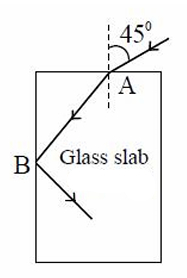
A
$\sqrt{\frac{3}{2}}$
B
$\frac{\sqrt{3}+1}{2}$
C
$\frac{\sqrt{2}+1}{2}$
D
$\frac{\sqrt{5}}{2}$
Solution
(A) Let the refractive index of the glass slab be $\mu$. The angle of incidence at point $A$ is $i = 45^\circ$. Let the angle of refraction at $A$ be $r$. By Snell's Law,$1 \cdot \sin(45^\circ) = \mu \cdot \sin(r)$,so $\sin(r) = \frac{1}{\mu\sqrt{2}}$.
At point $B$,the angle of incidence is $r' = 90^\circ - r$. For total internal reflection to occur,the angle of incidence must be greater than or equal to the critical angle $C$,where $\sin(C) = \frac{1}{\mu}$.
Thus,$\sin(90^\circ - r) \ge \frac{1}{\mu}$,which implies $\cos(r) \ge \frac{1}{\mu}$.
Squaring both sides,$\cos^2(r) \ge \frac{1}{\mu^2}$,so $1 - \sin^2(r) \ge \frac{1}{\mu^2}$.
Substituting $\sin^2(r) = \frac{1}{2\mu^2}$,we get $1 - \frac{1}{2\mu^2} \ge \frac{1}{\mu^2}$,which simplifies to $1 \ge \frac{3}{2\mu^2}$.
Thus,$\mu^2 \ge \frac{3}{2}$,or $\mu \ge \sqrt{\frac{3}{2}}$. The minimum refractive index is $\sqrt{\frac{3}{2}}$.
At point $B$,the angle of incidence is $r' = 90^\circ - r$. For total internal reflection to occur,the angle of incidence must be greater than or equal to the critical angle $C$,where $\sin(C) = \frac{1}{\mu}$.
Thus,$\sin(90^\circ - r) \ge \frac{1}{\mu}$,which implies $\cos(r) \ge \frac{1}{\mu}$.
Squaring both sides,$\cos^2(r) \ge \frac{1}{\mu^2}$,so $1 - \sin^2(r) \ge \frac{1}{\mu^2}$.
Substituting $\sin^2(r) = \frac{1}{2\mu^2}$,we get $1 - \frac{1}{2\mu^2} \ge \frac{1}{\mu^2}$,which simplifies to $1 \ge \frac{3}{2\mu^2}$.
Thus,$\mu^2 \ge \frac{3}{2}$,or $\mu \ge \sqrt{\frac{3}{2}}$. The minimum refractive index is $\sqrt{\frac{3}{2}}$.
0 likesView Solution
202
PhysicsMediumMCQAP EAMCET · 2025
If the least distance of distinct vision for a boy is $35 \ cm$,then the lens to be used by the boy for correcting the defect of his eye is
A
convex lens of focal length $35 \ cm$
B
concave lens of focal length $35 \ cm$
C
convex lens of focal length $87.5 \ cm$
D
concave lens of focal length $87.5 \ cm$
Solution
(C) The normal least distance of distinct vision $(D)$ is $25 \ cm$. Since the boy's least distance is $35 \ cm$,he is suffering from hypermetropia (farsightedness).
To correct this,we need to use a convex lens that forms a virtual image of an object placed at $25 \ cm$ at the boy's actual near point of $35 \ cm$.
Here,object distance $u = -25 \ cm$ and image distance $v = -35 \ cm$.
Using the lens formula: $\frac{1}{f} = \frac{1}{v} - \frac{1}{u}$.
$\frac{1}{f} = \frac{1}{-35} - \frac{1}{-25} = \frac{1}{25} - \frac{1}{35}$.
$\frac{1}{f} = \frac{7 - 5}{175} = \frac{2}{175}$.
$f = \frac{175}{2} = 87.5 \ cm$.
Since the focal length is positive,it is a convex lens.
To correct this,we need to use a convex lens that forms a virtual image of an object placed at $25 \ cm$ at the boy's actual near point of $35 \ cm$.
Here,object distance $u = -25 \ cm$ and image distance $v = -35 \ cm$.
Using the lens formula: $\frac{1}{f} = \frac{1}{v} - \frac{1}{u}$.
$\frac{1}{f} = \frac{1}{-35} - \frac{1}{-25} = \frac{1}{25} - \frac{1}{35}$.
$\frac{1}{f} = \frac{7 - 5}{175} = \frac{2}{175}$.
$f = \frac{175}{2} = 87.5 \ cm$.
Since the focal length is positive,it is a convex lens.
0 likesView Solution
203
PhysicsEasyMCQAP EAMCET · 2025
If the far point of a short-sighted person is $400 \ cm$, then the power of the lens required to enable him to see very distant objects clearly is
A
$-0.5 \ D$
B
$+0.5 \ D$
C
$+0.25 \ D$
D
$-0.25 \ D$
Solution
(D) person with short-sightedness (myopia) cannot see distant objects clearly because the image forms in front of the retina. To correct this, a concave lens is used.
For a person to see objects at infinity $(u = \infty)$, the lens must form a virtual image at the person's far point $(v = -400 \ cm = -4 \ m)$.
Using the lens formula: $\frac{1}{f} = \frac{1}{v} - \frac{1}{u}$.
Substituting the values: $\frac{1}{f} = \frac{1}{-4} - \frac{1}{\infty} = -0.25 \ m^{-1}$.
Since power $P = \frac{1}{f(\text{in meters})}$, we get $P = -0.25 \ D$.
For a person to see objects at infinity $(u = \infty)$, the lens must form a virtual image at the person's far point $(v = -400 \ cm = -4 \ m)$.
Using the lens formula: $\frac{1}{f} = \frac{1}{v} - \frac{1}{u}$.
Substituting the values: $\frac{1}{f} = \frac{1}{-4} - \frac{1}{\infty} = -0.25 \ m^{-1}$.
Since power $P = \frac{1}{f(\text{in meters})}$, we get $P = -0.25 \ D$.
0 likesView Solution
204
PhysicsMediumMCQAP EAMCET · 2025
Two thin convex lenses are kept in contact coaxially. If the focal length of the combination of the lenses is $4 \ cm$ and the sum of the focal lengths of the two lenses is $18 \ cm$,then the focal length of the lens of lower power is (in $cm$)
A
$8$
B
$10$
C
$6$
D
$12$
Solution
(D) Let the focal lengths of the two lenses be $f_1$ and $f_2$.
Given that the lenses are in contact,the equivalent focal length $F$ is given by $\frac{1}{F} = \frac{1}{f_1} + \frac{1}{f_2}$.
Given $F = 4 \ cm$,so $\frac{1}{f_1} + \frac{1}{f_2} = \frac{1}{4}$.
This simplifies to $\frac{f_1 + f_2}{f_1 f_2} = \frac{1}{4}$.
We are given $f_1 + f_2 = 18 \ cm$.
Substituting this into the equation: $\frac{18}{f_1 f_2} = \frac{1}{4}$,which gives $f_1 f_2 = 72 \ cm^2$.
We have the sum $f_1 + f_2 = 18$ and the product $f_1 f_2 = 72$.
These are the roots of the quadratic equation $x^2 - 18x + 72 = 0$.
Factoring the equation: $(x - 6)(x - 12) = 0$.
Thus,the focal lengths are $6 \ cm$ and $12 \ cm$.
Power $P$ is inversely proportional to focal length $(P = \frac{1}{f})$.
The lens with the lower power will have the larger focal length.
Therefore,the focal length of the lens with lower power is $12 \ cm$.
Given that the lenses are in contact,the equivalent focal length $F$ is given by $\frac{1}{F} = \frac{1}{f_1} + \frac{1}{f_2}$.
Given $F = 4 \ cm$,so $\frac{1}{f_1} + \frac{1}{f_2} = \frac{1}{4}$.
This simplifies to $\frac{f_1 + f_2}{f_1 f_2} = \frac{1}{4}$.
We are given $f_1 + f_2 = 18 \ cm$.
Substituting this into the equation: $\frac{18}{f_1 f_2} = \frac{1}{4}$,which gives $f_1 f_2 = 72 \ cm^2$.
We have the sum $f_1 + f_2 = 18$ and the product $f_1 f_2 = 72$.
These are the roots of the quadratic equation $x^2 - 18x + 72 = 0$.
Factoring the equation: $(x - 6)(x - 12) = 0$.
Thus,the focal lengths are $6 \ cm$ and $12 \ cm$.
Power $P$ is inversely proportional to focal length $(P = \frac{1}{f})$.
The lens with the lower power will have the larger focal length.
Therefore,the focal length of the lens with lower power is $12 \ cm$.
0 likesView Solution
205
PhysicsMediumMCQAP EAMCET · 2025
Images of same size are formed by a convex lens when an object is placed either at $20 \ cm$ or $10 \ cm$ distance from the lens. The focal length of the lens is (in $cm$)
A
$12$
B
$40$
C
$18$
D
$15$
Solution
(D) Let the focal length of the convex lens be $f$. The magnification $m$ produced by a lens is given by $m = \frac{f}{f+u}$,where $u$ is the object distance.
For a convex lens,if the image size is the same,the magnification $m$ must be $m = 1$ (virtual image) or $m = -1$ (real image).
Case $1$: For a real image,$m = -1$. Using the formula $m = \frac{f}{f+u}$,we have $-1 = \frac{f}{f+u_1}$,which implies $f+u_1 = -f$,so $u_1 = -2f$. Given $u_1 = -20 \ cm$,we get $2f = 20 \ cm$,so $f = 10 \ cm$. However,this would mean the object is at $2f$,forming a real image of the same size.
Case $2$: If the image size is the same for two different positions,one must be a real image and one must be a virtual image. For a convex lens,the magnification $m = \frac{v}{u}$. Since the image size is the same,$|m_1| = |m_2|$.
Let the object distances be $u_1 = -20 \ cm$ and $u_2 = -10 \ cm$. The magnification is $m = \frac{f}{f+u}$.
For $u_1 = -20$,$m_1 = \frac{f}{f-20}$. For $u_2 = -10$,$m_2 = \frac{f}{f-10}$.
Since the image sizes are equal,$|m_1| = |m_2|$. Thus,$\left| \frac{f}{f-20} \right| = \left| \frac{f}{f-10} \right|$.
This implies $\frac{f}{20-f} = \frac{f}{f-10}$ (since one image is real and one is virtual,one magnification is negative).
$20-f = f-10 \implies 2f = 30 \implies f = 15 \ cm$.
For a convex lens,if the image size is the same,the magnification $m$ must be $m = 1$ (virtual image) or $m = -1$ (real image).
Case $1$: For a real image,$m = -1$. Using the formula $m = \frac{f}{f+u}$,we have $-1 = \frac{f}{f+u_1}$,which implies $f+u_1 = -f$,so $u_1 = -2f$. Given $u_1 = -20 \ cm$,we get $2f = 20 \ cm$,so $f = 10 \ cm$. However,this would mean the object is at $2f$,forming a real image of the same size.
Case $2$: If the image size is the same for two different positions,one must be a real image and one must be a virtual image. For a convex lens,the magnification $m = \frac{v}{u}$. Since the image size is the same,$|m_1| = |m_2|$.
Let the object distances be $u_1 = -20 \ cm$ and $u_2 = -10 \ cm$. The magnification is $m = \frac{f}{f+u}$.
For $u_1 = -20$,$m_1 = \frac{f}{f-20}$. For $u_2 = -10$,$m_2 = \frac{f}{f-10}$.
Since the image sizes are equal,$|m_1| = |m_2|$. Thus,$\left| \frac{f}{f-20} \right| = \left| \frac{f}{f-10} \right|$.
This implies $\frac{f}{20-f} = \frac{f}{f-10}$ (since one image is real and one is virtual,one magnification is negative).
$20-f = f-10 \implies 2f = 30 \implies f = 15 \ cm$.
0 likesView Solution
206
PhysicsMediumMCQAP EAMCET · 2025
The ratio of the focal lengths of a convex lens when kept in air and when it is immersed in a liquid is $1: 2$. If the refractive index of the material of the lens is $1.5$,then the refractive index of the liquid is
A
$1.20$
B
$1.30$
C
$1.25$
D
$1.35$
Solution
(A) The lens maker's formula is given by $\frac{1}{f} = (\mu_g - 1) \left( \frac{1}{R_1} - \frac{1}{R_2} \right)$.
For a lens in air $(\mu_a = 1)$: $\frac{1}{f_a} = (\mu_l - 1) K$,where $K = (\frac{1}{R_1} - \frac{1}{R_2})$.
For a lens in liquid $(\mu_{liq})$: $\frac{1}{f_l} = (\frac{\mu_l}{\mu_{liq}} - 1) K$.
Given $\frac{f_a}{f_l} = \frac{1}{2}$,we have $\frac{f_l}{f_a} = 2$.
Dividing the two equations: $\frac{f_a}{f_l} = \frac{(\frac{\mu_l}{\mu_{liq}} - 1)}{(\mu_l - 1)} = \frac{1}{2}$.
Substituting $\mu_l = 1.5$: $\frac{(\frac{1.5}{\mu_{liq}} - 1)}{(1.5 - 1)} = \frac{1}{2}$.
$\frac{1.5}{\mu_{liq}} - 1 = 0.5 \times 0.5 = 0.25$.
$\frac{1.5}{\mu_{liq}} = 1.25$.
$\mu_{liq} = \frac{1.5}{1.25} = 1.2$.
For a lens in air $(\mu_a = 1)$: $\frac{1}{f_a} = (\mu_l - 1) K$,where $K = (\frac{1}{R_1} - \frac{1}{R_2})$.
For a lens in liquid $(\mu_{liq})$: $\frac{1}{f_l} = (\frac{\mu_l}{\mu_{liq}} - 1) K$.
Given $\frac{f_a}{f_l} = \frac{1}{2}$,we have $\frac{f_l}{f_a} = 2$.
Dividing the two equations: $\frac{f_a}{f_l} = \frac{(\frac{\mu_l}{\mu_{liq}} - 1)}{(\mu_l - 1)} = \frac{1}{2}$.
Substituting $\mu_l = 1.5$: $\frac{(\frac{1.5}{\mu_{liq}} - 1)}{(1.5 - 1)} = \frac{1}{2}$.
$\frac{1.5}{\mu_{liq}} - 1 = 0.5 \times 0.5 = 0.25$.
$\frac{1.5}{\mu_{liq}} = 1.25$.
$\mu_{liq} = \frac{1.5}{1.25} = 1.2$.
0 likesView Solution
207
PhysicsMediumMCQAP EAMCET · 2025
When an object is placed in front of a convex mirror at a distance '$u$' from the pole of the mirror such that the size of the image is '$1/n$' times that of the object,then the object distance '$u$' =
A
$f(1-n)$
B
$f(n-1)$
C
$f(1/n - 1)$
D
$f(1 + n)$
Solution
(B) For a convex mirror,the magnification $m$ is given by $m = \frac{h_i}{h_o} = -\frac{v}{u}$.
Given that the size of the image is $1/n$ times the size of the object,we have $m = 1/n$.
Thus,$1/n = -v/u$,which implies $v = -u/n$.
Using the mirror formula $\frac{1}{v} + \frac{1}{u} = \frac{1}{f}$,where $f$ is the focal length of the convex mirror (positive).
Substituting $v = -u/n$ into the mirror formula:
$\frac{1}{-u/n} + \frac{1}{u} = \frac{1}{f}$
$-\frac{n}{u} + \frac{1}{u} = \frac{1}{f}$
$\frac{1-n}{u} = \frac{1}{f}$
$u = f(1-n)$.
Since the object distance $u$ is conventionally negative,the magnitude is $|u| = f(n-1)$.
Given that the size of the image is $1/n$ times the size of the object,we have $m = 1/n$.
Thus,$1/n = -v/u$,which implies $v = -u/n$.
Using the mirror formula $\frac{1}{v} + \frac{1}{u} = \frac{1}{f}$,where $f$ is the focal length of the convex mirror (positive).
Substituting $v = -u/n$ into the mirror formula:
$\frac{1}{-u/n} + \frac{1}{u} = \frac{1}{f}$
$-\frac{n}{u} + \frac{1}{u} = \frac{1}{f}$
$\frac{1-n}{u} = \frac{1}{f}$
$u = f(1-n)$.
Since the object distance $u$ is conventionally negative,the magnitude is $|u| = f(n-1)$.
0 likesView Solution
208
PhysicsMediumMCQAP EAMCET · 2025
$A$ light ray is incident on an equilateral prism made of a material with a refractive index of $\sqrt{3}$. Inside the prism,if the light ray moves parallel to the base of the prism,then the angle of incidence of the light ray is: (in $^{\circ}$)
A
$30$
B
$45$
C
$75$
D
$60$
Solution
(D) For an equilateral prism,the angle of the prism is $A = 60^{\circ}$.
When the light ray inside the prism moves parallel to the base,the ray undergoes minimum deviation,which implies that the angle of incidence $i$ is equal to the angle of emergence $e$,and the angle of refraction $r_1$ is equal to $r_2$.
Since $r_1 + r_2 = A$,we have $2r = 60^{\circ}$,which gives $r = 30^{\circ}$.
Using Snell's Law at the first surface: $\mu = \frac{\sin i}{\sin r}$.
Given $\mu = \sqrt{3}$ and $r = 30^{\circ}$,we have $\sqrt{3} = \frac{\sin i}{\sin 30^{\circ}}$.
Since $\sin 30^{\circ} = 0.5$,we get $\sin i = \sqrt{3} \times 0.5 = \frac{\sqrt{3}}{2}$.
Therefore,$i = 60^{\circ}$.
When the light ray inside the prism moves parallel to the base,the ray undergoes minimum deviation,which implies that the angle of incidence $i$ is equal to the angle of emergence $e$,and the angle of refraction $r_1$ is equal to $r_2$.
Since $r_1 + r_2 = A$,we have $2r = 60^{\circ}$,which gives $r = 30^{\circ}$.
Using Snell's Law at the first surface: $\mu = \frac{\sin i}{\sin r}$.
Given $\mu = \sqrt{3}$ and $r = 30^{\circ}$,we have $\sqrt{3} = \frac{\sin i}{\sin 30^{\circ}}$.
Since $\sin 30^{\circ} = 0.5$,we get $\sin i = \sqrt{3} \times 0.5 = \frac{\sqrt{3}}{2}$.
Therefore,$i = 60^{\circ}$.
0 likesView Solution
209
PhysicsMediumMCQAP EAMCET · 2025
$A$ ray of light is incident at an angle of $60^{\circ}$ on the first face of a prism. The angle of the prism is $30^{\circ}$ and its second face is silvered. If the light ray inside the prism retraces its path after reflection from the second face, then the refractive index of the material of the prism is
A
$\frac{2}{\sqrt{3}}$
B
$\frac{3}{2}$
C
$\sqrt{2}$
D
$\sqrt{3}$
Solution
(D) For a light ray to retrace its path after reflection from the silvered second face, it must strike the second face normally (at an angle of $90^{\circ}$ to the surface).
Let $i = 60^{\circ}$ be the angle of incidence on the first face, $r_1$ be the angle of refraction at the first face, and $A = 30^{\circ}$ be the prism angle.
Since the ray strikes the second face normally, the angle of refraction at the second face is $r_2 = 0^{\circ}$.
From the geometry of the prism, we know that $A = r_1 + r_2$.
Substituting the values, $30^{\circ} = r_1 + 0^{\circ}$, so $r_1 = 30^{\circ}$.
Using Snell's Law at the first face: $\mu = \frac{\sin(i)}{\sin(r_1)}$.
Substituting the values: $\mu = \frac{\sin(60^{\circ})}{\sin(30^{\circ})}$.
$\mu = \frac{\sqrt{3}/2}{1/2} = \sqrt{3}$.
Thus, the refractive index of the material of the prism is $\sqrt{3}$.
Let $i = 60^{\circ}$ be the angle of incidence on the first face, $r_1$ be the angle of refraction at the first face, and $A = 30^{\circ}$ be the prism angle.
Since the ray strikes the second face normally, the angle of refraction at the second face is $r_2 = 0^{\circ}$.
From the geometry of the prism, we know that $A = r_1 + r_2$.
Substituting the values, $30^{\circ} = r_1 + 0^{\circ}$, so $r_1 = 30^{\circ}$.
Using Snell's Law at the first face: $\mu = \frac{\sin(i)}{\sin(r_1)}$.
Substituting the values: $\mu = \frac{\sin(60^{\circ})}{\sin(30^{\circ})}$.
$\mu = \frac{\sqrt{3}/2}{1/2} = \sqrt{3}$.
Thus, the refractive index of the material of the prism is $\sqrt{3}$.
0 likesView Solution
210
PhysicsMediumMCQAP EAMCET · 2025
$A$ Zener diode of breakdown voltage $20 \ V$ is connected as shown in the given circuit. The current through the Zener diode is (in $mA$)
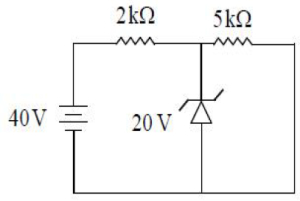
A
$10$
B
$4$
C
$6$
D
$8$
Solution
(C) The circuit consists of a $40 \ V$ $DC$ source,a series resistor $R_s = 2 \ k\Omega$,a Zener diode with breakdown voltage $V_z = 20 \ V$,and a load resistor $R_L = 5 \ k\Omega$.
First,calculate the total current $I$ flowing through the series resistor $R_s$:
$I = \frac{V_{source} - V_z}{R_s} = \frac{40 \ V - 20 \ V}{2 \ k\Omega} = \frac{20 \ V}{2 \times 10^3 \ \Omega} = 10 \times 10^{-3} \ A = 10 \ mA$.
Next,calculate the load current $I_L$ flowing through the load resistor $R_L$:
$I_L = \frac{V_z}{R_L} = \frac{20 \ V}{5 \ k\Omega} = \frac{20 \ V}{5 \times 10^3 \ \Omega} = 4 \times 10^{-3} \ A = 4 \ mA$.
The current through the Zener diode $I_z$ is given by the difference between the total current and the load current:
$I_z = I - I_L = 10 \ mA - 4 \ mA = 6 \ mA$.
Therefore,the correct option is $C$.
First,calculate the total current $I$ flowing through the series resistor $R_s$:
$I = \frac{V_{source} - V_z}{R_s} = \frac{40 \ V - 20 \ V}{2 \ k\Omega} = \frac{20 \ V}{2 \times 10^3 \ \Omega} = 10 \times 10^{-3} \ A = 10 \ mA$.
Next,calculate the load current $I_L$ flowing through the load resistor $R_L$:
$I_L = \frac{V_z}{R_L} = \frac{20 \ V}{5 \ k\Omega} = \frac{20 \ V}{5 \times 10^3 \ \Omega} = 4 \times 10^{-3} \ A = 4 \ mA$.
The current through the Zener diode $I_z$ is given by the difference between the total current and the load current:
$I_z = I - I_L = 10 \ mA - 4 \ mA = 6 \ mA$.
Therefore,the correct option is $C$.
0 likesView Solution
211
PhysicsEasyMCQAP EAMCET · 2025
The device used for voltage regulation is
A
Zener diode
B
photo diode
C
light emitting diode
D
solar cell
Solution
(A) $Zener$ $diode$ is a special type of $PN$ junction diode designed to operate in the reverse breakdown region.
When the reverse voltage across a $Zener$ $diode$ reaches the $Zener$ breakdown voltage,the voltage across it remains constant even if the current through it changes significantly.
This property makes it ideal for use as a voltage regulator in electronic circuits to maintain a stable output voltage.
When the reverse voltage across a $Zener$ $diode$ reaches the $Zener$ breakdown voltage,the voltage across it remains constant even if the current through it changes significantly.
This property makes it ideal for use as a voltage regulator in electronic circuits to maintain a stable output voltage.
0 likesView Solution
212
PhysicsEasyMCQAP EAMCET · 2025
In the given options,the diode that is forward biased is
A
B
C
D
Solution
(B) diode is forward biased when the potential at the $P$-terminal $(V_P)$ is higher than the potential at the $N$-terminal $(V_N)$.
In option $A$: $V_P = +2 \ V$,$V_N = +3 \ V$. Since $V_P < V_N$,it is reverse biased.
In option $B$: $V_P = +2 \ V$,$V_N = -2 \ V$. Since $V_P > V_N$,it is forward biased.
In option $C$: $V_P = -2 \ V$,$V_N = +2 \ V$. Since $V_P < V_N$,it is reverse biased.
In option $D$: $V_P = +2 \ V$,$V_N = +2 \ V$. Since $V_P = V_N$,there is no bias (or zero bias).
Therefore,the correct option is $B$.
In option $A$: $V_P = +2 \ V$,$V_N = +3 \ V$. Since $V_P < V_N$,it is reverse biased.
In option $B$: $V_P = +2 \ V$,$V_N = -2 \ V$. Since $V_P > V_N$,it is forward biased.
In option $C$: $V_P = -2 \ V$,$V_N = +2 \ V$. Since $V_P < V_N$,it is reverse biased.
In option $D$: $V_P = +2 \ V$,$V_N = +2 \ V$. Since $V_P = V_N$,there is no bias (or zero bias).
Therefore,the correct option is $B$.
0 likesView Solution
213
PhysicsEasyMCQAP EAMCET · 2025
$A$ $CCD$ camera is fabricated using a semiconducting material having a band gap of $3 \ eV$. The wavelength of light it can detect is nearly (in $nm$)
A
$210$
B
$546$
C
$413$
D
$345$
Solution
(C) The energy of a photon is given by the formula $E = \frac{hc}{\lambda}$.
Given the band gap energy $E_g = 3 \ eV$.
We know that $hc \approx 1240 \ eV \cdot nm$.
Substituting the values,we get $\lambda = \frac{hc}{E_g} = \frac{1240 \ eV \cdot nm}{3 \ eV}$.
$\lambda \approx 413.33 \ nm$.
Therefore,the wavelength of light it can detect is nearly $413 \ nm$.
Given the band gap energy $E_g = 3 \ eV$.
We know that $hc \approx 1240 \ eV \cdot nm$.
Substituting the values,we get $\lambda = \frac{hc}{E_g} = \frac{1240 \ eV \cdot nm}{3 \ eV}$.
$\lambda \approx 413.33 \ nm$.
Therefore,the wavelength of light it can detect is nearly $413 \ nm$.
0 likesView Solution
214
PhysicsEasyMCQAP EAMCET · 2025
The voltage gains of two amplifiers connected in series are $8$ and $12.5$. If the voltage of the input signal is $200 \mu V$, then the voltage of the output signal is
A
$50 \mu V$
B
$20 \mu V$
C
$20 \text{ mV}$
D
$50 \text{ mV}$
Solution
(C) When amplifiers are connected in series, the total voltage gain $(A_v)$ is the product of the individual voltage gains of the amplifiers.
Given: $A_1 = 8$, $A_2 = 12.5$.
Total voltage gain $A_v = A_1 \times A_2 = 8 \times 12.5 = 100$.
The input signal voltage $V_{in} = 200 \mu V = 200 \times 10^{-6} \text{ V}$.
The output voltage $V_{out}$ is given by the formula: $V_{out} = A_v \times V_{in}$.
$V_{out} = 100 \times 200 \times 10^{-6} \text{ V} = 20000 \times 10^{-6} \text{ V} = 20 \times 10^{-3} \text{ V}$.
Since $10^{-3} \text{ V} = 1 \text{ mV}$, the output voltage is $20 \text{ mV}$.
Given: $A_1 = 8$, $A_2 = 12.5$.
Total voltage gain $A_v = A_1 \times A_2 = 8 \times 12.5 = 100$.
The input signal voltage $V_{in} = 200 \mu V = 200 \times 10^{-6} \text{ V}$.
The output voltage $V_{out}$ is given by the formula: $V_{out} = A_v \times V_{in}$.
$V_{out} = 100 \times 200 \times 10^{-6} \text{ V} = 20000 \times 10^{-6} \text{ V} = 20 \times 10^{-3} \text{ V}$.
Since $10^{-3} \text{ V} = 1 \text{ mV}$, the output voltage is $20 \text{ mV}$.
0 likesView Solution
215
PhysicsEasyMCQAP EAMCET · 2025
$A$ transistor works as an amplifier when
A
emitter-base junction is forward biased and base-collector junction is reverse biased
B
both emitter-base and base-collector junctions are forward biased.
C
both emitter-base and base-collector junctions are reverse biased.
D
emitter-base junction is reverse biased and base-collector junction is forward biased.
Solution
(A) For a transistor to operate in the active region,which is required for amplification,the emitter-base junction must be forward biased and the base-collector junction must be reverse biased.
In the forward-biased emitter-base junction,charge carriers are injected from the emitter into the base.
In the reverse-biased base-collector junction,these carriers are collected by the collector,allowing for current control and signal amplification.
In the forward-biased emitter-base junction,charge carriers are injected from the emitter into the base.
In the reverse-biased base-collector junction,these carriers are collected by the collector,allowing for current control and signal amplification.
0 likesView Solution
216
PhysicsMediumMCQAP EAMCET · 2025
The voltage gain and the current amplification factor of a transistor in common emitter configuration are $300$ and $60$ respectively. If the collector resistance is $5 \, k\Omega$, then the base resistance is:
A
$5 \, k\Omega$
B
$25 \, k\Omega$
C
$2 \, k\Omega$
D
$1 \, k\Omega$
Solution
(D) Given:
Voltage gain $(A_v)$ = $300$
Current amplification factor $(\beta)$ = $60$
Collector resistance $(R_C)$ = $5 \, k\Omega$
We know that the voltage gain $(A_v)$ in a common emitter configuration is given by:
$A_v = \beta \times \frac{R_C}{R_B}$
Rearranging the formula to find the base resistance $(R_B)$:
$R_B = \beta \times \frac{R_C}{A_v}$
Substituting the given values:
$R_B = 60 \times \frac{5 \, k\Omega}{300}$
$R_B = 60 \times \frac{5}{300} \, k\Omega$
$R_B = \frac{300}{300} \, k\Omega$
$R_B = 1 \, k\Omega$
Therefore, the base resistance is $1 \, k\Omega$.
Voltage gain $(A_v)$ = $300$
Current amplification factor $(\beta)$ = $60$
Collector resistance $(R_C)$ = $5 \, k\Omega$
We know that the voltage gain $(A_v)$ in a common emitter configuration is given by:
$A_v = \beta \times \frac{R_C}{R_B}$
Rearranging the formula to find the base resistance $(R_B)$:
$R_B = \beta \times \frac{R_C}{A_v}$
Substituting the given values:
$R_B = 60 \times \frac{5 \, k\Omega}{300}$
$R_B = 60 \times \frac{5}{300} \, k\Omega$
$R_B = \frac{300}{300} \, k\Omega$
$R_B = 1 \, k\Omega$
Therefore, the base resistance is $1 \, k\Omega$.
0 likesView Solution
217
PhysicsMediumMCQAP EAMCET · 2025
In a common emitter amplifier of a transistor,if the ratio of the voltage gain and current amplification factor is $4$,then the ratio of the collector and base resistances is
A
$16 : 1$
B
$1 : 16$
C
$1 : 4$
D
$4 : 1$
Solution
(D) For a common emitter amplifier,the voltage gain $(A_v)$ is given by the formula: $A_v = \beta \times \frac{R_C}{R_B}$,where $\beta$ is the current amplification factor,$R_C$ is the collector resistance,and $R_B$ is the base resistance.
Given that the ratio of voltage gain $(A_v)$ to the current amplification factor $(\beta)$ is $4$,we have: $\frac{A_v}{\beta} = 4$.
Substituting the expression for $A_v$ into the given ratio: $\frac{\beta \times (R_C / R_B)}{\beta} = 4$.
This simplifies to: $\frac{R_C}{R_B} = 4$.
Therefore,the ratio of the collector resistance to the base resistance is $4 : 1$.
Given that the ratio of voltage gain $(A_v)$ to the current amplification factor $(\beta)$ is $4$,we have: $\frac{A_v}{\beta} = 4$.
Substituting the expression for $A_v$ into the given ratio: $\frac{\beta \times (R_C / R_B)}{\beta} = 4$.
This simplifies to: $\frac{R_C}{R_B} = 4$.
Therefore,the ratio of the collector resistance to the base resistance is $4 : 1$.
0 likesView Solution
218
PhysicsEasyMCQAP EAMCET · 2025
If $X, Y$ and $Z$ are the sizes of the emitter,base and collector of a transistor respectively,then
A
$X > Z > Y$
B
$X > Y > Z$
C
$Z > X > Y$
D
$Z > Y > X$
Solution
(C) In a standard bipolar junction transistor $(BJT)$,the three regions are designed with specific physical dimensions to optimize performance.
$1$. The $Base$ $(Y)$ is made very thin and lightly doped to allow most charge carriers to pass through to the collector.
$2$. The $Collector$ $(Z)$ is made the largest in size to handle the heat dissipation generated by the power collected from the emitter.
$3$. The $Emitter$ $(X)$ is of moderate size,larger than the base but smaller than the collector,and is heavily doped to provide a large number of charge carriers.
Therefore,the order of sizes is $Collector > Emitter > Base$,which corresponds to $Z > X > Y$.
$1$. The $Base$ $(Y)$ is made very thin and lightly doped to allow most charge carriers to pass through to the collector.
$2$. The $Collector$ $(Z)$ is made the largest in size to handle the heat dissipation generated by the power collected from the emitter.
$3$. The $Emitter$ $(X)$ is of moderate size,larger than the base but smaller than the collector,and is heavily doped to provide a large number of charge carriers.
Therefore,the order of sizes is $Collector > Emitter > Base$,which corresponds to $Z > X > Y$.
0 likesView Solution
219
PhysicsMediumMCQAP EAMCET · 2025
In a common emitter transistor amplifier,the resistance of the collector is $3 \ k\Omega$. If the current amplification factor is $100$ and the base resistance is $2 \ k\Omega$,then the power gain of the transistor is:
A
$150$
B
$10000$
C
$1500$
D
$15000$
Solution
(D) The power gain $(A_p)$ of a transistor amplifier is given by the product of the current gain $(\beta)$ and the voltage gain $(A_v)$.
$A_p = \beta \times A_v$
Voltage gain $(A_v)$ is defined as the product of the current gain $(\beta)$ and the ratio of output resistance $(R_c)$ to input resistance $(R_b)$:
$A_v = \beta \times \frac{R_c}{R_b}$
Given:
$\beta = 100$
$R_c = 3 \ k\Omega$
$R_b = 2 \ k\Omega$
Calculating $A_v$:
$A_v = 100 \times \frac{3 \ k\Omega}{2 \ k\Omega} = 100 \times 1.5 = 150$
Now,calculating power gain $(A_p)$:
$A_p = \beta \times A_v = 100 \times 150 = 15000$
Therefore,the power gain is $15000$.
$A_p = \beta \times A_v$
Voltage gain $(A_v)$ is defined as the product of the current gain $(\beta)$ and the ratio of output resistance $(R_c)$ to input resistance $(R_b)$:
$A_v = \beta \times \frac{R_c}{R_b}$
Given:
$\beta = 100$
$R_c = 3 \ k\Omega$
$R_b = 2 \ k\Omega$
Calculating $A_v$:
$A_v = 100 \times \frac{3 \ k\Omega}{2 \ k\Omega} = 100 \times 1.5 = 150$
Now,calculating power gain $(A_p)$:
$A_p = \beta \times A_v = 100 \times 150 = 15000$
Therefore,the power gain is $15000$.
0 likesView Solution
220
PhysicsEasyMCQAP EAMCET · 2025
In a transistor,if the collector current is $98 \%$ of emitter current,then the ratio of the base and collector currents is
A
$1: 98$
B
$1: 1$
C
$1: 49$
D
$1: 99$
Solution
(C) Given that the collector current $I_C = 0.98 I_E$.
We know that the emitter current is the sum of the base current and the collector current: $I_E = I_B + I_C$.
Substituting the value of $I_C$,we get $I_E = I_B + 0.98 I_E$.
Rearranging the terms to find $I_B$: $I_B = I_E - 0.98 I_E = 0.02 I_E$.
Now,we need to find the ratio of the base current to the collector current: $\frac{I_B}{I_C} = \frac{0.02 I_E}{0.98 I_E}$.
Simplifying the ratio: $\frac{I_B}{I_C} = \frac{2}{98} = \frac{1}{49}$.
Therefore,the ratio is $1: 49$.
We know that the emitter current is the sum of the base current and the collector current: $I_E = I_B + I_C$.
Substituting the value of $I_C$,we get $I_E = I_B + 0.98 I_E$.
Rearranging the terms to find $I_B$: $I_B = I_E - 0.98 I_E = 0.02 I_E$.
Now,we need to find the ratio of the base current to the collector current: $\frac{I_B}{I_C} = \frac{0.02 I_E}{0.98 I_E}$.
Simplifying the ratio: $\frac{I_B}{I_C} = \frac{2}{98} = \frac{1}{49}$.
Therefore,the ratio is $1: 49$.
0 likesView Solution
221
PhysicsMediumMCQAP EAMCET · 2025
If five logic gates are connected as shown in the figure,then the values of $y_1, y_2$ and $y_3$ are respectively
A
$1$,$1$,$1$
B
$0$,$0$,$1$
C
$1$,$1$,$0$
D
$1$,$0$,$1$
Solution
(A) Let the inputs be $A=0, B=1, C=0$.
$1$. The top $NAND$ gate has inputs $A=0$ and $B=1$. Its output is $\overline{0 \cdot 1} = \overline{0} = 1$.
$2$. The second $NAND$ gate has inputs $A=0$ and the output of the first $NAND$ gate $(1)$. Its output $y_1 = \overline{0 \cdot 1} = \overline{0} = 1$.
$3$. The bottom $NOR$ gate has inputs $B=1$ and $C=0$. Its output is $\overline{1 + 0} = \overline{1} = 0$.
$4$. The second $NOR$ gate has inputs $C=0$ and the output of the first $NOR$ gate $(0)$. Its output $y_2 = \overline{0 + 0} = \overline{0} = 1$.
$5$. The final $OR$ gate has inputs $y_1=1$ and $y_2=1$. Its output $y_3 = 1 + 1 = 1$.
Thus,the values are $y_1=1, y_2=1, y_3=1$.
$1$. The top $NAND$ gate has inputs $A=0$ and $B=1$. Its output is $\overline{0 \cdot 1} = \overline{0} = 1$.
$2$. The second $NAND$ gate has inputs $A=0$ and the output of the first $NAND$ gate $(1)$. Its output $y_1 = \overline{0 \cdot 1} = \overline{0} = 1$.
$3$. The bottom $NOR$ gate has inputs $B=1$ and $C=0$. Its output is $\overline{1 + 0} = \overline{1} = 0$.
$4$. The second $NOR$ gate has inputs $C=0$ and the output of the first $NOR$ gate $(0)$. Its output $y_2 = \overline{0 + 0} = \overline{0} = 1$.
$5$. The final $OR$ gate has inputs $y_1=1$ and $y_2=1$. Its output $y_3 = 1 + 1 = 1$.
Thus,the values are $y_1=1, y_2=1, y_3=1$.
0 likesView Solution
222
PhysicsMediumMCQAP EAMCET · 2025
When three $NAND$ logic gates are connected as shown in the figure,then the logic gate equivalent to the circuit is
A
$NOT$
B
$AND$
C
$OR$
D
$NOR$
Solution
(C) Let the inputs be $A$ and $B$.
Each of the first two $NAND$ gates has its inputs shorted,which makes them act as $NOT$ gates.
Therefore,the output of the first $NAND$ gate is $\overline{A}$ and the output of the second $NAND$ gate is $\overline{B}$.
These outputs $\overline{A}$ and $\overline{B}$ are fed as inputs to the third $NAND$ gate.
The output $Y$ of the third $NAND$ gate is given by $Y = \overline{(\overline{A} \cdot \overline{B})}$.
Using De Morgan's theorem,$\overline{X \cdot Y} = \overline{X} + \overline{Y}$.
So,$Y = \overline{(\overline{A})} + \overline{(\overline{B})} = A + B$.
Since the output $Y = A + B$ represents an $OR$ gate,the equivalent logic gate is $OR$.
Each of the first two $NAND$ gates has its inputs shorted,which makes them act as $NOT$ gates.
Therefore,the output of the first $NAND$ gate is $\overline{A}$ and the output of the second $NAND$ gate is $\overline{B}$.
These outputs $\overline{A}$ and $\overline{B}$ are fed as inputs to the third $NAND$ gate.
The output $Y$ of the third $NAND$ gate is given by $Y = \overline{(\overline{A} \cdot \overline{B})}$.
Using De Morgan's theorem,$\overline{X \cdot Y} = \overline{X} + \overline{Y}$.
So,$Y = \overline{(\overline{A})} + \overline{(\overline{B})} = A + B$.
Since the output $Y = A + B$ represents an $OR$ gate,the equivalent logic gate is $OR$.
0 likesView Solution
223
PhysicsMediumMCQAP EAMCET · 2025
If three logic gates are connected as shown in the figure,then the correct truth table of the circuit is
A
| $A$ | $B$ | $Y$ |
|---|---|---|
| $0$ | $0$ | $1$ |
| $0$ | $1$ | $0$ |
| $1$ | $0$ | $0$ |
| $1$ | $1$ | $1$ |
B
| $A$ | $B$ | $Y$ |
|---|---|---|
| $0$ | $0$ | $1$ |
| $0$ | $1$ | $1$ |
| $1$ | $0$ | $1$ |
| $1$ | $1$ | $0$ |
C
| $A$ | $B$ | $Y$ |
|---|---|---|
| $0$ | $0$ | $0$ |
| $0$ | $1$ | $0$ |
| $1$ | $0$ | $0$ |
| $1$ | $1$ | $1$ |
D
| $A$ | $B$ | $Y$ |
|---|---|---|
| $0$ | $0$ | $0$ |
| $0$ | $1$ | $1$ |
| $1$ | $0$ | $1$ |
| $1$ | $1$ | $0$ |
Solution
(B) The circuit consists of an $AND$ gate,an $OR$ gate,and a $NAND$ gate.
Let the inputs be $A$ and $B$.
The upper $AND$ gate receives inputs $A$ and $B$,so its output is $Y_1 = A \cdot B$.
The lower $OR$ gate receives inputs $B$ and $A$,so its output is $Y_2 = B + A$.
The final $NAND$ gate receives $Y_1$ and $Y_2$ as inputs,so the final output is $Y = \overline{Y_1 \cdot Y_2} = \overline{(A \cdot B) \cdot (A + B)}$.
Using Boolean algebra: $Y = \overline{(A \cdot B) \cdot A + (A \cdot B) \cdot B} = \overline{(A \cdot B) + (A \cdot B)} = \overline{A \cdot B}$.
This is the truth table for a $NAND$ gate:
If $A=0, B=0$,then $Y = \overline{0 \cdot 0} = 1$.
If $A=0, B=1$,then $Y = \overline{0 \cdot 1} = 1$.
If $A=1, B=0$,then $Y = \overline{1 \cdot 0} = 1$.
If $A=1, B=1$,then $Y = \overline{1 \cdot 1} = 0$.
Comparing this with the given options,option $B$ is correct.
Let the inputs be $A$ and $B$.
The upper $AND$ gate receives inputs $A$ and $B$,so its output is $Y_1 = A \cdot B$.
The lower $OR$ gate receives inputs $B$ and $A$,so its output is $Y_2 = B + A$.
The final $NAND$ gate receives $Y_1$ and $Y_2$ as inputs,so the final output is $Y = \overline{Y_1 \cdot Y_2} = \overline{(A \cdot B) \cdot (A + B)}$.
Using Boolean algebra: $Y = \overline{(A \cdot B) \cdot A + (A \cdot B) \cdot B} = \overline{(A \cdot B) + (A \cdot B)} = \overline{A \cdot B}$.
This is the truth table for a $NAND$ gate:
If $A=0, B=0$,then $Y = \overline{0 \cdot 0} = 1$.
If $A=0, B=1$,then $Y = \overline{0 \cdot 1} = 1$.
If $A=1, B=0$,then $Y = \overline{1 \cdot 0} = 1$.
If $A=1, B=1$,then $Y = \overline{1 \cdot 1} = 0$.
Comparing this with the given options,option $B$ is correct.
0 likesView Solution
224
PhysicsMediumMCQAP EAMCET · 2025
The logic gate equivalent to the circuit given in the figure is
A
$NAND$
B
$OR$
C
$AND$
D
$NOR$
Solution
(A) Let the inputs be $A$ and $B$.
Each input passes through a $NOT$ gate,so the inputs to the first stage $NAND$ gates become $\bar{A}$ and $\bar{B}$.
Since both inputs of the first stage $NAND$ gates are tied together,they act as $NOT$ gates. Thus,the outputs of the first stage are $\overline{\bar{A}} = A$ and $\overline{\bar{B}} = B$.
These outputs $A$ and $B$ are then fed into the final $NAND$ gate.
The output of the final $NAND$ gate is $Y = \overline{A \cdot B}$.
This is the Boolean expression for a $NAND$ gate.
Therefore,the circuit is equivalent to a $NAND$ gate.
Each input passes through a $NOT$ gate,so the inputs to the first stage $NAND$ gates become $\bar{A}$ and $\bar{B}$.
Since both inputs of the first stage $NAND$ gates are tied together,they act as $NOT$ gates. Thus,the outputs of the first stage are $\overline{\bar{A}} = A$ and $\overline{\bar{B}} = B$.
These outputs $A$ and $B$ are then fed into the final $NAND$ gate.
The output of the final $NAND$ gate is $Y = \overline{A \cdot B}$.
This is the Boolean expression for a $NAND$ gate.
Therefore,the circuit is equivalent to a $NAND$ gate.
0 likesView Solution
225
PhysicsMediumMCQAP EAMCET · 2025
The logic gate equivalent to the combination of logic gates shown in the figure is
A
$AND$
B
$NOR$
C
$OR$
D
$NAND$
Solution
(A) The given circuit consists of two $NOT$ gates followed by a $NOR$ gate.
Let the inputs be $A$ and $B$.
The outputs of the two $NOT$ gates are $\bar{A}$ and $\bar{B}$.
These are the inputs to the $NOR$ gate.
The output $y$ of the $NOR$ gate is given by $y = \overline{\bar{A} + \bar{B}}$.
Using De Morgan's theorem,$\overline{\bar{A} + \bar{B}} = \overline{\bar{A}} \cdot \overline{\bar{B}} = A \cdot B$.
The expression $y = A \cdot B$ represents an $AND$ gate.
Therefore,the combination is equivalent to an $AND$ gate.
Let the inputs be $A$ and $B$.
The outputs of the two $NOT$ gates are $\bar{A}$ and $\bar{B}$.
These are the inputs to the $NOR$ gate.
The output $y$ of the $NOR$ gate is given by $y = \overline{\bar{A} + \bar{B}}$.
Using De Morgan's theorem,$\overline{\bar{A} + \bar{B}} = \overline{\bar{A}} \cdot \overline{\bar{B}} = A \cdot B$.
The expression $y = A \cdot B$ represents an $AND$ gate.
Therefore,the combination is equivalent to an $AND$ gate.
0 likesView Solution
226
PhysicsEasyMCQAP EAMCET · 2025
In the given circuit,if $A=0, B=1$ and $C=1$ are inputs,then the values of $y_1$ and $y_2$ are respectively
A
$1$,$1$
B
$0$,$1$
C
$0$,$0$
D
$1$,$0$
Solution
(C) The circuit consists of a $NOR$ gate followed by an $AND$ gate.
$1$. The output of the $NOR$ gate is $y_1 = \overline{A+B}$.
Given $A=0$ and $B=1$,we have $y_1 = \overline{0+1} = \overline{1} = 0$.
$2$. The output of the $AND$ gate is $y_2 = y_1 \cdot C$.
Given $y_1 = 0$ and $C=1$,we have $y_2 = 0 \cdot 1 = 0$.
Therefore,the values of $y_1$ and $y_2$ are $0$ and $0$ respectively.
$1$. The output of the $NOR$ gate is $y_1 = \overline{A+B}$.
Given $A=0$ and $B=1$,we have $y_1 = \overline{0+1} = \overline{1} = 0$.
$2$. The output of the $AND$ gate is $y_2 = y_1 \cdot C$.
Given $y_1 = 0$ and $C=1$,we have $y_2 = 0 \cdot 1 = 0$.
Therefore,the values of $y_1$ and $y_2$ are $0$ and $0$ respectively.
0 likesView Solution
227
PhysicsEasyMCQAP EAMCET · 2025
$A$ transistor has $3$ impurity regions of different doping levels. In the order of increasing doping level,the regions are
A
$Emitter, Base, Collector$
B
$Collector, Base, Emitter$
C
$Base, Emitter, Collector$
D
$Base, Collector, Emitter$
Solution
(D) In a transistor,the three regions are the emitter,base,and collector.
$1$. The $Base$ is very thin and lightly doped to allow most charge carriers to pass through to the collector.
$2$. The $Collector$ is moderately doped and larger in size to dissipate heat.
$3$. The $Emitter$ is heavily doped to provide a large number of charge carriers.
Therefore,the order of increasing doping level is $Base < Collector < Emitter$.
$1$. The $Base$ is very thin and lightly doped to allow most charge carriers to pass through to the collector.
$2$. The $Collector$ is moderately doped and larger in size to dissipate heat.
$3$. The $Emitter$ is heavily doped to provide a large number of charge carriers.
Therefore,the order of increasing doping level is $Base < Collector < Emitter$.
0 likesView Solution
228
PhysicsEasyMCQAP EAMCET · 2025
At absolute zero temperature,an intrinsic semiconductor behaves as
A
conductor
B
superconductor
C
insulator
D
intrinsic semiconductor
Solution
(C) At absolute zero temperature $(T = 0 \ K)$,all valence electrons are tightly bound to their respective atoms in the crystal lattice.
There is no thermal energy available to excite electrons from the valence band to the conduction band.
Since there are no free charge carriers (electrons or holes) available for conduction,the intrinsic semiconductor behaves as a perfect insulator.
There is no thermal energy available to excite electrons from the valence band to the conduction band.
Since there are no free charge carriers (electrons or holes) available for conduction,the intrinsic semiconductor behaves as a perfect insulator.
0 likesView Solution
229
PhysicsEasyMCQAP EAMCET · 2025
$A$ narrow slit of width $2 \ mm$ is illuminated with a monochromatic light of wavelength $500 \ nm$. If the distance between the slit and the screen is $1 \ m$,then the first minima are separated by a distance of: (in $mm$)
A
$5$
B
$0.5$
C
$1$
D
$10$
Solution
(B) The condition for the $n^{th}$ minima in single-slit diffraction is given by $a \sin \theta = n \lambda$,where $a$ is the slit width,$\lambda$ is the wavelength,and $n$ is the order of the minima.
For the first minima,$n = 1$,so $a \sin \theta = \lambda$.
Since the angle $\theta$ is very small,$\sin \theta \approx \tan \theta = \frac{y}{D}$,where $y$ is the distance from the central maximum and $D$ is the distance to the screen.
Thus,$y = \frac{n \lambda D}{a}$.
For the first minima $(n = 1)$,$y_1 = \frac{\lambda D}{a}$.
The distance between the first minima on either side of the central maximum is $2y_1 = \frac{2 \lambda D}{a}$.
Given: $a = 2 \ mm = 2 \times 10^{-3} \ m$,$\lambda = 500 \ nm = 500 \times 10^{-9} \ m$,$D = 1 \ m$.
Substituting the values: $2y_1 = \frac{2 \times 500 \times 10^{-9} \times 1}{2 \times 10^{-3}} = 500 \times 10^{-6} \ m = 0.5 \times 10^{-3} \ m = 0.5 \ mm$.
For the first minima,$n = 1$,so $a \sin \theta = \lambda$.
Since the angle $\theta$ is very small,$\sin \theta \approx \tan \theta = \frac{y}{D}$,where $y$ is the distance from the central maximum and $D$ is the distance to the screen.
Thus,$y = \frac{n \lambda D}{a}$.
For the first minima $(n = 1)$,$y_1 = \frac{\lambda D}{a}$.
The distance between the first minima on either side of the central maximum is $2y_1 = \frac{2 \lambda D}{a}$.
Given: $a = 2 \ mm = 2 \times 10^{-3} \ m$,$\lambda = 500 \ nm = 500 \times 10^{-9} \ m$,$D = 1 \ m$.
Substituting the values: $2y_1 = \frac{2 \times 500 \times 10^{-9} \times 1}{2 \times 10^{-3}} = 500 \times 10^{-6} \ m = 0.5 \times 10^{-3} \ m = 0.5 \ mm$.
0 likesView Solution
230
PhysicsMediumMCQAP EAMCET · 2025
An unpolarised beam of light is incident on a group of three polarising sheets arranged such that the angle between the axes of any two adjacent sheets is $30^{\circ}$. The ratio of the intensities of polarised light emerging from the second and third sheets is
A
$1: 1$
B
$2: 1$
C
$4: 3$
D
$3: 2$
Solution
(C) Let the intensity of the unpolarised incident light be $I_0$.
After passing through the first polariser, the intensity becomes $I_1 = I_0 / 2$.
According to Malus' Law, the intensity of light emerging from a polariser is $I = I_{in} \cos^2 \theta$, where $\theta$ is the angle between the incident light's polarisation axis and the polariser's axis.
For the second sheet, the angle between the first and second sheet is $\theta = 30^{\circ}$. Thus, $I_2 = I_1 \cos^2(30^{\circ}) = (I_0 / 2) \times (\sqrt{3} / 2)^2 = (I_0 / 2) \times (3 / 4) = 3I_0 / 8$.
For the third sheet, the angle between the second and third sheet is also $\theta = 30^{\circ}$. Thus, $I_3 = I_2 \cos^2(30^{\circ}) = (3I_0 / 8) \times (3 / 4) = 9I_0 / 32$.
The ratio of intensities emerging from the second and third sheets is $I_2 / I_3 = (3I_0 / 8) / (9I_0 / 32) = (3 / 8) \times (32 / 9) = 4 / 3$.
Therefore, the ratio is $4: 3$.
After passing through the first polariser, the intensity becomes $I_1 = I_0 / 2$.
According to Malus' Law, the intensity of light emerging from a polariser is $I = I_{in} \cos^2 \theta$, where $\theta$ is the angle between the incident light's polarisation axis and the polariser's axis.
For the second sheet, the angle between the first and second sheet is $\theta = 30^{\circ}$. Thus, $I_2 = I_1 \cos^2(30^{\circ}) = (I_0 / 2) \times (\sqrt{3} / 2)^2 = (I_0 / 2) \times (3 / 4) = 3I_0 / 8$.
For the third sheet, the angle between the second and third sheet is also $\theta = 30^{\circ}$. Thus, $I_3 = I_2 \cos^2(30^{\circ}) = (3I_0 / 8) \times (3 / 4) = 9I_0 / 32$.
The ratio of intensities emerging from the second and third sheets is $I_2 / I_3 = (3I_0 / 8) / (9I_0 / 32) = (3 / 8) \times (32 / 9) = 4 / 3$.
Therefore, the ratio is $4: 3$.
0 likesView Solution
231
PhysicsEasyMCQAP EAMCET · 2025
According to Rayleigh, when sunlight travels through the atmosphere, the amount of scattering is proportional to the $n^{\text{th}}$ power of the wavelength of light. Then the value of '$n$' is:
A
$4$
B
$-4$
C
$3$
D
$-3$
Solution
(B) According to Rayleigh's law of scattering, the intensity of scattered light $(I)$ is inversely proportional to the fourth power of its wavelength $(\lambda)$ for particles much smaller than the wavelength of light.
Mathematically, this is expressed as $I \propto \frac{1}{\lambda^4}$.
This can be rewritten as $I \propto \lambda^{-4}$.
Comparing this with the given expression $I \propto \lambda^n$, we get $n = -4$.
Therefore, the correct option is $B$.
Mathematically, this is expressed as $I \propto \frac{1}{\lambda^4}$.
This can be rewritten as $I \propto \lambda^{-4}$.
Comparing this with the given expression $I \propto \lambda^n$, we get $n = -4$.
Therefore, the correct option is $B$.
0 likesView Solution
232
PhysicsMediumMCQAP EAMCET · 2025
In an experiment,two polaroids are arranged such that the intensity of the polarised light emerged from the second polaroid is $37.5 \%$ of the intensity of the unpolarised light incident on the first polaroid. Then the angle between the axes of the two polaroids is (in $^{\circ}$)
A
$60$
B
$90$
C
$45$
D
$30$
Solution
(D) Let $I_0$ be the intensity of the unpolarised light incident on the first polaroid.
When unpolarised light passes through the first polaroid,the intensity of the transmitted polarised light is $I_1 = \frac{I_0}{2}$.
According to Malus' Law,when this polarised light passes through the second polaroid,the intensity of the light emerging from it is $I_2 = I_1 \cos^2 \theta$,where $\theta$ is the angle between the axes of the two polaroids.
Given that $I_2 = 37.5 \% \text{ of } I_0 = 0.375 I_0$.
Substituting $I_1 = \frac{I_0}{2}$ into the equation: $0.375 I_0 = \frac{I_0}{2} \cos^2 \theta$.
$0.375 = 0.5 \cos^2 \theta$.
$\cos^2 \theta = \frac{0.375}{0.5} = 0.75 = \frac{3}{4}$.
Taking the square root on both sides: $\cos \theta = \frac{\sqrt{3}}{2}$.
Therefore,$\theta = 30^{\circ}$.
When unpolarised light passes through the first polaroid,the intensity of the transmitted polarised light is $I_1 = \frac{I_0}{2}$.
According to Malus' Law,when this polarised light passes through the second polaroid,the intensity of the light emerging from it is $I_2 = I_1 \cos^2 \theta$,where $\theta$ is the angle between the axes of the two polaroids.
Given that $I_2 = 37.5 \% \text{ of } I_0 = 0.375 I_0$.
Substituting $I_1 = \frac{I_0}{2}$ into the equation: $0.375 I_0 = \frac{I_0}{2} \cos^2 \theta$.
$0.375 = 0.5 \cos^2 \theta$.
$\cos^2 \theta = \frac{0.375}{0.5} = 0.75 = \frac{3}{4}$.
Taking the square root on both sides: $\cos \theta = \frac{\sqrt{3}}{2}$.
Therefore,$\theta = 30^{\circ}$.
0 likesView Solution
233
PhysicsMediumMCQAP EAMCET · 2025
In Young's double slit experiment,the wavelengths of red and blue lights used are $7.5 \times 10^{-5} \text{ cm}$ and $5 \times 10^{-5} \text{ cm}$ respectively. If the $n^{\text{th}}$ bright fringe of red color coincides with the $(n+1)^{\text{th}}$ bright fringe of blue color,then the value of $n$ is:
A
$1$
B
$2$
C
$4$
D
$8$
Solution
(B) The condition for the position of the $n^{\text{th}}$ bright fringe in Young's double slit experiment is given by $y_n = \frac{n \lambda D}{d}$.
For the $n^{\text{th}}$ bright fringe of red light $(\lambda_r = 7.5 \times 10^{-5} \text{ cm})$,the position is $y_r = \frac{n \lambda_r D}{d}$.
For the $(n+1)^{\text{th}}$ bright fringe of blue light $(\lambda_b = 5 \times 10^{-5} \text{ cm})$,the position is $y_b = \frac{(n+1) \lambda_b D}{d}$.
Since the fringes coincide,$y_r = y_b$,which implies $n \lambda_r = (n+1) \lambda_b$.
Substituting the given values: $n(7.5 \times 10^{-5}) = (n+1)(5 \times 10^{-5})$.
Dividing both sides by $10^{-5}$,we get $7.5n = 5(n+1)$.
$7.5n = 5n + 5$.
$2.5n = 5$.
$n = \frac{5}{2.5} = 2$.
Thus,the value of $n$ is $2$.
For the $n^{\text{th}}$ bright fringe of red light $(\lambda_r = 7.5 \times 10^{-5} \text{ cm})$,the position is $y_r = \frac{n \lambda_r D}{d}$.
For the $(n+1)^{\text{th}}$ bright fringe of blue light $(\lambda_b = 5 \times 10^{-5} \text{ cm})$,the position is $y_b = \frac{(n+1) \lambda_b D}{d}$.
Since the fringes coincide,$y_r = y_b$,which implies $n \lambda_r = (n+1) \lambda_b$.
Substituting the given values: $n(7.5 \times 10^{-5}) = (n+1)(5 \times 10^{-5})$.
Dividing both sides by $10^{-5}$,we get $7.5n = 5(n+1)$.
$7.5n = 5n + 5$.
$2.5n = 5$.
$n = \frac{5}{2.5} = 2$.
Thus,the value of $n$ is $2$.
0 likesView Solution
234
PhysicsMediumMCQAP EAMCET · 2025
In Young's double slit experiment,the wavelength of monochromatic light is increased by $20 \%$ and the distance between the two slits is decreased by $25 \%$. If the initial fringe width is $0.3 \ mm$,then the final fringe width is (in $mm$)
A
$0.72$
B
$0.60$
C
$0.16$
D
$0.48$
Solution
(D) The fringe width $\beta$ in Young's double slit experiment is given by the formula $\beta = \frac{\lambda D}{d}$,where $\lambda$ is the wavelength,$D$ is the distance between the screen and the slits,and $d$ is the distance between the two slits.
Given that $\lambda' = \lambda + 0.20\lambda = 1.20\lambda$ and $d' = d - 0.25d = 0.75d$.
The new fringe width $\beta'$ is given by $\beta' = \frac{\lambda' D}{d'} = \frac{1.20\lambda D}{0.75d}$.
Substituting $\beta = \frac{\lambda D}{d}$,we get $\beta' = \frac{1.20}{0.75} \beta = 1.6 \beta$.
Given the initial fringe width $\beta = 0.3 \ mm$,the final fringe width is $\beta' = 1.6 \times 0.3 \ mm = 0.48 \ mm$.
Given that $\lambda' = \lambda + 0.20\lambda = 1.20\lambda$ and $d' = d - 0.25d = 0.75d$.
The new fringe width $\beta'$ is given by $\beta' = \frac{\lambda' D}{d'} = \frac{1.20\lambda D}{0.75d}$.
Substituting $\beta = \frac{\lambda D}{d}$,we get $\beta' = \frac{1.20}{0.75} \beta = 1.6 \beta$.
Given the initial fringe width $\beta = 0.3 \ mm$,the final fringe width is $\beta' = 1.6 \times 0.3 \ mm = 0.48 \ mm$.
0 likesView Solution
235
PhysicsMediumMCQAP EAMCET · 2025
In Young's double slit experiment,the distance between the slits is $0.2 \ cm$,the distance between the screen and the slits is $1 \ m$. If the wavelength of light used in the experiment is $5000 \ Å$,then the distance between two consecutive dark fringes on the screen is (in $mm$)
A
$0.25$
B
$0.26$
C
$0.27$
D
$0.28$
Solution
(A) The fringe width $\beta$ in Young's double slit experiment is given by the formula $\beta = \frac{\lambda D}{d}$.
Here,the wavelength $\lambda = 5000 \ Å = 5000 \times 10^{-10} \ m = 5 \times 10^{-7} \ m$.
The distance between the screen and the slits $D = 1 \ m$.
The distance between the slits $d = 0.2 \ cm = 0.2 \times 10^{-2} \ m = 2 \times 10^{-3} \ m$.
Substituting these values into the formula:
$\beta = \frac{5 \times 10^{-7} \times 1}{2 \times 10^{-3}}$
$\beta = 2.5 \times 10^{-4} \ m$
Converting this to millimeters:
$\beta = 2.5 \times 10^{-4} \times 10^3 \ mm = 0.25 \ mm$.
Therefore,the distance between two consecutive dark fringes is $0.25 \ mm$.
Here,the wavelength $\lambda = 5000 \ Å = 5000 \times 10^{-10} \ m = 5 \times 10^{-7} \ m$.
The distance between the screen and the slits $D = 1 \ m$.
The distance between the slits $d = 0.2 \ cm = 0.2 \times 10^{-2} \ m = 2 \times 10^{-3} \ m$.
Substituting these values into the formula:
$\beta = \frac{5 \times 10^{-7} \times 1}{2 \times 10^{-3}}$
$\beta = 2.5 \times 10^{-4} \ m$
Converting this to millimeters:
$\beta = 2.5 \times 10^{-4} \times 10^3 \ mm = 0.25 \ mm$.
Therefore,the distance between two consecutive dark fringes is $0.25 \ mm$.
0 likesView Solution
236
PhysicsEasyMCQAP EAMCET · 2025
In Young's double slit experiment,if the distance between the slits is increased to $3$ times the initial distance,then the ratio of initial and final fringe widths is
A
$1: 9$
B
$9: 1$
C
$3: 1$
D
$1: 3$
Solution
(C) The fringe width $\beta$ in Young's double slit experiment is given by the formula $\beta = \frac{\lambda D}{d}$,where $\lambda$ is the wavelength of light,$D$ is the distance between the slits and the screen,and $d$ is the distance between the two slits.
From the formula,we can see that the fringe width is inversely proportional to the slit separation,i.e.,$\beta \propto \frac{1}{d}$.
Let the initial slit separation be $d_1 = d$ and the initial fringe width be $\beta_1 = \beta$.
Given that the final slit separation is $d_2 = 3d$.
Therefore,the final fringe width $\beta_2$ is given by $\beta_2 = \frac{\lambda D}{3d} = \frac{\beta}{3}$.
The ratio of the initial fringe width to the final fringe width is $\frac{\beta_1}{\beta_2} = \frac{\beta}{\beta/3} = 3:1$.
From the formula,we can see that the fringe width is inversely proportional to the slit separation,i.e.,$\beta \propto \frac{1}{d}$.
Let the initial slit separation be $d_1 = d$ and the initial fringe width be $\beta_1 = \beta$.
Given that the final slit separation is $d_2 = 3d$.
Therefore,the final fringe width $\beta_2$ is given by $\beta_2 = \frac{\lambda D}{3d} = \frac{\beta}{3}$.
The ratio of the initial fringe width to the final fringe width is $\frac{\beta_1}{\beta_2} = \frac{\beta}{\beta/3} = 3:1$.
0 likesView Solution
237
PhysicsMediumMCQAP EAMCET · 2025
In Young's double slit experiment,if the distance between the slits is $2 \ mm$ and the distance of the screen from the slits is $100 \ cm$,the fringe width is $0.36 \ mm$. If the distance between the slits is decreased by $0.5 \ mm$ and the distance of the screen from the slits is increased by $50 \ cm$,the fringe width becomes (in $mm$)
A
$0.84$
B
$0.96$
C
$0.48$
D
$0.72$
Solution
(D) The formula for fringe width in Young's double slit experiment is $\beta = \frac{\lambda D}{d}$,where $\lambda$ is the wavelength,$D$ is the distance of the screen from the slits,and $d$ is the distance between the slits.
Initially,$d_1 = 2 \ mm$,$D_1 = 100 \ cm = 1000 \ mm$,and $\beta_1 = 0.36 \ mm$.
Thus,$0.36 = \frac{\lambda \times 1000}{2} \implies \lambda = \frac{0.36 \times 2}{1000} = 0.00072 \ mm$.
Now,the new distance between the slits is $d_2 = 2 \ mm - 0.5 \ mm = 1.5 \ mm$.
The new distance of the screen is $D_2 = 100 \ cm + 50 \ cm = 150 \ cm = 1500 \ mm$.
The new fringe width $\beta_2$ is given by $\beta_2 = \frac{\lambda D_2}{d_2}$.
Substituting the values: $\beta_2 = \frac{0.00072 \times 1500}{1.5} = \frac{0.00072 \times 1000}{1} = 0.72 \ mm$.
Initially,$d_1 = 2 \ mm$,$D_1 = 100 \ cm = 1000 \ mm$,and $\beta_1 = 0.36 \ mm$.
Thus,$0.36 = \frac{\lambda \times 1000}{2} \implies \lambda = \frac{0.36 \times 2}{1000} = 0.00072 \ mm$.
Now,the new distance between the slits is $d_2 = 2 \ mm - 0.5 \ mm = 1.5 \ mm$.
The new distance of the screen is $D_2 = 100 \ cm + 50 \ cm = 150 \ cm = 1500 \ mm$.
The new fringe width $\beta_2$ is given by $\beta_2 = \frac{\lambda D_2}{d_2}$.
Substituting the values: $\beta_2 = \frac{0.00072 \times 1500}{1.5} = \frac{0.00072 \times 1000}{1} = 0.72 \ mm$.
0 likesView Solution
238
PhysicsMediumMCQAP EAMCET · 2025
If $11 \%$ of the power of a $200 \ W$ bulb is converted to visible radiation,then the intensity of the light at a distance of $100 \ cm$ from the bulb is (in $W \ m^{-2}$)
A
$1.75$
B
$3.5$
C
$10.5$
D
$5.25$
Solution
(A) Given: Power of the bulb $P = 200 \ W$,distance $r = 100 \ cm = 1 \ m$,and efficiency $\eta = 11 \% = 0.11$.
The power converted into visible radiation is $P_{vis} = \eta \times P = 0.11 \times 200 \ W = 22 \ W$.
Assuming the bulb acts as a point source,the light spreads uniformly over a sphere of radius $r$.
The intensity $I$ at a distance $r$ is given by $I = \frac{P_{vis}}{4 \pi r^2}$.
Substituting the values: $I = \frac{22}{4 \times 3.14 \times (1)^2} = \frac{22}{12.56} \approx 1.75 \ W \ m^{-2}$.
The power converted into visible radiation is $P_{vis} = \eta \times P = 0.11 \times 200 \ W = 22 \ W$.
Assuming the bulb acts as a point source,the light spreads uniformly over a sphere of radius $r$.
The intensity $I$ at a distance $r$ is given by $I = \frac{P_{vis}}{4 \pi r^2}$.
Substituting the values: $I = \frac{22}{4 \times 3.14 \times (1)^2} = \frac{22}{12.56} \approx 1.75 \ W \ m^{-2}$.
0 likesView Solution
239
PhysicsMediumMCQAP EAMCET · 2025
For an observer on the earth, if a spectral line of wavelength $6600 \, \text{Å}$ emitted by a star is found to be red shifted by $22 \, \text{Å}$, then the star is
A
receding away from earth with a speed of $9 \times 10^5 \, \text{m} \, \text{s}^{-1}$
B
receding away from earth with a speed of $10 \times 10^5 \, \text{m} \, \text{s}^{-1}$
C
moving towards earth with a speed of $9 \times 10^5 \, \text{m} \, \text{s}^{-1}$
D
moving towards earth with a speed of $10 \times 10^5 \, \text{m} \, \text{s}^{-1}$
Solution
(B) The Doppler effect for light states that the fractional change in wavelength is given by $\frac{\Delta \lambda}{\lambda} = \frac{v}{c}$, where $v$ is the relative velocity of the source and $c$ is the speed of light $(3 \times 10^8 \, \text{m} \, \text{s}^{-1})$.
Given: $\lambda = 6600 \, \text{Å}$, $\Delta \lambda = 22 \, \text{Å}$.
Since the light is red-shifted, the wavelength increases, which implies the star is receding away from the earth.
Using the formula: $v = c \times \frac{\Delta \lambda}{\lambda}$.
Substituting the values: $v = (3 \times 10^8 \, \text{m} \, \text{s}^{-1}) \times \frac{22 \, \text{Å}}{6600 \, \text{Å}}$.
$v = (3 \times 10^8) \times \frac{1}{300} = 10^6 \, \text{m} \, \text{s}^{-1} = 10 \times 10^5 \, \text{m} \, \text{s}^{-1}$.
Thus, the star is receding away from the earth with a speed of $10 \times 10^5 \, \text{m} \, \text{s}^{-1}$.
Given: $\lambda = 6600 \, \text{Å}$, $\Delta \lambda = 22 \, \text{Å}$.
Since the light is red-shifted, the wavelength increases, which implies the star is receding away from the earth.
Using the formula: $v = c \times \frac{\Delta \lambda}{\lambda}$.
Substituting the values: $v = (3 \times 10^8 \, \text{m} \, \text{s}^{-1}) \times \frac{22 \, \text{Å}}{6600 \, \text{Å}}$.
$v = (3 \times 10^8) \times \frac{1}{300} = 10^6 \, \text{m} \, \text{s}^{-1} = 10 \times 10^5 \, \text{m} \, \text{s}^{-1}$.
Thus, the star is receding away from the earth with a speed of $10 \times 10^5 \, \text{m} \, \text{s}^{-1}$.
0 likesView Solution
Vedclass Products
For Students
Vedclass Test Series
Mock tests in real AP EAMCET style covering Physics with performance analysis. 5-day free trial.
Start Free TrialFor Teachers
Exam Paper Generator
Generate Set A/B/C/D Physics papers from 7.5L+ questions in 2 minutes. 3 chapters free.
Try FreeFor Institutes
Online Exam Module
Run live AP EAMCET mock exams with unlimited students, 360° analytics & white-label branding.
See DemoFrequently Asked Questions
How many Physics questions are in AP EAMCET 2025?
There are 399 Physics questions from the AP EAMCET 2025 paper on Vedclass, each with a detailed step-by-step solution in English.
Are AP EAMCET 2025 Physics solutions available in English?
Yes. All solutions on this page are in English. You can also switch to English or Hindi using the language buttons above the questions.
Can I practice AP EAMCET 2025 Physics as a timed test?
Yes. Use the Vedclass Test Series to attempt a full AP EAMCET mock test covering Physics with time limits and instant score analysis.
Can teachers create Physics papers from AP EAMCET previous year questions?
Yes. The Vedclass Exam Paper Generator lets teachers mix AP EAMCET Physics questions and generate Set A/B/C/D papers in minutes.
For Teachers & Institutes
Build a Custom Physics Paper
Pick AP EAMCET 2025 Physics questions, set difficulty, and generate Set A/B/C/D in 2 minutes.