
PhysicsQ201–210 of 399 questions
Page 5 of 5 · English
201
PhysicsMediumMCQAP EAMCET · 2025
$A$ body is moving along a straight line under the influence of a constant power source. If the relation between the displacement $(s)$ of the body and time $(t)$ is $s \propto t^x$, then $x=$
A
$1$
B
$2$
C
$\frac{2}{3}$
D
$\frac{3}{2}$
Solution
(D) Power $(P)$ is defined as the rate of doing work, $P = Fv$. Since $P$ is constant, $Fv = \text{constant}$.
Using Newton's second law, $F = ma = m \frac{dv}{dt}$.
Thus, $m \frac{dv}{dt} v = P$, which implies $v dv = \frac{P}{m} dt$.
Integrating both sides, $\int v dv = \int \frac{P}{m} dt$, we get $\frac{1}{2} v^2 = \frac{P}{m} t + C$.
Assuming the body starts from rest at $t=0$, $C=0$, so $v^2 = \frac{2P}{m} t$, or $v = \sqrt{\frac{2P}{m}} t^{1/2}$.
Since $v = \frac{ds}{dt}$, we have $\frac{ds}{dt} = k t^{1/2}$ where $k = \sqrt{\frac{2P}{m}}$.
Integrating with respect to time, $s = \int k t^{1/2} dt = k \frac{t^{3/2}}{3/2} = \frac{2k}{3} t^{3/2}$.
Therefore, $s \propto t^{3/2}$, which means $x = \frac{3}{2}$.
Using Newton's second law, $F = ma = m \frac{dv}{dt}$.
Thus, $m \frac{dv}{dt} v = P$, which implies $v dv = \frac{P}{m} dt$.
Integrating both sides, $\int v dv = \int \frac{P}{m} dt$, we get $\frac{1}{2} v^2 = \frac{P}{m} t + C$.
Assuming the body starts from rest at $t=0$, $C=0$, so $v^2 = \frac{2P}{m} t$, or $v = \sqrt{\frac{2P}{m}} t^{1/2}$.
Since $v = \frac{ds}{dt}$, we have $\frac{ds}{dt} = k t^{1/2}$ where $k = \sqrt{\frac{2P}{m}}$.
Integrating with respect to time, $s = \int k t^{1/2} dt = k \frac{t^{3/2}}{3/2} = \frac{2k}{3} t^{3/2}$.
Therefore, $s \propto t^{3/2}$, which means $x = \frac{3}{2}$.
0 likesView Solution
202
PhysicsMediumMCQAP EAMCET · 2025
$A$ crane of efficiency $80 \%$ is used to lift $8000 \ kg$ of coal from a mine of depth $108 \ m$. If the time taken by the crane to lift the coal is one hour, then the power of the crane (in $kW$) is (Acceleration due to gravity $= 10 \ m \ s^{-2}$)
A
$5$
B
$4$
C
$6$
D
$3$
Solution
(D) The work done $(W)$ to lift the coal is given by $W = mgh$, where $m = 8000 \ kg$, $g = 10 \ m \ s^{-2}$, and $h = 108 \ m$.
$W = 8000 \times 10 \times 108 = 8.64 \times 10^6 \ J$.
The time taken $(t)$ is $1 \ hour = 3600 \ s$.
The useful power output $(P_{out})$ is $P_{out} = W / t = (8.64 \times 10^6) / 3600 = 2400 \ W = 2.4 \ kW$.
Given the efficiency $(\eta)$ is $80 \% = 0.8$, the input power $(P_{in})$ is $P_{in} = P_{out} / \eta$.
$P_{in} = 2.4 / 0.8 = 3 \ kW$.
Thus, the power of the crane is $3 \ kW$.
$W = 8000 \times 10 \times 108 = 8.64 \times 10^6 \ J$.
The time taken $(t)$ is $1 \ hour = 3600 \ s$.
The useful power output $(P_{out})$ is $P_{out} = W / t = (8.64 \times 10^6) / 3600 = 2400 \ W = 2.4 \ kW$.
Given the efficiency $(\eta)$ is $80 \% = 0.8$, the input power $(P_{in})$ is $P_{in} = P_{out} / \eta$.
$P_{in} = 2.4 / 0.8 = 3 \ kW$.
Thus, the power of the crane is $3 \ kW$.
0 likesView Solution
203
PhysicsEasyMCQAP EAMCET · 2025
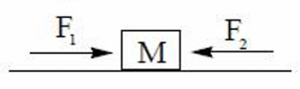
$A$ body of mass '$M$' is moving with a uniform speed of '$v$' on a frictionless horizontal surface under the influence of two forces $F_1$ and $F_2$ as shown in the figure. The net power of the system is
A
$(F_1-F_2) v$
B
$0.5(F_1+F_2) v$
C
$(F_1+F_2) v$
D
Zero
Solution
(D) Power is defined as the dot product of force and velocity,given by $P = \vec{F} \cdot \vec{v}$.
Since the body is moving with a uniform speed '$v$',the net force acting on the body must be zero according to Newton's first law of motion.
From the figure,the forces $F_1$ and $F_2$ act in opposite directions. Therefore,the net force $F_{net} = F_1 - F_2 = 0$.
The net power $P_{net}$ is the power delivered by the net force:
$P_{net} = F_{net} \cdot v = (F_1 - F_2) \cdot v$.
Since $F_1 = F_2$ for uniform motion,$P_{net} = 0 \cdot v = 0$.
Since the body is moving with a uniform speed '$v$',the net force acting on the body must be zero according to Newton's first law of motion.
From the figure,the forces $F_1$ and $F_2$ act in opposite directions. Therefore,the net force $F_{net} = F_1 - F_2 = 0$.
The net power $P_{net}$ is the power delivered by the net force:
$P_{net} = F_{net} \cdot v = (F_1 - F_2) \cdot v$.
Since $F_1 = F_2$ for uniform motion,$P_{net} = 0 \cdot v = 0$.
0 likesView Solution
204
PhysicsMediumMCQAP EAMCET · 2025
$A$ motor can pump $7560 \text{ kg}$ of water per hour from a well of depth $100 \text{ m}$. If the efficiency of the pump is $70 \%$, then the power of the pump is (Acceleration due to gravity $= 10 \text{ m s}^{-2}$) (in $\text{ kW}$)
A
$4$
B
$6$
C
$3$
D
$7$
Solution
(C) The mass of water pumped per hour is $m = 7560 \text{ kg}$.
The time taken is $t = 1 \text{ hour} = 3600 \text{ s}$.
The depth of the well is $h = 100 \text{ m}$.
The acceleration due to gravity is $g = 10 \text{ m s}^{-2}$.
The useful work done (output energy) per second is the power output $P_{\text{out}} = \frac{mgh}{t}$.
$P_{\text{out}} = \frac{7560 \times 10 \times 100}{3600} = \frac{7560000}{3600} = 2100 \text{ W} = 2.1 \text{ kW}$.
Given the efficiency $\eta = 70 \% = 0.7$, the power input $P_{\text{in}}$ is given by $\eta = \frac{P_{\text{out}}}{P_{\text{in}}}$.
$P_{\text{in}} = \frac{P_{\text{out}}}{\eta} = \frac{2.1 \text{ kW}}{0.7} = 3 \text{ kW}$.
Therefore, the power of the pump is $3 \text{ kW}$.
The time taken is $t = 1 \text{ hour} = 3600 \text{ s}$.
The depth of the well is $h = 100 \text{ m}$.
The acceleration due to gravity is $g = 10 \text{ m s}^{-2}$.
The useful work done (output energy) per second is the power output $P_{\text{out}} = \frac{mgh}{t}$.
$P_{\text{out}} = \frac{7560 \times 10 \times 100}{3600} = \frac{7560000}{3600} = 2100 \text{ W} = 2.1 \text{ kW}$.
Given the efficiency $\eta = 70 \% = 0.7$, the power input $P_{\text{in}}$ is given by $\eta = \frac{P_{\text{out}}}{P_{\text{in}}}$.
$P_{\text{in}} = \frac{P_{\text{out}}}{\eta} = \frac{2.1 \text{ kW}}{0.7} = 3 \text{ kW}$.
Therefore, the power of the pump is $3 \text{ kW}$.
0 likesView Solution
205
PhysicsMediumMCQAP EAMCET · 2025
If a force of $(6x^2 - 4x) \ N$ acts on a body of mass $10 \ kg$,then the work done by the force in displacing the body from $x = 2 \ m$ to $x = 4 \ m$ is: (in $J$)
A
$22$
B
$44$
C
$66$
D
$88$
Solution
(D) The work done $W$ by a variable force $F(x)$ is given by the integral $W = \int_{x_1}^{x_2} F(x) \ dx$.
Given $F(x) = 6x^2 - 4x$,$x_1 = 2 \ m$,and $x_2 = 4 \ m$.
$W = \int_{2}^{4} (6x^2 - 4x) \ dx$.
Integrating the expression: $W = [\frac{6x^3}{3} - \frac{4x^2}{2}]_{2}^{4} = [2x^3 - 2x^2]_{2}^{4}$.
Substituting the limits: $W = (2(4)^3 - 2(4)^2) - (2(2)^3 - 2(2)^2)$.
$W = (2(64) - 2(16)) - (2(8) - 2(4))$.
$W = (128 - 32) - (16 - 8)$.
$W = 96 - 8 = 88 \ J$.
Given $F(x) = 6x^2 - 4x$,$x_1 = 2 \ m$,and $x_2 = 4 \ m$.
$W = \int_{2}^{4} (6x^2 - 4x) \ dx$.
Integrating the expression: $W = [\frac{6x^3}{3} - \frac{4x^2}{2}]_{2}^{4} = [2x^3 - 2x^2]_{2}^{4}$.
Substituting the limits: $W = (2(4)^3 - 2(4)^2) - (2(2)^3 - 2(2)^2)$.
$W = (2(64) - 2(16)) - (2(8) - 2(4))$.
$W = (128 - 32) - (16 - 8)$.
$W = 96 - 8 = 88 \ J$.
0 likesView Solution
206
PhysicsEasyMCQAP EAMCET · 2025
If a force $\vec{F}=(3 \hat{i}-2 \hat{j}) \text{ N}$ acting on a body displaces it from point $(1 \text{ m}, 2 \text{ m})$ to point $(2 \text{ m}, 0 \text{ m})$,then the work done by the force is (in $\text{ J}$)
A
$5$
B
$6$
C
$4$
D
$7$
Solution
(D) The work done $W$ by a constant force $\vec{F}$ is given by the dot product of the force vector and the displacement vector $\vec{d}$.
Given $\vec{F} = (3 \hat{i} - 2 \hat{j}) \text{ N}$.
The initial position vector is $\vec{r}_1 = (1 \hat{i} + 2 \hat{j}) \text{ m}$.
The final position vector is $\vec{r}_2 = (2 \hat{i} + 0 \hat{j}) \text{ m}$.
The displacement vector $\vec{d} = \vec{r}_2 - \vec{r}_1 = (2-1) \hat{i} + (0-2) \hat{j} = (1 \hat{i} - 2 \hat{j}) \text{ m}$.
Work done $W = \vec{F} \cdot \vec{d} = (3 \hat{i} - 2 \hat{j}) \cdot (1 \hat{i} - 2 \hat{j})$.
$W = (3 \times 1) + (-2 \times -2) = 3 + 4 = 7 \text{ J}$.
Given $\vec{F} = (3 \hat{i} - 2 \hat{j}) \text{ N}$.
The initial position vector is $\vec{r}_1 = (1 \hat{i} + 2 \hat{j}) \text{ m}$.
The final position vector is $\vec{r}_2 = (2 \hat{i} + 0 \hat{j}) \text{ m}$.
The displacement vector $\vec{d} = \vec{r}_2 - \vec{r}_1 = (2-1) \hat{i} + (0-2) \hat{j} = (1 \hat{i} - 2 \hat{j}) \text{ m}$.
Work done $W = \vec{F} \cdot \vec{d} = (3 \hat{i} - 2 \hat{j}) \cdot (1 \hat{i} - 2 \hat{j})$.
$W = (3 \times 1) + (-2 \times -2) = 3 + 4 = 7 \text{ J}$.
0 likesView Solution
207
PhysicsMediumMCQAP EAMCET · 2025
If a position-dependent force $F(x) = (3x^2 - 2x + 7) \text{ N}$ acting on a body of mass $2 \text{ kg}$ displaces it from $x = 0 \text{ m}$ to $x = 5 \text{ m}$,then the work done by the force is: (in $J$)
A
$165$
B
$115$
C
$150$
D
$135$
Solution
(D) The work done $W$ by a variable force $F(x)$ is given by the integral of the force with respect to displacement:
$W = \int_{x_1}^{x_2} F(x) \, dx$
Given $F(x) = 3x^2 - 2x + 7$,$x_1 = 0 \text{ m}$,and $x_2 = 5 \text{ m}$.
$W = \int_{0}^{5} (3x^2 - 2x + 7) \, dx$
Integrating term by term:
$W = [x^3 - x^2 + 7x]_{0}^{5}$
Substitute the limits:
$W = (5^3 - 5^2 + 7(5)) - (0^3 - 0^2 + 7(0))$
$W = (125 - 25 + 35) - 0$
$W = 100 + 35 = 135 \text{ J}$.
Thus,the work done is $135 \text{ J}$.
$W = \int_{x_1}^{x_2} F(x) \, dx$
Given $F(x) = 3x^2 - 2x + 7$,$x_1 = 0 \text{ m}$,and $x_2 = 5 \text{ m}$.
$W = \int_{0}^{5} (3x^2 - 2x + 7) \, dx$
Integrating term by term:
$W = [x^3 - x^2 + 7x]_{0}^{5}$
Substitute the limits:
$W = (5^3 - 5^2 + 7(5)) - (0^3 - 0^2 + 7(0))$
$W = (125 - 25 + 35) - 0$
$W = 100 + 35 = 135 \text{ J}$.
Thus,the work done is $135 \text{ J}$.
0 likesView Solution
208
PhysicsEasyMCQAP EAMCET · 2025
If a constant force of $(2 \hat{i} + 3 \hat{j} + 4 \hat{k}) \text{ N}$ acting on a body of mass $5 \text{ kg}$ displaces it from $(3 \hat{i} - 4 \hat{k}) \text{ m}$ to $(2 \hat{i} + 2 \hat{j} + 3 \hat{k}) \text{ m}$, then the work done by the force on the body is (in $\text{ J}$)
A
$32$
B
$28$
C
$36$
D
$44$
Solution
(A) The work done $W$ by a constant force $\vec{F}$ is given by the dot product of the force vector and the displacement vector $\vec{d}$.
Given force $\vec{F} = (2 \hat{i} + 3 \hat{j} + 4 \hat{k}) \text{ N}$.
The initial position vector is $\vec{r}_1 = (3 \hat{i} - 4 \hat{k}) \text{ m}$.
The final position vector is $\vec{r}_2 = (2 \hat{i} + 2 \hat{j} + 3 \hat{k}) \text{ m}$.
The displacement vector $\vec{d} = \vec{r}_2 - \vec{r}_1 = (2 - 3) \hat{i} + (2 - 0) \hat{j} + (3 - (-4)) \hat{k} = (-1 \hat{i} + 2 \hat{j} + 7 \hat{k}) \text{ m}$.
Work done $W = \vec{F} \cdot \vec{d} = (2 \hat{i} + 3 \hat{j} + 4 \hat{k}) \cdot (-1 \hat{i} + 2 \hat{j} + 7 \hat{k})$.
$W = (2 \times -1) + (3 \times 2) + (4 \times 7) = -2 + 6 + 28 = 32 \text{ J}$.
Given force $\vec{F} = (2 \hat{i} + 3 \hat{j} + 4 \hat{k}) \text{ N}$.
The initial position vector is $\vec{r}_1 = (3 \hat{i} - 4 \hat{k}) \text{ m}$.
The final position vector is $\vec{r}_2 = (2 \hat{i} + 2 \hat{j} + 3 \hat{k}) \text{ m}$.
The displacement vector $\vec{d} = \vec{r}_2 - \vec{r}_1 = (2 - 3) \hat{i} + (2 - 0) \hat{j} + (3 - (-4)) \hat{k} = (-1 \hat{i} + 2 \hat{j} + 7 \hat{k}) \text{ m}$.
Work done $W = \vec{F} \cdot \vec{d} = (2 \hat{i} + 3 \hat{j} + 4 \hat{k}) \cdot (-1 \hat{i} + 2 \hat{j} + 7 \hat{k})$.
$W = (2 \times -1) + (3 \times 2) + (4 \times 7) = -2 + 6 + 28 = 32 \text{ J}$.
0 likesView Solution
209
PhysicsEasyMCQAP EAMCET · 2025
If a force $(3 \hat{i} + 2 \hat{j} + 5 \hat{k}) \text{ N}$ acting on a body displaces it through $(2 \hat{i} + 2 \hat{j} + 1 \hat{k}) \text{ m}$,then the work done by the force on the body is (in $J$)
A
$40$
B
$20$
C
$15$
D
$25$
Solution
(C) The work done $W$ by a constant force $\vec{F}$ during a displacement $\vec{d}$ is given by the dot product of the force and displacement vectors:
$W = \vec{F} \cdot \vec{d}$
Given:
$\vec{F} = (3 \hat{i} + 2 \hat{j} + 5 \hat{k}) \text{ N}$
$\vec{d} = (2 \hat{i} + 2 \hat{j} + 1 \hat{k}) \text{ m}$
Calculating the dot product:
$W = (3 \hat{i} + 2 \hat{j} + 5 \hat{k}) \cdot (2 \hat{i} + 2 \hat{j} + 1 \hat{k})$
$W = (3 \times 2) + (2 \times 2) + (5 \times 1)$
$W = 6 + 4 + 5$
$W = 15 \text{ J}$
Therefore,the work done is $15 \text{ J}$.
$W = \vec{F} \cdot \vec{d}$
Given:
$\vec{F} = (3 \hat{i} + 2 \hat{j} + 5 \hat{k}) \text{ N}$
$\vec{d} = (2 \hat{i} + 2 \hat{j} + 1 \hat{k}) \text{ m}$
Calculating the dot product:
$W = (3 \hat{i} + 2 \hat{j} + 5 \hat{k}) \cdot (2 \hat{i} + 2 \hat{j} + 1 \hat{k})$
$W = (3 \times 2) + (2 \times 2) + (5 \times 1)$
$W = 6 + 4 + 5$
$W = 15 \text{ J}$
Therefore,the work done is $15 \text{ J}$.
0 likesView Solution
210
PhysicsMediumMCQAP EAMCET · 2025
The power required for an engine to maintain a constant speed of $50 \,m \,s^{-1}$ for a train of mass $3 \times 10^6 \,kg$ on rough rails is (The coefficient of kinetic friction between the rails and wheels of the train is $0.05$ and acceleration due to gravity $= 10 \,m \,s^{-2}$).
A
$75 \,MW$
B
$40 \,MW$
C
$75 \,kW$
D
$65 \,MW$
Solution
(A) To maintain a constant speed, the engine must exert a force equal to the frictional force acting on the train.
The frictional force $F_f$ is given by $F_f = \mu N$, where $\mu$ is the coefficient of kinetic friction and $N$ is the normal force.
Since the train is on a horizontal track, $N = mg$.
Given: $m = 3 \times 10^6 \,kg$, $\mu = 0.05$, $g = 10 \,m \,s^{-2}$, and velocity $v = 50 \,m \,s^{-1}$.
$F_f = 0.05 \times (3 \times 10^6 \,kg) \times (10 \,m \,s^{-2}) = 0.05 \times 3 \times 10^7 \,N = 1.5 \times 10^6 \,N$.
The power $P$ required is given by $P = F_f \times v$.
$P = (1.5 \times 10^6 \,N) \times (50 \,m \,s^{-1}) = 75 \times 10^6 \,W = 75 \,MW$.
The frictional force $F_f$ is given by $F_f = \mu N$, where $\mu$ is the coefficient of kinetic friction and $N$ is the normal force.
Since the train is on a horizontal track, $N = mg$.
Given: $m = 3 \times 10^6 \,kg$, $\mu = 0.05$, $g = 10 \,m \,s^{-2}$, and velocity $v = 50 \,m \,s^{-1}$.
$F_f = 0.05 \times (3 \times 10^6 \,kg) \times (10 \,m \,s^{-2}) = 0.05 \times 3 \times 10^7 \,N = 1.5 \times 10^6 \,N$.
The power $P$ required is given by $P = F_f \times v$.
$P = (1.5 \times 10^6 \,N) \times (50 \,m \,s^{-1}) = 75 \times 10^6 \,W = 75 \,MW$.
0 likesView Solution
Vedclass Products
For Students
Vedclass Test Series
Mock tests in real AP EAMCET style covering Physics with performance analysis. 5-day free trial.
Start Free TrialFor Teachers
Exam Paper Generator
Generate Set A/B/C/D Physics papers from 7.5L+ questions in 2 minutes. 3 chapters free.
Try FreeFor Institutes
Online Exam Module
Run live AP EAMCET mock exams with unlimited students, 360° analytics & white-label branding.
See DemoFrequently Asked Questions
How many Physics questions are in AP EAMCET 2025?
There are 399 Physics questions from the AP EAMCET 2025 paper on Vedclass, each with a detailed step-by-step solution in English.
Are AP EAMCET 2025 Physics solutions available in English?
Yes. All solutions on this page are in English. You can also switch to English or Hindi using the language buttons above the questions.
Can I practice AP EAMCET 2025 Physics as a timed test?
Yes. Use the Vedclass Test Series to attempt a full AP EAMCET mock test covering Physics with time limits and instant score analysis.
Can teachers create Physics papers from AP EAMCET previous year questions?
Yes. The Vedclass Exam Paper Generator lets teachers mix AP EAMCET Physics questions and generate Set A/B/C/D papers in minutes.
For Teachers & Institutes
Build a Custom Physics Paper
Pick AP EAMCET 2025 Physics questions, set difficulty, and generate Set A/B/C/D in 2 minutes.