
BiologyQ1–100 of 172 questions
Page 1 of 2 · English
1
BiologyMediumMCQAIPMT · 2011
Which one of the following animals is correctly matched with its particular taxonomic category?
A
Tiger - Tigris, species
B
Cuttlefish - Mollusca, class
C
Humans - Primata, family
D
Housefly - Musca, order
Solution
(A) The correct answer is $A$.
$1$. The binomial nomenclature system, which uses a two-part scientific name, was devised by Carolus Linnaeus.
$2$. In this system, the first part is the genus and the second part is the species.
$3$. The zoological name of the tiger is $Panthera \, tigris$. Here, $Panthera$ is the genus and $tigris$ is the species.
$4$. Therefore, $Tiger - \, tigris, \, species$ is the correct match.
$5$. For other options: Cuttlefish belongs to the phylum $Mollusca$, not class. Humans belong to the order $Primata$, not family. Housefly belongs to the genus $Musca$, not order.
$1$. The binomial nomenclature system, which uses a two-part scientific name, was devised by Carolus Linnaeus.
$2$. In this system, the first part is the genus and the second part is the species.
$3$. The zoological name of the tiger is $Panthera \, tigris$. Here, $Panthera$ is the genus and $tigris$ is the species.
$4$. Therefore, $Tiger - \, tigris, \, species$ is the correct match.
$5$. For other options: Cuttlefish belongs to the phylum $Mollusca$, not class. Humans belong to the order $Primata$, not family. Housefly belongs to the genus $Musca$, not order.
0 likesView Solution
2
BiologyMediumMCQAIPMT · 2011
Which one of the following aspects is an exclusive characteristic of living things?
A
Isolated metabolic reactions occur in vitro
B
Increase in mass from inside only
C
Perception of events happening in the environment and their memory.
D
Increase in mass by accumulation of material both on surface as well as internally.
Solution
(C) The correct answer is $C$.
$1$. Isolated metabolic reactions occurring in vitro are not living things themselves,but they are living reactions.
$2$. Increase in mass is observed in both living and non-living objects (e.g.,mountains,boulders,and sand mounds grow by accumulation of material on the surface).
$3$. Consciousness,which is the ability to sense the environment and respond to environmental stimuli,is the defining property of living organisms. Humans are the only organisms aware of themselves,i.e.,they have self-consciousness and memory of events.
$1$. Isolated metabolic reactions occurring in vitro are not living things themselves,but they are living reactions.
$2$. Increase in mass is observed in both living and non-living objects (e.g.,mountains,boulders,and sand mounds grow by accumulation of material on the surface).
$3$. Consciousness,which is the ability to sense the environment and respond to environmental stimuli,is the defining property of living organisms. Humans are the only organisms aware of themselves,i.e.,they have self-consciousness and memory of events.
0 likesView Solution
3
BiologyMediumMCQAIPMT · 2011
In eubacteria,a cellular component that resembles eukaryotic cell is
A
plasma membrane
B
nucleus
C
ribosomes
D
cell wall
Solution
(A) The plasma membrane of eubacteria is structurally and functionally similar to the plasma membrane of eukaryotic cells,as both consist of a phospholipid bilayer with embedded proteins.
In contrast,the nucleus is absent in eubacteria (prokaryotes) while present in eukaryotes.
Ribosomes in eubacteria are $70S$ type,whereas in eukaryotes,they are $80S$ type (in the cytoplasm).
The cell wall of eubacteria is composed of peptidoglycan,whereas eukaryotic cell walls (if present,like in plants) are composed of cellulose.
In contrast,the nucleus is absent in eubacteria (prokaryotes) while present in eukaryotes.
Ribosomes in eubacteria are $70S$ type,whereas in eukaryotes,they are $80S$ type (in the cytoplasm).
The cell wall of eubacteria is composed of peptidoglycan,whereas eukaryotic cell walls (if present,like in plants) are composed of cellulose.
0 likesView Solution
4
BiologyEasyMCQAIPMT · 2011
Which one of the following organisms is not an eukaryote?
A
Paramecium caudatum
B
Escherichia coli
C
Euglena viridis
D
Amoeba proteus
Solution
(B) : $Escherichia \ coli$ (bacterium) is not an example of a eukaryotic cell. It is a typical example of a prokaryotic cell,which lacks a membrane-bound nucleus and other membrane-bound organelles.
0 likesView Solution
5
BiologyMediumMCQAIPMT · 2011
Which one of the following is incorrectly matched?
A
Root pressure - Guttation
B
Puccinia - Smut
C
Root - Exarch protoxylem
D
Cassia - Imbricate aestivation
Solution
(B) $Puccinia$ is a genus of fungi that causes rust disease in plants,not smut. Smut diseases are typically caused by fungi of the genus $Ustilago$. Therefore,the pair $Puccinia - Smut$ is incorrectly matched. Root pressure is responsible for guttation,roots exhibit exarch protoxylem,and $Cassia$ shows imbricate aestivation,making the other options correct.
0 likesView Solution
6
BiologyMediumMCQAIPMT · 2011
The pathogen $Microsporum$,responsible for ringworm disease in humans,belongs to the same kingdom of organisms as that of
A
$Taenia$,a tapeworm
B
$Wuchereria$,a filarial worm
C
$Rhizopus$,a mould
D
$Ascaris$,a round worm
Solution
(C) : The pathogen $Microsporum$ is a genus of Kingdom $Fungi$ that causes diseases of the skin and hair in humans and animals like dogs,cats,and monkeys.
Ringworm is caused by dermatophyte fungi,specifically species of $Microsporum$,$Trichophyton$,and $Epidermophyton$.
$Rhizopus$,a black bread mould,belongs to the group $Zygomycetes$ of Kingdom $Fungi$.
Ringworm is caused by dermatophyte fungi,specifically species of $Microsporum$,$Trichophyton$,and $Epidermophyton$.
$Rhizopus$,a black bread mould,belongs to the group $Zygomycetes$ of Kingdom $Fungi$.
0 likesView Solution
7
BiologyMediumMCQAIPMT · 2011
The gametophyte is not an independent,free-living generation in
A
Polytrichum
B
Adiantum
C
Marchantia
D
Pinus
Solution
(D) : In gymnosperms (like $Pinus$),the male and female gametophytes do not have an independent,free-living existence.
They remain within the sporangia retained on the sporophytes,$i.e.$,the female gametophyte (within the megasporangium) and the male gametophyte (within the microsporangium).
They remain within the sporangia retained on the sporophytes,$i.e.$,the female gametophyte (within the megasporangium) and the male gametophyte (within the microsporangium).
0 likesView Solution
8
BiologyMediumMCQAIPMT · 2011
Compared with the gametophytes of the bryophytes,the gametophytes of vascular plants tend to be
A
smaller but to have larger sex organs
B
larger but to have smaller sex organs
C
larger and to have larger sex organs
D
smaller and to have smaller sex organs.
Solution
(D) : In bryophytes,the dominant phase of the life cycle is the gametophytic plant body.
In contrast,vascular plants (pteridophytes,gymnosperms,and angiosperms) have a sporophytic plant body as the dominant phase of their life cycle.
Consequently,the gametophyte in vascular plants is highly reduced,smaller in size,and possesses smaller sex organs (antheridia and archegonia) compared to the relatively larger and more independent gametophytes of bryophytes.
In contrast,vascular plants (pteridophytes,gymnosperms,and angiosperms) have a sporophytic plant body as the dominant phase of their life cycle.
Consequently,the gametophyte in vascular plants is highly reduced,smaller in size,and possesses smaller sex organs (antheridia and archegonia) compared to the relatively larger and more independent gametophytes of bryophytes.
0 likesView Solution
9
BiologyEasyMCQAIPMT · 2011
Archegoniophore is present in
A
Marchantia
B
Chara
C
Adiantum
D
Funaria
Solution
(A) $Marchantia$ is a dioecious plant.
Male plants bear antheridiophores,and female plants bear archegoniophores.
Antheridiophores consist of a stalk and a disc-like portion called a receptacle.
Archegoniophore is composed of a stalk and a disc-like receptacle at its distal end.
Male plants bear antheridiophores,and female plants bear archegoniophores.
Antheridiophores consist of a stalk and a disc-like portion called a receptacle.
Archegoniophore is composed of a stalk and a disc-like receptacle at its distal end.
0 likesView Solution
10
BiologyMediumMCQAIPMT · 2011
$A$ prokaryotic autotrophic nitrogen-fixing symbiont is found in
A
Alnus
B
Cycas
C
Cicer
D
Pisum
Solution
(B) : $Cycas$ forms a symbiotic association with autotrophic nitrogen-fixing cyanobacteria (such as $Anabaena$ or $Nostoc$).
$Cycas$ provides fixed carbon and a stable environment to the cyanobacteria in exchange for fixed nitrogen.
These cyanobacteria are endosymbionts and live within the specialized roots of $Cycas$.
In addition to normal roots,$Cycas$ develops specialized symbiotic organs called coralloid roots,which house these cyanobacteria.
$Cycas$ provides fixed carbon and a stable environment to the cyanobacteria in exchange for fixed nitrogen.
These cyanobacteria are endosymbionts and live within the specialized roots of $Cycas$.
In addition to normal roots,$Cycas$ develops specialized symbiotic organs called coralloid roots,which house these cyanobacteria.
0 likesView Solution
11
BiologyMediumMCQAIPMT · 2011
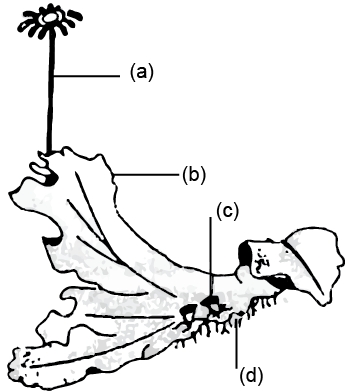
Examine the figure given below and select the correct option identifying all the four parts $(a, b, c$ and $d)$ correctly.
A
$(a)$-Archegoniophore,$(b)$-Female thallus,$(c)$-Gemma cup,$(d)$-Rhizoids
B
$(a)$-Archegoniophore,$(b)$-Female thallus,$(c)$-Bud,$(d)$-Foot
C
$(a)$-Seta,$(b)$-Sporophyte,$(c)$-Protonema,$(d)$-Rhizoids
D
$(a)$-Antheridiophore,$(b)$-Male thallus,$(c)$-Globule,$(d)$-Roots
Solution
(A) The given figure represents the female thallus of $Marchantia$,a liverwort belonging to the group Bryophyta.
In the diagram:
$(a)$ represents the Archegoniophore,which is the stalk bearing the female sex organs (archegonia).
$(b)$ represents the Female thallus,the main plant body.
$(c)$ represents the Gemma cup,which is a structure involved in asexual reproduction.
$(d)$ represents the Rhizoids,which are root-like structures that help in anchorage and absorption of water and minerals.
Therefore,the correct option is $(a)$.
In the diagram:
$(a)$ represents the Archegoniophore,which is the stalk bearing the female sex organs (archegonia).
$(b)$ represents the Female thallus,the main plant body.
$(c)$ represents the Gemma cup,which is a structure involved in asexual reproduction.
$(d)$ represents the Rhizoids,which are root-like structures that help in anchorage and absorption of water and minerals.
Therefore,the correct option is $(a)$.
0 likesView Solution
12
BiologyMediumMCQAIPMT · 2011
$Selaginella$ and $Salvinia$ are considered to represent a significant step toward the evolution of seed habit because
A
female gametophyte is free and gets dispersed like seeds.
B
female gametophyte lacks archegonia.
C
megaspores possess endosperm and embryo surrounded by seed coat.
D
embryo develops in female gametophyte which is retained on parent sporophyte.
Solution
(D) : In the majority of pteridophytes,all spores are of similar kinds; such plants are called homosporous.
Genera like $Selaginella$ and $Salvinia$,which produce two kinds of spores,macro (large) and micro (small) spores,are known as heterosporous.
The megaspores and microspores germinate and give rise to female and male gametophytes,respectively.
The female gametophytes in these plants are retained on the parent sporophytes for variable periods.
The development of the zygotes into young embryos takes place within the female gametophytes.
This event is a precursor to the seed habit,which is considered an important step in evolution.
Genera like $Selaginella$ and $Salvinia$,which produce two kinds of spores,macro (large) and micro (small) spores,are known as heterosporous.
The megaspores and microspores germinate and give rise to female and male gametophytes,respectively.
The female gametophytes in these plants are retained on the parent sporophytes for variable periods.
The development of the zygotes into young embryos takes place within the female gametophytes.
This event is a precursor to the seed habit,which is considered an important step in evolution.
0 likesView Solution
13
BiologyMediumMCQAIPMT · 2011
Consider the following four statements and determine which are correct or incorrect.
$A.$ The sporophyte in liverworts is more elaborate than that in mosses.
$B.$ Salvinia is heterosporous.
$C.$ The life-cycle in all seed-bearing plants is diplontic.
$D.$ In Pinus,male and female cones are borne on different trees.
Which two statements are incorrect?
$A.$ The sporophyte in liverworts is more elaborate than that in mosses.
$B.$ Salvinia is heterosporous.
$C.$ The life-cycle in all seed-bearing plants is diplontic.
$D.$ In Pinus,male and female cones are borne on different trees.
Which two statements are incorrect?
A
$A$ and $C$
B
$A$ and $D$
C
$B$ and $C$
D
$A$ and $B$
Solution
(B) Statement $A$ is incorrect because the sporophyte in mosses is more elaborate than that in liverworts.
Statement $B$ is correct because Salvinia is a heterosporous pteridophyte.
Statement $C$ is correct because all seed-bearing plants (gymnosperms and angiosperms) exhibit a diplontic life cycle.
Statement $D$ is incorrect because Pinus is monoecious,meaning male and female cones are borne on the same tree.
Therefore,statements $A$ and $D$ are the two incorrect statements.
Statement $B$ is correct because Salvinia is a heterosporous pteridophyte.
Statement $C$ is correct because all seed-bearing plants (gymnosperms and angiosperms) exhibit a diplontic life cycle.
Statement $D$ is incorrect because Pinus is monoecious,meaning male and female cones are borne on the same tree.
Therefore,statements $A$ and $D$ are the two incorrect statements.
0 likesView Solution
14
BiologyMediumMCQAIPMT · 2011
What will you look for to identify the sex of the following?
A
Female $Ascaris$ - sharply curved posterior end
B
Male frog - a copulatory pad on the first digit of the hind limb
C
Female cockroach - anal cerci
D
Male shark - claspers borne on pelvic fins
Solution
(D) is the correct answer.
In $Ascaris$,the female has a straight tail end,while the male has a ventrally curved tail end.
Anal cerci are present in both male and female cockroaches,whereas anal styles are present only in males.
In frogs,the nuptial or copulatory pad is found on the first digit of the $forelimb$ (not hind limb) in males,which helps in gripping the female during mating.
In male sharks,the pelvic fins are modified into structures called claspers,which are used for copulation. Thus,the presence of claspers is a reliable feature to identify a male shark.
In $Ascaris$,the female has a straight tail end,while the male has a ventrally curved tail end.
Anal cerci are present in both male and female cockroaches,whereas anal styles are present only in males.
In frogs,the nuptial or copulatory pad is found on the first digit of the $forelimb$ (not hind limb) in males,which helps in gripping the female during mating.
In male sharks,the pelvic fins are modified into structures called claspers,which are used for copulation. Thus,the presence of claspers is a reliable feature to identify a male shark.
0 likesView Solution
15
BiologyMediumMCQAIPMT · 2011
Which one of the following groups of animals is correctly matched with its characteristic feature without any exception?
A
Reptilia : possess $3$-chambered heart with an incompletely divided ventricle
B
Chordata : possess a mouth with an upper and a lower jaw
C
Chondrichthyes : possess cartilaginous endoskeleton
D
Mammalia : give birth to young ones
Solution
(C) The correct option is $C$.
$A$: Reptiles like crocodiles have a $4$-chambered heart,so this is not true for all reptiles.
$B$: Chordates include Agnatha (jawless vertebrates),so this is not true for all chordates.
$C$: All members of the class Chondrichthyes are characterized by a cartilaginous endoskeleton. This is a defining feature without exception.
$D$: Mammals like Ornithorhynchus (platypus) and Tachyglossus (echidna) are oviparous (egg-laying),so this is not true for all mammals.
$A$: Reptiles like crocodiles have a $4$-chambered heart,so this is not true for all reptiles.
$B$: Chordates include Agnatha (jawless vertebrates),so this is not true for all chordates.
$C$: All members of the class Chondrichthyes are characterized by a cartilaginous endoskeleton. This is a defining feature without exception.
$D$: Mammals like Ornithorhynchus (platypus) and Tachyglossus (echidna) are oviparous (egg-laying),so this is not true for all mammals.
0 likesView Solution
16
BiologyMediumMCQAIPMT · 2011
In which one of the following is the genus name,its two characters,and its class/phylum correctly matched?
| Genus Name | Two Characters $\&$ Class/Phylum |
|---|---|
| $A$. $Ascaris$ | $(i)$ Body segmented,$(ii)$ Males and females distinct; Phylum: $Annelida$ |
| $B$. $Salamandra$ | $(i)$ $A$ tympanum represents ear,$(ii)$ Fertilization is external; Class: $Amphibia$ |
| $C$. $Pteropus$ | $(i)$ Skin possesses hair,$(ii)$ Oviparous; Class: $Mammalia$ |
| $D$. $Aurelia$ | $(i)$ Cnidoblasts present,$(ii)$ Organ level of organization; Phylum: $Coelenterata$ |
A
$A$ and $B$
B
$B$ and $C$
C
$C$ and $D$
D
None of these
Solution
(D) None of the given options is entirely correct.
$1$. $Ascaris$ belongs to Phylum $Aschelminthes$ $(Nematoda)$. They have an unsegmented body and are dioecious (males and females are distinct). The table incorrectly lists the phylum as $Annelida$.
$2$. $Salamandra$ belongs to Class $Amphibia$. While they are amphibians,fertilization is typically internal in most salamanders. The table incorrectly lists fertilization as external.
$3$. $Pteropus$ (flying fox) belongs to Class $Mammalia$. Mammals possess hair and are viviparous (not oviparous). The table incorrectly lists them as oviparous.
$4$. $Aurelia$ belongs to Phylum $Coelenterata$ $(Cnidaria)$. They possess cnidoblasts,but they exhibit tissue level of organization,not organ level. The table incorrectly lists organ level of organization.
$1$. $Ascaris$ belongs to Phylum $Aschelminthes$ $(Nematoda)$. They have an unsegmented body and are dioecious (males and females are distinct). The table incorrectly lists the phylum as $Annelida$.
$2$. $Salamandra$ belongs to Class $Amphibia$. While they are amphibians,fertilization is typically internal in most salamanders. The table incorrectly lists fertilization as external.
$3$. $Pteropus$ (flying fox) belongs to Class $Mammalia$. Mammals possess hair and are viviparous (not oviparous). The table incorrectly lists them as oviparous.
$4$. $Aurelia$ belongs to Phylum $Coelenterata$ $(Cnidaria)$. They possess cnidoblasts,but they exhibit tissue level of organization,not organ level. The table incorrectly lists organ level of organization.
0 likesView Solution
17
BiologyMediumMCQAIPMT · 2011
Which one of the following statements is totally wrong about the occurrence of notochord,while the other three are correct?
A
It is present only in larval tail in ascidian.
B
It is replaced by a vertebral column in adult frog.
C
It is absent throughout life in humans from the very beginning.
D
It is present throughout life in Amphioxus.
Solution
(C) The correct answer is $C$.
$A$: In Ascidians (Urochordata),the notochord is present only in the larval tail. This statement is correct.
$B$: In adult frogs (Vertebrata),the notochord is replaced by a vertebral column. This statement is correct.
$C$: Humans are chordates. In all chordates,the notochord is present at least during the early embryonic stage. Therefore,saying it is absent from the very beginning in humans is incorrect.
$D$: In Amphioxus (Cephalochordata),the notochord extends from the head to the tail region and persists throughout their life. This statement is correct.
$A$: In Ascidians (Urochordata),the notochord is present only in the larval tail. This statement is correct.
$B$: In adult frogs (Vertebrata),the notochord is replaced by a vertebral column. This statement is correct.
$C$: Humans are chordates. In all chordates,the notochord is present at least during the early embryonic stage. Therefore,saying it is absent from the very beginning in humans is incorrect.
$D$: In Amphioxus (Cephalochordata),the notochord extends from the head to the tail region and persists throughout their life. This statement is correct.
0 likesView Solution
18
BiologyMediumMCQAIPMT · 2011
Consider the following four statements $(A-D)$ related to the common frog $Rana$ $tigrina$,and select the correct option stating which ones are true $(T)$ and which ones are false $(F)$.
Statements:
$A.$ On dry land it would die due to lack of $O_2$ if its mouth is forcibly kept closed for a few days.
$B.$ It has a four-chambered heart.
$C.$ On dry land it turns uricotelic from ureotelic.
$D.$ Its life-history is carried out in pond water.
Statements:
$A.$ On dry land it would die due to lack of $O_2$ if its mouth is forcibly kept closed for a few days.
$B.$ It has a four-chambered heart.
$C.$ On dry land it turns uricotelic from ureotelic.
$D.$ Its life-history is carried out in pond water.
A
$(A)-T, (B)-T, (C)-F, (D)-F$
B
$(A)-F, (B)-F, (C)-T, (D)-T$
C
$(A)-F, (B)-T, (C)-T, (D)-F$
D
None of these
Solution
(D) The correct evaluation of the statements is as follows:
$A.$ False: Frogs perform cutaneous respiration (through skin) in addition to pulmonary respiration. Even if the mouth is kept closed,they can survive by breathing through their moist skin.
$B.$ False: The heart of a frog is three-chambered,consisting of two atria and one ventricle.
$C.$ False: Frogs are ureotelic (excrete urea) and do not change their mode of nitrogenous waste excretion to uricotelic (excreting uric acid) on land.
$D.$ True: The life cycle of a frog involves external fertilization in water,followed by the development of aquatic larvae (tadpoles) which eventually undergo metamorphosis to become adults.
Thus,the correct sequence is $(A)-F, (B)-F, (C)-F, (D)-T$. Since this sequence is not provided in the options,the correct choice is 'None of these'.
$A.$ False: Frogs perform cutaneous respiration (through skin) in addition to pulmonary respiration. Even if the mouth is kept closed,they can survive by breathing through their moist skin.
$B.$ False: The heart of a frog is three-chambered,consisting of two atria and one ventricle.
$C.$ False: Frogs are ureotelic (excrete urea) and do not change their mode of nitrogenous waste excretion to uricotelic (excreting uric acid) on land.
$D.$ True: The life cycle of a frog involves external fertilization in water,followed by the development of aquatic larvae (tadpoles) which eventually undergo metamorphosis to become adults.
Thus,the correct sequence is $(A)-F, (B)-F, (C)-F, (D)-T$. Since this sequence is not provided in the options,the correct choice is 'None of these'.
0 likesView Solution
19
BiologyMediumMCQAIPMT · 2011
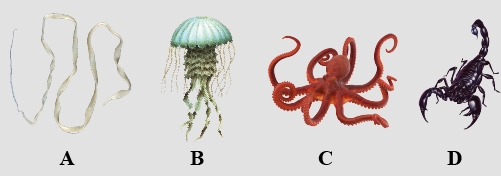
The figures $(A-D)$ show four animals. Select the correct option with respect to a common characteristic of two of these animals.
A
$(A)$ and $(D)$ respire mainly through body wall.
B
$(B)$ and $(C)$ show radial symmetry.
C
$(A)$ and $(B)$ have cnidoblasts for self-defence.
D
$(C)$ and $(D)$ have a true coelom.
Solution
(D) The animals shown are: $(A)$ Tapeworm (Platyhelminthes),$(B)$ Jellyfish (Cnidaria),$(C)$ Octopus (Mollusca),and $(D)$ Scorpion (Arthropoda).
$(A)$ Tapeworm is acoelomate.
$(B)$ Jellyfish is diploblastic and acoelomate.
$(C)$ Octopus is a mollusc and $(D)$ Scorpion is an arthropod. Both molluscs and arthropods are eucoelomates (possess a true coelom).
Therefore,the correct option is $(D)$.
$(A)$ Tapeworm is acoelomate.
$(B)$ Jellyfish is diploblastic and acoelomate.
$(C)$ Octopus is a mollusc and $(D)$ Scorpion is an arthropod. Both molluscs and arthropods are eucoelomates (possess a true coelom).
Therefore,the correct option is $(D)$.
0 likesView Solution
20
BiologyEasyMCQAIPMT · 2011
Ureters act as urinogenital ducts in
A
human males
B
human females
C
both male and female frogs
D
male frogs
Solution
(D) The correct answer is $D$.
In male frogs,the ureters serve as urinogenital ducts.
These ducts emerge from the kidneys and transport both urine and sperms to the cloaca.
In contrast,in female frogs,the ureters carry only urine,while the ova are transported through separate oviducts.
In male frogs,the ureters serve as urinogenital ducts.
These ducts emerge from the kidneys and transport both urine and sperms to the cloaca.
In contrast,in female frogs,the ureters carry only urine,while the ova are transported through separate oviducts.
0 likesView Solution
21
BiologyMediumMCQAIPMT · 2011
Which one of the following statements is correct?
A
In tomato,fruit is a capsule.
B
Seeds of orchids have oil-rich endosperm.
C
Placentation in primrose is basal.
D
Flower of tulip is a modified shoot.
Solution
(D) : $A$ flower is defined as a modified shoot wherein the shoot apical meristem changes into a floral meristem. Internodes do not elongate and the axis gets condensed. The apex produces different kinds of floral appendages laterally at successive nodes instead of leaves. Thus,the flower is a modified shoot. In tomato,the fruit is a berry. Orchid seeds are non-endospermic (exalbuminous). Placentation in primrose is free-central.
0 likesView Solution
22
BiologyMediumMCQAIPMT · 2011
Flowers are zygomorphic in
A
mustard
B
gulmohur
C
tomato
D
Datura
Solution
(B) : Flowers of gulmohur exhibit bilateral symmetry,which means they can be divided into two identical halves only in one particular vertical plane. Therefore,they are classified as zygomorphic. In contrast,Datura,mustard,and tomato possess actinomorphic flowers,which exhibit radial symmetry and can be divided into two identical halves in any radial plane passing through the center.
0 likesView Solution
23
BiologyEasyMCQAIPMT · 2011
The ovary is half inferior in flowers of
A
peach
B
cucumber
C
cotton
D
guava
Solution
(A) In perigynous flowers,the gynoecium is situated in the centre and other parts of the flower are located on the rim of the thalamus almost at the same level.
In this condition,the ovary is said to be half inferior.
Examples of perigynous flowers include $plum$,$rose$,and $peach$.
Therefore,the correct option is $A$.
In this condition,the ovary is said to be half inferior.
Examples of perigynous flowers include $plum$,$rose$,and $peach$.
Therefore,the correct option is $A$.
0 likesView Solution
24
BiologyMediumMCQAIPMT · 2011
$A$ drupe develops in
A
mango
B
wheat
C
pea
D
tomato
Solution
(A) : Drupe is a fleshy fruit that develops from either one or several fused carpels and contains one or many seeds. The seeds are enclosed by the hard protective endocarp (pericarp) of the fruit,$e.g.$,mango. In mango,the pericarp is well differentiated into an outer thin epicarp,a middle fleshy edible mesocarp,and an inner stony hard endocarp.
0 likesView Solution
25
BiologyMediumMCQAIPMT · 2011
Which one of the following figures represents the placentation in Dianthus?
A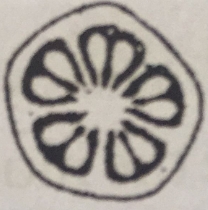
B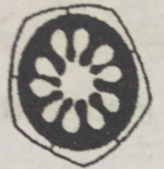
C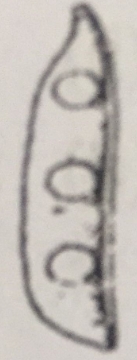
D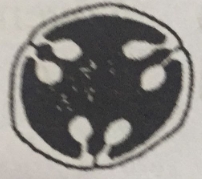
Solution
(B) The correct answer is $B$.
In $Dianthus$,the type of placentation is free central.
In free central placentation,the ovary is unilocular (single-chambered) and the ovules are borne on a central axis that is not connected to the ovary wall by septa.
Figure $B$ illustrates this arrangement,where the ovules are attached to a central column within a single-chambered ovary,which is characteristic of the family $Caryophyllaceae$ (e.g.,$Dianthus$ and $Primrose$).
In $Dianthus$,the type of placentation is free central.
In free central placentation,the ovary is unilocular (single-chambered) and the ovules are borne on a central axis that is not connected to the ovary wall by septa.
Figure $B$ illustrates this arrangement,where the ovules are attached to a central column within a single-chambered ovary,which is characteristic of the family $Caryophyllaceae$ (e.g.,$Dianthus$ and $Primrose$).
0 likesView Solution
26
BiologyMediumMCQAIPMT · 2011
Whorled,simple leaves with reticulate venation are present in
A
Calotropis
B
Neem
C
China rose
D
Alstonia
Solution
(D) The correct answer is $D$.
In $Alstonia$,multiple leaves arise from a single node,which is known as whorled phyllotaxy.
These leaves are simple,leathery,and exhibit reticulate venation.
In contrast,$Calotropis$ shows opposite phyllotaxy,while $Neem$ and $China$ $rose$ show alternate phyllotaxy.
In $Alstonia$,multiple leaves arise from a single node,which is known as whorled phyllotaxy.
These leaves are simple,leathery,and exhibit reticulate venation.
In contrast,$Calotropis$ shows opposite phyllotaxy,while $Neem$ and $China$ $rose$ show alternate phyllotaxy.
0 likesView Solution
27
BiologyEasyMCQAIPMT · 2011
The cork cambium, cork and secondary cortex are collectively called:
A
phelloderm
B
phellogen
C
periderm
D
phellem
Solution
(C) The cork cambium $(phellogen)$, cork $(phellem)$, and secondary cortex $(phelloderm)$ are collectively known as the $periderm$.
$1$. $Phellogen$ (cork cambium) is a meristematic layer that develops in the cortex.
$2$. $Phellem$ (cork) is produced on the outer side of the $phellogen$.
$3$. $Phelloderm$ (secondary cortex) is produced on the inner side of the $phellogen$.
These three layers together form the $periderm$, which serves a protective function as the epidermis ruptures during secondary growth.
$1$. $Phellogen$ (cork cambium) is a meristematic layer that develops in the cortex.
$2$. $Phellem$ (cork) is produced on the outer side of the $phellogen$.
$3$. $Phelloderm$ (secondary cortex) is produced on the inner side of the $phellogen$.
These three layers together form the $periderm$, which serves a protective function as the epidermis ruptures during secondary growth.
0 likesView Solution
28
BiologyMediumMCQAIPMT · 2011
Ground tissue includes
A
all tissues external to endodermis
B
all tissues except epidermis and vascular bundles
C
epidermis and cortex
D
all tissues internal to endodermis
Solution
(B) : Ground tissue can be defined as all the tissues except epidermis and vascular bundles. Ground tissue constitutes the interior of organs except the vascular system. It consists of simple tissues such as parenchyma,collenchyma,and sclerenchyma. Parenchymatous cells are usually present in the cortex,pericycle,pith,and medullary rays in the primary stems and roots. The ground tissue system of the leaves is called mesophyll.
0 likesView Solution
29
BiologyMediumMCQAIPMT · 2011
Some vascular bundles are described as open because these
A
are surrounded by pericycle but no endodermis
B
are capable of producing secondary xylem and phloem
C
possess conjunctive tissue between xylem and phloem
D
are not surrounded by pericycle
Solution
(B) : In dicot stems,cambium is present between xylem and phloem,and such vascular bundles are called open. In monocot stems,the cambium is absent,and such vascular bundles are called closed. Cambium consists of meristematic cells which are capable of producing secondary xylem and secondary phloem.
0 likesView Solution
30
BiologyMediumMCQAIPMT · 2011
The function of companion cells is
A
providing energy to sieve elements for active transport
B
providing water to phloem
C
loading of sucrose into sieve elements by passive transport
D
loading of sucrose into sieve elements
Solution
(D) : Companion cells are specialized parenchyma cells associated with sieve tube elements. They play a crucial role in the loading of sucrose into sieve tube elements.
In source tissues like leaves,companion cells use transmembrane proteins to actively transport sugars and amino acids into the sieve tube elements.
This active loading of sugars creates a high solute concentration,which lowers the water potential,thereby facilitating the movement of water and sugars through the phloem.
In source tissues like leaves,companion cells use transmembrane proteins to actively transport sugars and amino acids into the sieve tube elements.
This active loading of sugars creates a high solute concentration,which lowers the water potential,thereby facilitating the movement of water and sugars through the phloem.
0 likesView Solution
31
BiologyMediumMCQAIPMT · 2011
The ciliated columnar epithelial cells in humans are known to occur in
A
Eustachian tube and stomach lining
B
bronchioles and Fallopian tube
C
bile duct and oesophagus
D
Fallopian tube and urethra
Solution
(B) : In humans,ciliated columnar epithelial cells are primarily found in the inner surface of hollow organs like the bronchioles and the Fallopian tubes (oviducts).
These cells possess cilia on their free surface,which help in the movement of particles or mucus in a specific direction.
They are also found in the nasal passages,the ventricles of the brain,and the central canal of the spinal cord in the embryo.
These cells possess cilia on their free surface,which help in the movement of particles or mucus in a specific direction.
They are also found in the nasal passages,the ventricles of the brain,and the central canal of the spinal cord in the embryo.
0 likesView Solution
32
BiologyMediumMCQAIPMT · 2011
One very special feature in the earthworm $(Pheretima)$ is that
A
fertilization of eggs occurs inside the body
B
the typhlosole greatly increases the effective absorption area of the digested food in the intestine
C
the $S$-shaped setae embedded in the integument are the defensive weapons used against the enemies
D
it has a long dorsal tubular heart.
Solution
(B) : In $Pheretima$,the intestine follows the stomach. It is a long,wide,and thin-walled tube extending from the $15^{th}$ segment to the last. The middle part of the intestine,located between the $27^{th}$ segment and the $23-25$ segments in front of the anus,is characterized by the presence of a highly glandular and vascular longitudinal ridge. This ridge arises as a median ingrowth of the dorsal wall of the intestinal cavity and is called the typhlosole. The typhlosole significantly increases the effective surface area for the absorption of digested food in the intestine.
0 likesView Solution
33
BiologyMediumMCQAIPMT · 2011
Which of the following happens in the common cockroach?
A
Malpighian tubules are excretory organs projecting out from the colon.
B
Oxygen is transported by haemoglobin in blood.
C
Nitrogenous excretory product is urea.
D
The food is ground by mandibles and gizzard.
Solution
(D) : In the common cockroach,the mouthparts include a pair of mandibles that bear teeth for cutting and masticating food.
Additionally,the gizzard,which is a part of the alimentary canal,contains six muscular folds covered with chitinous teeth that further grind the food into smaller particles.
Option $A$ is incorrect because Malpighian tubules arise at the junction of the midgut and hindgut,not the colon.
Option $B$ is incorrect because cockroach blood (haemolymph) lacks haemoglobin and does not transport oxygen.
Option $C$ is incorrect because the primary nitrogenous excretory product in cockroaches is uric acid,not urea.
Additionally,the gizzard,which is a part of the alimentary canal,contains six muscular folds covered with chitinous teeth that further grind the food into smaller particles.
Option $A$ is incorrect because Malpighian tubules arise at the junction of the midgut and hindgut,not the colon.
Option $B$ is incorrect because cockroach blood (haemolymph) lacks haemoglobin and does not transport oxygen.
Option $C$ is incorrect because the primary nitrogenous excretory product in cockroaches is uric acid,not urea.
0 likesView Solution
34
BiologyMediumMCQAIPMT · 2011
Frogs differ from humans in possessing
A
paired cerebral hemispheres
B
hepatic portal system
C
nucleated red blood cells
D
thyroid as well as parathyroid.
Solution
(C) : Human erythrocytes are enucleated and discoidal,whereas in frogs,erythrocytes are large,oval,and biconvex nucleated cells. Erythrocytes are the carriers of haemoglobin.
0 likesView Solution
35
BiologyMediumMCQAIPMT · 2011
The cells lining the blood vessels belong to the category of
A
smooth muscle tissue
B
squamous epithelium
C
columnar epithelium
D
connective tissue
Solution
(B) : Simple squamous epithelium is composed of large flat cells whose edges fit closely together like the tiles in a floor,hence it is also called pavement epithelium.
The nuclei of the cells are flattened and often lie at the centre of the cells and cause bulgings of the cell surface.
The epithelium lines the blood vessels,lymph vessels,heart,terminal bronchioles,alveoli of the lungs,walls of the Bowman's capsules,and descending limbs of the loop of Henle.
In the blood vessels and heart,it is specifically called endothelium.
The nuclei of the cells are flattened and often lie at the centre of the cells and cause bulgings of the cell surface.
The epithelium lines the blood vessels,lymph vessels,heart,terminal bronchioles,alveoli of the lungs,walls of the Bowman's capsules,and descending limbs of the loop of Henle.
In the blood vessels and heart,it is specifically called endothelium.
0 likesView Solution
36
BiologyMediumMCQAIPMT · 2011
Which one of the following structures in Pheretima is correctly matched with its function?
A
Clitellum $\to$ Secretes cocoon
B
Gizzard $\to$ Absorbs digested food
C
Setae $\to$ Defence against predators
D
Typhlosole $\to$ Storage of extra nutrients
Solution
(A) : In a mature earthworm,segments $14^{th}-16^{th}$ are covered by a prominent dark band of glandular tissues called clitellum,which secretes cocoon where fertilization and development take place.
In the alimentary canal,the muscular gizzard ($8^{th}-9^{th}$ segments) helps in grinding soil particles and decaying leaves.
The characteristic feature of the intestine between $26^{th}-35^{th}$ segments is the presence of an internal median fold of the dorsal wall called typhlosole,which increases the effective area of absorption.
In each body segment,except the first,last,and clitellum,there are rows of $S$-shaped setae embedded in epidermal pits. Their principal role is in locomotion.
In the alimentary canal,the muscular gizzard ($8^{th}-9^{th}$ segments) helps in grinding soil particles and decaying leaves.
The characteristic feature of the intestine between $26^{th}-35^{th}$ segments is the presence of an internal median fold of the dorsal wall called typhlosole,which increases the effective area of absorption.
In each body segment,except the first,last,and clitellum,there are rows of $S$-shaped setae embedded in epidermal pits. Their principal role is in locomotion.
0 likesView Solution
37
BiologyEasyMCQAIPMT · 2011
Peptide synthesis inside a cell takes place in
A
chloroplast
B
mitochondria
C
chromoplast
D
ribosomes
Solution
(D) : Peptide synthesis inside a cell takes place in ribosomes.
Ribosomes are the cellular organelles responsible for protein synthesis (translation).
They are found in all living cells,either floating freely in the cytoplasm or attached to the endoplasmic reticulum.
The major constituents of ribosomes are $RNA$ and proteins,which are present in approximately equal amounts.
Ribosomes are the cellular organelles responsible for protein synthesis (translation).
They are found in all living cells,either floating freely in the cytoplasm or attached to the endoplasmic reticulum.
The major constituents of ribosomes are $RNA$ and proteins,which are present in approximately equal amounts.
0 likesView Solution
38
BiologyEasyMCQAIPMT · 2011
Important site for formation of glycoproteins and glycolipids is
A
vacuole
B
Golgi apparatus
C
plastid
D
lysosome
Solution
(B) : Eukaryotic cells contain a unique cluster of membrane vesicles known as Golgi apparatus. It principally performs the function of packaging materials. The newly synthesized proteins are handed over to the Golgi apparatus,where they are modified by the addition of carbohydrate,lipid,or sulphate moieties. Thus,the Golgi apparatus is the important site for the formation of glycoproteins and glycolipids.
0 likesView Solution
39
BiologyEasyMCQAIPMT · 2011
Which one of the following is not considered as a part of the endomembrane system?
A
Golgi complex
B
Peroxisome
C
Vacuole
D
Lysosome
Solution
(B) The correct answer is $B$.
While each of the membranous organelles is distinct in terms of its structure and function,many of these are considered together as an endomembrane system because their functions are coordinated.
The endomembrane system includes the endoplasmic reticulum $(ER)$,Golgi complex,lysosomes,and vacuoles.
Since the functions of the mitochondria,chloroplasts,and peroxisomes are not coordinated with the above-mentioned components,they are not considered part of the endomembrane system.
While each of the membranous organelles is distinct in terms of its structure and function,many of these are considered together as an endomembrane system because their functions are coordinated.
The endomembrane system includes the endoplasmic reticulum $(ER)$,Golgi complex,lysosomes,and vacuoles.
Since the functions of the mitochondria,chloroplasts,and peroxisomes are not coordinated with the above-mentioned components,they are not considered part of the endomembrane system.
0 likesView Solution
40
BiologyMediumMCQAIPMT · 2011
The figure below shows the structure of a mitochondrion with its four parts labelled $A, B, C$ and $D$. Select the part correctly matched with its function.
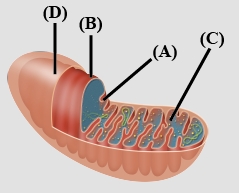
A
$D$ (outer membrane) - gives rise to inner membrane by splitting
B
$B$ (inner membrane) - forms infoldings called cristae
C
$C$ (crista) - possesses single circular $DNA$ molecule and ribosomes
D
$A$ (matrix) - major site for respiratory chain enzymes
Solution
(B) The correct answer is $B$.
Each mitochondrion is a double membrane-bound structure with the outer membrane and the inner membrane dividing its lumen distinctly into two aqueous compartments,$i.e.$,the outer compartment and the inner compartment.
The inner compartment is called the matrix.
The outer membrane forms the continuous limiting boundary of the organelle.
The inner membrane forms a number of infoldings called the cristae towards the matrix.
The cristae increase the surface area.
The two membranes have their own specific enzymes associated with the mitochondrial function.
Each mitochondrion is a double membrane-bound structure with the outer membrane and the inner membrane dividing its lumen distinctly into two aqueous compartments,$i.e.$,the outer compartment and the inner compartment.
The inner compartment is called the matrix.
The outer membrane forms the continuous limiting boundary of the organelle.
The inner membrane forms a number of infoldings called the cristae towards the matrix.
The cristae increase the surface area.
The two membranes have their own specific enzymes associated with the mitochondrial function.
0 likesView Solution
41
BiologyMediumMCQAIPMT · 2011
Select the correct option with respect to mitosis.
A
Chromatids separate but remain in the centre of the cell in anaphase.
B
Chromatids start moving towards opposite poles in telophase.
C
Golgi complex and endoplasmic reticulum are still visible at the end of prophase.
D
Chromosomes move to the spindle equator and get aligned along equatorial plate in metaphase.
Solution
(D) : The plane of alignment of the chromosomes at metaphase is referred to as the metaphase plate.
The key features of metaphase are:
$(1)$ Spindle fibres attach to kinetochores of chromosomes.
$(2)$ Chromosomes are moved to the spindle equator and get aligned along the metaphase plate through spindle fibres connected to both poles.
The key features of metaphase are:
$(1)$ Spindle fibres attach to kinetochores of chromosomes.
$(2)$ Chromosomes are moved to the spindle equator and get aligned along the metaphase plate through spindle fibres connected to both poles.
0 likesView Solution
42
BiologyMediumMCQAIPMT · 2011
At metaphase,chromosomes are attached to the spindle fibres by their
A
satellites
B
secondary constrictions
C
kinetochores
D
centromeres
Solution
(C) During metaphase,the chromosomes align at the equatorial plate.
Spindle fibres attach to the chromosomes specifically at structures called kinetochores.
Kinetochores are disc-shaped protein structures located on the surface of the centromeres.
These structures serve as the attachment sites for spindle fibres,which are essential for the movement and segregation of chromosomes during cell division.
Spindle fibres attach to the chromosomes specifically at structures called kinetochores.
Kinetochores are disc-shaped protein structures located on the surface of the centromeres.
These structures serve as the attachment sites for spindle fibres,which are essential for the movement and segregation of chromosomes during cell division.
0 likesView Solution
43
BiologyEasyMCQAIPMT · 2011
In land plants,the guard cells differ from other epidermal cells in having
A
cytoskeleton
B
mitochondria
C
endoplasmic reticulum
D
chloroplasts
Solution
(D) : The leaf and stem epidermis is covered with pores called stomata,which are part of a stomatal complex. This complex consists of a pore surrounded on each side by chloroplast-containing guard cells and two to four subsidiary cells that lack chloroplasts.
The guard cells differ from the epidermal cells in the following aspects:
$1$. The guard cells are bean-shaped in surface view,while the epidermal cells are irregular in shape.
$2$. The guard cells contain chloroplasts,allowing them to manufacture food by photosynthesis,whereas the epidermal cells do not contain chloroplasts.
$3$. Guard cells are the only epidermal cells that can synthesize sugar.
The guard cells differ from the epidermal cells in the following aspects:
$1$. The guard cells are bean-shaped in surface view,while the epidermal cells are irregular in shape.
$2$. The guard cells contain chloroplasts,allowing them to manufacture food by photosynthesis,whereas the epidermal cells do not contain chloroplasts.
$3$. Guard cells are the only epidermal cells that can synthesize sugar.
0 likesView Solution
44
BiologyEasyMCQAIPMT · 2011
Guttation is the result of
A
diffusion
B
transpiration
C
osmosis
D
root pressure
Solution
(D) : Various ions from the soil are actively transported into the vascular tissues of roots,water follows its potential gradient and increases the pressure inside the xylem. This positive pressure is called root pressure.
Effect of root pressure is observable at night and early morning when evaporation is low and excess water collects in the form of droplets near the tip of leaves of many herbaceous plants.
Such water loss in its liquid phase is known as guttation.
Effect of root pressure is observable at night and early morning when evaporation is low and excess water collects in the form of droplets near the tip of leaves of many herbaceous plants.
Such water loss in its liquid phase is known as guttation.
0 likesView Solution
45
BiologyEasyMCQAIPMT · 2011
Which one of the following elements in plants is not remobilised?
A
Phosphorus
B
Calcium
C
Potassium
D
Sulphur
Solution
(B) Elements that are actively mobilized within plants are exported from older,senescing tissues to younger developing tissues. Elements such as $Phosphorus$,$Potassium$,$Sulphur$,and $Nitrogen$ are highly mobile.
However,elements that are structural components of the cell,such as $Calcium$,are not remobilized. $Calcium$ is a component of the cell wall (as $Calcium$ pectate) and is therefore not transported out of mature tissues to younger ones.
However,elements that are structural components of the cell,such as $Calcium$,are not remobilized. $Calcium$ is a component of the cell wall (as $Calcium$ pectate) and is therefore not transported out of mature tissues to younger ones.
0 likesView Solution
46
BiologyEasyMCQAIPMT · 2011
Nitrifying bacteria:
A
oxidize ammonia to nitrates
B
convert free nitrogen to nitrogen compounds
C
convert proteins into ammonia
D
reduce nitrates to free nitrogen
Solution
(A) $Nitrifying$ bacteria perform the process of nitrification,which involves the oxidation of ammonia to nitrates.
This process occurs in two steps:
$1$. Nitrite bacteria (e.g.,$Nitrosomonas$ and $Nitrococcus$) convert ammonia $(NH_3)$ into nitrites $(NO_2^-)$.
$2$. Nitrate bacteria (e.g.,$Nitrobacter$ and $Nitrocystis$) convert nitrites $(NO_2^-)$ into nitrates $(NO_3^-)$.
Therefore,the correct function is the oxidation of ammonia to nitrates.
This process occurs in two steps:
$1$. Nitrite bacteria (e.g.,$Nitrosomonas$ and $Nitrococcus$) convert ammonia $(NH_3)$ into nitrites $(NO_2^-)$.
$2$. Nitrate bacteria (e.g.,$Nitrobacter$ and $Nitrocystis$) convert nitrites $(NO_2^-)$ into nitrates $(NO_3^-)$.
Therefore,the correct function is the oxidation of ammonia to nitrates.
0 likesView Solution
47
BiologyMediumMCQAIPMT · 2011
The function of leghaemoglobin in the root nodules of legumes is
A
inhibition of nitrogenase activity
B
oxygen removal
C
nodule differentiation
D
expression of $nif$ gene.
Solution
(B) The root nodules of legumes contain the enzyme nitrogenase and the protein leghaemoglobin.
Nitrogenase catalyzes the conversion of atmospheric nitrogen into ammonia.
This enzyme is highly sensitive to molecular oxygen and requires anaerobic conditions to function effectively.
The nodules have specific adaptations to ensure that the enzyme is protected from oxygen.
Leghaemoglobin acts as an oxygen scavenger,binding to oxygen and maintaining a low-oxygen environment within the nodule to protect the nitrogenase enzyme from inactivation.
Nitrogenase catalyzes the conversion of atmospheric nitrogen into ammonia.
This enzyme is highly sensitive to molecular oxygen and requires anaerobic conditions to function effectively.
The nodules have specific adaptations to ensure that the enzyme is protected from oxygen.
Leghaemoglobin acts as an oxygen scavenger,binding to oxygen and maintaining a low-oxygen environment within the nodule to protect the nitrogenase enzyme from inactivation.
0 likesView Solution
48
BiologyEasyMCQAIPMT · 2011
Which one of the following is not an essential mineral element for plants while the remaining three are?
A
Iron
B
Manganese
C
Cadmium
D
Phosphorus
Solution
(C) The essential mineral elements for plants are those that have a specific structural or physiological role and without which the plant cannot complete its life cycle.
These include $C, H, O, N, P, K, S, Mg, Ca, Fe, B, Mn, Cu, Zn, Mo, Cl,$ and $Ni$.
Cadmium $(Cd)$ is a heavy metal that is toxic to plants and is not considered an essential nutrient.
Therefore,the correct option is $C$.
These include $C, H, O, N, P, K, S, Mg, Ca, Fe, B, Mn, Cu, Zn, Mo, Cl,$ and $Ni$.
Cadmium $(Cd)$ is a heavy metal that is toxic to plants and is not considered an essential nutrient.
Therefore,the correct option is $C$.
0 likesView Solution
49
BiologyMediumMCQAIPMT · 2011
$CAM$ helps the plants in
A
conserving water
B
secondary growth
C
disease resistance
D
reproduction
Solution
(A) $CAM$ (Crassulacean Acid Metabolism) is a specialized photosynthetic pathway adapted by plants in arid environments.
In this process,stomata open at night to take up $CO_2$,which is fixed into malic acid.
During the day,stomata remain closed to minimize transpiration,and the stored malic acid is decarboxylated to release $CO_2$ for the Calvin cycle.
This mechanism is crucial for water conservation in desert plants,as it prevents excessive water loss through evaporation during the hot daylight hours.
In this process,stomata open at night to take up $CO_2$,which is fixed into malic acid.
During the day,stomata remain closed to minimize transpiration,and the stored malic acid is decarboxylated to release $CO_2$ for the Calvin cycle.
This mechanism is crucial for water conservation in desert plants,as it prevents excessive water loss through evaporation during the hot daylight hours.
0 likesView Solution
50
BiologyMediumMCQAIPMT · 2011
In $Kranz$ anatomy,the bundle sheath cells have
A
thin walls,many intercellular spaces and no chloroplasts
B
thick walls,no intercellular spaces and large number of chloroplasts
C
thin walls,no intercellular spaces and several chloroplasts
D
thick walls,many intercellular spaces and few chloroplasts.
Solution
(B) $C_4$ plants are adapted to dry tropical regions and exhibit higher biomass productivity. They possess a specialized leaf anatomy known as $Kranz$ anatomy.
In this anatomy,the bundle sheath cells form several layers around the vascular bundles.
These cells are characterized by having a large number of chloroplasts,thick walls that are impervious to gaseous exchange,and the absence of intercellular spaces.
In this anatomy,the bundle sheath cells form several layers around the vascular bundles.
These cells are characterized by having a large number of chloroplasts,thick walls that are impervious to gaseous exchange,and the absence of intercellular spaces.
0 likesView Solution
51
BiologyMediumMCQAIPMT · 2011
Which one of the following also acts as a catalyst in a bacterial cell?
A
$5S\ rRNA$
B
$snRNA$
C
$hnRNA$
D
$23S\ rRNA$
Solution
(D) The correct answer is $D$.
In a bacterial cell (prokaryote),the $70S$ ribosome consists of a large $50S$ subunit and a small $30S$ subunit.
The $50S$ subunit contains the $23S\ rRNA$,which functions as a ribozyme.
$A$ ribozyme is an $RNA$ molecule that possesses catalytic activity.
Specifically,the $23S\ rRNA$ catalyzes the formation of peptide bonds between amino acids during protein synthesis,a process known as peptidyl transferase activity.
In contrast,$snRNA$ and $hnRNA$ are primarily found in eukaryotic cells,and $5S\ rRNA$ is a structural component of the ribosome.
In a bacterial cell (prokaryote),the $70S$ ribosome consists of a large $50S$ subunit and a small $30S$ subunit.
The $50S$ subunit contains the $23S\ rRNA$,which functions as a ribozyme.
$A$ ribozyme is an $RNA$ molecule that possesses catalytic activity.
Specifically,the $23S\ rRNA$ catalyzes the formation of peptide bonds between amino acids during protein synthesis,a process known as peptidyl transferase activity.
In contrast,$snRNA$ and $hnRNA$ are primarily found in eukaryotic cells,and $5S\ rRNA$ is a structural component of the ribosome.
0 likesView Solution
52
BiologyMediumMCQAIPMT · 2011
Which one of the following pairs is wrongly matched while the remaining three are correct?
A
Penicillium-conidia
B
Water hyacinth-runner
C
Bryophyllum-leaf buds
D
Agave-bulbils
Solution
(B) : The examples of runners are doob grass,$Oxalis$,$Centella$ etc. These plants have long and thin internodes and branches creep over the surface of soil. Such plants develop adventitious roots at nodes on the lower side. When long branches break up by any method,they form new plants.
Water hyacinth $(Eichhornia)$ is an example of an offset. This is a sub-aerial modification of the stem. It is similar to a runner,but the internodes are thick and short.
Water hyacinth $(Eichhornia)$ is an example of an offset. This is a sub-aerial modification of the stem. It is similar to a runner,but the internodes are thick and short.
0 likesView Solution
53
BiologyMediumMCQAIPMT · 2011
Sweet potato is homologous to
A
potato
B
Colocasia
C
ginger
D
turnip
Solution
(D) The correct answer is $D$.
Sweet potato is homologous to turnip because both share the same evolutionary origin,as they are both modified roots.
Homologous organs are those that have a similar developmental origin but may perform different functions.
In this case,both sweet potato and turnip are modifications of the taproot system primarily for food storage.
Sweet potato is homologous to turnip because both share the same evolutionary origin,as they are both modified roots.
Homologous organs are those that have a similar developmental origin but may perform different functions.
In this case,both sweet potato and turnip are modifications of the taproot system primarily for food storage.
0 likesView Solution
54
BiologyEasyMCQAIPMT · 2011
Which one of the following helps in the absorption of phosphorus from soil by plants?
A
Glomus
B
Rhizobium
C
Frankia
D
Anabaena
Solution
(A) The correct answer is $A$.
Some fungi form symbiotic associations with plants,known as mycorrhiza.
Many members of the genus $Glomus$ form mycorrhiza.
The fungal symbiont in these associations absorbs phosphorus from the soil and passes it to the plant.
Plants having such associations show other benefits as well,such as resistance to root-borne pathogens,tolerance to salinity and drought,and an overall increase in plant growth and development.
Some fungi form symbiotic associations with plants,known as mycorrhiza.
Many members of the genus $Glomus$ form mycorrhiza.
The fungal symbiont in these associations absorbs phosphorus from the soil and passes it to the plant.
Plants having such associations show other benefits as well,such as resistance to root-borne pathogens,tolerance to salinity and drought,and an overall increase in plant growth and development.
0 likesView Solution
55
BiologyEasyMCQAIPMT · 2011
Filiform apparatus is a characteristic feature of
A
suspensor
B
egg
C
synergid
D
zygote
Solution
(C) The correct answer is $C$.
Filiform apparatus is a mass of finger-like projections of the cell wall extending into the cytoplasm.
It is present in the synergids (helper cells) of the embryo sac,specifically in the micropylar region.
Its primary function is to guide the pollen tube into the embryo sac within the ovule.
Filiform apparatus is a mass of finger-like projections of the cell wall extending into the cytoplasm.
It is present in the synergids (helper cells) of the embryo sac,specifically in the micropylar region.
Its primary function is to guide the pollen tube into the embryo sac within the ovule.
0 likesView Solution
56
BiologyMediumMCQAIPMT · 2011
Nucellar polyembryony is reported in species of
A
Citrus
B
Gossypium
C
Triticum
D
Brassica
Solution
(A) : In nucellar polyembryony,some of the nucellar cells surrounding the embryo sac start dividing.
These cells then protrude into the embryo sac and develop into embryos.
In such species,each ovule contains many embryos.
The occurrence of more than one embryo in a seed is referred to as polyembryony.
Nucellar polyembryony is commonly found in many species of $Citrus$ and $Mangifera$ (mango).
These cells then protrude into the embryo sac and develop into embryos.
In such species,each ovule contains many embryos.
The occurrence of more than one embryo in a seed is referred to as polyembryony.
Nucellar polyembryony is commonly found in many species of $Citrus$ and $Mangifera$ (mango).
0 likesView Solution
57
BiologyMediumMCQAIPMT · 2011
Which one of the following pollinations is autogamous?
A
Geitonogamy
B
Xenogamy
C
Chasmogamy
D
Cleistogamy
Solution
(D) : Autogamy is a type of pollination where pollen grains from the anthers of a flower are transferred to the stigma of the same flower.
Cleistogamy, homogamy, and bud pollination are methods of autogamy.
Cleistogamy occurs in flowers that do not open, ensuring complete self-pollination.
Examples include $Commelina \text{ } bengalensis$, $Oxalis$, and $Viola$.
Cleistogamy, homogamy, and bud pollination are methods of autogamy.
Cleistogamy occurs in flowers that do not open, ensuring complete self-pollination.
Examples include $Commelina \text{ } bengalensis$, $Oxalis$, and $Viola$.
0 likesView Solution
58
BiologyEasyMCQAIPMT · 2011
The "eyes" of the potato tuber are
A
root buds
B
flower buds
C
shoot buds
D
axillary buds
Solution
(D) : Potato is a common example of a stem tuber. It stores starch as a reserve food material. Potato tubers are used for vegetative propagation. These possess axillary buds over their nodes or "eyes". The buds produce new plantlets when a stem tuber or a part of it having an eye is placed in the soil.
0 likesView Solution
59
BiologyEasyMCQAIPMT · 2011
Wind pollination is common in
A
legumes
B
lilies
C
grasses
D
orchids
Solution
(C) $Anemophily$ is the process of pollination where pollen grains are transferred by wind. In this type of pollination, flowers are typically small, inconspicuous, and produce a large quantity of lightweight, non-sticky pollen grains. $Grasses$ are classic examples of plants that exhibit wind pollination.
0 likesView Solution
60
BiologyMediumMCQAIPMT · 2011
In angiosperms,the functional megaspore develops into
A
embryo sac
B
ovule
C
endosperm
D
pollen sac
Solution
(A) The correct answer is $A$. In angiosperms,the functional megaspore represents the first cell of the female gametophyte. It undergoes successive mitotic divisions to develop into the mature embryo sac,also known as the female gametophyte.
0 likesView Solution
61
BiologyMediumMCQAIPMT · 2011
If for some reason,the $vasa$ $efferentia$ in the human reproductive system get blocked,the gametes will not be transported from:
A
testes to epididymis
B
epididymis to vas deferens
C
ovary to uterus
D
vagina to uterus
Solution
(A) : The male sex accessory ducts include $rete$ $testis$,$vasa$ $efferentia$,$epididymis$,and $vas$ $deferens$.
The $seminiferous$ $tubules$ of the $testis$ open into the $vasa$ $efferentia$ through the $rete$ $testis$.
The $vasa$ $efferentia$ leave the $testis$ and open into the $epididymis$,which is located along the posterior surface of each $testis$.
Therefore,if the $vasa$ $efferentia$ are blocked,the gametes (sperm) will not be transported from the $testes$ to the $epididymis$.
The $seminiferous$ $tubules$ of the $testis$ open into the $vasa$ $efferentia$ through the $rete$ $testis$.
The $vasa$ $efferentia$ leave the $testis$ and open into the $epididymis$,which is located along the posterior surface of each $testis$.
Therefore,if the $vasa$ $efferentia$ are blocked,the gametes (sperm) will not be transported from the $testes$ to the $epididymis$.
0 likesView Solution
62
BiologyEasyMCQAIPMT · 2011
The testes in humans are situated outside the abdominal cavity inside a pouch called scrotum. The purpose served is for
A
maintaining the scrotal temperature lower than the internal body temperature
B
escaping any possible compression by the visceral organs
C
providing more space for the growth of epididymis
D
providing a secondary sexual feature for exhibiting the male sex.
Solution
(A) The correct answer is $A$.
In humans,the testes are located outside the abdominal cavity within a pouch known as the scrotum.
The primary function of the scrotum is to maintain the temperature of the testes at $2-2.5^{\circ}C$ lower than the normal internal body temperature.
This lower temperature is essential for the process of spermatogenesis,which is the production of sperm.
In humans,the testes are located outside the abdominal cavity within a pouch known as the scrotum.
The primary function of the scrotum is to maintain the temperature of the testes at $2-2.5^{\circ}C$ lower than the normal internal body temperature.
This lower temperature is essential for the process of spermatogenesis,which is the production of sperm.
0 likesView Solution
63
BiologyMediumMCQAIPMT · 2011
The figure given below depicts a diagrammatic sectional view of the human female reproductive system. Which set of three parts out of $I-VI$ have been correctly identified?
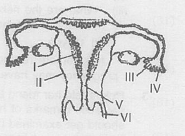
A
$(II)$ endometrium,$(III)$ infundibulum,$(IV)$ fimbriae
B
$(III)$ infundibulum,$(IV)$ fimbriae,$(V)$ cervix
C
$(IV)$ oviducal funnel,$(V)$ uterus,$(VI)$ cervix
D
$(I)$ perimetrium,$(II)$ myometrium,$(III)$ Fallopian tube
Solution
(B) The correct answer is $(B)$.
The female reproductive system includes the ovaries,a pair of oviducts (Fallopian tubes),uterus,cervix,vagina,and the external genitalia.
In the provided diagram:
- $(I)$ represents the endometrium (the innermost glandular layer of the uterus).
- $(II)$ represents the myometrium (the middle thick layer of smooth muscle).
- $(III)$ represents the infundibulum (the funnel-shaped part of the Fallopian tube closer to the ovary).
- $(IV)$ represents the fimbriae (finger-like projections at the edges of the infundibulum that collect the ovum after ovulation).
- $(V)$ represents the cervix (the narrow neck of the uterus that opens into the vagina).
- $(VI)$ represents the vagina.
Therefore,the set $(III)$ infundibulum,$(IV)$ fimbriae,and $(V)$ cervix is correctly identified.
The female reproductive system includes the ovaries,a pair of oviducts (Fallopian tubes),uterus,cervix,vagina,and the external genitalia.
In the provided diagram:
- $(I)$ represents the endometrium (the innermost glandular layer of the uterus).
- $(II)$ represents the myometrium (the middle thick layer of smooth muscle).
- $(III)$ represents the infundibulum (the funnel-shaped part of the Fallopian tube closer to the ovary).
- $(IV)$ represents the fimbriae (finger-like projections at the edges of the infundibulum that collect the ovum after ovulation).
- $(V)$ represents the cervix (the narrow neck of the uterus that opens into the vagina).
- $(VI)$ represents the vagina.
Therefore,the set $(III)$ infundibulum,$(IV)$ fimbriae,and $(V)$ cervix is correctly identified.
0 likesView Solution
64
BiologyMediumMCQAIPMT · 2011
What happens during fertilization in humans after many sperms reach close to the ovum?
A
Secretions of acrosome help one sperm enter the cytoplasm of the ovum through the zona pellucida.
B
All sperms except the one nearest to the ovum lose their tails.
C
Cells of corona radiata trap all the sperms except one.
D
Only two sperms nearest the ovum penetrate the zona pellucida.
Solution
(A) The process of fusion of a sperm with an ovum is called fertilization.
During fertilization,a sperm comes in contact with the zona pellucida layer of the ovum and induces changes in the membrane that block the entry of additional sperms.
Thus,it ensures that only one sperm can fertilize an ovum.
The secretions of the acrosome help the sperm enter into the cytoplasm of the ovum through the zona pellucida and the plasma membrane.
In contact with the surface of the egg covering,the acrosome releases its contained hydrolytic enzymes,also called sperm lysins.
This is known as the acrosomal reaction.
The acrosomal reaction results in the dissolving of corona cells and the degeneration of the zona pellucida,which helps in sperm penetration.
During fertilization,a sperm comes in contact with the zona pellucida layer of the ovum and induces changes in the membrane that block the entry of additional sperms.
Thus,it ensures that only one sperm can fertilize an ovum.
The secretions of the acrosome help the sperm enter into the cytoplasm of the ovum through the zona pellucida and the plasma membrane.
In contact with the surface of the egg covering,the acrosome releases its contained hydrolytic enzymes,also called sperm lysins.
This is known as the acrosomal reaction.
The acrosomal reaction results in the dissolving of corona cells and the degeneration of the zona pellucida,which helps in sperm penetration.
0 likesView Solution
65
BiologyMediumMCQAIPMT · 2011
About which day in a normal human menstrual cycle does rapid secretion of $LH$ (popularly called $LH$ surge) normally occur (in $14^{th}$ day)?
A
$14$
B
$20$
C
$5$
D
$11$
Solution
(A) In a normal human menstrual cycle of $28$ days, both $LH$ and $FSH$ reach their peak levels in the middle of the cycle, which is approximately the $14^{th}$ day.
This rapid secretion of $LH$, known as the $LH$ surge, is responsible for the rupture of the mature Graafian follicle.
Following the rupture of the follicle, the ovum is released, a process known as ovulation.
This rapid secretion of $LH$, known as the $LH$ surge, is responsible for the rupture of the mature Graafian follicle.
Following the rupture of the follicle, the ovum is released, a process known as ovulation.
0 likesView Solution
66
BiologyMediumMCQAIPMT · 2011
Which one of the following is the most widely accepted method of contraception in India at present?
A
Cervical caps
B
Tubectomy
C
Diaphragms
D
$IUDs$ (Intra uterine devices)
Solution
(D) The correct answer is $D$.
At present, the most widely accepted method of contraception in India is $IUDs$ (Intra Uterine Devices).
These devices are presently available as non-medicated $IUDs$ (e.g., Lippes loop), copper-releasing $IUDs$ $(CuT, Cu7, \text{Multiload } 375)$, and hormone-releasing $IUDs$ (Progestasert, $LNG-20$).
$IUDs$ increase the phagocytosis of sperms within the uterus.
The copper ions released suppress sperm motility and the fertilizing capacity of sperms.
The hormone-releasing $IUDs$ make the uterus unsuitable for implantation and the cervix hostile to the sperms.
At present, the most widely accepted method of contraception in India is $IUDs$ (Intra Uterine Devices).
These devices are presently available as non-medicated $IUDs$ (e.g., Lippes loop), copper-releasing $IUDs$ $(CuT, Cu7, \text{Multiload } 375)$, and hormone-releasing $IUDs$ (Progestasert, $LNG-20$).
$IUDs$ increase the phagocytosis of sperms within the uterus.
The copper ions released suppress sperm motility and the fertilizing capacity of sperms.
The hormone-releasing $IUDs$ make the uterus unsuitable for implantation and the cervix hostile to the sperms.
0 likesView Solution
67
BiologyMediumMCQAIPMT · 2011
Medical Termination of Pregnancy $(MTP)$ is considered safe up to how many weeks of pregnancy?
A
Eight weeks
B
Twelve weeks
C
Eighteen weeks
D
Six weeks
Solution
(B) The correct option is $(B)$.
Medical Termination of Pregnancy $(MTP)$,also known as induced abortion,is the intentional termination of pregnancy before the foetus becomes viable.
$MTP$ is considered relatively safe up to $12$ weeks of pregnancy,which corresponds to the first trimester.
Beyond the first trimester,the procedure becomes significantly riskier because the foetus becomes more intimately associated with the maternal tissues,increasing the chances of complications.
Medical Termination of Pregnancy $(MTP)$,also known as induced abortion,is the intentional termination of pregnancy before the foetus becomes viable.
$MTP$ is considered relatively safe up to $12$ weeks of pregnancy,which corresponds to the first trimester.
Beyond the first trimester,the procedure becomes significantly riskier because the foetus becomes more intimately associated with the maternal tissues,increasing the chances of complications.
0 likesView Solution
68
BiologyMediumMCQAIPMT · 2011
The technique called Gamete Intra Fallopian Transfer $(GIFT)$ is recommended for those females:
A
who cannot produce an ovum
B
who cannot retain the foetus inside uterus
C
whose cervical canal is too narrow to allow passage for the sperms
D
who cannot provide suitable environment for fertilization.
Solution
(A) $(GIFT)$ stands for Gamete Intra Fallopian Transfer.
This technique involves the transfer of an ovum collected from a donor into the Fallopian tube of another female.
It is specifically recommended for females who cannot produce their own ova but are capable of providing a suitable environment for fertilization and the subsequent development of the embryo.
This technique involves the transfer of an ovum collected from a donor into the Fallopian tube of another female.
It is specifically recommended for females who cannot produce their own ova but are capable of providing a suitable environment for fertilization and the subsequent development of the embryo.
0 likesView Solution
69
BiologyEasyMCQAIPMT · 2011
When two unrelated individuals or lines are crossed,the performance of $F_1$ hybrid is often superior to both its parents. This phenomenon is called
A
heterosis
B
transformation
C
splicing
D
metamorphosis
Solution
(A) : The increased vigour displayed by the offspring from a cross between genetically different parents is called heterosis. Hybrids from crosses between different crop varieties ($F_1$ hybrids) are often stronger and produce better yields than the original varieties.
0 likesView Solution
70
BiologyMediumMCQAIPMT · 2011
Which one of the following conditions correctly describes the manner of determining the sex?
A
Homozygous sex chromosomes $(ZZ)$ determine female sex in birds.
B
$XO$ type of sex chromosomes determine male sex in grasshopper.
C
$XO$ condition in humans as found in Turner's syndrome,determines female sex.
D
Homozygous sex chromosomes $(XX)$ produce male in Drosophila.
Solution
(B) : $XO$ type of sex chromosomes determine male sex in grasshoppers. This type of sex determination comes under $XX-XO$ type. Its common examples are cockroaches,grasshoppers,and bugs. The female has two homomorphic sex chromosomes $(XX)$ and is homogametic. It produces similar eggs,each with $X$-chromosome. The male has one chromosome only and is heterogametic. It produces $2$ types of sperms: gynosperms with $X$ and androsperms without $X$. Fertilization of an egg by $X$-bearing sperm yields female offspring and by no-$X$ sperm yields male offspring. The chromosomal constitution is represented as $AA + XX$ (female) and $AA + XO$ (male).
0 likesView Solution
71
BiologyEasyMCQAIPMT · 2011
Which one of the following conditions of the zygotic cell would lead to the birth of a normal human female child?
A
Two $X$ chromosomes
B
Only one $Y$ chromosome
C
Only one $X$ chromosome
D
One $X$ and one $Y$ chromosome
Solution
(A) The correct answer is $A$. In humans,the female has a pair of $X$ chromosomes ($XX$ - homogametic composition),and the male has $XY$ chromosomes (heterogametic composition).
During fertilization,the fusion of an egg (containing an $X$ chromosome) with a sperm (containing an $X$ chromosome) results in a zygote with two $X$ chromosomes $(XX)$.
This $XX$ chromosomal constitution in the zygotic cell leads to the development of a normal human female child.
During fertilization,the fusion of an egg (containing an $X$ chromosome) with a sperm (containing an $X$ chromosome) results in a zygote with two $X$ chromosomes $(XX)$.
This $XX$ chromosomal constitution in the zygotic cell leads to the development of a normal human female child.
0 likesView Solution
72
BiologyMediumMCQAIPMT · 2011
Test cross in plants or in Drosophila involves crossing
A
between two genotypes with recessive trait
B
between two $F_1$ hybrids
C
the $F_1$ hybrid with a double recessive genotype
D
between two genotypes with dominant trait.
Solution
(C) The correct answer is $C$.
Test cross is performed to determine the unknown genotype of an organism showing a dominant phenotype.
In a typical test cross,an organism with a dominant phenotype is crossed with an individual that is homozygous recessive for the traits being investigated.
This method allows researchers to determine whether the dominant phenotype is homozygous or heterozygous by analyzing the phenotypic ratio of the offspring.
For example,in a monohybrid test cross,if the $F_1$ hybrid $(Tt)$ is crossed with a homozygous recessive parent $(tt)$,the resulting offspring will show a $1:1$ ratio of dominant to recessive phenotypes if the parent was heterozygous.
Test cross is performed to determine the unknown genotype of an organism showing a dominant phenotype.
In a typical test cross,an organism with a dominant phenotype is crossed with an individual that is homozygous recessive for the traits being investigated.
This method allows researchers to determine whether the dominant phenotype is homozygous or heterozygous by analyzing the phenotypic ratio of the offspring.
For example,in a monohybrid test cross,if the $F_1$ hybrid $(Tt)$ is crossed with a homozygous recessive parent $(tt)$,the resulting offspring will show a $1:1$ ratio of dominant to recessive phenotypes if the parent was heterozygous.
0 likesView Solution
73
BiologyMediumMCQAIPMT · 2011
What are the structures called that give an appearance as 'beads-on-string' in the chromosomes when viewed under an electron microscope?
A
Genes
B
Nucleotides
C
Nucleosomes
D
Base pairs
Solution
(C) : Nucleosomes appear as 'beads-on-string' in the chromosome when viewed under an electron microscope.
The beads in the 'beads-on-string' arrangement are complexes of histones and $DNA$.
The bead plus the connecting $DNA$ that leads to the next bead forms the nucleosome.
Nucleosome is the fundamental unit of organization on which the higher-order packaging of chromatin is built.
The bead of each nucleosome contains eight histone molecules in which two copies each of $H_2A, H_2B, H_3$ and $H_4$ are found.
The beads in the 'beads-on-string' arrangement are complexes of histones and $DNA$.
The bead plus the connecting $DNA$ that leads to the next bead forms the nucleosome.
Nucleosome is the fundamental unit of organization on which the higher-order packaging of chromatin is built.
The bead of each nucleosome contains eight histone molecules in which two copies each of $H_2A, H_2B, H_3$ and $H_4$ are found.
0 likesView Solution
74
BiologyMediumMCQAIPMT · 2011
The unequivocal proof of $DNA$ as the genetic material came from the studies on a
A
bacterium
B
fungus
C
viroid
D
bacterial virus
Solution
(D) The unequivocal proof that $DNA$ is the genetic material came from the experiments of Alfred Hershey and Martha Chase $(1952)$.
They worked with viruses that infect bacteria,which are known as bacteriophages.
They worked with viruses that infect bacteria,which are known as bacteriophages.
0 likesView Solution
75
BiologyMediumMCQAIPMT · 2011
What was the most significant trend in the evolution of modern man ($Homo$ $sapiens$) from his ancestors?
A
Shortening of jaws
B
Binocular vision
C
Increasing cranial capacity
D
Upright posture
Solution
(C) The correct answer is $(C)$.
Binocular vision,smaller jaws,and upright posture are important adaptations that occurred during human evolution.
However,the most significant trend in the evolution of modern man from his ancestors is the increase in cranial capacity.
In modern humans ($Homo$ $sapiens$),the cranial capacity is approximately $1450$ $cc$,whereas it was only about $500$ $cc$ in $Australopithecus$.
This increased cranial capacity allowed for a larger brain,which serves as the foundation for the social,cultural,and intellectual development of modern man.
Binocular vision,smaller jaws,and upright posture are important adaptations that occurred during human evolution.
However,the most significant trend in the evolution of modern man from his ancestors is the increase in cranial capacity.
In modern humans ($Homo$ $sapiens$),the cranial capacity is approximately $1450$ $cc$,whereas it was only about $500$ $cc$ in $Australopithecus$.
This increased cranial capacity allowed for a larger brain,which serves as the foundation for the social,cultural,and intellectual development of modern man.
0 likesView Solution
76
BiologyMediumMCQAIPMT · 2011
Where will you look for the sporozoites of the malarial parasite?
A
Saliva of infected female Anopheles mosquito
B
Red blood corpuscles of human suffering from malaria
C
Spleen of infected humans
D
Salivary glands of freshly moulted female Anopheles mosquito
Solution
(A) The correct answer is $A$.
Sporozoites are the infectious stage of the malarial parasite $(Plasmodium)$.
When an infected female $Anopheles$ mosquito bites a healthy human,it injects saliva into the host's bloodstream to prevent blood clotting.
These sporozoites are stored in the salivary glands of the infected mosquito and are released into the human host along with the saliva during the bite.
Therefore,the sporozoites are found in the saliva of the infected female $Anopheles$ mosquito.
Sporozoites are the infectious stage of the malarial parasite $(Plasmodium)$.
When an infected female $Anopheles$ mosquito bites a healthy human,it injects saliva into the host's bloodstream to prevent blood clotting.
These sporozoites are stored in the salivary glands of the infected mosquito and are released into the human host along with the saliva during the bite.
Therefore,the sporozoites are found in the saliva of the infected female $Anopheles$ mosquito.
0 likesView Solution
77
BiologyMediumMCQAIPMT · 2011
Which one of the following options gives the correct match of a disease with its causative organism and mode of infection?
A
Typhoid $\rightarrow$ Salmonella typhi $\rightarrow$ with inspired air
B
Pneumonia $\rightarrow$ Streptococcus pneumoniae $\rightarrow$ droplet infection
C
Elephantiasis $\rightarrow$ Wuchereria bancrofti $\rightarrow$ with infected water and food
D
Malaria $\rightarrow$ Plasmodium vivax $\rightarrow$ bite of male Anopheles mosquito
Solution
(B) The correct match is $B$.
$1$. Typhoid is caused by $Salmonella$ $typhi$ and is transmitted through contaminated food and water.
$2$. Pneumonia is caused by $Streptococcus$ $pneumoniae$ and is transmitted through droplet infection (inhalation of droplets/aerosols released by an infected person).
$3$. Elephantiasis (Filariasis) is caused by $Wuchereria$ $bancrofti$ and is transmitted through the bite of female $Culex$ mosquitoes.
$4$. Malaria is caused by $Plasmodium$ species and is transmitted through the bite of female $Anopheles$ mosquitoes. Male mosquitoes do not bite humans.
$1$. Typhoid is caused by $Salmonella$ $typhi$ and is transmitted through contaminated food and water.
$2$. Pneumonia is caused by $Streptococcus$ $pneumoniae$ and is transmitted through droplet infection (inhalation of droplets/aerosols released by an infected person).
$3$. Elephantiasis (Filariasis) is caused by $Wuchereria$ $bancrofti$ and is transmitted through the bite of female $Culex$ mosquitoes.
$4$. Malaria is caused by $Plasmodium$ species and is transmitted through the bite of female $Anopheles$ mosquitoes. Male mosquitoes do not bite humans.
0 likesView Solution
78
BiologyMediumMCQAIPMT · 2011
Common cold is not cured by antibiotics because it is
A
caused by a virus
B
caused by a Gram-positive bacterium
C
caused by a Gram-negative bacterium
D
not an infectious disease.
Solution
(A) : Common cold is caused by approximately $100$ types of Rhinoviruses. It is one of the most common infectious diseases in humans.
Antibiotics are substances that destroy or inhibit the growth of microorganisms,particularly disease-producing bacteria and fungi.
Antibiotics are obtained from microorganisms (especially moulds) or synthesized.
Many antibiotics interfere with the pathogen's protein synthesis.
Some (e.g.,Penicillin) prevent the cross-linking of the glycan chains of peptidoglycan molecules in bacterial cell walls.
Since viruses do not possess a cell wall and lack their own protein-synthesizing apparatus,they are not affected by antibiotics.
Antibiotics are substances that destroy or inhibit the growth of microorganisms,particularly disease-producing bacteria and fungi.
Antibiotics are obtained from microorganisms (especially moulds) or synthesized.
Many antibiotics interfere with the pathogen's protein synthesis.
Some (e.g.,Penicillin) prevent the cross-linking of the glycan chains of peptidoglycan molecules in bacterial cell walls.
Since viruses do not possess a cell wall and lack their own protein-synthesizing apparatus,they are not affected by antibiotics.
0 likesView Solution
79
BiologyEasyMCQAIPMT · 2011
$A$ collection of plants and seeds having diverse alleles of all the genes of a crop is called:
A
herbarium
B
germplasm
C
gene library
D
genome
Solution
(B) The entire collection of plants or seeds having all the diverse alleles for all genes in a given crop is known as a germplasm collection. Germplasm serves as the fundamental resource for plant breeding programs,providing the genetic variability required for crop improvement.
0 likesView Solution
80
BiologyEasyMCQAIPMT · 2011
"Jaya" and "Ratna" developed for the Green Revolution in India are varieties of
A
maize
B
rice
C
wheat
D
bajra
Solution
(B) The correct answer is $B$. The Green Revolution was a major initiative by agricultural scientists in India to produce sufficient food for the rapidly increasing population. During this period, high-yielding semi-dwarf varieties of rice, specifically "Jaya" and "Ratna", were developed and introduced to significantly boost agricultural productivity.
0 likesView Solution
81
BiologyEasyMCQAIPMT · 2011
'Himgiri' developed by hybridization and selection for disease resistance against rust pathogens is a variety of
A
chilli
B
maize
C
sugarcane
D
wheat
Solution
(D) : 'Himgiri' is a variety of wheat.
It was developed through hybridization and selection for disease resistance against rust pathogens.
Specifically,it provides resistance to leaf and stripe rust,and hill bunt diseases.
It is commonly cultivated in the Northern Himalayan and Garhwal regions.
It was developed through hybridization and selection for disease resistance against rust pathogens.
Specifically,it provides resistance to leaf and stripe rust,and hill bunt diseases.
It is commonly cultivated in the Northern Himalayan and Garhwal regions.
0 likesView Solution
82
BiologyEasyMCQAIPMT · 2011
The most common substrate used in distilleries for the production of ethanol is
A
corn meal
B
soya meal
C
ground gram
D
molasses
Solution
(D) In the industrial production of ethanol, microorganisms like $Saccharomyces$ $\text{cerevisiae}$ (brewer's yeast) are used to ferment sugars.
Molasses, which is a byproduct of the sugar industry, is rich in sucrose and is the most common, cost-effective substrate used in distilleries for ethanol production.
Therefore, the correct option is $D$.
Molasses, which is a byproduct of the sugar industry, is rich in sucrose and is the most common, cost-effective substrate used in distilleries for ethanol production.
Therefore, the correct option is $D$.
0 likesView Solution
83
BiologyMediumMCQAIPMT · 2011
Which one of the following is not a biofertiliser?
A
Agrobacterium
B
Rhizobium
C
Nostoc
D
Mycorrhiza
Solution
(A) : Biofertilizers are organisms that enrich the nutrient quality of the soil.
The main sources of biofertilizers are bacteria,fungi,and cyanobacteria.
$Rhizobium$ bacteria are found in the root nodules of leguminous plants through a symbiotic association. These bacteria fix atmospheric nitrogen into organic forms,which are used by the plants as nutrients.
Fungi are also known to form symbiotic associations with plants called mycorrhiza.
Cyanobacteria are autotrophic microbes widely distributed in aquatic and terrestrial environments. Many of these can fix atmospheric nitrogen,$e.g.,$ $Anabaena$,$Nostoc$,$Oscillatoria$,etc.
However,$Agrobacterium$ $tumefaciens$ is a pathogen of several dicot plants. It causes crown gall disease in plants,not acting as a biofertilizer.
The main sources of biofertilizers are bacteria,fungi,and cyanobacteria.
$Rhizobium$ bacteria are found in the root nodules of leguminous plants through a symbiotic association. These bacteria fix atmospheric nitrogen into organic forms,which are used by the plants as nutrients.
Fungi are also known to form symbiotic associations with plants called mycorrhiza.
Cyanobacteria are autotrophic microbes widely distributed in aquatic and terrestrial environments. Many of these can fix atmospheric nitrogen,$e.g.,$ $Anabaena$,$Nostoc$,$Oscillatoria$,etc.
However,$Agrobacterium$ $tumefaciens$ is a pathogen of several dicot plants. It causes crown gall disease in plants,not acting as a biofertilizer.
0 likesView Solution
84
BiologyMediumMCQAIPMT · 2011
Secondary sewage treatment is mainly a
A
physical process
B
mechanical process
C
chemical process
D
biological process
Solution
(D) Secondary sewage treatment,also known as biological treatment,primarily involves the use of aerobic and anaerobic microorganisms to decompose organic matter present in the sewage.
In this process,the primary effluent is passed into large aeration tanks where it is constantly agitated mechanically and air is pumped into it.
This allows vigorous growth of useful aerobic microbes into flocs (masses of bacteria associated with fungal filaments to form mesh-like structures).
These microbes consume the major part of the organic matter in the effluent,significantly reducing the Biological Oxygen Demand $(BOD)$.
Therefore,it is essentially a biological process.
In this process,the primary effluent is passed into large aeration tanks where it is constantly agitated mechanically and air is pumped into it.
This allows vigorous growth of useful aerobic microbes into flocs (masses of bacteria associated with fungal filaments to form mesh-like structures).
These microbes consume the major part of the organic matter in the effluent,significantly reducing the Biological Oxygen Demand $(BOD)$.
Therefore,it is essentially a biological process.
0 likesView Solution
85
BiologyMediumMCQAIPMT · 2011
Which of the following is mainly produced by the activity of anaerobic bacteria on sewage?
A
Laughing gas
B
Propane
C
Mustard gas
D
Marsh gas
Solution
(D) : Marsh gas or methane $(CH_4)$ gas is mainly produced by the activities of anaerobic bacteria on sewage.
Sewage contains large amounts of organic matter and microbes,many of which are pathogenic.
These microbes (bacteria and fungi) are digested during the secondary treatment process of sewage by anaerobic bacteria.
During this anaerobic digestion,bacteria produce a mixture of gases such as methane,hydrogen sulphide $(H_2S)$,and carbon dioxide $(CO_2)$.
These gases are collectively called biogas and can be easily used as a source of energy as they are inflammable.
Sewage contains large amounts of organic matter and microbes,many of which are pathogenic.
These microbes (bacteria and fungi) are digested during the secondary treatment process of sewage by anaerobic bacteria.
During this anaerobic digestion,bacteria produce a mixture of gases such as methane,hydrogen sulphide $(H_2S)$,and carbon dioxide $(CO_2)$.
These gases are collectively called biogas and can be easily used as a source of energy as they are inflammable.
0 likesView Solution
86
BiologyMediumMCQAIPMT · 2011
An organism used as a biofertilizer for raising soybean crop is
A
Azotobacter
B
Azospirillum
C
Rhizobium
D
Nostoc
Solution
(C) $Rhizobium$ is used as a biofertilizer for raising soybean crops.
$Rhizobium$ $japonicum$ forms a symbiotic association in the roots of the leguminous plant,soybean,which helps in nitrogen fixation.
$Rhizobium$ $japonicum$ forms a symbiotic association in the roots of the leguminous plant,soybean,which helps in nitrogen fixation.
0 likesView Solution
87
BiologyMediumMCQAIPMT · 2011
Ethanol is commercially produced through a particular species of
A
Saccharomyces
B
Clostridium
C
Trichoderma
D
Aspergillus
Solution
(A) The correct answer is $A$.
Ethanol is commercially produced through the fermentation process using a particular species of yeast known as $Saccharomyces$ $cerevisiae$ (Brewer's yeast).
This yeast ferments sugars present in raw materials like molasses or grains into ethanol and $CO_2$.
Ethanol is commercially produced through the fermentation process using a particular species of yeast known as $Saccharomyces$ $cerevisiae$ (Brewer's yeast).
This yeast ferments sugars present in raw materials like molasses or grains into ethanol and $CO_2$.
0 likesView Solution
88
BiologyMediumMCQAIPMT · 2011
Continuous addition of sugars in 'fed-batch' fermentation is done to
A
produce methane
B
obtain antibiotics
C
purify enzymes
D
degrade sewage
Solution
(B) In 'fed-batch' fermentation,the substrate (such as sugars) is added periodically or continuously to the bioreactor. This is done to maintain the concentration of the substrate at an optimal level,which prevents the inhibition of microbial growth or product formation due to high substrate concentrations. This technique is commonly employed in the industrial production of secondary metabolites,such as antibiotics,to maximize yield.
0 likesView Solution
89
BiologyMediumMCQAIPMT · 2011
Read the following statement having two blanks ($A$ and $B$).
$A$ drug used for $A$ patients is obtained from a species of the organism $B$.
The one correct option for the two blanks is
$A$ drug used for $A$ patients is obtained from a species of the organism $B$.
The one correct option for the two blanks is
A
$A$-heart,$B$-Penicillium
B
$A$-organ-transplant,$B$-Trichoderma
C
$A$-swine flu,$B$-Monascus
D
$A$-$AIDS$,$B$-Pseudomonas
Solution
(B) The correct option is $(B)$.
Cyclosporin $A$ is a bioactive molecule used as an immunosuppressive agent in organ-transplant patients to prevent organ rejection.
It is produced by the fungus $Trichoderma$ $polysporum$.
Cyclosporin $A$ is a bioactive molecule used as an immunosuppressive agent in organ-transplant patients to prevent organ rejection.
It is produced by the fungus $Trichoderma$ $polysporum$.
0 likesView Solution
90
BiologyMediumMCQAIPMT · 2011
Consider the following statements $(A-D)$ about organic farming.
$(A)$ Utilizes genetically modified crops like Bt cotton
$(B)$ Uses only naturally produced inputs like compost
$(C)$ Does not use pesticides and urea
$(D)$ Produces vegetables rich in vitamins and minerals
Which of the above statements are correct?
$(A)$ Utilizes genetically modified crops like Bt cotton
$(B)$ Uses only naturally produced inputs like compost
$(C)$ Does not use pesticides and urea
$(D)$ Produces vegetables rich in vitamins and minerals
Which of the above statements are correct?
A
$B, C$ and $D$
B
$C$ and $D$ only
C
$B$ and $C$ only
D
$A$ and $B$ only
Solution
(C) Organic farming is a system of agriculture that relies on techniques such as crop rotation,green manure,compost,and biological pest control to maintain soil productivity and manage pests.
Statement $(A)$ is incorrect because organic farming strictly excludes the use of genetically modified organisms (GMOs) such as $Bt$ cotton.
Statement $(B)$ is correct because it emphasizes the use of naturally produced inputs like compost and manure.
Statement $(C)$ is correct because organic farming avoids synthetic chemical fertilizers (like urea) and synthetic pesticides.
Statement $(D)$ is incorrect in the context of defining organic farming principles,as the primary focus is on sustainable practices rather than specifically increasing vitamin/mineral content compared to conventional farming.
Therefore,statements $(B)$ and $(C)$ are correct.
Statement $(A)$ is incorrect because organic farming strictly excludes the use of genetically modified organisms (GMOs) such as $Bt$ cotton.
Statement $(B)$ is correct because it emphasizes the use of naturally produced inputs like compost and manure.
Statement $(C)$ is correct because organic farming avoids synthetic chemical fertilizers (like urea) and synthetic pesticides.
Statement $(D)$ is incorrect in the context of defining organic farming principles,as the primary focus is on sustainable practices rather than specifically increasing vitamin/mineral content compared to conventional farming.
Therefore,statements $(B)$ and $(C)$ are correct.
0 likesView Solution
91
BiologyMediumMCQAIPMT · 2011
Which one of the following is a wrong matching of a microbe and its industrial product, while the remaining three are correct?
A
Yeast - statins
B
Acetobacter aceti - acetic acid
C
Clostridium butylicum - lactic acid
D
Aspergillus niger - citric acid
Solution
(C) The correct answer is $C$.
Microbes are used for the commercial and industrial production of various chemicals, including organic acids, alcohols, and enzymes.
$A$. Yeast $(Monascus purpureus)$ is used to produce statins, which are blood-cholesterol lowering agents. This is correct.
$B$. $Acetobacter aceti$ is a bacterium used to produce acetic acid. This is correct.
$C$. $Clostridium butylicum$ is a bacterium used to produce butyric acid, not lactic acid. Lactic acid is produced by $Lactobacillus$. Therefore, this is the wrong matching.
$D$. $Aspergillus niger$ is a fungus used to produce citric acid. This is correct.
Microbes are used for the commercial and industrial production of various chemicals, including organic acids, alcohols, and enzymes.
$A$. Yeast $(Monascus purpureus)$ is used to produce statins, which are blood-cholesterol lowering agents. This is correct.
$B$. $Acetobacter aceti$ is a bacterium used to produce acetic acid. This is correct.
$C$. $Clostridium butylicum$ is a bacterium used to produce butyric acid, not lactic acid. Lactic acid is produced by $Lactobacillus$. Therefore, this is the wrong matching.
$D$. $Aspergillus niger$ is a fungus used to produce citric acid. This is correct.
0 likesView Solution
92
BiologyMediumMCQAIPMT · 2011
The maximum number of existing transgenic animals is of which of the following?
A
Fish
B
Mice
C
Cow
D
Pig
Solution
(B) The correct answer is $B$ (Mice).
Transgenic animals are animals that have had their $DNA$ manipulated to possess and express an extra (foreign) gene.
Among all existing transgenic animals,more than $95\%$ of all existing transgenic animals are mice.
They are widely used in research because they are easy to handle,have a short life cycle,and their genetic makeup is well-understood,making them ideal models for studying human diseases and gene function.
Transgenic animals are animals that have had their $DNA$ manipulated to possess and express an extra (foreign) gene.
Among all existing transgenic animals,more than $95\%$ of all existing transgenic animals are mice.
They are widely used in research because they are easy to handle,have a short life cycle,and their genetic makeup is well-understood,making them ideal models for studying human diseases and gene function.
0 likesView Solution
93
BiologyMediumMCQAIPMT · 2011
The process of $RNA$ interference $(RNAi)$ has been used in the development of plants resistant to
A
nematodes
B
fungi
C
viruses
D
insects
Solution
(A) $RNA$ interference $(RNAi)$ is a method used to develop plants resistant to nematodes.
Many nematodes live in plants and animals, including human beings.
A nematode, $Meloidogyne incognita$, infests the roots of tobacco plants and causes a significant reduction in yield.
A novel strategy was adopted to prevent this infection based on the process of $RNA$ interference $(RNAi)$.
$RNAi$ involves the silencing of a specific $mRNA$ due to a complementary $dsRNA$ molecule that binds to and prevents translation of the $mRNA$.
By introducing nematode-specific genes into the host plant, the plant produces both sense and anti-sense $RNA$ in the host cells.
These two $RNA$ strands form a double-stranded $RNA$ $(dsRNA)$ that initiates $RNAi$ and silences the specific $mRNA$ of the nematode, thereby protecting the plant from infestation.
Many nematodes live in plants and animals, including human beings.
A nematode, $Meloidogyne incognita$, infests the roots of tobacco plants and causes a significant reduction in yield.
A novel strategy was adopted to prevent this infection based on the process of $RNA$ interference $(RNAi)$.
$RNAi$ involves the silencing of a specific $mRNA$ due to a complementary $dsRNA$ molecule that binds to and prevents translation of the $mRNA$.
By introducing nematode-specific genes into the host plant, the plant produces both sense and anti-sense $RNA$ in the host cells.
These two $RNA$ strands form a double-stranded $RNA$ $(dsRNA)$ that initiates $RNAi$ and silences the specific $mRNA$ of the nematode, thereby protecting the plant from infestation.
0 likesView Solution
94
BiologyMediumMCQAIPMT · 2011
$Bacillus \text{ } thuringiensis$ forms protein crystals which contain insecticidal protein. This protein
A
binds with epithelial cells of midgut of the insect pest, ultimately killing it.
B
is coded by several genes including the gene $cry$.
C
is activated by acid $pH$ of the foregut of the insect pest.
D
does not kill the carrier bacterium which is itself resistant to this toxin.
Solution
(A) $Bacillus \text{ } thuringiensis$ $(Bt)$ produces insecticidal proteins that kill specific insect orders such as lepidopterans, coleopterans, and dipterans.
These proteins are produced as inactive protoxins within the bacterial protein crystals.
The toxin remains inactive within the bacterium, so it does not harm the host.
When an insect ingests the crystals, the alkaline $pH$ of the insect's midgut solubilizes the crystals and converts the protoxin into its active form.
The activated toxin then binds to the specific receptors on the surface of the midgut epithelial cells, creating pores that cause cell swelling, lysis, and eventually the death of the insect.
These proteins are produced as inactive protoxins within the bacterial protein crystals.
The toxin remains inactive within the bacterium, so it does not harm the host.
When an insect ingests the crystals, the alkaline $pH$ of the insect's midgut solubilizes the crystals and converts the protoxin into its active form.
The activated toxin then binds to the specific receptors on the surface of the midgut epithelial cells, creating pores that cause cell swelling, lysis, and eventually the death of the insect.
0 likesView Solution
95
BiologyMediumMCQAIPMT · 2011
Silencing of $mRNA$ has been used in producing transgenic plants resistant to
A
bollworms
B
nematodes
C
white rusts
D
bacterial blights
Solution
(B) The technique of $RNA$ interference $(RNAi)$ is used to prevent the translation of specific $mRNA$ molecules. This method is used to develop transgenic plants that are resistant to pests. $A$ well-known example is the protection of tobacco plants against the nematode $Meloidogyne$ $incognita$. By introducing nematode-specific genes into the host plant via $Agrobacterium$ vectors,double-stranded $RNA$ $(dsRNA)$ is produced,which triggers $RNAi$ and silences the essential $mRNA$ of the parasite,thereby preventing the nematode from surviving in the transgenic host.
0 likesView Solution
96
BiologyMediumMCQAIPMT · 2011
Read the following four statements $(A-D)$ and identify the mistakes in two of them.
$(A)$ The first transgenic cow,Rosie,produced milk which was human alpha-lactalbumin enriched.
$(B)$ Restriction enzymes are used in the isolation of $DNA$ from other macromolecules.
$(C)$ Downstream processing is one of the steps of $rDNA$ technology.
$(D)$ Disarmed pathogen vectors are also used in the transfer of $rDNA$ into the host.
Which of the two statements have mistakes?
$(A)$ The first transgenic cow,Rosie,produced milk which was human alpha-lactalbumin enriched.
$(B)$ Restriction enzymes are used in the isolation of $DNA$ from other macromolecules.
$(C)$ Downstream processing is one of the steps of $rDNA$ technology.
$(D)$ Disarmed pathogen vectors are also used in the transfer of $rDNA$ into the host.
Which of the two statements have mistakes?
A
$B$ and $C$
B
$C$ and $D$
C
$A$ and $C$
D
$A$ and $B$
Solution
(D) is incorrect because Rosie was a transgenic cow,not a buffalo.
$(B)$ is incorrect because restriction enzymes are used to cut $DNA$ at specific sites,not for the isolation of $DNA$ from other macromolecules. Isolation is achieved using enzymes like lysozyme,cellulase,or chitinase.
$(C)$ is correct; downstream processing is a vital step in $rDNA$ technology.
$(D)$ is correct; disarmed pathogen vectors are used to deliver $rDNA$ into host cells.
Therefore,statements $(A)$ and $(B)$ contain mistakes.
$(B)$ is incorrect because restriction enzymes are used to cut $DNA$ at specific sites,not for the isolation of $DNA$ from other macromolecules. Isolation is achieved using enzymes like lysozyme,cellulase,or chitinase.
$(C)$ is correct; downstream processing is a vital step in $rDNA$ technology.
$(D)$ is correct; disarmed pathogen vectors are used to deliver $rDNA$ into host cells.
Therefore,statements $(A)$ and $(B)$ contain mistakes.
0 likesView Solution
97
BiologyMediumMCQAIPMT · 2011
What type of human population is represented by the following age pyramid?
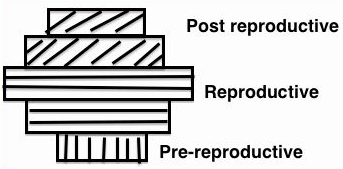
A
Vanishing population
B
Stable population
C
Declining population
D
Expanding population
Solution
(C) The provided age pyramid is urn-shaped,where the number of reproductive individuals is higher than the number of pre-reproductive individuals.
An age pyramid is a graphic representation of the abundance of individuals of different age groups,with pre-reproductive individuals at the base,reproductive individuals in the middle,and post-reproductive individuals at the top.
$1$. Triangular age pyramid: It has a high proportion of pre-reproductive individuals,a moderate number of reproductive individuals,and fewer post-reproductive individuals. It represents a young or rapidly growing population.
$2$. Bell-shaped age pyramid: The number of pre-reproductive and reproductive individuals is almost equal. Post-reproductive individuals are comparatively fewer. It represents a stable or stationary population where the growth rate is nearly zero.
$3$. Urn-shaped age pyramid: The number of reproductive individuals is higher than the number of pre-reproductive individuals. It represents a declining or diminishing population.
An age pyramid is a graphic representation of the abundance of individuals of different age groups,with pre-reproductive individuals at the base,reproductive individuals in the middle,and post-reproductive individuals at the top.
$1$. Triangular age pyramid: It has a high proportion of pre-reproductive individuals,a moderate number of reproductive individuals,and fewer post-reproductive individuals. It represents a young or rapidly growing population.
$2$. Bell-shaped age pyramid: The number of pre-reproductive and reproductive individuals is almost equal. Post-reproductive individuals are comparatively fewer. It represents a stable or stationary population where the growth rate is nearly zero.
$3$. Urn-shaped age pyramid: The number of reproductive individuals is higher than the number of pre-reproductive individuals. It represents a declining or diminishing population.
0 likesView Solution
98
BiologyEasyMCQAIPMT · 2011
Large woody vines are more commonly found in
A
temperate forests
B
mangroves
C
tropical rainforests
D
alpine forests
Solution
(C) : Lianas are large climbing woody vines that drape tropical rainforest trees.
They have adapted to life in the rainforest by having their roots in the ground and climbing high onto the tree canopy to reach available sunlight.
Many lianas start life in the rainforest canopy and send roots down to the ground.
They have adapted to life in the rainforest by having their roots in the ground and climbing high onto the tree canopy to reach available sunlight.
Many lianas start life in the rainforest canopy and send roots down to the ground.
0 likesView Solution
99
BiologyMediumMCQAIPMT · 2011
Consider the following four conditions $(1-4)$ and select a correct pair of them as adaptations to the environment in desert lizards.
Conditions:
$1$. Burrowing in soil to escape high temperature.
$2$. Losing heat rapidly from the body during high temperature.
$3$. Bask in sun when temperature is low.
$4$. Insulating body due to thick fatty dermis.
Conditions:
$1$. Burrowing in soil to escape high temperature.
$2$. Losing heat rapidly from the body during high temperature.
$3$. Bask in sun when temperature is low.
$4$. Insulating body due to thick fatty dermis.
A
$3, 4$
B
$1, 3$
C
$2, 4$
D
$1, 2$
Solution
(B) The correct answer is $(b)$.
Desert lizards lack the physiological ability that mammals possess to regulate body temperature in high-temperature habitats. Instead,they manage to keep their body temperature relatively constant through behavioral adaptations.
$1$. Burrowing into the soil is a behavioral adaptation to escape extreme surface heat.
$3$. Basking in the sun is a behavioral adaptation to absorb heat when the ambient temperature is low.
Conditions $2$ and $4$ are not typical adaptations for desert lizards; they are more characteristic of endothermic animals like mammals.
Desert lizards lack the physiological ability that mammals possess to regulate body temperature in high-temperature habitats. Instead,they manage to keep their body temperature relatively constant through behavioral adaptations.
$1$. Burrowing into the soil is a behavioral adaptation to escape extreme surface heat.
$3$. Basking in the sun is a behavioral adaptation to absorb heat when the ambient temperature is low.
Conditions $2$ and $4$ are not typical adaptations for desert lizards; they are more characteristic of endothermic animals like mammals.
0 likesView Solution
100
BiologyMediumMCQAIPMT · 2011
Which one of the following is categorised as a parasite in the true sense?
A
The female Anopheles bites and sucks blood from humans.
B
Human foetus developing inside the uterus draws nourishment from the mother.
C
Head louse living on the human scalp as well as laying eggs on human hair.
D
The cuckoo (koel) lays its eggs in a crow's nest.
Solution
(C) : Parasitism is an interaction between two species where one species (the parasite) depends on the other species (the host) for food and shelter. The parasite lives on (ectoparasite) or inside (endoparasite) the body of the host and derives nutrients from it. The head louse living on the human scalp is a classic example of an ectoparasite as it lives on the host and derives nutrition directly from it.
0 likesView Solution
Vedclass Products
For Students
Vedclass Test Series
Mock tests in real AIPMT style covering Biology with performance analysis. 5-day free trial.
Start Free TrialFor Teachers
Exam Paper Generator
Generate Set A/B/C/D Biology papers from 7.5L+ questions in 2 minutes. 3 chapters free.
Try FreeFor Institutes
Online Exam Module
Run live AIPMT mock exams with unlimited students, 360° analytics & white-label branding.
See DemoFrequently Asked Questions
How many Biology questions are in AIPMT 2011?
There are 172 Biology questions from the AIPMT 2011 paper on Vedclass, each with a detailed step-by-step solution in English.
Are AIPMT 2011 Biology solutions available in English?
Yes. All solutions on this page are in English. You can also switch to English or Hindi using the language buttons above the questions.
Can I practice AIPMT 2011 Biology as a timed test?
Yes. Use the Vedclass Test Series to attempt a full AIPMT mock test covering Biology with time limits and instant score analysis.
Can teachers create Biology papers from AIPMT previous year questions?
Yes. The Vedclass Exam Paper Generator lets teachers mix AIPMT Biology questions and generate Set A/B/C/D papers in minutes.
For Teachers & Institutes
Build a Custom Biology Paper
Pick AIPMT 2011 Biology questions, set difficulty, and generate Set A/B/C/D in 2 minutes.