
BiologyQ1–97 of 115 questions
Page 1 of 2 · English
1
BiologyMediumMCQAIPMT · 2009
Phylogenetic system of classification is based on
A
morphological features
B
chemical constituents
C
floral characters
D
evolutionary relationships
Solution
(D) The correct answer is $D$.
Phylogenetic system of classification,also known as cladistics,is based on the evolutionary history and genetic relationships among living organisms.
Unlike artificial or natural systems that rely on morphological or floral characters,the phylogenetic system organizes organisms based on their common ancestry and evolutionary sequence.
The system proposed by $Engler$ and $Prantl$ in their work $Die$ $Naturlichen$ $Pflanzen$ $Familien$ $(1892)$ is considered the first major phylogenetic classification,arranging plants from algae to angiosperms in a sequence reflecting their evolutionary progression from simple to complex forms.
Phylogenetic system of classification,also known as cladistics,is based on the evolutionary history and genetic relationships among living organisms.
Unlike artificial or natural systems that rely on morphological or floral characters,the phylogenetic system organizes organisms based on their common ancestry and evolutionary sequence.
The system proposed by $Engler$ and $Prantl$ in their work $Die$ $Naturlichen$ $Pflanzen$ $Familien$ $(1892)$ is considered the first major phylogenetic classification,arranging plants from algae to angiosperms in a sequence reflecting their evolutionary progression from simple to complex forms.
0 likesView Solution
2
BiologyMediumMCQAIPMT · 2009
$T$.$O$. Diener discovered a
A
free infectious $DNA$
B
infectious protein
C
bacteriophage
D
free infectious $RNA$
Solution
(D) The correct answer is $(d)$.
Viroids are infectious $RNA$ particles that were discovered by $T$.$O$. Diener in $1971$.
These particles are devoid of a protein coat (capsid) and consist only of a short strand of low molecular weight $RNA$.
Viroids cause various diseases in plants,such as potato spindle tuber disease and chrysanthemum stunt disease.
Viroids are infectious $RNA$ particles that were discovered by $T$.$O$. Diener in $1971$.
These particles are devoid of a protein coat (capsid) and consist only of a short strand of low molecular weight $RNA$.
Viroids cause various diseases in plants,such as potato spindle tuber disease and chrysanthemum stunt disease.
0 likesView Solution
3
BiologyMediumMCQAIPMT · 2009
Oxygenic photosynthesis occurs in
A
Oscillatoria
B
Rhodospirillum
C
Chlorobium
D
Chromatium
Solution
(A) : $Oscillatoria$ is a filamentous Gram-negative cyanobacterium that performs oxygenic photosynthesis due to the presence of chlorophyll-$a$,similar to eukaryotic algae and higher plants.
In contrast,$Rhodospirillum$,$Chlorobium$,and $Chromatium$ are photosynthetic bacteria that perform anoxygenic photosynthesis,as they use electron donors other than water (such as $H_2S$).
In contrast,$Rhodospirillum$,$Chlorobium$,and $Chromatium$ are photosynthetic bacteria that perform anoxygenic photosynthesis,as they use electron donors other than water (such as $H_2S$).
0 likesView Solution
4
BiologyEasyMCQAIPMT · 2009
Which of the following is a symbiotic nitrogen fixer?
A
Azotobacter
B
Frankia
C
Azolla
D
Glomus
Solution
(B) : $Frankia$ is a symbiotic nitrogen-fixing bacterium.
It induces root nodules in a manner similar to $Rhizobium$.
It forms a symbiotic association with the root nodules of several non-leguminous plants such as $Casuarina$,$Alnus$,and $Rubus$.
It is unable to fix nitrogen in a free-living state.
It induces root nodules in a manner similar to $Rhizobium$.
It forms a symbiotic association with the root nodules of several non-leguminous plants such as $Casuarina$,$Alnus$,and $Rubus$.
It is unable to fix nitrogen in a free-living state.
0 likesView Solution
5
BiologyMediumMCQAIPMT · 2009
Which one is the wrong pairing for the disease and its causal organism?
A
Black rust of wheat - Puccinia graminis
B
Loose smut of wheat - Ustilago nuda
C
Root knot of vegetables - Meloidogyne sp.
D
Late blight of potato - Alternaria solani
Solution
(D) : Late blight of potato is caused by $Phytophthora \text{ } infestans$. It is a phycomycetes fungus. $Alternaria \text{ } solani$ is the causal organism of early blight of potato disease.
0 likesView Solution
6
BiologyMediumMCQAIPMT · 2009
Which one of the following is a vascular cryptogam?
A
Ginkgo
B
Marchantia
C
Cedrus
D
Equisetum
Solution
(D) : Pteridophytes are known as vascular cryptogams ($Gk$ $kryptos$ = hidden + $gamos$ = wedded). They reproduce by spores rather than seeds. They are the first vascular land plants.
$Equisetum$ is a pteridophyte belonging to the Class $Sphenopsida$. All its vegetative parts possess vascular tissues ($i.e.$, hadrome equivalent to xylem and leptome equivalent to phloem) organized in definite groups of steles.
$Equisetum$ is a pteridophyte belonging to the Class $Sphenopsida$. All its vegetative parts possess vascular tissues ($i.e.$, hadrome equivalent to xylem and leptome equivalent to phloem) organized in definite groups of steles.
0 likesView Solution
7
BiologyMediumMCQAIPMT · 2009
Mannitol is the stored food in
A
Porphyra
B
Fucus
C
Gracillaria
D
Chara
Solution
(B) The correct answer is $B$.
$Fucus$ is a brown alga,which belongs to the Class $Phaeophyceae$.
In brown algae,the stored food material is complex carbohydrates,usually in the form of laminarin or mannitol.
$Porphyra$ and $Gracillaria$ are red algae (Class $Rhodophyceae$),where food is stored as floridean starch.
$Chara$ is a green alga (Class $Chlorophyceae$),where food is stored as starch.
$Fucus$ is a brown alga,which belongs to the Class $Phaeophyceae$.
In brown algae,the stored food material is complex carbohydrates,usually in the form of laminarin or mannitol.
$Porphyra$ and $Gracillaria$ are red algae (Class $Rhodophyceae$),where food is stored as floridean starch.
$Chara$ is a green alga (Class $Chlorophyceae$),where food is stored as starch.
0 likesView Solution
8
BiologyMediumMCQAIPMT · 2009
Which one of the following is considered important in the development of seed habit?
A
Heterospory
B
Haplontic life cycle
C
Free-living gametophyte
D
Dependent sporophyte
Solution
(A) : The differentiation of spores into microspores and megaspores,known as heterospory,is a crucial evolutionary step. The retention of the megaspore within the megasporangium on the parent sporophyte for development into the female gametophyte is considered an essential prerequisite for the formation of seeds,which is a characteristic feature of spermatophytes. This process allows the embryo to develop while being protected and nourished by the parent plant.
0 likesView Solution
9
BiologyMediumMCQAIPMT · 2009
Which one of the following has a haplontic life cycle?
A
Polytrichum
B
Funaria
C
Wheat
D
Ustilago
Solution
(D) The correct answer is $D$.
In a haplontic life cycle,the sporophytic generation is represented only by the one-celled zygote. There are no free-living sporophytes.
$A$,$B$,and $C$ (Polytrichum,Funaria,and Wheat) exhibit a diplohaplontic life cycle (haplodiplontic),where both haploid and diploid phases are multicellular.
$Ustilago$ (a smut fungus) is a member of Basidiomycetes. In many fungi,the dominant phase is haploid,and the zygote undergoes meiosis immediately to produce haploid spores,representing a haplontic life cycle.
In a haplontic life cycle,the sporophytic generation is represented only by the one-celled zygote. There are no free-living sporophytes.
$A$,$B$,and $C$ (Polytrichum,Funaria,and Wheat) exhibit a diplohaplontic life cycle (haplodiplontic),where both haploid and diploid phases are multicellular.
$Ustilago$ (a smut fungus) is a member of Basidiomycetes. In many fungi,the dominant phase is haploid,and the zygote undergoes meiosis immediately to produce haploid spores,representing a haplontic life cycle.
0 likesView Solution
10
BiologyEasyMCQAIPMT · 2009
Which one of the following plants is monoecious?
A
Pinus
B
Cycas
C
Papaya
D
Marchantia
Solution
(A) : Monoecious plants have separate male and female reproductive structures on the same individual plant.
$Pinus$ is a monoecious gymnosperm because it bears both male and female cones (strobili) on the same tree.
In contrast,$Cycas$ is dioecious (separate male and female plants),$Papaya$ is typically dioecious,and $Marchantia$ is a dioecious bryophyte.
$Pinus$ is a monoecious gymnosperm because it bears both male and female cones (strobili) on the same tree.
In contrast,$Cycas$ is dioecious (separate male and female plants),$Papaya$ is typically dioecious,and $Marchantia$ is a dioecious bryophyte.
0 likesView Solution
11
BiologyMediumMCQAIPMT · 2009
Which one of the following groups of animals is bilaterally symmetrical and triploblastic?
A
Aschelminthes (round worms)
B
Ctenophores
C
Sponges
D
Coelenterates (cnidarians)
Solution
(A) The correct answer is $A$.
Aschelminthes (roundworms) are bilaterally symmetrical and triploblastic animals.
They are also pseudocoelomates,meaning they possess a false body cavity.
In contrast,Sponges (Porifera) are asymmetrical,while Ctenophores and Coelenterates (Cnidarians) are radially symmetrical and diploblastic.
Aschelminthes (roundworms) are bilaterally symmetrical and triploblastic animals.
They are also pseudocoelomates,meaning they possess a false body cavity.
In contrast,Sponges (Porifera) are asymmetrical,while Ctenophores and Coelenterates (Cnidarians) are radially symmetrical and diploblastic.
0 likesView Solution
12
BiologyMediumMCQAIPMT · 2009
If a live earthworm is pricked with a needle on its outer surface without damaging its gut,the fluid that comes out is
A
coelomic fluid
B
haemolymph
C
slimy mucus
D
excretory fluid
Solution
(A) : The coelom or body cavity of an earthworm is filled with coelomic fluid.
It is located between the body wall and the alimentary canal.
Therefore,if a live earthworm is pricked with a needle on its outer surface without damaging the gut,only the coelomic fluid will come out.
It is located between the body wall and the alimentary canal.
Therefore,if a live earthworm is pricked with a needle on its outer surface without damaging the gut,only the coelomic fluid will come out.
0 likesView Solution
13
BiologyEasyMCQAIPMT · 2009
Which one of the following pairs of animals comprises 'jawless fishes'?
A
Mackerels and rohu
B
Lampreys and hagfishes
C
Guppies and hagfishes
D
Lampreys and eels
Solution
(B) $Agnatha$ is a superclass of vertebrates that lack jaws.
These are fish-like animals with cartilaginous skeletons and well-developed sucking mouthparts with horny teeth.
The only living agnathans belong to the class $Cyclostomata$,which includes lampreys and hagfishes.
These organisms are typically parasites or scavengers.
These are fish-like animals with cartilaginous skeletons and well-developed sucking mouthparts with horny teeth.
The only living agnathans belong to the class $Cyclostomata$,which includes lampreys and hagfishes.
These organisms are typically parasites or scavengers.
0 likesView Solution
14
BiologyEasyMCQAIPMT · 2009
$A$ fruit developed from hypanthodium inflorescence is called
A
sorosis
B
syconus
C
caryopsis
D
hesperidium
Solution
(B) : Syconus fruit develops from a hypanthodium inflorescence,$e.g.$,$Ficus$.
Hypanthodium is a box-like inflorescence where the box is formed by the fleshy receptacle.
It opens to the exterior by a single pore called ostiole.
The hollow,pear-shaped fleshy receptacle encloses a number of minute male and female flowers; it becomes fleshy and forms the fruit.
Hypanthodium is a box-like inflorescence where the box is formed by the fleshy receptacle.
It opens to the exterior by a single pore called ostiole.
The hollow,pear-shaped fleshy receptacle encloses a number of minute male and female flowers; it becomes fleshy and forms the fruit.
0 likesView Solution
15
BiologyMediumMCQAIPMT · 2009
An example of axile placentation is
A
Dianthus
B
marigold
C
lemon
D
Argemone
Solution
(C) In axile placentation,the placenta develops from the central axis of the ovary,and the ovules are attached to it in a multilocular ovary.
Examples of axile placentation include $Lemon$,$China$ $rose$,and $Tomato$.
$Dianthus$ shows free central placentation,$Marigold$ shows basal placentation,and $Argemone$ shows parietal placentation.
Examples of axile placentation include $Lemon$,$China$ $rose$,and $Tomato$.
$Dianthus$ shows free central placentation,$Marigold$ shows basal placentation,and $Argemone$ shows parietal placentation.
0 likesView Solution
16
BiologyMediumMCQAIPMT · 2009
Cotyledons and testa respectively are edible parts in
A
walnut and tamarind
B
french bean and coconut
C
cashew nut and litchi
D
groundnut and pomegranate
Solution
(D) The correct answer is $D$.
In groundnut $(Arachis hypogaea)$, the edible part consists of the cotyledons and the embryo.
In pomegranate $(Punica granatum)$, the fruit is a balausta, where the fleshy, edible portion is the succulent testa (seed coat) of the seeds.
In groundnut $(Arachis hypogaea)$, the edible part consists of the cotyledons and the embryo.
In pomegranate $(Punica granatum)$, the fruit is a balausta, where the fleshy, edible portion is the succulent testa (seed coat) of the seeds.
0 likesView Solution
17
BiologyMediumMCQAIPMT · 2009
In $Barley$ stem,vascular bundles are:
A
closed and scattered
B
open and in a ring
C
closed and radial
D
open and scattered
Solution
(A) $Barley$ is a monocotyledonous plant.
In monocot stems,the vascular bundles are conjoint,collateral,and closed because the cambium is absent.
These vascular bundles are scattered throughout the ground tissue.
In monocot stems,the vascular bundles are conjoint,collateral,and closed because the cambium is absent.
These vascular bundles are scattered throughout the ground tissue.
0 likesView Solution
18
BiologyMediumMCQAIPMT · 2009
Palisade parenchyma is absent in leaves of
A
mustard
B
soybean
C
gram
D
Sorghum
Solution
(D) : Palisade parenchyma is absent in the leaves of $Sorghum$.
$Sorghum$ is a monocot plant.
In monocot leaves (isobilateral leaves),the mesophyll tissue is not differentiated into palisade and spongy parenchyma,unlike in dicot leaves (dorsiventral leaves) where these two layers are distinct.
$Sorghum$ is a monocot plant.
In monocot leaves (isobilateral leaves),the mesophyll tissue is not differentiated into palisade and spongy parenchyma,unlike in dicot leaves (dorsiventral leaves) where these two layers are distinct.
0 likesView Solution
19
BiologyMediumMCQAIPMT · 2009
The annular and spirally thickened conducting elements generally develop in the protoxylem when the root or stem is
A
elongating
B
widening
C
differentiating
D
maturing
Solution
(C) : The protoxylem differentiates in the parts of the primary body that have not completed their growth and differentiation.
In the shoot, the protoxylem matures among actively elongating tissues and is, therefore, subjected to stresses.
In the root, the protoxylem elements persist longer because they mature beyond the region of maximum growth.
During this process of differentiation, annular and spiral thickenings take place in the conducting elements to provide structural support while allowing for further growth.
In the shoot, the protoxylem matures among actively elongating tissues and is, therefore, subjected to stresses.
In the root, the protoxylem elements persist longer because they mature beyond the region of maximum growth.
During this process of differentiation, annular and spiral thickenings take place in the conducting elements to provide structural support while allowing for further growth.
0 likesView Solution
20
BiologyMediumMCQAIPMT · 2009
Anatomically,a fairly old dicotyledonous root is distinguished from a dicotyledonous stem by
A
absence of secondary phloem
B
presence of cortex
C
position of protoxylem
D
absence of secondary xylem
Solution
(C) The correct answer is $C$.
In a dicotyledonous root,the protoxylem is located near the periphery of the vascular cylinder,while the metaxylem is located further inward. This arrangement is known as $exarch$ or centripetal xylem.
In contrast,in a dicotyledonous stem,the protoxylem is located near the center of the vascular bundle,and the metaxylem is located near the periphery. This arrangement is known as $endarch$ or centrifugal xylem.
Therefore,the position of the protoxylem is a key anatomical feature used to distinguish between a dicot root and a dicot stem.
In a dicotyledonous root,the protoxylem is located near the periphery of the vascular cylinder,while the metaxylem is located further inward. This arrangement is known as $exarch$ or centripetal xylem.
In contrast,in a dicotyledonous stem,the protoxylem is located near the center of the vascular bundle,and the metaxylem is located near the periphery. This arrangement is known as $endarch$ or centrifugal xylem.
Therefore,the position of the protoxylem is a key anatomical feature used to distinguish between a dicot root and a dicot stem.
0 likesView Solution
21
BiologyMediumMCQAIPMT · 2009
The ciliated columnar epithelial cells in humans are known to occur in
A
Eustachian tube and stomach lining
B
bronchioles and Fallopian tube
C
bile duct and oesophagus
D
Fallopian tube and urethra
Solution
(B) : In humans,ciliated columnar epithelial cells are primarily found in the inner surface of hollow organs like the bronchioles and the Fallopian tubes (oviducts).
These cells possess cilia on their free surface,which help in the movement of particles or mucus in a specific direction.
They are also found in the nasal passages,the ventricles of the brain,and the central canal of the spinal cord in the embryo.
These cells possess cilia on their free surface,which help in the movement of particles or mucus in a specific direction.
They are also found in the nasal passages,the ventricles of the brain,and the central canal of the spinal cord in the embryo.
0 likesView Solution
22
BiologyEasyMCQAIPMT · 2009
Which one of the following correctly describes the location of some body parts in the earthworm $Pheretima$?
A
Four pairs of spermathecae in $4^{th}-7^{th}$ segments
B
One pair of ovaries attached at intersegmental septum of $14^{th}$ and $15^{th}$ segments
C
Two pairs of testes in $10^{th}$ and $11^{th}$ segments
D
Two pairs of accessory glands in $16^{th}-18^{th}$ segments
Solution
(C) : In $Pheretima$,two pairs of testis sacs are situated in the $10^{th}$ and $11^{th}$ segments. Each testis sac of the $10^{th}$ segment encloses a testis and a seminal funnel. Each testis sac of the $11^{th}$ segment encloses a testis,a seminal vesicle,and a seminal funnel.
0 likesView Solution
23
BiologyMediumMCQAIPMT · 2009
Which one of the following is the correct pairing of a body part and the kind of muscle tissue that moves it?
A
Biceps of upper arm - Smooth muscle fibres
B
Abdominal wall - Smooth muscle
C
Iris - Involuntary smooth muscle
D
Heart wall - Involuntary unstriated muscle
Solution
(C) is the correct answer. Smooth muscles are known as involuntary muscles because their action is controlled by the autonomic nervous system,meaning they are not under the conscious control of the organism. The iris of the eye consists of involuntary smooth muscles. While the abdominal wall also contains smooth muscles,the biceps of the upper arm are composed of skeletal muscles,and the heart wall consists of specialized cardiac muscles.
0 likesView Solution
24
BiologyMediumMCQAIPMT · 2009
The epithelial tissue present on the inner surface of bronchioles and Fallopian tubes is
A
glandular
B
ciliated
C
squamous
D
cuboidal
Solution
(B) : The ciliated columnar epithelial cells in humans are present in the nasal passages,oviducts (Fallopian tubes),terminal bronchioles,ventricles of the brain,and the central canal of the spinal cord of the embryo. Ciliated epithelium consists of cells that bear cilia on their free surface,which help in the movement of particles or mucus in a specific direction.
0 likesView Solution
25
BiologyMediumMCQAIPMT · 2009
The cell junctions called tight,adhering and gap junctions are found in
A
connective tissue
B
epithelial tissue
C
neural tissue
D
muscular tissue
Solution
(B) : Epithelial tissues consist of variously shaped cells closely arranged in one or more layers.
The cells are held together by intercellular junctions like tight,adhering,and gap junctions.
The cells are held together by intercellular junctions like tight,adhering,and gap junctions.
0 likesView Solution
26
BiologyEasyMCQAIPMT · 2009
The kind of tissue that forms the supportive structure in our pinna (external ears) is also found in
A
nails
B
ear ossicles
C
tip of the nose
D
vertebrae
Solution
(C) The tissue that forms the supportive structure in the pinna (external ear) is yellow elastic cartilage. This type of cartilage provides both support and flexibility. It is also found in the tip of the nose,the epiglottis,and the Eustachian tubes. Therefore,the correct option is $(c)$.
0 likesView Solution
27
BiologyEasyMCQAIPMT · 2009
Middle lamella is composed mainly of
A
muramic acid
B
calcium pectate
C
phosphoglycerides
D
hemicellulose
Solution
(B) : The middle lamella of the cell wall is primarily composed of calcium and magnesium pectate.
It acts as a cementing layer that holds adjacent plant cells together.
It acts as a cementing layer that holds adjacent plant cells together.
0 likesView Solution
28
BiologyEasyMCQAIPMT · 2009
Cytoskeleton is made up of
A
callose deposits
B
cellulosic microfibrils
C
proteinaceous filaments
D
calcium carbonate granules
Solution
(C) The correct answer is $C$.
The cytoskeleton is an elaborate network of proteinaceous filaments present in the cytoplasm of eukaryotic cells.
It is primarily composed of three types of protein filaments:
$1$. Microtubules (made of tubulin protein).
$2$. Microfilaments (made of actin and myosin proteins).
$3$. Intermediate filaments (made of proteins like keratin,vimentin,desmin,and lamin).
These structures provide mechanical support,motility,and maintenance of the cell shape.
The cytoskeleton is an elaborate network of proteinaceous filaments present in the cytoplasm of eukaryotic cells.
It is primarily composed of three types of protein filaments:
$1$. Microtubules (made of tubulin protein).
$2$. Microfilaments (made of actin and myosin proteins).
$3$. Intermediate filaments (made of proteins like keratin,vimentin,desmin,and lamin).
These structures provide mechanical support,motility,and maintenance of the cell shape.
0 likesView Solution
29
BiologyEasyMCQAIPMT · 2009
Plasmodesmata are
A
locomotary structures
B
membranes connecting the nucleus with plasmalemma
C
connections between adjacent cells
D
lignified cemented layers between cells
Solution
(C) : Plasmodesmata are fine cytoplasmic strands that connect the protoplasts of adjacent plant cells by passing through their cell walls.
Plasmodesmata are cylindrical in shape (about $20-40 \ nm$ in diameter) and are lined by the plasma membrane of the two adjacent cells.
They permit the passage between cells of substances including ions,sugars,amino acids,and macromolecules.
Plasmodesmata are cylindrical in shape (about $20-40 \ nm$ in diameter) and are lined by the plasma membrane of the two adjacent cells.
They permit the passage between cells of substances including ions,sugars,amino acids,and macromolecules.
0 likesView Solution
30
BiologyEasyMCQAIPMT · 2009
Synapsis occurs between
A
$mRNA$ and ribosomes
B
spindle fibres and centromere
C
two homologous chromosomes
D
a male and a female gamete.
Solution
(C) The correct answer is $C$.
During the $zygotene$ or $zygonema$ stage of meiotic $prophase-I$, the chromosomes become shorter and thicker.
The homologous chromosomes come to lie side-by-side in pairs.
This pairing of homologous chromosomes is known as $synapsis$ or $syndesis$.
$A$ pair of homologous chromosomes lying together is called a $bivalent$.
During the $zygotene$ or $zygonema$ stage of meiotic $prophase-I$, the chromosomes become shorter and thicker.
The homologous chromosomes come to lie side-by-side in pairs.
This pairing of homologous chromosomes is known as $synapsis$ or $syndesis$.
$A$ pair of homologous chromosomes lying together is called a $bivalent$.
0 likesView Solution
31
BiologyMediumMCQAIPMT · 2009
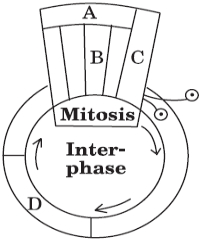
Given below is a schematic representation of the phases/stages of the cell cycle. Which one of the following is the correct indication of the stage/phase in the cell cycle?
A
$C$ - Cytokinesis
B
$D$ - Synthetic phase ($S$ phase)
C
$A$ - Prophase
D
$B$ - Metaphase
Solution
(B) The cell cycle is divided into two main phases: Interphase and $M$-phase (Mitosis).
Interphase consists of three stages: $G_1$ phase,$S$ phase (Synthetic phase),and $G_2$ phase.
In the provided diagram,$D$ represents the $S$ phase (Synthetic phase) within the Interphase.
Mitosis is further divided into Prophase $(A)$,Metaphase $(B)$,Anaphase,and Telophase ($C$ represents Cytokinesis).
Therefore,$D$ corresponds to the Synthetic phase.
Interphase consists of three stages: $G_1$ phase,$S$ phase (Synthetic phase),and $G_2$ phase.
In the provided diagram,$D$ represents the $S$ phase (Synthetic phase) within the Interphase.
Mitosis is further divided into Prophase $(A)$,Metaphase $(B)$,Anaphase,and Telophase ($C$ represents Cytokinesis).
Therefore,$D$ corresponds to the Synthetic phase.
0 likesView Solution
32
BiologyEasyMCQAIPMT · 2009
Guard cells help in
A
transpiration
B
guttation
C
fighting against infection
D
protection against grazing
Solution
(A) : Stomata are the primary organs for transpiration. The epidermis of stems and leaves contains numerous stomata. The diffusion of water vapour through stomatal pores is known as stomatal transpiration. Transpiration occurs while stomata are open for the passage of $CO_2$ and $O_2$ during photosynthesis. The opening and closing of stomata are regulated by the movement of guard cells.
0 likesView Solution
33
BiologyEasyMCQAIPMT · 2009
Manganese is required in
A
plant cell wall formation
B
photolysis of water during photosynthesis
C
chlorophyll synthesis
D
nucleic acid synthesis
Solution
(B) Manganese $(Mn^{2+})$ plays a crucial role in the process of photosynthesis. Specifically,it is essential for the photolysis of water,which is the splitting of water molecules into oxygen,protons,and electrons. This reaction occurs in the thylakoid lumen and is vital for providing electrons to the electron transport chain in Photosystem $II$.
0 likesView Solution
34
BiologyMediumMCQAIPMT · 2009
Cyclic photophosphorylation results in the formation of
A
$ATP$ and $NADPH$
B
$ATP, NADPH$ and $O_2$
C
$ATP$
D
$NADPH$
Solution
(C) In cyclic photophosphorylation,only $ATP$ molecules are synthesized.
This process involves the cyclic flow of electrons through the photosystem $I$ $(PS-I)$ complex.
Cyclic photophosphorylation is not associated with the photolysis of water,therefore $O_2$ is not evolved.
Additionally,$NADP^+$ is not reduced to $NADPH$ because the electrons are cycled back to the reaction center of $PS-I$ rather than being transferred to $NADP^+$.
This process involves the cyclic flow of electrons through the photosystem $I$ $(PS-I)$ complex.
Cyclic photophosphorylation is not associated with the photolysis of water,therefore $O_2$ is not evolved.
Additionally,$NADP^+$ is not reduced to $NADPH$ because the electrons are cycled back to the reaction center of $PS-I$ rather than being transferred to $NADP^+$.
0 likesView Solution
35
BiologyMediumMCQAIPMT · 2009
Stroma in the chloroplasts of higher plants contains
A
light-dependent reaction enzymes
B
ribosomes
C
chlorophyll
D
light-independent reaction enzymes
Solution
(D) The correct answer is $D$. The light-independent reactions (also known as the Calvin cycle or dark reactions) of photosynthesis are purely enzymatic and occur in the stroma of the chloroplast. These reactions are independent of light,meaning they can occur in the presence or absence of light,provided that the necessary assimilatory power ($ATP$ and $NADPH$) is available. While the stroma may contain ribosomes,the defining functional characteristic of the stroma in the context of photosynthesis is the presence of enzymes required for the light-independent reactions.
0 likesView Solution
36
BiologyMediumMCQAIPMT · 2009
Aerobic respiratory pathway is appropriately termed
A
parabolic
B
amphibolic
C
anabolic
D
catabolic
Solution
(B) : $A$ biochemical pathway that serves both anabolic and catabolic processes is known as an amphibolic pathway.
Aerobic respiration involves both the catabolism of carbohydrates,fats,and proteins to release energy and the synthesis of various metabolic intermediates that act as precursors for the biosynthesis of amino acids,fatty acids,and other secondary metabolites.
Because it functions in both the breakdown (catabolism) and synthesis (anabolism) of molecules,it is appropriately termed an amphibolic pathway.
Aerobic respiration involves both the catabolism of carbohydrates,fats,and proteins to release energy and the synthesis of various metabolic intermediates that act as precursors for the biosynthesis of amino acids,fatty acids,and other secondary metabolites.
Because it functions in both the breakdown (catabolism) and synthesis (anabolism) of molecules,it is appropriately termed an amphibolic pathway.
0 likesView Solution
37
BiologyMediumMCQAIPMT · 2009
One of the synthetic auxins is
A
$IAA$
B
$NAA$
C
$IBA$
D
Both $(b)$ and $(c)$
Solution
(D) The correct answer is $(d)$.
Many auxins have been synthesized that exhibit properties similar to natural auxins.
Examples of synthetic auxins include naphthalene acetic acid $(NAA)$,indole-$3$-butyric acid $(IBA)$,$2,4$-dichlorophenoxyacetic acid $(2,4-D)$,and $2,4,5$-trichlorophenoxyacetic acid $(2,4,5-T)$.
While $IBA$ is often found naturally in plants,it is also produced synthetically and is widely used in agriculture for rooting cuttings.
Many auxins have been synthesized that exhibit properties similar to natural auxins.
Examples of synthetic auxins include naphthalene acetic acid $(NAA)$,indole-$3$-butyric acid $(IBA)$,$2,4$-dichlorophenoxyacetic acid $(2,4-D)$,and $2,4,5$-trichlorophenoxyacetic acid $(2,4,5-T)$.
While $IBA$ is often found naturally in plants,it is also produced synthetically and is widely used in agriculture for rooting cuttings.
0 likesView Solution
38
BiologyMediumMCQAIPMT · 2009
Which one of the following acids is a derivative of carotenoids?
A
Indole-$3$-acetic acid
B
Gibberellic acid
C
Abscisic acid
D
Indole butyric acid
Solution
(C) $Abscisic$ $acid$ $(ABA)$ is a plant growth inhibitor.
Its biosynthesis in most plants occurs indirectly through the degradation of certain carotenoids,specifically violaxanthin,which are present in chloroplasts or other plastids.
The biosynthetic pathway involves the mevalonic acid pathway for the synthesis of its precursors.
The primary sites of $ABA$ synthesis include fruits,leaves,roots,and seeds.
Its biosynthesis in most plants occurs indirectly through the degradation of certain carotenoids,specifically violaxanthin,which are present in chloroplasts or other plastids.
The biosynthetic pathway involves the mevalonic acid pathway for the synthesis of its precursors.
The primary sites of $ABA$ synthesis include fruits,leaves,roots,and seeds.
0 likesView Solution
39
BiologyEasyMCQAIPMT · 2009
When breast feeding is replaced by less nutritive food low in proteins and calories,infants below the age of one year are likely to suffer from:
A
rickets
B
kwashiorkor
C
pellagra
D
marasmus
Solution
(D) : Marasmus is a form of protein-energy malnutrition that is common in infants under one year of age.
It develops due to a simultaneous deficiency of proteins and total calories.
Unlike kwashiorkor,which typically affects older children and is primarily a protein deficiency,marasmus involves a severe lack of all energy-providing nutrients.
It can be managed and cured by providing a diet rich in adequate proteins,fats,and carbohydrates.
It develops due to a simultaneous deficiency of proteins and total calories.
Unlike kwashiorkor,which typically affects older children and is primarily a protein deficiency,marasmus involves a severe lack of all energy-providing nutrients.
It can be managed and cured by providing a diet rich in adequate proteins,fats,and carbohydrates.
0 likesView Solution
40
BiologyMediumMCQAIPMT · 2009
$A$ young infant may be feeding entirely on mother's milk which is white in colour,but the stools which the infant passes out are quite yellowish. What is this yellow colour due to?
A
Bile pigments passed through bile juice
B
Undigested milk protein casein
C
Pancreatic juice poured into duodenum
D
Intestinal juice
Solution
(A) The yellow colour of the stool is due to the presence of bile pigments,specifically bilirubin,which is yellow in colour.
Bile pigments are excretory products formed from the breakdown of hemoglobin.
Bile is a bitter-tasting,greenish-yellow alkaline fluid produced by the liver,stored in the gall bladder,and secreted into the duodenum.
Even in infants feeding solely on mother's milk,these pigments are processed and excreted,resulting in the characteristic yellowish colour of the stool.
Bile pigments are excretory products formed from the breakdown of hemoglobin.
Bile is a bitter-tasting,greenish-yellow alkaline fluid produced by the liver,stored in the gall bladder,and secreted into the duodenum.
Even in infants feeding solely on mother's milk,these pigments are processed and excreted,resulting in the characteristic yellowish colour of the stool.
0 likesView Solution
41
BiologyMediumMCQAIPMT · 2009
Which one of the following statements is true regarding the digestion and absorption of food in humans?
A
Fructose and amino acids are absorbed through intestinal mucosa with the help of carrier ions like $Na^+$.
B
Chylomicrons are small lipoprotein particles that are transported from the intestine into blood capillaries.
C
About $60\%$ of starch is hydrolysed by salivary amylase in our mouth.
D
Oxyntic cells in our stomach secrete the proenzyme pepsinogen.
Solution
(A) The correct statement is that amino acids are absorbed through the intestinal mucosa with the help of carrier ions like $Na^+$.
$1$. Glucose and galactose are absorbed by active transport,which is facilitated by the sodium pump.
$2$. Fructose is absorbed by facilitated diffusion involving a specific transmembrane carrier.
$3$. Amino acids are absorbed by active transport coupled with $Na^+$ transport.
$4$. Chylomicrons are transported into lacteals (lymph vessels),not blood capillaries.
$5$. Only about $30\%$ of starch is hydrolyzed by salivary amylase in the mouth.
$6$. Oxyntic (parietal) cells secrete $HCl$ and intrinsic factor,while chief cells secrete pepsinogen.
$1$. Glucose and galactose are absorbed by active transport,which is facilitated by the sodium pump.
$2$. Fructose is absorbed by facilitated diffusion involving a specific transmembrane carrier.
$3$. Amino acids are absorbed by active transport coupled with $Na^+$ transport.
$4$. Chylomicrons are transported into lacteals (lymph vessels),not blood capillaries.
$5$. Only about $30\%$ of starch is hydrolyzed by salivary amylase in the mouth.
$6$. Oxyntic (parietal) cells secrete $HCl$ and intrinsic factor,while chief cells secrete pepsinogen.
0 likesView Solution
42
BiologyMediumMCQAIPMT · 2009
Which one of the following pairs of food components in humans reaches the stomach totally undigested?
A
Starch and fat
B
Fat and cellulose
C
Starch and cellulose
D
Protein and starch
Solution
(B) The correct answer is $B$.
$1$. Saliva contains salivary amylase,which begins the digestion of starch in the mouth. Therefore,starch does not reach the stomach completely undigested.
$2$. Saliva does not contain any lipase,and the stomach lacks fat-emulsifying agents (bile salts),so fat remains largely undigested until it reaches the small intestine.
$3$. Humans lack the enzyme cellulase required to digest cellulose; therefore,cellulose passes through the digestive tract completely undigested.
$4$. Proteins begin their digestion in the stomach due to the action of pepsin and hydrochloric acid.
Thus,fat and cellulose reach the stomach in an undigested state.
$1$. Saliva contains salivary amylase,which begins the digestion of starch in the mouth. Therefore,starch does not reach the stomach completely undigested.
$2$. Saliva does not contain any lipase,and the stomach lacks fat-emulsifying agents (bile salts),so fat remains largely undigested until it reaches the small intestine.
$3$. Humans lack the enzyme cellulase required to digest cellulose; therefore,cellulose passes through the digestive tract completely undigested.
$4$. Proteins begin their digestion in the stomach due to the action of pepsin and hydrochloric acid.
Thus,fat and cellulose reach the stomach in an undigested state.
0 likesView Solution
43
BiologyMediumMCQAIPMT · 2009
What is the vital capacity of our lungs?
A
Inspiratory reserve volume plus expiratory reserve volume
B
Total lung capacity minus residual volume
C
Inspiratory reserve volume plus tidal volume
D
Total lung capacity minus expiratory reserve volume
Solution
(B) The correct answer is $B$.
Vital capacity $(VC)$ is the maximum volume of air a person can breathe in after a forced expiration.
It is the sum of tidal volume $(TV)$,inspiratory reserve volume $(IRV)$,and expiratory reserve volume $(ERV)$.
Total lung capacity $(TLC)$ is the total volume of air accommodated in the lungs at the end of a forced inspiration,which includes $VC$ and residual volume $(RV)$.
Therefore,$TLC = VC + RV$,which implies $VC = TLC - RV$.
Vital capacity $(VC)$ is the maximum volume of air a person can breathe in after a forced expiration.
It is the sum of tidal volume $(TV)$,inspiratory reserve volume $(IRV)$,and expiratory reserve volume $(ERV)$.
Total lung capacity $(TLC)$ is the total volume of air accommodated in the lungs at the end of a forced inspiration,which includes $VC$ and residual volume $(RV)$.
Therefore,$TLC = VC + RV$,which implies $VC = TLC - RV$.
0 likesView Solution
44
BiologyMediumMCQAIPMT · 2009
The haemoglobin of a human foetus:
A
has only $2$ protein subunits instead of $4$
B
has a higher affinity for oxygen than that of an adult
C
has a lower affinity for oxygen than that of the adult
D
its affinity for oxygen is the same as that of an adult
Solution
(B) : Oxygen is required for aerobic respiration and diffuses from a region of high concentration to a region of low concentration from the mother's blood to the blood of the foetus.
The haemoglobin of the foetus $(HbF)$ has a higher affinity for oxygen than that of adult haemoglobin $(HbA)$,which facilitates the efficient transfer of oxygen across the placenta.
Carbon dioxide,a waste product of aerobic respiration,diffuses in the opposite direction from the foetus to the mother.
The haemoglobin of the foetus $(HbF)$ has a higher affinity for oxygen than that of adult haemoglobin $(HbA)$,which facilitates the efficient transfer of oxygen across the placenta.
Carbon dioxide,a waste product of aerobic respiration,diffuses in the opposite direction from the foetus to the mother.
0 likesView Solution
45
BiologyMediumMCQAIPMT · 2009
There is no $DNA$ in
A
mature $RBCs$
B
a mature spermatozoan
C
hair root
D
an enucleated ovum
Solution
(A) The correct answer is $A$. Mature mammalian $RBCs$ (red blood cells) are enucleated,meaning they lack a nucleus and consequently do not contain $DNA$. In contrast,mature spermatozoa contain $DNA$ in their head region,hair roots contain cells with nuclei and $DNA$,and an enucleated ovum (though lacking a nucleus) is not a standard biological cell type found in normal physiological conditions,but the question specifically targets the absence of $DNA$ in mature $RBCs$ as a primary biological characteristic.
0 likesView Solution
46
BiologyMediumMCQAIPMT · 2009
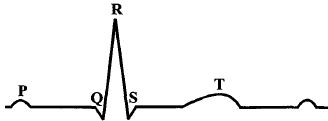
In a standard $ECG$,which one of the following alphabets is the correct representation of the respective activity of the human heart?
A
$S$ - start of systole
B
$T$ - end of diastole
C
$P$ - depolarisation of the atria
D
$R$ - repolarisation of ventricles
Solution
(C) The correct answer is $C$.
In a standard $ECG$:
$1$. The $P$-wave represents the electrical excitation (or depolarisation) of the atria,which leads to the contraction of both atria.
$2$. The $QRS$ complex represents the depolarisation of the ventricles,which initiates ventricular contraction. The contraction starts shortly after $Q$ and marks the beginning of the systole.
$3$. The $T$-wave represents the return of the ventricles from an excited state to a normal state (repolarisation). The end of the $T$-wave marks the end of systole.
In a standard $ECG$:
$1$. The $P$-wave represents the electrical excitation (or depolarisation) of the atria,which leads to the contraction of both atria.
$2$. The $QRS$ complex represents the depolarisation of the ventricles,which initiates ventricular contraction. The contraction starts shortly after $Q$ and marks the beginning of the systole.
$3$. The $T$-wave represents the return of the ventricles from an excited state to a normal state (repolarisation). The end of the $T$-wave marks the end of systole.
0 likesView Solution
47
BiologyMediumMCQAIPMT · 2009
Globulins contained in human blood plasma are primarily involved in
A
Blood clotting
B
Oxygen transport in the blood
C
Osmotic balance of body fluids
D
Defence mechanism of body
Solution
(D) : Globulins in human blood plasma are primarily involved in the defence mechanisms of the body.
Globulins,specifically immunoglobulins,act as antibodies that identify and neutralize pathogens such as bacteria,viruses,and other foreign toxic substances that enter the bloodstream.
Globulins,specifically immunoglobulins,act as antibodies that identify and neutralize pathogens such as bacteria,viruses,and other foreign toxic substances that enter the bloodstream.
0 likesView Solution
48
BiologyMediumMCQAIPMT · 2009
Compared to blood,our lymph has:
A
plasma without proteins
B
more $WBCs$ and no $RBCs$
C
more $RBCs$ and less $WBCs$
D
no plasma
Solution
(B) Lymph is a fluid connective tissue that is essentially blood plasma that has leaked out of the capillaries into the interstitial spaces.
It contains plasma and $WBCs$ (mainly lymphocytes) but lacks $RBCs$,platelets,and large plasma proteins.
Compared to blood,lymph has a higher concentration of $WBCs$ and is completely devoid of $RBCs$.
Therefore,the correct option is $B$.
It contains plasma and $WBCs$ (mainly lymphocytes) but lacks $RBCs$,platelets,and large plasma proteins.
Compared to blood,lymph has a higher concentration of $WBCs$ and is completely devoid of $RBCs$.
Therefore,the correct option is $B$.
0 likesView Solution
49
BiologyDifficultMCQAIPMT · 2009
What will happen if the stretch receptors of the urinary bladder wall are totally removed?
A
Micturition will continue
B
Urine will continue to collect normally in the bladder
C
There will be no micturition
D
Urine will not collect in the bladder
Solution
(C) The stretch receptors in the wall of the urinary bladder are sensory receptors that detect the distension of the bladder as it fills with urine.
These receptors send signals to the central nervous system to trigger the micturition reflex.
If these receptors are removed,the brain will not receive the signal that the bladder is full.
Consequently,the bladder will continue to fill with urine without triggering the reflex to empty it,leading to continuous,uncontrolled leakage or overflow of urine,which is often described as the loss of control over micturition.
These receptors send signals to the central nervous system to trigger the micturition reflex.
If these receptors are removed,the brain will not receive the signal that the bladder is full.
Consequently,the bladder will continue to fill with urine without triggering the reflex to empty it,leading to continuous,uncontrolled leakage or overflow of urine,which is often described as the loss of control over micturition.
0 likesView Solution
50
BiologyEasyMCQAIPMT · 2009
Uric acid is the chief nitrogenous component of the excretory products of
A
earthworm
B
cockroach
C
frog
D
man
Solution
(B) : Cockroach shows uricotelism. The excretion of uric acid is known as uricotelism,and the animals that excrete uric acid are called uricotelic.
Animals living in dry conditions must conserve water in their bodies. Therefore,they synthesize crystals of uric acid from ammonia.
Uric acid crystals are non-toxic and almost insoluble in water. Hence,these can be retained in the body for a considerable time.
Uricotelic animals include most insects (e.g.,cockroach),land reptiles (e.g.,lizards and snakes),and birds.
Animals living in dry conditions must conserve water in their bodies. Therefore,they synthesize crystals of uric acid from ammonia.
Uric acid crystals are non-toxic and almost insoluble in water. Hence,these can be retained in the body for a considerable time.
Uricotelic animals include most insects (e.g.,cockroach),land reptiles (e.g.,lizards and snakes),and birds.
0 likesView Solution
51
BiologyMediumMCQAIPMT · 2009
An example of a seed with endosperm,perisperm,and caruncle is
A
coffee
B
lily
C
castor
D
cotton
Solution
(C) The correct answer is $C$.
In a castor seed,the testa and tegmen are fused together.
The seed coat is tough and shiny due to the presence of scleroprotein.
At the narrower end,a brownish,spongy outgrowth is found,which is known as the caruncle.
The caruncle is carbohydrate in nature and develops as an integumental outgrowth after fertilization,helping to absorb water.
Below the seed coat,a thin membrane covers the kernel,which is the perisperm (the persistent nucellus).
Beneath the perisperm lies a large,white,swollen,and oily mass known as the endosperm.
In a castor seed,the testa and tegmen are fused together.
The seed coat is tough and shiny due to the presence of scleroprotein.
At the narrower end,a brownish,spongy outgrowth is found,which is known as the caruncle.
The caruncle is carbohydrate in nature and develops as an integumental outgrowth after fertilization,helping to absorb water.
Below the seed coat,a thin membrane covers the kernel,which is the perisperm (the persistent nucellus).
Beneath the perisperm lies a large,white,swollen,and oily mass known as the endosperm.
0 likesView Solution
52
BiologyMediumMCQAIPMT · 2009
Vegetative propagation in mint occurs by
A
offset
B
rhizome
C
sucker
D
runner
Solution
(C) Vegetative propagation in mint $(Mentha)$ occurs through a structure known as a sucker.
In this process,a lateral branch originates from the basal and underground portion of the main stem,grows horizontally beneath the soil for some distance,and then turns upwards to form a new leafy shoot.
In this process,a lateral branch originates from the basal and underground portion of the main stem,grows horizontally beneath the soil for some distance,and then turns upwards to form a new leafy shoot.
0 likesView Solution
53
BiologyEasyMCQAIPMT · 2009
Seminal plasma in humans is rich in
A
fructose and calcium but has no enzymes
B
glucose and certain enzymes but has no calcium
C
fructose and certain enzymes but poor in calcium
D
fructose,calcium and certain enzymes.
Solution
(D) The male accessory glands include paired seminal vesicles,a prostate,and paired bulbourethral glands.
These glands secrete fluids that constitute the seminal plasma.
Seminal plasma is rich in fructose,calcium,and certain enzymes.
Fructose provides energy for sperm motility,while calcium and enzymes support sperm function and survival.
The secretions of bulbourethral glands also help in the lubrication of the penis.
These glands secrete fluids that constitute the seminal plasma.
Seminal plasma is rich in fructose,calcium,and certain enzymes.
Fructose provides energy for sperm motility,while calcium and enzymes support sperm function and survival.
The secretions of bulbourethral glands also help in the lubrication of the penis.
0 likesView Solution
54
BiologyMediumMCQAIPMT · 2009
Which one of the following is the correct matching of the events occurring during the menstrual cycle?
A
Proliferative phase : Rapid regeneration of myometrium and maturation of Graafian follicle
B
Secretory phase : Development of corpus luteum and increased secretion of progesterone
C
Menstruation : Breakdown of myometrium and ovum not fertilised
D
Ovulation : $LH$ and $FSH$ attain peak level and sharp fall in the secretion of progesterone
Solution
(B) The correct answer is $B$.
During the secretory phase (also known as the luteal phase),the ruptured Graafian follicle transforms into the corpus luteum under the influence of $LH$.
The corpus luteum secretes large amounts of progesterone,which is essential for the maintenance of the endometrium.
Option $A$ is incorrect because the proliferative phase involves the regeneration of the endometrium,not the myometrium.
Option $C$ is incorrect because menstruation involves the breakdown of the endometrium,not the myometrium.
Option $D$ is incorrect because ovulation is triggered by the $LH$ surge,and progesterone levels rise after ovulation,not fall.
During the secretory phase (also known as the luteal phase),the ruptured Graafian follicle transforms into the corpus luteum under the influence of $LH$.
The corpus luteum secretes large amounts of progesterone,which is essential for the maintenance of the endometrium.
Option $A$ is incorrect because the proliferative phase involves the regeneration of the endometrium,not the myometrium.
Option $C$ is incorrect because menstruation involves the breakdown of the endometrium,not the myometrium.
Option $D$ is incorrect because ovulation is triggered by the $LH$ surge,and progesterone levels rise after ovulation,not fall.
0 likesView Solution
55
BiologyEasyMCQAIPMT · 2009
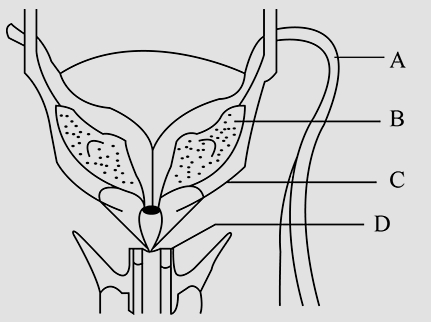
Given below is a diagrammatic sketch of a portion of the human male reproductive system. Select the correct set of the names of the parts labelled $A, B, C, D$.
A
$A$ - Vas deferens,$B$ - Seminal vesicle,$C$ - Prostate,$D$ - Bulbourethral gland
B
$A$ - Vas deferens,$B$ - Seminal vesicle,$C$ - Bulbourethral gland,$D$ - Prostate
C
$A$ - Ureter,$B$ - Seminal vesicle,$C$ - Prostate,$D$ - Bulbourethral gland
D
$A$ - Ureter,$B$ - Prostate,$C$ - Seminal vesicle,$D$ - Bulbourethral gland
Solution
(A) Based on the anatomical structure of the human male reproductive system:
$A$ represents the Vas deferens,which carries sperm from the epididymis.
$B$ represents the Seminal vesicle,a gland that secretes a significant portion of the seminal fluid.
$C$ represents the Prostate gland,which surrounds the urethra and contributes to seminal fluid.
$D$ represents the Bulbourethral gland (also known as Cowper's gland),which secretes a lubricating fluid.
Therefore,the correct sequence is $A$ - Vas deferens,$B$ - Seminal vesicle,$C$ - Prostate,$D$ - Bulbourethral gland.
$A$ represents the Vas deferens,which carries sperm from the epididymis.
$B$ represents the Seminal vesicle,a gland that secretes a significant portion of the seminal fluid.
$C$ represents the Prostate gland,which surrounds the urethra and contributes to seminal fluid.
$D$ represents the Bulbourethral gland (also known as Cowper's gland),which secretes a lubricating fluid.
Therefore,the correct sequence is $A$ - Vas deferens,$B$ - Seminal vesicle,$C$ - Prostate,$D$ - Bulbourethral gland.
0 likesView Solution
56
BiologyMediumMCQAIPMT · 2009
Foetal ejection reflex in human female is induced by
A
release of oxytocin from pituitary
B
fully developed foetus and placenta
C
differentiation of mammary glands
D
pressure exerted by amniotic fluid.
Solution
(B) : Parturition is induced by a complex neuroendocrine mechanism.
The signals for parturition originate from the fully developed foetus and the placenta,which induce mild uterine contractions called the foetal ejection reflex.
This triggers the release of oxytocin from the maternal pituitary.
Oxytocin acts on the uterine muscle and causes stronger uterine contractions,which in turn stimulates further secretion of oxytocin.
The stimulatory reflex between the uterine contraction and oxytocin secretion continues,resulting in stronger and stronger contractions.
This leads to the expulsion of the baby out of the uterus through the birth canal.
The signals for parturition originate from the fully developed foetus and the placenta,which induce mild uterine contractions called the foetal ejection reflex.
This triggers the release of oxytocin from the maternal pituitary.
Oxytocin acts on the uterine muscle and causes stronger uterine contractions,which in turn stimulates further secretion of oxytocin.
The stimulatory reflex between the uterine contraction and oxytocin secretion continues,resulting in stronger and stronger contractions.
This leads to the expulsion of the baby out of the uterus through the birth canal.
0 likesView Solution
57
BiologyMediumMCQAIPMT · 2009
The correct sequence of spermatogenetic stages leading to the formation of sperms in a mature human testis is
A
spermatogonia $\rightarrow$ spermatocyte $\rightarrow$ spermatid $\rightarrow$ sperms
B
spermatid $\rightarrow$ spermatocyte $\rightarrow$ spermatogonia $\rightarrow$ sperms
C
spermatogonia $\rightarrow$ spermatid $\rightarrow$ spermatocyte $\rightarrow$ sperms
D
spermatocyte $\rightarrow$ spermatogonia $\rightarrow$ spermatid $\rightarrow$ sperms
Solution
(A) The correct sequence is: $spermatogonia \rightarrow spermatocyte \rightarrow spermatid \rightarrow sperms$.
Spermatogenesis is the process of formation of haploid spermatozoa (sperms) from diploid spermatogonia inside the testes of the male.
At sexual maturity, the undifferentiated primordial germ cells divide by mitosis to produce a large number of spermatogonia.
Each spermatogonium grows into a larger primary spermatocyte.
The primary spermatocyte undergoes the first meiotic division (reductional division) to form two haploid secondary spermatocytes.
Each secondary spermatocyte undergoes the second meiotic division to form two haploid spermatids.
Finally, the transformation of spermatids into mature spermatozoa is called spermiogenesis.
Spermatogenesis is the process of formation of haploid spermatozoa (sperms) from diploid spermatogonia inside the testes of the male.
At sexual maturity, the undifferentiated primordial germ cells divide by mitosis to produce a large number of spermatogonia.
Each spermatogonium grows into a larger primary spermatocyte.
The primary spermatocyte undergoes the first meiotic division (reductional division) to form two haploid secondary spermatocytes.
Each secondary spermatocyte undergoes the second meiotic division to form two haploid spermatids.
Finally, the transformation of spermatids into mature spermatozoa is called spermiogenesis.
0 likesView Solution
58
BiologyMediumMCQAIPMT · 2009
Which one of the following is the most likely root cause why menstruation is not taking place in a regularly cycling human female?
A
Maintenance of the hypertrophical endometrial lining
B
Maintenance of high concentration of sex hormones in the blood stream
C
Retention of well-developed corpus luteum
D
Fertilization of the ovum
Solution
(D) The correct answer is $D$. In a regularly cycling human female,the most common physiological reason for the cessation of menstruation is pregnancy,which occurs following the fertilization of the ovum.
$1$. Upon fertilization,the embryo secretes $hCG$ (human Chorionic Gonadotropin),which maintains the corpus luteum.
$2$. The corpus luteum continues to secrete high levels of progesterone and estrogen,which prevent the shedding of the endometrial lining.
$3$. Consequently,the menstrual cycle is suspended to support the developing embryo.
$1$. Upon fertilization,the embryo secretes $hCG$ (human Chorionic Gonadotropin),which maintains the corpus luteum.
$2$. The corpus luteum continues to secrete high levels of progesterone and estrogen,which prevent the shedding of the endometrial lining.
$3$. Consequently,the menstrual cycle is suspended to support the developing embryo.
0 likesView Solution
59
BiologyMediumMCQAIPMT · 2009
$A$ change in the amount of yolk and its distribution in the egg will affect
A
pattern of cleavage
B
number of blastomeres produced
C
fertilization
D
formation of zygote.
Solution
(A) : Cleavage is a series of rapid mitotic cell divisions by which a single fertilized egg cell (zygote) is transformed into a multicellular structure called the blastula.
During cleavage,there is no significant growth in the size of the embryo,and the shape remains largely unchanged except for the formation of a central cavity known as the blastocoel.
The ratio of nuclear material $(DNA)$ to cytoplasm increases with each division.
The pattern or mode of cleavage is primarily determined by the amount of yolk present in the egg and its distribution (pattern of yolk deposition).
Based on the yolk content,cleavage is classified as holoblastic (total) or meroblastic (partial).
During cleavage,there is no significant growth in the size of the embryo,and the shape remains largely unchanged except for the formation of a central cavity known as the blastocoel.
The ratio of nuclear material $(DNA)$ to cytoplasm increases with each division.
The pattern or mode of cleavage is primarily determined by the amount of yolk present in the egg and its distribution (pattern of yolk deposition).
Based on the yolk content,cleavage is classified as holoblastic (total) or meroblastic (partial).
0 likesView Solution
60
BiologyMediumMCQAIPMT · 2009
Select the incorrect statement from the following.
A
Galactosemia is an inborn error of metabolism.
B
Small population size results in random genetic drift in a population.
C
Baldness is a sex-limited trait.
D
Linkage is an exception to the principle of independent assortment in heredity.
Solution
(C) is the incorrect statement. Baldness is a sex-influenced trait,not a sex-limited trait.
Sex-influenced traits are autosomal traits that are expressed differently in males and females due to the influence of sex hormones.
Sex-limited traits are expressed in only one sex (e.g.,milk production in females).
Galactosemia is indeed an inborn error of metabolism.
Genetic drift is more pronounced in small populations.
Linkage violates the law of independent assortment because linked genes do not assort independently during gamete formation.
Sex-influenced traits are autosomal traits that are expressed differently in males and females due to the influence of sex hormones.
Sex-limited traits are expressed in only one sex (e.g.,milk production in females).
Galactosemia is indeed an inborn error of metabolism.
Genetic drift is more pronounced in small populations.
Linkage violates the law of independent assortment because linked genes do not assort independently during gamete formation.
0 likesView Solution
61
BiologyMediumMCQAIPMT · 2009
Sickle-cell anaemia is
A
caused by substitution of glutamic acid by valine in the beta globin chain of haemoglobin
B
caused by a change in a single base pair of $DNA$
C
characterized by elongated sickle like $RBCs$ without a nucleus
D
an autosomal linked recessive trait.
Solution
(B) $Sickle-cell$ anaemia is an autosomal recessive genetic disorder in which erythrocytes become sickle-shaped.
It is caused by the formation of an abnormal haemoglobin called $Haemoglobin-S$ $(HbS)$.
$Haemoglobin-S$ is formed when the $6^{th}$ amino acid of the $\beta$-globin chain, $i.e.$, glutamic acid, is replaced by valine due to a point mutation.
This occurs due to a single nucleotide change ($GAG \rightarrow GTG$ at the $DNA$ level, corresponding to $A \rightarrow T$ substitution) in the $\beta$-globin gene.
In the normal $\beta$-globin gene, the $DNA$ sequence is $CCTGAGGAG$, while in $sickle-cell$ anaemia, the sequence is $CCTGTGGAG$.
It is caused by the formation of an abnormal haemoglobin called $Haemoglobin-S$ $(HbS)$.
$Haemoglobin-S$ is formed when the $6^{th}$ amino acid of the $\beta$-globin chain, $i.e.$, glutamic acid, is replaced by valine due to a point mutation.
This occurs due to a single nucleotide change ($GAG \rightarrow GTG$ at the $DNA$ level, corresponding to $A \rightarrow T$ substitution) in the $\beta$-globin gene.
In the normal $\beta$-globin gene, the $DNA$ sequence is $CCTGAGGAG$, while in $sickle-cell$ anaemia, the sequence is $CCTGTGGAG$.
0 likesView Solution
62
BiologyMediumMCQAIPMT · 2009
The genetic defect-adenosine deaminase $(ADA)$ deficiency may be cured permanently by
A
administering adenosine deaminase activators
B
introducing bone marrow cells producing $ADA$ into cells at early embryonic stages
C
enzyme replacement therapy
D
periodic infusion of genetically engineered lymphocytes having functional $ADA$ $cDNA$
Solution
(B) The correct answer is $(B)$.
$ADA$ deficiency is caused by the deletion of the gene for adenosine deaminase.
While enzyme replacement therapy and periodic infusion of genetically engineered lymphocytes are treatments,they are not permanent cures as they require repeated administration.
$A$ permanent cure can be achieved by gene therapy,specifically by introducing the functional $ADA$ gene isolated from bone marrow cells into cells at early embryonic stages,which allows the gene to be present in all cells of the developing organism.
$ADA$ deficiency is caused by the deletion of the gene for adenosine deaminase.
While enzyme replacement therapy and periodic infusion of genetically engineered lymphocytes are treatments,they are not permanent cures as they require repeated administration.
$A$ permanent cure can be achieved by gene therapy,specifically by introducing the functional $ADA$ gene isolated from bone marrow cells into cells at early embryonic stages,which allows the gene to be present in all cells of the developing organism.
0 likesView Solution
63
BiologyMediumMCQAIPMT · 2009
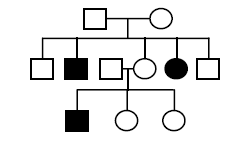
Study the pedigree chart given below. What does it show?
A
Inheritance of a condition like phenylketonuria as an autosomal recessive trait.
B
The pedigree chart is wrong as this is not possible.
C
Inheritance of a recessive sex-linked disease like haemophilia.
D
Inheritance of a sex-linked inborn error of metabolism like phenylketonuria.
Solution
(A) : This chart shows the inheritance of an autosomal recessive trait like phenylketonuria. An autosomal recessive trait may skip a generation. It appears in the case of marriage between two heterozygous individuals $(Aa \times Aa = 3\ Aa + 1\ aa)$,a recessive individual with a hybrid $(Aa \times aa = 2\ Aa + 2\ aa)$,and two recessive individuals $(aa \times aa = \text{all } aa)$. Phenylketonuria is an inborn,autosomal,recessive metabolic disorder in which the homozygous recessive individual lacks the enzyme phenylalanine hydroxylase. The heterozygous individuals are normal but carriers.
0 likesView Solution
64
BiologyMediumMCQAIPMT · 2009
Whose experiments cracked the $DNA$ and discovered unequivocally that a genetic code is a "triplet"?
A
Hershey and Chase
B
Morgan and Sturtevant
C
Beadle and Tatum
D
Nirenberg and Mathaei
Solution
(D) The genetic code was deciphered in the $1960$s by scientists including $Crick$, $Ochoa$, $Nirenberg$, $Mathaei$, and $Khorana$.
Specifically, Marshall $Nirenberg$ and $Heinrich$ $Mathaei$ performed the cell-free protein synthesis experiment using synthetic $RNA$ (poly-$U$), which provided the first evidence that a sequence of three nucleotides (a triplet) codes for a specific amino acid (phenylalanine).
This discovery unequivocally established the triplet nature of the genetic code.
Specifically, Marshall $Nirenberg$ and $Heinrich$ $Mathaei$ performed the cell-free protein synthesis experiment using synthetic $RNA$ (poly-$U$), which provided the first evidence that a sequence of three nucleotides (a triplet) codes for a specific amino acid (phenylalanine).
This discovery unequivocally established the triplet nature of the genetic code.
0 likesView Solution
65
BiologyMediumMCQAIPMT · 2009
Semi-conservative replication of $DNA$ was first demonstrated in
A
Escherichia coli
B
Streptococcus pneumoniae
C
Salmonella typhimurium
D
Drosophila melanogaster
Solution
(A) The semi-conservative replication of $DNA$ was first experimentally demonstrated by Matthew Meselson and Franklin Stahl in $1958$.
They used the bacterium $Escherichia$ $coli$ $(E. coli)$ for their experiments.
They grew $E. coli$ in a medium containing $^{15}N$ (a heavy isotope of nitrogen) for many generations to label the $DNA$ with heavy nitrogen.
Then,they transferred these bacteria to a medium containing $^{14}N$ (normal nitrogen) and extracted the $DNA$ at various time intervals.
By analyzing the density of the $DNA$ using cesium chloride $(CsCl)$ density gradient centrifugation,they observed that the $DNA$ molecules were hybrids of both $^{15}N$ and $^{14}N$,which provided direct evidence for the semi-conservative mode of $DNA$ replication.
They used the bacterium $Escherichia$ $coli$ $(E. coli)$ for their experiments.
They grew $E. coli$ in a medium containing $^{15}N$ (a heavy isotope of nitrogen) for many generations to label the $DNA$ with heavy nitrogen.
Then,they transferred these bacteria to a medium containing $^{14}N$ (normal nitrogen) and extracted the $DNA$ at various time intervals.
By analyzing the density of the $DNA$ using cesium chloride $(CsCl)$ density gradient centrifugation,they observed that the $DNA$ molecules were hybrids of both $^{15}N$ and $^{14}N$,which provided direct evidence for the semi-conservative mode of $DNA$ replication.
0 likesView Solution
66
BiologyMediumMCQAIPMT · 2009
Removal of introns and joining the exons in a defined order in a transcription unit is called
A
tailing
B
transformation
C
capping
D
splicing
Solution
(D) : $mRNA$ is not made directly in a eukaryotic cell. It is transcribed as heterogeneous nuclear $RNA$ $(hnRNA)$ in the nucleus. $hnRNA$ contains introns and exons. The introns are removed by $RNA$ splicing,leaving behind the exons,which contain the coding information. The exonic regions of $RNA$ are joined together to produce a single chain $RNA$ required for functioning as a translational template.
0 likesView Solution
67
BiologyMediumMCQAIPMT · 2009
What is not true for genetic code?
A
It is nearly universal.
B
It is degenerate.
C
It is unambiguous.
D
$A$ codon in $mRNA$ is read in a non-contiguous fashion.
Solution
(D) The correct answer is $D$. The genetic code is the relationship between the sequence of amino acids in a polypeptide and the nucleotide sequence of $DNA$ or $mRNA$.
Genetic code is continuous and does not possess pauses (commas) between the triplets.
Therefore,the statement that a codon in $mRNA$ is read in a non-contiguous fashion is false.
If a nucleotide is deleted or added,the entire reading frame shifts,which is known as a frameshift mutation.
Genetic code is continuous and does not possess pauses (commas) between the triplets.
Therefore,the statement that a codon in $mRNA$ is read in a non-contiguous fashion is false.
If a nucleotide is deleted or added,the entire reading frame shifts,which is known as a frameshift mutation.
0 likesView Solution
68
BiologyMediumMCQAIPMT · 2009
In the case of the peppered moth $(Biston \text{ } betularia)$, the black-coloured form became dominant over the light-coloured form in England during the industrial revolution. This is an example of:
A
appearance of the darker coloured individuals due to very poor sunlight
B
protective mimicry
C
inheritance of darker colour character acquired due to the darker environment
D
natural selection whereby the darker forms were selected
Solution
(D) : During the post-industrialisation period, tree trunks became dark due to industrial smoke and soot. White-winged moths did not survive due to predators, while dark-winged moths survived because they were less easily seen by predators against the dark background. Thus, industrial melanism supports evolution by natural selection, which favours the establishment of one particular advantageous mutation within a population.
0 likesView Solution
69
BiologyMediumMCQAIPMT · 2009
Which one of the following statements is correct?
A
Benign tumours show the property of metastasis.
B
Heroin accelerates body functions.
C
Malignant tumours may exhibit metastasis.
D
Patients who have undergone surgery are given cannabinoids to relieve pain.
Solution
(C) : Tumours are of two types: benign and malignant. Malignant tumours exhibit metastasis. This is the phenomenon in which cancer cells spread to distant sites through body fluids to develop secondary tumours.
0 likesView Solution
70
BiologyEasyMCQAIPMT · 2009
Which of the following is a pair of viral diseases?
A
Common cold,$AIDS$
B
Dysentery,common cold
C
Typhoid,tuberculosis
D
Ringworm,$AIDS$
Solution
(A) The correct answer is $A$.
Common cold is a viral disease caused by $Rhino$ viruses. It affects the nose,throat,and air passages,causing fever and body aches.
$AIDS$ (Acquired Immuno Deficiency Syndrome) is a disorder of the cell-mediated immune system caused by $HIV$ (Human Immunodeficiency Virus).
$HIV$ is a retrovirus that specifically attacks helper $T$-cells,weakening the body's immune response.
Other options: Dysentery is caused by bacteria or protozoa,Typhoid and Tuberculosis are bacterial diseases,and Ringworm is a fungal infection.
Common cold is a viral disease caused by $Rhino$ viruses. It affects the nose,throat,and air passages,causing fever and body aches.
$AIDS$ (Acquired Immuno Deficiency Syndrome) is a disorder of the cell-mediated immune system caused by $HIV$ (Human Immunodeficiency Virus).
$HIV$ is a retrovirus that specifically attacks helper $T$-cells,weakening the body's immune response.
Other options: Dysentery is caused by bacteria or protozoa,Typhoid and Tuberculosis are bacterial diseases,and Ringworm is a fungal infection.
0 likesView Solution
71
BiologyMediumMCQAIPMT · 2009
Polyethylene glycol method is used for
A
biodiesel production
B
seedless fruit production
C
energy production from sewage
D
gene transfer without a vector
Solution
(D) : Direct gene transfer is the transfer of naked $DNA$ into plant cells. Since the rigid plant cell wall acts as a barrier to $DNA$ uptake,protoplasts are the preferred target for this process. Polyethylene glycol $(PEG)$ mediated $DNA$ uptake is a direct gene transfer method that utilizes the interaction between $PEG$,naked $DNA$,salts,and the protoplast membrane to facilitate the transport of $DNA$ into the cytoplasm.
0 likesView Solution
72
BiologyMediumMCQAIPMT · 2009
Somaclones are obtained by
A
plant breeding
B
irradiation
C
genetic engineering
D
tissue culture
Solution
(D) : Genetic variation present among plant cells during tissue culture is called somaclonal variation.
The term somaclonal variation is also used for the genetic variation present in plants regenerated from a single culture.
This variation has been used to develop several useful varieties.
The term somaclonal variation is also used for the genetic variation present in plants regenerated from a single culture.
This variation has been used to develop several useful varieties.
0 likesView Solution
73
BiologyMediumMCQAIPMT · 2009
Which one of the following pairs is wrongly matched?
A
Alcohol - Nitrogenase
B
Fruit juice - Pectinase
C
Textile - Amylase
D
Detergents - Lipase
Solution
(A) The correct answer is $A$.
Alcohol production involves the process of fermentation,which is carried out by yeast ($Saccharomyces$ $cerevisiae$) using the enzyme complex $Zymase$,not $Nitrogenase$.
$Nitrogenase$ is an enzyme involved in biological nitrogen fixation in prokaryotes.
$Pectinase$ and $cellulase$ are used to clarify fruit juices.
$Amylase$ is used in the textile industry for desizing fabrics.
$Lipase$ is used in detergent formulations to remove oily stains from laundry.
Alcohol production involves the process of fermentation,which is carried out by yeast ($Saccharomyces$ $cerevisiae$) using the enzyme complex $Zymase$,not $Nitrogenase$.
$Nitrogenase$ is an enzyme involved in biological nitrogen fixation in prokaryotes.
$Pectinase$ and $cellulase$ are used to clarify fruit juices.
$Amylase$ is used in the textile industry for desizing fabrics.
$Lipase$ is used in detergent formulations to remove oily stains from laundry.
0 likesView Solution
74
BiologyMediumMCQAIPMT · 2009
Which of the following is not used as a biopesticide?
A
Trichoderma harzianum
B
Nucleopolyhedrovirus $(NPV)$
C
Xanthomonas campestris
D
Bacillus thuringiensis
Solution
(C) : The natural method of pest and pathogen control involving the use of viruses, bacteria, and other insects (which are their natural predators) is called biocontrol or biological control.
$Trichoderma$ $harzianum$ is a free-living fungus that acts as a biocontrol agent against several plant pathogens.
$Nucleopolyhedrovirus$ $(NPV)$ belongs to the genus $Baculovirus$ and is used as a narrow-spectrum insecticidal agent.
$Bacillus$ $thuringiensis$ is a soil bacterium widely used as a biopesticide to control insect larvae.
$Xanthomonas$ $campestris$ is a bacterium known for causing plant diseases (e.g., black rot in crucifers) and is not used as a biopesticide.
$Trichoderma$ $harzianum$ is a free-living fungus that acts as a biocontrol agent against several plant pathogens.
$Nucleopolyhedrovirus$ $(NPV)$ belongs to the genus $Baculovirus$ and is used as a narrow-spectrum insecticidal agent.
$Bacillus$ $thuringiensis$ is a soil bacterium widely used as a biopesticide to control insect larvae.
$Xanthomonas$ $campestris$ is a bacterium known for causing plant diseases (e.g., black rot in crucifers) and is not used as a biopesticide.
0 likesView Solution
75
BiologyMediumMCQAIPMT · 2009
What is true about $Bt$ toxin?
A
$Bt$ protein exists as active toxin in the $Bacillus$.
B
The activated toxin enters the ovaries of the pest to sterilise it and thus prevent its multiplication.
C
The concerned $Bacillus$ has antitoxins.
D
The inactive protoxin gets converted into active form in the insect gut.
Solution
(D) $Bt$ toxin is produced by the soil bacterium $Bacillus$ $thuringiensis$. It is produced as an inactive protoxin within the bacterium,which is why it does not kill the host. When an insect ingests the protoxin,the alkaline $pH$ of the insect's gut solubilizes the crystals and converts the inactive protoxin into an active toxin. This active toxin binds to the surface of the midgut epithelial cells,creating pores that cause cell swelling,lysis,and eventually the death of the insect.
0 likesView Solution
76
BiologyMediumMCQAIPMT · 2009
Transgenic plants are the ones
A
generated by introducing foreign $DNA$ into a cell and regenerating a plant from that cell
B
produced after protoplast fusion in artificial medium
C
grown in artificial medium after hybridization in the field
D
produced by a somatic embryo in artificial medium.
Solution
(A) : Transgenic plants are plants that have been genetically modified using recombinant $DNA$ technology.
This process involves the introduction of foreign $DNA$ (a transgene) into the genome of a plant cell.
Once the foreign $DNA$ is integrated,the transformed cell is cultured in an artificial medium to regenerate into a complete,mature plant.
These plants express the traits encoded by the introduced $DNA$,such as pest resistance,herbicide tolerance,or improved nutritional quality.
This process involves the introduction of foreign $DNA$ (a transgene) into the genome of a plant cell.
Once the foreign $DNA$ is integrated,the transformed cell is cultured in an artificial medium to regenerate into a complete,mature plant.
These plants express the traits encoded by the introduced $DNA$,such as pest resistance,herbicide tolerance,or improved nutritional quality.
0 likesView Solution
77
BiologyMediumMCQAIPMT · 2009
The bacterium $Bacillus$ $thuringiensis$ is widely used in contemporary biology as
A
insecticide
B
agent for production of dairy products
C
source of industrial enzyme
D
indicator of water pollution
Solution
(A) $Bacillus$ $thuringiensis$ $(Bt)$ is a soil bacterium that produces insecticidal proteins.
These proteins are effective against specific insect groups such as lepidopterans (tobacco budworm,armyworm),coleopterans (beetles),and dipterans (flies,mosquitoes).
$B. thuringiensis$ produces protein crystals containing a toxic insecticidal protein.
This toxin exists as an inactive protoxin within the bacterium,which is why it does not harm the host.
When an insect ingests the crystal,the alkaline $pH$ of the insect's alimentary canal converts the protoxin into an active toxin.
The activated toxin binds to the surface of the midgut epithelial cells,creating pores that cause cell swelling,lysis,and ultimately the death of the insect.
Therefore,it is widely used as a biological insecticide.
These proteins are effective against specific insect groups such as lepidopterans (tobacco budworm,armyworm),coleopterans (beetles),and dipterans (flies,mosquitoes).
$B. thuringiensis$ produces protein crystals containing a toxic insecticidal protein.
This toxin exists as an inactive protoxin within the bacterium,which is why it does not harm the host.
When an insect ingests the crystal,the alkaline $pH$ of the insect's alimentary canal converts the protoxin into an active toxin.
The activated toxin binds to the surface of the midgut epithelial cells,creating pores that cause cell swelling,lysis,and ultimately the death of the insect.
Therefore,it is widely used as a biological insecticide.
0 likesView Solution
78
BiologyMediumMCQAIPMT · 2009
What is antisense technology?
A
When a piece of $RNA$ that is complementary in sequence is used to stop expression of a specific gene
B
$RNA$ polymerase producing $DNA$
C
$A$ cell displaying a foreign antigen used for synthesis of antigens
D
Production of somaclonal variants in tissue cultures
Solution
(A) $RNA$ interference $(RNAi)$ is a method of cellular defense in all eukaryotic organisms. This method involves silencing of a specific $mRNA$ due to a complementary $dsRNA$ molecule that binds to and prevents translation of the $mRNA$ (silencing).
$1$. The $mRNA$ produced by a gene is called the sense strand because it contains the codons for translation.
$2$. $A$ complementary $RNA$ strand,which cannot be translated into a functional protein,is called antisense $RNA$.
$3$. When antisense $RNA$ is introduced,it base-pairs with the target $mRNA$ to form a double-stranded $RNA$ $(dsRNA)$ molecule.
$4$. This $dsRNA$ cannot be translated by the ribosome,effectively blocking the expression of the specific gene. This is the basis of antisense technology.
$1$. The $mRNA$ produced by a gene is called the sense strand because it contains the codons for translation.
$2$. $A$ complementary $RNA$ strand,which cannot be translated into a functional protein,is called antisense $RNA$.
$3$. When antisense $RNA$ is introduced,it base-pairs with the target $mRNA$ to form a double-stranded $RNA$ $(dsRNA)$ molecule.
$4$. This $dsRNA$ cannot be translated by the ribosome,effectively blocking the expression of the specific gene. This is the basis of antisense technology.
0 likesView Solution
79
BiologyMediumMCQAIPMT · 2009
$A$ country with a high rate of population growth took measures to reduce it. The figure below shows age-sex pyramids of populations $A$ and $B$ twenty years apart. Select the correct interpretation about them.
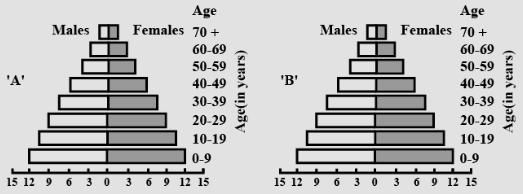
A
$B$ is the earlier pyramid and shows a stabilized growth rate.
B
$B$ is more recent,showing that the population is very young.
C
$A$ is the earlier pyramid and no change has occurred in the growth rate.
D
$A$ is more recent and shows a slight reduction in the growth rate.
Solution
(D) The correct answer is $D$.
$1$. An age-sex pyramid with a broad base indicates a rapidly growing population,as it shows a high proportion of individuals in the pre-reproductive age group ($0-9$ years).
$2$. Comparing the two pyramids,pyramid $B$ has a wider base compared to pyramid $A$. This indicates that pyramid $B$ represents the population twenty years ago (the earlier state) when the growth rate was higher.
$3$. Pyramid $A$ has a relatively narrower base compared to $B$,indicating a reduction in the proportion of the youngest age group. This reflects the impact of measures taken to reduce population growth over the twenty-year period.
$4$. Therefore,$A$ is the more recent pyramid,and it shows a slight reduction in the growth rate compared to $B$.
$1$. An age-sex pyramid with a broad base indicates a rapidly growing population,as it shows a high proportion of individuals in the pre-reproductive age group ($0-9$ years).
$2$. Comparing the two pyramids,pyramid $B$ has a wider base compared to pyramid $A$. This indicates that pyramid $B$ represents the population twenty years ago (the earlier state) when the growth rate was higher.
$3$. Pyramid $A$ has a relatively narrower base compared to $B$,indicating a reduction in the proportion of the youngest age group. This reflects the impact of measures taken to reduce population growth over the twenty-year period.
$4$. Therefore,$A$ is the more recent pyramid,and it shows a slight reduction in the growth rate compared to $B$.
0 likesView Solution
80
BiologyMediumMCQAIPMT · 2009
The correct sequence of plants in a hydrosere is
A
Volvox $\rightarrow$ Hydrilla $\rightarrow$ Pistia $\rightarrow$ Scirpus $\rightarrow$ Lantana $\rightarrow$ Oak
B
Pistia $\rightarrow$ Volvox $\rightarrow$ Scirpus $\rightarrow$ Hydrilla $\rightarrow$ Oak $\rightarrow$ Lantana
C
Oak $\rightarrow$ Lantana $\rightarrow$ Volvox $\rightarrow$ Hydrilla $\rightarrow$ Pistia $\rightarrow$ Scirpus
D
Oak $\rightarrow$ Lantana $\rightarrow$ Scirpus $\rightarrow$ Pistia $\rightarrow$ Hydrilla $\rightarrow$ Volvox
Solution
(A) The correct sequence is $A$.
$A$ hydrosere is a plant succession that occurs in an aquatic environment,starting from water bodies like ponds or lakes and ending in a climax forest community.
The stages are as follows:
$1$. Phytoplankton stage: $Volvox$ (pioneer community).
$2$. Rooted submerged stage: $Hydrilla$.
$3$. Rooted floating stage: $Pistia$.
$4$. Reed swamp stage: $Scirpus$.
$5$. Marsh-meadow stage: $Lantana$.
$6$. Climax forest stage: $Oak$ (woody trees).
$A$ hydrosere is a plant succession that occurs in an aquatic environment,starting from water bodies like ponds or lakes and ending in a climax forest community.
The stages are as follows:
$1$. Phytoplankton stage: $Volvox$ (pioneer community).
$2$. Rooted submerged stage: $Hydrilla$.
$3$. Rooted floating stage: $Pistia$.
$4$. Reed swamp stage: $Scirpus$.
$5$. Marsh-meadow stage: $Lantana$.
$6$. Climax forest stage: $Oak$ (woody trees).
0 likesView Solution
81
BiologyMediumMCQAIPMT · 2009
Which one of the following types of organisms occupy more than one trophic level in a pond ecosystem?
A
Fish
B
Zooplankton
C
Frog
D
Phytoplankton
Solution
(A) The correct answer is $A$.
In an ecosystem,a single species can occupy more than one trophic level depending on its food source.
In a pond ecosystem,fish exhibit this characteristic.
Small fish often act as secondary consumers by feeding on primary consumers (zooplankton).
Larger fish act as tertiary consumers by feeding on smaller fish.
Therefore,fish occupy more than one trophic level.
In an ecosystem,a single species can occupy more than one trophic level depending on its food source.
In a pond ecosystem,fish exhibit this characteristic.
Small fish often act as secondary consumers by feeding on primary consumers (zooplankton).
Larger fish act as tertiary consumers by feeding on smaller fish.
Therefore,fish occupy more than one trophic level.
0 likesView Solution
82
BiologyEasyMCQAIPMT · 2009
Which of the following has maximum genetic diversity in India?
A
Mango
B
Wheat
C
Groundnut
D
Rice
Solution
(D) The correct answer is $D$.
Genetic diversity refers to the variation in the number and types of genes, as well as chromosomes, present in different species and the variations in genes and their alleles within the same species.
In India, $Oryza \text{ } sativa$ (rice) exhibits the highest genetic diversity.
There are more than $50,000$ genetically different strains of rice in India alone, which is a prime example of high genetic diversity within a single species.
Genetic diversity refers to the variation in the number and types of genes, as well as chromosomes, present in different species and the variations in genes and their alleles within the same species.
In India, $Oryza \text{ } sativa$ (rice) exhibits the highest genetic diversity.
There are more than $50,000$ genetically different strains of rice in India alone, which is a prime example of high genetic diversity within a single species.
0 likesView Solution
83
BiologyEasyMCQAIPMT · 2009
Which one of the following has maximum genetic diversity in India?
A
Mango
B
Wheat
C
Tea
D
Teak
Solution
(A) India has more than $1,000$ varieties of mango $(Mangifera \text{ } indica)$ and about $50,000$ genetically different strains of rice. Among the given options, mango exhibits the highest genetic diversity in India. Therefore, the correct option is $A$.
0 likesView Solution
84
BiologyEasyMCQAIPMT · 2009
Tiger is not a resident in which one of the following national parks?
A
Sunderbans
B
Gir
C
Jim Corbett
D
Ranthambhor
Solution
(B) : $Gir$ National Park is situated in the Junagadh district of Gujarat. This national park is famous for the $Asiatic$ lion. Besides the lion,animals like the panther,striped hyaena,sambar,nilgai,and chital are also conserved here. Tigers are not found in $Gir$ National Park.
0 likesView Solution
85
BiologyEasyMCQAIPMT · 2009
Global agreement in specific control strategies to reduce the release of ozone depleting substances was adopted by
A
Montreal Protocol
B
Kyoto Protocol
C
Vienna Convention
D
Rio de Janeiro Conference
Solution
(A) The correct answer is $A$. The Montreal Protocol was signed in Montreal,Canada,by over $150$ countries at a convention in $1987$ to reduce the use of $CFCs$ (chlorofluorocarbons).
The primary aim of this protocol was to protect the ozone layer in the stratosphere by decreasing and eventually eliminating the use of ozone-depleting substances,such as $CFCs$.
It is widely regarded as one of the most successful international environmental treaties in modern history.
The primary aim of this protocol was to protect the ozone layer in the stratosphere by decreasing and eventually eliminating the use of ozone-depleting substances,such as $CFCs$.
It is widely regarded as one of the most successful international environmental treaties in modern history.
0 likesView Solution
86
BiologyMediumMCQAIPMT · 2009
Biochemical oxygen demand $(BOD)$ in a river water
A
has no relationship with concentration of oxygen in the water
B
gives a measure of Salmonella in the water
C
increases when sewage gets mixed with river water
D
remains unchanged when algal bloom occurs.
Solution
(C) $(BOD)$ is the amount of dissolved oxygen that would be consumed if all the organic matter in one liter of water were oxidized by bacteria.
When sewage is mixed with river water,the amount of organic matter increases.
This leads to an increase in the population of decomposer microorganisms,which consume more oxygen for the decomposition process.
Therefore,the $(BOD)$ value increases as the organic pollution load increases.
When sewage is mixed with river water,the amount of organic matter increases.
This leads to an increase in the population of decomposer microorganisms,which consume more oxygen for the decomposition process.
Therefore,the $(BOD)$ value increases as the organic pollution load increases.
0 likesView Solution
87
BiologyMediumMCQAIPMT · 2009
Steps taken by the Government of India to control air pollution include:
A
Compulsory $PUC$ (Pollution Under Control) certification of petrol-driven vehicles which tests for carbon monoxide and hydrocarbons.
B
Permission to use only pure diesel with a maximum of $500 \ ppm$ sulphur as fuel for vehicles.
C
Use of non-polluting Compressed Natural Gas $(CNG)$ only as fuel by all buses and trucks.
D
Compulsory mixing of $20\%$ ethyl alcohol with petrol and $20\%$ biodiesel with diesel.
Solution
(A) The correct answer is $A$. The Government of India has implemented several measures to control air pollution,particularly in urban areas. One of the primary steps is the mandatory $PUC$ (Pollution Under Control) certification for all petrol-driven vehicles. This test specifically checks the emission levels of carbon monoxide $(CO)$ and hydrocarbons $(HC)$ to ensure they remain within permissible limits. While $CNG$ is used in public transport,it is not mandated for all trucks,and the other options contain inaccuracies regarding fuel standards and blending mandates.
0 likesView Solution
88
BiologyEasyMCQAIPMT · 2009
The Montreal Protocol aims at:
A
biodiversity conservation
B
control of water pollution
C
control of $CO_2$ emission
D
reduction of ozone depleting substances
Solution
(D) The correct answer is $D$. The Montreal Protocol was signed in Montreal,Canada,by over $150$ countries at a convention in $1987$ to control the use of $CFCs$ (chlorofluorocarbons).
The primary objective of this protocol was to protect the ozone layer in the stratosphere by decreasing and eventually eliminating the use of ozone-depleting substances,such as $CFCs$.
It is widely regarded as one of the most successful international environmental treaties in modern history.
The primary objective of this protocol was to protect the ozone layer in the stratosphere by decreasing and eventually eliminating the use of ozone-depleting substances,such as $CFCs$.
It is widely regarded as one of the most successful international environmental treaties in modern history.
0 likesView Solution
89
BiologyEasyMCQAIPMT · 2009
The Chipko movement was launched for the protection of:
A
forests
B
livestock
C
wetlands
D
grasslands
Solution
(A) The Chipko movement was a non-violent social and ecological movement by rural villagers,particularly women,in India.
It began in the early $1970s$ in the Garhwal Himalayas region of Uttarakhand.
The primary objective of this movement was the protection and conservation of trees and forests from deforestation and commercial logging.
People hugged the trees to prevent them from being cut down,which is why it is called the 'Chipko' (to hug) movement.
It began in the early $1970s$ in the Garhwal Himalayas region of Uttarakhand.
The primary objective of this movement was the protection and conservation of trees and forests from deforestation and commercial logging.
People hugged the trees to prevent them from being cut down,which is why it is called the 'Chipko' (to hug) movement.
0 likesView Solution
90
BiologyMediumMCQAIPMT · 2009
What is involved in a point mutation?
A
Insertion
B
Change in a single base pair
C
Duplication
D
Deletion
Solution
(B) point mutation is a type of mutation that causes a single nucleotide base substitution,insertion,or deletion of the genetic material,$DNA$ or $RNA$.
Specifically,it refers to a change in a single base pair of $DNA$.
This can lead to a change in a single amino acid in the protein sequence,which may or may not affect the protein's function.
Therefore,the most accurate description among the options provided is a change in a single base pair.
Specifically,it refers to a change in a single base pair of $DNA$.
This can lead to a change in a single amino acid in the protein sequence,which may or may not affect the protein's function.
Therefore,the most accurate description among the options provided is a change in a single base pair.
0 likesView Solution
91
BiologyMediumMCQAIPMT · 2009
Identify the incorrect statement from the following.
A
Galactosemia is an inborn error of metabolism.
B
Genetic drift is the change in allele frequency in a small population due to chance.
C
Baldness is a sex-linked trait.
D
Linkage is an exception to the law of independent assortment in genetics.
Solution
(C) The correct answer is $C$. Baldness (specifically androgenetic alopecia) is a sex-influenced trait,not a sex-linked trait. Sex-influenced traits are autosomal traits whose expression is influenced by the sex of the individual (e.g.,presence of hormones like testosterone). In contrast,sex-linked traits are determined by genes located on the sex chromosomes ($X$ or $Y$). Galactosemia is indeed an inborn error of metabolism caused by the deficiency of the enzyme galactose-$1$-phosphate uridylyltransferase. Genetic drift refers to random fluctuations in allele frequencies in small populations. Linkage occurs when genes are located close together on the same chromosome,which violates Mendel's law of independent assortment.
0 likesView Solution
92
BiologyEasyMCQAIPMT · 2009
Antihistamines and steroids are administered to treat which of the following?
A
Anxiety
B
Cough
C
Allergy
D
Headache
Solution
(C) Antihistamines,adrenaline,and steroids are drugs that are commonly used to quickly reduce the symptoms of allergy.
These medications help in suppressing the immune response that causes allergic reactions,such as sneezing,watery eyes,and skin rashes.
These medications help in suppressing the immune response that causes allergic reactions,such as sneezing,watery eyes,and skin rashes.
0 likesView Solution
93
BiologyEasyMCQAIPMT · 2009
What does $T$ stand for in $T$-lymphocytes?
A
Thalamus
B
Tonsils
C
Thymus
D
Thyroid
Solution
(C) In the immune system,$T$-lymphocytes are a type of white blood cell that plays a central role in cell-mediated immunity. The letter '$T$' in '$T$-lymphocytes' stands for 'Thymus'. This is because these cells originate from stem cells in the bone marrow and then migrate to the thymus gland,where they mature and differentiate into functional $T$-cells.
0 likesView Solution
94
BiologyMediumMCQAIPMT · 2009
Which of the following can be used to provide immunity to a person who is at risk of developing tetanus?
A
Preformed antibodies
B
More effective antibiotics
C
Attenuated pathogens
D
Killed pathogens
Solution
(A) Tetanus is caused by the bacterium $Clostridium$ $tetani$,which produces a potent toxin. When a person is at risk of developing tetanus (e.g.,after a deep wound),they require immediate protection. This is achieved through passive immunization by administering preformed antibodies (antitoxins). This provides immediate immunity,which is crucial because the body does not have enough time to produce its own antibodies through active immunization.
0 likesView Solution
95
BiologyMediumMCQAIPMT · 2009
Which of the following is commonly used for the transfer of foreign $DNA$ into crop plants?
A
Trichoderma harzianum
B
Meloidogyne incognita
C
Agrobacterium tumefaciens
D
Penicillium expansum
Solution
(C) $Agrobacterium$ $tumefaciens$ is a soil-borne bacterium that naturally infects a wide range of dicot plants.
It contains a $Ti$ (Tumor inducing) plasmid, which can be modified to act as a vector for delivering foreign $DNA$ into the host plant cells.
Because of this natural ability to transfer its genetic material into the plant genome, it is widely used in genetic engineering to create transgenic crop plants.
It contains a $Ti$ (Tumor inducing) plasmid, which can be modified to act as a vector for delivering foreign $DNA$ into the host plant cells.
Because of this natural ability to transfer its genetic material into the plant genome, it is widely used in genetic engineering to create transgenic crop plants.
0 likesView Solution
96
BiologyMediumMCQAIPMT · 2009
$DDT$ residues are rapidly passed through the food chain causing biomagnification because $DDT$ is:
A
moderately toxic
B
non-toxic to aquatic animals
C
water soluble
D
lipo soluble
Solution
(D) $DDT$ residues are rapidly passed through the food chain causing biomagnification because $DDT$ is soluble in lipids (lipo-soluble).
Biomagnification,also known as bioamplification or biological magnification,is the increase in the concentration of a substance,such as the pesticide $DDT$,that occurs in a food chain as a consequence of:
• Persistence (slow to be broken down by environmental processes).
• Food chain energetics.
• Low (or non-existent) rate of internal degradation/excretion of the substance,which is often due to its water-insolubility and high lipid solubility,allowing it to accumulate in the fatty tissues of organisms.
Biomagnification,also known as bioamplification or biological magnification,is the increase in the concentration of a substance,such as the pesticide $DDT$,that occurs in a food chain as a consequence of:
• Persistence (slow to be broken down by environmental processes).
• Food chain energetics.
• Low (or non-existent) rate of internal degradation/excretion of the substance,which is often due to its water-insolubility and high lipid solubility,allowing it to accumulate in the fatty tissues of organisms.
0 likesView Solution
97
BiologyMediumMCQAIPMT · 2009
The peppered moth $(Biston \text{ } betularia)$, the black-coloured form became dominant over the light-coloured form of moth in England during the industrial revolution. This is an example of
A
Appearance of the darker-coloured individuals due to very poor sunlight
B
Protective mimicry
C
Inheritance of darker colour character acquired due to the darker environment
D
Natural selection whereby the darker forms were selected
Solution
(D) Industrial melanism is an adaptation where the moths living in industrial areas developed melanin pigments to match their body to the black soot (smoke) covered surroundings.
Before industrialisation, the light-coloured moths were well-camouflaged against the whitish lichens on tree barks, making them less visible to predatory birds.
After industrialisation, the tree barks became covered with black soot, making the light-coloured moths highly visible and easily preyed upon by birds.
Conversely, the dark-coloured (melanic) moths were better camouflaged against the soot-covered barks, allowing them to survive and reproduce.
This process, where the environment selects for the better-adapted phenotype, is a classic example of natural selection.
Before industrialisation, the light-coloured moths were well-camouflaged against the whitish lichens on tree barks, making them less visible to predatory birds.
After industrialisation, the tree barks became covered with black soot, making the light-coloured moths highly visible and easily preyed upon by birds.
Conversely, the dark-coloured (melanic) moths were better camouflaged against the soot-covered barks, allowing them to survive and reproduce.
This process, where the environment selects for the better-adapted phenotype, is a classic example of natural selection.
0 likesView Solution
Vedclass Products
For Students
Vedclass Test Series
Mock tests in real AIPMT style covering Biology with performance analysis. 5-day free trial.
Start Free TrialFor Teachers
Exam Paper Generator
Generate Set A/B/C/D Biology papers from 7.5L+ questions in 2 minutes. 3 chapters free.
Try FreeFor Institutes
Online Exam Module
Run live AIPMT mock exams with unlimited students, 360° analytics & white-label branding.
See DemoFrequently Asked Questions
How many Biology questions are in AIPMT 2009?
There are 115 Biology questions from the AIPMT 2009 paper on Vedclass, each with a detailed step-by-step solution in English.
Are AIPMT 2009 Biology solutions available in English?
Yes. All solutions on this page are in English. You can also switch to English or Hindi using the language buttons above the questions.
Can I practice AIPMT 2009 Biology as a timed test?
Yes. Use the Vedclass Test Series to attempt a full AIPMT mock test covering Biology with time limits and instant score analysis.
Can teachers create Biology papers from AIPMT previous year questions?
Yes. The Vedclass Exam Paper Generator lets teachers mix AIPMT Biology questions and generate Set A/B/C/D papers in minutes.
For Teachers & Institutes
Build a Custom Biology Paper
Pick AIPMT 2009 Biology questions, set difficulty, and generate Set A/B/C/D in 2 minutes.