
BiologyQ51–119 of 169 questions
Page 2 of 2 · English
51
BiologyMediumMCQAIPMT · 2012
For its action,nitrogenase requires
A
high input of energy
B
light
C
$Mn^{2+}$
D
super oxygen radicals
Solution
(A) : The enzyme $Nitrogenase$ is found in prokaryotic nitrogen-fixing organisms. The process of biological nitrogen fixation is highly energy-intensive and requires a significant amount of $ATP$ to reduce $N_2$ to $NH_3$. This is represented by the following equation:
$N_2 + 8e^- + 8H^+ + 16ATP \xrightarrow{Nitrogenase} 2NH_3 + H_2 + 16ADP + 16P_i$
$N_2 + 8e^- + 8H^+ + 16ATP \xrightarrow{Nitrogenase} 2NH_3 + H_2 + 16ADP + 16P_i$
0 likesView Solution
52
BiologyMediumMCQAIPMT · 2012
$A$ process that makes an important difference between $C_3$ and $C_4$ plants is
A
transpiration
B
glycolysis
C
photosynthesis
D
photorespiration
Solution
(D) $C_4$ plants are distinguished from $C_3$ plants primarily by the absence of photorespiration in the former.
Photorespiration is a light-dependent process involving the oxygenation of ribulose bisphosphate $(RuBP)$ and the release of carbon dioxide by photosynthetic organs.
In $C_3$ plants,at high temperatures and high oxygen concentrations,the enzyme $RuBP$ carboxylase acts as an oxygenase,leading to the oxidation of photosynthetic products into $CO_2$ and $H_2O$ without producing useful energy ($ATP$ or $NADPH$).
$C_4$ plants have evolved a mechanism to concentrate $CO_2$ around the enzyme,thereby suppressing photorespiration.
Peroxisomes and mitochondria are essential organelles for completing the photorespiratory pathway.
Photorespiration is a light-dependent process involving the oxygenation of ribulose bisphosphate $(RuBP)$ and the release of carbon dioxide by photosynthetic organs.
In $C_3$ plants,at high temperatures and high oxygen concentrations,the enzyme $RuBP$ carboxylase acts as an oxygenase,leading to the oxidation of photosynthetic products into $CO_2$ and $H_2O$ without producing useful energy ($ATP$ or $NADPH$).
$C_4$ plants have evolved a mechanism to concentrate $CO_2$ around the enzyme,thereby suppressing photorespiration.
Peroxisomes and mitochondria are essential organelles for completing the photorespiratory pathway.
0 likesView Solution
53
BiologyMediumMCQAIPMT · 2012
The correct sequence of cell organelles during photorespiration is
A
chloroplast,Golgi bodies,mitochondria
B
chloroplast,rough endoplasmic reticulum,dictyosomes
C
chloroplast,mitochondria,peroxisome
D
chloroplast,vacuole,peroxisome
Solution
(C) The correct sequence of cell organelles involved in photorespiration is chloroplast,peroxisome,and mitochondria.
Photorespiration is a light-dependent process involving the oxygenation of ribulose bisphosphate $(RuBP)$ and the release of carbon dioxide by photosynthetic organs.
It leads to the oxidation of photosynthetic products into $CO_2$ and $H_2O$ without the production of $ATP$ or $NADPH$.
This process occurs primarily in $C_3$ plants when high temperatures and high oxygen concentrations cause the enzyme $RuBP$ carboxylase to function as $RuBP$ oxygenase.
Photorespiration is absent in $C_4$ plants due to their specialized anatomy and mechanism to concentrate $CO_2$ around the enzyme.
Photorespiration is a light-dependent process involving the oxygenation of ribulose bisphosphate $(RuBP)$ and the release of carbon dioxide by photosynthetic organs.
It leads to the oxidation of photosynthetic products into $CO_2$ and $H_2O$ without the production of $ATP$ or $NADPH$.
This process occurs primarily in $C_3$ plants when high temperatures and high oxygen concentrations cause the enzyme $RuBP$ carboxylase to function as $RuBP$ oxygenase.
Photorespiration is absent in $C_4$ plants due to their specialized anatomy and mechanism to concentrate $CO_2$ around the enzyme.
0 likesView Solution
54
BiologyMediumMCQAIPMT · 2012
Read the following four statements $(A-D)$:
$(A)$ Both photophosphorylation and oxidative phosphorylation involve uphill transport of protons across the membrane.
$(B)$ In dicot stems,a new cambium originates from cells of pericycle at the time of secondary growth.
$(C)$ Stamens in flowers of Gloriosa and Petunia are polyandrous.
$(D)$ Symbiotic nitrogen fixers occur in free-living state also in soil.
How many of the above statements are right?
$(A)$ Both photophosphorylation and oxidative phosphorylation involve uphill transport of protons across the membrane.
$(B)$ In dicot stems,a new cambium originates from cells of pericycle at the time of secondary growth.
$(C)$ Stamens in flowers of Gloriosa and Petunia are polyandrous.
$(D)$ Symbiotic nitrogen fixers occur in free-living state also in soil.
How many of the above statements are right?
A
Two
B
Three
C
Four
D
One
Solution
(A) Incorrect: Photophosphorylation and oxidative phosphorylation involve the movement of protons from the lumen/intermembrane space to the stroma/matrix,which is a downhill movement (down the electrochemical gradient) through $ATP$ synthase.
$(B)$ Incorrect: In dicot stems,the intrafascicular cambium is present,and the interfascicular cambium originates from medullary ray cells,not the pericycle. Pericycle involvement in cambium formation is specific to dicot roots.
$(C)$ Correct: Polyandrous condition refers to the presence of free stamens. Both Gloriosa and Petunia exhibit this condition.
$(D)$ Correct: Symbiotic nitrogen fixers like $Rhizobium$ and $Frankia$ can exist in a free-living state in the soil as aerobes and only fix nitrogen when they establish a symbiotic relationship.
Therefore,statements $(C)$ and $(D)$ are correct. The total number of correct statements is $2$.
$(B)$ Incorrect: In dicot stems,the intrafascicular cambium is present,and the interfascicular cambium originates from medullary ray cells,not the pericycle. Pericycle involvement in cambium formation is specific to dicot roots.
$(C)$ Correct: Polyandrous condition refers to the presence of free stamens. Both Gloriosa and Petunia exhibit this condition.
$(D)$ Correct: Symbiotic nitrogen fixers like $Rhizobium$ and $Frankia$ can exist in a free-living state in the soil as aerobes and only fix nitrogen when they establish a symbiotic relationship.
Therefore,statements $(C)$ and $(D)$ are correct. The total number of correct statements is $2$.
0 likesView Solution
55
BiologyMediumMCQAIPMT · 2012
Through their effects on plant growth regulators,what do the temperature and light control in the plants?
A
Apical dominance
B
Flowering
C
Closure of stomata
D
Fruit elongation
Solution
(B) : Light and temperature may affect flowering in plants in various ways.
The effect of photoperiods or daily duration of light hours (and dark periods) on flowering is called photoperiodism.
For example,in short day plants,flowering occurs when day length is below the critical period,e.g.,dahlia,rice,etc.
In long day plants,flowering occurs when day length is above the critical period,e.g.,spinach,lettuce,etc.
In short-long day plants,a short photoperiod is required for floral initiation and a long photoperiod is required for blossoming,and vice-versa for long-short day plants.
The effect of photoperiods or daily duration of light hours (and dark periods) on flowering is called photoperiodism.
For example,in short day plants,flowering occurs when day length is below the critical period,e.g.,dahlia,rice,etc.
In long day plants,flowering occurs when day length is above the critical period,e.g.,spinach,lettuce,etc.
In short-long day plants,a short photoperiod is required for floral initiation and a long photoperiod is required for blossoming,and vice-versa for long-short day plants.
0 likesView Solution
56
BiologyMediumMCQAIPMT · 2012
Which one of the following generally acts as an antagonist to gibberellins?
A
Zeatin
B
Ethylene
C
$ABA$
D
$IAA$
Solution
(C) $ABA$ (Abscisic acid) acts as an antagonist to gibberellins. This is illustrated in the table below:
| Abscisic acid | Gibberellic acid |
| It inhibits growth. | It promotes growth. |
| It promotes the dormancy of seeds,buds,and tubers. | It overcomes the natural dormancy of seeds,tubers,etc. |
| It inhibits the synthesis of $RNA$ and proteins. | It promotes the synthesis of $RNA$ and proteins. |
| Causes abscission of flowers and fruits. | Promotes development of fruits. |
| Promotes leaf senescence. | Prevents leaf senescence. |
| Promotes stomatal closure. | Promotes stomatal opening. |
| Prevents amylase activity. | Promotes amylase activity during seed germination. |
0 likesView Solution
57
BiologyMediumMCQAIPMT · 2012
Vernalization stimulates flowering in
A
Zamikand
B
Turmeric
C
Carrot
D
Ginger
Solution
(C) : Carrot is a biennial plant that requires a stimulus of low temperature for flowering. It remains vegetative during the warm season and bears flowers and fruits only after experiencing a cold period. It can be made to flower in one growing season by providing low-temperature treatment to young plants or seedlings,a process referred to as vernalization. Hence,vernalization stimulates flowering in carrot.
0 likesView Solution
58
BiologyMediumMCQAIPMT · 2012
Anxiety and eating spicy food together in an otherwise normal human,may lead to:
A
indigestion
B
jaundice
C
diarrhoea
D
vomiting
Solution
(A) : Indigestion is a condition in which food is not properly digested,leading to a feeling of fullness. The primary causes of indigestion include inadequate enzyme secretion,anxiety,food poisoning,overeating,and the consumption of spicy food.
0 likesView Solution
59
BiologyEasyMCQAIPMT · 2012
For its activity,carboxypeptidase requires
A
zinc
B
iron
C
niacin
D
copper
Solution
(A) The correct answer is $A$.
Carboxypeptidase is a digestive enzyme synthesized in the pancreas and secreted into the small intestine.
It functions as a metalloenzyme and requires $Zn^{2+}$ (zinc) ions as a cofactor for its catalytic activity.
This enzyme plays a crucial role in protein digestion by cleaving amino acids from the carboxyl terminus of proteins and peptides.
It operates optimally in an alkaline medium and is primarily involved in the conversion of large polypeptides into smaller dipeptides and individual amino acids.
Carboxypeptidase is a digestive enzyme synthesized in the pancreas and secreted into the small intestine.
It functions as a metalloenzyme and requires $Zn^{2+}$ (zinc) ions as a cofactor for its catalytic activity.
This enzyme plays a crucial role in protein digestion by cleaving amino acids from the carboxyl terminus of proteins and peptides.
It operates optimally in an alkaline medium and is primarily involved in the conversion of large polypeptides into smaller dipeptides and individual amino acids.
0 likesView Solution
60
BiologyEasyMCQAIPMT · 2012
Where do certain symbiotic microorganisms normally occur in the human body?
A
Caecum
B
Oral lining and tongue surface
C
Vermiform appendix and rectum
D
Duodenum
Solution
(A) The human $Caecum$ is a small blind sac which hosts some symbiotic microorganisms. These microorganisms play a role in the digestion of certain substances and the synthesis of vitamins. While the large intestine as a whole contains a vast microbiome,the $Caecum$ is specifically noted in biological texts as a site for these symbiotic organisms.
0 likesView Solution
61
BiologyMediumMCQAIPMT · 2012
Which one of the following is the correct statement for respiration in humans?
A
Cigarette smoking may lead to inflammation of bronchi.
B
Neural signals from pneumotaxic centre in pons region of brain can increase the duration of inspiration.
C
Workers in grinding and stone-breaking industries may suffer from lung fibrosis.
D
About $90\%$ of carbon dioxide $(CO_2)$ is carried by haemoglobin as carbamino-haemoglobin.
Solution
(C) The correct statement is $(c)$. In certain industries,especially those involving grinding or stone breaking,so much dust is produced that the body's defense mechanism cannot fully cope with the situation.
Long-term exposure to this dust can lead to inflammation,which causes fibrosis (proliferation of fibrous tissues),resulting in serious lung damage.
Therefore,workers in such industries are advised to wear protective masks to prevent these respiratory disorders.
Option $(a)$ is incorrect because while smoking causes bronchitis,it is not the most comprehensive statement regarding respiratory disorders in the context of occupational hazards.
Option $(b)$ is incorrect because the pneumotaxic centre reduces the duration of inspiration.
Option $(d)$ is incorrect because only about $20-25\%$ of $CO_2$ is carried by haemoglobin as carbamino-haemoglobin,while the majority is carried as bicarbonates.
Long-term exposure to this dust can lead to inflammation,which causes fibrosis (proliferation of fibrous tissues),resulting in serious lung damage.
Therefore,workers in such industries are advised to wear protective masks to prevent these respiratory disorders.
Option $(a)$ is incorrect because while smoking causes bronchitis,it is not the most comprehensive statement regarding respiratory disorders in the context of occupational hazards.
Option $(b)$ is incorrect because the pneumotaxic centre reduces the duration of inspiration.
Option $(d)$ is incorrect because only about $20-25\%$ of $CO_2$ is carried by haemoglobin as carbamino-haemoglobin,while the majority is carried as bicarbonates.
0 likesView Solution
62
BiologyMediumMCQAIPMT · 2012
People who have migrated from the plains to an area adjoining Rohtang Pass about six months back:
A
have more $RBCs$ and their haemoglobin has a lower binding affinity to $O_2$
B
are not physically fit to play games like football
C
suffer from altitude sickness with symptoms like nausea,fatigue,etc.
D
have the usual $RBC$ count but their haemoglobin has very high binding affinity to $O_2$
Solution
(A) The correct answer is $A$. When individuals move from plains to high-altitude regions like Rohtang Pass,they initially experience altitude sickness due to low atmospheric pressure and reduced oxygen availability. However,after staying for about six months,the body undergoes physiological acclimatization. This process involves:
$1$. Increasing the production of red blood cells $(RBCs)$ to enhance oxygen-carrying capacity.
$2$. Decreasing the binding affinity of haemoglobin to $O_2$ (shifting the oxygen dissociation curve to the right),which facilitates the release of oxygen into the tissues.
$3$. Increasing the breathing rate to compensate for low oxygen levels.
$1$. Increasing the production of red blood cells $(RBCs)$ to enhance oxygen-carrying capacity.
$2$. Decreasing the binding affinity of haemoglobin to $O_2$ (shifting the oxygen dissociation curve to the right),which facilitates the release of oxygen into the tissues.
$3$. Increasing the breathing rate to compensate for low oxygen levels.
0 likesView Solution
63
BiologyMediumMCQAIPMT · 2012
$A$ certain road accident patient with unknown blood group needs immediate blood transfusion. His one doctor friend at once offers his blood. What was the blood group of the donor?
A
Blood group $B$
B
Blood group $AB$
C
Blood group $O$
D
Blood group $A$
Solution
(C) The correct answer is $C$. The blood group of the donor was $O$.
Individuals with blood group $O$ are considered universal donors.
This is because their red blood cells lack both $A$ and $B$ antigens on their surface.
Consequently,when $O$ type blood is transfused into a patient of any other blood group ($A, B, AB,$ or $O$),it does not trigger an immune response or cause agglutination (clumping) of the recipient's blood cells.
Individuals with blood group $O$ are considered universal donors.
This is because their red blood cells lack both $A$ and $B$ antigens on their surface.
Consequently,when $O$ type blood is transfused into a patient of any other blood group ($A, B, AB,$ or $O$),it does not trigger an immune response or cause agglutination (clumping) of the recipient's blood cells.
0 likesView Solution
64
BiologyEasyMCQAIPMT · 2012
Which one of the following human organs is often called the "graveyard" of $RBCs$?
A
Gall bladder
B
Kidney
C
Spleen
D
Liver
Solution
(C) : The $Spleen$ is a vertebrate organ located behind the stomach, primarily composed of lymphoid tissue.
Its functions include the production of lymphocytes and the destruction of foreign particles.
It acts as a reservoir for $RBCs$ and helps regulate their number in circulation.
Furthermore, it is the primary site for the breakdown of worn-out $RBCs$, which is why it is commonly referred to as the "graveyard" of $RBCs$.
Its functions include the production of lymphocytes and the destruction of foreign particles.
It acts as a reservoir for $RBCs$ and helps regulate their number in circulation.
Furthermore, it is the primary site for the breakdown of worn-out $RBCs$, which is why it is commonly referred to as the "graveyard" of $RBCs$.
0 likesView Solution
65
BiologyMediumMCQAIPMT · 2012
The maximum amount of electrolytes and water $(70-80\ \%)$ from the glomerular filtrate is reabsorbed in which part of the nephron?
A
Ascending limb of loop of Henle
B
Distal convoluted tubule
C
Proximal convoluted tubule
D
Descending limb of loop of Henle
Solution
(C) The correct answer is $(C)$.
During glomerular filtration in the kidneys,ultrafiltration of blood occurs,meaning almost all constituents of plasma except proteins pass into the Bowman's capsule.
Following this,nearly $99\%$ of the filtrate is reabsorbed by the renal tubules.
The Proximal Convoluted Tubule $(PCT)$ is responsible for the maximum reabsorption.
Approximately $70-80\%$ of electrolytes and water,along with nearly all essential nutrients (like glucose and amino acids),are reabsorbed in this segment of the nephron.
During glomerular filtration in the kidneys,ultrafiltration of blood occurs,meaning almost all constituents of plasma except proteins pass into the Bowman's capsule.
Following this,nearly $99\%$ of the filtrate is reabsorbed by the renal tubules.
The Proximal Convoluted Tubule $(PCT)$ is responsible for the maximum reabsorption.
Approximately $70-80\%$ of electrolytes and water,along with nearly all essential nutrients (like glucose and amino acids),are reabsorbed in this segment of the nephron.
0 likesView Solution
66
BiologyMediumMCQAIPMT · 2012
Which one of the following options gives the correct categorization of six animals according to the type of nitrogenous waste they excrete?
| Option | Ammonotelic | Ureotelic | Uricotelic |
|---|---|---|---|
| $a$ | Pigeon,human | Aquatic amphibia,lizards | Cockroach,frog |
| $b$ | Frog,lizards | Aquatic amphibia,humans | Cockroach,pigeon |
| $c$ | Aquatic amphibia | Frog,human | Pigeon,lizards,cockroach |
| $d$ | Aquatic amphibia | Cockroach,humans | Frog,pigeon,lizards |
A
$a$
B
$b$
C
$c$
D
$d$
Solution
(C) The correct classification is based on the primary nitrogenous waste excreted by the animals:
$1$. Ammonotelic animals excrete ammonia,which is highly toxic and requires large amounts of water. Examples include aquatic amphibians.
$2$. Ureotelic animals excrete urea,which is less toxic and requires moderate water. Examples include humans and adult frogs (terrestrial stage).
$3$. Uricotelic animals excrete uric acid,which is the least toxic and requires minimal water. Examples include birds (pigeon),reptiles (lizards),and insects (cockroach).
Therefore,option $c$ correctly categorizes these animals.
$1$. Ammonotelic animals excrete ammonia,which is highly toxic and requires large amounts of water. Examples include aquatic amphibians.
$2$. Ureotelic animals excrete urea,which is less toxic and requires moderate water. Examples include humans and adult frogs (terrestrial stage).
$3$. Uricotelic animals excrete uric acid,which is the least toxic and requires minimal water. Examples include birds (pigeon),reptiles (lizards),and insects (cockroach).
Therefore,option $c$ correctly categorizes these animals.
0 likesView Solution
67
BiologyMediumMCQAIPMT · 2012
$A$ fall in glomerular filtration rate $(GFR)$ activates
A
juxtaglomerular cells to release renin
B
adrenal cortex to release aldosterone
C
adrenal medulla to release adrenaline
D
posterior pituitary to release vasopressin.
Solution
(A) : The amount of the filtrate formed by the kidneys per minute is called glomerular filtration rate $(GFR)$. $GFR$ in a healthy individual is approximately $125 \text{ ml/minute}$, $i.e.$, $180 \text{ litres}$ per day.
The kidneys have built-in mechanisms for the regulation of $GFR$. One such efficient mechanism is carried out by the juxtaglomerular apparatus $(JGA)$.
$JGA$ is a special sensitive region formed by cellular modifications in the distal convoluted tubule $(DCT)$ and the afferent arteriole at the location of their contact.
$A$ fall in $GFR$ activates the $JG$ cells to release renin, which converts angiotensinogen in the blood to angiotensin $I$ and further to angiotensin $II$. Angiotensin $II$ is a powerful vasoconstrictor that increases the glomerular blood pressure and thereby brings the $GFR$ back to normal.
The kidneys have built-in mechanisms for the regulation of $GFR$. One such efficient mechanism is carried out by the juxtaglomerular apparatus $(JGA)$.
$JGA$ is a special sensitive region formed by cellular modifications in the distal convoluted tubule $(DCT)$ and the afferent arteriole at the location of their contact.
$A$ fall in $GFR$ activates the $JG$ cells to release renin, which converts angiotensinogen in the blood to angiotensin $I$ and further to angiotensin $II$. Angiotensin $II$ is a powerful vasoconstrictor that increases the glomerular blood pressure and thereby brings the $GFR$ back to normal.
0 likesView Solution
68
BiologyMediumMCQAIPMT · 2012
Select the correct statement regarding the specific disorder of the muscular or skeletal system.
A
Muscular dystrophy - Age-related shortening of muscles
B
Osteoporosis - Decrease in bone mass and higher chances of fractures with advancing age
C
Myasthenia gravis - Autoimmune disorder which inhibits sliding of myosin filaments
D
Gout - Inflammation of joints due to extra deposition of calcium
Solution
(B) is the correct statement.
$1$. Osteoporosis is an age-related disorder characterized by decreased bone mass and increased chances of fractures.
$2$. Muscular dystrophy is a genetic disorder resulting in progressive degeneration of skeletal muscles.
$3$. Myasthenia gravis is an autoimmune disorder affecting the neuromuscular junction,leading to fatigue,weakening,and paralysis of skeletal muscles,caused by antibodies blocking acetylcholine receptors.
$4$. Gout is the inflammation of joints due to the accumulation of uric acid crystals,not calcium.
$1$. Osteoporosis is an age-related disorder characterized by decreased bone mass and increased chances of fractures.
$2$. Muscular dystrophy is a genetic disorder resulting in progressive degeneration of skeletal muscles.
$3$. Myasthenia gravis is an autoimmune disorder affecting the neuromuscular junction,leading to fatigue,weakening,and paralysis of skeletal muscles,caused by antibodies blocking acetylcholine receptors.
$4$. Gout is the inflammation of joints due to the accumulation of uric acid crystals,not calcium.
0 likesView Solution
69
BiologyMediumMCQAIPMT · 2012
Which one of the following pairs of chemical substances is correctly categorized?
A
Calcitonin and thymosin $\rightarrow$ Thyroid hormones
B
Pepsin and prolactin $\rightarrow$ Two digestive enzymes secreted in stomach
C
Troponin and myosin $\rightarrow$ Complex proteins in striated muscles
D
Secretin and rhodopsin $\rightarrow$ Polypeptide hormones
Solution
(C) is the correct answer.
Troponin and myosin are essential protein components of striated (skeletal) muscles.
Myosin is a thick filament protein that acts as a motor protein,while troponin is a regulatory protein complex associated with actin filaments that helps in the regulation of muscle contraction.
Option $(a)$ is incorrect because thymosin is a peptide hormone secreted by the thymus,not the thyroid.
Option $(b)$ is incorrect because prolactin is a hormone secreted by the anterior pituitary,not a digestive enzyme.
Option $(d)$ is incorrect because rhodopsin is a light-sensitive pigment found in the retina of the eye,not a hormone.
Troponin and myosin are essential protein components of striated (skeletal) muscles.
Myosin is a thick filament protein that acts as a motor protein,while troponin is a regulatory protein complex associated with actin filaments that helps in the regulation of muscle contraction.
Option $(a)$ is incorrect because thymosin is a peptide hormone secreted by the thymus,not the thyroid.
Option $(b)$ is incorrect because prolactin is a hormone secreted by the anterior pituitary,not a digestive enzyme.
Option $(d)$ is incorrect because rhodopsin is a light-sensitive pigment found in the retina of the eye,not a hormone.
0 likesView Solution
70
BiologyMediumMCQAIPMT · 2012
The human hindbrain comprises three parts, one of which is
A
spinal cord
B
corpus callosum
C
cerebellum
D
hypothalamus
Solution
(C) The human brain is the anterior-most part of the central nervous system. It is divided into three main parts: forebrain, midbrain, and hindbrain. The hindbrain consists of three specific structures: the $pons$, the $cerebellum$, and the $medulla$ (also known as the $medulla$ $oblongata$). Therefore, the $cerebellum$ is a part of the hindbrain.
0 likesView Solution
71
BiologyMediumMCQAIPMT · 2012
Which part of the human ear plays no role in hearing as such but is otherwise very much required?
A
Eustachian tube
B
Organ of Corti
C
Vestibular apparatus
D
Ear ossicles
Solution
(C) The correct answer is $C$.
The vestibular apparatus is a complex structure located in the inner ear,positioned above the cochlea.
It is composed of three semicircular canals,which are responsible for detecting rotational movements of the head,and the utriculus and sacculus,which detect the orientation and position of the head relative to gravity.
While the cochlea is the primary organ for hearing,the vestibular apparatus does not contribute to the process of hearing.
However,it is essential for maintaining the body's equilibrium,balance,and posture,making it a vital component of the human ear.
The vestibular apparatus is a complex structure located in the inner ear,positioned above the cochlea.
It is composed of three semicircular canals,which are responsible for detecting rotational movements of the head,and the utriculus and sacculus,which detect the orientation and position of the head relative to gravity.
While the cochlea is the primary organ for hearing,the vestibular apparatus does not contribute to the process of hearing.
However,it is essential for maintaining the body's equilibrium,balance,and posture,making it a vital component of the human ear.
0 likesView Solution
72
BiologyMediumMCQAIPMT · 2012
$A$ person entering an empty room suddenly finds a snake right in front on opening the door. Which one of the following is likely to happen in his neuro-hormonal control system?
A
Sympathetic nervous system is activated releasing epinephrine and norepinephrine from adrenal medulla.
B
Neurotransmitters diffuse rapidly across the cleft and transmit a nerve impulse.
C
Hypothalamus activates the parasympathetic division of brain.
D
Sympathetic nervous system is activated releasing epinephrine and norepinephrine from adrenal cortex.
Solution
(A) The correct answer is $A$.
When a person encounters a sudden threat like a snake,the body initiates a 'fight-or-flight' response.
This response is mediated by the sympathetic nervous system.
The sympathetic nervous system stimulates the adrenal medulla to secrete emergency hormones,specifically epinephrine (adrenaline) and norepinephrine (noradrenaline).
These hormones prepare the body for immediate physical action by increasing heart rate,blood pressure,and alertness.
Note that these hormones are secreted by the adrenal medulla,not the adrenal cortex.
When a person encounters a sudden threat like a snake,the body initiates a 'fight-or-flight' response.
This response is mediated by the sympathetic nervous system.
The sympathetic nervous system stimulates the adrenal medulla to secrete emergency hormones,specifically epinephrine (adrenaline) and norepinephrine (noradrenaline).
These hormones prepare the body for immediate physical action by increasing heart rate,blood pressure,and alertness.
Note that these hormones are secreted by the adrenal medulla,not the adrenal cortex.
0 likesView Solution
73
BiologyMediumMCQAIPMT · 2012
Which one of the following pairs of hormones are the examples of those that can easily pass through the cell membrane of the target cell and bind to a receptor inside it (mostly in the nucleus)?
A
Insulin,glucagon
B
Thyroxine,insulin
C
Somatostatin,oxytocin
D
Cortisol,testosterone
Solution
(D) The correct answer is $D$.
Steroid hormones,such as $Cortisol$,$Testosterone$,$Estradiol$,and $Progesterone$,are lipid-soluble.
Because they are lipid-soluble,they can easily pass through the lipid bilayer of the target cell membrane.
Once inside the cell,they bind to intracellular receptors,which are often located in the nucleus.
This hormone-receptor complex then interacts with the genome to regulate gene expression or chromosome function.
In contrast,peptide hormones like $Insulin$,$Glucagon$,$Somatostatin$,and $Oxytocin$ are water-soluble and bind to membrane-bound receptors on the cell surface.
Steroid hormones,such as $Cortisol$,$Testosterone$,$Estradiol$,and $Progesterone$,are lipid-soluble.
Because they are lipid-soluble,they can easily pass through the lipid bilayer of the target cell membrane.
Once inside the cell,they bind to intracellular receptors,which are often located in the nucleus.
This hormone-receptor complex then interacts with the genome to regulate gene expression or chromosome function.
In contrast,peptide hormones like $Insulin$,$Glucagon$,$Somatostatin$,and $Oxytocin$ are water-soluble and bind to membrane-bound receptors on the cell surface.
0 likesView Solution
74
BiologyMediumMCQAIPMT · 2012
What is correct to say about the hormone action in humans?
A
Glucagon is secreted by $\beta$-cells of islets of Langerhans and stimulates glycogenolysis.
B
Secretion of thymosins is stimulated with aging.
C
In females,$FSH$ first binds with specific receptors on ovarian cell membrane.
D
$FSH$ stimulates the secretion of estrogen and progesterone.
Solution
(C) The correct statement is $(c)$.
Hormone action involves their reception by target cells.
Specific proteins called hormone receptors,which are located in target tissues,bind with these hormones.
$FSH$ (Follicle Stimulating Hormone) is a peptide hormone that cannot pass through the cell membrane.
Therefore,it binds to specific membrane-bound receptors located on the surface of ovarian cells to initiate its action.
Glucagon is secreted by $\alpha$-cells,not $\beta$-cells.
Thymosin secretion decreases with aging.
$FSH$ primarily stimulates follicular development and estrogen secretion,but progesterone is mainly stimulated by $LH$.
Hormone action involves their reception by target cells.
Specific proteins called hormone receptors,which are located in target tissues,bind with these hormones.
$FSH$ (Follicle Stimulating Hormone) is a peptide hormone that cannot pass through the cell membrane.
Therefore,it binds to specific membrane-bound receptors located on the surface of ovarian cells to initiate its action.
Glucagon is secreted by $\alpha$-cells,not $\beta$-cells.
Thymosin secretion decreases with aging.
$FSH$ primarily stimulates follicular development and estrogen secretion,but progesterone is mainly stimulated by $LH$.
0 likesView Solution
75
BiologyEasyMCQAIPMT · 2012
Ribosomal $RNA$ is actively synthesized in
A
lysosomes
B
nucleolus
C
nucleoplasm
D
ribosomes
Solution
(B) : The nucleolus is the primary site for the synthesis of ribosomal $RNA$ $(rRNA)$,which is essential for the formation of ribosomal subunits.
Ribosomal proteins are synthesized in the cytoplasm and then migrate into the nucleolus.
Inside the nucleolus,these proteins are assembled with $rRNA$ to form ribonucleoprotein complexes.
These complexes are then transported back to the cytoplasm,where they mature into functional ribosome particles.
Ribosomal proteins are synthesized in the cytoplasm and then migrate into the nucleolus.
Inside the nucleolus,these proteins are assembled with $rRNA$ to form ribonucleoprotein complexes.
These complexes are then transported back to the cytoplasm,where they mature into functional ribosome particles.
0 likesView Solution
76
BiologyMediumMCQAIPMT · 2012
Which of the following are likely to be present in deep-sea hydrothermal vents?
A
Archaebacteria
B
Eubacteria
C
Blue-green algae
D
Symbiotic fungi
Solution
(A) Archaebacteria are unique organisms that can survive in some of the most extreme environmental conditions on Earth.
These conditions include high salinity (halophiles),extreme temperatures (thermophiles),and highly acidic environments.
Deep-sea hydrothermal vents are characterized by extremely high temperatures and high pressure,which are conditions where only $Archaebacteria$ (specifically thermoacidophiles) can thrive.
Therefore,the correct option is $A$.
These conditions include high salinity (halophiles),extreme temperatures (thermophiles),and highly acidic environments.
Deep-sea hydrothermal vents are characterized by extremely high temperatures and high pressure,which are conditions where only $Archaebacteria$ (specifically thermoacidophiles) can thrive.
Therefore,the correct option is $A$.
0 likesView Solution
77
BiologyMediumMCQAIPMT · 2012
In some cyanobacteria,pigment-containing membranous extensions are called ..........
A
Heterocysts
B
Basal bodies
C
Pneumatophores
D
Chromatophores
Solution
(D) In some prokaryotes like cyanobacteria,there are other membranous extensions into the cytoplasm called chromatophores which contain pigments.
These structures are responsible for photosynthesis in these organisms.
Heterocysts are specialized cells for nitrogen fixation,basal bodies are associated with flagella,and pneumatophores are respiratory roots in plants.
These structures are responsible for photosynthesis in these organisms.
Heterocysts are specialized cells for nitrogen fixation,basal bodies are associated with flagella,and pneumatophores are respiratory roots in plants.
0 likesView Solution
78
BiologyEasyMCQAIPMT · 2012
Compared to humans,the red blood cells of a frog are ...........
A
Enucleated but contain hemoglobin.
B
Nucleated and contain hemoglobin.
C
Very small and fewer in number.
D
Nucleated but lack hemoglobin.
Solution
(B) In humans,mature red blood cells $(RBCs)$ are enucleated (lack a nucleus) to provide more space for hemoglobin. In contrast,the red blood cells of a frog are nucleated (possess a nucleus) and contain hemoglobin,which is the respiratory pigment responsible for oxygen transport.
0 likesView Solution
79
BiologyMediumMCQAIPMT · 2012
Which part of the human ear does not play a role in hearing but is essential for maintaining body balance?
A
Eustachian tube
B
Organ of Corti
C
Vestibular apparatus
D
Ear ossicles
Solution
(C) The human ear consists of three parts: the outer ear,middle ear,and inner ear.
The inner ear contains the cochlea and the vestibular apparatus.
The cochlea is primarily responsible for hearing.
The vestibular apparatus,which consists of the semicircular canals and the otolith organ (saccule and utricle),is responsible for maintaining the balance of the body and posture.
Therefore,the vestibular apparatus does not play a direct role in hearing but is essential for equilibrium.
The inner ear contains the cochlea and the vestibular apparatus.
The cochlea is primarily responsible for hearing.
The vestibular apparatus,which consists of the semicircular canals and the otolith organ (saccule and utricle),is responsible for maintaining the balance of the body and posture.
Therefore,the vestibular apparatus does not play a direct role in hearing but is essential for equilibrium.
0 likesView Solution
80
BiologyMediumMCQAIPMT · 2012
$A$ person entering an empty room suddenly finds a snake right in front on the right side. Which one of the following is likely to happen in his neuroendocrine system?
A
Sympathetic nervous system is activated,releasing epinephrine and norepinephrine from the adrenal medulla.
B
Neurotransmitters diffuse rapidly across the cleft and transmit a nerve impulse.
C
Hypothalamus activates the parasympathetic division of the brain.
D
Sympathetic nervous system is activated,releasing epinephrine and norepinephrine from the adrenal cortex.
Solution
(A) When a person encounters a sudden threat (like a snake),the body initiates the '$fight-or-flight$' response.
This response is mediated by the sympathetic nervous system.
The sympathetic nerves stimulate the adrenal medulla to secrete catecholamines,specifically epinephrine (adrenaline) and norepinephrine (noradrenaline).
These hormones prepare the body for immediate action by increasing heart rate,blood pressure,and alertness.
Therefore,option $A$ is correct because the adrenal medulla is the site of secretion for these hormones,not the adrenal cortex.
This response is mediated by the sympathetic nervous system.
The sympathetic nerves stimulate the adrenal medulla to secrete catecholamines,specifically epinephrine (adrenaline) and norepinephrine (noradrenaline).
These hormones prepare the body for immediate action by increasing heart rate,blood pressure,and alertness.
Therefore,option $A$ is correct because the adrenal medulla is the site of secretion for these hormones,not the adrenal cortex.
0 likesView Solution
81
BiologyMediumMCQAIPMT · 2012
Which of the following statements is correct regarding human respiration?
A
Cigarette smoking causes inflammation of the bronchi.
B
Neural signals from the pneumotaxic center in the pons region of the brain increase the duration of inspiration.
C
Workers in grinding and stone-breaking industries suffer from lung fibrosis.
D
$(A)$ and $(C)$
Solution
(D) $1$. Cigarette smoking is a major cause of emphysema and chronic bronchitis,which involves inflammation of the bronchi. Thus,statement $(A)$ is correct.
$2$. The pneumotaxic center present in the pons region of the brain primarily acts as a 'switch off' point for inspiration. It reduces the duration of inspiration,thereby altering the respiratory rate. Thus,statement $(B)$ is incorrect.
$3$. In certain industries,especially those involving grinding or stone-breaking,so much dust is produced that the defense mechanism of the body cannot fully cope with the situation. Long-term exposure can give rise to inflammation leading to fibrosis (proliferation of fibrous tissues) and thus cause serious lung damage. Thus,statement $(C)$ is correct.
$4$. Since both $(A)$ and $(C)$ are correct,the correct option is $(D)$.
$2$. The pneumotaxic center present in the pons region of the brain primarily acts as a 'switch off' point for inspiration. It reduces the duration of inspiration,thereby altering the respiratory rate. Thus,statement $(B)$ is incorrect.
$3$. In certain industries,especially those involving grinding or stone-breaking,so much dust is produced that the defense mechanism of the body cannot fully cope with the situation. Long-term exposure can give rise to inflammation leading to fibrosis (proliferation of fibrous tissues) and thus cause serious lung damage. Thus,statement $(C)$ is correct.
$4$. Since both $(A)$ and $(C)$ are correct,the correct option is $(D)$.
0 likesView Solution
82
BiologyMediumMCQAIPMT · 2012
Which category of bacteria is most abundant in nature and is helpful in making curd from milk and in the production of antibiotics?
A
Cyanobacteria
B
Archaebacteria
C
Chemosynthetic autotrophs
D
Heterotrophic bacteria
Solution
(D) Heterotrophic bacteria are the most abundant bacteria in nature.
Many of these are important to human beings in making curd from milk (e.g.,$Lactobacillus$),production of antibiotics (e.g.,$Streptomyces$),fixing nitrogen in legume roots,etc.
They act as decomposers and play a vital role in nutrient cycling.
Many of these are important to human beings in making curd from milk (e.g.,$Lactobacillus$),production of antibiotics (e.g.,$Streptomyces$),fixing nitrogen in legume roots,etc.
They act as decomposers and play a vital role in nutrient cycling.
0 likesView Solution
83
BiologyMediumMCQAIPMT · 2012
Which of the following groups exhibits the most extensive nutritional diversity?
A
Fungi
B
Animals
C
Monera
D
Plantae
Solution
(C) The kingdom $Monera$ (which includes bacteria) exhibits the most extensive nutritional diversity among all biological groups.
Bacteria can be autotrophic (photoautotrophic or chemoautotrophic) or heterotrophic (saprophytic,parasitic,or symbiotic).
This metabolic versatility allows them to survive in diverse and extreme environments,unlike other kingdoms which have more restricted modes of nutrition.
Bacteria can be autotrophic (photoautotrophic or chemoautotrophic) or heterotrophic (saprophytic,parasitic,or symbiotic).
This metabolic versatility allows them to survive in diverse and extreme environments,unlike other kingdoms which have more restricted modes of nutrition.
0 likesView Solution
84
BiologyMediumMCQAIPMT · 2012
The first clinical gene therapy was given for treating
A
diabetes mellitus
B
chicken pox
C
rheumatoid arthritis
D
adenosine deaminase deficiency
Solution
(D) The correct answer is $(d)$.
Gene therapy is a collection of methods that allows the correction of a gene defect that has been diagnosed in a child or embryo.
In this process,functional genes are inserted into a person's cells and tissues to treat a disease.
Correction of a genetic defect involves the delivery of a normal gene into the individual or embryo to take over the function of and compensate for the non-functional gene.
The first clinical gene therapy was given in $1990$ to a $4$-year-old girl suffering from adenosine deaminase $(ADA)$ deficiency.
This enzyme is crucial for the proper functioning of the immune system.
$SCID$ (Severe Combined Immunodeficiency) is caused due to a defect in the gene responsible for the enzyme adenosine deaminase.
In some children,$ADA$ deficiency can be cured by bone marrow transplantation or by introducing the functional gene into cells at early embryonic stages,which can provide a permanent cure.
Gene therapy is a collection of methods that allows the correction of a gene defect that has been diagnosed in a child or embryo.
In this process,functional genes are inserted into a person's cells and tissues to treat a disease.
Correction of a genetic defect involves the delivery of a normal gene into the individual or embryo to take over the function of and compensate for the non-functional gene.
The first clinical gene therapy was given in $1990$ to a $4$-year-old girl suffering from adenosine deaminase $(ADA)$ deficiency.
This enzyme is crucial for the proper functioning of the immune system.
$SCID$ (Severe Combined Immunodeficiency) is caused due to a defect in the gene responsible for the enzyme adenosine deaminase.
In some children,$ADA$ deficiency can be cured by bone marrow transplantation or by introducing the functional gene into cells at early embryonic stages,which can provide a permanent cure.
0 likesView Solution
85
BiologyEasyMCQAIPMT · 2012
$Cuscuta$ is an example of
A
ectoparasitism
B
brood parasitism
C
predation
D
endoparasitism
Solution
(A) $Cuscuta$ is a total stem parasite which is a classic example of ectoparasitism.
It is commonly found growing on hedge plants.
During the course of evolution,it has lost its chlorophyll and leaves.
It attaches and wraps itself around the stem of the host plant and produces haustoria that are inserted into the vascular system of the host.
The parasitic plant absorbs all the nutrients from the host plant with the help of these haustoria.
$Cuscuta$ is also known to derive the flower-inducing hormone,florigen,from the host.
It is commonly found growing on hedge plants.
During the course of evolution,it has lost its chlorophyll and leaves.
It attaches and wraps itself around the stem of the host plant and produces haustoria that are inserted into the vascular system of the host.
The parasitic plant absorbs all the nutrients from the host plant with the help of these haustoria.
$Cuscuta$ is also known to derive the flower-inducing hormone,florigen,from the host.
0 likesView Solution
86
BiologyMediumMCQAIPMT · 2012
Which one of the following is not a gaseous biogeochemical cycle in ecosystem?
A
Sulphur cycle
B
Phosphorus cycle
C
Nitrogen cycle
D
Carbon cycle
Solution
(B) : Biogeochemical cycles are of two types: gaseous and sedimentary.
In gaseous nutrient cycles,the materials involved in circulation between biotic and abiotic components of the biosphere are gases or vapours,and the reservoir pool is the atmosphere or hydrosphere,$e.g.$,carbon,hydrogen,oxygen,nitrogen,and water.
In sedimentary nutrient cycles,materials involved in circulation between biotic and abiotic components of the biosphere are non-gaseous,and the reservoir pool is the lithosphere,$e.g.$,phosphorus,calcium,and magnesium.
Sulphur has both sedimentary and gaseous nutrient cycles.
In gaseous nutrient cycles,the materials involved in circulation between biotic and abiotic components of the biosphere are gases or vapours,and the reservoir pool is the atmosphere or hydrosphere,$e.g.$,carbon,hydrogen,oxygen,nitrogen,and water.
In sedimentary nutrient cycles,materials involved in circulation between biotic and abiotic components of the biosphere are non-gaseous,and the reservoir pool is the lithosphere,$e.g.$,phosphorus,calcium,and magnesium.
Sulphur has both sedimentary and gaseous nutrient cycles.
0 likesView Solution
87
BiologyMediumMCQAIPMT · 2012
Identify the possible link $A$ in the following food chain.
Plant $\rightarrow$ Insect $\rightarrow$ Frog $\rightarrow$ $A$ $\rightarrow$ Eagle
Plant $\rightarrow$ Insect $\rightarrow$ Frog $\rightarrow$ $A$ $\rightarrow$ Eagle
A
Rabbit
B
Wolf
C
Cobra
D
Parrot
Solution
(C) In a food chain,energy flows from producers to consumers.
Plant (Producer) $\rightarrow$ Insect (Primary Consumer) $\rightarrow$ Frog (Secondary Consumer) $\rightarrow$ $A$ (Tertiary Consumer) $\rightarrow$ Eagle (Quaternary/Apex Consumer).
In this sequence,the organism $A$ must be a predator that feeds on frogs and is preyed upon by eagles. $A$ cobra (snake) is a common predator of frogs and is often preyed upon by eagles in such ecosystems. Therefore,$A$ is a cobra.
Plant (Producer) $\rightarrow$ Insect (Primary Consumer) $\rightarrow$ Frog (Secondary Consumer) $\rightarrow$ $A$ (Tertiary Consumer) $\rightarrow$ Eagle (Quaternary/Apex Consumer).
In this sequence,the organism $A$ must be a predator that feeds on frogs and is preyed upon by eagles. $A$ cobra (snake) is a common predator of frogs and is often preyed upon by eagles in such ecosystems. Therefore,$A$ is a cobra.
0 likesView Solution
88
BiologyMediumMCQAIPMT · 2012
Given below is an imaginary pyramid of numbers. What could be one of the possibilities about certain organisms at some of the different levels?
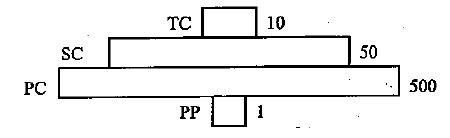
A
Level $PC$ is "insects" and level $SC$ is "small insectivorous birds".
B
Level $PP$ is "phytoplanktons" in sea and "whale" on top level $TC$.
C
Level one $PP$ is "pipal trees" and the level $SC$ is "sheep".
D
Level $PC$ is "rats" and level $SC$ is "cats".
Solution
(A) The given pyramid of numbers shows a single producer $(PP = 1)$ supporting a large number of primary consumers $(PC = 500)$, which in turn support secondary consumers $(SC = 50)$ and tertiary consumers $(TC = 10)$.
This is a spindle-shaped or inverted-type pyramid, which is characteristic of a tree ecosystem where a single large tree $(PP)$ supports many insects $(PC)$, which are then eaten by a smaller number of birds $(SC)$, and finally by a few top predators $(TC)$.
Option $(A)$ correctly identifies this relationship: $PP$ (tree) $\rightarrow$ $PC$ (insects) $\rightarrow$ $SC$ (insectivorous birds) $\rightarrow$ $TC$ (top predators).
This is a spindle-shaped or inverted-type pyramid, which is characteristic of a tree ecosystem where a single large tree $(PP)$ supports many insects $(PC)$, which are then eaten by a smaller number of birds $(SC)$, and finally by a few top predators $(TC)$.
Option $(A)$ correctly identifies this relationship: $PP$ (tree) $\rightarrow$ $PC$ (insects) $\rightarrow$ $SC$ (insectivorous birds) $\rightarrow$ $TC$ (top predators).
0 likesView Solution
89
BiologyMediumMCQAIPMT · 2012
Which one of the following is not a functional unit of an ecosystem?
A
Energy flow
B
Decomposition
C
Productivity
D
Stratification
Solution
(D) The four important functional aspects of an ecosystem are:
$1$. Productivity
$2$. Decomposition
$3$. Energy flow
$4$. Nutrient cycling
Stratification refers to the vertical distribution of different species occupying different levels in an ecosystem,which is a structural feature rather than a functional one. Therefore,$D$ is the correct answer.
$1$. Productivity
$2$. Decomposition
$3$. Energy flow
$4$. Nutrient cycling
Stratification refers to the vertical distribution of different species occupying different levels in an ecosystem,which is a structural feature rather than a functional one. Therefore,$D$ is the correct answer.
0 likesView Solution
90
BiologyMediumMCQAIPMT · 2012
The upright pyramid of number is absent in
A
pond
B
forest
C
lake
D
grassland
Solution
(B) In a forest ecosystem,the pyramid of number is inverted or spindle-shaped rather than upright. This is because a single large tree (producer) can support a large number of herbivorous birds or insects (primary consumers),which in turn support a smaller number of predatory birds (secondary consumers). Since the base representing the producers is narrower than the level representing the primary consumers,the pyramid is not upright.
0 likesView Solution
91
BiologyMediumMCQAIPMT · 2012
The rate of formation of new organic matter by a rabbit in a grassland is called:
A
net productivity
B
secondary productivity
C
net primary productivity
D
gross primary productivity
Solution
(B) : The rate of resynthesis of organic matter by consumers or the rate at which food energy is assimilated at the trophic level of consumers is called secondary productivity.
In a grassland ecosystem,the rabbit acts as a primary consumer (herbivore).
Therefore,the rate of formation of new organic matter by the rabbit is referred to as secondary productivity.
In a grassland ecosystem,the rabbit acts as a primary consumer (herbivore).
Therefore,the rate of formation of new organic matter by the rabbit is referred to as secondary productivity.
0 likesView Solution
92
BiologyMediumMCQAIPMT · 2012
The second stage of hydrosere is occupied by plants like
A
Azolla
B
Typha
C
Salix
D
Vallisneria
Solution
(D) The series of biotic communities that develop one after the other in a newly formed pond or lake is called hydrosere.
It starts as soon as the muddy water becomes clear.
The pioneer stage of hydrosere is the phytoplankton stage.
Death and decomposition of phytoplankton in the first seral stage produce organic matter,which mixes with clay and silt at the bottom to form soft mud.
This soft mud is favourable for the growth of submerged hydrophytes in the next seral stage.
Therefore,the second stage of hydrosere is occupied by submerged hydrophytes like $Vallisneria$.
It starts as soon as the muddy water becomes clear.
The pioneer stage of hydrosere is the phytoplankton stage.
Death and decomposition of phytoplankton in the first seral stage produce organic matter,which mixes with clay and silt at the bottom to form soft mud.
This soft mud is favourable for the growth of submerged hydrophytes in the next seral stage.
Therefore,the second stage of hydrosere is occupied by submerged hydrophytes like $Vallisneria$.
0 likesView Solution
93
BiologyMediumMCQAIPMT · 2012
Identify the likely organisms $(1), (2), (3)$ and $(4)$ in the food web shown below.
A
$(1)$-Deer,$(2)$-Rabbit,$(3)$-Frog,$(4)$-Rat
B
$(1)$-Dog,$(2)$-Squirrel,$(3)$-Bat,$(4)$-Deer
C
$(1)$-Rat,$(2)$-Dog,$(3)$-Tortoise,$(4)$-Crow
D
$(1)$-Squirrel,$(2)$-Cat,$(3)$-Rat,$(4)$-Pigeon
Solution
(A) In a typical terrestrial food web,organisms are categorized based on their trophic levels. Primary consumers (herbivores) feed directly on producers (plants).
$(1)$ and $(2)$ represent primary consumers such as Deer and Rabbit,which are strictly herbivorous.
$(3)$ and $(4)$ represent secondary or tertiary consumers such as Frog and Rat,which occupy higher trophic levels by feeding on insects or primary consumers.
Therefore,option $(A)$ provides the most ecologically accurate classification for these positions in a standard food web.
$(1)$ and $(2)$ represent primary consumers such as Deer and Rabbit,which are strictly herbivorous.
$(3)$ and $(4)$ represent secondary or tertiary consumers such as Frog and Rat,which occupy higher trophic levels by feeding on insects or primary consumers.
Therefore,option $(A)$ provides the most ecologically accurate classification for these positions in a standard food web.
0 likesView Solution
94
BiologyMediumMCQAIPMT · 2012
Which of the following represent the maximum number of species among global biodiversity?
A
Fungi
B
Mosses and Ferns
C
Algae
D
Lichens
Solution
(A) The correct answer is $A$.
According to global biodiversity estimates,$Fungi$ represent the largest group of species among the options provided.
$Fungi$ are achlorophyllous,heterotrophic,spore-forming,non-vascular,eukaryotic organisms that possess chitin in their cell walls and store food as glycogen.
They act as major decomposers in various ecosystems and play a crucial role in nutrient cycling.
According to global biodiversity estimates,$Fungi$ represent the largest group of species among the options provided.
$Fungi$ are achlorophyllous,heterotrophic,spore-forming,non-vascular,eukaryotic organisms that possess chitin in their cell walls and store food as glycogen.
They act as major decomposers in various ecosystems and play a crucial role in nutrient cycling.
0 likesView Solution
95
BiologyMediumMCQAIPMT · 2012
Which one of the following areas in India is a hotspot of biodiversity?
A
Eastern Ghats
B
Gangetic Plain
C
Sunderbans
D
Western Ghats
Solution
(D) : Biodiversity hotspots are regions characterized by high levels of species richness and a significant degree of endemism,while also facing severe threats to their habitats due to degradation and fragmentation.
India hosts three recognized biodiversity hotspots: the Himalayas,the Indo-Burma region,and the Western Ghats-Sri Lanka region.
The Western Ghats are globally recognized for their high degree of endemism,particularly in flowering plants,amphibians,reptiles,and various mammals.
Therefore,among the given options,the Western Ghats is the correct biodiversity hotspot.
India hosts three recognized biodiversity hotspots: the Himalayas,the Indo-Burma region,and the Western Ghats-Sri Lanka region.
The Western Ghats are globally recognized for their high degree of endemism,particularly in flowering plants,amphibians,reptiles,and various mammals.
Therefore,among the given options,the Western Ghats is the correct biodiversity hotspot.
0 likesView Solution
96
BiologyMediumMCQAIPMT · 2012
Select the correct statement about biodiversity.
A
The desert areas of Rajasthan and Gujarat have a very high level of desert animal species as well as numerous rare animals.
B
Large scale planting of $Bt$ cotton has no adverse effect on biodiversity.
C
Western Ghats have a very high degree of species richness and endemism.
D
Conservation of biodiversity is just a fad pursued by the developed countries.
Solution
(C) : Hotspots are areas with high density of biodiversity or megadiversity which are also the most threatened ones.
Ecologically,hotspots are determined by four factors: number of species/species diversity,degree of endemism,degree of threat to habitat due to its degradation and fragmentation,and degree of exploitation.
India has three hotspots: Indo-Burma,Himalayas,and Western Ghats-Sri Lanka.
India is a country of megadiversity with $2.4\%$ of the global land area and having $8.1\%$ of global biodiversity.
Major centers of biodiversity include Agasthyamalai hills,Silent Valley,and Anamalai reserve.
There is a high degree of endemism as well as richness of species of flowering plants,amphibians,reptiles,some mammals,and butterflies in the Western Ghats.
Ecologically,hotspots are determined by four factors: number of species/species diversity,degree of endemism,degree of threat to habitat due to its degradation and fragmentation,and degree of exploitation.
India has three hotspots: Indo-Burma,Himalayas,and Western Ghats-Sri Lanka.
India is a country of megadiversity with $2.4\%$ of the global land area and having $8.1\%$ of global biodiversity.
Major centers of biodiversity include Agasthyamalai hills,Silent Valley,and Anamalai reserve.
There is a high degree of endemism as well as richness of species of flowering plants,amphibians,reptiles,some mammals,and butterflies in the Western Ghats.
0 likesView Solution
97
BiologyMediumMCQAIPMT · 2012
Sacred groves are specially useful in
A
generating environmental awareness
B
preventing soil erosion
C
year-round flow of water in rivers
D
conserving rare and threatened species.
Solution
(D) : Sacred groves are an example of $in-situ$ conservation of forests and wildlife,especially rare and threatened species.
These forest patches are found around places of worship and are held in high esteem by tribal communities.
They are the most undisturbed forest patches,often surrounded by highly degraded landscapes.
Not a single branch is allowed to be cut from these forests.
As a result,many endemic species which are rare or have become extinct elsewhere can be seen to flourish here.
Such sacred groves are found in the Khasi and Jaintia hills of Meghalaya,Aravalli hills of Rajasthan,Western Ghat regions of Karnataka and Maharashtra,and the Sarguja,Chanda,and Bastar areas of Madhya Pradesh.
These forest patches are found around places of worship and are held in high esteem by tribal communities.
They are the most undisturbed forest patches,often surrounded by highly degraded landscapes.
Not a single branch is allowed to be cut from these forests.
As a result,many endemic species which are rare or have become extinct elsewhere can be seen to flourish here.
Such sacred groves are found in the Khasi and Jaintia hills of Meghalaya,Aravalli hills of Rajasthan,Western Ghat regions of Karnataka and Maharashtra,and the Sarguja,Chanda,and Bastar areas of Madhya Pradesh.
0 likesView Solution
98
BiologyMediumMCQAIPMT · 2012
In an area where $DDT$ had been used extensively,the population of birds declined significantly because
A
birds stopped laying eggs
B
earthworms in the area got eradicated
C
cobras were feeding exclusively on birds
D
many of the birds eggs laid,did not hatch.
Solution
(D) $DDT$ undergoes biomagnification in the food chain. In birds,high concentrations of $DDT$ interfere with calcium metabolism. This leads to the thinning of eggshells. Consequently,these thin-shelled eggs break prematurely during incubation,preventing the embryos from developing fully and hatching. Thus,the population of birds declines significantly.
0 likesView Solution
99
BiologyMediumMCQAIPMT · 2012
Which one of the following is a wrong statement?
A
Most of the forests have been lost in tropical areas.
B
Ozone in the upper part of the atmosphere is harmful to animals.
C
Greenhouse effect is a natural phenomenon.
D
Eutrophication is a natural phenomenon in freshwater bodies.
Solution
(B) is the incorrect statement. Ozone present in the upper atmosphere (stratosphere) forms a protective layer known as the ozone layer. This layer is essential for the survival of life on Earth because it absorbs harmful $UV$ radiation from the Sun,preventing it from reaching the Earth's surface. In contrast,ozone at the ground level (troposphere) is considered a pollutant and is harmful to animals and plants.
0 likesView Solution
100
BiologyMediumMCQAIPMT · 2012
Measuring Biochemical Oxygen Demand $(BOD)$ is a method used for
A
estimating the amount of organic matter in sewage water
B
working out the efficiency of oil driven automobile engines
C
measuring the activity of Saccharomyces cerevisiae in producing curd on a commercial scale
D
working out the efficiency of $RBCs$ about their capacity to carry oxygen.
Solution
(A) : Biochemical oxygen demand $(BOD)$ is the amount of dissolved oxygen required by aerobic microorganisms to break down the organic matter present in a given volume of water sample.
It serves as a direct indicator of the level of organic pollution in water bodies.
Higher $(BOD)$ values indicate higher levels of organic pollution,making it a standard method for estimating the amount of organic matter in sewage water.
It serves as a direct indicator of the level of organic pollution in water bodies.
Higher $(BOD)$ values indicate higher levels of organic pollution,making it a standard method for estimating the amount of organic matter in sewage water.
0 likesView Solution
101
BiologyEasyMCQAIPMT · 2012
Which of the following represents the highest number of species in the world?
A
Fungi
B
Algae
C
Bacteria
D
Lichens
Solution
(A) According to the global biodiversity estimates,among the groups listed,$Fungi$ represent a very high number of species. In the context of biological classification and biodiversity,$Fungi$ have a greater number of described species compared to $Algae$,$Bacteria$,or $Lichens$.
0 likesView Solution
102
BiologyMediumMCQAIPMT · 2012
Which of the following is correctly matched?
A
Onion - Bulb
B
Ginger - Sucker
C
Chlamydomonas - Conidia
D
Yeast - Zoospores
Solution
(A) $1$. Onion $(Allium \text{ } cepa)$ reproduces vegetatively through a specialized underground stem structure known as a $Bulb$.
$2$. Ginger reproduces through $Rhizomes$, not suckers.
$3$. $Chlamydomonas$ reproduces through $Zoospores$, not conidia.
$4$. $Yeast$ reproduces through $Budding$, not zoospores.
Therefore, the correct match is Onion - Bulb.
$2$. Ginger reproduces through $Rhizomes$, not suckers.
$3$. $Chlamydomonas$ reproduces through $Zoospores$, not conidia.
$4$. $Yeast$ reproduces through $Budding$, not zoospores.
Therefore, the correct match is Onion - Bulb.
0 likesView Solution
103
BiologyMediumMCQAIPMT · 2012
Menstruation is caused by the deficiency of which hormone?
A
Progesterone
B
$FSH$
C
Oxytocin
D
Vasopressin
Solution
(A) The menstrual cycle is regulated by hormones. During the luteal phase,the corpus luteum secretes large amounts of progesterone,which is essential for maintaining the endometrium. If fertilization does not occur,the corpus luteum degenerates,leading to a sharp decrease in the levels of progesterone. This withdrawal of progesterone causes the breakdown of the endometrial lining and its blood vessels,which results in menstruation.
0 likesView Solution
104
BiologyMediumMCQAIPMT · 2012
Which of the following statements is correct regarding immunity?
A
Injection of preformed antibodies is required for the treatment of viper snake bites.
B
$T$-lymphocytes produce antibodies against smallpox pathogens.
C
Antibodies are protein molecules consisting of four light chains.
D
Rejection of a transplanted kidney is the function of $B$-lymphocytes.
Solution
(A) The correct answer is $A$.
$1$. In the treatment of viper snake bites,'passive immunity' is utilized,where preformed antibodies (antivenom) are injected directly into the patient's body.
$2$. $T$-lymphocytes do not produce antibodies themselves; instead,they assist $B$-lymphocytes in the immune response.
$3$. An antibody molecule consists of two light chains and two heavy chains,not four light chains.
$4$. The rejection of a transplanted organ (graft rejection) is primarily mediated by cell-mediated immunity,which is governed by $T$-lymphocytes,not $B$-lymphocytes.
$1$. In the treatment of viper snake bites,'passive immunity' is utilized,where preformed antibodies (antivenom) are injected directly into the patient's body.
$2$. $T$-lymphocytes do not produce antibodies themselves; instead,they assist $B$-lymphocytes in the immune response.
$3$. An antibody molecule consists of two light chains and two heavy chains,not four light chains.
$4$. The rejection of a transplanted organ (graft rejection) is primarily mediated by cell-mediated immunity,which is governed by $T$-lymphocytes,not $B$-lymphocytes.
0 likesView Solution
105
BiologyMediumMCQAIPMT · 2012
Select the option that correctly matches the example with its specific type of immunity barrier.
A
Polymorphonuclear leukocytes $(PMNL)$ and monocytes - Cellular barrier
B
Anti-tetanus and anti-snake venom injections - Active immunity
C
Saliva in the mouth and tears in the eyes - Physical barrier
D
Mucus coating of the urogenital tract and $HCl$ in the stomach - Physiological barrier
Solution
(A) The human body has innate immunity consisting of four types of barriers:
$1$. Physical barriers: Skin and mucus coating of the respiratory,gastrointestinal,and urogenital tracts.
$2$. Physiological barriers: Acid in the stomach,saliva in the mouth,and tears from eyes.
$3$. Cellular barriers: Polymorphonuclear leukocytes ($PMNL$-neutrophils),monocytes,and natural killer cells.
$4$. Cytokine barriers: Virus-infected cells secrete proteins called interferons which protect non-infected cells.
Option $A$ is correct because $PMNL$ and monocytes are examples of cellular barriers.
Option $B$ is incorrect because these are examples of passive immunity (pre-formed antibodies).
Option $C$ is incorrect because saliva and tears are physiological barriers,not physical.
Option $D$ is incorrect because mucus coating is a physical barrier,while $HCl$ is a physiological barrier.
$1$. Physical barriers: Skin and mucus coating of the respiratory,gastrointestinal,and urogenital tracts.
$2$. Physiological barriers: Acid in the stomach,saliva in the mouth,and tears from eyes.
$3$. Cellular barriers: Polymorphonuclear leukocytes ($PMNL$-neutrophils),monocytes,and natural killer cells.
$4$. Cytokine barriers: Virus-infected cells secrete proteins called interferons which protect non-infected cells.
Option $A$ is correct because $PMNL$ and monocytes are examples of cellular barriers.
Option $B$ is incorrect because these are examples of passive immunity (pre-formed antibodies).
Option $C$ is incorrect because saliva and tears are physiological barriers,not physical.
Option $D$ is incorrect because mucus coating is a physical barrier,while $HCl$ is a physiological barrier.
0 likesView Solution
106
BiologyMediumMCQAIPMT · 2012
Consider the following statements $(I-IV)$ and select the option containing the correct answer.
$I.$ The unicellular $Spirulina$ can produce large quantities of food rich in protein,minerals,and vitamins.
$II.$ Based on body weight,the microorganism $Methylophilus$ $methylotrophus$ can produce much more protein in a day than a cow.
$III.$ Common button mushrooms are a rich source of Vitamin-$C$.
$IV.$ $A$ variety of rice has been developed that is rich in calcium.
$I.$ The unicellular $Spirulina$ can produce large quantities of food rich in protein,minerals,and vitamins.
$II.$ Based on body weight,the microorganism $Methylophilus$ $methylotrophus$ can produce much more protein in a day than a cow.
$III.$ Common button mushrooms are a rich source of Vitamin-$C$.
$IV.$ $A$ variety of rice has been developed that is rich in calcium.
A
Statements $III$ and $IV$
B
Statements $I, III$ and $IV$
C
Statements $II, III$ and $IV$
D
Statements $I$ and $II$
Solution
(D) $I.$ $Spirulina$ is a unicellular cyanobacterium that is a rich source of protein,minerals,and vitamins. This statement is correct.
$II.$ $Methylophilus$ $methylotrophus$ has a high rate of biomass production and protein synthesis due to its high rate of biomass doubling. It can produce $25$ tonnes of protein from $250$ grams of microorganisms in a day,which is significantly higher than a cow. This statement is correct.
$III.$ Mushrooms are generally rich in proteins and fibers,not Vitamin-$C$. This statement is incorrect.
$IV.$ Biofortified rice varieties are typically rich in iron or Vitamin-$A$,not calcium. This statement is incorrect.
Therefore,only statements $I$ and $II$ are correct.
$II.$ $Methylophilus$ $methylotrophus$ has a high rate of biomass production and protein synthesis due to its high rate of biomass doubling. It can produce $25$ tonnes of protein from $250$ grams of microorganisms in a day,which is significantly higher than a cow. This statement is correct.
$III.$ Mushrooms are generally rich in proteins and fibers,not Vitamin-$C$. This statement is incorrect.
$IV.$ Biofortified rice varieties are typically rich in iron or Vitamin-$A$,not calcium. This statement is incorrect.
Therefore,only statements $I$ and $II$ are correct.
0 likesView Solution
107
BiologyMediumMCQAIPMT · 2012
Yeast is used in the production of ........... .
A
Citric acid and lactic acid
B
Lipase and pectinase
C
Bread and beer
D
Cheese and butter
Solution
(C) Yeast, specifically $Saccharomyces \text{ } cerevisiae$ (also known as Brewer's yeast), is widely used in the food and beverage industry.
It is used in the production of bread by fermenting sugars in the dough, which releases $CO_2$ and causes the dough to rise.
It is also used in the production of alcoholic beverages like beer and wine through the process of fermentation.
It is used in the production of bread by fermenting sugars in the dough, which releases $CO_2$ and causes the dough to rise.
It is also used in the production of alcoholic beverages like beer and wine through the process of fermentation.
0 likesView Solution
108
BiologyMediumMCQAIPMT · 2012
Which of the following microorganisms forms a symbiotic association with plants and helps in their nutrition?
A
Azotobacter
B
Aspergillus
C
Glomus
D
Trichoderma
Solution
(C) Many members of the genus $Glomus$ form symbiotic associations with plants,which are known as mycorrhiza. In this association,the fungal symbiont absorbs phosphorus from the soil and passes it to the plant. Plants having such associations show other benefits like resistance to root-borne pathogens,tolerance to salinity and drought,and an overall increase in plant growth and development. Therefore,$Glomus$ acts as a biofertilizer.
0 likesView Solution
109
BiologyMediumMCQAIPMT · 2012
In transformation,microparticles are bombarded with the help of a gene gun,which are made of ............ .
A
Silver or Platinum
B
Platinum or Zinc
C
Silicon or Platinum
D
Gold or Tungsten
Solution
(D) The gene gun method,also known as biolistics or microprojectile bombardment,is a technique used to introduce foreign $DNA$ into host cells. In this process,microparticles of heavy metals are coated with the target $DNA$. These particles are then accelerated at high velocity to penetrate the cell wall and membrane. The microparticles used for this purpose are typically made of $Gold$ or $Tungsten$ because they are inert,dense,and non-toxic to the cells.
0 likesView Solution
110
BiologyMediumMCQAIPMT · 2012
Which statement is correct regarding the $DNA$ polymerase used in $PCR$?
A
To join $DNA$ inserted into host cells.
B
It acts as a selectable marker.
C
It is isolated from a virus.
D
It remains active at high temperatures.
Solution
(D) The $DNA$ polymerase used in $PCR$ is known as $Taq$ polymerase.
It is isolated from a thermophilic bacterium called $Thermus$ $aquaticus$.
Because $PCR$ involves repeated cycles of heating (denaturation) to separate $DNA$ strands,the enzyme must be thermostable.
Therefore,$Taq$ polymerase remains active even at high temperatures,allowing the amplification process to continue without needing to add fresh enzyme in every cycle.
It is isolated from a thermophilic bacterium called $Thermus$ $aquaticus$.
Because $PCR$ involves repeated cycles of heating (denaturation) to separate $DNA$ strands,the enzyme must be thermostable.
Therefore,$Taq$ polymerase remains active even at high temperatures,allowing the amplification process to continue without needing to add fresh enzyme in every cycle.
0 likesView Solution
111
BiologyMediumMCQAIPMT · 2012
$A$ single-stranded nucleic acid tagged with a radioactive molecule is called a .............. .
A
Vector
B
Selectable marker
C
Plasmid
D
Probe
Solution
(D) $Probe$ is a single-stranded $DNA$ or $RNA$ molecule that is tagged with a radioactive isotope or a fluorescent molecule.
It is used to detect the presence of complementary sequences in a sample of $DNA$ or $RNA$ by the process of hybridization.
Since it is labeled,it allows for the identification of specific gene sequences in techniques like Southern blotting or colony hybridization.
It is used to detect the presence of complementary sequences in a sample of $DNA$ or $RNA$ by the process of hybridization.
Since it is labeled,it allows for the identification of specific gene sequences in techniques like Southern blotting or colony hybridization.
0 likesView Solution
112
BiologyMediumMCQAIPMT · 2012
$PCR$ and Restriction Fragment Length Polymorphism $(RFLP)$ are techniques used for.............
A
Study of enzymes
B
Genetic mutation
C
$DNA$ sequencing
D
$DNA$ fingerprinting
Solution
(D) $PCR$ (Polymerase Chain Reaction) and $RFLP$ (Restriction Fragment Length Polymorphism) are fundamental techniques employed in $DNA$ fingerprinting.
$DNA$ fingerprinting involves identifying differences in specific regions of $DNA$ sequences.
$PCR$ is used to amplify small amounts of $DNA$ samples,while $RFLP$ is used to analyze the variations in the length of $DNA$ fragments produced by restriction enzymes.
These techniques together allow for the identification of individuals based on their unique genetic makeup.
$DNA$ fingerprinting involves identifying differences in specific regions of $DNA$ sequences.
$PCR$ is used to amplify small amounts of $DNA$ samples,while $RFLP$ is used to analyze the variations in the length of $DNA$ fragments produced by restriction enzymes.
These techniques together allow for the identification of individuals based on their unique genetic makeup.
0 likesView Solution
113
BiologyMediumMCQAIPMT · 2012
The given figure represents the cloning vector $pBR322$ of $E. coli$. Which of the following options correctly identifies its components?
A
$ori$ - Original restriction enzyme
B
$rop$ - Reduced osmotic pressure
C
$Hind III, Eco RI$ - Selectable markers
D
$amp^R, tet^R$ - Antibiotic resistance genes
Solution
(D) The plasmid $pBR322$ is a widely used cloning vector in $E. coli$.
$1$. $ori$ stands for the origin of replication,which is the sequence where replication starts.
$2$. $rop$ codes for the proteins involved in the replication of the plasmid.
$3$. $Hind III$ and $Eco RI$ are restriction sites (recognition sites) for specific restriction enzymes,not selectable markers.
$4$. $amp^R$ (ampicillin resistance) and $tet^R$ (tetracycline resistance) are the selectable markers that help in identifying and eliminating non-transformants and selectively permitting the growth of the transformants.
$1$. $ori$ stands for the origin of replication,which is the sequence where replication starts.
$2$. $rop$ codes for the proteins involved in the replication of the plasmid.
$3$. $Hind III$ and $Eco RI$ are restriction sites (recognition sites) for specific restriction enzymes,not selectable markers.
$4$. $amp^R$ (ampicillin resistance) and $tet^R$ (tetracycline resistance) are the selectable markers that help in identifying and eliminating non-transformants and selectively permitting the growth of the transformants.
0 likesView Solution
114
BiologyMediumMCQAIPMT · 2012
Identify the organisms $I, II, III$ and $IV$ in the given food web.
$I$ | $II$ | $III$ | $IV$
$I$ | $II$ | $III$ | $IV$
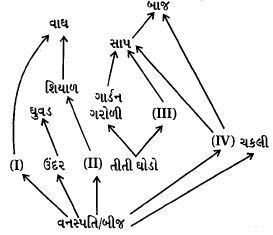
A
Deer | Rabbit | Frog | Mouse
B
Dog | Squirrel | Bat | Deer
C
Mouse | Dog | Turtle | Crow
D
Squirrel | Cat | Mouse | Pigeon
Solution
(D) Based on the provided food web diagram:
$1$. Organism $I$ consumes plants/seeds and is eaten by the tiger. In this context, it represents a herbivore like a squirrel.
$2$. Organism $II$ consumes plants/seeds and is eaten by the fox. It represents a herbivore like a cat (or similar small mammal).
$3$. Organism $III$ is eaten by the snake and consumes grasshoppers. It represents a predator like a mouse.
$4$. Organism $IV$ consumes plants/seeds and is eaten by the hawk. It represents a bird like a pigeon.
Therefore, the correct sequence is $I = \text{Squirrel}, II = \text{Cat}, III = \text{Mouse}, IV = \text{Pigeon}$.
$1$. Organism $I$ consumes plants/seeds and is eaten by the tiger. In this context, it represents a herbivore like a squirrel.
$2$. Organism $II$ consumes plants/seeds and is eaten by the fox. It represents a herbivore like a cat (or similar small mammal).
$3$. Organism $III$ is eaten by the snake and consumes grasshoppers. It represents a predator like a mouse.
$4$. Organism $IV$ consumes plants/seeds and is eaten by the hawk. It represents a bird like a pigeon.
Therefore, the correct sequence is $I = \text{Squirrel}, II = \text{Cat}, III = \text{Mouse}, IV = \text{Pigeon}$.
0 likesView Solution
115
BiologyMediumMCQAIPMT · 2012
In large cities,domestic sewage ............
A
has high $BOD$ as it contains both aerobic and anaerobic bacteria.
B
is processed in sewage treatment plants through primary aerobic and then secondary anaerobic processes.
C
does not require aeration when processed in $STP$ because it contains sufficient oxygen.
D
contains large amounts of suspended solids and dissolved salts.
Solution
(A) Domestic sewage in large cities is characterized by high organic content.
$1$. $BOD$ (Biochemical Oxygen Demand) is a measure of the organic matter present in water.
$2$. Domestic sewage contains a large amount of biodegradable organic matter,which serves as food for microorganisms like aerobic and anaerobic bacteria.
$3$. As these microorganisms decompose the organic matter,they consume dissolved oxygen,leading to a high $BOD$ value.
$4$. Therefore,domestic sewage is characterized by high $BOD$ due to the presence of high organic load and associated microbial activity.
$1$. $BOD$ (Biochemical Oxygen Demand) is a measure of the organic matter present in water.
$2$. Domestic sewage contains a large amount of biodegradable organic matter,which serves as food for microorganisms like aerobic and anaerobic bacteria.
$3$. As these microorganisms decompose the organic matter,they consume dissolved oxygen,leading to a high $BOD$ value.
$4$. Therefore,domestic sewage is characterized by high $BOD$ due to the presence of high organic load and associated microbial activity.
0 likesView Solution
116
BiologyMediumMCQAIPMT · 2012
Which of the following statements is incorrect?
A
$A$ large area of forest has been lost in the tropical region.
B
The ozone in the upper part of the atmosphere is harmful to animals.
C
The greenhouse effect is a natural phenomenon.
D
Eutrophication is a natural phenomenon of freshwater bodies.
Solution
(B) The correct answer is $B$.
$1$. The ozone found in the stratosphere (upper atmosphere) is known as 'good' ozone because it absorbs harmful ultraviolet $(UV)$ radiation from the sun,protecting living organisms.
$2$. The ozone found in the troposphere (lower atmosphere) is considered 'bad' or harmful to animals and plants.
$3$. Therefore,the statement that ozone in the upper atmosphere is harmful is incorrect.
$4$. Tropical forests are indeed being lost at a rapid rate.
$5$. The greenhouse effect is a naturally occurring phenomenon that is responsible for heating the Earth's surface and atmosphere.
$6$. Eutrophication is the natural aging of a lake by nutrient enrichment of its water.
$1$. The ozone found in the stratosphere (upper atmosphere) is known as 'good' ozone because it absorbs harmful ultraviolet $(UV)$ radiation from the sun,protecting living organisms.
$2$. The ozone found in the troposphere (lower atmosphere) is considered 'bad' or harmful to animals and plants.
$3$. Therefore,the statement that ozone in the upper atmosphere is harmful is incorrect.
$4$. Tropical forests are indeed being lost at a rapid rate.
$5$. The greenhouse effect is a naturally occurring phenomenon that is responsible for heating the Earth's surface and atmosphere.
$6$. Eutrophication is the natural aging of a lake by nutrient enrichment of its water.
0 likesView Solution
117
BiologyMediumMCQAIPMT · 2012
In areas where $DDT$ is used extensively,the bird population declines significantly because...
A
Birds stop laying eggs.
B
Earthworms are eradicated from the area.
C
Cobras feed on the birds.
D
Most of the birds lay eggs,but they do not hatch.
Solution
(D) $DDT$ (Dichlorodiphenyltrichloroethane) is a persistent organic pollutant that undergoes biomagnification in the food chain.
In birds,high concentrations of $DDT$ interfere with calcium metabolism.
This interference leads to the thinning of eggshells.
Consequently,the eggshells break prematurely during incubation,preventing the eggs from hatching and leading to a significant decline in the bird population.
In birds,high concentrations of $DDT$ interfere with calcium metabolism.
This interference leads to the thinning of eggshells.
Consequently,the eggshells break prematurely during incubation,preventing the eggs from hatching and leading to a significant decline in the bird population.
0 likesView Solution
118
BiologyEasyMCQAIPMT · 2012
What is the figure given below showing in particular?
A
Ovarian cancer
B
Uterine cancer
C
Tubectomy
D
Vasectomy
Solution
(C) The figure shows a tubectomy. This is a surgical method of contraception used in females. In this procedure,a small part of the fallopian tube is removed or tied through a small incision in the abdomen or through the vagina. It is a highly effective method of birth control,but its reversibility is very poor.
0 likesView Solution
119
BiologyMediumMCQAIPMT · 2012
$A$ patient brought to a hospital with myocardial infarction is normally immediately given
A
Penicillin
B
Streptokinase
C
Cyclosporin-$A$
D
Statins
Solution
(B) Streptokinase is a clot-buster enzyme produced by the bacterium Streptococcus and modified by genetic engineering. It is administered to patients who have suffered from myocardial infarction (heart attack) to dissolve blood clots (thrombi) in the blood vessels,thereby restoring blood flow to the heart muscle.
0 likesView Solution
Vedclass Products
For Students
Vedclass Test Series
Mock tests in real AIPMT style covering Biology with performance analysis. 5-day free trial.
Start Free TrialFor Teachers
Exam Paper Generator
Generate Set A/B/C/D Biology papers from 7.5L+ questions in 2 minutes. 3 chapters free.
Try FreeFor Institutes
Online Exam Module
Run live AIPMT mock exams with unlimited students, 360° analytics & white-label branding.
See DemoFrequently Asked Questions
How many Biology questions are in AIPMT 2012?
There are 169 Biology questions from the AIPMT 2012 paper on Vedclass, each with a detailed step-by-step solution in English.
Are AIPMT 2012 Biology solutions available in English?
Yes. All solutions on this page are in English. You can also switch to English or Hindi using the language buttons above the questions.
Can I practice AIPMT 2012 Biology as a timed test?
Yes. Use the Vedclass Test Series to attempt a full AIPMT mock test covering Biology with time limits and instant score analysis.
Can teachers create Biology papers from AIPMT previous year questions?
Yes. The Vedclass Exam Paper Generator lets teachers mix AIPMT Biology questions and generate Set A/B/C/D papers in minutes.
For Teachers & Institutes
Build a Custom Biology Paper
Pick AIPMT 2012 Biology questions, set difficulty, and generate Set A/B/C/D in 2 minutes.