
BiologyQ1–97 of 104 questions
Page 1 of 2 · English
1
BiologyMediumMCQAIPMT · 2008
$Thermococcus$,$Methanococcus$ and $Methanobacterium$ exemplify:
A
bacteria whose $DNA$ is relaxed or positively supercoiled but which have a cytoskeleton as well as mitochondria.
B
bacteria that contain a cytoskeleton and ribosomes.
C
archaebacteria that contain protein homologous to eukaryotic core histones.
D
archaebacteria that lack any histones resembling those found in eukaryotes but whose $DNA$ is negatively supercoiled.
Solution
(C) $Thermococcus$,$Methanococcus$ and $Methanobacterium$ are examples of archaebacteria.
These organisms are characterized by a unique cell wall that lacks peptidoglycan and consists of polysaccharides and proteins.
They closely resemble the eukaryotic cell in the mechanism of protein synthesis,structural proteins,and the $RNA$ components of the ribosomes.
Furthermore,they contain proteins that are homologous to eukaryotic core histones,which helps in the packaging of their $DNA$.
These organisms are characterized by a unique cell wall that lacks peptidoglycan and consists of polysaccharides and proteins.
They closely resemble the eukaryotic cell in the mechanism of protein synthesis,structural proteins,and the $RNA$ components of the ribosomes.
Furthermore,they contain proteins that are homologous to eukaryotic core histones,which helps in the packaging of their $DNA$.
0 likesView Solution
2
BiologyMediumMCQAIPMT · 2008
In the light of the recent classification of living organisms into three domains of life ($Bacteria$,$Archaea$,and $Eukarya$),which one of the following statements is true about $Archaea$?
A
$Archaea$ completely differ from both prokaryotes and eukaryotes.
B
$Archaea$ completely differ from prokaryotes.
C
$Archaea$ resemble $Eukarya$ in all respects.
D
$Archaea$ have some novel features that are absent in other prokaryotes and eukaryotes.
Solution
(D) : $Archaebacteria$ represent a cell type that possesses characteristics of both prokaryotes and eukaryotes.
In size,$Archaebacteria$ are about $1 \mu m$ in diameter,similar to typical prokaryotes.
They lack membrane-bound organelles,their nuclear bodies are not bound by nuclear membranes (like prokaryotes),and they possess $70S$ ribosomes.
However,they have a unique cell wall that lacks peptidoglycan.
They resemble eukaryotic cells in mechanisms of protein synthesis,structural proteins,and $RNA$ components of ribosomes.
$A$ distinctive feature of $Archaebacterial$ genes is the presence of introns,which are absent in other prokaryotes but common in eukaryotes.
Furthermore,$Archaebacteria$ possess unique characteristics found in neither eukaryotes nor prokaryotes,such as membrane lipids with branched chains and ether linkages,which enable them to tolerate extreme heat and $pH$.
In size,$Archaebacteria$ are about $1 \mu m$ in diameter,similar to typical prokaryotes.
They lack membrane-bound organelles,their nuclear bodies are not bound by nuclear membranes (like prokaryotes),and they possess $70S$ ribosomes.
However,they have a unique cell wall that lacks peptidoglycan.
They resemble eukaryotic cells in mechanisms of protein synthesis,structural proteins,and $RNA$ components of ribosomes.
$A$ distinctive feature of $Archaebacterial$ genes is the presence of introns,which are absent in other prokaryotes but common in eukaryotes.
Furthermore,$Archaebacteria$ possess unique characteristics found in neither eukaryotes nor prokaryotes,such as membrane lipids with branched chains and ether linkages,which enable them to tolerate extreme heat and $pH$.
0 likesView Solution
3
BiologyMediumMCQAIPMT · 2008
Select one of the following pairs of important features distinguishing $Gnetum$ from $Cycas$ and $Pinus$ and showing affinities with angiosperms.
A
Perianth and two integuments
B
Embryo development and apical meristem
C
Absence of resin duct and leaf venation
D
Presence of vessel elements and absence of archegonia
Solution
(D) $Gnetum$ is considered the most advanced gymnosperm because it exhibits several characteristics similar to angiosperms.
In most gymnosperms,the xylem consists of tracheids and xylem parenchyma,but they lack vessels.
$Gnetum$ possesses vessel elements in its xylem,which is a characteristic feature of angiosperms.
Furthermore,$Gnetum$ lacks archegonia in its female gametophyte,which is another significant similarity to the angiosperm life cycle.
Therefore,the presence of vessel elements and the absence of archegonia are key features that distinguish $Gnetum$ from $Cycas$ and $Pinus$ and show its evolutionary affinity with angiosperms.
In most gymnosperms,the xylem consists of tracheids and xylem parenchyma,but they lack vessels.
$Gnetum$ possesses vessel elements in its xylem,which is a characteristic feature of angiosperms.
Furthermore,$Gnetum$ lacks archegonia in its female gametophyte,which is another significant similarity to the angiosperm life cycle.
Therefore,the presence of vessel elements and the absence of archegonia are key features that distinguish $Gnetum$ from $Cycas$ and $Pinus$ and show its evolutionary affinity with angiosperms.
0 likesView Solution
4
BiologyMediumMCQAIPMT · 2008
In which one of the following do male and female gametophytes not have a free-living independent existence?
A
Polytrichum
B
Cedrus
C
Pteris
D
Funaria
Solution
(B) The correct answer is $B$. In gymnosperms (such as $Cedrus$),the male and female gametophytes do not have an independent,free-living existence. They remain within the sporangia retained on the sporophytes; specifically,the female gametophyte is retained within the megasporangium and the male gametophyte within the microsporangium.
0 likesView Solution
5
BiologyEasyMCQAIPMT · 2008
Which one of the following is heterosporous?
A
Adiantum
B
Equisetum
C
Dryopteris
D
Salvinia
Solution
(D) The correct answer is $D$.
In pteridophytes,the sporophyte produces spores inside sporangia.
Most pteridophytes produce only one type of spore,known as homosporous (e.g.,$Equisetum$,$Adiantum$,$Dryopteris$).
However,some genera like $Salvinia$,$Selaginella$,$Azolla$,$Marsilea$,and $Isoetes$ produce two different types of spores,known as heterosporous.
Therefore,$Salvinia$ is heterosporous.
In pteridophytes,the sporophyte produces spores inside sporangia.
Most pteridophytes produce only one type of spore,known as homosporous (e.g.,$Equisetum$,$Adiantum$,$Dryopteris$).
However,some genera like $Salvinia$,$Selaginella$,$Azolla$,$Marsilea$,and $Isoetes$ produce two different types of spores,known as heterosporous.
Therefore,$Salvinia$ is heterosporous.
0 likesView Solution
6
BiologyMediumMCQAIPMT · 2008
Which one of the following in birds indicates their reptilian ancestry?
A
Two special chambers,crop and gizzard,in their digestive tract
B
Eggs with a calcareous shell
C
Scales on their hind limbs
D
Four-chambered heart
Solution
(C) : Birds have originated from ancestral reptilian stock. These two classes share many common features that link the two groups. The evidence of the reptilian ancestry of birds is provided by their comparative anatomy,embryology,and palaeontology.
One of the key features is that all birds possess horny epidermal scales confined to the lower parts of their legs and feet,which are structurally identical to the epidermal scales found in reptiles.
One of the key features is that all birds possess horny epidermal scales confined to the lower parts of their legs and feet,which are structurally identical to the epidermal scales found in reptiles.
0 likesView Solution
7
BiologyEasyMCQAIPMT · 2008
$Ascaris$ is characterized by:
A
presence of true coelom but absence of metamerism
B
presence of true coelom and metamerism (metamerisation)
C
absence of true coelom but presence of metamerism
D
presence of neither true coelom nor metamerism
Solution
(D) $Ascaris$ belongs to the Phylum $Nematoda$ (also known as $Aschelminthes$).
These organisms possess a pseudocoelom (false coelom),which is a body cavity not lined by mesoderm.
They do not exhibit metamerism (true segmentation of the body).
Although the cuticle may show transverse striations that give a pseudosegmented appearance,they lack true metameric segmentation.
Therefore,they are characterized by the absence of both a true coelom and metamerism.
These organisms possess a pseudocoelom (false coelom),which is a body cavity not lined by mesoderm.
They do not exhibit metamerism (true segmentation of the body).
Although the cuticle may show transverse striations that give a pseudosegmented appearance,they lack true metameric segmentation.
Therefore,they are characterized by the absence of both a true coelom and metamerism.
0 likesView Solution
8
BiologyMediumMCQAIPMT · 2008
Which one of the following groups of three animals is correctly matched with their one characteristic morphological feature?
| $Option$ | Animals | Morphological features |
| $(a)$ | Scorpion,spider,cockroach | Ventral solid central nervous system |
| $(b)$ | Cockroach,locust,Taenia | Metameric segmentation |
| $(c)$ | Liver fluke,sea anemone,sea cucumber | Bilateral symmetry |
| $(d)$ | Centipede,prawn,sea urchin | Jointed appendages |
A
$(a)$
B
$(b)$
C
$(c)$
D
$(d)$
Solution
(A) The correct option is $(a)$.
$1$. Scorpion,spider,and cockroach all belong to the Phylum $Arthropoda$. $A$ characteristic feature of arthropods is the presence of a ventral solid central nervous system,which consists of a dorsal brain connected to a double ventral nerve cord.
$2$. In option $(b)$,$Taenia$ (tapeworm) is a Platyhelminth and does not show metameric segmentation.
$3$. In option $(c)$,sea anemone (Cnidaria) exhibits radial symmetry,not bilateral symmetry.
$4$. In option $(d)$,sea urchin (Echinodermata) exhibits radial symmetry in adults and lacks jointed appendages,which are characteristic of arthropods.
$1$. Scorpion,spider,and cockroach all belong to the Phylum $Arthropoda$. $A$ characteristic feature of arthropods is the presence of a ventral solid central nervous system,which consists of a dorsal brain connected to a double ventral nerve cord.
$2$. In option $(b)$,$Taenia$ (tapeworm) is a Platyhelminth and does not show metameric segmentation.
$3$. In option $(c)$,sea anemone (Cnidaria) exhibits radial symmetry,not bilateral symmetry.
$4$. In option $(d)$,sea urchin (Echinodermata) exhibits radial symmetry in adults and lacks jointed appendages,which are characteristic of arthropods.
0 likesView Solution
9
BiologyMediumMCQAIPMT · 2008
Which one of the following pairs of items correctly belongs to the category of organs mentioned against it?
A
Nephridia of earthworm and Malpighian tubules of cockroach: Excretory organs
B
Wings of honey bee and wings of crow: Homologous organs
C
Thorn of Bougainvillea and tendrils of Cucurbita: Analogous organs
D
Nictitating membrane and blind spot in human eye: Vestigial organs
Solution
(A) : Nephridia are the excretory organs of earthworms,consisting of simple or branched tubes formed by the ingrowth of ectoderm with cilia at the inner end. Excretory products diffuse into the nephridium and are moved to the exterior by ciliary action.
Malpighian tubules are the organs involved in the excretion of nitrogenous wastes in cockroaches. They open into the intestine,selectively extract uric acid from the blood,which,together with water and salts,is deposited into the hindgut and excreted in the faeces.
Therefore,both are correctly categorized as excretory organs.
Malpighian tubules are the organs involved in the excretion of nitrogenous wastes in cockroaches. They open into the intestine,selectively extract uric acid from the blood,which,together with water and salts,is deposited into the hindgut and excreted in the faeces.
Therefore,both are correctly categorized as excretory organs.
0 likesView Solution
10
BiologyMediumMCQAIPMT · 2008
Which one of the following phyla is correctly matched with its two general characteristics?
A
Echinodermata: pentamerous radial symmetry and mostly internal fertilization
B
Mollusca: normally oviparous and development through a trochophore or veliger larva
C
Arthropoda: body divided into head,thorax and abdomen and respiration by tracheae
D
Chordata: notochord at some stage and separate anal and urinary openings to the outside
Solution
(C) is the correct answer. Arthropoda is the largest phylum of Kingdom Animalia,characterized by a chitinous exoskeleton. The body is typically divided into three distinct regions: head,thorax,and abdomen. Respiration in terrestrial arthropods occurs through specialized structures such as tracheae,book lungs,or book gills.
0 likesView Solution
11
BiologyMediumMCQAIPMT · 2008
Which one of the following is not a characteristic of Phylum $Annelida$?
A
Pseudocoelom
B
Ventral nerve cord
C
Closed circulatory system
D
Segmentation
Solution
(A) : Phylum $Annelida$ comprises invertebrates,which are segmented worms having cylindrical soft bodies showing metameric segmentation. These are triploblastic animals showing bilateral symmetry. $A$ true coelom is present,which is filled with coelomic fluid containing cells. $Annelids$ are the first animals to have a true schizocoelic coelom. Therefore,they possess a true coelom,not a pseudocoelom.
0 likesView Solution
12
BiologyMediumMCQAIPMT · 2008
The fleshy receptacle of $Syconus$ of $Fig$ encloses a number of
A
berries
B
mericarps
C
achenes
D
samaras
Solution
(C) $Syconus$ develops from the $Hypanthodium$ type of inflorescence.
The flask-shaped fleshy receptacle encloses female flowers, which produce small $Achene$-like fruitlets, and it has a small pore protected by scale leaves.
Example: $Syconus$ of $Fig$ $(Ficus \text{ } carica)$.
The flask-shaped fleshy receptacle encloses female flowers, which produce small $Achene$-like fruitlets, and it has a small pore protected by scale leaves.
Example: $Syconus$ of $Fig$ $(Ficus \text{ } carica)$.
0 likesView Solution
13
BiologyMediumMCQAIPMT · 2008
Dry indehiscent single-seeded fruit formed from a bicarpellary syncarpous inferior ovary is:
A
berry
B
cremocarp
C
caryopsis
D
cypsella
Solution
(D) : Cypsella is a dry,one-chambered,one-seeded fruit developing from an inferior,bicarpellary syncarpous ovary,$e.g.$,sunflower,marigold,cosmos,etc.
Caryopsis or grain is a small,dry,one-seeded fruit developing from a superior monocarpellary ovary,where the pericarp is fused with the seed coat,$e.g.$,rice,wheat,maize,etc.
Cremocarp is a bilocular,two-seeded fruit developing from an inferior bicarpellary ovary. It is the characteristic fruit of the family Apiaceae (Umbelliferae),$e.g.$,coriander,cumin,etc.
Berry or bacca develops from a mono- or multicarpellary superior or inferior syncarpous ovary with axile or parietal placentation,$e.g.$,tomato,banana,brinjal,guava,grapes,etc.
Caryopsis or grain is a small,dry,one-seeded fruit developing from a superior monocarpellary ovary,where the pericarp is fused with the seed coat,$e.g.$,rice,wheat,maize,etc.
Cremocarp is a bilocular,two-seeded fruit developing from an inferior bicarpellary ovary. It is the characteristic fruit of the family Apiaceae (Umbelliferae),$e.g.$,coriander,cumin,etc.
Berry or bacca develops from a mono- or multicarpellary superior or inferior syncarpous ovary with axile or parietal placentation,$e.g.$,tomato,banana,brinjal,guava,grapes,etc.
0 likesView Solution
14
BiologyEasyMCQAIPMT · 2008
Replum is present in the ovary of the flower of
A
sunflower
B
pea
C
lemon
D
mustard
Solution
(D) : Replum is a false septum formed due to the ingrowth of parietal placenta. This makes the ovary bilocular. It is a characteristic feature of the ovary of flowers in the $Brassicaceae$ (Cruciferae) family,for example,mustard,candytuft,etc.
0 likesView Solution
15
BiologyMediumMCQAIPMT · 2008
The fruit is chambered,developed from an inferior ovary,and has seeds with a succulent testa in:
A
guava
B
cucumber
C
pomegranate
D
orange
Solution
(C) : In pomegranate,the fruit is chambered and develops from an inferior,multilocular,syncarpous ovary. The seeds are characterized by a succulent (fleshy) testa,which is the edible part of the seed.
0 likesView Solution
16
BiologyMediumMCQAIPMT · 2008
Vascular tissues in flowering plants develop from
A
periblem
B
dermatogen
C
phellogen
D
plerome
Solution
(D) $Dermatogen$ is the outermost layer of the apical meristem that gives rise to the epidermis.
$Periblem$ is the middle layer of the apical meristem that develops into the cortex.
$Plerome$ is the central core of the apical meristem that gives rise to the stele,which includes the vascular tissues (xylem and phloem).
Therefore,vascular tissues develop from the $plerome$ region.
$Periblem$ is the middle layer of the apical meristem that develops into the cortex.
$Plerome$ is the central core of the apical meristem that gives rise to the stele,which includes the vascular tissues (xylem and phloem).
Therefore,vascular tissues develop from the $plerome$ region.
0 likesView Solution
17
BiologyMediumMCQAIPMT · 2008
The length of different internodes in a culm of sugarcane is variable because of
A
size of leaf lamina at the node below each internode
B
intercalary meristem
C
shoot apical meristem
D
position of axillary buds.
Solution
(B) The correct answer is $B$.
An internode is the portion of a plant stem located between two adjacent nodes.
Intercalary meristems are located at the internodes and are typically found in the stems of grasses and other monocotyledonous plants,such as sugarcane.
In the early stages of development,the internode is entirely or partially meristematic.
As the plant grows,some parts of the internode mature more rapidly than others.
This differential growth rate,driven by the activity of the intercalary meristem,results in the variable lengths of internodes observed in the culm of sugarcane.
An internode is the portion of a plant stem located between two adjacent nodes.
Intercalary meristems are located at the internodes and are typically found in the stems of grasses and other monocotyledonous plants,such as sugarcane.
In the early stages of development,the internode is entirely or partially meristematic.
As the plant grows,some parts of the internode mature more rapidly than others.
This differential growth rate,driven by the activity of the intercalary meristem,results in the variable lengths of internodes observed in the culm of sugarcane.
0 likesView Solution
18
BiologyMediumMCQAIPMT · 2008
Earthworms have no skeleton,but during burrowing,the anterior end becomes turgid and acts as a hydraulic skeleton. It is due to
A
gut peristalsis
B
setae
C
coelomic fluid
D
blood
Solution
(C) The correct answer is $C$.
$A$ hydraulic skeleton is a support system found in soft-bodied invertebrates that relies on the incompressibility of fluids contained within the body cavity.
In earthworms,the coelomic fluid is under pressure within the coelom,which provides structural support for internal organs.
During the process of burrowing,this coelomic fluid makes the anterior end turgid,allowing it to act as a hydraulic skeleton that aids in the movement and penetration of the soil.
$A$ hydraulic skeleton is a support system found in soft-bodied invertebrates that relies on the incompressibility of fluids contained within the body cavity.
In earthworms,the coelomic fluid is under pressure within the coelom,which provides structural support for internal organs.
During the process of burrowing,this coelomic fluid makes the anterior end turgid,allowing it to act as a hydraulic skeleton that aids in the movement and penetration of the soil.
0 likesView Solution
19
BiologyMediumMCQAIPMT · 2008
Which one of the following is the true description about an animal concerned?
A
Rat - Left kidney is slightly higher in position than the right one
B
Cockroach - $10$ pairs of spiracles ($2$ pairs on thorax and $8$ pairs on abdomen)
C
Earthworm - The alimentary canal consists of a sequence of pharynx,oesophagus,stomach,gizzard and intestine
D
Frog - Body divisible into three regions - head,neck and trunk
Solution
(B) The correct option is $(B)$.
In a cockroach,there are $10$ pairs of spiracles present for respiration.
Two pairs are located on the thorax: the first pair (mesothoracic) lies between the pro- and mesothorax,and the second pair (metathoracic) lies between the meso- and metathorax.
The remaining $8$ pairs are located on the abdomen.
Option $(A)$ is incorrect because in a rat,the right kidney is usually slightly higher or at the same level as the left due to the position of the liver.
Option $(C)$ is incorrect because the earthworm's alimentary canal sequence is pharynx,oesophagus,gizzard,stomach,and intestine.
Option $(D)$ is incorrect because the frog's body is divisible into only two regions: head and trunk (neck is absent).
In a cockroach,there are $10$ pairs of spiracles present for respiration.
Two pairs are located on the thorax: the first pair (mesothoracic) lies between the pro- and mesothorax,and the second pair (metathoracic) lies between the meso- and metathorax.
The remaining $8$ pairs are located on the abdomen.
Option $(A)$ is incorrect because in a rat,the right kidney is usually slightly higher or at the same level as the left due to the position of the liver.
Option $(C)$ is incorrect because the earthworm's alimentary canal sequence is pharynx,oesophagus,gizzard,stomach,and intestine.
Option $(D)$ is incorrect because the frog's body is divisible into only two regions: head and trunk (neck is absent).
0 likesView Solution
20
BiologyMediumMCQAIPMT · 2008
In germinating seeds,fatty acids are degraded exclusively in the
A
peroxisomes
B
mitochondria
C
proplastids
D
glyoxysomes
Solution
(D) The correct answer is $D$. Glyoxysomes are specialized peroxisomes found in the cells of germinating fatty seeds. They contain enzymes of the glyoxylate cycle,which allows the conversion of stored fatty acids into carbohydrates (gluconeogenesis) to provide energy and carbon skeletons for the growing embryo.
0 likesView Solution
21
BiologyMediumMCQAIPMT · 2008
Vacuole in a plant cell
A
lacks membrane and contains air
B
lacks membrane and contains water and excretory substances
C
is membrane-bound and contains storage proteins and lipids
D
is membrane-bound and contains water and excretory substances.
Solution
(D) : In a plant cell,a vacuole is a membrane-bound organelle. The membrane surrounding the vacuole is called the tonoplast,which is selectively permeable. The vacuole contains cell sap,which is a solution of water,minerals,sugars,amino acids,and various excretory substances or metabolic waste products.
0 likesView Solution
22
BiologyEasyMCQAIPMT · 2008
The two subunits of ribosome remain united at a critical ion level of
A
magnesium
B
calcium
C
copper
D
manganese
Solution
(A) The correct answer is $A$. Ribosomes are small organelles with a diameter of $150 \ \mathring{A} - 250 \ \mathring{A}$.
Each ribosome consists of two subunits: a smaller subunit and a larger subunit.
These two subunits are held together by $Mg^{2+}$ ions at a critical concentration of approximately $0.001 \ M$.
If the concentration of $Mg^{2+}$ ions in the cytoplasm decreases,the two subunits dissociate.
Conversely,when the $Mg^{2+}$ ion concentration increases,the two subunits associate to form a functional ribosome or a dimer.
Each ribosome consists of two subunits: a smaller subunit and a larger subunit.
These two subunits are held together by $Mg^{2+}$ ions at a critical concentration of approximately $0.001 \ M$.
If the concentration of $Mg^{2+}$ ions in the cytoplasm decreases,the two subunits dissociate.
Conversely,when the $Mg^{2+}$ ion concentration increases,the two subunits associate to form a functional ribosome or a dimer.
0 likesView Solution
23
BiologyMediumMCQAIPMT · 2008
Keeping in view the 'fluid mosaic model' for the structure of the cell membrane,which one of the following statements is correct with respect to the movements of lipids and proteins from one lipid monolayer to the other (described as flip-flop movement)?
A
While proteins can flip-flop,lipids can not.
B
Neither lipids,nor proteins can flip-flop.
C
Both lipids and proteins can flip-flop.
D
While lipids can rarely flip-flop,proteins cannot.
Solution
(D) The correct answer is $D$.
According to the 'fluid mosaic model',the cell membrane exhibits rapid internal motion involving flexing within each lipid molecule.
$A$ rapid lateral diffusion of lipids within the same monolayer is possible.
$A$ slow 'flip-flop' motion,i.e.,the transfer of lipid molecules from one side of the bilayer to the other,is rare but possible.
In contrast,proteins are generally too large and amphipathic to undergo 'flip-flop' movement across the lipid bilayer,as this would require the hydrophilic regions of the protein to pass through the hydrophobic core of the membrane,which is energetically unfavorable.
According to the 'fluid mosaic model',the cell membrane exhibits rapid internal motion involving flexing within each lipid molecule.
$A$ rapid lateral diffusion of lipids within the same monolayer is possible.
$A$ slow 'flip-flop' motion,i.e.,the transfer of lipid molecules from one side of the bilayer to the other,is rare but possible.
In contrast,proteins are generally too large and amphipathic to undergo 'flip-flop' movement across the lipid bilayer,as this would require the hydrophilic regions of the protein to pass through the hydrophobic core of the membrane,which is energetically unfavorable.
0 likesView Solution
24
BiologyMediumMCQAIPMT · 2008
The rupture and fractionation do not usually occur in the water column in vessel/tracheids during the ascent of sap because of
A
weak gravitational pull
B
transpiration pull
C
lignified thick walls
D
cohesion and adhesion.
Solution
(D) : Cohesion,adhesion,and surface tension are the forces responsible for the movement of water up the tracheary elements.
Water molecules remain attached to one another by a strong mutual force of attraction called cohesion force.
On account of the cohesion force,the water column can bear a tension or pull of up to $100 \ atm$.
Therefore,the cohesion force is also called tensile strength.
Its theoretical value is about $15,000 \ atm$,but the measured value inside the tracheary elements ranges between $45 \ atm$ to $207 \ atm$.
The water column does not break its connection from the tracheary elements because of another force called adhesion force between their walls and water molecules.
Another force called surface tension accounts for high capillarity through tracheids and vessels.
Water molecules remain attached to one another by a strong mutual force of attraction called cohesion force.
On account of the cohesion force,the water column can bear a tension or pull of up to $100 \ atm$.
Therefore,the cohesion force is also called tensile strength.
Its theoretical value is about $15,000 \ atm$,but the measured value inside the tracheary elements ranges between $45 \ atm$ to $207 \ atm$.
The water column does not break its connection from the tracheary elements because of another force called adhesion force between their walls and water molecules.
Another force called surface tension accounts for high capillarity through tracheids and vessels.
0 likesView Solution
25
BiologyMediumMCQAIPMT · 2008
$C_4$ plants are more efficient in photosynthesis than $C_3$ plants due to
A
higher leaf area
B
presence of larger number of chloroplasts in the leaf cells
C
presence of thin cuticle
D
lower rate of photorespiration.
Solution
(D) $C_4$ plants are more efficient in photosynthesis because they have a mechanism to minimize photorespiration.
In $C_3$ plants,the enzyme $RuBisCO$ acts as an oxygenase in the presence of high $O_2$ concentrations,leading to photorespiration,which is a wasteful process that consumes energy and releases $CO_2$.
$C_4$ plants possess a specialized anatomy called $Kranz$ anatomy,which separates the initial $CO_2$ fixation from the Calvin cycle.
This spatial separation ensures that $RuBisCO$ always operates in a high $CO_2$ environment,effectively suppressing photorespiration.
Therefore,the lower rate of photorespiration in $C_4$ plants makes them more photosynthetically efficient compared to $C_3$ plants.
In $C_3$ plants,the enzyme $RuBisCO$ acts as an oxygenase in the presence of high $O_2$ concentrations,leading to photorespiration,which is a wasteful process that consumes energy and releases $CO_2$.
$C_4$ plants possess a specialized anatomy called $Kranz$ anatomy,which separates the initial $CO_2$ fixation from the Calvin cycle.
This spatial separation ensures that $RuBisCO$ always operates in a high $CO_2$ environment,effectively suppressing photorespiration.
Therefore,the lower rate of photorespiration in $C_4$ plants makes them more photosynthetically efficient compared to $C_3$ plants.
0 likesView Solution
26
BiologyMediumMCQAIPMT · 2008
The $C_4$ plants are photosynthetically more efficient than $C_3$ plants because
A
the $CO_2$ efflux is not prevented
B
they have more chloroplasts
C
the $CO_2$ compensation point is more
D
$CO_2$ generated during photorespiration is trapped and recycled through $PEP$ carboxylase.
Solution
(B) $C_4$ plants are photosynthetically more efficient than $C_3$ plants because they possess a specialized leaf anatomy known as Kranz anatomy,which includes two types of chloroplasts: bundle sheath chloroplasts and mesophyll chloroplasts.
These plants operate a dicarboxylic acid cycle (Hatch-Slack pathway) in addition to the Calvin cycle.
The primary $CO_2$ acceptor molecule,phosphoenolpyruvate $(PEP)$,is present in mesophyll cells and has a very high affinity for $CO_2$,even at low concentrations.
This mechanism effectively minimizes photorespiration,as the $CO_2$ concentration around the enzyme $RuBisCO$ is kept high,making them more efficient.
These plants operate a dicarboxylic acid cycle (Hatch-Slack pathway) in addition to the Calvin cycle.
The primary $CO_2$ acceptor molecule,phosphoenolpyruvate $(PEP)$,is present in mesophyll cells and has a very high affinity for $CO_2$,even at low concentrations.
This mechanism effectively minimizes photorespiration,as the $CO_2$ concentration around the enzyme $RuBisCO$ is kept high,making them more efficient.
0 likesView Solution
27
BiologyMediumMCQAIPMT · 2008
In leaves of $C_4$ plants,malic acid synthesis during $CO_2$ fixation occurs in:
A
bundle sheath
B
guard cells
C
epidermal cells
D
mesophyll cells
Solution
(D) : $C_4$ plants exhibit $Kranz$ anatomy,where the mesophyll is undifferentiated and arranged in concentric layers around the vascular bundles. These bundles are surrounded by large bundle sheath cells in a wreath-like manner.
In these plants,the initial fixation of $CO_2$ occurs in the mesophyll cells.
The primary acceptor,phosphoenolpyruvate $(PEP)$,combines with $CO_2$ to form oxaloacetic acid $(OAA)$,which is subsequently reduced to malic acid.
Malic acid is then translocated to the bundle sheath cells for further decarboxylation.
In these plants,the initial fixation of $CO_2$ occurs in the mesophyll cells.
The primary acceptor,phosphoenolpyruvate $(PEP)$,combines with $CO_2$ to form oxaloacetic acid $(OAA)$,which is subsequently reduced to malic acid.
Malic acid is then translocated to the bundle sheath cells for further decarboxylation.
0 likesView Solution
28
BiologyMediumMCQAIPMT · 2008
In the leaves of $C_4$ plants,malic acid formation during $CO_2$ fixation occurs in the cells of
A
bundle sheath
B
phloem
C
epidermis
D
mesophyll
Solution
(D) In $C_4$ plants,the process of $CO_2$ fixation occurs in two stages involving two different cell types.
$1$. The primary $CO_2$ fixation occurs in the mesophyll cells,where $CO_2$ is accepted by Phosphoenolpyruvate $(PEP)$ to form a $4$-carbon compound,oxaloacetic acid $(OAA)$.
$2$. This $OAA$ is then converted into malic acid (or aspartic acid) in the mesophyll cells.
$3$. Malic acid is then transported to the bundle sheath cells,where it undergoes decarboxylation to release $CO_2$ for the Calvin cycle.
Therefore,the formation of malic acid occurs in the mesophyll cells.
$1$. The primary $CO_2$ fixation occurs in the mesophyll cells,where $CO_2$ is accepted by Phosphoenolpyruvate $(PEP)$ to form a $4$-carbon compound,oxaloacetic acid $(OAA)$.
$2$. This $OAA$ is then converted into malic acid (or aspartic acid) in the mesophyll cells.
$3$. Malic acid is then transported to the bundle sheath cells,where it undergoes decarboxylation to release $CO_2$ for the Calvin cycle.
Therefore,the formation of malic acid occurs in the mesophyll cells.
0 likesView Solution
29
BiologyMediumMCQAIPMT · 2008
The first acceptor of electrons from an excited chlorophyll molecule of photosystem $II$ is
A
iron-sulphur protein
B
ferredoxin
C
quinone
D
cytochrome
Solution
(C) The correct answer is $C$. In the light-dependent reactions of photosynthesis,the reaction center of photosystem $II$ $(P680)$ gets excited by absorbing light energy and releases electrons. These high-energy electrons are immediately captured by the primary electron acceptor,which is a molecule of pheophytin (a chlorophyll derivative),followed by plastoquinone $(PQ)$. Among the given options,quinone acts as the primary electron acceptor in the electron transport chain of photosystem $II$.
0 likesView Solution
30
BiologyMediumMCQAIPMT · 2008
The energy-releasing metabolic process in which substrate is oxidized without an external electron acceptor is called:
A
glycolysis
B
fermentation
C
aerobic respiration
D
photorespiration
Solution
(B) : Fermentation is an energy-releasing metabolic process in which organic substrates,such as carbohydrates,are oxidized without the involvement of an external electron acceptor.
In this process,an endogenous electron acceptor (usually an organic compound) is used.
This is in contrast to aerobic respiration,where electrons are transferred to an exogenous electron acceptor,such as oxygen,via an electron transport chain.
In this process,an endogenous electron acceptor (usually an organic compound) is used.
This is in contrast to aerobic respiration,where electrons are transferred to an exogenous electron acceptor,such as oxygen,via an electron transport chain.
0 likesView Solution
31
BiologyMediumMCQAIPMT · 2008
The chemiosmotic coupling hypothesis of oxidative phosphorylation proposes that adenosine triphosphate $(ATP)$ is formed because
A
a proton gradient forms across the inner membrane
B
there is a change in the permeability of the inner mitochondrial membrane toward adenosine diphosphate $(ADP)$
C
high energy bonds are formed in mitochondrial proteins
D
$ADP$ is pumped out of the matrix into the intermembrane space.
Solution
(A) : The chemiosmotic coupling hypothesis of oxidative phosphorylation,proposed by $Peter \ Mitchell$,explains the process of $ATP$ formation and states that it is linked to the development of a proton gradient across the inner mitochondrial membrane.
$ATP$ synthase,which is required for $ATP$ synthesis,is located in the $F_1$ particles present on the inner mitochondrial membrane.
This enzyme becomes active only when there is a high concentration of protons on the $F_0$ side (intermembrane space) as compared to the $F_1$ side (matrix).
The flow of protons through the $F_0$ channel induces the $F_1$ particle to function as $ATP$ synthase,and the energy derived from the proton gradient drives the phosphorylation of $ADP$ to form $ATP$.
$ATP$ synthase,which is required for $ATP$ synthesis,is located in the $F_1$ particles present on the inner mitochondrial membrane.
This enzyme becomes active only when there is a high concentration of protons on the $F_0$ side (intermembrane space) as compared to the $F_1$ side (matrix).
The flow of protons through the $F_0$ channel induces the $F_1$ particle to function as $ATP$ synthase,and the energy derived from the proton gradient drives the phosphorylation of $ADP$ to form $ATP$.
0 likesView Solution
32
BiologyEasyMCQAIPMT · 2008
Importance of day length in flowering of plants was first shown in
A
cotton
B
Petunia
C
Lemna
D
tobacco
Solution
(D) : The effect of photoperiods or daily duration of light hours (and dark periods) on the growth and development of plants,especially flowering,is called photoperiodism.
Photoperiodism was first studied by Garner and Allard $(1920)$.
They observed that the 'Maryland Mammoth' variety of tobacco could be made to flower in summer by reducing the light hours with artificial darkening.
It could be made to remain vegetative in winter by providing extra light.
Photoperiodism was first studied by Garner and Allard $(1920)$.
They observed that the 'Maryland Mammoth' variety of tobacco could be made to flower in summer by reducing the light hours with artificial darkening.
It could be made to remain vegetative in winter by providing extra light.
0 likesView Solution
33
BiologyDifficultMCQAIPMT · 2008
Senescence as an active developmental cellular process in the growth and functioning of a flowering plant,is indicated in
A
annual plants
B
floral parts
C
vessels and tracheid differentiation
D
leaf abscission.
Solution
(C) : Senescence is the process of ageing which is caused by cellular breakdown,increased metabolic failure,and increased entropy. It occurs in the period between reproductive maturity and death.
Cell division followed by cell enlargement and differentiation precedes the actual separation.
Senescence of cells in the distal region leads to the lignification of the cell wall.
Tylose formation in tracheary elements and callose deposition in sieve elements,which occur in advance of abscission (i.e.,senescence),finally lead to actual separation.
Thus,vessels and tracheid (tracheary elements) differentiation indicates senescence.
Cell division followed by cell enlargement and differentiation precedes the actual separation.
Senescence of cells in the distal region leads to the lignification of the cell wall.
Tylose formation in tracheary elements and callose deposition in sieve elements,which occur in advance of abscission (i.e.,senescence),finally lead to actual separation.
Thus,vessels and tracheid (tracheary elements) differentiation indicates senescence.
0 likesView Solution
34
BiologyMediumMCQAIPMT · 2008
Which one of the following is the correct matching of the site of action on the given substrate,the enzyme acting upon it,and the end product?
A
Small intestine : Proteins $\xrightarrow{Pepsin}$ amino acids
B
Stomach : Fats $\xrightarrow{Lipase}$ micelles
C
Duodenum : Triglycerides $\xrightarrow{Trypsin}$ monoglycerides
D
Small intestine : Starch $\xrightarrow{\alpha-Amylase}$ disaccharide (maltose)
Solution
(D) The correct option is $D$.
In the small intestine,pancreatic juice contains pancreatic $\alpha$-amylase.
This enzyme hydrolyzes starch and glycogen into disaccharides like maltose.
The reaction is: $\text{Starch/Glycogen} \xrightarrow{\text{Pancreatic } \alpha\text{-Amylase}} \text{Maltose} + \text{Isomaltose} + \text{Limit Dextrins}$.
Option $A$ is incorrect because $Pepsin$ acts in the stomach.
Option $B$ is incorrect because $Lipase$ acts primarily in the small intestine.
Option $C$ is incorrect because $Trypsin$ acts on proteins,not triglycerides.
In the small intestine,pancreatic juice contains pancreatic $\alpha$-amylase.
This enzyme hydrolyzes starch and glycogen into disaccharides like maltose.
The reaction is: $\text{Starch/Glycogen} \xrightarrow{\text{Pancreatic } \alpha\text{-Amylase}} \text{Maltose} + \text{Isomaltose} + \text{Limit Dextrins}$.
Option $A$ is incorrect because $Pepsin$ acts in the stomach.
Option $B$ is incorrect because $Lipase$ acts primarily in the small intestine.
Option $C$ is incorrect because $Trypsin$ acts on proteins,not triglycerides.
0 likesView Solution
35
BiologyMediumMCQAIPMT · 2008
What will happen if the secretion of parietal cells of gastric glands is blocked with an inhibitor?
A
In the absence of $HCl$ secretion,inactive pepsinogen is not converted into the active enzyme pepsin.
B
Enterokinase will not be released from the duodenal mucosa and so trypsinogen is not converted to trypsin.
C
Gastric juice will be deficient in chymosin.
D
Gastric juice will be deficient in pepsinogen.
Solution
(A) The parietal cells (also known as oxyntic cells) of the gastric glands secrete $HCl$ (hydrochloric acid).
In the presence of $HCl$,pepsinogen (a proenzyme),which is an inactive precursor of the enzyme pepsin,is converted into its active form,$i.e.$,pepsin.
The activated pepsin then acts through autocatalysis to convert more pepsinogen into pepsin.
This pepsin enzyme is the primary protease or proteolytic enzyme of the stomach.
$\text{Pepsinogen (Inactive form)} \xrightarrow{HCl} \text{Pepsin (Active form)}$
Therefore,if the secretion of $HCl$ is blocked,inactive pepsinogen will not be converted into the active enzyme pepsin.
In the presence of $HCl$,pepsinogen (a proenzyme),which is an inactive precursor of the enzyme pepsin,is converted into its active form,$i.e.$,pepsin.
The activated pepsin then acts through autocatalysis to convert more pepsinogen into pepsin.
This pepsin enzyme is the primary protease or proteolytic enzyme of the stomach.
$\text{Pepsinogen (Inactive form)} \xrightarrow{HCl} \text{Pepsin (Active form)}$
Therefore,if the secretion of $HCl$ is blocked,inactive pepsinogen will not be converted into the active enzyme pepsin.
0 likesView Solution
36
BiologyMediumMCQAIPMT · 2008
In humans,blood passes from the post caval to the diastolic right atrium of the heart due to:
A
stimulation of the sino-auricular node
B
pressure difference between the post caval and atrium
C
pushing open of the venous valves
D
suction pull
Solution
(B) The correct answer is $B$. Blood flows from the post caval (inferior vena cava) into the right atrium during its diastolic phase due to a pressure gradient. The pressure in the right atrium is lower than the pressure in the post caval vein,which facilitates the passive movement of blood into the heart chamber.
0 likesView Solution
37
BiologyMediumMCQAIPMT · 2008
The most active phagocytic white blood cells are
A
eosinophils and lymphocytes
B
neutrophils and monocytes
C
neutrophils and eosinophils
D
lymphocytes and macrophages
Solution
(B) : Phagocytes are cells that are able to engulf and break down foreign particles,cell debris,and disease-producing microorganisms.
Neutrophils and monocytes are the most active phagocytic white blood cells in the human body.
Neutrophils are the most abundant and act as the first line of defense,while monocytes differentiate into macrophages to perform phagocytosis.
Neutrophils and monocytes are the most active phagocytic white blood cells in the human body.
Neutrophils are the most abundant and act as the first line of defense,while monocytes differentiate into macrophages to perform phagocytosis.
0 likesView Solution
38
BiologyMediumMCQAIPMT · 2008
Which type of white blood cells are concerned with the release of histamine and the natural anticoagulant heparin?
A
Eosinophils
B
Monocytes
C
Neutrophils
D
Basophils
Solution
(D) : Basophils are a type of white blood cell that contains coarse granules in their cytoplasm. These granules take up basic stains and are responsible for the secretion of substances such as histamine,serotonin,and the natural anticoagulant heparin,which plays a crucial role in inflammatory responses.
0 likesView Solution
39
BiologyMediumMCQAIPMT · 2008
Cornea transplant in humans is almost never rejected. This is because
A
it is composed of enucleated cells
B
it is a non-living layer
C
its cells are least penetrable by bacteria
D
it has no blood supply.
Solution
(D) The correct answer is $D$. The cornea is the transparent anterior part of the eye that helps in focusing light. It is avascular,meaning it has no direct blood supply. Because the immune system's cells (like lymphocytes) travel through the blood to identify and attack foreign tissues,the lack of blood vessels in the cornea prevents the immune system from easily detecting or rejecting the transplanted tissue.
0 likesView Solution
40
BiologyMediumMCQAIPMT · 2008
During the propagation of a nerve impulse,the action potential results from the movement of
A
$K^+$ ions from intracellular fluid to extracellular fluid
B
$Na^+$ ions from extracellular fluid to intracellular fluid
C
$K^+$ ions from extracellular fluid to extracellular fluid
D
$Na^+$ ions from intracellular fluid to extracellular fluid
Solution
(B) : Action potential is the change in electrical potential that occurs across a plasma membrane during the passage of a nerve impulse.
As an impulse travels in a wavelike manner along the axon of a nerve,it causes a localized and transient switch in electric potential across the membrane from $-60 \ mV$ (resting potential) to $+45 \ mV$.
This depolarization is primarily due to the rapid opening of voltage-gated sodium channels.
As a result,these channels permit the massive influx of $Na^+$ ions from the extracellular fluid into the intracellular fluid via diffusion,leading to the generation of the action potential.
As an impulse travels in a wavelike manner along the axon of a nerve,it causes a localized and transient switch in electric potential across the membrane from $-60 \ mV$ (resting potential) to $+45 \ mV$.
This depolarization is primarily due to the rapid opening of voltage-gated sodium channels.
As a result,these channels permit the massive influx of $Na^+$ ions from the extracellular fluid into the intracellular fluid via diffusion,leading to the generation of the action potential.
0 likesView Solution
41
BiologyMediumMCQAIPMT · 2008
Given below is a diagrammatic cross-section of a single loop of the human cochlea. Which one of the following options correctly represents the names of three different parts?
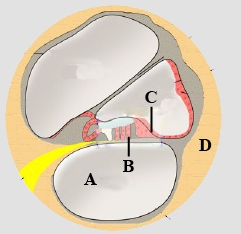
A
$D$: Sensory hair cells,$A$: Endolymph,$B$: Tectorial membrane.
B
$A$: Perilymph,$B$: Tectorial membrane,$C$: Endolymph.
C
$B$: Tectorial membrane,$C$: Perilymph,$D$: Sensory hair cells.
D
$C$: Endolymph,$D$: Sensory hair cells,$A$: Serum.
Solution
(B) Based on the anatomical structure of the human cochlea:
$A$ represents the Perilymph,which fills the scala vestibuli and scala tympani.
$B$ represents the Tectorial membrane,which overlies the hair cells of the organ of Corti.
$C$ represents the Endolymph,which fills the scala media.
$D$ represents the Sensory hair cells,which act as auditory receptors.
Therefore,the correct option is $B$.
$A$ represents the Perilymph,which fills the scala vestibuli and scala tympani.
$B$ represents the Tectorial membrane,which overlies the hair cells of the organ of Corti.
$C$ represents the Endolymph,which fills the scala media.
$D$ represents the Sensory hair cells,which act as auditory receptors.
Therefore,the correct option is $B$.
0 likesView Solution
42
BiologyMediumMCQAIPMT · 2008
Which one of the following is the correct difference between rod cells and cone cells of our retina?
A
Overall function $\Rightarrow$ Vision in poor light $\Rightarrow$ Colour vision and detailed vision in bright light
B
Distribution $\Rightarrow$ More concentrated in centre of retina $\Rightarrow$ Evenly distributed all over retina
C
Visual acuity $\Rightarrow$ High $\Rightarrow$ Low
D
Visual pigment $\Rightarrow$ Iodopsin $\Rightarrow$ Rhodopsin
Solution
(A) The correct answer is $A$.
$1$. Rod cells are photoreceptor cells in the retina that contain the pigment rhodopsin. They are highly sensitive to light and are essential for vision in dim light (scotopic vision).
$2$. Cone cells are photoreceptor cells responsible for colour vision and high-resolution (detailed) vision in bright light (photopic vision). They contain the pigment iodopsin.
$3$. Regarding option $A$: Rod cells function in poor light,while cone cells are specialized for colour and detailed vision in bright light. This is the correct functional distinction.
$4$. Option $B$ is incorrect because cone cells are concentrated in the fovea (centre of the retina),while rods are more abundant in the periphery.
$5$. Option $C$ is incorrect because cones provide high visual acuity,whereas rods provide low visual acuity.
$6$. Option $D$ is incorrect because rods contain rhodopsin and cones contain iodopsin,making the order reversed.
$1$. Rod cells are photoreceptor cells in the retina that contain the pigment rhodopsin. They are highly sensitive to light and are essential for vision in dim light (scotopic vision).
$2$. Cone cells are photoreceptor cells responsible for colour vision and high-resolution (detailed) vision in bright light (photopic vision). They contain the pigment iodopsin.
$3$. Regarding option $A$: Rod cells function in poor light,while cone cells are specialized for colour and detailed vision in bright light. This is the correct functional distinction.
$4$. Option $B$ is incorrect because cone cells are concentrated in the fovea (centre of the retina),while rods are more abundant in the periphery.
$5$. Option $C$ is incorrect because cones provide high visual acuity,whereas rods provide low visual acuity.
$6$. Option $D$ is incorrect because rods contain rhodopsin and cones contain iodopsin,making the order reversed.
0 likesView Solution
43
BiologyMediumMCQAIPMT · 2008
Which one of the following pairs of organs includes only endocrine glands?
A
Thymus and testes
B
Adrenal and ovary
C
Parathyroid and adrenal
D
Pancreas and parathyroid
Solution
(C) The correct answer is $C$.
Parathyroid and adrenal glands are purely endocrine glands because they synthesize hormones and secrete them directly into the bloodstream to act on target organs at distant sites.
Thymus,testes,ovaries,and pancreas are heterocrine or mixed glands (having both endocrine and exocrine functions) or have additional non-endocrine roles.
Therefore,the pair consisting only of endocrine glands is parathyroid and adrenal.
Parathyroid and adrenal glands are purely endocrine glands because they synthesize hormones and secrete them directly into the bloodstream to act on target organs at distant sites.
Thymus,testes,ovaries,and pancreas are heterocrine or mixed glands (having both endocrine and exocrine functions) or have additional non-endocrine roles.
Therefore,the pair consisting only of endocrine glands is parathyroid and adrenal.
0 likesView Solution
44
BiologyMediumMCQAIPMT · 2008
The blood calcium level is lowered by the deficiency of
A
both calcitonin and parathormone
B
calcitonin
C
parathormone
D
thyroxine
Solution
(C) $Parathormone$ $(PTH)$ is secreted by the chief cells of the parathyroid gland and plays a crucial role in regulating calcium and phosphate metabolism.
It increases blood calcium levels by promoting calcium absorption from the intestine,enhancing calcium reabsorption from the renal tubules of the kidneys,and stimulating bone resorption.
Therefore,a deficiency of $Parathormone$ leads to a decrease in blood calcium levels,a condition known as hypocalcemia.
It increases blood calcium levels by promoting calcium absorption from the intestine,enhancing calcium reabsorption from the renal tubules of the kidneys,and stimulating bone resorption.
Therefore,a deficiency of $Parathormone$ leads to a decrease in blood calcium levels,a condition known as hypocalcemia.
0 likesView Solution
45
BiologyMediumMCQAIPMT · 2008
In human adult females,oxytocin:
A
stimulates the pituitary to secrete vasopressin
B
causes strong uterine contractions during parturition
C
is secreted by the anterior pituitary
D
stimulates the growth of mammary glands
Solution
(B) : In human adult females,oxytocin is a hormone synthesized by the hypothalamus and released by the posterior pituitary gland (neurohypophysis).
It plays a crucial role in parturition by causing strong contractions of the smooth muscles of the uterus (myometrium).
Additionally,it stimulates the ejection of milk from the mammary glands by causing the contraction of myoepithelial cells surrounding the milk ducts.
It plays a crucial role in parturition by causing strong contractions of the smooth muscles of the uterus (myometrium).
Additionally,it stimulates the ejection of milk from the mammary glands by causing the contraction of myoepithelial cells surrounding the milk ducts.
0 likesView Solution
46
BiologyMediumMCQAIPMT · 2008
Polysome is formed by
A
a ribosome with several subunits
B
ribosomes attached to each other in a linear arrangement
C
several ribosomes attached to a single $mRNA$
D
many ribosomes attached to a strand of endoplasmic reticulum.
Solution
(C) : Ribosomes may occur in rosettes or helical groups called polyribosomes or polysomes (Greek: $Poly$ - many,$soma$ - body).
The different ribosomes of a polyribosome are connected with a $10 - 20 \ \mathring{A}$ thick strand of messenger $RNA$ or $mRNA$,and its maintenance requires energy.
Polyribosomes are formed during periods of active protein synthesis when a number of copies of the same polypeptide are required.
The different ribosomes of a polyribosome are connected with a $10 - 20 \ \mathring{A}$ thick strand of messenger $RNA$ or $mRNA$,and its maintenance requires energy.
Polyribosomes are formed during periods of active protein synthesis when a number of copies of the same polypeptide are required.
0 likesView Solution
47
BiologyEasyMCQAIPMT · 2008
Which one of the following is linked to the discovery of Bordeaux mixture as a popular fungicide?
A
Loose smut of wheat
B
Black rust of wheat
C
Bacterial leaf blight of rice
D
Downy mildew of grapes
Solution
(D) The correct answer is $D$.
Bordeaux mixture was discovered by $R.M.A. Millardet$ in $1882$ as the first inorganic fungicide.
It was specifically developed to control the downy mildew disease of grapes caused by the pathogen $Plasmopara$ $viticola$.
This mixture is composed of copper sulphate, lime, and water.
Bordeaux mixture was discovered by $R.M.A. Millardet$ in $1882$ as the first inorganic fungicide.
It was specifically developed to control the downy mildew disease of grapes caused by the pathogen $Plasmopara$ $viticola$.
This mixture is composed of copper sulphate, lime, and water.
0 likesView Solution
48
BiologyEasyMCQAIPMT · 2008
Nitrogen fixation in root nodules of $Alnus$ is brought about by
A
$Frankia$
B
$Azorhizobium$
C
$Bradyrhizobium$
D
$Clostridium$
Solution
(A) $Frankia$ is a filamentous,nitrogen-fixing bacterium that forms a symbiotic relationship with the roots of various non-leguminous plants,including $Alnus$ (alder) and $Casuarina$.
These bacteria induce the formation of root nodules,where they fix atmospheric nitrogen into ammonia,which the plant can utilize for growth.
While $Rhizobium$ is typically associated with leguminous plants,$Frankia$ is specifically known for its association with non-leguminous woody plants.
Therefore,the correct answer is $Frankia$.
These bacteria induce the formation of root nodules,where they fix atmospheric nitrogen into ammonia,which the plant can utilize for growth.
While $Rhizobium$ is typically associated with leguminous plants,$Frankia$ is specifically known for its association with non-leguminous woody plants.
Therefore,the correct answer is $Frankia$.
0 likesView Solution
49
BiologyMediumMCQAIPMT · 2008
In which of the following is cellulose a major component of the cell walls?
A
Pythium
B
Xanthomonas
C
Pseudomonas
D
Saccharomyces
Solution
(A) The cell walls of most fungi are composed of chitin. However,$Pythium$ is a member of the Oomycetes (water molds),which are fungus-like protists.
Unlike true fungi,the cell walls of Oomycetes are primarily composed of cellulose and glucans,not chitin.
$Xanthomonas$ and $Pseudomonas$ are bacteria,whose cell walls are made of peptidoglycan.
$Saccharomyces$ (yeast) is a true fungus,and its cell wall is composed of chitin and glucans.
Therefore,$Pythium$ is the correct answer.
Unlike true fungi,the cell walls of Oomycetes are primarily composed of cellulose and glucans,not chitin.
$Xanthomonas$ and $Pseudomonas$ are bacteria,whose cell walls are made of peptidoglycan.
$Saccharomyces$ (yeast) is a true fungus,and its cell wall is composed of chitin and glucans.
Therefore,$Pythium$ is the correct answer.
0 likesView Solution
50
BiologyMediumMCQAIPMT · 2008
Which of the following pairs correctly matches the phylum with its given characteristics?
A
Arthropoda $-$ Body divided into head,thorax,and abdomen,and respiration occurs through tracheae.
B
Chordata $-$ Notochord present during some stage and the anus and reproductive tract open into a common cloaca.
C
Echinodermata $-$ Pentamerous radial symmetry and primarily internal fertilization.
D
Mollusca $-$ Generally oviparous and development occurs through trochophore or veliger larvae.
Solution
(A) The correct answer is $A$.
$1$. In the phylum $Arthropoda$,the body is typically divided into head,thorax,and abdomen,and respiration occurs through specialized structures called tracheae.
$2$. In $Chordata$,while a notochord is present,the anus and reproductive tract do not always open into a common cloaca; this is specific to certain groups like amphibians or birds,not a general characteristic of the entire phylum.
$3$. $Echinodermata$ exhibit pentamerous radial symmetry in adults,but fertilization is primarily external,not internal.
$4$. While many $Mollusca$ are oviparous and have larval stages,option $A$ provides the most definitive and accurate anatomical description characteristic of the phylum $Arthropoda$.
$1$. In the phylum $Arthropoda$,the body is typically divided into head,thorax,and abdomen,and respiration occurs through specialized structures called tracheae.
$2$. In $Chordata$,while a notochord is present,the anus and reproductive tract do not always open into a common cloaca; this is specific to certain groups like amphibians or birds,not a general characteristic of the entire phylum.
$3$. $Echinodermata$ exhibit pentamerous radial symmetry in adults,but fertilization is primarily external,not internal.
$4$. While many $Mollusca$ are oviparous and have larval stages,option $A$ provides the most definitive and accurate anatomical description characteristic of the phylum $Arthropoda$.
0 likesView Solution
51
BiologyEasyMCQAIPMT · 2008
Bacterial leaf blight of rice is caused by a species of:
A
Alternaria
B
Erwinia
C
Xanthomonas
D
Pseudomonas
Solution
(C) : Bacterial leaf blight of rice is caused by $Xanthomonas$ $oryzae$,a bacterium which is Gram-negative,aerobic,capsulated,and motile with a single polar flagellum.
Primary infection is carried through the infected seeds.
The entry of the pathogen occurs through wounds and stomata.
The symptoms of the disease include the appearance of linear,yellow to straw-coloured stripes,usually on both edges of the leaf.
As the disease progresses,the drying and twisting of the leaf tip occurs.
The most destructive phase of the disease is the 'kresek' or wilt resulting from early systemic infection.
Primary infection is carried through the infected seeds.
The entry of the pathogen occurs through wounds and stomata.
The symptoms of the disease include the appearance of linear,yellow to straw-coloured stripes,usually on both edges of the leaf.
As the disease progresses,the drying and twisting of the leaf tip occurs.
The most destructive phase of the disease is the 'kresek' or wilt resulting from early systemic infection.
0 likesView Solution
52
BiologyMediumMCQAIPMT · 2008
Endosperm is consumed by the developing embryo in the seed of
A
pea
B
maize
C
coconut
D
castor
Solution
(A) The correct answer is $A$.
During the development of the embryo,the food stored in the endosperm is continuously utilized by the developing embryo,leading to its complete exhaustion.
Such seeds are known as non-endospermic or exalbuminous seeds.
Common examples of non-endospermic seeds include pea,gram,bean,and groundnut.
In contrast,maize,coconut,and castor are examples of endospermic or albuminous seeds,where the endosperm persists in the mature seed.
During the development of the embryo,the food stored in the endosperm is continuously utilized by the developing embryo,leading to its complete exhaustion.
Such seeds are known as non-endospermic or exalbuminous seeds.
Common examples of non-endospermic seeds include pea,gram,bean,and groundnut.
In contrast,maize,coconut,and castor are examples of endospermic or albuminous seeds,where the endosperm persists in the mature seed.
0 likesView Solution
53
BiologyMediumMCQAIPMT · 2008
Which one of the following pairs of plant structures has a haploid $(n)$ number of chromosomes?
A
Nucellus and antipodal cells
B
Egg nucleus and secondary nucleus
C
Megaspore mother cell and antipodal cells
D
Egg cell and antipodal cells
Solution
(D) In angiosperms,the $n$ (haploid) structures are those formed after meiosis or those that are part of the gametophyte generation.
$1$. The egg cell is a female gamete,which is haploid $(n)$.
$2$. Antipodal cells are part of the embryo sac and are also haploid $(n)$.
$3$. Nucellus and megaspore mother cells are diploid $(2n)$ as they are part of the sporophytic tissue.
$4$. The secondary nucleus is diploid $(2n)$ because it is formed by the fusion of two polar nuclei.
Therefore,the pair consisting of the egg cell and antipodal cells represents structures that are both haploid $(n)$.
$1$. The egg cell is a female gamete,which is haploid $(n)$.
$2$. Antipodal cells are part of the embryo sac and are also haploid $(n)$.
$3$. Nucellus and megaspore mother cells are diploid $(2n)$ as they are part of the sporophytic tissue.
$4$. The secondary nucleus is diploid $(2n)$ because it is formed by the fusion of two polar nuclei.
Therefore,the pair consisting of the egg cell and antipodal cells represents structures that are both haploid $(n)$.
0 likesView Solution
54
BiologyMediumMCQAIPMT · 2008
What does the filiform apparatus do at the entrance into the ovule?
A
It brings about opening of the pollen tube.
B
It guides the pollen tube into the synergid.
C
It helps in the entry of pollen tube into the egg cell.
D
It prevents entry of more than one pollen tube into the embryo sac.
Solution
(B) The correct answer is $B$.
Within the embryo sac,three cells are grouped together at the micropylar end and constitute the egg apparatus.
The egg apparatus consists of two synergids and one egg cell.
The synergids have special cellular thickenings at the micropylar tip called the filiform apparatus.
This structure plays an important role in guiding the pollen tubes into the synergid.
Within the embryo sac,three cells are grouped together at the micropylar end and constitute the egg apparatus.
The egg apparatus consists of two synergids and one egg cell.
The synergids have special cellular thickenings at the micropylar tip called the filiform apparatus.
This structure plays an important role in guiding the pollen tubes into the synergid.
0 likesView Solution
55
BiologyMediumMCQAIPMT · 2008
Unisexuality of flowers prevents
A
geitonogamy,but not xenogamy
B
autogamy and geitonogamy
C
autogamy,but not geitonogamy
D
both geitonogamy and xenogamy.
Solution
(C) : Unisexuality or dicliny is a condition in which two types of unisexual flowers are present,$i.e.$,staminate (male flower) and pistillate (female flower).
In a monoecious plant,unisexual flowers prevent autogamy (self-pollination within the same flower) because the male and female reproductive parts are in different flowers.
However,geitonogamy (transfer of pollen from the anther of one flower to the stigma of another flower on the same plant) can still occur in monoecious plants.
Therefore,unisexuality prevents autogamy but does not prevent geitonogamy.
In a monoecious plant,unisexual flowers prevent autogamy (self-pollination within the same flower) because the male and female reproductive parts are in different flowers.
However,geitonogamy (transfer of pollen from the anther of one flower to the stigma of another flower on the same plant) can still occur in monoecious plants.
Therefore,unisexuality prevents autogamy but does not prevent geitonogamy.
0 likesView Solution
56
BiologyMediumMCQAIPMT · 2008
Which one of the following is resistant to enzyme action?
A
Pollen exine
B
Leaf cuticle
C
Cork
D
Wood fibre
Solution
(A) The correct answer is $A$.
Sporopollenin is a major component of the tough outer layer (exine) of pollen grains.
It is one of the most chemically stable organic materials known.
It can withstand high temperatures,strong acids,and strong alkalis.
Crucially,no enzyme is known that can degrade sporopollenin,which allows pollen grains to be well-preserved as fossils.
Sporopollenin is a major component of the tough outer layer (exine) of pollen grains.
It is one of the most chemically stable organic materials known.
It can withstand high temperatures,strong acids,and strong alkalis.
Crucially,no enzyme is known that can degrade sporopollenin,which allows pollen grains to be well-preserved as fossils.
0 likesView Solution
57
BiologyMediumMCQAIPMT · 2008
In humans,at the end of the first meiotic division,the male germ cells differentiate into the
A
spermatids
B
spermatogonia
C
primary spermatocytes
D
secondary spermatocytes
Solution
(D) The correct answer is $D$.
During spermatogenesis,the $spermatogonia$ $(2n)$ undergo mitosis to increase in number.
Some $spermatogonia$ grow and differentiate into $primary$ $spermatocytes$ $(2n)$.
These $primary$ $spermatocytes$ undergo the first meiotic division $(Meiosis-I)$,which is a reductional division,to form two haploid $(n)$ cells known as $secondary$ $spermatocytes$.
Following this,the $secondary$ $spermatocytes$ undergo the second meiotic division $(Meiosis-II)$ to produce $spermatids$ $(n)$,which eventually differentiate into $spermatozoa$.
During spermatogenesis,the $spermatogonia$ $(2n)$ undergo mitosis to increase in number.
Some $spermatogonia$ grow and differentiate into $primary$ $spermatocytes$ $(2n)$.
These $primary$ $spermatocytes$ undergo the first meiotic division $(Meiosis-I)$,which is a reductional division,to form two haploid $(n)$ cells known as $secondary$ $spermatocytes$.
Following this,the $secondary$ $spermatocytes$ undergo the second meiotic division $(Meiosis-II)$ to produce $spermatids$ $(n)$,which eventually differentiate into $spermatozoa$.
0 likesView Solution
58
BiologyMediumMCQAIPMT · 2008
Which one of the following statements is incorrect about menstruation?
A
At menopause in the female,there is especially abrupt increase in gonadotropic hormones.
B
The beginning of the cycle of menstruation is called menarche.
C
During normal menstruation about $40 \ mL$ blood is lost.
D
The menstrual fluid can easily clot.
Solution
(D) The correct answer is $D$.
Menstruation is the process of shedding the uterine endometrium along with blood and tissue debris.
During a normal menstrual cycle,approximately $40 \ mL$ to $100 \ mL$ of blood is lost.
Menstrual fluid does not clot easily because it contains fibrinolysin,an enzyme that breaks down fibrin and prevents clotting.
Therefore,the statement that menstrual fluid can easily clot is incorrect.
Menarche refers to the first onset of menstruation at puberty,while menopause refers to the cessation of menstrual cycles,which is accompanied by a sharp rise in gonadotropic hormones ($FSH$ and $LH$) due to the loss of negative feedback from ovarian steroids.
Menstruation is the process of shedding the uterine endometrium along with blood and tissue debris.
During a normal menstrual cycle,approximately $40 \ mL$ to $100 \ mL$ of blood is lost.
Menstrual fluid does not clot easily because it contains fibrinolysin,an enzyme that breaks down fibrin and prevents clotting.
Therefore,the statement that menstrual fluid can easily clot is incorrect.
Menarche refers to the first onset of menstruation at puberty,while menopause refers to the cessation of menstrual cycles,which is accompanied by a sharp rise in gonadotropic hormones ($FSH$ and $LH$) due to the loss of negative feedback from ovarian steroids.
0 likesView Solution
59
BiologyMediumMCQAIPMT · 2008
Which extraembryonic membrane in humans prevents desiccation of the embryo inside the uterus?
A
Yolk sac
B
Amnion
C
Chorion
D
Allantois
Solution
(B) : Amnion is a type of extraembryonic membrane formed by the amniogenic cells inside and splanchnopleuric extraembryonic mesoderm outside.
Amnion surrounds the embryo,creating the amniotic cavity that is filled with amniotic fluid.
The amniotic fluid serves as a shock absorber for the foetus,regulates foetal body temperature,and prevents desiccation of the embryo.
Amnion surrounds the embryo,creating the amniotic cavity that is filled with amniotic fluid.
The amniotic fluid serves as a shock absorber for the foetus,regulates foetal body temperature,and prevents desiccation of the embryo.
0 likesView Solution
60
BiologyMediumMCQAIPMT · 2008
Consider the statements given below regarding contraception and answer as directed thereafter:
$(1)$ Medical termination of pregnancy $(MTP)$ during the first trimester is generally safe.
$(2)$ Generally,chances of conception are nil until the mother breastfeeds the infant up to two years.
$(3)$ Intrauterine devices like copper $T$ are effective contraceptives.
$(4)$ Contraception pills may be taken up to one week after coitus to prevent conception.
Which two of the above statements are correct?
$(1)$ Medical termination of pregnancy $(MTP)$ during the first trimester is generally safe.
$(2)$ Generally,chances of conception are nil until the mother breastfeeds the infant up to two years.
$(3)$ Intrauterine devices like copper $T$ are effective contraceptives.
$(4)$ Contraception pills may be taken up to one week after coitus to prevent conception.
Which two of the above statements are correct?
A
$1, 3$
B
$1, 2$
C
$2, 3$
D
$3, 4$
Solution
(A) Statement $(1)$ is correct: Medical termination of pregnancy $(MTP)$ is considered relatively safe during the first trimester (up to $12$ weeks of pregnancy).
Statement $(2)$ is incorrect: Lactational amenorrhea is effective only up to $6$ months following parturition,not two years.
Statement $(3)$ is correct: Intrauterine devices (IUDs) like Copper $T$ are highly effective contraceptives that suppress sperm motility and their fertilizing capacity.
Statement $(4)$ is incorrect: Emergency contraceptive pills are typically effective if taken within $72$ hours (not one week) after unprotected coitus.
Therefore,statements $(1)$ and $(3)$ are correct.
Statement $(2)$ is incorrect: Lactational amenorrhea is effective only up to $6$ months following parturition,not two years.
Statement $(3)$ is correct: Intrauterine devices (IUDs) like Copper $T$ are highly effective contraceptives that suppress sperm motility and their fertilizing capacity.
Statement $(4)$ is incorrect: Emergency contraceptive pills are typically effective if taken within $72$ hours (not one week) after unprotected coitus.
Therefore,statements $(1)$ and $(3)$ are correct.
0 likesView Solution
61
BiologyMediumMCQAIPMT · 2008
Given below are four methods $(A-D)$ and their modes of action $(i-iv)$ in achieving contraception. Select their correct matching from the four options that follow.
| Method | Mode of Action |
| $(A)$ The pill | $(i)$ Prevents sperms reaching cervix |
| $(B)$ Condom | $(ii)$ Prevents implantation |
| $(C)$ Vasectomy | $(iii)$ Prevents ovulation |
| $(D)$ Copper $T$ | $(iv)$ Semen contains no sperms |
A
$A-(iii), B-(iv), C-(i), D-(ii)$
B
$A-(ii), B-(iii), C-(i), D-(iv)$
C
$A-(iii), B-(i), C-(iv), D-(ii)$
D
$A-(iv), B-(i), C-(ii), D-(iii)$
Solution
(C) The correct matching is $A-(iii), B-(i), C-(iv), D-(ii)$.
$(A)$ The pill: Contraceptive pills contain progestogens or progestogen-oestrogen combinations,which inhibit ovulation.
$(B)$ Condom: These are physical barriers that prevent sperms from reaching the cervix.
$(C)$ Vasectomy: This is a surgical sterilization method in males where the vas deferens is cut or tied,ensuring that the semen contains no sperms.
$(D)$ Copper $T$: This is an intrauterine device $(IUD)$ that releases copper ions,which suppress sperm motility and prevent implantation of the embryo in the uterus.
$(A)$ The pill: Contraceptive pills contain progestogens or progestogen-oestrogen combinations,which inhibit ovulation.
$(B)$ Condom: These are physical barriers that prevent sperms from reaching the cervix.
$(C)$ Vasectomy: This is a surgical sterilization method in males where the vas deferens is cut or tied,ensuring that the semen contains no sperms.
$(D)$ Copper $T$: This is an intrauterine device $(IUD)$ that releases copper ions,which suppress sperm motility and prevent implantation of the embryo in the uterus.
0 likesView Solution
62
BiologyMediumMCQAIPMT · 2008
Which one of the following conditions in humans is correctly matched with its chromosomal abnormality/linkage?
A
Erythroblastosis foetalis - $X$-linked
B
Down's syndrome - $44$ autosomes + $XO$
C
Klinefelter's syndrome - $44$ autosomes + $XXY$
D
Colour blindness - $Y$-linked
Solution
(C) : Klinefelter's syndrome is a genetic disorder in which there are three sex chromosomes,$XXY$,rather than the normal $XX$ or $XY$.
The number of autosomes is normal,$i.e., 44$.
Affected individuals are phenotypically male but are tall and thin,with small testes,failure of normal sperm production (azoospermia),enlargement of the breasts (gynaecomastia),and absence of facial and body hairs.
The number of autosomes is normal,$i.e., 44$.
Affected individuals are phenotypically male but are tall and thin,with small testes,failure of normal sperm production (azoospermia),enlargement of the breasts (gynaecomastia),and absence of facial and body hairs.
0 likesView Solution
63
BiologyMediumMCQAIPMT · 2008
In the $DNA$ molecule,
A
the proportion of adenine in relation to thymine varies with the organism
B
there are two strands which run antiparallel; one in $5' \to 3'$ direction and other in $3' \to 5'$
C
the total amount of purine nucleotides and pyrimidine nucleotides is not always equal
D
there are two strands which run parallel in the $5' \to 3'$ direction.
Solution
(B) : $A$ $DNA$ molecule consists of two unbranched complementary strands that are spirally coiled.
These two chains are antiparallel,meaning they run parallel to each other but in opposite directions.
One chain has a polarity of $5' \to 3'$,while the other has a polarity of $3' \to 5'$.
Both strands are held together by hydrogen bonds between their nitrogenous bases,specifically $A=T$ and $G \equiv C$.
According to Chargaff's rule,the amount of adenine is equal to thymine,and the amount of guanine is equal to cytosine.
The base ratio $(A+T)/(G+C)$ may vary between different species but remains constant for a given species.
The total amount of purines $(A+G)$ is always equal to the total amount of pyrimidines $(T+C)$.
These two chains are antiparallel,meaning they run parallel to each other but in opposite directions.
One chain has a polarity of $5' \to 3'$,while the other has a polarity of $3' \to 5'$.
Both strands are held together by hydrogen bonds between their nitrogenous bases,specifically $A=T$ and $G \equiv C$.
According to Chargaff's rule,the amount of adenine is equal to thymine,and the amount of guanine is equal to cytosine.
The base ratio $(A+T)/(G+C)$ may vary between different species but remains constant for a given species.
The total amount of purines $(A+G)$ is always equal to the total amount of pyrimidines $(T+C)$.
0 likesView Solution
64
BiologyMediumMCQAIPMT · 2008
Which one of the following pairs of nitrogenous bases of nucleic acids is wrongly matched with the category mentioned against it?
A
Guanine,Adenine - Purines
B
Adenine,Thymine - Purines
C
Thymine,Uracil - Pyrimidines
D
Uracil,Cytosine - Pyrimidines
Solution
(B) : Nitrogenous bases are classified into two categories: Purines and Pyrimidines.
Purines include Adenine $(A)$ and Guanine $(G)$,which are double-ring structures.
Pyrimidines include Cytosine $(C)$,Thymine $(T)$,and Uracil $(U)$,which are single-ring structures.
In option $(b)$,Adenine is a purine,but Thymine is a pyrimidine. Therefore,the pair 'Adenine,Thymine - Purines' is incorrectly matched.
Purines include Adenine $(A)$ and Guanine $(G)$,which are double-ring structures.
Pyrimidines include Cytosine $(C)$,Thymine $(T)$,and Uracil $(U)$,which are single-ring structures.
In option $(b)$,Adenine is a purine,but Thymine is a pyrimidine. Therefore,the pair 'Adenine,Thymine - Purines' is incorrectly matched.
0 likesView Solution
65
BiologyMediumMCQAIPMT · 2008
Which one of the following pairs of codons is correctly matched with their function or the signal for the particular amino acid?
A
$AUG, ACG$ - Start/methionine
B
$UUA, UCA$ - Leucine
C
$GUU, GCU$ - Alanine
D
$UAG, UGA$ - Stop
Solution
(D) $AUG$ codes for methionine and is the initiation or start codon which starts the synthesis of the polypeptide chain.
$UAA$ (ochre),$UAG$ (amber),and $UGA$ (opal) are stop codons that do not specify any amino acid; therefore,they are called termination codons.
$UUA, UUG, CUU, CUC, CUA,$ and $CUG$ code for leucine.
$GCU, GCC, GCA,$ and $GCG$ code for alanine.
Thus,the pair $UAG, UGA$ is correctly matched as stop codons.
$UAA$ (ochre),$UAG$ (amber),and $UGA$ (opal) are stop codons that do not specify any amino acid; therefore,they are called termination codons.
$UUA, UUG, CUU, CUC, CUA,$ and $CUG$ code for leucine.
$GCU, GCC, GCA,$ and $GCG$ code for alanine.
Thus,the pair $UAG, UGA$ is correctly matched as stop codons.
0 likesView Solution
66
BiologyMediumMCQAIPMT · 2008
Darwin's finches are a good example of
A
industrial melanism
B
connecting link
C
adaptive radiation
D
convergent evolution
Solution
(C) Darwin's finches are a classic example of adaptive radiation.
Adaptive radiation is the process of evolution of different species in a given geographical area starting from a point and literally radiating to other areas of geography (habitats).
In the Galapagos Islands,Darwin observed that many varieties of finches evolved from a single ancestral species.
These finches adapted to different niches based on the availability of food resources such as insects,seeds,and cactus,leading to the diversification of their beak shapes and sizes.
Adaptive radiation is the process of evolution of different species in a given geographical area starting from a point and literally radiating to other areas of geography (habitats).
In the Galapagos Islands,Darwin observed that many varieties of finches evolved from a single ancestral species.
These finches adapted to different niches based on the availability of food resources such as insects,seeds,and cactus,leading to the diversification of their beak shapes and sizes.
0 likesView Solution
67
BiologyEasyMCQAIPMT · 2008
Which one of the following scientist's name is correctly matched with the theory put forth by him?
A
De Vries $\rightarrow$ Natural selection
B
Mendel $\rightarrow$ Theory of Pangenesis
C
Weismann $\rightarrow$ Theory of continuity of germplasm
D
Pasteur $\rightarrow$ Inheritance of acquired characters
Solution
(C) : The Theory of continuity of germplasm was proposed by August Weismann.
According to this theory,only the characters that influence the germ cells are inherited.
There is a continuity of germplasm,whereas the somatoplasm is not transmitted to the next generation; hence,it does not carry characters to the next generation.
According to this theory,only the characters that influence the germ cells are inherited.
There is a continuity of germplasm,whereas the somatoplasm is not transmitted to the next generation; hence,it does not carry characters to the next generation.
0 likesView Solution
68
BiologyMediumMCQAIPMT · 2008
Which one of the following is incorrect about the characteristics of protobionts (coacervates and microspheres) as envisaged in the abiogenic origin of life?
A
They were partially isolated from the surroundings.
B
They could maintain an internal environment.
C
They were able to reproduce.
D
They could separate combinations of molecules from the surroundings.
Solution
(C) The correct answer is $C$.
Protobionts (such as coacervates and microspheres) are considered precursors to the first living cells in the abiogenic origin of life.
These structures were able to maintain an internal environment distinct from their surroundings and could selectively separate combinations of molecules.
However,they lacked the genetic machinery and metabolic complexity required for reproduction.
Therefore,the statement that they were able to reproduce is incorrect.
Protobionts (such as coacervates and microspheres) are considered precursors to the first living cells in the abiogenic origin of life.
These structures were able to maintain an internal environment distinct from their surroundings and could selectively separate combinations of molecules.
However,they lacked the genetic machinery and metabolic complexity required for reproduction.
Therefore,the statement that they were able to reproduce is incorrect.
0 likesView Solution
69
BiologyMediumMCQAIPMT · 2008
Match the disease in column $I$ with the appropriate items (pathogen/prevention/treatment) in column $II$.
| Column-$I$ | Column-$II$ |
| $(A)$ Amoebiasis | $(i)$ Treponema pallidum |
| $(B)$ Diphtheria | $(ii)$ Use only sterilized food and water |
| $(C)$ Cholera | $(iii)$ $DPT$ Vaccine |
| $(D)$ Syphilis | $(iv)$ Use oral rehydration therapy |
A
$A-(i), B-(ii), C-(iii), D-(iv)$
B
$A-(ii), B-(iii), C-(iv), D-(i)$
C
$A-(i), B-(iii), C-(ii), D-(iv)$
D
$A-(ii), B-(iv), C-(i), D-(iii)$
Solution
(B) The correct matches are as follows:
$1$. $(A)$ Amoebiasis: It is caused by Entamoeba histolytica,which spreads through contaminated food and water. Thus,prevention involves the use of sterilized food and water $(A-ii)$.
$2$. $(B)$ Diphtheria: It is a bacterial infection prevented by the $DPT$ (Diphtheria,Pertussis,and Tetanus) vaccine $(B-iii)$.
$3$. $(C)$ Cholera: It is characterized by severe dehydration,and the primary treatment is oral rehydration therapy $(C-iv)$.
$4$. $(D)$ Syphilis: It is a sexually transmitted disease caused by the bacterium Treponema pallidum $(D-i)$.
Therefore,the correct sequence is $A-(ii), B-(iii), C-(iv), D-(i)$.
$1$. $(A)$ Amoebiasis: It is caused by Entamoeba histolytica,which spreads through contaminated food and water. Thus,prevention involves the use of sterilized food and water $(A-ii)$.
$2$. $(B)$ Diphtheria: It is a bacterial infection prevented by the $DPT$ (Diphtheria,Pertussis,and Tetanus) vaccine $(B-iii)$.
$3$. $(C)$ Cholera: It is characterized by severe dehydration,and the primary treatment is oral rehydration therapy $(C-iv)$.
$4$. $(D)$ Syphilis: It is a sexually transmitted disease caused by the bacterium Treponema pallidum $(D-i)$.
Therefore,the correct sequence is $A-(ii), B-(iii), C-(iv), D-(i)$.
0 likesView Solution
70
BiologyMediumMCQAIPMT · 2008
Which one of the following is the correct statement regarding the particular psychotropic drug specified?
A
Morphine leads to delusions and disturbed emotions.
B
Barbiturates cause relaxation and temporary euphoria.
C
Hashish causes after-thought perceptions and hallucinations.
D
Opium stimulates the nervous system and causes hallucinations.
Solution
(C) : Hashish or charas is a pure resin obtained from the female flowers and leaves of selected varieties of $Cannabis$ $sativa$. It is the most potent hemp product (cannabinoids) and is usually smoked with tobacco. Its use may lead to euphoria,hallucinations,drowsiness,and continuous laughing. Hallucinogens act mainly on the $CNS$ and greatly alter one's thoughts,feelings,and perceptions.
0 likesView Solution
71
BiologyMediumMCQAIPMT · 2008
Haploids are more suitable for mutation studies than diploids. This is because
A
haploids are more abundant in nature than diploids
B
all mutations,whether dominant or recessive,are expressed in haploids
C
haploids are reproductively more stable than diploids
D
mutagens penetrate in haploids more effectively than in diploids
Solution
(B) : Haploid organisms possess only a single set of chromosomes $(n)$.
Because there is no homologous chromosome to mask the effect of a recessive allele,all mutations,whether dominant or recessive,are immediately expressed in the phenotype.
In contrast,in diploids $(2n)$,recessive mutations are often masked by the presence of a dominant allele on the homologous chromosome,making them harder to detect.
Because there is no homologous chromosome to mask the effect of a recessive allele,all mutations,whether dominant or recessive,are immediately expressed in the phenotype.
In contrast,in diploids $(2n)$,recessive mutations are often masked by the presence of a dominant allele on the homologous chromosome,making them harder to detect.
0 likesView Solution
72
BiologyMediumMCQAIPMT · 2008
Consider the following four measures $(1-4)$ that could be taken to successfully grow chickpea in an area where bacterial blight disease is common.
$(1)$ Spray with Bordeaux mixture
$(2)$ Control of the insect vector of the disease pathogen
$(3)$ Use of only disease-free seeds
$(4)$ Use of varieties resistant to the disease
Which two of the above measures can control the disease?
$(1)$ Spray with Bordeaux mixture
$(2)$ Control of the insect vector of the disease pathogen
$(3)$ Use of only disease-free seeds
$(4)$ Use of varieties resistant to the disease
Which two of the above measures can control the disease?
A
$3$ and $4$
B
$1$ and $4$
C
$2$ and $3$
D
$1$ and $2$
Solution
(B) The correct answer is $B$.
Bacterial blight of chickpea is caused by the bacterium $Xanthomonas$ $campestris$.
This disease affects the stems and leaves,giving them a blighted or burnt appearance.
Effective control measures for bacterial diseases in crops primarily involve the use of disease-resistant varieties and chemical treatments to prevent the spread of the pathogen.
Spraying with Bordeaux mixture (a copper-based fungicide) is a standard chemical control method,and the use of disease-resistant varieties is the most sustainable and effective agricultural strategy.
Therefore,measures $(1)$ and $(4)$ are the most appropriate for controlling this disease.
Bacterial blight of chickpea is caused by the bacterium $Xanthomonas$ $campestris$.
This disease affects the stems and leaves,giving them a blighted or burnt appearance.
Effective control measures for bacterial diseases in crops primarily involve the use of disease-resistant varieties and chemical treatments to prevent the spread of the pathogen.
Spraying with Bordeaux mixture (a copper-based fungicide) is a standard chemical control method,and the use of disease-resistant varieties is the most sustainable and effective agricultural strategy.
Therefore,measures $(1)$ and $(4)$ are the most appropriate for controlling this disease.
0 likesView Solution
73
BiologyMediumMCQAIPMT · 2008
$Trichoderma harzianum$ has proved a useful microorganism for
A
gene transfer in higher plants
B
biological control of soil-borne plant pathogens
C
bioremediation of contaminated soils
D
reclamation of wastelands
Solution
(B) : The natural method of pest and pathogen control involving the use of viruses, bacteria, and other organisms (which are their natural predators) is called biocontrol or biological control.
$Trichoderma harzianum$ is a free-living fungus that is very common in root ecosystems and acts as an effective biocontrol agent against several soil-borne plant pathogens.
$Baculoviruses$ (mostly of the genus $Nucleopolyhedrovirus$) are used as narrow-spectrum insecticidal applications.
$Bacillus thuringiensis$ is a soil bacterium used as a biopesticide.
$Glomus$ species are fungal partners in mycorrhiza that help in nutrient absorption.
$Trichoderma harzianum$ is a free-living fungus that is very common in root ecosystems and acts as an effective biocontrol agent against several soil-borne plant pathogens.
$Baculoviruses$ (mostly of the genus $Nucleopolyhedrovirus$) are used as narrow-spectrum insecticidal applications.
$Bacillus thuringiensis$ is a soil bacterium used as a biopesticide.
$Glomus$ species are fungal partners in mycorrhiza that help in nutrient absorption.
0 likesView Solution
74
BiologyEasyMCQAIPMT · 2008
Which one of the following proved effective for biological control of nematodal diseases in plants?
A
Gliocladium virens
B
Paecilomyces lilacinus
C
Pisolithus tinctorius
D
Pseudomonas cepacia
Solution
(B) $Paecilomyces$ $lilacinus$ is a fungus that acts as a biological control agent against various plant-parasitic nematodes. It infects and destroys the eggs of nematodes,thereby reducing the population of these pathogens in the soil and protecting plant roots from infection.
0 likesView Solution
75
BiologyMediumMCQAIPMT · 2008
$Cry\ I$ endotoxins obtained from $Bacillus\ thuringiensis$ are effective against:
A
nematodes
B
boll worms
C
mosquitoes
D
flies
Solution
(B) The $Cry\ I$ endotoxins produced by the bacterium $Bacillus\ thuringiensis$ $(Bt)$ are specific insecticidal proteins.
These proteins are encoded by $cry$ genes.
Specifically,$Cry\ I$ proteins (such as $Cry\ IAc$ and $Cry\ IIAb$) are highly effective against lepidopterans,which include tobacco budworms and armyworms,commonly referred to as bollworms.
Therefore,the correct option is $B$.
These proteins are encoded by $cry$ genes.
Specifically,$Cry\ I$ proteins (such as $Cry\ IAc$ and $Cry\ IIAb$) are highly effective against lepidopterans,which include tobacco budworms and armyworms,commonly referred to as bollworms.
Therefore,the correct option is $B$.
0 likesView Solution
76
BiologyEasyMCQAIPMT · 2008
$A$ transgenic food crop which may help in solving the problem of night blindness in developing countries is
A
$Bt$ soybean
B
Golden rice
C
Flavr Savr tomatoes
D
Starlink maize
Solution
(B) The correct answer is $B$. Golden rice is a genetically modified (transgenic) variety of rice $(Oryza sativa)$ engineered to produce $\beta$-carotene, which is a precursor of Vitamin $A$. Vitamin $A$ deficiency is a major cause of night blindness and other vision-related problems in developing countries. By consuming this rice, individuals can obtain the necessary Vitamin $A$ to prevent such deficiencies.
0 likesView Solution
77
BiologyMediumMCQAIPMT · 2008
The main objective of the production/use of herbicide-resistant $GM$ crops is to
A
encourage eco-friendly herbicides
B
eliminate weeds from the field without the use of manual labour
C
reduce herbicide accumulation in food articles for health safety
D
eliminate weeds from the field without the use of herbicides
Solution
(C) The primary objective of developing herbicide-resistant $GM$ crops is to allow for the selective application of herbicides to control weeds without harming the crop itself. By engineering crops to be resistant to specific herbicides (like glyphosate,bromoxynil,or glufosinate),farmers can manage weed populations more effectively. This technology is designed to reduce the overall accumulation of toxic herbicide residues in food products,thereby enhancing health safety for consumers. Therefore,the correct option is $C$.
0 likesView Solution
78
BiologyEasyMCQAIPMT · 2008
Human insulin is being commercially produced from a transgenic species of
A
Rhizobium
B
Saccharomyces
C
Escherichia
D
Mycobacterium
Solution
(C) The correct answer is $(C)$.
Insulin is now being commercially produced by genetic engineering.
Human insulin consists of two short polypeptide chains, chain $A$ and chain $B$, which are linked together by disulphide bonds.
In mammals, insulin is synthesized as a prohormone containing an extra stretch called the $C$-peptide, which is removed during maturation.
In $1983$, Eli Lilly, an American company, prepared functional insulin by introducing two $DNA$ sequences corresponding to the $A$ and $B$ chains of human insulin into the plasmids of $Escherichia$ $coli$ $(E. coli)$.
These chains were produced separately, extracted, and then combined by creating disulphide bonds to form mature human insulin.
Insulin is now being commercially produced by genetic engineering.
Human insulin consists of two short polypeptide chains, chain $A$ and chain $B$, which are linked together by disulphide bonds.
In mammals, insulin is synthesized as a prohormone containing an extra stretch called the $C$-peptide, which is removed during maturation.
In $1983$, Eli Lilly, an American company, prepared functional insulin by introducing two $DNA$ sequences corresponding to the $A$ and $B$ chains of human insulin into the plasmids of $Escherichia$ $coli$ $(E. coli)$.
These chains were produced separately, extracted, and then combined by creating disulphide bonds to form mature human insulin.
0 likesView Solution
79
BiologyMediumMCQAIPMT · 2008
Consider the following four statements $(1-4)$ about certain desert animals such as kangaroo rat.
$(1)$ They have dark colour and high rate of reproduction and excrete solid urine.
$(2)$ They do not drink water,breathe at a slow rate to conserve water and have their body covered with thick hairs.
$(3)$ They feed on dry seeds and do not require drinking water.
$(4)$ They excrete very concentrated urine and do not use water to regulate body temperature.
Which two of the above statements for such animals are true?
$(1)$ They have dark colour and high rate of reproduction and excrete solid urine.
$(2)$ They do not drink water,breathe at a slow rate to conserve water and have their body covered with thick hairs.
$(3)$ They feed on dry seeds and do not require drinking water.
$(4)$ They excrete very concentrated urine and do not use water to regulate body temperature.
Which two of the above statements for such animals are true?
A
$3$ and $1$
B
$1$ and $2$
C
$3$ and $4$
D
$2$ and $3$
Solution
(C) The correct answer is $C$ ($3$ and $4$).
Kangaroo rat $(Dipodomys \ merriami)$ is a desert rodent that exhibits specific adaptations to survive in arid environments.
Statement $(3)$ is true: They feed on dry seeds and do not require drinking water as they obtain water from metabolic processes.
Statement $(4)$ is true: They excrete very concentrated urine to minimize water loss and do not use water (like sweating) to regulate body temperature.
Statement $(1)$ is incorrect because they do not excrete solid urine (they excrete concentrated urine).
Statement $(2)$ is incorrect because they do not breathe at a slow rate to conserve water; rather,they minimize water loss through physiological and behavioral adaptations like living in burrows.
Kangaroo rat $(Dipodomys \ merriami)$ is a desert rodent that exhibits specific adaptations to survive in arid environments.
Statement $(3)$ is true: They feed on dry seeds and do not require drinking water as they obtain water from metabolic processes.
Statement $(4)$ is true: They excrete very concentrated urine to minimize water loss and do not use water (like sweating) to regulate body temperature.
Statement $(1)$ is incorrect because they do not excrete solid urine (they excrete concentrated urine).
Statement $(2)$ is incorrect because they do not breathe at a slow rate to conserve water; rather,they minimize water loss through physiological and behavioral adaptations like living in burrows.
0 likesView Solution
80
BiologyMediumMCQAIPMT · 2008
Quercus species are the dominant component in
A
scrub forests
B
tropical rain forests
C
temperate deciduous forests
D
alpine forests
Solution
(C) $Quercus$ (oak) species are the dominant component in temperate deciduous forests.
Temperate broad-leaf (deciduous) forests experience warm summers and moderately cool winters with annual rainfall ranging from $100-250 \ cm$.
Dominant tree species in these forests include oak,elm,birch,maple,ash,chestnut,hickory,beech,poplar,and Magnolia.
In India,temperate broad-leaf forests are specifically dominated by various oak species such as $Quercus \ semecarpifolia$ (Brown oak of Himalayas),$Q. \ floribunda$ (Tilonaj oak),$Q. \ lanuginosa$ (Rianj oak),and $Q. \ leucotrichophora$ (Banj oak).
The fauna of these forests typically includes deer,foxes,beavers,wild cats,and raccoons.
Temperate broad-leaf (deciduous) forests experience warm summers and moderately cool winters with annual rainfall ranging from $100-250 \ cm$.
Dominant tree species in these forests include oak,elm,birch,maple,ash,chestnut,hickory,beech,poplar,and Magnolia.
In India,temperate broad-leaf forests are specifically dominated by various oak species such as $Quercus \ semecarpifolia$ (Brown oak of Himalayas),$Q. \ floribunda$ (Tilonaj oak),$Q. \ lanuginosa$ (Rianj oak),and $Q. \ leucotrichophora$ (Banj oak).
The fauna of these forests typically includes deer,foxes,beavers,wild cats,and raccoons.
0 likesView Solution
81
BiologyMediumMCQAIPMT · 2008
Consider the following statements concerning food chains.
$A.$ Removal of $80\%$ tigers from an area resulted in greatly increased growth of vegetation.
$B.$ Removal of most of the carnivores resulted in an increased population of deers.
$C.$ The length of food chains is generally limited to $3-4$ trophic levels due to energy loss.
$D.$ The length of food chains may vary from $2$ to $8$ trophic levels.
Which two of the above statements are correct?
$A.$ Removal of $80\%$ tigers from an area resulted in greatly increased growth of vegetation.
$B.$ Removal of most of the carnivores resulted in an increased population of deers.
$C.$ The length of food chains is generally limited to $3-4$ trophic levels due to energy loss.
$D.$ The length of food chains may vary from $2$ to $8$ trophic levels.
Which two of the above statements are correct?
A
$A, D$
B
$A, B$
C
$B, C$
D
$C, D$
Solution
(C) Statement $A$ is incorrect: Removal of $80\%$ tigers (tertiary consumers) leads to an increase in herbivores (primary consumers),which in turn causes overgrazing and decreased vegetation growth.
Statement $B$ is correct: Carnivores regulate the population of herbivores (like deer). Their removal leads to an unchecked increase in the deer population.
Statement $C$ is correct: According to the $10\%$ law of energy transfer,energy loss at each trophic level is significant,limiting the length of food chains to typically $3-4$ trophic levels.
Statement $D$ is incorrect: Food chains are generally short and do not typically reach $8$ trophic levels due to the drastic reduction in available energy.
Therefore,statements $B$ and $C$ are correct.
Statement $B$ is correct: Carnivores regulate the population of herbivores (like deer). Their removal leads to an unchecked increase in the deer population.
Statement $C$ is correct: According to the $10\%$ law of energy transfer,energy loss at each trophic level is significant,limiting the length of food chains to typically $3-4$ trophic levels.
Statement $D$ is incorrect: Food chains are generally short and do not typically reach $8$ trophic levels due to the drastic reduction in available energy.
Therefore,statements $B$ and $C$ are correct.
0 likesView Solution
82
BiologyMediumMCQAIPMT · 2008
The slow rate of decomposition of fallen logs in nature is due to their
A
anaerobic environment around them
B
low cellulose content
C
poor nitrogen content
D
low moisture content
Solution
(D) Decomposition is the process by which microorganisms break down complex organic matter into simpler inorganic substances.
Fallen logs are primarily composed of wood,which contains a high concentration of cellulose and lignin.
These materials are complex and resistant to rapid degradation.
Furthermore,the slow rate of decomposition of fallen logs in nature is primarily due to their low moisture content,which limits the activity of decomposers like bacteria and fungi.
Therefore,the correct answer is 'low moisture content'.
Fallen logs are primarily composed of wood,which contains a high concentration of cellulose and lignin.
These materials are complex and resistant to rapid degradation.
Furthermore,the slow rate of decomposition of fallen logs in nature is primarily due to their low moisture content,which limits the activity of decomposers like bacteria and fungi.
Therefore,the correct answer is 'low moisture content'.
0 likesView Solution
83
BiologyEasyMCQAIPMT · 2008
About $70\%$ of total global carbon is found in
A
oceans
B
forests
C
grasslands
D
agroecosystems
Solution
(A) The correct answer is $A$.
Carbon constitutes $49\%$ of the dry weight of organisms and is the second most abundant element after water.
Among the total quantity of global carbon,approximately $71\%$ is found in the oceans in a dissolved form,whereas only $1\%$ is found in the atmosphere.
Carbon cycling occurs through the atmosphere,oceans,and living or dead organisms.
Carbon constitutes $49\%$ of the dry weight of organisms and is the second most abundant element after water.
Among the total quantity of global carbon,approximately $71\%$ is found in the oceans in a dissolved form,whereas only $1\%$ is found in the atmosphere.
Carbon cycling occurs through the atmosphere,oceans,and living or dead organisms.
0 likesView Solution
84
BiologyDifficultMCQAIPMT · 2008
The table below gives the populations (in thousands) of ten species $(A-J)$ in four areas $(p-s)$ consisting of the number of habitats given within brackets against each. Study the table and answer the question which follows. Which area out of $p-s$ shows maximum species diversity?
| Area and No. of habitats | $A$ | $B$ | $C$ | $D$ | $E$ | $F$ | $G$ | $H$ | $I$ | $J$ |
| $p(11)$ | $2.3$ | $1.2$ | $0.52$ | $6.0$ | - | $3.1$ | $1.1$ | $9.0$ | - | $10.3$ |
| $q(11)$ | $10.2$ | - | $0.62$ | - | $1.5$ | $3.0$ | - | $8.2$ | $1.1$ | $11.2$ |
| $r(13)$ | $11.3$ | $0.9$ | $0.48$ | $2.4$ | $1.4$ | $4.2$ | $0.8$ | $8.4$ | $2.2$ | $4.1$ |
| $s(12)$ | $3.2$ | $10.2$ | $11.1$ | $4.8$ | $0.4$ | $3.3$ | $0.8$ | $7.3$ | $11.3$ | $2.1$ |
A
$s$
B
$p$
C
$q$
D
$r$
Solution
(A) Species diversity is determined by species richness (the number of species present) and species evenness (the relative abundance of each species).
In the provided table, we can count the number of species present (where population is not '-'):
- Area $p$: $8$ species present $(A, B, C, D, F, G, H, J)$
- Area $q$: $7$ species present $(A, C, E, F, H, I, J)$
- Area $r$: $10$ species present $(A, B, C, D, E, F, G, H, I, J)$
- Area $s$: $10$ species present $(A, B, C, D, E, F, G, H, I, J)$
Comparing areas $r$ and $s$, area $s$ shows a more balanced distribution (evenness) of population sizes across the species compared to area $r$, where some populations are very low (e.g., $0.48, 0.8$). Therefore, area $s$ exhibits the maximum species diversity.
In the provided table, we can count the number of species present (where population is not '-'):
- Area $p$: $8$ species present $(A, B, C, D, F, G, H, J)$
- Area $q$: $7$ species present $(A, C, E, F, H, I, J)$
- Area $r$: $10$ species present $(A, B, C, D, E, F, G, H, I, J)$
- Area $s$: $10$ species present $(A, B, C, D, E, F, G, H, I, J)$
Comparing areas $r$ and $s$, area $s$ shows a more balanced distribution (evenness) of population sizes across the species compared to area $r$, where some populations are very low (e.g., $0.48, 0.8$). Therefore, area $s$ exhibits the maximum species diversity.
0 likesView Solution
85
BiologyMediumMCQAIPMT · 2008
Which one of the following is not observed in biodiversity hotspots?
A
Lesser interspecific competition
B
Species richness
C
Endemism
D
Accelerated species loss
Solution
(A) Biodiversity hotspots are regions characterized by high levels of species richness and high degree of endemism (species found only in a particular region). These areas are also under constant threat,leading to accelerated species loss due to human activities. Lesser interspecific competition is not a defining characteristic of these areas; in fact,high species density often leads to intense competition for resources.
0 likesView Solution
86
BiologyEasyMCQAIPMT · 2008
World Summit on Sustainable Development $(2002)$ was held in
A
Argentina
B
South Africa
C
Brazil
D
Sweden
Solution
(B) The correct answer is $B$.
Conservation of biodiversity is a collective responsibility of all nations.
The historic Convention on Biological Diversity ('The Earth Summit') held in Rio de Janeiro in $1992$ called upon all nations to take appropriate measures for the conservation of biodiversity and the sustainable utilisation of its benefits.
In a follow-up,the World Summit on Sustainable Development was held in $2002$ in Johannesburg,South Africa.
During this summit,$190$ countries pledged their commitment to achieve a significant reduction in the current rate of biodiversity loss at global,regional,and local levels by $2010$.
Conservation of biodiversity is a collective responsibility of all nations.
The historic Convention on Biological Diversity ('The Earth Summit') held in Rio de Janeiro in $1992$ called upon all nations to take appropriate measures for the conservation of biodiversity and the sustainable utilisation of its benefits.
In a follow-up,the World Summit on Sustainable Development was held in $2002$ in Johannesburg,South Africa.
During this summit,$190$ countries pledged their commitment to achieve a significant reduction in the current rate of biodiversity loss at global,regional,and local levels by $2010$.
0 likesView Solution
87
BiologyMediumMCQAIPMT · 2008
$A$ lake near a village suffered heavy mortality of fishes within a few days. Consider the following reasons for this.
$A.$ Lots of urea and phosphate fertilizer were used in the crops in the vicinity.
$B.$ The area was sprayed with $DDT$ by an aircraft.
$C.$ The lake water turned green and stinky.
$D.$ Phytoplankton populations in the lake declined initially thereby greatly reducing photosynthesis.
Which two of the above were the main causes of fish mortality in the lake?
$A.$ Lots of urea and phosphate fertilizer were used in the crops in the vicinity.
$B.$ The area was sprayed with $DDT$ by an aircraft.
$C.$ The lake water turned green and stinky.
$D.$ Phytoplankton populations in the lake declined initially thereby greatly reducing photosynthesis.
Which two of the above were the main causes of fish mortality in the lake?
A
$A, B$
B
$A, C$
C
$B, C$
D
$C, D$
Solution
(C) The correct answer is $B$ and $C$.
$1.$ The use of fertilizers like urea and phosphate in nearby crops leads to eutrophication,which causes the lake water to turn green due to algal blooms and become stinky due to decomposition,resulting in oxygen depletion and fish mortality $(C)$.
$2.$ Spraying $DDT$ by aircraft leads to the accumulation of toxic pesticides in the water body,which causes immediate and mass-scale death of aquatic animals like fishes $(B)$.
$3.$ Therefore,the combination of eutrophication $(C)$ and toxic pesticide contamination $(B)$ are the primary reasons for the observed fish mortality.
$1.$ The use of fertilizers like urea and phosphate in nearby crops leads to eutrophication,which causes the lake water to turn green due to algal blooms and become stinky due to decomposition,resulting in oxygen depletion and fish mortality $(C)$.
$2.$ Spraying $DDT$ by aircraft leads to the accumulation of toxic pesticides in the water body,which causes immediate and mass-scale death of aquatic animals like fishes $(B)$.
$3.$ Therefore,the combination of eutrophication $(C)$ and toxic pesticide contamination $(B)$ are the primary reasons for the observed fish mortality.
0 likesView Solution
88
BiologyEasyMCQAIPMT · 2008
According to the Central Pollution Control Board $(CPCB)$,which particulate size in diameter (in micrometers) of air pollutants is responsible for the greatest harm to human health?
A
$1.0$ or less
B
$5.2-2.5$
C
$2.5$ or less
D
$1.5$ or less
Solution
(C) The correct answer is $C$.
According to the Central Pollution Control Board $(CPCB)$,particulate matter of size $2.5 \ \mu m$ or less in diameter (referred to as $PM \ 2.5$) is considered the most harmful to human health.
These fine particles can penetrate deep into the respiratory system,reaching the lungs.
Exposure to these particles causes breathing and respiratory problems,irritation,inflammation,and damage to the lungs,which can lead to premature death.
While they do not enter the circulatory system directly,they cause significant systemic damage through the respiratory tract.
According to the Central Pollution Control Board $(CPCB)$,particulate matter of size $2.5 \ \mu m$ or less in diameter (referred to as $PM \ 2.5$) is considered the most harmful to human health.
These fine particles can penetrate deep into the respiratory system,reaching the lungs.
Exposure to these particles causes breathing and respiratory problems,irritation,inflammation,and damage to the lungs,which can lead to premature death.
While they do not enter the circulatory system directly,they cause significant systemic damage through the respiratory tract.
0 likesView Solution
89
BiologyEasyMCQAIPMT · 2008
Which one of the following is the correct percentage of the two (out of the total of $4$) greenhouse gases that contribute to the total global warming?
A
$N_2O\ 6\%, CO_2\ 60\%$
B
Methane $20\%, N_2O\ 18\%$
C
$CFCs\ 14\%$,Methane $20\%$
D
$CO_2\ 40\%, CFCs\ 30\%$
Solution
(C) The relative contribution of various greenhouse gases to global warming is as follows:
$1$. Carbon dioxide $(CO_2)$: $60\%$
$2$. Methane $(CH_4)$: $20\%$
$3$. Chlorofluorocarbons $(CFCs)$: $14\%$
$4$. Nitrous oxide $(N_2O)$: $6\%$
Comparing these values with the given options,option $(c)$ correctly identifies the percentages for $CFCs$ $(14\%)$ and Methane $(20\%)$.
$1$. Carbon dioxide $(CO_2)$: $60\%$
$2$. Methane $(CH_4)$: $20\%$
$3$. Chlorofluorocarbons $(CFCs)$: $14\%$
$4$. Nitrous oxide $(N_2O)$: $6\%$
Comparing these values with the given options,option $(c)$ correctly identifies the percentages for $CFCs$ $(14\%)$ and Methane $(20\%)$.
0 likesView Solution
90
BiologyEasyMCQAIPMT · 2008
What is the function of the filiform apparatus?
A
Recognizes the suitable pollen on the stigma.
B
Stimulates the division of the generative cell.
C
Produces nectar.
D
Guides the entry of the pollen tube.
Solution
(D) The filiform apparatus is a specialized cellular thickening present in the synergid cells of the embryo sac in angiosperms.
Its primary function is to secrete chemical substances that guide the entry of the pollen tube into the synergids.
Therefore,it acts as a chemo-tropic guide for the pollen tube.
Its primary function is to secrete chemical substances that guide the entry of the pollen tube into the synergids.
Therefore,it acts as a chemo-tropic guide for the pollen tube.
0 likesView Solution
91
BiologyEasyMCQAIPMT · 2008
Which extra-embryonic membrane prevents the embryo from drying out in the uterus in humans?
A
Chorion
B
Allantois
C
Yolk sac
D
Amnion
Solution
(D) The $Amnion$ is a thin, tough, transparent membrane that surrounds the developing embryo.
It encloses the amniotic cavity, which is filled with amniotic fluid.
This fluid acts as a shock absorber and, most importantly, prevents the embryo from drying out (desiccation) by providing a moist environment within the uterus.
It encloses the amniotic cavity, which is filled with amniotic fluid.
This fluid acts as a shock absorber and, most importantly, prevents the embryo from drying out (desiccation) by providing a moist environment within the uterus.
0 likesView Solution
92
BiologyMediumMCQAIPMT · 2008
Modern detergents contain enzymatic additives such as $.......$.
A
Acidophiles
B
Alkalophiles
C
Thermoacidophiles
D
Thermophiles
Solution
(B) Modern detergents often contain enzymes like proteases,lipases,and amylases to help remove stains. These enzymes are derived from microorganisms that can function in alkaline conditions,as detergents are typically alkaline. Therefore,these enzymes are obtained from $Alkalophiles$ (organisms that thrive in high pH environments).
0 likesView Solution
93
BiologyEasyMCQAIPMT · 2008
Which type of barrier includes the various barriers of innate immunity such as saliva in the mouth and tears from the eyes?
A
Cytokine barrier
B
Cellular barrier
C
Physiological barrier
D
Physical barrier
Solution
(C) Innate immunity consists of four types of barriers:
$1$. Physical barriers: Skin and mucus coating of the respiratory,gastrointestinal,and urogenital tracts.
$2$. Physiological barriers: Acid in the stomach,saliva in the mouth,and tears from the eyes prevent microbial growth.
$3$. Cellular barriers: Polymorphonuclear leukocytes ($PMNL$-neutrophils),monocytes,and natural killer cells in the blood,as well as macrophages in tissues.
$4$. Cytokine barriers: Virus-infected cells secrete proteins called interferons which protect non-infected cells from further viral infection.
Therefore,saliva and tears are classified as physiological barriers.
$1$. Physical barriers: Skin and mucus coating of the respiratory,gastrointestinal,and urogenital tracts.
$2$. Physiological barriers: Acid in the stomach,saliva in the mouth,and tears from the eyes prevent microbial growth.
$3$. Cellular barriers: Polymorphonuclear leukocytes ($PMNL$-neutrophils),monocytes,and natural killer cells in the blood,as well as macrophages in tissues.
$4$. Cytokine barriers: Virus-infected cells secrete proteins called interferons which protect non-infected cells from further viral infection.
Therefore,saliva and tears are classified as physiological barriers.
0 likesView Solution
94
BiologyMediumMCQAIPMT · 2008
Cry-$1$ endotoxins,which are obtained from $Bacillus$ $thuringiensis$,are effective against ...........
A
Mosquitoes
B
Flies
C
Nematodes
D
Bollworms
Solution
(D) The bacterium $Bacillus$ $thuringiensis$ $(Bt)$ produces protein crystals during a particular phase of their growth. These crystals contain a toxic insecticidal protein. The $Bt$ toxin protein exists as inactive protoxins but once an insect ingests the inactive toxin,it is converted into an active form of toxin due to the alkaline $pH$ of the gut which solubilizes the crystals. The activated toxin binds to the surface of midgut epithelial cells and creates pores that cause cell swelling and lysis and eventually cause death of the insect. Specific $Bt$ toxin genes were isolated from $Bacillus$ $thuringiensis$ and incorporated into several crop plants such as cotton. The toxins coded by a gene like $cryIAc$ and $cryIIAb$ control the cotton bollworms. Therefore,$Cry-1$ endotoxins are effective against bollworms.
0 likesView Solution
95
BiologyEasyMCQAIPMT · 2008
The ligation of an antibiotic resistance gene with a plasmid vector can be performed by which of the following enzymes?
A
$DNA$ ligase
B
Endonuclease
C
$DNA$ polymerase
D
Exonuclease
Solution
(A) The enzyme $DNA$ ligase is responsible for joining $DNA$ fragments together by forming phosphodiester bonds between the $3'$-hydroxyl end of one nucleotide and the $5'$-phosphate end of another. In recombinant $DNA$ technology,$DNA$ ligase is used to ligate (join) the gene of interest (such as an antibiotic resistance gene) into the plasmid vector to create a recombinant $DNA$ molecule.
0 likesView Solution
96
BiologyMediumMCQAIPMT · 2008
Gel electrophoresis is used for:
A
Construction of recombinant $DNA$ by joining with cloning vectors
B
Isolation of $DNA$ molecules
C
Cutting of $DNA$ into smaller fragments
D
Separation of $DNA$ fragments according to their size
Solution
(D) Gel electrophoresis is a technique used to separate charged molecules like $DNA$,$RNA$,or proteins based on their size and charge.
In the context of $DNA$ technology,it is specifically used to separate $DNA$ fragments based on their size.
Under an electric field,$DNA$ fragments (which are negatively charged) move towards the anode through a matrix (usually agarose gel).
Smaller fragments move faster and travel further through the gel pores compared to larger fragments,allowing for effective separation.
In the context of $DNA$ technology,it is specifically used to separate $DNA$ fragments based on their size.
Under an electric field,$DNA$ fragments (which are negatively charged) move towards the anode through a matrix (usually agarose gel).
Smaller fragments move faster and travel further through the gel pores compared to larger fragments,allowing for effective separation.
0 likesView Solution
97
BiologyMediumMCQAIPMT · 2008
Thorn of Bougainvillea and tendril of Cucurbita are examples of
A
analogous organs
B
homologous organs
C
vestigial organs
D
retrogressive evolution
Solution
(B) Homologous organs are those that have the same fundamental structure and developmental origin but perform different functions.
Thorns of $Bougainvillea$ and tendrils of $Cucurbita$ both arise from axillary buds (same origin).
Thorns provide protection,while tendrils provide support for climbing (different functions).
Therefore,they are classic examples of homologous organs.
Thorns of $Bougainvillea$ and tendrils of $Cucurbita$ both arise from axillary buds (same origin).
Thorns provide protection,while tendrils provide support for climbing (different functions).
Therefore,they are classic examples of homologous organs.
0 likesView Solution
Vedclass Products
For Students
Vedclass Test Series
Mock tests in real AIPMT style covering Biology with performance analysis. 5-day free trial.
Start Free TrialFor Teachers
Exam Paper Generator
Generate Set A/B/C/D Biology papers from 7.5L+ questions in 2 minutes. 3 chapters free.
Try FreeFor Institutes
Online Exam Module
Run live AIPMT mock exams with unlimited students, 360° analytics & white-label branding.
See DemoFrequently Asked Questions
How many Biology questions are in AIPMT 2008?
There are 104 Biology questions from the AIPMT 2008 paper on Vedclass, each with a detailed step-by-step solution in English.
Are AIPMT 2008 Biology solutions available in English?
Yes. All solutions on this page are in English. You can also switch to English or Hindi using the language buttons above the questions.
Can I practice AIPMT 2008 Biology as a timed test?
Yes. Use the Vedclass Test Series to attempt a full AIPMT mock test covering Biology with time limits and instant score analysis.
Can teachers create Biology papers from AIPMT previous year questions?
Yes. The Vedclass Exam Paper Generator lets teachers mix AIPMT Biology questions and generate Set A/B/C/D papers in minutes.
For Teachers & Institutes
Build a Custom Biology Paper
Pick AIPMT 2008 Biology questions, set difficulty, and generate Set A/B/C/D in 2 minutes.