
ChemistryQ51–100 of 156 questions
Page 2 of 3 · English
51
ChemistryMCQAIPMT · 2011
Nitrifying bacteria :
A
oxidize ammonia to nitrates
B
convert free nitrogen to nitrogen compounds
C
convert proteins into ammonia
D
reduce nitrates to free nitrogen
Solution
(A) Nitrifying bacteria are chemoautotrophic organisms that play a crucial role in the nitrogen cycle.
They perform the process of nitrification,which involves the oxidation of ammonia $(NH_3)$ into nitrites $(NO_2^-)$ and subsequently into nitrates $(NO_3^-)$.
Examples include $Nitrosomonas$ (which oxidizes ammonia to nitrites) and $Nitrobacter$ (which oxidizes nitrites to nitrates).
Therefore,the correct description is that they oxidize ammonia to nitrates.
They perform the process of nitrification,which involves the oxidation of ammonia $(NH_3)$ into nitrites $(NO_2^-)$ and subsequently into nitrates $(NO_3^-)$.
Examples include $Nitrosomonas$ (which oxidizes ammonia to nitrites) and $Nitrobacter$ (which oxidizes nitrites to nitrates).
Therefore,the correct description is that they oxidize ammonia to nitrates.
0 likesView Solution
52
ChemistryMCQAIPMT · 2011
The function of leghaemoglobin in the root nodules of legumes is:
A
inhibition of nitrogenase activity
B
protecting nitrogenase from oxygen
C
nodule differentiation
D
expression of $nif$ gene
Solution
(B) Leghaemoglobin is an oxygen scavenger found in the root nodules of leguminous plants.
The enzyme nitrogenase,which is responsible for biological nitrogen fixation,is highly sensitive to molecular oxygen $(O_2)$.
Leghaemoglobin binds to $O_2$ and maintains a low concentration of free oxygen in the nodules,thereby creating an anaerobic environment that protects the nitrogenase enzyme from oxidative damage and allows it to function efficiently.
The enzyme nitrogenase,which is responsible for biological nitrogen fixation,is highly sensitive to molecular oxygen $(O_2)$.
Leghaemoglobin binds to $O_2$ and maintains a low concentration of free oxygen in the nodules,thereby creating an anaerobic environment that protects the nitrogenase enzyme from oxidative damage and allows it to function efficiently.
0 likesView Solution
53
ChemistryMCQAIPMT · 2011
Which one of the following is not an essential mineral element for plants while the remaining three are?
A
Iron
B
Manganese
C
Cadmium
D
Phosphorus
Solution
(C) Essential mineral elements are those that are absolutely necessary for the growth,development,and reproduction of plants.
According to the criteria established by Arnon and Stout,an element is considered essential if it is required for the plant's life cycle,its deficiency cannot be replaced by another element,and it is directly involved in plant metabolism.
$Iron$ $(Fe)$,$Manganese$ $(Mn)$,and $Phosphorus$ $(P)$ are well-known essential macronutrients or micronutrients.
$Cadmium$ $(Cd)$ is a toxic heavy metal and is not required for any physiological process in plants; in fact,it is harmful even in small concentrations.
Therefore,$Cadmium$ is not an essential mineral element.
According to the criteria established by Arnon and Stout,an element is considered essential if it is required for the plant's life cycle,its deficiency cannot be replaced by another element,and it is directly involved in plant metabolism.
$Iron$ $(Fe)$,$Manganese$ $(Mn)$,and $Phosphorus$ $(P)$ are well-known essential macronutrients or micronutrients.
$Cadmium$ $(Cd)$ is a toxic heavy metal and is not required for any physiological process in plants; in fact,it is harmful even in small concentrations.
Therefore,$Cadmium$ is not an essential mineral element.
0 likesView Solution
54
ChemistryMCQAIPMT · 2011
In Kranz anatomy,the bundle sheath cells have
A
thin walls,many intercellular spaces and no chloroplasts
B
thick walls,no intercellular spaces and large number of chloroplasts
C
thin walls,no intercellular spaces and several chloroplasts
D
thick walls,many intercellular spaces and few chloroplasts
Solution
(B) $C_4$ plants exhibit a special type of leaf anatomy known as Kranz anatomy.
In this anatomy,the bundle sheath cells are arranged in several layers around the vascular bundles.
These cells are characterized by having thick walls that are impervious to gaseous exchange,no intercellular spaces,and a large number of chloroplasts to facilitate the $C_4$ cycle (Calvin cycle occurs in these cells).
In this anatomy,the bundle sheath cells are arranged in several layers around the vascular bundles.
These cells are characterized by having thick walls that are impervious to gaseous exchange,no intercellular spaces,and a large number of chloroplasts to facilitate the $C_4$ cycle (Calvin cycle occurs in these cells).
0 likesView Solution
55
ChemistryMCQAIPMT · 2011
One of the constituents of the pancreatic juice while poured into the duodenum in humans is
A
trypsinogen
B
chymotrypsin
C
trypsin
D
enterokinase
Solution
(A) Pancreatic juice contains inactive enzymes known as proenzymes or zymogens,which include $trypsinogen$,$chymotrypsinogen$,and $procarboxypeptidase$.
$Trypsinogen$ is secreted by the pancreas into the duodenum.
In the duodenum,$trypsinogen$ is activated into its active form,$trypsin$,by an enzyme called $enterokinase$ (also known as $enteropeptidase$),which is secreted by the intestinal mucosa.
Therefore,$trypsinogen$ is a constituent of pancreatic juice,while $trypsin$ is the activated form,and $enterokinase$ is an intestinal enzyme.
$Trypsinogen$ is secreted by the pancreas into the duodenum.
In the duodenum,$trypsinogen$ is activated into its active form,$trypsin$,by an enzyme called $enterokinase$ (also known as $enteropeptidase$),which is secreted by the intestinal mucosa.
Therefore,$trypsinogen$ is a constituent of pancreatic juice,while $trypsin$ is the activated form,and $enterokinase$ is an intestinal enzyme.
0 likesView Solution
56
ChemistryMCQAIPMT · 2011
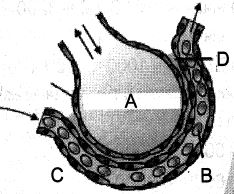
The figure given below shows a small part of human lung where exchange of gases takes place. In which one of the options given below,the one part $A, B, C$ or $D$ is correctly identified along with its function?
A
$C$: Arterial capillary - Passes oxygen to tissues
B
$A$: Alveolar cavity - Main site of exchange of respiratory gases
C
$D$: Capillary wall - Exchange of $O_2$ and $CO_2$ takes place here.
D
$B$: Red blood cell - Transport of $CO_2$ mainly
Solution
(B) In the given diagram of the alveolus:
$A$ represents the Alveolar cavity,which is the primary site for the exchange of respiratory gases ($O_2$ and $CO_2$) between the air in the lungs and the blood.
$B$ represents a Red blood cell (erythrocyte),which is primarily responsible for the transport of $O_2$ and $CO_2$.
$C$ represents the pulmonary artery/arteriole bringing deoxygenated blood.
$D$ represents the capillary wall,which along with the alveolar wall,forms the respiratory membrane for gas exchange.
Comparing the options,option $B$ correctly identifies $A$ as the alveolar cavity and its function as the main site of gas exchange.
$A$ represents the Alveolar cavity,which is the primary site for the exchange of respiratory gases ($O_2$ and $CO_2$) between the air in the lungs and the blood.
$B$ represents a Red blood cell (erythrocyte),which is primarily responsible for the transport of $O_2$ and $CO_2$.
$C$ represents the pulmonary artery/arteriole bringing deoxygenated blood.
$D$ represents the capillary wall,which along with the alveolar wall,forms the respiratory membrane for gas exchange.
Comparing the options,option $B$ correctly identifies $A$ as the alveolar cavity and its function as the main site of gas exchange.
0 likesView Solution
57
ChemistryMCQAIPMT · 2011
Bundle of His is a part of which one of the following organs in humans?
A
Brain
B
Heart
C
Kidney
D
Pancreas
Solution
(B) The Bundle of His (also known as the atrioventricular bundle) is a collection of heart muscle cells specialized for electrical conduction.
It transmits the electrical impulses from the atrioventricular node $(AVN)$ to the ventricles of the heart.
Therefore,it is an essential component of the human heart's conducting system.
It transmits the electrical impulses from the atrioventricular node $(AVN)$ to the ventricles of the heart.
Therefore,it is an essential component of the human heart's conducting system.
0 likesView Solution
58
ChemistryMCQAIPMT · 2011
The $24$ hour (diurnal) rhythm of our body,such as the sleep-wake cycle,is regulated by the hormone:
A
Calcitonin
B
Prolactin
C
Adrenaline
D
Melatonin
Solution
(D) The $24$ hour (diurnal) rhythm of our body,such as the sleep-wake cycle,is regulated by the hormone Melatonin.
Melatonin is secreted by the pineal gland located on the dorsal side of the forebrain.
It plays a very important role in the regulation of a $24$-hour (diurnal) rhythm of our body.
It also helps in maintaining the normal rhythms of sleep-wake cycle,body temperature,and influences metabolism,pigmentation,the menstrual cycle,as well as our defense capability.
Melatonin is secreted by the pineal gland located on the dorsal side of the forebrain.
It plays a very important role in the regulation of a $24$-hour (diurnal) rhythm of our body.
It also helps in maintaining the normal rhythms of sleep-wake cycle,body temperature,and influences metabolism,pigmentation,the menstrual cycle,as well as our defense capability.
0 likesView Solution
59
ChemistryMCQAIPMT · 2011
In eubacteria,a cellular component that resembles eukaryotic cell is
A
plasma membrane
B
nucleus
C
ribosomes
D
cell wall
Solution
(A) The plasma membrane of eubacteria is structurally and functionally similar to that of eukaryotic cells. Both consist of a phospholipid bilayer with embedded proteins.
In contrast,eubacteria lack a membrane-bound nucleus (they have a nucleoid instead).
While both have ribosomes,eukaryotic ribosomes are $80S$ (composed of $60S$ and $40S$ subunits),whereas eubacterial ribosomes are $70S$ (composed of $50S$ and $30S$ subunits).
The cell wall of eubacteria is made of peptidoglycan,which is absent in eukaryotic cells.
In contrast,eubacteria lack a membrane-bound nucleus (they have a nucleoid instead).
While both have ribosomes,eukaryotic ribosomes are $80S$ (composed of $60S$ and $40S$ subunits),whereas eubacterial ribosomes are $70S$ (composed of $50S$ and $30S$ subunits).
The cell wall of eubacteria is made of peptidoglycan,which is absent in eukaryotic cells.
0 likesView Solution
60
ChemistryMCQAIPMT · 2011
The gametophyte is not an independent,free-living generation in
A
Polytrichum
B
Adiantum
C
Marchantia
D
Pinus
Solution
(D) In the plant kingdom,the life cycle involves an alternation of generations between a haploid gametophyte and a diploid sporophyte.
In Bryophytes (e.g.,$Polytrichum$,$Marchantia$) and Pteridophytes (e.g.,$Adiantum$),the gametophyte is an independent,free-living generation.
In Gymnosperms (e.g.,$Pinus$) and Angiosperms,the gametophyte is highly reduced and depends on the sporophyte for nutrition and support.
Therefore,in $Pinus$,the gametophyte is not an independent,free-living generation.
In Bryophytes (e.g.,$Polytrichum$,$Marchantia$) and Pteridophytes (e.g.,$Adiantum$),the gametophyte is an independent,free-living generation.
In Gymnosperms (e.g.,$Pinus$) and Angiosperms,the gametophyte is highly reduced and depends on the sporophyte for nutrition and support.
Therefore,in $Pinus$,the gametophyte is not an independent,free-living generation.
0 likesView Solution
61
ChemistryMCQAIPMT · 2011
In angiosperms,the functional megaspore develops into:
A
embryo sac
B
ovule
C
endosperm
D
pollen sac
Solution
(A) In angiosperms,the megaspore mother cell undergoes meiosis to produce four haploid megaspores. Out of these four,three degenerate,and only one remains functional. This functional megaspore undergoes three successive mitotic divisions to form the female gametophyte,which is known as the embryo sac.
0 likesView Solution
62
ChemistryMCQAIPMT · 2011
Ground tissue includes
A
all tissues external to endodermis
B
all tissues except epidermis and vascular bundles
C
epidermis and cortex
D
all tissues internal to endodermis
Solution
(B) In plant anatomy,the ground tissue system consists of all tissues except the epidermis and the vascular bundles. It includes simple tissues such as parenchyma,collenchyma,and sclerenchyma. In primary stems and roots,the ground tissue consists of the cortex,pericycle,pith,and medullary rays.
0 likesView Solution
63
ChemistryMCQAIPMT · 2011
At metaphase,chromosomes are attached to the spindle fibres by their
A
satellites
B
secondary constrictions
C
kinetochores
D
centromere
Solution
(C) During the metaphase stage of cell division,the chromosomes align at the equatorial plate.
Each chromosome consists of two sister chromatids held together at the centromere.
On the surface of the centromere,there are small disc-shaped structures called kinetochores.
The spindle fibres attach to these kinetochores to facilitate the movement and segregation of chromosomes during anaphase.
Therefore,the correct answer is $C$ (kinetochores).
Each chromosome consists of two sister chromatids held together at the centromere.
On the surface of the centromere,there are small disc-shaped structures called kinetochores.
The spindle fibres attach to these kinetochores to facilitate the movement and segregation of chromosomes during anaphase.
Therefore,the correct answer is $C$ (kinetochores).
0 likesView Solution
64
ChemistryMCQAIPMT · 2011
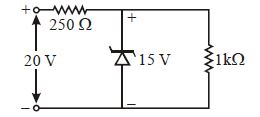
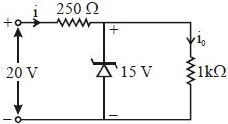
$A$ Zener diode,having a breakdown voltage equal to $15 \, V$,is used in a voltage regulator circuit as shown in the figure. The current through the diode is ..... $mA$.
A
$20$
B
$5$
C
$10$
D
$15$
Solution
(B) The voltage across the Zener diode remains constant at $15 \, V$ when it is in the breakdown region.
The current through the load resistor $(R_L = 1 \, k\Omega)$ is:
$i_0 = \frac{V_z}{R_L} = \frac{15 \, V}{1000 \, \Omega} = 0.015 \, A = 15 \, mA$
The total current $(i)$ supplied by the source is determined by the voltage drop across the series resistor $(R = 250 \, \Omega)$:
$i = \frac{V_{in} - V_z}{R} = \frac{20 \, V - 15 \, V}{250 \, \Omega} = \frac{5 \, V}{250 \, \Omega} = 0.02 \, A = 20 \, mA$
Applying Kirchhoff's Current Law at the junction,the current through the Zener diode $(i_z)$ is:
$i_z = i - i_0 = 20 \, mA - 15 \, mA = 5 \, mA$
The current through the load resistor $(R_L = 1 \, k\Omega)$ is:
$i_0 = \frac{V_z}{R_L} = \frac{15 \, V}{1000 \, \Omega} = 0.015 \, A = 15 \, mA$
The total current $(i)$ supplied by the source is determined by the voltage drop across the series resistor $(R = 250 \, \Omega)$:
$i = \frac{V_{in} - V_z}{R} = \frac{20 \, V - 15 \, V}{250 \, \Omega} = \frac{5 \, V}{250 \, \Omega} = 0.02 \, A = 20 \, mA$
Applying Kirchhoff's Current Law at the junction,the current through the Zener diode $(i_z)$ is:
$i_z = i - i_0 = 20 \, mA - 15 \, mA = 5 \, mA$
0 likesView Solution
65
ChemistryMCQAIPMT · 2011
The electrode potentials for $Cu^{2+}_{(aq)} + e^- \to Cu^{+}_{(aq)}$ and $Cu^{+}_{(aq)} + e^- \to Cu_{(s)}$ are $+0.15 \ V$ and $+0.50 \ V$ respectively. The value of $E^\circ$ for the reaction $Cu^{2+}_{(aq)} + 2e^- \to Cu_{(s)}$ will be ............ $V$.
A
$0.500$
B
$0.325$
C
$0.650$
D
$0.150$
Solution
(B) Given:
$(1) \ Cu^{2+}_{(aq)} + e^- \to Cu^{+}_{(aq)}$; $\Delta G_1 = -1 \times 0.15 \times F$
$(2) \ Cu^{+}_{(aq)} + e^- \to Cu_{(s)}$; $\Delta G_2 = -1 \times 0.50 \times F$
We need to find $E^\circ$ for the reaction:
$(3) \ Cu^{2+}_{(aq)} + 2e^- \to Cu_{(s)}$; $\Delta G_3 = -2 \times F \times E^\circ_3$
Since reaction $(3) = (1) + (2)$,we have:
$\Delta G_3 = \Delta G_1 + \Delta G_2$
$-2 \times F \times E^\circ_3 = (-1 \times 0.15 \times F) + (-1 \times 0.50 \times F)$
$-2 \times E^\circ_3 = -0.15 - 0.50$
$-2 \times E^\circ_3 = -0.65$
$E^\circ_3 = \frac{0.65}{2} = 0.325 \ V$
$(1) \ Cu^{2+}_{(aq)} + e^- \to Cu^{+}_{(aq)}$; $\Delta G_1 = -1 \times 0.15 \times F$
$(2) \ Cu^{+}_{(aq)} + e^- \to Cu_{(s)}$; $\Delta G_2 = -1 \times 0.50 \times F$
We need to find $E^\circ$ for the reaction:
$(3) \ Cu^{2+}_{(aq)} + 2e^- \to Cu_{(s)}$; $\Delta G_3 = -2 \times F \times E^\circ_3$
Since reaction $(3) = (1) + (2)$,we have:
$\Delta G_3 = \Delta G_1 + \Delta G_2$
$-2 \times F \times E^\circ_3 = (-1 \times 0.15 \times F) + (-1 \times 0.50 \times F)$
$-2 \times E^\circ_3 = -0.15 - 0.50$
$-2 \times E^\circ_3 = -0.65$
$E^\circ_3 = \frac{0.65}{2} = 0.325 \ V$
0 likesView Solution
66
ChemistryMCQAIPMT · 2011
Two radioactive nuclei $P$ and $Q$ in a given sample decay into a stable nucleus $R$. At time $t = 0$,the number of $P$ species is $4N_0$ and that of $Q$ is $N_0$. The half-life of $P$ is $1$ minute,while that of $Q$ is $2$ minutes. Initially,there are no nuclei of $R$ present in the sample. When the number of nuclei of $P$ and $Q$ are equal,the number of nuclei of $R$ present in the sample would be:
A
$2N_0$
B
$3N_0$
C
$\frac{9N_0}{2}$
D
$\frac{5N_0}{2}$
Solution
(C) Let $N_P(t)$ and $N_Q(t)$ be the number of nuclei of $P$ and $Q$ at time $t$.
Given: $N_P(0) = 4N_0$,$T_{1/2, P} = 1$ min,$N_Q(0) = N_0$,$T_{1/2, Q} = 2$ min.
The decay equations are: $N_P(t) = 4N_0 \cdot (1/2)^{t/1}$ and $N_Q(t) = N_0 \cdot (1/2)^{t/2}$.
We need to find $t$ when $N_P(t) = N_Q(t)$:
$4N_0 \cdot (1/2)^t = N_0 \cdot (1/2)^{t/2}$
$4 = (1/2)^{t/2} / (1/2)^t = (1/2)^{-t/2} = 2^{t/2}$
$2^2 = 2^{t/2} \implies t/2 = 2 \implies t = 4$ minutes.
At $t = 4$ min:
$N_P(4) = 4N_0 \cdot (1/2)^4 = 4N_0 / 16 = N_0/4$.
$N_Q(4) = N_0 \cdot (1/2)^{4/2} = N_0 / 4$.
The number of nuclei of $R$ formed is the total number of decayed nuclei of $P$ and $Q$:
$N_R = (N_P(0) - N_P(4)) + (N_Q(0) - N_Q(4))$
$N_R = (4N_0 - N_0/4) + (N_0 - N_0/4) = 15N_0/4 + 3N_0/4 = 18N_0/4 = 9N_0/2$.
Given: $N_P(0) = 4N_0$,$T_{1/2, P} = 1$ min,$N_Q(0) = N_0$,$T_{1/2, Q} = 2$ min.
The decay equations are: $N_P(t) = 4N_0 \cdot (1/2)^{t/1}$ and $N_Q(t) = N_0 \cdot (1/2)^{t/2}$.
We need to find $t$ when $N_P(t) = N_Q(t)$:
$4N_0 \cdot (1/2)^t = N_0 \cdot (1/2)^{t/2}$
$4 = (1/2)^{t/2} / (1/2)^t = (1/2)^{-t/2} = 2^{t/2}$
$2^2 = 2^{t/2} \implies t/2 = 2 \implies t = 4$ minutes.
At $t = 4$ min:
$N_P(4) = 4N_0 \cdot (1/2)^4 = 4N_0 / 16 = N_0/4$.
$N_Q(4) = N_0 \cdot (1/2)^{4/2} = N_0 / 4$.
The number of nuclei of $R$ formed is the total number of decayed nuclei of $P$ and $Q$:
$N_R = (N_P(0) - N_P(4)) + (N_Q(0) - N_Q(4))$
$N_R = (4N_0 - N_0/4) + (N_0 - N_0/4) = 15N_0/4 + 3N_0/4 = 18N_0/4 = 9N_0/2$.
0 likesView Solution
67
ChemistryMCQAIPMT · 2011
The rate of the reaction $2N_2O_5 \to 4NO_2 + O_2$ can be written in three ways:
$-\frac{d[N_2O_5]}{dt} = k[N_2O_5]$
$\frac{d[NO_2]}{dt} = k'[N_2O_5]$
$\frac{d[O_2]}{dt} = k''[N_2O_5]$
The relationship between $k$ and $k'$ and between $k$ and $k''$ are:
$-\frac{d[N_2O_5]}{dt} = k[N_2O_5]$
$\frac{d[NO_2]}{dt} = k'[N_2O_5]$
$\frac{d[O_2]}{dt} = k''[N_2O_5]$
The relationship between $k$ and $k'$ and between $k$ and $k''$ are:
A
$k' = k$ ; $k'' = k$
B
$k' = 2k$ ; $k'' = k$
C
$k' = 2k$ ; $k'' = k/2$
D
$k' = 2k$ ; $k'' = 2k$
Solution
(C) The rate of reaction $(ROR)$ is defined as:
$ROR = -\frac{1}{2} \frac{d[N_2O_5]}{dt} = \frac{1}{4} \frac{d[NO_2]}{dt} = \frac{d[O_2]}{dt}$
Given the rate expressions:
$-\frac{d[N_2O_5]}{dt} = k[N_2O_5]$
$\frac{d[NO_2]}{dt} = k'[N_2O_5]$
$\frac{d[O_2]}{dt} = k''[N_2O_5]$
Substituting these into the $ROR$ expression:
$\frac{1}{2} k[N_2O_5] = \frac{1}{4} k'[N_2O_5] = k''[N_2O_5]$
Comparing $k$ and $k'$:
$\frac{k}{2} = \frac{k'}{4} \implies k' = 2k$
Comparing $k$ and $k''$:
$\frac{k}{2} = k'' \implies k'' = \frac{k}{2}$
$ROR = -\frac{1}{2} \frac{d[N_2O_5]}{dt} = \frac{1}{4} \frac{d[NO_2]}{dt} = \frac{d[O_2]}{dt}$
Given the rate expressions:
$-\frac{d[N_2O_5]}{dt} = k[N_2O_5]$
$\frac{d[NO_2]}{dt} = k'[N_2O_5]$
$\frac{d[O_2]}{dt} = k''[N_2O_5]$
Substituting these into the $ROR$ expression:
$\frac{1}{2} k[N_2O_5] = \frac{1}{4} k'[N_2O_5] = k''[N_2O_5]$
Comparing $k$ and $k'$:
$\frac{k}{2} = \frac{k'}{4} \implies k' = 2k$
Comparing $k$ and $k''$:
$\frac{k}{2} = k'' \implies k'' = \frac{k}{2}$
0 likesView Solution
68
ChemistryMCQAIPMT · 2011
The electric and the magnetic field,associated with an $e.m.$ wave,propagating along the $+z-$ axis,can be represented by
A
$\vec E = {E_0}\hat i, \vec B = {B_0}\hat j$
B
$\vec E = {E_0}\hat k, \vec B = {B_0}\hat i$
C
$\vec E = {E_0}\hat j, \vec B = {B_0}\hat i$
D
$\vec E = {E_0}\hat j, \vec B = {B_0}\hat k$
Solution
(A) The direction of propagation of an electromagnetic wave is given by the direction of the Poynting vector,which is $\vec E \times \vec B$.
Given that the wave propagates along the $+z-$ axis (unit vector $\hat k$),we must have $\hat E \times \hat B = \hat k$.
Testing option $A$: $\hat i \times \hat j = \hat k$. This satisfies the condition.
Therefore,the electric field is along the $x-$ axis and the magnetic field is along the $y-$ axis.
Given that the wave propagates along the $+z-$ axis (unit vector $\hat k$),we must have $\hat E \times \hat B = \hat k$.
Testing option $A$: $\hat i \times \hat j = \hat k$. This satisfies the condition.
Therefore,the electric field is along the $x-$ axis and the magnetic field is along the $y-$ axis.
0 likesView Solution
69
ChemistryMCQAIPMT · 2011
By what factor does the average velocity of a gaseous molecule increase when the temperature (in Kelvin) is doubled?
A
$2.0$
B
$2.8$
C
$4$
D
$1.4$
Solution
(D) The average velocity $(V_{av})$ of a gaseous molecule is given by the formula $V_{av} = \sqrt{\frac{8RT}{\pi M}}$.
From this expression,it is clear that $V_{av} \propto \sqrt{T}$.
If the temperature is doubled,the new temperature $T' = 2T$.
The new average velocity $V_{av}'$ will be proportional to $\sqrt{2T}$.
Therefore,$V_{av}' = \sqrt{2} \times V_{av}$.
Since $\sqrt{2} \approx 1.414$,the average velocity increases by a factor of $1.4$.
From this expression,it is clear that $V_{av} \propto \sqrt{T}$.
If the temperature is doubled,the new temperature $T' = 2T$.
The new average velocity $V_{av}'$ will be proportional to $\sqrt{2T}$.
Therefore,$V_{av}' = \sqrt{2} \times V_{av}$.
Since $\sqrt{2} \approx 1.414$,the average velocity increases by a factor of $1.4$.
0 likesView Solution
70
ChemistryMCQAIPMT · 2011
If $x$ is the amount of adsorbate and $m$ is the amount of adsorbent,which of the following relations is not related to the adsorption process?
A
$x/m = f(P)$ at constant $T$
B
$x/m = f(T)$ at constant $P$
C
$P = f(T)$ at constant $(x/m)$
D
$x/m = P \times T$
Solution
(D) According to the Freundlich adsorption isotherm,the relationship between the amount of gas adsorbed $(x)$ and the mass of the adsorbent $(m)$ at a constant temperature is given by $\frac{x}{m} = k p^{1/n}$.
Here,$k$ and $n$ are constants,$x$ is the amount of gas adsorbed,and $m$ is the amount of solid adsorbent.
Adsorption isotherms and isobars describe the variation of $\frac{x}{m}$ with pressure at constant temperature or with temperature at constant pressure,respectively.
The relation $\frac{x}{m} = P \times T$ is incorrect because the adsorption capacity $\frac{x}{m}$ does not follow a simple product relationship with pressure and temperature.
Here,$k$ and $n$ are constants,$x$ is the amount of gas adsorbed,and $m$ is the amount of solid adsorbent.
Adsorption isotherms and isobars describe the variation of $\frac{x}{m}$ with pressure at constant temperature or with temperature at constant pressure,respectively.
The relation $\frac{x}{m} = P \times T$ is incorrect because the adsorption capacity $\frac{x}{m}$ does not follow a simple product relationship with pressure and temperature.
0 likesView Solution
71
ChemistryMCQAIPMT · 2011
Which of the following is not a fat-soluble vitamin?
A
Vitamin $A$
B
Vitamin $B$ complex
C
Vitamin $D$
D
Vitamin $E$
Solution
(B) Fat-soluble vitamins are those that are similar to oil and do not dissolve in water.
Vitamin $A, D, E,$ and $K$ are the fat-soluble vitamins.
Vitamin $B$ complex is not a fat-soluble vitamin because it is water-soluble.
It consists of eight vitamins: $B_1, B_2, B_3, B_5, B_6, B_7, B_9,$ and $B_{12}$.
Since it is water-soluble,our body does not store it,and therefore,it must be consumed daily.
Vitamin $A, D, E,$ and $K$ are the fat-soluble vitamins.
Vitamin $B$ complex is not a fat-soluble vitamin because it is water-soluble.
It consists of eight vitamins: $B_1, B_2, B_3, B_5, B_6, B_7, B_9,$ and $B_{12}$.
Since it is water-soluble,our body does not store it,and therefore,it must be consumed daily.
0 likesView Solution
72
ChemistryMediumMCQAIPMT · 2011
Which has the maximum number of molecules among the following?
A
$64 \ g \ SO_2$
B
$44 \ g \ CO_2$
C
$48 \ g \ O_3$
D
$8 \ g \ H_2$
Solution
(D) The number of molecules is directly proportional to the number of moles $(n = \text{mass} / \text{molar mass})$.
For $A$: $n(SO_2) = 64 \ g / 64 \ g \ mol^{-1} = 1 \ mol$.
For $B$: $n(CO_2) = 44 \ g / 44 \ g \ mol^{-1} = 1 \ mol$.
For $C$: $n(O_3) = 48 \ g / 48 \ g \ mol^{-1} = 1 \ mol$.
For $D$: $n(H_2) = 8 \ g / 2 \ g \ mol^{-1} = 4 \ mol$.
Since $H_2$ has the highest number of moles $(4 \ mol)$,it contains the maximum number of molecules.
For $A$: $n(SO_2) = 64 \ g / 64 \ g \ mol^{-1} = 1 \ mol$.
For $B$: $n(CO_2) = 44 \ g / 44 \ g \ mol^{-1} = 1 \ mol$.
For $C$: $n(O_3) = 48 \ g / 48 \ g \ mol^{-1} = 1 \ mol$.
For $D$: $n(H_2) = 8 \ g / 2 \ g \ mol^{-1} = 4 \ mol$.
Since $H_2$ has the highest number of moles $(4 \ mol)$,it contains the maximum number of molecules.
0 likesView Solution
73
ChemistryMCQAIPMT · 2011
The instantaneous angular position of a point on a rotating wheel is given by the equation $\theta(t) = 2t^3 - 6t^2$. The torque on the wheel becomes zero at $t = $ ....... $\text{sec}$.
A
$1$
B
$0.5$
C
$0.25$
D
$2$
Solution
(A) Given the angular position: $\theta(t) = 2t^3 - 6t^2$.
First,find the angular velocity $\omega$ by differentiating $\theta$ with respect to time $t$: $\omega = \frac{d\theta}{dt} = 6t^2 - 12t$.
Next,find the angular acceleration $\alpha$ by differentiating $\omega$ with respect to time $t$: $\alpha = \frac{d\omega}{dt} = 12t - 12$.
The torque $\tau$ is related to angular acceleration by the equation $\tau = I\alpha$,where $I$ is the moment of inertia.
For the torque to be zero,the angular acceleration $\alpha$ must be zero (assuming $I \neq 0$).
Setting $\alpha = 0$: $12t - 12 = 0$.
Solving for $t$: $12t = 12$,which gives $t = 1 \text{ s}$.
First,find the angular velocity $\omega$ by differentiating $\theta$ with respect to time $t$: $\omega = \frac{d\theta}{dt} = 6t^2 - 12t$.
Next,find the angular acceleration $\alpha$ by differentiating $\omega$ with respect to time $t$: $\alpha = \frac{d\omega}{dt} = 12t - 12$.
The torque $\tau$ is related to angular acceleration by the equation $\tau = I\alpha$,where $I$ is the moment of inertia.
For the torque to be zero,the angular acceleration $\alpha$ must be zero (assuming $I \neq 0$).
Setting $\alpha = 0$: $12t - 12 = 0$.
Solving for $t$: $12t = 12$,which gives $t = 1 \text{ s}$.
0 likesView Solution
74
ChemistryMCQAIPMT · 2011
Which of the following is least likely to behave as a Lewis base?
A
$H_2O$
B
$NH_3$
C
$BF_3$
D
$OH^{-}$
Solution
(C) Lewis base is a substance that can donate a lone pair of electrons.
$H_2O$,$NH_3$,and $OH^{-}$ all possess lone pairs of electrons on their central atoms,allowing them to act as Lewis bases.
$BF_3$ has an incomplete octet (only $6$ electrons around the central $B$ atom) and acts as an electron-pair acceptor,making it a Lewis acid.
Therefore,$BF_3$ is the least likely to behave as a Lewis base.
$H_2O$,$NH_3$,and $OH^{-}$ all possess lone pairs of electrons on their central atoms,allowing them to act as Lewis bases.
$BF_3$ has an incomplete octet (only $6$ electrons around the central $B$ atom) and acts as an electron-pair acceptor,making it a Lewis acid.
Therefore,$BF_3$ is the least likely to behave as a Lewis base.
0 likesView Solution
75
ChemistryMCQAIPMT · 2011
The half-life of a radioactive isotope $X$ is $50$ years. It decays to another element $Y$,which is stable. The two elements $X$ and $Y$ were found to be in the ratio of $1:15$ in a sample of a given rock. The age of the rock was estimated to be ......... years.
A
$150$
B
$200$
C
$250$
D
$100$
Solution
(B) Let $N$ be the amount of radioactive isotope $X$ remaining and $N_0$ be the initial amount of $X$.
The amount of stable element $Y$ formed is $N_0 - N$.
Given the ratio of $X$ to $Y$ is $1:15$,we have $\frac{N}{N_0 - N} = \frac{1}{15}$.
Adding $1$ to both sides or rearranging gives $\frac{N_0 - N}{N} = 15$,so $\frac{N_0}{N} - 1 = 15$,which implies $\frac{N_0}{N} = 16$.
We know the radioactive decay law is $\frac{N}{N_0} = (\frac{1}{2})^{t/T_{1/2}}$,where $T_{1/2} = 50$ years.
Thus,$\frac{N_0}{N} = 2^{t/T_{1/2}} = 16$.
Since $16 = 2^4$,we have $\frac{t}{T_{1/2}} = 4$.
Therefore,$t = 4 \times 50 = 200$ years.
The amount of stable element $Y$ formed is $N_0 - N$.
Given the ratio of $X$ to $Y$ is $1:15$,we have $\frac{N}{N_0 - N} = \frac{1}{15}$.
Adding $1$ to both sides or rearranging gives $\frac{N_0 - N}{N} = 15$,so $\frac{N_0}{N} - 1 = 15$,which implies $\frac{N_0}{N} = 16$.
We know the radioactive decay law is $\frac{N}{N_0} = (\frac{1}{2})^{t/T_{1/2}}$,where $T_{1/2} = 50$ years.
Thus,$\frac{N_0}{N} = 2^{t/T_{1/2}} = 16$.
Since $16 = 2^4$,we have $\frac{t}{T_{1/2}} = 4$.
Therefore,$t = 4 \times 50 = 200$ years.
0 likesView Solution
76
ChemistryMCQAIPMT · 2011
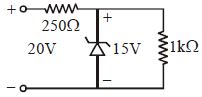
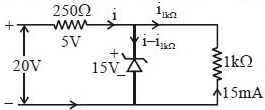
$A$ Zener diode,having a breakdown voltage equal to $15 \, V$,is used in a voltage regulator circuit as shown in the figure. The current through the diode is.....$mA$.
A
$20$
B
$5$
C
$10$
D
$15$
Solution
(B) The voltage across the Zener diode is constant at $15 \, V$ because it is in the breakdown region.
First,calculate the current through the load resistor $(R_L = 1 \, k\Omega)$:
$I_L = \frac{V_Z}{R_L} = \frac{15 \, V}{1 \times 10^3 \, \Omega} = 15 \, mA$.
Next,calculate the total current $(I)$ flowing through the series resistor $(R_S = 250 \, \Omega)$:
The voltage drop across the series resistor is $V_S = V_{in} - V_Z = 20 \, V - 15 \, V = 5 \, V$.
$I = \frac{V_S}{R_S} = \frac{5 \, V}{250 \, \Omega} = 0.02 \, A = 20 \, mA$.
Finally,apply Kirchhoff's Current Law at the node:
$I = I_Z + I_L$
$I_Z = I - I_L = 20 \, mA - 15 \, mA = 5 \, mA$.
Therefore,the current through the Zener diode is $5 \, mA$.
First,calculate the current through the load resistor $(R_L = 1 \, k\Omega)$:
$I_L = \frac{V_Z}{R_L} = \frac{15 \, V}{1 \times 10^3 \, \Omega} = 15 \, mA$.
Next,calculate the total current $(I)$ flowing through the series resistor $(R_S = 250 \, \Omega)$:
The voltage drop across the series resistor is $V_S = V_{in} - V_Z = 20 \, V - 15 \, V = 5 \, V$.
$I = \frac{V_S}{R_S} = \frac{5 \, V}{250 \, \Omega} = 0.02 \, A = 20 \, mA$.
Finally,apply Kirchhoff's Current Law at the node:
$I = I_Z + I_L$
$I_Z = I - I_L = 20 \, mA - 15 \, mA = 5 \, mA$.
Therefore,the current through the Zener diode is $5 \, mA$.
0 likesView Solution
77
ChemistryMCQAIPMT · 2011
The energies $E_1$ and $E_2$ of two radiations are $25 \ eV$ and $50 \ eV$ respectively. The relation between their wavelengths,i.e.,$\lambda_1$ and $\lambda_2$,will be:
A
$\lambda_1 = \lambda_2$
B
$\lambda_1 = 2\lambda_2$
C
$\lambda_1 = 4\lambda_2$
D
$\lambda_1 = 0.5\lambda_2$
Solution
(B) The energy of a radiation is given by the formula $E = \frac{hc}{\lambda}$,where $h$ is Planck's constant,$c$ is the speed of light,and $\lambda$ is the wavelength.
Since $h$ and $c$ are constants,$E \propto \frac{1}{\lambda}$.
Therefore,$\frac{E_1}{E_2} = \frac{\lambda_2}{\lambda_1}$.
Given $E_1 = 25 \ eV$ and $E_2 = 50 \ eV$,we have:
$\frac{25}{50} = \frac{\lambda_2}{\lambda_1}$
$\frac{1}{2} = \frac{\lambda_2}{\lambda_1}$
$\lambda_1 = 2\lambda_2$.
Since $h$ and $c$ are constants,$E \propto \frac{1}{\lambda}$.
Therefore,$\frac{E_1}{E_2} = \frac{\lambda_2}{\lambda_1}$.
Given $E_1 = 25 \ eV$ and $E_2 = 50 \ eV$,we have:
$\frac{25}{50} = \frac{\lambda_2}{\lambda_1}$
$\frac{1}{2} = \frac{\lambda_2}{\lambda_1}$
$\lambda_1 = 2\lambda_2$.
0 likesView Solution
78
ChemistryMCQAIPMT · 2011
In the Davisson and Germer experiment,the velocity of electrons emitted from the electron gun can be increased by
A
Decreasing the potential difference between the anode and filament
B
Increasing the potential difference between the anode and filament
C
Increasing the filament current
D
Decreasing the filament current
Solution
(B) In the Davisson and Germer experiment,the electrons are accelerated by an electric field created by the potential difference $V$ applied between the filament and the anode.
According to the work-energy theorem,the kinetic energy $K$ gained by an electron of charge $e$ is given by $K = eV = \frac{1}{2}mv^2$.
From this relation,the velocity $v$ is given by $v = \sqrt{\frac{2eV}{m}}$.
Since $v \propto \sqrt{V}$,the velocity of the electrons increases as the potential difference $V$ between the anode and the filament is increased.
According to the work-energy theorem,the kinetic energy $K$ gained by an electron of charge $e$ is given by $K = eV = \frac{1}{2}mv^2$.
From this relation,the velocity $v$ is given by $v = \sqrt{\frac{2eV}{m}}$.
Since $v \propto \sqrt{V}$,the velocity of the electrons increases as the potential difference $V$ between the anode and the filament is increased.
0 likesView Solution
79
ChemistryMCQAIPMT · 2011
Fusion reaction takes place at high temperature because
A
Molecules break up at high temperature
B
Nuclei break up at high temperature
C
Atoms get ionised at high temperature
D
Kinetic energy is high enough to overcome the coulomb repulsion between nuclei
Solution
(D) In a nuclear fusion reaction,two lighter nuclei combine to form a heavier nucleus.
Since all nuclei are positively charged,there exists a strong electrostatic (Coulomb) repulsion between them.
To overcome this repulsive force and bring the nuclei close enough for the strong nuclear force to take over,they must possess very high kinetic energy.
This high kinetic energy is achieved at extremely high temperatures (on the order of $10^7$ to $10^8 \ K$),which is why fusion reactions are also known as thermonuclear reactions.
Since all nuclei are positively charged,there exists a strong electrostatic (Coulomb) repulsion between them.
To overcome this repulsive force and bring the nuclei close enough for the strong nuclear force to take over,they must possess very high kinetic energy.
This high kinetic energy is achieved at extremely high temperatures (on the order of $10^7$ to $10^8 \ K$),which is why fusion reactions are also known as thermonuclear reactions.
0 likesView Solution
80
ChemistryMCQAIPMT · 2011
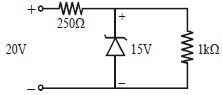
$A$ Zener diode,having a breakdown voltage equal to $15\,V,$ is used in a voltage regulator circuit as shown in the figure. The current through the diode is ........ $mA$.
A
$20$
B
$5$
C
$10$
D
$15$
Solution
(B) $1$. The input voltage is $V_{in} = 20\,V$ and the series resistance is $R_s = 250\,\Omega$.
$2$. The Zener diode is in parallel with the load resistor $R_L = 1\,k\Omega = 1000\,\Omega$. Since the Zener diode is in breakdown,the voltage across the load resistor is $V_L = V_Z = 15\,V$.
$3$. The current through the load resistor is $I_L = \frac{V_L}{R_L} = \frac{15\,V}{1000\,\Omega} = 0.015\,A = 15\,mA$.
$4$. The total current supplied by the source through the series resistor $R_s$ is $I_s = \frac{V_{in} - V_Z}{R_s} = \frac{20\,V - 15\,V}{250\,\Omega} = \frac{5\,V}{250\,\Omega} = 0.02\,A = 20\,mA$.
$5$. Applying Kirchhoff's current law at the node,the current through the Zener diode is $I_Z = I_s - I_L = 20\,mA - 15\,mA = 5\,mA$.
$2$. The Zener diode is in parallel with the load resistor $R_L = 1\,k\Omega = 1000\,\Omega$. Since the Zener diode is in breakdown,the voltage across the load resistor is $V_L = V_Z = 15\,V$.
$3$. The current through the load resistor is $I_L = \frac{V_L}{R_L} = \frac{15\,V}{1000\,\Omega} = 0.015\,A = 15\,mA$.
$4$. The total current supplied by the source through the series resistor $R_s$ is $I_s = \frac{V_{in} - V_Z}{R_s} = \frac{20\,V - 15\,V}{250\,\Omega} = \frac{5\,V}{250\,\Omega} = 0.02\,A = 20\,mA$.
$5$. Applying Kirchhoff's current law at the node,the current through the Zener diode is $I_Z = I_s - I_L = 20\,mA - 15\,mA = 5\,mA$.
0 likesView Solution
81
ChemistryMCQAIPMT · 2011
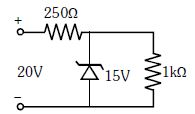
$A$ Zener diode,having a breakdown voltage equal to $15\, V$,is used in a voltage regulator circuit as shown in the figure. The current through the Zener diode is.....$mA$.
A
$5$
B
$10$
C
$15$
D
$20$
Solution
(A) The input voltage is $V_{in} = 20\, V$. The series resistance is $R_s = 250\, \Omega$. The Zener breakdown voltage is $V_z = 15\, V$. The load resistance is $R_L = 1\, k\Omega = 1000\, \Omega$.
$1$. Calculate the total current $(I)$ flowing through the series resistor $R_s$:
$I = \frac{V_{in} - V_z}{R_s} = \frac{20\, V - 15\, V}{250\, \Omega} = \frac{5\, V}{250\, \Omega} = 0.02\, A = 20\, mA$.
$2$. Calculate the current $(I_L)$ flowing through the load resistor $R_L$:
$I_L = \frac{V_z}{R_L} = \frac{15\, V}{1000\, \Omega} = 0.015\, A = 15\, mA$.
$3$. The current through the Zener diode $(I_z)$ is given by:
$I_z = I - I_L = 20\, mA - 15\, mA = 5\, mA$.
$1$. Calculate the total current $(I)$ flowing through the series resistor $R_s$:
$I = \frac{V_{in} - V_z}{R_s} = \frac{20\, V - 15\, V}{250\, \Omega} = \frac{5\, V}{250\, \Omega} = 0.02\, A = 20\, mA$.
$2$. Calculate the current $(I_L)$ flowing through the load resistor $R_L$:
$I_L = \frac{V_z}{R_L} = \frac{15\, V}{1000\, \Omega} = 0.015\, A = 15\, mA$.
$3$. The current through the Zener diode $(I_z)$ is given by:
$I_z = I - I_L = 20\, mA - 15\, mA = 5\, mA$.
0 likesView Solution
82
ChemistryMCQAIPMT · 2011
The complex $[Pt(py)(NH_3)(Br)(Cl)]$ will have how many geometrical isomers?
A
$0$
B
$2$
C
$3$
D
$4$
Solution
(C) The given complex is of the type $[Mabcd]$,where $M$ is the central metal atom $(Pt)$ and $a, b, c, d$ are $4$ different ligands $(py, NH_3, Br, Cl)$ attached to it.
Square planar complexes of the type $[Mabcd]$ exhibit $3$ geometrical isomers.
These isomers are formed by fixing one ligand and changing the positions of the other three ligands relative to it,as shown in the provided image.
Square planar complexes of the type $[Mabcd]$ exhibit $3$ geometrical isomers.
These isomers are formed by fixing one ligand and changing the positions of the other three ligands relative to it,as shown in the provided image.
0 likesView Solution
83
ChemistryMCQAIPMT · 2011
The instantaneous angular position of a point on a rotating wheel is given by the equation $\theta(t) = 2t^3 - 6t^2$. The torque on the wheel becomes zero at $t = \dots \text{sec}$.
A
$1$
B
$0.5$
C
$0.25$
D
$2$
Solution
(A) Given the angular position $\theta(t) = 2t^3 - 6t^2$.
First,find the angular velocity $\omega$ by differentiating $\theta(t)$ with respect to time $t$:
$\omega = \frac{d\theta}{dt} = \frac{d}{dt}(2t^3 - 6t^2) = 6t^2 - 12t$.
Next,find the angular acceleration $\alpha$ by differentiating $\omega$ with respect to time $t$:
$\alpha = \frac{d\omega}{dt} = \frac{d}{dt}(6t^2 - 12t) = 12t - 12$.
The torque $\tau$ is given by $\tau = I\alpha$,where $I$ is the moment of inertia.
For the torque to be zero,$\tau = 0$,which implies $I\alpha = 0$. Since $I \neq 0$,we must have $\alpha = 0$.
Setting $\alpha = 12t - 12 = 0$,we get $12t = 12$,which results in $t = 1 \text{ sec}$.
First,find the angular velocity $\omega$ by differentiating $\theta(t)$ with respect to time $t$:
$\omega = \frac{d\theta}{dt} = \frac{d}{dt}(2t^3 - 6t^2) = 6t^2 - 12t$.
Next,find the angular acceleration $\alpha$ by differentiating $\omega$ with respect to time $t$:
$\alpha = \frac{d\omega}{dt} = \frac{d}{dt}(6t^2 - 12t) = 12t - 12$.
The torque $\tau$ is given by $\tau = I\alpha$,where $I$ is the moment of inertia.
For the torque to be zero,$\tau = 0$,which implies $I\alpha = 0$. Since $I \neq 0$,we must have $\alpha = 0$.
Setting $\alpha = 12t - 12 = 0$,we get $12t = 12$,which results in $t = 1 \text{ sec}$.
0 likesView Solution
84
ChemistryMCQAIPMT · 2011
The electrode potentials for $Cu^{2+}_{(aq)} + e^- \to Cu^{+}_{(aq)}$ and $Cu^{+}_{(aq)} + e^- \to Cu_{(s)}$ are $+0.15 \, V$ and $+0.50 \, V$ respectively. The value of $E^o_{Cu^{2+}/Cu}$ will be ............ $V$.
A
$0.500$
B
$0.325$
C
$0.650$
D
$0.150$
Solution
(B) Given:
$(1) \ Cu^{2+}_{(aq)} + e^- \to Cu^{+}_{(aq)} \quad \Delta G_1^{\circ} = -1 \times 0.15 \times F$
$(2) \ Cu^{+}_{(aq)} + e^- \to Cu_{(s)} \quad \Delta G_2^{\circ} = -1 \times 0.50 \times F$
Adding $(1)$ and $(2)$ gives the overall reaction:
$Cu^{2+}_{(aq)} + 2e^- \to Cu_{(s)} \quad \Delta G_3^{\circ} = -2 \times F \times E^{\circ}_{Cu^{2+}/Cu}$
Since $\Delta G_3^{\circ} = \Delta G_1^{\circ} + \Delta G_2^{\circ}$,we have:
$-2 \times F \times E^{\circ}_{Cu^{2+}/Cu} = (-1 \times 0.15 \times F) + (-1 \times 0.50 \times F)$
$-2 \times E^{\circ}_{Cu^{2+}/Cu} = -0.65$
$E^{\circ}_{Cu^{2+}/Cu} = \frac{0.65}{2} = 0.325 \, V$.
$(1) \ Cu^{2+}_{(aq)} + e^- \to Cu^{+}_{(aq)} \quad \Delta G_1^{\circ} = -1 \times 0.15 \times F$
$(2) \ Cu^{+}_{(aq)} + e^- \to Cu_{(s)} \quad \Delta G_2^{\circ} = -1 \times 0.50 \times F$
Adding $(1)$ and $(2)$ gives the overall reaction:
$Cu^{2+}_{(aq)} + 2e^- \to Cu_{(s)} \quad \Delta G_3^{\circ} = -2 \times F \times E^{\circ}_{Cu^{2+}/Cu}$
Since $\Delta G_3^{\circ} = \Delta G_1^{\circ} + \Delta G_2^{\circ}$,we have:
$-2 \times F \times E^{\circ}_{Cu^{2+}/Cu} = (-1 \times 0.15 \times F) + (-1 \times 0.50 \times F)$
$-2 \times E^{\circ}_{Cu^{2+}/Cu} = -0.65$
$E^{\circ}_{Cu^{2+}/Cu} = \frac{0.65}{2} = 0.325 \, V$.
0 likesView Solution
85
ChemistryMCQAIPMT · 2011
The total number of atomic orbitals in the fourth energy level of an atom is .......
A
$8$
B
$16$
C
$32$
D
$4$
Solution
(B) The total number of orbitals in a given energy level $n$ is given by the formula $n^2$.
For the fourth energy level,$n = 4$.
Therefore,the total number of orbitals = $n^2 = 4^2 = 16$.
Thus,the correct option is $B$.
For the fourth energy level,$n = 4$.
Therefore,the total number of orbitals = $n^2 = 4^2 = 16$.
Thus,the correct option is $B$.
0 likesView Solution
86
ChemistryMCQAIPMT · 2011
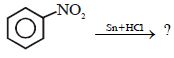
What is the product obtained in the following reaction?
A
Phenylhydroxylamine
B
Aniline
C
Azobenzene
D
Azoxybenzene
Solution
(B) The reaction of nitrobenzene with $Sn + HCl$ is a standard reduction reaction.
Nitrobenzene $(C_6H_5NO_2)$ undergoes reduction in the presence of a metal-acid catalyst like $Sn + HCl$ to form aniline $(C_6H_5NH_2)$.
The chemical equation is:
$C_6H_5NO_2 + 6[H] \xrightarrow{Sn+HCl} C_6H_5NH_2 + 2H_2O$
Therefore,the product obtained is aniline.
Nitrobenzene $(C_6H_5NO_2)$ undergoes reduction in the presence of a metal-acid catalyst like $Sn + HCl$ to form aniline $(C_6H_5NH_2)$.
The chemical equation is:
$C_6H_5NO_2 + 6[H] \xrightarrow{Sn+HCl} C_6H_5NH_2 + 2H_2O$
Therefore,the product obtained is aniline.
0 likesView Solution
87
ChemistryMCQAIPMT · 2011
$A$ conveyor belt is moving at a constant speed of $2\, m/s$. $A$ box is gently dropped on it. The coefficient of friction between them is $\mu = 0.5$. The distance that the box will move relative to the belt before coming to rest on it,taking $g = 10\, m/s^2$,is ........ $m$.
A
$0.4$
B
$1.2$
C
$0.6$
D
$0.8$
Solution
(A) The box is dropped on the moving belt,so its initial velocity relative to the belt is $u_{rel} = 2\, m/s$.
The frictional force acting on the box provides an acceleration $a = \mu g = 0.5 \times 10 = 5\, m/s^2$.
This acceleration acts in the direction of the belt's motion to bring the box to rest relative to the belt.
Using the kinematic equation $v_{rel}^2 = u_{rel}^2 - 2 a s$,where $v_{rel} = 0$ (when the box stops relative to the belt):
$0 = (2)^2 - 2(5)s$
$10s = 4$
$s = 0.4\, m$.
The frictional force acting on the box provides an acceleration $a = \mu g = 0.5 \times 10 = 5\, m/s^2$.
This acceleration acts in the direction of the belt's motion to bring the box to rest relative to the belt.
Using the kinematic equation $v_{rel}^2 = u_{rel}^2 - 2 a s$,where $v_{rel} = 0$ (when the box stops relative to the belt):
$0 = (2)^2 - 2(5)s$
$10s = 4$
$s = 0.4\, m$.
0 likesView Solution
88
ChemistryMCQAIPMT · 2011
$A$ mass $m$ moving horizontally (along the $x-$ axis) with velocity $v$ collides and sticks to a mass of $3m$ moving vertically upward (along the $y-$ axis) with velocity $2v$. The final velocity of the combination is
A
$\frac{1}{4} v \hat{i} + \frac{3}{2} v \hat{j}$
B
$\frac{3}{2} v \hat{i} + \frac{1}{4} v \hat{j}$
C
$\frac{1}{3} v \hat{i} + \frac{2}{3} v \hat{j}$
D
$\frac{2}{3} v \hat{i} + \frac{1}{3} v \hat{j}$
Solution
(A) According to the principle of conservation of linear momentum,the total momentum before the collision equals the total momentum after the collision.
Initial momentum of mass $m$ is $\vec{p}_1 = m v \hat{i}$.
Initial momentum of mass $3m$ is $\vec{p}_2 = 3m (2v \hat{j}) = 6m v \hat{j}$.
Total initial momentum $\vec{p}_{total} = m v \hat{i} + 6m v \hat{j}$.
Let the final velocity of the combined mass $(m + 3m = 4m)$ be $\vec{v}_c$.
By conservation of momentum: $4m \vec{v}_c = m v \hat{i} + 6m v \hat{j}$.
Dividing by $4m$,we get $\vec{v}_c = \frac{m v}{4m} \hat{i} + \frac{6m v}{4m} \hat{j}$.
Therefore,$\vec{v}_c = \frac{1}{4} v \hat{i} + \frac{3}{2} v \hat{j}$.
Initial momentum of mass $m$ is $\vec{p}_1 = m v \hat{i}$.
Initial momentum of mass $3m$ is $\vec{p}_2 = 3m (2v \hat{j}) = 6m v \hat{j}$.
Total initial momentum $\vec{p}_{total} = m v \hat{i} + 6m v \hat{j}$.
Let the final velocity of the combined mass $(m + 3m = 4m)$ be $\vec{v}_c$.
By conservation of momentum: $4m \vec{v}_c = m v \hat{i} + 6m v \hat{j}$.
Dividing by $4m$,we get $\vec{v}_c = \frac{m v}{4m} \hat{i} + \frac{6m v}{4m} \hat{j}$.
Therefore,$\vec{v}_c = \frac{1}{4} v \hat{i} + \frac{3}{2} v \hat{j}$.
0 likesView Solution
89
ChemistryMCQAIPMT · 2011
Which of the following is not a fat-soluble vitamin?
A
Vitamin $A$
B
Vitamin $D$
C
Vitamin $C$
D
Vitamin $E$
Solution
(C) Vitamins are classified into two groups based on their solubility: fat-soluble and water-soluble.
Fat-soluble vitamins include Vitamin $A$,$D$,$E$,and $K$.
Water-soluble vitamins include Vitamin $B$ complex and Vitamin $C$.
Therefore,Vitamin $C$ is not a fat-soluble vitamin; it is water-soluble.
Fat-soluble vitamins include Vitamin $A$,$D$,$E$,and $K$.
Water-soluble vitamins include Vitamin $B$ complex and Vitamin $C$.
Therefore,Vitamin $C$ is not a fat-soluble vitamin; it is water-soluble.
0 likesView Solution
90
ChemistryMCQAIPMT · 2011
The half-life of a radioactive isotope $X$ is $50 \, years$. It decays to another element $Y$ which is stable. The two elements $X$ and $Y$ were found to be in the ratio of $1 : 15$ in a sample of a given rock. The age of the rock was estimated to be ........ $years$.
A
$150$
B
$200$
C
$250$
D
$100$
Solution
(B) Let $N$ be the amount of radioactive isotope $X$ remaining and $N_0$ be the initial amount.
The amount of stable element $Y$ formed is $N_0 - N$.
Given the ratio $\frac{N}{N_0 - N} = \frac{1}{15}$.
Adding $1$ to both sides: $\frac{N}{N_0 - N} + 1 = \frac{1}{15} + 1 \implies \frac{N + N_0 - N}{N_0 - N} = \frac{16}{15} \implies \frac{N_0}{N_0 - N} = \frac{16}{15}$.
Taking the reciprocal: $\frac{N}{N_0} = \frac{1}{16}$.
We know the radioactive decay law: $\frac{N}{N_0} = (\frac{1}{2})^n$,where $n$ is the number of half-lives.
$\frac{1}{16} = (\frac{1}{2})^4$,so $n = 4$.
The age of the rock $t = n \times t_{1/2} = 4 \times 50 \, years = 200 \, years$.
The amount of stable element $Y$ formed is $N_0 - N$.
Given the ratio $\frac{N}{N_0 - N} = \frac{1}{15}$.
Adding $1$ to both sides: $\frac{N}{N_0 - N} + 1 = \frac{1}{15} + 1 \implies \frac{N + N_0 - N}{N_0 - N} = \frac{16}{15} \implies \frac{N_0}{N_0 - N} = \frac{16}{15}$.
Taking the reciprocal: $\frac{N}{N_0} = \frac{1}{16}$.
We know the radioactive decay law: $\frac{N}{N_0} = (\frac{1}{2})^n$,where $n$ is the number of half-lives.
$\frac{1}{16} = (\frac{1}{2})^4$,so $n = 4$.
The age of the rock $t = n \times t_{1/2} = 4 \times 50 \, years = 200 \, years$.
0 likesView Solution
91
ChemistryMCQAIPMT · 2011
The electric and the magnetic field,associated with an $e.m.$ wave,propagating along the $+z-$ axis,can be represented by
A
$\vec E = {E_0}\hat i, \vec B = {B_0}\hat j$
B
$\vec E = {E_0}\hat k, \vec B = {B_0}\hat i$
C
$\vec E = {E_0}\hat j, \vec B = {B_0}\hat k$
D
$\vec E = {E_0}\hat i, \vec B = {B_0}\hat k$
Solution
(A) The direction of propagation of an electromagnetic wave is given by the direction of the vector $\vec{E} \times \vec{B}$.
Given that the wave propagates along the $+z-$ axis,we must have $\vec{E} \times \vec{B} = \hat{k}$.
Since the electric field $\vec{E}$ and magnetic field $\vec{B}$ must be perpendicular to each other and to the direction of propagation,they must lie in the $xy-$ plane.
Checking the options:
For option $A$: $\vec{E} = E_0 \hat{i}$ and $\vec{B} = B_0 \hat{j}$.
Then $\vec{E} \times \vec{B} = (E_0 \hat{i}) \times (B_0 \hat{j}) = E_0 B_0 (\hat{i} \times \hat{j}) = E_0 B_0 \hat{k}$.
This matches the direction of propagation $+z$.
Therefore,option $A$ is correct.
Given that the wave propagates along the $+z-$ axis,we must have $\vec{E} \times \vec{B} = \hat{k}$.
Since the electric field $\vec{E}$ and magnetic field $\vec{B}$ must be perpendicular to each other and to the direction of propagation,they must lie in the $xy-$ plane.
Checking the options:
For option $A$: $\vec{E} = E_0 \hat{i}$ and $\vec{B} = B_0 \hat{j}$.
Then $\vec{E} \times \vec{B} = (E_0 \hat{i}) \times (B_0 \hat{j}) = E_0 B_0 (\hat{i} \times \hat{j}) = E_0 B_0 \hat{k}$.
This matches the direction of propagation $+z$.
Therefore,option $A$ is correct.
0 likesView Solution
92
ChemistryMCQAIPMT · 2011
Two identical piano wires,kept under the same tension $T$,have a fundamental frequency of $600\, Hz$. The fractional increase in the tension of one of the wires which will lead to the occurrence of $6\, beats/s$ when both the wires oscillate together is:
A
$0.01$
B
$0.02$
C
$0.03$
D
$0.04$
Solution
(B) The fundamental frequency $n$ of a stretched wire is given by $n = \frac{1}{2L} \sqrt{\frac{T}{\mu}}$.
Since the wires are identical,$n \propto \sqrt{T}$.
Differentiating this relation,we get $\frac{dn}{n} = \frac{1}{2} \frac{dT}{T}$.
For small changes,we can write $\frac{\Delta n}{n} = \frac{1}{2} \frac{\Delta T}{T}$.
Here,the beat frequency is $\Delta n = 6\, Hz$ and the original frequency is $n = 600\, Hz$.
Substituting these values,we get $\frac{\Delta T}{T} = 2 \left( \frac{\Delta n}{n} \right)$.
$\frac{\Delta T}{T} = 2 \left( \frac{6}{600} \right) = 2 \times 0.01 = 0.02$.
Since the wires are identical,$n \propto \sqrt{T}$.
Differentiating this relation,we get $\frac{dn}{n} = \frac{1}{2} \frac{dT}{T}$.
For small changes,we can write $\frac{\Delta n}{n} = \frac{1}{2} \frac{\Delta T}{T}$.
Here,the beat frequency is $\Delta n = 6\, Hz$ and the original frequency is $n = 600\, Hz$.
Substituting these values,we get $\frac{\Delta T}{T} = 2 \left( \frac{\Delta n}{n} \right)$.
$\frac{\Delta T}{T} = 2 \left( \frac{6}{600} \right) = 2 \times 0.01 = 0.02$.
0 likesView Solution
93
ChemistryMCQAIPMT · 2011
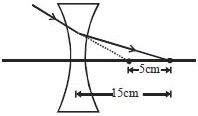
$A$ converging beam of rays is incident on a diverging lens. Having passed through the lens,the rays intersect at a point $15 \, cm$ from the lens on the opposite side. If the lens is removed,the point where the rays meet will move $5 \, cm$ closer to the lens. The focal length of the lens is.....$cm$
A
$5$
B
$-10$
C
$20$
D
$-30$
Solution
(D) The rays are converging towards a point $15 \, cm$ behind the lens,so the image distance $v = +15 \, cm$.
If the lens is removed,the rays meet $5 \, cm$ closer to the lens,meaning the original convergence point was at $15 - 5 = 10 \, cm$ from the lens position. Since the rays were converging towards this point,the object distance $u = +10 \, cm$.
Using the lens formula: $\frac{1}{v} - \frac{1}{u} = \frac{1}{f}$
Substituting the values: $\frac{1}{15} - \frac{1}{10} = \frac{1}{f}$
$\frac{2 - 3}{30} = \frac{1}{f}$
$-\frac{1}{30} = \frac{1}{f}$
$f = -30 \, cm$
If the lens is removed,the rays meet $5 \, cm$ closer to the lens,meaning the original convergence point was at $15 - 5 = 10 \, cm$ from the lens position. Since the rays were converging towards this point,the object distance $u = +10 \, cm$.
Using the lens formula: $\frac{1}{v} - \frac{1}{u} = \frac{1}{f}$
Substituting the values: $\frac{1}{15} - \frac{1}{10} = \frac{1}{f}$
$\frac{2 - 3}{30} = \frac{1}{f}$
$-\frac{1}{30} = \frac{1}{f}$
$f = -30 \, cm$
0 likesView Solution
94
ChemistryMCQAIPMT · 2011
The wavelength of the first line of the Lyman series for a hydrogen atom is equal to that of the second line of the Balmer series for a hydrogen-like ion. The atomic number $Z$ of the hydrogen-like ion is
A
$3$
B
$4$
C
$1$
D
$2$
Solution
(D) For the first line of the Lyman series of hydrogen $(n_1=1, n_2=2)$:
$\frac{1}{\lambda_1} = R(1)^2 \left(\frac{1}{1^2} - \frac{1}{2^2}\right) = R \left(1 - \frac{1}{4}\right) = \frac{3R}{4}$
For the second line of the Balmer series of a hydrogen-like ion $(n_1=2, n_2=4)$:
$\frac{1}{\lambda_2} = R Z^2 \left(\frac{1}{2^2} - \frac{1}{4^2}\right) = R Z^2 \left(\frac{1}{4} - \frac{1}{16}\right) = R Z^2 \left(\frac{3}{16}\right)$
Given that $\lambda_1 = \lambda_2$,we have $\frac{1}{\lambda_1} = \frac{1}{\lambda_2}$:
$\frac{3R}{4} = \frac{3RZ^2}{16}$
Dividing both sides by $\frac{3R}{4}$:
$1 = \frac{Z^2}{4}$
$Z^2 = 4$
$Z = 2$
$\frac{1}{\lambda_1} = R(1)^2 \left(\frac{1}{1^2} - \frac{1}{2^2}\right) = R \left(1 - \frac{1}{4}\right) = \frac{3R}{4}$
For the second line of the Balmer series of a hydrogen-like ion $(n_1=2, n_2=4)$:
$\frac{1}{\lambda_2} = R Z^2 \left(\frac{1}{2^2} - \frac{1}{4^2}\right) = R Z^2 \left(\frac{1}{4} - \frac{1}{16}\right) = R Z^2 \left(\frac{3}{16}\right)$
Given that $\lambda_1 = \lambda_2$,we have $\frac{1}{\lambda_1} = \frac{1}{\lambda_2}$:
$\frac{3R}{4} = \frac{3RZ^2}{16}$
Dividing both sides by $\frac{3R}{4}$:
$1 = \frac{Z^2}{4}$
$Z^2 = 4$
$Z = 2$
0 likesView Solution
95
ChemistryMCQAIPMT · 2011
Which has the maximum number of molecules among the following?
A
$44 \ g \ CO_2$
B
$48 \ g \ O_3$
C
$8 \ g \ H_2$
D
$64 \ g \ SO_2$
Solution
(C) The number of molecules is calculated as: $\text{Number of molecules} = \text{Moles} \times N_A$.
For $A$: $\text{Moles of } CO_2 = \frac{44 \ g}{44 \ g/mol} = 1 \ mol$. Number of molecules = $1 \times N_A$.
For $B$: $\text{Moles of } O_3 = \frac{48 \ g}{48 \ g/mol} = 1 \ mol$. Number of molecules = $1 \times N_A$.
For $C$: $\text{Moles of } H_2 = \frac{8 \ g}{2 \ g/mol} = 4 \ mol$. Number of molecules = $4 \times N_A$.
For $D$: $\text{Moles of } SO_2 = \frac{64 \ g}{64 \ g/mol} = 1 \ mol$. Number of molecules = $1 \times N_A$.
Comparing the values,$8 \ g \ H_2$ contains the maximum number of molecules $(4 \times N_A)$.
For $A$: $\text{Moles of } CO_2 = \frac{44 \ g}{44 \ g/mol} = 1 \ mol$. Number of molecules = $1 \times N_A$.
For $B$: $\text{Moles of } O_3 = \frac{48 \ g}{48 \ g/mol} = 1 \ mol$. Number of molecules = $1 \times N_A$.
For $C$: $\text{Moles of } H_2 = \frac{8 \ g}{2 \ g/mol} = 4 \ mol$. Number of molecules = $4 \times N_A$.
For $D$: $\text{Moles of } SO_2 = \frac{64 \ g}{64 \ g/mol} = 1 \ mol$. Number of molecules = $1 \times N_A$.
Comparing the values,$8 \ g \ H_2$ contains the maximum number of molecules $(4 \times N_A)$.
0 likesView Solution
96
ChemistryMCQAIPMT · 2011
Ground tissue includes
A
All tissues except epidermis and vascular bundles
B
Epidermis and cortex
C
All tissues internal to endodermis
D
All tissues external to endodermis
Solution
(A) All tissues except epidermis and vascular bundles constitute the ground tissue or fundamental tissue. It consists of simple tissues such as parenchyma,collenchyma,and sclerenchyma. Ground tissue includes cortex,pericycle,and medullary rays. In leaves,the ground tissue consists of mesophyll.
0 likesView Solution
97
ChemistryMCQAIPMT · 2011
Which one of the following is not considered as part of the endomembrane system?
A
Golgi complex
B
Peroxisome
C
Vacuole
D
Lysosome
Solution
(B) The endomembrane system consists of organelles whose functions are coordinated. These include the endoplasmic reticulum $(ER)$,Golgi complex,lysosomes,and vacuoles.
Peroxisomes are not part of the endomembrane system because their functions are not coordinated with the aforementioned components.
Peroxisomes are not part of the endomembrane system because their functions are not coordinated with the aforementioned components.
0 likesView Solution
98
ChemistryMCQAIPMT · 2011
The function of leghaemoglobin in the root nodules of legumes is
A
Oxygen removal
B
Nodule differentiation
C
Expression of nif gene
D
Inhibition of nitrogenase activity
Solution
(A) Leghaemoglobin is an oxygen scavenger found in the root nodules of leguminous plants.
It protects the nitrogen-fixing enzyme,nitrogenase,from the damaging effects of oxygen,as nitrogenase is highly sensitive to molecular oxygen.
It protects the nitrogen-fixing enzyme,nitrogenase,from the damaging effects of oxygen,as nitrogenase is highly sensitive to molecular oxygen.
0 likesView Solution
99
ChemistryMCQAIPMT · 2011
Which one of the following elements in plants is not remobilised?
A
Calcium
B
Potassium
C
Sulphur
D
Phosphorus
Solution
(A) Elements that are structural components of the cell,such as $Calcium$,are not remobilized from older tissues to younger tissues.
Because these elements are immobile,the deficiency symptoms of $Calcium$ appear first in the young tissues.
In contrast,elements like $Potassium$,$Sulphur$,and $Phosphorus$ are highly mobile and are readily transported from older tissues to younger,developing tissues.
Because these elements are immobile,the deficiency symptoms of $Calcium$ appear first in the young tissues.
In contrast,elements like $Potassium$,$Sulphur$,and $Phosphorus$ are highly mobile and are readily transported from older tissues to younger,developing tissues.
0 likesView Solution
100
ChemistryMCQAIPMT · 2011
Two friends are eating together on a dining table. One of them suddenly starts coughing while swallowing some food. This coughing would have been due to improper movement of
A
Diaphragm
B
Neck
C
Tongue
D
Epiglottis
Solution
(D) The epiglottis is a thin,leaf-like flap of elastic cartilage covered with a mucous membrane,located at the entrance of the larynx (voice box).
Its primary function is to act as a lid that closes the glottis during swallowing,preventing food or liquid from entering the trachea (windpipe).
When food is swallowed,the epiglottis moves downward to cover the opening of the larynx.
If the epiglottis fails to close properly,food particles may enter the larynx,triggering a cough reflex to expel the foreign material and protect the airway.
Its primary function is to act as a lid that closes the glottis during swallowing,preventing food or liquid from entering the trachea (windpipe).
When food is swallowed,the epiglottis moves downward to cover the opening of the larynx.
If the epiglottis fails to close properly,food particles may enter the larynx,triggering a cough reflex to expel the foreign material and protect the airway.
0 likesView Solution
Vedclass Products
For Students
Vedclass Test Series
Mock tests in real AIPMT style covering Chemistry with performance analysis. 5-day free trial.
Start Free TrialFor Teachers
Exam Paper Generator
Generate Set A/B/C/D Chemistry papers from 7.5L+ questions in 2 minutes. 3 chapters free.
Try FreeFor Institutes
Online Exam Module
Run live AIPMT mock exams with unlimited students, 360° analytics & white-label branding.
See DemoFrequently Asked Questions
How many Chemistry questions are in AIPMT 2011?
There are 156 Chemistry questions from the AIPMT 2011 paper on Vedclass, each with a detailed step-by-step solution in English.
Are AIPMT 2011 Chemistry solutions available in English?
Yes. All solutions on this page are in English. You can also switch to English or Hindi using the language buttons above the questions.
Can I practice AIPMT 2011 Chemistry as a timed test?
Yes. Use the Vedclass Test Series to attempt a full AIPMT mock test covering Chemistry with time limits and instant score analysis.
Can teachers create Chemistry papers from AIPMT previous year questions?
Yes. The Vedclass Exam Paper Generator lets teachers mix AIPMT Chemistry questions and generate Set A/B/C/D papers in minutes.
For Teachers & Institutes
Build a Custom Chemistry Paper
Pick AIPMT 2011 Chemistry questions, set difficulty, and generate Set A/B/C/D in 2 minutes.