
BiologyQ51–68 of 115 questions
Page 2 of 2 · English
51
BiologyMediumMCQAIPMT · 2009
Which one of the following is the correct matching of three items and their grouping category?
A
Ilium,ischium,pubis $\to$ Coxal bones of pelvic girdle
B
Actin,myosin,rhodopsin $\to$ Muscle proteins
C
Cytosine,uracil,thiamine $\to$ Pyrimidines
D
Malleus,incus,cochlea $\to$ Ear ossicles
Solution
(A) The correct answer is $A$.
The pelvic girdle is formed by two coxal bones (also known as innominate or hip bones).
Each coxal bone is formed by the fusion of three bones: ilium,ischium,and pubis.
Option $B$ is incorrect because rhodopsin is a visual pigment,not a muscle protein.
Option $C$ is incorrect because thiamine is a vitamin,not a pyrimidine (thymine is a pyrimidine).
Option $D$ is incorrect because the cochlea is a part of the inner ear,not an ear ossicle (the ossicles are malleus,incus,and stapes).
The pelvic girdle is formed by two coxal bones (also known as innominate or hip bones).
Each coxal bone is formed by the fusion of three bones: ilium,ischium,and pubis.
Option $B$ is incorrect because rhodopsin is a visual pigment,not a muscle protein.
Option $C$ is incorrect because thiamine is a vitamin,not a pyrimidine (thymine is a pyrimidine).
Option $D$ is incorrect because the cochlea is a part of the inner ear,not an ear ossicle (the ossicles are malleus,incus,and stapes).
0 likesView Solution
52
BiologyEasyMCQAIPMT · 2009
Elbow joint is an example of
A
hinge joint
B
gliding joint
C
ball and socket joint
D
pivot joint
Solution
(A) The elbow joint is an example of a hinge joint.
$A$ hinge joint is a type of diarthrosis (freely movable joint) that allows angular movement in only one plane,similar to the hinge of a door.
This movement involves increasing or decreasing the angle between the bones involved.
Other common examples of hinge joints in the human body include the knee joint and the joints between the phalanges of the fingers.
$A$ hinge joint is a type of diarthrosis (freely movable joint) that allows angular movement in only one plane,similar to the hinge of a door.
This movement involves increasing or decreasing the angle between the bones involved.
Other common examples of hinge joints in the human body include the knee joint and the joints between the phalanges of the fingers.
0 likesView Solution
53
BiologyMediumMCQAIPMT · 2009
The nerve centres which control the body temperature and the urge for eating are contained in
A
hypothalamus
B
pons
C
cerebellum
D
thalamus
Solution
(A) : The hypothalamus is a region of the forebrain located at the base of the third ventricle,connected to the thalamus above and the pituitary gland below.
It contains several vital centres that regulate body temperature,thirst,hunger,eating,water balance,and sexual function.
It is also closely associated with emotional activity and sleep,acting as a central hub for integrating hormonal and autonomic nervous system activities by controlling pituitary gland secretions.
It contains several vital centres that regulate body temperature,thirst,hunger,eating,water balance,and sexual function.
It is also closely associated with emotional activity and sleep,acting as a central hub for integrating hormonal and autonomic nervous system activities by controlling pituitary gland secretions.
0 likesView Solution
54
BiologyMediumMCQAIPMT · 2009
Alzheimer's disease in humans is associated with the deficiency of
A
glutamic acid
B
acetylcholine
C
gamma aminobutyric acid $(GABA)$
D
dopamine
Solution
(B) : Alzheimer's disease is a neurological disorder characterized by the progressive loss of intellectual ability.
This disease,named after the German physician Alois Alzheimer $(1864-1915)$,is associated with the general shrinkage of brain tissue.
It involves the accumulation of $\beta$-amyloid protein deposits and abnormal filaments composed of tau protein in the brain.
Furthermore,it involves changes in the neurotransmitter systems,specifically a significant reduction in the activity of cholinergic neurons,which are neurons that release the neurotransmitter acetylcholine.
Some inherited forms of the disease are linked to a genetic locus on chromosome $21$.
This disease,named after the German physician Alois Alzheimer $(1864-1915)$,is associated with the general shrinkage of brain tissue.
It involves the accumulation of $\beta$-amyloid protein deposits and abnormal filaments composed of tau protein in the brain.
Furthermore,it involves changes in the neurotransmitter systems,specifically a significant reduction in the activity of cholinergic neurons,which are neurons that release the neurotransmitter acetylcholine.
Some inherited forms of the disease are linked to a genetic locus on chromosome $21$.
0 likesView Solution
55
BiologyEasyMCQAIPMT · 2009
Which part of the human brain is concerned with the regulation of body temperature?
A
Cerebellum
B
Cerebrum
C
Hypothalamus
D
Medulla oblongata
Solution
(C) The correct answer is $C$. The $Hypothalamus$ acts as the thermoregulatory center of the human body.
It maintains the body temperature at approximately $37^{\circ}C$ by functioning as a complex biological thermostat system.
It maintains the body temperature at approximately $37^{\circ}C$ by functioning as a complex biological thermostat system.
0 likesView Solution
56
BiologyMediumMCQAIPMT · 2009
$A$ health disorder that results from the deficiency of thyroxine in adults and is characterised by $(i)$ a low metabolic rate,$(ii)$ an increase in body weight,and $(iii)$ a tendency to retain water in tissues is:
A
Simple goitre
B
Myxoedema
C
Cretinism
D
Hypothyroidism
Solution
(B) $(B) :$ Myxoedema is caused by the deficiency of thyroid hormone or thyroxine in adults.
It is characterized by a low metabolic rate,weight gain,puffy appearance,and low body temperature.
This condition can be treated by the administration of thyroid hormones.
It is characterized by a low metabolic rate,weight gain,puffy appearance,and low body temperature.
This condition can be treated by the administration of thyroid hormones.
0 likesView Solution
57
BiologyMediumMCQAIPMT · 2009
The most popularly known blood grouping is the $ABO$ grouping. It is named $ABO$ and not $ABC$, because "$O$" in it refers to having
A
overdominance of this type on the genes for $A$ and $B$ types
B
one antibody only - either anti-$A$ or anti-$B$ on the $RBCs$
C
no antigens $A$ and $B$ on $RBCs$
D
other antigens besides $A$ and $B$ on $RBCs$
Solution
(C) The $ABO$ blood grouping system is based on the presence or absence of two surface antigens, $A$ and $B$, on the surface of red blood cells $(RBCs)$.
Individuals with blood group $A$ have antigen $A$ on their $RBCs$.
Individuals with blood group $B$ have antigen $B$ on their $RBCs$.
Individuals with blood group $AB$ have both antigens $A$ and $B$ on their $RBCs$.
Individuals with blood group $O$ have neither antigen $A$ nor antigen $B$ on their $RBCs$. The term "$O$" is derived from the German word "ohne," which means "without," indicating the absence of these specific antigens.
Individuals with blood group $A$ have antigen $A$ on their $RBCs$.
Individuals with blood group $B$ have antigen $B$ on their $RBCs$.
Individuals with blood group $AB$ have both antigens $A$ and $B$ on their $RBCs$.
Individuals with blood group $O$ have neither antigen $A$ nor antigen $B$ on their $RBCs$. The term "$O$" is derived from the German word "ohne," which means "without," indicating the absence of these specific antigens.
0 likesView Solution
58
BiologyEasyMCQAIPMT · 2009
$Peripatus$ is a connecting link between
A
$Mollusca$ and $Echinodermata$
B
$Annelida$ and $Arthropoda$
C
$Coelenterata$ and $Porifera$
D
$Ctenophora$ and $Platyhelminthes$
Solution
(B) $Peripatus$ belongs to the phylum $Onychophora$.
It exhibits characteristics of both $Annelida$ (such as segmented body,thin cuticle,and segmental nephridia) and $Arthropoda$ (such as tracheal respiration,open circulatory system,and jointed appendages).
Due to these shared features,$Peripatus$ is considered a connecting link between $Annelida$ and $Arthropoda$.
This serves as a significant morphological and anatomical evidence for the theory of evolution.
It exhibits characteristics of both $Annelida$ (such as segmented body,thin cuticle,and segmental nephridia) and $Arthropoda$ (such as tracheal respiration,open circulatory system,and jointed appendages).
Due to these shared features,$Peripatus$ is considered a connecting link between $Annelida$ and $Arthropoda$.
This serves as a significant morphological and anatomical evidence for the theory of evolution.
0 likesView Solution
59
BiologyEasyMCQAIPMT · 2009
Nitrogen fixation in root nodules of $Alnus$ is brought about by
A
$Frankia$
B
$Azorhizobium$
C
$Bradyrhizobium$
D
$Clostridium$
Solution
(A) $Frankia$ is a filamentous,nitrogen-fixing bacterium that forms a symbiotic relationship with the roots of various non-leguminous plants,including $Alnus$ (alder) and $Casuarina$.
These bacteria induce the formation of root nodules,where they fix atmospheric nitrogen into ammonia,which the plant can utilize for growth.
While $Rhizobium$ is typically associated with leguminous plants,$Frankia$ is specifically known for its association with non-leguminous woody plants.
Therefore,the correct answer is $Frankia$.
These bacteria induce the formation of root nodules,where they fix atmospheric nitrogen into ammonia,which the plant can utilize for growth.
While $Rhizobium$ is typically associated with leguminous plants,$Frankia$ is specifically known for its association with non-leguminous woody plants.
Therefore,the correct answer is $Frankia$.
0 likesView Solution
60
BiologyMediumMCQAIPMT · 2009
Reduction in vascular tissue,mechanical tissue and cuticle is characteristic of
A
mesophytes
B
epiphytes
C
hydrophytes
D
xerophytes
Solution
(C) The correct answer is $C$. In $hydrophytes$,the vascular tissue (xylem),mechanical tissue (sclerenchyma),and cuticle are either significantly reduced or entirely absent. This is an adaptation to their aquatic environment where water is abundant and buoyancy provides support,making extensive vascular and mechanical systems unnecessary.
0 likesView Solution
61
BiologyMediumMCQAIPMT · 2009
$T$.$O$. Diener discovered . . . . . . .
A
Free infectious $RNA$
B
Free infectious $DNA$
C
Infectious proteins
D
Bacteriophages
Solution
(A) In $1971$,$T$.$O$. Diener discovered a new infectious agent that was smaller than viruses and caused potato spindle tuber disease. This agent was found to be a free infectious $RNA$ molecule that lacked the protein coat typically found in viruses. This infectious agent was named a 'viroid'.
0 likesView Solution
62
BiologyMediumMCQAIPMT · 2009
Which of the following is a vascular,non-flowering plant?
A
Equisetum
B
Ginkgo
C
Marchantia
D
Cedrus
Solution
(A) The plant kingdom is classified based on the presence or absence of vascular tissues and seeds.
$1$. $Marchantia$ is a bryophyte,which lacks true vascular tissues (xylem and phloem).
$2$. $Equisetum$ is a pteridophyte. Pteridophytes are the first terrestrial plants to possess vascular tissues ($xylem$ and $phloem$) and they are non-flowering (cryptogams) as they do not produce seeds or flowers.
$3$. $Ginkgo$ and $Cedrus$ are gymnosperms,which are vascular plants that produce seeds but do not produce flowers.
Therefore,$Equisetum$ is the correct answer as it is a vascular,non-flowering plant.
$1$. $Marchantia$ is a bryophyte,which lacks true vascular tissues (xylem and phloem).
$2$. $Equisetum$ is a pteridophyte. Pteridophytes are the first terrestrial plants to possess vascular tissues ($xylem$ and $phloem$) and they are non-flowering (cryptogams) as they do not produce seeds or flowers.
$3$. $Ginkgo$ and $Cedrus$ are gymnosperms,which are vascular plants that produce seeds but do not produce flowers.
Therefore,$Equisetum$ is the correct answer as it is a vascular,non-flowering plant.
0 likesView Solution
63
BiologyMediumMCQAIPMT · 2009
Mannitol is the stored food in $..........$.
A
Chara
B
Porphyra
C
Fucus
D
Gracilaria
Solution
(C) In algae, the stored food material varies among different classes.
$1$. $Chara$ belongs to Chlorophyceae (green algae), where food is stored as starch.
$2$. $Porphyra$ and $Gracilaria$ belong to Rhodophyceae (red algae), where food is stored as floridean starch.
$3$. $Fucus$ belongs to Phaeophyceae (brown algae). In brown algae, food is stored in the form of complex carbohydrates, specifically mannitol and laminarin.
Therefore, mannitol is the stored food in $Fucus$.
$1$. $Chara$ belongs to Chlorophyceae (green algae), where food is stored as starch.
$2$. $Porphyra$ and $Gracilaria$ belong to Rhodophyceae (red algae), where food is stored as floridean starch.
$3$. $Fucus$ belongs to Phaeophyceae (brown algae). In brown algae, food is stored in the form of complex carbohydrates, specifically mannitol and laminarin.
Therefore, mannitol is the stored food in $Fucus$.
0 likesView Solution
64
BiologyMediumMCQAIPMT · 2009
If a needle is pricked into a living earthworm on its outer surface without damaging the gut,the fluid that comes out is ....
A
Excretory fluid
B
Coelomic fluid
C
Haemolymph
D
Mucus
Solution
(B) The body cavity of an earthworm is a true coelom,which is filled with a fluid known as coelomic fluid.
This fluid acts as a hydrostatic skeleton,providing support and facilitating movement.
When the body wall is punctured without damaging the alimentary canal,this coelomic fluid escapes through the opening.
This fluid acts as a hydrostatic skeleton,providing support and facilitating movement.
When the body wall is punctured without damaging the alimentary canal,this coelomic fluid escapes through the opening.
0 likesView Solution
65
BiologyEasyMCQAIPMT · 2009
Vegetative propagation in mint occurs through . . . . . . .
A
Runner
B
Stolon
C
Rhizome
D
Sucker
Solution
(D) In mint $(Mentha)$, vegetative propagation occurs through a specialized underground stem modification known as a $Sucker$. A $Sucker$ is a lateral branch that originates from the basal underground portion of the main stem, grows horizontally beneath the soil for some distance, and then turns upwards to produce a new leafy shoot.
0 likesView Solution
66
BiologyMediumMCQAIPMT · 2009
Anatomically,a mature dicot root can be distinguished from a dicot stem by the:
A
Absence of secondary xylem
B
Absence of secondary phloem
C
Presence of cortex
D
Position of protoxylem
Solution
(D) In a dicot root,the protoxylem is situated towards the periphery,a condition known as $exarch$.
In contrast,in a dicot stem,the protoxylem is situated towards the center,a condition known as $endarch$.
Therefore,the position of the protoxylem is a key anatomical feature used to distinguish between a dicot root and a dicot stem.
In contrast,in a dicot stem,the protoxylem is situated towards the center,a condition known as $endarch$.
Therefore,the position of the protoxylem is a key anatomical feature used to distinguish between a dicot root and a dicot stem.
0 likesView Solution
67
BiologyEasyMCQAIPMT · 2009
The tissue that forms the supporting structure in the pinna of our external ear is also found in:
A
Vertebrae
B
Nails
C
Ear ossicles
D
Tip of the nose
Solution
(D) The supporting structure of the pinna of the external ear is composed of elastic cartilage.
Elastic cartilage is a type of connective tissue that provides both flexibility and support.
Apart from the pinna,elastic cartilage is also found in the tip of the nose,the epiglottis,and parts of the larynx.
Elastic cartilage is a type of connective tissue that provides both flexibility and support.
Apart from the pinna,elastic cartilage is also found in the tip of the nose,the epiglottis,and parts of the larynx.
0 likesView Solution
68
BiologyMediumMCQAIPMT · 2009
The phases of the cell cycle are given below. Which of the following options correctly identifies the phase represented by the labels?
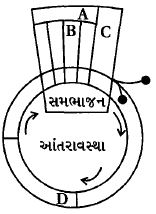
A
$C$ - Cytokinesis
B
$D$ - Synthesis phase ($S$-phase)
C
$A$ - Karyokinesis
D
$B$ - Mitosis phase ($M$-phase)
Solution
(B) The cell cycle consists of two main phases: Interphase and $M$-phase (Mitosis).
Interphase is divided into $G_1$,$S$,and $G_2$ phases.
In the provided diagram,$D$ represents the $S$-phase (Synthesis phase) where $DNA$ replication occurs.
The $M$-phase consists of Karyokinesis (nuclear division) and Cytokinesis (cytoplasmic division).
In the diagram,the $M$-phase is subdivided into $A$,$B$,and $C$. Based on standard cell cycle diagrams:
$A$ represents Cytokinesis,
$B$ represents Karyokinesis,
$C$ represents the overall Mitosis phase (or specific stages like Prophase/Metaphase/Anaphase/Telophase).
However,looking at the options provided,$D$ correctly corresponds to the $S$-phase (Synthesis phase) within the Interphase.
Interphase is divided into $G_1$,$S$,and $G_2$ phases.
In the provided diagram,$D$ represents the $S$-phase (Synthesis phase) where $DNA$ replication occurs.
The $M$-phase consists of Karyokinesis (nuclear division) and Cytokinesis (cytoplasmic division).
In the diagram,the $M$-phase is subdivided into $A$,$B$,and $C$. Based on standard cell cycle diagrams:
$A$ represents Cytokinesis,
$B$ represents Karyokinesis,
$C$ represents the overall Mitosis phase (or specific stages like Prophase/Metaphase/Anaphase/Telophase).
However,looking at the options provided,$D$ correctly corresponds to the $S$-phase (Synthesis phase) within the Interphase.
0 likesView Solution
Vedclass Products
For Students
Vedclass Test Series
Mock tests in real AIPMT style covering Biology with performance analysis. 5-day free trial.
Start Free TrialFor Teachers
Exam Paper Generator
Generate Set A/B/C/D Biology papers from 7.5L+ questions in 2 minutes. 3 chapters free.
Try FreeFor Institutes
Online Exam Module
Run live AIPMT mock exams with unlimited students, 360° analytics & white-label branding.
See DemoFrequently Asked Questions
How many Biology questions are in AIPMT 2009?
There are 115 Biology questions from the AIPMT 2009 paper on Vedclass, each with a detailed step-by-step solution in English.
Are AIPMT 2009 Biology solutions available in English?
Yes. All solutions on this page are in English. You can also switch to English or Hindi using the language buttons above the questions.
Can I practice AIPMT 2009 Biology as a timed test?
Yes. Use the Vedclass Test Series to attempt a full AIPMT mock test covering Biology with time limits and instant score analysis.
Can teachers create Biology papers from AIPMT previous year questions?
Yes. The Vedclass Exam Paper Generator lets teachers mix AIPMT Biology questions and generate Set A/B/C/D papers in minutes.
For Teachers & Institutes
Build a Custom Biology Paper
Pick AIPMT 2009 Biology questions, set difficulty, and generate Set A/B/C/D in 2 minutes.