
ChemistryQ1–80 of 98 questions
Page 1 of 2 · English
1
ChemistryMCQAIPMT · 2006
$A$ parallel plate air capacitor is charged to a potential difference of $V$. After disconnecting the battery,the distance between the plates of the capacitor is increased using an insulating handle. As a result,the potential difference between the plates:
A
Decreases
B
Increases
C
Becomes zero
D
Does not change
Solution
(B) The capacitance of a parallel plate capacitor is given by $C = \frac{\varepsilon_0 A}{d}$.
When the battery is disconnected,the charge $Q$ on the plates remains constant.
The potential difference $V$ across the plates is given by $V = \frac{Q}{C}$.
Substituting the expression for $C$,we get $V = \frac{Q d}{\varepsilon_0 A}$.
Since $Q$,$\varepsilon_0$,and $A$ are constant,we have $V \propto d$.
When the distance $d$ between the plates is increased,the potential difference $V$ increases.
When the battery is disconnected,the charge $Q$ on the plates remains constant.
The potential difference $V$ across the plates is given by $V = \frac{Q}{C}$.
Substituting the expression for $C$,we get $V = \frac{Q d}{\varepsilon_0 A}$.
Since $Q$,$\varepsilon_0$,and $A$ are constant,we have $V \propto d$.
When the distance $d$ between the plates is increased,the potential difference $V$ increases.
0 likesView Solution
2
ChemistryMCQAIPMT · 2006
The ionization potential of a hydrogen atom is $13.6 \ eV$. Hydrogen atoms in the ground state are excited by monochromatic radiation of photon energy $12.1 \ eV$. The number of spectral lines emitted by the hydrogen atoms according to Bohr's theory will be
A
$1$
B
$2$
C
$3$
D
$4$
Solution
(C) The energy of the electron in the ground state $(n=1)$ of a hydrogen atom is $E_1 = -13.6 \ eV$.
When the atom absorbs a photon of energy $12.1 \ eV$,the final energy of the electron becomes $E_f = E_1 + 12.1 \ eV = -13.6 \ eV + 12.1 \ eV = -1.51 \ eV$.
Using the formula $E_n = -\frac{13.6}{n^2} \ eV$,we find the excited state $n$:
$-1.51 = -\frac{13.6}{n^2} \implies n^2 = \frac{13.6}{1.51} \approx 9 \implies n = 3$.
The number of spectral lines emitted when an electron transitions from an excited state $n$ to lower energy states is given by the formula $N = \frac{n(n-1)}{2}$.
For $n=3$,the number of spectral lines is $N = \frac{3(3-1)}{2} = \frac{3 \times 2}{2} = 3$.
When the atom absorbs a photon of energy $12.1 \ eV$,the final energy of the electron becomes $E_f = E_1 + 12.1 \ eV = -13.6 \ eV + 12.1 \ eV = -1.51 \ eV$.
Using the formula $E_n = -\frac{13.6}{n^2} \ eV$,we find the excited state $n$:
$-1.51 = -\frac{13.6}{n^2} \implies n^2 = \frac{13.6}{1.51} \approx 9 \implies n = 3$.
The number of spectral lines emitted when an electron transitions from an excited state $n$ to lower energy states is given by the formula $N = \frac{n(n-1)}{2}$.
For $n=3$,the number of spectral lines is $N = \frac{3(3-1)}{2} = \frac{3 \times 2}{2} = 3$.
0 likesView Solution
3
ChemistryMCQAIPMT · 2006
Sertoli cells are regulated by the pituitary hormone known as:
A
$FSH$
B
$GH$
C
Prolactin
D
$LH$
Solution
(A) Sertoli cells are located in the seminiferous tubules of the testes.
They are regulated by the Follicle Stimulating Hormone $(FSH)$,which is secreted by the anterior pituitary gland.
$FSH$ acts on the Sertoli cells and stimulates the secretion of some factors which help in the process of spermiogenesis.
Therefore,the correct option is $A$.
They are regulated by the Follicle Stimulating Hormone $(FSH)$,which is secreted by the anterior pituitary gland.
$FSH$ acts on the Sertoli cells and stimulates the secretion of some factors which help in the process of spermiogenesis.
Therefore,the correct option is $A$.
0 likesView Solution
4
ChemistryMCQAIPMT · 2006
Which of the following amino acids was $NOT$ synthesized in Miller's experiment?
A
Glycine
B
Aspartic acid
C
Glutamic acid
D
Alanine
Solution
(C) In $1953$,Stanley Miller and Harold Urey conducted an experiment to simulate the conditions of the primitive Earth's atmosphere. They used a mixture of $CH_4$,$NH_3$,$H_2$,and water vapor in a closed flask and subjected it to electric discharges. The experiment resulted in the formation of simple organic compounds,including amino acids like glycine,alanine,and aspartic acid. Glutamic acid was not among the amino acids synthesized in this specific experiment.
0 likesView Solution
5
ChemistryMCQAIPMT · 2006
The evolutionary history of an organism is known as .......
A
Phylogeny
B
Ancestry
C
Paleontology
D
Ontogeny
Solution
(A) The evolutionary history and relationship of a species or group of organisms is called $Phylogeny$.
$Ontogeny$ refers to the developmental history of an individual organism.
$Paleontology$ is the study of fossils.
$Ancestry$ refers to the lineage or descent of an organism.
Therefore,the correct term for evolutionary history is $Phylogeny$.
$Ontogeny$ refers to the developmental history of an individual organism.
$Paleontology$ is the study of fossils.
$Ancestry$ refers to the lineage or descent of an organism.
Therefore,the correct term for evolutionary history is $Phylogeny$.
0 likesView Solution
6
ChemistryMCQAIPMT · 2006
If a plant species has $8$ chromosomes in its synergid cells,how many chromosomes will be present in its endosperm?
A
$16$
B
$24$
C
$32$
D
$8$
Solution
(B) In angiosperms,the synergid cells are haploid $(n)$.
Given that the number of chromosomes in the synergid cell is $n = 8$.
The endosperm in angiosperms is formed by the fusion of two polar nuclei and one male gamete,resulting in a triploid $(3n)$ structure.
Therefore,the number of chromosomes in the endosperm = $3 \times n = 3 \times 8 = 24$.
Given that the number of chromosomes in the synergid cell is $n = 8$.
The endosperm in angiosperms is formed by the fusion of two polar nuclei and one male gamete,resulting in a triploid $(3n)$ structure.
Therefore,the number of chromosomes in the endosperm = $3 \times n = 3 \times 8 = 24$.
0 likesView Solution
7
ChemistryMCQAIPMT · 2006
$1.00 \ g$ of a non-electrolyte solute (molar mass $250 \ g \ mol^{-1}$) is dissolved in $51.2 \ g$ of benzene. If the freezing point depression constant of benzene is $5.12 \ K \ kg \ mol^{-1}$,then the freezing point of benzene decreases by ...... $K$.
A
$0.4$
B
$0.3$
C
$0.5$
D
$0.2$
Solution
(A) The formula for freezing point depression is $\Delta T_f = K_f \times m$,where $m$ is the molality of the solution.
Molality $m = \frac{W_1 \times 1000}{M_1 \times W_2}$,where $W_1$ is the mass of solute,$M_1$ is the molar mass of solute,and $W_2$ is the mass of solvent in grams.
Given: $W_1 = 1.00 \ g$,$M_1 = 250 \ g \ mol^{-1}$,$W_2 = 51.2 \ g$,and $K_f = 5.12 \ K \ kg \ mol^{-1}$.
Substituting the values: $\Delta T_f = 5.12 \times \frac{1.00 \times 1000}{250 \times 51.2}$.
$\Delta T_f = 5.12 \times \frac{1000}{12800} = 5.12 \times 0.078125 = 0.4 \ K$.
Molality $m = \frac{W_1 \times 1000}{M_1 \times W_2}$,where $W_1$ is the mass of solute,$M_1$ is the molar mass of solute,and $W_2$ is the mass of solvent in grams.
Given: $W_1 = 1.00 \ g$,$M_1 = 250 \ g \ mol^{-1}$,$W_2 = 51.2 \ g$,and $K_f = 5.12 \ K \ kg \ mol^{-1}$.
Substituting the values: $\Delta T_f = 5.12 \times \frac{1.00 \times 1000}{250 \times 51.2}$.
$\Delta T_f = 5.12 \times \frac{1000}{12800} = 5.12 \times 0.078125 = 0.4 \ K$.
0 likesView Solution
8
ChemistryMCQAIPMT · 2006
Two circular coils $1$ and $2$ are made from the same wire,but the radius of the $1^{st}$ coil is twice that of the $2^{nd}$ coil. What is the ratio of potential difference in volts that should be applied across them so that the magnetic field at their centres is the same?
A
$2$
B
$3$
C
$4$
D
$6$
Solution
(C) Let $r_{1}$ and $r_{2}$ be the radii of coil $1$ and $2$ respectively. Given $r_{1} = 2r_{2}$.
The magnetic field at the center of a circular coil is given by $B = \frac{\mu_{0} I}{2r}$.
For the fields to be equal,$B_{1} = B_{2} \implies \frac{\mu_{0} I_{1}}{2r_{1}} = \frac{\mu_{0} I_{2}}{2r_{2}}$.
Substituting $r_{1} = 2r_{2}$,we get $\frac{I_{1}}{2r_{2}} = \frac{I_{2}}{r_{2}}$,which simplifies to $I_{1} = 2I_{2}$.
The resistance of a wire is proportional to its length,$R \propto L = 2\pi r$. Since both coils are made of the same wire,$R_{1} = 2R_{2}$.
The potential difference is $V = IR$. Therefore,the ratio of potential differences is $\frac{V_{1}}{V_{2}} = \frac{I_{1} R_{1}}{I_{2} R_{2}}$.
Substituting the values,$\frac{V_{1}}{V_{2}} = \frac{(2I_{2})(2R_{2})}{I_{2} R_{2}} = 4$.
The magnetic field at the center of a circular coil is given by $B = \frac{\mu_{0} I}{2r}$.
For the fields to be equal,$B_{1} = B_{2} \implies \frac{\mu_{0} I_{1}}{2r_{1}} = \frac{\mu_{0} I_{2}}{2r_{2}}$.
Substituting $r_{1} = 2r_{2}$,we get $\frac{I_{1}}{2r_{2}} = \frac{I_{2}}{r_{2}}$,which simplifies to $I_{1} = 2I_{2}$.
The resistance of a wire is proportional to its length,$R \propto L = 2\pi r$. Since both coils are made of the same wire,$R_{1} = 2R_{2}$.
The potential difference is $V = IR$. Therefore,the ratio of potential differences is $\frac{V_{1}}{V_{2}} = \frac{I_{1} R_{1}}{I_{2} R_{2}}$.
Substituting the values,$\frac{V_{1}}{V_{2}} = \frac{(2I_{2})(2R_{2})}{I_{2} R_{2}} = 4$.
0 likesView Solution
9
ChemistryMCQAIPMT · 2006
The radius of germanium $(Ge)$ nuclide is measured to be twice the radius of ${}_4^9Be$. The number of nucleons in $Ge$ are
A
$72$
B
$73$
C
$74$
D
$75$
Solution
(A) The radius of a nucleus is given by the formula $R = R_0 A^{1/3}$,where $R_0$ is a constant and $A$ is the mass number (number of nucleons).
Given that the radius of $Ge$ is twice the radius of ${}_4^9Be$,we have:
$R_{Ge} = 2 R_{Be}$
Using the formula $R \propto A^{1/3}$:
$\frac{R_{Ge}}{R_{Be}} = \left( \frac{A_{Ge}}{A_{Be}} \right)^{1/3}$
Substituting the given values:
$2 = \left( \frac{A_{Ge}}{9} \right)^{1/3}$
Cubing both sides:
$2^3 = \frac{A_{Ge}}{9}$
$8 = \frac{A_{Ge}}{9}$
$A_{Ge} = 8 \times 9 = 72$
Therefore,the number of nucleons in $Ge$ is $72$.
Given that the radius of $Ge$ is twice the radius of ${}_4^9Be$,we have:
$R_{Ge} = 2 R_{Be}$
Using the formula $R \propto A^{1/3}$:
$\frac{R_{Ge}}{R_{Be}} = \left( \frac{A_{Ge}}{A_{Be}} \right)^{1/3}$
Substituting the given values:
$2 = \left( \frac{A_{Ge}}{9} \right)^{1/3}$
Cubing both sides:
$2^3 = \frac{A_{Ge}}{9}$
$8 = \frac{A_{Ge}}{9}$
$A_{Ge} = 8 \times 9 = 72$
Therefore,the number of nucleons in $Ge$ is $72$.
0 likesView Solution
10
ChemistryMCQAIPMT · 2006
The formula for exponential population growth is
A
$dN/dt = rN$
B
$dt/dN = rN$
C
$dN/rN = dt$
D
$rN/dN = dt$
Solution
(A) The correct formula for exponential population growth is $dN/dt = rN$.
In this equation:
$N$ represents the population size.
$t$ represents time.
$r$ represents the intrinsic rate of natural increase.
$dN/dt$ represents the rate of change in population size over time.
When resources are unlimited,populations tend to grow exponentially,which is described by this differential equation.
In this equation:
$N$ represents the population size.
$t$ represents time.
$r$ represents the intrinsic rate of natural increase.
$dN/dt$ represents the rate of change in population size over time.
When resources are unlimited,populations tend to grow exponentially,which is described by this differential equation.
0 likesView Solution
11
ChemistryMCQAIPMT · 2006
$HIV$,which causes $AIDS$,first starts destroying:
A
helper $T$-lymphocytes
B
$B$-lymphocytes
C
leucocytes
D
thrombocytes
Solution
(A) $AIDS$ (Acquired Immuno Deficiency Syndrome) is a syndrome caused by the retrovirus $HIV$ (Human Immunodeficiency Virus).
Upon entering the body,the virus targets and destroys a specific subgroup of white blood cells known as helper $T$-cells (also called $CD4$ lymphocytes).
These cells are crucial for coordinating the immune response; their destruction leads to a severe suppression of the body's immune system,making the individual susceptible to opportunistic infections.
$HIV$ is transmitted through infected blood,semen,and vaginal fluids.
While antiviral therapy can delay the progression of the disease,it cannot completely cure $AIDS$.
Upon entering the body,the virus targets and destroys a specific subgroup of white blood cells known as helper $T$-cells (also called $CD4$ lymphocytes).
These cells are crucial for coordinating the immune response; their destruction leads to a severe suppression of the body's immune system,making the individual susceptible to opportunistic infections.
$HIV$ is transmitted through infected blood,semen,and vaginal fluids.
While antiviral therapy can delay the progression of the disease,it cannot completely cure $AIDS$.
0 likesView Solution
12
ChemistryMCQAIPMT · 2006
In maize,hybrid vigour is exploited by
A
inducing mutations
B
bombarding the protoplast with $DNA$
C
crossing of two inbred parental lines
D
harvesting seeds from the most productive plants
Solution
(C) : Hybridisation,heterosis,or hybrid vigour is defined as the superiority of the hybrid over the parents. It has been commercially exploited in different commercial crops like maize,sorghum,bajra,etc. The main steps include: selection of parents,selfing of parents,emasculation,bagging,crossing of desired and selected parents,and finally seed setting and harvesting.
0 likesView Solution
13
ChemistryMCQAIPMT · 2006
Which of the following is considered a hotspot of biodiversity in India?
A
Aravalli hills
B
Western Ghats
C
Indo-Gangetic plain
D
Eastern Ghats
Solution
(B) : Hotspots are areas with high density of biodiversity or megadiversity which are also the most threatened ones.
Ecologically,hotspots are determined by four factors: number of species/species diversity,degree of endemism,degree of threat to habitat due to its degradation and fragmentation,and degree of exploitation.
India has three biodiversity hotspots: Indo-Burma,Himalayas,and Western Ghats & Sri Lanka.
India is a country of megadiversity with $2.4\%$ of the global land area and $8.1\%$ of the global species diversity.
Major centers of biodiversity within the Western Ghats include Agasthyamalai hills,Silent Valley,and Amambalam reserve.
There is a high degree of endemism as well as richness of species of flowering plants,amphibians,reptiles,some mammals,and butterflies.
Ecologically,hotspots are determined by four factors: number of species/species diversity,degree of endemism,degree of threat to habitat due to its degradation and fragmentation,and degree of exploitation.
India has three biodiversity hotspots: Indo-Burma,Himalayas,and Western Ghats & Sri Lanka.
India is a country of megadiversity with $2.4\%$ of the global land area and $8.1\%$ of the global species diversity.
Major centers of biodiversity within the Western Ghats include Agasthyamalai hills,Silent Valley,and Amambalam reserve.
There is a high degree of endemism as well as richness of species of flowering plants,amphibians,reptiles,some mammals,and butterflies.
0 likesView Solution
14
ChemistryMediumMCQAIPMT · 2006
The orientation of an atomic orbital is governed by
A
principal quantum number
B
azimuthal quantum number
C
spin quantum number
D
magnetic quantum number
Solution
(D) The magnetic quantum number is denoted by $m_l$.
It provides information about the spatial orientation of the orbital with respect to the standard set of coordinate axes.
Explanation for incorrect options:
- The azimuthal quantum number $(l)$ determines the shape of the orbital.
- The spin quantum number $(m_s)$ denotes the orientation of the spin of the electron.
- The principal quantum number $(n)$ determines the size and,to a large extent,the energy of the orbital.
Therefore,options $(A)$,$(B)$,and $(C)$ are incorrect.
Hence,option $(D)$ is correct.
It provides information about the spatial orientation of the orbital with respect to the standard set of coordinate axes.
Explanation for incorrect options:
- The azimuthal quantum number $(l)$ determines the shape of the orbital.
- The spin quantum number $(m_s)$ denotes the orientation of the spin of the electron.
- The principal quantum number $(n)$ determines the size and,to a large extent,the energy of the orbital.
Therefore,options $(A)$,$(B)$,and $(C)$ are incorrect.
Hence,option $(D)$ is correct.
0 likesView Solution
15
ChemistryAdvancedMCQAIPMT · 2006
The mass of an electron is $9.11 \times 10^{-31} \ kg$,and the Planck constant is $6.626 \times 10^{-34} \ J \ s$. The uncertainty involved in the measurement of velocity within a distance of $0.1 \ \mathring{A}$ is:
A
$5.79 \times 10^5 \ m \ s^{-1}$
B
$5.79 \times 10^6 \ m \ s^{-1}$
C
$5.79 \times 10^7 \ m \ s^{-1}$
D
$5.79 \times 10^8 \ m \ s^{-1}$
Solution
(B) According to Heisenberg's uncertainty principle:
$\Delta x \cdot \Delta p \geq \frac{h}{4 \pi}$
Since $\Delta p = m \cdot \Delta v$,the formula becomes:
$\Delta x \cdot m \cdot \Delta v \geq \frac{h}{4 \pi}$
$\Delta v \geq \frac{h}{4 \pi \cdot m \cdot \Delta x}$
Given:
$\Delta x = 0.1 \ \mathring{A} = 0.1 \times 10^{-10} \ m = 10^{-11} \ m$
$m = 9.11 \times 10^{-31} \ kg$
$h = 6.626 \times 10^{-34} \ J \ s$
$\pi = 3.14$
Substituting the values:
$\Delta v = \frac{6.626 \times 10^{-34}}{4 \times 3.14 \times 9.11 \times 10^{-31} \times 10^{-11}}$
$\Delta v = \frac{6.626 \times 10^{-34}}{114.46 \times 10^{-42}}$
$\Delta v \approx 0.05789 \times 10^8 \ m \ s^{-1} = 5.79 \times 10^6 \ m \ s^{-1}$
$\Delta x \cdot \Delta p \geq \frac{h}{4 \pi}$
Since $\Delta p = m \cdot \Delta v$,the formula becomes:
$\Delta x \cdot m \cdot \Delta v \geq \frac{h}{4 \pi}$
$\Delta v \geq \frac{h}{4 \pi \cdot m \cdot \Delta x}$
Given:
$\Delta x = 0.1 \ \mathring{A} = 0.1 \times 10^{-10} \ m = 10^{-11} \ m$
$m = 9.11 \times 10^{-31} \ kg$
$h = 6.626 \times 10^{-34} \ J \ s$
$\pi = 3.14$
Substituting the values:
$\Delta v = \frac{6.626 \times 10^{-34}}{4 \times 3.14 \times 9.11 \times 10^{-31} \times 10^{-11}}$
$\Delta v = \frac{6.626 \times 10^{-34}}{114.46 \times 10^{-42}}$
$\Delta v \approx 0.05789 \times 10^8 \ m \ s^{-1} = 5.79 \times 10^6 \ m \ s^{-1}$
0 likesView Solution
16
ChemistryMCQAIPMT · 2006
Which one of the following orders is not in accordance with the property stated against it?
A
$F_2 > Cl_2 > Br_2 > I_2$ : Bond dissociation energy
B
$F_2 > Cl_2 > Br_2 > I_2$ : Oxidising power
C
$HI > HBr > HCl > HF$ : Acidic property in water
D
$F_2 > Cl_2 > Br_2 > I_2$ : Electronegativity
Solution
(A) The correct order of bond dissociation energy for halogens is $Cl_2 > Br_2 > F_2 > I_2$.
The given order $F_2 > Cl_2 > Br_2 > I_2$ is incorrect because the $F-F$ bond is weaker than the $Cl-Cl$ bond due to the small size of the $F$ atom,which causes significant inter-electronic repulsion between the lone pairs of the two fluorine atoms.
The given order $F_2 > Cl_2 > Br_2 > I_2$ is incorrect because the $F-F$ bond is weaker than the $Cl-Cl$ bond due to the small size of the $F$ atom,which causes significant inter-electronic repulsion between the lone pairs of the two fluorine atoms.
0 likesView Solution
17
ChemistryMediumMCQAIPMT · 2006
Which of the following is not a correct statement?
A
Multiple bonds are always shorter than corresponding single bonds.
B
The electron-deficient molecules can act as Lewis acids.
C
The canonical structures have no real existence.
D
Every $AB_5$ molecule does in fact have square pyramid structure.
Solution
(D) Generally,$AB_5$ molecules have a trigonal bipyramidal structure due to $sp^3d$ hybridization.
For example,$PCl_5$ has a trigonal bipyramidal geometry.
Therefore,the statement that every $AB_5$ molecule has a square pyramidal structure is incorrect.
For example,$PCl_5$ has a trigonal bipyramidal geometry.
Therefore,the statement that every $AB_5$ molecule has a square pyramidal structure is incorrect.
0 likesView Solution
18
ChemistryMediumMCQAIPMT · 2006
Which of the following species has a linear shape?
A
$O_3$
B
$NO_2^-$
C
$SO_2$
D
$NO_2^+$
Solution
(D) $NO_2^+$ has a linear shape due to $sp$ hybridization of the $N$ atom.
$O_3$,$NO_2^-$,and $SO_2$ all have an angular (bent) shape due to the presence of a lone pair on the central atom.
$O_3$,$NO_2^-$,and $SO_2$ all have an angular (bent) shape due to the presence of a lone pair on the central atom.
0 likesView Solution
19
ChemistryMediumMCQAIPMT · 2006
Which of the following is not isostructural with $SiCl_4$?
A
$NH_4^+$
B
$SCl_4$
C
$SO_4^{2-}$
D
$PO_4^{3-}$
Solution
(B) $SiCl_4$ has $sp^3$ hybridization and a tetrahedral geometry.
$NH_4^+$,$SO_4^{2-}$,and $PO_4^{3-}$ also exhibit $sp^3$ hybridization and a tetrahedral geometry,making them isostructural with $SiCl_4$.
$SCl_4$ has $sp^3d$ hybridization with one lone pair on the $S$ atom,resulting in a see-saw geometry.
Therefore,$SCl_4$ is not isostructural with $SiCl_4$.
$NH_4^+$,$SO_4^{2-}$,and $PO_4^{3-}$ also exhibit $sp^3$ hybridization and a tetrahedral geometry,making them isostructural with $SiCl_4$.
$SCl_4$ has $sp^3d$ hybridization with one lone pair on the $S$ atom,resulting in a see-saw geometry.
Therefore,$SCl_4$ is not isostructural with $SiCl_4$.
0 likesView Solution
20
ChemistryMediumMCQAIPMT · 2006
Identify the correct statement for the change in Gibbs energy for a system $(\Delta G_{system})$ at constant temperature and pressure.
A
If $\Delta G_{system} < 0,$ the process is not spontaneous.
B
If $\Delta G_{system} > 0,$ the process is spontaneous.
C
If $\Delta G_{system} = 0,$ the system has attained equilibrium.
D
If $\Delta G_{system} = 0,$ the system is still moving in a particular direction.
Solution
(C) For a process occurring at constant temperature and pressure:
$1$. If $\Delta G_{system} < 0,$ the process is spontaneous.
$2$. If $\Delta G_{system} > 0,$ the process is non-spontaneous.
$3$. If $\Delta G_{system} = 0,$ the system is in a state of equilibrium.
$1$. If $\Delta G_{system} < 0,$ the process is spontaneous.
$2$. If $\Delta G_{system} > 0,$ the process is non-spontaneous.
$3$. If $\Delta G_{system} = 0,$ the system is in a state of equilibrium.
0 likesView Solution
21
ChemistryMediumMCQAIPMT · 2006
Assume each reaction is carried out in an open container. For which reaction will $\Delta H = \Delta E$ ?
A
$2CO_{(g)} + O_{2_{(g)}} \rightarrow 2CO_{2_{(g)}}$
B
$H_{2_{(g)}} + Br_{2_{(g)}} \rightarrow 2HBr_{(g)}$
C
$C_{(s)} + 2H_{2}O_{(g)} \rightarrow 2H_{2_{(g)}} + CO_{2_{(g)}}$
D
$PCl_{5_{(g)}} \rightarrow PCl_{3_{(g)}} + Cl_{2_{(g)}}$
Solution
(B) The relationship between enthalpy change $(\Delta H)$ and internal energy change $(\Delta E)$ is given by the equation: $\Delta H = \Delta E + \Delta n_{g} RT$.
For $\Delta H = \Delta E$ to hold true,the change in the number of moles of gaseous species $(\Delta n_{g})$ must be $0$.
Calculating $\Delta n_{g}$ for option $B$: $H_{2_{(g)}} + Br_{2_{(g)}} \rightarrow 2HBr_{(g)}$.
$\Delta n_{g} = (\text{moles of gaseous products}) - (\text{moles of gaseous reactants}) = 2 - (1 + 1) = 0$.
Since $\Delta n_{g} = 0$,it follows that $\Delta H = \Delta E$.
For $\Delta H = \Delta E$ to hold true,the change in the number of moles of gaseous species $(\Delta n_{g})$ must be $0$.
Calculating $\Delta n_{g}$ for option $B$: $H_{2_{(g)}} + Br_{2_{(g)}} \rightarrow 2HBr_{(g)}$.
$\Delta n_{g} = (\text{moles of gaseous products}) - (\text{moles of gaseous reactants}) = 2 - (1 + 1) = 0$.
Since $\Delta n_{g} = 0$,it follows that $\Delta H = \Delta E$.
0 likesView Solution
22
ChemistryMediumMCQAIPMT · 2006
The enthalpy and entropy change for the reaction $Br_{2(l)} + Cl_{2(g)} \rightarrow 2BrCl_{(g)}$ are $30 \ kJ \ mol^{-1}$ and $105 \ J \ K^{-1} \ mol^{-1}$ respectively. The temperature at which the reaction will be in equilibrium is ............... $K$.
A
$300$
B
$285.7$
C
$273$
D
$450$
Solution
(B) For the reaction $Br_{2(l)} + Cl_{2(g)} \rightarrow 2BrCl_{(g)}$,we have:
$\Delta H = 30 \ kJ \ mol^{-1} = 30000 \ J \ mol^{-1}$
$\Delta S = 105 \ J \ K^{-1} \ mol^{-1}$
At equilibrium,the Gibbs free energy change $\Delta G$ is $0$.
Using the relation $\Delta G = \Delta H - T \Delta S$,we set $\Delta G = 0$:
$0 = \Delta H - T \Delta S$
$\Delta H = T \Delta S$
$T = \frac{\Delta H}{\Delta S} = \frac{30000 \ J \ mol^{-1}}{105 \ J \ K^{-1} \ mol^{-1}} \approx 285.7 \ K$.
$\Delta H = 30 \ kJ \ mol^{-1} = 30000 \ J \ mol^{-1}$
$\Delta S = 105 \ J \ K^{-1} \ mol^{-1}$
At equilibrium,the Gibbs free energy change $\Delta G$ is $0$.
Using the relation $\Delta G = \Delta H - T \Delta S$,we set $\Delta G = 0$:
$0 = \Delta H - T \Delta S$
$\Delta H = T \Delta S$
$T = \frac{\Delta H}{\Delta S} = \frac{30000 \ J \ mol^{-1}}{105 \ J \ K^{-1} \ mol^{-1}} \approx 285.7 \ K$.
0 likesView Solution
23
ChemistryDifficultMCQAIPMT · 2006
The enthalpy of hydrogenation of cyclohexene is $-119.5 \ kJ \ mol^{-1}.$ If resonance energy of benzene is $-150.4 \ kJ \ mol^{-1},$ its enthalpy of hydrogenation would be $...... \ kJ \ mol^{-1}.$
A
$-358.5$
B
$-508.9$
C
$-208.1$
D
$-269.9$
Solution
(B) The enthalpy of hydrogenation of cyclohexene is $-119.5 \ kJ \ mol^{-1},$ which corresponds to the hydrogenation of one $C=C$ double bond.
Benzene contains three $C=C$ double bonds. Therefore,the calculated enthalpy of hydrogenation for benzene (assuming no resonance) is:
$\Delta H_{Cal} = 3 \times (-119.5 \ kJ \ mol^{-1}) = -358.5 \ kJ \ mol^{-1}.$
Resonance energy is defined as the difference between the experimental enthalpy of hydrogenation and the calculated enthalpy of hydrogenation:
$\text{Resonance Energy} = \Delta H_{Exp} - \Delta H_{Cal}.$
Given that the resonance energy is $-150.4 \ kJ \ mol^{-1},$ we have:
$-150.4 = \Delta H_{Exp} - (-358.5).$
Solving for $\Delta H_{Exp}:$
$\Delta H_{Exp} = -150.4 - 358.5 = -508.9 \ kJ \ mol^{-1}.$
Benzene contains three $C=C$ double bonds. Therefore,the calculated enthalpy of hydrogenation for benzene (assuming no resonance) is:
$\Delta H_{Cal} = 3 \times (-119.5 \ kJ \ mol^{-1}) = -358.5 \ kJ \ mol^{-1}.$
Resonance energy is defined as the difference between the experimental enthalpy of hydrogenation and the calculated enthalpy of hydrogenation:
$\text{Resonance Energy} = \Delta H_{Exp} - \Delta H_{Cal}.$
Given that the resonance energy is $-150.4 \ kJ \ mol^{-1},$ we have:
$-150.4 = \Delta H_{Exp} - (-358.5).$
Solving for $\Delta H_{Exp}:$
$\Delta H_{Exp} = -150.4 - 358.5 = -508.9 \ kJ \ mol^{-1}.$
0 likesView Solution
24
ChemistryMediumMCQAIPMT · 2006
For the reaction $:$
$CH_{4(g)} + 2O_{2(g)} \rightleftharpoons CO_{2(g)} + 2H_2O_{(l)},$
$\Delta H_r = -170.8 \ kJ \ mol^{-1},$ which of the following statements is not true $?$
$CH_{4(g)} + 2O_{2(g)} \rightleftharpoons CO_{2(g)} + 2H_2O_{(l)},$
$\Delta H_r = -170.8 \ kJ \ mol^{-1},$ which of the following statements is not true $?$
A
The reaction is exothermic.
B
At equilibrium,the concentrations of $CO_{2(g)}$ and $H_2O_{(l)}$ are not equal.
C
The equilibrium constant for the reaction is given by $K_p = \frac{[CO_2]}{[CH_4][O_2]^2}$
D
Addition of $CH_{4(g)}$ or $O_{2(g)}$ at equilibrium will cause a shift to the right.
Solution
(C) The given reaction is $:$
$CH_{4(g)} + 2O_{2(g)} \rightleftharpoons CO_{2(g)} + 2H_2O_{(l)}$
The equilibrium constant expression for this reaction is $K_c = \frac{[CO_2]}{[CH_4][O_2]^2}$ because $H_2O$ is a pure liquid and its activity is taken as $1$.
Option $A$ is true because $\Delta H_r$ is negative,indicating an exothermic reaction.
Option $B$ is true because there is no requirement for the concentrations of products to be equal at equilibrium.
Option $C$ is incorrect because $K_p$ is defined in terms of partial pressures,not concentrations. The expression given is for $K_c$,and it is also missing the pressure terms for the gaseous species.
Option $D$ is true according to Le Chatelier's principle; adding reactants shifts the equilibrium to the right.
$CH_{4(g)} + 2O_{2(g)} \rightleftharpoons CO_{2(g)} + 2H_2O_{(l)}$
The equilibrium constant expression for this reaction is $K_c = \frac{[CO_2]}{[CH_4][O_2]^2}$ because $H_2O$ is a pure liquid and its activity is taken as $1$.
Option $A$ is true because $\Delta H_r$ is negative,indicating an exothermic reaction.
Option $B$ is true because there is no requirement for the concentrations of products to be equal at equilibrium.
Option $C$ is incorrect because $K_p$ is defined in terms of partial pressures,not concentrations. The expression given is for $K_c$,and it is also missing the pressure terms for the gaseous species.
Option $D$ is true according to Le Chatelier's principle; adding reactants shifts the equilibrium to the right.
0 likesView Solution
25
ChemistryMediumMCQAIPMT · 2006
Which of the following pairs constitutes a buffer?
A
$HCl$ and $KCl$
B
$HNO_2$ and $NaNO_2$
C
$NaOH$ and $NaCl$
D
$HNO_3$ and $NH_4NO_3$
Solution
(B) buffer solution is formed by a mixture of a weak acid and its conjugate base (salt with a strong base) or a weak base and its conjugate acid (salt with a strong acid).
$HNO_2$ is a weak acid and $NaNO_2$ is its salt with a strong base $(NaOH)$.
Therefore,the pair $HNO_2$ and $NaNO_2$ constitutes an acidic buffer solution.
$HNO_2$ is a weak acid and $NaNO_2$ is its salt with a strong base $(NaOH)$.
Therefore,the pair $HNO_2$ and $NaNO_2$ constitutes an acidic buffer solution.
0 likesView Solution
26
ChemistryMediumMCQAIPMT · 2006
The hydrogen ion concentration of a $10^{-8} \ M \ HCl$ aqueous solution at $298 \ K$ $(K_w = 10^{-14})$ is
A
$1.0 \times 10^{-8} \ M$
B
$1.0 \times 10^{-6} \ M$
C
$1.0525 \times 10^{-7} \ M$
D
$9.525 \times 10^{-8} \ M$
Solution
(C) In an aqueous solution of $10^{-8} \ M \ HCl$,the total $[H^{+}]$ is the sum of $[H^{+}]$ from $HCl$ and $[H^{+}]$ from the dissociation of water.
Let $[H^{+}] = x$.
From $HCl$,$[H^{+}] = 10^{-8} \ M$.
From water,$[H^{+}] = [OH^{-}] = x - 10^{-8} \ M$.
Using the ionic product of water,$K_w = [H^{+}][OH^{-}] = 10^{-14}$.
$x(x - 10^{-8}) = 10^{-14}$
$x^{2} - 10^{-8}x - 10^{-14} = 0$
Solving this quadratic equation using the quadratic formula $x = \frac{-b + \sqrt{b^{2} - 4ac}}{2a}$:
$x = \frac{10^{-8} + \sqrt{(10^{-8})^{2} - 4(1)(-10^{-14})}}{2}$
$x = \frac{10^{-8} + \sqrt{10^{-16} + 4 \times 10^{-14}}}{2}$
$x = \frac{10^{-8} + \sqrt{10^{-16} + 400 \times 10^{-16}}}{2}$
$x = \frac{10^{-8} + \sqrt{401 \times 10^{-16}}}{2}$
$x = \frac{10^{-8} + 20.025 \times 10^{-8}}{2}$
$x = \frac{21.025 \times 10^{-8}}{2} = 1.05125 \times 10^{-7} \ M \approx 1.0525 \times 10^{-7} \ M$.
Let $[H^{+}] = x$.
From $HCl$,$[H^{+}] = 10^{-8} \ M$.
From water,$[H^{+}] = [OH^{-}] = x - 10^{-8} \ M$.
Using the ionic product of water,$K_w = [H^{+}][OH^{-}] = 10^{-14}$.
$x(x - 10^{-8}) = 10^{-14}$
$x^{2} - 10^{-8}x - 10^{-14} = 0$
Solving this quadratic equation using the quadratic formula $x = \frac{-b + \sqrt{b^{2} - 4ac}}{2a}$:
$x = \frac{10^{-8} + \sqrt{(10^{-8})^{2} - 4(1)(-10^{-14})}}{2}$
$x = \frac{10^{-8} + \sqrt{10^{-16} + 4 \times 10^{-14}}}{2}$
$x = \frac{10^{-8} + \sqrt{10^{-16} + 400 \times 10^{-16}}}{2}$
$x = \frac{10^{-8} + \sqrt{401 \times 10^{-16}}}{2}$
$x = \frac{10^{-8} + 20.025 \times 10^{-8}}{2}$
$x = \frac{21.025 \times 10^{-8}}{2} = 1.05125 \times 10^{-7} \ M \approx 1.0525 \times 10^{-7} \ M$.
0 likesView Solution
27
ChemistryEasyMCQAIPMT · 2006
The correct order of the mobility of the alkali metal ions in aqueous solution is
A
$Rb^{+} > K^{+} > Na^{+} > Li^{+}$
B
$Li^{+} > Na^{+} > K^{+} > Rb^{+}$
C
$Na^{+} > K^{+} > Rb^{+} > Li^{+}$
D
$K^{+} > Rb^{+} > Na^{+} > Li^{+}$
Solution
(A) In an aqueous solution,alkali metal ions get hydrated. The extent of hydration depends on the size of the cation; smaller cations have higher charge density and thus higher hydration energy.
The order of hydration energy is $Li^{+} > Na^{+} > K^{+} > Rb^{+}$.
Due to higher hydration,the effective size of the hydrated $Li^{+}$ ion is the largest,which makes it move the slowest in an electric field.
Therefore,the mobility of the ions in an aqueous solution is inversely proportional to their hydrated size,resulting in the order: $Rb^{+} > K^{+} > Na^{+} > Li^{+}$.
The order of hydration energy is $Li^{+} > Na^{+} > K^{+} > Rb^{+}$.
Due to higher hydration,the effective size of the hydrated $Li^{+}$ ion is the largest,which makes it move the slowest in an electric field.
Therefore,the mobility of the ions in an aqueous solution is inversely proportional to their hydrated size,resulting in the order: $Rb^{+} > K^{+} > Na^{+} > Li^{+}$.
0 likesView Solution
28
ChemistryEasyMCQAIPMT · 2006
Which of the following is the most basic oxide?
A
$SeO_2$
B
$Al_2O_3$
C
$Sb_2O_3$
D
$Bi_2O_3$
Solution
(D) In the periodic table,the acidic nature of oxides increases from left to right across a period,while the basic character increases from top to bottom down a group.
$SeO_2$ is an acidic oxide (non-metal oxide).
$Al_2O_3$ is an amphoteric oxide.
$Sb_2O_3$ is amphoteric (with more basic character than $Al_2O_3$ due to its position in the group).
$Bi_2O_3$ is the most basic oxide among the given options because $Bi$ is the most metallic element in the group.
Therefore,the order of basic nature is $Bi_2O_3 > Sb_2O_3 > Al_2O_3 > SeO_2$.
$SeO_2$ is an acidic oxide (non-metal oxide).
$Al_2O_3$ is an amphoteric oxide.
$Sb_2O_3$ is amphoteric (with more basic character than $Al_2O_3$ due to its position in the group).
$Bi_2O_3$ is the most basic oxide among the given options because $Bi$ is the most metallic element in the group.
Therefore,the order of basic nature is $Bi_2O_3 > Sb_2O_3 > Al_2O_3 > SeO_2$.
0 likesView Solution
29
ChemistryMediumMCQAIPMT · 2006
The correct order regarding the electronegativity of hybrid orbitals of carbon is
A
$sp < sp^2 < sp^3$
B
$sp > sp^2 < sp^3$
C
$sp > sp^2 > sp^3$
D
$sp < sp^2 > sp^3$
Solution
(C) The electronegativity of hybrid orbitals depends on the $s$-character present in the orbital.
As the $s$-character increases,the electron-attracting tendency (electronegativity) increases.
The $s$-character in different hybrid orbitals is as follows:
$sp$: $50\%$
$sp^2$: $33.3\%$
$sp^3$: $25\%$
Therefore,the correct order of electronegativity is $sp > sp^2 > sp^3$.
As the $s$-character increases,the electron-attracting tendency (electronegativity) increases.
The $s$-character in different hybrid orbitals is as follows:
$sp$: $50\%$
$sp^2$: $33.3\%$
$sp^3$: $25\%$
Therefore,the correct order of electronegativity is $sp > sp^2 > sp^3$.
0 likesView Solution
30
ChemistryMediumMCQAIPMT · 2006
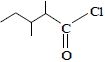
The $IUPAC$ name of the compound shown in the figure is:
A
$1-$chloro$-1-$oxo$-2,3-$dimethylpentane
B
$2-$ethyl$-3-$methylbutanoyl chloride
C
$2,3-$dimethylpentanoyl chloride
D
$3,4-$dimethylpentanoyl chloride
Solution
(C) $1$. Identify the principal functional group: The compound contains an acyl chloride group $(-COCl)$,which takes priority in numbering.
$2$. Select the longest carbon chain containing the functional group: The longest chain starting from the carbonyl carbon has $5$ carbons,making it a pentanoyl chloride derivative.
$3$. Number the chain: The carbonyl carbon of the $-COCl$ group is assigned position $1$.
$4$. Identify substituents: There are methyl groups at positions $2$ and $3$.
$5$. Combine the parts: The name is $2,3-$dimethylpentanoyl chloride.
$2$. Select the longest carbon chain containing the functional group: The longest chain starting from the carbonyl carbon has $5$ carbons,making it a pentanoyl chloride derivative.
$3$. Number the chain: The carbonyl carbon of the $-COCl$ group is assigned position $1$.
$4$. Identify substituents: There are methyl groups at positions $2$ and $3$.
$5$. Combine the parts: The name is $2,3-$dimethylpentanoyl chloride.
0 likesView Solution
31
ChemistryMCQAIPMT · 2006
$A$ solution containing $10 \ g$ per $dm^3$ of urea (molecular mass $= 60 \ g \ mol^{-1}$) is isotonic with a $5 \%$ solution of a non-volatile solute. The molecular mass of the non-volatile solute is ........ $g \ mol^{-1}$.
A
$200$
B
$250$
C
$300$
D
$350$
Solution
(C) For isotonic solutions,the osmotic pressures are equal,so $\pi_1 = \pi_2$.
Since the temperature is constant,the molar concentrations are equal: $C_1 = C_2$.
For urea: Concentration $C_1 = \frac{10 \ g}{60 \ g \ mol^{-1} \times 1 \ L} = \frac{1}{6} \ mol \ L^{-1}$.
For the non-volatile solute: $A$ $5 \%$ solution means $5 \ g$ of solute in $100 \ mL$ of solution,which is $50 \ g \ L^{-1}$.
So,$C_2 = \frac{50}{M_w} \ mol \ L^{-1}$,where $M_w$ is the molecular mass.
Equating the concentrations: $\frac{1}{6} = \frac{50}{M_w}$.
Solving for $M_w$: $M_w = 50 \times 6 = 300 \ g \ mol^{-1}$.
Since the temperature is constant,the molar concentrations are equal: $C_1 = C_2$.
For urea: Concentration $C_1 = \frac{10 \ g}{60 \ g \ mol^{-1} \times 1 \ L} = \frac{1}{6} \ mol \ L^{-1}$.
For the non-volatile solute: $A$ $5 \%$ solution means $5 \ g$ of solute in $100 \ mL$ of solution,which is $50 \ g \ L^{-1}$.
So,$C_2 = \frac{50}{M_w} \ mol \ L^{-1}$,where $M_w$ is the molecular mass.
Equating the concentrations: $\frac{1}{6} = \frac{50}{M_w}$.
Solving for $M_w$: $M_w = 50 \times 6 = 300 \ g \ mol^{-1}$.
0 likesView Solution
32
ChemistryDifficultMCQAIPMT · 2006
The electronegativity difference between $N$ and $F$ is greater than that between $N$ and $H$,yet the dipole moment of $NH_3$ $(1.5 \ D)$ is larger than that of $NF_3$ $(0.2 \ D)$. This is because
A
in $NH_3$ the atomic dipole and bond dipole are in the opposite directions whereas in $NF_3$ these are in the same direction
B
in $NH_3$ as well as in $NF_3$ the atomic dipole and bond dipole are in the same direction
C
in $NH_3$ the atomic dipole and bond dipole are in the same direction whereas in $NF_3$ these are in opposite directions
D
in $NH_3$ as well as in $NF_3$ the atomic dipole and bond dipole are in opposite directions.
Solution
(C) The electronegativity of $N$ $(3.04)$ is greater than that of $H$ $(2.20)$,so the bond dipoles $(N-H)$ and the lone pair dipole on $N$ point in the same direction,reinforcing each other.
In $NF_3$,the electronegativity of $F$ $(3.98)$ is greater than that of $N$ $(3.04)$,so the bond dipoles $(N-F)$ point away from $N$,which is opposite to the direction of the lone pair dipole on $N$. This causes the bond dipoles to partially cancel the lone pair dipole,resulting in a much smaller net dipole moment.
In $NF_3$,the electronegativity of $F$ $(3.98)$ is greater than that of $N$ $(3.04)$,so the bond dipoles $(N-F)$ point away from $N$,which is opposite to the direction of the lone pair dipole on $N$. This causes the bond dipoles to partially cancel the lone pair dipole,resulting in a much smaller net dipole moment.
0 likesView Solution
33
ChemistryMediumMCQAIPMT · 2006
In which of the following molecules are all the bonds not equal?
A
$NF_3$
B
$ClF_3$
C
$BF_3$
D
$AlF_3$
Solution
(B) $BF_3$ has a trigonal planar structure with $sp^2$ hybridization,where all $B-F$ bonds are equivalent.
$AlF_3$ is an ionic compound with a crystal lattice structure where all $Al-F$ bonds are equivalent.
$NF_3$ has a trigonal pyramidal geometry with $sp^3$ hybridization,where all $N-F$ bonds are equivalent.
$ClF_3$ has a $T$-shaped geometry due to $sp^3d$ hybridization with two lone pairs in the equatorial positions. This results in two different bond lengths (axial and equatorial),meaning all bonds are not equal.
Therefore,the correct option is $B$.
$AlF_3$ is an ionic compound with a crystal lattice structure where all $Al-F$ bonds are equivalent.
$NF_3$ has a trigonal pyramidal geometry with $sp^3$ hybridization,where all $N-F$ bonds are equivalent.
$ClF_3$ has a $T$-shaped geometry due to $sp^3d$ hybridization with two lone pairs in the equatorial positions. This results in two different bond lengths (axial and equatorial),meaning all bonds are not equal.
Therefore,the correct option is $B$.
0 likesView Solution
34
ChemistryMediumMCQAIPMT · 2006
Which of the following is not chiral?
A
$2-$Hydroxypropanoic acid
B
$2-$Butanol
C
$2,3-$Dibromopentane
D
$3-$Bromopentane
Solution
(D) molecule is chiral if it contains at least one chiral carbon atom,which is a carbon atom bonded to four different groups.
$1$. $2-$Hydroxypropanoic acid: $CH_3-CH(OH)-COOH$. The $C-2$ atom is bonded to $-H$,$-OH$,$-CH_3$,and $-COOH$. It is chiral.
$2$. $2-$Butanol: $CH_3-CH(OH)-CH_2-CH_3$. The $C-2$ atom is bonded to $-H$,$-OH$,$-CH_3$,and $-CH_2CH_3$. It is chiral.
$3$. $2,3-$Dibromopentane: $CH_3-CH(Br)-CH(Br)-CH_2-CH_3$. Both $C-2$ and $C-3$ are bonded to four different groups. It is chiral.
$4$. $3-$Bromopentane: $CH_3-CH_2-CH(Br)-CH_2-CH_3$. The $C-3$ atom is bonded to $-H$,$-Br$,and two identical $-CH_2CH_3$ groups. Since it is bonded to two identical groups,it is achiral.
Therefore,$3-$Bromopentane is not chiral.
$1$. $2-$Hydroxypropanoic acid: $CH_3-CH(OH)-COOH$. The $C-2$ atom is bonded to $-H$,$-OH$,$-CH_3$,and $-COOH$. It is chiral.
$2$. $2-$Butanol: $CH_3-CH(OH)-CH_2-CH_3$. The $C-2$ atom is bonded to $-H$,$-OH$,$-CH_3$,and $-CH_2CH_3$. It is chiral.
$3$. $2,3-$Dibromopentane: $CH_3-CH(Br)-CH(Br)-CH_2-CH_3$. Both $C-2$ and $C-3$ are bonded to four different groups. It is chiral.
$4$. $3-$Bromopentane: $CH_3-CH_2-CH(Br)-CH_2-CH_3$. The $C-3$ atom is bonded to $-H$,$-Br$,and two identical $-CH_2CH_3$ groups. Since it is bonded to two identical groups,it is achiral.
Therefore,$3-$Bromopentane is not chiral.
0 likesView Solution
35
ChemistryMCQAIPMT · 2006
The human body does not produce
A
enzymes
B
$DNA$
C
vitamins
D
hormones
Solution
(C) Organic compounds,other than carbohydrates and proteins,which are required for normal growth and nutrition in the human body but are not synthesized by the human body are called vitamins. They must be supplied through the diet.
0 likesView Solution
36
ChemistryMCQAIPMT · 2006
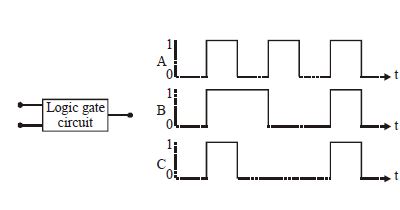
The following figure shows a logic gate circuit with two inputs $A$ and $B$ and an output $C$. The voltage waveforms of $A$,$B$,and $C$ are as shown in the figure. The logic gate is:
A
$OR$ gate
B
$AND$ gate
C
$NAND$ gate
D
$NOR$ gate
Solution
(B) By observing the given waveforms:
At $t_1$,$A=0, B=0 \implies C=0$.
At $t_2$,$A=1, B=1 \implies C=1$.
At $t_3$,$A=0, B=1 \implies C=0$.
At $t_4$,$A=1, B=0 \implies C=0$.
This behavior corresponds to the truth table of an $AND$ gate,where the output is $1$ only when both inputs are $1$.
At $t_1$,$A=0, B=0 \implies C=0$.
At $t_2$,$A=1, B=1 \implies C=1$.
At $t_3$,$A=0, B=1 \implies C=0$.
At $t_4$,$A=1, B=0 \implies C=0$.
This behavior corresponds to the truth table of an $AND$ gate,where the output is $1$ only when both inputs are $1$.
| $A$ | $B$ | $C$ |
| $0$ | $0$ | $0$ |
| $0$ | $1$ | $0$ |
| $1$ | $0$ | $0$ |
| $1$ | $1$ | $1$ |
0 likesView Solution
37
ChemistryMCQAIPMT · 2006
Which one of the following is not a second messenger in hormone action?
A
Calcium
B
Sodium
C
$cAMP$
D
$IP_3$
Solution
(B) In the mechanism of hormone action,hormones that cannot enter the target cell (like peptide or protein hormones) bind to specific receptors on the cell membrane. This binding triggers the production of intracellular molecules known as second messengers,which regulate cellular metabolism. Common second messengers include $cAMP$,$IP_3$ (Inositol triphosphate),and $Ca^{2+}$ (Calcium ions). Sodium $(Na^+)$ ions are involved in membrane potential and nerve impulse conduction but do not function as second messengers in hormone signaling pathways.
0 likesView Solution
38
ChemistryMCQAIPMT · 2006
Bowman's glands are located in the .......
A
Anterior pituitary gland
B
Female reproductive system of cockroach
C
Olfactory epithelium of our nose
D
Proximal end of uriniferous tubules
Solution
(C) Bowman's glands (also known as olfactory glands) are specialized glands located in the olfactory epithelium of the nasal cavity.
These glands secrete mucus,which helps in dissolving odorants,thereby facilitating the sense of smell (olfaction).
Therefore,the correct option is $C$.
These glands secrete mucus,which helps in dissolving odorants,thereby facilitating the sense of smell (olfaction).
Therefore,the correct option is $C$.
0 likesView Solution
39
ChemistryMCQAIPMT · 2006
Which of the following amino acids was not synthesized in Miller's experiment?
A
Aspartic acid
B
Glutamic acid
C
Alanine
D
Glycine
Solution
(B) In $1953$, Stanley Miller and Harold Urey conducted an experiment to simulate the conditions of the primitive Earth's atmosphere. They used a mixture of $CH_4$, $NH_3$, $H_2$, and water vapor in a closed flask and subjected it to electric discharges. The experiment resulted in the formation of several organic compounds, including amino acids like $Glycine$, $Alanine$, and $Aspartic$ acid. $Glutamic$ acid was not among the amino acids synthesized in this specific experiment.
0 likesView Solution
40
ChemistryMCQAIPMT · 2006
Which of the following is more basic than aniline?
A
$p$-Nitroaniline
B
Benzyl amine
C
Diphenyl amine
D
Triphenyl amine
Solution
(B) Benzyl amine,$C_6H_5CH_2NH_2$,is more basic than aniline because the $C_6H_5CH_2-$ group is an electron-donating group due to the $+I$ effect.
This increases the electron density on the nitrogen atom of the $-NH_2$ group.
Consequently,the availability of the lone pair of electrons for donation increases,making it more basic.
In contrast,phenyl and nitro groups are electron-withdrawing groups,which decrease the electron density on the nitrogen atom,making them less basic than aniline.
This increases the electron density on the nitrogen atom of the $-NH_2$ group.
Consequently,the availability of the lone pair of electrons for donation increases,making it more basic.
In contrast,phenyl and nitro groups are electron-withdrawing groups,which decrease the electron density on the nitrogen atom,making them less basic than aniline.
0 likesView Solution
41
ChemistryMCQAIPMT · 2006
$A$ uniform rod $AB$ of length $l$ and mass $m$ is free to rotate about point $A$. The rod is released from rest in the horizontal position. Given that the moment of inertia of the rod about $A$ is $\frac{ml^2}{3}$,the initial angular acceleration of the rod will be:
A
$\frac{3g}{2l}$
B
$\frac{2g}{3l}$
C
$g\frac{l}{2}$
D
$\frac{3}{2}gl$
Solution
(A) The torque $\tau$ acting on the rod about point $A$ is due to the weight of the rod acting at its center of mass,which is at a distance of $\frac{l}{2}$ from $A$.
$\tau = mg \left(\frac{l}{2}\right)$
Using the rotational form of Newton's second law,$\tau = I\alpha$,where $I$ is the moment of inertia about $A$ and $\alpha$ is the angular acceleration.
Given $I = \frac{ml^2}{3}$,we have:
$mg \left(\frac{l}{2}\right) = \left(\frac{ml^2}{3}\right) \alpha$
Solving for $\alpha$:
$\alpha = \frac{mg(l/2)}{ml^2/3} = \frac{mg l}{2} \cdot \frac{3}{ml^2} = \frac{3g}{2l}$
$\tau = mg \left(\frac{l}{2}\right)$
Using the rotational form of Newton's second law,$\tau = I\alpha$,where $I$ is the moment of inertia about $A$ and $\alpha$ is the angular acceleration.
Given $I = \frac{ml^2}{3}$,we have:
$mg \left(\frac{l}{2}\right) = \left(\frac{ml^2}{3}\right) \alpha$
Solving for $\alpha$:
$\alpha = \frac{mg(l/2)}{ml^2/3} = \frac{mg l}{2} \cdot \frac{3}{ml^2} = \frac{3g}{2l}$
0 likesView Solution
42
ChemistryMCQAIPMT · 2006
Assume each reaction is carried out in an open container. For which reaction will $\Delta H = \Delta E$?
A
$H_{2(g)} + Br_{2(g)} \to 2HBr_{(g)}$
B
$C_{(s)} + 2H_2O_{(g)} \to 2H_{2(g)} + CO_{2(g)}$
C
$PCl_{5(g)} \to PCl_{3(g)} + Cl_{2(g)}$
D
$2CO_{(g)} + O_{2(g)} \to 2CO_{2(g)}$
Solution
(A) The relationship between enthalpy change $(\Delta H)$ and internal energy change ($\Delta E$ or $\Delta U$) is given by the equation: $\Delta H = \Delta E + \Delta n_g RT$.
Here,$\Delta n_g$ is the change in the number of moles of gaseous species,calculated as: $\Delta n_g = \sum n_g(\text{products}) - \sum n_g(\text{reactants})$.
For $\Delta H = \Delta E$,the term $\Delta n_g RT$ must be equal to $0$,which implies $\Delta n_g = 0$.
Evaluating the options:
$A$: $H_{2(g)} + Br_{2(g)} \to 2HBr_{(g)}$,$\Delta n_g = 2 - (1 + 1) = 0$.
$B$: $C_{(s)} + 2H_2O_{(g)} \to 2H_{2(g)} + CO_{2(g)}$,$\Delta n_g = (2 + 1) - 2 = 1$.
$C$: $PCl_{5(g)} \to PCl_{3(g)} + Cl_{2(g)}$,$\Delta n_g = (1 + 1) - 1 = 1$.
$D$: $2CO_{(g)} + O_{2(g)} \to 2CO_{2(g)}$,$\Delta n_g = 2 - (2 + 1) = -1$.
Thus,the condition $\Delta H = \Delta E$ is satisfied for reaction $A$.
Here,$\Delta n_g$ is the change in the number of moles of gaseous species,calculated as: $\Delta n_g = \sum n_g(\text{products}) - \sum n_g(\text{reactants})$.
For $\Delta H = \Delta E$,the term $\Delta n_g RT$ must be equal to $0$,which implies $\Delta n_g = 0$.
Evaluating the options:
$A$: $H_{2(g)} + Br_{2(g)} \to 2HBr_{(g)}$,$\Delta n_g = 2 - (1 + 1) = 0$.
$B$: $C_{(s)} + 2H_2O_{(g)} \to 2H_{2(g)} + CO_{2(g)}$,$\Delta n_g = (2 + 1) - 2 = 1$.
$C$: $PCl_{5(g)} \to PCl_{3(g)} + Cl_{2(g)}$,$\Delta n_g = (1 + 1) - 1 = 1$.
$D$: $2CO_{(g)} + O_{2(g)} \to 2CO_{2(g)}$,$\Delta n_g = 2 - (2 + 1) = -1$.
Thus,the condition $\Delta H = \Delta E$ is satisfied for reaction $A$.
0 likesView Solution
43
ChemistryMCQAIPMT · 2006
The binding energy of deuteron is $2.2 \, MeV$ and that of ${}_2^4He$ is $28 \, MeV$. If two deuterons are fused to form one ${}_2^4He$ nucleus,then the energy released is ......... $MeV$.
A
$25.8$
B
$23.6$
C
$19.2$
D
$30.2$
Solution
(B) The nuclear fusion reaction is given by: ${}_1^2H + {}_1^2H \rightarrow {}_2^4He + Q$.
Binding energy of one deuteron is $2.2 \, MeV$. Therefore,the total binding energy of two deuterons is $2 \times 2.2 \, MeV = 4.4 \, MeV$.
The binding energy of one ${}_2^4He$ nucleus is $28 \, MeV$.
The energy released $(Q)$ in the fusion process is equal to the difference between the binding energy of the product nucleus and the total binding energy of the reactant nuclei.
$Q = BE({}_2^4He) - 2 \times BE({}_1^2H)$
$Q = 28 \, MeV - 4.4 \, MeV = 23.6 \, MeV$.
Binding energy of one deuteron is $2.2 \, MeV$. Therefore,the total binding energy of two deuterons is $2 \times 2.2 \, MeV = 4.4 \, MeV$.
The binding energy of one ${}_2^4He$ nucleus is $28 \, MeV$.
The energy released $(Q)$ in the fusion process is equal to the difference between the binding energy of the product nucleus and the total binding energy of the reactant nuclei.
$Q = BE({}_2^4He) - 2 \times BE({}_1^2H)$
$Q = 28 \, MeV - 4.4 \, MeV = 23.6 \, MeV$.
0 likesView Solution
44
ChemistryMCQAIPMT · 2006
Copper sulphate dissolves in excess of $KCN$ to give
A
$CuCN$
B
$[Cu(CN)_4]^{3-}$
C
$[Cu(CN)_4]^{2-}$
D
$Cu(CN)_2$
Solution
(B) When $CuSO_4$ reacts with $KCN$,initially $Cu(CN)_2$ is formed,which is unstable and decomposes to form $CuCN$ and $(CN)_2$ gas.
$2Cu^{2+} + 4CN^- \longrightarrow 2CuCN + (CN)_2$
In the presence of excess $KCN$,$CuCN$ reacts to form a stable complex:
$CuCN + 3KCN \longrightarrow K_3[Cu(CN)_4]$
Thus,the final product is $[Cu(CN)_4]^{3-}$.
$2Cu^{2+} + 4CN^- \longrightarrow 2CuCN + (CN)_2$
In the presence of excess $KCN$,$CuCN$ reacts to form a stable complex:
$CuCN + 3KCN \longrightarrow K_3[Cu(CN)_4]$
Thus,the final product is $[Cu(CN)_4]^{3-}$.
0 likesView Solution
45
ChemistryMCQAIPMT · 2006
Which of the following is the most basic oxide?
A
$Sb_2O_3$
B
$Bi_2O_3$
C
$SeO_2$
D
$Al_2O_3$
Solution
(B) The basic character of oxides increases as the metallic character of the central atom increases down a group.
$SeO_2$ is an acidic oxide because $Se$ is a non-metal.
$Al_2O_3$ is amphoteric.
Between $Sb_2O_3$ and $Bi_2O_3$,both are oxides of Group $15$ elements.
As we move down the group from $Sb$ to $Bi$,the metallic character increases,which leads to an increase in the basic nature of the oxides.
Therefore,$Bi_2O_3$ is the most basic oxide among the given options.
$SeO_2$ is an acidic oxide because $Se$ is a non-metal.
$Al_2O_3$ is amphoteric.
Between $Sb_2O_3$ and $Bi_2O_3$,both are oxides of Group $15$ elements.
As we move down the group from $Sb$ to $Bi$,the metallic character increases,which leads to an increase in the basic nature of the oxides.
Therefore,$Bi_2O_3$ is the most basic oxide among the given options.
0 likesView Solution
46
ChemistryMCQAIPMT · 2006
$A$ transistor-oscillator using a resonant circuit with an inductor $L$ (of negligible resistance) and a capacitor $C$ in series produces oscillations of frequency $f$. If $L$ is doubled and $C$ is changed to $4C$,the frequency will be
A
$f/2$
B
$f/4$
C
$8f$
D
$f/(2\sqrt{2})$
Solution
(D) The frequency of an $L-C$ resonant circuit is given by the formula: $f = \frac{1}{2 \pi \sqrt{LC}}$.
Let the initial frequency be $f_1 = f$ with inductance $L_1 = L$ and capacitance $C_1 = C$.
The new frequency $f_2$ with $L_2 = 2L$ and $C_2 = 4C$ is given by:
$f_2 = \frac{1}{2 \pi \sqrt{L_2 C_2}} = \frac{1}{2 \pi \sqrt{(2L)(4C)}}$.
Comparing the two frequencies:
$\frac{f_2}{f_1} = \frac{\frac{1}{2 \pi \sqrt{8LC}}}{\frac{1}{2 \pi \sqrt{LC}}} = \sqrt{\frac{LC}{8LC}} = \frac{1}{\sqrt{8}} = \frac{1}{2\sqrt{2}}$.
Therefore,$f_2 = \frac{f}{2\sqrt{2}}$.
Let the initial frequency be $f_1 = f$ with inductance $L_1 = L$ and capacitance $C_1 = C$.
The new frequency $f_2$ with $L_2 = 2L$ and $C_2 = 4C$ is given by:
$f_2 = \frac{1}{2 \pi \sqrt{L_2 C_2}} = \frac{1}{2 \pi \sqrt{(2L)(4C)}}$.
Comparing the two frequencies:
$\frac{f_2}{f_1} = \frac{\frac{1}{2 \pi \sqrt{8LC}}}{\frac{1}{2 \pi \sqrt{LC}}} = \sqrt{\frac{LC}{8LC}} = \frac{1}{\sqrt{8}} = \frac{1}{2\sqrt{2}}$.
Therefore,$f_2 = \frac{f}{2\sqrt{2}}$.
0 likesView Solution
47
ChemistryMCQAIPMT · 2006
The binding energy of deuteron is $2.2\,MeV$ and that of $_2^4He$ is $28\,MeV$. If two deuterons are fused to form one $_2^4He$ nucleus, then the energy released is ......... $MeV$.
A
$25.8$
B
$23.6$
C
$19.2$
D
$30.2$
Solution
(B) The nuclear fusion reaction is given by: $2(_1^2H) \rightarrow _2^4He + Q$.
The energy released $(Q)$ in a nuclear reaction is equal to the difference between the total binding energy of the products and the total binding energy of the reactants.
Total binding energy of the reactants (two deuterons) $= 2 \times 2.2\,MeV = 4.4\,MeV$.
Total binding energy of the product ($^4He$ nucleus) $= 28\,MeV$.
Energy released $(Q)$ $= (\text{Binding energy of product}) - (\text{Binding energy of reactants})$.
$Q = 28\,MeV - 4.4\,MeV = 23.6\,MeV$.
The energy released $(Q)$ in a nuclear reaction is equal to the difference between the total binding energy of the products and the total binding energy of the reactants.
Total binding energy of the reactants (two deuterons) $= 2 \times 2.2\,MeV = 4.4\,MeV$.
Total binding energy of the product ($^4He$ nucleus) $= 28\,MeV$.
Energy released $(Q)$ $= (\text{Binding energy of product}) - (\text{Binding energy of reactants})$.
$Q = 28\,MeV - 4.4\,MeV = 23.6\,MeV$.
0 likesView Solution
48
ChemistryMCQAIPMT · 2006
The radius of Germanium $(Ge)$ nuclide is measured to be twice the radius of $_{4}^{9}\text{Be}$ . The number of nucleons in $Ge$ are
A
$73$
B
$74$
C
$75$
D
$72$
Solution
(D) The radius of a nucleus is given by the formula $R = R_{0}A^{1/3}$,where $R_{0}$ is a constant and $A$ is the mass number (number of nucleons).
Given that the radius of $Ge$ is twice the radius of $_{4}^{9}\text{Be}$,we have $R_{Ge} = 2R_{Be}$.
Using the formula,we can write the ratio as $\frac{R_{Ge}}{R_{Be}} = \frac{A_{Ge}^{1/3}}{A_{Be}^{1/3}}$.
Substituting the given values: $2 = \left(\frac{A_{Ge}}{9}\right)^{1/3}$.
Cubing both sides,we get $2^{3} = \frac{A_{Ge}}{9}$.
$8 = \frac{A_{Ge}}{9}$.
$A_{Ge} = 8 \times 9 = 72$.
Therefore,the number of nucleons in $Ge$ is $72$.
Given that the radius of $Ge$ is twice the radius of $_{4}^{9}\text{Be}$,we have $R_{Ge} = 2R_{Be}$.
Using the formula,we can write the ratio as $\frac{R_{Ge}}{R_{Be}} = \frac{A_{Ge}^{1/3}}{A_{Be}^{1/3}}$.
Substituting the given values: $2 = \left(\frac{A_{Ge}}{9}\right)^{1/3}$.
Cubing both sides,we get $2^{3} = \frac{A_{Ge}}{9}$.
$8 = \frac{A_{Ge}}{9}$.
$A_{Ge} = 8 \times 9 = 72$.
Therefore,the number of nucleons in $Ge$ is $72$.
0 likesView Solution
49
ChemistryMCQAIPMT · 2006
$[Co(NH_3)_4(NO_2)_2]Cl$ exhibits
A
linkage isomerism,geometrical isomerism and optical isomerism
B
linkage isomerism,ionization isomerism and optical isomerism
C
linkage isomerism,ionization isomerism and geometrical isomerism
D
ionization isomerism,geometrical isomerism and optical isomerism
Solution
(C) The complex $[Co(NH_3)_4(NO_2)_2]Cl$ exhibits the following isomerisms:
$1$. Linkage Isomerism: Due to the presence of the ambidentate ligand $NO_2^-$,which can coordinate through either $N$ or $O$.
$2$. Ionization Isomerism: Due to the exchange of the $Cl^-$ ion inside the coordination sphere with the $NO_2^-$ ligand.
$3$. Geometrical Isomerism: The complex exists in $cis$ and $trans$ forms due to the arrangement of the $NO_2^-$ ligands.
$1$. Linkage Isomerism: Due to the presence of the ambidentate ligand $NO_2^-$,which can coordinate through either $N$ or $O$.
$2$. Ionization Isomerism: Due to the exchange of the $Cl^-$ ion inside the coordination sphere with the $NO_2^-$ ligand.
$3$. Geometrical Isomerism: The complex exists in $cis$ and $trans$ forms due to the arrangement of the $NO_2^-$ ligands.
0 likesView Solution
50
ChemistryMCQAIPMT · 2006
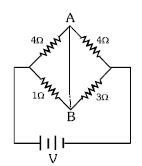
In the circuit shown, if a conducting wire is connected between points $A$ and $B$, the current in this wire will
A
Flow from $A$ to $B$
B
Flow in the direction which will be decided by the value of $V$
C
Be zero
D
Flow from $B$ to $A$
Solution
(A) Let the potential of the left junction be $V_L = 0$ and the right junction be $V_R = V$.
The potential at point $A$ is determined by the voltage divider of the top two resistors ($4 \, \Omega$ and $4 \, \Omega$):
$V_A = V_L + \frac{4}{4+4} \times (V_R - V_L) = 0 + \frac{4}{8} \times V = \frac{V}{2}$.
The potential at point $B$ is determined by the voltage divider of the bottom two resistors ($1 \, \Omega$ and $3 \, \Omega$):
$V_B = V_L + \frac{1}{1+3} \times (V_R - V_L) = 0 + \frac{1}{4} \times V = \frac{V}{4}$.
Comparing the potentials, $V_A = \frac{V}{2}$ and $V_B = \frac{V}{4}$.
Since $V_A > V_B$, the current will flow from the higher potential to the lower potential, i.e., from $A$ to $B$.
The potential at point $A$ is determined by the voltage divider of the top two resistors ($4 \, \Omega$ and $4 \, \Omega$):
$V_A = V_L + \frac{4}{4+4} \times (V_R - V_L) = 0 + \frac{4}{8} \times V = \frac{V}{2}$.
The potential at point $B$ is determined by the voltage divider of the bottom two resistors ($1 \, \Omega$ and $3 \, \Omega$):
$V_B = V_L + \frac{1}{1+3} \times (V_R - V_L) = 0 + \frac{1}{4} \times V = \frac{V}{4}$.
Comparing the potentials, $V_A = \frac{V}{2}$ and $V_B = \frac{V}{4}$.
Since $V_A > V_B$, the current will flow from the higher potential to the lower potential, i.e., from $A$ to $B$.
0 likesView Solution
51
ChemistryMediumMCQAIPMT · 2006
The general molecular formula,which represents the homologous series of alkanols is
A
$C_nH_{2n}O$
B
$C_nH_{2n}O_2$
C
$C_nH_{2n+2}O$
D
$C_nH_{2n+1}O$
Solution
(C) Alkanols are derivatives of alkanes,formed by replacing one hydrogen atom $(-H)$ of an alkane with a hydroxyl group $(-OH)$.
The general formula for alkanes is $C_nH_{2n+2}$.
Replacing one $H$ with $OH$ gives $C_nH_{2n+1}OH$,which simplifies to $C_nH_{2n+2}O$.
Therefore,the general molecular formula for the homologous series of alkanols is $C_nH_{2n+2}O$.
The general formula for alkanes is $C_nH_{2n+2}$.
Replacing one $H$ with $OH$ gives $C_nH_{2n+1}OH$,which simplifies to $C_nH_{2n+2}O$.
Therefore,the general molecular formula for the homologous series of alkanols is $C_nH_{2n+2}O$.
0 likesView Solution
52
ChemistryEasyMCQAIPMT · 2006
The appearance of colour in solid alkali metal halides is generally due to
A
interstitial positions
B
$F$-centers
C
Schottky defect
D
Frenkel defect
Solution
(B) $F$-centers are the sites where anions are missing and instead electrons are present. The appearance of colour in solid alkali metal halides is generally due to these $F$-centers.
0 likesView Solution
53
ChemistryDifficultMCQAIPMT · 2006
$CsBr$ crystallises in a body-centred cubic lattice. The unit cell length is $436.6 \, pm$. Given that the atomic mass of $Cs = 133$ and that of $Br = 80 \, amu$ and Avogadro number being $6.02 \times 10^{23} \, mol^{-1}$,the density of $CsBr$ is .............. $g/cm^{3}$.
A
$4.25$
B
$42.5$
C
$0.425$
D
$8.25$
Solution
(A) The density of a unit cell is given by the formula: $\rho = \frac{Z \times M}{a^{3} \times N_{A}}$
For $CsBr$ in a body-centred cubic (bcc) lattice,the number of formula units per unit cell $Z = 1$.
The molar mass $M = 133 + 80 = 213 \, g/mol$.
The edge length $a = 436.6 \, pm = 436.6 \times 10^{-10} \, cm$.
Substituting these values into the formula:
$\rho = \frac{1 \times 213}{(436.6 \times 10^{-10})^{3} \times 6.02 \times 10^{23}}$
$\rho = \frac{213}{83.25 \times 10^{-24} \times 6.02 \times 10^{23}}$
$\rho = \frac{213}{50.11} \approx 4.25 \, g/cm^{3}$.
For $CsBr$ in a body-centred cubic (bcc) lattice,the number of formula units per unit cell $Z = 1$.
The molar mass $M = 133 + 80 = 213 \, g/mol$.
The edge length $a = 436.6 \, pm = 436.6 \times 10^{-10} \, cm$.
Substituting these values into the formula:
$\rho = \frac{1 \times 213}{(436.6 \times 10^{-10})^{3} \times 6.02 \times 10^{23}}$
$\rho = \frac{213}{83.25 \times 10^{-24} \times 6.02 \times 10^{23}}$
$\rho = \frac{213}{50.11} \approx 4.25 \, g/cm^{3}$.
0 likesView Solution
54
ChemistryEasyMCQAIPMT · 2006
During osmosis,the flow of water through a semipermeable membrane is:
A
from the solution having lower concentration only
B
from the solution having higher concentration only
C
from both sides of the semipermeable membrane with equal flow rates
D
from both sides of the semipermeable membrane with unequal flow rates
Solution
(D) Osmosis is the phenomenon of the flow of solvent molecules through a semipermeable membrane.
In reality,solvent molecules move in both directions across the membrane.
However,the net flow occurs from the region of lower solute concentration (higher solvent concentration) to the region of higher solute concentration (lower solvent concentration).
Since no membrane is perfectly semipermeable,the flow of water occurs from both sides but at unequal rates,resulting in a net flow.
In reality,solvent molecules move in both directions across the membrane.
However,the net flow occurs from the region of lower solute concentration (higher solvent concentration) to the region of higher solute concentration (lower solvent concentration).
Since no membrane is perfectly semipermeable,the flow of water occurs from both sides but at unequal rates,resulting in a net flow.
0 likesView Solution
55
ChemistryEasyMCQAIPMT · 2006
$A$ solution of acetone in ethanol:
A
obeys Raoult's law
B
shows a negative deviation from Raoult's law
C
shows a positive deviation from Raoult's law
D
behaves like a near ideal solution
Solution
(C) solution of acetone in ethanol shows a positive deviation from Raoult's law.
In pure ethanol,molecules are held together by strong hydrogen bonding.
When acetone is added,it disrupts these hydrogen bonds,leading to weaker solute-solvent interactions compared to the original solvent-solvent interactions.
This results in an increase in vapor pressure,which is characteristic of a positive deviation from Raoult's law.
In pure ethanol,molecules are held together by strong hydrogen bonding.
When acetone is added,it disrupts these hydrogen bonds,leading to weaker solute-solvent interactions compared to the original solvent-solvent interactions.
This results in an increase in vapor pressure,which is characteristic of a positive deviation from Raoult's law.
0 likesView Solution
56
ChemistryMediumMCQAIPMT · 2006
$1.00 \ g$ of a non-electrolyte solute (molar mass $250 \ g \ mol^{-1}$) was dissolved in $51.2 \ g$ of benzene. If the freezing point depression constant,$K_f$ of benzene is $5.12 \ K \ kg \ mol^{-1},$ the freezing point of benzene will be lowered by .......... $K$.
A
$0.2$
B
$0.4$
C
$0.3$
D
$0.5$
Solution
(B) The formula for freezing point depression is $\Delta T_f = K_f \times m$,where $m$ is the molality of the solution.
Molality $m = \frac{W_1 \times 1000}{M_1 \times W_2}$,where $W_1$ is the mass of solute,$M_1$ is the molar mass of solute,and $W_2$ is the mass of solvent in grams.
Given: $W_1 = 1.00 \ g$,$M_1 = 250 \ g \ mol^{-1}$,$W_2 = 51.2 \ g$,$K_f = 5.12 \ K \ kg \ mol^{-1}$.
Substituting the values: $\Delta T_f = 5.12 \times \frac{1.00 \times 1000}{250 \times 51.2}$.
$\Delta T_f = 5.12 \times \frac{1000}{12800} = 5.12 \times 0.078125 = 0.4 \ K$.
Molality $m = \frac{W_1 \times 1000}{M_1 \times W_2}$,where $W_1$ is the mass of solute,$M_1$ is the molar mass of solute,and $W_2$ is the mass of solvent in grams.
Given: $W_1 = 1.00 \ g$,$M_1 = 250 \ g \ mol^{-1}$,$W_2 = 51.2 \ g$,$K_f = 5.12 \ K \ kg \ mol^{-1}$.
Substituting the values: $\Delta T_f = 5.12 \times \frac{1.00 \times 1000}{250 \times 51.2}$.
$\Delta T_f = 5.12 \times \frac{1000}{12800} = 5.12 \times 0.078125 = 0.4 \ K$.
0 likesView Solution
57
ChemistryDifficultMCQAIPMT · 2006
$A$ hypothetical electrochemical cell is shown below.
$A \,|\, A^{+} \,(x \ M)\, ||\, B^{+} \,(y \ M)\, |\, B$
The $emf$ measured is $+ 0.20 \ V.$ The cell reaction is
$A \,|\, A^{+} \,(x \ M)\, ||\, B^{+} \,(y \ M)\, |\, B$
The $emf$ measured is $+ 0.20 \ V.$ The cell reaction is
A
$A + B^{+} \rightarrow A^{+} + B$
B
$A^{+} + B \rightarrow A + B^{+}$
C
$A^{+} + e^-$ $\rightarrow A \, ;\, B^{+} + e^-$ $\rightarrow B$
D
The cell reaction cannot be predicted.
Solution
(A) In an electrochemical cell representation,the left side represents the anode (oxidation) and the right side represents the cathode (reduction).
Given cell: $A \,|\, A^{+} \,(x \ M) \, ||\, B^{+} \,(y \ M) \, |\, B$
At the anode (left): $A \rightarrow A^{+} + e^-$
At the cathode (right): $B^{+} + e^- \rightarrow B$
Adding these two half-reactions,the overall cell reaction is: $A + B^{+} \rightarrow A^{+} + B$
Since the measured $emf$ is positive $(+ 0.20 \ V)$,the reaction is spontaneous in the direction written.
Given cell: $A \,|\, A^{+} \,(x \ M) \, ||\, B^{+} \,(y \ M) \, |\, B$
At the anode (left): $A \rightarrow A^{+} + e^-$
At the cathode (right): $B^{+} + e^- \rightarrow B$
Adding these two half-reactions,the overall cell reaction is: $A + B^{+} \rightarrow A^{+} + B$
Since the measured $emf$ is positive $(+ 0.20 \ V)$,the reaction is spontaneous in the direction written.
0 likesView Solution
58
ChemistryAdvancedMCQAIPMT · 2006
$E^{\circ}_{Fe^{2+}/Fe} = -0.441 \ V$ and $E^{\circ}_{Fe^{3+}/Fe^{2+}} = 0.771 \ V$,the standard $EMF$ of the reaction $Fe + 2Fe^{3+} \rightarrow 3Fe^{2+}$ will be $.......... \ V$.
A
$0.111$
B
$0.330$
C
$1.653$
D
$1.212$
Solution
(D) The given half-cell reactions are:
$Fe^{2+} + 2e^{-} \rightarrow Fe, E^{\circ} = -0.441 \ V$ (Anode reaction: $Fe \rightarrow Fe^{2+} + 2e^{-}, E^{\circ} = +0.441 \ V$)
$Fe^{3+} + e^{-} \rightarrow Fe^{2+}, E^{\circ} = +0.771 \ V$ (Cathode reaction: $2Fe^{3+} + 2e^{-} \rightarrow 2Fe^{2+}, E^{\circ} = +0.771 \ V$)
For the overall reaction $Fe + 2Fe^{3+} \rightarrow 3Fe^{2+}$,the standard cell potential is calculated as:
$E^{\circ}_{cell} = E^{\circ}_{cathode} - E^{\circ}_{anode}$
$E^{\circ}_{cell} = E^{\circ}_{Fe^{3+}/Fe^{2+}} - E^{\circ}_{Fe^{2+}/Fe}$
$E^{\circ}_{cell} = 0.771 \ V - (-0.441 \ V)$
$E^{\circ}_{cell} = 1.212 \ V$
$Fe^{2+} + 2e^{-} \rightarrow Fe, E^{\circ} = -0.441 \ V$ (Anode reaction: $Fe \rightarrow Fe^{2+} + 2e^{-}, E^{\circ} = +0.441 \ V$)
$Fe^{3+} + e^{-} \rightarrow Fe^{2+}, E^{\circ} = +0.771 \ V$ (Cathode reaction: $2Fe^{3+} + 2e^{-} \rightarrow 2Fe^{2+}, E^{\circ} = +0.771 \ V$)
For the overall reaction $Fe + 2Fe^{3+} \rightarrow 3Fe^{2+}$,the standard cell potential is calculated as:
$E^{\circ}_{cell} = E^{\circ}_{cathode} - E^{\circ}_{anode}$
$E^{\circ}_{cell} = E^{\circ}_{Fe^{3+}/Fe^{2+}} - E^{\circ}_{Fe^{2+}/Fe}$
$E^{\circ}_{cell} = 0.771 \ V - (-0.441 \ V)$
$E^{\circ}_{cell} = 1.212 \ V$
0 likesView Solution
59
ChemistryMediumMCQAIPMT · 2006
Consider the reaction: $N_{2(g)} + 3H_{2(g)} \rightarrow 2NH_{3(g)}$. The equality relationship between $\frac{d[NH_3]}{dt}$ and $\frac{d[H_2]}{dt}$ is
A
$\frac{d[NH_3]}{dt} = - \frac{d[H_2]}{dt}$
B
$\frac{d[NH_3]}{dt} = - \frac{1}{3} \frac{d[H_2]}{dt}$
C
$+ \frac{d[NH_3]}{dt} = - \frac{2}{3} \frac{d[H_2]}{dt}$
D
$+ \frac{d[NH_3]}{dt} = - \frac{3}{2} \frac{d[H_2]}{dt}$
Solution
(C) For the reaction $N_{2(g)} + 3H_{2(g)} \rightarrow 2NH_{3(g)}$,the rate of reaction is expressed as:
Rate $= - \frac{d[N_2]}{dt} = - \frac{1}{3} \frac{d[H_2]}{dt} = + \frac{1}{2} \frac{d[NH_3]}{dt}$.
Equating the terms for $NH_3$ and $H_2$:
$+ \frac{1}{2} \frac{d[NH_3]}{dt} = - \frac{1}{3} \frac{d[H_2]}{dt}$.
Multiplying both sides by $2$,we get:
$+ \frac{d[NH_3]}{dt} = - \frac{2}{3} \frac{d[H_2]}{dt}$.
Rate $= - \frac{d[N_2]}{dt} = - \frac{1}{3} \frac{d[H_2]}{dt} = + \frac{1}{2} \frac{d[NH_3]}{dt}$.
Equating the terms for $NH_3$ and $H_2$:
$+ \frac{1}{2} \frac{d[NH_3]}{dt} = - \frac{1}{3} \frac{d[H_2]}{dt}$.
Multiplying both sides by $2$,we get:
$+ \frac{d[NH_3]}{dt} = - \frac{2}{3} \frac{d[H_2]}{dt}$.
0 likesView Solution
60
ChemistryMediumMCQAIPMT · 2006
For the reaction,$2A + B \rightarrow 3C + D,$ which of the following does not express the reaction rate?
A
$-\frac{d[A]}{2dt}$
B
$-\frac{d[C]}{3dt}$
C
$-\frac{d[B]}{dt}$
D
$\frac{d[D]}{dt}$
Solution
(B) For the reaction $2A + B \rightarrow 3C + D,$ the rate of reaction is expressed as:
Rate $= -\frac{1}{2} \frac{d[A]}{dt} = -\frac{d[B]}{dt} = \frac{1}{3} \frac{d[C]}{dt} = \frac{d[D]}{dt}$
Comparing this with the given options:
Option $A$ is $-\frac{1}{2} \frac{d[A]}{dt}$ (Correct expression).
Option $B$ is $-\frac{d[C]}{3dt}$,but the correct expression for $C$ is $+\frac{1}{3} \frac{d[C]}{dt}$. Thus,this is incorrect.
Option $C$ is $-\frac{d[B]}{dt}$ (Correct expression).
Option $D$ is $\frac{d[D]}{dt}$ (Correct expression).
Therefore,the expression that does not represent the reaction rate is $-\frac{d[C]}{3dt}$.
Rate $= -\frac{1}{2} \frac{d[A]}{dt} = -\frac{d[B]}{dt} = \frac{1}{3} \frac{d[C]}{dt} = \frac{d[D]}{dt}$
Comparing this with the given options:
Option $A$ is $-\frac{1}{2} \frac{d[A]}{dt}$ (Correct expression).
Option $B$ is $-\frac{d[C]}{3dt}$,but the correct expression for $C$ is $+\frac{1}{3} \frac{d[C]}{dt}$. Thus,this is incorrect.
Option $C$ is $-\frac{d[B]}{dt}$ (Correct expression).
Option $D$ is $\frac{d[D]}{dt}$ (Correct expression).
Therefore,the expression that does not represent the reaction rate is $-\frac{d[C]}{3dt}$.
0 likesView Solution
61
ChemistryMediumMCQAIPMT · 2006
$A$ plot of $\log (x/m)$ versus $\log p$ for the adsorption of a gas on a solid gives a straight line with slope equal to
A
$\log K$
B
$-\log K$
C
$n$
D
$1/n$
Solution
(D) According to the Freundlich adsorption isotherm,the relation is given by $x/m = K p^{1/n}$.
Taking logarithm on both sides,we get $\log(x/m) = \log K + \frac{1}{n} \log p$.
Comparing this with the equation of a straight line $y = mx + c$,where $y = \log(x/m)$,$x = \log p$,slope $m = 1/n$,and intercept $c = \log K$.
Therefore,the slope of the plot is $1/n$.
Taking logarithm on both sides,we get $\log(x/m) = \log K + \frac{1}{n} \log p$.
Comparing this with the equation of a straight line $y = mx + c$,where $y = \log(x/m)$,$x = \log p$,slope $m = 1/n$,and intercept $c = \log K$.
Therefore,the slope of the plot is $1/n$.
0 likesView Solution
62
ChemistryMediumMCQAIPMT · 2006
Which one of the following orders is not in accordance with the property stated against it?
A
$F_2 > Cl_2 > Br_2 > I_2$ : Bond dissociation energy
B
$F_2 > Cl_2 > Br_2 > I_2$ : Oxidising power
C
$HI > HBr > HCl > HF$ : Acidic property in water
D
$F_2 > Cl_2 > Br_2 > I_2$ : Electronegativity
Solution
(A) The order given in option $A$ is incorrect.
The correct order of bond dissociation energy is $Cl_2 > Br_2 > F_2 > I_2$.
This is because the $F-F$ bond is weaker than the $Cl-Cl$ and $Br-Br$ bonds due to the small size of the fluorine atom,which leads to significant interelectronic repulsion between the lone pairs of the two fluorine atoms.
The correct order of bond dissociation energy is $Cl_2 > Br_2 > F_2 > I_2$.
This is because the $F-F$ bond is weaker than the $Cl-Cl$ and $Br-Br$ bonds due to the small size of the fluorine atom,which leads to significant interelectronic repulsion between the lone pairs of the two fluorine atoms.
0 likesView Solution
63
ChemistryMediumMCQAIPMT · 2006
In which of the following pairs are both the ions coloured in aqueous solution?
(At. no. $:$ $Sc = 21, Ti = 22, Ni = 28, Cu = 29, Co = 27$)
(At. no. $:$ $Sc = 21, Ti = 22, Ni = 28, Cu = 29, Co = 27$)
A
$Ni^{2+}, Cu^{+}$
B
$Ni^{2+}, Ti^{3+}$
C
$Sc^{3+}, Ti^{3+}$
D
$Sc^{3+}, Co^{2+}$
Solution
(B) Ions are coloured if they possess unpaired electrons in their $d$-orbitals due to $d-d$ transitions.
$Sc^{3+} \rightarrow [Ar] 3d^{0}$ (No unpaired electrons,colourless)
$Ti^{3+} \rightarrow [Ar] 3d^{1}$ (One unpaired electron,coloured)
$Ni^{2+} \rightarrow [Ar] 3d^{8}$ (Two unpaired electrons,coloured)
$Cu^{+} \rightarrow [Ar] 3d^{10}$ (No unpaired electrons,colourless)
$Co^{2+} \rightarrow [Ar] 3d^{7}$ (Three unpaired electrons,coloured)
Comparing the options:
$A$: $Ni^{2+}$ (coloured),$Cu^{+}$ (colourless)
$B$: $Ni^{2+}$ (coloured),$Ti^{3+}$ (coloured)
$C$: $Sc^{3+}$ (colourless),$Ti^{3+}$ (coloured)
$D$: $Sc^{3+}$ (colourless),$Co^{2+}$ (coloured)
Thus,both ions are coloured in option $B$.
$Sc^{3+} \rightarrow [Ar] 3d^{0}$ (No unpaired electrons,colourless)
$Ti^{3+} \rightarrow [Ar] 3d^{1}$ (One unpaired electron,coloured)
$Ni^{2+} \rightarrow [Ar] 3d^{8}$ (Two unpaired electrons,coloured)
$Cu^{+} \rightarrow [Ar] 3d^{10}$ (No unpaired electrons,colourless)
$Co^{2+} \rightarrow [Ar] 3d^{7}$ (Three unpaired electrons,coloured)
Comparing the options:
$A$: $Ni^{2+}$ (coloured),$Cu^{+}$ (colourless)
$B$: $Ni^{2+}$ (coloured),$Ti^{3+}$ (coloured)
$C$: $Sc^{3+}$ (colourless),$Ti^{3+}$ (coloured)
$D$: $Sc^{3+}$ (colourless),$Co^{2+}$ (coloured)
Thus,both ions are coloured in option $B$.
0 likesView Solution
64
ChemistryDifficultMCQAIPMT · 2006
Copper sulphate dissolves in excess of $KCN$ to give
A
$Cu(CN)_2$
B
$CuCN$
C
$[Cu(CN)_4]^{3-}$
D
$[Cu(CN)_4]^{2-}$
Solution
(C) When $CuSO_4$ reacts with $KCN$,it first forms a precipitate of cupric cyanide $(Cu(CN)_2)$,which is unstable and decomposes to form cuprous cyanide $(Cu_2(CN)_2)$ and cyanogen gas $((CN)_2)$.
$2CuSO_4 + 4KCN \rightarrow 2Cu(CN)_2 + 2K_2SO_4$
$2Cu(CN)_2 \rightarrow Cu_2(CN)_2 + (CN)_2$
The cuprous cyanide $(Cu_2(CN)_2)$ then dissolves in excess $KCN$ to form the stable soluble complex potassium tetracyanocuprate$(I)$,$K_3[Cu(CN)_4]$.
$Cu_2(CN)_2 + 6KCN \rightarrow 2K_3[Cu(CN)_4]$
Overall reaction:
$2CuSO_4 + 10KCN \rightarrow 2K_3[Cu(CN)_4] + 2K_2SO_4 + (CN)_2$
$2CuSO_4 + 4KCN \rightarrow 2Cu(CN)_2 + 2K_2SO_4$
$2Cu(CN)_2 \rightarrow Cu_2(CN)_2 + (CN)_2$
The cuprous cyanide $(Cu_2(CN)_2)$ then dissolves in excess $KCN$ to form the stable soluble complex potassium tetracyanocuprate$(I)$,$K_3[Cu(CN)_4]$.
$Cu_2(CN)_2 + 6KCN \rightarrow 2K_3[Cu(CN)_4]$
Overall reaction:
$2CuSO_4 + 10KCN \rightarrow 2K_3[Cu(CN)_4] + 2K_2SO_4 + (CN)_2$
0 likesView Solution
65
ChemistryMediumMCQAIPMT · 2006
More number of oxidation states are exhibited by the actinoids than by the lanthanoids. The main reason for this is
A
more active nature of the actinoids
B
more energy difference between $5f$ and $6d$ orbitals than that between $4f$ and $5d$ orbitals
C
lesser energy difference between $5f$ and $6d$ orbitals than that between $4f$ and $5d$ orbitals
D
greater metallic character of the lanthanoids than that of the corresponding actinoids.
Solution
(C) The actinoids exhibit a greater number of oxidation states compared to the lanthanoids.
This is primarily because the energy difference between the $5f$ and $6d$ orbitals in actinoids is smaller than the energy difference between the $4f$ and $5d$ orbitals in lanthanoids.
Consequently,the $5f$ electrons can participate in bonding more easily than the $4f$ electrons.
This is primarily because the energy difference between the $5f$ and $6d$ orbitals in actinoids is smaller than the energy difference between the $4f$ and $5d$ orbitals in lanthanoids.
Consequently,the $5f$ electrons can participate in bonding more easily than the $4f$ electrons.
0 likesView Solution
66
ChemistryDifficultMCQAIPMT · 2006
$[Cr(H_2O)_6]Cl_3$ $(At. \text{ } no. \text{ } of \text{ } Cr = 24)$ has a magnetic moment of $3.83 \text{ } B.M.$ The correct distribution of $3d$ electrons in the chromium of the complex is
A
$3d_{xy}^1, 3d_{yz}^1, 3d_{z^2}^1$
B
$3d_{(x^2-y^2)}^1, 3d_{z^2}^1, 3d_{xz}^1$
C
$3d_{xy}^1, 3d_{(x^2-y^2)}^1, 3d_{yz}^1$
D
$3d_{xy}^1, 3d_{yz}^1, 3d_{xz}^1$
Solution
(D) Magnetic moment $(\mu) = \sqrt{n(n+2)} \text{ } B.M.$
Given $\mu = 3.83 \text{ } B.M.$
$3.83 = \sqrt{n(n+2)} \implies n \approx 3$
This indicates there are $3$ unpaired electrons.
For the complex $[Cr(H_2O)_6]Cl_3$,the oxidation state of $Cr$ is $+3$.
The electronic configuration of $Cr$ $(Z=24)$ is $[Ar] 3d^5 4s^1$.
Thus,$Cr^{3+}$ is $[Ar] 3d^3$.
According to Hund's rule,the $3$ electrons in the $3d$ orbitals occupy the $t_{2g}$ set $(d_{xy}, d_{yz}, d_{xz})$ singly.
Therefore,the distribution is $3d_{xy}^1, 3d_{yz}^1, 3d_{xz}^1$.
Given $\mu = 3.83 \text{ } B.M.$
$3.83 = \sqrt{n(n+2)} \implies n \approx 3$
This indicates there are $3$ unpaired electrons.
For the complex $[Cr(H_2O)_6]Cl_3$,the oxidation state of $Cr$ is $+3$.
The electronic configuration of $Cr$ $(Z=24)$ is $[Ar] 3d^5 4s^1$.
Thus,$Cr^{3+}$ is $[Ar] 3d^3$.
According to Hund's rule,the $3$ electrons in the $3d$ orbitals occupy the $t_{2g}$ set $(d_{xy}, d_{yz}, d_{xz})$ singly.
Therefore,the distribution is $3d_{xy}^1, 3d_{yz}^1, 3d_{xz}^1$.
0 likesView Solution
67
ChemistryMediumMCQAIPMT · 2006
$[Co(NH_3)_4(NO_2)_2]Cl$ exhibits
A
linkage isomerism,geometrical isomerism and optical isomerism
B
linkage isomerism,ionization isomerism and optical isomerism
C
linkage isomerism,ionization isomerism and geometrical isomerism
D
ionization isomerism,geometrical isomerism and optical isomerism
Solution
(C) The complex $[Co(NH_3)_4(NO_2)_2]Cl$ exhibits the following types of isomerism:
$1.$ Linkage isomerism: Due to the presence of the ambidentate ligand $NO_2^-$ (it can coordinate through $N$ or $O$).
$2.$ Ionization isomerism: It can exchange ions between the coordination sphere and the ionization sphere to form $[Co(NH_3)_4(NO_2)Cl]NO_2$.
$3.$ Geometrical isomerism: It is an $[MA_4B_2]$ type octahedral complex,which exists in $\text{cis}$ and $\text{trans}$ forms.
It does not show optical isomerism because both $\text{cis}$ and $\text{trans}$ forms possess a plane of symmetry.
$1.$ Linkage isomerism: Due to the presence of the ambidentate ligand $NO_2^-$ (it can coordinate through $N$ or $O$).
$2.$ Ionization isomerism: It can exchange ions between the coordination sphere and the ionization sphere to form $[Co(NH_3)_4(NO_2)Cl]NO_2$.
$3.$ Geometrical isomerism: It is an $[MA_4B_2]$ type octahedral complex,which exists in $\text{cis}$ and $\text{trans}$ forms.
It does not show optical isomerism because both $\text{cis}$ and $\text{trans}$ forms possess a plane of symmetry.
0 likesView Solution
68
ChemistryMediumMCQAIPMT · 2006
The general molecular formula,which represents the homologous series of alkanols is
A
$C_nH_{2n+2}O$
B
$C_nH_{2n}O_2$
C
$C_nH_{2n}O$
D
$C_nH_{2n+1}O$
Solution
(A) Alkanols (alcohols) are derivatives of alkanes where one hydrogen atom is replaced by a hydroxyl $(-OH)$ group.
The general formula for an alkane is $C_nH_{2n+2}$.
Replacing one $H$ with $OH$ gives $C_nH_{2n+1}OH$,which simplifies to $C_nH_{2n+2}O$.
Thus,the correct general molecular formula is $C_nH_{2n+2}O$.
The general formula for an alkane is $C_nH_{2n+2}$.
Replacing one $H$ with $OH$ gives $C_nH_{2n+1}OH$,which simplifies to $C_nH_{2n+2}O$.
Thus,the correct general molecular formula is $C_nH_{2n+2}O$.
0 likesView Solution
69
ChemistryMediumMCQAIPMT · 2006
What is the product formed when ethylene oxide is treated with a Grignard reagent?
A
primary alcohol
B
secondary alcohol
C
tertiary alcohol
D
cyclopropyl alcohol
Solution
(A) The reaction of ethylene oxide $(CH_2-CH_2-O)$ with a Grignard reagent $(RMgX)$ involves the nucleophilic attack of the alkyl group $(R^-)$ on one of the carbon atoms of the epoxide ring,leading to ring opening.
This forms an intermediate alkoxide $(R-CH_2-CH_2-OMgX)$.
Subsequent acid hydrolysis of this intermediate yields a primary alcohol $(R-CH_2-CH_2-OH)$ as the final product.
This forms an intermediate alkoxide $(R-CH_2-CH_2-OMgX)$.
Subsequent acid hydrolysis of this intermediate yields a primary alcohol $(R-CH_2-CH_2-OH)$ as the final product.
0 likesView Solution
70
ChemistryMediumMCQAIPMT · 2006
The major organic product in the reaction is: $CH_3-O-CH(CH_3)_2 + HI \to$ products
A
$CH_3I + (CH_3)_2CHOH$
B
$CH_3OH + (CH_3)_2CHI$
C
$ICH_2OCH(CH_3)_2$
D
$CH_3-O-C(I)(CH_3)_2$
Solution
(A) In the reaction of an unsymmetrical ether with $HI$,if the alkyl groups are primary or secondary,the reaction follows the $S_N2$ mechanism.
The iodide ion $(I^{-})$ attacks the smaller (less sterically hindered) alkyl group.
In $CH_3-O-CH(CH_3)_2$,the methyl group $(-CH_3)$ is smaller than the isopropyl group $(-CH(CH_3)_2)$.
Therefore,the $I^{-}$ ion attacks the methyl group,leading to the formation of $CH_3I$ and $(CH_3)_2CHOH$ as the major products.
The iodide ion $(I^{-})$ attacks the smaller (less sterically hindered) alkyl group.
In $CH_3-O-CH(CH_3)_2$,the methyl group $(-CH_3)$ is smaller than the isopropyl group $(-CH(CH_3)_2)$.
Therefore,the $I^{-}$ ion attacks the methyl group,leading to the formation of $CH_3I$ and $(CH_3)_2CHOH$ as the major products.
0 likesView Solution
71
ChemistryMediumMCQAIPMT · 2006
Nucleophilic addition reaction will be most favoured in
A
$CH_3-CHO$
B
$CH_3-CH_2-CO-CH_3$
C
$CH_3-CO-CH_3$
D
$CH_3-CH_2-CHO$
Solution
(A) Nucleophilic addition reactions are influenced by steric and electronic factors.
Aldehydes are generally more reactive than ketones because they have less steric hindrance and fewer electron-donating alkyl groups ($+I$ effect),which reduces the electrophilicity of the carbonyl carbon.
Among the given options,$CH_3-CHO$ (ethanal) has the smallest alkyl group compared to $CH_3-CH_2-CHO$ (propanal),and it is an aldehyde,whereas the other options are ketones or larger aldehydes.
Therefore,$CH_3-CHO$ is the most reactive toward nucleophilic attack.
Aldehydes are generally more reactive than ketones because they have less steric hindrance and fewer electron-donating alkyl groups ($+I$ effect),which reduces the electrophilicity of the carbonyl carbon.
Among the given options,$CH_3-CHO$ (ethanal) has the smallest alkyl group compared to $CH_3-CH_2-CHO$ (propanal),and it is an aldehyde,whereas the other options are ketones or larger aldehydes.
Therefore,$CH_3-CHO$ is the most reactive toward nucleophilic attack.
0 likesView Solution
72
ChemistryMediumMCQAIPMT · 2006
$A$ carbonyl compound reacts with hydrogen cyanide $(HCN)$ to form cyanohydrin,which on hydrolysis forms a racemic mixture of $\alpha$-hydroxy acid. The carbonyl compound is:
A
formaldehyde
B
acetaldehyde
C
acetone
D
diethyl ketone
Solution
(B) . Acetaldehyde $(CH_3CHO)$ reacts with $HCN$ to form acetaldehyde cyanohydrin $(CH_3CH(OH)CN)$.
On hydrolysis,it yields lactic acid $(CH_3CH(OH)COOH)$.
Since the $\alpha$-carbon in lactic acid is chiral (bonded to four different groups: $-H$,$-OH$,$-CH_3$,and $-COOH$),it exists as a racemic mixture when synthesized from an achiral starting material like acetaldehyde.
On hydrolysis,it yields lactic acid $(CH_3CH(OH)COOH)$.
Since the $\alpha$-carbon in lactic acid is chiral (bonded to four different groups: $-H$,$-OH$,$-CH_3$,and $-COOH$),it exists as a racemic mixture when synthesized from an achiral starting material like acetaldehyde.
0 likesView Solution
73
ChemistryMediumMCQAIPMT · 2006
In a set of reactions,propionic acid yielded a compound $D$.
$CH_3CH_2COOH$ $\xrightarrow{SOCl_2} B$ $\xrightarrow{NH_3} C$ $\xrightarrow{KOH, Br_2} D$
The structure of $D$ would be
$CH_3CH_2COOH$ $\xrightarrow{SOCl_2} B$ $\xrightarrow{NH_3} C$ $\xrightarrow{KOH, Br_2} D$
The structure of $D$ would be
A
$CH_3CH_2NH_2$
B
$CH_3CH_2CH_2NH_2$
C
$CH_3CH_2CONH_2$
D
$CH_3CH_2NHCH_3$
Solution
(A) The reaction sequence is as follows:
$1$. Propionic acid $(CH_3CH_2COOH)$ reacts with $SOCl_2$ to form propionyl chloride $(B = CH_3CH_2COCl)$.
$2$. Propionyl chloride reacts with $NH_3$ to form propionamide $(C = CH_3CH_2CONH_2)$.
$3$. Propionamide reacts with $KOH$ and $Br_2$ (Hofmann bromamide degradation reaction) to form ethylamine $(D = CH_3CH_2NH_2)$.
Thus,the structure of $D$ is $CH_3CH_2NH_2$.
$1$. Propionic acid $(CH_3CH_2COOH)$ reacts with $SOCl_2$ to form propionyl chloride $(B = CH_3CH_2COCl)$.
$2$. Propionyl chloride reacts with $NH_3$ to form propionamide $(C = CH_3CH_2CONH_2)$.
$3$. Propionamide reacts with $KOH$ and $Br_2$ (Hofmann bromamide degradation reaction) to form ethylamine $(D = CH_3CH_2NH_2)$.
Thus,the structure of $D$ is $CH_3CH_2NH_2$.
0 likesView Solution
74
ChemistryMediumMCQAIPMT · 2006
Self-condensation of two moles of ethyl acetate in the presence of sodium ethoxide yields:
A
ethyl propionate
B
ethyl butyrate
C
acetoacetic ester
D
methyl acetoacetate
Solution
(C) The self-condensation of two moles of ethyl acetate in the presence of a strong base like sodium ethoxide $(NaOC_2H_5)$ is known as the Claisen condensation.
This reaction occurs because ethyl acetate possesses $\alpha$-hydrogen atoms.
The reaction proceeds as follows:
$2CH_3COOC_2H_5 \xrightarrow{NaOC_2H_5} CH_3COCH_2COOC_2H_5 + C_2H_5OH$
The product formed is ethyl acetoacetate,which is commonly referred to as acetoacetic ester.
This reaction occurs because ethyl acetate possesses $\alpha$-hydrogen atoms.
The reaction proceeds as follows:
$2CH_3COOC_2H_5 \xrightarrow{NaOC_2H_5} CH_3COCH_2COOC_2H_5 + C_2H_5OH$
The product formed is ethyl acetoacetate,which is commonly referred to as acetoacetic ester.
0 likesView Solution
75
ChemistryMediumMCQAIPMT · 2006
Which of the following is more basic than aniline?
A
Benzylamine
B
Diphenylamine
C
Triphenylamine
D
$p-$Nitroaniline
Solution
(A) Benzylamine,$C_{6}H_{5}CH_{2}NH_{2}$,is more basic than aniline because the benzyl group $(C_{6}H_{5}CH_{2}-)$ is an electron-donating group due to the $+I$ effect.
This increases the electron density on the nitrogen atom of the $-NH_{2}$ group,making the lone pair more available for donation.
In contrast,phenyl and nitro groups are electron-withdrawing groups ($-I$ or $-M$ effects),which decrease the electron density on the nitrogen atom.
Therefore,diphenylamine,triphenylamine,and $p-$nitroaniline are less basic than aniline.
This increases the electron density on the nitrogen atom of the $-NH_{2}$ group,making the lone pair more available for donation.
In contrast,phenyl and nitro groups are electron-withdrawing groups ($-I$ or $-M$ effects),which decrease the electron density on the nitrogen atom.
Therefore,diphenylamine,triphenylamine,and $p-$nitroaniline are less basic than aniline.
0 likesView Solution
76
ChemistryEasyMCQAIPMT · 2006
During the process of digestion,the proteins present in food materials are hydrolysed to amino acids. The two enzymes involved in the process
$proteins$ $\xrightarrow{\text{enzyme } (A)} polypeptides$ $\xrightarrow{\text{enzyme } (B)} amino \ acids$,
are respectively
$proteins$ $\xrightarrow{\text{enzyme } (A)} polypeptides$ $\xrightarrow{\text{enzyme } (B)} amino \ acids$,
are respectively
A
invertase and zymase
B
amylase and maltase
C
diastase and lipase
D
pepsin and trypsin
Solution
(D) In the process of digestion,the proteins present in food material are hydrolysed to amino acids.
In this process,two enzymes,$pepsin$ and $trypsin$,are involved as follows:
$Proteins$ $\xrightarrow{Pepsin \ (A)} Polypeptides$ $\xrightarrow{trypsin \ (B)} Amino \ acids$
In this process,two enzymes,$pepsin$ and $trypsin$,are involved as follows:
$Proteins$ $\xrightarrow{Pepsin \ (A)} Polypeptides$ $\xrightarrow{trypsin \ (B)} Amino \ acids$
0 likesView Solution
77
ChemistryEasyMCQAIPMT · 2006
Which one of the following is a peptide hormone?
A
Adrenaline
B
Glucagon
C
Testosterone
D
Thyroxine
Solution
(B) Glucagon is a peptide hormone because it consists of a chain of $29$ amino acids linked by peptide bonds.
Adrenaline is an amino acid derivative.
Testosterone is a steroid hormone.
Thyroxine is an iodinated amino acid derivative.
Adrenaline is an amino acid derivative.
Testosterone is a steroid hormone.
Thyroxine is an iodinated amino acid derivative.
0 likesView Solution
78
ChemistryEasyMCQAIPMT · 2006
The given polymer structure is $-[NH(CH_2)_6NHCO(CH_2)_4CO]_n-$. This polymer is a:
A
homopolymer
B
copolymer
C
addition polymer
D
thermosetting polymer
Solution
(B) The given structure represents $Nylon-6,6$.
$Nylon-6,6$ is formed by the condensation polymerization of two different monomers: hexamethylenediamine $(H_2N(CH_2)_6NH_2)$ and adipic acid $(HOOC(CH_2)_4COOH)$.
Since it is formed from two different types of monomers,it is classified as a copolymer.
$Nylon-6,6$ is formed by the condensation polymerization of two different monomers: hexamethylenediamine $(H_2N(CH_2)_6NH_2)$ and adipic acid $(HOOC(CH_2)_4COOH)$.
Since it is formed from two different types of monomers,it is classified as a copolymer.
0 likesView Solution
79
ChemistryMediumMCQAIPMT · 2006
$A$ solution containing $10 \ g$ per $dm^3$ of urea (molecular mass $= 60 \ g \ mol^{-1}$) is isotonic with a $5 \%$ solution of a non-volatile solute. The molecular mass of this non-volatile solute is ........ $g \ mol^{-1}$.
A
$300$
B
$350$
C
$200$
D
$250$
Solution
(A) Two solutions are isotonic if they have the same osmotic pressure,which implies they have the same molar concentration at the same temperature.
Molar concentration of urea $= \frac{10 \ g \ L^{-1}}{60 \ g \ mol^{-1}} = \frac{1}{6} \ mol \ L^{-1}$.
$A$ $5 \%$ solution of a non-volatile solute means $5 \ g$ of solute in $100 \ mL$ of solution,which is $50 \ g$ of solute in $1 \ L$ $(dm^3)$ of solution.
Let the molecular mass of the non-volatile solute be $M$.
Molar concentration of the non-volatile solute $= \frac{50 \ g \ L^{-1}}{M \ g \ mol^{-1}} = \frac{50}{M} \ mol \ L^{-1}$.
Since the solutions are isotonic,$\frac{1}{6} = \frac{50}{M}$.
Therefore,$M = 50 \times 6 = 300 \ g \ mol^{-1}$.
Molar concentration of urea $= \frac{10 \ g \ L^{-1}}{60 \ g \ mol^{-1}} = \frac{1}{6} \ mol \ L^{-1}$.
$A$ $5 \%$ solution of a non-volatile solute means $5 \ g$ of solute in $100 \ mL$ of solution,which is $50 \ g$ of solute in $1 \ L$ $(dm^3)$ of solution.
Let the molecular mass of the non-volatile solute be $M$.
Molar concentration of the non-volatile solute $= \frac{50 \ g \ L^{-1}}{M \ g \ mol^{-1}} = \frac{50}{M} \ mol \ L^{-1}$.
Since the solutions are isotonic,$\frac{1}{6} = \frac{50}{M}$.
Therefore,$M = 50 \times 6 = 300 \ g \ mol^{-1}$.
0 likesView Solution
80
ChemistryEasyMCQAIPMT · 2006
The human body does not produce
A
Enzymes
B
$DNA$
C
Vitamins
D
Hormones
Solution
(C) Vitamins are a group of biomolecules required for normal metabolic processes,growth,and health in humans and animals.
The human body cannot synthesize most vitamins and must obtain them from external sources such as vegetables,fish,meat,eggs,fruits,and sunlight to prevent deficiency diseases.
Therefore,the human body does not produce vitamins.
The human body cannot synthesize most vitamins and must obtain them from external sources such as vegetables,fish,meat,eggs,fruits,and sunlight to prevent deficiency diseases.
Therefore,the human body does not produce vitamins.
0 likesView Solution
Vedclass Products
For Students
Vedclass Test Series
Mock tests in real AIPMT style covering Chemistry with performance analysis. 5-day free trial.
Start Free TrialFor Teachers
Exam Paper Generator
Generate Set A/B/C/D Chemistry papers from 7.5L+ questions in 2 minutes. 3 chapters free.
Try FreeFor Institutes
Online Exam Module
Run live AIPMT mock exams with unlimited students, 360° analytics & white-label branding.
See DemoFrequently Asked Questions
How many Chemistry questions are in AIPMT 2006?
There are 98 Chemistry questions from the AIPMT 2006 paper on Vedclass, each with a detailed step-by-step solution in English.
Are AIPMT 2006 Chemistry solutions available in English?
Yes. All solutions on this page are in English. You can also switch to English or Hindi using the language buttons above the questions.
Can I practice AIPMT 2006 Chemistry as a timed test?
Yes. Use the Vedclass Test Series to attempt a full AIPMT mock test covering Chemistry with time limits and instant score analysis.
Can teachers create Chemistry papers from AIPMT previous year questions?
Yes. The Vedclass Exam Paper Generator lets teachers mix AIPMT Chemistry questions and generate Set A/B/C/D papers in minutes.
For Teachers & Institutes
Build a Custom Chemistry Paper
Pick AIPMT 2006 Chemistry questions, set difficulty, and generate Set A/B/C/D in 2 minutes.