
PhysicsQ1–48 of 48 questions
Page 1 of 1 · English
1
PhysicsDifficultMCQAIPMT · 2006
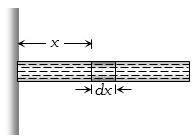
$A$ tube of length $L$ is filled completely with an incompressible liquid of mass $M$ and closed at both the ends. The tube is then rotated in a horizontal plane about one of its ends with a uniform angular velocity $\omega$. The force exerted by the liquid at the other end is
A
$\frac{ML\omega^2}{2}$
B
$ML\omega^2$
C
$\frac{M\omega L^2}{2}$
D
$\frac{ML^2\omega^2}{2}$
Solution
(A) Consider a small element of the liquid of length $dx$ at a distance $x$ from the axis of rotation. The mass of this element is $dM = (M/L)dx$.
The centripetal force required for this element to rotate in a circle of radius $x$ is $dF = (dM)\omega^2 x$.
Substituting $dM$,we get $dF = (M/L)dx \cdot \omega^2 x = (M\omega^2/L)x dx$.
The total force $F$ exerted by the liquid at the outer end is the integral of these centripetal forces from $x = 0$ to $x = L$:
$F = \int_0^L \frac{M\omega^2}{L} x dx = \frac{M\omega^2}{L} \left[ \frac{x^2}{2} \right]_0^L = \frac{M\omega^2}{L} \cdot \frac{L^2}{2} = \frac{1}{2}ML\omega^2$.
The centripetal force required for this element to rotate in a circle of radius $x$ is $dF = (dM)\omega^2 x$.
Substituting $dM$,we get $dF = (M/L)dx \cdot \omega^2 x = (M\omega^2/L)x dx$.
The total force $F$ exerted by the liquid at the outer end is the integral of these centripetal forces from $x = 0$ to $x = L$:
$F = \int_0^L \frac{M\omega^2}{L} x dx = \frac{M\omega^2}{L} \left[ \frac{x^2}{2} \right]_0^L = \frac{M\omega^2}{L} \cdot \frac{L^2}{2} = \frac{1}{2}ML\omega^2$.
0 likesView Solution
2
PhysicsMediumMCQAIPMT · 2006
The time of reverberation of a room $A$ is $1 \; s$. What will be the time (in seconds) of reverberation of a room,having all the dimensions double of those of room $A$?
A
$0.5$
B
$1$
C
$4$
D
$2$
Solution
(D) The time of reverberation is defined as the time during which the intensity of sound in an auditorium becomes one millionth of its initial intensity. Sabine's formula for reverberation time is given by:
$T = \frac{0.16 V}{\sum a s}$
Where $V$ is the volume of the hall in $m^3$ and $\sum a s$ is the total absorption of the hall.
Since the dimensions of the room are doubled,the volume $V$ becomes $V' = (2L)(2W)(2H) = 8V$.
The total surface area $S$ (which is proportional to $\sum a s$) becomes $S' = (2L)(2W) + (2W)(2H) + (2H)(2L) = 4S$.
Using the ratio of the reverberation times:
$\frac{T'}{T} = \frac{V'}{S'} \times \frac{S}{V} = \frac{8V}{4S} \times \frac{S}{V} = \frac{8}{4} = 2$
Given $T = 1 \; s$,we find $T' = 2 \times 1 = 2 \; s$.
$T = \frac{0.16 V}{\sum a s}$
Where $V$ is the volume of the hall in $m^3$ and $\sum a s$ is the total absorption of the hall.
Since the dimensions of the room are doubled,the volume $V$ becomes $V' = (2L)(2W)(2H) = 8V$.
The total surface area $S$ (which is proportional to $\sum a s$) becomes $S' = (2L)(2W) + (2W)(2H) + (2H)(2L) = 4S$.
Using the ratio of the reverberation times:
$\frac{T'}{T} = \frac{V'}{S'} \times \frac{S}{V} = \frac{8V}{4S} \times \frac{S}{V} = \frac{8}{4} = 2$
Given $T = 1 \; s$,we find $T' = 2 \times 1 = 2 \; s$.
0 likesView Solution
3
PhysicsMediumMCQAIPMT · 2006
$A$ particle moves along a straight line $OX$. At a time $t$ (in seconds),the distance $x$ (in metres) of the particle from $O$ is given by $x = 40 + 12t - t^3$. How long would the particle travel before coming to rest?
A
$16$
B
$24$
C
$40$
D
$56$
Solution
(A) The position of the particle is given by $x = 40 + 12t - t^3$.
Velocity $v$ is the rate of change of position with respect to time: $v = \frac{dx}{dt} = \frac{d}{dt}(40 + 12t - t^3) = 12 - 3t^2$.
For the particle to come to rest,its velocity must be zero: $v = 0$.
$12 - 3t^2 = 0 \implies 3t^2 = 12 \implies t^2 = 4 \implies t = 2 \text{ s}$ (since time cannot be negative).
The distance traveled by the particle from $t = 0$ to $t = 2$ is given by the change in position:
$x(0) = 40 + 12(0) - (0)^3 = 40 \text{ m}$.
$x(2) = 40 + 12(2) - (2)^3 = 40 + 24 - 8 = 56 \text{ m}$.
Distance traveled = $x(2) - x(0) = 56 - 40 = 16 \text{ m}$.
Velocity $v$ is the rate of change of position with respect to time: $v = \frac{dx}{dt} = \frac{d}{dt}(40 + 12t - t^3) = 12 - 3t^2$.
For the particle to come to rest,its velocity must be zero: $v = 0$.
$12 - 3t^2 = 0 \implies 3t^2 = 12 \implies t^2 = 4 \implies t = 2 \text{ s}$ (since time cannot be negative).
The distance traveled by the particle from $t = 0$ to $t = 2$ is given by the change in position:
$x(0) = 40 + 12(0) - (0)^3 = 40 \text{ m}$.
$x(2) = 40 + 12(2) - (2)^3 = 40 + 24 - 8 = 56 \text{ m}$.
Distance traveled = $x(2) - x(0) = 56 - 40 = 16 \text{ m}$.
0 likesView Solution
4
PhysicsMediumMCQAIPMT · 2006
$A$ car runs at a constant speed on a circular track of radius $100\,m$,taking $62.8\,s$ for every circular lap. The average velocity and average speed for each circular lap respectively are:
A
$10\,m/s, 0\,m/s$
B
$0\,m/s, 0\,m/s$
C
$0\,m/s, 10\,m/s$
D
$10\,m/s, 10\,m/s$
Solution
(C) The distance traveled in one complete circular lap is equal to the circumference of the track,which is $2\pi r$.
Given $r = 100\,m$ and time $t = 62.8\,s$.
Average speed is defined as the total distance divided by the total time:
$\text{Average speed} = \frac{2\pi r}{t} = \frac{2 \times 3.14 \times 100}{62.8} = \frac{628}{62.8} = 10\,m/s$.
Since the car completes one full lap,the final position is the same as the initial position.
Therefore,the net displacement is $0\,m$.
Average velocity is defined as the net displacement divided by the total time:
$\text{Average velocity} = \frac{\text{net displacement}}{t} = \frac{0}{62.8} = 0\,m/s$.
Thus,the average velocity is $0\,m/s$ and the average speed is $10\,m/s$.
Given $r = 100\,m$ and time $t = 62.8\,s$.
Average speed is defined as the total distance divided by the total time:
$\text{Average speed} = \frac{2\pi r}{t} = \frac{2 \times 3.14 \times 100}{62.8} = \frac{628}{62.8} = 10\,m/s$.
Since the car completes one full lap,the final position is the same as the initial position.
Therefore,the net displacement is $0\,m$.
Average velocity is defined as the net displacement divided by the total time:
$\text{Average velocity} = \frac{\text{net displacement}}{t} = \frac{0}{62.8} = 0\,m/s$.
Thus,the average velocity is $0\,m/s$ and the average speed is $10\,m/s$.
0 likesView Solution
5
PhysicsMediumMCQAIPMT · 2006
Two bodies $A$ (of mass $1\,kg$) and $B$ (of mass $3\,kg$) are dropped from heights of $16\,m$ and $25\,m$ respectively. The ratio of the time taken by them to reach the ground is:
A
$0.8$
B
$1.25$
C
$2.4$
D
$0.42$
Solution
(A) The time $t$ taken by a body to reach the ground when dropped from a height $h$ is given by the formula $t = \sqrt{\frac{2h}{g}}$.
Since both bodies are dropped,their initial velocity is $0$ and they are under the influence of the same acceleration due to gravity $g$.
The ratio of the time taken by body $A$ $(t_A)$ to the time taken by body $B$ $(t_B)$ is:
$\frac{t_A}{t_B} = \frac{\sqrt{\frac{2h_A}{g}}}{\sqrt{\frac{2h_B}{g}}} = \sqrt{\frac{h_A}{h_B}}$
Given $h_A = 16\,m$ and $h_B = 25\,m$:
$\frac{t_A}{t_B} = \sqrt{\frac{16}{25}} = \frac{4}{5} = 0.8$
Thus,the ratio of the time taken is $0.8$.
Since both bodies are dropped,their initial velocity is $0$ and they are under the influence of the same acceleration due to gravity $g$.
The ratio of the time taken by body $A$ $(t_A)$ to the time taken by body $B$ $(t_B)$ is:
$\frac{t_A}{t_B} = \frac{\sqrt{\frac{2h_A}{g}}}{\sqrt{\frac{2h_B}{g}}} = \sqrt{\frac{h_A}{h_B}}$
Given $h_A = 16\,m$ and $h_B = 25\,m$:
$\frac{t_A}{t_B} = \sqrt{\frac{16}{25}} = \frac{4}{5} = 0.8$
Thus,the ratio of the time taken is $0.8$.
0 likesView Solution
6
PhysicsEasyMCQAIPMT · 2006
For angles of projection of a projectile at angles $(45^\circ + \theta)$ and $(45^\circ - \theta)$,the horizontal range described by the projectile are in the ratio of:
A
$2:1$
B
$1:1$
C
$2:3$
D
$1:2$
Solution
(B) The horizontal range $R$ of a projectile is given by the formula: $R = \frac{u^2 \sin(2\alpha)}{g}$,where $u$ is the initial velocity,$\alpha$ is the angle of projection,and $g$ is the acceleration due to gravity.
For the first angle of projection $\alpha_1 = (45^\circ - \theta)$:
$R_1 = \frac{u^2 \sin[2(45^\circ - \theta)]}{g} = \frac{u^2 \sin(90^\circ - 2\theta)}{g} = \frac{u^2 \cos(2\theta)}{g}$.
For the second angle of projection $\alpha_2 = (45^\circ + \theta)$:
$R_2 = \frac{u^2 \sin[2(45^\circ + \theta)]}{g} = \frac{u^2 \sin(90^\circ + 2\theta)}{g} = \frac{u^2 \cos(2\theta)}{g}$.
Comparing the two ranges:
$\frac{R_1}{R_2} = \frac{\frac{u^2 \cos(2\theta)}{g}}{\frac{u^2 \cos(2\theta)}{g}} = \frac{1}{1}$.
Thus,the ratio of the horizontal ranges is $1:1$.
For the first angle of projection $\alpha_1 = (45^\circ - \theta)$:
$R_1 = \frac{u^2 \sin[2(45^\circ - \theta)]}{g} = \frac{u^2 \sin(90^\circ - 2\theta)}{g} = \frac{u^2 \cos(2\theta)}{g}$.
For the second angle of projection $\alpha_2 = (45^\circ + \theta)$:
$R_2 = \frac{u^2 \sin[2(45^\circ + \theta)]}{g} = \frac{u^2 \sin(90^\circ + 2\theta)}{g} = \frac{u^2 \cos(2\theta)}{g}$.
Comparing the two ranges:
$\frac{R_1}{R_2} = \frac{\frac{u^2 \cos(2\theta)}{g}}{\frac{u^2 \cos(2\theta)}{g}} = \frac{1}{1}$.
Thus,the ratio of the horizontal ranges is $1:1$.
0 likesView Solution
7
PhysicsMediumMCQAIPMT · 2006
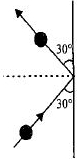
$A$ $0.5\, kg$ ball moving with a speed of $12\, m/s$ strikes a hard wall at an angle of $30^\circ$ with the wall. It is reflected with the same speed at the same angle. If the ball is in contact with the wall for $0.25\, s$,the average force acting on the wall is ........... $N$.
A
$96$
B
$48$
C
$24$
D
$12$
Solution
(C) Given:
Mass of the ball,$m = 0.5\, kg$
Speed of the ball,$v = 12\, m/s$
Angle with the wall,$\theta = 30^\circ$
Time of contact,$\Delta t = 0.25\, s$
The component of momentum parallel to the wall remains unchanged. The component of momentum perpendicular to the wall changes direction.
Initial momentum perpendicular to the wall: $p_i = -mv \sin \theta$ (taking direction towards the wall as negative).
Final momentum perpendicular to the wall: $p_f = mv \sin \theta$ (taking direction away from the wall as positive).
Change in momentum,$\Delta p = p_f - p_i = mv \sin \theta - (-mv \sin \theta) = 2mv \sin \theta$.
Average force,$F = \frac{\Delta p}{\Delta t} = \frac{2mv \sin \theta}{\Delta t}$
$F = \frac{2 \times 0.5 \times 12 \times \sin 30^\circ}{0.25}$
$F = \frac{2 \times 0.5 \times 12 \times 0.5}{0.25}$
$F = \frac{6}{0.25} = 24\, N$.
Mass of the ball,$m = 0.5\, kg$
Speed of the ball,$v = 12\, m/s$
Angle with the wall,$\theta = 30^\circ$
Time of contact,$\Delta t = 0.25\, s$
The component of momentum parallel to the wall remains unchanged. The component of momentum perpendicular to the wall changes direction.
Initial momentum perpendicular to the wall: $p_i = -mv \sin \theta$ (taking direction towards the wall as negative).
Final momentum perpendicular to the wall: $p_f = mv \sin \theta$ (taking direction away from the wall as positive).
Change in momentum,$\Delta p = p_f - p_i = mv \sin \theta - (-mv \sin \theta) = 2mv \sin \theta$.
Average force,$F = \frac{\Delta p}{\Delta t} = \frac{2mv \sin \theta}{\Delta t}$
$F = \frac{2 \times 0.5 \times 12 \times \sin 30^\circ}{0.25}$
$F = \frac{2 \times 0.5 \times 12 \times 0.5}{0.25}$
$F = \frac{6}{0.25} = 24\, N$.
0 likesView Solution
8
PhysicsMediumMCQAIPMT · 2006
$A$ body of mass $3\, kg$ is under a constant force which causes a displacement $s$ in metres in it,given by the relation $s = \frac{1}{3}t^2$,where $t$ is in seconds. Work done by the force in $2$ seconds is
A
$\frac{19}{5}\, J$
B
$\frac{5}{19}\, J$
C
$\frac{3}{8}\, J$
D
$\frac{8}{3}\, J$
Solution
(D) Given: Mass $m = 3\, kg$,displacement $s = \frac{1}{3}t^2$.
First,find the velocity $v$ by differentiating $s$ with respect to $t$:
$v = \frac{ds}{dt} = \frac{d}{dt}(\frac{1}{3}t^2) = \frac{2}{3}t$.
Next,find the acceleration $a$ by differentiating $v$ with respect to $t$:
$a = \frac{dv}{dt} = \frac{d}{dt}(\frac{2}{3}t) = \frac{2}{3}\, m/s^2$.
The force $F$ acting on the body is $F = m \times a = 3 \times \frac{2}{3} = 2\, N$.
The work done $W$ is given by $W = \int F \, ds$. Since $ds = v \, dt$,we have $W = \int_0^2 F \cdot v \, dt$.
$W = \int_0^2 2 \cdot (\frac{2}{3}t) \, dt = \frac{4}{3} \int_0^2 t \, dt$.
$W = \frac{4}{3} [\frac{t^2}{2}]_0^2 = \frac{4}{3} \times \frac{4}{2} = \frac{8}{3}\, J$.
First,find the velocity $v$ by differentiating $s$ with respect to $t$:
$v = \frac{ds}{dt} = \frac{d}{dt}(\frac{1}{3}t^2) = \frac{2}{3}t$.
Next,find the acceleration $a$ by differentiating $v$ with respect to $t$:
$a = \frac{dv}{dt} = \frac{d}{dt}(\frac{2}{3}t) = \frac{2}{3}\, m/s^2$.
The force $F$ acting on the body is $F = m \times a = 3 \times \frac{2}{3} = 2\, N$.
The work done $W$ is given by $W = \int F \, ds$. Since $ds = v \, dt$,we have $W = \int_0^2 F \cdot v \, dt$.
$W = \int_0^2 2 \cdot (\frac{2}{3}t) \, dt = \frac{4}{3} \int_0^2 t \, dt$.
$W = \frac{4}{3} [\frac{t^2}{2}]_0^2 = \frac{4}{3} \times \frac{4}{2} = \frac{8}{3}\, J$.
0 likesView Solution
9
PhysicsMediumMCQAIPMT · 2006
$300\, J$ of work is done in sliding a $2\, kg$ block up an inclined plane of height $10\, m.$ Work done against friction is.....$J$ (Take $g = 10\, m/s^2$)
A
$1000$
B
$200$
C
$100$
D
$0$
Solution
(C) The total work done on the block is $W_{total} = 300\, J$.
This work is used to increase the potential energy of the block and to overcome friction.
The increase in potential energy is given by $\Delta U = mgh$.
Substituting the given values: $\Delta U = 2\, kg \times 10\, m/s^2 \times 10\, m = 200\, J$.
The work done against friction $(W_f)$ is the difference between the total work done and the work done against gravity:
$W_f = W_{total} - \Delta U$
$W_f = 300\, J - 200\, J = 100\, J$.
This work is used to increase the potential energy of the block and to overcome friction.
The increase in potential energy is given by $\Delta U = mgh$.
Substituting the given values: $\Delta U = 2\, kg \times 10\, m/s^2 \times 10\, m = 200\, J$.
The work done against friction $(W_f)$ is the difference between the total work done and the work done against gravity:
$W_f = W_{total} - \Delta U$
$W_f = 300\, J - 200\, J = 100\, J$.
0 likesView Solution
10
PhysicsMediumMCQAIPMT · 2006
$A$ black body at $1227^{\circ}C$ emits radiations with maximum intensity at a wavelength of $5000\;\mathring{A}$. If the temperature of the body is increased by $1000^{\circ}C$,the maximum intensity will be observed at ...... $\mathring{A}$.
A
$2754.8$
B
$3000$
C
$3500$
D
$4000$
Solution
(B) According to $Wien's$ displacement law,the product of the wavelength of maximum intensity $(\lambda_{\max})$ and the absolute temperature $(T)$ is constant:
$\lambda_{\max} T = b$ (constant)
Given:
Initial temperature $T_1 = 1227^{\circ}C = 1227 + 273 = 1500\;K$
Initial wavelength $\lambda_{\max 1} = 5000\;\mathring{A}$
Final temperature $T_2 = 1227^{\circ}C + 1000^{\circ}C = 2227^{\circ}C = 2227 + 273 = 2500\;K$
Using the relation $\lambda_{\max 1} T_1 = \lambda_{\max 2} T_2$:
$\lambda_{\max 2} = \frac{\lambda_{\max 1} T_1}{T_2}$
$\lambda_{\max 2} = \frac{5000 \times 1500}{2500}$
$\lambda_{\max 2} = 5000 \times 0.6 = 3000\;\mathring{A}$
Therefore,the maximum intensity will be observed at $3000\;\mathring{A}$.
$\lambda_{\max} T = b$ (constant)
Given:
Initial temperature $T_1 = 1227^{\circ}C = 1227 + 273 = 1500\;K$
Initial wavelength $\lambda_{\max 1} = 5000\;\mathring{A}$
Final temperature $T_2 = 1227^{\circ}C + 1000^{\circ}C = 2227^{\circ}C = 2227 + 273 = 2500\;K$
Using the relation $\lambda_{\max 1} T_1 = \lambda_{\max 2} T_2$:
$\lambda_{\max 2} = \frac{\lambda_{\max 1} T_1}{T_2}$
$\lambda_{\max 2} = \frac{5000 \times 1500}{2500}$
$\lambda_{\max 2} = 5000 \times 0.6 = 3000\;\mathring{A}$
Therefore,the maximum intensity will be observed at $3000\;\mathring{A}$.
0 likesView Solution
11
PhysicsMediumMCQAIPMT · 2006
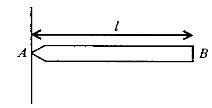
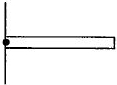
$A$ uniform rod $AB$ of length $l$ and mass $m$ is free to rotate about point $A.$ The rod is released from rest in the horizontal position. Given that the moment of inertia of the rod about $A$ is $ml^2/3$,the initial angular acceleration of the rod will be:
A
$\frac{mgl}{2}$
B
$\frac{3}{2}gl$
C
$\frac{3g}{2l}$
D
$\frac{2g}{3l}$
Solution
(C) The torque $\tau$ about point $A$ is due to the gravitational force acting at the center of mass of the rod,which is at a distance $l/2$ from $A.$
$\tau = mg \times \frac{l}{2} = \frac{mgl}{2}$
Using the relation between torque and angular acceleration,$\tau = I\alpha$,where $I$ is the moment of inertia about $A$ and $\alpha$ is the angular acceleration.
Given $I = \frac{ml^2}{3}$,we have:
$\alpha = \frac{\tau}{I} = \frac{mgl/2}{ml^2/3} = \frac{mgl}{2} \times \frac{3}{ml^2} = \frac{3g}{2l}$
$\tau = mg \times \frac{l}{2} = \frac{mgl}{2}$
Using the relation between torque and angular acceleration,$\tau = I\alpha$,where $I$ is the moment of inertia about $A$ and $\alpha$ is the angular acceleration.
Given $I = \frac{ml^2}{3}$,we have:
$\alpha = \frac{\tau}{I} = \frac{mgl/2}{ml^2/3} = \frac{mgl}{2} \times \frac{3}{ml^2} = \frac{3g}{2l}$
0 likesView Solution
12
PhysicsMediumMCQAIPMT · 2006
The Earth is assumed to be a sphere of radius $R$. $A$ platform is arranged at a height $R$ from the surface of the Earth. The escape velocity of a body from this platform is $fv$,where $v$ is its escape velocity from the surface of the Earth. The value of $f$ is
A
$\frac{1}{2}$
B
$\sqrt{2}$
C
$\frac{1}{\sqrt{2}}$
D
$\frac{1}{3}$
Solution
(C) The escape velocity from the surface of the Earth is given by $v = \sqrt{\frac{2GM}{R}} = \sqrt{2gR}$.
For a body at a height $h = R$ from the surface,the distance from the center of the Earth is $r = R + h = 2R$.
The total energy required to escape from this distance must be zero:
$-\frac{GMm}{2R} + \frac{1}{2}m(fv)^2 = 0$.
Solving for the escape velocity at height $R$ $(v')$:
$\frac{1}{2}m(v')^2 = \frac{GMm}{2R} \Rightarrow v' = \sqrt{\frac{GM}{R}}$.
Since $v = \sqrt{\frac{2GM}{R}}$,we can write $v' = \frac{1}{\sqrt{2}} \sqrt{\frac{2GM}{R}} = \frac{v}{\sqrt{2}}$.
Given that the escape velocity from the platform is $fv$,we have $fv = \frac{v}{\sqrt{2}}$.
Therefore,$f = \frac{1}{\sqrt{2}}$.
For a body at a height $h = R$ from the surface,the distance from the center of the Earth is $r = R + h = 2R$.
The total energy required to escape from this distance must be zero:
$-\frac{GMm}{2R} + \frac{1}{2}m(fv)^2 = 0$.
Solving for the escape velocity at height $R$ $(v')$:
$\frac{1}{2}m(v')^2 = \frac{GMm}{2R} \Rightarrow v' = \sqrt{\frac{GM}{R}}$.
Since $v = \sqrt{\frac{2GM}{R}}$,we can write $v' = \frac{1}{\sqrt{2}} \sqrt{\frac{2GM}{R}} = \frac{v}{\sqrt{2}}$.
Given that the escape velocity from the platform is $fv$,we have $fv = \frac{v}{\sqrt{2}}$.
Therefore,$f = \frac{1}{\sqrt{2}}$.
0 likesView Solution
13
PhysicsMediumMCQAIPMT · 2006
The molar specific heat at constant pressure of an ideal gas is $(7/2)R$. The ratio of specific heat at constant pressure to that at constant volume is
A
$9/7$
B
$7/5$
C
$8/7$
D
$5/7$
Solution
(B) The molar specific heat at constant pressure is given as ${C_p} = \frac{7}{2}R$.
Using Mayer's relation,${C_p} - {C_V} = R$,we can find the molar specific heat at constant volume ${C_V}$.
${C_V} = {C_p} - R = \frac{7}{2}R - R = \frac{5}{2}R$.
The ratio of specific heat at constant pressure to that at constant volume is denoted by $\gamma = \frac{{C_p}}{{C_V}}$.
Substituting the values,$\gamma = \frac{(7/2)R}{(5/2)R} = \frac{7}{5}$.
Using Mayer's relation,${C_p} - {C_V} = R$,we can find the molar specific heat at constant volume ${C_V}$.
${C_V} = {C_p} - R = \frac{7}{2}R - R = \frac{5}{2}R$.
The ratio of specific heat at constant pressure to that at constant volume is denoted by $\gamma = \frac{{C_p}}{{C_V}}$.
Substituting the values,$\gamma = \frac{(7/2)R}{(5/2)R} = \frac{7}{5}$.
0 likesView Solution
14
PhysicsDifficultMCQAIPMT · 2006
$A$ Carnot engine whose sink is at $300\, K$ has an efficiency of $40\%.$ By how much should the temperature of the source be increased so as to increase its efficiency by $50\%$ of its original efficiency? (in $K$)
A
$380$
B
$275$
C
$325$
D
$250$
Solution
(D) The efficiency of a Carnot engine is given by $\eta = 1 - \frac{T_2}{T_1}$,where $T_2$ is the sink temperature and $T_1$ is the source temperature.
Given $\eta = 40\% = 0.4$ and $T_2 = 300\, K$.
$0.4 = 1 - \frac{300}{T_1} \implies \frac{300}{T_1} = 0.6 \implies T_1 = \frac{300}{0.6} = 500\, K$.
The efficiency is to be increased by $50\%$ of its original efficiency.
New efficiency $\eta' = \eta + 0.5 \times \eta = 0.4 + 0.5(0.4) = 0.4 + 0.2 = 0.6 = 60\%$.
Let the new source temperature be $T_1'$.
$0.6 = 1 - \frac{300}{T_1'} \implies \frac{300}{T_1'} = 0.4 \implies T_1' = \frac{300}{0.4} = 750\, K$.
The increase in source temperature is $\Delta T = T_1' - T_1 = 750 - 500 = 250\, K$.
Given $\eta = 40\% = 0.4$ and $T_2 = 300\, K$.
$0.4 = 1 - \frac{300}{T_1} \implies \frac{300}{T_1} = 0.6 \implies T_1 = \frac{300}{0.6} = 500\, K$.
The efficiency is to be increased by $50\%$ of its original efficiency.
New efficiency $\eta' = \eta + 0.5 \times \eta = 0.4 + 0.5(0.4) = 0.4 + 0.2 = 0.6 = 60\%$.
Let the new source temperature be $T_1'$.
$0.6 = 1 - \frac{300}{T_1'} \implies \frac{300}{T_1'} = 0.4 \implies T_1' = \frac{300}{0.4} = 750\, K$.
The increase in source temperature is $\Delta T = T_1' - T_1 = 750 - 500 = 250\, K$.
0 likesView Solution
15
PhysicsDifficultMCQAIPMT · 2006
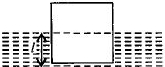
$A$ rectangular block of mass $m$ and area of cross-section $A$ floats in a liquid of density $\rho$. If it is given a small vertical displacement from equilibrium,it undergoes simple harmonic motion with a time period $T$. Then:
A
$T \propto \frac{1}{\sqrt{m}}$
B
$T \propto \sqrt{\rho}$
C
$T \propto \frac{1}{\sqrt{A}}$
D
$T \propto \frac{1}{\rho}$
Solution
(C) Let $l$ be the length of the block immersed in the liquid at equilibrium. When the block is floating,the weight of the block is balanced by the buoyant force:
$mg = A l \rho g$
If the block is given a small vertical displacement $y$ downwards,the additional buoyant force acting upwards is:
$F_{restoring} = -(A(l+y)\rho g - mg) = -(Al\rho g + Ay\rho g - mg)$
Since $mg = Al\rho g$,we get:
$F_{restoring} = -A\rho g y$
This is the equation of simple harmonic motion $F = -ky$,where the spring constant $k = A\rho g$.
The time period $T$ of the oscillation is given by:
$T = 2\pi \sqrt{\frac{m}{k}} = 2\pi \sqrt{\frac{m}{A\rho g}}$
From this expression,we can see that $T \propto \frac{1}{\sqrt{A}}$.
$mg = A l \rho g$
If the block is given a small vertical displacement $y$ downwards,the additional buoyant force acting upwards is:
$F_{restoring} = -(A(l+y)\rho g - mg) = -(Al\rho g + Ay\rho g - mg)$
Since $mg = Al\rho g$,we get:
$F_{restoring} = -A\rho g y$
This is the equation of simple harmonic motion $F = -ky$,where the spring constant $k = A\rho g$.
The time period $T$ of the oscillation is given by:
$T = 2\pi \sqrt{\frac{m}{k}} = 2\pi \sqrt{\frac{m}{A\rho g}}$
From this expression,we can see that $T \propto \frac{1}{\sqrt{A}}$.
0 likesView Solution
16
PhysicsMediumMCQAIPMT · 2006
Two sound waves with wavelengths $5.0\, m$ and $5.5\, m$ respectively,each propagate in a gas with velocity $330\, m/s$. We expect the following number of beats per second.
A
$6$
B
$12$
C
$0$
D
$1$
Solution
(A) The frequency $f$ of a sound wave is given by the formula $f = \frac{v}{\lambda}$,where $v$ is the velocity and $\lambda$ is the wavelength.
For the first wave: $f_1 = \frac{330}{5.0} = 66\, Hz$.
For the second wave: $f_2 = \frac{330}{5.5} = 60\, Hz$.
The number of beats per second is equal to the absolute difference between the two frequencies: $|f_1 - f_2|$.
Beats per second $= |66 - 60| = 6\, Hz$.
For the first wave: $f_1 = \frac{330}{5.0} = 66\, Hz$.
For the second wave: $f_2 = \frac{330}{5.5} = 60\, Hz$.
The number of beats per second is equal to the absolute difference between the two frequencies: $|f_1 - f_2|$.
Beats per second $= |66 - 60| = 6\, Hz$.
0 likesView Solution
17
PhysicsMediumMCQAIPMT · 2006
$A$ transverse wave propagating along the $x-$ axis is represented by $y(x,t) = 8.0 \sin \left( 0.5\pi x - 4\pi t - \frac{\pi}{4} \right)$,where $x$ is in metres and $t$ is in seconds. The speed of the wave is ..... $m/s$.
A
$8$
B
$4\pi$
C
$0.5\pi$
D
$\frac{\pi}{4}$
Solution
(A) The given wave equation is $y(x, t) = 8.0 \sin \left( 0.5 \pi x - 4 \pi t - \frac{\pi}{4} \right)$.
Comparing this with the standard wave equation $y(x, t) = A \sin (kx - \omega t + \phi)$:
Here,the wave number $k = 0.5 \pi$ and the angular frequency $\omega = 4 \pi$.
The speed of the wave $v$ is given by the ratio of angular frequency to wave number:
$v = \frac{\omega}{k}$
Substituting the values:
$v = \frac{4 \pi}{0.5 \pi} = \frac{4}{0.5} = 8 \ m/s$.
Therefore,the speed of the wave is $8 \ m/s$.
Comparing this with the standard wave equation $y(x, t) = A \sin (kx - \omega t + \phi)$:
Here,the wave number $k = 0.5 \pi$ and the angular frequency $\omega = 4 \pi$.
The speed of the wave $v$ is given by the ratio of angular frequency to wave number:
$v = \frac{\omega}{k}$
Substituting the values:
$v = \frac{4 \pi}{0.5 \pi} = \frac{4}{0.5} = 8 \ m/s$.
Therefore,the speed of the wave is $8 \ m/s$.
0 likesView Solution
18
PhysicsMediumMCQAIPMT · 2006
The velocity $v$ (in $cm/sec$) of a particle is given in terms of time $t$ (in $sec$) by the relation $v = at + \frac{b}{t + c}$. The dimensions of $a, b,$ and $c$ are:
A
$a = L^2, b = T, c = LT^2$
B
$a = LT^2, b = LT, c = L$
C
$a = LT^{-2}, b = L, c = T$
D
$a = L, b = LT, c = T^2$
Solution
(C) According to the principle of dimensional homogeneity,the dimensions of each term in an equation must be the same.
$1$. For the term $c$: Since $c$ is added to $t$ (time),the dimension of $c$ must be the same as the dimension of $t$. Therefore,$[c] = [T]$.
$2$. For the term $at$: The dimension of $at$ must be equal to the dimension of velocity $v$. Thus,$[a][T] = [LT^{-1}]$,which gives $[a] = [LT^{-2}]$.
$3$. For the term $\frac{b}{t+c}$: The dimension of the entire term must be equal to the dimension of velocity $v$. Since $[t+c] = [T]$,we have $\frac{[b]}{[T]} = [LT^{-1}]$. Therefore,$[b] = [L]$.
Thus,the dimensions are $a = LT^{-2}, b = L, c = T$.
$1$. For the term $c$: Since $c$ is added to $t$ (time),the dimension of $c$ must be the same as the dimension of $t$. Therefore,$[c] = [T]$.
$2$. For the term $at$: The dimension of $at$ must be equal to the dimension of velocity $v$. Thus,$[a][T] = [LT^{-1}]$,which gives $[a] = [LT^{-2}]$.
$3$. For the term $\frac{b}{t+c}$: The dimension of the entire term must be equal to the dimension of velocity $v$. Since $[t+c] = [T]$,we have $\frac{[b]}{[T]} = [LT^{-1}]$. Therefore,$[b] = [L]$.
Thus,the dimensions are $a = LT^{-2}, b = L, c = T$.
0 likesView Solution
19
PhysicsEasyMCQAIPMT · 2006
Which one of the following statements is true?
A
Both light and sound waves in air are transverse.
B
The sound waves in air are longitudinal while the light waves are transverse.
C
Both light and sound waves in air are longitudinal.
D
Both light and sound waves can travel in vacuum.
Solution
(B) Sound waves are mechanical waves that require a material medium for propagation. In air,sound waves propagate as longitudinal waves,where the particles of the medium oscillate parallel to the direction of wave propagation.
Light waves are electromagnetic waves that do not require a material medium for propagation. They are transverse waves,where the electric and magnetic field vectors oscillate perpendicular to the direction of wave propagation.
Therefore,the correct statement is that sound waves in air are longitudinal while light waves are transverse.
Light waves are electromagnetic waves that do not require a material medium for propagation. They are transverse waves,where the electric and magnetic field vectors oscillate perpendicular to the direction of wave propagation.
Therefore,the correct statement is that sound waves in air are longitudinal while light waves are transverse.
0 likesView Solution
20
PhysicsMediumMCQAIPMT · 2006
The moment of inertia of a uniform circular disc of radius $R$ and mass $M$ about an axis passing through the edge of the disc and normal to the disc is
A
$\frac{3}{2}MR^2$
B
$MR^2$
C
$\frac{7}{2}MR^2$
D
$\frac{1}{2}MR^2$
Solution
(A) The moment of inertia of a uniform circular disc about an axis passing through its centre and perpendicular to its plane is $I_{G} = \frac{1}{2}MR^2$.
By the theorem of parallel axes,the moment of inertia about an axis passing through the edge and normal to the disc is given by $I = I_{G} + Md^2$,where $d = R$ is the distance between the parallel axes.
Substituting the values,we get $I = \frac{1}{2}MR^2 + M(R)^2 = \frac{3}{2}MR^2$.
By the theorem of parallel axes,the moment of inertia about an axis passing through the edge and normal to the disc is given by $I = I_{G} + Md^2$,where $d = R$ is the distance between the parallel axes.
Substituting the values,we get $I = \frac{1}{2}MR^2 + M(R)^2 = \frac{3}{2}MR^2$.
0 likesView Solution
21
PhysicsDifficultMCQAIPMT · 2006
The vectors $\vec{A}$ and $\vec{B}$ are such that $|\vec{A}+\vec{B}|=|\vec{A}-\vec{B}|$. The angle between the two vectors is: (in $^{\circ}$)
A
$60$
B
$75$
C
$45$
D
$90$
Solution
(D) The magnitude of the sum of two vectors is given by $|\vec{A}+\vec{B}|^2 = |\vec{A}|^2 + |\vec{B}|^2 + 2|\vec{A}||\vec{B}| \cos \theta$.
Similarly,the magnitude of the difference of two vectors is given by $|\vec{A}-\vec{B}|^2 = |\vec{A}|^2 + |\vec{B}|^2 - 2|\vec{A}||\vec{B}| \cos \theta$.
Given that $|\vec{A}+\vec{B}| = |\vec{A}-\vec{B}|$,we square both sides to get $|\vec{A}+\vec{B}|^2 = |\vec{A}-\vec{B}|^2$.
Substituting the expressions,we have $|\vec{A}|^2 + |\vec{B}|^2 + 2|\vec{A}||\vec{B}| \cos \theta = |\vec{A}|^2 + |\vec{B}|^2 - 2|\vec{A}||\vec{B}| \cos \theta$.
Canceling the common terms $|\vec{A}|^2$ and $|\vec{B}|^2$ from both sides,we get $2|\vec{A}||\vec{B}| \cos \theta = -2|\vec{A}||\vec{B}| \cos \theta$.
Rearranging the terms,we get $4|\vec{A}||\vec{B}| \cos \theta = 0$.
Since the vectors are non-zero,$|\vec{A}| \neq 0$ and $|\vec{B}| \neq 0$,therefore $\cos \theta = 0$.
This implies $\theta = 90^{\circ}$.
Similarly,the magnitude of the difference of two vectors is given by $|\vec{A}-\vec{B}|^2 = |\vec{A}|^2 + |\vec{B}|^2 - 2|\vec{A}||\vec{B}| \cos \theta$.
Given that $|\vec{A}+\vec{B}| = |\vec{A}-\vec{B}|$,we square both sides to get $|\vec{A}+\vec{B}|^2 = |\vec{A}-\vec{B}|^2$.
Substituting the expressions,we have $|\vec{A}|^2 + |\vec{B}|^2 + 2|\vec{A}||\vec{B}| \cos \theta = |\vec{A}|^2 + |\vec{B}|^2 - 2|\vec{A}||\vec{B}| \cos \theta$.
Canceling the common terms $|\vec{A}|^2$ and $|\vec{B}|^2$ from both sides,we get $2|\vec{A}||\vec{B}| \cos \theta = -2|\vec{A}||\vec{B}| \cos \theta$.
Rearranging the terms,we get $4|\vec{A}||\vec{B}| \cos \theta = 0$.
Since the vectors are non-zero,$|\vec{A}| \neq 0$ and $|\vec{B}| \neq 0$,therefore $\cos \theta = 0$.
This implies $\theta = 90^{\circ}$.
0 likesView Solution
22
PhysicsEasyMCQAIPMT · 2006
The potential energy of a long spring when stretched by $2\,cm$ is $U$. If the spring is stretched by $8\,cm$,the potential energy stored in it will be $.......\,U$.
A
$16$
B
$2$
C
$4$
D
$8$
Solution
(A) The potential energy $U$ stored in a spring stretched by a distance $x$ is given by the formula $U = \frac{1}{2} k x^2$,where $k$ is the spring constant.
For the initial stretch $x_1 = 2\,cm$,the potential energy is $U = \frac{1}{2} k (2)^2 = 2k$.
For the final stretch $x_2 = 8\,cm$,the new potential energy $U'$ is $U' = \frac{1}{2} k (8)^2 = 32k$.
Dividing the two equations:
$\frac{U'}{U} = \frac{\frac{1}{2} k (8)^2}{\frac{1}{2} k (2)^2} = \left(\frac{8}{2}\right)^2 = (4)^2 = 16$.
Therefore,$U' = 16\,U$.
For the initial stretch $x_1 = 2\,cm$,the potential energy is $U = \frac{1}{2} k (2)^2 = 2k$.
For the final stretch $x_2 = 8\,cm$,the new potential energy $U'$ is $U' = \frac{1}{2} k (8)^2 = 32k$.
Dividing the two equations:
$\frac{U'}{U} = \frac{\frac{1}{2} k (8)^2}{\frac{1}{2} k (2)^2} = \left(\frac{8}{2}\right)^2 = (4)^2 = 16$.
Therefore,$U' = 16\,U$.
0 likesView Solution
23
PhysicsEasyMCQAIPMT · 2006
Curie temperature is the temperature above which
A
$A$ paramagnetic material becomes ferromagnetic
B
$A$ ferromagnetic material becomes paramagnetic
C
$A$ paramagnetic material becomes diamagnetic
D
$A$ ferromagnetic material becomes diamagnetic
Solution
(B) The Curie temperature $(T_C)$ is a characteristic property of ferromagnetic materials.
At temperatures below $T_C$,the material exhibits ferromagnetic properties due to the alignment of magnetic domains.
As the temperature increases and reaches $T_C$,the thermal agitation becomes strong enough to overcome the exchange coupling that maintains the alignment of these domains.
Consequently,above the Curie temperature,the material loses its spontaneous magnetization and transitions into a paramagnetic state.
Therefore,the correct option is $(B)$.
At temperatures below $T_C$,the material exhibits ferromagnetic properties due to the alignment of magnetic domains.
As the temperature increases and reaches $T_C$,the thermal agitation becomes strong enough to overcome the exchange coupling that maintains the alignment of these domains.
Consequently,above the Curie temperature,the material loses its spontaneous magnetization and transitions into a paramagnetic state.
Therefore,the correct option is $(B)$.
0 likesView Solution
24
PhysicsEasyMCQAIPMT · 2006
The core of a transformer is laminated so that
A
Ratio of voltage in the primary and secondary may be increased
B
Rusting of the core may be stopped
C
Energy losses due to eddy currents may be reduced
D
Change in flux is increased
Solution
(C) When magnetic flux linked with a coil changes,an induced $emf$ is produced in it,and the induced current flows through the material. These induced currents are set up in the conductor in the form of closed loops. These currents resemble eddies or whirlpools and are known as $Eddy$ currents. These currents oppose the cause of their origin; therefore,due to $Eddy$ currents,a significant amount of energy is wasted in the form of heat energy. If the core of the transformer is laminated,the path for these currents is restricted,and their effect is minimized.
0 likesView Solution
25
PhysicsEasyMCQAIPMT · 2006
An electric dipole of moment $\vec{p}$ is lying along a uniform electric field $\vec{E}$. The work done in rotating the dipole by $90^{\circ}$ is
A
$pE$
B
$\sqrt{2} pE$
C
$\frac{pE}{2}$
D
$2 pE$
Solution
(A) The work done $W$ in rotating an electric dipole of dipole moment $\vec{p}$ in a uniform electric field $\vec{E}$ from an initial angle $\theta_1$ to a final angle $\theta_2$ is given by the formula:
$W = \int_{\theta_1}^{\theta_2} pE \sin \theta \, d\theta = pE (\cos \theta_1 - \cos \theta_2)$
Given that the dipole is initially lying along the electric field,the initial angle $\theta_1 = 0^{\circ}$.
The final angle is $\theta_2 = 90^{\circ}$.
Substituting these values into the formula:
$W = pE (\cos 0^{\circ} - \cos 90^{\circ})$
Since $\cos 0^{\circ} = 1$ and $\cos 90^{\circ} = 0$,we get:
$W = pE (1 - 0) = pE$.
$W = \int_{\theta_1}^{\theta_2} pE \sin \theta \, d\theta = pE (\cos \theta_1 - \cos \theta_2)$
Given that the dipole is initially lying along the electric field,the initial angle $\theta_1 = 0^{\circ}$.
The final angle is $\theta_2 = 90^{\circ}$.
Substituting these values into the formula:
$W = pE (\cos 0^{\circ} - \cos 90^{\circ})$
Since $\cos 0^{\circ} = 1$ and $\cos 90^{\circ} = 0$,we get:
$W = pE (1 - 0) = pE$.
0 likesView Solution
26
PhysicsEasyMCQAIPMT · 2006
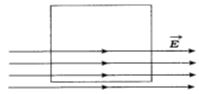
$A$ square surface of side $L$ metres is in the plane of the paper. $A$ uniform electric field $\vec{E} \text{ (V/m)}$,also in the plane of the paper,is limited only to the lower half of the square surface,(see figure). The electric flux in $SI$ units associated with the surface is
A
$EL^2$
B
$\frac{EL^2}{2\varepsilon_0}$
C
$\frac{EL^2}{2}$
D
$0$
Solution
(D) The electric flux $\phi$ through a surface is defined as the dot product of the electric field vector $\vec{E}$ and the area vector $\vec{S}$.
$\phi = \vec{E} \cdot \vec{S} = ES \cos \theta$
Here,the electric field $\vec{E}$ lies in the plane of the paper.
The area vector $\vec{S}$ for a surface in the plane of the paper is perpendicular to the plane of the paper.
Therefore,the angle $\theta$ between the electric field vector $\vec{E}$ and the area vector $\vec{S}$ is $90^{\circ}$.
Since $\cos 90^{\circ} = 0$,the electric flux $\phi$ associated with the surface is:
$\phi = ES \cos 90^{\circ} = ES(0) = 0$.
$\phi = \vec{E} \cdot \vec{S} = ES \cos \theta$
Here,the electric field $\vec{E}$ lies in the plane of the paper.
The area vector $\vec{S}$ for a surface in the plane of the paper is perpendicular to the plane of the paper.
Therefore,the angle $\theta$ between the electric field vector $\vec{E}$ and the area vector $\vec{S}$ is $90^{\circ}$.
Since $\cos 90^{\circ} = 0$,the electric flux $\phi$ associated with the surface is:
$\phi = ES \cos 90^{\circ} = ES(0) = 0$.
0 likesView Solution
27
PhysicsEasyMCQAIPMT · 2006
$A$ parallel plate air capacitor is charged to a potential difference of $V$ volts. After disconnecting the charging battery,the distance between the plates of the capacitor is increased using an insulating handle. As a result,the potential difference between the plates:
A
decreases
B
increases
C
does not change
D
becomes zero
Solution
(B) The capacitance of a parallel plate capacitor is given by $C = \frac{\varepsilon_{0} A}{d}$,where $A$ is the area of the plates and $d$ is the distance between them.
When the distance $d$ is increased,the capacitance $C$ decreases.
Since the battery is disconnected,the charge $Q$ on the plates remains constant.
The relationship between charge,capacitance,and potential difference is $V = \frac{Q}{C}$.
Since $Q$ is constant and $C$ decreases,the potential difference $V$ must increase.
When the distance $d$ is increased,the capacitance $C$ decreases.
Since the battery is disconnected,the charge $Q$ on the plates remains constant.
The relationship between charge,capacitance,and potential difference is $V = \frac{Q}{C}$.
Since $Q$ is constant and $C$ decreases,the potential difference $V$ must increase.
0 likesView Solution
28
PhysicsMediumMCQAIPMT · 2006
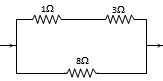
Power dissipated across the $8 \,\Omega$ resistor in the circuit shown here is $2 \,\text{W}.$ The power dissipated in watt units across the $3 \,\Omega$ resistor is
A
$1$
B
$2$
C
$3$
D
$0.5$
Solution
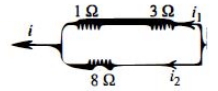
(C) The circuit consists of two parallel branches. The upper branch has resistors $1 \,\Omega$ and $3 \,\Omega$ in series,so its total resistance is $R_1 = 1 + 3 = 4 \,\Omega.$ The lower branch has a resistor $R_2 = 8 \,\Omega.$
Since the branches are in parallel,the potential difference $V$ across both branches is the same.
The power dissipated in a resistor is given by $P = \frac{V^2}{R}.$
For the $8 \,\Omega$ resistor,$P_2 = \frac{V^2}{8} = 2 \,\text{W},$ which implies $V^2 = 16 \,\text{V}^2.$
The current $i_1$ flowing through the upper branch is $i_1 = \frac{V}{R_1} = \frac{V}{4}.$
The power dissipated in the $3 \,\Omega$ resistor is $P_{3\Omega} = i_1^2 \times 3 = \left(\frac{V}{4}\right)^2 \times 3 = \frac{V^2}{16} \times 3.$
Substituting $V^2 = 16,$ we get $P_{3\Omega} = \frac{16}{16} \times 3 = 3 \,\text{W}.$
Since the branches are in parallel,the potential difference $V$ across both branches is the same.
The power dissipated in a resistor is given by $P = \frac{V^2}{R}.$
For the $8 \,\Omega$ resistor,$P_2 = \frac{V^2}{8} = 2 \,\text{W},$ which implies $V^2 = 16 \,\text{V}^2.$
The current $i_1$ flowing through the upper branch is $i_1 = \frac{V}{R_1} = \frac{V}{4}.$
The power dissipated in the $3 \,\Omega$ resistor is $P_{3\Omega} = i_1^2 \times 3 = \left(\frac{V}{4}\right)^2 \times 3 = \frac{V^2}{16} \times 3.$
Substituting $V^2 = 16,$ we get $P_{3\Omega} = \frac{16}{16} \times 3 = 3 \,\text{W}.$
0 likesView Solution
29
PhysicsMediumMCQAIPMT · 2006
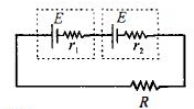
Two cells,having the same $e.m.f.$ $E$,are connected in series through an external resistance $R$. The cells have internal resistances $r_1$ and $r_2$ $(r_1 > r_2)$ respectively. When the circuit is closed,the potential difference across the first cell is zero. The value of $R$ is
A
$\sqrt{r_1 r_2}$
B
$r_1 + r_2$
C
$r_1 - r_2$
D
$\frac{r_1 + r_2}{2}$
Solution
(C) The total $e.m.f.$ of the series combination is $E_{eq} = E + E = 2E$.
The total resistance of the circuit is $R_{eq} = R + r_1 + r_2$.
The current $I$ flowing through the circuit is given by $I = \frac{2E}{R + r_1 + r_2}$.
The potential difference $V_1$ across the first cell (with internal resistance $r_1$) is given by $V_1 = E - I r_1$.
Given that $V_1 = 0$,we have $E - I r_1 = 0$,which implies $E = I r_1$.
Substituting the expression for $I$:
$E = \left( \frac{2E}{R + r_1 + r_2} \right) r_1$.
Dividing both sides by $E$ (assuming $E \neq 0$):
$1 = \frac{2r_1}{R + r_1 + r_2}$.
$R + r_1 + r_2 = 2r_1$.
$R = 2r_1 - r_1 - r_2 = r_1 - r_2$.
Thus,the correct option is $C$.
The total resistance of the circuit is $R_{eq} = R + r_1 + r_2$.
The current $I$ flowing through the circuit is given by $I = \frac{2E}{R + r_1 + r_2}$.
The potential difference $V_1$ across the first cell (with internal resistance $r_1$) is given by $V_1 = E - I r_1$.
Given that $V_1 = 0$,we have $E - I r_1 = 0$,which implies $E = I r_1$.
Substituting the expression for $I$:
$E = \left( \frac{2E}{R + r_1 + r_2} \right) r_1$.
Dividing both sides by $E$ (assuming $E \neq 0$):
$1 = \frac{2r_1}{R + r_1 + r_2}$.
$R + r_1 + r_2 = 2r_1$.
$R = 2r_1 - r_1 - r_2 = r_1 - r_2$.
Thus,the correct option is $C$.
0 likesView Solution
30
PhysicsEasyMCQAIPMT · 2006
Kirchhoff's first law $(\sum i = 0)$ and second law $(\sum iR = \sum E)$,where the symbols have their usual meanings,are respectively based on:
A
conservation of electric charge and energy respectively
B
conservation of charge,conservation of momentum
C
conservation of energy,conservation of charge
D
conservation of momentum,conservation of charge
Solution
(A) Kirchhoff's first law,also known as the Junction Rule,states that the algebraic sum of currents meeting at a junction is zero. This is a direct consequence of the law of conservation of charge,as charge cannot accumulate at a junction.
Kirchhoff's second law,also known as the Loop Rule,states that the algebraic sum of potential differences in any closed loop is zero. This is a direct consequence of the law of conservation of energy,as the work done in moving a unit charge around a closed loop in an electrostatic field is zero.
Kirchhoff's second law,also known as the Loop Rule,states that the algebraic sum of potential differences in any closed loop is zero. This is a direct consequence of the law of conservation of energy,as the work done in moving a unit charge around a closed loop in an electrostatic field is zero.
0 likesView Solution
31
PhysicsMediumMCQAIPMT · 2006
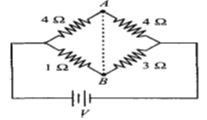
In the circuit shown,if a conducting wire is connected between points $A$ and $B,$ the current in this wire will
A
flow from $A$ to $B$
B
flow from $B$ to $A$
C
flow in the direction which will be decided by the value of $V$
D
be zero
Solution
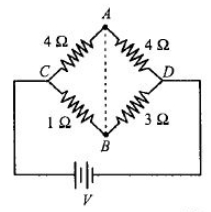
(B) Let the potential at point $C$ be $V_C$ and at point $D$ be $V_D$. Let $V_C - V_D = V$.
The circuit consists of two parallel branches: $CAD$ and $CBD$.
In branch $CAD$,the total resistance is $4 \, \Omega + 4 \, \Omega = 8 \, \Omega$. The current is $I = \frac{V}{8} \, A$.
The potential at $A$ relative to $C$ is $V_C - V_A = I \times 4 \, \Omega = \frac{V}{8} \times 4 = \frac{V}{2}$. Thus,$V_A = V_C - \frac{V}{2}$.
In branch $CBD$,the total resistance is $1 \, \Omega + 3 \, \Omega = 4 \, \Omega$. The current is $I' = \frac{V}{4} \, A$.
The potential at $B$ relative to $C$ is $V_C - V_B = I' \times 1 \, \Omega = \frac{V}{4} \times 1 = \frac{V}{4}$. Thus,$V_B = V_C - \frac{V}{4}$.
Comparing the potentials,$V_B = V_C - 0.25V$ and $V_A = V_C - 0.5V$. Since $V_B > V_A$,the current will flow from $B$ to $A$ when a wire is connected between them.
The circuit consists of two parallel branches: $CAD$ and $CBD$.
In branch $CAD$,the total resistance is $4 \, \Omega + 4 \, \Omega = 8 \, \Omega$. The current is $I = \frac{V}{8} \, A$.
The potential at $A$ relative to $C$ is $V_C - V_A = I \times 4 \, \Omega = \frac{V}{8} \times 4 = \frac{V}{2}$. Thus,$V_A = V_C - \frac{V}{2}$.
In branch $CBD$,the total resistance is $1 \, \Omega + 3 \, \Omega = 4 \, \Omega$. The current is $I' = \frac{V}{4} \, A$.
The potential at $B$ relative to $C$ is $V_C - V_B = I' \times 1 \, \Omega = \frac{V}{4} \times 1 = \frac{V}{4}$. Thus,$V_B = V_C - \frac{V}{4}$.
Comparing the potentials,$V_B = V_C - 0.25V$ and $V_A = V_C - 0.5V$. Since $V_B > V_A$,the current will flow from $B$ to $A$ when a wire is connected between them.
0 likesView Solution
32
PhysicsMediumMCQAIPMT · 2006
When a charged particle moving with velocity $\vec{v}$ is subjected to a magnetic field of induction $\vec{B}$,the force on it is non-zero. This implies that
A
angle between is either zero or $180^{\circ}$
B
angle between is necessarily $90^{\circ}$
C
angle between can have any value other than $90^{\circ}$
D
angle between can have any value other than zero and $180^{\circ}$
Solution
(D) The force acting on a charged particle moving with velocity $\vec{v}$ in a magnetic field $\vec{B}$ is given by the Lorentz force formula:
$\vec{F} = q(\vec{v} \times \vec{B})$
The magnitude of this force is given by:
$F = qvB \sin \theta$
where $\theta$ is the angle between the velocity vector $\vec{v}$ and the magnetic field vector $\vec{B}$.
For the force to be non-zero $(F \neq 0)$,we must have $\sin \theta \neq 0$.
Since $\sin \theta = 0$ at $\theta = 0^{\circ}$ and $\theta = 180^{\circ}$,the force is zero in these cases.
Therefore,for the force to be non-zero,the angle $\theta$ can have any value other than $0^{\circ}$ and $180^{\circ}$.
$\vec{F} = q(\vec{v} \times \vec{B})$
The magnitude of this force is given by:
$F = qvB \sin \theta$
where $\theta$ is the angle between the velocity vector $\vec{v}$ and the magnetic field vector $\vec{B}$.
For the force to be non-zero $(F \neq 0)$,we must have $\sin \theta \neq 0$.
Since $\sin \theta = 0$ at $\theta = 0^{\circ}$ and $\theta = 180^{\circ}$,the force is zero in these cases.
Therefore,for the force to be non-zero,the angle $\theta$ can have any value other than $0^{\circ}$ and $180^{\circ}$.
0 likesView Solution
33
PhysicsEasyMCQAIPMT · 2006
$A$ convex lens and a concave lens,each having the same focal length of $25\, cm$,are put in contact to form a combination of lenses. The power in diopters of the combination is:
A
$0$
B
$25$
C
$50$
D
infinite
Solution
(A) The focal length of the convex lens is $f_{1} = +25\, cm$.
The focal length of the concave lens is $f_{2} = -25\, cm$.
The power $P$ of a lens in diopters is given by $P = \frac{100}{f(cm)}$.
The power of the convex lens is $P_{1} = \frac{100}{25} = +4\, D$.
The power of the concave lens is $P_{2} = \frac{100}{-25} = -4\, D$.
When lenses are in contact,the total power of the combination is $P = P_{1} + P_{2}$.
Therefore,$P = 4\, D + (-4\, D) = 0\, D$.
The focal length of the concave lens is $f_{2} = -25\, cm$.
The power $P$ of a lens in diopters is given by $P = \frac{100}{f(cm)}$.
The power of the convex lens is $P_{1} = \frac{100}{25} = +4\, D$.
The power of the concave lens is $P_{2} = \frac{100}{-25} = -4\, D$.
When lenses are in contact,the total power of the combination is $P = P_{1} + P_{2}$.
Therefore,$P = 4\, D + (-4\, D) = 0\, D$.
0 likesView Solution
34
PhysicsMediumMCQAIPMT · 2006
$A$ microscope is focused on a mark on a piece of paper and then a slab of glass of thickness $3\, cm$ and refractive index $1.5$ is placed over the mark. How should the microscope be moved to get the mark in focus again?
A
$2\, cm$ upward
B
$4.5\, cm$ downward
C
$1\, cm$ upward
D
$1\, cm$ downward
Solution
(C) The apparent depth of the mark when viewed through the glass slab is given by the formula: $\text{Apparent depth} = \frac{\text{Real depth}}{\mu} = \frac{3\, cm}{1.5} = 2\, cm$.
The shift in the position of the mark is given by: $\text{Shift} = \text{Real depth} - \text{Apparent depth} = 3\, cm - 2\, cm = 1\, cm$.
Since the mark appears to be raised by $1\, cm$ towards the microscope,the microscope must be moved upwards by $1\, cm$ to bring the mark back into focus.
The shift in the position of the mark is given by: $\text{Shift} = \text{Real depth} - \text{Apparent depth} = 3\, cm - 2\, cm = 1\, cm$.
Since the mark appears to be raised by $1\, cm$ towards the microscope,the microscope must be moved upwards by $1\, cm$ to bring the mark back into focus.
0 likesView Solution
35
PhysicsEasyMCQAIPMT · 2006
The momentum of a photon of energy $1 \, MeV$ in $kg \, m/s$ will be:
A
$5 \times 10^{-22}$
B
$0.33 \times 10^6$
C
$7 \times 10^{-24}$
D
$10^{-22}$
Solution
(A) The energy of the photon is given as $E = 1 \, MeV = 1 \times 10^6 \, eV$.
Converting energy into Joules: $E = 10^6 \times 1.6 \times 10^{-19} \, J = 1.6 \times 10^{-13} \, J$.
The momentum $p$ of a photon is related to its energy $E$ by the formula $p = E/c$,where $c$ is the speed of light $(c \approx 3 \times 10^8 \, m/s)$.
Substituting the values: $p = \frac{1.6 \times 10^{-13} \, J}{3 \times 10^8 \, m/s}$.
$p \approx 0.533 \times 10^{-21} \, kg \, m/s$.
$p \approx 5.33 \times 10^{-22} \, kg \, m/s$.
Rounding to the nearest given option,the correct value is $5 \times 10^{-22} \, kg \, m/s$.
Converting energy into Joules: $E = 10^6 \times 1.6 \times 10^{-19} \, J = 1.6 \times 10^{-13} \, J$.
The momentum $p$ of a photon is related to its energy $E$ by the formula $p = E/c$,where $c$ is the speed of light $(c \approx 3 \times 10^8 \, m/s)$.
Substituting the values: $p = \frac{1.6 \times 10^{-13} \, J}{3 \times 10^8 \, m/s}$.
$p \approx 0.533 \times 10^{-21} \, kg \, m/s$.
$p \approx 5.33 \times 10^{-22} \, kg \, m/s$.
Rounding to the nearest given option,the correct value is $5 \times 10^{-22} \, kg \, m/s$.
0 likesView Solution
36
PhysicsEasyMCQAIPMT · 2006
When photons of energy $hf$ fall on an aluminium plate (of work function $E_0$),photoelectrons of maximum kinetic energy $K$ are ejected. If the frequency of radiation is doubled,the maximum kinetic energy of the ejected photoelectrons will be:
A
$K+ hf$
B
$K+ E_0$
C
$2K$
D
$K+ hf$
Solution
(A) Let $K$ and $K^{\prime}$ be the maximum kinetic energy of photoelectrons for incident light of frequency $f$ and $2f$ respectively.
According to Einstein's photoelectric equation:
$K = hf - E_0$ ....... $(i)$
For the doubled frequency $2f$,the new maximum kinetic energy $K^{\prime}$ is:
$K^{\prime} = h(2f) - E_0$ ...... $(ii)$
We can rewrite equation $(ii)$ as:
$K^{\prime} = 2hf - E_0$
$K^{\prime} = hf + hf - E_0$
Substituting $hf = K + E_0$ from equation $(i)$ into the expression:
$K^{\prime} = (K + E_0) + hf - E_0$
$K^{\prime} = K + hf$
According to Einstein's photoelectric equation:
$K = hf - E_0$ ....... $(i)$
For the doubled frequency $2f$,the new maximum kinetic energy $K^{\prime}$ is:
$K^{\prime} = h(2f) - E_0$ ...... $(ii)$
We can rewrite equation $(ii)$ as:
$K^{\prime} = 2hf - E_0$
$K^{\prime} = hf + hf - E_0$
Substituting $hf = K + E_0$ from equation $(i)$ into the expression:
$K^{\prime} = (K + E_0) + hf - E_0$
$K^{\prime} = K + hf$
0 likesView Solution
37
PhysicsEasyMCQAIPMT · 2006
$A$ photocell employs the photoelectric effect to convert
A
change in the frequency of light into a change in the electric current
B
change in the frequency of light into a change in electric voltage
C
change in the intensity of illumination into a change in photoelectric current
D
change in the intensity of illumination into a change in the work function of the photocathode.
Solution
(C) The photoelectric current is directly proportional to the intensity of the incident light (illumination).
According to the photoelectric effect,when light of a suitable frequency falls on a metal surface,electrons are emitted.
The number of photoelectrons emitted per second is directly proportional to the intensity of the incident radiation.
Therefore,a change in the intensity of illumination results in a corresponding change in the photoelectric current.
According to the photoelectric effect,when light of a suitable frequency falls on a metal surface,electrons are emitted.
The number of photoelectrons emitted per second is directly proportional to the intensity of the incident radiation.
Therefore,a change in the intensity of illumination results in a corresponding change in the photoelectric current.
0 likesView Solution
38
PhysicsEasyMCQAIPMT · 2006
Two coils of self-inductance $2 \, mH$ and $8 \, mH$ are placed so close together that the effective flux in one coil is completely linked with the other. The mutual inductance between these coils is......$ mH$
A
$16$
B
$10$
C
$6$
D
$4$
Solution
(D) The mutual inductance $M$ between two coils is given by the formula $M = K \sqrt{L_1 L_2}$,where $K$ is the coefficient of coupling.
Since the flux in one coil is completely linked with the other,the coils are perfectly coupled,meaning $K = 1$.
Given $L_1 = 2 \, mH$ and $L_2 = 8 \, mH$.
Substituting these values into the formula:
$M = 1 \times \sqrt{2 \, mH \times 8 \, mH}$
$M = \sqrt{16 \, mH^2}$
$M = 4 \, mH$.
Since the flux in one coil is completely linked with the other,the coils are perfectly coupled,meaning $K = 1$.
Given $L_1 = 2 \, mH$ and $L_2 = 8 \, mH$.
Substituting these values into the formula:
$M = 1 \times \sqrt{2 \, mH \times 8 \, mH}$
$M = \sqrt{16 \, mH^2}$
$M = 4 \, mH$.
0 likesView Solution
39
PhysicsMediumMCQAIPMT · 2006
$A$ coil of inductive reactance $31\,\Omega$ has a resistance of $8\,\Omega$. It is placed in series with a capacitor of capacitive reactance $25\,\Omega$. The combination is connected to an $A$.$C$. source of $110\,V$. The power factor of the circuit is:
A
$0.33$
B
$0.56$
C
$0.64$
D
$0.80$
Solution
(D) Given:
Inductive reactance $X_{L} = 31\,\Omega$
Resistance $R = 8\,\Omega$
Capacitive reactance $X_{C} = 25\,\Omega$
The impedance $Z$ of a series $LCR$ circuit is given by the formula:
$Z = \sqrt{R^{2} + (X_{L} - X_{C})^{2}}$
Substituting the given values:
$Z = \sqrt{8^{2} + (31 - 25)^{2}}$
$Z = \sqrt{64 + 6^{2}}$
$Z = \sqrt{64 + 36}$
$Z = \sqrt{100} = 10\,\Omega$
The power factor of the circuit is defined as:
$\cos \phi = \frac{R}{Z}$
Substituting the values of $R$ and $Z$:
$\cos \phi = \frac{8}{10} = 0.8$
Inductive reactance $X_{L} = 31\,\Omega$
Resistance $R = 8\,\Omega$
Capacitive reactance $X_{C} = 25\,\Omega$
The impedance $Z$ of a series $LCR$ circuit is given by the formula:
$Z = \sqrt{R^{2} + (X_{L} - X_{C})^{2}}$
Substituting the given values:
$Z = \sqrt{8^{2} + (31 - 25)^{2}}$
$Z = \sqrt{64 + 6^{2}}$
$Z = \sqrt{64 + 36}$
$Z = \sqrt{100} = 10\,\Omega$
The power factor of the circuit is defined as:
$\cos \phi = \frac{R}{Z}$
Substituting the values of $R$ and $Z$:
$\cos \phi = \frac{8}{10} = 0.8$
0 likesView Solution
40
PhysicsMediumMCQAIPMT · 2006
$A$ transistor-oscillator using a resonant circuit with an inductor $L$ (of negligible resistance) and a capacitor $C$ in series produces oscillations of frequency $f$. If $L$ is doubled and $C$ is changed to $4C$,the frequency will be
A
$f/2$
B
$f/4$
C
$8f$
D
$f / (2\sqrt{2})$
Solution
(D) The frequency of an $LC$ oscillator is given by the formula $f = \frac{1}{2\pi\sqrt{LC}}$.
Let the initial frequency be $f_1 = f$ with inductance $L_1 = L$ and capacitance $C_1 = C$.
Let the new frequency be $f_2$ with new inductance $L_2 = 2L$ and new capacitance $C_2 = 4C$.
Using the ratio of frequencies:
$\frac{f_2}{f_1} = \frac{\frac{1}{2\pi\sqrt{L_2 C_2}}}{\frac{1}{2\pi\sqrt{L_1 C_1}}} = \sqrt{\frac{L_1 C_1}{L_2 C_2}}$
Substituting the values:
$\frac{f_2}{f} = \sqrt{\frac{L \times C}{2L \times 4C}} = \sqrt{\frac{1}{8}} = \frac{1}{2\sqrt{2}}$
Therefore,the new frequency is $f_2 = \frac{f}{2\sqrt{2}}$.
Let the initial frequency be $f_1 = f$ with inductance $L_1 = L$ and capacitance $C_1 = C$.
Let the new frequency be $f_2$ with new inductance $L_2 = 2L$ and new capacitance $C_2 = 4C$.
Using the ratio of frequencies:
$\frac{f_2}{f_1} = \frac{\frac{1}{2\pi\sqrt{L_2 C_2}}}{\frac{1}{2\pi\sqrt{L_1 C_1}}} = \sqrt{\frac{L_1 C_1}{L_2 C_2}}$
Substituting the values:
$\frac{f_2}{f} = \sqrt{\frac{L \times C}{2L \times 4C}} = \sqrt{\frac{1}{8}} = \frac{1}{2\sqrt{2}}$
Therefore,the new frequency is $f_2 = \frac{f}{2\sqrt{2}}$.
0 likesView Solution
41
PhysicsMediumMCQAIPMT · 2006
The ionization potential of a hydrogen atom is $13.6 \ eV$. Hydrogen atoms in the ground state are excited by monochromatic radiation of photon energy $12.1 \ eV$. According to Bohr's theory,the number of spectral lines emitted by the hydrogen atoms will be:
A
$1$
B
$2$
C
$3$
D
$4$
Solution
(C) The ionization potential of a hydrogen atom is $13.6 \ eV$. The energy of the $n^{th}$ orbit is given by $E_n = -\frac{13.6}{n^2} \ eV$.
When the hydrogen atom in the ground state $(n=1)$ absorbs a photon of energy $12.1 \ eV$,it is excited to a higher energy level $n$. The energy difference is given by:
$E = E_n - E_1$
$12.1 = -\frac{13.6}{n^2} - (-13.6)$
$12.1 = 13.6 - \frac{13.6}{n^2}$
$\frac{13.6}{n^2} = 13.6 - 12.1 = 1.5$
$n^2 = \frac{13.6}{1.5} \approx 9.06 \approx 9$
$n = 3$
The number of spectral lines emitted when the electron transitions from the $n^{th}$ state back to the ground state is given by the formula $\frac{n(n-1)}{2}$.
For $n=3$,the number of spectral lines = $\frac{3(3-1)}{2} = \frac{3 \times 2}{2} = 3$.
When the hydrogen atom in the ground state $(n=1)$ absorbs a photon of energy $12.1 \ eV$,it is excited to a higher energy level $n$. The energy difference is given by:
$E = E_n - E_1$
$12.1 = -\frac{13.6}{n^2} - (-13.6)$
$12.1 = 13.6 - \frac{13.6}{n^2}$
$\frac{13.6}{n^2} = 13.6 - 12.1 = 1.5$
$n^2 = \frac{13.6}{1.5} \approx 9.06 \approx 9$
$n = 3$
The number of spectral lines emitted when the electron transitions from the $n^{th}$ state back to the ground state is given by the formula $\frac{n(n-1)}{2}$.
For $n=3$,the number of spectral lines = $\frac{3(3-1)}{2} = \frac{3 \times 2}{2} = 3$.
0 likesView Solution
42
PhysicsMediumMCQAIPMT · 2006
The binding energy of deuteron is $2.2 \, MeV$ and that of $_2^4He$ is $28 \, MeV$. If two deuterons are fused to form one $_2^4He$,then the energy released is ......... $MeV$.
A
$30.2$
B
$25.8$
C
$23.6$
D
$19.2$
Solution
(C) The nuclear fusion reaction is given by: $_{1}^{2}H + _{1}^{2}H \rightarrow _{2}^{4}He + Q$.
The energy released $(Q)$ in a nuclear reaction is equal to the difference between the total binding energy of the products and the total binding energy of the reactants.
$Q = B.E.(_{2}^{4}He) - 2 \times B.E.(_{1}^{2}H)$.
Given:
$B.E.(_{2}^{4}He) = 28 \, MeV$
$B.E.(_{1}^{2}H) = 2.2 \, MeV$
Substituting the values:
$Q = 28 - 2(2.2) \, MeV$
$Q = 28 - 4.4 \, MeV$
$Q = 23.6 \, MeV$.
Therefore,the energy released is $23.6 \, MeV$.
The energy released $(Q)$ in a nuclear reaction is equal to the difference between the total binding energy of the products and the total binding energy of the reactants.
$Q = B.E.(_{2}^{4}He) - 2 \times B.E.(_{1}^{2}H)$.
Given:
$B.E.(_{2}^{4}He) = 28 \, MeV$
$B.E.(_{1}^{2}H) = 2.2 \, MeV$
Substituting the values:
$Q = 28 - 2(2.2) \, MeV$
$Q = 28 - 4.4 \, MeV$
$Q = 23.6 \, MeV$.
Therefore,the energy released is $23.6 \, MeV$.
0 likesView Solution
43
PhysicsMediumMCQAIPMT · 2006
In a radioactive material,the activity at time $t_1$ is $R_1$ and at a later time $t_2$ it is $R_2$. If the decay constant of the material is $\lambda$,then:
A
$R_1 = R_2$
B
$R_1 = R_2 e^{-\lambda(t_1 - t_2)}$
C
$R_1 = R_2 e^{\lambda(t_1 - t_2)}$
D
$R_1 = R_2 \left( \frac{t_1}{t_2} \right)$
Solution
(B) According to the law of radioactive decay,the activity $R$ at any time $t$ is given by $R = R_0 e^{-\lambda t}$.
At time $t_1$,the activity is $R_1 = R_0 e^{-\lambda t_1}$.
At time $t_2$,the activity is $R_2 = R_0 e^{-\lambda t_2}$.
Dividing the two equations,we get:
$\frac{R_1}{R_2} = \frac{R_0 e^{-\lambda t_1}}{R_0 e^{-\lambda t_2}} = e^{-\lambda t_1} \cdot e^{\lambda t_2} = e^{-\lambda(t_1 - t_2)}$.
Therefore,$R_1 = R_2 e^{-\lambda(t_1 - t_2)}$.
At time $t_1$,the activity is $R_1 = R_0 e^{-\lambda t_1}$.
At time $t_2$,the activity is $R_2 = R_0 e^{-\lambda t_2}$.
Dividing the two equations,we get:
$\frac{R_1}{R_2} = \frac{R_0 e^{-\lambda t_1}}{R_0 e^{-\lambda t_2}} = e^{-\lambda t_1} \cdot e^{\lambda t_2} = e^{-\lambda(t_1 - t_2)}$.
Therefore,$R_1 = R_2 e^{-\lambda(t_1 - t_2)}$.
0 likesView Solution
44
PhysicsMediumMCQAIPMT · 2006
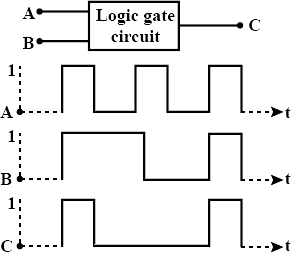
The following figure shows a logic gate circuit with two inputs $A$ and $B$ and the output $C$. The voltage waveforms of $A$,$B$,and $C$ are as shown below. The logic circuit gate is
A
$OR$ gate
B
$AND$ gate
C
$NAND$ gate
D
$NOR$ gate
Solution
(B) By observing the given voltage waveforms,we can construct the truth table for the inputs $A$ and $B$ and the output $C$:
Comparing this truth table with the standard truth tables of logic gates,we find that the output $C$ is $1$ only when both inputs $A$ and $B$ are $1$. This is the characteristic behavior of an $AND$ gate. Therefore,the logic circuit gate is an $AND$ gate.
| $A$ | $B$ | $C$ |
|---|---|---|
| $1$ | $1$ | $1$ |
| $1$ | $0$ | $0$ |
| $0$ | $1$ | $0$ |
| $0$ | $0$ | $0$ |
Comparing this truth table with the standard truth tables of logic gates,we find that the output $C$ is $1$ only when both inputs $A$ and $B$ are $1$. This is the characteristic behavior of an $AND$ gate. Therefore,the logic circuit gate is an $AND$ gate.
0 likesView Solution
45
PhysicsMediumMCQAIPMT · 2006
$A$ transistor is operated in common emitter configuration at a constant collector voltage $V_C = 1.5 \, V$ such that a change in the base current from $100 \, \mu A$ to $150 \, \mu A$ produces a change in the collector current from $5 \, mA$ to $10 \, mA$. The current gain $\beta$ is:
A
$50$
B
$67$
C
$75$
D
$100$
Solution
(D) The change in base current is $\Delta I_B = 150 \, \mu A - 100 \, \mu A = 50 \, \mu A = 50 \times 10^{-6} \, A$.
The change in collector current is $\Delta I_C = 10 \, mA - 5 \, mA = 5 \, mA = 5 \times 10^{-3} \, A$.
The current gain $\beta$ in common emitter configuration is defined as the ratio of the change in collector current to the change in base current:
$\beta = \frac{\Delta I_C}{\Delta I_B} = \frac{5 \times 10^{-3} \, A}{50 \times 10^{-6} \, A} = \frac{5000 \times 10^{-6}}{50 \times 10^{-6}} = 100$.
Therefore,the current gain $\beta$ is $100$.
The change in collector current is $\Delta I_C = 10 \, mA - 5 \, mA = 5 \, mA = 5 \times 10^{-3} \, A$.
The current gain $\beta$ in common emitter configuration is defined as the ratio of the change in collector current to the change in base current:
$\beta = \frac{\Delta I_C}{\Delta I_B} = \frac{5 \times 10^{-3} \, A}{50 \times 10^{-6} \, A} = \frac{5000 \times 10^{-6}}{50 \times 10^{-6}} = 100$.
Therefore,the current gain $\beta$ is $100$.
0 likesView Solution
46
PhysicsEasyMCQAIPMT · 2006
Which one of the following represents a forward-biased diode?
A
B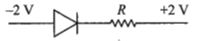
C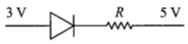
D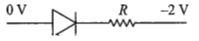
Solution
(D) $p-n$ junction diode is said to be forward-biased if the potential at the $p$-side $(V_p)$ is higher than the potential at the $n$-side $(V_n)$,i.e.,$V_p > V_n$.
Let us analyze each option:
$A$: $V_p = -4 \text{ V}$,$V_n = -3 \text{ V}$. Here,$-4 < -3$,so $V_p < V_n$ (Reverse biased).
$B$: $V_p = -2 \text{ V}$,$V_n = +2 \text{ V}$. Here,$-2 < +2$,so $V_p < V_n$ (Reverse biased).
$C$: $V_p = 3 \text{ V}$,$V_n = 5 \text{ V}$. Here,$3 < 5$,so $V_p < V_n$ (Reverse biased).
$D$: $V_p = 0 \text{ V}$,$V_n = -2 \text{ V}$. Here,$0 > -2$,so $V_p > V_n$ (Forward biased).
Therefore,option $D$ represents a forward-biased diode.
Let us analyze each option:
$A$: $V_p = -4 \text{ V}$,$V_n = -3 \text{ V}$. Here,$-4 < -3$,so $V_p < V_n$ (Reverse biased).
$B$: $V_p = -2 \text{ V}$,$V_n = +2 \text{ V}$. Here,$-2 < +2$,so $V_p < V_n$ (Reverse biased).
$C$: $V_p = 3 \text{ V}$,$V_n = 5 \text{ V}$. Here,$3 < 5$,so $V_p < V_n$ (Reverse biased).
$D$: $V_p = 0 \text{ V}$,$V_n = -2 \text{ V}$. Here,$0 > -2$,so $V_p > V_n$ (Forward biased).
Therefore,option $D$ represents a forward-biased diode.
0 likesView Solution
47
PhysicsMediumMCQAIPMT · 2006
Two circular coils $1$ and $2$ are made from the same wire. The radius of the first coil is twice that of the second coil. What is the ratio of potential difference applied across them $V_1 / V_2$,so that the magnetic field at their centre is the same?
A
$3$
B
$4$
C
$6$
D
$2$
Solution
(B) The magnetic field at the centre of a circular coil is given by $B = \frac{\mu_0 I}{2r}$.
Given that the magnetic field at the centre is the same for both coils,we have:
$\frac{\mu_0 I_1}{2(2r)} = \frac{\mu_0 I_2}{2(r)} \Rightarrow \frac{I_1}{I_2} = 2 \quad ...(i)$
Since the coils are made from the same wire,their resistance $R$ is proportional to their length $l$ $(R = \rho \frac{l}{A})$.
The lengths are $l_1 = 2\pi(2r) = 4\pi r$ and $l_2 = 2\pi(r) = 2\pi r$.
Thus,the ratio of resistances is $\frac{R_1}{R_2} = \frac{l_1}{l_2} = \frac{4\pi r}{2\pi r} = 2 \quad ...(ii)$
Using Ohm's law,$V = IR$,we have $I = V/R$.
Substituting this into equation $(i)$:
$\frac{V_1/R_1}{V_2/R_2} = 2 \Rightarrow \frac{V_1}{V_2} = 2 \times \frac{R_1}{R_2}$
Substituting the ratio from equation $(ii)$:
$\frac{V_1}{V_2} = 2 \times 2 = 4$.
Given that the magnetic field at the centre is the same for both coils,we have:
$\frac{\mu_0 I_1}{2(2r)} = \frac{\mu_0 I_2}{2(r)} \Rightarrow \frac{I_1}{I_2} = 2 \quad ...(i)$
Since the coils are made from the same wire,their resistance $R$ is proportional to their length $l$ $(R = \rho \frac{l}{A})$.
The lengths are $l_1 = 2\pi(2r) = 4\pi r$ and $l_2 = 2\pi(r) = 2\pi r$.
Thus,the ratio of resistances is $\frac{R_1}{R_2} = \frac{l_1}{l_2} = \frac{4\pi r}{2\pi r} = 2 \quad ...(ii)$
Using Ohm's law,$V = IR$,we have $I = V/R$.
Substituting this into equation $(i)$:
$\frac{V_1/R_1}{V_2/R_2} = 2 \Rightarrow \frac{V_1}{V_2} = 2 \times \frac{R_1}{R_2}$
Substituting the ratio from equation $(ii)$:
$\frac{V_1}{V_2} = 2 \times 2 = 4$.
0 likesView Solution
48
PhysicsEasyMCQAIPMT · 2006
The radius of germanium $(Ge)$ nuclide is measured to be twice the radius of ${ }_4^9 Be$. The number of nucleons in $Ge$ will be
A
$72$
B
$73$
C
$74$
D
$75$
Solution
(A) The radius of a nucleus is given by the relation $R = R_0 A^{1/3}$,where $A$ is the number of nucleons.
Therefore,the ratio of the radii of two nuclei is given by $\frac{R_1}{R_2} = \left(\frac{A_1}{A_2}\right)^{1/3}$.
Given that $R_{Ge} = 2 R_{Be}$ and $A_{Be} = 9$.
Substituting these values into the formula:
$2 = \left(\frac{A_{Ge}}{9}\right)^{1/3}$.
Cubing both sides,we get $2^3 = \frac{A_{Ge}}{9}$.
$8 = \frac{A_{Ge}}{9}$.
$A_{Ge} = 8 \times 9 = 72$.
Thus,the number of nucleons in germanium is $72$.
Therefore,the ratio of the radii of two nuclei is given by $\frac{R_1}{R_2} = \left(\frac{A_1}{A_2}\right)^{1/3}$.
Given that $R_{Ge} = 2 R_{Be}$ and $A_{Be} = 9$.
Substituting these values into the formula:
$2 = \left(\frac{A_{Ge}}{9}\right)^{1/3}$.
Cubing both sides,we get $2^3 = \frac{A_{Ge}}{9}$.
$8 = \frac{A_{Ge}}{9}$.
$A_{Ge} = 8 \times 9 = 72$.
Thus,the number of nucleons in germanium is $72$.
0 likesView Solution
Vedclass Products
For Students
Vedclass Test Series
Mock tests in real AIPMT style covering Physics with performance analysis. 5-day free trial.
Start Free TrialFor Teachers
Exam Paper Generator
Generate Set A/B/C/D Physics papers from 7.5L+ questions in 2 minutes. 3 chapters free.
Try FreeFor Institutes
Online Exam Module
Run live AIPMT mock exams with unlimited students, 360° analytics & white-label branding.
See DemoFrequently Asked Questions
How many Physics questions are in AIPMT 2006?
There are 48 Physics questions from the AIPMT 2006 paper on Vedclass, each with a detailed step-by-step solution in English.
Are AIPMT 2006 Physics solutions available in English?
Yes. All solutions on this page are in English. You can also switch to English or Hindi using the language buttons above the questions.
Can I practice AIPMT 2006 Physics as a timed test?
Yes. Use the Vedclass Test Series to attempt a full AIPMT mock test covering Physics with time limits and instant score analysis.
Can teachers create Physics papers from AIPMT previous year questions?
Yes. The Vedclass Exam Paper Generator lets teachers mix AIPMT Physics questions and generate Set A/B/C/D papers in minutes.
For Teachers & Institutes
Build a Custom Physics Paper
Pick AIPMT 2006 Physics questions, set difficulty, and generate Set A/B/C/D in 2 minutes.