
ChemistryQ1–83 of 96 questions
Page 1 of 2 · English
1
ChemistryMCQAIPMT · 2003
The vector sum of two forces is perpendicular to their vector difference. In that case,the forces
A
Are equal to each other in magnitude
B
Are not equal to each other in magnitude
C
Cannot be predicted
D
Are equal to each other
Solution
(A) If two vectors are perpendicular,their dot product must be equal to zero.
According to the problem:
$(\overrightarrow{A} + \overrightarrow{B}) \cdot (\overrightarrow{A} - \overrightarrow{B}) = 0$
$\Rightarrow \overrightarrow{A} \cdot \overrightarrow{A} - \overrightarrow{A} \cdot \overrightarrow{B} + \overrightarrow{B} \cdot \overrightarrow{A} - \overrightarrow{B} \cdot \overrightarrow{B} = 0$
Since the dot product is commutative,$\overrightarrow{A} \cdot \overrightarrow{B} = \overrightarrow{B} \cdot \overrightarrow{A}$,so the middle terms cancel out:
$\Rightarrow A^2 - B^2 = 0$
$\Rightarrow A^2 = B^2$
$\therefore A = B$
This means the two forces are equal to each other in magnitude.
According to the problem:
$(\overrightarrow{A} + \overrightarrow{B}) \cdot (\overrightarrow{A} - \overrightarrow{B}) = 0$
$\Rightarrow \overrightarrow{A} \cdot \overrightarrow{A} - \overrightarrow{A} \cdot \overrightarrow{B} + \overrightarrow{B} \cdot \overrightarrow{A} - \overrightarrow{B} \cdot \overrightarrow{B} = 0$
Since the dot product is commutative,$\overrightarrow{A} \cdot \overrightarrow{B} = \overrightarrow{B} \cdot \overrightarrow{A}$,so the middle terms cancel out:
$\Rightarrow A^2 - B^2 = 0$
$\Rightarrow A^2 = B^2$
$\therefore A = B$
This means the two forces are equal to each other in magnitude.
0 likesView Solution
2
ChemistryMCQAIPMT · 2003
The vector sum of two forces is perpendicular to their vector difference. In that case,the forces:
A
Are equal to each other in magnitude
B
Are not equal to each other in magnitude
C
Cannot be predicted
D
Are equal to each other
Solution
(A) Let the two force vectors be $\overrightarrow{F_1}$ and $\overrightarrow{F_2}$.
Given that their vector sum $(\overrightarrow{F_1} + \overrightarrow{F_2})$ is perpendicular to their vector difference $(\overrightarrow{F_1} - \overrightarrow{F_2})$.
Two vectors are perpendicular if their dot product is zero.
Therefore,$(\overrightarrow{F_1} + \overrightarrow{F_2}) \cdot (\overrightarrow{F_1} - \overrightarrow{F_2}) = 0$.
Expanding the dot product:
$\overrightarrow{F_1} \cdot \overrightarrow{F_1} - \overrightarrow{F_1} \cdot \overrightarrow{F_2} + \overrightarrow{F_2} \cdot \overrightarrow{F_1} - \overrightarrow{F_2} \cdot \overrightarrow{F_2} = 0$.
Since the dot product is commutative,$\overrightarrow{F_1} \cdot \overrightarrow{F_2} = \overrightarrow{F_2} \cdot \overrightarrow{F_1}$,so these terms cancel out.
We are left with $|\overrightarrow{F_1}|^2 - |\overrightarrow{F_2}|^2 = 0$.
This implies $|\overrightarrow{F_1}|^2 = |\overrightarrow{F_2}|^2$,or $|\overrightarrow{F_1}| = |\overrightarrow{F_2}|$.
Thus,the forces are equal in magnitude.
Given that their vector sum $(\overrightarrow{F_1} + \overrightarrow{F_2})$ is perpendicular to their vector difference $(\overrightarrow{F_1} - \overrightarrow{F_2})$.
Two vectors are perpendicular if their dot product is zero.
Therefore,$(\overrightarrow{F_1} + \overrightarrow{F_2}) \cdot (\overrightarrow{F_1} - \overrightarrow{F_2}) = 0$.
Expanding the dot product:
$\overrightarrow{F_1} \cdot \overrightarrow{F_1} - \overrightarrow{F_1} \cdot \overrightarrow{F_2} + \overrightarrow{F_2} \cdot \overrightarrow{F_1} - \overrightarrow{F_2} \cdot \overrightarrow{F_2} = 0$.
Since the dot product is commutative,$\overrightarrow{F_1} \cdot \overrightarrow{F_2} = \overrightarrow{F_2} \cdot \overrightarrow{F_1}$,so these terms cancel out.
We are left with $|\overrightarrow{F_1}|^2 - |\overrightarrow{F_2}|^2 = 0$.
This implies $|\overrightarrow{F_1}|^2 = |\overrightarrow{F_2}|^2$,or $|\overrightarrow{F_1}| = |\overrightarrow{F_2}|$.
Thus,the forces are equal in magnitude.
0 likesView Solution
3
ChemistryMCQAIPMT · 2003
An observer moves towards a stationary source of sound with a speed $1/5^{th}$ of the speed of sound. The wavelength and frequency of the source emitted are $\lambda$ and $f$ respectively. The apparent frequency and wavelength recorded by the observer are respectively:
A
$1.2f, \lambda$
B
$f, 1.2\lambda$
C
$0.8f, 0.8\lambda$
D
$1.2f, 1.2\lambda$
Solution
(A) The speed of sound is $v$. The speed of the observer is $v_0 = v/5$. The source is stationary,so $v_s = 0$.
The apparent frequency $f'$ is given by the Doppler effect formula: $f' = f \left( \frac{v + v_0}{v} \right)$.
Substituting the values: $f' = f \left( \frac{v + v/5}{v} \right) = f \left( \frac{6v/5}{v} \right) = 1.2f$.
Since the source is stationary,the wavelength $\lambda$ of the sound waves in the medium does not change for the observer. Therefore,the apparent wavelength is $\lambda' = \lambda$.
Thus,the apparent frequency is $1.2f$ and the apparent wavelength is $\lambda$.
The apparent frequency $f'$ is given by the Doppler effect formula: $f' = f \left( \frac{v + v_0}{v} \right)$.
Substituting the values: $f' = f \left( \frac{v + v/5}{v} \right) = f \left( \frac{6v/5}{v} \right) = 1.2f$.
Since the source is stationary,the wavelength $\lambda$ of the sound waves in the medium does not change for the observer. Therefore,the apparent wavelength is $\lambda' = \lambda$.
Thus,the apparent frequency is $1.2f$ and the apparent wavelength is $\lambda$.
0 likesView Solution
4
ChemistryMCQAIPMT · 2003
$A$ photoelectric cell is illuminated by a point source of light $1\;m$ away. When the source is shifted to $2\;m$,then:
A
Number of electrons emitted is half the initial number
B
Each emitted electron carries half the initial energy
C
Number of electrons emitted is a quarter of the initial number
D
Each emitted electron carries one quarter of the initial energy
Solution
(C) The intensity $I$ of light from a point source follows the inverse square law,$I \propto \frac{1}{d^2}$.
Since the number of photoelectrons emitted per second is directly proportional to the intensity of incident light,we have $n \propto I \propto \frac{1}{d^2}$.
Given initial distance $d_1 = 1\;m$ and final distance $d_2 = 2\;m$.
Therefore,the ratio of the number of electrons is $\frac{n_2}{n_1} = \left( \frac{d_1}{d_2} \right)^2 = \left( \frac{1}{2} \right)^2 = \frac{1}{4}$.
Thus,$n_2 = \frac{n_1}{4}$.
The energy of each emitted electron depends on the frequency of the incident light,not on the intensity,so the energy remains unchanged.
Since the number of photoelectrons emitted per second is directly proportional to the intensity of incident light,we have $n \propto I \propto \frac{1}{d^2}$.
Given initial distance $d_1 = 1\;m$ and final distance $d_2 = 2\;m$.
Therefore,the ratio of the number of electrons is $\frac{n_2}{n_1} = \left( \frac{d_1}{d_2} \right)^2 = \left( \frac{1}{2} \right)^2 = \frac{1}{4}$.
Thus,$n_2 = \frac{n_1}{4}$.
The energy of each emitted electron depends on the frequency of the incident light,not on the intensity,so the energy remains unchanged.
0 likesView Solution
5
ChemistryMediumMCQAIPMT · 2003
The molar heat capacity of water at constant pressure is $75 \, J \, K^{-1} \, mol^{-1}$. When $1.0 \, kJ$ of heat is supplied to $100 \, g$ of water which is free to expand,the increase in temperature of water is (in $, K$)
A
$6.6$
B
$1.2$
C
$2.4$
D
$4.8$
Solution
(C) The relationship between the heat supplied $(q)$,molar heat capacity at constant pressure $(C_p)$,and the temperature change $(\Delta T)$ is given by the formula: $q = n \cdot C_p \cdot \Delta T$
Given:
$q = 1.0 \, kJ = 1000 \, J$
$C_p = 75 \, J \, K^{-1} \, mol^{-1}$
Mass of water = $100 \, g$
Molar mass of water $(H_2O)$ = $18 \, g \, mol^{-1}$
Calculate the number of moles $(n)$:
$n = \frac{\text{mass}}{\text{molar mass}} = \frac{100 \, g}{18 \, g \, mol^{-1}} = 5.55 \, mol$
Substitute the values into the formula:
$1000 = (\frac{100}{18}) \times 75 \times \Delta T$
$1000 = 5.55 \times 75 \times \Delta T$
$1000 = 416.67 \times \Delta T$
$\Delta T = \frac{1000}{416.67} \approx 2.4 \, K$
Therefore,the increase in temperature is $2.4 \, K$.
Given:
$q = 1.0 \, kJ = 1000 \, J$
$C_p = 75 \, J \, K^{-1} \, mol^{-1}$
Mass of water = $100 \, g$
Molar mass of water $(H_2O)$ = $18 \, g \, mol^{-1}$
Calculate the number of moles $(n)$:
$n = \frac{\text{mass}}{\text{molar mass}} = \frac{100 \, g}{18 \, g \, mol^{-1}} = 5.55 \, mol$
Substitute the values into the formula:
$1000 = (\frac{100}{18}) \times 75 \times \Delta T$
$1000 = 5.55 \times 75 \times \Delta T$
$1000 = 416.67 \times \Delta T$
$\Delta T = \frac{1000}{416.67} \approx 2.4 \, K$
Therefore,the increase in temperature is $2.4 \, K$.
0 likesView Solution
6
ChemistryMediumMCQAIPMT · 2003
The value of Planck's constant is $6.63 \times 10^{-34} \ J \ s$. The velocity of light is $3.0 \times 10^8 \ m \ s^{-1}$. Which value is closest to the wavelength in nanometres of a quantum of light with frequency of $8 \times 10^{15} \ s^{-1}$?
A
$3 \times 10^7$
B
$2 \times 10^{-25}$
C
$5 \times 10^{-18}$
D
$4 \times 10^1$
Solution
(D) The relationship between wavelength $(\lambda)$,velocity of light $(c)$,and frequency $(\nu)$ is given by $\lambda = \frac{c}{\nu}$.
Substituting the given values: $\lambda = \frac{3.0 \times 10^8 \ m \ s^{-1}}{8 \times 10^{15} \ s^{-1}} = 0.375 \times 10^{-7} \ m = 3.75 \times 10^{-8} \ m$.
To convert the wavelength into nanometres $(nm)$,we multiply by $10^9 \ nm/m$: $\lambda = 3.75 \times 10^{-8} \ m \times 10^9 \ nm/m = 37.5 \ nm$.
The value closest to $37.5 \ nm$ is $4 \times 10^1 \ nm$.
Substituting the given values: $\lambda = \frac{3.0 \times 10^8 \ m \ s^{-1}}{8 \times 10^{15} \ s^{-1}} = 0.375 \times 10^{-7} \ m = 3.75 \times 10^{-8} \ m$.
To convert the wavelength into nanometres $(nm)$,we multiply by $10^9 \ nm/m$: $\lambda = 3.75 \times 10^{-8} \ m \times 10^9 \ nm/m = 37.5 \ nm$.
The value closest to $37.5 \ nm$ is $4 \times 10^1 \ nm$.
0 likesView Solution
7
ChemistryDifficultMCQAIPMT · 2003
In the Haber process,$30 \ L$ of dihydrogen and $30 \ L$ of dinitrogen were taken for the reaction,which yielded only $50\%$ of the expected product. What will be the composition of the gaseous mixture under the aforesaid condition in the end?
A
$20 \ L$ ammonia,$25 \ L$ nitrogen,$15 \ L$ hydrogen
B
$20 \ L$ ammonia,$20 \ L$ nitrogen,$20 \ L$ hydrogen
C
$10 \ L$ ammonia,$25 \ L$ nitrogen,$15 \ L$ hydrogen
D
$20 \ L$ ammonia,$10 \ L$ nitrogen,$30 \ L$ hydrogen
Solution
(C) The balanced chemical equation for the Haber process is: $N_2(g) + 3H_2(g) \rightleftharpoons 2NH_3(g)$.
Initially,we have $30 \ L$ of $N_2$ and $30 \ L$ of $H_2$.
According to the stoichiometry,$1 \ L$ of $N_2$ reacts with $3 \ L$ of $H_2$ to produce $2 \ L$ of $NH_3$.
If all $30 \ L$ of $H_2$ were consumed,it would require $10 \ L$ of $N_2$ and produce $20 \ L$ of $NH_3$ (theoretical yield).
Since the reaction yielded only $50\%$ of the expected product,the actual amount of $NH_3$ produced is $50\% \times 20 \ L = 10 \ L$.
For $10 \ L$ of $NH_3$ to be produced,$5 \ L$ of $N_2$ and $15 \ L$ of $H_2$ must have reacted.
Remaining $N_2 = 30 \ L - 5 \ L = 25 \ L$.
Remaining $H_2 = 30 \ L - 15 \ L = 15 \ L$.
Thus,the final composition is $10 \ L$ ammonia,$25 \ L$ nitrogen,and $15 \ L$ hydrogen.
Initially,we have $30 \ L$ of $N_2$ and $30 \ L$ of $H_2$.
According to the stoichiometry,$1 \ L$ of $N_2$ reacts with $3 \ L$ of $H_2$ to produce $2 \ L$ of $NH_3$.
If all $30 \ L$ of $H_2$ were consumed,it would require $10 \ L$ of $N_2$ and produce $20 \ L$ of $NH_3$ (theoretical yield).
Since the reaction yielded only $50\%$ of the expected product,the actual amount of $NH_3$ produced is $50\% \times 20 \ L = 10 \ L$.
For $10 \ L$ of $NH_3$ to be produced,$5 \ L$ of $N_2$ and $15 \ L$ of $H_2$ must have reacted.
Remaining $N_2 = 30 \ L - 5 \ L = 25 \ L$.
Remaining $H_2 = 30 \ L - 15 \ L = 15 \ L$.
Thus,the final composition is $10 \ L$ ammonia,$25 \ L$ nitrogen,and $15 \ L$ hydrogen.
0 likesView Solution
8
ChemistryMediumMCQAIPMT · 2003
Which one of the following compounds is not a protonic acid?
A
$SO_2(OH)_2$
B
$B(OH)_3$
C
$PO(OH)_3$
D
$SO(OH)_2$
Solution
(B) protonic acid is a substance that can donate a proton ($H^+$ ion) in an aqueous solution.
$SO_2(OH)_2$ (Sulfuric acid),$PO(OH)_3$ (Phosphoric acid),and $SO(OH)_2$ (Sulfurous acid) all contain ionizable $H$ atoms attached to oxygen,which can be released as $H^+$ ions.
$B(OH)_3$ (Boric acid) acts as a Lewis acid by accepting an $OH^-$ ion from water to form $[B(OH)_4]^-$,releasing $H^+$ from the water molecule,not from itself. Therefore,it is not a protonic acid.
$SO_2(OH)_2$ (Sulfuric acid),$PO(OH)_3$ (Phosphoric acid),and $SO(OH)_2$ (Sulfurous acid) all contain ionizable $H$ atoms attached to oxygen,which can be released as $H^+$ ions.
$B(OH)_3$ (Boric acid) acts as a Lewis acid by accepting an $OH^-$ ion from water to form $[B(OH)_4]^-$,releasing $H^+$ from the water molecule,not from itself. Therefore,it is not a protonic acid.
0 likesView Solution
9
ChemistryMediumMCQAIPMT · 2003
For the reaction,$C_3H_{8(g)} + 5O_{2(g)} \to 3CO_{2(g)} + 4H_2O_{(l)}$ at constant temperature,$\Delta H - \Delta E$ is
A
$-RT$
B
$+RT$
C
$-3RT$
D
$+3RT$
Solution
(C) The relationship between enthalpy change $(\Delta H)$ and internal energy change $(\Delta E)$ is given by the equation: $\Delta H = \Delta E + \Delta n_g RT$,which implies $\Delta H - \Delta E = \Delta n_g RT$.
For the reaction $C_3H_{8(g)} + 5O_{2(g)} \to 3CO_{2(g)} + 4H_2O_{(l)}$,the change in the number of gaseous moles $(\Delta n_g)$ is calculated as: $\Delta n_g = (\text{moles of gaseous products}) - (\text{moles of gaseous reactants})$.
$\Delta n_g = 3 - (1 + 5) = 3 - 6 = -3$.
Substituting this value into the equation: $\Delta H - \Delta E = -3RT$.
For the reaction $C_3H_{8(g)} + 5O_{2(g)} \to 3CO_{2(g)} + 4H_2O_{(l)}$,the change in the number of gaseous moles $(\Delta n_g)$ is calculated as: $\Delta n_g = (\text{moles of gaseous products}) - (\text{moles of gaseous reactants})$.
$\Delta n_g = 3 - (1 + 5) = 3 - 6 = -3$.
Substituting this value into the equation: $\Delta H - \Delta E = -3RT$.
0 likesView Solution
10
ChemistryEasyMCQAIPMT · 2003
The molar heat capacity of water at constant pressure is $75 \ J \ K^{-1} \ mol^{-1}$. When $1.0 \ kJ$ of heat is supplied to $100 \ g$ of water which is free to expand,the increase in temperature of water is $...... \ K$.
A
$6.6$
B
$1.2$
C
$2.4$
D
$4.8$
Solution
(C) The molar mass of water $(H_2O)$ is $18 \ g \ mol^{-1}$.
Given,molar heat capacity $(C_p)$ = $75 \ J \ K^{-1} \ mol^{-1}$.
Specific heat capacity $(c)$ = $\frac{C_p}{\text{Molar mass}} = \frac{75}{18} \approx 4.17 \ J \ g^{-1} \ K^{-1}$.
Heat supplied $(Q)$ = $1.0 \ kJ = 1000 \ J$.
Mass of water $(m)$ = $100 \ g$.
Using the formula $Q = m \cdot c \cdot \Delta T$:
$1000 = 100 \times 4.17 \times \Delta T$.
$\Delta T = \frac{1000}{417} \approx 2.4 \ K$.
Given,molar heat capacity $(C_p)$ = $75 \ J \ K^{-1} \ mol^{-1}$.
Specific heat capacity $(c)$ = $\frac{C_p}{\text{Molar mass}} = \frac{75}{18} \approx 4.17 \ J \ g^{-1} \ K^{-1}$.
Heat supplied $(Q)$ = $1.0 \ kJ = 1000 \ J$.
Mass of water $(m)$ = $100 \ g$.
Using the formula $Q = m \cdot c \cdot \Delta T$:
$1000 = 100 \times 4.17 \times \Delta T$.
$\Delta T = \frac{1000}{417} \approx 2.4 \ K$.
1 likesView Solution
11
ChemistryMediumMCQAIPMT · 2003
For which one of the following equations is $\Delta H_{react}^o$ equal to $\Delta H_f^o$ for the product?
A
$2CO_{(g)} + O_{2(g)} \to 2CO_{2(g)}$
B
$N_{2(g)} + O_{3(g)} \to N_2O_{3(g)}$
C
$CH_{4(g)} + 2Cl_{2(g)} \to CH_2Cl_{2(l)} + 2HCl_{(g)}$
D
$Xe_{(g)} + 2F_{2(g)} \to XeF_{4(s)}$
Solution
(D) The standard enthalpy of formation,$\Delta H_f^o$,is defined as the enthalpy change when $1 \ mol$ of a compound is formed from its constituent elements in their standard states.
For option $D$,$Xe_{(g)}$ and $F_{2(g)}$ are the standard states of the elements at $298 \ K$ and $1 \ bar$ pressure.
Since $1 \ mol$ of $XeF_{4(s)}$ is formed from its elements in their standard states,$\Delta H_{react}^o = \Delta H_f^o$ for $XeF_{4(s)}$.
For option $D$,$Xe_{(g)}$ and $F_{2(g)}$ are the standard states of the elements at $298 \ K$ and $1 \ bar$ pressure.
Since $1 \ mol$ of $XeF_{4(s)}$ is formed from its elements in their standard states,$\Delta H_{react}^o = \Delta H_f^o$ for $XeF_{4(s)}$.
0 likesView Solution
12
ChemistryMediumMCQAIPMT · 2003
The densities of graphite and diamond at $298 \, K$ are $2.25 \, g \, cm^{-3}$ and $3.31 \, g \, cm^{-3}$ respectively. If the standard free energy difference $(\Delta G^o)$ is $1895 \, J \, mol^{-1}$, the pressure at which graphite will be transformed into diamond at $298 \, K$ is:
A
$9.92 \times 10^5 \, Pa$
B
$9.92 \times 10^8 \, Pa$
C
$9.92 \times 10^7 \, Pa$
D
$9.92 \times 10^6 \, Pa$
Solution
(B) The transformation is $C_{\text{graphite}} \rightarrow C_{\text{diamond}}$.
For this process, $\Delta G = \Delta G^o + \int_{P_1}^{P_2} \Delta V \, dP = 0$ at equilibrium.
$\Delta G^o = -\Delta V \times P$ (assuming $\Delta V$ is constant).
$\Delta V = V_{\text{diamond}} - V_{\text{graphite}} = \frac{M}{\rho_{\text{diamond}}} - \frac{M}{\rho_{\text{graphite}}}$.
Given $M = 12 \, g \, mol^{-1}$, $\rho_{\text{diamond}} = 3.31 \, g \, cm^{-3}$, $\rho_{\text{graphite}} = 2.25 \, g \, cm^{-3}$.
$\Delta V = 12 \times (\frac{1}{3.31} - \frac{1}{2.25}) \, cm^3 \, mol^{-1} = 12 \times (0.3021 - 0.4444) = -1.7076 \, cm^3 \, mol^{-1} = -1.7076 \times 10^{-6} \, m^3 \, mol^{-1}$.
$P = \frac{-\Delta G^o}{\Delta V} = \frac{-1895 \, J \, mol^{-1}}{-1.7076 \times 10^{-6} \, m^3 \, mol^{-1}} \approx 1.11 \times 10^9 \, Pa$.
Given the options, the closest value is $9.92 \times 10^8 \, Pa$.
For this process, $\Delta G = \Delta G^o + \int_{P_1}^{P_2} \Delta V \, dP = 0$ at equilibrium.
$\Delta G^o = -\Delta V \times P$ (assuming $\Delta V$ is constant).
$\Delta V = V_{\text{diamond}} - V_{\text{graphite}} = \frac{M}{\rho_{\text{diamond}}} - \frac{M}{\rho_{\text{graphite}}}$.
Given $M = 12 \, g \, mol^{-1}$, $\rho_{\text{diamond}} = 3.31 \, g \, cm^{-3}$, $\rho_{\text{graphite}} = 2.25 \, g \, cm^{-3}$.
$\Delta V = 12 \times (\frac{1}{3.31} - \frac{1}{2.25}) \, cm^3 \, mol^{-1} = 12 \times (0.3021 - 0.4444) = -1.7076 \, cm^3 \, mol^{-1} = -1.7076 \times 10^{-6} \, m^3 \, mol^{-1}$.
$P = \frac{-\Delta G^o}{\Delta V} = \frac{-1895 \, J \, mol^{-1}}{-1.7076 \times 10^{-6} \, m^3 \, mol^{-1}} \approx 1.11 \times 10^9 \, Pa$.
Given the options, the closest value is $9.92 \times 10^8 \, Pa$.
0 likesView Solution
13
ChemistryEasyMCQAIPMT · 2003
Ionic radii are
A
Directly proportional to effective nuclear charge
B
Directly proportional to square of effective nuclear charge
C
Inversely proportional to effective nuclear charge
D
Inversely proportional to square of effective nuclear charge.
Solution
(C) The ionic radius $(r)$ is inversely proportional to the effective nuclear charge $(Z_{eff})$.
According to the relationship $r \propto \frac{1}{Z_{eff}}$,as the effective nuclear charge increases,the electrons are pulled more strongly towards the nucleus,resulting in a decrease in the ionic radius.
Therefore,the correct option is $(C)$.
According to the relationship $r \propto \frac{1}{Z_{eff}}$,as the effective nuclear charge increases,the electrons are pulled more strongly towards the nucleus,resulting in a decrease in the ionic radius.
Therefore,the correct option is $(C)$.
0 likesView Solution
14
ChemistryMCQAIPMT · 2003
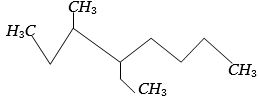
The $IUPAC$ name of the compound given below is:
A
$5-$ethyl$-6-$methyloctane
B
$4-$ethyl$-3-$methyloctane
C
$3-$methyl$-4-$ethyloctane
D
$2, 3-$diethylheptane
Solution
(B) $1$. Identify the longest carbon chain. The longest chain contains $8$ carbon atoms,so the parent alkane is octane.
$2$. Number the chain from the end that gives the lowest locants to the substituents. Numbering from left to right gives substituents at positions $3$ and $4$.
$3$. At position $3$,there is a methyl group $(-CH_3)$,and at position $4$,there is an ethyl group $(-CH_2CH_3)$.
$4$. According to $IUPAC$ rules,substituents are listed in alphabetical order: ethyl comes before methyl.
$5$. Therefore,the correct name is $4-$ethyl$-3-$methyloctane.
$2$. Number the chain from the end that gives the lowest locants to the substituents. Numbering from left to right gives substituents at positions $3$ and $4$.
$3$. At position $3$,there is a methyl group $(-CH_3)$,and at position $4$,there is an ethyl group $(-CH_2CH_3)$.
$4$. According to $IUPAC$ rules,substituents are listed in alphabetical order: ethyl comes before methyl.
$5$. Therefore,the correct name is $4-$ethyl$-3-$methyloctane.
0 likesView Solution
15
ChemistryMediumMCQAIPMT · 2003
Which of the following pairs of compounds are enantiomers?
A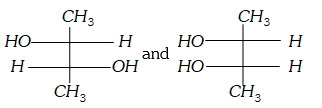
B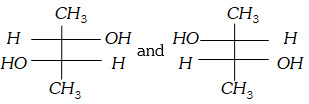
C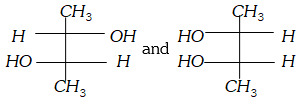
D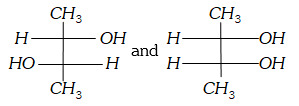
Solution
(B) Enantiomers are stereoisomers that are non-superimposable mirror images of each other.
In option $(B)$,the two structures are mirror images of each other and are non-superimposable,which defines them as enantiomers.
Other options represent either identical compounds,diastereomers,or constitutional isomers.
In option $(B)$,the two structures are mirror images of each other and are non-superimposable,which defines them as enantiomers.
Other options represent either identical compounds,diastereomers,or constitutional isomers.
0 likesView Solution
16
ChemistryMediumMCQAIPMT · 2003
The compound $CH_3-C(CH_3)=CH-CH_3$ on reaction with $NaIO_4$ in the presence of $KMnO_4$ gives:
A
$CH_3CHO + CO_2$
B
$CH_3COCH_3$
C
$CH_3COCH_3 + CH_3CHO$
D
$CH_3COCH_3 + CH_3COOH$
Solution
(D) The reaction of an alkene with $NaIO_4$ in the presence of $KMnO_4$ (Lemieux-von Rudloff reagent) results in the oxidative cleavage of the $C=C$ double bond.
In the compound $CH_3-C(CH_3)=CH-CH_3$,the double bond is cleaved.
The substituted carbon $CH_3-C(CH_3)=$ is oxidized to a ketone,$CH_3COCH_3$ (acetone).
The $=CH-CH_3$ part is oxidized to an aldehyde,which is further oxidized to a carboxylic acid,$CH_3COOH$ (acetic acid),under these conditions.
Therefore,the final products are $CH_3COCH_3 + CH_3COOH$.
In the compound $CH_3-C(CH_3)=CH-CH_3$,the double bond is cleaved.
The substituted carbon $CH_3-C(CH_3)=$ is oxidized to a ketone,$CH_3COCH_3$ (acetone).
The $=CH-CH_3$ part is oxidized to an aldehyde,which is further oxidized to a carboxylic acid,$CH_3COOH$ (acetic acid),under these conditions.
Therefore,the final products are $CH_3COCH_3 + CH_3COOH$.
0 likesView Solution
17
ChemistryDifficultMCQAIPMT · 2003
The correct order of reactivity towards the electrophilic substitution of the compounds aniline $(I)$,benzene $(II)$,and nitrobenzene $(III)$ is
A
$I > II > III$
B
$III > II > I$
C
$II > III > I$
D
$I < II > III$
Solution
(A) The reactivity towards electrophilic aromatic substitution depends on the electron density of the benzene ring.
$1$. The $-NH_2$ group in aniline $(I)$ is a strong electron-donating group due to its $+M$ effect,which significantly increases the electron density on the ring,making it highly reactive.
$2$. Benzene $(II)$ has no substituents,serving as the reference point.
$3$. The $-NO_2$ group in nitrobenzene $(III)$ is a strong electron-withdrawing group due to its $-M$ and $-I$ effects,which significantly decreases the electron density on the ring,making it the least reactive.
Therefore,the correct order of reactivity is $I > II > III$.
$1$. The $-NH_2$ group in aniline $(I)$ is a strong electron-donating group due to its $+M$ effect,which significantly increases the electron density on the ring,making it highly reactive.
$2$. Benzene $(II)$ has no substituents,serving as the reference point.
$3$. The $-NO_2$ group in nitrobenzene $(III)$ is a strong electron-withdrawing group due to its $-M$ and $-I$ effects,which significantly decreases the electron density on the ring,making it the least reactive.
Therefore,the correct order of reactivity is $I > II > III$.
0 likesView Solution
18
ChemistryMCQAIPMT · 2003
Which of the following could act as a propellant for rockets?
A
Liquid hydrogen $+$ liquid nitrogen
B
Liquid oxygen $+$ liquid argon
C
Liquid hydrogen $+$ liquid oxygen
D
Liquid nitrogen $+$ liquid oxygen
Solution
(C) rocket propellant consists of a fuel and an oxidizer.
Liquid hydrogen $(H_2)$ acts as the fuel,and liquid oxygen $(O_2)$ acts as the oxidizer.
This combination is highly efficient and is commonly used in space launch vehicles because it provides a high specific impulse.
Liquid hydrogen $(H_2)$ acts as the fuel,and liquid oxygen $(O_2)$ acts as the oxidizer.
This combination is highly efficient and is commonly used in space launch vehicles because it provides a high specific impulse.
0 likesView Solution
19
ChemistryMCQAIPMT · 2003
The reason for the double helical structure of $DNA$ is the operation of
A
Van der Waals forces
B
Dipole-dipole interaction
C
Hydrogen bonding
D
Electrostatic attractions
Solution
(C) $DNA$ (deoxyribonucleic acid) is the molecule that carries the genetic information of all living beings.
The structure consists of two polynucleotide strands that wind around each other to form a double helix.
Each strand has a backbone made of alternating sugar (deoxyribose) and phosphate molecules.
The two strands are held together by hydrogen bonding between the nitrogenous bases.
Adenine $(A)$ pairs with Thymine $(T)$ via two hydrogen bonds,and Cytosine $(C)$ pairs with Guanine $(G)$ via three hydrogen bonds.
Therefore,the double-helical structure of $DNA$ is stabilized by hydrogen bonding.
The structure consists of two polynucleotide strands that wind around each other to form a double helix.
Each strand has a backbone made of alternating sugar (deoxyribose) and phosphate molecules.
The two strands are held together by hydrogen bonding between the nitrogenous bases.
Adenine $(A)$ pairs with Thymine $(T)$ via two hydrogen bonds,and Cytosine $(C)$ pairs with Guanine $(G)$ via three hydrogen bonds.
Therefore,the double-helical structure of $DNA$ is stabilized by hydrogen bonding.
0 likesView Solution
20
ChemistryMCQAIPMT · 2003
During embryonic development,the establishment of polarity along the anterior/posterior,dorsal/ventral,or medial/lateral axis is called:
A
Anamorphosis
B
Organizer phenomena
C
Pattern formation
D
Axis formation
Solution
(C) Pattern formation is the developmental process by which cells in a developing embryo acquire identities that lead to the formation of a spatially organized and differentiated structure. This process involves the establishment of polarity along the anterior/posterior,dorsal/ventral,and medial/lateral axes,ensuring that organs and tissues develop in their correct anatomical positions.
0 likesView Solution
21
ChemistryMCQAIPMT · 2003
During embryonic development,the establishment of polarity along anterior/posterior,dorsal/ventral,or medial/lateral axis is called:
A
Pattern formation
B
Organizer phenomena
C
Axis formation
D
Anamorphosis
Solution
(B) The correct answer is $B$. The establishment of polarity in a developing embryo along different axes (anterior/posterior,dorsal/ventral,or medial/lateral) is induced by the organizer phenomenon. This process involves specific regions of the embryo that secrete signaling molecules to direct the differentiation and spatial organization of surrounding tissues.
0 likesView Solution
22
ChemistryMCQAIPMT · 2003
If a plant is deficient in the element $Zinc$,which plant hormone's biosynthesis will be affected in that plant?
A
$Abscisic$ $acid$
B
$Auxin$
C
$Cytokinin$
D
$Ethylene$
Solution
(B) $Zinc$ is an essential micronutrient required by plants for various physiological processes.
Specifically,$Zinc$ is required for the synthesis of the plant hormone $Auxin$ (specifically $Indole-3-acetic$ $acid$ or $IAA$).
Therefore,a deficiency of $Zinc$ leads to a reduction in the biosynthesis of $Auxin$,which subsequently affects plant growth and development.
Specifically,$Zinc$ is required for the synthesis of the plant hormone $Auxin$ (specifically $Indole-3-acetic$ $acid$ or $IAA$).
Therefore,a deficiency of $Zinc$ leads to a reduction in the biosynthesis of $Auxin$,which subsequently affects plant growth and development.
0 likesView Solution
23
ChemistryMCQAIPMT · 2003
During transcription,the site on $DNA$ where $RNA$ polymerase binds is called .........
A
Promoter
B
Regulator
C
Receptor
D
Enhancer
Solution
(A) During the process of transcription in prokaryotes and eukaryotes,the $RNA$ polymerase enzyme recognizes and binds to a specific sequence on the $DNA$ template strand known as the promoter.
This binding event is the first step in initiating transcription.
The promoter is located towards the $5'$ end (upstream) of the structural gene.
This binding event is the first step in initiating transcription.
The promoter is located towards the $5'$ end (upstream) of the structural gene.
0 likesView Solution
24
ChemistryMCQAIPMT · 2003
Which of the following plants are used as green manure in crop fields and sandy soils?
A
Crotalaria juncea and Alhagi camelorum
B
Calotropis procera and Phyllanthus niruri
C
Saccharum munja and Lantana camara
D
Dichanthium annulatum and Azolla nilotica
Solution
(A) $Crotalaria juncea$ (Sunn hemp) and $Alhagi camelorum$ (Camel thorn) are widely recognized for their role in soil enrichment.
$Crotalaria juncea$ is a leguminous plant that fixes atmospheric nitrogen,making it an excellent green manure crop.
$Alhagi camelorum$ is often used in sandy soils to improve soil fertility and structure.
Therefore,these plants are specifically utilized in agricultural practices to enhance soil nutrient content.
$Crotalaria juncea$ is a leguminous plant that fixes atmospheric nitrogen,making it an excellent green manure crop.
$Alhagi camelorum$ is often used in sandy soils to improve soil fertility and structure.
Therefore,these plants are specifically utilized in agricultural practices to enhance soil nutrient content.
0 likesView Solution
25
ChemistryMCQAIPMT · 2003
Which of the following plants are used as green manure in crop fields and sandy soils?
A
Crotalaria juncea and Alhagi camelorum
B
Calotropis procera and Phyllanthus niruri
C
Saccharum munja and Lantana camara
D
Dichanthium annulatum and Azolla nilotica
Solution
(A) Green manure refers to plants that are grown and then incorporated into the soil to improve its fertility and structure.
$Crotalaria juncea$ (Sunn hemp) is a well-known leguminous plant used extensively as green manure because it fixes atmospheric nitrogen.
$Alhagi camelorum$ (Camel thorn) is also known to be used in sandy soils for soil improvement and as a green manure crop.
Therefore,the correct pair is $Crotalaria juncea$ and $Alhagi camelorum$.
$Crotalaria juncea$ (Sunn hemp) is a well-known leguminous plant used extensively as green manure because it fixes atmospheric nitrogen.
$Alhagi camelorum$ (Camel thorn) is also known to be used in sandy soils for soil improvement and as a green manure crop.
Therefore,the correct pair is $Crotalaria juncea$ and $Alhagi camelorum$.
0 likesView Solution
26
ChemistryMCQAIPMT · 2003
$A$ solid cylinder of mass $M$ and radius $R$ rolls without slipping down an inclined plane of length $L$ and height $h$. What is the velocity of its center of mass when the cylinder reaches the bottom of the incline?
A
$\sqrt{2gh}$
B
$\sqrt{\frac{3}{4}gh}$
C
$\sqrt{\frac{4}{3}gh}$
D
$\sqrt{4gh}$
Solution
(C) For a body rolling without slipping down an inclined plane,the velocity $v$ at the bottom is given by the conservation of energy: $mgh = \frac{1}{2}mv^2 + \frac{1}{2}I\omega^2$.
Since the body is a solid cylinder,its moment of inertia about the central axis is $I = \frac{1}{2}MR^2$ and the condition for rolling without slipping is $v = R\omega$.
Substituting these into the energy equation:
$Mgh = \frac{1}{2}Mv^2 + \frac{1}{2}(\frac{1}{2}MR^2)(\frac{v}{R})^2$
$Mgh = \frac{1}{2}Mv^2 + \frac{1}{4}Mv^2$
$Mgh = \frac{3}{4}Mv^2$
$v^2 = \frac{4}{3}gh$
$v = \sqrt{\frac{4}{3}gh}$.
Since the body is a solid cylinder,its moment of inertia about the central axis is $I = \frac{1}{2}MR^2$ and the condition for rolling without slipping is $v = R\omega$.
Substituting these into the energy equation:
$Mgh = \frac{1}{2}Mv^2 + \frac{1}{2}(\frac{1}{2}MR^2)(\frac{v}{R})^2$
$Mgh = \frac{1}{2}Mv^2 + \frac{1}{4}Mv^2$
$Mgh = \frac{3}{4}Mv^2$
$v^2 = \frac{4}{3}gh$
$v = \sqrt{\frac{4}{3}gh}$.
0 likesView Solution
27
ChemistryMCQAIPMT · 2003
$A$ ball rolls without slipping. The radius of gyration of the ball about an axis passing through its center of mass is $K$. If the radius of the ball is $R$,what fraction of its total energy is associated with its rotational kinetic energy?
A
$\frac{K^2 + R^2}{R^2}$
B
$\frac{K^2}{R^2}$
C
$\frac{K^2}{K^2 + R^2}$
D
$\frac{R^2}{K^2 + R^2}$
Solution
(C) For a body rolling without slipping,the total kinetic energy $E_{\text{total}}$ is the sum of translational kinetic energy $E_t$ and rotational kinetic energy $E_r$.
$E_t = \frac{1}{2}mv^2$
$E_r = \frac{1}{2}I\omega^2$
Since $I = mK^2$ and $\omega = \frac{v}{R}$,we have $E_r = \frac{1}{2}(mK^2)(\frac{v}{R})^2 = \frac{1}{2}mv^2(\frac{K^2}{R^2})$.
$E_{\text{total}} = E_t + E_r = \frac{1}{2}mv^2 + \frac{1}{2}mv^2(\frac{K^2}{R^2}) = \frac{1}{2}mv^2(1 + \frac{K^2}{R^2})$.
The fraction of total energy associated with rotational kinetic energy is $\frac{E_r}{E_{\text{total}}}$.
$\frac{E_r}{E_{\text{total}}} = \frac{\frac{1}{2}mv^2(\frac{K^2}{R^2})}{\frac{1}{2}mv^2(1 + \frac{K^2}{R^2})} = \frac{\frac{K^2}{R^2}}{\frac{R^2 + K^2}{R^2}} = \frac{K^2}{K^2 + R^2}$.
$E_t = \frac{1}{2}mv^2$
$E_r = \frac{1}{2}I\omega^2$
Since $I = mK^2$ and $\omega = \frac{v}{R}$,we have $E_r = \frac{1}{2}(mK^2)(\frac{v}{R})^2 = \frac{1}{2}mv^2(\frac{K^2}{R^2})$.
$E_{\text{total}} = E_t + E_r = \frac{1}{2}mv^2 + \frac{1}{2}mv^2(\frac{K^2}{R^2}) = \frac{1}{2}mv^2(1 + \frac{K^2}{R^2})$.
The fraction of total energy associated with rotational kinetic energy is $\frac{E_r}{E_{\text{total}}}$.
$\frac{E_r}{E_{\text{total}}} = \frac{\frac{1}{2}mv^2(\frac{K^2}{R^2})}{\frac{1}{2}mv^2(1 + \frac{K^2}{R^2})} = \frac{\frac{K^2}{R^2}}{\frac{R^2 + K^2}{R^2}} = \frac{K^2}{K^2 + R^2}$.
0 likesView Solution
28
ChemistryMCQAIPMT · 2003
$A$ thin circular ring of mass $M$ and radius $R$ is rotating about its axis with a constant angular velocity $\omega$. Four objects,each of mass $m$,are placed gently at the opposite ends of two mutually perpendicular diameters of the ring. The new angular velocity of the ring will be:
A
$\frac{M\omega}{4m}$
B
$\frac{M\omega}{M + 4m}$
C
$\frac{(M + 4m)\omega}{M}$
D
$\frac{(M + 4m)\omega}{M + 4m}$
Solution
(B) According to the principle of conservation of angular momentum,since no external torque acts on the system,the initial angular momentum equals the final angular momentum.
$L_1 = L_2$
$I_1 \omega_1 = I_2 \omega_2$
Initially,the moment of inertia of the ring is $I_1 = MR^2$ and angular velocity is $\omega$.
After placing four masses $m$ at the rim,the new moment of inertia is $I_2 = MR^2 + 4(mR^2) = (M + 4m)R^2$.
Substituting these into the conservation equation:
$MR^2 \omega = (M + 4m)R^2 \omega_2$
$\omega_2 = \frac{MR^2 \omega}{(M + 4m)R^2} = \frac{M\omega}{M + 4m}$.
$L_1 = L_2$
$I_1 \omega_1 = I_2 \omega_2$
Initially,the moment of inertia of the ring is $I_1 = MR^2$ and angular velocity is $\omega$.
After placing four masses $m$ at the rim,the new moment of inertia is $I_2 = MR^2 + 4(mR^2) = (M + 4m)R^2$.
Substituting these into the conservation equation:
$MR^2 \omega = (M + 4m)R^2 \omega_2$
$\omega_2 = \frac{MR^2 \omega}{(M + 4m)R^2} = \frac{M\omega}{M + 4m}$.
0 likesView Solution
29
ChemistryMCQAIPMT · 2003
Vitamin $B_{12}$ contains which of the following metals?
A
$Ca(II)$
B
$Zn(II)$
C
$Fe(II)$
D
$Co(III)$
Solution
(D) Vitamin $B_{12}$,also known as cyanocobalamin,contains a central cobalt ion in the $+3$ oxidation state,i.e.,$Co(III)$,coordinated within a corrin ring system.
0 likesView Solution
30
ChemistryMediumMCQAIPMT · 2003
The reaction quotient $Q$ for the reaction $N_{2(g)} + 3H_{2(g)} \rightleftharpoons 2NH_{3(g)}$ is given by $Q = \frac{[NH_3]^2}{[N_2][H_2]^3}$. The reaction will proceed from right to left when:
A
$Q = 0$
B
$Q = K_c$
C
$Q < K_c$
D
$Q > K_c$
Solution
(D) The direction of a reaction can be predicted by comparing the reaction quotient $Q$ with the equilibrium constant $K_c$.
If $Q > K_c$,the concentration of products is higher than at equilibrium,so the reaction proceeds in the reverse direction (right to left) to reach equilibrium.
If $Q < K_c$,the reaction proceeds in the forward direction (left to right).
If $Q = K_c$,the reaction is at equilibrium.
Therefore,the correct condition for the reaction to proceed from right to left is $Q > K_c$.
If $Q > K_c$,the concentration of products is higher than at equilibrium,so the reaction proceeds in the reverse direction (right to left) to reach equilibrium.
If $Q < K_c$,the reaction proceeds in the forward direction (left to right).
If $Q = K_c$,the reaction is at equilibrium.
Therefore,the correct condition for the reaction to proceed from right to left is $Q > K_c$.
0 likesView Solution
31
ChemistryMediumMCQAIPMT · 2003
The solubility product of $AgI$ at $25\,\text{°C}$ is $1.0 \times 10^{-16}\,\text{mol}^2\,\text{L}^{-2}$. The solubility of $AgI$ in $10^{-4}\,\text{N}$ solution of $KI$ at $25\,\text{°C}$ is approximately (in $\text{mol L}^{-1}$)
A
$1.0 \times 10^{-8}$
B
$1.0 \times 10^{-16}$
C
$1.0 \times 10^{-12}$
D
$1.0 \times 10^{-10}$
Solution
(C) The dissociation of $AgI$ is given by: $AgI(s) \rightleftharpoons Ag^+(aq) + I^-(aq)$.
Given $K_{sp} = 1.0 \times 10^{-16}$.
In a $10^{-4}\,\text{N}$ solution of $KI$,the concentration of $I^-$ ions is $[I^-] = 10^{-4}\,\text{M}$ (since $KI$ is a strong electrolyte).
Let $S$ be the solubility of $AgI$ in the presence of $KI$.
Then $[Ag^+] = S$ and $[I^-] = 10^{-4} + S \approx 10^{-4}$ (since $S$ is very small).
$K_{sp} = [Ag^+][I^-] = S \times 10^{-4} = 1.0 \times 10^{-16}$.
$S = \frac{1.0 \times 10^{-16}}{10^{-4}} = 1.0 \times 10^{-12}\,\text{mol L}^{-1}$.
Given $K_{sp} = 1.0 \times 10^{-16}$.
In a $10^{-4}\,\text{N}$ solution of $KI$,the concentration of $I^-$ ions is $[I^-] = 10^{-4}\,\text{M}$ (since $KI$ is a strong electrolyte).
Let $S$ be the solubility of $AgI$ in the presence of $KI$.
Then $[Ag^+] = S$ and $[I^-] = 10^{-4} + S \approx 10^{-4}$ (since $S$ is very small).
$K_{sp} = [Ag^+][I^-] = S \times 10^{-4} = 1.0 \times 10^{-16}$.
$S = \frac{1.0 \times 10^{-16}}{10^{-4}} = 1.0 \times 10^{-12}\,\text{mol L}^{-1}$.
0 likesView Solution
32
ChemistryDifficultMCQAIPMT · 2003
The internal energy change when a system goes from state $A$ to $B$ is $40 \, kJ/mol$. If the system goes from $A$ to $B$ by a reversible path and returns to state $A$ by an irreversible path,what would be the net change in internal energy?
A
$40 \, kJ/mol$
B
$> 0 \, kJ/mol$
C
$< 40 \, kJ/mol$
D
$Zero$
Solution
(D) Internal energy $(U)$ is a state function.
$A$ state function depends only on the initial and final states of the system,not on the path taken.
For any cyclic process,where the system returns to its initial state,the total change in the state function is always zero.
Since the system starts at state $A$,goes to state $B$,and returns to state $A$,the net change in internal energy $\Delta U_{net} = U_{final} - U_{initial} = U_A - U_A = 0$.
$A$ state function depends only on the initial and final states of the system,not on the path taken.
For any cyclic process,where the system returns to its initial state,the total change in the state function is always zero.
Since the system starts at state $A$,goes to state $B$,and returns to state $A$,the net change in internal energy $\Delta U_{net} = U_{final} - U_{initial} = U_A - U_A = 0$.
0 likesView Solution
33
ChemistryMediumMCQAIPMT · 2003
What is the entropy change (in $J\, K^{-1}\, mol^{-1}$) when one mole of ice is converted into water at $0^{\circ}C$? (The enthalpy change for the conversion of ice to liquid water is $6.0\, kJ\, mol^{-1}$ at $0^{\circ}C$)
A
$21.98$
B
$20.13$
C
$2.013$
D
$2.198$
Solution
(A) The entropy change $(\Delta S)$ for a phase transition is given by the formula $\Delta S = \frac{\Delta H_{fus}}{T}$.
Given,$\Delta H_{fus} = 6.0\, kJ\, mol^{-1} = 6000\, J\, mol^{-1}$.
The temperature $T = 0^{\circ}C = 273\, K$.
Substituting the values: $\Delta S = \frac{6000\, J\, mol^{-1}}{273\, K} = 21.98\, J\, K^{-1}\, mol^{-1}$.
Thus,the correct option is $A$.
Given,$\Delta H_{fus} = 6.0\, kJ\, mol^{-1} = 6000\, J\, mol^{-1}$.
The temperature $T = 0^{\circ}C = 273\, K$.
Substituting the values: $\Delta S = \frac{6000\, J\, mol^{-1}}{273\, K} = 21.98\, J\, K^{-1}\, mol^{-1}$.
Thus,the correct option is $A$.
0 likesView Solution
34
ChemistryMediumMCQAIPMT · 2003
The oxidation states of sulphur in the anions $SO_3^{2-}$,$S_2O_4^{2-}$ and $S_2O_6^{2-}$ follow the order:
A
$S_2O_6^{2-} < S_2O_4^{2-} < SO_3^{2-}$
B
$S_2O_4^{2-} < SO_3^{2-} < S_2O_6^{2-}$
C
$SO_3^{2-} < S_2O_4^{2-} < S_2O_6^{2-}$
D
$S_2O_4^{2-} < S_2O_6^{2-} < SO_3^{2-}$
Solution
(B) To find the oxidation state of sulphur $(S)$ in each anion,we use the rule that the sum of oxidation states equals the charge of the ion.
$1$. For $S_2O_4^{2-}$: $2x + 4(-2) = -2 \implies 2x - 8 = -2 \implies 2x = +6 \implies x = +3$.
$2$. For $SO_3^{2-}$: $x + 3(-2) = -2 \implies x - 6 = -2 \implies x = +4$.
$3$. For $S_2O_6^{2-}$: $2x + 6(-2) = -2 \implies 2x - 12 = -2 \implies 2x = +10 \implies x = +5$.
Comparing the values: $+3 < +4 < +5$.
Therefore,the order is $S_2O_4^{2-} < SO_3^{2-} < S_2O_6^{2-}$.
$1$. For $S_2O_4^{2-}$: $2x + 4(-2) = -2 \implies 2x - 8 = -2 \implies 2x = +6 \implies x = +3$.
$2$. For $SO_3^{2-}$: $x + 3(-2) = -2 \implies x - 6 = -2 \implies x = +4$.
$3$. For $S_2O_6^{2-}$: $2x + 6(-2) = -2 \implies 2x - 12 = -2 \implies 2x = +10 \implies x = +5$.
Comparing the values: $+3 < +4 < +5$.
Therefore,the order is $S_2O_4^{2-} < SO_3^{2-} < S_2O_6^{2-}$.
0 likesView Solution
35
ChemistryMediumMCQAIPMT · 2003
Which one of the following is a free-radical substitution reaction?
A
$CH_3CHO + HCN \to CH_3CH(OH)CN$
B
$CH_4 + Cl_2 \xrightarrow{h\nu} CH_3Cl + HCl$
C
$CH_2=CH_2 + H_2O \xrightarrow{H^{+}} CH_3CH_2OH$
D
$CH_3CHO + NH_2NH_2 \to CH_3CH=NNH_2 + H_2O$
Solution
(B) The reaction $CH_4 + Cl_2 \xrightarrow{h\nu} CH_3Cl + HCl$ is a free-radical substitution reaction.
In this reaction,the $Cl-Cl$ bond undergoes homolytic fission in the presence of light $(h\nu)$ to generate chlorine free radicals $(Cl^{\bullet})$.
These radicals then attack the methane molecule to substitute a hydrogen atom,which is a characteristic step of free-radical substitution.
In this reaction,the $Cl-Cl$ bond undergoes homolytic fission in the presence of light $(h\nu)$ to generate chlorine free radicals $(Cl^{\bullet})$.
These radicals then attack the methane molecule to substitute a hydrogen atom,which is a characteristic step of free-radical substitution.
0 likesView Solution
36
ChemistryMCQAIPMT · 2003
$A$ particle moves along a circle of radius $\frac{20}{\pi} \; m$ with constant tangential acceleration. If the velocity of the particle is $80 \; m/s$ at the end of the second revolution after motion has begun,the tangential acceleration is:
A
$640 \pi \; m/s^2$
B
$160 \pi \; m/s^2$
C
$40 \pi \; m/s^2$
D
$40 \; m/s^2$
Solution
(D) Given: Radius $r = \frac{20}{\pi} \; m$,final velocity $v = 80 \; m/s$,initial velocity $u = 0$,and number of revolutions $n = 2$.
The total angular displacement $\theta = 2\pi \times n = 2\pi \times 2 = 4\pi \; rad$.
The final angular velocity $\omega = \frac{v}{r} = \frac{80}{20/\pi} = 4\pi \; rad/s$.
Using the rotational kinematic equation $\omega^2 = \omega_0^2 + 2\alpha\theta$,where $\omega_0 = 0$:
$(4\pi)^2 = 0 + 2 \times \alpha \times 4\pi$
$16\pi^2 = 8\pi\alpha$
$\alpha = \frac{16\pi^2}{8\pi} = 2\pi \; rad/s^2$.
The tangential acceleration $a_t$ is given by $a_t = r\alpha$.
$a_t = \left(\frac{20}{\pi}\right) \times 2\pi = 40 \; m/s^2$.
The total angular displacement $\theta = 2\pi \times n = 2\pi \times 2 = 4\pi \; rad$.
The final angular velocity $\omega = \frac{v}{r} = \frac{80}{20/\pi} = 4\pi \; rad/s$.
Using the rotational kinematic equation $\omega^2 = \omega_0^2 + 2\alpha\theta$,where $\omega_0 = 0$:
$(4\pi)^2 = 0 + 2 \times \alpha \times 4\pi$
$16\pi^2 = 8\pi\alpha$
$\alpha = \frac{16\pi^2}{8\pi} = 2\pi \; rad/s^2$.
The tangential acceleration $a_t$ is given by $a_t = r\alpha$.
$a_t = \left(\frac{20}{\pi}\right) \times 2\pi = 40 \; m/s^2$.
0 likesView Solution
37
ChemistryMCQAIPMT · 2003
$A$ thin circular ring of mass $M$ and radius $r$ is rotating about its axis with a constant angular velocity $\omega$. Four particles,each of mass $m$,are gently placed on the ring at opposite points of two perpendicular diameters. The new angular velocity of the ring will be:
A
$\frac{M\omega}{M + 4m}$
B
$\frac{(M + 4m)\omega}{M}$
C
$\frac{(M - 4m)\omega}{M + 4m}$
D
$\frac{M\omega}{4m}$
Solution
(A) The initial angular momentum of the ring is $L = I\omega = Mr^2\omega$.
When four particles of mass $m$ are placed on the ring,the new moment of inertia of the system becomes $I' = Mr^2 + 4(mr^2) = (M + 4m)r^2$.
Since there is no external torque acting on the system,the angular momentum remains conserved.
Therefore,$L_{initial} = L_{final}$.
$Mr^2\omega = (M + 4m)r^2\omega'$.
Solving for the new angular velocity $\omega'$,we get $\omega' = \frac{Mr^2\omega}{(M + 4m)r^2} = \frac{M\omega}{M + 4m}$.
When four particles of mass $m$ are placed on the ring,the new moment of inertia of the system becomes $I' = Mr^2 + 4(mr^2) = (M + 4m)r^2$.
Since there is no external torque acting on the system,the angular momentum remains conserved.
Therefore,$L_{initial} = L_{final}$.
$Mr^2\omega = (M + 4m)r^2\omega'$.
Solving for the new angular velocity $\omega'$,we get $\omega' = \frac{Mr^2\omega}{(M + 4m)r^2} = \frac{M\omega}{M + 4m}$.
0 likesView Solution
38
ChemistryDifficultMCQAIPMT · 2003
The equilibrium constants of the following are
$N_2 + 3H_2 \rightleftharpoons 2NH_3 \,; \quad K_1$
$N_2 + O_2 \rightleftharpoons 2NO \,; \quad K_2$
$H_2 + \frac{1}{2} O_2 \rightleftharpoons H_2O \,; \quad K_3$
The equilibrium constant $(K)$ of the reaction:
$2NH_3 + \frac{5}{2} O_2 \rightleftharpoons 2NO + 3H_2O$ is:
$N_2 + 3H_2 \rightleftharpoons 2NH_3 \,; \quad K_1$
$N_2 + O_2 \rightleftharpoons 2NO \,; \quad K_2$
$H_2 + \frac{1}{2} O_2 \rightleftharpoons H_2O \,; \quad K_3$
The equilibrium constant $(K)$ of the reaction:
$2NH_3 + \frac{5}{2} O_2 \rightleftharpoons 2NO + 3H_2O$ is:
A
$K_2 K_3^3 / K_1$
B
$K_2 K_3 / K_1$
C
$K_2^3 K_3 / K_1$
D
$K_1 K_3^3 / K_2$
Solution
(A) Given reactions:
$(1) \ N_2 + 3H_2 \rightleftharpoons 2NH_3 \quad K_1$
$(2) \ N_2 + O_2 \rightleftharpoons 2NO \quad K_2$
$(3) \ H_2 + \frac{1}{2} O_2 \rightleftharpoons H_2O \quad K_3$
Target reaction:
$(4) \ 2NH_3 + \frac{5}{2} O_2 \rightleftharpoons 2NO + 3H_2O \quad K$
To obtain equation $(4)$,we perform the operation: $(2) + 3 \times (3) - (1)$.
Applying the rules of equilibrium constants:
$K = \frac{K_2 \times (K_3)^3}{K_1} = \frac{K_2 K_3^3}{K_1}$
$(1) \ N_2 + 3H_2 \rightleftharpoons 2NH_3 \quad K_1$
$(2) \ N_2 + O_2 \rightleftharpoons 2NO \quad K_2$
$(3) \ H_2 + \frac{1}{2} O_2 \rightleftharpoons H_2O \quad K_3$
Target reaction:
$(4) \ 2NH_3 + \frac{5}{2} O_2 \rightleftharpoons 2NO + 3H_2O \quad K$
To obtain equation $(4)$,we perform the operation: $(2) + 3 \times (3) - (1)$.
Applying the rules of equilibrium constants:
$K = \frac{K_2 \times (K_3)^3}{K_1} = \frac{K_2 K_3^3}{K_1}$
0 likesView Solution
39
ChemistryMediumMCQAIPMT · 2003
Find the number of electrons in the ground state of $Pd$ $(Z = 46)$ with $l = 2$.
A
$18$
B
$20$
C
$8$
D
$10$
Solution
(D) The atomic number of Palladium $(Pd)$ is $46$.
The electronic configuration of $Pd$ in its ground state is $[Kr] 4d^{10} 5s^0$.
The value $l = 2$ corresponds to the $d$-subshell.
In the $4d^{10}$ configuration,there are $10$ electrons in the $d$-subshell.
Therefore,the number of electrons with $l = 2$ is $10$.
The electronic configuration of $Pd$ in its ground state is $[Kr] 4d^{10} 5s^0$.
The value $l = 2$ corresponds to the $d$-subshell.
In the $4d^{10}$ configuration,there are $10$ electrons in the $d$-subshell.
Therefore,the number of electrons with $l = 2$ is $10$.
0 likesView Solution
40
ChemistryMCQAIPMT · 2003
The compound $CH_3-C(CH_3)=CH-CH_3$ on reaction with $NaIO_4$ in the presence of $KMnO_4$ gives :-
A
$CH_3CHO + CO_2$
B
$CH_3COCH_3$
C
$CH_3COCH_3 + CH_3COOH$
D
$CH_3COCH_3 + CH_3CHO$
Solution
(C) The reaction of an alkene with $KMnO_4$ (a strong oxidizing agent) leads to the oxidative cleavage of the double bond.
For the compound $CH_3-C(CH_3)=CH-CH_3$ ($2$-methylbut$-2-$ene):
$1$. The double bond breaks between the $C_2$ and $C_3$ carbons.
$2$. The $C_2$ carbon is bonded to two methyl groups,so it forms acetone $(CH_3COCH_3)$.
$3$. The $C_3$ carbon is bonded to one hydrogen and one methyl group,so it forms acetic acid $(CH_3COOH)$ upon further oxidation.
Thus,the products are $CH_3COCH_3 + CH_3COOH$.
For the compound $CH_3-C(CH_3)=CH-CH_3$ ($2$-methylbut$-2-$ene):
$1$. The double bond breaks between the $C_2$ and $C_3$ carbons.
$2$. The $C_2$ carbon is bonded to two methyl groups,so it forms acetone $(CH_3COCH_3)$.
$3$. The $C_3$ carbon is bonded to one hydrogen and one methyl group,so it forms acetic acid $(CH_3COOH)$ upon further oxidation.
Thus,the products are $CH_3COCH_3 + CH_3COOH$.
0 likesView Solution
41
ChemistryMCQAIPMT · 2003
The method of zone refining of metals is based on the principle of:
A
Greater mobility of the pure metal than that of impurity.
B
Higher melting point of the impurity than that of the pure metal.
C
Greater noble character of the solid metal than that of the impurity.
D
Greater solubility of the impurity in the molten state than in the solid state.
Solution
(D) The method of zone refining is based on the principle that the impurities are more soluble in the molten state of the metal than in the solid state.
$A$ circular mobile heater is fixed at one end of a rod of the impure metal.
The molten zone moves along with the heater as it is moved forward.
As the heater moves forward,the pure metal crystallises out of the melt,while the impurities remain in the molten zone and are carried forward.
$A$ circular mobile heater is fixed at one end of a rod of the impure metal.
The molten zone moves along with the heater as it is moved forward.
As the heater moves forward,the pure metal crystallises out of the melt,while the impurities remain in the molten zone and are carried forward.
0 likesView Solution
42
ChemistryMCQAIPMT · 2003
Boron in green plants assists in
A
Sugar transport
B
Activation of enzymes
C
Acting as enzyme cofactor
D
Photosynthesis
Solution
(A) Boron is an essential micronutrient for plants. Its primary physiological roles include:
$1$. Boron is required for the uptake and utilization of $Ca^{2+}$.
$2$. It is essential for pollen germination and tube growth.
$3$. It plays a critical role in cell differentiation and carbohydrate translocation.
$4$. Specifically,boron facilitates the transport of sugars across the cell membrane by forming borate-sugar complexes,which are more easily transported than free sugars.
Therefore,the correct option is $A$.
$1$. Boron is required for the uptake and utilization of $Ca^{2+}$.
$2$. It is essential for pollen germination and tube growth.
$3$. It plays a critical role in cell differentiation and carbohydrate translocation.
$4$. Specifically,boron facilitates the transport of sugars across the cell membrane by forming borate-sugar complexes,which are more easily transported than free sugars.
Therefore,the correct option is $A$.
0 likesView Solution
43
ChemistryMediumMCQAIPMT · 2003
Which of the following pairs of compounds is a pair of enantiomers?
A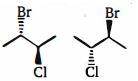
$3$-bromo-$2$-chlorobutane (diastereomers)
B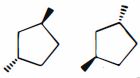
$1,3$-dimethylcyclopentane (cis and trans isomers)
C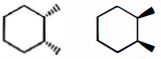
$1,2$-dimethylcyclohexane (cis and trans isomers)
D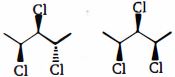
$1,2,3$-trichlorobutane (diastereomers)
Solution
(A) Enantiomers are non-superimposable mirror images of each other.
In option $A$, the two structures are non-superimposable mirror images.
Structure $1$ is $(2S, 3S)$-$3$-bromo-$2$-chlorobutane and structure $2$ is $(2R, 3R)$-$3$-bromo-$2$-chlorobutane.
Since they are non-superimposable mirror images, they are enantiomers.
In option $A$, the two structures are non-superimposable mirror images.
Structure $1$ is $(2S, 3S)$-$3$-bromo-$2$-chlorobutane and structure $2$ is $(2R, 3R)$-$3$-bromo-$2$-chlorobutane.
Since they are non-superimposable mirror images, they are enantiomers.
0 likesView Solution
44
ChemistryMediumMCQAIPMT · 2003
The oxidation state of sulfur in the anions $SO_3^{2-}$,$S_2O_4^{2-}$,and $S_2O_6^{2-}$ increases in the order:
A
$S_2O_6^{2-} < S_2O_4^{2-} < SO_3^{2-}$
B
$SO_3^{2-} < S_2O_4^{2-} < S_2O_6^{2-}$
C
$S_2O_4^{2-} < SO_3^{2-} < S_2O_6^{2-}$
D
$S_2O_4^{2-} < S_2O_6^{2-} < SO_3^{2-}$
Solution
(C) For $SO_3^{2-}$: $x + 3(-2) = -2 \implies x = +4$.
For $S_2O_4^{2-}$: $2x + 4(-2) = -2 \implies 2x = +6 \implies x = +3$.
For $S_2O_6^{2-}$: $2x + 6(-2) = -2 \implies 2x = +10 \implies x = +5$.
Comparing the oxidation states: $+3 < +4 < +5$.
Thus,the increasing order is $S_2O_4^{2-} < SO_3^{2-} < S_2O_6^{2-}$.
For $S_2O_4^{2-}$: $2x + 4(-2) = -2 \implies 2x = +6 \implies x = +3$.
For $S_2O_6^{2-}$: $2x + 6(-2) = -2 \implies 2x = +10 \implies x = +5$.
Comparing the oxidation states: $+3 < +4 < +5$.
Thus,the increasing order is $S_2O_4^{2-} < SO_3^{2-} < S_2O_6^{2-}$.
0 likesView Solution
45
ChemistryMCQAIPMT · 2003
If the rate of the reaction is equal to the rate constant,the order of the reaction is
A
$0$
B
$1$
C
$2$
D
$3$
Solution
(A) According to the rate law,the rate of reaction is given by the expression:
$\text{Rate} = k[\text{conc.}]^{x}$
Where $x$ is the overall order of the reaction.
To make the rate of reaction equal to the rate constant $(k)$,the term $[\text{conc.}]^{x}$ must be equal to $1$.
This is possible only when the order of the reaction $(x)$ is $0$,because $[\text{conc.}]^{0} = 1$.
Therefore,if the rate of reaction is equal to the rate constant,the order of the reaction is $0$.
$\text{Rate} = k[\text{conc.}]^{x}$
Where $x$ is the overall order of the reaction.
To make the rate of reaction equal to the rate constant $(k)$,the term $[\text{conc.}]^{x}$ must be equal to $1$.
This is possible only when the order of the reaction $(x)$ is $0$,because $[\text{conc.}]^{0} = 1$.
Therefore,if the rate of reaction is equal to the rate constant,the order of the reaction is $0$.
0 likesView Solution
46
ChemistryMCQAIPMT · 2003
$A$ sample of a radioactive element has a mass of $10 \, g$ at an instant $t = 0$. The approximate mass of this element in the sample after two mean lives is ........ $g$.
A
$2.50$
B
$3.70$
C
$6.30$
D
$1.35$
Solution
(D) The mass of a radioactive sample at time $t$ is given by the decay law: $M = M_0 e^{-\lambda t}$.
Here,$M_0 = 10 \, g$ is the initial mass.
The mean life $\tau$ is defined as $\tau = \frac{1}{\lambda}$,so $\lambda = \frac{1}{\tau}$.
We are asked to find the mass after two mean lives,i.e.,$t = 2\tau = \frac{2}{\lambda}$.
Substituting the value of $t$ in the decay equation:
$M = 10 e^{-\lambda (2/\lambda)} = 10 e^{-2} = \frac{10}{e^2}$.
Given that $e \approx 2.718$,then $e^2 \approx 7.389$.
$M = \frac{10}{7.389} \approx 1.35 \, g$.
Here,$M_0 = 10 \, g$ is the initial mass.
The mean life $\tau$ is defined as $\tau = \frac{1}{\lambda}$,so $\lambda = \frac{1}{\tau}$.
We are asked to find the mass after two mean lives,i.e.,$t = 2\tau = \frac{2}{\lambda}$.
Substituting the value of $t$ in the decay equation:
$M = 10 e^{-\lambda (2/\lambda)} = 10 e^{-2} = \frac{10}{e^2}$.
Given that $e \approx 2.718$,then $e^2 \approx 7.389$.
$M = \frac{10}{7.389} \approx 1.35 \, g$.
0 likesView Solution
47
ChemistryMCQAIPMT · 2003
The method of zone refining of metals is based on the principle of
A
Greater mobility of the pure metal than that of impurity
B
Higher melting point of the impurity than that of the pure metal
C
Greater noble character of the solid metal than that of the impurity
D
Greater solubility of the impurity in the molten state than in the solid
Solution
(D) Zone refining is based on the principle that impurities are more soluble in the molten state of the metal than in the solid state.
As the heater moves,the pure metal crystallizes out of the melt,while the impurities remain in the molten zone and are carried to the end of the rod.
This method is commonly used for purifying semiconductors like $Si$,$Ge$,and $Ga$.
As the heater moves,the pure metal crystallizes out of the melt,while the impurities remain in the molten zone and are carried to the end of the rod.
This method is commonly used for purifying semiconductors like $Si$,$Ge$,and $Ga$.
0 likesView Solution
48
ChemistryMCQAIPMT · 2003
Which of the following statements is not true?
A
$HF$ is a stronger acid than $HCl$.
B
Among halide ions,iodide is the most powerful reducing agent.
C
Fluorine is the only halogen that does not show variable oxidation states.
D
$HOCl$ is a stronger acid than $HOBr$.
Solution
(A) $1$. $F$ is more electronegative than $Cl$,making the $H-F$ bond stronger than the $H-Cl$ bond. Thus,$HF$ does not donate a proton easily,making it a weaker acid than $HCl$. Therefore,statement $A$ is incorrect.
$2$. Iodide $(I^-)$ has the largest size and lowest ionization energy among halides,making it the strongest reducing agent.
$3$. Fluorine is the most electronegative element and only shows an oxidation state of $-1$ (except in $F_2$ where it is $0$).
$4$. Since $Cl$ is more electronegative than $Br$,the $O-H$ bond in $HOCl$ is more polarized than in $HOBr$,making $HOCl$ a stronger acid.
$2$. Iodide $(I^-)$ has the largest size and lowest ionization energy among halides,making it the strongest reducing agent.
$3$. Fluorine is the most electronegative element and only shows an oxidation state of $-1$ (except in $F_2$ where it is $0$).
$4$. Since $Cl$ is more electronegative than $Br$,the $O-H$ bond in $HOCl$ is more polarized than in $HOBr$,making $HOCl$ a stronger acid.
0 likesView Solution
49
ChemistryMCQAIPMT · 2003
$A$ solid cylinder of mass $M$ and radius $R$ rolls without slipping down an inclined plane of length $L$ and height $h$. What is the speed of its centre of mass when the cylinder reaches its bottom?
A
$\sqrt{2gh}$
B
$\sqrt{\frac{3}{4}gh}$
C
$\sqrt{\frac{4}{3}gh}$
D
$\sqrt{4gh}$
Solution
(C) The potential energy of the solid cylinder at height $h$ is $U = Mgh$.
When the cylinder reaches the bottom,its total kinetic energy $(K.E.)$ is the sum of translational and rotational kinetic energy:
$K.E. = \frac{1}{2} M v^2 + \frac{1}{2} I \omega^2$
Since the cylinder rolls without slipping,$\omega = \frac{v}{R}$. For a solid cylinder,the moment of inertia $I = \frac{1}{2} M R^2$.
Substituting these into the kinetic energy equation:
$K.E. = \frac{1}{2} M v^2 + \frac{1}{2} (\frac{1}{2} M R^2) (\frac{v}{R})^2$
$K.E. = \frac{1}{2} M v^2 + \frac{1}{4} M v^2 = \frac{3}{4} M v^2$
By the law of conservation of energy,the potential energy at the top equals the kinetic energy at the bottom:
$Mgh = \frac{3}{4} M v^2$
Solving for $v$:
$v^2 = \frac{4}{3} gh$
$v = \sqrt{\frac{4}{3} gh}$
When the cylinder reaches the bottom,its total kinetic energy $(K.E.)$ is the sum of translational and rotational kinetic energy:
$K.E. = \frac{1}{2} M v^2 + \frac{1}{2} I \omega^2$
Since the cylinder rolls without slipping,$\omega = \frac{v}{R}$. For a solid cylinder,the moment of inertia $I = \frac{1}{2} M R^2$.
Substituting these into the kinetic energy equation:
$K.E. = \frac{1}{2} M v^2 + \frac{1}{2} (\frac{1}{2} M R^2) (\frac{v}{R})^2$
$K.E. = \frac{1}{2} M v^2 + \frac{1}{4} M v^2 = \frac{3}{4} M v^2$
By the law of conservation of energy,the potential energy at the top equals the kinetic energy at the bottom:
$Mgh = \frac{3}{4} M v^2$
Solving for $v$:
$v^2 = \frac{4}{3} gh$
$v = \sqrt{\frac{4}{3} gh}$
0 likesView Solution
50
ChemistryMCQAIPMT · 2003
The oxidation states of Sulphur in the anions $SO_3^{2-}$,$S_2O_4^{2-}$ and $S_2O_6^{2-}$ follow the order:
A
$S_2O_6^{2-} < S_2O_4^{2-} < SO_3^{2-}$
B
$S_2O_4^{2-} < SO_3^{2-} < S_2O_6^{2-}$
C
$SO_3^{2-} < S_2O_4^{2-} < S_2O_6^{2-}$
D
$S_2O_4^{2-} < S_2O_6^{2-} < SO_3^{2-}$
Solution
(B) For $SO_3^{2-}$: $x + 3(-2) = -2 \Rightarrow x = +4$
For $S_2O_4^{2-}$: $2x + 4(-2) = -2$ $\Rightarrow 2x = +6$ $\Rightarrow x = +3$
For $S_2O_6^{2-}$: $2x + 6(-2) = -2$ $\Rightarrow 2x = +10$ $\Rightarrow x = +5$
The oxidation states are $+3, +4, +5$ for $S_2O_4^{2-}, SO_3^{2-}, S_2O_6^{2-}$ respectively.
Thus,the correct order is $S_2O_4^{2-} < SO_3^{2-} < S_2O_6^{2-}$.
For $S_2O_4^{2-}$: $2x + 4(-2) = -2$ $\Rightarrow 2x = +6$ $\Rightarrow x = +3$
For $S_2O_6^{2-}$: $2x + 6(-2) = -2$ $\Rightarrow 2x = +10$ $\Rightarrow x = +5$
The oxidation states are $+3, +4, +5$ for $S_2O_4^{2-}, SO_3^{2-}, S_2O_6^{2-}$ respectively.
Thus,the correct order is $S_2O_4^{2-} < SO_3^{2-} < S_2O_6^{2-}$.
0 likesView Solution
51
ChemistryEasyMCQAIPMT · 2003
Which of the following statements is not true?
A
$HF$ is a stronger acid than $HCl$
B
Among halide ions,iodide is the most powerful reducing agent
C
Fluorine is the only halogen that does not show a variable oxidation state
D
$HOCl$ is a stronger acid than $HOBr$
Solution
(A) . The statement "$HF$ is a stronger acid than $HCl$" is false.
$HF$ is a weak acid in aqueous solution due to strong intermolecular hydrogen bonding and high bond dissociation enthalpy of the $H-F$ bond,whereas $HCl$ is a strong acid.
$HF$ is a weak acid in aqueous solution due to strong intermolecular hydrogen bonding and high bond dissociation enthalpy of the $H-F$ bond,whereas $HCl$ is a strong acid.
0 likesView Solution
52
ChemistryMediumMCQAIPMT · 2003
Formation of a solution from two components can be considered as
$(i)$ Pure solvent $\to$ separated solvent molecules $\Delta H_1$
$(ii)$ Pure solute $\to$ separated solute molecules $\Delta H_2$
$(iii)$ Separated solvent and solute molecules $\to$ solution $\Delta H_3$
Solution so formed will be ideal if
$(i)$ Pure solvent $\to$ separated solvent molecules $\Delta H_1$
$(ii)$ Pure solute $\to$ separated solute molecules $\Delta H_2$
$(iii)$ Separated solvent and solute molecules $\to$ solution $\Delta H_3$
Solution so formed will be ideal if
A
$\Delta H_{soln} = \Delta H_3 - \Delta H_1 - \Delta H_2$
B
$\Delta H_{soln} = \Delta H_1 + \Delta H_2 + \Delta H_3$
C
$\Delta H_{soln} = \Delta H_1 + \Delta H_2 - \Delta H_3$
D
$\Delta H_{soln} = \Delta H_1 - \Delta H_2 - \Delta H_3$
Solution
(B) The enthalpy of solution formation is the sum of the enthalpy changes of the individual steps:
$\Delta H_{soln} = \Delta H_1 + \Delta H_2 + \Delta H_3$
For an ideal solution,the net enthalpy change of mixing is zero,meaning $\Delta H_{mix} = 0$.
However,the question asks for the expression of $\Delta H_{soln}$ based on the given steps.
By Hess's Law,the total enthalpy change is the sum of the enthalpy changes of the intermediate steps:
$\Delta H_{soln} = \Delta H_1 + \Delta H_2 + \Delta H_3$
$\Delta H_{soln} = \Delta H_1 + \Delta H_2 + \Delta H_3$
For an ideal solution,the net enthalpy change of mixing is zero,meaning $\Delta H_{mix} = 0$.
However,the question asks for the expression of $\Delta H_{soln}$ based on the given steps.
By Hess's Law,the total enthalpy change is the sum of the enthalpy changes of the intermediate steps:
$\Delta H_{soln} = \Delta H_1 + \Delta H_2 + \Delta H_3$
0 likesView Solution
53
ChemistryDifficultMCQAIPMT · 2003
The pyknometric density of sodium chloride crystal is $2.165 \times 10^3 \ kg \ m^{-3}$ while its $X$-ray density is $2.178 \times 10^3 \ kg \ m^{-3}$. The fraction of unoccupied sites in sodium chloride crystal is
A
$5.96 \times 10^{-3}$
B
$5.96$
C
$5.96 \times 10^{-2}$
D
$5.96 \times 10^{-1}$
Solution
(A) The fraction of unoccupied sites (vacancies) is given by the formula: $\text{Fraction} = \frac{\rho_{\text{X-ray}} - \rho_{\text{pyknometric}}}{\rho_{\text{X-ray}}}$
Given: $\rho_{\text{X-ray}} = 2.178 \times 10^3 \ kg \ m^{-3}$ and $\rho_{\text{pyknometric}} = 2.165 \times 10^3 \ kg \ m^{-3}$
Difference $= (2.178 - 2.165) \times 10^3 = 0.013 \times 10^3 \ kg \ m^{-3}$
Fraction $= \frac{0.013 \times 10^3}{2.178 \times 10^3} = \frac{0.013}{2.178} \approx 5.96 \times 10^{-3}$
Given: $\rho_{\text{X-ray}} = 2.178 \times 10^3 \ kg \ m^{-3}$ and $\rho_{\text{pyknometric}} = 2.165 \times 10^3 \ kg \ m^{-3}$
Difference $= (2.178 - 2.165) \times 10^3 = 0.013 \times 10^3 \ kg \ m^{-3}$
Fraction $= \frac{0.013 \times 10^3}{2.178 \times 10^3} = \frac{0.013}{2.178} \approx 5.96 \times 10^{-3}$
0 likesView Solution
54
ChemistryEasyMCQAIPMT · 2003
If the rate of the reaction is equal to the rate constant,the order of the reaction is
A
$3$
B
$0$
C
$1$
D
$2$
Solution
(B) The rate law for a reaction is given by $Rate = k[A]^n$,where $n$ is the order of the reaction.
If the rate of the reaction is equal to the rate constant $(Rate = k)$,then $[A]^n$ must be equal to $1$.
This is only possible when $n = 0$.
Therefore,the reaction is of zero order.
If the rate of the reaction is equal to the rate constant $(Rate = k)$,then $[A]^n$ must be equal to $1$.
This is only possible when $n = 0$.
Therefore,the reaction is of zero order.
0 likesView Solution
55
ChemistryMediumMCQAIPMT · 2003
The reaction $A \to B$ follows first order kinetics. The time taken for $0.8 \ mol$ of $A$ to produce $0.6 \ mol$ of $B$ is $1 \ hr$. What is the time taken for the conversion of $0.9 \ mol$ of $A$ to produce $0.675 \ mol$ of $B$?
A
$2$
B
$1$
C
$0.5$
D
$0.25$
Solution
(B) For a first-order reaction,the rate constant $k$ is given by the formula: $k = \frac{2.303}{t} \log \frac{[A]_0}{[A]_t}$.
In the first case,initial concentration $[A]_0 = 0.8 \ mol$ and remaining concentration $[A]_t = 0.8 - 0.6 = 0.2 \ mol$. However,the problem states $0.8 \ mol$ of $A$ produces $0.6 \ mol$ of $B$,implying the ratio of reactant remaining is $\frac{0.8 - 0.6}{0.8} = \frac{0.2}{0.8} = \frac{1}{4}$.
Wait,the standard first-order equation is $k = \frac{2.303}{t} \log \frac{[A]_0}{[A]_t}$.
For the first case: $k = \frac{2.303}{1} \log \frac{0.8}{0.8 - 0.6} = 2.303 \log \frac{0.8}{0.2} = 2.303 \log 4$.
For the second case: $t = \frac{2.303}{k} \log \frac{0.9}{0.9 - 0.675} = \frac{2.303}{k} \log \frac{0.9}{0.225} = \frac{2.303}{k} \log 4$.
Since $k$ is the same,$t = 1 \ hr$.
In the first case,initial concentration $[A]_0 = 0.8 \ mol$ and remaining concentration $[A]_t = 0.8 - 0.6 = 0.2 \ mol$. However,the problem states $0.8 \ mol$ of $A$ produces $0.6 \ mol$ of $B$,implying the ratio of reactant remaining is $\frac{0.8 - 0.6}{0.8} = \frac{0.2}{0.8} = \frac{1}{4}$.
Wait,the standard first-order equation is $k = \frac{2.303}{t} \log \frac{[A]_0}{[A]_t}$.
For the first case: $k = \frac{2.303}{1} \log \frac{0.8}{0.8 - 0.6} = 2.303 \log \frac{0.8}{0.2} = 2.303 \log 4$.
For the second case: $t = \frac{2.303}{k} \log \frac{0.9}{0.9 - 0.675} = \frac{2.303}{k} \log \frac{0.9}{0.225} = \frac{2.303}{k} \log 4$.
Since $k$ is the same,$t = 1 \ hr$.
0 likesView Solution
56
ChemistryEasyMCQAIPMT · 2003
The activation energy for a simple chemical reaction $A \to B$ is ${E_a}$ in the forward direction. The activation energy for the reverse reaction:
A
Is always double of ${E_a}$
B
Is negative of ${E_a}$
C
Is always less than ${E_a}$
D
Can be less than or more than ${E_a}$
Solution
(D) The relationship between the activation energy of the forward reaction $(E_{a,f})$ and the reverse reaction $(E_{a,r})$ is given by the equation: $E_{a,f} - E_{a,r} = \Delta H$,where $\Delta H$ is the enthalpy change of the reaction.
For an exothermic reaction,$\Delta H < 0$,which implies $E_{a,r} > E_{a,f}$.
For an endothermic reaction,$\Delta H > 0$,which implies $E_{a,r} < E_{a,f}$.
Therefore,the activation energy for the reverse reaction can be less than or more than ${E_a}$ depending on the nature of the reaction.
For an exothermic reaction,$\Delta H < 0$,which implies $E_{a,r} > E_{a,f}$.
For an endothermic reaction,$\Delta H > 0$,which implies $E_{a,r} < E_{a,f}$.
Therefore,the activation energy for the reverse reaction can be less than or more than ${E_a}$ depending on the nature of the reaction.
0 likesView Solution
57
ChemistryDifficultMCQAIPMT · 2003
The temperature dependence of the rate constant $(k)$ of a chemical reaction is expressed by the Arrhenius equation,$k = A \cdot e^{-E^*/RT}$. The activation energy $(E^*)$ of the reaction can be calculated by plotting:
A
$\log \, k$ vs $\frac{1}{T}$
B
$k$ vs $T$
C
$k$ vs $\frac{1}{\log \, T}$
D
$\log \, k$ vs $T$
Solution
(A) The Arrhenius equation is given by $k = A e^{-E^*/RT}$.
Taking the logarithm on both sides,we get $\log \, k = \log \, A - \frac{E^*}{2.303 R} \cdot \frac{1}{T}$.
This equation follows the linear form $y = mx + c$,where $y = \log \, k$ and $x = \frac{1}{T}$.
Plotting $\log \, k$ versus $\frac{1}{T}$ yields a straight line with a slope equal to $-\frac{E^*}{2.303 R}$.
Thus,the activation energy $E^*$ can be determined from the slope of this plot.
Taking the logarithm on both sides,we get $\log \, k = \log \, A - \frac{E^*}{2.303 R} \cdot \frac{1}{T}$.
This equation follows the linear form $y = mx + c$,where $y = \log \, k$ and $x = \frac{1}{T}$.
Plotting $\log \, k$ versus $\frac{1}{T}$ yields a straight line with a slope equal to $-\frac{E^*}{2.303 R}$.
Thus,the activation energy $E^*$ can be determined from the slope of this plot.
0 likesView Solution
58
ChemistryEasyMCQAIPMT · 2003
On the basis of the information available from the reaction $\frac{4}{3} Al + O_2 \to \frac{2}{3} Al_2O_3$,$\Delta G = -827 \ kJ \ mol^{-1}$ of $O_2$,the minimum emf required to carry out an electrolysis of $Al_2O_3$ is $............... \ V$
A
$8.56$
B
$2.14$
C
$4.28$
D
$6.42$
Solution
(B) The reaction for the electrolysis of $Al_2O_3$ is the reverse of the formation reaction: $\frac{2}{3} Al_2O_3 \to \frac{4}{3} Al + O_2$.
For this reaction,$\Delta G = +827 \ kJ \ mol^{-1} = 827000 \ J \ mol^{-1}$.
The number of electrons involved in the reaction is calculated from the oxidation state change: $Al^{3+} + 3e^- \to Al$. Since there are $\frac{4}{3}$ moles of $Al$,the total electrons $n = \frac{4}{3} \times 3 = 4$.
Using the formula $\Delta G = -nFE$,the minimum emf $E$ required is $E = -\frac{\Delta G}{nF}$.
$E = -\frac{827000 \ J \ mol^{-1}}{4 \times 96500 \ C \ mol^{-1}} = -2.14 \ V$.
Since we are looking for the minimum external potential to drive the non-spontaneous reaction,the magnitude is $2.14 \ V$.
For this reaction,$\Delta G = +827 \ kJ \ mol^{-1} = 827000 \ J \ mol^{-1}$.
The number of electrons involved in the reaction is calculated from the oxidation state change: $Al^{3+} + 3e^- \to Al$. Since there are $\frac{4}{3}$ moles of $Al$,the total electrons $n = \frac{4}{3} \times 3 = 4$.
Using the formula $\Delta G = -nFE$,the minimum emf $E$ required is $E = -\frac{\Delta G}{nF}$.
$E = -\frac{827000 \ J \ mol^{-1}}{4 \times 96500 \ C \ mol^{-1}} = -2.14 \ V$.
Since we are looking for the minimum external potential to drive the non-spontaneous reaction,the magnitude is $2.14 \ V$.
0 likesView Solution
59
ChemistryDifficultMCQAIPMT · 2003
The $emf$ of a $Daniel$ cell at $298 \ K$ is ${E_1}$ for the cell reaction $Zn|ZnSO_4(0.01 \ M)||CuSO_4(1.0 \ M)|Cu$. When the concentration of $ZnSO_4$ is $1.0 \ M$ and that of $CuSO_4$ is $0.01 \ M$,the $emf$ changes to ${E_2}$. What is the relationship between ${E_1}$ and ${E_2}$?
A
${E_2} = 0 \neq {E_1}$
B
${E_1} > {E_2}$
C
${E_1} < {E_2}$
D
${E_1} = {E_2}$
Solution
(B) The cell reaction is $Zn(s) + Cu^{2+}(aq) \rightarrow Zn^{2+}(aq) + Cu(s)$.
Using the $Nernst$ equation: $E = E^o - \frac{0.0591}{2} \log \frac{[Zn^{2+}]}{[Cu^{2+}]}$.
For ${E_1}$: $[Zn^{2+}] = 0.01 \ M$ and $[Cu^{2+}] = 1.0 \ M$,so ${E_1} = E^o - \frac{0.0591}{2} \log \frac{0.01}{1} = E^o + 0.0591$.
For ${E_2}$: $[Zn^{2+}] = 1.0 \ M$ and $[Cu^{2+}] = 0.01 \ M$,so ${E_2} = E^o - \frac{0.0591}{2} \log \frac{1}{0.01} = E^o - 0.0591$.
Therefore,${E_1} > {E_2}$.
Using the $Nernst$ equation: $E = E^o - \frac{0.0591}{2} \log \frac{[Zn^{2+}]}{[Cu^{2+}]}$.
For ${E_1}$: $[Zn^{2+}] = 0.01 \ M$ and $[Cu^{2+}] = 1.0 \ M$,so ${E_1} = E^o - \frac{0.0591}{2} \log \frac{0.01}{1} = E^o + 0.0591$.
For ${E_2}$: $[Zn^{2+}] = 1.0 \ M$ and $[Cu^{2+}] = 0.01 \ M$,so ${E_2} = E^o - \frac{0.0591}{2} \log \frac{1}{0.01} = E^o - 0.0591$.
Therefore,${E_1} > {E_2}$.
0 likesView Solution
60
ChemistryEasyMCQAIPMT · 2003
According to the adsorption theory of catalysis,the speed of the reaction increases because
A
Adsorption lowers the activation energy of the reaction
B
The concentration of reactant molecules at the active centres of the catalyst becomes high due to adsorption
C
In the process of adsorption,the activation energy of the molecules becomes large
D
Adsorption produces heat which increases the speed of the reaction
Solution
(A) According to the adsorption theory of catalysis,the catalyst provides a surface where reactant molecules get adsorbed.
This adsorption increases the concentration of reactants at the active sites and,more importantly,it provides an alternative pathway with lower activation energy,thereby increasing the rate of the reaction.
This adsorption increases the concentration of reactants at the active sites and,more importantly,it provides an alternative pathway with lower activation energy,thereby increasing the rate of the reaction.
0 likesView Solution
61
ChemistryEasyMCQAIPMT · 2003
Which one of the following characteristics of the transition metals is associated with their catalytic activity?
A
Variable oxidation states
B
High enthalpy of atomization
C
Paramagnetic behaviour
D
Colour of hydrated ions
Solution
(A) The catalytic activity of transition metals is primarily due to their ability to adopt $Variable \ oxidation \ states$ and provide a large surface area with free valencies.
These properties allow them to form unstable intermediate compounds with reactants,providing an alternative reaction path with lower activation energy.
Therefore,the correct option is $(A)$.
These properties allow them to form unstable intermediate compounds with reactants,providing an alternative reaction path with lower activation energy.
Therefore,the correct option is $(A)$.
0 likesView Solution
62
ChemistryMediumMCQAIPMT · 2003
The method of zone refining of metals is based on the principle of
A
Greater solubility of the impurity in the molten state than in the solid
B
Greater mobility of the pure metal than that of the impurity
C
Higher melting point of the impurity than that of the pure metal
D
Greater noble character of the solid metal than that of the impurity
Solution
(A) This method is based on the principle that the impurities are more soluble in the melt than in the solid state of the metal.
$A$ circular mobile heater is fixed at one end of a rod of the impure metal.
The molten zone moves along with the heater which is moved forward.
As the heater moves forward,the pure metal crystallises out of the melt and the impurities pass on into the adjacent molten zone.
$A$ circular mobile heater is fixed at one end of a rod of the impure metal.
The molten zone moves along with the heater which is moved forward.
As the heater moves forward,the pure metal crystallises out of the melt and the impurities pass on into the adjacent molten zone.
0 likesView Solution
63
ChemistryMediumMCQAIPMT · 2003
The basic character of the transition metal monoxides follows the order
(Atomic no. $Ti = 22, V = 23, Cr = 24, Fe = 26$)
(Atomic no. $Ti = 22, V = 23, Cr = 24, Fe = 26$)
A
$TiO > VO > CrO > FeO$
B
$VO > CrO > TiO > FeO$
C
$CrO > VO > FeO > TiO$
D
$TiO > FeO > VO > CrO$
Solution
(A) The basic character of metal oxides depends on the oxidation state and the metallic nature of the element.
For transition metal monoxides $(MO)$,the metal is in the $+2$ oxidation state.
As we move from left to right across the $3d$ series $(Ti$ $\rightarrow V$ $\rightarrow Cr$ $\rightarrow Fe)$,the electronegativity of the metal increases and its metallic character decreases.
Consequently,the ionic character of the $M-O$ bond decreases,leading to a decrease in the basic character of the oxides.
Therefore,the order of basic character is $TiO > VO > CrO > FeO$.
For transition metal monoxides $(MO)$,the metal is in the $+2$ oxidation state.
As we move from left to right across the $3d$ series $(Ti$ $\rightarrow V$ $\rightarrow Cr$ $\rightarrow Fe)$,the electronegativity of the metal increases and its metallic character decreases.
Consequently,the ionic character of the $M-O$ bond decreases,leading to a decrease in the basic character of the oxides.
Therefore,the order of basic character is $TiO > VO > CrO > FeO$.
0 likesView Solution
64
ChemistryDifficultMCQAIPMT · 2003
According to $IUPAC$ nomenclature,sodium nitroprusside is named as:
A
Sodium pentacyanidonitrosylferrate$(II)$
B
Sodium nitroferricyanide
C
Sodium nitroferrocyanide
D
Sodium pentacyanonitrosylferrate$(II)$
Solution
(A) The chemical formula for sodium nitroprusside is $Na_2[Fe(CN)_5(NO)] \cdot 2H_2O$.
In this complex,the ligand $NO$ is treated as $NO^+$ (nitrosonium ion).
The oxidation state of $Fe$ is calculated as: $2(+1) + x + 5(-1) + (+1) = 0$,which gives $x = +2$.
Thus,the central metal is $Fe(II)$.
The ligands are five cyanide ions (pentacyanido) and one nitrosyl group (nitrosyl).
According to $IUPAC$ rules,the name is sodium pentacyanidonitrosylferrate$(II)$.
In this complex,the ligand $NO$ is treated as $NO^+$ (nitrosonium ion).
The oxidation state of $Fe$ is calculated as: $2(+1) + x + 5(-1) + (+1) = 0$,which gives $x = +2$.
Thus,the central metal is $Fe(II)$.
The ligands are five cyanide ions (pentacyanido) and one nitrosyl group (nitrosyl).
According to $IUPAC$ rules,the name is sodium pentacyanidonitrosylferrate$(II)$.
0 likesView Solution
65
ChemistryDifficultMCQAIPMT · 2003
Which one of the following octahedral complexes will not show geometric isomerism ($A$ and $B$ are monodentate ligands)?
A
$[MA_5B]$
B
$[MA_2B_4]$
C
$[MA_3B_3]$
D
$[MA_4B_2]$
Solution
(A) Geometric isomerism in octahedral complexes occurs when there are different spatial arrangements of ligands around the central metal atom.
For complexes of the type $[MA_5B]$,all positions are equivalent relative to the unique ligand $B$,meaning no geometric isomers can be formed.
Complexes of the type $[MA_4B_2]$ exhibit $cis$ and $trans$ isomers.
Complexes of the type $[MA_3B_3]$ exhibit $fac$ (facial) and $mer$ (meridional) isomers.
Complexes of the type $[MA_2B_4]$ exhibit $cis$ and $trans$ isomers.
Therefore,$[MA_5B]$ is the correct answer.
For complexes of the type $[MA_5B]$,all positions are equivalent relative to the unique ligand $B$,meaning no geometric isomers can be formed.
Complexes of the type $[MA_4B_2]$ exhibit $cis$ and $trans$ isomers.
Complexes of the type $[MA_3B_3]$ exhibit $fac$ (facial) and $mer$ (meridional) isomers.
Complexes of the type $[MA_2B_4]$ exhibit $cis$ and $trans$ isomers.
Therefore,$[MA_5B]$ is the correct answer.
0 likesView Solution
66
ChemistryDifficultMCQAIPMT · 2003
The number of unpaired electrons in the complex ion $[CoF_6]^{3-}$ is (Atomic number of $Co = 27$).
A
$0$
B
$2$
C
$3$
D
$4$
Solution
(D) The atomic number of $Co$ is $27$. The electronic configuration of $Co$ is $[Ar] 3d^7 4s^2$.
In the complex ion $[CoF_6]^{3-}$,let the oxidation state of $Co$ be $x$. Then $x + 6(-1) = -3$,which gives $x = +3$.
The electronic configuration of $Co^{3+}$ is $[Ar] 3d^6$.
Since $F^-$ is a weak field ligand,it does not cause pairing of electrons in the $3d$ orbitals.
According to crystal field theory,for $d^6$ configuration in an octahedral field with weak ligands,the distribution is $t_{2g}^4 e_g^2$.
The number of unpaired electrons is $4$.
In the complex ion $[CoF_6]^{3-}$,let the oxidation state of $Co$ be $x$. Then $x + 6(-1) = -3$,which gives $x = +3$.
The electronic configuration of $Co^{3+}$ is $[Ar] 3d^6$.
Since $F^-$ is a weak field ligand,it does not cause pairing of electrons in the $3d$ orbitals.
According to crystal field theory,for $d^6$ configuration in an octahedral field with weak ligands,the distribution is $t_{2g}^4 e_g^2$.
The number of unpaired electrons is $4$.
0 likesView Solution
67
ChemistryMediumMCQAIPMT · 2003
Among the following,which is not the $\pi$-bonded organometallic compound?
A
$(CH_3)_4Sn$
B
$K[PtCl_3(\eta^2 - C_2H_4)]$
C
$Fe(\eta^5 - C_5H_5)_2$
D
$Cr(\eta^6 - C_6H_6)_2$
Solution
(A) $(CH_3)_4Sn$ (Tetramethyltin) contains only $\sigma$-bonds between the metal and the carbon atoms of the alkyl groups.
$K[PtCl_3(\eta^2 - C_2H_4)]$ (Zeise's salt) contains a $\pi$-bonded ethylene ligand.
$Fe(\eta^5 - C_5H_5)_2$ (Ferrocene) is a sandwich compound with $\pi$-bonded cyclopentadienyl rings.
$Cr(\eta^6 - C_6H_6)_2$ (Dibenzenechromium) is a sandwich compound with $\pi$-bonded benzene rings.
Therefore,$(CH_3)_4Sn$ is the only $\sigma$-bonded organometallic compound among the given options.
$K[PtCl_3(\eta^2 - C_2H_4)]$ (Zeise's salt) contains a $\pi$-bonded ethylene ligand.
$Fe(\eta^5 - C_5H_5)_2$ (Ferrocene) is a sandwich compound with $\pi$-bonded cyclopentadienyl rings.
$Cr(\eta^6 - C_6H_6)_2$ (Dibenzenechromium) is a sandwich compound with $\pi$-bonded benzene rings.
Therefore,$(CH_3)_4Sn$ is the only $\sigma$-bonded organometallic compound among the given options.
0 likesView Solution
68
ChemistryMediumMCQAIPMT · 2003
When $m$-chlorobenzaldehyde is treated with $50\%$ $KOH$ solution,the product$(s)$ obtained is (are):
A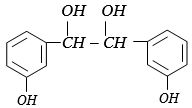
B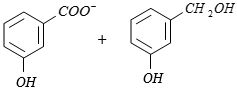
C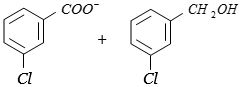
D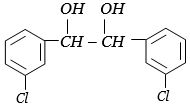
Solution
(B) The reaction of $m$-chlorobenzaldehyde with concentrated $KOH$ $(50\%)$ is a classic example of the Cannizzaro reaction.
Aldehydes that do not contain $\alpha$-hydrogen atoms undergo self-oxidation and reduction (disproportionation) in the presence of concentrated alkali.
$m$-chlorobenzaldehyde lacks $\alpha$-hydrogens,so it undergoes the Cannizzaro reaction to form $m$-chlorobenzoate and $m$-chlorobenzyl alcohol.
Aldehydes that do not contain $\alpha$-hydrogen atoms undergo self-oxidation and reduction (disproportionation) in the presence of concentrated alkali.
$m$-chlorobenzaldehyde lacks $\alpha$-hydrogens,so it undergoes the Cannizzaro reaction to form $m$-chlorobenzoate and $m$-chlorobenzyl alcohol.
0 likesView Solution
69
ChemistryMediumMCQAIPMT · 2003
$A$ and $B$ in the following reactions are

A
$A = RR'C(CN)(OH), B = LiAlH_4$
B
$A = RR'C(OH)(COOH), B = NH_3$
C
$A = RR'C(CN)(OH), B = H_3O^+$
D
$A = RR'CH_2CN, B = NaOH$
Solution
(A) The reaction of a ketone $(RR'C=O)$ with $HCN$ in the presence of $KCN$ (catalyst) leads to the formation of a cyanohydrin,where $A = RR'C(OH)(CN)$.
Next,the reduction of the cyanohydrin $(RR'C(OH)(CN))$ using a strong reducing agent like $LiAlH_4$ reduces the nitrile group $(-CN)$ to a primary amine group $(-CH_2NH_2)$.
Therefore,$A = RR'C(OH)(CN)$ and $B = LiAlH_4$.
Next,the reduction of the cyanohydrin $(RR'C(OH)(CN))$ using a strong reducing agent like $LiAlH_4$ reduces the nitrile group $(-CN)$ to a primary amine group $(-CH_2NH_2)$.
Therefore,$A = RR'C(OH)(CN)$ and $B = LiAlH_4$.
0 likesView Solution
70
ChemistryMediumMCQAIPMT · 2003
Which one of the following orders of acid strength is correct?
A
$RCOOH > HC \equiv CH > HOH > ROH$
B
$RCOOH > ROH > HOH > HC \equiv CH$
C
$RCOOH > HOH > ROH > HC \equiv CH$
D
$RCOOH > HOH > HC \equiv CH > ROH$
Solution
(C) The acid strength of a compound is determined by the stability of its conjugate base. The more stable the conjugate base,the stronger the acid.
$1$. $RCOOH$ (Carboxylic acid) is the strongest acid among the given options because its conjugate base,the carboxylate ion $(RCOO^-)$,is resonance-stabilized.
$2$. $HOH$ $(H_2O)$ is a stronger acid than $ROH$ (alcohol) because the alkyl group in $ROH$ is electron-donating ($+I$ effect),which destabilizes the alkoxide ion $(RO^-)$.
$3$. $HC \equiv CH$ (terminal alkyne) is the weakest acid among these because the $sp$-hybridized carbon is less electronegative than oxygen,and the negative charge on the carbon atom is less stable compared to the negative charge on oxygen.
Therefore,the correct order of acid strength is: $RCOOH > HOH > ROH > HC \equiv CH$.
$1$. $RCOOH$ (Carboxylic acid) is the strongest acid among the given options because its conjugate base,the carboxylate ion $(RCOO^-)$,is resonance-stabilized.
$2$. $HOH$ $(H_2O)$ is a stronger acid than $ROH$ (alcohol) because the alkyl group in $ROH$ is electron-donating ($+I$ effect),which destabilizes the alkoxide ion $(RO^-)$.
$3$. $HC \equiv CH$ (terminal alkyne) is the weakest acid among these because the $sp$-hybridized carbon is less electronegative than oxygen,and the negative charge on the carbon atom is less stable compared to the negative charge on oxygen.
Therefore,the correct order of acid strength is: $RCOOH > HOH > ROH > HC \equiv CH$.
0 likesView Solution
71
ChemistryDifficultMCQAIPMT · 2003
In a set of the given reactions,acetic acid yielded a product $C$. Product $C$ would be:
$CH_3COOH + PCl_5 \to A$ $\xrightarrow{C_6H_6, \text{anh. } AlCl_3} B$ $\xrightarrow{C_2H_5MgBr, \text{ether}} C$
$CH_3COOH + PCl_5 \to A$ $\xrightarrow{C_6H_6, \text{anh. } AlCl_3} B$ $\xrightarrow{C_2H_5MgBr, \text{ether}} C$
A
$C_2H_5-C(OH)(CH_3)-C_6H_5$
B
$CH_3-CH(OH)-C_2H_5$
C
$CH_3-CO-C_6H_5$
D
$CH_3-CH(OH)-C_6H_5$
Solution
(A) The reaction sequence is as follows:
$1.$ Acetic acid reacts with $PCl_5$ to form acetyl chloride $(A)$:
$CH_3COOH + PCl_5 \to CH_3COCl (A) + POCl_3 + HCl$
$2.$ Acetyl chloride reacts with benzene in the presence of anhydrous $AlCl_3$ (Friedel-Crafts acylation) to form acetophenone $(B)$:
$CH_3COCl + C_6H_6 \xrightarrow{\text{anh. } AlCl_3} C_6H_5COCH_3 (B) + HCl$
$3.$ Acetophenone reacts with ethylmagnesium bromide followed by hydrolysis to form $2$-phenylbutan-$2$-ol $(C)$:
$C_6H_5COCH_3 + C_2H_5MgBr$ $\xrightarrow{\text{ether}} C_6H_5-C(OMgBr)(CH_3)-C_2H_5$ $\xrightarrow{H_2O} C_6H_5-C(OH)(CH_3)-C_2H_5 (C)$
$1.$ Acetic acid reacts with $PCl_5$ to form acetyl chloride $(A)$:
$CH_3COOH + PCl_5 \to CH_3COCl (A) + POCl_3 + HCl$
$2.$ Acetyl chloride reacts with benzene in the presence of anhydrous $AlCl_3$ (Friedel-Crafts acylation) to form acetophenone $(B)$:
$CH_3COCl + C_6H_6 \xrightarrow{\text{anh. } AlCl_3} C_6H_5COCH_3 (B) + HCl$
$3.$ Acetophenone reacts with ethylmagnesium bromide followed by hydrolysis to form $2$-phenylbutan-$2$-ol $(C)$:
$C_6H_5COCH_3 + C_2H_5MgBr$ $\xrightarrow{\text{ether}} C_6H_5-C(OMgBr)(CH_3)-C_2H_5$ $\xrightarrow{H_2O} C_6H_5-C(OH)(CH_3)-C_2H_5 (C)$
0 likesView Solution
72
ChemistryDifficultMCQAIPMT · 2003
The final product $C$,obtained in the following reaction sequence,would be:
$p$-Toluidine $\xrightarrow{Ac_2O} A$ $\xrightarrow{Br_2/CH_3COOH} B$ $\xrightarrow{H_2O/H^+} C$
$p$-Toluidine $\xrightarrow{Ac_2O} A$ $\xrightarrow{Br_2/CH_3COOH} B$ $\xrightarrow{H_2O/H^+} C$
A
$2-$Bromo$-4-$methylaniline
B
$4-$Bromo$-2-$methylaniline
C
$2-$Bromo$-4-$methylacetanilide
D
$3-$Bromo$-4-$methylaniline
Solution
(A) The reaction sequence is as follows:
$1$. $p$-Toluidine reacts with acetic anhydride $(Ac_2O)$ to form $N$-($4$-methylphenyl)acetamide (acetanilide derivative),which is compound $A$.
$2$. Compound $A$ undergoes electrophilic aromatic substitution with $Br_2$ in $CH_3COOH$. The $-NHCOCH_3$ group is strongly activating and ortho/para directing. Since the para position is occupied by the $-CH_3$ group,bromine enters the ortho position relative to the $-NHCOCH_3$ group,forming $2$-bromo-$4$-methylacetanilide,which is compound $B$.
$3$. Finally,acid-catalyzed hydrolysis of compound $B$ removes the acetyl group to regenerate the amine,yielding $2$-bromo-$4$-methylaniline as the final product $C$.
$1$. $p$-Toluidine reacts with acetic anhydride $(Ac_2O)$ to form $N$-($4$-methylphenyl)acetamide (acetanilide derivative),which is compound $A$.
$2$. Compound $A$ undergoes electrophilic aromatic substitution with $Br_2$ in $CH_3COOH$. The $-NHCOCH_3$ group is strongly activating and ortho/para directing. Since the para position is occupied by the $-CH_3$ group,bromine enters the ortho position relative to the $-NHCOCH_3$ group,forming $2$-bromo-$4$-methylacetanilide,which is compound $B$.
$3$. Finally,acid-catalyzed hydrolysis of compound $B$ removes the acetyl group to regenerate the amine,yielding $2$-bromo-$4$-methylaniline as the final product $C$.
0 likesView Solution
73
ChemistryEasyMCQAIPMT · 2003
Which one of the following monomers gives the polymer neoprene on polymerization?
A
$CF_2 = CF_2$
B
$CH_2 = CHCl$
C
$CCl_2 = CCl_2$
D
$CH_2 = C(Cl) - CH = CH_2$
Solution
(D) Neoprene is a synthetic rubber formed by the free-radical polymerization of chloroprene ($2$-chloro$-1,3-$butadiene).
The chemical reaction is:
$n(CH_2 = C(Cl) - CH = CH_2) \rightarrow [-CH_2 - C(Cl) = CH - CH_2 -]_n$
Thus,the monomer is $CH_2 = C(Cl) - CH = CH_2$.
The chemical reaction is:
$n(CH_2 = C(Cl) - CH = CH_2) \rightarrow [-CH_2 - C(Cl) = CH - CH_2 -]_n$
Thus,the monomer is $CH_2 = C(Cl) - CH = CH_2$.
0 likesView Solution
74
ChemistryMediumMCQAIPMT · 2003
Acrilan is a hard,horny,and a high-melting material. Which of the following represents its structure?
A
$(-CH_2-CHCl-)_n$
B
$(-CH_2-CH(CN)-)_n$
C
$(-CH_2-C(CH_3)(COOCH_3)-)_n$
D
$(-CH_2-CH(COOC_2H_5)-)_n$
Solution
(B) . Acrilan is the trade name for polyacrylonitrile $(PAN)$.
It is a synthetic polymer produced from the monomer acrylonitrile $(CH_2=CH-CN)$.
Its structure is represented as $(-CH_2-CH(CN)-)_n$.
It is known for being hard,horny,and having a high melting point.
It is a synthetic polymer produced from the monomer acrylonitrile $(CH_2=CH-CN)$.
Its structure is represented as $(-CH_2-CH(CN)-)_n$.
It is known for being hard,horny,and having a high melting point.
0 likesView Solution
75
ChemistryEasyMCQAIPMT · 2003
Glycolysis is
A
Conversion of glucose to haem
B
Oxidation of glucose to glutamate
C
Conversion of pyruvate to citrate
D
Oxidation of glucose to pyruvate
Solution
(D) Glycolysis is a metabolic pathway that occurs in the cytosol of the cell.
In this process,one molecule of glucose $(C_6H_{12}O_6)$ is broken down into two molecules of pyruvate $(CH_3COCOOH)$ through a series of enzymatic reactions.
It is an anaerobic process that yields a net gain of $2$ $ATP$ and $2$ $NADH$ molecules.
In this process,one molecule of glucose $(C_6H_{12}O_6)$ is broken down into two molecules of pyruvate $(CH_3COCOOH)$ through a series of enzymatic reactions.
It is an anaerobic process that yields a net gain of $2$ $ATP$ and $2$ $NADH$ molecules.
0 likesView Solution
76
ChemistryMediumMCQAIPMT · 2003
Phospholipids are esters of glycerol with
A
Three phosphate groups
B
Three carboxylic acid residues
C
One carboxylic acid residue and two phosphate groups
D
Two carboxylic acid residues and one phosphate group
Solution
(D) Phospholipids are esters of glycerol with two carboxylic acid residues and one phosphate group.
Hence,phospholipids may be regarded as derivatives of glycerol in which two hydroxyl groups are esterified with fatty acids,while the third is esterified with phosphoric acid.
Hence,phospholipids may be regarded as derivatives of glycerol in which two hydroxyl groups are esterified with fatty acids,while the third is esterified with phosphoric acid.
0 likesView Solution
77
ChemistryEasyMCQAIPMT · 2003
Chargaff's rule states that in an organism
A
Amounts of all bases are equal
B
Amount of adenine $(A)$ is equal to that of thymine $(T)$ and the amount of guanine $(G)$ is equal to that of cytosine $(C)$
C
Amount of adenine $(A)$ is equal to that of guanine $(G)$ and the amount of thymine $(T)$ is equal to that of cytosine $(C)$
D
Amount of adenine $(A)$ is equal to that of cytosine $(C)$ and the amount of thymine $(T)$ is equal to guanine $(G)$
Solution
(B) According to Chargaff's rule,the $DNA$ of any species from any organism should have a $1:1$ stoichiometric ratio of purine and pyrimidine bases.
Specifically,the amount of adenine $(A)$ is equal to that of thymine $(T)$,and the amount of guanine $(G)$ is equal to that of cytosine $(C)$.
Therefore,the correct option is $(B)$.
Specifically,the amount of adenine $(A)$ is equal to that of thymine $(T)$,and the amount of guanine $(G)$ is equal to that of cytosine $(C)$.
Therefore,the correct option is $(B)$.
0 likesView Solution
78
ChemistryMediumMCQAIPMT · 2003
Vitamin $B_{12}$ contains which of the following metals?
A
$Ca(II)$
B
$Zn(II)$
C
$Fe(II)$
D
$Co(III)$
Solution
(D) Vitamin $B_{12}$,also known as cyanocobalamin,contains a central metal ion.
The metal present in the coordination complex of vitamin $B_{12}$ is Cobalt in the $+3$ oxidation state,denoted as $Co(III)$.
Therefore,the correct option is $(D)$.
The metal present in the coordination complex of vitamin $B_{12}$ is Cobalt in the $+3$ oxidation state,denoted as $Co(III)$.
Therefore,the correct option is $(D)$.
0 likesView Solution
79
ChemistryEasyMCQAIPMT · 2003
Which of the following could act as a propellant for a rocket?
A
Liquid hydrogen + Liquid nitrogen
B
Liquid oxygen + Liquid argon
C
Liquid hydrogen + Liquid oxygen
D
Liquid nitrogen + Liquid oxygen
Solution
(C) The combination of $Liquid \ H_2$ and $Liquid \ O_2$ is widely used as a high-performance rocket propellant.
In this system,$Liquid \ H_2$ acts as the fuel and $Liquid \ O_2$ acts as the oxidizer.
The reaction is highly exothermic,providing the necessary thrust for the rocket.
In this system,$Liquid \ H_2$ acts as the fuel and $Liquid \ O_2$ acts as the oxidizer.
The reaction is highly exothermic,providing the necessary thrust for the rocket.
0 likesView Solution
80
ChemistryMediumMCQAIPMT · 2003
The correct order of ionic radii of $Y^{3+}$,$La^{3+}$,$Eu^{3+}$ and $Lu^{3+}$ is
(Atomic No. $Y = 39$,$La = 57$,$Eu = 63$,$Lu = 71$)
(Atomic No. $Y = 39$,$La = 57$,$Eu = 63$,$Lu = 71$)
A
$La^{3+} < Eu^{3+} < Lu^{3+} < Y^{3+}$
B
$Y^{3+} < La^{3+} < Eu^{3+} < Lu^{3+}$
C
$Lu^{3+} < Y^{3+} < Eu^{3+} < La^{3+}$
D
$Lu^{3+} < Eu^{3+} < La^{3+} < Y^{3+}$
Solution
(C) The ionic radii of lanthanoids decrease with an increase in atomic number due to lanthanide contraction.
$La^{3+}$ $(Z=57)$ has the largest size,while $Lu^{3+}$ $(Z=71)$ has the smallest size among the lanthanoids.
$Y^{3+}$ $(Z=39)$ has an ionic radius comparable to the heavier lanthanoids (like $Ho^{3+}$ or $Er^{3+}$),but it is smaller than $La^{3+}$ and $Eu^{3+}$.
Comparing the given ions: $La^{3+} (1.03 \ \mathring{A}) > Eu^{3+} (0.95 \ \mathring{A}) > Y^{3+} (0.90 \ \mathring{A}) > Lu^{3+} (0.86 \ \mathring{A})$.
Therefore,the correct order is $Lu^{3+} < Y^{3+} < Eu^{3+} < La^{3+}$.
$La^{3+}$ $(Z=57)$ has the largest size,while $Lu^{3+}$ $(Z=71)$ has the smallest size among the lanthanoids.
$Y^{3+}$ $(Z=39)$ has an ionic radius comparable to the heavier lanthanoids (like $Ho^{3+}$ or $Er^{3+}$),but it is smaller than $La^{3+}$ and $Eu^{3+}$.
Comparing the given ions: $La^{3+} (1.03 \ \mathring{A}) > Eu^{3+} (0.95 \ \mathring{A}) > Y^{3+} (0.90 \ \mathring{A}) > Lu^{3+} (0.86 \ \mathring{A})$.
Therefore,the correct order is $Lu^{3+} < Y^{3+} < Eu^{3+} < La^{3+}$.
0 likesView Solution
81
ChemistryMediumMCQAIPMT · 2003
In the reaction $CH_3CHO + HCN \to CH_3CH(OH)CN \xrightarrow{H_3O^+} CH_3CH(OH)COOH$,an asymmetric center is generated. The acid obtained would be:
A
$20\% \ D + 80\% \ L$ isomer
B
$D$ isomer
C
$L$ isomer
D
$50\% \ D + 50\% \ L$ isomer
Solution
(D) The reaction of acetaldehyde $(CH_3CHO)$ with $HCN$ is a nucleophilic addition reaction.
Since the carbonyl carbon in $CH_3CHO$ is $sp^2$ hybridized and planar,the cyanide ion $(CN^-)$ can attack from either side of the plane with equal probability.
This leads to the formation of a racemic mixture of the cyanohydrin intermediate.
Subsequent hydrolysis of the cyanohydrin to the carboxylic acid ($CH_3CH(OH)COOH$,lactic acid) preserves this racemic nature.
Therefore,the final product is a $50\% \ D$ and $50\% \ L$ mixture,which is a racemic mixture.
Since the carbonyl carbon in $CH_3CHO$ is $sp^2$ hybridized and planar,the cyanide ion $(CN^-)$ can attack from either side of the plane with equal probability.
This leads to the formation of a racemic mixture of the cyanohydrin intermediate.
Subsequent hydrolysis of the cyanohydrin to the carboxylic acid ($CH_3CH(OH)COOH$,lactic acid) preserves this racemic nature.
Therefore,the final product is a $50\% \ D$ and $50\% \ L$ mixture,which is a racemic mixture.
0 likesView Solution
82
ChemistryMediumMCQAIPMT · 2003
The reason for the double helical structure of $DNA$ is the operation of
A
Electrostatic attractions
B
van der Waals forces
C
Dipole-dipole interactions
D
Hydrogen bonding
Solution
(D) The two polynucleotide chains of $DNA$ molecules are twisted around a common axis but run in opposite directions to form a right-handed helix.
These two chains are held together by specific hydrogen bonds between the complementary nitrogenous bases ($A$ pairs with $T$,and $G$ pairs with $C$).
These two chains are held together by specific hydrogen bonds between the complementary nitrogenous bases ($A$ pairs with $T$,and $G$ pairs with $C$).
0 likesView Solution
83
ChemistryMediumMCQAIPMT · 2003
Assertion : Hydroxyketones are not directly used in Grignard reaction.
Reason : Grignard reagents react with hydroxyl group.
Reason : Grignard reagents react with hydroxyl group.
A
If both Assertion and Reason are correct and the Reason is a correct explanation of the Assertion.
B
If both Assertion and Reason are correct but Reason is not a correct explanation of the Assertion.
C
If the Assertion is correct but Reason is incorrect.
D
If both the Assertion and Reason are incorrect.
Solution
(A) Grignard reagents $(RMgX)$ are strong bases and highly reactive nucleophiles.
They react rapidly with acidic hydrogen atoms,such as those present in the hydroxyl $(-OH)$ group of hydroxyketones,to form an alkoxide and an alkane $(R-H)$.
Therefore,to perform a Grignard reaction on a hydroxyketone,the hydroxyl group must first be protected (e.g.,by silylation) to prevent this side reaction.
They react rapidly with acidic hydrogen atoms,such as those present in the hydroxyl $(-OH)$ group of hydroxyketones,to form an alkoxide and an alkane $(R-H)$.
Therefore,to perform a Grignard reaction on a hydroxyketone,the hydroxyl group must first be protected (e.g.,by silylation) to prevent this side reaction.
0 likesView Solution
Vedclass Products
For Students
Vedclass Test Series
Mock tests in real AIPMT style covering Chemistry with performance analysis. 5-day free trial.
Start Free TrialFor Teachers
Exam Paper Generator
Generate Set A/B/C/D Chemistry papers from 7.5L+ questions in 2 minutes. 3 chapters free.
Try FreeFor Institutes
Online Exam Module
Run live AIPMT mock exams with unlimited students, 360° analytics & white-label branding.
See DemoFrequently Asked Questions
How many Chemistry questions are in AIPMT 2003?
There are 96 Chemistry questions from the AIPMT 2003 paper on Vedclass, each with a detailed step-by-step solution in English.
Are AIPMT 2003 Chemistry solutions available in English?
Yes. All solutions on this page are in English. You can also switch to English or Hindi using the language buttons above the questions.
Can I practice AIPMT 2003 Chemistry as a timed test?
Yes. Use the Vedclass Test Series to attempt a full AIPMT mock test covering Chemistry with time limits and instant score analysis.
Can teachers create Chemistry papers from AIPMT previous year questions?
Yes. The Vedclass Exam Paper Generator lets teachers mix AIPMT Chemistry questions and generate Set A/B/C/D papers in minutes.
For Teachers & Institutes
Build a Custom Chemistry Paper
Pick AIPMT 2003 Chemistry questions, set difficulty, and generate Set A/B/C/D in 2 minutes.