
ChemistryQ51–63 of 96 questions
Page 2 of 2 · English
51
ChemistryMCQAIPMT · 2003
An observer moves towards a stationary source of sound with a speed $1/5^{th}$ of the speed of sound. The wavelength and frequency of the source emitted are $\lambda$ and $f$ respectively. The apparent frequency and wavelength recorded by the observer are respectively:
A
$1.2f, 1.2\lambda$
B
$1.2f, \lambda$
C
$f, 1.2\lambda$
D
$0.8f, 0.8\lambda$
Solution
(B) The source of sound is stationary,so the wavelength of the sound waves emitted by the source remains unchanged as $\lambda$.
The apparent frequency $f'$ heard by an observer moving towards a stationary source is given by the Doppler effect formula:
$f' = f \left( \frac{v + v_o}{v} \right)$
where $v$ is the speed of sound and $v_o$ is the speed of the observer.
Given that the observer moves with a speed $v_o = v/5$,we substitute this into the formula:
$f' = f \left( \frac{v + v/5}{v} \right) = f \left( \frac{1.2v}{v} \right) = 1.2f$
Since the source is stationary,the wavelength $\lambda$ does not change for the observer.
Therefore,the apparent frequency is $1.2f$ and the wavelength is $\lambda$.
The apparent frequency $f'$ heard by an observer moving towards a stationary source is given by the Doppler effect formula:
$f' = f \left( \frac{v + v_o}{v} \right)$
where $v$ is the speed of sound and $v_o$ is the speed of the observer.
Given that the observer moves with a speed $v_o = v/5$,we substitute this into the formula:
$f' = f \left( \frac{v + v/5}{v} \right) = f \left( \frac{1.2v}{v} \right) = 1.2f$
Since the source is stationary,the wavelength $\lambda$ does not change for the observer.
Therefore,the apparent frequency is $1.2f$ and the wavelength is $\lambda$.
0 likesView Solution
52
ChemistryMCQAIPMT · 2003
An ideal gas heat engine operates in a Carnot cycle between $227\,^{\circ}C$ and $127\,^{\circ}C$. It absorbs $6\, kcal$ at the higher temperature. The amount of heat (in $kcal$) converted into work is equal to
A
$4.8$
B
$3.5$
C
$1.6$
D
$1.2$
Solution
(D) The efficiency $\eta$ of a Carnot engine is given by $\eta = 1 - \frac{T_2}{T_1}$,where $T_1$ and $T_2$ are the absolute temperatures in Kelvin.
Given: $T_1 = 227\,^{\circ}C = 227 + 273 = 500\,K$ and $T_2 = 127\,^{\circ}C = 127 + 273 = 400\,K$.
Efficiency $\eta = 1 - \frac{400}{500} = 1 - 0.8 = 0.2$.
We know that $\eta = \frac{W}{Q_1}$,where $W$ is the work done and $Q_1$ is the heat absorbed at the higher temperature.
Given $Q_1 = 6\, kcal$.
Therefore,$W = \eta \times Q_1 = 0.2 \times 6 = 1.2\, kcal$.
Given: $T_1 = 227\,^{\circ}C = 227 + 273 = 500\,K$ and $T_2 = 127\,^{\circ}C = 127 + 273 = 400\,K$.
Efficiency $\eta = 1 - \frac{400}{500} = 1 - 0.8 = 0.2$.
We know that $\eta = \frac{W}{Q_1}$,where $W$ is the work done and $Q_1$ is the heat absorbed at the higher temperature.
Given $Q_1 = 6\, kcal$.
Therefore,$W = \eta \times Q_1 = 0.2 \times 6 = 1.2\, kcal$.
0 likesView Solution
53
ChemistryMCQAIPMT · 2003
The vector sum of two forces is perpendicular to their vector difference. In that case,the forces
A
cannot be predicted
B
are equal to each other
C
are equal to each other in magnitude
D
are not equal to each other in magnitude
Solution
(C) Let the two forces be $\vec{A}$ and $\vec{B}$.
The vector sum is $\vec{P} = \vec{A} + \vec{B}$.
The vector difference is $\vec{Q} = \vec{A} - \vec{B}$.
Since $\vec{P}$ and $\vec{Q}$ are perpendicular,their dot product must be zero:
$\vec{P} \cdot \vec{Q} = 0$
Substituting the expressions for $\vec{P}$ and $\vec{Q}$:
$(\vec{A} + \vec{B}) \cdot (\vec{A} - \vec{B}) = 0$
Expanding the dot product:
$\vec{A} \cdot \vec{A} - \vec{A} \cdot \vec{B} + \vec{B} \cdot \vec{A} - \vec{B} \cdot \vec{B} = 0$
Since $\vec{A} \cdot \vec{B} = \vec{B} \cdot \vec{A}$,the middle terms cancel out:
$|A|^2 - |B|^2 = 0$
$|A|^2 = |B|^2$
$|A| = |B|$
Therefore,the forces are equal to each other in magnitude.
The vector sum is $\vec{P} = \vec{A} + \vec{B}$.
The vector difference is $\vec{Q} = \vec{A} - \vec{B}$.
Since $\vec{P}$ and $\vec{Q}$ are perpendicular,their dot product must be zero:
$\vec{P} \cdot \vec{Q} = 0$
Substituting the expressions for $\vec{P}$ and $\vec{Q}$:
$(\vec{A} + \vec{B}) \cdot (\vec{A} - \vec{B}) = 0$
Expanding the dot product:
$\vec{A} \cdot \vec{A} - \vec{A} \cdot \vec{B} + \vec{B} \cdot \vec{A} - \vec{B} \cdot \vec{B} = 0$
Since $\vec{A} \cdot \vec{B} = \vec{B} \cdot \vec{A}$,the middle terms cancel out:
$|A|^2 - |B|^2 = 0$
$|A|^2 = |B|^2$
$|A| = |B|$
Therefore,the forces are equal to each other in magnitude.
0 likesView Solution
54
ChemistryEasyMCQAIPMT · 2003
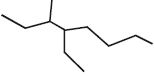
The $IUPAC$ name of the compound given below is:
A
$3-$methyl$-4-$ethyloctane
B
$2, 3-$diethylheptane
C
$5-$ethyl$-6-$methyloctane
D
$4-$ethyl$-3-$methyloctane
Solution
(D) $1$. Identify the longest carbon chain. The longest chain in the given structure contains $8$ carbon atoms,so the parent alkane is octane.
$2$. Number the chain from the end that gives the lowest locants to the substituents.
$3$. Numbering from left to right gives substituents at positions $3$ and $4$. Numbering from right to left gives substituents at positions $5$ and $6$.
$4$. Following the lowest locant rule,we number from left to right.
$5$. At position $3$,there is a methyl group $(-CH_3)$,and at position $4$,there is an ethyl group $(-CH_2CH_3)$.
$6$. According to $IUPAC$ rules,substituents are listed in alphabetical order. Therefore,ethyl comes before methyl.
$7$. The correct name is $4-$ethyl$-3-$methyloctane.
$2$. Number the chain from the end that gives the lowest locants to the substituents.
$3$. Numbering from left to right gives substituents at positions $3$ and $4$. Numbering from right to left gives substituents at positions $5$ and $6$.
$4$. Following the lowest locant rule,we number from left to right.
$5$. At position $3$,there is a methyl group $(-CH_3)$,and at position $4$,there is an ethyl group $(-CH_2CH_3)$.
$6$. According to $IUPAC$ rules,substituents are listed in alphabetical order. Therefore,ethyl comes before methyl.
$7$. The correct name is $4-$ethyl$-3-$methyloctane.
0 likesView Solution
55
ChemistryMCQAIPMT · 2003
During its life cycle,$Fasciola$ $hepatica$ (liver fluke) infects its intermediate host and primary host at the following larval stages,respectively:
A
Metacercaria and cercaria
B
Miracidium and metacercaria
C
Redia and miracidium
D
Cercaria and redia
Solution
(B) $Fasciola$ $hepatica$ (liver fluke) is a digenetic trematode.
It completes its life cycle in two hosts:
$1$. Primary host: Sheep or human (vertebrate).
$2$. Intermediate host: Snail (mollusc).
The $Miracidium$ larva infects the intermediate host (snail).
The $Metacercaria$ larva is the infective stage for the primary host (sheep/human).
It completes its life cycle in two hosts:
$1$. Primary host: Sheep or human (vertebrate).
$2$. Intermediate host: Snail (mollusc).
The $Miracidium$ larva infects the intermediate host (snail).
The $Metacercaria$ larva is the infective stage for the primary host (sheep/human).
0 likesView Solution
56
ChemistryMCQAIPMT · 2003
Boron in green plants assists in
A
Photosynthesis
B
Sugar transport
C
Activation of enzymes
D
Acting as enzyme cofactor
Solution
(B) Boron is essential for plants for several physiological processes,including:
$(i)$ Uptake and utilization of $Ca^{2+}$.
$(ii)$ Pollen germination and cell differentiation.
$(iii)$ Carbohydrate translocation (sugar transport).
Therefore,among the given options,boron assists in sugar transport.
$(i)$ Uptake and utilization of $Ca^{2+}$.
$(ii)$ Pollen germination and cell differentiation.
$(iii)$ Carbohydrate translocation (sugar transport).
Therefore,among the given options,boron assists in sugar transport.
0 likesView Solution
57
ChemistryMCQAIPMT · 2003
In alcohol fermentation,
A
There is no electron donor
B
Oxygen is the electron acceptor
C
Triose phosphate is the electron donor,while acetaldehyde is the electron acceptor
D
Triose phosphate is the electron donor,while pyruvic acid is the electron acceptor
Solution
(C) In alcoholic fermentation:
$1$. $NADH$ (formed during the conversion of triose-$3$-phosphate to $3$-phosphoglycerate) is oxidized to $NAD^+$.
$2$. Electrons are accepted by acetaldehyde,which is formed by the decarboxylation of pyruvate.
$1$. $NADH$ (formed during the conversion of triose-$3$-phosphate to $3$-phosphoglycerate) is oxidized to $NAD^+$.
$2$. Electrons are accepted by acetaldehyde,which is formed by the decarboxylation of pyruvate.
0 likesView Solution
58
ChemistryMCQAIPMT · 2003
If Henle's loop were absent from mammalian nephron,which of the following is to be expected?
A
The urine will be more concentrated
B
The urine will be more dilute
C
There will be no urine formation
D
There will be hardly any change in the quality and quantity of urine formed
Solution
(B) The primary function of the Henle's loop is to facilitate the reabsorption of water from the tubular filtrate into the interstitial fluid,which helps in concentrating the urine.
If the Henle's loop were absent,the counter-current mechanism would not function,preventing the concentration of urine.
Consequently,the urine excreted would be significantly more dilute compared to normal urine.
If the Henle's loop were absent,the counter-current mechanism would not function,preventing the concentration of urine.
Consequently,the urine excreted would be significantly more dilute compared to normal urine.
0 likesView Solution
59
ChemistryMCQAIPMT · 2003
Which of the following plants are used as green manure in crop fields and in sandy soils?
A
Crotalaria juncea and Alhagi camelorum
B
Calotropis procera and Phyllanthus niruri
C
Saccharum munja and Lantana camara
D
Dichanthium annulatum and Acacia nilotica
Solution
(A) Green manure consists of plants that are grown and then incorporated into the soil to improve its fertility and structure.
$Crotalaria juncea$ (Sunn hemp) is a well-known leguminous plant used as green manure.
$Alhagi camelorum$ (Camel thorn) is also known for its ability to grow in sandy soils and improve soil nitrogen content.
These plants are ploughed into the soil while still green,which increases crop yield by $30-50\, \%$.
$Crotalaria juncea$ (Sunn hemp) is a well-known leguminous plant used as green manure.
$Alhagi camelorum$ (Camel thorn) is also known for its ability to grow in sandy soils and improve soil nitrogen content.
These plants are ploughed into the soil while still green,which increases crop yield by $30-50\, \%$.
0 likesView Solution
60
ChemistryMCQAIPMT · 2003
Which endangered animal is the source of the world's finest, lightest, warmest, and most expensive wool-the Shahtoosh?
A
Kashmiri goat
B
Chiru
C
Nilgai
D
Cheetal
Solution
(B) The $Chiru$ (also known as the Tibetan antelope, $Pantholops$ $\text{hodgsonii}$) is the source of $Shahtoosh$ wool.
$Shahtoosh$ is renowned for being the world's finest, lightest, and warmest wool.
Due to the illegal hunting of $Chiru$ for this purpose, it is now classified as an endangered species.
$Shahtoosh$ is renowned for being the world's finest, lightest, and warmest wool.
Due to the illegal hunting of $Chiru$ for this purpose, it is now classified as an endangered species.
0 likesView Solution
61
ChemistryMCQAIPMT · 2003
$A$ long solenoid carrying a current produces a magnetic field $B$ along its axis. If the current is doubled and the number of turns per $cm$ is halved,the new value of magnetic field will be equal to
A
$B$
B
$2 B$
C
$4 B$
D
$\frac{B}{2}$
Solution
(A) The magnetic field $B$ inside a long solenoid is given by the formula $B = \mu_{0} n I$,where $n$ is the number of turns per unit length and $I$ is the current.
Let the initial magnetic field be $B_{1} = \mu_{0} n I$.
According to the problem,the new current $I' = 2I$ and the new number of turns per unit length $n' = \frac{n}{2}$.
The new magnetic field $B_{2}$ is given by $B_{2} = \mu_{0} n' I' = \mu_{0} \left( \frac{n}{2} \right) (2I) = \mu_{0} n I$.
Therefore,$B_{2} = B_{1} = B$.
Let the initial magnetic field be $B_{1} = \mu_{0} n I$.
According to the problem,the new current $I' = 2I$ and the new number of turns per unit length $n' = \frac{n}{2}$.
The new magnetic field $B_{2}$ is given by $B_{2} = \mu_{0} n' I' = \mu_{0} \left( \frac{n}{2} \right) (2I) = \mu_{0} n I$.
Therefore,$B_{2} = B_{1} = B$.
0 likesView Solution
62
ChemistryMCQAIPMT · 2003
$A$ sample of a radioactive element has a mass of $10 \, g$ at an instant $t=0$. The approximate mass of this element in the sample after two mean lives is ........ $g$.
A
$2.50$
B
$1.35$
C
$6.30$
D
$3.70$
Solution
(B) The radioactive decay law is given by $m = m_0 e^{-\lambda t}$,where $m_0$ is the initial mass,$\lambda$ is the decay constant,and $t$ is the time elapsed.
Given that the time elapsed is two mean lives,we have $t = 2 \tau$,where $\tau = \frac{1}{\lambda}$ is the mean life.
Substituting $t = \frac{2}{\lambda}$ into the decay equation:
$m = m_0 e^{-\lambda (2/\lambda)} = m_0 e^{-2}$.
Given $m_0 = 10 \, g$ and $e \approx 2.718$,we have $e^2 \approx 7.389$.
Therefore,$m = \frac{10}{7.389} \approx 1.353 \, g$.
Thus,the approximate mass is $1.35 \, g$.
Given that the time elapsed is two mean lives,we have $t = 2 \tau$,where $\tau = \frac{1}{\lambda}$ is the mean life.
Substituting $t = \frac{2}{\lambda}$ into the decay equation:
$m = m_0 e^{-\lambda (2/\lambda)} = m_0 e^{-2}$.
Given $m_0 = 10 \, g$ and $e \approx 2.718$,we have $e^2 \approx 7.389$.
Therefore,$m = \frac{10}{7.389} \approx 1.353 \, g$.
Thus,the approximate mass is $1.35 \, g$.
0 likesView Solution
63
ChemistryMCQAIPMT · 2003
Which one of the following characteristics of the transition metals is associated with their catalytic activity?
A
High enthalpy of atomization
B
Paramagnetic behavior
C
Colour of hydrated ions
D
Variable oxidation states
Solution
(D) Transition metals and their compounds are known for their catalytic activity. This is primarily due to their ability to adopt multiple oxidation states and to form complexes.
By exhibiting variable oxidation states,transition metals can form unstable intermediate compounds and provide a new path with lower activation energy for the reaction.
Thus,the variable oxidation states are the key characteristic associated with their catalytic activity.
By exhibiting variable oxidation states,transition metals can form unstable intermediate compounds and provide a new path with lower activation energy for the reaction.
Thus,the variable oxidation states are the key characteristic associated with their catalytic activity.
0 likesView Solution
Vedclass Products
For Students
Vedclass Test Series
Mock tests in real AIPMT style covering Chemistry with performance analysis. 5-day free trial.
Start Free TrialFor Teachers
Exam Paper Generator
Generate Set A/B/C/D Chemistry papers from 7.5L+ questions in 2 minutes. 3 chapters free.
Try FreeFor Institutes
Online Exam Module
Run live AIPMT mock exams with unlimited students, 360° analytics & white-label branding.
See DemoFrequently Asked Questions
How many Chemistry questions are in AIPMT 2003?
There are 96 Chemistry questions from the AIPMT 2003 paper on Vedclass, each with a detailed step-by-step solution in English.
Are AIPMT 2003 Chemistry solutions available in English?
Yes. All solutions on this page are in English. You can also switch to English or Hindi using the language buttons above the questions.
Can I practice AIPMT 2003 Chemistry as a timed test?
Yes. Use the Vedclass Test Series to attempt a full AIPMT mock test covering Chemistry with time limits and instant score analysis.
Can teachers create Chemistry papers from AIPMT previous year questions?
Yes. The Vedclass Exam Paper Generator lets teachers mix AIPMT Chemistry questions and generate Set A/B/C/D papers in minutes.
For Teachers & Institutes
Build a Custom Chemistry Paper
Pick AIPMT 2003 Chemistry questions, set difficulty, and generate Set A/B/C/D in 2 minutes.