
PhysicsQ1–50 of 50 questions
Page 1 of 1 · English
1
PhysicsMediumMCQAIPMT · 1997
Find the torque of a force $\vec{F} = -3\hat{i} + \hat{j} + 5\hat{k}$ acting at the point $\vec{r} = 7\hat{i} + 3\hat{j} + \hat{k}$.
A
$14\hat{i} - 38\hat{j} + 16\hat{k}$
B
$4\hat{i} + 4\hat{j} + 6\hat{k}$
C
$21\hat{i} + 4\hat{j} + 4\hat{k}$
D
$-14\hat{i} + 34\hat{j} - 16\hat{k}$
Solution
(A) The torque $\vec{\tau}$ is given by the cross product of the position vector $\vec{r}$ and the force vector $\vec{F}$:
$\vec{\tau} = \vec{r} \times \vec{F}$
Given $\vec{r} = 7\hat{i} + 3\hat{j} + \hat{k}$ and $\vec{F} = -3\hat{i} + \hat{j} + 5\hat{k}$,we calculate the determinant:
$\vec{\tau} = \begin{vmatrix} \hat{i} & \hat{j} & \hat{k} \\ 7 & 3 & 1 \\ -3 & 1 & 5 \end{vmatrix}$
Expanding the determinant:
$\vec{\tau} = \hat{i}(3 \times 5 - 1 \times 1) - \hat{j}(7 \times 5 - 1 \times (-3)) + \hat{k}(7 \times 1 - 3 \times (-3))$
$\vec{\tau} = \hat{i}(15 - 1) - \hat{j}(35 + 3) + \hat{k}(7 + 9)$
$\vec{\tau} = 14\hat{i} - 38\hat{j} + 16\hat{k}$
$\vec{\tau} = \vec{r} \times \vec{F}$
Given $\vec{r} = 7\hat{i} + 3\hat{j} + \hat{k}$ and $\vec{F} = -3\hat{i} + \hat{j} + 5\hat{k}$,we calculate the determinant:
$\vec{\tau} = \begin{vmatrix} \hat{i} & \hat{j} & \hat{k} \\ 7 & 3 & 1 \\ -3 & 1 & 5 \end{vmatrix}$
Expanding the determinant:
$\vec{\tau} = \hat{i}(3 \times 5 - 1 \times 1) - \hat{j}(7 \times 5 - 1 \times (-3)) + \hat{k}(7 \times 1 - 3 \times (-3))$
$\vec{\tau} = \hat{i}(15 - 1) - \hat{j}(35 + 3) + \hat{k}(7 + 9)$
$\vec{\tau} = 14\hat{i} - 38\hat{j} + 16\hat{k}$
0 likesView Solution
2
PhysicsMediumMCQAIPMT · 1997
If a car at rest accelerates uniformly to a speed of $144 \, km/h$ in $20 \, s$,then it covers a distance of ........ $m$.
A
$20$
B
$400$
C
$1440$
D
$2880$
Solution
(B) Given: Initial velocity $u = 0 \, m/s$,final velocity $v = 144 \, km/h = 144 \times \frac{5}{18} \, m/s = 40 \, m/s$,and time $t = 20 \, s$.
Using the first equation of motion,$v = u + at$:
$40 = 0 + a \times 20 \Rightarrow a = 2 \, m/s^2$.
Now,using the second equation of motion,$s = ut + \frac{1}{2}at^2$:
$s = 0 \times 20 + \frac{1}{2} \times 2 \times (20)^2 = 400 \, m$.
Therefore,the distance covered is $400 \, m$.
Using the first equation of motion,$v = u + at$:
$40 = 0 + a \times 20 \Rightarrow a = 2 \, m/s^2$.
Now,using the second equation of motion,$s = ut + \frac{1}{2}at^2$:
$s = 0 \times 20 + \frac{1}{2} \times 2 \times (20)^2 = 400 \, m$.
Therefore,the distance covered is $400 \, m$.
0 likesView Solution
3
PhysicsMediumMCQAIPMT · 1997
The position $x$ of a particle varies with time $t$ as $x = at^2 - bt^3$. The acceleration of the particle will be zero at time $t$ equal to
A
$a/b$
B
$2a/3b$
C
$a/3b$
D
Zero
Solution
(C) The velocity $v$ is the first derivative of position $x$ with respect to time $t$:
$v = \frac{dx}{dt} = \frac{d}{dt}(at^2 - bt^3) = 2at - 3bt^2$
The acceleration $a_{acc}$ is the derivative of velocity $v$ with respect to time $t$:
$a_{acc} = \frac{dv}{dt} = \frac{d}{dt}(2at - 3bt^2) = 2a - 6bt$
To find the time when acceleration is zero,set $a_{acc} = 0$:
$2a - 6bt = 0$
$6bt = 2a$
$t = \frac{2a}{6b} = \frac{a}{3b}$
$v = \frac{dx}{dt} = \frac{d}{dt}(at^2 - bt^3) = 2at - 3bt^2$
The acceleration $a_{acc}$ is the derivative of velocity $v$ with respect to time $t$:
$a_{acc} = \frac{dv}{dt} = \frac{d}{dt}(2at - 3bt^2) = 2a - 6bt$
To find the time when acceleration is zero,set $a_{acc} = 0$:
$2a - 6bt = 0$
$6bt = 2a$
$t = \frac{2a}{6b} = \frac{a}{3b}$
0 likesView Solution
4
PhysicsMediumMCQAIPMT · 1997
$A$ ball is projected with kinetic energy $E$ at an angle of $45^\circ$ to the horizontal. At the highest point during its flight,its kinetic energy will be
A
Zero
B
$E/2$
C
$E/\sqrt{2}$
D
$E$
Solution
(B) The initial kinetic energy of the ball is $E = \frac{1}{2}mv^2$,where $v$ is the initial velocity.
At the highest point of the trajectory,the vertical component of the velocity becomes zero,while the horizontal component remains constant.
The horizontal component of velocity is $v_x = v \cos \theta$.
At the highest point,the velocity of the ball is $v_h = v \cos \theta$.
The kinetic energy at the highest point is $E' = \frac{1}{2}m(v_h)^2 = \frac{1}{2}m(v \cos \theta)^2$.
$E' = (\frac{1}{2}mv^2) \cos^2 \theta = E \cos^2 \theta$.
Given $\theta = 45^\circ$,we have $\cos 45^\circ = \frac{1}{\sqrt{2}}$.
Therefore,$E' = E (\frac{1}{\sqrt{2}})^2 = E (\frac{1}{2}) = \frac{E}{2}$.
At the highest point of the trajectory,the vertical component of the velocity becomes zero,while the horizontal component remains constant.
The horizontal component of velocity is $v_x = v \cos \theta$.
At the highest point,the velocity of the ball is $v_h = v \cos \theta$.
The kinetic energy at the highest point is $E' = \frac{1}{2}m(v_h)^2 = \frac{1}{2}m(v \cos \theta)^2$.
$E' = (\frac{1}{2}mv^2) \cos^2 \theta = E \cos^2 \theta$.
Given $\theta = 45^\circ$,we have $\cos 45^\circ = \frac{1}{\sqrt{2}}$.
Therefore,$E' = E (\frac{1}{\sqrt{2}})^2 = E (\frac{1}{2}) = \frac{E}{2}$.
0 likesView Solution
5
PhysicsEasyMCQAIPMT · 1997
$A$ body moves a distance of $10 \, m$ along a straight line under the action of a force of $5 \, N$. If the work done is $25 \, J$,the angle which the force makes with the direction of motion of the body is.....$^o$
A
$0$
B
$30$
C
$60$
D
$90$
Solution
(C) The formula for work done is given by $W = Fs \cos \theta$,where $W$ is work,$F$ is force,$s$ is displacement,and $\theta$ is the angle between the force and the direction of motion.
Given: $W = 25 \, J$,$F = 5 \, N$,and $s = 10 \, m$.
Substituting the values into the formula:
$25 = 5 \times 10 \times \cos \theta$
$25 = 50 \times \cos \theta$
$\cos \theta = \frac{25}{50} = \frac{1}{2}$
Since $\cos 60^\circ = \frac{1}{2}$,the angle $\theta = 60^\circ$.
Given: $W = 25 \, J$,$F = 5 \, N$,and $s = 10 \, m$.
Substituting the values into the formula:
$25 = 5 \times 10 \times \cos \theta$
$25 = 50 \times \cos \theta$
$\cos \theta = \frac{25}{50} = \frac{1}{2}$
Since $\cos 60^\circ = \frac{1}{2}$,the angle $\theta = 60^\circ$.
1 likesView Solution
6
PhysicsEasyMCQAIPMT · 1997
Two bodies of masses $m$ and $4m$ are moving with equal kinetic energy $(K.E.)$. The ratio of their linear momentums is
A
$4:1$
B
$1:1$
C
$1:2$
D
$1:4$
Solution
(C) The relationship between linear momentum $(p)$,mass $(m)$,and kinetic energy $(K.E.)$ is given by the formula: $p = \sqrt{2m(K.E.)}$.
Since the kinetic energy $(K.E.)$ is equal for both bodies,we have $p \propto \sqrt{m}$.
Therefore,the ratio of their linear momentums is $\frac{p_1}{p_2} = \sqrt{\frac{m_1}{m_2}}$.
Given $m_1 = m$ and $m_2 = 4m$,we substitute these values:
$\frac{p_1}{p_2} = \sqrt{\frac{m}{4m}} = \sqrt{\frac{1}{4}} = \frac{1}{2}$.
Thus,the ratio is $1:2$.
Since the kinetic energy $(K.E.)$ is equal for both bodies,we have $p \propto \sqrt{m}$.
Therefore,the ratio of their linear momentums is $\frac{p_1}{p_2} = \sqrt{\frac{m_1}{m_2}}$.
Given $m_1 = m$ and $m_2 = 4m$,we substitute these values:
$\frac{p_1}{p_2} = \sqrt{\frac{m}{4m}} = \sqrt{\frac{1}{4}} = \frac{1}{2}$.
Thus,the ratio is $1:2$.
0 likesView Solution
7
PhysicsMediumMCQAIPMT · 1997
$A$ metal ball of mass $2 \,kg$ moving with a velocity of $36 \,km/h$ has a head-on collision with a stationary ball of mass $3 \,kg$. If after the collision,the two balls move together,the loss in kinetic energy due to the collision is ........ $J$.
A
$40$
B
$60$
C
$100$
D
$140$
Solution
(B) Initial velocity of the first ball,$u_1 = 36 \,km/h = 36 \times \frac{5}{18} = 10 \,m/s$.
Initial velocity of the second ball,$u_2 = 0 \,m/s$.
Masses are $m_1 = 2 \,kg$ and $m_2 = 3 \,kg$.
By the law of conservation of linear momentum,$m_1 u_1 + m_2 u_2 = (m_1 + m_2)V$,where $V$ is the common velocity after the collision.
$2 \times 10 + 3 \times 0 = (2 + 3)V \implies 20 = 5V \implies V = 4 \,m/s$.
Initial kinetic energy,$K_i = \frac{1}{2} m_1 u_1^2 + \frac{1}{2} m_2 u_2^2 = \frac{1}{2} \times 2 \times (10)^2 + 0 = 100 \,J$.
Final kinetic energy,$K_f = \frac{1}{2} (m_1 + m_2) V^2 = \frac{1}{2} \times 5 \times (4)^2 = \frac{1}{2} \times 5 \times 16 = 40 \,J$.
Loss in kinetic energy,$\Delta K = K_i - K_f = 100 - 40 = 60 \,J$.
Initial velocity of the second ball,$u_2 = 0 \,m/s$.
Masses are $m_1 = 2 \,kg$ and $m_2 = 3 \,kg$.
By the law of conservation of linear momentum,$m_1 u_1 + m_2 u_2 = (m_1 + m_2)V$,where $V$ is the common velocity after the collision.
$2 \times 10 + 3 \times 0 = (2 + 3)V \implies 20 = 5V \implies V = 4 \,m/s$.
Initial kinetic energy,$K_i = \frac{1}{2} m_1 u_1^2 + \frac{1}{2} m_2 u_2^2 = \frac{1}{2} \times 2 \times (10)^2 + 0 = 100 \,J$.
Final kinetic energy,$K_f = \frac{1}{2} (m_1 + m_2) V^2 = \frac{1}{2} \times 5 \times (4)^2 = \frac{1}{2} \times 5 \times 16 = 40 \,J$.
Loss in kinetic energy,$\Delta K = K_i - K_f = 100 - 40 = 60 \,J$.
0 likesView Solution
8
PhysicsMediumMCQAIPMT · 1997
The escape velocity of a body on the surface of the earth is $11.2 \, km/s$. If the earth's mass increases to twice its present value and the radius of the earth becomes half,the escape velocity would become ......... $km/s$.
A
$5.6$
B
$11.2$
C
$22.4$
D
$44.8$
Solution
(C) The formula for escape velocity is given by $v_e = \sqrt{\frac{2GM}{R}}$.
From this formula,we can see that $v_e \propto \sqrt{\frac{M}{R}}$.
Let the initial mass be $M$ and radius be $R$. The initial escape velocity is $v_{e1} = 11.2 \, km/s$.
According to the problem,the new mass $M' = 2M$ and the new radius $R' = \frac{R}{2}$.
The new escape velocity $v_{e2}$ is given by:
$v_{e2} = \sqrt{\frac{2G(2M)}{R/2}} = \sqrt{4 \cdot \frac{2GM}{R}} = 2 \cdot \sqrt{\frac{2GM}{R}} = 2 \cdot v_{e1}$.
Substituting the value of $v_{e1}$:
$v_{e2} = 2 \cdot 11.2 \, km/s = 22.4 \, km/s$.
From this formula,we can see that $v_e \propto \sqrt{\frac{M}{R}}$.
Let the initial mass be $M$ and radius be $R$. The initial escape velocity is $v_{e1} = 11.2 \, km/s$.
According to the problem,the new mass $M' = 2M$ and the new radius $R' = \frac{R}{2}$.
The new escape velocity $v_{e2}$ is given by:
$v_{e2} = \sqrt{\frac{2G(2M)}{R/2}} = \sqrt{4 \cdot \frac{2GM}{R}} = 2 \cdot \sqrt{\frac{2GM}{R}} = 2 \cdot v_{e1}$.
Substituting the value of $v_{e1}$:
$v_{e2} = 2 \cdot 11.2 \, km/s = 22.4 \, km/s$.
0 likesView Solution
9
PhysicsMediumMCQAIPMT · 1997
$A$ sample of gas expands from volume ${V_1}$ to ${V_2}$. The amount of work done by the gas is greatest when the expansion is
A
Isothermal
B
Isobaric
C
Adiabatic
D
Equal in all cases
Solution
(B) In a thermodynamic process,the work done by a gas is equal to the area under the $PV$ curve with respect to the volume axis.
For a given expansion from volume ${V_1}$ to ${V_2}$,the pressure $P$ remains constant in an isobaric process,whereas it decreases in both isothermal and adiabatic processes.
Since the isobaric process maintains the highest pressure throughout the expansion,the area under the $PV$ curve is the largest.
Therefore,the work done follows the order: ${W_{adiabatic}} < {W_{isothermal}} < {W_{isobaric}}$.
Thus,the work done is greatest for an isobaric expansion.
For a given expansion from volume ${V_1}$ to ${V_2}$,the pressure $P$ remains constant in an isobaric process,whereas it decreases in both isothermal and adiabatic processes.
Since the isobaric process maintains the highest pressure throughout the expansion,the area under the $PV$ curve is the largest.
Therefore,the work done follows the order: ${W_{adiabatic}} < {W_{isothermal}} < {W_{isobaric}}$.
Thus,the work done is greatest for an isobaric expansion.
0 likesView Solution
10
PhysicsMediumMCQAIPMT · 1997
Standing waves are produced in a $10 \; m$ long stretched string. If the string vibrates in $5$ segments and the wave velocity is $20 \; m/s$,the frequency is ... $Hz$.
A
$2$
B
$4$
C
$5$
D
$10$
Solution
(C) The length of the string is $l = 10 \; m$. The number of segments is $p = 5$. The wave velocity is $v = 20 \; m/s$.
For a string vibrating in $p$ segments,the length $l$ is related to the wavelength $\lambda$ by the formula $l = p \cdot \frac{\lambda}{2}$.
Substituting the values,we get $10 = 5 \cdot \frac{\lambda}{2}$,which simplifies to $\lambda = \frac{10 \cdot 2}{5} = 4 \; m$.
The frequency $f$ is given by the relation $f = \frac{v}{\lambda}$.
Substituting the values,$f = \frac{20 \; m/s}{4 \; m} = 5 \; Hz$.
For a string vibrating in $p$ segments,the length $l$ is related to the wavelength $\lambda$ by the formula $l = p \cdot \frac{\lambda}{2}$.
Substituting the values,we get $10 = 5 \cdot \frac{\lambda}{2}$,which simplifies to $\lambda = \frac{10 \cdot 2}{5} = 4 \; m$.
The frequency $f$ is given by the relation $f = \frac{v}{\lambda}$.
Substituting the values,$f = \frac{20 \; m/s}{4 \; m} = 5 \; Hz$.
0 likesView Solution
11
PhysicsMediumMCQAIPMT · 1997
$A$ cylindrical tube,open at both ends,has a fundamental frequency $f_0$ in air. The tube is dipped vertically into water such that half of its length is inside water. The fundamental frequency of the air column now is
A
$3f_0/4$
B
$f_0$
C
$f_0/2$
D
$2f_0$
Solution
(B) The fundamental frequency of an open tube of length $L$ is given by $f_0 = \frac{v}{2L}$,where $v$ is the speed of sound in air.
When the tube is dipped vertically into water such that half of its length is inside the water,the tube effectively becomes a closed pipe (closed at one end by the water surface) with a new length $L' = L/2$.
The fundamental frequency of a closed pipe of length $L'$ is given by $f' = \frac{v}{4L'}$.
Substituting $L' = L/2$ into the formula,we get $f' = \frac{v}{4(L/2)} = \frac{v}{2L}$.
Comparing this with the original frequency,we find $f' = f_0$.
When the tube is dipped vertically into water such that half of its length is inside the water,the tube effectively becomes a closed pipe (closed at one end by the water surface) with a new length $L' = L/2$.
The fundamental frequency of a closed pipe of length $L'$ is given by $f' = \frac{v}{4L'}$.
Substituting $L' = L/2$ into the formula,we get $f' = \frac{v}{4(L/2)} = \frac{v}{2L}$.
Comparing this with the original frequency,we find $f' = f_0$.
0 likesView Solution
12
PhysicsEasyMCQAIPMT · 1997
$A$ couple produces:
A
Purely linear motion
B
Purely rotational motion
C
Linear and rotational motion
D
No motion
Solution
(B) couple is defined as a pair of two equal,parallel,and opposite forces acting at different points on a rigid body. Since the net force acting on the body is zero $(F_{net} = F - F = 0)$,there is no linear acceleration or linear motion. However,because the forces act at different points,they create a net torque about any point,which results in purely rotational motion.
0 likesView Solution
13
PhysicsMediumMCQAIPMT · 1997
$A$ force of $6 \; N$ acts on a body at rest and of mass $1 \; kg$. During this time,the body attains a velocity of $30 \; m/s$. The time for which the force acts on the body is ..... $seconds$.
A
$5$
B
$7$
C
$8$
D
$10$
Solution
(A) Given: Force $F = 6 \; N$,mass $m = 1 \; kg$,initial velocity $u = 0 \; m/s$,and final velocity $v = 30 \; m/s$.
According to Newton's second law of motion,the acceleration $a$ is given by $a = \frac{F}{m} = \frac{6 \; N}{1 \; kg} = 6 \; m/s^2$.
Using the first equation of motion,$v = u + at$,we can find the time $t$:
$30 = 0 + 6 \times t$
$t = \frac{30}{6} = 5 \; s$.
Therefore,the force acts on the body for $5 \; seconds$.
According to Newton's second law of motion,the acceleration $a$ is given by $a = \frac{F}{m} = \frac{6 \; N}{1 \; kg} = 6 \; m/s^2$.
Using the first equation of motion,$v = u + at$,we can find the time $t$:
$30 = 0 + 6 \times t$
$t = \frac{30}{6} = 5 \; s$.
Therefore,the force acts on the body for $5 \; seconds$.
0 likesView Solution
14
PhysicsEasyMCQAIPMT · 1997
$A$ black body is at a temperature of $500 \; K$. It emits energy at a rate which is proportional to:
A
$(500)^{4}$
B
$(500)^{3}$
C
$(500)^{2}$
D
$(500)$
Solution
(A) According to Stefan-Boltzmann Law,the rate of energy emission (power) $P$ from a black body is directly proportional to the fourth power of its absolute temperature $T$.
Mathematically,$P \propto T^{4}$.
Given the temperature $T = 500 \; K$,the rate of energy emission is proportional to $(500)^{4}$.
Mathematically,$P \propto T^{4}$.
Given the temperature $T = 500 \; K$,the rate of energy emission is proportional to $(500)^{4}$.
0 likesView Solution
15
PhysicsMediumMCQAIPMT · 1997
The resultant of two rectangular simple harmonic motions of the same frequency and equal amplitudes but differing in phase by $\frac{\pi}{2}$ is
A
straight line
B
Circular
C
Elliptical
D
None of these
Solution
(B) Let the two rectangular simple harmonic motions be represented as:
$x = a \sin(\omega t)$
$y = a \sin(\omega t + \frac{\pi}{2})$
Since $\sin(\omega t + \frac{\pi}{2}) = \cos(\omega t)$,we have:
$y = a \cos(\omega t)$
Squaring and adding both equations:
$x^2 + y^2 = a^2 \sin^2(\omega t) + a^2 \cos^2(\omega t)$
$x^2 + y^2 = a^2 (\sin^2(\omega t) + \cos^2(\omega t))$
$x^2 + y^2 = a^2$
This is the equation of a circle with radius $a$ centered at the origin. Therefore,the resultant motion is circular.
$x = a \sin(\omega t)$
$y = a \sin(\omega t + \frac{\pi}{2})$
Since $\sin(\omega t + \frac{\pi}{2}) = \cos(\omega t)$,we have:
$y = a \cos(\omega t)$
Squaring and adding both equations:
$x^2 + y^2 = a^2 \sin^2(\omega t) + a^2 \cos^2(\omega t)$
$x^2 + y^2 = a^2 (\sin^2(\omega t) + \cos^2(\omega t))$
$x^2 + y^2 = a^2$
This is the equation of a circle with radius $a$ centered at the origin. Therefore,the resultant motion is circular.
0 likesView Solution
16
PhysicsEasyMCQAIPMT · 1997
The centre of mass of a system of particles does not depend on
A
position of the particles
B
relative distance between the particles
C
masses of the particles
D
forces acting on the particles
Solution
(D) The position of the centre of mass of a system of particles is defined by the formula $\vec{R}_{cm} = \frac{\sum m_i \vec{r}_i}{\sum m_i}$.
From this formula,it is clear that the centre of mass depends on the masses $(m_i)$ and the positions $(\vec{r}_i)$ of the particles.
The relative distance between particles is a function of their positions.
However,the centre of mass is a geometric property of the distribution of mass and does not depend on the external or internal forces acting on the particles.
From this formula,it is clear that the centre of mass depends on the masses $(m_i)$ and the positions $(\vec{r}_i)$ of the particles.
The relative distance between particles is a function of their positions.
However,the centre of mass is a geometric property of the distribution of mass and does not depend on the external or internal forces acting on the particles.
0 likesView Solution
17
PhysicsEasyMCQAIPMT · 1997
The length of a simple pendulum is increased by $2\%$. Its time period will
A
Increase by $2\%$
B
Increase by $1\%$
C
Increase by $4\%$
D
Increase by $0.5\%$
Solution
(B) The time period of a simple pendulum is given by $T = 2\pi \sqrt{\frac{l}{g}}$.
This implies $T \propto \sqrt{l}$.
Taking the natural logarithm on both sides: $\ln T = \ln(2\pi) + \frac{1}{2} \ln l - \frac{1}{2} \ln g$.
Differentiating both sides, we get the fractional change: $\frac{\Delta T}{T} = \frac{1}{2} \frac{\Delta l}{l}$.
Given that the length is increased by $2\%$, we have $\frac{\Delta l}{l} = 0.02$.
Substituting this value: $\frac{\Delta T}{T} = \frac{1}{2} \times 0.02 = 0.01$.
Therefore, the time period increases by $1\%$.
This implies $T \propto \sqrt{l}$.
Taking the natural logarithm on both sides: $\ln T = \ln(2\pi) + \frac{1}{2} \ln l - \frac{1}{2} \ln g$.
Differentiating both sides, we get the fractional change: $\frac{\Delta T}{T} = \frac{1}{2} \frac{\Delta l}{l}$.
Given that the length is increased by $2\%$, we have $\frac{\Delta l}{l} = 0.02$.
Substituting this value: $\frac{\Delta T}{T} = \frac{1}{2} \times 0.02 = 0.01$.
Therefore, the time period increases by $1\%$.
0 likesView Solution
18
PhysicsEasyMCQAIPMT · 1997
Identify the vector quantity among the following.
A
distance
B
angular momentum
C
heat
D
energy
Solution
(B) vector quantity is a physical quantity that has both magnitude and direction.
Distance,heat,and energy are scalar quantities because they only have magnitude.
Angular momentum is defined as the cross product of position vector $\vec{r}$ and linear momentum $\vec{p}$,given by $\vec{L} = \vec{r} \times \vec{p}$.
Since it is defined by a cross product and has a specific direction (determined by the right-hand rule),angular momentum is a vector quantity.
Distance,heat,and energy are scalar quantities because they only have magnitude.
Angular momentum is defined as the cross product of position vector $\vec{r}$ and linear momentum $\vec{p}$,given by $\vec{L} = \vec{r} \times \vec{p}$.
Since it is defined by a cross product and has a specific direction (determined by the right-hand rule),angular momentum is a vector quantity.
0 likesView Solution
19
PhysicsEasyMCQAIPMT · 1997
$A$ shell,in flight,explodes into four unequal parts. Which of the following is conserved?
A
Potential energy
B
Momentum
C
Kinetic energy
D
Both $(a)$ and $(c)$
Solution
(B) When a shell explodes in flight,the explosion is caused by internal forces.
According to the law of conservation of linear momentum,if the net external force acting on a system is zero,the total linear momentum of the system remains conserved.
In this case,the gravitational force is an external force,but during the short interval of the explosion,the internal forces are much larger than the external forces,making the impulse due to external forces negligible.
Therefore,the total linear momentum of the shell is conserved.
Kinetic energy is generally not conserved in an explosion because internal chemical energy is converted into kinetic energy,leading to an increase in the total kinetic energy of the fragments.
According to the law of conservation of linear momentum,if the net external force acting on a system is zero,the total linear momentum of the system remains conserved.
In this case,the gravitational force is an external force,but during the short interval of the explosion,the internal forces are much larger than the external forces,making the impulse due to external forces negligible.
Therefore,the total linear momentum of the shell is conserved.
Kinetic energy is generally not conserved in an explosion because internal chemical energy is converted into kinetic energy,leading to an increase in the total kinetic energy of the fragments.
0 likesView Solution
20
PhysicsEasyMCQAIPMT · 1997
The efficiency of a Carnot engine operating with reservoir temperatures of $100\,^{\circ}C$ and $-23\,^{\circ}C$ will be
A
$\frac{373+250}{373}$
B
$\frac{100+23}{100}$
C
$\frac{373-250}{373}$
D
$\frac{100-23}{100}$
Solution
(C) The temperatures of the reservoirs are given as $T_{1} = 100^{\circ}C$ and $T_{2} = -23^{\circ}C$.
First,convert these temperatures to the Kelvin scale:
$T_{1} = 100 + 273 = 373\,K$
$T_{2} = -23 + 273 = 250\,K$
The efficiency $\eta$ of a Carnot engine is given by the formula:
$\eta = 1 - \frac{T_{2}}{T_{1}}$
Substituting the values:
$\eta = \frac{T_{1} - T_{2}}{T_{1}} = \frac{373 - 250}{373}$
First,convert these temperatures to the Kelvin scale:
$T_{1} = 100 + 273 = 373\,K$
$T_{2} = -23 + 273 = 250\,K$
The efficiency $\eta$ of a Carnot engine is given by the formula:
$\eta = 1 - \frac{T_{2}}{T_{1}}$
Substituting the values:
$\eta = \frac{T_{1} - T_{2}}{T_{1}} = \frac{373 - 250}{373}$
0 likesView Solution
21
PhysicsEasyMCQAIPMT · 1997
The period of revolution of planet $A$ around the sun is $8$ times that of $B$. The distance of $A$ from the sun is how many times greater than that of $B$ from the sun?
A
$2$
B
$3$
C
$4$
D
$5$
Solution
(C) Let $T_A$ and $T_B$ be the time periods of planet $A$ and $B$ around the sun respectively. Given that $T_A = 8 T_B$.
According to Kepler's third law of planetary motion,the square of the time period is proportional to the cube of the semi-major axis (distance from the sun),i.e.,$T^2 \propto R^3$.
Therefore,$\left(\frac{T_A}{T_B}\right)^2 = \left(\frac{R_A}{R_B}\right)^3$.
Substituting the given values:
$\left(\frac{8 T_B}{T_B}\right)^2 = \left(\frac{R_A}{R_B}\right)^3$
$8^2 = \left(\frac{R_A}{R_B}\right)^3$
$64 = \left(\frac{R_A}{R_B}\right)^3$
Taking the cube root on both sides:
$\frac{R_A}{R_B} = (64)^{1/3} = 4$.
Thus,the distance of planet $A$ from the sun is $4$ times the distance of planet $B$ from the sun.
According to Kepler's third law of planetary motion,the square of the time period is proportional to the cube of the semi-major axis (distance from the sun),i.e.,$T^2 \propto R^3$.
Therefore,$\left(\frac{T_A}{T_B}\right)^2 = \left(\frac{R_A}{R_B}\right)^3$.
Substituting the given values:
$\left(\frac{8 T_B}{T_B}\right)^2 = \left(\frac{R_A}{R_B}\right)^3$
$8^2 = \left(\frac{R_A}{R_B}\right)^3$
$64 = \left(\frac{R_A}{R_B}\right)^3$
Taking the cube root on both sides:
$\frac{R_A}{R_B} = (64)^{1/3} = 4$.
Thus,the distance of planet $A$ from the sun is $4$ times the distance of planet $B$ from the sun.
0 likesView Solution
22
PhysicsEasyMCQAIPMT · 1997
Tesla is a unit for measuring
A
Magnetic moment
B
Magnetic induction
C
Magnetic pole strength
D
None of these
Solution
(B) The unit of magnetic field strength or magnetic induction $(B)$ in the $SI$ system is the Tesla $(T)$. One Tesla is defined as one Weber per square meter $(1 \ T = 1 \ Wb/m^2)$. Therefore,Tesla is the unit for measuring magnetic induction.
0 likesView Solution
23
PhysicsMediumMCQAIPMT · 1997
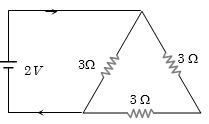
The current in the following circuit is ........... $A$.
A
$1/8$
B
$2/9$
C
$2/3$
D
$1$
Solution
(D) In the given circuit,the battery is connected to two branches in parallel. One branch contains a single $3\,\Omega$ resistor,and the other branch contains two $3\,\Omega$ resistors in series.
$1$. The resistance of the first branch is $R_1 = 3\,\Omega$.
$2$. The resistance of the second branch is $R_2 = 3\,\Omega + 3\,\Omega = 6\,\Omega$.
$3$. These two branches are in parallel,so the equivalent resistance $R_{eq}$ is given by:
$\frac{1}{R_{eq}} = \frac{1}{R_1} + \frac{1}{R_2} = \frac{1}{3} + \frac{1}{6} = \frac{2+1}{6} = \frac{3}{6} = \frac{1}{2}$
$\Rightarrow R_{eq} = 2\,\Omega$.
$4$. Using Ohm's law,the total current $I$ supplied by the $2\,V$ battery is:
$I = \frac{V}{R_{eq}} = \frac{2\,V}{2\,\Omega} = 1\,A$.
$1$. The resistance of the first branch is $R_1 = 3\,\Omega$.
$2$. The resistance of the second branch is $R_2 = 3\,\Omega + 3\,\Omega = 6\,\Omega$.
$3$. These two branches are in parallel,so the equivalent resistance $R_{eq}$ is given by:
$\frac{1}{R_{eq}} = \frac{1}{R_1} + \frac{1}{R_2} = \frac{1}{3} + \frac{1}{6} = \frac{2+1}{6} = \frac{3}{6} = \frac{1}{2}$
$\Rightarrow R_{eq} = 2\,\Omega$.
$4$. Using Ohm's law,the total current $I$ supplied by the $2\,V$ battery is:
$I = \frac{V}{R_{eq}} = \frac{2\,V}{2\,\Omega} = 1\,A$.
0 likesView Solution
24
PhysicsEasyMCQAIPMT · 1997
Kirchhoff's first law,$i.e.$,$\Sigma i = 0$ at a junction,is based on the law of conservation of:
A
Charge
B
Energy
C
Momentum
D
Angular momentum
Solution
(A) Kirchhoff's first law,also known as the Kirchhoff's Current Law $(KCL)$,states that the algebraic sum of currents meeting at a junction in an electric circuit is zero,i.e.,$\Sigma i = 0$.
This law implies that the total charge entering a junction must equal the total charge leaving the junction in the same time interval.
Since electric charge cannot be created or destroyed at a junction,this law is a direct consequence of the law of conservation of charge.
This law implies that the total charge entering a junction must equal the total charge leaving the junction in the same time interval.
Since electric charge cannot be created or destroyed at a junction,this law is a direct consequence of the law of conservation of charge.
0 likesView Solution
25
PhysicsEasyMCQAIPMT · 1997
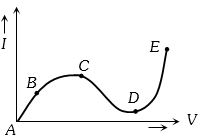
From the graph between current $I$ and voltage $V$ shown below,identify the portion corresponding to negative resistance.
A
$AB$
B
$BC$
C
$CD$
D
$DE$
Solution
(C) The resistance $R$ is defined by the relation $R = V/I$. In an $I-V$ graph,the slope of the curve is given by $dI/dV$,which is equal to $1/R$.
For negative resistance,the slope $dI/dV$ must be negative.
Looking at the graph,in the portion $CD$,as the voltage $V$ increases,the current $I$ decreases.
Therefore,the slope $dI/dV$ is negative in the region $CD$,which corresponds to negative resistance.
For negative resistance,the slope $dI/dV$ must be negative.
Looking at the graph,in the portion $CD$,as the voltage $V$ increases,the current $I$ decreases.
Therefore,the slope $dI/dV$ is negative in the region $CD$,which corresponds to negative resistance.
0 likesView Solution
26
PhysicsEasyMCQAIPMT · 1997
One kilowatt hour is equal to
A
$36 \times 10^5 \; J$
B
$36 \times 10^3 \; J$
C
$36 \times 10^{-5} \; J$
D
$36 \times 10^{-4} \; J$
Solution
(A) The unit of energy is kilowatt hour $(kWh)$.
$1 \; kWh = 1 \; kW \times 1 \; h$
Since $1 \; kW = 1000 \; W$ and $1 \; h = 3600 \; s$,
$1 \; kWh = 1000 \; W \times 3600 \; s = 3,600,000 \; W \cdot s$.
Since $1 \; W \cdot s = 1 \; J$,we have $1 \; kWh = 3.6 \times 10^6 \; J$.
This can also be written as $36 \times 10^5 \; J$.
$1 \; kWh = 1 \; kW \times 1 \; h$
Since $1 \; kW = 1000 \; W$ and $1 \; h = 3600 \; s$,
$1 \; kWh = 1000 \; W \times 3600 \; s = 3,600,000 \; W \cdot s$.
Since $1 \; W \cdot s = 1 \; J$,we have $1 \; kWh = 3.6 \times 10^6 \; J$.
This can also be written as $36 \times 10^5 \; J$.
0 likesView Solution
27
PhysicsEasyMCQAIPMT · 1997
Two electric bulbs whose resistances are in the ratio of $1:2$ are connected in series. The powers dissipated in them have the ratio:
A
$1:2$
B
$2:1$
C
$1:1$
D
$1:4$
Solution
(A) In a series circuit,the current $I$ flowing through both bulbs is the same.
The power dissipated in a resistor is given by the formula $P = I^2 R$.
Since $I$ is constant for both bulbs,the power dissipated is directly proportional to the resistance,i.e.,$P \propto R$.
Therefore,the ratio of the powers dissipated is equal to the ratio of their resistances:
$\frac{P_1}{P_2} = \frac{R_1}{R_2} = \frac{1}{2}$.
The power dissipated in a resistor is given by the formula $P = I^2 R$.
Since $I$ is constant for both bulbs,the power dissipated is directly proportional to the resistance,i.e.,$P \propto R$.
Therefore,the ratio of the powers dissipated is equal to the ratio of their resistances:
$\frac{P_1}{P_2} = \frac{R_1}{R_2} = \frac{1}{2}$.
0 likesView Solution
28
PhysicsMediumMCQAIPMT · 1997
$A$ ($100\, W$,$200\, V$) bulb is connected to a $160\, V$ power supply. The power consumption would be ............. $W$.
A
$64$
B
$80$
C
$100$
D
$125$
Solution
(A) The resistance $R$ of the bulb is calculated using its rated power $P_R$ and rated voltage $V_R$:
$R = \frac{V_R^2}{P_R} = \frac{200^2}{100} = \frac{40000}{100} = 400\,\Omega$.
When connected to a supply voltage $V = 160\, V$,the power consumed $P$ is given by:
$P = \frac{V^2}{R} = \frac{160^2}{400} = \frac{25600}{400} = 64\, W$.
Alternatively,using the ratio formula:
$P_{consumed} = \left( \frac{V}{V_R} \right)^2 \times P_R = \left( \frac{160}{200} \right)^2 \times 100 = (0.8)^2 \times 100 = 0.64 \times 100 = 64\, W$.
$R = \frac{V_R^2}{P_R} = \frac{200^2}{100} = \frac{40000}{100} = 400\,\Omega$.
When connected to a supply voltage $V = 160\, V$,the power consumed $P$ is given by:
$P = \frac{V^2}{R} = \frac{160^2}{400} = \frac{25600}{400} = 64\, W$.
Alternatively,using the ratio formula:
$P_{consumed} = \left( \frac{V}{V_R} \right)^2 \times P_R = \left( \frac{160}{200} \right)^2 \times 100 = (0.8)^2 \times 100 = 0.64 \times 100 = 64\, W$.
0 likesView Solution
29
PhysicsEasyMCQAIPMT · 1997
$A$ straight wire of diameter $0.5\, mm$ carrying a current of $1\, A$ is replaced by another wire of $1\, mm$ diameter carrying the same current. The strength of the magnetic field at a point far away is
A
Twice the earlier value
B
Half of the earlier value
C
Quarter of its earlier value
D
Unchanged
Solution
(D) The magnetic field $B$ at a distance $r$ from a long straight current-carrying wire is given by the formula $B = \frac{\mu_0}{4\pi} \frac{2i}{r}$.
Here,$\mu_0$ is the permeability of free space,$i$ is the current flowing through the wire,and $r$ is the perpendicular distance from the wire.
As per the formula,the magnetic field $B$ depends only on the current $i$ and the distance $r$ from the wire.
It is independent of the radius or diameter of the wire.
Since the current $i$ remains the same and the distance $r$ is considered far away (implying the same observation point),the magnetic field strength remains unchanged.
Here,$\mu_0$ is the permeability of free space,$i$ is the current flowing through the wire,and $r$ is the perpendicular distance from the wire.
As per the formula,the magnetic field $B$ depends only on the current $i$ and the distance $r$ from the wire.
It is independent of the radius or diameter of the wire.
Since the current $i$ remains the same and the distance $r$ is considered far away (implying the same observation point),the magnetic field strength remains unchanged.
0 likesView Solution
30
PhysicsEasyMCQAIPMT · 1997
$A$ positively charged particle moving due east enters a region of uniform magnetic field directed vertically upwards. The particle will
A
Get deflected vertically upwards
B
Move in a circular orbit with its speed increased
C
Move in a circular orbit with its speed unchanged
D
Continue to move due east
Solution
(C) According to the Lorentz force formula,$\vec{F} = q(\vec{v} \times \vec{B})$.
Here,the velocity $\vec{v}$ is directed towards the east,and the magnetic field $\vec{B}$ is directed vertically upwards.
Using the right-hand rule for the cross product $\vec{v} \times \vec{B}$,the force $\vec{F}$ acts in the horizontal plane towards the north.
Since the magnetic force is always perpendicular to the velocity of the particle,it does no work on the particle $(W = \vec{F} \cdot \vec{d} = 0)$.
Consequently,the kinetic energy and the speed of the particle remain constant.
$A$ particle moving perpendicular to a uniform magnetic field follows a circular path with a constant speed.
Here,the velocity $\vec{v}$ is directed towards the east,and the magnetic field $\vec{B}$ is directed vertically upwards.
Using the right-hand rule for the cross product $\vec{v} \times \vec{B}$,the force $\vec{F}$ acts in the horizontal plane towards the north.
Since the magnetic force is always perpendicular to the velocity of the particle,it does no work on the particle $(W = \vec{F} \cdot \vec{d} = 0)$.
Consequently,the kinetic energy and the speed of the particle remain constant.
$A$ particle moving perpendicular to a uniform magnetic field follows a circular path with a constant speed.
0 likesView Solution
31
PhysicsMediumMCQAIPMT · 1997
Two parallel wires in free space are $10\, cm$ apart and each carries a current of $10\, A$ in the same direction. The force one wire exerts on the other per metre of length is
A
$2 \times 10^{-4}\,N$,attractive
B
$2 \times 10^{-4}\,N$,repulsive
C
$2 \times 10^{-7}\,N$,attractive
D
$2 \times 10^{-7}\,N$,repulsive
Solution
(A) The force per unit length between two parallel current-carrying wires is given by the formula: $F/L = \frac{\mu_0}{4\pi} \frac{2i_1 i_2}{d}$.
Given: $\mu_0/4\pi = 10^{-7}\,T\cdot m/A$,$i_1 = i_2 = 10\,A$,and $d = 10\,cm = 0.1\,m$.
Substituting the values: $F/L = 10^{-7} \times \frac{2 \times 10 \times 10}{0.1} = 10^{-7} \times \frac{200}{0.1} = 10^{-7} \times 2000 = 2 \times 10^{-4}\,N/m$.
Since the currents are in the same direction,the force between the wires is attractive.
Given: $\mu_0/4\pi = 10^{-7}\,T\cdot m/A$,$i_1 = i_2 = 10\,A$,and $d = 10\,cm = 0.1\,m$.
Substituting the values: $F/L = 10^{-7} \times \frac{2 \times 10 \times 10}{0.1} = 10^{-7} \times \frac{200}{0.1} = 10^{-7} \times 2000 = 2 \times 10^{-4}\,N/m$.
Since the currents are in the same direction,the force between the wires is attractive.
0 likesView Solution
32
PhysicsEasyMCQAIPMT · 1997
Due to the earth's magnetic field,charged cosmic ray particles
A
Can never reach the equator
B
Require less kinetic energy to reach the equator than the poles
C
Require greater kinetic energy to reach the equator than the poles
D
Can never reach the poles
Solution
(C) The earth's magnetic field lines are perpendicular to the surface at the poles and parallel to the surface at the equator. Charged particles moving towards the equator experience a magnetic force $F = q(v \times B)$ that deflects them. To overcome this magnetic influence and reach the equatorial region,the charged particles must possess higher kinetic energy compared to those reaching the polar regions.
0 likesView Solution
33
PhysicsMediumMCQAIPMT · 1997
The primary winding of a transformer has $500$ turns,whereas its secondary has $5000$ turns. The primary is connected to an $ac$ supply of $20\, V$,$50\, Hz$. The secondary will have an output of
A
$200\, V, 50\, Hz$
B
$2\, V, 50\, Hz$
C
$200\, V, 500\, Hz$
D
$2\, V, 5\, Hz$
Solution
(A) The transformation ratio of a transformer is given by the formula: $\frac{V_s}{V_p} = \frac{N_s}{N_p}$.
Given:
Primary turns $(N_p)$ = $500$
Secondary turns $(N_s)$ = $5000$
Primary voltage $(V_p)$ = $20\, V$
Substituting the values:
$\frac{V_s}{20} = \frac{5000}{500}$
$\frac{V_s}{20} = 10$
$V_s = 200\, V$.
In a transformer,the frequency of the output voltage remains the same as the input frequency because the magnetic flux changes at the same rate as the input current. Therefore,the frequency is $50\, Hz$.
Given:
Primary turns $(N_p)$ = $500$
Secondary turns $(N_s)$ = $5000$
Primary voltage $(V_p)$ = $20\, V$
Substituting the values:
$\frac{V_s}{20} = \frac{5000}{500}$
$\frac{V_s}{20} = 10$
$V_s = 200\, V$.
In a transformer,the frequency of the output voltage remains the same as the input frequency because the magnetic flux changes at the same rate as the input current. Therefore,the frequency is $50\, Hz$.
0 likesView Solution
34
PhysicsEasyMCQAIPMT · 1997
In an $ac$ circuit with voltage $V$ and current $I$,the power dissipated is
A
$VI$
B
$\frac{1}{2}VI$
C
$\frac{1}{\sqrt{2}}VI$
D
Depends on the phase between $V$ and $I$
Solution
(D) The instantaneous power in an $ac$ circuit is given by $P = V_{rms} I_{rms} \cos \phi$,where $\phi$ is the phase difference between voltage and current.
Since the power depends on the power factor $\cos \phi$,the power dissipated in the circuit depends on the phase difference between $V$ and $I$.
Therefore,the correct option is $D$.
Since the power depends on the power factor $\cos \phi$,the power dissipated in the circuit depends on the phase difference between $V$ and $I$.
Therefore,the correct option is $D$.
0 likesView Solution
35
PhysicsEasyMCQAIPMT · 1997
The kinetic energy of an electron which is accelerated through a potential of $100 \, V$ is:
A
$1.602 \times 10^{-17} \, J$
B
$418.6 \, \text{calories}$
C
$1.16 \times 10^{4} \, J$
D
$6.626 \times 10^{-34} \, W \cdot s$
Solution
(A) The kinetic energy $(K)$ gained by an electron accelerated through a potential difference $(V)$ is given by the formula $K = e \cdot V$.
Here,the charge of an electron $e = 1.602 \times 10^{-19} \, C$ and the potential difference $V = 100 \, V$.
Substituting these values into the formula:
$K = (1.602 \times 10^{-19} \, C) \times (100 \, V)$
$K = 1.602 \times 10^{-17} \, J$.
Therefore,the correct option is $A$.
Here,the charge of an electron $e = 1.602 \times 10^{-19} \, C$ and the potential difference $V = 100 \, V$.
Substituting these values into the formula:
$K = (1.602 \times 10^{-19} \, C) \times (100 \, V)$
$K = 1.602 \times 10^{-17} \, J$.
Therefore,the correct option is $A$.
0 likesView Solution
36
PhysicsEasyMCQAIPMT · 1997
Which of the following statements is correct?
A
The current in a photocell increases with increasing frequency of light.
B
The photocurrent is proportional to applied voltage.
C
The photocurrent increases with increasing intensity of light.
D
The stopping potential increases with increasing intensity of incident light.
Solution
(C) According to the experimental observations of the photoelectric effect,the photoelectric current is directly proportional to the intensity of the incident light,provided the frequency of the light is above the threshold frequency.
$1$. The frequency of light determines the kinetic energy of the emitted photoelectrons,not the number of electrons (current).
$2$. The photocurrent saturates at a certain voltage,so it is not directly proportional to the applied voltage for all values.
$3$. The stopping potential depends on the frequency of the incident light,not its intensity.
Therefore,the correct statement is that the photocurrent increases with increasing intensity of light.
$1$. The frequency of light determines the kinetic energy of the emitted photoelectrons,not the number of electrons (current).
$2$. The photocurrent saturates at a certain voltage,so it is not directly proportional to the applied voltage for all values.
$3$. The stopping potential depends on the frequency of the incident light,not its intensity.
Therefore,the correct statement is that the photocurrent increases with increasing intensity of light.
0 likesView Solution
37
PhysicsEasyMCQAIPMT · 1997
The most penetrating radiation out of the following is
A
$X-$ rays
B
$\beta -$ rays
C
$\alpha -$ particles
D
$\gamma -$ rays
Solution
(D) The penetrating power of radiation depends on its energy and mass. $\alpha -$ particles are heavy and have low penetrating power. $\beta -$ rays are lighter and have more penetrating power than $\alpha -$ particles. $\gamma -$ rays are high-energy electromagnetic waves with no mass and no charge,giving them the highest penetrating power among the options provided. Therefore,$\gamma -$ rays are the most penetrating.
0 likesView Solution
38
PhysicsEasyMCQAIPMT · 1997
The energy of a hydrogen atom in its ground state is $-13.6 \ eV$. The energy of the level corresponding to the quantum number $n = 2$ (first excited state) in the hydrogen atom is......$eV$.
A
$-2.72$
B
$-0.85$
C
$-0.54$
D
$-3.4$
Solution
(D) The energy of an electron in the $n^{th}$ orbit of a hydrogen atom is given by the formula: $E_n = \frac{-13.6 \ eV}{n^2}$.
For the first excited state,the quantum number is $n = 2$.
Substituting $n = 2$ into the formula:
$E_2 = \frac{-13.6 \ eV}{2^2} = \frac{-13.6 \ eV}{4} = -3.4 \ eV$.
For the first excited state,the quantum number is $n = 2$.
Substituting $n = 2$ into the formula:
$E_2 = \frac{-13.6 \ eV}{2^2} = \frac{-13.6 \ eV}{4} = -3.4 \ eV$.
0 likesView Solution
39
PhysicsEasyMCQAIPMT · 1997
When a hydrogen atom is in its first excited level,its radius is .... of the Bohr radius.
A
Half
B
Four times
C
Twice
D
Same
Solution
(B) The radius of an electron orbit in a hydrogen atom is given by the formula $r_n = n^2 a_0$,where $n$ is the principal quantum number and $a_0$ is the Bohr radius.
For the ground state,$n = 1$.
For the first excited state,$n = 2$.
Substituting $n = 2$ into the formula,we get $r_2 = (2)^2 a_0 = 4 a_0$.
Therefore,the radius of the first excited state is $4$ times the Bohr radius.
For the ground state,$n = 1$.
For the first excited state,$n = 2$.
Substituting $n = 2$ into the formula,we get $r_2 = (2)^2 a_0 = 4 a_0$.
Therefore,the radius of the first excited state is $4$ times the Bohr radius.
0 likesView Solution
40
PhysicsEasyMCQAIPMT · 1997
Which of the following is used as a moderator in nuclear reactors?
A
Uranium
B
Heavy water
C
Cadmium
D
Plutonium
Solution
(B) The correct answer is $(b)$. $A$ neutron moderator is a medium that reduces the speed of fast neutrons,thereby turning them into thermal neutrons capable of sustaining a nuclear chain reaction involving uranium$-235$.
Heavy water $(D_2O)$ serves as an effective neutron moderator in a nuclear reactor. It slows down fast-moving neutrons through elastic collisions,which increases the probability of these neutrons causing further fission in uranium nuclei.
Explanation:
In a fission reaction,neutrons are released with high kinetic energy. These fast neutrons are less likely to cause further fission. By using a moderator like heavy water,the neutrons lose kinetic energy and become 'thermal' or 'slow' neutrons,which are much more efficient at sustaining the chain reaction.
Heavy water $(D_2O)$ serves as an effective neutron moderator in a nuclear reactor. It slows down fast-moving neutrons through elastic collisions,which increases the probability of these neutrons causing further fission in uranium nuclei.
Explanation:
In a fission reaction,neutrons are released with high kinetic energy. These fast neutrons are less likely to cause further fission. By using a moderator like heavy water,the neutrons lose kinetic energy and become 'thermal' or 'slow' neutrons,which are much more efficient at sustaining the chain reaction.
0 likesView Solution
41
PhysicsEasyMCQAIPMT · 1997
To obtain a $P$-type germanium semiconductor,it must be doped with
A
Arsenic
B
Antimony
C
Indium
D
Phosphorus
Solution
(C) To obtain a $P$-type semiconductor,the intrinsic semiconductor (like Germanium or Silicon) must be doped with a trivalent impurity atom.
Among the given options,Arsenic $(As)$,Antimony $(Sb)$,and Phosphorus $(P)$ are pentavalent elements (Group $15$),which are used to create $N$-type semiconductors.
Indium $(In)$ is a trivalent element (Group $13$),which creates a deficiency of electrons (holes) when added to Germanium,thus forming a $P$-type semiconductor.
Therefore,the correct option is $C$.
Among the given options,Arsenic $(As)$,Antimony $(Sb)$,and Phosphorus $(P)$ are pentavalent elements (Group $15$),which are used to create $N$-type semiconductors.
Indium $(In)$ is a trivalent element (Group $13$),which creates a deficiency of electrons (holes) when added to Germanium,thus forming a $P$-type semiconductor.
Therefore,the correct option is $C$.
0 likesView Solution
42
PhysicsEasyMCQAIPMT · 1997
$A$ truth table is given below. Which of the following logic gates corresponds to this truth table?
$A: 0, 1, 0, 1$
$B: 0, 0, 1, 1$
$Y: 1, 0, 0, 0$
$A: 0, 1, 0, 1$
$B: 0, 0, 1, 1$
$Y: 1, 0, 0, 0$
A
$XOR$ gate
B
$NOR$ gate
C
$AND$ gate
D
$OR$ gate
Solution
(B) The given truth table is:
$A=0, B=0 \implies Y=1$
$A=1, B=0 \implies Y=0$
$A=0, B=1 \implies Y=0$
$A=1, B=1 \implies Y=0$
For a $NOR$ gate,the output is defined by the Boolean expression $Y = \overline{A + B}$.
Calculating for each case:
$1$. For $A=0, B=0$: $Y = \overline{0+0} = \overline{0} = 1$.
$2$. For $A=1, B=0$: $Y = \overline{1+0} = \overline{1} = 0$.
$3$. For $A=0, B=1$: $Y = \overline{0+1} = \overline{1} = 0$.
$4$. For $A=1, B=1$: $Y = \overline{1+1} = \overline{1} = 0$.
This matches the given truth table. Therefore,the correct option is $B$.
$A=0, B=0 \implies Y=1$
$A=1, B=0 \implies Y=0$
$A=0, B=1 \implies Y=0$
$A=1, B=1 \implies Y=0$
For a $NOR$ gate,the output is defined by the Boolean expression $Y = \overline{A + B}$.
Calculating for each case:
$1$. For $A=0, B=0$: $Y = \overline{0+0} = \overline{0} = 1$.
$2$. For $A=1, B=0$: $Y = \overline{1+0} = \overline{1} = 0$.
$3$. For $A=0, B=1$: $Y = \overline{0+1} = \overline{1} = 0$.
$4$. For $A=1, B=1$: $Y = \overline{1+1} = \overline{1} = 0$.
This matches the given truth table. Therefore,the correct option is $B$.
0 likesView Solution
43
PhysicsMediumMCQAIPMT · 1997
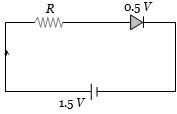
The diode used in the circuit shown in the figure has a constant voltage drop of $0.5\; V$ at all currents and a maximum power rating of $100\; mW$. What should be the value of the resistor $R$,connected in series with the diode,to obtain the maximum current? (in $\Omega$)
A
$1.5$
B
$5$
C
$6.67$
D
$200$
Solution
(B) The maximum current $I$ that the diode can handle is determined by its maximum power rating $P$ and its constant voltage drop $V_d$.
Given $P = 100\; mW = 100 \times 10^{-3}\; W$ and $V_d = 0.5\; V$.
The maximum current is $I = \frac{P}{V_d} = \frac{100 \times 10^{-3}}{0.5} = 0.2\; A$.
Applying Kirchhoff's Voltage Law to the circuit,the voltage across the resistor $R$ is $V_R = V_{source} - V_d = 1.5\; V - 0.5\; V = 1.0\; V$.
Using Ohm's law,$V_R = I \times R$,so $R = \frac{V_R}{I} = \frac{1.0}{0.2} = 5\; \Omega$.
Given $P = 100\; mW = 100 \times 10^{-3}\; W$ and $V_d = 0.5\; V$.
The maximum current is $I = \frac{P}{V_d} = \frac{100 \times 10^{-3}}{0.5} = 0.2\; A$.
Applying Kirchhoff's Voltage Law to the circuit,the voltage across the resistor $R$ is $V_R = V_{source} - V_d = 1.5\; V - 0.5\; V = 1.0\; V$.
Using Ohm's law,$V_R = I \times R$,so $R = \frac{V_R}{I} = \frac{1.0}{0.2} = 5\; \Omega$.
0 likesView Solution
44
PhysicsEasyMCQAIPMT · 1997
If ${\varepsilon _0}$ and ${\mu _0}$ are respectively the electric permittivity and the magnetic permeability of free space,and ${\varepsilon}$ and ${\mu}$ are the corresponding quantities in a medium,the refractive index of the medium is:
A
$\sqrt {\frac{{\mu \varepsilon }}{{{\mu _0}{\varepsilon _0}}}} $
B
$\frac{{\mu \varepsilon }}{{{\mu _0}{\varepsilon _0}}}$
C
$\sqrt {\frac{{{\mu _0}{\varepsilon _0}}}{{\mu \varepsilon }}} $
D
$\sqrt {\frac{{\mu {\mu _0}}}{{\varepsilon \,{\varepsilon _0}}}} $
Solution
(A) The speed of light in free space is given by $c = \frac{1}{\sqrt{\mu_0 \varepsilon_0}}$.
The speed of light in a medium is given by $v = \frac{1}{\sqrt{\mu \varepsilon}}$.
The refractive index $n$ of a medium is defined as the ratio of the speed of light in vacuum to the speed of light in the medium:
$n = \frac{c}{v} = \frac{1/\sqrt{\mu_0 \varepsilon_0}}{1/\sqrt{\mu \varepsilon}} = \sqrt{\frac{\mu \varepsilon}{\mu_0 \varepsilon_0}}$.
The speed of light in a medium is given by $v = \frac{1}{\sqrt{\mu \varepsilon}}$.
The refractive index $n$ of a medium is defined as the ratio of the speed of light in vacuum to the speed of light in the medium:
$n = \frac{c}{v} = \frac{1/\sqrt{\mu_0 \varepsilon_0}}{1/\sqrt{\mu \varepsilon}} = \sqrt{\frac{\mu \varepsilon}{\mu_0 \varepsilon_0}}$.
0 likesView Solution
45
PhysicsMediumMCQAIPMT · 1997
Electromagnetic radiation of frequency $n$,wavelength $\lambda$,travelling with velocity $v$ in air,enters a glass slab of refractive index $\mu$. The frequency,wavelength,and velocity of light in the glass slab will be respectively:
A
$\frac{n}{\mu}, \frac{\lambda}{\mu}, \frac{v}{\mu}$
B
$n, \frac{\lambda}{\mu}, \frac{v}{\mu}$
C
$n, \lambda, \frac{v}{\mu}$
D
$\frac{n}{\mu}, \frac{\lambda}{\mu}, v$
Solution
(B) When light travels from one medium to another,its frequency $(n)$ remains constant because it depends on the source of the light.
When light enters a medium with refractive index $\mu > 1$,its velocity $(v')$ decreases and is given by $v' = \frac{v}{\mu}$.
Since the relation between velocity,frequency,and wavelength is $v = n\lambda$,and $n$ is constant,the new wavelength $\lambda'$ is given by $\lambda' = \frac{v'}{n} = \frac{v/\mu}{n} = \frac{\lambda}{\mu}$.
Therefore,the new frequency,wavelength,and velocity are $n, \frac{\lambda}{\mu}, \frac{v}{\mu}$ respectively.
When light enters a medium with refractive index $\mu > 1$,its velocity $(v')$ decreases and is given by $v' = \frac{v}{\mu}$.
Since the relation between velocity,frequency,and wavelength is $v = n\lambda$,and $n$ is constant,the new wavelength $\lambda'$ is given by $\lambda' = \frac{v'}{n} = \frac{v/\mu}{n} = \frac{\lambda}{\mu}$.
Therefore,the new frequency,wavelength,and velocity are $n, \frac{\lambda}{\mu}, \frac{v}{\mu}$ respectively.
0 likesView Solution
46
PhysicsMediumMCQAIPMT · 1997
The focal lengths for violet,green,and red light rays are ${f_V}$,${f_G}$,and ${f_R}$ respectively. Which of the following is the true relationship?
A
${f_R} < {f_G} < {f_V}$
B
${f_V} < {f_G} < {f_R}$
C
${f_G} < {f_R} < {f_V}$
D
${f_G} < {f_V} < {f_R}$
Solution
(B) According to the lens maker's formula,the focal length $f$ is related to the refractive index $\mu$ as $f \propto \frac{1}{\mu - 1}$.
From Cauchy's dispersion formula,the refractive index $\mu$ is inversely proportional to the wavelength $\lambda$ (i.e.,$\mu \propto \frac{1}{\lambda}$).
Since the wavelength of violet light is the shortest $({\lambda_V} < {\lambda_G} < {\lambda_R})$,the refractive index for violet light is the highest $({\mu_V} > {\mu_G} > {\mu_R})$.
Consequently,the focal length is inversely related to the refractive index,meaning the focal length for violet light is the shortest.
Therefore,the correct relationship is ${f_V} < {f_G} < {f_R}$.
From Cauchy's dispersion formula,the refractive index $\mu$ is inversely proportional to the wavelength $\lambda$ (i.e.,$\mu \propto \frac{1}{\lambda}$).
Since the wavelength of violet light is the shortest $({\lambda_V} < {\lambda_G} < {\lambda_R})$,the refractive index for violet light is the highest $({\mu_V} > {\mu_G} > {\mu_R})$.
Consequently,the focal length is inversely related to the refractive index,meaning the focal length for violet light is the shortest.
Therefore,the correct relationship is ${f_V} < {f_G} < {f_R}$.
0 likesView Solution
47
PhysicsMediumMCQAIPMT · 1997
An astronomical telescope of ten-fold angular magnification has a length of $44\, cm$. The focal length of the objective is.......$cm$
A
$4$
B
$40$
C
$44$
D
$440$
Solution
(B) For an astronomical telescope in normal adjustment,the length of the tube is given by $L = f_o + f_e = 44\, cm$.
The angular magnification is given by $|m| = \frac{f_o}{f_e} = 10$,which implies $f_o = 10 f_e$.
Substituting $f_o = 10 f_e$ into the length equation: $10 f_e + f_e = 44$.
$11 f_e = 44$,so $f_e = 4\, cm$.
Therefore,the focal length of the objective is $f_o = 10 \times 4 = 40\, cm$.
The angular magnification is given by $|m| = \frac{f_o}{f_e} = 10$,which implies $f_o = 10 f_e$.
Substituting $f_o = 10 f_e$ into the length equation: $10 f_e + f_e = 44$.
$11 f_e = 44$,so $f_e = 4\, cm$.
Therefore,the focal length of the objective is $f_o = 10 \times 4 = 40\, cm$.
0 likesView Solution
48
PhysicsEasyMCQAIPMT · 1997
$A$ bar magnet of magnetic moment $M$ is cut into two parts of equal length. The magnetic moment of each part will be ......... $M$.
A
$0.5$
B
$0$
C
$2$
D
$1$
Solution
(A) The magnetic moment $M$ of a bar magnet is given by the product of its pole strength $m$ and its magnetic length $2l$,so $M = m \times 2l$.
When the magnet is cut into two equal parts perpendicular to its length,the pole strength $m$ of each part remains the same,but the length of each part becomes half,i.e.,$l' = l$.
Therefore,the new magnetic moment $M'$ of each part is $M' = m \times l = (m \times 2l) / 2 = M / 2$.
Thus,$M' = 0.5 M$.
When the magnet is cut into two equal parts perpendicular to its length,the pole strength $m$ of each part remains the same,but the length of each part becomes half,i.e.,$l' = l$.
Therefore,the new magnetic moment $M'$ of each part is $M' = m \times l = (m \times 2l) / 2 = M / 2$.
Thus,$M' = 0.5 M$.
0 likesView Solution
49
PhysicsEasyMCQAIPMT · 1997
Three copper wires of lengths and cross-sectional areas are $(l, A)$,$(2l, A/2)$,and $(l/2, 2A)$. Resistance is minimum in
A
wire of cross-sectional area $A/2$
B
wire of cross-sectional area $A$
C
wire of cross-sectional area $2A$
D
same in all the three cases
Solution
(C) The resistance $R$ of a wire is given by the formula $R = \rho \frac{l}{A}$,where $\rho$ is the resistivity,$l$ is the length,and $A$ is the cross-sectional area.
For the three wires,the resistances are:
$R_1 = \rho \frac{l}{A}$
$R_2 = \rho \frac{2l}{A/2} = 4 \rho \frac{l}{A} = 4R_1$
$R_3 = \rho \frac{l/2}{2A} = \frac{1}{4} \rho \frac{l}{A} = 0.25R_1$
Comparing the resistances,$R_3 < R_1 < R_2$.
Therefore,the resistance is minimum for the wire with length $l/2$ and cross-sectional area $2A$.
For the three wires,the resistances are:
$R_1 = \rho \frac{l}{A}$
$R_2 = \rho \frac{2l}{A/2} = 4 \rho \frac{l}{A} = 4R_1$
$R_3 = \rho \frac{l/2}{2A} = \frac{1}{4} \rho \frac{l}{A} = 0.25R_1$
Comparing the resistances,$R_3 < R_1 < R_2$.
Therefore,the resistance is minimum for the wire with length $l/2$ and cross-sectional area $2A$.
1 likesView Solution
50
PhysicsMediumMCQAIPMT · 1997
The correct relation between $\alpha$ (ratio of collector current to emitter current) and $\beta$ (ratio of collector current to base current) of a transistor is :
A
$\beta=\frac{\alpha}{1+\alpha}$
B
$\alpha=\frac{\beta}{1-\alpha}$
C
$\beta=\frac{1}{1-\alpha}$
D
$\alpha=\frac{\beta}{1+\beta}$
Solution
(D) The current gain $\alpha$ is defined as the ratio of collector current $(I_{C})$ to emitter current $(I_{E})$: $\alpha = \frac{I_{C}}{I_{E}}$.
The current gain $\beta$ is defined as the ratio of collector current $(I_{C})$ to base current $(I_{B})$: $\beta = \frac{I_{C}}{I_{B}}$.
From Kirchhoff's current law for a transistor,the emitter current is the sum of base and collector currents: $I_{E} = I_{B} + I_{C}$.
Substituting $I_{E}$ in the expression for $\alpha$: $\alpha = \frac{I_{C}}{I_{B} + I_{C}}$.
Dividing the numerator and denominator by $I_{C}$: $\alpha = \frac{1}{\frac{I_{B}}{I_{C}} + 1}$.
Since $\frac{1}{\beta} = \frac{I_{B}}{I_{C}}$,we substitute this into the equation: $\alpha = \frac{1}{\frac{1}{\beta} + 1} = \frac{1}{\frac{1+\beta}{\beta}} = \frac{\beta}{1+\beta}$.
Therefore,the correct relation is $\alpha = \frac{\beta}{1+\beta}$.
The current gain $\beta$ is defined as the ratio of collector current $(I_{C})$ to base current $(I_{B})$: $\beta = \frac{I_{C}}{I_{B}}$.
From Kirchhoff's current law for a transistor,the emitter current is the sum of base and collector currents: $I_{E} = I_{B} + I_{C}$.
Substituting $I_{E}$ in the expression for $\alpha$: $\alpha = \frac{I_{C}}{I_{B} + I_{C}}$.
Dividing the numerator and denominator by $I_{C}$: $\alpha = \frac{1}{\frac{I_{B}}{I_{C}} + 1}$.
Since $\frac{1}{\beta} = \frac{I_{B}}{I_{C}}$,we substitute this into the equation: $\alpha = \frac{1}{\frac{1}{\beta} + 1} = \frac{1}{\frac{1+\beta}{\beta}} = \frac{\beta}{1+\beta}$.
Therefore,the correct relation is $\alpha = \frac{\beta}{1+\beta}$.
0 likesView Solution
Vedclass Products
For Students
Vedclass Test Series
Mock tests in real AIPMT style covering Physics with performance analysis. 5-day free trial.
Start Free TrialFor Teachers
Exam Paper Generator
Generate Set A/B/C/D Physics papers from 7.5L+ questions in 2 minutes. 3 chapters free.
Try FreeFor Institutes
Online Exam Module
Run live AIPMT mock exams with unlimited students, 360° analytics & white-label branding.
See DemoFrequently Asked Questions
How many Physics questions are in AIPMT 1997?
There are 50 Physics questions from the AIPMT 1997 paper on Vedclass, each with a detailed step-by-step solution in English.
Are AIPMT 1997 Physics solutions available in English?
Yes. All solutions on this page are in English. You can also switch to English or Hindi using the language buttons above the questions.
Can I practice AIPMT 1997 Physics as a timed test?
Yes. Use the Vedclass Test Series to attempt a full AIPMT mock test covering Physics with time limits and instant score analysis.
Can teachers create Physics papers from AIPMT previous year questions?
Yes. The Vedclass Exam Paper Generator lets teachers mix AIPMT Physics questions and generate Set A/B/C/D papers in minutes.
For Teachers & Institutes
Build a Custom Physics Paper
Pick AIPMT 1997 Physics questions, set difficulty, and generate Set A/B/C/D in 2 minutes.