
ChemistryQ1–63 of 63 questions
Page 1 of 1 · English
1
ChemistryMCQAIPMT · 1997
The period of revolution of planet $A$ around the sun is $8$ times that of planet $B$. The distance of planet $A$ from the sun is how many times greater than that of planet $B$ from the sun?
A
$2$
B
$3$
C
$4$
D
$5$
Solution
(C) According to Kepler's third law of planetary motion,the square of the period of revolution $T$ is proportional to the cube of the semi-major axis $r$ of the orbit: $T^2 \propto r^3$.
Given that the period of revolution of planet $A$ is $8$ times that of planet $B$,we have $T_A = 8 T_B$,or $\frac{T_A}{T_B} = 8$.
Using the relation $\frac{T_A}{T_B} = \left( \frac{r_A}{r_B} \right)^{3/2}$,we substitute the given values:
$8 = \left( \frac{r_A}{r_B} \right)^{3/2}$.
To solve for $\frac{r_A}{r_B}$,we raise both sides to the power of $2/3$:
$\left( 8 \right)^{2/3} = \frac{r_A}{r_B}$.
Since $8 = 2^3$,we have $(2^3)^{2/3} = 2^2 = 4$.
Therefore,$\frac{r_A}{r_B} = 4$,which means the distance of planet $A$ from the sun is $4$ times greater than that of planet $B$.
Given that the period of revolution of planet $A$ is $8$ times that of planet $B$,we have $T_A = 8 T_B$,or $\frac{T_A}{T_B} = 8$.
Using the relation $\frac{T_A}{T_B} = \left( \frac{r_A}{r_B} \right)^{3/2}$,we substitute the given values:
$8 = \left( \frac{r_A}{r_B} \right)^{3/2}$.
To solve for $\frac{r_A}{r_B}$,we raise both sides to the power of $2/3$:
$\left( 8 \right)^{2/3} = \frac{r_A}{r_B}$.
Since $8 = 2^3$,we have $(2^3)^{2/3} = 2^2 = 4$.
Therefore,$\frac{r_A}{r_B} = 4$,which means the distance of planet $A$ from the sun is $4$ times greater than that of planet $B$.
0 likesView Solution
2
ChemistryMediumMCQAIPMT · 1997
$CO$ has the same number of electrons as which of the following ions? Or,which ion is isoelectronic with $CO$?
A
$N_2^{+}$
B
$CN^{-}$
C
$O_2^{+}$
D
$O_2^{-}$
Solution
(B) $CO$ and $CN^{-}$ are isoelectronic species.
Total electrons in $CO = 6 + 8 = 14$.
Total electrons in $CN^{-} = 6 + 7 + 1 = 14$.
Since both have $14$ electrons,they are isoelectronic.
Total electrons in $CO = 6 + 8 = 14$.
Total electrons in $CN^{-} = 6 + 7 + 1 = 14$.
Since both have $14$ electrons,they are isoelectronic.
0 likesView Solution
3
ChemistryMediumMCQAIPMT · 1997
In graphite,electrons are
A
Localised on every third $C$ atom
B
Present in antibonding orbital
C
Localised on each $C$ atom
D
Spread out between the structure
Solution
(D) In graphite,each carbon atom is $sp^2$ hybridized and uses $3$ of its $4$ valence electrons to form covalent bonds with $3$ other carbon atoms in a hexagonal layer.
The fourth electron remains in an unhybridized $p$-orbital,which overlaps with adjacent $p$-orbitals to form a delocalized $\pi$-electron cloud.
Therefore,these electrons are spread out between the layers of the structure,allowing graphite to conduct electricity.
The fourth electron remains in an unhybridized $p$-orbital,which overlaps with adjacent $p$-orbitals to form a delocalized $\pi$-electron cloud.
Therefore,these electrons are spread out between the layers of the structure,allowing graphite to conduct electricity.
0 likesView Solution
4
ChemistryMediumMCQAIPMT · 1997
$N_2$ and $O_2$ are converted into monoanions $N_2^-$ and $O_2^-$ respectively. Which of the following statements is wrong?
A
In $N_2^-$,the $N-N$ bond weakens.
B
In $O_2^-$,the $O-O$ bond order increases.
C
In $O_2^-$,bond length increases.
D
$N_2^-$ becomes diamagnetic.
Solution
(B) The electronic configuration of $N_2$ is $\sigma 1s^2, \sigma^* 1s^2, \sigma 2s^2, \sigma^* 2s^2, \pi 2p_x^2 = \pi 2p_y^2, \sigma 2p_z^2$. Bond order = $(10-4)/2 = 3$.
For $N_2^-$,the extra electron enters the $\pi^* 2p$ orbital. Bond order = $(10-5)/2 = 2.5$. Since bond order decreases,the $N-N$ bond weakens. $N_2^-$ has one unpaired electron,so it is paramagnetic.
The electronic configuration of $O_2$ is $\sigma 1s^2, \sigma^* 1s^2, \sigma 2s^2, \sigma^* 2s^2, \sigma 2p_z^2, \pi 2p_x^2 = \pi 2p_y^2, \pi^* 2p_x^1 = \pi^* 2p_y^1$. Bond order = $(10-6)/2 = 2$.
For $O_2^-$,the extra electron enters the $\pi^* 2p$ orbital. Bond order = $(10-7)/2 = 1.5$. Since bond order decreases,the bond length increases.
Therefore,the statement that the $O-O$ bond order increases is wrong.
For $N_2^-$,the extra electron enters the $\pi^* 2p$ orbital. Bond order = $(10-5)/2 = 2.5$. Since bond order decreases,the $N-N$ bond weakens. $N_2^-$ has one unpaired electron,so it is paramagnetic.
The electronic configuration of $O_2$ is $\sigma 1s^2, \sigma^* 1s^2, \sigma 2s^2, \sigma^* 2s^2, \sigma 2p_z^2, \pi 2p_x^2 = \pi 2p_y^2, \pi^* 2p_x^1 = \pi^* 2p_y^1$. Bond order = $(10-6)/2 = 2$.
For $O_2^-$,the extra electron enters the $\pi^* 2p$ orbital. Bond order = $(10-7)/2 = 1.5$. Since bond order decreases,the bond length increases.
Therefore,the statement that the $O-O$ bond order increases is wrong.
0 likesView Solution
5
ChemistryMediumMCQAIPMT · 1997
The high density of water compared to ice is due to
A
Hydrogen bonding interactions
B
Dipole-dipole interactions
C
Dipole-induced dipole interactions
D
Induced dipole-induced dipole interactions
Solution
(A) . Water is denser than ice because of the hydrogen bonding interactions and the open cage-like structure of ice.
0 likesView Solution
6
ChemistryMCQAIPMT · 1997
$N_2$ and $O_2$ are converted into monocations $N_2^+$ and $O_2^+$ respectively. Which statement is wrong?
A
In $N_2^+$,the $N-N$ bond weakens
B
In $O_2^+$,the $O-O$ bond order increases
C
In $O_2^+$,paramagnetism decreases
D
$N_2^+$ becomes diamagnetic
Solution
(D) The electronic configuration of $N_2$ is $\sigma 1s^2, \sigma^* 1s^2, \sigma 2s^2, \sigma^* 2s^2, \pi 2p_x^2 = \pi 2p_y^2, \sigma 2p_z^2$ (Bond order = $3$).
When $N_2$ is converted to $N_2^+$,an electron is removed from the bonding molecular orbital $(\sigma 2p_z)$,resulting in a bond order of $2.5$. Thus,the $N-N$ bond weakens.
$N_2^+$ has $13$ electrons,so its configuration is $\sigma 1s^2, \sigma^* 1s^2, \sigma 2s^2, \sigma^* 2s^2, \pi 2p_x^2 = \pi 2p_y^2, \sigma 2p_z^1$. Since it has one unpaired electron,it is paramagnetic.
The electronic configuration of $O_2$ is $\sigma 1s^2, \sigma^* 1s^2, \sigma 2s^2, \sigma^* 2s^2, \sigma 2p_z^2, \pi 2p_x^2 = \pi 2p_y^2, \pi^* 2p_x^1 = \pi^* 2p_y^1$ (Bond order = $2$).
When $O_2$ is converted to $O_2^+$,an electron is removed from the antibonding molecular orbital $(\pi^*)$,increasing the bond order to $2.5$ and decreasing paramagnetism.
Therefore,the statement that $N_2^+$ becomes diamagnetic is wrong.
When $N_2$ is converted to $N_2^+$,an electron is removed from the bonding molecular orbital $(\sigma 2p_z)$,resulting in a bond order of $2.5$. Thus,the $N-N$ bond weakens.
$N_2^+$ has $13$ electrons,so its configuration is $\sigma 1s^2, \sigma^* 1s^2, \sigma 2s^2, \sigma^* 2s^2, \pi 2p_x^2 = \pi 2p_y^2, \sigma 2p_z^1$. Since it has one unpaired electron,it is paramagnetic.
The electronic configuration of $O_2$ is $\sigma 1s^2, \sigma^* 1s^2, \sigma 2s^2, \sigma^* 2s^2, \sigma 2p_z^2, \pi 2p_x^2 = \pi 2p_y^2, \pi^* 2p_x^1 = \pi^* 2p_y^1$ (Bond order = $2$).
When $O_2$ is converted to $O_2^+$,an electron is removed from the antibonding molecular orbital $(\pi^*)$,increasing the bond order to $2.5$ and decreasing paramagnetism.
Therefore,the statement that $N_2^+$ becomes diamagnetic is wrong.
0 likesView Solution
7
ChemistryMediumMCQAIPMT · 1997
$A$ physician wishes to prepare a buffer solution at $pH = 3.58$ that efficiently resists changes in $pH$ yet contains only small concentration of the buffering agents. Which of the following weak acids together with its sodium salt would be best to use?
A
$m-$chlorobenzoic acid $(pK_a = 3.98)$
B
$p-$chlorocinnamic acid $(pK_a = 4.41)$
C
$2, 5-$dihydroxy benzoic acid $(pK_a = 2.97)$
D
Acetoacetic acid $(pK_a = 3.58)$
Solution
(D) The Henderson-Hasselbalch equation is given by $pH = pK_a + \log \frac{[Salt]}{[Acid]}$.
For a buffer to be most efficient,the $pH$ of the solution should be as close as possible to the $pK_a$ of the weak acid used,i.e.,$pH \approx pK_a$.
Given the target $pH = 3.58$,we look for an acid with a $pK_a$ value closest to $3.58$.
Comparing the given options:
$(A)$ $pK_a = 3.98$
$(B)$ $pK_a = 4.41$
$(C)$ $pK_a = 2.97$
$(D)$ $pK_a = 3.58$
Since Acetoacetic acid has a $pK_a$ of $3.58$,which is exactly equal to the desired $pH$,it provides the maximum buffer capacity at this $pH$.
For a buffer to be most efficient,the $pH$ of the solution should be as close as possible to the $pK_a$ of the weak acid used,i.e.,$pH \approx pK_a$.
Given the target $pH = 3.58$,we look for an acid with a $pK_a$ value closest to $3.58$.
Comparing the given options:
$(A)$ $pK_a = 3.98$
$(B)$ $pK_a = 4.41$
$(C)$ $pK_a = 2.97$
$(D)$ $pK_a = 3.58$
Since Acetoacetic acid has a $pK_a$ of $3.58$,which is exactly equal to the desired $pH$,it provides the maximum buffer capacity at this $pH$.
0 likesView Solution
8
ChemistryMediumMCQAIPMT · 1997
The hydride ion $H^{-}$ is a stronger base than the hydroxide ion $OH^{-}$. Which of the following reactions will occur if sodium hydride $(NaH)$ is dissolved in water?
A
$H^{-}_{(aq)} + H_2O \to H_2O + e^-$
B
$H^{-}_{(aq)} + H_2O_{(l)} \to OH^{-} + H_2$
C
$H^{-} + H_2O \to \text{No reaction}$
D
None of these
Solution
(B) Since the hydride ion $(H^{-})$ is a much stronger base than the hydroxide ion $(OH^{-})$,it will readily abstract a proton $(H^{+})$ from water.
The reaction is as follows:
$H^{-}_{(aq)} + H_2O_{(l)} \to H_2(g) + OH^{-}_{(aq)}$
In this reaction,$H^{-}$ acts as a Bronsted-Lowry base and $H_2O$ acts as a Bronsted-Lowry acid.
The reaction is as follows:
$H^{-}_{(aq)} + H_2O_{(l)} \to H_2(g) + OH^{-}_{(aq)}$
In this reaction,$H^{-}$ acts as a Bronsted-Lowry base and $H_2O$ acts as a Bronsted-Lowry acid.
0 likesView Solution
9
ChemistryMediumMCQAIPMT · 1997
Which of the following is a redox reaction?
A
$H_2SO_4$ with $NaOH$
B
In the atmosphere,$O_3$ from $O_2$ by lightning
C
Evaporation of $H_2O$
D
Nitrogen oxides form nitrogen and oxygen by lightning
Solution
(D) redox reaction involves a change in the oxidation state of elements.
In option $D$,the reaction is $N_2 + O_2 \to 2NO$.
Here,the oxidation number $(O.N.)$ of $N$ increases from $0$ in $N_2$ to $+2$ in $NO$ (oxidation),and the $O.N.$ of $O$ decreases from $0$ in $O_2$ to $-2$ in $NO$ (reduction).
Therefore,this is a redox reaction.
In option $D$,the reaction is $N_2 + O_2 \to 2NO$.
Here,the oxidation number $(O.N.)$ of $N$ increases from $0$ in $N_2$ to $+2$ in $NO$ (oxidation),and the $O.N.$ of $O$ decreases from $0$ in $O_2$ to $-2$ in $NO$ (reduction).
Therefore,this is a redox reaction.
0 likesView Solution
10
ChemistryMediumMCQAIPMT · 1997
Which one is the correct order of the size of the iodine species?
A
$I > I^{+} > I^{-}$
B
$I > I^{-} > I^{+}$
C
$I^{+} > I^{-} > I$
D
$I^{-} > I > I^{+}$
Solution
(D) The size of an atom or ion depends on the number of electrons and the effective nuclear charge.
For the same element,the size order is $I^{-} > I > I^{+}$.
$I^{-}$ has $54$ electrons,$I$ has $53$ electrons,and $I^{+}$ has $52$ electrons.
As the number of electrons decreases for the same nuclear charge,the effective nuclear charge per electron increases,leading to a smaller size.
Therefore,the correct order is $I^{-} > I > I^{+}$.
For the same element,the size order is $I^{-} > I > I^{+}$.
$I^{-}$ has $54$ electrons,$I$ has $53$ electrons,and $I^{+}$ has $52$ electrons.
As the number of electrons decreases for the same nuclear charge,the effective nuclear charge per electron increases,leading to a smaller size.
Therefore,the correct order is $I^{-} > I > I^{+}$.
0 likesView Solution
11
ChemistryMCQAIPMT · 1997
The lanthanide contraction is responsible for the fact that
A
$Zr$ and $Y$ have about the same radius
B
$Zr$ and $Nb$ have similar oxidation state
C
$Zr$ and $Hf$ have about the same radius
D
$Zr$ and $Zn$ have the same oxidation state
Solution
(C) Due to lanthanide contraction,the atomic radii of $Zr$ and $Hf$ are nearly identical.
Lanthanide contraction is explained by the poor shielding effect of $4f$ electrons.
In multi-electron atoms,inner electrons shield outer electrons from the nuclear charge.
The shielding efficiency follows the order $s > p > d > f$.
Because the $4f$ subshell provides poor shielding,the effective nuclear charge experienced by the outer electrons increases,leading to a smaller atomic size.
In the case of $Hf$ $(Z = 72)$,the filling of the $4f$ subshell results in a smaller size than expected,making it comparable to $Zr$ $(Z = 40)$.
Lanthanide contraction is explained by the poor shielding effect of $4f$ electrons.
In multi-electron atoms,inner electrons shield outer electrons from the nuclear charge.
The shielding efficiency follows the order $s > p > d > f$.
Because the $4f$ subshell provides poor shielding,the effective nuclear charge experienced by the outer electrons increases,leading to a smaller atomic size.
In the case of $Hf$ $(Z = 72)$,the filling of the $4f$ subshell results in a smaller size than expected,making it comparable to $Zr$ $(Z = 40)$.
0 likesView Solution
12
ChemistryMediumMCQAIPMT · 1997
The hydride ion $H^{-}$ is a stronger base than the hydroxide ion $OH^{-}$. Which of the following reactions will occur if sodium hydride $(NaH)$ is dissolved in water?
A
$H^{-}_{(aq)} + H_2O \to H_3O^{-}_{(aq)}$
B
$H^{-}_{(aq)} + H_2O_{(l)} \to OH^{-}_{(aq)} + H_{2(g)}$
C
$H^{-}_{(aq)} + H_2O_{(l)} \to \text{No reaction}$
D
None of these
Solution
(B) Since $H^{-}$ is a stronger base than $OH^{-}$,it will readily accept a proton from water.
$H^{-}$ acts as a Bronsted-Lowry base and $H_2O$ acts as a Bronsted-Lowry acid.
The reaction is: $H^{-}_{(aq)} + H_2O_{(l)} \to OH^{-}_{(aq)} + H_{2(g)}$
This is an acid-base reaction where the stronger base $(H^{-})$ reacts with the acid $(H_2O)$ to form a weaker base $(OH^{-})$ and a weaker acid $(H_2)$.
$H^{-}$ acts as a Bronsted-Lowry base and $H_2O$ acts as a Bronsted-Lowry acid.
The reaction is: $H^{-}_{(aq)} + H_2O_{(l)} \to OH^{-}_{(aq)} + H_{2(g)}$
This is an acid-base reaction where the stronger base $(H^{-})$ reacts with the acid $(H_2O)$ to form a weaker base $(OH^{-})$ and a weaker acid $(H_2)$.
0 likesView Solution
13
ChemistryDifficultMCQAIPMT · 1997
Which of the following has the highest dipole moment?
A
$NH_3$
B
$PH_3$
C
$SbH_3$
D
$AsH_3$
Solution
(A) As we move from top to bottom in a group,the dipole moment of hydrides of the elements of that particular group decreases due to an increase in the size of the central atom and a decrease in electronegativity.
$NH_3$ has the highest dipole moment because nitrogen is the most electronegative element in the group,leading to a greater polarity of the $N-H$ bond.
The order of dipole moment for the given hydrides is:
$NH_3 > PH_3 > AsH_3 > SbH_3$
$NH_3$ has the highest dipole moment because nitrogen is the most electronegative element in the group,leading to a greater polarity of the $N-H$ bond.
The order of dipole moment for the given hydrides is:
$NH_3 > PH_3 > AsH_3 > SbH_3$
0 likesView Solution
14
ChemistryMCQAIPMT · 1997
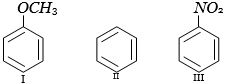
Among the following compounds $(I-III)$,the correct order of reactivity towards electrophilic substitution is:
A
$II > III > I$
B
$III < I < II$
C
$I > II > III$
D
$I = II > III$
Solution
(C) The reactivity of benzene derivatives towards electrophilic substitution depends on the electron density of the benzene ring.
$I$ (Anisole) has a $-OCH_3$ group,which is an electron-donating group $(EDG)$ via resonance ($+M$ effect),significantly increasing the electron density of the benzene ring.
$II$ (Benzene) has no substituents.
$III$ (Nitrobenzene) has a $-NO_2$ group,which is a strong electron-withdrawing group $(EWG)$ via both inductive $(-I)$ and resonance $(-M)$ effects,significantly decreasing the electron density of the benzene ring.
Since electrophiles are electron-deficient species,they react faster with rings having higher electron density.
Therefore,the order of reactivity is $I > II > III$.
$I$ (Anisole) has a $-OCH_3$ group,which is an electron-donating group $(EDG)$ via resonance ($+M$ effect),significantly increasing the electron density of the benzene ring.
$II$ (Benzene) has no substituents.
$III$ (Nitrobenzene) has a $-NO_2$ group,which is a strong electron-withdrawing group $(EWG)$ via both inductive $(-I)$ and resonance $(-M)$ effects,significantly decreasing the electron density of the benzene ring.
Since electrophiles are electron-deficient species,they react faster with rings having higher electron density.
Therefore,the order of reactivity is $I > II > III$.
0 likesView Solution
15
ChemistryMediumMCQAIPMT · 1997
Tautomerism is exhibited by
A
$(CH_3)_3CNO$
B
$(CH_3)_2NH$
C
$R_3CNO_2$
D
$RCH_2NO_2$
Solution
(D) Tautomerism requires the presence of at least one $\alpha$-hydrogen atom attached to a carbon atom adjacent to a functional group that can undergo tautomeric rearrangement.
In the case of nitro compounds $(RCH_2NO_2)$,the $\alpha$-hydrogen atom is acidic and can migrate to the oxygen atom of the nitro group to form an aci-nitro form.
The equilibrium is represented as:
$R-CH_2-N^+(O)O^- \rightleftharpoons R-CH=N^+(OH)O^-$
Since $(CH_3)_3CNO$,$(CH_3)_2NH$,and $R_3CNO_2$ lack an $\alpha$-hydrogen atom,they do not exhibit tautomerism.
Therefore,the correct option is $D$.
In the case of nitro compounds $(RCH_2NO_2)$,the $\alpha$-hydrogen atom is acidic and can migrate to the oxygen atom of the nitro group to form an aci-nitro form.
The equilibrium is represented as:
$R-CH_2-N^+(O)O^- \rightleftharpoons R-CH=N^+(OH)O^-$
Since $(CH_3)_3CNO$,$(CH_3)_2NH$,and $R_3CNO_2$ lack an $\alpha$-hydrogen atom,they do not exhibit tautomerism.
Therefore,the correct option is $D$.
0 likesView Solution
16
ChemistryMediumMCQAIPMT · 1997
In commercial gasolines,the type of hydrocarbons which are more desirable is
A
Branched hydrocarbons
B
Straight-chain hydrocarbons
C
Linear unsaturated hydrocarbons
D
Toluene
Solution
(A) The correct answer is $A$. Branched chain hydrocarbons are more desirable in commercial gasoline because they have higher octane ratings compared to their straight-chain isomers,which helps in reducing engine knocking.
0 likesView Solution
17
ChemistryDifficultMCQAIPMT · 1997
Which of the following reactions is expected to readily give a hydrocarbon product in good yields?
A
$2RCOOK + 2H_2O \xrightarrow{\text{Electrolysis}} R-R + 2CO_2 + 2KOH + H_2$
B
$RCOOAg + I_2 \xrightarrow{\Delta} R-COOR + CO_2 + 2AgI$
C
$CH_3-CH_3 \xrightarrow{hv, Cl_2} CH_3-CH_2Cl + HCl$
D
$(CH_3)_3CCl \xrightarrow{C_2H_5OH} \text{Alkene}$
Solution
(A) The reaction $2RCOOK + 2H_2O \xrightarrow{\text{Electrolysis}} R-R + 2CO_2 + 2KOH + H_2$ is known as the Kolbe's electrolysis method.
This method is used for the preparation of alkanes (hydrocarbons) with an even number of carbon atoms.
It proceeds via a free radical mechanism and provides good yields of the symmetric alkane product $(R-R)$.
This method is used for the preparation of alkanes (hydrocarbons) with an even number of carbon atoms.
It proceeds via a free radical mechanism and provides good yields of the symmetric alkane product $(R-R)$.
0 likesView Solution
18
ChemistryDifficultMCQAIPMT · 1997
In the reaction $CH_2=CH_2$ $\xrightarrow{HOCl} M$ $\xrightarrow{R} HO-CH_2-CH_2-OH$,where $M$ is a molecule and $R$ is a reagent,$M$ and $R$ are:
A
$CH_3-CH_2-Cl$ and $NaOH$
B
$Cl-CH_2-CH_2-OH$ and $aq. NaHCO_3$
C
$CH_3-CH_2-OH$ and $HCl$
D
$CH_2=CH_2$ and heat
Solution
(B) The reaction of ethene $(CH_2=CH_2)$ with hypochlorous acid $(HOCl)$ follows an electrophilic addition mechanism to form ethylene chlorohydrin $(Cl-CH_2-CH_2-OH)$,which is molecule $M$.
Ethylene chlorohydrin then undergoes hydrolysis in the presence of a mild base like aqueous sodium bicarbonate $(aq. NaHCO_3)$,which acts as reagent $R$,to produce ethylene glycol $(HO-CH_2-CH_2-OH)$.
Ethylene chlorohydrin then undergoes hydrolysis in the presence of a mild base like aqueous sodium bicarbonate $(aq. NaHCO_3)$,which acts as reagent $R$,to produce ethylene glycol $(HO-CH_2-CH_2-OH)$.
0 likesView Solution
19
ChemistryMediumMCQAIPMT · 1997
The triple bond of ethyne is made of,or the cylindrical shape of an alkyne is due to:
A
$3$ $\sigma$-bonds
B
$3$ $\pi$-bonds
C
$2$ $\sigma$ and $1$ $\pi$-bond
D
$2$ $\pi$ and $1$ $\sigma$-bond
Solution
(D) In ethyne $(CH \equiv CH)$,the carbon-carbon triple bond consists of $1$ $\sigma$ bond and $2$ $\pi$ bonds.
The cylindrical shape of the alkyne molecule arises due to the presence of these two $\pi$ bonds,which are formed by the sideways overlap of two sets of $p$-orbitals perpendicular to each other.
The cylindrical shape of the alkyne molecule arises due to the presence of these two $\pi$ bonds,which are formed by the sideways overlap of two sets of $p$-orbitals perpendicular to each other.
0 likesView Solution
20
ChemistryDifficultMCQAIPMT · 1997
The volume strength of $1.5 \ N \ H_2O_2$ solution is
A
$4.8$
B
$5.2$
C
$8.4$
D
$8.8$
Solution
(C) Strength = $\text{Normality} \times \text{Equivalent Weight (EW)}$ of $H_2O_2$
$= 1.5 \ N \times 17 \ g \ eq^{-1} = 25.5 \ g \ L^{-1}$
Decomposition reaction: $2H_2O_2 \rightarrow 2H_2O + O_2$
$2 \times 34 \ g = 68 \ g$ of $H_2O_2$ produces $22.4 \ L$ of $O_2$ at $STP$.
Volume strength = $\frac{11.2 \times \text{Normality}}{2} = 5.6 \times \text{Normality}$
$= 5.6 \times 1.5 = 8.4$
Thus,the volume strength of $1.5 \ N \ H_2O_2$ solution is $8.4$.
$= 1.5 \ N \times 17 \ g \ eq^{-1} = 25.5 \ g \ L^{-1}$
Decomposition reaction: $2H_2O_2 \rightarrow 2H_2O + O_2$
$2 \times 34 \ g = 68 \ g$ of $H_2O_2$ produces $22.4 \ L$ of $O_2$ at $STP$.
Volume strength = $\frac{11.2 \times \text{Normality}}{2} = 5.6 \times \text{Normality}$
$= 5.6 \times 1.5 = 8.4$
Thus,the volume strength of $1.5 \ N \ H_2O_2$ solution is $8.4$.
1 likesView Solution
21
ChemistryMCQAIPMT · 1997
Which of the following is an opiate narcotic?
A
Barbiturates
B
Morphine
C
Amphetamines
D
$LSD$
Solution
(B) The correct answer is $B$.
Opiate narcotics are drugs that bind to specific opioid receptors in our central nervous system and gastrointestinal tract.
They act as central nervous system depressants,which help in relieving intense pain and inducing sleep.
Morphine is a well-known opiate extracted from the latex of the poppy plant,$Papaver$ $somniferum$.
Other examples include heroin,pethidine,and methadone.
Opiate narcotics are drugs that bind to specific opioid receptors in our central nervous system and gastrointestinal tract.
They act as central nervous system depressants,which help in relieving intense pain and inducing sleep.
Morphine is a well-known opiate extracted from the latex of the poppy plant,$Papaver$ $somniferum$.
Other examples include heroin,pethidine,and methadone.
0 likesView Solution
22
ChemistryMCQAIPMT · 1997
Which of the following has the highest dipole moment?
A
$NH_3$
B
$PH_3$
C
$AsH_3$
D
$SbH_3$
Solution
(A) The dipole moment of hydrides of group $15$ elements depends on the electronegativity difference between the central atom and hydrogen,as well as the lone pair contribution.
As we move down the group from $N$ to $Sb$,the electronegativity of the central atom decreases,which reduces the polarity of the $M-H$ bond.
Additionally,the bond angle decreases down the group,which also affects the resultant dipole moment.
$NH_3$ has the highest electronegativity difference and a significant lone pair contribution,resulting in the highest dipole moment of $1.47 \ D$.
As we move down the group from $N$ to $Sb$,the electronegativity of the central atom decreases,which reduces the polarity of the $M-H$ bond.
Additionally,the bond angle decreases down the group,which also affects the resultant dipole moment.
$NH_3$ has the highest electronegativity difference and a significant lone pair contribution,resulting in the highest dipole moment of $1.47 \ D$.
0 likesView Solution
23
ChemistryMCQAIPMT · 1997
The hydride ion $H^-$ is a stronger base than the hydroxide ion $OH^-$. If sodium hydride $(NaH)$ is dissolved in water,which of the following reactions will occur?
A
$H^-_{(aq)} + H_2O \to H_2O^-_{(aq)}$
B
$H^-_{(aq)} + H_2O_{(l)} \to OH^-_{(aq)} + H_{2(g)}$
C
$H^-_{(aq)} + H_2O_{(l)} \to \text{No reaction occurs.}$
D
None of these.
Solution
(B) Since the $H^-$ ion is a stronger base than the $OH^-$ ion,it acts as a Bronsted-Lowry base and accepts a proton $(H^+)$ from water.
The reaction is: $H^-_{(aq)} + H_2O_{(l)} \to OH^-_{(aq)} + H_{2(g)}$
The reaction is: $H^-_{(aq)} + H_2O_{(l)} \to OH^-_{(aq)} + H_{2(g)}$
0 likesView Solution
24
ChemistryMediumMCQAIPMT · 1997
The solubility product $(K_{sp})$ values of $CuS$,$Ag_2S$,and $HgS$ are $10^{-31}$,$10^{-44}$,and $10^{-54}$ respectively. The solubilities of these sulphides are in the order:
A
$Ag_2S > CuS > HgS$
B
$Ag_2S > HgS > CuS$
C
$HgS > Ag_2S > CuS$
D
$CuS > Ag_2S > HgS$
Solution
(A) For $CuS$ ($1:1$ type salt): $K_{sp} = s^2 \implies s = \sqrt{K_{sp}} = \sqrt{10^{-31}} = 10^{-15.5}$.
For $Ag_2S$ ($2:1$ type salt): $K_{sp} = 4s^3 \implies s = (K_{sp}/4)^{1/3} = (10^{-44}/4)^{1/3} \approx 0.63 \times 10^{-14.6} \approx 10^{-15.2}$.
For $HgS$ ($1:1$ type salt): $K_{sp} = s^2 \implies s = \sqrt{K_{sp}} = \sqrt{10^{-54}} = 10^{-27}$.
Comparing the values: $10^{-15.2} > 10^{-15.5} > 10^{-27}$.
Therefore,the order of solubility is $Ag_2S > CuS > HgS$.
For $Ag_2S$ ($2:1$ type salt): $K_{sp} = 4s^3 \implies s = (K_{sp}/4)^{1/3} = (10^{-44}/4)^{1/3} \approx 0.63 \times 10^{-14.6} \approx 10^{-15.2}$.
For $HgS$ ($1:1$ type salt): $K_{sp} = s^2 \implies s = \sqrt{K_{sp}} = \sqrt{10^{-54}} = 10^{-27}$.
Comparing the values: $10^{-15.2} > 10^{-15.5} > 10^{-27}$.
Therefore,the order of solubility is $Ag_2S > CuS > HgS$.
0 likesView Solution
25
ChemistryDifficultMCQAIPMT · 1997
The most stable conformation of $n-$butane is
A
Skew boat
B
Eclipsed
C
Gauche
D
Staggered
Solution
(D) Anti or completely staggered.
The anti-staggered conformation is the most stable because it minimizes the steric repulsion (van der Waals strain) between the two bulky methyl groups,which are placed at a dihedral angle of $180^{\circ}$.
The anti-staggered conformation is the most stable because it minimizes the steric repulsion (van der Waals strain) between the two bulky methyl groups,which are placed at a dihedral angle of $180^{\circ}$.
0 likesView Solution
26
ChemistryMCQAIPMT · 1997
The basic functional unit of the human kidney is
A
nephron
B
nephridia
C
pyramid
D
Henle's loop
Solution
(A) The human kidney consists of approximately one million complex tubular structures called nephrons.
Each nephron is the structural and functional unit of the kidney.
It consists of two major parts: the glomerulus and the renal tubule.
Nephridia are excretory organs found in annelids like earthworms,not humans.
Pyramids are conical masses in the renal medulla,and Henle's loop is just a part of the nephron.
Each nephron is the structural and functional unit of the kidney.
It consists of two major parts: the glomerulus and the renal tubule.
Nephridia are excretory organs found in annelids like earthworms,not humans.
Pyramids are conical masses in the renal medulla,and Henle's loop is just a part of the nephron.
0 likesView Solution
27
ChemistryMCQAIPMT · 1997
What is common among silverfish,scorpion,crab,and honeybee?
A
Compound eyes
B
Poison glands
C
Jointed appendages
D
Metamorphosis
Solution
(C) Silverfish $(Lepisma)$,scorpion $(Palamnaeus)$,crab $(Cancer)$,and honeybee $(Apis)$ all belong to the phylum $Arthropoda$.
The most characteristic feature of all organisms in the phylum $Arthropoda$ is the presence of jointed appendages ($arthros$ = joint,$poda$ = foot).
Therefore,the common feature among these organisms is the presence of jointed appendages.
The most characteristic feature of all organisms in the phylum $Arthropoda$ is the presence of jointed appendages ($arthros$ = joint,$poda$ = foot).
Therefore,the common feature among these organisms is the presence of jointed appendages.
0 likesView Solution
28
ChemistryMCQAIPMT · 1997
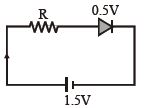
The diode used in the circuit shown in the figure has a constant voltage drop of $0.5 \, V$ at all currents and a maximum power rating of $100 \, mW$. What should be the value of the resistor $R$,connected in series with the diode,to obtain the maximum current?
A
$1.5 \, \Omega$
B
$5 \, \Omega$
C
$6.67 \, \Omega$
D
$200 \, \Omega$
Solution
(B) Given: Voltage drop across the diode $(V_D) = 0.5 \, V$. Maximum power rating of the diode $(P) = 100 \, mW = 100 \times 10^{-3} \, W$. Source voltage $(V_S) = 1.5 \, V$.
To find the maximum current $(I_{max})$ that the diode can handle:
$P = V_D \times I_{max}$
$I_{max} = \frac{P}{V_D} = \frac{100 \times 10^{-3} \, W}{0.5 \, V} = 0.2 \, A$.
Applying Kirchhoff's Voltage Law $(KVL)$ to the circuit:
$V_S = I_{max} \times R + V_D$
$1.5 \, V = (0.2 \, A) \times R + 0.5 \, V$
$1.5 - 0.5 = 0.2 \times R$
$1.0 = 0.2 \times R$
$R = \frac{1.0}{0.2} = 5 \, \Omega$.
Therefore,the value of the series resistor $R$ is $5 \, \Omega$.
To find the maximum current $(I_{max})$ that the diode can handle:
$P = V_D \times I_{max}$
$I_{max} = \frac{P}{V_D} = \frac{100 \times 10^{-3} \, W}{0.5 \, V} = 0.2 \, A$.
Applying Kirchhoff's Voltage Law $(KVL)$ to the circuit:
$V_S = I_{max} \times R + V_D$
$1.5 \, V = (0.2 \, A) \times R + 0.5 \, V$
$1.5 - 0.5 = 0.2 \times R$
$1.0 = 0.2 \times R$
$R = \frac{1.0}{0.2} = 5 \, \Omega$.
Therefore,the value of the series resistor $R$ is $5 \, \Omega$.
0 likesView Solution
29
ChemistryMCQAIPMT · 1997
Which of the following has the highest dipole moment?
A
$NH_3$
B
$PH_3$
C
$AsH_3$
D
$SbH_3$
Solution
(A) The dipole moment of the hydrides of group $15$ elements decreases down the group.
This is because the electronegativity of the central atom decreases from $N$ to $Bi$.
Since $N$ is the most electronegative element among them,$NH_3$ has the highest dipole moment.
This is because the electronegativity of the central atom decreases from $N$ to $Bi$.
Since $N$ is the most electronegative element among them,$NH_3$ has the highest dipole moment.
0 likesView Solution
30
ChemistryMCQAIPMT · 1997
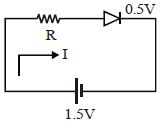
The diode used in the circuit shown in the figure has a constant voltage drop of $0.5 \, V$ at all currents and a maximum power rating of $100 \, mW$. What should be the value of the resistor $R$,connected in series with the diode,for obtaining maximum current?
A
$1.5 \, \Omega$
B
$5 \, \Omega$
C
$6.67 \, \Omega$
D
$200 \, \Omega$
Solution
(B) The maximum power rating of the diode is $P = 100 \, mW = 0.1 \, W$.
The voltage drop across the diode is $V_d = 0.5 \, V$.
The maximum current $I$ that can flow through the diode is given by $I = \frac{P}{V_d} = \frac{0.1 \, W}{0.5 \, V} = 0.2 \, A$.
According to Kirchhoff's voltage law for the circuit,the total voltage of the battery $V_b = 1.5 \, V$ is equal to the sum of the voltage drop across the resistor $V_R$ and the voltage drop across the diode $V_d$.
$V_b = V_R + V_d$
$1.5 \, V = I \cdot R + 0.5 \, V$
$1.5 \, V = (0.2 \, A) \cdot R + 0.5 \, V$
$1.0 \, V = 0.2 \cdot R$
$R = \frac{1.0}{0.2} \, \Omega = 5 \, \Omega$.
The voltage drop across the diode is $V_d = 0.5 \, V$.
The maximum current $I$ that can flow through the diode is given by $I = \frac{P}{V_d} = \frac{0.1 \, W}{0.5 \, V} = 0.2 \, A$.
According to Kirchhoff's voltage law for the circuit,the total voltage of the battery $V_b = 1.5 \, V$ is equal to the sum of the voltage drop across the resistor $V_R$ and the voltage drop across the diode $V_d$.
$V_b = V_R + V_d$
$1.5 \, V = I \cdot R + 0.5 \, V$
$1.5 \, V = (0.2 \, A) \cdot R + 0.5 \, V$
$1.0 \, V = 0.2 \cdot R$
$R = \frac{1.0}{0.2} \, \Omega = 5 \, \Omega$.
0 likesView Solution
31
ChemistryMCQAIPMT · 1997
The lanthanide contraction is responsible for the fact that
A
$Zr$ and $Y$ have about the same radius
B
$Zr$ and $Nb$ have similar oxidation state
C
$Zr$ and $Hf$ have almost the same radius
D
$Zr$ and $Zn$ have the same oxidation state
Solution
(C) Due to lanthanoid contraction,the atomic radii of $Zr$ $(160 \ pm)$ and $Hf$ $(159 \ pm)$ are almost the same. This occurs because the $4f$ orbitals are filled before the $5d$ series,and the poor shielding effect of $4f$ electrons leads to a greater effective nuclear charge,which offsets the expected increase in size down the group.
0 likesView Solution
32
ChemistryMCQAIPMT · 1997
The hydride ion $H^{-}$ is a stronger base than the hydroxide ion $OH^{-}$. If sodium hydride $(NaH)$ is dissolved in water,which of the following reactions will occur?
A
$H^{-}_{(aq)} + H_2O \to H_2O^{-}_{(aq)}$
B
$H^{-}_{(aq)} + H_2O_{(l)} \to OH^{-}_{(aq)} + H_{2(g)}$
C
$H^{-}_{(aq)} + H_2O_{(l)} \to \text{No reaction}$
D
None of these
Solution
(B) Since $H^{-}$ is a stronger base than $OH^{-}$,it will abstract a proton $(H^{+})$ from water.
The reaction is: $H^{-}_{(aq)} + H_2O_{(l)} \to OH^{-}_{(aq)} + H_{2(g)}$.
In this reaction,$H^{-}$ acts as a Bronsted-Lowry base and water acts as an acid.
The reaction is: $H^{-}_{(aq)} + H_2O_{(l)} \to OH^{-}_{(aq)} + H_{2(g)}$.
In this reaction,$H^{-}$ acts as a Bronsted-Lowry base and water acts as an acid.
0 likesView Solution
33
ChemistryDifficultMCQAIPMT · 1997
$N_2$ and $O_2$ are converted into monocations,$N_2^+$ and $O_2^+$ respectively. Which of the following statements is wrong?
A
In $N_2^+$,the $N-N$ bond weakens
B
In $O_2^+$,the $O-O$ bond order increases
C
In $O_2^+$,paramagnetism decreases
D
$N_2^+$ becomes diamagnetic
Solution
(D) The electronic configuration of $N_2$ is $\sigma 1s^2, \sigma^* 1s^2, \sigma 2s^2, \sigma^* 2s^2, \pi 2p_x^2 = \pi 2p_y^2, \sigma 2p_z^2$. Bond order = $(10-4)/2 = 3$.
In $N_2^+$,one electron is removed from the bonding molecular orbital $(\sigma 2p_z)$,so the configuration becomes $\sigma 1s^2, \sigma^* 1s^2, \sigma 2s^2, \sigma^* 2s^2, \pi 2p_x^2 = \pi 2p_y^2, \sigma 2p_z^1$. Bond order = $(9-4)/2 = 2.5$. Since the bond order decreases,the $N-N$ bond weakens and $N_2^+$ is paramagnetic.
For $O_2$,the configuration is $\sigma 1s^2, \sigma^* 1s^2, \sigma 2s^2, \sigma^* 2s^2, \sigma 2p_z^2, \pi 2p_x^2 = \pi 2p_y^2, \pi^* 2p_x^1 = \pi^* 2p_y^1$. Bond order = $(10-6)/2 = 2$.
In $O_2^+$,one electron is removed from the antibonding molecular orbital $(\pi^*)$,so the configuration becomes $\sigma 1s^2, \sigma^* 1s^2, \sigma 2s^2, \sigma^* 2s^2, \sigma 2p_z^2, \pi 2p_x^2 = \pi 2p_y^2, \pi^* 2p_x^1$. Bond order = $(10-5)/2 = 2.5$. The bond order increases,and paramagnetism decreases as the number of unpaired electrons reduces from $2$ to $1$.
Therefore,the statement that $N_2^+$ becomes diamagnetic is wrong.
In $N_2^+$,one electron is removed from the bonding molecular orbital $(\sigma 2p_z)$,so the configuration becomes $\sigma 1s^2, \sigma^* 1s^2, \sigma 2s^2, \sigma^* 2s^2, \pi 2p_x^2 = \pi 2p_y^2, \sigma 2p_z^1$. Bond order = $(9-4)/2 = 2.5$. Since the bond order decreases,the $N-N$ bond weakens and $N_2^+$ is paramagnetic.
For $O_2$,the configuration is $\sigma 1s^2, \sigma^* 1s^2, \sigma 2s^2, \sigma^* 2s^2, \sigma 2p_z^2, \pi 2p_x^2 = \pi 2p_y^2, \pi^* 2p_x^1 = \pi^* 2p_y^1$. Bond order = $(10-6)/2 = 2$.
In $O_2^+$,one electron is removed from the antibonding molecular orbital $(\pi^*)$,so the configuration becomes $\sigma 1s^2, \sigma^* 1s^2, \sigma 2s^2, \sigma^* 2s^2, \sigma 2p_z^2, \pi 2p_x^2 = \pi 2p_y^2, \pi^* 2p_x^1$. Bond order = $(10-5)/2 = 2.5$. The bond order increases,and paramagnetism decreases as the number of unpaired electrons reduces from $2$ to $1$.
Therefore,the statement that $N_2^+$ becomes diamagnetic is wrong.
0 likesView Solution
34
ChemistryMediumMCQAIPMT · 1997
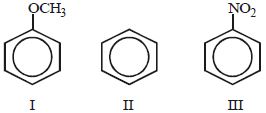
Among the following compounds $(I-III)$,the correct order of reactivity towards electrophilic substitution reaction is:
A
$I > II > III$
B
$II > III > I$
C
$III < I < II$
D
$I = II > III$
Solution
(A) Electrophilic substitution reaction is favored by the presence of electron-donating groups on the benzene ring,which increase the electron density and activate the ring. Conversely,electron-withdrawing groups decrease the electron density and deactivate the ring.
$I$: Anisole $(C_6H_5OCH_3)$ contains a $-OCH_3$ group,which is a strong electron-donating group due to the resonance effect ($+R$ effect),making it highly reactive.
$II$: Benzene $(C_6H_6)$ has no substituent,serving as the reference.
$III$: Nitrobenzene $(C_6H_5NO_2)$ contains a $-NO_2$ group,which is a strong electron-withdrawing group due to the $-R$ and $-I$ effects,making it the least reactive.
Therefore,the order of reactivity is $I > II > III$.
$I$: Anisole $(C_6H_5OCH_3)$ contains a $-OCH_3$ group,which is a strong electron-donating group due to the resonance effect ($+R$ effect),making it highly reactive.
$II$: Benzene $(C_6H_6)$ has no substituent,serving as the reference.
$III$: Nitrobenzene $(C_6H_5NO_2)$ contains a $-NO_2$ group,which is a strong electron-withdrawing group due to the $-R$ and $-I$ effects,making it the least reactive.
Therefore,the order of reactivity is $I > II > III$.
0 likesView Solution
35
ChemistryMCQAIPMT · 1997
The centre of mass of a system of particles does not depend on:
A
masses of the particles
B
position of the particles
C
relative distance between the particles
D
forces acting on the particles
Solution
(D) The centre of mass of a system of particles is defined by the position vector $\vec{R} = \frac{\sum m_i \vec{r}_i}{\sum m_i}$.
From this formula,it is evident that the centre of mass depends on the individual masses $(m_i)$ and their respective position vectors $(\vec{r}_i)$.
The relative distance between particles is inherently determined by their positions.
However,the centre of mass is a geometric property of the distribution of mass and is independent of any external or internal forces acting on the system.
From this formula,it is evident that the centre of mass depends on the individual masses $(m_i)$ and their respective position vectors $(\vec{r}_i)$.
The relative distance between particles is inherently determined by their positions.
However,the centre of mass is a geometric property of the distribution of mass and is independent of any external or internal forces acting on the system.
0 likesView Solution
36
ChemistryMCQAIPMT · 1997
The centre of mass of a system of particles does not depend on:
A
Forces acting on the particles
B
Position of the particles
C
Relative distance between the particles
D
Masses of the particles
Solution
(A) The position of the centre of mass $(R_{cm})$ of a system of particles is defined by the formula:
$R_{cm} = \frac{\sum m_i r_i}{\sum m_i}$
From this formula,it is evident that the centre of mass depends on the masses $(m_i)$ of the particles and their respective positions $(r_i)$.
The internal forces acting between particles in a system cancel each other out due to Newton's third law,and external forces affect the motion of the centre of mass,but the definition of the centre of mass itself is purely a geometric property based on mass distribution.
Therefore,the centre of mass does not depend on the forces acting on the particles.
$R_{cm} = \frac{\sum m_i r_i}{\sum m_i}$
From this formula,it is evident that the centre of mass depends on the masses $(m_i)$ of the particles and their respective positions $(r_i)$.
The internal forces acting between particles in a system cancel each other out due to Newton's third law,and external forces affect the motion of the centre of mass,but the definition of the centre of mass itself is purely a geometric property based on mass distribution.
Therefore,the centre of mass does not depend on the forces acting on the particles.
0 likesView Solution
37
ChemistryMediumMCQAIPMT · 1997
The electronic configuration of gadolinium (atomic no. $64$) is
A
$[Xe]4f^8 5d^9 6s^2$
B
$[Xe]4f^7 5d^1 6s^2$
C
$[Xe]4f^3 5d^5 6s^2$
D
$[Xe]4f^6 5d^2 6s^2$
Solution
(B) The electronic configuration of $La$ $(Z=57)$ is $[Xe] 5d^1 6s^2$.
Following this,the $4f$ orbitals are filled.
Europium ($Eu$,$Z=63$) has a stable half-filled $4f$ subshell with the configuration $[Xe] 4f^7 6s^2$.
For Gadolinium ($Gd$,$Z=64$),the next electron enters the $5d$ orbital instead of the $4f$ orbital to maintain the stability of the half-filled $4f^7$ configuration.
Therefore,the electronic configuration of $Gd$ $(Z=64)$ is $[Xe] 4f^7 5d^1 6s^2$.
Following this,the $4f$ orbitals are filled.
Europium ($Eu$,$Z=63$) has a stable half-filled $4f$ subshell with the configuration $[Xe] 4f^7 6s^2$.
For Gadolinium ($Gd$,$Z=64$),the next electron enters the $5d$ orbital instead of the $4f$ orbital to maintain the stability of the half-filled $4f^7$ configuration.
Therefore,the electronic configuration of $Gd$ $(Z=64)$ is $[Xe] 4f^7 5d^1 6s^2$.
0 likesView Solution
38
ChemistryMediumMCQAIPMT · 1997
Which of the following does not represent the correct order of the property indicated?
A
$Sc^{3+} > Cr^{3+} > Fe^{3+} > Mn^{3+}$ (ionic radii)
B
$Sc < Ti < Cr < Mn$ (density)
C
$Mn^{2+} > Ni^{2+} < Co^{2+} < Fe^{2+}$ (ionic radii)
D
$FeO < CaO > MnO > CuO$ (basic nature)
Solution
(A) The correct order for ionic radii of $M^{3+}$ ions is $Sc^{3+} > Cr^{3+} > Mn^{3+} > Fe^{3+}$.
Option $A$ is incorrect because the given order $Sc^{3+} > Cr^{3+} > Fe^{3+} > Mn^{3+}$ does not match the actual trend.
Option $B$ is correct as density generally increases across the $3d$ series.
Option $C$ is correct as ionic radii decrease with increasing atomic number for $M^{2+}$ ions,though there are minor variations.
Option $D$ is correct as basic nature depends on the oxidation state and electronegativity of the metal.
Option $A$ is incorrect because the given order $Sc^{3+} > Cr^{3+} > Fe^{3+} > Mn^{3+}$ does not match the actual trend.
Option $B$ is correct as density generally increases across the $3d$ series.
Option $C$ is correct as ionic radii decrease with increasing atomic number for $M^{2+}$ ions,though there are minor variations.
Option $D$ is correct as basic nature depends on the oxidation state and electronegativity of the metal.
0 likesView Solution
39
ChemistryEasyMCQAIPMT · 1997
Calcium is obtained by
A
Roasting of limestone
B
Electrolysis of solution of calcium chloride in $H_2O$
C
Reduction of calcium chloride with carbon
D
Electrolysis of molten anhydrous calcium chloride
Solution
(D) Calcium is obtained by the electrolysis of a fused mixture of calcium chloride $(CaCl_2)$ with about $16 \%$ calcium fluoride $(CaF_2)$ in a graphite crucible.
$CaF_2$ is added to lower the melting point of the mixture and to increase the electrical conductivity.
$CaF_2$ is added to lower the melting point of the mixture and to increase the electrical conductivity.
0 likesView Solution
40
ChemistryMediumMCQAIPMT · 1997
The structural formula of hypophosphorus acid is
A
B
C
D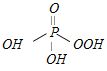
Solution
(A) Hypophosphorus acid is $H_3PO_2$.
In its structure,the central phosphorus atom is bonded to one oxygen atom by a double bond $(P=O)$,one hydroxyl group $(-OH)$,and two hydrogen atoms directly attached to the phosphorus atom $(P-H)$.
This structure is represented by option $A$.
In its structure,the central phosphorus atom is bonded to one oxygen atom by a double bond $(P=O)$,one hydroxyl group $(-OH)$,and two hydrogen atoms directly attached to the phosphorus atom $(P-H)$.
This structure is represented by option $A$.
0 likesView Solution
41
ChemistryMediumMCQAIPMT · 1997
The following reaction is described as:
$CH_3(CH_2)_5-CH(CH_3)-Br + OH^- \rightarrow HO-CH(CH_3)(CH_2)_5CH_3 + Br^-$
$CH_3(CH_2)_5-CH(CH_3)-Br + OH^- \rightarrow HO-CH(CH_3)(CH_2)_5CH_3 + Br^-$
A
$S_E2$
B
$S_N1$
C
$S_N2$
D
$S_N0$
Solution
(C) The reaction shows the nucleophilic substitution of a bromide ion by a hydroxide ion.
The product shows an inversion of configuration at the chiral carbon atom,which is a characteristic feature of the $S_N2$ mechanism.
In an $S_N2$ reaction (Bimolecular Nucleophilic Substitution),the nucleophile attacks from the side opposite to the leaving group,leading to Walden inversion.
The product shows an inversion of configuration at the chiral carbon atom,which is a characteristic feature of the $S_N2$ mechanism.
In an $S_N2$ reaction (Bimolecular Nucleophilic Substitution),the nucleophile attacks from the side opposite to the leaving group,leading to Walden inversion.
1 likesView Solution
42
ChemistryMediumMCQAIPMT · 1997
Which of the following $0.10 \ m$ aqueous solution will have the lowest freezing point?
A
$Al_2(SO_4)_3$
B
$C_5H_{10}O_5$
C
$KI$
D
$C_{12}H_{22}O_{11}$
Solution
(A) The freezing point depression is given by the formula $\Delta T_f = i \times K_f \times m$.
Since the molality $(m)$ and the solvent $(K_f)$ are the same for all solutions,the freezing point depends on the van't Hoff factor $(i)$.
$Al_2(SO_4)_3$ dissociates as $2Al^{3+} + 3SO_4^{2-}$,giving $i = 5$.
$C_5H_{10}O_5$ is a non-electrolyte,$i = 1$.
$KI$ dissociates as $K^+ + I^-$,giving $i = 2$.
$C_{12}H_{22}O_{11}$ is a non-electrolyte,$i = 1$.
Since $Al_2(SO_4)_3$ has the highest van't Hoff factor $(i=5)$,it will show the maximum depression in freezing point,resulting in the lowest freezing point.
Since the molality $(m)$ and the solvent $(K_f)$ are the same for all solutions,the freezing point depends on the van't Hoff factor $(i)$.
$Al_2(SO_4)_3$ dissociates as $2Al^{3+} + 3SO_4^{2-}$,giving $i = 5$.
$C_5H_{10}O_5$ is a non-electrolyte,$i = 1$.
$KI$ dissociates as $K^+ + I^-$,giving $i = 2$.
$C_{12}H_{22}O_{11}$ is a non-electrolyte,$i = 1$.
Since $Al_2(SO_4)_3$ has the highest van't Hoff factor $(i=5)$,it will show the maximum depression in freezing point,resulting in the lowest freezing point.
0 likesView Solution
43
ChemistryMediumMCQAIPMT · 1997
The intermetallic compound $LiAg$ crystallizes in a cubic lattice in which both lithium and silver have a coordination number of $8$. The crystal class is
A
Simple cube
B
Body-centred cube
C
Face-centred cube
D
None of these
Solution
(B) The coordination number of $8$ is characteristic of the body-centred cubic $(BCC)$ lattice structure.
In a $BCC$ unit cell,each atom at the center is surrounded by $8$ nearest neighbors,and each corner atom is also surrounded by $8$ nearest neighbors.
Therefore,the crystal class is body-centred cube.
In a $BCC$ unit cell,each atom at the center is surrounded by $8$ nearest neighbors,and each corner atom is also surrounded by $8$ nearest neighbors.
Therefore,the crystal class is body-centred cube.
0 likesView Solution
44
ChemistryMediumMCQAIPMT · 1997
$_{92}U^{235} + n \to \text{fission product} + \text{neutron} + 3.20 \times 10^{-11} \ J$. The energy released when $1 \ g$ of $_{92}U^{235}$ undergoes fission is
A
$12.75 \times 10^8 \ kJ$
B
$18.60 \times 10^9 \ kJ$
C
$8.21 \times 10^7 \ kJ$
D
$6.55 \times 10^6 \ kJ$
Solution
(C) The number of atoms in $1 \ g$ of $_{92}U^{235}$ is given by $\frac{1 \ g}{235 \ g/mol} \times 6.023 \times 10^{23} \ \text{atoms/mol} \approx 2.563 \times 10^{21} \ \text{atoms}$.
Energy released per atom is $3.20 \times 10^{-11} \ J$.
Total energy released $= (2.563 \times 10^{21} \ \text{atoms}) \times (3.20 \times 10^{-11} \ J/\text{atom}) = 8.2016 \times 10^{10} \ J$.
Converting to $kJ$: $8.2016 \times 10^{10} \ J = 8.2016 \times 10^7 \ kJ \approx 8.21 \times 10^7 \ kJ$.
Energy released per atom is $3.20 \times 10^{-11} \ J$.
Total energy released $= (2.563 \times 10^{21} \ \text{atoms}) \times (3.20 \times 10^{-11} \ J/\text{atom}) = 8.2016 \times 10^{10} \ J$.
Converting to $kJ$: $8.2016 \times 10^{10} \ J = 8.2016 \times 10^7 \ kJ \approx 8.21 \times 10^7 \ kJ$.
0 likesView Solution
45
ChemistryMediumMCQAIPMT · 1997
The experimental data for the reaction $2A + B_2 \to 2AB$ is given below. Determine the rate equation for the reaction.
| $Exp.$ | $[A]_0$ | $[B_2]_0$ | $Rate \ (mol \ L^{-1} \ s^{-1})$ |
| $(1)$ | $0.50$ | $0.50$ | $1.6 \times 10^{-4}$ |
| $(2)$ | $0.50$ | $1.00$ | $3.2 \times 10^{-4}$ |
| $(3)$ | $1.00$ | $1.00$ | $3.2 \times 10^{-4}$ |
A
$Rate = k [B_2]$
B
$Rate = k [B_2]^2$
C
$Rate = k [A]^2 [B_2]^2$
D
$Rate = k [A]^2 [B_2]$
Solution
(A) Let the rate law be $Rate = k [A]^x [B_2]^y$.
From experiment $(1)$ and $(2)$,$[A]_0$ is constant $(0.50 \ M)$ and $[B_2]_0$ is doubled ($0.50 \ M$ to $1.00 \ M$). The rate increases from $1.6 \times 10^{-4}$ to $3.2 \times 10^{-4}$ (doubled).
Therefore,$2^y = 2$,which implies $y = 1$.
From experiment $(2)$ and $(3)$,$[B_2]_0$ is constant $(1.00 \ M)$ and $[A]_0$ is doubled ($0.50 \ M$ to $1.00 \ M$). The rate remains $3.2 \times 10^{-4}$ (no change).
Therefore,$2^x = 1$,which implies $x = 0$.
Substituting the values of $x$ and $y$ into the rate law,we get $Rate = k [A]^0 [B_2]^1 = k [B_2]$.
From experiment $(1)$ and $(2)$,$[A]_0$ is constant $(0.50 \ M)$ and $[B_2]_0$ is doubled ($0.50 \ M$ to $1.00 \ M$). The rate increases from $1.6 \times 10^{-4}$ to $3.2 \times 10^{-4}$ (doubled).
Therefore,$2^y = 2$,which implies $y = 1$.
From experiment $(2)$ and $(3)$,$[B_2]_0$ is constant $(1.00 \ M)$ and $[A]_0$ is doubled ($0.50 \ M$ to $1.00 \ M$). The rate remains $3.2 \times 10^{-4}$ (no change).
Therefore,$2^x = 1$,which implies $x = 0$.
Substituting the values of $x$ and $y$ into the rate law,we get $Rate = k [A]^0 [B_2]^1 = k [B_2]$.
0 likesView Solution
46
ChemistryMediumMCQAIPMT · 1997
For the reaction $H_{2(g)} + I_{2(g)} \rightleftharpoons 2HI_{(g)}$,the rate of reaction is expressed as:
A
$-\frac{\Delta [H_2]}{\Delta t} = -\frac{\Delta [I_2]}{\Delta t} = \frac{1}{2} \frac{\Delta [HI]}{\Delta t}$
B
$\frac{\Delta [H_2]}{\Delta t} = \frac{\Delta [I_2]}{\Delta t} = \frac{1}{2} \frac{\Delta [HI]}{\Delta t}$
C
$\frac{\Delta [H_2]}{\Delta t} = \frac{1}{2} \frac{\Delta [I_2]}{\Delta t} = -\frac{\Delta [HI]}{\Delta t}$
D
None of these
Solution
(A) For a general reaction $aA + bB \rightarrow cC + dD$,the rate of reaction is given by:
Rate $= -\frac{1}{a} \frac{\Delta [A]}{\Delta t} = -\frac{1}{b} \frac{\Delta [B]}{\Delta t} = \frac{1}{c} \frac{\Delta [C]}{\Delta t} = \frac{1}{d} \frac{\Delta [D]}{\Delta t}$.
For the reaction $H_{2(g)} + I_{2(g)} \rightleftharpoons 2HI_{(g)}$,the stoichiometric coefficients are $1, 1, 2$ respectively.
Thus,the rate of reaction is expressed as:
Rate $= -\frac{\Delta [H_2]}{\Delta t} = -\frac{\Delta [I_2]}{\Delta t} = \frac{1}{2} \frac{\Delta [HI]}{\Delta t}$.
Rate $= -\frac{1}{a} \frac{\Delta [A]}{\Delta t} = -\frac{1}{b} \frac{\Delta [B]}{\Delta t} = \frac{1}{c} \frac{\Delta [C]}{\Delta t} = \frac{1}{d} \frac{\Delta [D]}{\Delta t}$.
For the reaction $H_{2(g)} + I_{2(g)} \rightleftharpoons 2HI_{(g)}$,the stoichiometric coefficients are $1, 1, 2$ respectively.
Thus,the rate of reaction is expressed as:
Rate $= -\frac{\Delta [H_2]}{\Delta t} = -\frac{\Delta [I_2]}{\Delta t} = \frac{1}{2} \frac{\Delta [HI]}{\Delta t}$.
0 likesView Solution
47
ChemistryMediumMCQAIPMT · 1997
The molar conductances of $NaCl$,$HCl$,and $CH_3COONa$ at infinite dilution are $126.45$,$426.16$,and $91 \ \Omega^{-1} \ cm^2 \ mol^{-1}$ respectively. The molar conductance of $CH_3COOH$ at infinite dilution is .............. $\Omega^{-1} \ cm^2 \ mol^{-1}$.
A
$201.28$
B
$390.71$
C
$698.28$
D
$540.48$
Solution
(B) According to Kohlrausch's law of independent migration of ions:
$\Lambda_m^o(CH_3COOH) = \Lambda_m^o(CH_3COONa) + \Lambda_m^o(HCl) - \Lambda_m^o(NaCl)$
Substituting the given values:
$\Lambda_m^o(CH_3COOH) = 91 + 426.16 - 126.45$
$\Lambda_m^o(CH_3COOH) = 390.71 \ \Omega^{-1} \ cm^2 \ mol^{-1}$.
$\Lambda_m^o(CH_3COOH) = \Lambda_m^o(CH_3COONa) + \Lambda_m^o(HCl) - \Lambda_m^o(NaCl)$
Substituting the given values:
$\Lambda_m^o(CH_3COOH) = 91 + 426.16 - 126.45$
$\Lambda_m^o(CH_3COOH) = 390.71 \ \Omega^{-1} \ cm^2 \ mol^{-1}$.
0 likesView Solution
48
ChemistryMediumMCQAIPMT · 1997
The $E^o$ for the cell $Zn|Zn^{2+}_{(aq)}||Cu^{2+}_{(aq)}|Cu$ is $1.10 \ V$ at $25 \ ^oC$. The equilibrium constant for the reaction $Zn + Cu^{2+}_{(aq)} \rightleftharpoons Cu + Zn^{2+}_{(aq)}$ is of the order of:
A
$10^{-28}$
B
$10^{+37}$
C
$10^{+18}$
D
$10^{+17}$
Solution
(B) For the given cell reaction,the number of electrons transferred is $n = 2$.
Using the Nernst equation at equilibrium: $E_{cell}^o = \frac{0.0591}{n} \log K_c$.
Substituting the values: $1.10 = \frac{0.0591}{2} \log K_c$.
$\log K_c = \frac{1.10 \times 2}{0.0591} \approx 37.22$.
Therefore,$K_c = 10^{37.22} \approx 10^{37}$.
Using the Nernst equation at equilibrium: $E_{cell}^o = \frac{0.0591}{n} \log K_c$.
Substituting the values: $1.10 = \frac{0.0591}{2} \log K_c$.
$\log K_c = \frac{1.10 \times 2}{0.0591} \approx 37.22$.
Therefore,$K_c = 10^{37.22} \approx 10^{37}$.
0 likesView Solution
49
ChemistryEasyMCQAIPMT · 1997
The ability of an ion to bring about coagulation of a given colloid depends upon
A
Its size
B
The magnitude of its charge only
C
The sign of its charge
D
Both the magnitude and the sign of its charge
Solution
(D) The ability of an ion to bring about coagulation of a given colloid depends upon both the magnitude and sign of its charge. According to the $Hardy-Schulze$ rule,greater the valence of the flocculating ion added,the greater is its power to cause precipitation.
0 likesView Solution
50
ChemistryEasyMCQAIPMT · 1997
The lanthanide contraction is responsible for the fact that
A
$Zr$ and $Y$ have about the same radius
B
$Zr$ and $Nb$ have similar oxidation state
C
$Zr$ and $Hf$ have about the same radius
D
$Zr$ and $Zn$ have the same oxidation state
Solution
(C) Due to lanthanide contraction,the atomic radii of $Zr$ and $Hf$ are nearly identical.
Lanthanide contraction is explained by the poor shielding effect of $4f$ electrons.
In multi-electron atoms,inner electrons shield outer electrons from the nuclear charge.
The shielding efficiency follows the order $s > p > d > f$.
Because the $4f$ subshell has a very poor shielding effect,the outer electrons experience a higher effective nuclear charge,leading to a decrease in atomic size.
This effect causes elements of the $5d$ series (like $Hf$) to have radii very similar to their counterparts in the $4d$ series (like $Zr$).
Lanthanide contraction is explained by the poor shielding effect of $4f$ electrons.
In multi-electron atoms,inner electrons shield outer electrons from the nuclear charge.
The shielding efficiency follows the order $s > p > d > f$.
Because the $4f$ subshell has a very poor shielding effect,the outer electrons experience a higher effective nuclear charge,leading to a decrease in atomic size.
This effect causes elements of the $5d$ series (like $Hf$) to have radii very similar to their counterparts in the $4d$ series (like $Zr$).
0 likesView Solution
51
ChemistryMediumMCQAIPMT · 1997
$K_2Cr_2O_7$ on heating with aqueous $NaOH$ gives:
A
$CrO_4^{2-}$
B
$Cr(OH)_3$
C
$Cr_2O_7^{2-}$
D
$Cr(OH)_2$
Solution
(A) When potassium dichromate $(K_2Cr_2O_7)$ reacts with an aqueous solution of sodium hydroxide $(NaOH)$,it forms potassium chromate and sodium chromate.
The chemical equation is: $K_2Cr_2O_7 + 2NaOH \rightarrow K_2CrO_4 + Na_2CrO_4 + H_2O$.
In this reaction,the orange dichromate ion $(Cr_2O_7^{2-})$ is converted into the yellow chromate ion $(CrO_4^{2-})$.
The chemical equation is: $K_2Cr_2O_7 + 2NaOH \rightarrow K_2CrO_4 + Na_2CrO_4 + H_2O$.
In this reaction,the orange dichromate ion $(Cr_2O_7^{2-})$ is converted into the yellow chromate ion $(CrO_4^{2-})$.
0 likesView Solution
52
ChemistryDifficultMCQAIPMT · 1997
The formula of dichloro bis (urea) copper $(II)$ is
A
$[Cu\{O=C(NH_2)_2\}Cl_2]$
B
$[CuCl_2\{O=C(NH_2)_2\}_2]$
C
$[Cu\{O=C(NH_2)_2\}Cl]Cl$
D
$[CuCl_2]\{O=C(NH_2)_2\}_2$
Solution
(B) In this coordination complex,the central metal ion is $Cu^{2+}$.
There are $2$ chloro ligands $(Cl^-)$ and $2$ urea ligands $(O=C(NH_2)_2)$.
According to $IUPAC$ nomenclature rules for coordination compounds,ligands are named in alphabetical order.
'Chloro' comes before 'urea'.
Since there are $2$ urea ligands,the prefix 'bis' is used for the ligand name 'urea'.
Thus,the formula is written as $[CuCl_2\{O=C(NH_2)_2\}_2]$.
Therefore,the correct option is $B$.
There are $2$ chloro ligands $(Cl^-)$ and $2$ urea ligands $(O=C(NH_2)_2)$.
According to $IUPAC$ nomenclature rules for coordination compounds,ligands are named in alphabetical order.
'Chloro' comes before 'urea'.
Since there are $2$ urea ligands,the prefix 'bis' is used for the ligand name 'urea'.
Thus,the formula is written as $[CuCl_2\{O=C(NH_2)_2\}_2]$.
Therefore,the correct option is $B$.
0 likesView Solution
53
ChemistryMediumMCQAIPMT · 1997
The number of geometrical isomers of the complex $[Co(NO_2)_2(NH_3)_2]$ is
A
$2$
B
$3$
C
$4$
D
$0$
Solution
(A) The given complex is $[Co(NO_2)_2(NH_3)_2]$. Assuming a square planar geometry (as it is a $4$-coordinate complex),it follows the form $[MA_2B_2]$.
For a square planar complex of the type $[MA_2B_2]$,there are $2$ possible geometrical isomers: $cis$ and $trans$.
In the $cis$ isomer,the identical ligands are adjacent to each other.
In the $trans$ isomer,the identical ligands are opposite to each other.
Therefore,the total number of geometrical isomers is $2$.
For a square planar complex of the type $[MA_2B_2]$,there are $2$ possible geometrical isomers: $cis$ and $trans$.
In the $cis$ isomer,the identical ligands are adjacent to each other.
In the $trans$ isomer,the identical ligands are opposite to each other.
Therefore,the total number of geometrical isomers is $2$.
0 likesView Solution
54
ChemistryMediumMCQAIPMT · 1997
The replacement of $Cl$ in chlorobenzene to form phenol requires drastic conditions,but the chlorine in $2,4-$dinitrochlorobenzene is readily replaced because:
A
$NO_2$ makes the ring electron-rich at the ortho and para positions.
B
$NO_2$ withdraws $e^-$ from the meta position.
C
$NO_2$ donates $e^-$ at the meta position.
D
$NO_2$ withdraws $e^-$ from the ortho and para positions.
Solution
(D) The presence of electron-withdrawing groups like $-NO_2$ at the ortho and para positions relative to the halogen atom significantly activates the benzene ring toward nucleophilic aromatic substitution.
This occurs because the $-NO_2$ group stabilizes the carbanion intermediate (Meisenheimer complex) formed during the reaction by withdrawing electron density through both inductive and resonance effects.
In $2,4-$dinitrochlorobenzene,the two $-NO_2$ groups are located at the ortho and para positions,which effectively delocalize the negative charge of the intermediate,thereby lowering the activation energy for the substitution reaction.
This occurs because the $-NO_2$ group stabilizes the carbanion intermediate (Meisenheimer complex) formed during the reaction by withdrawing electron density through both inductive and resonance effects.
In $2,4-$dinitrochlorobenzene,the two $-NO_2$ groups are located at the ortho and para positions,which effectively delocalize the negative charge of the intermediate,thereby lowering the activation energy for the substitution reaction.
0 likesView Solution
55
ChemistryMediumMCQAIPMT · 1997
Ketones $(R-C(=O)-R_1)$ where $R = R_1 = \text{alkyl group}$. It can be obtained in one step by:
A
Hydrolysis of esters
B
Oxidation of primary alcohol
C
Oxidation of secondary alcohol
D
Reaction of acid halide with alcohols
Solution
(C) Primary alcohols upon oxidation yield aldehydes,whereas secondary alcohols upon oxidation yield ketones.
$R-CH(OH)-R_1 \xrightarrow{[O]} R-C(=O)-R_1 + H_2O$.
Hydrolysis of esters yields carboxylic acids and alcohols.
Reaction of acid halides with alcohols yields esters.
$R-CH(OH)-R_1 \xrightarrow{[O]} R-C(=O)-R_1 + H_2O$.
Hydrolysis of esters yields carboxylic acids and alcohols.
Reaction of acid halides with alcohols yields esters.
0 likesView Solution
56
ChemistryEasyMCQAIPMT · 1997
Phenylmethanol can be prepared by reducing benzaldehyde with:
A
$CH_3Br$
B
$Zn$ and $HCl$
C
$CH_3Br$ and $Na$
D
$CH_3I$ and $Mg$
Solution
(B) Phenylmethanol (benzyl alcohol) can be prepared from benzaldehyde by reduction. While common laboratory reagents for reducing aldehydes to alcohols include $NaBH_4$ or $LiAlH_4$,the reaction of benzaldehyde with $Zn/HCl$ (Clemmensen reduction conditions) typically reduces the carbonyl group to a methylene group (forming toluene). However,in the context of this specific question,$Zn/HCl$ is provided as the intended reducing agent to produce the alcohol. The reaction is: $C_6H_5CHO + 2[H] \xrightarrow{Zn/HCl} C_6H_5CH_2OH$.
0 likesView Solution
57
ChemistryDifficultMCQAIPMT · 1997
Which of the following can possibly be used as an analgesic without causing addiction and mood modification?
A
Morphine
B
$N$-acetyl-para-aminophenol
C
Diazepam
D
Tetrahydrocannabinol
Solution
(B) The correct answer is $B$. $N$-acetyl-para-aminophenol (also known as Paracetamol) is a non-narcotic analgesic.
Non-narcotic analgesics are drugs that relieve pain without causing addiction or mood modification.
Morphine is a narcotic analgesic,while Diazepam is a tranquilizer and Tetrahydrocannabinol is a psychoactive substance.
Non-narcotic analgesics are drugs that relieve pain without causing addiction or mood modification.
Morphine is a narcotic analgesic,while Diazepam is a tranquilizer and Tetrahydrocannabinol is a psychoactive substance.
0 likesView Solution
58
ChemistryDifficultMCQAIPMT · 1997
When chloroform reacts with ethyl amine in the presence of alcoholic $KOH$,the compound formed is
A
Ethyl cyanide
B
Ethyl isocyanide
C
Formic acid
D
An amide
Solution
(B) The reaction between a primary amine,chloroform,and alcoholic $KOH$ is known as the carbylamine reaction.
The chemical equation is: $CHCl_3 + C_2H_5NH_2 + 3KOH \to C_2H_5NC + 3KCl + 3H_2O$.
In this reaction,ethyl amine $(C_2H_5NH_2)$ reacts with chloroform $(CHCl_3)$ and alcoholic potassium hydroxide $(KOH)$ to produce ethyl isocyanide $(C_2H_5NC)$,which has a characteristic foul smell.
The chemical equation is: $CHCl_3 + C_2H_5NH_2 + 3KOH \to C_2H_5NC + 3KCl + 3H_2O$.
In this reaction,ethyl amine $(C_2H_5NH_2)$ reacts with chloroform $(CHCl_3)$ and alcoholic potassium hydroxide $(KOH)$ to produce ethyl isocyanide $(C_2H_5NC)$,which has a characteristic foul smell.
0 likesView Solution
59
ChemistryDifficultMCQAIPMT · 1997
Which one of the following is used to make 'non-stick' cookware?
A
$PVC$
B
Polystyrene
C
Polyethylene terephthalate
D
Polytetrafluoroethylene
Solution
(D) Teflon (Polytetrafluoroethylene) has great chemical inertness and high thermal stability,hence it is used for making non-stick utensils.
For this purpose,a thin layer of Teflon is coated on the inner side of the vessel.
For this purpose,a thin layer of Teflon is coated on the inner side of the vessel.
0 likesView Solution
60
ChemistryEasyMCQAIPMT · 1997
What is the primary function of enzymes in living systems?
A
Provide energy
B
Provide immunity
C
Transport oxygen
D
Catalyse biological processes
Solution
(D) The primary function of enzymes in living systems is to catalyse biochemical reactions.
Enzymes are highly substrate-specific and accelerate reactions by providing an alternate pathway with lower activation energy.
Enzymes are highly substrate-specific and accelerate reactions by providing an alternate pathway with lower activation energy.
0 likesView Solution
61
ChemistryEasyMCQAIPMT · 1997
Haemoglobin is
A
An enzyme
B
$A$ globular protein
C
$A$ vitamin
D
$A$ carbohydrate
Solution
(B) Haemoglobin is a globular protein. It is a conjugated protein that transports oxygen in the blood.
0 likesView Solution
62
ChemistryMediumMCQAIPMT · 1997
An alkyl halide may be converted into an alcohol by
A
Addition
B
Substitution
C
Dehydrohalogenation
D
Elimination
Solution
(B) The conversion of an alkyl halide $(R-X)$ to an alcohol $(R-OH)$ is a nucleophilic substitution reaction.
When an alkyl halide is treated with an aqueous alkali like $Aq. KOH$ or $NaOH$,the halide ion $(X^-)$ is replaced by the hydroxyl group $(OH^-)$.
Reaction: $R-X + KOH (aq) \rightarrow R-OH + KX$.
This is a nucleophilic substitution reaction ($S_N1$ or $S_N2$ depending on the substrate).
Therefore,the correct option is $B$.
When an alkyl halide is treated with an aqueous alkali like $Aq. KOH$ or $NaOH$,the halide ion $(X^-)$ is replaced by the hydroxyl group $(OH^-)$.
Reaction: $R-X + KOH (aq) \rightarrow R-OH + KX$.
This is a nucleophilic substitution reaction ($S_N1$ or $S_N2$ depending on the substrate).
Therefore,the correct option is $B$.
0 likesView Solution
63
ChemistryMediumMCQAIPMT · 1997
Assertion : Ionic reactions are not instantaneous.
Reason : Oppositely charged ions exert strong forces.
Reason : Oppositely charged ions exert strong forces.
A
If both Assertion and Reason are correct and the Reason is a correct explanation of the Assertion.
B
If both Assertion and Reason are correct but Reason is not a correct explanation of the Assertion.
C
If the Assertion is correct but Reason is incorrect.
D
If the Assertion is incorrect but the Reason is correct.
Solution
(D) Ionic reactions involve the interaction of oppositely charged ions in solution. Because these ions exert strong electrostatic forces of attraction on each other,they combine almost immediately upon mixing. Therefore,ionic reactions are considered to be instantaneous. The Assertion is incorrect,while the Reason is correct.
0 likesView Solution
Vedclass Products
For Students
Vedclass Test Series
Mock tests in real AIPMT style covering Chemistry with performance analysis. 5-day free trial.
Start Free TrialFor Teachers
Exam Paper Generator
Generate Set A/B/C/D Chemistry papers from 7.5L+ questions in 2 minutes. 3 chapters free.
Try FreeFor Institutes
Online Exam Module
Run live AIPMT mock exams with unlimited students, 360° analytics & white-label branding.
See DemoFrequently Asked Questions
How many Chemistry questions are in AIPMT 1997?
There are 63 Chemistry questions from the AIPMT 1997 paper on Vedclass, each with a detailed step-by-step solution in English.
Are AIPMT 1997 Chemistry solutions available in English?
Yes. All solutions on this page are in English. You can also switch to English or Hindi using the language buttons above the questions.
Can I practice AIPMT 1997 Chemistry as a timed test?
Yes. Use the Vedclass Test Series to attempt a full AIPMT mock test covering Chemistry with time limits and instant score analysis.
Can teachers create Chemistry papers from AIPMT previous year questions?
Yes. The Vedclass Exam Paper Generator lets teachers mix AIPMT Chemistry questions and generate Set A/B/C/D papers in minutes.
For Teachers & Institutes
Build a Custom Chemistry Paper
Pick AIPMT 1997 Chemistry questions, set difficulty, and generate Set A/B/C/D in 2 minutes.