
PhysicsQ1–42 of 42 questions
Page 1 of 1 · English
1
PhysicsEasyMCQAIPMT · 1993
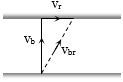
$A$ boat crosses a river with a velocity of $8 \, km/h$ relative to the water. If the resultant velocity of the boat with respect to the ground is $10 \, km/h$,then the velocity of the river water is...........$km/h$.
A
$12$
B
$6$
C
$5$
D
$10$
Solution
(B) Let $\overrightarrow{v_b}$ be the velocity of the boat relative to the water and $\overrightarrow{v_r}$ be the velocity of the river water relative to the ground.
The resultant velocity of the boat relative to the ground is given by $\overrightarrow{v_{bg}} = \overrightarrow{v_b} + \overrightarrow{v_r}$.
Since the boat crosses the river perpendicular to the flow,the vectors $\overrightarrow{v_b}$ and $\overrightarrow{v_r}$ are perpendicular to each other.
Therefore,the magnitude of the resultant velocity is $v_{bg} = \sqrt{v_b^2 + v_r^2}$.
Given $v_{bg} = 10 \, km/h$ and $v_b = 8 \, km/h$,we have:
$10 = \sqrt{8^2 + v_r^2}$
$100 = 64 + v_r^2$
$v_r^2 = 100 - 64 = 36$
$v_r = 6 \, km/h$.
The resultant velocity of the boat relative to the ground is given by $\overrightarrow{v_{bg}} = \overrightarrow{v_b} + \overrightarrow{v_r}$.
Since the boat crosses the river perpendicular to the flow,the vectors $\overrightarrow{v_b}$ and $\overrightarrow{v_r}$ are perpendicular to each other.
Therefore,the magnitude of the resultant velocity is $v_{bg} = \sqrt{v_b^2 + v_r^2}$.
Given $v_{bg} = 10 \, km/h$ and $v_b = 8 \, km/h$,we have:
$10 = \sqrt{8^2 + v_r^2}$
$100 = 64 + v_r^2$
$v_r^2 = 100 - 64 = 36$
$v_r = 6 \, km/h$.
0 likesView Solution
2
PhysicsMediumMCQAIPMT · 1993
$A$ body starts from rest. What is the ratio of the distance travelled by the body during the $4^{th}$ and $3^{rd}$ second?
A
$\frac{7}{5}$
B
$\frac{5}{7}$
C
$\frac{7}{3}$
D
$\frac{3}{7}$
Solution
(A) The distance travelled by a body in the $n^{th}$ second is given by the formula: $S_n = u + \frac{a}{2}(2n - 1)$.
Since the body starts from rest,the initial velocity $u = 0$.
Therefore,the distance travelled in the $n^{th}$ second is $S_n = \frac{a}{2}(2n - 1)$.
For the $4^{th}$ second $(n = 4)$: $S_4 = \frac{a}{2}(2 \times 4 - 1) = \frac{a}{2}(7) = \frac{7a}{2}$.
For the $3^{rd}$ second $(n = 3)$: $S_3 = \frac{a}{2}(2 \times 3 - 1) = \frac{a}{2}(5) = \frac{5a}{2}$.
The ratio of the distance travelled in the $4^{th}$ second to the $3^{rd}$ second is: $\frac{S_4}{S_3} = \frac{7a/2}{5a/2} = \frac{7}{5}$.
Since the body starts from rest,the initial velocity $u = 0$.
Therefore,the distance travelled in the $n^{th}$ second is $S_n = \frac{a}{2}(2n - 1)$.
For the $4^{th}$ second $(n = 4)$: $S_4 = \frac{a}{2}(2 \times 4 - 1) = \frac{a}{2}(7) = \frac{7a}{2}$.
For the $3^{rd}$ second $(n = 3)$: $S_3 = \frac{a}{2}(2 \times 3 - 1) = \frac{a}{2}(5) = \frac{5a}{2}$.
The ratio of the distance travelled in the $4^{th}$ second to the $3^{rd}$ second is: $\frac{S_4}{S_3} = \frac{7a/2}{5a/2} = \frac{7}{5}$.
0 likesView Solution
3
PhysicsEasyMCQAIPMT · 1993
$A$ block is at rest on an inclined plane making an angle $\alpha$ with the horizontal. As the angle $\alpha$ of the incline is increased,the block starts slipping when the angle of inclination becomes $\theta$. The coefficient of static friction between the block and the surface of the inclined plane is:
A
$\sin \theta$
B
$\cos \theta$
C
$\tan \theta$
D
Independent of $\theta$
Solution
(C) When a block is placed on an inclined plane,the forces acting on it are the gravitational force $(mg)$,the normal force $(N)$,and the static frictional force $(f_s)$.
The component of weight acting down the plane is $mg \sin \alpha$ and the component perpendicular to the plane is $mg \cos \alpha$.
For the block to be at rest,the frictional force $f_s = mg \sin \alpha$ and the normal force $N = mg \cos \alpha$.
The block starts slipping when the angle of inclination reaches the angle of repose,$\theta$. At this point,the static friction reaches its maximum value,$f_{s,max} = \mu_s N$.
Equating the forces at the point of slipping: $mg \sin \theta = \mu_s (mg \cos \theta)$.
Dividing both sides by $mg \cos \theta$,we get $\mu_s = \frac{\sin \theta}{\cos \theta} = \tan \theta$.
Thus,the coefficient of static friction is $\tan \theta$.
The component of weight acting down the plane is $mg \sin \alpha$ and the component perpendicular to the plane is $mg \cos \alpha$.
For the block to be at rest,the frictional force $f_s = mg \sin \alpha$ and the normal force $N = mg \cos \alpha$.
The block starts slipping when the angle of inclination reaches the angle of repose,$\theta$. At this point,the static friction reaches its maximum value,$f_{s,max} = \mu_s N$.
Equating the forces at the point of slipping: $mg \sin \theta = \mu_s (mg \cos \theta)$.
Dividing both sides by $mg \cos \theta$,we get $\mu_s = \frac{\sin \theta}{\cos \theta} = \tan \theta$.
Thus,the coefficient of static friction is $\tan \theta$.
0 likesView Solution
4
PhysicsEasyMCQAIPMT · 1993
Masses of two substances are $1\, g$ and $9\, g$ respectively. If their kinetic energies are same,then the ratio of their momentum will be
A
$1:9$
B
$9:1$
C
$3:1$
D
$1:3$
Solution
(D) The relationship between kinetic energy $(K)$,momentum $(P)$,and mass $(m)$ is given by $K = \frac{P^2}{2m}$.
Since the kinetic energies are the same $(K_1 = K_2)$,we have $\frac{P_1^2}{2m_1} = \frac{P_2^2}{2m_2}$.
Rearranging the terms,we get $\frac{P_1^2}{P_2^2} = \frac{m_1}{m_2}$.
Taking the square root on both sides,the ratio of their momenta is $\frac{P_1}{P_2} = \sqrt{\frac{m_1}{m_2}}$.
Given $m_1 = 1\, g$ and $m_2 = 9\, g$,we substitute these values:
$\frac{P_1}{P_2} = \sqrt{\frac{1}{9}} = \frac{1}{3}$.
Therefore,the ratio of their momentum is $1:3$.
Since the kinetic energies are the same $(K_1 = K_2)$,we have $\frac{P_1^2}{2m_1} = \frac{P_2^2}{2m_2}$.
Rearranging the terms,we get $\frac{P_1^2}{P_2^2} = \frac{m_1}{m_2}$.
Taking the square root on both sides,the ratio of their momenta is $\frac{P_1}{P_2} = \sqrt{\frac{m_1}{m_2}}$.
Given $m_1 = 1\, g$ and $m_2 = 9\, g$,we substitute these values:
$\frac{P_1}{P_2} = \sqrt{\frac{1}{9}} = \frac{1}{3}$.
Therefore,the ratio of their momentum is $1:3$.
1 likesView Solution
5
PhysicsMediumMCQAIPMT · 1993
$A$ satellite $A$ of mass $m$ is at a distance of $r$ from the centre of the earth. Another satellite $B$ of mass $2m$ is at a distance of $2r$ from the earth's centre. Their time periods are in the ratio of:
A
$1:2$
B
$1:16$
C
$1:32$
D
$1:2\sqrt{2}$
Solution
(D) According to Kepler's Third Law of Planetary Motion,the square of the time period $T$ of a satellite is directly proportional to the cube of its orbital radius $r$,i.e.,$T^2 \propto r^3$.
This relationship is independent of the mass of the satellite.
Given for satellite $A$: $r_A = r$.
Given for satellite $B$: $r_B = 2r$.
The ratio of their time periods is given by:
$\frac{T_A}{T_B} = \left( \frac{r_A}{r_B} \right)^{3/2} = \left( \frac{r}{2r} \right)^{3/2} = \left( \frac{1}{2} \right)^{3/2} = \frac{1}{2^{3/2}} = \frac{1}{2 \cdot 2^{1/2}} = \frac{1}{2\sqrt{2}}$.
Thus,the ratio is $1:2\sqrt{2}$.
This relationship is independent of the mass of the satellite.
Given for satellite $A$: $r_A = r$.
Given for satellite $B$: $r_B = 2r$.
The ratio of their time periods is given by:
$\frac{T_A}{T_B} = \left( \frac{r_A}{r_B} \right)^{3/2} = \left( \frac{r}{2r} \right)^{3/2} = \left( \frac{1}{2} \right)^{3/2} = \frac{1}{2^{3/2}} = \frac{1}{2 \cdot 2^{1/2}} = \frac{1}{2\sqrt{2}}$.
Thus,the ratio is $1:2\sqrt{2}$.
0 likesView Solution
6
PhysicsEasyMCQAIPMT · 1993
How does the melting point of ice change with increasing pressure?
A
Increases with increasing pressure
B
Decreases with increasing pressure
C
Is independent of pressure
D
Is proportional to pressure
Solution
(B) The melting point of ice decreases with an increase in pressure. This is because ice expands upon solidification,meaning its volume increases when it turns from liquid water to solid ice. According to Le Chatelier's principle and the Clausius-Clapeyron relation,for substances that expand upon freezing,an increase in pressure lowers the melting point.
0 likesView Solution
7
PhysicsEasyMCQAIPMT · 1993
For hydrogen gas $C_p - C_v = a$ and for oxygen gas $C_p - C_v = b$. The relation between $a$ and $b$ is given by:
A
$a = 16b$
B
$b = 16a$
C
$a = 4b$
D
$a = b$
Solution
(D) According to Mayer's relation,for any ideal gas,the difference between the molar heat capacity at constant pressure $(C_p)$ and the molar heat capacity at constant volume $(C_v)$ is equal to the universal gas constant $(R)$.
Mathematically,$C_p - C_v = R$.
Since $R$ is a universal constant,it is the same for all ideal gases regardless of their molecular weight or composition.
For hydrogen gas,$C_p - C_v = a = R$.
For oxygen gas,$C_p - C_v = b = R$.
Therefore,$a = b$.
Mathematically,$C_p - C_v = R$.
Since $R$ is a universal constant,it is the same for all ideal gases regardless of their molecular weight or composition.
For hydrogen gas,$C_p - C_v = a = R$.
For oxygen gas,$C_p - C_v = b = R$.
Therefore,$a = b$.
0 likesView Solution
8
PhysicsEasyMCQAIPMT · 1993
The number of translational degrees of freedom for a diatomic gas is
A
$2$
B
$3$
C
$5$
D
$6$
Solution
(B) For a diatomic gas molecule,the motion can be described in three-dimensional space.
The number of translational degrees of freedom is always $3$ for any gas molecule,corresponding to motion along the $x, y,$ and $z$ axes.
The number of rotational degrees of freedom for a rigid diatomic molecule is $2$.
Therefore,the number of translational degrees of freedom is $3$.
The number of translational degrees of freedom is always $3$ for any gas molecule,corresponding to motion along the $x, y,$ and $z$ axes.
The number of rotational degrees of freedom for a rigid diatomic molecule is $2$.
Therefore,the number of translational degrees of freedom is $3$.
0 likesView Solution
9
PhysicsEasyMCQAIPMT · 1993
$110\; J$ of heat is added to a gaseous system,whose internal energy change is $40\; J$,then the amount of external work done is ........ $J$.
A
$150$
B
$70$
C
$110$
D
$40$
Solution
(B) According to the First Law of Thermodynamics,the heat supplied to a system is equal to the sum of the change in internal energy and the work done by the system.
$\Delta Q = \Delta U + \Delta W$
Given:
Heat added,$\Delta Q = 110\; J$
Change in internal energy,$\Delta U = 40\; J$
Rearranging the formula to find the work done:
$\Delta W = \Delta Q - \Delta U$
$\Delta W = 110\; J - 40\; J = 70\; J$
Therefore,the amount of external work done is $70\; J$.
$\Delta Q = \Delta U + \Delta W$
Given:
Heat added,$\Delta Q = 110\; J$
Change in internal energy,$\Delta U = 40\; J$
Rearranging the formula to find the work done:
$\Delta W = \Delta Q - \Delta U$
$\Delta W = 110\; J - 40\; J = 70\; J$
Therefore,the amount of external work done is $70\; J$.
0 likesView Solution
10
PhysicsEasyMCQAIPMT · 1993
Which of the following is not a thermodynamic state function?
A
Enthalpy
B
Work done
C
Gibbs energy
D
Internal energy
Solution
(B) thermodynamic state function is a property whose value depends only on the current state of the system and not on the path taken to reach that state.
Enthalpy $(H)$,Gibbs energy $(G)$,and Internal energy $(U)$ are all state functions because they depend only on the state variables of the system.
Work done $(W)$ is a path function,meaning its value depends on the specific process or path taken to change the state of the system.
Therefore,work done is not a thermodynamic state function.
Enthalpy $(H)$,Gibbs energy $(G)$,and Internal energy $(U)$ are all state functions because they depend only on the state variables of the system.
Work done $(W)$ is a path function,meaning its value depends on the specific process or path taken to change the state of the system.
Therefore,work done is not a thermodynamic state function.
0 likesView Solution
11
PhysicsEasyMCQAIPMT · 1993
Which of the following parameters does not characterize the thermodynamic state of matter?
A
Volume
B
Temperature
C
Pressure
D
Work
Solution
(D) The thermodynamic state of a system is defined by state functions such as Pressure $(P)$,Volume $(V)$,Temperature $(T)$,and Internal Energy $(U)$. These depend only on the current state of the system,not on the path taken to reach that state.
Work $(W)$ is a path function,not a state function. It represents the energy transferred between the system and its surroundings due to a process,and its value depends on the specific path taken during the thermodynamic process. Therefore,work does not characterize the thermodynamic state of matter.
Work $(W)$ is a path function,not a state function. It represents the energy transferred between the system and its surroundings due to a process,and its value depends on the specific path taken during the thermodynamic process. Therefore,work does not characterize the thermodynamic state of matter.
0 likesView Solution
12
PhysicsMediumMCQAIPMT · 1993
If the temperature of the sun (black body) is doubled,the rate of energy received on earth will be increased by a factor of
A
$2$
B
$4$
C
$8$
D
$16$
Solution
(D) According to the Stefan-Boltzmann Law,the power $P$ radiated by a black body is proportional to the fourth power of its absolute temperature $T$,i.e.,$P \propto T^4$.
Since the rate of energy received on Earth is directly proportional to the power radiated by the Sun,we have $E \propto T^4$.
If the temperature is doubled $(T' = 2T)$,the new rate of energy $E'$ will be $E' \propto (2T)^4 = 16T^4$.
Therefore,the rate of energy received increases by a factor of $16$.
Since the rate of energy received on Earth is directly proportional to the power radiated by the Sun,we have $E \propto T^4$.
If the temperature is doubled $(T' = 2T)$,the new rate of energy $E'$ will be $E' \propto (2T)^4 = 16T^4$.
Therefore,the rate of energy received increases by a factor of $16$.
0 likesView Solution
13
PhysicsMediumMCQAIPMT · 1993
When the potential energy of a particle executing simple harmonic motion is one-fourth of its maximum value during the oscillation,the displacement of the particle from the equilibrium position in terms of its amplitude $a$ is
A
$a/4$
B
$a/3$
C
$a/2$
D
$2a/3$
Solution
(C) The potential energy $U$ of a particle executing simple harmonic motion at a displacement $y$ is given by $U = \frac{1}{2}m\omega^2 y^2$.
The maximum potential energy $U_{\max}$ occurs at the amplitude $a$,given by $U_{\max} = \frac{1}{2}m\omega^2 a^2$.
According to the problem,the potential energy is one-fourth of its maximum value:
$U = \frac{1}{4} U_{\max}$
Substituting the expressions for $U$ and $U_{\max}$:
$\frac{1}{2}m\omega^2 y^2 = \frac{1}{4} (\frac{1}{2}m\omega^2 a^2)$
Canceling the common terms $\frac{1}{2}m\omega^2$ from both sides:
$y^2 = \frac{1}{4} a^2$
Taking the square root of both sides:
$y = \frac{a}{2}$
The maximum potential energy $U_{\max}$ occurs at the amplitude $a$,given by $U_{\max} = \frac{1}{2}m\omega^2 a^2$.
According to the problem,the potential energy is one-fourth of its maximum value:
$U = \frac{1}{4} U_{\max}$
Substituting the expressions for $U$ and $U_{\max}$:
$\frac{1}{2}m\omega^2 y^2 = \frac{1}{4} (\frac{1}{2}m\omega^2 a^2)$
Canceling the common terms $\frac{1}{2}m\omega^2$ from both sides:
$y^2 = \frac{1}{4} a^2$
Taking the square root of both sides:
$y = \frac{a}{2}$
0 likesView Solution
14
PhysicsMediumMCQAIPMT · 1993
The temperature at which the speed of sound in air becomes double of its value at $27^\circ C$ is ... $^\circ C$
A
$0$
B
$273$
C
$927$
D
$1027$
Solution
(C) The speed of sound in an ideal gas is given by the formula $v = \sqrt{\frac{\gamma RT}{M}}$,where $\gamma$ is the adiabatic index,$R$ is the gas constant,$T$ is the absolute temperature in Kelvin,and $M$ is the molar mass of the gas.
From this relation,we can see that $v \propto \sqrt{T}$.
Let $v_1$ be the speed of sound at temperature $T_1$ and $v_2$ be the speed at $T_2$.
Given $T_1 = 27^\circ C = 27 + 273 = 300 \ K$.
We want the speed to be doubled,so $v_2 = 2v_1$.
Using the proportionality $v_2/v_1 = \sqrt{T_2/T_1}$,we get $2 = \sqrt{T_2/300}$.
Squaring both sides,$4 = T_2/300$,which gives $T_2 = 1200 \ K$.
Converting back to Celsius,$T_2 = 1200 - 273 = 927^\circ C$.
From this relation,we can see that $v \propto \sqrt{T}$.
Let $v_1$ be the speed of sound at temperature $T_1$ and $v_2$ be the speed at $T_2$.
Given $T_1 = 27^\circ C = 27 + 273 = 300 \ K$.
We want the speed to be doubled,so $v_2 = 2v_1$.
Using the proportionality $v_2/v_1 = \sqrt{T_2/T_1}$,we get $2 = \sqrt{T_2/300}$.
Squaring both sides,$4 = T_2/300$,which gives $T_2 = 1200 \ K$.
Converting back to Celsius,$T_2 = 1200 - 273 = 927^\circ C$.
0 likesView Solution
15
PhysicsEasyMCQAIPMT · 1993
$A$ study of binary stars is most helpful in
A
Finding their distances
B
Finding their temperature
C
Finding their masses
D
Verifying Newton's force law of gravitation
Solution
(D) Binary stars are two stars that orbit around a common center of mass. By observing their orbital periods and the separation between them,astronomers can apply Kepler's laws and Newton's law of universal gravitation to determine the masses of the stars. Furthermore,the motion of binary stars provides a direct observational test for Newton's law of gravitation in a celestial context,confirming that the same gravitational laws apply to distant stars as they do to objects on Earth.
0 likesView Solution
16
PhysicsMediumMCQAIPMT · 1993
In a rectangle $ABCD$ where $BC = 2AB$,the moment of inertia will be minimum about which axis?
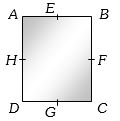
A
$BC$
B
$BD$
C
$HF$
D
$EG$
Solution
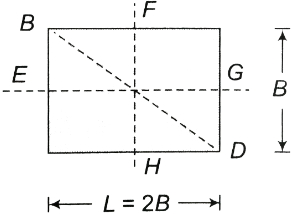
(D) Let the side $AB = B$ and $BC = L = 2B$. The mass of the rectangle is $M$.
For an axis passing through the center of mass and parallel to the sides:
$I_{EG} = \frac{MB^2}{12}$
$I_{HF} = \frac{ML^2}{12} = \frac{M(2B)^2}{12} = \frac{4MB^2}{12} = \frac{MB^2}{3}$
For the diagonal $BD$,the moment of inertia is given by $I_{BD} = \frac{M B^2 L^2}{6(B^2 + L^2)}$.
Substituting $L = 2B$:
$I_{BD} = \frac{M B^2 (2B)^2}{6(B^2 + (2B)^2)} = \frac{4MB^4}{6(5B^2)} = \frac{4MB^2}{30} = \frac{2MB^2}{15} \approx 0.133 MB^2$.
Comparing the values:
$I_{EG} = 0.0833 MB^2$
$I_{HF} = 0.333 MB^2$
$I_{BD} = 0.133 MB^2$
Thus,the moment of inertia is minimum about the axis $EG$.
For an axis passing through the center of mass and parallel to the sides:
$I_{EG} = \frac{MB^2}{12}$
$I_{HF} = \frac{ML^2}{12} = \frac{M(2B)^2}{12} = \frac{4MB^2}{12} = \frac{MB^2}{3}$
For the diagonal $BD$,the moment of inertia is given by $I_{BD} = \frac{M B^2 L^2}{6(B^2 + L^2)}$.
Substituting $L = 2B$:
$I_{BD} = \frac{M B^2 (2B)^2}{6(B^2 + (2B)^2)} = \frac{4MB^4}{6(5B^2)} = \frac{4MB^2}{30} = \frac{2MB^2}{15} \approx 0.133 MB^2$.
Comparing the values:
$I_{EG} = 0.0833 MB^2$
$I_{HF} = 0.333 MB^2$
$I_{BD} = 0.133 MB^2$
Thus,the moment of inertia is minimum about the axis $EG$.
0 likesView Solution
17
PhysicsEasyMCQAIPMT · 1993
The time dependence of a physical quantity $P$ is given by $P = P_0 \exp(-\alpha t^2)$,where $\alpha$ is a constant and $t$ is time. The constant $\alpha$:
A
is dimensionless
B
has dimensions $T^{-2}$
C
has dimensions of $P$
D
has dimensions $T^2$
Solution
(B) The given equation is $P = P_0 \exp(-\alpha t^2)$.
In any exponential function of the form $e^x$,the exponent $x$ must be dimensionless.
Therefore,the term $\alpha t^2$ must be dimensionless.
This implies that the dimensions of $\alpha$ multiplied by the dimensions of $t^2$ must equal $1$ (dimensionless).
$[\alpha] [t^2] = [M^0 L^0 T^0] = 1$.
Since $[t] = [T]$,we have $[\alpha] [T^2] = 1$.
Thus,$[\alpha] = [T^{-2}]$.
In any exponential function of the form $e^x$,the exponent $x$ must be dimensionless.
Therefore,the term $\alpha t^2$ must be dimensionless.
This implies that the dimensions of $\alpha$ multiplied by the dimensions of $t^2$ must equal $1$ (dimensionless).
$[\alpha] [t^2] = [M^0 L^0 T^0] = 1$.
Since $[t] = [T]$,we have $[\alpha] [T^2] = 1$.
Thus,$[\alpha] = [T^{-2}]$.
0 likesView Solution
18
PhysicsMediumMCQAIPMT · 1993
$A$ wave has simple harmonic motion whose period is $4\; s$,while another wave which also possesses simple harmonic motion has its period $3\; s$. If both are combined,then the resultant wave will have the period equal to ....... $s$.
A
$12$
B
$4$
C
$3$
D
$5$
Solution
(A) The frequency of the first wave is $f_1 = \frac{1}{T_1} = \frac{1}{4}\; Hz$.
The frequency of the second wave is $f_2 = \frac{1}{T_2} = \frac{1}{3}\; Hz$.
When two waves of different frequencies are combined,they produce beats.
The beat frequency is given by $f_b = |f_2 - f_1| = |\frac{1}{3} - \frac{1}{4}| = \frac{4-3}{12} = \frac{1}{12}\; Hz$.
The time period of the resultant beat phenomenon is $T = \frac{1}{f_b} = \frac{1}{1/12} = 12\; s$.
The frequency of the second wave is $f_2 = \frac{1}{T_2} = \frac{1}{3}\; Hz$.
When two waves of different frequencies are combined,they produce beats.
The beat frequency is given by $f_b = |f_2 - f_1| = |\frac{1}{3} - \frac{1}{4}| = \frac{4-3}{12} = \frac{1}{12}\; Hz$.
The time period of the resultant beat phenomenon is $T = \frac{1}{f_b} = \frac{1}{1/12} = 12\; s$.
0 likesView Solution
19
PhysicsMediumMCQAIPMT · 1993
Turpentine oil is flowing through a tube of length $l$ and radius $r$. The pressure difference between the two ends of the tube is $P$. The viscosity of oil is given by $\eta = \frac{P(r^2 - x^2)}{4vl}$,where $v$ is the velocity of oil at a distance $x$ from the axis of the tube. The dimensions of $\eta$ are
A
$[MLT^{-1}]$
B
$[M^0L^0T^0]$
C
$[ML^{-1}T^{-1}]$
D
$[ML^2T^{-2}]$
Solution
(C) The dimensions of pressure $P$ are $[ML^{-1}T^{-2}]$.
The dimensions of radius $r$ and distance $x$ are $[L]$.
The dimensions of velocity $v$ are $[LT^{-1}]$.
The dimensions of length $l$ are $[L]$.
Given the formula $\eta = \frac{P(r^2 - x^2)}{4vl}$,we substitute the dimensions:
$\eta = \frac{[ML^{-1}T^{-2}] \cdot [L^2]}{[LT^{-1}] \cdot [L]}$
$\eta = \frac{[MLT^{-2}]}{[L^2T^{-1}]}$
$\eta = [ML^{-1}T^{-1}]$
The dimensions of radius $r$ and distance $x$ are $[L]$.
The dimensions of velocity $v$ are $[LT^{-1}]$.
The dimensions of length $l$ are $[L]$.
Given the formula $\eta = \frac{P(r^2 - x^2)}{4vl}$,we substitute the dimensions:
$\eta = \frac{[ML^{-1}T^{-2}] \cdot [L^2]}{[LT^{-1}] \cdot [L]}$
$\eta = \frac{[MLT^{-2}]}{[L^2T^{-1}]}$
$\eta = [ML^{-1}T^{-1}]$
0 likesView Solution
20
PhysicsMediumMCQAIPMT · 1993
$A$ solid sphere,a disc,and a solid cylinder,all of the same mass and made of the same material,are allowed to roll down from rest on an inclined plane. Then,which of the following is true?
A
The disc will reach the bottom first.
B
The solid sphere reaches the bottom last.
C
The solid sphere reaches the bottom first.
D
All reach the bottom at the same time.
Solution
(C) The time taken for an object to roll down an inclined plane is given by $t = \sqrt{\frac{2h}{g \sin^2 \theta} (1 + \frac{K^2}{R^2})}$.
For a solid sphere,the moment of inertia $I = \frac{2}{5}MR^2$,so $\frac{K^2}{R^2} = \frac{2}{5} = 0.4$.
For a disc and a solid cylinder,the moment of inertia $I = \frac{1}{2}MR^2$,so $\frac{K^2}{R^2} = \frac{1}{2} = 0.5$.
Since the time $t$ is directly proportional to $\sqrt{1 + \frac{K^2}{R^2}}$,the object with the smallest value of $\frac{K^2}{R^2}$ will reach the bottom first.
Comparing the values,$0.4 < 0.5$,therefore the solid sphere reaches the bottom first.
For a solid sphere,the moment of inertia $I = \frac{2}{5}MR^2$,so $\frac{K^2}{R^2} = \frac{2}{5} = 0.4$.
For a disc and a solid cylinder,the moment of inertia $I = \frac{1}{2}MR^2$,so $\frac{K^2}{R^2} = \frac{1}{2} = 0.5$.
Since the time $t$ is directly proportional to $\sqrt{1 + \frac{K^2}{R^2}}$,the object with the smallest value of $\frac{K^2}{R^2}$ will reach the bottom first.
Comparing the values,$0.4 < 0.5$,therefore the solid sphere reaches the bottom first.
0 likesView Solution
21
PhysicsEasyMCQAIPMT · 1993
$A$ stretched string resonates with a tuning fork of frequency $512 \; Hz$ when the length of the string is $0.5 \; m$. The length of the string required to vibrate resonantly with a tuning fork of frequency $256 \; Hz$ would be .......... $m$.
A
$0.25$
B
$0.5$
C
$2$
D
$1$
Solution
(D) The fundamental frequency $f$ of a stretched string is given by the formula: $f = \frac{1}{2l} \sqrt{\frac{T}{\mu}}$.
Here,$T$ is the tension and $\mu$ is the linear mass density of the string.
Since $T$ and $\mu$ remain constant,the product of frequency and length is constant: $f_1 l_1 = f_2 l_2$.
Given $f_1 = 512 \; Hz$,$l_1 = 0.5 \; m$,and $f_2 = 256 \; Hz$.
Substituting the values: $512 \times 0.5 = 256 \times l_2$.
$256 = 256 \times l_2$.
Therefore,$l_2 = 1 \; m$.
Here,$T$ is the tension and $\mu$ is the linear mass density of the string.
Since $T$ and $\mu$ remain constant,the product of frequency and length is constant: $f_1 l_1 = f_2 l_2$.
Given $f_1 = 512 \; Hz$,$l_1 = 0.5 \; m$,and $f_2 = 256 \; Hz$.
Substituting the values: $512 \times 0.5 = 256 \times l_2$.
$256 = 256 \times l_2$.
Therefore,$l_2 = 1 \; m$.
0 likesView Solution
22
PhysicsMediumMCQAIPMT · 1993
$A$ monkey is descending from the branch of a tree with constant acceleration. If the breaking strength of the branch is $75 \%$ of the weight of the monkey,what is the minimum acceleration with which the monkey can slide down without breaking the branch?
A
$\frac{3g}{4}$
B
$\frac{g}{4}$
C
$g$
D
$\frac{g}{2}$
Solution
(B) Let $m$ be the mass of the monkey and $g$ be the acceleration due to gravity.
Let $a$ be the acceleration with which the monkey descends.
The force equation for the monkey is given by $mg - T = ma$,where $T$ is the tension in the branch.
To prevent the branch from breaking,the tension $T$ must not exceed the breaking strength of the branch.
The breaking strength is given as $75 \%$ of the weight of the monkey,so $T_{max} = 0.75mg = \frac{3}{4}mg$.
Substituting $T = \frac{3}{4}mg$ into the equation $mg - T = ma$:
$mg - \frac{3}{4}mg = ma$
$\frac{1}{4}mg = ma$
$a = \frac{g}{4}$.
Thus,the minimum acceleration required for the monkey to slide down without breaking the branch is $\frac{g}{4}$.
Let $a$ be the acceleration with which the monkey descends.
The force equation for the monkey is given by $mg - T = ma$,where $T$ is the tension in the branch.
To prevent the branch from breaking,the tension $T$ must not exceed the breaking strength of the branch.
The breaking strength is given as $75 \%$ of the weight of the monkey,so $T_{max} = 0.75mg = \frac{3}{4}mg$.
Substituting $T = \frac{3}{4}mg$ into the equation $mg - T = ma$:
$mg - \frac{3}{4}mg = ma$
$\frac{1}{4}mg = ma$
$a = \frac{g}{4}$.
Thus,the minimum acceleration required for the monkey to slide down without breaking the branch is $\frac{g}{4}$.
1 likesView Solution
23
PhysicsEasyMCQAIPMT · 1993
When one electron is moved towards another electron,the electric potential energy of the system:
A
Decreases
B
Increases
C
Remains unchanged
D
Becomes zero
Solution
(B) The electric potential energy $U$ of a system of two point charges $q_1$ and $q_2$ separated by a distance $r$ is given by $U = \frac{1}{4\pi\varepsilon_0} \frac{q_1 q_2}{r}$.
For two electrons,$q_1 = -e$ and $q_2 = -e$,so the potential energy is $U = \frac{e^2}{4\pi\varepsilon_0 r}$.
When one electron is moved towards the other,the separation distance $r$ decreases.
Since $U \propto \frac{1}{r}$,as the distance $r$ decreases,the potential energy $U$ increases.
For two electrons,$q_1 = -e$ and $q_2 = -e$,so the potential energy is $U = \frac{e^2}{4\pi\varepsilon_0 r}$.
When one electron is moved towards the other,the separation distance $r$ decreases.
Since $U \propto \frac{1}{r}$,as the distance $r$ decreases,the potential energy $U$ increases.
0 likesView Solution
24
PhysicsMediumMCQAIPMT · 1993
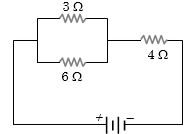
In the figure,the current through the $3\,\Omega$ resistor is $0.8\,A$. Then,the potential drop across the $4\,\Omega$ resistor is ........... $V$.
A
$9.6$
B
$2.6$
C
$4.8$
D
$1.2$
Solution
(C) The $3\,\Omega$ and $6\,\Omega$ resistors are connected in parallel. Therefore,the potential difference across both is the same.
Let $V_p$ be the potential difference across the parallel combination.
$V_p = I_1 R_1 = I_2 R_2$
$0.8 \times 3 = I_2 \times 6$
$I_2 = \frac{2.4}{6} = 0.4\,A$
The total current $I$ flowing through the $4\,\Omega$ resistor is the sum of the currents through the parallel branches:
$I = I_1 + I_2 = 0.8\,A + 0.4\,A = 1.2\,A$
The potential drop across the $4\,\Omega$ resistor is given by $V = I \times R = 1.2\,A \times 4\,\Omega = 4.8\,V$.
Let $V_p$ be the potential difference across the parallel combination.
$V_p = I_1 R_1 = I_2 R_2$
$0.8 \times 3 = I_2 \times 6$
$I_2 = \frac{2.4}{6} = 0.4\,A$
The total current $I$ flowing through the $4\,\Omega$ resistor is the sum of the currents through the parallel branches:
$I = I_1 + I_2 = 0.8\,A + 0.4\,A = 1.2\,A$
The potential drop across the $4\,\Omega$ resistor is given by $V = I \times R = 1.2\,A \times 4\,\Omega = 4.8\,V$.
0 likesView Solution
25
PhysicsMediumMCQAIPMT · 1993
Three resistances of $4\,\Omega$ each are connected in the form of an equilateral triangle. The effective resistance between any two corners is:
A
$8\,\Omega$
B
$12\,\Omega$
C
$\frac{3}{8}\,\Omega$
D
$\frac{8}{3}\,\Omega$
Solution
(D) When three resistors of $4\,\Omega$ are connected in an equilateral triangle,let the corners be $A$,$B$,and $C$.
To find the effective resistance between any two corners (e.g.,$A$ and $B$),we observe the circuit configuration.
The resistor connected directly between $A$ and $B$ is in parallel with the series combination of the other two resistors (connected between $A-C$ and $C-B$).
Resistance of the series branch = $4\,\Omega + 4\,\Omega = 8\,\Omega$.
Now,this $8\,\Omega$ branch is in parallel with the $4\,\Omega$ resistor connected directly across $A$ and $B$.
The equivalent resistance $R_{eq}$ is given by:
$\frac{1}{R_{eq}} = \frac{1}{4} + \frac{1}{8} = \frac{2+1}{8} = \frac{3}{8}$.
Therefore,$R_{eq} = \frac{8}{3}\,\Omega$.
To find the effective resistance between any two corners (e.g.,$A$ and $B$),we observe the circuit configuration.
The resistor connected directly between $A$ and $B$ is in parallel with the series combination of the other two resistors (connected between $A-C$ and $C-B$).
Resistance of the series branch = $4\,\Omega + 4\,\Omega = 8\,\Omega$.
Now,this $8\,\Omega$ branch is in parallel with the $4\,\Omega$ resistor connected directly across $A$ and $B$.
The equivalent resistance $R_{eq}$ is given by:
$\frac{1}{R_{eq}} = \frac{1}{4} + \frac{1}{8} = \frac{2+1}{8} = \frac{3}{8}$.
Therefore,$R_{eq} = \frac{8}{3}\,\Omega$.
0 likesView Solution
26
PhysicsEasyMCQAIPMT · 1993
$A$ charge moving with velocity $v$ in $X$-direction is subjected to a field of magnetic induction in the negative $X$-direction. As a result,the charge will
A
Remain unaffected
B
Start moving in a circular path in the $Y-Z$ plane
C
Retard along $X$-axis
D
Move along a helical path around $X$-axis
Solution
(A) The magnetic force on a moving charge is given by the Lorentz force formula: $\overrightarrow{F_m} = q(\overrightarrow{v} \times \overrightarrow{B})$.
Here,the velocity vector $\overrightarrow{v}$ is in the $+X$-direction,and the magnetic field $\overrightarrow{B}$ is in the $-X$-direction.
The angle $\theta$ between $\overrightarrow{v}$ and $\overrightarrow{B}$ is $180^\circ$.
Since the cross product $\overrightarrow{v} \times \overrightarrow{B} = vB \sin(180^\circ) = 0$,the magnetic force $\overrightarrow{F_m}$ is zero.
Therefore,the charge will continue to move in the $X$-direction with constant velocity and remain unaffected.
Here,the velocity vector $\overrightarrow{v}$ is in the $+X$-direction,and the magnetic field $\overrightarrow{B}$ is in the $-X$-direction.
The angle $\theta$ between $\overrightarrow{v}$ and $\overrightarrow{B}$ is $180^\circ$.
Since the cross product $\overrightarrow{v} \times \overrightarrow{B} = vB \sin(180^\circ) = 0$,the magnetic force $\overrightarrow{F_m}$ is zero.
Therefore,the charge will continue to move in the $X$-direction with constant velocity and remain unaffected.
0 likesView Solution
27
PhysicsEasyMCQAIPMT · 1993
$A$ coil carrying electric current is placed in a uniform magnetic field,then
A
Torque is formed
B
$E.M.F.$ is induced
C
Both $(a)$ and $(b)$ are correct
D
None of these
Solution
(A) current-carrying coil placed in a uniform magnetic field experiences a magnetic torque given by $\vec{\tau} = \vec{M} \times \vec{B}$,where $\vec{M}$ is the magnetic moment and $\vec{B}$ is the magnetic field.
According to Faraday's law of electromagnetic induction,an $E.M.F.$ is induced only when there is a change in magnetic flux linked with the coil $(\varepsilon = -d\phi/dt)$.
Since the magnetic field is uniform and the coil is not specified to be moving or changing its orientation relative to the field,there is no change in magnetic flux. Therefore,no $E.M.F.$ is induced.
Thus,only torque is formed. The correct option is $A$.
According to Faraday's law of electromagnetic induction,an $E.M.F.$ is induced only when there is a change in magnetic flux linked with the coil $(\varepsilon = -d\phi/dt)$.
Since the magnetic field is uniform and the coil is not specified to be moving or changing its orientation relative to the field,there is no change in magnetic flux. Therefore,no $E.M.F.$ is induced.
Thus,only torque is formed. The correct option is $A$.
0 likesView Solution
28
PhysicsEasyMCQAIPMT · 1993
An $e.m.f.$ of $5 \,V$ is produced by a self-inductance when the current changes at a steady rate from $3 \,A$ to $2 \,A$ in $1 \,ms$. The value of self-inductance is:
A
Zero
B
$5 \,H$
C
$5000 \,H$
D
$5 \,mH$
Solution
(D) The induced $e.m.f.$ $(e)$ in a coil due to self-inductance is given by the formula: $e = L \cdot \left| \frac{di}{dt} \right|$.
Given:
$e = 5 \,V$
Change in current,$di = 3 \,A - 2 \,A = 1 \,A$
Time interval,$dt = 1 \,ms = 1 \times 10^{-3} \,s$
Substituting the values into the formula:
$5 = L \cdot \frac{1 \,A}{1 \times 10^{-3} \,s}$
$5 = L \cdot 10^3$
$L = \frac{5}{10^3} \,H = 5 \times 10^{-3} \,H = 5 \,mH$.
Therefore,the correct option is $D$.
Given:
$e = 5 \,V$
Change in current,$di = 3 \,A - 2 \,A = 1 \,A$
Time interval,$dt = 1 \,ms = 1 \times 10^{-3} \,s$
Substituting the values into the formula:
$5 = L \cdot \frac{1 \,A}{1 \times 10^{-3} \,s}$
$5 = L \cdot 10^3$
$L = \frac{5}{10^3} \,H = 5 \times 10^{-3} \,H = 5 \,mH$.
Therefore,the correct option is $D$.
0 likesView Solution
29
PhysicsEasyMCQAIPMT · 1993
The momentum of a photon of wavelength $\lambda$ is
A
$\frac{h}{\lambda}$
B
Zero
C
$\frac{h\lambda}{c^2}$
D
$\frac{h\lambda}{c}$
Solution
(A) The energy of a photon is given by $E = h\nu$,where $h$ is Planck's constant and $\nu$ is the frequency.
According to Einstein's mass-energy equivalence,$E = mc^2$,where $m$ is the relativistic mass and $c$ is the speed of light.
Equating the two expressions for energy: $mc^2 = h\nu$.
Since the momentum $p$ of a photon is defined as $p = mc$,we can substitute $m = \frac{p}{c}$ into the equation: $p = \frac{h\nu}{c}$.
Using the relation $\nu = \frac{c}{\lambda}$,we substitute for $\nu$: $p = \frac{h(c/\lambda)}{c} = \frac{h}{\lambda}$.
Therefore,the momentum of a photon is $\frac{h}{\lambda}$.
According to Einstein's mass-energy equivalence,$E = mc^2$,where $m$ is the relativistic mass and $c$ is the speed of light.
Equating the two expressions for energy: $mc^2 = h\nu$.
Since the momentum $p$ of a photon is defined as $p = mc$,we can substitute $m = \frac{p}{c}$ into the equation: $p = \frac{h\nu}{c}$.
Using the relation $\nu = \frac{c}{\lambda}$,we substitute for $\nu$: $p = \frac{h(c/\lambda)}{c} = \frac{h}{\lambda}$.
Therefore,the momentum of a photon is $\frac{h}{\lambda}$.
0 likesView Solution
30
PhysicsEasyMCQAIPMT · 1993
The number of photo-electrons emitted per second from a metal surface increases when:
A
The energy of incident photons increases
B
The frequency of incident light increases
C
The wavelength of the incident light increases
D
The intensity of the incident light increases
Solution
(D) According to the photoelectric effect,the number of photo-electrons emitted per second is directly proportional to the number of incident photons per second.
Since the intensity of light is defined as the energy incident per unit area per unit time,it is directly proportional to the number of photons incident on the metal surface.
Therefore,increasing the intensity of the incident light increases the number of incident photons,which in turn increases the number of photo-electrons emitted per second.
Thus,the correct option is $D$.
Since the intensity of light is defined as the energy incident per unit area per unit time,it is directly proportional to the number of photons incident on the metal surface.
Therefore,increasing the intensity of the incident light increases the number of incident photons,which in turn increases the number of photo-electrons emitted per second.
Thus,the correct option is $D$.
0 likesView Solution
31
PhysicsMediumMCQAIPMT · 1993
When light of wavelength $300 \; nm$ falls on a photoelectric emitter,photoelectrons are liberated. For another emitter,light of $600 \; nm$ wavelength is sufficient for creating photoemission. What is the ratio of the work functions of the two emitters?
A
$1:2$
B
$2:1$
C
$1:4$
D
$4:1$
Solution
(B) The work function $W_0$ of a photoelectric emitter is given by the formula $W_0 = \frac{hc}{\lambda_0}$,where $h$ is Planck's constant,$c$ is the speed of light,and $\lambda_0$ is the threshold wavelength.
Assuming the given wavelengths are the threshold wavelengths for the respective emitters,we have $\lambda_{01} = 300 \; nm$ and $\lambda_{02} = 600 \; nm$.
The ratio of the work functions is $\frac{W_{01}}{W_{02}} = \frac{hc / \lambda_{01}}{hc / \lambda_{02}} = \frac{\lambda_{02}}{\lambda_{01}}$.
Substituting the values: $\frac{W_{01}}{W_{02}} = \frac{600 \; nm}{300 \; nm} = \frac{2}{1}$.
Thus,the ratio is $2:1$.
Assuming the given wavelengths are the threshold wavelengths for the respective emitters,we have $\lambda_{01} = 300 \; nm$ and $\lambda_{02} = 600 \; nm$.
The ratio of the work functions is $\frac{W_{01}}{W_{02}} = \frac{hc / \lambda_{01}}{hc / \lambda_{02}} = \frac{\lambda_{02}}{\lambda_{01}}$.
Substituting the values: $\frac{W_{01}}{W_{02}} = \frac{600 \; nm}{300 \; nm} = \frac{2}{1}$.
Thus,the ratio is $2:1$.
0 likesView Solution
32
PhysicsMediumMCQAIPMT · 1993
$A$ hydrogen atom is excited from the ground state to another state with a principal quantum number equal to $4$. The number of spectral lines in the emission spectra will be:
A
$3$
B
$6$
C
$5$
D
$2$
Solution
(B) The number of spectral lines emitted when an electron transitions from an excited state with principal quantum number $n$ to the ground state is given by the formula:
$N = \frac{n(n - 1)}{2}$
Given that the electron is excited to the state with principal quantum number $n = 4$,we substitute this value into the formula:
$N = \frac{4(4 - 1)}{2}$
$N = \frac{4 \times 3}{2}$
$N = \frac{12}{2} = 6$
Therefore,the total number of spectral lines in the emission spectra is $6$.
$N = \frac{n(n - 1)}{2}$
Given that the electron is excited to the state with principal quantum number $n = 4$,we substitute this value into the formula:
$N = \frac{4(4 - 1)}{2}$
$N = \frac{4 \times 3}{2}$
$N = \frac{12}{2} = 6$
Therefore,the total number of spectral lines in the emission spectra is $6$.
0 likesView Solution
33
PhysicsMediumMCQAIPMT · 1993
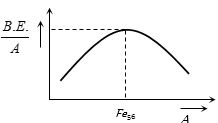
The binding energy per nucleon is maximum in the case of
A
$_{2}^{4}He$
B
$_{26}^{56}Fe$
C
$_{56}^{141}Ba$
D
$_{92}^{235}U$
Solution
(B) The binding energy per nucleon $(B.E./A)$ is a measure of the stability of a nucleus.
According to the binding energy curve,the value of $B.E./A$ increases with the mass number $A$ for light nuclei,reaches a maximum value of approximately $8.8 \text{ MeV}$ for iron $(_{26}^{56}Fe)$,and then gradually decreases for heavier nuclei.
Therefore,the binding energy per nucleon is maximum for $_{26}^{56}Fe$.
According to the binding energy curve,the value of $B.E./A$ increases with the mass number $A$ for light nuclei,reaches a maximum value of approximately $8.8 \text{ MeV}$ for iron $(_{26}^{56}Fe)$,and then gradually decreases for heavier nuclei.
Therefore,the binding energy per nucleon is maximum for $_{26}^{56}Fe$.
0 likesView Solution
34
PhysicsMediumMCQAIPMT · 1993
Energy released in the fission of a single $_{92}U^{235}$ nucleus is $200 \, MeV$. The fission rate of a $_{92}U^{235}$ fuelled reactor operating at a power level of $5 \, W$ is
A
$1.56 \times 10^{10} \, s^{-1}$
B
$1.56 \times 10^{11} \, s^{-1}$
C
$1.56 \times 10^{16} \, s^{-1}$
D
$1.56 \times 10^{17} \, s^{-1}$
Solution
(B) Power $P = 5 \, W = 5 \, J/s$.
Energy released per fission $E = 200 \, MeV = 200 \times 10^6 \times 1.6 \times 10^{-19} \, J = 3.2 \times 10^{-11} \, J$.
Fission rate $R = \frac{P}{E} = \frac{5}{3.2 \times 10^{-11}} \, s^{-1}$.
$R = 1.5625 \times 10^{11} \, s^{-1} \approx 1.56 \times 10^{11} \, s^{-1}$.
Energy released per fission $E = 200 \, MeV = 200 \times 10^6 \times 1.6 \times 10^{-19} \, J = 3.2 \times 10^{-11} \, J$.
Fission rate $R = \frac{P}{E} = \frac{5}{3.2 \times 10^{-11}} \, s^{-1}$.
$R = 1.5625 \times 10^{11} \, s^{-1} \approx 1.56 \times 10^{11} \, s^{-1}$.
0 likesView Solution
35
PhysicsMediumMCQAIPMT · 1993
In the given reaction $_Z{X^A} \to _{Z+1}{Y^A} \to _{Z-1}{K^{A-4}} \to _{Z-1}{K^{A-4}}$,radioactive radiations are emitted in the sequence:
A
$\alpha, \beta, \gamma$
B
$\beta, \alpha, \gamma$
C
$\gamma, \alpha, \beta$
D
$\beta, \gamma, \alpha$
Solution
(B) The given reaction sequence is: $_Z{X^A} \to _{Z+1}{Y^A} \to _{Z-1}{K^{A-4}} \to _{Z-1}{K^{A-4}}$.
$1$. In the first step,$_Z{X^A} \to _{Z+1}{Y^A}$,the atomic number increases by $1$ while the mass number remains the same. This corresponds to the emission of a $\beta^-$-particle $(_{-1}e^0)$.
$2$. In the second step,$_{Z+1}{Y^A} \to _{Z-1}{K^{A-4}}$,the atomic number decreases by $2$ and the mass number decreases by $4$. This corresponds to the emission of an $\alpha$-particle $(_{2}He^4)$.
$3$. In the third step,$_{Z-1}{K^{A-4}} \to _{Z-1}{K^{A-4}}$,there is no change in atomic number or mass number,which indicates the emission of a $\gamma$-ray (electromagnetic radiation).
Therefore,the sequence of emissions is $\beta, \alpha, \gamma$.
$1$. In the first step,$_Z{X^A} \to _{Z+1}{Y^A}$,the atomic number increases by $1$ while the mass number remains the same. This corresponds to the emission of a $\beta^-$-particle $(_{-1}e^0)$.
$2$. In the second step,$_{Z+1}{Y^A} \to _{Z-1}{K^{A-4}}$,the atomic number decreases by $2$ and the mass number decreases by $4$. This corresponds to the emission of an $\alpha$-particle $(_{2}He^4)$.
$3$. In the third step,$_{Z-1}{K^{A-4}} \to _{Z-1}{K^{A-4}}$,there is no change in atomic number or mass number,which indicates the emission of a $\gamma$-ray (electromagnetic radiation).
Therefore,the sequence of emissions is $\beta, \alpha, \gamma$.
0 likesView Solution
36
PhysicsEasyMCQAIPMT · 1993
The part of a transistor which is heavily doped to produce a large number of majority carriers is
A
Base
B
Emitter
C
Collector
D
Can be any of the above three
Solution
(B) In a transistor,the $Emitter$ is the section that is heavily doped. The purpose of heavy doping is to provide a large number of majority charge carriers,which are then injected into the $Base$ region. The $Base$ is lightly doped and thin,while the $Collector$ is moderately doped. Therefore,the correct option is $B$.
0 likesView Solution
37
PhysicsMediumMCQAIPMT · 1993
Time taken by the sunlight to pass through a window of thickness $4 \, mm$ whose refractive index is $1.5$ is
A
$2 \times 10^{-8} \, s$
B
$2 \times 10^{8} \, s$
C
$2 \times 10^{-11} \, s$
D
$2 \times 10^{11} \, s$
Solution
(C) The velocity of light in a medium is given by $v = \frac{c}{n}$,where $c$ is the speed of light in vacuum $(3 \times 10^8 \, m/s)$ and $n$ is the refractive index.
Given $n = 1.5$,the velocity of light in the window is $v = \frac{3 \times 10^8}{1.5} = 2 \times 10^8 \, m/s$.
The thickness of the window is $d = 4 \, mm = 4 \times 10^{-3} \, m$.
The time taken $t$ is given by $t = \frac{d}{v}$.
Substituting the values,$t = \frac{4 \times 10^{-3}}{2 \times 10^8} = 2 \times 10^{-11} \, s$.
Given $n = 1.5$,the velocity of light in the window is $v = \frac{3 \times 10^8}{1.5} = 2 \times 10^8 \, m/s$.
The thickness of the window is $d = 4 \, mm = 4 \times 10^{-3} \, m$.
The time taken $t$ is given by $t = \frac{d}{v}$.
Substituting the values,$t = \frac{4 \times 10^{-3}}{2 \times 10^8} = 2 \times 10^{-11} \, s$.
0 likesView Solution
38
PhysicsEasyMCQAIPMT · 1993
Which source is associated with a line emission spectrum?
A
Electric fire
B
Neon street sign
C
Red traffic light
D
Sun
Solution
(B) line emission spectrum is produced by excited atoms in a low-pressure gas.
Among the given options,a neon street sign contains neon gas at low pressure.
When an electric discharge passes through the gas,the neon atoms are excited and emit light at specific,discrete wavelengths,resulting in a line emission spectrum.
In contrast,sources like an electric fire or the Sun produce continuous spectra due to thermal radiation from solids or high-pressure gases.
Among the given options,a neon street sign contains neon gas at low pressure.
When an electric discharge passes through the gas,the neon atoms are excited and emit light at specific,discrete wavelengths,resulting in a line emission spectrum.
In contrast,sources like an electric fire or the Sun produce continuous spectra due to thermal radiation from solids or high-pressure gases.
0 likesView Solution
39
PhysicsEasyMCQAIPMT · 1993
Interference was observed in an interference chamber when air was present. Now,the chamber is evacuated and if the same light is used,a careful observer will see:
A
No interference
B
Interference with bright bands
C
Interference with dark bands
D
Interference in which the width of the fringe will be slightly increased
Solution
(D) The fringe width $\beta$ in an interference experiment is given by $\beta = \frac{\lambda D}{d}$,where $\lambda$ is the wavelength of light,$D$ is the distance between the slits and the screen,and $d$ is the distance between the slits.
When the chamber is filled with air,the wavelength of light is $\lambda_{air} = \frac{\lambda_0}{\mu_{air}}$,where $\lambda_0$ is the wavelength in vacuum and $\mu_{air} \approx 1.0003$.
When the chamber is evacuated,the refractive index becomes $\mu_{vac} = 1$.
Since $\mu_{vac} < \mu_{air}$,the wavelength of light in the vacuum becomes larger than in air $(\lambda_{vac} > \lambda_{air})$.
As $\beta \propto \lambda$,the fringe width $\beta$ increases when the chamber is evacuated.
When the chamber is filled with air,the wavelength of light is $\lambda_{air} = \frac{\lambda_0}{\mu_{air}}$,where $\lambda_0$ is the wavelength in vacuum and $\mu_{air} \approx 1.0003$.
When the chamber is evacuated,the refractive index becomes $\mu_{vac} = 1$.
Since $\mu_{vac} < \mu_{air}$,the wavelength of light in the vacuum becomes larger than in air $(\lambda_{vac} > \lambda_{air})$.
As $\beta \propto \lambda$,the fringe width $\beta$ increases when the chamber is evacuated.
0 likesView Solution
40
PhysicsEasyMCQAIPMT · 1993
$A$ parallel beam of monochromatic light of wavelength $5000 \; \mathring{A}$ is incident normally on a single narrow slit of width $0.001 \; mm$. The light is focused by a convex lens on a screen placed on the focal plane. The first minimum will be formed for the angle of diffraction equal to ........$^o$.
A
$0$
B
$15$
C
$30$
D
$60$
Solution
(C) For the first minimum in a single slit diffraction pattern,the condition is given by $d \sin \theta = n \lambda$,where $n = 1$ for the first minimum.
Given: Wavelength $\lambda = 5000 \; \mathring{A} = 5000 \times 10^{-10} \; m = 5 \times 10^{-7} \; m$.
Slit width $d = 0.001 \; mm = 10^{-3} \; mm = 10^{-6} \; m$.
Substituting the values into the formula: $\sin \theta = \frac{\lambda}{d} = \frac{5 \times 10^{-7}}{10^{-6}} = 0.5$.
Therefore,$\theta = \sin^{-1}(0.5) = 30^o$.
Given: Wavelength $\lambda = 5000 \; \mathring{A} = 5000 \times 10^{-10} \; m = 5 \times 10^{-7} \; m$.
Slit width $d = 0.001 \; mm = 10^{-3} \; mm = 10^{-6} \; m$.
Substituting the values into the formula: $\sin \theta = \frac{\lambda}{d} = \frac{5 \times 10^{-7}}{10^{-6}} = 0.5$.
Therefore,$\theta = \sin^{-1}(0.5) = 30^o$.
0 likesView Solution
41
PhysicsMediumMCQAIPMT · 1993
In the nuclear decay sequence given below:
$_Z{X^A} \to {}_{Z + 1}{Y^A} \to {}_{Z - 1}{K^{A - 4}} \to {}_{Z - 1}{K^{A - 4}}$
the particles emitted in the sequence are:
$_Z{X^A} \to {}_{Z + 1}{Y^A} \to {}_{Z - 1}{K^{A - 4}} \to {}_{Z - 1}{K^{A - 4}}$
the particles emitted in the sequence are:
A
$\alpha, \beta, \gamma$
B
$\beta, \alpha, \gamma$
C
$\gamma, \alpha, \beta$
D
$\beta, \gamma, \alpha$
Solution
(B) The given decay sequence is: ${}_Z^AX \to {}_{Z + 1}^AY \to {}_{Z - 1}^{A - 4}K \to {}_{Z - 1}^{A - 4}K$.
$1$. In the first step,${}_Z^AX \to {}_{Z + 1}^AY$: The atomic number increases by $1$ while the mass number remains the same. This corresponds to the emission of a $\beta^-$ particle.
$2$. In the second step,${}_{Z + 1}^AY \to {}_{Z - 1}^{A - 4}K$: The atomic number decreases by $2$ and the mass number decreases by $4$. This corresponds to the emission of an $\alpha$ particle.
$3$. In the third step,${}_{Z - 1}^{A - 4}K \to {}_{Z - 1}^{A - 4}K$: There is no change in the atomic number or mass number,which indicates the emission of a $\gamma$ ray (de-excitation of the nucleus).
Therefore,the sequence of particles emitted is $\beta, \alpha, \gamma$.
$1$. In the first step,${}_Z^AX \to {}_{Z + 1}^AY$: The atomic number increases by $1$ while the mass number remains the same. This corresponds to the emission of a $\beta^-$ particle.
$2$. In the second step,${}_{Z + 1}^AY \to {}_{Z - 1}^{A - 4}K$: The atomic number decreases by $2$ and the mass number decreases by $4$. This corresponds to the emission of an $\alpha$ particle.
$3$. In the third step,${}_{Z - 1}^{A - 4}K \to {}_{Z - 1}^{A - 4}K$: There is no change in the atomic number or mass number,which indicates the emission of a $\gamma$ ray (de-excitation of the nucleus).
Therefore,the sequence of particles emitted is $\beta, \alpha, \gamma$.
0 likesView Solution
42
PhysicsMediumMCQAIPMT · 1993
If $N$ is the number of turns in a coil,the value of self-inductance varies as
A
$N^0$
B
$N$
C
$N^{-2}$
D
$N^2$
Solution
(D) The self-inductance $L$ of a coil is defined as $L = \frac{N \phi}{i}$,where $N$ is the number of turns,$\phi$ is the magnetic flux through each turn,and $i$ is the current.
For a solenoid,the magnetic flux $\phi$ is given by $\phi = B A$,where $B$ is the magnetic field and $A$ is the cross-sectional area.
The magnetic field $B$ inside a solenoid is $B = \mu_0 n i = \frac{\mu_0 N i}{l}$,where $n$ is the number of turns per unit length $(n = N/l)$ and $l$ is the length of the solenoid.
Substituting $B$ into the flux equation: $\phi = \left( \frac{\mu_0 N i}{l} \right) A$.
Now,substituting $\phi$ into the expression for $L$: $L = \frac{N}{i} \left( \frac{\mu_0 N i A}{l} \right) = \frac{\mu_0 N^2 A}{l}$.
Thus,the self-inductance $L$ is proportional to $N^2$.
For a solenoid,the magnetic flux $\phi$ is given by $\phi = B A$,where $B$ is the magnetic field and $A$ is the cross-sectional area.
The magnetic field $B$ inside a solenoid is $B = \mu_0 n i = \frac{\mu_0 N i}{l}$,where $n$ is the number of turns per unit length $(n = N/l)$ and $l$ is the length of the solenoid.
Substituting $B$ into the flux equation: $\phi = \left( \frac{\mu_0 N i}{l} \right) A$.
Now,substituting $\phi$ into the expression for $L$: $L = \frac{N}{i} \left( \frac{\mu_0 N i A}{l} \right) = \frac{\mu_0 N^2 A}{l}$.
Thus,the self-inductance $L$ is proportional to $N^2$.
0 likesView Solution
Vedclass Products
For Students
Vedclass Test Series
Mock tests in real AIPMT style covering Physics with performance analysis. 5-day free trial.
Start Free TrialFor Teachers
Exam Paper Generator
Generate Set A/B/C/D Physics papers from 7.5L+ questions in 2 minutes. 3 chapters free.
Try FreeFor Institutes
Online Exam Module
Run live AIPMT mock exams with unlimited students, 360° analytics & white-label branding.
See DemoFrequently Asked Questions
How many Physics questions are in AIPMT 1993?
There are 42 Physics questions from the AIPMT 1993 paper on Vedclass, each with a detailed step-by-step solution in English.
Are AIPMT 1993 Physics solutions available in English?
Yes. All solutions on this page are in English. You can also switch to English or Hindi using the language buttons above the questions.
Can I practice AIPMT 1993 Physics as a timed test?
Yes. Use the Vedclass Test Series to attempt a full AIPMT mock test covering Physics with time limits and instant score analysis.
Can teachers create Physics papers from AIPMT previous year questions?
Yes. The Vedclass Exam Paper Generator lets teachers mix AIPMT Physics questions and generate Set A/B/C/D papers in minutes.
For Teachers & Institutes
Build a Custom Physics Paper
Pick AIPMT 1993 Physics questions, set difficulty, and generate Set A/B/C/D in 2 minutes.