
ChemistryQ1–22 of 22 questions
Page 1 of 1 · English
1
ChemistryEasyMCQAIPMT · 1993
Under similar conditions of pressure and temperature,$40 \, mL$ of slightly moist hydrogen chloride gas is mixed with $20 \, mL$ of ammonia gas,the final volume of gas at the same temperature and pressure will be ............. $mL$.
A
$100$
B
$20$
C
$40$
D
$60$
Solution
(B) The chemical reaction is: $NH_{3(g)} + HCl_{(g)} \to NH_4Cl_{(s)}$.
Given volumes are $V_{NH_3} = 20 \, mL$ and $V_{HCl} = 40 \, mL$.
Since the reaction stoichiometry is $1:1$,$NH_3$ acts as the limiting reagent.
$20 \, mL$ of $NH_3$ will react completely with $20 \, mL$ of $HCl$ to form solid $NH_4Cl$.
$NH_4Cl$ is a solid,so it does not contribute to the gaseous volume.
The remaining volume of $HCl$ is $40 \, mL - 20 \, mL = 20 \, mL$.
Thus,the final volume of the gas is $20 \, mL$.
Given volumes are $V_{NH_3} = 20 \, mL$ and $V_{HCl} = 40 \, mL$.
Since the reaction stoichiometry is $1:1$,$NH_3$ acts as the limiting reagent.
$20 \, mL$ of $NH_3$ will react completely with $20 \, mL$ of $HCl$ to form solid $NH_4Cl$.
$NH_4Cl$ is a solid,so it does not contribute to the gaseous volume.
The remaining volume of $HCl$ is $40 \, mL - 20 \, mL = 20 \, mL$.
Thus,the final volume of the gas is $20 \, mL$.
0 likesView Solution
2
ChemistryMediumMCQAIPMT · 1993
Ionic bonds are usually formed by the combination of elements with:
A
High ionization potential and low electron affinity
B
Low ionization potential and high electron affinity
C
High ionization potential and high electron affinity
D
Low ionization potential and low electron affinity
Solution
(B) Ionic bonds are formed by the transfer of electrons from a metal to a non-metal.
$1$. The metal atom should have a $Low \ ionization \ potential$ to easily lose an electron to form a cation.
$2$. The non-metal atom should have a $High \ electron \ affinity$ to easily accept the electron to form an anion.
Therefore,the correct combination is $Low \ ionization \ potential$ and $High \ electron \ affinity$.
$1$. The metal atom should have a $Low \ ionization \ potential$ to easily lose an electron to form a cation.
$2$. The non-metal atom should have a $High \ electron \ affinity$ to easily accept the electron to form an anion.
Therefore,the correct combination is $Low \ ionization \ potential$ and $High \ electron \ affinity$.
0 likesView Solution
3
ChemistryMediumMCQAIPMT · 1993
Under what conditions will a pure sample of an ideal gas not only exhibit a pressure of $1 \, atm$ but also a concentration of $1 \, mol \, L^{-1}$ $(R = 0.082 \, L \, atm \, mol^{-1} \, K^{-1})$?
A
At $STP$
B
When $V = 22.4 \, L$
C
When $T = 12 \, K$
D
Impossible under any conditions
Solution
(C) The ideal gas equation is given by $PV = nRT$.
Rearranging for concentration $C = \frac{n}{V}$,we get $P = CRT$.
Given $P = 1 \, atm$,$C = 1 \, mol \, L^{-1}$,and $R = 0.082 \, L \, atm \, mol^{-1} \, K^{-1}$.
Substituting these values: $1 = 1 \times 0.082 \times T$.
Therefore,$T = \frac{1}{0.082} \approx 12.19 \, K$.
Thus,the condition is $T \approx 12 \, K$.
Rearranging for concentration $C = \frac{n}{V}$,we get $P = CRT$.
Given $P = 1 \, atm$,$C = 1 \, mol \, L^{-1}$,and $R = 0.082 \, L \, atm \, mol^{-1} \, K^{-1}$.
Substituting these values: $1 = 1 \times 0.082 \times T$.
Therefore,$T = \frac{1}{0.082} \approx 12.19 \, K$.
Thus,the condition is $T \approx 12 \, K$.
0 likesView Solution
4
ChemistryMediumMCQAIPMT · 1993
Internal energy and pressure of a gas per unit volume are related as
A
$P = \frac{2}{3}E$
B
$P = \frac{3}{2}E$
C
$P = \frac{1}{2}E$
D
$P = 2E$
Solution
(A) For an ideal gas,the kinetic energy $(KE)$ is given by $KE = \frac{3}{2}PV$.
Since internal energy $(E)$ per unit volume is defined as $E = \frac{KE}{V}$,we have $E = \frac{3}{2}P$.
Rearranging this for pressure $(P)$,we get $P = \frac{2}{3}E$.
Since internal energy $(E)$ per unit volume is defined as $E = \frac{KE}{V}$,we have $E = \frac{3}{2}P$.
Rearranging this for pressure $(P)$,we get $P = \frac{2}{3}E$.
0 likesView Solution
5
ChemistryEasyMCQAIPMT · 1993
At $STP$,$0.50 \ mol$ $H_2$ gas and $1.0 \ mol$ $He$ gas:
A
Have equal average kinetic energies
B
Have equal molecular speeds
C
Occupy equal volumes
D
Have equal effusion rates
Solution
(A) The average kinetic energy of a gas molecule is given by the formula $KE_{avg} = \frac{3}{2}RT$.
Since the temperature $(T)$ is the same for both gases at $STP$,the average kinetic energy per mole of both gases will be equal.
Therefore,$0.50 \ mol$ of $H_2$ and $1.0 \ mol$ of $He$ will have equal average kinetic energies.
Since the temperature $(T)$ is the same for both gases at $STP$,the average kinetic energy per mole of both gases will be equal.
Therefore,$0.50 \ mol$ of $H_2$ and $1.0 \ mol$ of $He$ will have equal average kinetic energies.
0 likesView Solution
6
ChemistryMediumMCQAIPMT · 1993
The ratio among most probable velocity,mean velocity and root mean square velocity is given by
A
$1 : 2 : 3$
B
$1 : \sqrt{2} : \sqrt{3}$
C
$\sqrt{2} : \sqrt{3} : \sqrt{8/\pi}$
D
$\sqrt{2} : \sqrt{8/\pi} : \sqrt{3}$
Solution
(D) The formulas for the three types of molecular velocities are:
Most probable velocity $(V_{mp})$ = $\sqrt{\frac{2RT}{M}}$
Mean velocity $(V_{avg})$ = $\sqrt{\frac{8RT}{\pi M}}$
Root mean square velocity $(V_{rms})$ = $\sqrt{\frac{3RT}{M}}$
Taking the ratio $V_{mp} : V_{avg} : V_{rms}$:
$= \sqrt{\frac{2RT}{M}} : \sqrt{\frac{8RT}{\pi M}} : \sqrt{\frac{3RT}{M}}$
Dividing by $\sqrt{\frac{RT}{M}}$,we get:
$= \sqrt{2} : \sqrt{\frac{8}{\pi}} : \sqrt{3}$
Thus,the correct option is $(D)$.
Most probable velocity $(V_{mp})$ = $\sqrt{\frac{2RT}{M}}$
Mean velocity $(V_{avg})$ = $\sqrt{\frac{8RT}{\pi M}}$
Root mean square velocity $(V_{rms})$ = $\sqrt{\frac{3RT}{M}}$
Taking the ratio $V_{mp} : V_{avg} : V_{rms}$:
$= \sqrt{\frac{2RT}{M}} : \sqrt{\frac{8RT}{\pi M}} : \sqrt{\frac{3RT}{M}}$
Dividing by $\sqrt{\frac{RT}{M}}$,we get:
$= \sqrt{2} : \sqrt{\frac{8}{\pi}} : \sqrt{3}$
Thus,the correct option is $(D)$.
0 likesView Solution
7
ChemistryEasyMCQAIPMT · 1993
When is deviation more in the behaviour of a gas from the ideal gas equation $PV = nRT$?
A
At high temperature and low pressure
B
At low temperature and high pressure
C
At high temperature and high pressure
D
At low temperature and low pressure
Solution
(B) An ideal gas is defined as a system in which there are no intermolecular or interatomic forces.
Any real system approaches ideal gas behaviour in the limit where the pressure is extremely low and the temperature is high enough to overcome attractive intermolecular forces.
$PV = nRT$
Here,$n$ is the number of moles of gas.
The ideal gas equation describes the state of an ideal gas.
At low temperature and high pressure,gases deviate more from ideal behaviour because as pressure increases,the force of attraction between molecules increases and the molecules come closer together,making the volume of the gas particles significant compared to the total volume.
Any real system approaches ideal gas behaviour in the limit where the pressure is extremely low and the temperature is high enough to overcome attractive intermolecular forces.
$PV = nRT$
Here,$n$ is the number of moles of gas.
The ideal gas equation describes the state of an ideal gas.
At low temperature and high pressure,gases deviate more from ideal behaviour because as pressure increases,the force of attraction between molecules increases and the molecules come closer together,making the volume of the gas particles significant compared to the total volume.
0 likesView Solution
8
ChemistryMediumMCQAIPMT · 1993
$A$ sample of $O_2$ gas is collected over water at $23\,^oC$ at a barometric pressure of $751\, mm\, Hg$ (vapour pressure of water at $23\,^oC$ is $21\, mm\, Hg$). The partial pressure of $O_2$ gas in the sample collected is
A
$21\, mm\, Hg$
B
$751\, mm\, Hg$
C
$0.96\, atm$
D
$1.02\, atm$
Solution
(C) According to Dalton's Law of Partial Pressures,the total pressure of a gas collected over water is the sum of the partial pressure of the dry gas and the vapour pressure of water at that temperature.
$P_{\text{total}} = P_{O_2} + P_{H_2O}$
Given:
$P_{\text{total}} = 751\, mm\, Hg$
$P_{H_2O} = 21\, mm\, Hg$
Therefore,$P_{O_2} = P_{\text{total}} - P_{H_2O} = 751 - 21 = 730\, mm\, Hg$.
To convert this to atmospheres,we use the relation $1\, atm = 760\, mm\, Hg$:
$P_{O_2} = \frac{730}{760}\, atm \approx 0.96\, atm$.
$P_{\text{total}} = P_{O_2} + P_{H_2O}$
Given:
$P_{\text{total}} = 751\, mm\, Hg$
$P_{H_2O} = 21\, mm\, Hg$
Therefore,$P_{O_2} = P_{\text{total}} - P_{H_2O} = 751 - 21 = 730\, mm\, Hg$.
To convert this to atmospheres,we use the relation $1\, atm = 760\, mm\, Hg$:
$P_{O_2} = \frac{730}{760}\, atm \approx 0.96\, atm$.
0 likesView Solution
9
ChemistryMediumMCQAIPMT · 1993
At $90\,^{\circ}C$ pure water has $[H_3O^{+}] = 10^{-6}\,M$. The value of $K_w$ at this temperature will be:
A
$10^{-6}$
B
$10^{-12}$
C
$10^{-14}$
D
$10^{-8}$
Solution
(B) For pure water,the concentration of hydronium ions is equal to the concentration of hydroxide ions: $[H_3O^{+}] = [OH^{-}]$.
Given $[H_3O^{+}] = 10^{-6}\,M$,therefore $[OH^{-}] = 10^{-6}\,M$.
The ionic product of water is defined as $K_w = [H_3O^{+}][OH^{-}]$.
Substituting the values: $K_w = (10^{-6}) \times (10^{-6}) = 10^{-12}$.
Given $[H_3O^{+}] = 10^{-6}\,M$,therefore $[OH^{-}] = 10^{-6}\,M$.
The ionic product of water is defined as $K_w = [H_3O^{+}][OH^{-}]$.
Substituting the values: $K_w = (10^{-6}) \times (10^{-6}) = 10^{-12}$.
0 likesView Solution
10
ChemistryMediumMCQAIPMT · 1993
Ammonium dichromate on heating gives:
A
Chromium oxide and ammonia
B
Chromic acid and nitrogen
C
Chromium oxide and nitrogen
D
Chromic acid and ammonia
Solution
(C) The thermal decomposition of ammonium dichromate is a classic reaction used in the 'volcano' experiment.
When heated,it decomposes to produce chromium$(III)$ oxide,nitrogen gas,and water vapor.
The balanced chemical equation is:
$(NH_4)_2Cr_2O_7 \xrightarrow{\Delta} Cr_2O_3 + N_2 + 4H_2O$
Therefore,the products are chromium oxide and nitrogen.
When heated,it decomposes to produce chromium$(III)$ oxide,nitrogen gas,and water vapor.
The balanced chemical equation is:
$(NH_4)_2Cr_2O_7 \xrightarrow{\Delta} Cr_2O_3 + N_2 + 4H_2O$
Therefore,the products are chromium oxide and nitrogen.
0 likesView Solution
11
ChemistryMediumMCQAIPMT · 1993
Which one has the highest percentage of nitrogen?
A
Urea
B
Ammonium sulphate
C
Ammonium nitrate
D
Calcium nitrate
Solution
(A) To find the percentage of nitrogen,we calculate the mass percentage for each compound:
$1$. Urea $(NH_2CONH_2)$: Molar mass = $60 \ g/mol$. Nitrogen mass = $28 \ g$. Percentage = $(28/60) \times 100 = 46.66 \%$.
$2$. Ammonium sulphate $(NH_4)_2SO_4$: Molar mass = $132 \ g/mol$. Nitrogen mass = $28 \ g$. Percentage = $(28/132) \times 100 = 21.21 \%$.
$3$. Ammonium nitrate $(NH_4NO_3)$: Molar mass = $80 \ g/mol$. Nitrogen mass = $28 \ g$. Percentage = $(28/80) \times 100 = 35 \%$.
$4$. Calcium nitrate $Ca(NO_3)_2$: Molar mass = $164 \ g/mol$. Nitrogen mass = $28 \ g$. Percentage = $(28/164) \times 100 = 17.07 \%$.
Thus,Urea has the highest percentage of nitrogen.
$1$. Urea $(NH_2CONH_2)$: Molar mass = $60 \ g/mol$. Nitrogen mass = $28 \ g$. Percentage = $(28/60) \times 100 = 46.66 \%$.
$2$. Ammonium sulphate $(NH_4)_2SO_4$: Molar mass = $132 \ g/mol$. Nitrogen mass = $28 \ g$. Percentage = $(28/132) \times 100 = 21.21 \%$.
$3$. Ammonium nitrate $(NH_4NO_3)$: Molar mass = $80 \ g/mol$. Nitrogen mass = $28 \ g$. Percentage = $(28/80) \times 100 = 35 \%$.
$4$. Calcium nitrate $Ca(NO_3)_2$: Molar mass = $164 \ g/mol$. Nitrogen mass = $28 \ g$. Percentage = $(28/164) \times 100 = 17.07 \%$.
Thus,Urea has the highest percentage of nitrogen.
0 likesView Solution
12
ChemistryMCQAIPMT · 1993
Glucose is reabsorbed from the glomerular filtrate by . . . . . . .
A
Active transport
B
Passive transport
C
Osmosis
D
Diffusion
Solution
(A) In the process of urine formation,the glomerular filtrate contains substances like glucose,amino acids,and electrolytes that are essential for the body.
These substances are reabsorbed from the renal tubules back into the blood.
Glucose is reabsorbed from the proximal convoluted tubule $(PCT)$ through the process of active transport,which requires energy $(ATP)$ to move molecules against their concentration gradient.
These substances are reabsorbed from the renal tubules back into the blood.
Glucose is reabsorbed from the proximal convoluted tubule $(PCT)$ through the process of active transport,which requires energy $(ATP)$ to move molecules against their concentration gradient.
0 likesView Solution
13
ChemistryMCQAIPMT · 1993
Vitamin $K$ is required for:
A
Conversion of prothrombin to thrombin
B
Synthesis of prothrombin
C
Conversion of fibrinogen to fibrin
D
Formation of thromboplastin
Solution
(B) Vitamin $K$ is essential for the synthesis of several clotting factors in the liver,including prothrombin (Factor $II$),Factor $VII$,Factor $IX$,and Factor $X$.
Specifically,it acts as a cofactor for the enzyme gamma-glutamyl carboxylase,which carboxylates glutamic acid residues on these clotting factors,enabling them to bind calcium ions and participate in the blood coagulation cascade.
Therefore,the synthesis of prothrombin in the liver is dependent on Vitamin $K$.
Specifically,it acts as a cofactor for the enzyme gamma-glutamyl carboxylase,which carboxylates glutamic acid residues on these clotting factors,enabling them to bind calcium ions and participate in the blood coagulation cascade.
Therefore,the synthesis of prothrombin in the liver is dependent on Vitamin $K$.
0 likesView Solution
14
ChemistryMediumMCQAIPMT · 1993
The most suitable method of separation of a $1:1$ mixture of $ortho$- and $para$-nitrophenols is:
A
Chromatography
B
Crystallisation
C
Steam distillation
D
Sublimation
Solution
(C) $o$-Nitrophenol and $p$-nitrophenol can be separated by steam distillation.
$o$-Nitrophenol is steam volatile due to the presence of intramolecular hydrogen bonding,which reduces its intermolecular attraction.
In contrast,$p$-nitrophenol exhibits intermolecular hydrogen bonding,leading to the association of molecules,which makes it less volatile.
Therefore,$o$-nitrophenol distills over with steam,while $p$-nitrophenol remains in the distillation flask.
$o$-Nitrophenol is steam volatile due to the presence of intramolecular hydrogen bonding,which reduces its intermolecular attraction.
In contrast,$p$-nitrophenol exhibits intermolecular hydrogen bonding,leading to the association of molecules,which makes it less volatile.
Therefore,$o$-nitrophenol distills over with steam,while $p$-nitrophenol remains in the distillation flask.
0 likesView Solution
15
ChemistryMCQAIPMT · 1993
Pulses are obtained from which family?
A
Fabaceae
B
Asteraceae
C
Poaceae
D
Solanaceae
Solution
(A) Pulses are seeds of leguminous plants belonging to the family $Fabaceae$. This family was earlier known as $Papilionoideae$,a subfamily of the family $Leguminosae$. Plants in this family are a major source of protein in the human diet.
0 likesView Solution
16
ChemistryMCQAIPMT · 1993
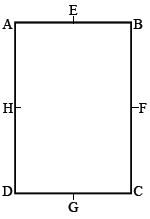
In a rectangle $ABCD$ where $BC = 2AB$,the moment of inertia will be minimum along which of the following axes?
A
$BC$
B
$BD$
C
$HF$
D
$EG$
Solution
(D) The moment of inertia $I$ of a body about an axis is given by $I = \int r^2 dm$,where $r$ is the perpendicular distance of the mass element $dm$ from the axis. To minimize the moment of inertia,the mass distribution should be as close to the axis as possible.
For a rectangle of sides $a$ and $b$ (where $b = 2a$),the axes $HF$ and $EG$ pass through the center. Axis $HF$ is parallel to the sides $AB$ and $CD$ (length $a$),and axis $EG$ is parallel to the sides $AD$ and $BC$ (length $2a$).
The moment of inertia about an axis passing through the center and parallel to a side of length $L$ is given by $I = \frac{1}{12} M L^2$ (where $L$ is the side perpendicular to the axis).
For axis $HF$ (parallel to $AB$),the perpendicular side is $BC = 2a$,so $I_{HF} = \frac{1}{12} M (2a)^2 = \frac{4}{12} M a^2 = \frac{1}{3} M a^2$.
For axis $EG$ (parallel to $BC$),the perpendicular side is $AB = a$,so $I_{EG} = \frac{1}{12} M a^2$.
Comparing the two,$I_{EG} < I_{HF}$. Thus,the moment of inertia is minimum along the axis $EG$.
For a rectangle of sides $a$ and $b$ (where $b = 2a$),the axes $HF$ and $EG$ pass through the center. Axis $HF$ is parallel to the sides $AB$ and $CD$ (length $a$),and axis $EG$ is parallel to the sides $AD$ and $BC$ (length $2a$).
The moment of inertia about an axis passing through the center and parallel to a side of length $L$ is given by $I = \frac{1}{12} M L^2$ (where $L$ is the side perpendicular to the axis).
For axis $HF$ (parallel to $AB$),the perpendicular side is $BC = 2a$,so $I_{HF} = \frac{1}{12} M (2a)^2 = \frac{4}{12} M a^2 = \frac{1}{3} M a^2$.
For axis $EG$ (parallel to $BC$),the perpendicular side is $AB = a$,so $I_{EG} = \frac{1}{12} M a^2$.
Comparing the two,$I_{EG} < I_{HF}$. Thus,the moment of inertia is minimum along the axis $EG$.
0 likesView Solution
17
ChemistryMCQAIPMT · 1993
The ratio among most probable velocity,mean velocity and root mean square velocity is given by
A
$1 : 2 : 3$
B
$1 : \sqrt{2} : \sqrt{3}$
C
$\sqrt{2} : \sqrt{3} : \sqrt{8/\pi}$
D
$\sqrt{2} : \sqrt{8/\pi} : \sqrt{3}$
Solution
(D) Most probable velocity,$U_{MP} = \sqrt{\frac{2RT}{M}}$
Average velocity,$U_{avg} = \sqrt{\frac{8RT}{\pi M}}$
Root mean square velocity,$U_{RMS} = \sqrt{\frac{3RT}{M}}$
Taking the ratio $U_{MP} : U_{avg} : U_{RMS}$:
$= \sqrt{\frac{2RT}{M}} : \sqrt{\frac{8RT}{\pi M}} : \sqrt{\frac{3RT}{M}}$
$= \sqrt{2} : \sqrt{\frac{8}{\pi}} : \sqrt{3}$
Hence,option $D$ is correct.
Average velocity,$U_{avg} = \sqrt{\frac{8RT}{\pi M}}$
Root mean square velocity,$U_{RMS} = \sqrt{\frac{3RT}{M}}$
Taking the ratio $U_{MP} : U_{avg} : U_{RMS}$:
$= \sqrt{\frac{2RT}{M}} : \sqrt{\frac{8RT}{\pi M}} : \sqrt{\frac{3RT}{M}}$
$= \sqrt{2} : \sqrt{\frac{8}{\pi}} : \sqrt{3}$
Hence,option $D$ is correct.
0 likesView Solution
18
ChemistryMCQAIPMT · 1993
The number of photo-electrons emitted per second from a metal surface increases when
A
The energy of incident photons increases
B
The frequency of incident light increases
C
The wavelength of the incident light increases
D
The intensity of the incident light increases
Solution
(D) According to the photoelectric effect,the number of photo-electrons emitted per second is directly proportional to the number of incident photons per second.
Since the intensity of light is defined as the energy incident per unit area per unit time,it is directly proportional to the number of incident photons.
Therefore,increasing the intensity of the incident light increases the number of incident photons,which in turn increases the number of photo-electrons emitted per second.
Since the intensity of light is defined as the energy incident per unit area per unit time,it is directly proportional to the number of incident photons.
Therefore,increasing the intensity of the incident light increases the number of incident photons,which in turn increases the number of photo-electrons emitted per second.
0 likesView Solution
19
ChemistryMCQAIPMT · 1993
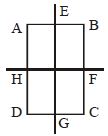
In a rectangle $ABCD$ where $BC = 2AB$,the moment of inertia will be minimum about which axis?
A
$BC$
B
$BD$
C
$HF$
D
$EG$
Solution
(D) Let the length $AB = CD = a$ and the width $BC = AD = 2a$. The mass of the rectangle is $M$.
For a rectangular lamina of sides $a$ and $b$,the moment of inertia about an axis passing through the center and parallel to side $b$ is $I = \frac{Ma^2}{12}$.
$1$. For axis $EG$ (parallel to $BC$): The distance of mass distribution is along $AB$. Here,$I_{EG} = \frac{M(AB)^2}{12} = \frac{Ma^2}{12}$.
$2$. For axis $HF$ (parallel to $AB$): The distance of mass distribution is along $BC$. Here,$I_{HF} = \frac{M(BC)^2}{12} = \frac{M(2a)^2}{12} = \frac{4Ma^2}{12} = \frac{Ma^2}{3}$.
Comparing the two,$I_{EG} < I_{HF}$.
Since the moment of inertia is proportional to the square of the distance of the mass from the axis,the axis that passes through the center and is parallel to the longer side will have the minimum moment of inertia.
Therefore,the moment of inertia is minimum about the axis $EG$.
For a rectangular lamina of sides $a$ and $b$,the moment of inertia about an axis passing through the center and parallel to side $b$ is $I = \frac{Ma^2}{12}$.
$1$. For axis $EG$ (parallel to $BC$): The distance of mass distribution is along $AB$. Here,$I_{EG} = \frac{M(AB)^2}{12} = \frac{Ma^2}{12}$.
$2$. For axis $HF$ (parallel to $AB$): The distance of mass distribution is along $BC$. Here,$I_{HF} = \frac{M(BC)^2}{12} = \frac{M(2a)^2}{12} = \frac{4Ma^2}{12} = \frac{Ma^2}{3}$.
Comparing the two,$I_{EG} < I_{HF}$.
Since the moment of inertia is proportional to the square of the distance of the mass from the axis,the axis that passes through the center and is parallel to the longer side will have the minimum moment of inertia.
Therefore,the moment of inertia is minimum about the axis $EG$.
0 likesView Solution
20
ChemistryMCQAIPMT · 1993
If $N$ is the number of turns in a coil,the value of self-inductance varies as
A
$N^0$
B
$N$
C
$N^2$
D
$N^{-2}$
Solution
(C) The self-inductance $L$ of a solenoid is given by the formula $L = \frac{\mu_0 N^2 A}{l}$,where $\mu_0$ is the permeability of free space,$N$ is the number of turns,$A$ is the cross-sectional area,and $l$ is the length of the coil.
From this expression,it is clear that the self-inductance $L$ is directly proportional to the square of the number of turns,i.e.,$L \propto N^2$.
From this expression,it is clear that the self-inductance $L$ is directly proportional to the square of the number of turns,i.e.,$L \propto N^2$.
0 likesView Solution
21
ChemistryMediumMCQAIPMT · 1993
The standard oxidation potentials for the half-reactions are given as $Zn \to Zn^{2+} + 2e^{-}; E^o = +0.76 \ V$ and $Fe \to Fe^{2+} + 2e^{-}; E^o = +0.41 \ V$. The $EMF$ for the cell reaction $Fe^{2+} + Zn \to Zn^{2+} + Fe$ is ............ $V$.
A
$-0.35$
B
$+0.35$
C
$+1.17$
D
$-1.17$
Solution
(B) The given reactions are oxidation half-reactions. The standard reduction potentials $(E^o_{red})$ are the negative of the standard oxidation potentials $(E^o_{ox})$.
$E^o_{red}(Zn^{2+}/Zn) = -0.76 \ V$
$E^o_{red}(Fe^{2+}/Fe) = -0.41 \ V$
In the cell reaction $Fe^{2+} + Zn \to Zn^{2+} + Fe$,$Zn$ is oxidized (anode) and $Fe^{2+}$ is reduced (cathode).
$E^o_{cell} = E^o_{cathode} - E^o_{anode}$
$E^o_{cell} = E^o_{red}(Fe^{2+}/Fe) - E^o_{red}(Zn^{2+}/Zn)$
$E^o_{cell} = -0.41 \ V - (-0.76 \ V)$
$E^o_{cell} = -0.41 \ V + 0.76 \ V = +0.35 \ V$.
$E^o_{red}(Zn^{2+}/Zn) = -0.76 \ V$
$E^o_{red}(Fe^{2+}/Fe) = -0.41 \ V$
In the cell reaction $Fe^{2+} + Zn \to Zn^{2+} + Fe$,$Zn$ is oxidized (anode) and $Fe^{2+}$ is reduced (cathode).
$E^o_{cell} = E^o_{cathode} - E^o_{anode}$
$E^o_{cell} = E^o_{red}(Fe^{2+}/Fe) - E^o_{red}(Zn^{2+}/Zn)$
$E^o_{cell} = -0.41 \ V - (-0.76 \ V)$
$E^o_{cell} = -0.41 \ V + 0.76 \ V = +0.35 \ V$.
0 likesView Solution
22
ChemistryEasyMCQAIPMT · 1993
Which one of the following is an ore of silver?
A
Argentite
B
Stibnite
C
Haematite
D
Bauxite
Solution
(A) Argentite is an ore of silver with the chemical formula $Ag_2S$.
Stibnite is an ore of antimony with the chemical formula $Sb_2S_3$.
Haematite is an ore of iron with the chemical formula $Fe_2O_3$.
Bauxite is an ore of aluminium with the chemical formula $Al_2O_3 \cdot 2H_2O$.
Stibnite is an ore of antimony with the chemical formula $Sb_2S_3$.
Haematite is an ore of iron with the chemical formula $Fe_2O_3$.
Bauxite is an ore of aluminium with the chemical formula $Al_2O_3 \cdot 2H_2O$.
0 likesView Solution
Vedclass Products
For Students
Vedclass Test Series
Mock tests in real AIPMT style covering Chemistry with performance analysis. 5-day free trial.
Start Free TrialFor Teachers
Exam Paper Generator
Generate Set A/B/C/D Chemistry papers from 7.5L+ questions in 2 minutes. 3 chapters free.
Try FreeFor Institutes
Online Exam Module
Run live AIPMT mock exams with unlimited students, 360° analytics & white-label branding.
See DemoFrequently Asked Questions
How many Chemistry questions are in AIPMT 1993?
There are 22 Chemistry questions from the AIPMT 1993 paper on Vedclass, each with a detailed step-by-step solution in English.
Are AIPMT 1993 Chemistry solutions available in English?
Yes. All solutions on this page are in English. You can also switch to English or Hindi using the language buttons above the questions.
Can I practice AIPMT 1993 Chemistry as a timed test?
Yes. Use the Vedclass Test Series to attempt a full AIPMT mock test covering Chemistry with time limits and instant score analysis.
Can teachers create Chemistry papers from AIPMT previous year questions?
Yes. The Vedclass Exam Paper Generator lets teachers mix AIPMT Chemistry questions and generate Set A/B/C/D papers in minutes.
For Teachers & Institutes
Build a Custom Chemistry Paper
Pick AIPMT 1993 Chemistry questions, set difficulty, and generate Set A/B/C/D in 2 minutes.