
BiologyQ1–58 of 58 questions
Page 1 of 1 · English
1
BiologyMediumMCQAIIMS · 2017
Match column-$I$ with column-$II$ and choose the correct option.
| $A$. Family | $I$. tuberosum |
| $B$. Kingdom | $II$. Polymoniales |
| $C$. Order | $III$. Solanum |
| $D$. Species | $IV$. Plantae |
| $E$. Genus | $V$. Solanaceae |
A
$A-IV, B-III, C-V, D-II, E-I$
B
$A-V, B-IV, C-II, D-I, E-III$
C
$A-IV, B-V, C-II, D-I, E-III$
D
$A-V, B-III, C-II, D-I, E-IV$
Solution
(B) The taxonomic classification of the potato plant (Solanum tuberosum) is as follows:
$A$. Family: Solanaceae $(V)$
$B$. Kingdom: Plantae $(IV)$
$C$. Order: Polymoniales $(II)$
$D$. Species: tuberosum $(I)$
$E$. Genus: Solanum $(III)$
Therefore, the correct matching is $A-V, B-IV, C-II, D-I, E-III$.
$A$. Family: Solanaceae $(V)$
$B$. Kingdom: Plantae $(IV)$
$C$. Order: Polymoniales $(II)$
$D$. Species: tuberosum $(I)$
$E$. Genus: Solanum $(III)$
Therefore, the correct matching is $A-V, B-IV, C-II, D-I, E-III$.
0 likesView Solution
2
BiologyEasyMCQAIIMS · 2017
Fungi are filamentous with the exception of $X$ which is unicellular. Identify $X$.
A
Yeast
B
Albugo
C
Mucor
D
Lichen
Solution
(A) Yeast is a unicellular fungus and does not exhibit a filamentous structure. It is a microscopic fungus consisting of a single oval cell that reproduces primarily by budding.
0 likesView Solution
3
BiologyMediumMCQAIIMS · 2017
Which of the following statements is not correct for viruses?
A
Viruses are obligate parasites.
B
Viruses can multiply only when they are inside the living cells.
C
Viruses cannot pass through bacterial filters.
D
Viruses are made up of protein and $DNA$ or $RNA$ (never both $DNA$ and $RNA$).
Solution
(C) Viruses are sub-microscopic infectious agents that replicate only inside the living cells of a host organism.
They are obligate parasites,meaning they require a host to complete their life cycle.
Because viruses are significantly smaller than bacteria,they can easily pass through bacterial-proof filters.
Therefore,the statement that viruses cannot pass through bacterial filters is incorrect.
They are obligate parasites,meaning they require a host to complete their life cycle.
Because viruses are significantly smaller than bacteria,they can easily pass through bacterial-proof filters.
Therefore,the statement that viruses cannot pass through bacterial filters is incorrect.
0 likesView Solution
4
BiologyMediumMCQAIIMS · 2017
Which of the following statements regarding cyanobacteria is incorrect?
A
It is also called blue-green algae.
B
They are chemosynthetic heterotrophs.
C
It forms blooms in polluted water bodies.
D
It is unicellular,colonial or filamentous,marine or terrestrial bacteria.
Solution
(B) Cyanobacteria are photosynthetic autotrophs,not chemosynthetic heterotrophs. They contain chlorophyll $a$ similar to green plants and perform oxygenic photosynthesis. They are prokaryotic organisms that can be unicellular,colonial,or filamentous,and they are found in marine,freshwater,or terrestrial environments. They often form blooms in polluted water bodies.
0 likesView Solution
5
BiologyMediumMCQAIIMS · 2017
Assertion : $TMV$ is a virus which causes mosaic disease.
Reason : $TMV$ has $RNA$ as genetic material.
Reason : $TMV$ has $RNA$ as genetic material.
A
If both Assertion and Reason are correct and the Reason is a correct explanation of the Assertion.
B
If both Assertion and Reason are correct but Reason is not a correct explanation of the Assertion.
C
If the Assertion is correct but Reason is incorrect.
D
If both the Assertion and Reason are incorrect.
Solution
(B) The Assertion is correct because $TMV$ (Tobacco Mosaic Virus) is indeed the causative agent of mosaic disease in tobacco plants.
The Reason is also correct because the genetic material of $TMV$ is a single-stranded $RNA$ molecule.
However,the fact that $TMV$ has $RNA$ as its genetic material does not explain why it causes mosaic disease; these are two independent biological facts about the virus. Therefore,the Reason is not the correct explanation of the Assertion.
The Reason is also correct because the genetic material of $TMV$ is a single-stranded $RNA$ molecule.
However,the fact that $TMV$ has $RNA$ as its genetic material does not explain why it causes mosaic disease; these are two independent biological facts about the virus. Therefore,the Reason is not the correct explanation of the Assertion.
0 likesView Solution
6
BiologyDifficultMCQAIIMS · 2017
Consider the following statements regarding the major pigments and stored food in the different groups of algae and choose the correct option:
$(i)$ In Chlorophyceae,the stored food material is starch and the major pigments are chlorophyll $-a$ and $d$.
$(ii)$ In Phaeophyceae,laminarin is the stored food and major pigments are chlorophyll $-a$ and $b$.
$(iii)$ In Rhodophyceae,floridean starch is the stored food and the major pigments are chlorophyll $-a, d$ and phycoerythrin.
$(i)$ In Chlorophyceae,the stored food material is starch and the major pigments are chlorophyll $-a$ and $d$.
$(ii)$ In Phaeophyceae,laminarin is the stored food and major pigments are chlorophyll $-a$ and $b$.
$(iii)$ In Rhodophyceae,floridean starch is the stored food and the major pigments are chlorophyll $-a, d$ and phycoerythrin.
A
$(i)$ is correct,but $(ii)$ and $(iii)$ are incorrect.
B
$(i)$ and $(ii)$ are correct,but $(iii)$ is incorrect.
C
$(i)$ and $(iii)$ are correct,but $(ii)$ is incorrect.
D
$(iii)$ is correct,but $(i)$ and $(ii)$ are incorrect.
Solution
(D) Statement $(i)$ is incorrect because in Chlorophyceae,the major pigments are chlorophyll $-a$ and $b$,not $a$ and $d$.
Statement $(ii)$ is incorrect because in Phaeophyceae,the major pigments are chlorophyll $-a, c$ and fucoxanthin,not $a$ and $b$.
Statement $(iii)$ is correct because in Rhodophyceae,the stored food is floridean starch and the major pigments are chlorophyll $-a, d$ and phycoerythrin.
Therefore,only statement $(iii)$ is correct.
Statement $(ii)$ is incorrect because in Phaeophyceae,the major pigments are chlorophyll $-a, c$ and fucoxanthin,not $a$ and $b$.
Statement $(iii)$ is correct because in Rhodophyceae,the stored food is floridean starch and the major pigments are chlorophyll $-a, d$ and phycoerythrin.
Therefore,only statement $(iii)$ is correct.
0 likesView Solution
7
BiologyMediumMCQAIIMS · 2017
Column $-I$ contains organisms and column $-II$ contains their excretory structures. Choose the correct match from the options given below:
| Column $-I$ (Organism) | Column $-II$ (Excretory Structure) |
| $A$. Cockroach | $I$. Nephridia |
| $B$. Cat fish | $II$. Malpighian tubules |
| $C$. Earthworm | $III$. Kidneys |
| $D$. Balanoglossus | $IV$. Flame cells |
| $E$. Flatworm | $V$. Proboscis gland |
A
$A-I, B-III, C-II, D-IV, E-V$
B
$A-III, B-I, C-II, D-V, E-IV$
C
$A-II, B-I, C-III, D-V, E-IV$
D
$A-II, B-III, C-I, D-V, E-IV$
Solution
(D) The correct matching of organisms with their respective excretory structures is as follows:
$A$. Cockroach: Excretes through $II$. Malpighian tubules.
$B$. Cat fish: Being a vertebrate, it excretes through $III$. Kidneys.
$C$. Earthworm: Excretes through $I$. Nephridia.
$D$. Balanoglossus: Excretes through $V$. Proboscis gland.
$E$. Flatworm: Excretes through $IV$. Flame cells.
Thus, the correct sequence is $A-II, B-III, C-I, D-V, E-IV$.
$A$. Cockroach: Excretes through $II$. Malpighian tubules.
$B$. Cat fish: Being a vertebrate, it excretes through $III$. Kidneys.
$C$. Earthworm: Excretes through $I$. Nephridia.
$D$. Balanoglossus: Excretes through $V$. Proboscis gland.
$E$. Flatworm: Excretes through $IV$. Flame cells.
Thus, the correct sequence is $A-II, B-III, C-I, D-V, E-IV$.
0 likesView Solution
8
BiologyMediumMCQAIIMS · 2017
In which one of the following is the genus name,its two characters,and phylum $NOT$ correctly matched?
A
| $A$. Pila | $(i)$ Body segmented,$(ii)$ Mouth with radula,Phylum: Mollusca |
B
| $B$. Asterias | $(i)$ Spiny skinned,$(ii)$ Water vascular system,Phylum: Echinodermata |
C
| $C$. Sycon | $(i)$ Pore bearing,$(ii)$ Canal system,Phylum: Porifera |
D
| $D$. Periplaneta | $(i)$ Jointed appendages,$(ii)$ Chitinous exoskeleton,Phylum: Arthropoda |
Solution
(A) The genus $Pila$ belongs to the phylum $Mollusca$.
$Molluscs$ are characterized by having a soft,unsegmented body with a distinct head,muscular foot,and visceral hump.
Therefore,the character '$(i)$ Body segmented' is incorrect for $Pila$.
While $Pila$ does possess a radula (a rasping organ in the buccal cavity),the body segmentation is not a feature of this phylum.
Thus,option $A$ is the incorrectly matched pair.
$Molluscs$ are characterized by having a soft,unsegmented body with a distinct head,muscular foot,and visceral hump.
Therefore,the character '$(i)$ Body segmented' is incorrect for $Pila$.
While $Pila$ does possess a radula (a rasping organ in the buccal cavity),the body segmentation is not a feature of this phylum.
Thus,option $A$ is the incorrectly matched pair.
0 likesView Solution
9
BiologyMediumMCQAIIMS · 2017
Assertion : Ambulacral system plays a major role in locomotion of echinoderm.
Reason : Hydraulic pressure of fluid and contraction of muscle of tube feet make possible movement of echinoderm.
Reason : Hydraulic pressure of fluid and contraction of muscle of tube feet make possible movement of echinoderm.
A
If both Assertion and Reason are correct and the Reason is a correct explanation of the Assertion.
B
If both Assertion and Reason are correct but Reason is not a correct explanation of the Assertion.
C
If the Assertion is correct but Reason is incorrect.
D
If both the Assertion and Reason are incorrect.
Solution
(A) The water vascular system (also known as the ambulacral system) is a unique organ system found in echinoderms that functions in locomotion,food capture,respiration,and excretion.
This system consists of a network of water-filled canals that connect to external tube feet.
The movement of echinoderms is facilitated by the hydraulic pressure of the fluid within the system and the coordinated contraction of the muscles associated with the tube feet.
Therefore,the assertion is correct,and the reason provides a correct explanation for how the ambulacral system enables locomotion.
This system consists of a network of water-filled canals that connect to external tube feet.
The movement of echinoderms is facilitated by the hydraulic pressure of the fluid within the system and the coordinated contraction of the muscles associated with the tube feet.
Therefore,the assertion is correct,and the reason provides a correct explanation for how the ambulacral system enables locomotion.
0 likesView Solution
10
BiologyMediumMCQAIIMS · 2017
Which of the following is a modified stem for the protection of plants from browsing animals?
A
Tendrils
B
Thorns
C
Rhizome
D
Tuber
Solution
(B) Thorns are hard,woody,and sharp-pointed structures that develop from the axillary buds of the stem. They serve as a defensive mechanism to protect plants from browsing animals. Examples include $Citrus$ and $Bougainvillea$.
0 likesView Solution
11
BiologyDifficultMCQAIIMS · 2017
Leaves of dicotyledonous plants possess . . . . . . venation,while . . . . . . venation is the characteristic of most monocotyledons.
A
reticulate and parallel
B
parallel and reticulate
C
reticulate and perpendicular
D
obliquely and parallel
Solution
(A) Leaves of dicotyledonous plants possess reticulate venation,while parallel venation is the characteristic of most monocotyledons.
In reticulate venation,the veins of the leaf form a network or a net-like arrangement.
This type of venation is commonly found in dicotyledonous plants.
In parallel venation,the veins run parallel to each other within the leaf lamina.
This type of venation is a characteristic feature of most monocotyledonous plants.
In reticulate venation,the veins of the leaf form a network or a net-like arrangement.
This type of venation is commonly found in dicotyledonous plants.
In parallel venation,the veins run parallel to each other within the leaf lamina.
This type of venation is a characteristic feature of most monocotyledonous plants.
0 likesView Solution
12
BiologyMediumMCQAIIMS · 2017
In stems,the protoxylem lies towards the . . . . . . and the metaxylem lies towards the . . . . . . of the organ.
A
centre; periphery
B
periphery; centre
C
periphery; periphery
D
centre; centre
Solution
(A) The first formed primary xylem elements are called protoxylem and the later formed primary xylem is called metaxylem.
In stems,the protoxylem lies towards the centre (pith) and the metaxylem lies towards the periphery of the organ.
This arrangement of primary xylem is known as endarch.
In stems,the protoxylem lies towards the centre (pith) and the metaxylem lies towards the periphery of the organ.
This arrangement of primary xylem is known as endarch.
0 likesView Solution
13
BiologyEasyMCQAIIMS · 2017
Male cockroach can be identified from the female by the presence of
A
long antennae
B
wingless body
C
elongated abdomen
D
anal styles
Solution
(D) Both sexes of the cockroach possess anal cerci,which are jointed,paired structures located on the $10^{th}$ abdominal segment.
However,the male cockroach possesses an additional pair of unjointed,needle-like structures called anal styles on the $9^{th}$ abdominal segment.
These anal styles are absent in the female cockroach,making them a key morphological feature for distinguishing between the two sexes.
However,the male cockroach possesses an additional pair of unjointed,needle-like structures called anal styles on the $9^{th}$ abdominal segment.
These anal styles are absent in the female cockroach,making them a key morphological feature for distinguishing between the two sexes.
0 likesView Solution
14
BiologyEasyMCQAIIMS · 2017
The sensory papillae in frogs are associated with
A
smell
B
hearing
C
respiration
D
touch
Solution
(D) Frogs possess various types of sense organs to interact with their environment.
These include sensory papillae for the sense of touch,taste buds for taste,nasal epithelium for smell,eyes for vision,and the tympanum with internal ears for hearing.
Therefore,sensory papillae are specifically associated with the sense of touch.
These include sensory papillae for the sense of touch,taste buds for taste,nasal epithelium for smell,eyes for vision,and the tympanum with internal ears for hearing.
Therefore,sensory papillae are specifically associated with the sense of touch.
0 likesView Solution
15
BiologyEasyMCQAIIMS · 2017
In earthworms,setae are present in all segments except
A
first and the last segments
B
first segment and the clitellum
C
first segment
D
first,clitellum and last segments
Solution
(D) In earthworms,each segment (except the first,the last,and the clitellar segment) bears a ring of tiny,curved,chitinous structures known as setae. Setae help in locomotion and copulation.
0 likesView Solution
16
BiologyMediumMCQAIIMS · 2017
Assertion: The squamous epithelium is made of a single thin layer of flattened cells with irregular boundaries.
Reason: They are found in walls of blood vessels and air sacs of lungs.
Reason: They are found in walls of blood vessels and air sacs of lungs.
A
If both Assertion and Reason are correct and the Reason is a correct explanation of the Assertion.
B
If both Assertion and Reason are correct but Reason is not a correct explanation of the Assertion.
C
If the Assertion is correct but Reason is incorrect.
D
If both the Assertion and Reason are incorrect.
Solution
(A) The squamous epithelium is composed of a single thin layer of flattened cells with irregular boundaries,which is a correct description of its structure. This structure is ideal for diffusion,which is why it is found in the walls of blood vessels (endothelium) and air sacs of lungs (alveoli). Since the structure (Assertion) directly facilitates the function and location (Reason),the Reason is the correct explanation of the Assertion. Therefore,both are correct and the Reason explains the Assertion.
0 likesView Solution
17
BiologyMediumMCQAIIMS · 2017
Nucleotides are building blocks of nucleic acids. Each nucleotide is a composite molecule formed by
A
base-sugar-phosphate
B
base-sugar-$OH$
C
(base-sugar-phosphate)$_n$
D
sugar-phosphate
Solution
(A) Nucleotides are the building blocks of nucleic acids.
Each nucleotide consists of three distinct components:
$1$. $A$ pentose sugar (ribose in $RNA$ or deoxyribose in $DNA$).
$2$. $A$ phosphate group.
$3$. $A$ nitrogenous base (purine or pyrimidine).
Therefore,a nucleotide is formed by the combination of a base,a sugar,and a phosphate group.
Each nucleotide consists of three distinct components:
$1$. $A$ pentose sugar (ribose in $RNA$ or deoxyribose in $DNA$).
$2$. $A$ phosphate group.
$3$. $A$ nitrogenous base (purine or pyrimidine).
Therefore,a nucleotide is formed by the combination of a base,a sugar,and a phosphate group.
0 likesView Solution
18
BiologyMediumMCQAIIMS · 2017
Match the description (given in Column $I$) with the correct stage (given in Column $II$) and choose the correct option.
| Column $I$ | Column $II$ |
| $A$. Chromosomes are moved to spindle equator | $I$. Pachytene |
| $B$. Centromere splits and chromatids move apart | $II$. Zygotene |
| $C$. Pairing between homologous chromosomes takes place | $III$. Anaphase |
| $D$. Crossing over between homologous chromosomes | $IV$. Metaphase |
A
$A-I, B-II, C-III, D-IV$
B
$A-II, B-III, C-IV, D-I$
C
$A-IV, B-III, C-II, D-I$
D
$A-III, B-I, C-IV, D-II$
Solution
(C) $A-IV, B-III, C-II, D-I$
$1$. Metaphase $(IV)$: During metaphase, the chromosomes align at the spindle equator.
$2$. Anaphase $(III)$: During anaphase, the centromere splits, and the sister chromatids separate and move toward opposite poles.
$3$. Zygotene $(II)$: During the zygotene stage of prophase $I$, homologous chromosomes undergo pairing, a process known as synapsis.
$4$. Pachytene $(I)$: During the pachytene stage of prophase $I$, crossing over occurs between non-sister chromatids of homologous chromosomes.
$1$. Metaphase $(IV)$: During metaphase, the chromosomes align at the spindle equator.
$2$. Anaphase $(III)$: During anaphase, the centromere splits, and the sister chromatids separate and move toward opposite poles.
$3$. Zygotene $(II)$: During the zygotene stage of prophase $I$, homologous chromosomes undergo pairing, a process known as synapsis.
$4$. Pachytene $(I)$: During the pachytene stage of prophase $I$, crossing over occurs between non-sister chromatids of homologous chromosomes.
0 likesView Solution
19
BiologyMediumMCQAIIMS · 2017
Which of the following statements is/are not incorrect?
$(i)$ Water and minerals,and food are generally moved by a mass or bulk flow system.
$(ii)$ Bulk flow can be achieved either through a positive hydrostatic pressure gradient or a negative hydrostatic pressure gradient.
$(iii)$ The bulk movement of substances through the conducting tissues of plants is called translocation.
$(iv)$ Xylem translocates organic and inorganic solutes,mainly from roots to the aerial parts of the plants.
$(v)$ Phloem translocates water,mineral salts,some organic nitrogen and hormones,from the leaves to other parts of the plants.
$(i)$ Water and minerals,and food are generally moved by a mass or bulk flow system.
$(ii)$ Bulk flow can be achieved either through a positive hydrostatic pressure gradient or a negative hydrostatic pressure gradient.
$(iii)$ The bulk movement of substances through the conducting tissues of plants is called translocation.
$(iv)$ Xylem translocates organic and inorganic solutes,mainly from roots to the aerial parts of the plants.
$(v)$ Phloem translocates water,mineral salts,some organic nitrogen and hormones,from the leaves to other parts of the plants.
A
$(ii), (iii)$ and $(v)$
B
$(ii), (iii)$ and $(iv)$
C
$(i), (ii), (iii), (iv)$
D
$(ii)$ and $(v)$
Solution
(NONE OF THE OPTIONS PROVIDED ARE FULLY CORRECT BASED ON THE ANALYSIS (CORRECT SET IS $(I), (II), (III)$).) Statement $(i)$ is correct: Water,minerals,and food are moved by a mass or bulk flow system.
Statement $(ii)$ is correct: Bulk flow is achieved through positive or negative hydrostatic pressure gradients.
Statement $(iii)$ is correct: The bulk movement of substances through conducting tissues is called translocation.
Statement $(iv)$ is incorrect: Xylem mainly translocates water,mineral salts,some organic nitrogen,and hormones from roots to aerial parts.
Statement $(v)$ is incorrect: Phloem mainly translocates organic solutes (food) from leaves to other parts of the plant.
Therefore,statements $(i), (ii),$ and $(iii)$ are correct (not incorrect).
Statement $(ii)$ is correct: Bulk flow is achieved through positive or negative hydrostatic pressure gradients.
Statement $(iii)$ is correct: The bulk movement of substances through conducting tissues is called translocation.
Statement $(iv)$ is incorrect: Xylem mainly translocates water,mineral salts,some organic nitrogen,and hormones from roots to aerial parts.
Statement $(v)$ is incorrect: Phloem mainly translocates organic solutes (food) from leaves to other parts of the plant.
Therefore,statements $(i), (ii),$ and $(iii)$ are correct (not incorrect).
0 likesView Solution
20
BiologyDifficultMCQAIIMS · 2017
Refer to the given equation and answer the question. $2(C_{51}H_{98}O_6) + 145O_2 \to 102CO_2 + 98H_2O + \text{Energy}$. The $RQ$ of the above reaction is:
A
$1$
B
$0.7$
C
$1.45$
D
$1.62$
Solution
(B) The Respiratory Quotient $(RQ)$ is defined as the ratio of the volume of $CO_2$ evolved to the volume of $O_2$ consumed during respiration.
The formula is: $RQ = \frac{\text{Volume of } CO_2 \text{ evolved}}{\text{Volume of } O_2 \text{ consumed}}$.
From the given balanced chemical equation: $2(C_{51}H_{98}O_6) + 145O_2 \to 102CO_2 + 98H_2O + \text{Energy}$.
Here, the volume of $CO_2$ evolved is $102$ and the volume of $O_2$ consumed is $145$.
Therefore, $RQ = \frac{102}{145} \approx 0.703$, which is approximately $0.7$.
This value is characteristic of fatty substances (like tripalmitin).
The formula is: $RQ = \frac{\text{Volume of } CO_2 \text{ evolved}}{\text{Volume of } O_2 \text{ consumed}}$.
From the given balanced chemical equation: $2(C_{51}H_{98}O_6) + 145O_2 \to 102CO_2 + 98H_2O + \text{Energy}$.
Here, the volume of $CO_2$ evolved is $102$ and the volume of $O_2$ consumed is $145$.
Therefore, $RQ = \frac{102}{145} \approx 0.703$, which is approximately $0.7$.
This value is characteristic of fatty substances (like tripalmitin).
0 likesView Solution
21
BiologyMediumMCQAIIMS · 2017
In alcoholic fermentation,$NAD^+$ is produced during the
A
reduction of acetaldehyde to ethanol
B
oxidation of glucose
C
oxidation of pyruvate to acetyl $CoA$
D
hydrolysis of $ATP$ to $ADP$
Solution
(A) Alcoholic fermentation is an anaerobic process where glucose is converted into ethanol and carbon dioxide.
In the final step of this pathway,acetaldehyde is reduced to ethanol by the enzyme alcohol dehydrogenase.
During this specific reduction reaction,$NADH + H^+$ is oxidized back to $NAD^+$.
This regeneration of $NAD^+$ is crucial for the continuation of glycolysis.
In the final step of this pathway,acetaldehyde is reduced to ethanol by the enzyme alcohol dehydrogenase.
During this specific reduction reaction,$NADH + H^+$ is oxidized back to $NAD^+$.
This regeneration of $NAD^+$ is crucial for the continuation of glycolysis.
0 likesView Solution
22
BiologyMediumMCQAIIMS · 2017
Assertion : Auxins help to prevent fruit and leaf drop at early stages.
Reason : Auxins promote the abscission of older mature leaves and fruits.
Reason : Auxins promote the abscission of older mature leaves and fruits.
A
If both Assertion and Reason are correct and the Reason is a correct explanation of the Assertion.
B
If both Assertion and Reason are correct but Reason is not a correct explanation of the Assertion.
C
If the Assertion is correct but Reason is incorrect.
D
If both the Assertion and Reason are incorrect.
Solution
(B) Auxins,such as $IAA$ (Indole$-3-$acetic acid),play a dual role in the process of abscission.
In the early stages of development,auxins prevent the formation of the abscission layer,thereby preventing the premature drop of young leaves and fruits.
Conversely,in older or mature leaves and fruits,auxins promote the process of abscission.
Since the Assertion describes the inhibitory role in early stages and the Reason describes the promoting role in mature stages,both statements are correct,but the Reason does not explain why auxins prevent drop in early stages. Thus,the Reason is not the correct explanation of the Assertion.
In the early stages of development,auxins prevent the formation of the abscission layer,thereby preventing the premature drop of young leaves and fruits.
Conversely,in older or mature leaves and fruits,auxins promote the process of abscission.
Since the Assertion describes the inhibitory role in early stages and the Reason describes the promoting role in mature stages,both statements are correct,but the Reason does not explain why auxins prevent drop in early stages. Thus,the Reason is not the correct explanation of the Assertion.
0 likesView Solution
23
BiologyMediumMCQAIIMS · 2017
Which of the following statements is true?
A
Pepsin cannot digest casein.
B
Trypsin can digest collagen.
C
Pepsin cannot digest collagen.
D
Chymotrypsin can digest casein.
Solution
(D) Milk protein (casein) can be digested by both pepsin and chymotrypsin. Pepsin is a proteolytic enzyme found in the stomach that acts on proteins,including casein. Chymotrypsin is a pancreatic enzyme that also breaks down proteins,including casein. Therefore,the statement that chymotrypsin can digest casein is correct.
0 likesView Solution
24
BiologyMediumMCQAIIMS · 2017
Assertion : Water and electrolytes are almost fully absorbed in the large intestine.
Reason : In large intestine,haustral contractions (slow segmenting movements) roll the forming faeces over and over,causing absorption of water and electrolytes.
Reason : In large intestine,haustral contractions (slow segmenting movements) roll the forming faeces over and over,causing absorption of water and electrolytes.
A
If both Assertion and Reason are correct and the Reason is a correct explanation of the Assertion.
B
If both Assertion and Reason are correct but Reason is not a correct explanation of the Assertion.
C
If the Assertion is correct but Reason is incorrect.
D
If both the Assertion and Reason are incorrect.
Solution
(D) The Assertion is incorrect because the primary site for the absorption of water and electrolytes is the small intestine,not the large intestine. While the large intestine does absorb some water and electrolytes,it is not the site where they are 'almost fully' absorbed.
The Reason is also incorrect because,although haustral contractions do occur in the large intestine to mix and move contents,the primary function of the large intestine is the absorption of water,some minerals,and certain vitamins produced by symbiotic bacteria,not the primary absorption of electrolytes as implied.
Therefore,both the Assertion and the Reason are incorrect.
The Reason is also incorrect because,although haustral contractions do occur in the large intestine to mix and move contents,the primary function of the large intestine is the absorption of water,some minerals,and certain vitamins produced by symbiotic bacteria,not the primary absorption of electrolytes as implied.
Therefore,both the Assertion and the Reason are incorrect.
0 likesView Solution
25
BiologyEasyMCQAIIMS · 2017
The given figure represents the cross-bridge cycle in skeletal muscle. What does step $B$ in the figure represent?
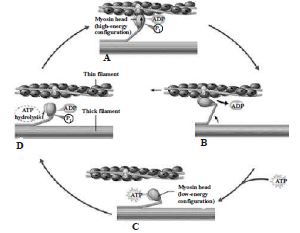
A
Attachment of myosin head to actin forming a cross-bridge.
B
Release of phosphate. Myosin changes shape to pull actin.
C
Attachment of new $ATP$ to myosin head. The cross-bridge detaches.
D
Splitting of $ATP$ into $ADP$ and $Pi$. Myosin cocks into its high-energy conformation.
Solution
(B) Step $A$: Attachment of myosin head to actin forming a cross-bridge.
Step $B$: Release of phosphate. Myosin changes shape to pull actin.
Step $C$: Attachment of new $ATP$ to myosin head. The cross-bridge detaches.
Step $D$: Splitting of $ATP$ into $ADP$ and $Pi$. Myosin cocks into its high-energy conformation.
Step $B$: Release of phosphate. Myosin changes shape to pull actin.
Step $C$: Attachment of new $ATP$ to myosin head. The cross-bridge detaches.
Step $D$: Splitting of $ATP$ into $ADP$ and $Pi$. Myosin cocks into its high-energy conformation.
0 likesView Solution
26
BiologyMediumMCQAIIMS · 2017
Assertion: Inflammation of a skeletal joint may immobilize the movements of the joint.
Reason: Uric acid crystals in the joint cavity and ossification of articular cartilage lead to this.
Reason: Uric acid crystals in the joint cavity and ossification of articular cartilage lead to this.
A
If both Assertion and Reason are correct and the Reason is a correct explanation of the Assertion.
B
If both Assertion and Reason are correct but Reason is not a correct explanation of the Assertion.
C
If the Assertion is correct but Reason is incorrect.
D
If both the Assertion and Reason are incorrect.
Solution
(A) The assertion is correct because inflammation of joints (arthritis) leads to stiffness and reduced mobility.
The reason is also correct as it describes specific causes of joint disorders: accumulation of uric acid crystals causes gout,and ossification of articular cartilage (ankylosis) leads to the fusion and immobilization of joints.
Therefore,the reason correctly explains why inflammation and associated pathological changes lead to the immobilization of joints.
The reason is also correct as it describes specific causes of joint disorders: accumulation of uric acid crystals causes gout,and ossification of articular cartilage (ankylosis) leads to the fusion and immobilization of joints.
Therefore,the reason correctly explains why inflammation and associated pathological changes lead to the immobilization of joints.
0 likesView Solution
27
BiologyMediumMCQAIIMS · 2017
Assertion : The cerebellum is related to skillful voluntary movements and involuntary activities like body balance,equilibrium,etc.
Reason : It is a part of the hindbrain and is situated behind the pons.
Reason : It is a part of the hindbrain and is situated behind the pons.
A
If both Assertion and Reason are correct and the Reason is a correct explanation of the Assertion.
B
If both Assertion and Reason are correct but Reason is not a correct explanation of the Assertion.
C
If the Assertion is correct but Reason is incorrect.
D
If both the Assertion and Reason are incorrect.
Solution
(B) The cerebellum is a part of the hindbrain,located dorsally to the medulla oblongata and the pons.
It plays a crucial role in maintaining posture,equilibrium,and muscle tone.
While the cerebellum coordinates voluntary movements (making them smooth and precise),it does not initiate them; rather,it refines them.
Since the cerebellum is indeed a part of the hindbrain and is located behind the pons,the reason correctly explains the anatomical position,though the assertion focuses on its functional role. Both statements are scientifically accurate.
It plays a crucial role in maintaining posture,equilibrium,and muscle tone.
While the cerebellum coordinates voluntary movements (making them smooth and precise),it does not initiate them; rather,it refines them.
Since the cerebellum is indeed a part of the hindbrain and is located behind the pons,the reason correctly explains the anatomical position,though the assertion focuses on its functional role. Both statements are scientifically accurate.
0 likesView Solution
28
BiologyMediumMCQAIIMS · 2017
Which of the following hormones acts upon the renal tubule and blood capillaries?
A
Glucagon
B
Aldosterone
C
Vasopressin
D
Glucocorticoids
Solution
(C) $ADH$ (also known as vasopressin) is secreted by the posterior pituitary gland.
It acts on the renal tubules (specifically the distal convoluted tubules and collecting ducts) and blood capillaries.
It promotes the reabsorption of water and electrolytes,thereby reducing the loss of water through urine (diuresis) and concentrating the urine.
It acts on the renal tubules (specifically the distal convoluted tubules and collecting ducts) and blood capillaries.
It promotes the reabsorption of water and electrolytes,thereby reducing the loss of water through urine (diuresis) and concentrating the urine.
0 likesView Solution
29
BiologyMediumMCQAIIMS · 2017
Assertion : Species are groups of potentially interbreeding natural populations which are isolated from other such groups.
Reason : Distinctive morphological characters are displayed due to reproductive isolation.
Reason : Distinctive morphological characters are displayed due to reproductive isolation.
A
If both Assertion and Reason are correct and the Reason is a correct explanation of the Assertion.
B
If both Assertion and Reason are correct but Reason is not a correct explanation of the Assertion.
C
If the Assertion is correct but Reason is incorrect.
D
If both the Assertion and Reason are incorrect.
Solution
(C) The Assertion is correct because it defines the biological species concept,which states that species are groups of interbreeding natural populations that are reproductively isolated from other such groups.
The Reason is incorrect because distinctive morphological characters are not primarily displayed due to reproductive isolation; rather,they are the result of genetic divergence,natural selection,and adaptation to specific environments. Reproductive isolation is a mechanism that maintains species boundaries,not the cause of morphological variation.
The Reason is incorrect because distinctive morphological characters are not primarily displayed due to reproductive isolation; rather,they are the result of genetic divergence,natural selection,and adaptation to specific environments. Reproductive isolation is a mechanism that maintains species boundaries,not the cause of morphological variation.
0 likesView Solution
30
BiologyEasyMCQAIIMS · 2017
Assertion: In a $DNA$ molecule,$A-T$ rich parts melt before $G-C$ rich parts.
Reason: In between $A$ and $T$ there are three $H-$ bonds,whereas in between $G$ and $C$ there are two $H-$ bonds.
Reason: In between $A$ and $T$ there are three $H-$ bonds,whereas in between $G$ and $C$ there are two $H-$ bonds.
A
If both Assertion and Reason are correct and the Reason is a correct explanation of the Assertion.
B
If both Assertion and Reason are correct but Reason is not a correct explanation of the Assertion.
C
If the Assertion is correct but Reason is incorrect.
D
If both the Assertion and Reason are incorrect.
Solution
(C) The Assertion is correct because $A-T$ base pairs are held together by two hydrogen bonds,while $G-C$ base pairs are held together by three hydrogen bonds.
Because $G-C$ pairs have more hydrogen bonds,they are more stable and require more energy to break (melt) compared to $A-T$ pairs.
The Reason provided is incorrect because it states the number of hydrogen bonds in reverse: $A$ and $T$ have two hydrogen bonds,while $G$ and $C$ have three hydrogen bonds.
Because $G-C$ pairs have more hydrogen bonds,they are more stable and require more energy to break (melt) compared to $A-T$ pairs.
The Reason provided is incorrect because it states the number of hydrogen bonds in reverse: $A$ and $T$ have two hydrogen bonds,while $G$ and $C$ have three hydrogen bonds.
0 likesView Solution
31
BiologyMediumMCQAIIMS · 2017
In a practical test, a student has to identify the organisms in which syngamy does not occur. In those organisms, the female gamete undergoes development to form new organisms without fertilization. This phenomenon is called "$X$". Identify the organisms and the phenomenon "$X$".
A
Frog, Parthenogenesis
B
Lizards, Gametogenesis
C
Rotifers, Embryogenesis
D
Honeybee, Parthenogenesis
Solution
(D) Parthenogenesis is a form of asexual reproduction in which an unfertilized egg develops into a new individual.
In organisms like rotifers, honeybees, and some lizards and birds (like turkeys), the female gamete undergoes development to form new organisms without fertilization.
This process is known as Parthenogenesis.
Therefore, the correct pair is Honeybee and Parthenogenesis.
In organisms like rotifers, honeybees, and some lizards and birds (like turkeys), the female gamete undergoes development to form new organisms without fertilization.
This process is known as Parthenogenesis.
Therefore, the correct pair is Honeybee and Parthenogenesis.
0 likesView Solution
32
BiologyMediumMCQAIIMS · 2017
Assertion: Endosperm is a nutritive tissue and it is triploid.
Reason: Endosperm is formed by the fusion of the secondary nucleus with the second male gamete. It is used by the developing embryo.
Reason: Endosperm is formed by the fusion of the secondary nucleus with the second male gamete. It is used by the developing embryo.
A
If both Assertion and Reason are correct and the Reason is a correct explanation of the Assertion.
B
If both Assertion and Reason are correct but Reason is not a correct explanation of the Assertion.
C
If the Assertion is correct but Reason is incorrect.
D
If both the Assertion and Reason are incorrect.
Solution
(A) The process of double fertilization involves the fusion of one male gamete $(n)$ with the secondary nucleus $(2n)$ to form the primary endosperm nucleus $(3n)$.
This process is known as triple fusion.
The primary endosperm nucleus develops into the endosperm,which is a triploid $(3n)$ nutritive tissue.
The endosperm provides essential nutrients to the developing embryo.
This process is known as triple fusion.
The primary endosperm nucleus develops into the endosperm,which is a triploid $(3n)$ nutritive tissue.
The endosperm provides essential nutrients to the developing embryo.
0 likesView Solution
33
BiologyEasyMCQAIIMS · 2017
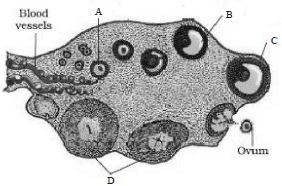
The figure given below shows the sectional view of an ovary. Select the option which gives the correct identification of the marked structure ($A$ to $D$) and its feature.
A
$A$: Primary follicle,it is also called a gamete mother cell.
B
$B$: Corpus luteum,it cannot be formed and added after birth.
C
$C$: Graafian follicle,a mature follicle which ruptures to release a secondary oocyte.
D
$D$: Tertiary follicle,a large number of these follicles degenerate during the phase from birth to puberty.
Solution
(C) Oogonia are referred to as gamete mother cells.
$A$ represents a primary follicle.
$B$ represents a tertiary follicle.
$C$ represents a Graafian follicle,which is a mature follicle that ruptures to release the secondary oocyte during ovulation.
$D$ represents the corpus luteum,which is formed from the remains of the Graafian follicle after ovulation.
$A$ large number of primary follicles degenerate during the phase from birth to puberty,a process known as follicular atresia.
Therefore,option $C$ is the correct identification and description.
$A$ represents a primary follicle.
$B$ represents a tertiary follicle.
$C$ represents a Graafian follicle,which is a mature follicle that ruptures to release the secondary oocyte during ovulation.
$D$ represents the corpus luteum,which is formed from the remains of the Graafian follicle after ovulation.
$A$ large number of primary follicles degenerate during the phase from birth to puberty,a process known as follicular atresia.
Therefore,option $C$ is the correct identification and description.
0 likesView Solution
34
BiologyMediumMCQAIIMS · 2017
Select the correct match of the techniques given in column $I$ with its feature given in column $II$.
| Column $I$ | Column $II$ |
| $A.$ $ICSI$ | $I.$ Artificially introduction of semen into the vagina or uterus. |
| $B.$ $IUI$ | $II.$ Transfer of ovum collected from a donor into the fallopian tube where fertilization occurs. |
| $C.$ $IUT$ | $III.$ Formation of embryo by directly injecting sperm into the ovum. |
| $D.$ $GIFT$ | $IV.$ Transfer of the zygote or early embryo (with up to $8$ blastomeres) into a fallopian tube. |
| $E.$ $ZIFT$ | $V.$ Transfer of embryo with more than $8$ blastomeres into the uterus. |
A
$A-V, B-IV, C-I, D-III, E-IV$
B
$A-I, B-II, C-III, D-IV, E-V$
C
$A-III, B-V, C-II, D-IV, E-I$
D
$A-III, B-I, C-V, D-II, E-IV$
Solution
(D) $ICSI$ (Intracytoplasmic sperm injection) - Formation of embryo by directly injecting sperm into the ovum $(III)$.
$IUI$ (Intrauterine insemination) - Artificial introduction of semen into the vagina or uterus $(I)$.
$IUT$ (Intrauterine transfer) - Transfer of embryo with more than $8$ blastomeres into the uterus $(V)$.
$GIFT$ (Gamete intrafallopian transfer) - Transfer of ovum collected from a donor into the fallopian tube where fertilization occurs $(II)$.
$ZIFT$ (Zygote intrafallopian transfer) - Transfer of the zygote or early embryo (with up to $8$ blastomeres) into a fallopian tube $(IV)$.
Therefore, the correct match is $A-III, B-I, C-V, D-II, E-IV$.
$IUI$ (Intrauterine insemination) - Artificial introduction of semen into the vagina or uterus $(I)$.
$IUT$ (Intrauterine transfer) - Transfer of embryo with more than $8$ blastomeres into the uterus $(V)$.
$GIFT$ (Gamete intrafallopian transfer) - Transfer of ovum collected from a donor into the fallopian tube where fertilization occurs $(II)$.
$ZIFT$ (Zygote intrafallopian transfer) - Transfer of the zygote or early embryo (with up to $8$ blastomeres) into a fallopian tube $(IV)$.
Therefore, the correct match is $A-III, B-I, C-V, D-II, E-IV$.
0 likesView Solution
35
BiologyMediumMCQAIIMS · 2017
Assertion : In humans,the gamete contributed by the male determines whether the child produced will be male or female.
Reason : Sex in humans is a polygenic trait depending upon a cumulative effect of some genes on $X-$ chromosome and some on $Y-$ chromosome.
Reason : Sex in humans is a polygenic trait depending upon a cumulative effect of some genes on $X-$ chromosome and some on $Y-$ chromosome.
A
If both Assertion and Reason are correct and the Reason is a correct explanation of the Assertion.
B
If both Assertion and Reason are correct but Reason is not a correct explanation of the Assertion.
C
If the Assertion is correct but Reason is incorrect.
D
If both the Assertion and Reason are incorrect.
Solution
(C) In humans,sex determination is based on the $XY$ type. Males produce two types of gametes: $50\%$ carrying the $X$ chromosome and $50\%$ carrying the $Y$ chromosome. Females produce only one type of gamete,all carrying the $X$ chromosome. Therefore,the sex of the child is determined by the sperm (male gamete) that fertilizes the egg. Thus,the Assertion is correct.
Sex in humans is not a polygenic trait; it is determined by the presence or absence of the $Y$ chromosome,specifically the $SRY$ gene located on it. The Reason statement is scientifically incorrect because sex determination in humans is primarily a monogenic trait controlled by the $Y$ chromosome,not a polygenic trait.
Sex in humans is not a polygenic trait; it is determined by the presence or absence of the $Y$ chromosome,specifically the $SRY$ gene located on it. The Reason statement is scientifically incorrect because sex determination in humans is primarily a monogenic trait controlled by the $Y$ chromosome,not a polygenic trait.
0 likesView Solution
36
BiologyEasyMCQAIIMS · 2017
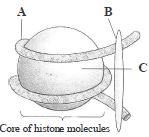
The given figure shows the structure of a nucleosome with its parts labelled as $A, B$ and $C$. Identify $A, B$ and $C$.
A
$A - DNA$; $B - H_1$ histone; $C -$ Histone octamer
B
$A - H_1$ histone; $B - DNA$; $C -$ Histone octamer
C
$A -$ Histone octamer; $B - RNA$; $C - H_1$ histone
D
$A - RNA$; $B - H_1$ histone; $C -$ Histone octamer
Solution
(A) nucleosome is the basic structural unit of eukaryotic chromatin,which consists of a segment of $DNA$ wrapped around a core of histone proteins.
In the provided figure:
$A$ represents the $DNA$ molecule that wraps around the histone core.
$B$ represents the $H_1$ histone protein,which binds to the $DNA$ where it enters and leaves the nucleosome.
$C$ represents the histone octamer,which is the core complex consisting of two molecules each of four histone proteins ($H2A, H2B, H3,$ and $H4$).
Therefore,the correct identification is $A - DNA, B - H_1$ histone,and $C -$ Histone octamer.
In the provided figure:
$A$ represents the $DNA$ molecule that wraps around the histone core.
$B$ represents the $H_1$ histone protein,which binds to the $DNA$ where it enters and leaves the nucleosome.
$C$ represents the histone octamer,which is the core complex consisting of two molecules each of four histone proteins ($H2A, H2B, H3,$ and $H4$).
Therefore,the correct identification is $A - DNA, B - H_1$ histone,and $C -$ Histone octamer.
0 likesView Solution
37
BiologyMediumMCQAIIMS · 2017
Match the codons given in column $I$ with their respective amino acids given in column $II$ and choose the correct answer.
| Column $I$ (Codons) | Column $II$ (Amino acids) |
| $(A)$ $UUU$ | $(I)$ Serine |
| $(B)$ $GGG$ | $(II)$ Methionine |
| $(C)$ $UCU$ | $(III)$ Phenylalanine |
| $(D)$ $CCC$ | $(IV)$ Glycine |
| $(E)$ $AUG$ | $(V)$ Proline |
A
$A-III, B-IV, C-I, D-V, E-II$
B
$A-III, B-I, C-IV, D-V, E-II$
C
$A-III, B-IV, C-V, D-I, E-II$
D
$A-II, B-IV, C-I, D-V, E-III$
Solution
$(A)$ The genetic code specifies the relationship between codons and amino acids:
$1$. $UUU$ codes for Phenylalanine $(A-III)$.
$2$. $GGG$ codes for Glycine $(B-IV)$.
$3$. $UCU$ codes for Serine $(C-I)$.
$4$. $CCC$ codes for Proline $(D-V)$.
$5$. $AUG$ codes for Methionine $(E-II)$.
Thus, the correct matching is $A-III, B-IV, C-I, D-V, E-II$.
$1$. $UUU$ codes for Phenylalanine $(A-III)$.
$2$. $GGG$ codes for Glycine $(B-IV)$.
$3$. $UCU$ codes for Serine $(C-I)$.
$4$. $CCC$ codes for Proline $(D-V)$.
$5$. $AUG$ codes for Methionine $(E-II)$.
Thus, the correct matching is $A-III, B-IV, C-I, D-V, E-II$.
0 likesView Solution
38
BiologyMediumMCQAIIMS · 2017
According to the Hardy-Weinberg principle,allele and genotype frequencies in a population will remain constant from generation to generation in the absence of other evolutionary influences. It makes several assumptions which are given below:
$i.$ Random Mating
$ii.$ Sexual Reproduction
$iii.$ Non-overlapping Generations
$iv.$ Occurrence of Natural Selection
$v.$ Small size of population
Identify two assumptions which do not meet the criteria for a population to reach Hardy-Weinberg Equilibrium.
$i.$ Random Mating
$ii.$ Sexual Reproduction
$iii.$ Non-overlapping Generations
$iv.$ Occurrence of Natural Selection
$v.$ Small size of population
Identify two assumptions which do not meet the criteria for a population to reach Hardy-Weinberg Equilibrium.
A
$iv$ and $v$
B
$ii$ and $iv$
C
$iii, iv$ and $v$
D
$i, ii$ and $iii$
Solution
(A) The Hardy-Weinberg principle states that allele frequencies in a population remain constant in the absence of evolutionary forces.
The assumptions for Hardy-Weinberg equilibrium include:
$1.$ Large population size.
$2.$ Random mating.
$3.$ No mutation.
$4.$ No gene flow (migration).
$5.$ No natural selection.
Comparing these with the given list:
- $iv.$ Occurrence of natural selection: This violates the principle because natural selection causes changes in allele frequencies.
- $v.$ Small size of population: This violates the principle because small populations are subject to genetic drift,which changes allele frequencies.
Therefore,$iv$ and $v$ are the conditions that do not meet the criteria for Hardy-Weinberg equilibrium.
The assumptions for Hardy-Weinberg equilibrium include:
$1.$ Large population size.
$2.$ Random mating.
$3.$ No mutation.
$4.$ No gene flow (migration).
$5.$ No natural selection.
Comparing these with the given list:
- $iv.$ Occurrence of natural selection: This violates the principle because natural selection causes changes in allele frequencies.
- $v.$ Small size of population: This violates the principle because small populations are subject to genetic drift,which changes allele frequencies.
Therefore,$iv$ and $v$ are the conditions that do not meet the criteria for Hardy-Weinberg equilibrium.
0 likesView Solution
39
BiologyEasyMCQAIIMS · 2017
Which of the following was most similar to modern man?
A
Java man
B
Neanderthal man
C
Homo habilis
D
Cro-Magnon man
Solution
(D) The $Cro-Magnon$ man is considered the most similar to modern humans ($Homo$ $sapiens$).
Their skeletal structure,cranial capacity,and physical features were almost identical to those of modern humans.
They lived approximately $10,000$ to $40,000$ years ago and are known for their advanced tool-making and artistic capabilities.
Their skeletal structure,cranial capacity,and physical features were almost identical to those of modern humans.
They lived approximately $10,000$ to $40,000$ years ago and are known for their advanced tool-making and artistic capabilities.
0 likesView Solution
40
BiologyMediumMCQAIIMS · 2017
Human immunodeficiency virus $(HIV)$ has a protein coat and a genetic material which is:
A
Single stranded $DNA$
B
Single stranded $RNA$
C
Double stranded $RNA$
D
Double stranded $DNA$
Solution
(B) The human immunodeficiency virus $(HIV)$ is a retrovirus that belongs to the genus Lentivirus.
It consists of a protein coat (capsid) that encloses its genetic material.
The genetic material of $HIV$ is single-stranded $RNA$ $(ssRNA)$.
Upon entering the host cell,the viral $RNA$ is reverse-transcribed into $DNA$ by the enzyme reverse transcriptase,which then integrates into the host genome.
It consists of a protein coat (capsid) that encloses its genetic material.
The genetic material of $HIV$ is single-stranded $RNA$ $(ssRNA)$.
Upon entering the host cell,the viral $RNA$ is reverse-transcribed into $DNA$ by the enzyme reverse transcriptase,which then integrates into the host genome.
0 likesView Solution
41
BiologyMediumMCQAIIMS · 2017
Which one of the following pairs of diseases is viral as well as transmitted by mosquitoes?
A
Elephantiasis and dengue
B
Yellow fever and sleeping sickness
C
Encephalitis and sleeping sickness
D
Yellow fever and dengue
Solution
(D) Yellow fever is a viral disease caused by the yellow fever virus and is transmitted by the $Aedes$ $aegypti$ mosquito.
Dengue is also a viral disease caused by the dengue virus and is primarily transmitted by the $Aedes$ $aegypti$ mosquito.
Elephantiasis is caused by a filarial worm (parasite),sleeping sickness is caused by a protozoan $(Trypanosoma)$,and encephalitis can be caused by various agents including viruses,but the specific pair that is both viral and mosquito-borne is yellow fever and dengue.
Dengue is also a viral disease caused by the dengue virus and is primarily transmitted by the $Aedes$ $aegypti$ mosquito.
Elephantiasis is caused by a filarial worm (parasite),sleeping sickness is caused by a protozoan $(Trypanosoma)$,and encephalitis can be caused by various agents including viruses,but the specific pair that is both viral and mosquito-borne is yellow fever and dengue.
0 likesView Solution
42
BiologyMediumMCQAIIMS · 2017
Assertion: Artificially acquired passive immunity results when antibodies or lymphocytes produced outside the host are introduced into a host.
Reason: $A$ bone marrow transplant given to a patient with genetic immunodeficiency is an example of artificially acquired passive immunity.
Reason: $A$ bone marrow transplant given to a patient with genetic immunodeficiency is an example of artificially acquired passive immunity.
A
If both Assertion and Reason are correct and the Reason is a correct explanation of the Assertion.
B
If both Assertion and Reason are correct but Reason is not a correct explanation of the Assertion.
C
If the Assertion is correct but Reason is incorrect.
D
If both the Assertion and Reason are incorrect.
Solution
(A) Artificially acquired passive immunity is a type of immunity where pre-formed antibodies or sensitized lymphocytes are introduced into the host's body.
This provides immediate protection but is short-lived because the host's immune system does not produce these antibodies itself.
Bone marrow transplantation involves the transfer of stem cells that can differentiate into immune cells,which is a form of adoptive immunotherapy.
Since the introduced cells (lymphocytes/stem cells) are produced outside the host and provide immunity,it is classified as artificially acquired passive immunity.
Therefore,both the Assertion and the Reason are correct,and the Reason correctly explains the Assertion.
This provides immediate protection but is short-lived because the host's immune system does not produce these antibodies itself.
Bone marrow transplantation involves the transfer of stem cells that can differentiate into immune cells,which is a form of adoptive immunotherapy.
Since the introduced cells (lymphocytes/stem cells) are produced outside the host and provide immunity,it is classified as artificially acquired passive immunity.
Therefore,both the Assertion and the Reason are correct,and the Reason correctly explains the Assertion.
0 likesView Solution
43
BiologyEasyMCQAIIMS · 2017
Biodiversity loss occurs due to the reasons given below:
$(i)$ Habitat loss and fragmentation
$(ii)$ Co-extinction
$(iii)$ Over-exploitation
$(iv)$ Alien species invasion
Identify the correct reasons.
$(i)$ Habitat loss and fragmentation
$(ii)$ Co-extinction
$(iii)$ Over-exploitation
$(iv)$ Alien species invasion
Identify the correct reasons.
A
$(i)$ and $(ii)$
B
$(i), (ii)$ and $(iii)$
C
$(ii), (iii)$ and $(iv)$
D
$(i), (ii), (iii)$ and $(iv)$
Solution
(D) Biodiversity loss is primarily driven by human activities that negatively impact ecosystems. The four major causes,often referred to as the 'Evil Quartet',are:
$1$. Habitat loss and fragmentation: This is the most significant cause,where natural habitats are destroyed or broken into smaller pieces.
$2$. Over-exploitation: Humans over-harvest species for food,medicine,or trade,leading to population decline.
$3$. Alien species invasion: The introduction of non-native species can outcompete or prey upon native species,causing their extinction.
$4$. Co-extinction: When a species becomes extinct,the plant and animal species associated with it in an obligatory way also become extinct.
Since all four factors listed $(i, ii, iii, iv)$ are recognized as primary causes of biodiversity loss,the correct option is $(D)$.
$1$. Habitat loss and fragmentation: This is the most significant cause,where natural habitats are destroyed or broken into smaller pieces.
$2$. Over-exploitation: Humans over-harvest species for food,medicine,or trade,leading to population decline.
$3$. Alien species invasion: The introduction of non-native species can outcompete or prey upon native species,causing their extinction.
$4$. Co-extinction: When a species becomes extinct,the plant and animal species associated with it in an obligatory way also become extinct.
Since all four factors listed $(i, ii, iii, iv)$ are recognized as primary causes of biodiversity loss,the correct option is $(D)$.
0 likesView Solution
44
BiologyEasyMCQAIIMS · 2017
Explant is required to be disinfected before placing in culture. This is done by
A
autoclaving
B
ultra-violet rays
C
clorax or hypochlorite
D
$X$-rays
Solution
(C) Before transferring the explant onto the culture medium,it must be disinfected through surface sterilization. This process typically involves the use of chemical agents such as clorax water,sodium hypochlorite,calcium hypochlorite,or methiolate. Extreme care is required during this procedure to ensure that the explant cells remain viable and do not die due to the chemical treatment.
0 likesView Solution
45
BiologyEasyMCQAIIMS · 2017
Which of the following is a viral disease of poultry birds?
A
Anthrax
B
Ranikhet
C
Coccidiosis
D
None of these
Solution
(B) Ranikhet disease, also known as Newcastle disease, is a highly contagious viral disease affecting poultry birds.
Anthrax is a bacterial disease caused by $Bacillus \text{ } anthracis$.
Coccidiosis is a protozoan disease caused by $Eimeria$ species.
Anthrax is a bacterial disease caused by $Bacillus \text{ } anthracis$.
Coccidiosis is a protozoan disease caused by $Eimeria$ species.
0 likesView Solution
46
BiologyMediumMCQAIIMS · 2017
Assertion : Somatic embryos can be induced from any cell in plant tissue culture.
Reason : Any living plant cell is capable of differentiating into somatic embryos.
Reason : Any living plant cell is capable of differentiating into somatic embryos.
A
If both Assertion and Reason are correct and the Reason is a correct explanation of the Assertion.
B
If both Assertion and Reason are correct but Reason is not a correct explanation of the Assertion.
C
If the Assertion is correct but Reason is incorrect.
D
If both the Assertion and Reason are incorrect.
Solution
(A) The concept of $Totipotency$ states that any living plant cell has the genetic potential to differentiate and develop into a whole plant or somatic embryo under appropriate culture conditions. Somatic embryos are non-zygotic embryo-like structures that can be induced from various types of plant tissues in vitro. Since the ability to form somatic embryos is a direct consequence of the $Totipotency$ of plant cells,the Reason correctly explains the Assertion.
0 likesView Solution
47
BiologyMediumMCQAIIMS · 2017
Assertion: $A$ major advantage of tissue culture is protoplast fusion.
Reason: $A$ hybrid is formed by the fusion of naked protoplasts of two plants.
Reason: $A$ hybrid is formed by the fusion of naked protoplasts of two plants.
A
If both Assertion and Reason are correct and the Reason is a correct explanation of the Assertion.
B
If both Assertion and Reason are correct but Reason is not a correct explanation of the Assertion.
C
If the Assertion is correct but Reason is incorrect.
D
If both the Assertion and Reason are incorrect.
Solution
(A) Somatic hybridization is a significant technique in plant tissue culture that involves the fusion of protoplasts from two different plant varieties.
Protoplasts are plant cells whose cell walls have been enzymatically removed,leaving them 'naked'.
When these naked protoplasts from two different plants are fused,they form a somatic hybrid.
This process allows for the combination of desirable traits from two different species or varieties that might not be crossable through traditional sexual reproduction.
Therefore,protoplast fusion is indeed a major advantage and application of tissue culture technology,and the reason provided correctly explains the process of forming such a hybrid.
Protoplasts are plant cells whose cell walls have been enzymatically removed,leaving them 'naked'.
When these naked protoplasts from two different plants are fused,they form a somatic hybrid.
This process allows for the combination of desirable traits from two different species or varieties that might not be crossable through traditional sexual reproduction.
Therefore,protoplast fusion is indeed a major advantage and application of tissue culture technology,and the reason provided correctly explains the process of forming such a hybrid.
0 likesView Solution
48
BiologyMediumMCQAIIMS · 2017
Which one of the following statements regarding $BOD$ is true?
A
The greater the $BOD$ of waste water,more is its polluting potential.
B
The greater the $BOD$ of waste water,less is its polluting potential.
C
The lesser the $BOD$ of waste water,more is its polluting potential.
D
The lesser the $BOD$ of waste water,less is its polluting potential.
Solution
(A) $BOD$ (Biochemical Oxygen Demand) refers to the amount of dissolved oxygen that would be consumed if all the organic matter in one liter of water were oxidized by bacteria.
Greater $BOD$ indicates a higher concentration of organic pollutants in the water,which requires more oxygen for decomposition.
Therefore,a higher $BOD$ value directly correlates to a higher polluting potential of the waste water.
Thus,the correct statement is that the greater the $BOD$ of waste water,the more is its polluting potential.
Greater $BOD$ indicates a higher concentration of organic pollutants in the water,which requires more oxygen for decomposition.
Therefore,a higher $BOD$ value directly correlates to a higher polluting potential of the waste water.
Thus,the correct statement is that the greater the $BOD$ of waste water,the more is its polluting potential.
0 likesView Solution
49
BiologyMediumMCQAIIMS · 2017
The free-living fungus $Trichoderma$ can be used for
A
killing insects
B
biological control of plant diseases
C
controlling butterfly caterpillars
D
producing antibiotics
Solution
(B) $Trichoderma$ is a free-living saprophytic fungus that commonly lives on dead organic matter in the soil and rhizosphere (root ecosystem).
It acts as an effective biocontrol agent by inhibiting soil-borne plant pathogens.
It produces secondary metabolites like gliotoxin,viridin,gliovirin,and trichodermin,which suppress the growth of harmful fungi and bacteria,thereby protecting plants from diseases.
It acts as an effective biocontrol agent by inhibiting soil-borne plant pathogens.
It produces secondary metabolites like gliotoxin,viridin,gliovirin,and trichodermin,which suppress the growth of harmful fungi and bacteria,thereby protecting plants from diseases.
0 likesView Solution
50
BiologyMediumMCQAIIMS · 2017
Which of the following statements is not correct about a cloning vector?
A
$Ori$ is a sequence responsible for controlling the copy number of the linked $DNA$.
B
Selectable marker selectively permitting the growth of the non-transformants.
C
In order to link the alien $DNA$,the vector needs to have a single recognition site for the commonly used restriction enzymes.
D
The ligation of alien $DNA$ is carried out at a restriction site present in one of the two antibiotic resistance genes.
Solution
(B) selectable marker is a gene that facilitates the selection of transformants (cells that have taken up the recombinant vector) by eliminating non-transformants. Option $B$ is incorrect because a selectable marker permits the growth of transformants,not non-transformants.
0 likesView Solution
51
BiologyMediumMCQAIIMS · 2017
Assertion : Insertion of recombinant $DNA$ within the coding sequence of $\beta -$ galactosidase results in colourless colonies.
Reason : Presence of insert results in inactivation of enzyme $\beta -$ galactosidase known as insertional inactivation.
Reason : Presence of insert results in inactivation of enzyme $\beta -$ galactosidase known as insertional inactivation.
A
If both Assertion and Reason are correct and the Reason is a correct explanation of the Assertion.
B
If both Assertion and Reason are correct but Reason is not a correct explanation of the Assertion.
C
If the Assertion is correct but Reason is incorrect.
D
If both the Assertion and Reason are incorrect.
Solution
(A) Alternative selectable markers have been developed to differentiate recombinants from non-recombinants based on their ability to produce color in the presence of a chromogenic substrate.
When a recombinant $DNA$ is inserted into the coding sequence of the enzyme $\beta -$ galactosidase,the gene becomes non-functional.
This process is known as insertional inactivation.
Consequently,the bacteria containing the recombinant plasmid cannot produce the functional $\beta -$ galactosidase enzyme.
As a result,they fail to produce color in the presence of a chromogenic substrate,leading to the formation of colorless colonies.
Non-recombinant bacteria,which do not have the insert,produce functional $\beta -$ galactosidase and form blue-colored colonies.
When a recombinant $DNA$ is inserted into the coding sequence of the enzyme $\beta -$ galactosidase,the gene becomes non-functional.
This process is known as insertional inactivation.
Consequently,the bacteria containing the recombinant plasmid cannot produce the functional $\beta -$ galactosidase enzyme.
As a result,they fail to produce color in the presence of a chromogenic substrate,leading to the formation of colorless colonies.
Non-recombinant bacteria,which do not have the insert,produce functional $\beta -$ galactosidase and form blue-colored colonies.
0 likesView Solution
52
BiologyMediumMCQAIIMS · 2017
Which variety of rice was patented by a $U.S.$ company even though the highest number of varieties of this rice is found in India?
A
Sharbati Sonora
B
$Co-667$
C
Basmati
D
Lerma Roja
Solution
(C) Basmati rice was patented by a $U.S.$ company in $1997$ through the $U.S.$ Patent and Trademark Office. This was controversial because India has been cultivating diverse varieties of Basmati rice for centuries,and it is a traditional crop of the Indian subcontinent.
0 likesView Solution
53
BiologyMediumMCQAIIMS · 2017
In an $Urn$-shaped age pyramid of the population,the trend of growth is:
A
Rapid
B
Stable
C
Declining
D
Stationary
Solution
(C) In an $Urn$-shaped age pyramid,the number of individuals in the pre-reproductive age group is significantly lower than those in the reproductive age group.
This indicates a shrinking population base,which leads to a negative growth rate.
Therefore,the population trend is considered declining.
This indicates a shrinking population base,which leads to a negative growth rate.
Therefore,the population trend is considered declining.
0 likesView Solution
54
BiologyMediumMCQAIIMS · 2017
Arrange the following ecosystems in increasing order of mean $NPP$ (Tonnes / ha / year):
$A.$ Tropical deciduous forest
$B.$ Temperate coniferous forest
$C.$ Tropical rain forest
$D.$ Temperate deciduous forest
$A.$ Tropical deciduous forest
$B.$ Temperate coniferous forest
$C.$ Tropical rain forest
$D.$ Temperate deciduous forest
A
$B < A < D < C$
B
$D < B < A < C$
C
$A < C < D < B$
D
$B < D < A < C$
Solution
(D) Net primary productivity $(NPP)$ is the amount of biomass or energy stored by producers per unit area per unit time,after accounting for respiratory losses.
In general,productivity is highest in tropical regions due to abundant sunlight,high temperature,and sufficient rainfall,and lowest in polar or temperate regions.
The approximate mean $NPP$ values are:
$1.$ Temperate coniferous forest: $\approx 8 \text{ Tonnes/ha/year}$
$2.$ Temperate deciduous forest: $\approx 12 \text{ Tonnes/ha/year}$
$3.$ Tropical deciduous forest: $\approx 15 \text{ Tonnes/ha/year}$
$4.$ Tropical rain forest: $\approx 22 \text{ Tonnes/ha/year}$
Therefore,the increasing order is $B < D < A < C$.
In general,productivity is highest in tropical regions due to abundant sunlight,high temperature,and sufficient rainfall,and lowest in polar or temperate regions.
The approximate mean $NPP$ values are:
$1.$ Temperate coniferous forest: $\approx 8 \text{ Tonnes/ha/year}$
$2.$ Temperate deciduous forest: $\approx 12 \text{ Tonnes/ha/year}$
$3.$ Tropical deciduous forest: $\approx 15 \text{ Tonnes/ha/year}$
$4.$ Tropical rain forest: $\approx 22 \text{ Tonnes/ha/year}$
Therefore,the increasing order is $B < D < A < C$.
0 likesView Solution
55
BiologyMediumMCQAIIMS · 2017
Assertion : In a food chain, members of successive higher levels are fewer in number.
Reason : Number of organisms at any trophic level depends upon the availability of organisms which serve as food at the lower level.
Reason : Number of organisms at any trophic level depends upon the availability of organisms which serve as food at the lower level.
A
If both Assertion and Reason is a correct explanation of the Assertion, then both Assertion and Reason are correct.
B
If both Assertion and Reason are correct but Reason is not a correct explanation of the Assertion.
C
If the Assertion is correct but Reason is incorrect.
D
If both the Assertion and Reason are incorrect.
Solution
(A) In a food chain, energy is transferred from one trophic level to the next. According to the $10\%$ law of energy transfer, only about $10\%$ of the energy available at one trophic level is transferred to the next higher level.
Due to this significant loss of energy, the amount of biomass and the number of organisms that can be supported decreases as we move to higher trophic levels.
Therefore, the Assertion is correct because higher trophic levels have fewer organisms.
The Reason is also correct because the population size at any trophic level is limited by the energy and food supply provided by the lower trophic level.
Since the limitation of food/energy at lower levels directly causes the reduction in the number of individuals at higher levels, the Reason is the correct explanation of the Assertion.
Due to this significant loss of energy, the amount of biomass and the number of organisms that can be supported decreases as we move to higher trophic levels.
Therefore, the Assertion is correct because higher trophic levels have fewer organisms.
The Reason is also correct because the population size at any trophic level is limited by the energy and food supply provided by the lower trophic level.
Since the limitation of food/energy at lower levels directly causes the reduction in the number of individuals at higher levels, the Reason is the correct explanation of the Assertion.
0 likesView Solution
56
BiologyMediumMCQAIIMS · 2017
Assertion: Communities that comprise of more species tend to be more stable.
Reason: $A$ higher number of species results in less animal variation in total biomass.
Reason: $A$ higher number of species results in less animal variation in total biomass.
A
If both Assertion and Reason are correct and the Reason is a correct explanation of the Assertion.
B
If both Assertion and Reason are correct but Reason is not a correct explanation of the Assertion.
C
If the Assertion is correct but Reason is incorrect.
D
If both the Assertion and Reason are incorrect.
Solution
(C) Communities with a higher number of species are more stable as they can resist occasional disturbances.
According to David Tilman's long-term ecosystem experiments,plots with more species showed less year-to-year variation in total biomass.
Therefore,the Assertion is correct,but the Reason provided is scientifically inaccurate because higher species diversity leads to less variation in total biomass,not just 'animal' variation.
According to David Tilman's long-term ecosystem experiments,plots with more species showed less year-to-year variation in total biomass.
Therefore,the Assertion is correct,but the Reason provided is scientifically inaccurate because higher species diversity leads to less variation in total biomass,not just 'animal' variation.
0 likesView Solution
57
BiologyEasyMCQAIIMS · 2017
Euro $II$ norms stipulate that sulphur be controlled at . . . . . . $ppm$ in diesel and . . . . . . $ppm$ in petrol.
A
$350; 150$
B
$150; 350$
C
$350; 250$
D
$150; 250$
Solution
(A) The Government of India,through a new auto fuel policy,has laid out a roadmap to cut down vehicular pollution in Indian cities.
According to the Euro $II$ norms,sulphur content must be controlled at $350\, ppm$ in diesel and $150\, ppm$ in petrol to reduce harmful emissions.
According to the Euro $II$ norms,sulphur content must be controlled at $350\, ppm$ in diesel and $150\, ppm$ in petrol to reduce harmful emissions.
0 likesView Solution
58
BiologyMediumMCQAIIMS · 2017
Assertion: Eutrophication shows an increase in productivity in water.
Reason: With increasing eutrophication,the diversity of the phytoplankton increases.
Reason: With increasing eutrophication,the diversity of the phytoplankton increases.
A
If both Assertion and Reason are correct and the Reason is a correct explanation of the Assertion.
B
If both Assertion and Reason are correct but Reason is not a correct explanation of the Assertion.
C
If the Assertion is correct but Reason is incorrect.
D
If both the Assertion and Reason are incorrect.
Solution
(C) Eutrophication is a natural process that literally means 'well-nourished' or 'enriched'.
It is a natural state in many lakes and ponds that have a rich supply of nutrients.
Eutrophication becomes excessive when abnormally high amounts of nutrients from sewage,fertilizers,animal waste,and detergents enter streams and lakes,causing excessive growth or blooms of microorganisms.
With increasing eutrophication,the diversity of the phytoplankton community of a lake decreases,not increases,because the lake eventually becomes dominated by a few species of blue-green algae,leading to a loss of overall biodiversity.
It is a natural state in many lakes and ponds that have a rich supply of nutrients.
Eutrophication becomes excessive when abnormally high amounts of nutrients from sewage,fertilizers,animal waste,and detergents enter streams and lakes,causing excessive growth or blooms of microorganisms.
With increasing eutrophication,the diversity of the phytoplankton community of a lake decreases,not increases,because the lake eventually becomes dominated by a few species of blue-green algae,leading to a loss of overall biodiversity.
0 likesView Solution
Vedclass Products
For Students
Vedclass Test Series
Mock tests in real AIIMS style covering Biology with performance analysis. 5-day free trial.
Start Free TrialFor Teachers
Exam Paper Generator
Generate Set A/B/C/D Biology papers from 7.5L+ questions in 2 minutes. 3 chapters free.
Try FreeFor Institutes
Online Exam Module
Run live AIIMS mock exams with unlimited students, 360° analytics & white-label branding.
See DemoFrequently Asked Questions
How many Biology questions are in AIIMS 2017?
There are 58 Biology questions from the AIIMS 2017 paper on Vedclass, each with a detailed step-by-step solution in English.
Are AIIMS 2017 Biology solutions available in English?
Yes. All solutions on this page are in English. You can also switch to English or Hindi using the language buttons above the questions.
Can I practice AIIMS 2017 Biology as a timed test?
Yes. Use the Vedclass Test Series to attempt a full AIIMS mock test covering Biology with time limits and instant score analysis.
Can teachers create Biology papers from AIIMS previous year questions?
Yes. The Vedclass Exam Paper Generator lets teachers mix AIIMS Biology questions and generate Set A/B/C/D papers in minutes.
For Teachers & Institutes
Build a Custom Biology Paper
Pick AIIMS 2017 Biology questions, set difficulty, and generate Set A/B/C/D in 2 minutes.