
BiologyQ1–59 of 59 questions
Page 1 of 1 · English
1
BiologyMediumMCQAIIMS · 2016
How many mitotic divisions are needed for a single cell to produce $128$ cells?
A
$7$
B
$14$
C
$28$
D
$32$
Solution
(A) In mitosis,one cell divides to form two daughter cells.
If $n$ is the number of mitotic divisions,the number of cells produced is given by the formula $2^n$.
We need to find $n$ such that $2^n = 128$.
Since $128 = 2^7$,it follows that $n = 7$.
Therefore,$7$ mitotic divisions are required to produce $128$ cells from a single cell.
If $n$ is the number of mitotic divisions,the number of cells produced is given by the formula $2^n$.
We need to find $n$ such that $2^n = 128$.
Since $128 = 2^7$,it follows that $n = 7$.
Therefore,$7$ mitotic divisions are required to produce $128$ cells from a single cell.
0 likesView Solution
2
BiologyMediumMCQAIIMS · 2016
Match the following:
| Column-$I$ (Classes) | Column-$II$ (Examples) |
|---|---|
| $A$. Psilotopsida | $I$. Dryopteris,Pteris,Adiantum |
| $B$. Lycopsida | $II$. Equisetum |
| $C$. Sphenopsida | $III$. Selaginella |
| $D$. Pteropsida | $IV$. Lycopodium |
| $V$. Psilotum |
A
$A-V; B-III, IV; C-II; D-I$
B
$A-I; B-II; C-III; D-IV$
C
$A-IV; B-III; C-II; D-I$
D
$A-III; B-V; C-I; D-II$
Solution
(A) The classification of Pteridophytes into four classes is as follows:
$1$. Psilotopsida: Example is $Psilotum$ $(V)$.
$2$. Lycopsida: Examples are $Selaginella$ $(III)$ and $Lycopodium$ $(IV)$.
$3$. Sphenopsida: Example is $Equisetum$ $(II)$.
$4$. Pteropsida: Examples are $Dryopteris$,$Pteris$,and $Adiantum$ $(I)$.
Therefore,the correct matching is $A-V; B-III, IV; C-II; D-I$. Since option $A$ is the closest representation of this classification,it is the correct choice.
$1$. Psilotopsida: Example is $Psilotum$ $(V)$.
$2$. Lycopsida: Examples are $Selaginella$ $(III)$ and $Lycopodium$ $(IV)$.
$3$. Sphenopsida: Example is $Equisetum$ $(II)$.
$4$. Pteropsida: Examples are $Dryopteris$,$Pteris$,and $Adiantum$ $(I)$.
Therefore,the correct matching is $A-V; B-III, IV; C-II; D-I$. Since option $A$ is the closest representation of this classification,it is the correct choice.
0 likesView Solution
3
BiologyMediumMCQAIIMS · 2016
Assertion : Members of Phaeophyceae vary in colour from olive green to various shades of brown.
Reason : Phaeophyceae possess chlorophyll $a, c$,carotenoids and xanthophylls.
Reason : Phaeophyceae possess chlorophyll $a, c$,carotenoids and xanthophylls.
A
If both Assertion and Reason are correct and the Reason is a correct explanation of the Assertion.
B
If both Assertion and Reason are correct but Reason is not a correct explanation of the Assertion.
C
If the Assertion is correct but Reason is incorrect.
D
If both the Assertion and Reason are incorrect.
Solution
(A) Phaeophyceae (brown algae) possess chlorophyll $a, c$,carotenoids,and xanthophylls (specifically fucoxanthin).
These pigments are responsible for the characteristic colour of these algae.
The variation in colour from olive green to various shades of brown depends upon the amount of xanthophyll pigments (fucoxanthin) present in the cells.
Therefore,both the Assertion and the Reason are correct,and the Reason is the correct explanation of the Assertion.
These pigments are responsible for the characteristic colour of these algae.
The variation in colour from olive green to various shades of brown depends upon the amount of xanthophyll pigments (fucoxanthin) present in the cells.
Therefore,both the Assertion and the Reason are correct,and the Reason is the correct explanation of the Assertion.
0 likesView Solution
4
BiologyMediumMCQAIIMS · 2016
Assertion : Typhlosole increases the effective area of absorption in the intestine.
Reason : Typhlosole,present in the intestine,is the characteristic feature of cockroach.
Reason : Typhlosole,present in the intestine,is the characteristic feature of cockroach.
A
If both Assertion and Reason are correct and the Reason is a correct explanation of the Assertion.
B
If both the Assertion and Reason are incorrect.
C
If both Assertion and Reason are correct but Reason is not a correct explanation of the Assertion.
D
If the Assertion is correct but Reason is incorrect.
Solution
(D) The Assertion is correct because the typhlosole is an internal fold of the intestine that increases the surface area for absorption.
However,the Reason is incorrect because the typhlosole is a characteristic feature of the earthworm $(Pheretima)$,not the cockroach.
Therefore,the correct option is $D$.
However,the Reason is incorrect because the typhlosole is a characteristic feature of the earthworm $(Pheretima)$,not the cockroach.
Therefore,the correct option is $D$.
0 likesView Solution
5
BiologyMediumMCQAIIMS · 2016
Match the following:
| List-$I$ | List-$II$ |
|---|---|
| $A$. Coleorhiza | $I$. Development of sporophyte directly from gametophyte without intervention of gametes |
| $B$. Apogamy | $II$. Development of gametophyte directly from sporophyte without the involvement of reduction division |
| $C$. Indusium | $III$. An unbranched columnar stem with a crown of leaves |
| $D$. Caudex | $IV$. Protective covering of radicle |
| - | $V$. Protective structure of a sorus |
A
$A-V, B-II, C-IV, D-I$
B
$A-IV, B-I, C-V, D-III$
C
$A-III, B-V, C-II, D-IV$
D
$A-II, B-III, C-I, D-V$
Solution
(B) The correct matches are as follows:
- $A$. Coleorhiza: It is the protective sheath covering the radicle in monocot seeds $(IV)$.
- $B$. Apogamy: It is the development of a sporophyte directly from a gametophyte without the fusion of gametes $(I)$.
- $C$. Indusium: It is the thin,membranous protective covering of a sorus in ferns $(V)$.
- $D$. Caudex: It refers to an unbranched,columnar stem,often seen in palms or cycads,bearing a crown of leaves $(III)$.
Thus,the correct sequence is $A-IV, B-I, C-V, D-III$.
- $A$. Coleorhiza: It is the protective sheath covering the radicle in monocot seeds $(IV)$.
- $B$. Apogamy: It is the development of a sporophyte directly from a gametophyte without the fusion of gametes $(I)$.
- $C$. Indusium: It is the thin,membranous protective covering of a sorus in ferns $(V)$.
- $D$. Caudex: It refers to an unbranched,columnar stem,often seen in palms or cycads,bearing a crown of leaves $(III)$.
Thus,the correct sequence is $A-IV, B-I, C-V, D-III$.
0 likesView Solution
6
BiologyMediumMCQAIIMS · 2016
Assertion : $A$ simple leaf has undivided lamina.
Reason : Leaves showing pinnate and palmate venation have various types of incisions.
Reason : Leaves showing pinnate and palmate venation have various types of incisions.
A
If both Assertion and Reason are correct and the Reason is a correct explanation of the Assertion.
B
If both Assertion and Reason are correct but Reason is not a correct explanation of the Assertion.
C
If the Assertion is correct but Reason is incorrect.
D
If both the Assertion and Reason are incorrect.
Solution
(A) leaf is considered simple when its lamina is entire or when the incisions do not reach the midrib or petiole. Even in simple leaves,the lamina can have various types of incisions that may reach up to half,more than half,or near the base or midrib. These incisions are classified based on the venation pattern (pinnate or palmate) as pinnatifid,palmatifid,pinnatipartite,palmatipartite,pinnatisect,or palmatisect. Therefore,both the Assertion and the Reason are correct,and the Reason explains why simple leaves can exhibit various forms of incisions.
0 likesView Solution
7
BiologyMediumMCQAIIMS · 2016
Meristematic tissue responsible for the increase in the girth of a tree trunk is:
A
Apical meristem
B
Intercalary meristem
C
Lateral meristem
D
Phellogen
Solution
(C) The increase in the girth or diameter of a plant stem is known as secondary growth.
This growth is facilitated by lateral meristems,which include the vascular cambium and the cork cambium (phellogen).
While phellogen is a type of lateral meristem,the term 'lateral meristem' is the broader,more accurate category that encompasses all tissues responsible for secondary growth in thickness.
Therefore,lateral meristem is the primary tissue responsible for the increase in girth.
This growth is facilitated by lateral meristems,which include the vascular cambium and the cork cambium (phellogen).
While phellogen is a type of lateral meristem,the term 'lateral meristem' is the broader,more accurate category that encompasses all tissues responsible for secondary growth in thickness.
Therefore,lateral meristem is the primary tissue responsible for the increase in girth.
0 likesView Solution
8
BiologyDifficultMCQAIIMS · 2016
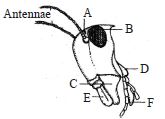
The figure given below shows the head region of a cockroach. Identify $A$ to $F$.
A
$A-$ Compound eye,$B-$ Ocellus,$C-$ Maxilla,$D-$ Mandible,$E-$ Labrum,$F-$ Labium
B
$A-$ Ocellus,$B-$ Compound eye,$C-$ Mandible,$D-$ Maxilla,$E-$ Labrum,$F-$ Labium
C
$A-$ Ocellus,$B-$ Compound eye,$C-$ Mandible,$D-$ Maxilla,$E-$ Labium,$F-$ Labrum
D
$A-$ Ocellus,$B-$ Compound eye,$C-$ Maxilla,$D-$ Mandible,$E-$ Labrum,$F-$ Labium
Solution
(B) Based on the anatomy of the cockroach head:
$A$ represents the Ocellus (fenestra),which is a simple eye.
$B$ represents the Compound eye.
$C$ represents the Mandible,which is a hard,biting jaw.
$D$ represents the Maxilla,which helps in food manipulation.
$E$ represents the Labrum,which acts as the upper lip.
$F$ represents the Labium,which acts as the lower lip.
Therefore,the correct sequence is $A-$ Ocellus,$B-$ Compound eye,$C-$ Mandible,$D-$ Maxilla,$E-$ Labrum,$F-$ Labium.
$A$ represents the Ocellus (fenestra),which is a simple eye.
$B$ represents the Compound eye.
$C$ represents the Mandible,which is a hard,biting jaw.
$D$ represents the Maxilla,which helps in food manipulation.
$E$ represents the Labrum,which acts as the upper lip.
$F$ represents the Labium,which acts as the lower lip.
Therefore,the correct sequence is $A-$ Ocellus,$B-$ Compound eye,$C-$ Mandible,$D-$ Maxilla,$E-$ Labrum,$F-$ Labium.
0 likesView Solution
9
BiologyMediumMCQAIIMS · 2016
Which of the following statements are correct?
$(i)$ In prokaryotic cells,a special membranous structure formed by the extension of the plasma membrane into the cell is known as polysome.
$(ii)$ The smooth endoplasmic reticulum is the major site for synthesis of glycoproteins.
$(iii)$ $RuBisCO$ is the most abundant protein in the whole biosphere.
$(iv)$ Mitochondria,chloroplasts,and peroxisomes are not considered as part of the endomembrane system.
$(i)$ In prokaryotic cells,a special membranous structure formed by the extension of the plasma membrane into the cell is known as polysome.
$(ii)$ The smooth endoplasmic reticulum is the major site for synthesis of glycoproteins.
$(iii)$ $RuBisCO$ is the most abundant protein in the whole biosphere.
$(iv)$ Mitochondria,chloroplasts,and peroxisomes are not considered as part of the endomembrane system.
A
$(iii)$ and $(iv)$
B
$(i)$ and $(ii)$
C
$(ii)$ and $(iii)$
D
$(i)$ and $(iv)$
Solution
(A) Statement $(i)$ is incorrect because the special membranous structure formed by the extension of the plasma membrane in prokaryotes is called a mesosome,not a polysome. $A$ polysome is a chain of ribosomes attached to a single $mRNA$ molecule.
Statement $(ii)$ is incorrect because the smooth endoplasmic reticulum $(SER)$ is the major site for lipid synthesis,whereas the rough endoplasmic reticulum $(RER)$ is the site for protein and glycoprotein synthesis.
Statement $(iii)$ is correct because $RuBisCO$ (Ribulose bisphosphate carboxylase-oxygenase) is the most abundant protein in the biosphere.
Statement $(iv)$ is correct because the endomembrane system includes only the endoplasmic reticulum,Golgi complex,lysosomes,and vacuoles. Mitochondria,chloroplasts,and peroxisomes are not part of this system.
Therefore,statements $(iii)$ and $(iv)$ are correct.
Statement $(ii)$ is incorrect because the smooth endoplasmic reticulum $(SER)$ is the major site for lipid synthesis,whereas the rough endoplasmic reticulum $(RER)$ is the site for protein and glycoprotein synthesis.
Statement $(iii)$ is correct because $RuBisCO$ (Ribulose bisphosphate carboxylase-oxygenase) is the most abundant protein in the biosphere.
Statement $(iv)$ is correct because the endomembrane system includes only the endoplasmic reticulum,Golgi complex,lysosomes,and vacuoles. Mitochondria,chloroplasts,and peroxisomes are not part of this system.
Therefore,statements $(iii)$ and $(iv)$ are correct.
0 likesView Solution
10
BiologyMediumMCQAIIMS · 2016
Assertion : Centrosomes and centrioles are related to each other.
Reason : Centrosome usually contains two cylindrical structures called centrioles.
Reason : Centrosome usually contains two cylindrical structures called centrioles.
A
If both Assertion and Reason are correct and the Reason is a correct explanation of the Assertion.
B
If both Assertion and Reason are correct but Reason is not a correct explanation of the Assertion.
C
If the Assertion is correct but Reason is incorrect.
D
If both the Assertion and Reason are incorrect.
Solution
(A) The centrosome is an organelle that serves as the main microtubule organizing center $(MTOC)$ of the animal cell.
It typically contains two cylindrical structures known as centrioles,which are oriented at right angles to each other.
These centrioles are composed of microtubules arranged in a $9 + 0$ pattern (nine triplets of microtubules).
Since the centrosome is defined by the presence of these centrioles,the Reason correctly explains the Assertion.
It typically contains two cylindrical structures known as centrioles,which are oriented at right angles to each other.
These centrioles are composed of microtubules arranged in a $9 + 0$ pattern (nine triplets of microtubules).
Since the centrosome is defined by the presence of these centrioles,the Reason correctly explains the Assertion.
0 likesView Solution
11
BiologyEasyMCQAIIMS · 2016
Inorganic catalysts work efficiently at . . . . . . temperature and . . . . . . pressure.
A
high,low
B
low,low
C
low,high
D
high,high
Solution
(D) Inorganic catalysts work efficiently at high temperature and high pressure.
Inorganic catalysts are substances that increase the rate of a chemical reaction without being consumed in the process.
Unlike enzymes (biological catalysts),which are sensitive to heat and denature at high temperatures,inorganic catalysts are stable and often require high thermal energy and pressure to function optimally.
An example of this is the use of iron as a catalyst in the Haber process for the production of ammonia,which operates at high temperature and high pressure.
Inorganic catalysts are substances that increase the rate of a chemical reaction without being consumed in the process.
Unlike enzymes (biological catalysts),which are sensitive to heat and denature at high temperatures,inorganic catalysts are stable and often require high thermal energy and pressure to function optimally.
An example of this is the use of iron as a catalyst in the Haber process for the production of ammonia,which operates at high temperature and high pressure.
0 likesView Solution
12
BiologyMediumMCQAIIMS · 2016
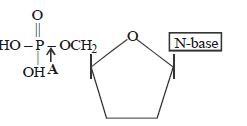
Refer to the given structure of adenylic acid. In this,identify $A$.
A
Glycosidic bond
B
Phosphate bond
C
Ester bond
D
Ionic bond
Solution
(C) In the structure of a nucleotide like adenylic acid,the phosphate group is attached to the $5'$-carbon of the pentose sugar. This linkage is formed by a phosphoester bond,which is a type of ester bond.
0 likesView Solution
13
BiologyMediumMCQAIIMS · 2016
Assertion : $A$ co-enzyme or metal ion that is very tightly bound to enzyme protein is called a prosthetic group.
Reason : $A$ complete,catalytically active enzyme together with its bound prosthetic group is called an apoenzyme.
Reason : $A$ complete,catalytically active enzyme together with its bound prosthetic group is called an apoenzyme.
A
If both Assertion and Reason are correct and the Reason is a correct explanation of the Assertion.
B
If both Assertion and Reason are correct but Reason is not a correct explanation of the Assertion.
C
If the Assertion is correct but Reason is incorrect.
D
If both the Assertion and Reason are incorrect.
Solution
(C) The Assertion is correct: $A$ prosthetic group is an organic compound or metal ion that is tightly bound to the apoenzyme (protein portion) and remains associated with it throughout the catalytic cycle.
The Reason is incorrect: $A$ complete,catalytically active enzyme consisting of the protein part (apoenzyme) and the non-protein part (co-factor/prosthetic group) is called a holoenzyme,not an apoenzyme. An apoenzyme is only the protein portion of the enzyme.
The Reason is incorrect: $A$ complete,catalytically active enzyme consisting of the protein part (apoenzyme) and the non-protein part (co-factor/prosthetic group) is called a holoenzyme,not an apoenzyme. An apoenzyme is only the protein portion of the enzyme.
0 likesView Solution
14
BiologyMediumMCQAIIMS · 2016
Assertion : Glycosidic bonds are formed by dehydration.
Reason : In polysaccharides,individual monosaccharides are linked by glycosidic bonds.
Reason : In polysaccharides,individual monosaccharides are linked by glycosidic bonds.
A
If both Assertion and Reason are correct and the Reason is a correct explanation of the Assertion.
B
If both Assertion and Reason are correct but Reason is not a correct explanation of the Assertion.
C
If the Assertion is correct but Reason is incorrect.
D
If both the Assertion and Reason are incorrect.
Solution
(A) glycosidic bond is a type of covalent bond that joins a carbohydrate molecule to another group,which may or may not be another carbohydrate.
These bonds are formed by a dehydration reaction (also known as a condensation reaction),where a water molecule is removed during the linkage of two monosaccharides.
In polysaccharides,individual monosaccharides are linked by these glycosidic bonds to form long chains.
Since the formation of the bond involves the process of dehydration,the Reason correctly explains the Assertion.
These bonds are formed by a dehydration reaction (also known as a condensation reaction),where a water molecule is removed during the linkage of two monosaccharides.
In polysaccharides,individual monosaccharides are linked by these glycosidic bonds to form long chains.
Since the formation of the bond involves the process of dehydration,the Reason correctly explains the Assertion.
0 likesView Solution
15
BiologyMediumMCQAIIMS · 2016
Assertion : The stage between two mitotic divisions is called interkinesis.
Reason : Interkinesis is generally short lived.
Reason : Interkinesis is generally short lived.
A
If both Assertion and Reason are correct and the Reason is a correct explanation of the Assertion.
B
If both Assertion and Reason are correct but Reason is not a correct explanation of the Assertion.
C
If the Assertion is correct but Reason is incorrect.
D
If both the Assertion and Reason are incorrect.
Solution
(D) Interkinesis is the stage between two meiotic divisions (meiosis $I$ and meiosis $II$),not between two mitotic divisions. Therefore,the Assertion is incorrect.
Interkinesis is indeed a short-lived stage where no $DNA$ replication occurs. Thus,the Reason is correct.
Since the Assertion is incorrect and the Reason is correct,the correct option is $D$.
Interkinesis is indeed a short-lived stage where no $DNA$ replication occurs. Thus,the Reason is correct.
Since the Assertion is incorrect and the Reason is correct,the correct option is $D$.
0 likesView Solution
16
BiologyEasyMCQAIIMS · 2016
Assertion : Diplotene is characterized by the presence of chiasmata.
Reason : Diplotene can last for months and years in oocytes of some vertebrates.
Reason : Diplotene can last for months and years in oocytes of some vertebrates.
A
If both Assertion and Reason are correct and the Reason is a correct explanation of the Assertion.
B
If both Assertion and Reason are correct but Reason is not a correct explanation of the Assertion.
C
If the Assertion is correct but Reason is incorrect.
D
If both the Assertion and Reason are incorrect.
Solution
(B) Diplotene is the longest and most active subphase of prophase $I$ of meiosis.
The beginning of diplotene is recognized by the dissolution of the synaptonemal complex and the tendency of the recombined homologous chromosomes of the bivalents to separate from each other except at the sites of crossovers.
These $X$-shaped structures are called chiasmata.
Additionally,in the oocytes of some vertebrates,the diplotene stage can remain suspended for months or even years,a state known as dictyotene.
Since both statements are factually correct but the duration of the stage does not explain why chiasmata are present,the correct option is $B$.
The beginning of diplotene is recognized by the dissolution of the synaptonemal complex and the tendency of the recombined homologous chromosomes of the bivalents to separate from each other except at the sites of crossovers.
These $X$-shaped structures are called chiasmata.
Additionally,in the oocytes of some vertebrates,the diplotene stage can remain suspended for months or even years,a state known as dictyotene.
Since both statements are factually correct but the duration of the stage does not explain why chiasmata are present,the correct option is $B$.
0 likesView Solution
17
BiologyMediumMCQAIIMS · 2016
$A$ boy is studying the transport of a certain type of molecule into a cell. He finds that the transport slows down when the cells are poisoned with a chemical that inhibits energy production. Under normal circumstances,the molecules studied by the boy are probably transported by
A
simple diffusion
B
osmosis
C
active transport
D
facilitated diffusion
Solution
(C) Active transport is a process that requires energy in the form of $ATP$ to move molecules against their concentration gradient.
Since the transport process slows down when energy production is inhibited,it indicates that the process is energy-dependent.
Therefore,the molecules are transported by active transport.
Since the transport process slows down when energy production is inhibited,it indicates that the process is energy-dependent.
Therefore,the molecules are transported by active transport.
0 likesView Solution
18
BiologyEasyMCQAIIMS · 2016
Which of the following is the mismatched pair regarding mineral elements and the form in which they are absorbed by plants?
A
Nitrogen $\to NO_3^-$
B
Phosphorus $\to H_2PO_4^-$
C
Sulphur $\to H_2SO_4$
D
Iron $\to Fe^{3+}$
Solution
(C) Plants primarily absorb nitrogen as nitrates $(NO_3^-)$ or nitrites $(NO_2^-)$.
Phosphorus is absorbed mainly as phosphate ions ($H_2PO_4^-$ or $HPO_4^{2-}$).
Sulphur is absorbed by plants in the form of sulphate ions $(SO_4^{2-})$,not as sulphuric acid $(H_2SO_4)$.
Iron is absorbed in the form of ferric ions $(Fe^{3+})$.
Therefore,the pair Sulphur $\to H_2SO_4$ is mismatched.
Phosphorus is absorbed mainly as phosphate ions ($H_2PO_4^-$ or $HPO_4^{2-}$).
Sulphur is absorbed by plants in the form of sulphate ions $(SO_4^{2-})$,not as sulphuric acid $(H_2SO_4)$.
Iron is absorbed in the form of ferric ions $(Fe^{3+})$.
Therefore,the pair Sulphur $\to H_2SO_4$ is mismatched.
0 likesView Solution
19
BiologyMediumMCQAIIMS · 2016
By which of the following complexes is a proton pumped to reach $ATP$ synthase to participate in $ATP$ synthesis?
A
Cytochrome $b_6f$
B
Cytochrome $c$ oxidase
C
Cytochrome $a - a_3$
D
Cytochrome $bc$
Solution
(A) In the process of photophosphorylation,the cytochrome $b_6f$ complex acts as a proton pump.
It facilitates the movement of protons from the stroma into the thylakoid lumen,creating a proton gradient.
This proton gradient is essential for the functioning of $ATP$ synthase,which utilizes the energy of the proton motive force to synthesize $ATP$ from $ADP$ and inorganic phosphate.
It facilitates the movement of protons from the stroma into the thylakoid lumen,creating a proton gradient.
This proton gradient is essential for the functioning of $ATP$ synthase,which utilizes the energy of the proton motive force to synthesize $ATP$ from $ADP$ and inorganic phosphate.
0 likesView Solution
20
BiologyMediumMCQAIIMS · 2016
Which of the following statements ($i$ to $v$) regarding glycolysis are correct?
$(i)$ It is ten enzymatic reactions that convert a six-carbon molecule to a three-carbon pyruvate and result in a net gain of $2\, ATP$ molecules.
$(ii)$ Glucose undergoes partial oxidation to form one molecule of pyruvic acid.
$(iii)$ Glucose is phosphorylated to give rise to glucose-$6$-phosphate by the activity of the enzyme phosphofructokinase.
$(iv)$ The scheme of glycolysis was given by Gustav Embden,Otto Meyerhof,and $J$. Parnas and is often referred to as the $EMP$ pathway.
$(v)$ $ATP$ is utilized at two steps: first in the conversion of glucose into glucose-$6$-phosphate and second in the conversion of fructose-$6$-phosphate to fructose-$1,6$-bisphosphate.
$(i)$ It is ten enzymatic reactions that convert a six-carbon molecule to a three-carbon pyruvate and result in a net gain of $2\, ATP$ molecules.
$(ii)$ Glucose undergoes partial oxidation to form one molecule of pyruvic acid.
$(iii)$ Glucose is phosphorylated to give rise to glucose-$6$-phosphate by the activity of the enzyme phosphofructokinase.
$(iv)$ The scheme of glycolysis was given by Gustav Embden,Otto Meyerhof,and $J$. Parnas and is often referred to as the $EMP$ pathway.
$(v)$ $ATP$ is utilized at two steps: first in the conversion of glucose into glucose-$6$-phosphate and second in the conversion of fructose-$6$-phosphate to fructose-$1,6$-bisphosphate.
A
$(i), (iv)$ and $(v)$
B
$(iii)$ and $(v)$
C
$(iv)$ and $(v)$
D
$(ii)$ and $(iv)$
Solution
(A) Statement $(i)$ is correct: Glycolysis involves ten enzymatic steps converting one molecule of glucose $(6C)$ into two molecules of pyruvate $(3C)$ with a net gain of $2\, ATP$.
Statement $(ii)$ is incorrect: Glucose undergoes partial oxidation to form two molecules of pyruvic acid,not one.
Statement $(iii)$ is incorrect: Glucose is phosphorylated to glucose-$6$-phosphate by the enzyme hexokinase,not phosphofructokinase.
Statement $(iv)$ is correct: The $EMP$ pathway is named after Embden,Meyerhof,and Parnas.
Statement $(v)$ is correct: $ATP$ is consumed during the phosphorylation of glucose to glucose-$6$-phosphate and fructose-$6$-phosphate to fructose-$1,6$-bisphosphate.
Therefore,statements $(i), (iv),$ and $(v)$ are correct.
Statement $(ii)$ is incorrect: Glucose undergoes partial oxidation to form two molecules of pyruvic acid,not one.
Statement $(iii)$ is incorrect: Glucose is phosphorylated to glucose-$6$-phosphate by the enzyme hexokinase,not phosphofructokinase.
Statement $(iv)$ is correct: The $EMP$ pathway is named after Embden,Meyerhof,and Parnas.
Statement $(v)$ is correct: $ATP$ is consumed during the phosphorylation of glucose to glucose-$6$-phosphate and fructose-$6$-phosphate to fructose-$1,6$-bisphosphate.
Therefore,statements $(i), (iv),$ and $(v)$ are correct.
0 likesView Solution
21
BiologyMediumMCQAIIMS · 2016
Identify the correct and incorrect statements from the following.
$(i)$ $17,500$ new cells are produced per hour by a single maize root apical meristem.
$(ii)$ With the help of length,growth of pollen tube is measured.
$(iii)$ The growth of the leaf is measured in terms of volume.
$(iv)$ Cells in a watermelon may increase in size by up to $3,50,000$ times.
$(i)$ $17,500$ new cells are produced per hour by a single maize root apical meristem.
$(ii)$ With the help of length,growth of pollen tube is measured.
$(iii)$ The growth of the leaf is measured in terms of volume.
$(iv)$ Cells in a watermelon may increase in size by up to $3,50,000$ times.
A
$(i), (ii), (iii)$ are correct and $(iv)$ is incorrect.
B
$(i), (ii), (iv)$ are correct and $(iii)$ is incorrect.
C
$(ii), (iii)$ are correct and $(i), (iv)$ are incorrect.
D
$(i), (iv)$ are correct and $(ii), (iii)$ are incorrect.
Solution
(B) Statement $(i)$ is correct: $A$ single maize root apical meristem can produce more than $17,500$ new cells per hour.
Statement $(ii)$ is correct: The growth of a pollen tube is measured in terms of length.
Statement $(iii)$ is incorrect: The growth of a leaf is measured in terms of surface area,not volume.
Statement $(iv)$ is correct: Cells in a watermelon may increase in size by up to $3,50,000$ times.
Therefore,statements $(i), (ii),$ and $(iv)$ are correct,while $(iii)$ is incorrect.
Statement $(ii)$ is correct: The growth of a pollen tube is measured in terms of length.
Statement $(iii)$ is incorrect: The growth of a leaf is measured in terms of surface area,not volume.
Statement $(iv)$ is correct: Cells in a watermelon may increase in size by up to $3,50,000$ times.
Therefore,statements $(i), (ii),$ and $(iv)$ are correct,while $(iii)$ is incorrect.
0 likesView Solution
22
BiologyMediumMCQAIIMS · 2016
$A$ healthy person eats the following diet: $5 \, gm$ raw sugar,$4 \, gm$ albumin,$10 \, gm$ pure buffalo ghee adulterated with $2 \, gm$ vegetable ghee (hydrogenated vegetable oil),and $5 \, gm$ lignin. How many calories is he likely to get?
A
$144$
B
$126$
C
$164$
D
$112$
Solution
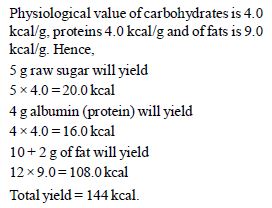
(A) The physiological calorific value of carbohydrates is $4.0 \, kcal/g$,proteins is $4.0 \, kcal/g$,and fats is $9.0 \, kcal/g$. Lignin is a dietary fiber that cannot be digested by humans,so it provides $0 \, kcal$.
$1$. Raw sugar (carbohydrate): $5 \, g \times 4.0 \, kcal/g = 20.0 \, kcal$.
$2$. Albumin (protein): $4 \, g \times 4.0 \, kcal/g = 16.0 \, kcal$.
$3$. Total fat (pure ghee + vegetable ghee): $10 \, g + 2 \, g = 12 \, g$. Energy from fat: $12 \, g \times 9.0 \, kcal/g = 108.0 \, kcal$.
$4$. Lignin: $5 \, g \times 0 \, kcal/g = 0 \, kcal$.
Total energy = $20.0 + 16.0 + 108.0 + 0 = 144 \, kcal$.
$1$. Raw sugar (carbohydrate): $5 \, g \times 4.0 \, kcal/g = 20.0 \, kcal$.
$2$. Albumin (protein): $4 \, g \times 4.0 \, kcal/g = 16.0 \, kcal$.
$3$. Total fat (pure ghee + vegetable ghee): $10 \, g + 2 \, g = 12 \, g$. Energy from fat: $12 \, g \times 9.0 \, kcal/g = 108.0 \, kcal$.
$4$. Lignin: $5 \, g \times 0 \, kcal/g = 0 \, kcal$.
Total energy = $20.0 + 16.0 + 108.0 + 0 = 144 \, kcal$.
0 likesView Solution
23
BiologyMediumMCQAIIMS · 2016
Assertion : Starch is hydrolysed by ptyalin to maltose.
Reason : Sucrase hydrolyses sucrose to lactose.
Reason : Sucrase hydrolyses sucrose to lactose.
A
If both Assertion and Reason are correct and the Reason is a correct explanation of the Assertion.
B
If both Assertion and Reason are correct but Reason is not a correct explanation of the Assertion.
C
If the Assertion is correct but Reason is incorrect.
D
If both the Assertion and Reason are incorrect.
Solution
(C) The Assertion is correct because $ptyalin$ (salivary amylase) acts on starch and converts it into maltose.
The Reason is incorrect because $sucrase$ (invertase) hydrolyses sucrose into glucose and fructose,not lactose. Lactose is hydrolysed by the enzyme $lactase$ into glucose and galactose.
The Reason is incorrect because $sucrase$ (invertase) hydrolyses sucrose into glucose and fructose,not lactose. Lactose is hydrolysed by the enzyme $lactase$ into glucose and galactose.
0 likesView Solution
24
BiologyDifficultMCQAIIMS · 2016
During oxygen transport,the oxyhaemoglobin at the tissue level liberates oxygen to the cells because in tissue:
A
$O_2$ concentration is high and $CO_2$ is low
B
$O_2$ concentration is low and $CO_2$ is high
C
$O_2$ tension is high and $CO_2$ tension is low
D
$O_2$ tension is low and $CO_2$ tension is high
Solution
(D) At the tissue level,cellular respiration consumes oxygen and produces carbon dioxide.
Consequently,the partial pressure (tension) of $O_2$ is low,and the partial pressure (tension) of $CO_2$ is high in the tissues compared to the blood.
According to the Bohr effect,high $CO_2$ concentration and low $O_2$ tension shift the oxygen-haemoglobin dissociation curve to the right,facilitating the dissociation of oxygen from oxyhaemoglobin.
Therefore,oxyhaemoglobin releases oxygen to the cells.
Consequently,the partial pressure (tension) of $O_2$ is low,and the partial pressure (tension) of $CO_2$ is high in the tissues compared to the blood.
According to the Bohr effect,high $CO_2$ concentration and low $O_2$ tension shift the oxygen-haemoglobin dissociation curve to the right,facilitating the dissociation of oxygen from oxyhaemoglobin.
Therefore,oxyhaemoglobin releases oxygen to the cells.
0 likesView Solution
25
BiologyDifficultMCQAIIMS · 2016
Assertion : $Lub$ is a heart sound which is produced during each cardiac cycle.
Reason : It is associated with the closure of the tricuspid and bicuspid valves.
Reason : It is associated with the closure of the tricuspid and bicuspid valves.
A
If both Assertion and Reason are correct and the Reason is a correct explanation of the Assertion.
B
If both Assertion and Reason are correct but Reason is not a correct explanation of the Assertion.
C
If the Assertion is correct but Reason is incorrect.
D
If both the Assertion and Reason are incorrect.
Solution
(A) $Lub$ and $Dub$ are two heart sounds produced during each cardiac cycle.
$Lub$ is the first heart sound,which is produced due to the closure of the atrioventricular valves (tricuspid and bicuspid valves) at the beginning of ventricular systole.
It is a low-pitched sound of longer duration (approximately $0.15 \,sec$).
Since the assertion states that $Lub$ is produced during the cardiac cycle and the reason correctly identifies its cause as the closure of the atrioventricular valves,both statements are correct and the reason explains the assertion.
$Lub$ is the first heart sound,which is produced due to the closure of the atrioventricular valves (tricuspid and bicuspid valves) at the beginning of ventricular systole.
It is a low-pitched sound of longer duration (approximately $0.15 \,sec$).
Since the assertion states that $Lub$ is produced during the cardiac cycle and the reason correctly identifies its cause as the closure of the atrioventricular valves,both statements are correct and the reason explains the assertion.
0 likesView Solution
26
BiologyMediumMCQAIIMS · 2016
Which blood vessel in mammals would normally carry the largest amount of urea?
A
Dorsal aorta
B
Hepatic vein
C
Hepatic portal vein
D
Renal vein
Solution
(B) In mammals,urea is produced in the liver through the ornithine cycle (urea cycle) as a byproduct of amino acid metabolism.
Since the liver is the site of urea synthesis,the blood leaving the liver via the hepatic vein contains the highest concentration of urea compared to any other blood vessel in the body.
The renal vein carries blood away from the kidneys,which have already filtered the urea out of the blood,so it contains the lowest concentration of urea.
The dorsal aorta carries oxygenated blood to various parts of the body,and the hepatic portal vein carries blood from the digestive tract to the liver,neither of which has as high a concentration of urea as the hepatic vein.
Since the liver is the site of urea synthesis,the blood leaving the liver via the hepatic vein contains the highest concentration of urea compared to any other blood vessel in the body.
The renal vein carries blood away from the kidneys,which have already filtered the urea out of the blood,so it contains the lowest concentration of urea.
The dorsal aorta carries oxygenated blood to various parts of the body,and the hepatic portal vein carries blood from the digestive tract to the liver,neither of which has as high a concentration of urea as the hepatic vein.
0 likesView Solution
27
BiologyEasyMCQAIIMS · 2016
In the ornithine cycle,the enzyme arginase breaks down arginine into:
A
Citrulline and ammonia
B
Ornithine and ammonia
C
Ornithine and urea
D
Citrulline and urea
Solution
(C) The ornithine cycle (also known as the urea cycle) is a series of biochemical reactions that occur in the liver to convert toxic ammonia into urea.
In the final step of this cycle,the enzyme arginase catalyzes the hydrolysis of arginine.
This reaction produces ornithine and urea.
Ornithine is then recycled back into the mitochondria to continue the cycle,while urea is excreted from the body.
In the final step of this cycle,the enzyme arginase catalyzes the hydrolysis of arginine.
This reaction produces ornithine and urea.
Ornithine is then recycled back into the mitochondria to continue the cycle,while urea is excreted from the body.
0 likesView Solution
28
BiologyMediumMCQAIIMS · 2016
Assertion : In the descending limb of the loop of Henle,the urine is hypertonic,whereas in the ascending limb of the loop of Henle,the urine is hypotonic.
Reason : The descending limb is impermeable to sodium,while the ascending limb is impermeable to water.
Reason : The descending limb is impermeable to sodium,while the ascending limb is impermeable to water.
A
If both Assertion and Reason are correct and the Reason is a correct explanation of the Assertion.
B
If both Assertion and Reason are correct but Reason is not a correct explanation of the Assertion.
C
If the Assertion is correct but Reason is incorrect.
D
If both the Assertion and Reason are incorrect.
Solution
(A) The descending limb of the loop of Henle is permeable to water but impermeable to electrolytes like sodium. As the filtrate moves down,water is reabsorbed into the interstitium,which increases the concentration of solutes,making the filtrate hypertonic.
The ascending limb of the loop of Henle is impermeable to water but permeable to electrolytes like sodium. As the filtrate moves up,electrolytes are actively or passively transported out of the tubule into the interstitium,which decreases the concentration of solutes,making the filtrate hypotonic.
Therefore,both the Assertion and the Reason are correct,and the Reason explains why the tonicity changes in the respective limbs.
The ascending limb of the loop of Henle is impermeable to water but permeable to electrolytes like sodium. As the filtrate moves up,electrolytes are actively or passively transported out of the tubule into the interstitium,which decreases the concentration of solutes,making the filtrate hypotonic.
Therefore,both the Assertion and the Reason are correct,and the Reason explains why the tonicity changes in the respective limbs.
0 likesView Solution
29
BiologyEasyMCQAIIMS · 2016
The 'wishbone' in birds is formed from the bones of:
A
Shoulder girdle
B
Hip girdle
C
Keeled sternum
D
Skull bones
Solution
(A) In birds,the two clavicles fuse with a single inter-clavicle to form a $V$-shaped bone known as the 'wishbone' or 'furcula' (also called the 'merrythought' bone). This structure is part of the pectoral girdle,which is also known as the shoulder girdle.
0 likesView Solution
30
BiologyMediumMCQAIIMS · 2016
Assertion : The phase of muscle contraction occurs when myosin binds and releases actin.
Reason : Muscle contraction is initiated by a signal sent by the peripheral nervous system via motor neuron.
Reason : Muscle contraction is initiated by a signal sent by the peripheral nervous system via motor neuron.
A
If both Assertion and Reason are correct and the Reason is a correct explanation of the Assertion.
B
If both Assertion and Reason are correct but Reason is not a correct explanation of the Assertion.
C
If the Assertion is correct but Reason is incorrect.
D
If both the Assertion and Reason are incorrect.
Solution
(C) The assertion is correct because muscle contraction involves the formation and breaking of cross-bridges between myosin heads and actin filaments,known as the sliding filament theory.
The reason is incorrect because muscle contraction is initiated by a signal sent by the $Central \ Nervous \ System$ $(CNS)$,not the peripheral nervous system,via a motor neuron.
Therefore,the assertion is correct,but the reason is incorrect.
The reason is incorrect because muscle contraction is initiated by a signal sent by the $Central \ Nervous \ System$ $(CNS)$,not the peripheral nervous system,via a motor neuron.
Therefore,the assertion is correct,but the reason is incorrect.
0 likesView Solution
31
BiologyMediumMCQAIIMS · 2016
Which of the following ions are required for nerve conduction?
A
$Ca^{++}, Na^+$ and $K^+$
B
$Ca^{++}$ and $Mg^{++}$
C
$Mg^{++}$ and $K^+$
D
$Na^+$ and $K^+$
Solution
(D) Nerve conduction,or the transmission of a nerve impulse along an axon,primarily relies on the movement of $Na^+$ and $K^+$ ions across the neuronal membrane.
During the resting state,the axonal membrane is more permeable to $K^+$ ions and nearly impermeable to $Na^+$ ions.
When a stimulus is applied,the membrane becomes permeable to $Na^+$ ions,leading to a rapid influx of $Na^+$ into the cell,which causes depolarization.
Following this,the membrane becomes permeable to $K^+$ ions,leading to an efflux of $K^+$ out of the cell,which causes repolarization.
Thus,$Na^+$ and $K^+$ are the essential ions for the generation and conduction of nerve impulses.
During the resting state,the axonal membrane is more permeable to $K^+$ ions and nearly impermeable to $Na^+$ ions.
When a stimulus is applied,the membrane becomes permeable to $Na^+$ ions,leading to a rapid influx of $Na^+$ into the cell,which causes depolarization.
Following this,the membrane becomes permeable to $K^+$ ions,leading to an efflux of $K^+$ out of the cell,which causes repolarization.
Thus,$Na^+$ and $K^+$ are the essential ions for the generation and conduction of nerve impulses.
0 likesView Solution
32
BiologyMediumMCQAIIMS · 2016
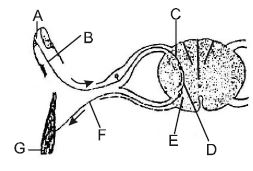
The following diagram indicates the reflex arc. Identify the parts labelled as $A, B, C, D, E, F$ and $G$. Choose the correct option.
A
$A =$ sense organ; $B =$ sensory nerve; $C =$ dorsal horn; $D =$ interneuron; $E =$ ventral horn; $F =$ motor nerve; $G =$ effector
B
$A =$ sense organ; $B =$ sensory nerve; $C =$ ventral horn; $D =$ interneuron; $E =$ dorsal horn; $F =$ motor nerve; $G =$ effector
C
$A =$ effector; $B =$ motor nerve; $C =$ dorsal horn; $D =$ interneuron; $E =$ ventral horn; $F =$ sensory nerve; $G =$ effector
D
$A =$ effector; $B =$ motor nerve; $C =$ ventral horn; $D =$ interneuron; $E =$ dorsal horn; $F =$ sensory nerve; $G =$ sense organ.
Solution
(A) In a reflex arc,the pathway of a nerve impulse is as follows:
$1$. $A$ represents the sense organ (receptor) which detects the stimulus.
$2$. $B$ represents the sensory nerve (afferent neuron) which carries the impulse towards the central nervous system.
$3$. $C$ represents the dorsal horn of the spinal cord grey matter,where sensory neurons enter.
$4$. $D$ represents the interneuron (relay neuron) which connects sensory and motor neurons.
$5$. $E$ represents the ventral horn of the spinal cord grey matter,where motor neurons exit.
$6$. $F$ represents the motor nerve (efferent neuron) which carries the impulse away from the central nervous system.
$7$. $G$ represents the effector (muscle or gland) which performs the response.
Therefore,the correct sequence is $A =$ sense organ,$B =$ sensory nerve,$C =$ dorsal horn,$D =$ interneuron,$E =$ ventral horn,$F =$ motor nerve,$G =$ effector.
$1$. $A$ represents the sense organ (receptor) which detects the stimulus.
$2$. $B$ represents the sensory nerve (afferent neuron) which carries the impulse towards the central nervous system.
$3$. $C$ represents the dorsal horn of the spinal cord grey matter,where sensory neurons enter.
$4$. $D$ represents the interneuron (relay neuron) which connects sensory and motor neurons.
$5$. $E$ represents the ventral horn of the spinal cord grey matter,where motor neurons exit.
$6$. $F$ represents the motor nerve (efferent neuron) which carries the impulse away from the central nervous system.
$7$. $G$ represents the effector (muscle or gland) which performs the response.
Therefore,the correct sequence is $A =$ sense organ,$B =$ sensory nerve,$C =$ dorsal horn,$D =$ interneuron,$E =$ ventral horn,$F =$ motor nerve,$G =$ effector.
0 likesView Solution
33
BiologyMediumMCQAIIMS · 2016
Assertion $(A)$: The axonal membrane of the neuron is more permeable to sodium ion $(Na^+)$ and nearly impermeable to potassium $(K^+)$.
Reason $(R)$: In a resting state,a neuron does not conduct any impulse.
Reason $(R)$: In a resting state,a neuron does not conduct any impulse.
A
If both Assertion and Reason are correct and the Reason is a correct explanation of the Assertion.
B
If both Assertion and Reason are correct but Reason is not a correct explanation of the Assertion.
C
If the Assertion is correct but Reason is incorrect.
D
If the Assertion is incorrect but the Reason is correct.
Solution
(D) The axonal membrane of a neuron in a resting state is significantly more permeable to potassium ions $(K^+)$ and nearly impermeable to sodium ions $(Na^+)$. Therefore,the Assertion $(A)$ is incorrect.
In a resting state,the neuron is polarized and does not conduct any nerve impulse. Therefore,the Reason $(R)$ is correct.
In a resting state,the neuron is polarized and does not conduct any nerve impulse. Therefore,the Reason $(R)$ is correct.
0 likesView Solution
34
BiologyMediumMCQAIIMS · 2016
Which endocrine gland is called 'the Throne of immunity'?
A
Spleen
B
Thymus
C
Pineal
D
Adrenal medulla
Solution
(B) The thymus gland is known as the 'Throne of immunity' because it plays a vital role in the development of the immune system.
It is the primary site for the maturation and differentiation of $T-$lymphocytes (or $T-$cells).
These $T-$cells are essential for cell-mediated immunity and also help in regulating the production of antibodies by $B-$cells.
It is the primary site for the maturation and differentiation of $T-$lymphocytes (or $T-$cells).
These $T-$cells are essential for cell-mediated immunity and also help in regulating the production of antibodies by $B-$cells.
0 likesView Solution
35
BiologyMediumMCQAIIMS · 2016
Assertion : Flora contains the actual account of habitat and distribution of plants of a given area.
Reason : Flora helps in correct identification.
Reason : Flora helps in correct identification.
A
If both Assertion and Reason are correct and the Reason is a correct explanation of the Assertion.
B
If both Assertion and Reason are correct but Reason is not a correct explanation of the Assertion.
C
If the Assertion is correct but Reason is incorrect.
D
If both the Assertion and Reason are incorrect.
Solution
(A) Flora is a taxonomic aid that provides the actual account of habitat and distribution of plants in a given area.
It serves as an index to the plant species found in a particular area,which facilitates the correct identification of those plants.
Therefore,both the Assertion and the Reason are correct,and the Reason is the correct explanation of the Assertion.
It serves as an index to the plant species found in a particular area,which facilitates the correct identification of those plants.
Therefore,both the Assertion and the Reason are correct,and the Reason is the correct explanation of the Assertion.
0 likesView Solution
36
BiologyEasyMCQAIIMS · 2016
Which of the following statements is incorrect?
$(i)$ Bamboo species flower only once in their lifetime,generally after $50-100$ years,produce a large number of fruits,and die.
$(ii)$ In animals,the juvenile phase is followed by morphological and physiological changes prior to active reproductive behaviour.
$(iii)$ The reproductive phase is of the same duration in all organisms.
$(iv)$ The juvenile phase is the period of growth between the birth of an individual until it reaches reproductive maturity.
$(i)$ Bamboo species flower only once in their lifetime,generally after $50-100$ years,produce a large number of fruits,and die.
$(ii)$ In animals,the juvenile phase is followed by morphological and physiological changes prior to active reproductive behaviour.
$(iii)$ The reproductive phase is of the same duration in all organisms.
$(iv)$ The juvenile phase is the period of growth between the birth of an individual until it reaches reproductive maturity.
A
Only $(i)$
B
Only $(ii)$
C
Only $(iii)$
D
Only $(iv)$
Solution
(C) Statement $(iii)$ is incorrect. The duration of the reproductive phase varies significantly among different organisms depending on their species,environmental conditions,and life history strategies. It is not uniform across all living beings.
0 likesView Solution
37
BiologyEasyMCQAIIMS · 2016
Which of the following statements is correct?
A
Sporopollenin can withstand high temperatures but not strong acids.
B
Sporopollenin can be degraded by enzymes.
C
Sporopollenin is made up of inorganic materials.
D
Sporopollenin can withstand high temperature as well as strong acids and alkalis.
Solution
(D) Pollen grains are generally spherical and possess a prominent two-layered wall.
The hard outer layer,called the exine,is made up of sporopollenin,which is one of the most resistant organic materials known.
It can withstand high temperatures,strong acids,and strong alkalis,and no enzyme is known that degrades sporopollenin.
The hard outer layer,called the exine,is made up of sporopollenin,which is one of the most resistant organic materials known.
It can withstand high temperatures,strong acids,and strong alkalis,and no enzyme is known that degrades sporopollenin.
0 likesView Solution
38
BiologyMediumMCQAIIMS · 2016
Assertion: Double fertilization is a characteristic feature of angiosperms.
Reason: Double fertilization involves two fusions.
Reason: Double fertilization involves two fusions.
A
If both Assertion and Reason are correct and the Reason is a correct explanation of the Assertion.
B
If both Assertion and Reason are correct but Reason is not a correct explanation of the Assertion.
C
If the Assertion is correct but Reason is incorrect.
D
If both the Assertion and Reason are incorrect.
Solution
(A) Double fertilization is a unique and characteristic feature of angiosperms.
It involves two distinct fusion events:
$1$. Syngamy: One male gamete fuses with the egg cell to form a diploid zygote $(2n)$.
$2$. Triple Fusion: The second male gamete fuses with the two polar nuclei (or the diploid secondary nucleus) to form the primary endosperm nucleus $(PEN)$,which is triploid $(3n)$.
Since the process is defined by these two specific fusion events,the Reason correctly explains the Assertion.
It involves two distinct fusion events:
$1$. Syngamy: One male gamete fuses with the egg cell to form a diploid zygote $(2n)$.
$2$. Triple Fusion: The second male gamete fuses with the two polar nuclei (or the diploid secondary nucleus) to form the primary endosperm nucleus $(PEN)$,which is triploid $(3n)$.
Since the process is defined by these two specific fusion events,the Reason correctly explains the Assertion.
0 likesView Solution
39
BiologyMediumMCQAIIMS · 2016
Ejaculation of human male contains about $200 - 300$ million sperms,of which for normal fertility . . . . . . $\%$ sperms must have normal shape and size and at least . . . . . . $\%$ must show energetic motility.
A
$40, 60$
B
$50, 50$
C
$60, 40$
D
$30, 70$
Solution
(C) During copulation (coitus),semen is released by the penis into the vagina (insemination).
The human male ejaculates about $200 - 300$ million sperms during a single coitus.
For normal fertility,it is essential that at least $60\%$ of all sperms must have normal shape and size.
Furthermore,for the sperms to reach the ovum and fertilize it,at least $40\%$ of them must show vigorous (energetic) motility.
The human male ejaculates about $200 - 300$ million sperms during a single coitus.
For normal fertility,it is essential that at least $60\%$ of all sperms must have normal shape and size.
Furthermore,for the sperms to reach the ovum and fertilize it,at least $40\%$ of them must show vigorous (energetic) motility.
0 likesView Solution
40
BiologyEasyMCQAIIMS · 2016
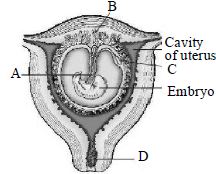
The given figure shows the human foetus within the uterus with few structures marked as $A, B, C$ and $D$. Which of the following options shows the correct labeling?
A
$A \to$ Umbilical cord with its veins,$B \to$ Chorionic villi,$C \to$ Antrum,$D \to$ Plug of mucus in cervix
B
$A \to$ Umbilical cord with its vessels,$B \to$ Fimbriae,$C \to$ Oocyte,$D \to$ Plug of mucus in vagina
C
$A \to$ Umbilical cord with its vessels,$B \to$ Placental villi,$C \to$ Yolk sac,$D \to$ Plug of mucus in cervix
D
$A \to$ Umbilical cord with its veins,$B \to$ Placental villi,$C \to$ Trophoblast,$D \to$ Plug of mucus in vagina
Solution
(C) Based on the anatomical structure of the human foetus within the uterus:
$A$ represents the Umbilical cord,which contains blood vessels that transport nutrients and oxygen to the foetus.
$B$ represents the Placental villi (chorionic villi),which are finger-like projections that increase the surface area for exchange between maternal and foetal blood.
$C$ represents the Yolk sac,which is an extra-embryonic membrane.
$D$ represents the Plug of mucus in the cervix,which acts as a protective barrier during pregnancy.
Therefore,the correct labeling is $A \to$ Umbilical cord with its vessels,$B \to$ Placental villi,$C \to$ Yolk sac,$D \to$ Plug of mucus in cervix.
$A$ represents the Umbilical cord,which contains blood vessels that transport nutrients and oxygen to the foetus.
$B$ represents the Placental villi (chorionic villi),which are finger-like projections that increase the surface area for exchange between maternal and foetal blood.
$C$ represents the Yolk sac,which is an extra-embryonic membrane.
$D$ represents the Plug of mucus in the cervix,which acts as a protective barrier during pregnancy.
Therefore,the correct labeling is $A \to$ Umbilical cord with its vessels,$B \to$ Placental villi,$C \to$ Yolk sac,$D \to$ Plug of mucus in cervix.
0 likesView Solution
41
BiologyMediumMCQAIIMS · 2016
Assertion : Testicular lobules are the compartments present in testis.
Reason : These lobules are involved in the process of fertilization.
Reason : These lobules are involved in the process of fertilization.
A
If both Assertion and Reason are correct and the Reason is a correct explanation of the Assertion.
B
If both Assertion and Reason are correct but Reason is not a correct explanation of the Assertion.
C
If both the Assertion and Reason are incorrect.
D
If the Assertion is correct but Reason is incorrect.
Solution
(D) Testicular lobules are the structural compartments found within the testes,each containing $1-3$ highly coiled seminiferous tubules.
These lobules are the sites of spermatogenesis (production of sperm),not fertilization.
Fertilization is the process of fusion of male and female gametes,which typically occurs in the ampullary region of the fallopian tube in the female reproductive system.
Therefore,the Assertion is correct,but the Reason is incorrect.
These lobules are the sites of spermatogenesis (production of sperm),not fertilization.
Fertilization is the process of fusion of male and female gametes,which typically occurs in the ampullary region of the fallopian tube in the female reproductive system.
Therefore,the Assertion is correct,but the Reason is incorrect.
0 likesView Solution
42
BiologyMediumMCQAIIMS · 2016
Select the correct match of the techniques given in column $I$ with its feature given in column $II$.
| Column $I$ | Column $II$ |
| $A.$ $ICSI$ | $I.$ Artificially introduction of semen into the vagina or uterus. |
| $B.$ $IUI$ | $II.$ Transfer of ovum collected from a donor into the fallopian tube where fertilization occurs. |
| $C.$ $IUT$ | $III.$ Formation of embryo by directly injecting sperm into the ovum. |
| $D.$ $GIFT$ | $IV.$ Transfer of the zygote or early embryo (with up to $8$ blastomeres) into a fallopian tube. |
| $E.$ $ZIFT$ | $V.$ Transfer of embryo with more than $8$ blastomeres into the uterus. |
A
$A-V, B-IV, C-I, D-III, E-IV$
B
$A-I, B-II, C-III, D-IV, E-V$
C
$A-III, B-V, C-II, D-IV, E-I$
D
$A-III, B-I, C-V, D-II, E-IV$
Solution
(D) $ICSI$ (Intracytoplasmic sperm injection) - Formation of embryo by directly injecting sperm into the ovum $(III)$.
$IUI$ (Intrauterine insemination) - Artificial introduction of semen into the vagina or uterus $(I)$.
$IUT$ (Intrauterine transfer) - Transfer of embryo with more than $8$ blastomeres into the uterus $(V)$.
$GIFT$ (Gamete intrafallopian transfer) - Transfer of ovum collected from a donor into the fallopian tube where fertilization occurs $(II)$.
$ZIFT$ (Zygote intrafallopian transfer) - Transfer of the zygote or early embryo (with up to $8$ blastomeres) into a fallopian tube $(IV)$.
Therefore, the correct match is $A-III, B-I, C-V, D-II, E-IV$.
$IUI$ (Intrauterine insemination) - Artificial introduction of semen into the vagina or uterus $(I)$.
$IUT$ (Intrauterine transfer) - Transfer of embryo with more than $8$ blastomeres into the uterus $(V)$.
$GIFT$ (Gamete intrafallopian transfer) - Transfer of ovum collected from a donor into the fallopian tube where fertilization occurs $(II)$.
$ZIFT$ (Zygote intrafallopian transfer) - Transfer of the zygote or early embryo (with up to $8$ blastomeres) into a fallopian tube $(IV)$.
Therefore, the correct match is $A-III, B-I, C-V, D-II, E-IV$.
0 likesView Solution
43
BiologyEasyMCQAIIMS · 2016
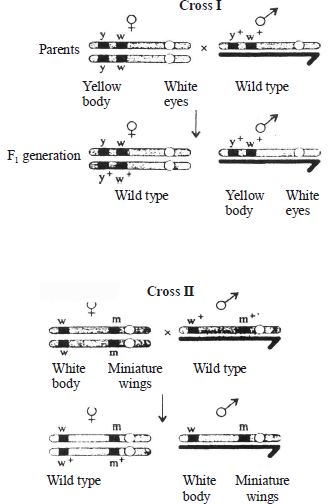
The experiment shown in the given figure has been carried out by Morgan to show the phenomenon of linkage and recombination. If in cross $I$,genes are tightly linked and in cross $II$,genes are loosely linked,then what will be the percentage of recombinants produced in cross $I$ and cross $II$ respectively?
A
$98.7\%$ and $62.8\%$
B
$1.3\%$ and $37.2\%$
C
$37.2\%$ and $1.3\%$
D
$62.8\%$ and $98.7\%$
Solution
(B) Thomas Hunt Morgan conducted experiments on Drosophila melanogaster to study linkage and recombination.
In cross $I$,the genes for yellow body $(y)$ and white eyes $(w)$ are tightly linked,resulting in a low frequency of recombination,which is $1.3\%$.
In cross $II$,the genes for white eyes $(w)$ and miniature wings $(m)$ are loosely linked,resulting in a higher frequency of recombination,which is $37.2\%$.
Therefore,the percentage of recombinants produced in cross $I$ and cross $II$ are $1.3\%$ and $37.2\%$ respectively.
In cross $I$,the genes for yellow body $(y)$ and white eyes $(w)$ are tightly linked,resulting in a low frequency of recombination,which is $1.3\%$.
In cross $II$,the genes for white eyes $(w)$ and miniature wings $(m)$ are loosely linked,resulting in a higher frequency of recombination,which is $37.2\%$.
Therefore,the percentage of recombinants produced in cross $I$ and cross $II$ are $1.3\%$ and $37.2\%$ respectively.
0 likesView Solution
44
BiologyMediumMCQAIIMS · 2016
Which one of the following groups of codons is referred to as degenerate codons?
A
$UAA, UAG$ and $UGA$
B
$GUA, GUG, GCA, GCG$ and $GAA$
C
$UUC, UUG, CCU, CAA$ and $CUG$
D
$UUA, UUG, CUU, CUC, CUA$ and $CUG$
Solution
(A) The term 'degenerate' in the context of the genetic code usually refers to the property where multiple codons code for the same amino acid. However,in many textbooks,the term 'degenerate' is incorrectly used to refer to 'stop codons' or 'nonsense codons'. Based on the provided options,the question asks for the set of stop codons.
Stop codons (also known as nonsense or termination codons) do not code for any amino acids and signal the end of protein synthesis.
The three stop codons are $UAA$ (ochre),$UAG$ (amber),and $UGA$ (opal).
Stop codons (also known as nonsense or termination codons) do not code for any amino acids and signal the end of protein synthesis.
The three stop codons are $UAA$ (ochre),$UAG$ (amber),and $UGA$ (opal).
0 likesView Solution
45
BiologyMediumMCQAIIMS · 2016
$A$ population is in Hardy-Weinberg equilibrium for a gene with only two alleles. If the gene frequency of an allele $A$ is $0.7$,the genotype frequency of $Aa$ is
A
$0.21$
B
$0.42$
C
$0.36$
D
$0.7$
Solution
(B) For a gene with two alleles,$A$ and $a$,if the frequency of $A$ is $p$ and the frequency of $a$ is $q$,then the frequencies of the three possible genotypes ($AA, Aa,$ and $aa$) are expressed by the Hardy-Weinberg equation: $p^2 + 2pq + q^2 = 1$.
Here,$p$ is the frequency of allele $A$ and $q$ is the frequency of allele $a$.
Given that $p = 0.7$,we know that $p + q = 1$,so $q = 1 - 0.7 = 0.3$.
The frequency of the heterozygous genotype $Aa$ is represented by $2pq$.
Substituting the values: $2pq = 2 \times 0.7 \times 0.3 = 0.42$.
Here,$p$ is the frequency of allele $A$ and $q$ is the frequency of allele $a$.
Given that $p = 0.7$,we know that $p + q = 1$,so $q = 1 - 0.7 = 0.3$.
The frequency of the heterozygous genotype $Aa$ is represented by $2pq$.
Substituting the values: $2pq = 2 \times 0.7 \times 0.3 = 0.42$.
0 likesView Solution
46
BiologyMediumMCQAIIMS · 2016
Assertion : Organic compounds first evolved in earth required for origin of life were protein and nucleic acid.
Reason : All life forms were in water environment only.
Reason : All life forms were in water environment only.
A
If both Assertion and Reason are correct and the Reason is a correct explanation of the Assertion.
B
If both Assertion and Reason are correct but Reason is not a correct explanation of the Assertion.
C
If the Assertion is correct but Reason is incorrect.
D
If both the Assertion and Reason are incorrect.
Solution
(B) The Assertion is correct because,according to the Oparin-Haldane hypothesis,the first organic molecules synthesized in the primitive atmosphere and oceans were simple monomers like amino acids and nucleotides,which polymerized to form proteins and nucleic acids.
The Reason is also correct because the early life forms (protobionts) originated and evolved in the primitive aquatic environment (the 'primordial soup').
However,the fact that life originated in water is not the direct scientific explanation for why proteins and nucleic acids were the specific organic compounds required for the origin of life. Therefore,the Reason does not explain the Assertion.
The Reason is also correct because the early life forms (protobionts) originated and evolved in the primitive aquatic environment (the 'primordial soup').
However,the fact that life originated in water is not the direct scientific explanation for why proteins and nucleic acids were the specific organic compounds required for the origin of life. Therefore,the Reason does not explain the Assertion.
0 likesView Solution
47
BiologyEasyMCQAIIMS · 2016
$Pasteurella/Yersinia pestis$ (causal agent of Bubonic Plague) is transmitted by:
A
$Cimex$
B
$Xenopsylla$
C
$Pediculus$
D
$Aedes$
Solution
(B) $Yersinia pestis$ (formerly known as $Pasteurella pestis$) is the bacterium that causes Bubonic Plague.
This pathogen is primarily transmitted to humans through the bite of infected rat fleas,specifically the species $Xenopsylla cheopis$.
$Cimex$ refers to bedbugs,$Pediculus$ refers to lice,and $Aedes$ is a genus of mosquitoes known for transmitting diseases like Dengue and Chikungunya.
Therefore,the correct vector for the transmission of $Yersinia pestis$ is $Xenopsylla$.
This pathogen is primarily transmitted to humans through the bite of infected rat fleas,specifically the species $Xenopsylla cheopis$.
$Cimex$ refers to bedbugs,$Pediculus$ refers to lice,and $Aedes$ is a genus of mosquitoes known for transmitting diseases like Dengue and Chikungunya.
Therefore,the correct vector for the transmission of $Yersinia pestis$ is $Xenopsylla$.
0 likesView Solution
48
BiologyEasyMCQAIIMS · 2016
Which of the following pairs is not correctly matched?
A
Cholera - $Vibrio$ $cholerae$
B
German measles - $Rubella$ virus
C
Whooping cough - $Bordetella$ $pertussis$
D
Tetanus - $Pasteurella$ $pestis$
Solution
(D) Tetanus is caused by the bacterium $Clostridium$ $tetani$.
$Pasteurella$ $pestis$ (also known as $Yersinia$ $pestis$) is the causative agent of plague,not tetanus.
Therefore,the pair $Tetanus - Pasteurella$ $pestis$ is incorrectly matched.
$Pasteurella$ $pestis$ (also known as $Yersinia$ $pestis$) is the causative agent of plague,not tetanus.
Therefore,the pair $Tetanus - Pasteurella$ $pestis$ is incorrectly matched.
0 likesView Solution
49
BiologyMediumMCQAIIMS · 2016
Assertion: Cocaine has a potent stimulating action on the central nervous system,producing a sense of euphoria and increased energy.
Reason: Injecting the microbes intentionally during immunisation or infectious organisms gaining access into the body during natural infection induces active immunity.
Reason: Injecting the microbes intentionally during immunisation or infectious organisms gaining access into the body during natural infection induces active immunity.
A
If both Assertion and Reason are correct and the Reason is a correct explanation of the Assertion.
B
If both Assertion and Reason are correct but Reason is not a correct explanation of the Assertion.
C
If the Assertion is correct but Reason is incorrect.
D
If both the Assertion and Reason are incorrect.
Solution
(B) The Assertion is correct. Cocaine is an alkaloid obtained from the coca plant, $Erythroxylum \text{ } coca$. It interferes with the transport of the neurotransmitter dopamine,resulting in a potent stimulating action on the central nervous system,which produces a sense of euphoria and increased energy.
The Reason is also a correct statement regarding immunology. Active immunity is indeed developed when a host is exposed to antigens,which can occur either through natural infection or through intentional exposure via immunization (vaccination).
However,the Reason does not explain the mechanism of action of cocaine. Therefore,both statements are correct,but the Reason is not the correct explanation of the Assertion.
The Reason is also a correct statement regarding immunology. Active immunity is indeed developed when a host is exposed to antigens,which can occur either through natural infection or through intentional exposure via immunization (vaccination).
However,the Reason does not explain the mechanism of action of cocaine. Therefore,both statements are correct,but the Reason is not the correct explanation of the Assertion.
0 likesView Solution
50
BiologyEasyMCQAIIMS · 2016
Hisardale is a new breed of sheep developed in Punjab by a breeding technique in which a superior male of one breed is mated with a superior female of another breed. Identify the breeding technique from the options given below.
A
Inbreeding
B
Outcrossing
C
Outbreeding
D
Cross-breeding
Solution
(D) Hisardale is a new breed of sheep developed in Punjab by crossing Bikaneri ewes and Marino rams.
Cross-breeding is a breeding technique in which a superior male of one breed is mated with a superior female of another breed.
This method allows the desirable qualities of two different breeds to be combined into a single progeny.
Cross-breeding is a breeding technique in which a superior male of one breed is mated with a superior female of another breed.
This method allows the desirable qualities of two different breeds to be combined into a single progeny.
0 likesView Solution
51
BiologyMediumMCQAIIMS · 2016
Choose the correct combination:
| Column-$I$ | Column-$II$ |
|---|---|
| $A$. Escherichia coli | $I$. Nif gene |
| $B$. Rhizobium melilotae | $II$. Digestive hydrocarbon of crude oil |
| $C$. Bacillus thuringiensis | $III$. Production of human insulin |
| $D$. Pseudomonas putida | $IV$. Biological control of fungal disease |
| $V$. Biodecomposed insecticide |
A
$A-III, B-I, C-V, D-IV$
B
$A-I, B-II, C-III, D-IV$
C
$A-II, B-I, C-III, D-IV$
D
$A-III, B-I, C-V, D-II$
Solution
(D) The correct matches are as follows:
$1$. $A$. Escherichia coli is widely used in biotechnology for the production of human insulin $(III)$.
$2$. $B$. Rhizobium melilotae is a nitrogen-fixing bacterium associated with the $Nif$ gene $(I)$.
$3$. $C$. Bacillus thuringiensis produces toxins used as a biological insecticide $(V)$.
$4$. $D$. Pseudomonas putida is known for its ability to degrade hydrocarbons in crude oil $(II)$.
Therefore,the correct combination is $A-III, B-I, C-V, D-II$.
$1$. $A$. Escherichia coli is widely used in biotechnology for the production of human insulin $(III)$.
$2$. $B$. Rhizobium melilotae is a nitrogen-fixing bacterium associated with the $Nif$ gene $(I)$.
$3$. $C$. Bacillus thuringiensis produces toxins used as a biological insecticide $(V)$.
$4$. $D$. Pseudomonas putida is known for its ability to degrade hydrocarbons in crude oil $(II)$.
Therefore,the correct combination is $A-III, B-I, C-V, D-II$.
0 likesView Solution
52
BiologyMediumMCQAIIMS · 2016
What would happen if oxygen availability to activated sludge flocs is reduced?
A
It will slow down the rate of degradation of organic matter
B
The centre of flocs will become anoxic,which would cause death of bacteria and eventually breakage of flocs
C
Flocs would increase in size as anaerobic bacteria would grow around flocs
D
Protozoa would grow in large numbers
Solution
(B) In the secondary treatment of sewage,activated sludge flocs consist of masses of bacteria associated with fungal filaments to form a mesh-like structure.
These flocs require a constant supply of oxygen for the aerobic decomposition of organic matter.
If the oxygen availability is reduced,the oxygen cannot diffuse into the interior of the flocs.
Consequently,the centre of the flocs becomes anoxic (lacking oxygen).
This leads to the death of the aerobic bacteria residing in the centre,which eventually causes the structural integrity of the flocs to fail,leading to their breakage.
These flocs require a constant supply of oxygen for the aerobic decomposition of organic matter.
If the oxygen availability is reduced,the oxygen cannot diffuse into the interior of the flocs.
Consequently,the centre of the flocs becomes anoxic (lacking oxygen).
This leads to the death of the aerobic bacteria residing in the centre,which eventually causes the structural integrity of the flocs to fail,leading to their breakage.
0 likesView Solution
53
BiologyMediumMCQAIIMS · 2016
Which one of the following palindromic base sequences in $DNA$ can be easily cut at about the middle by some particular restriction enzyme?
A
$5'-CGTTCG-3'$
$3'-GCAAGC-5'$
$3'-GCAAGC-5'$
B
$5'-GATATG-3'$
$3'-CTATAC-5'$
$3'-CTATAC-5'$
C
$5'-GAATTC-3'$
$3'-CTTAAG-5'$
$3'-CTTAAG-5'$
D
$5'-CACGTA-3'$
$3'-GTGCAT-5'$
$3'-GTGCAT-5'$
Solution
(C) palindromic sequence in $DNA$ is a sequence of base pairs that reads the same on the two strands when the orientation of reading is kept the same (e.g.,$5' \rightarrow 3'$).
Restriction enzymes recognize specific palindromic sequences to cut the $DNA$.
In option $(c)$,the sequence $5'-GAATTC-3'$ on one strand corresponds to $3'-CTTAAG-5'$ on the complementary strand.
When read in the $5' \rightarrow 3'$ direction,both strands yield the sequence $GAATTC$,which is a classic recognition site for the restriction enzyme $EcoRI$.
Restriction enzymes recognize specific palindromic sequences to cut the $DNA$.
In option $(c)$,the sequence $5'-GAATTC-3'$ on one strand corresponds to $3'-CTTAAG-5'$ on the complementary strand.
When read in the $5' \rightarrow 3'$ direction,both strands yield the sequence $GAATTC$,which is a classic recognition site for the restriction enzyme $EcoRI$.
0 likesView Solution
54
BiologyEasyMCQAIIMS · 2016
$A$ transgenic food crop which may help in solving the problem of night blindness in developing countries is
A
golden rice
B
$Bt$ soyabean
C
flavr-savr tomato
D
starlink maize
Solution
(A) transgenic food crop which may help in solving the problem of night blindness in developing countries is golden rice.
Golden rice is a genetically modified rice variety that has been engineered to produce elevated levels of beta-carotene.
Beta-carotene is a precursor of vitamin $A$,which helps in preventing night blindness.
This modification gives the rice its characteristic golden colour.
Golden rice is a genetically modified rice variety that has been engineered to produce elevated levels of beta-carotene.
Beta-carotene is a precursor of vitamin $A$,which helps in preventing night blindness.
This modification gives the rice its characteristic golden colour.
0 likesView Solution
55
BiologyMediumMCQAIIMS · 2016
The salinity in sea water in parts per thousand $(ppt)$ ranges between
A
$30-35$
B
$10-15$
C
$3-5$
D
$0-5$
Solution
(A) Salinity is defined as the concentration of salts in water,measured in parts per thousand $(ppt)$.
In the sea,the salinity typically ranges between $30-35$ $ppt$.
In contrast,inland waters (freshwater) have a salinity of less than $5$ $ppt$.
Some hypersaline lagoons can have salinities exceeding $100$ $ppt$.
In the sea,the salinity typically ranges between $30-35$ $ppt$.
In contrast,inland waters (freshwater) have a salinity of less than $5$ $ppt$.
Some hypersaline lagoons can have salinities exceeding $100$ $ppt$.
0 likesView Solution
56
BiologyEasyMCQAIIMS · 2016
How much portion of the Photosynthetically Active Radiation $(PAR)$ is captured by the plants (in $2-10\%$)?
A
$5$
B
$7$
C
$8$
D
$2$
Solution
(D) The main source of energy for an ecosystem is the radiant energy or light energy derived from the sun.
$50\%$ of the total solar radiation that falls on Earth is Photosynthetically Active Radiation $(PAR)$.
The light energy is converted into chemical energy in the form of sugar by photosynthesis.
The chemical equation is: $6H_2O + 6CO_2 + \text{Light} \to C_6H_{12}O_6 + 6O_2$.
Plants utilize only $2-10\%$ of the incident $PAR$ for the process of photosynthesis.
$50\%$ of the total solar radiation that falls on Earth is Photosynthetically Active Radiation $(PAR)$.
The light energy is converted into chemical energy in the form of sugar by photosynthesis.
The chemical equation is: $6H_2O + 6CO_2 + \text{Light} \to C_6H_{12}O_6 + 6O_2$.
Plants utilize only $2-10\%$ of the incident $PAR$ for the process of photosynthesis.
0 likesView Solution
57
BiologyMediumMCQAIIMS · 2016
Assertion : Net primary productivity is gross primary productivity minus respiration.
Reason : Secondary productivity is produced by heterotrophs.
Reason : Secondary productivity is produced by heterotrophs.
A
If both Assertion and Reason are correct and the Reason is a correct explanation of the Assertion.
B
If both Assertion and Reason are correct but Reason is not a correct explanation of the Assertion.
C
If the Assertion is correct but Reason is incorrect.
D
If both the Assertion and Reason are incorrect.
Solution
(B) Net primary productivity $(NPP)$ is the rate of organic matter built up or stored by producers in their bodies per unit time and area. It is calculated as $NPP = GPP - R$,where $GPP$ is Gross Primary Productivity and $R$ is the energy lost due to respiration.
Secondary productivity is defined as the rate of formation of new organic matter by consumers (heterotrophs) per unit time and area.
Both statements are scientifically correct,but the Reason does not explain why $NPP$ is defined as $GPP$ minus respiration. Therefore,the correct option is $B$.
Secondary productivity is defined as the rate of formation of new organic matter by consumers (heterotrophs) per unit time and area.
Both statements are scientifically correct,but the Reason does not explain why $NPP$ is defined as $GPP$ minus respiration. Therefore,the correct option is $B$.
0 likesView Solution
58
BiologyDifficultMCQAIIMS · 2016
Using the provided graph,determine the percentage of bird species that will be lost if the island's inhabitable land area is reduced from $100,000\, km^2$ to $1\, km^2$.
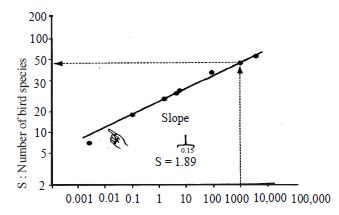
A
$17$ percent of the bird species will be lost.
B
$20$ percent of the bird species will be lost.
C
All of the bird species will be lost.
D
$93$ percent of the bird species will be lost.
Solution
(D) The species-area relationship is given by the equation $\log S = \log C + Z \log A$.
From the graph,the slope $(Z)$ is $1.15$ (as indicated by the value $S=1.15$ in the provided image).
For an area of $100,000\, km^2$,the number of species $(S_1)$ is approximately $70$.
For an area of $1\, km^2$,the number of species $(S_2)$ is approximately $5$.
The number of species lost is $S_1 - S_2 = 70 - 5 = 65$.
The percentage of species lost is $(65 / 70) \times 100 \approx 92.8\%$,which is approximately $93\%$.
Therefore,$93\%$ of the bird species will be lost.
From the graph,the slope $(Z)$ is $1.15$ (as indicated by the value $S=1.15$ in the provided image).
For an area of $100,000\, km^2$,the number of species $(S_1)$ is approximately $70$.
For an area of $1\, km^2$,the number of species $(S_2)$ is approximately $5$.
The number of species lost is $S_1 - S_2 = 70 - 5 = 65$.
The percentage of species lost is $(65 / 70) \times 100 \approx 92.8\%$,which is approximately $93\%$.
Therefore,$93\%$ of the bird species will be lost.
0 likesView Solution
59
BiologyMediumMCQAIIMS · 2016
Two lakes,$A$ and $B$ are identical in all aspects except that lake $A$ has higher temperature. Which of the following is true?
A
$A$ has higher rate of oxygen dissolution.
B
$B$ has higher rate of oxygen dissolution.
C
Oxygen dissolution of both is the same.
D
Both the lakes have same $BOD$.
Solution
(B) The solubility of gases in liquids is inversely proportional to temperature.
As the temperature of a liquid increases,the kinetic energy of the gas molecules increases,causing them to escape from the liquid phase more easily.
Since lake $A$ has a higher temperature than lake $B$,the solubility of oxygen in lake $A$ will be lower.
Conversely,lake $B$,having a lower temperature,will have a higher rate of oxygen dissolution compared to lake $A$.
As the temperature of a liquid increases,the kinetic energy of the gas molecules increases,causing them to escape from the liquid phase more easily.
Since lake $A$ has a higher temperature than lake $B$,the solubility of oxygen in lake $A$ will be lower.
Conversely,lake $B$,having a lower temperature,will have a higher rate of oxygen dissolution compared to lake $A$.
0 likesView Solution
Vedclass Products
For Students
Vedclass Test Series
Mock tests in real AIIMS style covering Biology with performance analysis. 5-day free trial.
Start Free TrialFor Teachers
Exam Paper Generator
Generate Set A/B/C/D Biology papers from 7.5L+ questions in 2 minutes. 3 chapters free.
Try FreeFor Institutes
Online Exam Module
Run live AIIMS mock exams with unlimited students, 360° analytics & white-label branding.
See DemoFrequently Asked Questions
How many Biology questions are in AIIMS 2016?
There are 59 Biology questions from the AIIMS 2016 paper on Vedclass, each with a detailed step-by-step solution in English.
Are AIIMS 2016 Biology solutions available in English?
Yes. All solutions on this page are in English. You can also switch to English or Hindi using the language buttons above the questions.
Can I practice AIIMS 2016 Biology as a timed test?
Yes. Use the Vedclass Test Series to attempt a full AIIMS mock test covering Biology with time limits and instant score analysis.
Can teachers create Biology papers from AIIMS previous year questions?
Yes. The Vedclass Exam Paper Generator lets teachers mix AIIMS Biology questions and generate Set A/B/C/D papers in minutes.
For Teachers & Institutes
Build a Custom Biology Paper
Pick AIIMS 2016 Biology questions, set difficulty, and generate Set A/B/C/D in 2 minutes.