
ChemistryQ1–64 of 64 questions
Page 1 of 1 · English
1
ChemistryMCQAIIMS · 2009
An element $(X)$ forms compounds of the formula $XCl_3$,$X_2O_5$ and $Ca_3X_2$,but does not form $XCl_5$. Which of the following is the element $X$?
A
$B$
B
$Al$
C
$N$
D
$P$
Solution
(C) The element $(X)$ forms $XCl_3$,$X_2O_5$,and $Ca_3X_2$.
Nitrogen $(N)$ forms $NCl_3$,$N_2O_5$,and $Ca_3N_2$.
Nitrogen does not form $NCl_5$ because it lacks $d$-orbitals in its valence shell,which prevents it from expanding its covalency beyond $4$.
Therefore,the element $(X)$ is $N$.
Nitrogen $(N)$ forms $NCl_3$,$N_2O_5$,and $Ca_3N_2$.
Nitrogen does not form $NCl_5$ because it lacks $d$-orbitals in its valence shell,which prevents it from expanding its covalency beyond $4$.
Therefore,the element $(X)$ is $N$.
0 likesView Solution
2
ChemistryDifficultMCQAIIMS · 2009
Calculate the millimoles of $SeO_3^{2-}$ in solution on the basis of following data: $70 \ mL$ of $\frac{M}{60}$ solution of $KBrO_3$ was added to $SeO_3^{2-}$ solution. The bromine evolved was removed by boiling and excess of $KBrO_3$ was back titrated with $12.5 \ mL$ of $\frac{M}{25}$ solution of $NaAsO_2$. The reactions are given below.
$I. \ SeO_3^{2-} + BrO_3^{-} + H^{+} \to SeO_4^{2-} + Br_2 + H_2O$
$II. \ BrO_3^{-} + AsO_2^{-} + H_2O \to Br^{-} + AsO_4^{3-} + H^{+}$
$I. \ SeO_3^{2-} + BrO_3^{-} + H^{+} \to SeO_4^{2-} + Br_2 + H_2O$
$II. \ BrO_3^{-} + AsO_2^{-} + H_2O \to Br^{-} + AsO_4^{3-} + H^{+}$
A
$1.6 \times 10^{-3}$
B
$1.25$
C
$2.5 \times 10^{-3}$
D
None of these
Solution
(C) Reaction $(I): \ SeO_3^{2-} + BrO_3^{-} + H^{+} \to SeO_4^{2-} + Br_2 + H_2O$ (n-factor for $SeO_3^{2-} = 2$,for $BrO_3^{-} = 5$)
Reaction $(II): \ BrO_3^{-} + AsO_2^{-} + H_2O \to Br^{-} + AsO_4^{3-} + H^{+}$ (n-factor for $BrO_3^{-} = 6$,for $AsO_2^{-} = 2$)
Step $1$: Calculate milliequivalents of $AsO_2^{-}$ used in back titration:
$meq \ of \ AsO_2^{-} = 12.5 \ mL \times (\frac{1}{25} \ M) \times 2 = 1 \ meq$
Step $2$: Calculate millimoles of excess $BrO_3^{-}$:
$meq \ of \ BrO_3^{-} = meq \ of \ AsO_2^{-} = 1 \ meq$
$mmol \ of \ BrO_3^{-} = \frac{1}{6} \ mmol$
Step $3$: Calculate millimoles of $BrO_3^{-}$ consumed in reaction $(I)$:
Total $mmol \ of \ BrO_3^{-} = 70 \ mL \times \frac{1}{60} \ M = \frac{7}{6} \ mmol$
$mmol \ of \ BrO_3^{-} \ consumed = \frac{7}{6} - \frac{1}{6} = 1 \ mmol$
Step $4$: Calculate millimoles of $SeO_3^{2-}$:
$meq \ of \ SeO_3^{2-} = meq \ of \ BrO_3^{-} \ consumed$
$mmol \ of \ SeO_3^{2-} \times 2 = 1 \ mmol \times 5$
$mmol \ of \ SeO_3^{2-} = 2.5 \ mmol = 2.5 \times 10^{-3} \ mol$
Reaction $(II): \ BrO_3^{-} + AsO_2^{-} + H_2O \to Br^{-} + AsO_4^{3-} + H^{+}$ (n-factor for $BrO_3^{-} = 6$,for $AsO_2^{-} = 2$)
Step $1$: Calculate milliequivalents of $AsO_2^{-}$ used in back titration:
$meq \ of \ AsO_2^{-} = 12.5 \ mL \times (\frac{1}{25} \ M) \times 2 = 1 \ meq$
Step $2$: Calculate millimoles of excess $BrO_3^{-}$:
$meq \ of \ BrO_3^{-} = meq \ of \ AsO_2^{-} = 1 \ meq$
$mmol \ of \ BrO_3^{-} = \frac{1}{6} \ mmol$
Step $3$: Calculate millimoles of $BrO_3^{-}$ consumed in reaction $(I)$:
Total $mmol \ of \ BrO_3^{-} = 70 \ mL \times \frac{1}{60} \ M = \frac{7}{6} \ mmol$
$mmol \ of \ BrO_3^{-} \ consumed = \frac{7}{6} - \frac{1}{6} = 1 \ mmol$
Step $4$: Calculate millimoles of $SeO_3^{2-}$:
$meq \ of \ SeO_3^{2-} = meq \ of \ BrO_3^{-} \ consumed$
$mmol \ of \ SeO_3^{2-} \times 2 = 1 \ mmol \times 5$
$mmol \ of \ SeO_3^{2-} = 2.5 \ mmol = 2.5 \times 10^{-3} \ mol$
0 likesView Solution
3
ChemistryDifficultMCQAIIMS · 2009
Assertion : Both $Be$ and $Al$ can form complexes such as $BeF_4^{2-}$ and $AlF_6^{3-}$ respectively,$BeF_6^{3-}$ is not formed.
Reason : In case of $Be$,no vacant $d-$ orbitals are present in its outermost shell.
Reason : In case of $Be$,no vacant $d-$ orbitals are present in its outermost shell.
A
If both Assertion and Reason are correct and the Reason is a correct explanation of the Assertion.
B
If both Assertion and Reason are correct but Reason is not a correct explanation of the Assertion.
C
If the Assertion is correct but Reason is incorrect.
D
If both the Assertion and Reason are incorrect.
Solution
(A) The assertion is correct because $Be$ can expand its coordination number up to $4$ due to the presence of only $s$ and $p$ orbitals in its valence shell $(n=2)$.
$Al$ can expand its coordination number to $6$ because it has vacant $3d$ orbitals in its valence shell $(n=3)$.
Since $Be$ lacks vacant $d-$ orbitals,it cannot form $BeF_6^{3-}$,which would require a coordination number of $6$.
Thus,the reason correctly explains the assertion.
$Al$ can expand its coordination number to $6$ because it has vacant $3d$ orbitals in its valence shell $(n=3)$.
Since $Be$ lacks vacant $d-$ orbitals,it cannot form $BeF_6^{3-}$,which would require a coordination number of $6$.
Thus,the reason correctly explains the assertion.
0 likesView Solution
4
ChemistryEasyMCQAIIMS · 2009
When a solid melts reversibly,which of the following occurs?
A
$H$ decreases
B
$G$ increases
C
$E$ decreases
D
$S$ increases
Solution
(D) When a solid melts,it undergoes a phase transition from a highly ordered state to a less ordered state.
Since entropy $(S)$ is a measure of the randomness or disorder of a system,the transition from solid to liquid results in an increase in the randomness of the particles.
Therefore,$S$ increases during the melting process.
Since entropy $(S)$ is a measure of the randomness or disorder of a system,the transition from solid to liquid results in an increase in the randomness of the particles.
Therefore,$S$ increases during the melting process.
0 likesView Solution
5
ChemistryMediumMCQAIIMS · 2009
$6$ moles of an ideal gas expand isothermally and reversibly from a volume of $1 \ L$ to a volume of $10 \ L$ at $27 \ ^oC$. What is the maximum work done? (in $kJ$)
A
$47$
B
$100$
C
$0$
D
$34.465$
Solution
(D) For an isothermal reversible expansion,the work done is given by the formula: $W = -2.303 \times nRT \times \log(\frac{V_2}{V_1})$.
Given values: $n = 6 \ mol$,$T = 27 \ ^oC = 300 \ K$,$V_1 = 1 \ L$,$V_2 = 10 \ L$,and $R = 8.314 \ J \ K^{-1} \ mol^{-1}$.
Substituting the values: $W = -2.303 \times 6 \times 8.314 \times 300 \times \log(\frac{10}{1})$.
$W = -2.303 \times 6 \times 8.314 \times 300 \times 1$.
$W = -34465.3 \ J = -34.465 \ kJ$.
The magnitude of maximum work done is $34.465 \ kJ$.
Given values: $n = 6 \ mol$,$T = 27 \ ^oC = 300 \ K$,$V_1 = 1 \ L$,$V_2 = 10 \ L$,and $R = 8.314 \ J \ K^{-1} \ mol^{-1}$.
Substituting the values: $W = -2.303 \times 6 \times 8.314 \times 300 \times \log(\frac{10}{1})$.
$W = -2.303 \times 6 \times 8.314 \times 300 \times 1$.
$W = -34465.3 \ J = -34.465 \ kJ$.
The magnitude of maximum work done is $34.465 \ kJ$.
0 likesView Solution
6
ChemistryDifficultMCQAIIMS · 2009
The standard enthalpy of combustion at $25\,^{\circ}C$ of hydrogen,cyclohexene $(C_6H_{10})$ and cyclohexane $(C_6H_{12})$ are $-241$,$-3800$ and $-3920\, kJ/mol$ respectively. Calculate the heat of hydrogenation of cyclohexene in $kJ/mol$.
A
$-111$
B
$-121$
C
$-118$
D
$-128$
Solution
(B) The required reaction is $C_6H_{10} + H_2 \to C_6H_{12}$,$\Delta H_1 = ? \dots (1)$
Given combustion reactions:
$H_2 + \frac{1}{2}O_2 \to H_2O$,$\Delta H_2 = -241 \, kJ/mol \dots (2)$
$C_6H_{10} + \frac{17}{2}O_2 \to 6CO_2 + 5H_2O$,$\Delta H_3 = -3800 \, kJ/mol \dots (3)$
$C_6H_{12} + 9O_2 \to 6CO_2 + 6H_2O$,$\Delta H_4 = -3920 \, kJ/mol \dots (4)$
Applying Hess's Law,the required reaction $(1)$ is obtained by $(2) + (3) - (4)$:
$\Delta H_1 = (\Delta H_2 + \Delta H_3) - \Delta H_4$
$\Delta H_1 = (-241 - 3800) - (-3920)$
$\Delta H_1 = -4041 + 3920 = -121 \, kJ/mol$.
Given combustion reactions:
$H_2 + \frac{1}{2}O_2 \to H_2O$,$\Delta H_2 = -241 \, kJ/mol \dots (2)$
$C_6H_{10} + \frac{17}{2}O_2 \to 6CO_2 + 5H_2O$,$\Delta H_3 = -3800 \, kJ/mol \dots (3)$
$C_6H_{12} + 9O_2 \to 6CO_2 + 6H_2O$,$\Delta H_4 = -3920 \, kJ/mol \dots (4)$
Applying Hess's Law,the required reaction $(1)$ is obtained by $(2) + (3) - (4)$:
$\Delta H_1 = (\Delta H_2 + \Delta H_3) - \Delta H_4$
$\Delta H_1 = (-241 - 3800) - (-3920)$
$\Delta H_1 = -4041 + 3920 = -121 \, kJ/mol$.
0 likesView Solution
7
ChemistryMediumMCQAIIMS · 2009
$A$ weak acid,$HA$,is found to be $10\%$ ionized in $0.01\ M$ aqueous solution. Calculate the $pH$ of a solution which is $0.1\ M$ in $HA$ and $0.05\ M$ in $NaA$.
A
$5.365$
B
$6.355$
C
$3.653$
D
$6.593$
Solution
(C) For the weak acid $HA$,the degree of ionization $\alpha = 0.1$ at concentration $C = 0.01 \ M$.
The dissociation constant $K_a$ is given by $K_a = \frac{C \alpha^2}{1 - \alpha} = \frac{0.01 \times (0.1)^2}{1 - 0.1} = \frac{0.0001}{0.9} = 1.11 \times 10^{-4}$.
Calculate $pK_a$: $pK_a = -\log(1.11 \times 10^{-4}) = 4 - \log(1.11) \approx 4 - 0.0458 = 3.9542$.
Using the Henderson-Hasselbalch equation for the buffer solution containing $HA$ $(0.1 \ M)$ and $NaA$ $(0.05 \ M)$:
$pH = pK_a + \log \left( \frac{[Salt]}{[Acid]} \right) = 3.9542 + \log \left( \frac{0.05}{0.1} \right)$.
$pH = 3.9542 + \log(0.5) = 3.9542 - 0.3010 = 3.6532 \approx 3.653$.
The dissociation constant $K_a$ is given by $K_a = \frac{C \alpha^2}{1 - \alpha} = \frac{0.01 \times (0.1)^2}{1 - 0.1} = \frac{0.0001}{0.9} = 1.11 \times 10^{-4}$.
Calculate $pK_a$: $pK_a = -\log(1.11 \times 10^{-4}) = 4 - \log(1.11) \approx 4 - 0.0458 = 3.9542$.
Using the Henderson-Hasselbalch equation for the buffer solution containing $HA$ $(0.1 \ M)$ and $NaA$ $(0.05 \ M)$:
$pH = pK_a + \log \left( \frac{[Salt]}{[Acid]} \right) = 3.9542 + \log \left( \frac{0.05}{0.1} \right)$.
$pH = 3.9542 + \log(0.5) = 3.9542 - 0.3010 = 3.6532 \approx 3.653$.
0 likesView Solution
8
ChemistryDifficultMCQAIIMS · 2009
The solubility of $PbF_2$ in water at $25\,^{\circ}C$ is $\sim 10^{-3}\, M$. What is its solubility in $0.05\, M\, NaF$ solution? Assume the latter to be fully ionised.
A
$1.6 \times 10^{-6}\, M$
B
$1.2 \times 10^{-6}\, M$
C
$1.2 \times 10^{-5}\, M$
D
$1.6 \times 10^{-4}\, M$
Solution
(A) The solubility of $PbF_2$ in water is $S = 10^{-3}\, M$.
The solubility product constant $K_{sp}$ is given by $K_{sp} = [Pb^{2+}][F^-]^2 = (S)(2S)^2 = 4S^3$.
$K_{sp} = 4 \times (10^{-3})^3 = 4 \times 10^{-9}$.
In $0.05\, M\, NaF$ solution,$NaF$ dissociates completely to provide $[F^-] = 0.05\, M$.
Let the solubility of $PbF_2$ in this solution be $S'\, M$. Then $[Pb^{2+}] = S'$ and $[F^-] = (2S' + 0.05)\, M$.
$K_{sp} = S'(2S' + 0.05)^2 = 4 \times 10^{-9}$.
Since $S'$ is very small,we assume $2S' \ll 0.05$,so $(2S' + 0.05) \approx 0.05$.
$S' \times (0.05)^2 = 4 \times 10^{-9}$.
$S' \times 2.5 \times 10^{-3} = 4 \times 10^{-9}$.
$S' = \frac{4 \times 10^{-9}}{2.5 \times 10^{-3}} = 1.6 \times 10^{-6}\, M$.
The solubility product constant $K_{sp}$ is given by $K_{sp} = [Pb^{2+}][F^-]^2 = (S)(2S)^2 = 4S^3$.
$K_{sp} = 4 \times (10^{-3})^3 = 4 \times 10^{-9}$.
In $0.05\, M\, NaF$ solution,$NaF$ dissociates completely to provide $[F^-] = 0.05\, M$.
Let the solubility of $PbF_2$ in this solution be $S'\, M$. Then $[Pb^{2+}] = S'$ and $[F^-] = (2S' + 0.05)\, M$.
$K_{sp} = S'(2S' + 0.05)^2 = 4 \times 10^{-9}$.
Since $S'$ is very small,we assume $2S' \ll 0.05$,so $(2S' + 0.05) \approx 0.05$.
$S' \times (0.05)^2 = 4 \times 10^{-9}$.
$S' \times 2.5 \times 10^{-3} = 4 \times 10^{-9}$.
$S' = \frac{4 \times 10^{-9}}{2.5 \times 10^{-3}} = 1.6 \times 10^{-6}\, M$.
0 likesView Solution
9
ChemistryDifficultMCQAIIMS · 2009
Air containing $79\%$ of nitrogen and $21\%$ of oxygen by volume is heated at $2200 \ K$ and $1 \ atm$ until equilibrium is established according to the reaction $N_{2(g)} + O_{2(g)} \rightleftharpoons 2NO_{(g)}$. If the $K_p$ of the reaction is $1.1 \times 10^{-3}$,calculate the amount of nitric oxide produced in terms of volume percent.
A
$1.33$
B
$1.12$
C
$1.02$
D
$1.44$
Solution
(A) The reaction is $N_{2(g)} + O_{2(g)} \rightleftharpoons 2NO_{(g)}$.
Initially,let the total moles be $1$. Thus,$n(N_2) = 0.79$ and $n(O_2) = 0.21$.
Let the degree of dissociation be $\alpha$. At equilibrium:
$n(N_2) = 0.79 - \alpha/2$,$n(O_2) = 0.21 - \alpha/2$,$n(NO) = \alpha$.
However,using the standard approximation where $\alpha$ is small,we assume the total moles remain constant at $1$.
$K_p = \frac{P_{NO}^2}{P_{N_2} \cdot P_{O_2}} = \frac{n_{NO}^2}{n_{N_2} \cdot n_{O_2}} = \frac{\alpha^2}{0.79 \times 0.21} = 1.1 \times 10^{-3}$.
$\alpha^2 = 1.1 \times 10^{-3} \times 0.79 \times 0.21 = 0.18249 \times 10^{-3} = 1.8249 \times 10^{-4}$.
$\alpha = \sqrt{1.8249 \times 10^{-4}} = 0.0135$.
Volume percent of $NO = \alpha \times 100 = 1.35 \% \approx 1.33 \%$ (given the approximation in the provided solution steps).
Initially,let the total moles be $1$. Thus,$n(N_2) = 0.79$ and $n(O_2) = 0.21$.
Let the degree of dissociation be $\alpha$. At equilibrium:
$n(N_2) = 0.79 - \alpha/2$,$n(O_2) = 0.21 - \alpha/2$,$n(NO) = \alpha$.
However,using the standard approximation where $\alpha$ is small,we assume the total moles remain constant at $1$.
$K_p = \frac{P_{NO}^2}{P_{N_2} \cdot P_{O_2}} = \frac{n_{NO}^2}{n_{N_2} \cdot n_{O_2}} = \frac{\alpha^2}{0.79 \times 0.21} = 1.1 \times 10^{-3}$.
$\alpha^2 = 1.1 \times 10^{-3} \times 0.79 \times 0.21 = 0.18249 \times 10^{-3} = 1.8249 \times 10^{-4}$.
$\alpha = \sqrt{1.8249 \times 10^{-4}} = 0.0135$.
Volume percent of $NO = \alpha \times 100 = 1.35 \% \approx 1.33 \%$ (given the approximation in the provided solution steps).
0 likesView Solution
10
ChemistryMediumMCQAIIMS · 2009
Assertion : In a titration of weak acid and $NaOH$,the $pH$ at half equivalence point is $pK_a$.
Reason : At half equivalence point,it forms an acidic buffer and the buffer capacity is maximum where $[acid] = [salt]$.
Reason : At half equivalence point,it forms an acidic buffer and the buffer capacity is maximum where $[acid] = [salt]$.
A
If both Assertion and Reason are correct and the Reason is a correct explanation of the Assertion.
B
If both Assertion and Reason are correct but Reason is not a correct explanation of the Assertion.
C
If the Assertion is correct but Reason is incorrect.
D
If both the Assertion and Reason are incorrect.
Solution
(A) In the titration of a weak acid $(HA)$ with a strong base $(NaOH)$,the reaction is $HA + OH^- \rightarrow A^- + H_2O$.
At the half equivalence point,half of the acid has been neutralized,meaning $[HA] = [A^-]$.
According to the Henderson-Hasselbalch equation,$pH = pK_a + \log(\frac{[salt]}{[acid]})$.
Since $[salt] = [acid]$ at this point,$\log(1) = 0$,so $pH = pK_a$.
This mixture acts as an acidic buffer,and the buffer capacity is indeed maximum when the concentration of the acid equals the concentration of its conjugate base (salt).
At the half equivalence point,half of the acid has been neutralized,meaning $[HA] = [A^-]$.
According to the Henderson-Hasselbalch equation,$pH = pK_a + \log(\frac{[salt]}{[acid]})$.
Since $[salt] = [acid]$ at this point,$\log(1) = 0$,so $pH = pK_a$.
This mixture acts as an acidic buffer,and the buffer capacity is indeed maximum when the concentration of the acid equals the concentration of its conjugate base (salt).
0 likesView Solution
11
ChemistryMediumMCQAIIMS · 2009
The commercial salt is purified by passing
A
$H_2S$ gas through an alkaline solution of salt
B
$HCl$ gas through a saturated solution of salt
C
$H_2$ gas through a solution of salt
D
$Cl_2$ gas through a saturated solution of salt
Solution
(B) The common table salt $(NaCl)$ is purified by passing $HCl$ gas through a saturated solution of salt.
This process is based on the common ion effect,where the increase in the concentration of $Cl^-$ ions forces the equilibrium to shift towards the precipitation of $NaCl$.
The reaction is: $NaCl(aq) + HCl(g) \to NaCl(s) + H^+(aq) + Cl^-(aq)$.
This process is based on the common ion effect,where the increase in the concentration of $Cl^-$ ions forces the equilibrium to shift towards the precipitation of $NaCl$.
The reaction is: $NaCl(aq) + HCl(g) \to NaCl(s) + H^+(aq) + Cl^-(aq)$.
0 likesView Solution
12
ChemistryDifficultMCQAIIMS · 2009
Assertion : We feel cold on touching the ice.
Reason : Ice is a solid form of water.
Reason : Ice is a solid form of water.
A
If both Assertion and Reason are correct and the Reason is a correct explanation of the Assertion.
B
If both Assertion and Reason are correct but Reason is not a correct explanation of the Assertion.
C
If the Assertion is correct but Reason is incorrect.
D
If both the Assertion and Reason are incorrect.
Solution
(B) The Assertion is correct because when we touch ice,heat flows from our body (at a higher temperature) to the ice (at a lower temperature),causing a sensation of coldness.
The Reason is also correct because ice is indeed the solid state of $H_2O$.
However,the Reason does not explain why we feel cold; the sensation of cold is due to the heat transfer process,not merely the state of matter.
The Reason is also correct because ice is indeed the solid state of $H_2O$.
However,the Reason does not explain why we feel cold; the sensation of cold is due to the heat transfer process,not merely the state of matter.
0 likesView Solution
13
ChemistryDifficultMCQAIIMS · 2009
Assertion : $s-$Block elements do not occur free in nature.
Reason : $s-$Block elements are highly electropositive in nature.
Reason : $s-$Block elements are highly electropositive in nature.
A
If both Assertion and Reason are correct and the Reason is a correct explanation of the Assertion.
B
If both Assertion and Reason are correct but Reason is not a correct explanation of the Assertion.
C
If the Assertion is correct but Reason is incorrect.
D
If both the Assertion and Reason are incorrect.
Solution
(A) The $s-$block elements are highly electropositive in nature,which makes them very reactive.
Due to their high reactivity,they readily react with other elements and do not occur in a free state in nature.
They are typically found in nature in the form of compounds like halides,carbonates,and sulphates.
Therefore,the Reason correctly explains the Assertion.
Due to their high reactivity,they readily react with other elements and do not occur in a free state in nature.
They are typically found in nature in the form of compounds like halides,carbonates,and sulphates.
Therefore,the Reason correctly explains the Assertion.
0 likesView Solution
14
ChemistryMCQAIIMS · 2009
Assertion : Both $Be$ and $Al$ can form complexes such as $BeF_4^{2-}$ and $AlF_6^{3-}$ respectively,$BeF_6^{3-}$ is not formed.
Reason : In case of $Be$,no vacant $d-$orbitals are present in its outermost shell.
Reason : In case of $Be$,no vacant $d-$orbitals are present in its outermost shell.
A
If both Assertion and Reason are correct and the Reason is a correct explanation of the Assertion.
B
If both Assertion and Reason are correct but Reason is not a correct explanation of the Assertion.
C
If the Assertion is correct but Reason is incorrect.
D
If both the Assertion and Reason are incorrect.
Solution
(A) The electronic configuration of $Be$ is $1s^2 2s^2$. It has only $s$ and $p$ orbitals in its valence shell $(n=2)$.
Since there are no vacant $d-$orbitals available in the valence shell of $Be$,it cannot expand its coordination number beyond $4$.
Therefore,$Be$ can form $BeF_4^{2-}$ but cannot form $BeF_6^{3-}$.
$Al$ has $3d$ orbitals available,allowing it to form $AlF_6^{3-}$.
Thus,both the assertion and the reason are correct,and the reason correctly explains why $BeF_6^{3-}$ is not formed.
Since there are no vacant $d-$orbitals available in the valence shell of $Be$,it cannot expand its coordination number beyond $4$.
Therefore,$Be$ can form $BeF_4^{2-}$ but cannot form $BeF_6^{3-}$.
$Al$ has $3d$ orbitals available,allowing it to form $AlF_6^{3-}$.
Thus,both the assertion and the reason are correct,and the reason correctly explains why $BeF_6^{3-}$ is not formed.
0 likesView Solution
15
ChemistryEasyMCQAIIMS · 2009
Thermodynamically,the most stable form of carbon is
A
Diamond
B
Graphite
C
Fullerenes
D
Coal
Solution
(B) Graphite is thermodynamically the most stable allotrope of carbon. That is why $\Delta_fH^o$ (graphite) is taken as $0 \ kJ \ mol^{-1}$.
$\Delta_fH^o$ (diamond) $= +1.90 \ kJ \ mol^{-1}$
$\Delta_fH^o$ (fullerene) $= +38.1 \ kJ \ mol^{-1}$
Since the standard enthalpy of formation of graphite is the lowest (zero),it is the most stable form.
$\Delta_fH^o$ (diamond) $= +1.90 \ kJ \ mol^{-1}$
$\Delta_fH^o$ (fullerene) $= +38.1 \ kJ \ mol^{-1}$
Since the standard enthalpy of formation of graphite is the lowest (zero),it is the most stable form.
0 likesView Solution
16
ChemistryDifficultMCQAIIMS · 2009
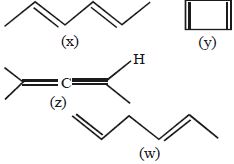
The correct stability order of the following species is:
A
$x > w > z > y$
B
$y > x > w > z$
C
$x > w > y > z$
D
$z > x > y > w$
Solution
(A) $(x)$ is a conjugated diene,which is more stable due to resonance.
$(w)$ is an isolated diene,which is less stable than a conjugated diene.
$(z)$ is a cumulated diene (allene),which is highly unstable due to steric strain and $sp$ hybridization of the central carbon.
$(y)$ is cyclobutadiene,which is an antiaromatic system and is highly unstable.
Therefore,the stability order is $(x) > (w) > (z) > (y)$.
$(w)$ is an isolated diene,which is less stable than a conjugated diene.
$(z)$ is a cumulated diene (allene),which is highly unstable due to steric strain and $sp$ hybridization of the central carbon.
$(y)$ is cyclobutadiene,which is an antiaromatic system and is highly unstable.
Therefore,the stability order is $(x) > (w) > (z) > (y)$.
0 likesView Solution
17
ChemistryDifficultMCQAIIMS · 2009
The most important method of preparation of hydrocarbons of lower carbon number is
A
Pyrolysis of higher carbon number of hydrocarbons
B
Electrolysis of salts of fatty acids
C
Sabatier and Senderens reaction
D
Direct synthesis
Solution
(A) Pyrolysis (or cracking) is the process of breaking down higher alkanes into lower alkanes and alkenes by heating them in the absence of air.
For example: $C_6H_{14} \xrightarrow[\Delta]{\text{Pyrolysis}} C_2H_4 + C_4H_{10}$
This is the most effective industrial method for obtaining hydrocarbons with a lower carbon number from higher ones.
For example: $C_6H_{14} \xrightarrow[\Delta]{\text{Pyrolysis}} C_2H_4 + C_4H_{10}$
This is the most effective industrial method for obtaining hydrocarbons with a lower carbon number from higher ones.
0 likesView Solution
18
ChemistryDifficultMCQAIIMS · 2009
Assertion : $trans-2-Butene$ on reaction with $Br_2$ gives $meso-2,3-dibromobutane$.
Reason : The reaction involves $syn-addition$ of bromine.
Reason : The reaction involves $syn-addition$ of bromine.
A
If both Assertion and Reason are correct and the Reason is a correct explanation of the Assertion.
B
If both Assertion and Reason are correct but Reason is not a correct explanation of the Assertion.
C
If the Assertion is correct but Reason is incorrect.
D
If both the Assertion and Reason are incorrect.
Solution
(C) The reaction of $trans-2-Butene$ with $Br_2$ proceeds via the formation of a cyclic bromonium ion intermediate.
The bromide ion then attacks the intermediate from the side opposite to the bromonium bridge,resulting in $anti-addition$.
$trans-2-Butene$ undergoes $anti-addition$ of $Br_2$ to yield $meso-2,3-dibromobutane$.
Therefore,the Assertion is correct,but the Reason is incorrect because the reaction involves $anti-addition$,not $syn-addition$.
The bromide ion then attacks the intermediate from the side opposite to the bromonium bridge,resulting in $anti-addition$.
$trans-2-Butene$ undergoes $anti-addition$ of $Br_2$ to yield $meso-2,3-dibromobutane$.
Therefore,the Assertion is correct,but the Reason is incorrect because the reaction involves $anti-addition$,not $syn-addition$.
0 likesView Solution
19
ChemistryMediumMCQAIIMS · 2009
Assertion : $1$-Butene on reaction with $HBr$ in the presence of a peroxide produces $1$-bromobutane.
Reason : It involves the free radical mechanism.
Reason : It involves the free radical mechanism.
A
If both Assertion and Reason are correct and the Reason is a correct explanation of the Assertion.
B
If both Assertion and Reason are correct but Reason is not a correct explanation of the Assertion.
C
If the Assertion is correct but Reason is incorrect.
D
If both the Assertion and Reason are incorrect.
Solution
(A) The reaction of $1$-butene with $HBr$ in the presence of peroxide follows the anti-Markovnikov addition rule.
$CH_3-CH_2-CH=CH_2 + HBr \xrightarrow{\text{Peroxide}} CH_3-CH_2-CH_2-CH_2Br$ ($1$-bromobutane).
This reaction proceeds via a free radical mechanism,which explains the anti-Markovnikov regioselectivity. Therefore,both the Assertion and the Reason are correct,and the Reason is the correct explanation of the Assertion.
$CH_3-CH_2-CH=CH_2 + HBr \xrightarrow{\text{Peroxide}} CH_3-CH_2-CH_2-CH_2Br$ ($1$-bromobutane).
This reaction proceeds via a free radical mechanism,which explains the anti-Markovnikov regioselectivity. Therefore,both the Assertion and the Reason are correct,and the Reason is the correct explanation of the Assertion.
0 likesView Solution
20
ChemistryMCQAIIMS · 2009
Assertion : $\text{Trans-}2\text{-butene}$ on reaction with $Br_2$ gives $\text{meso-}2,3\text{-dibromobutane}$.
Reason : The reaction involves $\text{syn-addition}$ of bromine.
Reason : The reaction involves $\text{syn-addition}$ of bromine.
A
If both Assertion and Reason are correct and the Reason is a correct explanation of the Assertion.
B
If both Assertion and Reason are correct but Reason is not a correct explanation of the Assertion.
C
If the Assertion is correct but Reason is incorrect.
D
If both the Assertion and Reason are incorrect.
Solution
(C) The addition of $Br_2$ to an alkene is an $\text{anti-addition}$ process,not $\text{syn-addition}$.
When $\text{trans-}2\text{-butene}$ undergoes $\text{anti-addition}$ of $Br_2$,it forms $\text{meso-}2,3\text{-dibromobutane}$.
Since the Assertion is correct but the Reason is incorrect,the correct option is $C$.
When $\text{trans-}2\text{-butene}$ undergoes $\text{anti-addition}$ of $Br_2$,it forms $\text{meso-}2,3\text{-dibromobutane}$.
Since the Assertion is correct but the Reason is incorrect,the correct option is $C$.
0 likesView Solution
21
ChemistryAdvancedMCQAIIMS · 2009
Assertion : The $S-S-S$ bond angle in $S_8$ molecule is $105^o$.
Reason : $S_8$ has a $V$-shape.
Reason : $S_8$ has a $V$-shape.
A
If both Assertion and Reason are correct and the Reason is a correct explanation of the Assertion.
B
If both Assertion and Reason are correct but Reason is not a correct explanation of the Assertion.
C
If the Assertion is correct but Reason is incorrect.
D
If both the Assertion and Reason are incorrect.
Solution
(C) The $S_8$ molecule adopts a puckered ring structure (crown shape).
In this structure,the $S-S-S$ bond angle is approximately $107^o$ (often cited in the range of $102^o-108^o$).
Therefore,the assertion is correct.
However,$S_8$ does not have a $V$-shape; it has a crown-like puckered ring structure.
Thus,the reason is incorrect.
In this structure,the $S-S-S$ bond angle is approximately $107^o$ (often cited in the range of $102^o-108^o$).
Therefore,the assertion is correct.
However,$S_8$ does not have a $V$-shape; it has a crown-like puckered ring structure.
Thus,the reason is incorrect.
0 likesView Solution
22
ChemistryMediumMCQAIIMS · 2009
Assertion : Sulphuric acid is more viscous than water.
Reason : Concentrated sulphuric acid has a great affinity for water.
Reason : Concentrated sulphuric acid has a great affinity for water.
A
If both Assertion and Reason are correct and the Reason is a correct explanation of the Assertion.
B
If both Assertion and Reason are correct but Reason is not a correct explanation of the Assertion.
C
If the Assertion is correct but Reason is incorrect.
D
If both the Assertion and Reason are incorrect.
Solution
(B) The assertion is true because $H_2SO_4$ molecules are associated through a large number of intermolecular hydrogen bonds,which increases its viscosity compared to water.
The reason is also true because concentrated $H_2SO_4$ is highly hygroscopic and has a strong affinity for water.
However,the high viscosity is due to hydrogen bonding,not the affinity for water. Thus,the reason is not the correct explanation of the assertion.
The reason is also true because concentrated $H_2SO_4$ is highly hygroscopic and has a strong affinity for water.
However,the high viscosity is due to hydrogen bonding,not the affinity for water. Thus,the reason is not the correct explanation of the assertion.
0 likesView Solution
23
ChemistryDifficultMCQAIIMS · 2009
$(CH_3)_2C = CHCH_3 + NOBr \to$ product. The structure of the product is
A
$(CH_3)_2C(NO) - CH(Br)CH_3$
B
$(CH_3)_2C(Br) - CH(NO)CH_3$
C
$(CH_3)_2CH - C(NO)(Br)CH_3$
D
$(CH_3)_2C(Br) - CH(NO)CH_3$
Solution
(B) The reaction follows the Markownikoff rule,where the electrophilic part $(NO^+)$ adds to the carbon atom with more hydrogen atoms,and the nucleophilic part $(Br^-)$ adds to the carbon atom with fewer hydrogen atoms.
In the reactant $(CH_3)_2C = CHCH_3$,the carbon at position $2$ has no hydrogen atoms,while the carbon at position $3$ has one hydrogen atom.
Therefore,the $Br$ atom attaches to the carbon at position $2$,and the $NO$ group attaches to the carbon at position $3$.
The product formed is $(CH_3)_2C(Br) - CH(NO)CH_3$.
In the reactant $(CH_3)_2C = CHCH_3$,the carbon at position $2$ has no hydrogen atoms,while the carbon at position $3$ has one hydrogen atom.
Therefore,the $Br$ atom attaches to the carbon at position $2$,and the $NO$ group attaches to the carbon at position $3$.
The product formed is $(CH_3)_2C(Br) - CH(NO)CH_3$.
0 likesView Solution
24
ChemistryAdvancedMCQAIIMS · 2009
Methylcyclopentane $\xrightarrow{Br_2/hv} \mathop{Major}\limits_{(X)}$ $\xrightarrow[KOH/\Delta]{Alcoholic} \mathop{Major}\limits_{(Y)}$ $\xrightarrow[Peroxide]{HBr} \mathop{Major}\limits_{(Z)}$
Major final product $(Z)$ is
Major final product $(Z)$ is
A
$1-$Bromo$-1-$methylcyclopentane
B
Bromocyclohexane
C
$2-$Bromo$-1-$methylcyclopentane
D
$1-$Bromo$-2-$methylcyclopentane
Solution
(D) $1$. Step $1$: Free radical bromination of methylcyclopentane with $Br_2/hv$ occurs preferentially at the tertiary carbon to form $1-$bromo$-1-$methylcyclopentane $(X)$ as the major product.
$2$. Step $2$: Dehydrohalogenation of $(X)$ with alcoholic $KOH/\Delta$ follows the $E2$ mechanism to form the more substituted alkene,$1$-methylcyclopentene $(Y)$,as the major product.
$3$. Step $3$: Anti-Markovnikov addition of $HBr$ to $1-$methylcyclopentene $(Y)$ in the presence of peroxide yields $1-$bromo$-2-$methylcyclopentane $(Z)$ as the major product.
$2$. Step $2$: Dehydrohalogenation of $(X)$ with alcoholic $KOH/\Delta$ follows the $E2$ mechanism to form the more substituted alkene,$1$-methylcyclopentene $(Y)$,as the major product.
$3$. Step $3$: Anti-Markovnikov addition of $HBr$ to $1-$methylcyclopentene $(Y)$ in the presence of peroxide yields $1-$bromo$-2-$methylcyclopentane $(Z)$ as the major product.
0 likesView Solution
25
ChemistryDifficultMCQAIIMS · 2009
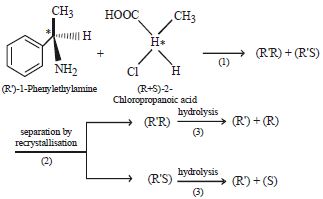
Observe the following reaction: Which statement is not correct about the above observation?
A
The product mixture of step $1$ is optically active
B
The products $R'R$ and $R'S$ have identical structural formula
C
$R'R$ is non-superimposable on $R'S$
D
$R'R$ and $R'S$ have same solubility in water
Solution
(D) $R'R$ and $R'S$ are diastereomers and have different physical properties like water solubility,$B.P.$,$M.P.$,etc.
Since they are diastereomers,they have different physical properties,meaning they do not have the same solubility in water.
Therefore,the statement that $R'R$ and $R'S$ have the same solubility in water is incorrect.
Since they are diastereomers,they have different physical properties,meaning they do not have the same solubility in water.
Therefore,the statement that $R'R$ and $R'S$ have the same solubility in water is incorrect.
0 likesView Solution
26
ChemistryMCQAIIMS · 2009
Assertion: In the condition of obstructive jaundice,large amounts of unabsorbed fats are eliminated out of the body.
Reason: Entry of bile into the small intestine is prevented during obstructive jaundice.
Reason: Entry of bile into the small intestine is prevented during obstructive jaundice.
A
If both Assertion and Reason are correct and the Reason is a correct explanation of the Assertion.
B
If both Assertion and Reason are correct but Reason is not a correct explanation of the Assertion.
C
If the Assertion is correct but Reason is incorrect.
D
If both the Assertion and Reason are incorrect.
Solution
(A) In the condition of obstructive jaundice,the entry of bile into the small intestine is prevented due to an obstruction in the bile duct.
Bile salts are essential for the digestion of fats through emulsification and for their absorption by forming water-soluble droplets called micelles.
From these micelles,fatty acids,glycerides,sterols,and fat-soluble vitamins are absorbed into the intestinal cells.
Therefore,in the absence of bile,fats remain unabsorbed and are consequently eliminated from the body in the faeces.
Bile salts are essential for the digestion of fats through emulsification and for their absorption by forming water-soluble droplets called micelles.
From these micelles,fatty acids,glycerides,sterols,and fat-soluble vitamins are absorbed into the intestinal cells.
Therefore,in the absence of bile,fats remain unabsorbed and are consequently eliminated from the body in the faeces.
0 likesView Solution
27
ChemistryMCQAIIMS · 2009
Thermodynamically the most stable form of carbon is
A
diamond
B
graphite
C
fullerenes
D
coal
Solution
(B) Graphite is the thermodynamically most stable allotrope of carbon at standard temperature and pressure.
0 likesView Solution
28
ChemistryMCQAIIMS · 2009
The study of homologous structures in mature organisms provides evidence for evolutionary relationships among certain groups of organisms. Which field of study includes this evidence of evolution?
A
Comparative cytology
B
Biochemistry
C
Geology
D
Comparative anatomy
Solution
(D) Comparative anatomy is the study of similarities and differences in the structures of different organisms. Homologous structures,which are organs or skeletal elements of animals and organisms that,by virtue of their similarity,suggest their connection to a common ancestor,are a primary focus of comparative anatomy. Comparative cytology involves the study of cellular structures,while biochemistry focuses on molecular comparisons like $DNA$ and proteins. Geology deals with the study of the Earth's physical structure and substance.
0 likesView Solution
29
ChemistryMediumMCQAIIMS · 2009
Assertion : The molecules of the dissolved gas present in a liquid gain kinetic energy as temperature is raised.
Reason : Gases tend to be more soluble in liquids as the temperature is raised.
Reason : Gases tend to be more soluble in liquids as the temperature is raised.
A
If both Assertion and Reason are correct and the Reason is a correct explanation of the Assertion.
B
If both Assertion and Reason are correct but Reason is not a correct explanation of the Assertion.
C
If the Assertion is correct but Reason is incorrect.
D
If both the Assertion and Reason are incorrect.
Solution
(C) When the temperature is raised,the molecules of the dissolved gas present in a liquid gain kinetic energy.
This higher kinetic energy allows the gas molecules to overcome the intermolecular forces and escape from the solution.
Therefore,the solubility of gases in liquids decreases as the temperature increases.
Thus,the Assertion is correct,but the Reason is incorrect.
This higher kinetic energy allows the gas molecules to overcome the intermolecular forces and escape from the solution.
Therefore,the solubility of gases in liquids decreases as the temperature increases.
Thus,the Assertion is correct,but the Reason is incorrect.
0 likesView Solution
30
ChemistryMediumMCQAIIMS · 2009
Assertion : Coloured cations can be identified by borax bead test.
Reason : Transparent bead $(NaBO_2 + B_2O_3)$ forms coloured bead with coloured cation.
Reason : Transparent bead $(NaBO_2 + B_2O_3)$ forms coloured bead with coloured cation.
A
If both Assertion and Reason are correct and the Reason is a correct explanation of the Assertion.
B
If both Assertion and Reason are correct but Reason is not a correct explanation of the Assertion.
C
If the Assertion is correct but Reason is incorrect.
D
If both the Assertion and Reason are incorrect.
Solution
(A) Borax $(Na_2B_4O_7 \cdot 10H_2O)$ when heated,loses water and swells up,then melts to form a transparent glassy bead consisting of sodium metaborate $(NaBO_2)$ and boric anhydride $(B_2O_3)$.
$Na_2B_4O_7 \cdot 10H_2O$ $\xrightarrow{\Delta} Na_2B_4O_7$ $\xrightarrow{\Delta} 2NaBO_2 + B_2O_3$
When this glassy bead is heated with coloured transition metal salts,it forms coloured metaborates,which are characteristic of the metal cation. Thus,the borax bead test is used to identify coloured cations.
Since the formation of the transparent bead and its subsequent reaction with cations to form coloured beads explains why the test works,the Reason is the correct explanation of the Assertion.
$Na_2B_4O_7 \cdot 10H_2O$ $\xrightarrow{\Delta} Na_2B_4O_7$ $\xrightarrow{\Delta} 2NaBO_2 + B_2O_3$
When this glassy bead is heated with coloured transition metal salts,it forms coloured metaborates,which are characteristic of the metal cation. Thus,the borax bead test is used to identify coloured cations.
Since the formation of the transparent bead and its subsequent reaction with cations to form coloured beads explains why the test works,the Reason is the correct explanation of the Assertion.
0 likesView Solution
31
ChemistryEasyMCQAIIMS · 2009
The space lattice of graphite is
A
Cubic
B
Tetragonal
C
Rhombic
D
Hexagonal
Solution
(D) In graphite,the carbon atoms are arranged in regular hexagons in flat parallel layers. This structure corresponds to a $Hexagonal$ crystal system.
0 likesView Solution
32
ChemistryDifficultMCQAIIMS · 2009
Assertion : Stability of a crystal is reflected in the magnitude of its melting point.
Reason : The stability of a crystal depends upon the strength of the interparticle attractive force.
Reason : The stability of a crystal depends upon the strength of the interparticle attractive force.
A
If both Assertion and Reason are correct and the Reason is a correct explanation of the Assertion.
B
If both Assertion and Reason are correct but Reason is not a correct explanation of the Assertion.
C
If the Assertion is correct but Reason is incorrect.
D
If both the Assertion and Reason are incorrect.
Solution
(A) The stability of a crystal depends upon the strength of the interparticle attractive force.
The melting point of a solid is a measure of the energy required to overcome these attractive forces.
Therefore,a higher melting point indicates stronger interparticle forces,which corresponds to higher crystal stability.
Thus,the stability of a crystal is reflected in the magnitude of its melting point,and the Reason correctly explains the Assertion.
The melting point of a solid is a measure of the energy required to overcome these attractive forces.
Therefore,a higher melting point indicates stronger interparticle forces,which corresponds to higher crystal stability.
Thus,the stability of a crystal is reflected in the magnitude of its melting point,and the Reason correctly explains the Assertion.
0 likesView Solution
33
ChemistryMediumMCQAIIMS · 2009
An aqueous solution of hydrochloric acid:
A
Obeys Raoult's law
B
Shows negative deviation from Raoult's law
C
Shows positive deviation from Raoult's law
D
Obeys Henry's law at all compositions
Solution
(B) An aqueous solution of $HCl$ shows a negative deviation from Raoult's law.
In this solution,the intermolecular forces of attraction between the solute $(HCl)$ and solvent $(H_2O)$ molecules are stronger than the forces between the pure components.
This stronger attraction reduces the escaping tendency of the molecules into the vapour phase.
Consequently,the observed partial vapour pressure is lower than the value predicted by Raoult's law,which is the characteristic definition of a negative deviation.
In this solution,the intermolecular forces of attraction between the solute $(HCl)$ and solvent $(H_2O)$ molecules are stronger than the forces between the pure components.
This stronger attraction reduces the escaping tendency of the molecules into the vapour phase.
Consequently,the observed partial vapour pressure is lower than the value predicted by Raoult's law,which is the characteristic definition of a negative deviation.
0 likesView Solution
34
ChemistryDifficultMCQAIIMS · 2009
At $300 \ K$,the vapour pressure of an ideal solution containing $3 \ mol$ of $A$ and $2 \ mol$ of $B$ is $600 \ torr$. At the same temperature,if $1.5 \ mol$ of $A$ and $0.5 \ mol$ of $C$ (non-volatile) are added to this solution,the vapour pressure of the solution increases by $30 \ torr$. What is the value of $p_B^o$?
A
$940$
B
$405$
C
$90$
D
None of these
Solution
(C) For the initial solution: $n_A = 3, n_B = 2$. Total moles = $5$.
$P_1 = p_A^o \left( \frac{3}{5} \right) + p_B^o \left( \frac{2}{5} \right) = 600 \ torr$.
$3p_A^o + 2p_B^o = 3000$ (Equation $1$).
After adding $1.5 \ mol$ of $A$ and $0.5 \ mol$ of $C$: $n_A = 4.5, n_B = 2, n_C = 0.5$. Total moles = $7$.
Since $C$ is non-volatile,$p_C^o = 0$.
$P_2 = 600 + 30 = 630 \ torr$.
$P_2 = p_A^o \left( \frac{4.5}{7} \right) + p_B^o \left( \frac{2}{7} \right) = 630$.
$4.5p_A^o + 2p_B^o = 4410$ (Equation $2$).
Subtracting Equation $1$ from Equation $2$: $(4.5 - 3)p_A^o = 4410 - 3000 \implies 1.5p_A^o = 1410 \implies p_A^o = 940 \ torr$.
Substituting $p_A^o$ in Equation $1$: $3(940) + 2p_B^o = 3000 \implies 2820 + 2p_B^o = 3000 \implies 2p_B^o = 180 \implies p_B^o = 90 \ torr$.
$P_1 = p_A^o \left( \frac{3}{5} \right) + p_B^o \left( \frac{2}{5} \right) = 600 \ torr$.
$3p_A^o + 2p_B^o = 3000$ (Equation $1$).
After adding $1.5 \ mol$ of $A$ and $0.5 \ mol$ of $C$: $n_A = 4.5, n_B = 2, n_C = 0.5$. Total moles = $7$.
Since $C$ is non-volatile,$p_C^o = 0$.
$P_2 = 600 + 30 = 630 \ torr$.
$P_2 = p_A^o \left( \frac{4.5}{7} \right) + p_B^o \left( \frac{2}{7} \right) = 630$.
$4.5p_A^o + 2p_B^o = 4410$ (Equation $2$).
Subtracting Equation $1$ from Equation $2$: $(4.5 - 3)p_A^o = 4410 - 3000 \implies 1.5p_A^o = 1410 \implies p_A^o = 940 \ torr$.
Substituting $p_A^o$ in Equation $1$: $3(940) + 2p_B^o = 3000 \implies 2820 + 2p_B^o = 3000 \implies 2p_B^o = 180 \implies p_B^o = 90 \ torr$.
0 likesView Solution
35
ChemistryEasyMCQAIIMS · 2009
Equivalent conductance of an electrolyte containing $NaF$ at infinite dilution is $90.1 \, \Omega^{-1} \, cm^2$. If $NaF$ is replaced by $KF$,what is the value of equivalent conductance? ........... $\Omega^{-1} \, cm^{2}$
A
$90.1$
B
$111.2$
C
$0$
D
$222.4$
Solution
(B) According to Kohlrausch's law of independent migration of ions,the equivalent conductance at infinite dilution is the sum of the ionic conductances of the cation and the anion.
For $NaF$,$\Lambda^{\infty}_{NaF} = \lambda^{\infty}_{Na^+} + \lambda^{\infty}_{F^-} = 90.1 \, \Omega^{-1} \, cm^2$.
For $KF$,$\Lambda^{\infty}_{KF} = \lambda^{\infty}_{K^+} + \lambda^{\infty}_{F^-}$.
Since the ionic mobility of $K^+$ is higher than $Na^+$,the equivalent conductance of $KF$ will be higher than $NaF$.
However,in many simplified textbook contexts,if the question implies a comparison where the values are expected to be similar or if it is a trick question regarding the nature of the electrolyte,we must note that $KF$ has a higher value than $90.1$.
Given the options provided,$111.2$ is the only value greater than $90.1$ that fits the expected trend for the substitution of $Na^+$ with $K^+$.
For $NaF$,$\Lambda^{\infty}_{NaF} = \lambda^{\infty}_{Na^+} + \lambda^{\infty}_{F^-} = 90.1 \, \Omega^{-1} \, cm^2$.
For $KF$,$\Lambda^{\infty}_{KF} = \lambda^{\infty}_{K^+} + \lambda^{\infty}_{F^-}$.
Since the ionic mobility of $K^+$ is higher than $Na^+$,the equivalent conductance of $KF$ will be higher than $NaF$.
However,in many simplified textbook contexts,if the question implies a comparison where the values are expected to be similar or if it is a trick question regarding the nature of the electrolyte,we must note that $KF$ has a higher value than $90.1$.
Given the options provided,$111.2$ is the only value greater than $90.1$ that fits the expected trend for the substitution of $Na^+$ with $K^+$.
0 likesView Solution
36
ChemistryAdvancedMCQAIIMS · 2009
The first order rate constant for a certain reaction increases from $1.667 \times 10^{-6} \ s^{-1}$ at $727 \ ^oC$ to $1.667 \times 10^{-4} \ s^{-1}$ at $1571 \ ^oC$. The rate constant at $1150 \ ^oC$,assuming constancy of activation energy over the given temperature range is [Given : $log \ 19.9 = 1.299$ ]
A
$3.911 \times 10^{-5} \ s^{-1}$
B
$1.139 \times 10^{-5} \ s^{-1}$
C
$3.318 \times 10^{-5} \ s^{-1}$
D
$1.193 \times 10^{-5} \ s^{-1}$
Solution
(C) Using the Arrhenius equation: $\log \frac{k_2}{k_1} = \frac{E_a}{2.303 \ R} \left[ \frac{T_2 - T_1}{T_1 T_2} \right]$
Given $T_1 = 727 + 273 = 1000 \ K$,$T_2 = 1571 + 273 = 1844 \ K$,$T_3 = 1150 + 273 = 1423 \ K$.
For the first interval: $\log \left( \frac{1.667 \times 10^{-4}}{1.667 \times 10^{-6}} \right) = \frac{E_a}{2.303 \ R} \left( \frac{1844 - 1000}{1844 \times 1000} \right)$
$2 = \frac{E_a}{2.303 \ R} \left( \frac{844}{1844000} \right) \dots (1)$
For the second interval: $\log \left( \frac{k_3}{1.667 \times 10^{-6}} \right) = \frac{E_a}{2.303 \ R} \left( \frac{1423 - 1000}{1423 \times 1000} \right) \dots (2)$
Dividing $(2)$ by $(1)$:
$\frac{\log \left( \frac{k_3}{1.667 \times 10^{-6}} \right)}{2} = \frac{423}{1423 \times 1000} \times \frac{1844000}{844} \approx 0.6495$
$\log \left( \frac{k_3}{1.667 \times 10^{-6}} \right) = 1.299$
$\frac{k_3}{1.667 \times 10^{-6}} = 19.9$
$k_3 = 19.9 \times 1.667 \times 10^{-6} = 3.318 \times 10^{-5} \ s^{-1}$
Given $T_1 = 727 + 273 = 1000 \ K$,$T_2 = 1571 + 273 = 1844 \ K$,$T_3 = 1150 + 273 = 1423 \ K$.
For the first interval: $\log \left( \frac{1.667 \times 10^{-4}}{1.667 \times 10^{-6}} \right) = \frac{E_a}{2.303 \ R} \left( \frac{1844 - 1000}{1844 \times 1000} \right)$
$2 = \frac{E_a}{2.303 \ R} \left( \frac{844}{1844000} \right) \dots (1)$
For the second interval: $\log \left( \frac{k_3}{1.667 \times 10^{-6}} \right) = \frac{E_a}{2.303 \ R} \left( \frac{1423 - 1000}{1423 \times 1000} \right) \dots (2)$
Dividing $(2)$ by $(1)$:
$\frac{\log \left( \frac{k_3}{1.667 \times 10^{-6}} \right)}{2} = \frac{423}{1423 \times 1000} \times \frac{1844000}{844} \approx 0.6495$
$\log \left( \frac{k_3}{1.667 \times 10^{-6}} \right) = 1.299$
$\frac{k_3}{1.667 \times 10^{-6}} = 19.9$
$k_3 = 19.9 \times 1.667 \times 10^{-6} = 3.318 \times 10^{-5} \ s^{-1}$
1 likesView Solution
37
ChemistryMediumMCQAIIMS · 2009
Assertion : In rate law,unlike in the expression for equilibrium constants,the exponents for concentrations do not necessarily match the stoichiometric coefficients.
Reason : It is the mechanism and not the balanced chemical equation for the overall change that governs the reaction rate.
Reason : It is the mechanism and not the balanced chemical equation for the overall change that governs the reaction rate.
A
$A$. If both Assertion and Reason are correct and the Reason is a correct explanation of the Assertion.
B
$B$. If both Assertion and Reason are correct but Reason is not a correct explanation of the Assertion.
C
$C$. If the Assertion is correct but Reason is incorrect.
D
$D$. If both the Assertion and Reason are incorrect.
Solution
(A) The rate law is determined experimentally and depends on the slowest step (rate-determining step) of the reaction mechanism.
In contrast,the equilibrium constant expression is derived from the stoichiometry of the overall balanced chemical equation.
Therefore,the exponents in the rate law do not necessarily correspond to the stoichiometric coefficients of the reactants in the overall balanced equation.
Since the reaction rate is governed by the reaction mechanism,the Reason correctly explains the Assertion.
In contrast,the equilibrium constant expression is derived from the stoichiometry of the overall balanced chemical equation.
Therefore,the exponents in the rate law do not necessarily correspond to the stoichiometric coefficients of the reactants in the overall balanced equation.
Since the reaction rate is governed by the reaction mechanism,the Reason correctly explains the Assertion.
0 likesView Solution
38
ChemistryDifficultMCQAIIMS · 2009
Assertion : In chemisorption,adsorption first increases with temperature and then decreases.
Reason : Heat keeps on providing more and more activation energy.
Reason : Heat keeps on providing more and more activation energy.
A
If both Assertion and Reason are correct and the Reason is a correct explanation of the Assertion.
B
If both Assertion and Reason are correct but Reason is not a correct explanation of the Assertion.
C
If the Assertion is correct but Reason is incorrect.
D
If both the Assertion and Reason are incorrect.
Solution
(C) In chemisorption,adsorption involves the formation of chemical bonds between the adsorbate and the adsorbent,which requires an initial activation energy.
Initially,as temperature increases,more molecules gain sufficient energy to overcome this activation barrier,leading to an increase in adsorption.
However,once the chemical bonds are formed,the process is typically exothermic. According to Le Chatelier's principle,an increase in temperature at higher values favors the reverse (desorption) process,causing adsorption to decrease.
Therefore,the Assertion is correct,but the Reason is incorrect because heat does not provide 'more and more' activation energy indefinitely; rather,it facilitates the initial bond formation,and excessive heat eventually destabilizes the formed bonds.
Initially,as temperature increases,more molecules gain sufficient energy to overcome this activation barrier,leading to an increase in adsorption.
However,once the chemical bonds are formed,the process is typically exothermic. According to Le Chatelier's principle,an increase in temperature at higher values favors the reverse (desorption) process,causing adsorption to decrease.
Therefore,the Assertion is correct,but the Reason is incorrect because heat does not provide 'more and more' activation energy indefinitely; rather,it facilitates the initial bond formation,and excessive heat eventually destabilizes the formed bonds.
0 likesView Solution
39
ChemistryMediumMCQAIIMS · 2009
Choose the correct statement.
A
White or yellow phosphorus is stored under water.
B
Ignition temperature of red phosphorus is low.
C
Black phosphorus is non-crystalline in nature.
D
Phosphorus does not form hydrides.
Solution
(A) Due to the low ignition temperature of white phosphorus,it undergoes oxidation in the presence of air,which slowly raises its temperature,and after a few moments,it catches fire spontaneously. Due to this reason,it is stored under water.
Ignition temperature of red phosphorus is high.
Black phosphorus is crystalline in nature.
Phosphorus forms a number of hydrides,such as $PH_3$ and $P_2H_4$.
Ignition temperature of red phosphorus is high.
Black phosphorus is crystalline in nature.
Phosphorus forms a number of hydrides,such as $PH_3$ and $P_2H_4$.
0 likesView Solution
40
ChemistryMediumMCQAIIMS · 2009
An element $(X)$ forms compounds of the formula $XCl_3$,$X_2O_5$ and $Ca_3X_2$,but does not form $XCl_5$. Which of the following is the element?
A
$B$
B
$Al$
C
$N$
D
$P$
Solution
(C) $N$ forms $NCl_3$,$N_2O_5$ and $Ca_3N_2$.
Nitrogen,due to the absence of empty $d$-orbitals,cannot extend its covalency beyond $3$ and hence does not form $NCl_5$.
Due to its small size and high electronegativity,it can accept $3$ electrons to form the $N^{3-}$ ion in $Ca_3N_2$.
Nitrogen,due to the absence of empty $d$-orbitals,cannot extend its covalency beyond $3$ and hence does not form $NCl_5$.
Due to its small size and high electronegativity,it can accept $3$ electrons to form the $N^{3-}$ ion in $Ca_3N_2$.
0 likesView Solution
41
ChemistryDifficultMCQAIIMS · 2009
$H_2S$ gas is not evolved when $SO_3^{2-}$ ion reacts with the following reagents.
A
$Zn +$ dil. $H_2SO_4$
B
$Al +$ Conc. $NaOH$
C
$Al +$ dil. $HCl$
D
None of these
Solution
(B) The reaction of $SO_3^{2-}$ with $Al$ in the presence of $NaOH$ is a reduction reaction where $SO_3^{2-}$ is reduced to $S^{2-}$.
The chemical equation is: $SO_3^{2-} + 2Al + 2OH^- + 3H_2O \to S^{2-} + 2[Al(OH)_4]^-$.
In this reaction,$H_2S$ is not evolved because the sulfide ion $(S^{2-})$ formed is immediately trapped in the alkaline medium as $Na_2S$ (or $S^{2-}$ ions),and no acidic conditions are present to release $H_2S$ gas.
In contrast,reactions with dilute acids like $HCl$ or $H_2SO_4$ typically provide the $H^+$ ions necessary to convert $S^{2-}$ into $H_2S$ gas.
The chemical equation is: $SO_3^{2-} + 2Al + 2OH^- + 3H_2O \to S^{2-} + 2[Al(OH)_4]^-$.
In this reaction,$H_2S$ is not evolved because the sulfide ion $(S^{2-})$ formed is immediately trapped in the alkaline medium as $Na_2S$ (or $S^{2-}$ ions),and no acidic conditions are present to release $H_2S$ gas.
In contrast,reactions with dilute acids like $HCl$ or $H_2SO_4$ typically provide the $H^+$ ions necessary to convert $S^{2-}$ into $H_2S$ gas.
0 likesView Solution
42
ChemistryAdvancedMCQAIIMS · 2009
In the nitrogen family,the $H-M-H$ bond angle in the hydrides $MH_3$ gradually becomes closer to $90^o$ on going from $N$ to $Sb$. This shows that gradually
A
The basic strength of hydrides increases
B
Almost pure $p-$ orbitals are used for $M-H$ bonding
C
The bond energies of $M-H$ bond increases
D
The bond pairs of electrons becomes nearer to the central atom
Solution
(B) The hydrides $MH_3$ have a pyramidal shape with a lone pair of electrons on the central atom. The $H-M-H$ bond angle is less than the tetrahedral angle of $109^o 28'$ due to lone pair-bond pair repulsion.
As the electronegativity of the central atom $M$ decreases from $N$ to $Sb$,the bond pair of electrons shifts further away from the central atom.
Consequently,the bond angle decreases and approaches $90^o$.
This indicates that the bonding involves almost pure $p-$ orbitals of the central atom,with very little $s-$ character involved in the hybridization.
As the electronegativity of the central atom $M$ decreases from $N$ to $Sb$,the bond pair of electrons shifts further away from the central atom.
Consequently,the bond angle decreases and approaches $90^o$.
This indicates that the bonding involves almost pure $p-$ orbitals of the central atom,with very little $s-$ character involved in the hybridization.
0 likesView Solution
43
ChemistryMediumMCQAIIMS · 2009
Which of the following oxides is most acidic?
A
$Ag_2O$
B
$V_2O_5$
C
$CO$
D
$N_2O_5$
Solution
(D) The acidity of oxides generally increases with an increase in the oxidation state of the central atom and with an increase in the electronegativity of the central atom.
$Ag_2O$ is basic,$V_2O_5$ is amphoteric,$CO$ is neutral,and $N_2O_5$ is strongly acidic.
In $N_2O_5$,the oxidation state of $N$ is $+5$ and $N$ has high electronegativity,which makes the $N-O$ bond more polar and the oxide more acidic compared to the others.
$Ag_2O$ is basic,$V_2O_5$ is amphoteric,$CO$ is neutral,and $N_2O_5$ is strongly acidic.
In $N_2O_5$,the oxidation state of $N$ is $+5$ and $N$ has high electronegativity,which makes the $N-O$ bond more polar and the oxide more acidic compared to the others.
0 likesView Solution
44
ChemistryMediumMCQAIIMS · 2009
Iodine exists in which form in iodised salt?
A
$I_2$
B
$NaIO_3$
C
$ICl$
D
$IO_4^-$
Solution
(B) Iodised salt is common table salt $(NaCl)$ that has been fortified with a small amount of iodine-containing salts.
These salts are typically $KI$ (potassium iodide),$KIO_3$ (potassium iodate),$NaI$ (sodium iodide),or $NaIO_3$ (sodium iodate).
Among the given options,$NaIO_3$ is the correct chemical form present in iodised salt.
These salts are typically $KI$ (potassium iodide),$KIO_3$ (potassium iodate),$NaI$ (sodium iodide),or $NaIO_3$ (sodium iodate).
Among the given options,$NaIO_3$ is the correct chemical form present in iodised salt.
0 likesView Solution
45
ChemistryMediumMCQAIIMS · 2009
When chlorine water is added to a solution of $KBr$,the solution immediately turns orange-red,because:
A
Chlorine is reduced to chloride ion
B
Of the formation of $BrCl$
C
Bromide ion is oxidized to bromine
D
Of the formation of $Br_3^-$
Solution
(B) When chlorine water $(Cl_2)$ is added to a solution of $KBr$,the following reaction occurs: $2KBr + Cl_2 \to 2KCl + Br_2$.
Initially,the solution turns brown due to the formation of $Br_2$.
However,in the presence of excess chlorine water,$Br_2$ reacts further with $Cl_2$ to form $BrCl$ (bromine monochloride),which is orange-red in color: $Br_2 + Cl_2 \to 2BrCl$.
Initially,the solution turns brown due to the formation of $Br_2$.
However,in the presence of excess chlorine water,$Br_2$ reacts further with $Cl_2$ to form $BrCl$ (bromine monochloride),which is orange-red in color: $Br_2 + Cl_2 \to 2BrCl$.
0 likesView Solution
46
ChemistryDifficultMCQAIIMS · 2009
The purple colour of $KMnO_4$ is due to the transition:
A
$C.T. (L \to M)$
B
$C.T. (M \to L)$
C
$d-d$
D
$p-d$
Solution
(A) In $KMnO_4$,Manganese $(Mn)$ is in the $+7$ oxidation state with a $d^0$ electronic configuration.
Since there are no $d$ electrons,$d-d$ transitions are not possible.
The intense purple color arises from Ligand-to-Metal Charge Transfer $(LMCT)$,where an electron is promoted from the $O^{2-}$ ligand to the empty $d$-orbitals of the $Mn^{7+}$ center.
Therefore,the transition is $L \to M$ charge transfer.
Since there are no $d$ electrons,$d-d$ transitions are not possible.
The intense purple color arises from Ligand-to-Metal Charge Transfer $(LMCT)$,where an electron is promoted from the $O^{2-}$ ligand to the empty $d$-orbitals of the $Mn^{7+}$ center.
Therefore,the transition is $L \to M$ charge transfer.
0 likesView Solution
47
ChemistryMediumMCQAIIMS · 2009
To obtain silver from silver amalgam,it is heated in a vessel which is made of
A
$Cu$
B
$Fe$
C
$Ni$
D
$Zn$
Solution
(B) $Fe$ and $Pt$ do not form amalgams with mercury.
$\text{Silver amalgam} (Ag-Hg) \xrightarrow[\Delta]{Fe \text{ vessel}} Ag + Hg \uparrow$
If the vessel were made of other metals like $Cu$,$Ni$,or $Zn$,they would react with the liberated mercury to form their own amalgams,contaminating the silver.
$\text{Silver amalgam} (Ag-Hg) \xrightarrow[\Delta]{Fe \text{ vessel}} Ag + Hg \uparrow$
If the vessel were made of other metals like $Cu$,$Ni$,or $Zn$,they would react with the liberated mercury to form their own amalgams,contaminating the silver.
0 likesView Solution
48
ChemistryDifficultMCQAIIMS · 2009
Among the following,the compound that is both paramagnetic and coloured is
A
$K_2Cr_2O_7$
B
$(NH_4)_2[TiCl_6]$
C
$VOSO_4$
D
$K_3[Cu(CN)_4]$
Solution
(C) $K_3[Cu(CN)_4]$: $Cu$ is in $+1$ oxidation state $(3d^{10})$,so it has no unpaired electrons,making it diamagnetic and colourless.
$(NH_4)_2[TiCl_6]$: $Ti$ is in $+4$ oxidation state $(3d^0)$,so it has no unpaired electrons,making it diamagnetic and colourless.
$VOSO_4$: $V$ is in $+4$ oxidation state $(3d^1)$,so it has one unpaired electron,making it paramagnetic and coloured.
$K_2Cr_2O_7$: $Cr$ is in $+6$ oxidation state $(3d^0)$,so it has no unpaired electrons. It is diamagnetic,but appears coloured due to ligand-to-metal charge transfer $(LMCT)$.
$(NH_4)_2[TiCl_6]$: $Ti$ is in $+4$ oxidation state $(3d^0)$,so it has no unpaired electrons,making it diamagnetic and colourless.
$VOSO_4$: $V$ is in $+4$ oxidation state $(3d^1)$,so it has one unpaired electron,making it paramagnetic and coloured.
$K_2Cr_2O_7$: $Cr$ is in $+6$ oxidation state $(3d^0)$,so it has no unpaired electrons. It is diamagnetic,but appears coloured due to ligand-to-metal charge transfer $(LMCT)$.
0 likesView Solution
49
ChemistryMediumMCQAIIMS · 2009
Which of the following complexes has a zero magnetic moment (spin only)?
A
$[Ni(NH_3)_6]Cl_2$
B
$Na_3[FeF_6]$
C
$[Cr(H_2O)_6]SO_4$
D
$K_4[Fe(CN)_6]$
Solution
(D) The magnetic moment (spin only) is given by $\mu = \sqrt{n(n+2)} \ BM$,where $n$ is the number of unpaired electrons. Zero magnetic moment implies $n = 0$.
$1$. $[Ni(NH_3)_6]Cl_2$: $Ni^{2+}$ is $3d^8$. $NH_3$ is a weak field ligand,resulting in $sp^3d^2$ hybridization with $2$ unpaired electrons.
$2$. $Na_3[FeF_6]$: $Fe^{3+}$ is $3d^5$. $F^-$ is a weak field ligand,resulting in $sp^3d^2$ hybridization with $5$ unpaired electrons.
$3$. $[Cr(H_2O)_6]SO_4$: $Cr^{2+}$ is $3d^4$. $H_2O$ is a weak field ligand,resulting in $sp^3d^2$ hybridization with $4$ unpaired electrons.
$4$. $K_4[Fe(CN)_6]$: $Fe^{2+}$ is $3d^6$. $CN^-$ is a strong field ligand,causing pairing of electrons. It undergoes $d^2sp^3$ hybridization with $0$ unpaired electrons.
Thus,$K_4[Fe(CN)_6]$ has a zero magnetic moment.
$1$. $[Ni(NH_3)_6]Cl_2$: $Ni^{2+}$ is $3d^8$. $NH_3$ is a weak field ligand,resulting in $sp^3d^2$ hybridization with $2$ unpaired electrons.
$2$. $Na_3[FeF_6]$: $Fe^{3+}$ is $3d^5$. $F^-$ is a weak field ligand,resulting in $sp^3d^2$ hybridization with $5$ unpaired electrons.
$3$. $[Cr(H_2O)_6]SO_4$: $Cr^{2+}$ is $3d^4$. $H_2O$ is a weak field ligand,resulting in $sp^3d^2$ hybridization with $4$ unpaired electrons.
$4$. $K_4[Fe(CN)_6]$: $Fe^{2+}$ is $3d^6$. $CN^-$ is a strong field ligand,causing pairing of electrons. It undergoes $d^2sp^3$ hybridization with $0$ unpaired electrons.
Thus,$K_4[Fe(CN)_6]$ has a zero magnetic moment.
0 likesView Solution
50
ChemistryAdvancedMCQAIIMS · 2009
$A$ chemist wants to determine the molecular geometry of the $[CoCl_4]^{2-}$ ion. Which of the following gives the best suggestion for a measurement and for the interpretation of that measurement?
A
Using absorption spectroscopy,measure $\lambda_{max}$ then calculate $\Delta_0$ for octahedral geometry
B
Measure the molecule's magnetic moment and use the result to estimate the number of unpaired spins in the molecule. If this number is low,the geometry is likely to be square planar; otherwise,it is likely to be tetrahedral
C
Measure the molecule's magnetic moment and use the result to estimate the number of unpaired spins in the molecule. If this number is low,the geometry is likely to be tetrahedral; otherwise,it is likely to be square planar
D
Measure the molecule's magnetic moment and use the result to estimate the number of unpaired spins in the molecule. If this number is low,the geometry is likely to be tetrahedral; otherwise,it is likely to be octahedral
Solution
(B) For coordination complexes with a coordination number of $4$,the geometry can be either tetrahedral or square planar.
Square planar complexes typically exhibit low-spin configurations because the crystal field splitting energy is large enough to cause pairing.
Tetrahedral complexes,due to smaller crystal field splitting,almost always exhibit high-spin configurations.
Therefore,measuring the magnetic moment to determine the number of unpaired electrons helps distinguish between these two geometries.
Square planar complexes typically exhibit low-spin configurations because the crystal field splitting energy is large enough to cause pairing.
Tetrahedral complexes,due to smaller crystal field splitting,almost always exhibit high-spin configurations.
Therefore,measuring the magnetic moment to determine the number of unpaired electrons helps distinguish between these two geometries.
0 likesView Solution
51
ChemistryAdvancedMCQAIIMS · 2009
How many pairs of enantiomers are possible for the following complex compound,$[M(AB)(CD)ef]^{n \pm}$ (where $AB, CD$ are unsymmetrical bidentate ligands,and $e, f$ are monodentate ligands)?
A
$20$
B
$5$
C
$10$
D
$8$
Solution
(A) For an octahedral complex of the type $[M(AB)(CD)ef]$,where $AB$ and $CD$ are unsymmetrical bidentate ligands and $e, f$ are monodentate ligands,the total number of geometrical isomers is $20$.
Each geometrical isomer is chiral because the complex lacks a plane of symmetry and a center of inversion.
Since each geometrical isomer exists as a pair of enantiomers (a $d$ and $l$ form),the total number of enantiomeric pairs is equal to the total number of geometrical isomers.
Therefore,there are $20$ pairs of enantiomers possible.
Each geometrical isomer is chiral because the complex lacks a plane of symmetry and a center of inversion.
Since each geometrical isomer exists as a pair of enantiomers (a $d$ and $l$ form),the total number of enantiomeric pairs is equal to the total number of geometrical isomers.
Therefore,there are $20$ pairs of enantiomers possible.
0 likesView Solution
52
ChemistryDifficultMCQAIIMS · 2009
Assertion : When $NO$ reacts with $FeSO_4$,a brown coloured complex is formed.
Reason : In the complex,the coordination number of $Fe$ is $6$.
Reason : In the complex,the coordination number of $Fe$ is $6$.
A
If both Assertion and Reason are correct and the Reason is a correct explanation of the Assertion.
B
If both Assertion and Reason are correct but Reason is not a correct explanation of the Assertion.
C
If the Assertion is correct but Reason is incorrect.
D
If both the Assertion and Reason are incorrect.
Solution
(B) In the qualitative analysis of nitrate,a brown ring is formed due to the formation of $[Fe(H_2O)_5(NO)]^{2+}$. The chemical reaction is: $FeSO_4 + NO + 5H_2O \to [Fe(H_2O)_5(NO)]SO_4$.
In this complex,the central metal ion is $Fe^{2+}$. The ligands are five $H_2O$ molecules and one $NO$ molecule.
The coordination number is the total number of sigma bonds formed by the ligand atoms with the central metal ion,which is $5 + 1 = 6$.
Both the Assertion and the Reason are correct,but the Reason does not explain why the complex is brown-coloured (which is due to charge transfer). Therefore,the Reason is not the correct explanation of the Assertion.
In this complex,the central metal ion is $Fe^{2+}$. The ligands are five $H_2O$ molecules and one $NO$ molecule.
The coordination number is the total number of sigma bonds formed by the ligand atoms with the central metal ion,which is $5 + 1 = 6$.
Both the Assertion and the Reason are correct,but the Reason does not explain why the complex is brown-coloured (which is due to charge transfer). Therefore,the Reason is not the correct explanation of the Assertion.
0 likesView Solution
53
ChemistryDifficultMCQAIIMS · 2009
Assertion : Phenol on oxidation with $KMnO_4$ gives meso-tartaric acid.
Reason : Pure phenol is colourless but turns pink due to oxidation to phenoquinone.
Reason : Pure phenol is colourless but turns pink due to oxidation to phenoquinone.
A
If both Assertion and Reason are correct and the Reason is a correct explanation of the Assertion.
B
If both Assertion and Reason are correct but Reason is not a correct explanation of the Assertion.
C
If the Assertion is correct but Reason is incorrect.
D
If both the Assertion and Reason are incorrect.
Solution
(D) The Assertion is incorrect because the oxidation of phenol with $KMnO_4$ does not yield meso-tartaric acid; it typically leads to the formation of $p$-benzoquinone or other oxidation products depending on conditions.
The Reason is correct because pure phenol is a colourless crystalline solid that turns pink or red upon exposure to air and light due to the formation of phenoquinone (a type of quinone) via atmospheric oxidation.
Since the Assertion is incorrect and the Reason is correct,the correct option is $D$.
The Reason is correct because pure phenol is a colourless crystalline solid that turns pink or red upon exposure to air and light due to the formation of phenoquinone (a type of quinone) via atmospheric oxidation.
Since the Assertion is incorrect and the Reason is correct,the correct option is $D$.
0 likesView Solution
54
ChemistryMediumMCQAIIMS · 2009
The formation of diethyl ether from ethanol is based on:
A
Dehydrogenation reaction
B
Hydrogenation reaction
C
Dehydration reaction
D
Heterolytic fission reaction
Solution
(C) The formation of diethyl ether from ethanol $(C_2H_5OH)$ in the presence of concentrated $H_2SO_4$ at $413 \ K$ $(140^\circ C)$ is an example of an intermolecular dehydration reaction.
$2 \ C_2H_5OH \xrightarrow{H_2SO_4, 413 \ K} C_2H_5-O-C_2H_5 + H_2O$
$2 \ C_2H_5OH \xrightarrow{H_2SO_4, 413 \ K} C_2H_5-O-C_2H_5 + H_2O$
0 likesView Solution
55
ChemistryAdvancedMCQAIIMS · 2009
In the Cannizzaro reaction,the intermediate that will be the best hydride donor is:
A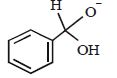
B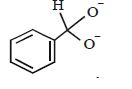
C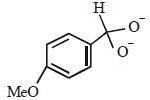
D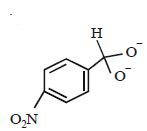
Solution
(C) In the Cannizzaro reaction,the rate-determining step involves the transfer of a hydride ion $(H^-)$ from the gem-diol dianion intermediate to another molecule of the aldehyde.
The ability of the intermediate to act as a hydride donor depends on the electron density at the carbon atom attached to the hydrogen. An electron-donating group (like $-OCH_3$) increases the electron density on the carbon,making the $C-H$ bond more polarized and facilitating the release of the hydride ion.
Conversely,an electron-withdrawing group (like $-NO_2$) decreases the electron density,making it a poorer hydride donor.
Comparing the options:
- Option $A$ is a mono-anion,which is not the primary hydride donor.
- Option $B$ is the unsubstituted benzaldehyde gem-diol dianion.
- Option $C$ has a methoxy group $(-OCH_3)$,which is an electron-donating group ($+M$ effect),making it the best hydride donor.
- Option $D$ has a nitro group $(-NO_2)$,which is an electron-withdrawing group ($-M$ effect),making it the poorest hydride donor.
Therefore,the intermediate with the electron-donating group is the best hydride donor.
The ability of the intermediate to act as a hydride donor depends on the electron density at the carbon atom attached to the hydrogen. An electron-donating group (like $-OCH_3$) increases the electron density on the carbon,making the $C-H$ bond more polarized and facilitating the release of the hydride ion.
Conversely,an electron-withdrawing group (like $-NO_2$) decreases the electron density,making it a poorer hydride donor.
Comparing the options:
- Option $A$ is a mono-anion,which is not the primary hydride donor.
- Option $B$ is the unsubstituted benzaldehyde gem-diol dianion.
- Option $C$ has a methoxy group $(-OCH_3)$,which is an electron-donating group ($+M$ effect),making it the best hydride donor.
- Option $D$ has a nitro group $(-NO_2)$,which is an electron-withdrawing group ($-M$ effect),making it the poorest hydride donor.
Therefore,the intermediate with the electron-donating group is the best hydride donor.
0 likesView Solution
56
ChemistryMediumMCQAIIMS · 2009
Identify the product for the following reaction: $CH_3-CO-CH_3 + HO-CH_2-CH_2-OH \xrightarrow{HCl} ?$
A
$CH_3-CH(OH)-CH_3 + HOOC-COOH$
B
The cyclic ketal structure: $C(CH_3)_2(OCH_2CH_2O)$
C
$CH_3-C(OH)(CH_3)-CH(OH)-CH_3$
D
No reaction
Solution
(B) Acetone reacts with ethylene glycol in the presence of dry $HCl$ gas to form a cyclic ketal,specifically $2,2-dimethyl-1,3-dioxolane$.
The reaction involves the elimination of a water molecule between the carbonyl oxygen of the ketone and the hydroxyl hydrogens of the diol.
The reaction is: $CH_3-CO-CH_3 + HO-CH_2-CH_2-OH \xrightarrow{HCl} \text{Cyclic Ketal} + H_2O$.
The reaction involves the elimination of a water molecule between the carbonyl oxygen of the ketone and the hydroxyl hydrogens of the diol.
The reaction is: $CH_3-CO-CH_3 + HO-CH_2-CH_2-OH \xrightarrow{HCl} \text{Cyclic Ketal} + H_2O$.
0 likesView Solution
57
ChemistryDifficultMCQAIIMS · 2009
Assertion : $RCOCl$,$(RCO)_2O$ and $RCOOR'$ all react with Grignard reagents to form $3^o$ alcohols.
Reason : $RCOCl$ reacts with $R_2Cd$ to form ketones but $(RCO)_2O$ and $RCOOR'$ do not react at all.
Reason : $RCOCl$ reacts with $R_2Cd$ to form ketones but $(RCO)_2O$ and $RCOOR'$ do not react at all.
A
If both Assertion and Reason are correct and the Reason is a correct explanation of the Assertion.
B
If both Assertion and Reason are correct but Reason is not a correct explanation of the Assertion.
C
If the Assertion is correct but Reason is incorrect.
D
If both the Assertion and Reason are incorrect.
Solution
(C) The Assertion is correct: $RCOCl$,$(RCO)_2O$,and $RCOOR'$ all react with excess Grignard reagents $(R''MgX)$ to form $3^o$ alcohols after hydrolysis.
The Reason is incorrect: While $RCOCl$ reacts with $R_2Cd$ to form ketones,$(RCO)_2O$ also reacts with $R_2Cd$ to form ketones. Therefore,the statement that $(RCO)_2O$ does not react at all is false.
The Reason is incorrect: While $RCOCl$ reacts with $R_2Cd$ to form ketones,$(RCO)_2O$ also reacts with $R_2Cd$ to form ketones. Therefore,the statement that $(RCO)_2O$ does not react at all is false.
0 likesView Solution
58
ChemistryMediumMCQAIIMS · 2009
Assertion : Protonation of a carbonyl group increases its electrophilic character.
Reason : Protonation of a carbonyl group involves addition of an electrophile on nucleophilic oxygen.
Reason : Protonation of a carbonyl group involves addition of an electrophile on nucleophilic oxygen.
A
If both Assertion and Reason are correct and the Reason is a correct explanation of the Assertion.
B
If both Assertion and Reason are correct but Reason is not a correct explanation of the Assertion.
C
If the Assertion is correct but Reason is incorrect.
D
If both the Assertion and Reason are incorrect.
Solution
(B) The Assertion is correct because protonation of the carbonyl oxygen atom increases the positive charge on the carbon atom,thereby enhancing its electrophilic character.
The Reason is also correct because the oxygen atom of the carbonyl group acts as a nucleophile (due to lone pairs) and accepts a proton $(H^+)$,which is an electrophile.
However,the Reason is not the correct explanation for the Assertion,as the increased electrophilicity is a consequence of the resonance effect and inductive effect induced by the positive charge on oxygen,not simply the fact that an electrophile was added.
The Reason is also correct because the oxygen atom of the carbonyl group acts as a nucleophile (due to lone pairs) and accepts a proton $(H^+)$,which is an electrophile.
However,the Reason is not the correct explanation for the Assertion,as the increased electrophilicity is a consequence of the resonance effect and inductive effect induced by the positive charge on oxygen,not simply the fact that an electrophile was added.
0 likesView Solution
59
ChemistryMediumMCQAIIMS · 2009
Assertion : Nitration of benzoic acid gives $m-$nitrobenzoic acid.
Reason : Carboxyl group increases the electron density at meta-position.
Reason : Carboxyl group increases the electron density at meta-position.
A
If both Assertion and Reason are correct and the Reason is a correct explanation of the Assertion.
B
If both Assertion and Reason are correct but Reason is not a correct explanation of the Assertion.
C
If the Assertion is correct but Reason is incorrect.
D
If both the Assertion and Reason are incorrect.
Solution
(C) The $-COOH$ group is a strong electron-withdrawing group due to both $-I$ and $-M$ effects.
It deactivates the benzene ring towards electrophilic substitution.
The electron density is decreased at all positions,but the decrease is relatively less at the $m-$position compared to the $o-$ and $p-$positions.
Therefore,the incoming electrophile $(NO_2^+)$ attacks the $m-$position.
The Assertion is correct,but the Reason is incorrect because the carboxyl group decreases,not increases,the electron density.
It deactivates the benzene ring towards electrophilic substitution.
The electron density is decreased at all positions,but the decrease is relatively less at the $m-$position compared to the $o-$ and $p-$positions.
Therefore,the incoming electrophile $(NO_2^+)$ attacks the $m-$position.
The Assertion is correct,but the Reason is incorrect because the carboxyl group decreases,not increases,the electron density.
0 likesView Solution
60
ChemistryMediumMCQAIIMS · 2009
Diethyl oxalate is used for distinguishing primary,secondary and tertiary
A
alcohols
B
amines
C
alkyl halides
D
hydrogens in hydrocarbons
Solution
(B) Diethyl oxalate is used for distinguishing $1^o, 2^o$ and $3^o$ amines because they react differently.
$1^o$ amines form crystalline substituted oxamides.
$2^o$ amines form liquid diethyl oxamic esters.
$3^o$ amines do not react with diethyl oxalate because they lack a replaceable hydrogen atom.
$RNH_2 + (COOC_2H_5)_2 \to (CONHR)_2 + 2 C_2H_5OH$ ($1^o$ amine,crystalline oxamide)
$R_2NH + (COOC_2H_5)_2 \to (CONR_2)(COOC_2H_5) + C_2H_5OH$ ($2^o$ amine,liquid oxamic ester)
$R_3N + (COOC_2H_5)_2 \to \text{No reaction}$ ($3^o$ amine)
$1^o$ amines form crystalline substituted oxamides.
$2^o$ amines form liquid diethyl oxamic esters.
$3^o$ amines do not react with diethyl oxalate because they lack a replaceable hydrogen atom.
$RNH_2 + (COOC_2H_5)_2 \to (CONHR)_2 + 2 C_2H_5OH$ ($1^o$ amine,crystalline oxamide)
$R_2NH + (COOC_2H_5)_2 \to (CONR_2)(COOC_2H_5) + C_2H_5OH$ ($2^o$ amine,liquid oxamic ester)
$R_3N + (COOC_2H_5)_2 \to \text{No reaction}$ ($3^o$ amine)
0 likesView Solution
61
ChemistryMediumMCQAIIMS · 2009
Fluorescein is an example of
A
azo dyes
B
phthalein dyes
C
triphenylmethane dyes
D
nitro dyes
Solution
(B) Fluorescein,also known as resorcinolphthalein,is a classic example of a phthalein dye.
It is synthesized by the condensation reaction of phthalic anhydride with resorcinol in the presence of a catalyst like anhydrous zinc chloride $(ZnCl_2)$.
Due to its structure containing the phthalein backbone,it is classified under phthalein dyes.
It is synthesized by the condensation reaction of phthalic anhydride with resorcinol in the presence of a catalyst like anhydrous zinc chloride $(ZnCl_2)$.
Due to its structure containing the phthalein backbone,it is classified under phthalein dyes.
0 likesView Solution
62
ChemistryEasyMCQAIIMS · 2009
If one strand of $DNA$ has the sequence $ATCGTATG$,the sequence in the complementary strand would be
A
$TAGCTTAC$
B
$TCACATAC$
C
$TAGCATAC$
D
$TACGATAC$
Solution
(C) According to the base pairing rules in $DNA$,$Adenine$ $(A)$ pairs with $Thymine$ $(T)$ and $Cytosine$ $(C)$ pairs with $Guanine$ $(G)$.
Given strand: $ATCGTATG$
Complementary strand: $TAGCATAC$
Given strand: $ATCGTATG$
Complementary strand: $TAGCATAC$
0 likesView Solution
63
ChemistryDifficultMCQAIIMS · 2009
Synthetic detergents are more effective in hard water than soaps because
A
they are non-ionic
B
their $Ca^{2+}$ and $Mg^{2+}$ salts are insoluble in water
C
their $Ca^{2+}$ and $Mg^{2+}$ salts are water soluble
D
they are highly soluble in water
Solution
(C) The structural features of soaps and detergents are similar,except that the polar end in detergents is $-OSO_3^-Na^+$ or $-SO_3^-Na^+$,while in soaps,the polar end is $-COO^-Na^+$.
Detergents have an advantage over soaps because their polar ends (sulphate or sulphonate groups) retain their efficiency in hard water.
This is because the corresponding $Ca^{2+}$ and $Mg^{2+}$ salts of detergents are soluble in water,whereas the $Ca^{2+}$ and $Mg^{2+}$ salts of soaps are insoluble and form scum.
Therefore,the correct reason is that their $Ca^{2+}$ and $Mg^{2+}$ salts are water soluble.
Detergents have an advantage over soaps because their polar ends (sulphate or sulphonate groups) retain their efficiency in hard water.
This is because the corresponding $Ca^{2+}$ and $Mg^{2+}$ salts of detergents are soluble in water,whereas the $Ca^{2+}$ and $Mg^{2+}$ salts of soaps are insoluble and form scum.
Therefore,the correct reason is that their $Ca^{2+}$ and $Mg^{2+}$ salts are water soluble.
0 likesView Solution
64
ChemistryEasyMCQAIIMS · 2009
Which of the following is a local anaesthetic?
A
Diazepam
B
Procaine
C
Chloramphenicol
D
Penicillin $-G$
Solution
(B) Procaine is a well-known local anaesthetic used in medical procedures to numb specific areas of the body.
Chloramphenicol and Penicillin $-G$ are antibiotics used to treat bacterial infections.
Diazepam is a sedative belonging to the benzodiazepine class,used to treat anxiety and muscle spasms.
Chloramphenicol and Penicillin $-G$ are antibiotics used to treat bacterial infections.
Diazepam is a sedative belonging to the benzodiazepine class,used to treat anxiety and muscle spasms.
0 likesView Solution
Vedclass Products
For Students
Vedclass Test Series
Mock tests in real AIIMS style covering Chemistry with performance analysis. 5-day free trial.
Start Free TrialFor Teachers
Exam Paper Generator
Generate Set A/B/C/D Chemistry papers from 7.5L+ questions in 2 minutes. 3 chapters free.
Try FreeFor Institutes
Online Exam Module
Run live AIIMS mock exams with unlimited students, 360° analytics & white-label branding.
See DemoFrequently Asked Questions
How many Chemistry questions are in AIIMS 2009?
There are 64 Chemistry questions from the AIIMS 2009 paper on Vedclass, each with a detailed step-by-step solution in English.
Are AIIMS 2009 Chemistry solutions available in English?
Yes. All solutions on this page are in English. You can also switch to English or Hindi using the language buttons above the questions.
Can I practice AIIMS 2009 Chemistry as a timed test?
Yes. Use the Vedclass Test Series to attempt a full AIIMS mock test covering Chemistry with time limits and instant score analysis.
Can teachers create Chemistry papers from AIIMS previous year questions?
Yes. The Vedclass Exam Paper Generator lets teachers mix AIIMS Chemistry questions and generate Set A/B/C/D papers in minutes.
For Teachers & Institutes
Build a Custom Chemistry Paper
Pick AIIMS 2009 Chemistry questions, set difficulty, and generate Set A/B/C/D in 2 minutes.