
BiologyQ1–62 of 62 questions
Page 1 of 1 · English
1
BiologyMediumMCQAIIMS · 2009
What happens to the heart rate if the parasympathetic nerve of a rabbit is cut?
A
It remains unaffected
B
It decreases
C
It increases
D
It stops
Solution
(C) The parasympathetic nervous system,specifically through the vagus nerve,releases acetylcholine which acts on the $SA$ node to decrease the heart rate.
When the parasympathetic nerve is cut,the inhibitory effect of the vagus nerve on the heart is removed.
As a result,the sympathetic nervous system's influence becomes dominant,leading to an increase in the heart rate.
When the parasympathetic nerve is cut,the inhibitory effect of the vagus nerve on the heart is removed.
As a result,the sympathetic nervous system's influence becomes dominant,leading to an increase in the heart rate.
0 likesView Solution
2
BiologyMediumMCQAIIMS · 2009
The system of classification based on evolutionary and genetic relationships among organisms,ignoring the morphological similarities or differences,is called
A
cladistics
B
phenetics
C
classical systematics
D
new systematics
Solution
(A) Cladistics is a method of classification that groups organisms based on shared derived characteristics (synapomorphies) that can be traced to a common ancestor.
It focuses exclusively on evolutionary and genetic relationships,often ignoring superficial morphological similarities or differences that may arise due to convergent evolution.
In contrast,phenetics classifies organisms based on overall morphological similarity,while classical systematics relies heavily on morphological traits.
Therefore,the system described is known as cladistics.
It focuses exclusively on evolutionary and genetic relationships,often ignoring superficial morphological similarities or differences that may arise due to convergent evolution.
In contrast,phenetics classifies organisms based on overall morphological similarity,while classical systematics relies heavily on morphological traits.
Therefore,the system described is known as cladistics.
0 likesView Solution
3
BiologyMediumMCQAIIMS · 2009
"Fairy rings" in lawns result from outward-spreading circles of mycelia of mushrooms producing, at their periphery, fruiting bodies called
A
ascocarps
B
basidiocarps
C
sorocarps
D
pseudocarps
Solution
(B) Some $Basidiomycetes$ or club fungi (e.g., $Agaricus$ $campestris$) produce $basidiocarps$.
These aerial structures are also called mushrooms.
They occur in rings known as 'fairy rings' due to the outward radial growth of the mycelium.
$Basidiocarps$ of some fungi are edible.
These aerial structures are also called mushrooms.
They occur in rings known as 'fairy rings' due to the outward radial growth of the mycelium.
$Basidiocarps$ of some fungi are edible.
0 likesView Solution
4
BiologyDifficultMCQAIIMS · 2009
Assertion: Chemosynthesis is an autotrophic nutrition.
Reason: Chemoautotrophs contain chlorophyll pigments.
Reason: Chemoautotrophs contain chlorophyll pigments.
A
If both Assertion and Reason are correct and the Reason is a correct explanation of the Assertion.
B
If the Assertion is correct but Reason is incorrect.
C
If both Assertion and Reason are correct but Reason is not a correct explanation of the Assertion.
D
If both the Assertion and Reason are incorrect.
Solution
(B) Chemosynthesis is a form of autotrophic nutrition where organisms synthesize organic molecules using energy derived from the oxidation of inorganic substances.
Chemoautotrophs do not contain chlorophyll pigments; chlorophyll is characteristic of photoautotrophs,which use solar energy to synthesize organic compounds.
Therefore,the Assertion is correct,but the Reason is incorrect.
Chemoautotrophs do not contain chlorophyll pigments; chlorophyll is characteristic of photoautotrophs,which use solar energy to synthesize organic compounds.
Therefore,the Assertion is correct,but the Reason is incorrect.
0 likesView Solution
5
BiologyEasyMCQAIIMS · 2009
The botanical name of Sanjeevani is:
A
Selaginella chrysocaulos
B
Selaginella bryopteris
C
Selaginella chrysorhizos
D
None of the above
Solution
(B) Selaginella bryopteris $(L.)$,popularly known as Sanjeevani,is a plant with medicinal properties.
Sanjeevani grows on the hills of tropical areas,particularly the Arawali mountain terrains from east to west in India.
Traditionally,this plant has been used to: $(i)$ provide relief from heat stroke and burning sensation during urination; $(ii)$ restore menstrual irregularities to normal and,when applied topically to pregnant women,aid in easy delivery; and $(iii)$ treat jaundice.
Sanjeevani grows on the hills of tropical areas,particularly the Arawali mountain terrains from east to west in India.
Traditionally,this plant has been used to: $(i)$ provide relief from heat stroke and burning sensation during urination; $(ii)$ restore menstrual irregularities to normal and,when applied topically to pregnant women,aid in easy delivery; and $(iii)$ treat jaundice.
0 likesView Solution
6
BiologyMediumMCQAIIMS · 2009
Which statement best explains why invertebrates regenerate lost tissue more readily than most vertebrates do?
A
Invertebrates contain specialized cells that produce the hormones necessary for this process
B
Invertebrate cells exhibit a higher degree of uncontrolled cell division than vertebrate cells do
C
Invertebrate animals reproduce asexually,but vertebrate animals reproduce sexually
D
Invertebrate animals have more undifferentiated cells than vertebrate animals have
Solution
(D) Invertebrates,which are animals without a backbone,possess a higher proportion of undifferentiated cells (stem cells) compared to vertebrates.
These undifferentiated cells retain the potential to divide and differentiate into various cell types,which facilitates the regeneration of lost tissues or body parts.
In contrast,vertebrate cells are generally more specialized and have limited regenerative capacity.
These undifferentiated cells retain the potential to divide and differentiate into various cell types,which facilitates the regeneration of lost tissues or body parts.
In contrast,vertebrate cells are generally more specialized and have limited regenerative capacity.
0 likesView Solution
7
BiologyMediumMCQAIIMS · 2009
Which of the following is correctly matched?
A
Human - Renal portal system
B
Earthworm - Closed circulatory system
C
Cockroach - Nephridia
D
None of the above
Solution
(B) Earthworms possess a closed circulatory system,where blood circulates within defined,walled blood vessels.
Renal portal systems are characteristic of amphibians and reptiles,not humans. Humans possess a hepatic portal system that transports venous blood from the digestive system to the liver.
In cockroaches,the primary excretory organs are Malpighian tubules,whereas nephridia are the excretory structures found in annelids like earthworms.
Renal portal systems are characteristic of amphibians and reptiles,not humans. Humans possess a hepatic portal system that transports venous blood from the digestive system to the liver.
In cockroaches,the primary excretory organs are Malpighian tubules,whereas nephridia are the excretory structures found in annelids like earthworms.
0 likesView Solution
8
BiologyDifficultMCQAIIMS · 2009
Which set of terms would most likely be used in a description of the nervous system of chordates?
A
Brain,dorsal nerve cord,highly developed receptors
B
Brain,fused ganglia,ventral nerve cord
C
No brain,fused ganglia,tympana
D
No brain,nerve net,modified neurons
Solution
(A) Chordates are a group of animals that include fish,amphibians,reptiles,birds,and mammals.
The defining characteristics of the chordate nervous system include a central nervous system consisting of a brain and a hollow,dorsal nerve cord.
Additionally,chordates possess highly developed sensory receptors to detect environmental stimuli.
In contrast,fused ganglia are characteristic of annelids and arthropods,tympana are found in insects like grasshoppers,and nerve nets are characteristic of cnidarians like Hydra.
The defining characteristics of the chordate nervous system include a central nervous system consisting of a brain and a hollow,dorsal nerve cord.
Additionally,chordates possess highly developed sensory receptors to detect environmental stimuli.
In contrast,fused ganglia are characteristic of annelids and arthropods,tympana are found in insects like grasshoppers,and nerve nets are characteristic of cnidarians like Hydra.
0 likesView Solution
9
BiologyMediumMCQAIIMS · 2009
Assertion : Sponges have body organization of "cellular level".
Reason : There is some physiological division of labour.
Reason : There is some physiological division of labour.
A
If both Assertion and Reason are correct and the Reason is a correct explanation of the Assertion.
B
If both Assertion and Reason are correct but Reason is not a correct explanation of the Assertion.
C
If the Assertion is correct but Reason is incorrect.
D
If both the Assertion and Reason are incorrect.
Solution
(A) Sponges are multicellular organisms, but they exhibit a "cellular level" of body organization, meaning they do not possess true tissues, organs, or organ systems.
Although sponges lack tissues, there is a degree of physiological division of labour among the various types of cells (e.g., choanocytes, amoebocytes) present in their body.
These cells perform specific functions such as digestion, respiration, and reproduction, but they are not organized into permanent layers or masses to form tissues.
Therefore, both the Assertion and the Reason are correct, and the Reason provides a valid explanation for why the organization is considered "cellular level" despite the presence of functional specialization.
Although sponges lack tissues, there is a degree of physiological division of labour among the various types of cells (e.g., choanocytes, amoebocytes) present in their body.
These cells perform specific functions such as digestion, respiration, and reproduction, but they are not organized into permanent layers or masses to form tissues.
Therefore, both the Assertion and the Reason are correct, and the Reason provides a valid explanation for why the organization is considered "cellular level" despite the presence of functional specialization.
0 likesView Solution
10
BiologyMediumMCQAIIMS · 2009
If the anthers are fused together forming a tubular structure while the filaments remain free,the condition is found in which one of the following family?
A
Malvaceae
B
Cucurbitaceae
C
Solanaceae
D
Asteraceae
Solution
(D) The condition where anthers are fused together to form a tube while the filaments remain free is known as $syngenesious$ condition.
This characteristic feature is observed in the members of the family $Asteraceae$ (also known as $Compositae$).
For example,in the disc florets of the sunflower ($Helianthus$ $annuus$),the anthers are united to form a tube around the style.
This characteristic feature is observed in the members of the family $Asteraceae$ (also known as $Compositae$).
For example,in the disc florets of the sunflower ($Helianthus$ $annuus$),the anthers are united to form a tube around the style.
0 likesView Solution
11
BiologyMediumMCQAIIMS · 2009
Floral diagram fails to indicate
A
epiphylly and epipetaly
B
aestivation and placentation
C
position of ovary on the thalamus
D
cohesion of carpels and stamens
Solution
(C) floral diagram provides information about the number of parts of a flower,their arrangement,and the relation they have with one another.
It indicates the aestivation,placentation,and cohesion or adhesion of floral parts.
However,it does not represent the position of the ovary on the thalamus (i.e.,whether the flower is hypogynous,perigynous,or epigynous),which is instead indicated by the floral formula.
It indicates the aestivation,placentation,and cohesion or adhesion of floral parts.
However,it does not represent the position of the ovary on the thalamus (i.e.,whether the flower is hypogynous,perigynous,or epigynous),which is instead indicated by the floral formula.
0 likesView Solution
12
BiologyMediumMCQAIIMS · 2009
Aggregate fruit develops from
A
syncarpous ovary
B
multicarpellary,syncarpous ovary
C
unilocular ovary
D
multicarpellary,apocarpous ovary
Solution
(D) An aggregate fruit is formed from a single flower that has a multicarpellary,apocarpous gynoecium.
In an apocarpous ovary,the carpels are free from each other.
Each individual carpel develops into a small fruitlet,and the entire collection of these fruitlets,which are attached to a common receptacle,is known as an aggregate fruit or $etaerio$.
In an apocarpous ovary,the carpels are free from each other.
Each individual carpel develops into a small fruitlet,and the entire collection of these fruitlets,which are attached to a common receptacle,is known as an aggregate fruit or $etaerio$.
0 likesView Solution
13
BiologyMediumMCQAIIMS · 2009
The presence of cilia, an oral groove, and food vacuoles, and the absence of chloroplasts in a unicellular organism indicate that the organism carries on
A
sexual reproduction
B
autotrophic nutrition
C
extracellular digestion
D
heterotrophic nutrition
Solution
(D) Cilia are hair-like structures on a $Paramecium$ used for locomotion and capturing food.
An oral groove acts as a mouth, and food vacuoles are involved in the digestion of ingested food particles.
The absence of chloroplasts confirms that the organism cannot perform photosynthesis.
These features collectively indicate that the organism relies on preformed organic matter for energy, which is defined as $heterotrophic \text{ nutrition}$.
An oral groove acts as a mouth, and food vacuoles are involved in the digestion of ingested food particles.
The absence of chloroplasts confirms that the organism cannot perform photosynthesis.
These features collectively indicate that the organism relies on preformed organic matter for energy, which is defined as $heterotrophic \text{ nutrition}$.
0 likesView Solution
14
BiologyEasyMCQAIIMS · 2009
Of the following,which instrument is most commonly used to observe the external features of a grasshopper's abdomen?
A
Ultracentrifuge
B
Microdissection instrument
C
Dissecting microscope
D
Electron microscope
Solution
(C) The dissecting microscope allows for the viewing of $3D$ images at magnifications up to $50x$. It is commonly used during dissections to observe external morphological features.
An ultracentrifuge is used to separate components of a mixture based on density by spinning at high speeds.
Microdissection instruments are specialized tools used for manipulating microscopic structures,such as cell nuclei.
Electron microscopes provide extremely high magnification (up to $250,000x$) and are used to study internal cellular ultrastructure,not external features of an organism.
An ultracentrifuge is used to separate components of a mixture based on density by spinning at high speeds.
Microdissection instruments are specialized tools used for manipulating microscopic structures,such as cell nuclei.
Electron microscopes provide extremely high magnification (up to $250,000x$) and are used to study internal cellular ultrastructure,not external features of an organism.
0 likesView Solution
15
BiologyMediumMCQAIIMS · 2009
Two cross-sections of stem and root appear simple,when viewed by the naked eye. But under a microscope,they can be differentiated by:
A
exarch condition of root and stem
B
endarch condition of stem and root
C
endarch condition of root and exarch condition of stem
D
endarch condition of stem and exarch condition of root
Solution
(D) The cross-sections of stem and root appear simple when viewed by the naked eye,but under a microscope,they can be differentiated by the $endarch$ condition in the stem and the $exarch$ condition in the root.
In the $endarch$ condition,the $protoxylem$ is present towards the center of the stem,while the $metaxylem$ is towards the periphery.
In the $exarch$ condition,the $protoxylem$ is present towards the periphery (pericycle) and the $metaxylem$ is towards the center of the root.
In the $endarch$ condition,the $protoxylem$ is present towards the center of the stem,while the $metaxylem$ is towards the periphery.
In the $exarch$ condition,the $protoxylem$ is present towards the periphery (pericycle) and the $metaxylem$ is towards the center of the root.
0 likesView Solution
16
BiologyEasyMCQAIIMS · 2009
Molecules that are too large to pass through the pores of a cell membrane may enter the cell by a process known as
A
hydrolysis
B
pinocytosis
C
cyclosis
D
synthesis
Solution
(B) Pinocytosis,often described as 'cell drinking' or the pinching in of the cell membrane,allows cells to engulf and internalize larger molecules or extracellular fluid that cannot pass through membrane pores.
Hydrolysis is the chemical breakdown of a compound due to reaction with water.
Cyclosis (or cytoplasmic streaming) is the directed flow of cytosol and organelles around the large central vacuole of a plant cell.
Synthesis is the process of building complex molecules from simpler ones within the cell.
Hydrolysis is the chemical breakdown of a compound due to reaction with water.
Cyclosis (or cytoplasmic streaming) is the directed flow of cytosol and organelles around the large central vacuole of a plant cell.
Synthesis is the process of building complex molecules from simpler ones within the cell.
0 likesView Solution
17
BiologyMediumMCQAIIMS · 2009
Assertion : Lipids present in the outer and inner side of the bilayer membrane are commonly different.
Reason : Oligosaccharides are attached to external surface as well as inner surface of a biomembrane.
Reason : Oligosaccharides are attached to external surface as well as inner surface of a biomembrane.
A
If both Assertion and Reason are correct and the Reason is a correct explanation of the Assertion.
B
If both Assertion and Reason are correct but Reason is not a correct explanation of the Assertion.
C
If the Assertion is correct but Reason is incorrect.
D
If both the Assertion and Reason are incorrect.
Solution
(C) The Assertion is correct because the lipid composition of the two leaflets of the bilayer membrane is asymmetric. For example,in the erythrocyte membrane,lecithin (phosphatidylcholine) is primarily found on the outer leaflet,while cephalin (phosphatidylethanolamine) is more abundant on the inner leaflet.
The Reason is incorrect because oligosaccharides (forming the glycocalyx) are exclusively attached to the external surface of the plasma membrane,facing the extracellular environment. They are not present on the inner cytoplasmic surface of the biomembrane.
The Reason is incorrect because oligosaccharides (forming the glycocalyx) are exclusively attached to the external surface of the plasma membrane,facing the extracellular environment. They are not present on the inner cytoplasmic surface of the biomembrane.
0 likesView Solution
18
BiologyMediumMCQAIIMS · 2009
During which stages (or prophase $I$ substages) of meiosis do you expect to find the bivalents and $DNA$ replication respectively?
A
Pachytene and interphase (between two meiotic divisions)
B
Pachytene and interphase (just prior to prophase $I$)
C
Pachytene and $S$ phase (of interphase just prior to prophase $I$)
D
Zygotene and $S$ phase (of interphase prior to prophase $I$)
Solution
(D) Bivalents are pairs of homologous chromosomes formed during the $zygotene$ substage of $prophase-I$ of meiosis through a process called synapsis.
$DNA$ replication occurs during the $S$ phase (synthesis phase) of the interphase, which takes place just prior to the onset of meiosis (prophase $I$).
$DNA$ replication occurs during the $S$ phase (synthesis phase) of the interphase, which takes place just prior to the onset of meiosis (prophase $I$).
0 likesView Solution
19
BiologyMediumMCQAIIMS · 2009
Through the use of oxygen $-18$ (heavy oxygen),scientists have found that the oxygen released during photosynthesis comes from molecules of
A
carbon dioxide
B
water
C
glucose
D
chlorophyll
Solution
(B) The oxygen released during photosynthesis originates from water molecules. During the light-dependent reactions of photosynthesis,light energy is captured by chlorophyll in the chloroplasts. This energy facilitates the photolysis of water,which is the splitting of water molecules into protons,electrons,and oxygen gas.
The chemical process is represented as:
$4H_2O \rightleftharpoons 4H^+ + 4OH^-$
$4OH^- \xrightarrow{Mn^{2+}, Cl^-} 2H_2O + O_2 \uparrow + 4e^-$
The chemical process is represented as:
$4H_2O \rightleftharpoons 4H^+ + 4OH^-$
$4OH^- \xrightarrow{Mn^{2+}, Cl^-} 2H_2O + O_2 \uparrow + 4e^-$
0 likesView Solution
20
BiologyMediumMCQAIIMS · 2009
Assertion : Dark reaction occurs only at night in the stroma of chloroplast.
Reason : $CO_2$ fixation occurs only during $C_3$ cycle.
Reason : $CO_2$ fixation occurs only during $C_3$ cycle.
A
If both Assertion and Reason are correct and the Reason is a correct explanation of the Assertion.
B
If both Assertion and Reason are correct but Reason is not a correct explanation of the Assertion.
C
If the Assertion is correct but Reason is incorrect.
D
If both the Assertion and Reason are incorrect.
Solution
(D) Dark reaction is also known as light-independent phase. Unlike light reaction,it does not require light as an essential factor. Thus,it can take place both in the presence or absence of light.
The term 'dark reaction' does not mean that it takes place only in the dark period or at night.
$CO_2$ fixation occurs in both $C_3$ and $C_4$ cycles.
In the $C_3$ cycle,$CO_2$ is fixed by the enzyme RuBisCO to a $5$-carbon compound $RuBP$,which is converted into $2$ molecules of $3$-carbon $PGA$.
In the $C_4$ cycle,the first product of $CO_2$ fixation (which takes place in the mesophyll) is a $4$-carbon compound called oxaloacetic acid $(OAA)$.
Since both the Assertion and the Reason are scientifically incorrect,the correct option is $D$.
The term 'dark reaction' does not mean that it takes place only in the dark period or at night.
$CO_2$ fixation occurs in both $C_3$ and $C_4$ cycles.
In the $C_3$ cycle,$CO_2$ is fixed by the enzyme RuBisCO to a $5$-carbon compound $RuBP$,which is converted into $2$ molecules of $3$-carbon $PGA$.
In the $C_4$ cycle,the first product of $CO_2$ fixation (which takes place in the mesophyll) is a $4$-carbon compound called oxaloacetic acid $(OAA)$.
Since both the Assertion and the Reason are scientifically incorrect,the correct option is $D$.
0 likesView Solution
21
BiologyMediumMCQAIIMS · 2009
Assertion : Glycolysis is the first step of respiration in which glucose completely breaks into $CO_2$ and $H_2O$.
Reason : In this process,there is net gain of twenty four molecules of $ATP$.
Reason : In this process,there is net gain of twenty four molecules of $ATP$.
A
If both Assertion and Reason are correct and the Reason is a correct explanation of the Assertion.
B
If both Assertion and Reason are correct but Reason is not a correct explanation of the Assertion.
C
If the Assertion is correct but Reason is incorrect.
D
If both the Assertion and Reason are incorrect.
Solution
(D) Glycolysis is the process of breakdown of glucose or similar hexose sugar into two molecules of pyruvic acid through a series of enzyme-mediated reactions,releasing energy $(ATP)$ and reducing power $(NADH_2)$.
It is the first step of respiration,which occurs inside the cytoplasm and is independent of $O_2$.
In glycolysis,two molecules of $ATP$ are consumed during the double phosphorylation of glucose to form fructose $1, 6$-diphosphate.
Four molecules of $ATP$ are produced in the conversion of $1, 3$-diphosphoglycerate to $3$-phosphoglycerate and phosphoenolpyruvate to pyruvate.
Additionally,two molecules of $NADH_2$ are formed during the oxidation of glyceraldehyde $3$-phosphate to $1, 3$-diphosphoglycerate.
Since each $NADH$ is equivalent to $3\, ATP$,the net gain in glycolysis is $8\, ATP$.
Therefore,both the Assertion and the Reason are incorrect.
It is the first step of respiration,which occurs inside the cytoplasm and is independent of $O_2$.
In glycolysis,two molecules of $ATP$ are consumed during the double phosphorylation of glucose to form fructose $1, 6$-diphosphate.
Four molecules of $ATP$ are produced in the conversion of $1, 3$-diphosphoglycerate to $3$-phosphoglycerate and phosphoenolpyruvate to pyruvate.
Additionally,two molecules of $NADH_2$ are formed during the oxidation of glyceraldehyde $3$-phosphate to $1, 3$-diphosphoglycerate.
Since each $NADH$ is equivalent to $3\, ATP$,the net gain in glycolysis is $8\, ATP$.
Therefore,both the Assertion and the Reason are incorrect.
0 likesView Solution
22
BiologyMediumMCQAIIMS · 2009
Assertion : In the condition of obstructive jaundice,large amounts of unabsorbed fats are eliminated out of the body.
Reason : Entry of bile into the small intestine is prevented during obstructive jaundice.
Reason : Entry of bile into the small intestine is prevented during obstructive jaundice.
A
If both Assertion and Reason are correct and the Reason is a correct explanation of the Assertion.
B
If both Assertion and Reason are correct but Reason is not a correct explanation of the Assertion.
C
If the Assertion is correct but Reason is incorrect.
D
If both the Assertion and Reason are incorrect.
Solution
(A) In the condition of obstructive jaundice,the entry of bile into the small intestine is prevented due to an obstruction in the bile duct.
Bile salts are essential for the emulsification of fats,which increases the surface area for lipase action.
Furthermore,bile salts are necessary for the formation of micelles,which are water-soluble aggregates that transport fatty acids,glycerides,and fat-soluble vitamins to the intestinal mucosa for absorption.
In the absence of bile,fats cannot be properly emulsified or absorbed.
Consequently,these unabsorbed fats pass through the digestive tract and are eliminated from the body in the faeces.
Bile salts are essential for the emulsification of fats,which increases the surface area for lipase action.
Furthermore,bile salts are necessary for the formation of micelles,which are water-soluble aggregates that transport fatty acids,glycerides,and fat-soluble vitamins to the intestinal mucosa for absorption.
In the absence of bile,fats cannot be properly emulsified or absorbed.
Consequently,these unabsorbed fats pass through the digestive tract and are eliminated from the body in the faeces.
0 likesView Solution
23
BiologyMediumMCQAIIMS · 2009
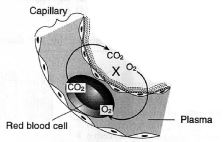
The diagram below represents part of a capillary in a specific region of the human body. The region labeled $X$ represents part of
A
a glomerulus
B
an alveolus
C
a villus
D
the liver
Solution
(B) An alveolus is a tiny air sac in the lung. It is the actual part of the lung where the exchange of atmospheric oxygen $(O_2)$ and carbon dioxide $(CO_2)$ occurs with the blood.
In the diagram,the exchange of gases ($O_2$ entering the blood and $CO_2$ leaving the blood) indicates that region $X$ is the alveolar space.
$A$ glomerulus is a network of capillaries in the kidneys for filtration,a villus is a projection in the small intestine for nutrient absorption,and the liver is involved in metabolic processes like bile production.
In the diagram,the exchange of gases ($O_2$ entering the blood and $CO_2$ leaving the blood) indicates that region $X$ is the alveolar space.
$A$ glomerulus is a network of capillaries in the kidneys for filtration,a villus is a projection in the small intestine for nutrient absorption,and the liver is involved in metabolic processes like bile production.
0 likesView Solution
24
BiologyEasyMCQAIIMS · 2009
In humans,the concentration of carbon dioxide in the plasma
A
causes increased production of hydrochloric acid
B
regulates gastric acid production by forming carbonic acid.
C
regulates breathing rate by its effect on the medulla.
D
causes inflammation of the tissues of the bronchial tubes.
Solution
(C) The medulla oblongata,located at the base of the brain,acts as a respiratory rhythm center.
When the concentration of $CO_2$ in the blood plasma increases,it leads to a decrease in blood $pH$.
This change is detected by chemoreceptors,which send signals to the medulla oblongata.
In response,the medulla increases the breathing rate to expel excess $CO_2$ from the body.
Therefore,the concentration of $CO_2$ regulates the breathing rate by its effect on the medulla.
When the concentration of $CO_2$ in the blood plasma increases,it leads to a decrease in blood $pH$.
This change is detected by chemoreceptors,which send signals to the medulla oblongata.
In response,the medulla increases the breathing rate to expel excess $CO_2$ from the body.
Therefore,the concentration of $CO_2$ regulates the breathing rate by its effect on the medulla.
0 likesView Solution
25
BiologyDifficultMCQAIIMS · 2009
If the respiratory rate of $A$ is $35$ breaths/min and tidal volume is $185 \, cc/breath$, and for $B$ it is $25$ breaths/min and tidal volume is $259 \, cc/breath$, then:
A
Pulmonary ventilation of $A$ and $B$ is same.
B
Alveolar ventilation of $A$ and $B$ is same.
C
Pulmonary ventilation of $A$ is greater than $B$.
D
Alveolar ventilation of $A$ is greater than $B$.
Solution
(A) Pulmonary ventilation is calculated as: $\text{Tidal Volume} \times \text{Respiratory Rate}$.
For $A$: $185 \, cc/breath \times 35 \, breaths/min = 6475 \, cc/min$.
For $B$: $259 \, cc/breath \times 25 \, breaths/min = 6475 \, cc/min$.
Since both values are equal, the pulmonary ventilation of $A$ and $B$ is the same.
For $A$: $185 \, cc/breath \times 35 \, breaths/min = 6475 \, cc/min$.
For $B$: $259 \, cc/breath \times 25 \, breaths/min = 6475 \, cc/min$.
Since both values are equal, the pulmonary ventilation of $A$ and $B$ is the same.
0 likesView Solution
26
BiologyMediumMCQAIIMS · 2009
$A$ malfunction of the lymph nodes would most likely interfere with the
A
release of carbon dioxide into the lymph
B
filtering of glucose from the lymph
C
release of oxygen into the lymph
D
filtering of bacteria from the lymph
Solution
(D) The lymphatic system plays a crucial role in maintaining fluid balance and supporting the immune system.
Lymph nodes act as filters for the lymph fluid,trapping and destroying pathogens such as bacteria and viruses.
When lymph nodes malfunction,they cannot effectively filter these harmful microorganisms,which can lead to the spread of infection.
Therefore,the primary function that would be interfered with is the filtering of bacteria from the lymph.
Lymph nodes act as filters for the lymph fluid,trapping and destroying pathogens such as bacteria and viruses.
When lymph nodes malfunction,they cannot effectively filter these harmful microorganisms,which can lead to the spread of infection.
Therefore,the primary function that would be interfered with is the filtering of bacteria from the lymph.
0 likesView Solution
27
BiologyMediumMCQAIIMS · 2009
Which row in the chart contains the words that best complete this statement? The $(I)$ glands produce $(II)$, which are transported by the $(III)$ system.
| Row | $I, II, III$ |
| $A$. digestive, hormones, circulatory | |
| $B$. endocrine, enzymes, lymphatic | |
| $C$. endocrine, hormones, circulatory | |
| $D$. digestive, enzymes, lymphatic |
A
$A$
B
$B$
C
$C$
D
$D$
Solution
$(C)$ Endocrine glands are ductless glands that secrete their chemical messengers, known as hormones, directly into the blood.
The circulatory system (blood) then transports these hormones to their target organs or tissues to exert their physiological effects.
In contrast, digestive glands produce enzymes, which are typically transported through ducts to the site of action in the digestive tract, not primarily by the circulatory system.
Therefore, the correct sequence is: $(I)$ Endocrine glands, $(II)$ Hormones, $(III)$ Circulatory system. This corresponds to row $C$.
The circulatory system (blood) then transports these hormones to their target organs or tissues to exert their physiological effects.
In contrast, digestive glands produce enzymes, which are typically transported through ducts to the site of action in the digestive tract, not primarily by the circulatory system.
Therefore, the correct sequence is: $(I)$ Endocrine glands, $(II)$ Hormones, $(III)$ Circulatory system. This corresponds to row $C$.
0 likesView Solution
28
BiologyMediumMCQAIIMS · 2009
Assertion: Hormone calcitonin has an antagonistic effect to that of parathormone.
Reason: Calcitonin decreases blood calcium level while parathormone increases blood calcium level.
Reason: Calcitonin decreases blood calcium level while parathormone increases blood calcium level.
A
If both Assertion and Reason are correct and the Reason is a correct explanation of the Assertion.
B
If both Assertion and Reason are correct but Reason is not a correct explanation of the Assertion.
C
If the Assertion is correct but Reason is incorrect.
D
If both the Assertion and Reason are incorrect.
Solution
(A) Calcitonin (or thyrocalcitonin) is secreted by the parafollicular cells of the thyroid gland. It lowers blood calcium levels by inhibiting bone resorption and promoting calcium excretion in urine.
Parathormone $(PTH)$ is secreted by the chief cells of the parathyroid gland. It increases blood calcium levels by stimulating calcium absorption from the intestine,reabsorption from the renal tubules,and bone demineralization.
Since calcitonin lowers blood calcium and parathormone raises it,they have antagonistic effects.
Therefore,the Assertion is correct,the Reason is correct,and the Reason is the correct explanation of the Assertion.
Parathormone $(PTH)$ is secreted by the chief cells of the parathyroid gland. It increases blood calcium levels by stimulating calcium absorption from the intestine,reabsorption from the renal tubules,and bone demineralization.
Since calcitonin lowers blood calcium and parathormone raises it,they have antagonistic effects.
Therefore,the Assertion is correct,the Reason is correct,and the Reason is the correct explanation of the Assertion.
0 likesView Solution
29
BiologyMediumMCQAIIMS · 2009
Bean seeds were planted and put on a sunny windowsill. As the plants grew,their stems bent toward the window. This bending was most likely caused by an
A
unequal distribution of auxin in the stem.
B
unequal distribution of a neurotransmitter in the stem.
C
equal distribution of auxin in the stem.
D
equal distribution of a neurotransmitter in the stem.
Solution
(A) The plant hormone,$Auxin$,is distributed more on the side away from the unilateral illumination,causing cells to grow faster in the darker side. This differential growth causes the plant to bend toward the light,a phenomenon known as phototropism. If the distribution were equal,the plant would grow straight upwards. Neurotransmitters are chemicals secreted by multicellular animals and are used in transmitting impulses in the nervous system,not in plant growth responses.
0 likesView Solution
30
BiologyMediumMCQAIIMS · 2009
Assertion: Lichen is important for chemical industries.
Reason: Litmus and Orcein are formed from lichens.
Reason: Litmus and Orcein are formed from lichens.
A
If both Assertion and Reason are correct and the Reason is a correct explanation of the Assertion.
B
If both Assertion and Reason are correct but Reason is not a correct explanation of the Assertion.
C
If the Assertion is correct but Reason is incorrect.
D
If both the Assertion and Reason are incorrect.
Solution
(A) Lichens are economically important in various industries, including the chemical industry.
Litmus is a well-known acid-base indicator used extensively in chemical laboratories, which is extracted from lichens like $Rocella montaignei$.
Orcein is another important dye and biological stain derived from lichens like $Rocella tinctoria$.
Since these chemical products are derived from lichens, the reason correctly explains why lichens are important for chemical industries.
Litmus is a well-known acid-base indicator used extensively in chemical laboratories, which is extracted from lichens like $Rocella montaignei$.
Orcein is another important dye and biological stain derived from lichens like $Rocella tinctoria$.
Since these chemical products are derived from lichens, the reason correctly explains why lichens are important for chemical industries.
0 likesView Solution
31
BiologyEasyMCQAIIMS · 2009
In the vast marine ecosystem, certain seas develop red colouration. This red colour is due to the presence of a large population of which one of the following organisms?
A
Trichodesmium erythreum
B
Physarum
C
Dinoflagellates
D
Diatoms and members of red algae
Solution
(A) $Trichodesmium erythreum$ is a cyanobacterium (blue-green alga). Although it is a blue-green alga, it possesses a pigment called phycoerythrin, which is red in colour. When these organisms multiply rapidly, they impart a red colour to the seawater, which is why the Red Sea is named as such.
0 likesView Solution
32
BiologyMediumMCQAIIMS · 2009
The xerophytic plants conserve water by storing it in
A
intercellular spaces
B
normal parenchymatous cells
C
intercellular spaces and parenchymatous cells
D
parenchymatous cells specialized for this purpose
Solution
(D) Xerophytic plants conserve water by storing it in parenchymatous cells specialized for this purpose.
These plants are specially adapted to survive in arid climates.
They are typically able to withstand long periods of drought and the drying effects of desert winds.
Some plants have adapted to arid lands by developing specialized water-storage tissues,which are modified parenchymatous cells.
These plants are specially adapted to survive in arid climates.
They are typically able to withstand long periods of drought and the drying effects of desert winds.
Some plants have adapted to arid lands by developing specialized water-storage tissues,which are modified parenchymatous cells.
0 likesView Solution
33
BiologyMediumMCQAIIMS · 2009
Seminal plasma in human males is rich in
A
fructose and calcium
B
glucose and calcium
C
$DNA$ and testosterone
D
ribose and potassium
Solution
(A) The correct answer is $A$.
Seminal plasma is the fluid component of semen,which is ejaculated from the penis during sexual climax.
It is primarily secreted by the seminal vesicles,prostate gland,and bulbourethral (Cowper's) glands.
Seminal plasma is rich in fructose,calcium,and various enzymes.
Fructose serves as the primary energy source for sperm,while calcium and enzymes help in sperm motility and activation.
Additionally,it provides a medium for sperm transport,lubricates the female reproductive tract,and neutralizes the acidic environment of the vagina to protect the sperm.
Seminal plasma is the fluid component of semen,which is ejaculated from the penis during sexual climax.
It is primarily secreted by the seminal vesicles,prostate gland,and bulbourethral (Cowper's) glands.
Seminal plasma is rich in fructose,calcium,and various enzymes.
Fructose serves as the primary energy source for sperm,while calcium and enzymes help in sperm motility and activation.
Additionally,it provides a medium for sperm transport,lubricates the female reproductive tract,and neutralizes the acidic environment of the vagina to protect the sperm.
0 likesView Solution
34
BiologyMediumMCQAIIMS · 2009
Darwin's finches are a good example of
A
industrial melanism
B
connecting link
C
adaptive radiation
D
convergent evolution
Solution
(C) Darwin's finches are a classic example of adaptive radiation.
Adaptive radiation is the process of evolution of different species in a given geographical area starting from a point and literally radiating to other areas of geography (habitats).
In the Galapagos Islands,Darwin observed that many varieties of finches evolved from a single ancestral species.
These finches adapted to different niches based on the availability of food resources such as insects,seeds,and cactus,leading to the diversification of their beak shapes and sizes.
Adaptive radiation is the process of evolution of different species in a given geographical area starting from a point and literally radiating to other areas of geography (habitats).
In the Galapagos Islands,Darwin observed that many varieties of finches evolved from a single ancestral species.
These finches adapted to different niches based on the availability of food resources such as insects,seeds,and cactus,leading to the diversification of their beak shapes and sizes.
0 likesView Solution
35
BiologyMediumMCQAIIMS · 2009
In $Pinus$,the third tier of embryonal cells from below is known as:
A
rosette tier
B
suspensor tier
C
embryonal tier
D
free-nuclear tier
Solution
(A) In $Pinus$,the proembryo consists of four tiers of cells.
$1$. The lowermost tier (farthest from the micropylar end) is the embryonal tier,which develops into the embryo.
$2$. The second tier from below is the suspensor tier,which elongates to push the embryo into the endosperm.
$3$. The third tier from below is known as the rosette tier.
$4$. The uppermost tier is the free-nuclear tier,consisting of $4$ nuclei.
$1$. The lowermost tier (farthest from the micropylar end) is the embryonal tier,which develops into the embryo.
$2$. The second tier from below is the suspensor tier,which elongates to push the embryo into the endosperm.
$3$. The third tier from below is known as the rosette tier.
$4$. The uppermost tier is the free-nuclear tier,consisting of $4$ nuclei.
0 likesView Solution
36
BiologyMediumMCQAIIMS · 2009
Assertion : Mammary glands are apocrine glands.
Reason : The distal part containing secretory granules breaks down and leaves as a secretion.
Reason : The distal part containing secretory granules breaks down and leaves as a secretion.
A
If both Assertion and Reason are correct and the Reason is a correct explanation of the Assertion.
B
If both Assertion and Reason are correct but Reason is not a correct explanation of the Assertion.
C
If the Assertion is correct but Reason is incorrect.
D
If both the Assertion and Reason are incorrect.
Solution
(A) Based on the mode of secretion,glands are classified into three types: merocrine,apocrine,and holocrine.
Mammary glands,which are present in mammals to feed their young with milk,are classic examples of apocrine glands.
In apocrine glands,the secretion accumulates as secretory granules in the distal part (apical portion) of the cell.
During the process of secretion,this distal part of the cell breaks off and is released along with the secretory product.
Therefore,both the Assertion and the Reason are correct,and the Reason provides the correct explanation for the Assertion.
Mammary glands,which are present in mammals to feed their young with milk,are classic examples of apocrine glands.
In apocrine glands,the secretion accumulates as secretory granules in the distal part (apical portion) of the cell.
During the process of secretion,this distal part of the cell breaks off and is released along with the secretory product.
Therefore,both the Assertion and the Reason are correct,and the Reason provides the correct explanation for the Assertion.
0 likesView Solution
37
BiologyMediumMCQAIIMS · 2009
Which reproductive adaptation is characteristic of most terrestrial vertebrates but not of most aquatic vertebrates?
A
External fertilization
B
Internal fertilization
C
Motile gametes
D
External development
Solution
(B) Most vertebrate animals that live on land have an adaptation that allows $Internal \ fertilization$,whereby the male deposits sperm directly into the female body. This is advantageous because sperm require a liquid medium to swim,and the moist female reproductive tract provides this environment. In contrast,aquatic vertebrate animals live in water,which allows sperm to be easily released into the surrounding medium to swim toward the female gametes,making $External \ fertilization$ more common in aquatic environments.
0 likesView Solution
38
BiologyMediumMCQAIIMS · 2009
Assertion : Pollen mother cells $(PMCs)$ are the first male gametophytic cells.
Reason : Each $PMC$ gives rise to two pollens.
Reason : Each $PMC$ gives rise to two pollens.
A
If both Assertion and Reason are correct and the Reason is a correct explanation of the Assertion.
B
If both Assertion and Reason are correct but Reason is not a correct explanation of the Assertion.
C
If the Assertion is correct but Reason is incorrect.
D
If both the Assertion and Reason are incorrect.
Solution
(D) The Assertion is incorrect because Pollen Mother Cells $(PMCs)$ are diploid $(2n)$ sporophytic cells,not gametophytic cells. The gametophytic phase begins with the microspores.
The Reason is also incorrect because each $PMC$ undergoes meiosis to produce $4$ haploid microspores (pollens),not $2$.
The Reason is also incorrect because each $PMC$ undergoes meiosis to produce $4$ haploid microspores (pollens),not $2$.
0 likesView Solution
39
BiologyMediumMCQAIIMS · 2009
In humans,what is the ratio of the number of gametes produced from one male primary sex cell to the number of gametes produced from one female primary sex cell?
A
$1:3$
B
$4:1$
C
$1:4$
D
$1:1$
Solution
(B) In males,one primary spermatocyte undergoes meiosis to produce $4$ functional,viable sperm cells.
In females,one primary oocyte undergoes meiosis,but due to unequal cytoplasmic division,it produces only $1$ functional,viable ovum and $2$ or $3$ non-functional polar bodies that eventually degenerate.
Therefore,the ratio of gametes produced from one male primary sex cell to one female primary sex cell is $4:1$.
In females,one primary oocyte undergoes meiosis,but due to unequal cytoplasmic division,it produces only $1$ functional,viable ovum and $2$ or $3$ non-functional polar bodies that eventually degenerate.
Therefore,the ratio of gametes produced from one male primary sex cell to one female primary sex cell is $4:1$.
0 likesView Solution
40
BiologyMediumMCQAIIMS · 2009
Assertion: Corpus luteum degenerates in the absence of fertilization.
Reason: Progesterone level decreases.
Reason: Progesterone level decreases.
A
If both Assertion and Reason are correct and the Reason is a correct explanation of the Assertion.
B
If both Assertion and Reason are correct but Reason is not a correct explanation of the Assertion.
C
If the Assertion is correct but Reason is incorrect.
D
If both the Assertion and Reason are incorrect.
Solution
(A) In females,the Graafian follicle transforms into the corpus luteum after ovulation.
The cells of the corpus luteum are known as luteal cells,which contain yellow granules called lutein.
These cells secrete the hormone progesterone,which is essential for maintaining pregnancy if fertilization occurs.
In the absence of fertilization,the corpus luteum degenerates into the corpus albicans,leading to a significant decrease in the level of progesterone.
The cells of the corpus luteum are known as luteal cells,which contain yellow granules called lutein.
These cells secrete the hormone progesterone,which is essential for maintaining pregnancy if fertilization occurs.
In the absence of fertilization,the corpus luteum degenerates into the corpus albicans,leading to a significant decrease in the level of progesterone.
0 likesView Solution
41
BiologyMediumMCQAIIMS · 2009
Assertion: $Clitoris$ is not a remnant of the $penis$ in females.
Reason: It also has a high blood supply and erectile tissue.
Reason: It also has a high blood supply and erectile tissue.
A
If both Assertion and Reason are correct and the Reason is a correct explanation of the Assertion.
B
If the Assertion is correct but Reason is incorrect.
C
If both Assertion and Reason are correct but Reason is not a correct explanation of the Assertion.
D
If both the Assertion and Reason are incorrect.
Solution
(C) The $Clitoris$ is a female reproductive organ that is homologous to the $penis$ in males,meaning they share a common embryonic origin.
However,the $Clitoris$ is not a 'remnant' of the $penis$; rather,both develop from the same genital tubercle.
The Assertion is correct because the $Clitoris$ is a distinct organ,not a vestigial or remnant structure of the male $penis$.
The Reason is also correct because the $Clitoris$ is composed of erectile tissue and possesses a rich blood supply,similar to the $penis$,which allows it to become engorged during sexual arousal.
Therefore,both statements are correct,but the Reason does not explain why the $Clitoris$ is not a remnant of the $penis$.
However,the $Clitoris$ is not a 'remnant' of the $penis$; rather,both develop from the same genital tubercle.
The Assertion is correct because the $Clitoris$ is a distinct organ,not a vestigial or remnant structure of the male $penis$.
The Reason is also correct because the $Clitoris$ is composed of erectile tissue and possesses a rich blood supply,similar to the $penis$,which allows it to become engorged during sexual arousal.
Therefore,both statements are correct,but the Reason does not explain why the $Clitoris$ is not a remnant of the $penis$.
0 likesView Solution
42
BiologyMediumMCQAIIMS · 2009
Assertion : Mammalian ova produces hyaluronidase.
Reason : The eggs of mammal are microlecithal and telolecithal.
Reason : The eggs of mammal are microlecithal and telolecithal.
A
If both Assertion and Reason are correct and the Reason is a correct explanation of the Assertion.
B
If both Assertion and Reason are correct but Reason is not a correct explanation of the Assertion.
C
If the Assertion is correct but Reason is incorrect.
D
If both the Assertion and Reason are incorrect.
Solution
(D) The Assertion is incorrect because $Hyaluronidase$ is an enzyme found in the acrosome of the sperm,not the ovum. It helps the sperm penetrate the layers surrounding the ovum during fertilization.
The Reason is also incorrect. Mammalian eggs are $alecithal$ (or $microlecithal$ in some contexts,but not $telolecithal$). $Telolecithal$ eggs,such as those of birds and reptiles,have a large amount of yolk concentrated at one pole. Mammalian eggs contain negligible amounts of yolk due to their placental development.
Therefore,both the Assertion and the Reason are incorrect.
The Reason is also incorrect. Mammalian eggs are $alecithal$ (or $microlecithal$ in some contexts,but not $telolecithal$). $Telolecithal$ eggs,such as those of birds and reptiles,have a large amount of yolk concentrated at one pole. Mammalian eggs contain negligible amounts of yolk due to their placental development.
Therefore,both the Assertion and the Reason are incorrect.
0 likesView Solution
43
BiologyMediumMCQAIIMS · 2009
$GIFT$ is
A
transfer of a sperm in fallopian tube of a female with the help of injections.
B
transfer of a zygote fertilized in vitro in the fallopian tube of female incapable to conceive.
C
transfer of an ovum collected from a donor into another female's fallopian tube who cannot produce an ovum but can provide a good environment for further development.
D
embryo is developed in vitro and then transferred into female's tract.
Solution
(C) $GIFT$ stands for Gamete Intra Fallopian Transfer.
It is an assisted reproductive technology used for women who cannot produce ova but can provide a suitable environment for fertilization and further development.
In this procedure,an ovum is collected from a donor and transferred into the fallopian tube of the recipient female.
Fertilization and subsequent embryo development occur naturally within the fallopian tube of the recipient.
It is an assisted reproductive technology used for women who cannot produce ova but can provide a suitable environment for fertilization and further development.
In this procedure,an ovum is collected from a donor and transferred into the fallopian tube of the recipient female.
Fertilization and subsequent embryo development occur naturally within the fallopian tube of the recipient.
0 likesView Solution
44
BiologyMediumMCQAIIMS · 2009
Assertion : $Cu-T$ and $Cu-7$ do not suppress sperm motility.
Reason : Hormones released by them affect sperm motility.
Reason : Hormones released by them affect sperm motility.
A
If both Assertion and Reason are correct and the Reason is a correct explanation of the Assertion.
B
If both Assertion and Reason are correct but Reason is not a correct explanation of the Assertion.
C
If both the Assertion and Reason are incorrect.
D
If the Assertion is correct but Reason is incorrect.
Solution
(C) $Cu-T$ and $Cu-7$ are copper-releasing intrauterine devices $(IUDs)$.
They do not suppress sperm motility; instead,they release copper ions $(Cu^{2+})$ which suppress sperm motility and fertilizing capacity of sperms.
However,the assertion states they do not suppress sperm motility,which is scientifically incorrect because copper ions are known to reduce sperm motility.
Furthermore,the reason is incorrect because these devices do not release any hormones.
Therefore,both the Assertion and the Reason are incorrect.
They do not suppress sperm motility; instead,they release copper ions $(Cu^{2+})$ which suppress sperm motility and fertilizing capacity of sperms.
However,the assertion states they do not suppress sperm motility,which is scientifically incorrect because copper ions are known to reduce sperm motility.
Furthermore,the reason is incorrect because these devices do not release any hormones.
Therefore,both the Assertion and the Reason are incorrect.
0 likesView Solution
45
BiologyEasyMCQAIIMS · 2009
Bird females have chromosome arrangement as
A
$XY$
B
$XO$
C
$ZW$
D
$ZZ$
Solution
(C) In birds,sex is determined by a morphologically dissimilar pair of chromosomes called sex chromosomes.
$Z$ and $W$ are the two sex chromosomes found in birds.
$A$ male bird has a $ZZ$ (homogametic) arrangement,while a female bird has a $ZW$ (heterogametic) arrangement of chromosomes.
Therefore,the female bird has the $ZW$ chromosome arrangement.
$Z$ and $W$ are the two sex chromosomes found in birds.
$A$ male bird has a $ZZ$ (homogametic) arrangement,while a female bird has a $ZW$ (heterogametic) arrangement of chromosomes.
Therefore,the female bird has the $ZW$ chromosome arrangement.
0 likesView Solution
46
BiologyMediumMCQAIIMS · 2009
Gene pool is referred to
A
the genetic drift caused in a population
B
aggregate of all genes and their alleles in a population.
C
deletion of non essential genes.
D
induce cell division
Solution
(B) Gene pool is defined as the sum total of all genes and their alleles present in a population at a given time.
It represents the complete set of genetic information available to the individuals of a population.
These genes are passed from one generation to the next through gametes.
The frequency of these alleles within the gene pool determines the genetic structure of the population.
It represents the complete set of genetic information available to the individuals of a population.
These genes are passed from one generation to the next through gametes.
The frequency of these alleles within the gene pool determines the genetic structure of the population.
0 likesView Solution
47
BiologyMediumMCQAIIMS · 2009
Mother and father both have blood group '$A$'. They have two children,one with blood group '$O$' and the second one with blood group '$A$'. They have:
A
mother has homozygotic gene,father has heterozygote $I^A I^A$.
B
both are homozygotic $(I^A I^A)$.
C
mother is heterozygotic $(I^A i)$ and father is homozygotic $(I^A I^A)$.
D
both are heterozygotic $(I^A i)$.
Solution
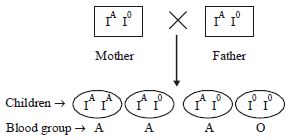
(D) The inheritance of blood groups is determined by multiple alleles. For a child to have blood group '$O$' (genotype $ii$),both parents must contribute an 'i' allele.
Since both parents have blood group '$A$',their genotypes must be $I^A I^A$ or $I^A i$.
If a child has blood group '$O$' $(ii)$,it implies that both parents must carry the recessive 'i' allele.
Therefore,both parents must be heterozygotic for blood group '$A$',with the genotype $I^A i$.
When both parents are $I^A i$,the possible genotypes for the offspring are $I^A I^A$ (blood group $A$),$I^A i$ (blood group $A$),and $ii$ (blood group $O$).
Since both parents have blood group '$A$',their genotypes must be $I^A I^A$ or $I^A i$.
If a child has blood group '$O$' $(ii)$,it implies that both parents must carry the recessive 'i' allele.
Therefore,both parents must be heterozygotic for blood group '$A$',with the genotype $I^A i$.
When both parents are $I^A i$,the possible genotypes for the offspring are $I^A I^A$ (blood group $A$),$I^A i$ (blood group $A$),and $ii$ (blood group $O$).
0 likesView Solution
48
BiologyMediumMCQAIIMS · 2009
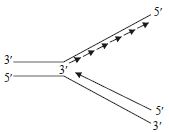
What is the error in the above diagram?
A
Arrows are wrongly depicted
B
Polarity is incorrect
C
Both arrows and polarity are incorrect
D
None of the above
Solution
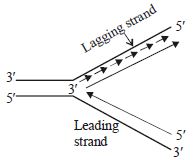
(B) The figure represents a $DNA$ replication fork. $DNA$ replication always occurs in the $5' \rightarrow 3'$ direction.
In the provided diagram,the polarity of the template strands is incorrectly labeled relative to the replication fork.
Specifically,the template strand with $3'$ end at the fork should be the one where the leading strand is synthesized continuously in the $5' \rightarrow 3'$ direction.
Since the strands are antiparallel,the orientation of the $3'$ and $5'$ ends at the replication fork must be consistent with the direction of synthesis for both the leading and lagging strands.
Therefore,the polarity indicated in the diagram is incorrect.
In the provided diagram,the polarity of the template strands is incorrectly labeled relative to the replication fork.
Specifically,the template strand with $3'$ end at the fork should be the one where the leading strand is synthesized continuously in the $5' \rightarrow 3'$ direction.
Since the strands are antiparallel,the orientation of the $3'$ and $5'$ ends at the replication fork must be consistent with the direction of synthesis for both the leading and lagging strands.
Therefore,the polarity indicated in the diagram is incorrect.
0 likesView Solution
49
BiologyMediumMCQAIIMS · 2009
The study of homologous structures in mature organisms provides evidence for the evolutionary relationships among certain groups of organisms. Which field of study includes this evidence of evolution?
A
Comparative cytology
B
Biochemistry
C
Geology
D
Comparative anatomy
Solution
(D) Comparative anatomy is the study of similarities and differences in the structures of different organisms. Homologous structures,which share a common evolutionary origin but may have different functions,are a key focus of this field.
Comparative cytology involves the examination of similarities in the cellular structures of different organisms.
Biochemistry compares $DNA$ sequences and proteins to determine evolutionary relationships.
Geology is the study of the Earth,its physical structure,and the processes acting upon it.
Comparative cytology involves the examination of similarities in the cellular structures of different organisms.
Biochemistry compares $DNA$ sequences and proteins to determine evolutionary relationships.
Geology is the study of the Earth,its physical structure,and the processes acting upon it.
0 likesView Solution
50
BiologyEasyMCQAIIMS · 2009
Darwin's finches were a good example of
A
convergent evolution
B
adaptive radiation
C
mutation
D
none of the above
Solution
(B) During his voyage on the ship $H.M.S.$ Beagle,Charles Darwin visited the Galapagos Islands.
He observed a variety of small black birds,now known as Darwin's finches.
He realized that there were many varieties of finches in the same island.
All the varieties,he conjectured,evolved on the island itself from the original seed-eating features.
From the original insectivorous features,many other forms with altered beaks arose,enabling them to become insectivorous and vegetarian finches.
This process of evolution of different species in a given geographical area starting from a point and literally radiating to other areas of geography (habitats) is called adaptive radiation.
Therefore,Darwin's finches are a classic example of adaptive radiation.
He observed a variety of small black birds,now known as Darwin's finches.
He realized that there were many varieties of finches in the same island.
All the varieties,he conjectured,evolved on the island itself from the original seed-eating features.
From the original insectivorous features,many other forms with altered beaks arose,enabling them to become insectivorous and vegetarian finches.
This process of evolution of different species in a given geographical area starting from a point and literally radiating to other areas of geography (habitats) is called adaptive radiation.
Therefore,Darwin's finches are a classic example of adaptive radiation.
0 likesView Solution
51
BiologyMediumMCQAIIMS · 2009
Assertion: The primitive atmosphere was a reducing one,i.e.,without oxygen.
Reason: In the primitive atmosphere,oxygen was involved in forming ozone.
Reason: In the primitive atmosphere,oxygen was involved in forming ozone.
A
If both Assertion and Reason are correct and the Reason is a correct explanation of the Assertion.
B
If both Assertion and Reason are correct but Reason is not a correct explanation of the Assertion.
C
If the Assertion is correct but Reason is incorrect.
D
If both the Assertion and Reason are incorrect.
Solution
(C) The primitive atmosphere was composed of light atoms like hydrogen,which were highly reactive. These hydrogen atoms combined with all available oxygen atoms to form water $(H_2O)$,leaving no free oxygen in the atmosphere. Therefore,the primitive atmosphere was reducing in nature.
The formation of the ozone layer $(O_3)$ is a result of the modern oxidizing atmosphere,which contains abundant free oxygen produced by photosynthetic organisms. In the primitive atmosphere,there was no free oxygen available to form ozone. Thus,the Reason is incorrect.
The formation of the ozone layer $(O_3)$ is a result of the modern oxidizing atmosphere,which contains abundant free oxygen produced by photosynthetic organisms. In the primitive atmosphere,there was no free oxygen available to form ozone. Thus,the Reason is incorrect.
0 likesView Solution
52
BiologyMediumMCQAIIMS · 2009
Assertion : Java Ape-man, Peking man and Heidelberg man are the fossils of $Homo \text{ } erectus$.
Reason : $Homo \text{ } erectus$ evolved from $Homo \text{ } habilis$.
Reason : $Homo \text{ } erectus$ evolved from $Homo \text{ } habilis$.
A
If both Assertion and Reason are correct and the Reason is a correct explanation of the Assertion.
B
If both Assertion and Reason are correct but Reason is not a correct explanation of the Assertion.
C
If the Assertion is correct but Reason is incorrect.
D
If both the Assertion and Reason are incorrect.
Solution
(B) The fossil of Java Ape-man was discovered from Pleistocene rocks in central Java. The fossil of Peking man was discovered from the limestone caves of Choukoutien near Peking, while that of Heidelberg man was discovered in mid-Pleistocene deposits. All these three fossils are classified under the category of $Homo \text{ } erectus$.
$Homo \text{ } erectus$ appeared about $1.7$ million years ago during the middle Pleistocene epoch. It is widely accepted that $H. \text{ } erectus$ evolved from $Homo \text{ } habilis$.
$H. \text{ } erectus$ individuals were about $1.5-1.8$ meters tall and possessed an erect posture. Their skulls were flatter than those of modern humans. They had protruding jaws, prominent brow ridges, small canines, and large molar teeth. They crafted more elaborate tools from stones and bones, hunted large animals, and likely possessed the knowledge of using fire.
$Homo \text{ } erectus$ appeared about $1.7$ million years ago during the middle Pleistocene epoch. It is widely accepted that $H. \text{ } erectus$ evolved from $Homo \text{ } habilis$.
$H. \text{ } erectus$ individuals were about $1.5-1.8$ meters tall and possessed an erect posture. Their skulls were flatter than those of modern humans. They had protruding jaws, prominent brow ridges, small canines, and large molar teeth. They crafted more elaborate tools from stones and bones, hunted large animals, and likely possessed the knowledge of using fire.
0 likesView Solution
53
BiologyMediumMCQAIIMS · 2009
Where is the antigen-binding site present on the antibody molecule?
A
On light chain as well as on heavy chain
B
On light chain only
C
On variable region and constant region of light chain
D
On heavy chain only
Solution
(A) The $Y$-shaped antibody molecule is composed of $4$ polypeptide chains: two identical light chains and two identical heavy chains,held together by disulphide bonds.
The antigen-binding site (paratope) is formed at the $N$-terminal end of the antibody molecule,where the variable region of a heavy chain and the variable region of a light chain come together.
Therefore,the antigen-binding site involves both the light chain and the heavy chain.
The antigen-binding site (paratope) is formed at the $N$-terminal end of the antibody molecule,where the variable region of a heavy chain and the variable region of a light chain come together.
Therefore,the antigen-binding site involves both the light chain and the heavy chain.
0 likesView Solution
54
BiologyMediumMCQAIIMS · 2009
Assertion : $Cannabis \text{ } sativa$ is a powerful anti-depressant.
Reason : Hashish and Marijuana are derived from it.
Reason : Hashish and Marijuana are derived from it.
A
If both Assertion and Reason are correct and the Reason is a correct explanation of the Assertion.
B
If both Assertion and Reason are correct but Reason is not a correct explanation of the Assertion.
C
If the Assertion is correct but Reason is incorrect.
D
If both the Assertion and Reason are incorrect.
Solution
(D) $Cannabis \text{ } sativa$ (Hemp) is an annual herb belonging to the family $Cannabaceae$. It is primarily known as a source of fiber.
$Cannabis \text{ } sativa$ is not an antidepressant. Antidepressants are psychiatric medications used to treat mood disorders like major depression.
Hashish and Marijuana are indeed drugs derived from this plant. Marijuana is prepared from the dried flowers and leaves, while Hashish is prepared from the resinous extract.
Both substances are hallucinogens that affect the central nervous system and can cause acute panic and anxiety reactions, rather than acting as antidepressants.
Therefore, the Assertion is incorrect, but the Reason is correct.
$Cannabis \text{ } sativa$ is not an antidepressant. Antidepressants are psychiatric medications used to treat mood disorders like major depression.
Hashish and Marijuana are indeed drugs derived from this plant. Marijuana is prepared from the dried flowers and leaves, while Hashish is prepared from the resinous extract.
Both substances are hallucinogens that affect the central nervous system and can cause acute panic and anxiety reactions, rather than acting as antidepressants.
Therefore, the Assertion is incorrect, but the Reason is correct.
0 likesView Solution
55
BiologyEasyMCQAIIMS · 2009
The polymerase chain reaction $(PCR)$ technology was discovered by
A
Kary Mullis
B
Saiki et al.
C
Craig Venter
D
Maxam and Gilbert
Solution
(A) Developed in $1984$ by Kary Mullis,$PCR$ is now a common and often indispensable technique used in medical and biological research labs for a variety of applications.
These include $DNA$ cloning for sequencing,$DNA$-based phylogeny,or functional analysis of genes; the diagnosis of hereditary diseases; the identification of genetic fingerprints (used in forensic sciences and paternity testing); and the detection and diagnosis of infectious diseases.
In $1993$,Mullis won the Nobel Prize in Chemistry for his work on $PCR$.
These include $DNA$ cloning for sequencing,$DNA$-based phylogeny,or functional analysis of genes; the diagnosis of hereditary diseases; the identification of genetic fingerprints (used in forensic sciences and paternity testing); and the detection and diagnosis of infectious diseases.
In $1993$,Mullis won the Nobel Prize in Chemistry for his work on $PCR$.
0 likesView Solution
56
BiologyMediumMCQAIIMS · 2009
Assertion : Restriction enzymes cut the strand of $DNA$ to produce sticky ends.
Reason : Stickiness of the ends facilitates the action of the enzyme $DNA$ polymerase.
Reason : Stickiness of the ends facilitates the action of the enzyme $DNA$ polymerase.
A
If both Assertion and Reason are correct and the Reason is a correct explanation of the Assertion.
B
If both Assertion and Reason are correct but Reason is not a correct explanation of the Assertion.
C
If the Assertion is correct but Reason is incorrect.
D
If both the Assertion and Reason are incorrect.
Solution
(C) Restriction enzymes,a type of endonuclease,function by inspecting the length of a $DNA$ sequence.
Once they find a specific recognition sequence,they bind to it and cut each of the two strands of the double helix at specific points,leaving single-stranded portions at the ends.
This results in overhanging stretches called sticky ends.
These are named so because they form hydrogen bonds with their complementary counterparts; i.e.,they can join similar complementary ends of $DNA$ fragments from other sources with the help of the enzyme $DNA$ ligase.
Therefore,the stickiness of the ends facilitates the action of the enzyme $DNA$ ligase,not $DNA$ polymerase.
Thus,the Assertion is correct,but the Reason is incorrect.
Once they find a specific recognition sequence,they bind to it and cut each of the two strands of the double helix at specific points,leaving single-stranded portions at the ends.
This results in overhanging stretches called sticky ends.
These are named so because they form hydrogen bonds with their complementary counterparts; i.e.,they can join similar complementary ends of $DNA$ fragments from other sources with the help of the enzyme $DNA$ ligase.
Therefore,the stickiness of the ends facilitates the action of the enzyme $DNA$ ligase,not $DNA$ polymerase.
Thus,the Assertion is correct,but the Reason is incorrect.
0 likesView Solution
57
BiologyMediumMCQAIIMS · 2009
Carrying capacity is
A
the capacity of an individual to produce young ones
B
availability of resources in a given habitat to support a certain number of individuals of a population,beyond which no further growth is possible
C
gene frequency from one generation to next
D
gene frequency in the same generation
Solution
(B) Carrying capacity is defined as the maximum number of individuals of a population that can be supported by the available resources in a given habitat.
Beyond this limit,the environment cannot sustain additional individuals,and therefore,no further population growth is possible.
When a population reaches its carrying capacity,the resources become limited,often leading to a state where mortality exceeds or equals natality,preventing further increase.
Beyond this limit,the environment cannot sustain additional individuals,and therefore,no further population growth is possible.
When a population reaches its carrying capacity,the resources become limited,often leading to a state where mortality exceeds or equals natality,preventing further increase.
0 likesView Solution
58
BiologyMediumMCQAIIMS · 2009
An ecosystem,such as an aquarium,is self-sustaining if it involves the interaction between organisms,a flow of energy,and the presence of
A
equal numbers of plants and animals
B
more animals than plants
C
materials cycles
D
pioneer organisms
Solution
(C) For an ecosystem to be self-sustaining,it must maintain a balance where essential nutrients and materials such as oxygen,carbon dioxide,water,and nitrogen are continuously recycled between the biotic components (organisms) and the abiotic environment. This process of nutrient cycling ensures that resources are not depleted,allowing the ecosystem to function independently.
0 likesView Solution
59
BiologyMediumMCQAIIMS · 2009
The graph below shows the changes in two populations of herbivores in a grassy field. $A$ possible reason for these changes is that
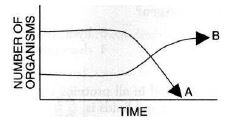
A
all of the plant populations in this habitat decreased.
B
population $B$ competed more successfully for food than population $A$ did.
C
population $A$ produced more offspring than population $B$ did.
D
population $A$ consumed the members of population $B$.
Solution
(B) The graph illustrates a classic case of competitive exclusion. As population $B$ increases,population $A$ decreases over time. This suggests that both populations are competing for the same limited resource (e.g.,grass). Since population $B$ is better adapted or more efficient at utilizing this resource,it outcompetes population $A$,leading to a decline in the number of individuals in population $A$.
0 likesView Solution
60
BiologyMediumMCQAIIMS · 2009
$A$ scorpion stalks,kills,and then eats a spider. Based on its behavior,which ecological terms describe the scorpion?
A
producer,herbivore,decomposer
B
producer,carnivore,heterotroph
C
predator,carnivore,consumer
D
predator,autotroph,herbivore
Solution
(C) scorpion is a $predator$ because it stalks,kills,and eats its prey.
Since it feeds on a spider (another animal),it is classified as a $carnivore$.
Because it ingests organic food rather than producing it,it is a $consumer$.
In contrast,a $producer$ is an $autotroph$ that synthesizes its own food from inorganic substances,a $decomposer$ breaks down dead organic matter,and a $herbivore$ feeds exclusively on plants.
Since it feeds on a spider (another animal),it is classified as a $carnivore$.
Because it ingests organic food rather than producing it,it is a $consumer$.
In contrast,a $producer$ is an $autotroph$ that synthesizes its own food from inorganic substances,a $decomposer$ breaks down dead organic matter,and a $herbivore$ feeds exclusively on plants.
0 likesView Solution
61
BiologyMediumMCQAIIMS · 2009
Assertion : Secondary succession takes place in a recently denuded area.
Reason : It is caused due to the baring of an area.
Reason : It is caused due to the baring of an area.
A
If both Assertion and Reason are correct and the Reason is a correct explanation of the Assertion.
B
If both Assertion and Reason are correct but Reason is not a correct explanation of the Assertion.
C
If the Assertion is correct but Reason is incorrect.
D
If both the Assertion and Reason are incorrect.
Solution
(A) Ecological succession is the process by which the structure of a biological community evolves over time.
Primary succession occurs in areas where no living organisms have previously existed,such as bare rock or newly cooled lava.
Secondary succession occurs in areas where a pre-existing community has been destroyed or removed,such as after a forest fire,flood,or deforestation.
These areas still contain soil,organic debris,and biological propagules (seeds,spores,etc.) from the previous community.
The assertion is correct because secondary succession indeed occurs in recently denuded areas.
The reason is also correct because the process of secondary succession is initiated precisely because an area has been 'bared' (cleared) of its previous vegetation or community due to disturbances like fire or human activity.
Therefore,the reason correctly explains why secondary succession occurs in such areas.
Primary succession occurs in areas where no living organisms have previously existed,such as bare rock or newly cooled lava.
Secondary succession occurs in areas where a pre-existing community has been destroyed or removed,such as after a forest fire,flood,or deforestation.
These areas still contain soil,organic debris,and biological propagules (seeds,spores,etc.) from the previous community.
The assertion is correct because secondary succession indeed occurs in recently denuded areas.
The reason is also correct because the process of secondary succession is initiated precisely because an area has been 'bared' (cleared) of its previous vegetation or community due to disturbances like fire or human activity.
Therefore,the reason correctly explains why secondary succession occurs in such areas.
0 likesView Solution
62
BiologyMediumMCQAIIMS · 2009
Assertion: Excess of nitrates in drinking water is harmful for infants.
Reason: Nitrates are responsible for blue baby syndrome.
Reason: Nitrates are responsible for blue baby syndrome.
A
If both Assertion and Reason are correct and the Reason is a correct explanation of the Assertion.
B
If both Assertion and Reason are correct but Reason is not a correct explanation of the Assertion.
C
If the Assertion is correct but Reason is incorrect.
D
If both the Assertion and Reason are incorrect.
Solution
(A) Excess of nitrates in drinking water is harmful to human health and can be fatal for infants. Excessive use of fertilizers often leads to the accumulation of nitrates in water sources. In infants, excess nitrate reacts with haemoglobin to form non-functional methaemoglobin, which impairs oxygen transport in the blood. This condition is clinically termed as methaemoglobinemia or $blue \text{ } baby \text{ } syndrome$. This disease can damage the respiratory and vascular systems and may lead to severe suffocation.
0 likesView Solution
Vedclass Products
For Students
Vedclass Test Series
Mock tests in real AIIMS style covering Biology with performance analysis. 5-day free trial.
Start Free TrialFor Teachers
Exam Paper Generator
Generate Set A/B/C/D Biology papers from 7.5L+ questions in 2 minutes. 3 chapters free.
Try FreeFor Institutes
Online Exam Module
Run live AIIMS mock exams with unlimited students, 360° analytics & white-label branding.
See DemoFrequently Asked Questions
How many Biology questions are in AIIMS 2009?
There are 62 Biology questions from the AIIMS 2009 paper on Vedclass, each with a detailed step-by-step solution in English.
Are AIIMS 2009 Biology solutions available in English?
Yes. All solutions on this page are in English. You can also switch to English or Hindi using the language buttons above the questions.
Can I practice AIIMS 2009 Biology as a timed test?
Yes. Use the Vedclass Test Series to attempt a full AIIMS mock test covering Biology with time limits and instant score analysis.
Can teachers create Biology papers from AIIMS previous year questions?
Yes. The Vedclass Exam Paper Generator lets teachers mix AIIMS Biology questions and generate Set A/B/C/D papers in minutes.
For Teachers & Institutes
Build a Custom Biology Paper
Pick AIIMS 2009 Biology questions, set difficulty, and generate Set A/B/C/D in 2 minutes.