
ChemistryQ1–77 of 77 questions
Page 1 of 1 · English
1
ChemistryMCQAIIMS · 2006
Thymine is .......
A
$5-$methyluracil
B
$4-$methyluracil
C
$3-$methyluracil
D
$1-$methyluracil
Solution
(A) Thymine,also known as $5-$methyluracil,is one of the four nucleobases in the nucleic acid of $DNA$. It is a pyrimidine derivative. The structure of uracil is $2,4-$dioxopyrimidine,and when a methyl group is attached at the $5^{th}$ position,it forms thymine.
0 likesView Solution
2
ChemistryMCQAIIMS · 2006
The enthalpy change $(\Delta H)$ for the reaction $N_{2(g)} + 3H_{2(g)} \to 2NH_{3(g)}$ is $-92.38 \ kJ$ at $298 \ K$. The internal energy change $\Delta U$ at $298 \ K$ is $...... \ kJ$.
A
$-92.98$
B
$-87.42$
C
$-97.34$
D
$-89.9$
Solution
(B) The relationship between enthalpy change $(\Delta H)$ and internal energy change $(\Delta U)$ is given by the equation: $\Delta H = \Delta U + \Delta n_g RT$.
For the reaction $N_{2(g)} + 3H_{2(g)} \to 2NH_{3(g)}$,the change in the number of moles of gaseous species is $\Delta n_g = n_p - n_r = 2 - (1 + 3) = -2$.
Given $\Delta H = -92.38 \ kJ$,$T = 298 \ K$,and $R = 8.314 \times 10^{-3} \ kJ \ K^{-1} \ mol^{-1}$.
Substituting the values: $-92.38 = \Delta U + (-2) \times (8.314 \times 10^{-3}) \times 298$.
$-92.38 = \Delta U - 4.959$.
$\Delta U = -92.38 + 4.959 = -87.421 \ kJ$.
Thus,the internal energy change is approximately $-87.42 \ kJ$.
For the reaction $N_{2(g)} + 3H_{2(g)} \to 2NH_{3(g)}$,the change in the number of moles of gaseous species is $\Delta n_g = n_p - n_r = 2 - (1 + 3) = -2$.
Given $\Delta H = -92.38 \ kJ$,$T = 298 \ K$,and $R = 8.314 \times 10^{-3} \ kJ \ K^{-1} \ mol^{-1}$.
Substituting the values: $-92.38 = \Delta U + (-2) \times (8.314 \times 10^{-3}) \times 298$.
$-92.38 = \Delta U - 4.959$.
$\Delta U = -92.38 + 4.959 = -87.421 \ kJ$.
Thus,the internal energy change is approximately $-87.42 \ kJ$.
0 likesView Solution
3
ChemistryMCQAIIMS · 2006
$A$ bimetallic strip consists of metals $X$ and $Y$. It is mounted rigidly at the base as shown in the figure. The metal $X$ has a higher coefficient of linear expansion compared to that of metal $Y$. When the bimetallic strip is placed in a cold bath, what happens?
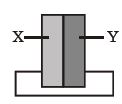
A
It will bend towards the right
B
It will bend towards the left
C
It will not bend but shrink
D
It will neither bend nor shrink
Solution
(B) bimetallic strip works on the principle of different coefficients of linear expansion $(\alpha)$ for different metals.
Given that $\alpha_X > \alpha_Y$.
When the temperature decreases (placed in a cold bath), both metals contract.
The change in length is given by $\Delta L = L_0 \alpha \Delta T$.
Since $\alpha_X > \alpha_Y$, the metal $X$ will contract more than metal $Y$ for the same decrease in temperature $(\Delta T)$.
Because metal $X$ is on the left and contracts more, it will pull the strip towards itself, causing the bimetallic strip to bend towards the left.
Given that $\alpha_X > \alpha_Y$.
When the temperature decreases (placed in a cold bath), both metals contract.
The change in length is given by $\Delta L = L_0 \alpha \Delta T$.
Since $\alpha_X > \alpha_Y$, the metal $X$ will contract more than metal $Y$ for the same decrease in temperature $(\Delta T)$.
Because metal $X$ is on the left and contracts more, it will pull the strip towards itself, causing the bimetallic strip to bend towards the left.
0 likesView Solution
4
ChemistryMCQAIIMS · 2006
If $Alpha$,$Beta$,and $Gamma$ rays carry the same momentum,which has the longest wavelength?
A
Alpha rays
B
Beta rays
C
Gamma rays
D
None,all have the same wavelength
Solution
(D) The de Broglie wavelength $\lambda$ associated with a particle or radiation is given by the relation:
$\lambda = \frac{h}{p}$
where $h$ is Planck's constant and $p$ is the momentum of the particle or radiation.
According to the problem,the $Alpha$,$Beta$,and $Gamma$ rays carry the same momentum $p$.
Since $h$ is a constant and $p$ is the same for all three,the wavelength $\lambda$ must be the same for all of them.
Therefore,all these rays have the same wavelength.
$\lambda = \frac{h}{p}$
where $h$ is Planck's constant and $p$ is the momentum of the particle or radiation.
According to the problem,the $Alpha$,$Beta$,and $Gamma$ rays carry the same momentum $p$.
Since $h$ is a constant and $p$ is the same for all three,the wavelength $\lambda$ must be the same for all of them.
Therefore,all these rays have the same wavelength.
0 likesView Solution
5
ChemistryMCQAIIMS · 2006
The enthalpy change $\left( \Delta H \right)$ for the reaction,$N_{2(g)} + 3H_{2(g)} \to 2NH_{3(g)}$ is $-92.38 \ kJ$ at $298 \ K$. The internal energy change $\left( \Delta U \right)$ at $298 \ K$ is ........ $kJ$.
A
$-92.38$
B
$-87.42$
C
$-97.34$
D
$-89.9$
Solution
(B) The reaction is $N_{2(g)} + 3H_{2(g)} \to 2NH_{3(g)}$.
Given: $\Delta H = -92.38 \ kJ$,$T = 298 \ K$,$R = 8.314 \times 10^{-3} \ kJ \ K^{-1} \ mol^{-1}$.
The relationship between enthalpy change and internal energy change is given by $\Delta H = \Delta U + \Delta n_g RT$.
Calculate the change in the number of moles of gaseous species,$\Delta n_g = n_{products} - n_{reactants} = 2 - (1 + 3) = -2$.
Substitute the values into the equation: $-92.38 = \Delta U + (-2) \times (8.314 \times 10^{-3}) \times 298$.
$-92.38 = \Delta U - 4.959$.
$\Delta U = -92.38 + 4.959 = -87.421 \ kJ \approx -87.42 \ kJ$.
Given: $\Delta H = -92.38 \ kJ$,$T = 298 \ K$,$R = 8.314 \times 10^{-3} \ kJ \ K^{-1} \ mol^{-1}$.
The relationship between enthalpy change and internal energy change is given by $\Delta H = \Delta U + \Delta n_g RT$.
Calculate the change in the number of moles of gaseous species,$\Delta n_g = n_{products} - n_{reactants} = 2 - (1 + 3) = -2$.
Substitute the values into the equation: $-92.38 = \Delta U + (-2) \times (8.314 \times 10^{-3}) \times 298$.
$-92.38 = \Delta U - 4.959$.
$\Delta U = -92.38 + 4.959 = -87.421 \ kJ \approx -87.42 \ kJ$.
0 likesView Solution
6
ChemistryMCQAIIMS · 2006
The enthalpy change $(\Delta H)$ for the reaction,$N_{2(g)} + 3H_{2(g)} \longrightarrow 2NH_{3(g)}$ is $-92.38 \ kJ$ at $298 \ K$. The internal energy change $\Delta U$ at $298 \ K$ is ...... $kJ$.
A
$-92.38$
B
$-87.42$
C
$-97.34$
D
$-89.9$
Solution
(B) The reaction is $N_{2(g)} + 3H_{2(g)} \longrightarrow 2NH_{3(g)}$.
Given,$\Delta H = -92.38 \ kJ$ at $298 \ K$.
The relationship between enthalpy change and internal energy change is given by $\Delta H = \Delta U + \Delta n_g RT$.
Calculate the change in the number of moles of gaseous species,$\Delta n_g = n_{p(g)} - n_{r(g)} = 2 - (1 + 3) = -2$.
Substitute the values into the equation (using $R = 8.314 \ J \ K^{-1} \ mol^{-1}$ and converting $\Delta H$ to $J$):
$-92.38 \times 10^3 \ J = \Delta U + (-2) \times 8.314 \times 298$.
$-92380 \ J = \Delta U - 4959.15 \ J$.
$\Delta U = -92380 + 4959.15 = -87420.85 \ J$.
Converting back to $kJ$,$\Delta U \approx -87.42 \ kJ$.
Given,$\Delta H = -92.38 \ kJ$ at $298 \ K$.
The relationship between enthalpy change and internal energy change is given by $\Delta H = \Delta U + \Delta n_g RT$.
Calculate the change in the number of moles of gaseous species,$\Delta n_g = n_{p(g)} - n_{r(g)} = 2 - (1 + 3) = -2$.
Substitute the values into the equation (using $R = 8.314 \ J \ K^{-1} \ mol^{-1}$ and converting $\Delta H$ to $J$):
$-92.38 \times 10^3 \ J = \Delta U + (-2) \times 8.314 \times 298$.
$-92380 \ J = \Delta U - 4959.15 \ J$.
$\Delta U = -92380 + 4959.15 = -87420.85 \ J$.
Converting back to $kJ$,$\Delta U \approx -87.42 \ kJ$.
0 likesView Solution
7
ChemistryMCQAIIMS · 2006
If $Alpha$,$Beta$,and $Gamma$ rays carry the same momentum,which has the longest wavelength?
A
$Alpha$ rays
B
$Beta$ rays
C
$Gamma$ rays
D
None,all have the same wavelength
Solution
(D) According to the de Broglie hypothesis,the wavelength $\lambda$ of a particle is related to its momentum $p$ by the equation $\lambda = \frac{h}{p}$,where $h$ is Planck's constant.
Since the question states that all three types of rays ($Alpha$,$Beta$,and $Gamma$) carry the same momentum $p$,and $h$ is a universal constant,the wavelength $\lambda$ must be the same for all of them.
Therefore,none of them has a longer wavelength than the others; they all have the same wavelength.
Since the question states that all three types of rays ($Alpha$,$Beta$,and $Gamma$) carry the same momentum $p$,and $h$ is a universal constant,the wavelength $\lambda$ must be the same for all of them.
Therefore,none of them has a longer wavelength than the others; they all have the same wavelength.
0 likesView Solution
8
ChemistryMCQAIIMS · 2006
When a $p-n$ diode is reverse biased,then
A
no current flows
B
the depletion region is increased
C
the depletion region is reduced
D
the height of the potential barrier is reduced
Solution
(B) When a $p-n$ junction is reverse biased,the positive terminal of the battery is connected to the $n$-region and the negative terminal to the $p$-region.
This causes the majority charge carriers to move away from the junction,which increases the width of the depletion region.
Consequently,the height of the potential barrier increases,making it more difficult for charge carriers to cross the junction.
This causes the majority charge carriers to move away from the junction,which increases the width of the depletion region.
Consequently,the height of the potential barrier increases,making it more difficult for charge carriers to cross the junction.
0 likesView Solution
9
ChemistryMCQAIIMS · 2006
The enthalpy change $(\Delta H)$ for the reaction,$N_{2(g)} + 3H_{2(g)} \to 2NH_{3(g)}$ is $-92.38 \ kJ$ at $298 \ K$. The internal energy change $\Delta U$ at $298 \ K$ is $..... \ kJ$.
A
$-92.38$
B
$-87.42$
C
$-97.34$
D
$-89.9$
Solution
(B) The relationship between enthalpy change and internal energy change is given by the equation: $\Delta H = \Delta U + \Delta n_g RT$.
Here,$\Delta n_g$ is the change in the number of moles of gaseous species: $\Delta n_g = \sum n_p(g) - \sum n_R(g) = 2 - (1 + 3) = -2 \ mol$.
Rearranging the formula for $\Delta U$: $\Delta U = \Delta H - \Delta n_g RT$.
Substituting the given values: $\Delta U = (-92.38 \ kJ) - (-2 \ mol) \times (8.314 \times 10^{-3} \ kJ \ K^{-1} \ mol^{-1}) \times (298 \ K)$.
$\Delta U = -92.38 \ kJ + 4.955 \ kJ \approx -87.42 \ kJ$.
Here,$\Delta n_g$ is the change in the number of moles of gaseous species: $\Delta n_g = \sum n_p(g) - \sum n_R(g) = 2 - (1 + 3) = -2 \ mol$.
Rearranging the formula for $\Delta U$: $\Delta U = \Delta H - \Delta n_g RT$.
Substituting the given values: $\Delta U = (-92.38 \ kJ) - (-2 \ mol) \times (8.314 \times 10^{-3} \ kJ \ K^{-1} \ mol^{-1}) \times (298 \ K)$.
$\Delta U = -92.38 \ kJ + 4.955 \ kJ \approx -87.42 \ kJ$.
0 likesView Solution
10
ChemistryMCQAIIMS · 2006
Thymine is
A
$5-$methyluracil
B
$4-$methyluracil
C
$3-$methyluracil
D
$1-$methyluracil
Solution
(A) Thymine is one of the four nucleobases in the nucleic acid of $DNA$.
The others are adenine,guanine,and cytosine.
Thymine is also known as $5-$methyluracil,and it is a pyrimidine nucleobase.
The others are adenine,guanine,and cytosine.
Thymine is also known as $5-$methyluracil,and it is a pyrimidine nucleobase.
0 likesView Solution
11
ChemistryMCQAIIMS · 2006
The enthalpy change $(\Delta H)$ for the reaction,$N_{2(g)} + 3H_{2(g)} \rightarrow 2NH_{3(g)}$ is $-92.38 \ kJ$ at $298 \ K$. The internal energy change $\Delta U$ at $298 \ K$ is $... \ kJ$.
A
$-92.38$
B
$-87.42$
C
$-97.34$
D
$-89.9$
Solution
(B) The relationship between enthalpy change $(\Delta H)$ and internal energy change $(\Delta U)$ is given by the equation: $\Delta H = \Delta U + \Delta n_g RT$.
For the reaction $N_{2(g)} + 3H_{2(g)} \rightarrow 2NH_{3(g)}$,the change in the number of gaseous moles is $\Delta n_g = 2 - (1 + 3) = -2$.
Given $\Delta H = -92.38 \ kJ = -92380 \ J$,$R = 8.314 \ J \ K^{-1} \ mol^{-1}$,and $T = 298 \ K$.
Substituting the values: $-92380 = \Delta U + (-2 \times 8.314 \times 298)$.
$-92380 = \Delta U - 4955.144$.
$\Delta U = -92380 + 4955.144 = -87424.856 \ J$.
Converting to $kJ$: $\Delta U \approx -87.42 \ kJ$.
For the reaction $N_{2(g)} + 3H_{2(g)} \rightarrow 2NH_{3(g)}$,the change in the number of gaseous moles is $\Delta n_g = 2 - (1 + 3) = -2$.
Given $\Delta H = -92.38 \ kJ = -92380 \ J$,$R = 8.314 \ J \ K^{-1} \ mol^{-1}$,and $T = 298 \ K$.
Substituting the values: $-92380 = \Delta U + (-2 \times 8.314 \times 298)$.
$-92380 = \Delta U - 4955.144$.
$\Delta U = -92380 + 4955.144 = -87424.856 \ J$.
Converting to $kJ$: $\Delta U \approx -87.42 \ kJ$.
0 likesView Solution
12
ChemistryMCQAIIMS · 2006
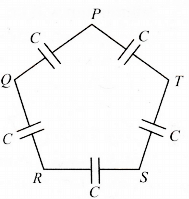
Five capacitors,each of capacitance $C$,are connected as shown in the figure. The ratio of the equivalent capacitance between $P$ and $R$ to the equivalent capacitance between $P$ and $Q$ is:
A
$3:1$
B
$5:2$
C
$2:3$
D
$1:1$
Solution
(C) Let the five capacitors be connected in a pentagonal loop with vertices $P, Q, R, S, T$.
Case $1$: Equivalent capacitance between $P$ and $R$ $(C_{PR})$.
When we look from $P$ to $R$,the path $P-Q-R$ consists of two capacitors in series,so their equivalent is $C/2$. The path $P-T-S-R$ consists of three capacitors in series,so their equivalent is $C/3$.
These two branches are in parallel,so $C_{PR} = C/2 + C/3 = 5C/6$.
Case $2$: Equivalent capacitance between $P$ and $Q$ $(C_{PQ})$.
When we look from $P$ to $Q$,one path is the single capacitor $PQ$ with capacitance $C$. The other path is $P-T-S-R-Q$,which consists of four capacitors in series,so their equivalent is $C/4$.
These two branches are in parallel,so $C_{PQ} = C + C/4 = 5C/4$.
Ratio $= C_{PR} / C_{PQ} = (5C/6) / (5C/4) = (5/6) \times (4/5) = 4/6 = 2:3$.
Case $1$: Equivalent capacitance between $P$ and $R$ $(C_{PR})$.
When we look from $P$ to $R$,the path $P-Q-R$ consists of two capacitors in series,so their equivalent is $C/2$. The path $P-T-S-R$ consists of three capacitors in series,so their equivalent is $C/3$.
These two branches are in parallel,so $C_{PR} = C/2 + C/3 = 5C/6$.
Case $2$: Equivalent capacitance between $P$ and $Q$ $(C_{PQ})$.
When we look from $P$ to $Q$,one path is the single capacitor $PQ$ with capacitance $C$. The other path is $P-T-S-R-Q$,which consists of four capacitors in series,so their equivalent is $C/4$.
These two branches are in parallel,so $C_{PQ} = C + C/4 = 5C/4$.
Ratio $= C_{PR} / C_{PQ} = (5C/6) / (5C/4) = (5/6) \times (4/5) = 4/6 = 2:3$.
0 likesView Solution
13
ChemistryMCQAIIMS · 2006
The fossil bone has a ${}^{14}C:{}^{12}C$ ratio,which is $\left( \frac{1}{16} \right)$ of that in a living animal bone. If the half-life of ${}^{14}C$ is $5730 \text{ years}$,then the age of the fossil bone is ......... $\text{years}$.
A
$11460$
B
$17190$
C
$22920$
D
$45840$
Solution
(C) Let the initial ratio of ${}^{14}C:{}^{12}C$ be $R_0$. In the fossil,the ratio is $R = \frac{1}{16} R_0$.
Since the amount of ${}^{12}C$ remains constant in the bone,the amount of radioactive ${}^{14}C$ must have reduced to $\frac{1}{16}$ of its initial value.
The decay law is given by $N(t) = N_0 \left( \frac{1}{2} \right)^n$,where $n$ is the number of half-lives.
Given $\frac{N(t)}{N_0} = \frac{1}{16} = \left( \frac{1}{2} \right)^4$.
Therefore,the number of half-lives $n = 4$.
The age of the fossil is $t = n \times T_{1/2} = 4 \times 5730 \text{ years} = 22920 \text{ years}$.
Since the amount of ${}^{12}C$ remains constant in the bone,the amount of radioactive ${}^{14}C$ must have reduced to $\frac{1}{16}$ of its initial value.
The decay law is given by $N(t) = N_0 \left( \frac{1}{2} \right)^n$,where $n$ is the number of half-lives.
Given $\frac{N(t)}{N_0} = \frac{1}{16} = \left( \frac{1}{2} \right)^4$.
Therefore,the number of half-lives $n = 4$.
The age of the fossil is $t = n \times T_{1/2} = 4 \times 5730 \text{ years} = 22920 \text{ years}$.
0 likesView Solution
14
ChemistryMediumMCQAIIMS · 2006
The de Broglie wavelength associated with a ball of mass $1 \, kg$ having kinetic energy $0.5 \, J$ is
A
$6.626 \times 10^{-34} \, m$
B
$13.20 \times 10^{-34} \, m$
C
$10.38 \times 10^{-21} \, m$
D
$6.626 \times 10^{-34} \, \mathring{A}$
Solution
(A) The de Broglie wavelength $\lambda$ is given by the formula $\lambda = \frac{h}{p}$,where $p$ is the momentum.
Since kinetic energy $E = \frac{p^2}{2m}$,we have $p = \sqrt{2mE}$.
Substituting this into the de Broglie equation: $\lambda = \frac{h}{\sqrt{2mE}}$.
Given $m = 1 \, kg$,$E = 0.5 \, J$,and $h = 6.626 \times 10^{-34} \, J \cdot s$:
$\lambda = \frac{6.626 \times 10^{-34}}{\sqrt{2 \times 1 \times 0.5}} = \frac{6.626 \times 10^{-34}}{\sqrt{1}} = 6.626 \times 10^{-34} \, m$.
Since kinetic energy $E = \frac{p^2}{2m}$,we have $p = \sqrt{2mE}$.
Substituting this into the de Broglie equation: $\lambda = \frac{h}{\sqrt{2mE}}$.
Given $m = 1 \, kg$,$E = 0.5 \, J$,and $h = 6.626 \times 10^{-34} \, J \cdot s$:
$\lambda = \frac{6.626 \times 10^{-34}}{\sqrt{2 \times 1 \times 0.5}} = \frac{6.626 \times 10^{-34}}{\sqrt{1}} = 6.626 \times 10^{-34} \, m$.
0 likesView Solution
15
ChemistryMediumMCQAIIMS · 2006
Dominance of strong repulsive forces among the molecules of the gas ($Z =$ compressibility factor)
A
Depends on $Z$ and indicated by $Z = 1$
B
Depends on $Z$ and indicated by $Z > 1$
C
Depends on $Z$ and indicated by $Z < 1$
D
Is independent of $Z$
Solution
(B) The compressibility factor is defined as $Z = \frac{PV}{nRT}$.
When repulsive forces are dominant,the molecules push each other away,which makes the gas occupy a larger volume than expected for an ideal gas at the same pressure.
Consequently,the product $PV$ becomes greater than $nRT$.
Therefore,the value of $Z$ becomes greater than $1$ $(Z > 1)$.
When repulsive forces are dominant,the molecules push each other away,which makes the gas occupy a larger volume than expected for an ideal gas at the same pressure.
Consequently,the product $PV$ becomes greater than $nRT$.
Therefore,the value of $Z$ becomes greater than $1$ $(Z > 1)$.
0 likesView Solution
16
ChemistryEasyMCQAIIMS · 2006
For a spontaneous process,the correct statement is
A
Entropy of the system always increases
B
Free energy of the system always increases
C
Total entropy change is always negative
D
Total entropy change is always positive
Solution
(D) For a process to be spontaneous,the total entropy change of the universe,which is the sum of the entropy change of the system and the surroundings,must be positive. Mathematically,$\Delta S_{\text{total}} = \Delta S_{\text{system}} + \Delta S_{\text{surroundings}} > 0$.
0 likesView Solution
17
ChemistryEasyMCQAIIMS · 2006
For a phase change$H _2 O ( l ) \underset{1 bar , 0^{\circ} C }{\rightleftharpoons} H _2 O ( s )$
A
$\Delta G = 0$
B
$\Delta S = 0$
C
$\Delta H = 0$
D
$\Delta U = 0$
Solution
(A) For any phase change occurring at equilibrium,the change in Gibbs free energy is zero.
Since the process $H _2 O (l) \underset{1 \text { bar, } 0^{\circ} C }{\rightleftharpoons} H _2 O (s)$ represents the freezing of water at its normal melting point ( $0^{\circ} C$ and 1 bar ), the system is at equilibrium.
Therefore, $\Delta G=0$.
Since the process $H _2 O (l) \underset{1 \text { bar, } 0^{\circ} C }{\rightleftharpoons} H _2 O (s)$ represents the freezing of water at its normal melting point ( $0^{\circ} C$ and 1 bar ), the system is at equilibrium.
Therefore, $\Delta G=0$.
0 likesView Solution
18
ChemistryMediumMCQAIIMS · 2006
The enthalpy change $(\Delta H)$ for the reaction,$N_{2(g)} + 3H_{2(g)} \to 2NH_{3(g)}$ is $-92.38 \ kJ$ at $298 \ K$. The internal energy change $\Delta U$ at $298 \ K$ is .............. $kJ$
A
$-92.38$
B
$-87.42$
C
$-97.34$
D
$-89.9$
Solution
(B) The relationship between enthalpy change $(\Delta H)$ and internal energy change $(\Delta U)$ is given by the equation: $\Delta H = \Delta U + \Delta n_g RT$.
Rearranging for $\Delta U$: $\Delta U = \Delta H - \Delta n_g RT$.
For the reaction $N_{2(g)} + 3H_{2(g)} \to 2NH_{3(g)}$,the change in the number of gaseous moles is $\Delta n_g = n_p - n_r = 2 - (1 + 3) = -2$.
Given $\Delta H = -92.38 \ kJ$,$R = 8.314 \times 10^{-3} \ kJ \ K^{-1} \ mol^{-1}$,and $T = 298 \ K$.
Substituting the values: $\Delta U = -92.38 - (-2 \times 8.314 \times 10^{-3} \times 298)$.
$\Delta U = -92.38 - (-4.957) = -92.38 + 4.957 = -87.423 \ kJ$.
Thus,$\Delta U \approx -87.42 \ kJ$.
Rearranging for $\Delta U$: $\Delta U = \Delta H - \Delta n_g RT$.
For the reaction $N_{2(g)} + 3H_{2(g)} \to 2NH_{3(g)}$,the change in the number of gaseous moles is $\Delta n_g = n_p - n_r = 2 - (1 + 3) = -2$.
Given $\Delta H = -92.38 \ kJ$,$R = 8.314 \times 10^{-3} \ kJ \ K^{-1} \ mol^{-1}$,and $T = 298 \ K$.
Substituting the values: $\Delta U = -92.38 - (-2 \times 8.314 \times 10^{-3} \times 298)$.
$\Delta U = -92.38 - (-4.957) = -92.38 + 4.957 = -87.423 \ kJ$.
Thus,$\Delta U \approx -87.42 \ kJ$.
0 likesView Solution
19
ChemistryEasyMCQAIIMS · 2006
Assertion : Water in liquid state is more stable than ice at room temperature.
Reason : Water in liquid form has higher entropy than ice.
Reason : Water in liquid form has higher entropy than ice.
A
If both Assertion and Reason are correct and the Reason is a correct explanation of the Assertion.
B
If both Assertion and Reason are correct but Reason is not a correct explanation of the Assertion.
C
If the Assertion is correct but Reason is incorrect.
D
If both the Assertion and Reason are incorrect.
Solution
(A) At room temperature,water is more stable than ice because ice spontaneously melts into liquid water. Thus,the Assertion is true.
Entropy is a measure of the randomness or disorder of a system. Liquid water has a more disordered structure compared to the highly ordered crystalline structure of ice,meaning liquid water has higher entropy. Thus,the Reason is true.
According to the second law of thermodynamics,for a spontaneous process at constant temperature and pressure,the Gibbs free energy change $\Delta G = \Delta H - T\Delta S$ must be negative. Since the melting of ice is spontaneous at room temperature,the increase in entropy $(\Delta S > 0)$ contributes to making $\Delta G$ negative,thereby explaining the stability of the liquid state. Therefore,the Reason correctly explains the Assertion.
Entropy is a measure of the randomness or disorder of a system. Liquid water has a more disordered structure compared to the highly ordered crystalline structure of ice,meaning liquid water has higher entropy. Thus,the Reason is true.
According to the second law of thermodynamics,for a spontaneous process at constant temperature and pressure,the Gibbs free energy change $\Delta G = \Delta H - T\Delta S$ must be negative. Since the melting of ice is spontaneous at room temperature,the increase in entropy $(\Delta S > 0)$ contributes to making $\Delta G$ negative,thereby explaining the stability of the liquid state. Therefore,the Reason correctly explains the Assertion.
0 likesView Solution
20
ChemistryMediumMCQAIIMS · 2006
$40 \ mL$ of $0.1 \ M$ ammonia solution is mixed with $20 \ mL$ of $0.1 \ M \ HCl$. What is the $pH$ of the mixture? ($pK_b$ of ammonia solution is $4.74$).
A
$4.74$
B
$2.26$
C
$9.26$
D
$5$
Solution
(C) The reaction is: $NH_3 + HCl \to NH_4Cl$.
Initial moles of $NH_3 = 40 \ mL \times 0.1 \ M = 4 \ mmol$.
Initial moles of $HCl = 20 \ mL \times 0.1 \ M = 2 \ mmol$.
After the reaction,$2 \ mmol$ of $NH_3$ remains and $2 \ mmol$ of $NH_4Cl$ is formed.
This forms a basic buffer solution.
Using the Henderson-Hasselbalch equation: $pOH = pK_b + \log \frac{[Salt]}{[Base]}$.
Since the volume is the same for both,we can use the ratio of moles: $pOH = 4.74 + \log \frac{2}{2} = 4.74 + 0 = 4.74$.
Finally,$pH = 14 - pOH = 14 - 4.74 = 9.26$.
Initial moles of $NH_3 = 40 \ mL \times 0.1 \ M = 4 \ mmol$.
Initial moles of $HCl = 20 \ mL \times 0.1 \ M = 2 \ mmol$.
After the reaction,$2 \ mmol$ of $NH_3$ remains and $2 \ mmol$ of $NH_4Cl$ is formed.
This forms a basic buffer solution.
Using the Henderson-Hasselbalch equation: $pOH = pK_b + \log \frac{[Salt]}{[Base]}$.
Since the volume is the same for both,we can use the ratio of moles: $pOH = 4.74 + \log \frac{2}{2} = 4.74 + 0 = 4.74$.
Finally,$pH = 14 - pOH = 14 - 4.74 = 9.26$.
0 likesView Solution
21
ChemistryMediumMCQAIIMS · 2006
Borax is used as a cleansing agent because on dissolving in water it gives:
A
Alkaline solution
B
Acidic solution
C
Bleaching solution
D
Colloidal solution
Solution
(A) Borax is $Na_2B_4O_7 \cdot 10H_2O$. It gives an alkaline solution upon dissolution in water because it is a salt of a strong base $(NaOH)$ and a weak acid $(H_3BO_3)$.
The hydrolysis reaction is:
$Na_2B_4O_7 + 7H_2O \to 2NaOH + 4H_3BO_3$
Since $NaOH$ is a strong base,the resulting solution is alkaline,which helps in cleaning.
The hydrolysis reaction is:
$Na_2B_4O_7 + 7H_2O \to 2NaOH + 4H_3BO_3$
Since $NaOH$ is a strong base,the resulting solution is alkaline,which helps in cleaning.
0 likesView Solution
22
ChemistryMCQAIIMS · 2006
Assertion : Silicones are hydrophobic in nature.
Reason : $Si-O-Si$ linkages are moisture sensitive.
Reason : $Si-O-Si$ linkages are moisture sensitive.
A
If both Assertion and Reason are correct and the Reason is a correct explanation of the Assertion.
B
If both Assertion and Reason are correct but Reason is not a correct explanation of the Assertion.
C
If the Assertion is correct but Reason is incorrect.
D
If both the Assertion and Reason are incorrect.
Solution
(C) Silicones are hydrophobic in nature,meaning they are water-repellent. This is because the organic groups attached to the silicon atoms make the molecule non-polar and water-repellent. Thus,the assertion is true.
The $Si-O-Si$ linkages in silicones are highly stable and resistant to hydrolysis by moisture. Therefore,the reason is false.
The $Si-O-Si$ linkages in silicones are highly stable and resistant to hydrolysis by moisture. Therefore,the reason is false.
0 likesView Solution
23
ChemistryDifficultMCQAIIMS · 2006
Assertion : Addition of $HBr$ on $2-$butene gives two isomeric products.
Reason : Addition of $HBr$ on $2-$butene follows Markovnikov rule.
Reason : Addition of $HBr$ on $2-$butene follows Markovnikov rule.
A
If both Assertion and Reason are correct and the Reason is a correct explanation of the Assertion.
B
If both Assertion and Reason are correct but Reason is not a correct explanation of the Assertion.
C
If the Assertion is correct but Reason is incorrect.
D
If both the Assertion and Reason are incorrect.
Solution
(C) $2-$butene $(CH_3-CH=CH-CH_3)$ is a symmetrical alkene.
Upon addition of $HBr$,it forms $2-$bromobutane $(CH_3-CH_2-CH(Br)-CH_3)$.
The carbon atom attached to the bromine atom is a chiral center,meaning the product exists as a pair of enantiomers (optical isomers).
Therefore,the Assertion is correct.
Since $2-$butene is a symmetrical alkene,the addition of $HBr$ does not require the application of Markovnikov's rule to determine the regiochemistry,as both carbons of the double bond are equivalent.
Therefore,the Reason is incorrect.
Upon addition of $HBr$,it forms $2-$bromobutane $(CH_3-CH_2-CH(Br)-CH_3)$.
The carbon atom attached to the bromine atom is a chiral center,meaning the product exists as a pair of enantiomers (optical isomers).
Therefore,the Assertion is correct.
Since $2-$butene is a symmetrical alkene,the addition of $HBr$ does not require the application of Markovnikov's rule to determine the regiochemistry,as both carbons of the double bond are equivalent.
Therefore,the Reason is incorrect.
0 likesView Solution
24
ChemistryMediumMCQAIIMS · 2006
The compound,found in nature in gas phase but ionic in solid state is
A
$PCl_5$
B
$CCl_4$
C
$PCl_3$
D
$POCl_3$
Solution
(A) $PCl_5$ exists as a covalent molecule in the gas phase.
However,in the solid state,it exists in an ionic form as $[PCl_4]^+ [PCl_6]^-$.
The cation $[PCl_4]^+$ has a tetrahedral geometry,while the anion $[PCl_6]^-$ has an octahedral geometry.
However,in the solid state,it exists in an ionic form as $[PCl_4]^+ [PCl_6]^-$.
The cation $[PCl_4]^+$ has a tetrahedral geometry,while the anion $[PCl_6]^-$ has an octahedral geometry.
0 likesView Solution
25
ChemistryDifficultMCQAIIMS · 2006
Assertion : Silicones are hydrophobic in nature.
Reason : $Si-O-Si$ linkages are moisture sensitive.
Reason : $Si-O-Si$ linkages are moisture sensitive.
A
If both Assertion and Reason are correct and the Reason is a correct explanation of the Assertion.
B
If both Assertion and Reason are correct but Reason is not a correct explanation of the Assertion.
C
If the Assertion is correct but Reason is incorrect.
D
If both the Assertion and Reason are incorrect.
Solution
(C) Silicones are synthetic organosilicon polymers with the general formula $(R_2SiO)_n$.
They have a backbone of alternating silicon and oxygen atoms with organic side groups attached to the silicon atoms.
These organic groups (like alkyl groups) make the surface of silicones water-repellent or hydrophobic.
Therefore,the Assertion is correct.
However,the $Si-O-Si$ linkages in silicones are highly stable and are not moisture sensitive; in fact,they are resistant to water.
Thus,the Reason is incorrect.
They have a backbone of alternating silicon and oxygen atoms with organic side groups attached to the silicon atoms.
These organic groups (like alkyl groups) make the surface of silicones water-repellent or hydrophobic.
Therefore,the Assertion is correct.
However,the $Si-O-Si$ linkages in silicones are highly stable and are not moisture sensitive; in fact,they are resistant to water.
Thus,the Reason is incorrect.
0 likesView Solution
26
ChemistryMediumMCQAIIMS · 2006
Among the following,which one can have a meso form?
A
$CH_3CH(OH)CH(Cl)C_2H_5$
B
$CH_3CH(OH)CH(OH)CH_3$
C
$C_2H_5CH(OH)CH(OH)CH_3$
D
$HOCH_2CH(Cl)CH_3$
Solution
(B) meso compound is an optically inactive molecule that contains chiral centers but also possesses an internal plane of symmetry or a center of symmetry.
For a molecule to exhibit a meso form,it must have at least two identical chiral centers and a symmetric structure.
In $CH_3CH(OH)CH(OH)CH_3$ (butane$-2,3-$diol),the two central carbons are chiral and identical. In the eclipsed conformation,it can have a plane of symmetry,making it a meso compound.
For a molecule to exhibit a meso form,it must have at least two identical chiral centers and a symmetric structure.
In $CH_3CH(OH)CH(OH)CH_3$ (butane$-2,3-$diol),the two central carbons are chiral and identical. In the eclipsed conformation,it can have a plane of symmetry,making it a meso compound.
0 likesView Solution
27
ChemistryMediumMCQAIIMS · 2006
Assertion : $Sb_2S_3$ is not soluble in yellow ammonium sulphide. Reason : The common ion effect due to $S^{2-}$ ions reduces the solubility of $Sb_2S_3$.
A
If both Assertion and Reason are correct and the Reason is a correct explanation of the Assertion.
B
If both Assertion and Reason are correct but Reason is not a correct explanation of the Assertion.
C
If the Assertion is correct but Reason is incorrect.
D
If both the Assertion and Reason are incorrect.
Solution
(D) Antimony sulphide $(Sb_2S_3)$ is soluble in yellow ammonium sulphide $( (NH_4)_2S_x )$ to form soluble ammonium thioantimonate $( (NH_4)_3SbS_4 )$.
The chemical reaction is: $Sb_2S_3 + 3(NH_4)_2S + 2S \longrightarrow 2(NH_4)_3SbS_4$.
Since $Sb_2S_3$ is soluble,the Assertion is false.
The common ion effect due to $S^{2-}$ ions would generally decrease solubility,but it is not the reason for the behavior of $Sb_2S_3$ in this context,and the premise of the Assertion itself is incorrect. Thus,both the Assertion and the Reason are incorrect.
The chemical reaction is: $Sb_2S_3 + 3(NH_4)_2S + 2S \longrightarrow 2(NH_4)_3SbS_4$.
Since $Sb_2S_3$ is soluble,the Assertion is false.
The common ion effect due to $S^{2-}$ ions would generally decrease solubility,but it is not the reason for the behavior of $Sb_2S_3$ in this context,and the premise of the Assertion itself is incorrect. Thus,both the Assertion and the Reason are incorrect.
0 likesView Solution
28
ChemistryDifficultMCQAIIMS · 2006
Assertion: Change in color of acidic solution of potassium dichromate by breath is used to test drunk drivers.
Reason: Change in color is due to the complexation of alcohol with potassium dichromate.
Reason: Change in color is due to the complexation of alcohol with potassium dichromate.
A
If both Assertion and Reason are correct and the Reason is a correct explanation of the Assertion.
B
If both Assertion and Reason are correct but Reason is not a correct explanation of the Assertion.
C
If the Assertion is correct but Reason is incorrect.
D
If both the Assertion and Reason are incorrect.
Solution
(C) The Assertion is correct because the breathalyzer test uses the oxidation of ethanol by acidic potassium dichromate $(K_2Cr_2O_7)$,which changes color from orange to green as $Cr^{6+}$ is reduced to $Cr^{3+}$.
The Reason is incorrect because the color change is due to a redox reaction (oxidation of alcohol),not complexation.
The chemical reaction is:
$2K_2Cr_2O_7 + 8H_2SO_4 + 3C_2H_5OH \longrightarrow 2K_2SO_4 + 2Cr_2(SO_4)_3 + 3CH_3COOH + 11H_2O$
Therefore,the correct option is $C$.
The Reason is incorrect because the color change is due to a redox reaction (oxidation of alcohol),not complexation.
The chemical reaction is:
$2K_2Cr_2O_7 + 8H_2SO_4 + 3C_2H_5OH \longrightarrow 2K_2SO_4 + 2Cr_2(SO_4)_3 + 3CH_3COOH + 11H_2O$
Therefore,the correct option is $C$.
0 likesView Solution
29
ChemistryMCQAIIMS · 2006
What is common between chloroplasts,chromoplasts and leucoplasts?
A
Ability to multiply by a fission-like process.
B
Possession of thylakoids and grana.
C
Storage of starch,proteins and lipids.
D
Presence of pigments.
Solution
(A) Chloroplasts,chromoplasts,and leucoplasts are all types of plastids.
All plastids originate from proplastids and are considered to have evolved from symbiotic prokaryotes.
Due to this evolutionary origin,they all possess the ability to multiply by a fission-like process.
Leucoplasts are colourless and lack pigments,so option $D$ is incorrect.
Only chloroplasts contain thylakoids and grana,so option $B$ is incorrect.
Leucoplasts are primarily for storage,but chromoplasts and chloroplasts have different primary functions,making option $C$ incorrect.
Therefore,the common feature is their ability to divide by fission.
All plastids originate from proplastids and are considered to have evolved from symbiotic prokaryotes.
Due to this evolutionary origin,they all possess the ability to multiply by a fission-like process.
Leucoplasts are colourless and lack pigments,so option $D$ is incorrect.
Only chloroplasts contain thylakoids and grana,so option $B$ is incorrect.
Leucoplasts are primarily for storage,but chromoplasts and chloroplasts have different primary functions,making option $C$ incorrect.
Therefore,the common feature is their ability to divide by fission.
0 likesView Solution
30
ChemistryMCQAIIMS · 2006
In prokaryotes,chromatophores are
A
specialized granules responsible for colouration of cells.
B
structures responsible for organizing the shape of the organism.
C
inclusion bodies lying free inside the cells for carrying out various metabolic activities.
D
internal membrane system which becomes extensive and complex in photosynthetic bacteria.
Solution
(D) In some prokaryotes like cyanobacteria,there are membranous extensions into the cytoplasm called chromatophores. These structures contain pigments and are involved in photosynthesis. Therefore,they represent an internal membrane system that becomes extensive and complex in photosynthetic bacteria.
0 likesView Solution
31
ChemistryMCQAIIMS · 2006
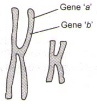
Given below is a highly simplified representation of the human sex chromosomes from a karyotype. The genes 'a' and 'b' could be of
A
Colour blindness and body height
B
Attached ear lobe and rhesus blood group
C
Haemophilia and red-green colour blindness
D
Phenylketonuria and haemophilia
Solution
(C) The image shows the $X$ and $Y$ chromosomes. Genes 'a' and 'b' are located on the $X$ chromosome.
Haemophilia and red-green colour blindness are both $X$-linked recessive disorders,meaning their genes are located on the $X$ chromosome.
Body height is an example of polygenic inheritance,which is autosomal.
Rhesus blood group is determined by the presence or absence of the Rh-protein on the surface of $RBCs$,which is an autosomal trait.
Phenylketonuria $(PKU)$ is an autosomal recessive disorder.
Haemophilia and red-green colour blindness are both $X$-linked recessive disorders,meaning their genes are located on the $X$ chromosome.
Body height is an example of polygenic inheritance,which is autosomal.
Rhesus blood group is determined by the presence or absence of the Rh-protein on the surface of $RBCs$,which is an autosomal trait.
Phenylketonuria $(PKU)$ is an autosomal recessive disorder.
0 likesView Solution
32
ChemistryMCQAIIMS · 2006
Pollution from animal excreta and organic waste from the kitchen can be most profitably minimised by
A
Storing them in underground storage tanks
B
Using them for producing biogas
C
Vermiculture
D
Using them directly as biofertilizers
Solution
(B) Pollution from animal excreta and organic wastes from the kitchen can be most profitably minimised by using them for producing biogas.
These wastes release methane and other gases as a result of the action of anaerobic microorganisms.
Biogas contains methane in bulk and other gases like $CO_{2}$,$H_{2}$,$N_{2}$,and $O_{2}$.
These wastes release methane and other gases as a result of the action of anaerobic microorganisms.
Biogas contains methane in bulk and other gases like $CO_{2}$,$H_{2}$,$N_{2}$,and $O_{2}$.
0 likesView Solution
33
ChemistryMCQAIIMS · 2006
Keystone species deserve protection because these
A
Are capable of surviving in harsh environmental conditions
B
Indicate presence of certain minerals in the soil
C
Have become rare due to over-exploitation
D
Play an important role in supporting other species
Solution
(D) Keystone species deserve protection because they have a significant and disproportionately large impact on the other species living in a community.
Their population size is often low compared to other species,but they play a critical role in regulating the population dynamics of other organisms.
Removal or a decrease in the number of these species in a community causes serious disruption in the structure and function of that ecosystem.
Their population size is often low compared to other species,but they play a critical role in regulating the population dynamics of other organisms.
Removal or a decrease in the number of these species in a community causes serious disruption in the structure and function of that ecosystem.
0 likesView Solution
34
ChemistryDifficultMCQAIIMS · 2006
$XeF_4$ reacting strongly with water gives .......
A
$Xe + O_2$
B
$XeO_3 + O_2 + HF$
C
$Xe + HF + XeO_3$
D
$XeOF_3$
Solution
(C) The hydrolysis of $XeF_4$ with water is a disproportionation reaction.
The chemical equation is: $6XeF_4 + 12H_2O \rightarrow 2Xe + 4XeO_3 + 24HF + 3O_2$.
Thus,the products formed are $Xe$,$XeO_3$,$HF$,and $O_2$.
The chemical equation is: $6XeF_4 + 12H_2O \rightarrow 2Xe + 4XeO_3 + 24HF + 3O_2$.
Thus,the products formed are $Xe$,$XeO_3$,$HF$,and $O_2$.
0 likesView Solution
35
ChemistryDifficultMCQAIIMS · 2006
Among the following,the species having square planar geometry for the central atom are:
$(i)$ $XeF_4$
$(ii)$ $SF_4$
$(iii)$ $[NiCl_4]^{2-}$
$(iv)$ $[PtCl_4]^{2-}$
$(i)$ $XeF_4$
$(ii)$ $SF_4$
$(iii)$ $[NiCl_4]^{2-}$
$(iv)$ $[PtCl_4]^{2-}$
A
$(i)$ and $(iv)$
B
$(i)$ and $(ii)$
C
$(ii)$ and $(iii)$
D
$(iii)$ and $(iv)$
Solution
(A) To determine the geometry,we analyze the hybridization and lone pairs of the central atom:
$1$. $XeF_4$: $Xe$ has $8$ valence electrons. It forms $4$ bonds with $F$ and has $2$ lone pairs. Steric number = $4 + 2 = 6$ ($sp^3d^2$ hybridization). Due to $2$ lone pairs,it adopts a square planar geometry.
$2$. $SF_4$: $S$ has $6$ valence electrons. It forms $4$ bonds with $F$ and has $1$ lone pair. Steric number = $4 + 1 = 5$ ($sp^3d$ hybridization). It adopts a see-saw geometry.
$3$. $[NiCl_4]^{2-}$: $Ni^{2+}$ is a $d^8$ ion. With a weak field ligand $(Cl^-)$,it undergoes $sp^3$ hybridization,resulting in a tetrahedral geometry.
$4$. $[PtCl_4]^{2-}$: $Pt^{2+}$ is a $5d$ series metal ion. It forms square planar complexes due to high crystal field splitting,resulting in $dsp^2$ hybridization.
Therefore,the species with square planar geometry are $(i)$ $XeF_4$ and $(iv)$ $[PtCl_4]^{2-}$.
$1$. $XeF_4$: $Xe$ has $8$ valence electrons. It forms $4$ bonds with $F$ and has $2$ lone pairs. Steric number = $4 + 2 = 6$ ($sp^3d^2$ hybridization). Due to $2$ lone pairs,it adopts a square planar geometry.
$2$. $SF_4$: $S$ has $6$ valence electrons. It forms $4$ bonds with $F$ and has $1$ lone pair. Steric number = $4 + 1 = 5$ ($sp^3d$ hybridization). It adopts a see-saw geometry.
$3$. $[NiCl_4]^{2-}$: $Ni^{2+}$ is a $d^8$ ion. With a weak field ligand $(Cl^-)$,it undergoes $sp^3$ hybridization,resulting in a tetrahedral geometry.
$4$. $[PtCl_4]^{2-}$: $Pt^{2+}$ is a $5d$ series metal ion. It forms square planar complexes due to high crystal field splitting,resulting in $dsp^2$ hybridization.
Therefore,the species with square planar geometry are $(i)$ $XeF_4$ and $(iv)$ $[PtCl_4]^{2-}$.
0 likesView Solution
36
ChemistryEasyMCQAIIMS · 2006
In $[Ag(CN)_2]^-$,the number of $\pi$ bonds is
A
$2$
B
$3$
C
$4$
D
$6$
Solution
(C) The cyanide ion,$CN^-$,contains a triple bond between carbon and nitrogen,which consists of one $\sigma$ bond and two $\pi$ bonds.
In the complex $[Ag(CN)_2]^-$,there are two $CN^-$ ligands.
Therefore,the total number of $\pi$ bonds $= 2 \times 2 = 4$.
In the complex $[Ag(CN)_2]^-$,there are two $CN^-$ ligands.
Therefore,the total number of $\pi$ bonds $= 2 \times 2 = 4$.
0 likesView Solution
37
ChemistryMediumMCQAIIMS · 2006
Assertion : Molecular nitrogen is less reactive than molecular oxygen.
Reason : The bond length of $N_2$ is shorter than that of oxygen.
Reason : The bond length of $N_2$ is shorter than that of oxygen.
A
If both Assertion and Reason and Reason are correct and the Reason is a correct explanation of the Assertion.
B
If both Assertion and Reason are correct but Reason is not a correct explanation of the Assertion.
C
If the Assertion is correct but Reason is incorrect.
D
If both the Assertion and Reason are incorrect.
Solution
$(A)$ The $N_2$ molecule contains a $N \equiv N$ triple bond, while the $O_2$ molecule contains an $O = O$ double bond.
The bond dissociation energy of the $N \equiv N$ triple bond is significantly higher than that of the $O = O$ double bond, making $N_2$ chemically inert or less reactive under normal conditions.
The bond length of $N_2$ $(109.8 \ pm)$ is indeed shorter than that of $O_2$ $(121 \ pm)$ due to the higher bond order.
Since the high bond dissociation energy (a consequence of the short, strong triple bond) is the reason for the low reactivity of $N_2$, the Reason correctly explains the Assertion.
Therefore, both $A$ and $R$ are true and $R$ is the correct explanation of $A$.
The bond dissociation energy of the $N \equiv N$ triple bond is significantly higher than that of the $O = O$ double bond, making $N_2$ chemically inert or less reactive under normal conditions.
The bond length of $N_2$ $(109.8 \ pm)$ is indeed shorter than that of $O_2$ $(121 \ pm)$ due to the higher bond order.
Since the high bond dissociation energy (a consequence of the short, strong triple bond) is the reason for the low reactivity of $N_2$, the Reason correctly explains the Assertion.
Therefore, both $A$ and $R$ are true and $R$ is the correct explanation of $A$.
0 likesView Solution
38
ChemistryDifficultMCQAIIMS · 2006
The pair whose both species are used in antacid medicinal preparations is
A
$NaHCO_3$ and $Mg(OH)_2$
B
$Na_2CO_3$ and $Ca(HCO_3)_2$
C
$Ca(HCO_3)_2$ and $Mg(OH)_2$
D
$Ca(OH)_2$ and $NaHCO_3$
Solution
(A) $NaHCO_3$ (sodium bicarbonate) is commonly used as an antacid to neutralize excess stomach acidity.
$Mg(OH)_2$ (magnesium hydroxide),also known as milk of magnesia,is a mild base used to neutralize stomach acid.
Therefore,both $NaHCO_3$ and $Mg(OH)_2$ are used in antacid medicinal preparations.
$Mg(OH)_2$ (magnesium hydroxide),also known as milk of magnesia,is a mild base used to neutralize stomach acid.
Therefore,both $NaHCO_3$ and $Mg(OH)_2$ are used in antacid medicinal preparations.
0 likesView Solution
39
ChemistryMediumMCQAIIMS · 2006
Among the following,$L$-serine is
A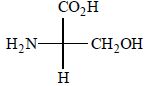
B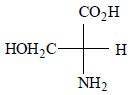
C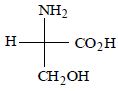
D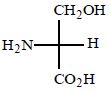
Solution
(A) In $L$-amino acids,the $-NH_2$ group is located on the left side of the chiral carbon in the Fischer projection when the $-COOH$ group is placed at the top.
Serine is $HOCH_2-CH(NH_2)-COOH$.
In option $A$,the $-NH_2$ group is on the left side,which corresponds to the $L$-configuration of serine.
Serine is $HOCH_2-CH(NH_2)-COOH$.
In option $A$,the $-NH_2$ group is on the left side,which corresponds to the $L$-configuration of serine.
0 likesView Solution
40
ChemistryMediumMCQAIIMS · 2006
Methyl-$\alpha-D$-glucoside and methyl-$\beta-D$-glucoside are
A
Epimers
B
Anomers
C
Enantiomers
D
Conformational diastereomers
Solution
(B) In methyl-$\alpha-D$-glucoside,the $-OCH_3$ group at the $C_1$ position is in the $\alpha$-configuration (trans to the $-CH_2OH$ group).
In methyl-$\beta-D$-glucoside,the $-OCH_3$ group at the $C_1$ position is in the $\beta$-configuration (cis to the $-CH_2OH$ group).
Since these two isomers differ in configuration only at the anomeric carbon $(C_1)$,they are classified as anomers.
In methyl-$\beta-D$-glucoside,the $-OCH_3$ group at the $C_1$ position is in the $\beta$-configuration (cis to the $-CH_2OH$ group).
Since these two isomers differ in configuration only at the anomeric carbon $(C_1)$,they are classified as anomers.
0 likesView Solution
41
ChemistryDifficultMCQAIIMS · 2006
Below,some catalysts and corresponding processes/reactions are matched. The mismatch is
A
$[RhCl(PPh_3)_3] :$ Hydrogenation
B
$TiCl_4 + Al(C_2H_5)_3 :$ Polymerization
C
$V_2O_5 :$ Haber-Bosch process
D
Nickel : Hydrogenation
Solution
(C) $V_2O_5$ is used as a catalyst in the contact process for the manufacture of $SO_3$ and subsequently $H_2SO_4$.
In the Haber-Bosch process for the manufacture of $NH_3$,finely divided $Fe$ with molybdenum as a promoter is used.
Therefore,the match $V_2O_5 :$ Haber-Bosch process is incorrect.
In the Haber-Bosch process for the manufacture of $NH_3$,finely divided $Fe$ with molybdenum as a promoter is used.
Therefore,the match $V_2O_5 :$ Haber-Bosch process is incorrect.
0 likesView Solution
42
ChemistryMediumMCQAIIMS · 2006
Which of the following sequence of reactions (reagents) can be used for the conversion of $C_6H_5CH_2CH_3$ into $C_6H_5CH=CH_2$?
A
$SOCl_2 : H_2O$
B
$SO_2Cl_2 : \text{alc. } KOH$
C
$Cl_2 / hv : H_2O$
D
$SOCl_2 : \text{alc. } KOH$
Solution
(B) The conversion of ethylbenzene $(C_6H_5CH_2CH_3)$ to styrene $(C_6H_5CH=CH_2)$ requires a two-step process: halogenation followed by dehydrohalogenation.
Step $1$: Free radical chlorination at the benzylic position using $SO_2Cl_2$ (sulfuryl chloride) yields $1$-chloroethylbenzene $(C_6H_5CHClCH_3)$.
Step $2$: Dehydrohalogenation of $C_6H_5CHClCH_3$ using alcoholic $KOH$ (a strong base) leads to the elimination of $HCl$ to form styrene $(C_6H_5CH=CH_2)$.
Step $1$: Free radical chlorination at the benzylic position using $SO_2Cl_2$ (sulfuryl chloride) yields $1$-chloroethylbenzene $(C_6H_5CHClCH_3)$.
Step $2$: Dehydrohalogenation of $C_6H_5CHClCH_3$ using alcoholic $KOH$ (a strong base) leads to the elimination of $HCl$ to form styrene $(C_6H_5CH=CH_2)$.
0 likesView Solution
43
ChemistryMediumMCQAIIMS · 2006
Assertion : $1, 3-$ Butadiene is the monomer for natural rubber.
Reason : Natural rubber is formed through anionic addition polymerization.
Reason : Natural rubber is formed through anionic addition polymerization.
A
If both Assertion and Reason are correct and the Reason is a correct explanation of the Assertion.
B
If both Assertion and Reason are correct but Reason is not a correct explanation of the Assertion.
C
If the Assertion is correct but Reason is incorrect.
D
If both the Assertion and Reason are incorrect.
Solution
(D) Natural rubber is a polymer of isoprene ($2-$methyl-$1, 3-$butadiene). Thus,the assertion is false.
Natural rubber is formed by the polymerization of isoprene,which typically proceeds via free radical or coordination polymerization,not anionic addition polymerization. Thus,the reason is also false.
Natural rubber is formed by the polymerization of isoprene,which typically proceeds via free radical or coordination polymerization,not anionic addition polymerization. Thus,the reason is also false.
0 likesView Solution
44
ChemistryEasyMCQAIIMS · 2006
The $Ca^{2+}$ and $F^{-}$ ions are located in $CaF_2$ crystal,respectively,at face-centered cubic lattice points and in
A
Tetrahedral voids
B
Half of tetrahedral voids
C
Octahedral voids
D
Half of octahedral voids
Solution
(A) In the $CaF_2$ (fluorite) structure,$Ca^{2+}$ ions form a face-centered cubic $(FCC)$ lattice.
There are $4$ $Ca^{2+}$ ions per unit cell.
The number of tetrahedral voids in an $FCC$ unit cell is $2 \times Z = 2 \times 4 = 8$.
All $8$ tetrahedral voids are occupied by $F^{-}$ ions.
Therefore,$F^{-}$ ions are located in all tetrahedral voids.
There are $4$ $Ca^{2+}$ ions per unit cell.
The number of tetrahedral voids in an $FCC$ unit cell is $2 \times Z = 2 \times 4 = 8$.
All $8$ tetrahedral voids are occupied by $F^{-}$ ions.
Therefore,$F^{-}$ ions are located in all tetrahedral voids.
0 likesView Solution
45
ChemistryEasyMCQAIIMS · 2006
Assertion : Graphite is an example of a tetragonal crystal system.
Reason : For a tetragonal system,$a = b \neq c$,$\alpha = \beta = 90^o$,$\gamma = 120^o$.
Reason : For a tetragonal system,$a = b \neq c$,$\alpha = \beta = 90^o$,$\gamma = 120^o$.
A
If both Assertion and Reason are correct and the Reason is a correct explanation of the Assertion.
B
If both Assertion and Reason are correct but Reason is not a correct explanation of the Assertion.
C
If the Assertion is correct but Reason is incorrect.
D
If both the Assertion and Reason are incorrect.
Solution
(D) Graphite crystallizes in a hexagonal crystal system,not a tetragonal one. For a hexagonal system,the parameters are $a = b \neq c$,$\alpha = \beta = 90^o$,and $\gamma = 120^o$.
For a tetragonal system,the parameters are $a = b \neq c$ and $\alpha = \beta = \gamma = 90^o$.
Since the Assertion incorrectly identifies the crystal system of graphite and the Reason provides incorrect parameters for a tetragonal system,both the Assertion and the Reason are incorrect.
For a tetragonal system,the parameters are $a = b \neq c$ and $\alpha = \beta = \gamma = 90^o$.
Since the Assertion incorrectly identifies the crystal system of graphite and the Reason provides incorrect parameters for a tetragonal system,both the Assertion and the Reason are incorrect.
0 likesView Solution
46
ChemistryAdvancedMCQAIIMS · 2006
$A$ $5\%$ solution (by mass) of cane sugar in water has a freezing point of $271 \ K$ and the freezing point of pure water is $273.15 \ K$. The freezing point of a $5\%$ solution (by mass) of glucose in water is ............. $K$.
A
$271$
B
$273.15$
C
$269.07$
D
$277.23$
Solution
(C) The depression in freezing point is given by $\Delta T_f = K_f \times m$,where $m$ is the molality.
For a $5\%$ solution (by mass),the molality $m = \frac{w_2 \times 1000}{M_2 \times w_1}$.
Since the percentage by mass is the same $(5\%)$,the molality is inversely proportional to the molar mass $(M_2)$ of the solute.
$\Delta T_f \propto \frac{1}{M_2}$.
For cane sugar $(M_1 = 342 \ g/mol)$: $\Delta T_{f1} = 273.15 - 271 = 2.15 \ K$.
For glucose $(M_2 = 180 \ g/mol)$: $\Delta T_{f2} = \Delta T_{f1} \times \frac{M_1}{M_2}$.
$\Delta T_{f2} = 2.15 \times \frac{342}{180} = 2.15 \times 1.9 = 4.085 \ K$.
The freezing point of the glucose solution $= 273.15 - 4.085 = 269.065 \ K \approx 269.07 \ K$.
For a $5\%$ solution (by mass),the molality $m = \frac{w_2 \times 1000}{M_2 \times w_1}$.
Since the percentage by mass is the same $(5\%)$,the molality is inversely proportional to the molar mass $(M_2)$ of the solute.
$\Delta T_f \propto \frac{1}{M_2}$.
For cane sugar $(M_1 = 342 \ g/mol)$: $\Delta T_{f1} = 273.15 - 271 = 2.15 \ K$.
For glucose $(M_2 = 180 \ g/mol)$: $\Delta T_{f2} = \Delta T_{f1} \times \frac{M_1}{M_2}$.
$\Delta T_{f2} = 2.15 \times \frac{342}{180} = 2.15 \times 1.9 = 4.085 \ K$.
The freezing point of the glucose solution $= 273.15 - 4.085 = 269.065 \ K \approx 269.07 \ K$.
0 likesView Solution
47
ChemistryMediumMCQAIIMS · 2006
Assertion : If red blood cells were removed from the body and placed in pure water,pressure inside the cells increases.
Reason : The concentration of salt content in the cells increases.
Reason : The concentration of salt content in the cells increases.
A
If both Assertion and Reason are correct and the Reason is a correct explanation of the Assertion.
B
If both Assertion and Reason are correct but Reason is not a correct explanation of the Assertion.
C
If the Assertion is correct but Reason is incorrect.
D
If both the Assertion and Reason are incorrect.
Solution
(C) The Assertion is true. When red blood cells are placed in pure water,water enters the cells due to osmosis because the concentration of solutes is higher inside the cells than in the surrounding pure water.
This influx of water causes the cells to swell,leading to an increase in the pressure inside the cells.
The Reason is incorrect because the concentration of salt content in the cells does not increase; rather,it decreases as water enters the cell,diluting the internal medium.
Therefore,the Assertion is correct but the Reason is incorrect.
This influx of water causes the cells to swell,leading to an increase in the pressure inside the cells.
The Reason is incorrect because the concentration of salt content in the cells does not increase; rather,it decreases as water enters the cell,diluting the internal medium.
Therefore,the Assertion is correct but the Reason is incorrect.
0 likesView Solution
48
ChemistryMediumMCQAIIMS · 2006
Assertion : The water pouch of an instant cold pack for treating athletic injuries breaks when squeezed and $NH_4NO_3$ dissolves,lowering the temperature.
Reason : Addition of a non-volatile solute into a solvent results in the depression of the freezing point of the solvent.
Reason : Addition of a non-volatile solute into a solvent results in the depression of the freezing point of the solvent.
A
If both Assertion and Reason are correct and the Reason is a correct explanation of the Assertion.
B
If both Assertion and Reason are correct but Reason is not a correct explanation of the Assertion.
C
If the Assertion is correct but Reason is incorrect.
D
If both the Assertion and Reason are incorrect.
Solution
(A) The dissolution of $NH_4NO_3$ in water is an endothermic process,which absorbs heat from the surroundings,thereby lowering the temperature of the pack.
This phenomenon is related to the colligative properties of solutions.
The addition of a non-volatile solute to a solvent leads to a decrease in the vapor pressure,which results in the depression of the freezing point of the solvent.
Since the cooling effect in the cold pack is a practical application of the energy changes associated with dissolving solutes and the principles of colligative properties,both statements are correct and the reason explains the underlying principle.
This phenomenon is related to the colligative properties of solutions.
The addition of a non-volatile solute to a solvent leads to a decrease in the vapor pressure,which results in the depression of the freezing point of the solvent.
Since the cooling effect in the cold pack is a practical application of the energy changes associated with dissolving solutes and the principles of colligative properties,both statements are correct and the reason explains the underlying principle.
0 likesView Solution
49
ChemistryMediumMCQAIIMS · 2006
The charge required for the reduction of $1 \ mol$ of $MnO_4^-$ to $MnO_2$ is ............ $F$.
A
$1$
B
$3$
C
$5$
D
$6$
Solution
(B) The reduction half-reaction for $MnO_4^-$ to $MnO_2$ in an acidic medium is given by:
$MnO_4^- + 4H^{+} + 3e^- \to MnO_2 + 2H_2O$
From the balanced equation,it is clear that $3 \ mol$ of electrons are required to reduce $1 \ mol$ of $MnO_4^-$.
Since the charge of $1 \ mol$ of electrons is $1 \ F$,the total charge required is $3 \ F$.
$MnO_4^- + 4H^{+} + 3e^- \to MnO_2 + 2H_2O$
From the balanced equation,it is clear that $3 \ mol$ of electrons are required to reduce $1 \ mol$ of $MnO_4^-$.
Since the charge of $1 \ mol$ of electrons is $1 \ F$,the total charge required is $3 \ F$.
0 likesView Solution
50
ChemistryMediumMCQAIIMS · 2006
The products formed when an aqueous solution of $NaBr$ is electrolysed in a cell having inert electrodes are
A
$Na$ and $Br_2$
B
$Na$ and $O_2$
C
$H_2, Br_2$ and $NaOH$
D
$H_2$ and $O_2$
Solution
(C) In an aqueous solution,$NaBr$ dissociates as: $NaBr(aq) \to Na^{+}(aq) + Br^{-}(aq)$.
Water also dissociates slightly: $H_2O(l) \rightleftharpoons H^{+}(aq) + OH^{-}(aq)$.
At the cathode,the reduction of water is preferred over $Na^{+}$ ions: $2H_2O(l) + 2e^{-} \to H_2(g) + 2OH^{-}(aq)$.
At the anode,the oxidation of $Br^{-}$ ions is preferred over water: $2Br^{-}(aq) \to Br_2(l) + 2e^{-}$.
The $Na^{+}$ ions remain in the solution and combine with $OH^{-}$ ions to form $NaOH$.
Thus,the final products are $H_2(g)$,$Br_2(l)$,and $NaOH(aq)$.
Water also dissociates slightly: $H_2O(l) \rightleftharpoons H^{+}(aq) + OH^{-}(aq)$.
At the cathode,the reduction of water is preferred over $Na^{+}$ ions: $2H_2O(l) + 2e^{-} \to H_2(g) + 2OH^{-}(aq)$.
At the anode,the oxidation of $Br^{-}$ ions is preferred over water: $2Br^{-}(aq) \to Br_2(l) + 2e^{-}$.
The $Na^{+}$ ions remain in the solution and combine with $OH^{-}$ ions to form $NaOH$.
Thus,the final products are $H_2(g)$,$Br_2(l)$,and $NaOH(aq)$.
0 likesView Solution
51
ChemistryDifficultMCQAIIMS · 2006
Assertion : $E^o$ for $Mn^{3+}/Mn^{2+}$ is more positive than $Cr^{3+}/Cr^{2+}$.
Reason : The third ionization energy of $Mn$ is larger than that of $Cr$.
Reason : The third ionization energy of $Mn$ is larger than that of $Cr$.
A
If both Assertion and Reason are correct and the Reason is a correct explanation of the Assertion.
B
If both Assertion and Reason are correct but Reason is not a correct explanation of the Assertion.
C
If the Assertion is correct but Reason is incorrect.
D
If both the Assertion and Reason are incorrect.
Solution
(A) The standard reduction potential $E^o$ for $Mn^{3+}/Mn^{2+}$ $(+1.51 \ V)$ is much higher than that for $Cr^{3+}/Cr^{2+}$ $(-0.41 \ V)$.
This is because $Mn^{2+}$ has a stable $d^5$ configuration,making the reduction of $Mn^{3+}$ to $Mn^{2+}$ highly favorable.
Conversely,the third ionization energy of $Mn$ is very high because it involves removing an electron from the stable $d^5$ configuration of $Mn^{2+}$.
Since the third ionization energy is a measure of the energy required to remove an electron from the $M^{2+}$ ion,the high value for $Mn$ explains why $Mn^{3+}$ is a strong oxidizing agent.
Therefore,both Assertion and Reason are correct,and the Reason is the correct explanation for the Assertion.
This is because $Mn^{2+}$ has a stable $d^5$ configuration,making the reduction of $Mn^{3+}$ to $Mn^{2+}$ highly favorable.
Conversely,the third ionization energy of $Mn$ is very high because it involves removing an electron from the stable $d^5$ configuration of $Mn^{2+}$.
Since the third ionization energy is a measure of the energy required to remove an electron from the $M^{2+}$ ion,the high value for $Mn$ explains why $Mn^{3+}$ is a strong oxidizing agent.
Therefore,both Assertion and Reason are correct,and the Reason is the correct explanation for the Assertion.
0 likesView Solution
52
ChemistryDifficultMCQAIIMS · 2006
Assertion : For the Daniel cell,$Zn|Zn^{2+} || Cu^{2+}|Cu$ with $E_{cell} = 1.1 \ V$,the application of an opposite potential greater than $1.1 \ V$ results in the flow of electrons from cathode to anode.
Reason : $Zn$ is deposited at the anode,and $Cu$ is deposited at the cathode.
Reason : $Zn$ is deposited at the anode,and $Cu$ is deposited at the cathode.
A
If both Assertion and Reason are correct and the Reason is a correct explanation of the Assertion.
B
If both Assertion and Reason are correct but Reason is not a correct explanation of the Assertion.
C
If the Assertion is correct but Reason is incorrect.
D
If both the Assertion and Reason are incorrect.
Solution
(C) In a Daniel cell,$Zn | Zn^{2+} || Cu^{2+} | Cu$,the standard cell potential is $E_{cell} = 1.1 \ V$.
The oxidation half-reaction at the anode is $Zn \to Zn^{2+} + 2e^-$.
The reduction half-reaction at the cathode is $Cu^{2+} + 2e^- \to Cu$.
When an external potential greater than $1.1 \ V$ is applied,the cell reaction is reversed,and the cell acts as an electrolytic cell.
In this state,electrons flow from the cathode to the anode,and the chemical processes are reversed: $Zn^{2+}$ is reduced to $Zn$ at the anode,and $Cu$ is oxidized to $Cu^{2+}$ at the cathode.
Therefore,the Assertion is correct,but the Reason is incorrect because $Zn$ is not deposited at the anode during the reverse process; rather,$Zn^{2+}$ is reduced to $Zn$ at the anode.
The oxidation half-reaction at the anode is $Zn \to Zn^{2+} + 2e^-$.
The reduction half-reaction at the cathode is $Cu^{2+} + 2e^- \to Cu$.
When an external potential greater than $1.1 \ V$ is applied,the cell reaction is reversed,and the cell acts as an electrolytic cell.
In this state,electrons flow from the cathode to the anode,and the chemical processes are reversed: $Zn^{2+}$ is reduced to $Zn$ at the anode,and $Cu$ is oxidized to $Cu^{2+}$ at the cathode.
Therefore,the Assertion is correct,but the Reason is incorrect because $Zn$ is not deposited at the anode during the reverse process; rather,$Zn^{2+}$ is reduced to $Zn$ at the anode.
0 likesView Solution
53
ChemistryEasyMCQAIIMS · 2006
For the reaction,$2N_2O_5 \to 4NO_2 + O_2$,the rate of reaction is
A
$-\frac{1}{2}\frac{d[N_2O_5]}{dt}$
B
$-2\frac{d[N_2O_5]}{dt}$
C
$\frac{1}{4}\frac{d[NO_2]}{dt}$
D
$4\frac{d[NO_2]}{dt}$
Solution
(A) For a general reaction $aA + bB \to cC + dD$,the rate of reaction is given by:
Rate $= -\frac{1}{a}\frac{d[A]}{dt} = -\frac{1}{b}\frac{d[B]}{dt} = \frac{1}{c}\frac{d[C]}{dt} = \frac{1}{d}\frac{d[D]}{dt}$.
For the given reaction $2N_2O_5 \to 4NO_2 + O_2$,the rate of reaction is:
Rate $= -\frac{1}{2}\frac{d[N_2O_5]}{dt} = \frac{1}{4}\frac{d[NO_2]}{dt} = \frac{d[O_2]}{dt}$.
Rate $= -\frac{1}{a}\frac{d[A]}{dt} = -\frac{1}{b}\frac{d[B]}{dt} = \frac{1}{c}\frac{d[C]}{dt} = \frac{1}{d}\frac{d[D]}{dt}$.
For the given reaction $2N_2O_5 \to 4NO_2 + O_2$,the rate of reaction is:
Rate $= -\frac{1}{2}\frac{d[N_2O_5]}{dt} = \frac{1}{4}\frac{d[NO_2]}{dt} = \frac{d[O_2]}{dt}$.
0 likesView Solution
54
ChemistryMediumMCQAIIMS · 2006
Assertion : According to transition state theory for the formation of an activated complex,one of the vibrational degrees of freedom is converted into a translational degree of freedom.
Reason : Energy of the activated complex is higher than the energy of reactant molecules.
Reason : Energy of the activated complex is higher than the energy of reactant molecules.
A
If both Assertion and Reason are correct and the Reason is a correct explanation of the Assertion.
B
If both Assertion and Reason are correct but Reason is not a correct explanation of the Assertion.
C
If the Assertion is correct but Reason is incorrect.
D
If both the Assertion and Reason are incorrect.
Solution
(B) According to the transition state theory,the formation of an activated complex involves the conversion of one of the vibrational degrees of freedom of the reactant molecules into a translational degree of freedom along the reaction coordinate.
It is also true that the energy of the activated complex is higher than the energy of the reactant molecules,as it represents the energy barrier that must be overcome for the reaction to proceed.
However,the fact that the activated complex has higher energy does not explain why a vibrational degree of freedom is converted into a translational one. Therefore,both statements are correct,but the Reason is not the correct explanation of the Assertion.
It is also true that the energy of the activated complex is higher than the energy of the reactant molecules,as it represents the energy barrier that must be overcome for the reaction to proceed.
However,the fact that the activated complex has higher energy does not explain why a vibrational degree of freedom is converted into a translational one. Therefore,both statements are correct,but the Reason is not the correct explanation of the Assertion.
0 likesView Solution
55
ChemistryMediumMCQAIIMS · 2006
The incorrect statement among the following is:
A
$C_{60}$ is an allotropic form of carbon
B
$O_3$ is an allotropic form of oxygen
C
$S_8$ is the only allotropic form of sulphur
D
Red phosphorus is more stable in air than white phosphorus
Solution
(C) Sulphur exhibits several allotropic forms such as rhombic sulphur $(S_8)$,monoclinic sulphur,and others. Therefore,the statement that $S_8$ is the only allotropic form of sulphur is incorrect.
0 likesView Solution
56
ChemistryMediumMCQAIIMS · 2006
Tincture of iodine is
A
$A$. Aqueous solution of $I_2$
B
$B$. Solution of $I_2$ in aqueous $KI$
C
$C$. Alcoholic solution of $I_2$
D
$D$. Aqueous solution of $KI$
Solution
(C) Tincture of iodine is defined as a $2\%$ solution of iodine $(I_2)$ in a mixture of alcohol and water.
It is primarily used as an antiseptic.
It is primarily used as an antiseptic.
0 likesView Solution
57
ChemistryDifficultMCQAIIMS · 2006
Which two of the following salts are used for preparing iodized salt?
$(i) \, KIO_3$ $(ii) \, KI$
$(iii) \, I_2$ $(iv) \, HI$
$(i) \, KIO_3$ $(ii) \, KI$
$(iii) \, I_2$ $(iv) \, HI$
A
$(i)$ and $(ii)$
B
$(i)$ and $(iii)$
C
$(ii)$ and $(iv)$
D
$(iii)$ and $(iv)$
Solution
(A) Iodized salt is prepared by adding small amounts of iodine compounds to common salt $(NaCl)$.
$KIO_3$ (potassium iodate) and $KI$ (potassium iodide) are the standard compounds used for this purpose because they are stable and provide the necessary iodine content.
$KIO_3$ (potassium iodate) and $KI$ (potassium iodide) are the standard compounds used for this purpose because they are stable and provide the necessary iodine content.
0 likesView Solution
58
ChemistryMediumMCQAIIMS · 2006
The colour imparted by $Co(II)$ compounds to glass is
A
Green
B
Deep blue
C
Yellow
D
Red
Solution
(B) $Co(II)$ compounds,specifically cobalt oxide $(CoO)$,are widely used in the glass industry to impart a characteristic deep blue colour to the glass. This is a well-known property of cobalt ions in silicate matrices.
0 likesView Solution
59
ChemistryDifficultMCQAIIMS · 2006
The pair in which both species have the same magnetic moment (spin-only value) is:
A
$[Cr(H_2O)_6]^{2+}, [CoCl_4]^{2-}$
B
$[Cr(H_2O)_6]^{2+}, [Fe(H_2O)_6]^{2+}$
C
$[Mn(H_2O)_6]^{2+}, [Cr(H_2O)_6]^{2+}$
D
$[CoCl_4]^{2-}, [Fe(H_2O)_6]^{2+}$
Solution
(B) To have the same magnetic moment,the species must have the same number of unpaired electrons $(n)$.
$1$. $[Cr(H_2O)_6]^{2+}$: $Cr^{2+}$ is $3d^4$. It has $4$ unpaired electrons.
$2$. $[CoCl_4]^{2-}$: $Co^{2+}$ is $3d^7$. In a tetrahedral field,it has $3$ unpaired electrons.
$3$. $[Fe(H_2O)_6]^{2+}$: $Fe^{2+}$ is $3d^6$. It has $4$ unpaired electrons.
$4$. $[Mn(H_2O)_6]^{2+}$: $Mn^{2+}$ is $3d^5$. It has $5$ unpaired electrons.
Comparing the number of unpaired electrons,$[Cr(H_2O)_6]^{2+}$ and $[Fe(H_2O)_6]^{2+}$ both have $4$ unpaired electrons. Therefore,they have the same magnetic moment.
$1$. $[Cr(H_2O)_6]^{2+}$: $Cr^{2+}$ is $3d^4$. It has $4$ unpaired electrons.
$2$. $[CoCl_4]^{2-}$: $Co^{2+}$ is $3d^7$. In a tetrahedral field,it has $3$ unpaired electrons.
$3$. $[Fe(H_2O)_6]^{2+}$: $Fe^{2+}$ is $3d^6$. It has $4$ unpaired electrons.
$4$. $[Mn(H_2O)_6]^{2+}$: $Mn^{2+}$ is $3d^5$. It has $5$ unpaired electrons.
Comparing the number of unpaired electrons,$[Cr(H_2O)_6]^{2+}$ and $[Fe(H_2O)_6]^{2+}$ both have $4$ unpaired electrons. Therefore,they have the same magnetic moment.
0 likesView Solution
60
ChemistryDifficultMCQAIIMS · 2006
The number of possible isomers of an octahedral complex $[Co(C_2O_4)_2(NH_3)_2]^-$ is
A
$1$
B
$2$
C
$3$
D
$4$
Solution
(C) The complex $[Co(C_2O_4)_2(NH_3)_2]^-$ is of the type $[M(AA)_2a_2]$,where $AA$ is a bidentate ligand (oxalate) and $a$ is a monodentate ligand (ammonia).
This complex exhibits geometrical isomerism,having two forms: $cis-$ and $trans-$.
The $cis-$ isomer is optically active and exists as a pair of enantiomers ($d$ and $l$ forms).
The $trans-$ isomer is optically inactive (achiral) due to the presence of a plane of symmetry.
Therefore,the total number of isomers is $3$ ($cis-d$,$cis-l$,and $trans-$).
This complex exhibits geometrical isomerism,having two forms: $cis-$ and $trans-$.
The $cis-$ isomer is optically active and exists as a pair of enantiomers ($d$ and $l$ forms).
The $trans-$ isomer is optically inactive (achiral) due to the presence of a plane of symmetry.
Therefore,the total number of isomers is $3$ ($cis-d$,$cis-l$,and $trans-$).
0 likesView Solution
61
ChemistryEasyMCQAIIMS · 2006
The ligands in the anti-cancer drug $cis$-platin are:
A
$NH_3, Cl^-$
B
$NH_3, H_2O$
C
$Cl^-, H_2O$
D
$NO, Cl^-$
Solution
(A) The chemical formula for $cis$-platin is $[PtCl_2(NH_3)_2]$.
In this coordination complex,the central metal ion is $Pt^{2+}$.
The ligands attached to the central metal ion are ammonia $(NH_3)$ and chloride ions $(Cl^-)$.
In this coordination complex,the central metal ion is $Pt^{2+}$.
The ligands attached to the central metal ion are ammonia $(NH_3)$ and chloride ions $(Cl^-)$.
0 likesView Solution
62
ChemistryMediumMCQAIIMS · 2006
Assertion : $[Co(NO_2)_3(NH_3)_3]$ does not show optical isomerism.
Reason : It has a plane of symmetry.
Reason : It has a plane of symmetry.
A
If both Assertion and Reason are correct and the Reason is a correct explanation of the Assertion.
B
If both Assertion and Reason are correct but Reason is not a correct explanation of the Assertion.
C
If the Assertion is correct but Reason is incorrect.
D
If both the Assertion and Reason are incorrect.
Solution
(A) The complex $[Co(NO_2)_3(NH_3)_3]$ exists in two geometric isomeric forms: $fac$ (facial) and $mer$ (meridional).
Both of these isomers possess a plane of symmetry,which makes them achiral.
Since optical isomerism requires the molecule to be chiral (lacking a plane of symmetry),this complex does not exhibit optical isomerism.
Therefore,both the Assertion and the Reason are correct,and the Reason is the correct explanation for the Assertion.
Both of these isomers possess a plane of symmetry,which makes them achiral.
Since optical isomerism requires the molecule to be chiral (lacking a plane of symmetry),this complex does not exhibit optical isomerism.
Therefore,both the Assertion and the Reason are correct,and the Reason is the correct explanation for the Assertion.
0 likesView Solution
63
ChemistryDifficultMCQAIIMS · 2006
The correct increasing order of the reactivity of halides for $S_N1$ reaction is
A
$CH_3-CH_2-X < (CH_3)_2CH-X < CH_2=CH-CH_2-X < PhCH_2-X$
B
$(CH_3)_2CH-X < CH_3-CH_2-X < CH_2=CH-CH_2-X < PhCH_2-X$
C
$PhCH_2-X < (CH_3)_2CH-X < CH_3-CH_2-X < CH_2=CH-CH_2-X$
D
$CH_2=CH-CH_2-X < PhCH_2-X < (CH_3)_2CH-X < CH_3-CH_2-X$
Solution
(A) $S_N1$ reactions proceed via the formation of a carbocation intermediate.
The reactivity toward $S_N1$ is directly proportional to the stability of the carbocation formed.
The stability order of the corresponding carbocations is: $PhCH_2^+ > CH_2=CH-CH_2^+ > (CH_3)_2CH^+ > CH_3-CH_2^+$.
Therefore,the increasing order of reactivity is: $CH_3-CH_2-X < (CH_3)_2CH-X < CH_2=CH-CH_2-X < PhCH_2-X$.
The reactivity toward $S_N1$ is directly proportional to the stability of the carbocation formed.
The stability order of the corresponding carbocations is: $PhCH_2^+ > CH_2=CH-CH_2^+ > (CH_3)_2CH^+ > CH_3-CH_2^+$.
Therefore,the increasing order of reactivity is: $CH_3-CH_2-X < (CH_3)_2CH-X < CH_2=CH-CH_2-X < PhCH_2-X$.
0 likesView Solution
64
ChemistryMediumMCQAIIMS · 2006
Which of the following compounds has the highest boiling point?
A
$CH_3CH_2CH_2Cl$
B
$CH_3CH_2CH_2CH_2Cl$
C
$CH_3CH(CH_3)CH_2Cl$
D
$(CH_3)_3CCl$
Solution
(B) The boiling point of haloalkanes depends on the molecular mass and the extent of branching.
As the molecular mass increases,the boiling point increases.
Among isomers,the boiling point decreases with an increase in branching because branching reduces the surface area,leading to weaker van der Waals forces.
Comparing the given compounds:
$CH_3CH_2CH_2CH_2Cl$ (n-butyl chloride) has the highest molecular mass and is a straight-chain isomer with no branching,resulting in the strongest intermolecular forces.
Therefore,it has the highest boiling point.
As the molecular mass increases,the boiling point increases.
Among isomers,the boiling point decreases with an increase in branching because branching reduces the surface area,leading to weaker van der Waals forces.
Comparing the given compounds:
$CH_3CH_2CH_2CH_2Cl$ (n-butyl chloride) has the highest molecular mass and is a straight-chain isomer with no branching,resulting in the strongest intermolecular forces.
Therefore,it has the highest boiling point.
0 likesView Solution
65
ChemistryMediumMCQAIIMS · 2006
The major product formed in the following reaction: $CH_3CH(Cl)CH_2CH_2OH \xrightarrow{Aq. KOH}$ is
A
$CH_3CH = CHCH_2OH$
B
$CH_2 = CHCH_2CH_2OH$
C
$CH_3CH(O)CH_2CH_2$ (cyclic ether)
D
$CH_3CH(OH)CH_2CH_2OH$
Solution
(D) The reaction involves an aqueous solution of $KOH$,which acts as a source of $OH^-$ ions.
In the presence of $aq. KOH$,the nucleophilic substitution reaction takes place where the chloride ion $(-Cl)$ is replaced by the hydroxyl group $(-OH)$.
Therefore,the reaction is: $CH_3CH(Cl)CH_2CH_2OH + KOH(aq) \rightarrow CH_3CH(OH)CH_2CH_2OH + KCl$.
The major product is $CH_3CH(OH)CH_2CH_2OH$.
In the presence of $aq. KOH$,the nucleophilic substitution reaction takes place where the chloride ion $(-Cl)$ is replaced by the hydroxyl group $(-OH)$.
Therefore,the reaction is: $CH_3CH(Cl)CH_2CH_2OH + KOH(aq) \rightarrow CH_3CH(OH)CH_2CH_2OH + KCl$.
The major product is $CH_3CH(OH)CH_2CH_2OH$.
0 likesView Solution
66
ChemistryDifficultMCQAIIMS · 2006
Assertion : The presence of nitro group facilitates nucleophilic substitution reactions in aryl halides.
Reason : The intermediate carbanion is stabilized due to the presence of nitro group.
Reason : The intermediate carbanion is stabilized due to the presence of nitro group.
A
If both Assertion and Reason are correct and the Reason is a correct explanation of the Assertion.
B
If both Assertion and Reason are correct but Reason is not a correct explanation of the Assertion.
C
If the Assertion is correct but Reason is incorrect.
D
If both the Assertion and Reason are incorrect.
Solution
(A) The nitro group $(-NO_2)$ is a strong electron-withdrawing group $(-EWG)$.
In nucleophilic aromatic substitution,the rate-determining step is the formation of a resonance-stabilized carbanion intermediate (Meisenheimer complex).
The $-NO_2$ group stabilizes this intermediate carbanion by dispersing the negative charge through resonance and inductive effects.
Therefore,the presence of a nitro group at ortho or para positions significantly facilitates nucleophilic substitution reactions in aryl halides.
Thus,both the Assertion and the Reason are correct,and the Reason is the correct explanation of the Assertion.
In nucleophilic aromatic substitution,the rate-determining step is the formation of a resonance-stabilized carbanion intermediate (Meisenheimer complex).
The $-NO_2$ group stabilizes this intermediate carbanion by dispersing the negative charge through resonance and inductive effects.
Therefore,the presence of a nitro group at ortho or para positions significantly facilitates nucleophilic substitution reactions in aryl halides.
Thus,both the Assertion and the Reason are correct,and the Reason is the correct explanation of the Assertion.
0 likesView Solution
67
ChemistryDifficultMCQAIIMS · 2006
The major product obtained on the monobromination (with $Br_2/FeBr_3$) of the following compound $A$ is

A
$2-$bromo$-1-$methoxy$-3-$methylbenzene
B
$4-$bromo$-1-$methoxy$-3-$methylbenzene
C
$5-$bromo$-1-$methoxy$-3-$methylbenzene
D
$2-$bromo$-1-$methoxy$-4-$methylbenzene
Solution
(B) The compound $A$ is $3$-methylanisole ($1$-methoxy-$3$-methylbenzene).
In this molecule,the $-OCH_3$ group is a strong ortho/para-directing group,while the $-CH_3$ group is a weakly ortho/para-directing group.
The $-OCH_3$ group dominates the directing effect.
Electrophilic substitution occurs at the positions ortho and para to the $-OCH_3$ group.
The positions ortho to $-OCH_3$ are $2$ and $6$. Position $2$ is sterically hindered by the $-CH_3$ group at position $3$.
The position para to $-OCH_3$ is position $4$.
Substitution at position $4$ is favored due to less steric hindrance compared to position $2$.
Thus,the major product is $4$-bromo-$1$-methoxy-$3$-methylbenzene.
In this molecule,the $-OCH_3$ group is a strong ortho/para-directing group,while the $-CH_3$ group is a weakly ortho/para-directing group.
The $-OCH_3$ group dominates the directing effect.
Electrophilic substitution occurs at the positions ortho and para to the $-OCH_3$ group.
The positions ortho to $-OCH_3$ are $2$ and $6$. Position $2$ is sterically hindered by the $-CH_3$ group at position $3$.
The position para to $-OCH_3$ is position $4$.
Substitution at position $4$ is favored due to less steric hindrance compared to position $2$.
Thus,the major product is $4$-bromo-$1$-methoxy-$3$-methylbenzene.
0 likesView Solution
68
ChemistryMediumMCQAIIMS · 2006
Isopropylbenzene on air oxidation in the presence of dilute acid gives
A
$C_6H_5COOH$
B
$C_6H_5COCH_3$
C
$C_6H_5CHO$
D
$C_6H_5OH$
Solution
(D) The air oxidation of isopropylbenzene (cumene) in the presence of air followed by treatment with dilute acid is the industrial process for the production of phenol and acetone.
$1$. Isopropylbenzene reacts with $O_2$ to form cumene hydroperoxide.
$2$. Cumene hydroperoxide,upon treatment with dilute acid $(H^+)$,undergoes rearrangement to yield phenol $(C_6H_5OH)$ and acetone $(CH_3COCH_3)$.
The reaction is:
$C_6H_5CH(CH_3)_2 + O_2 \xrightarrow{H^+} C_6H_5OH + CH_3COCH_3$
Therefore,the correct option is $D$.
$1$. Isopropylbenzene reacts with $O_2$ to form cumene hydroperoxide.
$2$. Cumene hydroperoxide,upon treatment with dilute acid $(H^+)$,undergoes rearrangement to yield phenol $(C_6H_5OH)$ and acetone $(CH_3COCH_3)$.
The reaction is:
$C_6H_5CH(CH_3)_2 + O_2 \xrightarrow{H^+} C_6H_5OH + CH_3COCH_3$
Therefore,the correct option is $D$.
0 likesView Solution
69
ChemistryDifficultMCQAIIMS · 2006
The following sequence of reactions on $A$ gives:
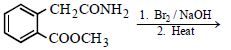
A
$A$ cyclic anhydride
B
$A$ cyclic imide
C
$A$ cyclic amide (lactam)
D
$A$ cyclic ketone
Solution
(C) The reaction sequence is as follows:
$1$. The starting material is methyl $2$-(carbamoylmethyl)benzoate.
$2$. Treatment with $Br_2/NaOH$ (Hofmann bromamide degradation) converts the amide group $(-CONH_2)$ into a primary amine group $(-NH_2)$.
$3$. The resulting intermediate is methyl $2$-(aminomethyl)benzoate.
$4$. Upon heating,this intermediate undergoes intramolecular cyclization (nucleophilic acyl substitution) where the amino group attacks the ester carbonyl,eliminating methanol $(CH_3OH)$ to form a cyclic amide,specifically a lactam (isoindolin$-1-$one).
$1$. The starting material is methyl $2$-(carbamoylmethyl)benzoate.
$2$. Treatment with $Br_2/NaOH$ (Hofmann bromamide degradation) converts the amide group $(-CONH_2)$ into a primary amine group $(-NH_2)$.
$3$. The resulting intermediate is methyl $2$-(aminomethyl)benzoate.
$4$. Upon heating,this intermediate undergoes intramolecular cyclization (nucleophilic acyl substitution) where the amino group attacks the ester carbonyl,eliminating methanol $(CH_3OH)$ to form a cyclic amide,specifically a lactam (isoindolin$-1-$one).
0 likesView Solution
70
ChemistryDifficultMCQAIIMS · 2006
Nitrobenzene on treatment with zinc dust and aqueous ammonium chloride gives
A
$C_6H_5N = NC_6H_5$
B
$C_6H_5NH_2$
C
$C_6H_5NO$
D
$C_6H_5NHOH$
Solution
(D) When nitrobenzene $(C_6H_5NO_2)$ is treated with zinc dust and aqueous ammonium chloride $(NH_4Cl)$,it undergoes partial reduction to form phenylhydroxylamine $(C_6H_5NHOH)$.
This is a selective reduction reaction where the nitro group is reduced to a hydroxylamine group instead of being fully reduced to an amine.
This is a selective reduction reaction where the nitro group is reduced to a hydroxylamine group instead of being fully reduced to an amine.
0 likesView Solution
71
ChemistryMediumMCQAIIMS · 2006
Assertion : Anilinium chloride is more acidic than ammonium chloride.
Reason : Anilinium ion is resonance stabilized.
Reason : Anilinium ion is resonance stabilized.
A
If both Assertion and Reason are correct and the Reason is a correct explanation of the Assertion.
B
If both Assertion and Reason are correct but Reason is not a correct explanation of the Assertion.
C
If the Assertion is correct but Reason is incorrect.
D
If both the Assertion and Reason are incorrect.
Solution
(C) The assertion is correct: Anilinium chloride $(C_6H_5NH_3^+Cl^-)$ is more acidic than ammonium chloride $(NH_4^+Cl^-)$. This is because the conjugate base of anilinium ion,which is aniline $(C_6H_5NH_2)$,is resonance stabilized by the benzene ring.
The reason is incorrect: The anilinium ion itself is not resonance stabilized because the nitrogen atom is $sp^3$ hybridized and cannot participate in resonance with the benzene ring's $\pi$-system. The resonance stabilization occurs in the conjugate base (aniline) after the loss of a proton.
The reason is incorrect: The anilinium ion itself is not resonance stabilized because the nitrogen atom is $sp^3$ hybridized and cannot participate in resonance with the benzene ring's $\pi$-system. The resonance stabilization occurs in the conjugate base (aniline) after the loss of a proton.
0 likesView Solution
72
ChemistryMediumMCQAIIMS · 2006
The pair in which both species have iron is
A
Nitrogenase,cytochromes
B
Carboxypeptidase,haemoglobin
C
Haemocyanin,nitrogenase
D
Haemoglobin,cytochromes
Solution
(D) Haemoglobin contains iron as the central metal ion in the heme group. Cytochromes are iron-containing hemoproteins that act as electron carriers. Therefore,both $Haemoglobin$ and $cytochromes$ contain iron.
0 likesView Solution
73
ChemistryDifficultMCQAIIMS · 2006
Lysine is least soluble in water in the $pH$ range:
A
$3$ to $4$
B
$5$ to $6$
C
$9$ to $10$
D
$11$ to $12$
Solution
(C) Lysine is a basic amino acid with two amino groups and one carboxyl group.
Its isoelectric point $(pI)$ is approximately $9.74$.
An amino acid is least soluble in water at its isoelectric point because the net charge on the molecule is zero,leading to minimum electrostatic repulsion between molecules.
However,in the context of standard textbook questions regarding lysine,the range $9-10$ is often cited as the region where it approaches its isoelectric state.
Its isoelectric point $(pI)$ is approximately $9.74$.
An amino acid is least soluble in water at its isoelectric point because the net charge on the molecule is zero,leading to minimum electrostatic repulsion between molecules.
However,in the context of standard textbook questions regarding lysine,the range $9-10$ is often cited as the region where it approaches its isoelectric state.
0 likesView Solution
74
ChemistryEasyMCQAIIMS · 2006
Thymine is
A
$5-$ Methyluracil
B
$4-$ Methyluracil
C
$3-$ Methyluracil
D
$1-$ Methyluracil
Solution
(A) Thymine is $5-$ methyluracil. It is a pyrimidine nucleobase found in $DNA$.
0 likesView Solution
75
ChemistryMediumMCQAIIMS · 2006
Assertion : In the iodometric titration,starch is used as an indicator.
Reason : Starch is a polysaccharide.
Reason : Starch is a polysaccharide.
A
If both Assertion and Reason are correct and the Reason is a correct explanation of the Assertion.
B
If both Assertion and Reason are correct but Reason is not a correct explanation of the Assertion.
C
If the Assertion is correct but Reason is incorrect.
D
If both the Assertion and Reason are incorrect.
Solution
(B) Starch is used as an indicator in iodometric titration because it forms a deep blue-colored complex with $I_2$ (iodine).
Starch is indeed a polysaccharide,but this chemical property (being a polysaccharide) is not the reason why it acts as an indicator in this specific titration.
Therefore,both statements are correct,but the Reason is not the correct explanation for the Assertion.
Starch is indeed a polysaccharide,but this chemical property (being a polysaccharide) is not the reason why it acts as an indicator in this specific titration.
Therefore,both statements are correct,but the Reason is not the correct explanation for the Assertion.
0 likesView Solution
76
ChemistryMediumMCQAIIMS · 2006
Assertion : $K_2Cr_2O_7$ is used as a primary standard in volumetric analysis.
Reason : It has a good solubility in water.
Reason : It has a good solubility in water.
A
If both Assertion and Reason are correct and the Reason is a correct explanation of the Assertion.
B
If both Assertion and Reason are correct but Reason is not a correct explanation of the Assertion.
C
If the Assertion is correct but Reason is incorrect.
D
If both the Assertion and Reason are incorrect.
Solution
(C) $K_2Cr_2O_7$ is used as a primary standard in volumetric analysis because it is available in a high state of purity,is stable,and its standard solution can be prepared accurately. While it is soluble in water,its suitability as a primary standard is due to its purity and stability,not just its solubility. Therefore,the Assertion is correct,but the Reason is incorrect.
0 likesView Solution
77
ChemistryMediumMCQAIIMS · 2006
Assertion : $Fe^{3+}$ can be used for coagulation of $As_2S_3$ sol.
Reason : $Fe^{3+}$ reacts with $As_2S_3$ to give $Fe_2S_3$.
Reason : $Fe^{3+}$ reacts with $As_2S_3$ to give $Fe_2S_3$.
A
If both Assertion and Reason are correct and the Reason is a correct explanation of the Assertion.
B
If both Assertion and Reason are correct but Reason is not a correct explanation of the Assertion.
C
If the Assertion is correct but Reason is incorrect.
D
If both the Assertion and Reason are incorrect.
Solution
(C) The $As_2S_3$ sol is negatively charged due to the preferential adsorption of $S^{2-}$ ions on its surface.
According to the Hardy-Schulze law,the coagulating power of an ion increases with the increase in the magnitude of its charge.
$Fe^{3+}$ ions are positively charged and effectively neutralize the negative charge of the $As_2S_3$ sol particles,leading to coagulation.
The reason provided,that $Fe^{3+}$ reacts with $As_2S_3$ to form $Fe_2S_3$,is chemically incorrect as coagulation is a surface phenomenon involving charge neutralization,not a chemical reaction forming $Fe_2S_3$.
According to the Hardy-Schulze law,the coagulating power of an ion increases with the increase in the magnitude of its charge.
$Fe^{3+}$ ions are positively charged and effectively neutralize the negative charge of the $As_2S_3$ sol particles,leading to coagulation.
The reason provided,that $Fe^{3+}$ reacts with $As_2S_3$ to form $Fe_2S_3$,is chemically incorrect as coagulation is a surface phenomenon involving charge neutralization,not a chemical reaction forming $Fe_2S_3$.
0 likesView Solution
Vedclass Products
For Students
Vedclass Test Series
Mock tests in real AIIMS style covering Chemistry with performance analysis. 5-day free trial.
Start Free TrialFor Teachers
Exam Paper Generator
Generate Set A/B/C/D Chemistry papers from 7.5L+ questions in 2 minutes. 3 chapters free.
Try FreeFor Institutes
Online Exam Module
Run live AIIMS mock exams with unlimited students, 360° analytics & white-label branding.
See DemoFrequently Asked Questions
How many Chemistry questions are in AIIMS 2006?
There are 77 Chemistry questions from the AIIMS 2006 paper on Vedclass, each with a detailed step-by-step solution in English.
Are AIIMS 2006 Chemistry solutions available in English?
Yes. All solutions on this page are in English. You can also switch to English or Hindi using the language buttons above the questions.
Can I practice AIIMS 2006 Chemistry as a timed test?
Yes. Use the Vedclass Test Series to attempt a full AIIMS mock test covering Chemistry with time limits and instant score analysis.
Can teachers create Chemistry papers from AIIMS previous year questions?
Yes. The Vedclass Exam Paper Generator lets teachers mix AIIMS Chemistry questions and generate Set A/B/C/D papers in minutes.
For Teachers & Institutes
Build a Custom Chemistry Paper
Pick AIIMS 2006 Chemistry questions, set difficulty, and generate Set A/B/C/D in 2 minutes.