
PhysicsQ1–53 of 53 questions
Page 1 of 1 · English
1
PhysicsDifficultMCQAIIMS · 2006
For a given velocity,a projectile has the same range $R$ for two angles of projection. If $t_1$ and $t_2$ are the times of flight in the two cases,then:
A
${t_1}{t_2} \propto {R^2}$
B
${t_1}{t_2} \propto R$
C
${t_1}{t_2} \propto \frac{1}{R}$
D
${t_1}{t_2} \propto \frac{1}{R^2}$
Solution
(B) For a given velocity $u$,the range $R$ is the same for two angles of projection,$\theta$ and $(90^\circ - \theta)$.
The time of flight for angle $\theta$ is $t_1 = \frac{2u \sin \theta}{g}$.
The time of flight for angle $(90^\circ - \theta)$ is $t_2 = \frac{2u \sin(90^\circ - \theta)}{g} = \frac{2u \cos \theta}{g}$.
Multiplying the two times of flight:
$t_1 t_2 = \left( \frac{2u \sin \theta}{g} \right) \left( \frac{2u \cos \theta}{g} \right) = \frac{4u^2 \sin \theta \cos \theta}{g^2}$.
Using the identity $\sin 2\theta = 2 \sin \theta \cos \theta$,we get:
$t_1 t_2 = \frac{2u^2 (2 \sin \theta \cos \theta)}{g^2} = \frac{2(u^2 \sin 2\theta)}{g^2}$.
Since the range $R = \frac{u^2 \sin 2\theta}{g}$,we can substitute this into the equation:
$t_1 t_2 = \frac{2R}{g}$.
Since $g$ is constant,we conclude that $t_1 t_2 \propto R$.
The time of flight for angle $\theta$ is $t_1 = \frac{2u \sin \theta}{g}$.
The time of flight for angle $(90^\circ - \theta)$ is $t_2 = \frac{2u \sin(90^\circ - \theta)}{g} = \frac{2u \cos \theta}{g}$.
Multiplying the two times of flight:
$t_1 t_2 = \left( \frac{2u \sin \theta}{g} \right) \left( \frac{2u \cos \theta}{g} \right) = \frac{4u^2 \sin \theta \cos \theta}{g^2}$.
Using the identity $\sin 2\theta = 2 \sin \theta \cos \theta$,we get:
$t_1 t_2 = \frac{2u^2 (2 \sin \theta \cos \theta)}{g^2} = \frac{2(u^2 \sin 2\theta)}{g^2}$.
Since the range $R = \frac{u^2 \sin 2\theta}{g}$,we can substitute this into the equation:
$t_1 t_2 = \frac{2R}{g}$.
Since $g$ is constant,we conclude that $t_1 t_2 \propto R$.
0 likesView Solution
2
PhysicsEasyMCQAIIMS · 2006
The magnetic moment has dimensions of
A
$[LA]$
B
$[L^2A]$
C
$[LT^{-1}A]$
D
$[L^2T^{-1}A]$
Solution
(B) The magnetic moment $(M)$ of a current-carrying coil is given by the product of the current $(I)$ and the area of the cross-section $(A)$: $M = I \times A$.
The dimension of current $(I)$ is $[A]$.
The dimension of area $(A)$ is $[L^2]$.
Therefore,the dimension of the magnetic moment is $[M] = [A][L^2] = [L^2A]$.
The dimension of current $(I)$ is $[A]$.
The dimension of area $(A)$ is $[L^2]$.
Therefore,the dimension of the magnetic moment is $[M] = [A][L^2] = [L^2A]$.
0 likesView Solution
3
PhysicsEasyMCQAIIMS · 2006
Two spheres of same size,one of mass $2\, kg$ and another of mass $4\, kg$,are dropped simultaneously from the top of Qutab Minar (height $= 72\, m$). When they are $1\, m$ above the ground,the two spheres have the same
A
momentum
B
kinetic energy
C
potential energy
D
acceleration
Solution
(D) When objects are dropped from the same height,they undergo free fall under the influence of gravity.
According to the equations of motion,the acceleration of an object in free fall is independent of its mass and is equal to the acceleration due to gravity,$g$.
Since both spheres are dropped from the same height and are at the same position ($1\, m$ above the ground),they have the same velocity.
However,momentum $(p = mv)$,kinetic energy $(K = \frac{1}{2}mv^2)$,and potential energy $(U = mgh)$ all depend on the mass of the object.
Since the masses are different ($2\, kg$ and $4\, kg$),their momentum,kinetic energy,and potential energy will be different.
Therefore,the only quantity that remains the same for both spheres is their acceleration,which is $g$.
According to the equations of motion,the acceleration of an object in free fall is independent of its mass and is equal to the acceleration due to gravity,$g$.
Since both spheres are dropped from the same height and are at the same position ($1\, m$ above the ground),they have the same velocity.
However,momentum $(p = mv)$,kinetic energy $(K = \frac{1}{2}mv^2)$,and potential energy $(U = mgh)$ all depend on the mass of the object.
Since the masses are different ($2\, kg$ and $4\, kg$),their momentum,kinetic energy,and potential energy will be different.
Therefore,the only quantity that remains the same for both spheres is their acceleration,which is $g$.
0 likesView Solution
4
PhysicsMediumMCQAIIMS · 2006
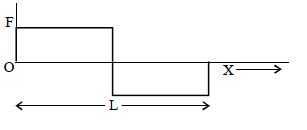
$A$ person used force $(F)$,shown in the figure,to move a load with a constant velocity on a given surface. Identify the correct surface profile.
A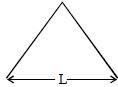
B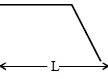
C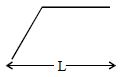
D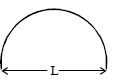
Solution
(A) To move a load of mass $m$ with a constant velocity on an inclined plane of angle $\theta$,the required force $F$ is $mg \sin \theta$.
In the given $F-x$ graph,the force is positive for the first half of the distance $L$ and negative for the second half.
This indicates that for the first half,the load is being pushed up an incline (requiring a positive force $mg \sin \theta$),and for the second half,the load is moving down an incline (where the force required to maintain constant velocity is $-mg \sin \theta$).
The surface profile that consists of an upward incline followed by a downward incline is the triangular profile shown in the first option image (labeled as option $A$ in the context of the provided images).
In the given $F-x$ graph,the force is positive for the first half of the distance $L$ and negative for the second half.
This indicates that for the first half,the load is being pushed up an incline (requiring a positive force $mg \sin \theta$),and for the second half,the load is moving down an incline (where the force required to maintain constant velocity is $-mg \sin \theta$).
The surface profile that consists of an upward incline followed by a downward incline is the triangular profile shown in the first option image (labeled as option $A$ in the context of the provided images).
0 likesView Solution
5
PhysicsEasyMCQAIIMS · 2006
$Assertion$: Use of ball bearings between two moving parts of a machine is a common practice.
$Reason$: Ball bearings reduce vibrations and provide good stability.
$Reason$: Ball bearings reduce vibrations and provide good stability.
A
If both $Assertion$ and $Reason$ are correct and the $Reason$ is a correct explanation of the $Assertion$.
B
If both $Assertion$ and $Reason$ are correct but $Reason$ is not a correct explanation of the $Assertion$.
C
If the $Assertion$ is correct but $Reason$ is incorrect.
D
If both the $Assertion$ and $Reason$ are incorrect.
Solution
(C) The $Assertion$ is correct because ball bearings are widely used in machines to reduce friction between moving parts.
The $Reason$ is incorrect because the primary purpose of using ball bearings is to convert sliding friction into rolling friction,which is significantly smaller than sliding friction. While they may provide stability,they are not primarily used to reduce vibrations in the context of friction reduction.
The $Reason$ is incorrect because the primary purpose of using ball bearings is to convert sliding friction into rolling friction,which is significantly smaller than sliding friction. While they may provide stability,they are not primarily used to reduce vibrations in the context of friction reduction.
0 likesView Solution
6
PhysicsEasyMCQAIIMS · 2006
For an inelastic collision between two spherical rigid bodies:
A
the total kinetic energy is conserved
B
the total potential energy is conserved
C
the linear momentum is not conserved
D
the linear momentum is conserved
Solution
(D) In any collision (elastic or inelastic),the total linear momentum of the system remains conserved,provided no external force acts on the system.
In an inelastic collision,the kinetic energy is not conserved,but the linear momentum is always conserved.
In an inelastic collision,the kinetic energy is not conserved,but the linear momentum is always conserved.
0 likesView Solution
7
PhysicsMediumMCQAIIMS · 2006
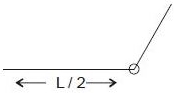
The moment of inertia of a rod of mass $M$ and length $L$ about an axis passing through its centre and perpendicular to it is $\frac{1}{12} ML^2$. The rod is bent in the middle so that the two halves make an angle of $60^o$. The moment of inertia of the bent rod about the same axis (passing through the original centre of the rod) would be:
A
$\frac{1}{48} ML^2$
B
$\frac{1}{12} ML^2$
C
$\frac{1}{24} ML^2$
D
$\frac{ML^2}{8\sqrt{3}}$
Solution
(B) Let the rod be along the $x$-axis initially with its centre at the origin $(0,0)$. The rod consists of two halves,each of mass $m = M/2$ and length $l = L/2$.
When the rod is bent at the centre,the centre of the rod remains at the origin. Let the axis of rotation be the $z$-axis passing through the origin.
The moment of inertia of a rod of mass $m$ and length $l$ about an axis passing through one of its ends and making an angle $\theta$ with the rod is given by $I = \int r^2 dm$,where $r$ is the perpendicular distance from the axis.
For each half of the rod,the distance $r$ of a point at a distance $x$ from the centre along the rod is $r = x \sin(\theta)$,where $\theta$ is the angle between the rod and the axis of rotation. Here,the axis is perpendicular to the original rod,so for the first half,$\theta = 90^o$,and for the second half,the angle changes.
However,a simpler approach: The moment of inertia $I = \int r^2 dm$. Since the distance $r$ of every mass element $dm$ from the axis of rotation remains unchanged when the rod is bent at its centre (the centre point is on the axis),the total moment of inertia remains the same.
Therefore,$I = \frac{1}{12} ML^2$.
When the rod is bent at the centre,the centre of the rod remains at the origin. Let the axis of rotation be the $z$-axis passing through the origin.
The moment of inertia of a rod of mass $m$ and length $l$ about an axis passing through one of its ends and making an angle $\theta$ with the rod is given by $I = \int r^2 dm$,where $r$ is the perpendicular distance from the axis.
For each half of the rod,the distance $r$ of a point at a distance $x$ from the centre along the rod is $r = x \sin(\theta)$,where $\theta$ is the angle between the rod and the axis of rotation. Here,the axis is perpendicular to the original rod,so for the first half,$\theta = 90^o$,and for the second half,the angle changes.
However,a simpler approach: The moment of inertia $I = \int r^2 dm$. Since the distance $r$ of every mass element $dm$ from the axis of rotation remains unchanged when the rod is bent at its centre (the centre point is on the axis),the total moment of inertia remains the same.
Therefore,$I = \frac{1}{12} ML^2$.
0 likesView Solution
8
PhysicsMediumMCQAIIMS · 2006
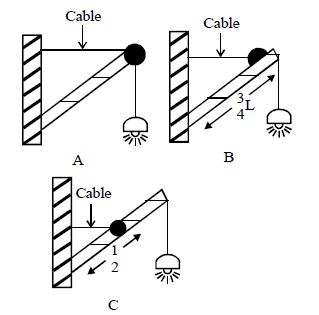
If a street light of mass $M$ is suspended from the end of a uniform rod of length $L$ in different possible patterns as shown in the figure,then
A
Pattern $A$ is more sturdy
B
Pattern $B$ is more sturdy
C
Pattern $C$ is more sturdy
D
All will have same sturdiness
Solution
(A) The torque created due to the weight of the street light remains the same in all three cases because the force (weight $Mg$) and its perpendicular distance from the pivot (the wall hinge) are constant.
This torque is balanced by the torque created by the tension $T$ in the cable.
Let $\tau$ be the torque created by the weight of the lamp,$T$ be the tension in the cable,and $d$ be the perpendicular distance of the cable attachment point from the axis of rotation (the hinge at the wall).
The equilibrium condition is given by $\tau = T \cdot d$.
Since $\tau$ is constant,the tension $T$ will be inversely proportional to the distance $d$ $(T = \tau / d)$.
Therefore,the tension $T$ will be the least when the distance $d$ is the largest.
In pattern $A$,the cable is attached at the end of the rod,providing the maximum perpendicular distance $d$ from the wall.
Since the tension is minimal in pattern $A$,it is the most sturdy configuration.
This torque is balanced by the torque created by the tension $T$ in the cable.
Let $\tau$ be the torque created by the weight of the lamp,$T$ be the tension in the cable,and $d$ be the perpendicular distance of the cable attachment point from the axis of rotation (the hinge at the wall).
The equilibrium condition is given by $\tau = T \cdot d$.
Since $\tau$ is constant,the tension $T$ will be inversely proportional to the distance $d$ $(T = \tau / d)$.
Therefore,the tension $T$ will be the least when the distance $d$ is the largest.
In pattern $A$,the cable is attached at the end of the rod,providing the maximum perpendicular distance $d$ from the wall.
Since the tension is minimal in pattern $A$,it is the most sturdy configuration.
0 likesView Solution
9
PhysicsEasyMCQAIIMS · 2006
$Assertion$ : $A$ judo fighter,in order to throw his opponent onto the mat,tries to initially bend his opponent and then rotate him around his hip.
$Reason$ : As the mass of the opponent is brought closer to the fighter's hip,the moment of inertia of the opponent about the axis of rotation decreases,which makes it easier to rotate the opponent.
$Reason$ : As the mass of the opponent is brought closer to the fighter's hip,the moment of inertia of the opponent about the axis of rotation decreases,which makes it easier to rotate the opponent.
A
If both $Assertion$ and $Reason$ are correct and the $Reason$ is a correct explanation of the $Assertion$.
B
If both $Assertion$ and $Reason$ are correct but $Reason$ is not a correct explanation of the $Assertion$.
C
If the $Assertion$ is correct but $Reason$ is incorrect.
D
If both the $Assertion$ and $Reason$ are incorrect.
Solution
(A) The moment of inertia $I$ of a body is given by $I = \sum m_i r_i^2$,where $r_i$ is the distance of the mass element $m_i$ from the axis of rotation.
By bending the opponent and bringing their mass closer to the hip (the axis of rotation),the average distance $r$ decreases.
As $I \propto r^2$,the moment of inertia of the opponent decreases significantly.
$A$ smaller moment of inertia requires less torque to produce a given angular acceleration,making it easier for the judo fighter to rotate and throw the opponent.
Thus,both the $Assertion$ and $Reason$ are correct,and the $Reason$ is the correct explanation.
By bending the opponent and bringing their mass closer to the hip (the axis of rotation),the average distance $r$ decreases.
As $I \propto r^2$,the moment of inertia of the opponent decreases significantly.
$A$ smaller moment of inertia requires less torque to produce a given angular acceleration,making it easier for the judo fighter to rotate and throw the opponent.
Thus,both the $Assertion$ and $Reason$ are correct,and the $Reason$ is the correct explanation.
0 likesView Solution
10
PhysicsMediumMCQAIIMS · 2006
By sucking through a straw,a student can reduce the pressure in his lungs to $750\, mm$ of $Hg$ (density $= 13.6\, g/cm^3$). Using the straw,he can drink water from a glass up to a maximum depth of ....... $cm$.
A
$10$
B
$75$
C
$13.6$
D
$1.36$
Solution
(C) The atmospheric pressure is $P_{atm} = 760\, mm$ of $Hg$.
The pressure in the lungs is $P_{lungs} = 750\, mm$ of $Hg$.
The pressure difference created is $\Delta P = P_{atm} - P_{lungs} = 760\, mm - 750\, mm = 10\, mm$ of $Hg$.
This pressure difference supports a column of water of height $h$ in the straw.
Using the hydrostatic pressure formula $\Delta P = h_w \rho_w g = h_{Hg} \rho_{Hg} g$,we have:
$h_w \rho_w = h_{Hg} \rho_{Hg}$
Given $h_{Hg} = 10\, mm = 1\, cm$,$\rho_{Hg} = 13.6\, g/cm^3$,and $\rho_w = 1\, g/cm^3$:
$h_w \times 1\, g/cm^3 = 1\, cm \times 13.6\, g/cm^3$
$h_w = 13.6\, cm$.
The pressure in the lungs is $P_{lungs} = 750\, mm$ of $Hg$.
The pressure difference created is $\Delta P = P_{atm} - P_{lungs} = 760\, mm - 750\, mm = 10\, mm$ of $Hg$.
This pressure difference supports a column of water of height $h$ in the straw.
Using the hydrostatic pressure formula $\Delta P = h_w \rho_w g = h_{Hg} \rho_{Hg} g$,we have:
$h_w \rho_w = h_{Hg} \rho_{Hg}$
Given $h_{Hg} = 10\, mm = 1\, cm$,$\rho_{Hg} = 13.6\, g/cm^3$,and $\rho_w = 1\, g/cm^3$:
$h_w \times 1\, g/cm^3 = 1\, cm \times 13.6\, g/cm^3$
$h_w = 13.6\, cm$.
0 likesView Solution
11
PhysicsMediumMCQAIIMS · 2006
$Assertion :$ $A$ thin stainless steel needle can float on a still water surface.
$Reason :$ Any object floats when the buoyancy force balances the weight of the object.
$Reason :$ Any object floats when the buoyancy force balances the weight of the object.
A
If both $Assertion$ and $Reason$ are correct and the $Reason$ is a correct explanation of the $Assertion$.
B
If both $Assertion$ and $Reason$ are correct but $Reason$ is not a correct explanation of the $Assertion$.
C
If the $Assertion$ is correct but $Reason$ is incorrect.
D
If both the $Assertion$ and $Reason$ are incorrect.
Solution
(B) The $Assertion$ is correct because a thin stainless steel needle can float on a still water surface due to the surface tension of water.
The $Reason$ is also a correct statement in physics,as an object floats when the buoyant force equals its weight (Archimedes' Principle).
However,the $Reason$ is not the correct explanation for the $Assertion$. The needle floats not because of buoyancy,but because the surface tension force acts upwards to balance the weight of the needle.
Therefore,both are correct,but the $Reason$ does not explain the $Assertion$.
The $Reason$ is also a correct statement in physics,as an object floats when the buoyant force equals its weight (Archimedes' Principle).
However,the $Reason$ is not the correct explanation for the $Assertion$. The needle floats not because of buoyancy,but because the surface tension force acts upwards to balance the weight of the needle.
Therefore,both are correct,but the $Reason$ does not explain the $Assertion$.
0 likesView Solution
12
PhysicsEasyMCQAIIMS · 2006
Three objects colored black,gray,and white can withstand hostile conditions up to $2800\,^oC$. These objects are thrown into a furnace where each of them attains a temperature of $2000\,^oC$. Which object will glow brightest?
A
the white object
B
the black object
C
all glow with equal brightness
D
gray object
Solution
(B) According to Kirchhoff's law of radiation,good absorbers are also good emitters.
Black surfaces have the highest emissivity and absorptivity compared to gray or white surfaces.
Since all objects are at the same temperature of $2000\,^oC$,the object with the highest emissivity will emit the maximum amount of radiation per unit area.
Therefore,the black object will glow the brightest.
Black surfaces have the highest emissivity and absorptivity compared to gray or white surfaces.
Since all objects are at the same temperature of $2000\,^oC$,the object with the highest emissivity will emit the maximum amount of radiation per unit area.
Therefore,the black object will glow the brightest.
0 likesView Solution
13
PhysicsMediumMCQAIIMS · 2006
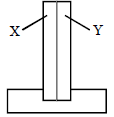
$A$ bimetallic strip consists of metals $X$ and $Y$. It is mounted rigidly at the base as shown. The metal $X$ has a higher coefficient of linear expansion compared to that for metal $Y$. When the bimetallic strip is placed in a cold bath:
A
It will bend towards the right
B
It will bend towards the left
C
It will not bend but shrink
D
It will neither bend nor shrink
Solution
(B) The coefficient of linear expansion $\alpha$ determines how much a material changes its length with temperature change,given by $\Delta L = L_0 \alpha \Delta T$.
Since the coefficient of linear expansion of metal $X$ is greater than that of metal $Y$ $(\alpha_X > \alpha_Y)$,metal $X$ will contract more than metal $Y$ when the temperature decreases (cooling).
Because metal $X$ is on the left side and it contracts more than metal $Y$,the strip will bend towards the side that contracts more.
Therefore,the bimetallic strip will bend towards the left.
Since the coefficient of linear expansion of metal $X$ is greater than that of metal $Y$ $(\alpha_X > \alpha_Y)$,metal $X$ will contract more than metal $Y$ when the temperature decreases (cooling).
Because metal $X$ is on the left side and it contracts more than metal $Y$,the strip will bend towards the side that contracts more.
Therefore,the bimetallic strip will bend towards the left.
0 likesView Solution
14
PhysicsEasyMCQAIIMS · 2006
$Assertion :$ Perspiration from the human body helps in cooling the body.
$Reason :$ $A$ thin layer of water on the skin enhances its emissivity.
$Reason :$ $A$ thin layer of water on the skin enhances its emissivity.
A
If both Assertion and Reason are correct and the Reason is a correct explanation of the Assertion.
B
If both Assertion and Reason are correct but Reason is not a correct explanation of the Assertion.
C
If the Assertion is correct but Reason is incorrect.
D
If both the Assertion and Reason are incorrect.
Solution
(C) Perspiration involves the exchange of heat from the body to the surroundings.
Water absorbs latent heat from the body to undergo phase change from liquid to vapour.
This process removes thermal energy from the skin,causing the body to cool down.
Emissivity is a property of the surface material. $A$ thin layer of water on the skin does not enhance its emissivity; in fact,it does not significantly change the emissivity of the skin in the context of cooling.
Therefore,the Assertion is correct,but the Reason is incorrect.
Water absorbs latent heat from the body to undergo phase change from liquid to vapour.
This process removes thermal energy from the skin,causing the body to cool down.
Emissivity is a property of the surface material. $A$ thin layer of water on the skin does not enhance its emissivity; in fact,it does not significantly change the emissivity of the skin in the context of cooling.
Therefore,the Assertion is correct,but the Reason is incorrect.
0 likesView Solution
15
PhysicsEasyMCQAIIMS · 2006
When you make ice cubes,the entropy of water
A
does not change
B
increases
C
decreases
D
may either increase or decrease depending
Solution
(C) The change in entropy is given by the formula $dS = \frac{dQ}{T}$.
In the process of freezing water into ice,heat is released by the system to the surroundings,meaning $dQ$ is negative.
Since the temperature $T$ is positive,the change in entropy $dS$ is negative.
Therefore,the entropy of the water decreases during the formation of ice cubes.
In the process of freezing water into ice,heat is released by the system to the surroundings,meaning $dQ$ is negative.
Since the temperature $T$ is positive,the change in entropy $dS$ is negative.
Therefore,the entropy of the water decreases during the formation of ice cubes.
0 likesView Solution
16
PhysicsEasyMCQAIIMS · 2006
$Assertion :$ In an isolated system,the entropy increases.
$Reason :$ The processes in an isolated system are adiabatic.
$Reason :$ The processes in an isolated system are adiabatic.
A
If both $Assertion$ and $Reason$ are correct and the $Reason$ is a correct explanation of the $Assertion$.
B
If both $Assertion$ and $Reason$ are correct but $Reason$ is not a correct explanation of the $Assertion$.
C
If the $Assertion$ is correct but $Reason$ is incorrect.
D
If both the $Assertion$ and $Reason$ are incorrect.
Solution
(B) According to the $Second$ $Law$ of $Thermodynamics$,for any spontaneous process in an isolated system,the entropy of the system must increase $(dS > 0)$.
An isolated system is defined as a system that cannot exchange energy (heat or work) or matter with its surroundings.
Since an adiabatic process is defined as a process where there is no exchange of heat $(dQ = 0)$ between the system and the surroundings,all processes occurring within an isolated system are indeed adiabatic.
However,the fact that the processes are adiabatic does not directly explain why the entropy must increase; the increase in entropy is a consequence of the $Second$ $Law$ of $Thermodynamics$ regarding spontaneous processes.
Therefore,both statements are correct,but the $Reason$ is not the correct explanation for the $Assertion$.
An isolated system is defined as a system that cannot exchange energy (heat or work) or matter with its surroundings.
Since an adiabatic process is defined as a process where there is no exchange of heat $(dQ = 0)$ between the system and the surroundings,all processes occurring within an isolated system are indeed adiabatic.
However,the fact that the processes are adiabatic does not directly explain why the entropy must increase; the increase in entropy is a consequence of the $Second$ $Law$ of $Thermodynamics$ regarding spontaneous processes.
Therefore,both statements are correct,but the $Reason$ is not the correct explanation for the $Assertion$.
0 likesView Solution
17
PhysicsEasyMCQAIIMS · 2006
$Assertion :$ The Carnot cycle is useful in understanding the performance of heat engines.
$Reason :$ The Carnot cycle provides a way of determining the maximum possible efficiency achievable with reservoirs of given temperatures.
$Reason :$ The Carnot cycle provides a way of determining the maximum possible efficiency achievable with reservoirs of given temperatures.
A
If both Assertion and Reason are correct and the Reason is a correct explanation of the Assertion.
B
If both Assertion and Reason are correct but Reason is not a correct explanation of the Assertion.
C
If the Assertion is correct but Reason is incorrect.
D
If both the Assertion and Reason are incorrect.
Solution
(A) The Carnot cycle represents the process of an ideal heat engine,which operates with the maximum possible efficiency for converting heat energy into mechanical work. Therefore,the Assertion is correct.
The efficiency of a Carnot engine is given by $\eta = 1 - \frac{T_L}{T_H}$,where $T_L$ and $T_H$ are the temperatures of the sink and source,respectively. This formula shows that the maximum efficiency depends solely on the temperatures of the reservoirs. Thus,the Reason is correct and provides a valid explanation for why the Carnot cycle is useful for understanding heat engine performance.
The efficiency of a Carnot engine is given by $\eta = 1 - \frac{T_L}{T_H}$,where $T_L$ and $T_H$ are the temperatures of the sink and source,respectively. This formula shows that the maximum efficiency depends solely on the temperatures of the reservoirs. Thus,the Reason is correct and provides a valid explanation for why the Carnot cycle is useful for understanding heat engine performance.
0 likesView Solution
18
PhysicsEasyMCQAIIMS · 2006
$Assertion :$ When a glass of hot milk is placed in a room and allowed to cool,its entropy decreases.
$Reason :$ Allowing a hot object to cool does not violate the second law of thermodynamics.
$Reason :$ Allowing a hot object to cool does not violate the second law of thermodynamics.
A
If both $Assertion$ and $Reason$ are correct and the $Reason$ is a correct explanation of the $Assertion$.
B
If both $Assertion$ and $Reason$ are correct but $Reason$ is not a correct explanation of the $Assertion$.
C
If the $Assertion$ is correct but $Reason$ is incorrect.
D
If both the $Assertion$ and $Reason$ are incorrect.
Solution
(B) The entropy change of a system is given by $dS = \frac{dQ}{T}$. When a body cools,it loses heat,so $dQ$ is negative. Since $T$ is positive,$dS$ is negative,meaning the entropy of the milk decreases. Thus,the $Assertion$ is correct.
The second law of thermodynamics states that the total entropy of the universe (system + surroundings) must increase for any spontaneous process. The cooling of a hot object in a room involves an increase in the entropy of the surroundings that is greater than the decrease in the entropy of the system,so it does not violate the second law. Thus,the $Reason$ is also correct.
However,the $Reason$ explains why the process is possible,not why the entropy of the milk itself decreases. Therefore,the $Reason$ is not the correct explanation of the $Assertion$.
The second law of thermodynamics states that the total entropy of the universe (system + surroundings) must increase for any spontaneous process. The cooling of a hot object in a room involves an increase in the entropy of the surroundings that is greater than the decrease in the entropy of the system,so it does not violate the second law. Thus,the $Reason$ is also correct.
However,the $Reason$ explains why the process is possible,not why the entropy of the milk itself decreases. Therefore,the $Reason$ is not the correct explanation of the $Assertion$.
0 likesView Solution
19
PhysicsEasyMCQAIIMS · 2006
$Assertion :$ The root mean square and most probable speeds of the molecules in a gas are the same.
$Reason :$ The Maxwell distribution for the speed of molecules in a gas is symmetrical.
$Reason :$ The Maxwell distribution for the speed of molecules in a gas is symmetrical.
A
If both Assertion and Reason are correct and the Reason is a correct explanation of the Assertion.
B
If both Assertion and Reason are correct but Reason is not a correct explanation of the Assertion.
C
If the Assertion is correct but Reason is incorrect.
D
If both the Assertion and Reason are incorrect.
Solution
(D) The root mean square speed $(v_{rms})$ is given by $\sqrt{3RT/M}$,and the most probable speed $(v_{mp})$ is given by $\sqrt{2RT/M}$. Since $\sqrt{3} \neq \sqrt{2}$,these speeds are not the same. Thus,the Assertion is incorrect.
The Maxwell-Boltzmann distribution curve for molecular speeds is skewed to the right (asymmetric),meaning it has a long tail towards higher speeds. Therefore,the distribution is not symmetrical. Thus,the Reason is also incorrect.
The Maxwell-Boltzmann distribution curve for molecular speeds is skewed to the right (asymmetric),meaning it has a long tail towards higher speeds. Therefore,the distribution is not symmetrical. Thus,the Reason is also incorrect.
0 likesView Solution
20
PhysicsMediumMCQAIIMS · 2006
$A$ boat at anchor is rocked by waves whose crests are $100 \ m$ apart and velocity is $25 \ m/s$. The boat bounces up once in every: ... $s$
A
$2500$
B
$75$
C
$4$
D
$0.25$
Solution
(C) The wavelength $\lambda$ is the distance between two consecutive crests,so $\lambda = 100 \ m$.
Given the wave velocity $v = 25 \ m/s$.
The frequency $f$ of the wave is given by the formula $v = f \lambda$,which implies $f = \frac{v}{\lambda}$.
Substituting the values,$f = \frac{25}{100} = 0.25 \ Hz$.
The time period $T$ is the time taken for one complete bounce,which is the reciprocal of the frequency: $T = \frac{1}{f}$.
Therefore,$T = \frac{1}{0.25} = 4 \ s$.
Given the wave velocity $v = 25 \ m/s$.
The frequency $f$ of the wave is given by the formula $v = f \lambda$,which implies $f = \frac{v}{\lambda}$.
Substituting the values,$f = \frac{25}{100} = 0.25 \ Hz$.
The time period $T$ is the time taken for one complete bounce,which is the reciprocal of the frequency: $T = \frac{1}{f}$.
Therefore,$T = \frac{1}{0.25} = 4 \ s$.
0 likesView Solution
21
PhysicsMediumMCQAIIMS · 2006
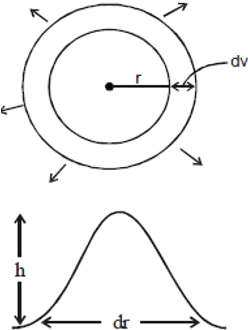
$A$ stone thrown into still water creates a circular wave pattern moving radially outwards. If $r$ is the distance measured from the centre of the pattern, the amplitude of the wave varies as
A
$r^{-1/2}$
B
$r^{-1}$
C
$r^{-2}$
D
$r^{-3/2}$
Solution
(A) When a stone is thrown into still water, it creates circular ripples. The energy $E$ of the wave is conserved as it spreads outwards.
The energy of a circular crest of width $dr$ and amplitude $h$ is proportional to its mass and the square of its amplitude. The mass of the crest is proportional to its circumference $(2 \pi r)$ and its width $(dr)$.
Thus, the energy $E$ is given by:
$E \propto (2 \pi r) \cdot dr \cdot h^2$
Since the total energy $E$ remains constant as the wave propagates outwards, we have:
$r \cdot h^2 \approx \text{constant}$
Therefore, $h^2 \propto \frac{1}{r}$, which implies $h \propto r^{-1/2}$.
Thus, the amplitude of the wave varies as $r^{-1/2}$.
The energy of a circular crest of width $dr$ and amplitude $h$ is proportional to its mass and the square of its amplitude. The mass of the crest is proportional to its circumference $(2 \pi r)$ and its width $(dr)$.
Thus, the energy $E$ is given by:
$E \propto (2 \pi r) \cdot dr \cdot h^2$
Since the total energy $E$ remains constant as the wave propagates outwards, we have:
$r \cdot h^2 \approx \text{constant}$
Therefore, $h^2 \propto \frac{1}{r}$, which implies $h \propto r^{-1/2}$.
Thus, the amplitude of the wave varies as $r^{-1/2}$.
0 likesView Solution
22
PhysicsEasyMCQAIIMS · 2006
When a guitar string is sounded with a $440\, Hz$ tuning fork,a beat frequency of $5\, Hz$ is heard. If the experiment is repeated with a tuning fork of $437\, Hz$,the beat frequency is $8\, Hz$. The string frequency $(Hz)$ is
A
$445$
B
$435$
C
$429$
D
$448$
Solution
(A) Let the frequency of the guitar string be $f_s$.
When sounded with a $440\, Hz$ tuning fork,the beat frequency is $|f_s - 440| = 5\, Hz$. This implies $f_s = 445\, Hz$ or $f_s = 435\, Hz$.
When sounded with a $437\, Hz$ tuning fork,the beat frequency is $|f_s - 437| = 8\, Hz$. This implies $f_s = 445\, Hz$ or $f_s = 429\, Hz$.
Comparing both cases,the common frequency is $f_s = 445\, Hz$.
Alternatively,since the beat frequency increased from $5\, Hz$ to $8\, Hz$ when the tuning fork frequency decreased from $440\, Hz$ to $437\, Hz$,the string frequency must be higher than the tuning fork frequencies. Thus,$f_s = 440 + 5 = 445\, Hz$.
When sounded with a $440\, Hz$ tuning fork,the beat frequency is $|f_s - 440| = 5\, Hz$. This implies $f_s = 445\, Hz$ or $f_s = 435\, Hz$.
When sounded with a $437\, Hz$ tuning fork,the beat frequency is $|f_s - 437| = 8\, Hz$. This implies $f_s = 445\, Hz$ or $f_s = 429\, Hz$.
Comparing both cases,the common frequency is $f_s = 445\, Hz$.
Alternatively,since the beat frequency increased from $5\, Hz$ to $8\, Hz$ when the tuning fork frequency decreased from $440\, Hz$ to $437\, Hz$,the string frequency must be higher than the tuning fork frequencies. Thus,$f_s = 440 + 5 = 445\, Hz$.
0 likesView Solution
23
PhysicsEasyMCQAIIMS · 2006
For a wave propagating in a medium, identify the property that is independent of the others.
A
velocity
B
wavelength
C
frequency
D
all these depend on each other
Solution
(C) When a wave travels from one medium to another, its velocity $(v)$ and wavelength $(\lambda)$ change depending on the properties of the medium (such as refractive index or density).
However, the frequency $(f)$ of the wave is determined solely by the source of the wave and remains constant regardless of the medium through which it propagates.
Therefore, frequency is independent of the medium's properties, while velocity and wavelength are dependent on them.
However, the frequency $(f)$ of the wave is determined solely by the source of the wave and remains constant regardless of the medium through which it propagates.
Therefore, frequency is independent of the medium's properties, while velocity and wavelength are dependent on them.
0 likesView Solution
24
PhysicsMediumMCQAIIMS · 2006
Two parallel large thin metal sheets have equal surface charge densities $(\sigma = 26.4 \times 10^{-12} \, C/m^2)$ of opposite signs. The electric field between these sheets is
A
$1.5 \, N/C$
B
$1.5 \times 10^{-10} \, N/C$
C
$3 \, N/C$
D
$3 \times 10^{-10} \, N/C$
Solution
(C) The electric field $E$ between two large parallel thin metal sheets with equal and opposite surface charge densities $\sigma$ is given by the formula:
$E = \frac{\sigma}{\epsilon_0}$
Given:
$\sigma = 26.4 \times 10^{-12} \, C/m^2$
$\epsilon_0 = 8.85 \times 10^{-12} \, C^2/(N \cdot m^2)$
Substituting the values:
$E = \frac{26.4 \times 10^{-12}}{8.85 \times 10^{-12}}$
$E = \frac{26.4}{8.85} \approx 2.983 \approx 3 \, N/C$
Therefore,the electric field between the sheets is $3 \, N/C$.
$E = \frac{\sigma}{\epsilon_0}$
Given:
$\sigma = 26.4 \times 10^{-12} \, C/m^2$
$\epsilon_0 = 8.85 \times 10^{-12} \, C^2/(N \cdot m^2)$
Substituting the values:
$E = \frac{26.4 \times 10^{-12}}{8.85 \times 10^{-12}}$
$E = \frac{26.4}{8.85} \approx 2.983 \approx 3 \, N/C$
Therefore,the electric field between the sheets is $3 \, N/C$.
0 likesView Solution
25
PhysicsEasyMCQAIIMS · 2006
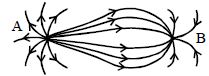
The spatial distribution of the electric field due to two charges $(A, B)$ is shown in the figure. Which one of the following statements is correct?
A
$A$ is positive and $B$ is negative; $|A| > |B|$
B
$A$ is negative and $B$ is positive; $|A| = |B|$
C
Both are positive but $|A| > |B|$
D
Both are negative but $|A| > |B|$
Solution
(A) $1$. Electric field lines originate from a positive charge and terminate at a negative charge. In the figure,lines are emerging from $A$ and entering $B$,so $A$ is positive and $B$ is negative.
$2$. The number of electric field lines originating from or terminating at a charge is proportional to the magnitude of the charge. By counting the lines,we observe that more lines originate from $A$ than terminate at $B$. Therefore,the magnitude of charge $A$ is greater than the magnitude of charge $B$,i.e.,$|A| > |B|$.
$2$. The number of electric field lines originating from or terminating at a charge is proportional to the magnitude of the charge. By counting the lines,we observe that more lines originate from $A$ than terminate at $B$. Therefore,the magnitude of charge $A$ is greater than the magnitude of charge $B$,i.e.,$|A| > |B|$.
0 likesView Solution
26
PhysicsMediumMCQAIIMS · 2006
The voltage of clouds is $4 \times 10^6 \, V$ with respect to the ground. In a lightning strike lasting $100 \, ms$,a charge of $4 \, C$ is delivered to the ground. The power of the lightning strike is
A
$160 \, MW$
B
$80 \, MW$
C
$20 \, MW$
D
$500 \, kW$
Solution
(A) The potential difference $V = 4 \times 10^6 \, V$.
The charge transferred $Q = 4 \, C$.
The time duration $t = 100 \, ms = 100 \times 10^{-3} \, s = 0.1 \, s$.
The energy delivered $E = V \times Q = 4 \times 10^6 \times 4 = 16 \times 10^6 \, J$.
The power $P$ is defined as the rate of energy delivery: $P = \frac{E}{t}$.
$P = \frac{16 \times 10^6 \, J}{0.1 \, s} = 160 \times 10^6 \, W$.
Since $10^6 \, W = 1 \, MW$,the power is $160 \, MW$.
The charge transferred $Q = 4 \, C$.
The time duration $t = 100 \, ms = 100 \times 10^{-3} \, s = 0.1 \, s$.
The energy delivered $E = V \times Q = 4 \times 10^6 \times 4 = 16 \times 10^6 \, J$.
The power $P$ is defined as the rate of energy delivery: $P = \frac{E}{t}$.
$P = \frac{16 \times 10^6 \, J}{0.1 \, s} = 160 \times 10^6 \, W$.
Since $10^6 \, W = 1 \, MW$,the power is $160 \, MW$.
0 likesView Solution
27
PhysicsMediumMCQAIIMS · 2006
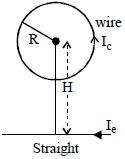
$A$ circular loop of a wire and a long straight wire carry currents $I_c$ and $I_e$,respectively,as shown in the figure. Assuming that these are placed in the same plane,the magnetic field will be zero at the centre of the loop when the separation $H$ is:
A
$\frac{I_e R}{I_c \pi}$
B
$\frac{I_c R}{I_e \pi}$
C
$\frac{\pi I_c}{I_e R}$
D
$\frac{I_e \pi}{I_c R}$
Solution
(A) The magnetic field at the centre of a circular loop of radius $R$ carrying current $I_c$ is given by $B_{loop} = \frac{\mu_0 I_c}{2R}$.
The magnetic field at a distance $H$ from a long straight wire carrying current $I_e$ is given by $B_{straight} = \frac{\mu_0 I_e}{2\pi H}$.
For the net magnetic field at the centre of the loop to be zero,the magnitudes of these two magnetic fields must be equal and their directions must be opposite.
Equating the magnitudes:
$\frac{\mu_0 I_c}{2R} = \frac{\mu_0 I_e}{2\pi H}$
Solving for $H$:
$\frac{I_c}{R} = \frac{I_e}{\pi H}$
$H = \frac{I_e R}{\pi I_c}$
The magnetic field at a distance $H$ from a long straight wire carrying current $I_e$ is given by $B_{straight} = \frac{\mu_0 I_e}{2\pi H}$.
For the net magnetic field at the centre of the loop to be zero,the magnitudes of these two magnetic fields must be equal and their directions must be opposite.
Equating the magnitudes:
$\frac{\mu_0 I_c}{2R} = \frac{\mu_0 I_e}{2\pi H}$
Solving for $H$:
$\frac{I_c}{R} = \frac{I_e}{\pi H}$
$H = \frac{I_e R}{\pi I_c}$
0 likesView Solution
28
PhysicsEasyMCQAIIMS · 2006
Assertion: Magnetic Resonance Imaging $(MRI)$ is a useful diagnostic tool for producing images of various parts of the human body.
Reason: Protons of various tissues of the human body play a role in $(MRI)$.
Reason: Protons of various tissues of the human body play a role in $(MRI)$.
A
If both Assertion and Reason are correct and the Reason is a correct explanation of the Assertion.
B
If both Assertion and Reason are correct but Reason is not a correct explanation of the Assertion.
C
If the Assertion is correct but Reason is incorrect.
D
If both the Assertion and Reason are incorrect.
Solution
(A) $MRI$ is a useful diagnostic tool for producing images of various parts of the human body because it relies on the magnetic properties of protons (hydrogen nuclei) present in the water and fat tissues of the body. When placed in a strong magnetic field,these protons align and precess. By applying radiofrequency pulses,these protons are excited,and the signal emitted during their relaxation is used to construct detailed images. Thus,the protons of various tissues are the fundamental basis for $(MRI)$ imaging.
0 likesView Solution
29
PhysicsEasyMCQAIIMS · 2006
Assertion : Diamagnetic materials can exhibit magnetism.
Reason : Diamagnetic materials have permanent magnetic dipole moment.
Reason : Diamagnetic materials have permanent magnetic dipole moment.
A
If both Assertion and Reason are correct and the Reason is a correct explanation of the Assertion.
B
If both Assertion and Reason are correct but Reason is not a correct explanation of the Assertion.
C
If the Assertion is correct but Reason is incorrect.
D
If both the Assertion and Reason are incorrect.
Solution
(C) Diamagnetic materials exhibit a weak magnetism in the direction opposite to the applied magnetic field.
Therefore,the Assertion is correct.
However,diamagnetic materials do not have a permanent magnetic dipole moment because all electrons are paired,resulting in a net magnetic moment of zero.
Therefore,the Reason is incorrect.
Thus,the correct option is $C$.
Therefore,the Assertion is correct.
However,diamagnetic materials do not have a permanent magnetic dipole moment because all electrons are paired,resulting in a net magnetic moment of zero.
Therefore,the Reason is incorrect.
Thus,the correct option is $C$.
0 likesView Solution
30
PhysicsMediumMCQAIIMS · 2006
$A$ metallic ring is dropped down, keeping its plane perpendicular to a constant and horizontal magnetic field. The ring enters the region of magnetic field at $t = 0$ and completely emerges out at $t = T \, \text{sec}$. The current in the ring varies as
A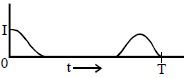
B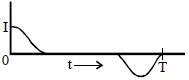
C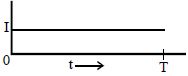
D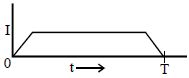
Solution
(B) When the ring enters the magnetic field, the magnetic flux linked with the ring changes, which induces an electromotive force $(emf)$ and consequently an induced current. According to Lenz's law, this current opposes the cause of its production.
Once the ring is completely inside the uniform magnetic field, the magnetic flux linked with it remains constant. Since there is no change in magnetic flux $(\frac{d\phi}{dt} = 0)$, the induced $emf$ and the induced current become zero.
When the ring starts to emerge from the magnetic field, the magnetic flux linked with it changes again. This induces an $emf$ and a current in the opposite direction compared to the entry phase.
Therefore, the current is non-zero during entry, zero while inside, and non-zero (with opposite polarity) during exit. Graph $B$ correctly represents this variation.
Once the ring is completely inside the uniform magnetic field, the magnetic flux linked with it remains constant. Since there is no change in magnetic flux $(\frac{d\phi}{dt} = 0)$, the induced $emf$ and the induced current become zero.
When the ring starts to emerge from the magnetic field, the magnetic flux linked with it changes again. This induces an $emf$ and a current in the opposite direction compared to the entry phase.
Therefore, the current is non-zero during entry, zero while inside, and non-zero (with opposite polarity) during exit. Graph $B$ correctly represents this variation.
0 likesView Solution
31
PhysicsEasyMCQAIIMS · 2006
Assertion: An $emf$ $\vec{E}$ is induced in a closed loop where magnetic flux is varied. The induced $\vec{E}$ is not a conservative field.
Reason: The line integral $\oint \vec{E} \cdot d\vec{l}$ around the closed loop is nonzero.
Reason: The line integral $\oint \vec{E} \cdot d\vec{l}$ around the closed loop is nonzero.
A
If both Assertion and Reason are correct and the Reason is a correct explanation of the Assertion.
B
If both Assertion and Reason are correct but Reason is not a correct explanation of the Assertion.
C
If the Assertion is correct but Reason is incorrect.
D
If both the Assertion and Reason are incorrect.
Solution
(A) According to Faraday's law of electromagnetic induction,the induced $emf$ in a closed loop is given by $\oint \vec{E} \cdot d\vec{l} = -\frac{d\phi}{dt}$.
Since the magnetic flux $\phi$ is varying,the line integral $\oint \vec{E} \cdot d\vec{l}$ is non-zero.
$A$ field is defined as conservative if the line integral of the field around any closed loop is zero. Since the line integral here is non-zero,the induced electric field $\vec{E}$ is a non-conservative field.
Therefore,both the Assertion and the Reason are correct,and the Reason correctly explains the Assertion.
Since the magnetic flux $\phi$ is varying,the line integral $\oint \vec{E} \cdot d\vec{l}$ is non-zero.
$A$ field is defined as conservative if the line integral of the field around any closed loop is zero. Since the line integral here is non-zero,the induced electric field $\vec{E}$ is a non-conservative field.
Therefore,both the Assertion and the Reason are correct,and the Reason correctly explains the Assertion.
0 likesView Solution
32
PhysicsEasyMCQAIIMS · 2006
In refraction,light waves are bent on passing from one medium to the second medium,because,in the second medium
A
the frequency is different
B
the coefficient of elasticity is different
C
the speed is different
D
the amplitude is smaller
Solution
(C) Refraction is the phenomenon of bending of light when it travels from one optical medium to another. This occurs because the speed of light changes as it enters the second medium. The frequency of light remains constant during refraction,but the change in speed leads to a change in the wavelength and the direction of propagation of the light wave.
0 likesView Solution
33
PhysicsMediumMCQAIIMS · 2006
$A$ wire mesh consisting of very small squares is viewed at a distance of $8 \, cm$ through a magnifying converging lens of focal length $10 \, cm$,kept close to the eye. The magnification produced by the lens is
A
$5$
B
$8$
C
$10$
D
$20$
Solution
(A) The lens formula is given by $\frac{1}{v} - \frac{1}{u} = \frac{1}{f}$.
Given,the object distance $u = -8 \, cm$ (using sign convention) and the focal length $f = +10 \, cm$ for a converging lens.
Substituting these values into the lens formula:
$\frac{1}{v} - \frac{1}{-8} = \frac{1}{10}$
$\frac{1}{v} + \frac{1}{8} = \frac{1}{10}$
$\frac{1}{v} = \frac{1}{10} - \frac{1}{8} = \frac{4 - 5}{40} = -\frac{1}{40}$
Thus,$v = -40 \, cm$.
The magnification $m$ produced by the lens is given by $m = \frac{v}{u}$.
$m = \frac{-40}{-8} = 5$.
Therefore,the magnification produced by the lens is $5$.
Given,the object distance $u = -8 \, cm$ (using sign convention) and the focal length $f = +10 \, cm$ for a converging lens.
Substituting these values into the lens formula:
$\frac{1}{v} - \frac{1}{-8} = \frac{1}{10}$
$\frac{1}{v} + \frac{1}{8} = \frac{1}{10}$
$\frac{1}{v} = \frac{1}{10} - \frac{1}{8} = \frac{4 - 5}{40} = -\frac{1}{40}$
Thus,$v = -40 \, cm$.
The magnification $m$ produced by the lens is given by $m = \frac{v}{u}$.
$m = \frac{-40}{-8} = 5$.
Therefore,the magnification produced by the lens is $5$.
0 likesView Solution
34
PhysicsDifficultMCQAIIMS · 2006
$A$ lens is made of flint glass (refractive index $= 1.5$). When the lens is immersed in a liquid of refractive index $1.25$,the focal length
A
increases by a factor of $1.25$
B
increases by a factor of $2.5$
C
increases by a factor of $1.2$
D
decreases by a factor of $1.2$
Solution
(B) The lens maker's formula is given by $\frac{1}{f} = (\mu - 1) \left( \frac{1}{R_1} - \frac{1}{R_2} \right)$.
For the lens in air $(\mu_a = 1)$:
$\frac{1}{f_a} = (1.5 - 1) \left( \frac{1}{R_1} - \frac{1}{R_2} \right) = 0.5 \left( \frac{1}{R_1} - \frac{1}{R_2} \right)$.
When immersed in a liquid $(\mu_l = 1.25)$,the relative refractive index is $\mu_{rel} = \frac{\mu_g}{\mu_l} = \frac{1.5}{1.25} = 1.2 = \frac{6}{5}$.
For the lens in the liquid:
$\frac{1}{f_l} = (\mu_{rel} - 1) \left( \frac{1}{R_1} - \frac{1}{R_2} \right) = (1.2 - 1) \left( \frac{1}{R_1} - \frac{1}{R_2} \right) = 0.2 \left( \frac{1}{R_1} - \frac{1}{R_2} \right)$.
Taking the ratio:
$\frac{f_l}{f_a} = \frac{0.5}{0.2} = 2.5$.
Therefore,the focal length increases by a factor of $2.5$.
For the lens in air $(\mu_a = 1)$:
$\frac{1}{f_a} = (1.5 - 1) \left( \frac{1}{R_1} - \frac{1}{R_2} \right) = 0.5 \left( \frac{1}{R_1} - \frac{1}{R_2} \right)$.
When immersed in a liquid $(\mu_l = 1.25)$,the relative refractive index is $\mu_{rel} = \frac{\mu_g}{\mu_l} = \frac{1.5}{1.25} = 1.2 = \frac{6}{5}$.
For the lens in the liquid:
$\frac{1}{f_l} = (\mu_{rel} - 1) \left( \frac{1}{R_1} - \frac{1}{R_2} \right) = (1.2 - 1) \left( \frac{1}{R_1} - \frac{1}{R_2} \right) = 0.2 \left( \frac{1}{R_1} - \frac{1}{R_2} \right)$.
Taking the ratio:
$\frac{f_l}{f_a} = \frac{0.5}{0.2} = 2.5$.
Therefore,the focal length increases by a factor of $2.5$.
0 likesView Solution
35
PhysicsEasyMCQAIIMS · 2006
$A$ leaf which contains only green pigments is illuminated by a laser light of wavelength $0.6328 \,\mu m$. It would appear to be
A
brown
B
black
C
red
D
green
Solution
(B) green leaf contains pigments that reflect green light and absorb other wavelengths in the visible spectrum.
When white light falls on a green leaf,it reflects the green component,making the leaf appear green.
The wavelength of green light typically ranges from $0.495 \,\mu m$ to $0.570 \,\mu m$.
The incident laser light has a wavelength of $0.6328 \,\mu m$,which corresponds to the red region of the spectrum.
Since the leaf does not reflect this wavelength,it absorbs the incident laser light.
Because no light is reflected back to the observer,the leaf appears black.
When white light falls on a green leaf,it reflects the green component,making the leaf appear green.
The wavelength of green light typically ranges from $0.495 \,\mu m$ to $0.570 \,\mu m$.
The incident laser light has a wavelength of $0.6328 \,\mu m$,which corresponds to the red region of the spectrum.
Since the leaf does not reflect this wavelength,it absorbs the incident laser light.
Because no light is reflected back to the observer,the leaf appears black.
0 likesView Solution
36
PhysicsEasyMCQAIIMS · 2006
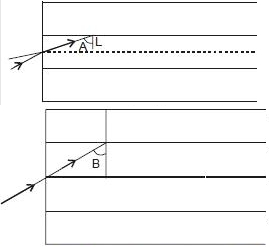
Assertion : In optical fibre,the diameter of the core is kept small.
Reason : This smaller diameter of the core ensures that the fibre should have incident angle more than the critical angle required for total internal reflection.
Reason : This smaller diameter of the core ensures that the fibre should have incident angle more than the critical angle required for total internal reflection.
A
If both Assertion and Reason are correct and the Reason is a correct explanation of the Assertion.
B
If both Assertion and Reason are correct but Reason is not a correct explanation of the Assertion.
C
If the Assertion is correct but Reason is incorrect.
D
If both the Assertion and Reason are incorrect.
Solution
(A) The Assertion and Reason are both correct,and the Reason provides a correct explanation for the Assertion.
In an optical fibre,the core diameter is kept small to ensure that the light rays entering the fibre strike the core-cladding interface at an angle greater than the critical angle.
As shown in the diagram,for a small diameter core,the angle of incidence $\angle A$ at the core-cladding interface is relatively large.
For a larger diameter core,the angle of incidence $\angle B$ is smaller.
Since the condition for total internal reflection is that the angle of incidence must be greater than the critical angle,a smaller core diameter increases the probability that the light rays will satisfy this condition,thereby ensuring efficient transmission of light through the fibre.
In an optical fibre,the core diameter is kept small to ensure that the light rays entering the fibre strike the core-cladding interface at an angle greater than the critical angle.
As shown in the diagram,for a small diameter core,the angle of incidence $\angle A$ at the core-cladding interface is relatively large.
For a larger diameter core,the angle of incidence $\angle B$ is smaller.
Since the condition for total internal reflection is that the angle of incidence must be greater than the critical angle,a smaller core diameter increases the probability that the light rays will satisfy this condition,thereby ensuring efficient transmission of light through the fibre.
0 likesView Solution
37
PhysicsEasyMCQAIIMS · 2006
Which of the following diagrams represents the variation of the electric field vector magnitude with time for a circularly polarized light?
A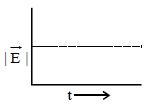
B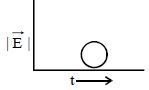
C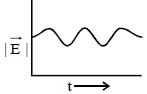
D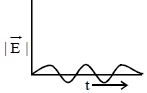
Solution
(A) In circularly polarized light, the electric field vector rotates in a plane perpendicular to the direction of propagation while maintaining a constant magnitude. Therefore, the graph of the magnitude of the electric field vector $|\vec{E}|$ versus time $t$ is a horizontal straight line, indicating that the magnitude does not change with time. This corresponds to the diagram in option $A$.
0 likesView Solution
38
PhysicsEasyMCQAIIMS · 2006
Assertion : Standard optical diffraction gratings cannot be used for discriminating between $X-$ray wavelengths.
Reason : The grating spacing is not of the order of $X-$ray wavelengths.
Reason : The grating spacing is not of the order of $X-$ray wavelengths.
A
If both Assertion and Reason are correct and the Reason is a correct explanation of the Assertion.
B
If both Assertion and Reason are correct but Reason is not a correct explanation of the Assertion.
C
If the Assertion is correct but Reason is incorrect.
D
If both the Assertion and Reason are incorrect.
Solution
(A) For diffraction to occur,the size of the obstacles or the spacing between the slits in a diffraction grating must be of the order of the wavelength of the incident radiation.
The wavelength of $X-$rays is typically in the range of $0.01 \ nm$ to $10 \ nm$.
Standard optical diffraction gratings have a grating spacing (distance between adjacent lines) of the order of $10^3 \ nm$ to $10^4 \ nm$.
Since the grating spacing is much larger than the wavelength of $X-$rays,the diffraction effect is negligible,and these gratings cannot be used to discriminate between $X-$ray wavelengths.
Therefore,both the Assertion and the Reason are correct,and the Reason is the correct explanation of the Assertion.
The wavelength of $X-$rays is typically in the range of $0.01 \ nm$ to $10 \ nm$.
Standard optical diffraction gratings have a grating spacing (distance between adjacent lines) of the order of $10^3 \ nm$ to $10^4 \ nm$.
Since the grating spacing is much larger than the wavelength of $X-$rays,the diffraction effect is negligible,and these gratings cannot be used to discriminate between $X-$ray wavelengths.
Therefore,both the Assertion and the Reason are correct,and the Reason is the correct explanation of the Assertion.
0 likesView Solution
39
PhysicsMediumMCQAIIMS · 2006
Hard $X$-rays for the study of fractures in bones should have a minimum wavelength of $10^{-11} \, m$. The accelerating voltage for electrons in the $X$-ray machine should be:
A
$< 124.2 \, kV$
B
$> 124.2 \, kV$
C
Between $60 \, kV$ and $70 \, kV$
D
$= 100 \, kV$
Solution
(B) The energy of an $X$-ray photon is given by $E = \frac{hc}{\lambda}$.
For the minimum wavelength $\lambda_{min}$,the accelerating voltage $V$ is given by $eV = \frac{hc}{\lambda_{min}}$.
Substituting the values $h = 6.63 \times 10^{-34} \, J \cdot s$,$c = 3 \times 10^8 \, m/s$,$e = 1.6 \times 10^{-19} \, C$,and $\lambda = 10^{-11} \, m$:
$V = \frac{6.63 \times 10^{-34} \times 3 \times 10^8}{1.6 \times 10^{-19} \times 10^{-11}}$
$V = \frac{19.89 \times 10^{-26}}{1.6 \times 10^{-30}} = 12.43 \times 10^4 \, V = 124.3 \, kV$.
Since the wavelength must be at least $10^{-11} \, m$,the energy of the electrons must be sufficient to produce this wavelength. Therefore,the accelerating voltage must be at least $124.3 \, kV$ to produce wavelengths equal to or shorter than this limit. However,in the context of the question asking for the condition to produce this specific minimum wavelength,the voltage must be at least $124.2 \, kV$ (using $hc \approx 1242 \, eV \cdot nm$). Thus,$V \geq 124.2 \, kV$.
For the minimum wavelength $\lambda_{min}$,the accelerating voltage $V$ is given by $eV = \frac{hc}{\lambda_{min}}$.
Substituting the values $h = 6.63 \times 10^{-34} \, J \cdot s$,$c = 3 \times 10^8 \, m/s$,$e = 1.6 \times 10^{-19} \, C$,and $\lambda = 10^{-11} \, m$:
$V = \frac{6.63 \times 10^{-34} \times 3 \times 10^8}{1.6 \times 10^{-19} \times 10^{-11}}$
$V = \frac{19.89 \times 10^{-26}}{1.6 \times 10^{-30}} = 12.43 \times 10^4 \, V = 124.3 \, kV$.
Since the wavelength must be at least $10^{-11} \, m$,the energy of the electrons must be sufficient to produce this wavelength. Therefore,the accelerating voltage must be at least $124.3 \, kV$ to produce wavelengths equal to or shorter than this limit. However,in the context of the question asking for the condition to produce this specific minimum wavelength,the voltage must be at least $124.2 \, kV$ (using $hc \approx 1242 \, eV \cdot nm$). Thus,$V \geq 124.2 \, kV$.
0 likesView Solution
40
PhysicsEasyMCQAIIMS · 2006
In the photoelectric effect,electrons are ejected from metals if the incident light has a certain minimum:
A
Wavelength
B
Frequency
C
Amplitude
D
Angle of incidence
Solution
(B) In the photoelectric effect,the emission of electrons from a metal surface occurs only when the incident light has a frequency greater than or equal to a specific minimum value. This minimum frequency is known as the threshold frequency $(\nu_0)$. If the frequency of the incident light is less than the threshold frequency,no photoelectric emission occurs,regardless of the intensity of the light.
0 likesView Solution
41
PhysicsEasyMCQAIIMS · 2006
Assertion : The photoelectrons produced by a monochromatic light beam incident on a metal surface have a spread in their kinetic energies.
Reason : The work function of the metal varies as a function of depth from the surface.
Reason : The work function of the metal varies as a function of depth from the surface.
A
If both Assertion and Reason are correct and the Reason is a correct explanation of the Assertion.
B
If both Assertion and Reason are correct but Reason is not a correct explanation of the Assertion.
C
If the Assertion is correct but Reason is incorrect.
D
If both the Assertion and Reason are incorrect.
Solution
(A) Photoelectrons emitted from a metal surface exhibit a range of kinetic energies because electrons within the metal occupy different energy levels within a continuous band structure. When a photon strikes the metal,it transfers its energy to an electron. The energy required to remove an electron from the surface is the work function. Electrons located deeper within the metal require additional energy to reach the surface before they can be emitted,effectively increasing the energy barrier for them. Consequently,electrons emitted from different depths have different kinetic energies. Thus,both the Assertion and the Reason are correct,and the Reason provides a valid explanation for the Assertion.
0 likesView Solution
42
PhysicsMediumMCQAIIMS · 2006
The operation of a nuclear reactor is said to be critical if the multiplication factor $(K)$ has a value of:
A
$1$
B
$1.5$
C
$2.1$
D
$2.5$
Solution
(A) The multiplication factor $(K)$ is defined as the ratio of the rate of production of neutrons to the rate of loss of neutrons.
$K = \frac{\text{Rate of production of neutrons}}{\text{Rate of loss of neutrons}}$
When $K = 1$,the chain reaction is self-sustaining at a constant level,and the reactor is said to be in a 'critical' state.
If $K > 1$,the reaction is supercritical,leading to an exponential increase in power (potentially causing an explosion).
If $K < 1$,the reaction is subcritical,and the chain reaction eventually dies out.
Therefore,for a critical reactor,$K = 1$.
$K = \frac{\text{Rate of production of neutrons}}{\text{Rate of loss of neutrons}}$
When $K = 1$,the chain reaction is self-sustaining at a constant level,and the reactor is said to be in a 'critical' state.
If $K > 1$,the reaction is supercritical,leading to an exponential increase in power (potentially causing an explosion).
If $K < 1$,the reaction is subcritical,and the chain reaction eventually dies out.
Therefore,for a critical reactor,$K = 1$.
0 likesView Solution
43
PhysicsEasyMCQAIIMS · 2006
${}^{238}U$ has $92$ protons and $238$ nucleons. It decays by emitting an alpha particle and becomes:
A
${}_{92}^{234}U$
B
${}_{90}^{234}Th$
C
${}_{92}^{235}U$
D
${}_{93}^{237}Np$
Solution
(B) An alpha particle is a helium nucleus,represented as ${}_{2}^{4}He$.
When a nucleus undergoes alpha decay,its atomic number $(Z)$ decreases by $2$ and its mass number $(A)$ decreases by $4$.
The decay equation is:
${}_{92}^{238}U \longrightarrow {}_{Z}^{A}X + {}_{2}^{4}He$
Equating the mass numbers: $238 = A + 4 \implies A = 234$.
Equating the atomic numbers: $92 = Z + 2 \implies Z = 90$.
The element with atomic number $90$ is Thorium $(Th)$.
Therefore,the daughter nucleus is ${}_{90}^{234}Th$.
When a nucleus undergoes alpha decay,its atomic number $(Z)$ decreases by $2$ and its mass number $(A)$ decreases by $4$.
The decay equation is:
${}_{92}^{238}U \longrightarrow {}_{Z}^{A}X + {}_{2}^{4}He$
Equating the mass numbers: $238 = A + 4 \implies A = 234$.
Equating the atomic numbers: $92 = Z + 2 \implies Z = 90$.
The element with atomic number $90$ is Thorium $(Th)$.
Therefore,the daughter nucleus is ${}_{90}^{234}Th$.
0 likesView Solution
44
PhysicsMediumMCQAIIMS · 2006
Which one of the following is a possible nuclear reaction?
A
${}_5^{10}B + {}_2^4He \longrightarrow {}_7^{13}N + {}_1^1H$
B
${}_{11}^{23}Na + {}_1^1H \longrightarrow {}_{10}^{20}Ne + {}_2^4He$
C
${}_{93}^{239}Np \longrightarrow {}_{94}^{239}Pu + {\beta ^ - } + \bar \nu$
D
${}_7^{11}N + {}_1^1H \longrightarrow {}_6^{12}C + {\beta ^ - } + \nu$
Solution
(C) nuclear reaction must satisfy the conservation of mass number $(A)$ and the conservation of atomic number $(Z)$.
For option $(A)$: ${}_5^{10}B + {}_2^4He \longrightarrow {}_7^{13}N + {}_1^1H$. Mass number: $10+4 = 14$ and $13+1 = 14$ (Conserved). Atomic number: $5+2 = 7$ and $7+1 = 8$ (Not conserved).
For option $(B)$: ${}_{11}^{23}Na + {}_1^1H \longrightarrow {}_{10}^{20}Ne + {}_2^4He$. Mass number: $23+1 = 24$ and $20+4 = 24$ (Conserved). Atomic number: $11+1 = 12$ and $10+2 = 12$ (Conserved). However,this reaction is not a standard spontaneous decay or common nuclear reaction compared to beta decay.
For option $(C)$: ${}_{93}^{239}Np \longrightarrow {}_{94}^{239}Pu + {\beta ^ - } + \bar \nu$. Mass number: $239 = 239 + 0 + 0 = 239$ (Conserved). Atomic number: $93 = 94 - 1 + 0 = 93$ (Conserved). This represents the $\beta^-$ decay of Neptunium-$239$ into Plutonium-$239$,which is a well-known and physically possible process.
For option $(D)$: ${}_7^{11}N + {}_1^1H \longrightarrow {}_6^{12}C + {\beta ^ - } + \nu$. Atomic number: $7+1 = 8$ and $6-1 = 5$ (Not conserved).
Therefore,option $(C)$ is the correct nuclear reaction.
For option $(A)$: ${}_5^{10}B + {}_2^4He \longrightarrow {}_7^{13}N + {}_1^1H$. Mass number: $10+4 = 14$ and $13+1 = 14$ (Conserved). Atomic number: $5+2 = 7$ and $7+1 = 8$ (Not conserved).
For option $(B)$: ${}_{11}^{23}Na + {}_1^1H \longrightarrow {}_{10}^{20}Ne + {}_2^4He$. Mass number: $23+1 = 24$ and $20+4 = 24$ (Conserved). Atomic number: $11+1 = 12$ and $10+2 = 12$ (Conserved). However,this reaction is not a standard spontaneous decay or common nuclear reaction compared to beta decay.
For option $(C)$: ${}_{93}^{239}Np \longrightarrow {}_{94}^{239}Pu + {\beta ^ - } + \bar \nu$. Mass number: $239 = 239 + 0 + 0 = 239$ (Conserved). Atomic number: $93 = 94 - 1 + 0 = 93$ (Conserved). This represents the $\beta^-$ decay of Neptunium-$239$ into Plutonium-$239$,which is a well-known and physically possible process.
For option $(D)$: ${}_7^{11}N + {}_1^1H \longrightarrow {}_6^{12}C + {\beta ^ - } + \nu$. Atomic number: $7+1 = 8$ and $6-1 = 5$ (Not conserved).
Therefore,option $(C)$ is the correct nuclear reaction.
0 likesView Solution
45
PhysicsEasyMCQAIIMS · 2006
If $Alpha$,$Beta$,and $Gamma$ rays carry the same momentum,which has the longest wavelength?
A
$Alpha$ rays
B
$Beta$ rays
C
$Gamma$ rays
D
None,all have the same wavelength
Solution
(D) According to the de Broglie wavelength formula,the wavelength $\lambda$ is given by $\lambda = \frac{h}{p}$,where $h$ is Planck's constant and $p$ is the momentum of the particle.
Since the problem states that the $Alpha$,$Beta$,and $Gamma$ rays carry the same momentum $(p)$,the wavelength $\lambda$ will be the same for all of them.
Therefore,none of them has a longer wavelength than the others; they all have the same wavelength.
Since the problem states that the $Alpha$,$Beta$,and $Gamma$ rays carry the same momentum $(p)$,the wavelength $\lambda$ will be the same for all of them.
Therefore,none of them has a longer wavelength than the others; they all have the same wavelength.
0 likesView Solution
46
PhysicsMediumMCQAIIMS · 2006
The fossil bone has a ${}^{14}C:{}^{12}C$ ratio,which is $\frac{1}{16}$ of that in a living animal bone. If the half-life of ${}^{14}C$ is $5730 \, years$,then the age of the fossil bone is .......... $years$.
A
$11460$
B
$17190$
C
$22920$
D
$45840$
Solution
(C) The ratio of ${}^{14}C$ to ${}^{12}C$ in the fossil bone is given as $\frac{N}{N_0} = \frac{1}{16}$.
The law of radioactive decay states that $\frac{N}{N_0} = \left(\frac{1}{2}\right)^n$,where $n$ is the number of half-lives.
Equating the two,we get $\left(\frac{1}{2}\right)^n = \frac{1}{16} = \left(\frac{1}{2}\right)^4$.
Therefore,the number of half-lives $n = 4$.
The age of the fossil $t$ is given by $t = n \times T_{1/2}$,where $T_{1/2} = 5730 \, years$.
$t = 4 \times 5730 = 22920 \, years$.
The law of radioactive decay states that $\frac{N}{N_0} = \left(\frac{1}{2}\right)^n$,where $n$ is the number of half-lives.
Equating the two,we get $\left(\frac{1}{2}\right)^n = \frac{1}{16} = \left(\frac{1}{2}\right)^4$.
Therefore,the number of half-lives $n = 4$.
The age of the fossil $t$ is given by $t = n \times T_{1/2}$,where $T_{1/2} = 5730 \, years$.
$t = 4 \times 5730 = 22920 \, years$.
0 likesView Solution
47
PhysicsEasyMCQAIIMS · 2006
Assertion : The binding energy per nucleon,for nuclei with atomic mass number $A > 100$,decreases with $A$.
Reason : The nuclear forces are weak for heavier nuclei.
Reason : The nuclear forces are weak for heavier nuclei.
A
If both Assertion and Reason are correct and the Reason is a correct explanation of the Assertion.
B
If both Assertion and Reason are correct but Reason is not a correct explanation of the Assertion.
C
If the Assertion is correct but Reason is incorrect.
D
If both the Assertion and Reason are incorrect.
Solution
(C) The binding energy per nucleon decreases for nuclei with $A > 100$ because the nuclear force is short-ranged,while the Coulomb repulsion between protons is long-ranged.
As the mass number $A$ increases,the size of the nucleus increases. Since the nuclear force acts only between nearest neighbors,the total nuclear binding energy increases roughly linearly with $A$.
However,the Coulomb repulsion acts between all pairs of protons,and the number of pairs increases as $A^2$. This causes the net binding energy per nucleon to decrease for heavier nuclei.
The Reason statement is technically incorrect because the nuclear force itself does not become 'weak' for heavier nuclei; rather,its short-range nature means it cannot compensate for the long-range Coulomb repulsion as the nucleus grows larger.
As the mass number $A$ increases,the size of the nucleus increases. Since the nuclear force acts only between nearest neighbors,the total nuclear binding energy increases roughly linearly with $A$.
However,the Coulomb repulsion acts between all pairs of protons,and the number of pairs increases as $A^2$. This causes the net binding energy per nucleon to decrease for heavier nuclei.
The Reason statement is technically incorrect because the nuclear force itself does not become 'weak' for heavier nuclei; rather,its short-range nature means it cannot compensate for the long-range Coulomb repulsion as the nucleus grows larger.
0 likesView Solution
48
PhysicsEasyMCQAIIMS · 2006
Assertion: Cobalt-$60$ is useful in cancer therapy.
Reason: Cobalt-$60$ is a source of $\gamma$-radiations capable of killing cancerous cells.
Reason: Cobalt-$60$ is a source of $\gamma$-radiations capable of killing cancerous cells.
A
If both Assertion and Reason are correct and the Reason is a correct explanation of the Assertion.
B
If both Assertion and Reason are correct but Reason is not a correct explanation of the Assertion.
C
If the Assertion is correct but Reason is incorrect.
D
If both the Assertion and Reason are incorrect.
Solution
(A) Cobalt-$60$ $(^{60}Co)$ is a radioactive isotope of cobalt.
It undergoes radioactive decay and emits high-energy $\gamma$-radiations.
These $\gamma$-radiations have high penetrating power and are used in radiation therapy to target and destroy cancerous cells.
Therefore,the Assertion is correct,the Reason is correct,and the Reason provides the correct explanation for the Assertion.
It undergoes radioactive decay and emits high-energy $\gamma$-radiations.
These $\gamma$-radiations have high penetrating power and are used in radiation therapy to target and destroy cancerous cells.
Therefore,the Assertion is correct,the Reason is correct,and the Reason provides the correct explanation for the Assertion.
0 likesView Solution
49
PhysicsEasyMCQAIIMS · 2006
When a $p-n$ diode is reverse biased,then
A
no current flows
B
the depletion region is increased
C
the depletion region is reduced
D
the height of the potential barrier is reduced
Solution
(B) When a $p-n$ junction is reverse biased,the negative terminal of the battery is connected to the $p$-side and the positive terminal to the $n$-side.
This causes the majority charge carriers to move away from the junction.
As a result,the width of the depletion region increases.
Consequently,the height of the potential barrier also increases,which opposes the flow of majority charge carriers.
This causes the majority charge carriers to move away from the junction.
As a result,the width of the depletion region increases.
Consequently,the height of the potential barrier also increases,which opposes the flow of majority charge carriers.
0 likesView Solution
50
PhysicsEasyMCQAIIMS · 2006
An amplifier has a voltage gain $A_v = 1000$. The voltage gain in $dB$ is...........
A
$30$
B
$60$
C
$3$
D
$20$
Solution
(B) The voltage gain in decibels $(dB)$ is given by the formula: $Gain (dB) = 20 \log_{10}(A_v)$.
Given the voltage gain $A_v = 1000$.
Substituting the value into the formula: $Gain (dB) = 20 \log_{10}(1000)$.
Since $1000 = 10^3$,we have $\log_{10}(10^3) = 3$.
Therefore,$Gain (dB) = 20 \times 3 = 60 \ dB$.
Given the voltage gain $A_v = 1000$.
Substituting the value into the formula: $Gain (dB) = 20 \log_{10}(1000)$.
Since $1000 = 10^3$,we have $\log_{10}(10^3) = 3$.
Therefore,$Gain (dB) = 20 \times 3 = 60 \ dB$.
0 likesView Solution
51
PhysicsMediumMCQAIIMS · 2006
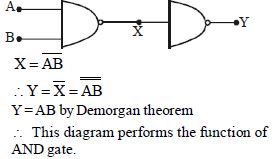
The following diagram performs the logic function of:

A
$XOR$ gate
B
$AND$ gate
C
$NAND$ gate
D
$OR$ gate
Solution
(B) The given circuit consists of two $NAND$ gates connected in series.
Let the inputs to the first $NAND$ gate be $A$ and $B$. The output of the first $NAND$ gate is $X = \overline{A \cdot B}$.
This output $X$ acts as the input to the second $NAND$ gate. Since both inputs of the second $NAND$ gate are connected to $X$, its output $Y$ is given by $Y = \overline{X \cdot X} = \overline{X}$.
Substituting the value of $X$, we get $Y = \overline{(\overline{A \cdot B})} = A \cdot B$.
The expression $Y = A \cdot B$ represents the logic function of an $AND$ gate.
Therefore, the given circuit performs the function of an $AND$ gate.
Let the inputs to the first $NAND$ gate be $A$ and $B$. The output of the first $NAND$ gate is $X = \overline{A \cdot B}$.
This output $X$ acts as the input to the second $NAND$ gate. Since both inputs of the second $NAND$ gate are connected to $X$, its output $Y$ is given by $Y = \overline{X \cdot X} = \overline{X}$.
Substituting the value of $X$, we get $Y = \overline{(\overline{A \cdot B})} = A \cdot B$.
The expression $Y = A \cdot B$ represents the logic function of an $AND$ gate.
Therefore, the given circuit performs the function of an $AND$ gate.
0 likesView Solution
52
PhysicsMediumMCQAIIMS · 2006
The energy gaps $(E_g)$ between the valence band and conduction band for diamond, silicon, and germanium are in the order:
A
$E_g$ (diamond) > $E_g$ (silicon) > $E_g$ (germanium)
B
$E_g$ (diamond) < $E_g$ (silicon) < $E_g$ (germanium)
C
$E_g$ (diamond) = $E_g$ (silicon) = $E_g$ (germanium)
D
$E_g$ (diamond) > $E_g$ (germanium) > $E_g$ (silicon)
Solution
(A) The energy gap $(E_g)$ is the energy difference between the top of the valence band and the bottom of the conduction band.
For diamond, the energy gap is approximately $6.0 \, eV$.
For silicon, the energy gap is approximately $1.1 \, eV$.
For germanium, the energy gap is approximately $0.72 \, eV$.
Comparing these values, we have $6.0 \, eV > 1.1 \, eV > 0.72 \, eV$.
Therefore, the order is $E_g$ (diamond) > $E_g$ (silicon) > $E_g$ (germanium).
For diamond, the energy gap is approximately $6.0 \, eV$.
For silicon, the energy gap is approximately $1.1 \, eV$.
For germanium, the energy gap is approximately $0.72 \, eV$.
Comparing these values, we have $6.0 \, eV > 1.1 \, eV > 0.72 \, eV$.
Therefore, the order is $E_g$ (diamond) > $E_g$ (silicon) > $E_g$ (germanium).
0 likesView Solution
53
PhysicsMediumMCQAIIMS · 2006
Five capacitors,each of capacitance $C$,are connected as shown in the figure. The ratio of the equivalent capacitance between $P$ and $R$ to the equivalent capacitance between $P$ and $Q$ is:
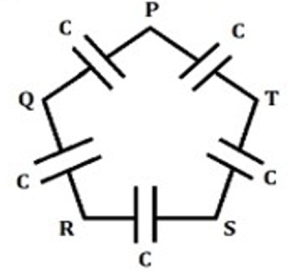
A
$1:4$
B
$2:3$
C
$3:1$
D
$5:2$
Solution
(B) $1$. To find the equivalent capacitance between $P$ and $R$ $(C_{PR})$: The path $P-Q-R$ consists of two capacitors in series,giving $C/2$. The path $P-T-S-R$ consists of three capacitors in series,giving $C/3$. These two branches are in parallel. Thus,$C_{PR} = C/2 + C/3 = 5C/6$.
$2$. To find the equivalent capacitance between $P$ and $Q$ $(C_{PQ})$: The path $P-Q$ is one capacitor $C$. The path $P-T-S-R-Q$ consists of four capacitors in series,giving $C/4$. These two branches are in parallel. Thus,$C_{PQ} = C + C/4 = 5C/4$.
$3$. The ratio $C_{PR} / C_{PQ} = (5C/6) / (5C/4) = 4/6 = 2/3$.
$2$. To find the equivalent capacitance between $P$ and $Q$ $(C_{PQ})$: The path $P-Q$ is one capacitor $C$. The path $P-T-S-R-Q$ consists of four capacitors in series,giving $C/4$. These two branches are in parallel. Thus,$C_{PQ} = C + C/4 = 5C/4$.
$3$. The ratio $C_{PR} / C_{PQ} = (5C/6) / (5C/4) = 4/6 = 2/3$.
0 likesView Solution
Vedclass Products
For Students
Vedclass Test Series
Mock tests in real AIIMS style covering Physics with performance analysis. 5-day free trial.
Start Free TrialFor Teachers
Exam Paper Generator
Generate Set A/B/C/D Physics papers from 7.5L+ questions in 2 minutes. 3 chapters free.
Try FreeFor Institutes
Online Exam Module
Run live AIIMS mock exams with unlimited students, 360° analytics & white-label branding.
See DemoFrequently Asked Questions
How many Physics questions are in AIIMS 2006?
There are 53 Physics questions from the AIIMS 2006 paper on Vedclass, each with a detailed step-by-step solution in English.
Are AIIMS 2006 Physics solutions available in English?
Yes. All solutions on this page are in English. You can also switch to English or Hindi using the language buttons above the questions.
Can I practice AIIMS 2006 Physics as a timed test?
Yes. Use the Vedclass Test Series to attempt a full AIIMS mock test covering Physics with time limits and instant score analysis.
Can teachers create Physics papers from AIIMS previous year questions?
Yes. The Vedclass Exam Paper Generator lets teachers mix AIIMS Physics questions and generate Set A/B/C/D papers in minutes.
For Teachers & Institutes
Build a Custom Physics Paper
Pick AIIMS 2006 Physics questions, set difficulty, and generate Set A/B/C/D in 2 minutes.