
PhysicsQ1–56 of 56 questions
Page 1 of 1 · English
1
PhysicsEasyMCQAIIMS · 1999
If $\overrightarrow{P} \cdot \overrightarrow{Q} = PQ,$ then the angle between $\overrightarrow{P}$ and $\overrightarrow{Q}$ is ....... $^\circ$.
A
$0$
B
$30$
C
$45$
D
$60$
Solution
(A) The dot product of two vectors $\overrightarrow{P}$ and $\overrightarrow{Q}$ is defined as $\overrightarrow{P} \cdot \overrightarrow{Q} = PQ \cos \theta$,where $\theta$ is the angle between the two vectors.
Given that $\overrightarrow{P} \cdot \overrightarrow{Q} = PQ$.
Substituting the definition,we get $PQ \cos \theta = PQ$.
Dividing both sides by $PQ$ (assuming $P, Q \neq 0$),we get $\cos \theta = 1$.
Since $\cos 0^\circ = 1$,the angle $\theta$ must be $0^\circ$.
Given that $\overrightarrow{P} \cdot \overrightarrow{Q} = PQ$.
Substituting the definition,we get $PQ \cos \theta = PQ$.
Dividing both sides by $PQ$ (assuming $P, Q \neq 0$),we get $\cos \theta = 1$.
Since $\cos 0^\circ = 1$,the angle $\theta$ must be $0^\circ$.
0 likesView Solution
2
PhysicsEasyMCQAIIMS · 1999
The velocity of a body upon reaching the point from which it was projected upwards is:
A
$v = 0$
B
$v = 2u$
C
$v = 0.5u$
D
$v = u$
Solution
(D) When a body is projected upwards with an initial velocity $u$,it undergoes constant deceleration due to gravity $(g)$.
At the maximum height,its velocity becomes $0$.
As it falls back down to the point of projection,it undergoes constant acceleration due to gravity $(g)$ over the same displacement.
Using the kinematic equation $v^2 = u^2 + 2as$,where $a = -g$ for the upward journey and $a = g$ for the downward journey,the final velocity $v$ at the starting point will have the same magnitude as the initial velocity $u$,but in the opposite direction.
Therefore,the speed of the body upon returning to the point of projection is $v = u$.
At the maximum height,its velocity becomes $0$.
As it falls back down to the point of projection,it undergoes constant acceleration due to gravity $(g)$ over the same displacement.
Using the kinematic equation $v^2 = u^2 + 2as$,where $a = -g$ for the upward journey and $a = g$ for the downward journey,the final velocity $v$ at the starting point will have the same magnitude as the initial velocity $u$,but in the opposite direction.
Therefore,the speed of the body upon returning to the point of projection is $v = u$.
1 likesView Solution
3
PhysicsEasyMCQAIIMS · 1999
The velocity-time curve for a body projected vertically upwards is:
A
Parabola
B
Ellipse
C
Hyperbola
D
Straight line
Solution
(D) The equation of motion for a body projected vertically upwards is given by $v = u - gt$,where $v$ is the final velocity,$u$ is the initial velocity,$g$ is the acceleration due to gravity,and $t$ is time.
Since $g$ is constant,this equation is of the form $y = mx + c$,which represents a straight line.
Therefore,the velocity-time graph for a body projected vertically upwards is a straight line with a negative slope equal to $-g$.
Since $g$ is constant,this equation is of the form $y = mx + c$,which represents a straight line.
Therefore,the velocity-time graph for a body projected vertically upwards is a straight line with a negative slope equal to $-g$.
0 likesView Solution
4
PhysicsEasyMCQAIIMS · 1999
If a cyclist moving with a speed of $4.9 \, m/s$ on a level road can take a sharp circular turn of radius $4 \, m$,then the coefficient of friction between the cycle tyres and the road is:
A
$0.41$
B
$0.51$
C
$0.61$
D
$0.71$
Solution
(C) For a cyclist taking a circular turn on a level road,the necessary centripetal force is provided by the static friction between the tyres and the road.
The condition for safe turning is given by the formula: $v^2 \leq \mu rg$,where $v$ is the speed,$\mu$ is the coefficient of friction,$r$ is the radius,and $g$ is the acceleration due to gravity.
To find the minimum coefficient of friction,we use: $\mu = \frac{v^2}{rg}$.
Given: $v = 4.9 \, m/s$,$r = 4 \, m$,and $g = 9.8 \, m/s^2$.
Substituting the values: $\mu = \frac{(4.9)^2}{4 \times 9.8} = \frac{24.01}{39.2} = 0.6125$.
Rounding to two decimal places,we get $\mu = 0.61$.
The condition for safe turning is given by the formula: $v^2 \leq \mu rg$,where $v$ is the speed,$\mu$ is the coefficient of friction,$r$ is the radius,and $g$ is the acceleration due to gravity.
To find the minimum coefficient of friction,we use: $\mu = \frac{v^2}{rg}$.
Given: $v = 4.9 \, m/s$,$r = 4 \, m$,and $g = 9.8 \, m/s^2$.
Substituting the values: $\mu = \frac{(4.9)^2}{4 \times 9.8} = \frac{24.01}{39.2} = 0.6125$.
Rounding to two decimal places,we get $\mu = 0.61$.
0 likesView Solution
5
PhysicsEasyMCQAIIMS · 1999
Two bodies of masses $m$ and $4m$ are moving with equal kinetic energy $(K.E.)$. The ratio of their linear momentums is
A
$4:1$
B
$1:1$
C
$1:2$
D
$1:4$
Solution
(C) The relationship between linear momentum $(p)$,mass $(m)$,and kinetic energy $(K.E.)$ is given by the formula: $p = \sqrt{2m(K.E.)}$.
Since the kinetic energy $(K.E.)$ is equal for both bodies,we have $p \propto \sqrt{m}$.
Therefore,the ratio of their linear momentums is $\frac{p_1}{p_2} = \sqrt{\frac{m_1}{m_2}}$.
Given $m_1 = m$ and $m_2 = 4m$,we substitute these values:
$\frac{p_1}{p_2} = \sqrt{\frac{m}{4m}} = \sqrt{\frac{1}{4}} = \frac{1}{2}$.
Thus,the ratio is $1:2$.
Since the kinetic energy $(K.E.)$ is equal for both bodies,we have $p \propto \sqrt{m}$.
Therefore,the ratio of their linear momentums is $\frac{p_1}{p_2} = \sqrt{\frac{m_1}{m_2}}$.
Given $m_1 = m$ and $m_2 = 4m$,we substitute these values:
$\frac{p_1}{p_2} = \sqrt{\frac{m}{4m}} = \sqrt{\frac{1}{4}} = \frac{1}{2}$.
Thus,the ratio is $1:2$.
0 likesView Solution
6
PhysicsEasyMCQAIIMS · 1999
Which of the following affects the elasticity of a substance?
A
Hammering and annealing
B
Change in temperature
C
Impurity in substance
D
All of these
Solution
(D) The elasticity of a material is influenced by several external and internal factors:
$1$. Temperature: Generally,the elasticity of most materials decreases as the temperature increases.
$2$. Impurities: The addition of impurities can alter the interatomic forces within the material,thereby changing its elastic properties.
$3$. Hammering and Annealing: These mechanical and thermal treatments change the internal crystalline structure of the material. Hammering breaks down crystal grains into smaller units,while annealing promotes the growth of larger,more uniform grains,both of which significantly affect the material's elasticity.
Therefore,all the given factors affect the elasticity of a substance.
$1$. Temperature: Generally,the elasticity of most materials decreases as the temperature increases.
$2$. Impurities: The addition of impurities can alter the interatomic forces within the material,thereby changing its elastic properties.
$3$. Hammering and Annealing: These mechanical and thermal treatments change the internal crystalline structure of the material. Hammering breaks down crystal grains into smaller units,while annealing promotes the growth of larger,more uniform grains,both of which significantly affect the material's elasticity.
Therefore,all the given factors affect the elasticity of a substance.
0 likesView Solution
7
PhysicsMediumMCQAIIMS · 1999
The average kinetic energy of a gas molecule at $27^oC$ is $6.21 \times 10^{-21} \, J$. Its average kinetic energy at $227^oC$ will be
A
$52.2 \times 10^{-21} \, J$
B
$5.22 \times 10^{-21} \, J$
C
$10.35 \times 10^{-21} \, J$
D
$11.35 \times 10^{-21} \, J$
Solution
(C) The average kinetic energy $(E)$ of a gas molecule is directly proportional to its absolute temperature $(T)$: $E \propto T$.
Therefore,the ratio is given by: $\frac{E_1}{E_2} = \frac{T_1}{T_2}$.
Given:
$E_1 = 6.21 \times 10^{-21} \, J$
$T_1 = 27^oC = 27 + 273 = 300 \, K$
$T_2 = 227^oC = 227 + 273 = 500 \, K$
Substituting the values:
$\frac{6.21 \times 10^{-21}}{E_2} = \frac{300}{500} = \frac{3}{5}$.
Solving for $E_2$:
$E_2 = \frac{6.21 \times 10^{-21} \times 5}{3} = 2.07 \times 5 \times 10^{-21} \, J = 10.35 \times 10^{-21} \, J$.
Therefore,the ratio is given by: $\frac{E_1}{E_2} = \frac{T_1}{T_2}$.
Given:
$E_1 = 6.21 \times 10^{-21} \, J$
$T_1 = 27^oC = 27 + 273 = 300 \, K$
$T_2 = 227^oC = 227 + 273 = 500 \, K$
Substituting the values:
$\frac{6.21 \times 10^{-21}}{E_2} = \frac{300}{500} = \frac{3}{5}$.
Solving for $E_2$:
$E_2 = \frac{6.21 \times 10^{-21} \times 5}{3} = 2.07 \times 5 \times 10^{-21} \, J = 10.35 \times 10^{-21} \, J$.
0 likesView Solution
8
PhysicsEasyMCQAIIMS · 1999
An adiabatic process occurs at constant
A
Temperature
B
Pressure
C
Heat
D
Temperature and pressure
Solution
(C) In an adiabatic process,the system is thermally insulated from its surroundings.
By definition,there is no exchange of heat between the system and the surroundings,which means $dQ = 0$.
Therefore,the heat content of the system remains constant during the process.
By definition,there is no exchange of heat between the system and the surroundings,which means $dQ = 0$.
Therefore,the heat content of the system remains constant during the process.
0 likesView Solution
9
PhysicsEasyMCQAIIMS · 1999
At a common temperature,a block of wood and a block of metal feel equally cold or hot. The temperatures of the block of wood and the block of metal are:
A
Equal to the temperature of the body
B
Less than the temperature of the body
C
Greater than the temperature of the body
D
Either $(b)$ or $(c)$
Solution
(A) When the temperature of an object is equal to that of the human body,no heat is transferred between the object and the body.
Since the human body is at a constant temperature,if the objects are also at that same temperature,there is no net flow of heat.
Therefore,both the block of wood and the block of metal will feel neither cold nor hot,or they will feel equally neutral,which is the condition described as feeling 'equally cold or hot' (i.e.,no temperature difference is perceived).
Thus,the correct answer is that their temperatures are equal to the temperature of the human body.
Since the human body is at a constant temperature,if the objects are also at that same temperature,there is no net flow of heat.
Therefore,both the block of wood and the block of metal will feel neither cold nor hot,or they will feel equally neutral,which is the condition described as feeling 'equally cold or hot' (i.e.,no temperature difference is perceived).
Thus,the correct answer is that their temperatures are equal to the temperature of the human body.
0 likesView Solution
10
PhysicsEasyMCQAIIMS · 1999
For a particle executing simple harmonic motion,which of the following statements is not correct?
A
The total energy of the particle always remains the same.
B
The restoring force is always directed towards a fixed point.
C
The restoring force is maximum at the extreme positions.
D
The acceleration of the particle is maximum at the equilibrium position.
Solution
(D) In simple harmonic motion $(SHM)$,the acceleration $a$ is given by $a = -\omega^2 x$,where $\omega$ is the angular frequency and $x$ is the displacement from the equilibrium position.
At the equilibrium position,$x = 0$,so the acceleration $a = 0$,which is the minimum value.
At the extreme positions,$x = \pm A$ (where $A$ is the amplitude),so the acceleration $a = \mp \omega^2 A$,which is the maximum value.
Therefore,the statement that the acceleration is maximum at the equilibrium position is incorrect.
The correct option is $D$.
At the equilibrium position,$x = 0$,so the acceleration $a = 0$,which is the minimum value.
At the extreme positions,$x = \pm A$ (where $A$ is the amplitude),so the acceleration $a = \mp \omega^2 A$,which is the maximum value.
Therefore,the statement that the acceleration is maximum at the equilibrium position is incorrect.
The correct option is $D$.
0 likesView Solution
11
PhysicsEasyMCQAIIMS · 1999
$A$ particle executes harmonic motion with an angular velocity and maximum acceleration of $3.5\, rad/s$ and $7.5\, m/s^2$ respectively. The amplitude of oscillation is .... $m$
A
$0.28$
B
$0.36$
C
$0.53$
D
$0.61$
Solution
(D) The maximum acceleration $(a_{\max})$ of a particle executing simple harmonic motion is given by the formula: $a_{\max} = A\omega^2$,where $A$ is the amplitude and $\omega$ is the angular velocity.
Given:
Angular velocity $\omega = 3.5\, rad/s$
Maximum acceleration $a_{\max} = 7.5\, m/s^2$
Rearranging the formula to solve for amplitude $A$:
$A = \frac{a_{\max}}{\omega^2}$
Substituting the given values:
$A = \frac{7.5}{(3.5)^2} = \frac{7.5}{12.25} \approx 0.61\, m$
Therefore,the amplitude of oscillation is $0.61\, m$.
Given:
Angular velocity $\omega = 3.5\, rad/s$
Maximum acceleration $a_{\max} = 7.5\, m/s^2$
Rearranging the formula to solve for amplitude $A$:
$A = \frac{a_{\max}}{\omega^2}$
Substituting the given values:
$A = \frac{7.5}{(3.5)^2} = \frac{7.5}{12.25} \approx 0.61\, m$
Therefore,the amplitude of oscillation is $0.61\, m$.
0 likesView Solution
12
PhysicsEasyMCQAIIMS · 1999
If the metal bob of a simple pendulum is replaced by a wooden bob, then its time period will
A
Increase
B
Decrease
C
Remain the same
D
First increase then decrease
Solution
(C) The time period $T$ of a simple pendulum is given by the formula $T = 2\pi \sqrt{\frac{L}{g}}$, where $L$ is the length of the pendulum and $g$ is the acceleration due to gravity.
As seen from the formula, the time period $T$ depends only on the length of the pendulum and the acceleration due to gravity.
It is independent of the mass, material, or density of the bob.
Therefore, replacing the metal bob with a wooden bob will not change the time period of the pendulum.
As seen from the formula, the time period $T$ depends only on the length of the pendulum and the acceleration due to gravity.
It is independent of the mass, material, or density of the bob.
Therefore, replacing the metal bob with a wooden bob will not change the time period of the pendulum.
0 likesView Solution
13
PhysicsDifficultMCQAIIMS · 1999
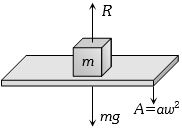
$A$ horizontal platform with an object placed on it is executing $S.H.M.$ in the vertical direction. The amplitude of oscillation is $3.92 \times 10^{-3} \, m$. What must be the least period of these oscillations,so that the object is not detached from the platform (in $, s$)?
A
$0.1256$
B
$0.1356$
C
$0.1456$
D
$0.1556$
Solution
(A) For the object not to be detached from the platform,the normal reaction $R$ must be greater than or equal to zero. The object is most likely to detach at the highest point of its oscillation where the acceleration is directed downwards.
Applying Newton's second law for the object of mass $m$ at the extreme top position:
$mg - R = ma\omega^2$
For the critical condition where the object is just about to detach,the normal reaction $R = 0$.
Thus,$mg = ma\omega^2$
$g = a\omega^2$
$\omega = \sqrt{\frac{g}{a}}$
Given $g = 9.8 \, m/s^2$ and amplitude $a = 3.92 \times 10^{-3} \, m$:
$\omega = \sqrt{\frac{9.8}{3.92 \times 10^{-3}}} = \sqrt{\frac{9800}{3.92}} = \sqrt{2500} = 50 \, rad/s$
The time period $T$ is given by:
$T = \frac{2\pi}{\omega} = \frac{2 \times 3.14159}{50} = 0.1256 \, s$
Therefore,the least period of oscillation is $0.1256 \, s$.
Applying Newton's second law for the object of mass $m$ at the extreme top position:
$mg - R = ma\omega^2$
For the critical condition where the object is just about to detach,the normal reaction $R = 0$.
Thus,$mg = ma\omega^2$
$g = a\omega^2$
$\omega = \sqrt{\frac{g}{a}}$
Given $g = 9.8 \, m/s^2$ and amplitude $a = 3.92 \times 10^{-3} \, m$:
$\omega = \sqrt{\frac{9.8}{3.92 \times 10^{-3}}} = \sqrt{\frac{9800}{3.92}} = \sqrt{2500} = 50 \, rad/s$
The time period $T$ is given by:
$T = \frac{2\pi}{\omega} = \frac{2 \times 3.14159}{50} = 0.1256 \, s$
Therefore,the least period of oscillation is $0.1256 \, s$.
0 likesView Solution
14
PhysicsEasyMCQAIIMS · 1999
$SONAR$ emits which of the following waves?
A
Radio waves
B
Ultrasonic waves
C
Light waves
D
Magnetic waves
Solution
(B) $SONAR$ stands for Sound Navigation and Ranging.
It works on the principle of reflection of sound waves.
$SONAR$ emits ultrasonic waves (sound waves with frequencies higher than $20,000 \ Hz$) into the water.
These waves travel through the water,strike an object,and reflect back to the receiver,allowing the system to detect the object's distance and location.
It works on the principle of reflection of sound waves.
$SONAR$ emits ultrasonic waves (sound waves with frequencies higher than $20,000 \ Hz$) into the water.
These waves travel through the water,strike an object,and reflect back to the receiver,allowing the system to detect the object's distance and location.
0 likesView Solution
15
PhysicsEasyMCQAIIMS · 1999
Energy is not carried by which of the following waves?
A
Stationary
B
Progressive
C
Transverse
D
Electromagnetic
Solution
(A) stationary wave (also known as a standing wave) is formed by the superposition of two identical waves traveling in opposite directions.
In a stationary wave,the energy is trapped between the nodes and does not propagate through the medium.
While the energy oscillates between kinetic and potential forms at different points,there is no net transport of energy across the medium.
In contrast,progressive waves,transverse waves,and electromagnetic waves are all characterized by the transport of energy from one point to another.
Therefore,the correct answer is $A$.
In a stationary wave,the energy is trapped between the nodes and does not propagate through the medium.
While the energy oscillates between kinetic and potential forms at different points,there is no net transport of energy across the medium.
In contrast,progressive waves,transverse waves,and electromagnetic waves are all characterized by the transport of energy from one point to another.
Therefore,the correct answer is $A$.
0 likesView Solution
16
PhysicsEasyMCQAIIMS · 1999
If the frequency of vibrations of a string is to be increased by a factor of two,then the tension in the string must be made:
A
Half
B
Twice
C
Four times
D
Eight times
Solution
(C) The frequency of vibration of a stretched string is given by the formula $n = \frac{1}{2L} \sqrt{\frac{T}{\mu}}$,where $n$ is the frequency,$L$ is the length,$T$ is the tension,and $\mu$ is the linear mass density.
From this relation,we can see that $n \propto \sqrt{T}$.
If the frequency is increased by a factor of two,the new frequency $n' = 2n$.
Therefore,$\frac{n'}{n} = \frac{\sqrt{T'}}{\sqrt{T}} = 2$.
Squaring both sides,we get $\frac{T'}{T} = 4$,which implies $T' = 4T$.
Thus,the tension must be made four times the original tension.
From this relation,we can see that $n \propto \sqrt{T}$.
If the frequency is increased by a factor of two,the new frequency $n' = 2n$.
Therefore,$\frac{n'}{n} = \frac{\sqrt{T'}}{\sqrt{T}} = 2$.
Squaring both sides,we get $\frac{T'}{T} = 4$,which implies $T' = 4T$.
Thus,the tension must be made four times the original tension.
0 likesView Solution
17
PhysicsMediumMCQAIIMS · 1999
$A$ siren emitting sound of frequency $500 \; Hz$ is going away from a static listener with a speed of $50 \; m/s$. The frequency of sound heard by the listener is .... $Hz$. (Take speed of sound $v = 330 \; m/s$)
A
$434.2$
B
$589.3$
C
$481.2$
D
$286.5$
Solution
(A) According to the Doppler effect,when the source is moving away from a stationary observer,the observed frequency $f'$ is given by the formula:
$f' = f \left( \frac{v}{v + v_s} \right)$
Where:
$f = 500 \; Hz$ (source frequency)
$v = 330 \; m/s$ (speed of sound)
$v_s = 50 \; m/s$ (speed of the source)
Substituting the values:
$f' = 500 \times \left( \frac{330}{330 + 50} \right)$
$f' = 500 \times \left( \frac{330}{380} \right)$
$f' = 500 \times 0.8684$
$f' \approx 434.2 \; Hz$
$f' = f \left( \frac{v}{v + v_s} \right)$
Where:
$f = 500 \; Hz$ (source frequency)
$v = 330 \; m/s$ (speed of sound)
$v_s = 50 \; m/s$ (speed of the source)
Substituting the values:
$f' = 500 \times \left( \frac{330}{330 + 50} \right)$
$f' = 500 \times \left( \frac{330}{380} \right)$
$f' = 500 \times 0.8684$
$f' \approx 434.2 \; Hz$
0 likesView Solution
18
PhysicsEasyMCQAIIMS · 1999
$Assertion$: On a rainy day,it is difficult to drive a car or bus at high speed.
$Reason$: The value of the coefficient of friction is lowered due to the wetting of the surface.
$Reason$: The value of the coefficient of friction is lowered due to the wetting of the surface.
A
If both $Assertion$ and $Reason$ are correct and the $Reason$ is a correct explanation of the $Assertion$.
B
If both $Assertion$ and $Reason$ are correct but $Reason$ is not a correct explanation of the $Assertion$.
C
If the $Assertion$ is correct but $Reason$ is incorrect.
D
If both the $Assertion$ and $Reason$ are incorrect.
Solution
(A) On a rainy day,the roads become wet.
Water acts as a lubricant between the tires and the road surface,which significantly lowers the coefficient of friction $(\mu)$.
Since the frictional force $f = \mu N$ (where $N$ is the normal force),a decrease in $\mu$ leads to a decrease in the available frictional force.
This reduced friction makes it difficult to maintain control,increases the braking distance,and increases the chances of skidding at high speeds.
Therefore,both the $Assertion$ and $Reason$ are correct,and the $Reason$ is the correct explanation for the $Assertion$.
Water acts as a lubricant between the tires and the road surface,which significantly lowers the coefficient of friction $(\mu)$.
Since the frictional force $f = \mu N$ (where $N$ is the normal force),a decrease in $\mu$ leads to a decrease in the available frictional force.
This reduced friction makes it difficult to maintain control,increases the braking distance,and increases the chances of skidding at high speeds.
Therefore,both the $Assertion$ and $Reason$ are correct,and the $Reason$ is the correct explanation for the $Assertion$.
0 likesView Solution
19
PhysicsEasyMCQAIIMS · 1999
The moment of inertia of a regular circular disc of mass $0.4\, kg$ and radius $100\, cm$ about an axis perpendicular to the plane of the disc and passing through its centre is ...... $kg\, m^2$.
A
$0.2$
B
$0.02$
C
$0.002$
D
$2$
Solution
(A) The moment of inertia $(I)$ of a circular disc about an axis perpendicular to its plane and passing through its center is given by the formula:
$I = \frac{1}{2} M R^2$
Given:
Mass $(M)$ = $0.4\, kg$
Radius $(R)$ = $100\, cm = 1\, m$
Substituting the values into the formula:
$I = \frac{1}{2} \times 0.4\, kg \times (1\, m)^2$
$I = 0.2 \times 1 = 0.2\, kg\, m^2$
Therefore,the correct option is $A$.
$I = \frac{1}{2} M R^2$
Given:
Mass $(M)$ = $0.4\, kg$
Radius $(R)$ = $100\, cm = 1\, m$
Substituting the values into the formula:
$I = \frac{1}{2} \times 0.4\, kg \times (1\, m)^2$
$I = 0.2 \times 1 = 0.2\, kg\, m^2$
Therefore,the correct option is $A$.
1 likesView Solution
20
PhysicsEasyMCQAIIMS · 1999
$Assertion :$ Fahrenheit is the smallest unit measuring temperature.
$Reason :$ Fahrenheit was the first temperature scale used for measuring temperature.
$Reason :$ Fahrenheit was the first temperature scale used for measuring temperature.
A
If both Assertion and Reason are correct and the Reason is a correct explanation of the Assertion.
B
If both Assertion and Reason are correct but Reason is not a correct explanation of the Assertion.
C
If the Assertion is correct but Reason is incorrect.
D
If the Assertion is incorrect but the Reason is correct.
Solution
(D) The Assertion is incorrect because the size of a degree in a temperature scale is determined by the number of divisions between the freezing and boiling points of water.
In the Celsius scale $(^oC)$,there are $100$ divisions.
In the Fahrenheit scale $(^oF)$,there are $180$ divisions.
In the Reaumur scale $(^oR)$,there are $80$ divisions.
In the Rankine scale $(^oRa)$,there are $180$ divisions.
Since the Rankine scale has the largest number of divisions for the same temperature interval,its unit size is actually smaller than that of the Fahrenheit scale.
Therefore,the statement that Fahrenheit is the smallest unit is false.
The Reason is correct because Daniel Gabriel Fahrenheit developed the first standardized mercury-in-glass thermometer and the associated Fahrenheit scale in $1724$.
In the Celsius scale $(^oC)$,there are $100$ divisions.
In the Fahrenheit scale $(^oF)$,there are $180$ divisions.
In the Reaumur scale $(^oR)$,there are $80$ divisions.
In the Rankine scale $(^oRa)$,there are $180$ divisions.
Since the Rankine scale has the largest number of divisions for the same temperature interval,its unit size is actually smaller than that of the Fahrenheit scale.
Therefore,the statement that Fahrenheit is the smallest unit is false.
The Reason is correct because Daniel Gabriel Fahrenheit developed the first standardized mercury-in-glass thermometer and the associated Fahrenheit scale in $1724$.
0 likesView Solution
21
PhysicsEasyMCQAIIMS · 1999
$Assertion :$ Bodies radiate heat at all temperatures.
$Reason :$ Rate of radiation of heat is proportional to the fourth power of absolute temperature.
$Reason :$ Rate of radiation of heat is proportional to the fourth power of absolute temperature.
A
If both Assertion and Reason are correct and the Reason is a correct explanation of the Assertion.
B
If both Assertion and Reason are correct but Reason is not a correct explanation of the Assertion.
C
If the Assertion is correct but Reason is incorrect.
D
If both the Assertion and Reason are incorrect.
Solution
(A) According to the kinetic theory of matter,all bodies at temperatures above absolute zero $(0 \ K)$ possess thermal energy and emit electromagnetic radiation. Thus,the assertion is correct.
According to the Stefan-Boltzmann law,the total energy radiated per unit surface area of a black body per unit time is directly proportional to the fourth power of its absolute temperature,given by $E = \sigma T^4$. This law explains why the rate of radiation depends on the temperature of the body. Therefore,the reason is correct and provides a valid explanation for the assertion.
According to the Stefan-Boltzmann law,the total energy radiated per unit surface area of a black body per unit time is directly proportional to the fourth power of its absolute temperature,given by $E = \sigma T^4$. This law explains why the rate of radiation depends on the temperature of the body. Therefore,the reason is correct and provides a valid explanation for the assertion.
0 likesView Solution
22
PhysicsMediumMCQAIIMS · 1999
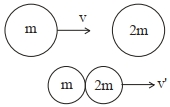
$A$ particle of mass $m$ moving with velocity $v$ collides with a stationary particle of mass $2m$. After collision,they stick together and continue to move together with velocity ........
A
$v$
B
$\frac{v}{2}$
C
$\frac{v}{3}$
D
$\frac{v}{4}$
Solution
(C) According to the law of conservation of linear momentum,the total initial momentum of the system must be equal to the total final momentum.
Initial momentum of the system: $P_i = m \cdot v + 2m \cdot 0 = mv$
After the collision,the two particles stick together,forming a combined mass of $(m + 2m) = 3m$.
Let the final velocity of the combined mass be $v'$.
Final momentum of the system: $P_f = (3m) \cdot v'$
Equating initial and final momentum: $mv = 3m \cdot v'$
Solving for $v'$: $v' = \frac{mv}{3m} = \frac{v}{3}$
Initial momentum of the system: $P_i = m \cdot v + 2m \cdot 0 = mv$
After the collision,the two particles stick together,forming a combined mass of $(m + 2m) = 3m$.
Let the final velocity of the combined mass be $v'$.
Final momentum of the system: $P_f = (3m) \cdot v'$
Equating initial and final momentum: $mv = 3m \cdot v'$
Solving for $v'$: $v' = \frac{mv}{3m} = \frac{v}{3}$
0 likesView Solution
23
PhysicsMediumMCQAIIMS · 1999
Dimensions of $CR$ are those of
A
Frequency
B
Energy
C
Time period
D
Current
Solution
(C) The dimension of $CR$ is given by the product of capacitance $(C)$ and resistance $(R)$.
$C = \frac{Q}{V}$,where $Q$ is charge and $V$ is potential difference.
$R = \frac{V}{I}$,where $I$ is current.
Therefore,$CR = \left( \frac{Q}{V} \right) \times \left( \frac{V}{I} \right) = \frac{Q}{I}$.
Since $I = \frac{Q}{t}$,where $t$ is time,we have $\frac{Q}{I} = t$.
Thus,the dimensions of $CR$ are the same as those of time,which corresponds to the time period.
$C = \frac{Q}{V}$,where $Q$ is charge and $V$ is potential difference.
$R = \frac{V}{I}$,where $I$ is current.
Therefore,$CR = \left( \frac{Q}{V} \right) \times \left( \frac{V}{I} \right) = \frac{Q}{I}$.
Since $I = \frac{Q}{t}$,where $t$ is time,we have $\frac{Q}{I} = t$.
Thus,the dimensions of $CR$ are the same as those of time,which corresponds to the time period.
0 likesView Solution
24
PhysicsEasyMCQAIIMS · 1999
Number of electrons in one coulomb of charge will be
A
$5.46 \times 10^{29}$
B
$6.25 \times 10^{18}$
C
$1.6 \times 10^{19}$
D
$9 \times 10^{11}$
Solution
(B) According to the quantization of charge,the total charge $q$ is given by $q = ne$,where $n$ is the number of electrons and $e$ is the elementary charge.
Given,$q = 1 \ C$ and $e = 1.6 \times 10^{-19} \ C$.
Therefore,$n = \frac{q}{e} = \frac{1}{1.6 \times 10^{-19}}$.
$n = \frac{1}{1.6} \times 10^{19} = 0.625 \times 10^{19} = 6.25 \times 10^{18}$.
Thus,the number of electrons in one coulomb of charge is $6.25 \times 10^{18}$.
Given,$q = 1 \ C$ and $e = 1.6 \times 10^{-19} \ C$.
Therefore,$n = \frac{q}{e} = \frac{1}{1.6 \times 10^{-19}}$.
$n = \frac{1}{1.6} \times 10^{19} = 0.625 \times 10^{19} = 6.25 \times 10^{18}$.
Thus,the number of electrons in one coulomb of charge is $6.25 \times 10^{18}$.
0 likesView Solution
25
PhysicsEasyMCQAIIMS · 1999
Two identical conductors of copper and aluminium are placed in identical electric fields. The magnitude of induced charge in the aluminium will be
A
Zero
B
Greater than in copper
C
Equal to that in copper
D
Less than in copper
Solution
(C) For a conductor placed in an external electric field $E$, the induced charge $q_{ind}$ is given by the relation $q_{ind} = -q(1 - 1/K)$, where $K$ is the dielectric constant.
For any perfect conductor, the dielectric constant $K$ is considered to be infinity $(\infty)$.
Therefore, the induced charge $q_{ind} = -q(1 - 1/\infty) = -q(1 - 0) = -q$.
Since both copper and aluminium are metals (conductors), they both have an infinite dielectric constant.
Thus, the magnitude of the induced charge on both conductors will be equal.
For any perfect conductor, the dielectric constant $K$ is considered to be infinity $(\infty)$.
Therefore, the induced charge $q_{ind} = -q(1 - 1/\infty) = -q(1 - 0) = -q$.
Since both copper and aluminium are metals (conductors), they both have an infinite dielectric constant.
Thus, the magnitude of the induced charge on both conductors will be equal.
0 likesView Solution
26
PhysicsEasyMCQAIIMS · 1999
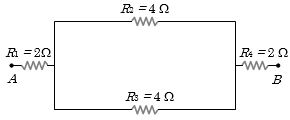
In the given figure,the equivalent resistance between the points $A$ and $B$ is ............ $\Omega$.
A
$8$
B
$6$
C
$4$
D
$2$
Solution
(B) From the circuit diagram,we can observe that resistors $R_2$ and $R_3$ are connected in parallel.
The equivalent resistance of this parallel combination $(R_p)$ is given by:
$\frac{1}{R_p} = \frac{1}{R_2} + \frac{1}{R_3} = \frac{1}{4} + \frac{1}{4} = \frac{2}{4} = \frac{1}{2}$
So,$R_p = 2 \,\Omega$.
Now,this parallel combination is in series with resistors $R_1$ and $R_4$.
The total equivalent resistance $(R_{AB})$ between points $A$ and $B$ is:
$R_{AB} = R_1 + R_p + R_4$
$R_{AB} = 2 + 2 + 2 = 6 \,\Omega$.
The equivalent resistance of this parallel combination $(R_p)$ is given by:
$\frac{1}{R_p} = \frac{1}{R_2} + \frac{1}{R_3} = \frac{1}{4} + \frac{1}{4} = \frac{2}{4} = \frac{1}{2}$
So,$R_p = 2 \,\Omega$.
Now,this parallel combination is in series with resistors $R_1$ and $R_4$.
The total equivalent resistance $(R_{AB})$ between points $A$ and $B$ is:
$R_{AB} = R_1 + R_p + R_4$
$R_{AB} = 2 + 2 + 2 = 6 \,\Omega$.
0 likesView Solution
27
PhysicsEasyMCQAIIMS · 1999
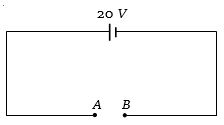
In the shown circuit,what is the potential difference across $A$ and $B$ (in $V$)?
A
$50$
B
$45$
C
$30$
D
$20$
Solution
(D) In the given circuit,the terminals $A$ and $B$ are open-circuited.
Since no current flows through the circuit $(I = 0)$,there is no voltage drop across any internal resistance of the cell (assuming an ideal cell or negligible internal resistance).
Therefore,the potential difference across the open terminals $A$ and $B$ is equal to the electromotive force $(EMF)$ of the cell.
Thus,the potential difference is $20 \ V$.
Since no current flows through the circuit $(I = 0)$,there is no voltage drop across any internal resistance of the cell (assuming an ideal cell or negligible internal resistance).
Therefore,the potential difference across the open terminals $A$ and $B$ is equal to the electromotive force $(EMF)$ of the cell.
Thus,the potential difference is $20 \ V$.
0 likesView Solution
28
PhysicsMediumMCQAIIMS · 1999
The resistance of a galvanometer is $50\,\Omega$ and the current required to give full-scale deflection is $100\,\mu A$. In order to convert it into an ammeter reading up to $10\,A$,it is necessary to put a resistance of
A
$5 \times 10^{-3}\,\Omega$ in parallel
B
$5 \times 10^{-4}\,\Omega$ in parallel
C
$10^5\,\Omega$ in series
D
$99,950\,\Omega$ in series
Solution
(B) To convert a galvanometer into an ammeter,a shunt resistance $S$ must be connected in parallel with the galvanometer.
Given:
Galvanometer resistance $G = 50\,\Omega$
Full-scale deflection current $i_g = 100\,\mu A = 100 \times 10^{-6}\,A = 10^{-4}\,A$
Desired range of ammeter $i = 10\,A$
The formula for shunt resistance is $S = \frac{G \cdot i_g}{i - i_g}$.
Substituting the values:
$S = \frac{50 \times 10^{-4}}{10 - 10^{-4}}$
Since $10^{-4}$ is very small compared to $10$,we can approximate the denominator as $10$.
$S \approx \frac{50 \times 10^{-4}}{10} = 5 \times 10^{-4}\,\Omega$.
Thus,a resistance of $5 \times 10^{-4}\,\Omega$ must be connected in parallel.
Given:
Galvanometer resistance $G = 50\,\Omega$
Full-scale deflection current $i_g = 100\,\mu A = 100 \times 10^{-6}\,A = 10^{-4}\,A$
Desired range of ammeter $i = 10\,A$
The formula for shunt resistance is $S = \frac{G \cdot i_g}{i - i_g}$.
Substituting the values:
$S = \frac{50 \times 10^{-4}}{10 - 10^{-4}}$
Since $10^{-4}$ is very small compared to $10$,we can approximate the denominator as $10$.
$S \approx \frac{50 \times 10^{-4}}{10} = 5 \times 10^{-4}\,\Omega$.
Thus,a resistance of $5 \times 10^{-4}\,\Omega$ must be connected in parallel.
0 likesView Solution
29
PhysicsEasyMCQAIIMS · 1999
Tesla is the unit of
A
Electric flux
B
Magnetic flux
C
Electric field
D
Magnetic field
Solution
(D) The $SI$ unit of magnetic field induction $(B)$ is Tesla $(T)$.
One Tesla is defined as the magnetic field that exerts a force of $1 \ N$ on a charge of $1 \ C$ moving with a velocity of $1 \ m/s$ perpendicular to the field.
One Tesla is defined as the magnetic field that exerts a force of $1 \ N$ on a charge of $1 \ C$ moving with a velocity of $1 \ m/s$ perpendicular to the field.
0 likesView Solution
30
PhysicsEasyMCQAIIMS · 1999
$A$ charged particle enters a magnetic field $B$ with its initial velocity making an angle of $45^\circ$ with $B$. The path of the particle will be
A
$A$ straight line
B
$A$ circle
C
An ellipse
D
$A$ helix
Solution
(D) When a charged particle enters a magnetic field $B$ at an angle $\theta$ (where $\theta \neq 0^\circ, 90^\circ, 180^\circ$),its velocity $v$ can be resolved into two components:
$1$. The component $v \cos \theta$ parallel to the magnetic field,which causes the particle to move in a straight line along the direction of the field.
$2$. The component $v \sin \theta$ perpendicular to the magnetic field,which causes the particle to move in a circular path.
Since the particle has both a parallel and a perpendicular velocity component,the resultant path is a helix. Given $\theta = 45^\circ$,the path is a helix.
$1$. The component $v \cos \theta$ parallel to the magnetic field,which causes the particle to move in a straight line along the direction of the field.
$2$. The component $v \sin \theta$ perpendicular to the magnetic field,which causes the particle to move in a circular path.
Since the particle has both a parallel and a perpendicular velocity component,the resultant path is a helix. Given $\theta = 45^\circ$,the path is a helix.
0 likesView Solution
31
PhysicsEasyMCQAIIMS · 1999
The angle of dip is $90^{\circ}$ at:
A
Poles
B
Equator
C
Both $(a)$ and $(b)$
D
None of these
Solution
(A) The angle of dip (or magnetic inclination) is defined as the angle that the total magnetic field of the Earth makes with the surface of the Earth.
At the magnetic poles,the Earth's magnetic field lines are perpendicular to the surface of the Earth.
Therefore,the angle of dip at the poles is $90^{\circ}$.
At the magnetic poles,the Earth's magnetic field lines are perpendicular to the surface of the Earth.
Therefore,the angle of dip at the poles is $90^{\circ}$.
0 likesView Solution
32
PhysicsEasyMCQAIIMS · 1999
When a magnetic substance is heated,then it
A
Becomes a strong magnet
B
Loses its magnetism
C
Does not affect the magnetism
D
Either $(A)$ or $(C)$
Solution
(B) When a magnetic substance is heated,it loses its magnetic property.
This happens because the thermal energy causes the atomic magnets (magnetic dipoles) to become randomly oriented,thereby destroying the net alignment that creates the magnetic field.
This happens because the thermal energy causes the atomic magnets (magnetic dipoles) to become randomly oriented,thereby destroying the net alignment that creates the magnetic field.
0 likesView Solution
33
PhysicsEasyMCQAIIMS · 1999
The north pole of a magnet is brought near a metallic ring. The direction of the induced current in the ring will be
A
Clockwise
B
Anticlockwise
C
Towards north
D
Towards south
Solution
(B) According to Lenz's law,the direction of the induced current is such that it opposes the cause that produces it.
When the north pole of a magnet is brought near a metallic ring,the magnetic flux linked with the ring increases.
To oppose this increase in magnetic flux,the ring will develop a north pole on the face towards the magnet.
$A$ face with a north pole polarity corresponds to an anticlockwise direction of current when viewed from the side of the magnet.
Therefore,the induced current in the ring will be anticlockwise.
When the north pole of a magnet is brought near a metallic ring,the magnetic flux linked with the ring increases.
To oppose this increase in magnetic flux,the ring will develop a north pole on the face towards the magnet.
$A$ face with a north pole polarity corresponds to an anticlockwise direction of current when viewed from the side of the magnet.
Therefore,the induced current in the ring will be anticlockwise.
0 likesView Solution
34
PhysicsMediumMCQAIIMS · 1999
The primary winding of a transformer has $500$ turns,whereas its secondary has $5000$ turns. The primary is connected to an $ac$ supply of $20\, V$,$50\, Hz$. The secondary will have an output of
A
$200\, V, 50\, Hz$
B
$2\, V, 50\, Hz$
C
$200\, V, 500\, Hz$
D
$2\, V, 5\, Hz$
Solution
(A) The transformation ratio of a transformer is given by the formula: $\frac{V_s}{V_p} = \frac{N_s}{N_p}$.
Given:
Primary turns $(N_p)$ = $500$
Secondary turns $(N_s)$ = $5000$
Primary voltage $(V_p)$ = $20\, V$
Substituting the values:
$\frac{V_s}{20} = \frac{5000}{500}$
$\frac{V_s}{20} = 10$
$V_s = 200\, V$.
In a transformer,the frequency of the output voltage remains the same as the input frequency because the magnetic flux changes at the same rate as the input current. Therefore,the frequency is $50\, Hz$.
Given:
Primary turns $(N_p)$ = $500$
Secondary turns $(N_s)$ = $5000$
Primary voltage $(V_p)$ = $20\, V$
Substituting the values:
$\frac{V_s}{20} = \frac{5000}{500}$
$\frac{V_s}{20} = 10$
$V_s = 200\, V$.
In a transformer,the frequency of the output voltage remains the same as the input frequency because the magnetic flux changes at the same rate as the input current. Therefore,the frequency is $50\, Hz$.
0 likesView Solution
35
PhysicsEasyMCQAIIMS · 1999
The quantity that remains unchanged in a transformer is:
A
Voltage
B
Current
C
Frequency
D
None of the above
Solution
(C) In a transformer,the primary purpose is to change the voltage and current levels through electromagnetic induction. However,the frequency of the alternating current $(AC)$ remains constant because the magnetic flux in the core oscillates at the same rate as the input supply frequency. Therefore,the frequency at the input is equal to the frequency at the output.
0 likesView Solution
36
PhysicsEasyMCQAIIMS · 1999
$A$ choke coil has
A
High inductance and low resistance
B
Low inductance and high resistance
C
High inductance and high resistance
D
Low inductance and low resistance
Solution
(A) choke coil is designed to have high inductance and low resistance.
Since an inductor is an ideal non-resistive device,it does not consume power in the form of heat,unlike a resistor.
By using a coil with high inductance $(L)$ and very low resistance $(R)$,we can control the current in an $AC$ circuit while minimizing power loss $(P = I^2 R)$.
Therefore,the correct option is $A$.
Since an inductor is an ideal non-resistive device,it does not consume power in the form of heat,unlike a resistor.
By using a coil with high inductance $(L)$ and very low resistance $(R)$,we can control the current in an $AC$ circuit while minimizing power loss $(P = I^2 R)$.
Therefore,the correct option is $A$.
0 likesView Solution
37
PhysicsEasyMCQAIIMS · 1999
When cathode rays strike a metal target of high melting point with very high velocity,then
A
$X$-rays are produced
B
Alpha-rays are produced
C
$TV$ waves are produced
D
Ultrasonic waves are produced
Solution
(A) Cathode rays consist of high-speed electrons. When these high-energy electrons strike a metal target with a high melting point (such as tungsten or molybdenum),they are suddenly decelerated by the strong electric fields of the target nuclei. This rapid deceleration causes the emission of high-energy electromagnetic radiation known as $X$-rays. This is the fundamental principle behind the operation of an $X$-ray tube.
0 likesView Solution
38
PhysicsEasyMCQAIIMS · 1999
In the Bohr's hydrogen atom model,the radius of the stationary orbit is directly proportional to ($n =$ principle quantum number)
A
$n^{-1}$
B
$n$
C
$n^{-2}$
D
$n^2$
Solution
(D) According to the Bohr model of the hydrogen atom,the radius of the $n^{th}$ stationary orbit is given by the formula:
$r_n = \frac{\varepsilon_0 n^2 h^2}{\pi Z m e^2}$
In this expression,$\varepsilon_0$ is the permittivity of free space,$h$ is Planck's constant,$Z$ is the atomic number,$m$ is the mass of the electron,and $e$ is the elementary charge.
Since all these parameters are constants for a given atom,the radius $r$ is directly proportional to the square of the principal quantum number $n$.
Therefore,$r \propto n^2$.
$r_n = \frac{\varepsilon_0 n^2 h^2}{\pi Z m e^2}$
In this expression,$\varepsilon_0$ is the permittivity of free space,$h$ is Planck's constant,$Z$ is the atomic number,$m$ is the mass of the electron,and $e$ is the elementary charge.
Since all these parameters are constants for a given atom,the radius $r$ is directly proportional to the square of the principal quantum number $n$.
Therefore,$r \propto n^2$.
0 likesView Solution
39
PhysicsEasyMCQAIIMS · 1999
Which of the following is used as a moderator in nuclear reactors?
A
Uranium
B
Heavy water
C
Cadmium
D
Plutonium
Solution
(B) The correct answer is $(b)$. $A$ neutron moderator is a medium that reduces the speed of fast neutrons,thereby turning them into thermal neutrons capable of sustaining a nuclear chain reaction involving uranium$-235$.
Heavy water $(D_2O)$ serves as an effective neutron moderator in a nuclear reactor. It slows down fast-moving neutrons through elastic collisions,which increases the probability of these neutrons causing further fission in uranium nuclei.
Explanation:
In a fission reaction,neutrons are released with high kinetic energy. These fast neutrons are less likely to cause further fission. By using a moderator like heavy water,the neutrons lose kinetic energy and become 'thermal' or 'slow' neutrons,which are much more efficient at sustaining the chain reaction.
Heavy water $(D_2O)$ serves as an effective neutron moderator in a nuclear reactor. It slows down fast-moving neutrons through elastic collisions,which increases the probability of these neutrons causing further fission in uranium nuclei.
Explanation:
In a fission reaction,neutrons are released with high kinetic energy. These fast neutrons are less likely to cause further fission. By using a moderator like heavy water,the neutrons lose kinetic energy and become 'thermal' or 'slow' neutrons,which are much more efficient at sustaining the chain reaction.
0 likesView Solution
40
PhysicsEasyMCQAIIMS · 1999
Energy in the sun is generated mainly by
A
Fusion of radioactive material
B
Fission of helium atoms
C
Chemical reaction
D
Fusion of hydrogen atoms
Solution
(D) The energy in the sun is generated primarily through the process of nuclear fusion.
In the core of the sun,hydrogen nuclei (protons) undergo fusion to form helium nuclei.
This process releases a tremendous amount of energy due to the mass defect between the reactants and the products,as described by Einstein's mass-energy equivalence principle,$E = \Delta mc^2$.
In the core of the sun,hydrogen nuclei (protons) undergo fusion to form helium nuclei.
This process releases a tremendous amount of energy due to the mass defect between the reactants and the products,as described by Einstein's mass-energy equivalence principle,$E = \Delta mc^2$.
0 likesView Solution
41
PhysicsEasyMCQAIIMS · 1999
In $N$-type semiconductors,the majority charge carriers are
A
Holes
B
Protons
C
Neutrons
D
Electrons
Solution
(D) In an $N$-type semiconductor,pentavalent impurity atoms (like Phosphorus or Arsenic) are added to the intrinsic semiconductor (like Silicon or Germanium).
These impurity atoms provide extra electrons to the conduction band.
Therefore,in $N$-type semiconductors,electrons are the majority charge carriers,while holes are the minority charge carriers.
These impurity atoms provide extra electrons to the conduction band.
Therefore,in $N$-type semiconductors,electrons are the majority charge carriers,while holes are the minority charge carriers.
0 likesView Solution
42
PhysicsEasyMCQAIIMS · 1999
Boolean algebra is essentially based on
A
Truth
B
Logic
C
Symbol
D
Numbers
Solution
(B) Boolean algebra is a branch of algebra in which the values of the variables are the truth values $true$ and $false$,usually denoted by $1$ and $0$ respectively.
It is essentially based on logic,as it deals with logical operations such as $AND$,$OR$,and $NOT$ to manipulate these truth values.
Therefore,the correct option is $B$.
It is essentially based on logic,as it deals with logical operations such as $AND$,$OR$,and $NOT$ to manipulate these truth values.
Therefore,the correct option is $B$.
0 likesView Solution
43
PhysicsEasyMCQAIIMS · 1999
$A$ diode is used as a/an
A
Oscillator
B
Amplifier
C
Rectifier
D
Modulator
Solution
(C) diode is a semiconductor device that allows current to flow in only one direction. Due to this unidirectional property,it is primarily used as a rectifier to convert alternating current $(AC)$ into direct current $(DC)$.
0 likesView Solution
44
PhysicsEasyMCQAIIMS · 1999
The relation between the critical angles of water and glass is:
A
$C_w > C_g$
B
$C_w < C_g$
C
$C_w = C_g$
D
$C_w = C_g = 0$
Solution
(A) The critical angle $C$ is given by the formula $\sin C = \frac{1}{\mu}$,where $\mu$ is the refractive index of the medium with respect to air.
Since the refractive index of water $\mu_w \approx 1.33$ and the refractive index of glass $\mu_g \approx 1.50$,we have $\mu_w < \mu_g$.
Because $C = \arcsin(\frac{1}{\mu})$,a smaller refractive index results in a larger critical angle.
Therefore,$C_w > C_g$.
Since the refractive index of water $\mu_w \approx 1.33$ and the refractive index of glass $\mu_g \approx 1.50$,we have $\mu_w < \mu_g$.
Because $C = \arcsin(\frac{1}{\mu})$,a smaller refractive index results in a larger critical angle.
Therefore,$C_w > C_g$.
0 likesView Solution
45
PhysicsEasyMCQAIIMS · 1999
The colour of the sky is blue due to
A
Scattering of light
B
Total internal reflection
C
Total emission
D
None of the above
Solution
(A) According to Rayleigh's law of scattering, the intensity of scattered light $I$ is inversely proportional to the fourth power of its wavelength, given by $I \propto \frac{1}{\lambda^4}$.
Since the wavelength of blue light $(\lambda_{blue})$ is the shortest among the visible spectrum, it undergoes maximum scattering by the atmospheric particles.
Therefore, the sky appears blue to our eyes.
Since the wavelength of blue light $(\lambda_{blue})$ is the shortest among the visible spectrum, it undergoes maximum scattering by the atmospheric particles.
Therefore, the sky appears blue to our eyes.
0 likesView Solution
46
PhysicsEasyMCQAIIMS · 1999
The phenomenon of interference is shown by
A
Longitudinal mechanical waves only
B
Transverse mechanical waves only
C
Electromagnetic waves only
D
All the above types of waves
Solution
(D) Interference is a general property of waves. It occurs when two or more waves of the same frequency and constant phase difference superpose each other. This phenomenon is observed in all types of waves,including longitudinal mechanical waves (e.g.,sound waves),transverse mechanical waves (e.g.,waves on a string),and electromagnetic waves (e.g.,light waves). Therefore,the correct option is $D$.
0 likesView Solution
47
PhysicsMediumMCQAIIMS · 1999
If a transparent medium of refractive index $\mu = 1.5$ and thickness $t = 2.5 \times 10^{-5} \, m$ is inserted in front of one of the slits of Young's Double Slit experiment,how much will be the shift in the interference pattern? The distance between the slits is $0.5 \, mm$ and that between slits and screen is $100 \, cm$. (Answer in $cm$)
A
$5$
B
$2.5$
C
$0.25$
D
$0.1$
Solution
(B) The shift in the interference pattern due to the insertion of a transparent plate is given by the formula: $x = \frac{(\mu - 1)tD}{d}$.
Here,$\mu = 1.5$,$t = 2.5 \times 10^{-5} \, m$,$D = 100 \, cm = 1 \, m$,and $d = 0.5 \, mm = 0.5 \times 10^{-3} \, m$.
Substituting these values into the formula:
$x = \frac{(1.5 - 1) \times 2.5 \times 10^{-5} \times 1}{0.5 \times 10^{-3}}$
$x = \frac{0.5 \times 2.5 \times 10^{-5}}{0.5 \times 10^{-3}}$
$x = 2.5 \times 10^{-2} \, m$
$x = 2.5 \, cm$.
Here,$\mu = 1.5$,$t = 2.5 \times 10^{-5} \, m$,$D = 100 \, cm = 1 \, m$,and $d = 0.5 \, mm = 0.5 \times 10^{-3} \, m$.
Substituting these values into the formula:
$x = \frac{(1.5 - 1) \times 2.5 \times 10^{-5} \times 1}{0.5 \times 10^{-3}}$
$x = \frac{0.5 \times 2.5 \times 10^{-5}}{0.5 \times 10^{-3}}$
$x = 2.5 \times 10^{-2} \, m$
$x = 2.5 \, cm$.
0 likesView Solution
48
PhysicsEasyMCQAIIMS · 1999
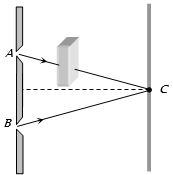
In Young's double-slit experiment,monochromatic light is used to illuminate the two slits $A$ and $B$. Interference fringes are observed on a screen placed in front of the slits. If a thin glass plate is placed normally in the path of the beam coming from one of the slits,what happens to the interference pattern?
A
The fringes will disappear.
B
The fringe width will increase.
C
The fringe width will decrease.
D
There will be no change in the fringe width,but the pattern shifts.
Solution
(D) When a thin glass plate of thickness $t$ and refractive index $\mu$ is placed in the path of one of the beams,an additional path difference is introduced.
This path difference is given by $\Delta x = (\mu - 1)t$.
Due to this additional path difference,the entire interference pattern shifts by a distance $y = \frac{D}{d}(\mu - 1)t$ towards the side where the glass plate is placed.
However,the fringe width $\beta = \frac{\lambda D}{d}$ depends only on the wavelength $\lambda$,the distance between the slits $d$,and the distance to the screen $D$.
Since these parameters remain unchanged,the fringe width remains constant.
Therefore,the correct option is $(d)$.
This path difference is given by $\Delta x = (\mu - 1)t$.
Due to this additional path difference,the entire interference pattern shifts by a distance $y = \frac{D}{d}(\mu - 1)t$ towards the side where the glass plate is placed.
However,the fringe width $\beta = \frac{\lambda D}{d}$ depends only on the wavelength $\lambda$,the distance between the slits $d$,and the distance to the screen $D$.
Since these parameters remain unchanged,the fringe width remains constant.
Therefore,the correct option is $(d)$.
0 likesView Solution
49
PhysicsEasyMCQAIIMS · 1999
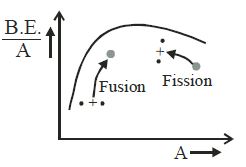
Fission of nuclei is possible because the binding energy per nucleon in them
A
Increases with mass number at high mass numbers
B
Decreases with mass number at high mass numbers
C
Increases with mass number at low mass numbers
D
Decreases with mass number at low mass numbers
Solution
(B) Nuclear fission is a process in which a heavy nucleus splits into two lighter nuclei.
According to the binding energy per nucleon curve,for heavy nuclei (high mass number $A$),the binding energy per nucleon decreases as the mass number increases.
This means that heavy nuclei are less stable compared to intermediate-mass nuclei.
When a heavy nucleus splits into two lighter nuclei,the binding energy per nucleon of the resulting products is higher than that of the parent nucleus.
This increase in binding energy per nucleon results in the release of energy,making the fission process possible.
Therefore,the correct reason is that the binding energy per nucleon decreases with mass number at high mass numbers.
According to the binding energy per nucleon curve,for heavy nuclei (high mass number $A$),the binding energy per nucleon decreases as the mass number increases.
This means that heavy nuclei are less stable compared to intermediate-mass nuclei.
When a heavy nucleus splits into two lighter nuclei,the binding energy per nucleon of the resulting products is higher than that of the parent nucleus.
This increase in binding energy per nucleon results in the release of energy,making the fission process possible.
Therefore,the correct reason is that the binding energy per nucleon decreases with mass number at high mass numbers.
0 likesView Solution
50
PhysicsDifficultMCQAIIMS · 1999
Half-life of a radioactive substance is $20 \, min$. The time between $20\%$ and $80\%$ decay will be ......... $min$.
A
$20$
B
$40$
C
$30$
D
$25$
Solution
(B) The half-life of the substance is $T_{1/2} = 20 \, min$. The decay constant is $\lambda = \frac{\ln 2}{T_{1/2}} = \frac{\ln 2}{20}$.
Let $N_0$ be the initial amount of the substance.
For $20\%$ decay,the amount remaining is $N_1 = N_0 - 0.20 N_0 = 0.80 N_0$. The time taken is $t_1$,where $0.80 N_0 = N_0 e^{-\lambda t_1}$.
For $80\%$ decay,the amount remaining is $N_2 = N_0 - 0.80 N_0 = 0.20 N_0$. The time taken is $t_2$,where $0.20 N_0 = N_0 e^{-\lambda t_2}$.
Dividing the two equations:
$\frac{0.80 N_0}{0.20 N_0} = \frac{e^{-\lambda t_1}}{e^{-\lambda t_2}}$
$4 = e^{\lambda(t_2 - t_1)}$
Taking the natural logarithm on both sides:
$\ln 4 = \lambda(t_2 - t_1)$
$2 \ln 2 = \left( \frac{\ln 2}{20} \right) (t_2 - t_1)$
$2 = \frac{t_2 - t_1}{20}$
$t_2 - t_1 = 40 \, min$.
Let $N_0$ be the initial amount of the substance.
For $20\%$ decay,the amount remaining is $N_1 = N_0 - 0.20 N_0 = 0.80 N_0$. The time taken is $t_1$,where $0.80 N_0 = N_0 e^{-\lambda t_1}$.
For $80\%$ decay,the amount remaining is $N_2 = N_0 - 0.80 N_0 = 0.20 N_0$. The time taken is $t_2$,where $0.20 N_0 = N_0 e^{-\lambda t_2}$.
Dividing the two equations:
$\frac{0.80 N_0}{0.20 N_0} = \frac{e^{-\lambda t_1}}{e^{-\lambda t_2}}$
$4 = e^{\lambda(t_2 - t_1)}$
Taking the natural logarithm on both sides:
$\ln 4 = \lambda(t_2 - t_1)$
$2 \ln 2 = \left( \frac{\ln 2}{20} \right) (t_2 - t_1)$
$2 = \frac{t_2 - t_1}{20}$
$t_2 - t_1 = 40 \, min$.
0 likesView Solution
51
PhysicsEasyMCQAIIMS · 1999
Assertion: Electrons move away from a region of higher potential to a region of lower potential.
Reason: An electron has a negative charge.
Reason: An electron has a negative charge.
A
If both Assertion and Reason are correct and the Reason is a correct explanation of the Assertion.
B
If both Assertion and Reason are correct but Reason is not a correct explanation of the Assertion.
C
If the Assertion is correct but Reason is incorrect.
D
If the Assertion is incorrect but the Reason is correct.
Solution
(D) The electric field $E$ is directed from a region of higher potential to a region of lower potential.
An electron carries a negative charge $q = -e$.
The force on a charged particle in an electric field is given by $F = qE$.
Since the charge is negative,the force on the electron is in the direction opposite to the electric field.
Therefore,an electron moves from a region of lower potential to a region of higher potential.
Thus,the Assertion is incorrect,and the Reason is correct.
An electron carries a negative charge $q = -e$.
The force on a charged particle in an electric field is given by $F = qE$.
Since the charge is negative,the force on the electron is in the direction opposite to the electric field.
Therefore,an electron moves from a region of lower potential to a region of higher potential.
Thus,the Assertion is incorrect,and the Reason is correct.
0 likesView Solution
52
PhysicsMediumMCQAIIMS · 1999
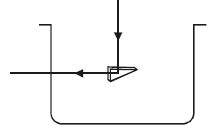
Assertion: The maximum refractive index of the liquid for total internal reflection of the ray passing through the prism as shown in the figure must be $\sqrt 2$.
Reason: Here,the critical angle is $45^o$.
Reason: Here,the critical angle is $45^o$.
A
If both Assertion and Reason are correct and the Reason is a correct explanation of the Assertion.
B
If both Assertion and Reason are correct but Reason is not a correct explanation of the Assertion.
C
If the Assertion is correct but Reason is incorrect.
D
If both the Assertion and Reason are incorrect.
Solution
(D) For total internal reflection to occur at the prism-liquid interface,the angle of incidence $i$ must be greater than or equal to the critical angle $c$.
In the given figure,the ray strikes the interface at an angle of incidence $i = 45^o$.
For total internal reflection,we require $i \ge c$,so $45^o \ge c$,or $\sin 45^o \ge \sin c$.
Since $\sin c = \frac{\mu_{liquid}}{\mu_{prism}}$,and assuming the prism is glass with $\mu_{prism} \approx 1.5$,the condition for total internal reflection is $\sin 45^o \ge \frac{\mu_{liquid}}{\mu_{prism}}$.
However,the question asks for the maximum refractive index of the liquid such that total internal reflection still occurs. This occurs when $c = 45^o$.
Using the relation $\sin c = \frac{\mu_{liquid}}{\mu_{prism}}$,we get $\mu_{liquid} = \mu_{prism} \sin 45^o = 1.5 \times \frac{1}{\sqrt 2} \approx 1.06$.
The assertion states the value is $\sqrt 2$,which is incorrect as it assumes the prism refractive index is $2$. Given the standard context of such problems,the assertion and reason are both technically incorrect based on standard glass prisms.
In the given figure,the ray strikes the interface at an angle of incidence $i = 45^o$.
For total internal reflection,we require $i \ge c$,so $45^o \ge c$,or $\sin 45^o \ge \sin c$.
Since $\sin c = \frac{\mu_{liquid}}{\mu_{prism}}$,and assuming the prism is glass with $\mu_{prism} \approx 1.5$,the condition for total internal reflection is $\sin 45^o \ge \frac{\mu_{liquid}}{\mu_{prism}}$.
However,the question asks for the maximum refractive index of the liquid such that total internal reflection still occurs. This occurs when $c = 45^o$.
Using the relation $\sin c = \frac{\mu_{liquid}}{\mu_{prism}}$,we get $\mu_{liquid} = \mu_{prism} \sin 45^o = 1.5 \times \frac{1}{\sqrt 2} \approx 1.06$.
The assertion states the value is $\sqrt 2$,which is incorrect as it assumes the prism refractive index is $2$. Given the standard context of such problems,the assertion and reason are both technically incorrect based on standard glass prisms.
0 likesView Solution
53
PhysicsMediumMCQAIIMS · 1999
Assertion: $A$ double convex lens $(\mu = 1.5)$ has a focal length of $10 \, cm$. When the lens is immersed in water $(\mu = 4/3)$,its focal length becomes $40 \, cm$.
Reason: $\frac{1}{f} = \left( \frac{\mu_l - \mu_m}{\mu_m} \right) \left( \frac{1}{R_1} - \frac{1}{R_2} \right)$
Reason: $\frac{1}{f} = \left( \frac{\mu_l - \mu_m}{\mu_m} \right) \left( \frac{1}{R_1} - \frac{1}{R_2} \right)$
A
If both Assertion and Reason are correct and the Reason is a correct explanation of the Assertion.
B
If both Assertion and Reason are correct but Reason is not a correct explanation of the Assertion.
C
If the Assertion is correct but Reason is incorrect.
D
If both the Assertion and Reason are incorrect.
Solution
(A) The Lens Maker's Formula is given by $\frac{1}{f} = \left( \frac{\mu_l}{\mu_m} - 1 \right) \left( \frac{1}{R_1} - \frac{1}{R_2} \right)$,which can be written as $\frac{1}{f} = \left( \frac{\mu_l - \mu_m}{\mu_m} \right) \left( \frac{1}{R_1} - \frac{1}{R_2} \right)$. Thus,the Reason is correct.
For the lens in air $(\mu_m = 1)$:
$\frac{1}{10} = (1.5 - 1) \left( \frac{1}{R_1} - \frac{1}{R_2} \right) \implies \frac{1}{10} = 0.5 \left( \frac{1}{R_1} - \frac{1}{R_2} \right) \implies \left( \frac{1}{R_1} - \frac{1}{R_2} \right) = \frac{1}{5} \dots (i)$
For the lens in water $(\mu_m = 4/3)$:
$\frac{1}{f'} = \left( \frac{1.5 - 4/3}{4/3} \right) \left( \frac{1}{R_1} - \frac{1}{R_2} \right)$
$\frac{1}{f'} = \left( \frac{4.5/3 - 4/3}{4/3} \right) \left( \frac{1}{5} \right) = \left( \frac{0.5/3}{4/3} \right) \left( \frac{1}{5} \right) = \left( \frac{0.5}{4} \right) \left( \frac{1}{5} \right) = \frac{1}{8} \times \frac{1}{5} = \frac{1}{40}$
Therefore,$f' = 40 \, cm$. The Assertion is also correct and the Reason explains it.
For the lens in air $(\mu_m = 1)$:
$\frac{1}{10} = (1.5 - 1) \left( \frac{1}{R_1} - \frac{1}{R_2} \right) \implies \frac{1}{10} = 0.5 \left( \frac{1}{R_1} - \frac{1}{R_2} \right) \implies \left( \frac{1}{R_1} - \frac{1}{R_2} \right) = \frac{1}{5} \dots (i)$
For the lens in water $(\mu_m = 4/3)$:
$\frac{1}{f'} = \left( \frac{1.5 - 4/3}{4/3} \right) \left( \frac{1}{R_1} - \frac{1}{R_2} \right)$
$\frac{1}{f'} = \left( \frac{4.5/3 - 4/3}{4/3} \right) \left( \frac{1}{5} \right) = \left( \frac{0.5/3}{4/3} \right) \left( \frac{1}{5} \right) = \left( \frac{0.5}{4} \right) \left( \frac{1}{5} \right) = \frac{1}{8} \times \frac{1}{5} = \frac{1}{40}$
Therefore,$f' = 40 \, cm$. The Assertion is also correct and the Reason explains it.
0 likesView Solution
54
PhysicsEasyMCQAIIMS · 1999
Assertion : Kinetic energy of photoelectrons emitted by a photosensitive surface depends upon the intensity of incident photon.
Reason : The ejection of electrons from a metallic surface is possible with a frequency of incident photon below the threshold frequency.
Reason : The ejection of electrons from a metallic surface is possible with a frequency of incident photon below the threshold frequency.
A
If both Assertion and Reason are correct and the Reason is a correct explanation of the Assertion.
B
If both Assertion and Reason are correct but Reason is not a correct explanation of the Assertion.
C
If the Assertion is correct but Reason is incorrect.
D
If both the Assertion and Reason are incorrect.
Solution
(D) The kinetic energy of emitted photoelectrons depends on the frequency of the incident photon, not the intensity. Intensity only determines the number of photoelectrons emitted per unit time.
According to Einstein's photoelectric equation, $K_{max} = h\nu - \Phi_0$, where $\nu$ is the frequency of incident light and $\Phi_0$ is the work function.
Furthermore, the ejection of electrons from a metallic surface is only possible if the frequency of the incident photon is greater than or equal to the threshold frequency $(\nu \ge \nu_0)$.
Therefore, both the Assertion and the Reason are incorrect.
According to Einstein's photoelectric equation, $K_{max} = h\nu - \Phi_0$, where $\nu$ is the frequency of incident light and $\Phi_0$ is the work function.
Furthermore, the ejection of electrons from a metallic surface is only possible if the frequency of the incident photon is greater than or equal to the threshold frequency $(\nu \ge \nu_0)$.
Therefore, both the Assertion and the Reason are incorrect.
0 likesView Solution
55
PhysicsEasyMCQAIIMS · 1999
Assertion: The specific charge of positive rays is not constant.
Reason: The mass of ions varies with speed.
Reason: The mass of ions varies with speed.
A
If both Assertion and Reason are correct and the Reason is a correct explanation of the Assertion.
B
If both Assertion and Reason are correct but Reason is not a correct explanation of the Assertion.
C
If the Assertion is correct but Reason is incorrect.
D
If both the Assertion and Reason are incorrect.
Solution
(A) The specific charge $\frac{e}{m}$ of positive rays is defined as the ratio of charge to mass. According to the theory of relativity,the mass $m$ of a particle moving with a velocity $v$ is given by $m = \frac{m_0}{\sqrt{1 - \frac{v^2}{c^2}}}$,where $m_0$ is the rest mass and $c$ is the speed of light.
Since the mass $m$ depends on the speed $v$,the specific charge $\frac{e}{m}$ also changes with speed.
Therefore,the specific charge of positive rays is not constant because the mass of ions varies with speed.
Thus,both the Assertion and the Reason are correct,and the Reason is the correct explanation of the Assertion.
Since the mass $m$ depends on the speed $v$,the specific charge $\frac{e}{m}$ also changes with speed.
Therefore,the specific charge of positive rays is not constant because the mass of ions varies with speed.
Thus,both the Assertion and the Reason are correct,and the Reason is the correct explanation of the Assertion.
0 likesView Solution
56
PhysicsEasyMCQAIIMS · 1999
Assertion: Separation of isotopes is possible because of the difference in electron numbers of isotopes.
Reason: Isotopes of an element can be separated by using a mass spectrometer.
Reason: Isotopes of an element can be separated by using a mass spectrometer.
A
If both Assertion and Reason are correct and the Reason is a correct explanation of the Assertion.
B
If both Assertion and Reason are correct but Reason is not a correct explanation of the Assertion.
C
If the Assertion is correct but Reason is incorrect.
D
If the Assertion is incorrect but the Reason is correct.
Solution
(D) Isotopes of an element have the same number of electrons and protons, but they differ in the number of neutrons, which leads to a difference in their atomic masses.
Because of this difference in atomic mass, isotopes can be separated using a mass spectrometer, which separates ions based on their mass-to-charge ratio $(m/q)$.
Since the Assertion claims that separation is due to the difference in electron numbers, the Assertion is incorrect.
However, the Reason stating that isotopes can be separated by a mass spectrometer is correct.
Therefore, the correct option is $D$.
Because of this difference in atomic mass, isotopes can be separated using a mass spectrometer, which separates ions based on their mass-to-charge ratio $(m/q)$.
Since the Assertion claims that separation is due to the difference in electron numbers, the Assertion is incorrect.
However, the Reason stating that isotopes can be separated by a mass spectrometer is correct.
Therefore, the correct option is $D$.
0 likesView Solution
Vedclass Products
For Students
Vedclass Test Series
Mock tests in real AIIMS style covering Physics with performance analysis. 5-day free trial.
Start Free TrialFor Teachers
Exam Paper Generator
Generate Set A/B/C/D Physics papers from 7.5L+ questions in 2 minutes. 3 chapters free.
Try FreeFor Institutes
Online Exam Module
Run live AIIMS mock exams with unlimited students, 360° analytics & white-label branding.
See DemoFrequently Asked Questions
How many Physics questions are in AIIMS 1999?
There are 56 Physics questions from the AIIMS 1999 paper on Vedclass, each with a detailed step-by-step solution in English.
Are AIIMS 1999 Physics solutions available in English?
Yes. All solutions on this page are in English. You can also switch to English or Hindi using the language buttons above the questions.
Can I practice AIIMS 1999 Physics as a timed test?
Yes. Use the Vedclass Test Series to attempt a full AIIMS mock test covering Physics with time limits and instant score analysis.
Can teachers create Physics papers from AIIMS previous year questions?
Yes. The Vedclass Exam Paper Generator lets teachers mix AIIMS Physics questions and generate Set A/B/C/D papers in minutes.
For Teachers & Institutes
Build a Custom Physics Paper
Pick AIIMS 1999 Physics questions, set difficulty, and generate Set A/B/C/D in 2 minutes.