
ChemistryQ1–51 of 51 questions
Page 1 of 1 · English
1
ChemistryMCQAIIMS · 1997
Which of the following cannot give iodometric titrations?
A
$Fe^{3+}$
B
$Cu^{2+}$
C
$Pb^{2+}$
D
$Ag^{+}$
Solution
(C) Iodometric titration involves the reaction of an oxidizing agent with iodide ions $(I^-)$ to liberate iodine $(I_2)$,which is then titrated against a standard sodium thiosulfate solution (hypo).
For a species to participate in iodometric titration,it must be capable of oxidizing $I^-$ to $I_2$.
$Fe^{3+}$,$Cu^{2+}$,and $Ag^{+}$ are oxidizing agents that can oxidize $I^-$ to $I_2$.
$Pb^{2+}$ is in its stable oxidation state and does not act as an oxidizing agent towards iodide ions under these conditions.
Therefore,$Pb^{2+}$ cannot give iodometric titrations.
For a species to participate in iodometric titration,it must be capable of oxidizing $I^-$ to $I_2$.
$Fe^{3+}$,$Cu^{2+}$,and $Ag^{+}$ are oxidizing agents that can oxidize $I^-$ to $I_2$.
$Pb^{2+}$ is in its stable oxidation state and does not act as an oxidizing agent towards iodide ions under these conditions.
Therefore,$Pb^{2+}$ cannot give iodometric titrations.
0 likesView Solution
2
ChemistryMediumMCQAIIMS · 1997
The total number of orbitals in an energy level designated by principal quantum number $n$ is equal to
A
$2n$
B
$2n^2$
C
$n$
D
$n^2$
Solution
(D) The maximum number of electrons in an energy level with principal quantum number $n$ is given by the formula $2n^2$.
Since each orbital can accommodate a maximum of $2$ electrons,the total number of orbitals in that energy level is calculated by dividing the total number of electrons by $2$.
Therefore,the number of orbitals $= \frac{2n^2}{2} = n^2$.
Since each orbital can accommodate a maximum of $2$ electrons,the total number of orbitals in that energy level is calculated by dividing the total number of electrons by $2$.
Therefore,the number of orbitals $= \frac{2n^2}{2} = n^2$.
0 likesView Solution
3
ChemistryMediumMCQAIIMS · 1997
The configuration $1s^2 2s^2 2p^5 3s^1$ shows
A
Ground state of fluorine atom
B
Excited state of fluorine atom
C
Excited state of neon atom
D
Excited state of ion $O_2^-$
Solution
(C) The total number of electrons in the given configuration is $2+2+5+1 = 10$.
An element with $10$ electrons in its neutral state is Neon $(Ne)$.
The ground state electronic configuration of Neon is $1s^2 2s^2 2p^6$.
In the configuration $1s^2 2s^2 2p^5 3s^1$,one electron from the $2p$ orbital has been promoted to the $3s$ orbital.
Therefore,this represents the excited state of the Neon atom.
An element with $10$ electrons in its neutral state is Neon $(Ne)$.
The ground state electronic configuration of Neon is $1s^2 2s^2 2p^6$.
In the configuration $1s^2 2s^2 2p^5 3s^1$,one electron from the $2p$ orbital has been promoted to the $3s$ orbital.
Therefore,this represents the excited state of the Neon atom.
0 likesView Solution
4
ChemistryMediumMCQAIIMS · 1997
Which of the following compounds contains both polar and non-polar bonds?
A
$C_2H_6$
B
$NH_4Cl$
C
$HCl$
D
$AlCl_3$
Solution
(B) $NH_4Cl$ contains both polar and non-polar bonds.
In the ammonium ion $(NH_4^+)$,the $N-H$ bonds are polar covalent bonds.
The bond between the $NH_4^+$ cation and the $Cl^-$ anion is an ionic bond.
However,the question refers to the presence of polar and non-polar covalent bonds within the structure.
Specifically,in $NH_4Cl$,the $N-H$ bonds are polar covalent,and the interaction between the ions is ionic.
Comparing the options,$NH_4Cl$ is the correct choice as it exhibits both ionic and covalent (polar) characteristics.
In the ammonium ion $(NH_4^+)$,the $N-H$ bonds are polar covalent bonds.
The bond between the $NH_4^+$ cation and the $Cl^-$ anion is an ionic bond.
However,the question refers to the presence of polar and non-polar covalent bonds within the structure.
Specifically,in $NH_4Cl$,the $N-H$ bonds are polar covalent,and the interaction between the ions is ionic.
Comparing the options,$NH_4Cl$ is the correct choice as it exhibits both ionic and covalent (polar) characteristics.
0 likesView Solution
5
ChemistryMediumMCQAIIMS · 1997
Which of the following is not paramagnetic?
A
$S^{2-}$
B
$N_2^{-}$
C
$O_2^{-}$
D
$NO$
Solution
(A) To determine paramagnetism,we look for the presence of unpaired electrons in the molecular orbitals.
$A$. $S^{2-}$: The sulfur atom has an atomic number of $16$. The $S^{2-}$ ion has $18$ electrons. Its electronic configuration is $1s^2 2s^2 2p^6 3s^2 3p^6$. Since all electrons are paired,it is diamagnetic.
$B$. $N_2^{-}$: Total electrons = $7 + 7 + 1 = 15$. The molecular orbital configuration is $(\sigma 1s)^2 (\sigma^* 1s)^2 (\sigma 2s)^2 (\sigma^* 2s)^2 (\pi 2p_x)^2 (\pi 2p_y)^2 (\sigma 2p_z)^2 (\pi^* 2p_x)^1$. It has one unpaired electron,so it is paramagnetic.
$C$. $O_2^{-}$: Total electrons = $8 + 8 + 1 = 17$. It has one unpaired electron in the $\pi^* 2p$ orbital,so it is paramagnetic.
$D$. $NO$: Total electrons = $7 + 8 = 15$. It has one unpaired electron in the $\pi^* 2p$ orbital,so it is paramagnetic.
Therefore,$S^{2-}$ is not paramagnetic.
$A$. $S^{2-}$: The sulfur atom has an atomic number of $16$. The $S^{2-}$ ion has $18$ electrons. Its electronic configuration is $1s^2 2s^2 2p^6 3s^2 3p^6$. Since all electrons are paired,it is diamagnetic.
$B$. $N_2^{-}$: Total electrons = $7 + 7 + 1 = 15$. The molecular orbital configuration is $(\sigma 1s)^2 (\sigma^* 1s)^2 (\sigma 2s)^2 (\sigma^* 2s)^2 (\pi 2p_x)^2 (\pi 2p_y)^2 (\sigma 2p_z)^2 (\pi^* 2p_x)^1$. It has one unpaired electron,so it is paramagnetic.
$C$. $O_2^{-}$: Total electrons = $8 + 8 + 1 = 17$. It has one unpaired electron in the $\pi^* 2p$ orbital,so it is paramagnetic.
$D$. $NO$: Total electrons = $7 + 8 = 15$. It has one unpaired electron in the $\pi^* 2p$ orbital,so it is paramagnetic.
Therefore,$S^{2-}$ is not paramagnetic.
0 likesView Solution
6
ChemistryEasyMCQAIIMS · 1997
The enthalpy change of a reaction does not depend on
A
The state of reactants and products
B
Nature of reactants and products
C
Different intermediate reaction paths
D
Initial and final enthalpy of a reaction
Solution
(C) Enthalpy change $(\Delta H)$ is a state function,which means it depends only on the initial and final states of the system.
It does not depend on the path taken or the intermediate steps involved in the reaction.
Therefore,it is independent of the different intermediate reaction paths.
It does not depend on the path taken or the intermediate steps involved in the reaction.
Therefore,it is independent of the different intermediate reaction paths.
0 likesView Solution
7
ChemistryMediumMCQAIIMS · 1997
$S + \frac{3}{2} O_2 \to SO_3 + 2x \ kcal$
$SO_2 + \frac{1}{2} O_2 \to SO_3 + y \ kcal$
Find out the heat of formation of $SO_2$.
$SO_2 + \frac{1}{2} O_2 \to SO_3 + y \ kcal$
Find out the heat of formation of $SO_2$.
A
$2x - y$
B
$2x + y$
C
$x + y$
D
$2x/y$
Solution
(A) The heat of formation of $SO_2$ is the enthalpy change for the reaction: $S + O_2 \to SO_2$.
Given equations:
$(i) \ S + \frac{3}{2} O_2 \to SO_3 + 2x \ kcal$
$(ii) \ SO_2 + \frac{1}{2} O_2 \to SO_3 + y \ kcal$
To obtain the target reaction,subtract equation $(ii)$ from equation $(i)$:
$(S + \frac{3}{2} O_2) - (SO_2 + \frac{1}{2} O_2) \to (SO_3 - SO_3) + (2x - y) \ kcal$
$S + O_2 - SO_2 \to 2x - y \ kcal$
$S + O_2 \to SO_2 + (2x - y) \ kcal$
Thus,the heat of formation of $SO_2$ is $(2x - y) \ kcal$.
Given equations:
$(i) \ S + \frac{3}{2} O_2 \to SO_3 + 2x \ kcal$
$(ii) \ SO_2 + \frac{1}{2} O_2 \to SO_3 + y \ kcal$
To obtain the target reaction,subtract equation $(ii)$ from equation $(i)$:
$(S + \frac{3}{2} O_2) - (SO_2 + \frac{1}{2} O_2) \to (SO_3 - SO_3) + (2x - y) \ kcal$
$S + O_2 - SO_2 \to 2x - y \ kcal$
$S + O_2 \to SO_2 + (2x - y) \ kcal$
Thus,the heat of formation of $SO_2$ is $(2x - y) \ kcal$.
0 likesView Solution
8
ChemistryMCQAIIMS · 1997
Nessler's reagent is used to detect
A
$CrO_4^{2-}$
B
$PO_4^{3-}$
C
$MnO_4^{-}$
D
$NH_4^{+}$
Solution
(D) Nessler's reagent is an alkaline solution of potassium tetraiodomercurate$(II)$,$K_2[HgI_4]$.
It reacts with ammonium ions $(NH_4^{+})$ to form a brown precipitate known as the iodide of Millon's base.
The chemical reaction is:
$NH_4^{+} + 2[HgI_4]^{2-} + 4OH^{-} \to [Hg_2N]I \cdot H_2O + 7I^{-} + 3H_2O$
Thus,it is used to detect $NH_4^{+}$ ions.
It reacts with ammonium ions $(NH_4^{+})$ to form a brown precipitate known as the iodide of Millon's base.
The chemical reaction is:
$NH_4^{+} + 2[HgI_4]^{2-} + 4OH^{-} \to [Hg_2N]I \cdot H_2O + 7I^{-} + 3H_2O$
Thus,it is used to detect $NH_4^{+}$ ions.
0 likesView Solution
9
ChemistryMediumMCQAIIMS · 1997
The maximum amount of $BaSO_4$ precipitated on mixing $BaCl_2$ $(0.5 \ M)$ with $H_2SO_4$ $(1 \ M)$ will correspond to.....$M$
A
$0.5$
B
$1$
C
$1.5$
D
$2$
Solution
(A) The balanced chemical equation is: $BaCl_2 + H_2SO_4 \rightarrow BaSO_4 + 2HCl$.
According to the stoichiometry,$1 \ mol$ of $BaCl_2$ reacts with $1 \ mol$ of $H_2SO_4$ to produce $1 \ mol$ of $BaSO_4$.
Given concentrations are $0.5 \ M$ for $BaCl_2$ and $1 \ M$ for $H_2SO_4$.
Since $BaCl_2$ is present in a smaller amount,it acts as the limiting reagent.
Therefore,the amount of $BaSO_4$ precipitated is determined by the amount of $BaCl_2$,which is $0.5 \ M$.
According to the stoichiometry,$1 \ mol$ of $BaCl_2$ reacts with $1 \ mol$ of $H_2SO_4$ to produce $1 \ mol$ of $BaSO_4$.
Given concentrations are $0.5 \ M$ for $BaCl_2$ and $1 \ M$ for $H_2SO_4$.
Since $BaCl_2$ is present in a smaller amount,it acts as the limiting reagent.
Therefore,the amount of $BaSO_4$ precipitated is determined by the amount of $BaCl_2$,which is $0.5 \ M$.
0 likesView Solution
10
ChemistryMediumMCQAIIMS · 1997
The $IUPAC$ name of $(CH_3)_3C-CH=CH_2$ is
A
$3,3,3-$trimethylprop$-1-$ene
B
$1,1,1-$trimethylprop$-2-$ene
C
$3,3-$dimethylbut$-1-$ene
D
$2,2-$dimethylbut$-3-$ene
Solution
(C) The structure is $(CH_3)_3C-CH=CH_2$.
$1$. Identify the longest carbon chain containing the double bond: The longest chain has $4$ carbon atoms,so the parent alkane is butane,and with the double bond,it is but$-1-$ene.
$2$. Number the chain starting from the end closer to the double bond: $C_1=CH_2$,$C_2=CH$,$C_3=C(CH_3)_2$,$C_4=CH_3$.
$3$. Identify substituents: There are two methyl groups at the $C_3$ position.
$4$. Combine the parts: $3,3-$dimethylbut$-1-$ene.
$1$. Identify the longest carbon chain containing the double bond: The longest chain has $4$ carbon atoms,so the parent alkane is butane,and with the double bond,it is but$-1-$ene.
$2$. Number the chain starting from the end closer to the double bond: $C_1=CH_2$,$C_2=CH$,$C_3=C(CH_3)_2$,$C_4=CH_3$.
$3$. Identify substituents: There are two methyl groups at the $C_3$ position.
$4$. Combine the parts: $3,3-$dimethylbut$-1-$ene.
0 likesView Solution
11
ChemistryMediumMCQAIIMS · 1997
The isomers which can be converted into another forms by rotation of the molecules around single bond are
A
Geometrical isomers
B
Conformers
C
Enantiomers
D
Diastereomers
Solution
(B) Conformers - Conformation arises because of free rotation around $C-C$ bond axis.
0 likesView Solution
12
ChemistryMediumMCQAIIMS · 1997
The number of stereoisomers of the compound $CH_3CHBrCHBrCOOH$ is
A
$0$
B
$1$
C
$3$
D
$4$
Solution
(D) The compound $CH_3CH(Br)CH(Br)COOH$ contains $n = 2$ chiral carbon atoms.
Since the molecule is unsymmetrical,the number of stereoisomers is given by the formula $2^n$.
Here,$n = 2$,so the number of stereoisomers = $2^2 = 4$.
These $4$ stereoisomers consist of $2$ pairs of enantiomers.
Since the molecule is unsymmetrical,the number of stereoisomers is given by the formula $2^n$.
Here,$n = 2$,so the number of stereoisomers = $2^2 = 4$.
These $4$ stereoisomers consist of $2$ pairs of enantiomers.
0 likesView Solution
13
ChemistryMediumMCQAIIMS · 1997
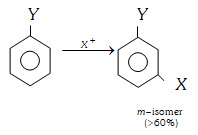
In a reaction of ${C_6H_5Y}$,the major product $(> 60\%)$ is the $m$-isomer. Therefore,the group $Y$ is:
A
$-COOH$
B
$-NH_2$
C
$-OH$
D
$-Cl$
Solution
(A) The reaction involves electrophilic aromatic substitution on a substituted benzene ring ${C_6H_5Y}$.
Groups that are electron-withdrawing by resonance or induction (deactivating groups) are meta-directing.
Among the given options,$-COOH$ is an electron-withdrawing group and acts as a meta-directing group.
Conversely,$-NH_2$,$-OH$,and $-Cl$ are electron-donating groups (by resonance) and act as ortho/para-directing groups.
Therefore,the correct option is $A$.
Groups that are electron-withdrawing by resonance or induction (deactivating groups) are meta-directing.
Among the given options,$-COOH$ is an electron-withdrawing group and acts as a meta-directing group.
Conversely,$-NH_2$,$-OH$,and $-Cl$ are electron-donating groups (by resonance) and act as ortho/para-directing groups.
Therefore,the correct option is $A$.
0 likesView Solution
14
ChemistryMediumMCQAIIMS · 1997
$But-1-yne$ reacts with cold alkaline $KMnO_4$ to produce:
A
$CH_3CH_2COOH$
B
$CH_3CH_2CH_2COOH$
C
$CH_3CH_2COOH + CO_2$
D
$CH_3CH_2COOH + HCOOH$
Solution
(C) The reaction of $but-1-yne$ $(CH_3-CH_2-C \equiv CH)$ with cold alkaline $KMnO_4$ (Baeyer's reagent) leads to the oxidative cleavage of the triple bond.
Since the terminal carbon is involved,it is oxidized to $CO_2$ and $H_2O$,while the remaining part forms a carboxylic acid.
The reaction is: $CH_3-CH_2-C \equiv CH \xrightarrow{\text{Cold alk. } KMnO_4} CH_3CH_2COOH + CO_2$.
Since the terminal carbon is involved,it is oxidized to $CO_2$ and $H_2O$,while the remaining part forms a carboxylic acid.
The reaction is: $CH_3-CH_2-C \equiv CH \xrightarrow{\text{Cold alk. } KMnO_4} CH_3CH_2COOH + CO_2$.
0 likesView Solution
15
ChemistryDifficultMCQAIIMS · 1997
Formation of polyethylene from calcium carbide takes place as follows:
$CaC_2 + 2H_2O \to Ca(OH)_2 + C_2H_2$
$C_2H_2 + H_2 \to C_2H_4$
$n(C_2H_4) \to (-CH_2-CH_2-)_n$
The amount of polyethylene obtained from $64.1 \ kg$ of $CaC_2$ is......$kg$.
$CaC_2 + 2H_2O \to Ca(OH)_2 + C_2H_2$
$C_2H_2 + H_2 \to C_2H_4$
$n(C_2H_4) \to (-CH_2-CH_2-)_n$
The amount of polyethylene obtained from $64.1 \ kg$ of $CaC_2$ is......$kg$.
A
$7$
B
$14$
C
$21$
D
$28$
Solution
(D) The stoichiometry of the reactions is as follows:
$1 \ mol$ of $CaC_2$ produces $1 \ mol$ of $C_2H_2$ (acetylene).
$1 \ mol$ of $C_2H_2$ produces $1 \ mol$ of $C_2H_4$ (ethylene).
$n \ mol$ of $C_2H_4$ produces $1 \ mol$ of polyethylene $(-CH_2-CH_2-)_n$.
Thus,$1 \ mol$ of $CaC_2$ produces $1 \ mol$ of ethylene units in polyethylene.
Molar mass of $CaC_2 = 40 + 2 \times 12 = 64 \ g/mol$.
Molar mass of ethylene unit $(C_2H_4) = 2 \times 12 + 4 \times 1 = 28 \ g/mol$.
Since $64 \ g$ of $CaC_2$ produces $28 \ g$ of polyethylene,$64.1 \ kg$ of $CaC_2$ will produce approximately $28.04 \ kg$ of polyethylene.
Rounding to the nearest given option,the answer is $28 \ kg$.
$1 \ mol$ of $CaC_2$ produces $1 \ mol$ of $C_2H_2$ (acetylene).
$1 \ mol$ of $C_2H_2$ produces $1 \ mol$ of $C_2H_4$ (ethylene).
$n \ mol$ of $C_2H_4$ produces $1 \ mol$ of polyethylene $(-CH_2-CH_2-)_n$.
Thus,$1 \ mol$ of $CaC_2$ produces $1 \ mol$ of ethylene units in polyethylene.
Molar mass of $CaC_2 = 40 + 2 \times 12 = 64 \ g/mol$.
Molar mass of ethylene unit $(C_2H_4) = 2 \times 12 + 4 \times 1 = 28 \ g/mol$.
Since $64 \ g$ of $CaC_2$ produces $28 \ g$ of polyethylene,$64.1 \ kg$ of $CaC_2$ will produce approximately $28.04 \ kg$ of polyethylene.
Rounding to the nearest given option,the answer is $28 \ kg$.
0 likesView Solution
16
ChemistryDifficultMCQAIIMS · 1997
The maximum amount of $BaSO_4$ precipitated on mixing equal volumes of $BaCl_2$ $(0.5 \ M)$ with $H_2SO_4$ $(1 \ M)$ will correspond to ................. $M$.
A
$0.5$
B
$1$
C
$1.5$
D
$2$
Solution
(A) The balanced chemical equation is: $BaCl_2 + H_2SO_4 \to BaSO_4(s) + 2HCl(aq)$.
Let the volume of each solution be $V \ L$.
Number of moles of $BaCl_2 = 0.5 \ M \times V \ L = 0.5V \ mol$.
Number of moles of $H_2SO_4 = 1 \ M \times V \ L = 1V \ mol$.
Since the stoichiometry of the reaction is $1:1$,$BaCl_2$ is the limiting reagent because it has fewer moles $(0.5V < 1V)$.
Therefore,the number of moles of $BaSO_4$ formed is equal to the number of moles of $BaCl_2$,which is $0.5V \ mol$.
The total volume of the mixture is $V + V = 2V \ L$.
The molarity of $BaSO_4$ in the final mixture is $\frac{0.5V \ mol}{2V \ L} = 0.25 \ M$.
Note: The question asks for the amount corresponding to the concentration in the final mixture. Based on the provided options,$0.5 \ M$ is the intended answer assuming the question refers to the concentration relative to the limiting reagent's initial concentration or a specific interpretation of the yield.
Let the volume of each solution be $V \ L$.
Number of moles of $BaCl_2 = 0.5 \ M \times V \ L = 0.5V \ mol$.
Number of moles of $H_2SO_4 = 1 \ M \times V \ L = 1V \ mol$.
Since the stoichiometry of the reaction is $1:1$,$BaCl_2$ is the limiting reagent because it has fewer moles $(0.5V < 1V)$.
Therefore,the number of moles of $BaSO_4$ formed is equal to the number of moles of $BaCl_2$,which is $0.5V \ mol$.
The total volume of the mixture is $V + V = 2V \ L$.
The molarity of $BaSO_4$ in the final mixture is $\frac{0.5V \ mol}{2V \ L} = 0.25 \ M$.
Note: The question asks for the amount corresponding to the concentration in the final mixture. Based on the provided options,$0.5 \ M$ is the intended answer assuming the question refers to the concentration relative to the limiting reagent's initial concentration or a specific interpretation of the yield.
0 likesView Solution
17
ChemistryMediumMCQAIIMS · 1997
Which of the following reactions with $H_2S$ does not produce metallic sulphide?
A
$ZnCl_2$
B
$CdCl_2$
C
$COCl_2$
D
$CuCl_2$
Solution
(C) $COCl_2$ (phosgene) is a covalent compound of carbon,oxygen,and chlorine.
It does not contain any metal atom.
Therefore,it cannot form a metallic sulphide upon reaction with $H_2S$.
In contrast,$ZnCl_2$,$CdCl_2$,and $CuCl_2$ are metal salts that react with $H_2S$ to form their respective metal sulphides ($ZnS$,$CdS$,and $CuS$).
It does not contain any metal atom.
Therefore,it cannot form a metallic sulphide upon reaction with $H_2S$.
In contrast,$ZnCl_2$,$CdCl_2$,and $CuCl_2$ are metal salts that react with $H_2S$ to form their respective metal sulphides ($ZnS$,$CdS$,and $CuS$).
0 likesView Solution
18
ChemistryMCQAIIMS · 1997
Two coherent monochromatic light beams of intensities $I$ and $4I$ are superposed. The maximum and minimum possible intensities in the resulting beam are:
A
$5I$ and $I$
B
$5I$ and $3I$
C
$9I$ and $I$
D
$9I$ and $3I$
Solution
(C) The maximum intensity $I_{\max}$ for the superposition of two coherent beams is given by the formula:
$I_{\max} = (\sqrt{I_{1}} + \sqrt{I_{2}})^2$
Given $I_{1} = I$ and $I_{2} = 4I$,we have:
$I_{\max} = (\sqrt{I} + \sqrt{4I})^2 = (\sqrt{I} + 2\sqrt{I})^2 = (3\sqrt{I})^2 = 9I$
The minimum intensity $I_{\min}$ is given by the formula:
$I_{\min} = (\sqrt{I_{1}} - \sqrt{I_{2}})^2$
Substituting the values:
$I_{\min} = (\sqrt{I} - \sqrt{4I})^2 = (\sqrt{I} - 2\sqrt{I})^2 = (-\sqrt{I})^2 = I$
Thus,the maximum and minimum intensities are $9I$ and $I$ respectively.
$I_{\max} = (\sqrt{I_{1}} + \sqrt{I_{2}})^2$
Given $I_{1} = I$ and $I_{2} = 4I$,we have:
$I_{\max} = (\sqrt{I} + \sqrt{4I})^2 = (\sqrt{I} + 2\sqrt{I})^2 = (3\sqrt{I})^2 = 9I$
The minimum intensity $I_{\min}$ is given by the formula:
$I_{\min} = (\sqrt{I_{1}} - \sqrt{I_{2}})^2$
Substituting the values:
$I_{\min} = (\sqrt{I} - \sqrt{4I})^2 = (\sqrt{I} - 2\sqrt{I})^2 = (-\sqrt{I})^2 = I$
Thus,the maximum and minimum intensities are $9I$ and $I$ respectively.
0 likesView Solution
19
ChemistryMCQAIIMS · 1997
In a reaction of $C_6H_5Y$,the major product $(> 60\%)$ is $m$-isomer,so the group $Y$ is:
A
$-COOH$
B
$-Cl$
C
$-OH$
D
$-NH_2$
Solution
(A) The group $Y$ attached to the benzene ring determines the orientation of the incoming electrophile in an electrophilic aromatic substitution reaction.
Groups that are electron-withdrawing by the inductive effect $(-I)$ or resonance effect $(-M)$ deactivate the ring and direct the incoming electrophile to the meta $(m)$ position.
Among the given options:
$1$. $-COOH$ is a strong electron-withdrawing group ($-M$ and $-I$ effect),which directs the incoming group to the meta position.
$2$. $-Cl$ is an ortho/para director due to the resonance effect $(+M)$,despite being inductively withdrawing $(-I)$.
$3$. $-OH$ and $-NH_2$ are strong ortho/para directors due to their strong $+M$ effect.
Therefore,the group $Y$ that directs the product to the $m$-isomer is $-COOH$.
Groups that are electron-withdrawing by the inductive effect $(-I)$ or resonance effect $(-M)$ deactivate the ring and direct the incoming electrophile to the meta $(m)$ position.
Among the given options:
$1$. $-COOH$ is a strong electron-withdrawing group ($-M$ and $-I$ effect),which directs the incoming group to the meta position.
$2$. $-Cl$ is an ortho/para director due to the resonance effect $(+M)$,despite being inductively withdrawing $(-I)$.
$3$. $-OH$ and $-NH_2$ are strong ortho/para directors due to their strong $+M$ effect.
Therefore,the group $Y$ that directs the product to the $m$-isomer is $-COOH$.
0 likesView Solution
20
ChemistryMCQAIIMS · 1997
The displacement equations of two waves are given as $y_1 = 10 \sin(3\pi t + \pi/3)$ and $y_2 = 5(\sin 3\pi t + \sqrt{3} \cos 3\pi t)$. What is the ratio of their amplitudes?
A
$1 : 2$
B
$2 : 1$
C
$1 : 1$
D
None of these
Solution
(C) The amplitude of the first wave $y_1 = 10 \sin(3\pi t + \pi/3)$ is $A_1 = 10$.
For the second wave,$y_2 = 5 \sin 3\pi t + 5\sqrt{3} \cos 3\pi t$. This is of the form $y = a \sin \omega t + b \cos \omega t$,where the amplitude $A_2 = \sqrt{a^2 + b^2}$.
Here,$a = 5$ and $b = 5\sqrt{3}$.
$A_2 = \sqrt{5^2 + (5\sqrt{3})^2} = \sqrt{25 + 75} = \sqrt{100} = 10$.
The ratio of their amplitudes is $\frac{A_1}{A_2} = \frac{10}{10} = 1:1$.
For the second wave,$y_2 = 5 \sin 3\pi t + 5\sqrt{3} \cos 3\pi t$. This is of the form $y = a \sin \omega t + b \cos \omega t$,where the amplitude $A_2 = \sqrt{a^2 + b^2}$.
Here,$a = 5$ and $b = 5\sqrt{3}$.
$A_2 = \sqrt{5^2 + (5\sqrt{3})^2} = \sqrt{25 + 75} = \sqrt{100} = 10$.
The ratio of their amplitudes is $\frac{A_1}{A_2} = \frac{10}{10} = 1:1$.
0 likesView Solution
21
ChemistryMCQAIIMS · 1997
Which of the following is an organometallic compound?
A
$Ti(C_2H_5)_4$
B
$Ti(OC_2H_5)_4$
C
$Ti(OCOCH_3)_4$
D
$Ti(OC_6H_5)_4$
Solution
(A) An organometallic compound is defined as a compound containing at least one direct metal-carbon $(M-C)$ bond.
In $Ti(C_2H_5)_4$ (Tetraethyltitanium),there is a direct bond between the titanium $(Ti)$ metal atom and the carbon $(C)$ atom of the ethyl group.
In the other options ($Ti(OC_2H_5)_4$,$Ti(OCOCH_3)_4$,and $Ti(OC_6H_5)_4$),the metal is bonded to oxygen $(O)$,not directly to carbon $(C)$.
Therefore,$Ti(C_2H_5)_4$ is the correct organometallic compound.
In $Ti(C_2H_5)_4$ (Tetraethyltitanium),there is a direct bond between the titanium $(Ti)$ metal atom and the carbon $(C)$ atom of the ethyl group.
In the other options ($Ti(OC_2H_5)_4$,$Ti(OCOCH_3)_4$,and $Ti(OC_6H_5)_4$),the metal is bonded to oxygen $(O)$,not directly to carbon $(C)$.
Therefore,$Ti(C_2H_5)_4$ is the correct organometallic compound.
0 likesView Solution
22
ChemistryMediumMCQAIIMS · 1997
Assertion : An atom is electrically neutral.
Reason : Atom contains equal number of protons and neutrons.
Reason : Atom contains equal number of protons and neutrons.
A
If both Assertion and Reason are correct and the Reason is a correct explanation of the Assertion.
B
If both Assertion and Reason are correct but Reason is not a correct explanation of the Assertion.
C
If the Assertion is correct but Reason is incorrect.
D
If both the Assertion and Reason are incorrect.
Solution
(C) An atom is electrically neutral because the total positive charge of protons is balanced by the total negative charge of electrons.
An atom contains an equal number of protons and electrons,not necessarily protons and neutrons.
Therefore,the Assertion is correct,but the Reason is incorrect.
An atom contains an equal number of protons and electrons,not necessarily protons and neutrons.
Therefore,the Assertion is correct,but the Reason is incorrect.
0 likesView Solution
23
ChemistryMediumMCQAIIMS · 1997
Assertion : The sum of protons and neutrons is always different in isobars.
Reason : Isobars are atoms of different elements having same mass number but different atomic number.
Reason : Isobars are atoms of different elements having same mass number but different atomic number.
A
If both Assertion and Reason are correct and the Reason is a correct explanation of the Assertion.
B
If both Assertion and Reason are correct but Reason is not a correct explanation of the Assertion.
C
If the Assertion is correct but Reason is incorrect.
D
If the Assertion is incorrect but the Reason is correct.
Solution
(D) Isobars are defined as atoms of different elements that have the same mass number $(A)$ but different atomic numbers $(Z)$.
The mass number $(A)$ is defined as the sum of the number of protons and neutrons in the nucleus.
Since isobars have the same mass number,the sum of protons and neutrons is the same for them,not different.
Therefore,the Assertion is incorrect,and the Reason is correct.
The mass number $(A)$ is defined as the sum of the number of protons and neutrons in the nucleus.
Since isobars have the same mass number,the sum of protons and neutrons is the same for them,not different.
Therefore,the Assertion is incorrect,and the Reason is correct.
0 likesView Solution
24
ChemistryDifficultMCQAIIMS · 1997
$A$ gas occupies a volume of $300 \, cc$ at $27 \, ^\circ C$ and $620 \, mm$ pressure. The volume of gas at $47 \, ^\circ C$ and $640 \, mm$ pressure is......$cc$
A
$260$
B
$310$
C
$390$
D
$450$
Solution
(B) Using the combined gas law: $\frac{P_1 V_1}{T_1} = \frac{P_2 V_2}{T_2}$
Given:
$P_1 = 620 \, mm$,$V_1 = 300 \, cc$,$T_1 = 27 + 273 = 300 \, K$
$P_2 = 640 \, mm$,$T_2 = 47 + 273 = 320 \, K$
Substituting the values:
$\frac{620 \times 300}{300} = \frac{640 \times V_2}{320}$
$620 = 2 \times V_2$
$V_2 = \frac{620}{2} = 310 \, cc$
Given:
$P_1 = 620 \, mm$,$V_1 = 300 \, cc$,$T_1 = 27 + 273 = 300 \, K$
$P_2 = 640 \, mm$,$T_2 = 47 + 273 = 320 \, K$
Substituting the values:
$\frac{620 \times 300}{300} = \frac{640 \times V_2}{320}$
$620 = 2 \times V_2$
$V_2 = \frac{620}{2} = 310 \, cc$
0 likesView Solution
25
ChemistryMediumMCQAIIMS · 1997
$A$ gas cylinder containing cooling gas can withstand a pressure of $14.9 \text{ atm}$. The pressure gauge of the cylinder indicates $12 \text{ atm}$ at $27 \,^oC$. Due to a sudden fire in the building,the temperature starts rising. The temperature at which the cylinder explodes is ............. $^oC$. (in $.5$)
A
$87$
B
$99$
C
$115$
D
$135$
Solution
(B) According to Gay-Lussac's Law,for a fixed volume of gas,$\frac{P_1}{T_1} = \frac{P_2}{T_2}$.
Given: $P_1 = 12 \text{ atm}$,$T_1 = 27 + 273 = 300 \text{ K}$,$P_2 = 14.9 \text{ atm}$.
Substituting the values: $\frac{12}{300} = \frac{14.9}{T_2}$.
$T_2 = \frac{14.9 \times 300}{12} = 372.5 \text{ K}$.
Converting to Celsius: $T_2 = 372.5 - 273 = 99.5 \,^oC$.
Given: $P_1 = 12 \text{ atm}$,$T_1 = 27 + 273 = 300 \text{ K}$,$P_2 = 14.9 \text{ atm}$.
Substituting the values: $\frac{12}{300} = \frac{14.9}{T_2}$.
$T_2 = \frac{14.9 \times 300}{12} = 372.5 \text{ K}$.
Converting to Celsius: $T_2 = 372.5 - 273 = 99.5 \,^oC$.
0 likesView Solution
26
ChemistryMediumMCQAIIMS · 1997
Assertion : Ice melts faster at high altitude.
Reason : At high altitude,atmospheric pressure is high.
Reason : At high altitude,atmospheric pressure is high.
A
If both Assertion and Reason are correct and the Reason is a correct explanation of the Assertion.
B
If both Assertion and Reason are correct but Reason is not a correct explanation of the Assertion.
C
If the Assertion is correct but Reason is incorrect.
D
If both the Assertion and Reason are incorrect.
Solution
(D) The melting point of ice decreases with an increase in pressure. Since atmospheric pressure decreases at high altitudes,the melting point of ice actually increases,meaning it does not melt faster.
Therefore,the assertion is false.
Additionally,atmospheric pressure is lower,not higher,at high altitudes,making the reason also false.
Thus,both the assertion and the reason are incorrect.
Therefore,the assertion is false.
Additionally,atmospheric pressure is lower,not higher,at high altitudes,making the reason also false.
Thus,both the assertion and the reason are incorrect.
0 likesView Solution
27
ChemistryMediumMCQAIIMS · 1997
Assertion : Gases do not settle to the bottom of a container.
Reason : Gases have high kinetic energy.
Reason : Gases have high kinetic energy.
A
If both Assertion and Reason are correct and the Reason is a correct explanation of the Assertion.
B
If both Assertion and Reason are correct but Reason is not a correct explanation of the Assertion.
C
If the Assertion is correct but Reason is incorrect.
D
If both the Assertion and Reason are incorrect.
Solution
(A) Gases do not settle to the bottom of a container because their particles possess high kinetic energy,which keeps them in constant,random motion.
Due to this high kinetic energy and their very small mass,the effect of gravity on individual gas molecules is negligible,preventing them from settling at the bottom.
Due to this high kinetic energy and their very small mass,the effect of gravity on individual gas molecules is negligible,preventing them from settling at the bottom.
0 likesView Solution
28
ChemistryMediumMCQAIIMS · 1997
Assertion : $Al(OH)_3$ is insoluble in $NH_4OH$ but soluble in $NaOH$.
Reason : $NaOH$ is a strong alkali.
Reason : $NaOH$ is a strong alkali.
A
If both Assertion and Reason are correct and the Reason is a correct explanation of the Assertion.
B
If both Assertion and Reason are correct but Reason is not a correct explanation of the Assertion.
C
If the Assertion is correct but Reason is incorrect.
D
If both the Assertion and Reason are incorrect.
Solution
(A) $Al(OH)_3$ is an amphoteric hydroxide. It is insoluble in weak bases like $NH_4OH$ but dissolves in strong bases like $NaOH$ due to the formation of a soluble complex,sodium meta-aluminate $(NaAlO_2)$.
The reaction is: $NaOH + Al(OH)_3 \to NaAlO_2 + 2H_2O$.
Since $NaOH$ is a strong alkali,it provides a high concentration of $OH^-$ ions,which is necessary to dissolve the amphoteric $Al(OH)_3$. Thus,the Reason correctly explains the Assertion.
The reaction is: $NaOH + Al(OH)_3 \to NaAlO_2 + 2H_2O$.
Since $NaOH$ is a strong alkali,it provides a high concentration of $OH^-$ ions,which is necessary to dissolve the amphoteric $Al(OH)_3$. Thus,the Reason correctly explains the Assertion.
0 likesView Solution
29
ChemistryMediumMCQAIIMS · 1997
Assertion : Boron is a metalloid.
Reason : Boron shows metallic nature.
Reason : Boron shows metallic nature.
A
If both Assertion and Reason are correct and the Reason is a correct explanation of the Assertion.
B
If both Assertion and Reason are correct but Reason is not a correct explanation of the Assertion.
C
If the Assertion is correct but Reason is incorrect.
D
If both the Assertion and Reason are incorrect.
Solution
(C) Boron is a metalloid,which means it exhibits properties intermediate between metals and non-metals. Thus,the Assertion is true.
While boron shows some metallic character (like high melting point and hardness),it is primarily characterized by its non-metallic behavior in many chemical reactions. The statement 'Boron shows metallic nature' is too broad and does not explain why it is classified as a metalloid. In fact,boron is predominantly non-metallic in its chemical behavior. Therefore,the Reason is considered incorrect in the context of defining its metalloid nature.
While boron shows some metallic character (like high melting point and hardness),it is primarily characterized by its non-metallic behavior in many chemical reactions. The statement 'Boron shows metallic nature' is too broad and does not explain why it is classified as a metalloid. In fact,boron is predominantly non-metallic in its chemical behavior. Therefore,the Reason is considered incorrect in the context of defining its metalloid nature.
0 likesView Solution
30
ChemistryMediumMCQAIIMS · 1997
Assertion: Potassium can be used in the Lassaigne test.
Reason: Potassium reacts vigorously.
Reason: Potassium reacts vigorously.
A
If both Assertion and Reason are correct and the Reason is a correct explanation of the Assertion.
B
If both Assertion and Reason are correct but Reason is not a correct explanation of the Assertion.
C
If the Assertion is incorrect but the Reason is correct.
D
If the Assertion is incorrect but the Reason is incorrect.
Solution
(C) The Lassaigne test involves the fusion of an organic compound with sodium metal to convert elements like nitrogen,sulfur,and halogens into their water-soluble ionic salts ($NaCN$,$Na_2S$,$NaCl$,etc.).
Sodium is preferred for this test because it is sufficiently reactive to fuse with the organic compound but not so reactive that it becomes hazardous or uncontrollable.
Potassium is not used in the Lassaigne test because it is significantly more reactive than sodium,making the reaction dangerously vigorous and difficult to handle.
Therefore,the Assertion is incorrect,and the Reason is correct.
Sodium is preferred for this test because it is sufficiently reactive to fuse with the organic compound but not so reactive that it becomes hazardous or uncontrollable.
Potassium is not used in the Lassaigne test because it is significantly more reactive than sodium,making the reaction dangerously vigorous and difficult to handle.
Therefore,the Assertion is incorrect,and the Reason is correct.
0 likesView Solution
31
ChemistryMCQAIIMS · 1997
To increase milk yield,a cow is given:
A
Stilbesterol
B
Sorbitol
C
Gonadotropin
D
Prolactin
Solution
(A) $Stilbesterol$ is a synthetic estrogen that is sometimes used to induce lactation in cows.
$Sorbitol$ is a sugar alcohol used as a laxative or for other medical purposes,not for milk production.
$Gonadotropin$ is a hormone that stimulates the gonads,not primarily milk production.
$Prolactin$ is a natural pituitary hormone that induces lactation,but $Stilbesterol$ is specifically cited in agricultural contexts for artificially increasing milk yield in cows.
$Sorbitol$ is a sugar alcohol used as a laxative or for other medical purposes,not for milk production.
$Gonadotropin$ is a hormone that stimulates the gonads,not primarily milk production.
$Prolactin$ is a natural pituitary hormone that induces lactation,but $Stilbesterol$ is specifically cited in agricultural contexts for artificially increasing milk yield in cows.
0 likesView Solution
32
ChemistryMediumMCQAIIMS · 1997
The brown ring complex compound is formulated as $[Fe(H_2O)_5NO]SO_4$. The oxidation state of iron is
A
$2$
B
$1$
C
$3$
D
$0$
Solution
(B) In the brown ring complex $[Fe(H_2O)_5NO]SO_4$,the oxidation state of iron is calculated by considering the ligands.
Water $(H_2O)$ is a neutral ligand with a charge of $0$.
The nitric oxide $(NO)$ ligand in this specific complex acts as $NO^+$.
The sulfate ion $(SO_4^{2-})$ has a charge of $-2$.
Let the oxidation state of $Fe$ be $x$.
$x + 5(0) + 1(+1) + (-2) = 0$
$x + 1 - 2 = 0$
$x - 1 = 0$
$x = +1$.
Therefore,the oxidation state of iron is $+1$.
Water $(H_2O)$ is a neutral ligand with a charge of $0$.
The nitric oxide $(NO)$ ligand in this specific complex acts as $NO^+$.
The sulfate ion $(SO_4^{2-})$ has a charge of $-2$.
Let the oxidation state of $Fe$ be $x$.
$x + 5(0) + 1(+1) + (-2) = 0$
$x + 1 - 2 = 0$
$x - 1 = 0$
$x = +1$.
Therefore,the oxidation state of iron is $+1$.
0 likesView Solution
33
ChemistryMediumMCQAIIMS · 1997
Which of the following cannot give iodometric titrations?
A
$Fe^{3+}$
B
$Cu^{2+}$
C
$Pb^{2+}$
D
$Ag^{2+}$
Solution
(C) In iodometric titrations,an oxidizing agent reacts with iodide ions $(I^-)$ to liberate iodine $(I_2)$,which is then titrated against a standard sodium thiosulfate solution.
For a species to participate in an iodometric titration,it must be capable of oxidizing $I^-$ to $I_2$.
$Fe^{3+}$,$Cu^{2+}$,and $Ag^{2+}$ act as oxidizing agents and can oxidize $I^-$ to $I_2$.
$Pb^{2+}$ is in its stable oxidation state and does not act as an oxidizing agent towards iodide ions; therefore,it cannot undergo iodometric titration.
For a species to participate in an iodometric titration,it must be capable of oxidizing $I^-$ to $I_2$.
$Fe^{3+}$,$Cu^{2+}$,and $Ag^{2+}$ act as oxidizing agents and can oxidize $I^-$ to $I_2$.
$Pb^{2+}$ is in its stable oxidation state and does not act as an oxidizing agent towards iodide ions; therefore,it cannot undergo iodometric titration.
0 likesView Solution
34
ChemistryEasyMCQAIIMS · 1997
Which of the following modes of expressing concentration is independent of temperature?
A
Molarity
B
Molality
C
Formality
D
Normality
Solution
(B) Molality is defined as the number of moles of solute per $1 \ kg$ of solvent.
Since mass does not change with temperature,molality is independent of temperature.
In contrast,molarity,formality,and normality involve volume,which changes with temperature.
Since mass does not change with temperature,molality is independent of temperature.
In contrast,molarity,formality,and normality involve volume,which changes with temperature.
0 likesView Solution
35
ChemistryMediumMCQAIIMS · 1997
Positron is
A
Electron with $+ve$ charge
B
$A$ helium nucleus
C
$A$ nucleus with two protons
D
$A$ nucleus with one neutron and one proton
Solution
(A) The correct answer is $(A)$.
Positron is the anti-particle of an electron,having the same mass as an electron but with a positive charge $(+1)$.
Positron is the anti-particle of an electron,having the same mass as an electron but with a positive charge $(+1)$.
0 likesView Solution
36
ChemistryMediumMCQAIIMS · 1997
Which is not emitted by a radioactive substance?
A
$\alpha$-rays
B
$\beta$-rays
C
Positron
D
Proton
Solution
(D) Radioactive decay involves the emission of particles like $\alpha$-particles (helium nuclei),$\beta$-particles (electrons or positrons),and $\gamma$-rays (electromagnetic radiation).
Protons are not typically emitted during natural radioactive decay processes.
Therefore,the correct option is $(D)$.
Protons are not typically emitted during natural radioactive decay processes.
Therefore,the correct option is $(D)$.
0 likesView Solution
37
ChemistryMediumMCQAIIMS · 1997
For a chemical reaction $A \to B$,it is found that the rate of reaction doubles when the concentration of $A$ is increased four times. The order of the reaction with respect to $A$ is:
A
$2$
B
$1$
C
$0.5$
D
$0$
Solution
(C) The rate law for the reaction is given by $r = k[A]^m$,where $m$ is the order of the reaction with respect to $A$.
According to the problem,when the concentration of $A$ is increased four times,the rate becomes $2r$.
So,$2r = k[4A]^m$.
Dividing the second equation by the first: $\frac{2r}{r} = \frac{k[4A]^m}{k[A]^m}$.
$2 = 4^m$.
Taking the logarithm or expressing $4$ as $2^2$: $2^1 = (2^2)^m = 2^{2m}$.
Equating the exponents: $1 = 2m$,which gives $m = 0.5$.
According to the problem,when the concentration of $A$ is increased four times,the rate becomes $2r$.
So,$2r = k[4A]^m$.
Dividing the second equation by the first: $\frac{2r}{r} = \frac{k[4A]^m}{k[A]^m}$.
$2 = 4^m$.
Taking the logarithm or expressing $4$ as $2^2$: $2^1 = (2^2)^m = 2^{2m}$.
Equating the exponents: $1 = 2m$,which gives $m = 0.5$.
0 likesView Solution
38
ChemistryMediumMCQAIIMS · 1997
In the reaction $Cu_{(s)} + 2Ag^{+}_{(aq)} \to Cu^{2+}_{(aq)} + 2Ag_{(s)}$,the reduction half-cell reaction is:
A
$Cu + 2e^- \to Cu^{2-}$
B
$Cu - 2e^- \to Cu^{2+}$
C
$Ag^{+} + e^- \to Ag$
D
$Ag - e^- \to Ag^{+}$
Solution
(C) In the given reaction,$Cu$ loses electrons to form $Cu^{2+}$,which is an oxidation process.
$Ag^{+}$ gains electrons to form $Ag$,which is a reduction process.
Therefore,the reduction half-cell reaction is $Ag^{+} + e^- \to Ag$.
$Ag^{+}$ gains electrons to form $Ag$,which is a reduction process.
Therefore,the reduction half-cell reaction is $Ag^{+} + e^- \to Ag$.
0 likesView Solution
39
ChemistryEasyMCQAIIMS · 1997
Which one of the following compounds is not coloured?
A
$Na_2CuCl_4$
B
$Na_2CdCl_4$
C
$K_4Fe(CN)_6$
D
$K_3Fe(CN)_6$
Solution
(B) The colour of transition metal complexes is generally due to $d-d$ transitions,which require the presence of unpaired $d$-electrons.
In $Na_2CdCl_4$,the cadmium ion is $Cd^{2+}$.
The electronic configuration of $Cd$ $(Z=48)$ is $[Kr] 4d^{10} 5s^2$.
Thus,$Cd^{2+}$ has the configuration $[Kr] 4d^{10}$.
Since the $d$-subshell is completely filled,there are no unpaired electrons available for $d-d$ transitions,making the compound colourless.
Therefore,the correct option is $(B)$.
In $Na_2CdCl_4$,the cadmium ion is $Cd^{2+}$.
The electronic configuration of $Cd$ $(Z=48)$ is $[Kr] 4d^{10} 5s^2$.
Thus,$Cd^{2+}$ has the configuration $[Kr] 4d^{10}$.
Since the $d$-subshell is completely filled,there are no unpaired electrons available for $d-d$ transitions,making the compound colourless.
Therefore,the correct option is $(B)$.
0 likesView Solution
40
ChemistryMediumMCQAIIMS · 1997
Which of the following does not react with $AgCl$?
A
$NaNO_3$
B
$Na_2CO_3$
C
$Na_2S_2O_3$
D
$NH_4OH$
Solution
(A) $NaNO_3$ does not react with $AgCl$ because there is no driving force for the reaction (no formation of a more stable complex,precipitate,or gas).
$Na_2CO_3$ reacts with $AgCl$ to form silver carbonate,which decomposes to silver oxide or metallic silver.
$Na_2S_2O_3$ reacts with $AgCl$ to form a soluble complex: $AgCl + 2Na_2S_2O_3 \to Na_3[Ag(S_2O_3)_2] + NaCl$.
$NH_4OH$ reacts with $AgCl$ to form a soluble diamminesilver$(I)$ chloride complex: $AgCl + 2NH_4OH \to [Ag(NH_3)_2]Cl + 2H_2O$.
$Na_2CO_3$ reacts with $AgCl$ to form silver carbonate,which decomposes to silver oxide or metallic silver.
$Na_2S_2O_3$ reacts with $AgCl$ to form a soluble complex: $AgCl + 2Na_2S_2O_3 \to Na_3[Ag(S_2O_3)_2] + NaCl$.
$NH_4OH$ reacts with $AgCl$ to form a soluble diamminesilver$(I)$ chloride complex: $AgCl + 2NH_4OH \to [Ag(NH_3)_2]Cl + 2H_2O$.
0 likesView Solution
41
ChemistryMediumMCQAIIMS · 1997
In the compound lithium tetrahydroaluminate,the ligand is
A
$H^{+}$
B
$H^{-}$
C
$H$
D
None of these
Solution
(B) The chemical formula for lithium tetrahydroaluminate is $Li[AlH_4]$.
In this complex,the central metal atom is $Al$ and the species attached to it are the ligands.
The complex ion is $[AlH_4]^-$,where four hydride ions $(H^-)$ act as ligands attached to the aluminum atom.
Therefore,the ligand is $H^-$.
In this complex,the central metal atom is $Al$ and the species attached to it are the ligands.
The complex ion is $[AlH_4]^-$,where four hydride ions $(H^-)$ act as ligands attached to the aluminum atom.
Therefore,the ligand is $H^-$.
0 likesView Solution
42
ChemistryMediumMCQAIIMS · 1997
The number of unpaired electrons in $Ni(CO)_4$ is
A
$0$
B
$1$
C
$3$
D
$5$
Solution
(A) The oxidation state of $Ni$ in $Ni(CO)_4$ is $0$. The electronic configuration of $Ni$ $(Z=28)$ is $[Ar] 3d^8 4s^2$.
Since $CO$ is a strong field ligand,it causes the pairing of electrons in the $3d$ and $4s$ orbitals.
As a result,the $4s$ electrons are promoted to the $3d$ orbital,leading to a fully filled $3d$ subshell $(3d^{10})$ and an empty $4s$ orbital.
Therefore,there are $0$ unpaired electrons in $Ni(CO)_4$.
Since $CO$ is a strong field ligand,it causes the pairing of electrons in the $3d$ and $4s$ orbitals.
As a result,the $4s$ electrons are promoted to the $3d$ orbital,leading to a fully filled $3d$ subshell $(3d^{10})$ and an empty $4s$ orbital.
Therefore,there are $0$ unpaired electrons in $Ni(CO)_4$.
0 likesView Solution
43
ChemistryDifficultMCQAIIMS · 1997
Which of the following is an organometallic compound?
A
$Ti(C_2H_5)_4$
B
$Ti(OC_2H_5)_4$
C
$Ti(OCOCH_3)_4$
D
$Ti(OC_6H_5)_4$
Solution
(A) An organometallic compound is defined as a compound containing at least one direct metal-carbon bond.
In $Ti(C_2H_5)_4$,the titanium atom is directly bonded to the carbon atoms of the ethyl groups.
In the other options ($Ti(OC_2H_5)_4$,$Ti(OCOCH_3)_4$,and $Ti(OC_6H_5)_4$),the metal is bonded to oxygen atoms,not carbon atoms.
Therefore,$Ti(C_2H_5)_4$ is an organometallic compound.
In $Ti(C_2H_5)_4$,the titanium atom is directly bonded to the carbon atoms of the ethyl groups.
In the other options ($Ti(OC_2H_5)_4$,$Ti(OCOCH_3)_4$,and $Ti(OC_6H_5)_4$),the metal is bonded to oxygen atoms,not carbon atoms.
Therefore,$Ti(C_2H_5)_4$ is an organometallic compound.
0 likesView Solution
44
ChemistryDifficultMCQAIIMS · 1997
Glycerine has:
A
One primary and two secondary $-OH$ groups
B
One secondary and two primary $-OH$ groups
C
Three primary $-OH$ groups
D
Three secondary $-OH$ groups
Solution
(B) The structural formula of Glycerine (Glycerol) is $CH_2(OH)-CH(OH)-CH_2(OH)$.
In this structure,the two terminal $-OH$ groups are attached to primary carbon atoms,and the middle $-OH$ group is attached to a secondary carbon atom.
Therefore,it contains two primary and one secondary $-OH$ groups.
In this structure,the two terminal $-OH$ groups are attached to primary carbon atoms,and the middle $-OH$ group is attached to a secondary carbon atom.
Therefore,it contains two primary and one secondary $-OH$ groups.
0 likesView Solution
45
ChemistryMediumMCQAIIMS · 1997
In the following reaction,product $P$ is: $RCOCl \xrightarrow{H_2, Pd-BaSO_4} P$
A
$RCH_2OH$
B
$RCOOH$
C
$RCHO$
D
$RCH_3$
Solution
(C) The reaction of an acid chloride with $H_2$ in the presence of $Pd-BaSO_4$ is known as the Rosenmund reduction.
This reaction specifically reduces the acid chloride group $(-COCl)$ to an aldehyde group $(-CHO)$.
Therefore,the product $P$ is $RCHO$.
This reaction specifically reduces the acid chloride group $(-COCl)$ to an aldehyde group $(-CHO)$.
Therefore,the product $P$ is $RCHO$.
0 likesView Solution
46
ChemistryMediumMCQAIIMS · 1997
Acetaldehyde cannot show:
A
Iodoform test
B
Lucas test
C
Benedict's test
D
Tollen's test
Solution
(B) The $Lucas$ test is used to distinguish between $1^o$,$2^o$,and $3^o$ alcohols based on their reactivity with $Lucas$ reagent $(ZnCl_2 + conc. HCl)$.
$1^o$ Alcohols: No turbidity at room temperature.
$2^o$ Alcohols: Turbidity appears within $5-10$ minutes.
$3^o$ Alcohols: Immediate turbidity.
Acetaldehyde is an aldehyde,not an alcohol; therefore,it does not react with $Lucas$ reagent and cannot show the $Lucas$ test. It gives positive results for $Iodoform$,$Benedict's$,and $Tollen's$ tests.
$1^o$ Alcohols: No turbidity at room temperature.
$2^o$ Alcohols: Turbidity appears within $5-10$ minutes.
$3^o$ Alcohols: Immediate turbidity.
Acetaldehyde is an aldehyde,not an alcohol; therefore,it does not react with $Lucas$ reagent and cannot show the $Lucas$ test. It gives positive results for $Iodoform$,$Benedict's$,and $Tollen's$ tests.
0 likesView Solution
47
ChemistryMediumMCQAIIMS · 1997
$R-CH_2-CH_2OH$ can be converted into $R-CH_2-CH_2-COOH$. The correct sequence of the reagents is:
A
$PBr_3, KCN, H_3O^{+}$
B
$PBr_3, KCN, H_2$
C
$HCN, PBr_3, H^{+}$
D
$KCN, H^{+}$
Solution
(A) The conversion of an alcohol to a carboxylic acid with an additional carbon atom involves the following steps:
$1$. Conversion of alcohol to alkyl bromide using $PBr_3$: $R-CH_2-CH_2OH \xrightarrow{PBr_3} R-CH_2-CH_2-Br$
$2$. Nucleophilic substitution with $KCN$ to form a nitrile: $R-CH_2-CH_2-Br \xrightarrow{KCN} R-CH_2-CH_2-CN$
$3$. Acidic hydrolysis of the nitrile to form a carboxylic acid: $R-CH_2-CH_2-CN \xrightarrow{H_3O^{+}} R-CH_2-CH_2-COOH + NH_3$
Therefore,the correct sequence is $PBr_3, KCN, H_3O^{+}$.
$1$. Conversion of alcohol to alkyl bromide using $PBr_3$: $R-CH_2-CH_2OH \xrightarrow{PBr_3} R-CH_2-CH_2-Br$
$2$. Nucleophilic substitution with $KCN$ to form a nitrile: $R-CH_2-CH_2-Br \xrightarrow{KCN} R-CH_2-CH_2-CN$
$3$. Acidic hydrolysis of the nitrile to form a carboxylic acid: $R-CH_2-CH_2-CN \xrightarrow{H_3O^{+}} R-CH_2-CH_2-COOH + NH_3$
Therefore,the correct sequence is $PBr_3, KCN, H_3O^{+}$.
0 likesView Solution
48
ChemistryDifficultMCQAIIMS · 1997
The major product ($70\%$ to $80\%$) of the reaction between $m$-dinitrobenzene with $NH_4HS$ is
A
$3-$nitroaniline
B
m-nitroaniline
C
$3-$nitro$-5-$mercaptoaniline
D
$3,5-$diaminobenzenethiol
Solution
(B) The reaction of $m$-dinitrobenzene with ammonium hydrosulfide $(NH_4HS)$ is a selective reduction reaction.
$NH_4HS$ acts as a selective reducing agent that reduces only one of the two nitro $(-NO_2)$ groups to an amino $(-NH_2)$ group in dinitro compounds.
Therefore,the reaction of $m$-dinitrobenzene with $NH_4HS$ yields $m$-nitroaniline as the major product ($70\%$ to $80\%$ yield).
The correct option is $(B)$.
$NH_4HS$ acts as a selective reducing agent that reduces only one of the two nitro $(-NO_2)$ groups to an amino $(-NH_2)$ group in dinitro compounds.
Therefore,the reaction of $m$-dinitrobenzene with $NH_4HS$ yields $m$-nitroaniline as the major product ($70\%$ to $80\%$ yield).
The correct option is $(B)$.
0 likesView Solution
49
ChemistryMediumMCQAIIMS · 1997
Assertion : Acetaldehyde on treatment with alkali gives aldol.
Reason : Acetaldehyde molecule contains $\alpha$-hydrogen atom.
Reason : Acetaldehyde molecule contains $\alpha$-hydrogen atom.
A
If both Assertion and Reason are correct and the Reason is a correct explanation of the Assertion.
B
If both Assertion and Reason are correct but Reason is not a correct explanation of the Assertion.
C
If the Assertion is correct but Reason is incorrect.
D
If both the Assertion and Reason are incorrect.
Solution
(A) Acetaldehyde $(CH_3CHO)$ contains $\alpha$-hydrogen atoms attached to the $\alpha$-carbon.
In the presence of a dilute alkali,it undergoes an aldol condensation reaction to form $3-$hydroxybutanal (aldol).
Therefore,the presence of $\alpha$-hydrogen is the reason for the aldol condensation reaction.
In the presence of a dilute alkali,it undergoes an aldol condensation reaction to form $3-$hydroxybutanal (aldol).
Therefore,the presence of $\alpha$-hydrogen is the reason for the aldol condensation reaction.
0 likesView Solution
50
ChemistryEasyMCQAIIMS · 1997
Assertion : Hydrolysis of sucrose is known as inversion of cane sugar.
Reason : Sucrose is a disaccharide.
Reason : Sucrose is a disaccharide.
A
If both Assertion and Reason are correct and the Reason is a correct explanation of the Assertion.
B
If both Assertion and Reason are correct but Reason is not a correct explanation of the Assertion.
C
If the Assertion is correct but Reason is incorrect.
D
If both the Assertion and Reason are incorrect.
Solution
(B) Sucrose is a disaccharide with a specific optical rotation of $+66.5^\circ$.
Upon hydrolysis,it yields $1 \ mole$ of $D-(+)$ glucose and $1 \ mole$ of $D-(-)$ fructose.
The resulting mixture is laevorotatory (net rotation is negative),which is why the process is known as the inversion of cane sugar.
While both statements are factually correct,the fact that sucrose is a disaccharide does not explain why its hydrolysis is called inversion; the explanation lies in the change of optical rotation from dextrorotatory to laevorotatory.
Upon hydrolysis,it yields $1 \ mole$ of $D-(+)$ glucose and $1 \ mole$ of $D-(-)$ fructose.
The resulting mixture is laevorotatory (net rotation is negative),which is why the process is known as the inversion of cane sugar.
While both statements are factually correct,the fact that sucrose is a disaccharide does not explain why its hydrolysis is called inversion; the explanation lies in the change of optical rotation from dextrorotatory to laevorotatory.
0 likesView Solution
51
ChemistryDifficultMCQAIIMS · 1997
Nessler's reagent is used to detect
A
$PO_4^{3-}$
B
$MnO_4^-$
C
$NH_4^+$
D
$CrO_4^{2-}$
Solution
(C) Nessler's reagent,$K_2[HgI_4]$,is used for the detection and quantitative determination of ammonia (or $NH_4^+$) in solution.
It reacts with ammonia to form a brown precipitate of $Hg_2NI \cdot H_2O$ (often represented as $IHg-NH_2-Hg-O-I$ or similar structures),known as the iodide of Millon's base.
The reaction is: $NH_4^+ + 2[HgI_4]^{2-} + 4OH^- \rightarrow Hg_2NI \cdot H_2O + 7I^- + 3H_2O$.
It reacts with ammonia to form a brown precipitate of $Hg_2NI \cdot H_2O$ (often represented as $IHg-NH_2-Hg-O-I$ or similar structures),known as the iodide of Millon's base.
The reaction is: $NH_4^+ + 2[HgI_4]^{2-} + 4OH^- \rightarrow Hg_2NI \cdot H_2O + 7I^- + 3H_2O$.
0 likesView Solution
Vedclass Products
For Students
Vedclass Test Series
Mock tests in real AIIMS style covering Chemistry with performance analysis. 5-day free trial.
Start Free TrialFor Teachers
Exam Paper Generator
Generate Set A/B/C/D Chemistry papers from 7.5L+ questions in 2 minutes. 3 chapters free.
Try FreeFor Institutes
Online Exam Module
Run live AIIMS mock exams with unlimited students, 360° analytics & white-label branding.
See DemoFrequently Asked Questions
How many Chemistry questions are in AIIMS 1997?
There are 51 Chemistry questions from the AIIMS 1997 paper on Vedclass, each with a detailed step-by-step solution in English.
Are AIIMS 1997 Chemistry solutions available in English?
Yes. All solutions on this page are in English. You can also switch to English or Hindi using the language buttons above the questions.
Can I practice AIIMS 1997 Chemistry as a timed test?
Yes. Use the Vedclass Test Series to attempt a full AIIMS mock test covering Chemistry with time limits and instant score analysis.
Can teachers create Chemistry papers from AIIMS previous year questions?
Yes. The Vedclass Exam Paper Generator lets teachers mix AIIMS Chemistry questions and generate Set A/B/C/D papers in minutes.
For Teachers & Institutes
Build a Custom Chemistry Paper
Pick AIIMS 1997 Chemistry questions, set difficulty, and generate Set A/B/C/D in 2 minutes.