
PhysicsQ1–38 of 38 questions
Page 1 of 1 · English
1
PhysicsEasyMCQAIIMS · 1997
The decrease in the potential energy of a ball of mass $20 \,kg$ which falls from a height of $50 \,cm$ is ............ $J$.
A
$968$
B
$98$
C
$1980$
D
None of these
Solution
(B) The potential energy $(U)$ of an object is given by the formula $U = mgh$,where $m$ is the mass,$g$ is the acceleration due to gravity,and $h$ is the height.
Given:
Mass $(m)$ = $20 \,kg$
Height $(h)$ = $50 \,cm = 0.5 \,m$
Acceleration due to gravity $(g)$ = $9.8 \,m/s^2$
Decrease in potential energy $(\Delta U)$ = $mgh$
$\Delta U = 20 \times 9.8 \times 0.5$
$\Delta U = 10 \times 9.8 = 98 \,J$.
Therefore,the correct option is $B$.
Given:
Mass $(m)$ = $20 \,kg$
Height $(h)$ = $50 \,cm = 0.5 \,m$
Acceleration due to gravity $(g)$ = $9.8 \,m/s^2$
Decrease in potential energy $(\Delta U)$ = $mgh$
$\Delta U = 20 \times 9.8 \times 0.5$
$\Delta U = 10 \times 9.8 = 98 \,J$.
Therefore,the correct option is $B$.
0 likesView Solution
2
PhysicsEasyMCQAIIMS · 1997
If the mass of a body is $M$ on the Earth's surface,then the mass of the same body on the Moon's surface is:
A
$M/6$
B
$Zero$
C
$M$
D
$6M$
Solution
(C) The mass of a body is defined as the quantity of matter contained in it.
Mass is an intrinsic property of an object and remains constant regardless of its location in the universe.
Unlike weight,which depends on the acceleration due to gravity $(g)$ at a specific location,mass does not change.
Therefore,if the mass of the body is $M$ on the Earth,it will remain $M$ on the Moon.
Mass is an intrinsic property of an object and remains constant regardless of its location in the universe.
Unlike weight,which depends on the acceleration due to gravity $(g)$ at a specific location,mass does not change.
Therefore,if the mass of the body is $M$ on the Earth,it will remain $M$ on the Moon.
0 likesView Solution
3
PhysicsMediumMCQAIIMS · 1997
If a spring extends by $x$ on loading,then the energy stored by the spring is (if $T$ is tension in the spring and $k$ is spring constant).
A
$\frac{T^2}{2x}$
B
$\frac{T^2}{2k}$
C
$\frac{2x}{T^2}$
D
$\frac{2T^2}{k}$
Solution
(B) The potential energy $U$ stored in a stretched spring is given by the formula $U = \frac{1}{2} k x^2$.
According to Hooke's Law,the tension $T$ in the spring is related to the extension $x$ by the equation $T = kx$.
From this,we can express the extension as $x = \frac{T}{k}$.
Substituting this value of $x$ into the energy formula:
$U = \frac{1}{2} k \left( \frac{T}{k} \right)^2$
$U = \frac{1}{2} k \left( \frac{T^2}{k^2} \right)$
$U = \frac{T^2}{2k}$.
Therefore,the correct option is $B$.
According to Hooke's Law,the tension $T$ in the spring is related to the extension $x$ by the equation $T = kx$.
From this,we can express the extension as $x = \frac{T}{k}$.
Substituting this value of $x$ into the energy formula:
$U = \frac{1}{2} k \left( \frac{T}{k} \right)^2$
$U = \frac{1}{2} k \left( \frac{T^2}{k^2} \right)$
$U = \frac{T^2}{2k}$.
Therefore,the correct option is $B$.
1 likesView Solution
4
PhysicsEasyMCQAIIMS · 1997
An elastic material of Young's modulus $Y$ is subjected to a stress $S$. The elastic energy stored per unit volume of the material is
A
$\frac{2Y}{S^2}$
B
$\frac{S^2}{2Y}$
C
$\frac{S}{2Y}$
D
$\frac{S^2}{Y}$
Solution
(B) The elastic potential energy stored per unit volume $(u)$ in a material is given by the formula:
$u = \frac{1}{2} \times \text{stress} \times \text{strain}$
We know that Young's modulus $(Y)$ is defined as the ratio of stress $(S)$ to strain $(\epsilon)$:
$Y = \frac{S}{\epsilon} \implies \epsilon = \frac{S}{Y}$
Substituting the expression for strain into the energy formula:
$u = \frac{1}{2} \times S \times \left( \frac{S}{Y} \right)$
$u = \frac{S^2}{2Y}$
Thus,the correct option is $B$.
$u = \frac{1}{2} \times \text{stress} \times \text{strain}$
We know that Young's modulus $(Y)$ is defined as the ratio of stress $(S)$ to strain $(\epsilon)$:
$Y = \frac{S}{\epsilon} \implies \epsilon = \frac{S}{Y}$
Substituting the expression for strain into the energy formula:
$u = \frac{1}{2} \times S \times \left( \frac{S}{Y} \right)$
$u = \frac{S^2}{2Y}$
Thus,the correct option is $B$.
0 likesView Solution
5
PhysicsEasyMCQAIIMS · 1997
If the specific heat of a substance is infinite,it means
A
Heat is given out
B
Heat is taken in
C
No change in temperature takes place whether heat is taken in or given out
D
All of the above
Solution
(C) The formula for heat exchange is given by $Q = m \cdot c \cdot \Delta \theta$,where $Q$ is the heat,$m$ is the mass,$c$ is the specific heat,and $\Delta \theta$ is the change in temperature.
Rearranging for specific heat,we get $c = \frac{Q}{m \cdot \Delta \theta}$.
If the specific heat $c$ is infinite $(c = \infty)$,then the denominator $m \cdot \Delta \theta$ must be zero.
Since mass $m$ cannot be zero,it implies that $\Delta \theta = 0$.
This means that there is no change in temperature regardless of whether heat is absorbed or released by the substance,which is characteristic of a phase change process.
Rearranging for specific heat,we get $c = \frac{Q}{m \cdot \Delta \theta}$.
If the specific heat $c$ is infinite $(c = \infty)$,then the denominator $m \cdot \Delta \theta$ must be zero.
Since mass $m$ cannot be zero,it implies that $\Delta \theta = 0$.
This means that there is no change in temperature regardless of whether heat is absorbed or released by the substance,which is characteristic of a phase change process.
0 likesView Solution
6
PhysicsEasyMCQAIIMS · 1997
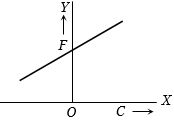
If a graph is plotted taking the temperature in Fahrenheit along the $Y-$axis and the corresponding temperature in Celsius along the $X-$axis,it will be a straight line:
A
Having a $+ve$ intercept on the $Y-$axis
B
Having a $+ve$ intercept on the $X-$axis
C
Passing through the origin
D
Having a $-ve$ intercept on both axes
Solution
(A) The relationship between temperature in Celsius $(C)$ and Fahrenheit $(F)$ is given by the formula: $\frac{C}{100} = \frac{F - 32}{180}$.
Rearranging this to express $F$ in terms of $C$,we get: $F = \frac{9}{5}C + 32$.
Comparing this with the equation of a straight line,$y = mx + c$,where $y = F$ and $x = C$:
Here,the slope $m = \frac{9}{5}$ (which is positive) and the $Y-$intercept $c = 32$ (which is positive).
Since the $Y-$intercept is positive,the line intersects the $Y-$axis at a point above the origin. Thus,the graph has a positive intercept on the $Y-$axis.
Rearranging this to express $F$ in terms of $C$,we get: $F = \frac{9}{5}C + 32$.
Comparing this with the equation of a straight line,$y = mx + c$,where $y = F$ and $x = C$:
Here,the slope $m = \frac{9}{5}$ (which is positive) and the $Y-$intercept $c = 32$ (which is positive).
Since the $Y-$intercept is positive,the line intersects the $Y-$axis at a point above the origin. Thus,the graph has a positive intercept on the $Y-$axis.
0 likesView Solution
7
PhysicsMediumMCQAIIMS · 1997
In the kinetic theory of gases,a molecule of mass $m$ of an ideal gas collides with a wall of a vessel with velocity $V$. The change in the linear momentum of the molecule is
A
$2mV$
B
$mV$
C
$-mV$
D
Zero
Solution
(A) When a molecule of mass $m$ collides elastically with a wall of a vessel with velocity $V$,it rebounds with the same speed in the opposite direction.
Initial momentum of the molecule,$p_i = mV$.
Final momentum of the molecule,$p_f = -mV$.
The change in linear momentum,$\Delta p = p_f - p_i = -mV - (mV) = -2mV$.
Since the question asks for the magnitude of the change in linear momentum,the change is $2mV$.
Initial momentum of the molecule,$p_i = mV$.
Final momentum of the molecule,$p_f = -mV$.
The change in linear momentum,$\Delta p = p_f - p_i = -mV - (mV) = -2mV$.
Since the question asks for the magnitude of the change in linear momentum,the change is $2mV$.
0 likesView Solution
8
PhysicsMediumMCQAIIMS · 1997
If the temperature of a black body increases from $7^oC$ to $287^oC$,then the rate of energy radiation increases by a factor of:
A
$(\frac{287}{7})^4$
B
$16$
C
$4$
D
$2$
Solution
(B) According to the Stefan-Boltzmann Law,the rate of energy radiation $P$ from a black body is proportional to the fourth power of its absolute temperature $T$ (in Kelvin).
$P \propto T^4$
Initial temperature $T_1 = 7^oC = 7 + 273 = 280 \ K$.
Final temperature $T_2 = 287^oC = 287 + 273 = 560 \ K$.
The ratio of the rates of energy radiation is:
$\frac{P_2}{P_1} = (\frac{T_2}{T_1})^4$
Substituting the values:
$\frac{P_2}{P_1} = (\frac{560}{280})^4 = (2)^4 = 16$.
Therefore,the rate of energy radiation increases by a factor of $16$.
$P \propto T^4$
Initial temperature $T_1 = 7^oC = 7 + 273 = 280 \ K$.
Final temperature $T_2 = 287^oC = 287 + 273 = 560 \ K$.
The ratio of the rates of energy radiation is:
$\frac{P_2}{P_1} = (\frac{T_2}{T_1})^4$
Substituting the values:
$\frac{P_2}{P_1} = (\frac{560}{280})^4 = (2)^4 = 16$.
Therefore,the rate of energy radiation increases by a factor of $16$.
1 likesView Solution
9
PhysicsMediumMCQAIIMS · 1997
The displacement equations of two waves are given as ${y_1} = 10\sin \left( {3\pi t + \frac{\pi }{3}} \right)$ and ${y_2} = 5(\sin 3\pi t + \sqrt 3 \cos 3\pi t)$. What is the ratio of their amplitudes?
A
$1:2$
B
$2:1$
C
$1:1$
D
None of these
Solution
(C) The first wave equation is ${y_1} = 10\sin \left( {3\pi t + \frac{\pi }{3}} \right)$. The amplitude of this wave is $A_1 = 10$.
The second wave equation is ${y_2} = 5(\sin 3\pi t + \sqrt 3 \cos 3\pi t)$.
We can rewrite this by multiplying and dividing by $2$:
${y_2} = 5 \times 2 \left( \frac{1}{2} \sin 3\pi t + \frac{\sqrt 3}{2} \cos 3\pi t \right)$.
Using the trigonometric identity $\sin(A + B) = \sin A \cos B + \cos A \sin B$,where $\cos \frac{\pi}{3} = \frac{1}{2}$ and $\sin \frac{\pi}{3} = \frac{\sqrt 3}{2}$:
${y_2} = 10 \left( \sin 3\pi t \cos \frac{\pi}{3} + \cos 3\pi t \sin \frac{\pi}{3} \right) = 10 \sin \left( 3\pi t + \frac{\pi}{3} \right)$.
The amplitude of the second wave is $A_2 = 10$.
The ratio of their amplitudes is $\frac{A_1}{A_2} = \frac{10}{10} = 1:1$.
The second wave equation is ${y_2} = 5(\sin 3\pi t + \sqrt 3 \cos 3\pi t)$.
We can rewrite this by multiplying and dividing by $2$:
${y_2} = 5 \times 2 \left( \frac{1}{2} \sin 3\pi t + \frac{\sqrt 3}{2} \cos 3\pi t \right)$.
Using the trigonometric identity $\sin(A + B) = \sin A \cos B + \cos A \sin B$,where $\cos \frac{\pi}{3} = \frac{1}{2}$ and $\sin \frac{\pi}{3} = \frac{\sqrt 3}{2}$:
${y_2} = 10 \left( \sin 3\pi t \cos \frac{\pi}{3} + \cos 3\pi t \sin \frac{\pi}{3} \right) = 10 \sin \left( 3\pi t + \frac{\pi}{3} \right)$.
The amplitude of the second wave is $A_2 = 10$.
The ratio of their amplitudes is $\frac{A_1}{A_2} = \frac{10}{10} = 1:1$.
0 likesView Solution
10
PhysicsMediumMCQAIIMS · 1997
If there is a change of angular momentum from $1\,J\cdot s$ to $5\,J\cdot s$ in $5\,s$,then the torque is:
A
$0.8\,N\cdot m$
B
$0.5\,N\cdot m$
C
$1.0\,N\cdot m$
D
None of these
Solution
(B) The torque $\tau$ is defined as the rate of change of angular momentum $L$ with respect to time $t$,given by the formula: $\tau = \frac{dL}{dt} = \frac{\Delta L}{\Delta t}$.
Given:
Initial angular momentum $L_i = 1\,J\cdot s$
Final angular momentum $L_f = 5\,J\cdot s$
Time interval $\Delta t = 5\,s$
Change in angular momentum $\Delta L = L_f - L_i = 5\,J\cdot s - 1\,J\cdot s = 4\,J\cdot s$.
Substituting the values into the formula:
$\tau = \frac{4\,J\cdot s}{5\,s} = 0.8\,N\cdot m$.
Thus,the torque is $0.8\,N\cdot m$,which is equivalent to $\frac{4}{5}\,N\cdot m$.
Given:
Initial angular momentum $L_i = 1\,J\cdot s$
Final angular momentum $L_f = 5\,J\cdot s$
Time interval $\Delta t = 5\,s$
Change in angular momentum $\Delta L = L_f - L_i = 5\,J\cdot s - 1\,J\cdot s = 4\,J\cdot s$.
Substituting the values into the formula:
$\tau = \frac{4\,J\cdot s}{5\,s} = 0.8\,N\cdot m$.
Thus,the torque is $0.8\,N\cdot m$,which is equivalent to $\frac{4}{5}\,N\cdot m$.
0 likesView Solution
11
PhysicsMediumMCQAIIMS · 1997
$Assertion$ : Moment of inertia depends on the axis of rotation and the nature of distribution of the mass of the body.
$Reason$ : Moment of inertia is the rotational inertia of the body.
$Reason$ : Moment of inertia is the rotational inertia of the body.
A
If both $Assertion$ and $Reason$ are correct and the $Reason$ is a correct explanation of the $Assertion$.
B
If both $Assertion$ and $Reason$ are correct but $Reason$ is not a correct explanation of the $Assertion$.
C
If the $Assertion$ is correct but $Reason$ is incorrect.
D
If both the $Assertion$ and $Reason$ are incorrect.
Solution
(B) The moment of inertia $I$ of a system of particles is defined as $I = \sum m_i r_i^2$,where $r_i$ is the perpendicular distance of the $i$-th particle of mass $m_i$ from the axis of rotation.
From this definition,it is clear that $I$ depends on the distribution of mass relative to the axis of rotation and the position/orientation of the axis itself. Thus,the $Assertion$ is correct.
$Moment$ of inertia is defined as the rotational analogue of mass in linear motion. Just as mass represents the inertia of a body in linear motion (resistance to change in linear velocity),the moment of inertia represents the rotational inertia of a body (resistance to change in angular velocity). Thus,the $Reason$ is also correct.
However,the $Reason$ explains what the moment of inertia represents (rotational inertia),but it does not explain *why* it depends on the axis of rotation and mass distribution. Therefore,the $Reason$ is not the correct explanation of the $Assertion$. The correct option is $B$.
From this definition,it is clear that $I$ depends on the distribution of mass relative to the axis of rotation and the position/orientation of the axis itself. Thus,the $Assertion$ is correct.
$Moment$ of inertia is defined as the rotational analogue of mass in linear motion. Just as mass represents the inertia of a body in linear motion (resistance to change in linear velocity),the moment of inertia represents the rotational inertia of a body (resistance to change in angular velocity). Thus,the $Reason$ is also correct.
However,the $Reason$ explains what the moment of inertia represents (rotational inertia),but it does not explain *why* it depends on the axis of rotation and mass distribution. Therefore,the $Reason$ is not the correct explanation of the $Assertion$. The correct option is $B$.
0 likesView Solution
12
PhysicsMediumMCQAIIMS · 1997
$A$ big drop of radius $R$ is formed by $729$ small drops of water of radius $r$. Then the radius of each small drop will be:
A
$\frac{R}{9}$
B
$\frac{R}{900}$
C
$\frac{R}{1800}$
D
$\frac{R}{9000}$
Solution
(A) The volume of the big drop is equal to the sum of the volumes of the $729$ small drops.
Let $V_{big}$ be the volume of the big drop and $V_{small}$ be the volume of one small drop.
$V_{big} = 729 \times V_{small}$
Using the formula for the volume of a sphere,$\frac{4}{3}\pi R^3 = 729 \times \frac{4}{3}\pi r^3$.
Canceling $\frac{4}{3}\pi$ from both sides,we get $R^3 = 729 \times r^3$.
Taking the cube root of both sides,$R = \sqrt[3]{729} \times r$.
Since $9^3 = 729$,we have $R = 9r$.
Therefore,the radius of each small drop is $r = \frac{R}{9}$.
Let $V_{big}$ be the volume of the big drop and $V_{small}$ be the volume of one small drop.
$V_{big} = 729 \times V_{small}$
Using the formula for the volume of a sphere,$\frac{4}{3}\pi R^3 = 729 \times \frac{4}{3}\pi r^3$.
Canceling $\frac{4}{3}\pi$ from both sides,we get $R^3 = 729 \times r^3$.
Taking the cube root of both sides,$R = \sqrt[3]{729} \times r$.
Since $9^3 = 729$,we have $R = 9r$.
Therefore,the radius of each small drop is $r = \frac{R}{9}$.
0 likesView Solution
13
PhysicsMediumMCQAIIMS · 1997
Assertion: The equivalent thermal conductivity of two plates of the same thickness in contact is less than the smaller value of thermal conductivity.
Reason: For two plates of equal thickness in contact,the equivalent thermal conductivity is given by: $\frac{2}{K} = \frac{1}{K_1} + \frac{1}{K_2}$
Reason: For two plates of equal thickness in contact,the equivalent thermal conductivity is given by: $\frac{2}{K} = \frac{1}{K_1} + \frac{1}{K_2}$
A
If both Assertion and Reason are correct and the Reason is a correct explanation of the Assertion.
B
If both Assertion and Reason are correct but Reason is not a correct explanation of the Assertion.
C
If the Assertion is correct but Reason is incorrect.
D
If both the Assertion and Reason are incorrect.
Solution
(C) For two plates of equal thickness $d$ and thermal conductivities $K_1$ and $K_2$ placed in series,the total thermal resistance is $R_{eq} = R_1 + R_2$.
Since $R = \frac{d}{KA}$,we have $\frac{2d}{K_{eq}A} = \frac{d}{K_1A} + \frac{d}{K_2A}$.
Simplifying this,we get $\frac{2}{K_{eq}} = \frac{1}{K_1} + \frac{1}{K_2}$,which implies $K_{eq} = \frac{2K_1K_2}{K_1 + K_2}$.
This is the harmonic mean of $K_1$ and $K_2$. The harmonic mean of two numbers is always less than the larger number and greater than the smaller number,but specifically,the equivalent conductivity $K_{eq}$ satisfies $K_{min} < K_{eq} < K_{max}$.
Wait,let's re-evaluate: If $K_1 = 10$ and $K_2 = 2$,then $K_{eq} = \frac{2(10)(2)}{10+2} = \frac{40}{12} \approx 3.33$.
Here $3.33 > 2$ (the smaller value). Thus,the Assertion is incorrect.
Since $R = \frac{d}{KA}$,we have $\frac{2d}{K_{eq}A} = \frac{d}{K_1A} + \frac{d}{K_2A}$.
Simplifying this,we get $\frac{2}{K_{eq}} = \frac{1}{K_1} + \frac{1}{K_2}$,which implies $K_{eq} = \frac{2K_1K_2}{K_1 + K_2}$.
This is the harmonic mean of $K_1$ and $K_2$. The harmonic mean of two numbers is always less than the larger number and greater than the smaller number,but specifically,the equivalent conductivity $K_{eq}$ satisfies $K_{min} < K_{eq} < K_{max}$.
Wait,let's re-evaluate: If $K_1 = 10$ and $K_2 = 2$,then $K_{eq} = \frac{2(10)(2)}{10+2} = \frac{40}{12} \approx 3.33$.
Here $3.33 > 2$ (the smaller value). Thus,the Assertion is incorrect.
0 likesView Solution
14
PhysicsEasyMCQAIIMS · 1997
$Assertion :$ In an isothermal process,the whole of the heat supplied to the body is converted into internal energy.
$Reason :$ According to the first law of thermodynamics,$\Delta Q = \Delta U + P\Delta V$.
$Reason :$ According to the first law of thermodynamics,$\Delta Q = \Delta U + P\Delta V$.
A
If both Assertion and Reason are correct and the Reason is a correct explanation of the Assertion.
B
If both Assertion and Reason are correct but Reason is not a correct explanation of the Assertion.
C
If the Assertion is correct but Reason is incorrect.
D
If both the Assertion and Reason are incorrect.
Solution
(D) The first law of thermodynamics is given by $\Delta Q = \Delta U + P\Delta V$.
For an ideal gas,the internal energy $U$ is a function of temperature $T$ only $(U = f(T))$.
In an isothermal process,the temperature remains constant,so $\Delta T = 0$.
Since $\Delta U = nC_v\Delta T$,it follows that $\Delta U = 0$ for an isothermal process.
Substituting this into the first law: $\Delta Q = 0 + P\Delta V$,which means $\Delta Q = P\Delta V$.
Therefore,the heat supplied is converted into work done by the system,not internal energy.
Thus,the Assertion is incorrect,and the Reason is a correct statement of the first law of thermodynamics.
For an ideal gas,the internal energy $U$ is a function of temperature $T$ only $(U = f(T))$.
In an isothermal process,the temperature remains constant,so $\Delta T = 0$.
Since $\Delta U = nC_v\Delta T$,it follows that $\Delta U = 0$ for an isothermal process.
Substituting this into the first law: $\Delta Q = 0 + P\Delta V$,which means $\Delta Q = P\Delta V$.
Therefore,the heat supplied is converted into work done by the system,not internal energy.
Thus,the Assertion is incorrect,and the Reason is a correct statement of the first law of thermodynamics.
0 likesView Solution
15
PhysicsEasyMCQAIIMS · 1997
Two charged spheres separated at a distance $d$ exert a force $F$ on each other. If they are immersed in a liquid of dielectric constant $2$,then what is the force (if all conditions are same)?
A
$F/2$
B
$F$
C
$2F$
D
$4F$
Solution
(A) According to Coulomb's Law,the force between two charges in a vacuum or air is given by $F = \frac{1}{4\pi\epsilon_0} \frac{q_1 q_2}{d^2}$.
When the charges are immersed in a medium with dielectric constant $K$,the force becomes $F_m = \frac{1}{4\pi\epsilon_0 K} \frac{q_1 q_2}{d^2}$.
Therefore,the relationship between the force in the medium and the force in air is $F_m = \frac{F}{K}$.
Given that $K = 2$,the new force is $F_m = \frac{F}{2}$.
When the charges are immersed in a medium with dielectric constant $K$,the force becomes $F_m = \frac{1}{4\pi\epsilon_0 K} \frac{q_1 q_2}{d^2}$.
Therefore,the relationship between the force in the medium and the force in air is $F_m = \frac{F}{K}$.
Given that $K = 2$,the new force is $F_m = \frac{F}{2}$.
0 likesView Solution
16
PhysicsEasyMCQAIIMS · 1997
On rotating a point charge having a charge $q$ around a charge $Q$ in a circle of radius $r$,the work done will be:
A
$q \times 2\pi r$
B
$\frac{q \times 2\pi Q}{r}$
C
Zero
D
$\frac{Q}{2\varepsilon_0 r}$
Solution
(C) The electric potential $V$ at a distance $r$ from a point charge $Q$ is given by $V = \frac{1}{4\pi\varepsilon_0} \frac{Q}{r}$.
Since the charge $q$ is moved in a circle of radius $r$ around the charge $Q$,every point on the circular path is at the same distance $r$ from $Q$.
Therefore,the entire circular path acts as an equipotential surface.
The work done $W$ in moving a charge $q$ between two points on an equipotential surface is given by $W = q(V_f - V_i)$.
Since $V_f = V_i$,the work done $W = 0$.
Since the charge $q$ is moved in a circle of radius $r$ around the charge $Q$,every point on the circular path is at the same distance $r$ from $Q$.
Therefore,the entire circular path acts as an equipotential surface.
The work done $W$ in moving a charge $q$ between two points on an equipotential surface is given by $W = q(V_f - V_i)$.
Since $V_f = V_i$,the work done $W = 0$.
0 likesView Solution
17
PhysicsMediumMCQAIIMS · 1997
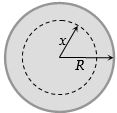
$A$ sphere of radius $R$ has a uniform distribution of electric charge in its volume. At a distance $x$ from its centre,for $x < R$,the electric field is directly proportional to
A
$\frac{1}{x^2}$
B
$\frac{1}{x}$
C
$x$
D
$x^2$
Solution
(C) Let the sphere have a uniform charge density $\rho = \frac{3Q}{4\pi R^3}$,and let $E$ be the electric field at a distance $x$ from the centre of the sphere,where $x < R$.
Applying Gauss's law to a Gaussian surface of radius $x$:
$E \cdot 4\pi x^2 = \frac{q_{enclosed}}{\varepsilon_0} = \frac{\rho V'}{\varepsilon_0} = \frac{\rho}{\varepsilon_0} \cdot \frac{4}{3}\pi x^3$
Here,$V' = \frac{4}{3}\pi x^3$ is the volume of the sphere of radius $x$.
Simplifying the equation:
$E = \frac{\rho}{3\varepsilon_0} x$
Since $\rho$,$3$,and $\varepsilon_0$ are constants,we have $E \propto x$.
Therefore,the electric field is directly proportional to $x$.
Applying Gauss's law to a Gaussian surface of radius $x$:
$E \cdot 4\pi x^2 = \frac{q_{enclosed}}{\varepsilon_0} = \frac{\rho V'}{\varepsilon_0} = \frac{\rho}{\varepsilon_0} \cdot \frac{4}{3}\pi x^3$
Here,$V' = \frac{4}{3}\pi x^3$ is the volume of the sphere of radius $x$.
Simplifying the equation:
$E = \frac{\rho}{3\varepsilon_0} x$
Since $\rho$,$3$,and $\varepsilon_0$ are constants,we have $E \propto x$.
Therefore,the electric field is directly proportional to $x$.
0 likesView Solution
18
PhysicsMediumMCQAIIMS · 1997
When a piece of aluminium wire of finite length is drawn through a series of dies to reduce its diameter to half its original value,its resistance will become ........ times.
A
$2$
B
$4$
C
$8$
D
$16$
Solution
(D) The resistance of a wire is given by $R = \rho \frac{L}{A}$,where $A = \pi r^2 = \pi (d/2)^2 = \frac{\pi d^2}{4}$.
Thus,$R = \rho \frac{L}{\pi d^2 / 4} = \frac{4 \rho L}{\pi d^2}$.
When a wire is drawn to reduce its diameter,its volume $V = A \times L$ remains constant.
Since $V = (\pi d^2 / 4) \times L$ is constant,$L \propto \frac{1}{d^2}$.
Substituting this into the resistance formula: $R \propto \frac{L}{d^2} \propto \frac{1/d^2}{d^2} = \frac{1}{d^4}$.
If the diameter is reduced to half $(d' = d/2)$,the new resistance $R'$ is:
$R' = R \times (d/d')^4 = R \times (d / (d/2))^4 = R \times (2)^4 = 16R$.
Therefore,the resistance becomes $16$ times the original value.
Thus,$R = \rho \frac{L}{\pi d^2 / 4} = \frac{4 \rho L}{\pi d^2}$.
When a wire is drawn to reduce its diameter,its volume $V = A \times L$ remains constant.
Since $V = (\pi d^2 / 4) \times L$ is constant,$L \propto \frac{1}{d^2}$.
Substituting this into the resistance formula: $R \propto \frac{L}{d^2} \propto \frac{1/d^2}{d^2} = \frac{1}{d^4}$.
If the diameter is reduced to half $(d' = d/2)$,the new resistance $R'$ is:
$R' = R \times (d/d')^4 = R \times (d / (d/2))^4 = R \times (2)^4 = 16R$.
Therefore,the resistance becomes $16$ times the original value.
0 likesView Solution
19
PhysicsMediumMCQAIIMS · 1997
$A$ coil has $200$ turns and an area of $70 \ cm^2$. The magnetic field perpendicular to the plane of the coil is $0.3 \ Wb/m^2$ and it takes $0.1 \ s$ to rotate through $180^o$. The value of the induced $e.m.f.$ will be ...... $V$.
A
$84$
B
$8.4$
C
$42$
D
$4.2$
Solution
(B) The induced $e.m.f.$ is given by Faraday's law: $e = -N \frac{d\phi}{dt} = -N \frac{\phi_2 - \phi_1}{\Delta t}$.
Here,$\phi = BA \cos \theta$. Initially,the field is perpendicular to the plane,so $\theta_1 = 0^o$. After rotating by $180^o$,the angle becomes $\theta_2 = 180^o$.
Given: $N = 200$,$A = 70 \ cm^2 = 70 \times 10^{-4} \ m^2$,$B = 0.3 \ Wb/m^2$,$\Delta t = 0.1 \ s$.
$e = -N \frac{BA(\cos 180^o - \cos 0^o)}{\Delta t}$
$e = -200 \times \frac{0.3 \times 70 \times 10^{-4} \times (-1 - 1)}{0.1}$
$e = -200 \times \frac{0.3 \times 70 \times 10^{-4} \times (-2)}{0.1}$
$e = 200 \times 0.3 \times 70 \times 10^{-4} \times 20 = 8.4 \ V$.
Here,$\phi = BA \cos \theta$. Initially,the field is perpendicular to the plane,so $\theta_1 = 0^o$. After rotating by $180^o$,the angle becomes $\theta_2 = 180^o$.
Given: $N = 200$,$A = 70 \ cm^2 = 70 \times 10^{-4} \ m^2$,$B = 0.3 \ Wb/m^2$,$\Delta t = 0.1 \ s$.
$e = -N \frac{BA(\cos 180^o - \cos 0^o)}{\Delta t}$
$e = -200 \times \frac{0.3 \times 70 \times 10^{-4} \times (-1 - 1)}{0.1}$
$e = -200 \times \frac{0.3 \times 70 \times 10^{-4} \times (-2)}{0.1}$
$e = 200 \times 0.3 \times 70 \times 10^{-4} \times 20 = 8.4 \ V$.
0 likesView Solution
20
PhysicsEasyMCQAIIMS · 1997
The current passing through a choke coil of $5 \, H$ is decreasing at the rate of $2 \, A/s$. The $e.m.f.$ developed across the coil is ....... $V$.
A
$10$
B
$-10$
C
$2.5$
D
$-2.5$
Solution
(A) The induced $e.m.f.$ $(e)$ in a coil due to self-induction is given by the formula: $e = -L \frac{di}{dt}$.
Here,the inductance $L = 5 \, H$.
The rate of change of current $\frac{di}{dt} = -2 \, A/s$ (since the current is decreasing).
Substituting these values into the formula:
$e = -5 \times (-2) = 10 \, V$.
Therefore,the $e.m.f.$ developed across the coil is $10 \, V$.
Here,the inductance $L = 5 \, H$.
The rate of change of current $\frac{di}{dt} = -2 \, A/s$ (since the current is decreasing).
Substituting these values into the formula:
$e = -5 \times (-2) = 10 \, V$.
Therefore,the $e.m.f.$ developed across the coil is $10 \, V$.
0 likesView Solution
21
PhysicsEasyMCQAIIMS · 1997
An alternating e.m.f. is applied to a purely capacitive circuit. What is the phase relation between the e.m.f. and the current flowing in the circuit?
A
e.m.f. is ahead of current by $\pi / 2$
B
Current is ahead of e.m.f. by $\pi / 2$
C
Current lags behind e.m.f. by $\pi$
D
Current is ahead of e.m.f. by $\pi$
Solution
(B) For a purely capacitive circuit,the applied alternating e.m.f. is given by $e = e_0 \sin(\omega t)$.
In a capacitor,the current $i$ leads the voltage $e$ by a phase angle of $\pi / 2$.
Therefore,the expression for current is $i = i_0 \sin(\omega t + \pi / 2)$.
This indicates that the current is ahead of the e.m.f. by $\pi / 2$.
In a capacitor,the current $i$ leads the voltage $e$ by a phase angle of $\pi / 2$.
Therefore,the expression for current is $i = i_0 \sin(\omega t + \pi / 2)$.
This indicates that the current is ahead of the e.m.f. by $\pi / 2$.
0 likesView Solution
22
PhysicsEasyMCQAIIMS · 1997
The potential difference applied to an $X$-ray tube is increased. As a result,in the emitted radiation
A
The intensity increases
B
The minimum wavelength increases
C
The intensity decreases
D
The minimum wavelength decreases
Solution
(D) The minimum wavelength (cutoff wavelength) of $X$-rays produced in an $X$-ray tube is given by the formula:
${\lambda _{\min }} = \frac{{hc}}{{eV}}$
where $h$ is Planck's constant,$c$ is the speed of light,$e$ is the charge of an electron,and $V$ is the accelerating potential difference.
From the relation ${\lambda _{\min }} \propto \frac{1}{V}$,it is clear that the minimum wavelength is inversely proportional to the applied potential difference.
Therefore,when the potential difference $V$ is increased,the minimum wavelength ${\lambda _{\min }}$ decreases.
Thus,the correct option is $(d)$.
${\lambda _{\min }} = \frac{{hc}}{{eV}}$
where $h$ is Planck's constant,$c$ is the speed of light,$e$ is the charge of an electron,and $V$ is the accelerating potential difference.
From the relation ${\lambda _{\min }} \propto \frac{1}{V}$,it is clear that the minimum wavelength is inversely proportional to the applied potential difference.
Therefore,when the potential difference $V$ is increased,the minimum wavelength ${\lambda _{\min }}$ decreases.
Thus,the correct option is $(d)$.
0 likesView Solution
23
PhysicsMediumMCQAIIMS · 1997
In Bohr's model,the atomic radius of the first orbit is $r_0$,then the radius of the third orbit is
A
$r_0/9$
B
$r_0$
C
$9r_0$
D
$3r_0$
Solution
(C) The radius of the $n^{th}$ orbit of an electron in a hydrogen-like atom is given by the formula $r_n = r_0 n^2 / Z$.
For a hydrogen atom,the atomic number $Z = 1$,which simplifies the expression to $r_n = r_0 n^2$.
For the third orbit,we substitute $n = 3$ into the formula.
Therefore,the radius of the third orbit is $r_3 = r_0 \times (3)^2 = 9r_0$.
For a hydrogen atom,the atomic number $Z = 1$,which simplifies the expression to $r_n = r_0 n^2$.
For the third orbit,we substitute $n = 3$ into the formula.
Therefore,the radius of the third orbit is $r_3 = r_0 \times (3)^2 = 9r_0$.
0 likesView Solution
24
PhysicsMediumMCQAIIMS · 1997
The wavelength of the energy emitted when an electron transitions from the fourth orbit to the second orbit in a hydrogen atom is $20.397 \, cm$. The wavelength of the energy for the same transition in $He^+$ is .......... $cm$.
A
$5.099$
B
$20.497$
C
$40.994$
D
$81.988$
Solution
(A) The Rydberg formula for the wavelength of emitted radiation is given by $\frac{1}{\lambda} = R Z^2 \left( \frac{1}{n_f^2} - \frac{1}{n_i^2} \right)$.
For a fixed transition ($n_i = 4$ to $n_f = 2$),the wavelength $\lambda$ is inversely proportional to the square of the atomic number $Z$,i.e.,$\lambda \propto \frac{1}{Z^2}$.
For hydrogen $(H)$,$Z = 1$,so $\lambda_H = 20.397 \, cm$.
For helium ion $(He^+)$,$Z = 2$,so $\lambda_{He^+} = \frac{\lambda_H}{Z^2} = \frac{20.397}{2^2} = \frac{20.397}{4} = 5.099 \, cm$.
For a fixed transition ($n_i = 4$ to $n_f = 2$),the wavelength $\lambda$ is inversely proportional to the square of the atomic number $Z$,i.e.,$\lambda \propto \frac{1}{Z^2}$.
For hydrogen $(H)$,$Z = 1$,so $\lambda_H = 20.397 \, cm$.
For helium ion $(He^+)$,$Z = 2$,so $\lambda_{He^+} = \frac{\lambda_H}{Z^2} = \frac{20.397}{2^2} = \frac{20.397}{4} = 5.099 \, cm$.
0 likesView Solution
25
PhysicsDifficultMCQAIIMS · 1997
The binding energy of deuteron $_1^2H$ is $1.112 \, MeV$ per nucleon and an $\alpha$-particle $_2^4He$ has a binding energy of $7.047 \, MeV$ per nucleon. Then in the fusion reaction $_1^2H + _1^2H \to _2^4He + Q$,the energy $Q$ released is ........ $MeV$.
A
$1$
B
$11.9$
C
$23.8$
D
$931$
Solution
(C) The binding energy of a nucleus is given by the product of the number of nucleons and the binding energy per nucleon.
For the reactant,two deuterons $(1^2H)$ are involved. Each deuteron has $2$ nucleons.
Total binding energy of two deuterons $= 2 \times (2 \times 1.112 \, MeV) = 4 \times 1.112 \, MeV = 4.448 \, MeV$.
For the product,one $\alpha$-particle $(2^4He)$ is formed. It has $4$ nucleons.
Total binding energy of one $\alpha$-particle $= 4 \times 7.047 \, MeV = 28.188 \, MeV$.
The energy released $Q$ in the fusion reaction is the difference between the total binding energy of the products and the total binding energy of the reactants.
$Q = 28.188 \, MeV - 4.448 \, MeV = 23.74 \, MeV$.
Rounding to the nearest provided option,$Q \approx 23.8 \, MeV$.
For the reactant,two deuterons $(1^2H)$ are involved. Each deuteron has $2$ nucleons.
Total binding energy of two deuterons $= 2 \times (2 \times 1.112 \, MeV) = 4 \times 1.112 \, MeV = 4.448 \, MeV$.
For the product,one $\alpha$-particle $(2^4He)$ is formed. It has $4$ nucleons.
Total binding energy of one $\alpha$-particle $= 4 \times 7.047 \, MeV = 28.188 \, MeV$.
The energy released $Q$ in the fusion reaction is the difference between the total binding energy of the products and the total binding energy of the reactants.
$Q = 28.188 \, MeV - 4.448 \, MeV = 23.74 \, MeV$.
Rounding to the nearest provided option,$Q \approx 23.8 \, MeV$.
0 likesView Solution
26
PhysicsEasyMCQAIIMS · 1997
In nuclear reactions,which of the following quantities are conserved?
A
Mass only
B
Energy only
C
Momentum only
D
Mass,energy and momentum
Solution
(D) In nuclear reactions,the total energy (including mass-energy equivalence),linear momentum,angular momentum,and charge are conserved. According to the law of conservation of mass-energy,the total mass-energy of the system remains constant. Since no external forces act on the system,the total linear momentum is also conserved. Therefore,mass (in terms of mass-energy),energy,and momentum are all conserved.
0 likesView Solution
27
PhysicsEasyMCQAIIMS · 1997
When the electrical conductivity of a semiconductor is due to the breaking of its covalent bonds,then the semiconductor is said to be
A
Donor
B
Acceptor
C
Intrinsic
D
Extrinsic
Solution
(C) An intrinsic semiconductor is a pure semiconductor material in which the electrical conductivity is solely due to the thermal excitation of electrons from the valence band to the conduction band,which involves the breaking of covalent bonds.
In contrast,an extrinsic semiconductor is a semiconductor that has been doped with impurities to increase its conductivity,meaning its conductivity is due to both the breaking of covalent bonds and the presence of excess charge carriers introduced by the impurity atoms.
Therefore,when conductivity is due to the breaking of covalent bonds in a pure material,it is classified as an intrinsic semiconductor.
In contrast,an extrinsic semiconductor is a semiconductor that has been doped with impurities to increase its conductivity,meaning its conductivity is due to both the breaking of covalent bonds and the presence of excess charge carriers introduced by the impurity atoms.
Therefore,when conductivity is due to the breaking of covalent bonds in a pure material,it is classified as an intrinsic semiconductor.
0 likesView Solution
28
PhysicsEasyMCQAIIMS · 1997
In a $P-$type semiconductor,
A
Current is mainly carried by holes
B
Current is mainly carried by electrons
C
The material is always positively charged
D
Doping is done by pentavalent material
Solution
(A) In a $P-$type semiconductor,the doping is done using trivalent impurities,which create an excess of holes.
Since holes are the majority charge carriers,the current in a $P-$type semiconductor is mainly carried by holes.
Therefore,option $A$ is correct.
Since holes are the majority charge carriers,the current in a $P-$type semiconductor is mainly carried by holes.
Therefore,option $A$ is correct.
0 likesView Solution
29
PhysicsEasyMCQAIIMS · 1997
In a diode,when there is saturation current,the plate resistance $({r_p})$ is
A
Zero
B
Infinite
C
Some finite quantity
D
Data is insufficient
Solution
(B) The plate resistance $({r_p})$ is defined as the ratio of the change in plate voltage $(\delta V)$ to the change in plate current $(\delta I)$,expressed as $r_p = \frac{\delta V}{\delta I}$.
At the saturation point,the current reaches its maximum value and does not change with further increases in voltage,meaning the change in current $\delta I = 0$.
Substituting this into the formula,we get $r_p = \frac{\delta V}{0} = \infty$.
Therefore,at saturation,the plate resistance is infinite.
At the saturation point,the current reaches its maximum value and does not change with further increases in voltage,meaning the change in current $\delta I = 0$.
Substituting this into the formula,we get $r_p = \frac{\delta V}{0} = \infty$.
Therefore,at saturation,the plate resistance is infinite.
0 likesView Solution
30
PhysicsEasyMCQAIIMS · 1997
$A$ light bulb is placed between two plane mirrors inclined at an angle of $60^{\circ}$. The number of images formed is:
A
$6$
B
$7$
C
$5$
D
$8$
Solution
(C) The number of images $n$ formed by two plane mirrors inclined at an angle $\theta$ is given by the formula $n = \frac{360^{\circ}}{\theta} - 1$,provided that $\frac{360^{\circ}}{\theta}$ is an even integer.
Given $\theta = 60^{\circ}$,we calculate the ratio: $\frac{360^{\circ}}{60^{\circ}} = 6$.
Since $6$ is an even integer,the number of images is $n = 6 - 1 = 5$.
Given $\theta = 60^{\circ}$,we calculate the ratio: $\frac{360^{\circ}}{60^{\circ}} = 6$.
Since $6$ is an even integer,the number of images is $n = 6 - 1 = 5$.
0 likesView Solution
31
PhysicsMediumMCQAIIMS · 1997
Two coherent monochromatic light beams of intensities $I$ and $4I$ are superposed. The maximum and minimum possible intensities in the resulting beam are
A
$5I$ and $I$
B
$5I$ and $3I$
C
$9I$ and $I$
D
$9I$ and $3I$
Solution
(C) The intensity of the resultant wave in interference is given by $I_{res} = I_1 + I_2 + 2\sqrt{I_1 I_2} \cos \phi$.
For maximum intensity, $\cos \phi = 1$, so $I_{max} = (\sqrt{I_1} + \sqrt{I_2})^2$.
Given $I_1 = I$ and $I_2 = 4I$, we have $I_{max} = (\sqrt{I} + \sqrt{4I})^2 = (\sqrt{I} + 2\sqrt{I})^2 = (3\sqrt{I})^2 = 9I$.
For minimum intensity, $\cos \phi = -1$, so $I_{min} = (\sqrt{I_1} - \sqrt{I_2})^2$.
Thus, $I_{min} = (\sqrt{I} - \sqrt{4I})^2 = (\sqrt{I} - 2\sqrt{I})^2 = (-\sqrt{I})^2 = I$.
Therefore, the maximum and minimum intensities are $9I$ and $I$ respectively.
For maximum intensity, $\cos \phi = 1$, so $I_{max} = (\sqrt{I_1} + \sqrt{I_2})^2$.
Given $I_1 = I$ and $I_2 = 4I$, we have $I_{max} = (\sqrt{I} + \sqrt{4I})^2 = (\sqrt{I} + 2\sqrt{I})^2 = (3\sqrt{I})^2 = 9I$.
For minimum intensity, $\cos \phi = -1$, so $I_{min} = (\sqrt{I_1} - \sqrt{I_2})^2$.
Thus, $I_{min} = (\sqrt{I} - \sqrt{4I})^2 = (\sqrt{I} - 2\sqrt{I})^2 = (-\sqrt{I})^2 = I$.
Therefore, the maximum and minimum intensities are $9I$ and $I$ respectively.
0 likesView Solution
32
PhysicsEasyMCQAIIMS · 1997
If a star is moving towards the Earth,then the spectral lines are shifted towards:
A
Red
B
Infrared
C
Blue
D
Green
Solution
(C) According to the Doppler effect for light,when a source of light moves towards an observer,the observed frequency increases,which corresponds to a decrease in wavelength.
This shift towards shorter wavelengths (higher frequencies) in the visible spectrum is known as a 'blue shift'.
Therefore,the spectral lines are shifted towards the blue end of the spectrum.
This shift towards shorter wavelengths (higher frequencies) in the visible spectrum is known as a 'blue shift'.
Therefore,the spectral lines are shifted towards the blue end of the spectrum.
0 likesView Solution
33
PhysicsEasyMCQAIIMS · 1997
Assertion : If the distance between parallel plates of a capacitor is halved and the dielectric constant is increased to three times its original value,then the capacitance becomes $6$ times.
Reason : The capacity of a capacitor does not depend upon the nature of the material between the plates.
Reason : The capacity of a capacitor does not depend upon the nature of the material between the plates.
A
If both Assertion and Reason are correct and the Reason is a correct explanation of the Assertion.
B
If both Assertion and Reason are correct but Reason is not a correct explanation of the Assertion.
C
If the Assertion is correct but Reason is incorrect.
D
If both the Assertion and Reason are incorrect.
Solution
(C) The capacitance of a parallel plate capacitor is given by $C = \frac{K \epsilon_0 A}{d}$,where $K$ is the dielectric constant,$A$ is the area,and $d$ is the distance between the plates.
Given that the new distance $d' = \frac{d}{2}$ and the new dielectric constant $K' = 3K$.
The new capacitance $C'$ becomes $C' = \frac{(3K) \epsilon_0 A}{(d/2)} = 6 \left( \frac{K \epsilon_0 A}{d} \right) = 6C$.
Thus,the Assertion is correct.
The capacity of a capacitor depends on the dielectric constant $(K)$ of the material placed between the plates. Therefore,the Reason is incorrect.
Given that the new distance $d' = \frac{d}{2}$ and the new dielectric constant $K' = 3K$.
The new capacitance $C'$ becomes $C' = \frac{(3K) \epsilon_0 A}{(d/2)} = 6 \left( \frac{K \epsilon_0 A}{d} \right) = 6C$.
Thus,the Assertion is correct.
The capacity of a capacitor depends on the dielectric constant $(K)$ of the material placed between the plates. Therefore,the Reason is incorrect.
0 likesView Solution
34
PhysicsMediumMCQAIIMS · 1997
Assertion : Cyclotron is a device which is used to accelerate the positive ion.
Reason : Cyclotron frequency depends upon the velocity.
Reason : Cyclotron frequency depends upon the velocity.
A
If both Assertion and Reason are correct and the Reason is a correct explanation of the Assertion.
B
If both Assertion and Reason are correct but Reason is not a correct explanation of the Assertion.
C
If the Assertion is correct but Reason is incorrect.
D
If both the Assertion and Reason are incorrect.
Solution
(C) cyclotron is a particle accelerator used to accelerate charged particles,such as positive ions,to high energies. Thus,the Assertion is correct.
The cyclotron frequency $f$ is given by the formula:
$f = \frac{Bq}{2 \pi m}$
where $B$ is the magnetic field,$q$ is the charge,and $m$ is the mass of the particle.
From this formula,it is clear that the cyclotron frequency depends only on the magnetic field,the charge,and the mass of the particle. It is independent of the velocity $v$ and the radius $r$ of the orbit.
Therefore,the Reason is incorrect.
The cyclotron frequency $f$ is given by the formula:
$f = \frac{Bq}{2 \pi m}$
where $B$ is the magnetic field,$q$ is the charge,and $m$ is the mass of the particle.
From this formula,it is clear that the cyclotron frequency depends only on the magnetic field,the charge,and the mass of the particle. It is independent of the velocity $v$ and the radius $r$ of the orbit.
Therefore,the Reason is incorrect.
0 likesView Solution
35
PhysicsEasyMCQAIIMS · 1997
Assertion: The colour of a green flower seen through red glass appears to be dark.
Reason: Red glass transmits only red light.
Reason: Red glass transmits only red light.
A
If both Assertion and Reason are correct and the Reason is a correct explanation of the Assertion.
B
If both Assertion and Reason are correct but Reason is not a correct explanation of the Assertion.
C
If the Assertion is correct but Reason is incorrect.
D
If both the Assertion and Reason are incorrect.
Solution
(A) green flower reflects only green light and absorbs all other wavelengths of light.
Red glass acts as a filter that transmits only red light and absorbs or reflects all other colours.
When light passes through red glass,only red light reaches the green flower.
Since the green flower absorbs red light and reflects only green light (which is absent in the incident light),it reflects almost no light to the observer's eye.
Therefore,the flower appears dark or black when viewed through red glass.
Thus,both the Assertion and the Reason are correct,and the Reason is the correct explanation of the Assertion.
Red glass acts as a filter that transmits only red light and absorbs or reflects all other colours.
When light passes through red glass,only red light reaches the green flower.
Since the green flower absorbs red light and reflects only green light (which is absent in the incident light),it reflects almost no light to the observer's eye.
Therefore,the flower appears dark or black when viewed through red glass.
Thus,both the Assertion and the Reason are correct,and the Reason is the correct explanation of the Assertion.
0 likesView Solution
36
PhysicsEasyMCQAIIMS · 1997
Assertion: The colour of the green flower seen through red glass appears to be dark.
Reason: Red glass transmits only red light.
Reason: Red glass transmits only red light.
A
If both Assertion and Reason are correct and the Reason is a correct explanation of the Assertion.
B
If both Assertion and Reason are correct but Reason is not a correct explanation of the Assertion.
C
If the Assertion is correct but Reason is incorrect.
D
If both the Assertion and Reason are incorrect.
Solution
(A) green flower reflects light in the green region of the visible spectrum and absorbs other wavelengths.
When this reflected green light is incident on red glass,the red glass acts as a filter that transmits only red light and absorbs all other wavelengths,including green.
Since the green light is absorbed by the red glass,no light from the flower reaches the observer's eye.
Therefore,the flower appears dark when viewed through red glass.
Thus,both the Assertion and the Reason are correct,and the Reason is the correct explanation of the Assertion.
When this reflected green light is incident on red glass,the red glass acts as a filter that transmits only red light and absorbs all other wavelengths,including green.
Since the green light is absorbed by the red glass,no light from the flower reaches the observer's eye.
Therefore,the flower appears dark when viewed through red glass.
Thus,both the Assertion and the Reason are correct,and the Reason is the correct explanation of the Assertion.
0 likesView Solution
37
PhysicsEasyMCQAIIMS · 1997
Assertion : Photosensitivity of a metal is high if its work function is small.
Reason : Work function $= hf_0$ where $f_0$ is the threshold frequency.
Reason : Work function $= hf_0$ where $f_0$ is the threshold frequency.
A
If both Assertion and Reason are correct and the Reason is a correct explanation of the Assertion.
B
If both Assertion and Reason are correct but Reason is not a correct explanation of the Assertion.
C
If the Assertion is correct but Reason is incorrect.
D
If both the Assertion and Reason are incorrect.
Solution
(A) The photosensitivity of a metal refers to its ability to emit photoelectrons when light of a suitable frequency is incident on it. A metal with a low work function $(\Phi_0)$ requires less energy to eject an electron, making it more photosensitive. Thus, the Assertion is correct.
The work function is defined as $\Phi_0 = hf_0$, where $h$ is Planck's constant and $f_0$ is the threshold frequency. This is a standard physical relationship for the photoelectric effect. Thus, the Reason is also correct.
Since the work function is defined by the threshold frequency $(f_0)$, and a smaller $f_0$ (and thus smaller $\Phi_0$) makes it easier to eject electrons, the Reason correctly explains why a small work function leads to high photosensitivity. Therefore, the correct option is $A$.
The work function is defined as $\Phi_0 = hf_0$, where $h$ is Planck's constant and $f_0$ is the threshold frequency. This is a standard physical relationship for the photoelectric effect. Thus, the Reason is also correct.
Since the work function is defined by the threshold frequency $(f_0)$, and a smaller $f_0$ (and thus smaller $\Phi_0$) makes it easier to eject electrons, the Reason correctly explains why a small work function leads to high photosensitivity. Therefore, the correct option is $A$.
0 likesView Solution
38
PhysicsEasyMCQAIIMS · 1997
Assertion: Isobars are the elements having same mass number but different atomic number.
Reason: Neutrons and protons are present inside the nucleus.
Reason: Neutrons and protons are present inside the nucleus.
A
If both Assertion and Reason are correct and the Reason is a correct explanation of the Assertion.
B
If both Assertion and Reason are correct but Reason is not a correct explanation of the Assertion.
C
If the Assertion is correct but Reason is incorrect.
D
If both the Assertion and Reason are incorrect.
Solution
(B) By definition,isobars are atoms of different elements that have the same mass number $(A)$ but different atomic numbers $(Z)$.
Therefore,the Assertion is correct.
Protons and neutrons are indeed present inside the nucleus,which is a correct statement regarding nuclear composition.
However,the fact that protons and neutrons exist in the nucleus does not explain why certain atoms are isobars.
Thus,the Reason is a correct statement but is not the correct explanation for the Assertion.
Therefore,the Assertion is correct.
Protons and neutrons are indeed present inside the nucleus,which is a correct statement regarding nuclear composition.
However,the fact that protons and neutrons exist in the nucleus does not explain why certain atoms are isobars.
Thus,the Reason is a correct statement but is not the correct explanation for the Assertion.
0 likesView Solution
Vedclass Products
For Students
Vedclass Test Series
Mock tests in real AIIMS style covering Physics with performance analysis. 5-day free trial.
Start Free TrialFor Teachers
Exam Paper Generator
Generate Set A/B/C/D Physics papers from 7.5L+ questions in 2 minutes. 3 chapters free.
Try FreeFor Institutes
Online Exam Module
Run live AIIMS mock exams with unlimited students, 360° analytics & white-label branding.
See DemoFrequently Asked Questions
How many Physics questions are in AIIMS 1997?
There are 38 Physics questions from the AIIMS 1997 paper on Vedclass, each with a detailed step-by-step solution in English.
Are AIIMS 1997 Physics solutions available in English?
Yes. All solutions on this page are in English. You can also switch to English or Hindi using the language buttons above the questions.
Can I practice AIIMS 1997 Physics as a timed test?
Yes. Use the Vedclass Test Series to attempt a full AIIMS mock test covering Physics with time limits and instant score analysis.
Can teachers create Physics papers from AIIMS previous year questions?
Yes. The Vedclass Exam Paper Generator lets teachers mix AIIMS Physics questions and generate Set A/B/C/D papers in minutes.
For Teachers & Institutes
Build a Custom Physics Paper
Pick AIIMS 1997 Physics questions, set difficulty, and generate Set A/B/C/D in 2 minutes.