
A English
Mixture and Alligation Questions in English
Competitive Exam Quantitative Aptitude · Mixture and Alligation · Mixture and Alligation
196+
Questions
English
Language
100%
With Solutions
Showing 50 of 196 questions in English
51
MediumMCQ
In a mixture of $75 \, litres$,the ratio of milk to water is $2:1$. The amount of water to be further added to the mixture so as to make the ratio of milk to water $1:2$ will be (in $litres$):
A
$45$
B
$60$
C
$75$
D
$80$
Solution
(C) Total volume of the mixture $= 75 \, litres$.
The ratio of milk to water is $2:1$.
Amount of milk $= \frac{2}{2+1} \times 75 = \frac{2}{3} \times 75 = 50 \, litres$.
Amount of water $= \frac{1}{2+1} \times 75 = \frac{1}{3} \times 75 = 25 \, litres$.
Let the amount of water to be added be $x \, litres$.
After adding water,the new amount of water becomes $(25 + x) \, litres$.
The new ratio of milk to water is given as $1:2$.
Therefore,$\frac{50}{25+x} = \frac{1}{2}$.
Cross-multiplying,we get $50 \times 2 = 1 \times (25 + x)$.
$100 = 25 + x$.
$x = 100 - 25 = 75 \, litres$.
The ratio of milk to water is $2:1$.
Amount of milk $= \frac{2}{2+1} \times 75 = \frac{2}{3} \times 75 = 50 \, litres$.
Amount of water $= \frac{1}{2+1} \times 75 = \frac{1}{3} \times 75 = 25 \, litres$.
Let the amount of water to be added be $x \, litres$.
After adding water,the new amount of water becomes $(25 + x) \, litres$.
The new ratio of milk to water is given as $1:2$.
Therefore,$\frac{50}{25+x} = \frac{1}{2}$.
Cross-multiplying,we get $50 \times 2 = 1 \times (25 + x)$.
$100 = 25 + x$.
$x = 100 - 25 = 75 \, litres$.
0 likes
View Solution52
DifficultMCQ
How many $kg$ of salt at $42$ $P$ per $kg$ must a man mix with $25 \, kg$ of salt at $24$ $P$ per $kg$,so that he may,on selling the mixture at $40$ $P$ per $kg$,gain $25 \%$ on the outlay?
A
$20$
B
$30$
C
$40$
D
$50$
Solution
(A) Let the cost price $(CP)$ of the mixture be $x$ $P$ per $kg$.
Given that the selling price $(SP)$ is $40$ $P$ per $kg$ and the gain is $25 \%$.
$CP = \frac{100}{100 + \text{Gain } \%} \times SP = \frac{100}{125} \times 40 = \frac{4}{5} \times 40 = 32$ $P$ per $kg$.
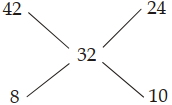
Using the method of alligation:
Cost of first salt = $42$ $P/kg$
Cost of second salt = $24$ $P/kg$
Mean price = $32$ $P/kg$
Difference for first salt = $|32 - 24| = 8$
Difference for second salt = $|42 - 32| = 10$
Ratio of quantities = $8 : 10 = 4 : 5$.
Let the quantity of the first salt be $x$ $kg$.
Then,$\frac{x}{25} = \frac{4}{5}$.
$x = \frac{4}{5} \times 25 = 20$ $kg$.
Given that the selling price $(SP)$ is $40$ $P$ per $kg$ and the gain is $25 \%$.
$CP = \frac{100}{100 + \text{Gain } \%} \times SP = \frac{100}{125} \times 40 = \frac{4}{5} \times 40 = 32$ $P$ per $kg$.
Using the method of alligation:
Cost of first salt = $42$ $P/kg$
Cost of second salt = $24$ $P/kg$
Mean price = $32$ $P/kg$
Difference for first salt = $|32 - 24| = 8$
Difference for second salt = $|42 - 32| = 10$
Ratio of quantities = $8 : 10 = 4 : 5$.
Let the quantity of the first salt be $x$ $kg$.
Then,$\frac{x}{25} = \frac{4}{5}$.
$x = \frac{4}{5} \times 25 = 20$ $kg$.
0 likes
View Solution53
MediumMCQ
$300$ $gm$ of sugar solution contains $40 \%$ sugar. How much sugar (in $gm$) should be added to make the concentration $50 \%$ in the solution?
A
$40$
B
$50$
C
$60$
D
$80$
Solution
(C) Initial amount of solution $= 300 \ gm$.
Amount of sugar $= 40 \%$ of $300 = \frac{40}{100} \times 300 = 120 \ gm$.
Amount of water $= 300 - 120 = 180 \ gm$.
Let the amount of sugar to be added be $x \ gm$.
After adding sugar,the new amount of sugar $= 120 + x$.
The total amount of solution becomes $= 300 + x$.
We want the new concentration of sugar to be $50 \%$,so:
$\frac{120 + x}{300 + x} = \frac{50}{100} = \frac{1}{2}$.
Cross-multiplying gives: $2(120 + x) = 300 + x$.
$240 + 2x = 300 + x$.
$2x - x = 300 - 240$.
$x = 60 \ gm$.
Amount of sugar $= 40 \%$ of $300 = \frac{40}{100} \times 300 = 120 \ gm$.
Amount of water $= 300 - 120 = 180 \ gm$.
Let the amount of sugar to be added be $x \ gm$.
After adding sugar,the new amount of sugar $= 120 + x$.
The total amount of solution becomes $= 300 + x$.
We want the new concentration of sugar to be $50 \%$,so:
$\frac{120 + x}{300 + x} = \frac{50}{100} = \frac{1}{2}$.
Cross-multiplying gives: $2(120 + x) = 300 + x$.
$240 + 2x = 300 + x$.
$2x - x = 300 - 240$.
$x = 60 \ gm$.
0 likes
View Solution54
DifficultMCQ
$A$ dishonest milkman professes to sell his milk at cost price but he mixes it with water and thereby gains $25 \%$. The percentage of water in the mixture is: (in $\%$)
A
$25$
B
$35$
C
$45$
D
$20$
Solution
(D) Let the cost price of $1$ litre of milk be $1$ unit.
Let the quantity of milk be $100$ litres.
Since the milkman sells at cost price but gains $25 \%$,it implies that the selling price of the mixture is equal to the cost price of $125$ litres of milk.
Since the milkman is selling the mixture at the cost price of pure milk,the extra $25$ litres must be water added to the $100$ litres of milk.
Total mixture quantity $= 100 \text{ (milk)} + 25 \text{ (water)} = 125 \text{ litres}$.
Percentage of water $= \frac{\text{Quantity of water}}{\text{Total mixture}} \times 100$.
Percentage of water $= \frac{25}{125} \times 100 = \frac{1}{5} \times 100 = 20 \%$.
Let the quantity of milk be $100$ litres.
Since the milkman sells at cost price but gains $25 \%$,it implies that the selling price of the mixture is equal to the cost price of $125$ litres of milk.
Since the milkman is selling the mixture at the cost price of pure milk,the extra $25$ litres must be water added to the $100$ litres of milk.
Total mixture quantity $= 100 \text{ (milk)} + 25 \text{ (water)} = 125 \text{ litres}$.
Percentage of water $= \frac{\text{Quantity of water}}{\text{Total mixture}} \times 100$.
Percentage of water $= \frac{25}{125} \times 100 = \frac{1}{5} \times 100 = 20 \%$.
0 likes
View Solution55
MediumMCQ
$200$ litres of mixture contains $15 \%$ water and the rest is milk. The amount of milk that must be added so that the resulting mixture contains $87.5 \%$ milk is..........$Litre$
A
$30$
B
$35$
C
$40$
D
$45$
Solution
(C) Initial volume of mixture $= 200 \text{ litres}$.
Water content $= 15 \% \text{ of } 200 = \frac{15}{100} \times 200 = 30 \text{ litres}$.
Milk content $= 200 - 30 = 170 \text{ litres}$.
Let $x$ litres of milk be added.
New total volume $= 200 + x$.
New milk content $= 170 + x$.
According to the problem,the new mixture contains $87.5 \%$ milk.
So,$\frac{170 + x}{200 + x} = \frac{87.5}{100} = \frac{875}{1000} = \frac{7}{8}$.
$8(170 + x) = 7(200 + x)$.
$1360 + 8x = 1400 + 7x$.
$8x - 7x = 1400 - 1360$.
$x = 40 \text{ litres}$.
Water content $= 15 \% \text{ of } 200 = \frac{15}{100} \times 200 = 30 \text{ litres}$.
Milk content $= 200 - 30 = 170 \text{ litres}$.
Let $x$ litres of milk be added.
New total volume $= 200 + x$.
New milk content $= 170 + x$.
According to the problem,the new mixture contains $87.5 \%$ milk.
So,$\frac{170 + x}{200 + x} = \frac{87.5}{100} = \frac{875}{1000} = \frac{7}{8}$.
$8(170 + x) = 7(200 + x)$.
$1360 + 8x = 1400 + 7x$.
$8x - 7x = 1400 - 1360$.
$x = 40 \text{ litres}$.
0 likes
View Solution56
DifficultMCQ
In a zoo,there are rabbits and pigeons. If the heads are counted,there are $200$ and if legs are counted,there are $580$. How many pigeons are there?
A
$105$
B
$110$
C
$115$
D
$120$
Solution
(B) Let the number of rabbits be $x$ and the number of pigeons be $y$.
Since each animal has one head,we have:
$x + y = 200$ $...(i)$
Rabbits have $4$ legs and pigeons have $2$ legs. Therefore,the total number of legs is:
$4x + 2y = 580$ $...(ii)$
To solve the system of equations,multiply equation $(i)$ by $2$:
$2x + 2y = 400$ $...(iii)$
Subtract equation $(iii)$ from equation $(ii)$:
$(4x + 2y) - (2x + 2y) = 580 - 400$
$2x = 180$
$x = 90$
Substitute $x = 90$ into equation $(i)$:
$90 + y = 200$
$y = 110$
Thus,the number of pigeons is $110$.
Since each animal has one head,we have:
$x + y = 200$ $...(i)$
Rabbits have $4$ legs and pigeons have $2$ legs. Therefore,the total number of legs is:
$4x + 2y = 580$ $...(ii)$
To solve the system of equations,multiply equation $(i)$ by $2$:
$2x + 2y = 400$ $...(iii)$
Subtract equation $(iii)$ from equation $(ii)$:
$(4x + 2y) - (2x + 2y) = 580 - 400$
$2x = 180$
$x = 90$
Substitute $x = 90$ into equation $(i)$:
$90 + y = 200$
$y = 110$
Thus,the number of pigeons is $110$.
0 likes
View Solution57
MediumMCQ
The ratio of milk and water in $66$ $litres$ of adulterated milk is $5:1$. Water is added to it to make the ratio $5:3$. The quantity of water added is (in $litres$):
A
$20$
B
$22$
C
$24$
D
$28$
Solution
(B) Total quantity of mixture = $66$ $litres$.
Ratio of milk to water = $5:1$.
Sum of ratio parts = $5 + 1 = 6$.
Quantity of milk = $(5/6) \times 66 = 55$ $litres$.
Quantity of water = $(1/6) \times 66 = 11$ $litres$.
Let the quantity of water added be $x$ $litres$.
New ratio of milk to water = $5:3$.
Therefore,$\frac{55}{11 + x} = \frac{5}{3}$.
Cross-multiplying,we get: $55 \times 3 = 5(11 + x)$.
$165 = 55 + 5x$.
$5x = 165 - 55 = 110$.
$x = 110 / 5 = 22$ $litres$.
Ratio of milk to water = $5:1$.
Sum of ratio parts = $5 + 1 = 6$.
Quantity of milk = $(5/6) \times 66 = 55$ $litres$.
Quantity of water = $(1/6) \times 66 = 11$ $litres$.
Let the quantity of water added be $x$ $litres$.
New ratio of milk to water = $5:3$.
Therefore,$\frac{55}{11 + x} = \frac{5}{3}$.
Cross-multiplying,we get: $55 \times 3 = 5(11 + x)$.
$165 = 55 + 5x$.
$5x = 165 - 55 = 110$.
$x = 110 / 5 = 22$ $litres$.
0 likes
View Solution58
DifficultMCQ
$A$ sum of $Rs. 41$ was divided among $50$ children. Each boy gets $90$ paise and each girl $65$ paise. The number of boys is?
A
$32$
B
$34$
C
$36$
D
$38$
Solution
(B) Total amount $= 41 \text{ rupees} = 4100 \text{ paise}$.
Total number of children $= 50$.
Average amount per child $= \frac{4100}{50} = 82 \text{ paise}$.
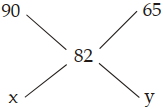
Using the method of alligation:
Boys ($90$ paise) : Girls ($65$ paise)
Mean value = $82$ paise
Difference for boys $= |82 - 65| = 17$
Difference for girls $= |90 - 82| = 8$
Ratio of boys to girls $= 17 : 8$.
Total parts $= 17 + 8 = 25$.
Number of boys $= \frac{17}{25} \times 50 = 34$.
Total number of children $= 50$.
Average amount per child $= \frac{4100}{50} = 82 \text{ paise}$.
Using the method of alligation:
Boys ($90$ paise) : Girls ($65$ paise)
Mean value = $82$ paise
Difference for boys $= |82 - 65| = 17$
Difference for girls $= |90 - 82| = 8$
Ratio of boys to girls $= 17 : 8$.
Total parts $= 17 + 8 = 25$.
Number of boys $= \frac{17}{25} \times 50 = 34$.
0 likes
View Solution59
MediumMCQ
Milk and water are mixed in vessel $A$ in the ratio of $5:2$ and in vessel $B$ in the ratio of $8:5$. In what ratio should quantities be taken from the two vessels so as to form a mixture in which milk and water will be in the ratio of $9:4$?
A
$7:2$
B
$5:2$
C
$2:7$
D
$2:5$
Solution
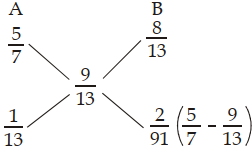
(A) In vessel $A$,the fraction of milk is $\frac{5}{7}$.
In vessel $B$,the fraction of milk is $\frac{8}{13}$.
The required fraction of milk in the final mixture is $\frac{9}{13}$.
Using the rule of alligation:
Difference for vessel $A = |\frac{8}{13} - \frac{9}{13}| = \frac{1}{13}$.
Difference for vessel $B = |\frac{5}{7} - \frac{9}{13}| = |\frac{65 - 63}{91}| = \frac{2}{91}$.
Required ratio of quantities from vessel $A$ and vessel $B = \frac{1}{13} : \frac{2}{91}$.
To simplify,multiply both sides by $91$: $(\frac{1}{13} \times 91) : (\frac{2}{91} \times 91) = 7 : 2$.
In vessel $B$,the fraction of milk is $\frac{8}{13}$.
The required fraction of milk in the final mixture is $\frac{9}{13}$.
Using the rule of alligation:
Difference for vessel $A = |\frac{8}{13} - \frac{9}{13}| = \frac{1}{13}$.
Difference for vessel $B = |\frac{5}{7} - \frac{9}{13}| = |\frac{65 - 63}{91}| = \frac{2}{91}$.
Required ratio of quantities from vessel $A$ and vessel $B = \frac{1}{13} : \frac{2}{91}$.
To simplify,multiply both sides by $91$: $(\frac{1}{13} \times 91) : (\frac{2}{91} \times 91) = 7 : 2$.
0 likes
View Solution60
DifficultMCQ
In a bag,there are three types of coins: $1$ rupee,$50$ paise,and $25$ paise in the ratio $3:8:20$. Their total value is $Rs. 372$. The total number of coins is:
A
$1200$
B
$961$
C
$744$
D
$612$
Solution
(B) Let the number of coins of $1$ rupee be $3x$,$50$ paise be $8x$,and $25$ paise be $20x$.
The value of $1$ rupee coins is $3x \times 1 = 3x$ rupees.
The value of $50$ paise coins is $8x \times 0.50 = 4x$ rupees.
The value of $25$ paise coins is $20x \times 0.25 = 5x$ rupees.
Given the total value is $Rs. 372$,we have:
$3x + 4x + 5x = 372$
$12x = 372$
$x = 31$
The total number of coins is $3x + 8x + 20x = 31x$.
Substituting $x = 31$,we get:
Total coins $= 31 \times 31 = 961$.
The value of $1$ rupee coins is $3x \times 1 = 3x$ rupees.
The value of $50$ paise coins is $8x \times 0.50 = 4x$ rupees.
The value of $25$ paise coins is $20x \times 0.25 = 5x$ rupees.
Given the total value is $Rs. 372$,we have:
$3x + 4x + 5x = 372$
$12x = 372$
$x = 31$
The total number of coins is $3x + 8x + 20x = 31x$.
Substituting $x = 31$,we get:
Total coins $= 31 \times 31 = 961$.
0 likes
View Solution61
MediumMCQ
$8$ litres are drawn from a cask full of wine and is then filled with water. This operation is performed three more times. The ratio of the quantity of wine now left in the cask to that of water is $16:65$. How much wine did the cask hold originally? (in litres)
A
$18$
B
$24$
C
$32$
D
$42$
Solution
(B) Let the original quantity of wine be $x$ litres.
After $1$ operation,the quantity of wine left is $x(1 - 8/x)$.
After $4$ operations (the initial one plus three more),the quantity of wine left is $x(1 - 8/x)^4$.
The total volume of the mixture remains $x$ litres.
The ratio of wine to water is $16:65$,so the ratio of wine to total mixture is $16:(16+65) = 16:81$.
Thus,$\frac{x(1 - 8/x)^4}{x} = \frac{16}{81}$.
$(1 - 8/x)^4 = (2/3)^4$.
Taking the fourth root on both sides,$1 - 8/x = 2/3$.
$8/x = 1 - 2/3 = 1/3$.
$x = 8 \times 3 = 24$ litres.
After $1$ operation,the quantity of wine left is $x(1 - 8/x)$.
After $4$ operations (the initial one plus three more),the quantity of wine left is $x(1 - 8/x)^4$.
The total volume of the mixture remains $x$ litres.
The ratio of wine to water is $16:65$,so the ratio of wine to total mixture is $16:(16+65) = 16:81$.
Thus,$\frac{x(1 - 8/x)^4}{x} = \frac{16}{81}$.
$(1 - 8/x)^4 = (2/3)^4$.
Taking the fourth root on both sides,$1 - 8/x = 2/3$.
$8/x = 1 - 2/3 = 1/3$.
$x = 8 \times 3 = 24$ litres.
0 likes
View Solution62
DifficultMCQ
$A$ can contains a mixture of two liquids $A$ and $B$ in the ratio $7:5$. When $9$ litres of mixture are drawn off and the can is filled with the same amount of liquid $B$,the ratio of $A$ and $B$ becomes $7:9$. How many litres of liquid $A$ was contained by the can initially?
A
$10$
B
$20$
C
$21$
D
$25$
Solution
(C) Let the initial quantity of liquid $A$ be $7x$ and liquid $B$ be $5x$ litres.
Total initial quantity $= 7x + 5x = 12x$ litres.
When $9$ litres of mixture are drawn off,the amount of $A$ removed is $\frac{7}{12} \times 9 = \frac{21}{4}$ litres,and the amount of $B$ removed is $\frac{5}{12} \times 9 = \frac{15}{4}$ litres.
Remaining quantity of $A = 7x - \frac{21}{4}$ litres.
Remaining quantity of $B = 5x - \frac{15}{4}$ litres.
After adding $9$ litres of liquid $B$,the new quantity of $B = 5x - \frac{15}{4} + 9 = 5x + \frac{21}{4}$ litres.
The new ratio is $7:9$,so:
$\frac{7x - 21/4}{5x + 21/4} = \frac{7}{9}$
$9(7x - 5.25) = 7(5x + 5.25)$
$63x - 47.25 = 35x + 36.75$
$28x = 84$
$x = 3$
Initial quantity of $A = 7x = 7 \times 3 = 21$ litres.
Total initial quantity $= 7x + 5x = 12x$ litres.
When $9$ litres of mixture are drawn off,the amount of $A$ removed is $\frac{7}{12} \times 9 = \frac{21}{4}$ litres,and the amount of $B$ removed is $\frac{5}{12} \times 9 = \frac{15}{4}$ litres.
Remaining quantity of $A = 7x - \frac{21}{4}$ litres.
Remaining quantity of $B = 5x - \frac{15}{4}$ litres.
After adding $9$ litres of liquid $B$,the new quantity of $B = 5x - \frac{15}{4} + 9 = 5x + \frac{21}{4}$ litres.
The new ratio is $7:9$,so:
$\frac{7x - 21/4}{5x + 21/4} = \frac{7}{9}$
$9(7x - 5.25) = 7(5x + 5.25)$
$63x - 47.25 = 35x + 36.75$
$28x = 84$
$x = 3$
Initial quantity of $A = 7x = 7 \times 3 = 21$ litres.
0 likes
View Solution63
MediumMCQ
$A$ container contained $80$ $litre$ of milk. From this container $8$ $litre$ of milk was taken out and replaced by water. This process was further repeated $3$ times. How much milk is now contained in the container? (in $litre$)
A
$54.23$
B
$54.26$
C
$56.26$
D
$52.48$
Solution
(D) The formula for the amount of substance remaining after $n$ operations is $A = x(1 - y/x)^n$,where $x$ is the initial quantity,$y$ is the quantity replaced,and $n$ is the total number of operations.
Here,$x = 80$,$y = 8$,and the process was performed once initially and repeated $3$ more times,so $n = 1 + 3 = 4$.
Remaining milk $= 80(1 - 8/80)^4$
$= 80(1 - 0.1)^4$
$= 80(0.9)^4$
$= 80 \times 0.6561$
$= 52.488 \text{ litre}$.
Rounding to the nearest provided option,the answer is $52.48$.
Here,$x = 80$,$y = 8$,and the process was performed once initially and repeated $3$ more times,so $n = 1 + 3 = 4$.
Remaining milk $= 80(1 - 8/80)^4$
$= 80(1 - 0.1)^4$
$= 80(0.9)^4$
$= 80 \times 0.6561$
$= 52.488 \text{ litre}$.
Rounding to the nearest provided option,the answer is $52.48$.
0 likes
View Solution64
DifficultMCQ
Vessels $A$ and $B$ contain mixtures of milk and water in the ratios $4:5$ and $5:1$ respectively. In what ratio should quantities of mixture be taken from $A$ and $B$ to form a mixture in which milk to water is in the ratio $5:4$?
A
$2:5$
B
$4:3$
C
$5:2$
D
$2:3$
Solution
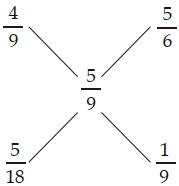
(C) Using the method of alligation,we consider the fraction of milk in each mixture.
In vessel $A$,the fraction of milk is $\frac{4}{4+5} = \frac{4}{9}$.
In vessel $B$,the fraction of milk is $\frac{5}{5+1} = \frac{5}{6}$.
The required fraction of milk in the final mixture is $\frac{5}{5+4} = \frac{5}{9}$.
Applying the alligation rule:
Difference between milk in $B$ and final mixture: $\frac{5}{6} - \frac{5}{9} = \frac{15-10}{18} = \frac{5}{18}$.
Difference between milk in $A$ and final mixture: $\frac{5}{9} - \frac{4}{9} = \frac{1}{9}$.
The ratio of quantities taken from $A$ and $B$ is $\frac{5}{18} : \frac{1}{9}$.
Multiplying both sides by $18$,we get $5 : 2$.
In vessel $A$,the fraction of milk is $\frac{4}{4+5} = \frac{4}{9}$.
In vessel $B$,the fraction of milk is $\frac{5}{5+1} = \frac{5}{6}$.
The required fraction of milk in the final mixture is $\frac{5}{5+4} = \frac{5}{9}$.
Applying the alligation rule:
Difference between milk in $B$ and final mixture: $\frac{5}{6} - \frac{5}{9} = \frac{15-10}{18} = \frac{5}{18}$.
Difference between milk in $A$ and final mixture: $\frac{5}{9} - \frac{4}{9} = \frac{1}{9}$.
The ratio of quantities taken from $A$ and $B$ is $\frac{5}{18} : \frac{1}{9}$.
Multiplying both sides by $18$,we get $5 : 2$.
0 likes
View Solution65
MediumMCQ
$A$ can contains a mixture of two liquids $A$ and $B$ in the ratio $4:7$. When $6 \text{ litres}$ of the mixture are drawn off and the can is filled with liquid $B$,the ratio of $A$ and $B$ becomes $3:7$. How many litres of liquid $A$ were contained in the can initially?
A
$15.4$
B
$12.46$
C
$15.7$
D
$16.4$
Solution
(B) Let the initial quantity of liquid $A$ be $4x$ and liquid $B$ be $7x$. The total quantity is $11x$.
When $6 \text{ litres}$ of the mixture are removed,the amount of $A$ removed is $\frac{4}{11} \times 6 = \frac{24}{11}$ and the amount of $B$ removed is $\frac{7}{11} \times 6 = \frac{42}{11}$.
After adding $6 \text{ litres}$ of $B$,the new quantity of $A$ is $4x - \frac{24}{11}$ and the new quantity of $B$ is $7x - \frac{42}{11} + 6$.
The new ratio is given as $3:7$,so:
$\frac{4x - \frac{24}{11}}{7x - \frac{42}{11} + 6} = \frac{3}{7}$
$\frac{44x - 24}{77x - 42 + 66} = \frac{3}{7}$
$7(44x - 24) = 3(77x + 24)$
$308x - 168 = 231x + 72$
$77x = 240 \Rightarrow x = \frac{240}{77}$
The initial amount of liquid $A$ was $4x = 4 \times \frac{240}{77} = \frac{960}{77} \approx 12.467 \text{ litres}$.
When $6 \text{ litres}$ of the mixture are removed,the amount of $A$ removed is $\frac{4}{11} \times 6 = \frac{24}{11}$ and the amount of $B$ removed is $\frac{7}{11} \times 6 = \frac{42}{11}$.
After adding $6 \text{ litres}$ of $B$,the new quantity of $A$ is $4x - \frac{24}{11}$ and the new quantity of $B$ is $7x - \frac{42}{11} + 6$.
The new ratio is given as $3:7$,so:
$\frac{4x - \frac{24}{11}}{7x - \frac{42}{11} + 6} = \frac{3}{7}$
$\frac{44x - 24}{77x - 42 + 66} = \frac{3}{7}$
$7(44x - 24) = 3(77x + 24)$
$308x - 168 = 231x + 72$
$77x = 240 \Rightarrow x = \frac{240}{77}$
The initial amount of liquid $A$ was $4x = 4 \times \frac{240}{77} = \frac{960}{77} \approx 12.467 \text{ litres}$.
0 likes
View Solution66
MediumMCQ
$100$ $litres$ of a mixture contains $20 \%$ water and the rest is milk. The amount of milk that must be added so that the resulting mixture contains $87.5 \%$ milk is (in $litres$):
A
$30$
B
$35$
C
$60$
D
$45$
Solution
(C) Initial volume of mixture $= 100 \text{ litres}$.
Water $= 20 \%$ of $100 = 20 \text{ litres}$.
Milk $= 100 - 20 = 80 \text{ litres}$.
Let $x$ litres of milk be added.
New volume of milk $= 80 + x$.
New total volume of mixture $= 100 + x$.
According to the problem,the new mixture contains $87.5 \%$ milk.
Therefore,the water content is $100 \% - 87.5 \% = 12.5 \%$.
Since the amount of water remains constant at $20 \text{ litres}$,we have:
$12.5 \% \text{ of } (100 + x) = 20$
$0.125 \times (100 + x) = 20$
$100 + x = \frac{20}{0.125} = 160$
$x = 160 - 100 = 60 \text{ litres}$.
Water $= 20 \%$ of $100 = 20 \text{ litres}$.
Milk $= 100 - 20 = 80 \text{ litres}$.
Let $x$ litres of milk be added.
New volume of milk $= 80 + x$.
New total volume of mixture $= 100 + x$.
According to the problem,the new mixture contains $87.5 \%$ milk.
Therefore,the water content is $100 \% - 87.5 \% = 12.5 \%$.
Since the amount of water remains constant at $20 \text{ litres}$,we have:
$12.5 \% \text{ of } (100 + x) = 20$
$0.125 \times (100 + x) = 20$
$100 + x = \frac{20}{0.125} = 160$
$x = 160 - 100 = 60 \text{ litres}$.
0 likes
View Solution67
DifficultMCQ
In what ratio must a person mix three kinds of wheat costing $Rs. 1.20$,$Rs. 1.44$ and $Rs. 1.74$ per $kg$ so that the mixture may be worth $Rs. 1.41$ per $kg$?
A
$11: 77: 7$
B
$25: 45: 8$
C
$27: 23: 6$
D
$11: 45: 7$
Solution
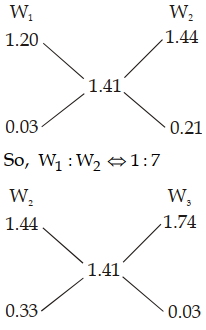
(A) Let the three kinds of wheat be $W_1, W_2$ and $W_3$ with costs $1.20, 1.44$ and $1.74$ respectively.
By the rule of Alligation:
For $W_1$ and $W_2$ with mean price $1.41$:
$W_1 : W_2 = (1.74 - 1.41) : (1.41 - 1.20) = 0.33 : 0.21 = 11 : 7$.
For $W_2$ and $W_3$ with mean price $1.41$:
$W_2 : W_3 = (1.74 - 1.41) : (1.41 - 1.44) = 0.33 : (-0.03) = 11 : 1$ (taking absolute differences).
To combine these,we equate the ratio of $W_2$ in both parts:
$W_1 : W_2 = 11 : 7$
$W_2 : W_3 = 77 : 7$ (multiplying the second ratio by $7$ to match $W_2 = 77$)
$W_1 : W_2 = 121 : 77$
Thus,$W_1 : W_2 : W_3 = 121 : 77 : 7$.
Wait,re-evaluating the alligation steps from the provided image:
$W_1(1.20)$ and $W_2(1.44)$ with mean $1.41$ gives $W_1:W_2 = (1.44-1.41) : (1.41-1.20) = 0.03 : 0.21 = 1 : 7$.
$W_2(1.44)$ and $W_3(1.74)$ with mean $1.41$ gives $W_2:W_3 = (1.74-1.41) : (1.41-1.44) = 0.33 : 0.03 = 11 : 1$.
Equating $W_2$: $W_1:W_2 = 1:7 = 11:77$ and $W_2:W_3 = 11:1 = 77:7$.
Therefore,$W_1:W_2:W_3 = 11:77:7$.
By the rule of Alligation:
For $W_1$ and $W_2$ with mean price $1.41$:
$W_1 : W_2 = (1.74 - 1.41) : (1.41 - 1.20) = 0.33 : 0.21 = 11 : 7$.
For $W_2$ and $W_3$ with mean price $1.41$:
$W_2 : W_3 = (1.74 - 1.41) : (1.41 - 1.44) = 0.33 : (-0.03) = 11 : 1$ (taking absolute differences).
To combine these,we equate the ratio of $W_2$ in both parts:
$W_1 : W_2 = 11 : 7$
$W_2 : W_3 = 77 : 7$ (multiplying the second ratio by $7$ to match $W_2 = 77$)
$W_1 : W_2 = 121 : 77$
Thus,$W_1 : W_2 : W_3 = 121 : 77 : 7$.
Wait,re-evaluating the alligation steps from the provided image:
$W_1(1.20)$ and $W_2(1.44)$ with mean $1.41$ gives $W_1:W_2 = (1.44-1.41) : (1.41-1.20) = 0.03 : 0.21 = 1 : 7$.
$W_2(1.44)$ and $W_3(1.74)$ with mean $1.41$ gives $W_2:W_3 = (1.74-1.41) : (1.41-1.44) = 0.33 : 0.03 = 11 : 1$.
Equating $W_2$: $W_1:W_2 = 1:7 = 11:77$ and $W_2:W_3 = 11:1 = 77:7$.
Therefore,$W_1:W_2:W_3 = 11:77:7$.
0 likes
View Solution68
DifficultMCQ
$A$ tea seller mixes three qualities of tea $T_{1}, T_{2}$,and $T_{3}$ priced at $Rs. 74$ per kg,$Rs. 68$ per kg,and $Rs. 63$ per kg in the ratio of $1:2:4$. He added some more quantity of $T_{1}$ to $4$ kg of this mixture. He sold this new mixture for $Rs. 84$ per kg,thereby making a profit of $20\%$. How much of $T_{1}$ did he mix with the mixture? (in kg)
A
$1$
B
$0.5$
C
$0.35$
D
$4$
Solution
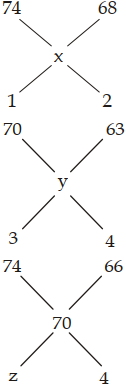
(D) First,find the cost price $(CP)$ of the initial mixture of $T_{1}, T_{2}$,and $T_{3}$ in the ratio $1:2:4$:
$CP_{mix} = \frac{(1 \times 74) + (2 \times 68) + (4 \times 63)}{1+2+4} = \frac{74 + 136 + 252}{7} = \frac{462}{7} = Rs. 66$ per kg.
Now,the seller adds $z$ kg of $T_{1}$ (priced at $Rs. 74$ per kg) to $4$ kg of the initial mixture (priced at $Rs. 66$ per kg).
The selling price of the new mixture is $Rs. 84$ per kg with a profit of $20\%$.
Therefore,the cost price of the new mixture is $CP_{new} = 84 \times \frac{100}{120} = Rs. 70$ per kg.
Using the alligation method for the new mixture:
Quantity of $T_{1}$ ($z$ kg) at $Rs. 74$ per kg and quantity of initial mixture ($4$ kg) at $Rs. 66$ per kg result in a mixture at $Rs. 70$ per kg.
$\frac{74 - 70}{70 - 66} = \frac{4}{z}$
$\frac{4}{4} = \frac{4}{z}$
$1 = \frac{4}{z} \Rightarrow z = 4$ kg.
$CP_{mix} = \frac{(1 \times 74) + (2 \times 68) + (4 \times 63)}{1+2+4} = \frac{74 + 136 + 252}{7} = \frac{462}{7} = Rs. 66$ per kg.
Now,the seller adds $z$ kg of $T_{1}$ (priced at $Rs. 74$ per kg) to $4$ kg of the initial mixture (priced at $Rs. 66$ per kg).
The selling price of the new mixture is $Rs. 84$ per kg with a profit of $20\%$.
Therefore,the cost price of the new mixture is $CP_{new} = 84 \times \frac{100}{120} = Rs. 70$ per kg.
Using the alligation method for the new mixture:
Quantity of $T_{1}$ ($z$ kg) at $Rs. 74$ per kg and quantity of initial mixture ($4$ kg) at $Rs. 66$ per kg result in a mixture at $Rs. 70$ per kg.
$\frac{74 - 70}{70 - 66} = \frac{4}{z}$
$\frac{4}{4} = \frac{4}{z}$
$1 = \frac{4}{z} \Rightarrow z = 4$ kg.
0 likes
View Solution69
MediumMCQ
Nine litres of water are drawn from a container full of water and it is then filled with milk. Nine litres of mixture are drawn and the container is again filled with milk. The ratio of the quantity of water now left in the container to that of the milk in it is $16:9$. How much liquid does the container hold? (in $litres$)
A
$34$
B
$38$
C
$43$
D
$45$
Solution
(D) Let the initial capacity of the container be $x$ litres of water.
After the first operation,the amount of water left is $(x - 9)$ litres.
After the second operation,the amount of water left is $x(1 - 9/x)^2$ litres.
The ratio of water to the total volume is $16 : (16 + 9) = 16 : 25$.
Therefore,the fraction of water remaining is $\frac{x(1 - 9/x)^2}{x} = \frac{16}{25}$.
$(1 - 9/x)^2 = (4/5)^2$.
$1 - 9/x = 4/5$.
$9/x = 1 - 4/5 = 1/5$.
$x = 45$ litres.
The container holds $45$ litres of liquid.
After the first operation,the amount of water left is $(x - 9)$ litres.
After the second operation,the amount of water left is $x(1 - 9/x)^2$ litres.
The ratio of water to the total volume is $16 : (16 + 9) = 16 : 25$.
Therefore,the fraction of water remaining is $\frac{x(1 - 9/x)^2}{x} = \frac{16}{25}$.
$(1 - 9/x)^2 = (4/5)^2$.
$1 - 9/x = 4/5$.
$9/x = 1 - 4/5 = 1/5$.
$x = 45$ litres.
The container holds $45$ litres of liquid.
0 likes
View Solution70
MediumMCQ
$A$ cylinder which has the capacity of $8 \text{ litres}$ contains a mixture of oxygen and nitrogen. The volume of oxygen in the cylinder is $16 \%$ of the total volume. $A$ few litres of the mixture is released and an equal amount of nitrogen is added. Then,the same amount of the mixture as before is released and replaced by nitrogen for the second time. As a result,the oxygen content becomes $9 \%$ of the total volume. Find the amount of mixture released each time (in litres).
A
$2$
B
$2.5$
C
$1$
D
$0.5$
Solution
(A) Let the amount of mixture released each time be $y \text{ litres}$.
The initial volume of oxygen is $16 \%$ of $8 \text{ litres}$,which is $0.16 \times 8$.
After the first replacement,the remaining oxygen is $8 \times 0.16 \times (1 - y/8)$.
After the second replacement,the remaining oxygen is $8 \times 0.16 \times (1 - y/8)^2$.
According to the problem,the final oxygen content is $9 \%$ of the total volume $(8 \text{ litres})$,so:
$8 \times 0.16 \times (1 - y/8)^2 = 0.09 \times 8$
$(1 - y/8)^2 = 0.09 / 0.16$
$(1 - y/8)^2 = (0.3 / 0.4)^2 = (3/4)^2$
$1 - y/8 = 3/4$
$y/8 = 1 - 3/4 = 1/4$
$y = 8 / 4 = 2 \text{ litres}$.
The initial volume of oxygen is $16 \%$ of $8 \text{ litres}$,which is $0.16 \times 8$.
After the first replacement,the remaining oxygen is $8 \times 0.16 \times (1 - y/8)$.
After the second replacement,the remaining oxygen is $8 \times 0.16 \times (1 - y/8)^2$.
According to the problem,the final oxygen content is $9 \%$ of the total volume $(8 \text{ litres})$,so:
$8 \times 0.16 \times (1 - y/8)^2 = 0.09 \times 8$
$(1 - y/8)^2 = 0.09 / 0.16$
$(1 - y/8)^2 = (0.3 / 0.4)^2 = (3/4)^2$
$1 - y/8 = 3/4$
$y/8 = 1 - 3/4 = 1/4$
$y = 8 / 4 = 2 \text{ litres}$.
0 likes
View Solution71
DifficultMCQ
Two liquids are mixed in the ratio of $3: 2$ and the mixture is sold at $Rs. 11$ per litre at a $10 \%$ profit. If the $1$st liquid costs $Rs. 2$ more per litre than the second,what is the cost per litre of the second liquid (in $.80$)? (in $Rs.$)
A
$8$
B
$10$
C
$12$
D
$14$
Solution
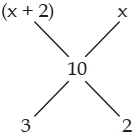
(A) Let the cost price of the second liquid be $x$ per litre.
Then,the cost price of the first liquid is $(x + 2)$ per litre.
The selling price of the mixture is $Rs. 11$ per litre at a profit of $10 \%$.
Therefore,the cost price $(CP)$ of the mixture is:
$CP = 11 \times \frac{100}{110} = Rs. 10$ per litre.
Using the method of alligation:
Ratio of first liquid to second liquid = $(10 - x) : (x + 2 - 10) = 3 : 2$
$\frac{10 - x}{x - 8} = \frac{3}{2}$
$2(10 - x) = 3(x - 8)$
$20 - 2x = 3x - 24$
$5x = 44$
$x = 8.8$
Thus,the cost per litre of the second liquid is $Rs. 8.80$.
Then,the cost price of the first liquid is $(x + 2)$ per litre.
The selling price of the mixture is $Rs. 11$ per litre at a profit of $10 \%$.
Therefore,the cost price $(CP)$ of the mixture is:
$CP = 11 \times \frac{100}{110} = Rs. 10$ per litre.
Using the method of alligation:
Ratio of first liquid to second liquid = $(10 - x) : (x + 2 - 10) = 3 : 2$
$\frac{10 - x}{x - 8} = \frac{3}{2}$
$2(10 - x) = 3(x - 8)$
$20 - 2x = 3x - 24$
$5x = 44$
$x = 8.8$
Thus,the cost per litre of the second liquid is $Rs. 8.80$.
0 likes
View Solution72
EasyMCQ
If $5 \ kg$ of potato costing $Rs. 5$ per $kg$ and $3 \ kg$ of potato costing $Rs. 4$ per $kg$ are mixed,find the average cost of the mixture per $kg$?
A
$4.40$
B
$4.45$
C
$4.63$
D
$4.95$
Solution
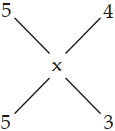
(C) Total cost of $5 \ kg$ of potatoes $= 5 \times 5 = Rs. 25$.
Total cost of $3 \ kg$ of potatoes $= 3 \times 4 = Rs. 12$.
Total weight of the mixture $= 5 + 3 = 8 \ kg$.
Total cost of the mixture $= 25 + 12 = Rs. 37$.
Average cost per $kg = \frac{\text{Total cost}}{\text{Total weight}} = \frac{37}{8} = Rs. 4.625$.
Rounding to two decimal places,the average cost is approximately $Rs. 4.63$ per $kg$.
Total cost of $3 \ kg$ of potatoes $= 3 \times 4 = Rs. 12$.
Total weight of the mixture $= 5 + 3 = 8 \ kg$.
Total cost of the mixture $= 25 + 12 = Rs. 37$.
Average cost per $kg = \frac{\text{Total cost}}{\text{Total weight}} = \frac{37}{8} = Rs. 4.625$.
Rounding to two decimal places,the average cost is approximately $Rs. 4.63$ per $kg$.
0 likes
View Solution73
MediumMCQ
$A$ $20\, \text{litre}$ mixture of milk and water contains milk and water in the ratio $3:2$. $10\, \text{litres}$ of the mixture is removed and replaced with pure milk,and the operation is repeated once more. At the end of the two removals and replacements,what is the ratio of milk and water in the resultant mixture?
A
$17:3$
B
$9:1$
C
$3:17$
D
$5:13$
Solution
(B) The initial $20\, \text{litre}$ mixture contains milk and water in the ratio $3:2$. Thus,the amount of milk is $12\, \text{litres}$ and water is $8\, \text{litres}$.
Step $1$: When $10\, \text{litres}$ of the mixture is removed,the amount of milk removed is $(3/5) \times 10 = 6\, \text{litres}$ and water removed is $(2/5) \times 10 = 4\, \text{litres}$. Remaining: $6\, \text{litres}$ milk and $4\, \text{litres}$ water. After adding $10\, \text{litres}$ of pure milk,the container has $6+10 = 16\, \text{litres}$ of milk and $4\, \text{litres}$ of water.
Step $2$: When $10\, \text{litres}$ of this new mixture is removed,the ratio of milk to water is $16:4$,which is $4:1$. The amount of milk removed is $(4/5) \times 10 = 8\, \text{litres}$ and water removed is $(1/5) \times 10 = 2\, \text{litres}$. Remaining: $16-8 = 8\, \text{litres}$ milk and $4-2 = 2\, \text{litres}$ water. After adding $10\, \text{litres}$ of pure milk,the container has $8+10 = 18\, \text{litres}$ of milk and $2\, \text{litres}$ of water.
The final ratio of milk to water is $18:2$,which simplifies to $9:1$.
Step $1$: When $10\, \text{litres}$ of the mixture is removed,the amount of milk removed is $(3/5) \times 10 = 6\, \text{litres}$ and water removed is $(2/5) \times 10 = 4\, \text{litres}$. Remaining: $6\, \text{litres}$ milk and $4\, \text{litres}$ water. After adding $10\, \text{litres}$ of pure milk,the container has $6+10 = 16\, \text{litres}$ of milk and $4\, \text{litres}$ of water.
Step $2$: When $10\, \text{litres}$ of this new mixture is removed,the ratio of milk to water is $16:4$,which is $4:1$. The amount of milk removed is $(4/5) \times 10 = 8\, \text{litres}$ and water removed is $(1/5) \times 10 = 2\, \text{litres}$. Remaining: $16-8 = 8\, \text{litres}$ milk and $4-2 = 2\, \text{litres}$ water. After adding $10\, \text{litres}$ of pure milk,the container has $8+10 = 18\, \text{litres}$ of milk and $2\, \text{litres}$ of water.
The final ratio of milk to water is $18:2$,which simplifies to $9:1$.
0 likes
View Solution74
DifficultMCQ
$A$ merchant mixes three varieties of rice costing $Rs. 20$ per $kg$,$Rs. 24$ per $kg$,and $Rs. 30$ per $kg$ and sells the mixture at a profit of $20\%$ at $Rs. 30$ per $kg$. How many $kgs$ of the second variety will be in the mixture if $2$ $kgs$ of the third variety is there in the mixture?
A
$1$
B
$3$
C
$5$
D
$6$
Solution
(C) The selling price of the mixture is $Rs. 30/kg$ and the profit is $20\%$. The cost price of the mixture is $\frac{30}{1.2} = Rs. 25/kg$.
Let the quantities of the three varieties be $Q_A, Q_B,$ and $Q_C$ with costs $20, 24,$ and $30$ respectively.
Using the alligation rule for the mixture:
For $Q_A$ and $Q_C$: $\frac{Q_A}{Q_C} = \frac{30 - 25}{25 - 20} = \frac{5}{5} = \frac{1}{1}$.
For $Q_B$ and $Q_C$: $\frac{Q_B}{Q_C} = \frac{30 - 25}{25 - 24} = \frac{5}{1}$.
To combine these,we equate the $Q_C$ parts. In both ratios,$Q_C$ is $1$ unit. Thus,the ratio $Q_A : Q_B : Q_C = 1 : 5 : 1$.
Wait,the total $Q_C$ is the sum of parts from both alligations: $Q_C = 1 + 1 = 2$ units.
So,the ratio is $Q_A : Q_B : Q_C = 1 : 5 : 2$.
Given $Q_C = 2$ $kg$,the quantity of the second variety $Q_B = 5$ $kg$.
Let the quantities of the three varieties be $Q_A, Q_B,$ and $Q_C$ with costs $20, 24,$ and $30$ respectively.
Using the alligation rule for the mixture:
For $Q_A$ and $Q_C$: $\frac{Q_A}{Q_C} = \frac{30 - 25}{25 - 20} = \frac{5}{5} = \frac{1}{1}$.
For $Q_B$ and $Q_C$: $\frac{Q_B}{Q_C} = \frac{30 - 25}{25 - 24} = \frac{5}{1}$.
To combine these,we equate the $Q_C$ parts. In both ratios,$Q_C$ is $1$ unit. Thus,the ratio $Q_A : Q_B : Q_C = 1 : 5 : 1$.
Wait,the total $Q_C$ is the sum of parts from both alligations: $Q_C = 1 + 1 = 2$ units.
So,the ratio is $Q_A : Q_B : Q_C = 1 : 5 : 2$.
Given $Q_C = 2$ $kg$,the quantity of the second variety $Q_B = 5$ $kg$.
0 likes
View Solution75
MediumMCQ
In what ratio must a person mix three kinds of tea costing $Rs. 60$ per $kg$,$Rs. 75$ per $kg$,and $Rs. 100$ per $kg$ so that the resultant mixture when sold at $Rs. 96$ per $kg$ yields a profit of $20\%$?
A
$1: 2: 4$
B
$3: 7: 6$
C
$1: 4: 2$
D
$1: 3: 5$
Solution
(C) The selling price of the mixture is $Rs. 96/kg$ with a profit of $20\%$.
$\text{Cost Price (CP)} = \frac{\text{Selling Price}}{1 + \text{Profit}\%} = \frac{96}{1.20} = Rs. 80/kg$.
Let the three varieties be $A$ $(Rs. 60/kg)$,$B$ $(Rs. 75/kg)$,and $C$ $(Rs. 100/kg)$.
We use the alligation method to find the ratio of quantities $Q_A, Q_B, Q_C$ to achieve a mean price of $Rs. 80/kg$.
Step $1$: Compare $A$ and $C$ with the mean price $80$.
$\frac{Q_A}{Q_C} = \frac{100 - 80}{80 - 60} = \frac{20}{20} = \frac{1}{1}$.
Step $2$: Compare $B$ and $C$ with the mean price $80$.
$\frac{Q_B}{Q_C} = \frac{100 - 80}{80 - 75} = \frac{20}{5} = \frac{4}{1}$.
Step $3$: Equate the parts of $Q_C$ in both ratios. Since $Q_C$ is $1$ part in both,we combine them:
$Q_A : Q_B : Q_C = 1 : 4 : (1 + 1) = 1 : 4 : 2$.
$\text{Cost Price (CP)} = \frac{\text{Selling Price}}{1 + \text{Profit}\%} = \frac{96}{1.20} = Rs. 80/kg$.
Let the three varieties be $A$ $(Rs. 60/kg)$,$B$ $(Rs. 75/kg)$,and $C$ $(Rs. 100/kg)$.
We use the alligation method to find the ratio of quantities $Q_A, Q_B, Q_C$ to achieve a mean price of $Rs. 80/kg$.
Step $1$: Compare $A$ and $C$ with the mean price $80$.
$\frac{Q_A}{Q_C} = \frac{100 - 80}{80 - 60} = \frac{20}{20} = \frac{1}{1}$.
Step $2$: Compare $B$ and $C$ with the mean price $80$.
$\frac{Q_B}{Q_C} = \frac{100 - 80}{80 - 75} = \frac{20}{5} = \frac{4}{1}$.
Step $3$: Equate the parts of $Q_C$ in both ratios. Since $Q_C$ is $1$ part in both,we combine them:
$Q_A : Q_B : Q_C = 1 : 4 : (1 + 1) = 1 : 4 : 2$.
0 likes
View Solution76
MediumMCQ
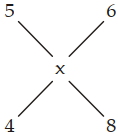
$4 \, kg$ of potato at $Rs. \,5$ per $kg$ is mixed with $8 \,kg$ of potato at $Rs. \,6$ per $kg.$ Find the average price of the mixture (in $Rs.$ per $kg$).
A
$5.66$
B
$6.50$
C
$7.25$
D
None of these
Solution
(A) Total cost of $4 \, kg$ of potato $= 4 \times 5 = Rs. \, 20.$
Total cost of $8 \, kg$ of potato $= 8 \times 6 = Rs. \, 48.$
Total cost of the mixture $= 20 + 48 = Rs. \, 68.$
Total weight of the mixture $= 4 + 8 = 12 \, kg.$
Average price of the mixture $= \frac{\text{Total Cost}}{\text{Total Weight}} = \frac{68}{12} = Rs. \, 5.666... \approx Rs. \, 5.67.$
Since $5.67$ is not explicitly listed,the closest option is $5.66$.
Total cost of $8 \, kg$ of potato $= 8 \times 6 = Rs. \, 48.$
Total cost of the mixture $= 20 + 48 = Rs. \, 68.$
Total weight of the mixture $= 4 + 8 = 12 \, kg.$
Average price of the mixture $= \frac{\text{Total Cost}}{\text{Total Weight}} = \frac{68}{12} = Rs. \, 5.666... \approx Rs. \, 5.67.$
Since $5.67$ is not explicitly listed,the closest option is $5.66$.
0 likes
View Solution77
MediumMCQ
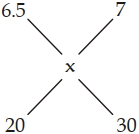
$A$ shopkeeper bought $20 \ kg$ of onions at $Rs. 6.50$ per $kg$ and $30 \ kg$ of onions at $Rs. 7$ per $kg$. He sold the mixture at a total profit of $Rs. 60$. At what price per $kg$ did he sell the mixture of onions? (in $Rs.$)
A
$12$
B
$8$
C
$7.50$
D
$11$
Solution
(B) Step $1$: Calculate the total cost price of the onions.
Total cost price $= (20 \times 6.50) + (30 \times 7) = 130 + 210 = Rs. 340$.
Step $2$: Calculate the total selling price.
Total profit $= Rs. 60$.
Total selling price $= \text{Total cost price} + \text{Total profit} = 340 + 60 = Rs. 400$.
Step $3$: Calculate the selling price per $kg$.
Total quantity of onions $= 20 + 30 = 50 \ kg$.
Selling price per $kg = \frac{400}{50} = Rs. 8$ per $kg$.
Total cost price $= (20 \times 6.50) + (30 \times 7) = 130 + 210 = Rs. 340$.
Step $2$: Calculate the total selling price.
Total profit $= Rs. 60$.
Total selling price $= \text{Total cost price} + \text{Total profit} = 340 + 60 = Rs. 400$.
Step $3$: Calculate the selling price per $kg$.
Total quantity of onions $= 20 + 30 = 50 \ kg$.
Selling price per $kg = \frac{400}{50} = Rs. 8$ per $kg$.
0 likes
View Solution78
DifficultMCQ
Two casks of $48$ $litres$ and $42$ $litres$ are filled with mixtures of wine and water,the proportions in the two casks being respectively $13:7$ and $18:17$. If the contents of the two casks are mixed,and $20$ $litres$ of water is added to the whole,what will be the proportion of wine to water in the resultant mixture?
A
$13:12$
B
$12:13$
C
$21:31$
D
$31:21$
Solution
(B) In the first cask ($48$ $litres$): Wine $= \frac{13}{20} \times 48 = 31.2$ $litres$,Water $= \frac{7}{20} \times 48 = 16.8$ $litres$.
In the second cask ($42$ $litres$): Wine $= \frac{18}{35} \times 42 = 21.6$ $litres$,Water $= \frac{17}{35} \times 42 = 20.4$ $litres$.
Total wine $= 31.2 + 21.6 = 52.8$ $litres$.
Total water $= 16.8 + 20.4 = 37.2$ $litres$.
After adding $20$ $litres$ of water,total water $= 37.2 + 20 = 57.2$ $litres$.
The ratio of wine to water $= 52.8 : 57.2 = 528 : 572$.
Dividing both by $44$,we get $12 : 13$.
In the second cask ($42$ $litres$): Wine $= \frac{18}{35} \times 42 = 21.6$ $litres$,Water $= \frac{17}{35} \times 42 = 20.4$ $litres$.
Total wine $= 31.2 + 21.6 = 52.8$ $litres$.
Total water $= 16.8 + 20.4 = 37.2$ $litres$.
After adding $20$ $litres$ of water,total water $= 37.2 + 20 = 57.2$ $litres$.
The ratio of wine to water $= 52.8 : 57.2 = 528 : 572$.
Dividing both by $44$,we get $12 : 13$.
0 likes
View Solution79
MediumMCQ
Three glasses of capacity $2 \, L$,$5 \, L$,and $9 \, L$ contain mixtures of milk and water with milk concentrations of $90 \%$,$80 \%$,and $70 \%$ respectively. The contents of the three glasses are emptied into a large vessel. Find the ratio of milk to water in the resultant mixture.
A
$121:39$
B
$131:49$
C
$39:121$
D
$49:131$
Solution
(A) Total volume of the mixture $= 2 + 5 + 9 = 16 \, L$.
Quantity of milk in the first glass $= 90 \% \text{ of } 2 \, L = 0.9 \times 2 = 1.8 \, L$.
Quantity of milk in the second glass $= 80 \% \text{ of } 5 \, L = 0.8 \times 5 = 4.0 \, L$.
Quantity of milk in the third glass $= 70 \% \text{ of } 9 \, L = 0.7 \times 9 = 6.3 \, L$.
Total quantity of milk $= 1.8 + 4.0 + 6.3 = 12.1 \, L$.
Total quantity of water $= \text{Total volume} - \text{Total milk} = 16.0 - 12.1 = 3.9 \, L$.
Therefore,the ratio of milk to water $= 12.1 : 3.9 = 121 : 39$.
Quantity of milk in the first glass $= 90 \% \text{ of } 2 \, L = 0.9 \times 2 = 1.8 \, L$.
Quantity of milk in the second glass $= 80 \% \text{ of } 5 \, L = 0.8 \times 5 = 4.0 \, L$.
Quantity of milk in the third glass $= 70 \% \text{ of } 9 \, L = 0.7 \times 9 = 6.3 \, L$.
Total quantity of milk $= 1.8 + 4.0 + 6.3 = 12.1 \, L$.
Total quantity of water $= \text{Total volume} - \text{Total milk} = 16.0 - 12.1 = 3.9 \, L$.
Therefore,the ratio of milk to water $= 12.1 : 3.9 = 121 : 39$.
0 likes
View Solution80
MediumMCQ
$A$ $12 \text{ litres}$ cylinder contains a mixture of oxygen and nitrogen,the volume of oxygen being $40 \%$ of the total volume. $A$ few litres of the mixture is released and an equal amount of nitrogen is added. Then,the same amount of the mixture as before is released and replaced by nitrogen for the $second$ time. As a result,the oxygen content becomes $10 \%$ of the total volume. How many $litres$ of the mixture is released each time?
A
$3$
B
$9$
C
$6$
D
$4$
Solution
(C) Let $y$ litres of the mixture be released each time.
Initially,the volume of oxygen is $40 \%$ of $12 \text{ litres} = 0.40 \times 12 = 4.8 \text{ litres}$.
The formula for the remaining amount of a substance after $n$ operations of replacing a volume $y$ from a total volume $V$ is: $A_{final} = A_{initial} \times (1 - \frac{y}{V})^n$.
Here,$A_{initial} = 0.40$,$A_{final} = 0.10$,$V = 12$,and $n = 2$.
Substituting the values: $0.10 = 0.40 \times (1 - \frac{y}{12})^2$.
Dividing both sides by $0.40$: $\frac{0.10}{0.40} = (1 - \frac{y}{12})^2$.
$\frac{1}{4} = (1 - \frac{y}{12})^2$.
Taking the square root of both sides: $\frac{1}{2} = 1 - \frac{y}{12}$.
$\frac{y}{12} = 1 - \frac{1}{2} = \frac{1}{2}$.
$y = 12 \times \frac{1}{2} = 6 \text{ litres}$.
Initially,the volume of oxygen is $40 \%$ of $12 \text{ litres} = 0.40 \times 12 = 4.8 \text{ litres}$.
The formula for the remaining amount of a substance after $n$ operations of replacing a volume $y$ from a total volume $V$ is: $A_{final} = A_{initial} \times (1 - \frac{y}{V})^n$.
Here,$A_{initial} = 0.40$,$A_{final} = 0.10$,$V = 12$,and $n = 2$.
Substituting the values: $0.10 = 0.40 \times (1 - \frac{y}{12})^2$.
Dividing both sides by $0.40$: $\frac{0.10}{0.40} = (1 - \frac{y}{12})^2$.
$\frac{1}{4} = (1 - \frac{y}{12})^2$.
Taking the square root of both sides: $\frac{1}{2} = 1 - \frac{y}{12}$.
$\frac{y}{12} = 1 - \frac{1}{2} = \frac{1}{2}$.
$y = 12 \times \frac{1}{2} = 6 \text{ litres}$.
0 likes
View Solution81
MediumMCQ
There are two containers of equal capacity. The ratio of milk to water in the first container is $3:1$,and in the second container is $5:2$. If they are mixed together,then the ratio of milk to water in the mixture will be:
A
$28:41$
B
$41:28$
C
$15:41$
D
$41:15$
Solution
(D) Let the capacity of each container be $L$ units. To make the calculations easier,we choose a common multiple of the sum of the parts in both ratios.
Sum of parts in the first container $= 3 + 1 = 4$.
Sum of parts in the second container $= 5 + 2 = 7$.
The least common multiple of $4$ and $7$ is $28$.
For the first container:
Milk $= (3/4) \times 28 = 21$ units,Water $= (1/4) \times 28 = 7$ units.
For the second container:
Milk $= (5/7) \times 28 = 20$ units,Water $= (2/7) \times 28 = 8$ units.
When mixed,total Milk $= 21 + 20 = 41$ units.
Total Water $= 7 + 8 = 15$ units.
Therefore,the ratio of milk to water in the mixture is $41:15$.
Sum of parts in the first container $= 3 + 1 = 4$.
Sum of parts in the second container $= 5 + 2 = 7$.
The least common multiple of $4$ and $7$ is $28$.
For the first container:
Milk $= (3/4) \times 28 = 21$ units,Water $= (1/4) \times 28 = 7$ units.
For the second container:
Milk $= (5/7) \times 28 = 20$ units,Water $= (2/7) \times 28 = 8$ units.
When mixed,total Milk $= 21 + 20 = 41$ units.
Total Water $= 7 + 8 = 15$ units.
Therefore,the ratio of milk to water in the mixture is $41:15$.
0 likes
View Solution82
MediumMCQ
In a mixture of $60\, L$,the ratio of acid and water is $2:1$. If the ratio of acid and water is to be $1:2$,then the amount of water (in $litres$) to be added to the mixture is:
A
$55$
B
$60$
C
$50$
D
$45$
Solution
(B) The total volume of the mixture is $60\, L$.
The ratio of acid to water is $2:1$.
Quantity of acid $= \frac{2}{2+1} \times 60 = \frac{2}{3} \times 60 = 40\, L$.
Quantity of water $= 60 - 40 = 20\, L$.
Let the amount of water to be added be $x\, L$.
The new ratio of acid to water becomes $1:2$.
So,$\frac{40}{20+x} = \frac{1}{2}$.
Cross-multiplying,we get $40 \times 2 = 20 + x$.
$80 = 20 + x$.
$x = 80 - 20 = 60\, L$.
Therefore,$60\, L$ of water must be added.
The ratio of acid to water is $2:1$.
Quantity of acid $= \frac{2}{2+1} \times 60 = \frac{2}{3} \times 60 = 40\, L$.
Quantity of water $= 60 - 40 = 20\, L$.
Let the amount of water to be added be $x\, L$.
The new ratio of acid to water becomes $1:2$.
So,$\frac{40}{20+x} = \frac{1}{2}$.
Cross-multiplying,we get $40 \times 2 = 20 + x$.
$80 = 20 + x$.
$x = 80 - 20 = 60\, L$.
Therefore,$60\, L$ of water must be added.
0 likes
View Solution83
EasyMCQ
In a mixture of $25\, L$,the ratio of acid to water is $4: 1$. Another $3\, L$ of water is added to the mixture. The ratio of acid to water in the new mixture is
A
$5:2$
B
$2:5$
C
$3:5$
D
$5:3$
Solution
(A) Total volume of the mixture $= 25\, L$.
The ratio of acid to water is $4: 1$.
Sum of ratio parts $= 4 + 1 = 5$.
Quantity of acid $= (4/5) \times 25 = 20\, L$.
Quantity of water $= (1/5) \times 25 = 5\, L$.
After adding $3\, L$ of water,the new quantity of water $= 5 + 3 = 8\, L$.
The quantity of acid remains $20\, L$.
New ratio of acid to water $= 20 : 8$.
Dividing both by $4$,we get $5 : 2$.
The ratio of acid to water is $4: 1$.
Sum of ratio parts $= 4 + 1 = 5$.
Quantity of acid $= (4/5) \times 25 = 20\, L$.
Quantity of water $= (1/5) \times 25 = 5\, L$.
After adding $3\, L$ of water,the new quantity of water $= 5 + 3 = 8\, L$.
The quantity of acid remains $20\, L$.
New ratio of acid to water $= 20 : 8$.
Dividing both by $4$,we get $5 : 2$.
0 likes
View Solution84
MediumMCQ
In a $729 \ L$ mixture of milk and water,the ratio of milk to water is $7:2.$ To get a new mixture containing milk and water in the ratio $7:3,$ the amount of water to be added is (in $L$)
A
$81$
B
$71$
C
$56$
D
$50$
Solution
(A) The total quantity of the mixture is $729 \ L.$ The ratio of milk to water is $7:2.$
Quantity of milk $= \frac{7}{7+2} \times 729 = \frac{7}{9} \times 729 = 567 \ L.$
Quantity of water $= 729 - 567 = 162 \ L.$
Let the amount of water to be added be $x \ L.$
According to the problem,the new ratio of milk to water is $7:3.$
$\frac{567}{162 + x} = \frac{7}{3}$
Cross-multiplying,we get:
$567 \times 3 = 7 \times (162 + x)$
$1701 = 1134 + 7x$
$7x = 1701 - 1134$
$7x = 567$
$x = \frac{567}{7} = 81 \ L.$
Therefore,$81 \ L$ of water must be added.
Quantity of milk $= \frac{7}{7+2} \times 729 = \frac{7}{9} \times 729 = 567 \ L.$
Quantity of water $= 729 - 567 = 162 \ L.$
Let the amount of water to be added be $x \ L.$
According to the problem,the new ratio of milk to water is $7:3.$
$\frac{567}{162 + x} = \frac{7}{3}$
Cross-multiplying,we get:
$567 \times 3 = 7 \times (162 + x)$
$1701 = 1134 + 7x$
$7x = 1701 - 1134$
$7x = 567$
$x = \frac{567}{7} = 81 \ L.$
Therefore,$81 \ L$ of water must be added.
0 likes
View Solution85
MediumMCQ
In a mixture of $75 \ L$,the ratio of milk to water is $2:1$. The amount of water to be further added to the mixture so as to make the ratio of the milk to water $1:2$ will be (in $L$):
A
$45$
B
$60$
C
$75$
D
$80$
Solution
(C) Total volume of the mixture = $75 \ L$.
The ratio of milk to water is $2:1$.
Amount of milk = $\frac{2}{2+1} \times 75 = \frac{2}{3} \times 75 = 50 \ L$.
Amount of water = $\frac{1}{2+1} \times 75 = \frac{1}{3} \times 75 = 25 \ L$.
Let $x \ L$ of water be added to the mixture.
The new amount of water becomes $(25+x) \ L$.
The new ratio of milk to water is given as $1:2$.
Therefore,$\frac{50}{25+x} = \frac{1}{2}$.
Cross-multiplying,we get $50 \times 2 = 25+x$.
$100 = 25+x$.
$x = 100 - 25 = 75 \ L$.
The ratio of milk to water is $2:1$.
Amount of milk = $\frac{2}{2+1} \times 75 = \frac{2}{3} \times 75 = 50 \ L$.
Amount of water = $\frac{1}{2+1} \times 75 = \frac{1}{3} \times 75 = 25 \ L$.
Let $x \ L$ of water be added to the mixture.
The new amount of water becomes $(25+x) \ L$.
The new ratio of milk to water is given as $1:2$.
Therefore,$\frac{50}{25+x} = \frac{1}{2}$.
Cross-multiplying,we get $50 \times 2 = 25+x$.
$100 = 25+x$.
$x = 100 - 25 = 75 \ L$.
0 likes
View Solution86
MediumMCQ
$A$ barrel contains a mixture of wine and water in the ratio $3:1$. How much fraction of the mixture must be drawn off and substituted by water so that the ratio of wine and water in the resultant mixture in the barrel becomes $1:1$?
A
$\frac{1}{4}$
B
$\frac{1}{3}$
C
$\frac{3}{4}$
D
$\frac{2}{3}$
Solution
(B) Let the total volume of the mixture in the barrel be $4\,L$.
Since the ratio of wine to water is $3:1$,the quantity of wine is $3\,L$ and the quantity of water is $1\,L$.
Let $x$ be the fraction of the mixture drawn off.
When $x$ fraction of the mixture is removed,the amount of wine removed is $3x$ and the amount of water removed is $x$.
The remaining amount of wine is $3 - 3x$ and the remaining amount of water is $1 - x$.
After adding $x$ amount of water (since the total volume removed is $x$ fraction of $4\,L$,i.e.,$4x$),the new amount of water becomes $(1 - x) + 4x = 1 + 3x$.
According to the problem,the new ratio of wine to water is $1:1$,so:
$\frac{3 - 3x}{1 + 3x} = \frac{1}{1}$
$3 - 3x = 1 + 3x$
$6x = 2$
$x = \frac{2}{6} = \frac{1}{3}$
Thus,the required fraction of the mixture to be drawn off is $\frac{1}{3}$.
Since the ratio of wine to water is $3:1$,the quantity of wine is $3\,L$ and the quantity of water is $1\,L$.
Let $x$ be the fraction of the mixture drawn off.
When $x$ fraction of the mixture is removed,the amount of wine removed is $3x$ and the amount of water removed is $x$.
The remaining amount of wine is $3 - 3x$ and the remaining amount of water is $1 - x$.
After adding $x$ amount of water (since the total volume removed is $x$ fraction of $4\,L$,i.e.,$4x$),the new amount of water becomes $(1 - x) + 4x = 1 + 3x$.
According to the problem,the new ratio of wine to water is $1:1$,so:
$\frac{3 - 3x}{1 + 3x} = \frac{1}{1}$
$3 - 3x = 1 + 3x$
$6x = 2$
$x = \frac{2}{6} = \frac{1}{3}$
Thus,the required fraction of the mixture to be drawn off is $\frac{1}{3}$.
0 likes
View Solution87
EasyMCQ
$A$ mixture contains spirit and water in the ratio $3:2$. If it contains $3 \ L$ more spirit than water,the quantity of spirit in the mixture is......$L$.
A
$10$
B
$12$
C
$8$
D
$9$
Solution
(D) Let the common ratio multiplier be $x$.
Then,the quantity of spirit $= 3x$ and the quantity of water $= 2x$.
According to the problem,the mixture contains $3 \ L$ more spirit than water:
$3x - 2x = 3$
$x = 3$
Therefore,the quantity of spirit $= 3x = 3 \times 3 = 9 \ L$.
Then,the quantity of spirit $= 3x$ and the quantity of water $= 2x$.
According to the problem,the mixture contains $3 \ L$ more spirit than water:
$3x - 2x = 3$
$x = 3$
Therefore,the quantity of spirit $= 3x = 3 \times 3 = 9 \ L$.
0 likes
View Solution88
MediumMCQ
Two vessels contain milk and water in the ratio $3:2$ and $7:3$. Find the ratio in which the contents of the two vessels have to be mixed to get a new mixture in which the ratio of milk and water is $2:1$.
A
$2:1$
B
$1:2$
C
$4:1$
D
$1:4$
Solution
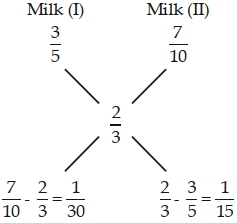
(B) In the first vessel,the fraction of milk is $\frac{3}{5}$.
In the second vessel,the fraction of milk is $\frac{7}{10}$.
In the final mixture,the fraction of milk is $\frac{2}{3}$.
Using the rule of alligation:
Difference $1$ (between second vessel and mixture) $= \frac{7}{10} - \frac{2}{3} = \frac{21-20}{30} = \frac{1}{30}$.
Difference $2$ (between mixture and first vessel) $= \frac{2}{3} - \frac{3}{5} = \frac{10-9}{15} = \frac{1}{15}$.
The required ratio is the ratio of these differences: $\frac{1}{30} : \frac{1}{15}$.
Multiplying both sides by $30$,we get $1 : 2$.
In the second vessel,the fraction of milk is $\frac{7}{10}$.
In the final mixture,the fraction of milk is $\frac{2}{3}$.
Using the rule of alligation:
Difference $1$ (between second vessel and mixture) $= \frac{7}{10} - \frac{2}{3} = \frac{21-20}{30} = \frac{1}{30}$.
Difference $2$ (between mixture and first vessel) $= \frac{2}{3} - \frac{3}{5} = \frac{10-9}{15} = \frac{1}{15}$.
The required ratio is the ratio of these differences: $\frac{1}{30} : \frac{1}{15}$.
Multiplying both sides by $30$,we get $1 : 2$.
0 likes
View Solution89
DifficultMCQ
$A$ can contains a mixture of two liquids $A$ and $B$ in the ratio $7:5$. When $9\,L$ of mixture is drained off and the can is filled with $B$,the ratio of $A$ and $B$ becomes $7:9$. How many litres of liquid $A$ was contained by the can initially?
A
$10$
B
$20$
C
$21$
D
$25$
Solution
(C) Let the initial quantity of liquid $A$ be $7x$ and liquid $B$ be $5x$. Total quantity $= 12x$.
When $9\,L$ of mixture is removed,the amount of $A$ removed is $\frac{7}{12} \times 9 = \frac{21}{4}\,L$ and the amount of $B$ removed is $\frac{5}{12} \times 9 = \frac{15}{4}\,L$.
Remaining $A = 7x - \frac{21}{4}$.
Remaining $B = 5x - \frac{15}{4}$.
After adding $9\,L$ of liquid $B$,the new ratio is $\frac{7x - 21/4}{5x - 15/4 + 9} = \frac{7}{9}$.
$\frac{28x - 21}{20x - 15 + 36} = \frac{7}{9} \Rightarrow \frac{28x - 21}{20x + 21} = \frac{7}{9}$.
Dividing the numerator by $7$: $\frac{4x - 3}{20x + 21} = \frac{1}{9}$.
$36x - 27 = 20x + 21 \Rightarrow 16x = 48 \Rightarrow x = 3$.
Initial quantity of liquid $A = 7x = 7 \times 3 = 21\,L$.
When $9\,L$ of mixture is removed,the amount of $A$ removed is $\frac{7}{12} \times 9 = \frac{21}{4}\,L$ and the amount of $B$ removed is $\frac{5}{12} \times 9 = \frac{15}{4}\,L$.
Remaining $A = 7x - \frac{21}{4}$.
Remaining $B = 5x - \frac{15}{4}$.
After adding $9\,L$ of liquid $B$,the new ratio is $\frac{7x - 21/4}{5x - 15/4 + 9} = \frac{7}{9}$.
$\frac{28x - 21}{20x - 15 + 36} = \frac{7}{9} \Rightarrow \frac{28x - 21}{20x + 21} = \frac{7}{9}$.
Dividing the numerator by $7$: $\frac{4x - 3}{20x + 21} = \frac{1}{9}$.
$36x - 27 = 20x + 21 \Rightarrow 16x = 48 \Rightarrow x = 3$.
Initial quantity of liquid $A = 7x = 7 \times 3 = 21\,L$.
0 likes
View Solution90
MediumMCQ
Vessels $A$ and $B$ contain acid and water in the ratios $4:3$ and $5:3$ respectively. In what ratio must these mixtures be mixed to obtain a new mixture in vessel $C$ containing acid and water in the ratio $3:2$?
A
$5:8$
B
$7:8$
C
$7:5$
D
$4:7$
Solution
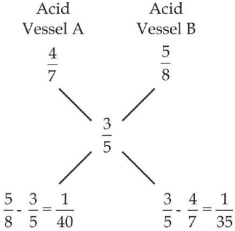
(B) Let the fraction of acid in vessel $A$ be $\frac{4}{7}$ and in vessel $B$ be $\frac{5}{8}$.
The fraction of acid in the final mixture in vessel $C$ is $\frac{3}{5}$.
Using the rule of alligation:
Ratio of $A$ to $B = \left| \frac{5}{8} - \frac{3}{5} \right| : \left| \frac{3}{5} - \frac{4}{7} \right|$
$= \left| \frac{25 - 24}{40} \right| : \left| \frac{21 - 20}{35} \right|$
$= \frac{1}{40} : \frac{1}{35}$
$= 35 : 40 = 7 : 8$.
Thus,the mixtures must be mixed in the ratio $7:8$.
The fraction of acid in the final mixture in vessel $C$ is $\frac{3}{5}$.
Using the rule of alligation:
Ratio of $A$ to $B = \left| \frac{5}{8} - \frac{3}{5} \right| : \left| \frac{3}{5} - \frac{4}{7} \right|$
$= \left| \frac{25 - 24}{40} \right| : \left| \frac{21 - 20}{35} \right|$
$= \frac{1}{40} : \frac{1}{35}$
$= 35 : 40 = 7 : 8$.
Thus,the mixtures must be mixed in the ratio $7:8$.
0 likes
View Solution91
MediumMCQ
Acid and water are mixed in a vessel $A$ in the ratio of $5:2$ and in the vessel $B$ in the ratio $8:5$. In what proportion should quantities be taken out from the two vessels so as to form a mixture in which the acid and water will be in the ratio of $9:4$?
A
$7:2$
B
$2:7$
C
$7:4$
D
$2:3$
Solution
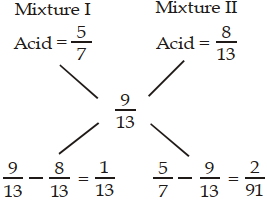
(A) In vessel $A$,the fraction of acid is $\frac{5}{7}$.
In vessel $B$,the fraction of acid is $\frac{8}{13}$.
The required mixture should have an acid fraction of $\frac{9}{13+4} = \frac{9}{13}$.
Using the rule of alligation:
Ratio of quantities = (Difference between acid in $B$ and mean) : (Difference between mean and acid in $A$)
Ratio = $|\frac{9}{13} - \frac{8}{13}| : |\frac{5}{7} - \frac{9}{13}|$
Ratio = $\frac{1}{13} : |\frac{65-63}{91}| = \frac{1}{13} : \frac{2}{91}$
To simplify,multiply both sides by $91$:
Ratio = $(\frac{1}{13} \times 91) : (\frac{2}{91} \times 91) = 7 : 2$.
In vessel $B$,the fraction of acid is $\frac{8}{13}$.
The required mixture should have an acid fraction of $\frac{9}{13+4} = \frac{9}{13}$.
Using the rule of alligation:
Ratio of quantities = (Difference between acid in $B$ and mean) : (Difference between mean and acid in $A$)
Ratio = $|\frac{9}{13} - \frac{8}{13}| : |\frac{5}{7} - \frac{9}{13}|$
Ratio = $\frac{1}{13} : |\frac{65-63}{91}| = \frac{1}{13} : \frac{2}{91}$
To simplify,multiply both sides by $91$:
Ratio = $(\frac{1}{13} \times 91) : (\frac{2}{91} \times 91) = 7 : 2$.
0 likes
View Solution92
DifficultMCQ
The acid and water in two vessels $A$ and $B$ are in the ratio $4:3$ and $2:3$. In what ratio should the liquids in both the vessels be mixed to obtain a new mixture in vessel $C$ containing half acid and half water?
A
$7:5$
B
$5:7$
C
$7:3$
D
$5:3$
Solution
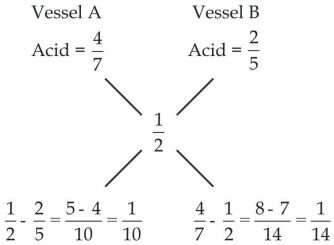
(A) In vessel $A$,the fraction of acid is $\frac{4}{7}$.
In vessel $B$,the fraction of acid is $\frac{2}{5}$.
The target mixture in vessel $C$ should have half acid,so the fraction is $\frac{1}{2}$.
Using the rule of alligation:
Ratio of vessel $A$ to vessel $B = (\frac{1}{2} - \frac{2}{5}) : (\frac{4}{7} - \frac{1}{2})$
$= (\frac{5-4}{10}) : (\frac{8-7}{14})$
$= \frac{1}{10} : \frac{1}{14}$
$= 14 : 10$
$= 7 : 5$
Thus,the required ratio is $7:5$.
In vessel $B$,the fraction of acid is $\frac{2}{5}$.
The target mixture in vessel $C$ should have half acid,so the fraction is $\frac{1}{2}$.
Using the rule of alligation:
Ratio of vessel $A$ to vessel $B = (\frac{1}{2} - \frac{2}{5}) : (\frac{4}{7} - \frac{1}{2})$
$= (\frac{5-4}{10}) : (\frac{8-7}{14})$
$= \frac{1}{10} : \frac{1}{14}$
$= 14 : 10$
$= 7 : 5$
Thus,the required ratio is $7:5$.
0 likes
View Solution93
DifficultMCQ
$A$ mixture contains wine and water in the ratio $3:2$ and another mixture contains them in the ratio $4:5$. How many litres of the latter must be mixed with $3 \, L$ of the former so that the resulting mixture may contain equal quantities of the wine and water? (in $L$)
A
$5 \frac{2}{5}$
B
$5 \frac{2}{3}$
C
$4 \frac{1}{2}$
D
$3 \frac{3}{4}$
Solution
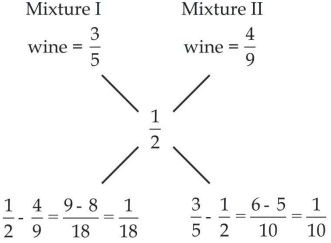
(A) Let the concentration of wine in the first mixture be $\frac{3}{5}$ and in the second mixture be $\frac{4}{9}$.
We want the final mixture to have equal quantities of wine and water,so the concentration of wine in the final mixture should be $\frac{1}{2}$.
Using the rule of alligation:
Ratio of first mixture to second mixture $= |\frac{4}{9} - \frac{1}{2}| : |\frac{3}{5} - \frac{1}{2}|$
$= |\frac{8-9}{18}| : |\frac{6-5}{10}| = \frac{1}{18} : \frac{1}{10} = 10 : 18 = 5 : 9$.
Given that $3 \, L$ of the first mixture is used,let $x$ be the quantity of the second mixture.
$\frac{5}{9} = \frac{3}{x}$
$5x = 27$
$x = \frac{27}{5} = 5 \frac{2}{5} \, L$.
We want the final mixture to have equal quantities of wine and water,so the concentration of wine in the final mixture should be $\frac{1}{2}$.
Using the rule of alligation:
Ratio of first mixture to second mixture $= |\frac{4}{9} - \frac{1}{2}| : |\frac{3}{5} - \frac{1}{2}|$
$= |\frac{8-9}{18}| : |\frac{6-5}{10}| = \frac{1}{18} : \frac{1}{10} = 10 : 18 = 5 : 9$.
Given that $3 \, L$ of the first mixture is used,let $x$ be the quantity of the second mixture.
$\frac{5}{9} = \frac{3}{x}$
$5x = 27$
$x = \frac{27}{5} = 5 \frac{2}{5} \, L$.
0 likes
View Solution94
DifficultMCQ
In the first alloy,zinc and copper are in the ratio $1:2.$ In the second alloy,the same elements are in the ratio $2:3.$ If these two alloys are mixed to form a new alloy in which the two elements are in the ratio $5:8,$ the ratio of these two alloys in the new alloy is
A
$3:10$
B
$3:7$
C
$10:3$
D
$7:3$
Solution
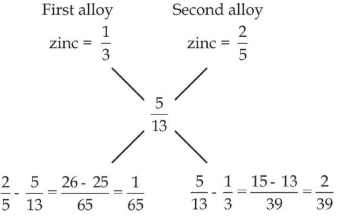
(A) Let the fraction of zinc in the first alloy be $\frac{1}{1+2} = \frac{1}{3}.$
Let the fraction of zinc in the second alloy be $\frac{2}{2+3} = \frac{2}{5}.$
Let the fraction of zinc in the final alloy be $\frac{5}{5+8} = \frac{5}{13}.$
Using the rule of alligation:
Ratio of alloys = $\left| \frac{2}{5} - \frac{5}{13} \right| : \left| \frac{5}{13} - \frac{1}{3} \right|$
$= \left| \frac{26-25}{65} \right| : \left| \frac{15-13}{39} \right|$
$= \frac{1}{65} : \frac{2}{39}$
$= \frac{1}{5 \times 13} : \frac{2}{3 \times 13}$
$= \frac{1}{5} : \frac{2}{3} = 3 : 10.$
Let the fraction of zinc in the second alloy be $\frac{2}{2+3} = \frac{2}{5}.$
Let the fraction of zinc in the final alloy be $\frac{5}{5+8} = \frac{5}{13}.$
Using the rule of alligation:
Ratio of alloys = $\left| \frac{2}{5} - \frac{5}{13} \right| : \left| \frac{5}{13} - \frac{1}{3} \right|$
$= \left| \frac{26-25}{65} \right| : \left| \frac{15-13}{39} \right|$
$= \frac{1}{65} : \frac{2}{39}$
$= \frac{1}{5 \times 13} : \frac{2}{3 \times 13}$
$= \frac{1}{5} : \frac{2}{3} = 3 : 10.$
0 likes
View Solution95
MediumMCQ
$A$ and $B$ are two alloys of gold and copper prepared by mixing metals in the ratio $5:3$ and $5:11,$ respectively. Equal quantities of these alloys are melted to form a third alloy $C.$ The ratio of gold and copper in the alloy $C$ is
A
$25:33$
B
$33:25$
C
$15:17$
D
$17:15$
Solution
(C) In alloy $A,$ the ratio of gold to copper is $5:3.$ The total parts are $5+3 = 8.$
In alloy $B,$ the ratio of gold to copper is $5:11.$ The total parts are $5+11 = 16.$
To mix equal quantities,we make the total parts equal. The least common multiple of $8$ and $16$ is $16.$
For alloy $A,$ multiply the ratio by $2$: $(5 \times 2) : (3 \times 2) = 10:6.$
For alloy $B,$ the ratio remains $5:11.$
When equal quantities are melted to form alloy $C,$ the total gold is $10 + 5 = 15$ and the total copper is $6 + 11 = 17.$
Therefore,the ratio of gold to copper in alloy $C$ is $15:17.$
In alloy $B,$ the ratio of gold to copper is $5:11.$ The total parts are $5+11 = 16.$
To mix equal quantities,we make the total parts equal. The least common multiple of $8$ and $16$ is $16.$
For alloy $A,$ multiply the ratio by $2$: $(5 \times 2) : (3 \times 2) = 10:6.$
For alloy $B,$ the ratio remains $5:11.$
When equal quantities are melted to form alloy $C,$ the total gold is $10 + 5 = 15$ and the total copper is $6 + 11 = 17.$
Therefore,the ratio of gold to copper in alloy $C$ is $15:17.$
0 likes
View Solution96
MediumMCQ
Two types of alloys contain gold and silver in the ratio of $7: 22$ and $21: 37.$ In what ratio should these alloys be mixed,so as to have a new alloy in which gold and silver would exist in the ratio $25: 62?$
A
$13:8$
B
$8:13$
C
$13:12$
D
$6:9$
Solution
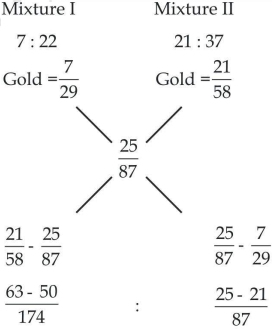
(A) Let us consider the fraction of gold in each alloy.
In the first alloy,the ratio of gold to silver is $7: 22$,so the fraction of gold is $\frac{7}{7+22} = \frac{7}{29}$.
In the second alloy,the ratio of gold to silver is $21: 37$,so the fraction of gold is $\frac{21}{21+37} = \frac{21}{58}$.
In the final mixture,the ratio of gold to silver is $25: 62$,so the fraction of gold is $\frac{25}{25+62} = \frac{25}{87}$.
Using the rule of alligation:
Ratio of first alloy to second alloy = $\left| \frac{21}{58} - \frac{25}{87} \right| : \left| \frac{25}{87} - \frac{7}{29} \right|$
$= \left| \frac{63 - 50}{174} \right| : \left| \frac{25 - 21}{87} \right|$
$= \frac{13}{174} : \frac{4}{87}$
$= \frac{13}{174} : \frac{8}{174}$
$= 13: 8$.
In the first alloy,the ratio of gold to silver is $7: 22$,so the fraction of gold is $\frac{7}{7+22} = \frac{7}{29}$.
In the second alloy,the ratio of gold to silver is $21: 37$,so the fraction of gold is $\frac{21}{21+37} = \frac{21}{58}$.
In the final mixture,the ratio of gold to silver is $25: 62$,so the fraction of gold is $\frac{25}{25+62} = \frac{25}{87}$.
Using the rule of alligation:
Ratio of first alloy to second alloy = $\left| \frac{21}{58} - \frac{25}{87} \right| : \left| \frac{25}{87} - \frac{7}{29} \right|$
$= \left| \frac{63 - 50}{174} \right| : \left| \frac{25 - 21}{87} \right|$
$= \frac{13}{174} : \frac{4}{87}$
$= \frac{13}{174} : \frac{8}{174}$
$= 13: 8$.
0 likes
View Solution97
MediumMCQ
Pure milk costs $16 / L$. After adding water,the milkman sells the mixture at $15 / L$ and thereby makes a profit of $25 \%$. In what respective ratio does he mix milk with water?
A
$3:1$
B
$4:3$
C
$3:2$
D
$5:3$
Solution
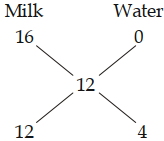
(A) Let the cost price of pure milk be $CP_m = 16 / L$ and the cost price of water be $CP_w = 0 / L$.
The selling price of the mixture is $SP = 15 / L$ with a profit of $25 \%$.
The cost price of the mixture $(CP_{mix})$ is calculated as:
$CP_{mix} = \frac{SP}{1 + \text{Profit}\%} = \frac{15}{1 + 0.25} = \frac{15}{1.25} = 12 / L$.
Using the rule of alligation:
Milk $(16)$ : Water $(0)$
Mean price = $12$
Difference (Milk side) = $|12 - 0| = 12$
Difference (Water side) = $|16 - 12| = 4$
Ratio of Milk to Water = $12 : 4 = 3 : 1$.
The selling price of the mixture is $SP = 15 / L$ with a profit of $25 \%$.
The cost price of the mixture $(CP_{mix})$ is calculated as:
$CP_{mix} = \frac{SP}{1 + \text{Profit}\%} = \frac{15}{1 + 0.25} = \frac{15}{1.25} = 12 / L$.
Using the rule of alligation:
Milk $(16)$ : Water $(0)$
Mean price = $12$
Difference (Milk side) = $|12 - 0| = 12$
Difference (Water side) = $|16 - 12| = 4$
Ratio of Milk to Water = $12 : 4 = 3 : 1$.
0 likes
View Solution98
MediumMCQ
The ratio in which two sugar solutions of the concentrations $15 \%$ and $40 \%$ are to be mixed to get a solution of concentration of $30 \%$ is
A
$2:3$
B
$3:2$
C
$8:9$
D
$9:8$
Solution
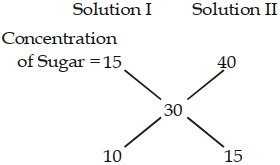
(A) Using the rule of alligation:
Concentration of first solution $= 15 \%$
Concentration of second solution $= 40 \%$
Mean concentration required $= 30 \%$
By alligation method:
Difference between second concentration and mean $= 40 - 30 = 10$
Difference between mean and first concentration $= 30 - 15 = 15$
Ratio of first solution to second solution $= 10 : 15 = 2 : 3$.
Concentration of first solution $= 15 \%$
Concentration of second solution $= 40 \%$
Mean concentration required $= 30 \%$
By alligation method:
Difference between second concentration and mean $= 40 - 30 = 10$
Difference between mean and first concentration $= 30 - 15 = 15$
Ratio of first solution to second solution $= 10 : 15 = 2 : 3$.
0 likes
View Solution99
MediumMCQ
Milk and water in a mixture are in the ratio $7:5$. When $15 \, L$ of water is added to it,the ratio of milk and water in the new mixture becomes $7:8$. The total quantity of water in the new mixture is........$L$
A
$35$
B
$40$
C
$60$
D
$96$
Solution
(B) Let the initial quantity of milk be $7x$ and water be $5x$.
According to the problem,when $15 \, L$ of water is added,the new ratio becomes $7:8$.
Therefore,the equation is: $\frac{7x}{5x + 15} = \frac{7}{8}$.
Cross-multiplying,we get: $7x \times 8 = 7(5x + 15)$.
Dividing both sides by $7$: $8x = 5x + 15$.
Subtracting $5x$ from both sides: $3x = 15$,which gives $x = 5$.
The initial quantity of water was $5x = 5 \times 5 = 25 \, L$.
The new quantity of water in the mixture is $25 \, L + 15 \, L = 40 \, L$.
According to the problem,when $15 \, L$ of water is added,the new ratio becomes $7:8$.
Therefore,the equation is: $\frac{7x}{5x + 15} = \frac{7}{8}$.
Cross-multiplying,we get: $7x \times 8 = 7(5x + 15)$.
Dividing both sides by $7$: $8x = 5x + 15$.
Subtracting $5x$ from both sides: $3x = 15$,which gives $x = 5$.
The initial quantity of water was $5x = 5 \times 5 = 25 \, L$.
The new quantity of water in the mixture is $25 \, L + 15 \, L = 40 \, L$.
0 likes
View Solution100
EasyMCQ
The ratio of milk and water in mixtures of four containers are $5:3, 2:1, 3:2$ and $7:4$ respectively. In which container is the quantity of milk,relative to water,minimum?
A
First
B
Second
C
Third
D
Fourth
Solution
(C) To find the container with the minimum quantity of milk relative to water,we calculate the fraction of milk in each mixture:
$1$. First container: $\frac{5}{5+3} = \frac{5}{8} = 0.625$
$2$. Second container: $\frac{2}{2+1} = \frac{2}{3} \approx 0.666$
$3$. Third container: $\frac{3}{3+2} = \frac{3}{5} = 0.600$
$4$. Fourth container: $\frac{7}{7+4} = \frac{7}{11} \approx 0.636$
Comparing the values: $0.600 < 0.625 < 0.636 < 0.666$.
Thus,the third container has the minimum quantity of milk relative to water.
$1$. First container: $\frac{5}{5+3} = \frac{5}{8} = 0.625$
$2$. Second container: $\frac{2}{2+1} = \frac{2}{3} \approx 0.666$
$3$. Third container: $\frac{3}{3+2} = \frac{3}{5} = 0.600$
$4$. Fourth container: $\frac{7}{7+4} = \frac{7}{11} \approx 0.636$
Comparing the values: $0.600 < 0.625 < 0.636 < 0.666$.
Thus,the third container has the minimum quantity of milk relative to water.
0 likes
View SolutionMixture and Alligation — Mixture and Alligation · Frequently Asked Questions
1Are these Mixture and Alligation questions useful for JEE and NEET?
Yes. All questions in this section are mapped to JEE Main and NEET exam patterns. Previous year questions from JEE Main, NEET, GUJCET and state-level exams are included with full solutions.
2Can I switch to Hindi or Gujarati for these questions?
Yes. Use the language tabs in the hero section or the sidebar to view the same questions and solutions in English, Hindi or Gujarati.
3How do I generate a question paper from this subtopic?
Use the Vedclass Exam Paper Generator — select the chapter and subtopic, set difficulty, and generate Sets A, B, C, D automatically. First 3 chapters of every subject are free.
Vedclass Products
For Students
Vedclass Test Series
Mock tests in real JEE/NEET style with performance analysis. 5-day free trial.
Start Free TrialFor Teachers
Exam Paper Generator
Generate Set A/B/C/D papers from this chapter in 2 minutes. 3 chapters free.
Try FreeFor Institutes
Online Exam Module
Live online exams with unlimited students, 360° analytics & white-label branding.
See DemoFor Teachers & Institutes
Generate a Mixture and Alligation Exam Paper in 2 Minutes
Select subtopic & difficulty — Sets A, B, C, D auto-generated with No Repeat logic.
First 3 chapters of every subject are free — no payment required.